Cambridge IGCSE Sociology 0495 — 2025 Oct/Nov Paper 1 · Variant 2
0495/12/O/N/25 · 80 marks · 120 min
The question paper and its mark scheme, free to read here and free to download. This is Cambridge’s own paper, exactly as it was sat.
Question paper8 pages




Mark scheme26 pages
Answers below. Sit the paper first if you are practising.
Paper as text
Question paper, page 1
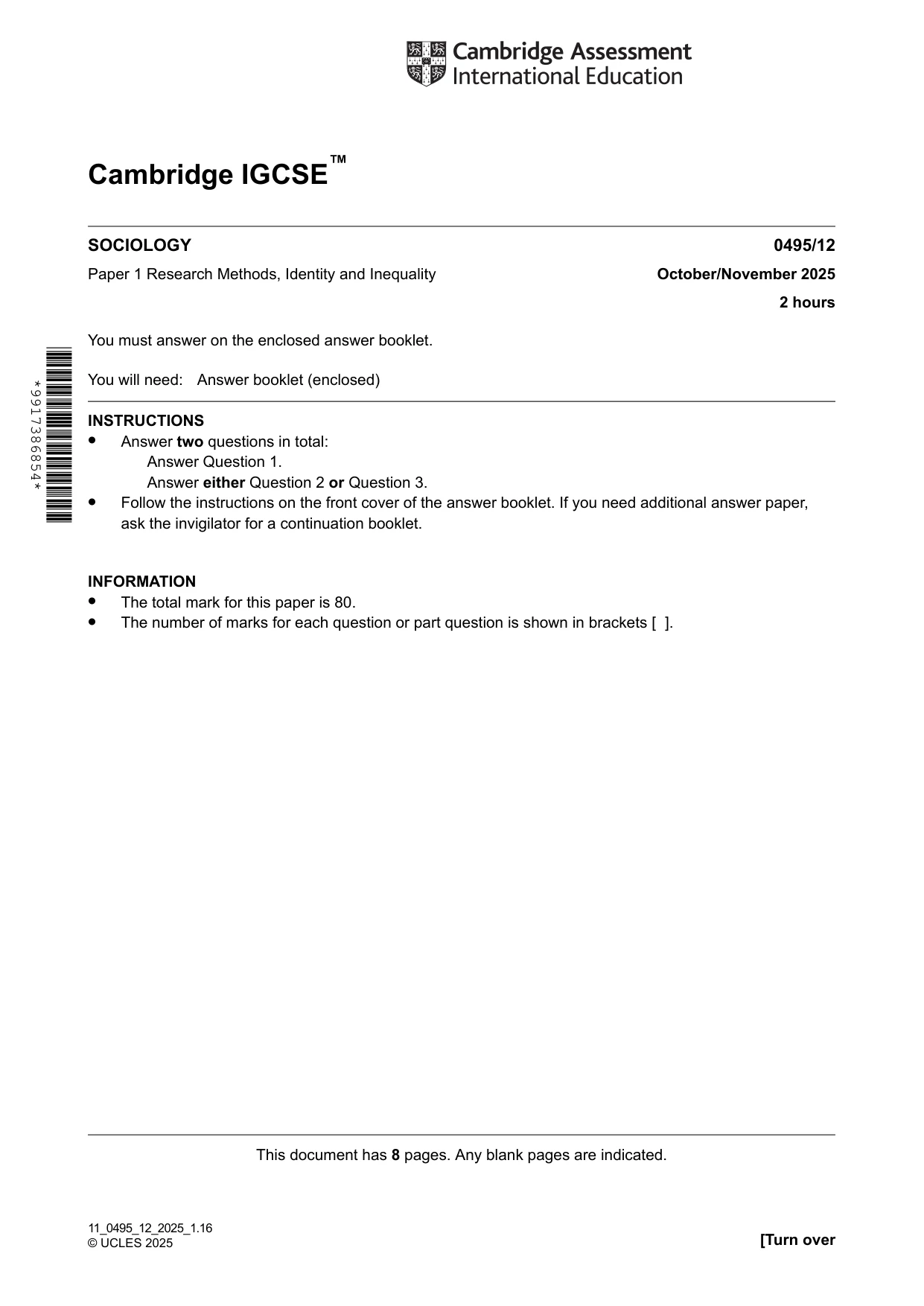
Cambridge IGCSE™ 0495/12 October/November 2025 2 hours SOCIOLOGY Paper 1 Research Methods, Identity and Inequality You must answer on the enclosed answer booklet. You will need: Answer booklet (enclosed) INSTRUCTIONS • Answer two questions in total: Answer Question 1. Answer either Question 2 or Question 3. • Follow the instructions on the front cover of the answer booklet. If you need additional answer paper, ask the invigilator for a continuation booklet. INFORMATION • The total mark for this paper is 80. • The number of marks for each question or part question is shown in brackets [ ]. This document has 8 pages. Any blank pages are indicated. [Turn over 11_0495_12_2025_1.16 © UCLES 2025 *9917386854*
Question paper, page 2
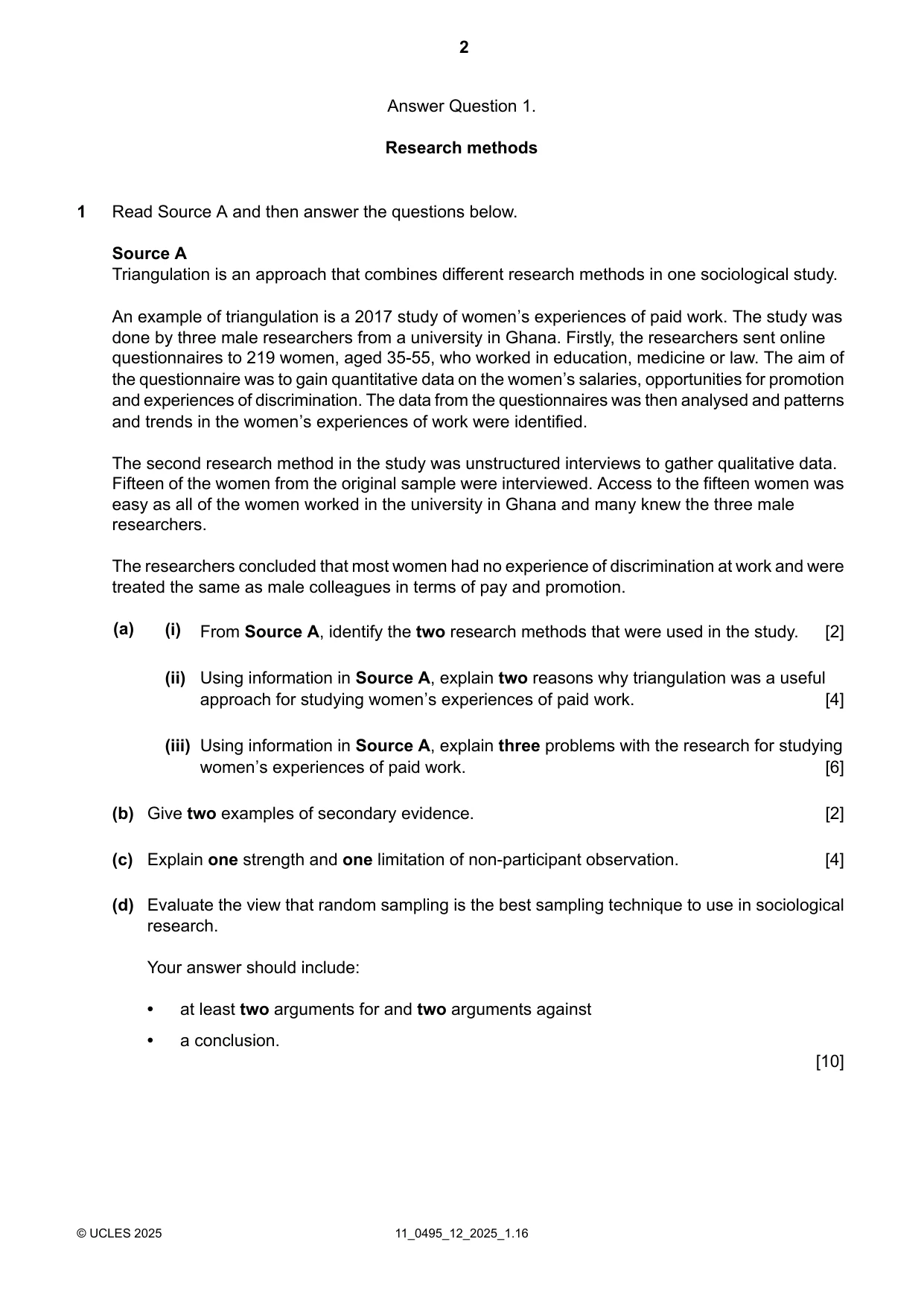
Answer Question 1. Research methods Read Source A and then answer the questions below. 1 Source A Triangulation is an approach that combines different research methods in one sociological study. An example of triangulation is a 2017 study of women’s experiences of paid work. The study was done by three male researchers from a university in Ghana. Firstly, the researchers sent online questionnaires to 219 women, aged 35-55, who worked in education, medicine or law. The aim of the questionnaire was to gain quantitative data on the women’s salaries, opportunities for promotion and experiences of discrimination. The data from the questionnaires was then analysed and patterns and trends in the women’s experiences of work were identified. The second research method in the study was unstructured interviews to gather qualitative data. Fifteen of the women from the original sample were interviewed. Access to the fifteen women was easy as all of the women worked in the university in Ghana and many knew the three male researchers. The researchers concluded that most women had no experience of discrimination at work and were treated the same as male colleagues in terms of pay and promotion. (a) From Source A, identify the two research methods that were used in the study. [2] (i) Using information in Source A, explain two reasons why triangulation was a useful approach for studying women’s experiences of paid work. [4] (ii) Using information in Source A, explain three problems with the research for studying women’s experiences of paid work. [6] (iii) Give two examples of secondary evidence. [2] (b) Explain one strength and one limitation of non-participant observation. [4] (c) Evaluate the view that random sampling is the best sampling technique to use in sociological research. Your answer should include: (d) • at least two arguments for and two arguments against • a conclusion. [10] 11_0495_12_2025_1.16 © UCLES 2025 2
Question paper, page 3
Explain the research methods and evidence that you would choose to investigate why people migrate from one country to another. Give reasons for your choices. Your answer should include: (e) • two primary methods with relevant sampling • one source of secondary evidence. [12] [Turn over 11_0495_12_2025_1.16 © UCLES 2025 3
Question paper, page 4
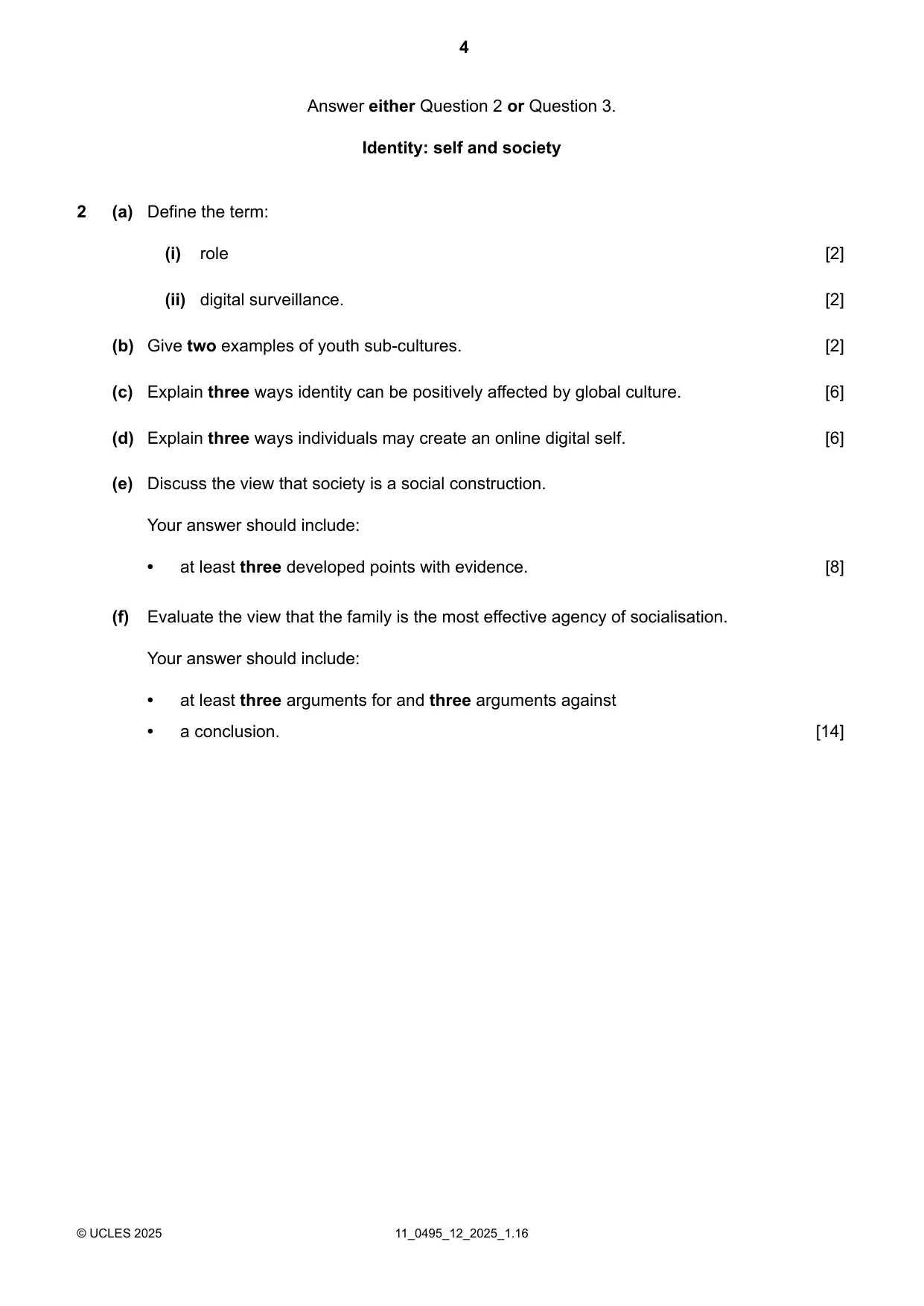
Answer either Question 2 or Question 3. Identity: self and society Define the term: (a) 2 role [2] (i) digital surveillance. [2] (ii) Give two examples of youth sub-cultures. [2] (b) Explain three ways identity can be positively affected by global culture. [6] (c) Explain three ways individuals may create an online digital self. [6] (d) Discuss the view that society is a social construction. Your answer should include: (e) • at least three developed points with evidence. [8] Evaluate the view that the family is the most effective agency of socialisation. Your answer should include: (f) • at least three arguments for and three arguments against • a conclusion. [14] 11_0495_12_2025_1.16 © UCLES 2025 4
Question paper, page 5
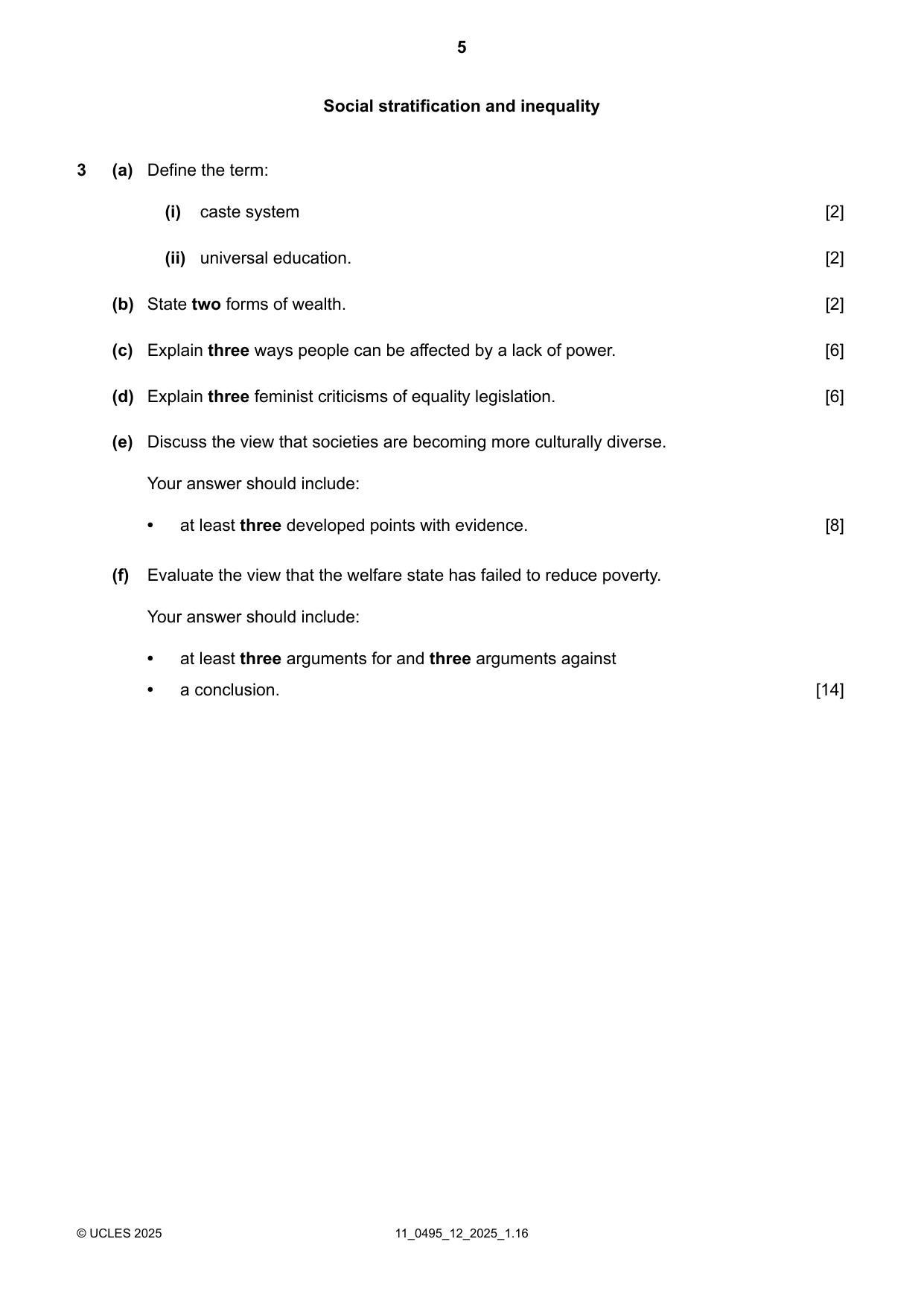
Social stratification and inequality Define the term: (a) 3 caste system [2] (i) universal education. [2] (ii) State two forms of wealth. [2] (b) Explain three ways people can be affected by a lack of power. [6] (c) Explain three feminist criticisms of equality legislation. [6] (d) Discuss the view that societies are becoming more culturally diverse. Your answer should include: (e) • at least three developed points with evidence. [8] Evaluate the view that the welfare state has failed to reduce poverty. Your answer should include: (f) • at least three arguments for and three arguments against • a conclusion. [14] 11_0495_12_2025_1.16 © UCLES 2025 5
Question paper, page 6
BLANK PAGE 11_0495_12_2025_1.16 © UCLES 2025 6
Question paper, page 7
BLANK PAGE 11_0495_12_2025_1.16 © UCLES 2025 7
Question paper, page 8
BLANK PAGE Permission to reproduce items where third-party owned material protected by copyright is included has been sought and cleared where possible. Every reasonable effort has been made by the publisher (UCLES) to trace copyright holders, but if any items requiring clearance have unwittingly been included, the publisher will be pleased to make amends at the earliest possible opportunity. To avoid the issue of disclosure of answer-related information to candidates, all copyright acknowledgements are reproduced online in the Cambridge Assessment International Education Copyright Acknowledgements Booklet. This is produced for each series of examinations and is freely available to download at www.cambridgeinternational.org after the live examination series. Cambridge Assessment International Education is part of Cambridge Assessment. Cambridge Assessment is the brand name of the University of Cambridge Local Examinations Syndicate (UCLES), which is a department of the University of Cambridge. 11_0495_12_2025_1.16 © UCLES 2025 8
Mark scheme, page 1
This document consists of 26 printed pages. © Cambridge University Press & Assessment 2025 [Turn over Cambridge IGCSE™ SOCIOLOGY 0495/12 Paper 1 Research Methods, Identity and Inequality October/November 2025 MARK SCHEME Maximum Mark: 80 Published This mark scheme is published as an aid to teachers and candidates, to indicate the requirements of the examination. It shows the basis on which Examiners were instructed to award marks. It does not indicate the details of the discussions that took place at an Examiners’ meeting before marking began, which would have considered the acceptability of alternative answers. Mark schemes should be read in conjunction with the question paper and the Principal Examiner Report for Teachers. Cambridge International will not enter into discussions about these mark schemes. Cambridge International is publishing the mark schemes for the October/November 2025 series for most Cambridge IGCSE, Cambridge International A and AS Level components, and some Cambridge O Level components.
Mark scheme, page 2
0495/12 Cambridge IGCSE – Mark Scheme PUBLISHED October/November 2025 © Cambridge University Press & Assessment 2025 Page 2 of 26 Generic Marking Principles These general marking principles must be applied by all examiners when marking candidate answers. They should be applied alongside the specific content of the mark scheme or generic level descriptions for a question. Each question paper and mark scheme will also comply with these marking principles. GENERIC MARKING PRINCIPLE 1: Marks must be awarded in line with: • the specific content of the mark scheme or the generic level descriptors for the question • the specific skills defined in the mark scheme or in the generic level descriptors for the question • the standard of response required by a candidate as exemplified by the standardisation scripts. GENERIC MARKING PRINCIPLE 2: Marks awarded are always whole marks (not half marks, or other fractions). GENERIC MARKING PRINCIPLE 3: Marks must be awarded positively: • marks are awarded for correct/valid answers, as defined in the mark scheme. However, credit is given for valid answers which go beyond the scope of the syllabus and mark scheme, referring to your Team Leader as appropriate • marks are awarded when candidates clearly demonstrate what they know and can do • marks are not deducted for errors • marks are not deducted for omissions • answers should only be judged on the quality of spelling, punctuation and grammar when these features are specifically assessed by the question as indicated by the mark scheme. The meaning, however, should be unambiguous. GENERIC MARKING PRINCIPLE 4: Rules must be applied consistently, e.g. in situations where candidates have not followed instructions or in the application of generic level descriptors. GENERIC MARKING PRINCIPLE 5: Marks should be awarded using the full range of marks defined in the mark scheme for the question (however; the use of the full mark range may be limited according to the quality of the candidate responses seen). GENERIC MARKING PRINCIPLE 6: Marks awarded are based solely on the requirements as defined in the mark scheme. Marks should not be awarded with grade thresholds or grade descriptors in mind.
Mark scheme, page 3
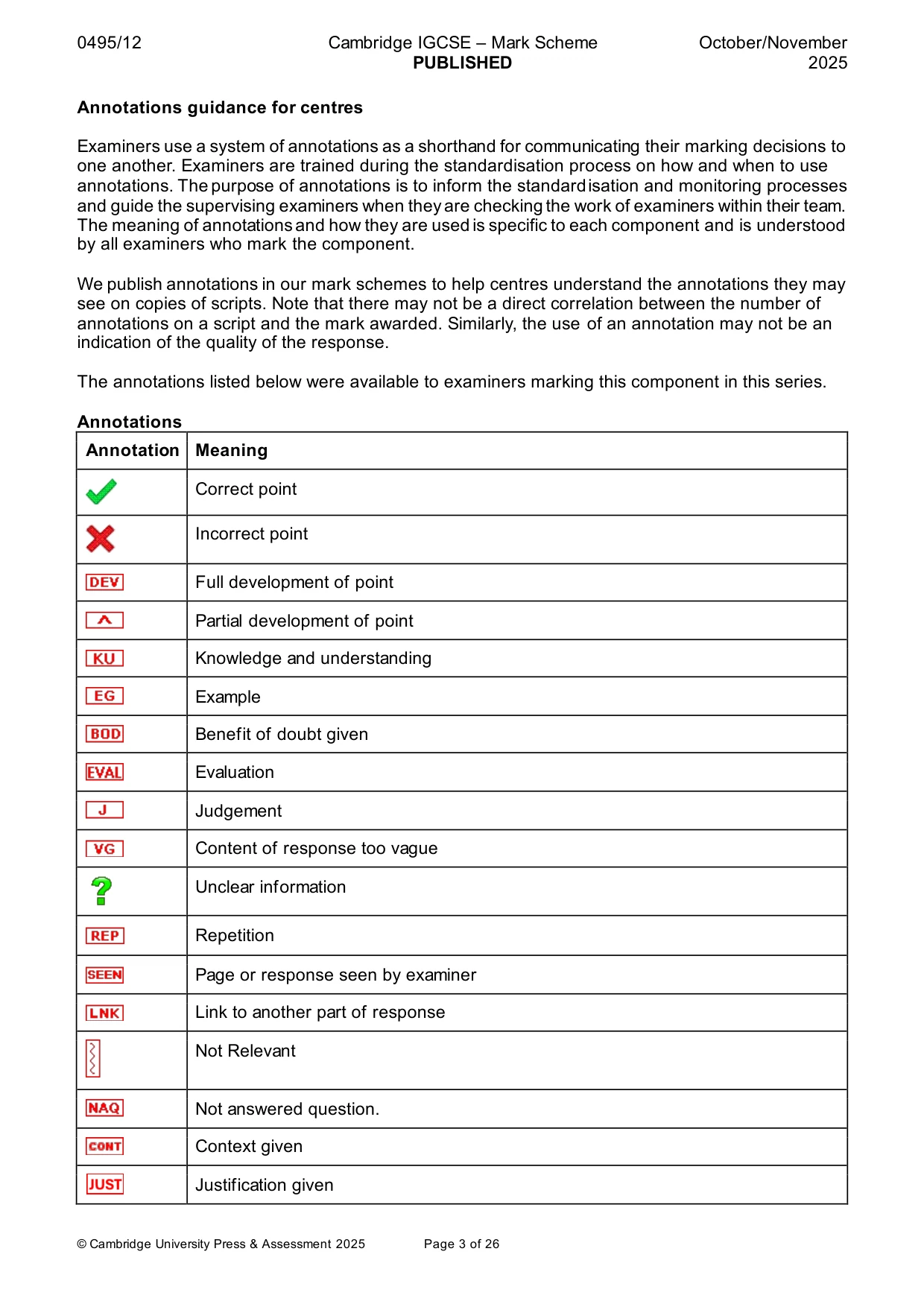
0495/12 Cambridge IGCSE – Mark Scheme PUBLISHED October/November 2025 © Cambridge University Press & Assessment 2025 Page 3 of 26 Annotations guidance for centres Examiners use a system of annotations as a shorthand for communicating their marking decisions to one another. Examiners are trained during the standardisation process on how and when to use annotations. The purpose of annotations is to inform the standardisation and monitoring processes and guide the supervising examiners when they are checking the work of examiners within their team. The meaning of annotations and how they are used is specific to each component and is understood by all examiners who mark the component. We publish annotations in our mark schemes to help centres understand the annotations they may see on copies of scripts. Note that there may not be a direct correlation between the number of annotations on a script and the mark awarded. Similarly, the use of an annotation may not be an indication of the quality of the response. The annotations listed below were available to examiners marking this component in this series. Annotations Annotation Meaning Correct point Incorrect point Full development of point Partial development of point Knowledge and understanding Example Benefit of doubt given Evaluation Judgement Content of response too vague Unclear information Repetition Page or response seen by examiner Link to another part of response Not Relevant Not answered question. Context given Justification given
Mark scheme, page 4
0495/12 Cambridge IGCSE – Mark Scheme PUBLISHED October/November 2025 © Cambridge University Press & Assessment 2025 Page 4 of 26 Assessment objectives AO1 Knowledge and understanding • Demonstrate knowledge and understanding of sociological concepts, theories, evidence, views and research methods. AO2 Interpretation and application • Apply relevant sociological concepts, theories, evidence, views and research methods to support points or develop arguments. • Explain how sociological concepts, theories, evidence, views and research methods apply to a particular issue or question. AO3 Analysis and evaluation • Analyse and evaluate sociological theories, evidence, views and research methods: explain the strengths and limitations of sociological theories, views and research methods construct, develop and discuss sociological arguments reach conclusions and make judgements based on a reasoned consideration of available evidence.
Mark scheme, page 5
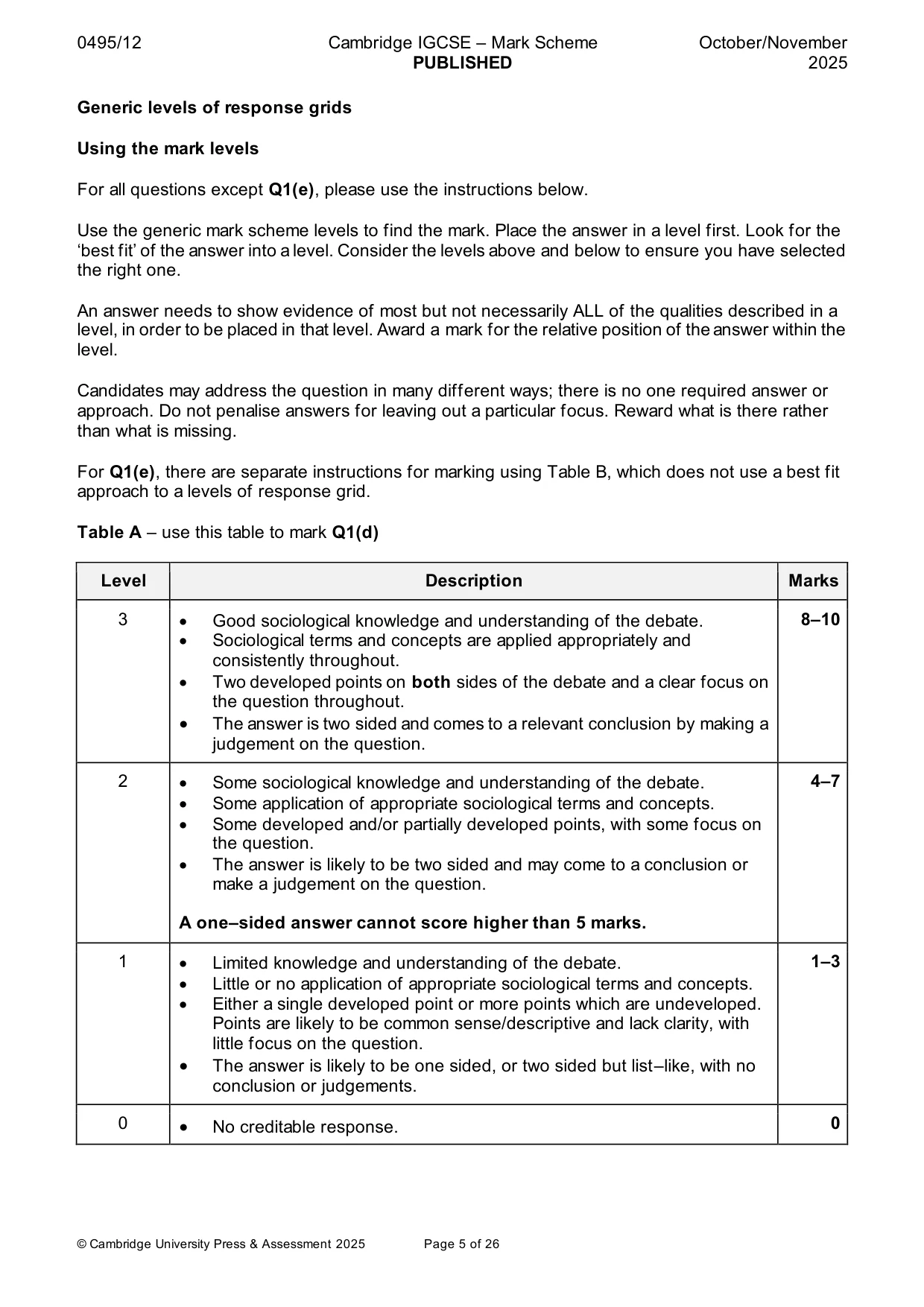
0495/12 Cambridge IGCSE – Mark Scheme PUBLISHED October/November 2025 © Cambridge University Press & Assessment 2025 Page 5 of 26 Generic levels of response grids Using the mark levels For all questions except Q1(e), please use the instructions below. Use the generic mark scheme levels to find the mark. Place the answer in a level first. Look for the ‘best fit’ of the answer into a level. Consider the levels above and below to ensure you have selected the right one. An answer needs to show evidence of most but not necessarily ALL of the qualities described in a level, in order to be placed in that level. Award a mark for the relative position of the answer within the level. Candidates may address the question in many different ways; there is no one required answer or approach. Do not penalise answers for leaving out a particular focus. Reward what is there rather than what is missing. For Q1(e), there are separate instructions for marking using Table B, which does not use a best fit approach to a levels of response grid. Table A – use this table to mark Q1(d) Level Description Marks 3 • Good sociological knowledge and understanding of the debate. • Sociological terms and concepts are applied appropriately and consistently throughout. • Two developed points on both sides of the debate and a clear focus on the question throughout. • The answer is two sided and comes to a relevant conclusion by making a judgement on the question. 8–10 2 • Some sociological knowledge and understanding of the debate. • Some application of appropriate sociological terms and concepts. • Some developed and/or partially developed points, with some focus on the question. • The answer is likely to be two sided and may come to a conclusion or make a judgement on the question. A one–sided answer cannot score higher than 5 marks. 4–7 1 • Limited knowledge and understanding of the debate. • Little or no application of appropriate sociological terms and concepts. • Either a single developed point or more points which are undeveloped. Points are likely to be common sense/descriptive and lack clarity, with little focus on the question. • The answer is likely to be one sided, or two sided but list–like, with no conclusion or judgements. 1–3 0 • No creditable response. 0
Mark scheme, page 6
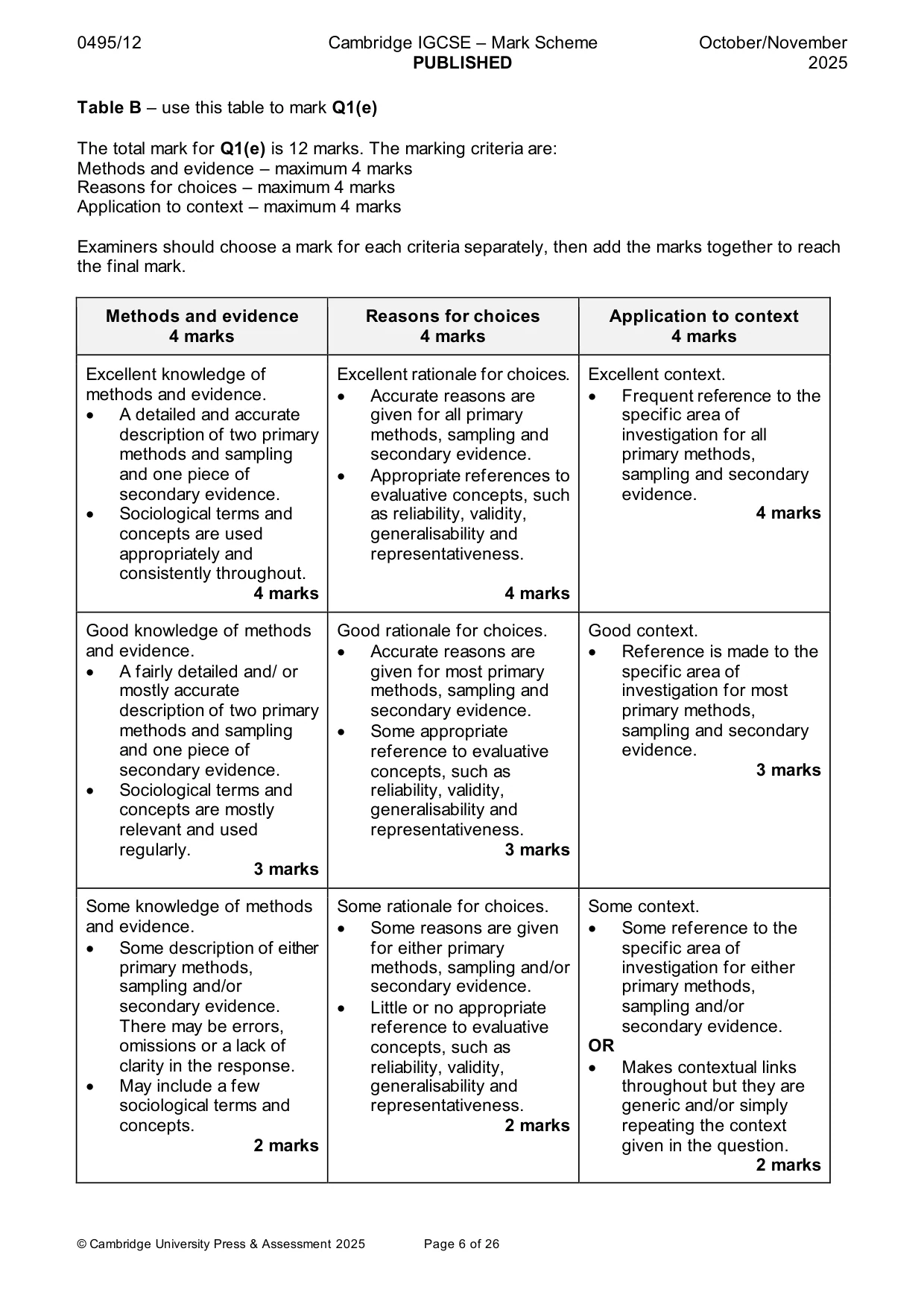
0495/12 Cambridge IGCSE – Mark Scheme PUBLISHED October/November 2025 © Cambridge University Press & Assessment 2025 Page 6 of 26 Table B – use this table to mark Q1(e) The total mark for Q1(e) is 12 marks. The marking criteria are: Methods and evidence – maximum 4 marks Reasons for choices – maximum 4 marks Application to context – maximum 4 marks Examiners should choose a mark for each criteria separately, then add the marks together to reach the final mark. Methods and evidence 4 marks Reasons for choices 4 marks Application to context 4 marks Excellent knowledge of methods and evidence. • A detailed and accurate description of two primary methods and sampling and one piece of secondary evidence. • Sociological terms and concepts are used appropriately and consistently throughout. 4 marks Excellent rationale for choices. • Accurate reasons are given for all primary methods, sampling and secondary evidence. • Appropriate references to evaluative concepts, such as reliability, validity, generalisability and representativeness. 4 marks Excellent context. • Frequent reference to the specific area of investigation for all primary methods, sampling and secondary evidence. 4 marks Good knowledge of methods and evidence. • A fairly detailed and/ or mostly accurate description of two primary methods and sampling and one piece of secondary evidence. • Sociological terms and concepts are mostly relevant and used regularly. 3 marks Good rationale for choices. • Accurate reasons are given for most primary methods, sampling and secondary evidence. • Some appropriate reference to evaluative concepts, such as reliability, validity, generalisability and representativeness. 3 marks Good context. • Reference is made to the specific area of investigation for most primary methods, sampling and secondary evidence. 3 marks Some knowledge of methods and evidence. • Some description of either primary methods, sampling and/or secondary evidence. There may be errors, omissions or a lack of clarity in the response. • May include a few sociological terms and concepts. 2 marks Some rationale for choices. • Some reasons are given for either primary methods, sampling and/or secondary evidence. • Little or no appropriate reference to evaluative concepts, such as reliability, validity, generalisability and representativeness. 2 marks Some context. • Some reference to the specific area of investigation for either primary methods, sampling and/or secondary evidence. OR • Makes contextual links throughout but they are generic and/or simply repeating the context given in the question. 2 marks
Mark scheme, page 7
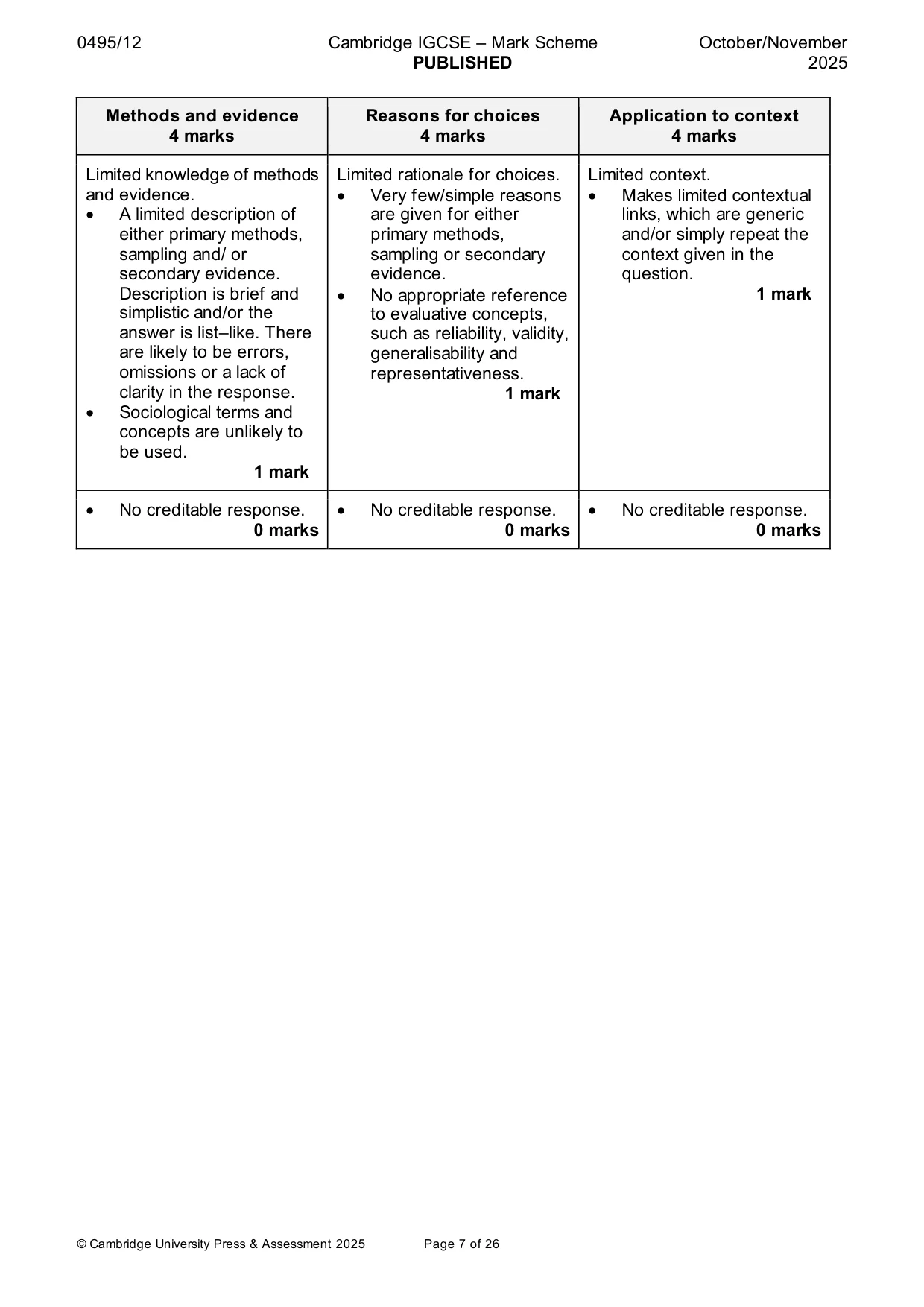
0495/12 Cambridge IGCSE – Mark Scheme PUBLISHED October/November 2025 © Cambridge University Press & Assessment 2025 Page 7 of 26 Methods and evidence 4 marks Reasons for choices 4 marks Application to context 4 marks Limited knowledge of methods and evidence. • A limited description of either primary methods, sampling and/ or secondary evidence. Description is brief and simplistic and/or the answer is list–like. There are likely to be errors, omissions or a lack of clarity in the response. • Sociological terms and concepts are unlikely to be used. 1 mark Limited rationale for choices. • Very few/simple reasons are given for either primary methods, sampling or secondary evidence. • No appropriate reference to evaluative concepts, such as reliability, validity, generalisability and representativeness. 1 mark Limited context. • Makes limited contextual links, which are generic and/or simply repeat the context given in the question. 1 mark • No creditable response. 0 marks • No creditable response. 0 marks • No creditable response. 0 marks
Mark scheme, page 8
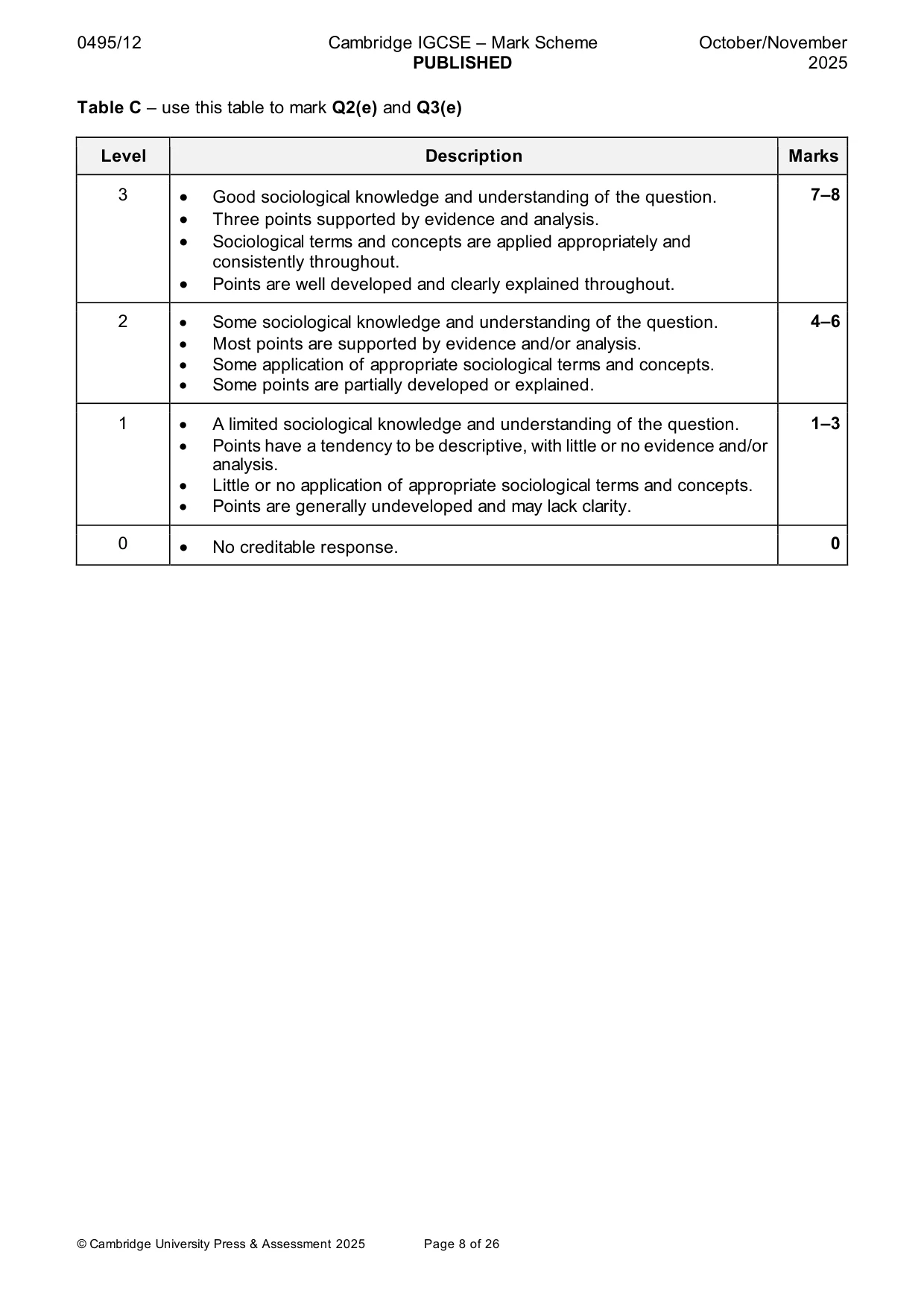
0495/12 Cambridge IGCSE – Mark Scheme PUBLISHED October/November 2025 © Cambridge University Press & Assessment 2025 Page 8 of 26 Table C – use this table to mark Q2(e) and Q3(e) Level Description Marks 3 • Good sociological knowledge and understanding of the question. • Three points supported by evidence and analysis. • Sociological terms and concepts are applied appropriately and consistently throughout. • Points are well developed and clearly explained throughout. 7–8 2 • Some sociological knowledge and understanding of the question. • Most points are supported by evidence and/or analysis. • Some application of appropriate sociological terms and concepts. • Some points are partially developed or explained. 4–6 1 • A limited sociological knowledge and understanding of the question. • Points have a tendency to be descriptive, with little or no evidence and/or analysis. • Little or no application of appropriate sociological terms and concepts. • Points are generally undeveloped and may lack clarity. 1–3 0 • No creditable response. 0
Mark scheme, page 9
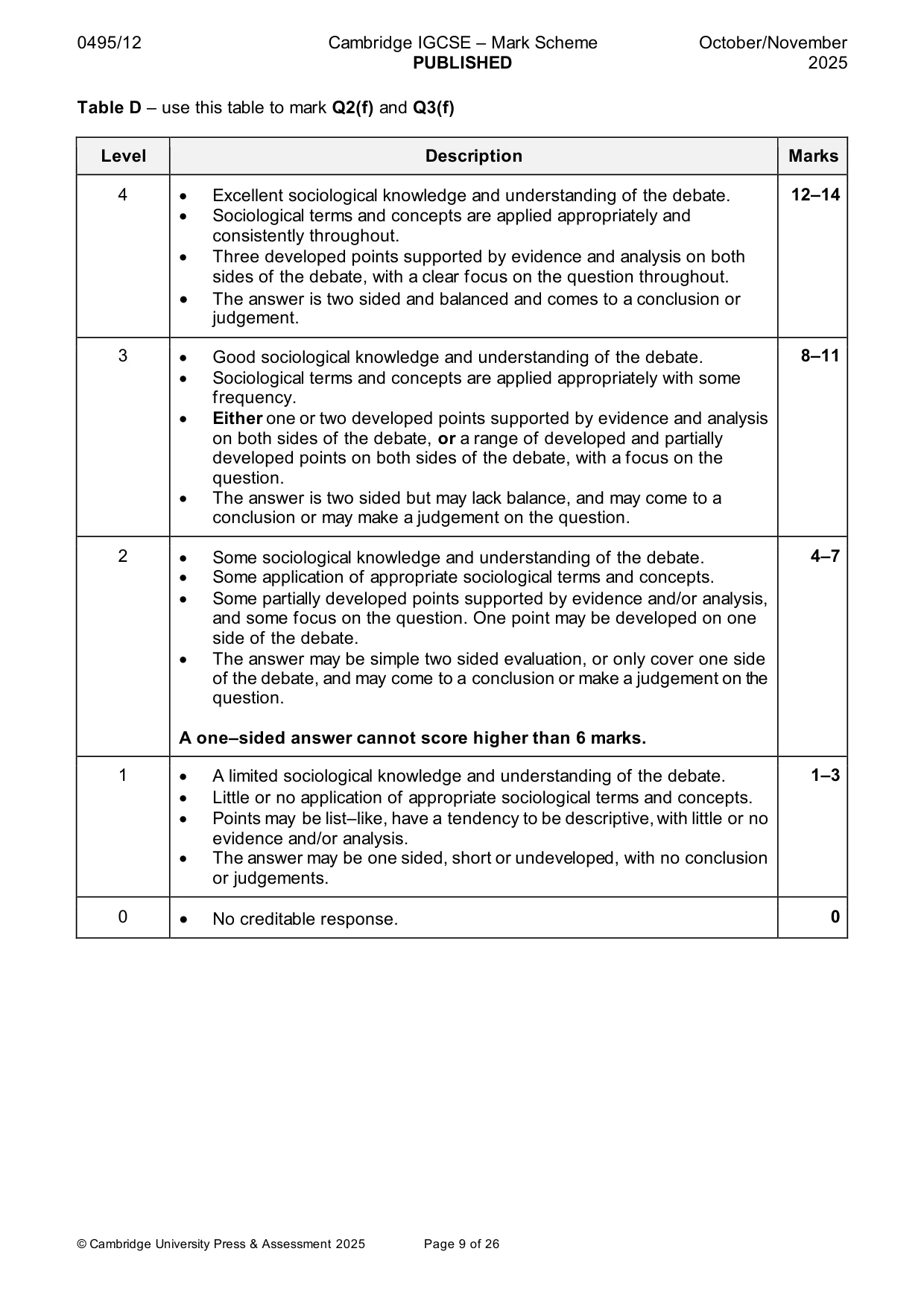
0495/12 Cambridge IGCSE – Mark Scheme PUBLISHED October/November 2025 © Cambridge University Press & Assessment 2025 Page 9 of 26 Table D – use this table to mark Q2(f) and Q3(f) Level Description Marks 4 • Excellent sociological knowledge and understanding of the debate. • Sociological terms and concepts are applied appropriately and consistently throughout. • Three developed points supported by evidence and analysis on both sides of the debate, with a clear focus on the question throughout. • The answer is two sided and balanced and comes to a conclusion or judgement. 12–14 3 • Good sociological knowledge and understanding of the debate. • Sociological terms and concepts are applied appropriately with some frequency. • Either one or two developed points supported by evidence and analysis on both sides of the debate, or a range of developed and partially developed points on both sides of the debate, with a focus on the question. • The answer is two sided but may lack balance, and may come to a conclusion or may make a judgement on the question. 8–11 2 • Some sociological knowledge and understanding of the debate. • Some application of appropriate sociological terms and concepts. • Some partially developed points supported by evidence and/or analysis, and some focus on the question. One point may be developed on one side of the debate. • The answer may be simple two sided evaluation, or only cover one side of the debate, and may come to a conclusion or make a judgement on the question. A one–sided answer cannot score higher than 6 marks. 4–7 1 • A limited sociological knowledge and understanding of the debate. • Little or no application of appropriate sociological terms and concepts. • Points may be list–like, have a tendency to be descriptive, with little or no evidence and/or analysis. • The answer may be one sided, short or undeveloped, with no conclusion or judgements. 1–3 0 • No creditable response. 0
Mark scheme, page 10
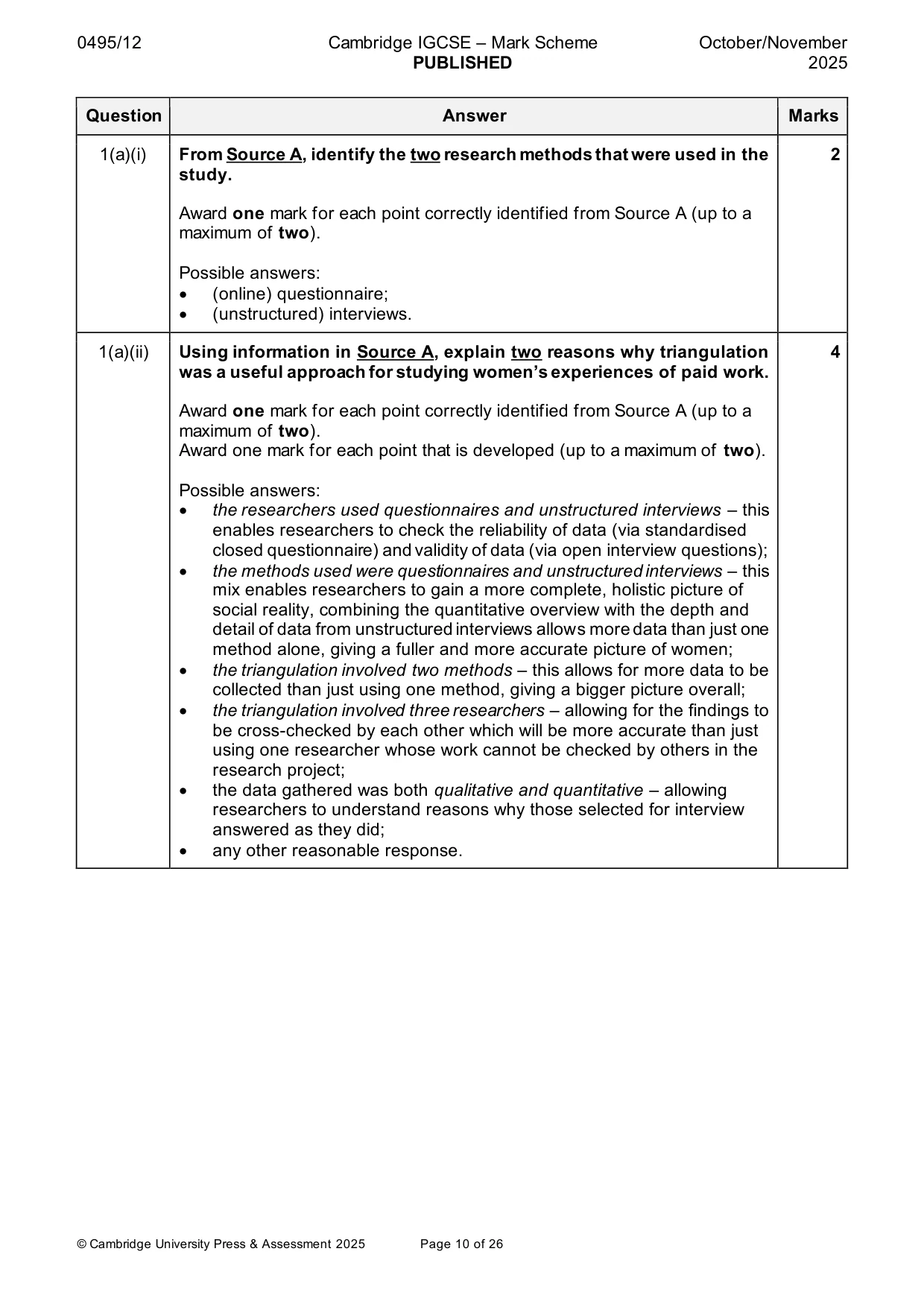
0495/12 Cambridge IGCSE – Mark Scheme PUBLISHED October/November 2025 © Cambridge University Press & Assessment 2025 Page 10 of 26 Question Answer Marks 1(a)(i) From Source A, identify the two research methods that were used in the study. Award one mark for each point correctly identified from Source A (up to a maximum of two). Possible answers: • (online) questionnaire; • (unstructured) interviews. 2 1(a)(ii) Using information in Source A, explain two reasons why triangulation was a useful approach for studying women’s experiences of paid work. Award one mark for each point correctly identified from Source A (up to a maximum of two). Award one mark for each point that is developed (up to a maximum of two). Possible answers: • the researchers used questionnaires and unstructured interviews – this enables researchers to check the reliability of data (via standardised closed questionnaire) and validity of data (via open interview questions); • the methods used were questionnaires and unstructured interviews – this mix enables researchers to gain a more complete, holistic picture of social reality, combining the quantitative overview with the depth and detail of data from unstructured interviews allows more data than just one method alone, giving a fuller and more accurate picture of women; • the triangulation involved two methods – this allows for more data to be collected than just using one method, giving a bigger picture overall; • the triangulation involved three researchers – allowing for the findings to be cross-checked by each other which will be more accurate than just using one researcher whose work cannot be checked by others in the research project; • the data gathered was both qualitative and quantitative – allowing researchers to understand reasons why those selected for interview answered as they did; • any other reasonable response. 4
Mark scheme, page 11
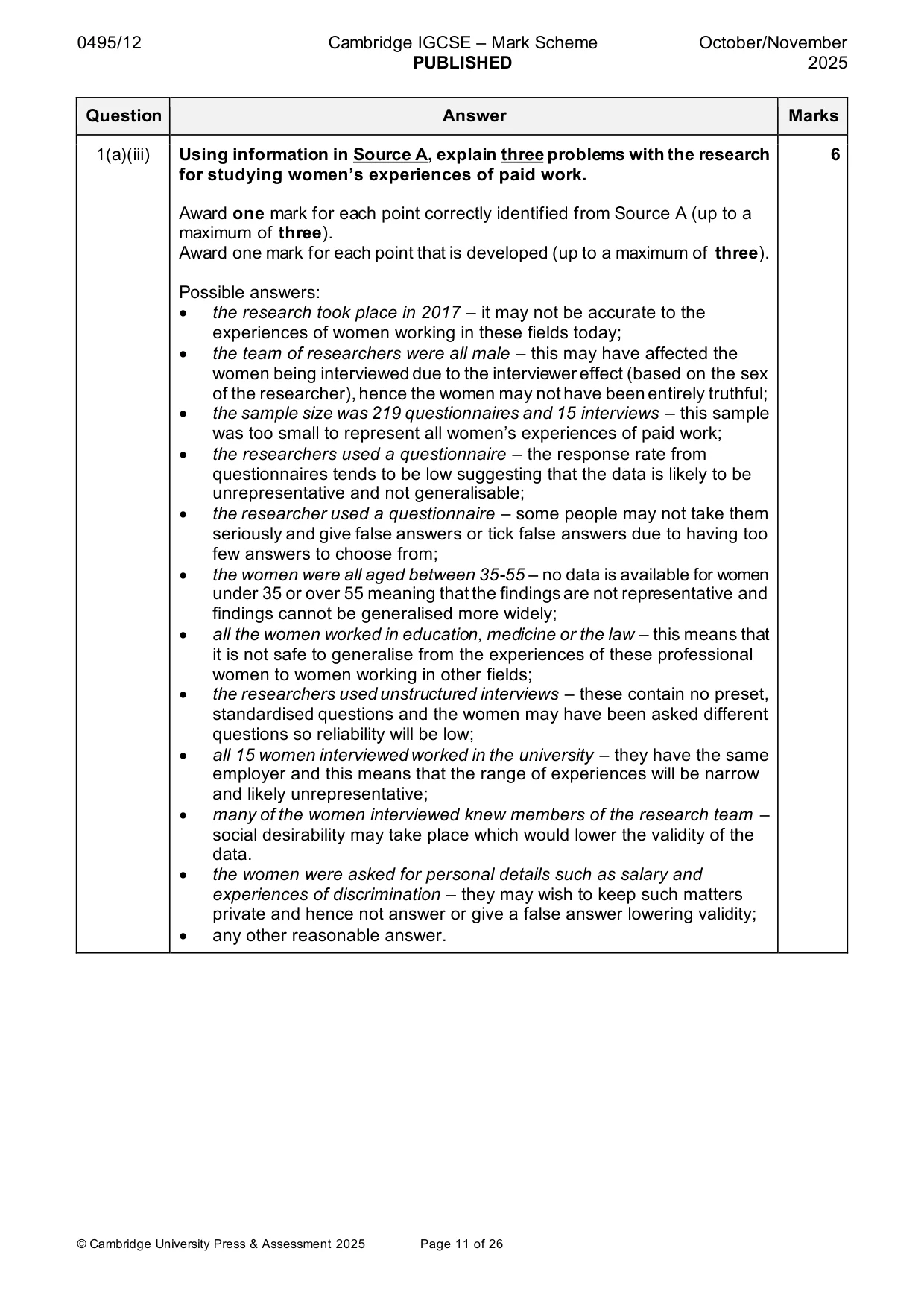
0495/12 Cambridge IGCSE – Mark Scheme PUBLISHED October/November 2025 © Cambridge University Press & Assessment 2025 Page 11 of 26 Question Answer Marks 1(a)(iii) Using information in Source A, explain three problems with the research for studying women’s experiences of paid work. Award one mark for each point correctly identified from Source A (up to a maximum of three). Award one mark for each point that is developed (up to a maximum of three). Possible answers: • the research took place in 2017 – it may not be accurate to the experiences of women working in these fields today; • the team of researchers were all male – this may have affected the women being interviewed due to the interviewer effect (based on the sex of the researcher), hence the women may not have been entirely truthful; • the sample size was 219 questionnaires and 15 interviews – this sample was too small to represent all women’s experiences of paid work; • the researchers used a questionnaire – the response rate from questionnaires tends to be low suggesting that the data is likely to be unrepresentative and not generalisable; • the researcher used a questionnaire – some people may not take them seriously and give false answers or tick false answers due to having too few answers to choose from; • the women were all aged between 35-55 – no data is available for women under 35 or over 55 meaning that the findings are not representative and findings cannot be generalised more widely; • all the women worked in education, medicine or the law – this means that it is not safe to generalise from the experiences of these professional women to women working in other fields; • the researchers used unstructured interviews – these contain no preset, standardised questions and the women may have been asked different questions so reliability will be low; • all 15 women interviewed worked in the university – they have the same employer and this means that the range of experiences will be narrow and likely unrepresentative; • many of the women interviewed knew members of the research team – social desirability may take place which would lower the validity of the data. • the women were asked for personal details such as salary and experiences of discrimination – they may wish to keep such matters private and hence not answer or give a false answer lowering validity; • any other reasonable answer. 6
Mark scheme, page 12
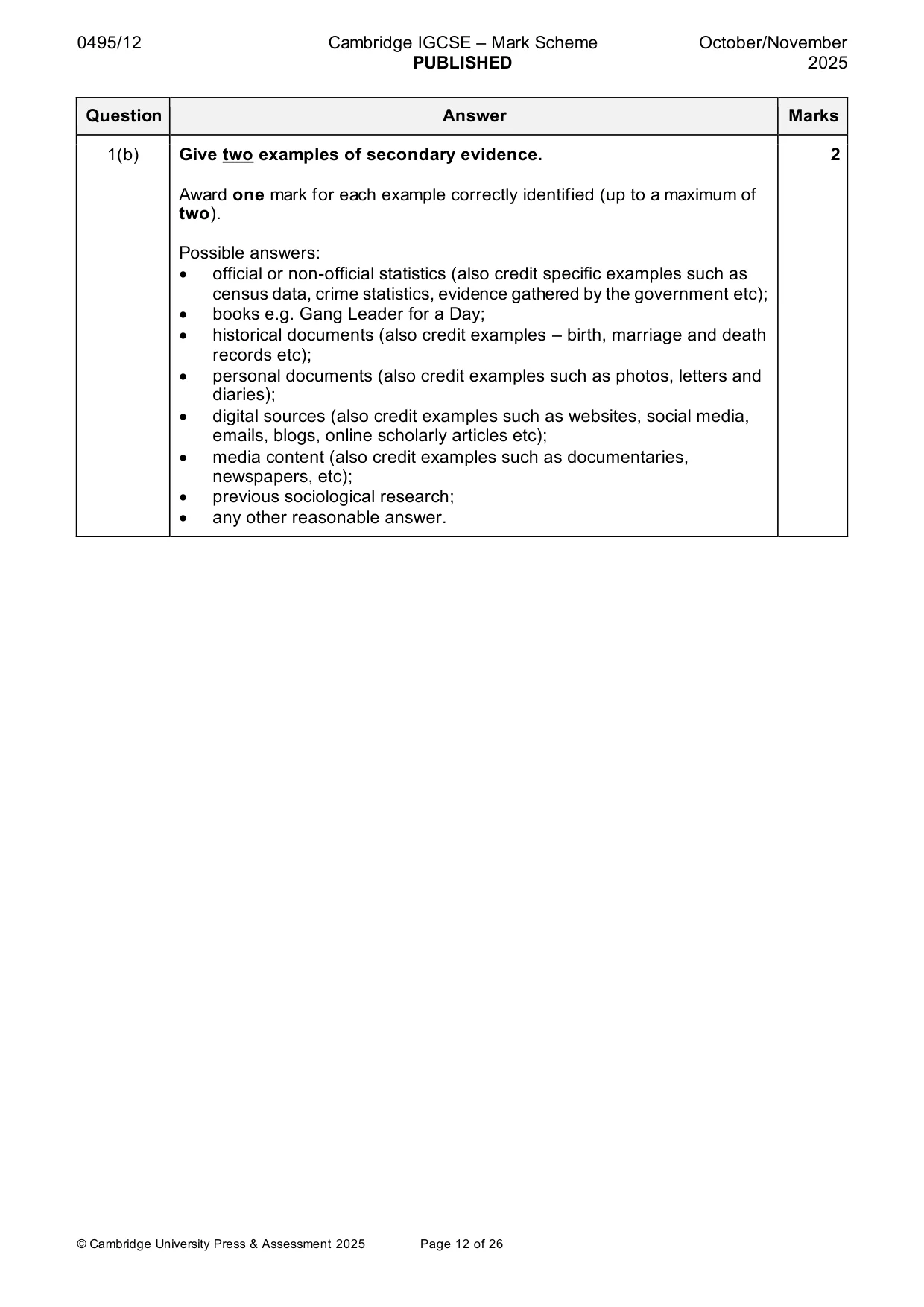
0495/12 Cambridge IGCSE – Mark Scheme PUBLISHED October/November 2025 © Cambridge University Press & Assessment 2025 Page 12 of 26 Question Answer Marks 1(b) Give two examples of secondary evidence. Award one mark for each example correctly identified (up to a maximum of two). Possible answers: • official or non-official statistics (also credit specific examples such as census data, crime statistics, evidence gathered by the government etc); • books e.g. Gang Leader for a Day; • historical documents (also credit examples – birth, marriage and death records etc); • personal documents (also credit examples such as photos, letters and diaries); • digital sources (also credit examples such as websites, social media, emails, blogs, online scholarly articles etc); • media content (also credit examples such as documentaries, newspapers, etc); • previous sociological research; • any other reasonable answer. 2
Mark scheme, page 13
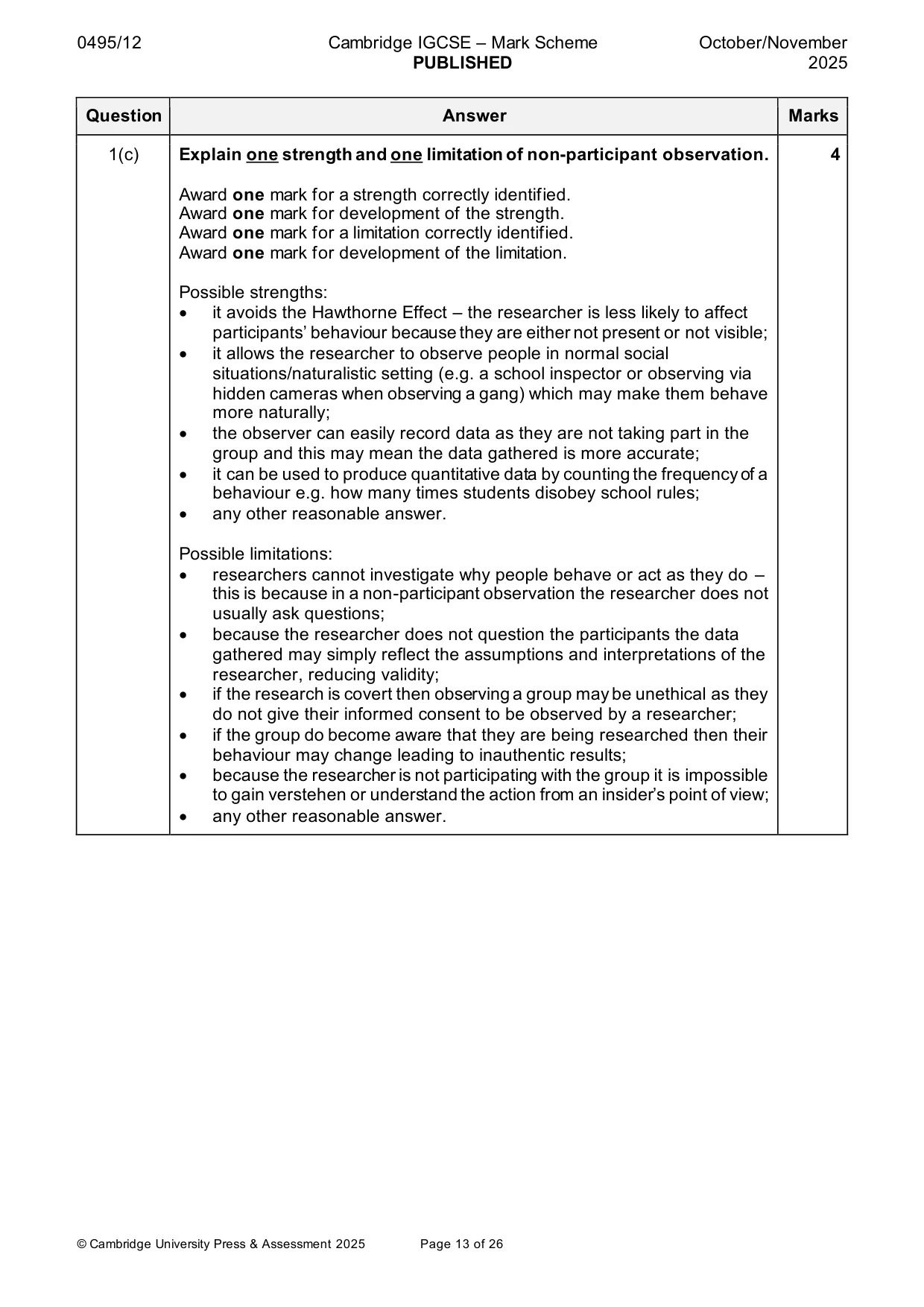
0495/12 Cambridge IGCSE – Mark Scheme PUBLISHED October/November 2025 © Cambridge University Press & Assessment 2025 Page 13 of 26 Question Answer Marks 1(c) Explain one strength and one limitation of non-participant observation. Award one mark for a strength correctly identified. Award one mark for development of the strength. Award one mark for a limitation correctly identified. Award one mark for development of the limitation. Possible strengths: • it avoids the Hawthorne Effect – the researcher is less likely to affect participants’ behaviour because they are either not present or not visible; • it allows the researcher to observe people in normal social situations/naturalistic setting (e.g. a school inspector or observing via hidden cameras when observing a gang) which may make them behave more naturally; • the observer can easily record data as they are not taking part in the group and this may mean the data gathered is more accurate; • it can be used to produce quantitative data by counting the frequency of a behaviour e.g. how many times students disobey school rules; • any other reasonable answer. Possible limitations: • researchers cannot investigate why people behave or act as they do – this is because in a non-participant observation the researcher does not usually ask questions; • because the researcher does not question the participants the data gathered may simply reflect the assumptions and interpretations of the researcher, reducing validity; • if the research is covert then observing a group may be unethical as they do not give their informed consent to be observed by a researcher; • if the group do become aware that they are being researched then their behaviour may change leading to inauthentic results; • because the researcher is not participating with the group it is impossible to gain verstehen or understand the action from an insider’s point of view; • any other reasonable answer. 4
Mark scheme, page 14
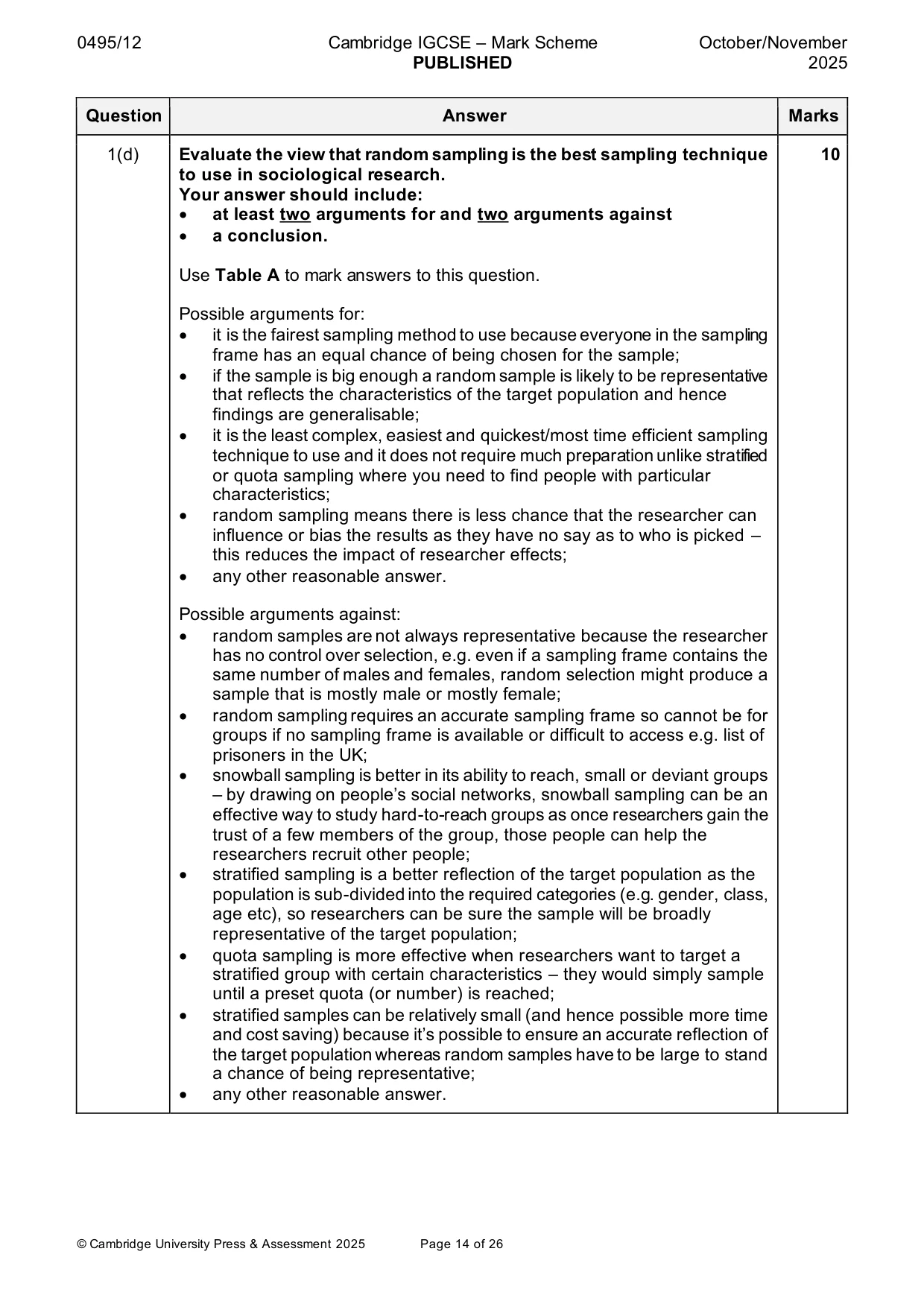
0495/12 Cambridge IGCSE – Mark Scheme PUBLISHED October/November 2025 © Cambridge University Press & Assessment 2025 Page 14 of 26 Question Answer Marks 1(d) Evaluate the view that random sampling is the best sampling technique to use in sociological research. Your answer should include: • at least two arguments for and two arguments against • a conclusion. Use Table A to mark answers to this question. Possible arguments for: • it is the fairest sampling method to use because everyone in the sampling frame has an equal chance of being chosen for the sample; • if the sample is big enough a random sample is likely to be representative that reflects the characteristics of the target population and hence findings are generalisable; • it is the least complex, easiest and quickest/most time efficient sampling technique to use and it does not require much preparation unlike stratified or quota sampling where you need to find people with particular characteristics; • random sampling means there is less chance that the researcher can influence or bias the results as they have no say as to who is picked – this reduces the impact of researcher effects; • any other reasonable answer. Possible arguments against: • random samples are not always representative because the researcher has no control over selection, e.g. even if a sampling frame contains the same number of males and females, random selection might produce a sample that is mostly male or mostly female; • random sampling requires an accurate sampling frame so cannot be for groups if no sampling frame is available or difficult to access e.g. list of prisoners in the UK; • snowball sampling is better in its ability to reach, small or deviant groups – by drawing on people’s social networks, snowball sampling can be an effective way to study hard-to-reach groups as once researchers gain the trust of a few members of the group, those people can help the researchers recruit other people; • stratified sampling is a better reflection of the target population as the population is sub-divided into the required categories (e.g. gender, class, age etc), so researchers can be sure the sample will be broadly representative of the target population; • quota sampling is more effective when researchers want to target a stratified group with certain characteristics – they would simply sample until a preset quota (or number) is reached; • stratified samples can be relatively small (and hence possible more time and cost saving) because it’s possible to ensure an accurate reflection of the target population whereas random samples have to be large to stand a chance of being representative; • any other reasonable answer. 10
Mark scheme, page 15
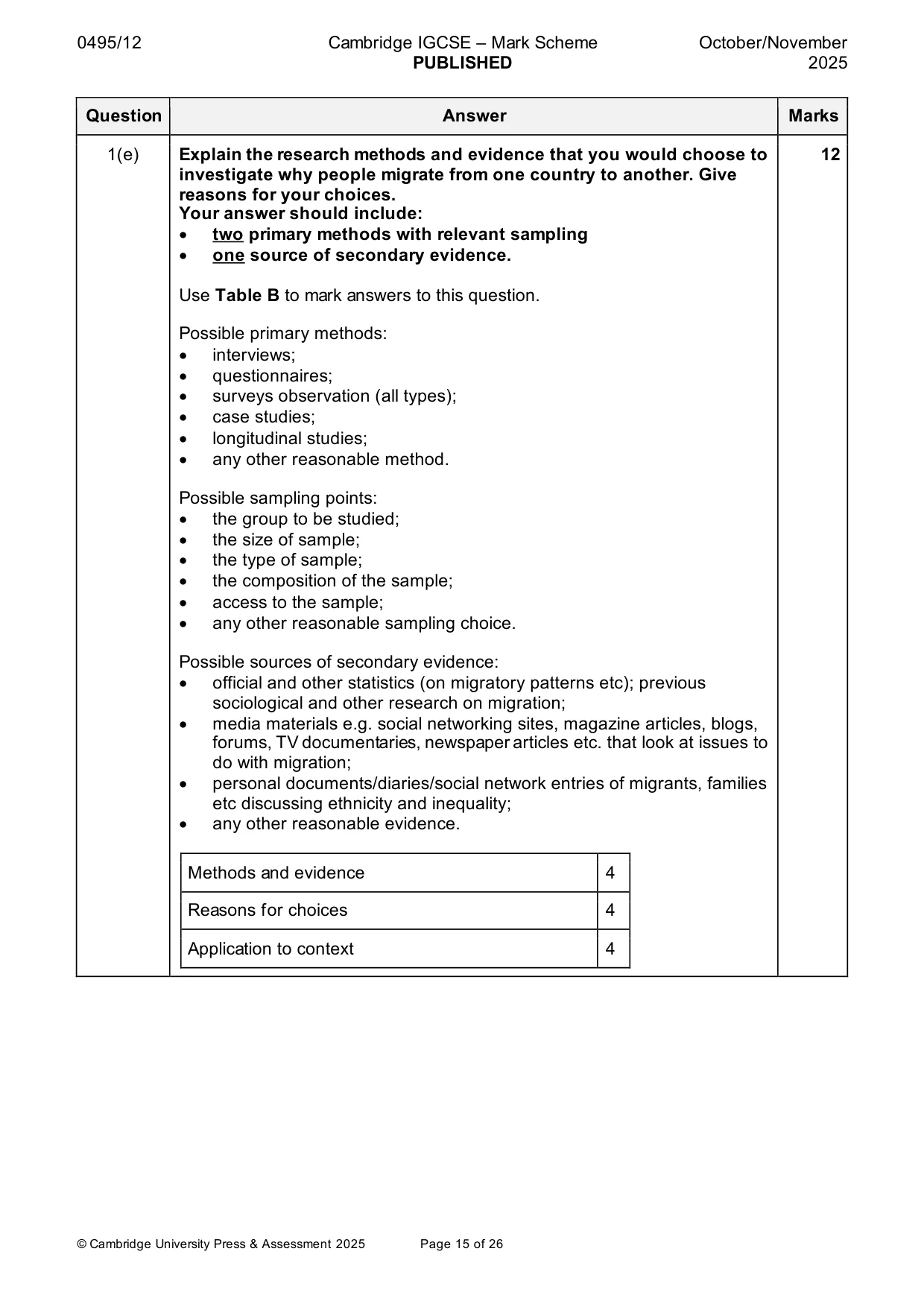
0495/12 Cambridge IGCSE – Mark Scheme PUBLISHED October/November 2025 © Cambridge University Press & Assessment 2025 Page 15 of 26 Question Answer Marks 1(e) Explain the research methods and evidence that you would choose to investigate why people migrate from one country to another. Give reasons for your choices. Your answer should include: • two primary methods with relevant sampling • one source of secondary evidence. Use Table B to mark answers to this question. Possible primary methods: • interviews; • questionnaires; • surveys observation (all types); • case studies; • longitudinal studies; • any other reasonable method. Possible sampling points: • the group to be studied; • the size of sample; • the type of sample; • the composition of the sample; • access to the sample; • any other reasonable sampling choice. Possible sources of secondary evidence: • official and other statistics (on migratory patterns etc); previous sociological and other research on migration; • media materials e.g. social networking sites, magazine articles, blogs, forums, TV documentaries, newspaper articles etc. that look at issues to do with migration; • personal documents/diaries/social network entries of migrants, families etc discussing ethnicity and inequality; • any other reasonable evidence. Methods and evidence 4 Reasons for choices 4 Application to context 4 12
Mark scheme, page 16
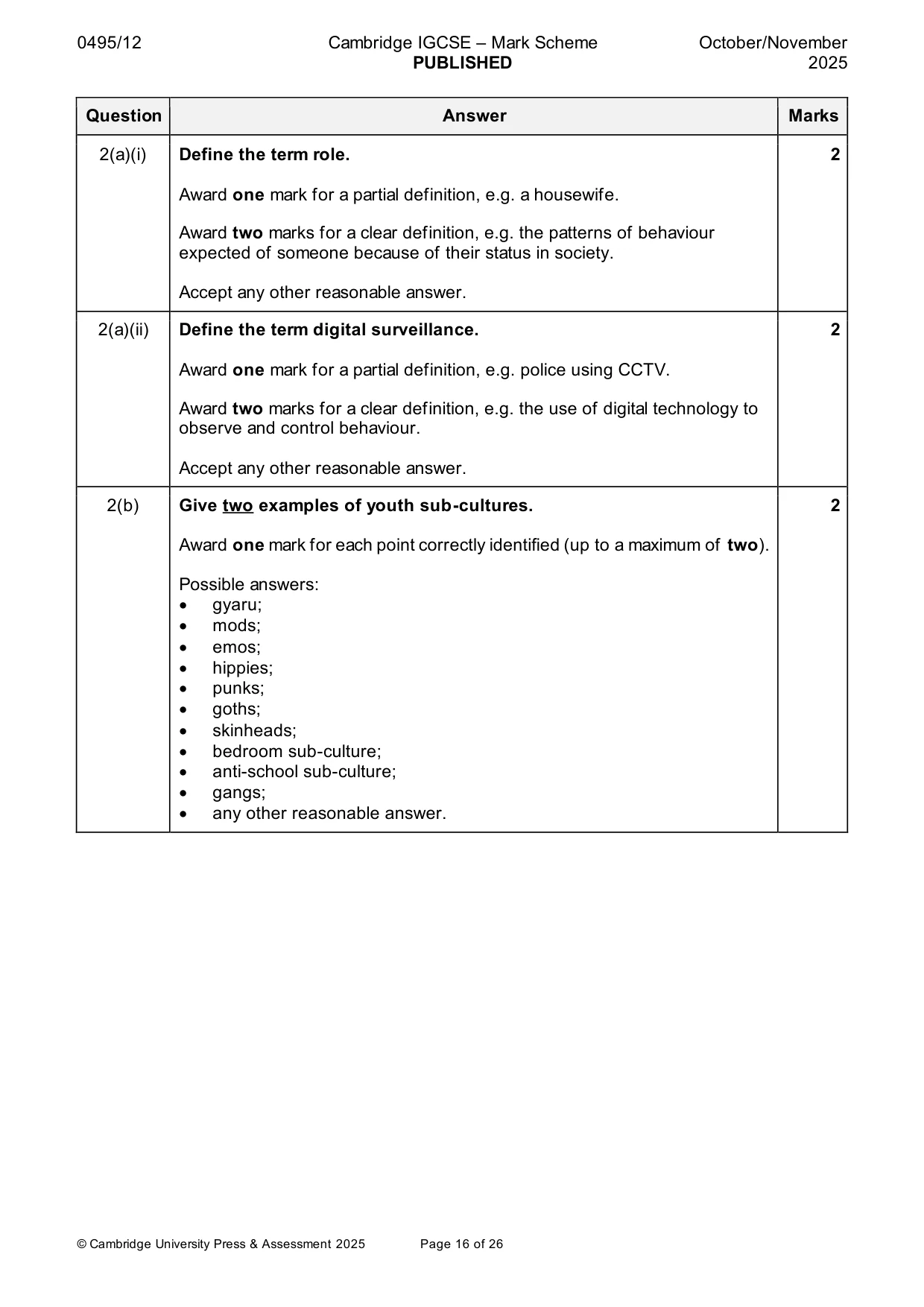
0495/12 Cambridge IGCSE – Mark Scheme PUBLISHED October/November 2025 © Cambridge University Press & Assessment 2025 Page 16 of 26 Question Answer Marks 2(a)(i) Define the term role. Award one mark for a partial definition, e.g. a housewife. Award two marks for a clear definition, e.g. the patterns of behaviour expected of someone because of their status in society. Accept any other reasonable answer. 2 2(a)(ii) Define the term digital surveillance. Award one mark for a partial definition, e.g. police using CCTV. Award two marks for a clear definition, e.g. the use of digital technology to observe and control behaviour. Accept any other reasonable answer. 2 2(b) Give two examples of youth sub-cultures. Award one mark for each point correctly identified (up to a maximum of two). Possible answers: • gyaru; • mods; • emos; • hippies; • punks; • goths; • skinheads; • bedroom sub-culture; • anti-school sub-culture; • gangs; • any other reasonable answer. 2
Mark scheme, page 17
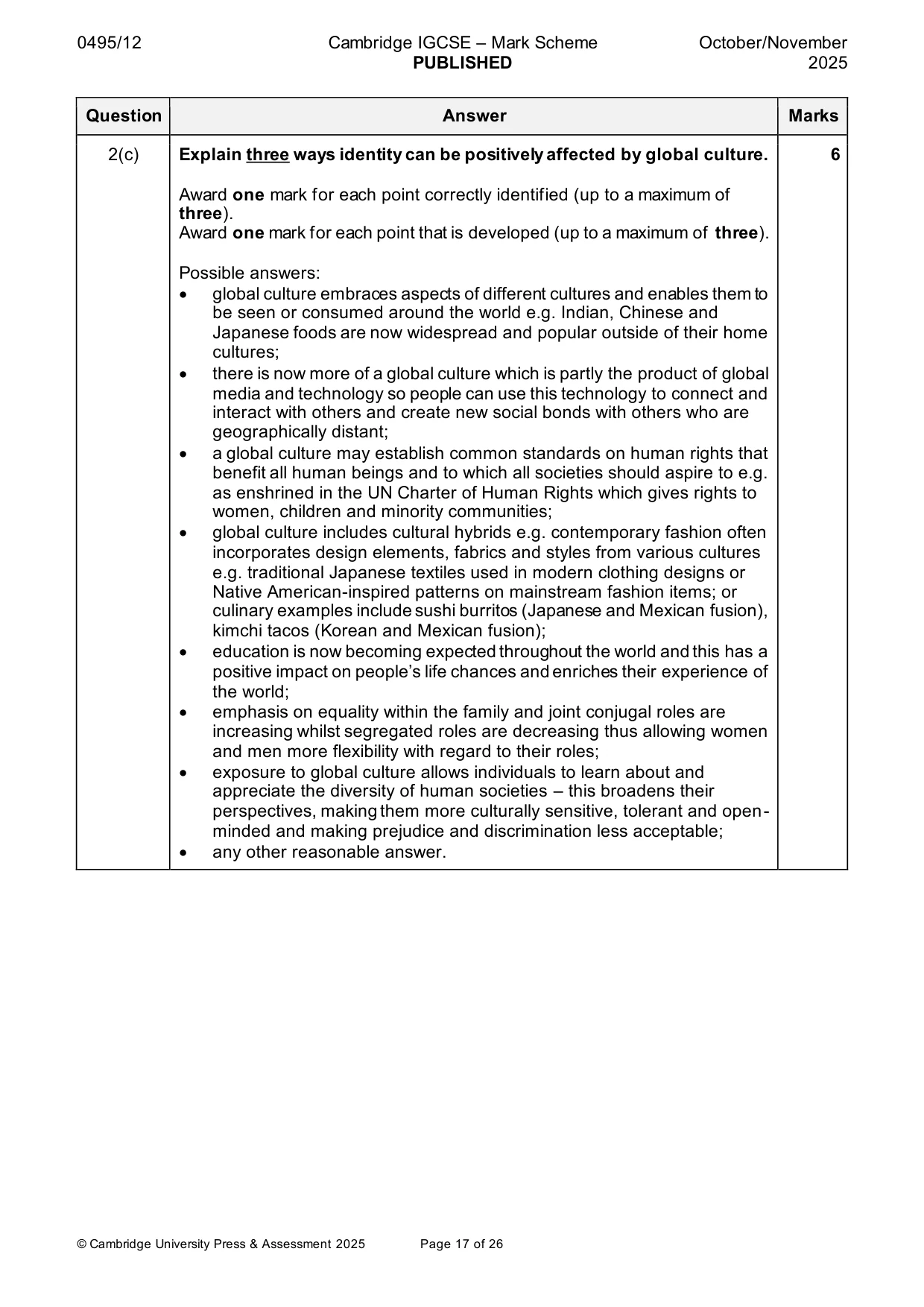
0495/12 Cambridge IGCSE – Mark Scheme PUBLISHED October/November 2025 © Cambridge University Press & Assessment 2025 Page 17 of 26 Question Answer Marks 2(c) Explain three ways identity can be positively affected by global culture. Award one mark for each point correctly identified (up to a maximum of three). Award one mark for each point that is developed (up to a maximum of three). Possible answers: • global culture embraces aspects of different cultures and enables them to be seen or consumed around the world e.g. Indian, Chinese and Japanese foods are now widespread and popular outside of their home cultures; • there is now more of a global culture which is partly the product of global media and technology so people can use this technology to connect and interact with others and create new social bonds with others who are geographically distant; • a global culture may establish common standards on human rights that benefit all human beings and to which all societies should aspire to e.g. as enshrined in the UN Charter of Human Rights which gives rights to women, children and minority communities; • global culture includes cultural hybrids e.g. contemporary fashion often incorporates design elements, fabrics and styles from various cultures e.g. traditional Japanese textiles used in modern clothing designs or Native American-inspired patterns on mainstream fashion items; or culinary examples include sushi burritos (Japanese and Mexican fusion), kimchi tacos (Korean and Mexican fusion); • education is now becoming expected throughout the world and this has a positive impact on people’s life chances and enriches their experience of the world; • emphasis on equality within the family and joint conjugal roles are increasing whilst segregated roles are decreasing thus allowing women and men more flexibility with regard to their roles; • exposure to global culture allows individuals to learn about and appreciate the diversity of human societies – this broadens their perspectives, making them more culturally sensitive, tolerant and open- minded and making prejudice and discrimination less acceptable; • any other reasonable answer. 6
Mark scheme, page 18
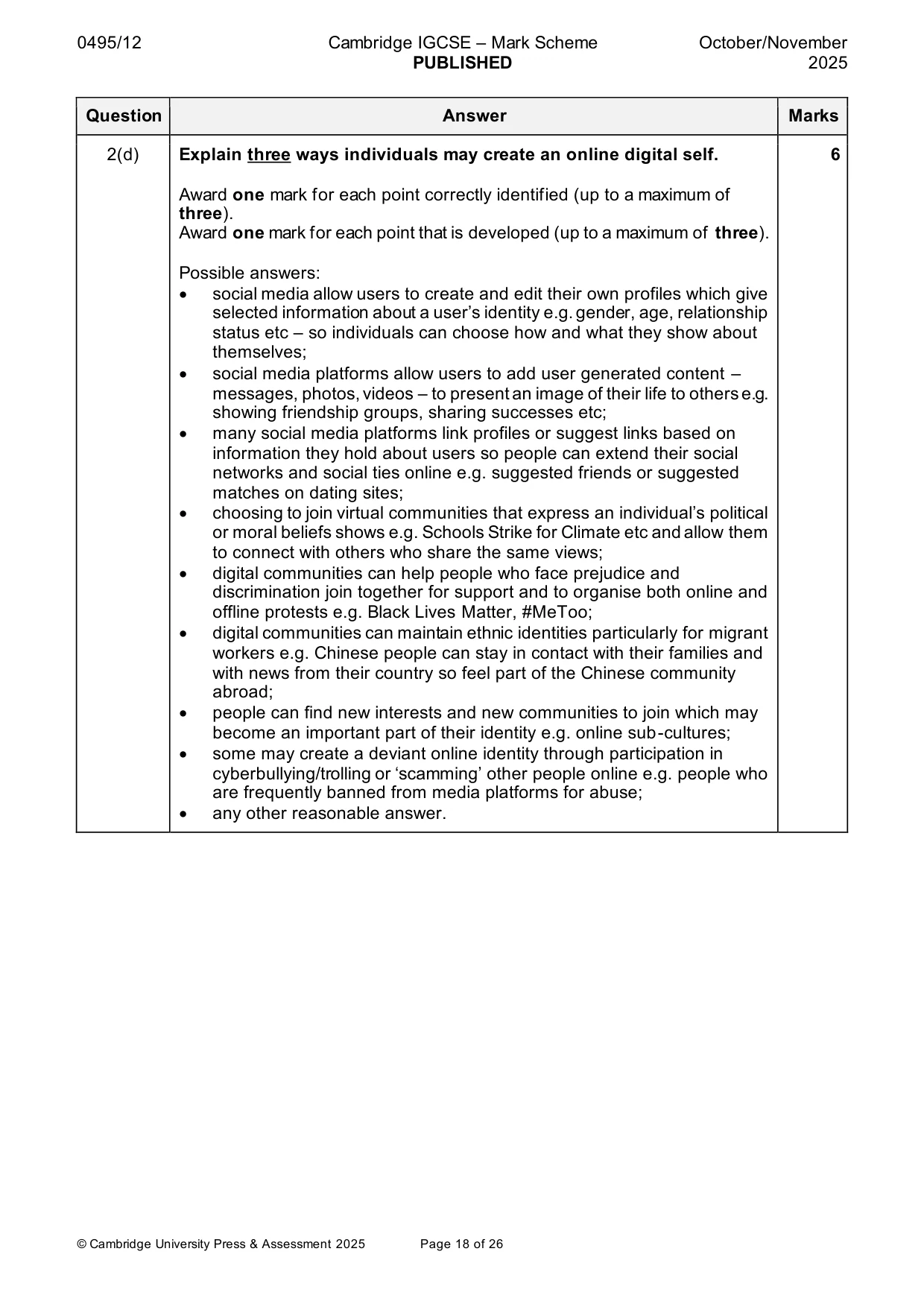
0495/12 Cambridge IGCSE – Mark Scheme PUBLISHED October/November 2025 © Cambridge University Press & Assessment 2025 Page 18 of 26 Question Answer Marks 2(d) Explain three ways individuals may create an online digital self. Award one mark for each point correctly identified (up to a maximum of three). Award one mark for each point that is developed (up to a maximum of three). Possible answers: • social media allow users to create and edit their own profiles which give selected information about a user’s identity e.g. gender, age, relationship status etc – so individuals can choose how and what they show about themselves; • social media platforms allow users to add user generated content – messages, photos, videos – to present an image of their life to others e.g. showing friendship groups, sharing successes etc; • many social media platforms link profiles or suggest links based on information they hold about users so people can extend their social networks and social ties online e.g. suggested friends or suggested matches on dating sites; • choosing to join virtual communities that express an individual’s political or moral beliefs shows e.g. Schools Strike for Climate etc and allow them to connect with others who share the same views; • digital communities can help people who face prejudice and discrimination join together for support and to organise both online and offline protests e.g. Black Lives Matter, #MeToo; • digital communities can maintain ethnic identities particularly for migrant workers e.g. Chinese people can stay in contact with their families and with news from their country so feel part of the Chinese community abroad; • people can find new interests and new communities to join which may become an important part of their identity e.g. online sub-cultures; • some may create a deviant online identity through participation in cyberbullying/trolling or ‘scamming’ other people online e.g. people who are frequently banned from media platforms for abuse; • any other reasonable answer. 6
Mark scheme, page 19
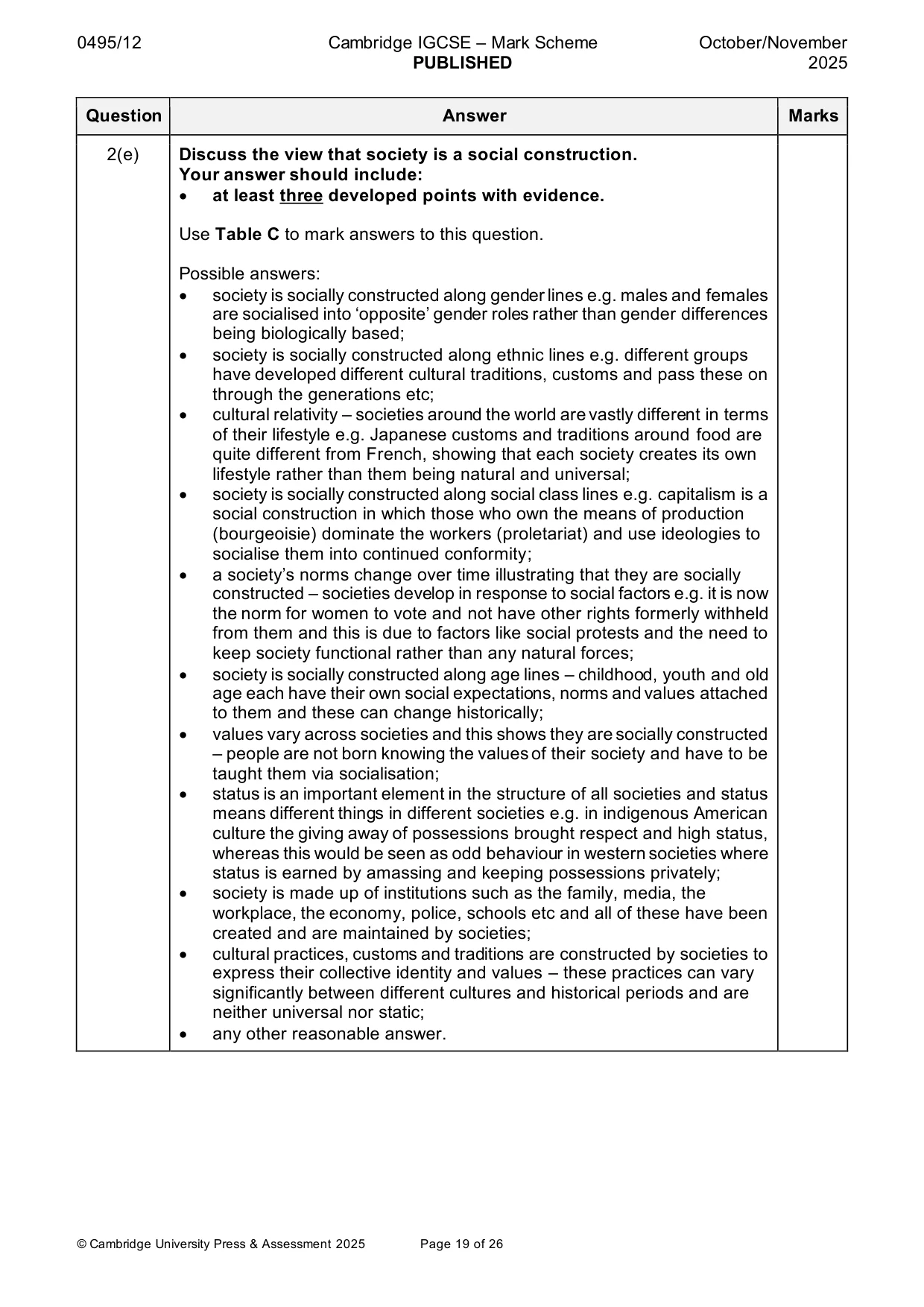
0495/12 Cambridge IGCSE – Mark Scheme PUBLISHED October/November 2025 © Cambridge University Press & Assessment 2025 Page 19 of 26 Question Answer Marks 2(e) Discuss the view that society is a social construction. Your answer should include: • at least three developed points with evidence. Use Table C to mark answers to this question. Possible answers: • society is socially constructed along gender lines e.g. males and females are socialised into ‘opposite’ gender roles rather than gender differences being biologically based; • society is socially constructed along ethnic lines e.g. different groups have developed different cultural traditions, customs and pass these on through the generations etc; • cultural relativity – societies around the world are vastly different in terms of their lifestyle e.g. Japanese customs and traditions around food are quite different from French, showing that each society creates its own lifestyle rather than them being natural and universal; • society is socially constructed along social class lines e.g. capitalism is a social construction in which those who own the means of production (bourgeoisie) dominate the workers (proletariat) and use ideologies to socialise them into continued conformity; • a society’s norms change over time illustrating that they are socially constructed – societies develop in response to social factors e.g. it is now the norm for women to vote and not have other rights formerly withheld from them and this is due to factors like social protests and the need to keep society functional rather than any natural forces; • society is socially constructed along age lines – childhood, youth and old age each have their own social expectations, norms and values attached to them and these can change historically; • values vary across societies and this shows they are socially constructed – people are not born knowing the values of their society and have to be taught them via socialisation; • status is an important element in the structure of all societies and status means different things in different societies e.g. in indigenous American culture the giving away of possessions brought respect and high status, whereas this would be seen as odd behaviour in western societies where status is earned by amassing and keeping possessions privately; • society is made up of institutions such as the family, media, the workplace, the economy, police, schools etc and all of these have been created and are maintained by societies; • cultural practices, customs and traditions are constructed by societies to express their collective identity and values – these practices can vary significantly between different cultures and historical periods and are neither universal nor static; • any other reasonable answer.
Mark scheme, page 20
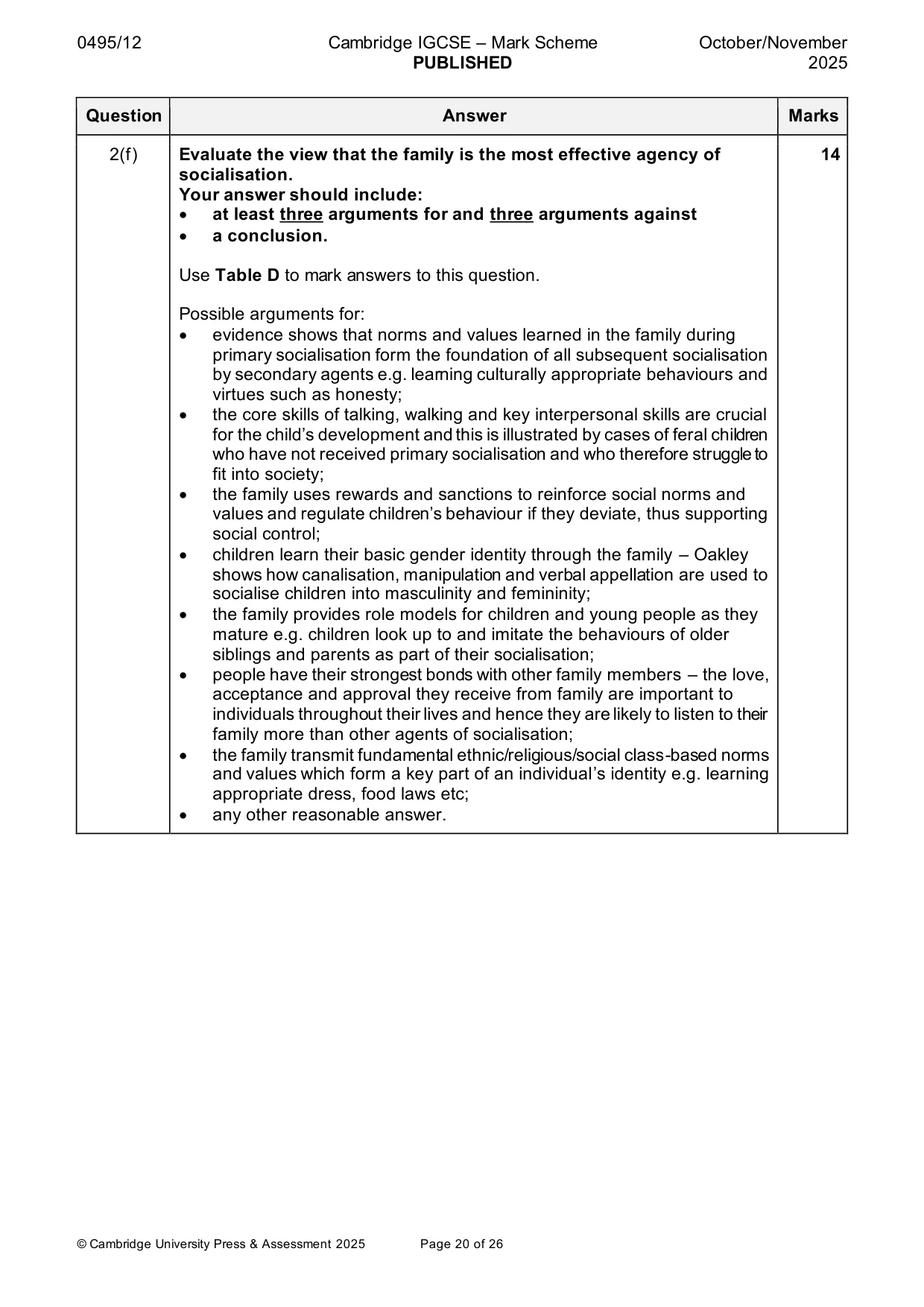
0495/12 Cambridge IGCSE – Mark Scheme PUBLISHED October/November 2025 © Cambridge University Press & Assessment 2025 Page 20 of 26 Question Answer Marks 2(f) Evaluate the view that the family is the most effective agency of socialisation. Your answer should include: • at least three arguments for and three arguments against • a conclusion. Use Table D to mark answers to this question. Possible arguments for: • evidence shows that norms and values learned in the family during primary socialisation form the foundation of all subsequent socialisation by secondary agents e.g. learning culturally appropriate behaviours and virtues such as honesty; • the core skills of talking, walking and key interpersonal skills are crucial for the child’s development and this is illustrated by cases of feral children who have not received primary socialisation and who therefore struggle to fit into society; • the family uses rewards and sanctions to reinforce social norms and values and regulate children’s behaviour if they deviate, thus supporting social control; • children learn their basic gender identity through the family – Oakley shows how canalisation, manipulation and verbal appellation are used to socialise children into masculinity and femininity; • the family provides role models for children and young people as they mature e.g. children look up to and imitate the behaviours of older siblings and parents as part of their socialisation; • people have their strongest bonds with other family members – the love, acceptance and approval they receive from family are important to individuals throughout their lives and hence they are likely to listen to their family more than other agents of socialisation; • the family transmit fundamental ethnic/religious/social class-based norms and values which form a key part of an individual’s identity e.g. learning appropriate dress, food laws etc; • any other reasonable answer. 14
Mark scheme, page 21
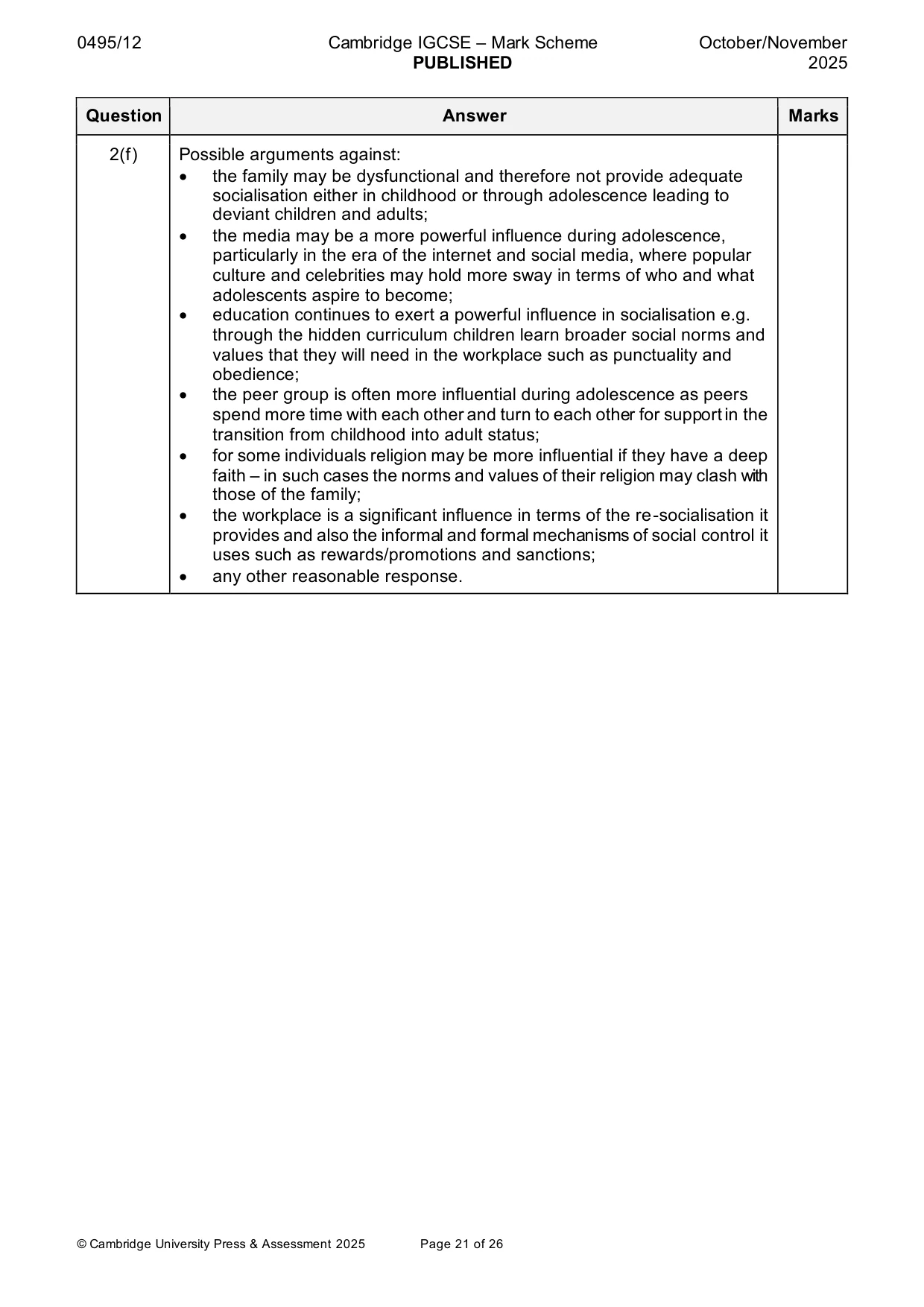
0495/12 Cambridge IGCSE – Mark Scheme PUBLISHED October/November 2025 © Cambridge University Press & Assessment 2025 Page 21 of 26 Question Answer Marks 2(f) Possible arguments against: • the family may be dysfunctional and therefore not provide adequate socialisation either in childhood or through adolescence leading to deviant children and adults; • the media may be a more powerful influence during adolescence, particularly in the era of the internet and social media, where popular culture and celebrities may hold more sway in terms of who and what adolescents aspire to become; • education continues to exert a powerful influence in socialisation e.g. through the hidden curriculum children learn broader social norms and values that they will need in the workplace such as punctuality and obedience; • the peer group is often more influential during adolescence as peers spend more time with each other and turn to each other for support in the transition from childhood into adult status; • for some individuals religion may be more influential if they have a deep faith – in such cases the norms and values of their religion may clash with those of the family; • the workplace is a significant influence in terms of the re-socialisation it provides and also the informal and formal mechanisms of social control it uses such as rewards/promotions and sanctions; • any other reasonable response.
Mark scheme, page 22
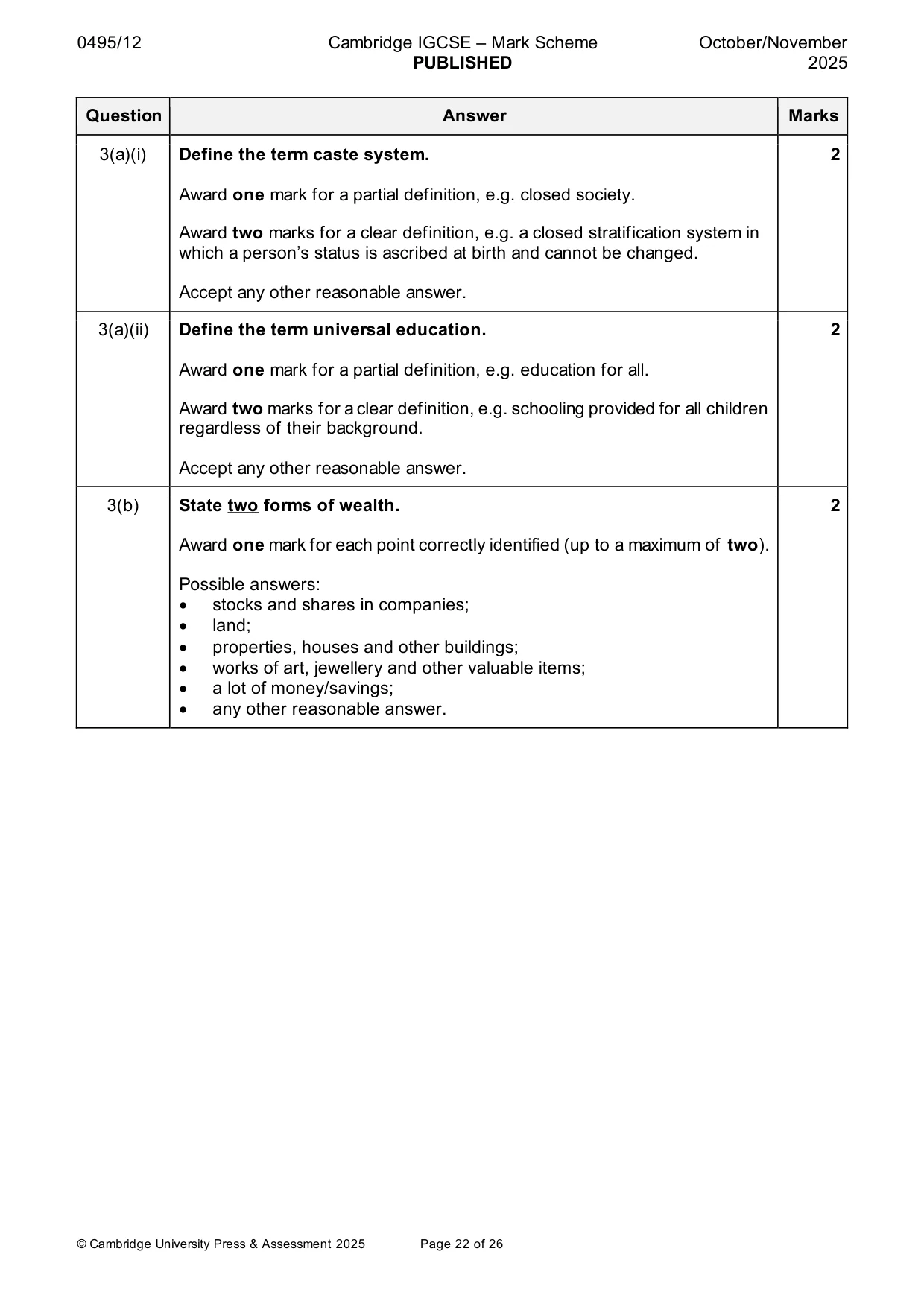
0495/12 Cambridge IGCSE – Mark Scheme PUBLISHED October/November 2025 © Cambridge University Press & Assessment 2025 Page 22 of 26 Question Answer Marks 3(a)(i) Define the term caste system. Award one mark for a partial definition, e.g. closed society. Award two marks for a clear definition, e.g. a closed stratification system in which a person’s status is ascribed at birth and cannot be changed. Accept any other reasonable answer. 2 3(a)(ii) Define the term universal education. Award one mark for a partial definition, e.g. education for all. Award two marks for a clear definition, e.g. schooling provided for all children regardless of their background. Accept any other reasonable answer. 2 3(b) State two forms of wealth. Award one mark for each point correctly identified (up to a maximum of two). Possible answers: • stocks and shares in companies; • land; • properties, houses and other buildings; • works of art, jewellery and other valuable items; • a lot of money/savings; • any other reasonable answer. 2
Mark scheme, page 23
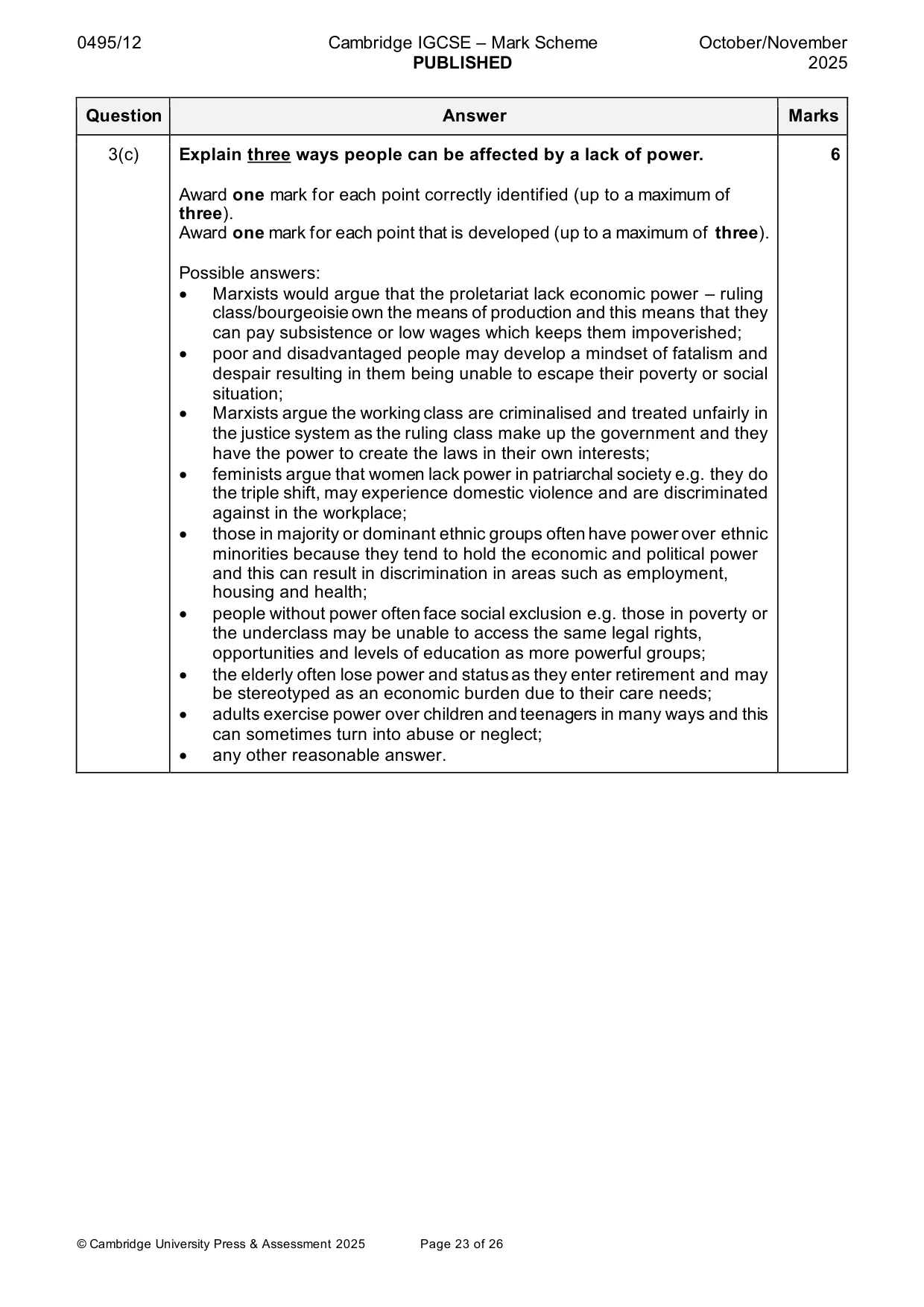
0495/12 Cambridge IGCSE – Mark Scheme PUBLISHED October/November 2025 © Cambridge University Press & Assessment 2025 Page 23 of 26 Question Answer Marks 3(c) Explain three ways people can be affected by a lack of power. Award one mark for each point correctly identified (up to a maximum of three). Award one mark for each point that is developed (up to a maximum of three). Possible answers: • Marxists would argue that the proletariat lack economic power – ruling class/bourgeoisie own the means of production and this means that they can pay subsistence or low wages which keeps them impoverished; • poor and disadvantaged people may develop a mindset of fatalism and despair resulting in them being unable to escape their poverty or social situation; • Marxists argue the working class are criminalised and treated unfairly in the justice system as the ruling class make up the government and they have the power to create the laws in their own interests; • feminists argue that women lack power in patriarchal society e.g. they do the triple shift, may experience domestic violence and are discriminated against in the workplace; • those in majority or dominant ethnic groups often have power over ethnic minorities because they tend to hold the economic and political power and this can result in discrimination in areas such as employment, housing and health; • people without power often face social exclusion e.g. those in poverty or the underclass may be unable to access the same legal rights, opportunities and levels of education as more powerful groups; • the elderly often lose power and status as they enter retirement and may be stereotyped as an economic burden due to their care needs; • adults exercise power over children and teenagers in many ways and this can sometimes turn into abuse or neglect; • any other reasonable answer. 6
Mark scheme, page 24
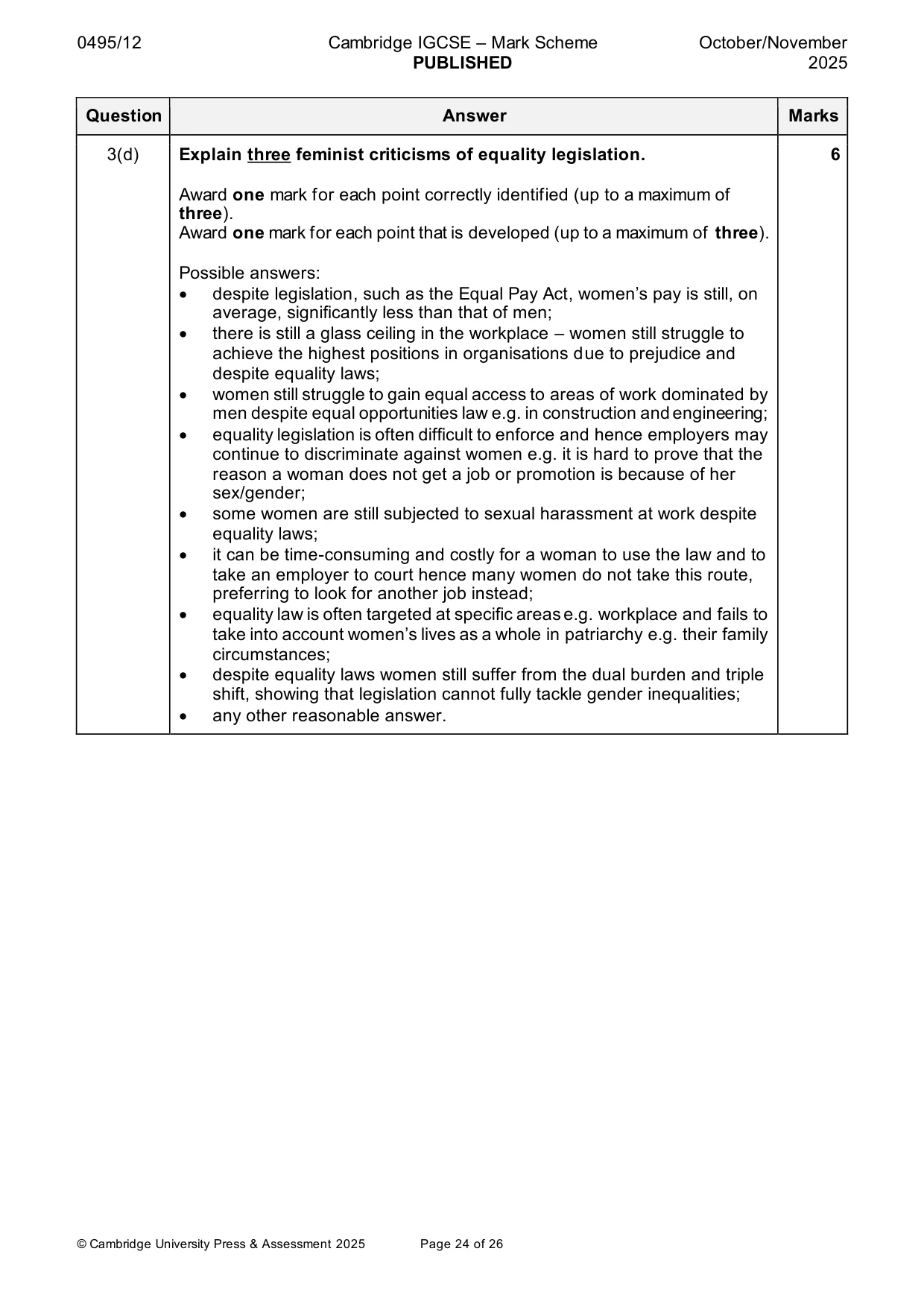
0495/12 Cambridge IGCSE – Mark Scheme PUBLISHED October/November 2025 © Cambridge University Press & Assessment 2025 Page 24 of 26 Question Answer Marks 3(d) Explain three feminist criticisms of equality legislation. Award one mark for each point correctly identified (up to a maximum of three). Award one mark for each point that is developed (up to a maximum of three). Possible answers: • despite legislation, such as the Equal Pay Act, women’s pay is still, on average, significantly less than that of men; • there is still a glass ceiling in the workplace – women still struggle to achieve the highest positions in organisations due to prejudice and despite equality laws; • women still struggle to gain equal access to areas of work dominated by men despite equal opportunities law e.g. in construction and engineering; • equality legislation is often difficult to enforce and hence employers may continue to discriminate against women e.g. it is hard to prove that the reason a woman does not get a job or promotion is because of her sex/gender; • some women are still subjected to sexual harassment at work despite equality laws; • it can be time-consuming and costly for a woman to use the law and to take an employer to court hence many women do not take this route, preferring to look for another job instead; • equality law is often targeted at specific areas e.g. workplace and fails to take into account women’s lives as a whole in patriarchy e.g. their family circumstances; • despite equality laws women still suffer from the dual burden and triple shift, showing that legislation cannot fully tackle gender inequalities; • any other reasonable answer. 6
Mark scheme, page 25
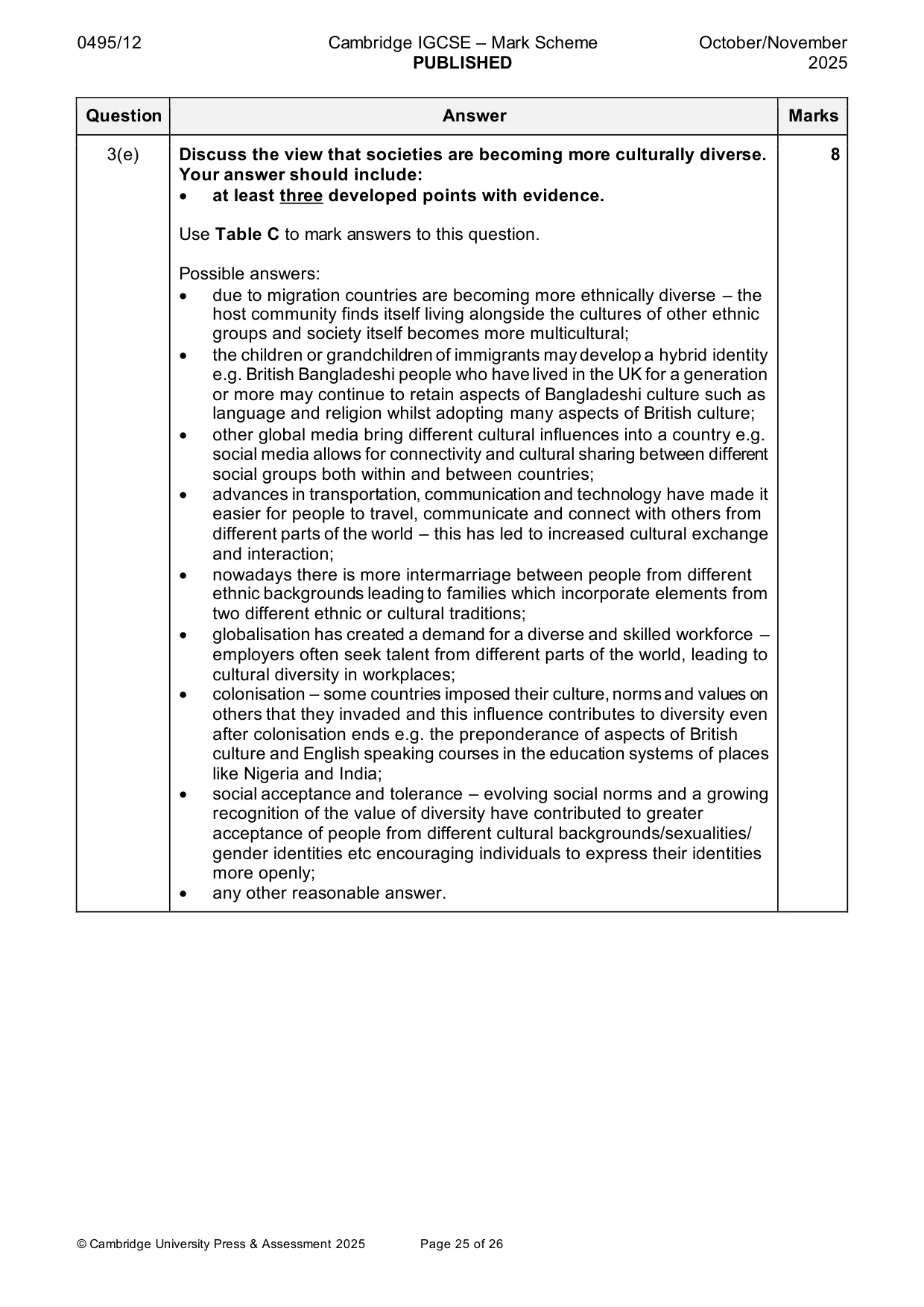
0495/12 Cambridge IGCSE – Mark Scheme PUBLISHED October/November 2025 © Cambridge University Press & Assessment 2025 Page 25 of 26 Question Answer Marks 3(e) Discuss the view that societies are becoming more culturally diverse. Your answer should include: • at least three developed points with evidence. Use Table C to mark answers to this question. Possible answers: • due to migration countries are becoming more ethnically diverse – the host community finds itself living alongside the cultures of other ethnic groups and society itself becomes more multicultural; • the children or grandchildren of immigrants may develop a hybrid identity e.g. British Bangladeshi people who have lived in the UK for a generation or more may continue to retain aspects of Bangladeshi culture such as language and religion whilst adopting many aspects of British culture; • other global media bring different cultural influences into a country e.g. social media allows for connectivity and cultural sharing between different social groups both within and between countries; • advances in transportation, communication and technology have made it easier for people to travel, communicate and connect with others from different parts of the world – this has led to increased cultural exchange and interaction; • nowadays there is more intermarriage between people from different ethnic backgrounds leading to families which incorporate elements from two different ethnic or cultural traditions; • globalisation has created a demand for a diverse and skilled workforce – employers often seek talent from different parts of the world, leading to cultural diversity in workplaces; • colonisation – some countries imposed their culture, norms and values on others that they invaded and this influence contributes to diversity even after colonisation ends e.g. the preponderance of aspects of British culture and English speaking courses in the education systems of places like Nigeria and India; • social acceptance and tolerance – evolving social norms and a growing recognition of the value of diversity have contributed to greater acceptance of people from different cultural backgrounds/sexualities/ gender identities etc encouraging individuals to express their identities more openly; • any other reasonable answer. 8
Mark scheme, page 26
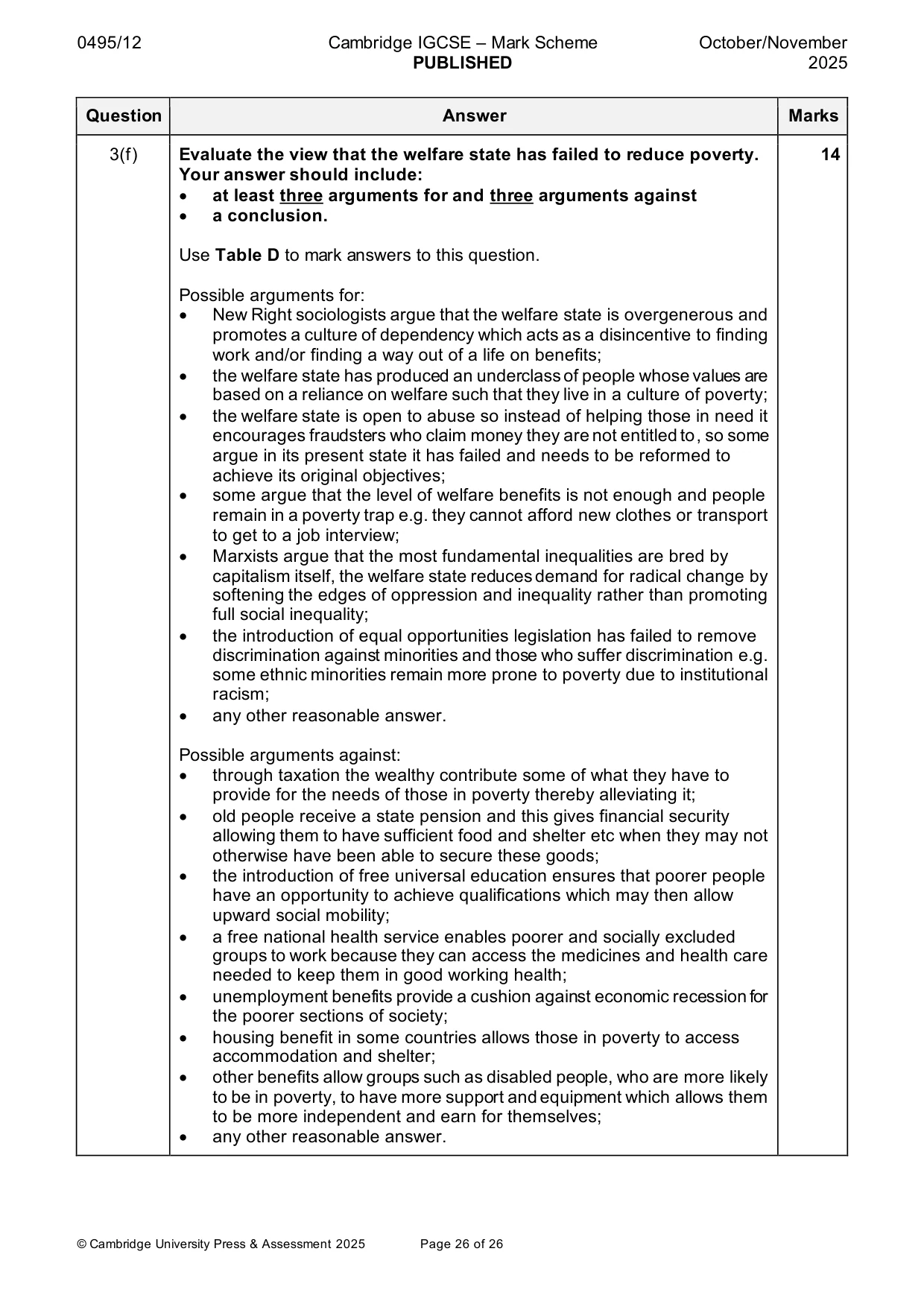
0495/12 Cambridge IGCSE – Mark Scheme PUBLISHED October/November 2025 © Cambridge University Press & Assessment 2025 Page 26 of 26 Question Answer Marks 3(f) Evaluate the view that the welfare state has failed to reduce poverty. Your answer should include: • at least three arguments for and three arguments against • a conclusion. Use Table D to mark answers to this question. Possible arguments for: • New Right sociologists argue that the welfare state is overgenerous and promotes a culture of dependency which acts as a disincentive to finding work and/or finding a way out of a life on benefits; • the welfare state has produced an underclass of people whose values are based on a reliance on welfare such that they live in a culture of poverty; • the welfare state is open to abuse so instead of helping those in need it encourages fraudsters who claim money they are not entitled to, so some argue in its present state it has failed and needs to be reformed to achieve its original objectives; • some argue that the level of welfare benefits is not enough and people remain in a poverty trap e.g. they cannot afford new clothes or transport to get to a job interview; • Marxists argue that the most fundamental inequalities are bred by capitalism itself, the welfare state reduces demand for radical change by softening the edges of oppression and inequality rather than promoting full social inequality; • the introduction of equal opportunities legislation has failed to remove discrimination against minorities and those who suffer discrimination e.g. some ethnic minorities remain more prone to poverty due to institutional racism; • any other reasonable answer. Possible arguments against: • through taxation the wealthy contribute some of what they have to provide for the needs of those in poverty thereby alleviating it; • old people receive a state pension and this gives financial security allowing them to have sufficient food and shelter etc when they may not otherwise have been able to secure these goods; • the introduction of free universal education ensures that poorer people have an opportunity to achieve qualifications which may then allow upward social mobility; • a free national health service enables poorer and socially excluded groups to work because they can access the medicines and health care needed to keep them in good working health; • unemployment benefits provide a cushion against economic recession for the poorer sections of society; • housing benefit in some countries allows those in poverty to access accommodation and shelter; • other benefits allow groups such as disabled people, who are more likely to be in poverty, to have more support and equipment which allows them to be more independent and earn for themselves; • any other reasonable answer. 14
What you needed in this session
Cambridge’s own grade thresholds for 2025 Oct/Nov, Paper 1 · Variant 2. A higher threshold means an easier paper — the bar moves with how the cohort did.