Cambridge IGCSE Sociology 0495 — 2025 May/June Paper 1 · Variant 2
0495/12/M/J/25 · 80 marks · 120 min
The question paper and its mark scheme, free to read here and free to download. This is Cambridge’s own paper, exactly as it was sat.
Question paper8 pages



Mark scheme29 pages
Answers below. Sit the paper first if you are practising.






Paper as text
Question paper, page 1
Cambridge IGCSE™ 0495/12 SOCIOLOGY May/June 2025 Paper 1 Research Methods, Identity and Inequality 2 hours You must answer on the enclosed answer booklet. You will need: Answer booklet (enclosed) INSTRUCTIONS • Answer two questions in total: Answer Question 1. Answer either Question 2 or Question 3. • Follow the instructions on the front cover of the answer booklet. If you need additional answer paper, ask the invigilator for a continuation booklet. INFORMATION • The total mark for this paper is 80. • The number of marks for each question or part question is shown in brackets [ ]. This document has 8 pages. Any blank pages are indicated. [Turn over 06_0495_12_2025_1.14 © UCLES 2025 *7466057757*
Question paper, page 2
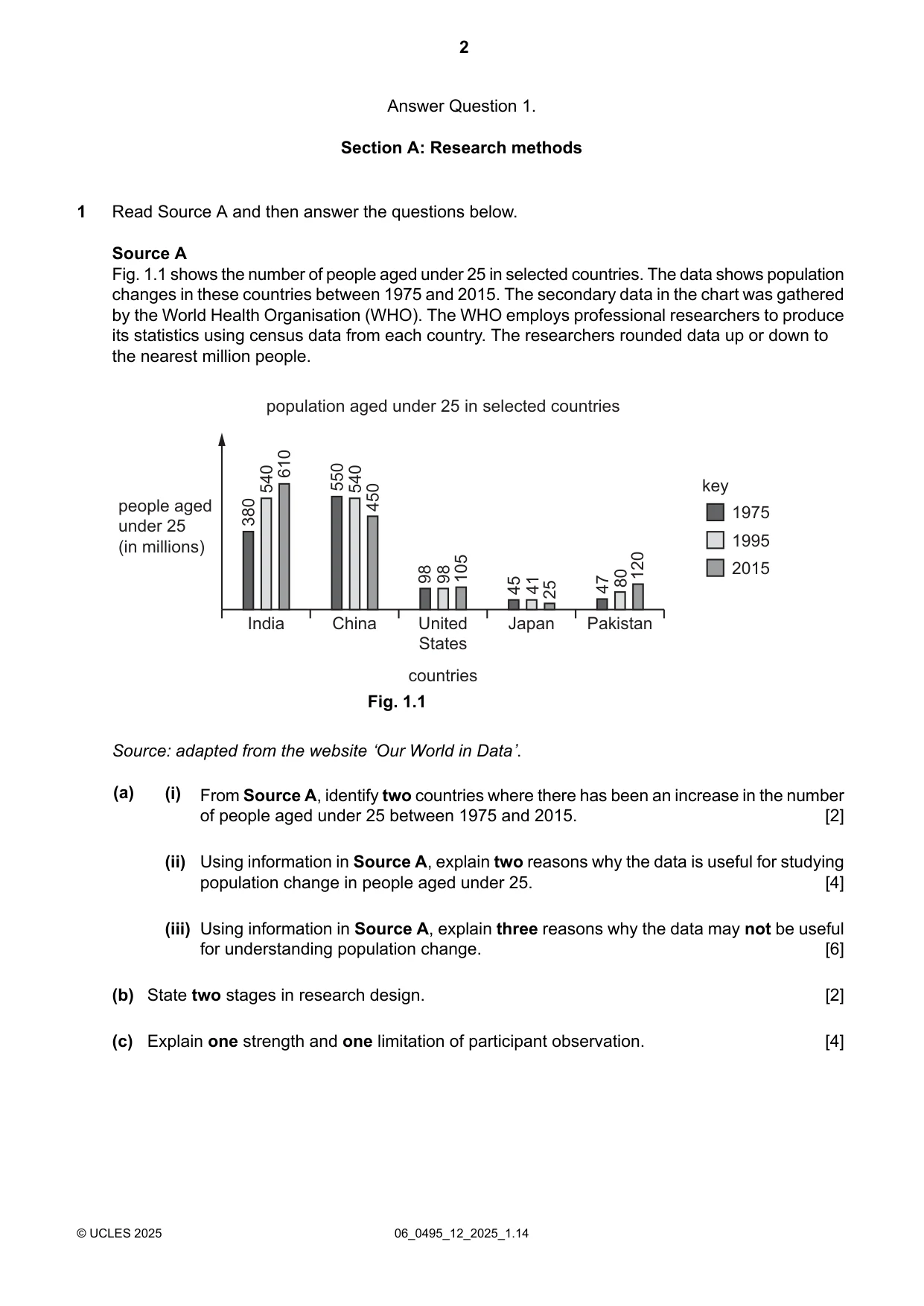
Answer Question 1. Section A: Research methods Read Source A and then answer the questions below. 1 Source A Fig. 1.1 shows the number of people aged under 25 in selected countries. The data shows population changes in these countries between 1975 and 2015. The secondary data in the chart was gathered by the World Health Organisation (WHO). The WHO employs professional researchers to produce its statistics using census data from each country. The researchers rounded data up or down to the nearest million people. India China United States countries Japan Pakistan people aged under 25 (in millions) 380 540 540 550 450 610 98 45 47 25 41 98 105 80 120 key 1975 1995 2015 population aged under 25 in selected countries Fig. 1.1 Source: adapted from the website ‘Our World in Data’. (a) From Source A, identify two countries where there has been an increase in the number of people aged under 25 between 1975 and 2015. [2] (i) Using information in Source A, explain two reasons why the data is useful for studying population change in people aged under 25. [4] (ii) Using information in Source A, explain three reasons why the data may not be useful for understanding population change. [6] (iii) State two stages in research design. [2] (b) Explain one strength and one limitation of participant observation. [4] (c) 06_0495_12_2025_1.14 © UCLES 2025 2
Question paper, page 3
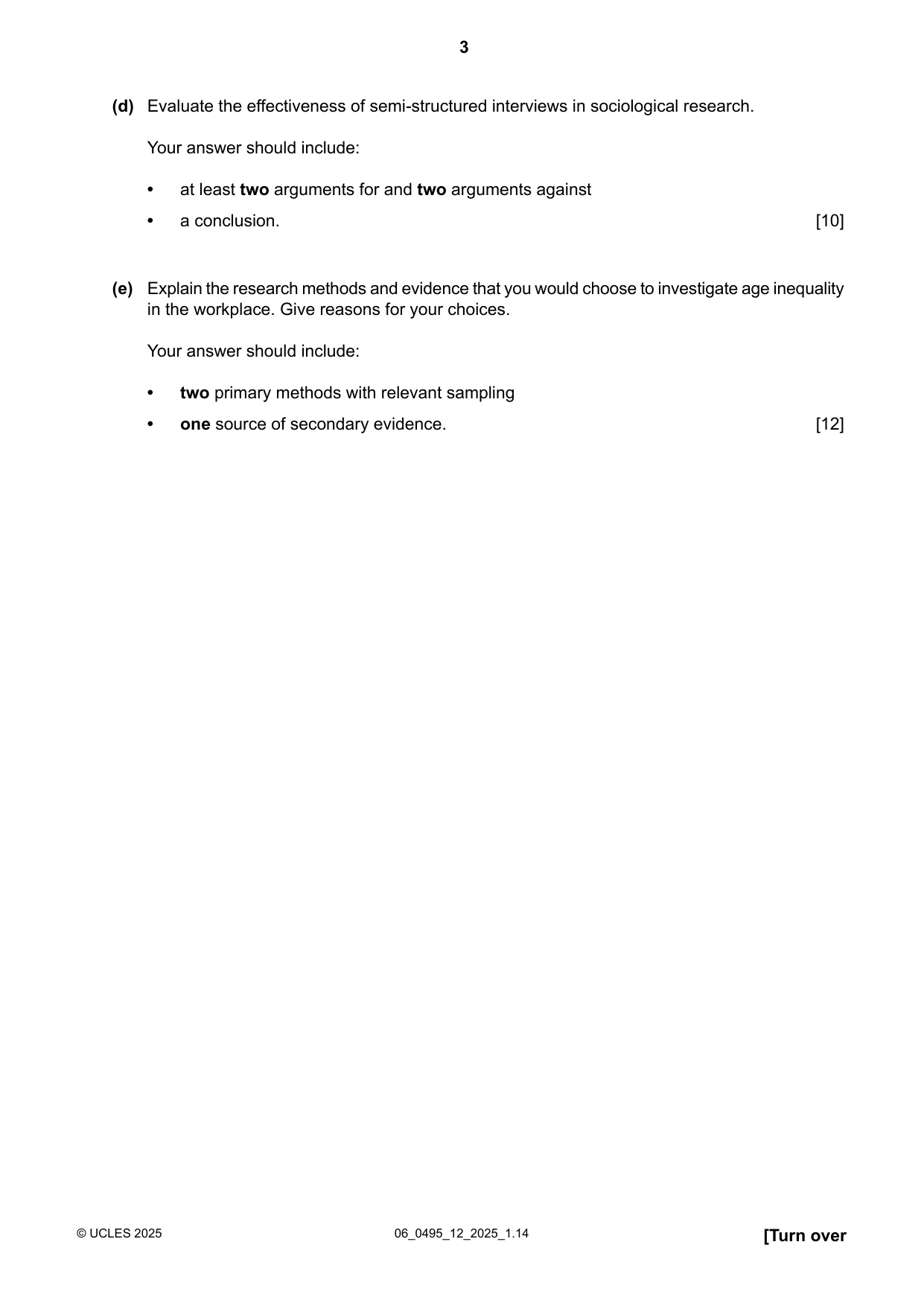
Evaluate the effectiveness of semi-structured interviews in sociological research. (d) Your answer should include: • at least two arguments for and two arguments against • a conclusion. [10] Explain the research methods and evidence that you would choose to investigate age inequality in the workplace. Give reasons for your choices. (e) Your answer should include: • two primary methods with relevant sampling • one source of secondary evidence. [12] [Turn over 06_0495_12_2025_1.14 © UCLES 2025 3
Question paper, page 4
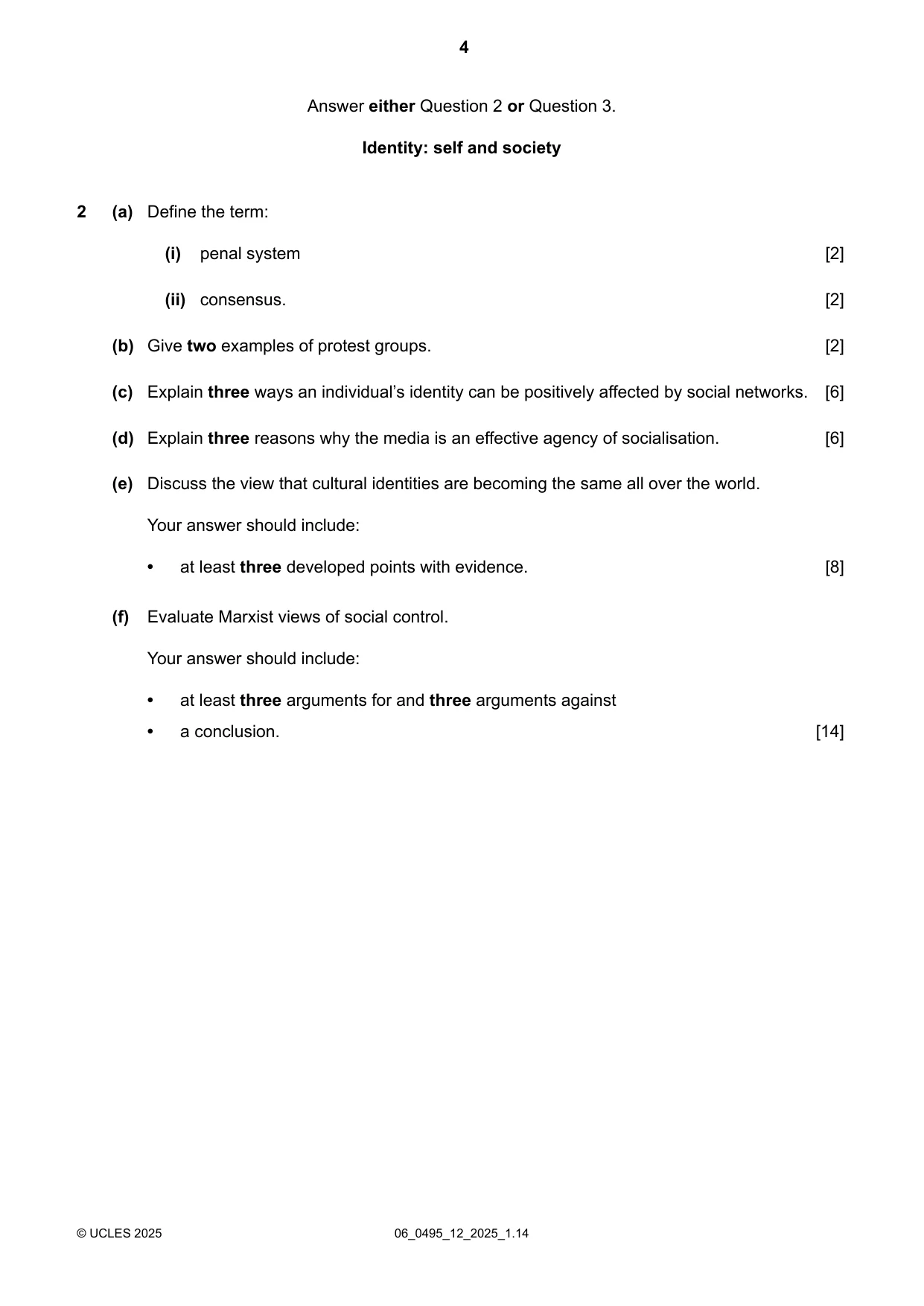
Answer either Question 2 or Question 3. Identity: self and society Define the term: (a) 2 penal system [2] (i) consensus. [2] (ii) Give two examples of protest groups. [2] (b) Explain three ways an individual’s identity can be positively affected by social networks. [6] (c) Explain three reasons why the media is an effective agency of socialisation. [6] (d) Discuss the view that cultural identities are becoming the same all over the world. (e) Your answer should include: • at least three developed points with evidence. [8] Evaluate Marxist views of social control. (f) Your answer should include: • at least three arguments for and three arguments against • a conclusion. [14] 06_0495_12_2025_1.14 © UCLES 2025 4
Question paper, page 5
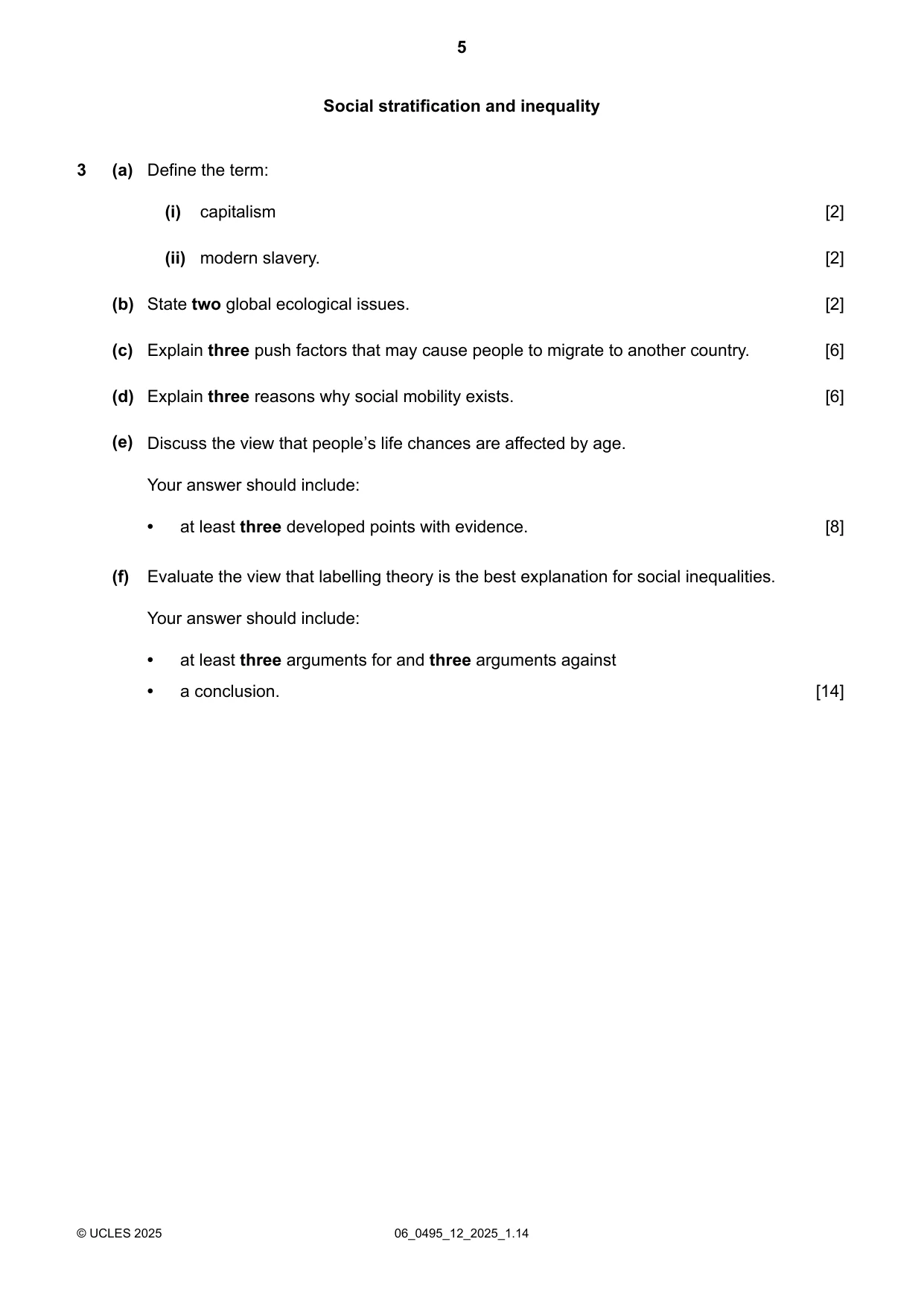
Social stratification and inequality Define the term: (a) 3 capitalism [2] (i) modern slavery. [2] (ii) State two global ecological issues. [2] (b) Explain three push factors that may cause people to migrate to another country. [6] (c) Explain three reasons why social mobility exists. [6] (d) Discuss the view that people’s life chances are affected by age. (e) Your answer should include: • at least three developed points with evidence. [8] Evaluate the view that labelling theory is the best explanation for social inequalities. (f) Your answer should include: • at least three arguments for and three arguments against • a conclusion. [14] 06_0495_12_2025_1.14 © UCLES 2025 5
Question paper, page 6
BLANK PAGE 06_0495_12_2025_1.14 © UCLES 2025 6
Question paper, page 7
BLANK PAGE 06_0495_12_2025_1.14 © UCLES 2025 7
Question paper, page 8
BLANK PAGE Permission to reproduce items where third-party owned material protected by copyright is included has been sought and cleared where possible. Every reasonable effort has been made by the publisher (UCLES) to trace copyright holders, but if any items requiring clearance have unwittingly been included, the publisher will be pleased to make amends at the earliest possible opportunity. To avoid the issue of disclosure of answer-related information to candidates, all copyright acknowledgements are reproduced online in the Cambridge Assessment International Education Copyright Acknowledgements Booklet. This is produced for each series of examinations and is freely available to download at www.cambridgeinternational.org after the live examination series. Cambridge Assessment International Education is part of Cambridge Assessment. Cambridge Assessment is the brand name of the University of Cambridge Local Examinations Syndicate (UCLES), which is a department of the University of Cambridge. 06_0495_12_2025_1.14 © UCLES 2025 8
Mark scheme, page 1
This document consists of 29 printed pages. © Cambridge University Press & Assessment 2025 [Turn over Cambridge IGCSE™ SOCIOLOGY 0495/12 Paper 1 Research Methods, Identity and Inequality May/June 2025 MARK SCHEME Maximum Mark: 80 Published This mark scheme is published as an aid to teachers and candidates, to indicate the requirements of the examination. It shows the basis on which Examiners were instructed to award marks. It does not indicate the details of the discussions that took place at an Examiners’ meeting before marking began, which would have considered the acceptability of alternative answers. Mark schemes should be read in conjunction with the question paper and the Principal Examiner Report for Teachers. Cambridge International will not enter into discussions about these mark schemes. Cambridge International is publishing the mark schemes for the May/June 2025 series for most Cambridge IGCSE, Cambridge International A and AS Level components, and some Cambridge O Level components.
Mark scheme, page 2
0495/12 Cambridge IGCSE – Mark Scheme PUBLISHED May/June 2025 © Cambridge University Press & Assessment 2025 Page 2 of 29 Generic Marking Principles These general marking principles must be applied by all examiners when marking candidate answers. They should be applied alongside the specific content of the mark scheme or generic level descriptions for a question. Each question paper and mark scheme will also comply with these marking principles. GENERIC MARKING PRINCIPLE 1: Marks must be awarded in line with: • the specific content of the mark scheme or the generic level descriptors for the question • the specific skills defined in the mark scheme or in the generic level descriptors for the question • the standard of response required by a candidate as exemplified by the standardisation scripts. GENERIC MARKING PRINCIPLE 2: Marks awarded are always whole marks (not half marks, or other fractions). GENERIC MARKING PRINCIPLE 3: Marks must be awarded positively: • marks are awarded for correct/valid answers, as defined in the mark scheme. However, credit is given for valid answers which go beyond the scope of the syllabus and mark scheme, referring to your Team Leader as appropriate • marks are awarded when candidates clearly demonstrate what they know and can do • marks are not deducted for errors • marks are not deducted for omissions • answers should only be judged on the quality of spelling, punctuation and grammar when these features are specifically assessed by the question as indicated by the mark scheme. The meaning, however, should be unambiguous. GENERIC MARKING PRINCIPLE 4: Rules must be applied consistently, e.g. in situations where candidates have not followed instructions or in the application of generic level descriptors. GENERIC MARKING PRINCIPLE 5: Marks should be awarded using the full range of marks defined in the mark scheme for the question (however; the use of the full mark range may be limited according to the quality of the candidate responses seen). GENERIC MARKING PRINCIPLE 6: Marks awarded are based solely on the requirements as defined in the mark scheme. Marks should not be awarded with grade thresholds or grade descriptors in mind.
Mark scheme, page 3
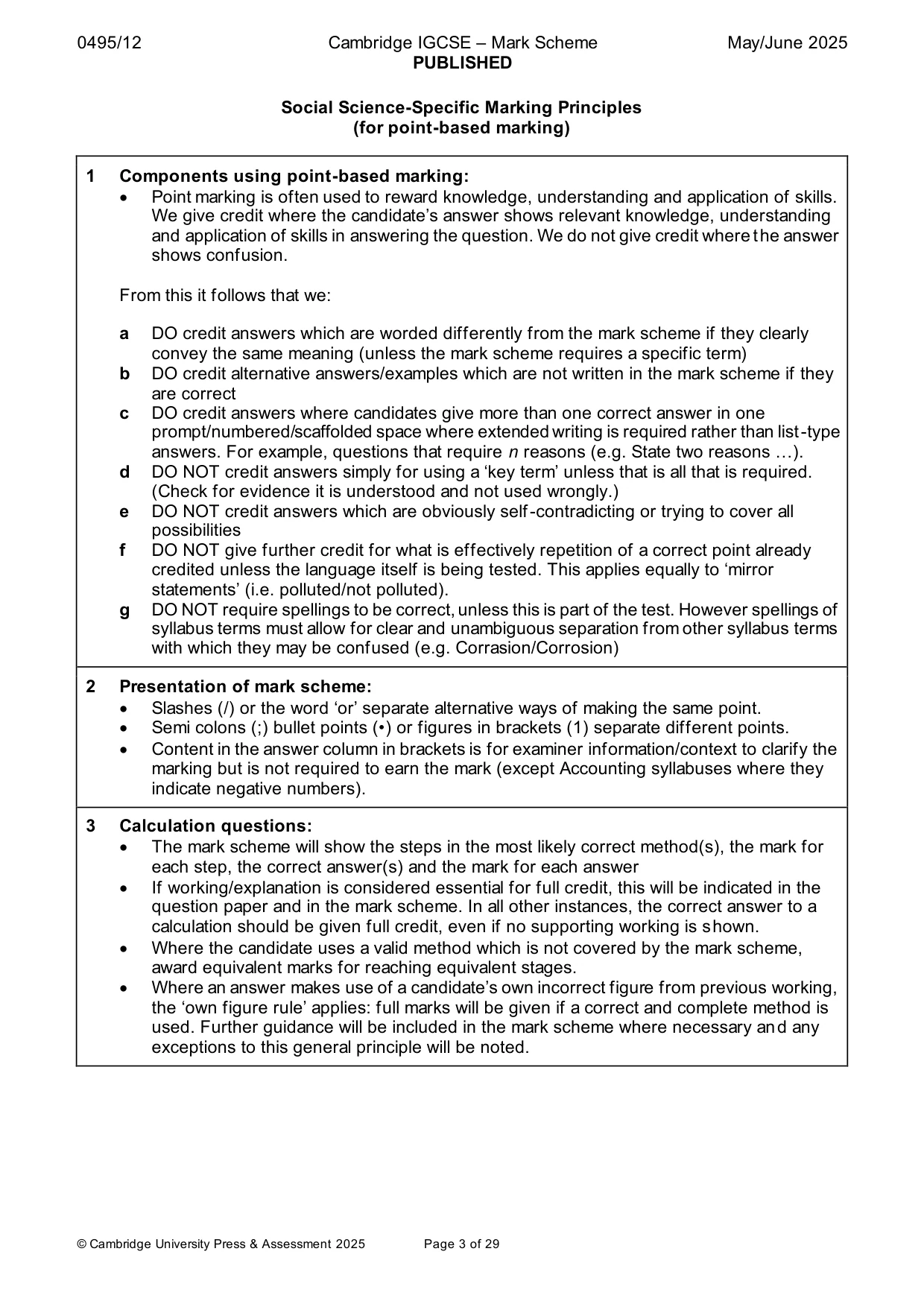
0495/12 Cambridge IGCSE – Mark Scheme PUBLISHED May/June 2025 © Cambridge University Press & Assessment 2025 Page 3 of 29 Social Science-Specific Marking Principles (for point-based marking) 1 Components using point-based marking: • Point marking is often used to reward knowledge, understanding and application of skills. We give credit where the candidate’s answer shows relevant knowledge, understanding and application of skills in answering the question. We do not give credit where the answer shows confusion. From this it follows that we: a DO credit answers which are worded differently from the mark scheme if they clearly convey the same meaning (unless the mark scheme requires a specific term) b DO credit alternative answers/examples which are not written in the mark scheme if they are correct c DO credit answers where candidates give more than one correct answer in one prompt/numbered/scaffolded space where extended writing is required rather than list-type answers. For example, questions that require n reasons (e.g. State two reasons …). d DO NOT credit answers simply for using a ‘key term’ unless that is all that is required. (Check for evidence it is understood and not used wrongly.) e DO NOT credit answers which are obviously self-contradicting or trying to cover all possibilities f DO NOT give further credit for what is effectively repetition of a correct point already credited unless the language itself is being tested. This applies equally to ‘mirror statements’ (i.e. polluted/not polluted). g DO NOT require spellings to be correct, unless this is part of the test. However spellings of syllabus terms must allow for clear and unambiguous separation from other syllabus terms with which they may be confused (e.g. Corrasion/Corrosion) 2 Presentation of mark scheme: • Slashes (/) or the word ‘or’ separate alternative ways of making the same point. • Semi colons (;) bullet points (•) or figures in brackets (1) separate different points. • Content in the answer column in brackets is for examiner information/context to clarify the marking but is not required to earn the mark (except Accounting syllabuses where they indicate negative numbers). 3 Calculation questions: • The mark scheme will show the steps in the most likely correct method(s), the mark for each step, the correct answer(s) and the mark for each answer • If working/explanation is considered essential for full credit, this will be indicated in the question paper and in the mark scheme. In all other instances, the correct answer to a calculation should be given full credit, even if no supporting working is shown. • Where the candidate uses a valid method which is not covered by the mark scheme, award equivalent marks for reaching equivalent stages. • Where an answer makes use of a candidate’s own incorrect figure from previous working, the ‘own figure rule’ applies: full marks will be given if a correct and complete method is used. Further guidance will be included in the mark scheme where necessary and any exceptions to this general principle will be noted.
Mark scheme, page 4
0495/12 Cambridge IGCSE – Mark Scheme PUBLISHED May/June 2025 © Cambridge University Press & Assessment 2025 Page 4 of 29 4 Annotation: • For point marking, ticks can be used to indicate correct answers and crosses can be used to indicate wrong answers. There is no direct relationship between ticks and marks. Ticks have no defined meaning for levels of response marking. • For levels of response marking, the level awarded should be annotated on the script. • Other annotations will be used by examiners as agreed during standardisation, and the meaning will be understood by all examiners who marked that paper.
Mark scheme, page 5
0495/12 Cambridge IGCSE – Mark Scheme PUBLISHED May/June 2025 © Cambridge University Press & Assessment 2025 Page 5 of 29 Annotations guidance for centres Examiners use a system of annotations as a shorthand for communicating their marking decisions to one another. Examiners are trained during the standardisation process on how and when to use annotations. The purpose of annotations is to inform the standardisation and monitoring processes and guide the supervising examiners when they are checking the work of examiners within their team. The meaning of annotations and how they are used is specific to each component and is understood by all examiners who mark the component. We publish annotations in our mark schemes to help centres understand the annotations they may see on copies of scripts. Note that there may not be a direct correlation between the number of annotations on a script and the mark awarded. Similarly, the use of an annotation may not be an indication of the quality of the response. The annotations listed below were available to examiners marking this component in this series.
Mark scheme, page 6
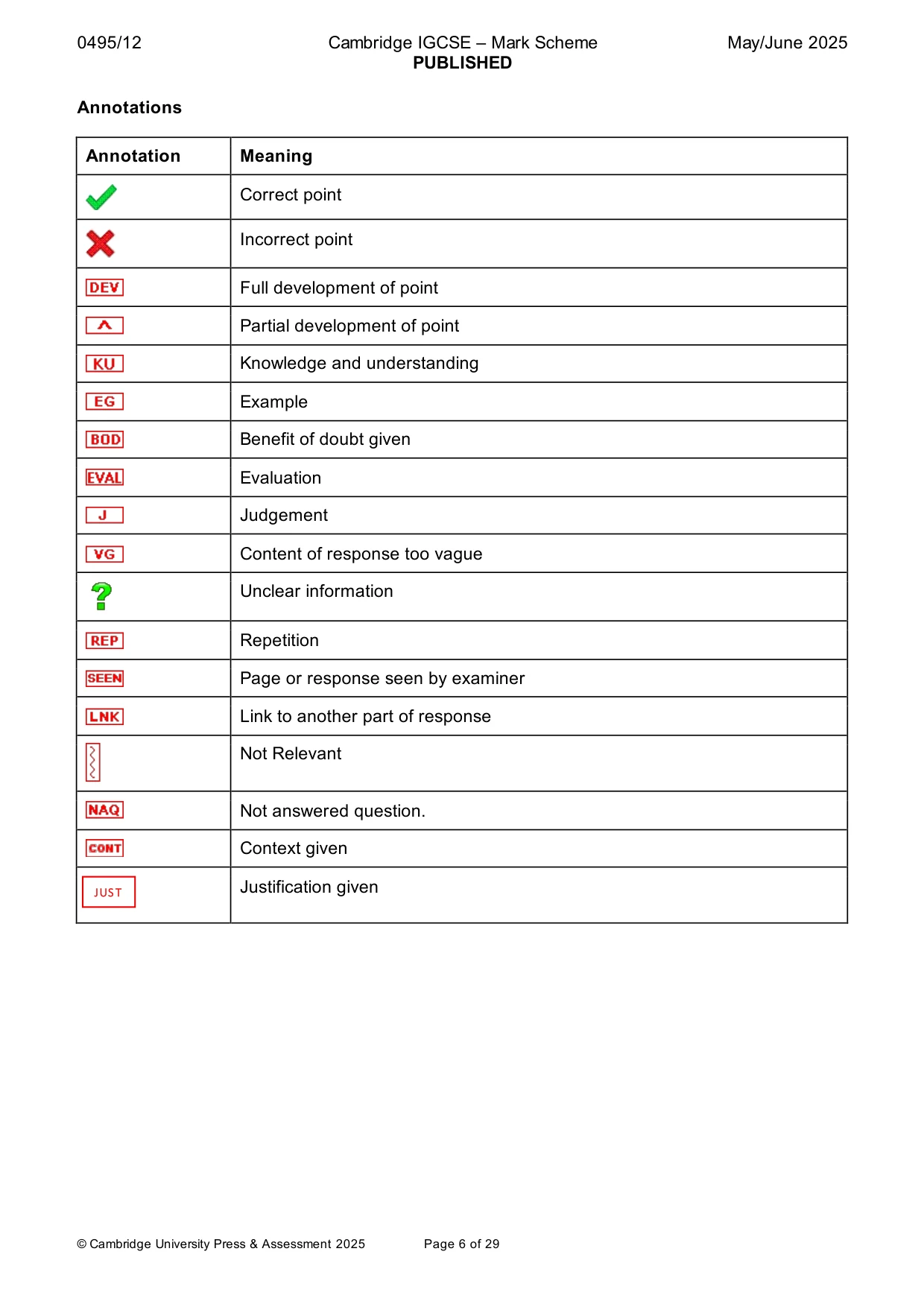
0495/12 Cambridge IGCSE – Mark Scheme PUBLISHED May/June 2025 © Cambridge University Press & Assessment 2025 Page 6 of 29 Annotations Annotation Meaning Correct point Incorrect point Full development of point Partial development of point Knowledge and understanding Example Benefit of doubt given Evaluation Judgement Content of response too vague Unclear information Repetition Page or response seen by examiner Link to another part of response Not Relevant Not answered question. Context given Justification given JUST
Mark scheme, page 7
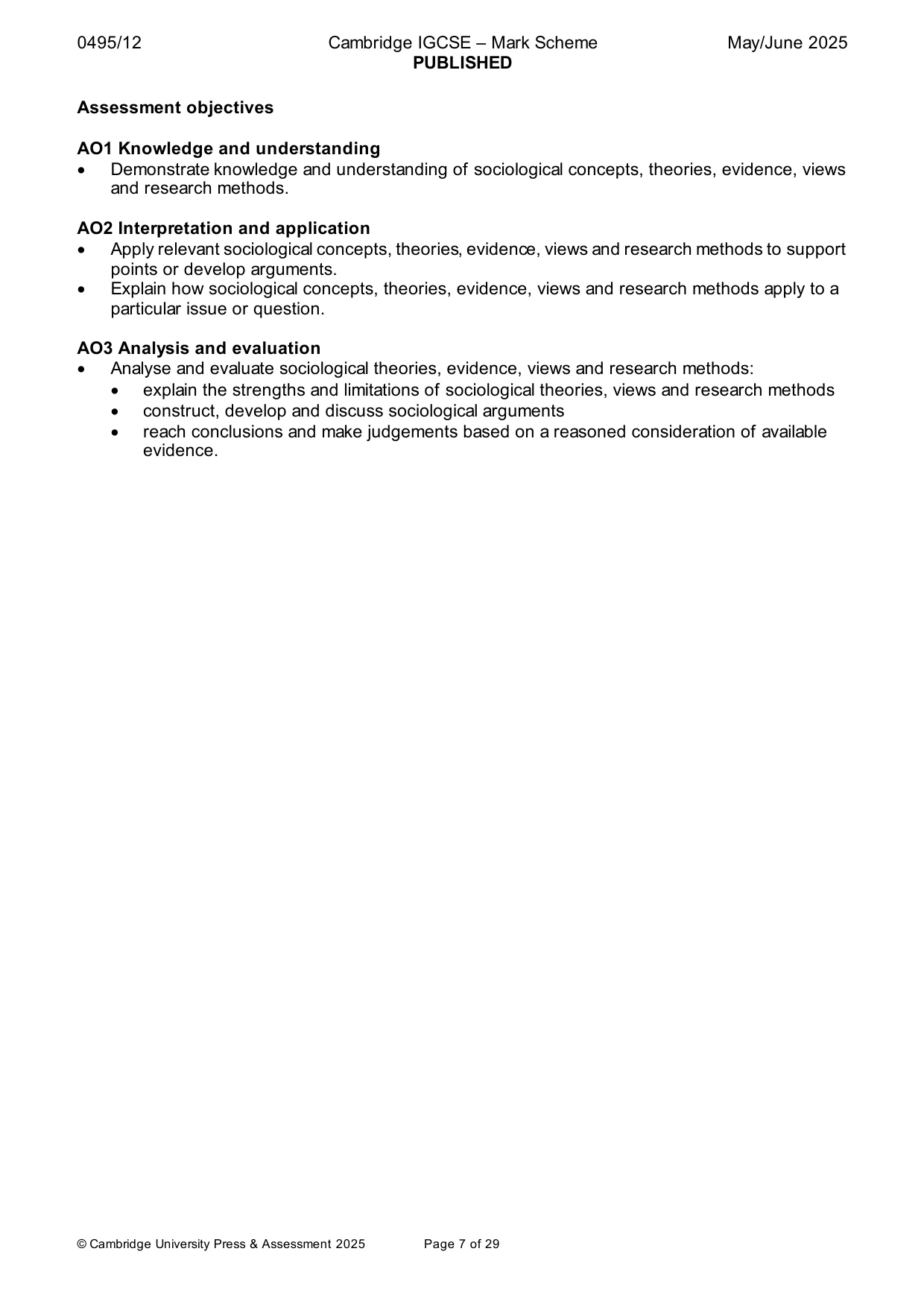
0495/12 Cambridge IGCSE – Mark Scheme PUBLISHED May/June 2025 © Cambridge University Press & Assessment 2025 Page 7 of 29 Assessment objectives AO1 Knowledge and understanding • Demonstrate knowledge and understanding of sociological concepts, theories, evidence, views and research methods. AO2 Interpretation and application • Apply relevant sociological concepts, theories, evidence, views and research methods to support points or develop arguments. • Explain how sociological concepts, theories, evidence, views and research methods apply to a particular issue or question. AO3 Analysis and evaluation • Analyse and evaluate sociological theories, evidence, views and research methods: • explain the strengths and limitations of sociological theories, views and research methods • construct, develop and discuss sociological arguments • reach conclusions and make judgements based on a reasoned consideration of available evidence.
Mark scheme, page 8
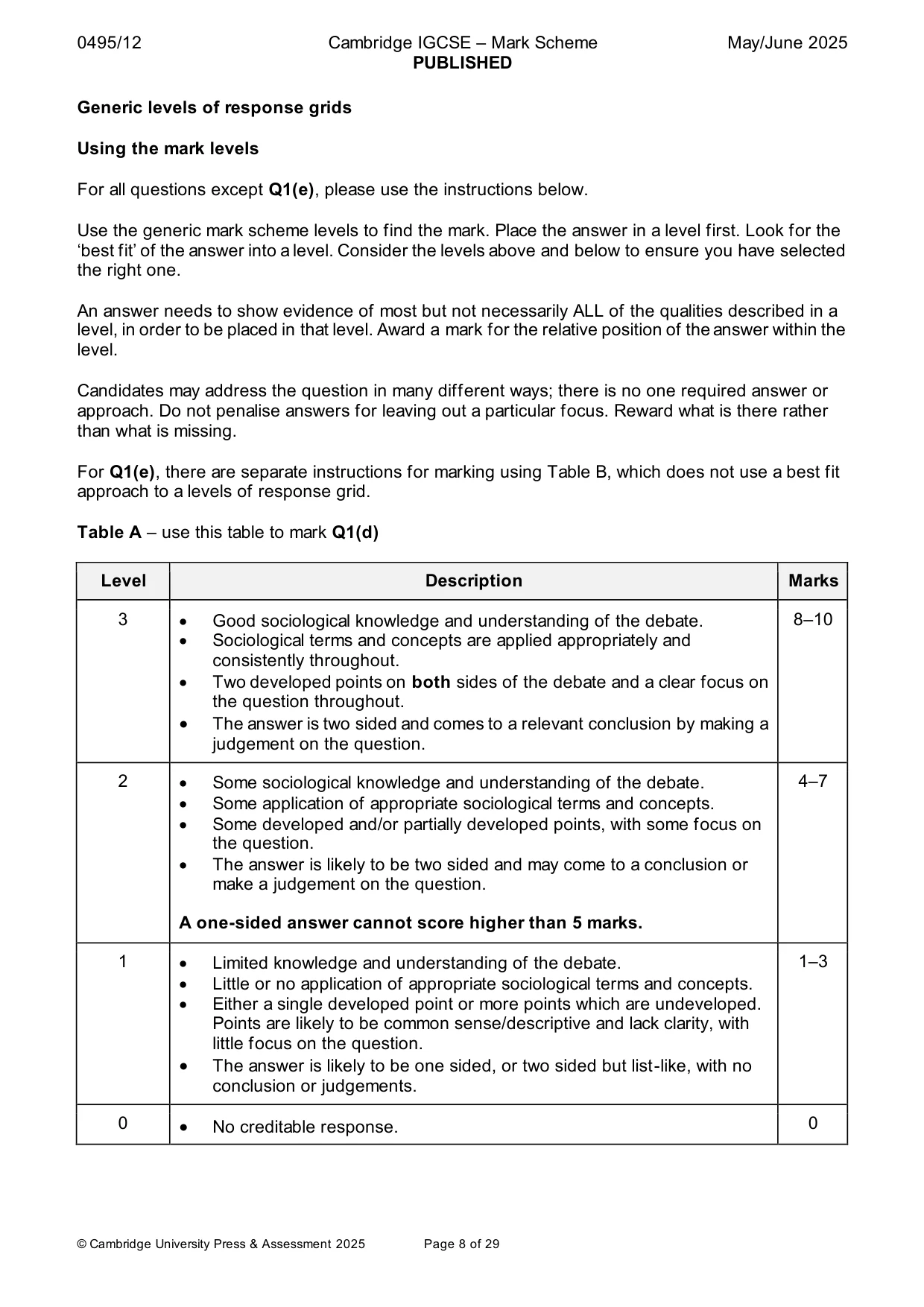
0495/12 Cambridge IGCSE – Mark Scheme PUBLISHED May/June 2025 © Cambridge University Press & Assessment 2025 Page 8 of 29 Generic levels of response grids Using the mark levels For all questions except Q1(e), please use the instructions below. Use the generic mark scheme levels to find the mark. Place the answer in a level first. Look for the ‘best fit’ of the answer into a level. Consider the levels above and below to ensure you have selected the right one. An answer needs to show evidence of most but not necessarily ALL of the qualities described in a level, in order to be placed in that level. Award a mark for the relative position of the answer within the level. Candidates may address the question in many different ways; there is no one required answer or approach. Do not penalise answers for leaving out a particular focus. Reward what is there rather than what is missing. For Q1(e), there are separate instructions for marking using Table B, which does not use a best fit approach to a levels of response grid. Table A – use this table to mark Q1(d) Level Description Marks 3 • Good sociological knowledge and understanding of the debate. • Sociological terms and concepts are applied appropriately and consistently throughout. • Two developed points on both sides of the debate and a clear focus on the question throughout. • The answer is two sided and comes to a relevant conclusion by making a judgement on the question. 8–10 2 • Some sociological knowledge and understanding of the debate. • Some application of appropriate sociological terms and concepts. • Some developed and/or partially developed points, with some focus on the question. • The answer is likely to be two sided and may come to a conclusion or make a judgement on the question. A one-sided answer cannot score higher than 5 marks. 4–7 1 • Limited knowledge and understanding of the debate. • Little or no application of appropriate sociological terms and concepts. • Either a single developed point or more points which are undeveloped. Points are likely to be common sense/descriptive and lack clarity, with little focus on the question. • The answer is likely to be one sided, or two sided but list-like, with no conclusion or judgements. 1–3 0 • No creditable response. 0
Mark scheme, page 9
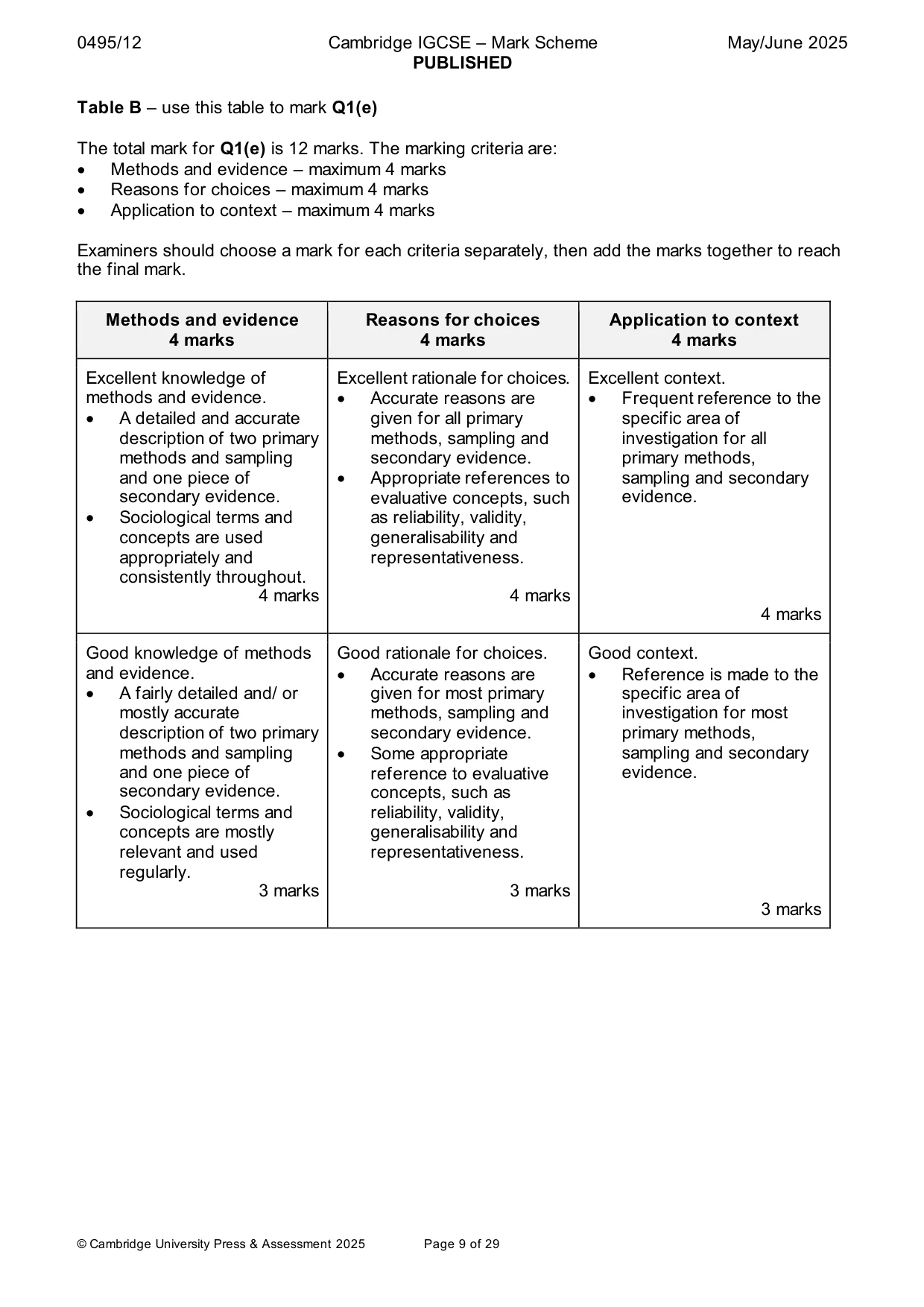
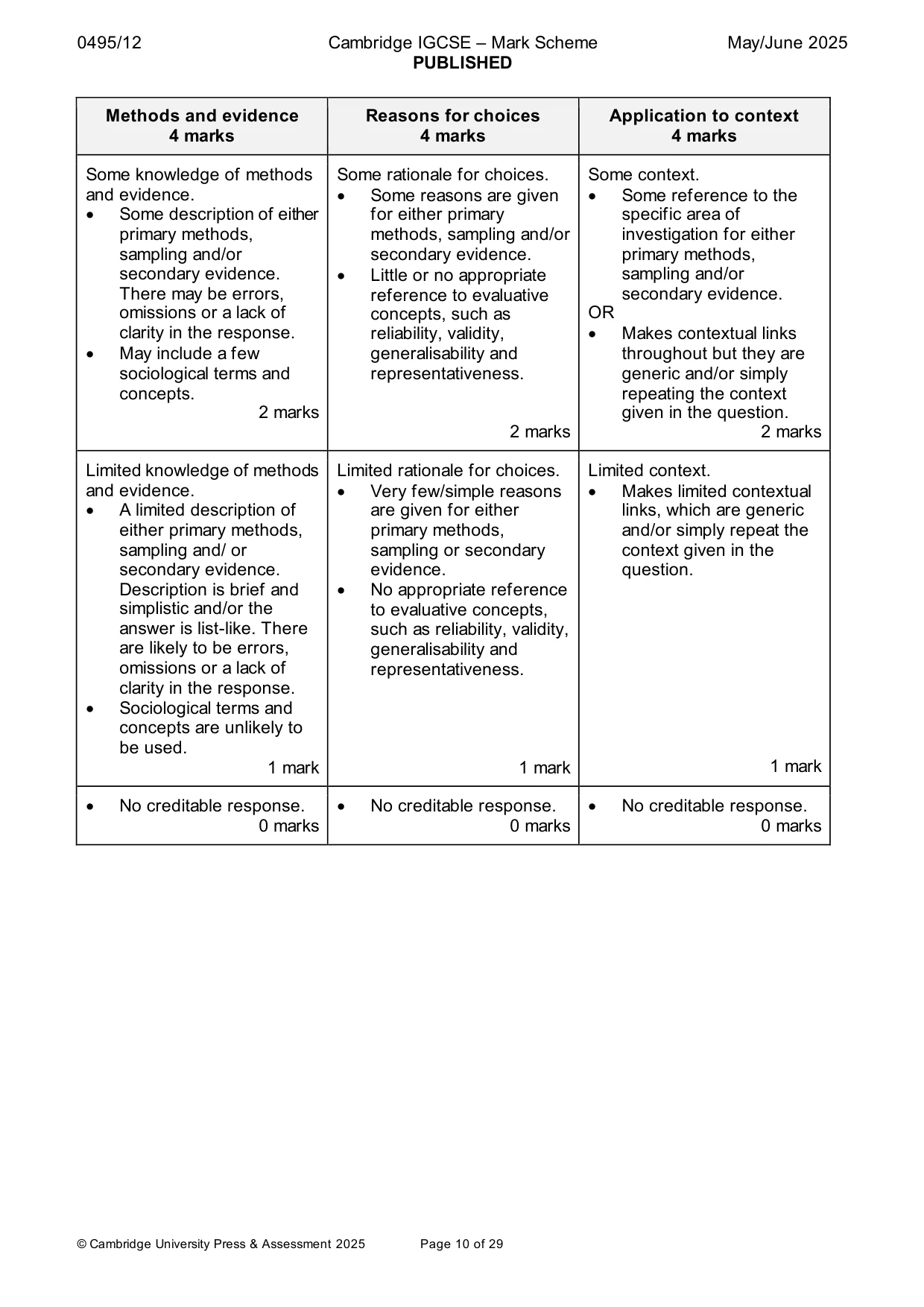
0495/12 Cambridge IGCSE – Mark Scheme PUBLISHED May/June 2025 © Cambridge University Press & Assessment 2025 Page 9 of 29 Table B – use this table to mark Q1(e) The total mark for Q1(e) is 12 marks. The marking criteria are: • Methods and evidence – maximum 4 marks • Reasons for choices – maximum 4 marks • Application to context – maximum 4 marks Examiners should choose a mark for each criteria separately, then add the marks together to reach the final mark. Methods and evidence 4 marks Reasons for choices 4 marks Application to context 4 marks Excellent knowledge of methods and evidence. • A detailed and accurate description of two primary methods and sampling and one piece of secondary evidence. • Sociological terms and concepts are used appropriately and consistently throughout. 4 marks Excellent rationale for choices. • Accurate reasons are given for all primary methods, sampling and secondary evidence. • Appropriate references to evaluative concepts, such as reliability, validity, generalisability and representativeness. 4 marks Excellent context. • Frequent reference to the specific area of investigation for all primary methods, sampling and secondary evidence. 4 marks Good knowledge of methods and evidence. • A fairly detailed and/ or mostly accurate description of two primary methods and sampling and one piece of secondary evidence. • Sociological terms and concepts are mostly relevant and used regularly. 3 marks Good rationale for choices. • Accurate reasons are given for most primary methods, sampling and secondary evidence. • Some appropriate reference to evaluative concepts, such as reliability, validity, generalisability and representativeness. 3 marks Good context. • Reference is made to the specific area of investigation for most primary methods, sampling and secondary evidence. 3 marks
Mark scheme, page 10
0495/12 Cambridge IGCSE – Mark Scheme PUBLISHED May/June 2025 © Cambridge University Press & Assessment 2025 Page 10 of 29 Methods and evidence 4 marks Reasons for choices 4 marks Application to context 4 marks Some knowledge of methods and evidence. • Some description of either primary methods, sampling and/or secondary evidence. There may be errors, omissions or a lack of clarity in the response. • May include a few sociological terms and concepts. 2 marks Some rationale for choices. • Some reasons are given for either primary methods, sampling and/or secondary evidence. • Little or no appropriate reference to evaluative concepts, such as reliability, validity, generalisability and representativeness. 2 marks Some context. • Some reference to the specific area of investigation for either primary methods, sampling and/or secondary evidence. OR • Makes contextual links throughout but they are generic and/or simply repeating the context given in the question. 2 marks Limited knowledge of methods and evidence. • A limited description of either primary methods, sampling and/ or secondary evidence. Description is brief and simplistic and/or the answer is list-like. There are likely to be errors, omissions or a lack of clarity in the response. • Sociological terms and concepts are unlikely to be used. 1 mark Limited rationale for choices. • Very few/simple reasons are given for either primary methods, sampling or secondary evidence. • No appropriate reference to evaluative concepts, such as reliability, validity, generalisability and representativeness. 1 mark Limited context. • Makes limited contextual links, which are generic and/or simply repeat the context given in the question. 1 mark • No creditable response. 0 marks • No creditable response. 0 marks • No creditable response. 0 marks
Mark scheme, page 11
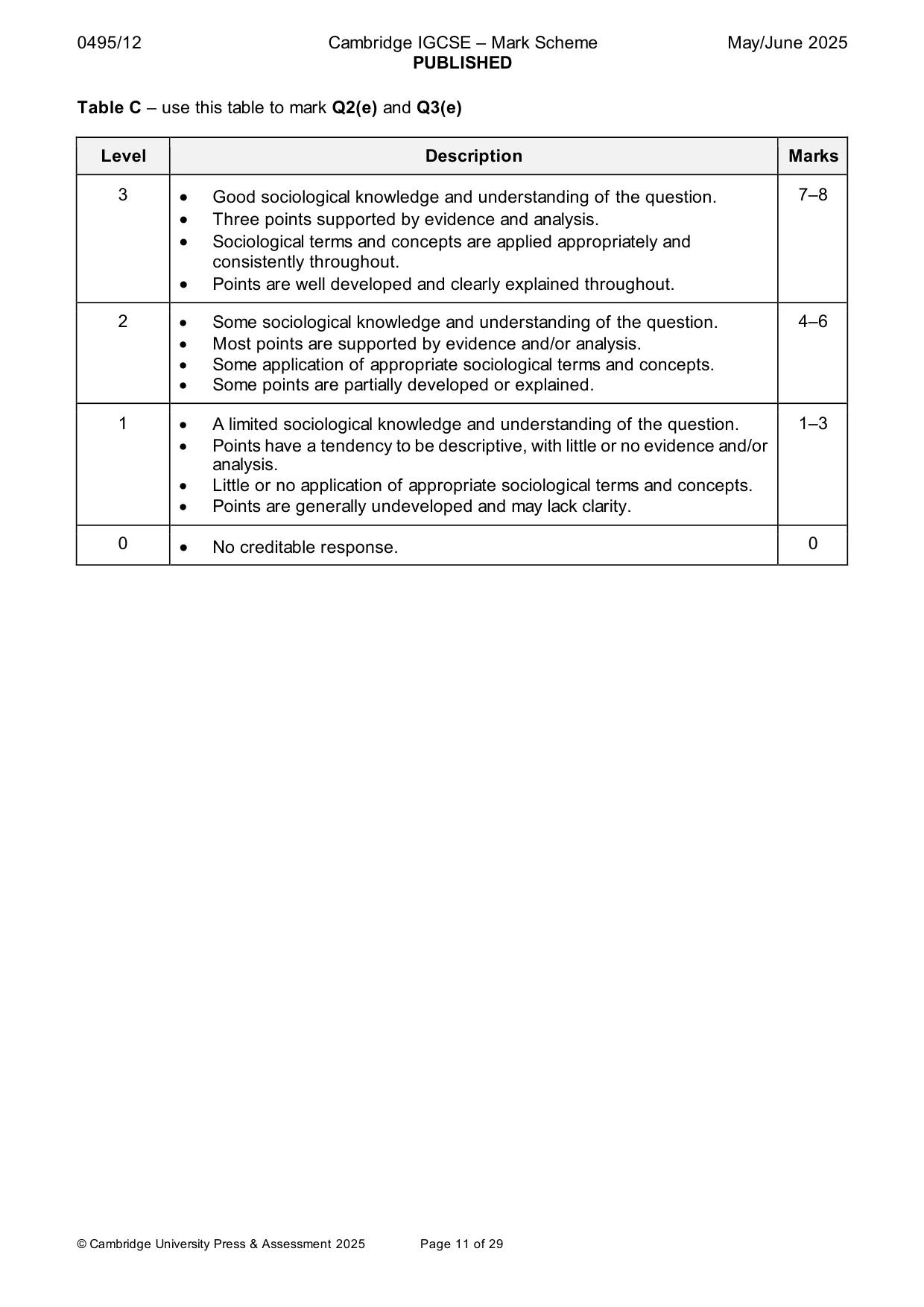
0495/12 Cambridge IGCSE – Mark Scheme PUBLISHED May/June 2025 © Cambridge University Press & Assessment 2025 Page 11 of 29 Table C – use this table to mark Q2(e) and Q3(e) Level Description Marks 3 • Good sociological knowledge and understanding of the question. • Three points supported by evidence and analysis. • Sociological terms and concepts are applied appropriately and consistently throughout. • Points are well developed and clearly explained throughout. 7–8 2 • Some sociological knowledge and understanding of the question. • Most points are supported by evidence and/or analysis. • Some application of appropriate sociological terms and concepts. • Some points are partially developed or explained. 4–6 1 • A limited sociological knowledge and understanding of the question. • Points have a tendency to be descriptive, with little or no evidence and/or analysis. • Little or no application of appropriate sociological terms and concepts. • Points are generally undeveloped and may lack clarity. 1–3 0 • No creditable response. 0
Mark scheme, page 12
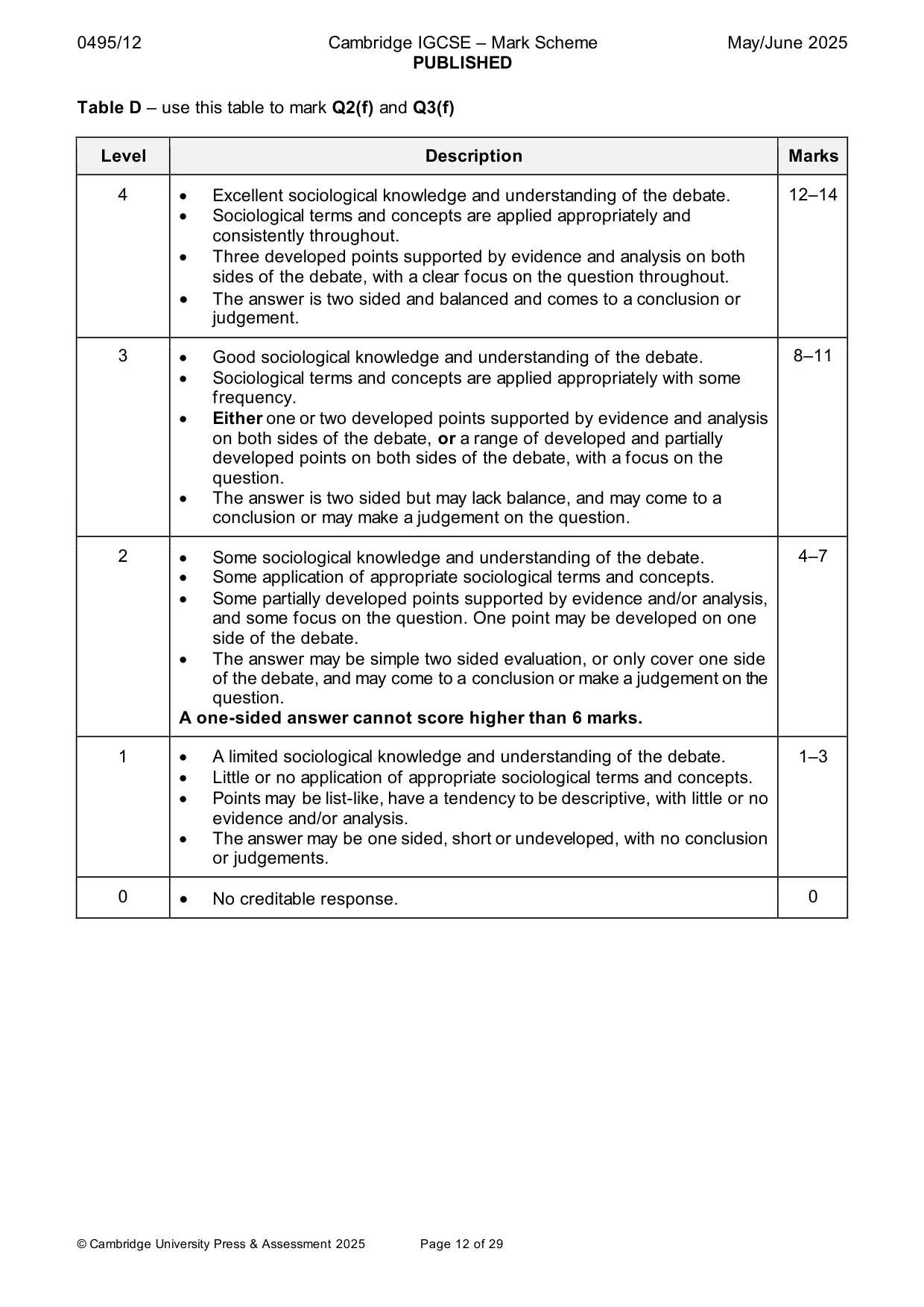
0495/12 Cambridge IGCSE – Mark Scheme PUBLISHED May/June 2025 © Cambridge University Press & Assessment 2025 Page 12 of 29 Table D – use this table to mark Q2(f) and Q3(f) Level Description Marks 4 • Excellent sociological knowledge and understanding of the debate. • Sociological terms and concepts are applied appropriately and consistently throughout. • Three developed points supported by evidence and analysis on both sides of the debate, with a clear focus on the question throughout. • The answer is two sided and balanced and comes to a conclusion or judgement. 12–14 3 • Good sociological knowledge and understanding of the debate. • Sociological terms and concepts are applied appropriately with some frequency. • Either one or two developed points supported by evidence and analysis on both sides of the debate, or a range of developed and partially developed points on both sides of the debate, with a focus on the question. • The answer is two sided but may lack balance, and may come to a conclusion or may make a judgement on the question. 8–11 2 • Some sociological knowledge and understanding of the debate. • Some application of appropriate sociological terms and concepts. • Some partially developed points supported by evidence and/or analysis, and some focus on the question. One point may be developed on one side of the debate. • The answer may be simple two sided evaluation, or only cover one side of the debate, and may come to a conclusion or make a judgement on the question. A one-sided answer cannot score higher than 6 marks. 4–7 1 • A limited sociological knowledge and understanding of the debate. • Little or no application of appropriate sociological terms and concepts. • Points may be list-like, have a tendency to be descriptive, with little or no evidence and/or analysis. • The answer may be one sided, short or undeveloped, with no conclusion or judgements. 1–3 0 • No creditable response. 0
Mark scheme, page 13
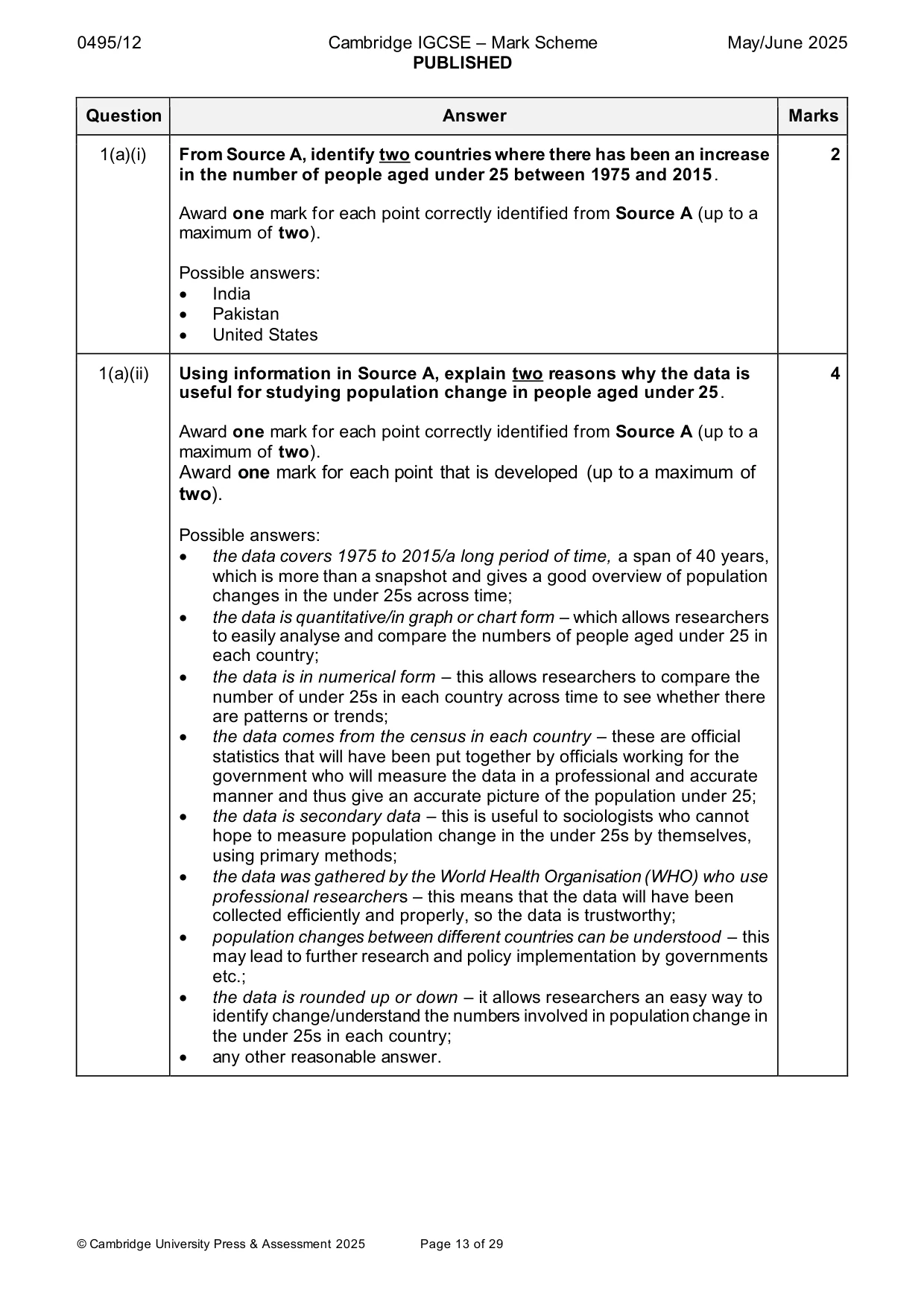
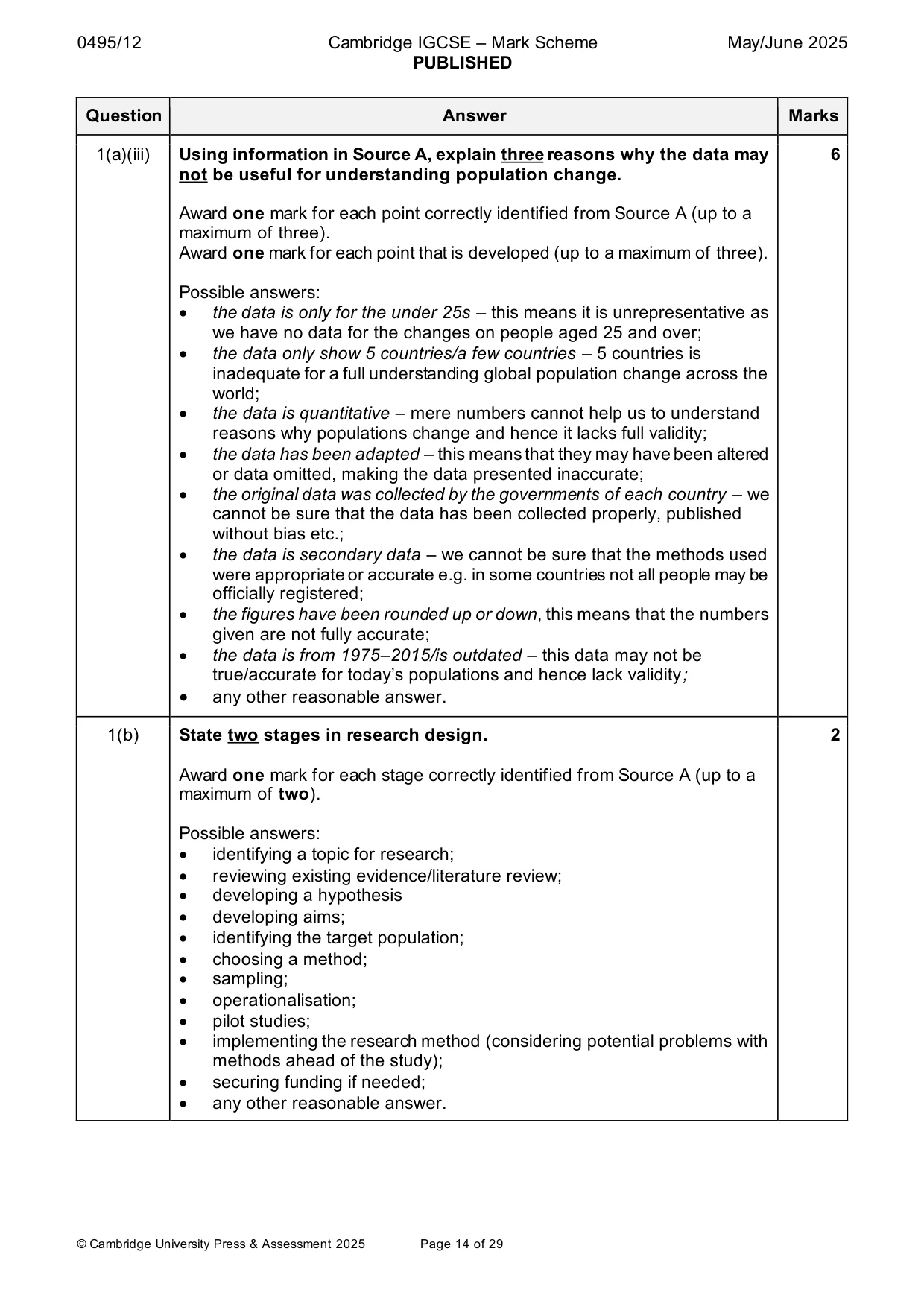
0495/12 Cambridge IGCSE – Mark Scheme PUBLISHED May/June 2025 © Cambridge University Press & Assessment 2025 Page 13 of 29 Question Answer Marks 1(a)(i) From Source A, identify two countries where there has been an increase in the number of people aged under 25 between 1975 and 2015. Award one mark for each point correctly identified from Source A (up to a maximum of two). Possible answers: • India • Pakistan • United States 2 1(a)(ii) Using information in Source A, explain two reasons why the data is useful for studying population change in people aged under 25. Award one mark for each point correctly identified from Source A (up to a maximum of two). Award one mark for each point that is developed (up to a maximum of two). Possible answers: • the data covers 1975 to 2015/a long period of time, a span of 40 years, which is more than a snapshot and gives a good overview of population changes in the under 25s across time; • the data is quantitative/in graph or chart form – which allows researchers to easily analyse and compare the numbers of people aged under 25 in each country; • the data is in numerical form – this allows researchers to compare the number of under 25s in each country across time to see whether there are patterns or trends; • the data comes from the census in each country – these are official statistics that will have been put together by officials working for the government who will measure the data in a professional and accurate manner and thus give an accurate picture of the population under 25; • the data is secondary data – this is useful to sociologists who cannot hope to measure population change in the under 25s by themselves, using primary methods; • the data was gathered by the World Health Organisation (WHO) who use professional researchers – this means that the data will have been collected efficiently and properly, so the data is trustworthy; • population changes between different countries can be understood – this may lead to further research and policy implementation by governments etc.; • the data is rounded up or down – it allows researchers an easy way to identify change/understand the numbers involved in population change in the under 25s in each country; • any other reasonable answer. 4
Mark scheme, page 14
0495/12 Cambridge IGCSE – Mark Scheme PUBLISHED May/June 2025 © Cambridge University Press & Assessment 2025 Page 14 of 29 Question Answer Marks 1(a)(iii) Using information in Source A, explain three reasons why the data may not be useful for understanding population change. Award one mark for each point correctly identified from Source A (up to a maximum of three). Award one mark for each point that is developed (up to a maximum of three). Possible answers: • the data is only for the under 25s – this means it is unrepresentative as we have no data for the changes on people aged 25 and over; • the data only show 5 countries/a few countries – 5 countries is inadequate for a full understanding global population change across the world; • the data is quantitative – mere numbers cannot help us to understand reasons why populations change and hence it lacks full validity; • the data has been adapted – this means that they may have been altered or data omitted, making the data presented inaccurate; • the original data was collected by the governments of each country – we cannot be sure that the data has been collected properly, published without bias etc.; • the data is secondary data – we cannot be sure that the methods used were appropriate or accurate e.g. in some countries not all people may be officially registered; • the figures have been rounded up or down, this means that the numbers given are not fully accurate; • the data is from 1975–2015/is outdated – this data may not be true/accurate for today’s populations and hence lack validity; • any other reasonable answer. 6 1(b) State two stages in research design. Award one mark for each stage correctly identified from Source A (up to a maximum of two). Possible answers: • identifying a topic for research; • reviewing existing evidence/literature review; • developing a hypothesis • developing aims; • identifying the target population; • choosing a method; • sampling; • operationalisation; • pilot studies; • implementing the research method (considering potential problems with methods ahead of the study); • securing funding if needed; • any other reasonable answer. 2
Mark scheme, page 15
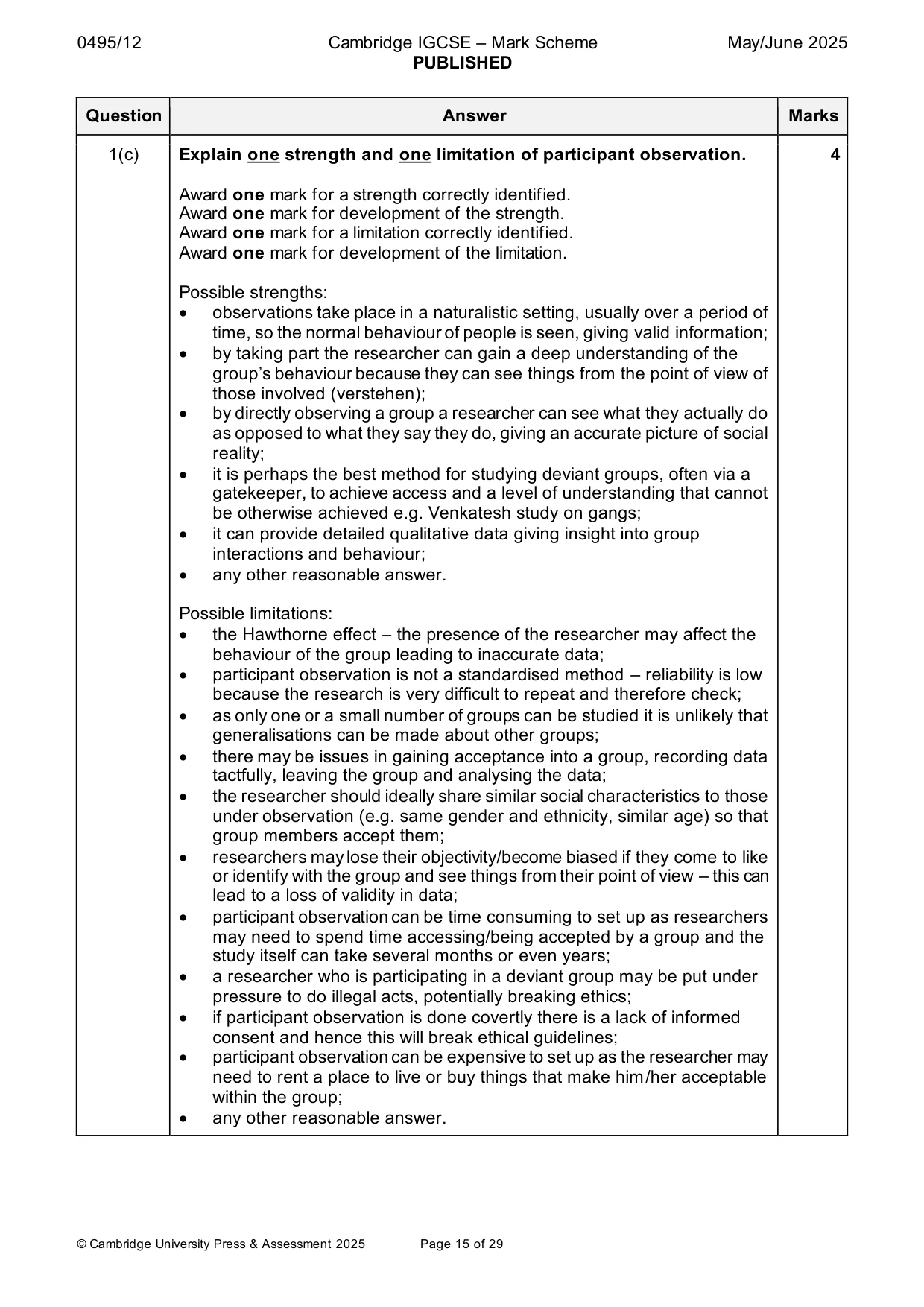
0495/12 Cambridge IGCSE – Mark Scheme PUBLISHED May/June 2025 © Cambridge University Press & Assessment 2025 Page 15 of 29 Question Answer Marks 1(c) Explain one strength and one limitation of participant observation. Award one mark for a strength correctly identified. Award one mark for development of the strength. Award one mark for a limitation correctly identified. Award one mark for development of the limitation. Possible strengths: • observations take place in a naturalistic setting, usually over a period of time, so the normal behaviour of people is seen, giving valid information; • by taking part the researcher can gain a deep understanding of the group’s behaviour because they can see things from the point of view of those involved (verstehen); • by directly observing a group a researcher can see what they actually do as opposed to what they say they do, giving an accurate picture of social reality; • it is perhaps the best method for studying deviant groups, often via a gatekeeper, to achieve access and a level of understanding that cannot be otherwise achieved e.g. Venkatesh study on gangs; • it can provide detailed qualitative data giving insight into group interactions and behaviour; • any other reasonable answer. Possible limitations: • the Hawthorne effect – the presence of the researcher may affect the behaviour of the group leading to inaccurate data; • participant observation is not a standardised method – reliability is low because the research is very difficult to repeat and therefore check; • as only one or a small number of groups can be studied it is unlikely that generalisations can be made about other groups; • there may be issues in gaining acceptance into a group, recording data tactfully, leaving the group and analysing the data; • the researcher should ideally share similar social characteristics to those under observation (e.g. same gender and ethnicity, similar age) so that group members accept them; • researchers may lose their objectivity/become biased if they come to like or identify with the group and see things from their point of view – this can lead to a loss of validity in data; • participant observation can be time consuming to set up as researchers may need to spend time accessing/being accepted by a group and the study itself can take several months or even years; • a researcher who is participating in a deviant group may be put under pressure to do illegal acts, potentially breaking ethics; • if participant observation is done covertly there is a lack of informed consent and hence this will break ethical guidelines; • participant observation can be expensive to set up as the researcher may need to rent a place to live or buy things that make him/her acceptable within the group; • any other reasonable answer. 4
Mark scheme, page 16
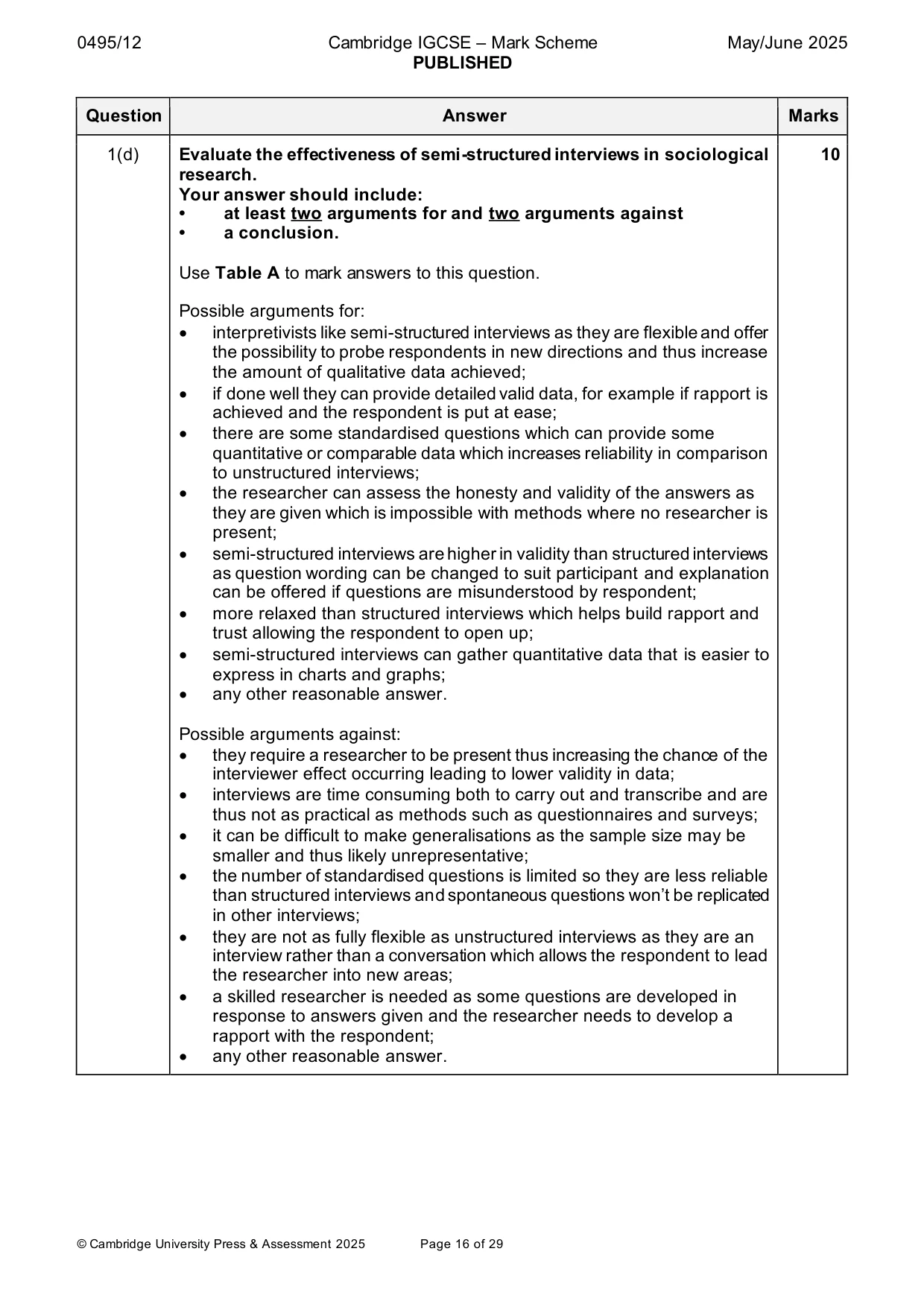
0495/12 Cambridge IGCSE – Mark Scheme PUBLISHED May/June 2025 © Cambridge University Press & Assessment 2025 Page 16 of 29 Question Answer Marks 1(d) Evaluate the effectiveness of semi-structured interviews in sociological research. Your answer should include: • at least two arguments for and two arguments against • a conclusion. Use Table A to mark answers to this question. Possible arguments for: • interpretivists like semi-structured interviews as they are flexible and offer the possibility to probe respondents in new directions and thus increase the amount of qualitative data achieved; • if done well they can provide detailed valid data, for example if rapport is achieved and the respondent is put at ease; • there are some standardised questions which can provide some quantitative or comparable data which increases reliability in comparison to unstructured interviews; • the researcher can assess the honesty and validity of the answers as they are given which is impossible with methods where no researcher is present; • semi-structured interviews are higher in validity than structured interviews as question wording can be changed to suit participant and explanation can be offered if questions are misunderstood by respondent; • more relaxed than structured interviews which helps build rapport and trust allowing the respondent to open up; • semi-structured interviews can gather quantitative data that is easier to express in charts and graphs; • any other reasonable answer. Possible arguments against: • they require a researcher to be present thus increasing the chance of the interviewer effect occurring leading to lower validity in data; • interviews are time consuming both to carry out and transcribe and are thus not as practical as methods such as questionnaires and surveys; • it can be difficult to make generalisations as the sample size may be smaller and thus likely unrepresentative; • the number of standardised questions is limited so they are less reliable than structured interviews and spontaneous questions won’t be replicated in other interviews; • they are not as fully flexible as unstructured interviews as they are an interview rather than a conversation which allows the respondent to lead the researcher into new areas; • a skilled researcher is needed as some questions are developed in response to answers given and the researcher needs to develop a rapport with the respondent; • any other reasonable answer. 10
Mark scheme, page 17
0495/12 Cambridge IGCSE – Mark Scheme PUBLISHED May/June 2025 © Cambridge University Press & Assessment 2025 Page 17 of 29 Question Answer Marks 1(e) Explain the research methods and evidence you would choose to investigate age inequality in the workplace. Give reasons for your choices. Your answer should include: • two primary methods with relevant sampling • one source of secondary evidence. Use Table B to mark answers to this question. Possible methods: • interviews; • questionnaires; • surveys; • observation (all types); • case studies; • longitudinal studies; • any other reasonable method. Possible sampling points: • the group to be studied; • the size of sample; • the type of sample; • the composition of the sample; • access to the sample; • any other reasonable sampling points. Possible sources of secondary evidence: • official and non-official statistics (e.g. employment/promotion rates of different age groups etc.); • previous sociological and other research on ageism in the workplace; • media materials (e.g. social networking sites, magazine articles, blogs, forums, TV documentaries, newspaper articles etc. that look at age inequality in the workplace); • personal documents/diaries/social network entries of individuals recording their experiences of inequality in the workplace; • any other reasonable evidence. 12
Mark scheme, page 18
0495/12 Cambridge IGCSE – Mark Scheme PUBLISHED May/June 2025 © Cambridge University Press & Assessment 2025 Page 18 of 29 Question Answer Marks 2(a)(i) Define the term penal system. Award one mark for a partial definition, e.g. prison. Award two marks for a clear definition, e.g. the formal means for enforcing punishments for crime. 2 2(a)(ii) Define the term consensus. Award one mark for a partial definition, e.g. agreement. Award two marks for a clear definition, e.g. agreement on shared values in society. 2 2(b) Give two examples of protest groups. Award one mark for each point correctly identified (up to a maximum of two). Possible answers: • anti-racism groups e.g. Black Lives Matter; • animal rights groups e.g. PETA; • environmental groups e.g. Schools Strike for Climate; • human rights groups e.g. Amnesty International; • indigenous land rights groups; • anti-sexism group e.g. #MeToo; • anti-war protest groups; • any other reasonable answer. 2
Mark scheme, page 19
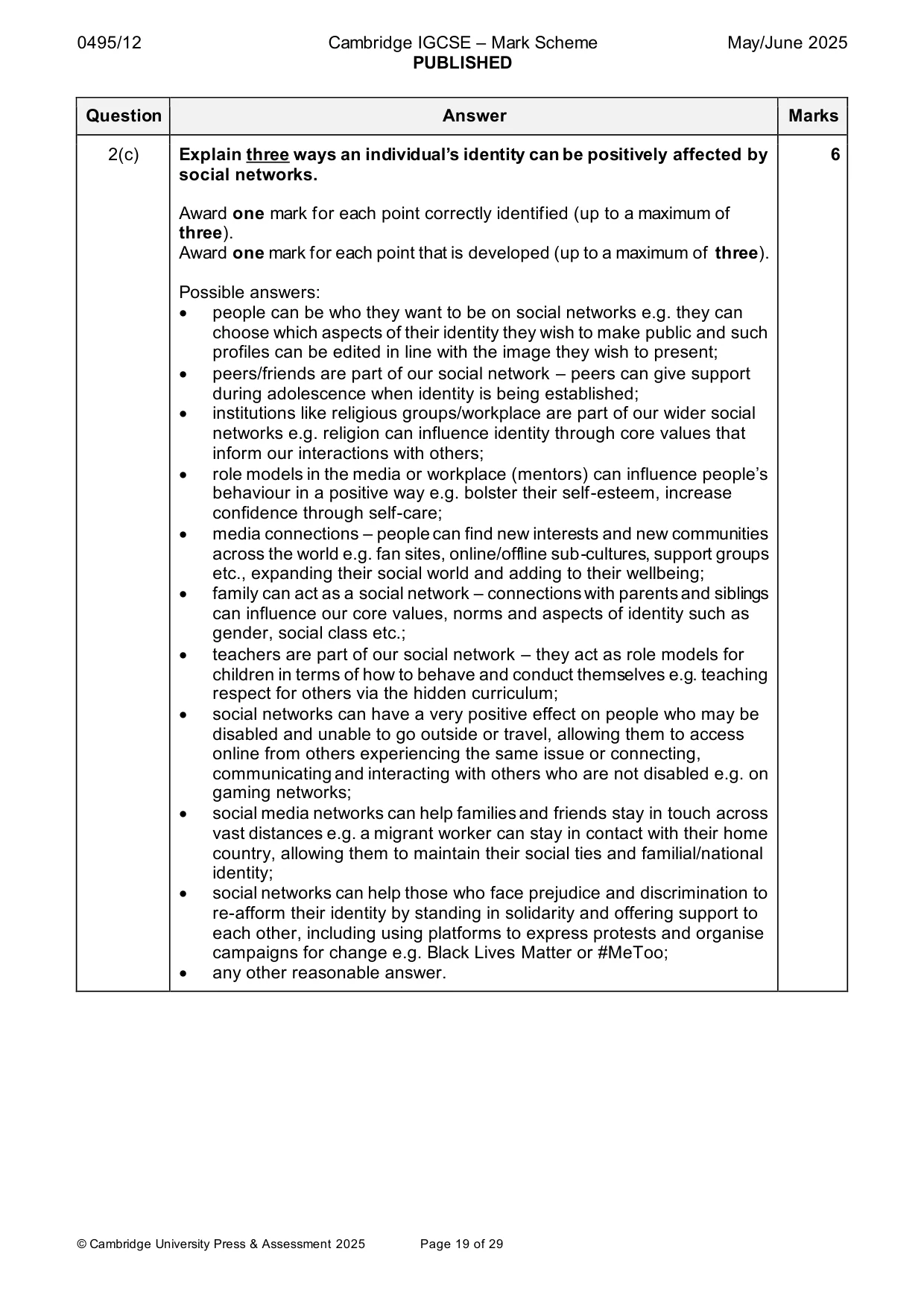
0495/12 Cambridge IGCSE – Mark Scheme PUBLISHED May/June 2025 © Cambridge University Press & Assessment 2025 Page 19 of 29 Question Answer Marks 2(c) Explain three ways an individual’s identity can be positively affected by social networks. Award one mark for each point correctly identified (up to a maximum of three). Award one mark for each point that is developed (up to a maximum of three). Possible answers: • people can be who they want to be on social networks e.g. they can choose which aspects of their identity they wish to make public and such profiles can be edited in line with the image they wish to present; • peers/friends are part of our social network – peers can give support during adolescence when identity is being established; • institutions like religious groups/workplace are part of our wider social networks e.g. religion can influence identity through core values that inform our interactions with others; • role models in the media or workplace (mentors) can influence people’s behaviour in a positive way e.g. bolster their self-esteem, increase confidence through self-care; • media connections – people can find new interests and new communities across the world e.g. fan sites, online/offline sub-cultures, support groups etc., expanding their social world and adding to their wellbeing; • family can act as a social network – connections with parents and siblings can influence our core values, norms and aspects of identity such as gender, social class etc.; • teachers are part of our social network – they act as role models for children in terms of how to behave and conduct themselves e.g. teaching respect for others via the hidden curriculum; • social networks can have a very positive effect on people who may be disabled and unable to go outside or travel, allowing them to access online from others experiencing the same issue or connecting, communicating and interacting with others who are not disabled e.g. on gaming networks; • social media networks can help families and friends stay in touch across vast distances e.g. a migrant worker can stay in contact with their home country, allowing them to maintain their social ties and familial/national identity; • social networks can help those who face prejudice and discrimination to re-afform their identity by standing in solidarity and offering support to each other, including using platforms to express protests and organise campaigns for change e.g. Black Lives Matter or #MeToo; • any other reasonable answer. 6
Mark scheme, page 20
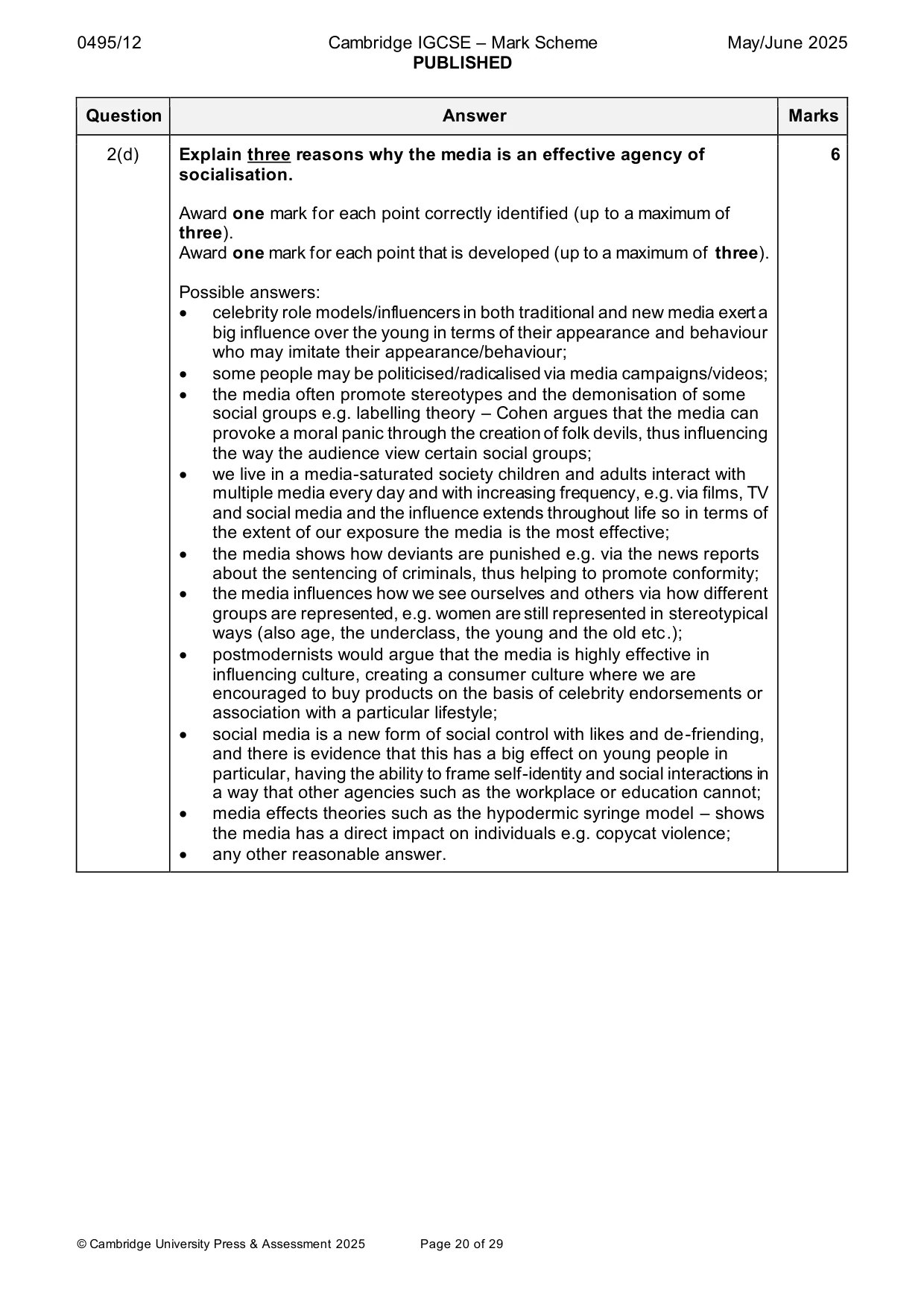
0495/12 Cambridge IGCSE – Mark Scheme PUBLISHED May/June 2025 © Cambridge University Press & Assessment 2025 Page 20 of 29 Question Answer Marks 2(d) Explain three reasons why the media is an effective agency of socialisation. Award one mark for each point correctly identified (up to a maximum of three). Award one mark for each point that is developed (up to a maximum of three). Possible answers: • celebrity role models/influencers in both traditional and new media exert a big influence over the young in terms of their appearance and behaviour who may imitate their appearance/behaviour; • some people may be politicised/radicalised via media campaigns/videos; • the media often promote stereotypes and the demonisation of some social groups e.g. labelling theory – Cohen argues that the media can provoke a moral panic through the creation of folk devils, thus influencing the way the audience view certain social groups; • we live in a media-saturated society children and adults interact with multiple media every day and with increasing frequency, e.g. via films, TV and social media and the influence extends throughout life so in terms of the extent of our exposure the media is the most effective; • the media shows how deviants are punished e.g. via the news reports about the sentencing of criminals, thus helping to promote conformity; • the media influences how we see ourselves and others via how different groups are represented, e.g. women are still represented in stereotypical ways (also age, the underclass, the young and the old etc.); • postmodernists would argue that the media is highly effective in influencing culture, creating a consumer culture where we are encouraged to buy products on the basis of celebrity endorsements or association with a particular lifestyle; • social media is a new form of social control with likes and de-friending, and there is evidence that this has a big effect on young people in particular, having the ability to frame self-identity and social interactions in a way that other agencies such as the workplace or education cannot; • media effects theories such as the hypodermic syringe model – shows the media has a direct impact on individuals e.g. copycat violence; • any other reasonable answer. 6
Mark scheme, page 21
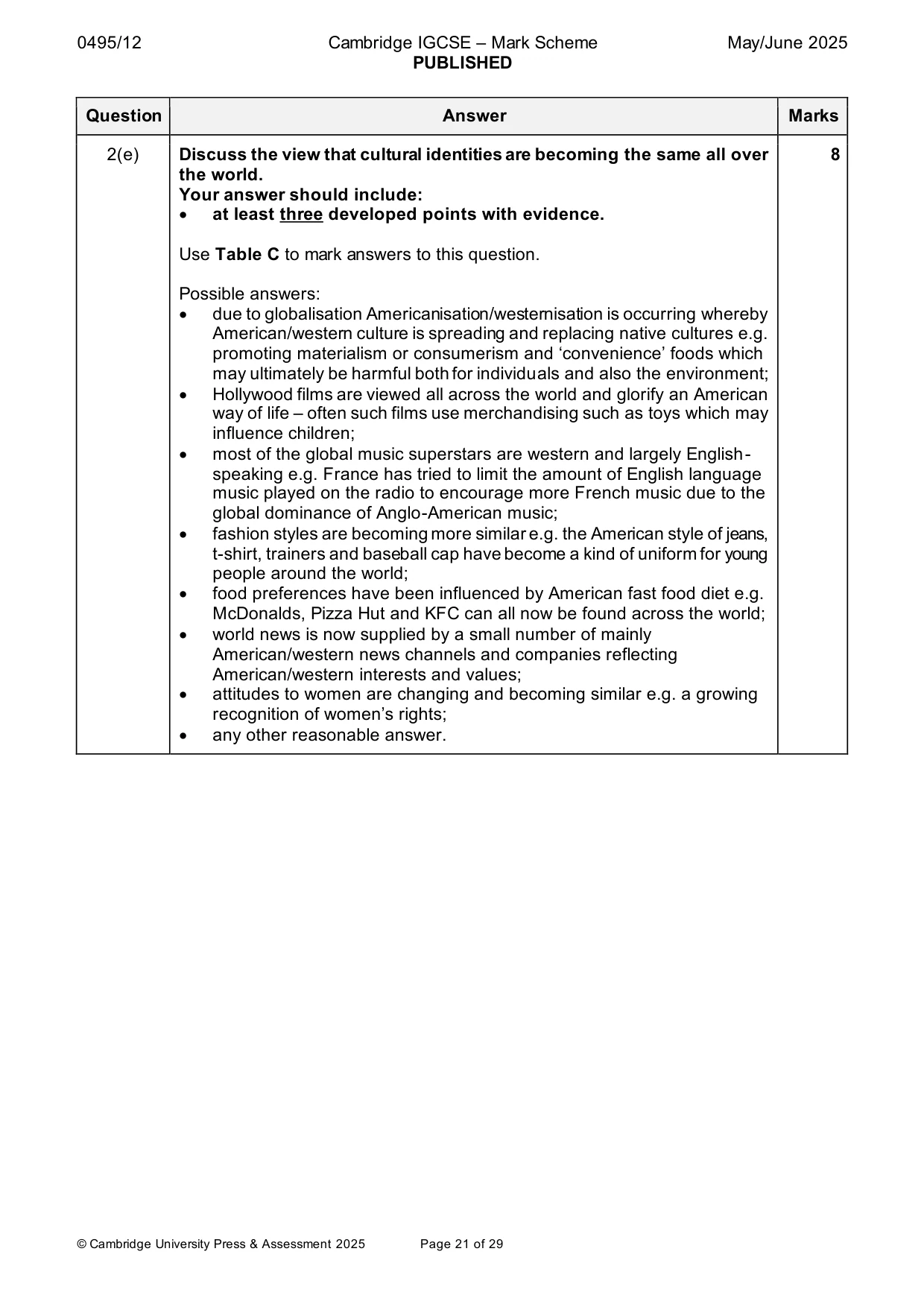
0495/12 Cambridge IGCSE – Mark Scheme PUBLISHED May/June 2025 © Cambridge University Press & Assessment 2025 Page 21 of 29 Question Answer Marks 2(e) Discuss the view that cultural identities are becoming the same all over the world. Your answer should include: • at least three developed points with evidence. Use Table C to mark answers to this question. Possible answers: • due to globalisation Americanisation/westernisation is occurring whereby American/western culture is spreading and replacing native cultures e.g. promoting materialism or consumerism and ‘convenience’ foods which may ultimately be harmful both for individuals and also the environment; • Hollywood films are viewed all across the world and glorify an American way of life – often such films use merchandising such as toys which may influence children; • most of the global music superstars are western and largely English- speaking e.g. France has tried to limit the amount of English language music played on the radio to encourage more French music due to the global dominance of Anglo-American music; • fashion styles are becoming more similar e.g. the American style of jeans, t-shirt, trainers and baseball cap have become a kind of uniform for young people around the world; • food preferences have been influenced by American fast food diet e.g. McDonalds, Pizza Hut and KFC can all now be found across the world; • world news is now supplied by a small number of mainly American/western news channels and companies reflecting American/western interests and values; • attitudes to women are changing and becoming similar e.g. a growing recognition of women’s rights; • any other reasonable answer. 8
Mark scheme, page 22
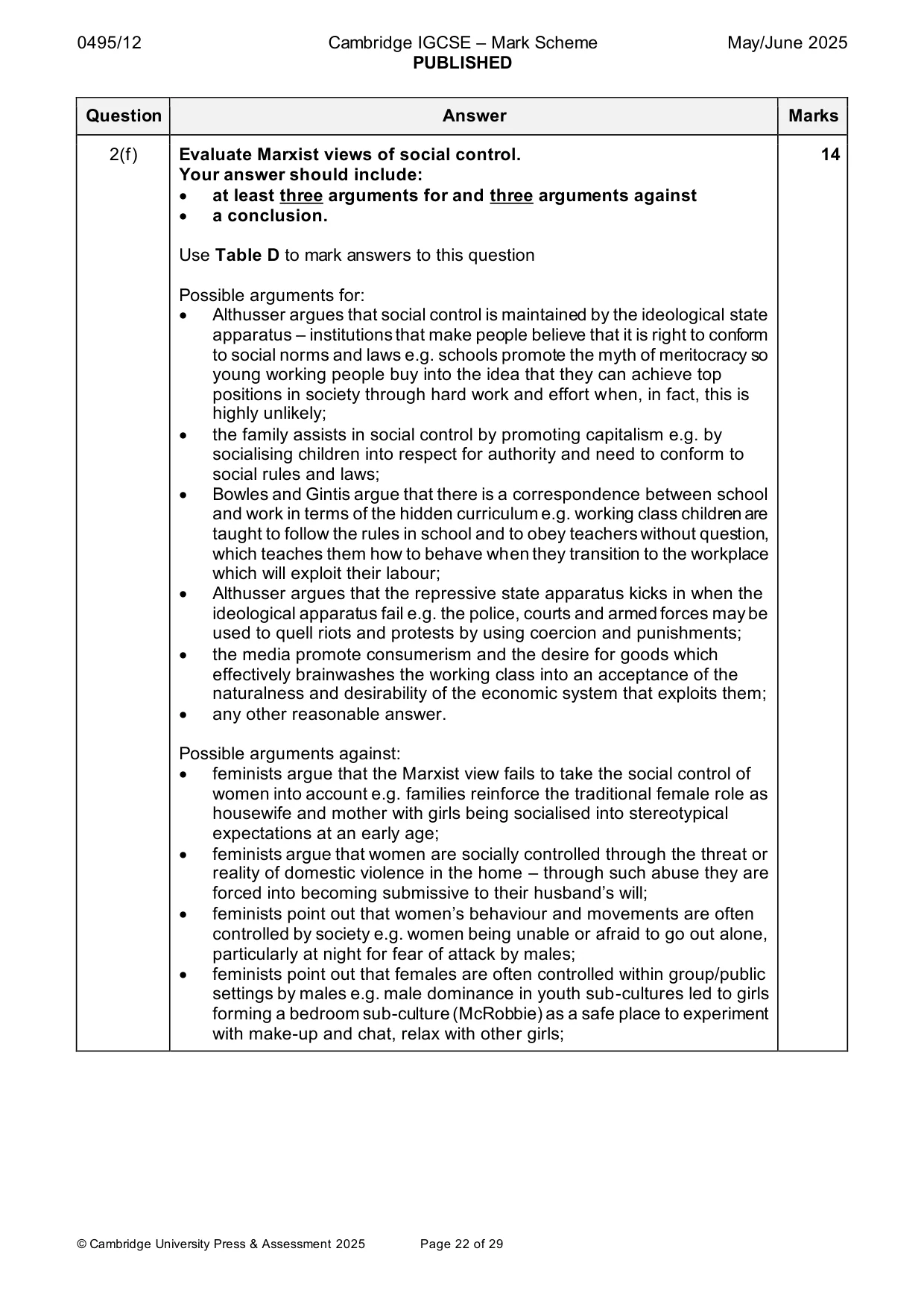
0495/12 Cambridge IGCSE – Mark Scheme PUBLISHED May/June 2025 © Cambridge University Press & Assessment 2025 Page 22 of 29 Question Answer Marks 2(f) Evaluate Marxist views of social control. Your answer should include: • at least three arguments for and three arguments against • a conclusion. Use Table D to mark answers to this question Possible arguments for: • Althusser argues that social control is maintained by the ideological state apparatus – institutions that make people believe that it is right to conform to social norms and laws e.g. schools promote the myth of meritocracy so young working people buy into the idea that they can achieve top positions in society through hard work and effort when, in fact, this is highly unlikely; • the family assists in social control by promoting capitalism e.g. by socialising children into respect for authority and need to conform to social rules and laws; • Bowles and Gintis argue that there is a correspondence between school and work in terms of the hidden curriculum e.g. working class children are taught to follow the rules in school and to obey teachers without question, which teaches them how to behave when they transition to the workplace which will exploit their labour; • Althusser argues that the repressive state apparatus kicks in when the ideological apparatus fail e.g. the police, courts and armed forces may be used to quell riots and protests by using coercion and punishments; • the media promote consumerism and the desire for goods which effectively brainwashes the working class into an acceptance of the naturalness and desirability of the economic system that exploits them; • any other reasonable answer. Possible arguments against: • feminists argue that the Marxist view fails to take the social control of women into account e.g. families reinforce the traditional female role as housewife and mother with girls being socialised into stereotypical expectations at an early age; • feminists argue that women are socially controlled through the threat or reality of domestic violence in the home – through such abuse they are forced into becoming submissive to their husband’s will; • feminists point out that women’s behaviour and movements are often controlled by society e.g. women being unable or afraid to go out alone, particularly at night for fear of attack by males; • feminists point out that females are often controlled within group/public settings by males e.g. male dominance in youth sub-cultures led to girls forming a bedroom sub-culture (McRobbie) as a safe place to experiment with make-up and chat, relax with other girls; 14
Mark scheme, page 23
0495/12 Cambridge IGCSE – Mark Scheme PUBLISHED May/June 2025 © Cambridge University Press & Assessment 2025 Page 23 of 29 Question Answer Marks 2(f) • functionalists argue that social control is a force for good in that it is essential in promoting social conformity and shared values e.g. the use of positive and negative sanctions in the family train children and young people into the behaviours and attitudes needed for social order and the avoidance of anomie; • postmodernists argue that the Marxist view is out of date – individuals have freedom and the agency to make their own choices – they are not controlled by the state as Marxists argue; • any other reasonable answer.
Mark scheme, page 24
0495/12 Cambridge IGCSE – Mark Scheme PUBLISHED May/June 2025 © Cambridge University Press & Assessment 2025 Page 24 of 29 Question Answer Marks 3(a)(i) Define the term capitalism. Award one mark for a partial definition, e.g. bourgeoisie and proletariat. Award two marks for a clear definition, e.g. the economic system based on private ownership of the means of production. 2 3(a)(ii) Define the term modern slavery. Award one mark for a partial definition, e.g. child workers/forced to work. Award two marks for a clear definition, e.g. the severe exploitation of vulnerable people for personal or commercial gain. 2 3(b) State two global ecological issues. Award one mark for each point correctly identified (up to a maximum of two). Possible answers: • climate change/global warming; • acid rain; • soil erosion and desertification; • loss of biodiversity; • rising sea levels; • deforestation; • over-fishing; • species extinction; • waste disposal; • use of pesticides and chemicals in farming that pollute land and water; • plastic pollution in the sea and on land; • increasing wildfires; • any other reasonable answer. 2
Mark scheme, page 25
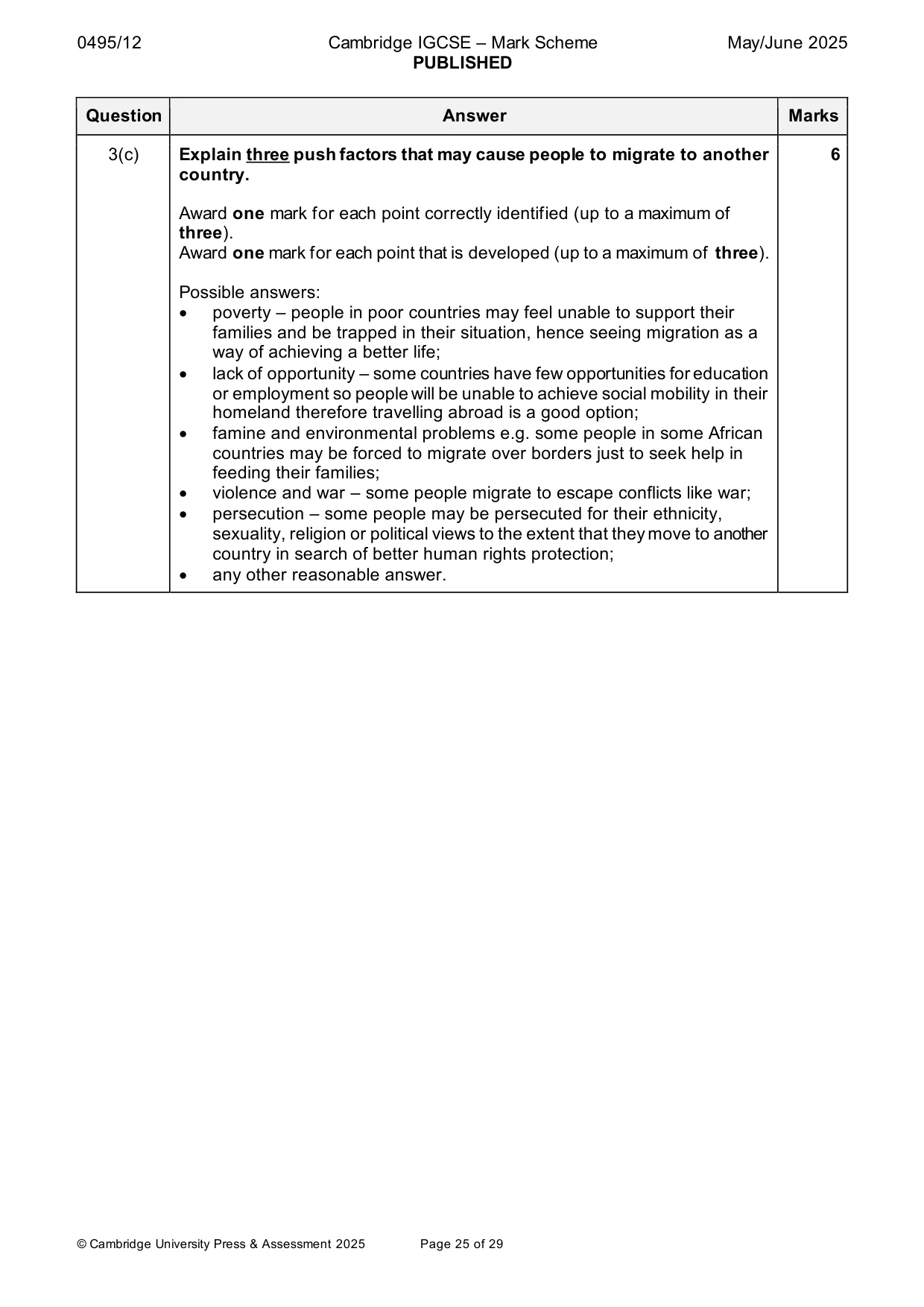
0495/12 Cambridge IGCSE – Mark Scheme PUBLISHED May/June 2025 © Cambridge University Press & Assessment 2025 Page 25 of 29 Question Answer Marks 3(c) Explain three push factors that may cause people to migrate to another country. Award one mark for each point correctly identified (up to a maximum of three). Award one mark for each point that is developed (up to a maximum of three). Possible answers: • poverty – people in poor countries may feel unable to support their families and be trapped in their situation, hence seeing migration as a way of achieving a better life; • lack of opportunity – some countries have few opportunities for education or employment so people will be unable to achieve social mobility in their homeland therefore travelling abroad is a good option; • famine and environmental problems e.g. some people in some African countries may be forced to migrate over borders just to seek help in feeding their families; • violence and war – some people migrate to escape conflicts like war; • persecution – some people may be persecuted for their ethnicity, sexuality, religion or political views to the extent that they move to another country in search of better human rights protection; • any other reasonable answer. 6
Mark scheme, page 26
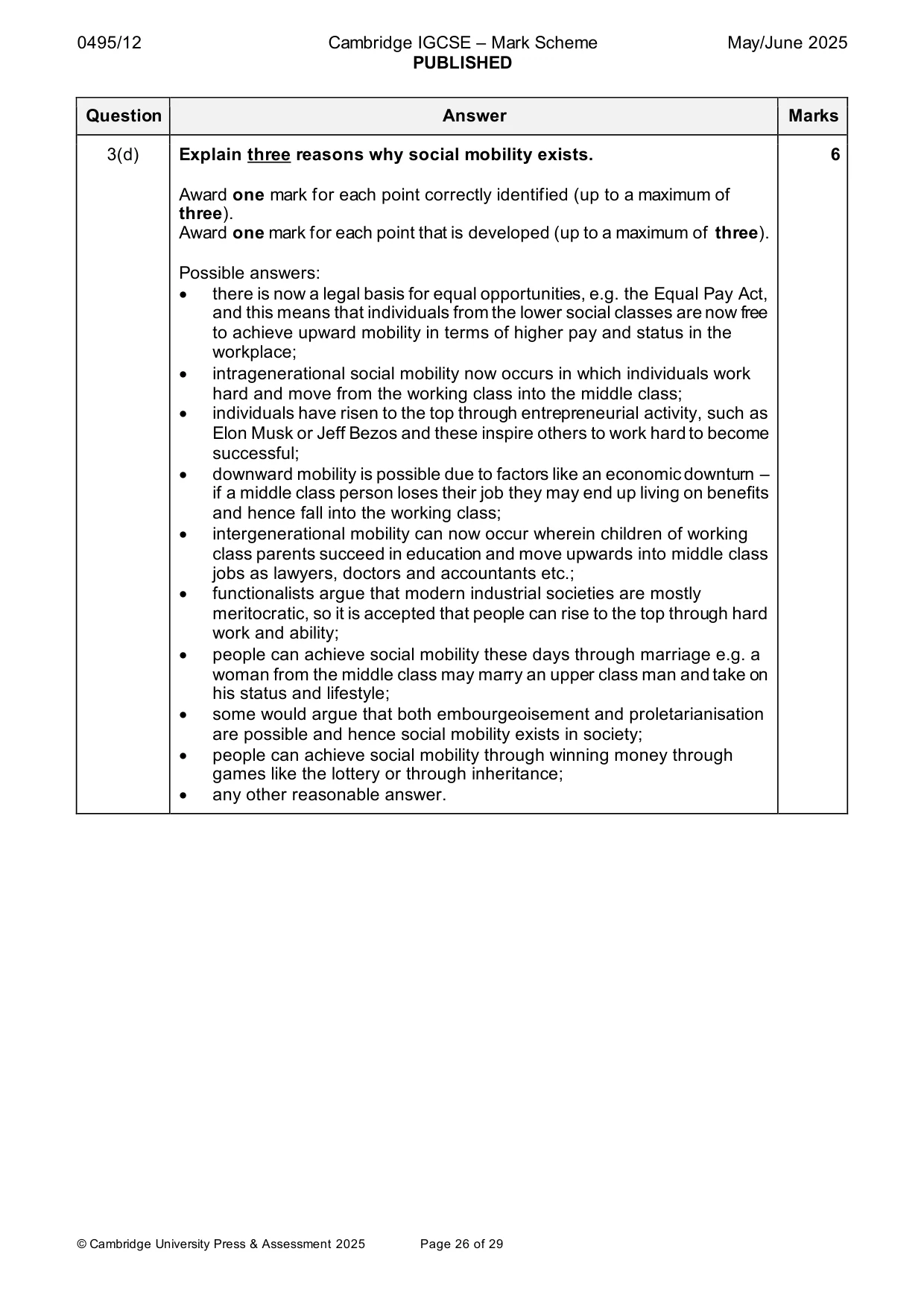
0495/12 Cambridge IGCSE – Mark Scheme PUBLISHED May/June 2025 © Cambridge University Press & Assessment 2025 Page 26 of 29 Question Answer Marks 3(d) Explain three reasons why social mobility exists. Award one mark for each point correctly identified (up to a maximum of three). Award one mark for each point that is developed (up to a maximum of three). Possible answers: • there is now a legal basis for equal opportunities, e.g. the Equal Pay Act, and this means that individuals from the lower social classes are now free to achieve upward mobility in terms of higher pay and status in the workplace; • intragenerational social mobility now occurs in which individuals work hard and move from the working class into the middle class; • individuals have risen to the top through entrepreneurial activity, such as Elon Musk or Jeff Bezos and these inspire others to work hard to become successful; • downward mobility is possible due to factors like an economic downturn – if a middle class person loses their job they may end up living on benefits and hence fall into the working class; • intergenerational mobility can now occur wherein children of working class parents succeed in education and move upwards into middle class jobs as lawyers, doctors and accountants etc.; • functionalists argue that modern industrial societies are mostly meritocratic, so it is accepted that people can rise to the top through hard work and ability; • people can achieve social mobility these days through marriage e.g. a woman from the middle class may marry an upper class man and take on his status and lifestyle; • some would argue that both embourgeoisement and proletarianisation are possible and hence social mobility exists in society; • people can achieve social mobility through winning money through games like the lottery or through inheritance; • any other reasonable answer. 6
Mark scheme, page 27
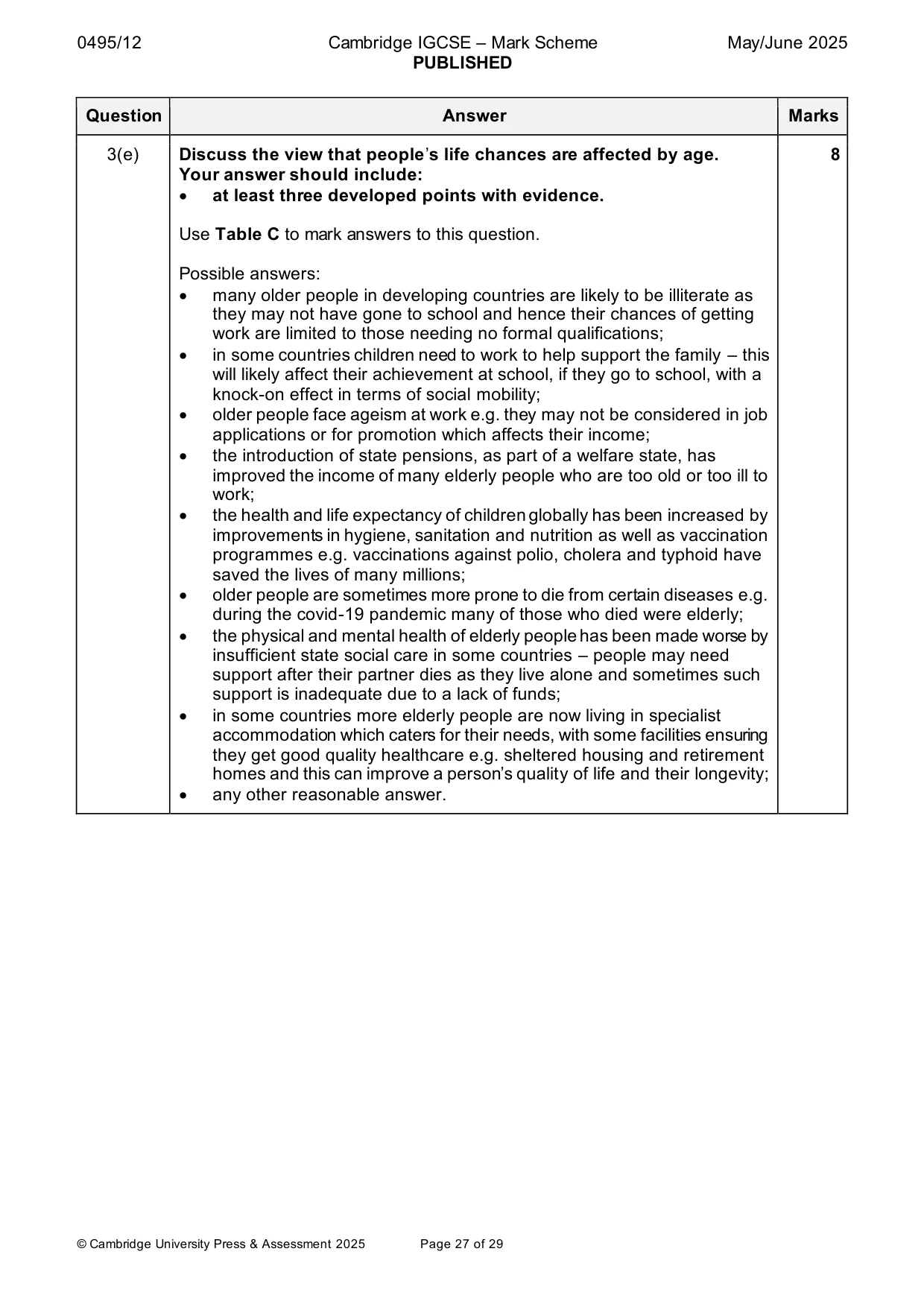
0495/12 Cambridge IGCSE – Mark Scheme PUBLISHED May/June 2025 © Cambridge University Press & Assessment 2025 Page 27 of 29 Question Answer Marks 3(e) Discuss the view that people’s life chances are affected by age. Your answer should include: • at least three developed points with evidence. Use Table C to mark answers to this question. Possible answers: • many older people in developing countries are likely to be illiterate as they may not have gone to school and hence their chances of getting work are limited to those needing no formal qualifications; • in some countries children need to work to help support the family – this will likely affect their achievement at school, if they go to school, with a knock-on effect in terms of social mobility; • older people face ageism at work e.g. they may not be considered in job applications or for promotion which affects their income; • the introduction of state pensions, as part of a welfare state, has improved the income of many elderly people who are too old or too ill to work; • the health and life expectancy of children globally has been increased by improvements in hygiene, sanitation and nutrition as well as vaccination programmes e.g. vaccinations against polio, cholera and typhoid have saved the lives of many millions; • older people are sometimes more prone to die from certain diseases e.g. during the covid-19 pandemic many of those who died were elderly; • the physical and mental health of elderly people has been made worse by insufficient state social care in some countries – people may need support after their partner dies as they live alone and sometimes such support is inadequate due to a lack of funds; • in some countries more elderly people are now living in specialist accommodation which caters for their needs, with some facilities ensuring they get good quality healthcare e.g. sheltered housing and retirement homes and this can improve a person’s quality of life and their longevity; • any other reasonable answer. 8
Mark scheme, page 28
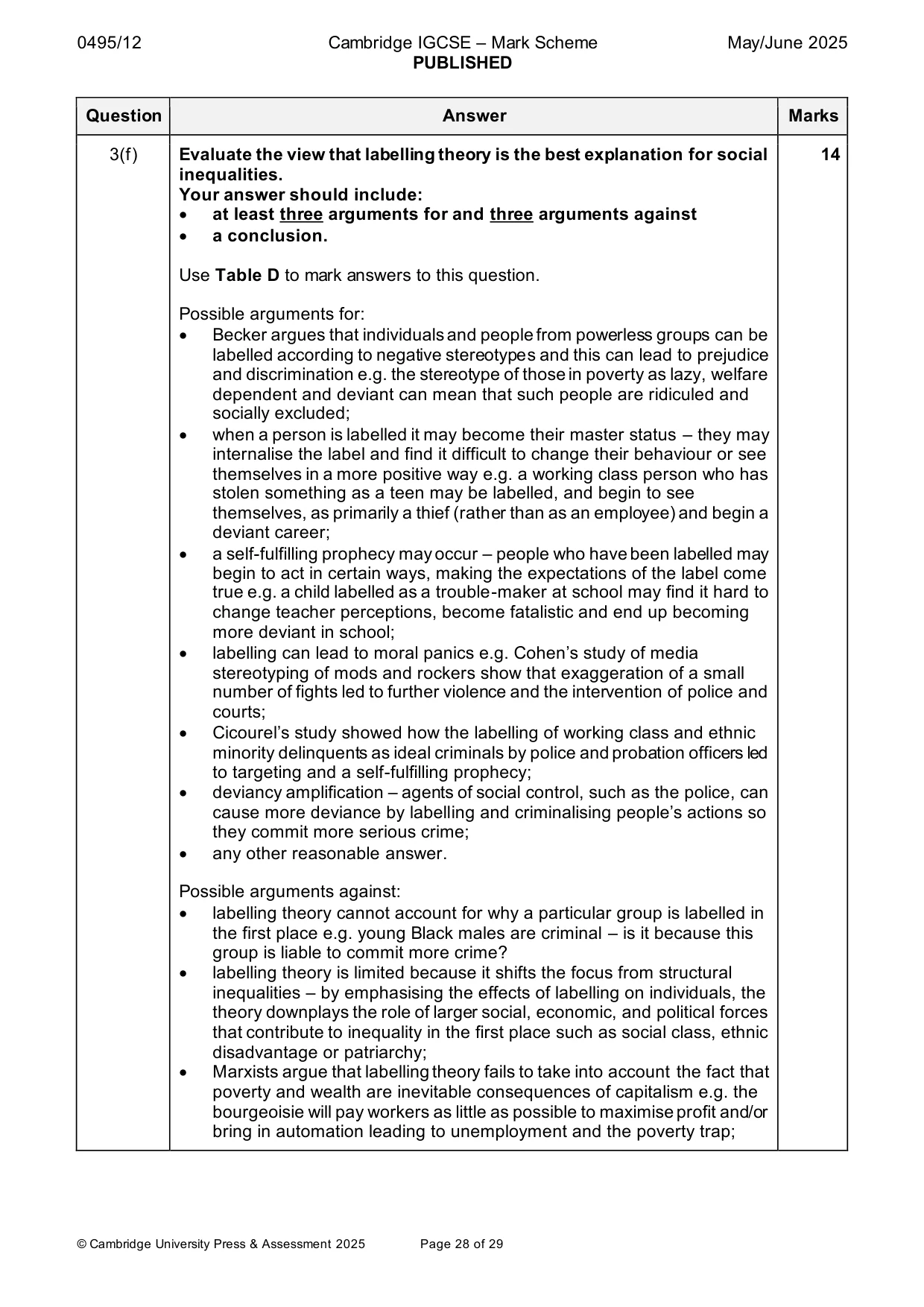
0495/12 Cambridge IGCSE – Mark Scheme PUBLISHED May/June 2025 © Cambridge University Press & Assessment 2025 Page 28 of 29 Question Answer Marks 3(f) Evaluate the view that labelling theory is the best explanation for social inequalities. Your answer should include: • at least three arguments for and three arguments against • a conclusion. Use Table D to mark answers to this question. Possible arguments for: • Becker argues that individuals and people from powerless groups can be labelled according to negative stereotypes and this can lead to prejudice and discrimination e.g. the stereotype of those in poverty as lazy, welfare dependent and deviant can mean that such people are ridiculed and socially excluded; • when a person is labelled it may become their master status – they may internalise the label and find it difficult to change their behaviour or see themselves in a more positive way e.g. a working class person who has stolen something as a teen may be labelled, and begin to see themselves, as primarily a thief (rather than as an employee) and begin a deviant career; • a self-fulfilling prophecy may occur – people who have been labelled may begin to act in certain ways, making the expectations of the label come true e.g. a child labelled as a trouble-maker at school may find it hard to change teacher perceptions, become fatalistic and end up becoming more deviant in school; • labelling can lead to moral panics e.g. Cohen’s study of media stereotyping of mods and rockers show that exaggeration of a small number of fights led to further violence and the intervention of police and courts; • Cicourel’s study showed how the labelling of working class and ethnic minority delinquents as ideal criminals by police and probation officers led to targeting and a self-fulfilling prophecy; • deviancy amplification – agents of social control, such as the police, can cause more deviance by labelling and criminalising people’s actions so they commit more serious crime; • any other reasonable answer. Possible arguments against: • labelling theory cannot account for why a particular group is labelled in the first place e.g. young Black males are criminal – is it because this group is liable to commit more crime? • labelling theory is limited because it shifts the focus from structural inequalities – by emphasising the effects of labelling on individuals, the theory downplays the role of larger social, economic, and political forces that contribute to inequality in the first place such as social class, ethnic disadvantage or patriarchy; • Marxists argue that labelling theory fails to take into account the fact that poverty and wealth are inevitable consequences of capitalism e.g. the bourgeoisie will pay workers as little as possible to maximise profit and/or bring in automation leading to unemployment and the poverty trap; 14
Mark scheme, page 29
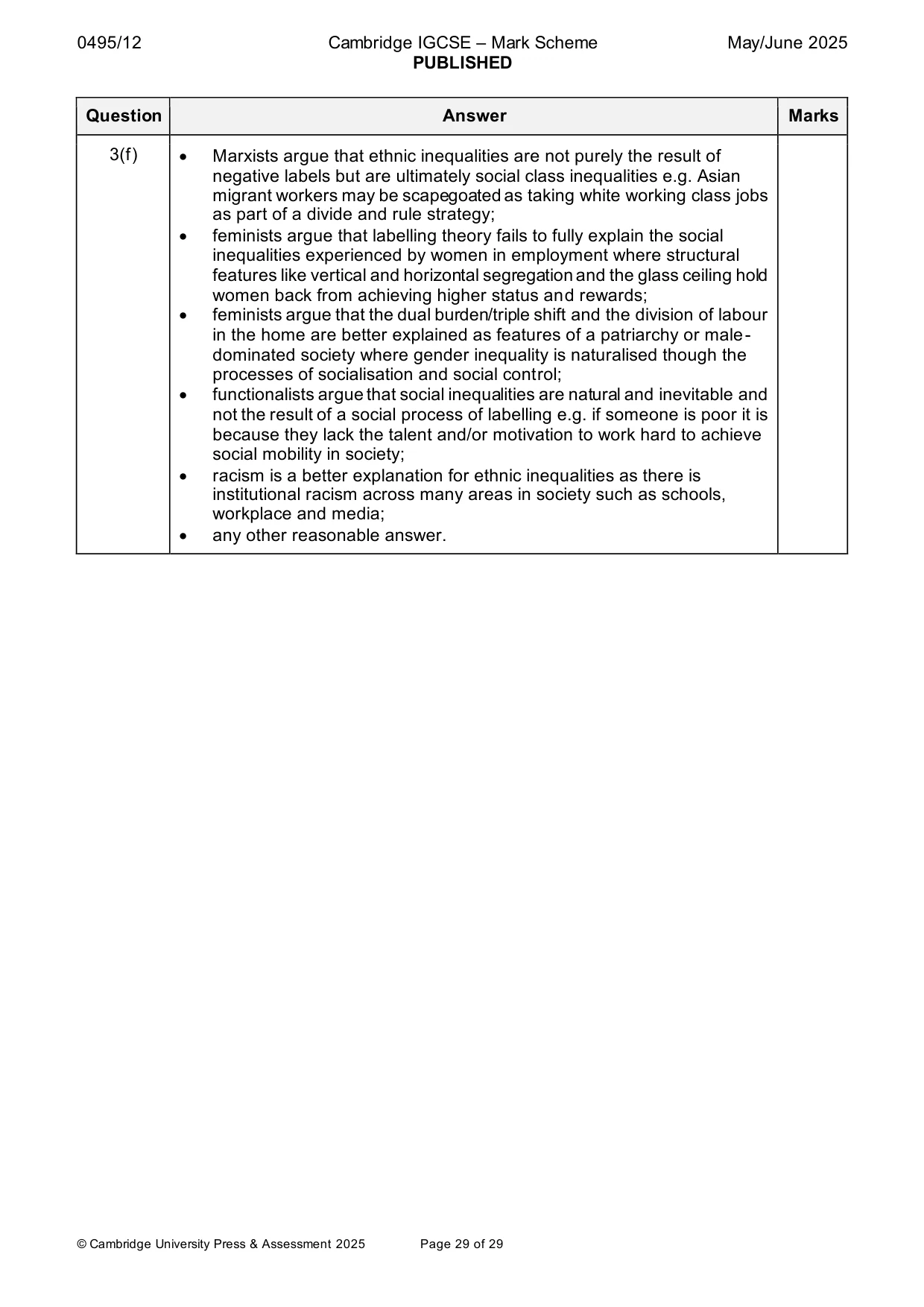
0495/12 Cambridge IGCSE – Mark Scheme PUBLISHED May/June 2025 © Cambridge University Press & Assessment 2025 Page 29 of 29 Question Answer Marks 3(f) • Marxists argue that ethnic inequalities are not purely the result of negative labels but are ultimately social class inequalities e.g. Asian migrant workers may be scapegoated as taking white working class jobs as part of a divide and rule strategy; • feminists argue that labelling theory fails to fully explain the social inequalities experienced by women in employment where structural features like vertical and horizontal segregation and the glass ceiling hold women back from achieving higher status and rewards; • feminists argue that the dual burden/triple shift and the division of labour in the home are better explained as features of a patriarchy or male- dominated society where gender inequality is naturalised though the processes of socialisation and social control; • functionalists argue that social inequalities are natural and inevitable and not the result of a social process of labelling e.g. if someone is poor it is because they lack the talent and/or motivation to work hard to achieve social mobility in society; • racism is a better explanation for ethnic inequalities as there is institutional racism across many areas in society such as schools, workplace and media; • any other reasonable answer.
What you needed in this session
Cambridge’s own grade thresholds for 2025 May/June, Paper 1 · Variant 2. A higher threshold means an easier paper — the bar moves with how the cohort did.