Cambridge IGCSE Sociology 0495 — 2024 Oct/Nov Paper 1 · Variant 2
0495/12/O/N/24 · 80 marks · ≈90 min
The question paper and its mark scheme, free to read here and free to download. This is Cambridge’s own paper, exactly as it was sat.
Question paper4 pages

Mark scheme21 pages
Answers below. Sit the paper first if you are practising.


Paper as text
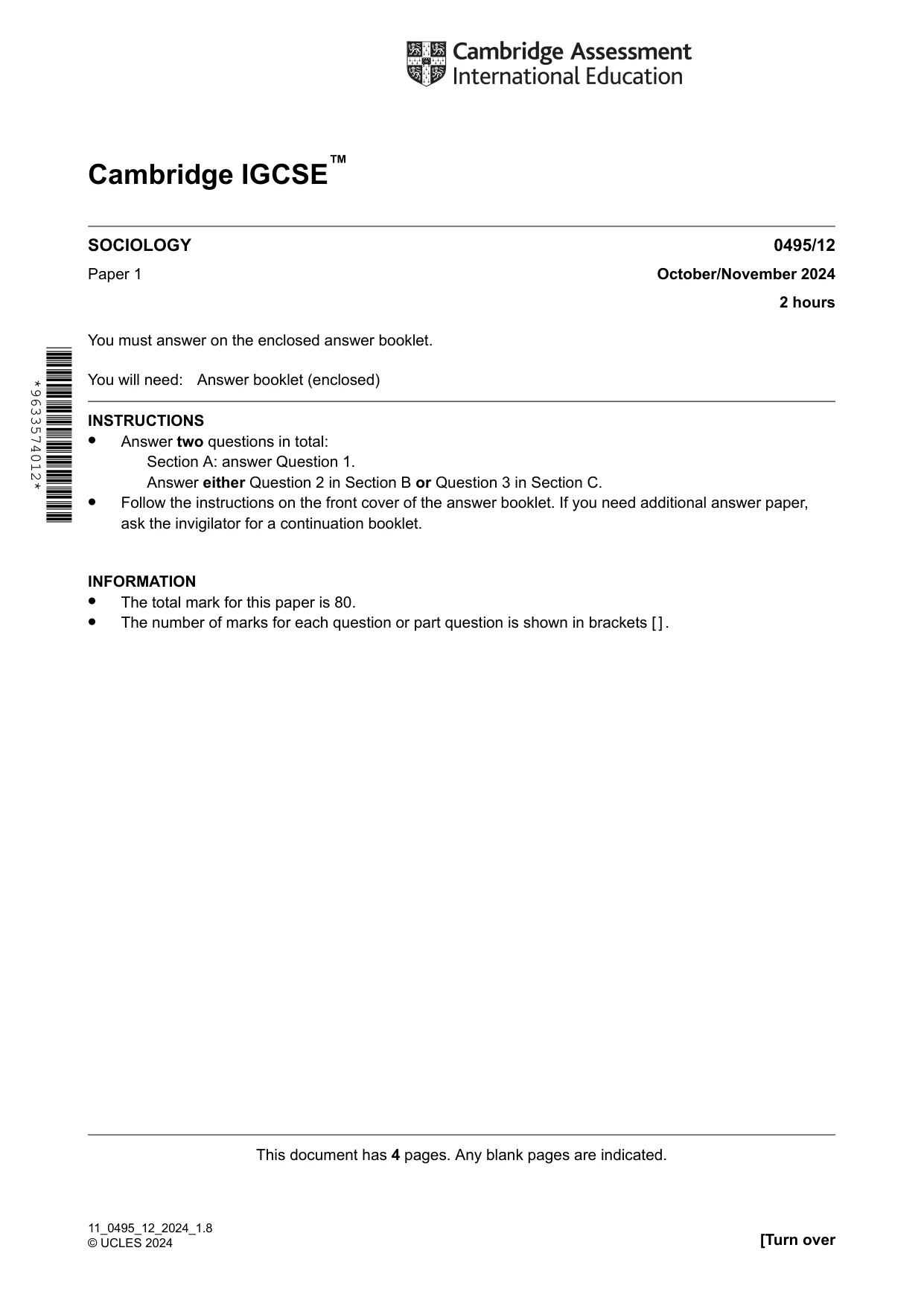
Question paper, page 1
Cambridge IGCSE™ 0495/12 October/November 2024 2 hours SOCIOLOGY Paper 1 You must answer on the enclosed answer booklet. You will need: Answer booklet (enclosed) INSTRUCTIONS • Answer two questions in total: Section A: answer Question 1. Answer either Question 2 in Section B or Question 3 in Section C. • Follow the instructions on the front cover of the answer booklet. If you need additional answer paper, ask the invigilator for a continuation booklet. INFORMATION • The total mark for this paper is 80. • The number of marks for each question or part question is shown in brackets [ ] . This document has 4 pages. Any blank pages are indicated. [Turn over 11_0495_12_2024_1.8 © UCLES 2024 *9633574012*
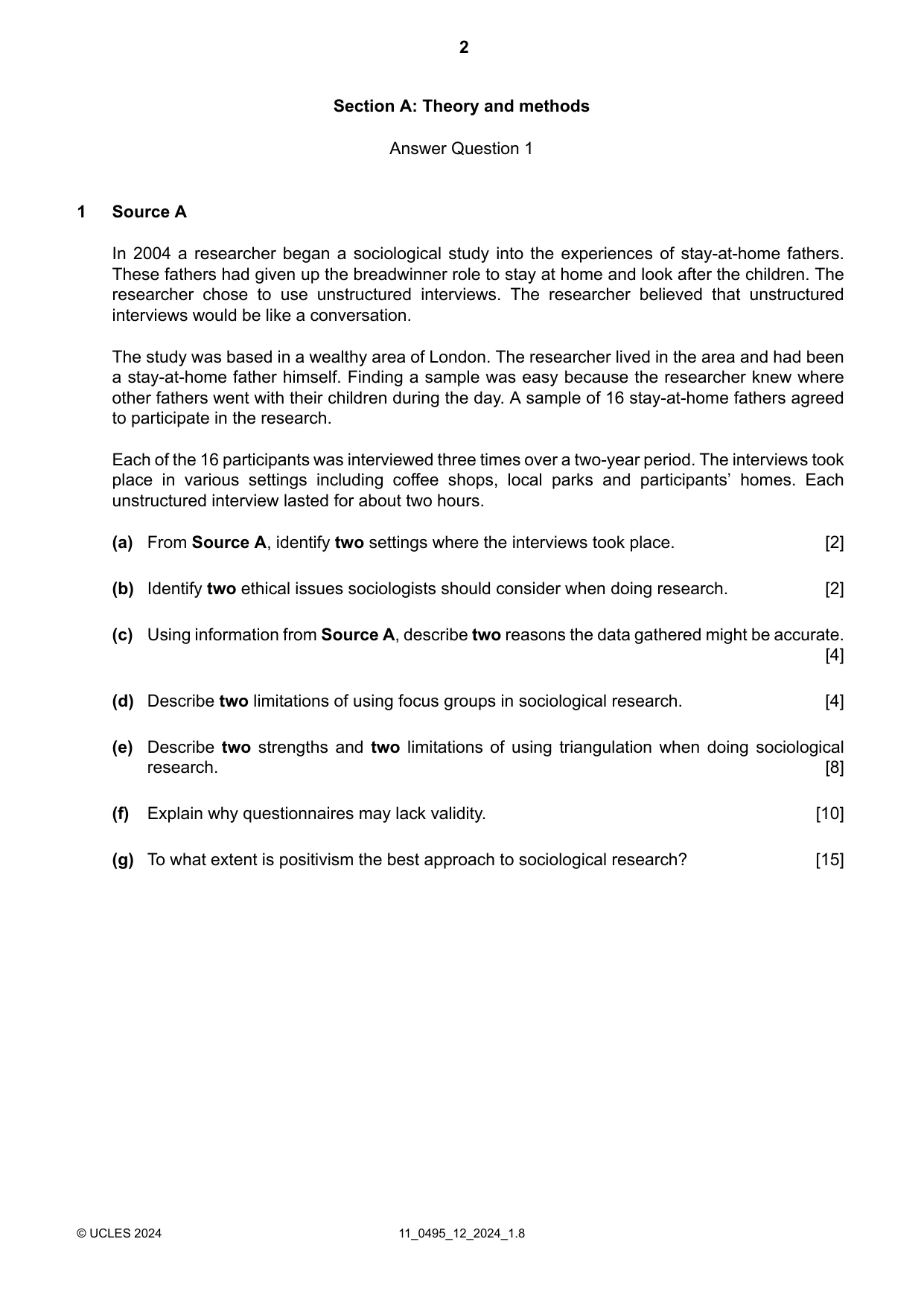
Question paper, page 2
Section A: Theory and methods Answer Question 1 Source A 1 In 2004 a researcher began a sociological study into the experiences of stay-at-home fathers. These fathers had given up the breadwinner role to stay at home and look after the children. The researcher chose to use unstructured interviews. The researcher believed that unstructured interviews would be like a conversation. The study was based in a wealthy area of London. The researcher lived in the area and had been a stay-at-home father himself. Finding a sample was easy because the researcher knew where other fathers went with their children during the day. A sample of 16 stay-at-home fathers agreed to participate in the research. Each of the 16 participants was interviewed three times over a two-year period. The interviews took place in various settings including coffee shops, local parks and participants’ homes. Each unstructured interview lasted for about two hours. From Source A, identify two settings where the interviews took place. [2] (a) Identify two ethical issues sociologists should consider when doing research. [2] (b) Using information from Source A, describe two reasons the data gathered might be accurate. [4] (c) Describe two limitations of using focus groups in sociological research. [4] (d) Describe two strengths and two limitations of using triangulation when doing sociological research. [8] (e) Explain why questionnaires may lack validity. [10] (f) To what extent is positivism the best approach to sociological research? [15] (g) 11_0495_12_2024_1.8 © UCLES 2024 2
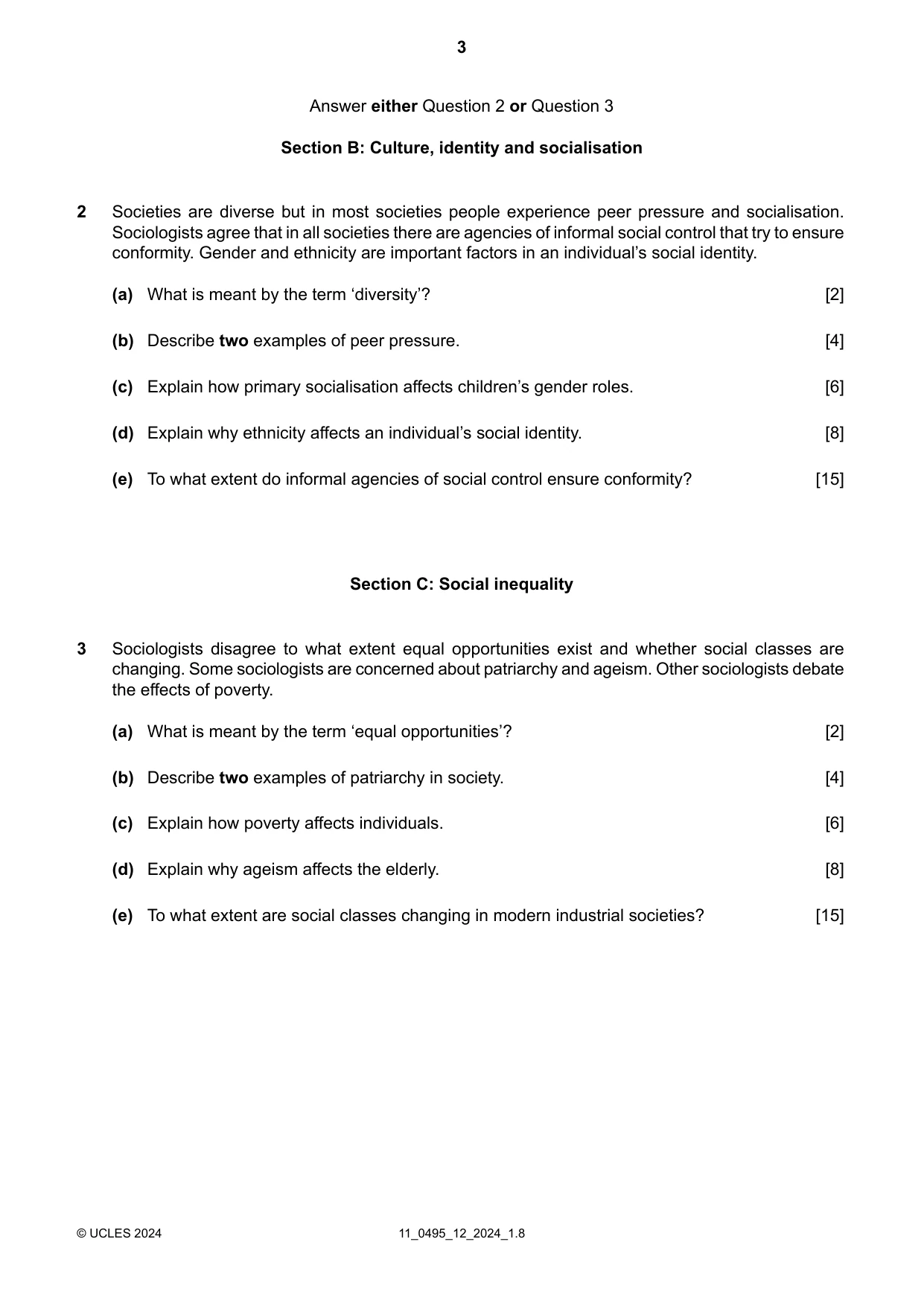
Question paper, page 3
Answer either Question 2 or Question 3 Section B: Culture, identity and socialisation Societies are diverse but in most societies people experience peer pressure and socialisation. Sociologists agree that in all societies there are agencies of informal social control that try to ensure conformity. Gender and ethnicity are important factors in an individual’s social identity. 2 What is meant by the term ‘diversity’? [2] (a) Describe two examples of peer pressure. [4] (b) Explain how primary socialisation affects children’s gender roles. [6] (c) Explain why ethnicity affects an individual’s social identity. [8] (d) To what extent do informal agencies of social control ensure conformity? [15] (e) Section C: Social inequality Sociologists disagree to what extent equal opportunities exist and whether social classes are changing. Some sociologists are concerned about patriarchy and ageism. Other sociologists debate the effects of poverty. 3 What is meant by the term ‘equal opportunities’? [2] (a) Describe two examples of patriarchy in society. [4] (b) Explain how poverty affects individuals. [6] (c) Explain why ageism affects the elderly. [8] (d) To what extent are social classes changing in modern industrial societies? [15] (e) 11_0495_12_2024_1.8 © UCLES 2024 3
Question paper, page 4
BLANK PAGE Permission to reproduce items where third-party owned material protected by copyright is included has been sought and cleared where possible. Every reasonable effort has been made by the publisher (UCLES) to trace copyright holders, but if any items requiring clearance have unwittingly been included, the publisher will be pleased to make amends at the earliest possible opportunity. To avoid the issue of disclosure of answer-related information to candidates, all copyright acknowledgements are reproduced online in the Cambridge Assessment International Education Copyright Acknowledgements Booklet. This is produced for each series of examinations and is freely available to download at www.cambridgeinternational.org after the live examination series. Cambridge Assessment International Education is part of Cambridge Assessment. Cambridge Assessment is the brand name of the University of Cambridge Local Examinations Syndicate (UCLES), which is a department of the University of Cambridge. 11_0495_12_2024_1.8 © UCLES 2024 4
Mark scheme, page 1
This document consists of 21 printed pages. © Cambridge University Press & Assessment 2024 [Turn over Cambridge IGCSE™ SOCIOLOGY 0495/12 Paper 1 October/November 2024 MARK SCHEME Maximum Mark: 80 Published This mark scheme is published as an aid to teachers and candidates, to indicate the requirements of the examination. It shows the basis on which Examiners were instructed to award marks. It does not indicate the details of the discussions that took place at an Examiners’ meeting before marking began, which would have considered the acceptability of alternative answers. Mark schemes should be read in conjunction with the question paper and the Principal Examiner Report for Teachers. Cambridge International will not enter into discussions about these mark schemes. Cambridge International is publishing the mark schemes for the October/November 2024 series for most Cambridge IGCSE, Cambridge International A and AS Level components, and some Cambridge O Level components.
Mark scheme, page 2
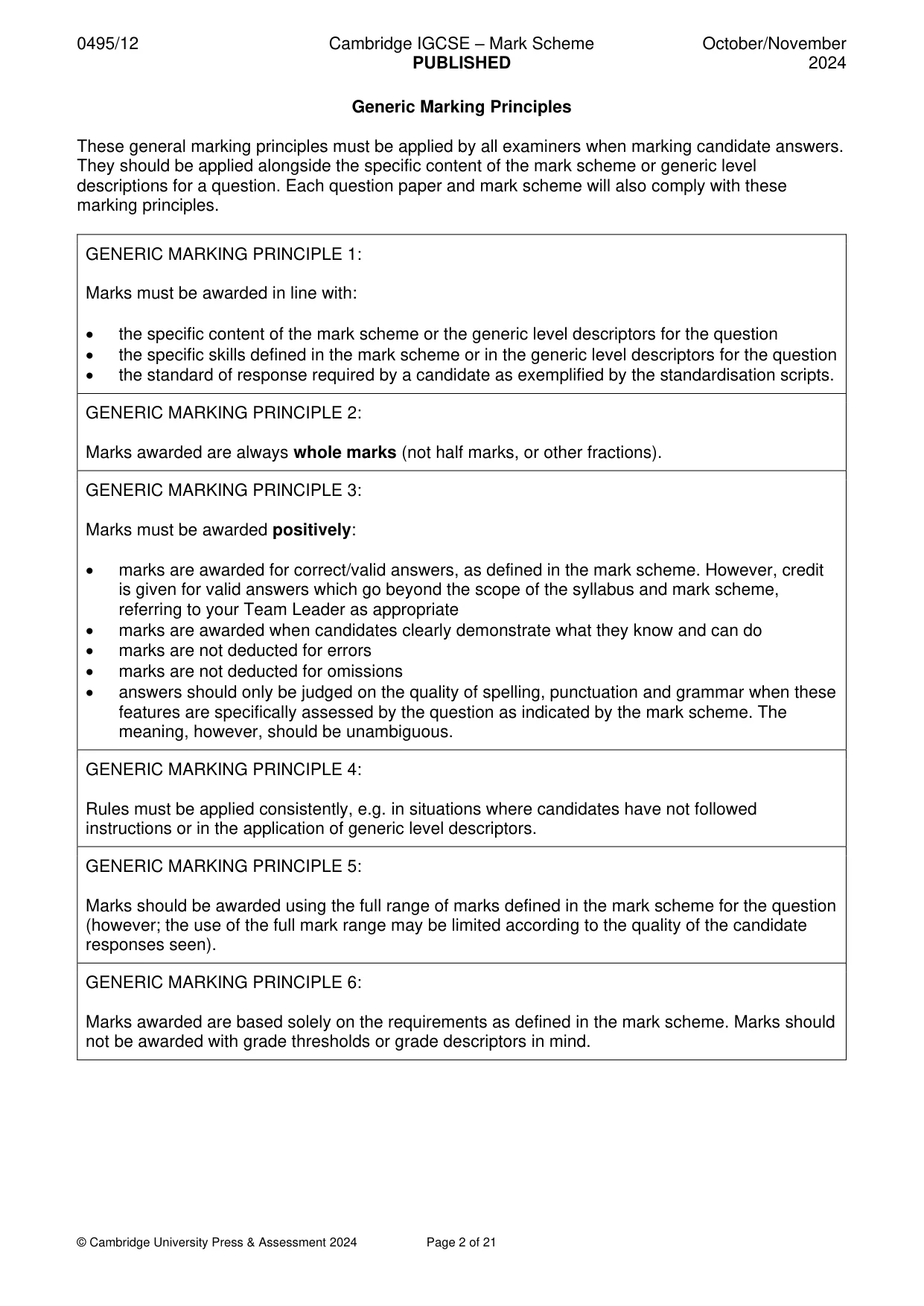
0495/12 Cambridge IGCSE – Mark Scheme PUBLISHED October/November 2024 © Cambridge University Press & Assessment 2024 Page 2 of 21 Generic Marking Principles These general marking principles must be applied by all examiners when marking candidate answers. They should be applied alongside the specific content of the mark scheme or generic level descriptions for a question. Each question paper and mark scheme will also comply with these marking principles. GENERIC MARKING PRINCIPLE 1: Marks must be awarded in line with: • the specific content of the mark scheme or the generic level descriptors for the question • the specific skills defined in the mark scheme or in the generic level descriptors for the question • the standard of response required by a candidate as exemplified by the standardisation scripts. GENERIC MARKING PRINCIPLE 2: Marks awarded are always whole marks (not half marks, or other fractions). GENERIC MARKING PRINCIPLE 3: Marks must be awarded positively: • marks are awarded for correct/valid answers, as defined in the mark scheme. However, credit is given for valid answers which go beyond the scope of the syllabus and mark scheme, referring to your Team Leader as appropriate • marks are awarded when candidates clearly demonstrate what they know and can do • marks are not deducted for errors • marks are not deducted for omissions • answers should only be judged on the quality of spelling, punctuation and grammar when these features are specifically assessed by the question as indicated by the mark scheme. The meaning, however, should be unambiguous. GENERIC MARKING PRINCIPLE 4: Rules must be applied consistently, e.g. in situations where candidates have not followed instructions or in the application of generic level descriptors. GENERIC MARKING PRINCIPLE 5: Marks should be awarded using the full range of marks defined in the mark scheme for the question (however; the use of the full mark range may be limited according to the quality of the candidate responses seen). GENERIC MARKING PRINCIPLE 6: Marks awarded are based solely on the requirements as defined in the mark scheme. Marks should not be awarded with grade thresholds or grade descriptors in mind.
Mark scheme, page 3
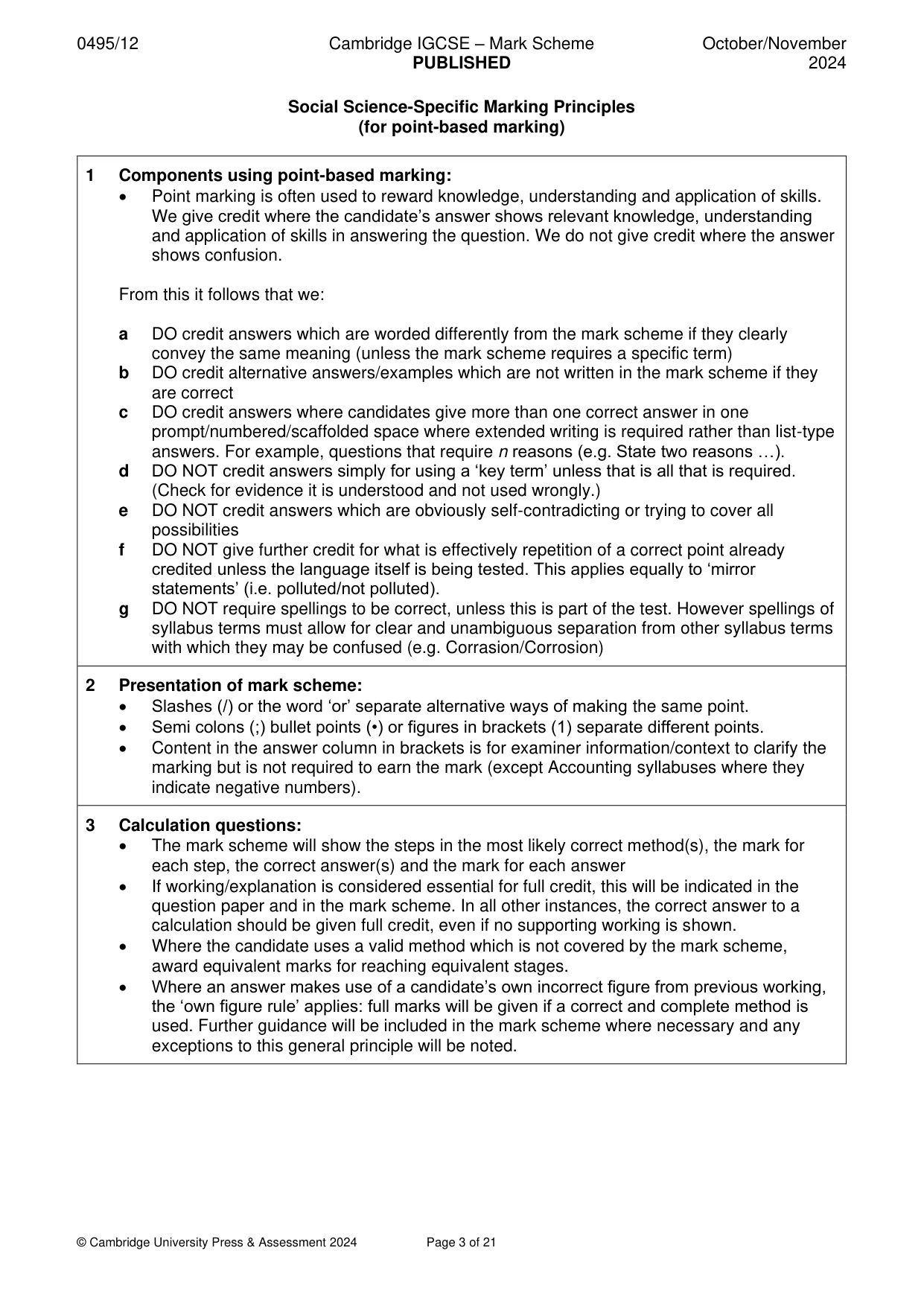
0495/12 Cambridge IGCSE – Mark Scheme PUBLISHED October/November 2024 © Cambridge University Press & Assessment 2024 Page 3 of 21 Social Science-Specific Marking Principles (for point-based marking) 1 Components using point-based marking: • Point marking is often used to reward knowledge, understanding and application of skills. We give credit where the candidate’s answer shows relevant knowledge, understanding and application of skills in answering the question. We do not give credit where the answer shows confusion. From this it follows that we: a DO credit answers which are worded differently from the mark scheme if they clearly convey the same meaning (unless the mark scheme requires a specific term) b DO credit alternative answers/examples which are not written in the mark scheme if they are correct c DO credit answers where candidates give more than one correct answer in one prompt/numbered/scaffolded space where extended writing is required rather than list-type answers. For example, questions that require n reasons (e.g. State two reasons …). d DO NOT credit answers simply for using a ‘key term’ unless that is all that is required. (Check for evidence it is understood and not used wrongly.) e DO NOT credit answers which are obviously self-contradicting or trying to cover all possibilities f DO NOT give further credit for what is effectively repetition of a correct point already credited unless the language itself is being tested. This applies equally to ‘mirror statements’ (i.e. polluted/not polluted). g DO NOT require spellings to be correct, unless this is part of the test. However spellings of syllabus terms must allow for clear and unambiguous separation from other syllabus terms with which they may be confused (e.g. Corrasion/Corrosion) 2 Presentation of mark scheme: • Slashes (/) or the word ‘or’ separate alternative ways of making the same point. • Semi colons (;) bullet points (•) or figures in brackets (1) separate different points. • Content in the answer column in brackets is for examiner information/context to clarify the marking but is not required to earn the mark (except Accounting syllabuses where they indicate negative numbers). 3 Calculation questions: • The mark scheme will show the steps in the most likely correct method(s), the mark for each step, the correct answer(s) and the mark for each answer • If working/explanation is considered essential for full credit, this will be indicated in the question paper and in the mark scheme. In all other instances, the correct answer to a calculation should be given full credit, even if no supporting working is shown. • Where the candidate uses a valid method which is not covered by the mark scheme, award equivalent marks for reaching equivalent stages. • Where an answer makes use of a candidate’s own incorrect figure from previous working, the ‘own figure rule’ applies: full marks will be given if a correct and complete method is used. Further guidance will be included in the mark scheme where necessary and any exceptions to this general principle will be noted.
Mark scheme, page 4
0495/12 Cambridge IGCSE – Mark Scheme PUBLISHED October/November 2024 © Cambridge University Press & Assessment 2024 Page 4 of 21 4 Annotation: • For point marking, ticks can be used to indicate correct answers and crosses can be used to indicate wrong answers. There is no direct relationship between ticks and marks. Ticks have no defined meaning for levels of response marking. • For levels of response marking, the level awarded should be annotated on the script. • Other annotations will be used by examiners as agreed during standardisation, and the meaning will be understood by all examiners who marked that paper.
Mark scheme, page 5
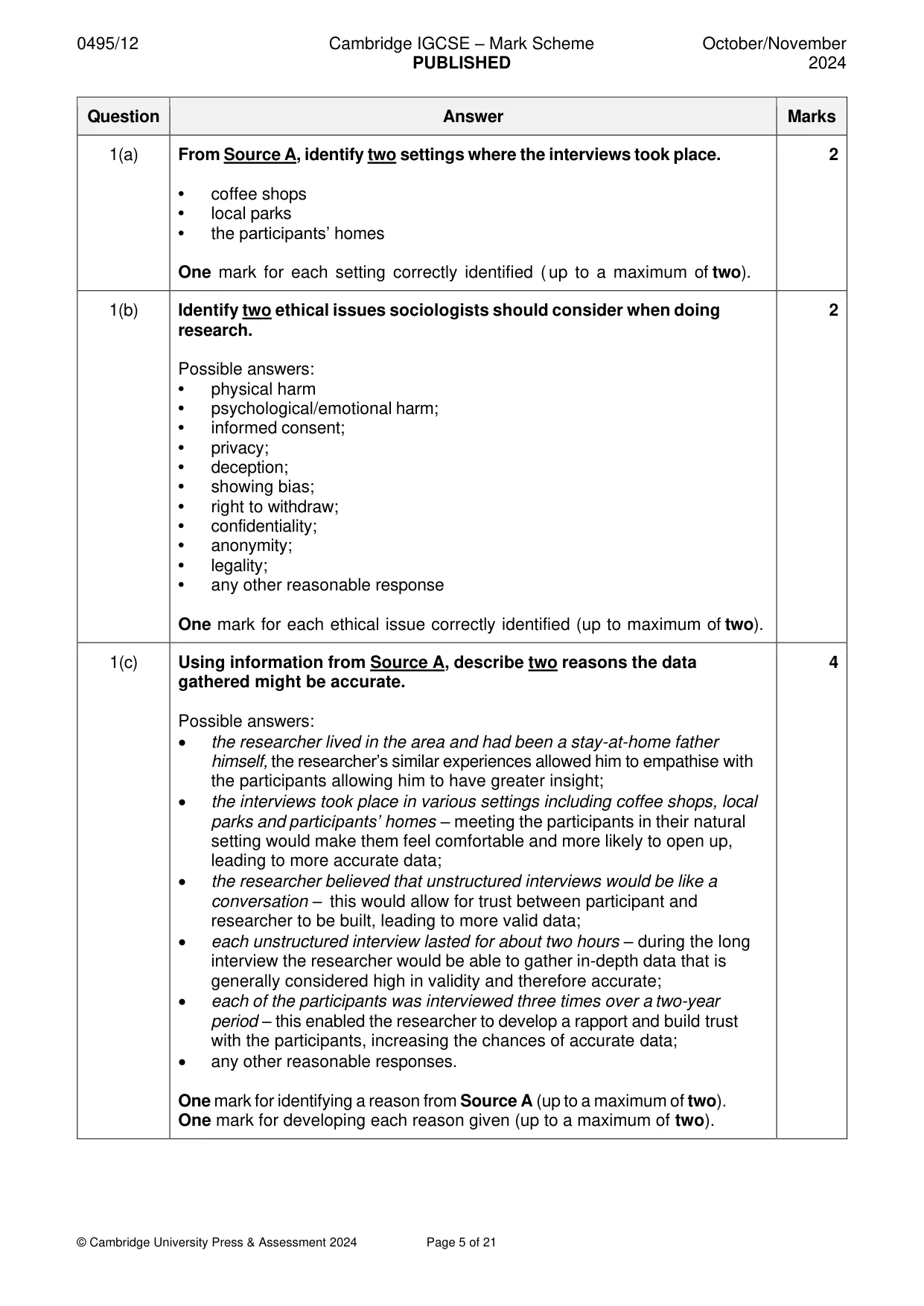
0495/12 Cambridge IGCSE – Mark Scheme PUBLISHED October/November 2024 © Cambridge University Press & Assessment 2024 Page 5 of 21 Question Answer Marks 1(a) From Source A, identify two settings where the interviews took place. • coffee shops • local parks • the participants’ homes One mark for each setting correctly identified (up to a maximum of two). 2 1(b) Identify two ethical issues sociologists should consider when doing research. Possible answers: • physical harm • psychological/emotional harm; • informed consent; • privacy; • deception; • showing bias; • right to withdraw; • confidentiality; • anonymity; • legality; • any other reasonable response One mark for each ethical issue correctly identified (up to maximum of two). 2 1(c) Using information from Source A, describe two reasons the data gathered might be accurate. Possible answers: • the researcher lived in the area and had been a stay-at-home father himself, the researcher’s similar experiences allowed him to empathise with the participants allowing him to have greater insight; • the interviews took place in various settings including coffee shops, local parks and participants’ homes – meeting the participants in their natural setting would make them feel comfortable and more likely to open up, leading to more accurate data; • the researcher believed that unstructured interviews would be like a conversation – this would allow for trust between participant and researcher to be built, leading to more valid data; • each unstructured interview lasted for about two hours – during the long interview the researcher would be able to gather in-depth data that is generally considered high in validity and therefore accurate; • each of the participants was interviewed three times over a two-year period – this enabled the researcher to develop a rapport and build trust with the participants, increasing the chances of accurate data; • any other reasonable responses. One mark for identifying a reason from Source A (up to a maximum of two). One mark for developing each reason given (up to a maximum of two). 4
Mark scheme, page 6
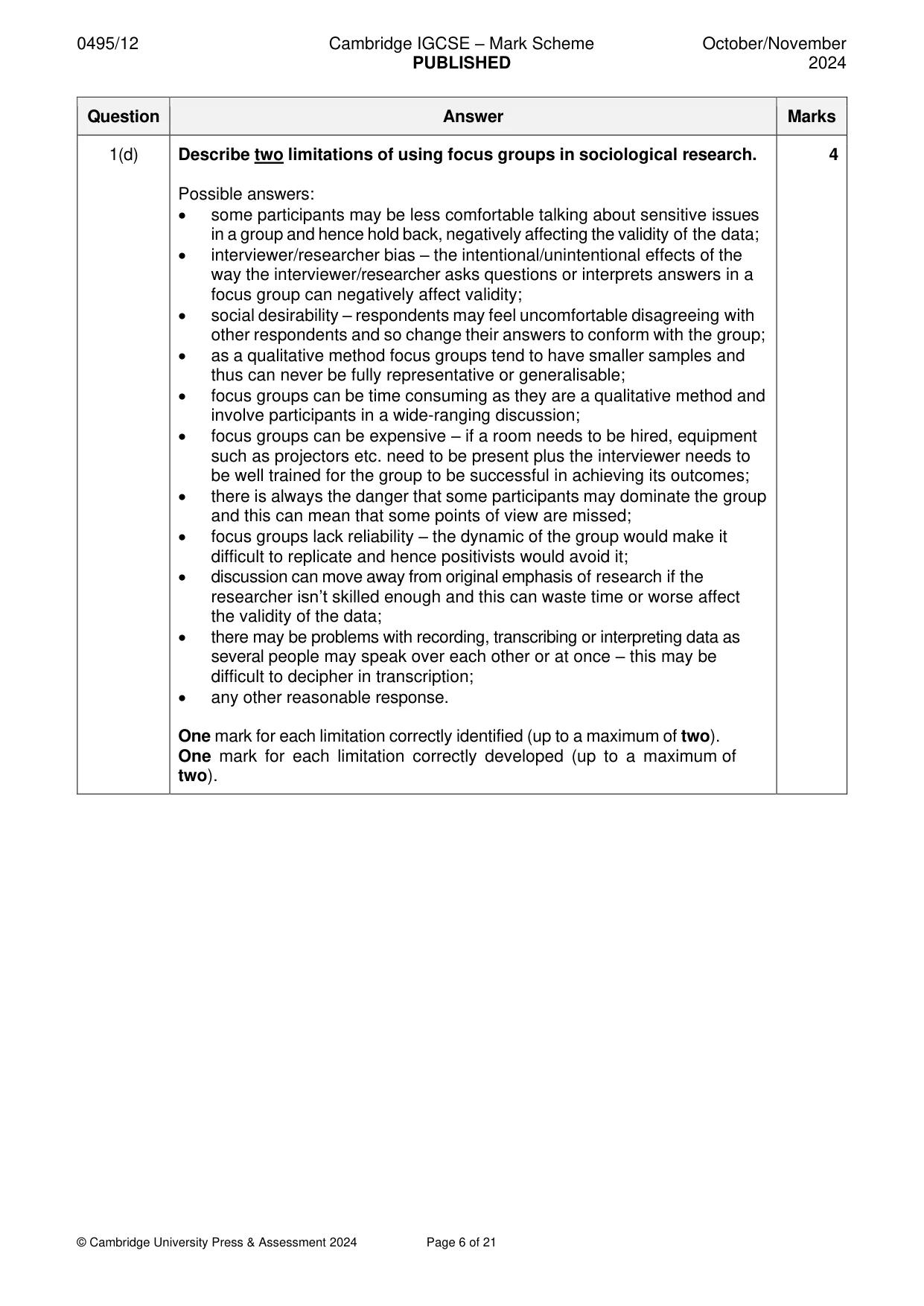
0495/12 Cambridge IGCSE – Mark Scheme PUBLISHED October/November 2024 © Cambridge University Press & Assessment 2024 Page 6 of 21 Question Answer Marks 1(d) Describe two limitations of using focus groups in sociological research. Possible answers: • some participants may be less comfortable talking about sensitive issues in a group and hence hold back, negatively affecting the validity of the data; • interviewer/researcher bias – the intentional/unintentional effects of the way the interviewer/researcher asks questions or interprets answers in a focus group can negatively affect validity; • social desirability – respondents may feel uncomfortable disagreeing with other respondents and so change their answers to conform with the group; • as a qualitative method focus groups tend to have smaller samples and thus can never be fully representative or generalisable; • focus groups can be time consuming as they are a qualitative method and involve participants in a wide-ranging discussion; • focus groups can be expensive – if a room needs to be hired, equipment such as projectors etc. need to be present plus the interviewer needs to be well trained for the group to be successful in achieving its outcomes; • there is always the danger that some participants may dominate the group and this can mean that some points of view are missed; • focus groups lack reliability – the dynamic of the group would make it difficult to replicate and hence positivists would avoid it; • discussion can move away from original emphasis of research if the researcher isn’t skilled enough and this can waste time or worse affect the validity of the data; • there may be problems with recording, transcribing or interpreting data as several people may speak over each other or at once – this may be difficult to decipher in transcription; • any other reasonable response. One mark for each limitation correctly identified (up to a maximum of two). One mark for each limitation correctly developed (up to a maximum of two). 4
Mark scheme, page 7
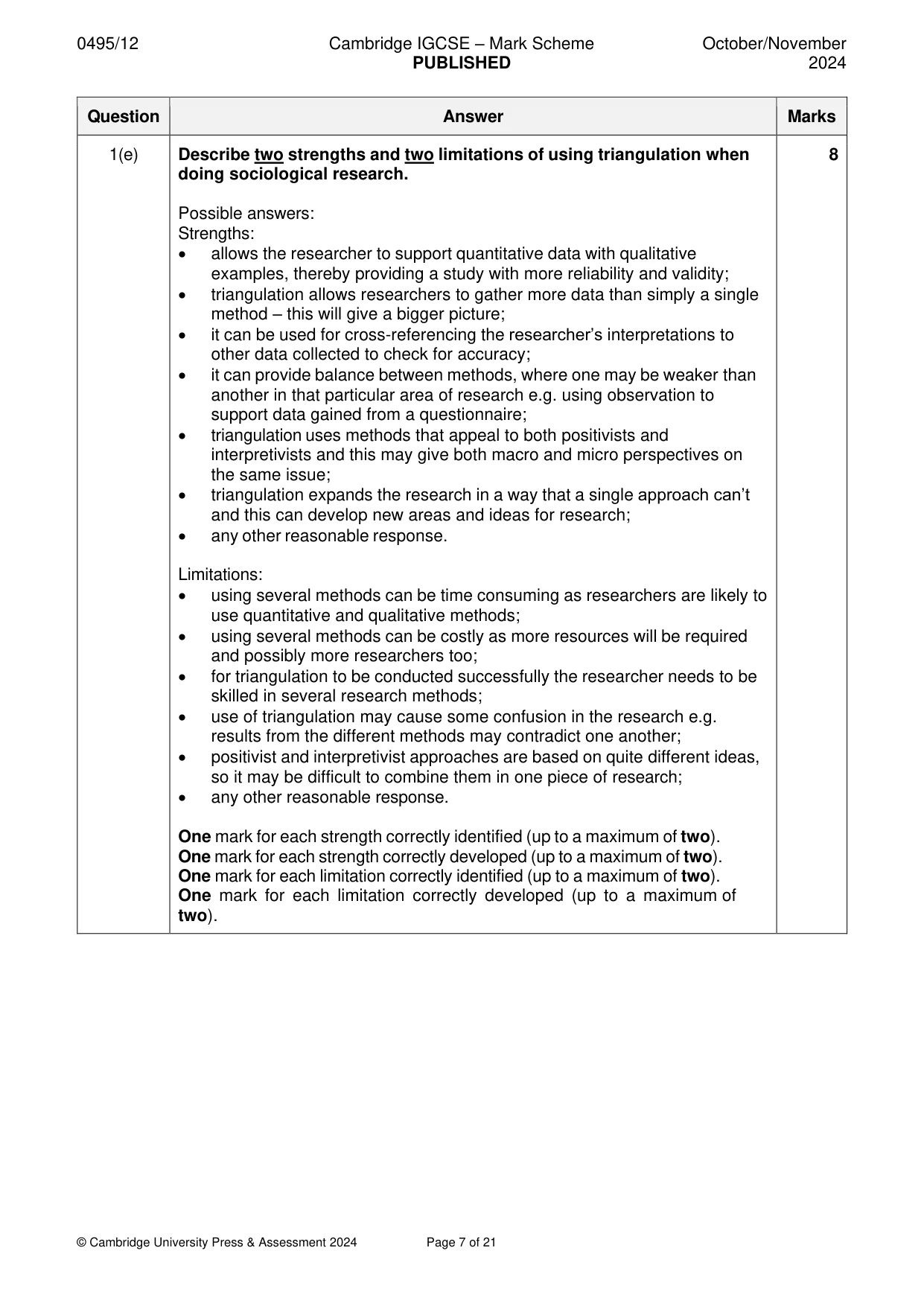
0495/12 Cambridge IGCSE – Mark Scheme PUBLISHED October/November 2024 © Cambridge University Press & Assessment 2024 Page 7 of 21 Question Answer Marks 1(e) Describe two strengths and two limitations of using triangulation when doing sociological research. Possible answers: Strengths: • allows the researcher to support quantitative data with qualitative examples, thereby providing a study with more reliability and validity; • triangulation allows researchers to gather more data than simply a single method – this will give a bigger picture; • it can be used for cross-referencing the researcher’s interpretations to other data collected to check for accuracy; • it can provide balance between methods, where one may be weaker than another in that particular area of research e.g. using observation to support data gained from a questionnaire; • triangulation uses methods that appeal to both positivists and interpretivists and this may give both macro and micro perspectives on the same issue; • triangulation expands the research in a way that a single approach can’t and this can develop new areas and ideas for research; • any other reasonable response. Limitations: • using several methods can be time consuming as researchers are likely to use quantitative and qualitative methods; • using several methods can be costly as more resources will be required and possibly more researchers too; • for triangulation to be conducted successfully the researcher needs to be skilled in several research methods; • use of triangulation may cause some confusion in the research e.g. results from the different methods may contradict one another; • positivist and interpretivist approaches are based on quite different ideas, so it may be difficult to combine them in one piece of research; • any other reasonable response. One mark for each strength correctly identified (up to a maximum of two). One mark for each strength correctly developed (up to a maximum of two). One mark for each limitation correctly identified (up to a maximum of two). One mark for each limitation correctly developed (up to a maximum of two). 8
Mark scheme, page 8
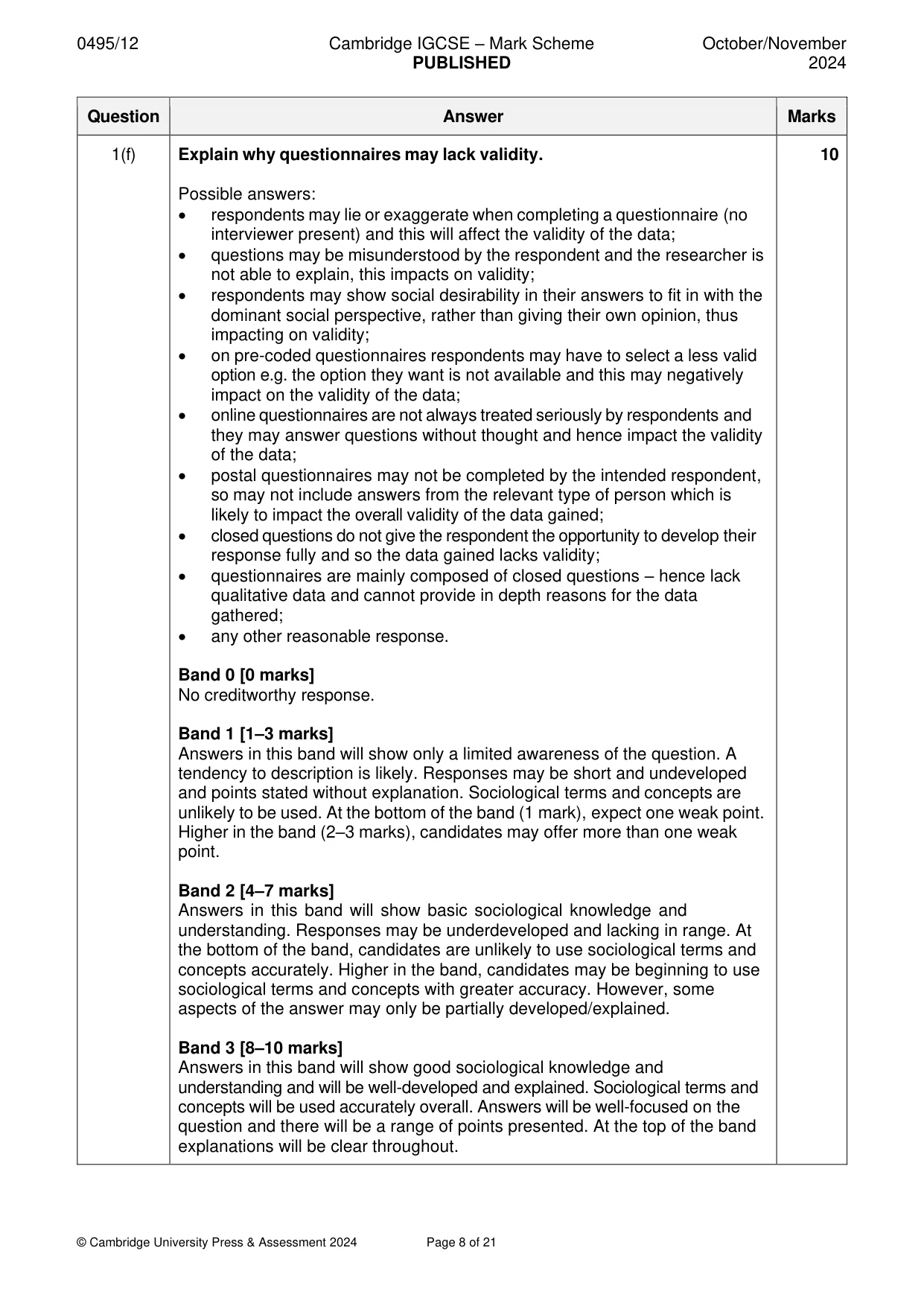
0495/12 Cambridge IGCSE – Mark Scheme PUBLISHED October/November 2024 © Cambridge University Press & Assessment 2024 Page 8 of 21 Question Answer Marks 1(f) Explain why questionnaires may lack validity. Possible answers: • respondents may lie or exaggerate when completing a questionnaire (no interviewer present) and this will affect the validity of the data; • questions may be misunderstood by the respondent and the researcher is not able to explain, this impacts on validity; • respondents may show social desirability in their answers to fit in with the dominant social perspective, rather than giving their own opinion, thus impacting on validity; • on pre-coded questionnaires respondents may have to select a less valid option e.g. the option they want is not available and this may negatively impact on the validity of the data; • online questionnaires are not always treated seriously by respondents and they may answer questions without thought and hence impact the validity of the data; • postal questionnaires may not be completed by the intended respondent, so may not include answers from the relevant type of person which is likely to impact the overall validity of the data gained; • closed questions do not give the respondent the opportunity to develop their response fully and so the data gained lacks validity; • questionnaires are mainly composed of closed questions – hence lack qualitative data and cannot provide in depth reasons for the data gathered; • any other reasonable response. Band 0 [0 marks] No creditworthy response. Band 1 [1–3 marks] Answers in this band will show only a limited awareness of the question. A tendency to description is likely. Responses may be short and undeveloped and points stated without explanation. Sociological terms and concepts are unlikely to be used. At the bottom of the band (1 mark), expect one weak point. Higher in the band (2–3 marks), candidates may offer more than one weak point. Band 2 [4–7 marks] Answers in this band will show basic sociological knowledge and understanding. Responses may be underdeveloped and lacking in range. At the bottom of the band, candidates are unlikely to use sociological terms and concepts accurately. Higher in the band, candidates may be beginning to use sociological terms and concepts with greater accuracy. However, some aspects of the answer may only be partially developed/explained. Band 3 [8–10 marks] Answers in this band will show good sociological knowledge and understanding and will be well-developed and explained. Sociological terms and concepts will be used accurately overall. Answers will be well-focused on the question and there will be a range of points presented. At the top of the band explanations will be clear throughout. 10
Mark scheme, page 9
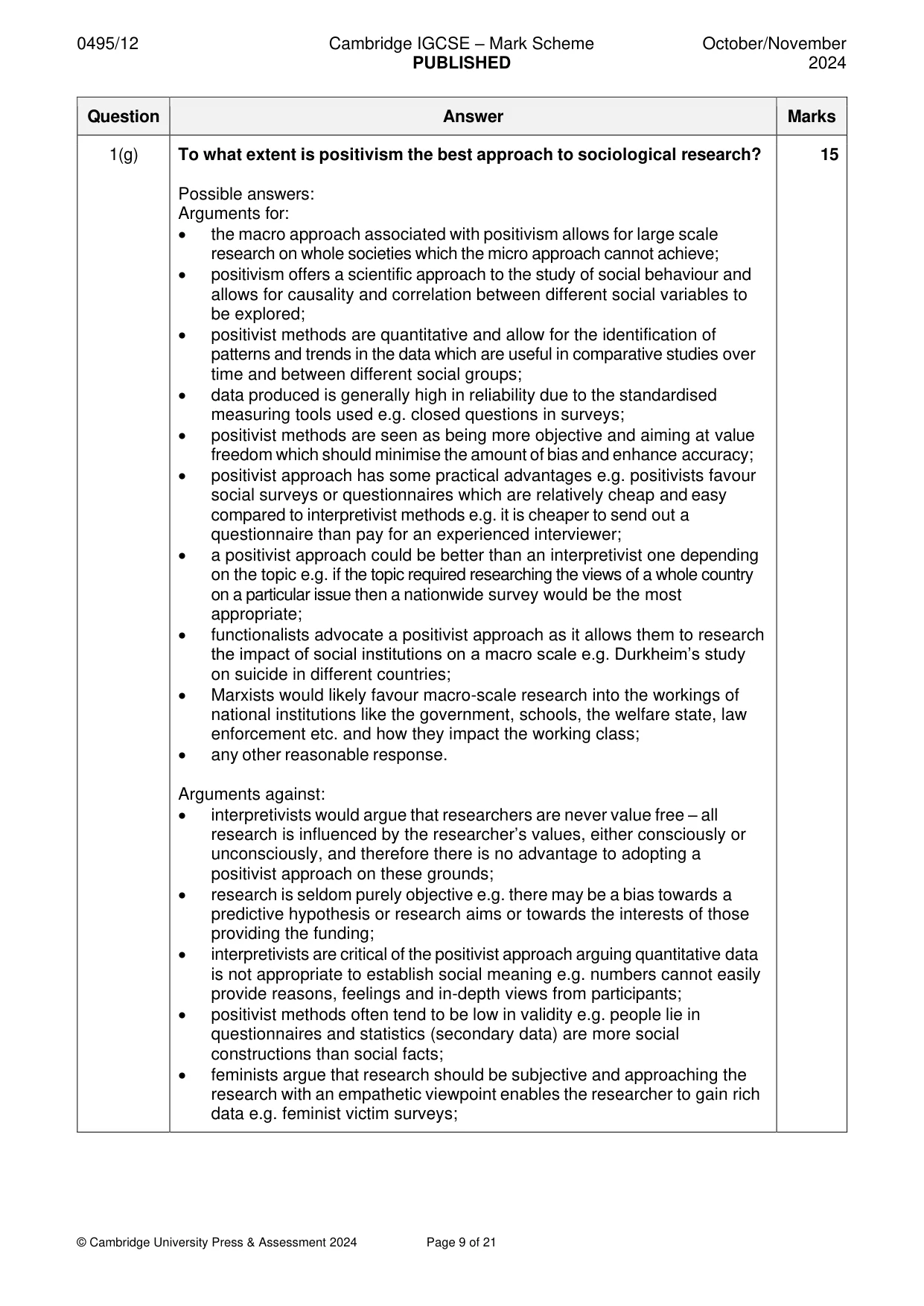
0495/12 Cambridge IGCSE – Mark Scheme PUBLISHED October/November 2024 © Cambridge University Press & Assessment 2024 Page 9 of 21 Question Answer Marks 1(g) To what extent is positivism the best approach to sociological research? Possible answers: Arguments for: • the macro approach associated with positivism allows for large scale research on whole societies which the micro approach cannot achieve; • positivism offers a scientific approach to the study of social behaviour and allows for causality and correlation between different social variables to be explored; • positivist methods are quantitative and allow for the identification of patterns and trends in the data which are useful in comparative studies over time and between different social groups; • data produced is generally high in reliability due to the standardised measuring tools used e.g. closed questions in surveys; • positivist methods are seen as being more objective and aiming at value freedom which should minimise the amount of bias and enhance accuracy; • positivist approach has some practical advantages e.g. positivists favour social surveys or questionnaires which are relatively cheap and easy compared to interpretivist methods e.g. it is cheaper to send out a questionnaire than pay for an experienced interviewer; • a positivist approach could be better than an interpretivist one depending on the topic e.g. if the topic required researching the views of a whole country on a particular issue then a nationwide survey would be the most appropriate; • functionalists advocate a positivist approach as it allows them to research the impact of social institutions on a macro scale e.g. Durkheim’s study on suicide in different countries; • Marxists would likely favour macro-scale research into the workings of national institutions like the government, schools, the welfare state, law enforcement etc. and how they impact the working class; • any other reasonable response. Arguments against: • interpretivists would argue that researchers are never value free – all research is influenced by the researcher’s values, either consciously or unconsciously, and therefore there is no advantage to adopting a positivist approach on these grounds; • research is seldom purely objective e.g. there may be a bias towards a predictive hypothesis or research aims or towards the interests of those providing the funding; • interpretivists are critical of the positivist approach arguing quantitative data is not appropriate to establish social meaning e.g. numbers cannot easily provide reasons, feelings and in-depth views from participants; • positivist methods often tend to be low in validity e.g. people lie in questionnaires and statistics (secondary data) are more social constructions than social facts; • feminists argue that research should be subjective and approaching the research with an empathetic viewpoint enables the researcher to gain rich data e.g. feminist victim surveys; 15
Mark scheme, page 10
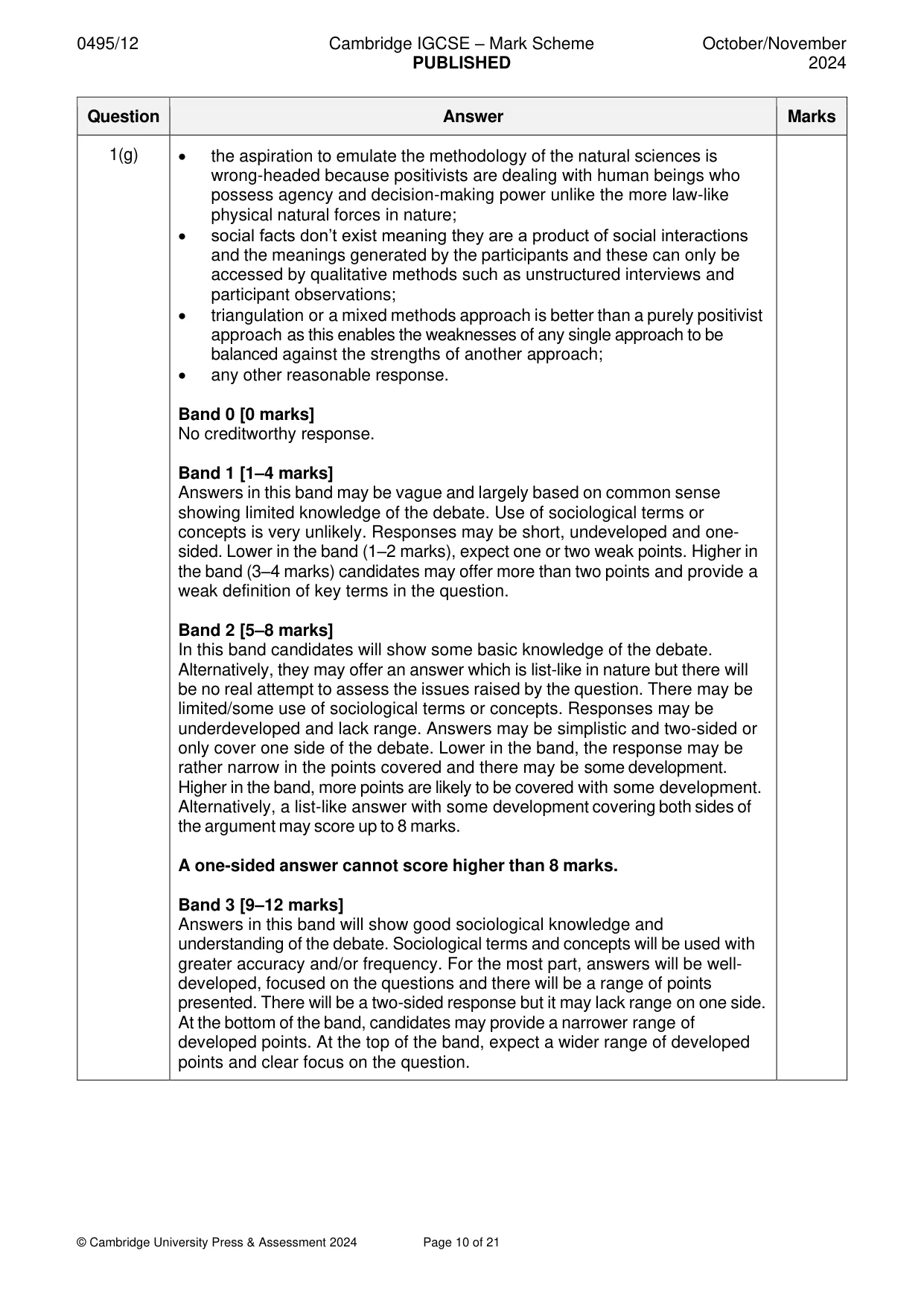
0495/12 Cambridge IGCSE – Mark Scheme PUBLISHED October/November 2024 © Cambridge University Press & Assessment 2024 Page 10 of 21 Question Answer Marks 1(g) • the aspiration to emulate the methodology of the natural sciences is wrong-headed because positivists are dealing with human beings who possess agency and decision-making power unlike the more law-like physical natural forces in nature; • social facts don’t exist meaning they are a product of social interactions and the meanings generated by the participants and these can only be accessed by qualitative methods such as unstructured interviews and participant observations; • triangulation or a mixed methods approach is better than a purely positivist approach as this enables the weaknesses of any single approach to be balanced against the strengths of another approach; • any other reasonable response. Band 0 [0 marks] No creditworthy response. Band 1 [1–4 marks] Answers in this band may be vague and largely based on common sense showing limited knowledge of the debate. Use of sociological terms or concepts is very unlikely. Responses may be short, undeveloped and one- sided. Lower in the band (1–2 marks), expect one or two weak points. Higher in the band (3–4 marks) candidates may offer more than two points and provide a weak definition of key terms in the question. Band 2 [5–8 marks] In this band candidates will show some basic knowledge of the debate. Alternatively, they may offer an answer which is list-like in nature but there will be no real attempt to assess the issues raised by the question. There may be limited/some use of sociological terms or concepts. Responses may be underdeveloped and lack range. Answers may be simplistic and two-sided or only cover one side of the debate. Lower in the band, the response may be rather narrow in the points covered and there may be some development. Higher in the band, more points are likely to be covered with some development. Alternatively, a list-like answer with some development covering both sides of the argument may score up to 8 marks. A one-sided answer cannot score higher than 8 marks. Band 3 [9–12 marks] Answers in this band will show good sociological knowledge and understanding of the debate. Sociological terms and concepts will be used with greater accuracy and/or frequency. For the most part, answers will be well- developed, focused on the questions and there will be a range of points presented. There will be a two-sided response but it may lack range on one side. At the bottom of the band, candidates may provide a narrower range of developed points. At the top of the band, expect a wider range of developed points and clear focus on the question.
Mark scheme, page 11
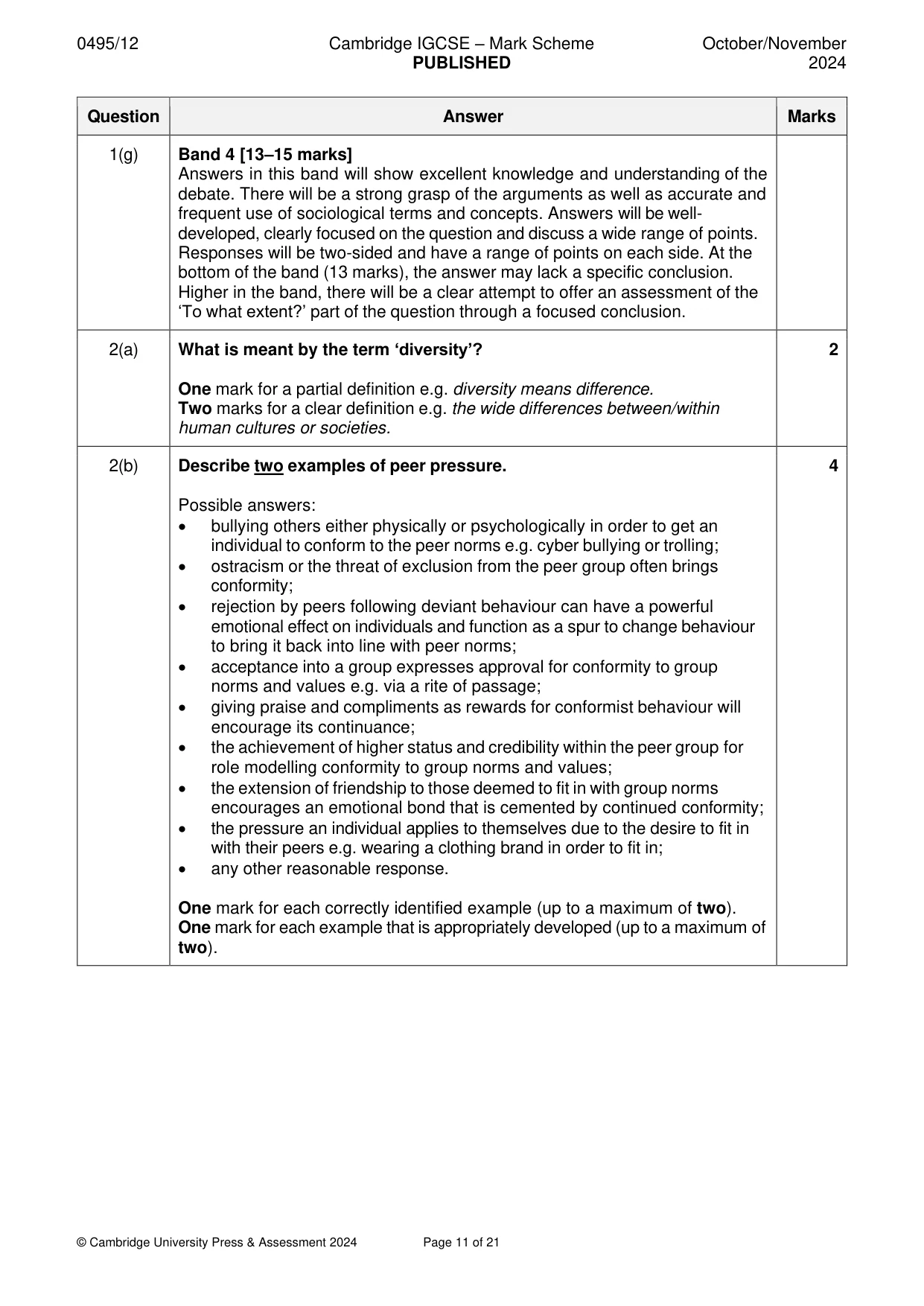
0495/12 Cambridge IGCSE – Mark Scheme PUBLISHED October/November 2024 © Cambridge University Press & Assessment 2024 Page 11 of 21 Question Answer Marks 1(g) Band 4 [13–15 marks] Answers in this band will show excellent knowledge and understanding of the debate. There will be a strong grasp of the arguments as well as accurate and frequent use of sociological terms and concepts. Answers will be well- developed, clearly focused on the question and discuss a wide range of points. Responses will be two-sided and have a range of points on each side. At the bottom of the band (13 marks), the answer may lack a specific conclusion. Higher in the band, there will be a clear attempt to offer an assessment of the ‘To what extent?’ part of the question through a focused conclusion. 2(a) What is meant by the term ‘diversity’? One mark for a partial definition e.g. diversity means difference. Two marks for a clear definition e.g. the wide differences between/within human cultures or societies. 2 2(b) Describe two examples of peer pressure. Possible answers: • bullying others either physically or psychologically in order to get an individual to conform to the peer norms e.g. cyber bullying or trolling; • ostracism or the threat of exclusion from the peer group often brings conformity; • rejection by peers following deviant behaviour can have a powerful emotional effect on individuals and function as a spur to change behaviour to bring it back into line with peer norms; • acceptance into a group expresses approval for conformity to group norms and values e.g. via a rite of passage; • giving praise and compliments as rewards for conformist behaviour will encourage its continuance; • the achievement of higher status and credibility within the peer group for role modelling conformity to group norms and values; • the extension of friendship to those deemed to fit in with group norms encourages an emotional bond that is cemented by continued conformity; • the pressure an individual applies to themselves due to the desire to fit in with their peers e.g. wearing a clothing brand in order to fit in; • any other reasonable response. One mark for each correctly identified example (up to a maximum of two). One mark for each example that is appropriately developed (up to a maximum of two). 4
Mark scheme, page 12
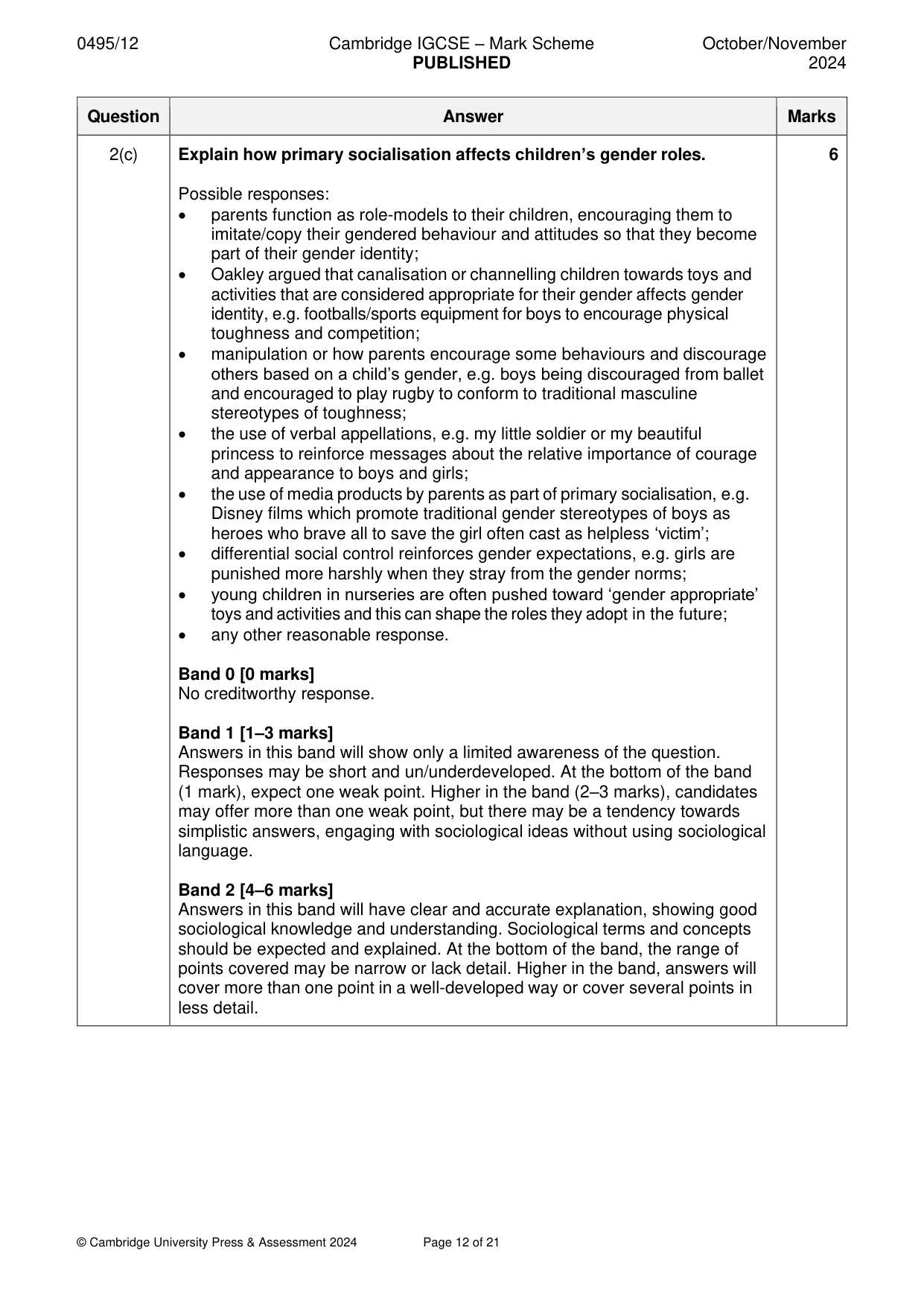
0495/12 Cambridge IGCSE – Mark Scheme PUBLISHED October/November 2024 © Cambridge University Press & Assessment 2024 Page 12 of 21 Question Answer Marks 2(c) Explain how primary socialisation affects children’s gender roles. Possible responses: • parents function as role-models to their children, encouraging them to imitate/copy their gendered behaviour and attitudes so that they become part of their gender identity; • Oakley argued that canalisation or channelling children towards toys and activities that are considered appropriate for their gender affects gender identity, e.g. footballs/sports equipment for boys to encourage physical toughness and competition; • manipulation or how parents encourage some behaviours and discourage others based on a child’s gender, e.g. boys being discouraged from ballet and encouraged to play rugby to conform to traditional masculine stereotypes of toughness; • the use of verbal appellations, e.g. my little soldier or my beautiful princess to reinforce messages about the relative importance of courage and appearance to boys and girls; • the use of media products by parents as part of primary socialisation, e.g. Disney films which promote traditional gender stereotypes of boys as heroes who brave all to save the girl often cast as helpless ‘victim’; • differential social control reinforces gender expectations, e.g. girls are punished more harshly when they stray from the gender norms; • young children in nurseries are often pushed toward ‘gender appropriate’ toys and activities and this can shape the roles they adopt in the future; • any other reasonable response. Band 0 [0 marks] No creditworthy response. Band 1 [1–3 marks] Answers in this band will show only a limited awareness of the question. Responses may be short and un/underdeveloped. At the bottom of the band (1 mark), expect one weak point. Higher in the band (2–3 marks), candidates may offer more than one weak point, but there may be a tendency towards simplistic answers, engaging with sociological ideas without using sociological language. Band 2 [4–6 marks] Answers in this band will have clear and accurate explanation, showing good sociological knowledge and understanding. Sociological terms and concepts should be expected and explained. At the bottom of the band, the range of points covered may be narrow or lack detail. Higher in the band, answers will cover more than one point in a well-developed way or cover several points in less detail. 6
Mark scheme, page 13
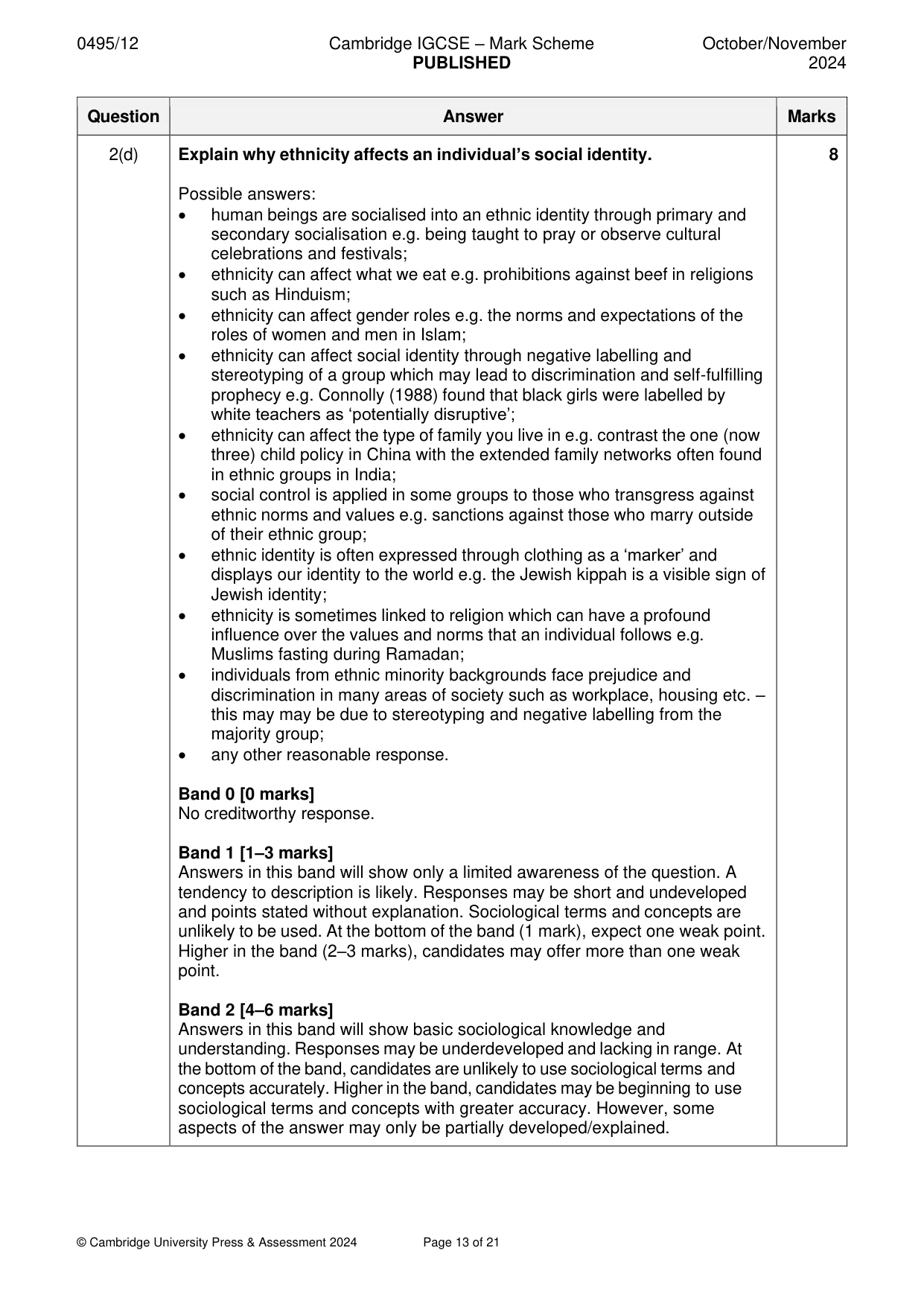
0495/12 Cambridge IGCSE – Mark Scheme PUBLISHED October/November 2024 © Cambridge University Press & Assessment 2024 Page 13 of 21 Question Answer Marks 2(d) Explain why ethnicity affects an individual’s social identity. Possible answers: • human beings are socialised into an ethnic identity through primary and secondary socialisation e.g. being taught to pray or observe cultural celebrations and festivals; • ethnicity can affect what we eat e.g. prohibitions against beef in religions such as Hinduism; • ethnicity can affect gender roles e.g. the norms and expectations of the roles of women and men in Islam; • ethnicity can affect social identity through negative labelling and stereotyping of a group which may lead to discrimination and self-fulfilling prophecy e.g. Connolly (1988) found that black girls were labelled by white teachers as ‘potentially disruptive’; • ethnicity can affect the type of family you live in e.g. contrast the one (now three) child policy in China with the extended family networks often found in ethnic groups in India; • social control is applied in some groups to those who transgress against ethnic norms and values e.g. sanctions against those who marry outside of their ethnic group; • ethnic identity is often expressed through clothing as a ‘marker’ and displays our identity to the world e.g. the Jewish kippah is a visible sign of Jewish identity; • ethnicity is sometimes linked to religion which can have a profound influence over the values and norms that an individual follows e.g. Muslims fasting during Ramadan; • individuals from ethnic minority backgrounds face prejudice and discrimination in many areas of society such as workplace, housing etc. – this may may be due to stereotyping and negative labelling from the majority group; • any other reasonable response. Band 0 [0 marks] No creditworthy response. Band 1 [1–3 marks] Answers in this band will show only a limited awareness of the question. A tendency to description is likely. Responses may be short and undeveloped and points stated without explanation. Sociological terms and concepts are unlikely to be used. At the bottom of the band (1 mark), expect one weak point. Higher in the band (2–3 marks), candidates may offer more than one weak point. Band 2 [4–6 marks] Answers in this band will show basic sociological knowledge and understanding. Responses may be underdeveloped and lacking in range. At the bottom of the band, candidates are unlikely to use sociological terms and concepts accurately. Higher in the band, candidates may be beginning to use sociological terms and concepts with greater accuracy. However, some aspects of the answer may only be partially developed/explained. 8
Mark scheme, page 14
0495/12 Cambridge IGCSE – Mark Scheme PUBLISHED October/November 2024 © Cambridge University Press & Assessment 2024 Page 14 of 21 Question Answer Marks 2(d) Band 3 [7–8 marks] Answers in this band will show good sociological knowledge and understanding and will be well developed and explained. Sociological terms and concepts will be used accurately overall. Answers will be well-focused on the question and there will be a range of points presented. At the top of the band explanations will be clear throughout.
Mark scheme, page 15
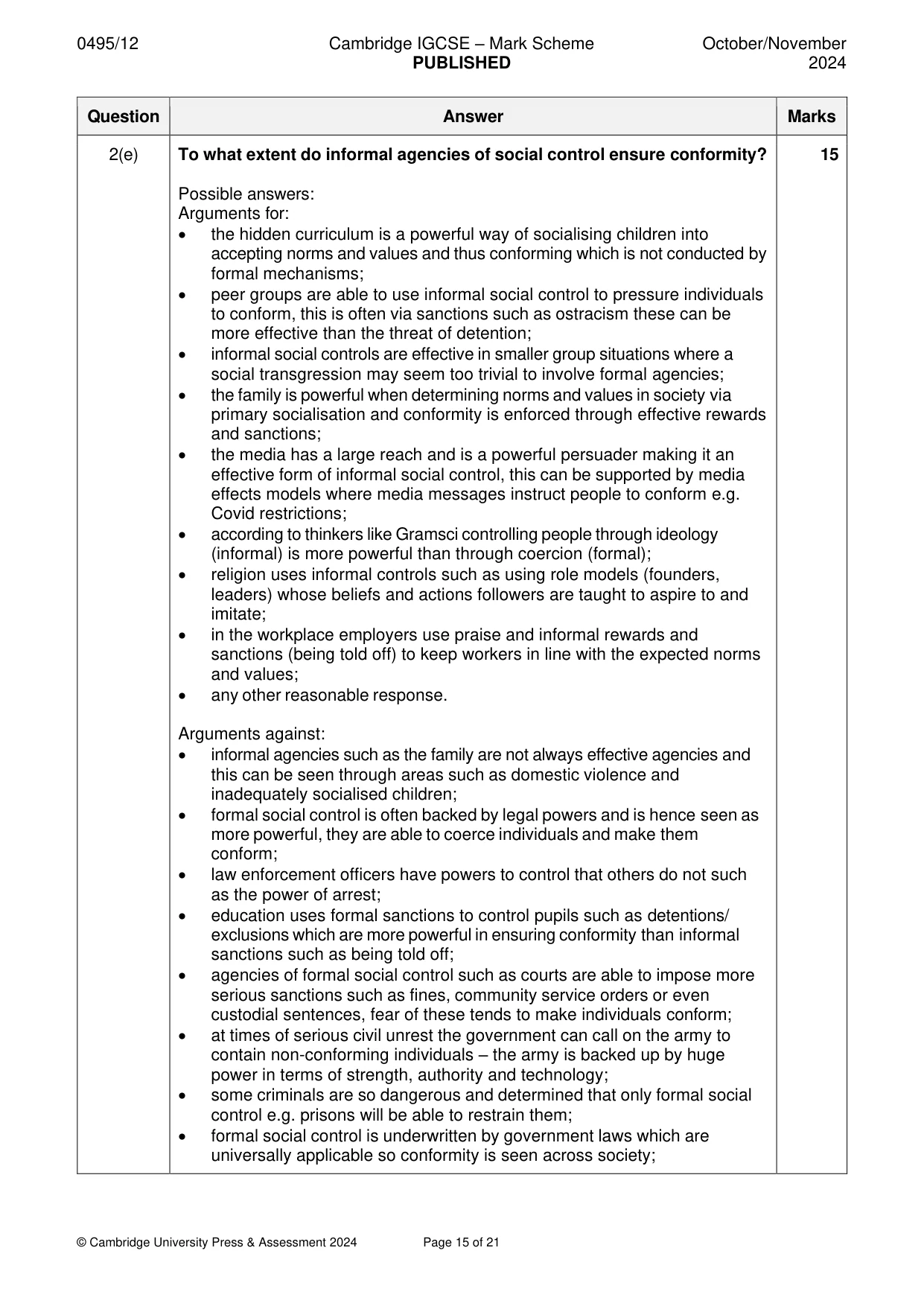
0495/12 Cambridge IGCSE – Mark Scheme PUBLISHED October/November 2024 © Cambridge University Press & Assessment 2024 Page 15 of 21 Question Answer Marks 2(e) To what extent do informal agencies of social control ensure conformity? Possible answers: Arguments for: • the hidden curriculum is a powerful way of socialising children into accepting norms and values and thus conforming which is not conducted by formal mechanisms; • peer groups are able to use informal social control to pressure individuals to conform, this is often via sanctions such as ostracism these can be more effective than the threat of detention; • informal social controls are effective in smaller group situations where a social transgression may seem too trivial to involve formal agencies; • the family is powerful when determining norms and values in society via primary socialisation and conformity is enforced through effective rewards and sanctions; • the media has a large reach and is a powerful persuader making it an effective form of informal social control, this can be supported by media effects models where media messages instruct people to conform e.g. Covid restrictions; • according to thinkers like Gramsci controlling people through ideology (informal) is more powerful than through coercion (formal); • religion uses informal controls such as using role models (founders, leaders) whose beliefs and actions followers are taught to aspire to and imitate; • in the workplace employers use praise and informal rewards and sanctions (being told off) to keep workers in line with the expected norms and values; • any other reasonable response. Arguments against: • informal agencies such as the family are not always effective agencies and this can be seen through areas such as domestic violence and inadequately socialised children; • formal social control is often backed by legal powers and is hence seen as more powerful, they are able to coerce individuals and make them conform; • law enforcement officers have powers to control that others do not such as the power of arrest; • education uses formal sanctions to control pupils such as detentions/ exclusions which are more powerful in ensuring conformity than informal sanctions such as being told off; • agencies of formal social control such as courts are able to impose more serious sanctions such as fines, community service orders or even custodial sentences, fear of these tends to make individuals conform; • at times of serious civil unrest the government can call on the army to contain non-conforming individuals – the army is backed up by huge power in terms of strength, authority and technology; • some criminals are so dangerous and determined that only formal social control e.g. prisons will be able to restrain them; • formal social control is underwritten by government laws which are universally applicable so conformity is seen across society; 15
Mark scheme, page 16
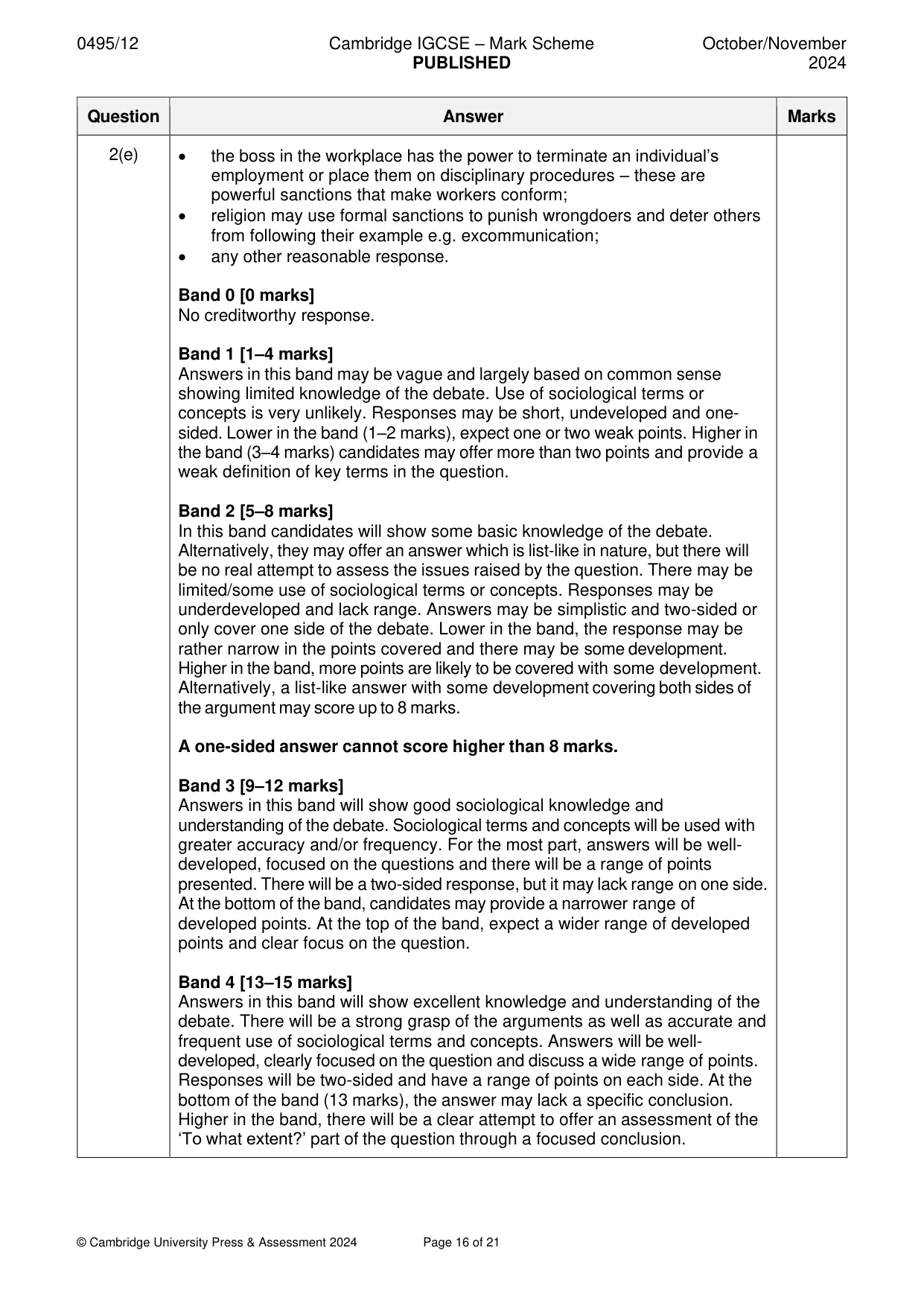
0495/12 Cambridge IGCSE – Mark Scheme PUBLISHED October/November 2024 © Cambridge University Press & Assessment 2024 Page 16 of 21 Question Answer Marks 2(e) • the boss in the workplace has the power to terminate an individual’s employment or place them on disciplinary procedures – these are powerful sanctions that make workers conform; • religion may use formal sanctions to punish wrongdoers and deter others from following their example e.g. excommunication; • any other reasonable response. Band 0 [0 marks] No creditworthy response. Band 1 [1–4 marks] Answers in this band may be vague and largely based on common sense showing limited knowledge of the debate. Use of sociological terms or concepts is very unlikely. Responses may be short, undeveloped and one- sided. Lower in the band (1–2 marks), expect one or two weak points. Higher in the band (3–4 marks) candidates may offer more than two points and provide a weak definition of key terms in the question. Band 2 [5–8 marks] In this band candidates will show some basic knowledge of the debate. Alternatively, they may offer an answer which is list-like in nature, but there will be no real attempt to assess the issues raised by the question. There may be limited/some use of sociological terms or concepts. Responses may be underdeveloped and lack range. Answers may be simplistic and two-sided or only cover one side of the debate. Lower in the band, the response may be rather narrow in the points covered and there may be some development. Higher in the band, more points are likely to be covered with some development. Alternatively, a list-like answer with some development covering both sides of the argument may score up to 8 marks. A one-sided answer cannot score higher than 8 marks. Band 3 [9–12 marks] Answers in this band will show good sociological knowledge and understanding of the debate. Sociological terms and concepts will be used with greater accuracy and/or frequency. For the most part, answers will be well- developed, focused on the questions and there will be a range of points presented. There will be a two-sided response, but it may lack range on one side. At the bottom of the band, candidates may provide a narrower range of developed points. At the top of the band, expect a wider range of developed points and clear focus on the question. Band 4 [13–15 marks] Answers in this band will show excellent knowledge and understanding of the debate. There will be a strong grasp of the arguments as well as accurate and frequent use of sociological terms and concepts. Answers will be well- developed, clearly focused on the question and discuss a wide range of points. Responses will be two-sided and have a range of points on each side. At the bottom of the band (13 marks), the answer may lack a specific conclusion. Higher in the band, there will be a clear attempt to offer an assessment of the ‘To what extent?’ part of the question through a focused conclusion.
Mark scheme, page 17
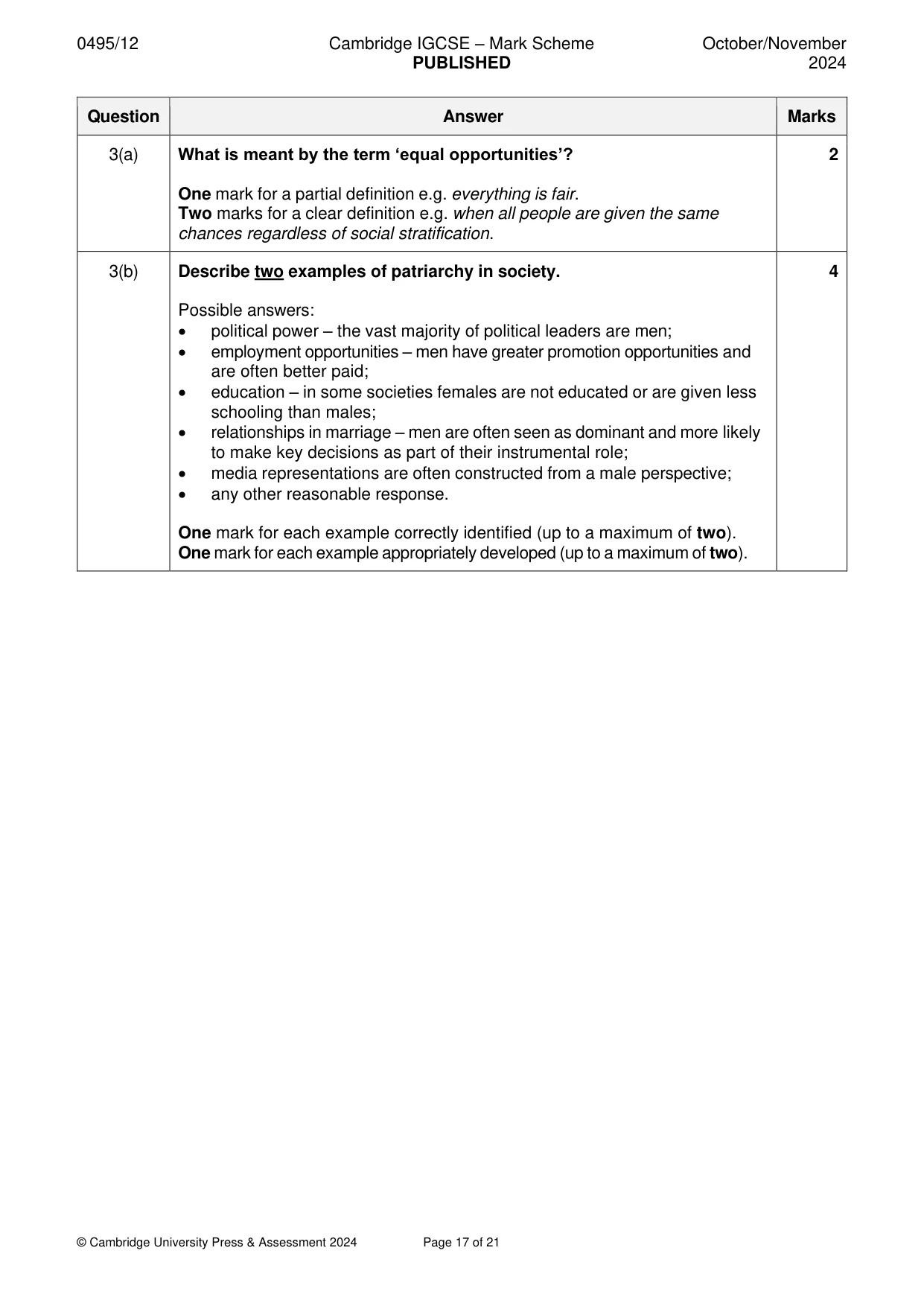
0495/12 Cambridge IGCSE – Mark Scheme PUBLISHED October/November 2024 © Cambridge University Press & Assessment 2024 Page 17 of 21 Question Answer Marks 3(a) What is meant by the term ‘equal opportunities’? One mark for a partial definition e.g. everything is fair. Two marks for a clear definition e.g. when all people are given the same chances regardless of social stratification. 2 3(b) Describe two examples of patriarchy in society. Possible answers: • political power – the vast majority of political leaders are men; • employment opportunities – men have greater promotion opportunities and are often better paid; • education – in some societies females are not educated or are given less schooling than males; • relationships in marriage – men are often seen as dominant and more likely to make key decisions as part of their instrumental role; • media representations are often constructed from a male perspective; • any other reasonable response. One mark for each example correctly identified (up to a maximum of two). One mark for each example appropriately developed (up to a maximum of two). 4
Mark scheme, page 18
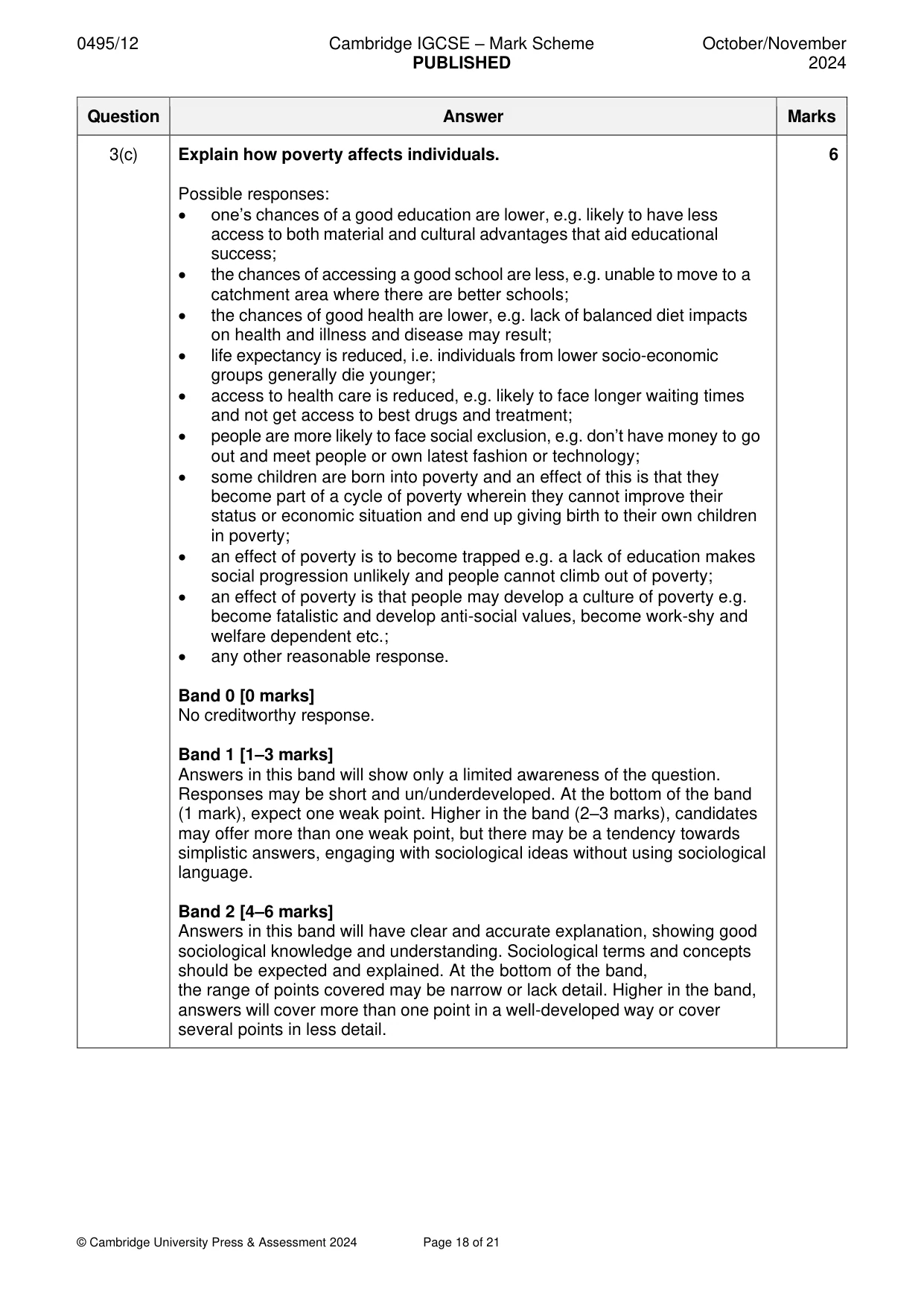
0495/12 Cambridge IGCSE – Mark Scheme PUBLISHED October/November 2024 © Cambridge University Press & Assessment 2024 Page 18 of 21 Question Answer Marks 3(c) Explain how poverty affects individuals. Possible responses: • one’s chances of a good education are lower, e.g. likely to have less access to both material and cultural advantages that aid educational success; • the chances of accessing a good school are less, e.g. unable to move to a catchment area where there are better schools; • the chances of good health are lower, e.g. lack of balanced diet impacts on health and illness and disease may result; • life expectancy is reduced, i.e. individuals from lower socio-economic groups generally die younger; • access to health care is reduced, e.g. likely to face longer waiting times and not get access to best drugs and treatment; • people are more likely to face social exclusion, e.g. don’t have money to go out and meet people or own latest fashion or technology; • some children are born into poverty and an effect of this is that they become part of a cycle of poverty wherein they cannot improve their status or economic situation and end up giving birth to their own children in poverty; • an effect of poverty is to become trapped e.g. a lack of education makes social progression unlikely and people cannot climb out of poverty; • an effect of poverty is that people may develop a culture of poverty e.g. become fatalistic and develop anti-social values, become work-shy and welfare dependent etc.; • any other reasonable response. Band 0 [0 marks] No creditworthy response. Band 1 [1–3 marks] Answers in this band will show only a limited awareness of the question. Responses may be short and un/underdeveloped. At the bottom of the band (1 mark), expect one weak point. Higher in the band (2–3 marks), candidates may offer more than one weak point, but there may be a tendency towards simplistic answers, engaging with sociological ideas without using sociological language. Band 2 [4–6 marks] Answers in this band will have clear and accurate explanation, showing good sociological knowledge and understanding. Sociological terms and concepts should be expected and explained. At the bottom of the band, the range of points covered may be narrow or lack detail. Higher in the band, answers will cover more than one point in a well-developed way or cover several points in less detail. 6
Mark scheme, page 19
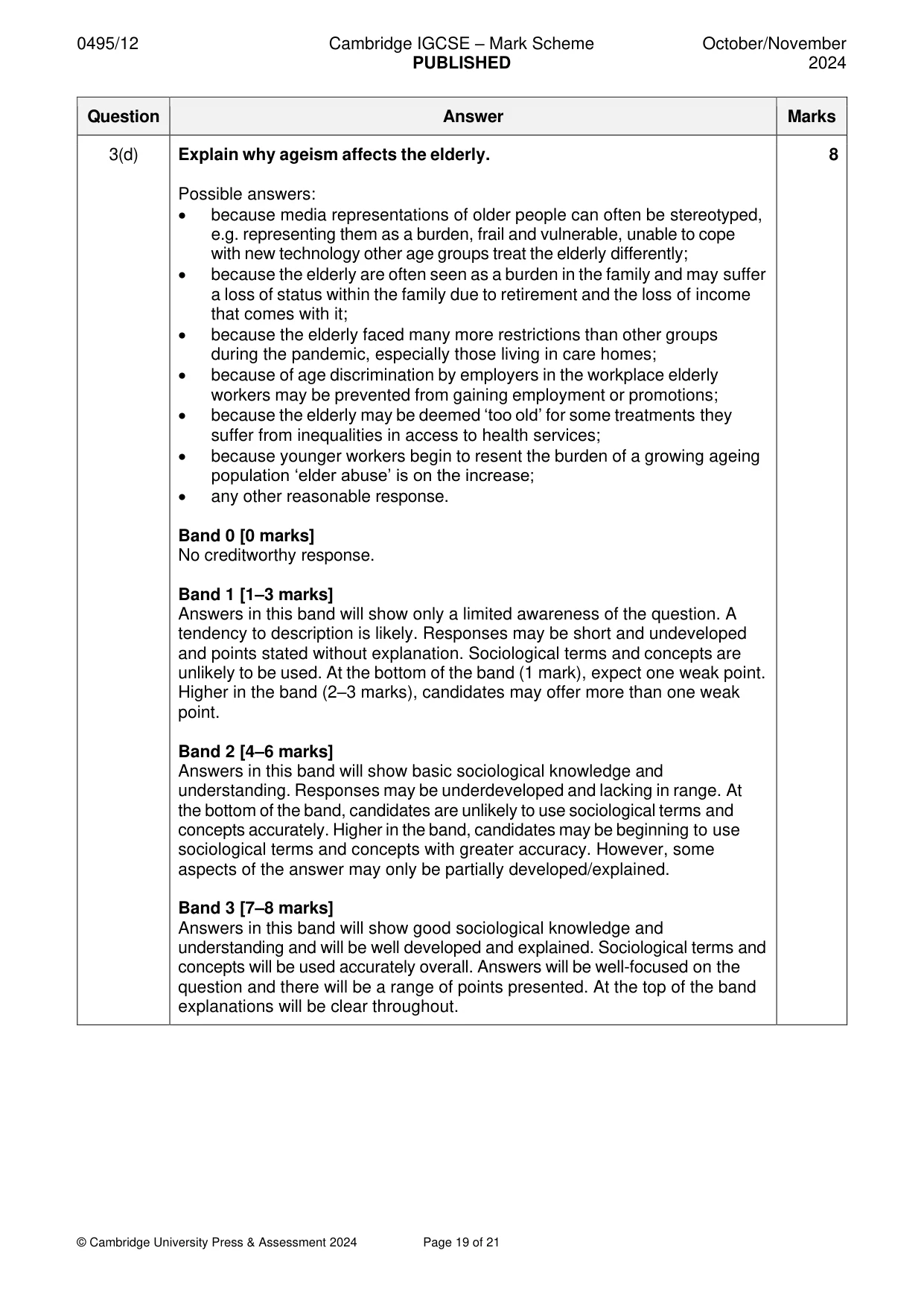
0495/12 Cambridge IGCSE – Mark Scheme PUBLISHED October/November 2024 © Cambridge University Press & Assessment 2024 Page 19 of 21 Question Answer Marks 3(d) Explain why ageism affects the elderly. Possible answers: • because media representations of older people can often be stereotyped, e.g. representing them as a burden, frail and vulnerable, unable to cope with new technology other age groups treat the elderly differently; • because the elderly are often seen as a burden in the family and may suffer a loss of status within the family due to retirement and the loss of income that comes with it; • because the elderly faced many more restrictions than other groups during the pandemic, especially those living in care homes; • because of age discrimination by employers in the workplace elderly workers may be prevented from gaining employment or promotions; • because the elderly may be deemed ‘too old’ for some treatments they suffer from inequalities in access to health services; • because younger workers begin to resent the burden of a growing ageing population ‘elder abuse’ is on the increase; • any other reasonable response. Band 0 [0 marks] No creditworthy response. Band 1 [1–3 marks] Answers in this band will show only a limited awareness of the question. A tendency to description is likely. Responses may be short and undeveloped and points stated without explanation. Sociological terms and concepts are unlikely to be used. At the bottom of the band (1 mark), expect one weak point. Higher in the band (2–3 marks), candidates may offer more than one weak point. Band 2 [4–6 marks] Answers in this band will show basic sociological knowledge and understanding. Responses may be underdeveloped and lacking in range. At the bottom of the band, candidates are unlikely to use sociological terms and concepts accurately. Higher in the band, candidates may be beginning to use sociological terms and concepts with greater accuracy. However, some aspects of the answer may only be partially developed/explained. Band 3 [7–8 marks] Answers in this band will show good sociological knowledge and understanding and will be well developed and explained. Sociological terms and concepts will be used accurately overall. Answers will be well-focused on the question and there will be a range of points presented. At the top of the band explanations will be clear throughout. 8
Mark scheme, page 20
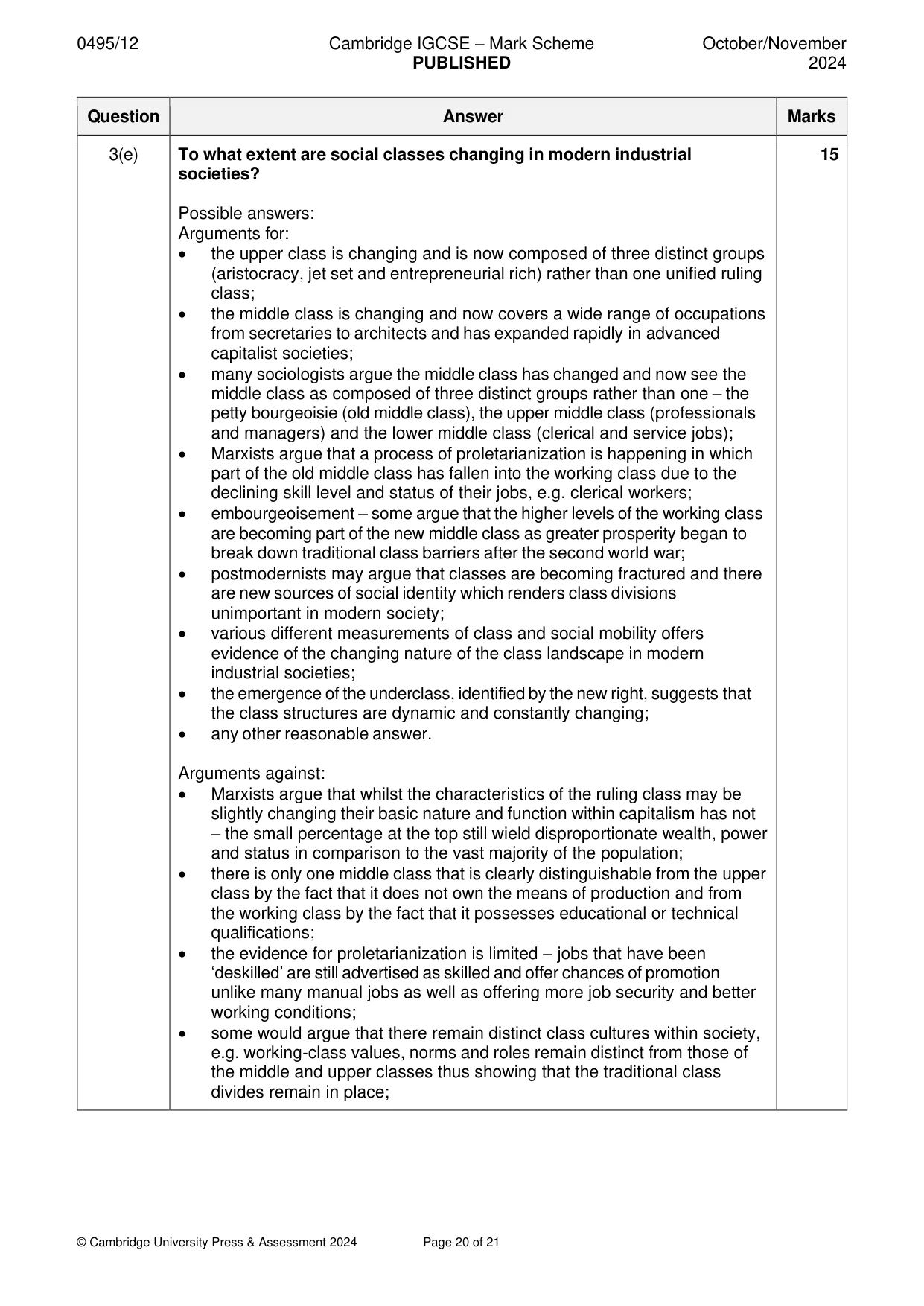
0495/12 Cambridge IGCSE – Mark Scheme PUBLISHED October/November 2024 © Cambridge University Press & Assessment 2024 Page 20 of 21 Question Answer Marks 3(e) To what extent are social classes changing in modern industrial societies? Possible answers: Arguments for: • the upper class is changing and is now composed of three distinct groups (aristocracy, jet set and entrepreneurial rich) rather than one unified ruling class; • the middle class is changing and now covers a wide range of occupations from secretaries to architects and has expanded rapidly in advanced capitalist societies; • many sociologists argue the middle class has changed and now see the middle class as composed of three distinct groups rather than one – the petty bourgeoisie (old middle class), the upper middle class (professionals and managers) and the lower middle class (clerical and service jobs); • Marxists argue that a process of proletarianization is happening in which part of the old middle class has fallen into the working class due to the declining skill level and status of their jobs, e.g. clerical workers; • embourgeoisement – some argue that the higher levels of the working class are becoming part of the new middle class as greater prosperity began to break down traditional class barriers after the second world war; • postmodernists may argue that classes are becoming fractured and there are new sources of social identity which renders class divisions unimportant in modern society; • various different measurements of class and social mobility offers evidence of the changing nature of the class landscape in modern industrial societies; • the emergence of the underclass, identified by the new right, suggests that the class structures are dynamic and constantly changing; • any other reasonable answer. Arguments against: • Marxists argue that whilst the characteristics of the ruling class may be slightly changing their basic nature and function within capitalism has not – the small percentage at the top still wield disproportionate wealth, power and status in comparison to the vast majority of the population; • there is only one middle class that is clearly distinguishable from the upper class by the fact that it does not own the means of production and from the working class by the fact that it possesses educational or technical qualifications; • the evidence for proletarianization is limited – jobs that have been ‘deskilled’ are still advertised as skilled and offer chances of promotion unlike many manual jobs as well as offering more job security and better working conditions; • some would argue that there remain distinct class cultures within society, e.g. working-class values, norms and roles remain distinct from those of the middle and upper classes thus showing that the traditional class divides remain in place; 15
Mark scheme, page 21
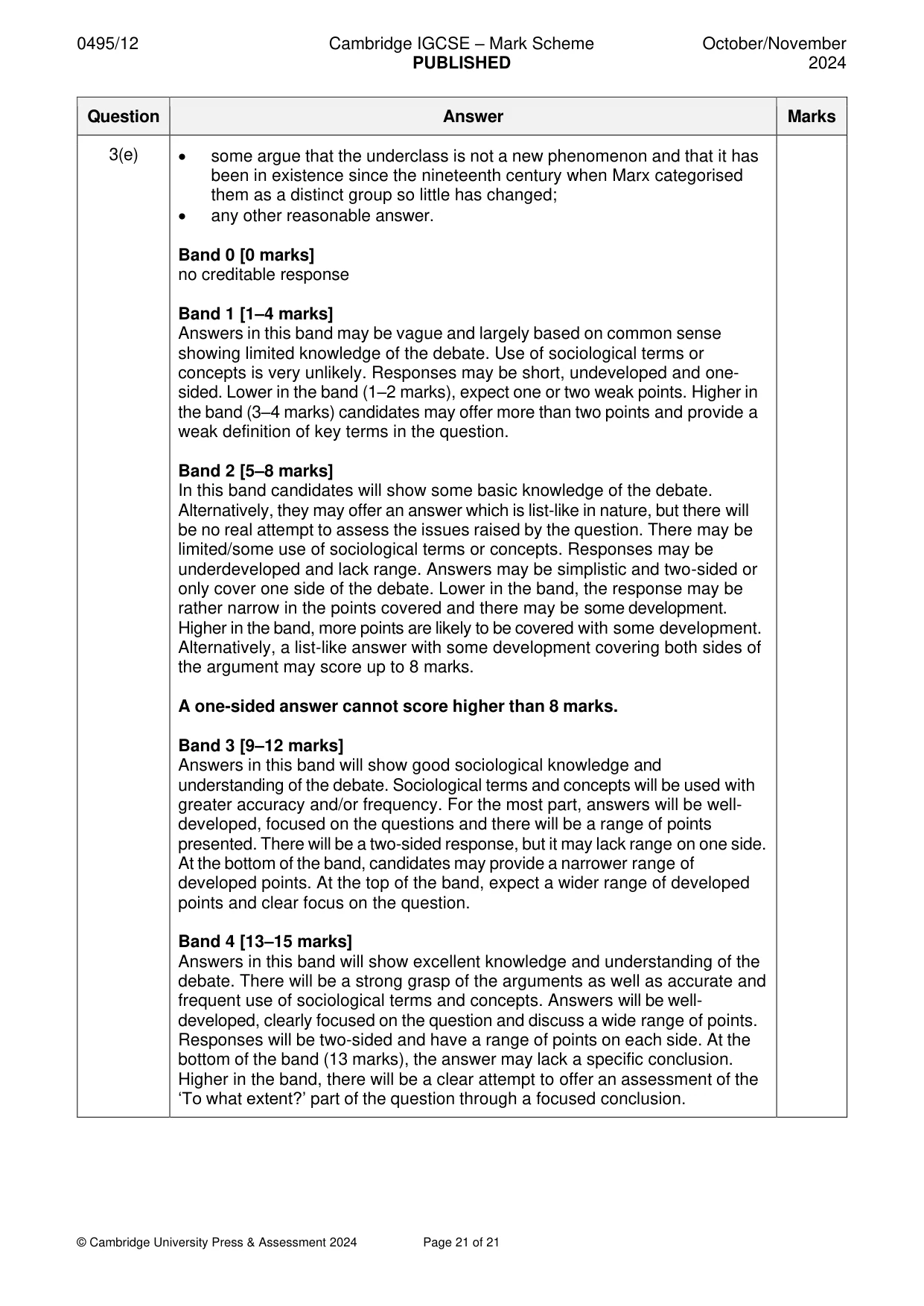
0495/12 Cambridge IGCSE – Mark Scheme PUBLISHED October/November 2024 © Cambridge University Press & Assessment 2024 Page 21 of 21 Question Answer Marks 3(e) • some argue that the underclass is not a new phenomenon and that it has been in existence since the nineteenth century when Marx categorised them as a distinct group so little has changed; • any other reasonable answer. Band 0 [0 marks] no creditable response Band 1 [1–4 marks] Answers in this band may be vague and largely based on common sense showing limited knowledge of the debate. Use of sociological terms or concepts is very unlikely. Responses may be short, undeveloped and one- sided. Lower in the band (1–2 marks), expect one or two weak points. Higher in the band (3–4 marks) candidates may offer more than two points and provide a weak definition of key terms in the question. Band 2 [5–8 marks] In this band candidates will show some basic knowledge of the debate. Alternatively, they may offer an answer which is list-like in nature, but there will be no real attempt to assess the issues raised by the question. There may be limited/some use of sociological terms or concepts. Responses may be underdeveloped and lack range. Answers may be simplistic and two-sided or only cover one side of the debate. Lower in the band, the response may be rather narrow in the points covered and there may be some development. Higher in the band, more points are likely to be covered with some development. Alternatively, a list-like answer with some development covering both sides of the argument may score up to 8 marks. A one-sided answer cannot score higher than 8 marks. Band 3 [9–12 marks] Answers in this band will show good sociological knowledge and understanding of the debate. Sociological terms and concepts will be used with greater accuracy and/or frequency. For the most part, answers will be well- developed, focused on the questions and there will be a range of points presented. There will be a two-sided response, but it may lack range on one side. At the bottom of the band, candidates may provide a narrower range of developed points. At the top of the band, expect a wider range of developed points and clear focus on the question. Band 4 [13–15 marks] Answers in this band will show excellent knowledge and understanding of the debate. There will be a strong grasp of the arguments as well as accurate and frequent use of sociological terms and concepts. Answers will be well- developed, clearly focused on the question and discuss a wide range of points. Responses will be two-sided and have a range of points on each side. At the bottom of the band (13 marks), the answer may lack a specific conclusion. Higher in the band, there will be a clear attempt to offer an assessment of the ‘To what extent?’ part of the question through a focused conclusion.
What you needed in this session
Cambridge’s own grade thresholds for 2024 Oct/Nov, Paper 1 · Variant 2. A higher threshold means an easier paper — the bar moves with how the cohort did.