Cambridge IGCSE Sociology 0495 — 2022 May/June Paper 1 · Variant 2
0495/12/M/J/22 · 80 marks · ≈90 min
The question paper and its mark scheme, free to read here and free to download. This is Cambridge’s own paper, exactly as it was sat.
Question paper4 pages

Mark scheme20 pages
Answers below. Sit the paper first if you are practising.

Paper as text
Question paper, page 1
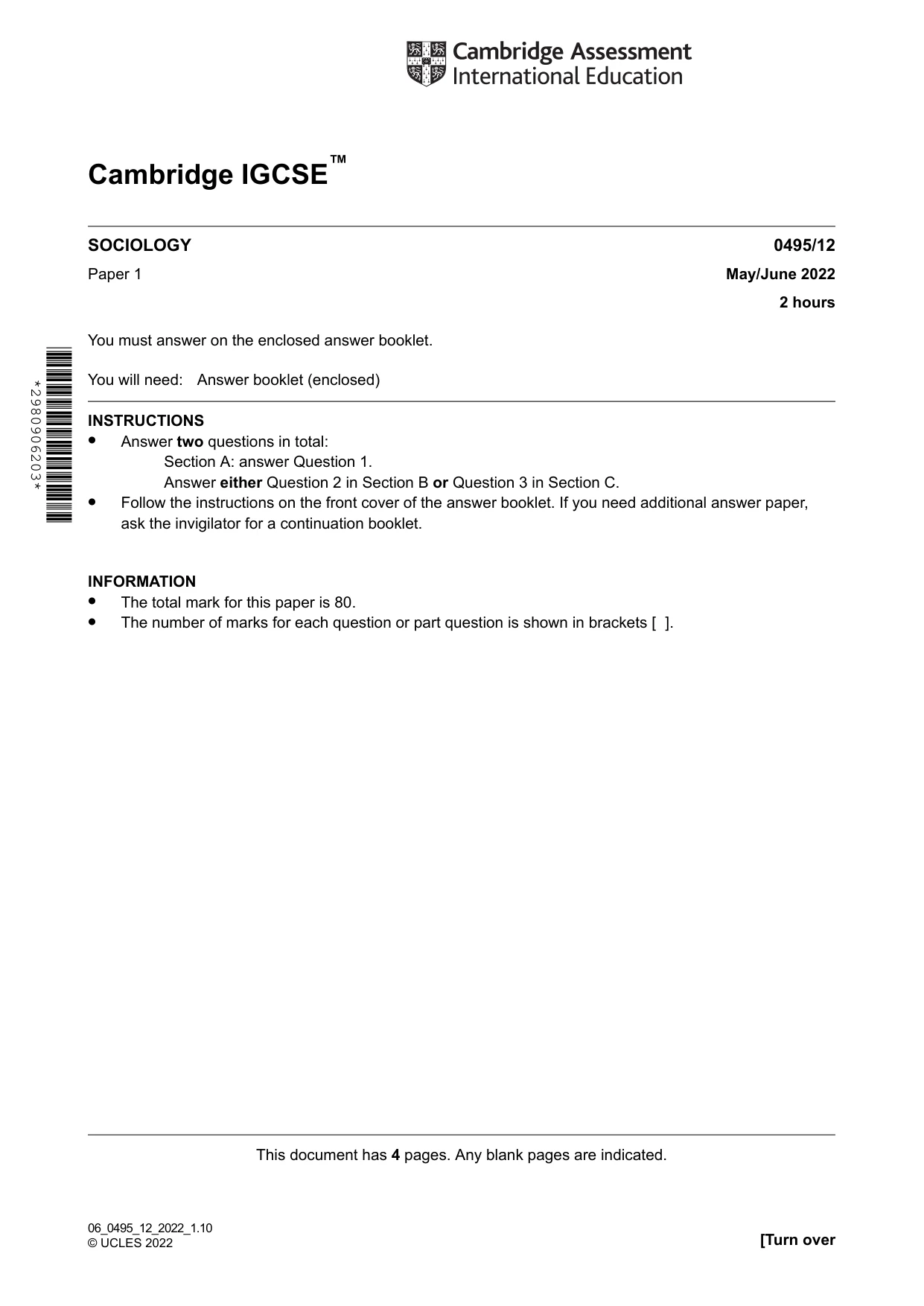
Cambridge IGCSE™ 0495/12 May/June 2022 2 hours SOCIOLOGY Paper 1 You must answer on the enclosed answer booklet. You will need: Answer booklet (enclosed) INSTRUCTIONS • Answer two questions in total: Section A: answer Question 1. Answer either Question 2 in Section B or Question 3 in Section C. • Follow the instructions on the front cover of the answer booklet. If you need additional answer paper, ask the invigilator for a continuation booklet. INFORMATION • The total mark for this paper is 80. • The number of marks for each question or part question is shown in brackets [ ]. This document has 4 pages. Any blank pages are indicated. [Turn over 06_0495_12_2022_1.10 © UCLES 2022 *2980906203*
Question paper, page 2
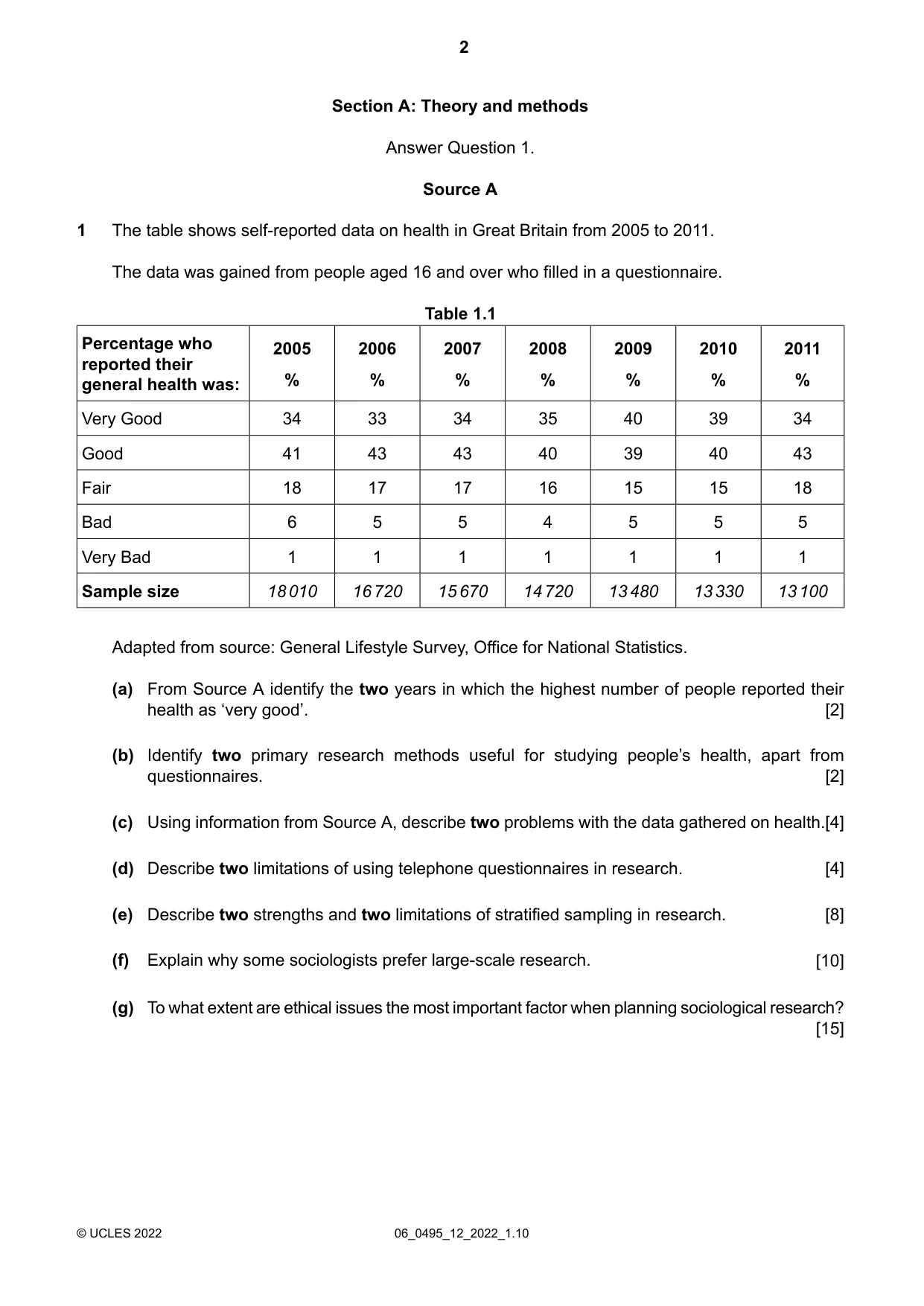
Section A: Theory and methods Answer Question 1. Source A The table shows self-reported data on health in Great Britain from 2005 to 2011. 1 The data was gained from people aged 16 and over who filled in a questionnaire. Table 1.1 2011 % 2010 % 2009 % 2008 % 2007 % 2006 % 2005 % Percentage who reported their general health was: 34 39 40 35 34 33 34 Very Good 43 40 39 40 43 43 41 Good 18 15 15 16 17 17 18 Fair 5 5 5 4 5 5 6 Bad 1 1 1 1 1 1 1 Very Bad 13100 13330 13480 14720 15670 16720 18010 Sample size Adapted from source: General Lifestyle Survey, Office for National Statistics. From Source A identify the two years in which the highest number of people reported their health as ‘very good’. [2] (a) Identify two primary research methods useful for studying people’s health, apart from questionnaires. [2] (b) Using information from Source A, describe two problems with the data gathered on health.[4] (c) Describe two limitations of using telephone questionnaires in research. [4] (d) Describe two strengths and two limitations of stratified sampling in research. [8] (e) Explain why some sociologists prefer large-scale research. [10] (f) To what extent are ethical issues the most important factor when planning sociological research? [15] (g) 06_0495_12_2022_1.10 © UCLES 2022 2
Question paper, page 3
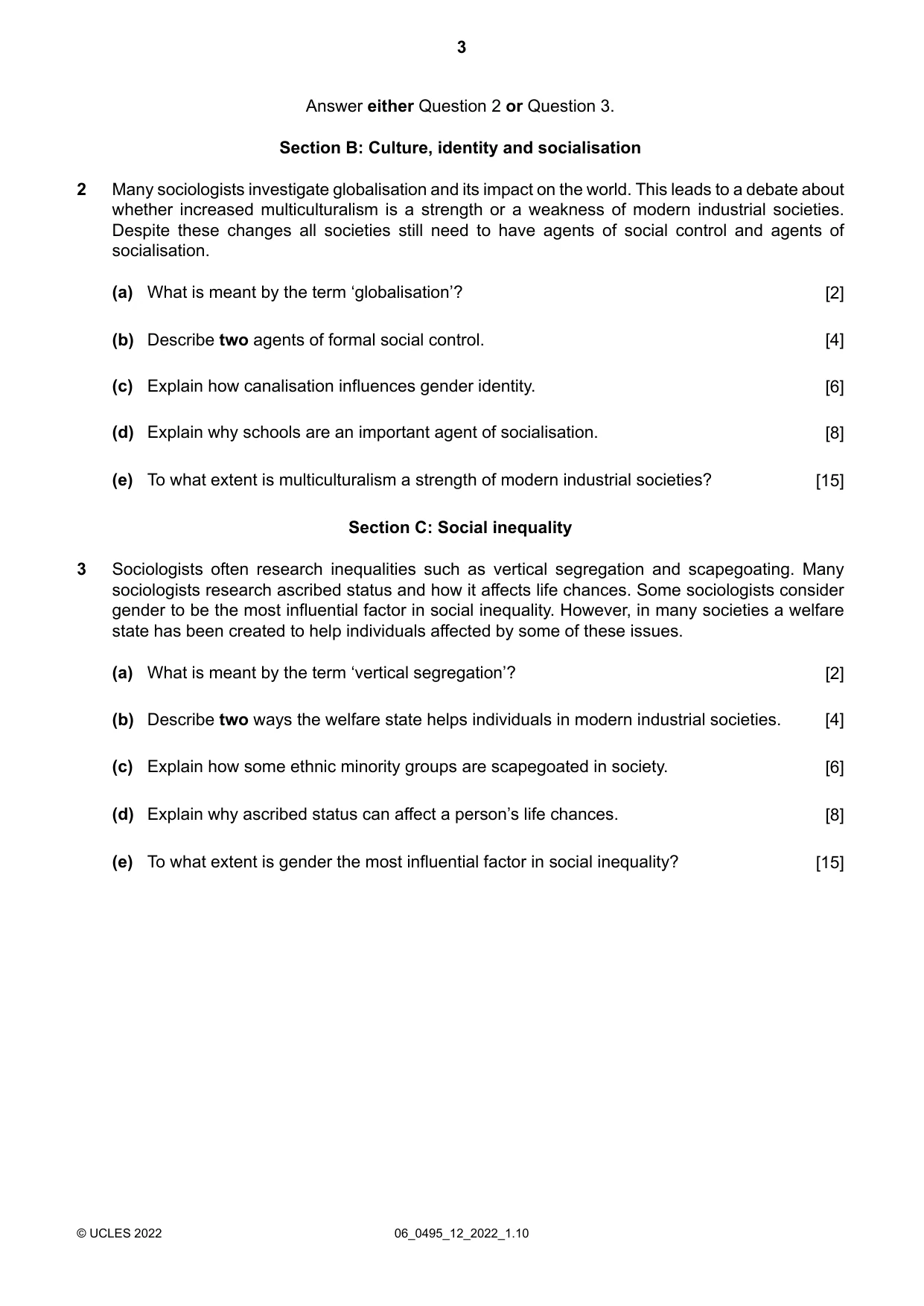
Answer either Question 2 or Question 3. Section B: Culture, identity and socialisation Many sociologists investigate globalisation and its impact on the world. This leads to a debate about whether increased multiculturalism is a strength or a weakness of modern industrial societies. 2 Despite these changes all societies still need to have agents of social control and agents of socialisation. What is meant by the term ‘globalisation’? [2] (a) Describe two agents of formal social control. [4] (b) Explain how canalisation influences gender identity. [6] (c) Explain why schools are an important agent of socialisation. [8] (d) To what extent is multiculturalism a strength of modern industrial societies? [15] (e) Section C: Social inequality Sociologists often research inequalities such as vertical segregation and scapegoating. Many sociologists research ascribed status and how it affects life chances. Some sociologists consider 3 gender to be the most influential factor in social inequality. However, in many societies a welfare state has been created to help individuals affected by some of these issues. What is meant by the term ‘vertical segregation’? [2] (a) Describe two ways the welfare state helps individuals in modern industrial societies. [4] (b) Explain how some ethnic minority groups are scapegoated in society. [6] (c) Explain why ascribed status can affect a person’s life chances. [8] (d) To what extent is gender the most influential factor in social inequality? [15] (e) 06_0495_12_2022_1.10 © UCLES 2022 3
Question paper, page 4
BLANK PAGE Permission to reproduce items where third-party owned material protected by copyright is included has been sought and cleared where possible. Every reasonable effort has been made by the publisher (UCLES) to trace copyright holders, but if any items requiring clearance have unwittingly been included, the publisher will be pleased to make amends at the earliest possible opportunity. To avoid the issue of disclosure of answer-related information to candidates, all copyright acknowledgements are reproduced online in the Cambridge Assessment International Education Copyright Acknowledgements Booklet. This is produced for each series of examinations and is freely available to download at www.cambridgeinternational.org after the live examination series. Cambridge Assessment International Education is part of Cambridge Assessment. Cambridge Assessment is the brand name of the University of Cambridge Local Examinations Syndicate (UCLES), which is a department of the University of Cambridge. 06_0495_12_2022_1.10 © UCLES 2022 4
Mark scheme, page 1
This document consists of 20 printed pages. © UCLES 2022 [Turn over Cambridge IGCSE™ SOCIOLOGY 0495/12 Paper 1 May/June 2022 MARK SCHEME Maximum Mark: 80 Published This mark scheme is published as an aid to teachers and candidates, to indicate the requirements of the examination. It shows the basis on which Examiners were instructed to award marks. It does not indicate the details of the discussions that took place at an Examiners’ meeting before marking began, which would have considered the acceptability of alternative answers. Mark schemes should be read in conjunction with the question paper and the Principal Examiner Report for Teachers. Cambridge International will not enter into discussions about these mark schemes. Cambridge International is publishing the mark schemes for the May/June 2022 series for most Cambridge IGCSE, Cambridge International A and AS Level and Cambridge Pre-U components, and some Cambridge O Level components.
Mark scheme, page 2
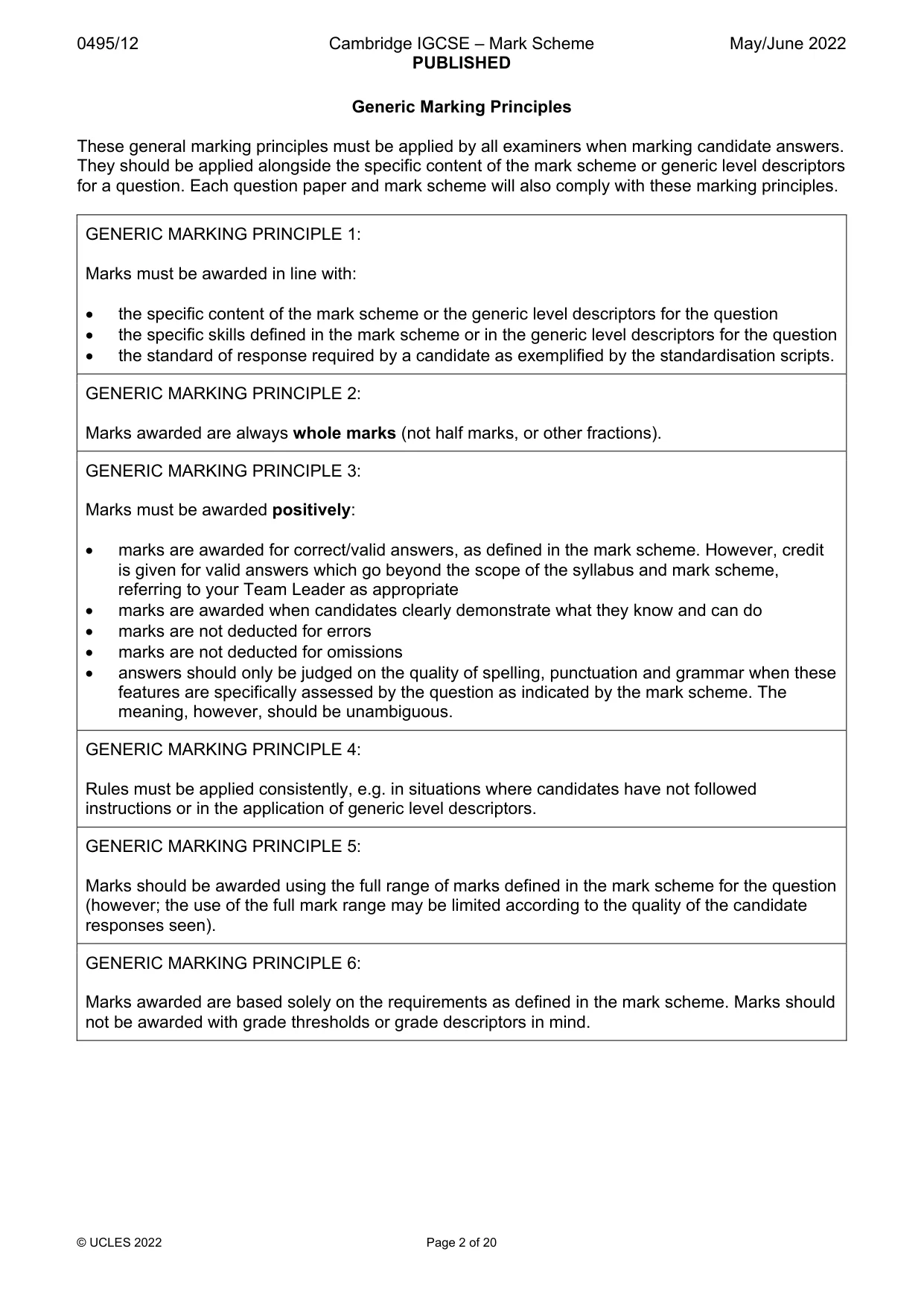
0495/12 Cambridge IGCSE – Mark Scheme PUBLISHED May/June 2022 © UCLES 2022 Page 2 of 20 Generic Marking Principles These general marking principles must be applied by all examiners when marking candidate answers. They should be applied alongside the specific content of the mark scheme or generic level descriptors for a question. Each question paper and mark scheme will also comply with these marking principles. GENERIC MARKING PRINCIPLE 1: Marks must be awarded in line with: the specific content of the mark scheme or the generic level descriptors for the question the specific skills defined in the mark scheme or in the generic level descriptors for the question the standard of response required by a candidate as exemplified by the standardisation scripts. GENERIC MARKING PRINCIPLE 2: Marks awarded are always whole marks (not half marks, or other fractions). GENERIC MARKING PRINCIPLE 3: Marks must be awarded positively: marks are awarded for correct/valid answers, as defined in the mark scheme. However, credit is given for valid answers which go beyond the scope of the syllabus and mark scheme, referring to your Team Leader as appropriate marks are awarded when candidates clearly demonstrate what they know and can do marks are not deducted for errors marks are not deducted for omissions answers should only be judged on the quality of spelling, punctuation and grammar when these features are specifically assessed by the question as indicated by the mark scheme. The meaning, however, should be unambiguous. GENERIC MARKING PRINCIPLE 4: Rules must be applied consistently, e.g. in situations where candidates have not followed instructions or in the application of generic level descriptors. GENERIC MARKING PRINCIPLE 5: Marks should be awarded using the full range of marks defined in the mark scheme for the question (however; the use of the full mark range may be limited according to the quality of the candidate responses seen). GENERIC MARKING PRINCIPLE 6: Marks awarded are based solely on the requirements as defined in the mark scheme. Marks should not be awarded with grade thresholds or grade descriptors in mind.
Mark scheme, page 3
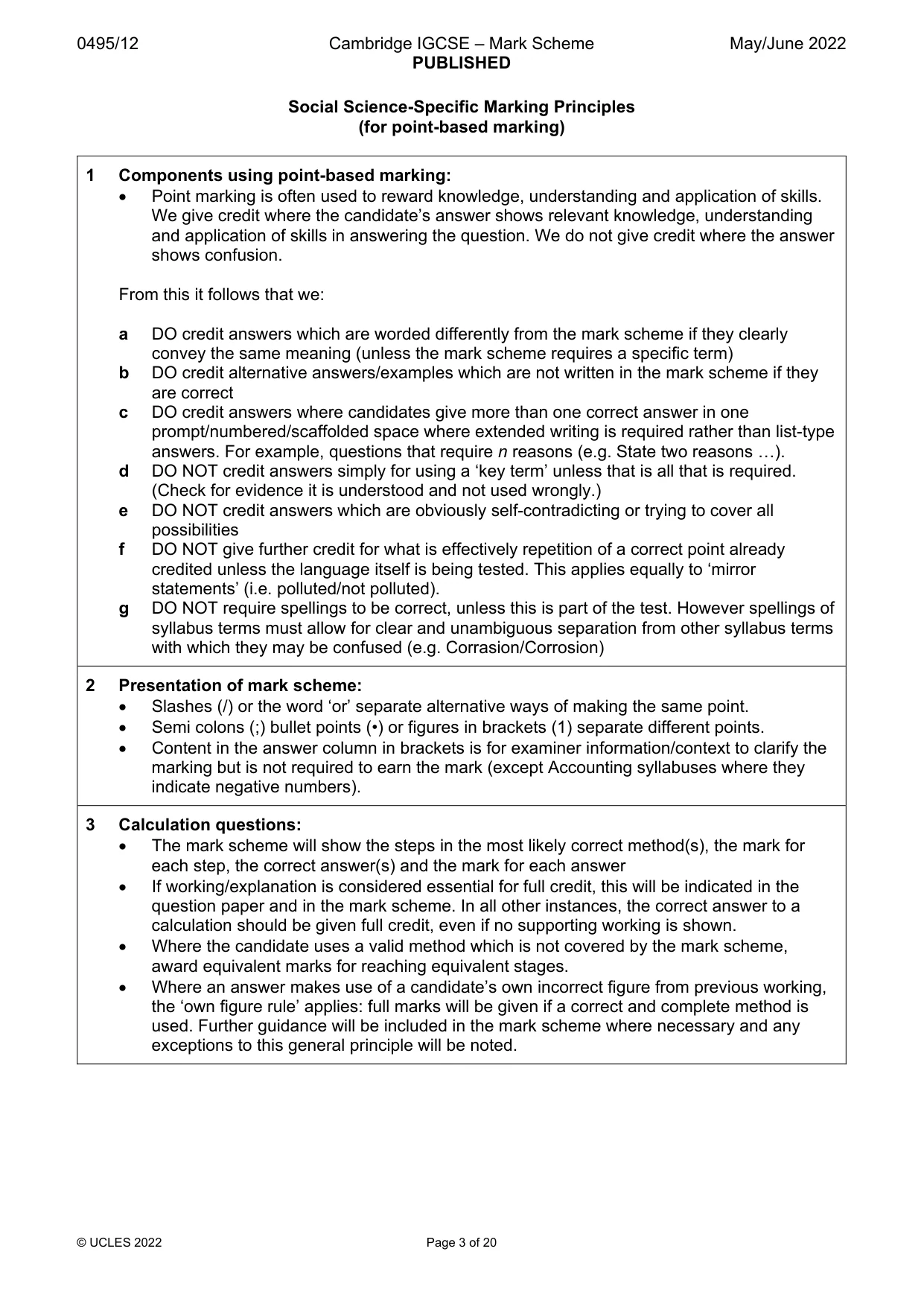
0495/12 Cambridge IGCSE – Mark Scheme PUBLISHED May/June 2022 © UCLES 2022 Page 3 of 20 Social Science-Specific Marking Principles (for point-based marking) 1 Components using point-based marking: Point marking is often used to reward knowledge, understanding and application of skills. We give credit where the candidate’s answer shows relevant knowledge, understanding and application of skills in answering the question. We do not give credit where the answer shows confusion. From this it follows that we: a DO credit answers which are worded differently from the mark scheme if they clearly convey the same meaning (unless the mark scheme requires a specific term) b DO credit alternative answers/examples which are not written in the mark scheme if they are correct c DO credit answers where candidates give more than one correct answer in one prompt/numbered/scaffolded space where extended writing is required rather than list-type answers. For example, questions that require n reasons (e.g. State two reasons …). d DO NOT credit answers simply for using a ‘key term’ unless that is all that is required. (Check for evidence it is understood and not used wrongly.) e DO NOT credit answers which are obviously self-contradicting or trying to cover all possibilities f DO NOT give further credit for what is effectively repetition of a correct point already credited unless the language itself is being tested. This applies equally to ‘mirror statements’ (i.e. polluted/not polluted). g DO NOT require spellings to be correct, unless this is part of the test. However spellings of syllabus terms must allow for clear and unambiguous separation from other syllabus terms with which they may be confused (e.g. Corrasion/Corrosion) 2 Presentation of mark scheme: Slashes (/) or the word ‘or’ separate alternative ways of making the same point. Semi colons (;) bullet points (•) or figures in brackets (1) separate different points. Content in the answer column in brackets is for examiner information/context to clarify the marking but is not required to earn the mark (except Accounting syllabuses where they indicate negative numbers). 3 Calculation questions: The mark scheme will show the steps in the most likely correct method(s), the mark for each step, the correct answer(s) and the mark for each answer If working/explanation is considered essential for full credit, this will be indicated in the question paper and in the mark scheme. In all other instances, the correct answer to a calculation should be given full credit, even if no supporting working is shown. Where the candidate uses a valid method which is not covered by the mark scheme, award equivalent marks for reaching equivalent stages. Where an answer makes use of a candidate’s own incorrect figure from previous working, the ‘own figure rule’ applies: full marks will be given if a correct and complete method is used. Further guidance will be included in the mark scheme where necessary and any exceptions to this general principle will be noted.
Mark scheme, page 4
0495/12 Cambridge IGCSE – Mark Scheme PUBLISHED May/June 2022 © UCLES 2022 Page 4 of 20 4 Annotation: For point marking, ticks can be used to indicate correct answers and crosses can be used to indicate wrong answers. There is no direct relationship between ticks and marks. Ticks have no defined meaning for levels of response marking. For levels of response marking, the level awarded should be annotated on the script. Other annotations will be used by examiners as agreed during standardisation, and the meaning will be understood by all examiners who marked that paper.
Mark scheme, page 5
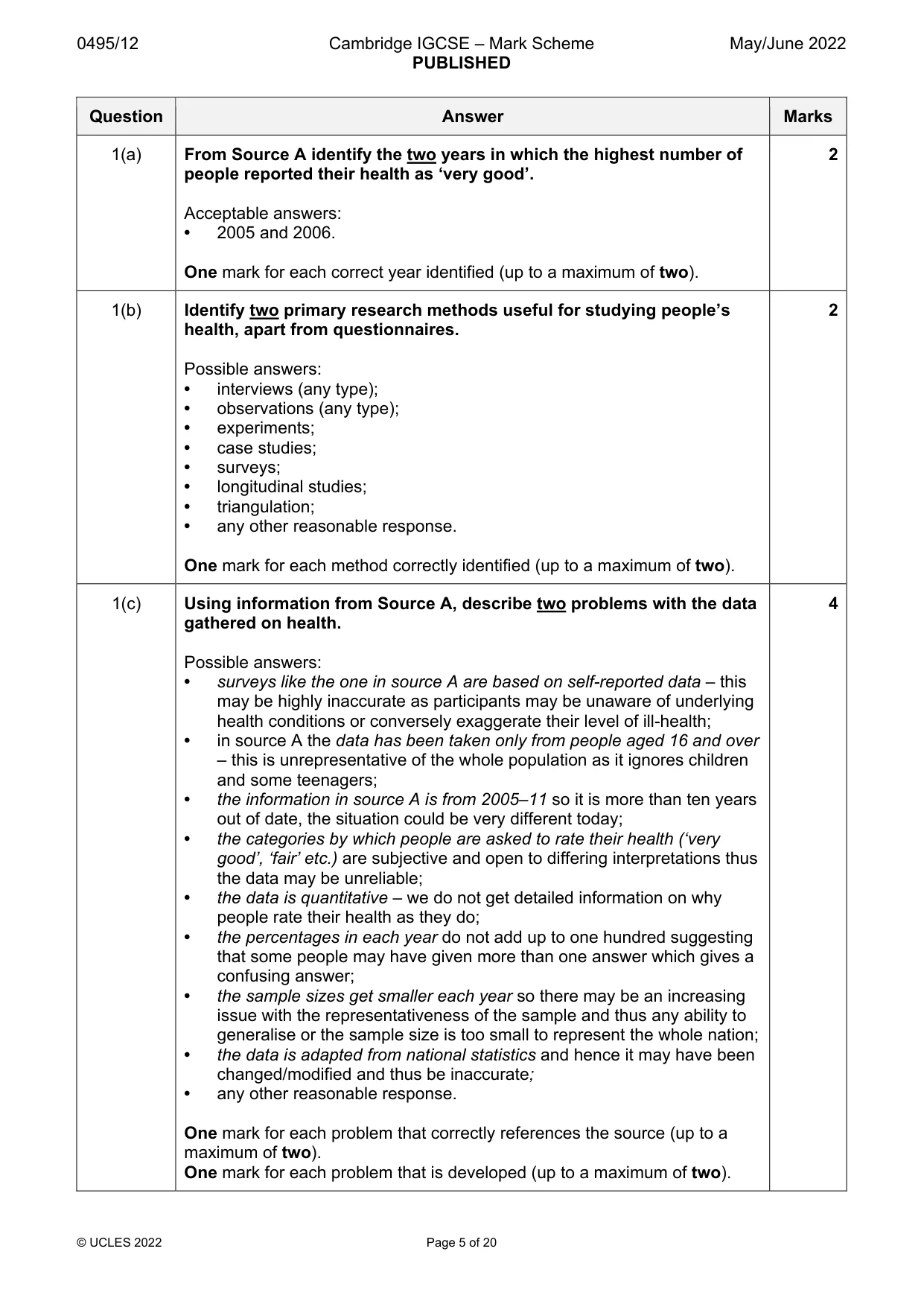
0495/12 Cambridge IGCSE – Mark Scheme PUBLISHED May/June 2022 © UCLES 2022 Page 5 of 20 Question Answer Marks 1(a) From Source A identify the two years in which the highest number of people reported their health as ‘very good’. Acceptable answers: • 2005 and 2006. One mark for each correct year identified (up to a maximum of two). 2 1(b) Identify two primary research methods useful for studying people’s health, apart from questionnaires. Possible answers: • interviews (any type); • observations (any type); • experiments; • case studies; • surveys; • longitudinal studies; • triangulation; • any other reasonable response. One mark for each method correctly identified (up to a maximum of two). 2 1(c) Using information from Source A, describe two problems with the data gathered on health. Possible answers: • surveys like the one in source A are based on self-reported data – this may be highly inaccurate as participants may be unaware of underlying health conditions or conversely exaggerate their level of ill-health; • in source A the data has been taken only from people aged 16 and over – this is unrepresentative of the whole population as it ignores children and some teenagers; • the information in source A is from 2005–11 so it is more than ten years out of date, the situation could be very different today; • the categories by which people are asked to rate their health (‘very good’, ‘fair’ etc.) are subjective and open to differing interpretations thus the data may be unreliable; • the data is quantitative – we do not get detailed information on why people rate their health as they do; • the percentages in each year do not add up to one hundred suggesting that some people may have given more than one answer which gives a confusing answer; • the sample sizes get smaller each year so there may be an increasing issue with the representativeness of the sample and thus any ability to generalise or the sample size is too small to represent the whole nation; • the data is adapted from national statistics and hence it may have been changed/modified and thus be inaccurate; • any other reasonable response. One mark for each problem that correctly references the source (up to a maximum of two). One mark for each problem that is developed (up to a maximum of two). 4
Mark scheme, page 6
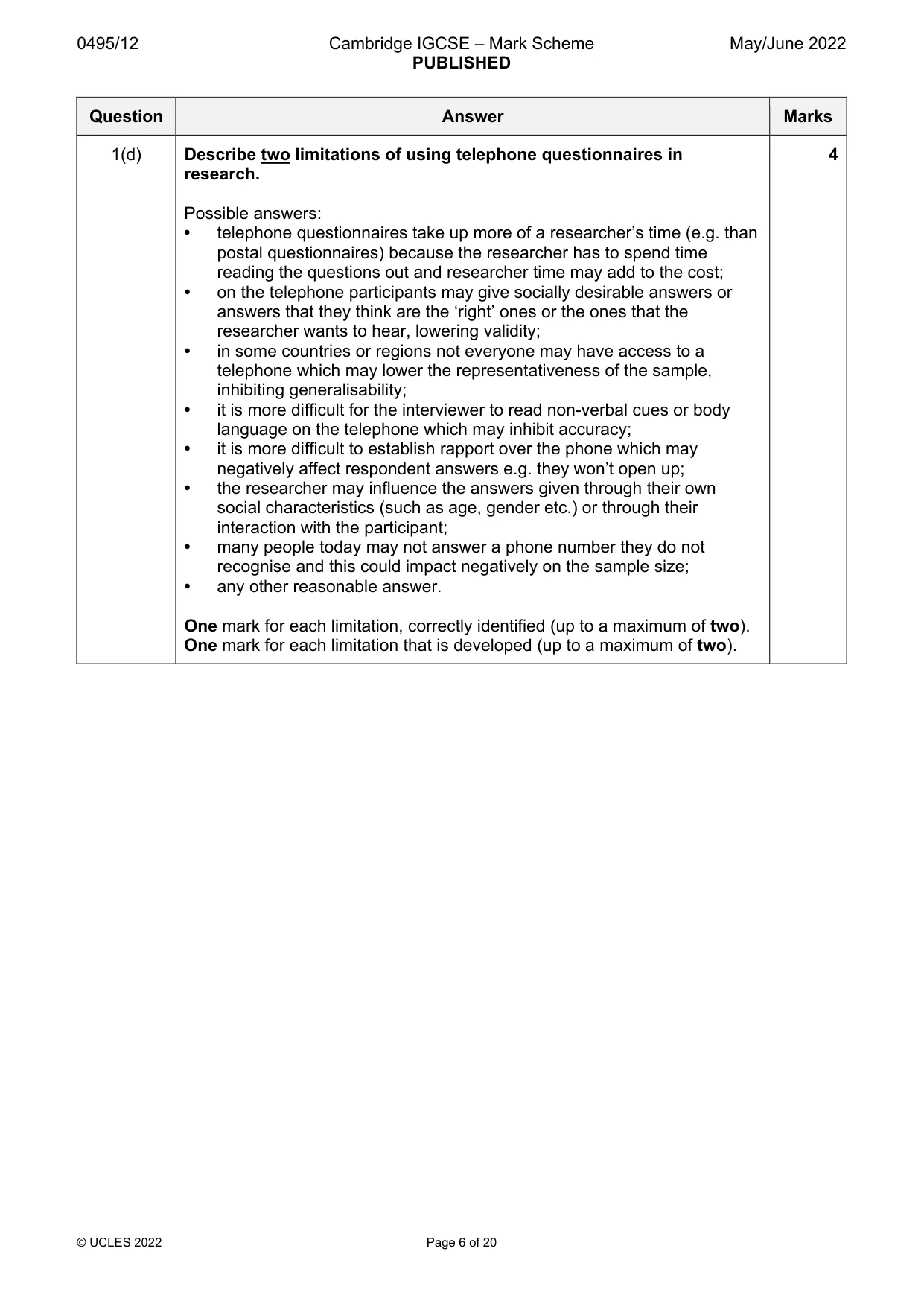
0495/12 Cambridge IGCSE – Mark Scheme PUBLISHED May/June 2022 © UCLES 2022 Page 6 of 20 Question Answer Marks 1(d) Describe two limitations of using telephone questionnaires in research. Possible answers: • telephone questionnaires take up more of a researcher’s time (e.g. than postal questionnaires) because the researcher has to spend time reading the questions out and researcher time may add to the cost; • on the telephone participants may give socially desirable answers or answers that they think are the ‘right’ ones or the ones that the researcher wants to hear, lowering validity; • in some countries or regions not everyone may have access to a telephone which may lower the representativeness of the sample, inhibiting generalisability; • it is more difficult for the interviewer to read non-verbal cues or body language on the telephone which may inhibit accuracy; • it is more difficult to establish rapport over the phone which may negatively affect respondent answers e.g. they won’t open up; • the researcher may influence the answers given through their own social characteristics (such as age, gender etc.) or through their interaction with the participant; • many people today may not answer a phone number they do not recognise and this could impact negatively on the sample size; • any other reasonable answer. One mark for each limitation, correctly identified (up to a maximum of two). One mark for each limitation that is developed (up to a maximum of two). 4
Mark scheme, page 7
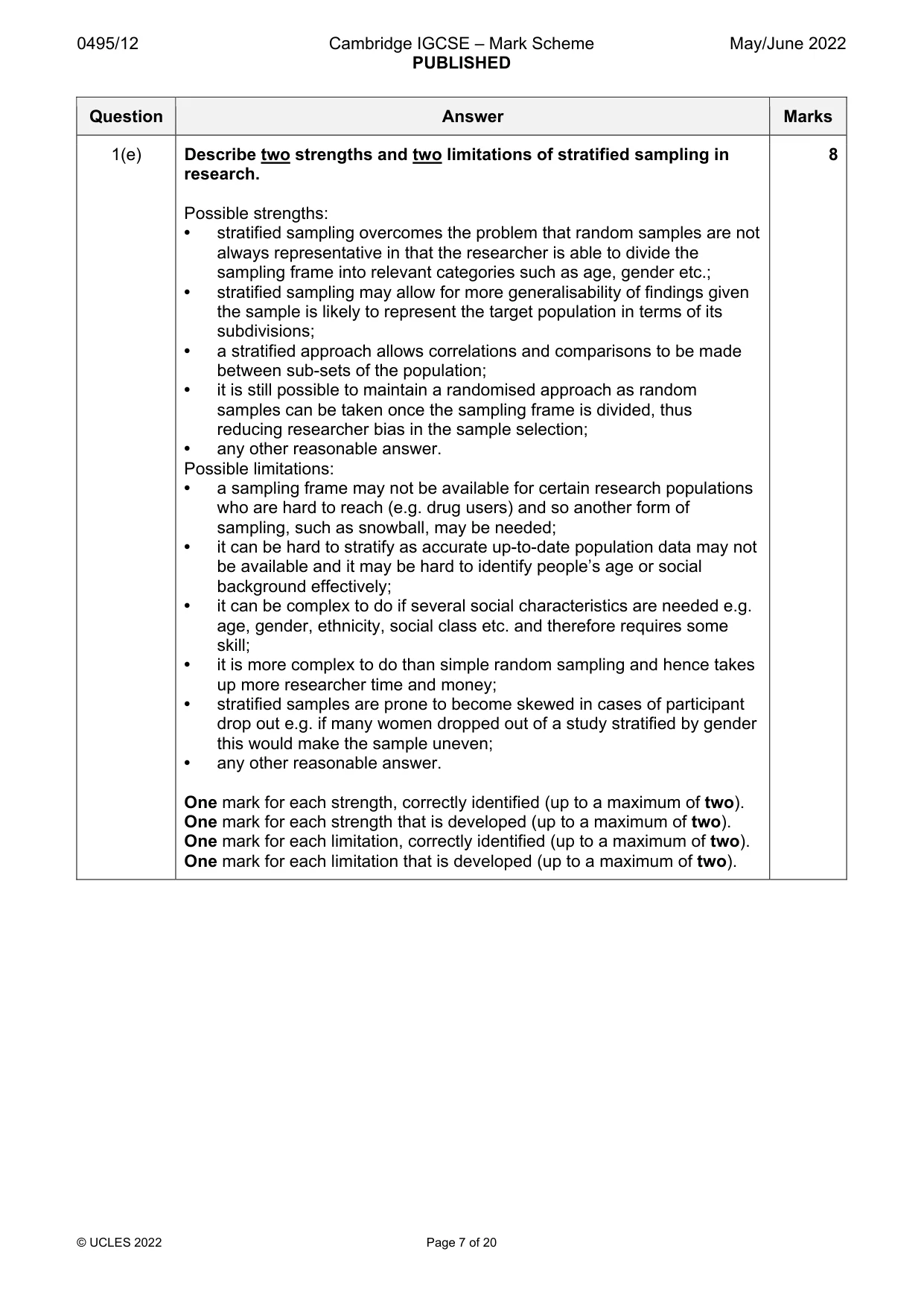
0495/12 Cambridge IGCSE – Mark Scheme PUBLISHED May/June 2022 © UCLES 2022 Page 7 of 20 Question Answer Marks 1(e) Describe two strengths and two limitations of stratified sampling in research. Possible strengths: • stratified sampling overcomes the problem that random samples are not always representative in that the researcher is able to divide the sampling frame into relevant categories such as age, gender etc.; • stratified sampling may allow for more generalisability of findings given the sample is likely to represent the target population in terms of its subdivisions; • a stratified approach allows correlations and comparisons to be made between sub-sets of the population; • it is still possible to maintain a randomised approach as random samples can be taken once the sampling frame is divided, thus reducing researcher bias in the sample selection; • any other reasonable answer. Possible limitations: • a sampling frame may not be available for certain research populations who are hard to reach (e.g. drug users) and so another form of sampling, such as snowball, may be needed; • it can be hard to stratify as accurate up-to-date population data may not be available and it may be hard to identify people’s age or social background effectively; • it can be complex to do if several social characteristics are needed e.g. age, gender, ethnicity, social class etc. and therefore requires some skill; • it is more complex to do than simple random sampling and hence takes up more researcher time and money; • stratified samples are prone to become skewed in cases of participant drop out e.g. if many women dropped out of a study stratified by gender this would make the sample uneven; • any other reasonable answer. One mark for each strength, correctly identified (up to a maximum of two). One mark for each strength that is developed (up to a maximum of two). One mark for each limitation, correctly identified (up to a maximum of two). One mark for each limitation that is developed (up to a maximum of two). 8
Mark scheme, page 8
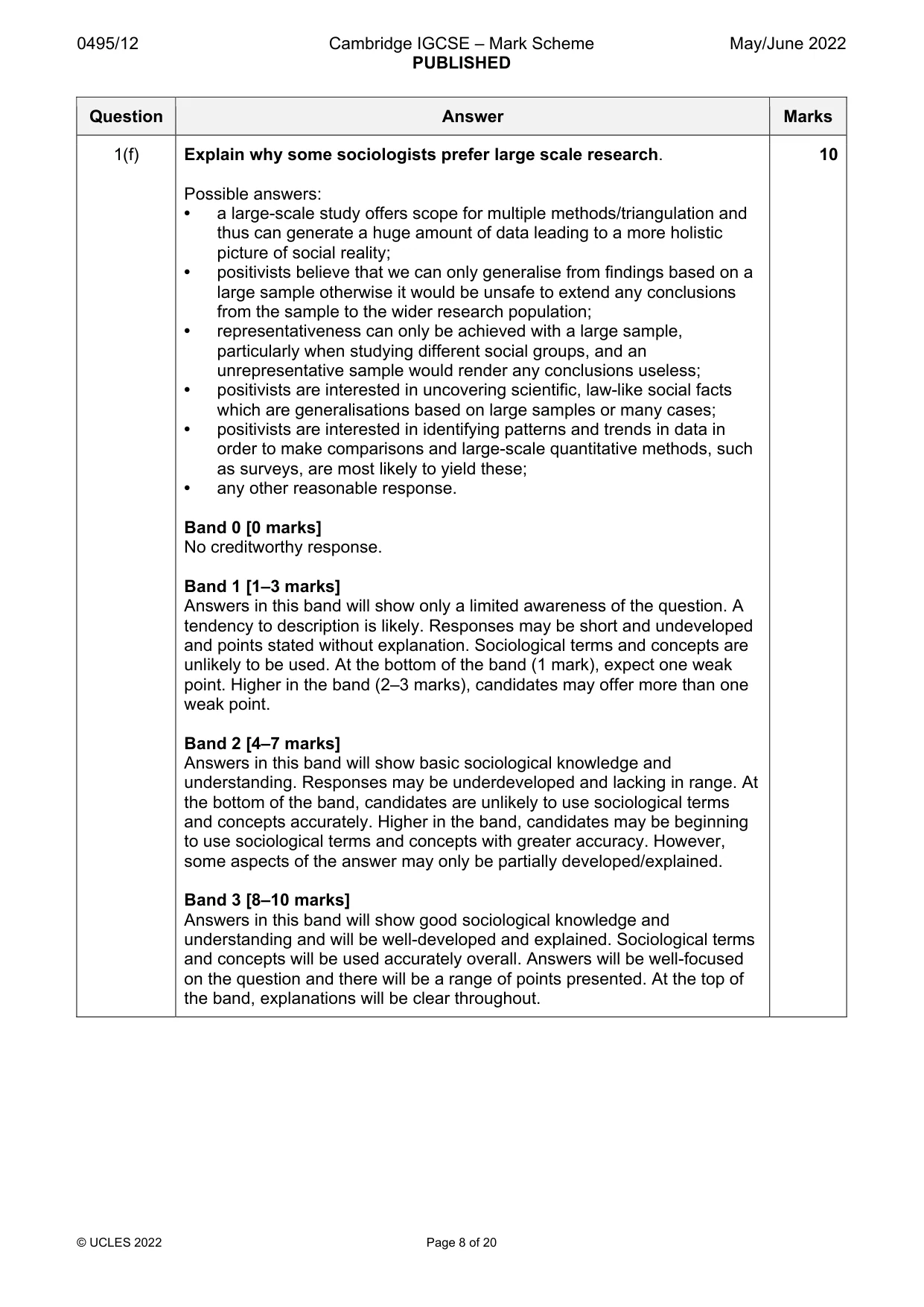
0495/12 Cambridge IGCSE – Mark Scheme PUBLISHED May/June 2022 © UCLES 2022 Page 8 of 20 Question Answer Marks 1(f) Explain why some sociologists prefer large scale research. Possible answers: • a large-scale study offers scope for multiple methods/triangulation and thus can generate a huge amount of data leading to a more holistic picture of social reality; • positivists believe that we can only generalise from findings based on a large sample otherwise it would be unsafe to extend any conclusions from the sample to the wider research population; • representativeness can only be achieved with a large sample, particularly when studying different social groups, and an unrepresentative sample would render any conclusions useless; • positivists are interested in uncovering scientific, law-like social facts which are generalisations based on large samples or many cases; • positivists are interested in identifying patterns and trends in data in order to make comparisons and large-scale quantitative methods, such as surveys, are most likely to yield these; • any other reasonable response. Band 0 [0 marks] No creditworthy response. Band 1 [1–3 marks] Answers in this band will show only a limited awareness of the question. A tendency to description is likely. Responses may be short and undeveloped and points stated without explanation. Sociological terms and concepts are unlikely to be used. At the bottom of the band (1 mark), expect one weak point. Higher in the band (2–3 marks), candidates may offer more than one weak point. Band 2 [4–7 marks] Answers in this band will show basic sociological knowledge and understanding. Responses may be underdeveloped and lacking in range. At the bottom of the band, candidates are unlikely to use sociological terms and concepts accurately. Higher in the band, candidates may be beginning to use sociological terms and concepts with greater accuracy. However, some aspects of the answer may only be partially developed/explained. Band 3 [8–10 marks] Answers in this band will show good sociological knowledge and understanding and will be well-developed and explained. Sociological terms and concepts will be used accurately overall. Answers will be well-focused on the question and there will be a range of points presented. At the top of the band, explanations will be clear throughout. 10
Mark scheme, page 9
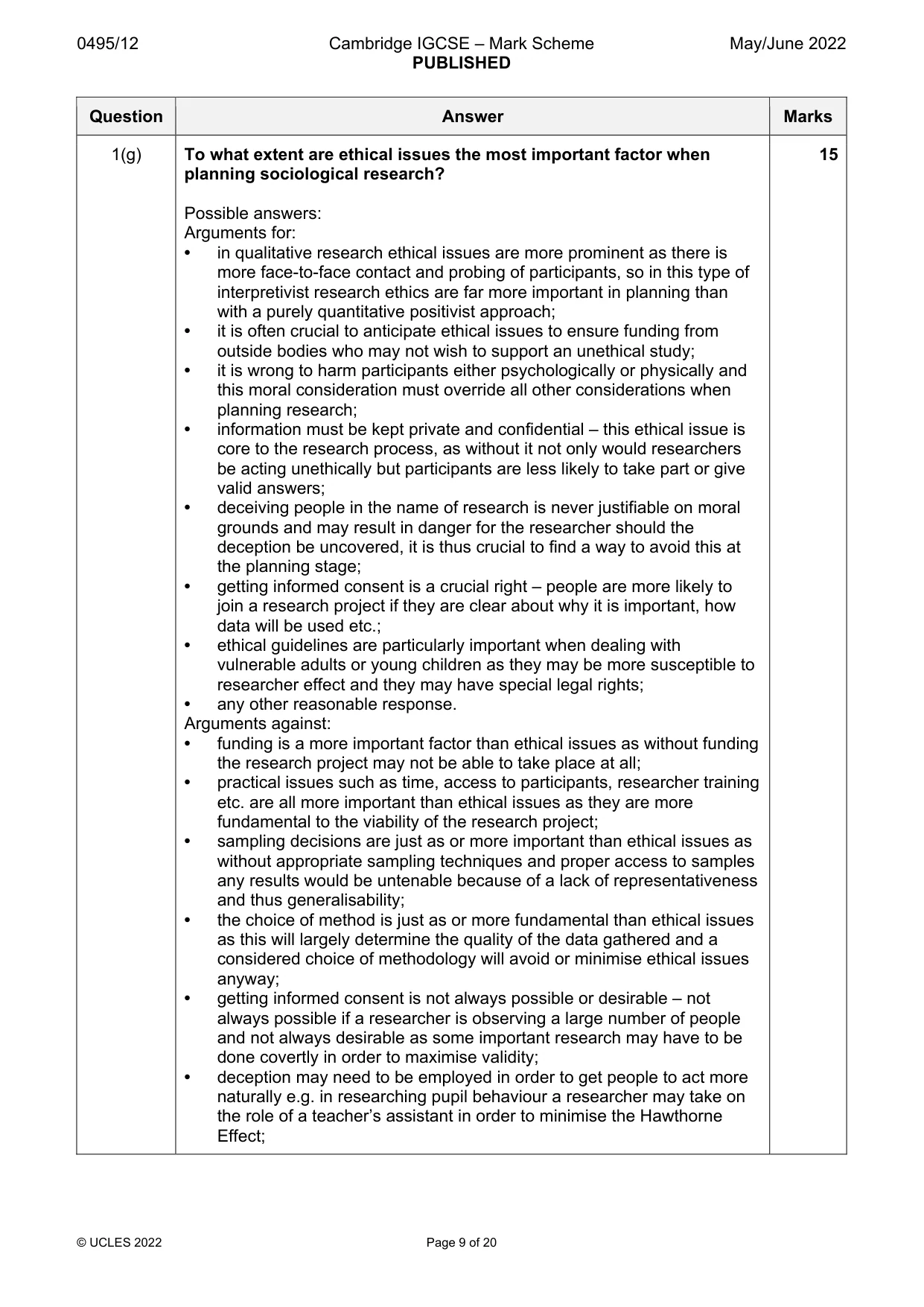
0495/12 Cambridge IGCSE – Mark Scheme PUBLISHED May/June 2022 © UCLES 2022 Page 9 of 20 Question Answer Marks 1(g) To what extent are ethical issues the most important factor when planning sociological research? Possible answers: Arguments for: • in qualitative research ethical issues are more prominent as there is more face-to-face contact and probing of participants, so in this type of interpretivist research ethics are far more important in planning than with a purely quantitative positivist approach; • it is often crucial to anticipate ethical issues to ensure funding from outside bodies who may not wish to support an unethical study; • it is wrong to harm participants either psychologically or physically and this moral consideration must override all other considerations when planning research; • information must be kept private and confidential – this ethical issue is core to the research process, as without it not only would researchers be acting unethically but participants are less likely to take part or give valid answers; • deceiving people in the name of research is never justifiable on moral grounds and may result in danger for the researcher should the deception be uncovered, it is thus crucial to find a way to avoid this at the planning stage; • getting informed consent is a crucial right – people are more likely to join a research project if they are clear about why it is important, how data will be used etc.; • ethical guidelines are particularly important when dealing with vulnerable adults or young children as they may be more susceptible to researcher effect and they may have special legal rights; • any other reasonable response. Arguments against: • funding is a more important factor than ethical issues as without funding the research project may not be able to take place at all; • practical issues such as time, access to participants, researcher training etc. are all more important than ethical issues as they are more fundamental to the viability of the research project; • sampling decisions are just as or more important than ethical issues as without appropriate sampling techniques and proper access to samples any results would be untenable because of a lack of representativeness and thus generalisability; • the choice of method is just as or more fundamental than ethical issues as this will largely determine the quality of the data gathered and a considered choice of methodology will avoid or minimise ethical issues anyway; • getting informed consent is not always possible or desirable – not always possible if a researcher is observing a large number of people and not always desirable as some important research may have to be done covertly in order to maximise validity; • deception may need to be employed in order to get people to act more naturally e.g. in researching pupil behaviour a researcher may take on the role of a teacher’s assistant in order to minimise the Hawthorne Effect; 15
Mark scheme, page 10
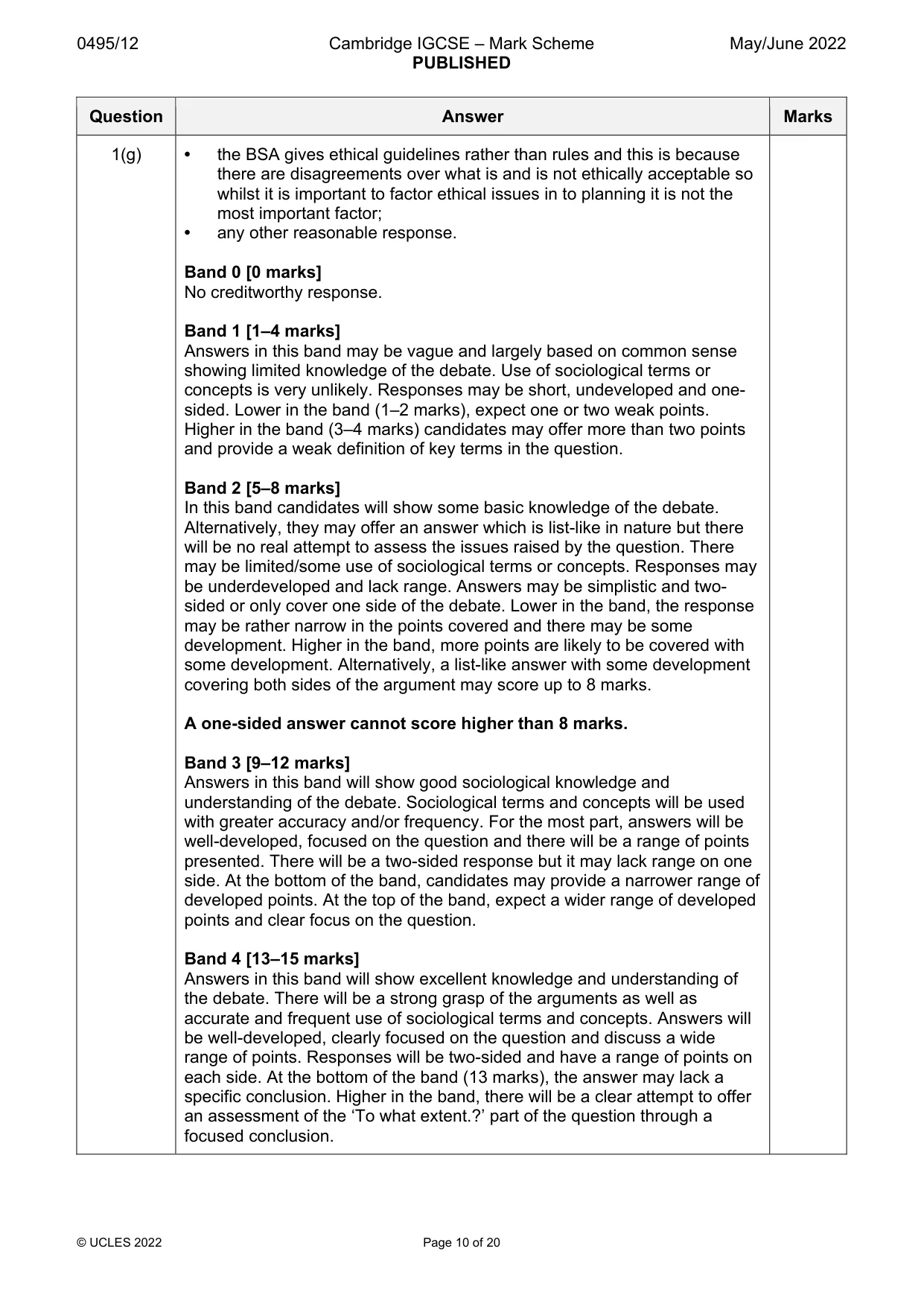
0495/12 Cambridge IGCSE – Mark Scheme PUBLISHED May/June 2022 © UCLES 2022 Page 10 of 20 Question Answer Marks 1(g) • the BSA gives ethical guidelines rather than rules and this is because there are disagreements over what is and is not ethically acceptable so whilst it is important to factor ethical issues in to planning it is not the most important factor; • any other reasonable response. Band 0 [0 marks] No creditworthy response. Band 1 [1–4 marks] Answers in this band may be vague and largely based on common sense showing limited knowledge of the debate. Use of sociological terms or concepts is very unlikely. Responses may be short, undeveloped and one- sided. Lower in the band (1–2 marks), expect one or two weak points. Higher in the band (3–4 marks) candidates may offer more than two points and provide a weak definition of key terms in the question. Band 2 [5–8 marks] In this band candidates will show some basic knowledge of the debate. Alternatively, they may offer an answer which is list-like in nature but there will be no real attempt to assess the issues raised by the question. There may be limited/some use of sociological terms or concepts. Responses may be underdeveloped and lack range. Answers may be simplistic and two- sided or only cover one side of the debate. Lower in the band, the response may be rather narrow in the points covered and there may be some development. Higher in the band, more points are likely to be covered with some development. Alternatively, a list-like answer with some development covering both sides of the argument may score up to 8 marks. A one-sided answer cannot score higher than 8 marks. Band 3 [9–12 marks] Answers in this band will show good sociological knowledge and understanding of the debate. Sociological terms and concepts will be used with greater accuracy and/or frequency. For the most part, answers will be well-developed, focused on the question and there will be a range of points presented. There will be a two-sided response but it may lack range on one side. At the bottom of the band, candidates may provide a narrower range of developed points. At the top of the band, expect a wider range of developed points and clear focus on the question. Band 4 [13–15 marks] Answers in this band will show excellent knowledge and understanding of the debate. There will be a strong grasp of the arguments as well as accurate and frequent use of sociological terms and concepts. Answers will be well-developed, clearly focused on the question and discuss a wide range of points. Responses will be two-sided and have a range of points on each side. At the bottom of the band (13 marks), the answer may lack a specific conclusion. Higher in the band, there will be a clear attempt to offer an assessment of the ‘To what extent.?’ part of the question through a focused conclusion.
Mark scheme, page 11
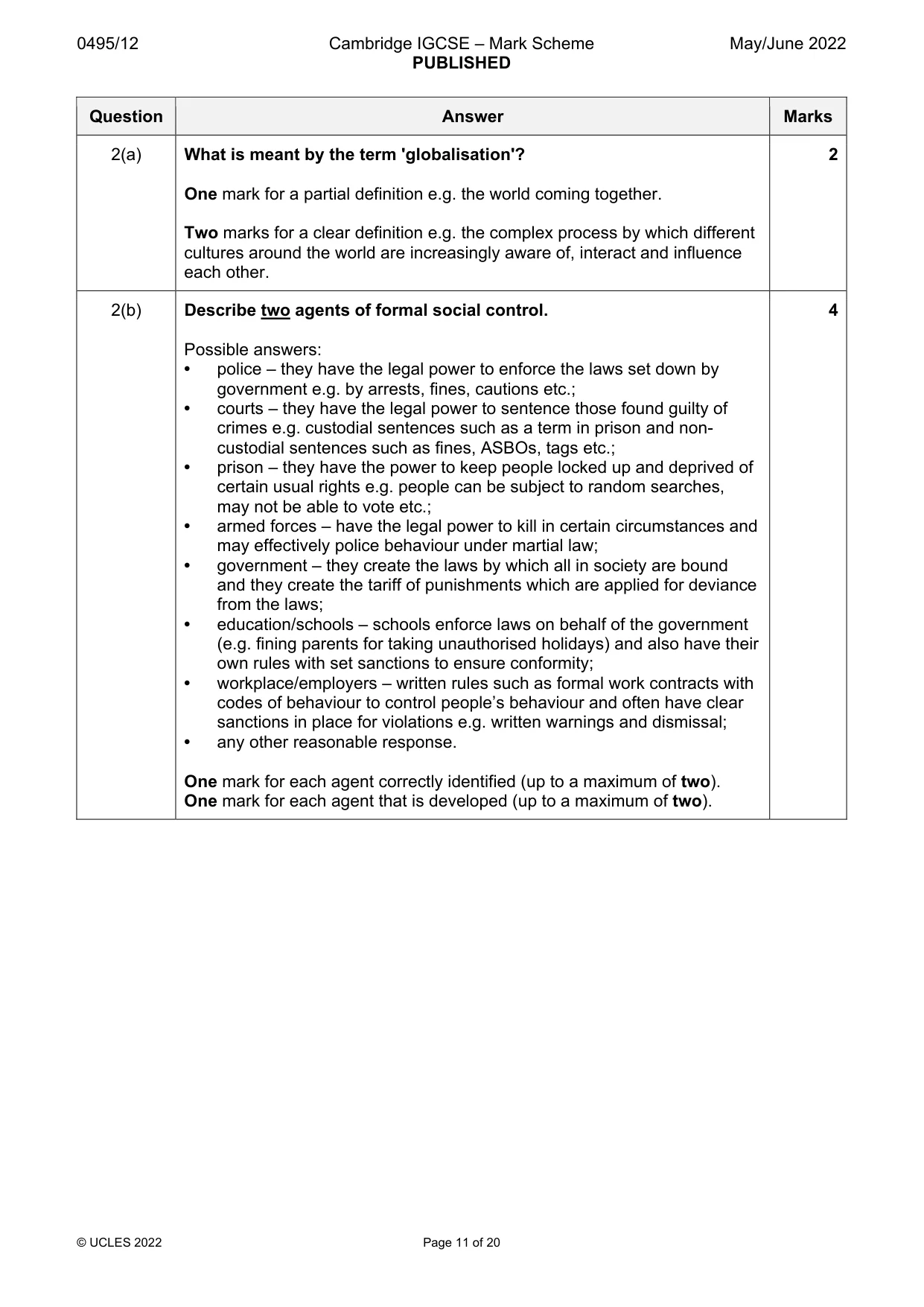
0495/12 Cambridge IGCSE – Mark Scheme PUBLISHED May/June 2022 © UCLES 2022 Page 11 of 20 Question Answer Marks 2(a) What is meant by the term 'globalisation'? One mark for a partial definition e.g. the world coming together. Two marks for a clear definition e.g. the complex process by which different cultures around the world are increasingly aware of, interact and influence each other. 2 2(b) Describe two agents of formal social control. Possible answers: • police – they have the legal power to enforce the laws set down by government e.g. by arrests, fines, cautions etc.; • courts – they have the legal power to sentence those found guilty of crimes e.g. custodial sentences such as a term in prison and non- custodial sentences such as fines, ASBOs, tags etc.; • prison – they have the power to keep people locked up and deprived of certain usual rights e.g. people can be subject to random searches, may not be able to vote etc.; • armed forces – have the legal power to kill in certain circumstances and may effectively police behaviour under martial law; • government – they create the laws by which all in society are bound and they create the tariff of punishments which are applied for deviance from the laws; • education/schools – schools enforce laws on behalf of the government (e.g. fining parents for taking unauthorised holidays) and also have their own rules with set sanctions to ensure conformity; • workplace/employers – written rules such as formal work contracts with codes of behaviour to control people’s behaviour and often have clear sanctions in place for violations e.g. written warnings and dismissal; • any other reasonable response. One mark for each agent correctly identified (up to a maximum of two). One mark for each agent that is developed (up to a maximum of two). 4
Mark scheme, page 12
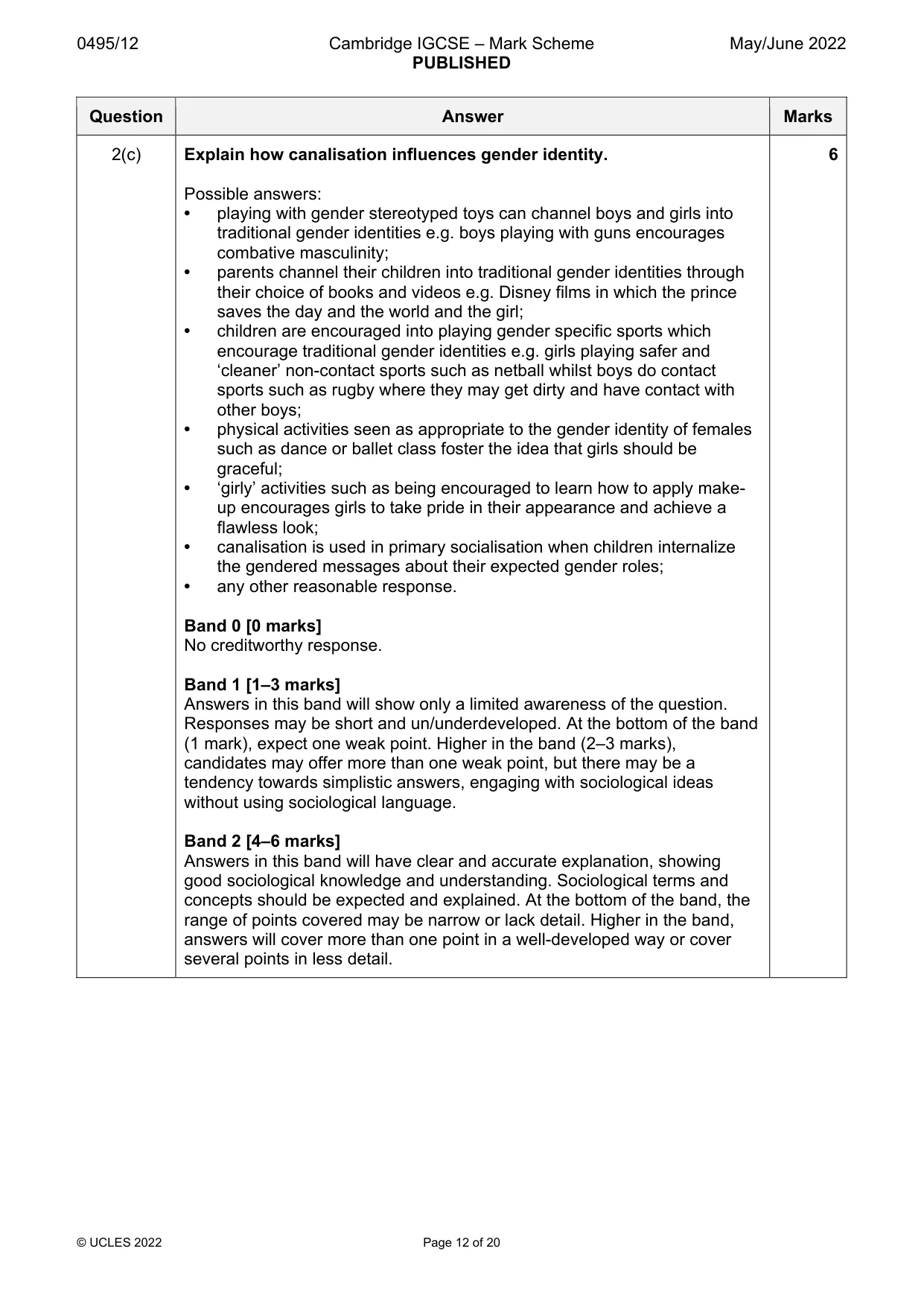
0495/12 Cambridge IGCSE – Mark Scheme PUBLISHED May/June 2022 © UCLES 2022 Page 12 of 20 Question Answer Marks 2(c) Explain how canalisation influences gender identity. Possible answers: • playing with gender stereotyped toys can channel boys and girls into traditional gender identities e.g. boys playing with guns encourages combative masculinity; • parents channel their children into traditional gender identities through their choice of books and videos e.g. Disney films in which the prince saves the day and the world and the girl; • children are encouraged into playing gender specific sports which encourage traditional gender identities e.g. girls playing safer and ‘cleaner’ non-contact sports such as netball whilst boys do contact sports such as rugby where they may get dirty and have contact with other boys; • physical activities seen as appropriate to the gender identity of females such as dance or ballet class foster the idea that girls should be graceful; • ‘girly’ activities such as being encouraged to learn how to apply make- up encourages girls to take pride in their appearance and achieve a flawless look; • canalisation is used in primary socialisation when children internalize the gendered messages about their expected gender roles; • any other reasonable response. Band 0 [0 marks] No creditworthy response. Band 1 [1–3 marks] Answers in this band will show only a limited awareness of the question. Responses may be short and un/underdeveloped. At the bottom of the band (1 mark), expect one weak point. Higher in the band (2–3 marks), candidates may offer more than one weak point, but there may be a tendency towards simplistic answers, engaging with sociological ideas without using sociological language. Band 2 [4–6 marks] Answers in this band will have clear and accurate explanation, showing good sociological knowledge and understanding. Sociological terms and concepts should be expected and explained. At the bottom of the band, the range of points covered may be narrow or lack detail. Higher in the band, answers will cover more than one point in a well-developed way or cover several points in less detail. 6
Mark scheme, page 13
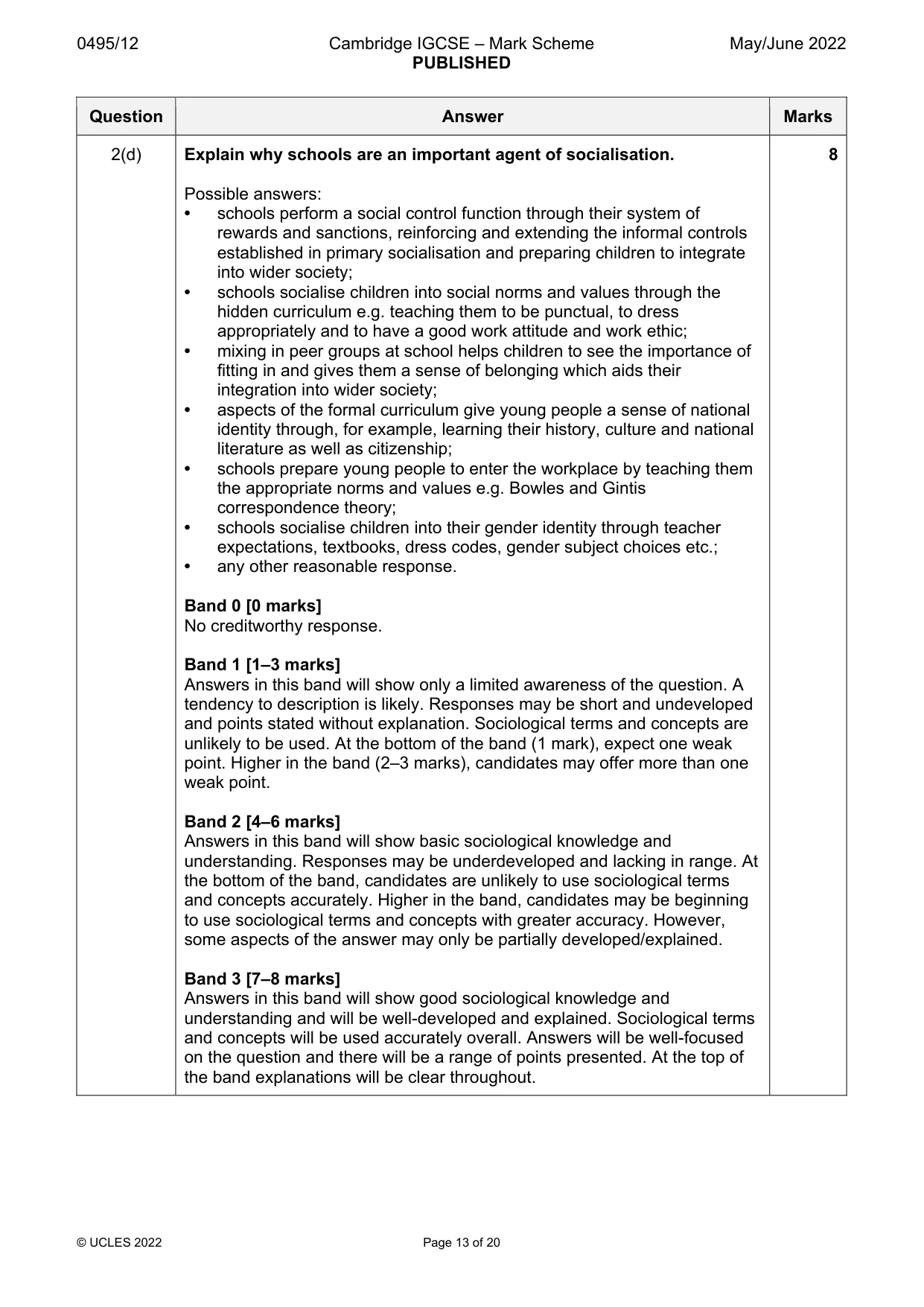
0495/12 Cambridge IGCSE – Mark Scheme PUBLISHED May/June 2022 © UCLES 2022 Page 13 of 20 Question Answer Marks 2(d) Explain why schools are an important agent of socialisation. Possible answers: • schools perform a social control function through their system of rewards and sanctions, reinforcing and extending the informal controls established in primary socialisation and preparing children to integrate into wider society; • schools socialise children into social norms and values through the hidden curriculum e.g. teaching them to be punctual, to dress appropriately and to have a good work attitude and work ethic; • mixing in peer groups at school helps children to see the importance of fitting in and gives them a sense of belonging which aids their integration into wider society; • aspects of the formal curriculum give young people a sense of national identity through, for example, learning their history, culture and national literature as well as citizenship; • schools prepare young people to enter the workplace by teaching them the appropriate norms and values e.g. Bowles and Gintis correspondence theory; • schools socialise children into their gender identity through teacher expectations, textbooks, dress codes, gender subject choices etc.; • any other reasonable response. Band 0 [0 marks] No creditworthy response. Band 1 [1–3 marks] Answers in this band will show only a limited awareness of the question. A tendency to description is likely. Responses may be short and undeveloped and points stated without explanation. Sociological terms and concepts are unlikely to be used. At the bottom of the band (1 mark), expect one weak point. Higher in the band (2–3 marks), candidates may offer more than one weak point. Band 2 [4–6 marks] Answers in this band will show basic sociological knowledge and understanding. Responses may be underdeveloped and lacking in range. At the bottom of the band, candidates are unlikely to use sociological terms and concepts accurately. Higher in the band, candidates may be beginning to use sociological terms and concepts with greater accuracy. However, some aspects of the answer may only be partially developed/explained. Band 3 [7–8 marks] Answers in this band will show good sociological knowledge and understanding and will be well-developed and explained. Sociological terms and concepts will be used accurately overall. Answers will be well-focused on the question and there will be a range of points presented. At the top of the band explanations will be clear throughout. 8
Mark scheme, page 14
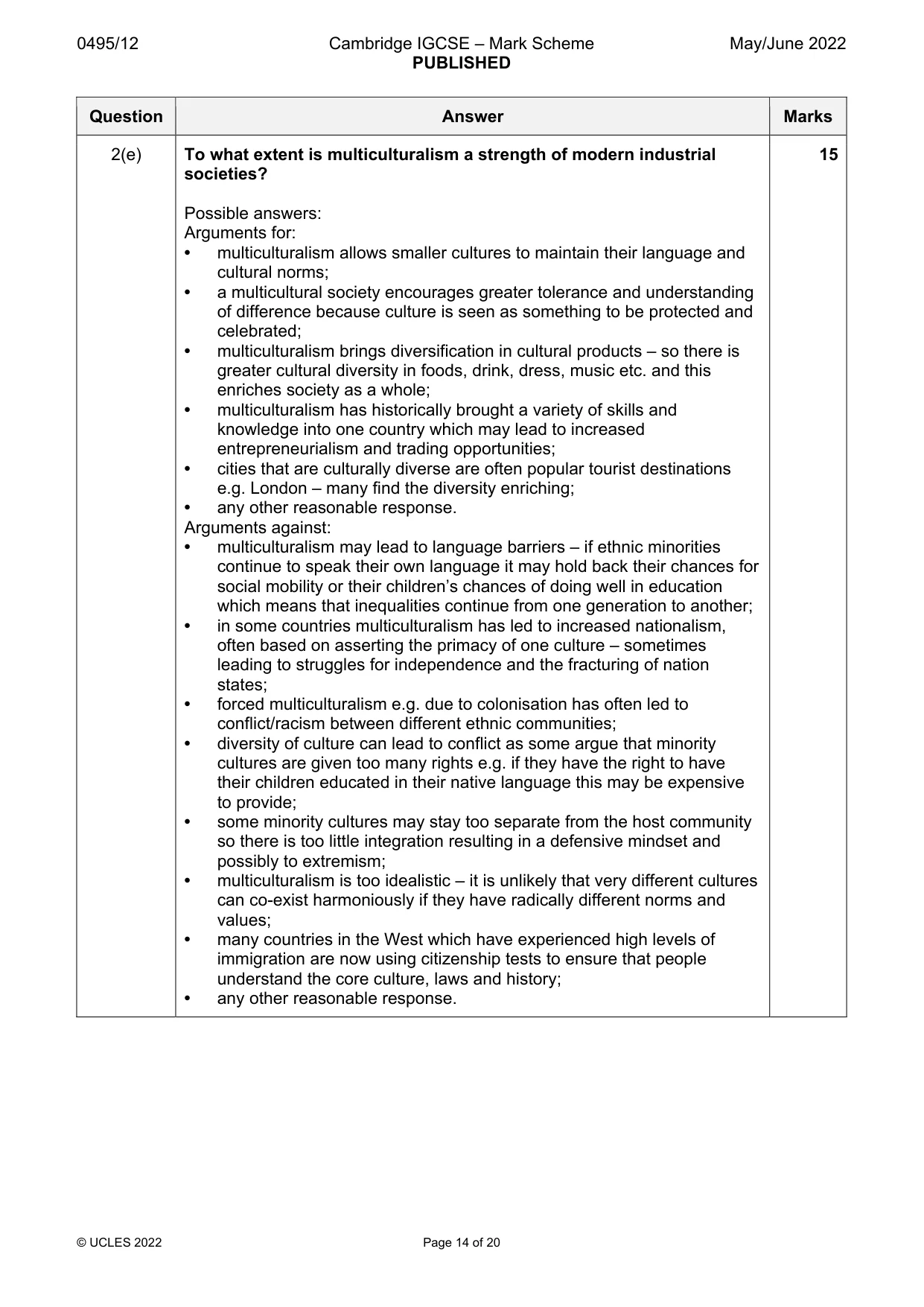
0495/12 Cambridge IGCSE – Mark Scheme PUBLISHED May/June 2022 © UCLES 2022 Page 14 of 20 Question Answer Marks 2(e) To what extent is multiculturalism a strength of modern industrial societies? Possible answers: Arguments for: • multiculturalism allows smaller cultures to maintain their language and cultural norms; • a multicultural society encourages greater tolerance and understanding of difference because culture is seen as something to be protected and celebrated; • multiculturalism brings diversification in cultural products – so there is greater cultural diversity in foods, drink, dress, music etc. and this enriches society as a whole; • multiculturalism has historically brought a variety of skills and knowledge into one country which may lead to increased entrepreneurialism and trading opportunities; • cities that are culturally diverse are often popular tourist destinations e.g. London – many find the diversity enriching; • any other reasonable response. Arguments against: • multiculturalism may lead to language barriers – if ethnic minorities continue to speak their own language it may hold back their chances for social mobility or their children’s chances of doing well in education which means that inequalities continue from one generation to another; • in some countries multiculturalism has led to increased nationalism, often based on asserting the primacy of one culture – sometimes leading to struggles for independence and the fracturing of nation states; • forced multiculturalism e.g. due to colonisation has often led to conflict/racism between different ethnic communities; • diversity of culture can lead to conflict as some argue that minority cultures are given too many rights e.g. if they have the right to have their children educated in their native language this may be expensive to provide; • some minority cultures may stay too separate from the host community so there is too little integration resulting in a defensive mindset and possibly to extremism; • multiculturalism is too idealistic – it is unlikely that very different cultures can co-exist harmoniously if they have radically different norms and values; • many countries in the West which have experienced high levels of immigration are now using citizenship tests to ensure that people understand the core culture, laws and history; • any other reasonable response. 15
Mark scheme, page 15
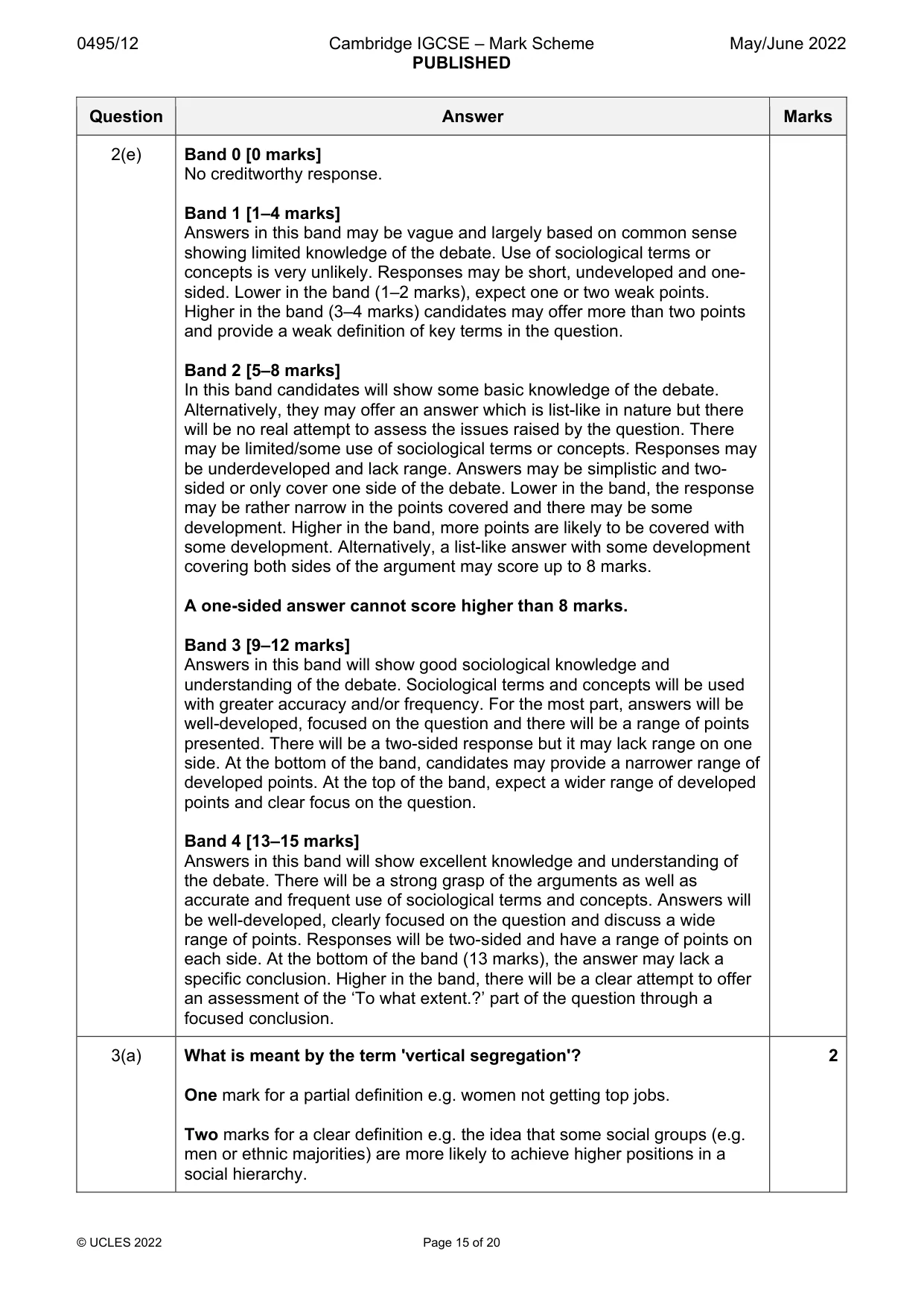
0495/12 Cambridge IGCSE – Mark Scheme PUBLISHED May/June 2022 © UCLES 2022 Page 15 of 20 Question Answer Marks 2(e) Band 0 [0 marks] No creditworthy response. Band 1 [1–4 marks] Answers in this band may be vague and largely based on common sense showing limited knowledge of the debate. Use of sociological terms or concepts is very unlikely. Responses may be short, undeveloped and one- sided. Lower in the band (1–2 marks), expect one or two weak points. Higher in the band (3–4 marks) candidates may offer more than two points and provide a weak definition of key terms in the question. Band 2 [5–8 marks] In this band candidates will show some basic knowledge of the debate. Alternatively, they may offer an answer which is list-like in nature but there will be no real attempt to assess the issues raised by the question. There may be limited/some use of sociological terms or concepts. Responses may be underdeveloped and lack range. Answers may be simplistic and two- sided or only cover one side of the debate. Lower in the band, the response may be rather narrow in the points covered and there may be some development. Higher in the band, more points are likely to be covered with some development. Alternatively, a list-like answer with some development covering both sides of the argument may score up to 8 marks. A one-sided answer cannot score higher than 8 marks. Band 3 [9–12 marks] Answers in this band will show good sociological knowledge and understanding of the debate. Sociological terms and concepts will be used with greater accuracy and/or frequency. For the most part, answers will be well-developed, focused on the question and there will be a range of points presented. There will be a two-sided response but it may lack range on one side. At the bottom of the band, candidates may provide a narrower range of developed points. At the top of the band, expect a wider range of developed points and clear focus on the question. Band 4 [13–15 marks] Answers in this band will show excellent knowledge and understanding of the debate. There will be a strong grasp of the arguments as well as accurate and frequent use of sociological terms and concepts. Answers will be well-developed, clearly focused on the question and discuss a wide range of points. Responses will be two-sided and have a range of points on each side. At the bottom of the band (13 marks), the answer may lack a specific conclusion. Higher in the band, there will be a clear attempt to offer an assessment of the ‘To what extent.?’ part of the question through a focused conclusion. 3(a) What is meant by the term 'vertical segregation'? One mark for a partial definition e.g. women not getting top jobs. Two marks for a clear definition e.g. the idea that some social groups (e.g. men or ethnic majorities) are more likely to achieve higher positions in a social hierarchy. 2
Mark scheme, page 16
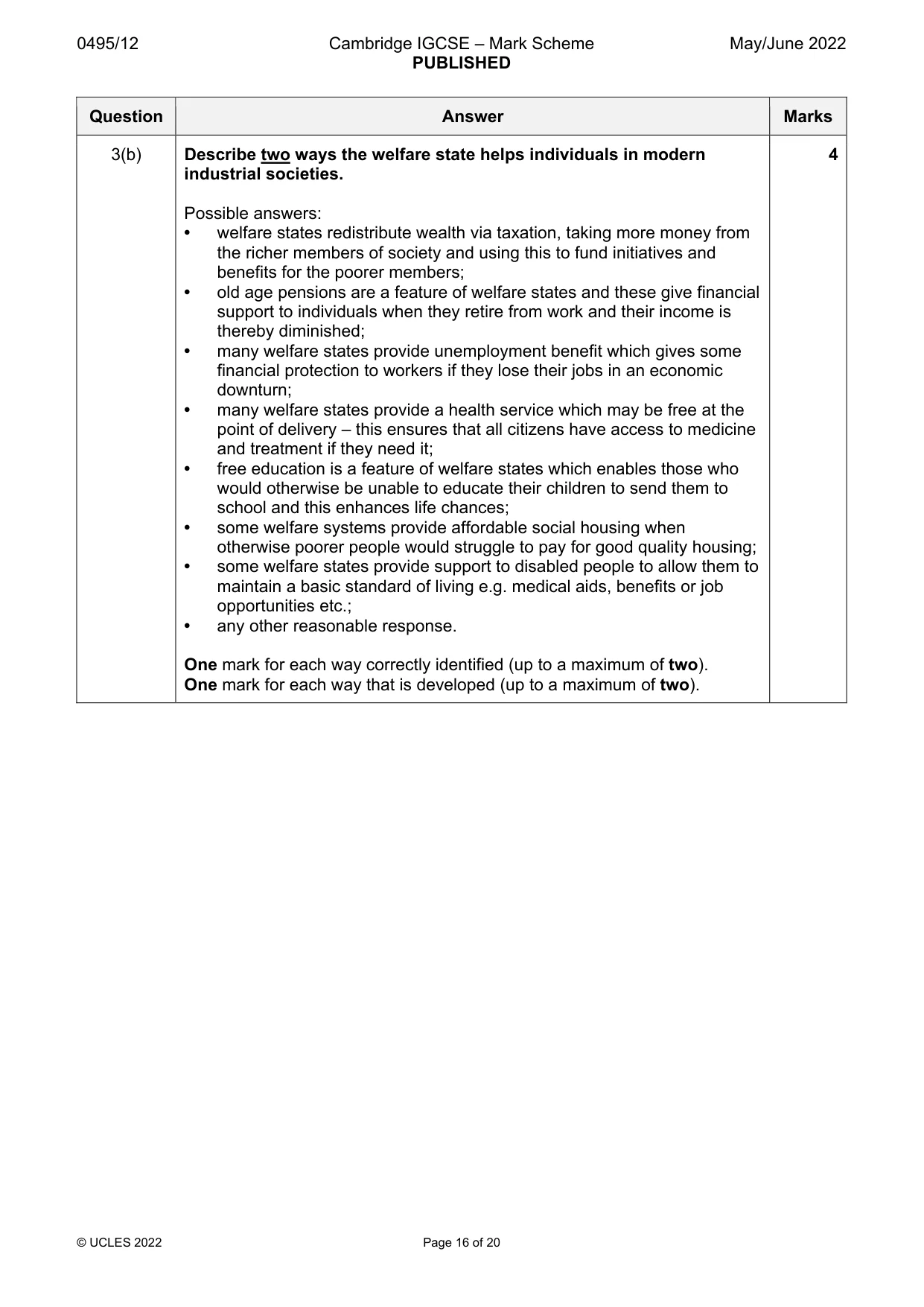
0495/12 Cambridge IGCSE – Mark Scheme PUBLISHED May/June 2022 © UCLES 2022 Page 16 of 20 Question Answer Marks 3(b) Describe two ways the welfare state helps individuals in modern industrial societies. Possible answers: • welfare states redistribute wealth via taxation, taking more money from the richer members of society and using this to fund initiatives and benefits for the poorer members; • old age pensions are a feature of welfare states and these give financial support to individuals when they retire from work and their income is thereby diminished; • many welfare states provide unemployment benefit which gives some financial protection to workers if they lose their jobs in an economic downturn; • many welfare states provide a health service which may be free at the point of delivery – this ensures that all citizens have access to medicine and treatment if they need it; • free education is a feature of welfare states which enables those who would otherwise be unable to educate their children to send them to school and this enhances life chances; • some welfare systems provide affordable social housing when otherwise poorer people would struggle to pay for good quality housing; • some welfare states provide support to disabled people to allow them to maintain a basic standard of living e.g. medical aids, benefits or job opportunities etc.; • any other reasonable response. One mark for each way correctly identified (up to a maximum of two). One mark for each way that is developed (up to a maximum of two). 4
Mark scheme, page 17
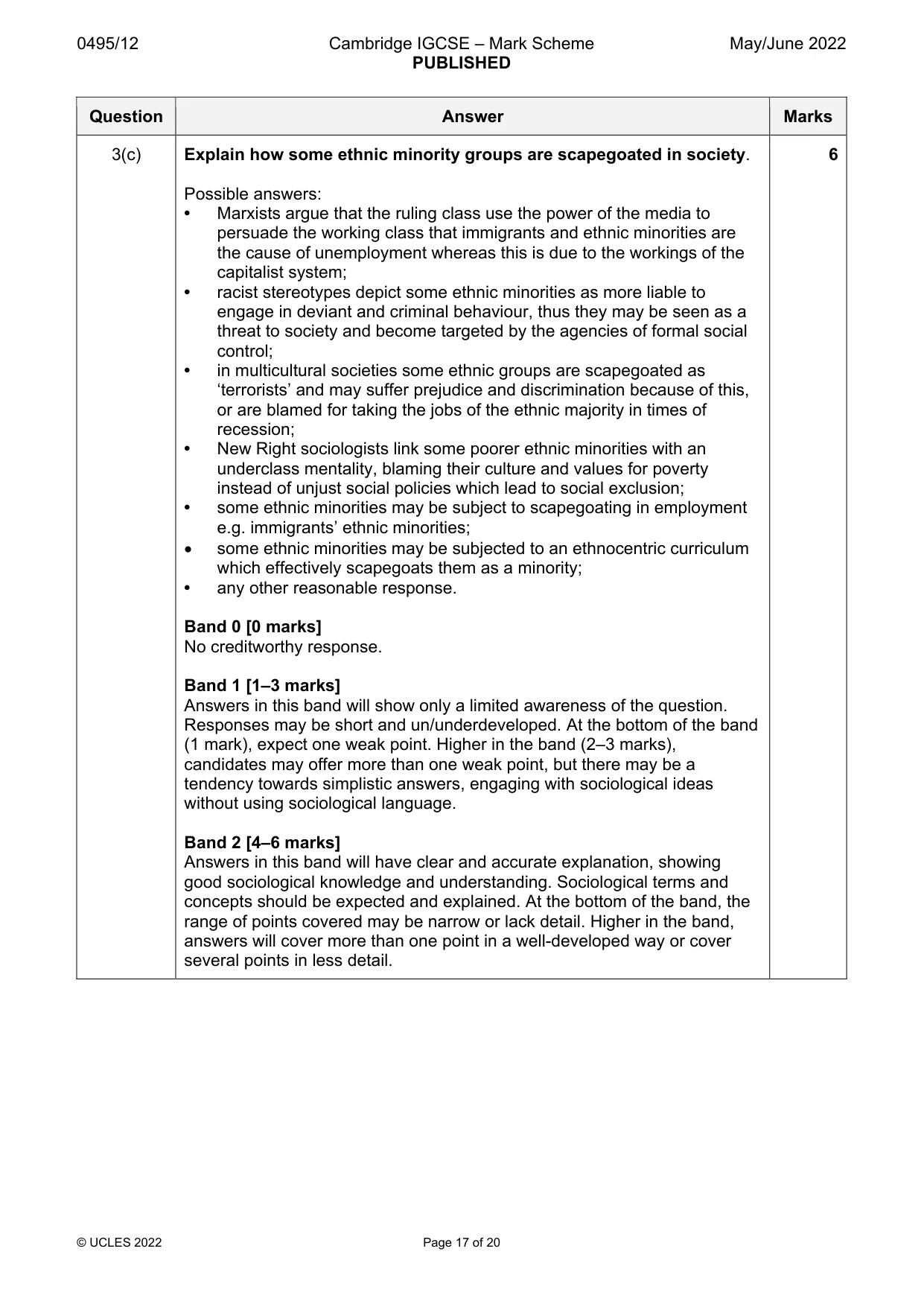
0495/12 Cambridge IGCSE – Mark Scheme PUBLISHED May/June 2022 © UCLES 2022 Page 17 of 20 Question Answer Marks 3(c) Explain how some ethnic minority groups are scapegoated in society. Possible answers: • Marxists argue that the ruling class use the power of the media to persuade the working class that immigrants and ethnic minorities are the cause of unemployment whereas this is due to the workings of the capitalist system; • racist stereotypes depict some ethnic minorities as more liable to engage in deviant and criminal behaviour, thus they may be seen as a threat to society and become targeted by the agencies of formal social control; • in multicultural societies some ethnic groups are scapegoated as ‘terrorists’ and may suffer prejudice and discrimination because of this, or are blamed for taking the jobs of the ethnic majority in times of recession; • New Right sociologists link some poorer ethnic minorities with an underclass mentality, blaming their culture and values for poverty instead of unjust social policies which lead to social exclusion; • some ethnic minorities may be subject to scapegoating in employment e.g. immigrants’ ethnic minorities; some ethnic minorities may be subjected to an ethnocentric curriculum which effectively scapegoats them as a minority; • any other reasonable response. Band 0 [0 marks] No creditworthy response. Band 1 [1–3 marks] Answers in this band will show only a limited awareness of the question. Responses may be short and un/underdeveloped. At the bottom of the band (1 mark), expect one weak point. Higher in the band (2–3 marks), candidates may offer more than one weak point, but there may be a tendency towards simplistic answers, engaging with sociological ideas without using sociological language. Band 2 [4–6 marks] Answers in this band will have clear and accurate explanation, showing good sociological knowledge and understanding. Sociological terms and concepts should be expected and explained. At the bottom of the band, the range of points covered may be narrow or lack detail. Higher in the band, answers will cover more than one point in a well-developed way or cover several points in less detail. 6
Mark scheme, page 18
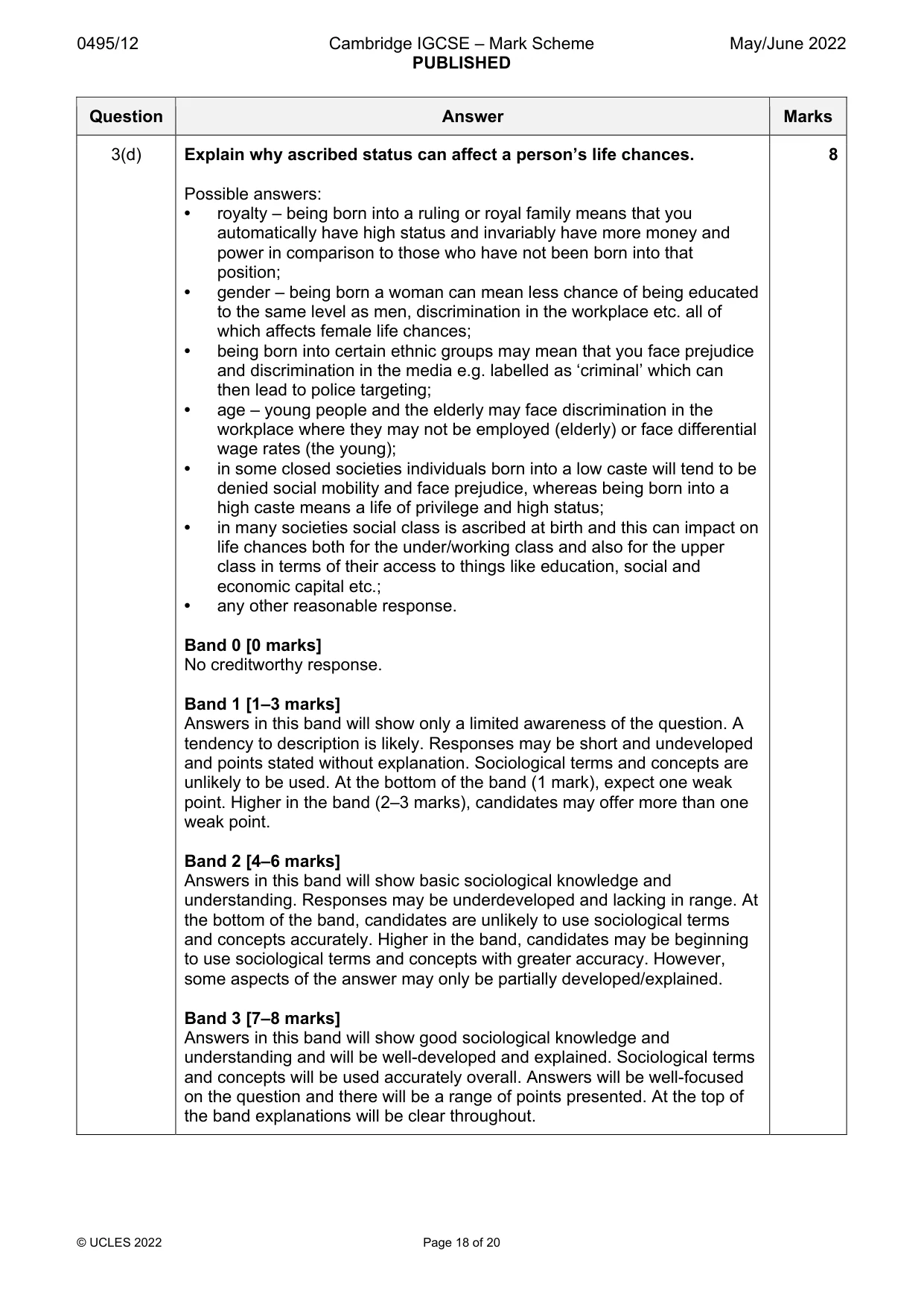
0495/12 Cambridge IGCSE – Mark Scheme PUBLISHED May/June 2022 © UCLES 2022 Page 18 of 20 Question Answer Marks 3(d) Explain why ascribed status can affect a person’s life chances. Possible answers: • royalty – being born into a ruling or royal family means that you automatically have high status and invariably have more money and power in comparison to those who have not been born into that position; • gender – being born a woman can mean less chance of being educated to the same level as men, discrimination in the workplace etc. all of which affects female life chances; • being born into certain ethnic groups may mean that you face prejudice and discrimination in the media e.g. labelled as ‘criminal’ which can then lead to police targeting; • age – young people and the elderly may face discrimination in the workplace where they may not be employed (elderly) or face differential wage rates (the young); • in some closed societies individuals born into a low caste will tend to be denied social mobility and face prejudice, whereas being born into a high caste means a life of privilege and high status; • in many societies social class is ascribed at birth and this can impact on life chances both for the under/working class and also for the upper class in terms of their access to things like education, social and economic capital etc.; • any other reasonable response. Band 0 [0 marks] No creditworthy response. Band 1 [1–3 marks] Answers in this band will show only a limited awareness of the question. A tendency to description is likely. Responses may be short and undeveloped and points stated without explanation. Sociological terms and concepts are unlikely to be used. At the bottom of the band (1 mark), expect one weak point. Higher in the band (2–3 marks), candidates may offer more than one weak point. Band 2 [4–6 marks] Answers in this band will show basic sociological knowledge and understanding. Responses may be underdeveloped and lacking in range. At the bottom of the band, candidates are unlikely to use sociological terms and concepts accurately. Higher in the band, candidates may be beginning to use sociological terms and concepts with greater accuracy. However, some aspects of the answer may only be partially developed/explained. Band 3 [7–8 marks] Answers in this band will show good sociological knowledge and understanding and will be well-developed and explained. Sociological terms and concepts will be used accurately overall. Answers will be well-focused on the question and there will be a range of points presented. At the top of the band explanations will be clear throughout. 8
Mark scheme, page 19
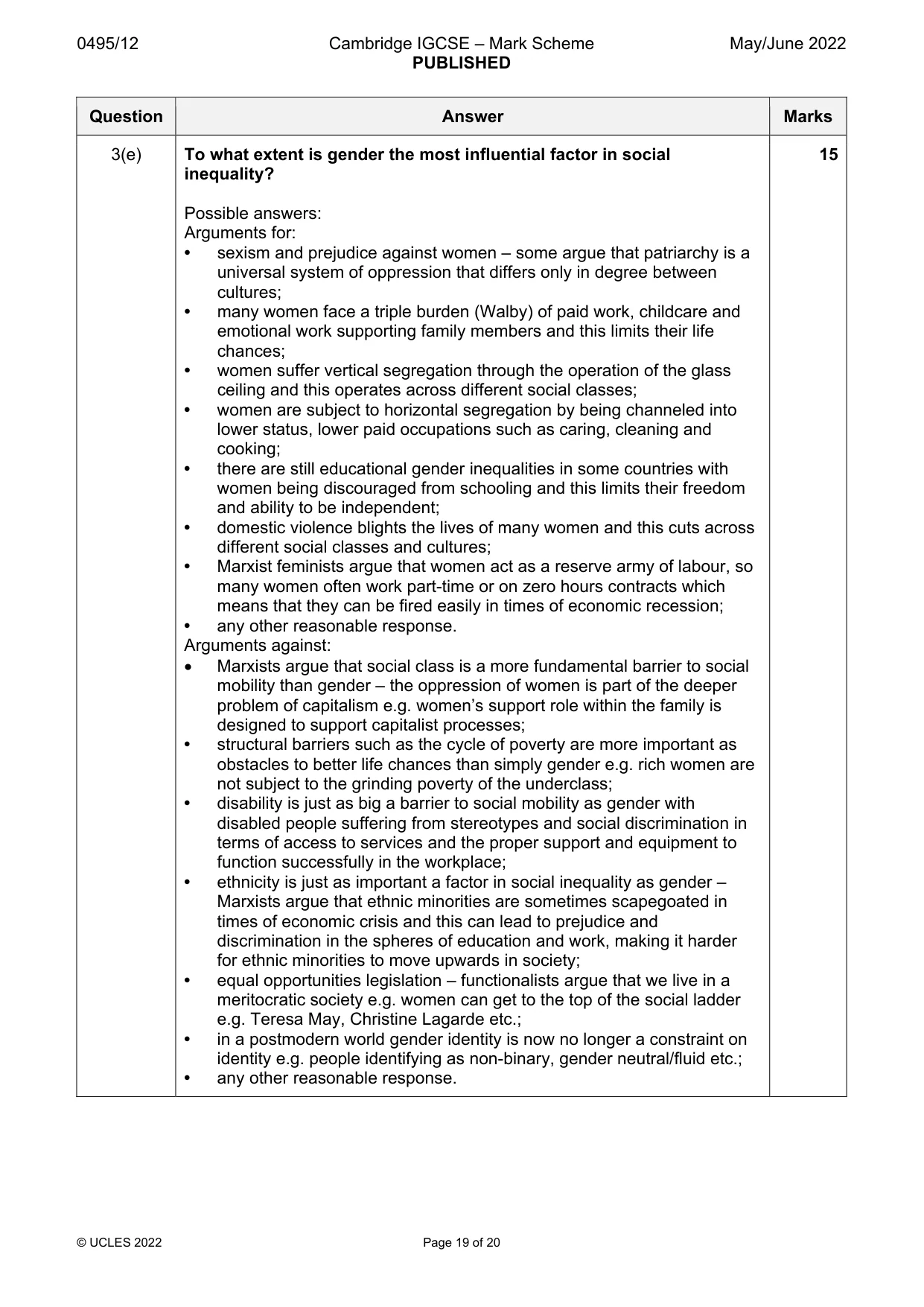
0495/12 Cambridge IGCSE – Mark Scheme PUBLISHED May/June 2022 © UCLES 2022 Page 19 of 20 Question Answer Marks 3(e) To what extent is gender the most influential factor in social inequality? Possible answers: Arguments for: • sexism and prejudice against women – some argue that patriarchy is a universal system of oppression that differs only in degree between cultures; • many women face a triple burden (Walby) of paid work, childcare and emotional work supporting family members and this limits their life chances; • women suffer vertical segregation through the operation of the glass ceiling and this operates across different social classes; • women are subject to horizontal segregation by being channeled into lower status, lower paid occupations such as caring, cleaning and cooking; • there are still educational gender inequalities in some countries with women being discouraged from schooling and this limits their freedom and ability to be independent; • domestic violence blights the lives of many women and this cuts across different social classes and cultures; • Marxist feminists argue that women act as a reserve army of labour, so many women often work part-time or on zero hours contracts which means that they can be fired easily in times of economic recession; • any other reasonable response. Arguments against: Marxists argue that social class is a more fundamental barrier to social mobility than gender – the oppression of women is part of the deeper problem of capitalism e.g. women’s support role within the family is designed to support capitalist processes; • structural barriers such as the cycle of poverty are more important as obstacles to better life chances than simply gender e.g. rich women are not subject to the grinding poverty of the underclass; • disability is just as big a barrier to social mobility as gender with disabled people suffering from stereotypes and social discrimination in terms of access to services and the proper support and equipment to function successfully in the workplace; • ethnicity is just as important a factor in social inequality as gender – Marxists argue that ethnic minorities are sometimes scapegoated in times of economic crisis and this can lead to prejudice and discrimination in the spheres of education and work, making it harder for ethnic minorities to move upwards in society; • equal opportunities legislation – functionalists argue that we live in a meritocratic society e.g. women can get to the top of the social ladder e.g. Teresa May, Christine Lagarde etc.; • in a postmodern world gender identity is now no longer a constraint on identity e.g. people identifying as non-binary, gender neutral/fluid etc.; • any other reasonable response. 15
Mark scheme, page 20
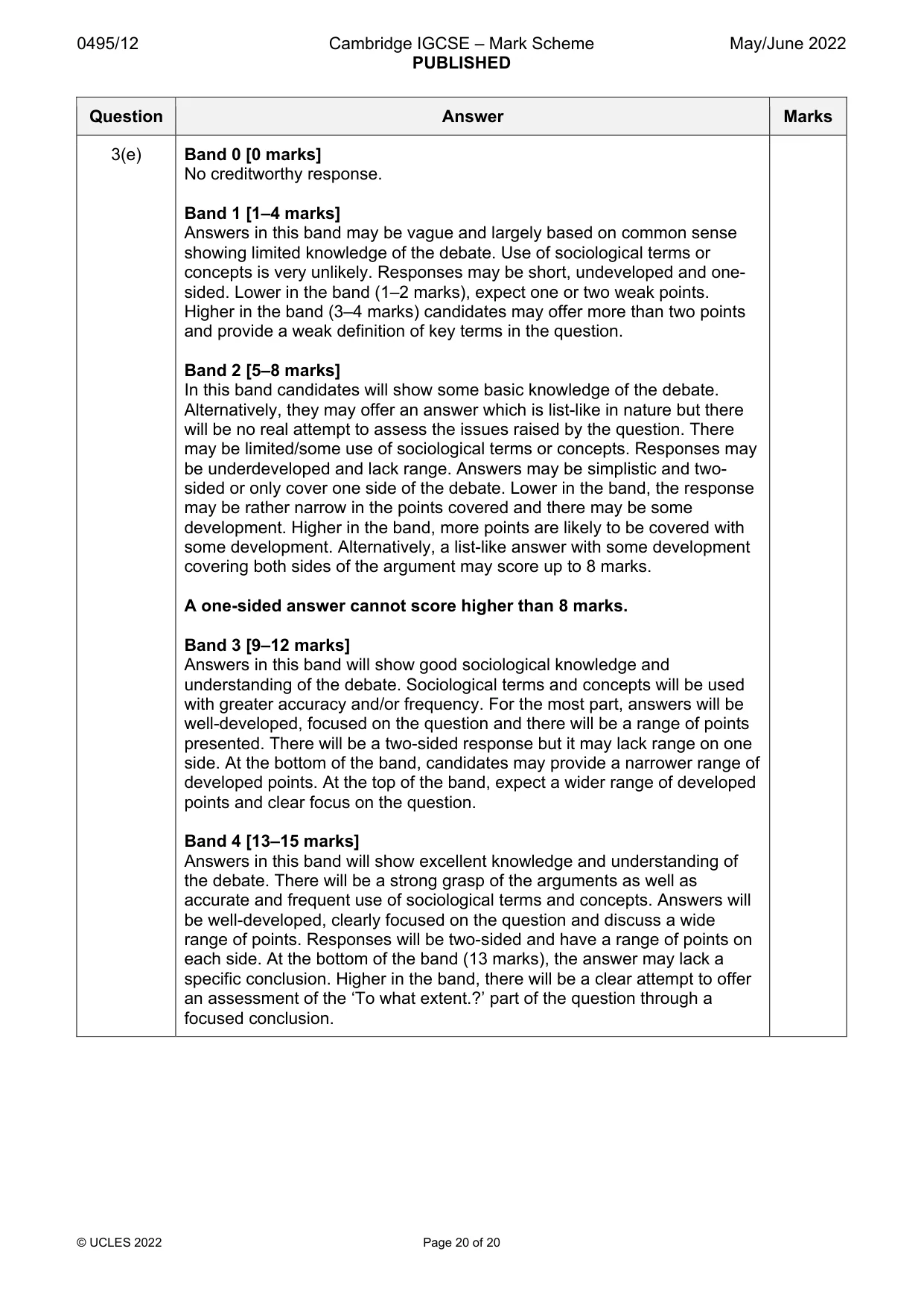
0495/12 Cambridge IGCSE – Mark Scheme PUBLISHED May/June 2022 © UCLES 2022 Page 20 of 20 Question Answer Marks 3(e) Band 0 [0 marks] No creditworthy response. Band 1 [1–4 marks] Answers in this band may be vague and largely based on common sense showing limited knowledge of the debate. Use of sociological terms or concepts is very unlikely. Responses may be short, undeveloped and one- sided. Lower in the band (1–2 marks), expect one or two weak points. Higher in the band (3–4 marks) candidates may offer more than two points and provide a weak definition of key terms in the question. Band 2 [5–8 marks] In this band candidates will show some basic knowledge of the debate. Alternatively, they may offer an answer which is list-like in nature but there will be no real attempt to assess the issues raised by the question. There may be limited/some use of sociological terms or concepts. Responses may be underdeveloped and lack range. Answers may be simplistic and two- sided or only cover one side of the debate. Lower in the band, the response may be rather narrow in the points covered and there may be some development. Higher in the band, more points are likely to be covered with some development. Alternatively, a list-like answer with some development covering both sides of the argument may score up to 8 marks. A one-sided answer cannot score higher than 8 marks. Band 3 [9–12 marks] Answers in this band will show good sociological knowledge and understanding of the debate. Sociological terms and concepts will be used with greater accuracy and/or frequency. For the most part, answers will be well-developed, focused on the question and there will be a range of points presented. There will be a two-sided response but it may lack range on one side. At the bottom of the band, candidates may provide a narrower range of developed points. At the top of the band, expect a wider range of developed points and clear focus on the question. Band 4 [13–15 marks] Answers in this band will show excellent knowledge and understanding of the debate. There will be a strong grasp of the arguments as well as accurate and frequent use of sociological terms and concepts. Answers will be well-developed, clearly focused on the question and discuss a wide range of points. Responses will be two-sided and have a range of points on each side. At the bottom of the band (13 marks), the answer may lack a specific conclusion. Higher in the band, there will be a clear attempt to offer an assessment of the ‘To what extent.?’ part of the question through a focused conclusion.
What you needed in this session
Cambridge’s own grade thresholds for 2022 May/June, Paper 1 · Variant 2. A higher threshold means an easier paper — the bar moves with how the cohort did.