Cambridge IGCSE Sociology 0495 — 2023 May/June Paper 1 · Variant 2
0495/12/M/J/23 · 80 marks · ≈90 min
The question paper and its mark scheme, free to read here and free to download. This is Cambridge’s own paper, exactly as it was sat.
Question paper4 pages

Mark scheme23 pages
Answers below. Sit the paper first if you are practising.

Paper as text
Question paper, page 1
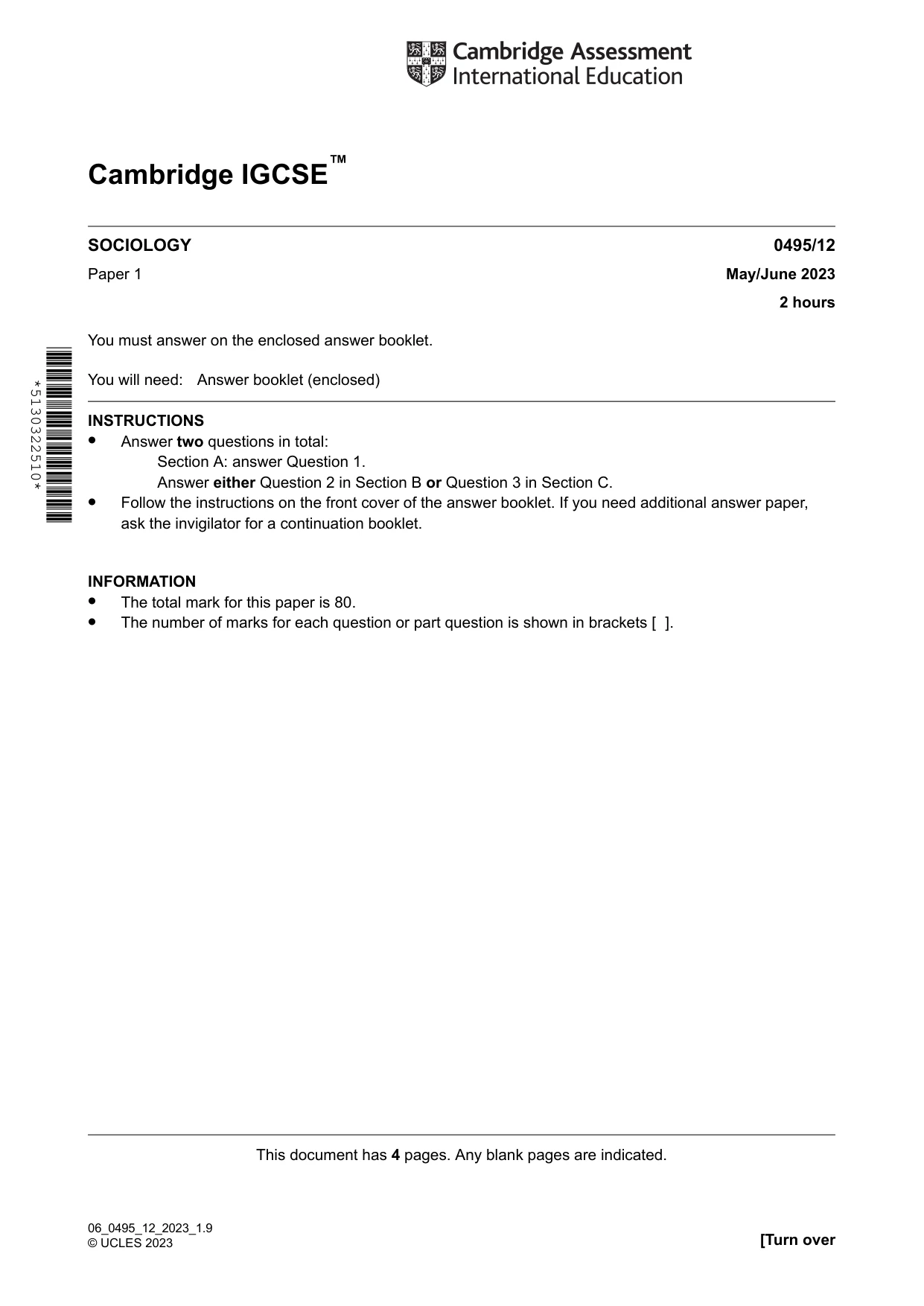
Cambridge IGCSE™ 0495/12 May/June 2023 2 hours SOCIOLOGY Paper 1 You must answer on the enclosed answer booklet. You will need: Answer booklet (enclosed) INSTRUCTIONS • Answer two questions in total: Section A: answer Question 1. Answer either Question 2 in Section B or Question 3 in Section C. • Follow the instructions on the front cover of the answer booklet. If you need additional answer paper, ask the invigilator for a continuation booklet. INFORMATION • The total mark for this paper is 80. • The number of marks for each question or part question is shown in brackets [ ]. This document has 4 pages. Any blank pages are indicated. [Turn over 06_0495_12_2023_1.9 © UCLES 2023 *5130322510*
Question paper, page 2
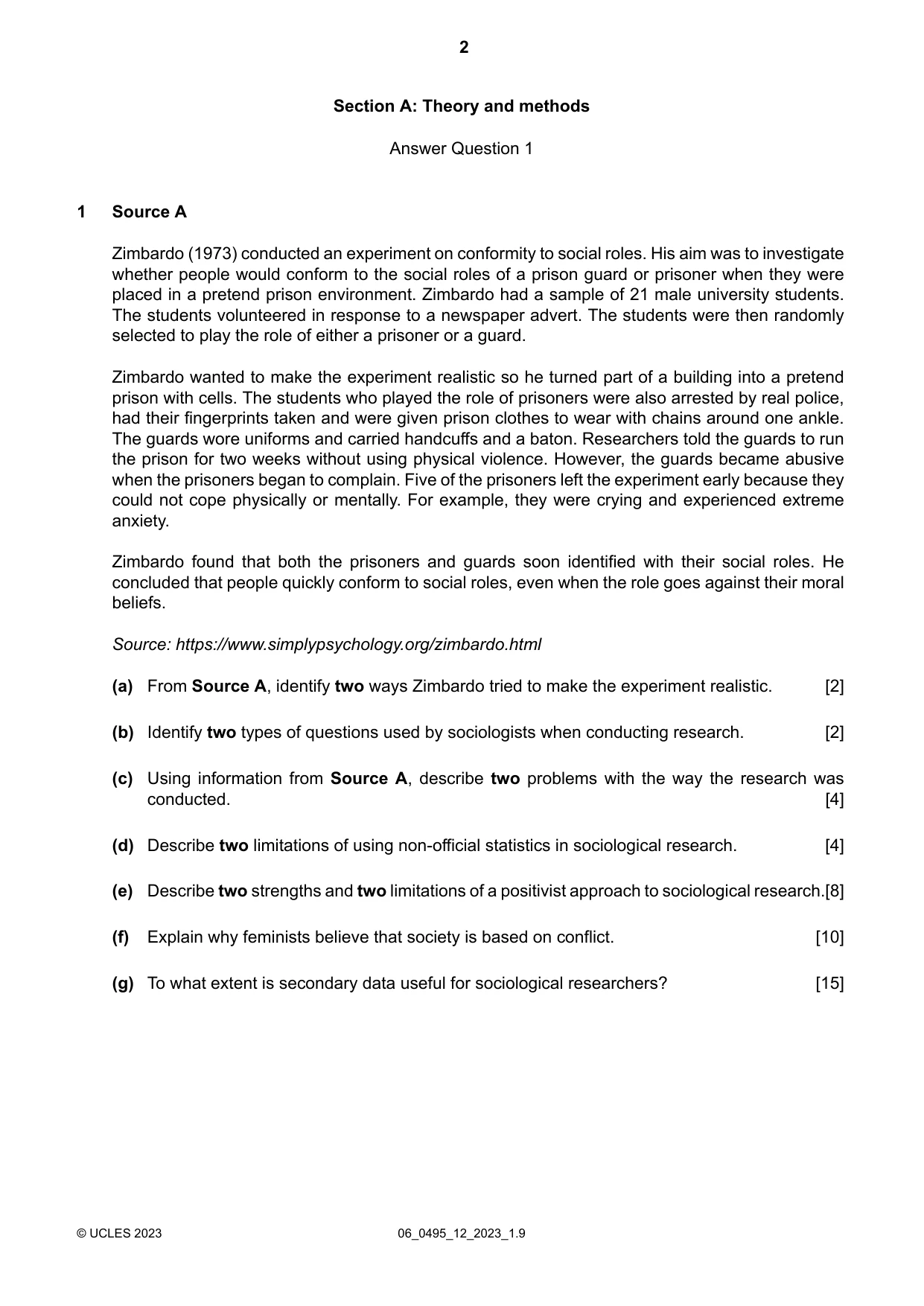
Section A: Theory and methods Answer Question 1 Source A 1 Zimbardo (1973) conducted an experiment on conformity to social roles. His aim was to investigate whether people would conform to the social roles of a prison guard or prisoner when they were placed in a pretend prison environment. Zimbardo had a sample of 21 male university students. The students volunteered in response to a newspaper advert. The students were then randomly selected to play the role of either a prisoner or a guard. Zimbardo wanted to make the experiment realistic so he turned part of a building into a pretend prison with cells. The students who played the role of prisoners were also arrested by real police, had their fingerprints taken and were given prison clothes to wear with chains around one ankle. The guards wore uniforms and carried handcuffs and a baton. Researchers told the guards to run the prison for two weeks without using physical violence. However, the guards became abusive when the prisoners began to complain. Five of the prisoners left the experiment early because they could not cope physically or mentally. For example, they were crying and experienced extreme anxiety. Zimbardo found that both the prisoners and guards soon identified with their social roles. He concluded that people quickly conform to social roles, even when the role goes against their moral beliefs. Source: https://www.simplypsychology.org/zimbardo.html From Source A, identify two ways Zimbardo tried to make the experiment realistic. [2] (a) Identify two types of questions used by sociologists when conducting research. [2] (b) Using information from Source A, describe two problems with the way the research was conducted. [4] (c) Describe two limitations of using non-official statistics in sociological research. [4] (d) Describe two strengths and two limitations of a positivist approach to sociological research.[8] (e) Explain why feminists believe that society is based on conflict. [10] (f) To what extent is secondary data useful for sociological researchers? [15] (g) 06_0495_12_2023_1.9 © UCLES 2023 2
Question paper, page 3
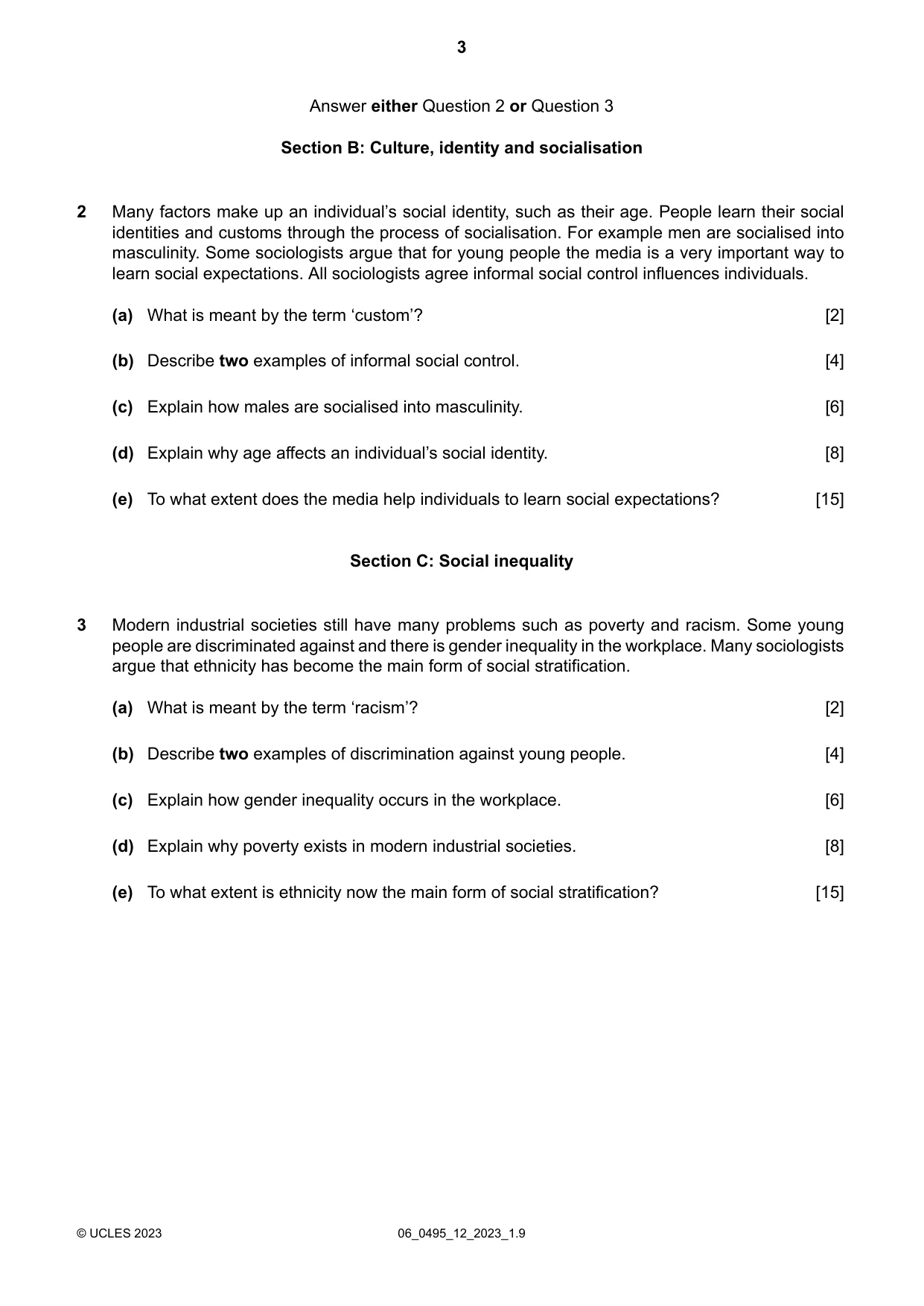
Answer either Question 2 or Question 3 Section B: Culture, identity and socialisation Many factors make up an individual’s social identity, such as their age. People learn their social identities and customs through the process of socialisation. For example men are socialised into 2 masculinity. Some sociologists argue that for young people the media is a very important way to learn social expectations. All sociologists agree informal social control influences individuals. What is meant by the term ‘custom’? [2] (a) Describe two examples of informal social control. [4] (b) Explain how males are socialised into masculinity. [6] (c) Explain why age affects an individual’s social identity. [8] (d) To what extent does the media help individuals to learn social expectations? [15] (e) Section C: Social inequality Modern industrial societies still have many problems such as poverty and racism. Some young people are discriminated against and there is gender inequality in the workplace. Many sociologists argue that ethnicity has become the main form of social stratification. 3 What is meant by the term ‘racism’? [2] (a) Describe two examples of discrimination against young people. [4] (b) Explain how gender inequality occurs in the workplace. [6] (c) Explain why poverty exists in modern industrial societies. [8] (d) To what extent is ethnicity now the main form of social stratification? [15] (e) 06_0495_12_2023_1.9 © UCLES 2023 3
Question paper, page 4
BLANK PAGE Permission to reproduce items where third-party owned material protected by copyright is included has been sought and cleared where possible. Every reasonable effort has been made by the publisher (UCLES) to trace copyright holders, but if any items requiring clearance have unwittingly been included, the publisher will be pleased to make amends at the earliest possible opportunity. To avoid the issue of disclosure of answer-related information to candidates, all copyright acknowledgements are reproduced online in the Cambridge Assessment International Education Copyright Acknowledgements Booklet. This is produced for each series of examinations and is freely available to download at www.cambridgeinternational.org after the live examination series. Cambridge Assessment International Education is part of Cambridge Assessment. Cambridge Assessment is the brand name of the University of Cambridge Local Examinations Syndicate (UCLES), which is a department of the University of Cambridge. 06_0495_12_2023_1.9 © UCLES 2023 4
Mark scheme, page 1
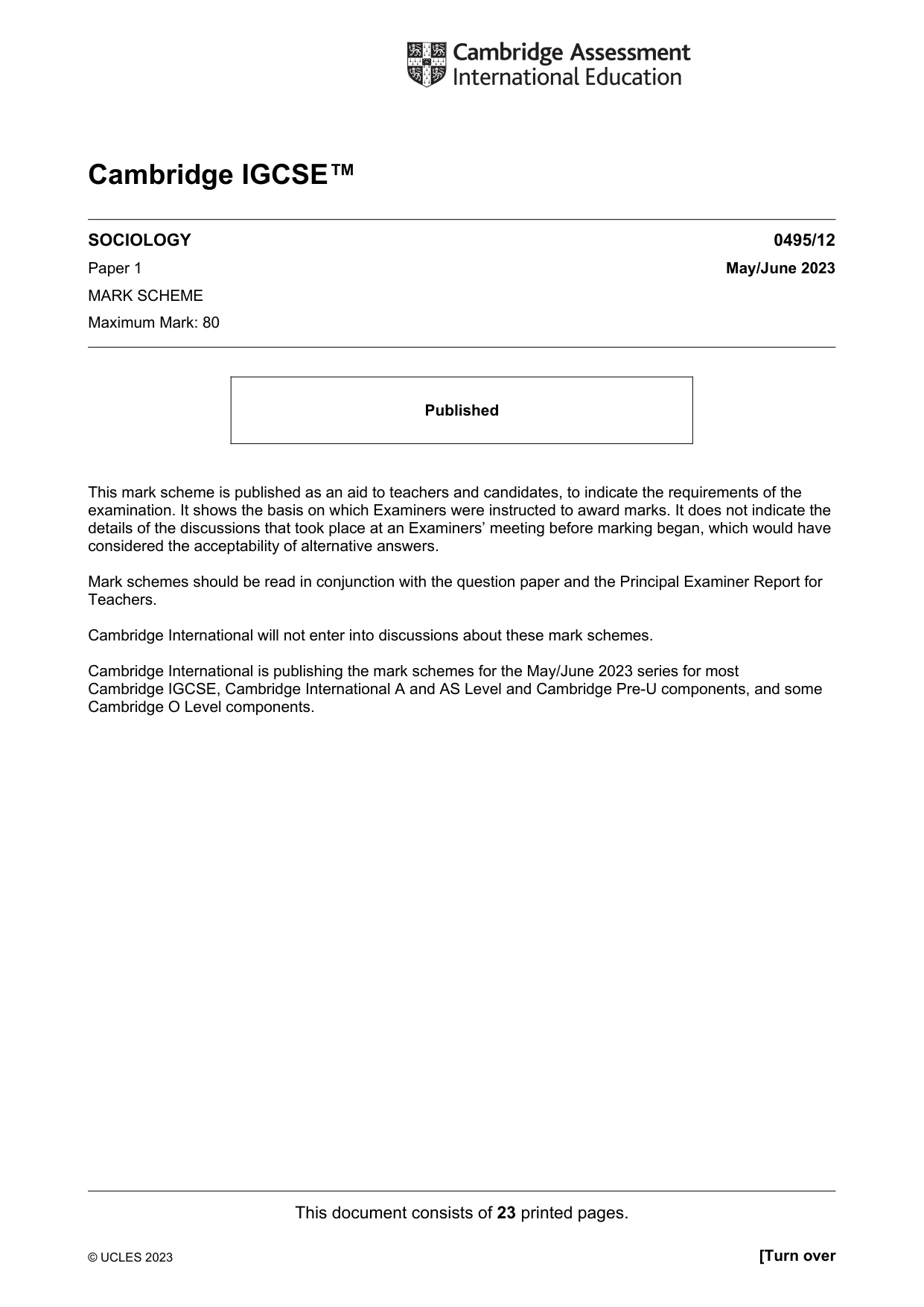
This document consists of 23 printed pages. © UCLES 2023 [Turn over Cambridge IGCSE™ SOCIOLOGY 0495/12 Paper 1 May/June 2023 MARK SCHEME Maximum Mark: 80 Published This mark scheme is published as an aid to teachers and candidates, to indicate the requirements of the examination. It shows the basis on which Examiners were instructed to award marks. It does not indicate the details of the discussions that took place at an Examiners’ meeting before marking began, which would have considered the acceptability of alternative answers. Mark schemes should be read in conjunction with the question paper and the Principal Examiner Report for Teachers. Cambridge International will not enter into discussions about these mark schemes. Cambridge International is publishing the mark schemes for the May/June 2023 series for most Cambridge IGCSE, Cambridge International A and AS Level and Cambridge Pre-U components, and some Cambridge O Level components.
Mark scheme, page 2
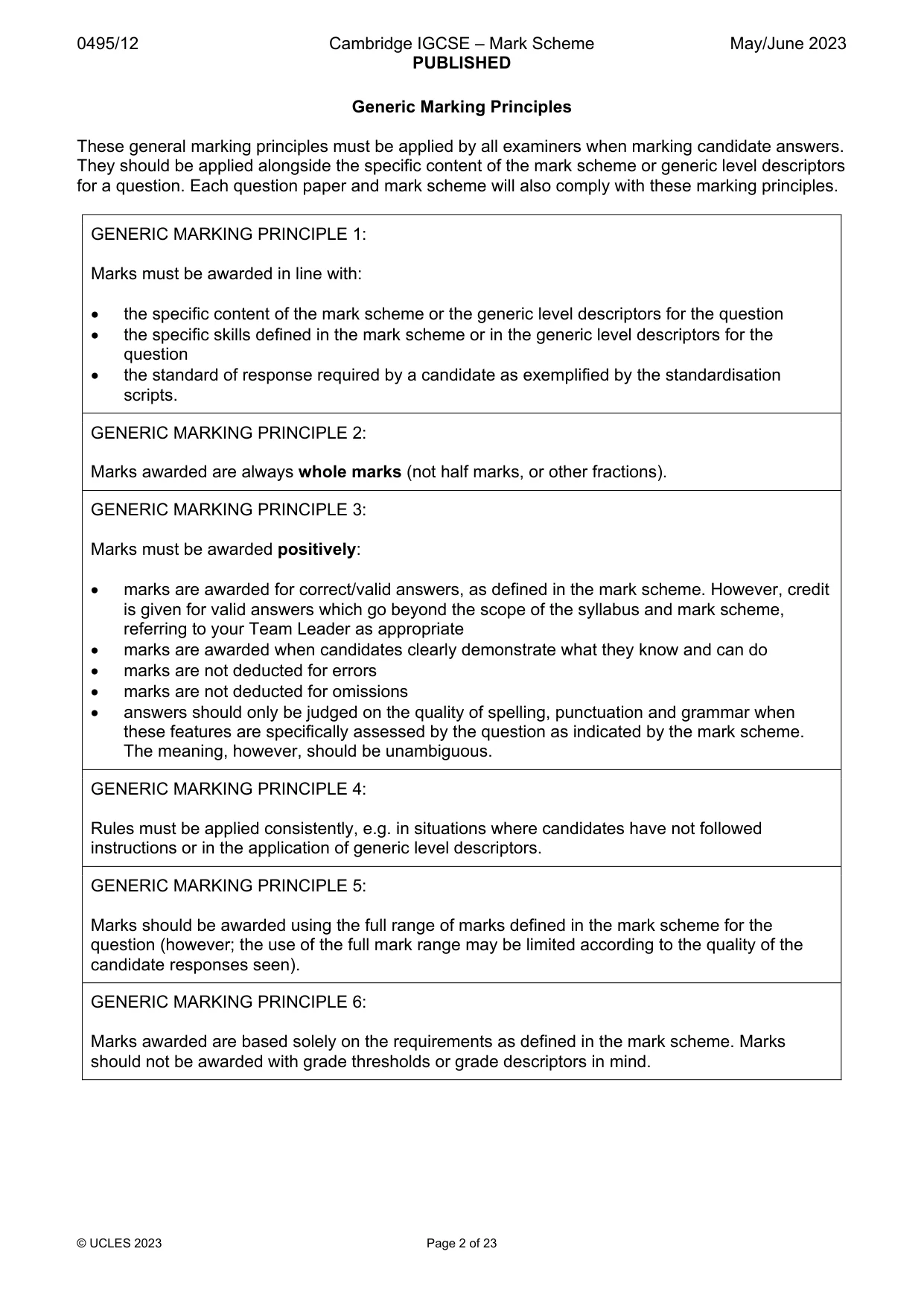
0495/12 Cambridge IGCSE – Mark Scheme PUBLISHED May/June 2023 © UCLES 2023 Page 2 of 23 Generic Marking Principles These general marking principles must be applied by all examiners when marking candidate answers. They should be applied alongside the specific content of the mark scheme or generic level descriptors for a question. Each question paper and mark scheme will also comply with these marking principles. GENERIC MARKING PRINCIPLE 1: Marks must be awarded in line with: the specific content of the mark scheme or the generic level descriptors for the question the specific skills defined in the mark scheme or in the generic level descriptors for the question the standard of response required by a candidate as exemplified by the standardisation scripts. GENERIC MARKING PRINCIPLE 2: Marks awarded are always whole marks (not half marks, or other fractions). GENERIC MARKING PRINCIPLE 3: Marks must be awarded positively: marks are awarded for correct/valid answers, as defined in the mark scheme. However, credit is given for valid answers which go beyond the scope of the syllabus and mark scheme, referring to your Team Leader as appropriate marks are awarded when candidates clearly demonstrate what they know and can do marks are not deducted for errors marks are not deducted for omissions answers should only be judged on the quality of spelling, punctuation and grammar when these features are specifically assessed by the question as indicated by the mark scheme. The meaning, however, should be unambiguous. GENERIC MARKING PRINCIPLE 4: Rules must be applied consistently, e.g. in situations where candidates have not followed instructions or in the application of generic level descriptors. GENERIC MARKING PRINCIPLE 5: Marks should be awarded using the full range of marks defined in the mark scheme for the question (however; the use of the full mark range may be limited according to the quality of the candidate responses seen). GENERIC MARKING PRINCIPLE 6: Marks awarded are based solely on the requirements as defined in the mark scheme. Marks should not be awarded with grade thresholds or grade descriptors in mind.
Mark scheme, page 3
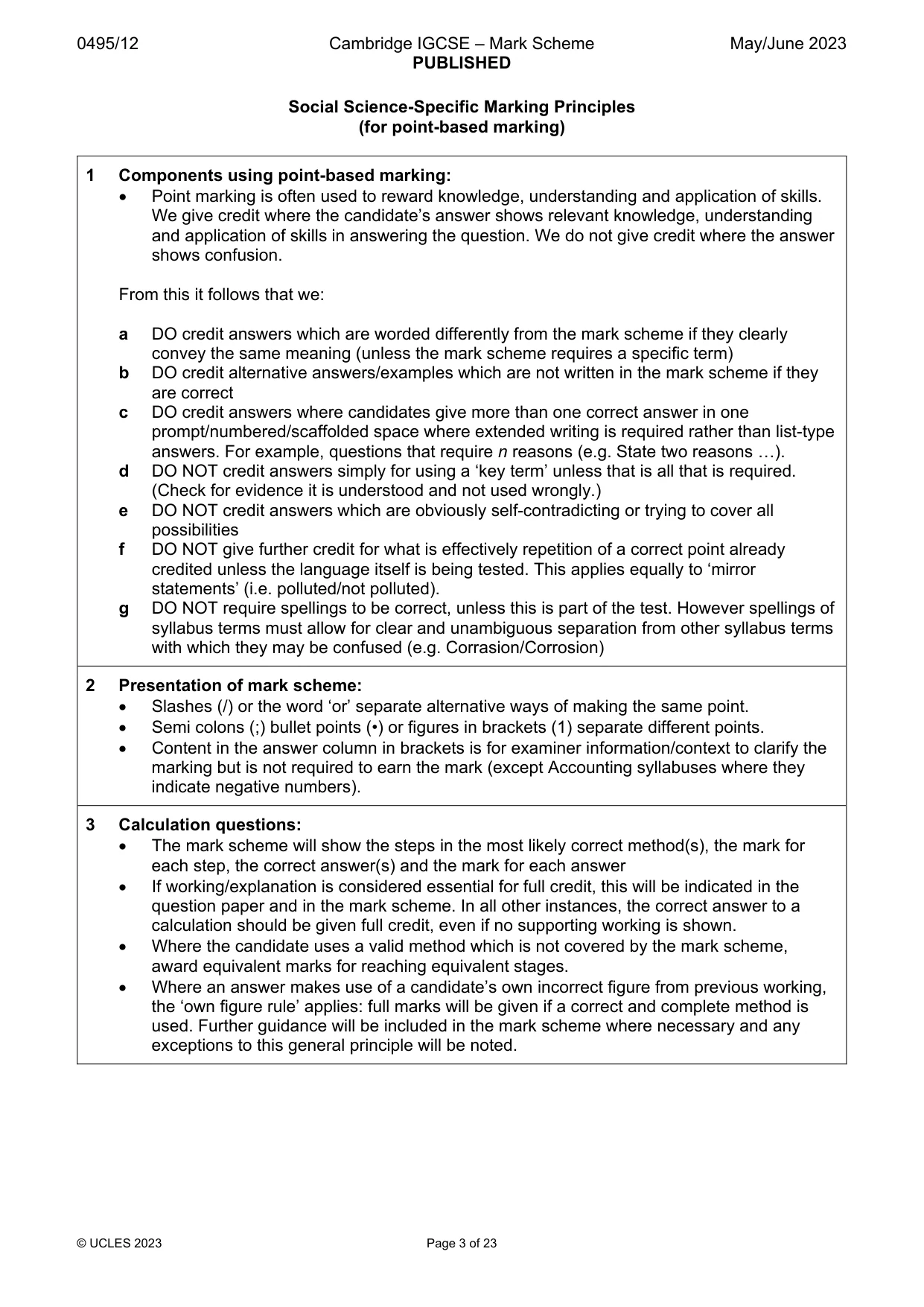
0495/12 Cambridge IGCSE – Mark Scheme PUBLISHED May/June 2023 © UCLES 2023 Page 3 of 23 Social Science-Specific Marking Principles (for point-based marking) 1 Components using point-based marking: Point marking is often used to reward knowledge, understanding and application of skills. We give credit where the candidate’s answer shows relevant knowledge, understanding and application of skills in answering the question. We do not give credit where the answer shows confusion. From this it follows that we: a DO credit answers which are worded differently from the mark scheme if they clearly convey the same meaning (unless the mark scheme requires a specific term) b DO credit alternative answers/examples which are not written in the mark scheme if they are correct c DO credit answers where candidates give more than one correct answer in one prompt/numbered/scaffolded space where extended writing is required rather than list-type answers. For example, questions that require n reasons (e.g. State two reasons …). d DO NOT credit answers simply for using a ‘key term’ unless that is all that is required. (Check for evidence it is understood and not used wrongly.) e DO NOT credit answers which are obviously self-contradicting or trying to cover all possibilities f DO NOT give further credit for what is effectively repetition of a correct point already credited unless the language itself is being tested. This applies equally to ‘mirror statements’ (i.e. polluted/not polluted). g DO NOT require spellings to be correct, unless this is part of the test. However spellings of syllabus terms must allow for clear and unambiguous separation from other syllabus terms with which they may be confused (e.g. Corrasion/Corrosion) 2 Presentation of mark scheme: Slashes (/) or the word ‘or’ separate alternative ways of making the same point. Semi colons (;) bullet points (•) or figures in brackets (1) separate different points. Content in the answer column in brackets is for examiner information/context to clarify the marking but is not required to earn the mark (except Accounting syllabuses where they indicate negative numbers). 3 Calculation questions: The mark scheme will show the steps in the most likely correct method(s), the mark for each step, the correct answer(s) and the mark for each answer If working/explanation is considered essential for full credit, this will be indicated in the question paper and in the mark scheme. In all other instances, the correct answer to a calculation should be given full credit, even if no supporting working is shown. Where the candidate uses a valid method which is not covered by the mark scheme, award equivalent marks for reaching equivalent stages. Where an answer makes use of a candidate’s own incorrect figure from previous working, the ‘own figure rule’ applies: full marks will be given if a correct and complete method is used. Further guidance will be included in the mark scheme where necessary and any exceptions to this general principle will be noted.
Mark scheme, page 4
0495/12 Cambridge IGCSE – Mark Scheme PUBLISHED May/June 2023 © UCLES 2023 Page 4 of 23 4 Annotation: For point marking, ticks can be used to indicate correct answers and crosses can be used to indicate wrong answers. There is no direct relationship between ticks and marks. Ticks have no defined meaning for levels of response marking. For levels of response marking, the level awarded should be annotated on the script. Other annotations will be used by examiners as agreed during standardisation, and the meaning will be understood by all examiners who marked that paper.
Mark scheme, page 5
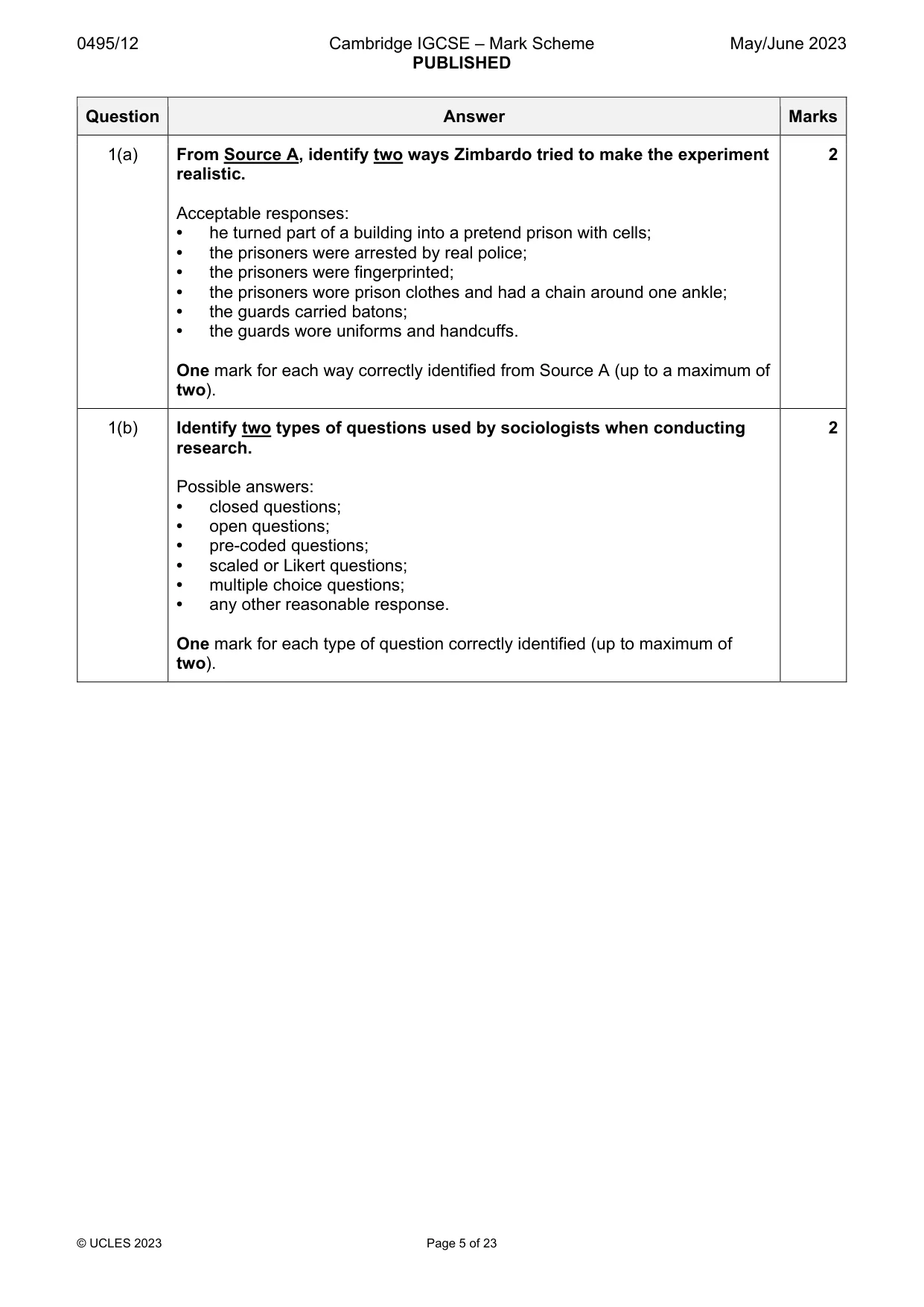
0495/12 Cambridge IGCSE – Mark Scheme PUBLISHED May/June 2023 © UCLES 2023 Page 5 of 23 Question Answer Marks 1(a) From Source A, identify two ways Zimbardo tried to make the experiment realistic. Acceptable responses: • he turned part of a building into a pretend prison with cells; • the prisoners were arrested by real police; • the prisoners were fingerprinted; • the prisoners wore prison clothes and had a chain around one ankle; • the guards carried batons; • the guards wore uniforms and handcuffs. One mark for each way correctly identified from Source A (up to a maximum of two). 2 1(b) Identify two types of questions used by sociologists when conducting research. Possible answers: • closed questions; • open questions; • pre-coded questions; • scaled or Likert questions; • multiple choice questions; • any other reasonable response. One mark for each type of question correctly identified (up to maximum of two). 2
Mark scheme, page 6
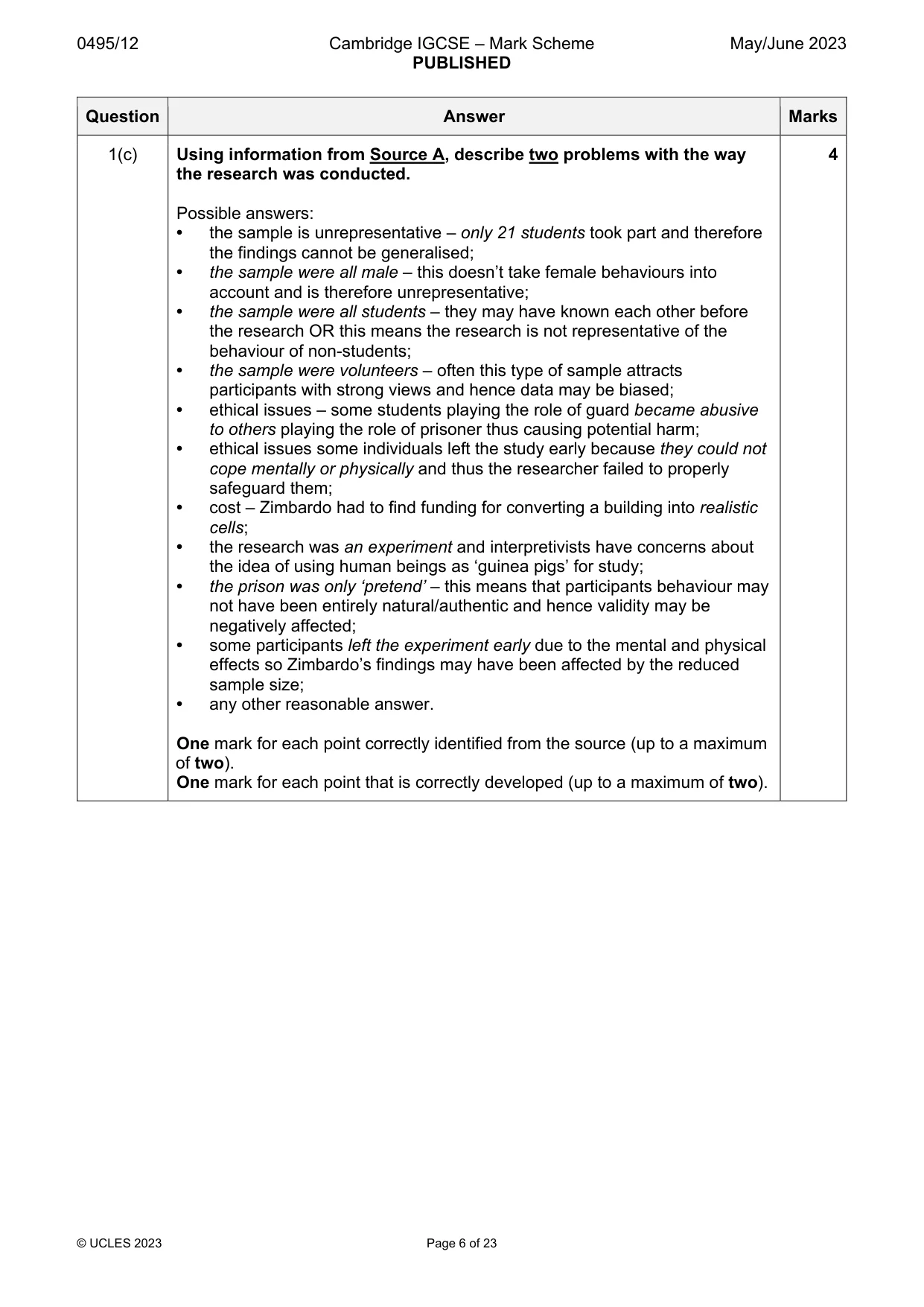
0495/12 Cambridge IGCSE – Mark Scheme PUBLISHED May/June 2023 © UCLES 2023 Page 6 of 23 Question Answer Marks 1(c) Using information from Source A, describe two problems with the way the research was conducted. Possible answers: • the sample is unrepresentative – only 21 students took part and therefore the findings cannot be generalised; • the sample were all male – this doesn’t take female behaviours into account and is therefore unrepresentative; • the sample were all students – they may have known each other before the research OR this means the research is not representative of the behaviour of non-students; • the sample were volunteers – often this type of sample attracts participants with strong views and hence data may be biased; • ethical issues – some students playing the role of guard became abusive to others playing the role of prisoner thus causing potential harm; • ethical issues some individuals left the study early because they could not cope mentally or physically and thus the researcher failed to properly safeguard them; • cost – Zimbardo had to find funding for converting a building into realistic cells; • the research was an experiment and interpretivists have concerns about the idea of using human beings as ‘guinea pigs’ for study; • the prison was only ‘pretend’ – this means that participants behaviour may not have been entirely natural/authentic and hence validity may be negatively affected; • some participants left the experiment early due to the mental and physical effects so Zimbardo’s findings may have been affected by the reduced sample size; • any other reasonable answer. One mark for each point correctly identified from the source (up to a maximum of two). One mark for each point that is correctly developed (up to a maximum of two). 4
Mark scheme, page 7
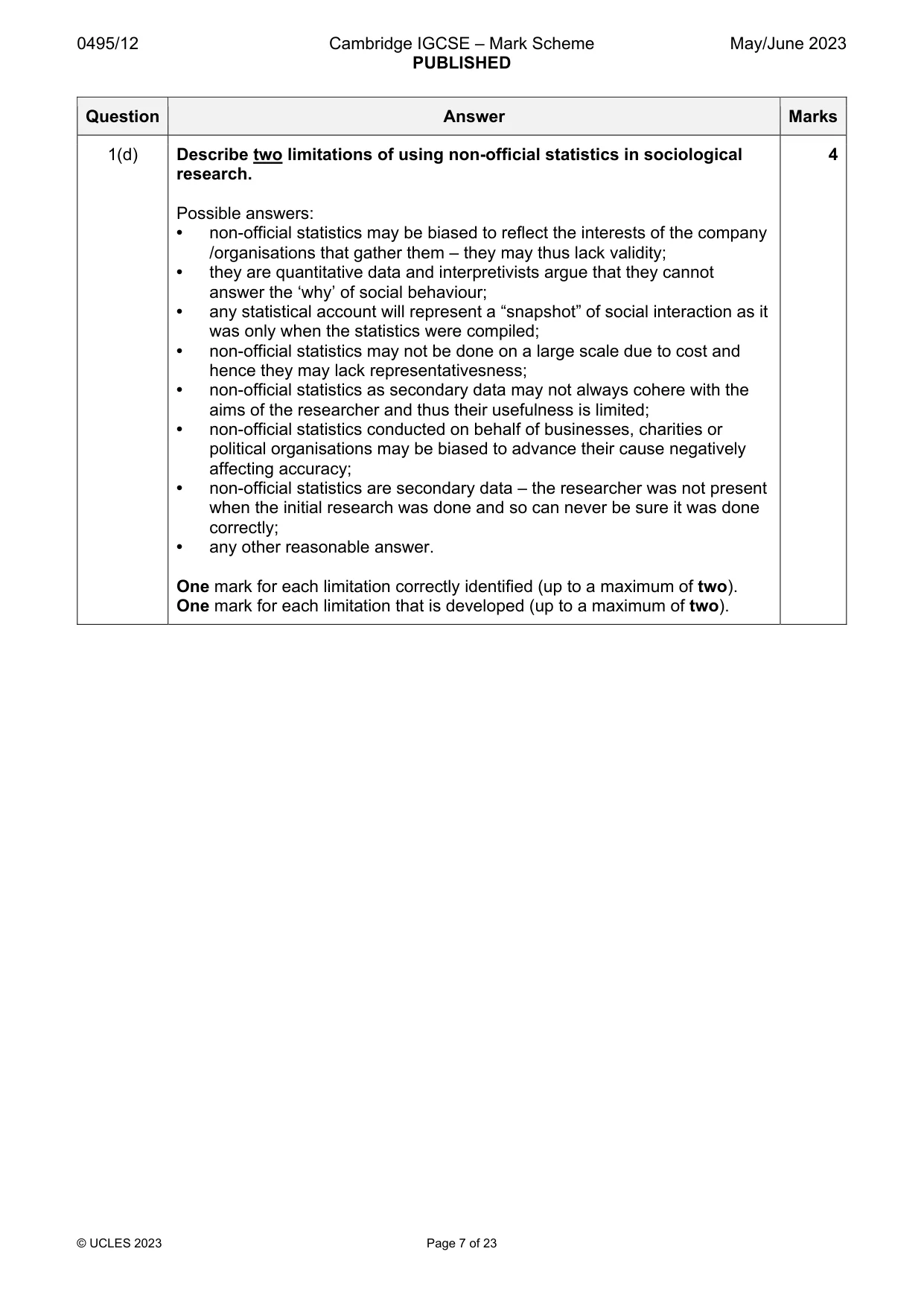
0495/12 Cambridge IGCSE – Mark Scheme PUBLISHED May/June 2023 © UCLES 2023 Page 7 of 23 Question Answer Marks 1(d) Describe two limitations of using non-official statistics in sociological research. Possible answers: • non-official statistics may be biased to reflect the interests of the company /organisations that gather them – they may thus lack validity; • they are quantitative data and interpretivists argue that they cannot answer the ‘why’ of social behaviour; • any statistical account will represent a “snapshot” of social interaction as it was only when the statistics were compiled; • non-official statistics may not be done on a large scale due to cost and hence they may lack representativesness; • non-official statistics as secondary data may not always cohere with the aims of the researcher and thus their usefulness is limited; • non-official statistics conducted on behalf of businesses, charities or political organisations may be biased to advance their cause negatively affecting accuracy; • non-official statistics are secondary data – the researcher was not present when the initial research was done and so can never be sure it was done correctly; • any other reasonable answer. One mark for each limitation correctly identified (up to a maximum of two). One mark for each limitation that is developed (up to a maximum of two). 4
Mark scheme, page 8
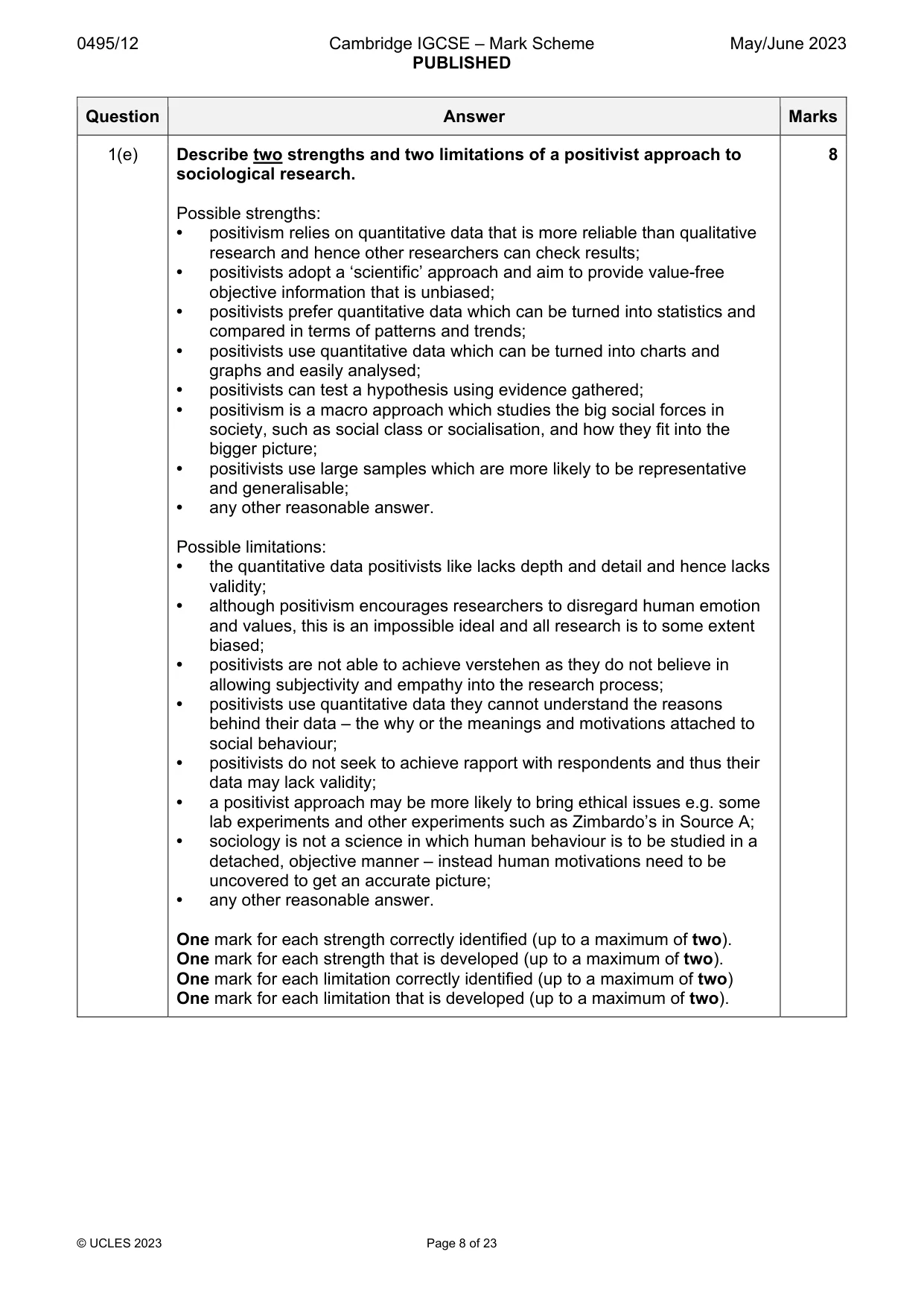
0495/12 Cambridge IGCSE – Mark Scheme PUBLISHED May/June 2023 © UCLES 2023 Page 8 of 23 Question Answer Marks 1(e) Describe two strengths and two limitations of a positivist approach to sociological research. Possible strengths: • positivism relies on quantitative data that is more reliable than qualitative research and hence other researchers can check results; • positivists adopt a ‘scientific’ approach and aim to provide value-free objective information that is unbiased; • positivists prefer quantitative data which can be turned into statistics and compared in terms of patterns and trends; • positivists use quantitative data which can be turned into charts and graphs and easily analysed; • positivists can test a hypothesis using evidence gathered; • positivism is a macro approach which studies the big social forces in society, such as social class or socialisation, and how they fit into the bigger picture; • positivists use large samples which are more likely to be representative and generalisable; • any other reasonable answer. Possible limitations: • the quantitative data positivists like lacks depth and detail and hence lacks validity; • although positivism encourages researchers to disregard human emotion and values, this is an impossible ideal and all research is to some extent biased; • positivists are not able to achieve verstehen as they do not believe in allowing subjectivity and empathy into the research process; • positivists use quantitative data they cannot understand the reasons behind their data – the why or the meanings and motivations attached to social behaviour; • positivists do not seek to achieve rapport with respondents and thus their data may lack validity; • a positivist approach may be more likely to bring ethical issues e.g. some lab experiments and other experiments such as Zimbardo’s in Source A; • sociology is not a science in which human behaviour is to be studied in a detached, objective manner – instead human motivations need to be uncovered to get an accurate picture; • any other reasonable answer. One mark for each strength correctly identified (up to a maximum of two). One mark for each strength that is developed (up to a maximum of two). One mark for each limitation correctly identified (up to a maximum of two) One mark for each limitation that is developed (up to a maximum of two). 8
Mark scheme, page 9
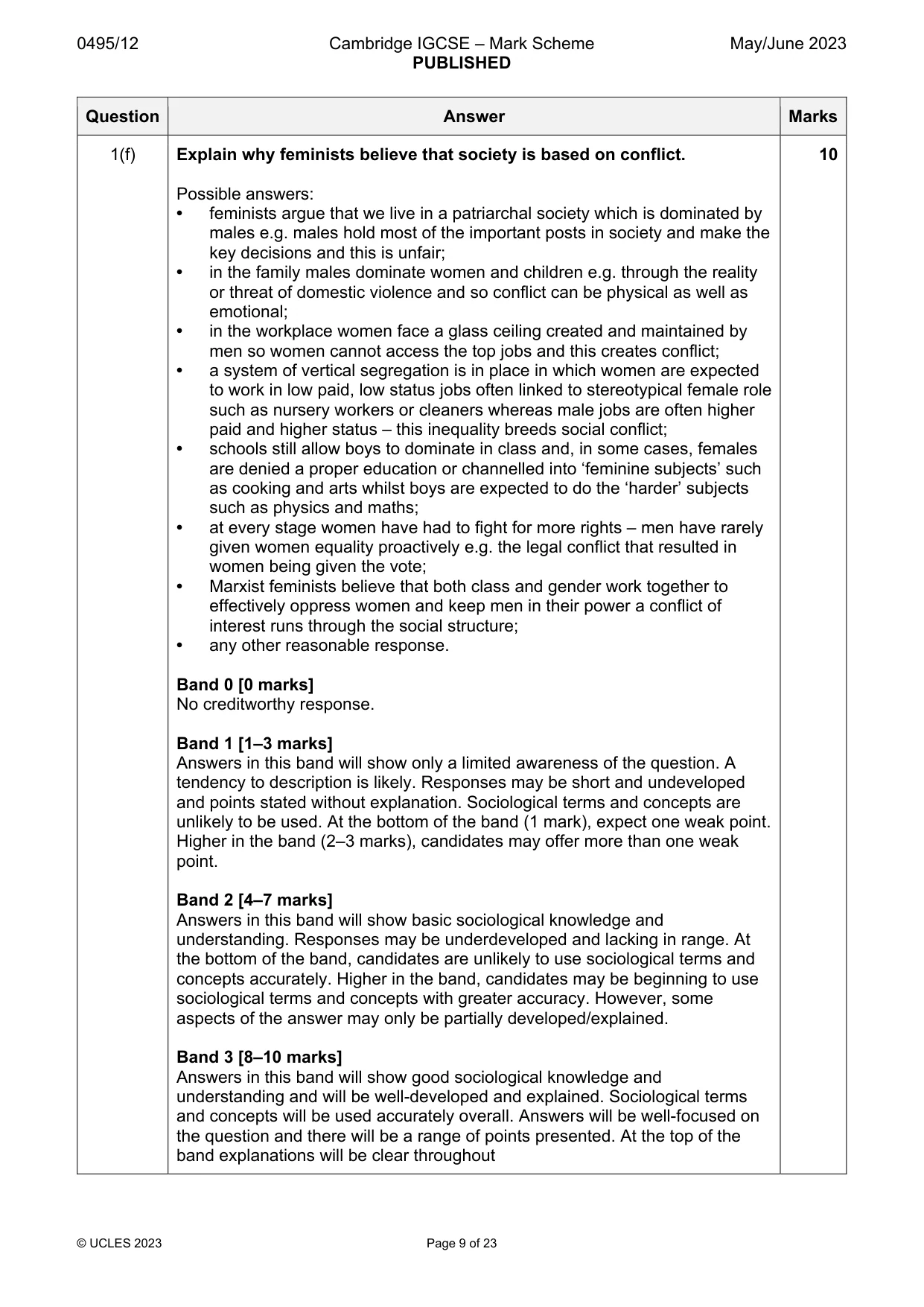
0495/12 Cambridge IGCSE – Mark Scheme PUBLISHED May/June 2023 © UCLES 2023 Page 9 of 23 Question Answer Marks 1(f) Explain why feminists believe that society is based on conflict. Possible answers: • feminists argue that we live in a patriarchal society which is dominated by males e.g. males hold most of the important posts in society and make the key decisions and this is unfair; • in the family males dominate women and children e.g. through the reality or threat of domestic violence and so conflict can be physical as well as emotional; • in the workplace women face a glass ceiling created and maintained by men so women cannot access the top jobs and this creates conflict; • a system of vertical segregation is in place in which women are expected to work in low paid, low status jobs often linked to stereotypical female role such as nursery workers or cleaners whereas male jobs are often higher paid and higher status – this inequality breeds social conflict; • schools still allow boys to dominate in class and, in some cases, females are denied a proper education or channelled into ‘feminine subjects’ such as cooking and arts whilst boys are expected to do the ‘harder’ subjects such as physics and maths; • at every stage women have had to fight for more rights – men have rarely given women equality proactively e.g. the legal conflict that resulted in women being given the vote; • Marxist feminists believe that both class and gender work together to effectively oppress women and keep men in their power a conflict of interest runs through the social structure; • any other reasonable response. Band 0 [0 marks] No creditworthy response. Band 1 [1–3 marks] Answers in this band will show only a limited awareness of the question. A tendency to description is likely. Responses may be short and undeveloped and points stated without explanation. Sociological terms and concepts are unlikely to be used. At the bottom of the band (1 mark), expect one weak point. Higher in the band (2–3 marks), candidates may offer more than one weak point. Band 2 [4–7 marks] Answers in this band will show basic sociological knowledge and understanding. Responses may be underdeveloped and lacking in range. At the bottom of the band, candidates are unlikely to use sociological terms and concepts accurately. Higher in the band, candidates may be beginning to use sociological terms and concepts with greater accuracy. However, some aspects of the answer may only be partially developed/explained. Band 3 [8–10 marks] Answers in this band will show good sociological knowledge and understanding and will be well-developed and explained. Sociological terms and concepts will be used accurately overall. Answers will be well-focused on the question and there will be a range of points presented. At the top of the band explanations will be clear throughout 10
Mark scheme, page 10
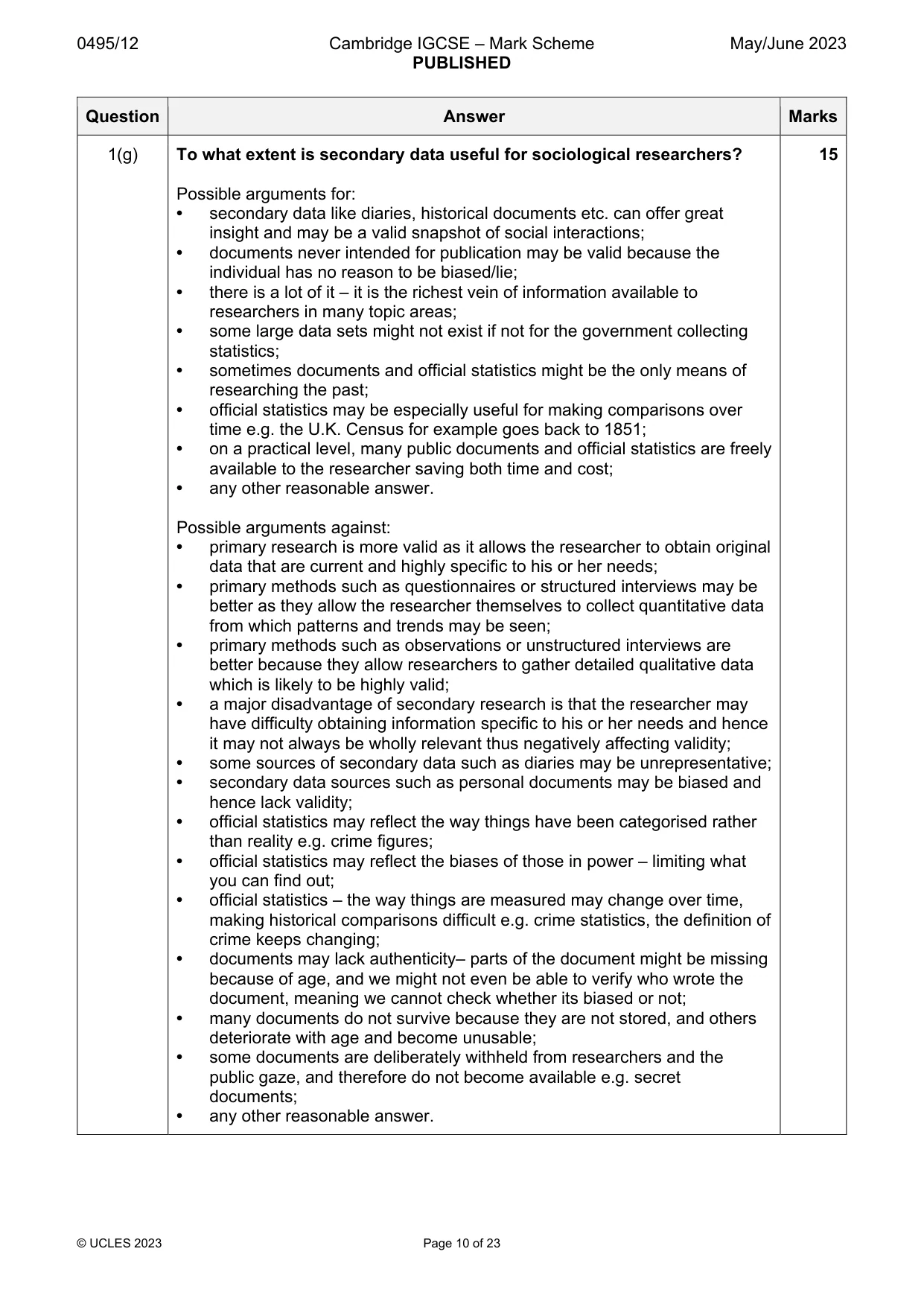
0495/12 Cambridge IGCSE – Mark Scheme PUBLISHED May/June 2023 © UCLES 2023 Page 10 of 23 Question Answer Marks 1(g) To what extent is secondary data useful for sociological researchers? Possible arguments for: • secondary data like diaries, historical documents etc. can offer great insight and may be a valid snapshot of social interactions; • documents never intended for publication may be valid because the individual has no reason to be biased/lie; • there is a lot of it – it is the richest vein of information available to researchers in many topic areas; • some large data sets might not exist if not for the government collecting statistics; • sometimes documents and official statistics might be the only means of researching the past; • official statistics may be especially useful for making comparisons over time e.g. the U.K. Census for example goes back to 1851; • on a practical level, many public documents and official statistics are freely available to the researcher saving both time and cost; • any other reasonable answer. Possible arguments against: • primary research is more valid as it allows the researcher to obtain original data that are current and highly specific to his or her needs; • primary methods such as questionnaires or structured interviews may be better as they allow the researcher themselves to collect quantitative data from which patterns and trends may be seen; • primary methods such as observations or unstructured interviews are better because they allow researchers to gather detailed qualitative data which is likely to be highly valid; • a major disadvantage of secondary research is that the researcher may have difficulty obtaining information specific to his or her needs and hence it may not always be wholly relevant thus negatively affecting validity; • some sources of secondary data such as diaries may be unrepresentative; • secondary data sources such as personal documents may be biased and hence lack validity; • official statistics may reflect the way things have been categorised rather than reality e.g. crime figures; • official statistics may reflect the biases of those in power – limiting what you can find out; • official statistics – the way things are measured may change over time, making historical comparisons difficult e.g. crime statistics, the definition of crime keeps changing; • documents may lack authenticity– parts of the document might be missing because of age, and we might not even be able to verify who wrote the document, meaning we cannot check whether its biased or not; • many documents do not survive because they are not stored, and others deteriorate with age and become unusable; • some documents are deliberately withheld from researchers and the public gaze, and therefore do not become available e.g. secret documents; • any other reasonable answer. 15
Mark scheme, page 11
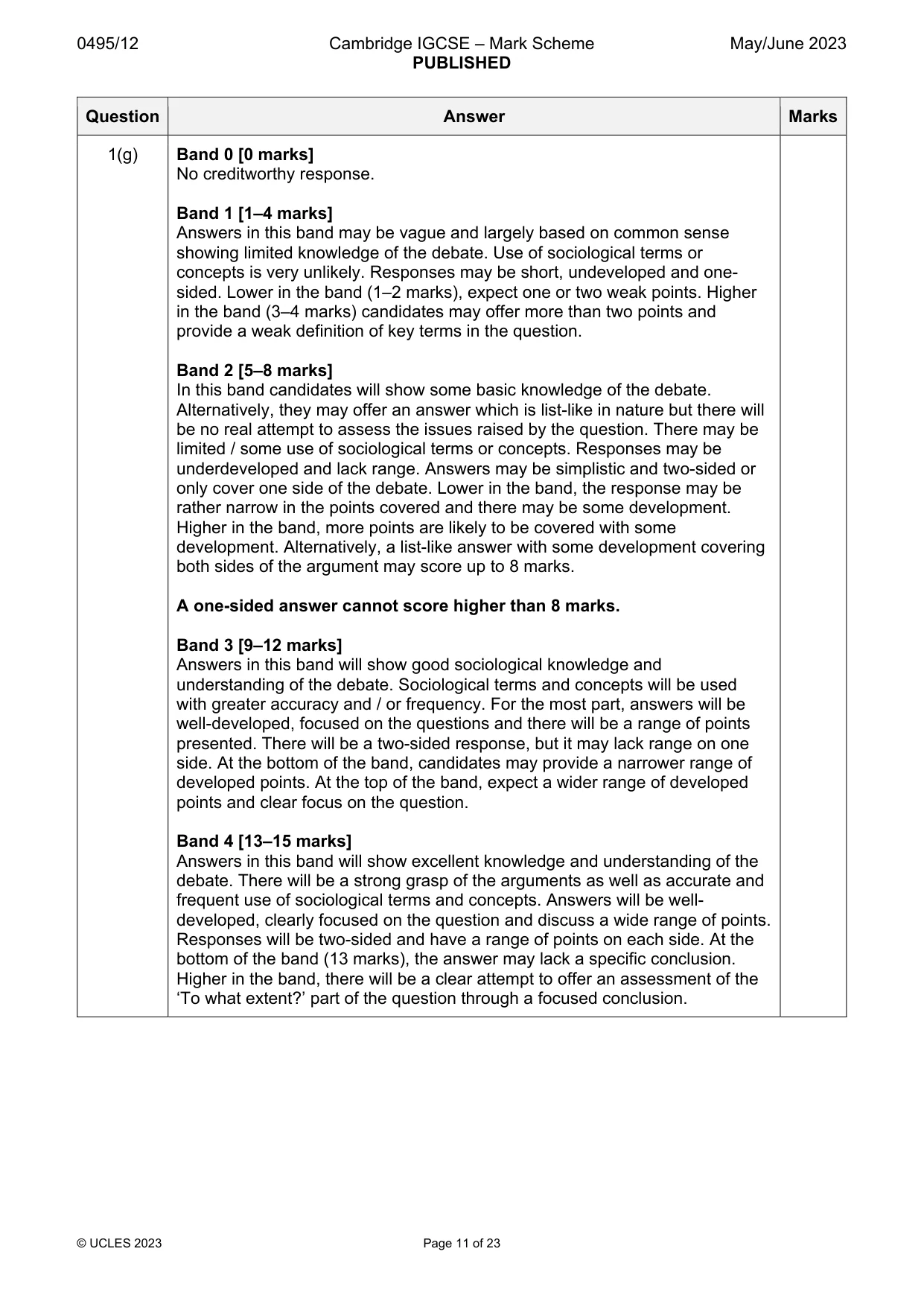
0495/12 Cambridge IGCSE – Mark Scheme PUBLISHED May/June 2023 © UCLES 2023 Page 11 of 23 Question Answer Marks 1(g) Band 0 [0 marks] No creditworthy response. Band 1 [1–4 marks] Answers in this band may be vague and largely based on common sense showing limited knowledge of the debate. Use of sociological terms or concepts is very unlikely. Responses may be short, undeveloped and one- sided. Lower in the band (1–2 marks), expect one or two weak points. Higher in the band (3–4 marks) candidates may offer more than two points and provide a weak definition of key terms in the question. Band 2 [5–8 marks] In this band candidates will show some basic knowledge of the debate. Alternatively, they may offer an answer which is list-like in nature but there will be no real attempt to assess the issues raised by the question. There may be limited / some use of sociological terms or concepts. Responses may be underdeveloped and lack range. Answers may be simplistic and two-sided or only cover one side of the debate. Lower in the band, the response may be rather narrow in the points covered and there may be some development. Higher in the band, more points are likely to be covered with some development. Alternatively, a list-like answer with some development covering both sides of the argument may score up to 8 marks. A one-sided answer cannot score higher than 8 marks. Band 3 [9–12 marks] Answers in this band will show good sociological knowledge and understanding of the debate. Sociological terms and concepts will be used with greater accuracy and / or frequency. For the most part, answers will be well-developed, focused on the questions and there will be a range of points presented. There will be a two-sided response, but it may lack range on one side. At the bottom of the band, candidates may provide a narrower range of developed points. At the top of the band, expect a wider range of developed points and clear focus on the question. Band 4 [13–15 marks] Answers in this band will show excellent knowledge and understanding of the debate. There will be a strong grasp of the arguments as well as accurate and frequent use of sociological terms and concepts. Answers will be well- developed, clearly focused on the question and discuss a wide range of points. Responses will be two-sided and have a range of points on each side. At the bottom of the band (13 marks), the answer may lack a specific conclusion. Higher in the band, there will be a clear attempt to offer an assessment of the ‘To what extent?’ part of the question through a focused conclusion.
Mark scheme, page 12
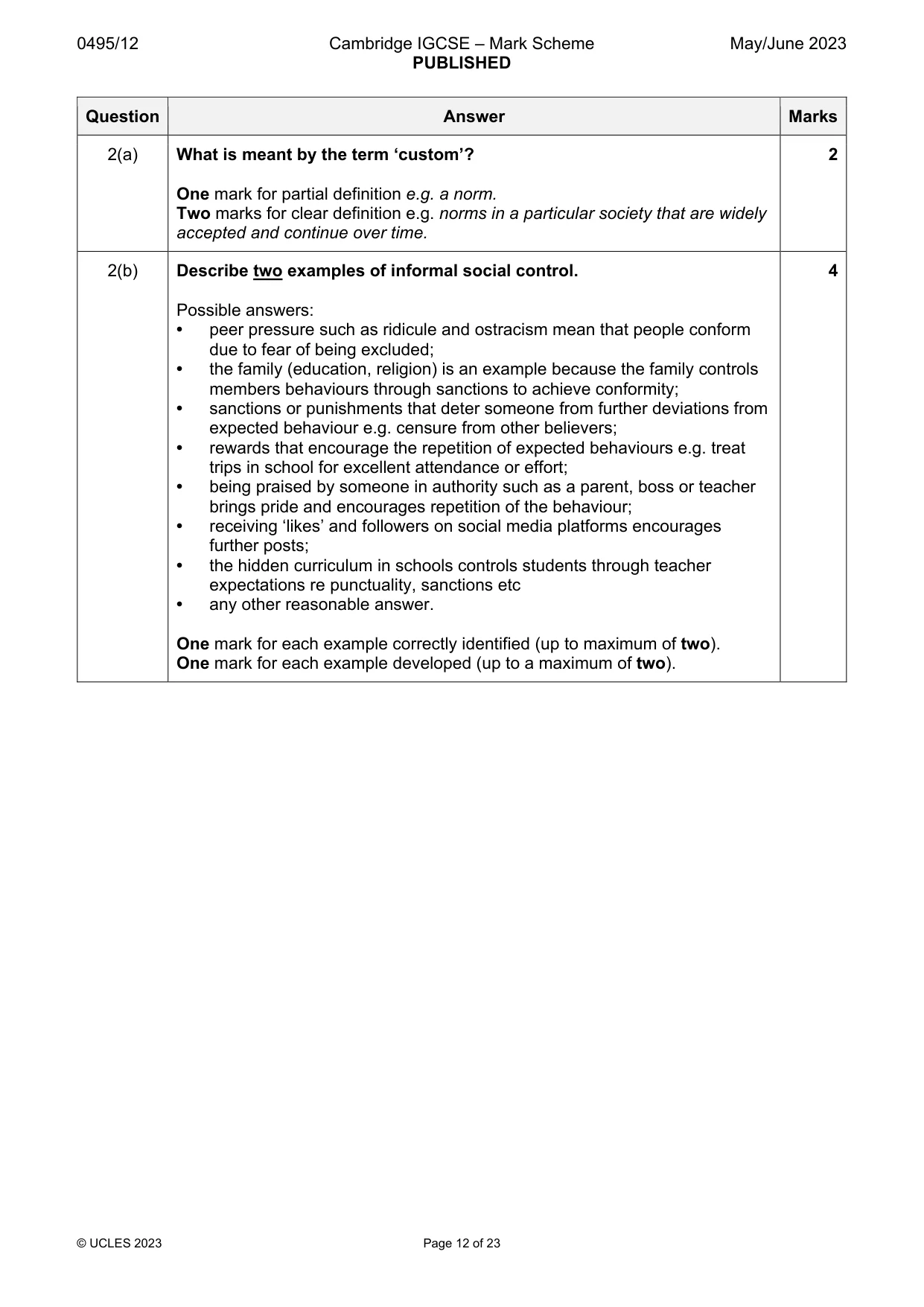
0495/12 Cambridge IGCSE – Mark Scheme PUBLISHED May/June 2023 © UCLES 2023 Page 12 of 23 Question Answer Marks 2(a) What is meant by the term ‘custom’? One mark for partial definition e.g. a norm. Two marks for clear definition e.g. norms in a particular society that are widely accepted and continue over time. 2 2(b) Describe two examples of informal social control. Possible answers: • peer pressure such as ridicule and ostracism mean that people conform due to fear of being excluded; • the family (education, religion) is an example because the family controls members behaviours through sanctions to achieve conformity; • sanctions or punishments that deter someone from further deviations from expected behaviour e.g. censure from other believers; • rewards that encourage the repetition of expected behaviours e.g. treat trips in school for excellent attendance or effort; • being praised by someone in authority such as a parent, boss or teacher brings pride and encourages repetition of the behaviour; • receiving ‘likes’ and followers on social media platforms encourages further posts; • the hidden curriculum in schools controls students through teacher expectations re punctuality, sanctions etc • any other reasonable answer. One mark for each example correctly identified (up to maximum of two). One mark for each example developed (up to a maximum of two). 4
Mark scheme, page 13
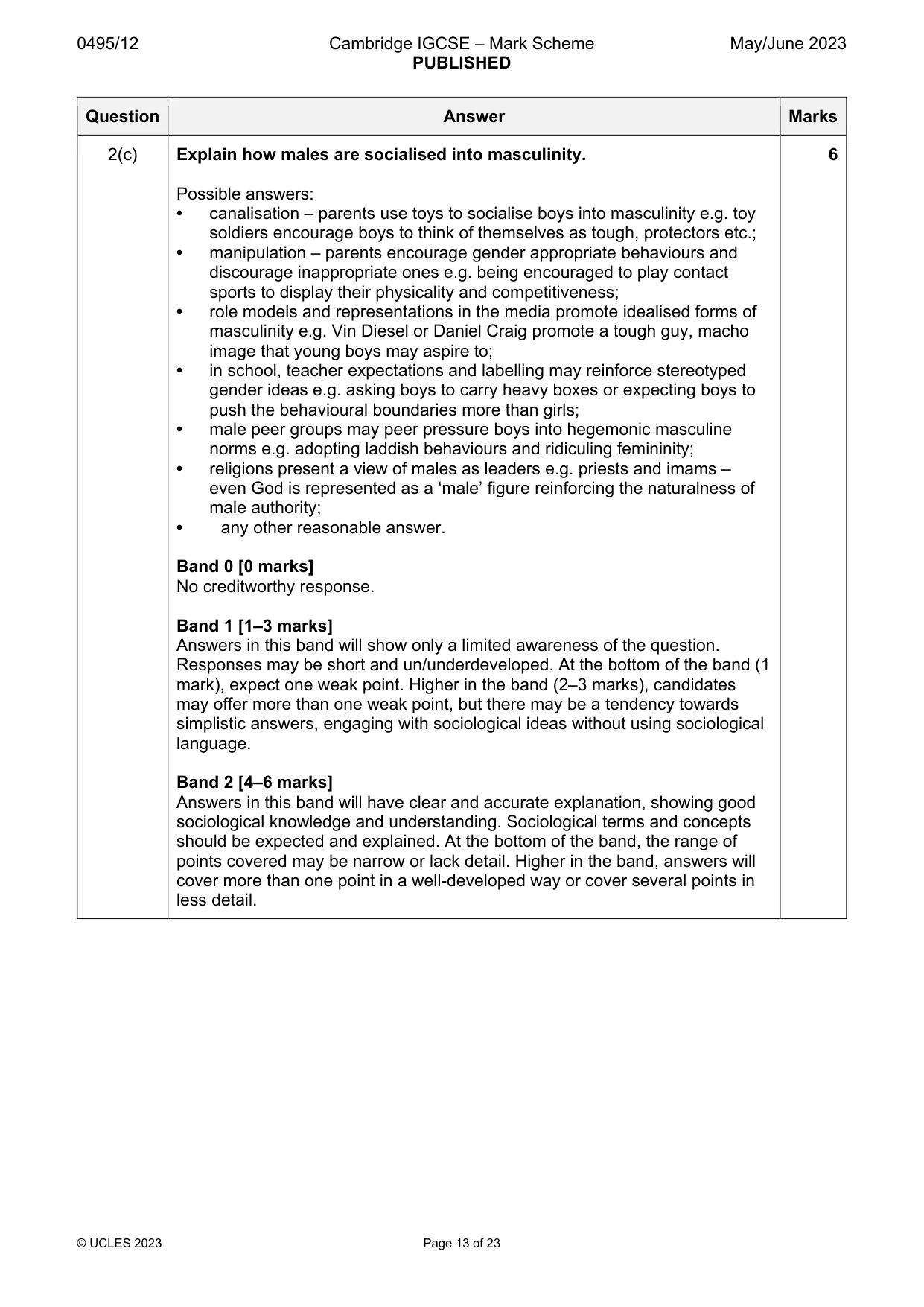
0495/12 Cambridge IGCSE – Mark Scheme PUBLISHED May/June 2023 © UCLES 2023 Page 13 of 23 Question Answer Marks 2(c) Explain how males are socialised into masculinity. Possible answers: • canalisation – parents use toys to socialise boys into masculinity e.g. toy soldiers encourage boys to think of themselves as tough, protectors etc.; • manipulation – parents encourage gender appropriate behaviours and discourage inappropriate ones e.g. being encouraged to play contact sports to display their physicality and competitiveness; • role models and representations in the media promote idealised forms of masculinity e.g. Vin Diesel or Daniel Craig promote a tough guy, macho image that young boys may aspire to; • in school, teacher expectations and labelling may reinforce stereotyped gender ideas e.g. asking boys to carry heavy boxes or expecting boys to push the behavioural boundaries more than girls; • male peer groups may peer pressure boys into hegemonic masculine norms e.g. adopting laddish behaviours and ridiculing femininity; • religions present a view of males as leaders e.g. priests and imams – even God is represented as a ‘male’ figure reinforcing the naturalness of male authority; • any other reasonable answer. Band 0 [0 marks] No creditworthy response. Band 1 [1–3 marks] Answers in this band will show only a limited awareness of the question. Responses may be short and un/underdeveloped. At the bottom of the band (1 mark), expect one weak point. Higher in the band (2–3 marks), candidates may offer more than one weak point, but there may be a tendency towards simplistic answers, engaging with sociological ideas without using sociological language. Band 2 [4–6 marks] Answers in this band will have clear and accurate explanation, showing good sociological knowledge and understanding. Sociological terms and concepts should be expected and explained. At the bottom of the band, the range of points covered may be narrow or lack detail. Higher in the band, answers will cover more than one point in a well-developed way or cover several points in less detail. 6
Mark scheme, page 14
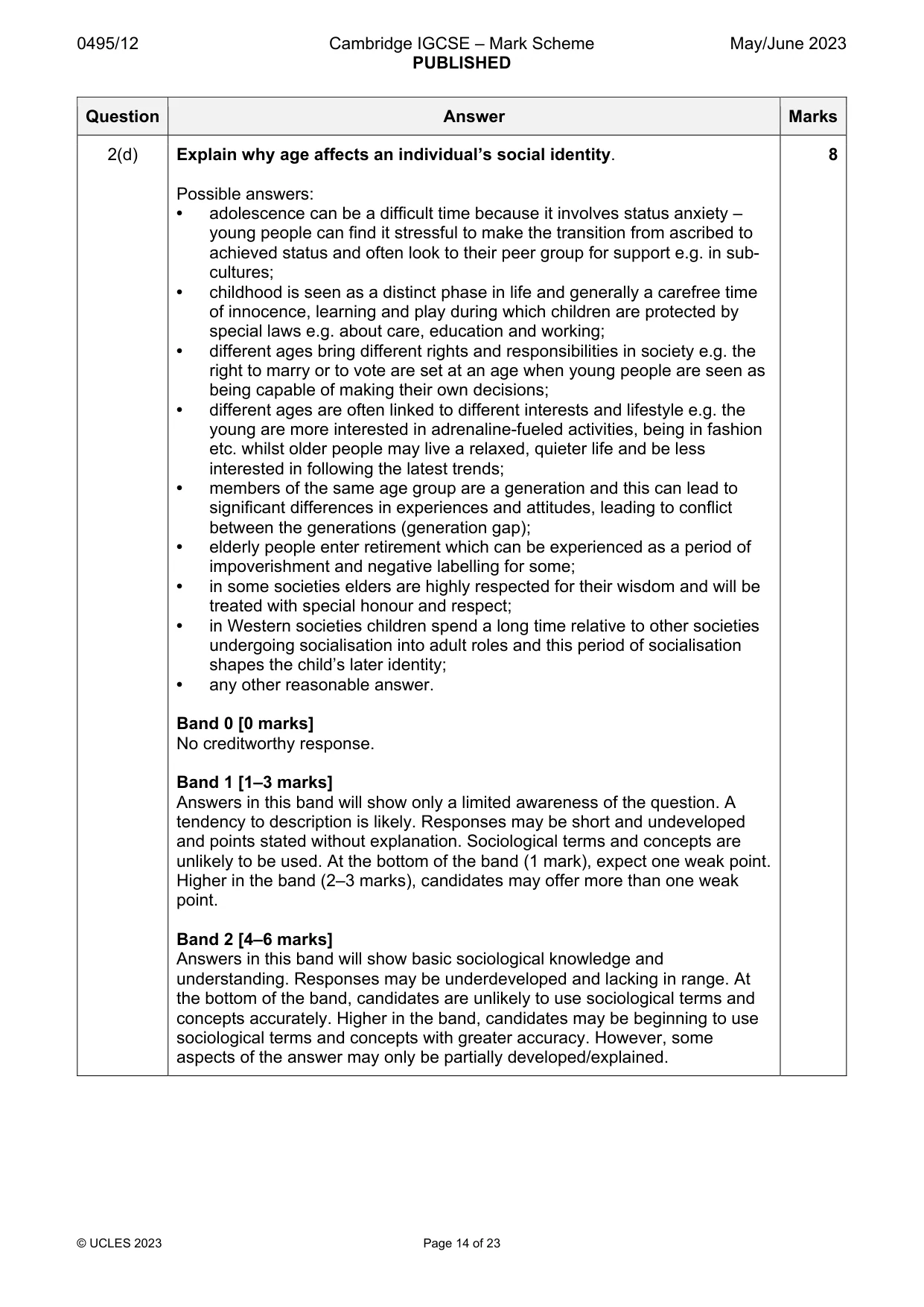
0495/12 Cambridge IGCSE – Mark Scheme PUBLISHED May/June 2023 © UCLES 2023 Page 14 of 23 Question Answer Marks 2(d) Explain why age affects an individual’s social identity. Possible answers: • adolescence can be a difficult time because it involves status anxiety – young people can find it stressful to make the transition from ascribed to achieved status and often look to their peer group for support e.g. in sub- cultures; • childhood is seen as a distinct phase in life and generally a carefree time of innocence, learning and play during which children are protected by special laws e.g. about care, education and working; • different ages bring different rights and responsibilities in society e.g. the right to marry or to vote are set at an age when young people are seen as being capable of making their own decisions; • different ages are often linked to different interests and lifestyle e.g. the young are more interested in adrenaline-fueled activities, being in fashion etc. whilst older people may live a relaxed, quieter life and be less interested in following the latest trends; • members of the same age group are a generation and this can lead to significant differences in experiences and attitudes, leading to conflict between the generations (generation gap); • elderly people enter retirement which can be experienced as a period of impoverishment and negative labelling for some; • in some societies elders are highly respected for their wisdom and will be treated with special honour and respect; • in Western societies children spend a long time relative to other societies undergoing socialisation into adult roles and this period of socialisation shapes the child’s later identity; • any other reasonable answer. Band 0 [0 marks] No creditworthy response. Band 1 [1–3 marks] Answers in this band will show only a limited awareness of the question. A tendency to description is likely. Responses may be short and undeveloped and points stated without explanation. Sociological terms and concepts are unlikely to be used. At the bottom of the band (1 mark), expect one weak point. Higher in the band (2–3 marks), candidates may offer more than one weak point. Band 2 [4–6 marks] Answers in this band will show basic sociological knowledge and understanding. Responses may be underdeveloped and lacking in range. At the bottom of the band, candidates are unlikely to use sociological terms and concepts accurately. Higher in the band, candidates may be beginning to use sociological terms and concepts with greater accuracy. However, some aspects of the answer may only be partially developed/explained. 8
Mark scheme, page 15
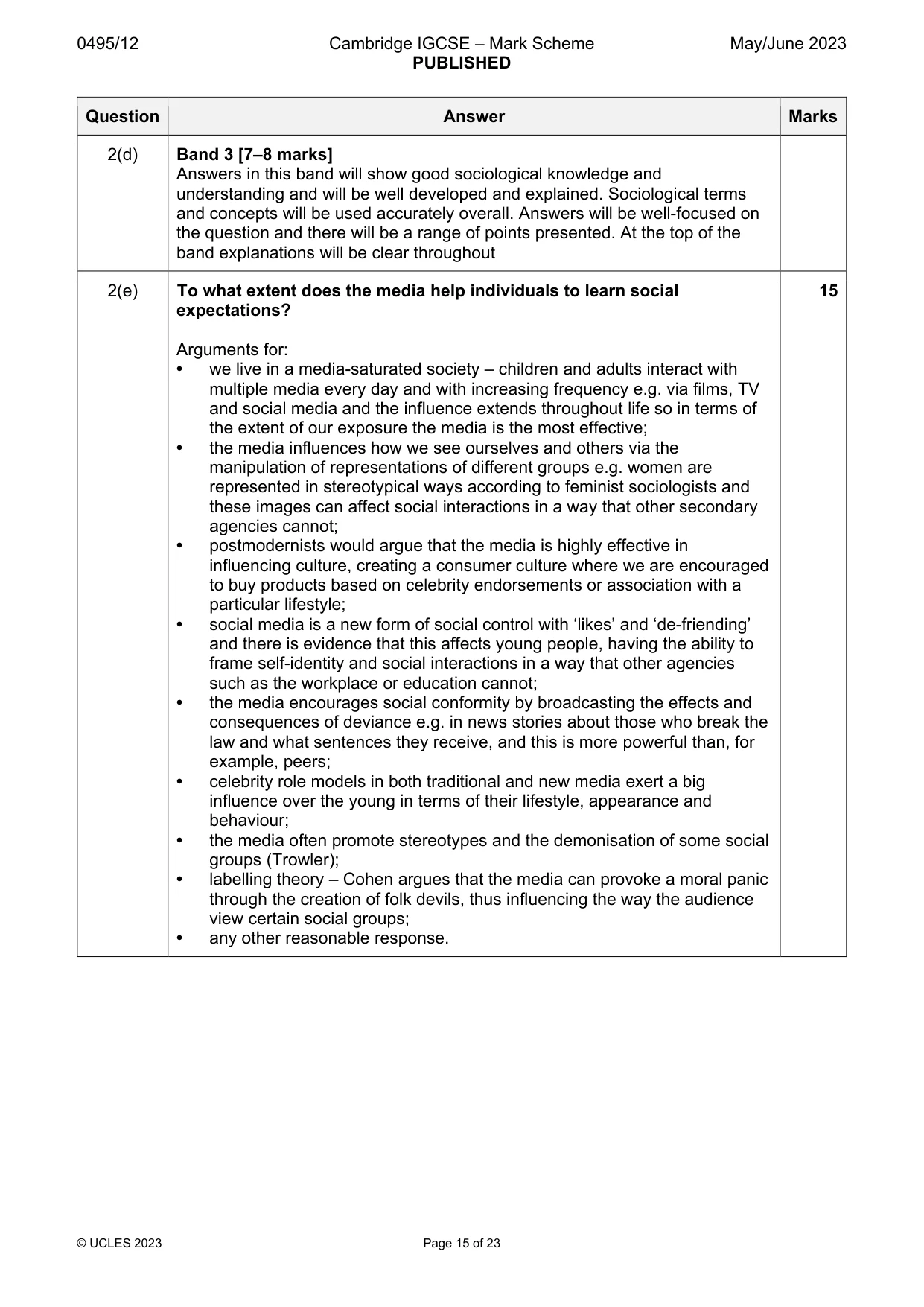
0495/12 Cambridge IGCSE – Mark Scheme PUBLISHED May/June 2023 © UCLES 2023 Page 15 of 23 Question Answer Marks 2(d) Band 3 [7–8 marks] Answers in this band will show good sociological knowledge and understanding and will be well developed and explained. Sociological terms and concepts will be used accurately overall. Answers will be well-focused on the question and there will be a range of points presented. At the top of the band explanations will be clear throughout 2(e) To what extent does the media help individuals to learn social expectations? Arguments for: • we live in a media-saturated society – children and adults interact with multiple media every day and with increasing frequency e.g. via films, TV and social media and the influence extends throughout life so in terms of the extent of our exposure the media is the most effective; • the media influences how we see ourselves and others via the manipulation of representations of different groups e.g. women are represented in stereotypical ways according to feminist sociologists and these images can affect social interactions in a way that other secondary agencies cannot; • postmodernists would argue that the media is highly effective in influencing culture, creating a consumer culture where we are encouraged to buy products based on celebrity endorsements or association with a particular lifestyle; • social media is a new form of social control with ‘likes’ and ‘de-friending’ and there is evidence that this affects young people, having the ability to frame self-identity and social interactions in a way that other agencies such as the workplace or education cannot; • the media encourages social conformity by broadcasting the effects and consequences of deviance e.g. in news stories about those who break the law and what sentences they receive, and this is more powerful than, for example, peers; • celebrity role models in both traditional and new media exert a big influence over the young in terms of their lifestyle, appearance and behaviour; • the media often promote stereotypes and the demonisation of some social groups (Trowler); • labelling theory – Cohen argues that the media can provoke a moral panic through the creation of folk devils, thus influencing the way the audience view certain social groups; • any other reasonable response. 15
Mark scheme, page 16
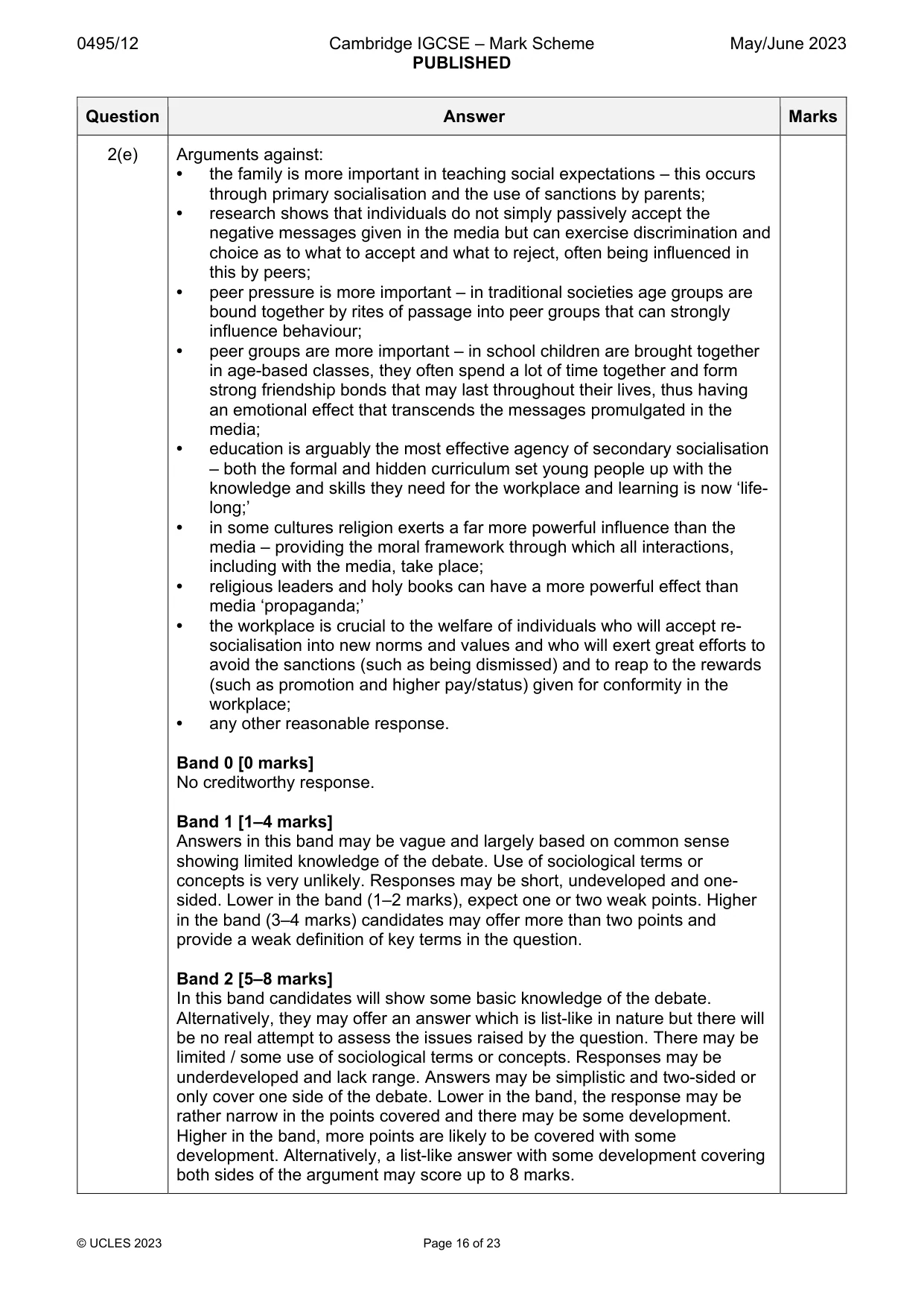
0495/12 Cambridge IGCSE – Mark Scheme PUBLISHED May/June 2023 © UCLES 2023 Page 16 of 23 Question Answer Marks 2(e) Arguments against: • the family is more important in teaching social expectations – this occurs through primary socialisation and the use of sanctions by parents; • research shows that individuals do not simply passively accept the negative messages given in the media but can exercise discrimination and choice as to what to accept and what to reject, often being influenced in this by peers; • peer pressure is more important – in traditional societies age groups are bound together by rites of passage into peer groups that can strongly influence behaviour; • peer groups are more important – in school children are brought together in age-based classes, they often spend a lot of time together and form strong friendship bonds that may last throughout their lives, thus having an emotional effect that transcends the messages promulgated in the media; • education is arguably the most effective agency of secondary socialisation – both the formal and hidden curriculum set young people up with the knowledge and skills they need for the workplace and learning is now ‘life- long;’ • in some cultures religion exerts a far more powerful influence than the media – providing the moral framework through which all interactions, including with the media, take place; • religious leaders and holy books can have a more powerful effect than media ‘propaganda;’ • the workplace is crucial to the welfare of individuals who will accept re- socialisation into new norms and values and who will exert great efforts to avoid the sanctions (such as being dismissed) and to reap to the rewards (such as promotion and higher pay/status) given for conformity in the workplace; • any other reasonable response. Band 0 [0 marks] No creditworthy response. Band 1 [1–4 marks] Answers in this band may be vague and largely based on common sense showing limited knowledge of the debate. Use of sociological terms or concepts is very unlikely. Responses may be short, undeveloped and one- sided. Lower in the band (1–2 marks), expect one or two weak points. Higher in the band (3–4 marks) candidates may offer more than two points and provide a weak definition of key terms in the question. Band 2 [5–8 marks] In this band candidates will show some basic knowledge of the debate. Alternatively, they may offer an answer which is list-like in nature but there will be no real attempt to assess the issues raised by the question. There may be limited / some use of sociological terms or concepts. Responses may be underdeveloped and lack range. Answers may be simplistic and two-sided or only cover one side of the debate. Lower in the band, the response may be rather narrow in the points covered and there may be some development. Higher in the band, more points are likely to be covered with some development. Alternatively, a list-like answer with some development covering both sides of the argument may score up to 8 marks.
Mark scheme, page 17
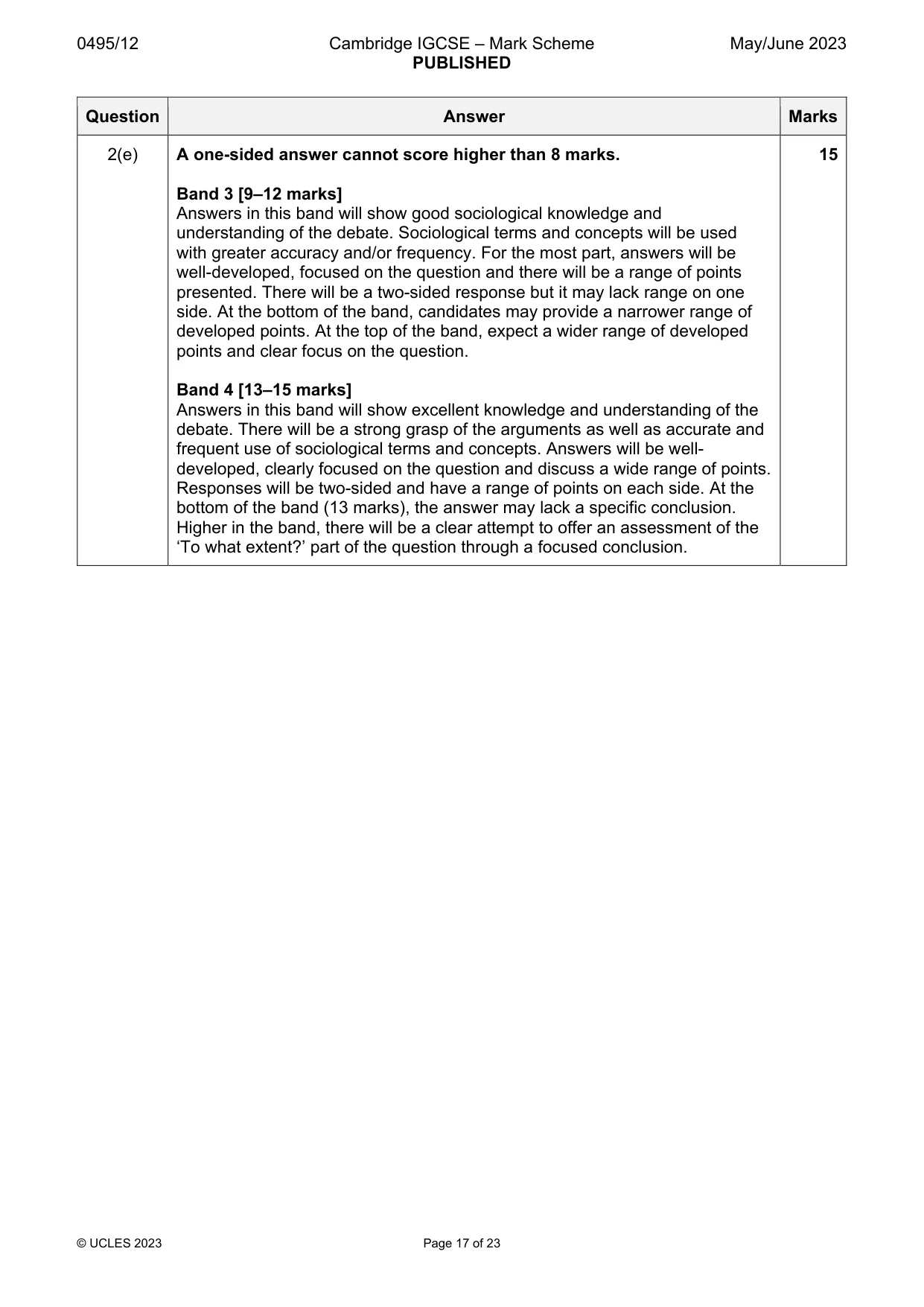
0495/12 Cambridge IGCSE – Mark Scheme PUBLISHED May/June 2023 © UCLES 2023 Page 17 of 23 Question Answer Marks 2(e) A one-sided answer cannot score higher than 8 marks. Band 3 [9–12 marks] Answers in this band will show good sociological knowledge and understanding of the debate. Sociological terms and concepts will be used with greater accuracy and/or frequency. For the most part, answers will be well-developed, focused on the question and there will be a range of points presented. There will be a two-sided response but it may lack range on one side. At the bottom of the band, candidates may provide a narrower range of developed points. At the top of the band, expect a wider range of developed points and clear focus on the question. Band 4 [13–15 marks] Answers in this band will show excellent knowledge and understanding of the debate. There will be a strong grasp of the arguments as well as accurate and frequent use of sociological terms and concepts. Answers will be well- developed, clearly focused on the question and discuss a wide range of points. Responses will be two-sided and have a range of points on each side. At the bottom of the band (13 marks), the answer may lack a specific conclusion. Higher in the band, there will be a clear attempt to offer an assessment of the ‘To what extent?’ part of the question through a focused conclusion. 15
Mark scheme, page 18
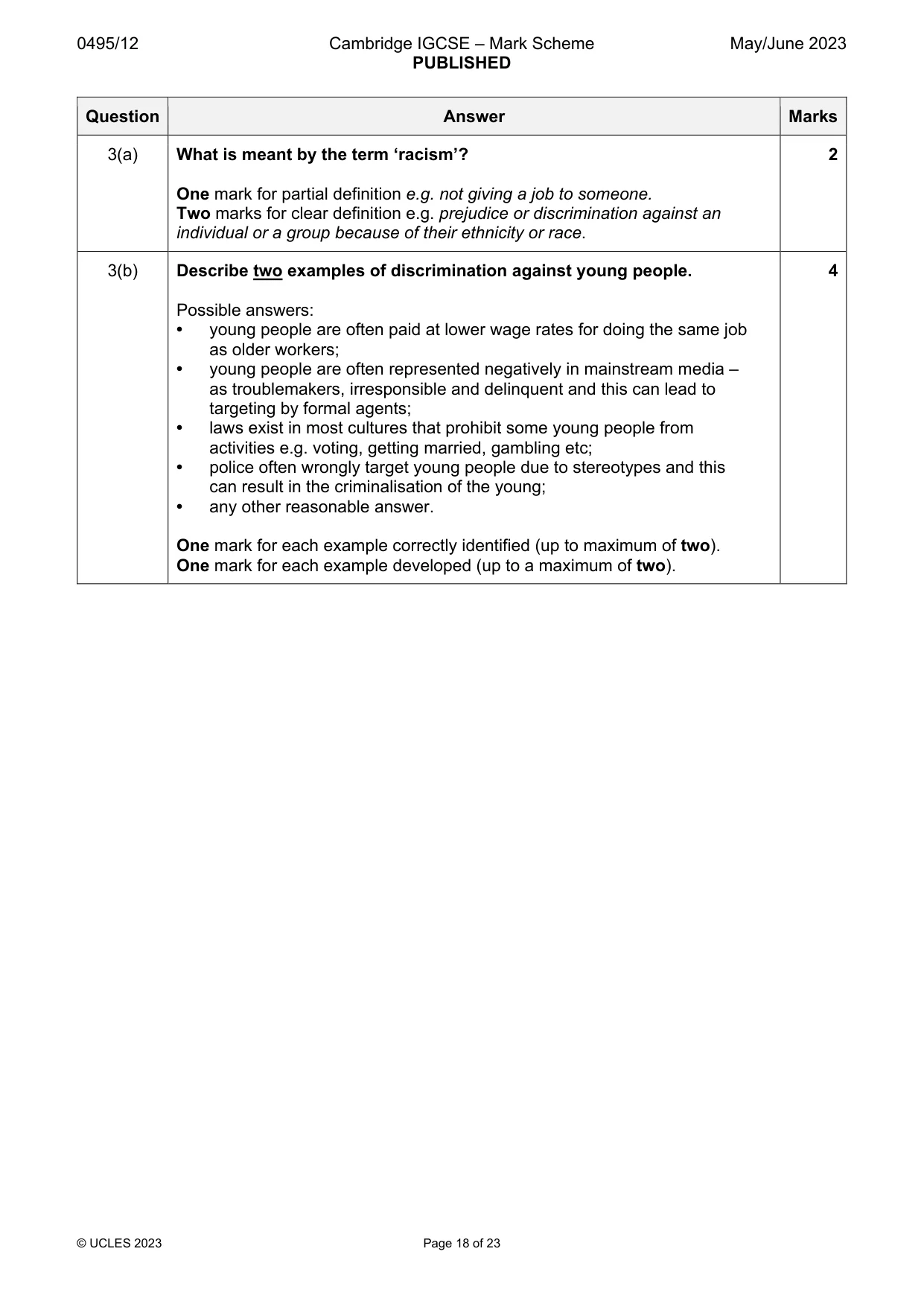
0495/12 Cambridge IGCSE – Mark Scheme PUBLISHED May/June 2023 © UCLES 2023 Page 18 of 23 Question Answer Marks 3(a) What is meant by the term ‘racism’? One mark for partial definition e.g. not giving a job to someone. Two marks for clear definition e.g. prejudice or discrimination against an individual or a group because of their ethnicity or race. 2 3(b) Describe two examples of discrimination against young people. Possible answers: • young people are often paid at lower wage rates for doing the same job as older workers; • young people are often represented negatively in mainstream media – as troublemakers, irresponsible and delinquent and this can lead to targeting by formal agents; • laws exist in most cultures that prohibit some young people from activities e.g. voting, getting married, gambling etc; • police often wrongly target young people due to stereotypes and this can result in the criminalisation of the young; • any other reasonable answer. One mark for each example correctly identified (up to maximum of two). One mark for each example developed (up to a maximum of two). 4
Mark scheme, page 19
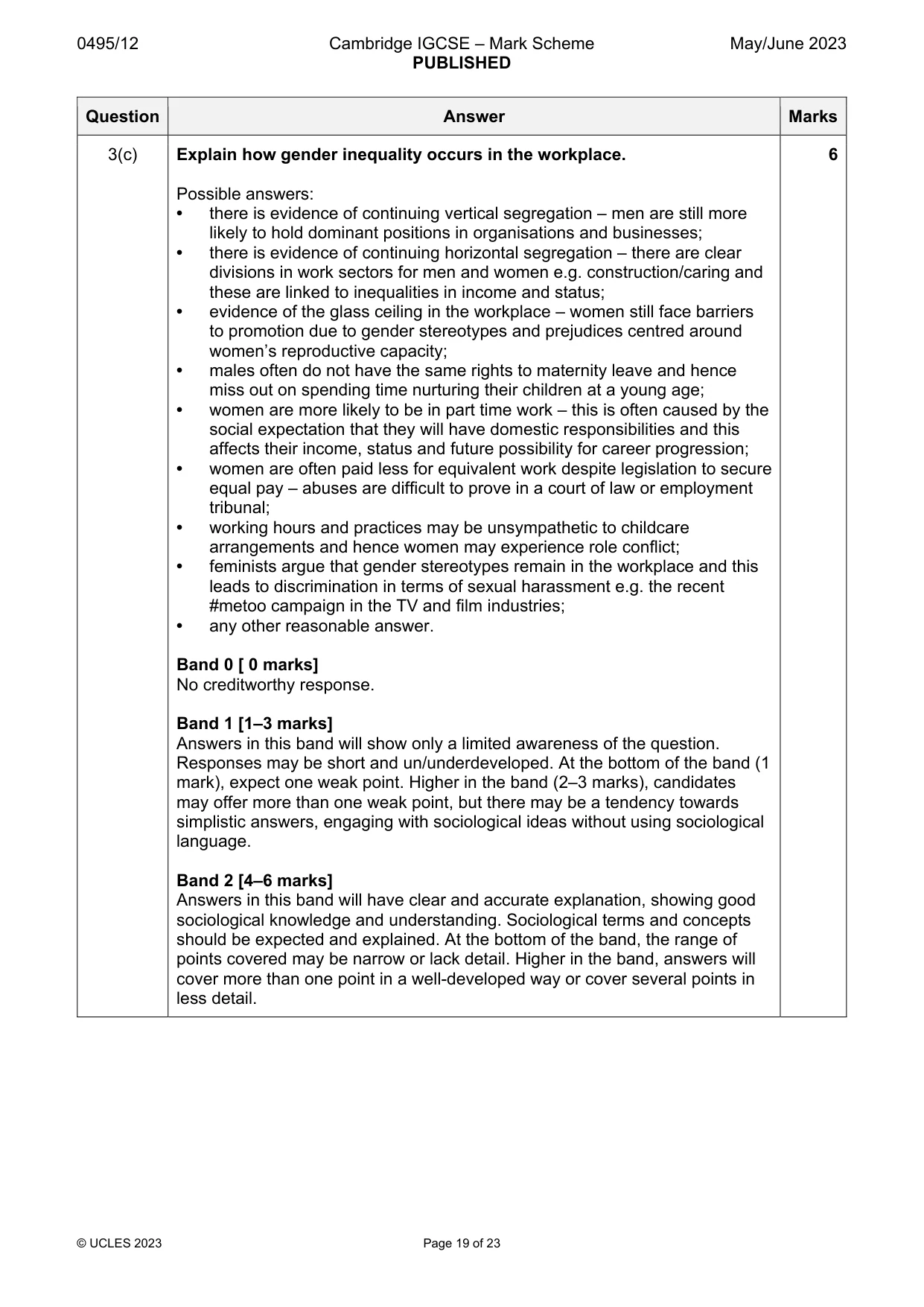
0495/12 Cambridge IGCSE – Mark Scheme PUBLISHED May/June 2023 © UCLES 2023 Page 19 of 23 Question Answer Marks 3(c) Explain how gender inequality occurs in the workplace. Possible answers: • there is evidence of continuing vertical segregation – men are still more likely to hold dominant positions in organisations and businesses; • there is evidence of continuing horizontal segregation – there are clear divisions in work sectors for men and women e.g. construction/caring and these are linked to inequalities in income and status; • evidence of the glass ceiling in the workplace – women still face barriers to promotion due to gender stereotypes and prejudices centred around women’s reproductive capacity; • males often do not have the same rights to maternity leave and hence miss out on spending time nurturing their children at a young age; • women are more likely to be in part time work – this is often caused by the social expectation that they will have domestic responsibilities and this affects their income, status and future possibility for career progression; • women are often paid less for equivalent work despite legislation to secure equal pay – abuses are difficult to prove in a court of law or employment tribunal; • working hours and practices may be unsympathetic to childcare arrangements and hence women may experience role conflict; • feminists argue that gender stereotypes remain in the workplace and this leads to discrimination in terms of sexual harassment e.g. the recent #metoo campaign in the TV and film industries; • any other reasonable answer. Band 0 [ 0 marks] No creditworthy response. Band 1 [1–3 marks] Answers in this band will show only a limited awareness of the question. Responses may be short and un/underdeveloped. At the bottom of the band (1 mark), expect one weak point. Higher in the band (2–3 marks), candidates may offer more than one weak point, but there may be a tendency towards simplistic answers, engaging with sociological ideas without using sociological language. Band 2 [4–6 marks] Answers in this band will have clear and accurate explanation, showing good sociological knowledge and understanding. Sociological terms and concepts should be expected and explained. At the bottom of the band, the range of points covered may be narrow or lack detail. Higher in the band, answers will cover more than one point in a well-developed way or cover several points in less detail. 6
Mark scheme, page 20
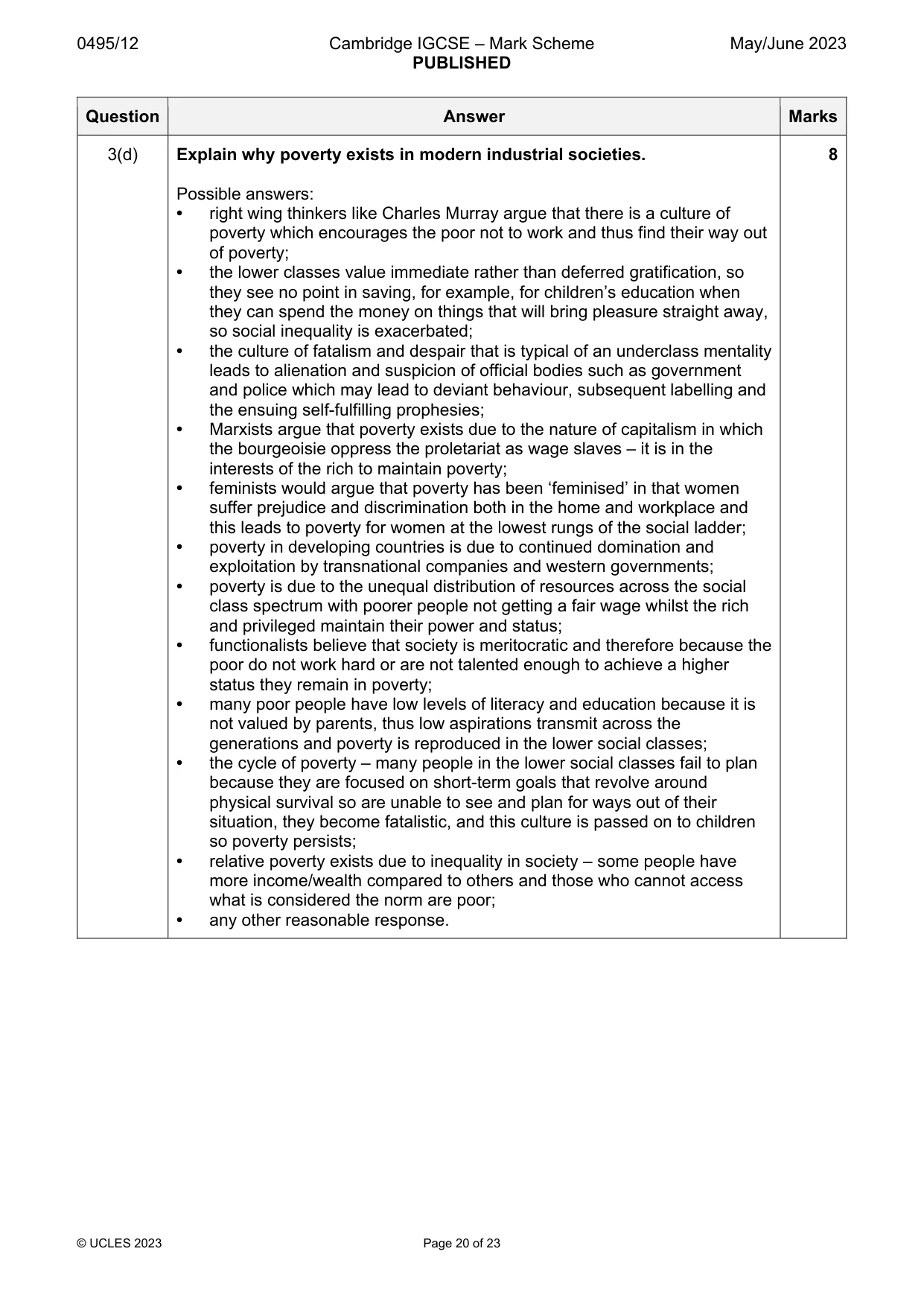
0495/12 Cambridge IGCSE – Mark Scheme PUBLISHED May/June 2023 © UCLES 2023 Page 20 of 23 Question Answer Marks 3(d) Explain why poverty exists in modern industrial societies. Possible answers: • right wing thinkers like Charles Murray argue that there is a culture of poverty which encourages the poor not to work and thus find their way out of poverty; • the lower classes value immediate rather than deferred gratification, so they see no point in saving, for example, for children’s education when they can spend the money on things that will bring pleasure straight away, so social inequality is exacerbated; • the culture of fatalism and despair that is typical of an underclass mentality leads to alienation and suspicion of official bodies such as government and police which may lead to deviant behaviour, subsequent labelling and the ensuing self-fulfilling prophesies; • Marxists argue that poverty exists due to the nature of capitalism in which the bourgeoisie oppress the proletariat as wage slaves – it is in the interests of the rich to maintain poverty; • feminists would argue that poverty has been ‘feminised’ in that women suffer prejudice and discrimination both in the home and workplace and this leads to poverty for women at the lowest rungs of the social ladder; • poverty in developing countries is due to continued domination and exploitation by transnational companies and western governments; • poverty is due to the unequal distribution of resources across the social class spectrum with poorer people not getting a fair wage whilst the rich and privileged maintain their power and status; • functionalists believe that society is meritocratic and therefore because the poor do not work hard or are not talented enough to achieve a higher status they remain in poverty; • many poor people have low levels of literacy and education because it is not valued by parents, thus low aspirations transmit across the generations and poverty is reproduced in the lower social classes; • the cycle of poverty – many people in the lower social classes fail to plan because they are focused on short-term goals that revolve around physical survival so are unable to see and plan for ways out of their situation, they become fatalistic, and this culture is passed on to children so poverty persists; • relative poverty exists due to inequality in society – some people have more income/wealth compared to others and those who cannot access what is considered the norm are poor; • any other reasonable response. 8
Mark scheme, page 21
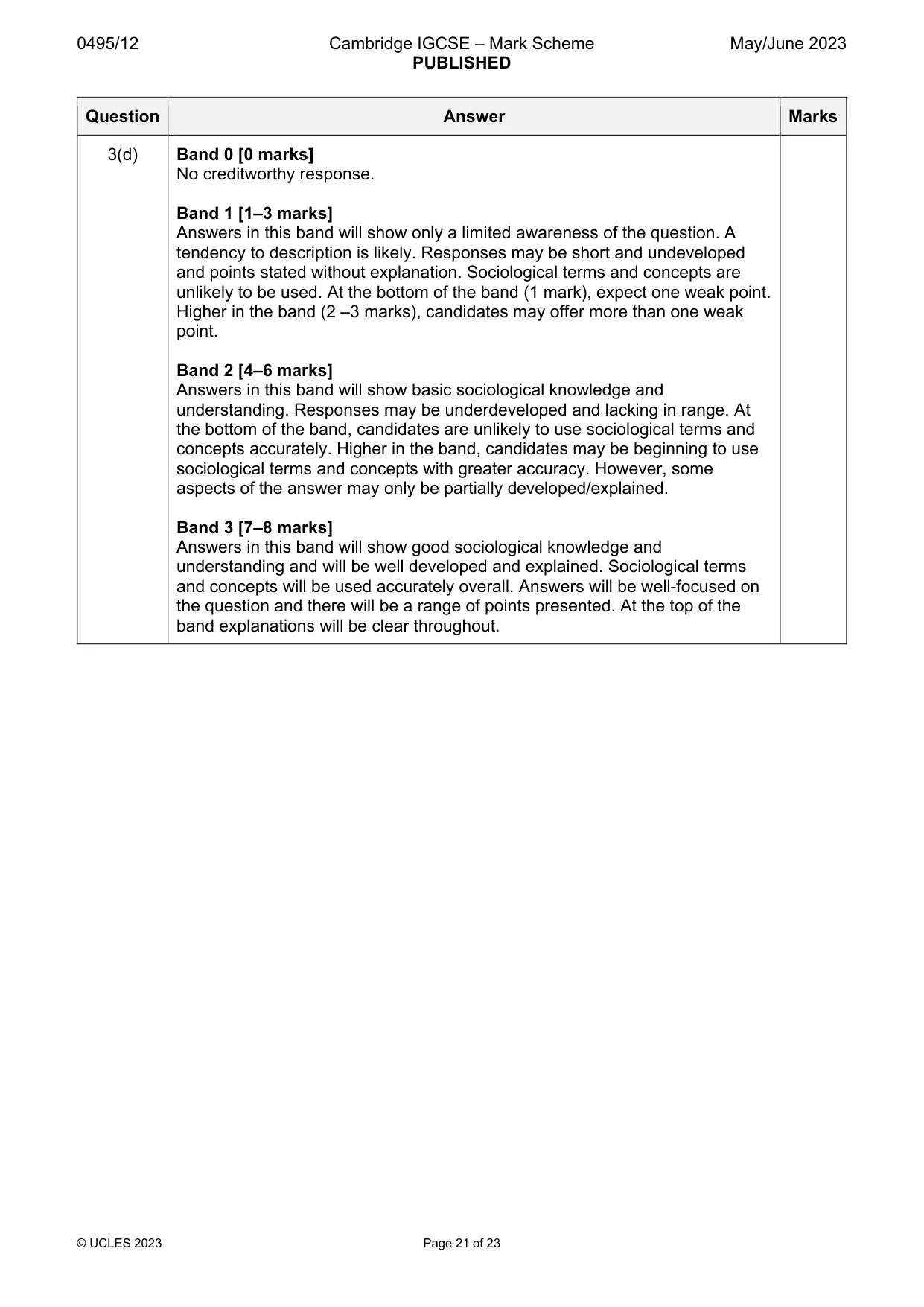
0495/12 Cambridge IGCSE – Mark Scheme PUBLISHED May/June 2023 © UCLES 2023 Page 21 of 23 Question Answer Marks 3(d) Band 0 [0 marks] No creditworthy response. Band 1 [1–3 marks] Answers in this band will show only a limited awareness of the question. A tendency to description is likely. Responses may be short and undeveloped and points stated without explanation. Sociological terms and concepts are unlikely to be used. At the bottom of the band (1 mark), expect one weak point. Higher in the band (2 –3 marks), candidates may offer more than one weak point. Band 2 [4–6 marks] Answers in this band will show basic sociological knowledge and understanding. Responses may be underdeveloped and lacking in range. At the bottom of the band, candidates are unlikely to use sociological terms and concepts accurately. Higher in the band, candidates may be beginning to use sociological terms and concepts with greater accuracy. However, some aspects of the answer may only be partially developed/explained. Band 3 [7–8 marks] Answers in this band will show good sociological knowledge and understanding and will be well developed and explained. Sociological terms and concepts will be used accurately overall. Answers will be well-focused on the question and there will be a range of points presented. At the top of the band explanations will be clear throughout.
Mark scheme, page 22
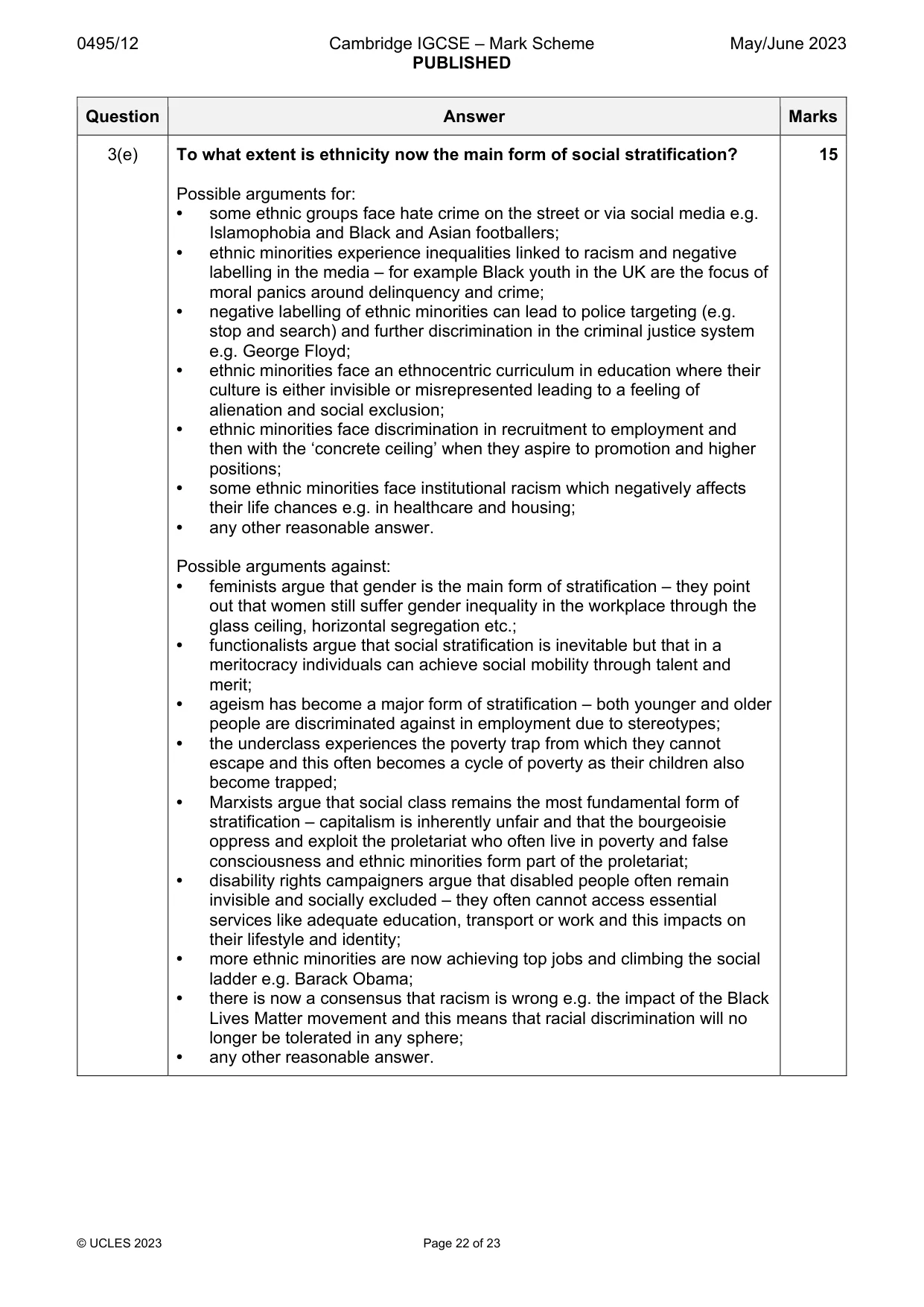
0495/12 Cambridge IGCSE – Mark Scheme PUBLISHED May/June 2023 © UCLES 2023 Page 22 of 23 Question Answer Marks 3(e) To what extent is ethnicity now the main form of social stratification? Possible arguments for: • some ethnic groups face hate crime on the street or via social media e.g. Islamophobia and Black and Asian footballers; • ethnic minorities experience inequalities linked to racism and negative labelling in the media – for example Black youth in the UK are the focus of moral panics around delinquency and crime; • negative labelling of ethnic minorities can lead to police targeting (e.g. stop and search) and further discrimination in the criminal justice system e.g. George Floyd; • ethnic minorities face an ethnocentric curriculum in education where their culture is either invisible or misrepresented leading to a feeling of alienation and social exclusion; • ethnic minorities face discrimination in recruitment to employment and then with the ‘concrete ceiling’ when they aspire to promotion and higher positions; • some ethnic minorities face institutional racism which negatively affects their life chances e.g. in healthcare and housing; • any other reasonable answer. Possible arguments against: • feminists argue that gender is the main form of stratification – they point out that women still suffer gender inequality in the workplace through the glass ceiling, horizontal segregation etc.; • functionalists argue that social stratification is inevitable but that in a meritocracy individuals can achieve social mobility through talent and merit; • ageism has become a major form of stratification – both younger and older people are discriminated against in employment due to stereotypes; • the underclass experiences the poverty trap from which they cannot escape and this often becomes a cycle of poverty as their children also become trapped; • Marxists argue that social class remains the most fundamental form of stratification – capitalism is inherently unfair and that the bourgeoisie oppress and exploit the proletariat who often live in poverty and false consciousness and ethnic minorities form part of the proletariat; • disability rights campaigners argue that disabled people often remain invisible and socially excluded – they often cannot access essential services like adequate education, transport or work and this impacts on their lifestyle and identity; • more ethnic minorities are now achieving top jobs and climbing the social ladder e.g. Barack Obama; • there is now a consensus that racism is wrong e.g. the impact of the Black Lives Matter movement and this means that racial discrimination will no longer be tolerated in any sphere; • any other reasonable answer. 15
Mark scheme, page 23
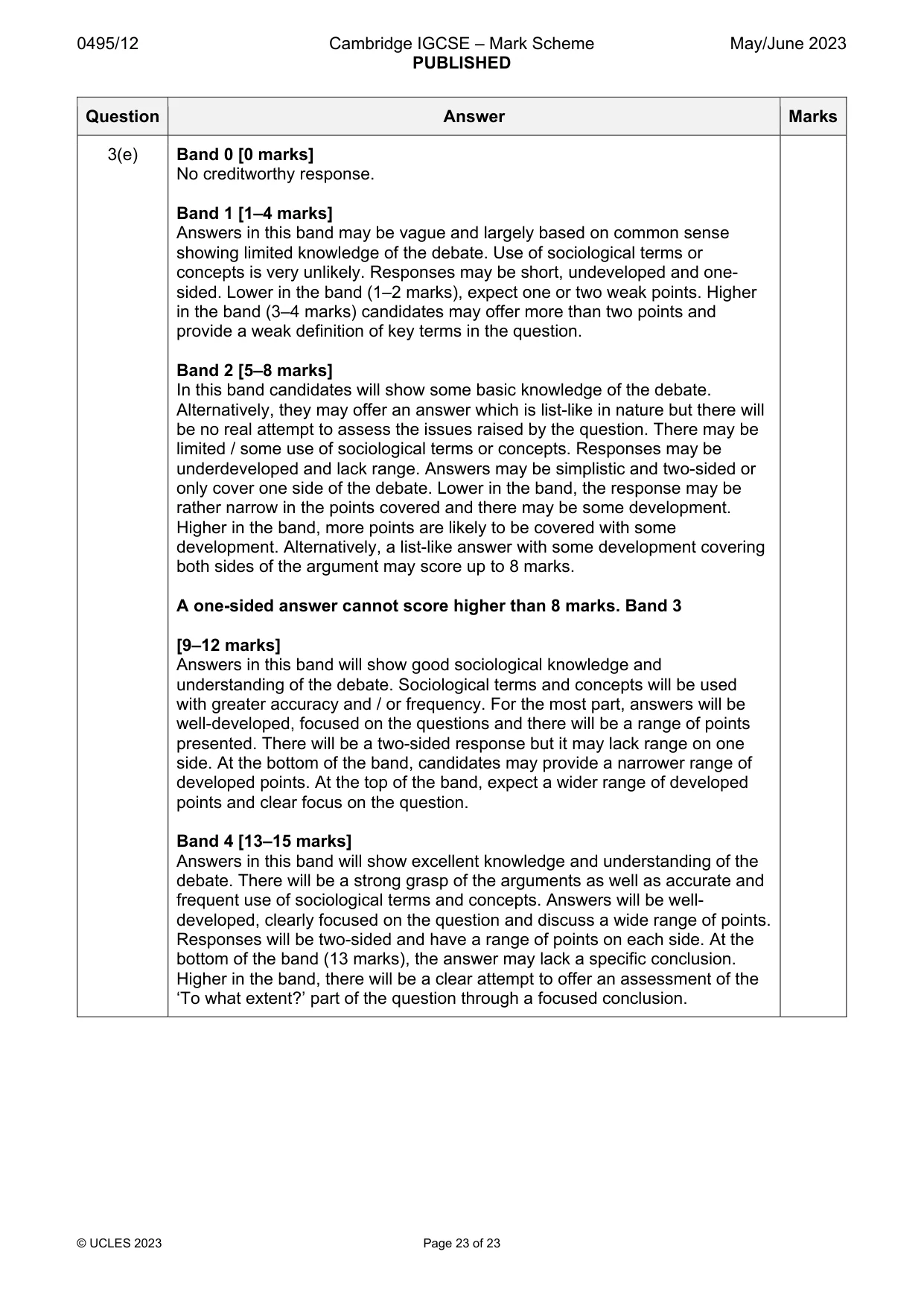
0495/12 Cambridge IGCSE – Mark Scheme PUBLISHED May/June 2023 © UCLES 2023 Page 23 of 23 Question Answer Marks 3(e) Band 0 [0 marks] No creditworthy response. Band 1 [1–4 marks] Answers in this band may be vague and largely based on common sense showing limited knowledge of the debate. Use of sociological terms or concepts is very unlikely. Responses may be short, undeveloped and one- sided. Lower in the band (1–2 marks), expect one or two weak points. Higher in the band (3–4 marks) candidates may offer more than two points and provide a weak definition of key terms in the question. Band 2 [5–8 marks] In this band candidates will show some basic knowledge of the debate. Alternatively, they may offer an answer which is list-like in nature but there will be no real attempt to assess the issues raised by the question. There may be limited / some use of sociological terms or concepts. Responses may be underdeveloped and lack range. Answers may be simplistic and two-sided or only cover one side of the debate. Lower in the band, the response may be rather narrow in the points covered and there may be some development. Higher in the band, more points are likely to be covered with some development. Alternatively, a list-like answer with some development covering both sides of the argument may score up to 8 marks. A one-sided answer cannot score higher than 8 marks. Band 3 [9–12 marks] Answers in this band will show good sociological knowledge and understanding of the debate. Sociological terms and concepts will be used with greater accuracy and / or frequency. For the most part, answers will be well-developed, focused on the questions and there will be a range of points presented. There will be a two-sided response but it may lack range on one side. At the bottom of the band, candidates may provide a narrower range of developed points. At the top of the band, expect a wider range of developed points and clear focus on the question. Band 4 [13–15 marks] Answers in this band will show excellent knowledge and understanding of the debate. There will be a strong grasp of the arguments as well as accurate and frequent use of sociological terms and concepts. Answers will be well- developed, clearly focused on the question and discuss a wide range of points. Responses will be two-sided and have a range of points on each side. At the bottom of the band (13 marks), the answer may lack a specific conclusion. Higher in the band, there will be a clear attempt to offer an assessment of the ‘To what extent?’ part of the question through a focused conclusion.
What you needed in this session
Cambridge’s own grade thresholds for 2023 May/June, Paper 1 · Variant 2. A higher threshold means an easier paper — the bar moves with how the cohort did.