Cambridge IGCSE Sociology 0495 — 2024 May/June Paper 1 · Variant 2
0495/12/M/J/24 · 80 marks · ≈90 min
The question paper and its mark scheme, free to read here and free to download. This is Cambridge’s own paper, exactly as it was sat.
Question paper4 pages

Mark scheme23 pages
Answers below. Sit the paper first if you are practising.


Paper as text
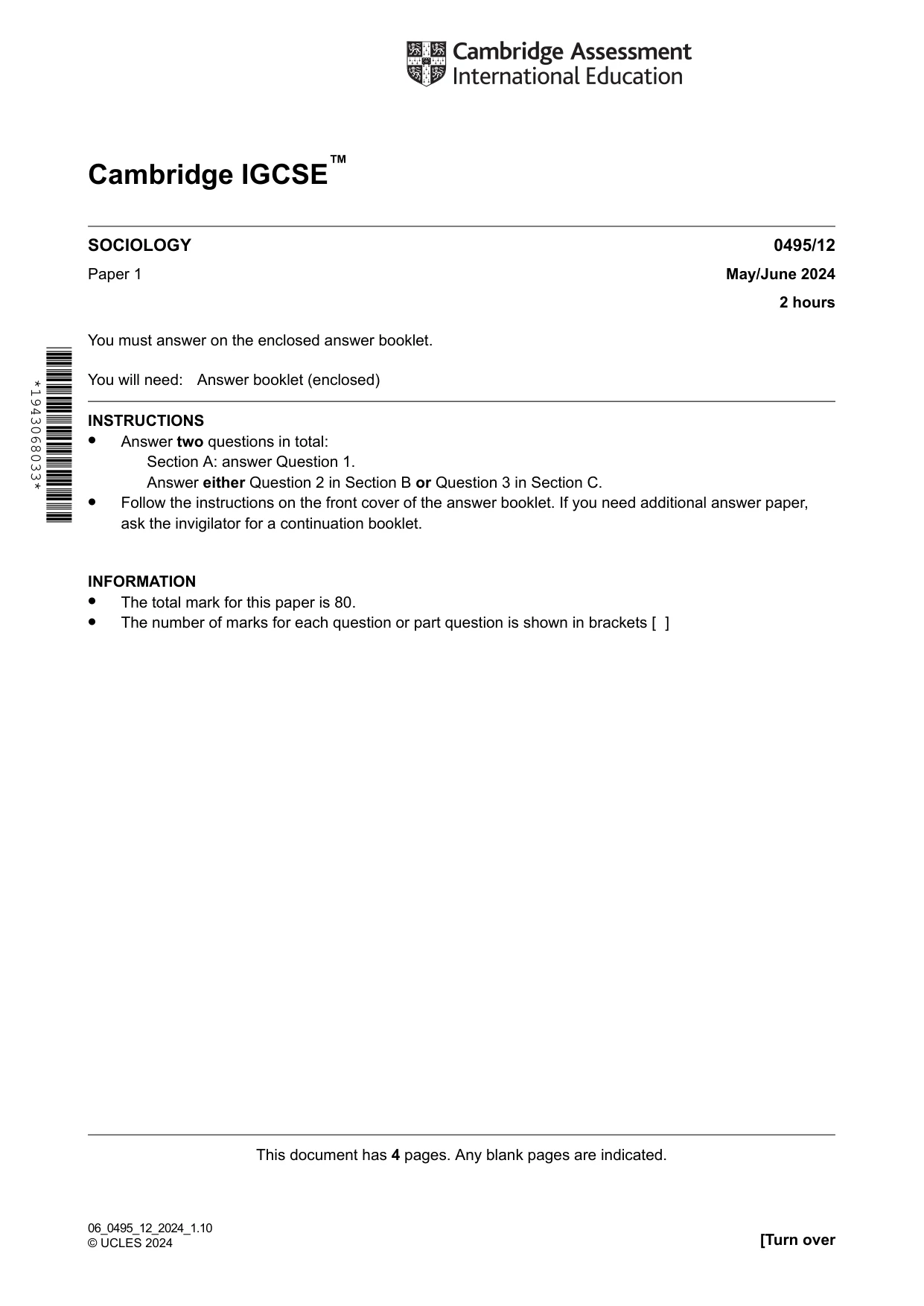
Question paper, page 1
Cambridge IGCSE™ 0495/12 SOCIOLOGY May/June 2024 Paper 1 2 hours You must answer on the enclosed answer booklet. You will need: Answer booklet (enclosed) INSTRUCTIONS • Answer two questions in total: Section A: answer Question 1. Answer either Question 2 in Section B or Question 3 in Section C. • Follow the instructions on the front cover of the answer booklet. If you need additional answer paper, ask the invigilator for a continuation booklet. INFORMATION • The total mark for this paper is 80. • The number of marks for each question or part question is shown in brackets [ ] This document has 4 pages. Any blank pages are indicated. [Turn over 06_0495_12_2024_1.10 © UCLES 2024 *1943068033*
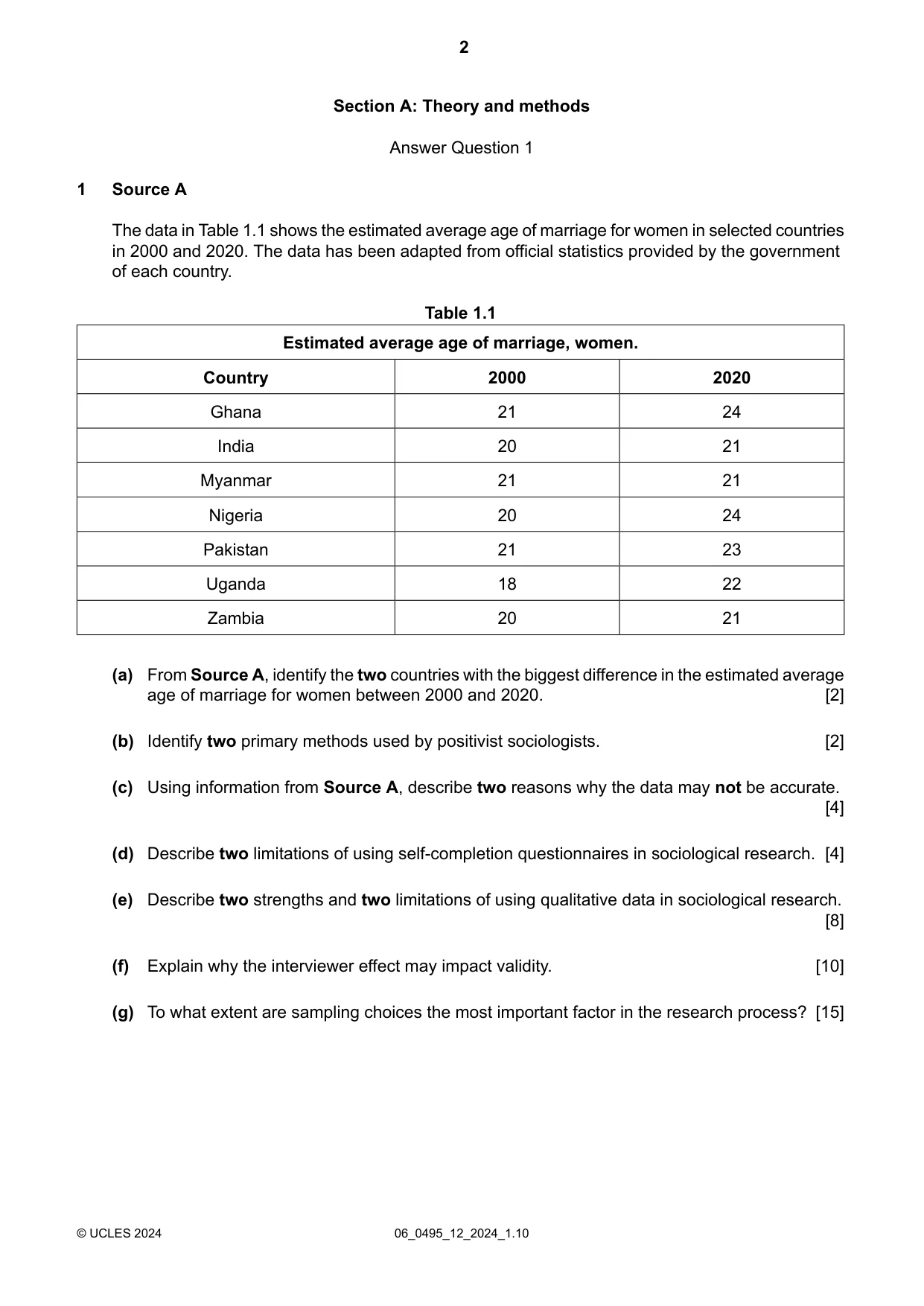
Question paper, page 2
Section A: Theory and methods Answer Question 1 Source A 1 The data in Table 1.1 shows the estimated average age of marriage for women in selected countries in 2000 and 2020. The data has been adapted from official statistics provided by the government of each country. Table 1.1 Estimated average age of marriage, women. 2020 2000 Country 24 21 Ghana 21 20 India 21 21 Myanmar 24 20 Nigeria 23 21 Pakistan 22 18 Uganda 21 20 Zambia From Source A, identify the two countries with the biggest difference in the estimated average age of marriage for women between 2000 and 2020. [2] (a) Identify two primary methods used by positivist sociologists. [2] (b) Using information from Source A, describe two reasons why the data may not be accurate. [4] (c) Describe two limitations of using self-completion questionnaires in sociological research. [4] (d) Describe two strengths and two limitations of using qualitative data in sociological research. [8] (e) Explain why the interviewer effect may impact validity. [10] (f) To what extent are sampling choices the most important factor in the research process? [15] (g) 06_0495_12_2024_1.10 © UCLES 2024 2
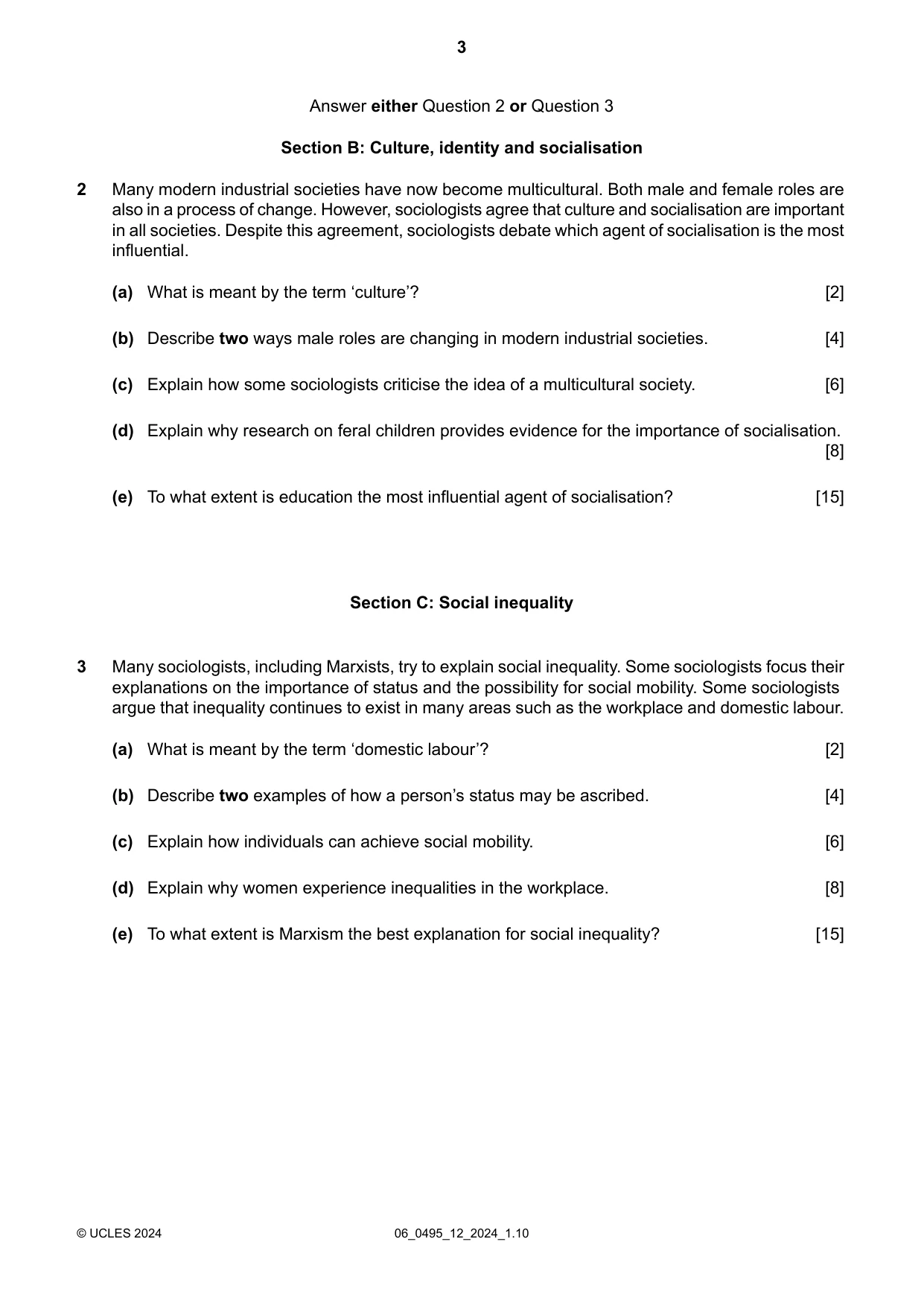
Question paper, page 3
Answer either Question 2 or Question 3 Section B: Culture, identity and socialisation Many modern industrial societies have now become multicultural. Both male and female roles are also in a process of change. However, sociologists agree that culture and socialisation are important 2 in all societies. Despite this agreement, sociologists debate which agent of socialisation is the most influential. What is meant by the term ‘culture’? [2] (a) Describe two ways male roles are changing in modern industrial societies. [4] (b) Explain how some sociologists criticise the idea of a multicultural society. [6] (c) Explain why research on feral children provides evidence for the importance of socialisation. [8] (d) To what extent is education the most influential agent of socialisation? [15] (e) Section C: Social inequality Many sociologists, including Marxists, try to explain social inequality. Some sociologists focus their explanations on the importance of status and the possibility for social mobility. Some sociologists argue that inequality continues to exist in many areas such as the workplace and domestic labour. 3 What is meant by the term ‘domestic labour’? [2] (a) Describe two examples of how a person’s status may be ascribed. [4] (b) Explain how individuals can achieve social mobility. [6] (c) Explain why women experience inequalities in the workplace. [8] (d) To what extent is Marxism the best explanation for social inequality? [15] (e) 06_0495_12_2024_1.10 © UCLES 2024 3
Question paper, page 4
BLANK PAGE Permission to reproduce items where third-party owned material protected by copyright is included has been sought and cleared where possible. Every reasonable effort has been made by the publisher (UCLES) to trace copyright holders, but if any items requiring clearance have unwittingly been included, the publisher will be pleased to make amends at the earliest possible opportunity. To avoid the issue of disclosure of answer-related information to candidates, all copyright acknowledgements are reproduced online in the Cambridge Assessment International Education Copyright Acknowledgements Booklet. This is produced for each series of examinations and is freely available to download at www.cambridgeinternational.org after the live examination series. Cambridge Assessment International Education is part of Cambridge Assessment. Cambridge Assessment is the brand name of the University of Cambridge Local Examinations Syndicate (UCLES), which is a department of the University of Cambridge. 06_0495_12_2024_1.10 © UCLES 2024 4
Mark scheme, page 1
This document consists of 23 printed pages. © Cambridge University Press & Assessment 2024 [Turn over Cambridge IGCSE™ SOCIOLOGY 0495/12 Paper 1 May/June 2024 MARK SCHEME Maximum Mark: 80 Published This mark scheme is published as an aid to teachers and candidates, to indicate the requirements of the examination. It shows the basis on which Examiners were instructed to award marks. It does not indicate the details of the discussions that took place at an Examiners’ meeting before marking began, which would have considered the acceptability of alternative answers. Mark schemes should be read in conjunction with the question paper and the Principal Examiner Report for Teachers. Cambridge International will not enter into discussions about these mark schemes. Cambridge International is publishing the mark schemes for the May/June 2024 series for most Cambridge IGCSE, Cambridge International A and AS Level and Cambridge Pre-U components, and some Cambridge O Level components.
Mark scheme, page 2
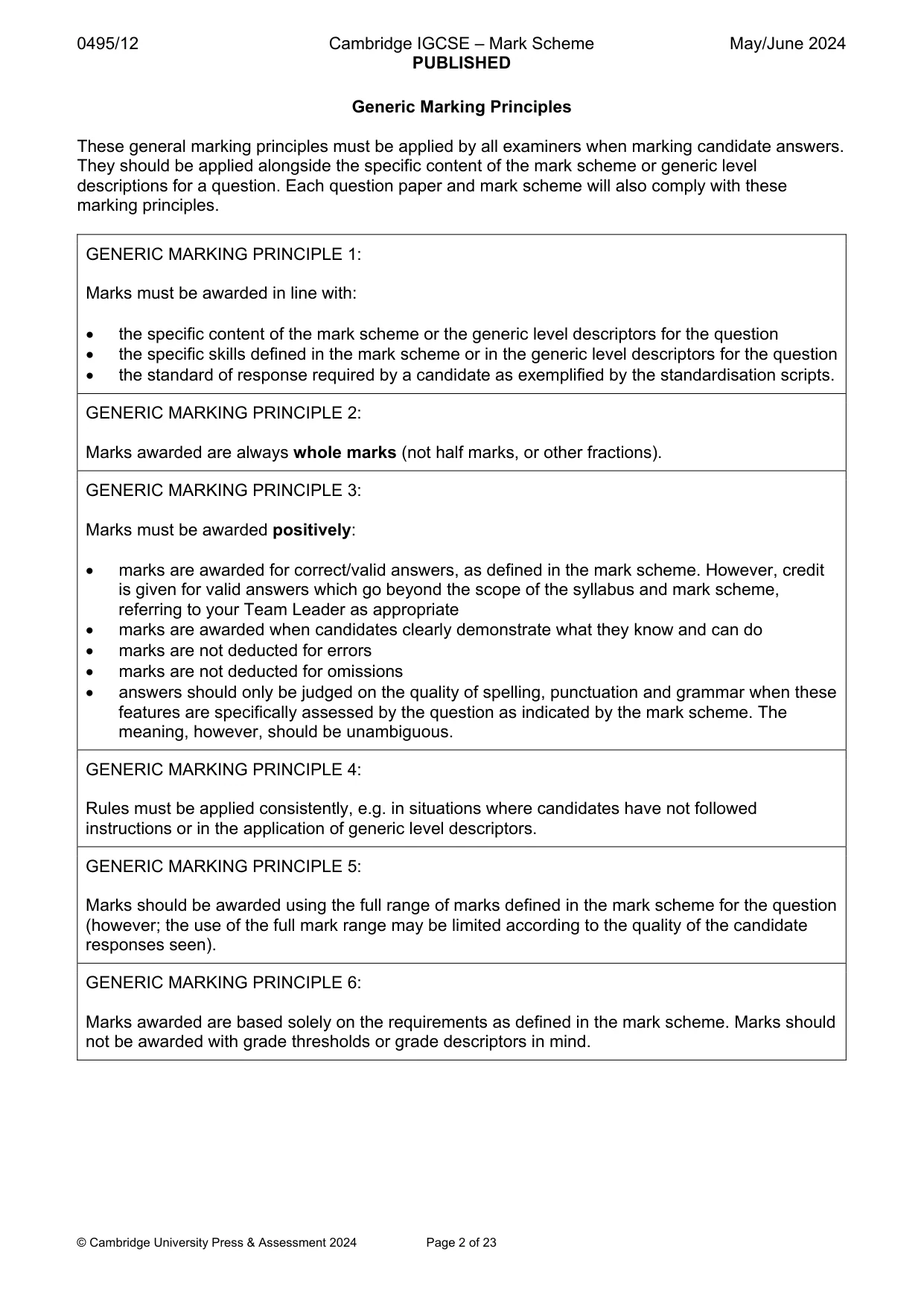
0495/12 Cambridge IGCSE – Mark Scheme PUBLISHED May/June 2024 © Cambridge University Press & Assessment 2024 Page 2 of 23 Generic Marking Principles These general marking principles must be applied by all examiners when marking candidate answers. They should be applied alongside the specific content of the mark scheme or generic level descriptions for a question. Each question paper and mark scheme will also comply with these marking principles. GENERIC MARKING PRINCIPLE 1: Marks must be awarded in line with: the specific content of the mark scheme or the generic level descriptors for the question the specific skills defined in the mark scheme or in the generic level descriptors for the question the standard of response required by a candidate as exemplified by the standardisation scripts. GENERIC MARKING PRINCIPLE 2: Marks awarded are always whole marks (not half marks, or other fractions). GENERIC MARKING PRINCIPLE 3: Marks must be awarded positively: marks are awarded for correct/valid answers, as defined in the mark scheme. However, credit is given for valid answers which go beyond the scope of the syllabus and mark scheme, referring to your Team Leader as appropriate marks are awarded when candidates clearly demonstrate what they know and can do marks are not deducted for errors marks are not deducted for omissions answers should only be judged on the quality of spelling, punctuation and grammar when these features are specifically assessed by the question as indicated by the mark scheme. The meaning, however, should be unambiguous. GENERIC MARKING PRINCIPLE 4: Rules must be applied consistently, e.g. in situations where candidates have not followed instructions or in the application of generic level descriptors. GENERIC MARKING PRINCIPLE 5: Marks should be awarded using the full range of marks defined in the mark scheme for the question (however; the use of the full mark range may be limited according to the quality of the candidate responses seen). GENERIC MARKING PRINCIPLE 6: Marks awarded are based solely on the requirements as defined in the mark scheme. Marks should not be awarded with grade thresholds or grade descriptors in mind.
Mark scheme, page 3
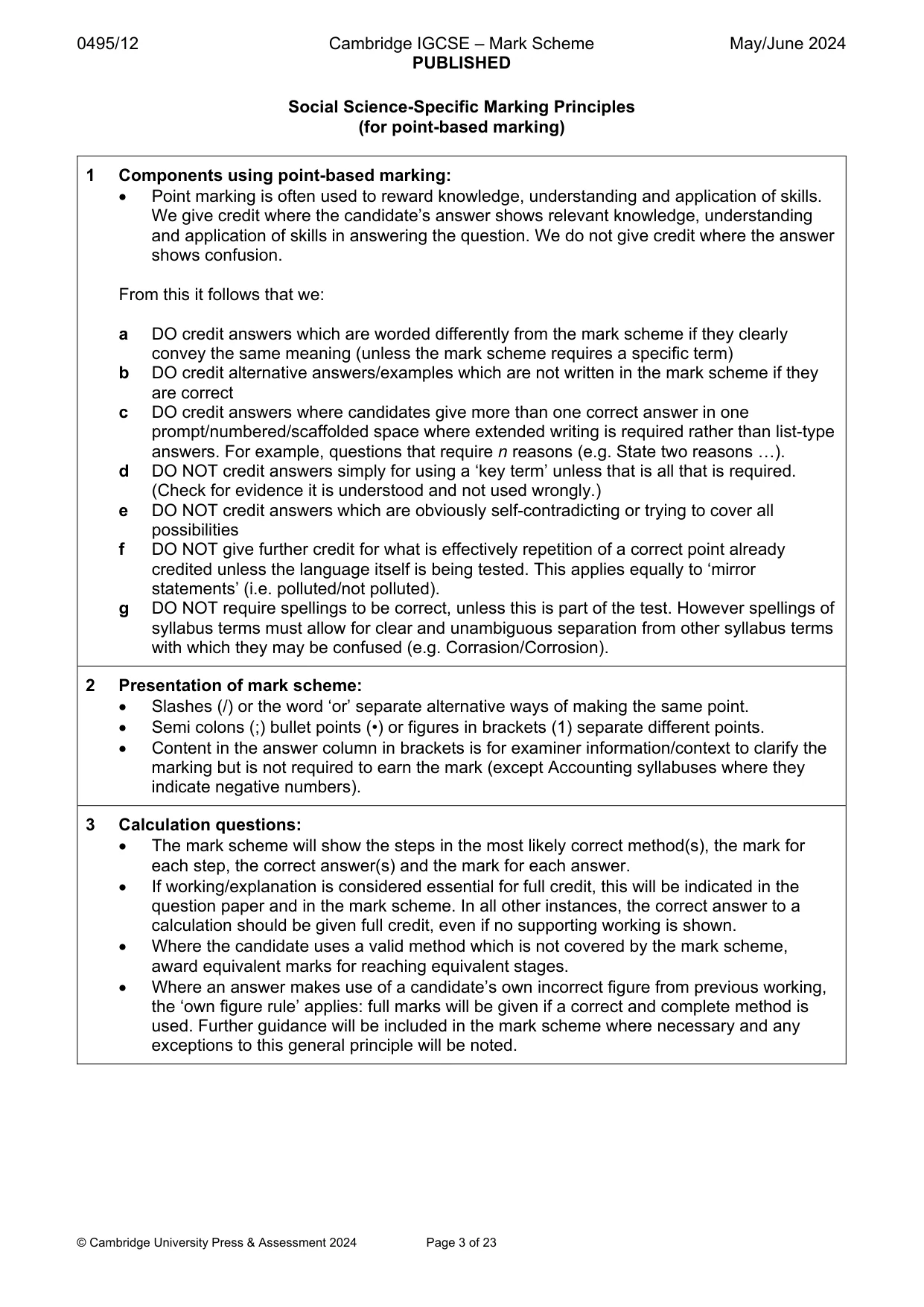
0495/12 Cambridge IGCSE – Mark Scheme PUBLISHED May/June 2024 © Cambridge University Press & Assessment 2024 Page 3 of 23 Social Science-Specific Marking Principles (for point-based marking) 1 Components using point-based marking: Point marking is often used to reward knowledge, understanding and application of skills. We give credit where the candidate’s answer shows relevant knowledge, understanding and application of skills in answering the question. We do not give credit where the answer shows confusion. From this it follows that we: a DO credit answers which are worded differently from the mark scheme if they clearly convey the same meaning (unless the mark scheme requires a specific term) b DO credit alternative answers/examples which are not written in the mark scheme if they are correct c DO credit answers where candidates give more than one correct answer in one prompt/numbered/scaffolded space where extended writing is required rather than list-type answers. For example, questions that require n reasons (e.g. State two reasons …). d DO NOT credit answers simply for using a ‘key term’ unless that is all that is required. (Check for evidence it is understood and not used wrongly.) e DO NOT credit answers which are obviously self-contradicting or trying to cover all possibilities f DO NOT give further credit for what is effectively repetition of a correct point already credited unless the language itself is being tested. This applies equally to ‘mirror statements’ (i.e. polluted/not polluted). g DO NOT require spellings to be correct, unless this is part of the test. However spellings of syllabus terms must allow for clear and unambiguous separation from other syllabus terms with which they may be confused (e.g. Corrasion/Corrosion). 2 Presentation of mark scheme: Slashes (/) or the word ‘or’ separate alternative ways of making the same point. Semi colons (;) bullet points (•) or figures in brackets (1) separate different points. Content in the answer column in brackets is for examiner information/context to clarify the marking but is not required to earn the mark (except Accounting syllabuses where they indicate negative numbers). 3 Calculation questions: The mark scheme will show the steps in the most likely correct method(s), the mark for each step, the correct answer(s) and the mark for each answer. If working/explanation is considered essential for full credit, this will be indicated in the question paper and in the mark scheme. In all other instances, the correct answer to a calculation should be given full credit, even if no supporting working is shown. Where the candidate uses a valid method which is not covered by the mark scheme, award equivalent marks for reaching equivalent stages. Where an answer makes use of a candidate’s own incorrect figure from previous working, the ‘own figure rule’ applies: full marks will be given if a correct and complete method is used. Further guidance will be included in the mark scheme where necessary and any exceptions to this general principle will be noted.
Mark scheme, page 4
0495/12 Cambridge IGCSE – Mark Scheme PUBLISHED May/June 2024 © Cambridge University Press & Assessment 2024 Page 4 of 23 4 Annotation: For point marking, ticks can be used to indicate correct answers and crosses can be used to indicate wrong answers. There is no direct relationship between ticks and marks. Ticks have no defined meaning for levels of response marking. For levels of response marking, the level awarded should be annotated on the script. Other annotations will be used by examiners as agreed during standardisation, and the meaning will be understood by all examiners who marked that paper.
Mark scheme, page 5
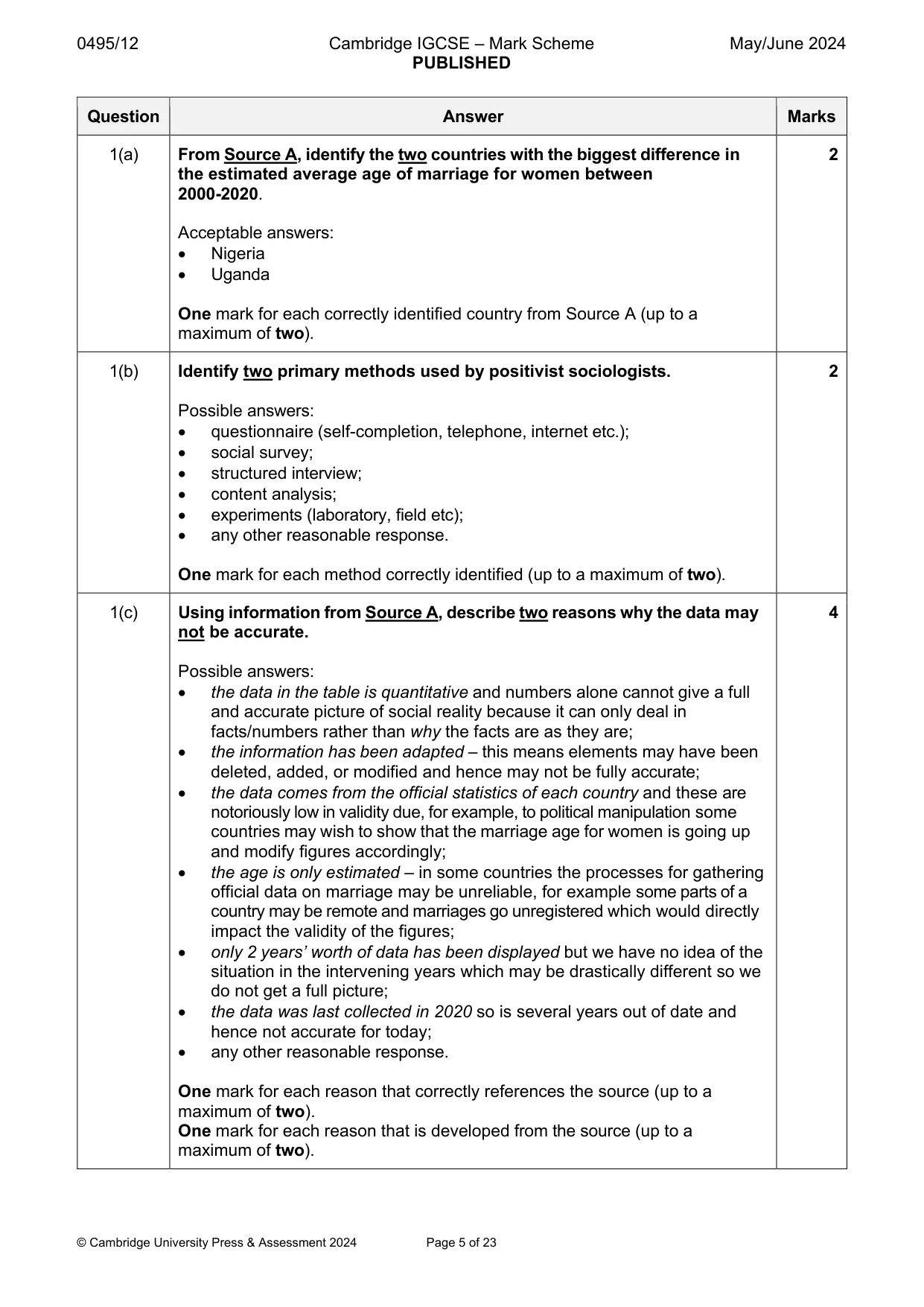
0495/12 Cambridge IGCSE – Mark Scheme PUBLISHED May/June 2024 © Cambridge University Press & Assessment 2024 Page 5 of 23 Question Answer Marks 1(a) From Source A, identify the two countries with the biggest difference in the estimated average age of marriage for women between 2000-2020. Acceptable answers: Nigeria Uganda One mark for each correctly identified country from Source A (up to a maximum of two). 2 1(b) Identify two primary methods used by positivist sociologists. Possible answers: questionnaire (self-completion, telephone, internet etc.); social survey; structured interview; content analysis; experiments (laboratory, field etc); any other reasonable response. One mark for each method correctly identified (up to a maximum of two). 2 1(c) Using information from Source A, describe two reasons why the data may not be accurate. Possible answers: the data in the table is quantitative and numbers alone cannot give a full and accurate picture of social reality because it can only deal in facts/numbers rather than why the facts are as they are; the information has been adapted – this means elements may have been deleted, added, or modified and hence may not be fully accurate; the data comes from the official statistics of each country and these are notoriously low in validity due, for example, to political manipulation some countries may wish to show that the marriage age for women is going up and modify figures accordingly; the age is only estimated – in some countries the processes for gathering official data on marriage may be unreliable, for example some parts of a country may be remote and marriages go unregistered which would directly impact the validity of the figures; only 2 years’ worth of data has been displayed but we have no idea of the situation in the intervening years which may be drastically different so we do not get a full picture; the data was last collected in 2020 so is several years out of date and hence not accurate for today; any other reasonable response. One mark for each reason that correctly references the source (up to a maximum of two). One mark for each reason that is developed from the source (up to a maximum of two). 4
Mark scheme, page 6
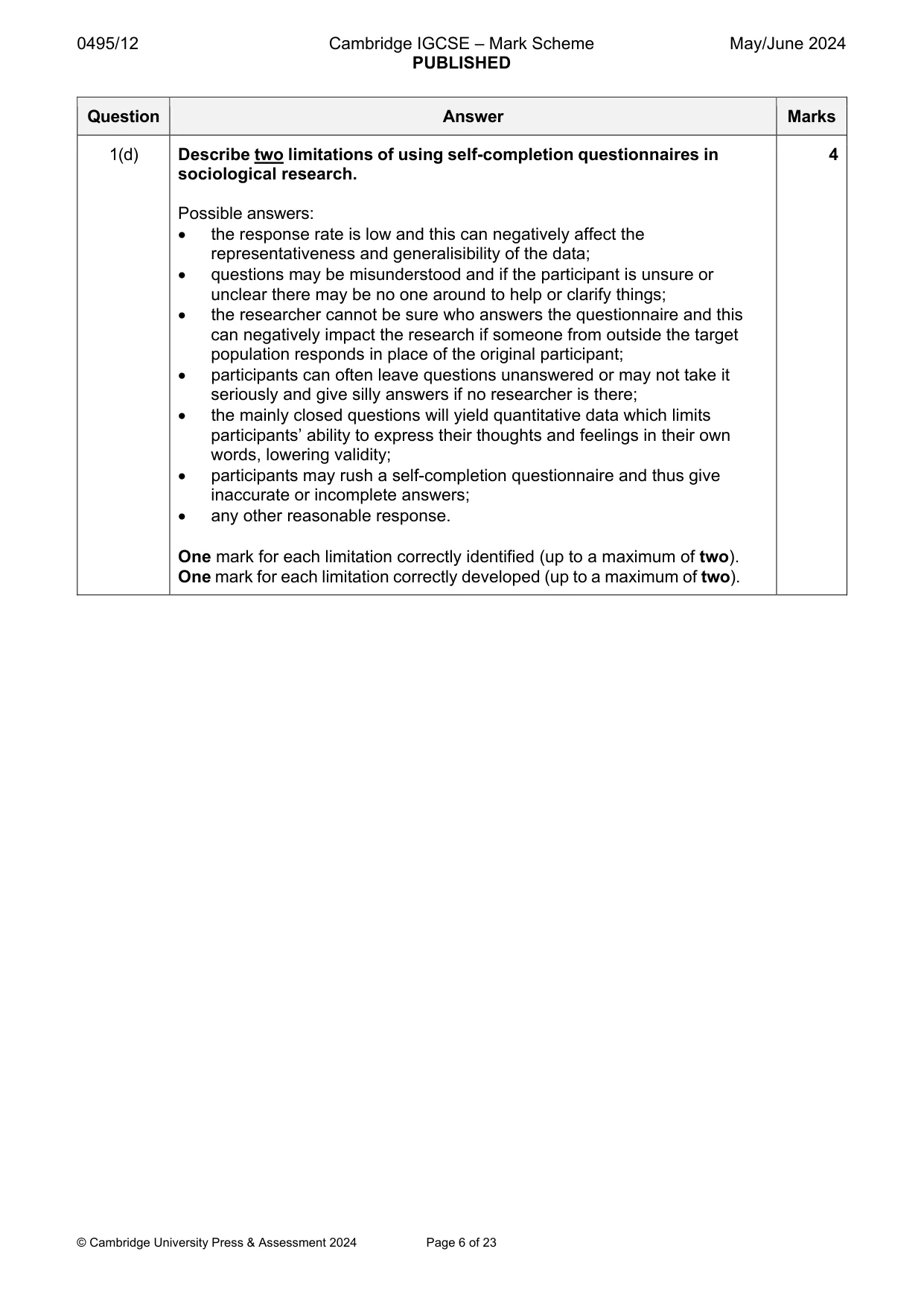
0495/12 Cambridge IGCSE – Mark Scheme PUBLISHED May/June 2024 © Cambridge University Press & Assessment 2024 Page 6 of 23 Question Answer Marks 1(d) Describe two limitations of using self-completion questionnaires in sociological research. Possible answers: the response rate is low and this can negatively affect the representativeness and generalisibility of the data; questions may be misunderstood and if the participant is unsure or unclear there may be no one around to help or clarify things; the researcher cannot be sure who answers the questionnaire and this can negatively impact the research if someone from outside the target population responds in place of the original participant; participants can often leave questions unanswered or may not take it seriously and give silly answers if no researcher is there; the mainly closed questions will yield quantitative data which limits participants’ ability to express their thoughts and feelings in their own words, lowering validity; participants may rush a self-completion questionnaire and thus give inaccurate or incomplete answers; any other reasonable response. One mark for each limitation correctly identified (up to a maximum of two). One mark for each limitation correctly developed (up to a maximum of two). 4
Mark scheme, page 7
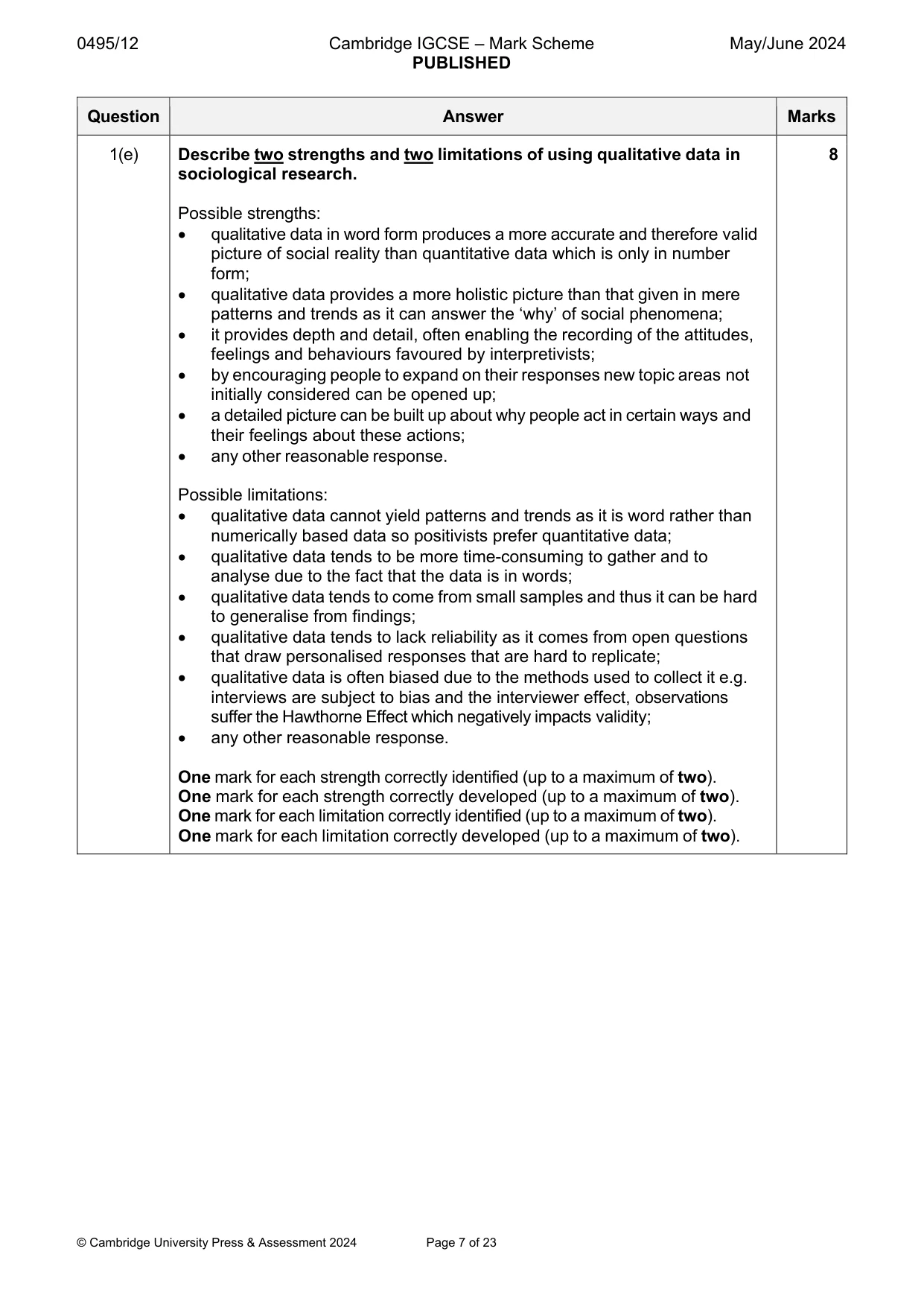
0495/12 Cambridge IGCSE – Mark Scheme PUBLISHED May/June 2024 © Cambridge University Press & Assessment 2024 Page 7 of 23 Question Answer Marks 1(e) Describe two strengths and two limitations of using qualitative data in sociological research. Possible strengths: qualitative data in word form produces a more accurate and therefore valid picture of social reality than quantitative data which is only in number form; qualitative data provides a more holistic picture than that given in mere patterns and trends as it can answer the ‘why’ of social phenomena; it provides depth and detail, often enabling the recording of the attitudes, feelings and behaviours favoured by interpretivists; by encouraging people to expand on their responses new topic areas not initially considered can be opened up; a detailed picture can be built up about why people act in certain ways and their feelings about these actions; any other reasonable response. Possible limitations: qualitative data cannot yield patterns and trends as it is word rather than numerically based data so positivists prefer quantitative data; qualitative data tends to be more time-consuming to gather and to analyse due to the fact that the data is in words; qualitative data tends to come from small samples and thus it can be hard to generalise from findings; qualitative data tends to lack reliability as it comes from open questions that draw personalised responses that are hard to replicate; qualitative data is often biased due to the methods used to collect it e.g. interviews are subject to bias and the interviewer effect, observations suffer the Hawthorne Effect which negatively impacts validity; any other reasonable response. One mark for each strength correctly identified (up to a maximum of two). One mark for each strength correctly developed (up to a maximum of two). One mark for each limitation correctly identified (up to a maximum of two). One mark for each limitation correctly developed (up to a maximum of two). 8
Mark scheme, page 8
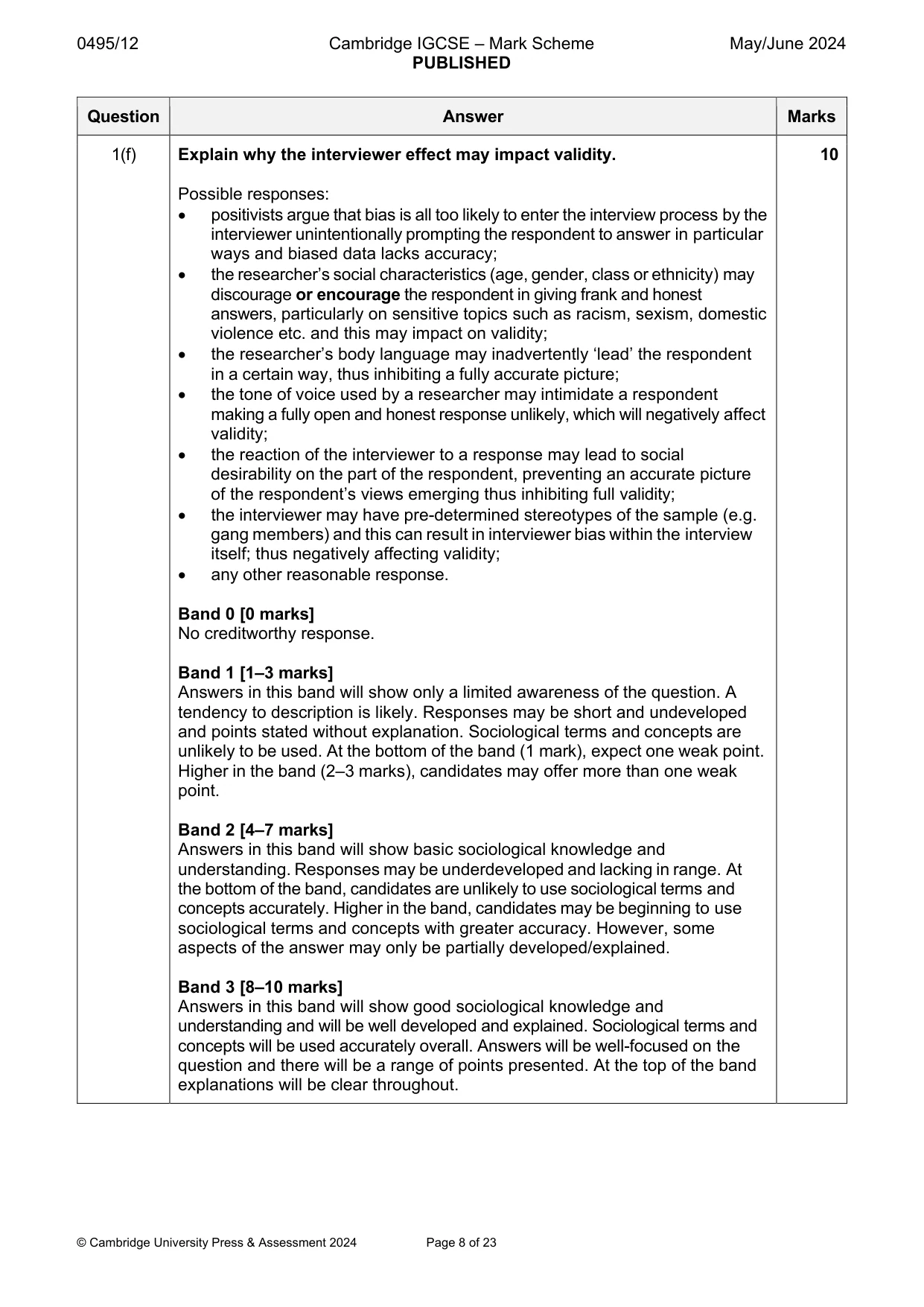
0495/12 Cambridge IGCSE – Mark Scheme PUBLISHED May/June 2024 © Cambridge University Press & Assessment 2024 Page 8 of 23 Question Answer Marks 1(f) Explain why the interviewer effect may impact validity. Possible responses: positivists argue that bias is all too likely to enter the interview process by the interviewer unintentionally prompting the respondent to answer in particular ways and biased data lacks accuracy; the researcher’s social characteristics (age, gender, class or ethnicity) may discourage or encourage the respondent in giving frank and honest answers, particularly on sensitive topics such as racism, sexism, domestic violence etc. and this may impact on validity; the researcher’s body language may inadvertently ‘lead’ the respondent in a certain way, thus inhibiting a fully accurate picture; the tone of voice used by a researcher may intimidate a respondent making a fully open and honest response unlikely, which will negatively affect validity; the reaction of the interviewer to a response may lead to social desirability on the part of the respondent, preventing an accurate picture of the respondent’s views emerging thus inhibiting full validity; the interviewer may have pre-determined stereotypes of the sample (e.g. gang members) and this can result in interviewer bias within the interview itself; thus negatively affecting validity; any other reasonable response. Band 0 [0 marks] No creditworthy response. Band 1 [1–3 marks] Answers in this band will show only a limited awareness of the question. A tendency to description is likely. Responses may be short and undeveloped and points stated without explanation. Sociological terms and concepts are unlikely to be used. At the bottom of the band (1 mark), expect one weak point. Higher in the band (2–3 marks), candidates may offer more than one weak point. Band 2 [4–7 marks] Answers in this band will show basic sociological knowledge and understanding. Responses may be underdeveloped and lacking in range. At the bottom of the band, candidates are unlikely to use sociological terms and concepts accurately. Higher in the band, candidates may be beginning to use sociological terms and concepts with greater accuracy. However, some aspects of the answer may only be partially developed/explained. Band 3 [8–10 marks] Answers in this band will show good sociological knowledge and understanding and will be well developed and explained. Sociological terms and concepts will be used accurately overall. Answers will be well-focused on the question and there will be a range of points presented. At the top of the band explanations will be clear throughout. 10
Mark scheme, page 9
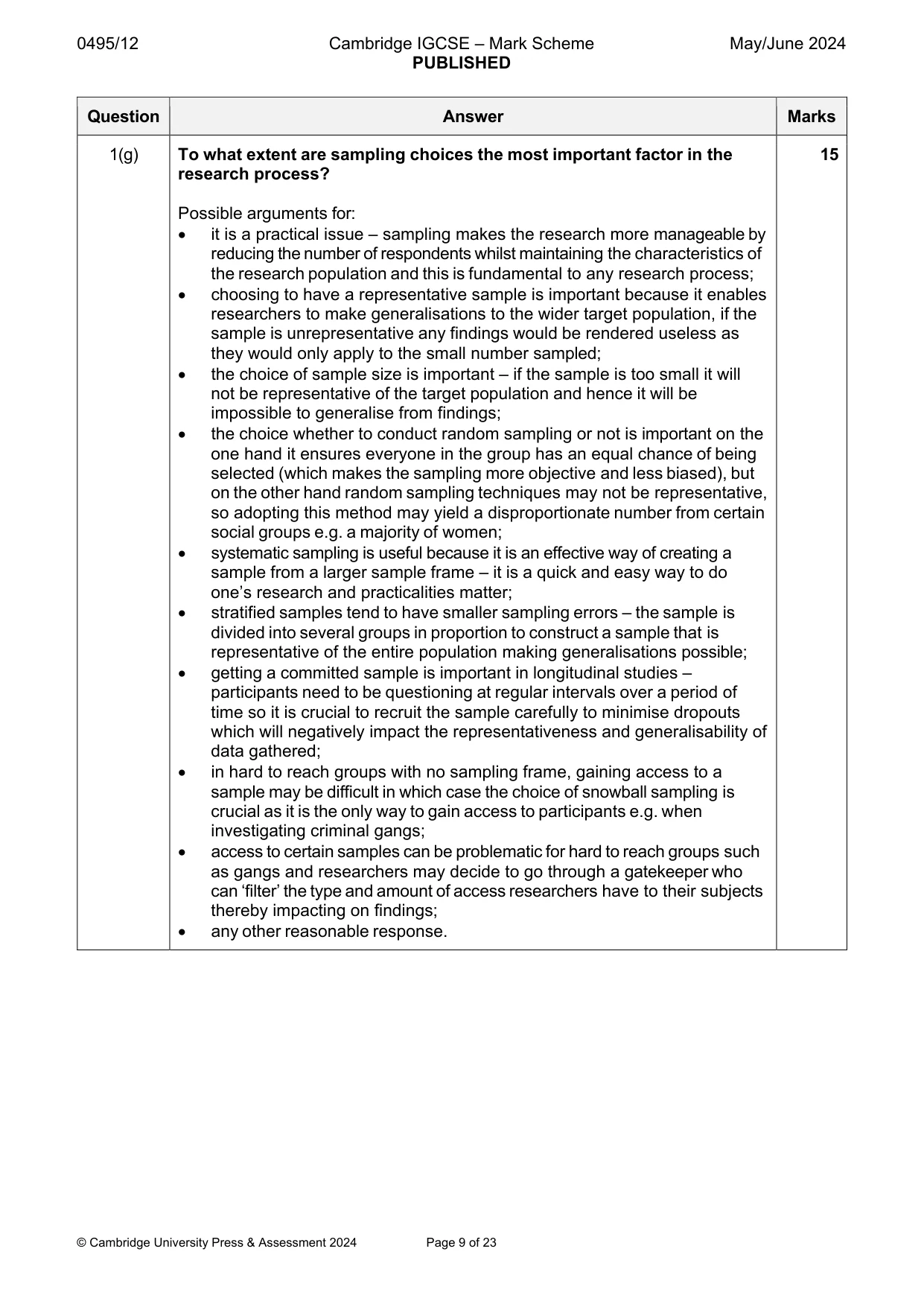
0495/12 Cambridge IGCSE – Mark Scheme PUBLISHED May/June 2024 © Cambridge University Press & Assessment 2024 Page 9 of 23 Question Answer Marks 1(g) To what extent are sampling choices the most important factor in the research process? Possible arguments for: it is a practical issue – sampling makes the research more manageable by reducing the number of respondents whilst maintaining the characteristics of the research population and this is fundamental to any research process; choosing to have a representative sample is important because it enables researchers to make generalisations to the wider target population, if the sample is unrepresentative any findings would be rendered useless as they would only apply to the small number sampled; the choice of sample size is important – if the sample is too small it will not be representative of the target population and hence it will be impossible to generalise from findings; the choice whether to conduct random sampling or not is important on the one hand it ensures everyone in the group has an equal chance of being selected (which makes the sampling more objective and less biased), but on the other hand random sampling techniques may not be representative, so adopting this method may yield a disproportionate number from certain social groups e.g. a majority of women; systematic sampling is useful because it is an effective way of creating a sample from a larger sample frame – it is a quick and easy way to do one’s research and practicalities matter; stratified samples tend to have smaller sampling errors – the sample is divided into several groups in proportion to construct a sample that is representative of the entire population making generalisations possible; getting a committed sample is important in longitudinal studies – participants need to be questioning at regular intervals over a period of time so it is crucial to recruit the sample carefully to minimise dropouts which will negatively impact the representativeness and generalisability of data gathered; in hard to reach groups with no sampling frame, gaining access to a sample may be difficult in which case the choice of snowball sampling is crucial as it is the only way to gain access to participants e.g. when investigating criminal gangs; access to certain samples can be problematic for hard to reach groups such as gangs and researchers may decide to go through a gatekeeper who can ‘filter’ the type and amount of access researchers have to their subjects thereby impacting on findings; any other reasonable response. 15
Mark scheme, page 10
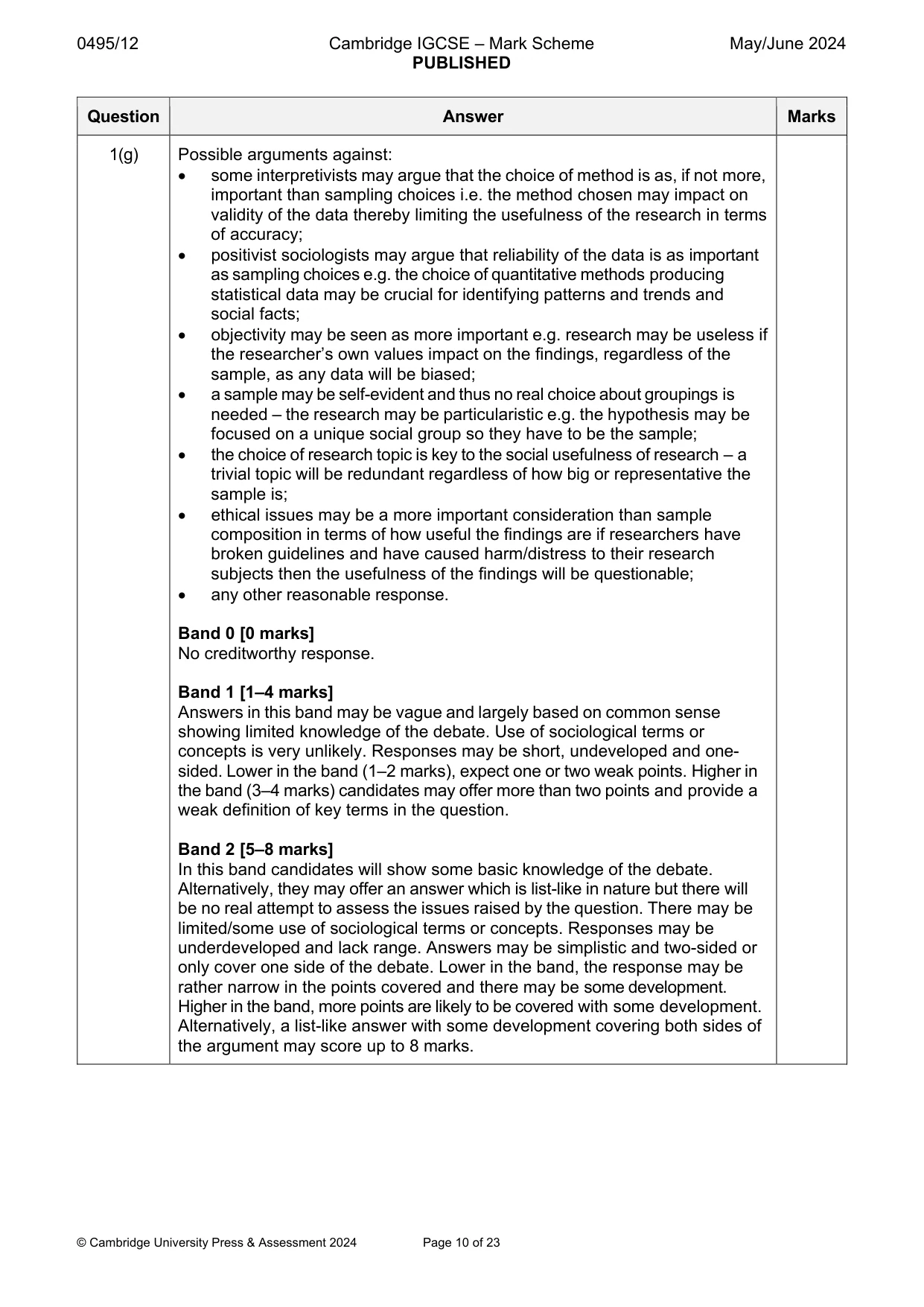
0495/12 Cambridge IGCSE – Mark Scheme PUBLISHED May/June 2024 © Cambridge University Press & Assessment 2024 Page 10 of 23 Question Answer Marks 1(g) Possible arguments against: some interpretivists may argue that the choice of method is as, if not more, important than sampling choices i.e. the method chosen may impact on validity of the data thereby limiting the usefulness of the research in terms of accuracy; positivist sociologists may argue that reliability of the data is as important as sampling choices e.g. the choice of quantitative methods producing statistical data may be crucial for identifying patterns and trends and social facts; objectivity may be seen as more important e.g. research may be useless if the researcher’s own values impact on the findings, regardless of the sample, as any data will be biased; a sample may be self-evident and thus no real choice about groupings is needed – the research may be particularistic e.g. the hypothesis may be focused on a unique social group so they have to be the sample; the choice of research topic is key to the social usefulness of research – a trivial topic will be redundant regardless of how big or representative the sample is; ethical issues may be a more important consideration than sample composition in terms of how useful the findings are if researchers have broken guidelines and have caused harm/distress to their research subjects then the usefulness of the findings will be questionable; any other reasonable response. Band 0 [0 marks] No creditworthy response. Band 1 [1–4 marks] Answers in this band may be vague and largely based on common sense showing limited knowledge of the debate. Use of sociological terms or concepts is very unlikely. Responses may be short, undeveloped and one- sided. Lower in the band (1–2 marks), expect one or two weak points. Higher in the band (3–4 marks) candidates may offer more than two points and provide a weak definition of key terms in the question. Band 2 [5–8 marks] In this band candidates will show some basic knowledge of the debate. Alternatively, they may offer an answer which is list-like in nature but there will be no real attempt to assess the issues raised by the question. There may be limited/some use of sociological terms or concepts. Responses may be underdeveloped and lack range. Answers may be simplistic and two-sided or only cover one side of the debate. Lower in the band, the response may be rather narrow in the points covered and there may be some development. Higher in the band, more points are likely to be covered with some development. Alternatively, a list-like answer with some development covering both sides of the argument may score up to 8 marks.
Mark scheme, page 11
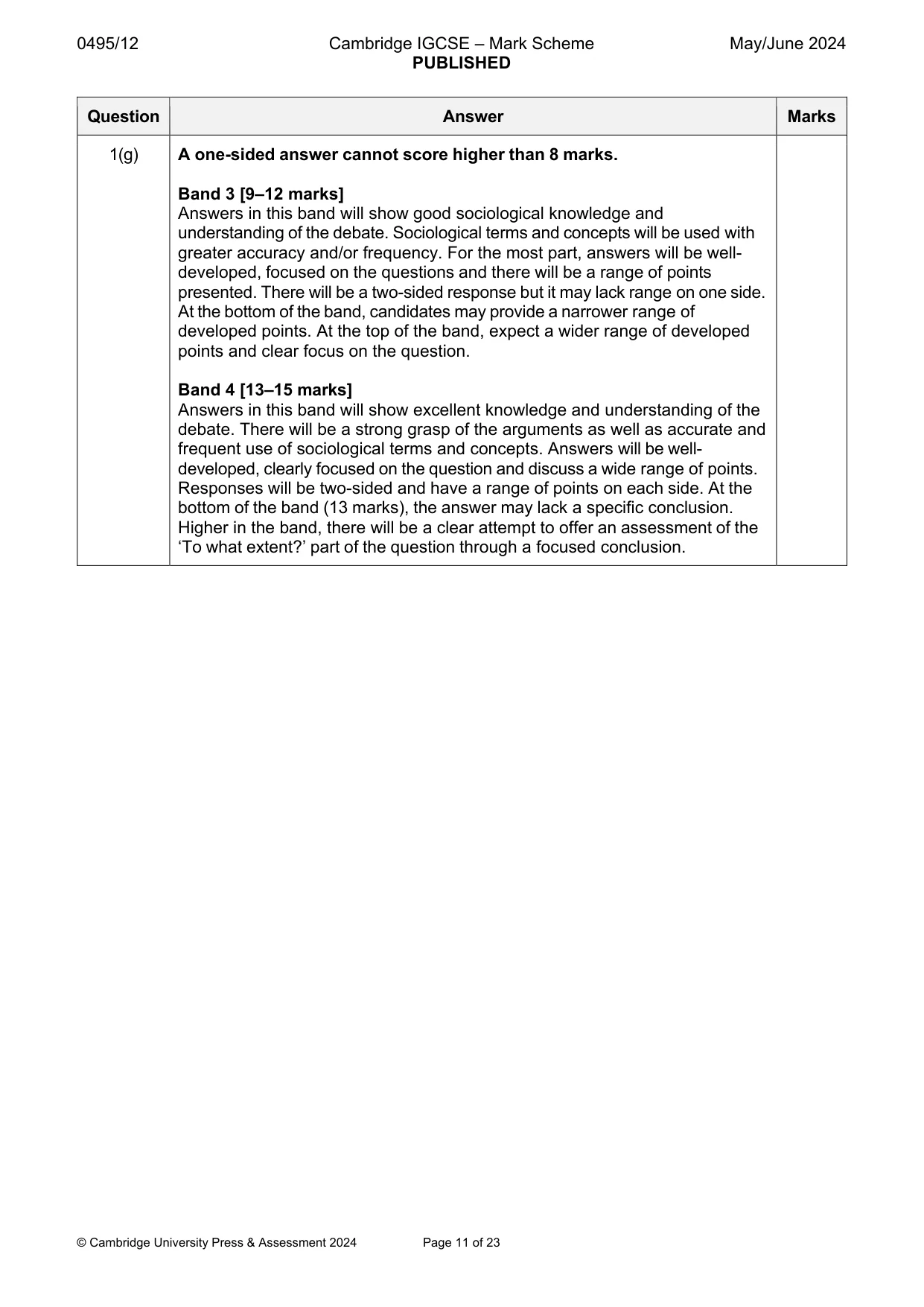
0495/12 Cambridge IGCSE – Mark Scheme PUBLISHED May/June 2024 © Cambridge University Press & Assessment 2024 Page 11 of 23 Question Answer Marks 1(g) A one-sided answer cannot score higher than 8 marks. Band 3 [9–12 marks] Answers in this band will show good sociological knowledge and understanding of the debate. Sociological terms and concepts will be used with greater accuracy and/or frequency. For the most part, answers will be well- developed, focused on the questions and there will be a range of points presented. There will be a two-sided response but it may lack range on one side. At the bottom of the band, candidates may provide a narrower range of developed points. At the top of the band, expect a wider range of developed points and clear focus on the question. Band 4 [13–15 marks] Answers in this band will show excellent knowledge and understanding of the debate. There will be a strong grasp of the arguments as well as accurate and frequent use of sociological terms and concepts. Answers will be well- developed, clearly focused on the question and discuss a wide range of points. Responses will be two-sided and have a range of points on each side. At the bottom of the band (13 marks), the answer may lack a specific conclusion. Higher in the band, there will be a clear attempt to offer an assessment of the ‘To what extent?’ part of the question through a focused conclusion.
Mark scheme, page 12
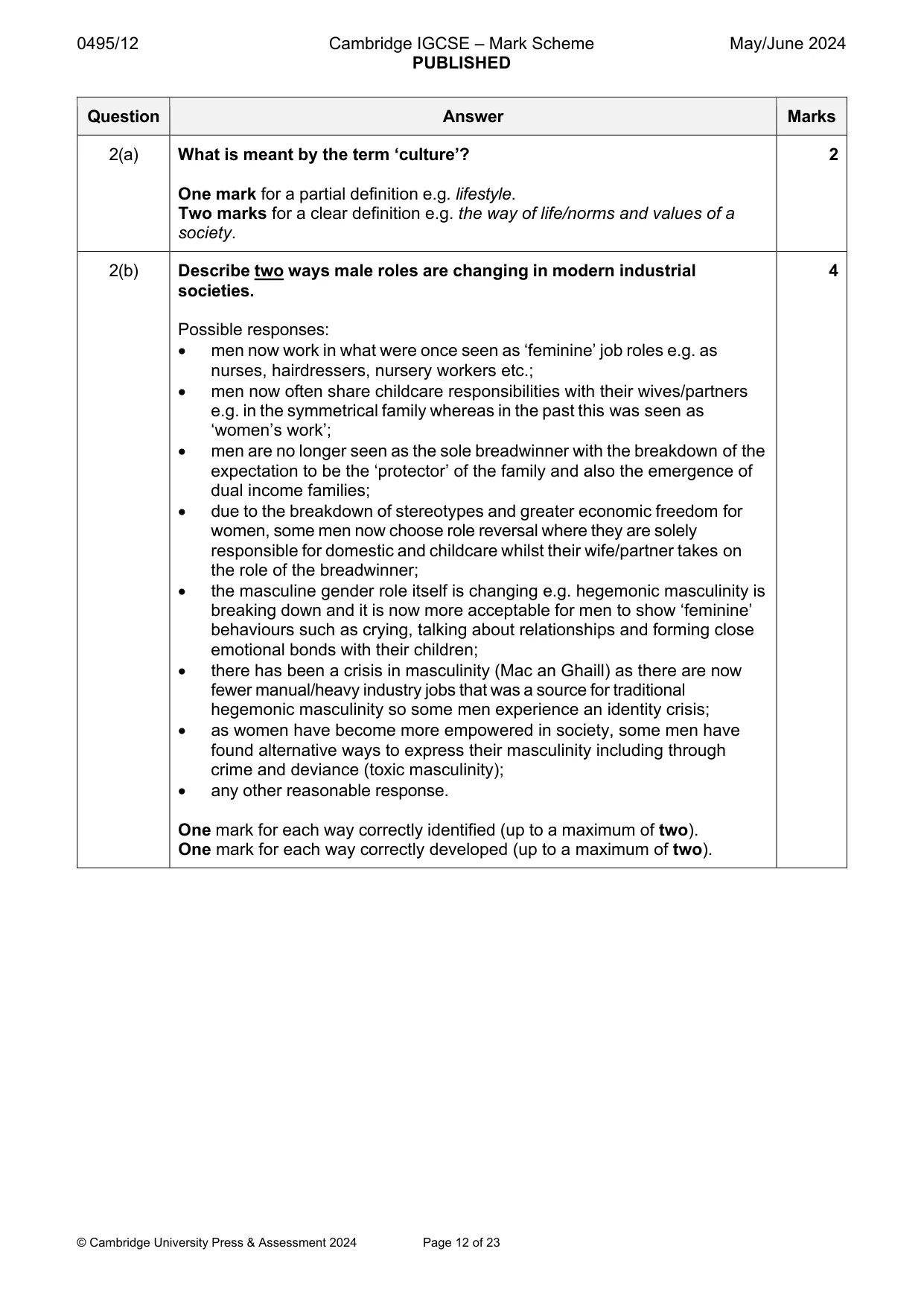
0495/12 Cambridge IGCSE – Mark Scheme PUBLISHED May/June 2024 © Cambridge University Press & Assessment 2024 Page 12 of 23 Question Answer Marks 2(a) What is meant by the term ‘culture’? One mark for a partial definition e.g. lifestyle. Two marks for a clear definition e.g. the way of life/norms and values of a society. 2 2(b) Describe two ways male roles are changing in modern industrial societies. Possible responses: men now work in what were once seen as ‘feminine’ job roles e.g. as nurses, hairdressers, nursery workers etc.; men now often share childcare responsibilities with their wives/partners e.g. in the symmetrical family whereas in the past this was seen as ‘women’s work’; men are no longer seen as the sole breadwinner with the breakdown of the expectation to be the ‘protector’ of the family and also the emergence of dual income families; due to the breakdown of stereotypes and greater economic freedom for women, some men now choose role reversal where they are solely responsible for domestic and childcare whilst their wife/partner takes on the role of the breadwinner; the masculine gender role itself is changing e.g. hegemonic masculinity is breaking down and it is now more acceptable for men to show ‘feminine’ behaviours such as crying, talking about relationships and forming close emotional bonds with their children; there has been a crisis in masculinity (Mac an Ghaill) as there are now fewer manual/heavy industry jobs that was a source for traditional hegemonic masculinity so some men experience an identity crisis; as women have become more empowered in society, some men have found alternative ways to express their masculinity including through crime and deviance (toxic masculinity); any other reasonable response. One mark for each way correctly identified (up to a maximum of two). One mark for each way correctly developed (up to a maximum of two). 4
Mark scheme, page 13
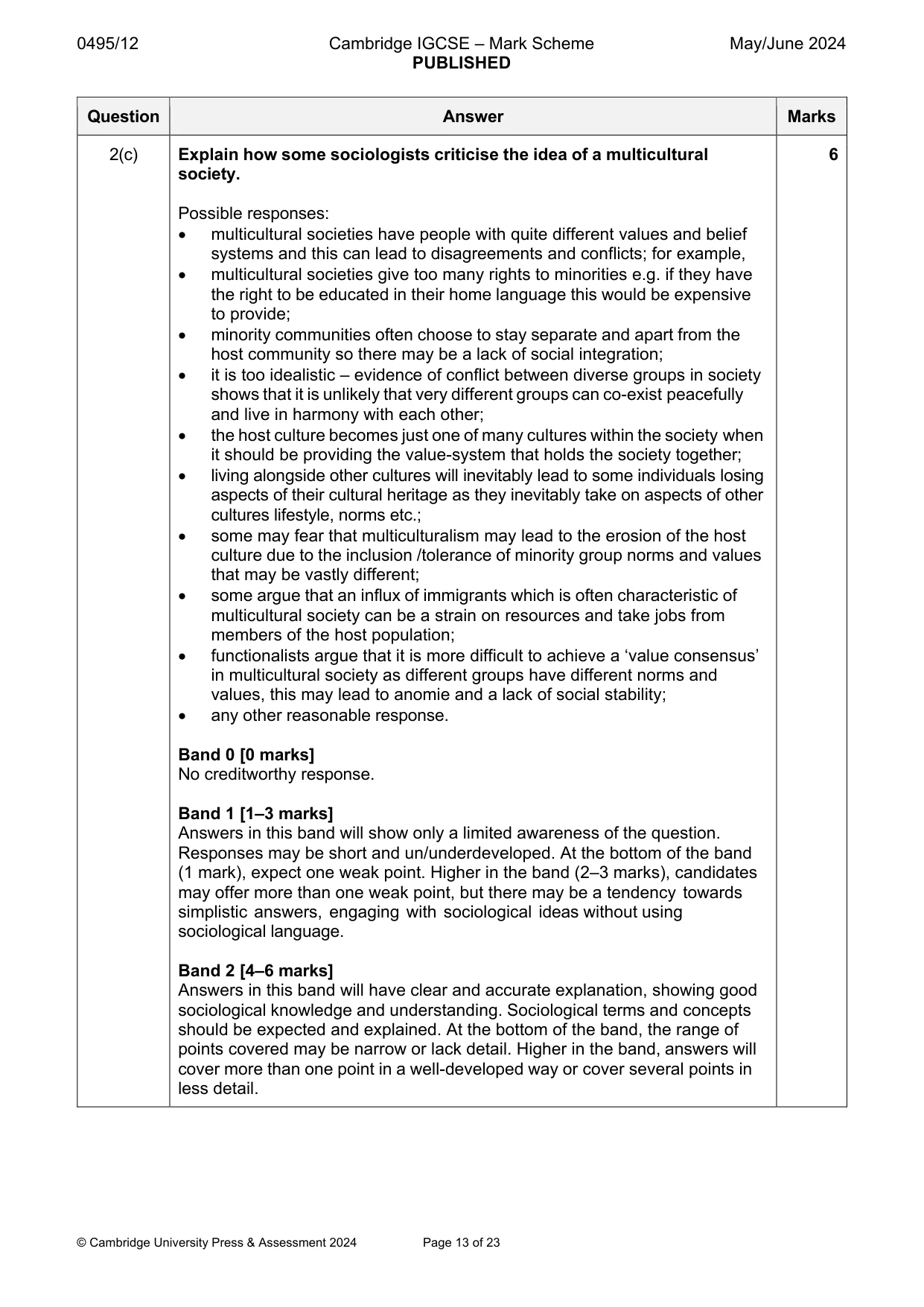
0495/12 Cambridge IGCSE – Mark Scheme PUBLISHED May/June 2024 © Cambridge University Press & Assessment 2024 Page 13 of 23 Question Answer Marks 2(c) Explain how some sociologists criticise the idea of a multicultural society. Possible responses: multicultural societies have people with quite different values and belief systems and this can lead to disagreements and conflicts; for example, multicultural societies give too many rights to minorities e.g. if they have the right to be educated in their home language this would be expensive to provide; minority communities often choose to stay separate and apart from the host community so there may be a lack of social integration; it is too idealistic – evidence of conflict between diverse groups in society shows that it is unlikely that very different groups can co-exist peacefully and live in harmony with each other; the host culture becomes just one of many cultures within the society when it should be providing the value-system that holds the society together; living alongside other cultures will inevitably lead to some individuals losing aspects of their cultural heritage as they inevitably take on aspects of other cultures lifestyle, norms etc.; some may fear that multiculturalism may lead to the erosion of the host culture due to the inclusion /tolerance of minority group norms and values that may be vastly different; some argue that an influx of immigrants which is often characteristic of multicultural society can be a strain on resources and take jobs from members of the host population; functionalists argue that it is more difficult to achieve a ‘value consensus’ in multicultural society as different groups have different norms and values, this may lead to anomie and a lack of social stability; any other reasonable response. Band 0 [0 marks] No creditworthy response. Band 1 [1–3 marks] Answers in this band will show only a limited awareness of the question. Responses may be short and un/underdeveloped. At the bottom of the band (1 mark), expect one weak point. Higher in the band (2–3 marks), candidates may offer more than one weak point, but there may be a tendency towards simplistic answers, engaging with sociological ideas without using sociological language. Band 2 [4–6 marks] Answers in this band will have clear and accurate explanation, showing good sociological knowledge and understanding. Sociological terms and concepts should be expected and explained. At the bottom of the band, the range of points covered may be narrow or lack detail. Higher in the band, answers will cover more than one point in a well-developed way or cover several points in less detail. 6
Mark scheme, page 14
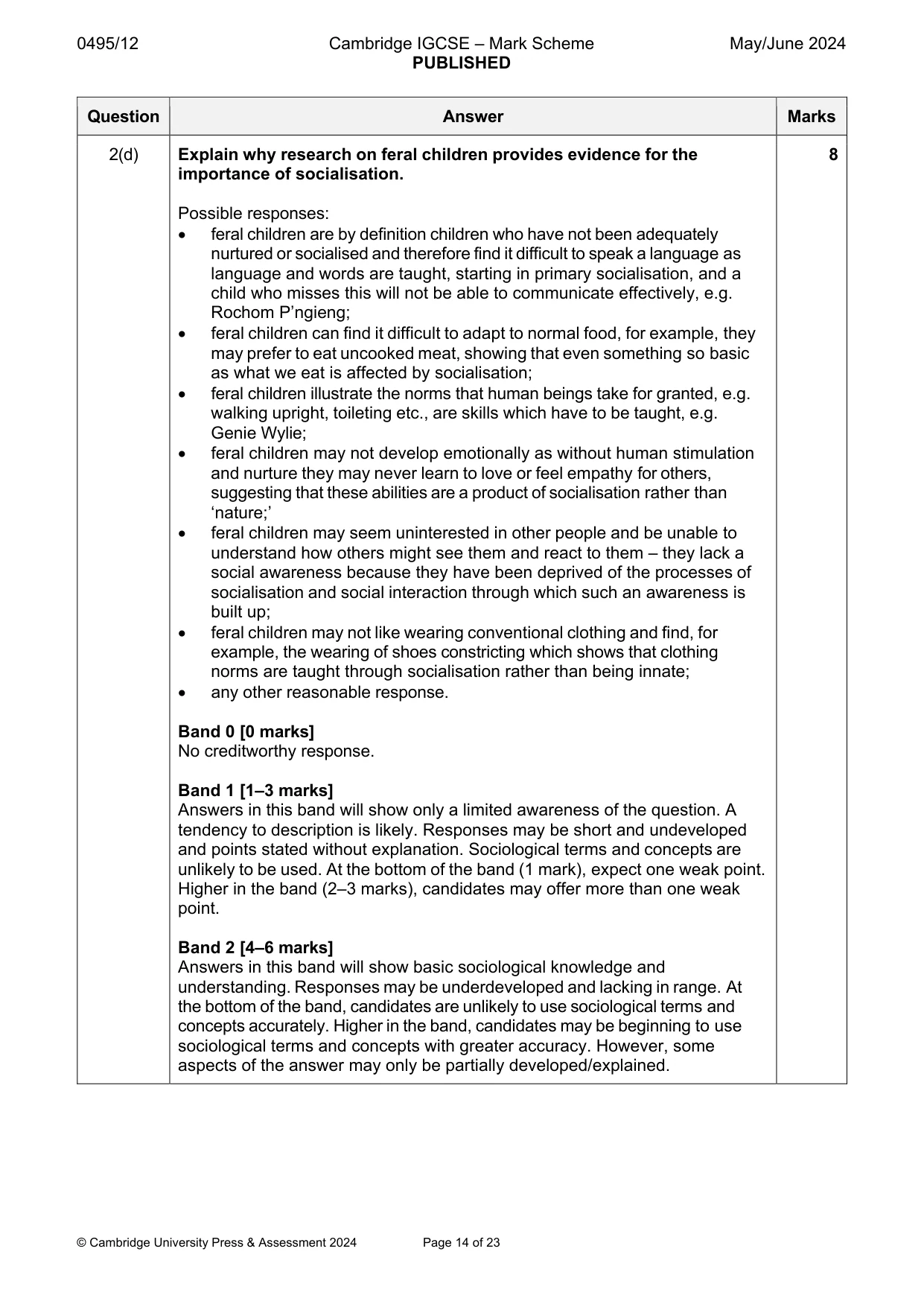
0495/12 Cambridge IGCSE – Mark Scheme PUBLISHED May/June 2024 © Cambridge University Press & Assessment 2024 Page 14 of 23 Question Answer Marks 2(d) Explain why research on feral children provides evidence for the importance of socialisation. Possible responses: feral children are by definition children who have not been adequately nurtured or socialised and therefore find it difficult to speak a language as language and words are taught, starting in primary socialisation, and a child who misses this will not be able to communicate effectively, e.g. Rochom P’ngieng; feral children can find it difficult to adapt to normal food, for example, they may prefer to eat uncooked meat, showing that even something so basic as what we eat is affected by socialisation; feral children illustrate the norms that human beings take for granted, e.g. walking upright, toileting etc., are skills which have to be taught, e.g. Genie Wylie; feral children may not develop emotionally as without human stimulation and nurture they may never learn to love or feel empathy for others, suggesting that these abilities are a product of socialisation rather than ‘nature;’ feral children may seem uninterested in other people and be unable to understand how others might see them and react to them – they lack a social awareness because they have been deprived of the processes of socialisation and social interaction through which such an awareness is built up; feral children may not like wearing conventional clothing and find, for example, the wearing of shoes constricting which shows that clothing norms are taught through socialisation rather than being innate; any other reasonable response. Band 0 [0 marks] No creditworthy response. Band 1 [1–3 marks] Answers in this band will show only a limited awareness of the question. A tendency to description is likely. Responses may be short and undeveloped and points stated without explanation. Sociological terms and concepts are unlikely to be used. At the bottom of the band (1 mark), expect one weak point. Higher in the band (2–3 marks), candidates may offer more than one weak point. Band 2 [4–6 marks] Answers in this band will show basic sociological knowledge and understanding. Responses may be underdeveloped and lacking in range. At the bottom of the band, candidates are unlikely to use sociological terms and concepts accurately. Higher in the band, candidates may be beginning to use sociological terms and concepts with greater accuracy. However, some aspects of the answer may only be partially developed/explained. 8
Mark scheme, page 15
0495/12 Cambridge IGCSE – Mark Scheme PUBLISHED May/June 2024 © Cambridge University Press & Assessment 2024 Page 15 of 23 Question Answer Marks 2(d) Band 3 [7–8 marks] Answers in this band will show good sociological knowledge and understanding and will be well developed and explained. Sociological terms and concepts will be used accurately overall. Answers will be well-focused on the question and there will be a range of points presented. At the top of the band explanations will be clear throughout.
Mark scheme, page 16
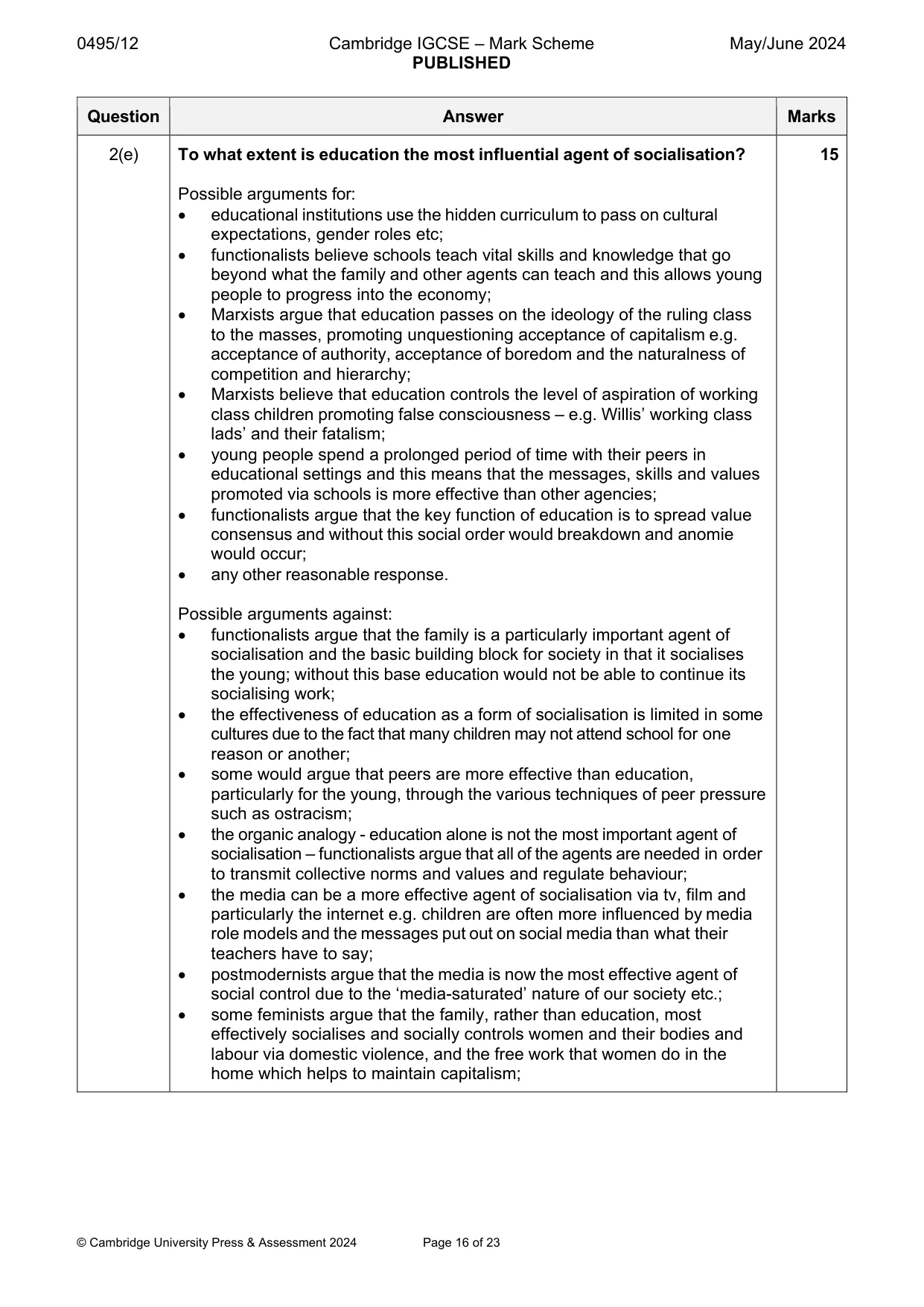
0495/12 Cambridge IGCSE – Mark Scheme PUBLISHED May/June 2024 © Cambridge University Press & Assessment 2024 Page 16 of 23 Question Answer Marks 2(e) To what extent is education the most influential agent of socialisation? Possible arguments for: educational institutions use the hidden curriculum to pass on cultural expectations, gender roles etc; functionalists believe schools teach vital skills and knowledge that go beyond what the family and other agents can teach and this allows young people to progress into the economy; Marxists argue that education passes on the ideology of the ruling class to the masses, promoting unquestioning acceptance of capitalism e.g. acceptance of authority, acceptance of boredom and the naturalness of competition and hierarchy; Marxists believe that education controls the level of aspiration of working class children promoting false consciousness – e.g. Willis’ working class lads’ and their fatalism; young people spend a prolonged period of time with their peers in educational settings and this means that the messages, skills and values promoted via schools is more effective than other agencies; functionalists argue that the key function of education is to spread value consensus and without this social order would breakdown and anomie would occur; any other reasonable response. Possible arguments against: functionalists argue that the family is a particularly important agent of socialisation and the basic building block for society in that it socialises the young; without this base education would not be able to continue its socialising work; the effectiveness of education as a form of socialisation is limited in some cultures due to the fact that many children may not attend school for one reason or another; some would argue that peers are more effective than education, particularly for the young, through the various techniques of peer pressure such as ostracism; the organic analogy - education alone is not the most important agent of socialisation – functionalists argue that all of the agents are needed in order to transmit collective norms and values and regulate behaviour; the media can be a more effective agent of socialisation via tv, film and particularly the internet e.g. children are often more influenced by media role models and the messages put out on social media than what their teachers have to say; postmodernists argue that the media is now the most effective agent of social control due to the ‘media-saturated’ nature of our society etc.; some feminists argue that the family, rather than education, most effectively socialises and socially controls women and their bodies and labour via domestic violence, and the free work that women do in the home which helps to maintain capitalism; 15
Mark scheme, page 17
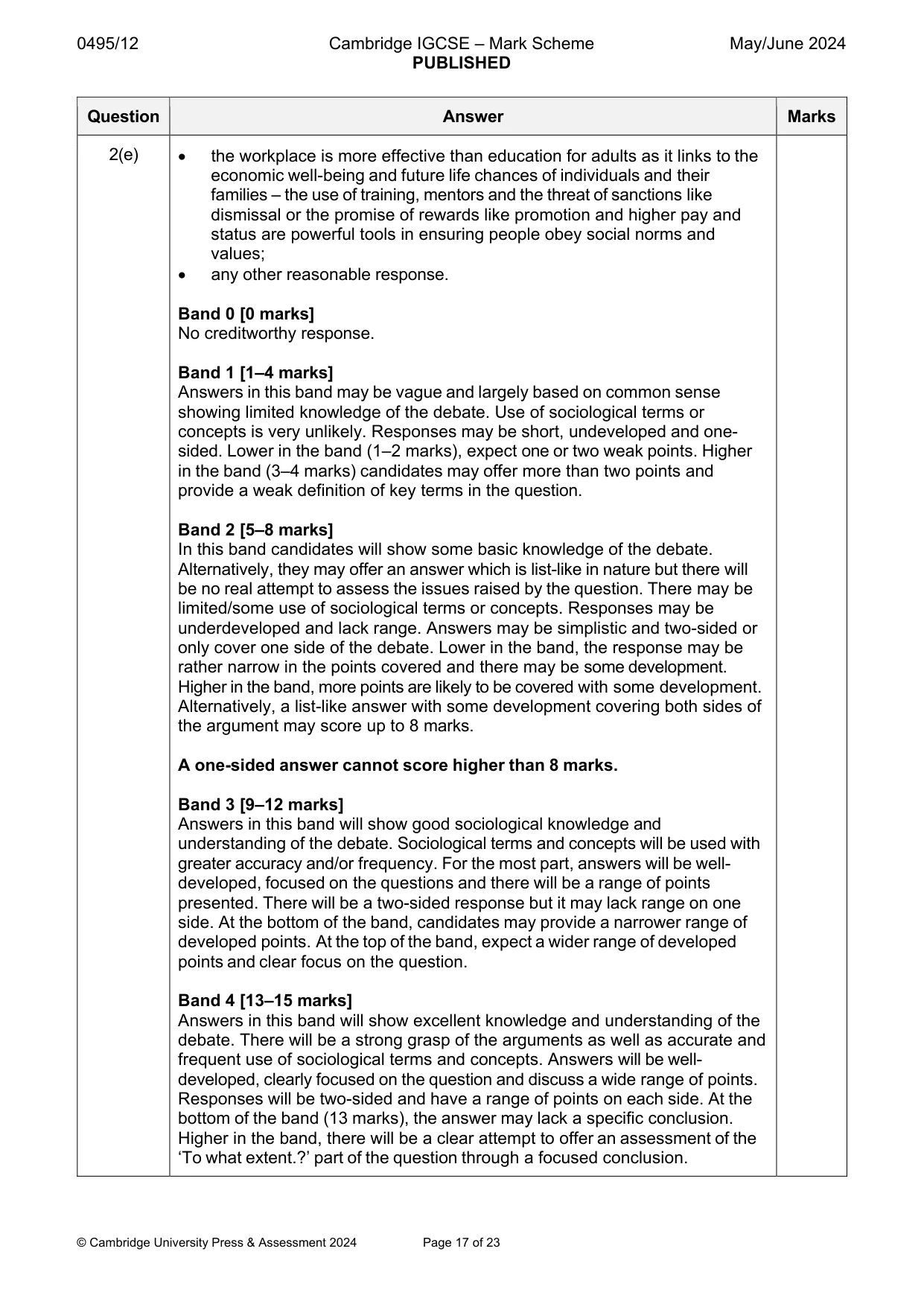
0495/12 Cambridge IGCSE – Mark Scheme PUBLISHED May/June 2024 © Cambridge University Press & Assessment 2024 Page 17 of 23 Question Answer Marks 2(e) the workplace is more effective than education for adults as it links to the economic well-being and future life chances of individuals and their families – the use of training, mentors and the threat of sanctions like dismissal or the promise of rewards like promotion and higher pay and status are powerful tools in ensuring people obey social norms and values; any other reasonable response. Band 0 [0 marks] No creditworthy response. Band 1 [1–4 marks] Answers in this band may be vague and largely based on common sense showing limited knowledge of the debate. Use of sociological terms or concepts is very unlikely. Responses may be short, undeveloped and one- sided. Lower in the band (1–2 marks), expect one or two weak points. Higher in the band (3–4 marks) candidates may offer more than two points and provide a weak definition of key terms in the question. Band 2 [5–8 marks] In this band candidates will show some basic knowledge of the debate. Alternatively, they may offer an answer which is list-like in nature but there will be no real attempt to assess the issues raised by the question. There may be limited/some use of sociological terms or concepts. Responses may be underdeveloped and lack range. Answers may be simplistic and two-sided or only cover one side of the debate. Lower in the band, the response may be rather narrow in the points covered and there may be some development. Higher in the band, more points are likely to be covered with some development. Alternatively, a list-like answer with some development covering both sides of the argument may score up to 8 marks. A one-sided answer cannot score higher than 8 marks. Band 3 [9–12 marks] Answers in this band will show good sociological knowledge and understanding of the debate. Sociological terms and concepts will be used with greater accuracy and/or frequency. For the most part, answers will be well- developed, focused on the questions and there will be a range of points presented. There will be a two-sided response but it may lack range on one side. At the bottom of the band, candidates may provide a narrower range of developed points. At the top of the band, expect a wider range of developed points and clear focus on the question. Band 4 [13–15 marks] Answers in this band will show excellent knowledge and understanding of the debate. There will be a strong grasp of the arguments as well as accurate and frequent use of sociological terms and concepts. Answers will be well- developed, clearly focused on the question and discuss a wide range of points. Responses will be two-sided and have a range of points on each side. At the bottom of the band (13 marks), the answer may lack a specific conclusion. Higher in the band, there will be a clear attempt to offer an assessment of the ‘To what extent.?’ part of the question through a focused conclusion.
Mark scheme, page 18
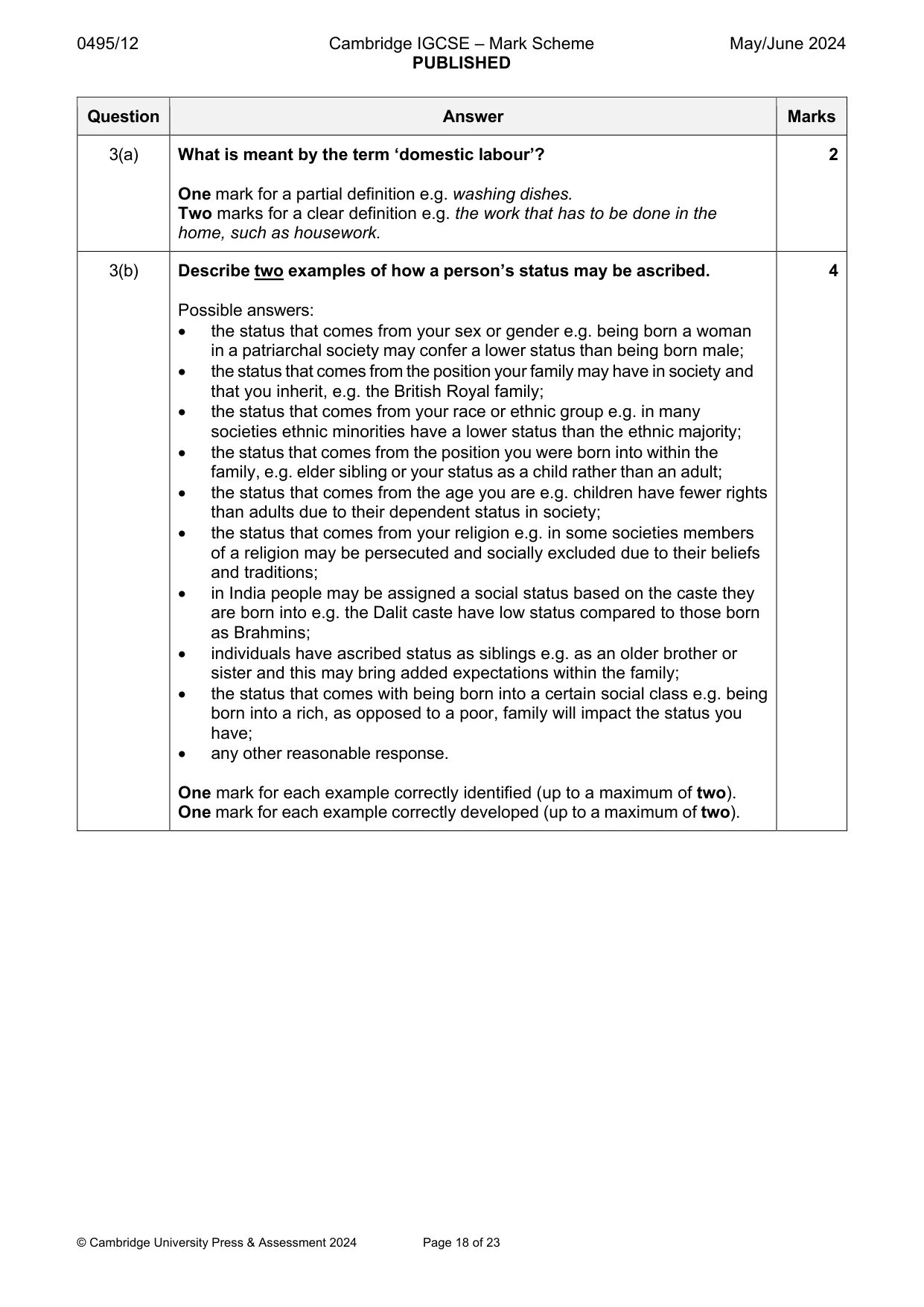
0495/12 Cambridge IGCSE – Mark Scheme PUBLISHED May/June 2024 © Cambridge University Press & Assessment 2024 Page 18 of 23 Question Answer Marks 3(a) What is meant by the term ‘domestic labour’? One mark for a partial definition e.g. washing dishes. Two marks for a clear definition e.g. the work that has to be done in the home, such as housework. 2 3(b) Describe two examples of how a person’s status may be ascribed. Possible answers: the status that comes from your sex or gender e.g. being born a woman in a patriarchal society may confer a lower status than being born male; the status that comes from the position your family may have in society and that you inherit, e.g. the British Royal family; the status that comes from your race or ethnic group e.g. in many societies ethnic minorities have a lower status than the ethnic majority; the status that comes from the position you were born into within the family, e.g. elder sibling or your status as a child rather than an adult; the status that comes from the age you are e.g. children have fewer rights than adults due to their dependent status in society; the status that comes from your religion e.g. in some societies members of a religion may be persecuted and socially excluded due to their beliefs and traditions; in India people may be assigned a social status based on the caste they are born into e.g. the Dalit caste have low status compared to those born as Brahmins; individuals have ascribed status as siblings e.g. as an older brother or sister and this may bring added expectations within the family; the status that comes with being born into a certain social class e.g. being born into a rich, as opposed to a poor, family will impact the status you have; any other reasonable response. One mark for each example correctly identified (up to a maximum of two). One mark for each example correctly developed (up to a maximum of two). 4
Mark scheme, page 19
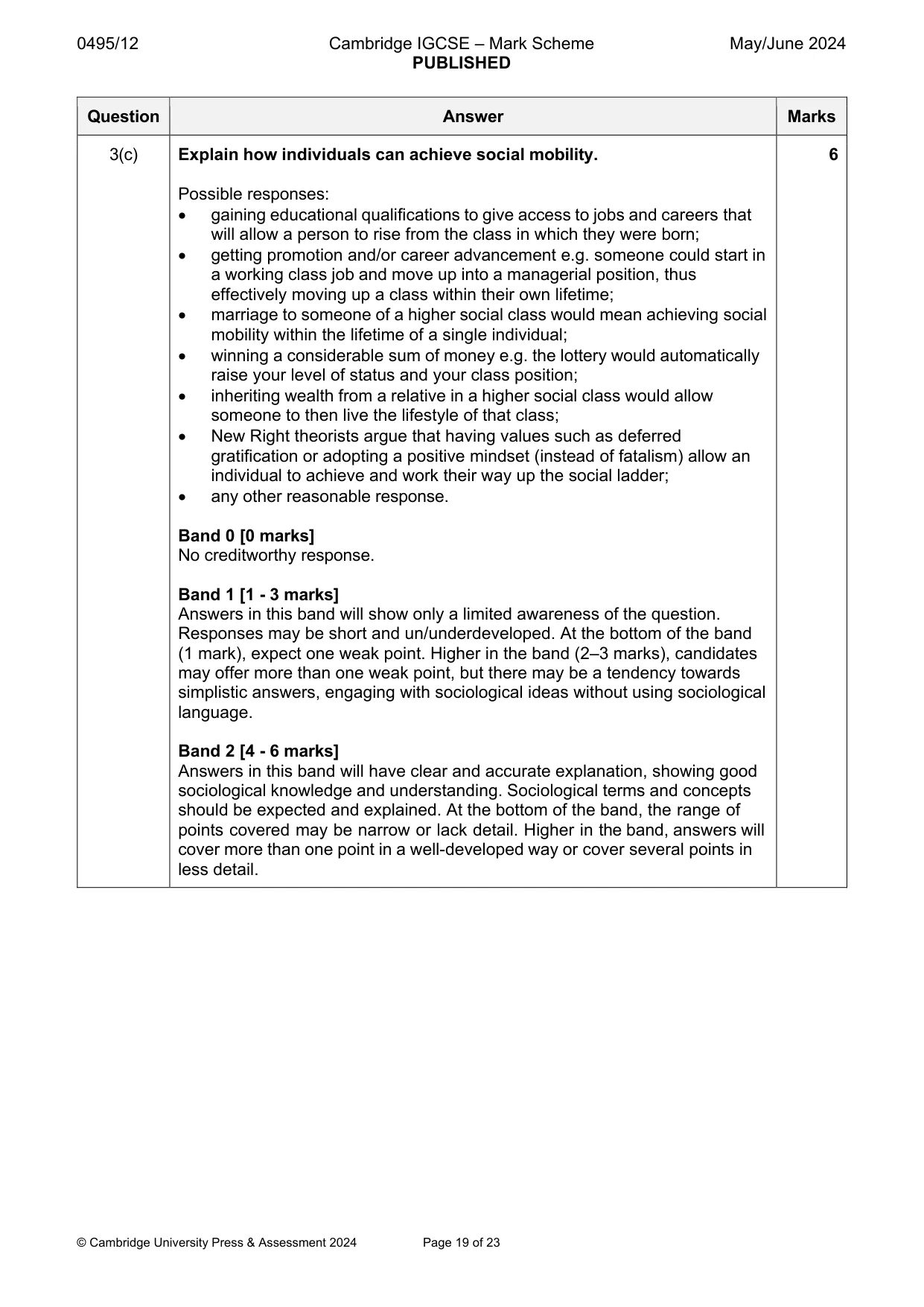
0495/12 Cambridge IGCSE – Mark Scheme PUBLISHED May/June 2024 © Cambridge University Press & Assessment 2024 Page 19 of 23 Question Answer Marks 3(c) Explain how individuals can achieve social mobility. Possible responses: gaining educational qualifications to give access to jobs and careers that will allow a person to rise from the class in which they were born; getting promotion and/or career advancement e.g. someone could start in a working class job and move up into a managerial position, thus effectively moving up a class within their own lifetime; marriage to someone of a higher social class would mean achieving social mobility within the lifetime of a single individual; winning a considerable sum of money e.g. the lottery would automatically raise your level of status and your class position; inheriting wealth from a relative in a higher social class would allow someone to then live the lifestyle of that class; New Right theorists argue that having values such as deferred gratification or adopting a positive mindset (instead of fatalism) allow an individual to achieve and work their way up the social ladder; any other reasonable response. Band 0 [0 marks] No creditworthy response. Band 1 [1 - 3 marks] Answers in this band will show only a limited awareness of the question. Responses may be short and un/underdeveloped. At the bottom of the band (1 mark), expect one weak point. Higher in the band (2–3 marks), candidates may offer more than one weak point, but there may be a tendency towards simplistic answers, engaging with sociological ideas without using sociological language. Band 2 [4 - 6 marks] Answers in this band will have clear and accurate explanation, showing good sociological knowledge and understanding. Sociological terms and concepts should be expected and explained. At the bottom of the band, the range of points covered may be narrow or lack detail. Higher in the band, answers will cover more than one point in a well-developed way or cover several points in less detail. 6
Mark scheme, page 20
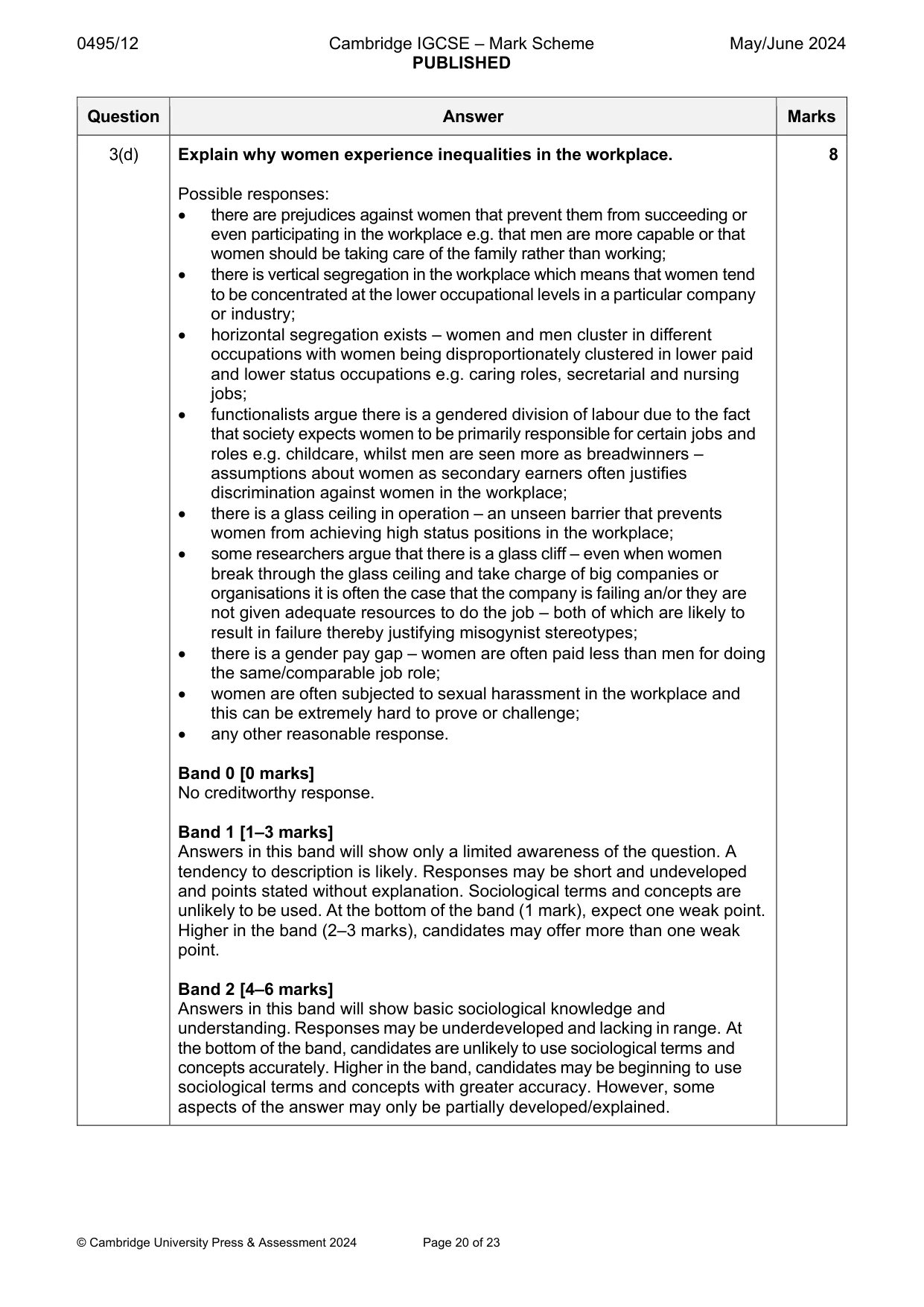
0495/12 Cambridge IGCSE – Mark Scheme PUBLISHED May/June 2024 © Cambridge University Press & Assessment 2024 Page 20 of 23 Question Answer Marks 3(d) Explain why women experience inequalities in the workplace. Possible responses: there are prejudices against women that prevent them from succeeding or even participating in the workplace e.g. that men are more capable or that women should be taking care of the family rather than working; there is vertical segregation in the workplace which means that women tend to be concentrated at the lower occupational levels in a particular company or industry; horizontal segregation exists – women and men cluster in different occupations with women being disproportionately clustered in lower paid and lower status occupations e.g. caring roles, secretarial and nursing jobs; functionalists argue there is a gendered division of labour due to the fact that society expects women to be primarily responsible for certain jobs and roles e.g. childcare, whilst men are seen more as breadwinners – assumptions about women as secondary earners often justifies discrimination against women in the workplace; there is a glass ceiling in operation – an unseen barrier that prevents women from achieving high status positions in the workplace; some researchers argue that there is a glass cliff – even when women break through the glass ceiling and take charge of big companies or organisations it is often the case that the company is failing an/or they are not given adequate resources to do the job – both of which are likely to result in failure thereby justifying misogynist stereotypes; there is a gender pay gap – women are often paid less than men for doing the same/comparable job role; women are often subjected to sexual harassment in the workplace and this can be extremely hard to prove or challenge; any other reasonable response. Band 0 [0 marks] No creditworthy response. Band 1 [1–3 marks] Answers in this band will show only a limited awareness of the question. A tendency to description is likely. Responses may be short and undeveloped and points stated without explanation. Sociological terms and concepts are unlikely to be used. At the bottom of the band (1 mark), expect one weak point. Higher in the band (2–3 marks), candidates may offer more than one weak point. Band 2 [4–6 marks] Answers in this band will show basic sociological knowledge and understanding. Responses may be underdeveloped and lacking in range. At the bottom of the band, candidates are unlikely to use sociological terms and concepts accurately. Higher in the band, candidates may be beginning to use sociological terms and concepts with greater accuracy. However, some aspects of the answer may only be partially developed/explained. 8
Mark scheme, page 21
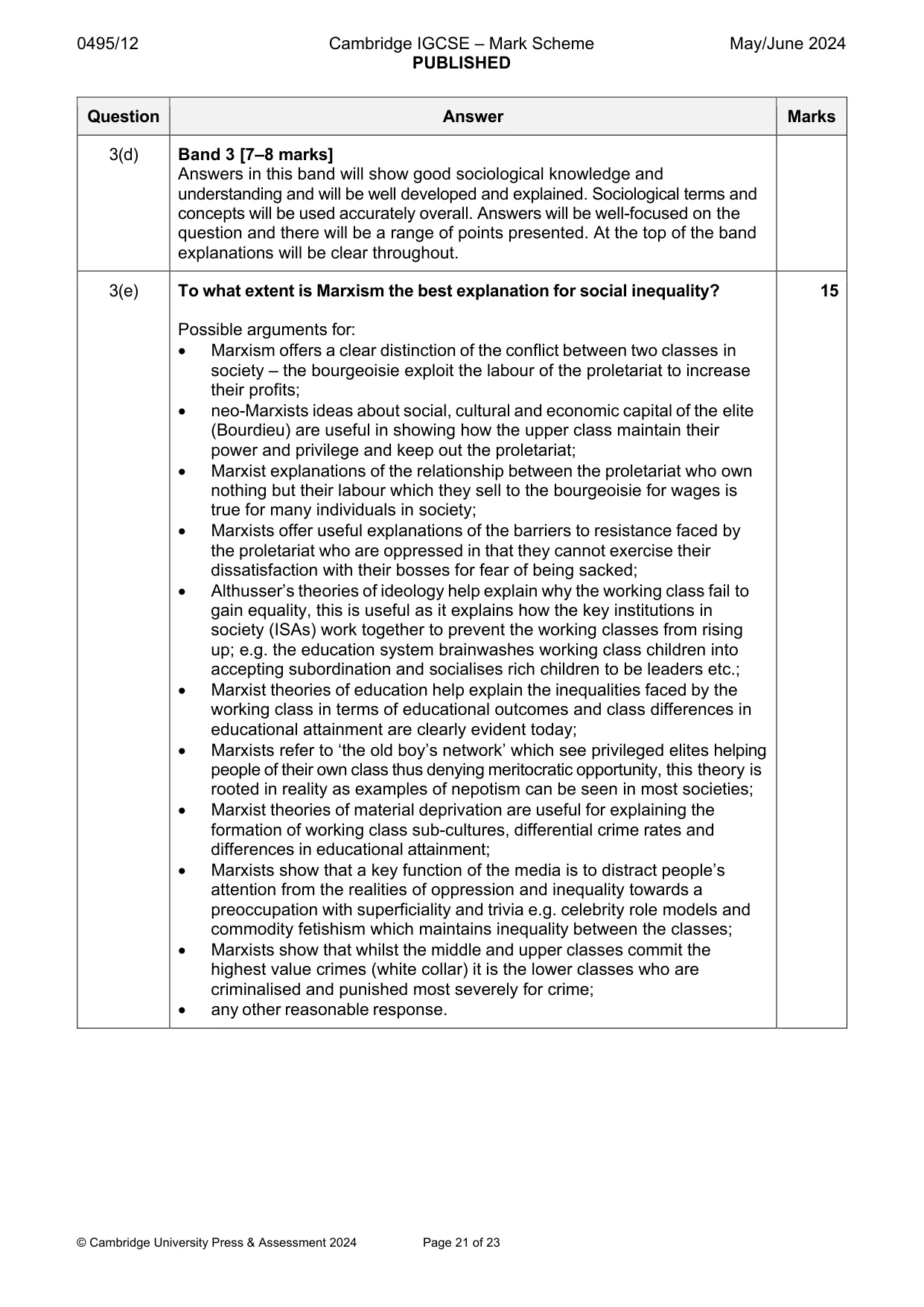
0495/12 Cambridge IGCSE – Mark Scheme PUBLISHED May/June 2024 © Cambridge University Press & Assessment 2024 Page 21 of 23 Question Answer Marks 3(d) Band 3 [7–8 marks] Answers in this band will show good sociological knowledge and understanding and will be well developed and explained. Sociological terms and concepts will be used accurately overall. Answers will be well-focused on the question and there will be a range of points presented. At the top of the band explanations will be clear throughout. 3(e) To what extent is Marxism the best explanation for social inequality? Possible arguments for: Marxism offers a clear distinction of the conflict between two classes in society – the bourgeoisie exploit the labour of the proletariat to increase their profits; neo-Marxists ideas about social, cultural and economic capital of the elite (Bourdieu) are useful in showing how the upper class maintain their power and privilege and keep out the proletariat; Marxist explanations of the relationship between the proletariat who own nothing but their labour which they sell to the bourgeoisie for wages is true for many individuals in society; Marxists offer useful explanations of the barriers to resistance faced by the proletariat who are oppressed in that they cannot exercise their dissatisfaction with their bosses for fear of being sacked; Althusser’s theories of ideology help explain why the working class fail to gain equality, this is useful as it explains how the key institutions in society (ISAs) work together to prevent the working classes from rising up; e.g. the education system brainwashes working class children into accepting subordination and socialises rich children to be leaders etc.; Marxist theories of education help explain the inequalities faced by the working class in terms of educational outcomes and class differences in educational attainment are clearly evident today; Marxists refer to ‘the old boy’s network’ which see privileged elites helping people of their own class thus denying meritocratic opportunity, this theory is rooted in reality as examples of nepotism can be seen in most societies; Marxist theories of material deprivation are useful for explaining the formation of working class sub-cultures, differential crime rates and differences in educational attainment; Marxists show that a key function of the media is to distract people’s attention from the realities of oppression and inequality towards a preoccupation with superficiality and trivia e.g. celebrity role models and commodity fetishism which maintains inequality between the classes; Marxists show that whilst the middle and upper classes commit the highest value crimes (white collar) it is the lower classes who are criminalised and punished most severely for crime; any other reasonable response. 15
Mark scheme, page 22
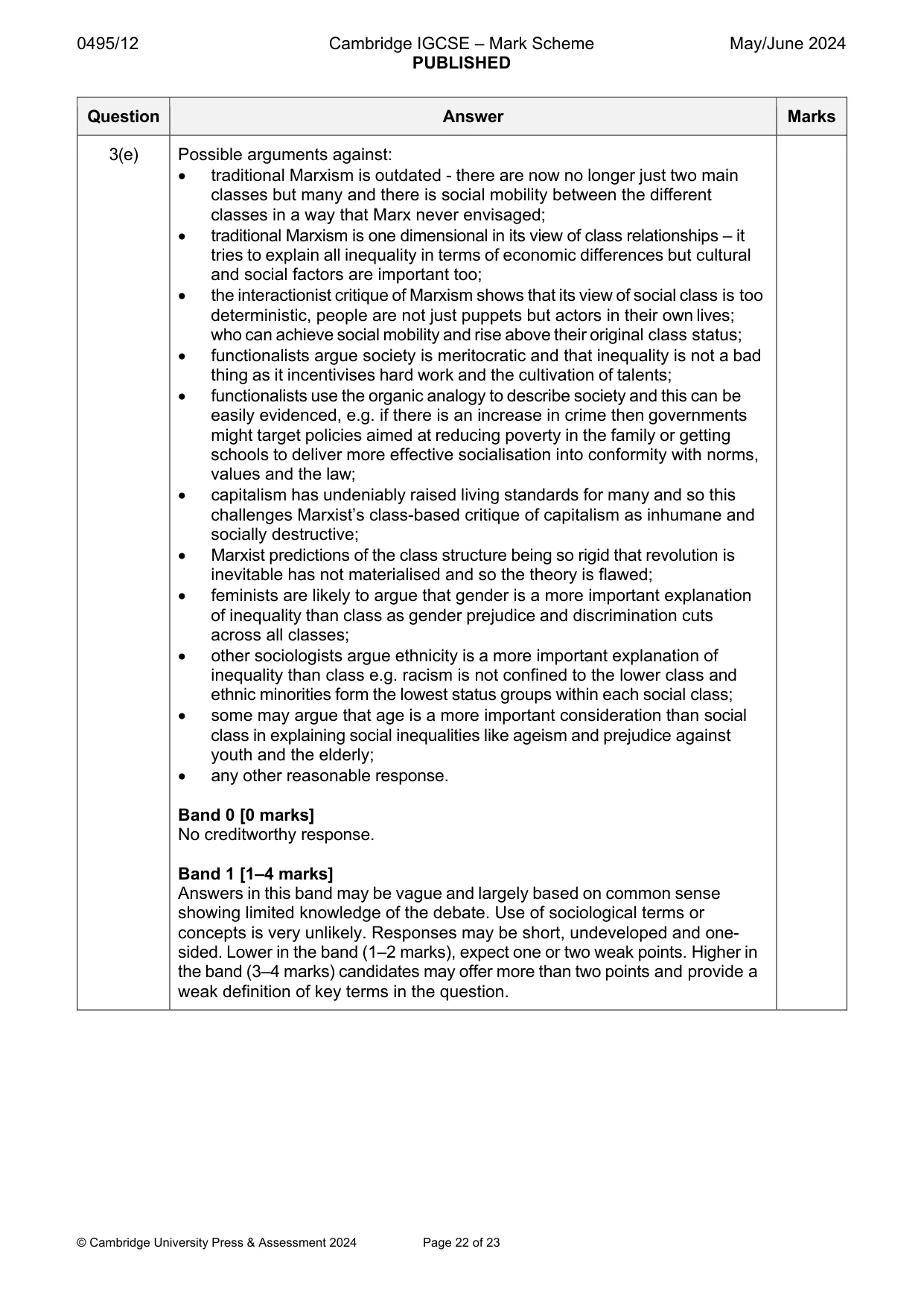
0495/12 Cambridge IGCSE – Mark Scheme PUBLISHED May/June 2024 © Cambridge University Press & Assessment 2024 Page 22 of 23 Question Answer Marks 3(e) Possible arguments against: traditional Marxism is outdated - there are now no longer just two main classes but many and there is social mobility between the different classes in a way that Marx never envisaged; traditional Marxism is one dimensional in its view of class relationships – it tries to explain all inequality in terms of economic differences but cultural and social factors are important too; the interactionist critique of Marxism shows that its view of social class is too deterministic, people are not just puppets but actors in their own lives; who can achieve social mobility and rise above their original class status; functionalists argue society is meritocratic and that inequality is not a bad thing as it incentivises hard work and the cultivation of talents; functionalists use the organic analogy to describe society and this can be easily evidenced, e.g. if there is an increase in crime then governments might target policies aimed at reducing poverty in the family or getting schools to deliver more effective socialisation into conformity with norms, values and the law; capitalism has undeniably raised living standards for many and so this challenges Marxist’s class-based critique of capitalism as inhumane and socially destructive; Marxist predictions of the class structure being so rigid that revolution is inevitable has not materialised and so the theory is flawed; feminists are likely to argue that gender is a more important explanation of inequality than class as gender prejudice and discrimination cuts across all classes; other sociologists argue ethnicity is a more important explanation of inequality than class e.g. racism is not confined to the lower class and ethnic minorities form the lowest status groups within each social class; some may argue that age is a more important consideration than social class in explaining social inequalities like ageism and prejudice against youth and the elderly; any other reasonable response. Band 0 [0 marks] No creditworthy response. Band 1 [1–4 marks] Answers in this band may be vague and largely based on common sense showing limited knowledge of the debate. Use of sociological terms or concepts is very unlikely. Responses may be short, undeveloped and one- sided. Lower in the band (1–2 marks), expect one or two weak points. Higher in the band (3–4 marks) candidates may offer more than two points and provide a weak definition of key terms in the question.
Mark scheme, page 23
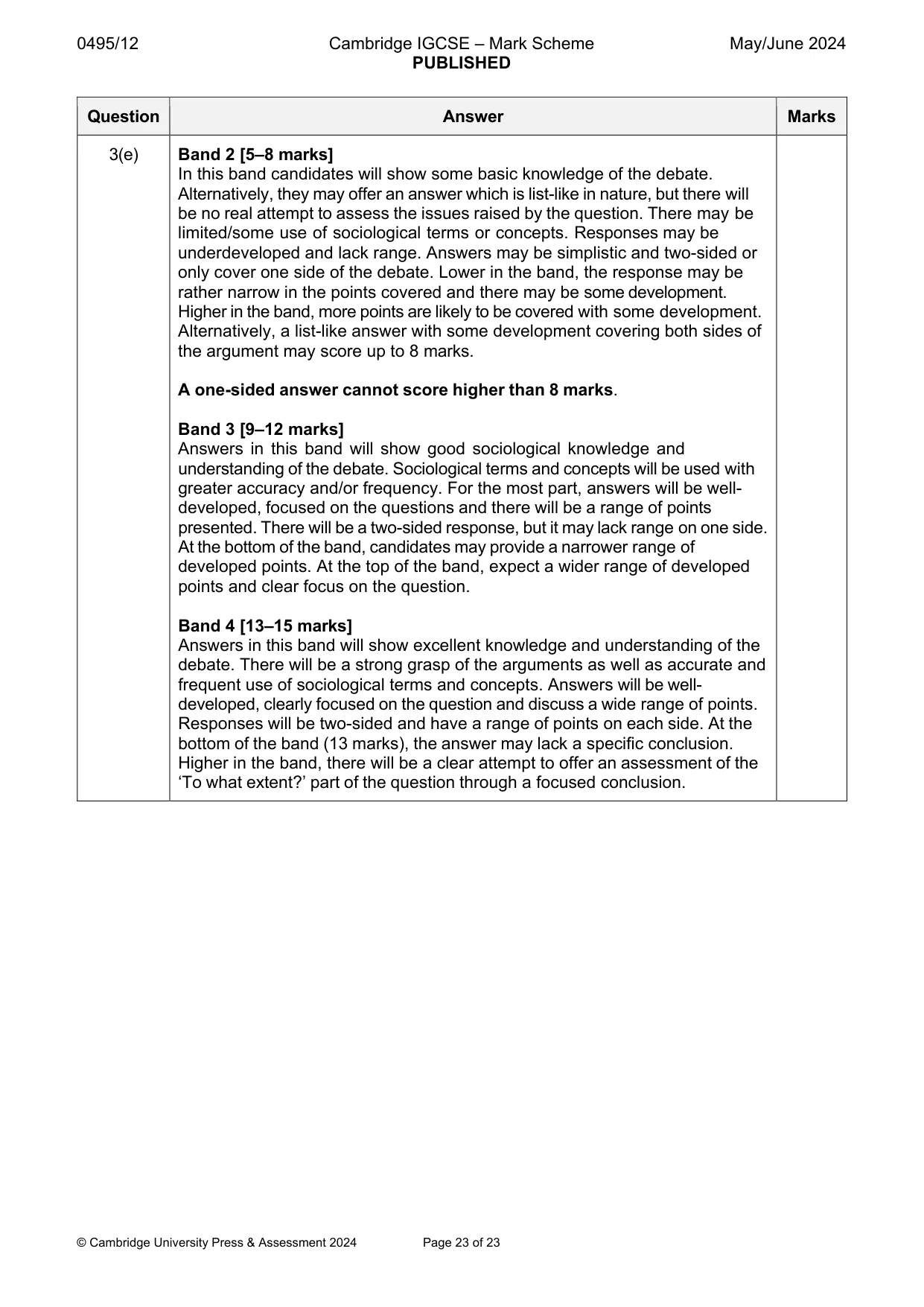
0495/12 Cambridge IGCSE – Mark Scheme PUBLISHED May/June 2024 © Cambridge University Press & Assessment 2024 Page 23 of 23 Question Answer Marks 3(e) Band 2 [5–8 marks] In this band candidates will show some basic knowledge of the debate. Alternatively, they may offer an answer which is list-like in nature, but there will be no real attempt to assess the issues raised by the question. There may be limited/some use of sociological terms or concepts. Responses may be underdeveloped and lack range. Answers may be simplistic and two-sided or only cover one side of the debate. Lower in the band, the response may be rather narrow in the points covered and there may be some development. Higher in the band, more points are likely to be covered with some development. Alternatively, a list-like answer with some development covering both sides of the argument may score up to 8 marks. A one-sided answer cannot score higher than 8 marks. Band 3 [9–12 marks] Answers in this band will show good sociological knowledge and understanding of the debate. Sociological terms and concepts will be used with greater accuracy and/or frequency. For the most part, answers will be well- developed, focused on the questions and there will be a range of points presented. There will be a two-sided response, but it may lack range on one side. At the bottom of the band, candidates may provide a narrower range of developed points. At the top of the band, expect a wider range of developed points and clear focus on the question. Band 4 [13–15 marks] Answers in this band will show excellent knowledge and understanding of the debate. There will be a strong grasp of the arguments as well as accurate and frequent use of sociological terms and concepts. Answers will be well- developed, clearly focused on the question and discuss a wide range of points. Responses will be two-sided and have a range of points on each side. At the bottom of the band (13 marks), the answer may lack a specific conclusion. Higher in the band, there will be a clear attempt to offer an assessment of the ‘To what extent?’ part of the question through a focused conclusion.
What you needed in this session
Cambridge’s own grade thresholds for 2024 May/June, Paper 1 · Variant 2. A higher threshold means an easier paper — the bar moves with how the cohort did.