Cambridge IGCSE Sociology 0495 — 2023 Oct/Nov Paper 1 · Variant 2
0495/12/O/N/23 · 80 marks · ≈90 min
The question paper and its mark scheme, free to read here and free to download. This is Cambridge’s own paper, exactly as it was sat.
Question paper4 pages

Mark scheme23 pages
Answers below. Sit the paper first if you are practising.


Paper as text
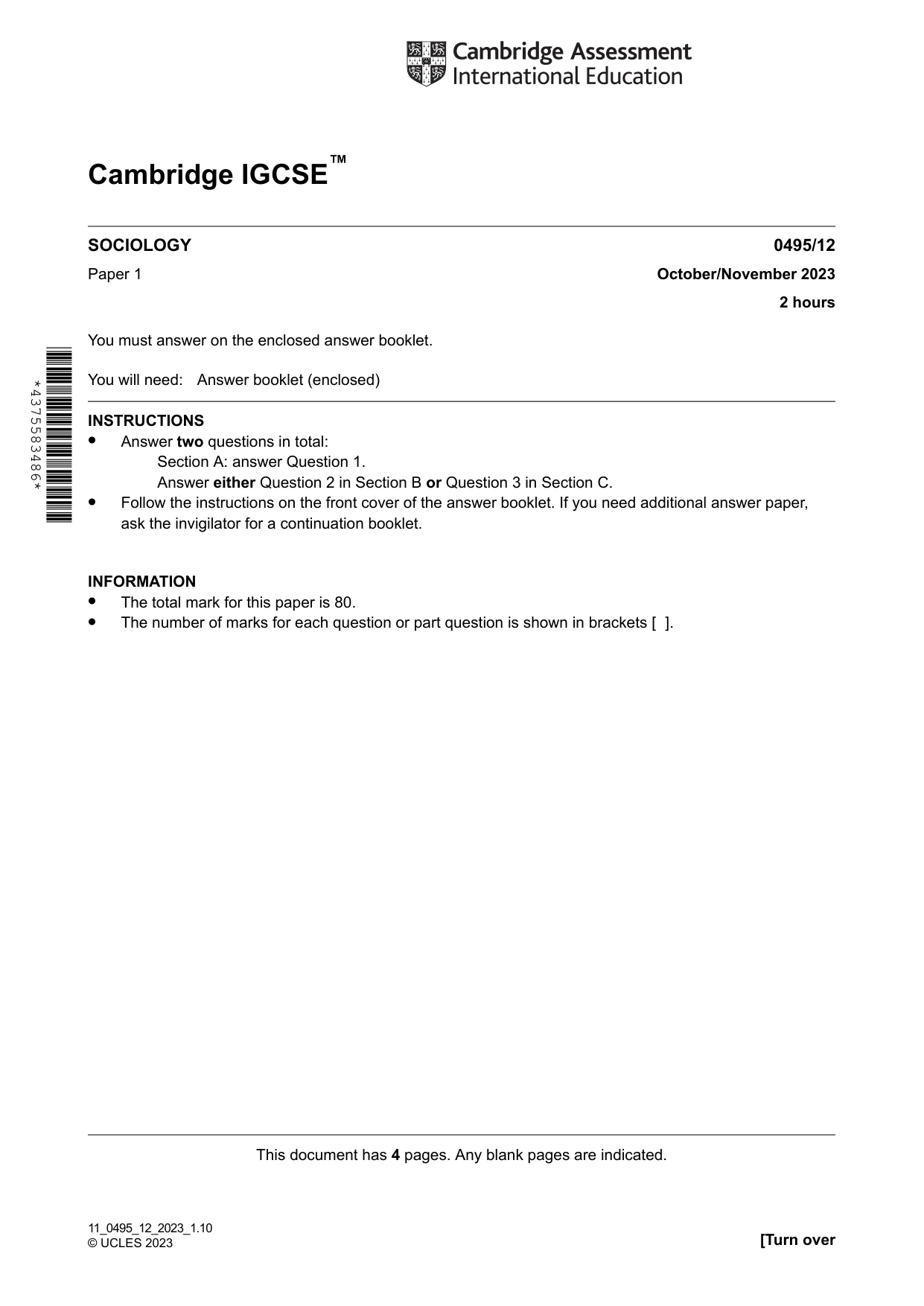
Question paper, page 1
Cambridge IGCSE™ 0495/12 October/November 2023 2 hours SOCIOLOGY Paper 1 You must answer on the enclosed answer booklet. You will need: Answer booklet (enclosed) INSTRUCTIONS • Answer two questions in total: Section A: answer Question 1. Answer either Question 2 in Section B or Question 3 in Section C. • Follow the instructions on the front cover of the answer booklet. If you need additional answer paper, ask the invigilator for a continuation booklet. INFORMATION • The total mark for this paper is 80. • The number of marks for each question or part question is shown in brackets [ ]. This document has 4 pages. Any blank pages are indicated. [Turn over 11_0495_12_2023_1.10 © UCLES 2023 *4375583486*
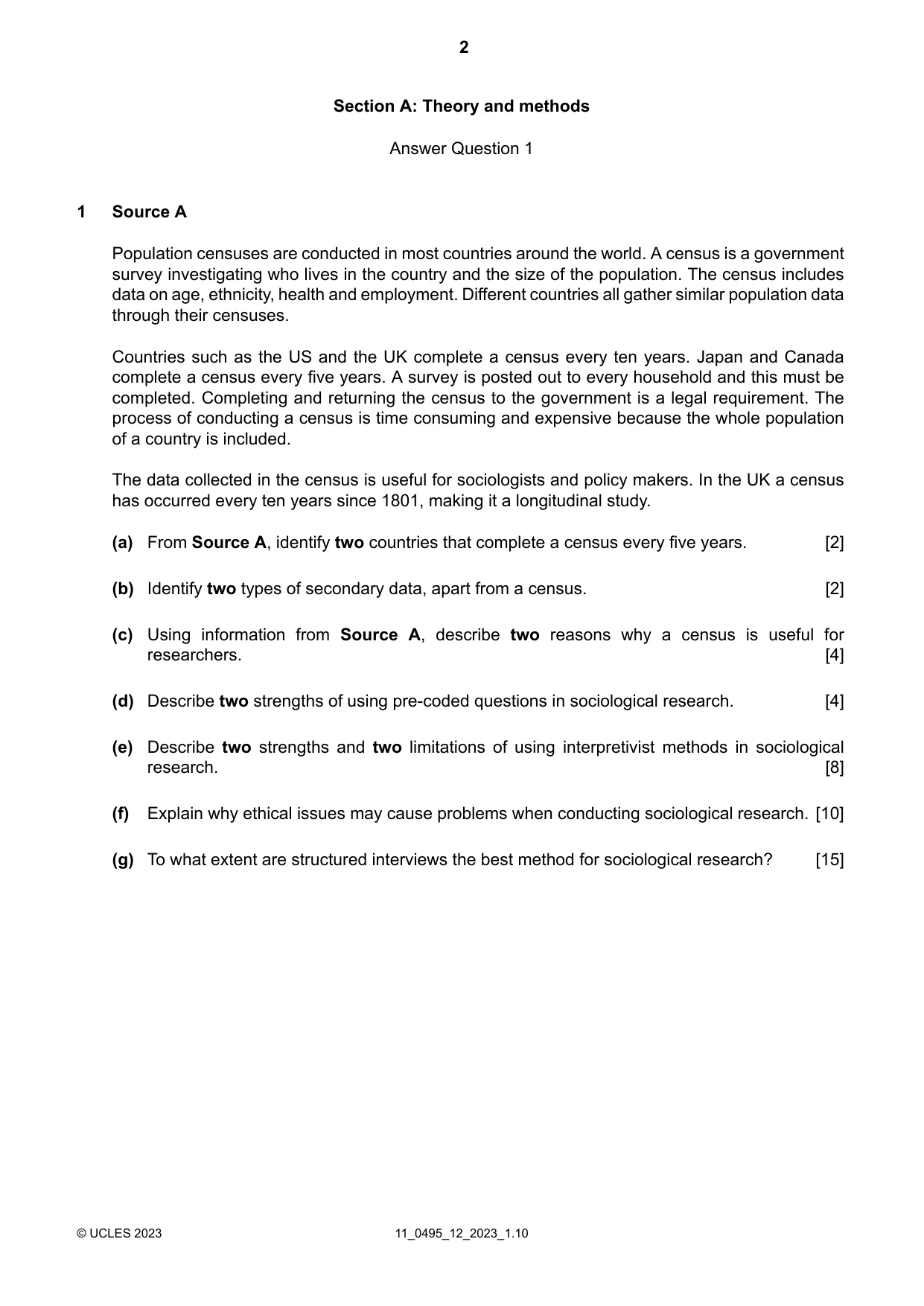
Question paper, page 2
Section A: Theory and methods Answer Question 1 Source A 1 Population censuses are conducted in most countries around the world. A census is a government survey investigating who lives in the country and the size of the population. The census includes data on age, ethnicity, health and employment. Different countries all gather similar population data through their censuses. Countries such as the US and the UK complete a census every ten years. Japan and Canada complete a census every five years. A survey is posted out to every household and this must be completed. Completing and returning the census to the government is a legal requirement. The process of conducting a census is time consuming and expensive because the whole population of a country is included. The data collected in the census is useful for sociologists and policy makers. In the UK a census has occurred every ten years since 1801, making it a longitudinal study. From Source A, identify two countries that complete a census every five years. [2] (a) Identify two types of secondary data, apart from a census. [2] (b) Using information from Source A, describe two reasons why a census is useful for researchers. [4] (c) Describe two strengths of using pre-coded questions in sociological research. [4] (d) Describe two strengths and two limitations of using interpretivist methods in sociological research. [8] (e) Explain why ethical issues may cause problems when conducting sociological research. [10] (f) To what extent are structured interviews the best method for sociological research? [15] (g) 11_0495_12_2023_1.10 © UCLES 2023 2
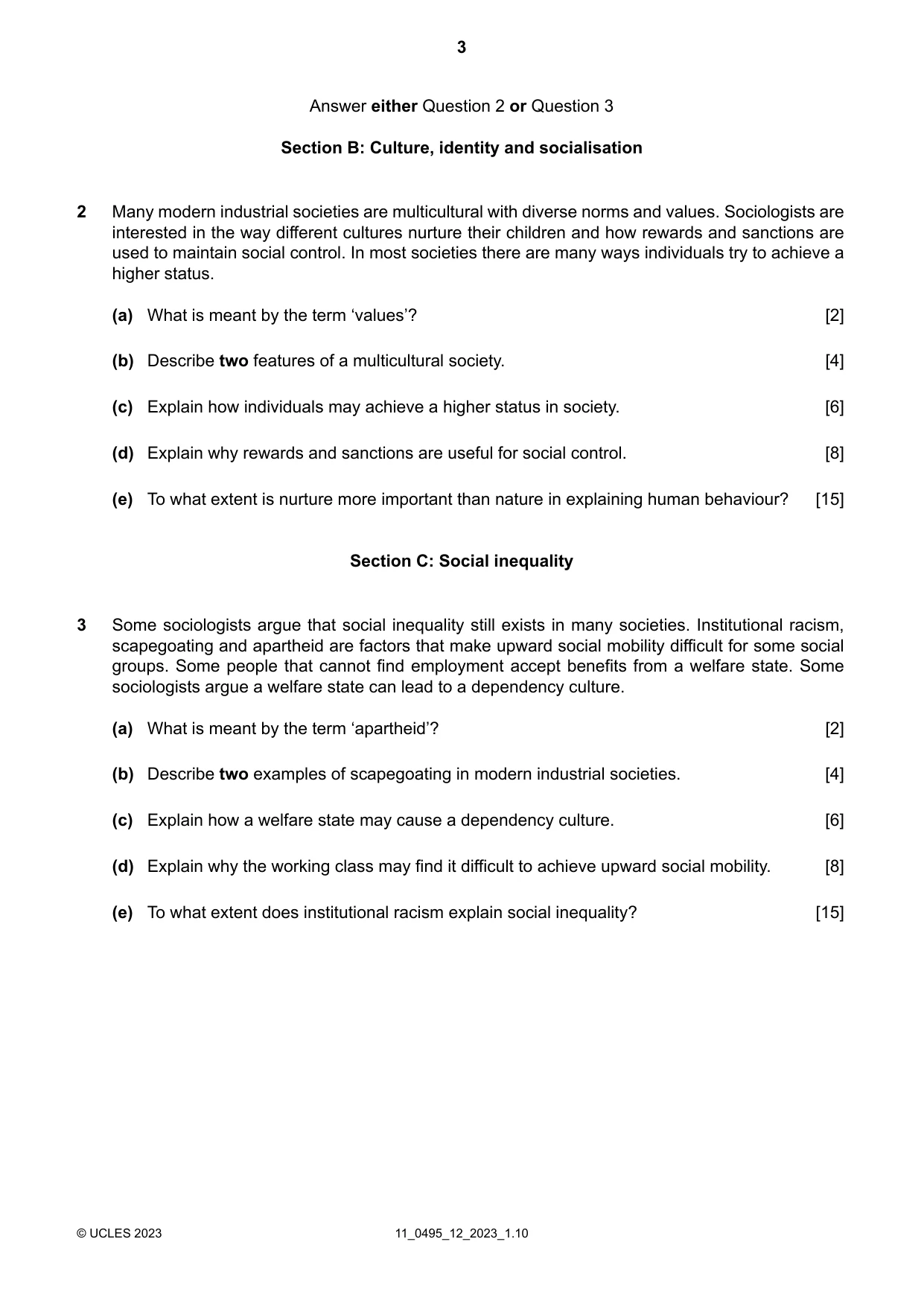
Question paper, page 3
Answer either Question 2 or Question 3 Section B: Culture, identity and socialisation Many modern industrial societies are multicultural with diverse norms and values. Sociologists are interested in the way different cultures nurture their children and how rewards and sanctions are 2 used to maintain social control. In most societies there are many ways individuals try to achieve a higher status. What is meant by the term ‘values’? [2] (a) Describe two features of a multicultural society. [4] (b) Explain how individuals may achieve a higher status in society. [6] (c) Explain why rewards and sanctions are useful for social control. [8] (d) To what extent is nurture more important than nature in explaining human behaviour? [15] (e) Section C: Social inequality Some sociologists argue that social inequality still exists in many societies. Institutional racism, scapegoating and apartheid are factors that make upward social mobility difficult for some social 3 groups. Some people that cannot find employment accept benefits from a welfare state. Some sociologists argue a welfare state can lead to a dependency culture. What is meant by the term ‘apartheid’? [2] (a) Describe two examples of scapegoating in modern industrial societies. [4] (b) Explain how a welfare state may cause a dependency culture. [6] (c) Explain why the working class may find it difficult to achieve upward social mobility. [8] (d) To what extent does institutional racism explain social inequality? [15] (e) 11_0495_12_2023_1.10 © UCLES 2023 3
Question paper, page 4
BLANK PAGE Permission to reproduce items where third-party owned material protected by copyright is included has been sought and cleared where possible. Every reasonable effort has been made by the publisher (UCLES) to trace copyright holders, but if any items requiring clearance have unwittingly been included, the publisher will be pleased to make amends at the earliest possible opportunity. To avoid the issue of disclosure of answer-related information to candidates, all copyright acknowledgements are reproduced online in the Cambridge Assessment International Education Copyright Acknowledgements Booklet. This is produced for each series of examinations and is freely available to download at www.cambridgeinternational.org after the live examination series. Cambridge Assessment International Education is part of Cambridge Assessment. Cambridge Assessment is the brand name of the University of Cambridge Local Examinations Syndicate (UCLES), which is a department of the University of Cambridge. 11_0495_12_2023_1.10 © UCLES 2023 4
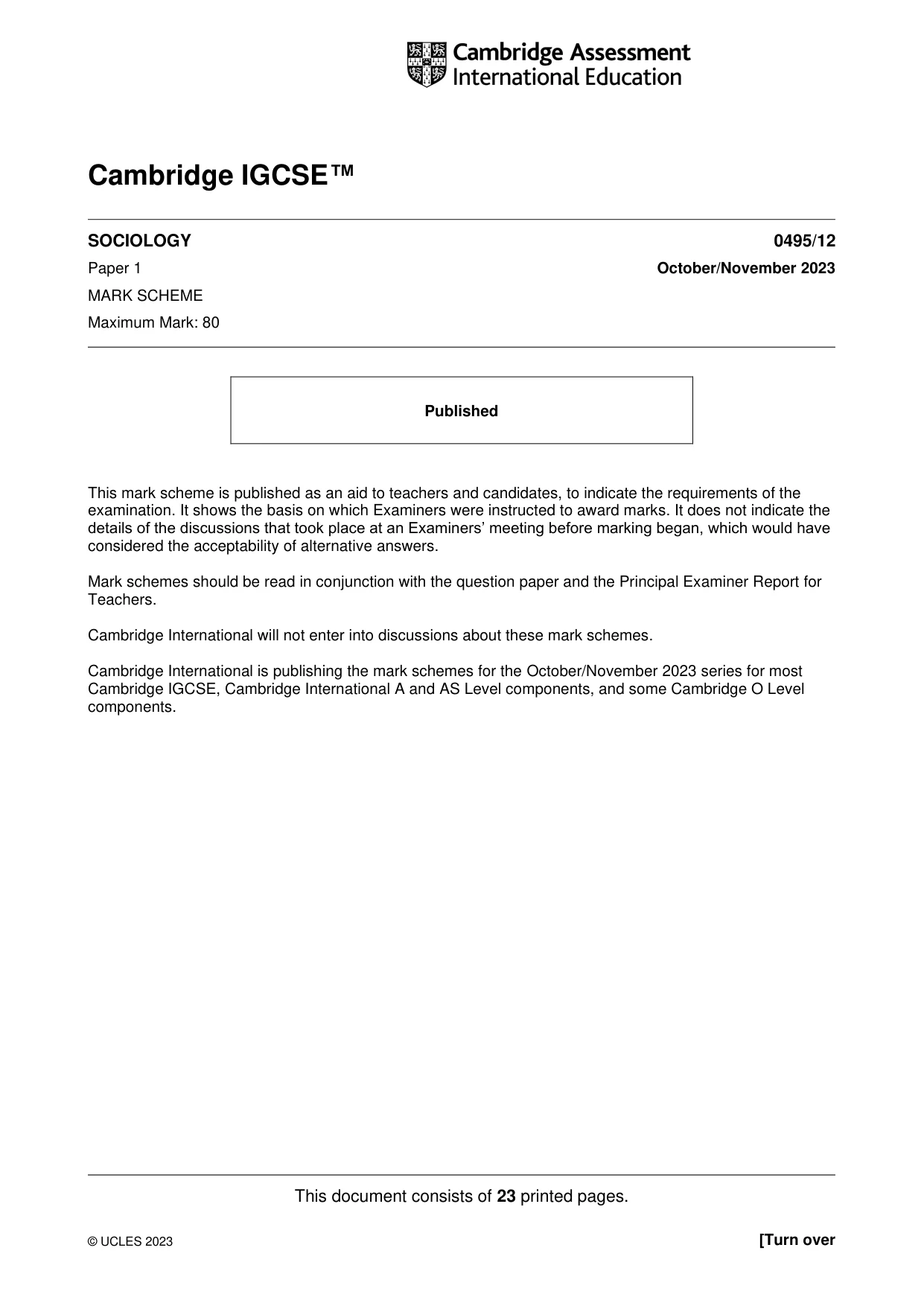
Mark scheme, page 1
This document consists of 23 printed pages. © UCLES 2023 [Turn over Cambridge IGCSE™ SOCIOLOGY 0495/12 Paper 1 October/November 2023 MARK SCHEME Maximum Mark: 80 Published This mark scheme is published as an aid to teachers and candidates, to indicate the requirements of the examination. It shows the basis on which Examiners were instructed to award marks. It does not indicate the details of the discussions that took place at an Examiners’ meeting before marking began, which would have considered the acceptability of alternative answers. Mark schemes should be read in conjunction with the question paper and the Principal Examiner Report for Teachers. Cambridge International will not enter into discussions about these mark schemes. Cambridge International is publishing the mark schemes for the October/November 2023 series for most Cambridge IGCSE, Cambridge International A and AS Level components, and some Cambridge O Level components.
Mark scheme, page 2
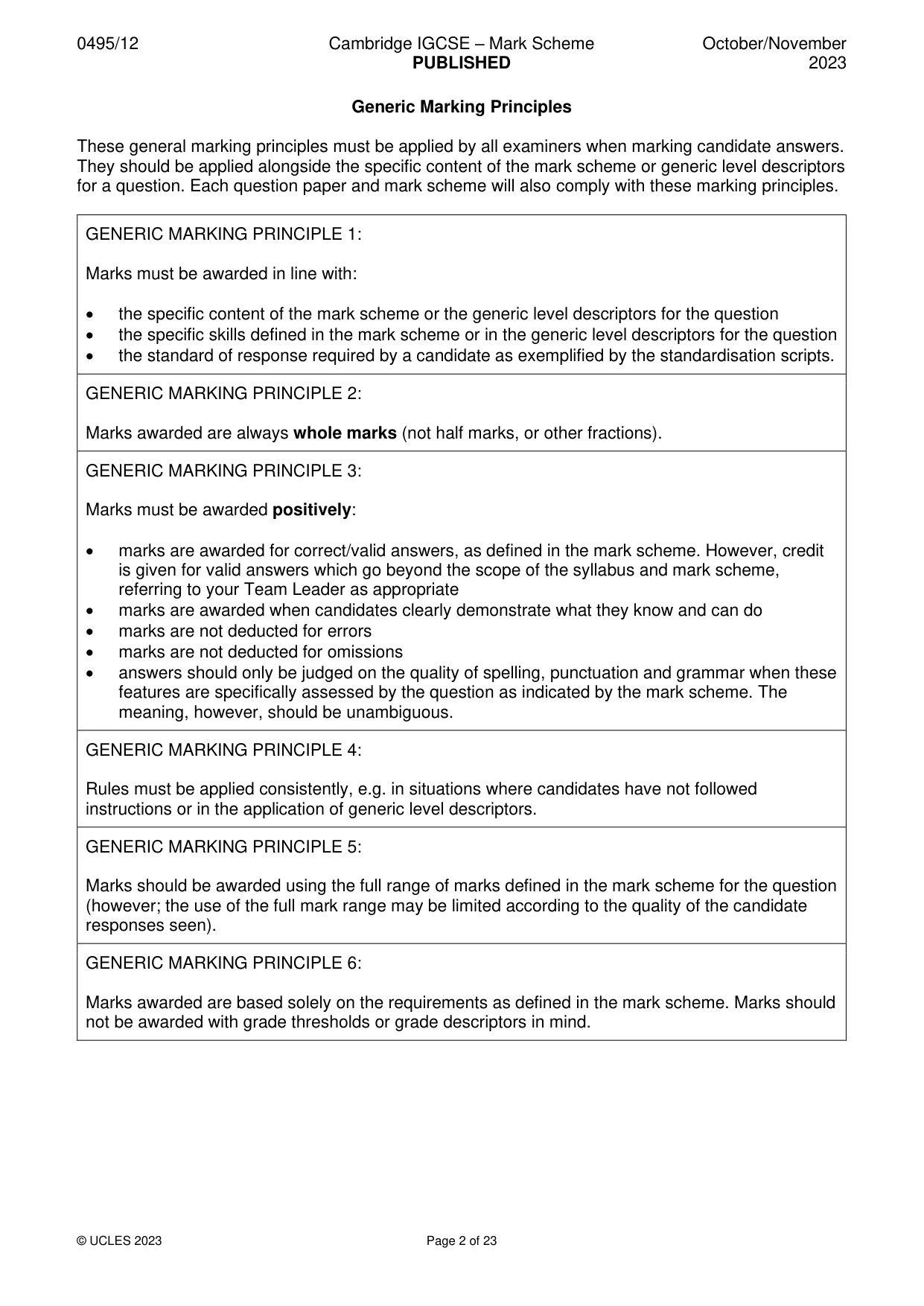
0495/12 Cambridge IGCSE – Mark Scheme PUBLISHED October/November 2023 © UCLES 2023 Page 2 of 23 Generic Marking Principles These general marking principles must be applied by all examiners when marking candidate answers. They should be applied alongside the specific content of the mark scheme or generic level descriptors for a question. Each question paper and mark scheme will also comply with these marking principles. GENERIC MARKING PRINCIPLE 1: Marks must be awarded in line with: • the specific content of the mark scheme or the generic level descriptors for the question • the specific skills defined in the mark scheme or in the generic level descriptors for the question • the standard of response required by a candidate as exemplified by the standardisation scripts. GENERIC MARKING PRINCIPLE 2: Marks awarded are always whole marks (not half marks, or other fractions). GENERIC MARKING PRINCIPLE 3: Marks must be awarded positively: • marks are awarded for correct/valid answers, as defined in the mark scheme. However, credit is given for valid answers which go beyond the scope of the syllabus and mark scheme, referring to your Team Leader as appropriate • marks are awarded when candidates clearly demonstrate what they know and can do • marks are not deducted for errors • marks are not deducted for omissions • answers should only be judged on the quality of spelling, punctuation and grammar when these features are specifically assessed by the question as indicated by the mark scheme. The meaning, however, should be unambiguous. GENERIC MARKING PRINCIPLE 4: Rules must be applied consistently, e.g. in situations where candidates have not followed instructions or in the application of generic level descriptors. GENERIC MARKING PRINCIPLE 5: Marks should be awarded using the full range of marks defined in the mark scheme for the question (however; the use of the full mark range may be limited according to the quality of the candidate responses seen). GENERIC MARKING PRINCIPLE 6: Marks awarded are based solely on the requirements as defined in the mark scheme. Marks should not be awarded with grade thresholds or grade descriptors in mind.
Mark scheme, page 3
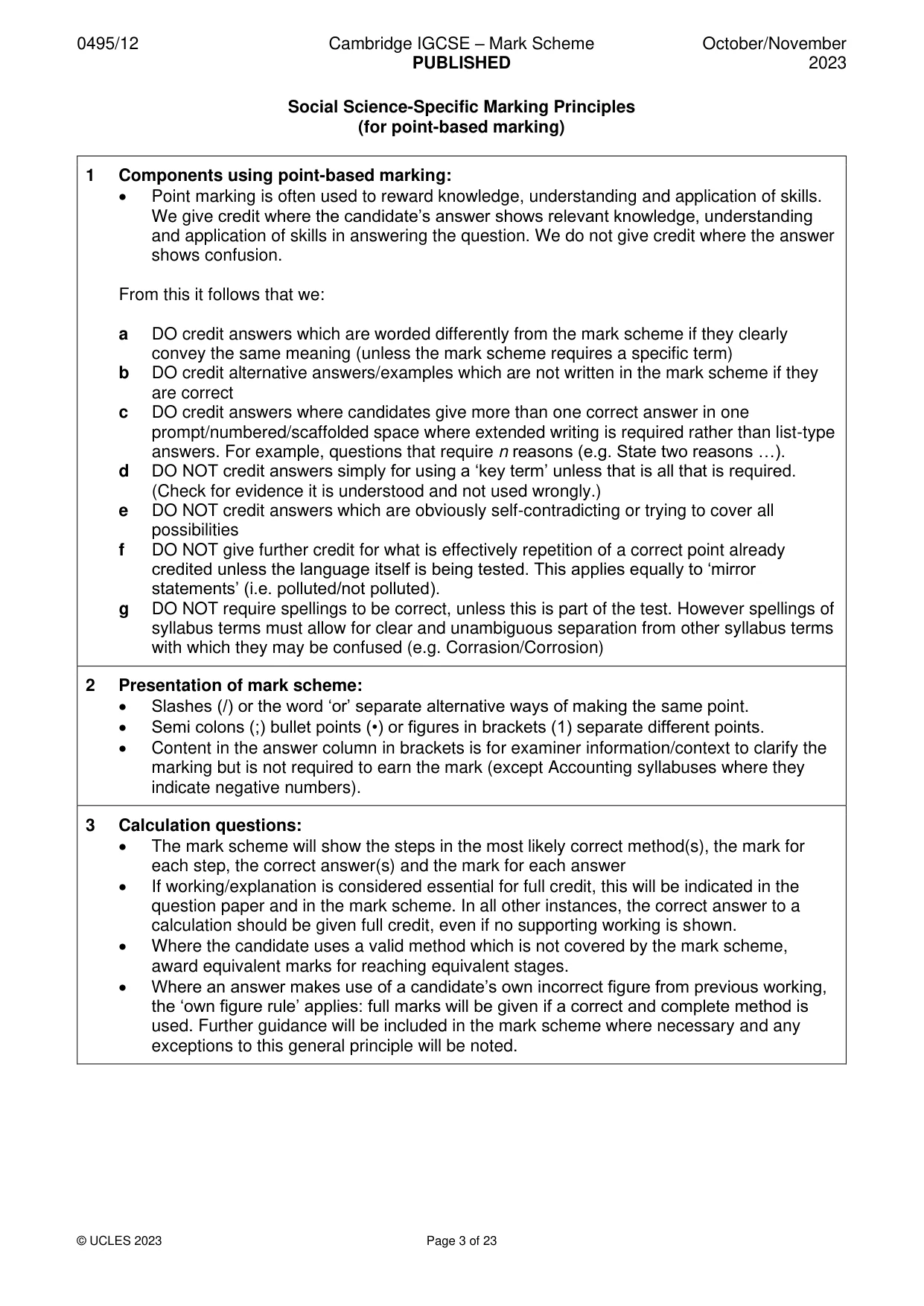
0495/12 Cambridge IGCSE – Mark Scheme PUBLISHED October/November 2023 © UCLES 2023 Page 3 of 23 Social Science-Specific Marking Principles (for point-based marking) 1 Components using point-based marking: • Point marking is often used to reward knowledge, understanding and application of skills. We give credit where the candidate’s answer shows relevant knowledge, understanding and application of skills in answering the question. We do not give credit where the answer shows confusion. From this it follows that we: a DO credit answers which are worded differently from the mark scheme if they clearly convey the same meaning (unless the mark scheme requires a specific term) b DO credit alternative answers/examples which are not written in the mark scheme if they are correct c DO credit answers where candidates give more than one correct answer in one prompt/numbered/scaffolded space where extended writing is required rather than list-type answers. For example, questions that require n reasons (e.g. State two reasons …). d DO NOT credit answers simply for using a ‘key term’ unless that is all that is required. (Check for evidence it is understood and not used wrongly.) e DO NOT credit answers which are obviously self-contradicting or trying to cover all possibilities f DO NOT give further credit for what is effectively repetition of a correct point already credited unless the language itself is being tested. This applies equally to ‘mirror statements’ (i.e. polluted/not polluted). g DO NOT require spellings to be correct, unless this is part of the test. However spellings of syllabus terms must allow for clear and unambiguous separation from other syllabus terms with which they may be confused (e.g. Corrasion/Corrosion) 2 Presentation of mark scheme: • Slashes (/) or the word ‘or’ separate alternative ways of making the same point. • Semi colons (;) bullet points (•) or figures in brackets (1) separate different points. • Content in the answer column in brackets is for examiner information/context to clarify the marking but is not required to earn the mark (except Accounting syllabuses where they indicate negative numbers). 3 Calculation questions: • The mark scheme will show the steps in the most likely correct method(s), the mark for each step, the correct answer(s) and the mark for each answer • If working/explanation is considered essential for full credit, this will be indicated in the question paper and in the mark scheme. In all other instances, the correct answer to a calculation should be given full credit, even if no supporting working is shown. • Where the candidate uses a valid method which is not covered by the mark scheme, award equivalent marks for reaching equivalent stages. • Where an answer makes use of a candidate’s own incorrect figure from previous working, the ‘own figure rule’ applies: full marks will be given if a correct and complete method is used. Further guidance will be included in the mark scheme where necessary and any exceptions to this general principle will be noted.
Mark scheme, page 4
0495/12 Cambridge IGCSE – Mark Scheme PUBLISHED October/November 2023 © UCLES 2023 Page 4 of 23 4 Annotation: • For point marking, ticks can be used to indicate correct answers and crosses can be used to indicate wrong answers. There is no direct relationship between ticks and marks. Ticks have no defined meaning for levels of response marking. • For levels of response marking, the level awarded should be annotated on the script. • Other annotations will be used by examiners as agreed during standardisation, and the meaning will be understood by all examiners who marked that paper.
Mark scheme, page 5
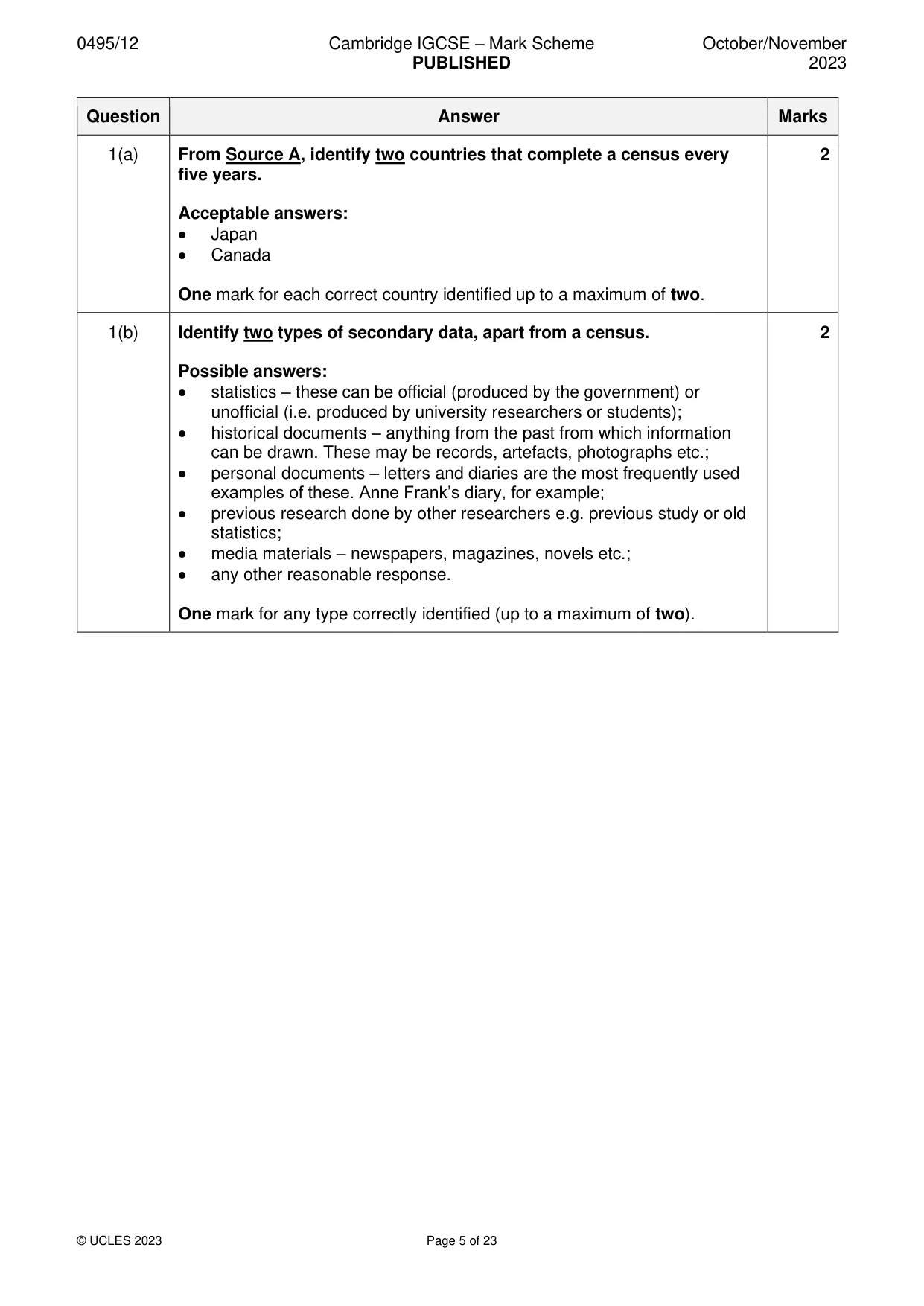
0495/12 Cambridge IGCSE – Mark Scheme PUBLISHED October/November 2023 © UCLES 2023 Page 5 of 23 Question Answer Marks 1(a) From Source A, identify two countries that complete a census every five years. Acceptable answers: • Japan • Canada One mark for each correct country identified up to a maximum of two. 2 1(b) Identify two types of secondary data, apart from a census. Possible answers: • statistics – these can be official (produced by the government) or unofficial (i.e. produced by university researchers or students); • historical documents – anything from the past from which information can be drawn. These may be records, artefacts, photographs etc.; • personal documents – letters and diaries are the most frequently used examples of these. Anne Frank’s diary, for example; • previous research done by other researchers e.g. previous study or old statistics; • media materials – newspapers, magazines, novels etc.; • any other reasonable response. One mark for any type correctly identified (up to a maximum of two). 2
Mark scheme, page 6
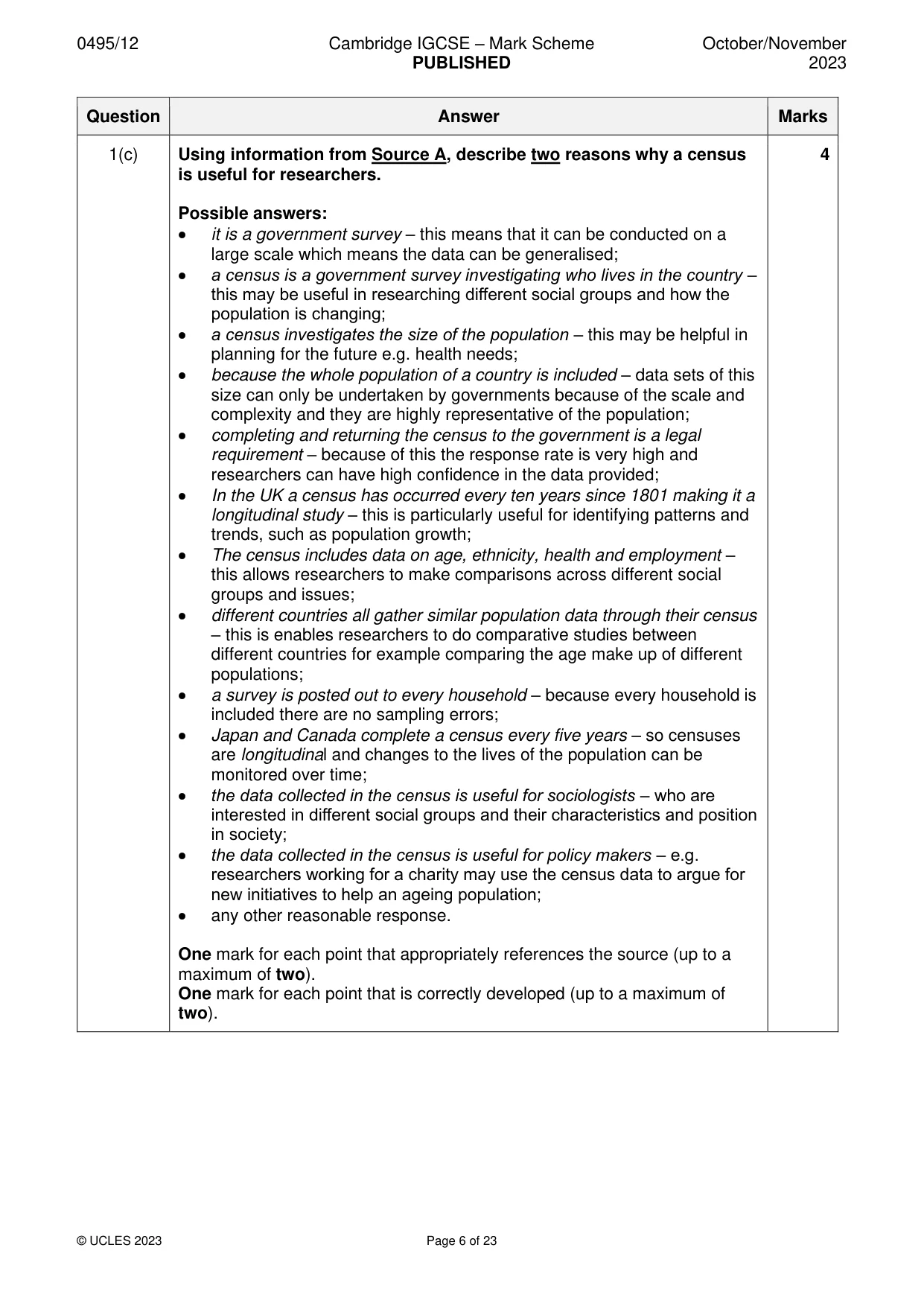
0495/12 Cambridge IGCSE – Mark Scheme PUBLISHED October/November 2023 © UCLES 2023 Page 6 of 23 Question Answer Marks 1(c) Using information from Source A, describe two reasons why a census is useful for researchers. Possible answers: • it is a government survey – this means that it can be conducted on a large scale which means the data can be generalised; • a census is a government survey investigating who lives in the country – this may be useful in researching different social groups and how the population is changing; • a census investigates the size of the population – this may be helpful in planning for the future e.g. health needs; • because the whole population of a country is included – data sets of this size can only be undertaken by governments because of the scale and complexity and they are highly representative of the population; • completing and returning the census to the government is a legal requirement – because of this the response rate is very high and researchers can have high confidence in the data provided; • In the UK a census has occurred every ten years since 1801 making it a longitudinal study – this is particularly useful for identifying patterns and trends, such as population growth; • The census includes data on age, ethnicity, health and employment – this allows researchers to make comparisons across different social groups and issues; • different countries all gather similar population data through their census – this is enables researchers to do comparative studies between different countries for example comparing the age make up of different populations; • a survey is posted out to every household – because every household is included there are no sampling errors; • Japan and Canada complete a census every five years – so censuses are longitudinal and changes to the lives of the population can be monitored over time; • the data collected in the census is useful for sociologists – who are interested in different social groups and their characteristics and position in society; • the data collected in the census is useful for policy makers – e.g. researchers working for a charity may use the census data to argue for new initiatives to help an ageing population; • any other reasonable response. One mark for each point that appropriately references the source (up to a maximum of two). One mark for each point that is correctly developed (up to a maximum of two). 4
Mark scheme, page 7
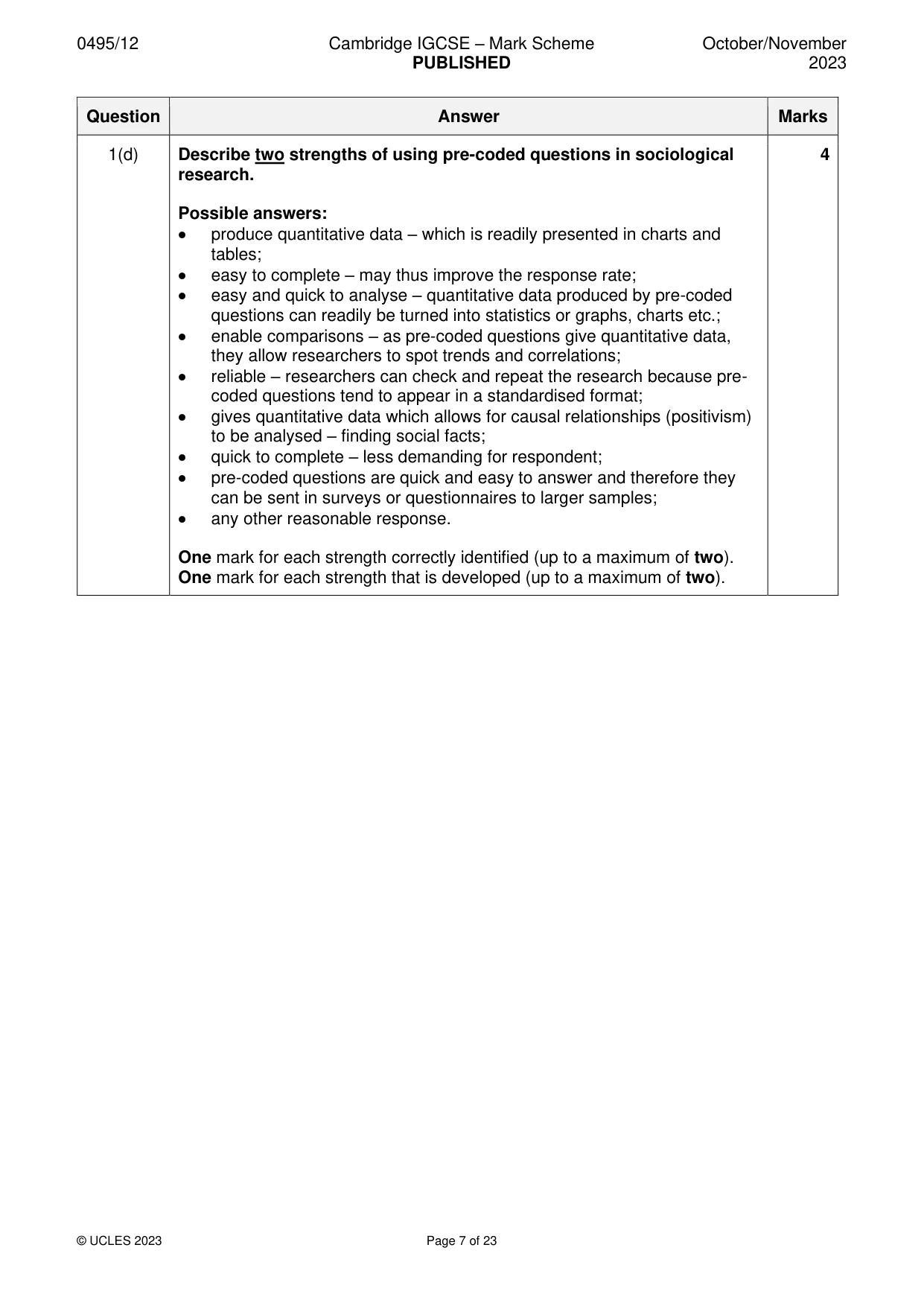
0495/12 Cambridge IGCSE – Mark Scheme PUBLISHED October/November 2023 © UCLES 2023 Page 7 of 23 Question Answer Marks 1(d) Describe two strengths of using pre-coded questions in sociological research. Possible answers: • produce quantitative data – which is readily presented in charts and tables; • easy to complete – may thus improve the response rate; • easy and quick to analyse – quantitative data produced by pre-coded questions can readily be turned into statistics or graphs, charts etc.; • enable comparisons – as pre-coded questions give quantitative data, they allow researchers to spot trends and correlations; • reliable – researchers can check and repeat the research because pre- coded questions tend to appear in a standardised format; • gives quantitative data which allows for causal relationships (positivism) to be analysed – finding social facts; • quick to complete – less demanding for respondent; • pre-coded questions are quick and easy to answer and therefore they can be sent in surveys or questionnaires to larger samples; • any other reasonable response. One mark for each strength correctly identified (up to a maximum of two). One mark for each strength that is developed (up to a maximum of two). 4
Mark scheme, page 8
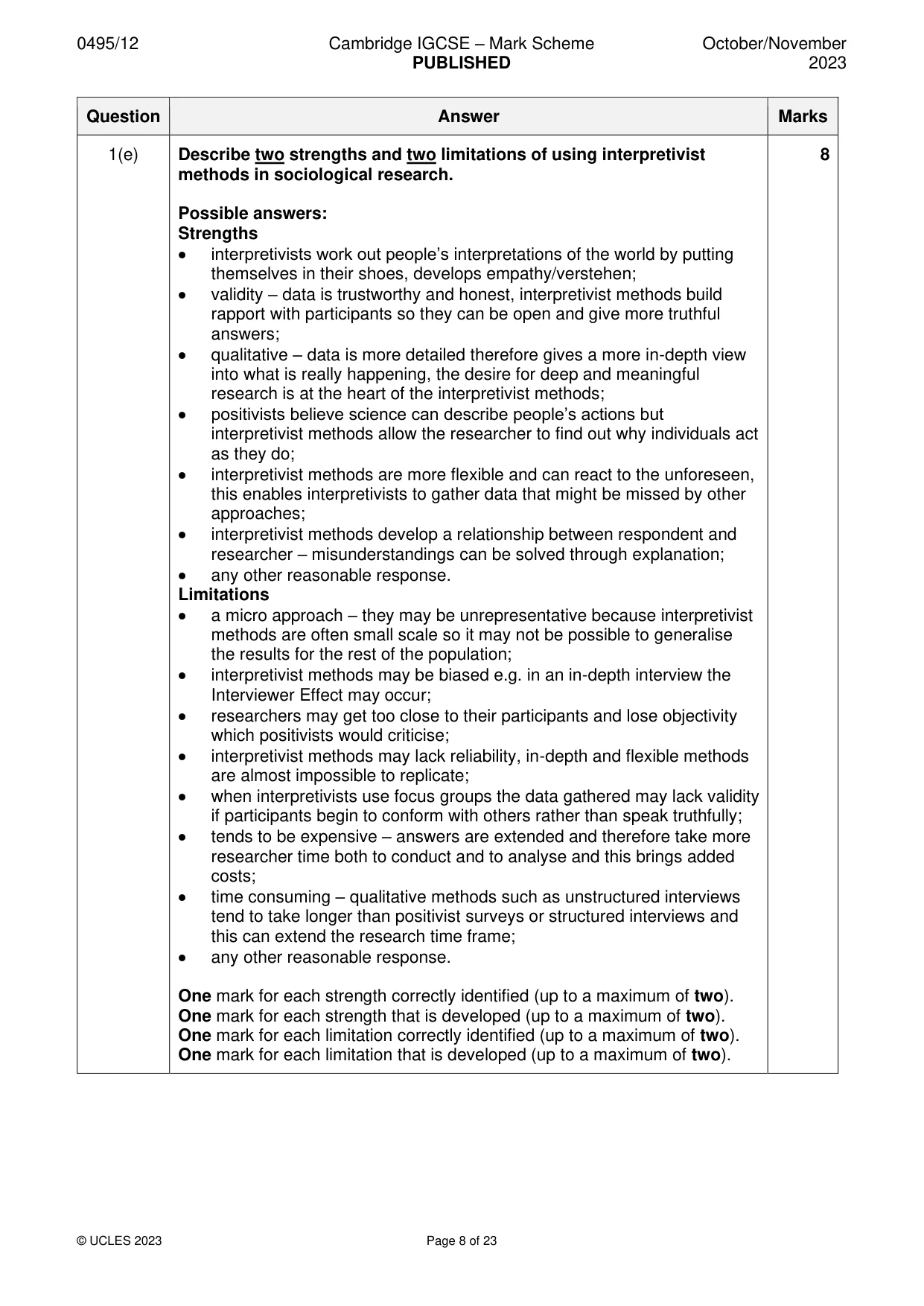
0495/12 Cambridge IGCSE – Mark Scheme PUBLISHED October/November 2023 © UCLES 2023 Page 8 of 23 Question Answer Marks 1(e) Describe two strengths and two limitations of using interpretivist methods in sociological research. Possible answers: Strengths • interpretivists work out people’s interpretations of the world by putting themselves in their shoes, develops empathy/verstehen; • validity – data is trustworthy and honest, interpretivist methods build rapport with participants so they can be open and give more truthful answers; • qualitative – data is more detailed therefore gives a more in-depth view into what is really happening, the desire for deep and meaningful research is at the heart of the interpretivist methods; • positivists believe science can describe people’s actions but interpretivist methods allow the researcher to find out why individuals act as they do; • interpretivist methods are more flexible and can react to the unforeseen, this enables interpretivists to gather data that might be missed by other approaches; • interpretivist methods develop a relationship between respondent and researcher – misunderstandings can be solved through explanation; • any other reasonable response. Limitations • a micro approach – they may be unrepresentative because interpretivist methods are often small scale so it may not be possible to generalise the results for the rest of the population; • interpretivist methods may be biased e.g. in an in-depth interview the Interviewer Effect may occur; • researchers may get too close to their participants and lose objectivity which positivists would criticise; • interpretivist methods may lack reliability, in-depth and flexible methods are almost impossible to replicate; • when interpretivists use focus groups the data gathered may lack validity if participants begin to conform with others rather than speak truthfully; • tends to be expensive – answers are extended and therefore take more researcher time both to conduct and to analyse and this brings added costs; • time consuming – qualitative methods such as unstructured interviews tend to take longer than positivist surveys or structured interviews and this can extend the research time frame; • any other reasonable response. One mark for each strength correctly identified (up to a maximum of two). One mark for each strength that is developed (up to a maximum of two). One mark for each limitation correctly identified (up to a maximum of two). One mark for each limitation that is developed (up to a maximum of two). 8
Mark scheme, page 9
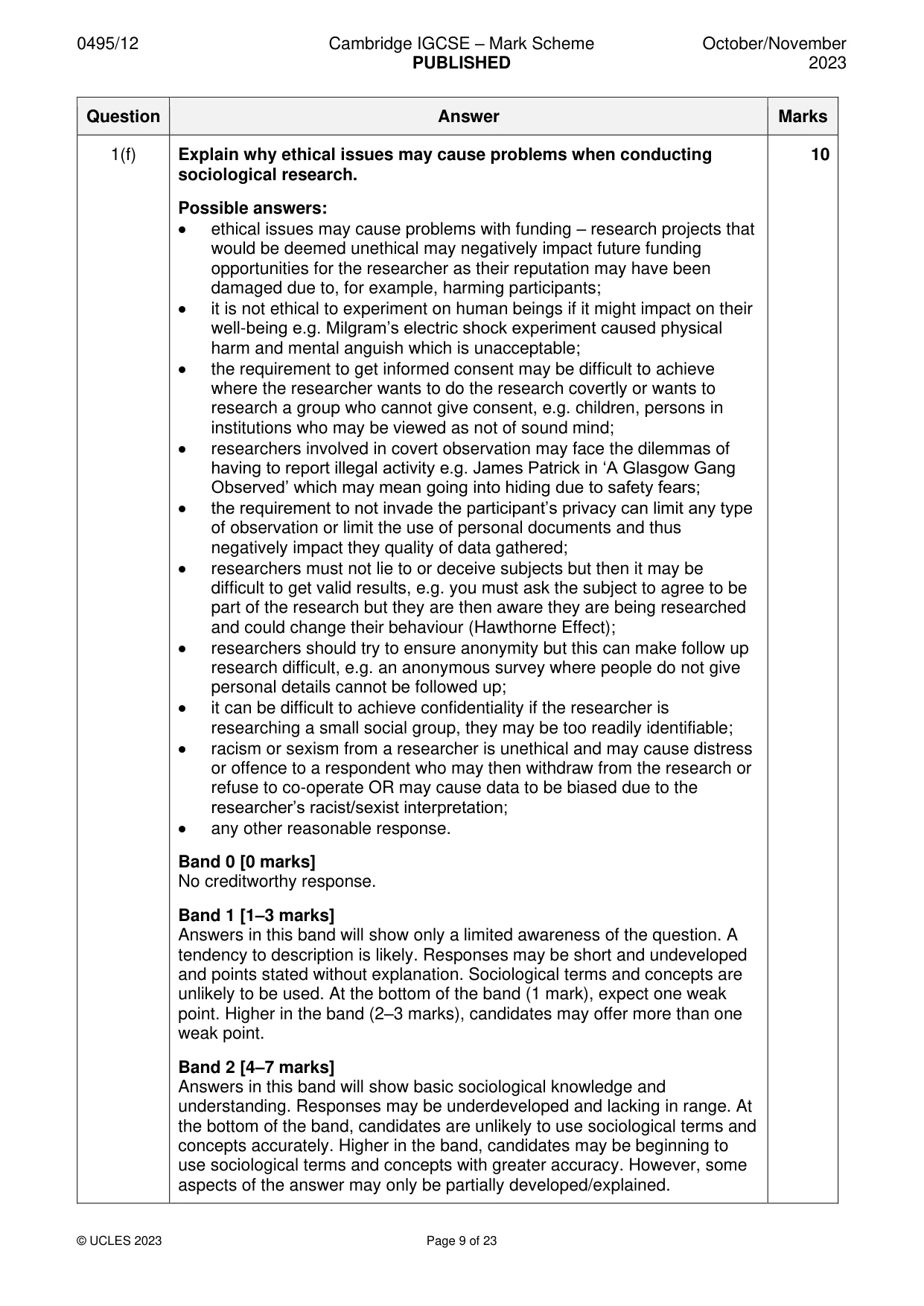
0495/12 Cambridge IGCSE – Mark Scheme PUBLISHED October/November 2023 © UCLES 2023 Page 9 of 23 Question Answer Marks 1(f) Explain why ethical issues may cause problems when conducting sociological research. Possible answers: • ethical issues may cause problems with funding – research projects that would be deemed unethical may negatively impact future funding opportunities for the researcher as their reputation may have been damaged due to, for example, harming participants; • it is not ethical to experiment on human beings if it might impact on their well-being e.g. Milgram’s electric shock experiment caused physical harm and mental anguish which is unacceptable; • the requirement to get informed consent may be difficult to achieve where the researcher wants to do the research covertly or wants to research a group who cannot give consent, e.g. children, persons in institutions who may be viewed as not of sound mind; • researchers involved in covert observation may face the dilemmas of having to report illegal activity e.g. James Patrick in ‘A Glasgow Gang Observed’ which may mean going into hiding due to safety fears; • the requirement to not invade the participant’s privacy can limit any type of observation or limit the use of personal documents and thus negatively impact they quality of data gathered; • researchers must not lie to or deceive subjects but then it may be difficult to get valid results, e.g. you must ask the subject to agree to be part of the research but they are then aware they are being researched and could change their behaviour (Hawthorne Effect); • researchers should try to ensure anonymity but this can make follow up research difficult, e.g. an anonymous survey where people do not give personal details cannot be followed up; • it can be difficult to achieve confidentiality if the researcher is researching a small social group, they may be too readily identifiable; • racism or sexism from a researcher is unethical and may cause distress or offence to a respondent who may then withdraw from the research or refuse to co-operate OR may cause data to be biased due to the researcher’s racist/sexist interpretation; • any other reasonable response. Band 0 [0 marks] No creditworthy response. Band 1 [1–3 marks] Answers in this band will show only a limited awareness of the question. A tendency to description is likely. Responses may be short and undeveloped and points stated without explanation. Sociological terms and concepts are unlikely to be used. At the bottom of the band (1 mark), expect one weak point. Higher in the band (2–3 marks), candidates may offer more than one weak point. Band 2 [4–7 marks] Answers in this band will show basic sociological knowledge and understanding. Responses may be underdeveloped and lacking in range. At the bottom of the band, candidates are unlikely to use sociological terms and concepts accurately. Higher in the band, candidates may be beginning to use sociological terms and concepts with greater accuracy. However, some aspects of the answer may only be partially developed/explained. 10
Mark scheme, page 10
0495/12 Cambridge IGCSE – Mark Scheme PUBLISHED October/November 2023 © UCLES 2023 Page 10 of 23 Question Answer Marks 1(f) Band 3 [8–10 marks] Answers in this band will show good sociological knowledge and understanding and will be well-developed and explained. Sociological terms and concepts will be used accurately overall. Answers will be well-focused on the question and there will be a range of points presented. At the top of the band explanations will be clear throughout.
Mark scheme, page 11
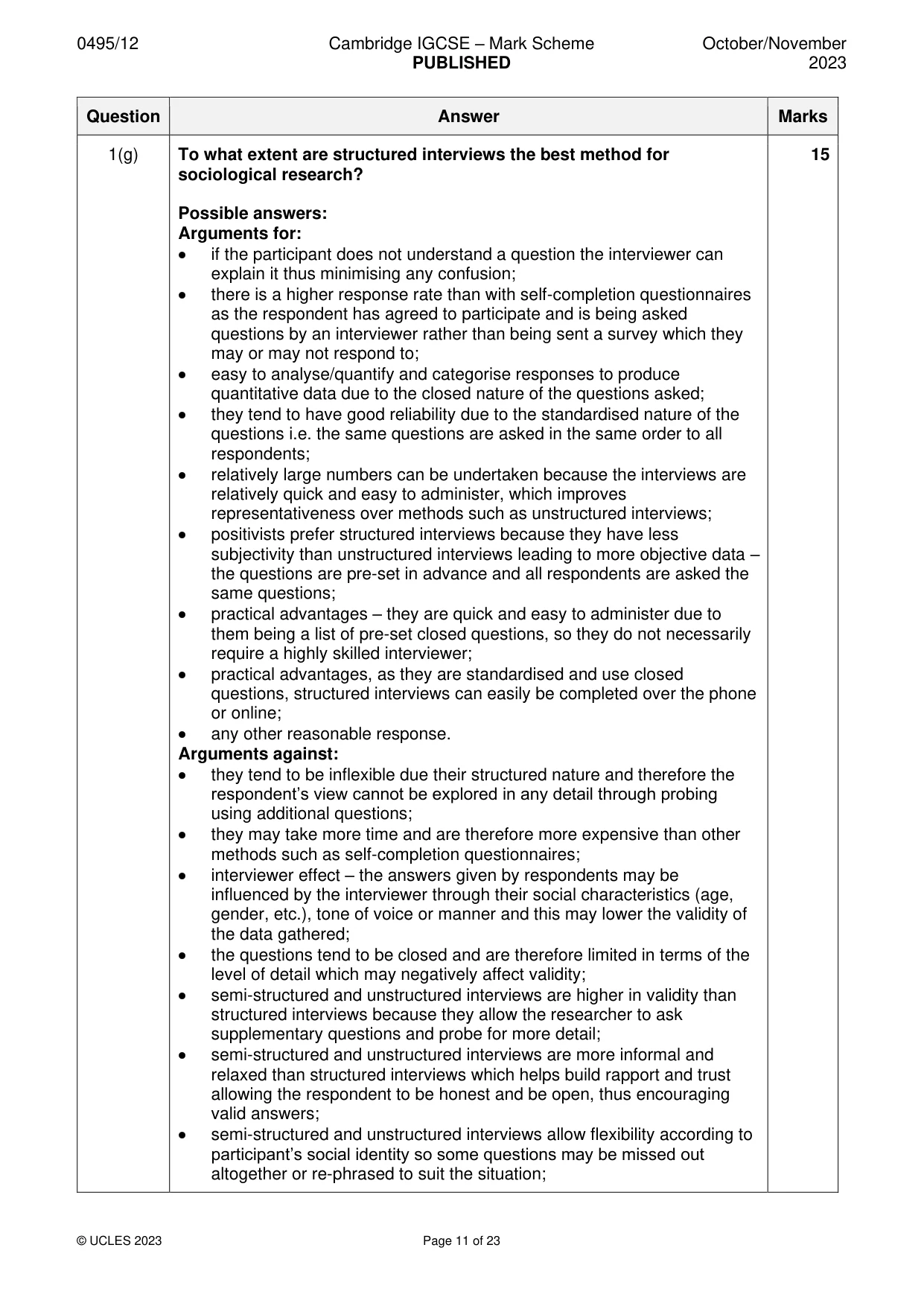
0495/12 Cambridge IGCSE – Mark Scheme PUBLISHED October/November 2023 © UCLES 2023 Page 11 of 23 Question Answer Marks 1(g) To what extent are structured interviews the best method for sociological research? Possible answers: Arguments for: • if the participant does not understand a question the interviewer can explain it thus minimising any confusion; • there is a higher response rate than with self-completion questionnaires as the respondent has agreed to participate and is being asked questions by an interviewer rather than being sent a survey which they may or may not respond to; • easy to analyse/quantify and categorise responses to produce quantitative data due to the closed nature of the questions asked; • they tend to have good reliability due to the standardised nature of the questions i.e. the same questions are asked in the same order to all respondents; • relatively large numbers can be undertaken because the interviews are relatively quick and easy to administer, which improves representativeness over methods such as unstructured interviews; • positivists prefer structured interviews because they have less subjectivity than unstructured interviews leading to more objective data – the questions are pre-set in advance and all respondents are asked the same questions; • practical advantages – they are quick and easy to administer due to them being a list of pre-set closed questions, so they do not necessarily require a highly skilled interviewer; • practical advantages, as they are standardised and use closed questions, structured interviews can easily be completed over the phone or online; • any other reasonable response. Arguments against: • they tend to be inflexible due their structured nature and therefore the respondent’s view cannot be explored in any detail through probing using additional questions; • they may take more time and are therefore more expensive than other methods such as self-completion questionnaires; • interviewer effect – the answers given by respondents may be influenced by the interviewer through their social characteristics (age, gender, etc.), tone of voice or manner and this may lower the validity of the data gathered; • the questions tend to be closed and are therefore limited in terms of the level of detail which may negatively affect validity; • semi-structured and unstructured interviews are higher in validity than structured interviews because they allow the researcher to ask supplementary questions and probe for more detail; • semi-structured and unstructured interviews are more informal and relaxed than structured interviews which helps build rapport and trust allowing the respondent to be honest and be open, thus encouraging valid answers; • semi-structured and unstructured interviews allow flexibility according to participant’s social identity so some questions may be missed out altogether or re-phrased to suit the situation; 15
Mark scheme, page 12
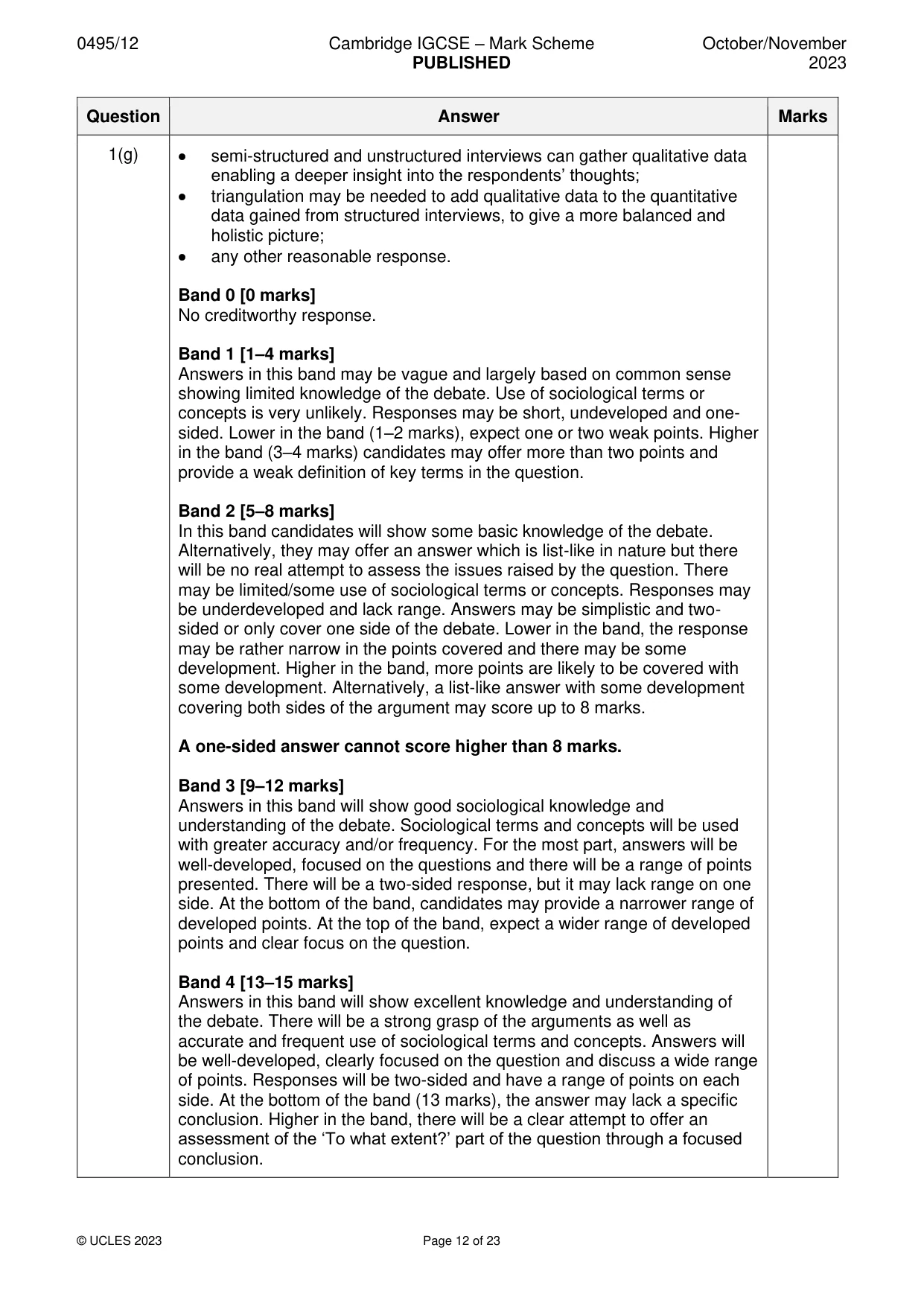
0495/12 Cambridge IGCSE – Mark Scheme PUBLISHED October/November 2023 © UCLES 2023 Page 12 of 23 Question Answer Marks 1(g) • semi-structured and unstructured interviews can gather qualitative data enabling a deeper insight into the respondents’ thoughts; • triangulation may be needed to add qualitative data to the quantitative data gained from structured interviews, to give a more balanced and holistic picture; • any other reasonable response. Band 0 [0 marks] No creditworthy response. Band 1 [1–4 marks] Answers in this band may be vague and largely based on common sense showing limited knowledge of the debate. Use of sociological terms or concepts is very unlikely. Responses may be short, undeveloped and one- sided. Lower in the band (1–2 marks), expect one or two weak points. Higher in the band (3–4 marks) candidates may offer more than two points and provide a weak definition of key terms in the question. Band 2 [5–8 marks] In this band candidates will show some basic knowledge of the debate. Alternatively, they may offer an answer which is list-like in nature but there will be no real attempt to assess the issues raised by the question. There may be limited/some use of sociological terms or concepts. Responses may be underdeveloped and lack range. Answers may be simplistic and two- sided or only cover one side of the debate. Lower in the band, the response may be rather narrow in the points covered and there may be some development. Higher in the band, more points are likely to be covered with some development. Alternatively, a list-like answer with some development covering both sides of the argument may score up to 8 marks. A one-sided answer cannot score higher than 8 marks. Band 3 [9–12 marks] Answers in this band will show good sociological knowledge and understanding of the debate. Sociological terms and concepts will be used with greater accuracy and/or frequency. For the most part, answers will be well-developed, focused on the questions and there will be a range of points presented. There will be a two-sided response, but it may lack range on one side. At the bottom of the band, candidates may provide a narrower range of developed points. At the top of the band, expect a wider range of developed points and clear focus on the question. Band 4 [13–15 marks] Answers in this band will show excellent knowledge and understanding of the debate. There will be a strong grasp of the arguments as well as accurate and frequent use of sociological terms and concepts. Answers will be well-developed, clearly focused on the question and discuss a wide range of points. Responses will be two-sided and have a range of points on each side. At the bottom of the band (13 marks), the answer may lack a specific conclusion. Higher in the band, there will be a clear attempt to offer an assessment of the ‘To what extent?’ part of the question through a focused conclusion.
Mark scheme, page 13
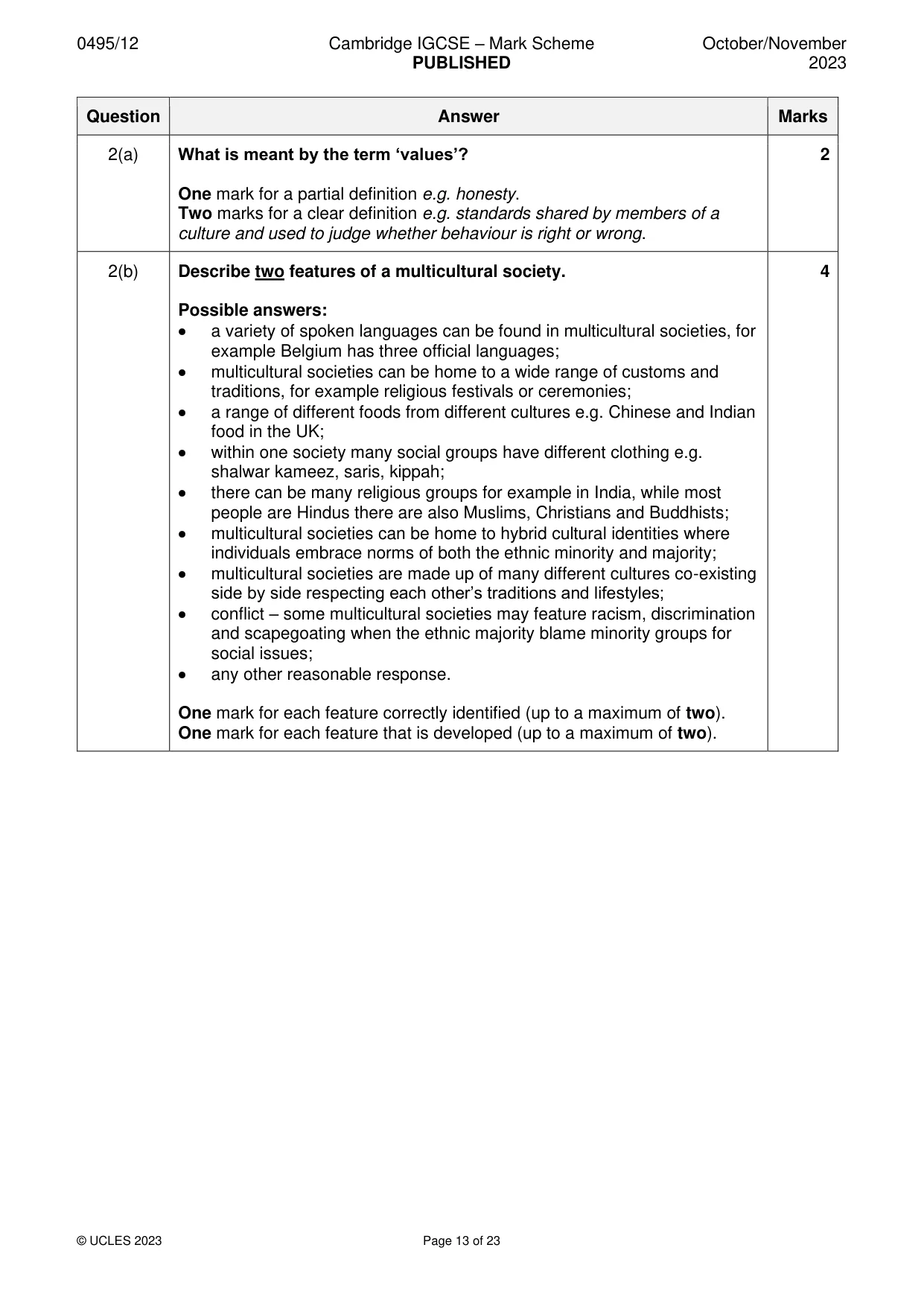
0495/12 Cambridge IGCSE – Mark Scheme PUBLISHED October/November 2023 © UCLES 2023 Page 13 of 23 Question Answer Marks 2(a) What is meant by the term ‘values’? One mark for a partial definition e.g. honesty. Two marks for a clear definition e.g. standards shared by members of a culture and used to judge whether behaviour is right or wrong. 2 2(b) Describe two features of a multicultural society. Possible answers: • a variety of spoken languages can be found in multicultural societies, for example Belgium has three official languages; • multicultural societies can be home to a wide range of customs and traditions, for example religious festivals or ceremonies; • a range of different foods from different cultures e.g. Chinese and Indian food in the UK; • within one society many social groups have different clothing e.g. shalwar kameez, saris, kippah; • there can be many religious groups for example in India, while most people are Hindus there are also Muslims, Christians and Buddhists; • multicultural societies can be home to hybrid cultural identities where individuals embrace norms of both the ethnic minority and majority; • multicultural societies are made up of many different cultures co-existing side by side respecting each other’s traditions and lifestyles; • conflict – some multicultural societies may feature racism, discrimination and scapegoating when the ethnic majority blame minority groups for social issues; • any other reasonable response. One mark for each feature correctly identified (up to a maximum of two). One mark for each feature that is developed (up to a maximum of two). 4
Mark scheme, page 14
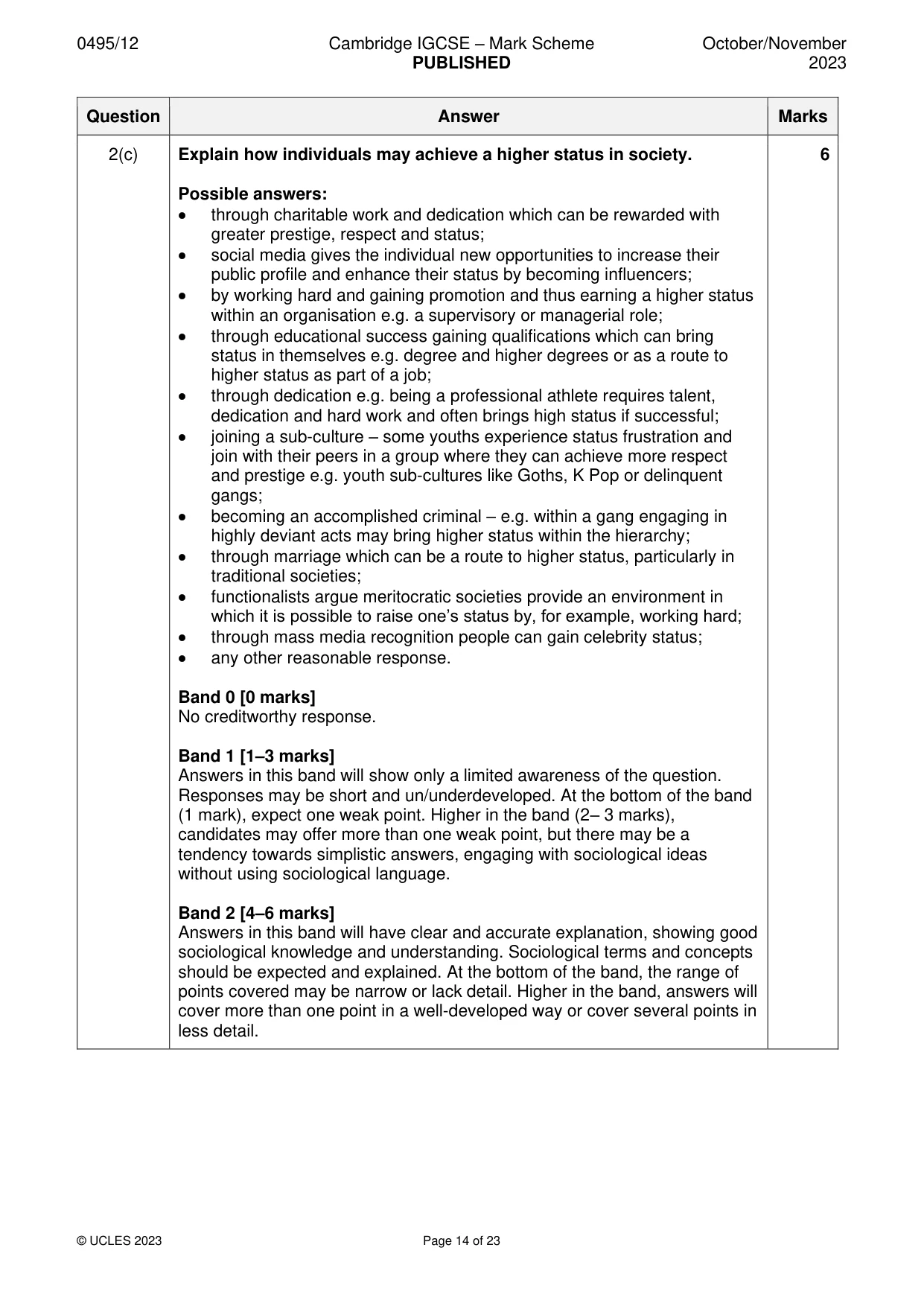
0495/12 Cambridge IGCSE – Mark Scheme PUBLISHED October/November 2023 © UCLES 2023 Page 14 of 23 Question Answer Marks 2(c) Explain how individuals may achieve a higher status in society. Possible answers: • through charitable work and dedication which can be rewarded with greater prestige, respect and status; • social media gives the individual new opportunities to increase their public profile and enhance their status by becoming influencers; • by working hard and gaining promotion and thus earning a higher status within an organisation e.g. a supervisory or managerial role; • through educational success gaining qualifications which can bring status in themselves e.g. degree and higher degrees or as a route to higher status as part of a job; • through dedication e.g. being a professional athlete requires talent, dedication and hard work and often brings high status if successful; • joining a sub-culture – some youths experience status frustration and join with their peers in a group where they can achieve more respect and prestige e.g. youth sub-cultures like Goths, K Pop or delinquent gangs; • becoming an accomplished criminal – e.g. within a gang engaging in highly deviant acts may bring higher status within the hierarchy; • through marriage which can be a route to higher status, particularly in traditional societies; • functionalists argue meritocratic societies provide an environment in which it is possible to raise one’s status by, for example, working hard; • through mass media recognition people can gain celebrity status; • any other reasonable response. Band 0 [0 marks] No creditworthy response. Band 1 [1–3 marks] Answers in this band will show only a limited awareness of the question. Responses may be short and un/underdeveloped. At the bottom of the band (1 mark), expect one weak point. Higher in the band (2– 3 marks), candidates may offer more than one weak point, but there may be a tendency towards simplistic answers, engaging with sociological ideas without using sociological language. Band 2 [4–6 marks] Answers in this band will have clear and accurate explanation, showing good sociological knowledge and understanding. Sociological terms and concepts should be expected and explained. At the bottom of the band, the range of points covered may be narrow or lack detail. Higher in the band, answers will cover more than one point in a well-developed way or cover several points in less detail. 6
Mark scheme, page 15
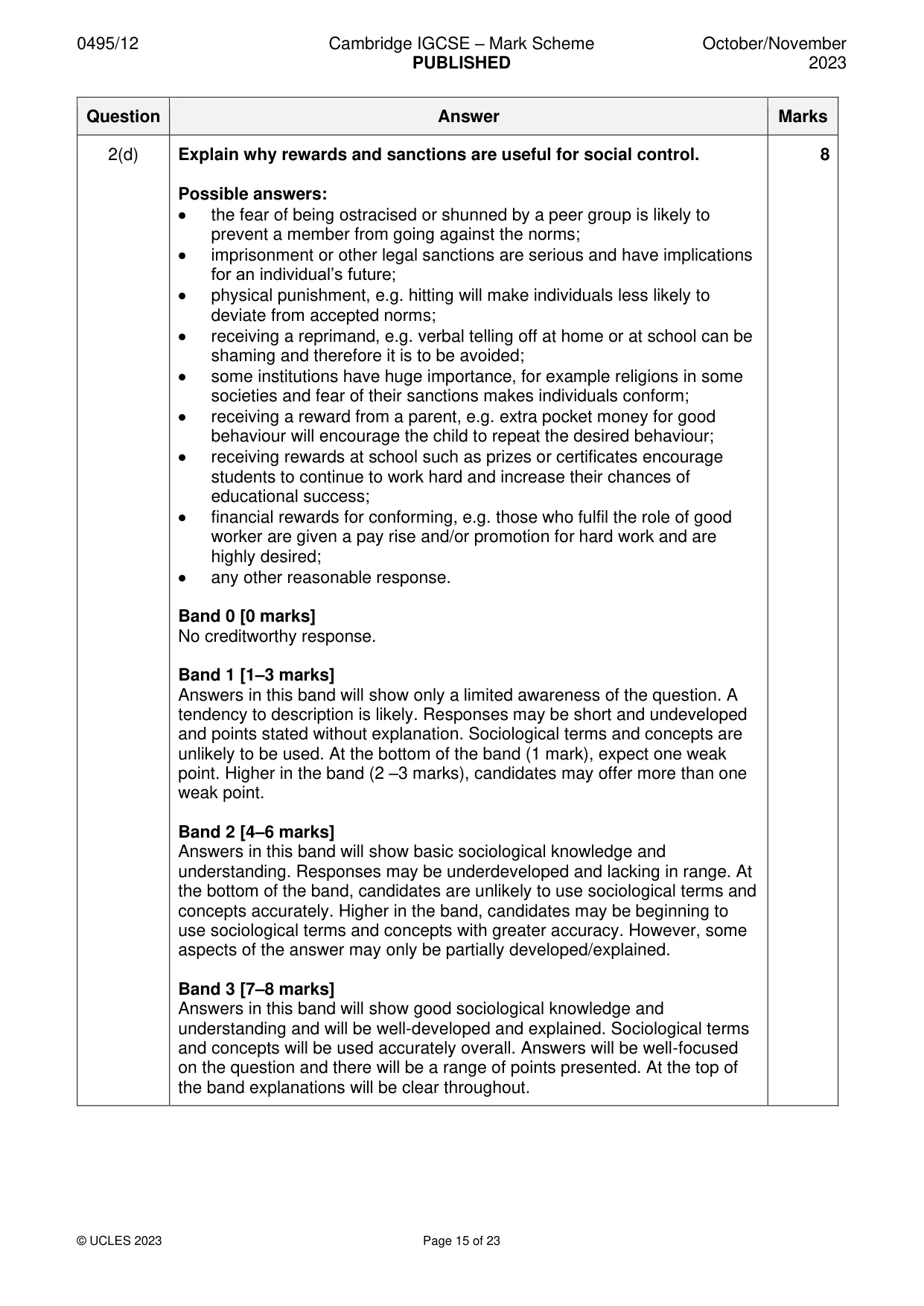
0495/12 Cambridge IGCSE – Mark Scheme PUBLISHED October/November 2023 © UCLES 2023 Page 15 of 23 Question Answer Marks 2(d) Explain why rewards and sanctions are useful for social control. Possible answers: • the fear of being ostracised or shunned by a peer group is likely to prevent a member from going against the norms; • imprisonment or other legal sanctions are serious and have implications for an individual’s future; • physical punishment, e.g. hitting will make individuals less likely to deviate from accepted norms; • receiving a reprimand, e.g. verbal telling off at home or at school can be shaming and therefore it is to be avoided; • some institutions have huge importance, for example religions in some societies and fear of their sanctions makes individuals conform; • receiving a reward from a parent, e.g. extra pocket money for good behaviour will encourage the child to repeat the desired behaviour; • receiving rewards at school such as prizes or certificates encourage students to continue to work hard and increase their chances of educational success; • financial rewards for conforming, e.g. those who fulfil the role of good worker are given a pay rise and/or promotion for hard work and are highly desired; • any other reasonable response. Band 0 [0 marks] No creditworthy response. Band 1 [1–3 marks] Answers in this band will show only a limited awareness of the question. A tendency to description is likely. Responses may be short and undeveloped and points stated without explanation. Sociological terms and concepts are unlikely to be used. At the bottom of the band (1 mark), expect one weak point. Higher in the band (2 –3 marks), candidates may offer more than one weak point. Band 2 [4–6 marks] Answers in this band will show basic sociological knowledge and understanding. Responses may be underdeveloped and lacking in range. At the bottom of the band, candidates are unlikely to use sociological terms and concepts accurately. Higher in the band, candidates may be beginning to use sociological terms and concepts with greater accuracy. However, some aspects of the answer may only be partially developed/explained. Band 3 [7–8 marks] Answers in this band will show good sociological knowledge and understanding and will be well-developed and explained. Sociological terms and concepts will be used accurately overall. Answers will be well-focused on the question and there will be a range of points presented. At the top of the band explanations will be clear throughout. 8
Mark scheme, page 16
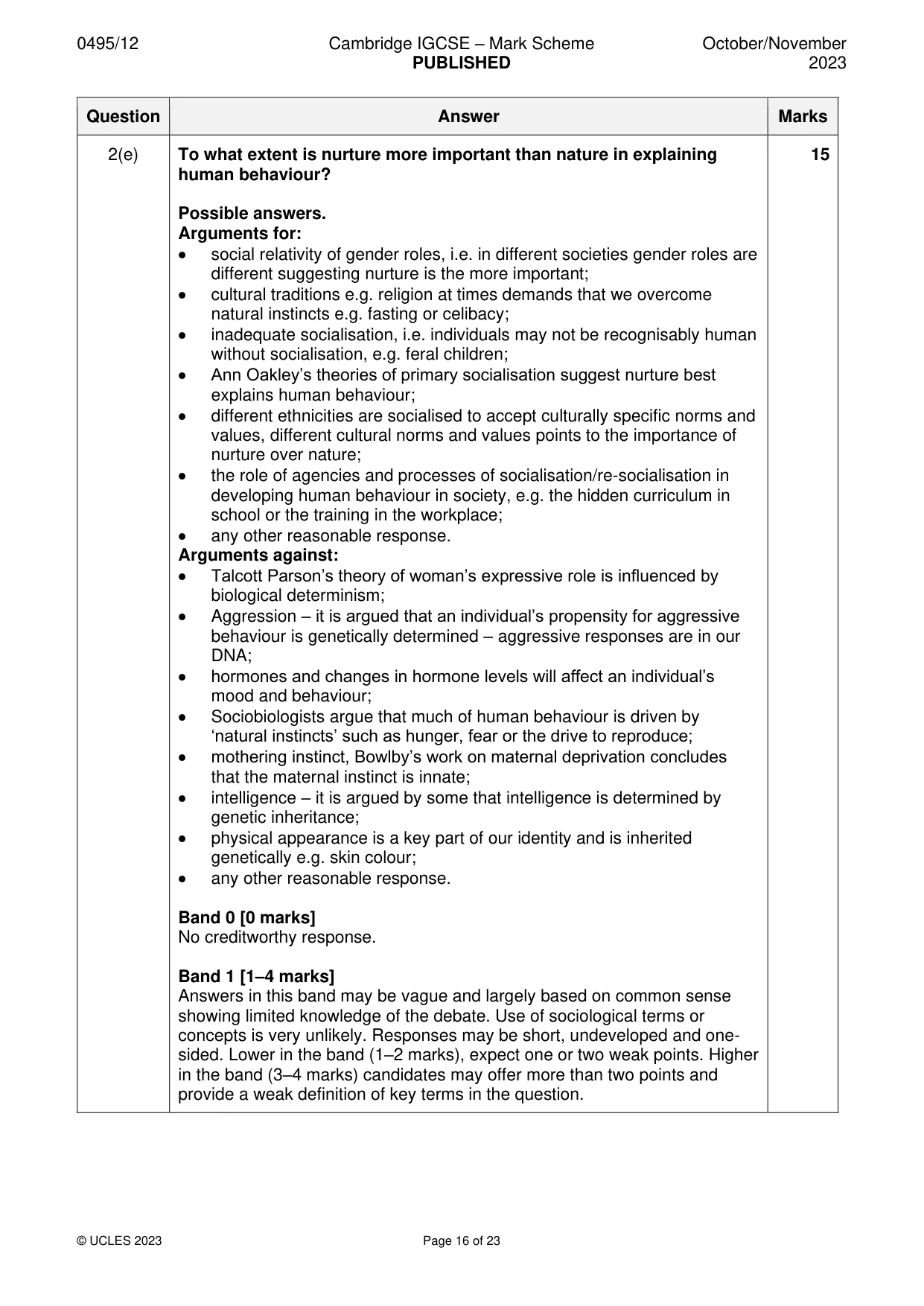
0495/12 Cambridge IGCSE – Mark Scheme PUBLISHED October/November 2023 © UCLES 2023 Page 16 of 23 Question Answer Marks 2(e) To what extent is nurture more important than nature in explaining human behaviour? Possible answers. Arguments for: • social relativity of gender roles, i.e. in different societies gender roles are different suggesting nurture is the more important; • cultural traditions e.g. religion at times demands that we overcome natural instincts e.g. fasting or celibacy; • inadequate socialisation, i.e. individuals may not be recognisably human without socialisation, e.g. feral children; • Ann Oakley’s theories of primary socialisation suggest nurture best explains human behaviour; • different ethnicities are socialised to accept culturally specific norms and values, different cultural norms and values points to the importance of nurture over nature; • the role of agencies and processes of socialisation/re-socialisation in developing human behaviour in society, e.g. the hidden curriculum in school or the training in the workplace; • any other reasonable response. Arguments against: • Talcott Parson’s theory of woman’s expressive role is influenced by biological determinism; • Aggression – it is argued that an individual’s propensity for aggressive behaviour is genetically determined – aggressive responses are in our DNA; • hormones and changes in hormone levels will affect an individual’s mood and behaviour; • Sociobiologists argue that much of human behaviour is driven by ‘natural instincts’ such as hunger, fear or the drive to reproduce; • mothering instinct, Bowlby’s work on maternal deprivation concludes that the maternal instinct is innate; • intelligence – it is argued by some that intelligence is determined by genetic inheritance; • physical appearance is a key part of our identity and is inherited genetically e.g. skin colour; • any other reasonable response. Band 0 [0 marks] No creditworthy response. Band 1 [1–4 marks] Answers in this band may be vague and largely based on common sense showing limited knowledge of the debate. Use of sociological terms or concepts is very unlikely. Responses may be short, undeveloped and one- sided. Lower in the band (1–2 marks), expect one or two weak points. Higher in the band (3–4 marks) candidates may offer more than two points and provide a weak definition of key terms in the question. 15
Mark scheme, page 17
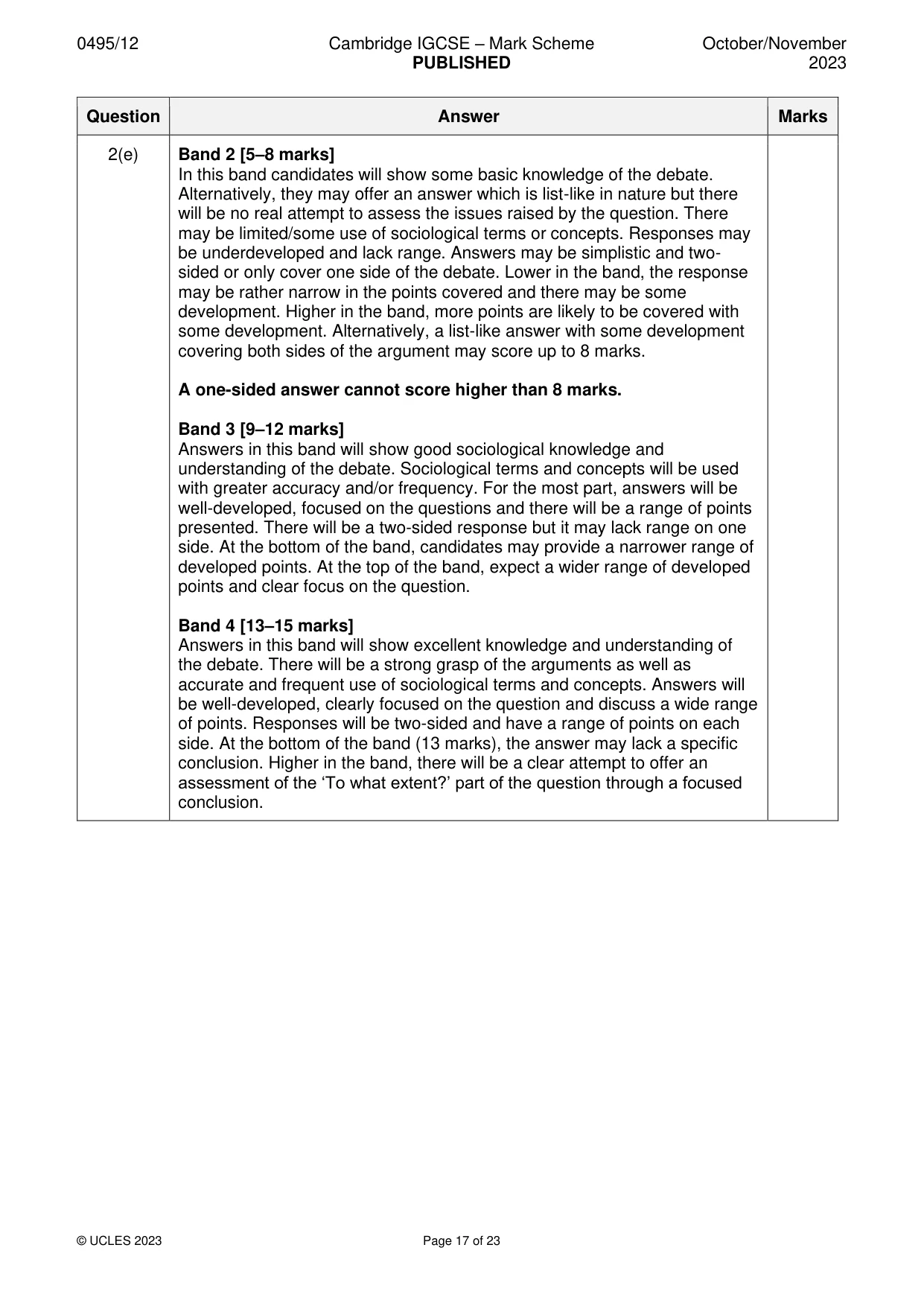
0495/12 Cambridge IGCSE – Mark Scheme PUBLISHED October/November 2023 © UCLES 2023 Page 17 of 23 Question Answer Marks 2(e) Band 2 [5–8 marks] In this band candidates will show some basic knowledge of the debate. Alternatively, they may offer an answer which is list-like in nature but there will be no real attempt to assess the issues raised by the question. There may be limited/some use of sociological terms or concepts. Responses may be underdeveloped and lack range. Answers may be simplistic and two- sided or only cover one side of the debate. Lower in the band, the response may be rather narrow in the points covered and there may be some development. Higher in the band, more points are likely to be covered with some development. Alternatively, a list-like answer with some development covering both sides of the argument may score up to 8 marks. A one-sided answer cannot score higher than 8 marks. Band 3 [9–12 marks] Answers in this band will show good sociological knowledge and understanding of the debate. Sociological terms and concepts will be used with greater accuracy and/or frequency. For the most part, answers will be well-developed, focused on the questions and there will be a range of points presented. There will be a two-sided response but it may lack range on one side. At the bottom of the band, candidates may provide a narrower range of developed points. At the top of the band, expect a wider range of developed points and clear focus on the question. Band 4 [13–15 marks] Answers in this band will show excellent knowledge and understanding of the debate. There will be a strong grasp of the arguments as well as accurate and frequent use of sociological terms and concepts. Answers will be well-developed, clearly focused on the question and discuss a wide range of points. Responses will be two-sided and have a range of points on each side. At the bottom of the band (13 marks), the answer may lack a specific conclusion. Higher in the band, there will be a clear attempt to offer an assessment of the ‘To what extent?’ part of the question through a focused conclusion.
Mark scheme, page 18
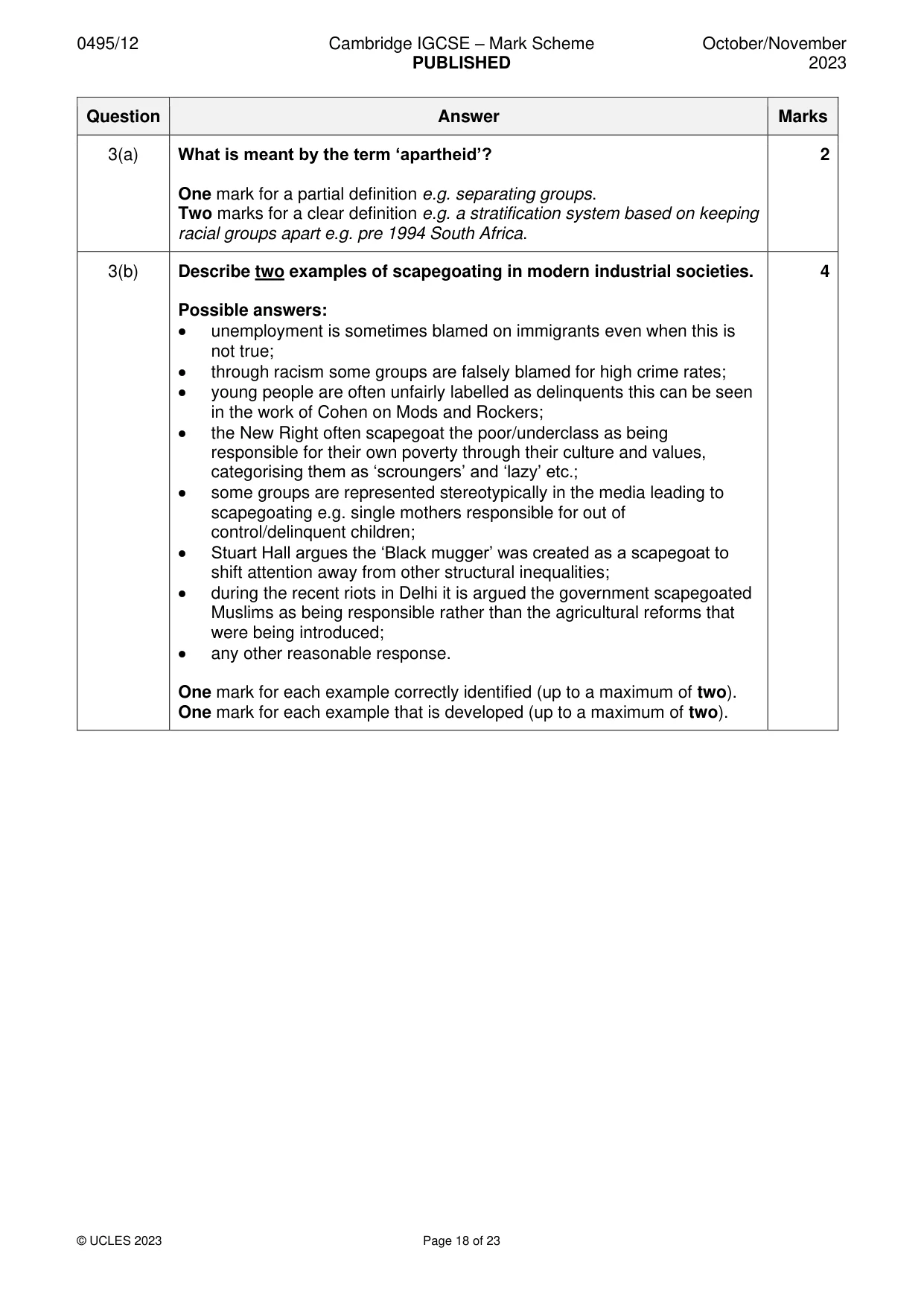
0495/12 Cambridge IGCSE – Mark Scheme PUBLISHED October/November 2023 © UCLES 2023 Page 18 of 23 Question Answer Marks 3(a) What is meant by the term ‘apartheid’? One mark for a partial definition e.g. separating groups. Two marks for a clear definition e.g. a stratification system based on keeping racial groups apart e.g. pre 1994 South Africa. 2 3(b) Describe two examples of scapegoating in modern industrial societies. Possible answers: • unemployment is sometimes blamed on immigrants even when this is not true; • through racism some groups are falsely blamed for high crime rates; • young people are often unfairly labelled as delinquents this can be seen in the work of Cohen on Mods and Rockers; • the New Right often scapegoat the poor/underclass as being responsible for their own poverty through their culture and values, categorising them as ‘scroungers’ and ‘lazy’ etc.; • some groups are represented stereotypically in the media leading to scapegoating e.g. single mothers responsible for out of control/delinquent children; • Stuart Hall argues the ‘Black mugger’ was created as a scapegoat to shift attention away from other structural inequalities; • during the recent riots in Delhi it is argued the government scapegoated Muslims as being responsible rather than the agricultural reforms that were being introduced; • any other reasonable response. One mark for each example correctly identified (up to a maximum of two). One mark for each example that is developed (up to a maximum of two). 4
Mark scheme, page 19
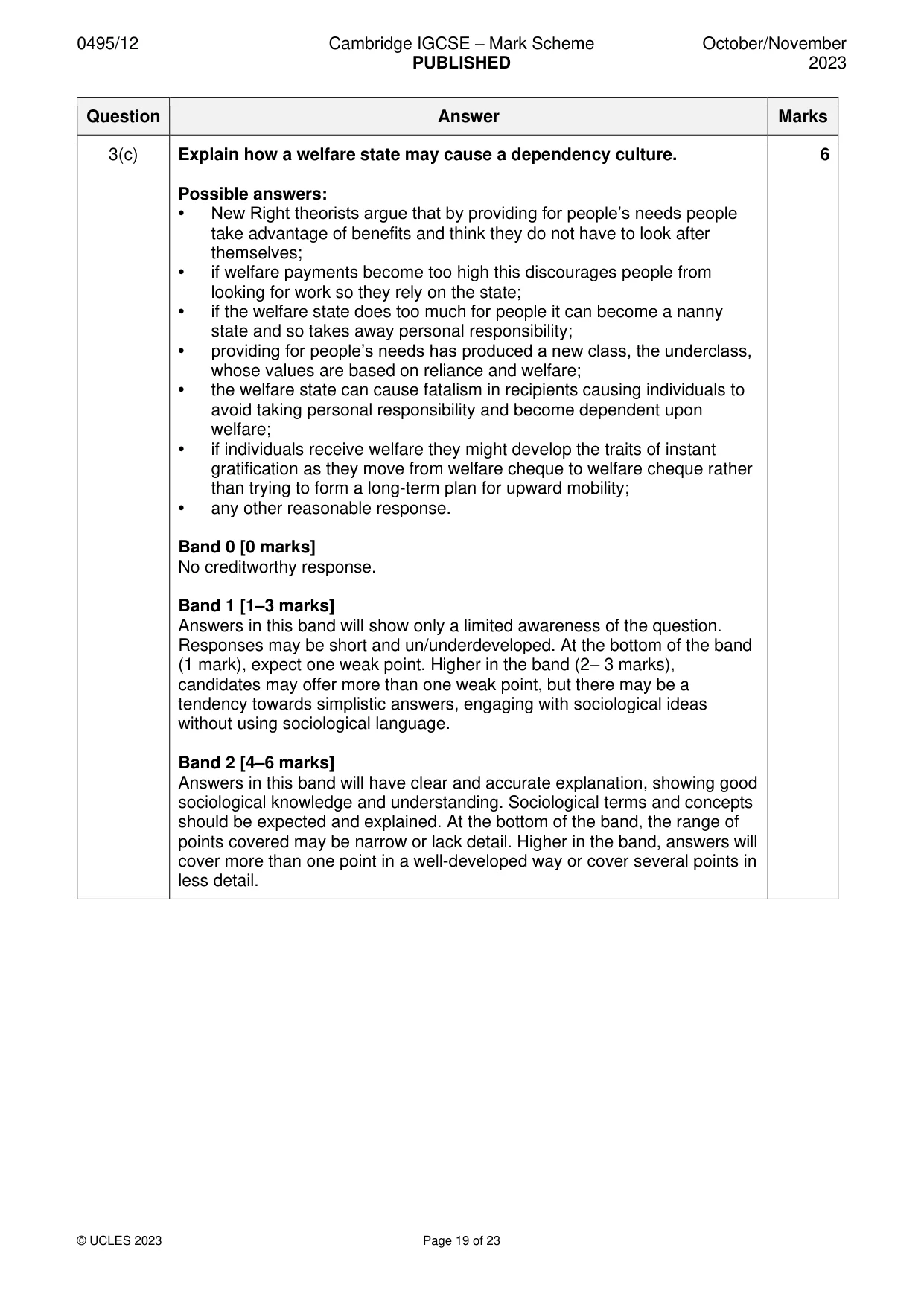
0495/12 Cambridge IGCSE – Mark Scheme PUBLISHED October/November 2023 © UCLES 2023 Page 19 of 23 Question Answer Marks 3(c) Explain how a welfare state may cause a dependency culture. Possible answers: • New Right theorists argue that by providing for people’s needs people take advantage of benefits and think they do not have to look after themselves; • if welfare payments become too high this discourages people from looking for work so they rely on the state; • if the welfare state does too much for people it can become a nanny state and so takes away personal responsibility; • providing for people’s needs has produced a new class, the underclass, whose values are based on reliance and welfare; • the welfare state can cause fatalism in recipients causing individuals to avoid taking personal responsibility and become dependent upon welfare; • if individuals receive welfare they might develop the traits of instant gratification as they move from welfare cheque to welfare cheque rather than trying to form a long-term plan for upward mobility; • any other reasonable response. Band 0 [0 marks] No creditworthy response. Band 1 [1–3 marks] Answers in this band will show only a limited awareness of the question. Responses may be short and un/underdeveloped. At the bottom of the band (1 mark), expect one weak point. Higher in the band (2– 3 marks), candidates may offer more than one weak point, but there may be a tendency towards simplistic answers, engaging with sociological ideas without using sociological language. Band 2 [4–6 marks] Answers in this band will have clear and accurate explanation, showing good sociological knowledge and understanding. Sociological terms and concepts should be expected and explained. At the bottom of the band, the range of points covered may be narrow or lack detail. Higher in the band, answers will cover more than one point in a well-developed way or cover several points in less detail. 6
Mark scheme, page 20
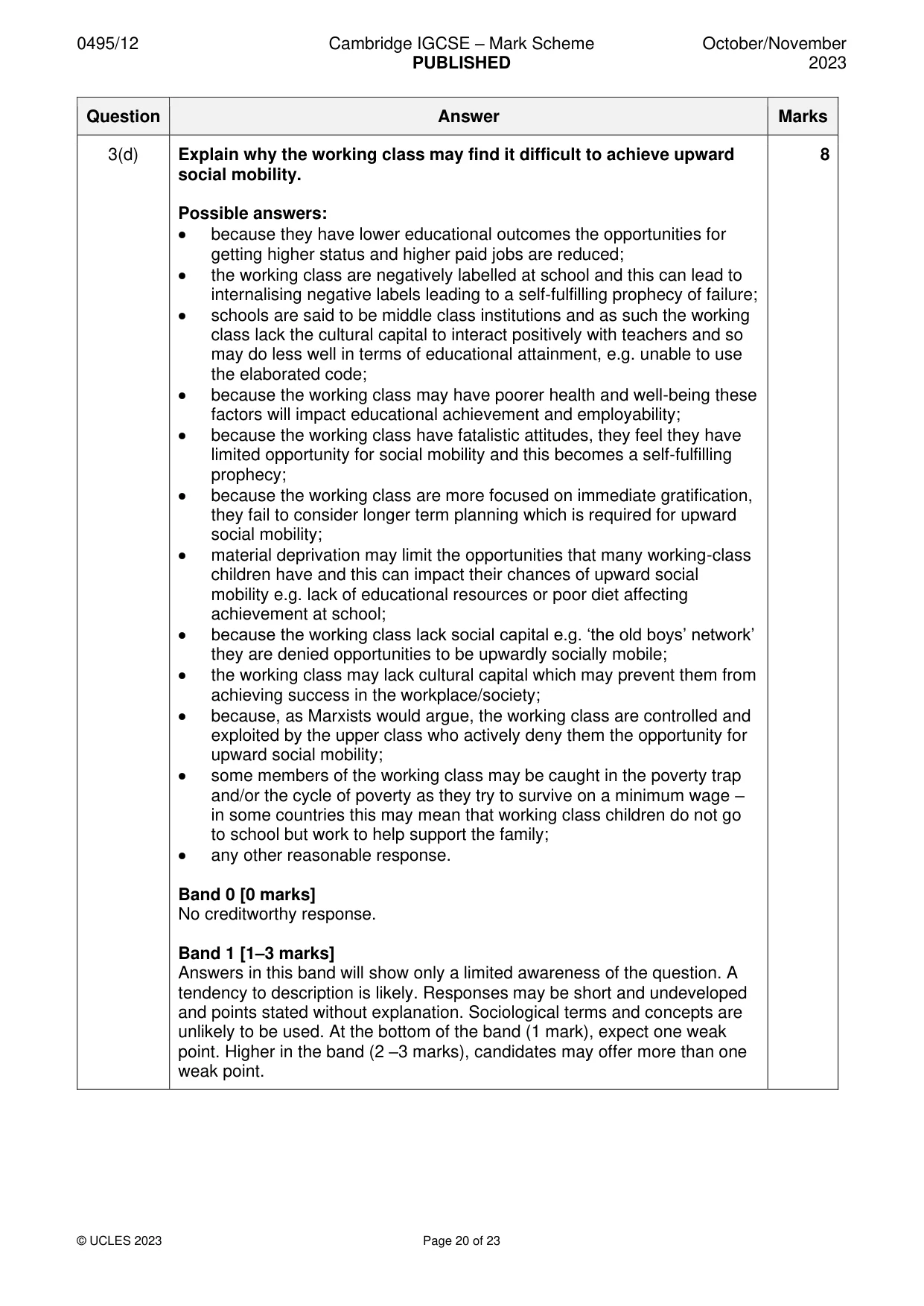
0495/12 Cambridge IGCSE – Mark Scheme PUBLISHED October/November 2023 © UCLES 2023 Page 20 of 23 Question Answer Marks 3(d) Explain why the working class may find it difficult to achieve upward social mobility. Possible answers: • because they have lower educational outcomes the opportunities for getting higher status and higher paid jobs are reduced; • the working class are negatively labelled at school and this can lead to internalising negative labels leading to a self-fulfilling prophecy of failure; • schools are said to be middle class institutions and as such the working class lack the cultural capital to interact positively with teachers and so may do less well in terms of educational attainment, e.g. unable to use the elaborated code; • because the working class may have poorer health and well-being these factors will impact educational achievement and employability; • because the working class have fatalistic attitudes, they feel they have limited opportunity for social mobility and this becomes a self-fulfilling prophecy; • because the working class are more focused on immediate gratification, they fail to consider longer term planning which is required for upward social mobility; • material deprivation may limit the opportunities that many working-class children have and this can impact their chances of upward social mobility e.g. lack of educational resources or poor diet affecting achievement at school; • because the working class lack social capital e.g. ‘the old boys’ network’ they are denied opportunities to be upwardly socially mobile; • the working class may lack cultural capital which may prevent them from achieving success in the workplace/society; • because, as Marxists would argue, the working class are controlled and exploited by the upper class who actively deny them the opportunity for upward social mobility; • some members of the working class may be caught in the poverty trap and/or the cycle of poverty as they try to survive on a minimum wage – in some countries this may mean that working class children do not go to school but work to help support the family; • any other reasonable response. Band 0 [0 marks] No creditworthy response. Band 1 [1–3 marks] Answers in this band will show only a limited awareness of the question. A tendency to description is likely. Responses may be short and undeveloped and points stated without explanation. Sociological terms and concepts are unlikely to be used. At the bottom of the band (1 mark), expect one weak point. Higher in the band (2 –3 marks), candidates may offer more than one weak point. 8
Mark scheme, page 21
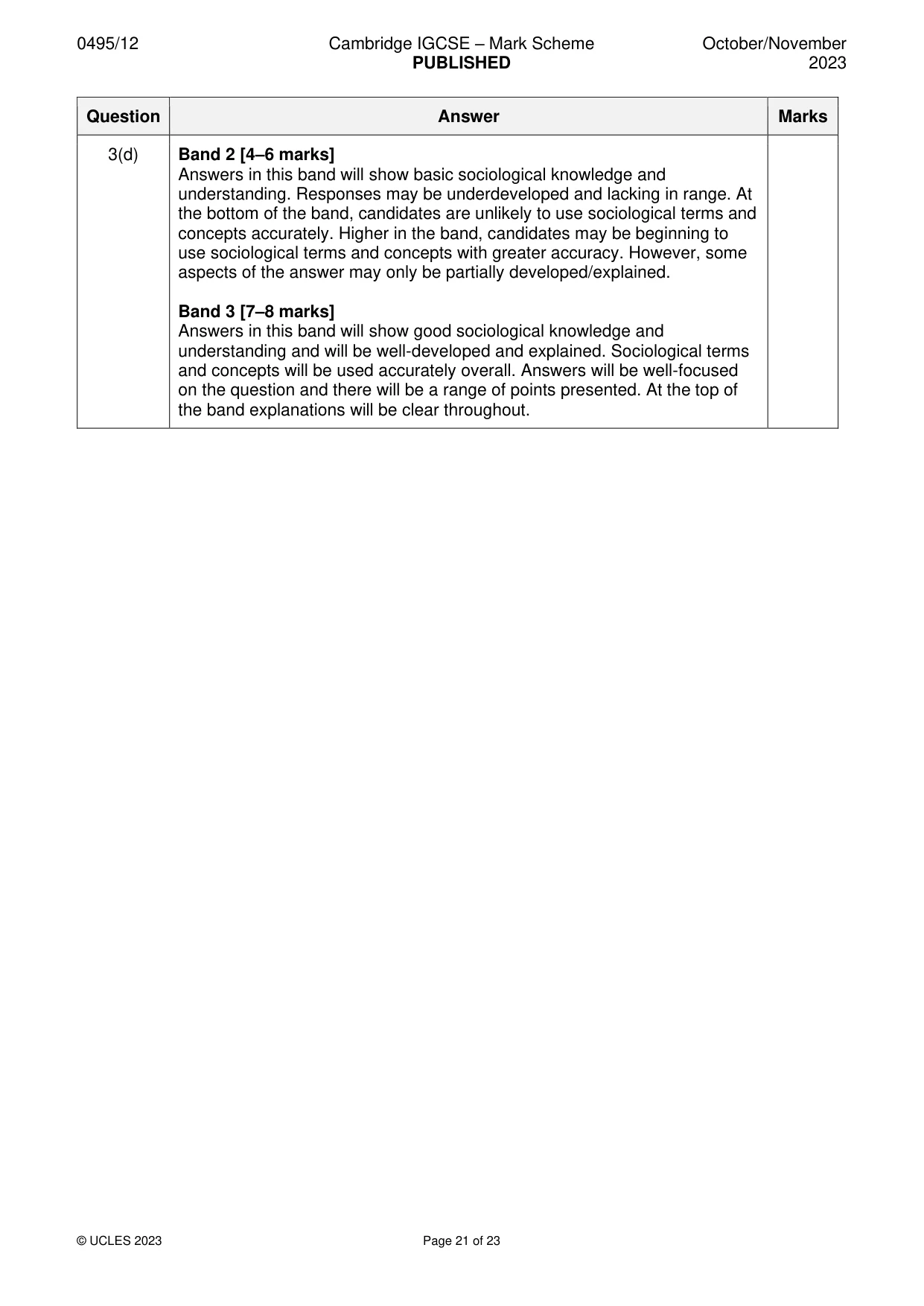
0495/12 Cambridge IGCSE – Mark Scheme PUBLISHED October/November 2023 © UCLES 2023 Page 21 of 23 Question Answer Marks 3(d) Band 2 [4–6 marks] Answers in this band will show basic sociological knowledge and understanding. Responses may be underdeveloped and lacking in range. At the bottom of the band, candidates are unlikely to use sociological terms and concepts accurately. Higher in the band, candidates may be beginning to use sociological terms and concepts with greater accuracy. However, some aspects of the answer may only be partially developed/explained. Band 3 [7–8 marks] Answers in this band will show good sociological knowledge and understanding and will be well-developed and explained. Sociological terms and concepts will be used accurately overall. Answers will be well-focused on the question and there will be a range of points presented. At the top of the band explanations will be clear throughout.
Mark scheme, page 22
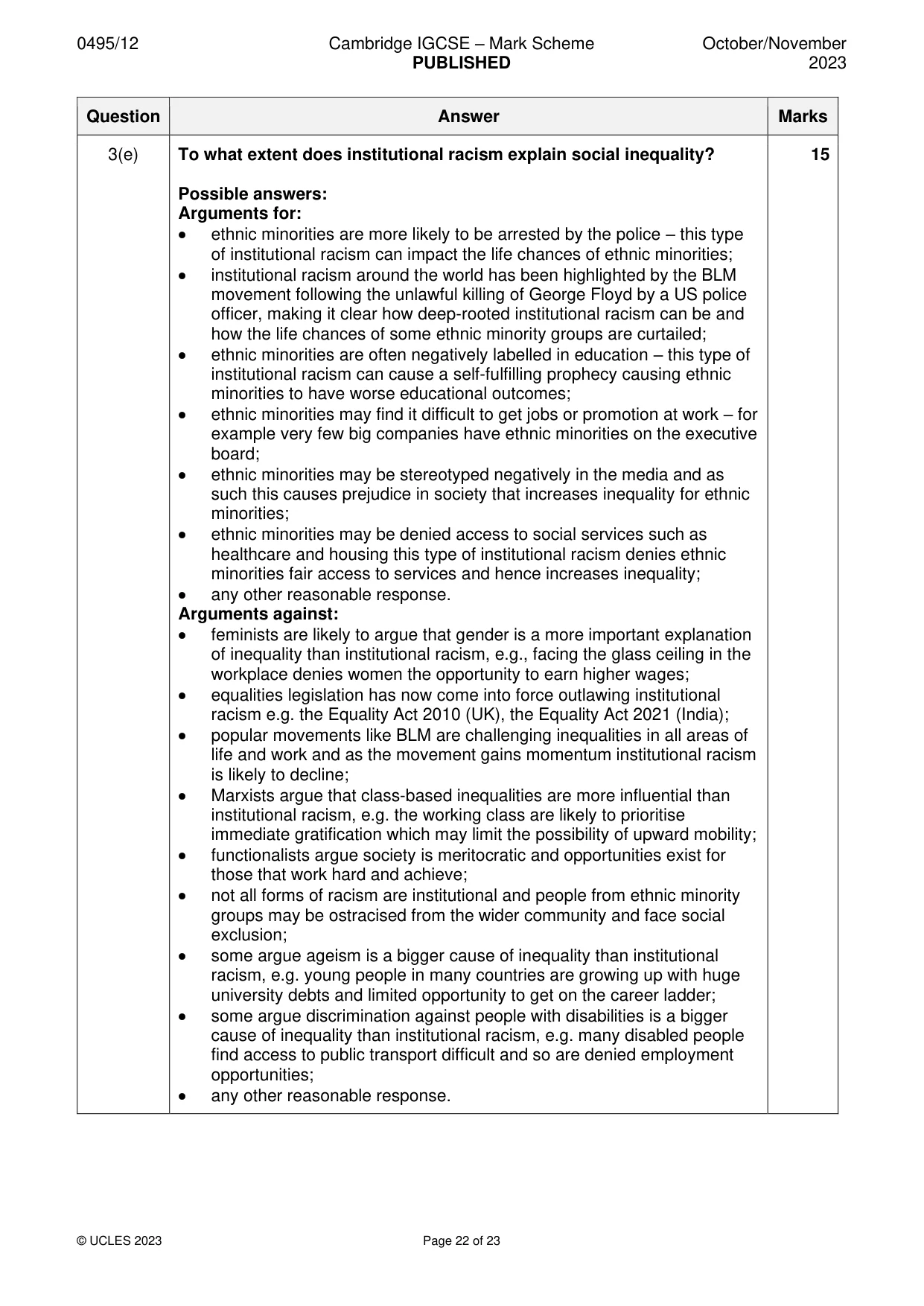
0495/12 Cambridge IGCSE – Mark Scheme PUBLISHED October/November 2023 © UCLES 2023 Page 22 of 23 Question Answer Marks 3(e) To what extent does institutional racism explain social inequality? Possible answers: Arguments for: • ethnic minorities are more likely to be arrested by the police – this type of institutional racism can impact the life chances of ethnic minorities; • institutional racism around the world has been highlighted by the BLM movement following the unlawful killing of George Floyd by a US police officer, making it clear how deep-rooted institutional racism can be and how the life chances of some ethnic minority groups are curtailed; • ethnic minorities are often negatively labelled in education – this type of institutional racism can cause a self-fulfilling prophecy causing ethnic minorities to have worse educational outcomes; • ethnic minorities may find it difficult to get jobs or promotion at work – for example very few big companies have ethnic minorities on the executive board; • ethnic minorities may be stereotyped negatively in the media and as such this causes prejudice in society that increases inequality for ethnic minorities; • ethnic minorities may be denied access to social services such as healthcare and housing this type of institutional racism denies ethnic minorities fair access to services and hence increases inequality; • any other reasonable response. Arguments against: • feminists are likely to argue that gender is a more important explanation of inequality than institutional racism, e.g., facing the glass ceiling in the workplace denies women the opportunity to earn higher wages; • equalities legislation has now come into force outlawing institutional racism e.g. the Equality Act 2010 (UK), the Equality Act 2021 (India); • popular movements like BLM are challenging inequalities in all areas of life and work and as the movement gains momentum institutional racism is likely to decline; • Marxists argue that class-based inequalities are more influential than institutional racism, e.g. the working class are likely to prioritise immediate gratification which may limit the possibility of upward mobility; • functionalists argue society is meritocratic and opportunities exist for those that work hard and achieve; • not all forms of racism are institutional and people from ethnic minority groups may be ostracised from the wider community and face social exclusion; • some argue ageism is a bigger cause of inequality than institutional racism, e.g. young people in many countries are growing up with huge university debts and limited opportunity to get on the career ladder; • some argue discrimination against people with disabilities is a bigger cause of inequality than institutional racism, e.g. many disabled people find access to public transport difficult and so are denied employment opportunities; • any other reasonable response. 15
Mark scheme, page 23
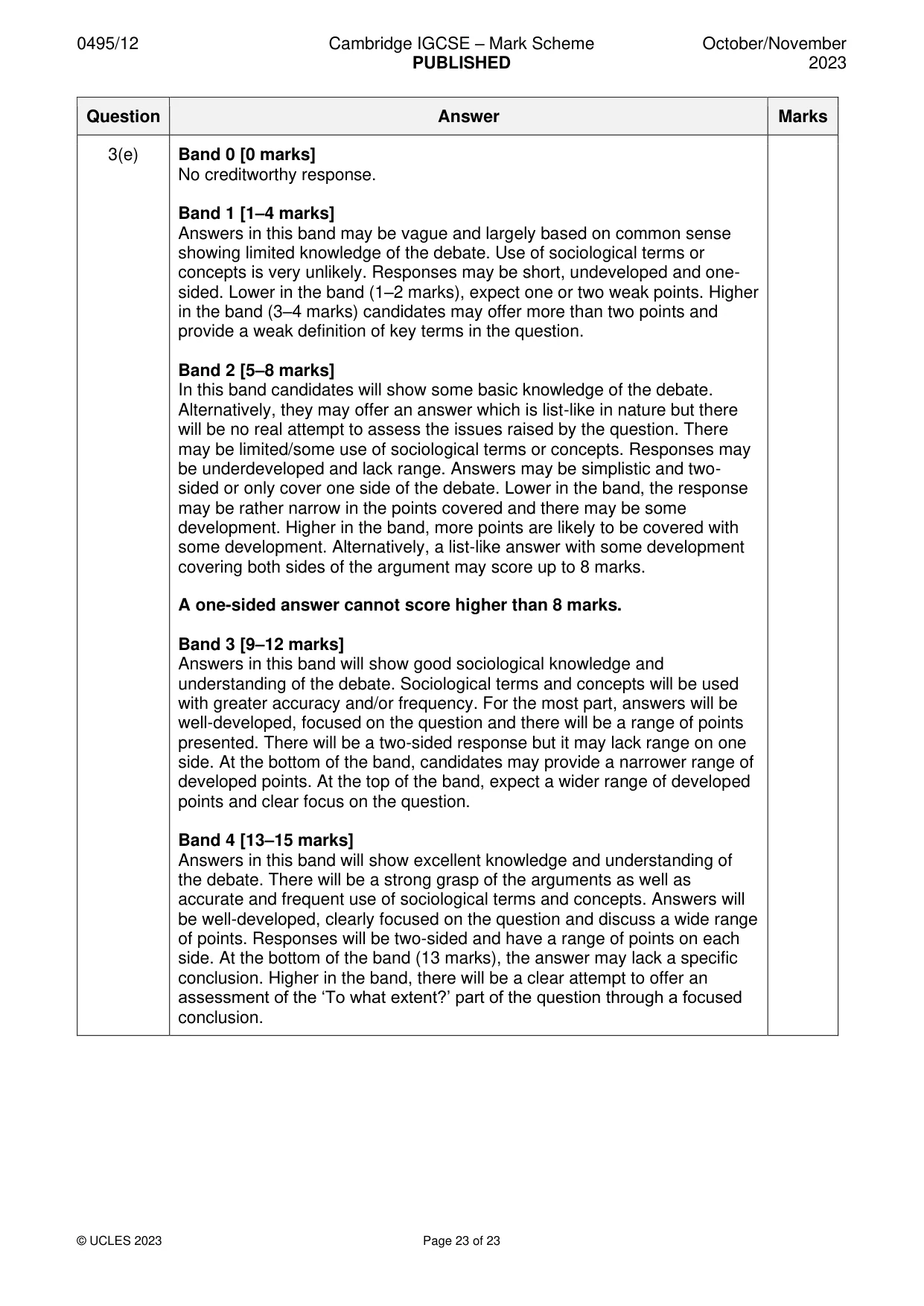
0495/12 Cambridge IGCSE – Mark Scheme PUBLISHED October/November 2023 © UCLES 2023 Page 23 of 23 Question Answer Marks 3(e) Band 0 [0 marks] No creditworthy response. Band 1 [1–4 marks] Answers in this band may be vague and largely based on common sense showing limited knowledge of the debate. Use of sociological terms or concepts is very unlikely. Responses may be short, undeveloped and one- sided. Lower in the band (1–2 marks), expect one or two weak points. Higher in the band (3–4 marks) candidates may offer more than two points and provide a weak definition of key terms in the question. Band 2 [5–8 marks] In this band candidates will show some basic knowledge of the debate. Alternatively, they may offer an answer which is list-like in nature but there will be no real attempt to assess the issues raised by the question. There may be limited/some use of sociological terms or concepts. Responses may be underdeveloped and lack range. Answers may be simplistic and two- sided or only cover one side of the debate. Lower in the band, the response may be rather narrow in the points covered and there may be some development. Higher in the band, more points are likely to be covered with some development. Alternatively, a list-like answer with some development covering both sides of the argument may score up to 8 marks. A one-sided answer cannot score higher than 8 marks. Band 3 [9–12 marks] Answers in this band will show good sociological knowledge and understanding of the debate. Sociological terms and concepts will be used with greater accuracy and/or frequency. For the most part, answers will be well-developed, focused on the question and there will be a range of points presented. There will be a two-sided response but it may lack range on one side. At the bottom of the band, candidates may provide a narrower range of developed points. At the top of the band, expect a wider range of developed points and clear focus on the question. Band 4 [13–15 marks] Answers in this band will show excellent knowledge and understanding of the debate. There will be a strong grasp of the arguments as well as accurate and frequent use of sociological terms and concepts. Answers will be well-developed, clearly focused on the question and discuss a wide range of points. Responses will be two-sided and have a range of points on each side. At the bottom of the band (13 marks), the answer may lack a specific conclusion. Higher in the band, there will be a clear attempt to offer an assessment of the ‘To what extent?’ part of the question through a focused conclusion.
What you needed in this session
Cambridge’s own grade thresholds for 2023 Oct/Nov, Paper 1 · Variant 2. A higher threshold means an easier paper — the bar moves with how the cohort did.