Cambridge IGCSE Sociology 0495 — 2022 May/June Paper 1 · Variant 1
0495/11/M/J/22 · 80 marks · ≈90 min
The question paper and its mark scheme, free to read here and free to download. This is Cambridge’s own paper, exactly as it was sat.
Question paper4 pages

Mark scheme20 pages
Answers below. Sit the paper first if you are practising.

Paper as text
Question paper, page 1
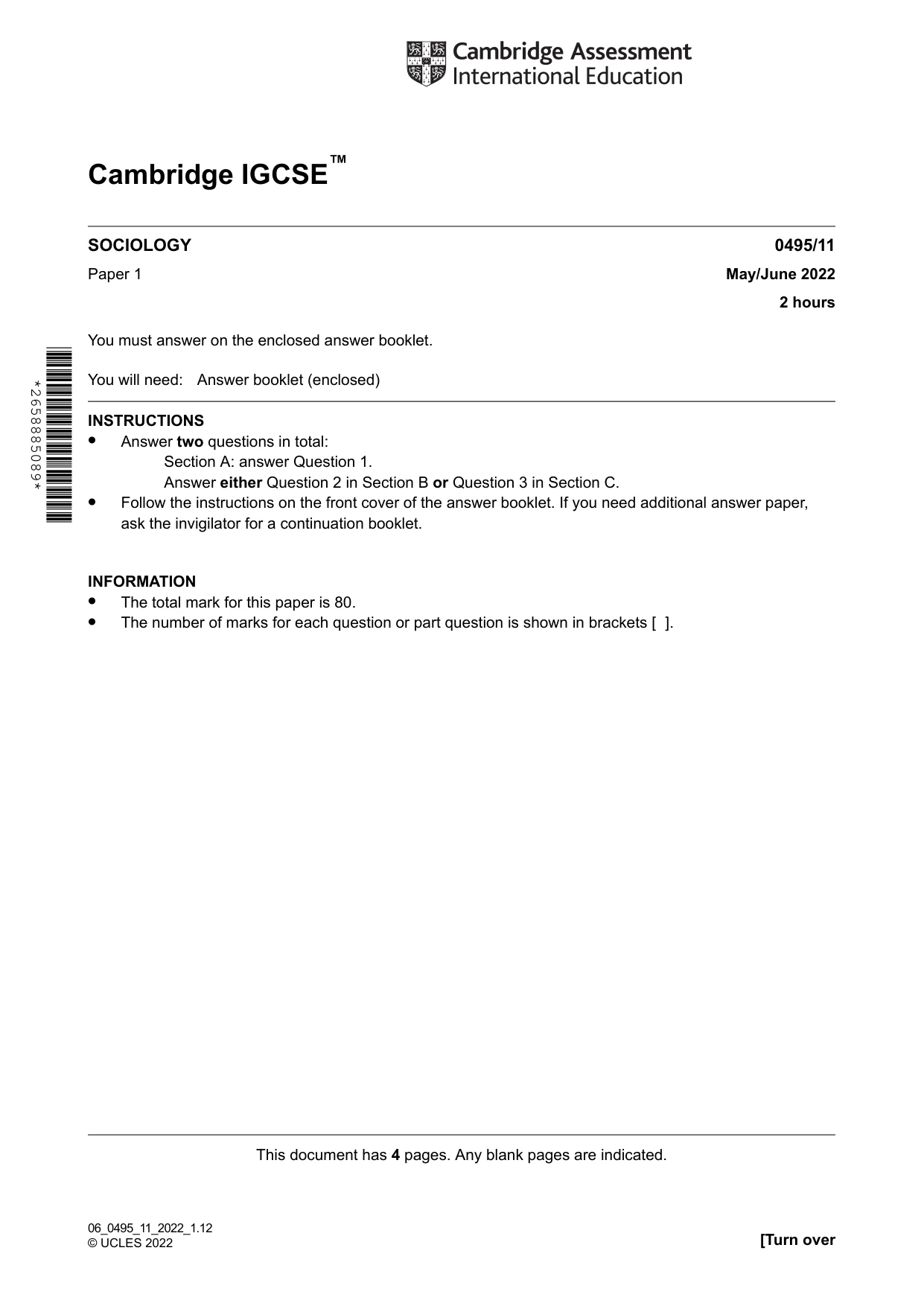
Cambridge IGCSE™ 0495/11 May/June 2022 2 hours SOCIOLOGY Paper 1 You must answer on the enclosed answer booklet. You will need: Answer booklet (enclosed) INSTRUCTIONS • Answer two questions in total: Section A: answer Question 1. Answer either Question 2 in Section B or Question 3 in Section C. • Follow the instructions on the front cover of the answer booklet. If you need additional answer paper, ask the invigilator for a continuation booklet. INFORMATION • The total mark for this paper is 80. • The number of marks for each question or part question is shown in brackets [ ]. This document has 4 pages. Any blank pages are indicated. [Turn over 06_0495_11_2022_1.12 © UCLES 2022 *2658885089*
Question paper, page 2
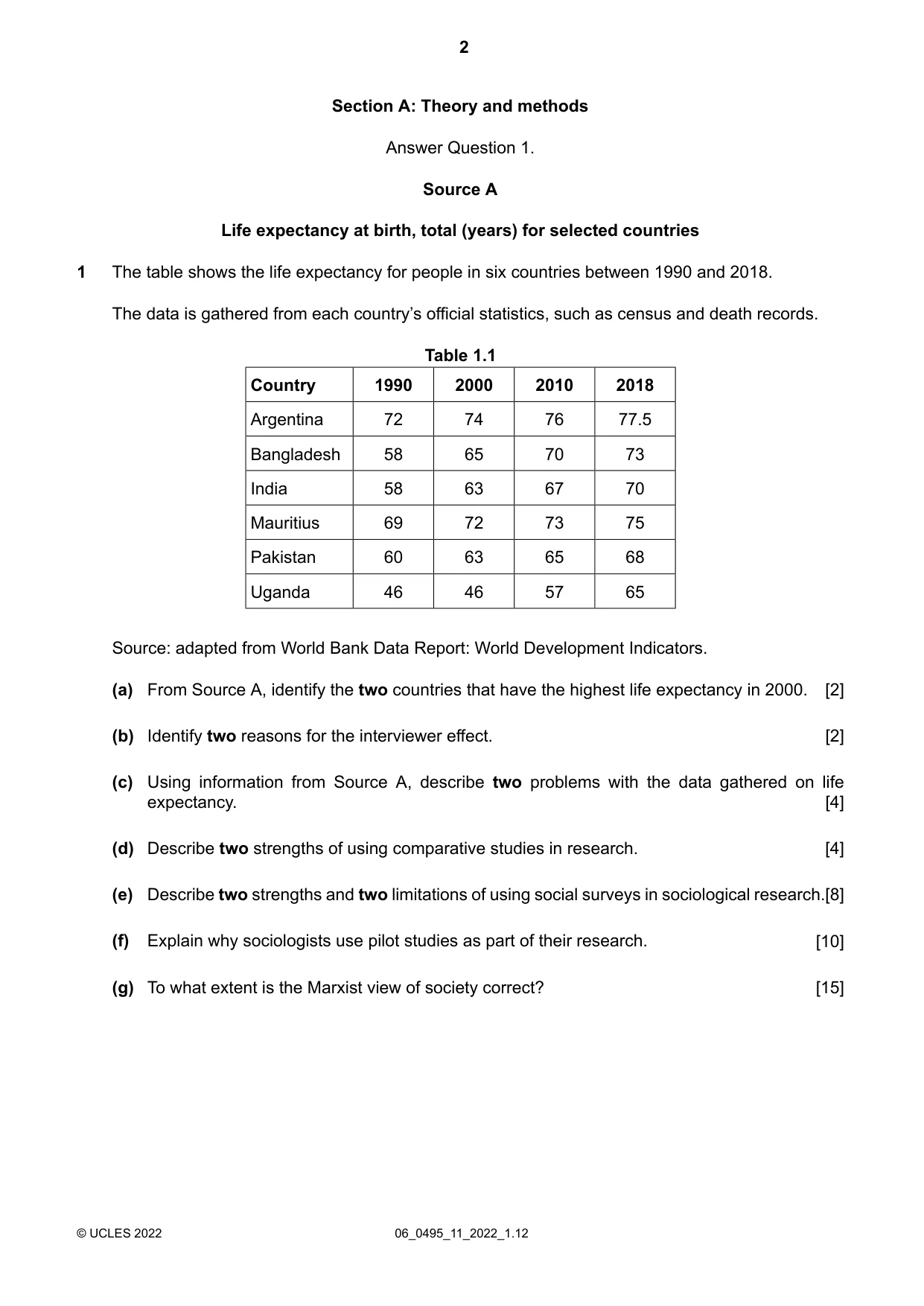
Section A: Theory and methods Answer Question 1. Source A Life expectancy at birth, total (years) for selected countries The table shows the life expectancy for people in six countries between 1990 and 2018. 1 The data is gathered from each country’s official statistics, such as census and death records. Table 1.1 2018 2010 2000 1990 Country 77.5 76 74 72 Argentina 73 70 65 58 Bangladesh 70 67 63 58 India 75 73 72 69 Mauritius 68 65 63 60 Pakistan 65 57 46 46 Uganda Source: adapted from World Bank Data Report: World Development Indicators. From Source A, identify the two countries that have the highest life expectancy in 2000. [2] (a) Identify two reasons for the interviewer effect. [2] (b) Using information from Source A, describe two problems with the data gathered on life expectancy. [4] (c) Describe two strengths of using comparative studies in research. [4] (d) Describe two strengths and two limitations of using social surveys in sociological research.[8] (e) Explain why sociologists use pilot studies as part of their research. [10] (f) To what extent is the Marxist view of society correct? [15] (g) 06_0495_11_2022_1.12 © UCLES 2022 2
Question paper, page 3
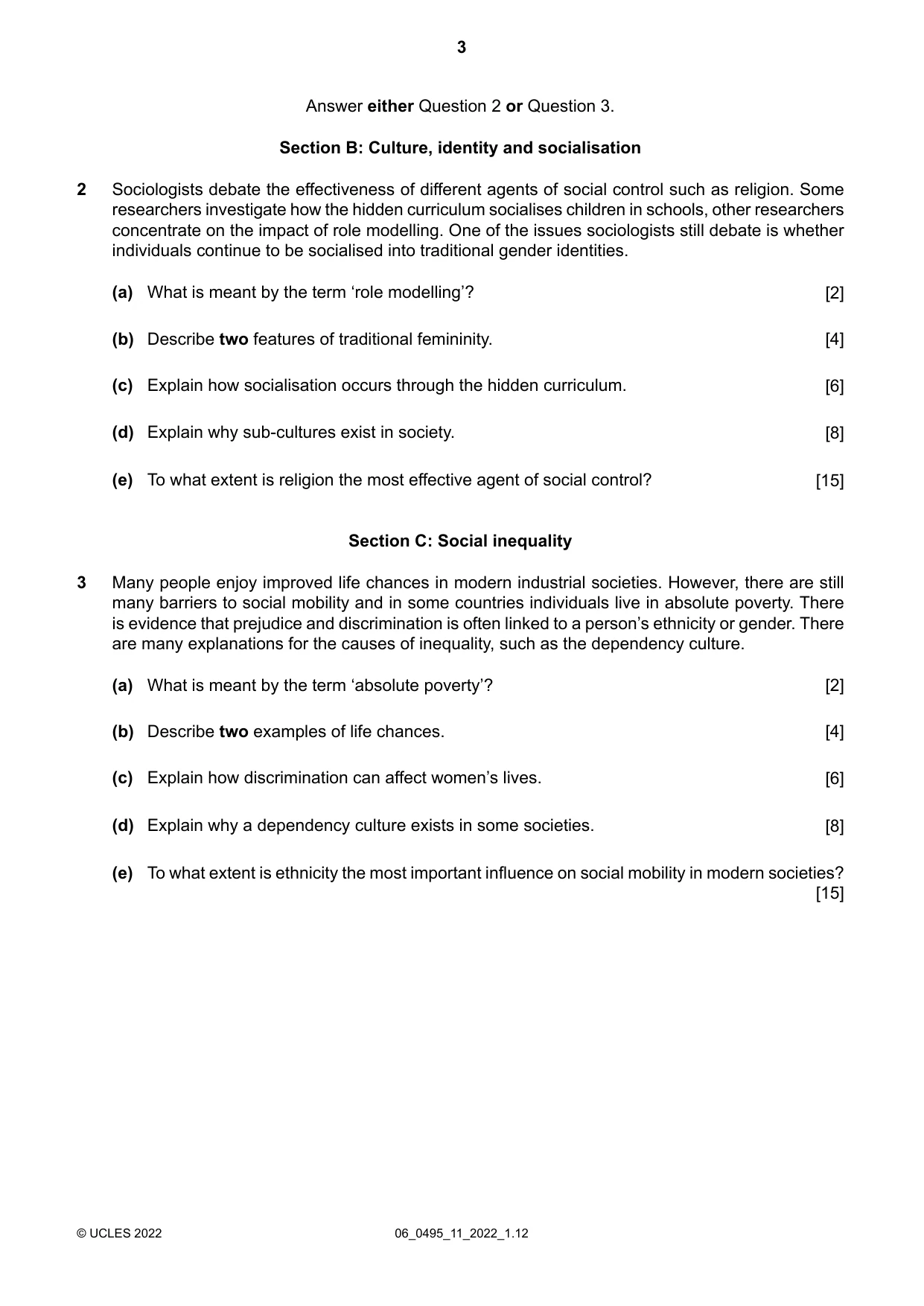
Answer either Question 2 or Question 3. Section B: Culture, identity and socialisation Sociologists debate the effectiveness of different agents of social control such as religion. Some researchers investigate how the hidden curriculum socialises children in schools, other researchers 2 concentrate on the impact of role modelling. One of the issues sociologists still debate is whether individuals continue to be socialised into traditional gender identities. What is meant by the term ‘role modelling’? [2] (a) Describe two features of traditional femininity. [4] (b) Explain how socialisation occurs through the hidden curriculum. [6] (c) Explain why sub-cultures exist in society. [8] (d) To what extent is religion the most effective agent of social control? [15] (e) Section C: Social inequality Many people enjoy improved life chances in modern industrial societies. However, there are still many barriers to social mobility and in some countries individuals live in absolute poverty. There 3 is evidence that prejudice and discrimination is often linked to a person’s ethnicity or gender. There are many explanations for the causes of inequality, such as the dependency culture. What is meant by the term ‘absolute poverty’? [2] (a) Describe two examples of life chances. [4] (b) Explain how discrimination can affect women’s lives. [6] (c) Explain why a dependency culture exists in some societies. [8] (d) To what extent is ethnicity the most important influence on social mobility in modern societies? [15] (e) 06_0495_11_2022_1.12 © UCLES 2022 3
Question paper, page 4
BLANK PAGE Permission to reproduce items where third-party owned material protected by copyright is included has been sought and cleared where possible. Every reasonable effort has been made by the publisher (UCLES) to trace copyright holders, but if any items requiring clearance have unwittingly been included, the publisher will be pleased to make amends at the earliest possible opportunity. To avoid the issue of disclosure of answer-related information to candidates, all copyright acknowledgements are reproduced online in the Cambridge Assessment International Education Copyright Acknowledgements Booklet. This is produced for each series of examinations and is freely available to download at www.cambridgeinternational.org after the live examination series. Cambridge Assessment International Education is part of Cambridge Assessment. Cambridge Assessment is the brand name of the University of Cambridge Local Examinations Syndicate (UCLES), which is a department of the University of Cambridge. 06_0495_11_2022_1.12 © UCLES 2022 4
Mark scheme, page 1
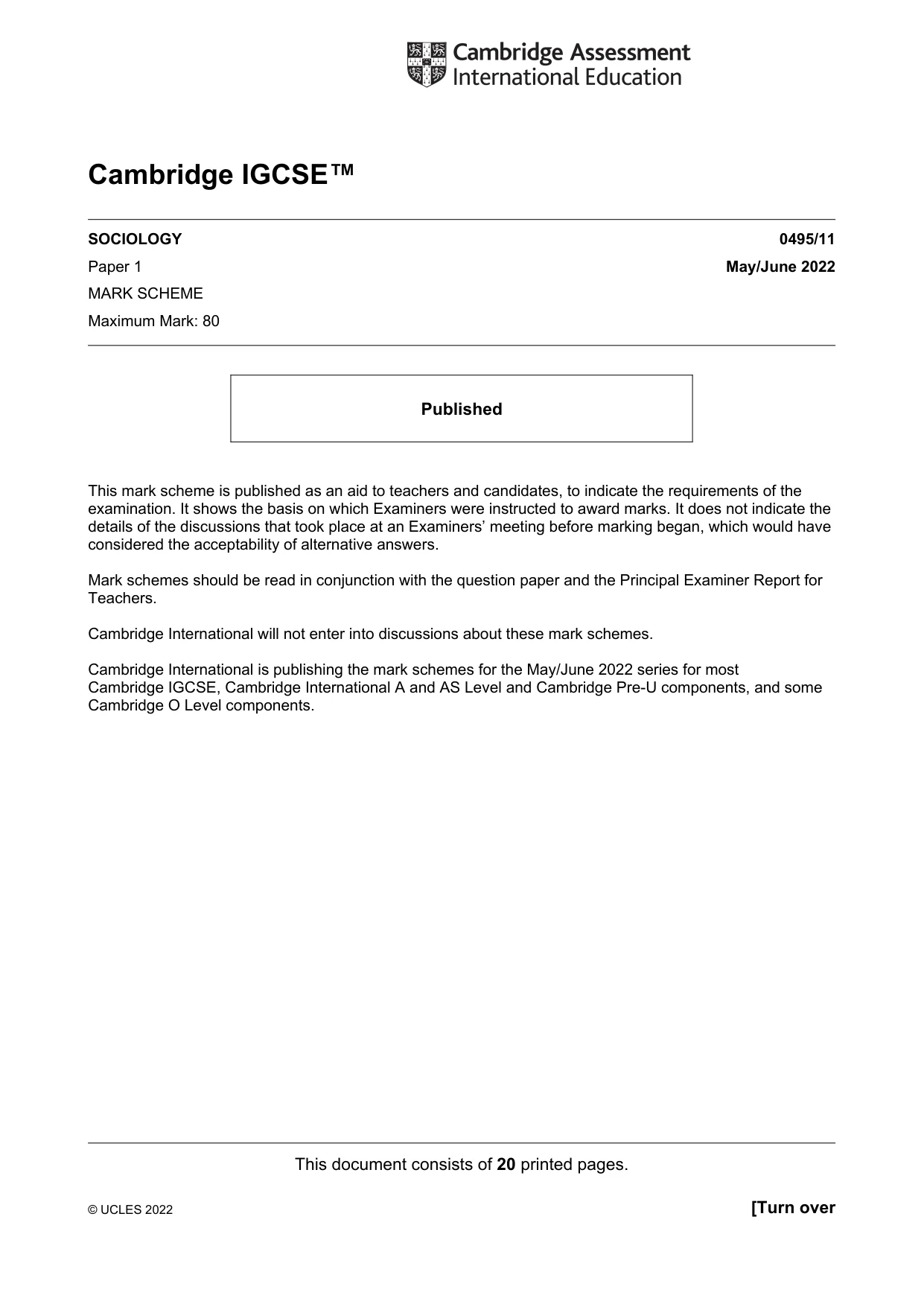
This document consists of 20 printed pages. © UCLES 2022 [Turn over Cambridge IGCSE™ SOCIOLOGY 0495/11 Paper 1 May/June 2022 MARK SCHEME Maximum Mark: 80 Published This mark scheme is published as an aid to teachers and candidates, to indicate the requirements of the examination. It shows the basis on which Examiners were instructed to award marks. It does not indicate the details of the discussions that took place at an Examiners’ meeting before marking began, which would have considered the acceptability of alternative answers. Mark schemes should be read in conjunction with the question paper and the Principal Examiner Report for Teachers. Cambridge International will not enter into discussions about these mark schemes. Cambridge International is publishing the mark schemes for the May/June 2022 series for most Cambridge IGCSE, Cambridge International A and AS Level and Cambridge Pre-U components, and some Cambridge O Level components.
Mark scheme, page 2
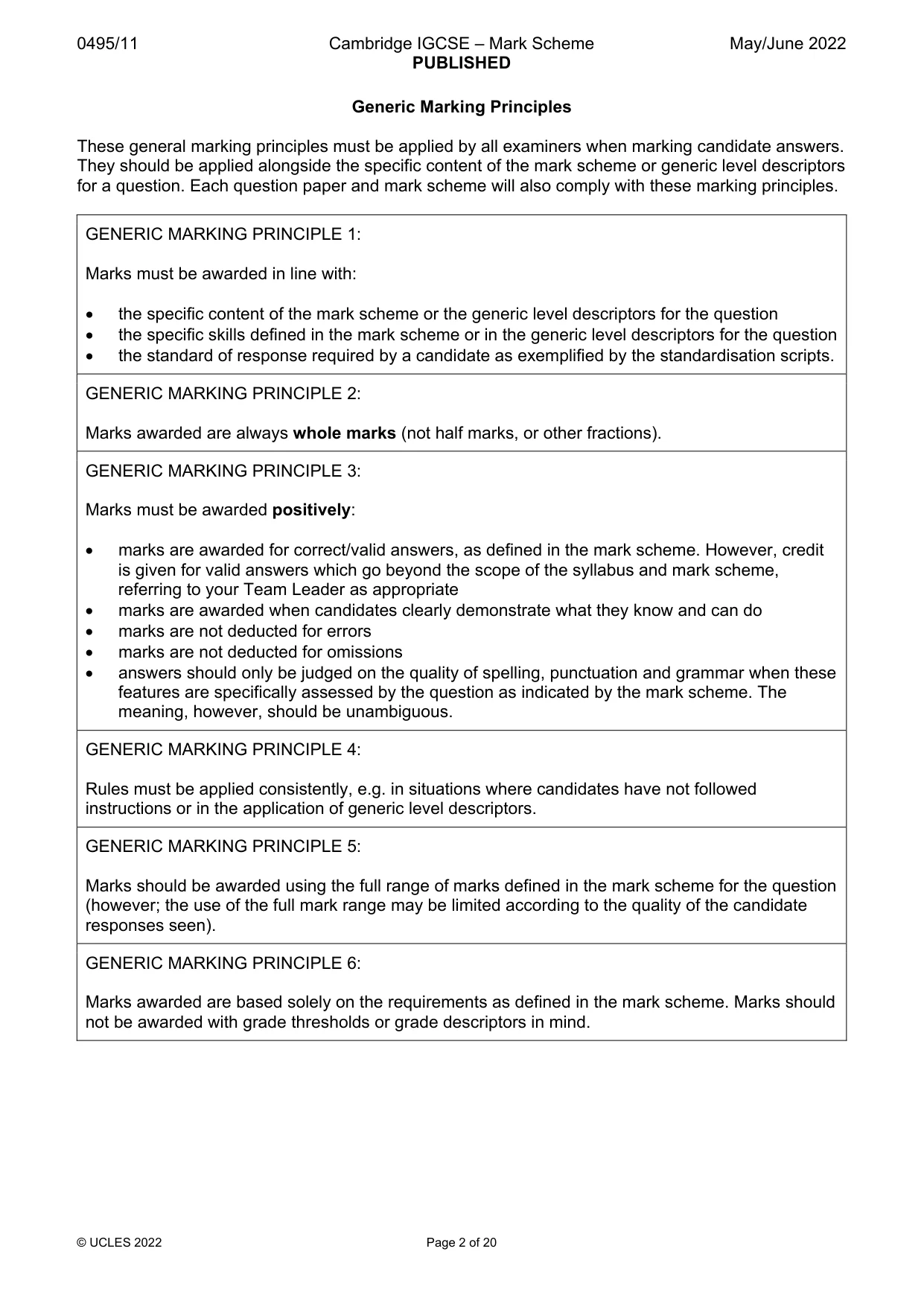
0495/11 Cambridge IGCSE – Mark Scheme PUBLISHED May/June 2022 © UCLES 2022 Page 2 of 20 Generic Marking Principles These general marking principles must be applied by all examiners when marking candidate answers. They should be applied alongside the specific content of the mark scheme or generic level descriptors for a question. Each question paper and mark scheme will also comply with these marking principles. GENERIC MARKING PRINCIPLE 1: Marks must be awarded in line with: the specific content of the mark scheme or the generic level descriptors for the question the specific skills defined in the mark scheme or in the generic level descriptors for the question the standard of response required by a candidate as exemplified by the standardisation scripts. GENERIC MARKING PRINCIPLE 2: Marks awarded are always whole marks (not half marks, or other fractions). GENERIC MARKING PRINCIPLE 3: Marks must be awarded positively: marks are awarded for correct/valid answers, as defined in the mark scheme. However, credit is given for valid answers which go beyond the scope of the syllabus and mark scheme, referring to your Team Leader as appropriate marks are awarded when candidates clearly demonstrate what they know and can do marks are not deducted for errors marks are not deducted for omissions answers should only be judged on the quality of spelling, punctuation and grammar when these features are specifically assessed by the question as indicated by the mark scheme. The meaning, however, should be unambiguous. GENERIC MARKING PRINCIPLE 4: Rules must be applied consistently, e.g. in situations where candidates have not followed instructions or in the application of generic level descriptors. GENERIC MARKING PRINCIPLE 5: Marks should be awarded using the full range of marks defined in the mark scheme for the question (however; the use of the full mark range may be limited according to the quality of the candidate responses seen). GENERIC MARKING PRINCIPLE 6: Marks awarded are based solely on the requirements as defined in the mark scheme. Marks should not be awarded with grade thresholds or grade descriptors in mind.
Mark scheme, page 3
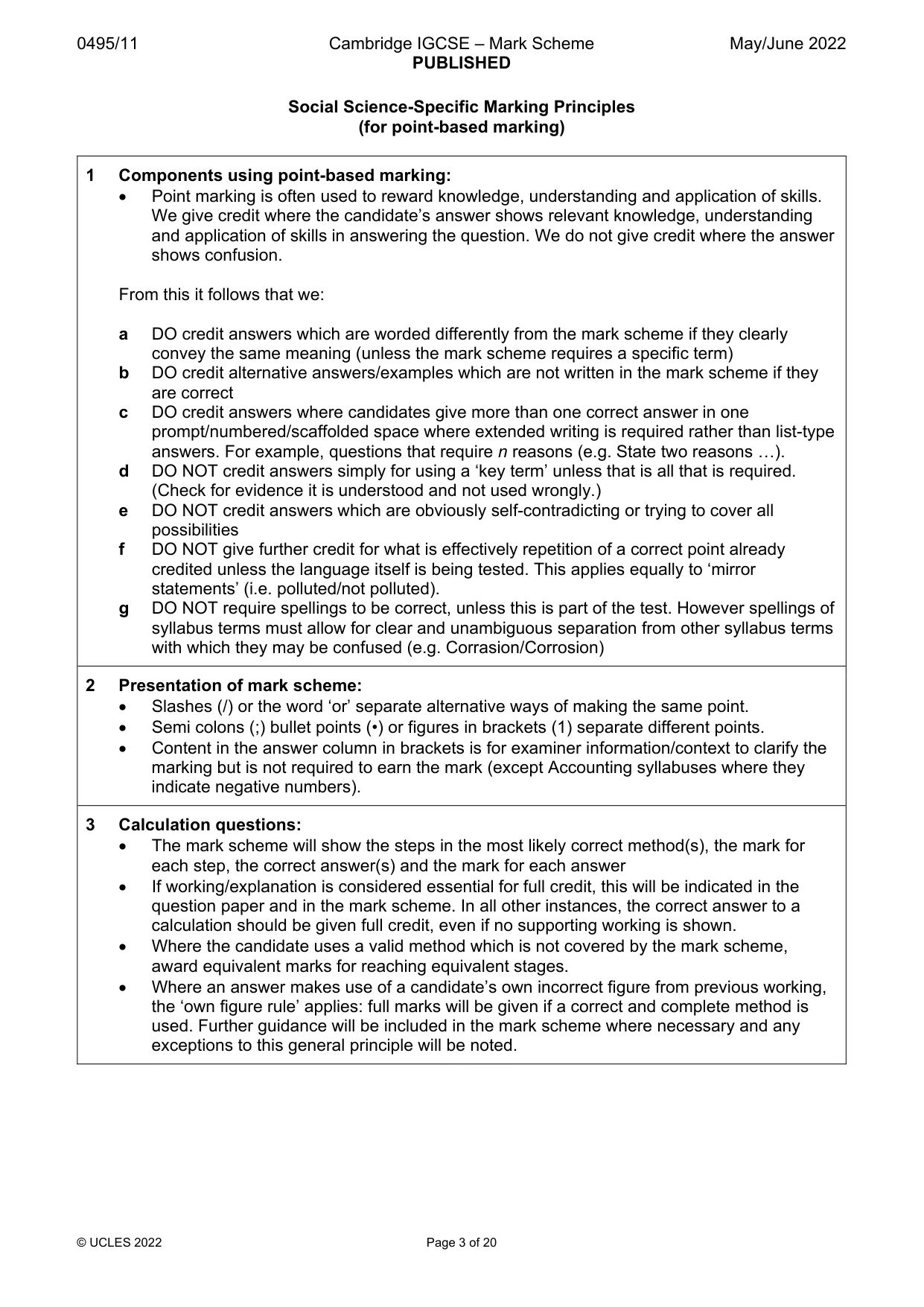
0495/11 Cambridge IGCSE – Mark Scheme PUBLISHED May/June 2022 © UCLES 2022 Page 3 of 20 Social Science-Specific Marking Principles (for point-based marking) 1 Components using point-based marking: Point marking is often used to reward knowledge, understanding and application of skills. We give credit where the candidate’s answer shows relevant knowledge, understanding and application of skills in answering the question. We do not give credit where the answer shows confusion. From this it follows that we: a DO credit answers which are worded differently from the mark scheme if they clearly convey the same meaning (unless the mark scheme requires a specific term) b DO credit alternative answers/examples which are not written in the mark scheme if they are correct c DO credit answers where candidates give more than one correct answer in one prompt/numbered/scaffolded space where extended writing is required rather than list-type answers. For example, questions that require n reasons (e.g. State two reasons …). d DO NOT credit answers simply for using a ‘key term’ unless that is all that is required. (Check for evidence it is understood and not used wrongly.) e DO NOT credit answers which are obviously self-contradicting or trying to cover all possibilities f DO NOT give further credit for what is effectively repetition of a correct point already credited unless the language itself is being tested. This applies equally to ‘mirror statements’ (i.e. polluted/not polluted). g DO NOT require spellings to be correct, unless this is part of the test. However spellings of syllabus terms must allow for clear and unambiguous separation from other syllabus terms with which they may be confused (e.g. Corrasion/Corrosion) 2 Presentation of mark scheme: Slashes (/) or the word ‘or’ separate alternative ways of making the same point. Semi colons (;) bullet points (•) or figures in brackets (1) separate different points. Content in the answer column in brackets is for examiner information/context to clarify the marking but is not required to earn the mark (except Accounting syllabuses where they indicate negative numbers). 3 Calculation questions: The mark scheme will show the steps in the most likely correct method(s), the mark for each step, the correct answer(s) and the mark for each answer If working/explanation is considered essential for full credit, this will be indicated in the question paper and in the mark scheme. In all other instances, the correct answer to a calculation should be given full credit, even if no supporting working is shown. Where the candidate uses a valid method which is not covered by the mark scheme, award equivalent marks for reaching equivalent stages. Where an answer makes use of a candidate’s own incorrect figure from previous working, the ‘own figure rule’ applies: full marks will be given if a correct and complete method is used. Further guidance will be included in the mark scheme where necessary and any exceptions to this general principle will be noted.
Mark scheme, page 4
0495/11 Cambridge IGCSE – Mark Scheme PUBLISHED May/June 2022 © UCLES 2022 Page 4 of 20 4 Annotation: For point marking, ticks can be used to indicate correct answers and crosses can be used to indicate wrong answers. There is no direct relationship between ticks and marks. Ticks have no defined meaning for levels of response marking. For levels of response marking, the level awarded should be annotated on the script. Other annotations will be used by examiners as agreed during standardisation, and the meaning will be understood by all examiners who marked that paper.
Mark scheme, page 5
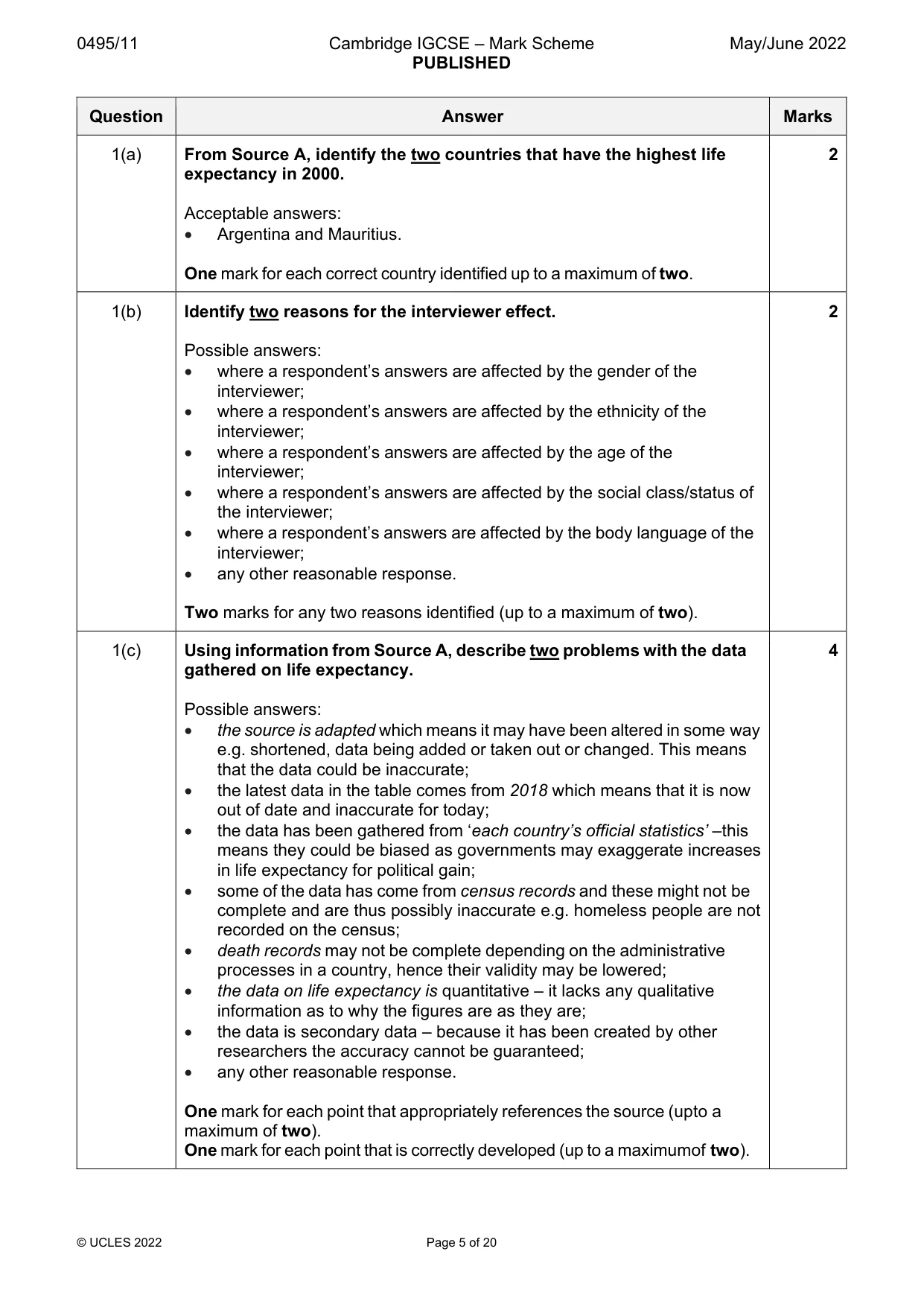
0495/11 Cambridge IGCSE – Mark Scheme PUBLISHED May/June 2022 © UCLES 2022 Page 5 of 20 Question Answer Marks 1(a) From Source A, identify the two countries that have the highest life expectancy in 2000. Acceptable answers: Argentina and Mauritius. One mark for each correct country identified up to a maximum of two. 2 1(b) Identify two reasons for the interviewer effect. Possible answers: where a respondent’s answers are affected by the gender of the interviewer; where a respondent’s answers are affected by the ethnicity of the interviewer; where a respondent’s answers are affected by the age of the interviewer; where a respondent’s answers are affected by the social class/status of the interviewer; where a respondent’s answers are affected by the body language of the interviewer; any other reasonable response. Two marks for any two reasons identified (up to a maximum of two). 2 1(c) Using information from Source A, describe two problems with the data gathered on life expectancy. Possible answers: the source is adapted which means it may have been altered in some way e.g. shortened, data being added or taken out or changed. This means that the data could be inaccurate; the latest data in the table comes from 2018 which means that it is now out of date and inaccurate for today; the data has been gathered from ‘each country’s official statistics’ – this means they could be biased as governments may exaggerate increases in life expectancy for political gain; some of the data has come from census records and these might not be complete and are thus possibly inaccurate e.g. homeless people are not recorded on the census; death records may not be complete depending on the administrative processes in a country, hence their validity may be lowered; the data on life expectancy is quantitative – it lacks any qualitative information as to why the figures are as they are; the data is secondary data – because it has been created by other researchers the accuracy cannot be guaranteed; any other reasonable response. One mark for each point that appropriately references the source (up to a maximum of two). One mark for each point that is correctly developed (up to a maximum of two). 4
Mark scheme, page 6
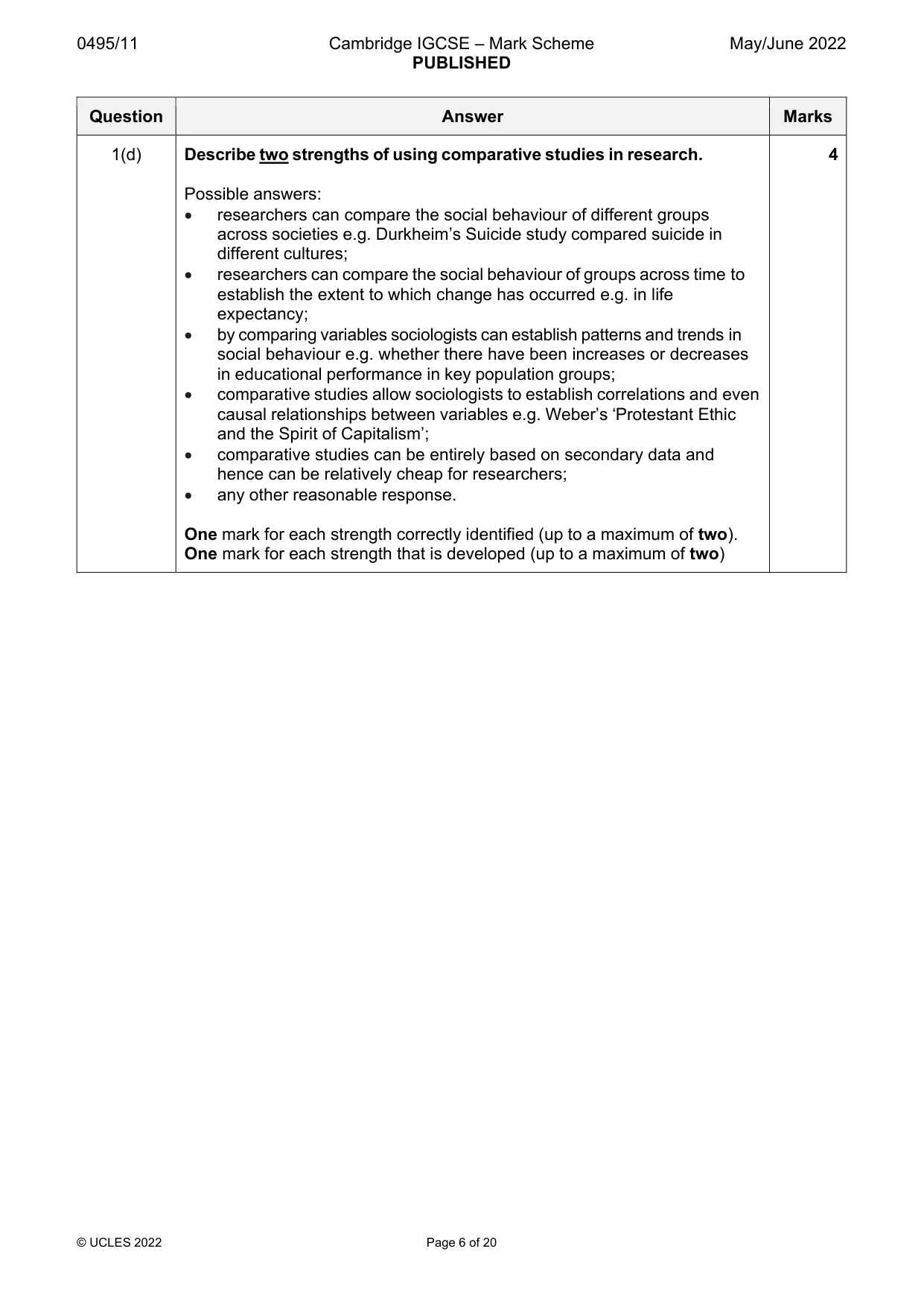
0495/11 Cambridge IGCSE – Mark Scheme PUBLISHED May/June 2022 © UCLES 2022 Page 6 of 20 Question Answer Marks 1(d) Describe two strengths of using comparative studies in research. Possible answers: researchers can compare the social behaviour of different groups across societies e.g. Durkheim’s Suicide study compared suicide in different cultures; researchers can compare the social behaviour of groups across time to establish the extent to which change has occurred e.g. in life expectancy; by comparing variables sociologists can establish patterns and trends in social behaviour e.g. whether there have been increases or decreases in educational performance in key population groups; comparative studies allow sociologists to establish correlations and even causal relationships between variables e.g. Weber’s ‘Protestant Ethic and the Spirit of Capitalism’; comparative studies can be entirely based on secondary data and hence can be relatively cheap for researchers; any other reasonable response. One mark for each strength correctly identified (up to a maximum of two). One mark for each strength that is developed (up to a maximum of two) 4
Mark scheme, page 7
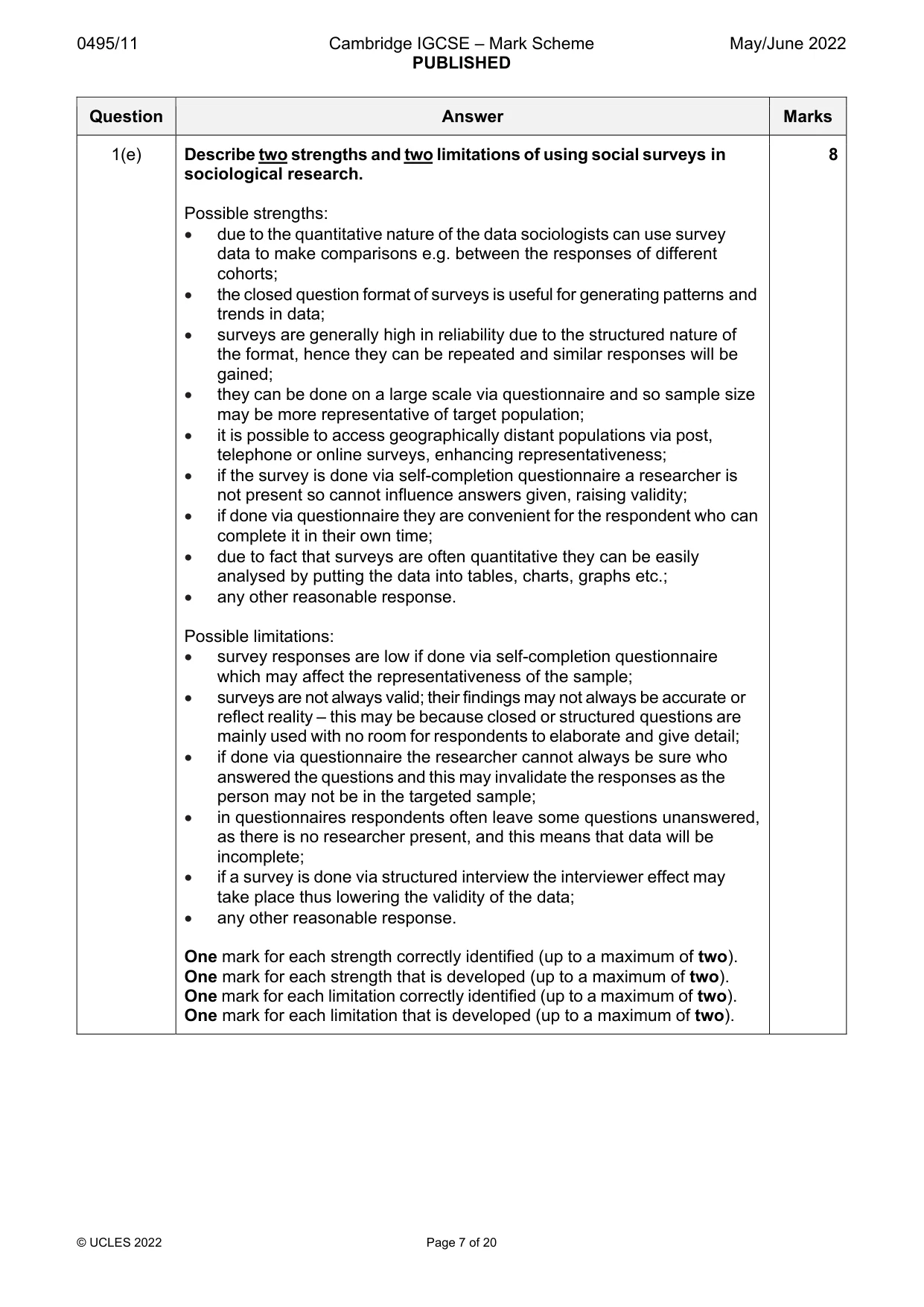
0495/11 Cambridge IGCSE – Mark Scheme PUBLISHED May/June 2022 © UCLES 2022 Page 7 of 20 Question Answer Marks 1(e) Describe two strengths and two limitations of using social surveys in sociological research. Possible strengths: due to the quantitative nature of the data sociologists can use survey data to make comparisons e.g. between the responses of different cohorts; the closed question format of surveys is useful for generating patterns and trends in data; surveys are generally high in reliability due to the structured nature of the format, hence they can be repeated and similar responses will be gained; they can be done on a large scale via questionnaire and so sample size may be more representative of target population; it is possible to access geographically distant populations via post, telephone or online surveys, enhancing representativeness; if the survey is done via self-completion questionnaire a researcher is not present so cannot influence answers given, raising validity; if done via questionnaire they are convenient for the respondent who can complete it in their own time; due to fact that surveys are often quantitative they can be easily analysed by putting the data into tables, charts, graphs etc.; any other reasonable response. Possible limitations: survey responses are low if done via self-completion questionnaire which may affect the representativeness of the sample; surveys are not always valid; their findings may not always be accurate or reflect reality – this may be because closed or structured questions are mainly used with no room for respondents to elaborate and give detail; if done via questionnaire the researcher cannot always be sure who answered the questions and this may invalidate the responses as the person may not be in the targeted sample; in questionnaires respondents often leave some questions unanswered, as there is no researcher present, and this means that data will be incomplete; if a survey is done via structured interview the interviewer effect may take place thus lowering the validity of the data; any other reasonable response. One mark for each strength correctly identified (up to a maximum of two). One mark for each strength that is developed (up to a maximum of two). One mark for each limitation correctly identified (up to a maximum of two). One mark for each limitation that is developed (up to a maximum of two). 8
Mark scheme, page 8
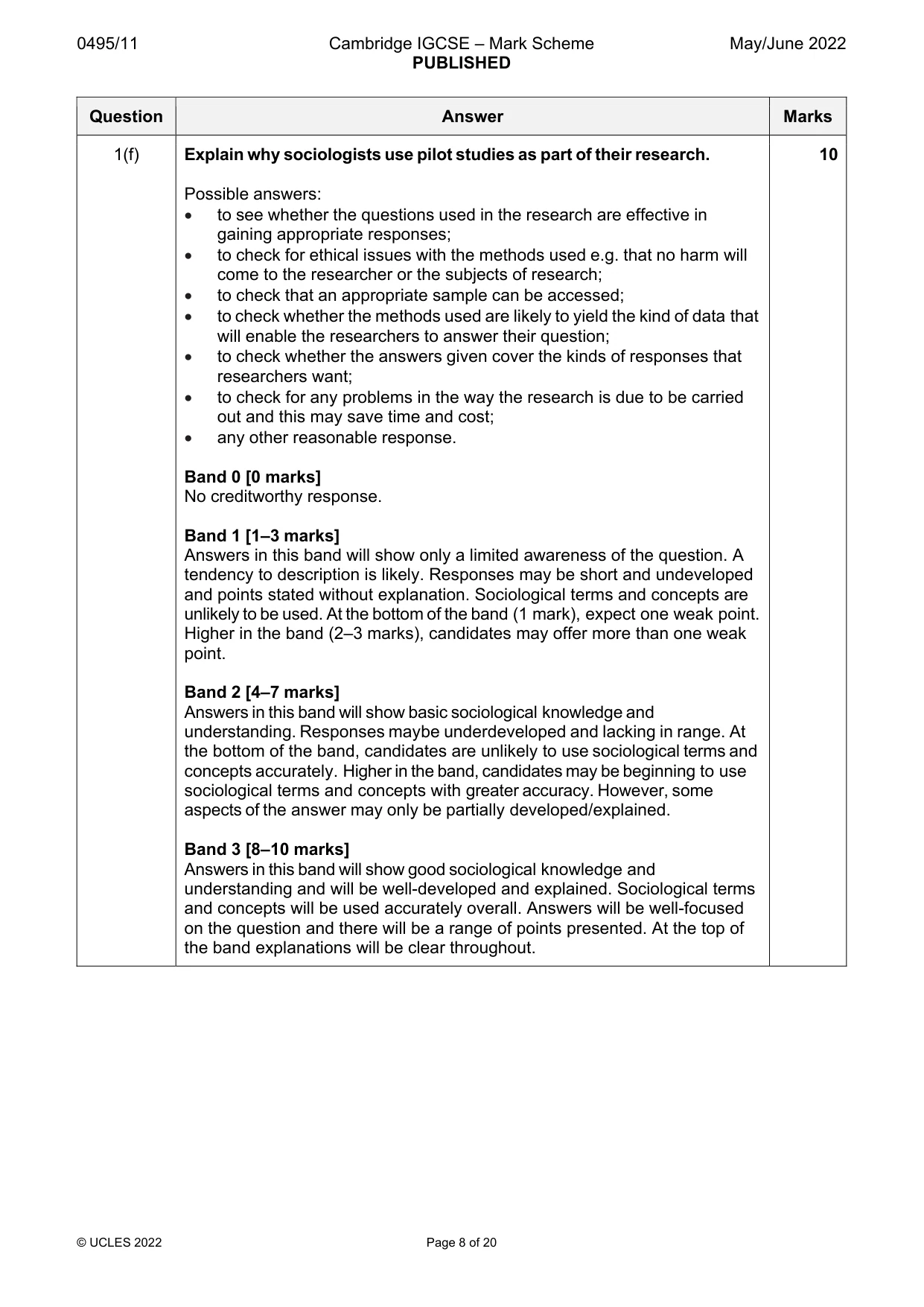
0495/11 Cambridge IGCSE – Mark Scheme PUBLISHED May/June 2022 © UCLES 2022 Page 8 of 20 Question Answer Marks 1(f) Explain why sociologists use pilot studies as part of their research. Possible answers: to see whether the questions used in the research are effective in gaining appropriate responses; to check for ethical issues with the methods used e.g. that no harm will come to the researcher or the subjects of research; to check that an appropriate sample can be accessed; to check whether the methods used are likely to yield the kind of data that will enable the researchers to answer their question; to check whether the answers given cover the kinds of responses that researchers want; to check for any problems in the way the research is due to be carried out and this may save time and cost; any other reasonable response. Band 0 [0 marks] No creditworthy response. Band 1 [1–3 marks] Answers in this band will show only a limited awareness of the question. A tendency to description is likely. Responses may be short and undeveloped and points stated without explanation. Sociological terms and concepts are unlikely to be used. At the bottom of the band (1 mark), expect one weak point. Higher in the band (2–3 marks), candidates may offer more than one weak point. Band 2 [4–7 marks] Answers in this band will show basic sociological knowledge and understanding. Responses may be underdeveloped and lacking in range. At the bottom of the band, candidates are unlikely to use sociological terms and concepts accurately. Higher in the band, candidates may be beginning to use sociological terms and concepts with greater accuracy. However, some aspects of the answer may only be partially developed/explained. Band 3 [8–10 marks] Answers in this band will show good sociological knowledge and understanding and will be well-developed and explained. Sociological terms and concepts will be used accurately overall. Answers will be well-focused on the question and there will be a range of points presented. At the top of the band explanations will be clear throughout. 10
Mark scheme, page 9
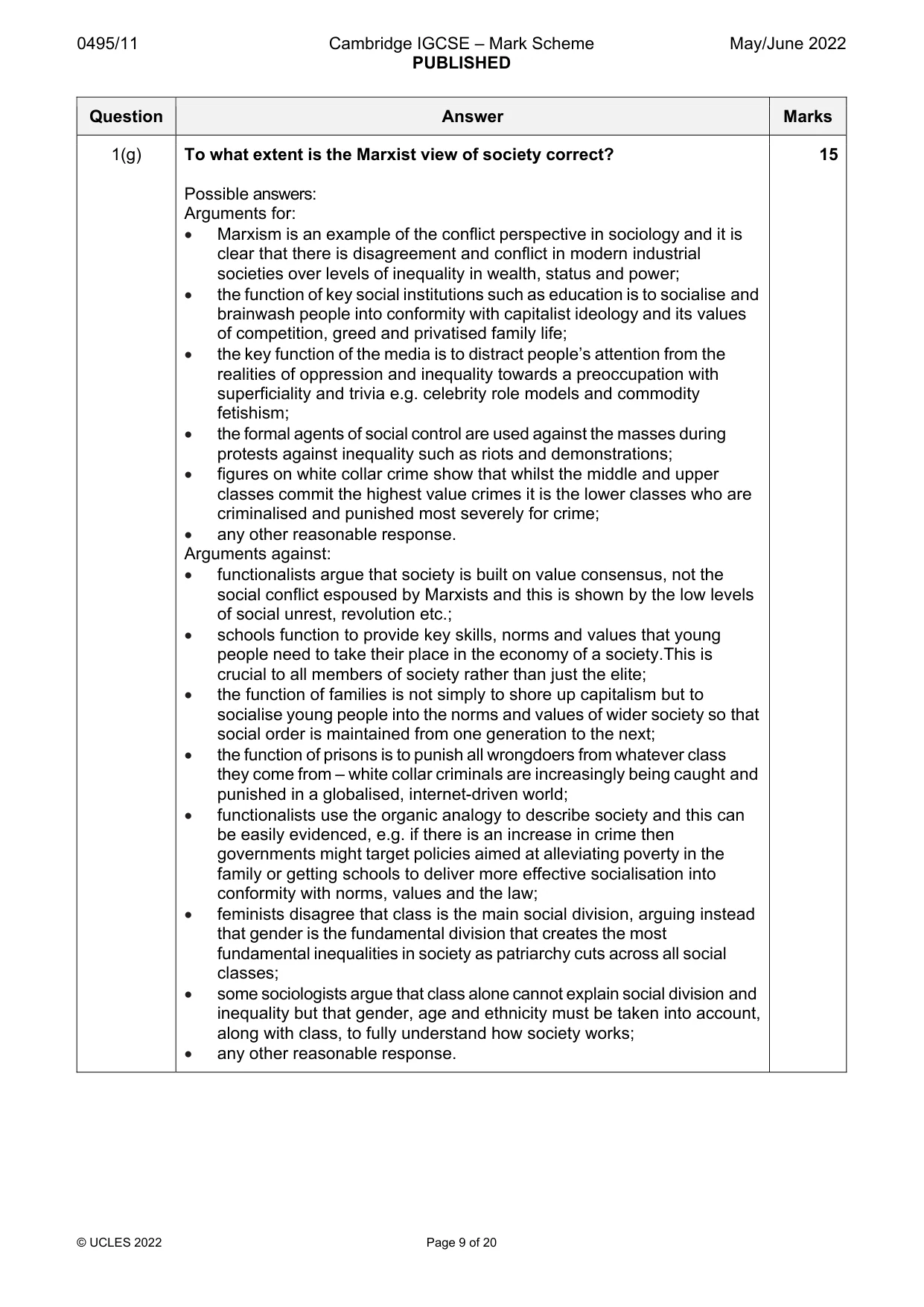
0495/11 Cambridge IGCSE – Mark Scheme PUBLISHED May/June 2022 © UCLES 2022 Page 9 of 20 Question Answer Marks 1(g) To what extent is the Marxist view of society correct? Possible answers: Arguments for: Marxism is an example of the conflict perspective in sociology and it is clear that there is disagreement and conflict in modern industrial societies over levels of inequality in wealth, status and power; the function of key social institutions such as education is to socialise and brainwash people into conformity with capitalist ideology and its values of competition, greed and privatised family life; the key function of the media is to distract people’s attention from the realities of oppression and inequality towards a preoccupation with superficiality and trivia e.g. celebrity role models and commodity fetishism; the formal agents of social control are used against the masses during protests against inequality such as riots and demonstrations; figures on white collar crime show that whilst the middle and upper classes commit the highest value crimes it is the lower classes who are criminalised and punished most severely for crime; any other reasonable response. Arguments against: functionalists argue that society is built on value consensus, not the social conflict espoused by Marxists and this is shown by the low levels of social unrest, revolution etc.; schools function to provide key skills, norms and values that young people need to take their place in the economy of a society. This is crucial to all members of society rather than just the elite; the function of families is not simply to shore up capitalism but to socialise young people into the norms and values of wider society so that social order is maintained from one generation to the next; the function of prisons is to punish all wrongdoers from whatever class they come from – white collar criminals are increasingly being caught and punished in a globalised, internet-driven world; functionalists use the organic analogy to describe society and this can be easily evidenced, e.g. if there is an increase in crime then governments might target policies aimed at alleviating poverty in the family or getting schools to deliver more effective socialisation into conformity with norms, values and the law; feminists disagree that class is the main social division, arguing instead that gender is the fundamental division that creates the most fundamental inequalities in society as patriarchy cuts across all social classes; some sociologists argue that class alone cannot explain social division and inequality but that gender, age and ethnicity must be taken into account, along with class, to fully understand how society works; any other reasonable response. 15
Mark scheme, page 10
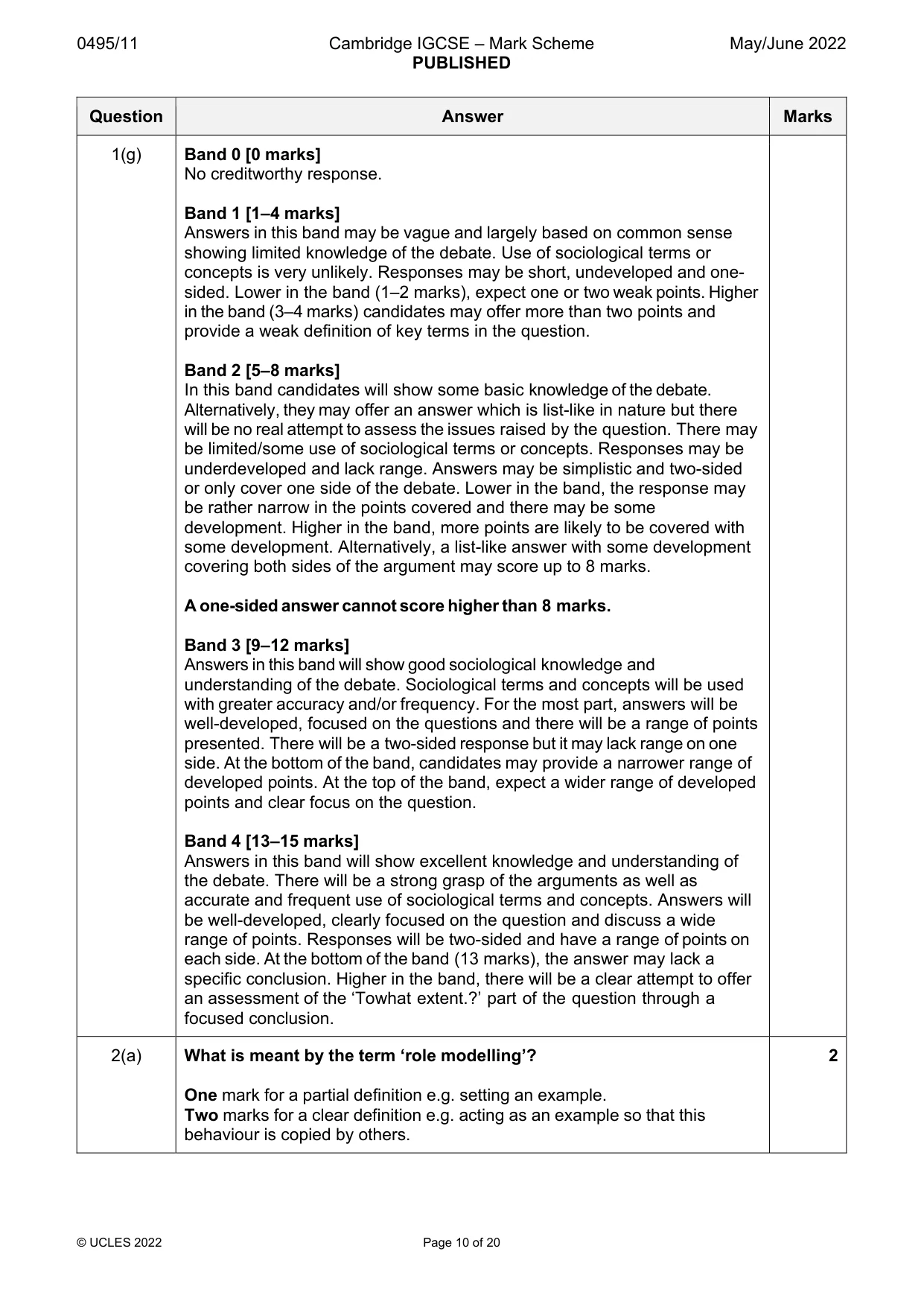
0495/11 Cambridge IGCSE – Mark Scheme PUBLISHED May/June 2022 © UCLES 2022 Page 10 of 20 Question Answer Marks 1(g) Band 0 [0 marks] No creditworthy response. Band 1 [1–4 marks] Answers in this band may be vague and largely based on common sense showing limited knowledge of the debate. Use of sociological terms or concepts is very unlikely. Responses may be short, undeveloped and one- sided. Lower in the band (1–2 marks), expect one or two weak points. Higher in the band (3–4 marks) candidates may offer more than two points and provide a weak definition of key terms in the question. Band 2 [5–8 marks] In this band candidates will show some basic knowledge of the debate. Alternatively, they may offer an answer which is list-like in nature but there will be no real attempt to assess the issues raised by the question. There may be limited/some use of sociological terms or concepts. Responses may be underdeveloped and lack range. Answers may be simplistic and two-sided or only cover one side of the debate. Lower in the band, the response may be rather narrow in the points covered and there may be some development. Higher in the band, more points are likely to be covered with some development. Alternatively, a list-like answer with some development covering both sides of the argument may score up to 8 marks. A one-sided answer cannot score higher than 8 marks. Band 3 [9–12 marks] Answers in this band will show good sociological knowledge and understanding of the debate. Sociological terms and concepts will be used with greater accuracy and/or frequency. For the most part, answers will be well-developed, focused on the questions and there will be a range of points presented. There will be a two-sided response but it may lack range on one side. At the bottom of the band, candidates may provide a narrower range of developed points. At the top of the band, expect a wider range of developed points and clear focus on the question. Band 4 [13–15 marks] Answers in this band will show excellent knowledge and understanding of the debate. There will be a strong grasp of the arguments as well as accurate and frequent use of sociological terms and concepts. Answers will be well-developed, clearly focused on the question and discuss a wide range of points. Responses will be two-sided and have a range of points on each side. At the bottom of the band (13 marks), the answer may lack a specific conclusion. Higher in the band, there will be a clear attempt to offer an assessment of the ‘To what extent.?’ part of the question through a focused conclusion. 2(a) What is meant by the term ‘role modelling’? One mark for a partial definition e.g. setting an example. Two marks for a clear definition e.g. acting as an example so that this behaviour is copied by others. 2
Mark scheme, page 11
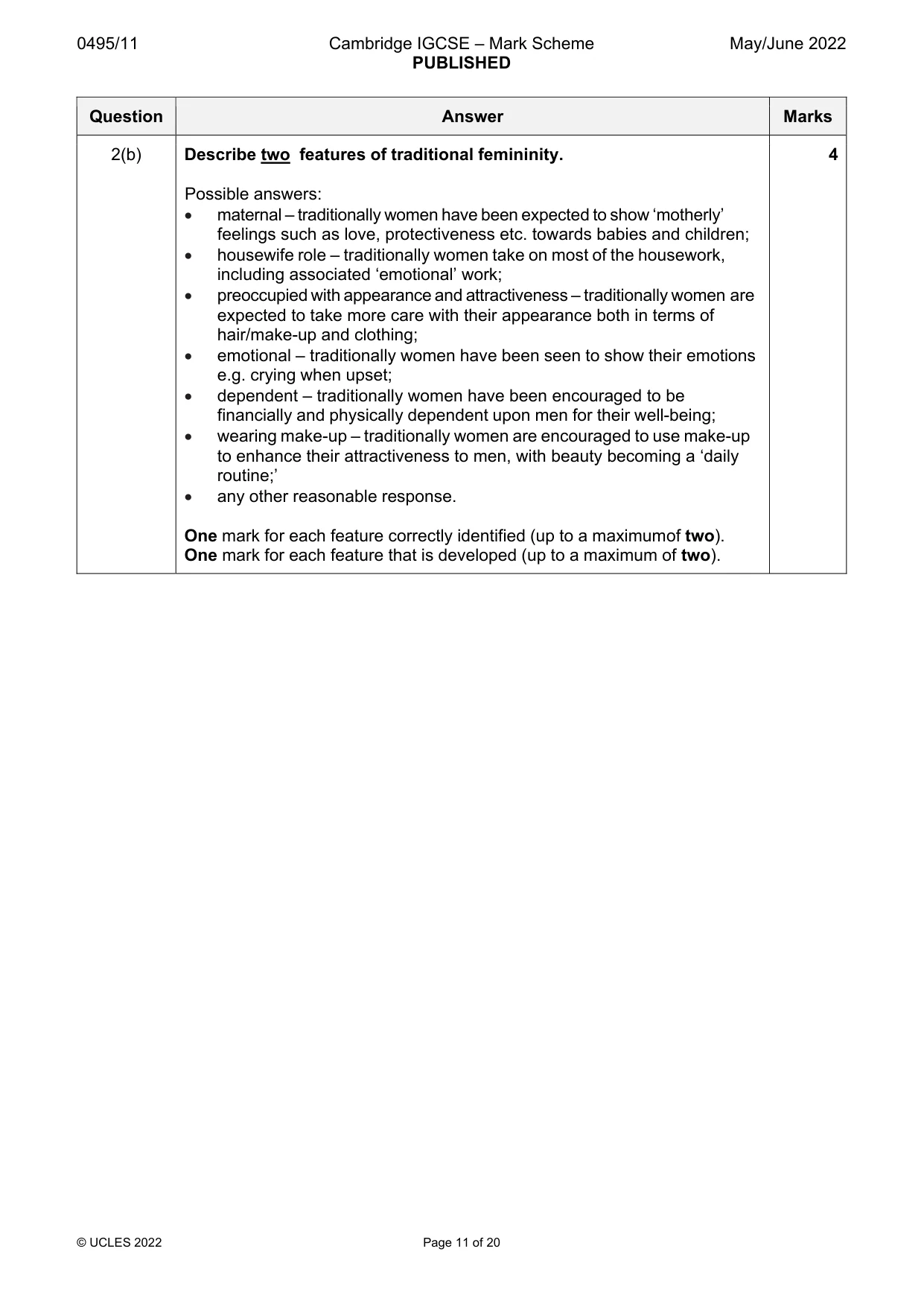
0495/11 Cambridge IGCSE – Mark Scheme PUBLISHED May/June 2022 © UCLES 2022 Page 11 of 20 Question Answer Marks 2(b) Describe two features of traditional femininity. Possible answers: maternal – traditionally women have been expected to show ‘motherly’ feelings such as love, protectiveness etc. towards babies and children; housewife role – traditionally women take on most of the housework, including associated ‘emotional’ work; preoccupied with appearance and attractiveness – traditionally women are expected to take more care with their appearance both in terms of hair/make-up and clothing; emotional – traditionally women have been seen to show their emotions e.g. crying when upset; dependent – traditionally women have been encouraged to be financially and physically dependent upon men for their well-being; wearing make-up – traditionally women are encouraged to use make-up to enhance their attractiveness to men, with beauty becoming a ‘daily routine;’ any other reasonable response. One mark for each feature correctly identified (up to a maximum of two). One mark for each feature that is developed (up to a maximum of two). 4
Mark scheme, page 12
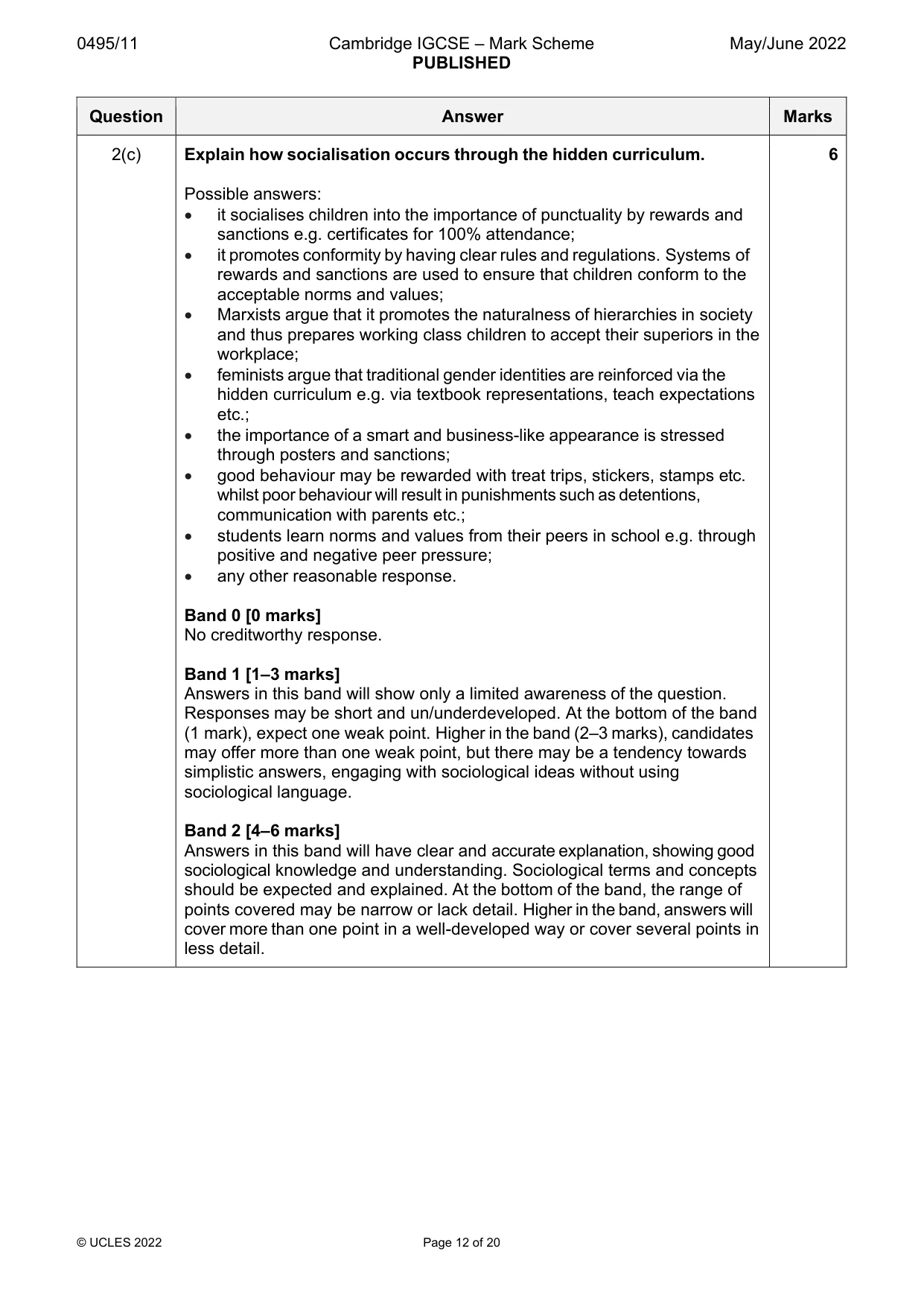
0495/11 Cambridge IGCSE – Mark Scheme PUBLISHED May/June 2022 © UCLES 2022 Page 12 of 20 Question Answer Marks 2(c) Explain how socialisation occurs through the hidden curriculum. Possible answers: it socialises children into the importance of punctuality by rewards and sanctions e.g. certificates for 100% attendance; it promotes conformity by having clear rules and regulations. Systems of rewards and sanctions are used to ensure that children conform to the acceptable norms and values; Marxists argue that it promotes the naturalness of hierarchies in society and thus prepares working class children to accept their superiors in the workplace; feminists argue that traditional gender identities are reinforced via the hidden curriculum e.g. via textbook representations, teach expectations etc.; the importance of a smart and business-like appearance is stressed through posters and sanctions; good behaviour may be rewarded with treat trips, stickers, stamps etc. whilst poor behaviour will result in punishments such as detentions, communication with parents etc.; students learn norms and values from their peers in school e.g. through positive and negative peer pressure; any other reasonable response. Band 0 [0 marks] No creditworthy response. Band 1 [1–3 marks] Answers in this band will show only a limited awareness of the question. Responses may be short and un/underdeveloped. At the bottom of the band (1 mark), expect one weak point. Higher in the band (2–3 marks), candidates may offer more than one weak point, but there may be a tendency towards simplistic answers, engaging with sociological ideas without using sociological language. Band 2 [4–6 marks] Answers in this band will have clear and accurate explanation, showing good sociological knowledge and understanding. Sociological terms and concepts should be expected and explained. At the bottom of the band, the range of points covered may be narrow or lack detail. Higher in the band, answers will cover more than one point in a well-developed way or cover several points in less detail. 6
Mark scheme, page 13
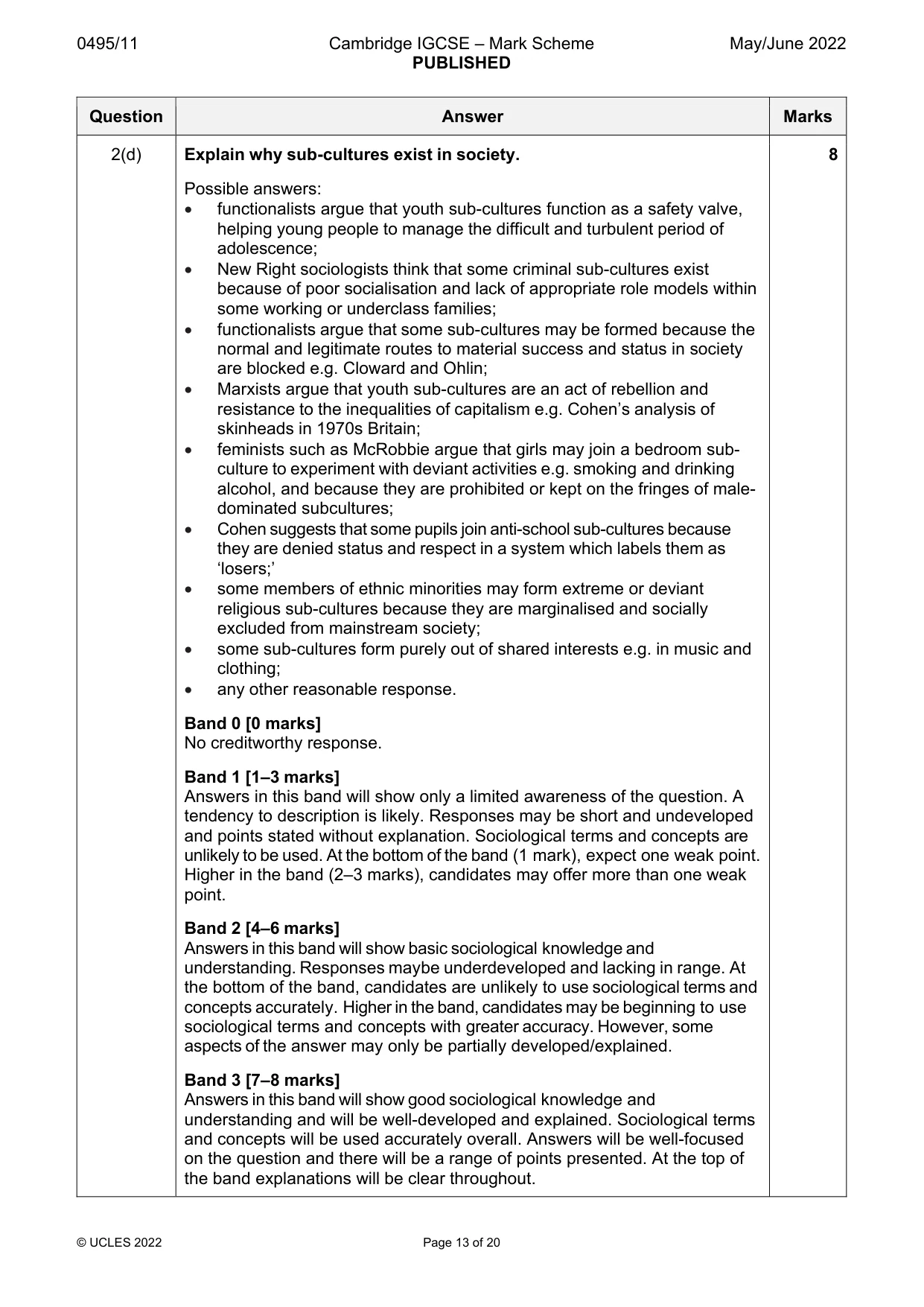
0495/11 Cambridge IGCSE – Mark Scheme PUBLISHED May/June 2022 © UCLES 2022 Page 13 of 20 Question Answer Marks 2(d) Explain why sub-cultures exist in society. Possible answers: functionalists argue that youth sub-cultures function as a safety valve, helping young people to manage the difficult and turbulent period of adolescence; New Right sociologists think that some criminal sub-cultures exist because of poor socialisation and lack of appropriate role models within some working or underclass families; functionalists argue that some sub-cultures may be formed because the normal and legitimate routes to material success and status in society are blocked e.g. Cloward and Ohlin; Marxists argue that youth sub-cultures are an act of rebellion and resistance to the inequalities of capitalism e.g. Cohen’s analysis of skinheads in 1970s Britain; feminists such as McRobbie argue that girls may join a bedroom sub- culture to experiment with deviant activities e.g. smoking and drinking alcohol, and because they are prohibited or kept on the fringes of male- dominated subcultures; Cohen suggests that some pupils join anti-school sub-cultures because they are denied status and respect in a system which labels them as ‘losers;’ some members of ethnic minorities may form extreme or deviant religious sub-cultures because they are marginalised and socially excluded from mainstream society; some sub-cultures form purely out of shared interests e.g. in music and clothing; any other reasonable response. Band 0 [0 marks] No creditworthy response. Band 1 [1–3 marks] Answers in this band will show only a limited awareness of the question. A tendency to description is likely. Responses may be short and undeveloped and points stated without explanation. Sociological terms and concepts are unlikely to be used. At the bottom of the band (1 mark), expect one weak point. Higher in the band (2–3 marks), candidates may offer more than one weak point. Band 2 [4–6 marks] Answers in this band will show basic sociological knowledge and understanding. Responses may be underdeveloped and lacking in range. At the bottom of the band, candidates are unlikely to use sociological terms and concepts accurately. Higher in the band, candidates may be beginning to use sociological terms and concepts with greater accuracy. However, some aspects of the answer may only be partially developed/explained. Band 3 [7–8 marks] Answers in this band will show good sociological knowledge and understanding and will be well-developed and explained. Sociological terms and concepts will be used accurately overall. Answers will be well-focused on the question and there will be a range of points presented. At the top of the band explanations will be clear throughout. 8
Mark scheme, page 14
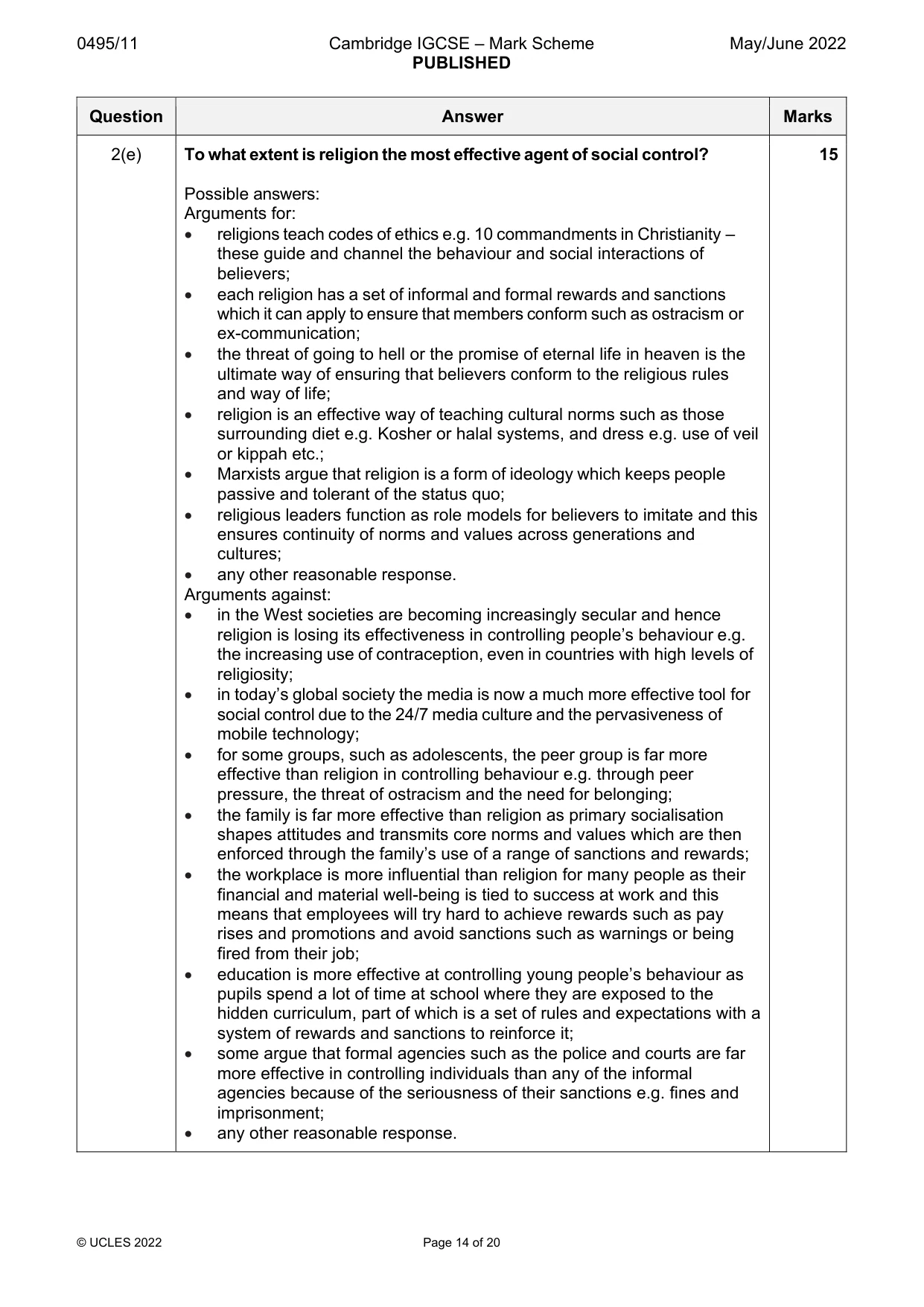
0495/11 Cambridge IGCSE – Mark Scheme PUBLISHED May/June 2022 © UCLES 2022 Page 14 of 20 Question Answer Marks 2(e) To what extent is religion the most effective agent of social control? Possible answers: Arguments for: religions teach codes of ethics e.g. 10 commandments in Christianity – these guide and channel the behaviour and social interactions of believers; each religion has a set of informal and formal rewards and sanctions which it can apply to ensure that members conform such as ostracism or ex-communication; the threat of going to hell or the promise of eternal life in heaven is the ultimate way of ensuring that believers conform to the religious rules and way of life; religion is an effective way of teaching cultural norms such as those surrounding diet e.g. Kosher or halal systems, and dress e.g. use of veil or kippah etc.; Marxists argue that religion is a form of ideology which keeps people passive and tolerant of the status quo; religious leaders function as role models for believers to imitate and this ensures continuity of norms and values across generations and cultures; any other reasonable response. Arguments against: in the West societies are becoming increasingly secular and hence religion is losing its effectiveness in controlling people’s behaviour e.g. the increasing use of contraception, even in countries with high levels of religiosity; in today’s global society the media is now a much more effective tool for social control due to the 24/7 media culture and the pervasiveness of mobile technology; for some groups, such as adolescents, the peer group is far more effective than religion in controlling behaviour e.g. through peer pressure, the threat of ostracism and the need for belonging; the family is far more effective than religion as primary socialisation shapes attitudes and transmits core norms and values which are then enforced through the family’s use of a range of sanctions and rewards; the workplace is more influential than religion for many people as their financial and material well-being is tied to success at work and this means that employees will try hard to achieve rewards such as pay rises and promotions and avoid sanctions such as warnings or being fired from their job; education is more effective at controlling young people’s behaviour as pupils spend a lot of time at school where they are exposed to the hidden curriculum, part of which is a set of rules and expectations with a system of rewards and sanctions to reinforce it; some argue that formal agencies such as the police and courts are far more effective in controlling individuals than any of the informal agencies because of the seriousness of their sanctions e.g. fines and imprisonment; any other reasonable response. 15
Mark scheme, page 15
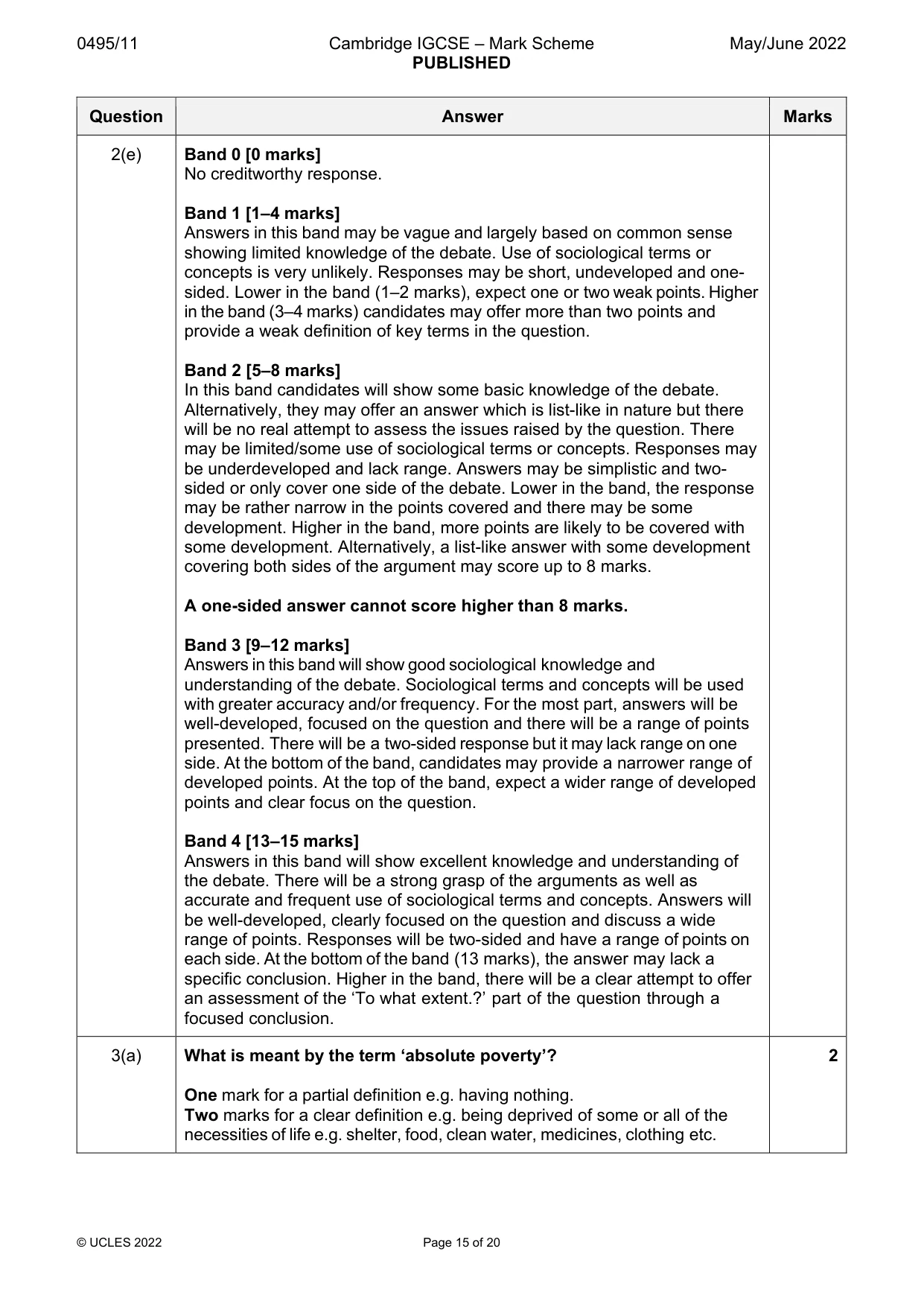
0495/11 Cambridge IGCSE – Mark Scheme PUBLISHED May/June 2022 © UCLES 2022 Page 15 of 20 Question Answer Marks 2(e) Band 0 [0 marks] No creditworthy response. Band 1 [1–4 marks] Answers in this band may be vague and largely based on common sense showing limited knowledge of the debate. Use of sociological terms or concepts is very unlikely. Responses may be short, undeveloped and one- sided. Lower in the band (1–2 marks), expect one or two weak points. Higher in the band (3–4 marks) candidates may offer more than two points and provide a weak definition of key terms in the question. Band 2 [5–8 marks] In this band candidates will show some basic knowledge of the debate. Alternatively, they may offer an answer which is list-like in nature but there will be no real attempt to assess the issues raised by the question. There may be limited/some use of sociological terms or concepts. Responses may be underdeveloped and lack range. Answers may be simplistic and two- sided or only cover one side of the debate. Lower in the band, the response may be rather narrow in the points covered and there may be some development. Higher in the band, more points are likely to be covered with some development. Alternatively, a list-like answer with some development covering both sides of the argument may score up to 8 marks. A one-sided answer cannot score higher than 8 marks. Band 3 [9–12 marks] Answers in this band will show good sociological knowledge and understanding of the debate. Sociological terms and concepts will be used with greater accuracy and/or frequency. For the most part, answers will be well-developed, focused on the question and there will be a range of points presented. There will be a two-sided response but it may lack range on one side. At the bottom of the band, candidates may provide a narrower range of developed points. At the top of the band, expect a wider range of developed points and clear focus on the question. Band 4 [13–15 marks] Answers in this band will show excellent knowledge and understanding of the debate. There will be a strong grasp of the arguments as well as accurate and frequent use of sociological terms and concepts. Answers will be well-developed, clearly focused on the question and discuss a wide range of points. Responses will be two-sided and have a range of points on each side. At the bottom of the band (13 marks), the answer may lack a specific conclusion. Higher in the band, there will be a clear attempt to offer an assessment of the ‘To what extent.?’ part of the question through a focused conclusion. 3(a) What is meant by the term ‘absolute poverty’? One mark for a partial definition e.g. having nothing. Two marks for a clear definition e.g. being deprived of some or all of the necessities of life e.g. shelter, food, clean water, medicines, clothing etc. 2
Mark scheme, page 16
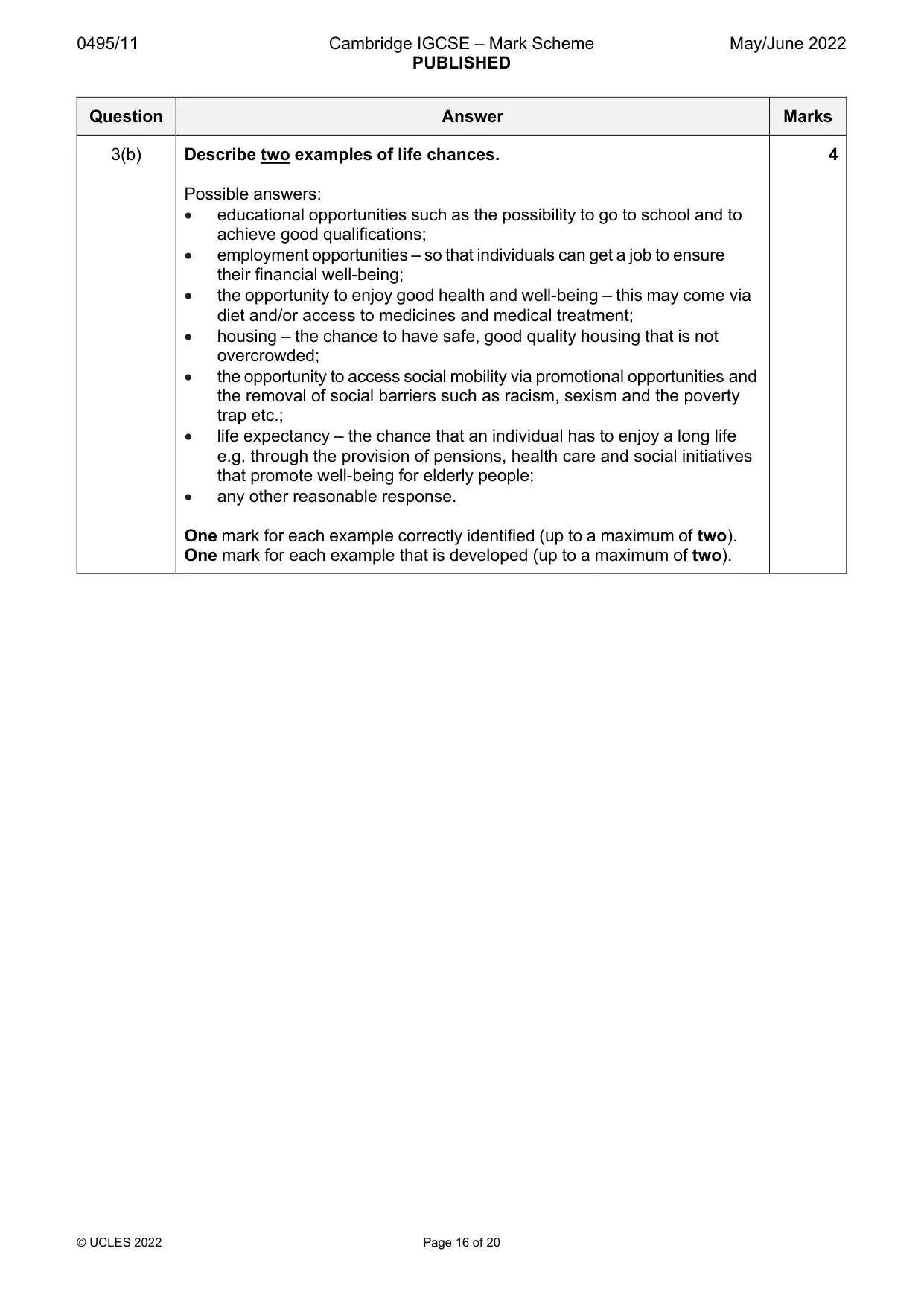
0495/11 Cambridge IGCSE – Mark Scheme PUBLISHED May/June 2022 © UCLES 2022 Page 16 of 20 Question Answer Marks 3(b) Describe two examples of life chances. Possible answers: educational opportunities such as the possibility to go to school and to achieve good qualifications; employment opportunities – so that individuals can get a job to ensure their financial well-being; the opportunity to enjoy good health and well-being – this may come via diet and/or access to medicines and medical treatment; housing – the chance to have safe, good quality housing that is not overcrowded; the opportunity to access social mobility via promotional opportunities and the removal of social barriers such as racism, sexism and the poverty trap etc.; life expectancy – the chance that an individual has to enjoy a long life e.g. through the provision of pensions, health care and social initiatives that promote well-being for elderly people; any other reasonable response. One mark for each example correctly identified (up to a maximum of two). One mark for each example that is developed (up to a maximum of two). 4
Mark scheme, page 17
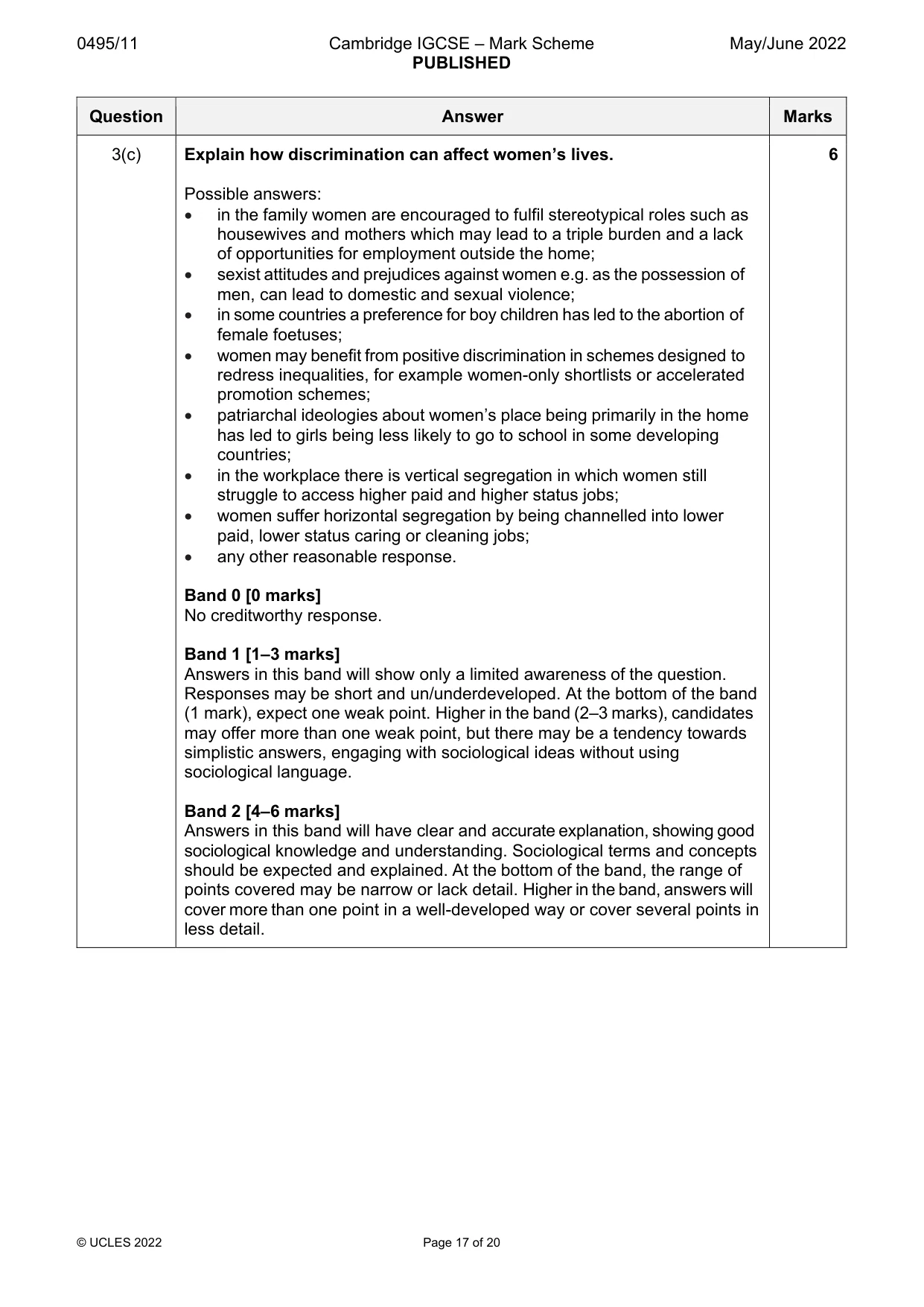
0495/11 Cambridge IGCSE – Mark Scheme PUBLISHED May/June 2022 © UCLES 2022 Page 17 of 20 Question Answer Marks 3(c) Explain how discrimination can affect women’s lives. Possible answers: in the family women are encouraged to fulfil stereotypical roles such as housewives and mothers which may lead to a triple burden and a lack of opportunities for employment outside the home; sexist attitudes and prejudices against women e.g. as the possession of men, can lead to domestic and sexual violence; in some countries a preference for boy children has led to the abortion of female foetuses; women may benefit from positive discrimination in schemes designed to redress inequalities, for example women-only shortlists or accelerated promotion schemes; patriarchal ideologies about women’s place being primarily in the home has led to girls being less likely to go to school in some developing countries; in the workplace there is vertical segregation in which women still struggle to access higher paid and higher status jobs; women suffer horizontal segregation by being channelled into lower paid, lower status caring or cleaning jobs; any other reasonable response. Band 0 [0 marks] No creditworthy response. Band 1 [1–3 marks] Answers in this band will show only a limited awareness of the question. Responses may be short and un/underdeveloped. At the bottom of the band (1 mark), expect one weak point. Higher in the band (2–3 marks), candidates may offer more than one weak point, but there may be a tendency towards simplistic answers, engaging with sociological ideas without using sociological language. Band 2 [4–6 marks] Answers in this band will have clear and accurate explanation, showing good sociological knowledge and understanding. Sociological terms and concepts should be expected and explained. At the bottom of the band, the range of points covered may be narrow or lack detail. Higher in the band, answers will cover more than one point in a well-developed way or cover several points in less detail. 6
Mark scheme, page 18
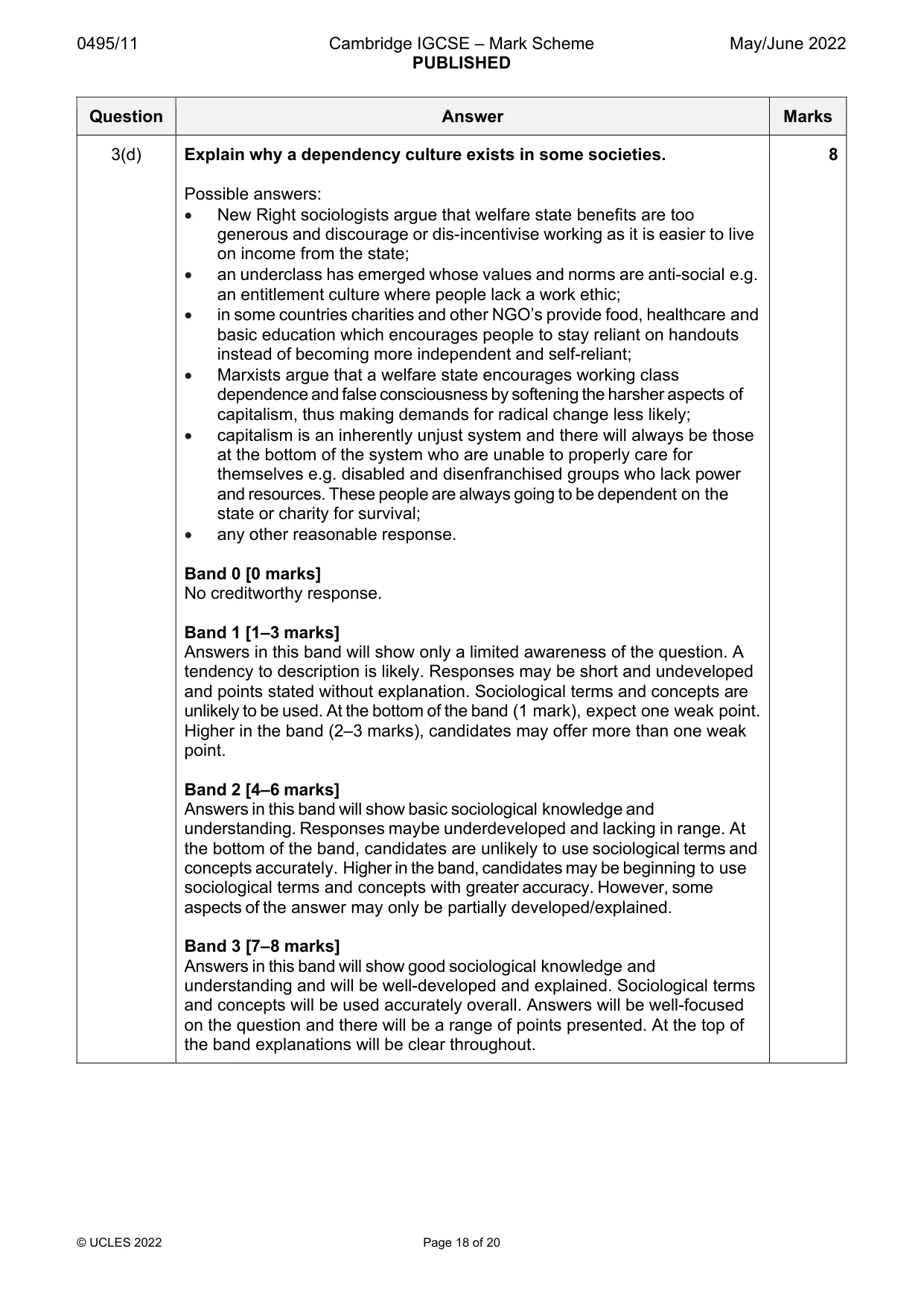
0495/11 Cambridge IGCSE – Mark Scheme PUBLISHED May/June 2022 © UCLES 2022 Page 18 of 20 Question Answer Marks 3(d) Explain why a dependency culture exists in some societies. Possible answers: New Right sociologists argue that welfare state benefits are too generous and discourage or dis-incentivise working as it is easier to live on income from the state; an underclass has emerged whose values and norms are anti-social e.g. an entitlement culture where people lack a work ethic; in some countries charities and other NGO’s provide food, healthcare and basic education which encourages people to stay reliant on handouts instead of becoming more independent and self-reliant; Marxists argue that a welfare state encourages working class dependence and false consciousness by softening the harsher aspects of capitalism, thus making demands for radical change less likely; capitalism is an inherently unjust system and there will always be those at the bottom of the system who are unable to properly care for themselves e.g. disabled and disenfranchised groups who lack power and resources. These people are always going to be dependent on the state or charity for survival; any other reasonable response. Band 0 [0 marks] No creditworthy response. Band 1 [1–3 marks] Answers in this band will show only a limited awareness of the question. A tendency to description is likely. Responses may be short and undeveloped and points stated without explanation. Sociological terms and concepts are unlikely to be used. At the bottom of the band (1 mark), expect one weak point. Higher in the band (2–3 marks), candidates may offer more than one weak point. Band 2 [4–6 marks] Answers in this band will show basic sociological knowledge and understanding. Responses may be underdeveloped and lacking in range. At the bottom of the band, candidates are unlikely to use sociological terms and concepts accurately. Higher in the band, candidates may be beginning to use sociological terms and concepts with greater accuracy. However, some aspects of the answer may only be partially developed/explained. Band 3 [7–8 marks] Answers in this band will show good sociological knowledge and understanding and will be well-developed and explained. Sociological terms and concepts will be used accurately overall. Answers will be well-focused on the question and there will be a range of points presented. At the top of the band explanations will be clear throughout. 8
Mark scheme, page 19
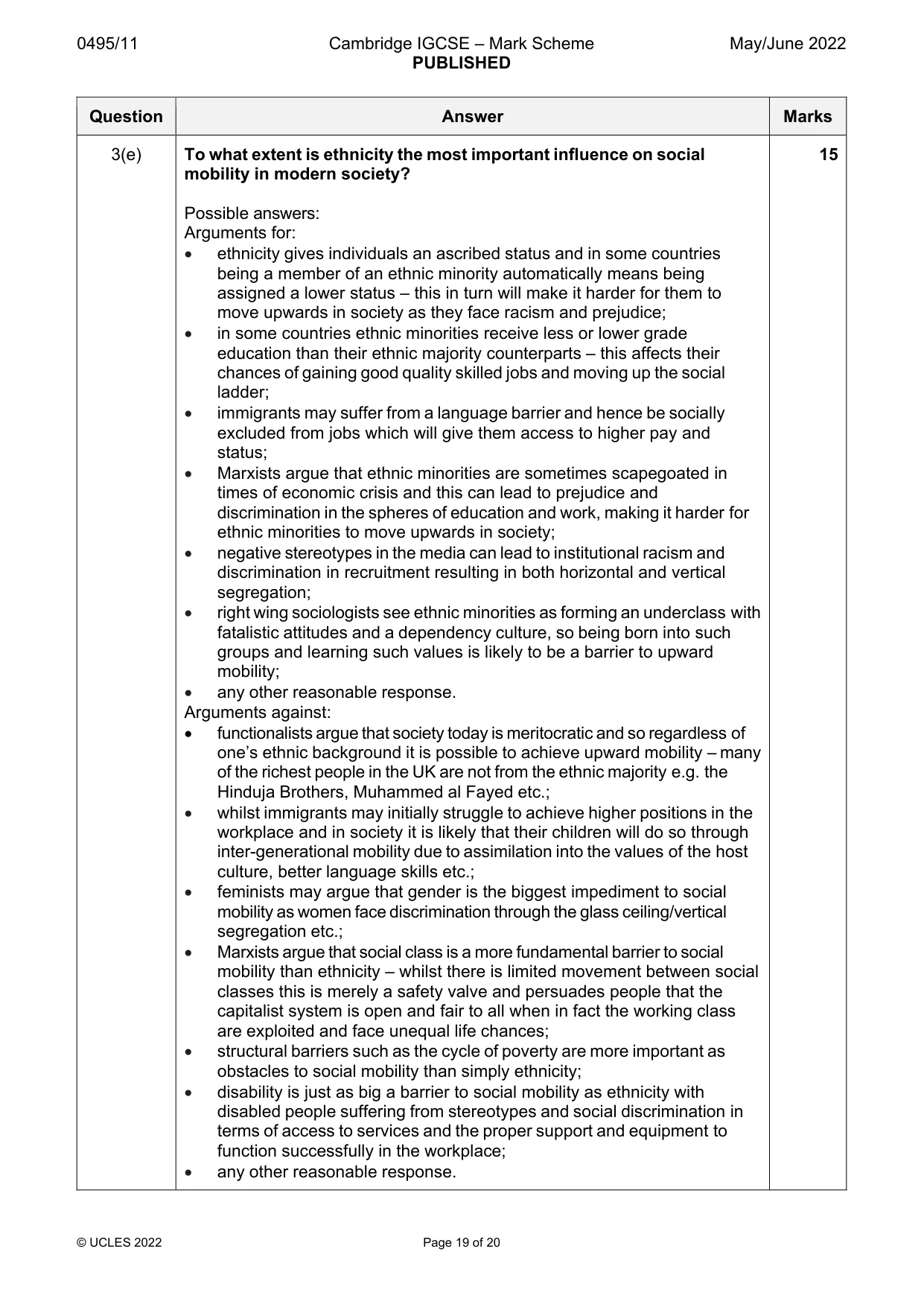
0495/11 Cambridge IGCSE – Mark Scheme PUBLISHED May/June 2022 © UCLES 2022 Page 19 of 20 Question Answer Marks 3(e) To what extent is ethnicity the most important influence on social mobility in modern society? Possible answers: Arguments for: ethnicity gives individuals an ascribed status and in some countries being a member of an ethnic minority automatically means being assigned a lower status – this in turn will make it harder for them to move upwards in society as they face racism and prejudice; in some countries ethnic minorities receive less or lower grade education than their ethnic majority counterparts – this affects their chances of gaining good quality skilled jobs and moving up the social ladder; immigrants may suffer from a language barrier and hence be socially excluded from jobs which will give them access to higher pay and status; Marxists argue that ethnic minorities are sometimes scapegoated in times of economic crisis and this can lead to prejudice and discrimination in the spheres of education and work, making it harder for ethnic minorities to move upwards in society; negative stereotypes in the media can lead to institutional racism and discrimination in recruitment resulting in both horizontal and vertical segregation; right wing sociologists see ethnic minorities as forming an underclass with fatalistic attitudes and a dependency culture, so being born into such groups and learning such values is likely to be a barrier to upward mobility; any other reasonable response. Arguments against: functionalists argue that society today is meritocratic and so regardless of one’s ethnic background it is possible to achieve upward mobility – many of the richest people in the UK are not from the ethnic majority e.g. the Hinduja Brothers, Muhammed al Fayed etc.; whilst immigrants may initially struggle to achieve higher positions in the workplace and in society it is likely that their children will do so through inter-generational mobility due to assimilation into the values of the host culture, better language skills etc.; feminists may argue that gender is the biggest impediment to social mobility as women face discrimination through the glass ceiling/vertical segregation etc.; Marxists argue that social class is a more fundamental barrier to social mobility than ethnicity – whilst there is limited movement between social classes this is merely a safety valve and persuades people that the capitalist system is open and fair to all when in fact the working class are exploited and face unequal life chances; structural barriers such as the cycle of poverty are more important as obstacles to social mobility than simply ethnicity; disability is just as big a barrier to social mobility as ethnicity with disabled people suffering from stereotypes and social discrimination in terms of access to services and the proper support and equipment to function successfully in the workplace; any other reasonable response. 15
Mark scheme, page 20
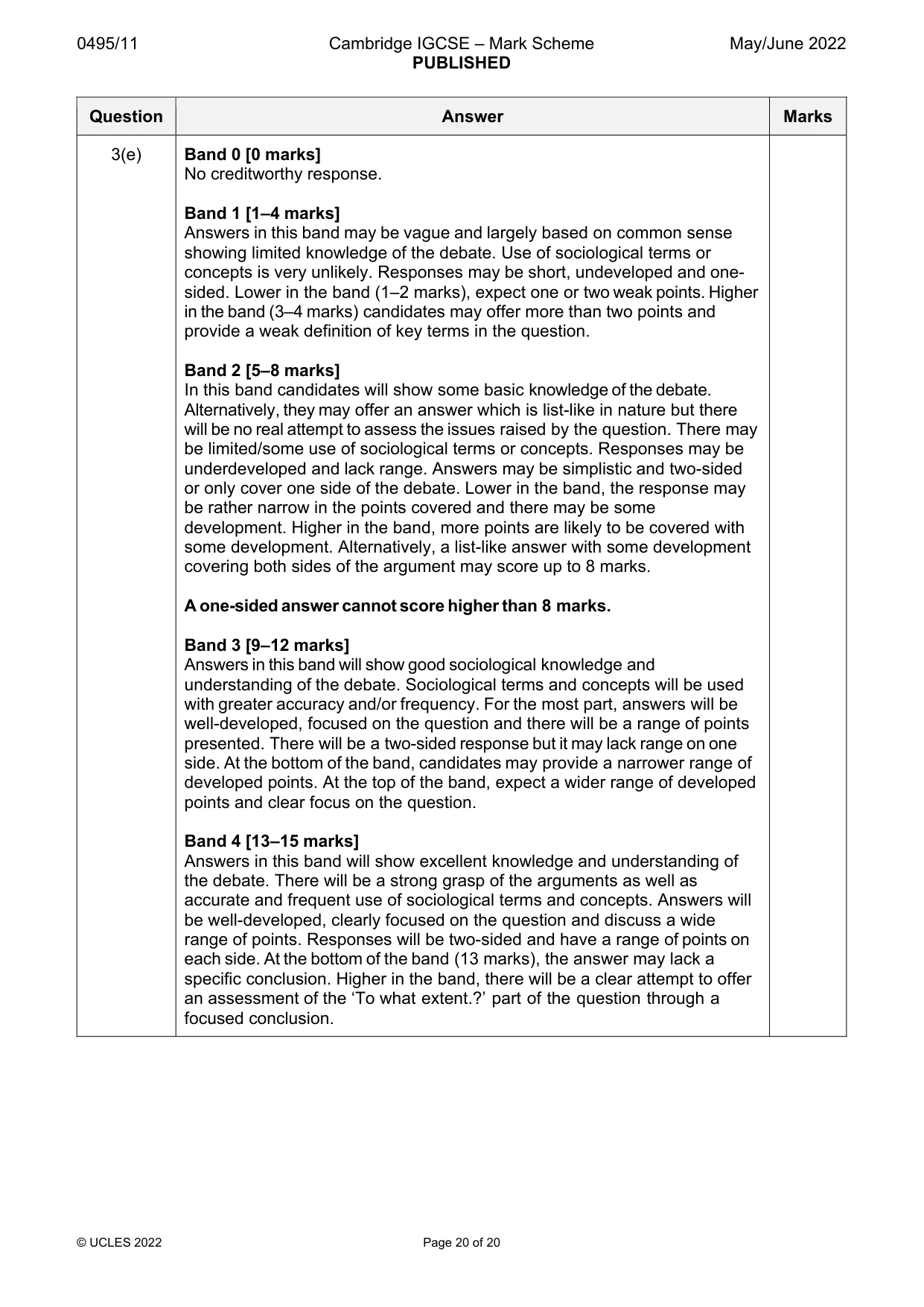
0495/11 Cambridge IGCSE – Mark Scheme PUBLISHED May/June 2022 © UCLES 2022 Page 20 of 20 Question Answer Marks 3(e) Band 0 [0 marks] No creditworthy response. Band 1 [1–4 marks] Answers in this band may be vague and largely based on common sense showing limited knowledge of the debate. Use of sociological terms or concepts is very unlikely. Responses may be short, undeveloped and one- sided. Lower in the band (1–2 marks), expect one or two weak points. Higher in the band (3–4 marks) candidates may offer more than two points and provide a weak definition of key terms in the question. Band 2 [5–8 marks] In this band candidates will show some basic knowledge of the debate. Alternatively, they may offer an answer which is list-like in nature but there will be no real attempt to assess the issues raised by the question. There may be limited/some use of sociological terms or concepts. Responses may be underdeveloped and lack range. Answers may be simplistic and two-sided or only cover one side of the debate. Lower in the band, the response may be rather narrow in the points covered and there may be some development. Higher in the band, more points are likely to be covered with some development. Alternatively, a list-like answer with some development covering both sides of the argument may score up to 8 marks. A one-sided answer cannot score higher than 8 marks. Band 3 [9–12 marks] Answers in this band will show good sociological knowledge and understanding of the debate. Sociological terms and concepts will be used with greater accuracy and/or frequency. For the most part, answers will be well-developed, focused on the question and there will be a range of points presented. There will be a two-sided response but it may lack range on one side. At the bottom of the band, candidates may provide a narrower range of developed points. At the top of the band, expect a wider range of developed points and clear focus on the question. Band 4 [13–15 marks] Answers in this band will show excellent knowledge and understanding of the debate. There will be a strong grasp of the arguments as well as accurate and frequent use of sociological terms and concepts. Answers will be well-developed, clearly focused on the question and discuss a wide range of points. Responses will be two-sided and have a range of points on each side. At the bottom of the band (13 marks), the answer may lack a specific conclusion. Higher in the band, there will be a clear attempt to offer an assessment of the ‘To what extent.?’ part of the question through a focused conclusion.
What you needed in this session
Cambridge’s own grade thresholds for 2022 May/June, Paper 1 · Variant 1. A higher threshold means an easier paper — the bar moves with how the cohort did.