Cambridge IGCSE Sociology 0495 — 2023 May/June Paper 1 · Variant 1
0495/11/M/J/23 · 80 marks · ≈90 min
The question paper and its mark scheme, free to read here and free to download. This is Cambridge’s own paper, exactly as it was sat.
Question paper4 pages

Mark scheme20 pages
Answers below. Sit the paper first if you are practising.

Paper as text
Question paper, page 1
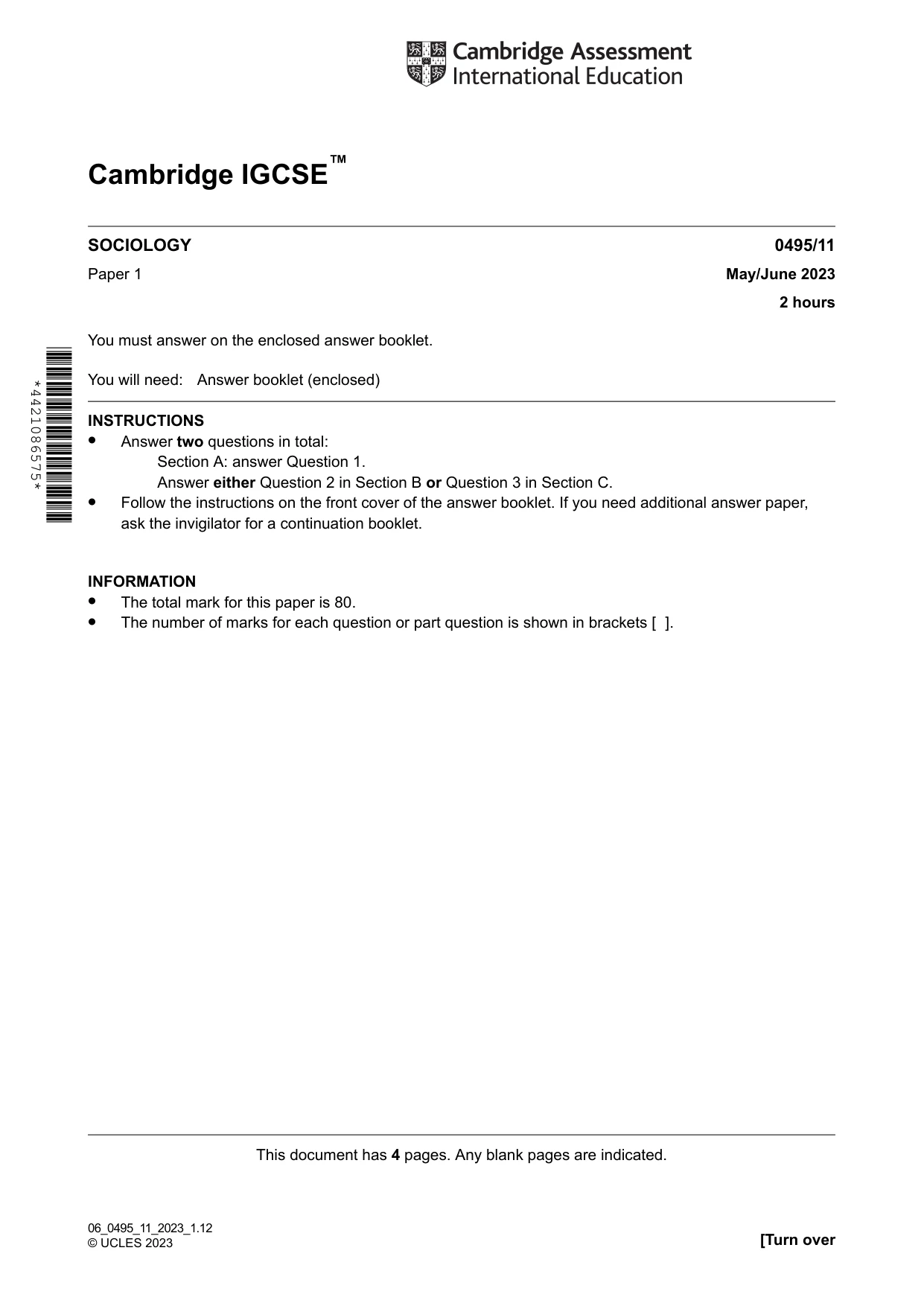
Cambridge IGCSE™ 0495/11 May/June 2023 2 hours SOCIOLOGY Paper 1 You must answer on the enclosed answer booklet. You will need: Answer booklet (enclosed) INSTRUCTIONS • Answer two questions in total: Section A: answer Question 1. Answer either Question 2 in Section B or Question 3 in Section C. • Follow the instructions on the front cover of the answer booklet. If you need additional answer paper, ask the invigilator for a continuation booklet. INFORMATION • The total mark for this paper is 80. • The number of marks for each question or part question is shown in brackets [ ]. This document has 4 pages. Any blank pages are indicated. [Turn over 06_0495_11_2023_1.12 © UCLES 2023 *4421086575*
Question paper, page 2
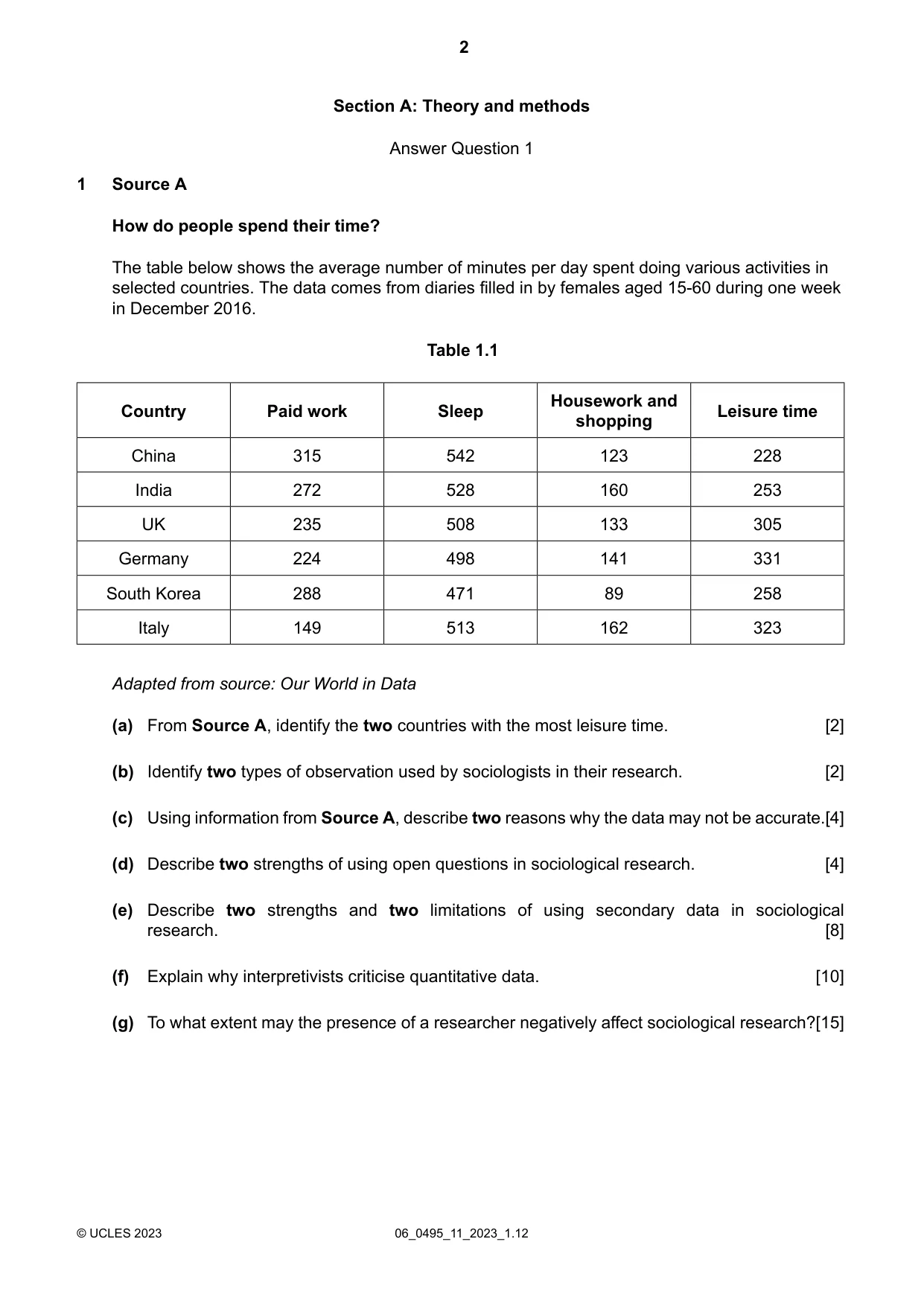
Section A: Theory and methods Answer Question 1 Source A 1 How do people spend their time? The table below shows the average number of minutes per day spent doing various activities in selected countries. The data comes from diaries filled in by females aged 15-60 during one week in December 2016. Table 1.1 Leisure time Housework and shopping Sleep Paid work Country 228 123 542 315 China 253 160 528 272 India 305 133 508 235 UK 331 141 498 224 Germany 258 89 471 288 South Korea 323 162 513 149 Italy Adapted from source: Our World in Data From Source A, identify the two countries with the most leisure time. [2] (a) Identify two types of observation used by sociologists in their research. [2] (b) Using information from Source A, describe two reasons why the data may not be accurate.[4] (c) Describe two strengths of using open questions in sociological research. [4] (d) Describe two strengths and two limitations of using secondary data in sociological research. [8] (e) Explain why interpretivists criticise quantitative data. [10] (f) To what extent may the presence of a researcher negatively affect sociological research?[15] (g) 06_0495_11_2023_1.12 © UCLES 2023 2
Question paper, page 3
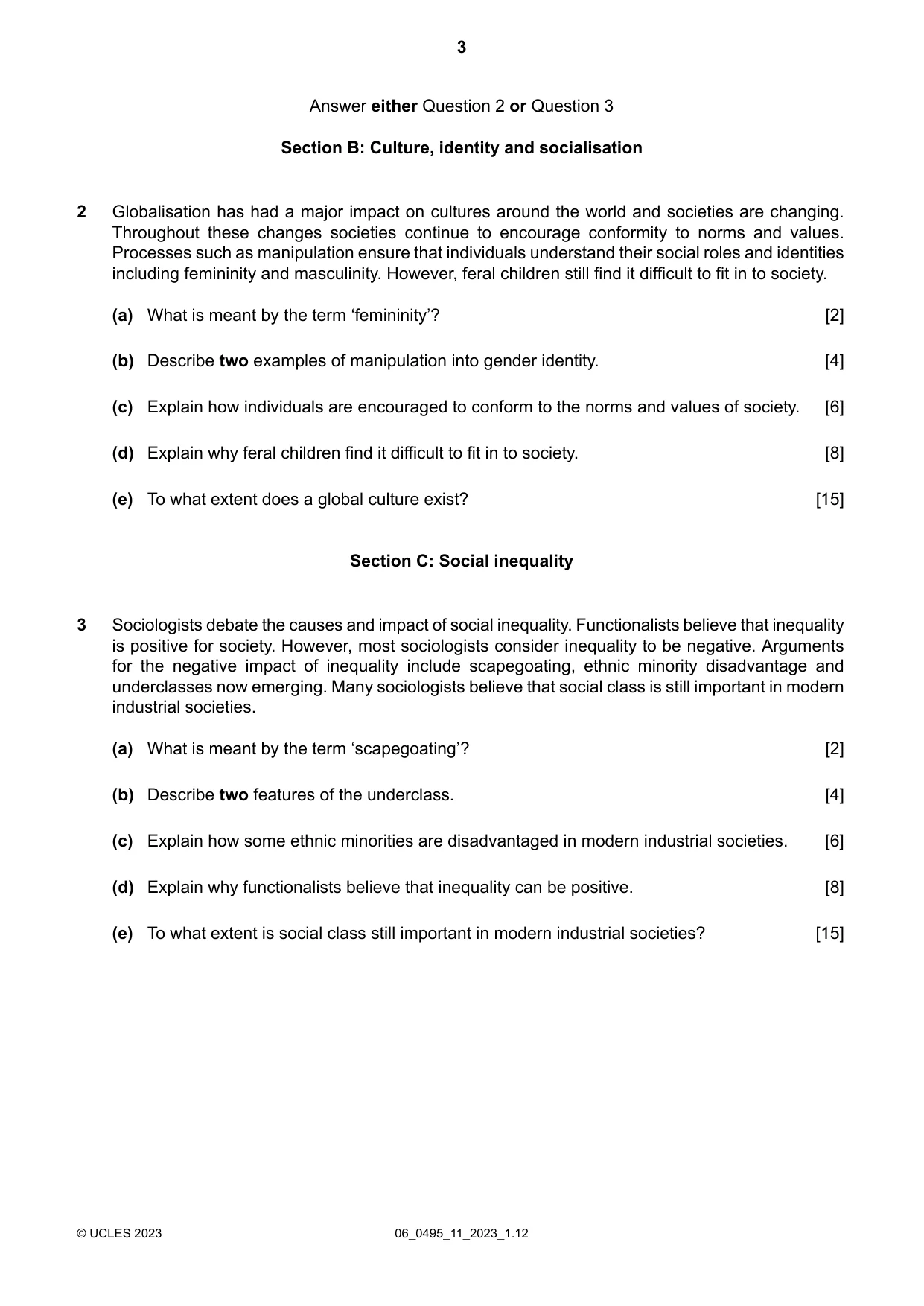
Answer either Question 2 or Question 3 Section B: Culture, identity and socialisation Globalisation has had a major impact on cultures around the world and societies are changing. Throughout these changes societies continue to encourage conformity to norms and values. 2 Processes such as manipulation ensure that individuals understand their social roles and identities including femininity and masculinity. However, feral children still find it difficult to fit in to society. What is meant by the term ‘femininity’? [2] (a) Describe two examples of manipulation into gender identity. [4] (b) Explain how individuals are encouraged to conform to the norms and values of society. [6] (c) Explain why feral children find it difficult to fit in to society. [8] (d) To what extent does a global culture exist? [15] (e) Section C: Social inequality Sociologists debate the causes and impact of social inequality. Functionalists believe that inequality is positive for society. However, most sociologists consider inequality to be negative. Arguments 3 for the negative impact of inequality include scapegoating, ethnic minority disadvantage and underclasses now emerging. Many sociologists believe that social class is still important in modern industrial societies. What is meant by the term ‘scapegoating’? [2] (a) Describe two features of the underclass. [4] (b) Explain how some ethnic minorities are disadvantaged in modern industrial societies. [6] (c) Explain why functionalists believe that inequality can be positive. [8] (d) To what extent is social class still important in modern industrial societies? [15] (e) 06_0495_11_2023_1.12 © UCLES 2023 3
Question paper, page 4
BLANK PAGE Permission to reproduce items where third-party owned material protected by copyright is included has been sought and cleared where possible. Every reasonable effort has been made by the publisher (UCLES) to trace copyright holders, but if any items requiring clearance have unwittingly been included, the publisher will be pleased to make amends at the earliest possible opportunity. To avoid the issue of disclosure of answer-related information to candidates, all copyright acknowledgements are reproduced online in the Cambridge Assessment International Education Copyright Acknowledgements Booklet. This is produced for each series of examinations and is freely available to download at www.cambridgeinternational.org after the live examination series. Cambridge Assessment International Education is part of Cambridge Assessment. Cambridge Assessment is the brand name of the University of Cambridge Local Examinations Syndicate (UCLES), which is a department of the University of Cambridge. 06_0495_11_2023_1.12 © UCLES 2023 4
Mark scheme, page 1
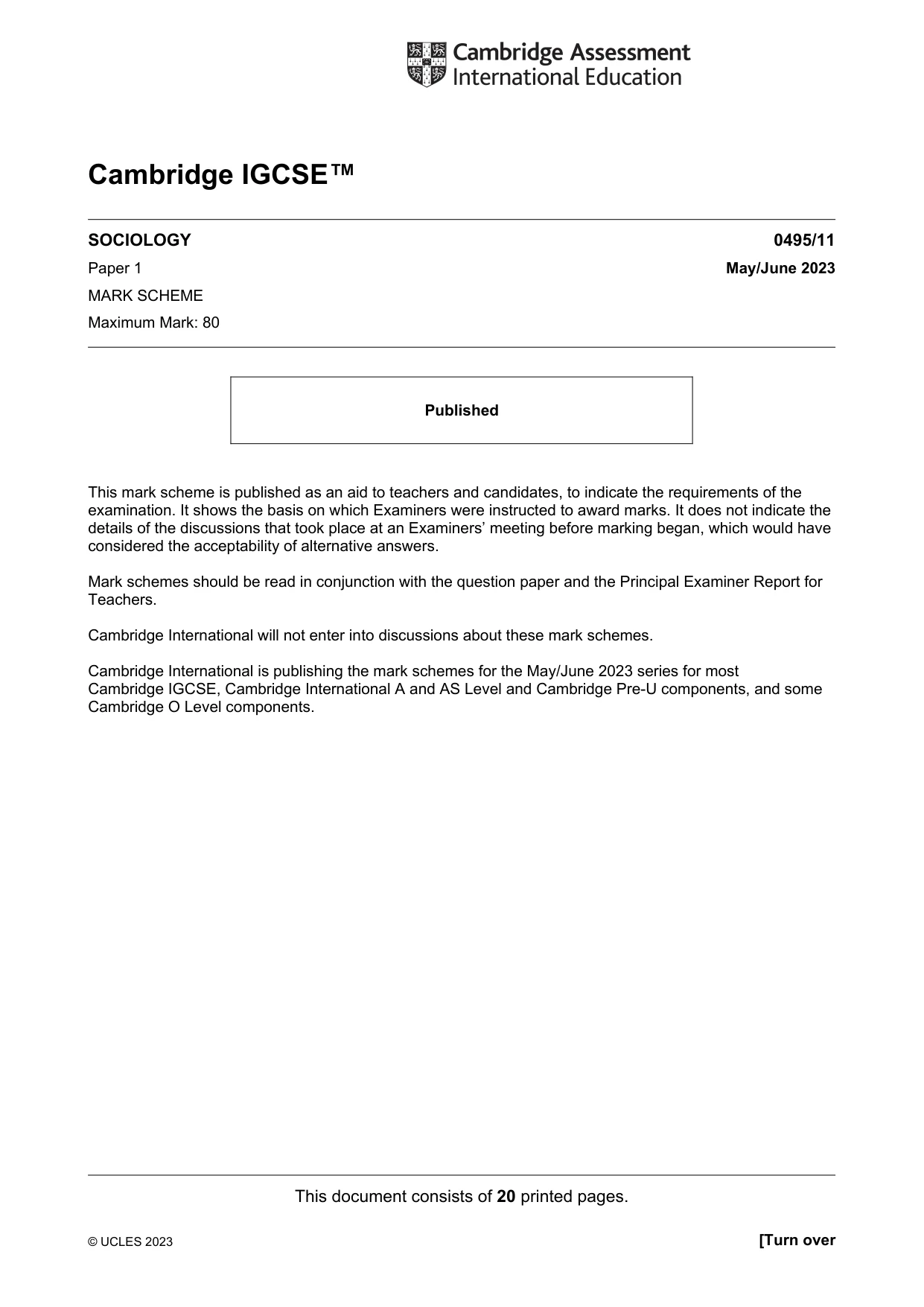
This document consists of 20 printed pages. © UCLES 2023 [Turn over Cambridge IGCSE™ SOCIOLOGY 0495/11 Paper 1 May/June 2023 MARK SCHEME Maximum Mark: 80 Published This mark scheme is published as an aid to teachers and candidates, to indicate the requirements of the examination. It shows the basis on which Examiners were instructed to award marks. It does not indicate the details of the discussions that took place at an Examiners’ meeting before marking began, which would have considered the acceptability of alternative answers. Mark schemes should be read in conjunction with the question paper and the Principal Examiner Report for Teachers. Cambridge International will not enter into discussions about these mark schemes. Cambridge International is publishing the mark schemes for the May/June 2023 series for most Cambridge IGCSE, Cambridge International A and AS Level and Cambridge Pre-U components, and some Cambridge O Level components.
Mark scheme, page 2
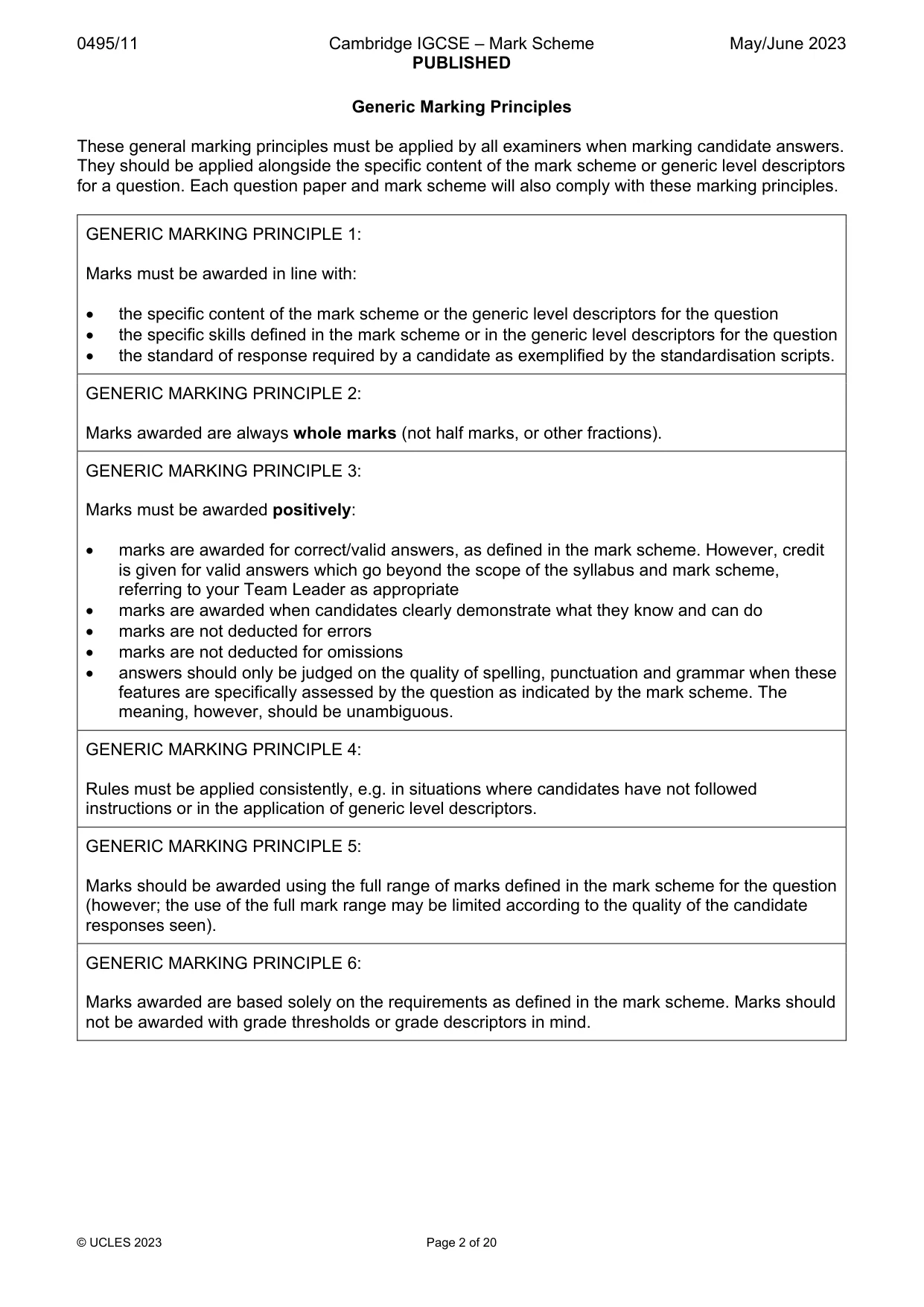
0495/11 Cambridge IGCSE – Mark Scheme PUBLISHED May/June 2023 © UCLES 2023 Page 2 of 20 Generic Marking Principles These general marking principles must be applied by all examiners when marking candidate answers. They should be applied alongside the specific content of the mark scheme or generic level descriptors for a question. Each question paper and mark scheme will also comply with these marking principles. GENERIC MARKING PRINCIPLE 1: Marks must be awarded in line with: the specific content of the mark scheme or the generic level descriptors for the question the specific skills defined in the mark scheme or in the generic level descriptors for the question the standard of response required by a candidate as exemplified by the standardisation scripts. GENERIC MARKING PRINCIPLE 2: Marks awarded are always whole marks (not half marks, or other fractions). GENERIC MARKING PRINCIPLE 3: Marks must be awarded positively: marks are awarded for correct/valid answers, as defined in the mark scheme. However, credit is given for valid answers which go beyond the scope of the syllabus and mark scheme, referring to your Team Leader as appropriate marks are awarded when candidates clearly demonstrate what they know and can do marks are not deducted for errors marks are not deducted for omissions answers should only be judged on the quality of spelling, punctuation and grammar when these features are specifically assessed by the question as indicated by the mark scheme. The meaning, however, should be unambiguous. GENERIC MARKING PRINCIPLE 4: Rules must be applied consistently, e.g. in situations where candidates have not followed instructions or in the application of generic level descriptors. GENERIC MARKING PRINCIPLE 5: Marks should be awarded using the full range of marks defined in the mark scheme for the question (however; the use of the full mark range may be limited according to the quality of the candidate responses seen). GENERIC MARKING PRINCIPLE 6: Marks awarded are based solely on the requirements as defined in the mark scheme. Marks should not be awarded with grade thresholds or grade descriptors in mind.
Mark scheme, page 3
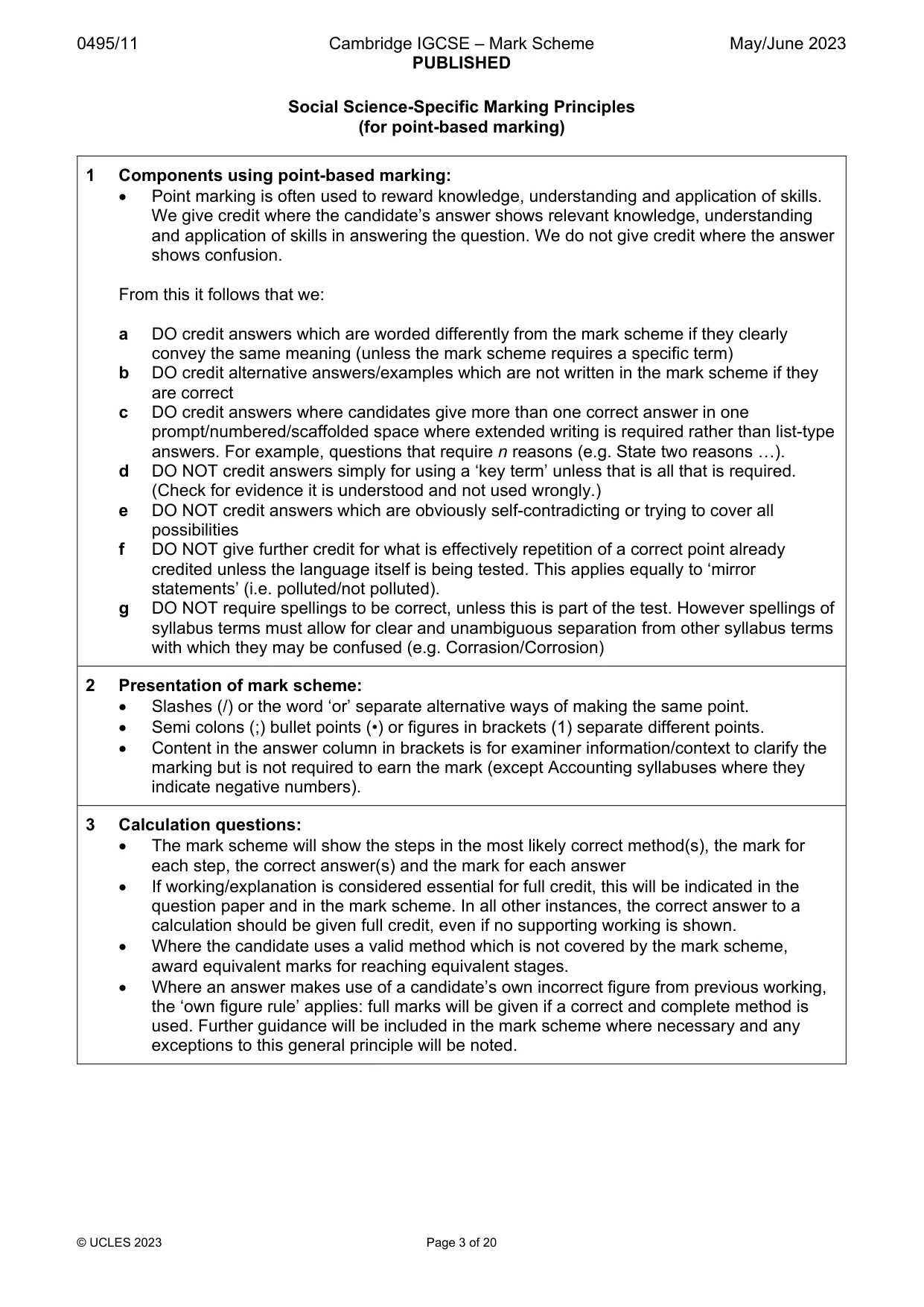
0495/11 Cambridge IGCSE – Mark Scheme PUBLISHED May/June 2023 © UCLES 2023 Page 3 of 20 Social Science-Specific Marking Principles (for point-based marking) 1 Components using point-based marking: Point marking is often used to reward knowledge, understanding and application of skills. We give credit where the candidate’s answer shows relevant knowledge, understanding and application of skills in answering the question. We do not give credit where the answer shows confusion. From this it follows that we: a DO credit answers which are worded differently from the mark scheme if they clearly convey the same meaning (unless the mark scheme requires a specific term) b DO credit alternative answers/examples which are not written in the mark scheme if they are correct c DO credit answers where candidates give more than one correct answer in one prompt/numbered/scaffolded space where extended writing is required rather than list-type answers. For example, questions that require n reasons (e.g. State two reasons …). d DO NOT credit answers simply for using a ‘key term’ unless that is all that is required. (Check for evidence it is understood and not used wrongly.) e DO NOT credit answers which are obviously self-contradicting or trying to cover all possibilities f DO NOT give further credit for what is effectively repetition of a correct point already credited unless the language itself is being tested. This applies equally to ‘mirror statements’ (i.e. polluted/not polluted). g DO NOT require spellings to be correct, unless this is part of the test. However spellings of syllabus terms must allow for clear and unambiguous separation from other syllabus terms with which they may be confused (e.g. Corrasion/Corrosion) 2 Presentation of mark scheme: Slashes (/) or the word ‘or’ separate alternative ways of making the same point. Semi colons (;) bullet points (•) or figures in brackets (1) separate different points. Content in the answer column in brackets is for examiner information/context to clarify the marking but is not required to earn the mark (except Accounting syllabuses where they indicate negative numbers). 3 Calculation questions: The mark scheme will show the steps in the most likely correct method(s), the mark for each step, the correct answer(s) and the mark for each answer If working/explanation is considered essential for full credit, this will be indicated in the question paper and in the mark scheme. In all other instances, the correct answer to a calculation should be given full credit, even if no supporting working is shown. Where the candidate uses a valid method which is not covered by the mark scheme, award equivalent marks for reaching equivalent stages. Where an answer makes use of a candidate’s own incorrect figure from previous working, the ‘own figure rule’ applies: full marks will be given if a correct and complete method is used. Further guidance will be included in the mark scheme where necessary and any exceptions to this general principle will be noted.
Mark scheme, page 4
0495/11 Cambridge IGCSE – Mark Scheme PUBLISHED May/June 2023 © UCLES 2023 Page 4 of 20 4 Annotation: For point marking, ticks can be used to indicate correct answers and crosses can be used to indicate wrong answers. There is no direct relationship between ticks and marks. Ticks have no defined meaning for levels of response marking. For levels of response marking, the level awarded should be annotated on the script. Other annotations will be used by examiners as agreed during standardisation, and the meaning will be understood by all examiners who marked that paper.
Mark scheme, page 5
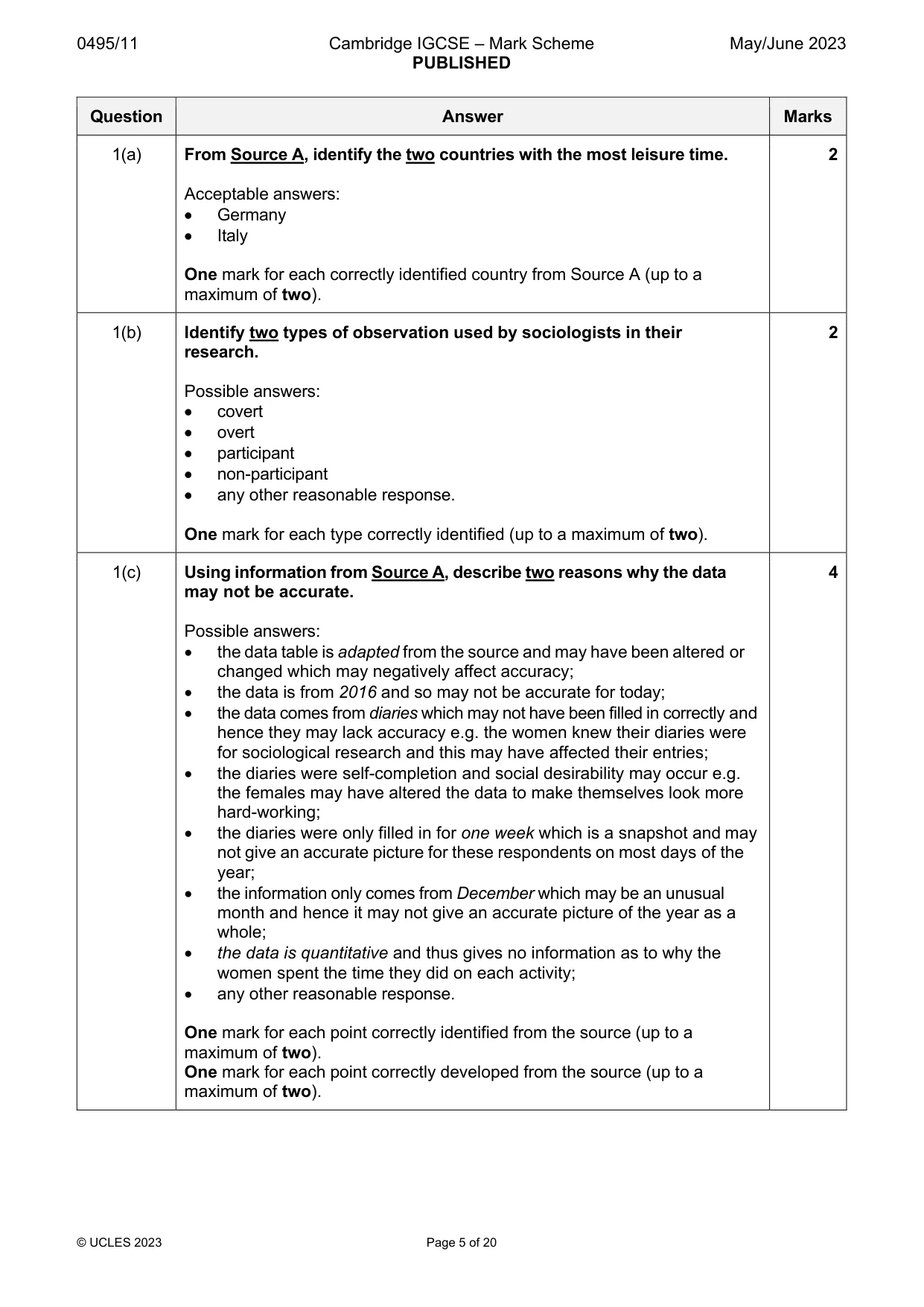
0495/11 Cambridge IGCSE – Mark Scheme PUBLISHED May/June 2023 © UCLES 2023 Page 5 of 20 Question Answer Marks 1(a) From Source A, identify the two countries with the most leisure time. Acceptable answers: Germany Italy One mark for each correctly identified country from Source A (up to a maximum of two). 2 1(b) Identify two types of observation used by sociologists in their research. Possible answers: covert overt participant non-participant any other reasonable response. One mark for each type correctly identified (up to a maximum of two). 2 1(c) Using information from Source A, describe two reasons why the data may not be accurate. Possible answers: the data table is adapted from the source and may have been altered or changed which may negatively affect accuracy; the data is from 2016 and so may not be accurate for today; the data comes from diaries which may not have been filled in correctly and hence they may lack accuracy e.g. the women knew their diaries were for sociological research and this may have affected their entries; the diaries were self-completion and social desirability may occur e.g. the females may have altered the data to make themselves look more hard-working; the diaries were only filled in for one week which is a snapshot and may not give an accurate picture for these respondents on most days of the year; the information only comes from December which may be an unusual month and hence it may not give an accurate picture of the year as a whole; the data is quantitative and thus gives no information as to why the women spent the time they did on each activity; any other reasonable response. One mark for each point correctly identified from the source (up to a maximum of two). One mark for each point correctly developed from the source (up to a maximum of two). 4
Mark scheme, page 6
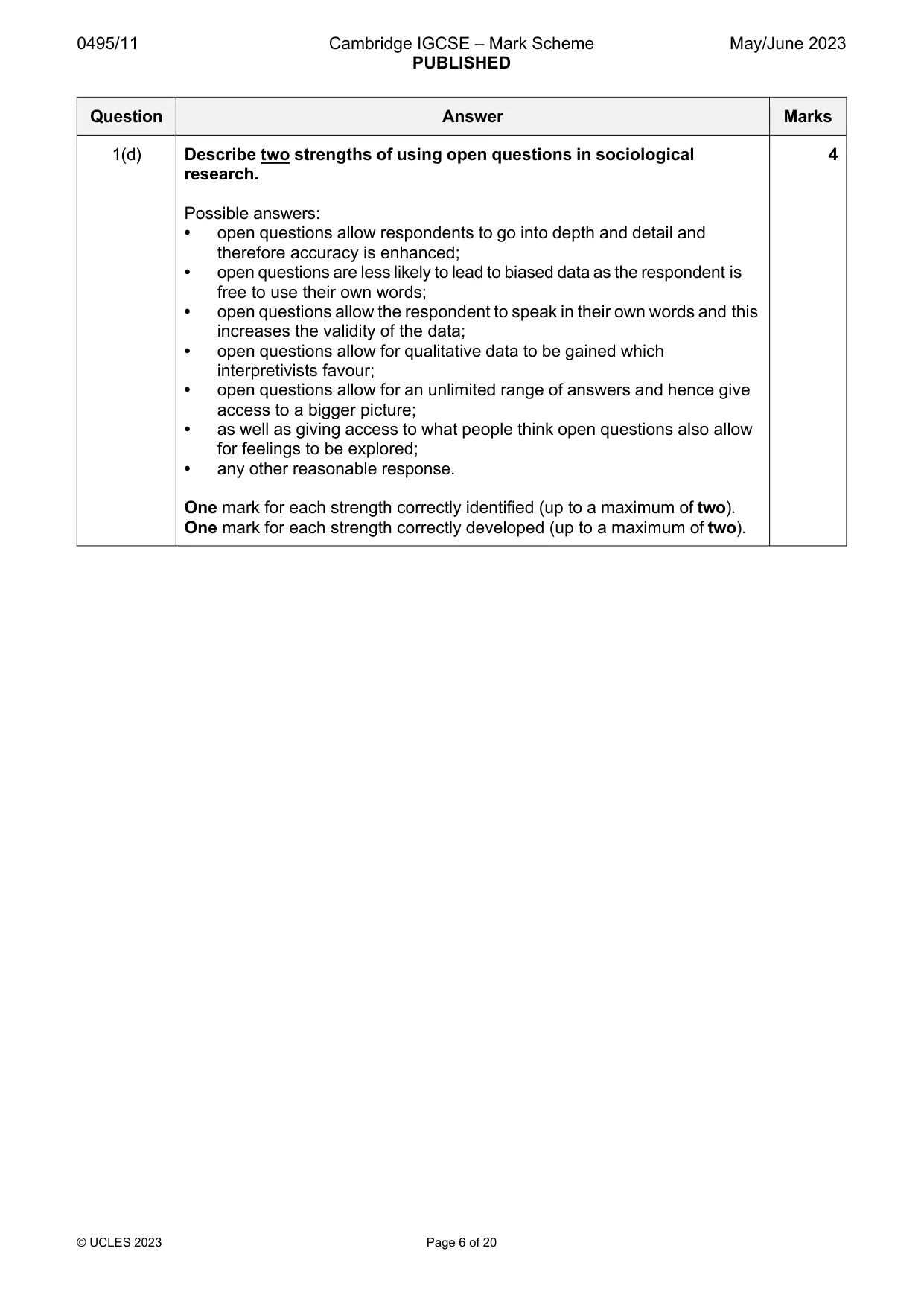
0495/11 Cambridge IGCSE – Mark Scheme PUBLISHED May/June 2023 © UCLES 2023 Page 6 of 20 Question Answer Marks 1(d) Describe two strengths of using open questions in sociological research. Possible answers: • open questions allow respondents to go into depth and detail and therefore accuracy is enhanced; • open questions are less likely to lead to biased data as the respondent is free to use their own words; • open questions allow the respondent to speak in their own words and this increases the validity of the data; • open questions allow for qualitative data to be gained which interpretivists favour; • open questions allow for an unlimited range of answers and hence give access to a bigger picture; • as well as giving access to what people think open questions also allow for feelings to be explored; • any other reasonable response. One mark for each strength correctly identified (up to a maximum of two). One mark for each strength correctly developed (up to a maximum of two). 4
Mark scheme, page 7
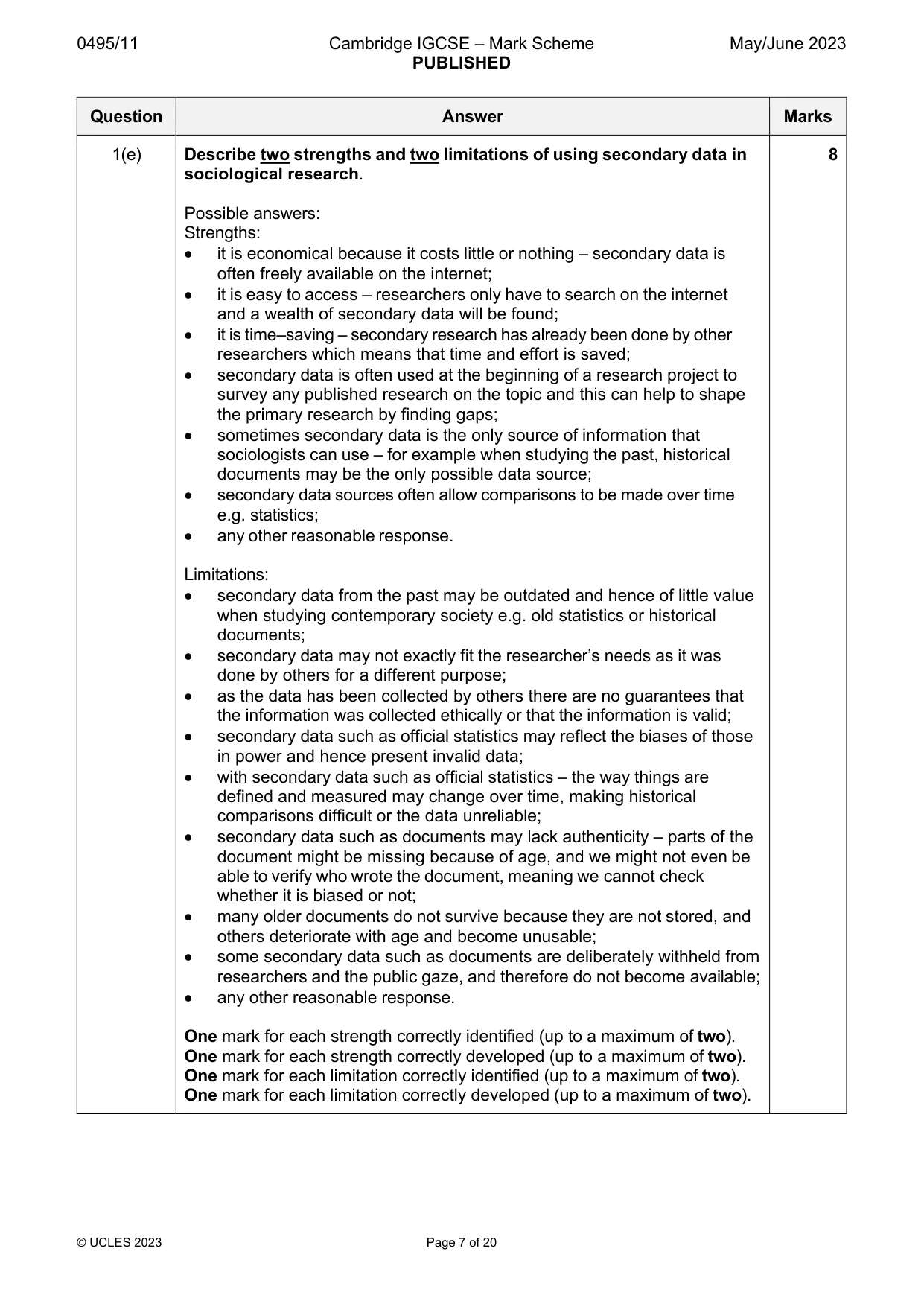
0495/11 Cambridge IGCSE – Mark Scheme PUBLISHED May/June 2023 © UCLES 2023 Page 7 of 20 Question Answer Marks 1(e) Describe two strengths and two limitations of using secondary data in sociological research. Possible answers: Strengths: it is economical because it costs little or nothing – secondary data is often freely available on the internet; it is easy to access – researchers only have to search on the internet and a wealth of secondary data will be found; it is time–saving – secondary research has already been done by other researchers which means that time and effort is saved; secondary data is often used at the beginning of a research project to survey any published research on the topic and this can help to shape the primary research by finding gaps; sometimes secondary data is the only source of information that sociologists can use – for example when studying the past, historical documents may be the only possible data source; secondary data sources often allow comparisons to be made over time e.g. statistics; any other reasonable response. Limitations: secondary data from the past may be outdated and hence of little value when studying contemporary society e.g. old statistics or historical documents; secondary data may not exactly fit the researcher’s needs as it was done by others for a different purpose; as the data has been collected by others there are no guarantees that the information was collected ethically or that the information is valid; secondary data such as official statistics may reflect the biases of those in power and hence present invalid data; with secondary data such as official statistics – the way things are defined and measured may change over time, making historical comparisons difficult or the data unreliable; secondary data such as documents may lack authenticity – parts of the document might be missing because of age, and we might not even be able to verify who wrote the document, meaning we cannot check whether it is biased or not; many older documents do not survive because they are not stored, and others deteriorate with age and become unusable; some secondary data such as documents are deliberately withheld from researchers and the public gaze, and therefore do not become available; any other reasonable response. One mark for each strength correctly identified (up to a maximum of two). One mark for each strength correctly developed (up to a maximum of two). One mark for each limitation correctly identified (up to a maximum of two). One mark for each limitation correctly developed (up to a maximum of two). 8
Mark scheme, page 8
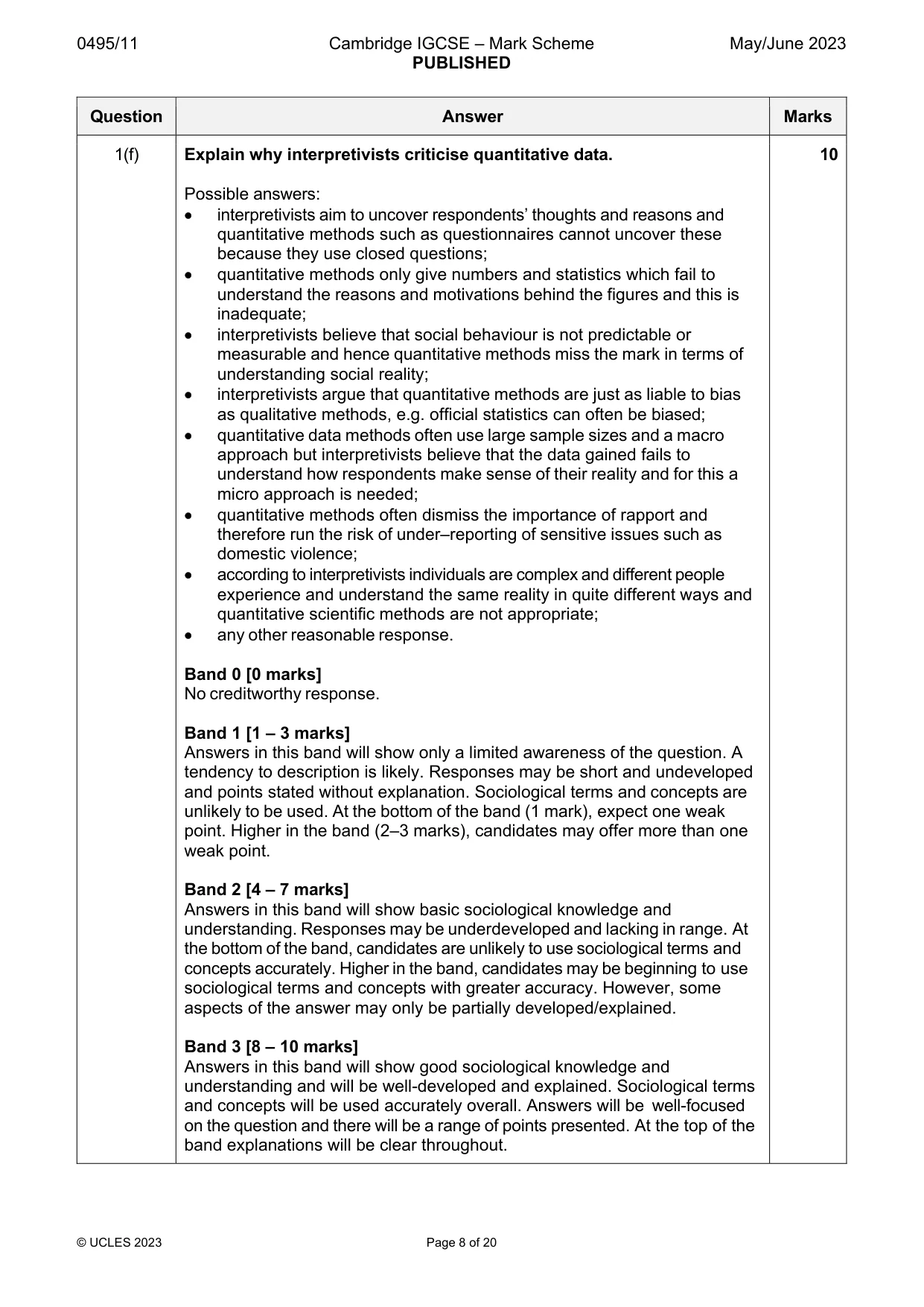
0495/11 Cambridge IGCSE – Mark Scheme PUBLISHED May/June 2023 © UCLES 2023 Page 8 of 20 Question Answer Marks 1(f) Explain why interpretivists criticise quantitative data. Possible answers: interpretivists aim to uncover respondents’ thoughts and reasons and quantitative methods such as questionnaires cannot uncover these because they use closed questions; quantitative methods only give numbers and statistics which fail to understand the reasons and motivations behind the figures and this is inadequate; interpretivists believe that social behaviour is not predictable or measurable and hence quantitative methods miss the mark in terms of understanding social reality; interpretivists argue that quantitative methods are just as liable to bias as qualitative methods, e.g. official statistics can often be biased; quantitative data methods often use large sample sizes and a macro approach but interpretivists believe that the data gained fails to understand how respondents make sense of their reality and for this a micro approach is needed; quantitative methods often dismiss the importance of rapport and therefore run the risk of under–reporting of sensitive issues such as domestic violence; according to interpretivists individuals are complex and different people experience and understand the same reality in quite different ways and quantitative scientific methods are not appropriate; any other reasonable response. Band 0 [0 marks] No creditworthy response. Band 1 [1 – 3 marks] Answers in this band will show only a limited awareness of the question. A tendency to description is likely. Responses may be short and undeveloped and points stated without explanation. Sociological terms and concepts are unlikely to be used. At the bottom of the band (1 mark), expect one weak point. Higher in the band (2–3 marks), candidates may offer more than one weak point. Band 2 [4 – 7 marks] Answers in this band will show basic sociological knowledge and understanding. Responses may be underdeveloped and lacking in range. At the bottom of the band, candidates are unlikely to use sociological terms and concepts accurately. Higher in the band, candidates may be beginning to use sociological terms and concepts with greater accuracy. However, some aspects of the answer may only be partially developed/explained. Band 3 [8 – 10 marks] Answers in this band will show good sociological knowledge and understanding and will be well-developed and explained. Sociological terms and concepts will be used accurately overall. Answers will be well-focused on the question and there will be a range of points presented. At the top of the band explanations will be clear throughout. 10
Mark scheme, page 9
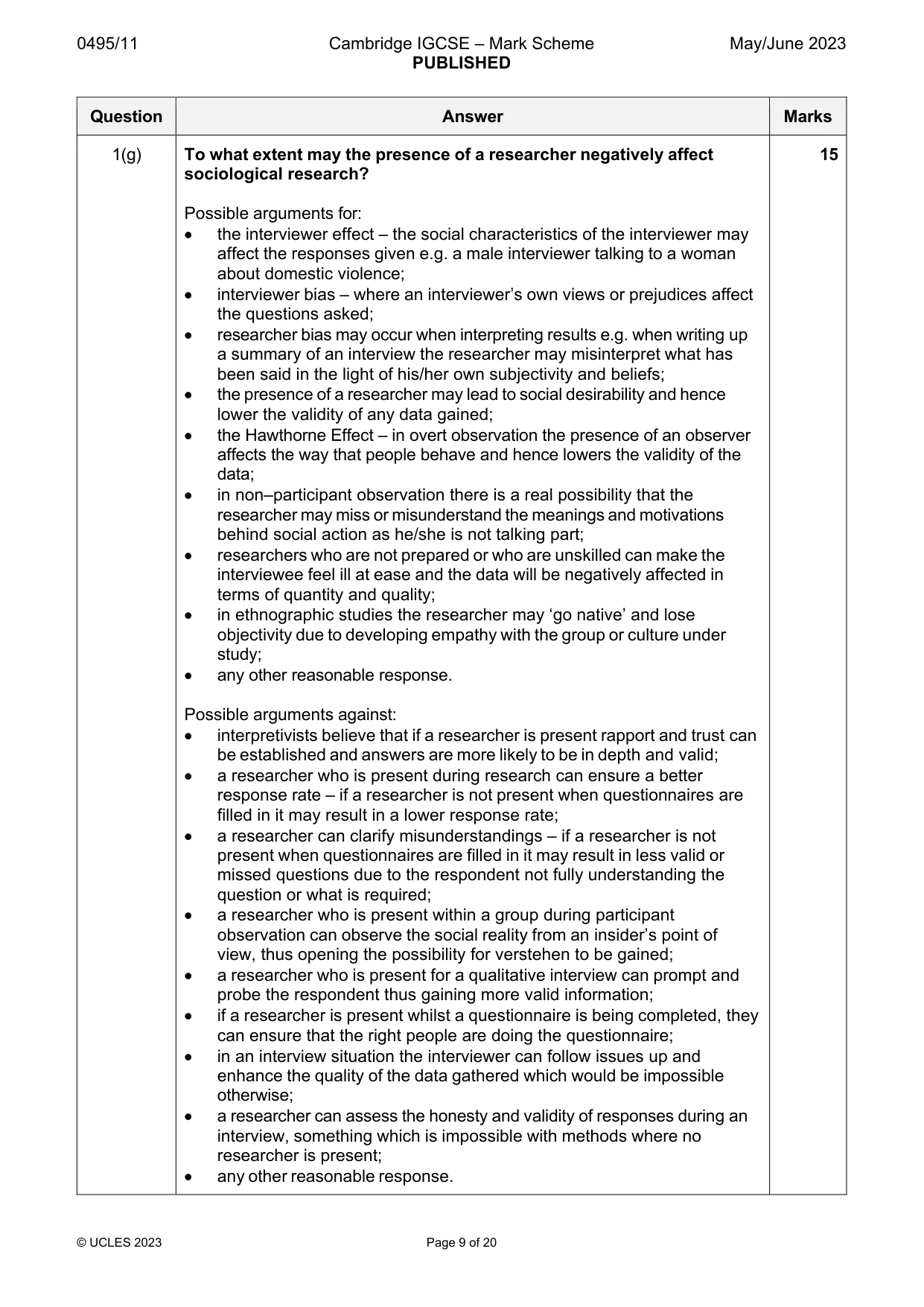
0495/11 Cambridge IGCSE – Mark Scheme PUBLISHED May/June 2023 © UCLES 2023 Page 9 of 20 Question Answer Marks 1(g) To what extent may the presence of a researcher negatively affect sociological research? Possible arguments for: the interviewer effect – the social characteristics of the interviewer may affect the responses given e.g. a male interviewer talking to a woman about domestic violence; interviewer bias – where an interviewer’s own views or prejudices affect the questions asked; researcher bias may occur when interpreting results e.g. when writing up a summary of an interview the researcher may misinterpret what has been said in the light of his/her own subjectivity and beliefs; the presence of a researcher may lead to social desirability and hence lower the validity of any data gained; the Hawthorne Effect – in overt observation the presence of an observer affects the way that people behave and hence lowers the validity of the data; in non–participant observation there is a real possibility that the researcher may miss or misunderstand the meanings and motivations behind social action as he/she is not talking part; researchers who are not prepared or who are unskilled can make the interviewee feel ill at ease and the data will be negatively affected in terms of quantity and quality; in ethnographic studies the researcher may ‘go native’ and lose objectivity due to developing empathy with the group or culture under study; any other reasonable response. Possible arguments against: interpretivists believe that if a researcher is present rapport and trust can be established and answers are more likely to be in depth and valid; a researcher who is present during research can ensure a better response rate – if a researcher is not present when questionnaires are filled in it may result in a lower response rate; a researcher can clarify misunderstandings – if a researcher is not present when questionnaires are filled in it may result in less valid or missed questions due to the respondent not fully understanding the question or what is required; a researcher who is present within a group during participant observation can observe the social reality from an insider’s point of view, thus opening the possibility for verstehen to be gained; a researcher who is present for a qualitative interview can prompt and probe the respondent thus gaining more valid information; if a researcher is present whilst a questionnaire is being completed, they can ensure that the right people are doing the questionnaire; in an interview situation the interviewer can follow issues up and enhance the quality of the data gathered which would be impossible otherwise; a researcher can assess the honesty and validity of responses during an interview, something which is impossible with methods where no researcher is present; any other reasonable response. 15
Mark scheme, page 10
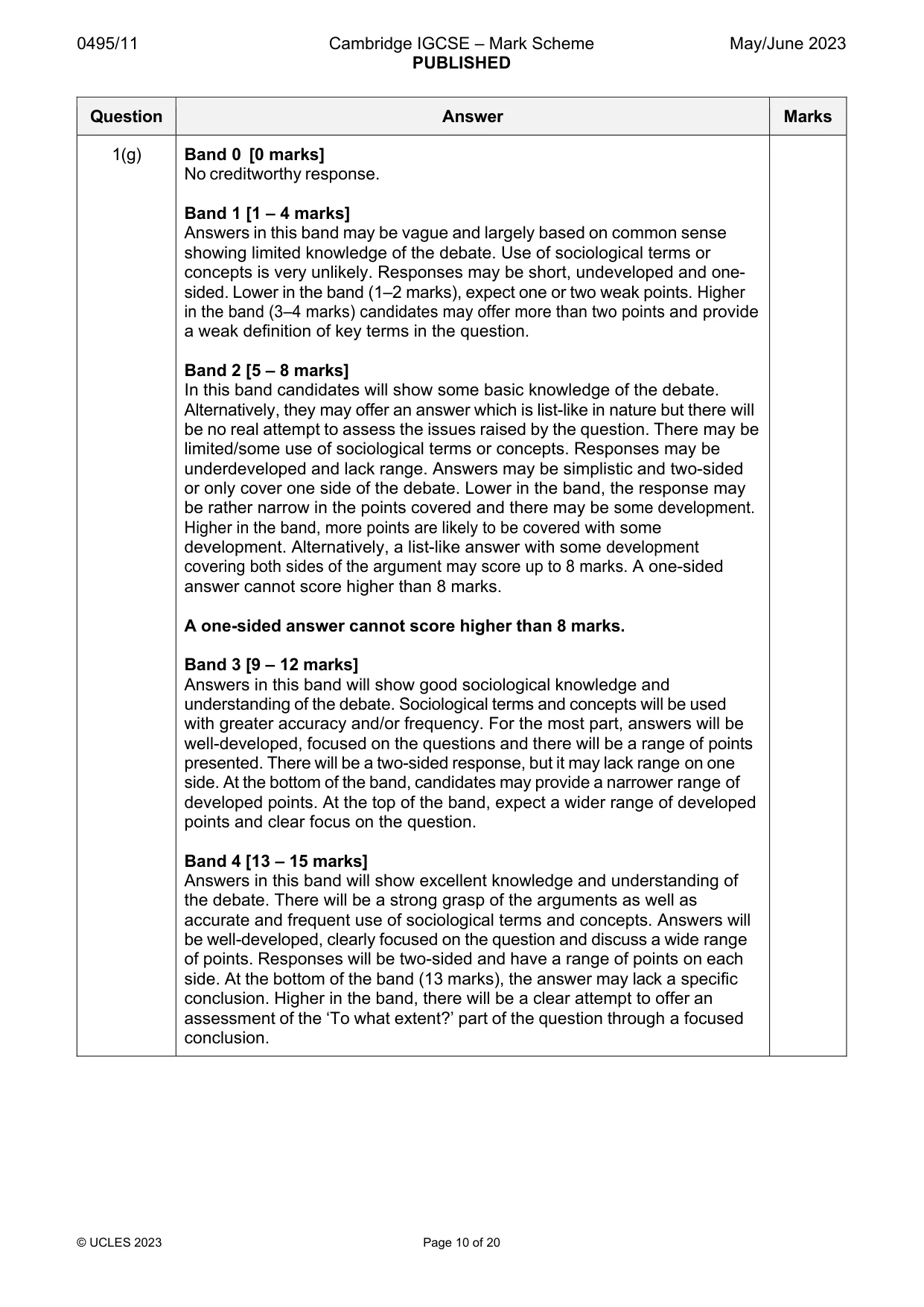
0495/11 Cambridge IGCSE – Mark Scheme PUBLISHED May/June 2023 © UCLES 2023 Page 10 of 20 Question Answer Marks 1(g) Band 0 [0 marks] No creditworthy response. Band 1 [1 – 4 marks] Answers in this band may be vague and largely based on common sense showing limited knowledge of the debate. Use of sociological terms or concepts is very unlikely. Responses may be short, undeveloped and one- sided. Lower in the band (1–2 marks), expect one or two weak points. Higher in the band (3–4 marks) candidates may offer more than two points and provide a weak definition of key terms in the question. Band 2 [5 – 8 marks] In this band candidates will show some basic knowledge of the debate. Alternatively, they may offer an answer which is list-like in nature but there will be no real attempt to assess the issues raised by the question. There may be limited/some use of sociological terms or concepts. Responses may be underdeveloped and lack range. Answers may be simplistic and two-sided or only cover one side of the debate. Lower in the band, the response may be rather narrow in the points covered and there may be some development. Higher in the band, more points are likely to be covered with some development. Alternatively, a list-like answer with some development covering both sides of the argument may score up to 8 marks. A one-sided answer cannot score higher than 8 marks. A one-sided answer cannot score higher than 8 marks. Band 3 [9 – 12 marks] Answers in this band will show good sociological knowledge and understanding of the debate. Sociological terms and concepts will be used with greater accuracy and/or frequency. For the most part, answers will be well-developed, focused on the questions and there will be a range of points presented. There will be a two-sided response, but it may lack range on one side. At the bottom of the band, candidates may provide a narrower range of developed points. At the top of the band, expect a wider range of developed points and clear focus on the question. Band 4 [13 – 15 marks] Answers in this band will show excellent knowledge and understanding of the debate. There will be a strong grasp of the arguments as well as accurate and frequent use of sociological terms and concepts. Answers will be well-developed, clearly focused on the question and discuss a wide range of points. Responses will be two-sided and have a range of points on each side. At the bottom of the band (13 marks), the answer may lack a specific conclusion. Higher in the band, there will be a clear attempt to offer an assessment of the ‘To what extent?’ part of the question through a focused conclusion.
Mark scheme, page 11
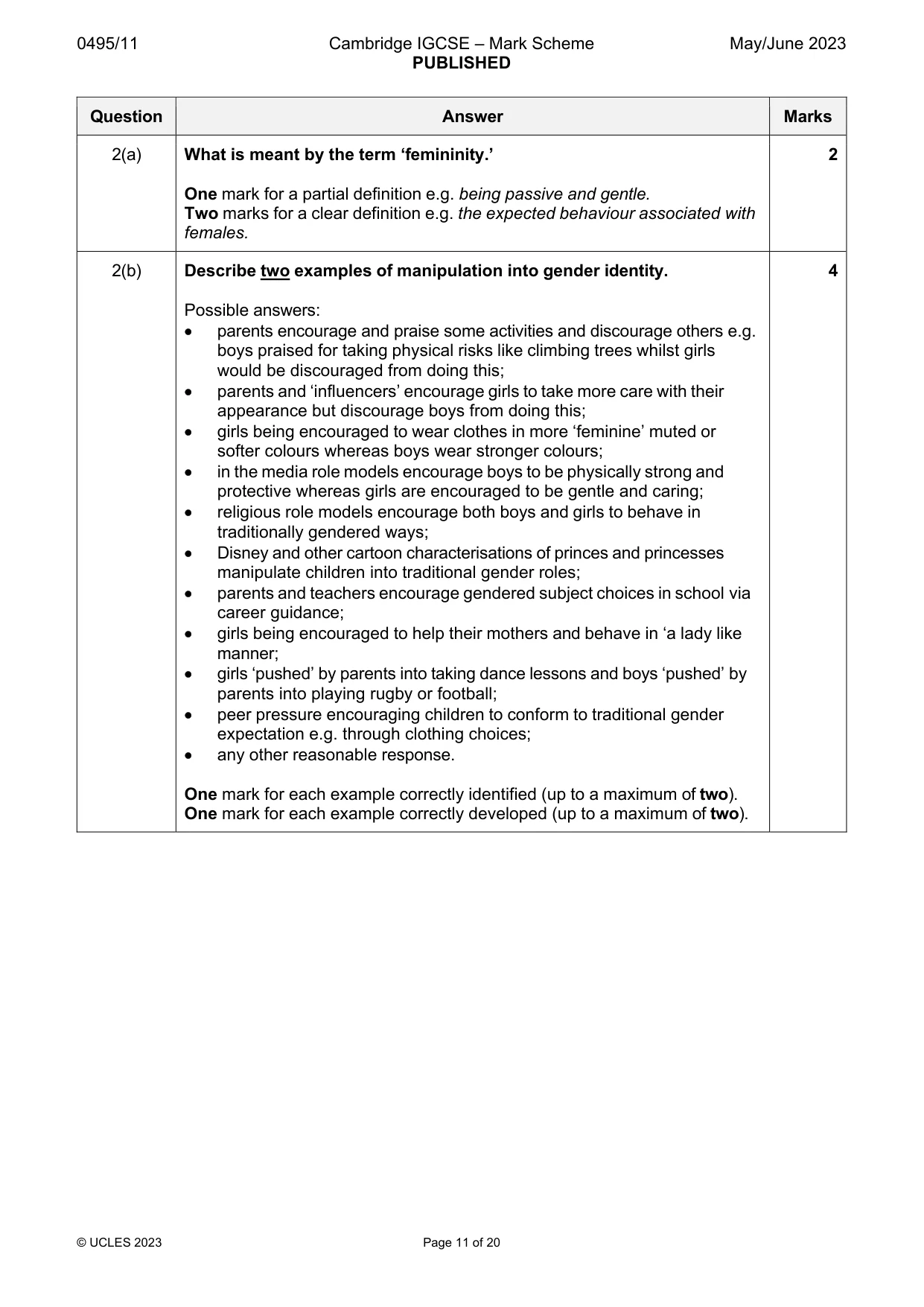
0495/11 Cambridge IGCSE – Mark Scheme PUBLISHED May/June 2023 © UCLES 2023 Page 11 of 20 Question Answer Marks 2(a) What is meant by the term ‘femininity.’ One mark for a partial definition e.g. being passive and gentle. Two marks for a clear definition e.g. the expected behaviour associated with females. 2 2(b) Describe two examples of manipulation into gender identity. Possible answers: parents encourage and praise some activities and discourage others e.g. boys praised for taking physical risks like climbing trees whilst girls would be discouraged from doing this; parents and ‘influencers’ encourage girls to take more care with their appearance but discourage boys from doing this; girls being encouraged to wear clothes in more ‘feminine’ muted or softer colours whereas boys wear stronger colours; in the media role models encourage boys to be physically strong and protective whereas girls are encouraged to be gentle and caring; religious role models encourage both boys and girls to behave in traditionally gendered ways; Disney and other cartoon characterisations of princes and princesses manipulate children into traditional gender roles; parents and teachers encourage gendered subject choices in school via career guidance; girls being encouraged to help their mothers and behave in ‘a lady like manner; girls ‘pushed’ by parents into taking dance lessons and boys ‘pushed’ by parents into playing rugby or football; peer pressure encouraging children to conform to traditional gender expectation e.g. through clothing choices; any other reasonable response. One mark for each example correctly identified (up to a maximum of two). One mark for each example correctly developed (up to a maximum of two). 4
Mark scheme, page 12
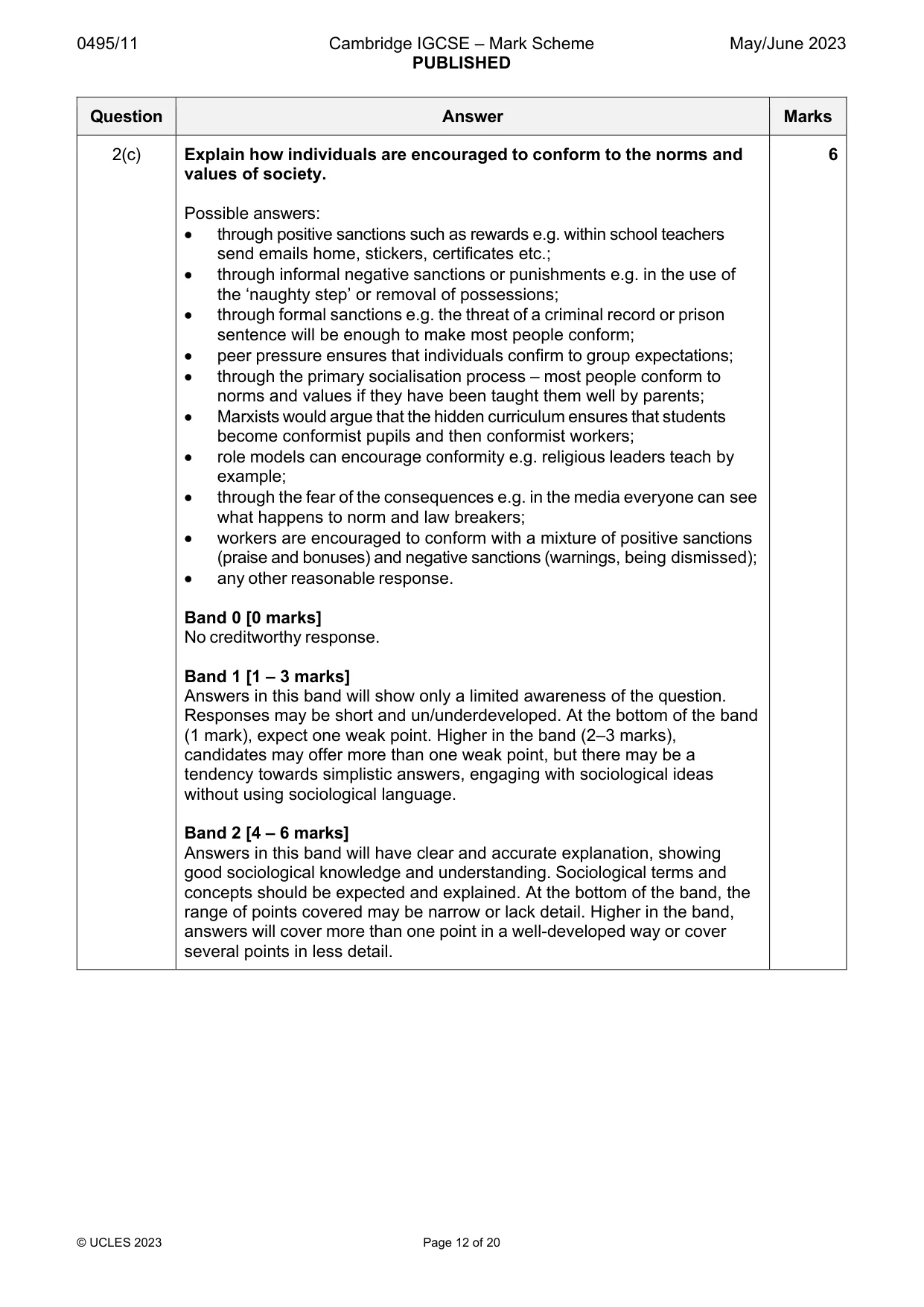
0495/11 Cambridge IGCSE – Mark Scheme PUBLISHED May/June 2023 © UCLES 2023 Page 12 of 20 Question Answer Marks 2(c) Explain how individuals are encouraged to conform to the norms and values of society. Possible answers: through positive sanctions such as rewards e.g. within school teachers send emails home, stickers, certificates etc.; through informal negative sanctions or punishments e.g. in the use of the ‘naughty step’ or removal of possessions; through formal sanctions e.g. the threat of a criminal record or prison sentence will be enough to make most people conform; peer pressure ensures that individuals confirm to group expectations; through the primary socialisation process – most people conform to norms and values if they have been taught them well by parents; Marxists would argue that the hidden curriculum ensures that students become conformist pupils and then conformist workers; role models can encourage conformity e.g. religious leaders teach by example; through the fear of the consequences e.g. in the media everyone can see what happens to norm and law breakers; workers are encouraged to conform with a mixture of positive sanctions (praise and bonuses) and negative sanctions (warnings, being dismissed); any other reasonable response. Band 0 [0 marks] No creditworthy response. Band 1 [1 – 3 marks] Answers in this band will show only a limited awareness of the question. Responses may be short and un/underdeveloped. At the bottom of the band (1 mark), expect one weak point. Higher in the band (2–3 marks), candidates may offer more than one weak point, but there may be a tendency towards simplistic answers, engaging with sociological ideas without using sociological language. Band 2 [4 – 6 marks] Answers in this band will have clear and accurate explanation, showing good sociological knowledge and understanding. Sociological terms and concepts should be expected and explained. At the bottom of the band, the range of points covered may be narrow or lack detail. Higher in the band, answers will cover more than one point in a well-developed way or cover several points in less detail. 6
Mark scheme, page 13
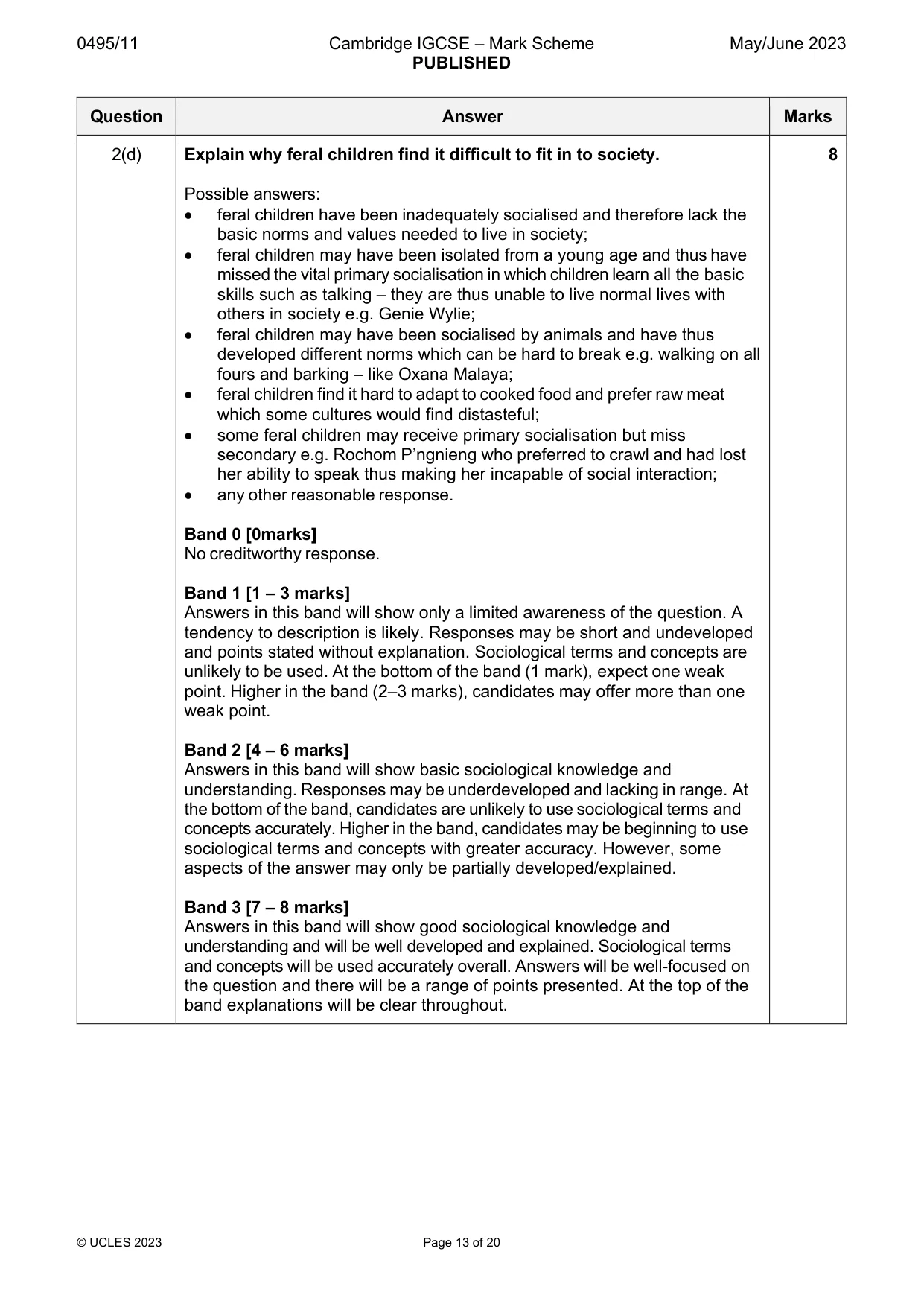
0495/11 Cambridge IGCSE – Mark Scheme PUBLISHED May/June 2023 © UCLES 2023 Page 13 of 20 Question Answer Marks 2(d) Explain why feral children find it difficult to fit in to society. Possible answers: feral children have been inadequately socialised and therefore lack the basic norms and values needed to live in society; feral children may have been isolated from a young age and thus have missed the vital primary socialisation in which children learn all the basic skills such as talking – they are thus unable to live normal lives with others in society e.g. Genie Wylie; feral children may have been socialised by animals and have thus developed different norms which can be hard to break e.g. walking on all fours and barking – like Oxana Malaya; feral children find it hard to adapt to cooked food and prefer raw meat which some cultures would find distasteful; some feral children may receive primary socialisation but miss secondary e.g. Rochom P’ngnieng who preferred to crawl and had lost her ability to speak thus making her incapable of social interaction; any other reasonable response. Band 0 [0marks] No creditworthy response. Band 1 [1 – 3 marks] Answers in this band will show only a limited awareness of the question. A tendency to description is likely. Responses may be short and undeveloped and points stated without explanation. Sociological terms and concepts are unlikely to be used. At the bottom of the band (1 mark), expect one weak point. Higher in the band (2–3 marks), candidates may offer more than one weak point. Band 2 [4 – 6 marks] Answers in this band will show basic sociological knowledge and understanding. Responses may be underdeveloped and lacking in range. At the bottom of the band, candidates are unlikely to use sociological terms and concepts accurately. Higher in the band, candidates may be beginning to use sociological terms and concepts with greater accuracy. However, some aspects of the answer may only be partially developed/explained. Band 3 [7 – 8 marks] Answers in this band will show good sociological knowledge and understanding and will be well developed and explained. Sociological terms and concepts will be used accurately overall. Answers will be well-focused on the question and there will be a range of points presented. At the top of the band explanations will be clear throughout. 8
Mark scheme, page 14
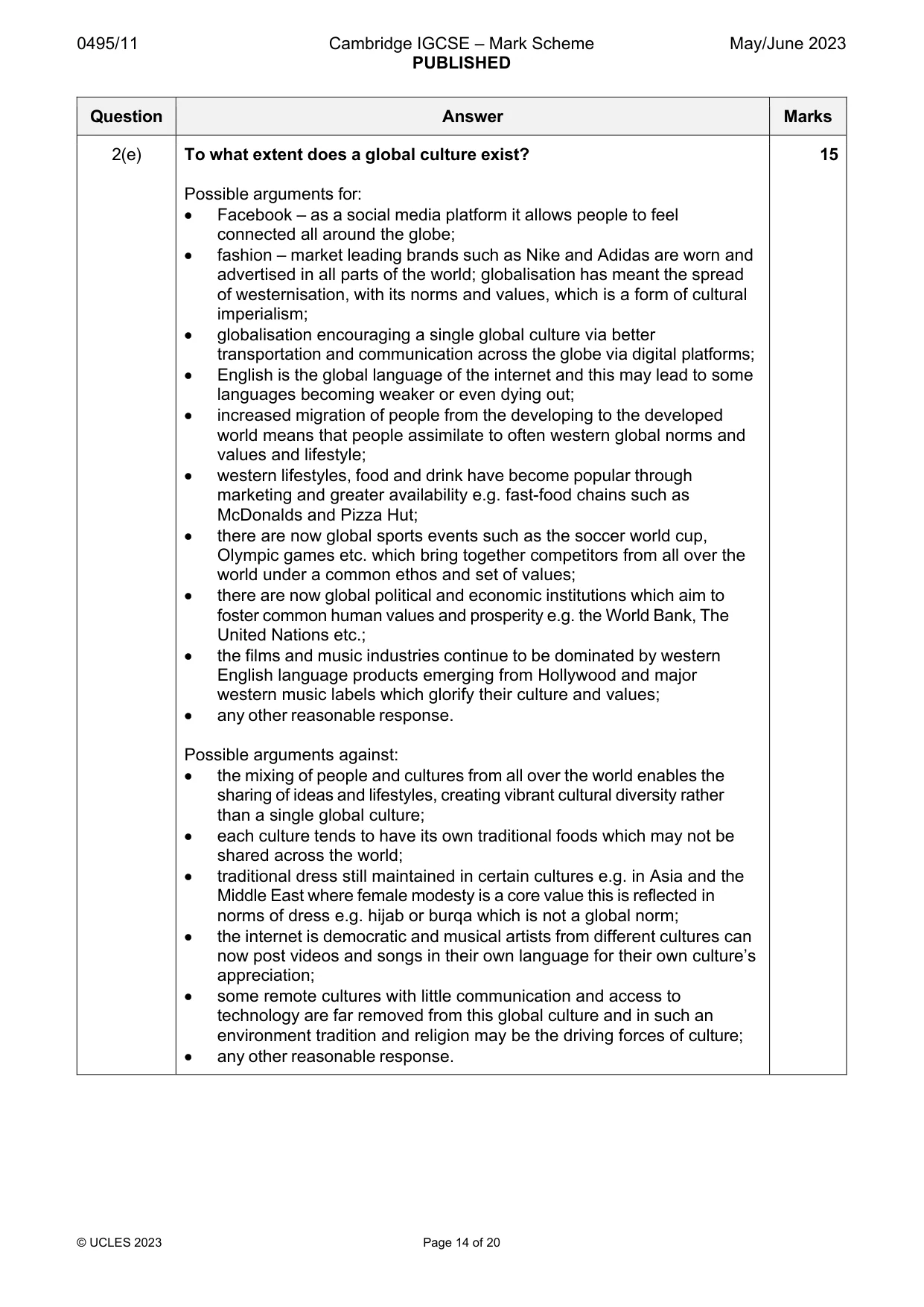
0495/11 Cambridge IGCSE – Mark Scheme PUBLISHED May/June 2023 © UCLES 2023 Page 14 of 20 Question Answer Marks 2(e) To what extent does a global culture exist? Possible arguments for: Facebook – as a social media platform it allows people to feel connected all around the globe; fashion – market leading brands such as Nike and Adidas are worn and advertised in all parts of the world; globalisation has meant the spread of westernisation, with its norms and values, which is a form of cultural imperialism; globalisation encouraging a single global culture via better transportation and communication across the globe via digital platforms; English is the global language of the internet and this may lead to some languages becoming weaker or even dying out; increased migration of people from the developing to the developed world means that people assimilate to often western global norms and values and lifestyle; western lifestyles, food and drink have become popular through marketing and greater availability e.g. fast-food chains such as McDonalds and Pizza Hut; there are now global sports events such as the soccer world cup, Olympic games etc. which bring together competitors from all over the world under a common ethos and set of values; there are now global political and economic institutions which aim to foster common human values and prosperity e.g. the World Bank, The United Nations etc.; the films and music industries continue to be dominated by western English language products emerging from Hollywood and major western music labels which glorify their culture and values; any other reasonable response. Possible arguments against: the mixing of people and cultures from all over the world enables the sharing of ideas and lifestyles, creating vibrant cultural diversity rather than a single global culture; each culture tends to have its own traditional foods which may not be shared across the world; traditional dress still maintained in certain cultures e.g. in Asia and the Middle East where female modesty is a core value this is reflected in norms of dress e.g. hijab or burqa which is not a global norm; the internet is democratic and musical artists from different cultures can now post videos and songs in their own language for their own culture’s appreciation; some remote cultures with little communication and access to technology are far removed from this global culture and in such an environment tradition and religion may be the driving forces of culture; any other reasonable response. 15
Mark scheme, page 15
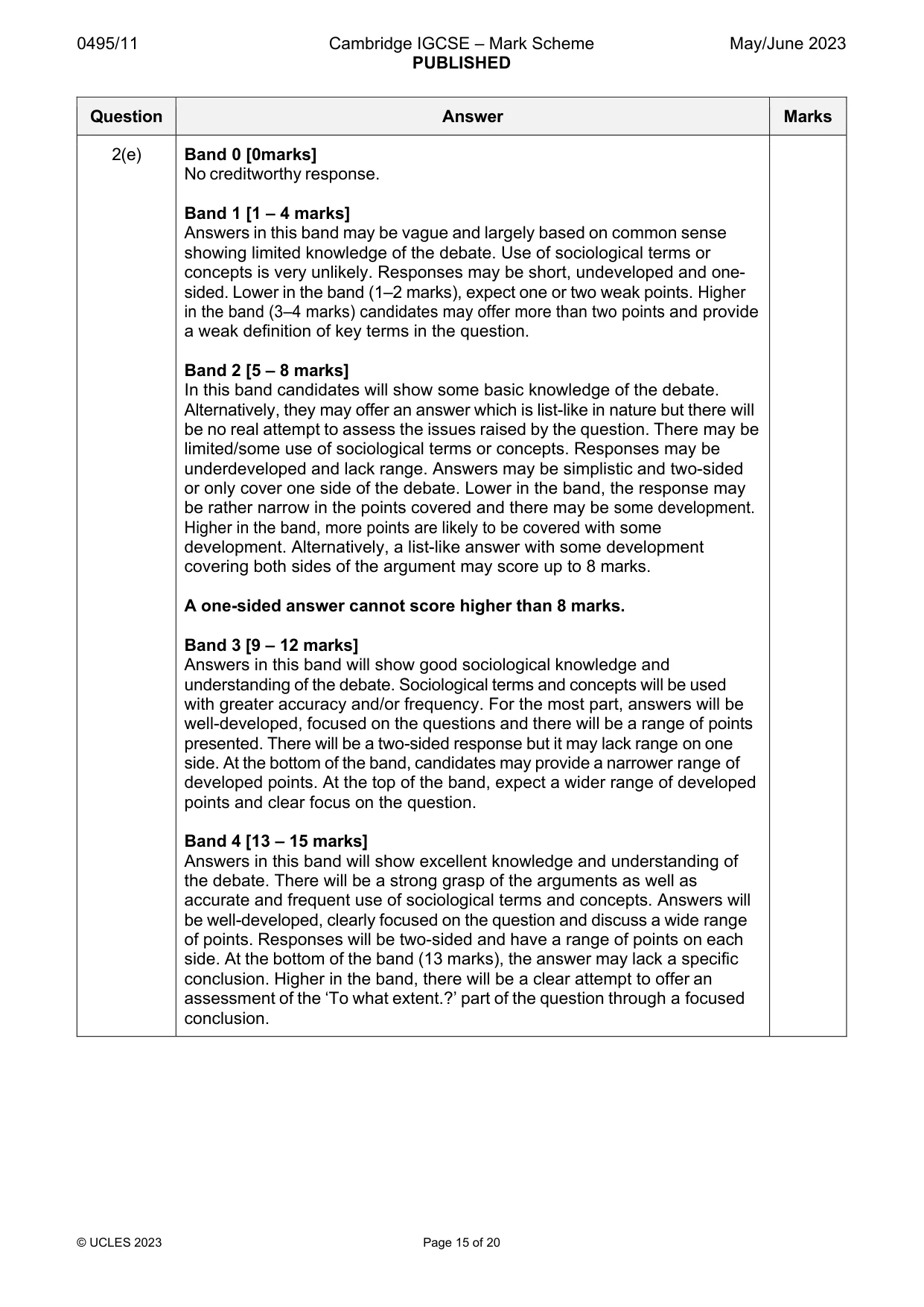
0495/11 Cambridge IGCSE – Mark Scheme PUBLISHED May/June 2023 © UCLES 2023 Page 15 of 20 Question Answer Marks 2(e) Band 0 [0marks] No creditworthy response. Band 1 [1 – 4 marks] Answers in this band may be vague and largely based on common sense showing limited knowledge of the debate. Use of sociological terms or concepts is very unlikely. Responses may be short, undeveloped and one- sided. Lower in the band (1–2 marks), expect one or two weak points. Higher in the band (3–4 marks) candidates may offer more than two points and provide a weak definition of key terms in the question. Band 2 [5 – 8 marks] In this band candidates will show some basic knowledge of the debate. Alternatively, they may offer an answer which is list-like in nature but there will be no real attempt to assess the issues raised by the question. There may be limited/some use of sociological terms or concepts. Responses may be underdeveloped and lack range. Answers may be simplistic and two-sided or only cover one side of the debate. Lower in the band, the response may be rather narrow in the points covered and there may be some development. Higher in the band, more points are likely to be covered with some development. Alternatively, a list-like answer with some development covering both sides of the argument may score up to 8 marks. A one-sided answer cannot score higher than 8 marks. Band 3 [9 – 12 marks] Answers in this band will show good sociological knowledge and understanding of the debate. Sociological terms and concepts will be used with greater accuracy and/or frequency. For the most part, answers will be well-developed, focused on the questions and there will be a range of points presented. There will be a two-sided response but it may lack range on one side. At the bottom of the band, candidates may provide a narrower range of developed points. At the top of the band, expect a wider range of developed points and clear focus on the question. Band 4 [13 – 15 marks] Answers in this band will show excellent knowledge and understanding of the debate. There will be a strong grasp of the arguments as well as accurate and frequent use of sociological terms and concepts. Answers will be well-developed, clearly focused on the question and discuss a wide range of points. Responses will be two-sided and have a range of points on each side. At the bottom of the band (13 marks), the answer may lack a specific conclusion. Higher in the band, there will be a clear attempt to offer an assessment of the ‘To what extent.?’ part of the question through a focused conclusion.
Mark scheme, page 16
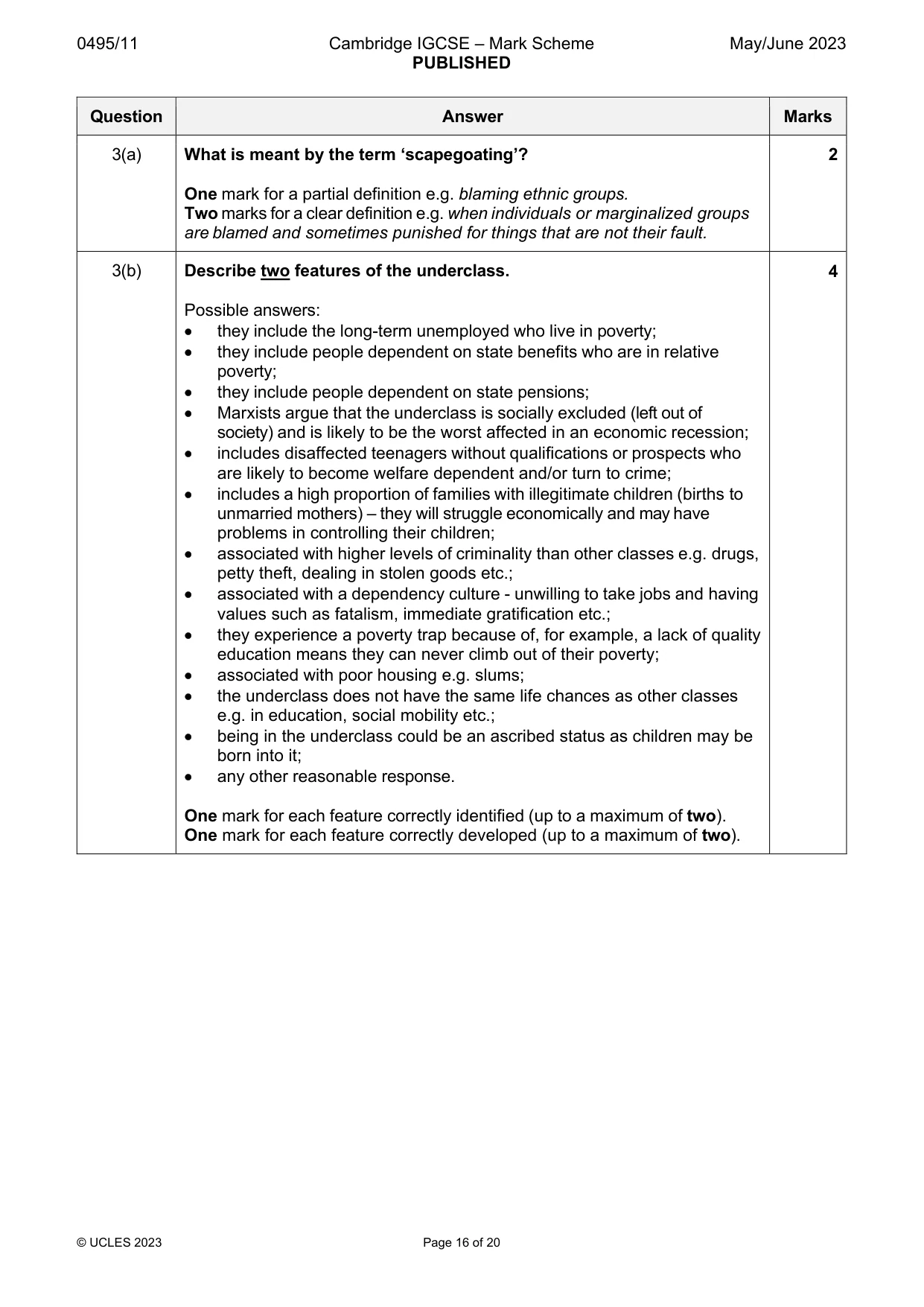
0495/11 Cambridge IGCSE – Mark Scheme PUBLISHED May/June 2023 © UCLES 2023 Page 16 of 20 Question Answer Marks 3(a) What is meant by the term ‘scapegoating’? One mark for a partial definition e.g. blaming ethnic groups. Two marks for a clear definition e.g. when individuals or marginalized groups are blamed and sometimes punished for things that are not their fault. 2 3(b) Describe two features of the underclass. Possible answers: they include the long-term unemployed who live in poverty; they include people dependent on state benefits who are in relative poverty; they include people dependent on state pensions; Marxists argue that the underclass is socially excluded (left out of society) and is likely to be the worst affected in an economic recession; includes disaffected teenagers without qualifications or prospects who are likely to become welfare dependent and/or turn to crime; includes a high proportion of families with illegitimate children (births to unmarried mothers) – they will struggle economically and may have problems in controlling their children; associated with higher levels of criminality than other classes e.g. drugs, petty theft, dealing in stolen goods etc.; associated with a dependency culture - unwilling to take jobs and having values such as fatalism, immediate gratification etc.; they experience a poverty trap because of, for example, a lack of quality education means they can never climb out of their poverty; associated with poor housing e.g. slums; the underclass does not have the same life chances as other classes e.g. in education, social mobility etc.; being in the underclass could be an ascribed status as children may be born into it; any other reasonable response. One mark for each feature correctly identified (up to a maximum of two). One mark for each feature correctly developed (up to a maximum of two). 4
Mark scheme, page 17
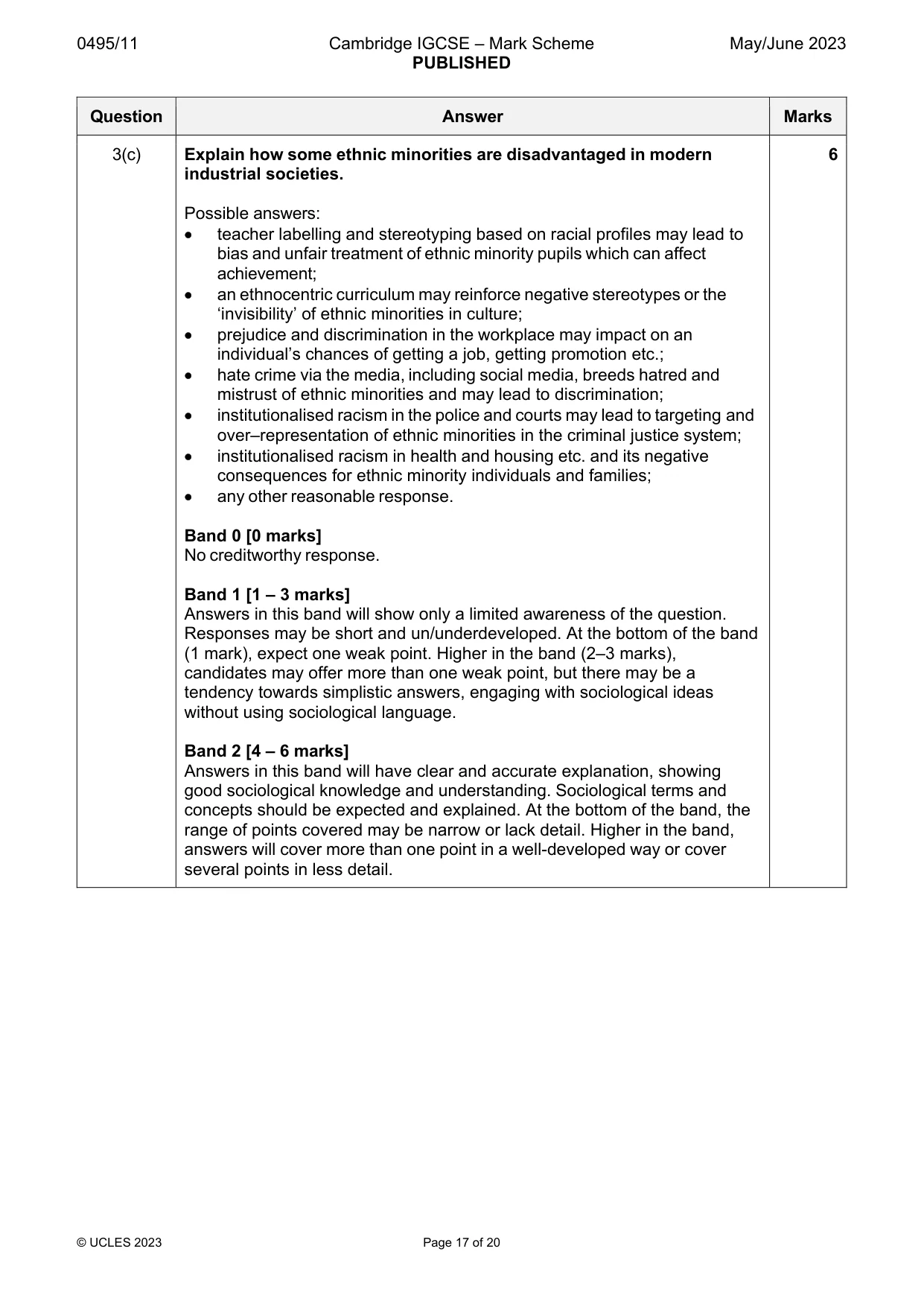
0495/11 Cambridge IGCSE – Mark Scheme PUBLISHED May/June 2023 © UCLES 2023 Page 17 of 20 Question Answer Marks 3(c) Explain how some ethnic minorities are disadvantaged in modern industrial societies. Possible answers: teacher labelling and stereotyping based on racial profiles may lead to bias and unfair treatment of ethnic minority pupils which can affect achievement; an ethnocentric curriculum may reinforce negative stereotypes or the ‘invisibility’ of ethnic minorities in culture; prejudice and discrimination in the workplace may impact on an individual’s chances of getting a job, getting promotion etc.; hate crime via the media, including social media, breeds hatred and mistrust of ethnic minorities and may lead to discrimination; institutionalised racism in the police and courts may lead to targeting and over–representation of ethnic minorities in the criminal justice system; institutionalised racism in health and housing etc. and its negative consequences for ethnic minority individuals and families; any other reasonable response. Band 0 [0 marks] No creditworthy response. Band 1 [1 – 3 marks] Answers in this band will show only a limited awareness of the question. Responses may be short and un/underdeveloped. At the bottom of the band (1 mark), expect one weak point. Higher in the band (2–3 marks), candidates may offer more than one weak point, but there may be a tendency towards simplistic answers, engaging with sociological ideas without using sociological language. Band 2 [4 – 6 marks] Answers in this band will have clear and accurate explanation, showing good sociological knowledge and understanding. Sociological terms and concepts should be expected and explained. At the bottom of the band, the range of points covered may be narrow or lack detail. Higher in the band, answers will cover more than one point in a well-developed way or cover several points in less detail. 6
Mark scheme, page 18
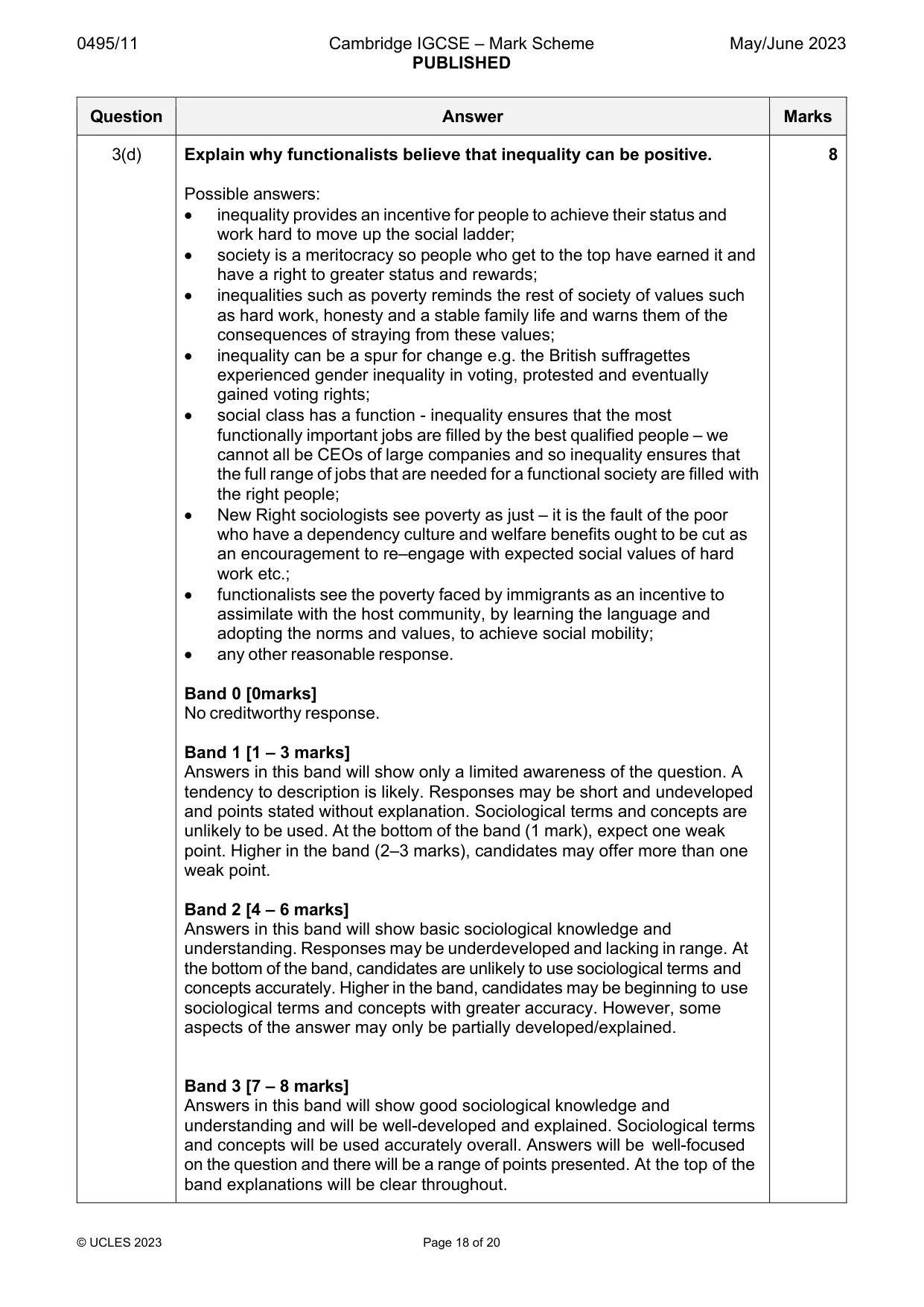
0495/11 Cambridge IGCSE – Mark Scheme PUBLISHED May/June 2023 © UCLES 2023 Page 18 of 20 Question Answer Marks 3(d) Explain why functionalists believe that inequality can be positive. Possible answers: inequality provides an incentive for people to achieve their status and work hard to move up the social ladder; society is a meritocracy so people who get to the top have earned it and have a right to greater status and rewards; inequalities such as poverty reminds the rest of society of values such as hard work, honesty and a stable family life and warns them of the consequences of straying from these values; inequality can be a spur for change e.g. the British suffragettes experienced gender inequality in voting, protested and eventually gained voting rights; social class has a function - inequality ensures that the most functionally important jobs are filled by the best qualified people – we cannot all be CEOs of large companies and so inequality ensures that the full range of jobs that are needed for a functional society are filled with the right people; New Right sociologists see poverty as just – it is the fault of the poor who have a dependency culture and welfare benefits ought to be cut as an encouragement to re–engage with expected social values of hard work etc.; functionalists see the poverty faced by immigrants as an incentive to assimilate with the host community, by learning the language and adopting the norms and values, to achieve social mobility; any other reasonable response. Band 0 [0marks] No creditworthy response. Band 1 [1 – 3 marks] Answers in this band will show only a limited awareness of the question. A tendency to description is likely. Responses may be short and undeveloped and points stated without explanation. Sociological terms and concepts are unlikely to be used. At the bottom of the band (1 mark), expect one weak point. Higher in the band (2–3 marks), candidates may offer more than one weak point. Band 2 [4 – 6 marks] Answers in this band will show basic sociological knowledge and understanding. Responses may be underdeveloped and lacking in range. At the bottom of the band, candidates are unlikely to use sociological terms and concepts accurately. Higher in the band, candidates may be beginning to use sociological terms and concepts with greater accuracy. However, some aspects of the answer may only be partially developed/explained. Band 3 [7 – 8 marks] Answers in this band will show good sociological knowledge and understanding and will be well-developed and explained. Sociological terms and concepts will be used accurately overall. Answers will be well-focused on the question and there will be a range of points presented. At the top of the band explanations will be clear throughout. 8
Mark scheme, page 19
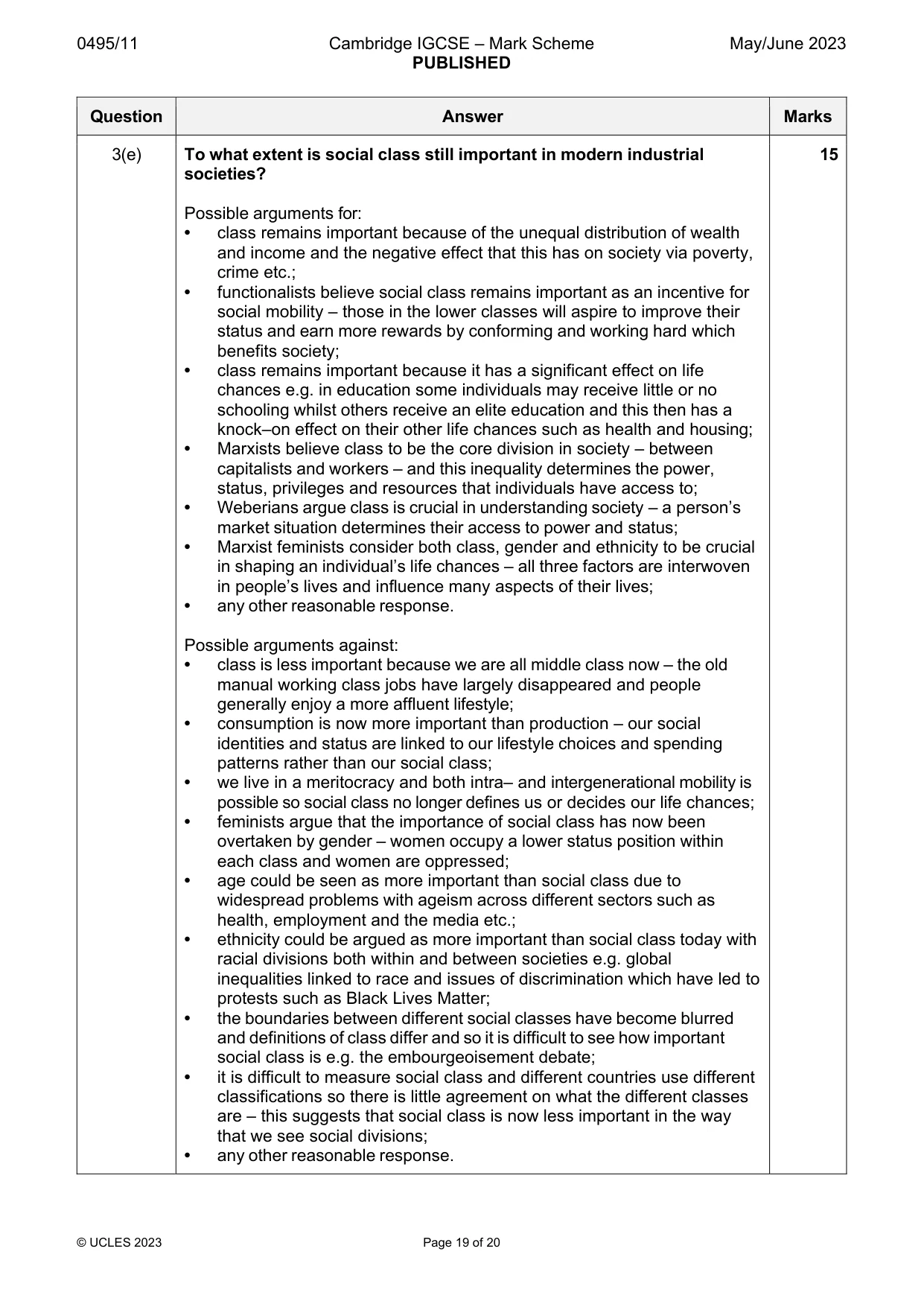
0495/11 Cambridge IGCSE – Mark Scheme PUBLISHED May/June 2023 © UCLES 2023 Page 19 of 20 Question Answer Marks 3(e) To what extent is social class still important in modern industrial societies? Possible arguments for: • class remains important because of the unequal distribution of wealth and income and the negative effect that this has on society via poverty, crime etc.; • functionalists believe social class remains important as an incentive for social mobility – those in the lower classes will aspire to improve their status and earn more rewards by conforming and working hard which benefits society; • class remains important because it has a significant effect on life chances e.g. in education some individuals may receive little or no schooling whilst others receive an elite education and this then has a knock–on effect on their other life chances such as health and housing; • Marxists believe class to be the core division in society – between capitalists and workers – and this inequality determines the power, status, privileges and resources that individuals have access to; • Weberians argue class is crucial in understanding society – a person’s market situation determines their access to power and status; • Marxist feminists consider both class, gender and ethnicity to be crucial in shaping an individual’s life chances – all three factors are interwoven in people’s lives and influence many aspects of their lives; • any other reasonable response. Possible arguments against: • class is less important because we are all middle class now – the old manual working class jobs have largely disappeared and people generally enjoy a more affluent lifestyle; • consumption is now more important than production – our social identities and status are linked to our lifestyle choices and spending patterns rather than our social class; • we live in a meritocracy and both intra– and intergenerational mobility is possible so social class no longer defines us or decides our life chances; • feminists argue that the importance of social class has now been overtaken by gender – women occupy a lower status position within each class and women are oppressed; • age could be seen as more important than social class due to widespread problems with ageism across different sectors such as health, employment and the media etc.; • ethnicity could be argued as more important than social class today with racial divisions both within and between societies e.g. global inequalities linked to race and issues of discrimination which have led to protests such as Black Lives Matter; • the boundaries between different social classes have become blurred and definitions of class differ and so it is difficult to see how important social class is e.g. the embourgeoisement debate; • it is difficult to measure social class and different countries use different classifications so there is little agreement on what the different classes are – this suggests that social class is now less important in the way that we see social divisions; • any other reasonable response. 15
Mark scheme, page 20
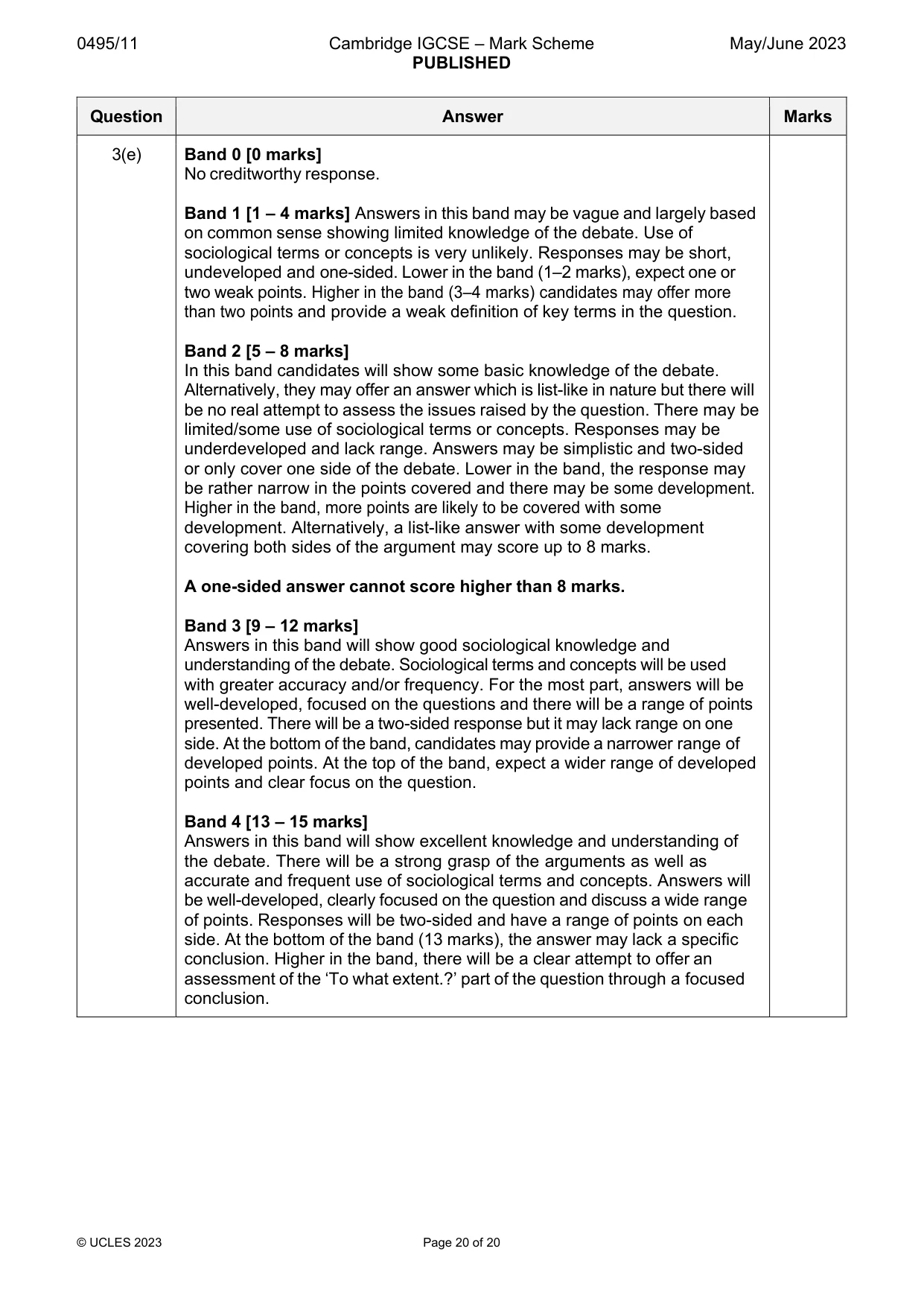
0495/11 Cambridge IGCSE – Mark Scheme PUBLISHED May/June 2023 © UCLES 2023 Page 20 of 20 Question Answer Marks 3(e) Band 0 [0 marks] No creditworthy response. Band 1 [1 – 4 marks] Answers in this band may be vague and largely based on common sense showing limited knowledge of the debate. Use of sociological terms or concepts is very unlikely. Responses may be short, undeveloped and one-sided. Lower in the band (1–2 marks), expect one or two weak points. Higher in the band (3–4 marks) candidates may offer more than two points and provide a weak definition of key terms in the question. Band 2 [5 – 8 marks] In this band candidates will show some basic knowledge of the debate. Alternatively, they may offer an answer which is list-like in nature but there will be no real attempt to assess the issues raised by the question. There may be limited/some use of sociological terms or concepts. Responses may be underdeveloped and lack range. Answers may be simplistic and two-sided or only cover one side of the debate. Lower in the band, the response may be rather narrow in the points covered and there may be some development. Higher in the band, more points are likely to be covered with some development. Alternatively, a list-like answer with some development covering both sides of the argument may score up to 8 marks. A one-sided answer cannot score higher than 8 marks. Band 3 [9 – 12 marks] Answers in this band will show good sociological knowledge and understanding of the debate. Sociological terms and concepts will be used with greater accuracy and/or frequency. For the most part, answers will be well-developed, focused on the questions and there will be a range of points presented. There will be a two-sided response but it may lack range on one side. At the bottom of the band, candidates may provide a narrower range of developed points. At the top of the band, expect a wider range of developed points and clear focus on the question. Band 4 [13 – 15 marks] Answers in this band will show excellent knowledge and understanding of the debate. There will be a strong grasp of the arguments as well as accurate and frequent use of sociological terms and concepts. Answers will be well-developed, clearly focused on the question and discuss a wide range of points. Responses will be two-sided and have a range of points on each side. At the bottom of the band (13 marks), the answer may lack a specific conclusion. Higher in the band, there will be a clear attempt to offer an assessment of the ‘To what extent.?’ part of the question through a focused conclusion.
What you needed in this session
Cambridge’s own grade thresholds for 2023 May/June, Paper 1 · Variant 1. A higher threshold means an easier paper — the bar moves with how the cohort did.