Cambridge IGCSE Sociology 0495 — 2025 May/June Paper 1 · Variant 1
0495/11/M/J/25 · 80 marks · 120 min
The question paper and its mark scheme, free to read here and free to download. This is Cambridge’s own paper, exactly as it was sat.
Question paper8 pages




Mark scheme30 pages
Answers below. Sit the paper first if you are practising.


Paper as text
Question paper, page 1
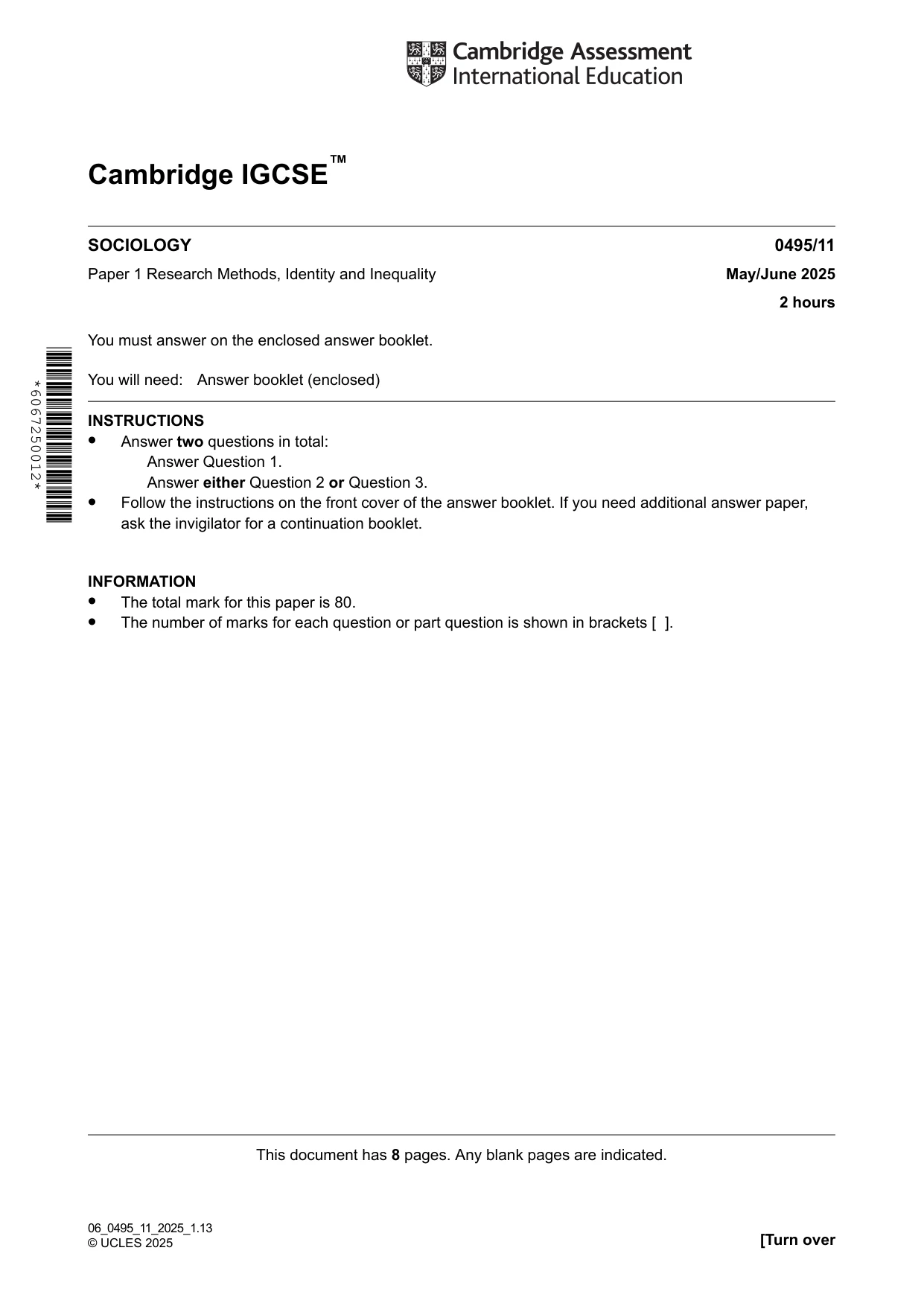
Cambridge IGCSE™ 0495/11 May/June 2025 2 hours SOCIOLOGY Paper 1 Research Methods, Identity and Inequality You must answer on the enclosed answer booklet. You will need: Answer booklet (enclosed) INSTRUCTIONS • Answer two questions in total: Answer Question 1. Answer either Question 2 or Question 3. • Follow the instructions on the front cover of the answer booklet. If you need additional answer paper, ask the invigilator for a continuation booklet. INFORMATION • The total mark for this paper is 80. • The number of marks for each question or part question is shown in brackets [ ]. This document has 8 pages. Any blank pages are indicated. [Turn over 06_0495_11_2025_1.13 © UCLES 2025 *6067250012*
Question paper, page 2
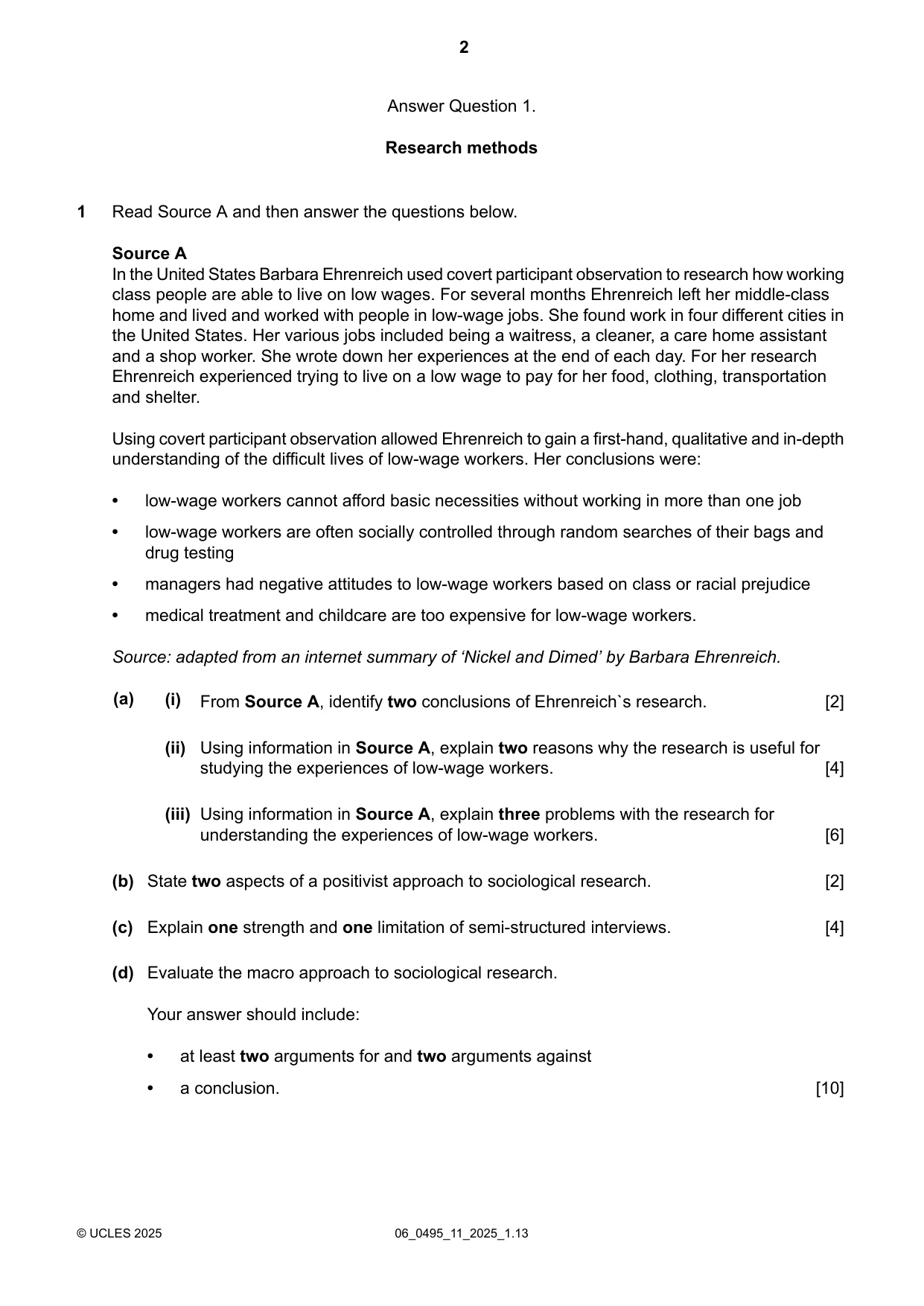
Answer Question 1. Research methods Read Source A and then answer the questions below. 1 Source A In the United States Barbara Ehrenreich used covert participant observation to research how working class people are able to live on low wages. For several months Ehrenreich left her middle-class home and lived and worked with people in low-wage jobs. She found work in four different cities in the United States. Her various jobs included being a waitress, a cleaner, a care home assistant and a shop worker. She wrote down her experiences at the end of each day. For her research Ehrenreich experienced trying to live on a low wage to pay for her food, clothing, transportation and shelter. Using covert participant observation allowed Ehrenreich to gain a first-hand, qualitative and in-depth understanding of the difficult lives of low-wage workers. Her conclusions were: • low-wage workers cannot afford basic necessities without working in more than one job • low-wage workers are often socially controlled through random searches of their bags and drug testing • managers had negative attitudes to low-wage workers based on class or racial prejudice • medical treatment and childcare are too expensive for low-wage workers. Source: adapted from an internet summary of ‘Nickel and Dimed’ by Barbara Ehrenreich. (a) From Source A, identify two conclusions of Ehrenreich`s research. [2] (i) Using information in Source A, explain two reasons why the research is useful for studying the experiences of low-wage workers. [4] (ii) Using information in Source A, explain three problems with the research for understanding the experiences of low-wage workers. [6] (iii) State two aspects of a positivist approach to sociological research. [2] (b) Explain one strength and one limitation of semi-structured interviews. [4] (c) Evaluate the macro approach to sociological research. Your answer should include: (d) • at least two arguments for and two arguments against • a conclusion. [10] 06_0495_11_2025_1.13 © UCLES 2025 2
Question paper, page 3
Explain the research methods and evidence that you would choose to investigate views on marriage. Give reasons for your choices. Your answer should include: (e) • two primary methods with relevant sampling • one source of secondary evidence. [12] [Turn over 06_0495_11_2025_1.13 © UCLES 2025 3
Question paper, page 4
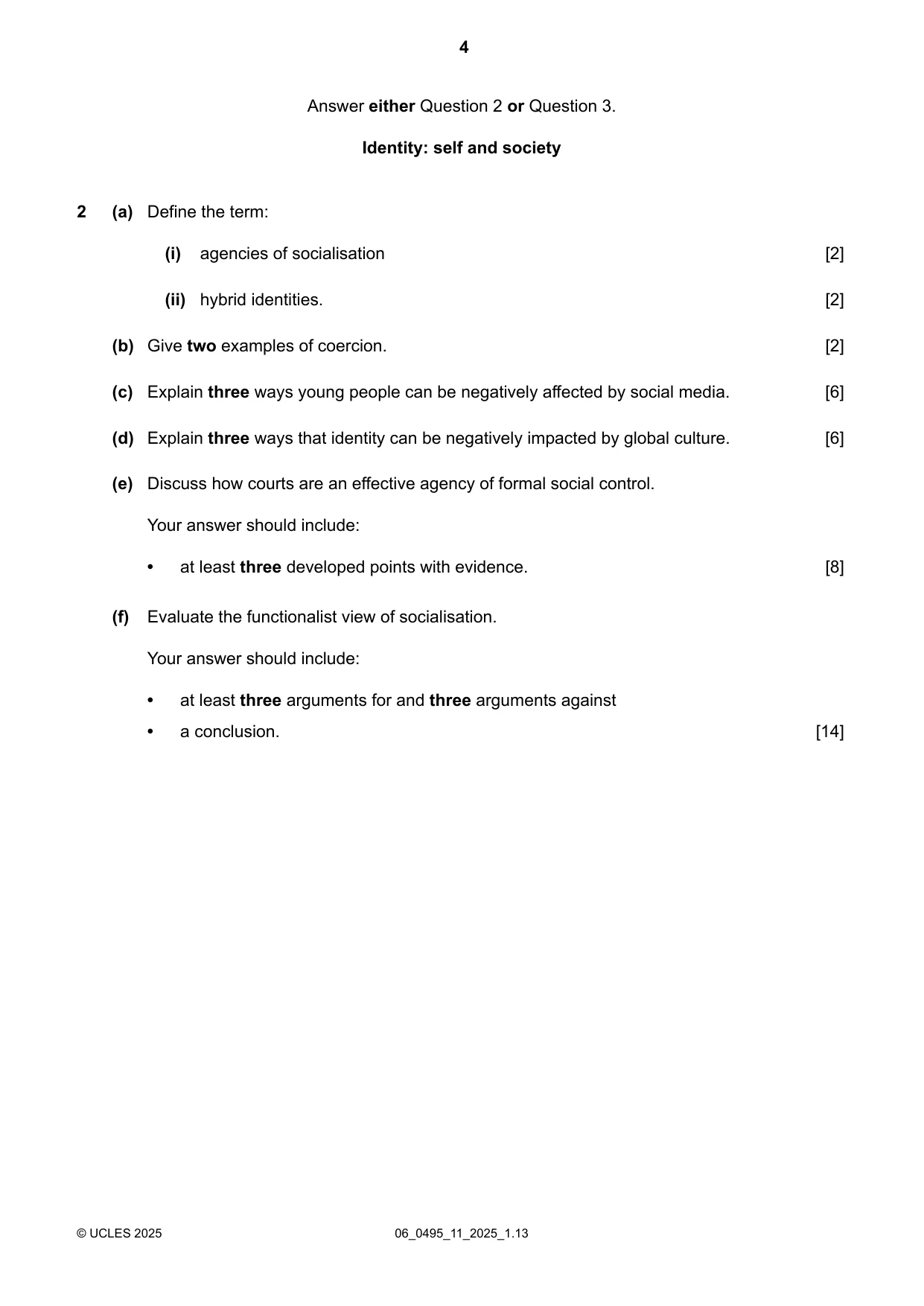
Answer either Question 2 or Question 3. Identity: self and society Define the term: (a) 2 agencies of socialisation [2] (i) hybrid identities. [2] (ii) Give two examples of coercion. [2] (b) Explain three ways young people can be negatively affected by social media. [6] (c) Explain three ways that identity can be negatively impacted by global culture. [6] (d) Discuss how courts are an effective agency of formal social control. Your answer should include: (e) • at least three developed points with evidence. [8] Evaluate the functionalist view of socialisation. Your answer should include: (f) • at least three arguments for and three arguments against • a conclusion. [14] 06_0495_11_2025_1.13 © UCLES 2025 4
Question paper, page 5
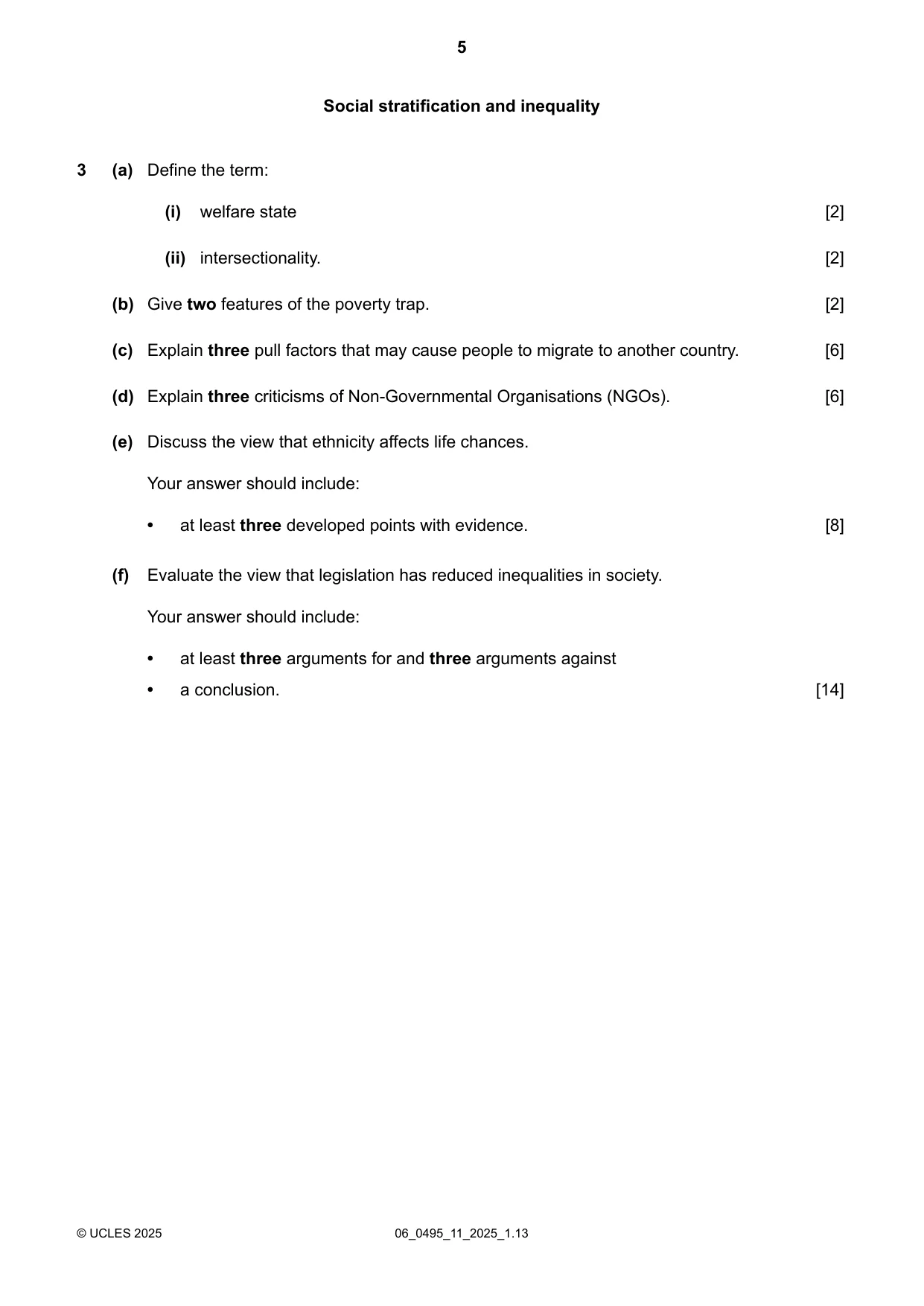
Social stratification and inequality Define the term: (a) 3 welfare state [2] (i) intersectionality. [2] (ii) Give two features of the poverty trap. [2] (b) Explain three pull factors that may cause people to migrate to another country. [6] (c) Explain three criticisms of Non-Governmental Organisations (NGOs). [6] (d) Discuss the view that ethnicity affects life chances. Your answer should include: (e) • at least three developed points with evidence. [8] Evaluate the view that legislation has reduced inequalities in society. Your answer should include: (f) • at least three arguments for and three arguments against • a conclusion. [14] 06_0495_11_2025_1.13 © UCLES 2025 5
Question paper, page 6
BLANK PAGE 06_0495_11_2025_1.13 © UCLES 2025 6
Question paper, page 7
BLANK PAGE 06_0495_11_2025_1.13 © UCLES 2025 7
Question paper, page 8
BLANK PAGE Permission to reproduce items where third-party owned material protected by copyright is included has been sought and cleared where possible. Every reasonable effort has been made by the publisher (UCLES) to trace copyright holders, but if any items requiring clearance have unwittingly been included, the publisher will be pleased to make amends at the earliest possible opportunity. To avoid the issue of disclosure of answer-related information to candidates, all copyright acknowledgements are reproduced online in the Cambridge Assessment International Education Copyright Acknowledgements Booklet. This is produced for each series of examinations and is freely available to download at www.cambridgeinternational.org after the live examination series. Cambridge Assessment International Education is part of Cambridge Assessment. Cambridge Assessment is the brand name of the University of Cambridge Local Examinations Syndicate (UCLES), which is a department of the University of Cambridge. 06_0495_11_2025_1.13 © UCLES 2025 8
Mark scheme, page 1
This document consists of 30 printed pages. © Cambridge University Press & Assessment 2025 [Turn over Cambridge IGCSE™ SOCIOLOGY 0495/11 Paper 1 Research Methods, Identity and Inequality May/June 2025 MARK SCHEME Maximum Mark: 80 Published This mark scheme is published as an aid to teachers and candidates, to indicate the requirements of the examination. It shows the basis on which Examiners were instructed to award marks. It does not indicate the details of the discussions that took place at an Examiners’ meeting before marking began, which would have considered the acceptability of alternative answers. Mark schemes should be read in conjunction with the question paper and the Principal Examiner Report for Teachers. Cambridge International will not enter into discussions about these mark schemes. Cambridge International is publishing the mark schemes for the May/June 2025 series for most Cambridge IGCSE, Cambridge International A and AS Level components, and some Cambridge O Level components.
Mark scheme, page 2
0495/11 Cambridge IGCSE – Mark Scheme PUBLISHED May/June 2025 © Cambridge University Press & Assessment 2025 Page 2 of 30 Generic Marking Principles These general marking principles must be applied by all examiners when marking candidate answers. They should be applied alongside the specific content of the mark scheme or generic level descriptions for a question. Each question paper and mark scheme will also comply with these marking principles. GENERIC MARKING PRINCIPLE 1: Marks must be awarded in line with: • the specific content of the mark scheme or the generic level descriptors for the question • the specific skills defined in the mark scheme or in the generic level descriptors for the question • the standard of response required by a candidate as exemplified by the standardisation scripts. GENERIC MARKING PRINCIPLE 2: Marks awarded are always whole marks (not half marks, or other fractions). GENERIC MARKING PRINCIPLE 3: Marks must be awarded positively: • marks are awarded for correct/valid answers, as defined in the mark scheme. However, credit is given for valid answers which go beyond the scope of the syllabus and mark scheme, referring to your Team Leader as appropriate • marks are awarded when candidates clearly demonstrate what they know and can do • marks are not deducted for errors • marks are not deducted for omissions • answers should only be judged on the quality of spelling, punctuation and grammar when these features are specifically assessed by the question as indicated by the mark scheme. The meaning, however, should be unambiguous. GENERIC MARKING PRINCIPLE 4: Rules must be applied consistently, e.g. in situations where candidates have not followed instructions or in the application of generic level descriptors. GENERIC MARKING PRINCIPLE 5: Marks should be awarded using the full range of marks defined in the mark scheme for the question (however; the use of the full mark range may be limited according to the quality of the candidate responses seen). GENERIC MARKING PRINCIPLE 6: Marks awarded are based solely on the requirements as defined in the mark scheme. Marks should not be awarded with grade thresholds or grade descriptors in mind.
Mark scheme, page 3
0495/11 Cambridge IGCSE – Mark Scheme PUBLISHED May/June 2025 © Cambridge University Press & Assessment 2025 Page 3 of 30 Social Science-Specific Marking Principles (for point-based marking) 1 Components using point-based marking: • Point marking is often used to reward knowledge, understanding and application of skills. We give credit where the candidate’s answer shows relevant knowledge, understanding and application of skills in answering the question. We do not give credit where the answer shows confusion. From this it follows that we: a DO credit answers which are worded differently from the mark scheme if they clearly convey the same meaning (unless the mark scheme requires a specific term) b DO credit alternative answers/examples which are not written in the mark scheme if they are correct c DO credit answers where candidates give more than one correct answer in one prompt/numbered/scaffolded space where extended writing is required rather than list-type answers. For example, questions that require n reasons (e.g. State two reasons …). d DO NOT credit answers simply for using a ‘key term’ unless that is all that is required. (Check for evidence it is understood and not used wrongly.) e DO NOT credit answers which are obviously self-contradicting or trying to cover all possibilities f DO NOT give further credit for what is effectively repetition of a correct point already credited unless the language itself is being tested. This applies equally to ‘mirror statements’ (i.e. polluted/not polluted). g DO NOT require spellings to be correct, unless this is part of the test. However spellings of syllabus terms must allow for clear and unambiguous separation from other syllabus terms with which they may be confused (e.g. Corrasion/Corrosion) 2 Presentation of mark scheme: • Slashes (/) or the word ‘or’ separate alternative ways of making the same point. • Semi colons (;) bullet points (•) or figures in brackets (1) separate different points. • Content in the answer column in brackets is for examiner information/context to clarify the marking but is not required to earn the mark (except Accounting syllabuses where they indicate negative numbers). 3 Calculation questions: • The mark scheme will show the steps in the most likely correct method(s), the mark for each step, the correct answer(s) and the mark for each answer • If working/explanation is considered essential for full credit, this will be indicated in the question paper and in the mark scheme. In all other instances, the correct answer to a calculation should be given full credit, even if no supporting working is shown. • Where the candidate uses a valid method which is not covered by the mark scheme, award equivalent marks for reaching equivalent stages. • Where an answer makes use of a candidate’s own incorrect figure from previous working, the ‘own figure rule’ applies: full marks will be given if a correct and complete method is used. Further guidance will be included in the mark scheme where necessary and any exceptions to this general principle will be noted.
Mark scheme, page 4
0495/11 Cambridge IGCSE – Mark Scheme PUBLISHED May/June 2025 © Cambridge University Press & Assessment 2025 Page 4 of 30 4 Annotation: • For point marking, ticks can be used to indicate correct answers and crosses can be used to indicate wrong answers. There is no direct relationship between ticks and marks. Ticks have no defined meaning for levels of response marking. • For levels of response marking, the level awarded should be annotated on the script. • Other annotations will be used by examiners as agreed during standardisation, and the meaning will be understood by all examiners who marked that paper.
Mark scheme, page 5
0495/11 Cambridge IGCSE – Mark Scheme PUBLISHED May/June 2025 © Cambridge University Press & Assessment 2025 Page 5 of 30 Annotations guidance for centres Examiners use a system of annotations as a shorthand for communicating their marking decisions to one another. Examiners are trained during the standardisation process on how and when to use annotations. The purpose of annotations is to inform the standardisation and monitoring processes and guide the supervising examiners when they are checking the work of examiners within their team. The meaning of annotations and how they are used is specific to each component and is understood by all examiners who mark the component. We publish annotations in our mark schemes to help centres understand the annotations they may see on copies of scripts. Note that there may not be a direct correlation between the number of annotations on a script and the mark awarded. Similarly, the use of an annotation may not be an indication of the quality of the response. The annotations listed below were available to examiners marking this component in this series.
Mark scheme, page 6
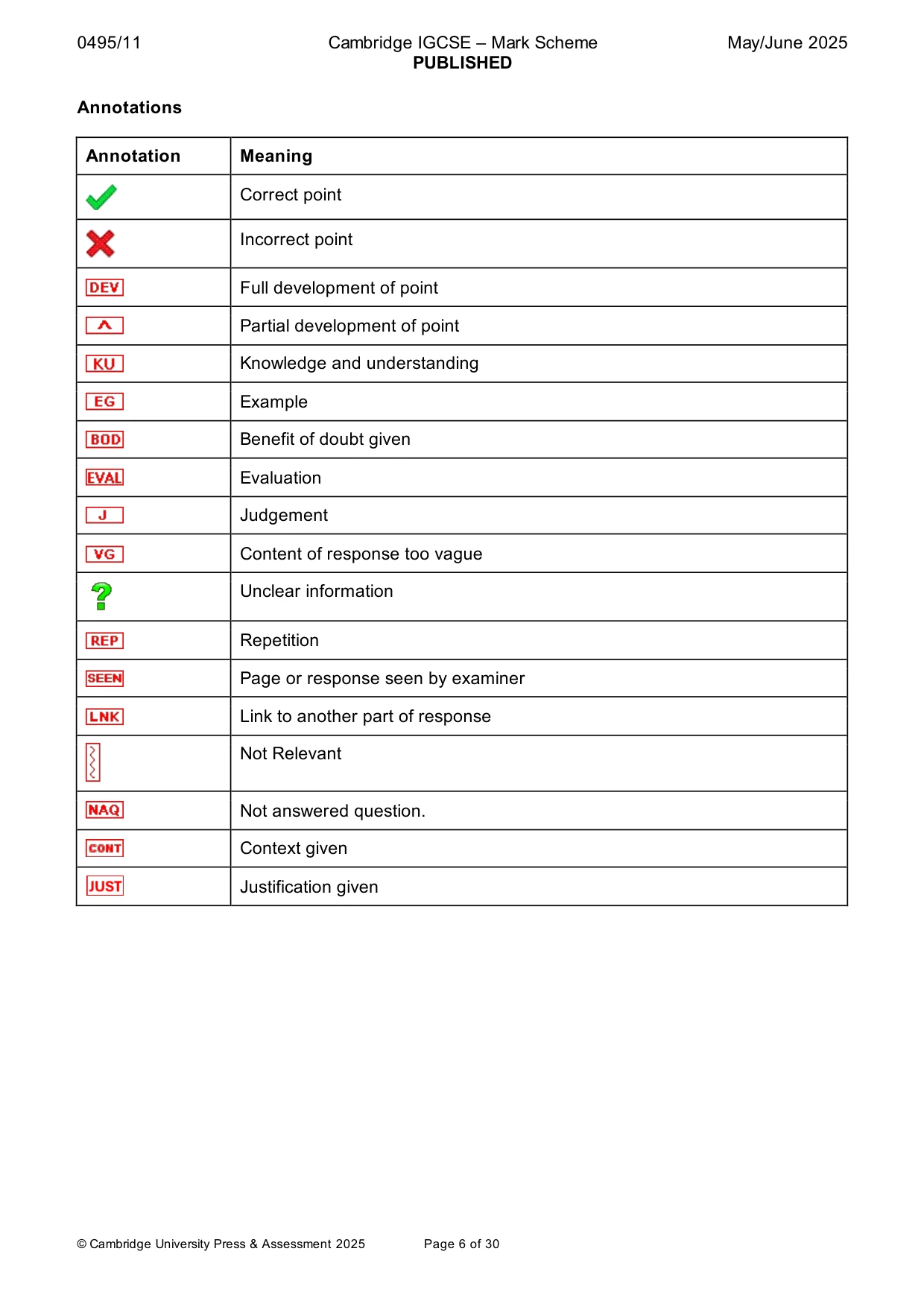
0495/11 Cambridge IGCSE – Mark Scheme PUBLISHED May/June 2025 © Cambridge University Press & Assessment 2025 Page 6 of 30 Annotations Annotation Meaning Correct point Incorrect point Full development of point Partial development of point Knowledge and understanding Example Benefit of doubt given Evaluation Judgement Content of response too vague Unclear information Repetition Page or response seen by examiner Link to another part of response Not Relevant Not answered question. Context given Justification given
Mark scheme, page 7
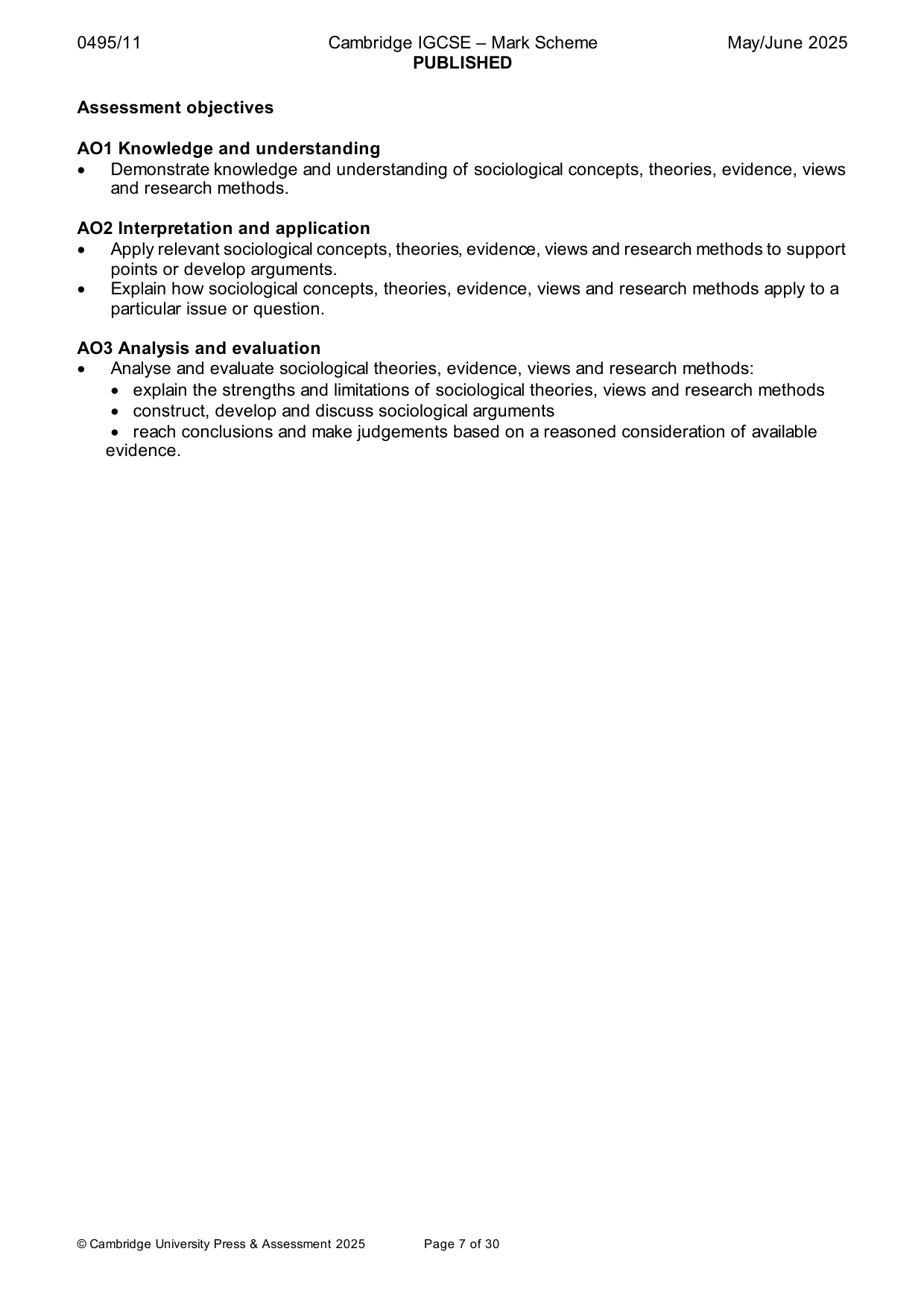
0495/11 Cambridge IGCSE – Mark Scheme PUBLISHED May/June 2025 © Cambridge University Press & Assessment 2025 Page 7 of 30 Assessment objectives AO1 Knowledge and understanding • Demonstrate knowledge and understanding of sociological concepts, theories, evidence, views and research methods. AO2 Interpretation and application • Apply relevant sociological concepts, theories, evidence, views and research methods to support points or develop arguments. • Explain how sociological concepts, theories, evidence, views and research methods apply to a particular issue or question. AO3 Analysis and evaluation • Analyse and evaluate sociological theories, evidence, views and research methods: • explain the strengths and limitations of sociological theories, views and research methods • construct, develop and discuss sociological arguments • reach conclusions and make judgements based on a reasoned consideration of available evidence.
Mark scheme, page 8
0495/11 Cambridge IGCSE – Mark Scheme PUBLISHED May/June 2025 © Cambridge University Press & Assessment 2025 Page 8 of 30 Generic levels of response grids Using the mark levels For all questions except Q1(e), please use the instructions below. Use the generic mark scheme levels to find the mark. Place the answer in a level first. Look for the ‘best fit’ of the answer into a level. Consider the levels above and below to ensure you have selected the right one. An answer needs to show evidence of most but not necessarily ALL of the qualities described in a level, in order to be placed in that level. Award a mark for the relative position of the answer within the level. Candidates may address the question in many different ways; there is no one required answer or approach. Do not penalise answers for leaving out a particular focus. Reward what is there rather than what is missing. For Q1(e), there are separate instructions for marking using Table B, which does not use a best fit approach to a levels of response grid.
Mark scheme, page 9
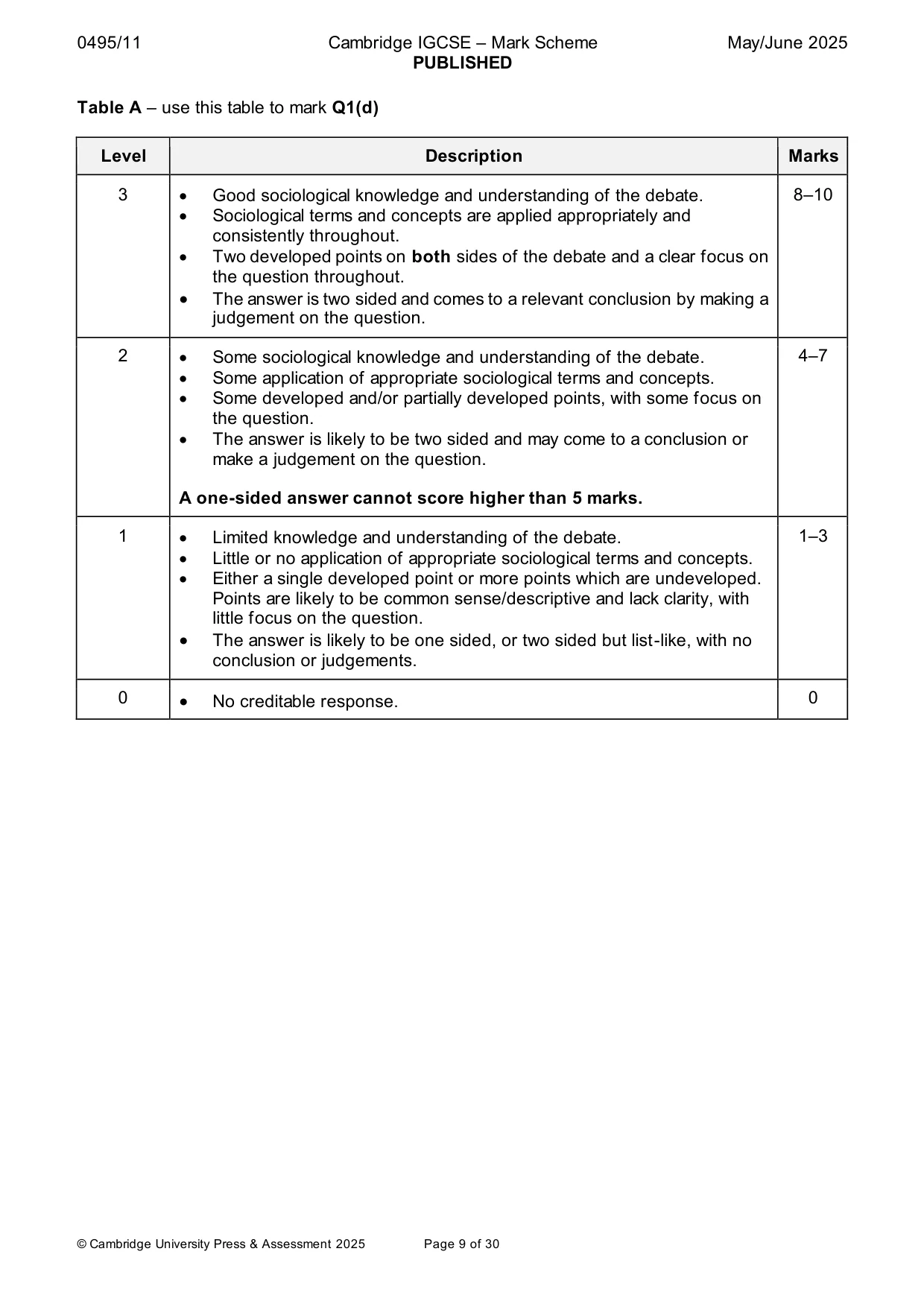
0495/11 Cambridge IGCSE – Mark Scheme PUBLISHED May/June 2025 © Cambridge University Press & Assessment 2025 Page 9 of 30 Table A – use this table to mark Q1(d) Level Description Marks 3 • Good sociological knowledge and understanding of the debate. • Sociological terms and concepts are applied appropriately and consistently throughout. • Two developed points on both sides of the debate and a clear focus on the question throughout. • The answer is two sided and comes to a relevant conclusion by making a judgement on the question. 8–10 2 • Some sociological knowledge and understanding of the debate. • Some application of appropriate sociological terms and concepts. • Some developed and/or partially developed points, with some focus on the question. • The answer is likely to be two sided and may come to a conclusion or make a judgement on the question. A one-sided answer cannot score higher than 5 marks. 4–7 1 • Limited knowledge and understanding of the debate. • Little or no application of appropriate sociological terms and concepts. • Either a single developed point or more points which are undeveloped. Points are likely to be common sense/descriptive and lack clarity, with little focus on the question. • The answer is likely to be one sided, or two sided but list-like, with no conclusion or judgements. 1–3 0 • No creditable response. 0
Mark scheme, page 10
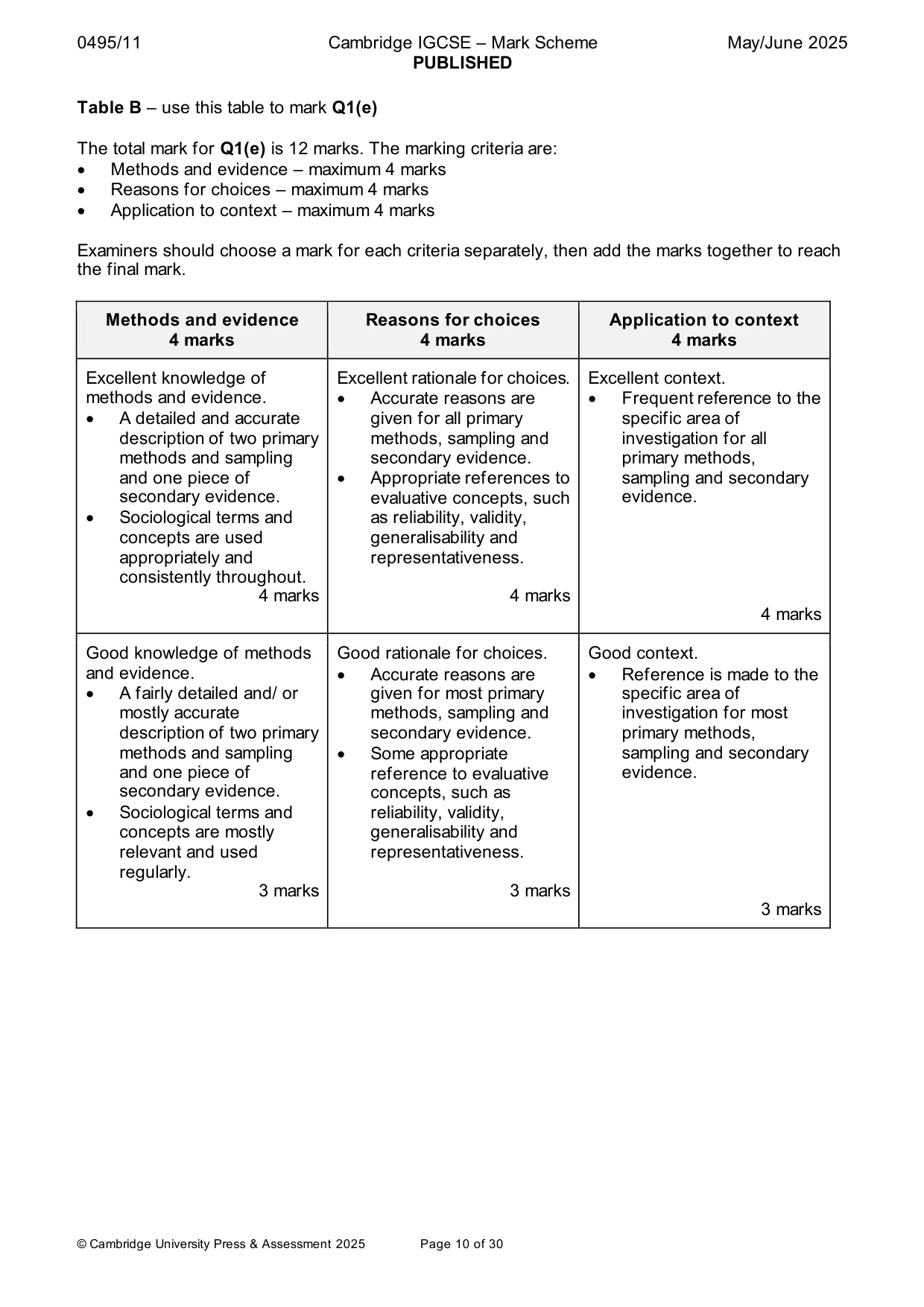
0495/11 Cambridge IGCSE – Mark Scheme PUBLISHED May/June 2025 © Cambridge University Press & Assessment 2025 Page 10 of 30 Table B – use this table to mark Q1(e) The total mark for Q1(e) is 12 marks. The marking criteria are: • Methods and evidence – maximum 4 marks • Reasons for choices – maximum 4 marks • Application to context – maximum 4 marks Examiners should choose a mark for each criteria separately, then add the marks together to reach the final mark. Methods and evidence 4 marks Reasons for choices 4 marks Application to context 4 marks Excellent knowledge of methods and evidence. • A detailed and accurate description of two primary methods and sampling and one piece of secondary evidence. • Sociological terms and concepts are used appropriately and consistently throughout. 4 marks Excellent rationale for choices. • Accurate reasons are given for all primary methods, sampling and secondary evidence. • Appropriate references to evaluative concepts, such as reliability, validity, generalisability and representativeness. 4 marks Excellent context. • Frequent reference to the specific area of investigation for all primary methods, sampling and secondary evidence. 4 marks Good knowledge of methods and evidence. • A fairly detailed and/ or mostly accurate description of two primary methods and sampling and one piece of secondary evidence. • Sociological terms and concepts are mostly relevant and used regularly. 3 marks Good rationale for choices. • Accurate reasons are given for most primary methods, sampling and secondary evidence. • Some appropriate reference to evaluative concepts, such as reliability, validity, generalisability and representativeness. 3 marks Good context. • Reference is made to the specific area of investigation for most primary methods, sampling and secondary evidence. 3 marks
Mark scheme, page 11
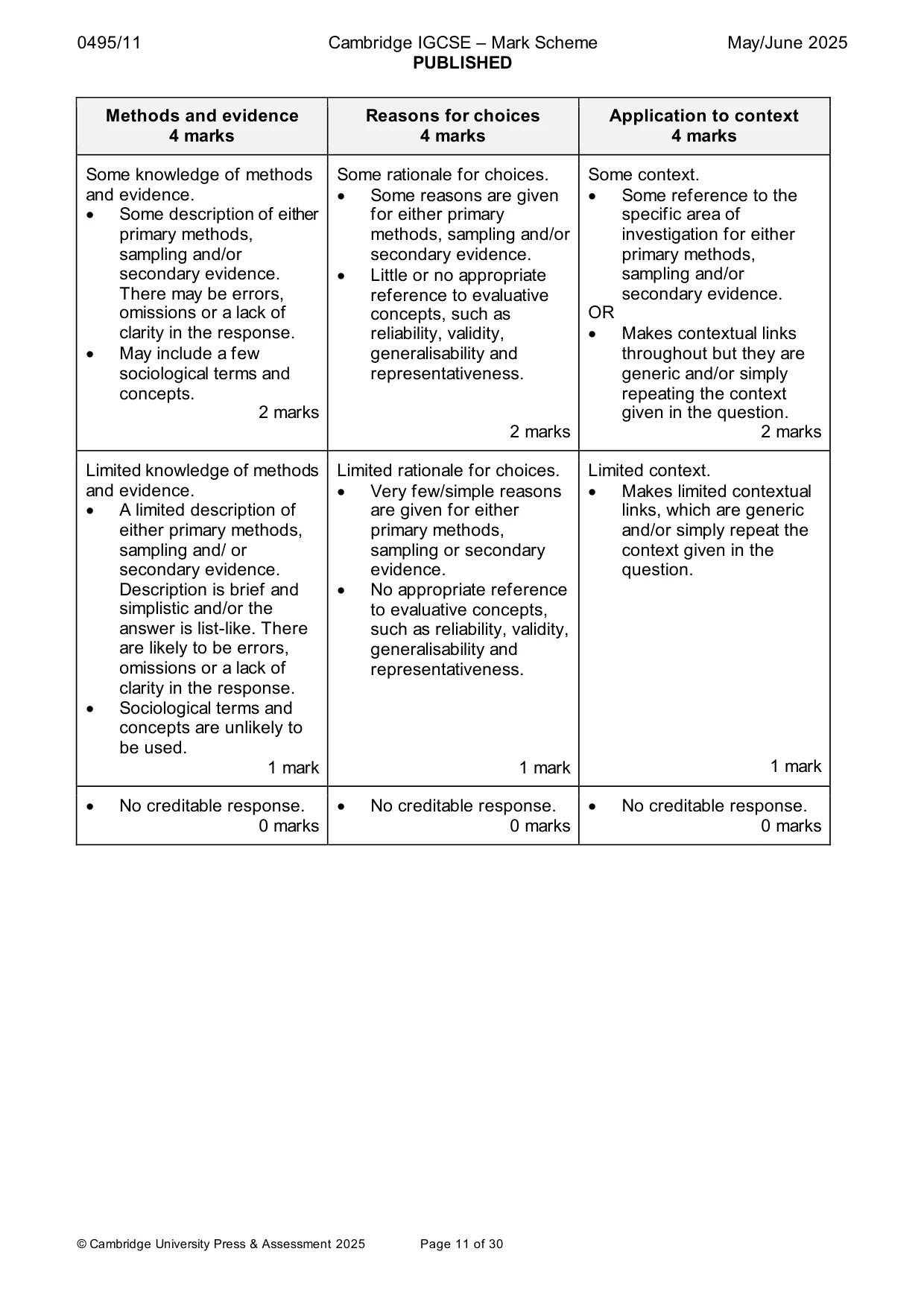
0495/11 Cambridge IGCSE – Mark Scheme PUBLISHED May/June 2025 © Cambridge University Press & Assessment 2025 Page 11 of 30 Methods and evidence 4 marks Reasons for choices 4 marks Application to context 4 marks Some knowledge of methods and evidence. • Some description of either primary methods, sampling and/or secondary evidence. There may be errors, omissions or a lack of clarity in the response. • May include a few sociological terms and concepts. 2 marks Some rationale for choices. • Some reasons are given for either primary methods, sampling and/or secondary evidence. • Little or no appropriate reference to evaluative concepts, such as reliability, validity, generalisability and representativeness. 2 marks Some context. • Some reference to the specific area of investigation for either primary methods, sampling and/or secondary evidence. OR • Makes contextual links throughout but they are generic and/or simply repeating the context given in the question. 2 marks Limited knowledge of methods and evidence. • A limited description of either primary methods, sampling and/ or secondary evidence. Description is brief and simplistic and/or the answer is list-like. There are likely to be errors, omissions or a lack of clarity in the response. • Sociological terms and concepts are unlikely to be used. 1 mark Limited rationale for choices. • Very few/simple reasons are given for either primary methods, sampling or secondary evidence. • No appropriate reference to evaluative concepts, such as reliability, validity, generalisability and representativeness. 1 mark Limited context. • Makes limited contextual links, which are generic and/or simply repeat the context given in the question. 1 mark • No creditable response. 0 marks • No creditable response. 0 marks • No creditable response. 0 marks
Mark scheme, page 12
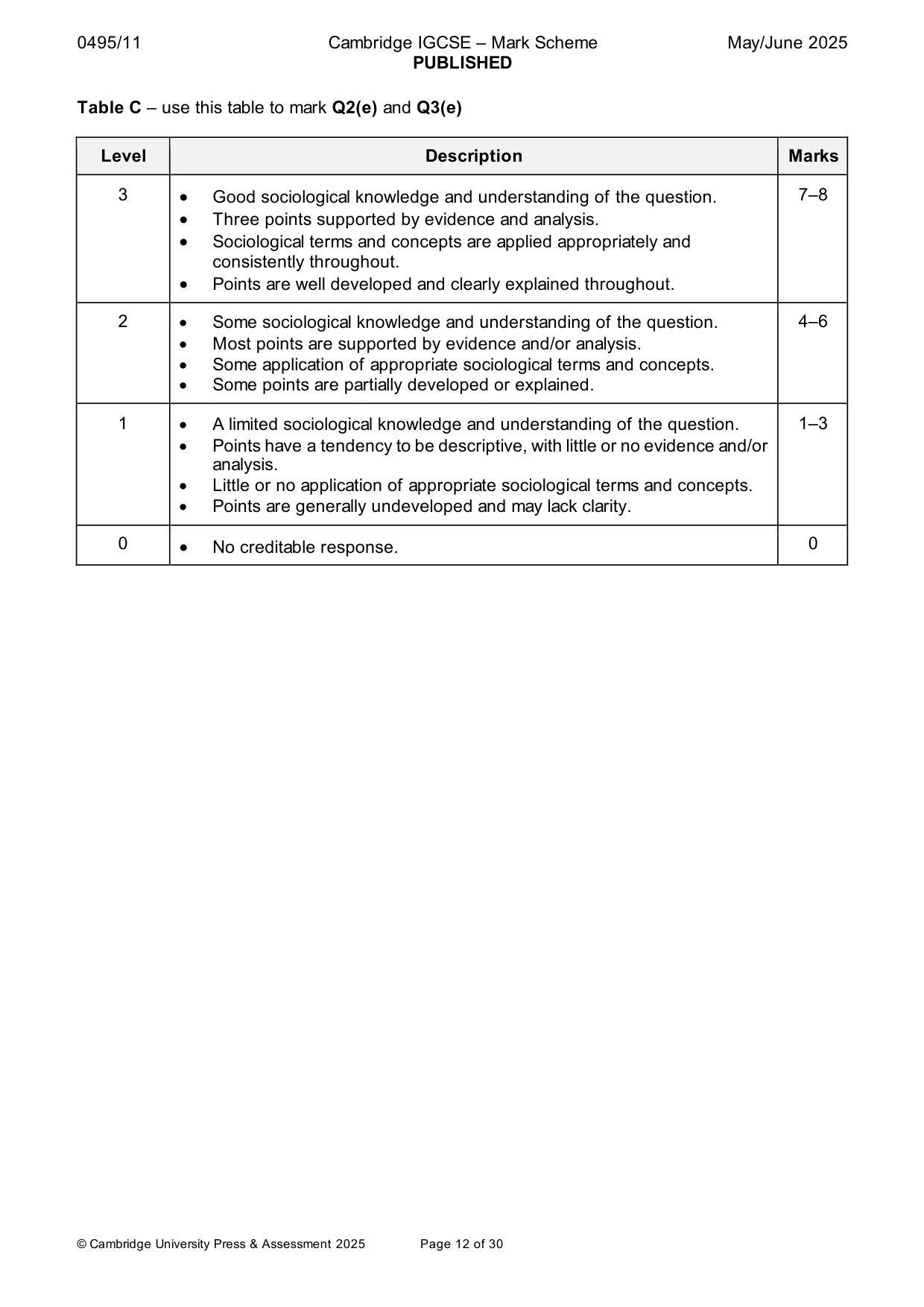
0495/11 Cambridge IGCSE – Mark Scheme PUBLISHED May/June 2025 © Cambridge University Press & Assessment 2025 Page 12 of 30 Table C – use this table to mark Q2(e) and Q3(e) Level Description Marks 3 • Good sociological knowledge and understanding of the question. • Three points supported by evidence and analysis. • Sociological terms and concepts are applied appropriately and consistently throughout. • Points are well developed and clearly explained throughout. 7–8 2 • Some sociological knowledge and understanding of the question. • Most points are supported by evidence and/or analysis. • Some application of appropriate sociological terms and concepts. • Some points are partially developed or explained. 4–6 1 • A limited sociological knowledge and understanding of the question. • Points have a tendency to be descriptive, with little or no evidence and/or analysis. • Little or no application of appropriate sociological terms and concepts. • Points are generally undeveloped and may lack clarity. 1–3 0 • No creditable response. 0
Mark scheme, page 13
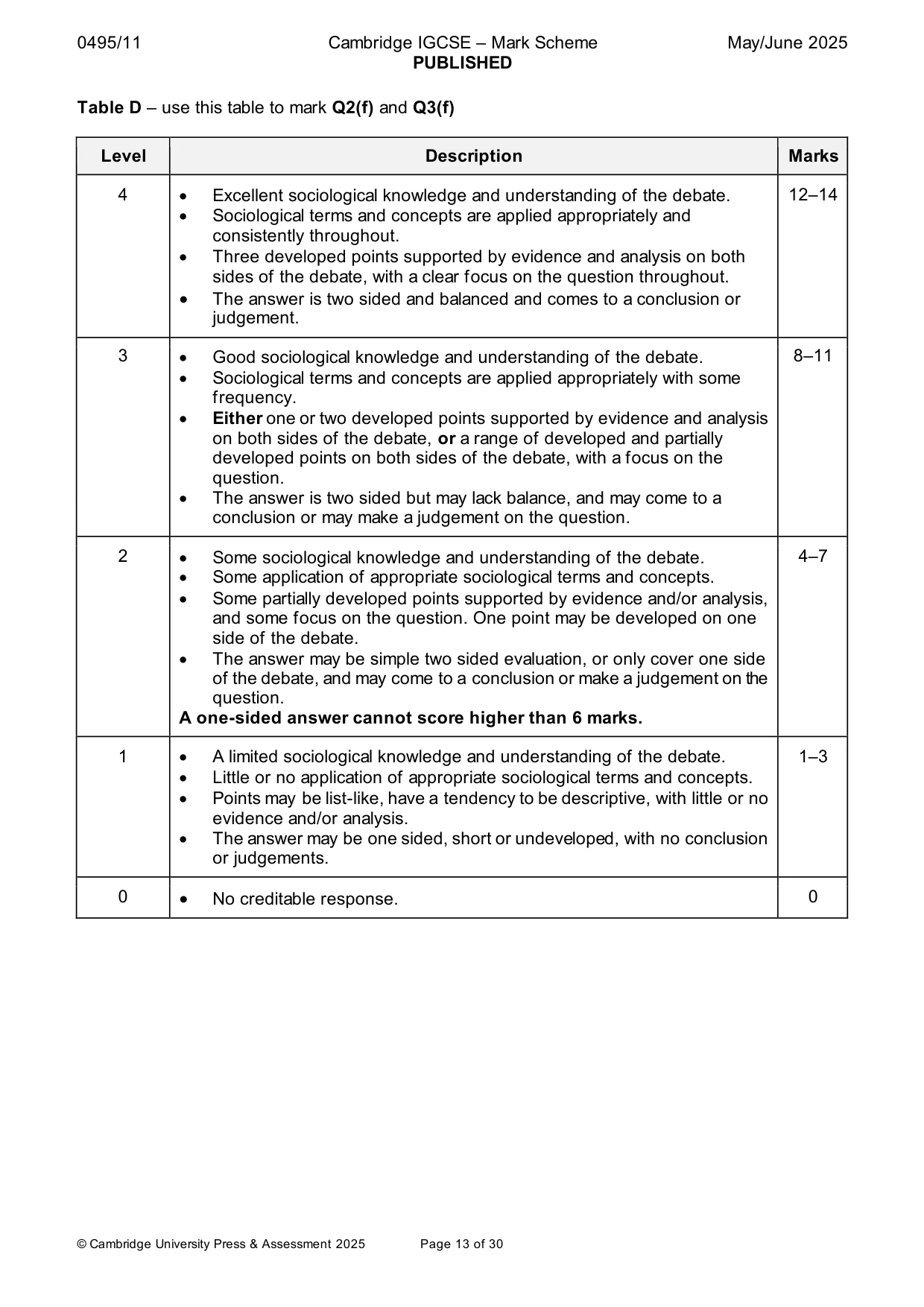
0495/11 Cambridge IGCSE – Mark Scheme PUBLISHED May/June 2025 © Cambridge University Press & Assessment 2025 Page 13 of 30 Table D – use this table to mark Q2(f) and Q3(f) Level Description Marks 4 • Excellent sociological knowledge and understanding of the debate. • Sociological terms and concepts are applied appropriately and consistently throughout. • Three developed points supported by evidence and analysis on both sides of the debate, with a clear focus on the question throughout. • The answer is two sided and balanced and comes to a conclusion or judgement. 12–14 3 • Good sociological knowledge and understanding of the debate. • Sociological terms and concepts are applied appropriately with some frequency. • Either one or two developed points supported by evidence and analysis on both sides of the debate, or a range of developed and partially developed points on both sides of the debate, with a focus on the question. • The answer is two sided but may lack balance, and may come to a conclusion or may make a judgement on the question. 8–11 2 • Some sociological knowledge and understanding of the debate. • Some application of appropriate sociological terms and concepts. • Some partially developed points supported by evidence and/or analysis, and some focus on the question. One point may be developed on one side of the debate. • The answer may be simple two sided evaluation, or only cover one side of the debate, and may come to a conclusion or make a judgement on the question. A one-sided answer cannot score higher than 6 marks. 4–7 1 • A limited sociological knowledge and understanding of the debate. • Little or no application of appropriate sociological terms and concepts. • Points may be list-like, have a tendency to be descriptive, with little or no evidence and/or analysis. • The answer may be one sided, short or undeveloped, with no conclusion or judgements. 1–3 0 • No creditable response. 0
Mark scheme, page 14
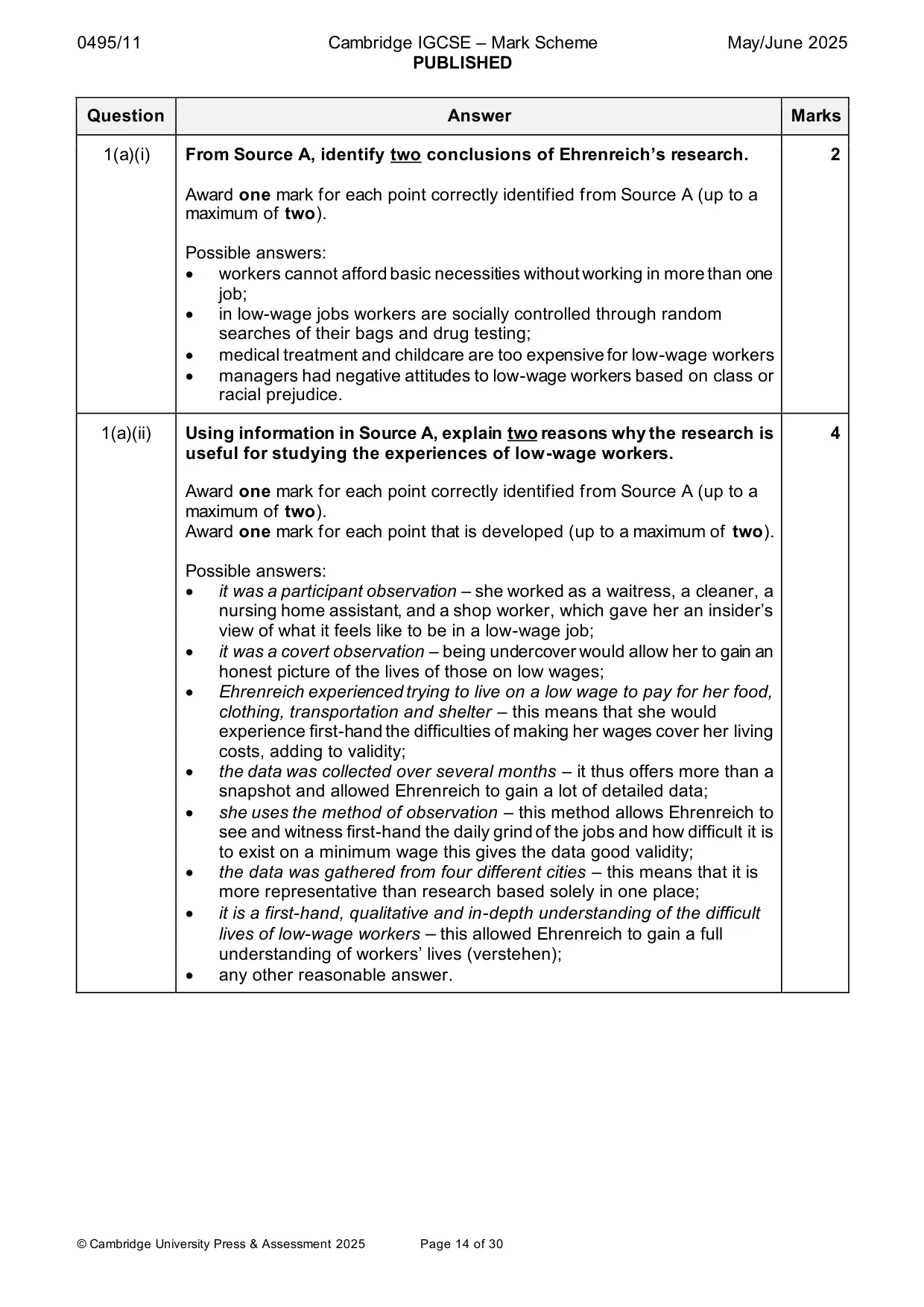
0495/11 Cambridge IGCSE – Mark Scheme PUBLISHED May/June 2025 © Cambridge University Press & Assessment 2025 Page 14 of 30 Question Answer Marks 1(a)(i) From Source A, identify two conclusions of Ehrenreich’s research. Award one mark for each point correctly identified from Source A (up to a maximum of two). Possible answers: • workers cannot afford basic necessities without working in more than one job; • in low-wage jobs workers are socially controlled through random searches of their bags and drug testing; • medical treatment and childcare are too expensive for low-wage workers • managers had negative attitudes to low-wage workers based on class or racial prejudice. 2 1(a)(ii) Using information in Source A, explain two reasons why the research is useful for studying the experiences of low-wage workers. Award one mark for each point correctly identified from Source A (up to a maximum of two). Award one mark for each point that is developed (up to a maximum of two). Possible answers: • it was a participant observation – she worked as a waitress, a cleaner, a nursing home assistant, and a shop worker, which gave her an insider’s view of what it feels like to be in a low-wage job; • it was a covert observation – being undercover would allow her to gain an honest picture of the lives of those on low wages; • Ehrenreich experienced trying to live on a low wage to pay for her food, clothing, transportation and shelter – this means that she would experience first-hand the difficulties of making her wages cover her living costs, adding to validity; • the data was collected over several months – it thus offers more than a snapshot and allowed Ehrenreich to gain a lot of detailed data; • she uses the method of observation – this method allows Ehrenreich to see and witness first-hand the daily grind of the jobs and how difficult it is to exist on a minimum wage this gives the data good validity; • the data was gathered from four different cities – this means that it is more representative than research based solely in one place; • it is a first-hand, qualitative and in-depth understanding of the difficult lives of low-wage workers – this allowed Ehrenreich to gain a full understanding of workers’ lives (verstehen); • any other reasonable answer. 4
Mark scheme, page 15
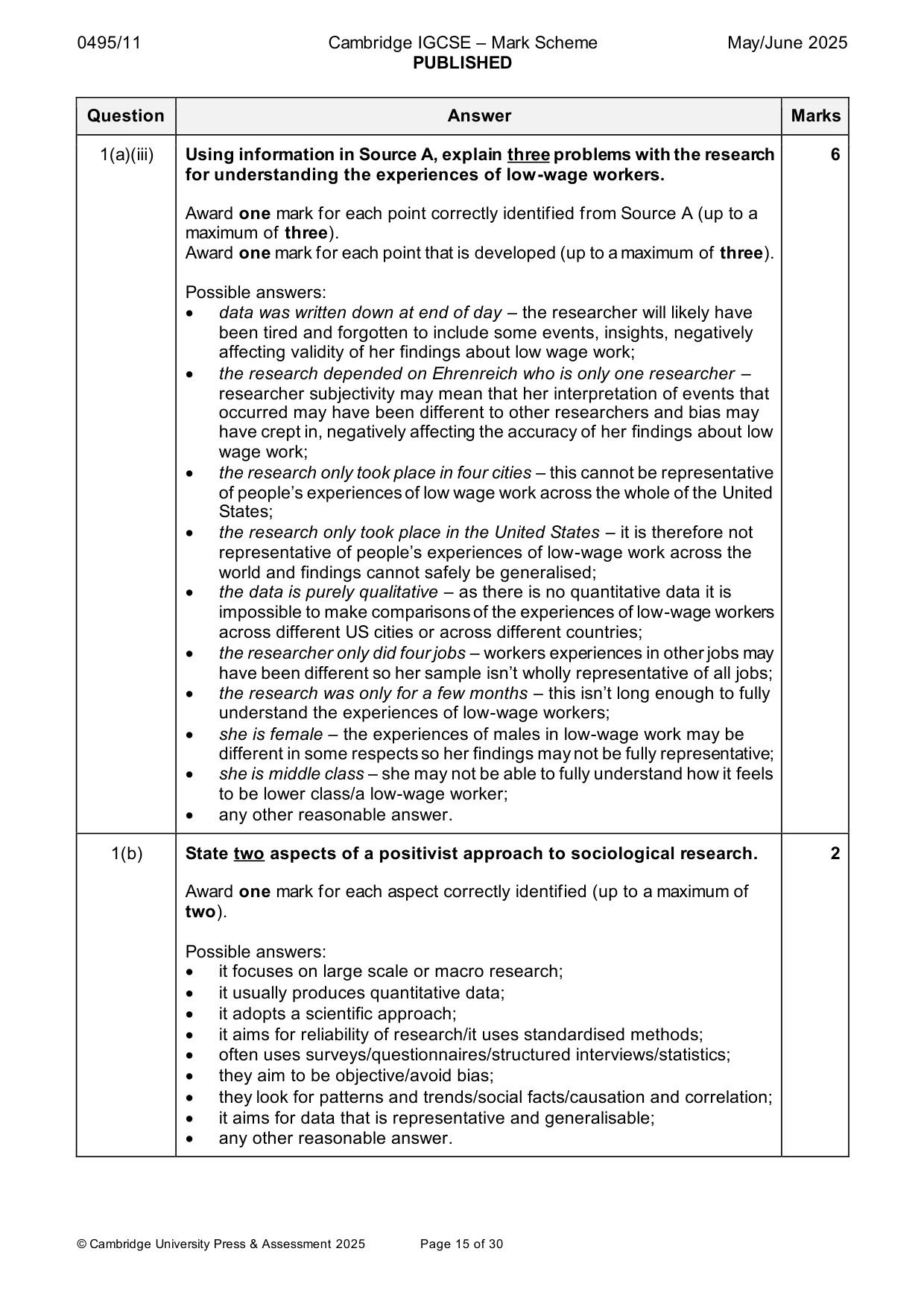
0495/11 Cambridge IGCSE – Mark Scheme PUBLISHED May/June 2025 © Cambridge University Press & Assessment 2025 Page 15 of 30 Question Answer Marks 1(a)(iii) Using information in Source A, explain three problems with the research for understanding the experiences of low-wage workers. Award one mark for each point correctly identified from Source A (up to a maximum of three). Award one mark for each point that is developed (up to a maximum of three). Possible answers: • data was written down at end of day – the researcher will likely have been tired and forgotten to include some events, insights, negatively affecting validity of her findings about low wage work; • the research depended on Ehrenreich who is only one researcher – researcher subjectivity may mean that her interpretation of events that occurred may have been different to other researchers and bias may have crept in, negatively affecting the accuracy of her findings about low wage work; • the research only took place in four cities – this cannot be representative of people’s experiences of low wage work across the whole of the United States; • the research only took place in the United States – it is therefore not representative of people’s experiences of low-wage work across the world and findings cannot safely be generalised; • the data is purely qualitative – as there is no quantitative data it is impossible to make comparisons of the experiences of low-wage workers across different US cities or across different countries; • the researcher only did four jobs – workers experiences in other jobs may have been different so her sample isn’t wholly representative of all jobs; • the research was only for a few months – this isn’t long enough to fully understand the experiences of low-wage workers; • she is female – the experiences of males in low-wage work may be different in some respects so her findings may not be fully representative; • she is middle class – she may not be able to fully understand how it feels to be lower class/a low-wage worker; • any other reasonable answer. 6 1(b) State two aspects of a positivist approach to sociological research. Award one mark for each aspect correctly identified (up to a maximum of two). Possible answers: • it focuses on large scale or macro research; • it usually produces quantitative data; • it adopts a scientific approach; • it aims for reliability of research/it uses standardised methods; • often uses surveys/questionnaires/structured interviews/statistics; • they aim to be objective/avoid bias; • they look for patterns and trends/social facts/causation and correlation; • it aims for data that is representative and generalisable; • any other reasonable answer. 2
Mark scheme, page 16
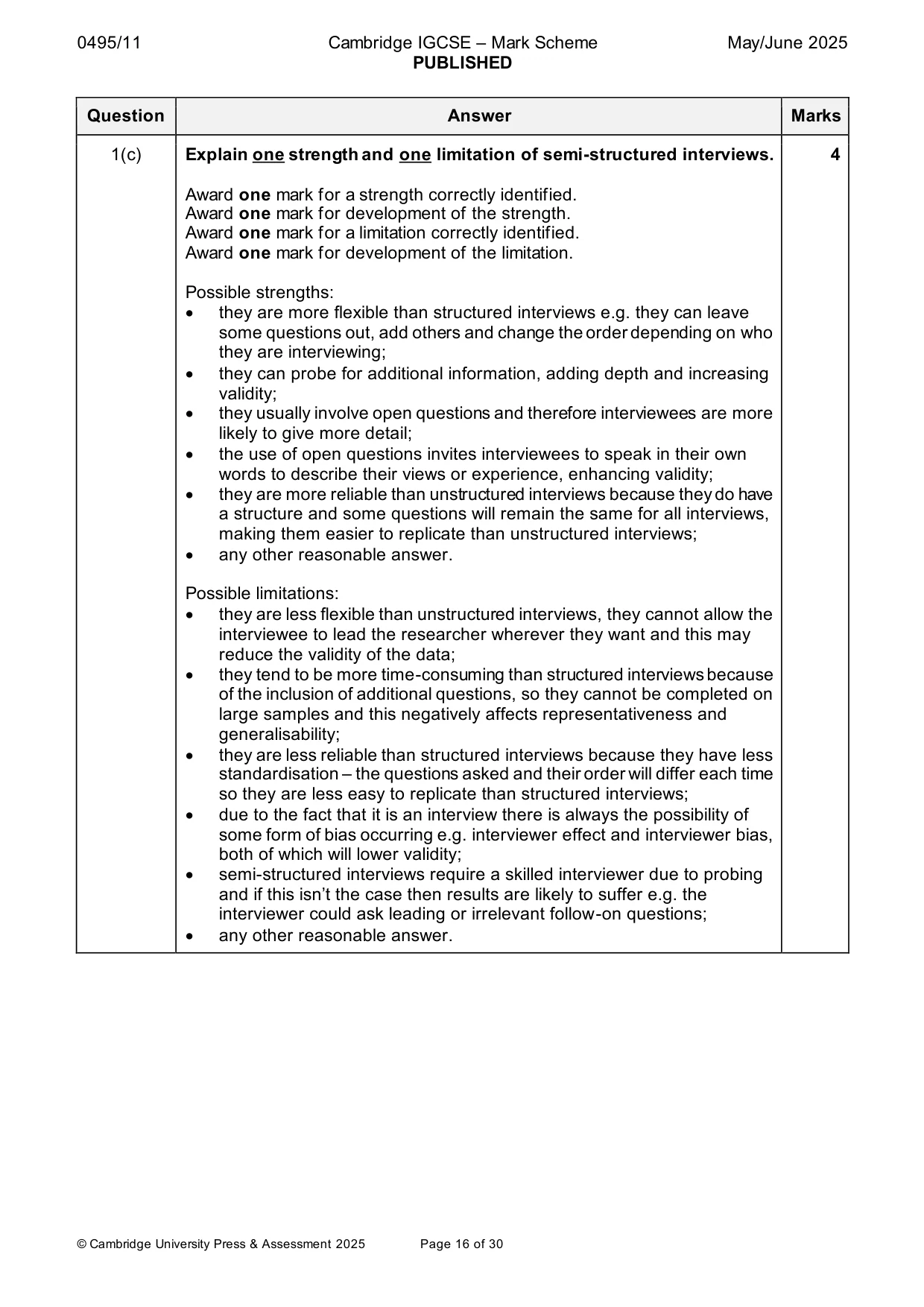
0495/11 Cambridge IGCSE – Mark Scheme PUBLISHED May/June 2025 © Cambridge University Press & Assessment 2025 Page 16 of 30 Question Answer Marks 1(c) Explain one strength and one limitation of semi-structured interviews. Award one mark for a strength correctly identified. Award one mark for development of the strength. Award one mark for a limitation correctly identified. Award one mark for development of the limitation. Possible strengths: • they are more flexible than structured interviews e.g. they can leave some questions out, add others and change the order depending on who they are interviewing; • they can probe for additional information, adding depth and increasing validity; • they usually involve open questions and therefore interviewees are more likely to give more detail; • the use of open questions invites interviewees to speak in their own words to describe their views or experience, enhancing validity; • they are more reliable than unstructured interviews because they do have a structure and some questions will remain the same for all interviews, making them easier to replicate than unstructured interviews; • any other reasonable answer. Possible limitations: • they are less flexible than unstructured interviews, they cannot allow the interviewee to lead the researcher wherever they want and this may reduce the validity of the data; • they tend to be more time-consuming than structured interviews because of the inclusion of additional questions, so they cannot be completed on large samples and this negatively affects representativeness and generalisability; • they are less reliable than structured interviews because they have less standardisation – the questions asked and their order will differ each time so they are less easy to replicate than structured interviews; • due to the fact that it is an interview there is always the possibility of some form of bias occurring e.g. interviewer effect and interviewer bias, both of which will lower validity; • semi-structured interviews require a skilled interviewer due to probing and if this isn’t the case then results are likely to suffer e.g. the interviewer could ask leading or irrelevant follow-on questions; • any other reasonable answer. 4
Mark scheme, page 17
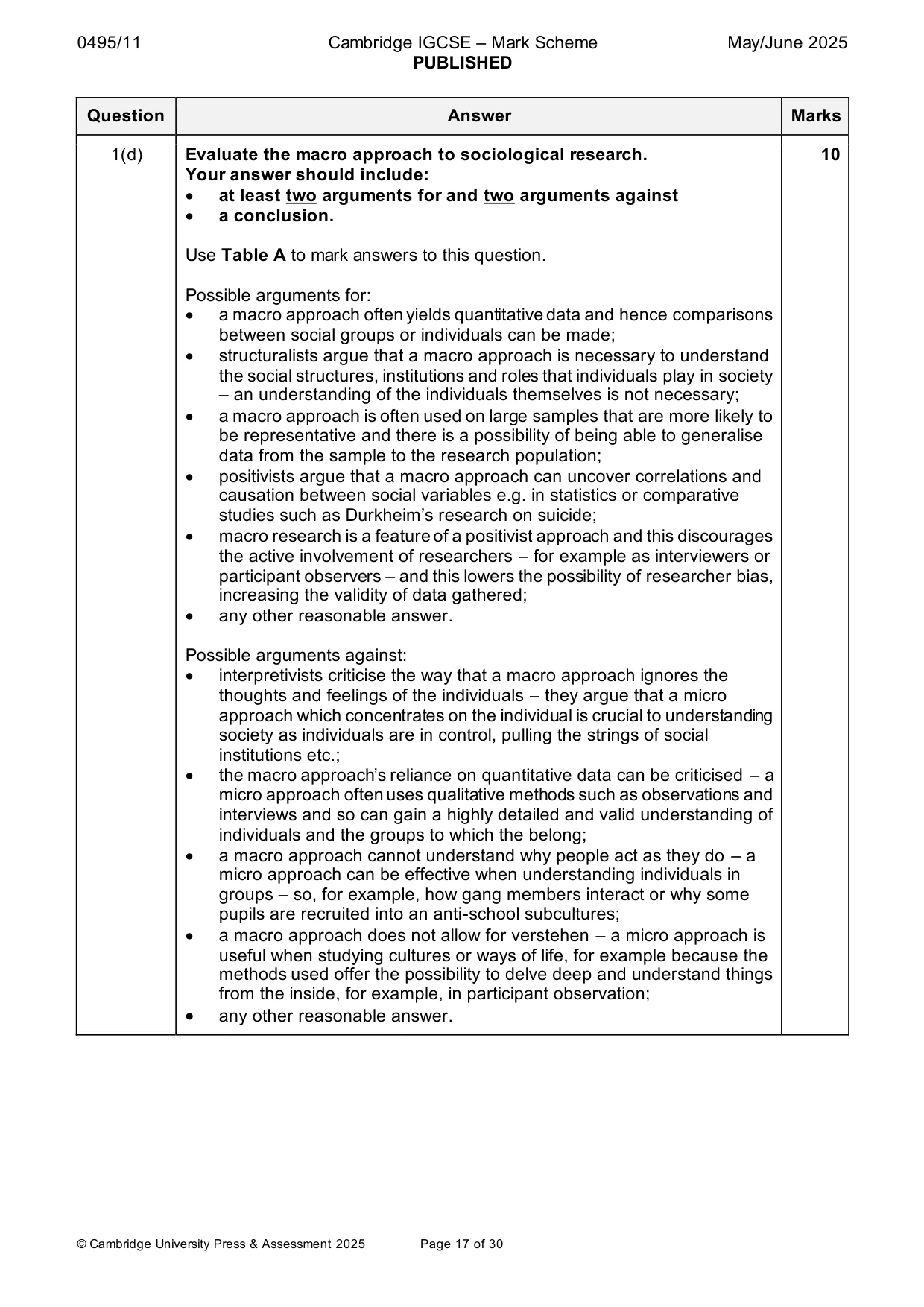
0495/11 Cambridge IGCSE – Mark Scheme PUBLISHED May/June 2025 © Cambridge University Press & Assessment 2025 Page 17 of 30 Question Answer Marks 1(d) Evaluate the macro approach to sociological research. Your answer should include: • at least two arguments for and two arguments against • a conclusion. Use Table A to mark answers to this question. Possible arguments for: • a macro approach often yields quantitative data and hence comparisons between social groups or individuals can be made; • structuralists argue that a macro approach is necessary to understand the social structures, institutions and roles that individuals play in society – an understanding of the individuals themselves is not necessary; • a macro approach is often used on large samples that are more likely to be representative and there is a possibility of being able to generalise data from the sample to the research population; • positivists argue that a macro approach can uncover correlations and causation between social variables e.g. in statistics or comparative studies such as Durkheim’s research on suicide; • macro research is a feature of a positivist approach and this discourages the active involvement of researchers – for example as interviewers or participant observers – and this lowers the possibility of researcher bias, increasing the validity of data gathered; • any other reasonable answer. Possible arguments against: • interpretivists criticise the way that a macro approach ignores the thoughts and feelings of the individuals – they argue that a micro approach which concentrates on the individual is crucial to understanding society as individuals are in control, pulling the strings of social institutions etc.; • the macro approach’s reliance on quantitative data can be criticised – a micro approach often uses qualitative methods such as observations and interviews and so can gain a highly detailed and valid understanding of individuals and the groups to which the belong; • a macro approach cannot understand why people act as they do – a micro approach can be effective when understanding individuals in groups – so, for example, how gang members interact or why some pupils are recruited into an anti-school subcultures; • a macro approach does not allow for verstehen – a micro approach is useful when studying cultures or ways of life, for example because the methods used offer the possibility to delve deep and understand things from the inside, for example, in participant observation; • any other reasonable answer. 10
Mark scheme, page 18
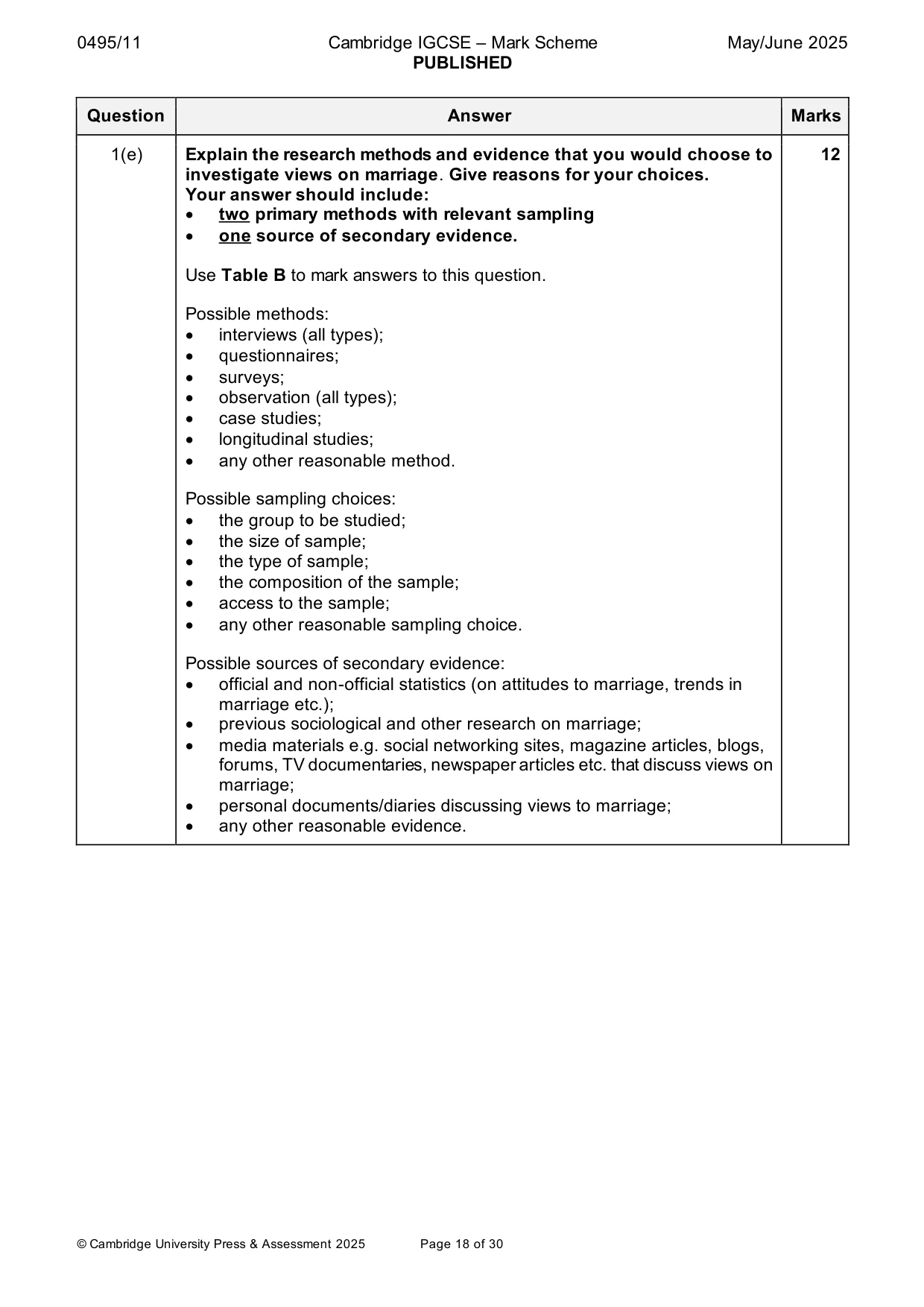
0495/11 Cambridge IGCSE – Mark Scheme PUBLISHED May/June 2025 © Cambridge University Press & Assessment 2025 Page 18 of 30 Question Answer Marks 1(e) Explain the research methods and evidence that you would choose to investigate views on marriage. Give reasons for your choices. Your answer should include: • two primary methods with relevant sampling • one source of secondary evidence. Use Table B to mark answers to this question. Possible methods: • interviews (all types); • questionnaires; • surveys; • observation (all types); • case studies; • longitudinal studies; • any other reasonable method. Possible sampling choices: • the group to be studied; • the size of sample; • the type of sample; • the composition of the sample; • access to the sample; • any other reasonable sampling choice. Possible sources of secondary evidence: • official and non-official statistics (on attitudes to marriage, trends in marriage etc.); • previous sociological and other research on marriage; • media materials e.g. social networking sites, magazine articles, blogs, forums, TV documentaries, newspaper articles etc. that discuss views on marriage; • personal documents/diaries discussing views to marriage; • any other reasonable evidence. 12
Mark scheme, page 19
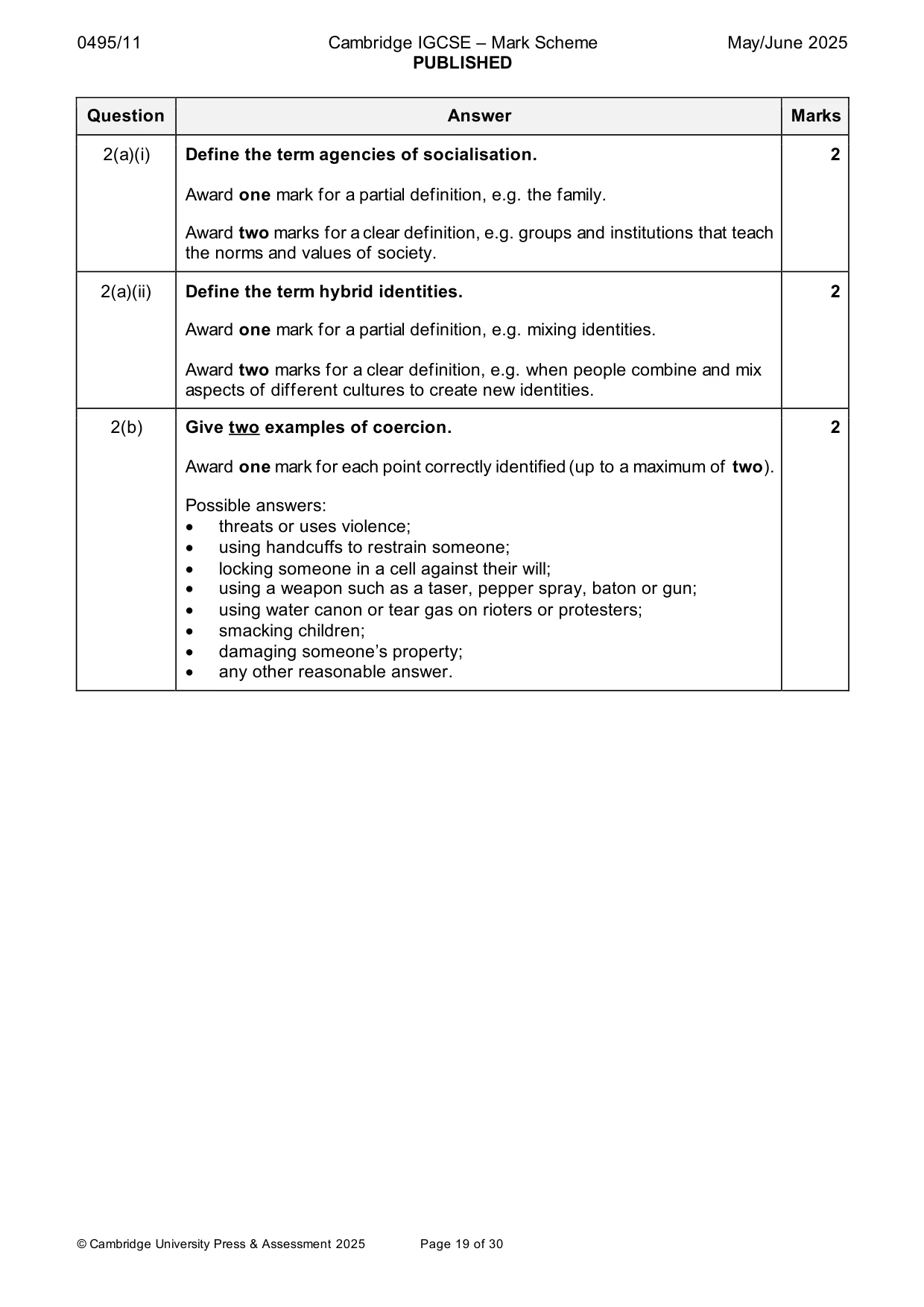
0495/11 Cambridge IGCSE – Mark Scheme PUBLISHED May/June 2025 © Cambridge University Press & Assessment 2025 Page 19 of 30 Question Answer Marks 2(a)(i) Define the term agencies of socialisation. Award one mark for a partial definition, e.g. the family. Award two marks for a clear definition, e.g. groups and institutions that teach the norms and values of society. 2 2(a)(ii) Define the term hybrid identities. Award one mark for a partial definition, e.g. mixing identities. Award two marks for a clear definition, e.g. when people combine and mix aspects of different cultures to create new identities. 2 2(b) Give two examples of coercion. Award one mark for each point correctly identified (up to a maximum of two). Possible answers: • threats or uses violence; • using handcuffs to restrain someone; • locking someone in a cell against their will; • using a weapon such as a taser, pepper spray, baton or gun; • using water canon or tear gas on rioters or protesters; • smacking children; • damaging someone’s property; • any other reasonable answer. 2
Mark scheme, page 20
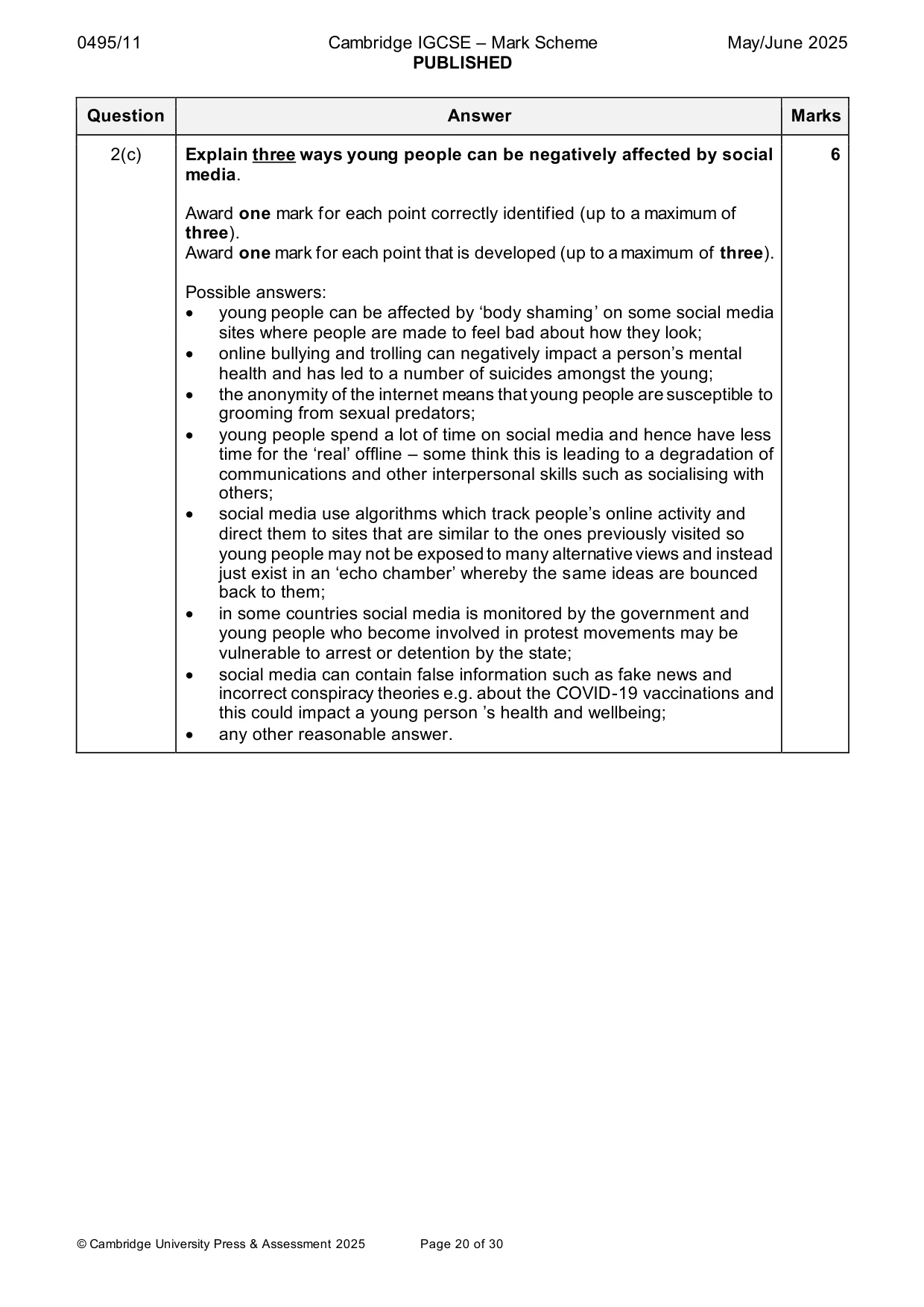
0495/11 Cambridge IGCSE – Mark Scheme PUBLISHED May/June 2025 © Cambridge University Press & Assessment 2025 Page 20 of 30 Question Answer Marks 2(c) Explain three ways young people can be negatively affected by social media. Award one mark for each point correctly identified (up to a maximum of three). Award one mark for each point that is developed (up to a maximum of three). Possible answers: • young people can be affected by ‘body shaming’ on some social media sites where people are made to feel bad about how they look; • online bullying and trolling can negatively impact a person’s mental health and has led to a number of suicides amongst the young; • the anonymity of the internet means that young people are susceptible to grooming from sexual predators; • young people spend a lot of time on social media and hence have less time for the ‘real’ offline – some think this is leading to a degradation of communications and other interpersonal skills such as socialising with others; • social media use algorithms which track people’s online activity and direct them to sites that are similar to the ones previously visited so young people may not be exposed to many alternative views and instead just exist in an ‘echo chamber’ whereby the same ideas are bounced back to them; • in some countries social media is monitored by the government and young people who become involved in protest movements may be vulnerable to arrest or detention by the state; • social media can contain false information such as fake news and incorrect conspiracy theories e.g. about the COVID-19 vaccinations and this could impact a young person ’s health and wellbeing; • any other reasonable answer. 6
Mark scheme, page 21
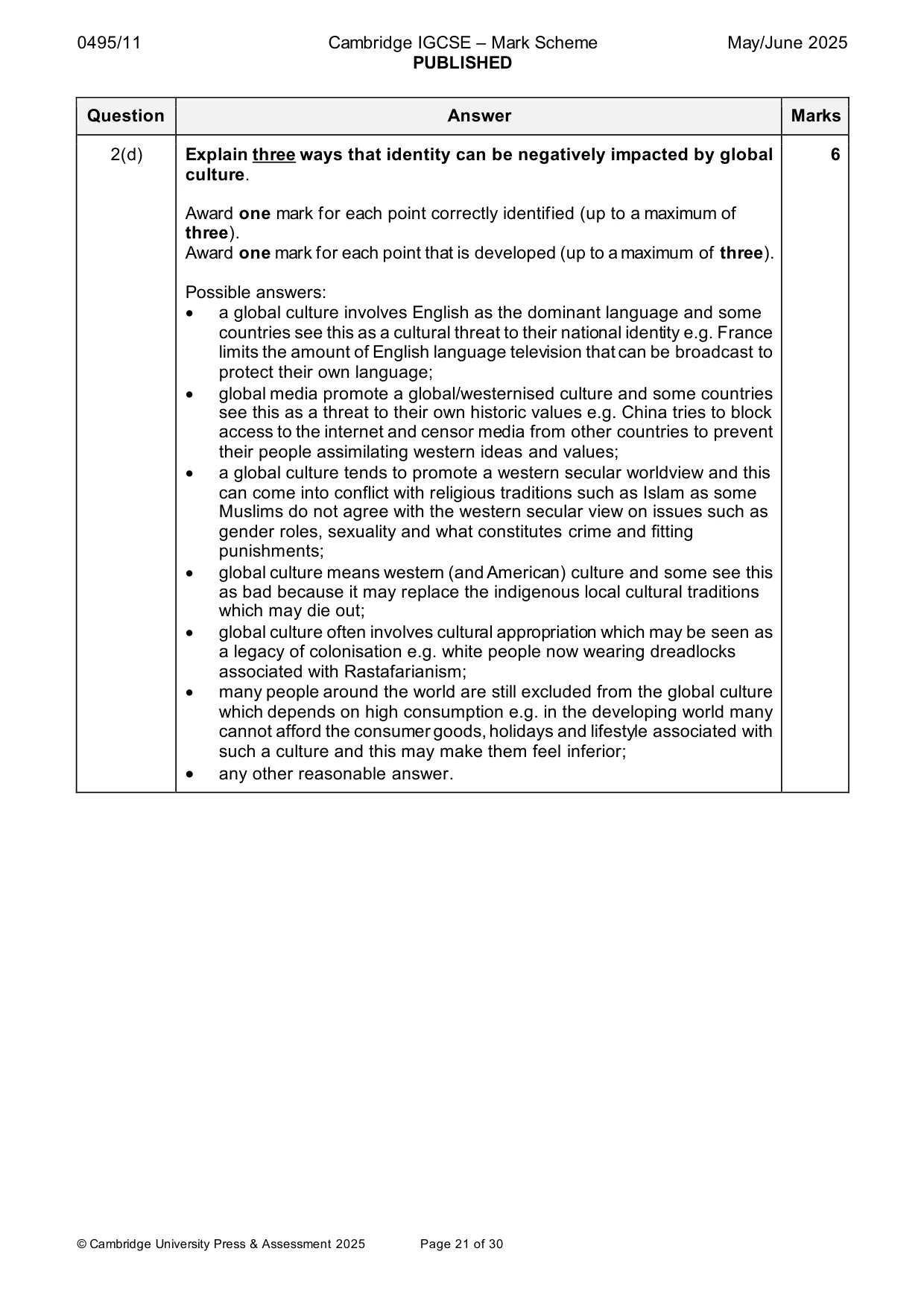
0495/11 Cambridge IGCSE – Mark Scheme PUBLISHED May/June 2025 © Cambridge University Press & Assessment 2025 Page 21 of 30 Question Answer Marks 2(d) Explain three ways that identity can be negatively impacted by global culture. Award one mark for each point correctly identified (up to a maximum of three). Award one mark for each point that is developed (up to a maximum of three). Possible answers: • a global culture involves English as the dominant language and some countries see this as a cultural threat to their national identity e.g. France limits the amount of English language television that can be broadcast to protect their own language; • global media promote a global/westernised culture and some countries see this as a threat to their own historic values e.g. China tries to block access to the internet and censor media from other countries to prevent their people assimilating western ideas and values; • a global culture tends to promote a western secular worldview and this can come into conflict with religious traditions such as Islam as some Muslims do not agree with the western secular view on issues such as gender roles, sexuality and what constitutes crime and fitting punishments; • global culture means western (and American) culture and some see this as bad because it may replace the indigenous local cultural traditions which may die out; • global culture often involves cultural appropriation which may be seen as a legacy of colonisation e.g. white people now wearing dreadlocks associated with Rastafarianism; • many people around the world are still excluded from the global culture which depends on high consumption e.g. in the developing world many cannot afford the consumer goods, holidays and lifestyle associated with such a culture and this may make them feel inferior; • any other reasonable answer. 6
Mark scheme, page 22
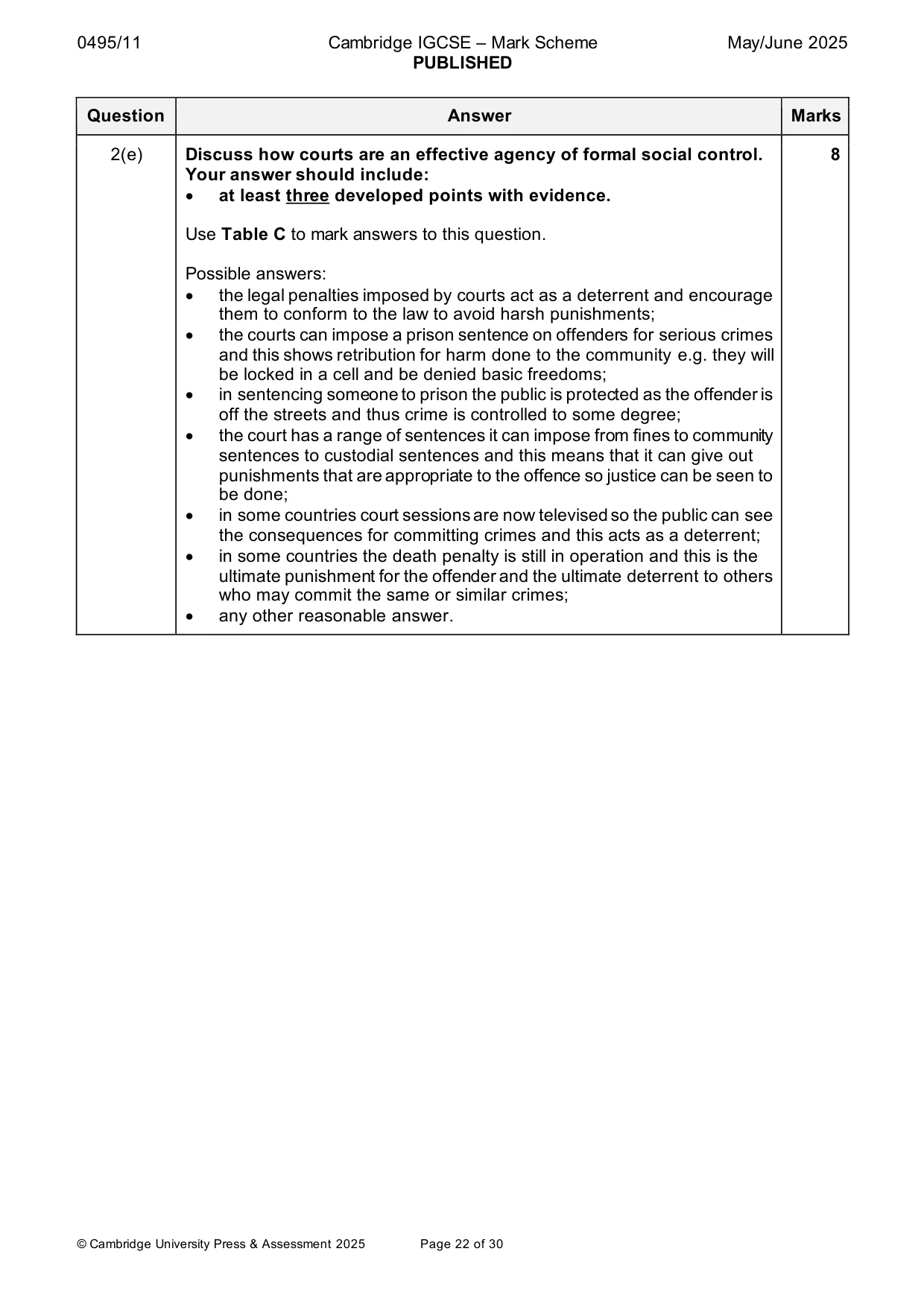
0495/11 Cambridge IGCSE – Mark Scheme PUBLISHED May/June 2025 © Cambridge University Press & Assessment 2025 Page 22 of 30 Question Answer Marks 2(e) Discuss how courts are an effective agency of formal social control. Your answer should include: • at least three developed points with evidence. Use Table C to mark answers to this question. Possible answers: • the legal penalties imposed by courts act as a deterrent and encourage them to conform to the law to avoid harsh punishments; • the courts can impose a prison sentence on offenders for serious crimes and this shows retribution for harm done to the community e.g. they will be locked in a cell and be denied basic freedoms; • in sentencing someone to prison the public is protected as the offender is off the streets and thus crime is controlled to some degree; • the court has a range of sentences it can impose from fines to community sentences to custodial sentences and this means that it can give out punishments that are appropriate to the offence so justice can be seen to be done; • in some countries court sessions are now televised so the public can see the consequences for committing crimes and this acts as a deterrent; • in some countries the death penalty is still in operation and this is the ultimate punishment for the offender and the ultimate deterrent to others who may commit the same or similar crimes; • any other reasonable answer. 8
Mark scheme, page 23
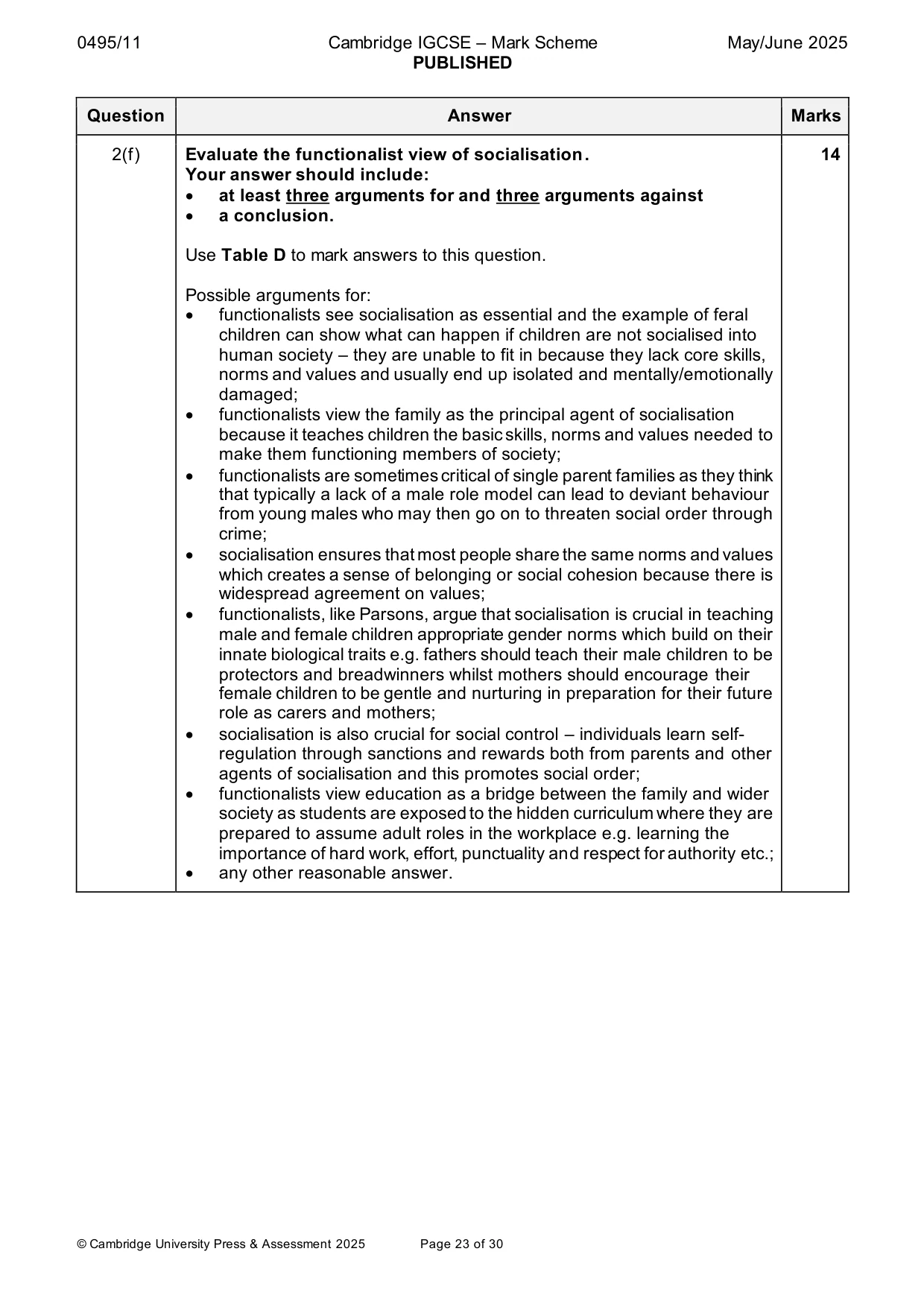
0495/11 Cambridge IGCSE – Mark Scheme PUBLISHED May/June 2025 © Cambridge University Press & Assessment 2025 Page 23 of 30 Question Answer Marks 2(f) Evaluate the functionalist view of socialisation. Your answer should include: • at least three arguments for and three arguments against • a conclusion. Use Table D to mark answers to this question. Possible arguments for: • functionalists see socialisation as essential and the example of feral children can show what can happen if children are not socialised into human society – they are unable to fit in because they lack core skills, norms and values and usually end up isolated and mentally/emotionally damaged; • functionalists view the family as the principal agent of socialisation because it teaches children the basic skills, norms and values needed to make them functioning members of society; • functionalists are sometimes critical of single parent families as they think that typically a lack of a male role model can lead to deviant behaviour from young males who may then go on to threaten social order through crime; • socialisation ensures that most people share the same norms and values which creates a sense of belonging or social cohesion because there is widespread agreement on values; • functionalists, like Parsons, argue that socialisation is crucial in teaching male and female children appropriate gender norms which build on their innate biological traits e.g. fathers should teach their male children to be protectors and breadwinners whilst mothers should encourage their female children to be gentle and nurturing in preparation for their future role as carers and mothers; • socialisation is also crucial for social control – individuals learn self- regulation through sanctions and rewards both from parents and other agents of socialisation and this promotes social order; • functionalists view education as a bridge between the family and wider society as students are exposed to the hidden curriculum where they are prepared to assume adult roles in the workplace e.g. learning the importance of hard work, effort, punctuality and respect for authority etc.; • any other reasonable answer. 14
Mark scheme, page 24
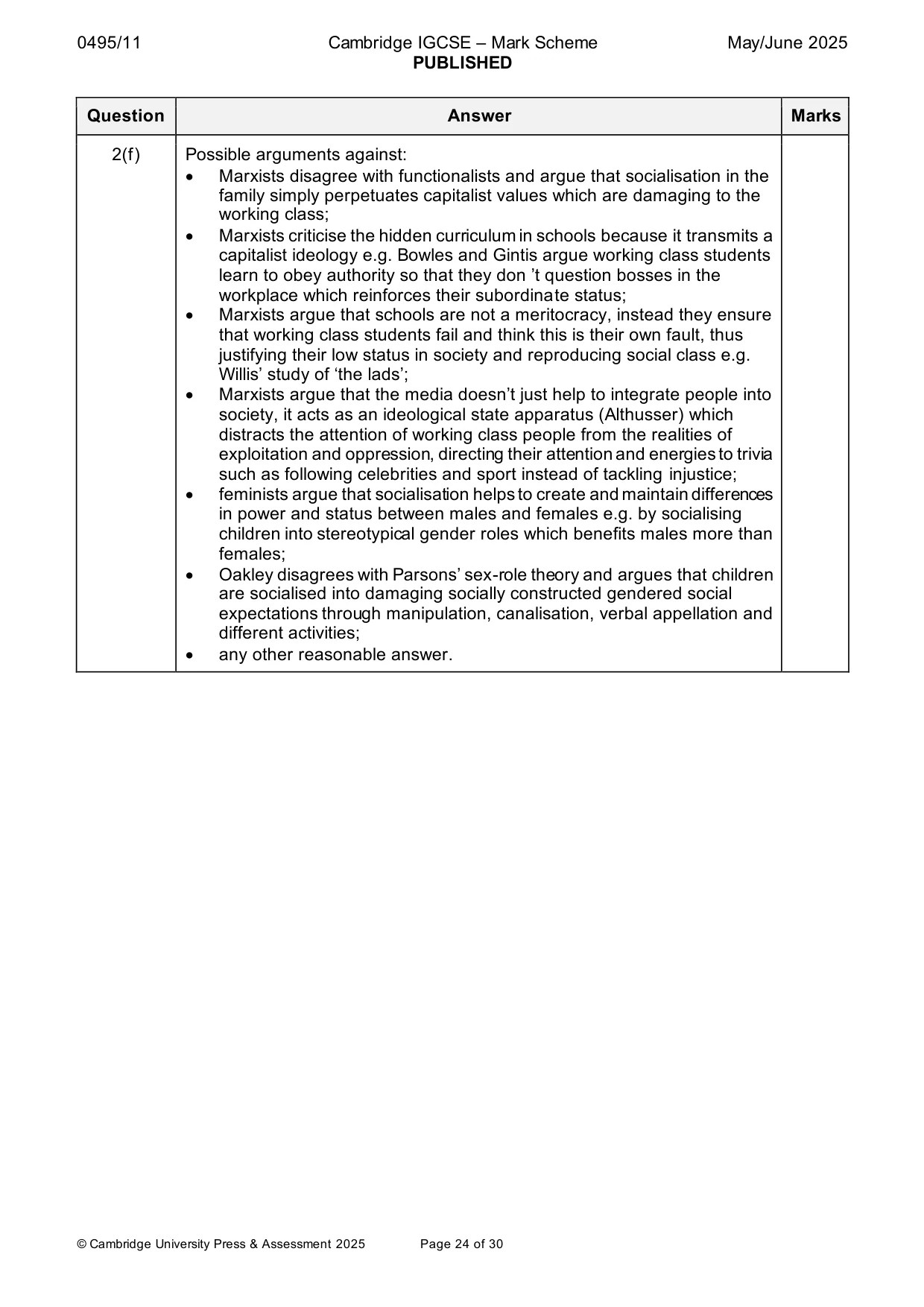
0495/11 Cambridge IGCSE – Mark Scheme PUBLISHED May/June 2025 © Cambridge University Press & Assessment 2025 Page 24 of 30 Question Answer Marks 2(f) Possible arguments against: • Marxists disagree with functionalists and argue that socialisation in the family simply perpetuates capitalist values which are damaging to the working class; • Marxists criticise the hidden curriculum in schools because it transmits a capitalist ideology e.g. Bowles and Gintis argue working class students learn to obey authority so that they don ’t question bosses in the workplace which reinforces their subordinate status; • Marxists argue that schools are not a meritocracy, instead they ensure that working class students fail and think this is their own fault, thus justifying their low status in society and reproducing social class e.g. Willis’ study of ‘the lads’; • Marxists argue that the media doesn’t just help to integrate people into society, it acts as an ideological state apparatus (Althusser) which distracts the attention of working class people from the realities of exploitation and oppression, directing their attention and energies to trivia such as following celebrities and sport instead of tackling injustice; • feminists argue that socialisation helps to create and maintain differences in power and status between males and females e.g. by socialising children into stereotypical gender roles which benefits males more than females; • Oakley disagrees with Parsons’ sex-role theory and argues that children are socialised into damaging socially constructed gendered social expectations through manipulation, canalisation, verbal appellation and different activities; • any other reasonable answer.
Mark scheme, page 25
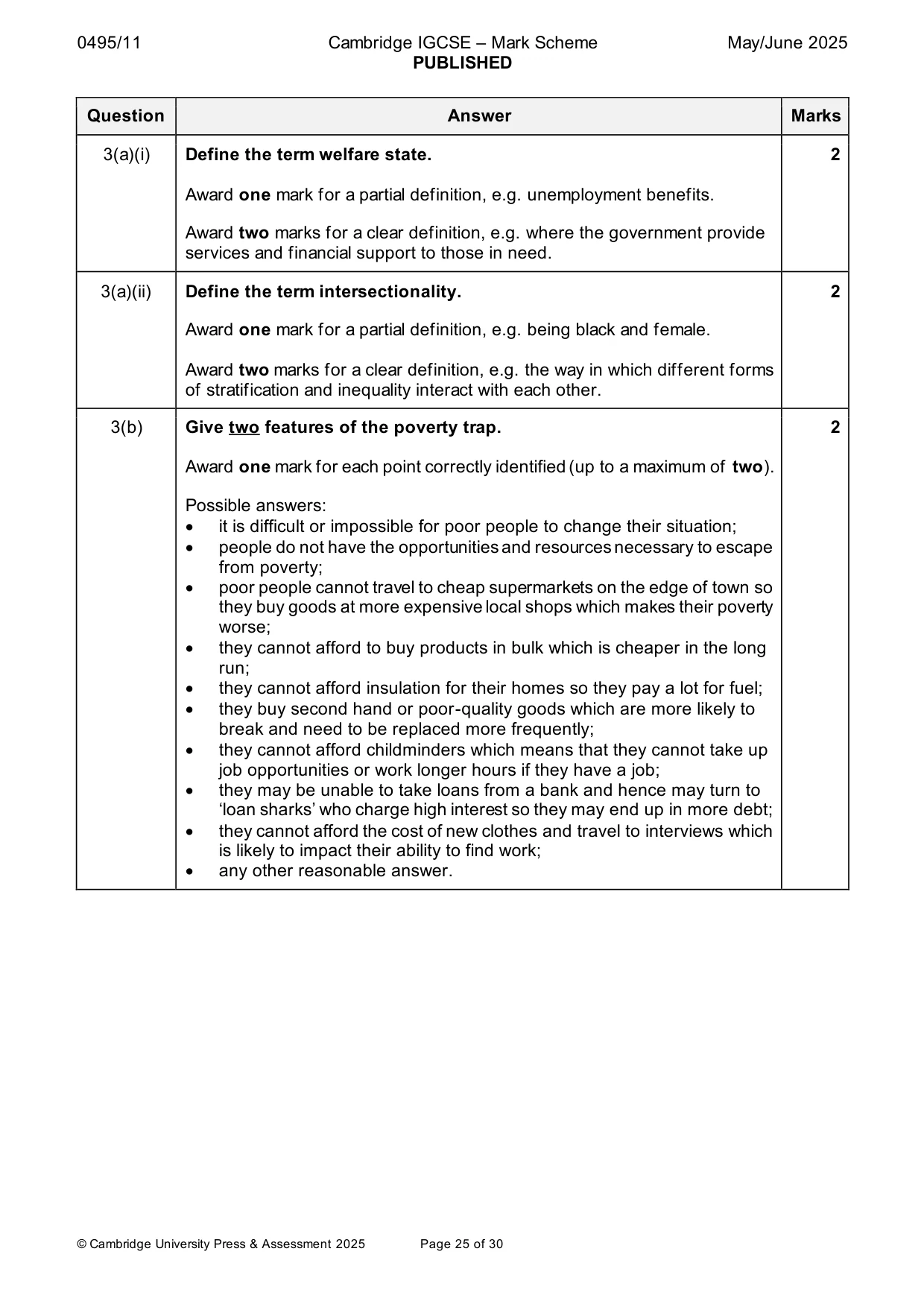
0495/11 Cambridge IGCSE – Mark Scheme PUBLISHED May/June 2025 © Cambridge University Press & Assessment 2025 Page 25 of 30 Question Answer Marks 3(a)(i) Define the term welfare state. Award one mark for a partial definition, e.g. unemployment benefits. Award two marks for a clear definition, e.g. where the government provide services and financial support to those in need. 2 3(a)(ii) Define the term intersectionality. Award one mark for a partial definition, e.g. being black and female. Award two marks for a clear definition, e.g. the way in which different forms of stratification and inequality interact with each other. 2 3(b) Give two features of the poverty trap. Award one mark for each point correctly identified (up to a maximum of two). Possible answers: • it is difficult or impossible for poor people to change their situation; • people do not have the opportunities and resources necessary to escape from poverty; • poor people cannot travel to cheap supermarkets on the edge of town so they buy goods at more expensive local shops which makes their poverty worse; • they cannot afford to buy products in bulk which is cheaper in the long run; • they cannot afford insulation for their homes so they pay a lot for fuel; • they buy second hand or poor-quality goods which are more likely to break and need to be replaced more frequently; • they cannot afford childminders which means that they cannot take up job opportunities or work longer hours if they have a job; • they may be unable to take loans from a bank and hence may turn to ‘loan sharks’ who charge high interest so they may end up in more debt; • they cannot afford the cost of new clothes and travel to interviews which is likely to impact their ability to find work; • any other reasonable answer. 2
Mark scheme, page 26
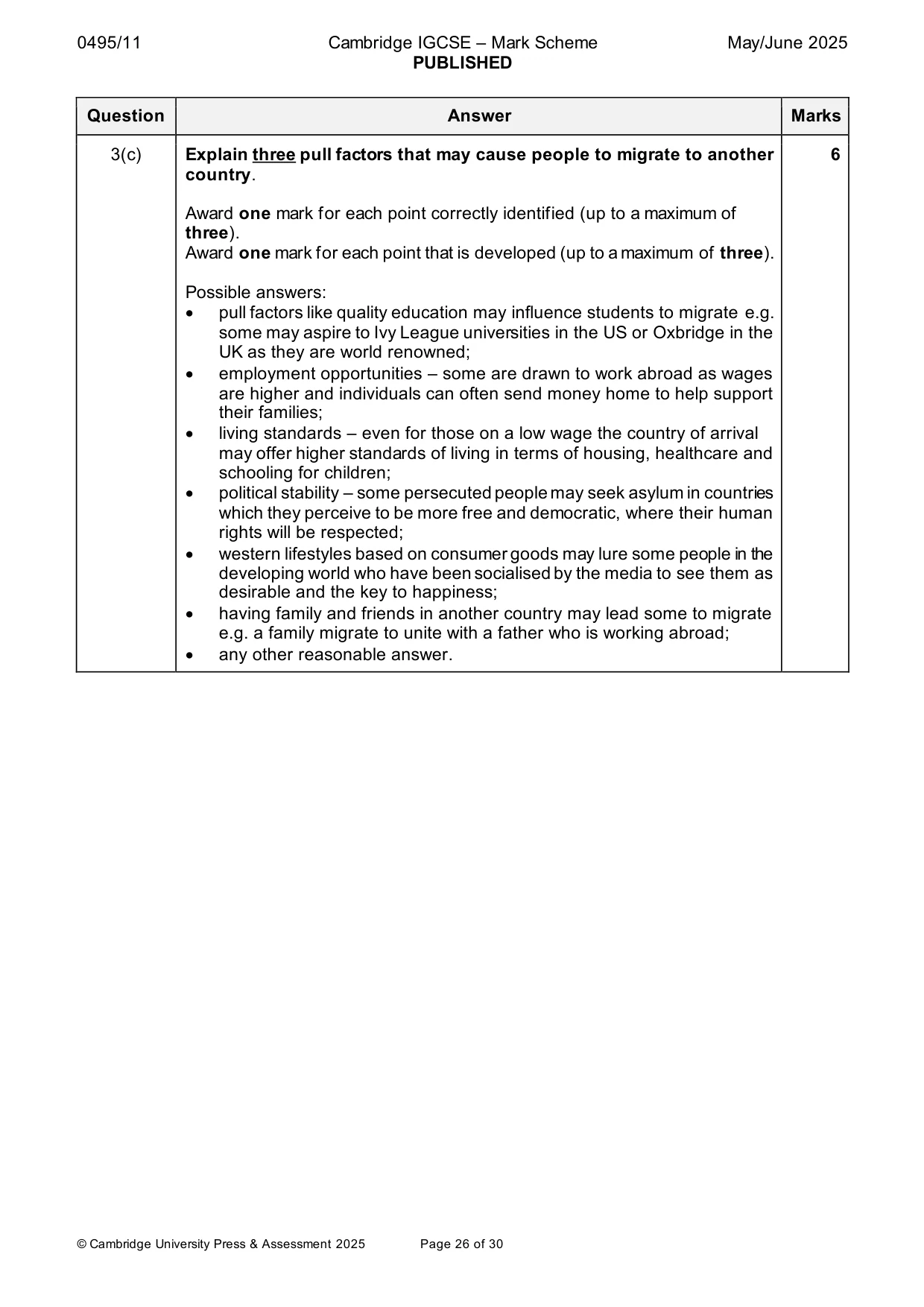
0495/11 Cambridge IGCSE – Mark Scheme PUBLISHED May/June 2025 © Cambridge University Press & Assessment 2025 Page 26 of 30 Question Answer Marks 3(c) Explain three pull factors that may cause people to migrate to another country. Award one mark for each point correctly identified (up to a maximum of three). Award one mark for each point that is developed (up to a maximum of three). Possible answers: • pull factors like quality education may influence students to migrate e.g. some may aspire to Ivy League universities in the US or Oxbridge in the UK as they are world renowned; • employment opportunities – some are drawn to work abroad as wages are higher and individuals can often send money home to help support their families; • living standards – even for those on a low wage the country of arrival may offer higher standards of living in terms of housing, healthcare and schooling for children; • political stability – some persecuted people may seek asylum in countries which they perceive to be more free and democratic, where their human rights will be respected; • western lifestyles based on consumer goods may lure some people in the developing world who have been socialised by the media to see them as desirable and the key to happiness; • having family and friends in another country may lead some to migrate e.g. a family migrate to unite with a father who is working abroad; • any other reasonable answer. 6
Mark scheme, page 27
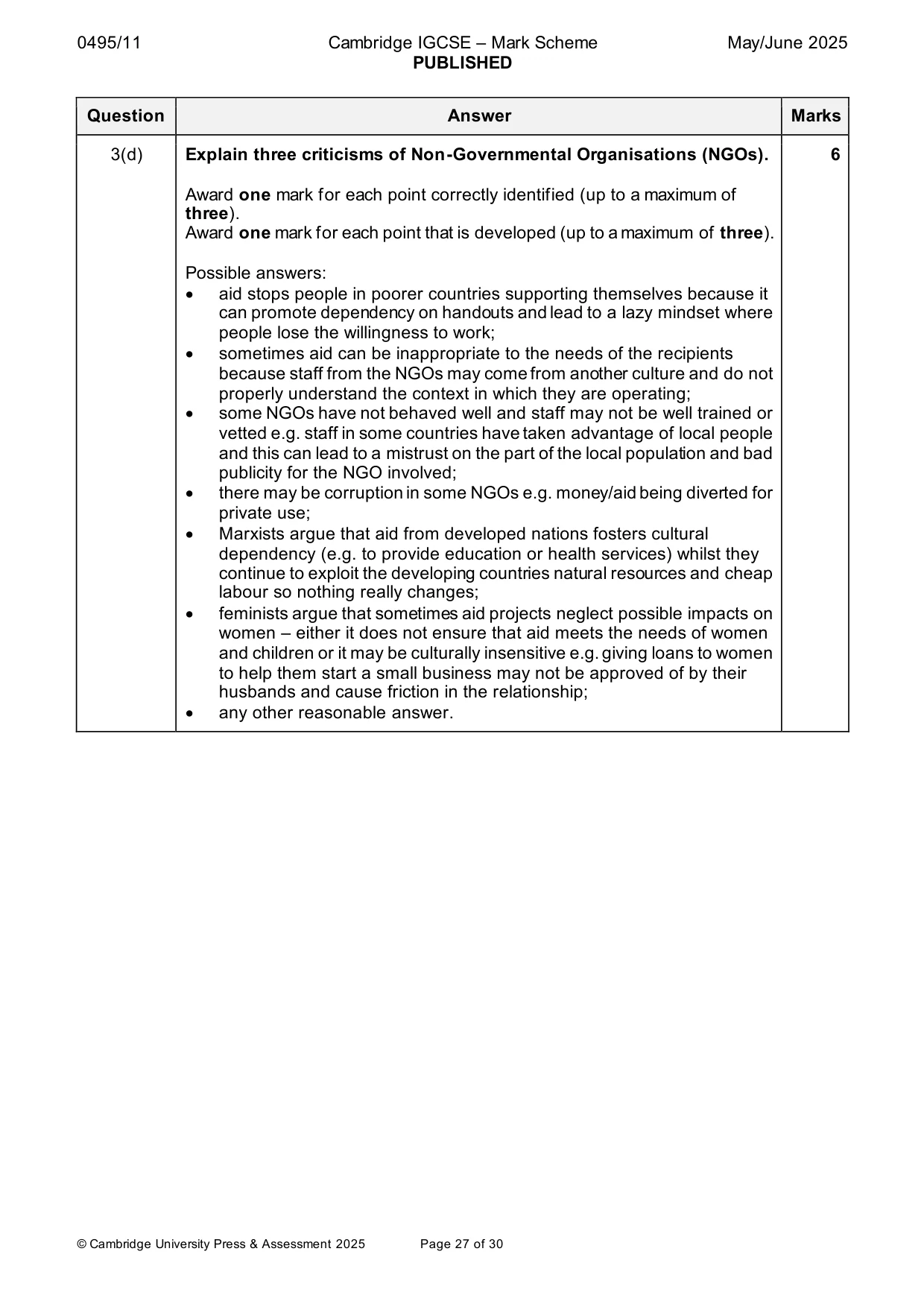
0495/11 Cambridge IGCSE – Mark Scheme PUBLISHED May/June 2025 © Cambridge University Press & Assessment 2025 Page 27 of 30 Question Answer Marks 3(d) Explain three criticisms of Non-Governmental Organisations (NGOs). Award one mark for each point correctly identified (up to a maximum of three). Award one mark for each point that is developed (up to a maximum of three). Possible answers: • aid stops people in poorer countries supporting themselves because it can promote dependency on handouts and lead to a lazy mindset where people lose the willingness to work; • sometimes aid can be inappropriate to the needs of the recipients because staff from the NGOs may come from another culture and do not properly understand the context in which they are operating; • some NGOs have not behaved well and staff may not be well trained or vetted e.g. staff in some countries have taken advantage of local people and this can lead to a mistrust on the part of the local population and bad publicity for the NGO involved; • there may be corruption in some NGOs e.g. money/aid being diverted for private use; • Marxists argue that aid from developed nations fosters cultural dependency (e.g. to provide education or health services) whilst they continue to exploit the developing countries natural resources and cheap labour so nothing really changes; • feminists argue that sometimes aid projects neglect possible impacts on women – either it does not ensure that aid meets the needs of women and children or it may be culturally insensitive e.g. giving loans to women to help them start a small business may not be approved of by their husbands and cause friction in the relationship; • any other reasonable answer. 6
Mark scheme, page 28
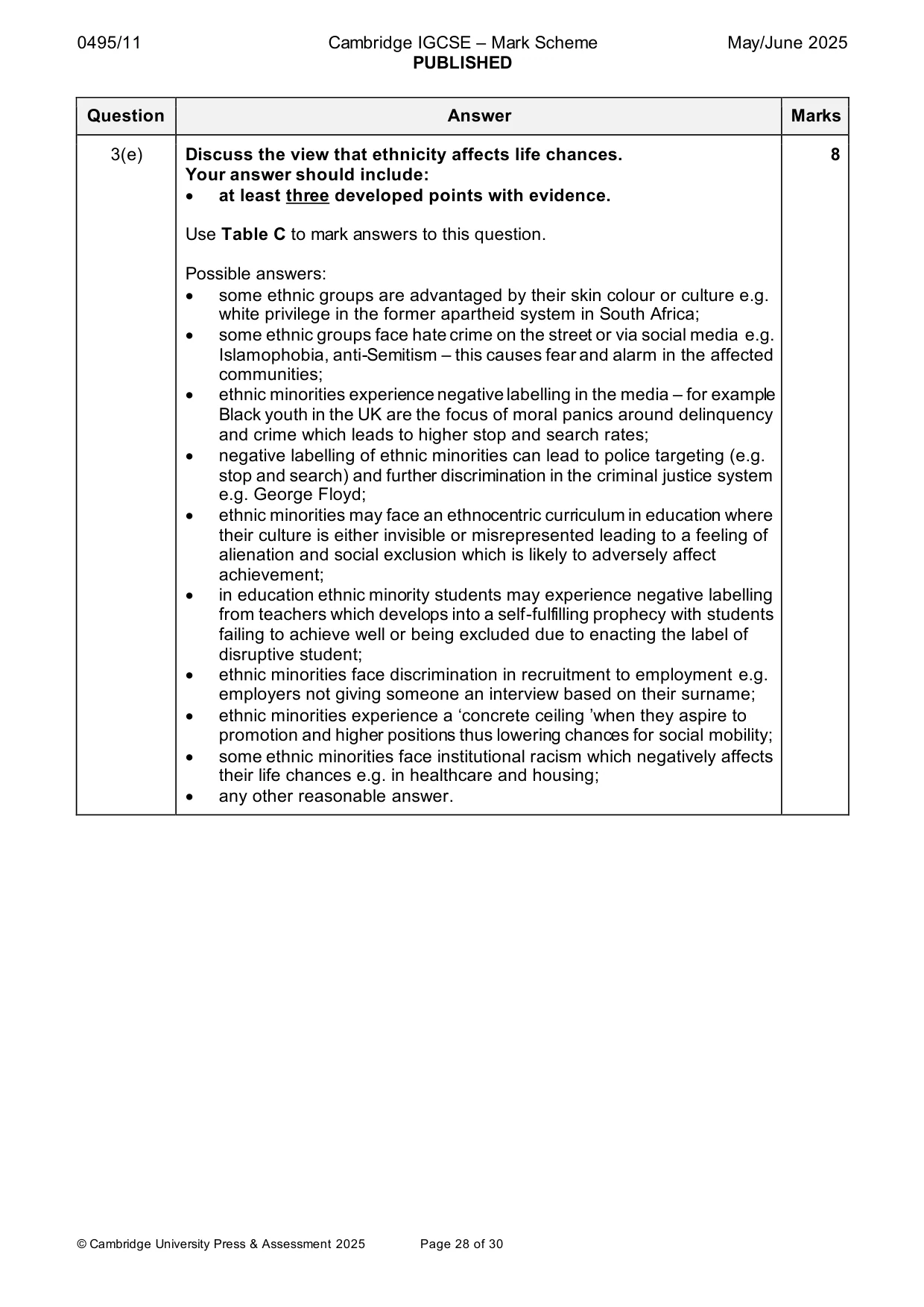
0495/11 Cambridge IGCSE – Mark Scheme PUBLISHED May/June 2025 © Cambridge University Press & Assessment 2025 Page 28 of 30 Question Answer Marks 3(e) Discuss the view that ethnicity affects life chances. Your answer should include: • at least three developed points with evidence. Use Table C to mark answers to this question. Possible answers: • some ethnic groups are advantaged by their skin colour or culture e.g. white privilege in the former apartheid system in South Africa; • some ethnic groups face hate crime on the street or via social media e.g. Islamophobia, anti-Semitism – this causes fear and alarm in the affected communities; • ethnic minorities experience negative labelling in the media – for example Black youth in the UK are the focus of moral panics around delinquency and crime which leads to higher stop and search rates; • negative labelling of ethnic minorities can lead to police targeting (e.g. stop and search) and further discrimination in the criminal justice system e.g. George Floyd; • ethnic minorities may face an ethnocentric curriculum in education where their culture is either invisible or misrepresented leading to a feeling of alienation and social exclusion which is likely to adversely affect achievement; • in education ethnic minority students may experience negative labelling from teachers which develops into a self-fulfilling prophecy with students failing to achieve well or being excluded due to enacting the label of disruptive student; • ethnic minorities face discrimination in recruitment to employment e.g. employers not giving someone an interview based on their surname; • ethnic minorities experience a ‘concrete ceiling ’when they aspire to promotion and higher positions thus lowering chances for social mobility; • some ethnic minorities face institutional racism which negatively affects their life chances e.g. in healthcare and housing; • any other reasonable answer. 8
Mark scheme, page 29
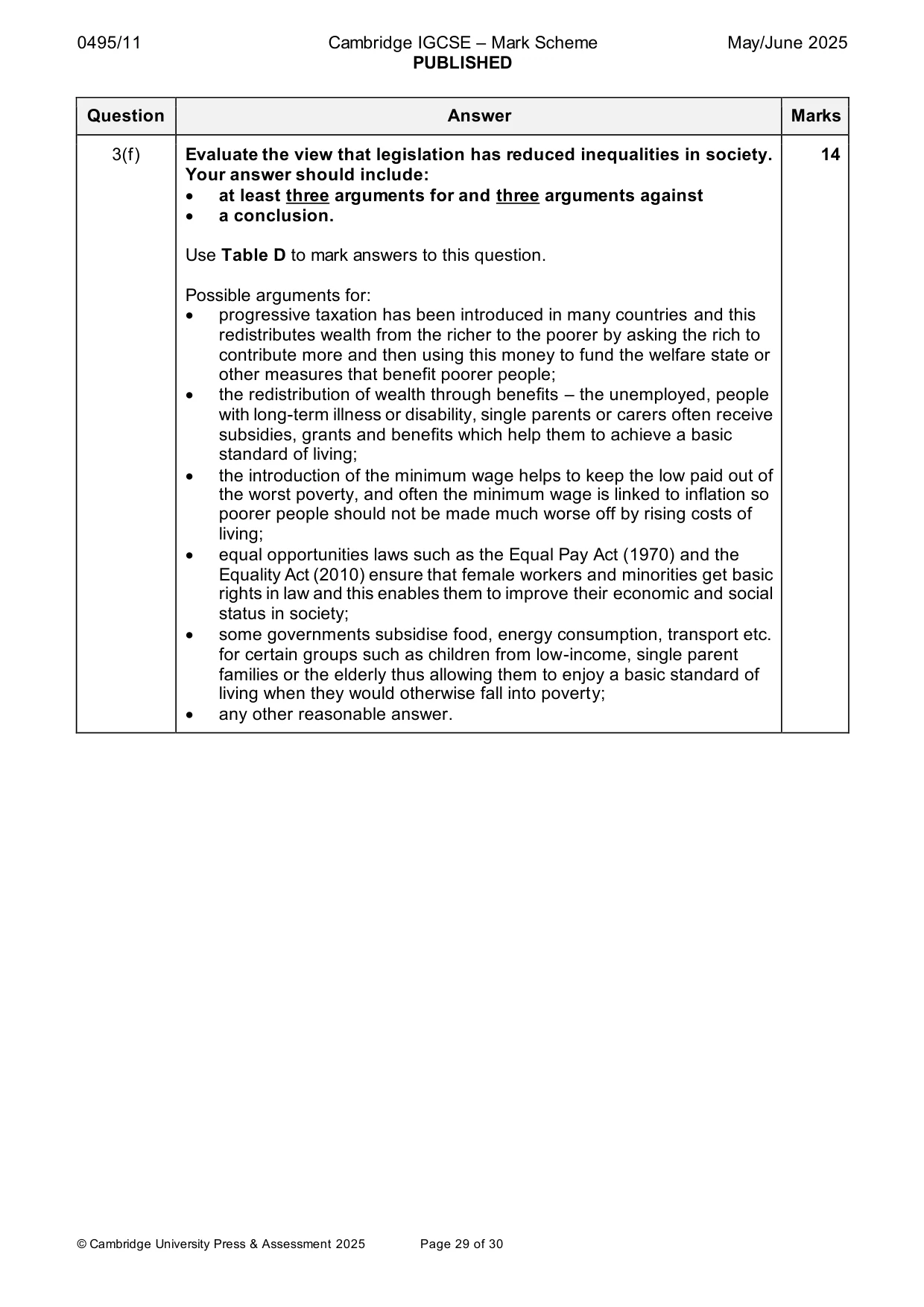
0495/11 Cambridge IGCSE – Mark Scheme PUBLISHED May/June 2025 © Cambridge University Press & Assessment 2025 Page 29 of 30 Question Answer Marks 3(f) Evaluate the view that legislation has reduced inequalities in society. Your answer should include: • at least three arguments for and three arguments against • a conclusion. Use Table D to mark answers to this question. Possible arguments for: • progressive taxation has been introduced in many countries and this redistributes wealth from the richer to the poorer by asking the rich to contribute more and then using this money to fund the welfare state or other measures that benefit poorer people; • the redistribution of wealth through benefits – the unemployed, people with long-term illness or disability, single parents or carers often receive subsidies, grants and benefits which help them to achieve a basic standard of living; • the introduction of the minimum wage helps to keep the low paid out of the worst poverty, and often the minimum wage is linked to inflation so poorer people should not be made much worse off by rising costs of living; • equal opportunities laws such as the Equal Pay Act (1970) and the Equality Act (2010) ensure that female workers and minorities get basic rights in law and this enables them to improve their economic and social status in society; • some governments subsidise food, energy consumption, transport etc. for certain groups such as children from low-income, single parent families or the elderly thus allowing them to enjoy a basic standard of living when they would otherwise fall into poverty; • any other reasonable answer. 14
Mark scheme, page 30
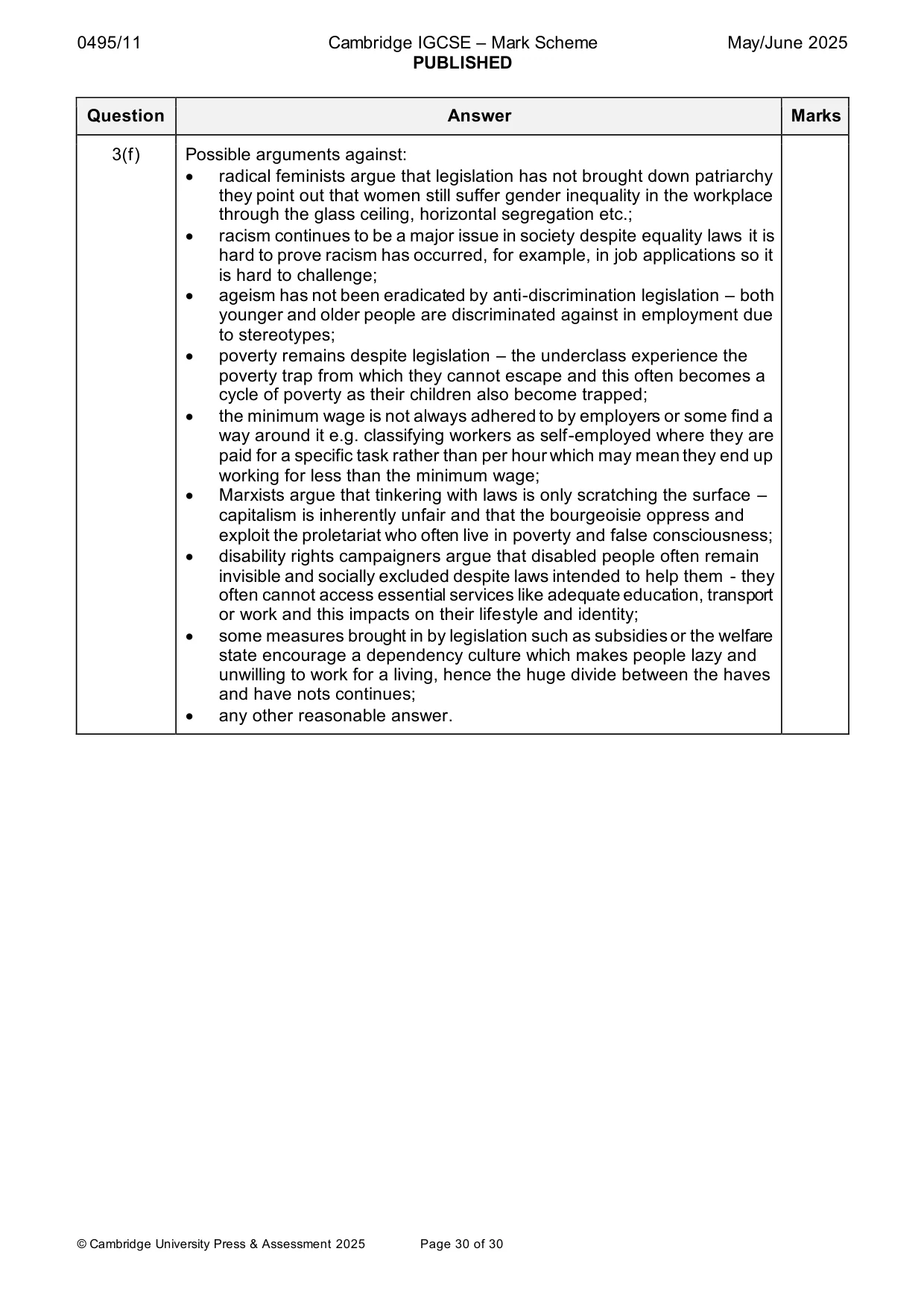
0495/11 Cambridge IGCSE – Mark Scheme PUBLISHED May/June 2025 © Cambridge University Press & Assessment 2025 Page 30 of 30 Question Answer Marks 3(f) Possible arguments against: • radical feminists argue that legislation has not brought down patriarchy they point out that women still suffer gender inequality in the workplace through the glass ceiling, horizontal segregation etc.; • racism continues to be a major issue in society despite equality laws it is hard to prove racism has occurred, for example, in job applications so it is hard to challenge; • ageism has not been eradicated by anti-discrimination legislation – both younger and older people are discriminated against in employment due to stereotypes; • poverty remains despite legislation – the underclass experience the poverty trap from which they cannot escape and this often becomes a cycle of poverty as their children also become trapped; • the minimum wage is not always adhered to by employers or some find a way around it e.g. classifying workers as self-employed where they are paid for a specific task rather than per hour which may mean they end up working for less than the minimum wage; • Marxists argue that tinkering with laws is only scratching the surface – capitalism is inherently unfair and that the bourgeoisie oppress and exploit the proletariat who often live in poverty and false consciousness; • disability rights campaigners argue that disabled people often remain invisible and socially excluded despite laws intended to help them - they often cannot access essential services like adequate education, transport or work and this impacts on their lifestyle and identity; • some measures brought in by legislation such as subsidies or the welfare state encourage a dependency culture which makes people lazy and unwilling to work for a living, hence the huge divide between the haves and have nots continues; • any other reasonable answer.
What you needed in this session
Cambridge’s own grade thresholds for 2025 May/June, Paper 1 · Variant 1. A higher threshold means an easier paper — the bar moves with how the cohort did.