Cambridge IGCSE Sociology 0495 — 2024 Oct/Nov Paper 1 · Variant 1
0495/11/O/N/24 · 80 marks · ≈90 min
The question paper and its mark scheme, free to read here and free to download. This is Cambridge’s own paper, exactly as it was sat.
Question paper4 pages

Mark scheme23 pages
Answers below. Sit the paper first if you are practising.



Paper as text
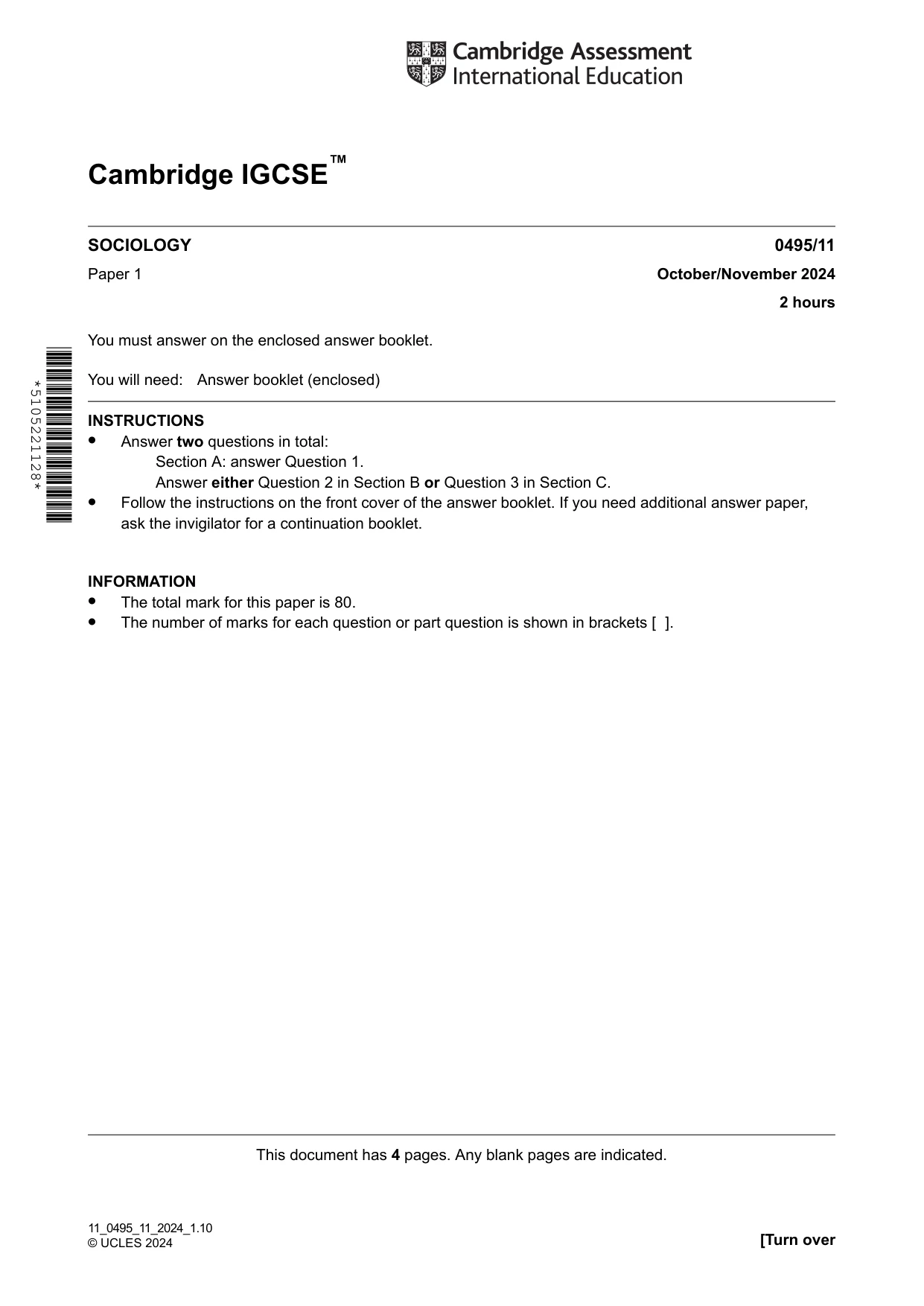
Question paper, page 1
Cambridge IGCSE™ 0495/11 October/November 2024 2 hours SOCIOLOGY Paper 1 You must answer on the enclosed answer booklet. You will need: Answer booklet (enclosed) INSTRUCTIONS • Answer two questions in total: Section A: answer Question 1. Answer either Question 2 in Section B or Question 3 in Section C. • Follow the instructions on the front cover of the answer booklet. If you need additional answer paper, ask the invigilator for a continuation booklet. INFORMATION • The total mark for this paper is 80. • The number of marks for each question or part question is shown in brackets [ ]. This document has 4 pages. Any blank pages are indicated. [Turn over 11_0495_11_2024_1.10 © UCLES 2024 *5105221128*
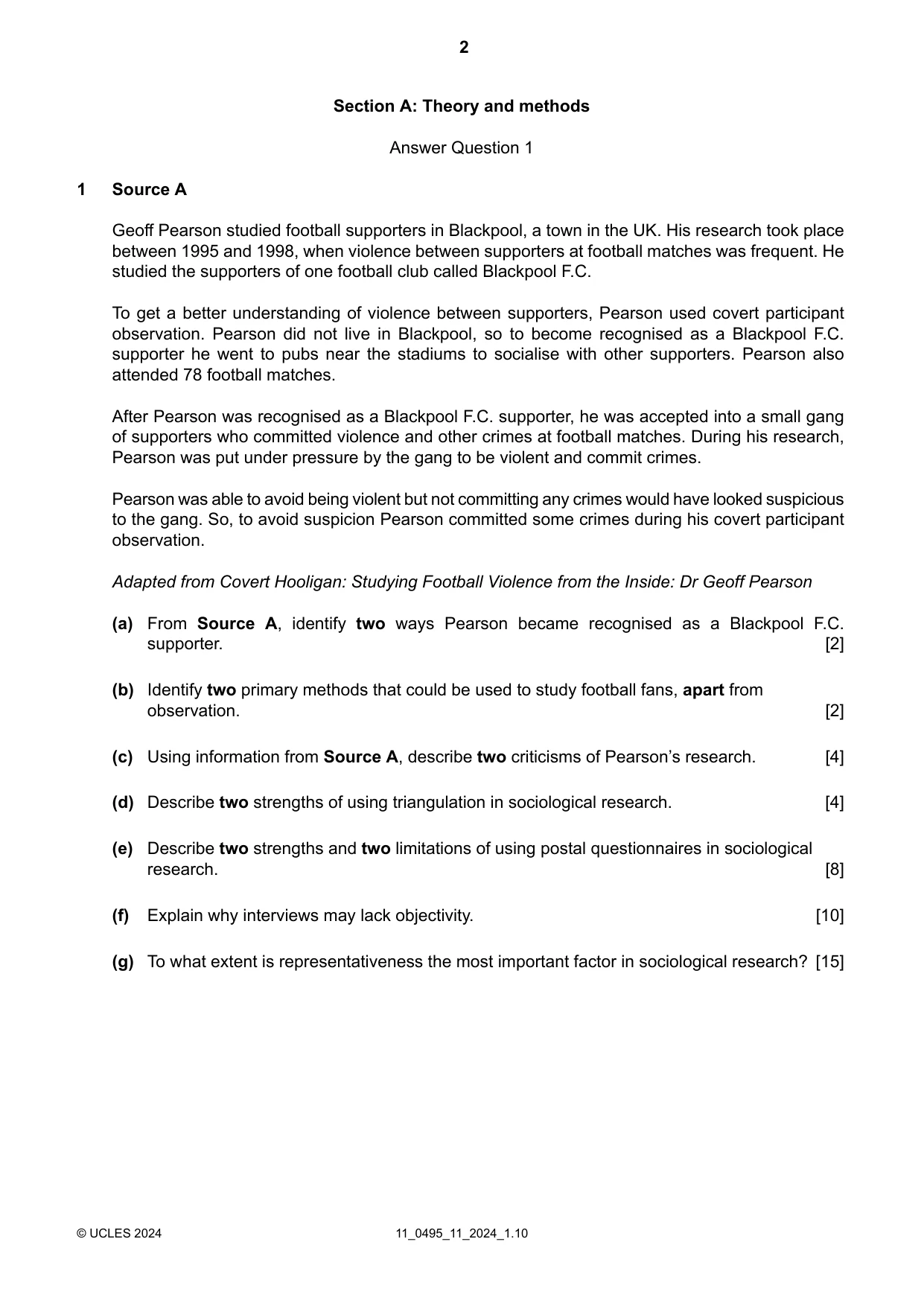
Question paper, page 2
Section A: Theory and methods Answer Question 1 Source A 1 Geoff Pearson studied football supporters in Blackpool, a town in the UK. His research took place between 1995 and 1998, when violence between supporters at football matches was frequent. He studied the supporters of one football club called Blackpool F.C. To get a better understanding of violence between supporters, Pearson used covert participant observation. Pearson did not live in Blackpool, so to become recognised as a Blackpool F.C. supporter he went to pubs near the stadiums to socialise with other supporters. Pearson also attended 78 football matches. After Pearson was recognised as a Blackpool F.C. supporter, he was accepted into a small gang of supporters who committed violence and other crimes at football matches. During his research, Pearson was put under pressure by the gang to be violent and commit crimes. Pearson was able to avoid being violent but not committing any crimes would have looked suspicious to the gang. So, to avoid suspicion Pearson committed some crimes during his covert participant observation. Adapted from Covert Hooligan: Studying Football Violence from the Inside: Dr Geoff Pearson From Source A, identify two ways Pearson became recognised as a Blackpool F.C. supporter. [2] (a) Identify two primary methods that could be used to study football fans, apart from observation. [2] (b) Using information from Source A, describe two criticisms of Pearson’s research. [4] (c) Describe two strengths of using triangulation in sociological research. [4] (d) Describe two strengths and two limitations of using postal questionnaires in sociological research. [8] (e) Explain why interviews may lack objectivity. [10] (f) To what extent is representativeness the most important factor in sociological research? [15] (g) 11_0495_11_2024_1.10 © UCLES 2024 2
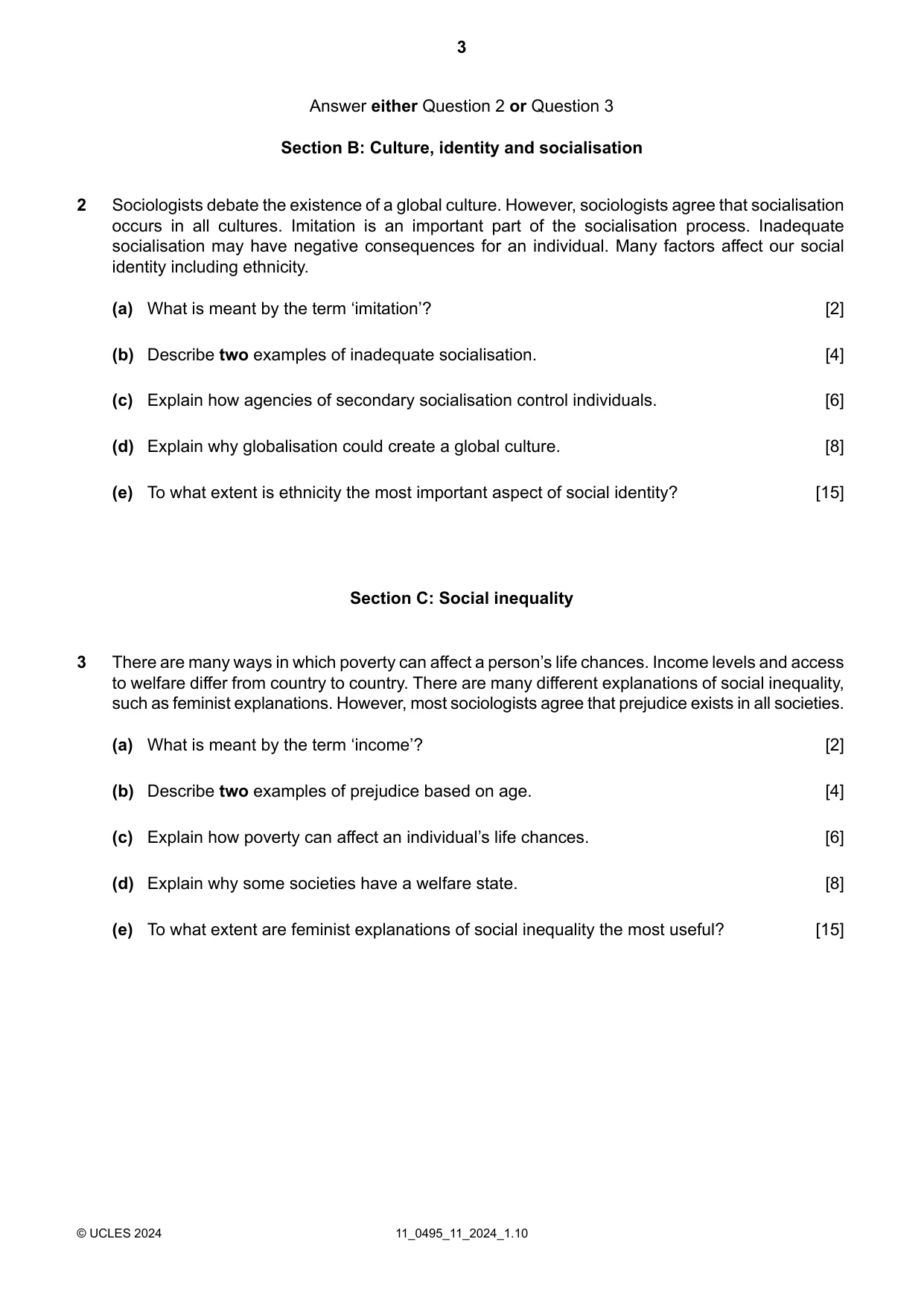
Question paper, page 3
Answer either Question 2 or Question 3 Section B: Culture, identity and socialisation Sociologists debate the existence of a global culture. However, sociologists agree that socialisation occurs in all cultures. Imitation is an important part of the socialisation process. Inadequate 2 socialisation may have negative consequences for an individual. Many factors affect our social identity including ethnicity. What is meant by the term ‘imitation’? [2] (a) Describe two examples of inadequate socialisation. [4] (b) Explain how agencies of secondary socialisation control individuals. [6] (c) Explain why globalisation could create a global culture. [8] (d) To what extent is ethnicity the most important aspect of social identity? [15] (e) Section C: Social inequality There are many ways in which poverty can affect a person’s life chances. Income levels and access to welfare differ from country to country. There are many different explanations of social inequality, such as feminist explanations. However, most sociologists agree that prejudice exists in all societies. 3 What is meant by the term ‘income’? [2] (a) Describe two examples of prejudice based on age. [4] (b) Explain how poverty can affect an individual’s life chances. [6] (c) Explain why some societies have a welfare state. [8] (d) To what extent are feminist explanations of social inequality the most useful? [15] (e) 11_0495_11_2024_1.10 © UCLES 2024 3
Question paper, page 4
BLANK PAGE Permission to reproduce items where third-party owned material protected by copyright is included has been sought and cleared where possible. Every reasonable effort has been made by the publisher (UCLES) to trace copyright holders, but if any items requiring clearance have unwittingly been included, the publisher will be pleased to make amends at the earliest possible opportunity. To avoid the issue of disclosure of answer-related information to candidates, all copyright acknowledgements are reproduced online in the Cambridge Assessment International Education Copyright Acknowledgements Booklet. This is produced for each series of examinations and is freely available to download at www.cambridgeinternational.org after the live examination series. Cambridge Assessment International Education is part of Cambridge Assessment. Cambridge Assessment is the brand name of the University of Cambridge Local Examinations Syndicate (UCLES), which is a department of the University of Cambridge. 11_0495_11_2024_1.10 © UCLES 2024 4
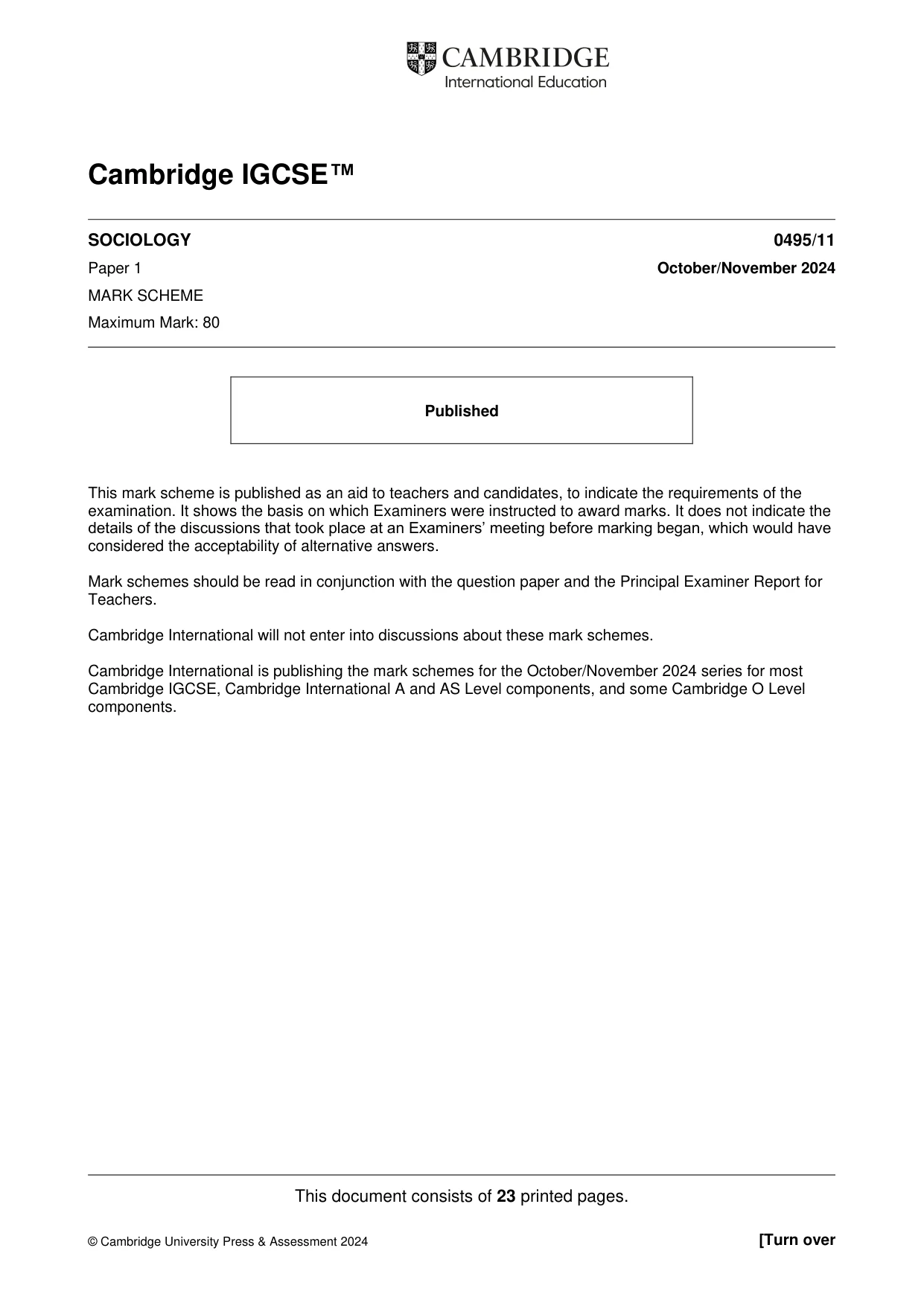
Mark scheme, page 1
This document consists of 23 printed pages. © Cambridge University Press & Assessment 2024 [Turn over Cambridge IGCSE™ SOCIOLOGY 0495/11 Paper 1 October/November 2024 MARK SCHEME Maximum Mark: 80 Published This mark scheme is published as an aid to teachers and candidates, to indicate the requirements of the examination. It shows the basis on which Examiners were instructed to award marks. It does not indicate the details of the discussions that took place at an Examiners’ meeting before marking began, which would have considered the acceptability of alternative answers. Mark schemes should be read in conjunction with the question paper and the Principal Examiner Report for Teachers. Cambridge International will not enter into discussions about these mark schemes. Cambridge International is publishing the mark schemes for the October/November 2024 series for most Cambridge IGCSE, Cambridge International A and AS Level components, and some Cambridge O Level components.
Mark scheme, page 2
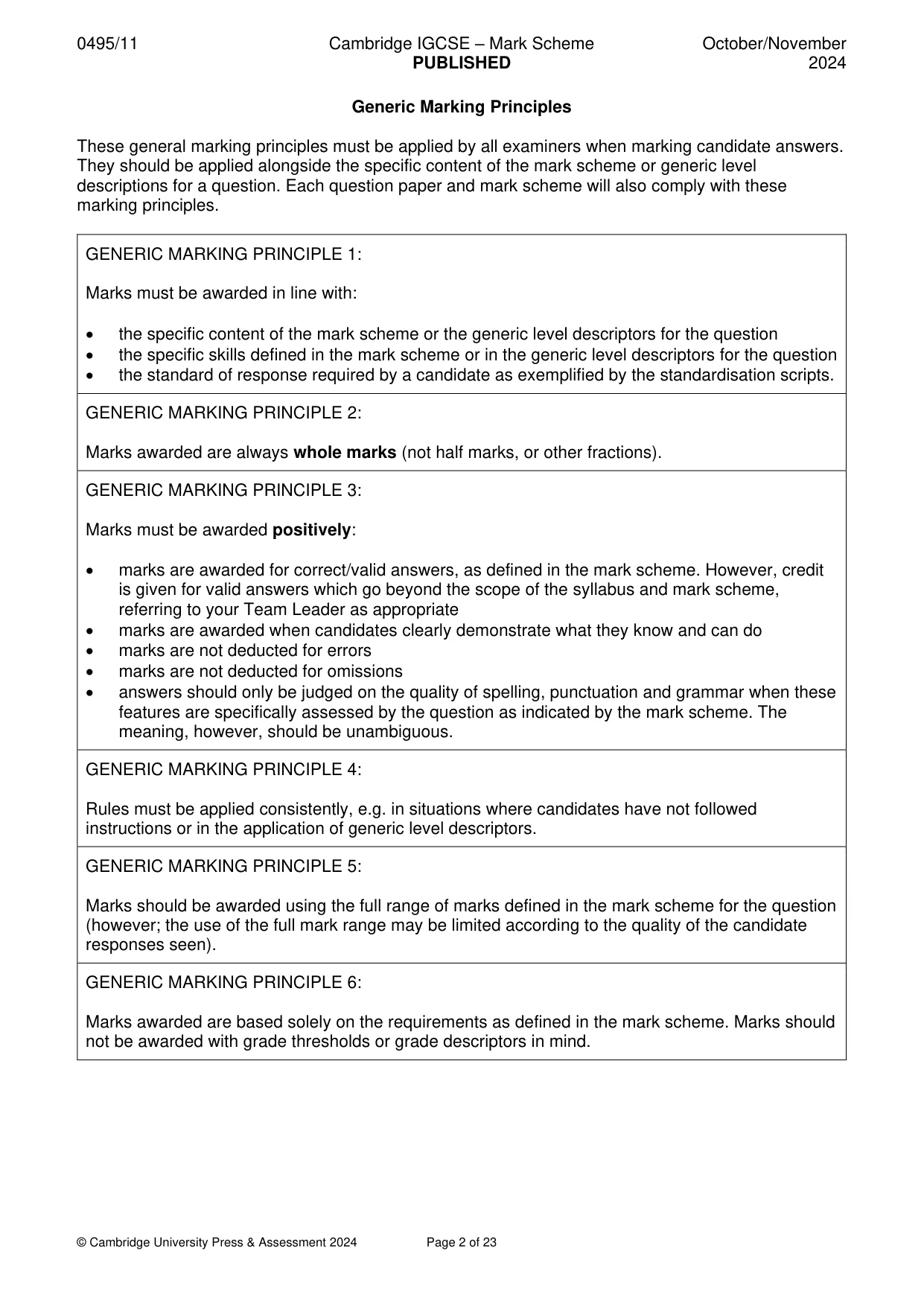
0495/11 Cambridge IGCSE – Mark Scheme PUBLISHED October/November 2024 © Cambridge University Press & Assessment 2024 Page 2 of 23 Generic Marking Principles These general marking principles must be applied by all examiners when marking candidate answers. They should be applied alongside the specific content of the mark scheme or generic level descriptions for a question. Each question paper and mark scheme will also comply with these marking principles. GENERIC MARKING PRINCIPLE 1: Marks must be awarded in line with: • the specific content of the mark scheme or the generic level descriptors for the question • the specific skills defined in the mark scheme or in the generic level descriptors for the question • the standard of response required by a candidate as exemplified by the standardisation scripts. GENERIC MARKING PRINCIPLE 2: Marks awarded are always whole marks (not half marks, or other fractions). GENERIC MARKING PRINCIPLE 3: Marks must be awarded positively: • marks are awarded for correct/valid answers, as defined in the mark scheme. However, credit is given for valid answers which go beyond the scope of the syllabus and mark scheme, referring to your Team Leader as appropriate • marks are awarded when candidates clearly demonstrate what they know and can do • marks are not deducted for errors • marks are not deducted for omissions • answers should only be judged on the quality of spelling, punctuation and grammar when these features are specifically assessed by the question as indicated by the mark scheme. The meaning, however, should be unambiguous. GENERIC MARKING PRINCIPLE 4: Rules must be applied consistently, e.g. in situations where candidates have not followed instructions or in the application of generic level descriptors. GENERIC MARKING PRINCIPLE 5: Marks should be awarded using the full range of marks defined in the mark scheme for the question (however; the use of the full mark range may be limited according to the quality of the candidate responses seen). GENERIC MARKING PRINCIPLE 6: Marks awarded are based solely on the requirements as defined in the mark scheme. Marks should not be awarded with grade thresholds or grade descriptors in mind.
Mark scheme, page 3
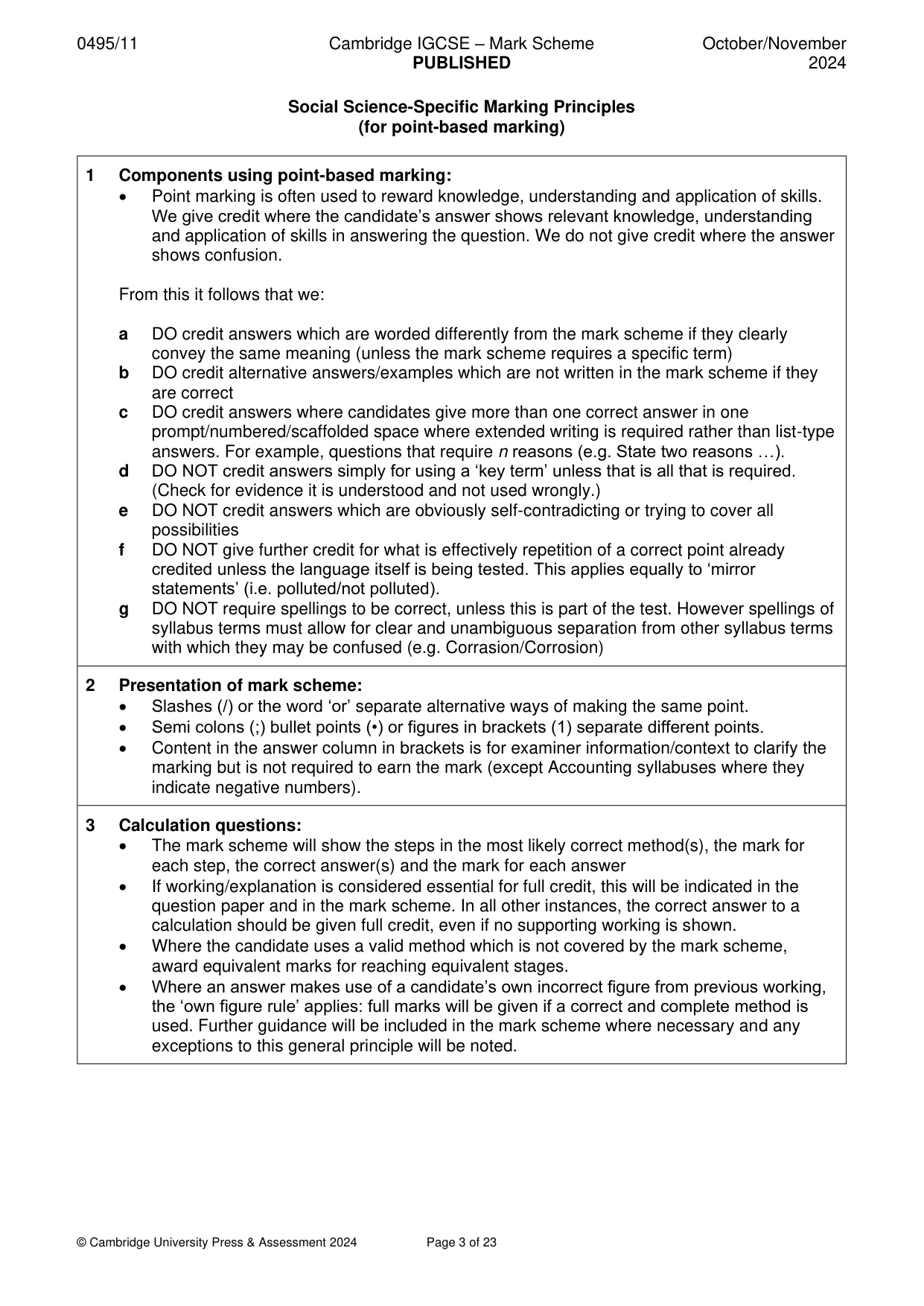
0495/11 Cambridge IGCSE – Mark Scheme PUBLISHED October/November 2024 © Cambridge University Press & Assessment 2024 Page 3 of 23 Social Science-Specific Marking Principles (for point-based marking) 1 Components using point-based marking: • Point marking is often used to reward knowledge, understanding and application of skills. We give credit where the candidate’s answer shows relevant knowledge, understanding and application of skills in answering the question. We do not give credit where the answer shows confusion. From this it follows that we: a DO credit answers which are worded differently from the mark scheme if they clearly convey the same meaning (unless the mark scheme requires a specific term) b DO credit alternative answers/examples which are not written in the mark scheme if they are correct c DO credit answers where candidates give more than one correct answer in one prompt/numbered/scaffolded space where extended writing is required rather than list-type answers. For example, questions that require n reasons (e.g. State two reasons …). d DO NOT credit answers simply for using a ‘key term’ unless that is all that is required. (Check for evidence it is understood and not used wrongly.) e DO NOT credit answers which are obviously self-contradicting or trying to cover all possibilities f DO NOT give further credit for what is effectively repetition of a correct point already credited unless the language itself is being tested. This applies equally to ‘mirror statements’ (i.e. polluted/not polluted). g DO NOT require spellings to be correct, unless this is part of the test. However spellings of syllabus terms must allow for clear and unambiguous separation from other syllabus terms with which they may be confused (e.g. Corrasion/Corrosion) 2 Presentation of mark scheme: • Slashes (/) or the word ‘or’ separate alternative ways of making the same point. • Semi colons (;) bullet points (•) or figures in brackets (1) separate different points. • Content in the answer column in brackets is for examiner information/context to clarify the marking but is not required to earn the mark (except Accounting syllabuses where they indicate negative numbers). 3 Calculation questions: • The mark scheme will show the steps in the most likely correct method(s), the mark for each step, the correct answer(s) and the mark for each answer • If working/explanation is considered essential for full credit, this will be indicated in the question paper and in the mark scheme. In all other instances, the correct answer to a calculation should be given full credit, even if no supporting working is shown. • Where the candidate uses a valid method which is not covered by the mark scheme, award equivalent marks for reaching equivalent stages. • Where an answer makes use of a candidate’s own incorrect figure from previous working, the ‘own figure rule’ applies: full marks will be given if a correct and complete method is used. Further guidance will be included in the mark scheme where necessary and any exceptions to this general principle will be noted.
Mark scheme, page 4
0495/11 Cambridge IGCSE – Mark Scheme PUBLISHED October/November 2024 © Cambridge University Press & Assessment 2024 Page 4 of 23 4 Annotation: • For point marking, ticks can be used to indicate correct answers and crosses can be used to indicate wrong answers. There is no direct relationship between ticks and marks. Ticks have no defined meaning for levels of response marking. • For levels of response marking, the level awarded should be annotated on the script. • Other annotations will be used by examiners as agreed during standardisation, and the meaning will be understood by all examiners who marked that paper.
Mark scheme, page 5
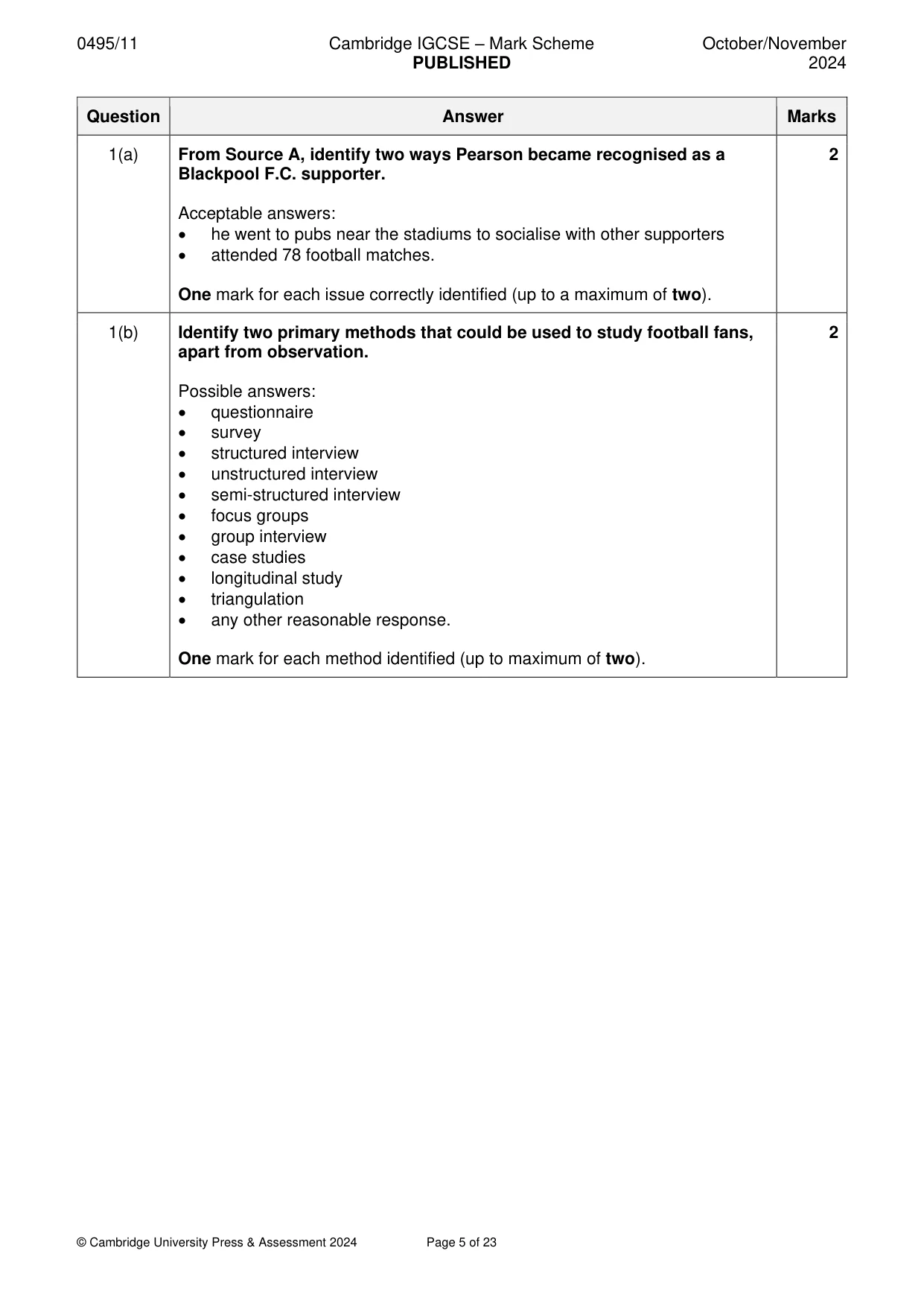
0495/11 Cambridge IGCSE – Mark Scheme PUBLISHED October/November 2024 © Cambridge University Press & Assessment 2024 Page 5 of 23 Question Answer Marks 1(a) From Source A, identify two ways Pearson became recognised as a Blackpool F.C. supporter. Acceptable answers: • he went to pubs near the stadiums to socialise with other supporters • attended 78 football matches. One mark for each issue correctly identified (up to a maximum of two). 2 1(b) Identify two primary methods that could be used to study football fans, apart from observation. Possible answers: • questionnaire • survey • structured interview • unstructured interview • semi-structured interview • focus groups • group interview • case studies • longitudinal study • triangulation • any other reasonable response. One mark for each method identified (up to maximum of two). 2
Mark scheme, page 6
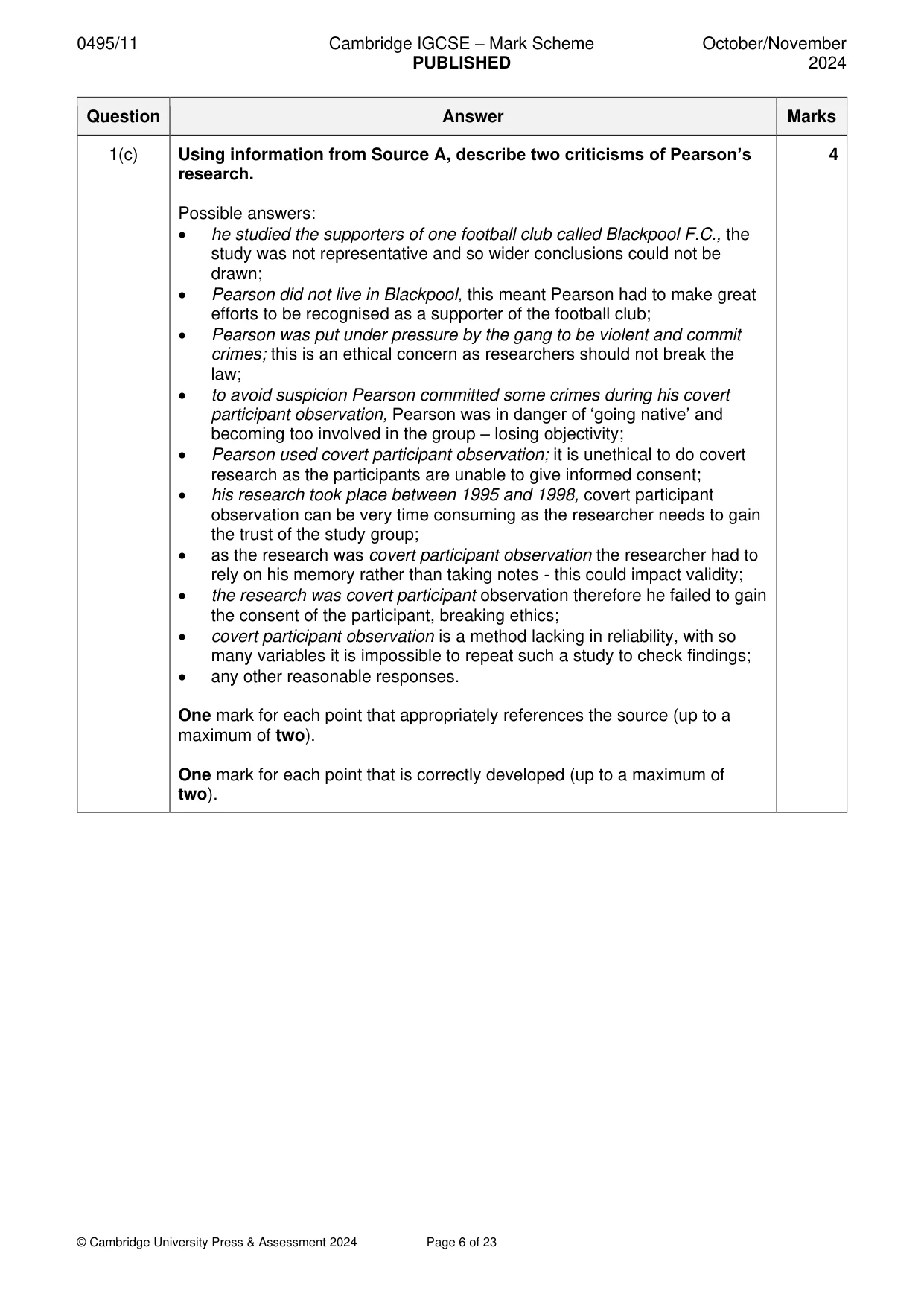
0495/11 Cambridge IGCSE – Mark Scheme PUBLISHED October/November 2024 © Cambridge University Press & Assessment 2024 Page 6 of 23 Question Answer Marks 1(c) Using information from Source A, describe two criticisms of Pearson’s research. Possible answers: • he studied the supporters of one football club called Blackpool F.C., the study was not representative and so wider conclusions could not be drawn; • Pearson did not live in Blackpool, this meant Pearson had to make great efforts to be recognised as a supporter of the football club; • Pearson was put under pressure by the gang to be violent and commit crimes; this is an ethical concern as researchers should not break the law; • to avoid suspicion Pearson committed some crimes during his covert participant observation, Pearson was in danger of ‘going native’ and becoming too involved in the group – losing objectivity; • Pearson used covert participant observation; it is unethical to do covert research as the participants are unable to give informed consent; • his research took place between 1995 and 1998, covert participant observation can be very time consuming as the researcher needs to gain the trust of the study group; • as the research was covert participant observation the researcher had to rely on his memory rather than taking notes - this could impact validity; • the research was covert participant observation therefore he failed to gain the consent of the participant, breaking ethics; • covert participant observation is a method lacking in reliability, with so many variables it is impossible to repeat such a study to check findings; • any other reasonable responses. One mark for each point that appropriately references the source (up to a maximum of two). One mark for each point that is correctly developed (up to a maximum of two). 4
Mark scheme, page 7
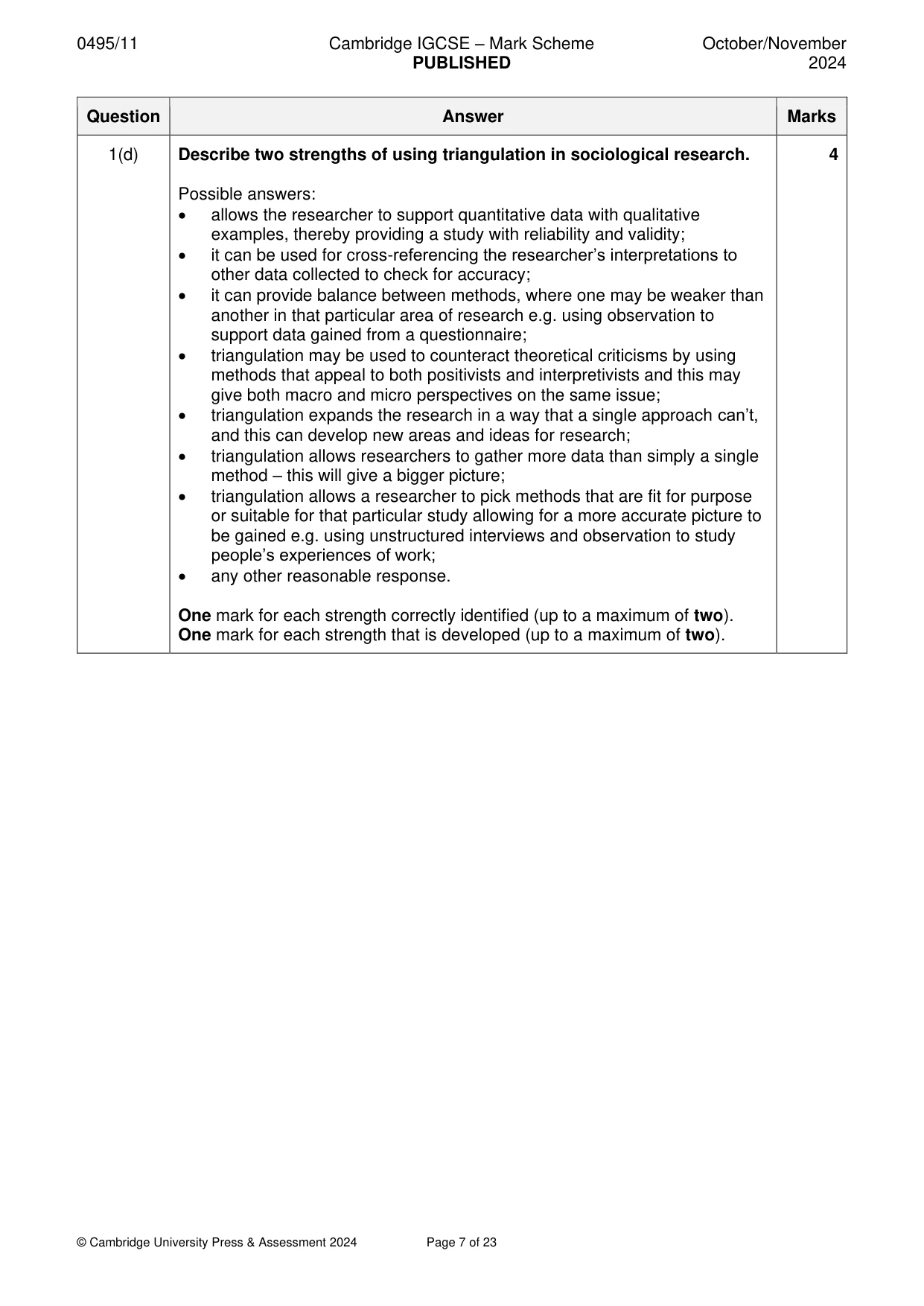
0495/11 Cambridge IGCSE – Mark Scheme PUBLISHED October/November 2024 © Cambridge University Press & Assessment 2024 Page 7 of 23 Question Answer Marks 1(d) Describe two strengths of using triangulation in sociological research. Possible answers: • allows the researcher to support quantitative data with qualitative examples, thereby providing a study with reliability and validity; • it can be used for cross-referencing the researcher’s interpretations to other data collected to check for accuracy; • it can provide balance between methods, where one may be weaker than another in that particular area of research e.g. using observation to support data gained from a questionnaire; • triangulation may be used to counteract theoretical criticisms by using methods that appeal to both positivists and interpretivists and this may give both macro and micro perspectives on the same issue; • triangulation expands the research in a way that a single approach can’t, and this can develop new areas and ideas for research; • triangulation allows researchers to gather more data than simply a single method – this will give a bigger picture; • triangulation allows a researcher to pick methods that are fit for purpose or suitable for that particular study allowing for a more accurate picture to be gained e.g. using unstructured interviews and observation to study people’s experiences of work; • any other reasonable response. One mark for each strength correctly identified (up to a maximum of two). One mark for each strength that is developed (up to a maximum of two). 4
Mark scheme, page 8
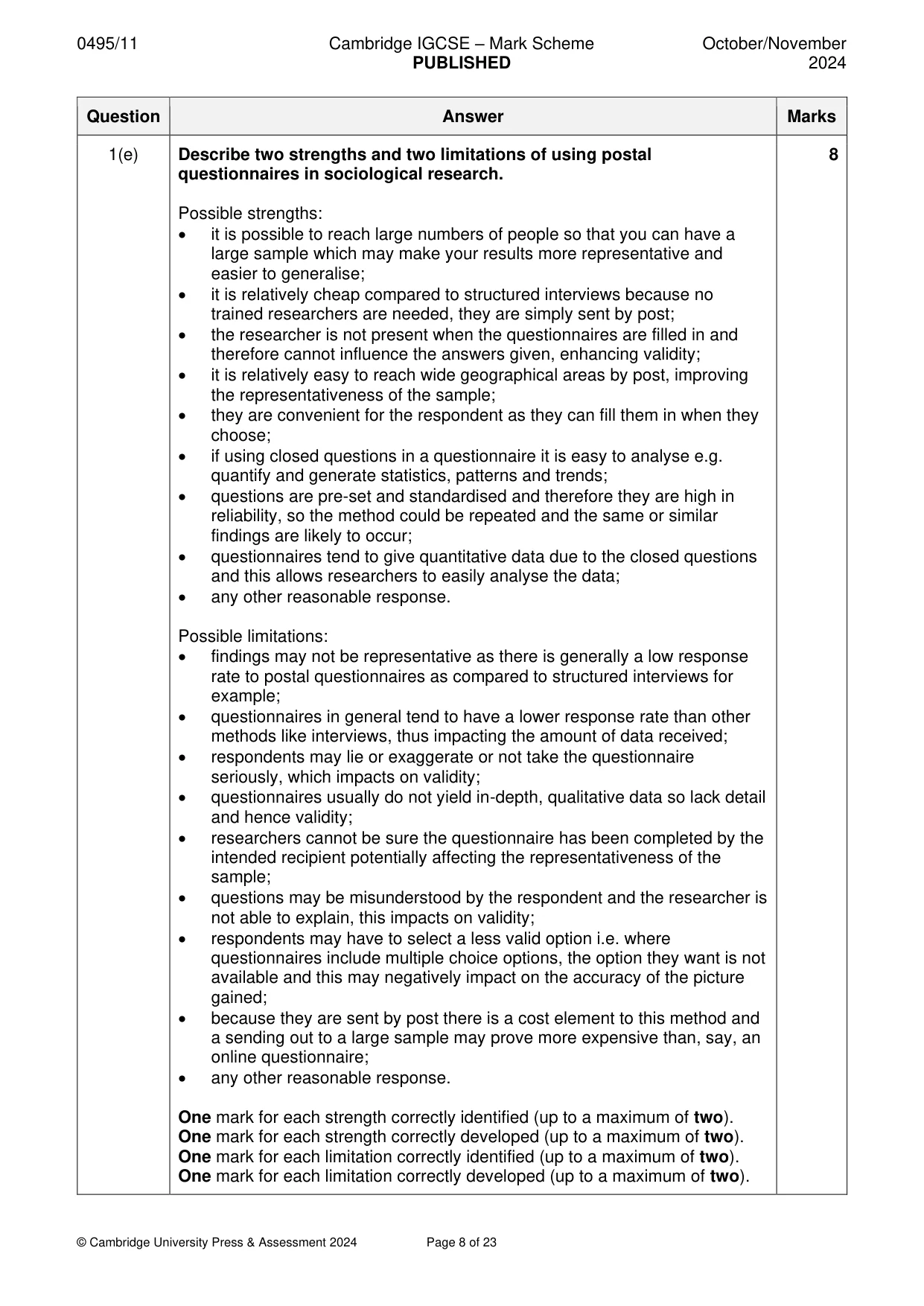
0495/11 Cambridge IGCSE – Mark Scheme PUBLISHED October/November 2024 © Cambridge University Press & Assessment 2024 Page 8 of 23 Question Answer Marks 1(e) Describe two strengths and two limitations of using postal questionnaires in sociological research. Possible strengths: • it is possible to reach large numbers of people so that you can have a large sample which may make your results more representative and easier to generalise; • it is relatively cheap compared to structured interviews because no trained researchers are needed, they are simply sent by post; • the researcher is not present when the questionnaires are filled in and therefore cannot influence the answers given, enhancing validity; • it is relatively easy to reach wide geographical areas by post, improving the representativeness of the sample; • they are convenient for the respondent as they can fill them in when they choose; • if using closed questions in a questionnaire it is easy to analyse e.g. quantify and generate statistics, patterns and trends; • questions are pre-set and standardised and therefore they are high in reliability, so the method could be repeated and the same or similar findings are likely to occur; • questionnaires tend to give quantitative data due to the closed questions and this allows researchers to easily analyse the data; • any other reasonable response. Possible limitations: • findings may not be representative as there is generally a low response rate to postal questionnaires as compared to structured interviews for example; • questionnaires in general tend to have a lower response rate than other methods like interviews, thus impacting the amount of data received; • respondents may lie or exaggerate or not take the questionnaire seriously, which impacts on validity; • questionnaires usually do not yield in-depth, qualitative data so lack detail and hence validity; • researchers cannot be sure the questionnaire has been completed by the intended recipient potentially affecting the representativeness of the sample; • questions may be misunderstood by the respondent and the researcher is not able to explain, this impacts on validity; • respondents may have to select a less valid option i.e. where questionnaires include multiple choice options, the option they want is not available and this may negatively impact on the accuracy of the picture gained; • because they are sent by post there is a cost element to this method and a sending out to a large sample may prove more expensive than, say, an online questionnaire; • any other reasonable response. One mark for each strength correctly identified (up to a maximum of two). One mark for each strength correctly developed (up to a maximum of two). One mark for each limitation correctly identified (up to a maximum of two). One mark for each limitation correctly developed (up to a maximum of two). 8
Mark scheme, page 9
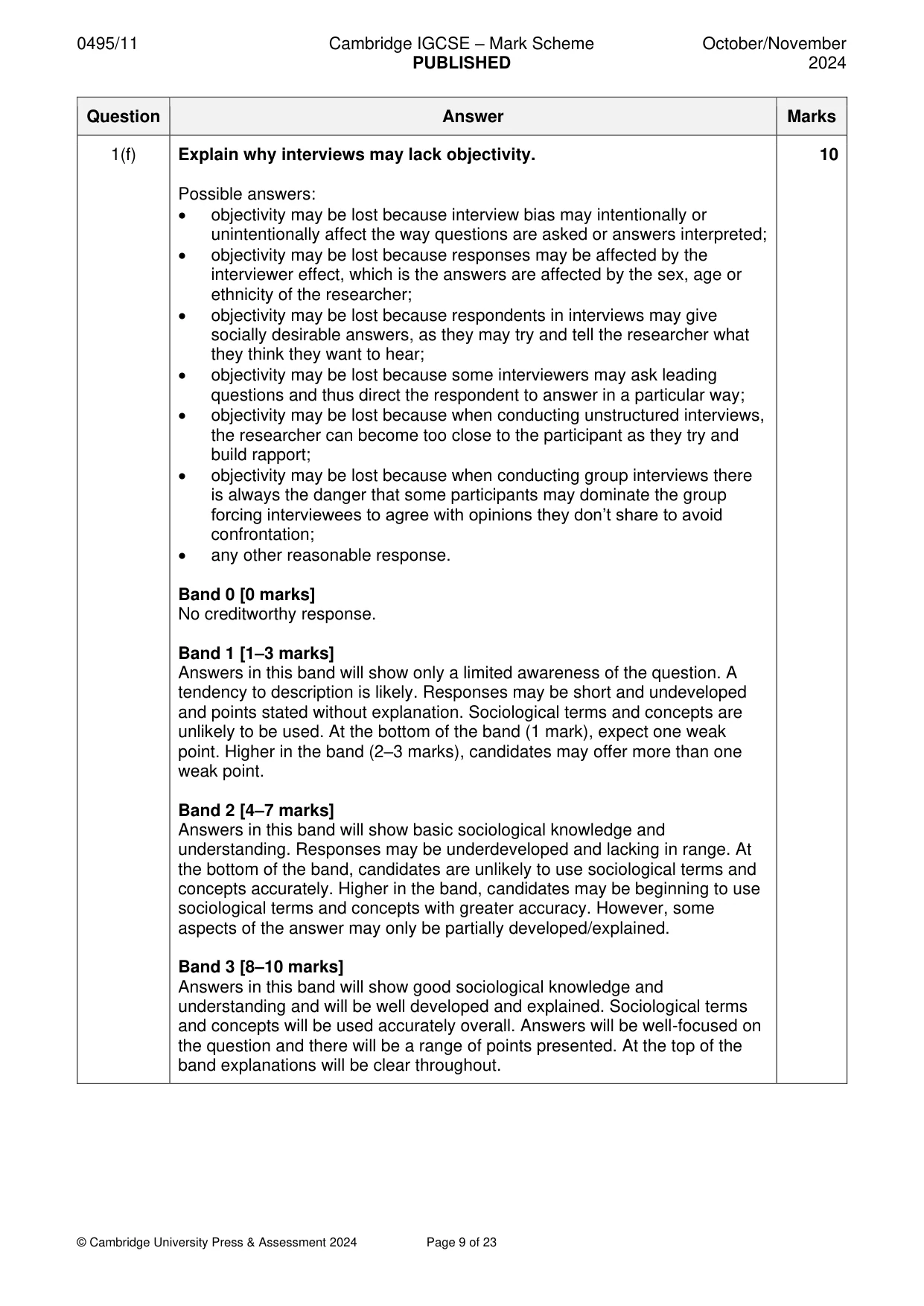
0495/11 Cambridge IGCSE – Mark Scheme PUBLISHED October/November 2024 © Cambridge University Press & Assessment 2024 Page 9 of 23 Question Answer Marks 1(f) Explain why interviews may lack objectivity. Possible answers: • objectivity may be lost because interview bias may intentionally or unintentionally affect the way questions are asked or answers interpreted; • objectivity may be lost because responses may be affected by the interviewer effect, which is the answers are affected by the sex, age or ethnicity of the researcher; • objectivity may be lost because respondents in interviews may give socially desirable answers, as they may try and tell the researcher what they think they want to hear; • objectivity may be lost because some interviewers may ask leading questions and thus direct the respondent to answer in a particular way; • objectivity may be lost because when conducting unstructured interviews, the researcher can become too close to the participant as they try and build rapport; • objectivity may be lost because when conducting group interviews there is always the danger that some participants may dominate the group forcing interviewees to agree with opinions they don’t share to avoid confrontation; • any other reasonable response. Band 0 [0 marks] No creditworthy response. Band 1 [1–3 marks] Answers in this band will show only a limited awareness of the question. A tendency to description is likely. Responses may be short and undeveloped and points stated without explanation. Sociological terms and concepts are unlikely to be used. At the bottom of the band (1 mark), expect one weak point. Higher in the band (2–3 marks), candidates may offer more than one weak point. Band 2 [4–7 marks] Answers in this band will show basic sociological knowledge and understanding. Responses may be underdeveloped and lacking in range. At the bottom of the band, candidates are unlikely to use sociological terms and concepts accurately. Higher in the band, candidates may be beginning to use sociological terms and concepts with greater accuracy. However, some aspects of the answer may only be partially developed/explained. Band 3 [8–10 marks] Answers in this band will show good sociological knowledge and understanding and will be well developed and explained. Sociological terms and concepts will be used accurately overall. Answers will be well-focused on the question and there will be a range of points presented. At the top of the band explanations will be clear throughout. 10
Mark scheme, page 10
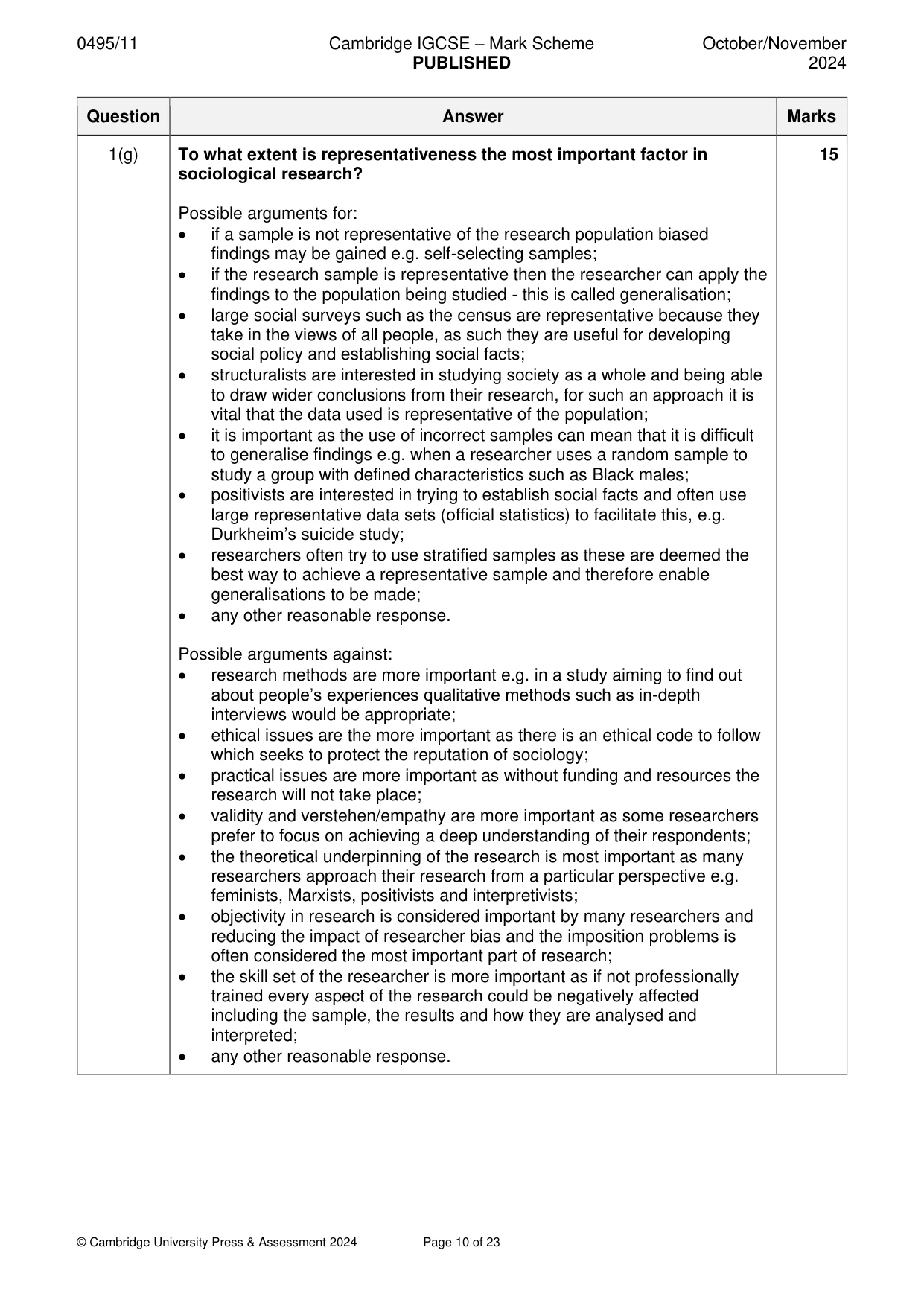
0495/11 Cambridge IGCSE – Mark Scheme PUBLISHED October/November 2024 © Cambridge University Press & Assessment 2024 Page 10 of 23 Question Answer Marks 1(g) To what extent is representativeness the most important factor in sociological research? Possible arguments for: • if a sample is not representative of the research population biased findings may be gained e.g. self-selecting samples; • if the research sample is representative then the researcher can apply the findings to the population being studied - this is called generalisation; • large social surveys such as the census are representative because they take in the views of all people, as such they are useful for developing social policy and establishing social facts; • structuralists are interested in studying society as a whole and being able to draw wider conclusions from their research, for such an approach it is vital that the data used is representative of the population; • it is important as the use of incorrect samples can mean that it is difficult to generalise findings e.g. when a researcher uses a random sample to study a group with defined characteristics such as Black males; • positivists are interested in trying to establish social facts and often use large representative data sets (official statistics) to facilitate this, e.g. Durkheim’s suicide study; • researchers often try to use stratified samples as these are deemed the best way to achieve a representative sample and therefore enable generalisations to be made; • any other reasonable response. Possible arguments against: • research methods are more important e.g. in a study aiming to find out about people’s experiences qualitative methods such as in-depth interviews would be appropriate; • ethical issues are the more important as there is an ethical code to follow which seeks to protect the reputation of sociology; • practical issues are more important as without funding and resources the research will not take place; • validity and verstehen/empathy are more important as some researchers prefer to focus on achieving a deep understanding of their respondents; • the theoretical underpinning of the research is most important as many researchers approach their research from a particular perspective e.g. feminists, Marxists, positivists and interpretivists; • objectivity in research is considered important by many researchers and reducing the impact of researcher bias and the imposition problems is often considered the most important part of research; • the skill set of the researcher is more important as if not professionally trained every aspect of the research could be negatively affected including the sample, the results and how they are analysed and interpreted; • any other reasonable response. 15
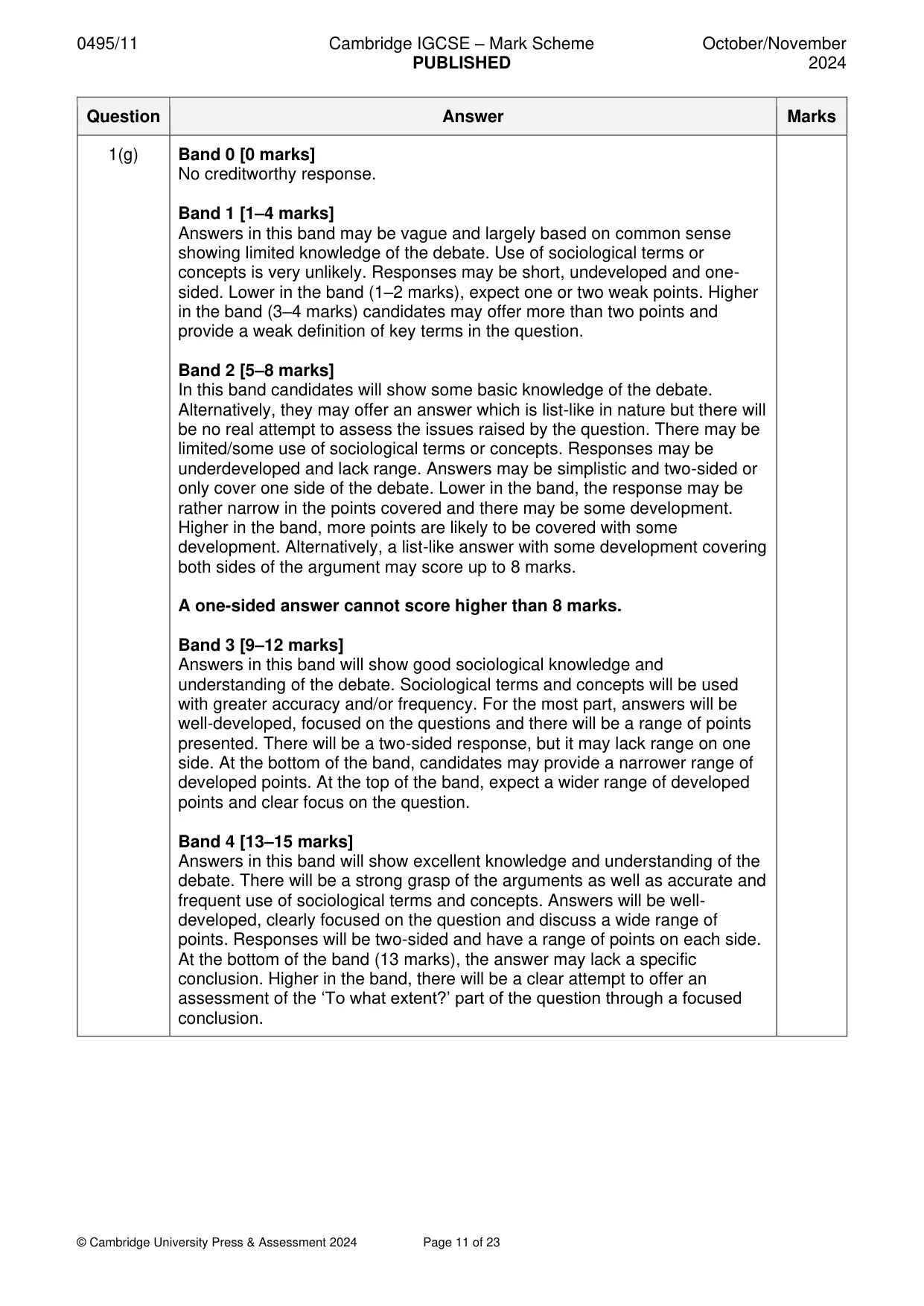
Mark scheme, page 11
0495/11 Cambridge IGCSE – Mark Scheme PUBLISHED October/November 2024 © Cambridge University Press & Assessment 2024 Page 11 of 23 Question Answer Marks 1(g) Band 0 [0 marks] No creditworthy response. Band 1 [1–4 marks] Answers in this band may be vague and largely based on common sense showing limited knowledge of the debate. Use of sociological terms or concepts is very unlikely. Responses may be short, undeveloped and one- sided. Lower in the band (1–2 marks), expect one or two weak points. Higher in the band (3–4 marks) candidates may offer more than two points and provide a weak definition of key terms in the question. Band 2 [5–8 marks] In this band candidates will show some basic knowledge of the debate. Alternatively, they may offer an answer which is list-like in nature but there will be no real attempt to assess the issues raised by the question. There may be limited/some use of sociological terms or concepts. Responses may be underdeveloped and lack range. Answers may be simplistic and two-sided or only cover one side of the debate. Lower in the band, the response may be rather narrow in the points covered and there may be some development. Higher in the band, more points are likely to be covered with some development. Alternatively, a list-like answer with some development covering both sides of the argument may score up to 8 marks. A one-sided answer cannot score higher than 8 marks. Band 3 [9–12 marks] Answers in this band will show good sociological knowledge and understanding of the debate. Sociological terms and concepts will be used with greater accuracy and/or frequency. For the most part, answers will be well-developed, focused on the questions and there will be a range of points presented. There will be a two-sided response, but it may lack range on one side. At the bottom of the band, candidates may provide a narrower range of developed points. At the top of the band, expect a wider range of developed points and clear focus on the question. Band 4 [13–15 marks] Answers in this band will show excellent knowledge and understanding of the debate. There will be a strong grasp of the arguments as well as accurate and frequent use of sociological terms and concepts. Answers will be well- developed, clearly focused on the question and discuss a wide range of points. Responses will be two-sided and have a range of points on each side. At the bottom of the band (13 marks), the answer may lack a specific conclusion. Higher in the band, there will be a clear attempt to offer an assessment of the ‘To what extent?’ part of the question through a focused conclusion.
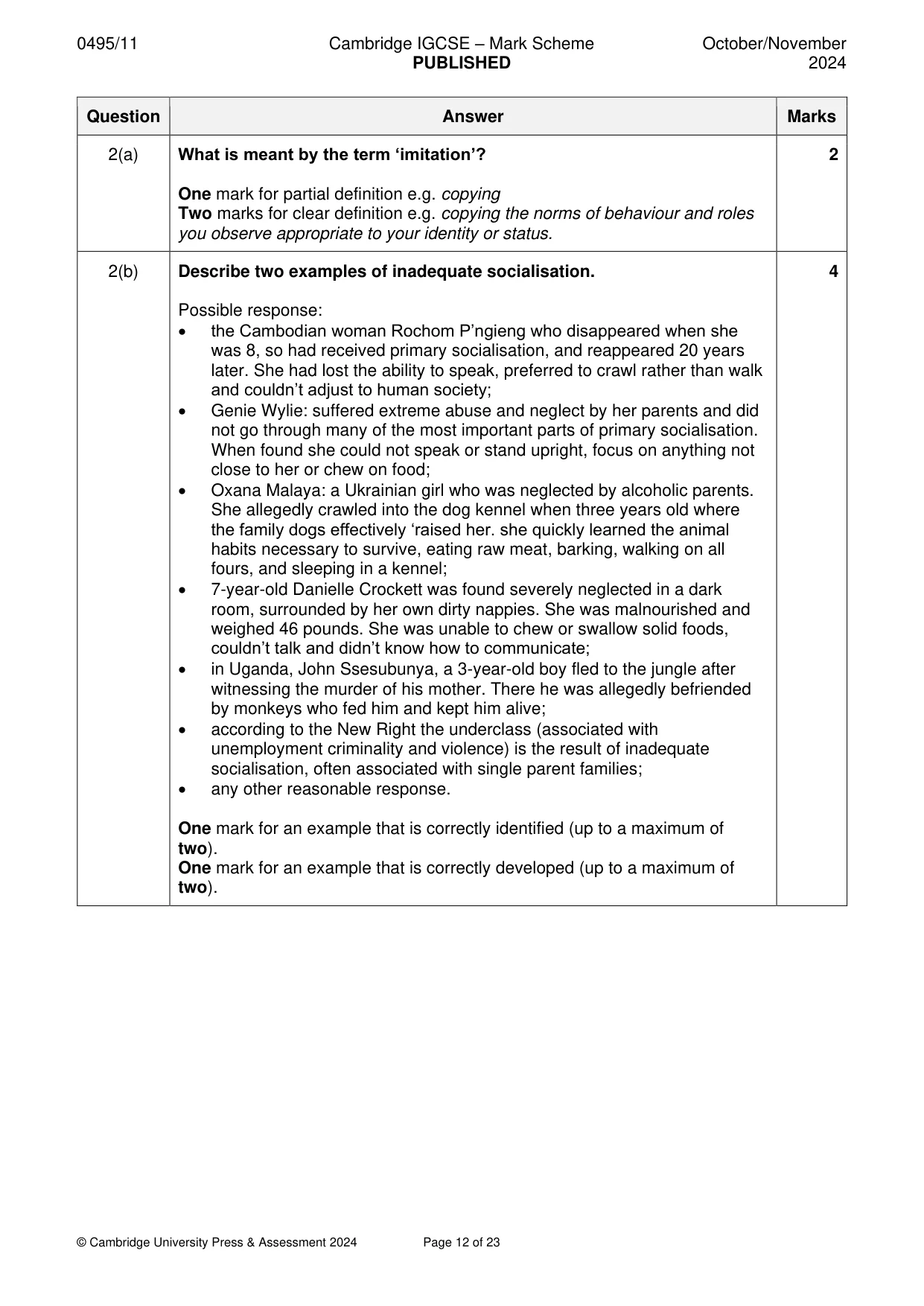
Mark scheme, page 12
0495/11 Cambridge IGCSE – Mark Scheme PUBLISHED October/November 2024 © Cambridge University Press & Assessment 2024 Page 12 of 23 Question Answer Marks 2(a) What is meant by the term ‘imitation’? One mark for partial definition e.g. copying Two marks for clear definition e.g. copying the norms of behaviour and roles you observe appropriate to your identity or status. 2 2(b) Describe two examples of inadequate socialisation. Possible response: • the Cambodian woman Rochom P’ngieng who disappeared when she was 8, so had received primary socialisation, and reappeared 20 years later. She had lost the ability to speak, preferred to crawl rather than walk and couldn’t adjust to human society; • Genie Wylie: suffered extreme abuse and neglect by her parents and did not go through many of the most important parts of primary socialisation. When found she could not speak or stand upright, focus on anything not close to her or chew on food; • Oxana Malaya: a Ukrainian girl who was neglected by alcoholic parents. She allegedly crawled into the dog kennel when three years old where the family dogs effectively ‘raised her. she quickly learned the animal habits necessary to survive, eating raw meat, barking, walking on all fours, and sleeping in a kennel; • 7-year-old Danielle Crockett was found severely neglected in a dark room, surrounded by her own dirty nappies. She was malnourished and weighed 46 pounds. She was unable to chew or swallow solid foods, couldn’t talk and didn’t know how to communicate; • in Uganda, John Ssesubunya, a 3-year-old boy fled to the jungle after witnessing the murder of his mother. There he was allegedly befriended by monkeys who fed him and kept him alive; • according to the New Right the underclass (associated with unemployment criminality and violence) is the result of inadequate socialisation, often associated with single parent families; • any other reasonable response. One mark for an example that is correctly identified (up to a maximum of two). One mark for an example that is correctly developed (up to a maximum of two). 4
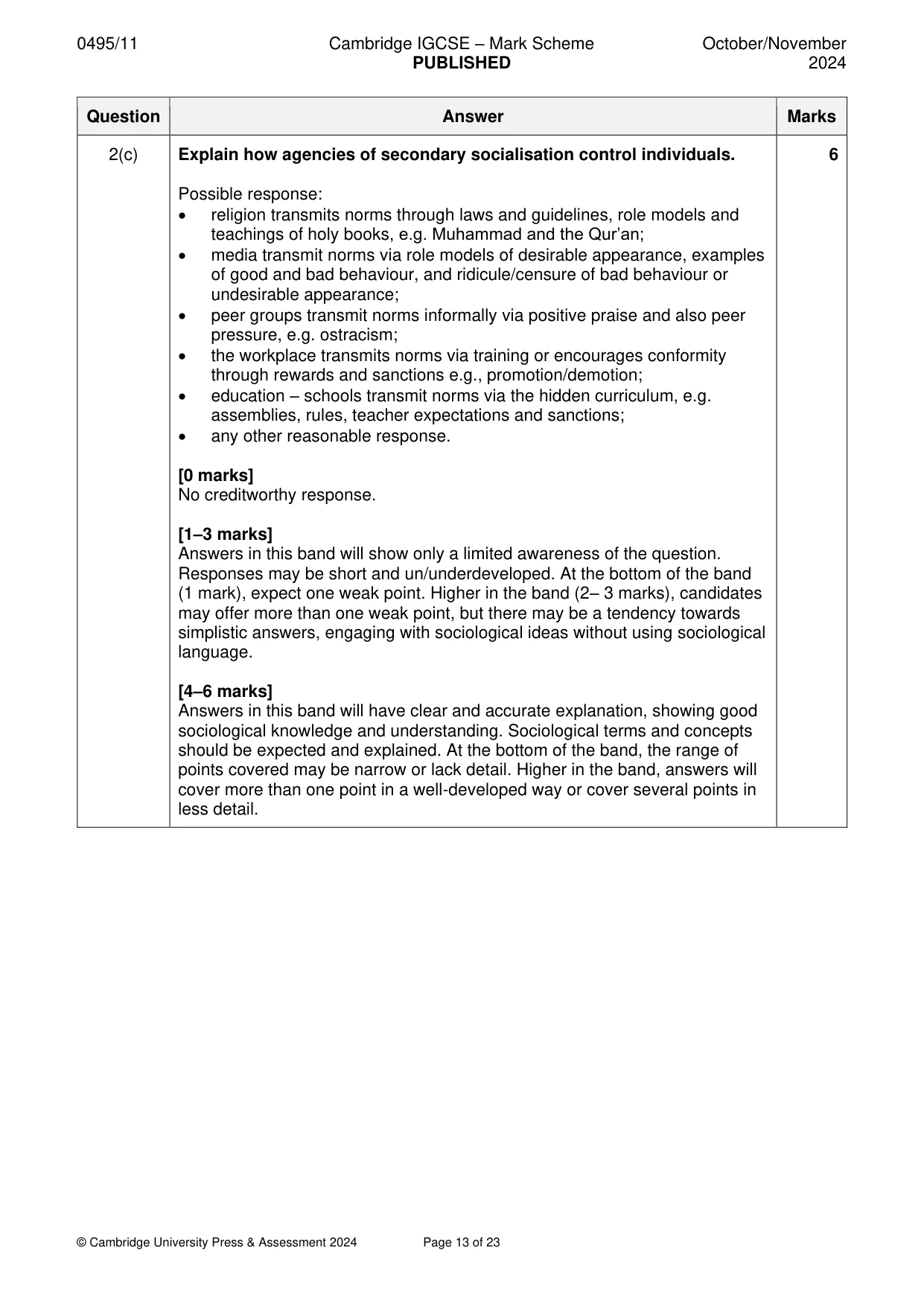
Mark scheme, page 13
0495/11 Cambridge IGCSE – Mark Scheme PUBLISHED October/November 2024 © Cambridge University Press & Assessment 2024 Page 13 of 23 Question Answer Marks 2(c) Explain how agencies of secondary socialisation control individuals. Possible response: • religion transmits norms through laws and guidelines, role models and teachings of holy books, e.g. Muhammad and the Qur’an; • media transmit norms via role models of desirable appearance, examples of good and bad behaviour, and ridicule/censure of bad behaviour or undesirable appearance; • peer groups transmit norms informally via positive praise and also peer pressure, e.g. ostracism; • the workplace transmits norms via training or encourages conformity through rewards and sanctions e.g., promotion/demotion; • education – schools transmit norms via the hidden curriculum, e.g. assemblies, rules, teacher expectations and sanctions; • any other reasonable response. [0 marks] No creditworthy response. [1–3 marks] Answers in this band will show only a limited awareness of the question. Responses may be short and un/underdeveloped. At the bottom of the band (1 mark), expect one weak point. Higher in the band (2– 3 marks), candidates may offer more than one weak point, but there may be a tendency towards simplistic answers, engaging with sociological ideas without using sociological language. [4–6 marks] Answers in this band will have clear and accurate explanation, showing good sociological knowledge and understanding. Sociological terms and concepts should be expected and explained. At the bottom of the band, the range of points covered may be narrow or lack detail. Higher in the band, answers will cover more than one point in a well-developed way or cover several points in less detail. 6
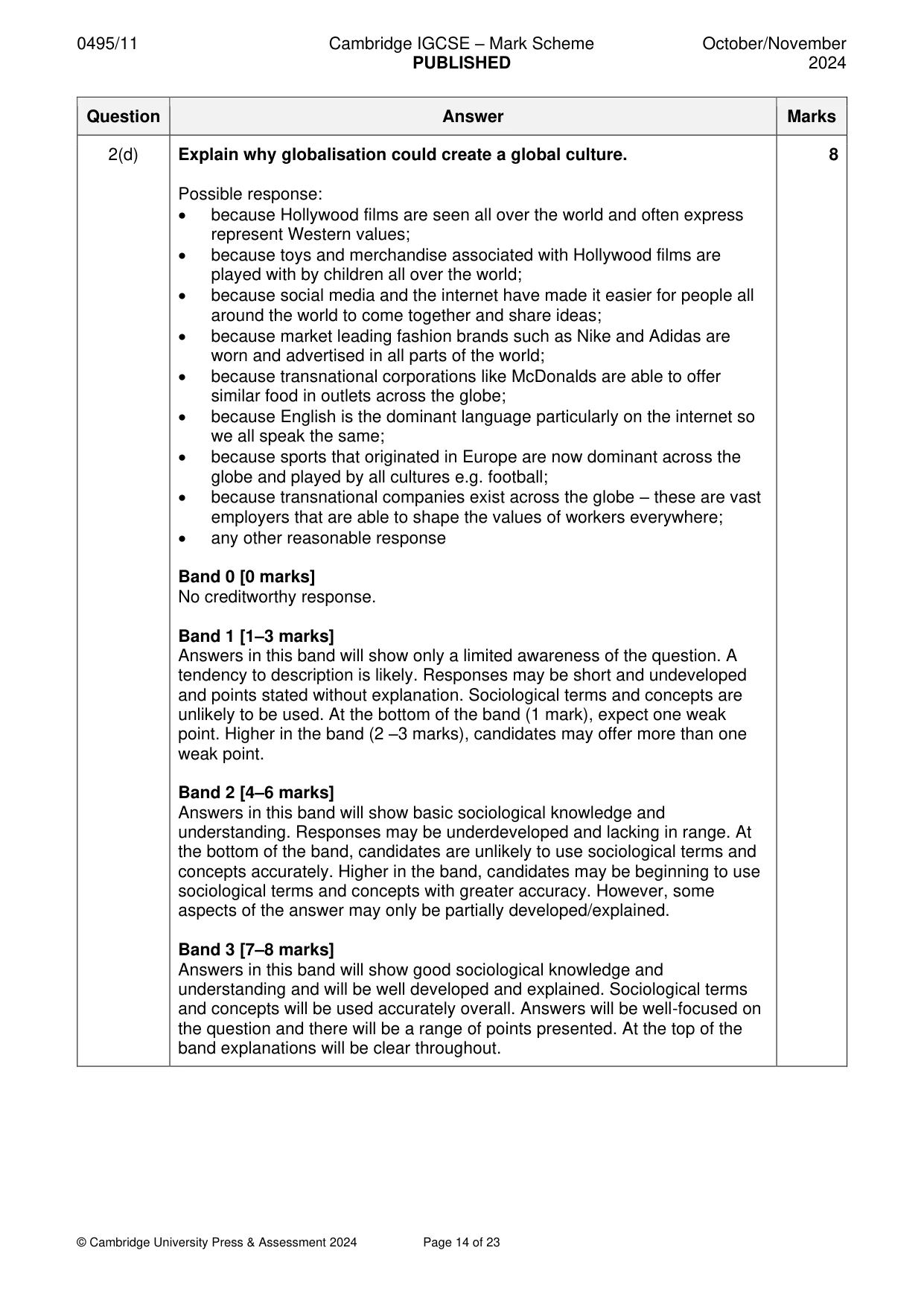
Mark scheme, page 14
0495/11 Cambridge IGCSE – Mark Scheme PUBLISHED October/November 2024 © Cambridge University Press & Assessment 2024 Page 14 of 23 Question Answer Marks 2(d) Explain why globalisation could create a global culture. Possible response: • because Hollywood films are seen all over the world and often express represent Western values; • because toys and merchandise associated with Hollywood films are played with by children all over the world; • because social media and the internet have made it easier for people all around the world to come together and share ideas; • because market leading fashion brands such as Nike and Adidas are worn and advertised in all parts of the world; • because transnational corporations like McDonalds are able to offer similar food in outlets across the globe; • because English is the dominant language particularly on the internet so we all speak the same; • because sports that originated in Europe are now dominant across the globe and played by all cultures e.g. football; • because transnational companies exist across the globe – these are vast employers that are able to shape the values of workers everywhere; • any other reasonable response Band 0 [0 marks] No creditworthy response. Band 1 [1–3 marks] Answers in this band will show only a limited awareness of the question. A tendency to description is likely. Responses may be short and undeveloped and points stated without explanation. Sociological terms and concepts are unlikely to be used. At the bottom of the band (1 mark), expect one weak point. Higher in the band (2 –3 marks), candidates may offer more than one weak point. Band 2 [4–6 marks] Answers in this band will show basic sociological knowledge and understanding. Responses may be underdeveloped and lacking in range. At the bottom of the band, candidates are unlikely to use sociological terms and concepts accurately. Higher in the band, candidates may be beginning to use sociological terms and concepts with greater accuracy. However, some aspects of the answer may only be partially developed/explained. Band 3 [7–8 marks] Answers in this band will show good sociological knowledge and understanding and will be well developed and explained. Sociological terms and concepts will be used accurately overall. Answers will be well-focused on the question and there will be a range of points presented. At the top of the band explanations will be clear throughout. 8
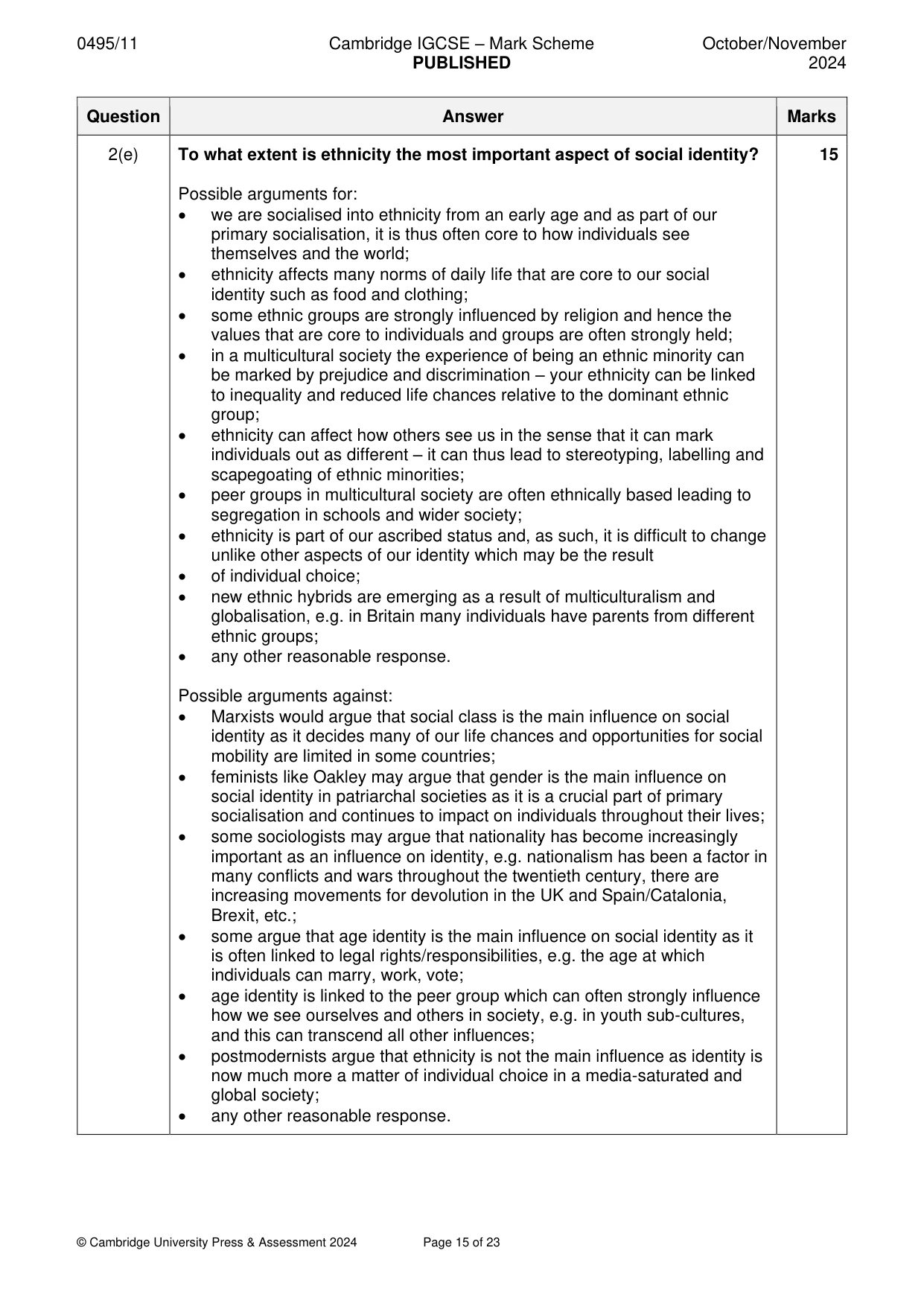
Mark scheme, page 15
0495/11 Cambridge IGCSE – Mark Scheme PUBLISHED October/November 2024 © Cambridge University Press & Assessment 2024 Page 15 of 23 Question Answer Marks 2(e) To what extent is ethnicity the most important aspect of social identity? Possible arguments for: • we are socialised into ethnicity from an early age and as part of our primary socialisation, it is thus often core to how individuals see themselves and the world; • ethnicity affects many norms of daily life that are core to our social identity such as food and clothing; • some ethnic groups are strongly influenced by religion and hence the values that are core to individuals and groups are often strongly held; • in a multicultural society the experience of being an ethnic minority can be marked by prejudice and discrimination – your ethnicity can be linked to inequality and reduced life chances relative to the dominant ethnic group; • ethnicity can affect how others see us in the sense that it can mark individuals out as different – it can thus lead to stereotyping, labelling and scapegoating of ethnic minorities; • peer groups in multicultural society are often ethnically based leading to segregation in schools and wider society; • ethnicity is part of our ascribed status and, as such, it is difficult to change unlike other aspects of our identity which may be the result • of individual choice; • new ethnic hybrids are emerging as a result of multiculturalism and globalisation, e.g. in Britain many individuals have parents from different ethnic groups; • any other reasonable response. Possible arguments against: • Marxists would argue that social class is the main influence on social identity as it decides many of our life chances and opportunities for social mobility are limited in some countries; • feminists like Oakley may argue that gender is the main influence on social identity in patriarchal societies as it is a crucial part of primary socialisation and continues to impact on individuals throughout their lives; • some sociologists may argue that nationality has become increasingly important as an influence on identity, e.g. nationalism has been a factor in many conflicts and wars throughout the twentieth century, there are increasing movements for devolution in the UK and Spain/Catalonia, Brexit, etc.; • some argue that age identity is the main influence on social identity as it is often linked to legal rights/responsibilities, e.g. the age at which individuals can marry, work, vote; • age identity is linked to the peer group which can often strongly influence how we see ourselves and others in society, e.g. in youth sub-cultures, and this can transcend all other influences; • postmodernists argue that ethnicity is not the main influence as identity is now much more a matter of individual choice in a media-saturated and global society; • any other reasonable response. 15
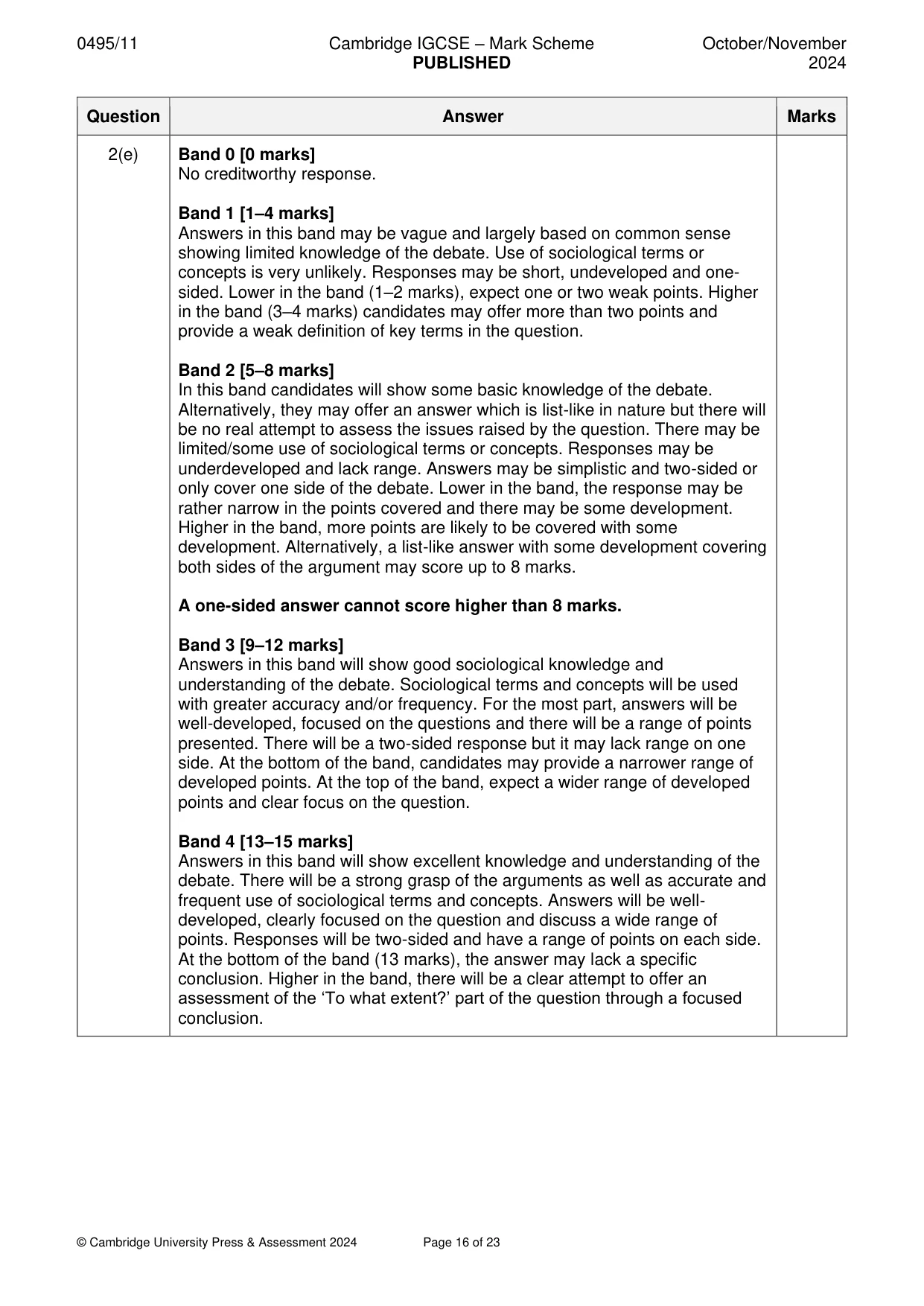
Mark scheme, page 16
0495/11 Cambridge IGCSE – Mark Scheme PUBLISHED October/November 2024 © Cambridge University Press & Assessment 2024 Page 16 of 23 Question Answer Marks 2(e) Band 0 [0 marks] No creditworthy response. Band 1 [1–4 marks] Answers in this band may be vague and largely based on common sense showing limited knowledge of the debate. Use of sociological terms or concepts is very unlikely. Responses may be short, undeveloped and one- sided. Lower in the band (1–2 marks), expect one or two weak points. Higher in the band (3–4 marks) candidates may offer more than two points and provide a weak definition of key terms in the question. Band 2 [5–8 marks] In this band candidates will show some basic knowledge of the debate. Alternatively, they may offer an answer which is list-like in nature but there will be no real attempt to assess the issues raised by the question. There may be limited/some use of sociological terms or concepts. Responses may be underdeveloped and lack range. Answers may be simplistic and two-sided or only cover one side of the debate. Lower in the band, the response may be rather narrow in the points covered and there may be some development. Higher in the band, more points are likely to be covered with some development. Alternatively, a list-like answer with some development covering both sides of the argument may score up to 8 marks. A one-sided answer cannot score higher than 8 marks. Band 3 [9–12 marks] Answers in this band will show good sociological knowledge and understanding of the debate. Sociological terms and concepts will be used with greater accuracy and/or frequency. For the most part, answers will be well-developed, focused on the questions and there will be a range of points presented. There will be a two-sided response but it may lack range on one side. At the bottom of the band, candidates may provide a narrower range of developed points. At the top of the band, expect a wider range of developed points and clear focus on the question. Band 4 [13–15 marks] Answers in this band will show excellent knowledge and understanding of the debate. There will be a strong grasp of the arguments as well as accurate and frequent use of sociological terms and concepts. Answers will be well- developed, clearly focused on the question and discuss a wide range of points. Responses will be two-sided and have a range of points on each side. At the bottom of the band (13 marks), the answer may lack a specific conclusion. Higher in the band, there will be a clear attempt to offer an assessment of the ‘To what extent?’ part of the question through a focused conclusion.
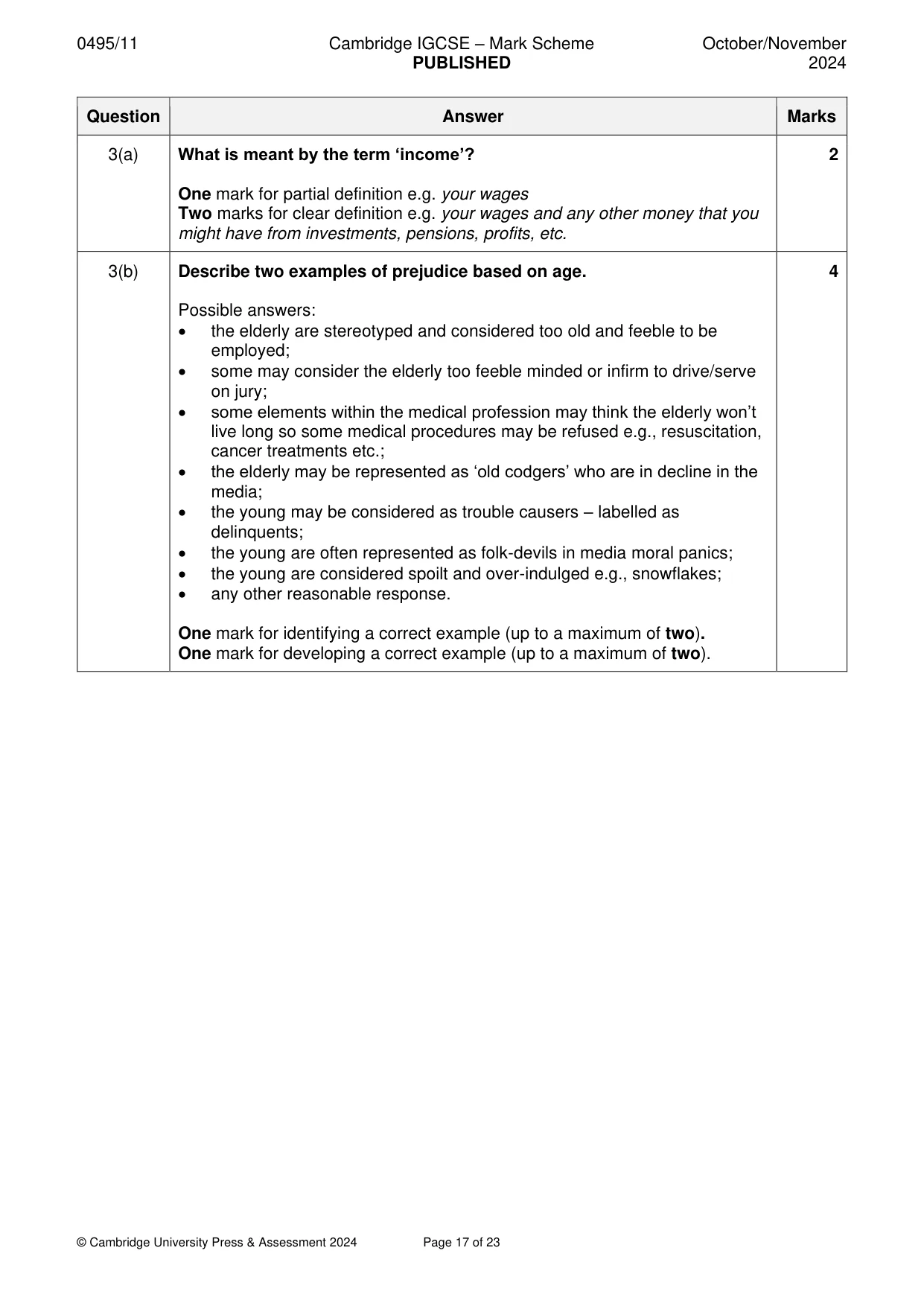
Mark scheme, page 17
0495/11 Cambridge IGCSE – Mark Scheme PUBLISHED October/November 2024 © Cambridge University Press & Assessment 2024 Page 17 of 23 Question Answer Marks 3(a) What is meant by the term ‘income’? One mark for partial definition e.g. your wages Two marks for clear definition e.g. your wages and any other money that you might have from investments, pensions, profits, etc. 2 3(b) Describe two examples of prejudice based on age. Possible answers: • the elderly are stereotyped and considered too old and feeble to be employed; • some may consider the elderly too feeble minded or infirm to drive/serve on jury; • some elements within the medical profession may think the elderly won’t live long so some medical procedures may be refused e.g., resuscitation, cancer treatments etc.; • the elderly may be represented as ‘old codgers’ who are in decline in the media; • the young may be considered as trouble causers – labelled as delinquents; • the young are often represented as folk-devils in media moral panics; • the young are considered spoilt and over-indulged e.g., snowflakes; • any other reasonable response. One mark for identifying a correct example (up to a maximum of two). One mark for developing a correct example (up to a maximum of two). 4
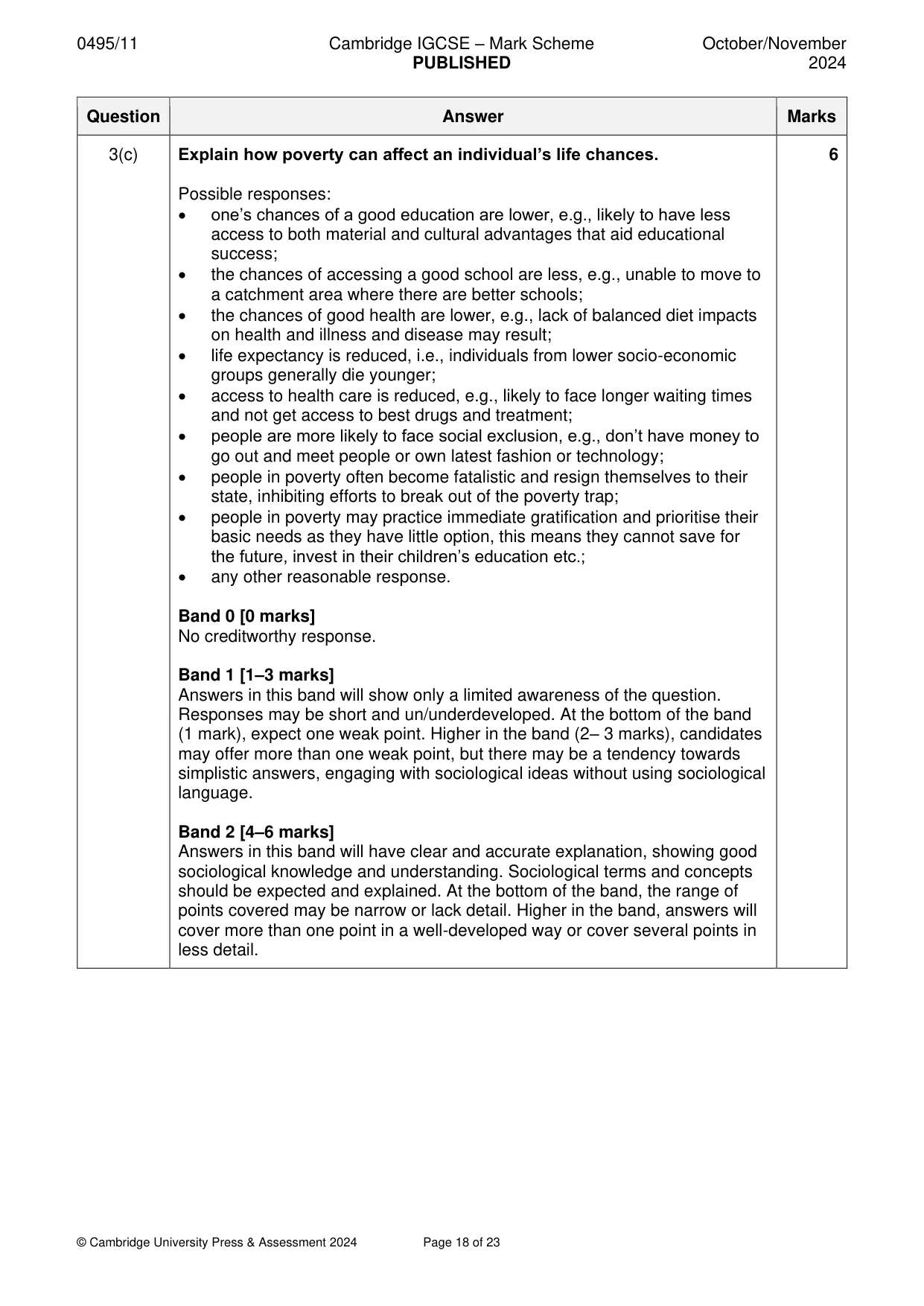
Mark scheme, page 18
0495/11 Cambridge IGCSE – Mark Scheme PUBLISHED October/November 2024 © Cambridge University Press & Assessment 2024 Page 18 of 23 Question Answer Marks 3(c) Explain how poverty can affect an individual’s life chances. Possible responses: • one’s chances of a good education are lower, e.g., likely to have less access to both material and cultural advantages that aid educational success; • the chances of accessing a good school are less, e.g., unable to move to a catchment area where there are better schools; • the chances of good health are lower, e.g., lack of balanced diet impacts on health and illness and disease may result; • life expectancy is reduced, i.e., individuals from lower socio-economic groups generally die younger; • access to health care is reduced, e.g., likely to face longer waiting times and not get access to best drugs and treatment; • people are more likely to face social exclusion, e.g., don’t have money to go out and meet people or own latest fashion or technology; • people in poverty often become fatalistic and resign themselves to their state, inhibiting efforts to break out of the poverty trap; • people in poverty may practice immediate gratification and prioritise their basic needs as they have little option, this means they cannot save for the future, invest in their children’s education etc.; • any other reasonable response. Band 0 [0 marks] No creditworthy response. Band 1 [1–3 marks] Answers in this band will show only a limited awareness of the question. Responses may be short and un/underdeveloped. At the bottom of the band (1 mark), expect one weak point. Higher in the band (2– 3 marks), candidates may offer more than one weak point, but there may be a tendency towards simplistic answers, engaging with sociological ideas without using sociological language. Band 2 [4–6 marks] Answers in this band will have clear and accurate explanation, showing good sociological knowledge and understanding. Sociological terms and concepts should be expected and explained. At the bottom of the band, the range of points covered may be narrow or lack detail. Higher in the band, answers will cover more than one point in a well-developed way or cover several points in less detail. 6
Mark scheme, page 19
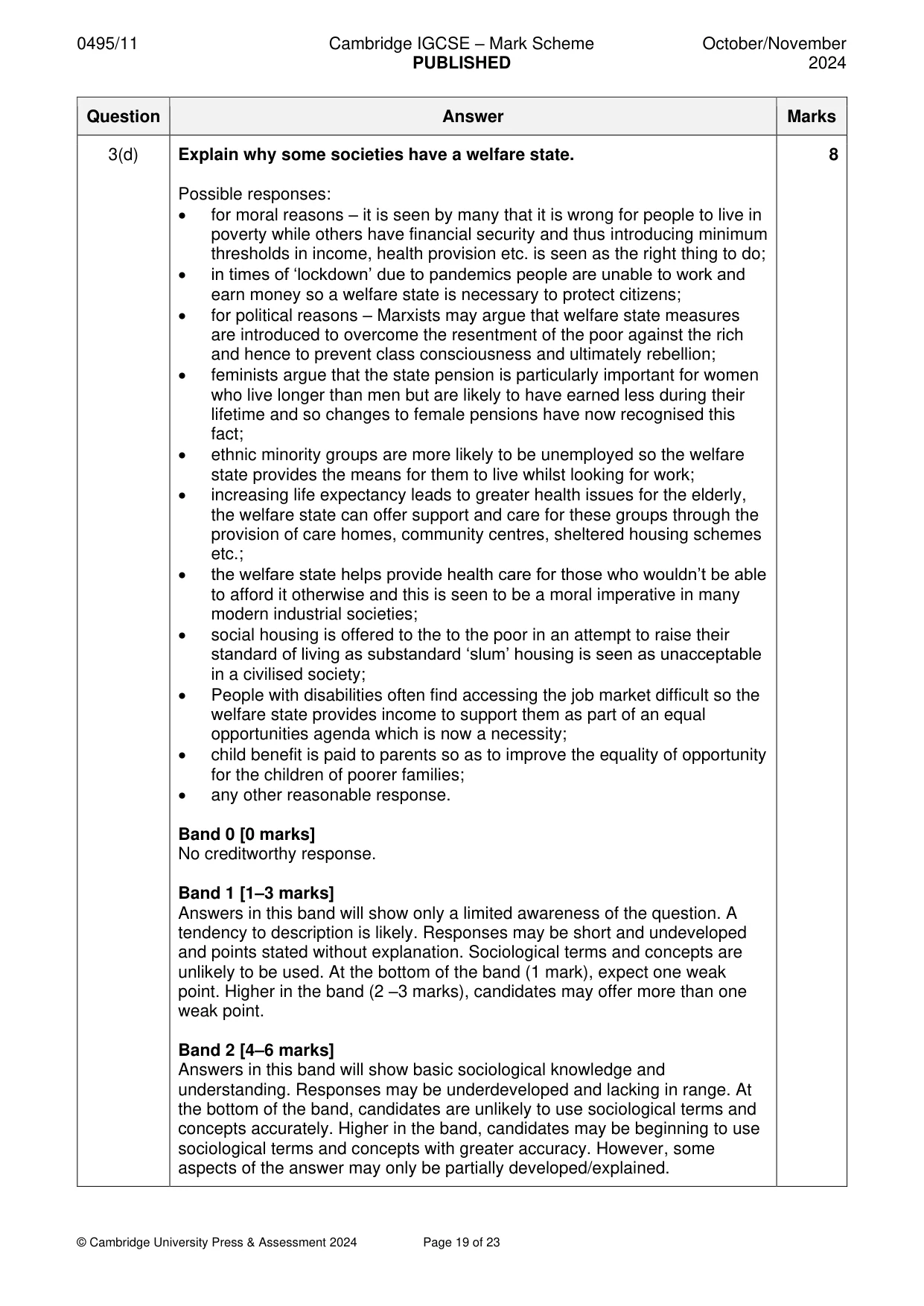
0495/11 Cambridge IGCSE – Mark Scheme PUBLISHED October/November 2024 © Cambridge University Press & Assessment 2024 Page 19 of 23 Question Answer Marks 3(d) Explain why some societies have a welfare state. Possible responses: • for moral reasons – it is seen by many that it is wrong for people to live in poverty while others have financial security and thus introducing minimum thresholds in income, health provision etc. is seen as the right thing to do; • in times of ‘lockdown’ due to pandemics people are unable to work and earn money so a welfare state is necessary to protect citizens; • for political reasons – Marxists may argue that welfare state measures are introduced to overcome the resentment of the poor against the rich and hence to prevent class consciousness and ultimately rebellion; • feminists argue that the state pension is particularly important for women who live longer than men but are likely to have earned less during their lifetime and so changes to female pensions have now recognised this fact; • ethnic minority groups are more likely to be unemployed so the welfare state provides the means for them to live whilst looking for work; • increasing life expectancy leads to greater health issues for the elderly, the welfare state can offer support and care for these groups through the provision of care homes, community centres, sheltered housing schemes etc.; • the welfare state helps provide health care for those who wouldn’t be able to afford it otherwise and this is seen to be a moral imperative in many modern industrial societies; • social housing is offered to the to the poor in an attempt to raise their standard of living as substandard ‘slum’ housing is seen as unacceptable in a civilised society; • People with disabilities often find accessing the job market difficult so the welfare state provides income to support them as part of an equal opportunities agenda which is now a necessity; • child benefit is paid to parents so as to improve the equality of opportunity for the children of poorer families; • any other reasonable response. Band 0 [0 marks] No creditworthy response. Band 1 [1–3 marks] Answers in this band will show only a limited awareness of the question. A tendency to description is likely. Responses may be short and undeveloped and points stated without explanation. Sociological terms and concepts are unlikely to be used. At the bottom of the band (1 mark), expect one weak point. Higher in the band (2 –3 marks), candidates may offer more than one weak point. Band 2 [4–6 marks] Answers in this band will show basic sociological knowledge and understanding. Responses may be underdeveloped and lacking in range. At the bottom of the band, candidates are unlikely to use sociological terms and concepts accurately. Higher in the band, candidates may be beginning to use sociological terms and concepts with greater accuracy. However, some aspects of the answer may only be partially developed/explained. 8
Mark scheme, page 20
0495/11 Cambridge IGCSE – Mark Scheme PUBLISHED October/November 2024 © Cambridge University Press & Assessment 2024 Page 20 of 23 Question Answer Marks 3(d) Band 3 [7–8 marks] Answers in this band will show good sociological knowledge and understanding and will be well developed and explained. Sociological terms and concepts will be used accurately overall. Answers will be well-focused on the question and there will be a range of points presented. At the top of the band explanations will be clear throughout.
Mark scheme, page 21
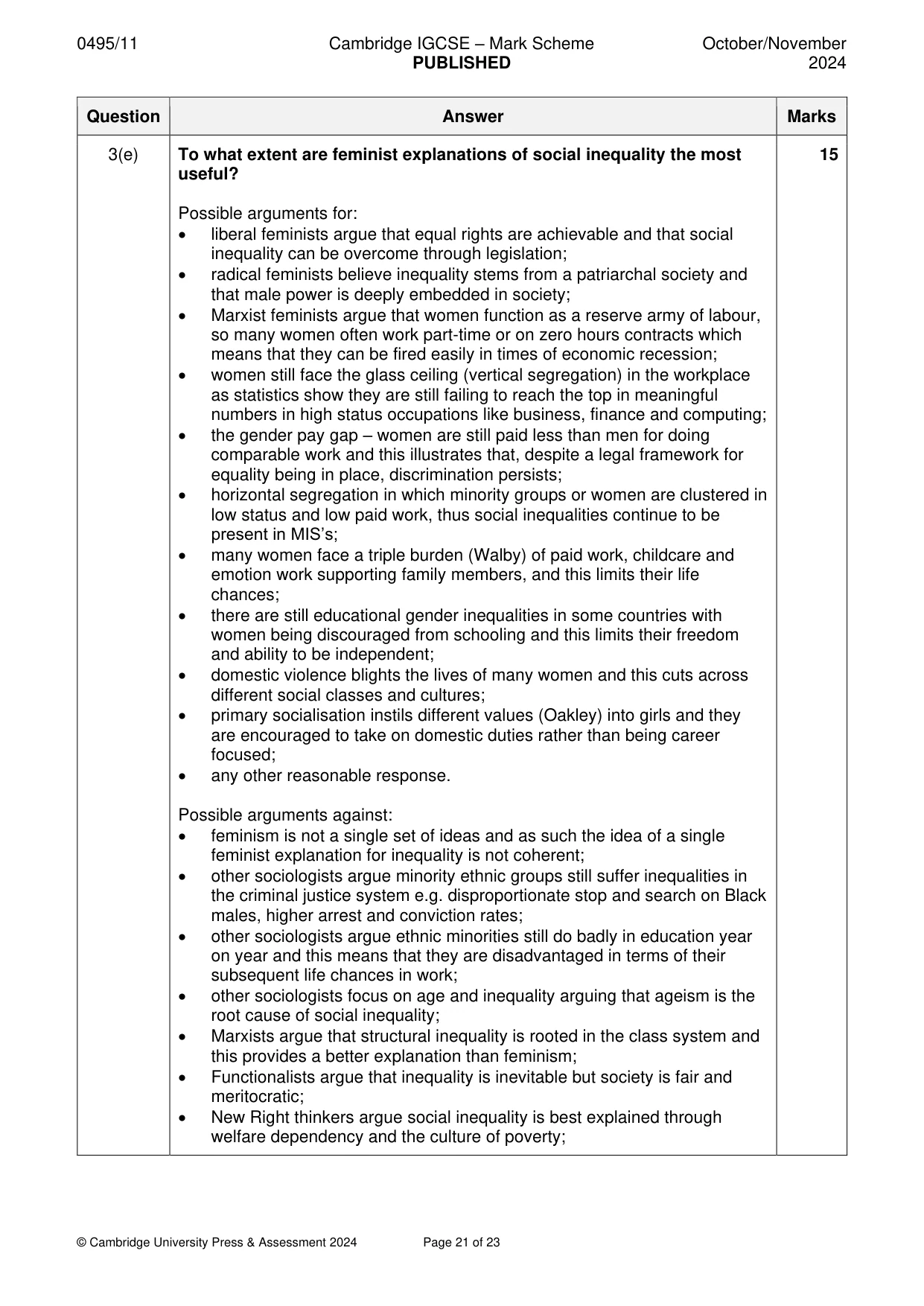
0495/11 Cambridge IGCSE – Mark Scheme PUBLISHED October/November 2024 © Cambridge University Press & Assessment 2024 Page 21 of 23 Question Answer Marks 3(e) To what extent are feminist explanations of social inequality the most useful? Possible arguments for: • liberal feminists argue that equal rights are achievable and that social inequality can be overcome through legislation; • radical feminists believe inequality stems from a patriarchal society and that male power is deeply embedded in society; • Marxist feminists argue that women function as a reserve army of labour, so many women often work part-time or on zero hours contracts which means that they can be fired easily in times of economic recession; • women still face the glass ceiling (vertical segregation) in the workplace as statistics show they are still failing to reach the top in meaningful numbers in high status occupations like business, finance and computing; • the gender pay gap – women are still paid less than men for doing comparable work and this illustrates that, despite a legal framework for equality being in place, discrimination persists; • horizontal segregation in which minority groups or women are clustered in low status and low paid work, thus social inequalities continue to be present in MIS’s; • many women face a triple burden (Walby) of paid work, childcare and emotion work supporting family members, and this limits their life chances; • there are still educational gender inequalities in some countries with women being discouraged from schooling and this limits their freedom and ability to be independent; • domestic violence blights the lives of many women and this cuts across different social classes and cultures; • primary socialisation instils different values (Oakley) into girls and they are encouraged to take on domestic duties rather than being career focused; • any other reasonable response. Possible arguments against: • feminism is not a single set of ideas and as such the idea of a single feminist explanation for inequality is not coherent; • other sociologists argue minority ethnic groups still suffer inequalities in the criminal justice system e.g. disproportionate stop and search on Black males, higher arrest and conviction rates; • other sociologists argue ethnic minorities still do badly in education year on year and this means that they are disadvantaged in terms of their subsequent life chances in work; • other sociologists focus on age and inequality arguing that ageism is the root cause of social inequality; • Marxists argue that structural inequality is rooted in the class system and this provides a better explanation than feminism; • Functionalists argue that inequality is inevitable but society is fair and meritocratic; • New Right thinkers argue social inequality is best explained through welfare dependency and the culture of poverty; 15
Mark scheme, page 22
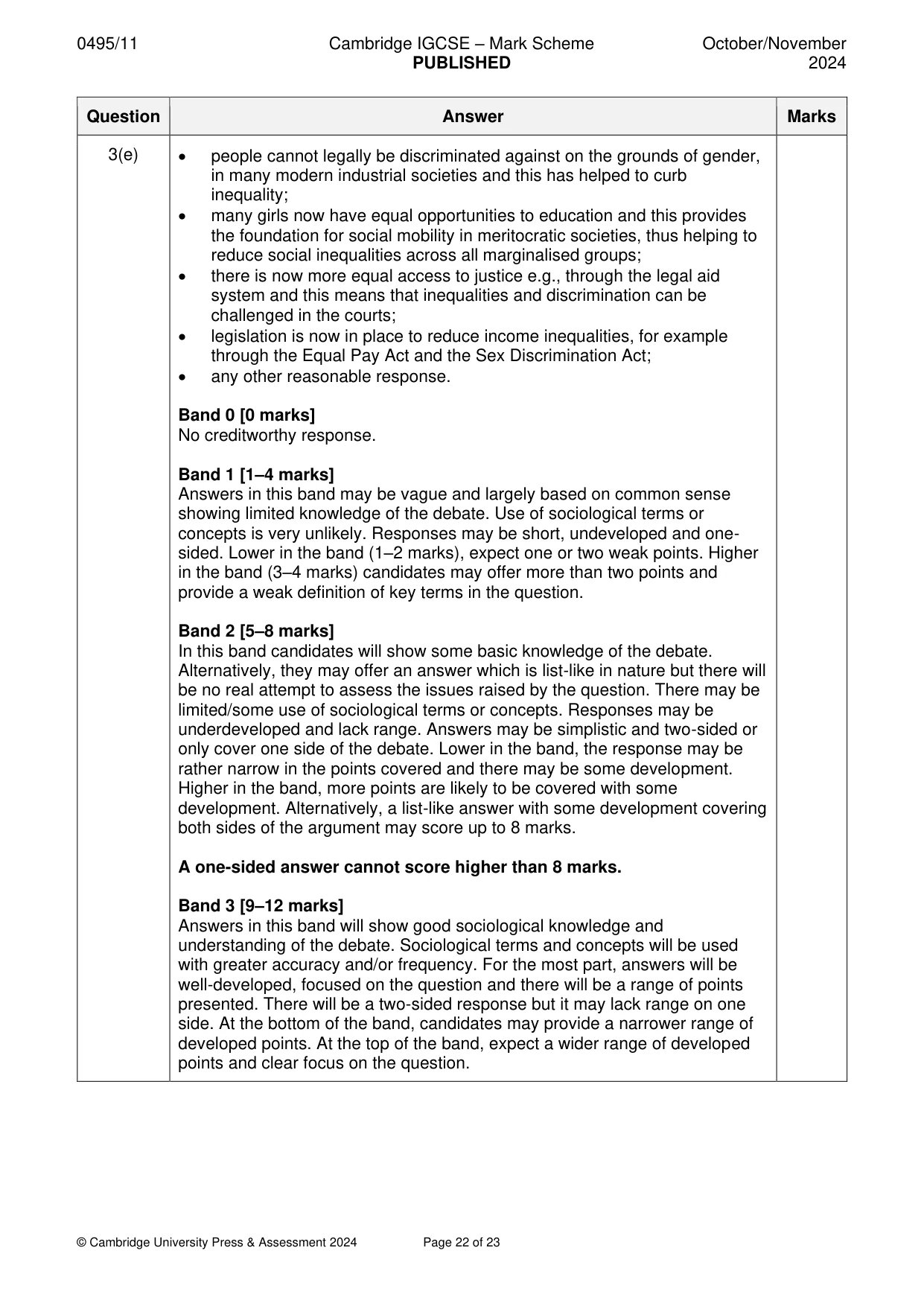
0495/11 Cambridge IGCSE – Mark Scheme PUBLISHED October/November 2024 © Cambridge University Press & Assessment 2024 Page 22 of 23 Question Answer Marks 3(e) • people cannot legally be discriminated against on the grounds of gender, in many modern industrial societies and this has helped to curb inequality; • many girls now have equal opportunities to education and this provides the foundation for social mobility in meritocratic societies, thus helping to reduce social inequalities across all marginalised groups; • there is now more equal access to justice e.g., through the legal aid system and this means that inequalities and discrimination can be challenged in the courts; • legislation is now in place to reduce income inequalities, for example through the Equal Pay Act and the Sex Discrimination Act; • any other reasonable response. Band 0 [0 marks] No creditworthy response. Band 1 [1–4 marks] Answers in this band may be vague and largely based on common sense showing limited knowledge of the debate. Use of sociological terms or concepts is very unlikely. Responses may be short, undeveloped and one- sided. Lower in the band (1–2 marks), expect one or two weak points. Higher in the band (3–4 marks) candidates may offer more than two points and provide a weak definition of key terms in the question. Band 2 [5–8 marks] In this band candidates will show some basic knowledge of the debate. Alternatively, they may offer an answer which is list-like in nature but there will be no real attempt to assess the issues raised by the question. There may be limited/some use of sociological terms or concepts. Responses may be underdeveloped and lack range. Answers may be simplistic and two-sided or only cover one side of the debate. Lower in the band, the response may be rather narrow in the points covered and there may be some development. Higher in the band, more points are likely to be covered with some development. Alternatively, a list-like answer with some development covering both sides of the argument may score up to 8 marks. A one-sided answer cannot score higher than 8 marks. Band 3 [9–12 marks] Answers in this band will show good sociological knowledge and understanding of the debate. Sociological terms and concepts will be used with greater accuracy and/or frequency. For the most part, answers will be well-developed, focused on the question and there will be a range of points presented. There will be a two-sided response but it may lack range on one side. At the bottom of the band, candidates may provide a narrower range of developed points. At the top of the band, expect a wider range of developed points and clear focus on the question.
Mark scheme, page 23
0495/11 Cambridge IGCSE – Mark Scheme PUBLISHED October/November 2024 © Cambridge University Press & Assessment 2024 Page 23 of 23 Question Answer Marks 3(e) Band 4 [13–15 marks] Answers in this band will show excellent knowledge and understanding of the debate. There will be a strong grasp of the arguments as well as accurate and frequent use of sociological terms and concepts. Answers will be well- developed, clearly focused on the question and discuss a wide range of points. Responses will be two-sided and have a range of points on each side. At the bottom of the band (13 marks), the answer may lack a specific conclusion. Higher in the band, there will be a clear attempt to offer an assessment of the ‘To what extent?’ part of the question through a focused conclusion.
What you needed in this session
Cambridge’s own grade thresholds for 2024 Oct/Nov, Paper 1 · Variant 1. A higher threshold means an easier paper — the bar moves with how the cohort did.