Cambridge IGCSE Sociology 0495 — 2023 Oct/Nov Paper 1 · Variant 1
0495/11/O/N/23 · 80 marks · ≈90 min
The question paper and its mark scheme, free to read here and free to download. This is Cambridge’s own paper, exactly as it was sat.
Question paper4 pages

Mark scheme20 pages
Answers below. Sit the paper first if you are practising.

Paper as text
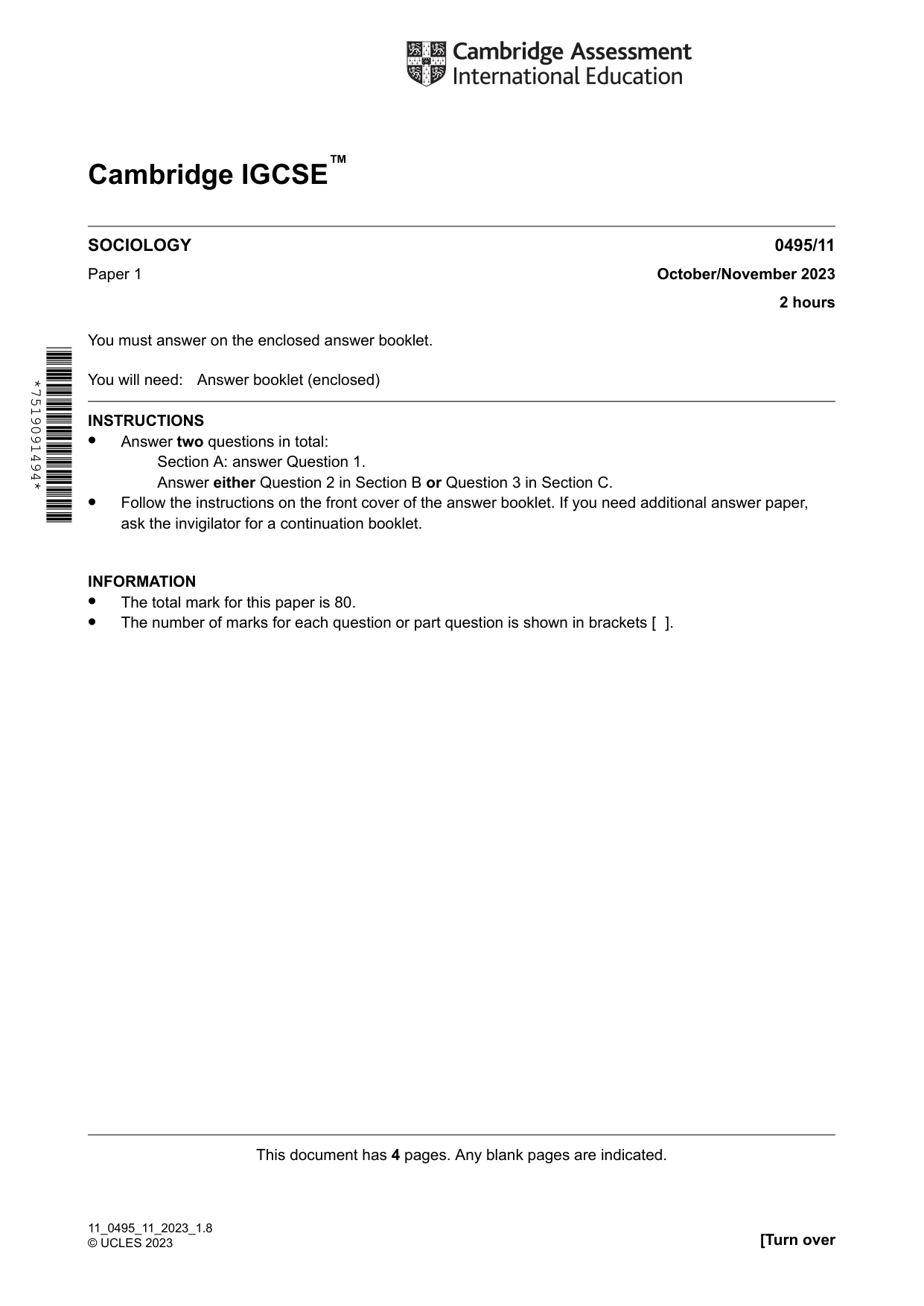
Question paper, page 1
Cambridge IGCSE™ 0495/11 October/November 2023 2 hours SOCIOLOGY Paper 1 You must answer on the enclosed answer booklet. You will need: Answer booklet (enclosed) INSTRUCTIONS • Answer two questions in total: Section A: answer Question 1. Answer either Question 2 in Section B or Question 3 in Section C. • Follow the instructions on the front cover of the answer booklet. If you need additional answer paper, ask the invigilator for a continuation booklet. INFORMATION • The total mark for this paper is 80. • The number of marks for each question or part question is shown in brackets [ ]. This document has 4 pages. Any blank pages are indicated. [Turn over 11_0495_11_2023_1.8 © UCLES 2023 *7519091494*
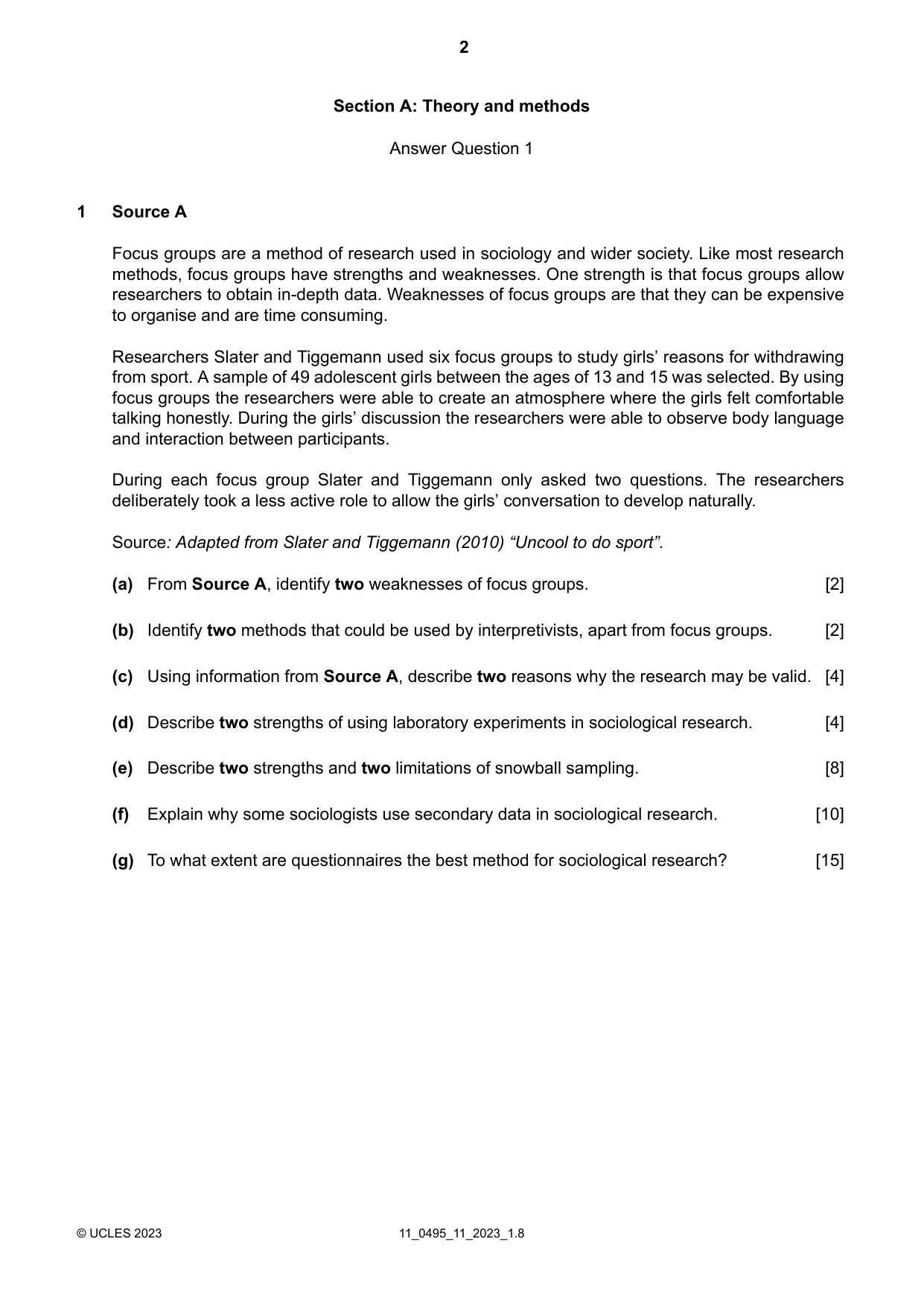
Question paper, page 2
Section A: Theory and methods Answer Question 1 Source A 1 Focus groups are a method of research used in sociology and wider society. Like most research methods, focus groups have strengths and weaknesses. One strength is that focus groups allow researchers to obtain in-depth data. Weaknesses of focus groups are that they can be expensive to organise and are time consuming. Researchers Slater and Tiggemann used six focus groups to study girls’ reasons for withdrawing from sport. A sample of 49 adolescent girls between the ages of 13 and 15 was selected. By using focus groups the researchers were able to create an atmosphere where the girls felt comfortable talking honestly. During the girls’ discussion the researchers were able to observe body language and interaction between participants. During each focus group Slater and Tiggemann only asked two questions. The researchers deliberately took a less active role to allow the girls’ conversation to develop naturally. Source: Adapted from Slater and Tiggemann (2010) “Uncool to do sport”. From Source A, identify two weaknesses of focus groups. [2] (a) Identify two methods that could be used by interpretivists, apart from focus groups. [2] (b) Using information from Source A, describe two reasons why the research may be valid. [4] (c) Describe two strengths of using laboratory experiments in sociological research. [4] (d) Describe two strengths and two limitations of snowball sampling. [8] (e) Explain why some sociologists use secondary data in sociological research. [10] (f) To what extent are questionnaires the best method for sociological research? [15] (g) 11_0495_11_2023_1.8 © UCLES 2023 2
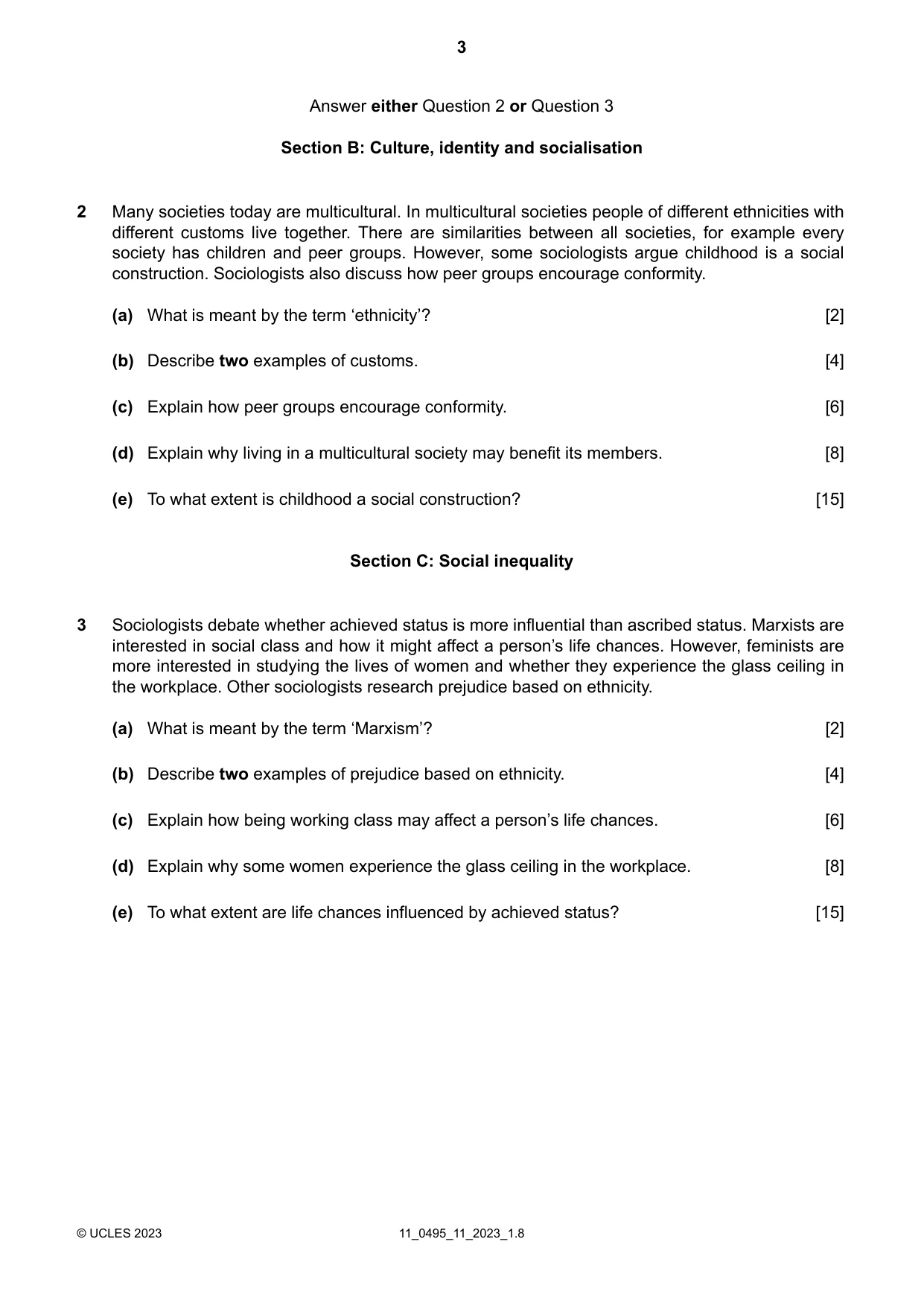
Question paper, page 3
Answer either Question 2 or Question 3 Section B: Culture, identity and socialisation Many societies today are multicultural. In multicultural societies people of different ethnicities with different customs live together. There are similarities between all societies, for example every 2 society has children and peer groups. However, some sociologists argue childhood is a social construction. Sociologists also discuss how peer groups encourage conformity. What is meant by the term ‘ethnicity’? [2] (a) Describe two examples of customs. [4] (b) Explain how peer groups encourage conformity. [6] (c) Explain why living in a multicultural society may benefit its members. [8] (d) To what extent is childhood a social construction? [15] (e) Section C: Social inequality Sociologists debate whether achieved status is more influential than ascribed status. Marxists are interested in social class and how it might affect a person’s life chances. However, feminists are 3 more interested in studying the lives of women and whether they experience the glass ceiling in the workplace. Other sociologists research prejudice based on ethnicity. What is meant by the term ‘Marxism’? [2] (a) Describe two examples of prejudice based on ethnicity. [4] (b) Explain how being working class may affect a person’s life chances. [6] (c) Explain why some women experience the glass ceiling in the workplace. [8] (d) To what extent are life chances influenced by achieved status? [15] (e) 11_0495_11_2023_1.8 © UCLES 2023 3
Question paper, page 4
BLANK PAGE Permission to reproduce items where third-party owned material protected by copyright is included has been sought and cleared where possible. Every reasonable effort has been made by the publisher (UCLES) to trace copyright holders, but if any items requiring clearance have unwittingly been included, the publisher will be pleased to make amends at the earliest possible opportunity. To avoid the issue of disclosure of answer-related information to candidates, all copyright acknowledgements are reproduced online in the Cambridge Assessment International Education Copyright Acknowledgements Booklet. This is produced for each series of examinations and is freely available to download at www.cambridgeinternational.org after the live examination series. Cambridge Assessment International Education is part of Cambridge Assessment. Cambridge Assessment is the brand name of the University of Cambridge Local Examinations Syndicate (UCLES), which is a department of the University of Cambridge. 11_0495_11_2023_1.8 © UCLES 2023 4
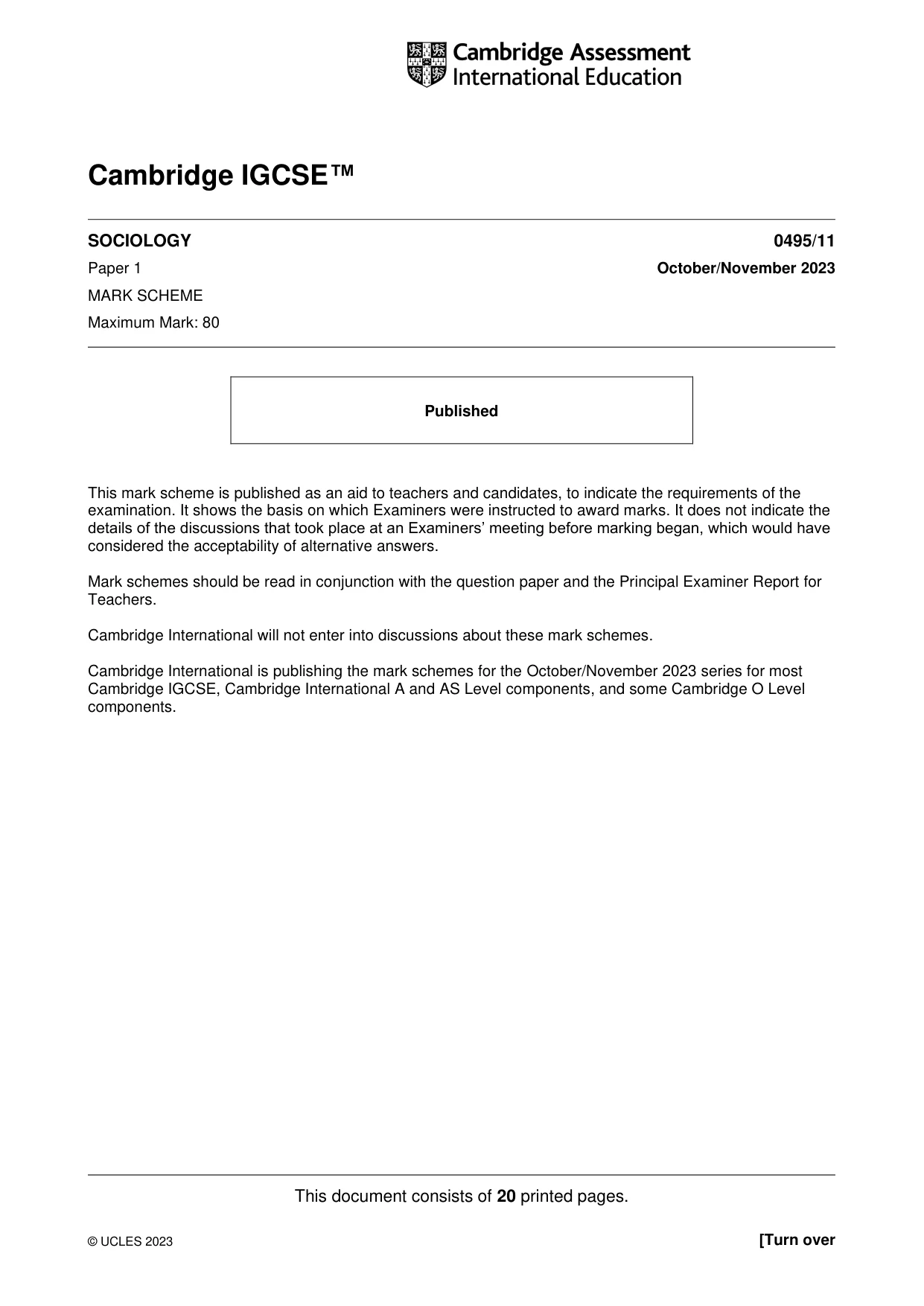
Mark scheme, page 1
This document consists of 20 printed pages. © UCLES 2023 [Turn over Cambridge IGCSE™ SOCIOLOGY 0495/11 Paper 1 October/November 2023 MARK SCHEME Maximum Mark: 80 Published This mark scheme is published as an aid to teachers and candidates, to indicate the requirements of the examination. It shows the basis on which Examiners were instructed to award marks. It does not indicate the details of the discussions that took place at an Examiners’ meeting before marking began, which would have considered the acceptability of alternative answers. Mark schemes should be read in conjunction with the question paper and the Principal Examiner Report for Teachers. Cambridge International will not enter into discussions about these mark schemes. Cambridge International is publishing the mark schemes for the October/November 2023 series for most Cambridge IGCSE, Cambridge International A and AS Level components, and some Cambridge O Level components.
Mark scheme, page 2
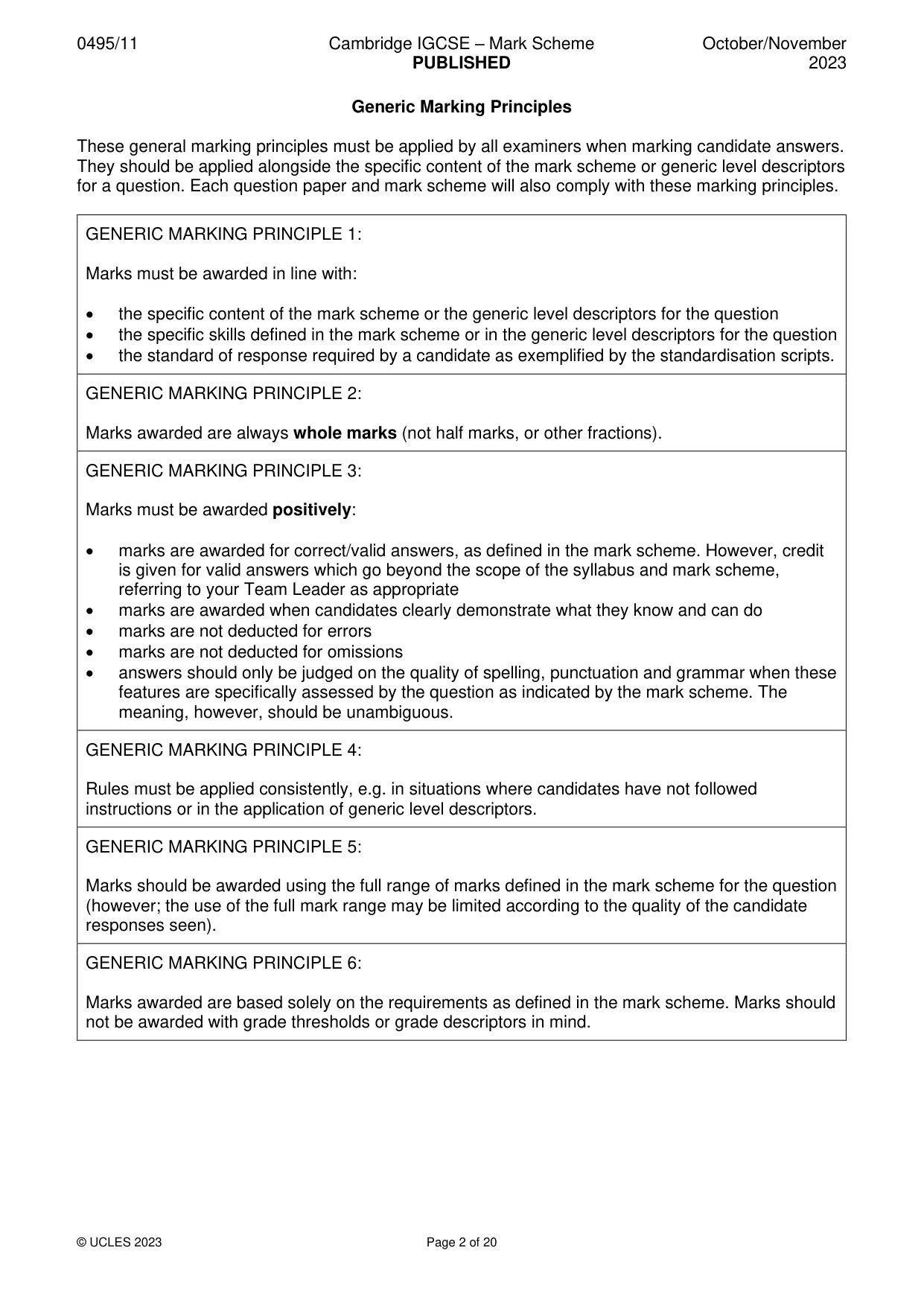
0495/11 Cambridge IGCSE – Mark Scheme PUBLISHED October/November 2023 © UCLES 2023 Page 2 of 20 Generic Marking Principles These general marking principles must be applied by all examiners when marking candidate answers. They should be applied alongside the specific content of the mark scheme or generic level descriptors for a question. Each question paper and mark scheme will also comply with these marking principles. GENERIC MARKING PRINCIPLE 1: Marks must be awarded in line with: • the specific content of the mark scheme or the generic level descriptors for the question • the specific skills defined in the mark scheme or in the generic level descriptors for the question • the standard of response required by a candidate as exemplified by the standardisation scripts. GENERIC MARKING PRINCIPLE 2: Marks awarded are always whole marks (not half marks, or other fractions). GENERIC MARKING PRINCIPLE 3: Marks must be awarded positively: • marks are awarded for correct/valid answers, as defined in the mark scheme. However, credit is given for valid answers which go beyond the scope of the syllabus and mark scheme, referring to your Team Leader as appropriate • marks are awarded when candidates clearly demonstrate what they know and can do • marks are not deducted for errors • marks are not deducted for omissions • answers should only be judged on the quality of spelling, punctuation and grammar when these features are specifically assessed by the question as indicated by the mark scheme. The meaning, however, should be unambiguous. GENERIC MARKING PRINCIPLE 4: Rules must be applied consistently, e.g. in situations where candidates have not followed instructions or in the application of generic level descriptors. GENERIC MARKING PRINCIPLE 5: Marks should be awarded using the full range of marks defined in the mark scheme for the question (however; the use of the full mark range may be limited according to the quality of the candidate responses seen). GENERIC MARKING PRINCIPLE 6: Marks awarded are based solely on the requirements as defined in the mark scheme. Marks should not be awarded with grade thresholds or grade descriptors in mind.
Mark scheme, page 3
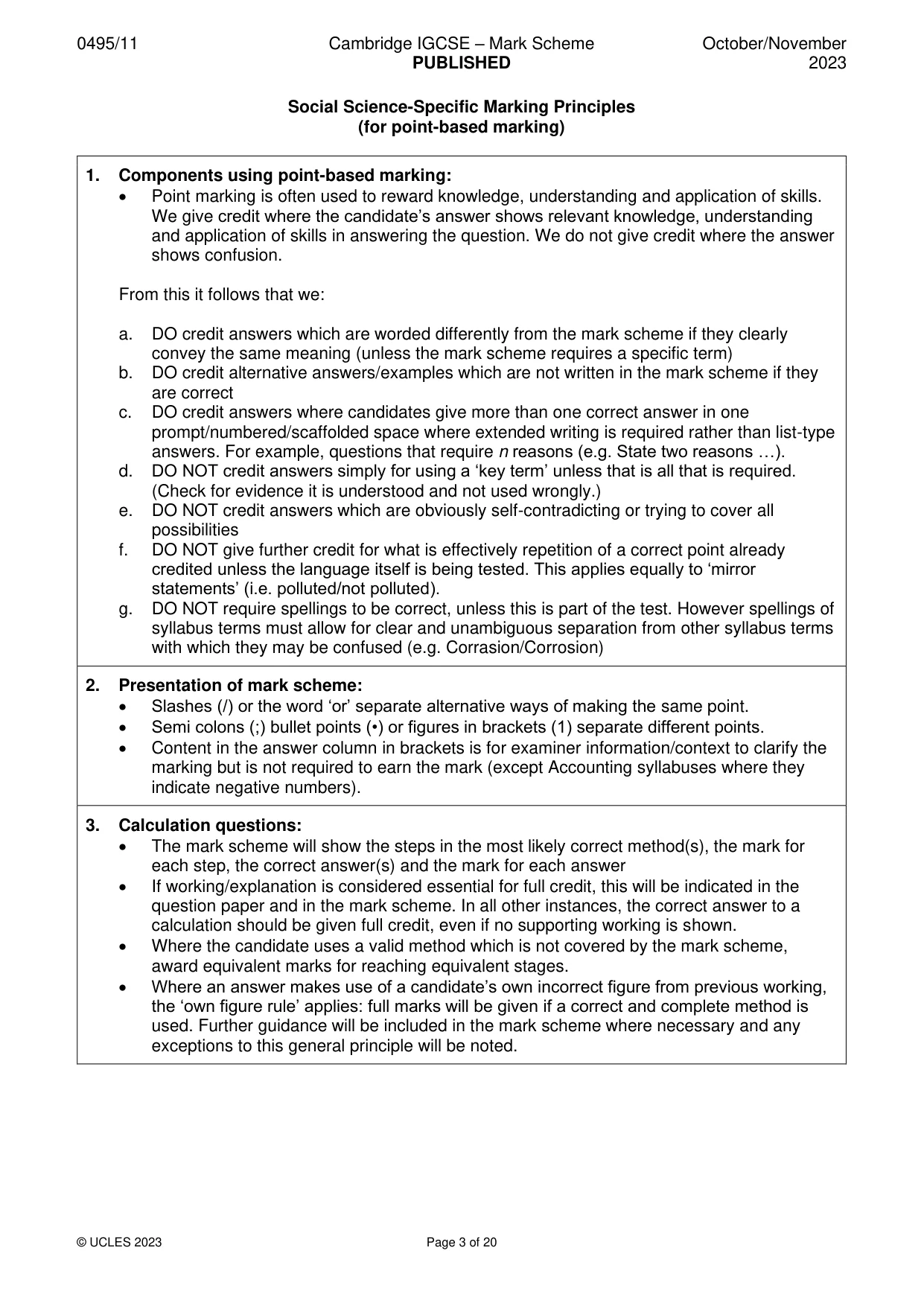
0495/11 Cambridge IGCSE – Mark Scheme PUBLISHED October/November 2023 © UCLES 2023 Page 3 of 20 Social Science-Specific Marking Principles (for point-based marking) 1. Components using point-based marking: • Point marking is often used to reward knowledge, understanding and application of skills. We give credit where the candidate’s answer shows relevant knowledge, understanding and application of skills in answering the question. We do not give credit where the answer shows confusion. From this it follows that we: a. DO credit answers which are worded differently from the mark scheme if they clearly convey the same meaning (unless the mark scheme requires a specific term) b. DO credit alternative answers/examples which are not written in the mark scheme if they are correct c. DO credit answers where candidates give more than one correct answer in one prompt/numbered/scaffolded space where extended writing is required rather than list-type answers. For example, questions that require n reasons (e.g. State two reasons …). d. DO NOT credit answers simply for using a ‘key term’ unless that is all that is required. (Check for evidence it is understood and not used wrongly.) e. DO NOT credit answers which are obviously self-contradicting or trying to cover all possibilities f. DO NOT give further credit for what is effectively repetition of a correct point already credited unless the language itself is being tested. This applies equally to ‘mirror statements’ (i.e. polluted/not polluted). g. DO NOT require spellings to be correct, unless this is part of the test. However spellings of syllabus terms must allow for clear and unambiguous separation from other syllabus terms with which they may be confused (e.g. Corrasion/Corrosion) 2. Presentation of mark scheme: • Slashes (/) or the word ‘or’ separate alternative ways of making the same point. • Semi colons (;) bullet points (•) or figures in brackets (1) separate different points. • Content in the answer column in brackets is for examiner information/context to clarify the marking but is not required to earn the mark (except Accounting syllabuses where they indicate negative numbers). 3. Calculation questions: • The mark scheme will show the steps in the most likely correct method(s), the mark for each step, the correct answer(s) and the mark for each answer • If working/explanation is considered essential for full credit, this will be indicated in the question paper and in the mark scheme. In all other instances, the correct answer to a calculation should be given full credit, even if no supporting working is shown. • Where the candidate uses a valid method which is not covered by the mark scheme, award equivalent marks for reaching equivalent stages. • Where an answer makes use of a candidate’s own incorrect figure from previous working, the ‘own figure rule’ applies: full marks will be given if a correct and complete method is used. Further guidance will be included in the mark scheme where necessary and any exceptions to this general principle will be noted.
Mark scheme, page 4
0495/11 Cambridge IGCSE – Mark Scheme PUBLISHED October/November 2023 © UCLES 2023 Page 4 of 20 4. Annotation: • For point marking, ticks can be used to indicate correct answers and crosses can be used to indicate wrong answers. There is no direct relationship between ticks and marks. Ticks have no defined meaning for levels of response marking. • For levels of response marking, the level awarded should be annotated on the script. • Other annotations will be used by examiners as agreed during standardisation, and the meaning will be understood by all examiners who marked that paper.
Mark scheme, page 5
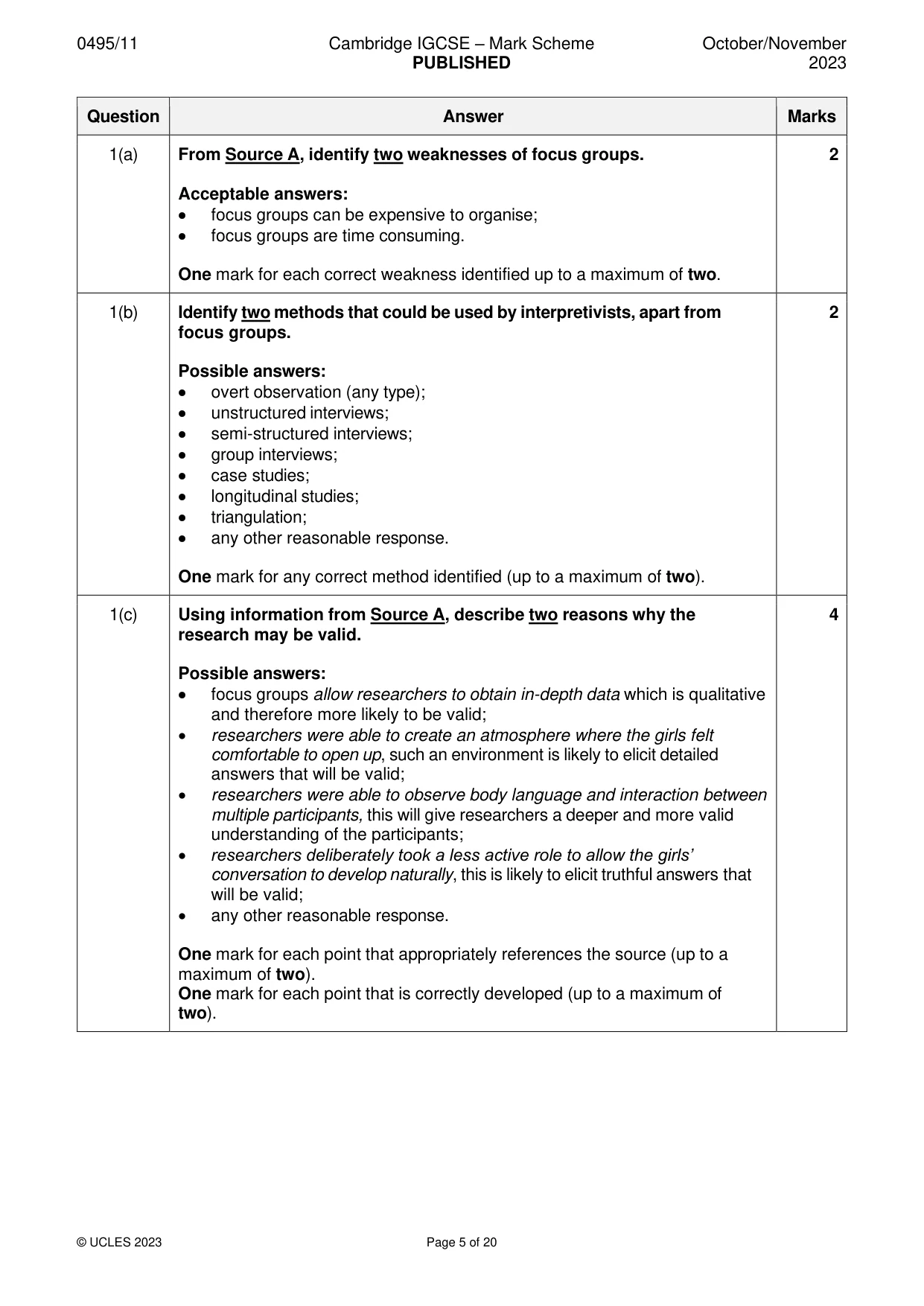
0495/11 Cambridge IGCSE – Mark Scheme PUBLISHED October/November 2023 © UCLES 2023 Page 5 of 20 Question Answer Marks 1(a) From Source A, identify two weaknesses of focus groups. Acceptable answers: • focus groups can be expensive to organise; • focus groups are time consuming. One mark for each correct weakness identified up to a maximum of two. 2 1(b) Identify two methods that could be used by interpretivists, apart from focus groups. Possible answers: • overt observation (any type); • unstructured interviews; • semi-structured interviews; • group interviews; • case studies; • longitudinal studies; • triangulation; • any other reasonable response. One mark for any correct method identified (up to a maximum of two). 2 1(c) Using information from Source A, describe two reasons why the research may be valid. Possible answers: • focus groups allow researchers to obtain in-depth data which is qualitative and therefore more likely to be valid; • researchers were able to create an atmosphere where the girls felt comfortable to open up, such an environment is likely to elicit detailed answers that will be valid; • researchers were able to observe body language and interaction between multiple participants, this will give researchers a deeper and more valid understanding of the participants; • researchers deliberately took a less active role to allow the girls’ conversation to develop naturally, this is likely to elicit truthful answers that will be valid; • any other reasonable response. One mark for each point that appropriately references the source (up to a maximum of two). One mark for each point that is correctly developed (up to a maximum of two). 4
Mark scheme, page 6
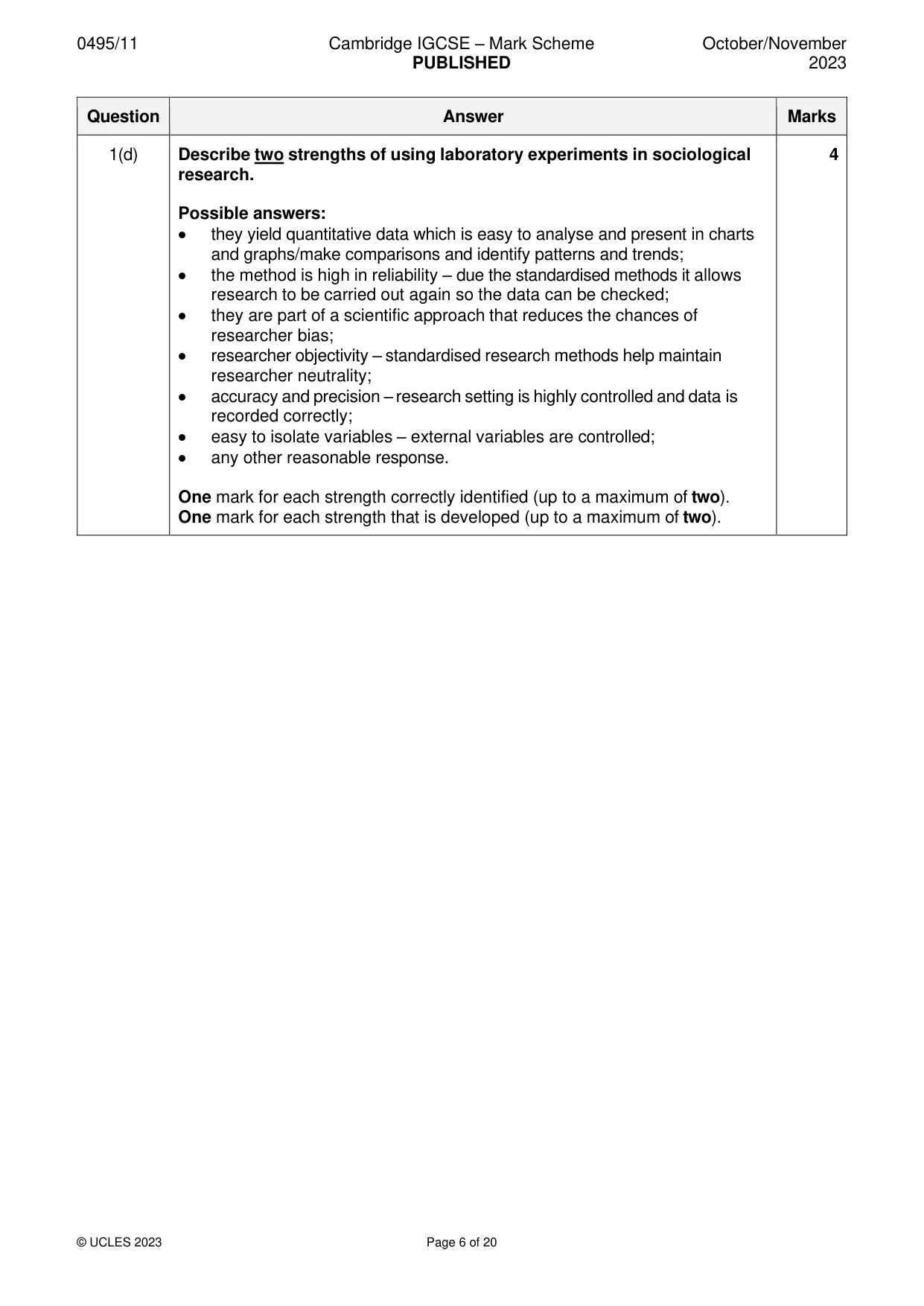
0495/11 Cambridge IGCSE – Mark Scheme PUBLISHED October/November 2023 © UCLES 2023 Page 6 of 20 Question Answer Marks 1(d) Describe two strengths of using laboratory experiments in sociological research. Possible answers: • they yield quantitative data which is easy to analyse and present in charts and graphs/make comparisons and identify patterns and trends; • the method is high in reliability – due the standardised methods it allows research to be carried out again so the data can be checked; • they are part of a scientific approach that reduces the chances of researcher bias; • researcher objectivity – standardised research methods help maintain researcher neutrality; • accuracy and precision – research setting is highly controlled and data is recorded correctly; • easy to isolate variables – external variables are controlled; • any other reasonable response. One mark for each strength correctly identified (up to a maximum of two). One mark for each strength that is developed (up to a maximum of two). 4
Mark scheme, page 7
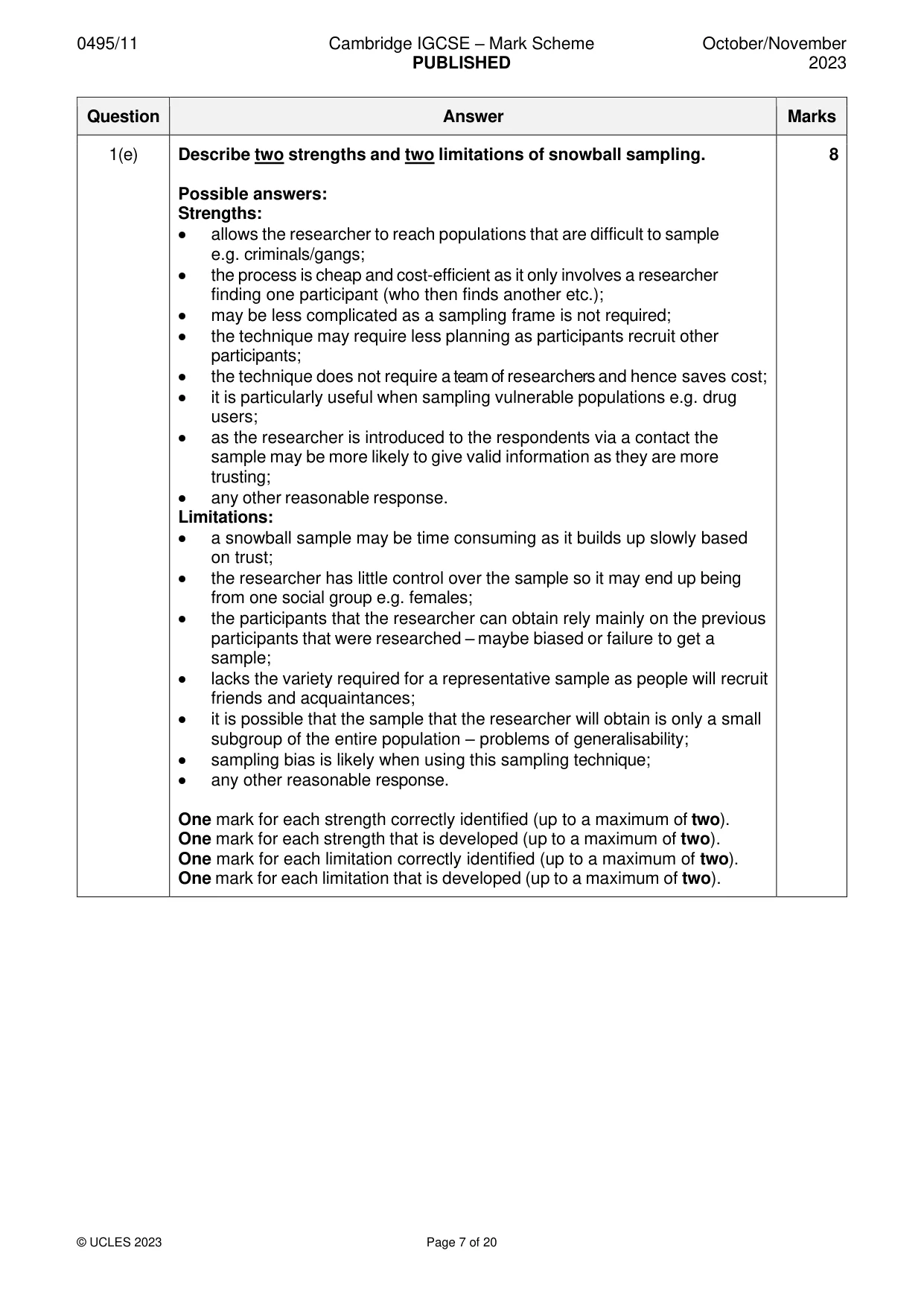
0495/11 Cambridge IGCSE – Mark Scheme PUBLISHED October/November 2023 © UCLES 2023 Page 7 of 20 Question Answer Marks 1(e) Describe two strengths and two limitations of snowball sampling. Possible answers: Strengths: • allows the researcher to reach populations that are difficult to sample e.g. criminals/gangs; • the process is cheap and cost-efficient as it only involves a researcher finding one participant (who then finds another etc.); • may be less complicated as a sampling frame is not required; • the technique may require less planning as participants recruit other participants; • the technique does not require a team of researchers and hence saves cost; • it is particularly useful when sampling vulnerable populations e.g. drug users; • as the researcher is introduced to the respondents via a contact the sample may be more likely to give valid information as they are more trusting; • any other reasonable response. Limitations: • a snowball sample may be time consuming as it builds up slowly based on trust; • the researcher has little control over the sample so it may end up being from one social group e.g. females; • the participants that the researcher can obtain rely mainly on the previous participants that were researched – maybe biased or failure to get a sample; • lacks the variety required for a representative sample as people will recruit friends and acquaintances; • it is possible that the sample that the researcher will obtain is only a small subgroup of the entire population – problems of generalisability; • sampling bias is likely when using this sampling technique; • any other reasonable response. One mark for each strength correctly identified (up to a maximum of two). One mark for each strength that is developed (up to a maximum of two). One mark for each limitation correctly identified (up to a maximum of two). One mark for each limitation that is developed (up to a maximum of two). 8
Mark scheme, page 8
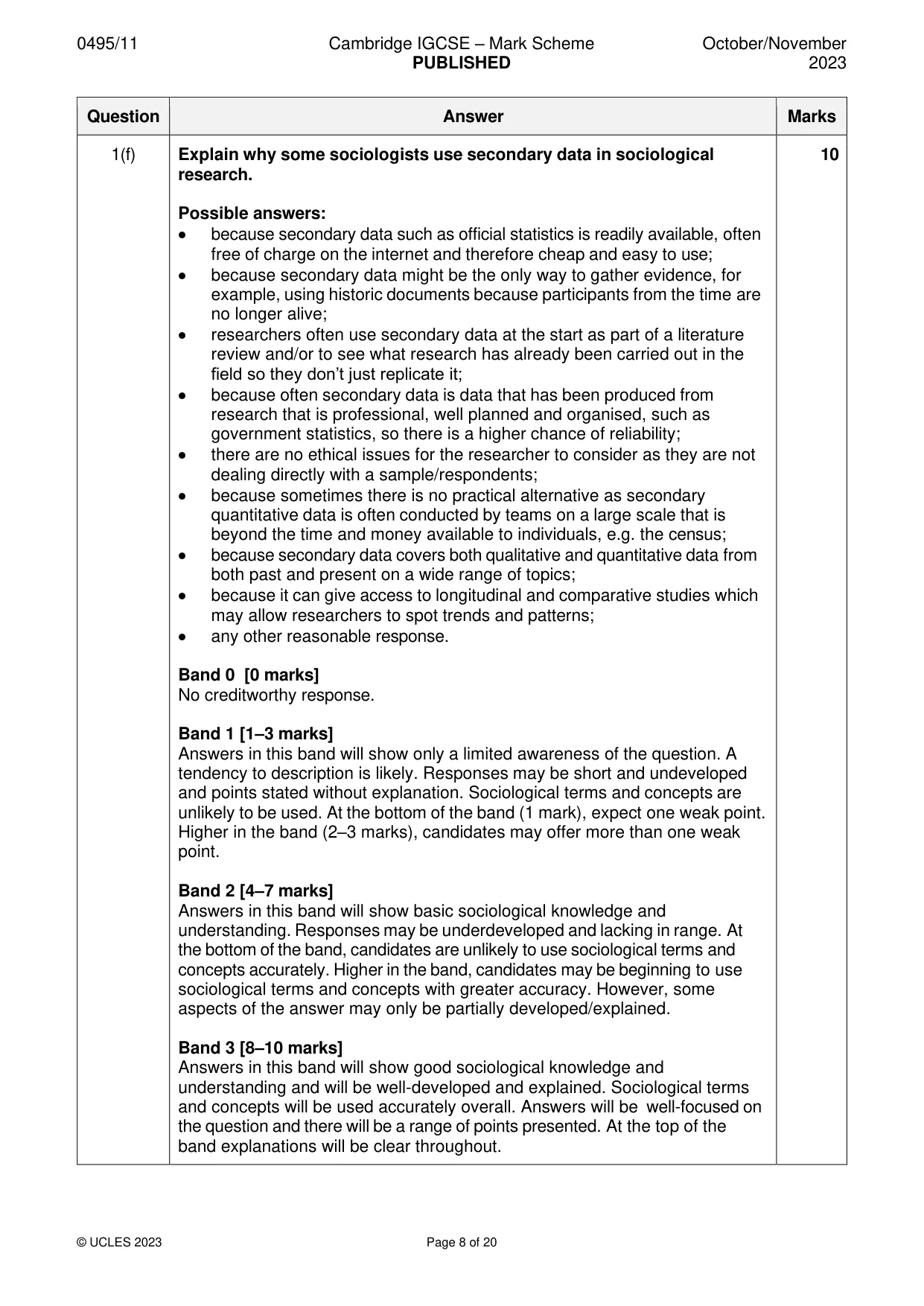
0495/11 Cambridge IGCSE – Mark Scheme PUBLISHED October/November 2023 © UCLES 2023 Page 8 of 20 Question Answer Marks 1(f) Explain why some sociologists use secondary data in sociological research. Possible answers: • because secondary data such as official statistics is readily available, often free of charge on the internet and therefore cheap and easy to use; • because secondary data might be the only way to gather evidence, for example, using historic documents because participants from the time are no longer alive; • researchers often use secondary data at the start as part of a literature review and/or to see what research has already been carried out in the field so they don’t just replicate it; • because often secondary data is data that has been produced from research that is professional, well planned and organised, such as government statistics, so there is a higher chance of reliability; • there are no ethical issues for the researcher to consider as they are not dealing directly with a sample/respondents; • because sometimes there is no practical alternative as secondary quantitative data is often conducted by teams on a large scale that is beyond the time and money available to individuals, e.g. the census; • because secondary data covers both qualitative and quantitative data from both past and present on a wide range of topics; • because it can give access to longitudinal and comparative studies which may allow researchers to spot trends and patterns; • any other reasonable response. Band 0 [0 marks] No creditworthy response. Band 1 [1–3 marks] Answers in this band will show only a limited awareness of the question. A tendency to description is likely. Responses may be short and undeveloped and points stated without explanation. Sociological terms and concepts are unlikely to be used. At the bottom of the band (1 mark), expect one weak point. Higher in the band (2–3 marks), candidates may offer more than one weak point. Band 2 [4–7 marks] Answers in this band will show basic sociological knowledge and understanding. Responses may be underdeveloped and lacking in range. At the bottom of the band, candidates are unlikely to use sociological terms and concepts accurately. Higher in the band, candidates may be beginning to use sociological terms and concepts with greater accuracy. However, some aspects of the answer may only be partially developed/explained. Band 3 [8–10 marks] Answers in this band will show good sociological knowledge and understanding and will be well-developed and explained. Sociological terms and concepts will be used accurately overall. Answers will be well-focused on the question and there will be a range of points presented. At the top of the band explanations will be clear throughout. 10
Mark scheme, page 9
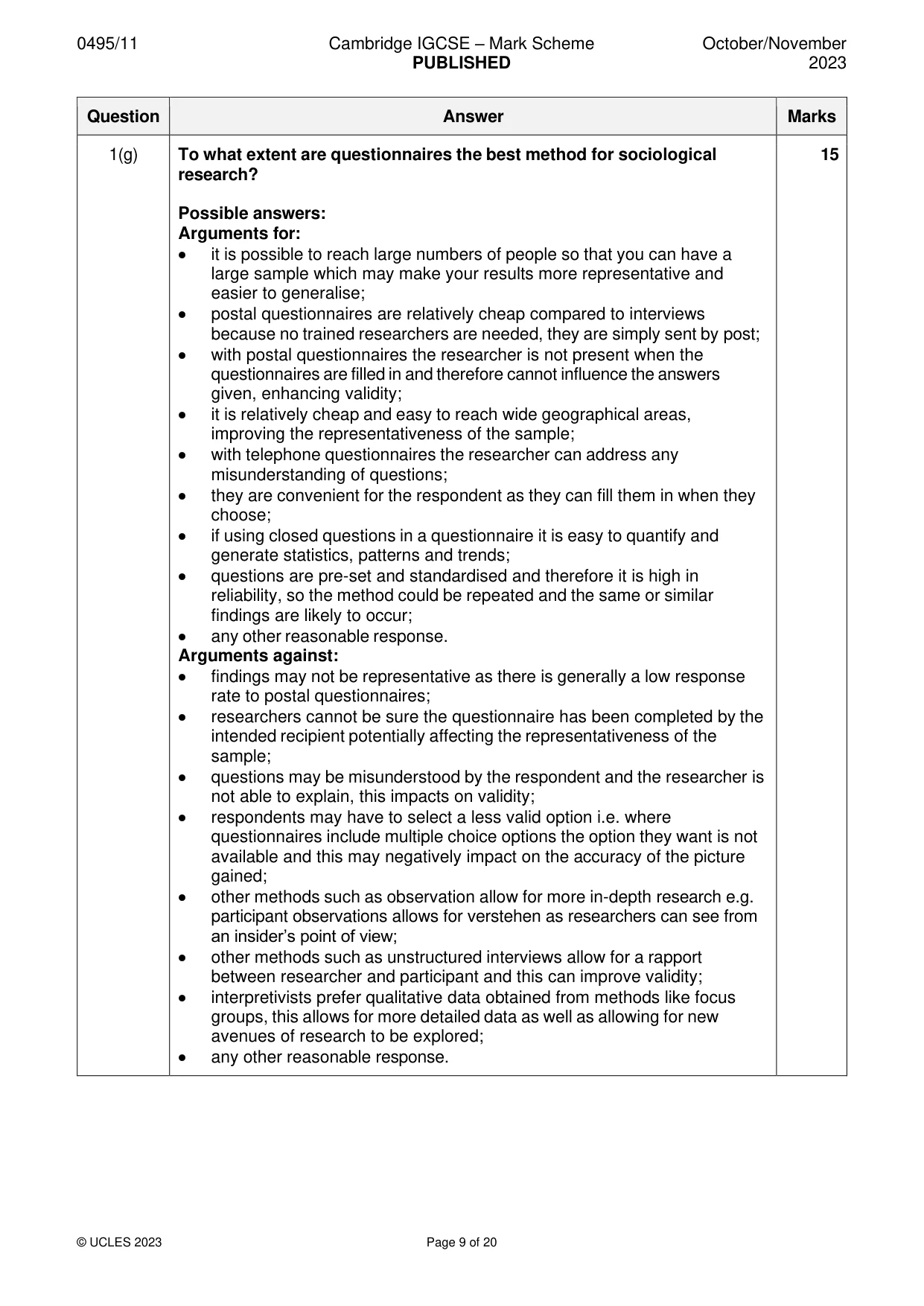
0495/11 Cambridge IGCSE – Mark Scheme PUBLISHED October/November 2023 © UCLES 2023 Page 9 of 20 Question Answer Marks 1(g) To what extent are questionnaires the best method for sociological research? Possible answers: Arguments for: • it is possible to reach large numbers of people so that you can have a large sample which may make your results more representative and easier to generalise; • postal questionnaires are relatively cheap compared to interviews because no trained researchers are needed, they are simply sent by post; • with postal questionnaires the researcher is not present when the questionnaires are filled in and therefore cannot influence the answers given, enhancing validity; • it is relatively cheap and easy to reach wide geographical areas, improving the representativeness of the sample; • with telephone questionnaires the researcher can address any misunderstanding of questions; • they are convenient for the respondent as they can fill them in when they choose; • if using closed questions in a questionnaire it is easy to quantify and generate statistics, patterns and trends; • questions are pre-set and standardised and therefore it is high in reliability, so the method could be repeated and the same or similar findings are likely to occur; • any other reasonable response. Arguments against: • findings may not be representative as there is generally a low response rate to postal questionnaires; • researchers cannot be sure the questionnaire has been completed by the intended recipient potentially affecting the representativeness of the sample; • questions may be misunderstood by the respondent and the researcher is not able to explain, this impacts on validity; • respondents may have to select a less valid option i.e. where questionnaires include multiple choice options the option they want is not available and this may negatively impact on the accuracy of the picture gained; • other methods such as observation allow for more in-depth research e.g. participant observations allows for verstehen as researchers can see from an insider’s point of view; • other methods such as unstructured interviews allow for a rapport between researcher and participant and this can improve validity; • interpretivists prefer qualitative data obtained from methods like focus groups, this allows for more detailed data as well as allowing for new avenues of research to be explored; • any other reasonable response. 15
Mark scheme, page 10
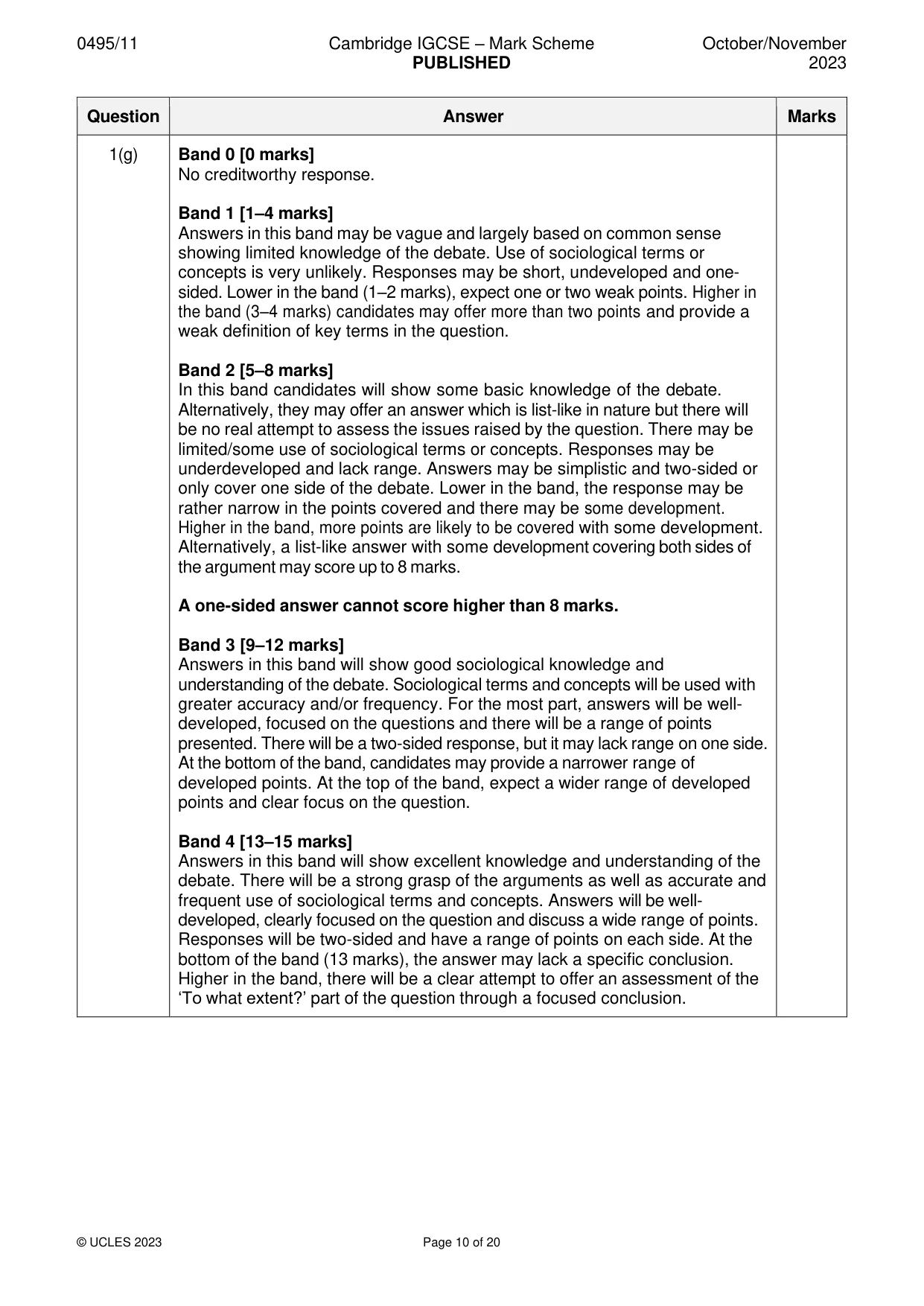
0495/11 Cambridge IGCSE – Mark Scheme PUBLISHED October/November 2023 © UCLES 2023 Page 10 of 20 Question Answer Marks 1(g) Band 0 [0 marks] No creditworthy response. Band 1 [1–4 marks] Answers in this band may be vague and largely based on common sense showing limited knowledge of the debate. Use of sociological terms or concepts is very unlikely. Responses may be short, undeveloped and one- sided. Lower in the band (1–2 marks), expect one or two weak points. Higher in the band (3–4 marks) candidates may offer more than two points and provide a weak definition of key terms in the question. Band 2 [5–8 marks] In this band candidates will show some basic knowledge of the debate. Alternatively, they may offer an answer which is list-like in nature but there will be no real attempt to assess the issues raised by the question. There may be limited/some use of sociological terms or concepts. Responses may be underdeveloped and lack range. Answers may be simplistic and two-sided or only cover one side of the debate. Lower in the band, the response may be rather narrow in the points covered and there may be some development. Higher in the band, more points are likely to be covered with some development. Alternatively, a list-like answer with some development covering both sides of the argument may score up to 8 marks. A one-sided answer cannot score higher than 8 marks. Band 3 [9–12 marks] Answers in this band will show good sociological knowledge and understanding of the debate. Sociological terms and concepts will be used with greater accuracy and/or frequency. For the most part, answers will be well- developed, focused on the questions and there will be a range of points presented. There will be a two-sided response, but it may lack range on one side. At the bottom of the band, candidates may provide a narrower range of developed points. At the top of the band, expect a wider range of developed points and clear focus on the question. Band 4 [13–15 marks] Answers in this band will show excellent knowledge and understanding of the debate. There will be a strong grasp of the arguments as well as accurate and frequent use of sociological terms and concepts. Answers will be well- developed, clearly focused on the question and discuss a wide range of points. Responses will be two-sided and have a range of points on each side. At the bottom of the band (13 marks), the answer may lack a specific conclusion. Higher in the band, there will be a clear attempt to offer an assessment of the ‘To what extent?’ part of the question through a focused conclusion.
Mark scheme, page 11
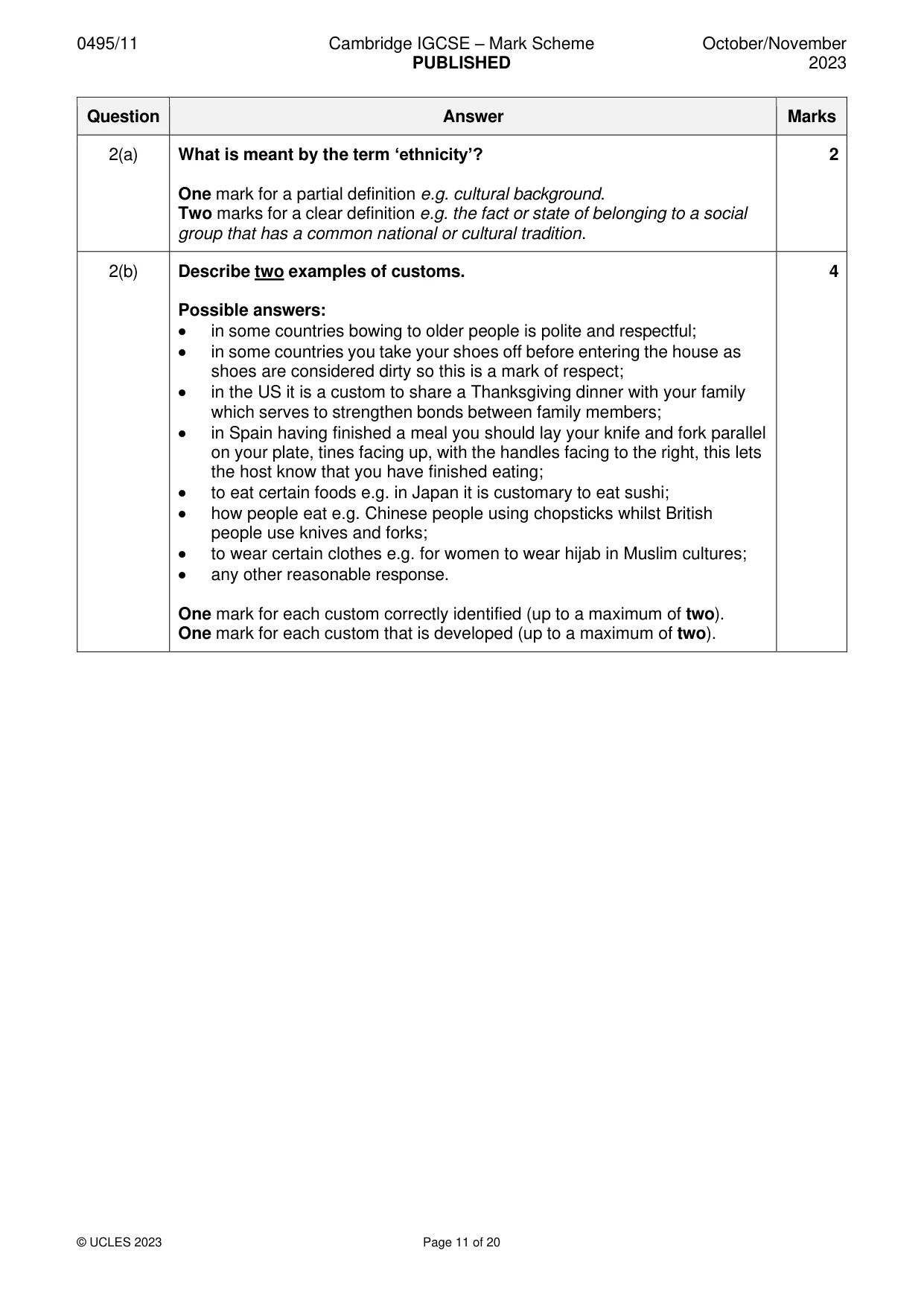
0495/11 Cambridge IGCSE – Mark Scheme PUBLISHED October/November 2023 © UCLES 2023 Page 11 of 20 Question Answer Marks 2(a) What is meant by the term ‘ethnicity’? One mark for a partial definition e.g. cultural background. Two marks for a clear definition e.g. the fact or state of belonging to a social group that has a common national or cultural tradition. 2 2(b) Describe two examples of customs. Possible answers: • in some countries bowing to older people is polite and respectful; • in some countries you take your shoes off before entering the house as shoes are considered dirty so this is a mark of respect; • in the US it is a custom to share a Thanksgiving dinner with your family which serves to strengthen bonds between family members; • in Spain having finished a meal you should lay your knife and fork parallel on your plate, tines facing up, with the handles facing to the right, this lets the host know that you have finished eating; • to eat certain foods e.g. in Japan it is customary to eat sushi; • how people eat e.g. Chinese people using chopsticks whilst British people use knives and forks; • to wear certain clothes e.g. for women to wear hijab in Muslim cultures; • any other reasonable response. One mark for each custom correctly identified (up to a maximum of two). One mark for each custom that is developed (up to a maximum of two). 4
Mark scheme, page 12
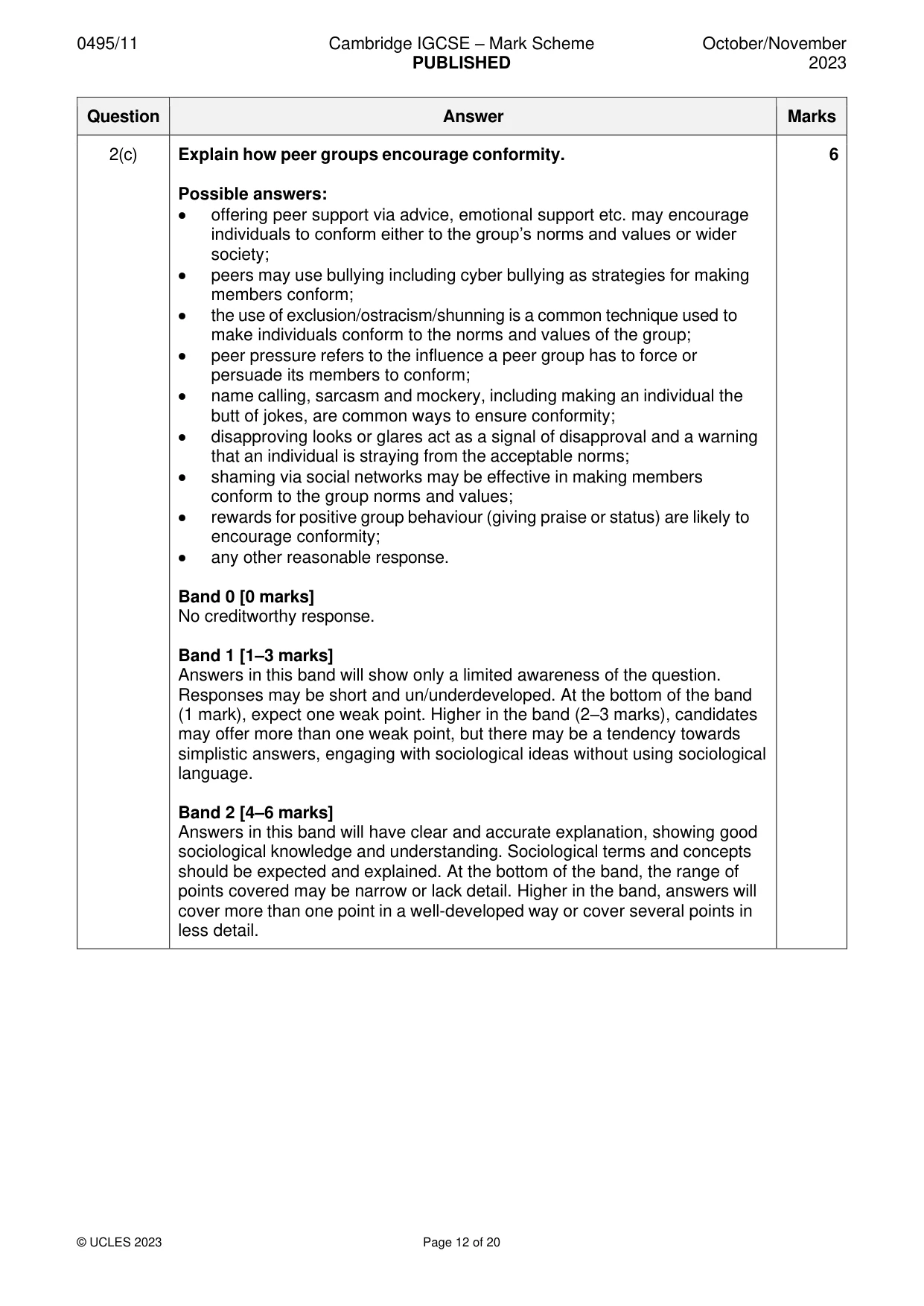
0495/11 Cambridge IGCSE – Mark Scheme PUBLISHED October/November 2023 © UCLES 2023 Page 12 of 20 Question Answer Marks 2(c) Explain how peer groups encourage conformity. Possible answers: • offering peer support via advice, emotional support etc. may encourage individuals to conform either to the group’s norms and values or wider society; • peers may use bullying including cyber bullying as strategies for making members conform; • the use of exclusion/ostracism/shunning is a common technique used to make individuals conform to the norms and values of the group; • peer pressure refers to the influence a peer group has to force or persuade its members to conform; • name calling, sarcasm and mockery, including making an individual the butt of jokes, are common ways to ensure conformity; • disapproving looks or glares act as a signal of disapproval and a warning that an individual is straying from the acceptable norms; • shaming via social networks may be effective in making members conform to the group norms and values; • rewards for positive group behaviour (giving praise or status) are likely to encourage conformity; • any other reasonable response. Band 0 [0 marks] No creditworthy response. Band 1 [1–3 marks] Answers in this band will show only a limited awareness of the question. Responses may be short and un/underdeveloped. At the bottom of the band (1 mark), expect one weak point. Higher in the band (2–3 marks), candidates may offer more than one weak point, but there may be a tendency towards simplistic answers, engaging with sociological ideas without using sociological language. Band 2 [4–6 marks] Answers in this band will have clear and accurate explanation, showing good sociological knowledge and understanding. Sociological terms and concepts should be expected and explained. At the bottom of the band, the range of points covered may be narrow or lack detail. Higher in the band, answers will cover more than one point in a well-developed way or cover several points in less detail. 6
Mark scheme, page 13
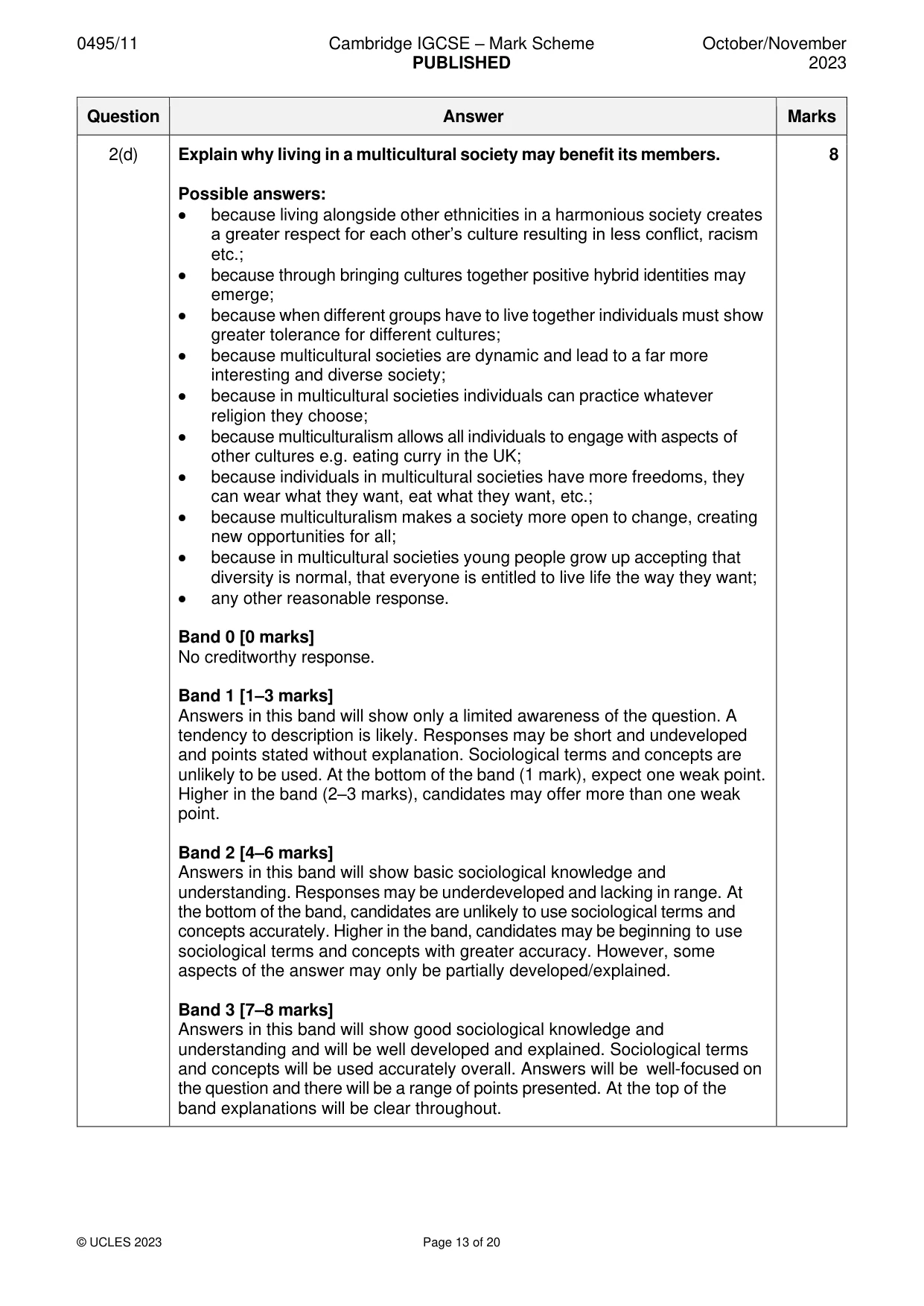
0495/11 Cambridge IGCSE – Mark Scheme PUBLISHED October/November 2023 © UCLES 2023 Page 13 of 20 Question Answer Marks 2(d) Explain why living in a multicultural society may benefit its members. Possible answers: • because living alongside other ethnicities in a harmonious society creates a greater respect for each other’s culture resulting in less conflict, racism etc.; • because through bringing cultures together positive hybrid identities may emerge; • because when different groups have to live together individuals must show greater tolerance for different cultures; • because multicultural societies are dynamic and lead to a far more interesting and diverse society; • because in multicultural societies individuals can practice whatever religion they choose; • because multiculturalism allows all individuals to engage with aspects of other cultures e.g. eating curry in the UK; • because individuals in multicultural societies have more freedoms, they can wear what they want, eat what they want, etc.; • because multiculturalism makes a society more open to change, creating new opportunities for all; • because in multicultural societies young people grow up accepting that diversity is normal, that everyone is entitled to live life the way they want; • any other reasonable response. Band 0 [0 marks] No creditworthy response. Band 1 [1–3 marks] Answers in this band will show only a limited awareness of the question. A tendency to description is likely. Responses may be short and undeveloped and points stated without explanation. Sociological terms and concepts are unlikely to be used. At the bottom of the band (1 mark), expect one weak point. Higher in the band (2–3 marks), candidates may offer more than one weak point. Band 2 [4–6 marks] Answers in this band will show basic sociological knowledge and understanding. Responses may be underdeveloped and lacking in range. At the bottom of the band, candidates are unlikely to use sociological terms and concepts accurately. Higher in the band, candidates may be beginning to use sociological terms and concepts with greater accuracy. However, some aspects of the answer may only be partially developed/explained. Band 3 [7–8 marks] Answers in this band will show good sociological knowledge and understanding and will be well developed and explained. Sociological terms and concepts will be used accurately overall. Answers will be well-focused on the question and there will be a range of points presented. At the top of the band explanations will be clear throughout. 8
Mark scheme, page 14
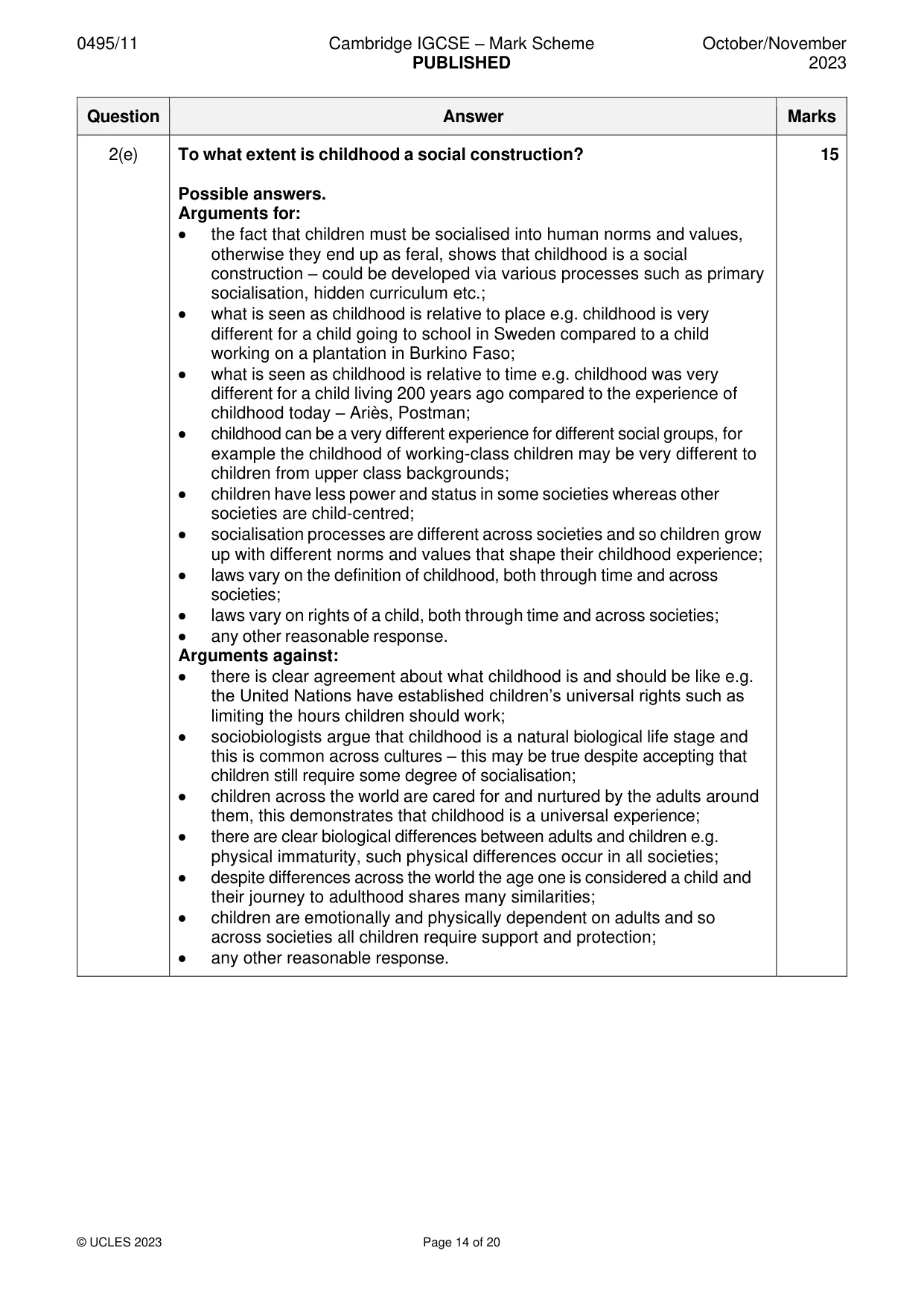
0495/11 Cambridge IGCSE – Mark Scheme PUBLISHED October/November 2023 © UCLES 2023 Page 14 of 20 Question Answer Marks 2(e) To what extent is childhood a social construction? Possible answers. Arguments for: • the fact that children must be socialised into human norms and values, otherwise they end up as feral, shows that childhood is a social construction – could be developed via various processes such as primary socialisation, hidden curriculum etc.; • what is seen as childhood is relative to place e.g. childhood is very different for a child going to school in Sweden compared to a child working on a plantation in Burkino Faso; • what is seen as childhood is relative to time e.g. childhood was very different for a child living 200 years ago compared to the experience of childhood today – Ariès, Postman; • childhood can be a very different experience for different social groups, for example the childhood of working-class children may be very different to children from upper class backgrounds; • children have less power and status in some societies whereas other societies are child-centred; • socialisation processes are different across societies and so children grow up with different norms and values that shape their childhood experience; • laws vary on the definition of childhood, both through time and across societies; • laws vary on rights of a child, both through time and across societies; • any other reasonable response. Arguments against: • there is clear agreement about what childhood is and should be like e.g. the United Nations have established children’s universal rights such as limiting the hours children should work; • sociobiologists argue that childhood is a natural biological life stage and this is common across cultures – this may be true despite accepting that children still require some degree of socialisation; • children across the world are cared for and nurtured by the adults around them, this demonstrates that childhood is a universal experience; • there are clear biological differences between adults and children e.g. physical immaturity, such physical differences occur in all societies; • despite differences across the world the age one is considered a child and their journey to adulthood shares many similarities; • children are emotionally and physically dependent on adults and so across societies all children require support and protection; • any other reasonable response. 15
Mark scheme, page 15
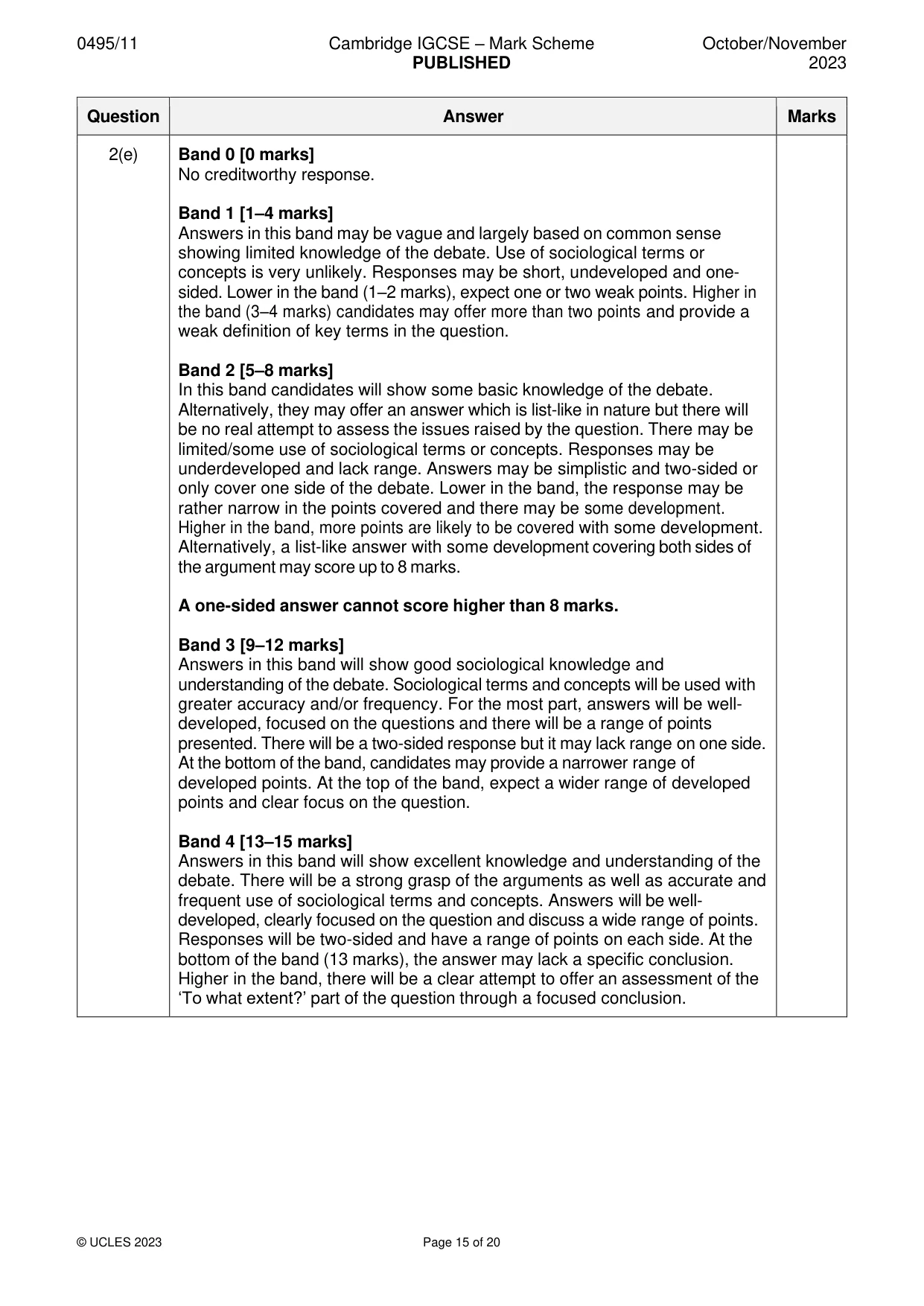
0495/11 Cambridge IGCSE – Mark Scheme PUBLISHED October/November 2023 © UCLES 2023 Page 15 of 20 Question Answer Marks 2(e) Band 0 [0 marks] No creditworthy response. Band 1 [1–4 marks] Answers in this band may be vague and largely based on common sense showing limited knowledge of the debate. Use of sociological terms or concepts is very unlikely. Responses may be short, undeveloped and one- sided. Lower in the band (1–2 marks), expect one or two weak points. Higher in the band (3–4 marks) candidates may offer more than two points and provide a weak definition of key terms in the question. Band 2 [5–8 marks] In this band candidates will show some basic knowledge of the debate. Alternatively, they may offer an answer which is list-like in nature but there will be no real attempt to assess the issues raised by the question. There may be limited/some use of sociological terms or concepts. Responses may be underdeveloped and lack range. Answers may be simplistic and two-sided or only cover one side of the debate. Lower in the band, the response may be rather narrow in the points covered and there may be some development. Higher in the band, more points are likely to be covered with some development. Alternatively, a list-like answer with some development covering both sides of the argument may score up to 8 marks. A one-sided answer cannot score higher than 8 marks. Band 3 [9–12 marks] Answers in this band will show good sociological knowledge and understanding of the debate. Sociological terms and concepts will be used with greater accuracy and/or frequency. For the most part, answers will be well- developed, focused on the questions and there will be a range of points presented. There will be a two-sided response but it may lack range on one side. At the bottom of the band, candidates may provide a narrower range of developed points. At the top of the band, expect a wider range of developed points and clear focus on the question. Band 4 [13–15 marks] Answers in this band will show excellent knowledge and understanding of the debate. There will be a strong grasp of the arguments as well as accurate and frequent use of sociological terms and concepts. Answers will be well- developed, clearly focused on the question and discuss a wide range of points. Responses will be two-sided and have a range of points on each side. At the bottom of the band (13 marks), the answer may lack a specific conclusion. Higher in the band, there will be a clear attempt to offer an assessment of the ‘To what extent?’ part of the question through a focused conclusion.
Mark scheme, page 16
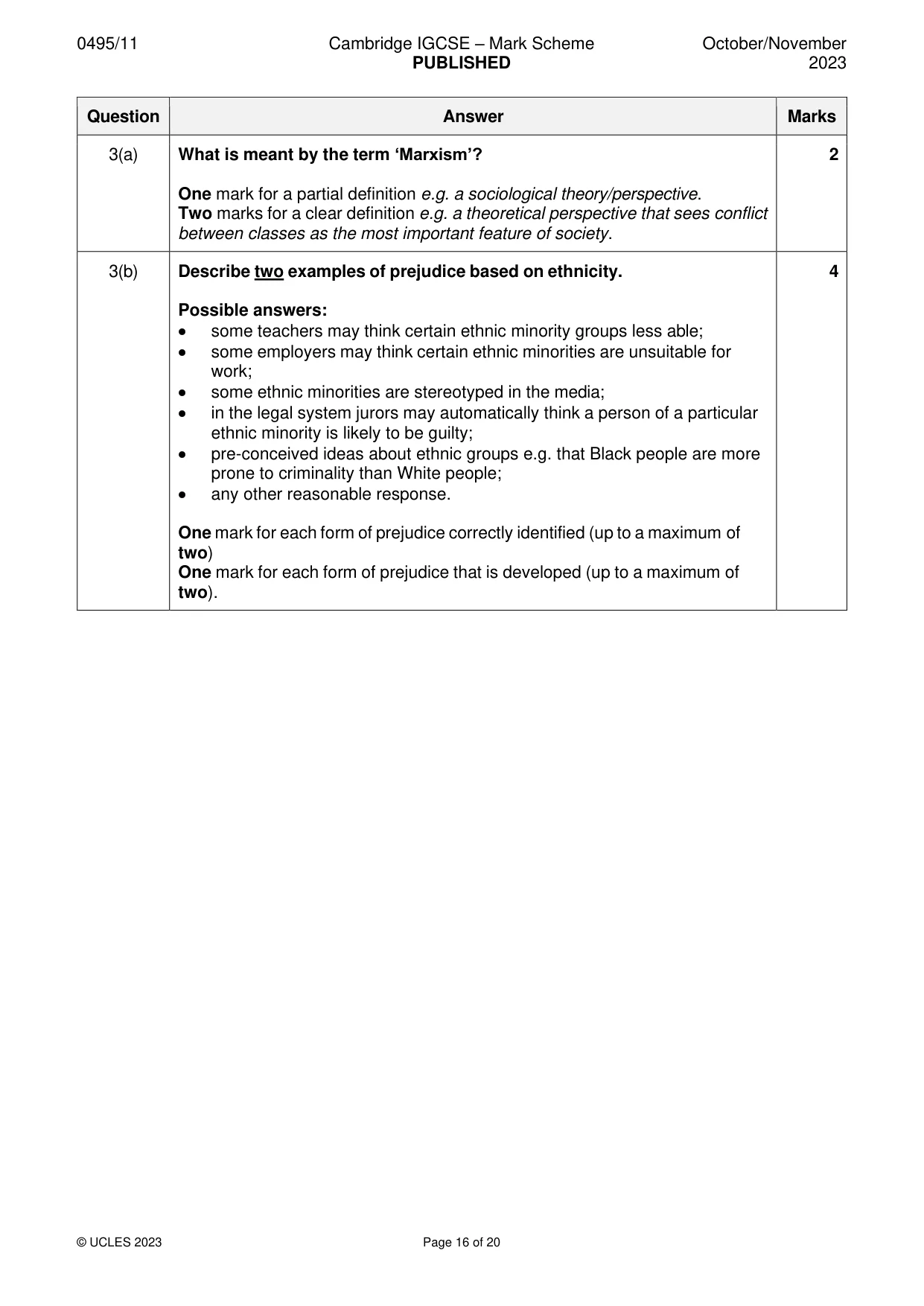
0495/11 Cambridge IGCSE – Mark Scheme PUBLISHED October/November 2023 © UCLES 2023 Page 16 of 20 Question Answer Marks 3(a) What is meant by the term ‘Marxism’? One mark for a partial definition e.g. a sociological theory/perspective. Two marks for a clear definition e.g. a theoretical perspective that sees conflict between classes as the most important feature of society. 2 3(b) Describe two examples of prejudice based on ethnicity. Possible answers: • some teachers may think certain ethnic minority groups less able; • some employers may think certain ethnic minorities are unsuitable for work; • some ethnic minorities are stereotyped in the media; • in the legal system jurors may automatically think a person of a particular ethnic minority is likely to be guilty; • pre-conceived ideas about ethnic groups e.g. that Black people are more prone to criminality than White people; • any other reasonable response. One mark for each form of prejudice correctly identified (up to a maximum of two) One mark for each form of prejudice that is developed (up to a maximum of two). 4
Mark scheme, page 17
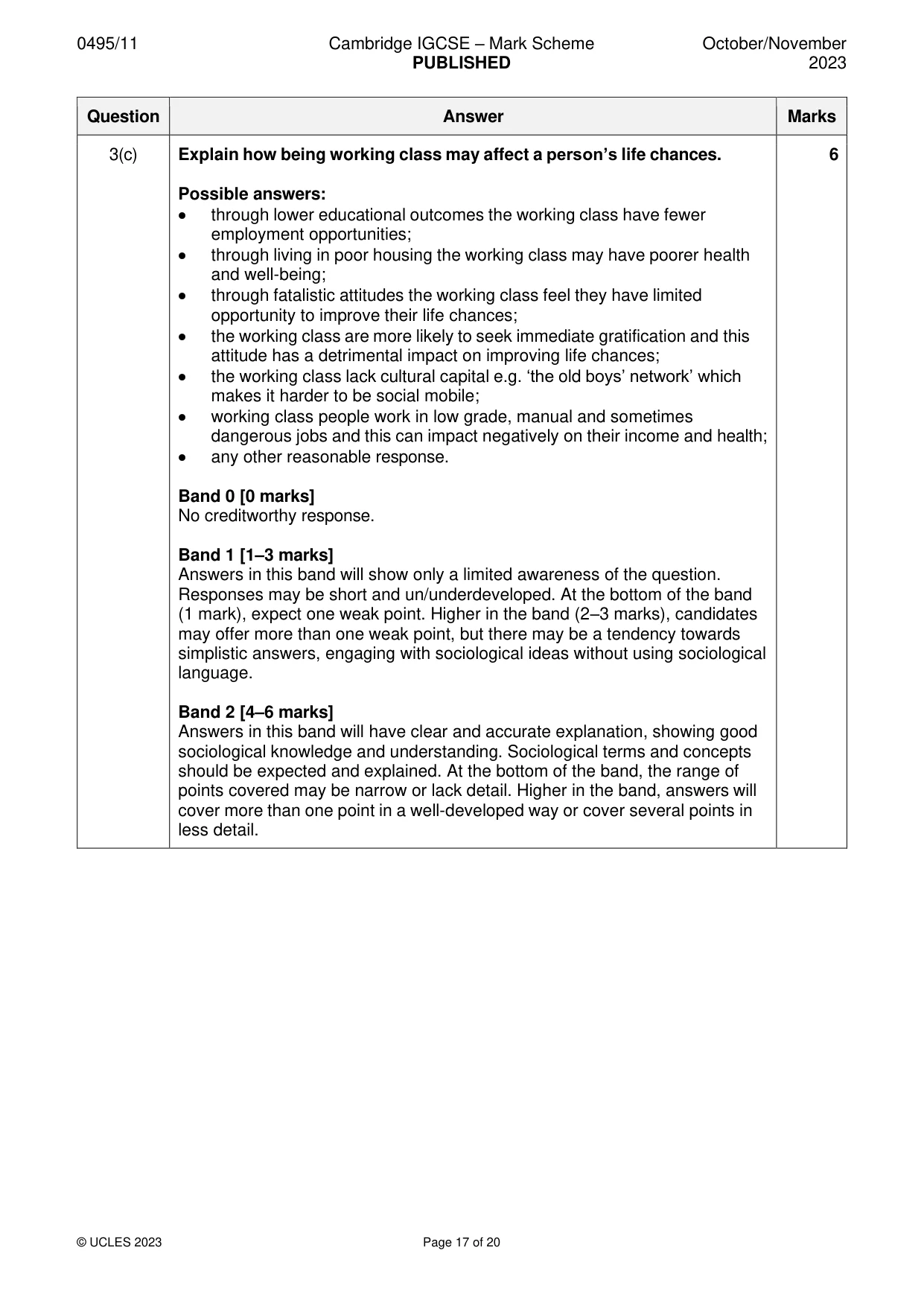
0495/11 Cambridge IGCSE – Mark Scheme PUBLISHED October/November 2023 © UCLES 2023 Page 17 of 20 Question Answer Marks 3(c) Explain how being working class may affect a person’s life chances. Possible answers: • through lower educational outcomes the working class have fewer employment opportunities; • through living in poor housing the working class may have poorer health and well-being; • through fatalistic attitudes the working class feel they have limited opportunity to improve their life chances; • the working class are more likely to seek immediate gratification and this attitude has a detrimental impact on improving life chances; • the working class lack cultural capital e.g. ‘the old boys’ network’ which makes it harder to be social mobile; • working class people work in low grade, manual and sometimes dangerous jobs and this can impact negatively on their income and health; • any other reasonable response. Band 0 [0 marks] No creditworthy response. Band 1 [1–3 marks] Answers in this band will show only a limited awareness of the question. Responses may be short and un/underdeveloped. At the bottom of the band (1 mark), expect one weak point. Higher in the band (2–3 marks), candidates may offer more than one weak point, but there may be a tendency towards simplistic answers, engaging with sociological ideas without using sociological language. Band 2 [4–6 marks] Answers in this band will have clear and accurate explanation, showing good sociological knowledge and understanding. Sociological terms and concepts should be expected and explained. At the bottom of the band, the range of points covered may be narrow or lack detail. Higher in the band, answers will cover more than one point in a well-developed way or cover several points in less detail. 6
Mark scheme, page 18
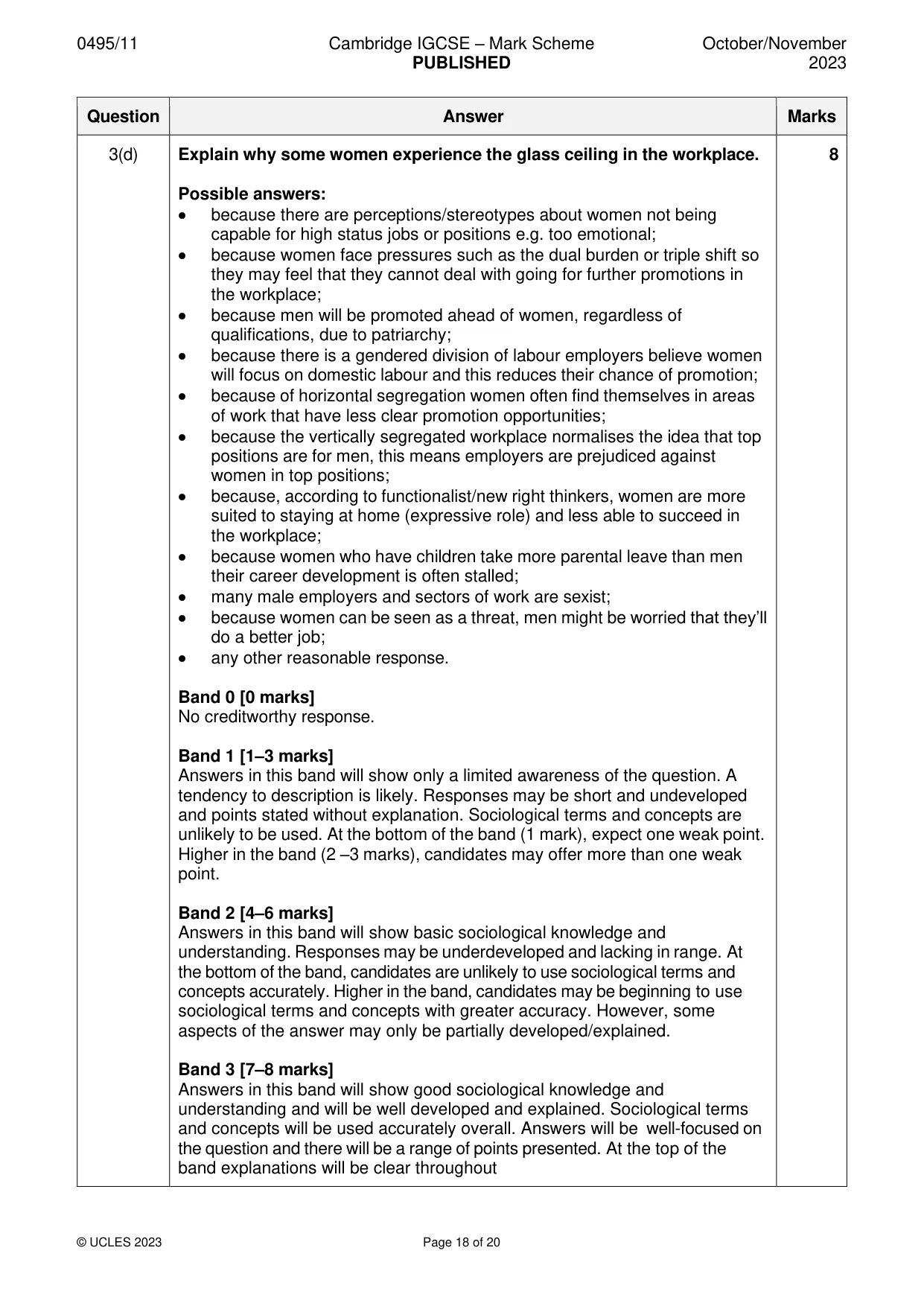
0495/11 Cambridge IGCSE – Mark Scheme PUBLISHED October/November 2023 © UCLES 2023 Page 18 of 20 Question Answer Marks 3(d) Explain why some women experience the glass ceiling in the workplace. Possible answers: • because there are perceptions/stereotypes about women not being capable for high status jobs or positions e.g. too emotional; • because women face pressures such as the dual burden or triple shift so they may feel that they cannot deal with going for further promotions in the workplace; • because men will be promoted ahead of women, regardless of qualifications, due to patriarchy; • because there is a gendered division of labour employers believe women will focus on domestic labour and this reduces their chance of promotion; • because of horizontal segregation women often find themselves in areas of work that have less clear promotion opportunities; • because the vertically segregated workplace normalises the idea that top positions are for men, this means employers are prejudiced against women in top positions; • because, according to functionalist/new right thinkers, women are more suited to staying at home (expressive role) and less able to succeed in the workplace; • because women who have children take more parental leave than men their career development is often stalled; • many male employers and sectors of work are sexist; • because women can be seen as a threat, men might be worried that they’ll do a better job; • any other reasonable response. Band 0 [0 marks] No creditworthy response. Band 1 [1–3 marks] Answers in this band will show only a limited awareness of the question. A tendency to description is likely. Responses may be short and undeveloped and points stated without explanation. Sociological terms and concepts are unlikely to be used. At the bottom of the band (1 mark), expect one weak point. Higher in the band (2 –3 marks), candidates may offer more than one weak point. Band 2 [4–6 marks] Answers in this band will show basic sociological knowledge and understanding. Responses may be underdeveloped and lacking in range. At the bottom of the band, candidates are unlikely to use sociological terms and concepts accurately. Higher in the band, candidates may be beginning to use sociological terms and concepts with greater accuracy. However, some aspects of the answer may only be partially developed/explained. Band 3 [7–8 marks] Answers in this band will show good sociological knowledge and understanding and will be well developed and explained. Sociological terms and concepts will be used accurately overall. Answers will be well-focused on the question and there will be a range of points presented. At the top of the band explanations will be clear throughout 8
Mark scheme, page 19
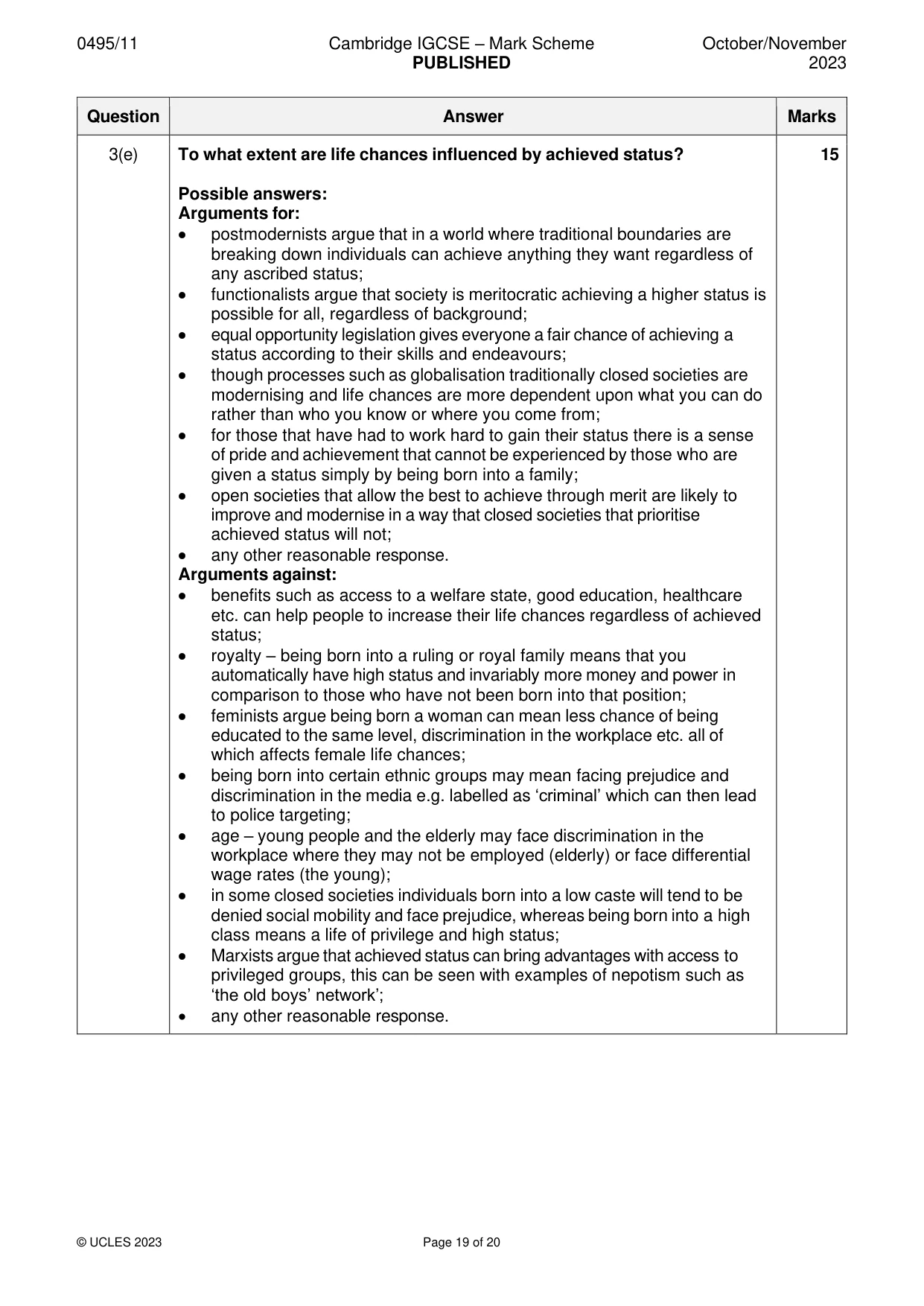
0495/11 Cambridge IGCSE – Mark Scheme PUBLISHED October/November 2023 © UCLES 2023 Page 19 of 20 Question Answer Marks 3(e) To what extent are life chances influenced by achieved status? Possible answers: Arguments for: • postmodernists argue that in a world where traditional boundaries are breaking down individuals can achieve anything they want regardless of any ascribed status; • functionalists argue that society is meritocratic achieving a higher status is possible for all, regardless of background; • equal opportunity legislation gives everyone a fair chance of achieving a status according to their skills and endeavours; • though processes such as globalisation traditionally closed societies are modernising and life chances are more dependent upon what you can do rather than who you know or where you come from; • for those that have had to work hard to gain their status there is a sense of pride and achievement that cannot be experienced by those who are given a status simply by being born into a family; • open societies that allow the best to achieve through merit are likely to improve and modernise in a way that closed societies that prioritise achieved status will not; • any other reasonable response. Arguments against: • benefits such as access to a welfare state, good education, healthcare etc. can help people to increase their life chances regardless of achieved status; • royalty – being born into a ruling or royal family means that you automatically have high status and invariably more money and power in comparison to those who have not been born into that position; • feminists argue being born a woman can mean less chance of being educated to the same level, discrimination in the workplace etc. all of which affects female life chances; • being born into certain ethnic groups may mean facing prejudice and discrimination in the media e.g. labelled as ‘criminal’ which can then lead to police targeting; • age – young people and the elderly may face discrimination in the workplace where they may not be employed (elderly) or face differential wage rates (the young); • in some closed societies individuals born into a low caste will tend to be denied social mobility and face prejudice, whereas being born into a high class means a life of privilege and high status; • Marxists argue that achieved status can bring advantages with access to privileged groups, this can be seen with examples of nepotism such as ‘the old boys’ network’; • any other reasonable response. 15
Mark scheme, page 20
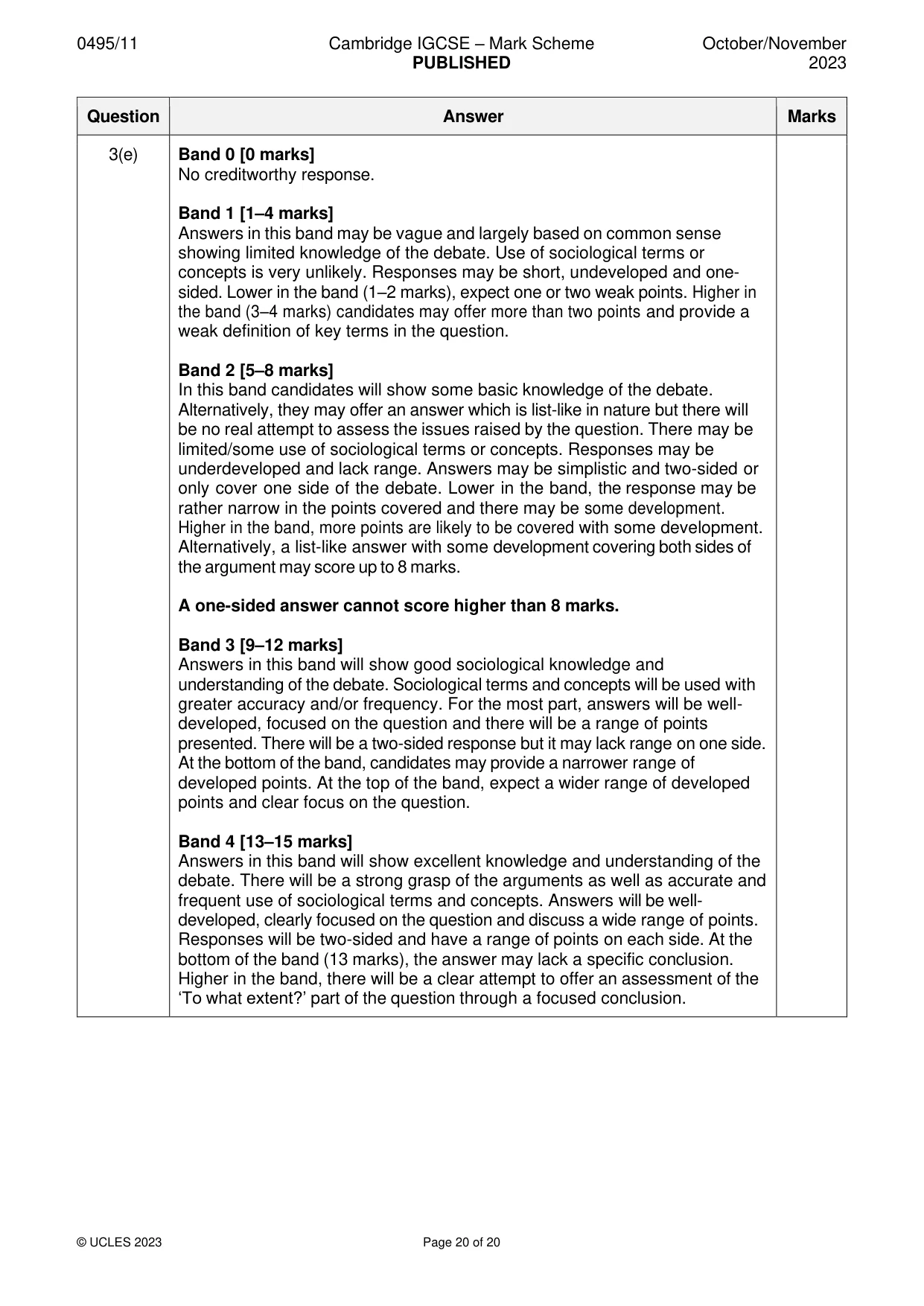
0495/11 Cambridge IGCSE – Mark Scheme PUBLISHED October/November 2023 © UCLES 2023 Page 20 of 20 Question Answer Marks 3(e) Band 0 [0 marks] No creditworthy response. Band 1 [1–4 marks] Answers in this band may be vague and largely based on common sense showing limited knowledge of the debate. Use of sociological terms or concepts is very unlikely. Responses may be short, undeveloped and one- sided. Lower in the band (1–2 marks), expect one or two weak points. Higher in the band (3–4 marks) candidates may offer more than two points and provide a weak definition of key terms in the question. Band 2 [5–8 marks] In this band candidates will show some basic knowledge of the debate. Alternatively, they may offer an answer which is list-like in nature but there will be no real attempt to assess the issues raised by the question. There may be limited/some use of sociological terms or concepts. Responses may be underdeveloped and lack range. Answers may be simplistic and two-sided or only cover one side of the debate. Lower in the band, the response may be rather narrow in the points covered and there may be some development. Higher in the band, more points are likely to be covered with some development. Alternatively, a list-like answer with some development covering both sides of the argument may score up to 8 marks. A one-sided answer cannot score higher than 8 marks. Band 3 [9–12 marks] Answers in this band will show good sociological knowledge and understanding of the debate. Sociological terms and concepts will be used with greater accuracy and/or frequency. For the most part, answers will be well- developed, focused on the question and there will be a range of points presented. There will be a two-sided response but it may lack range on one side. At the bottom of the band, candidates may provide a narrower range of developed points. At the top of the band, expect a wider range of developed points and clear focus on the question. Band 4 [13–15 marks] Answers in this band will show excellent knowledge and understanding of the debate. There will be a strong grasp of the arguments as well as accurate and frequent use of sociological terms and concepts. Answers will be well- developed, clearly focused on the question and discuss a wide range of points. Responses will be two-sided and have a range of points on each side. At the bottom of the band (13 marks), the answer may lack a specific conclusion. Higher in the band, there will be a clear attempt to offer an assessment of the ‘To what extent?’ part of the question through a focused conclusion.
What you needed in this session
Cambridge’s own grade thresholds for 2023 Oct/Nov, Paper 1 · Variant 1. A higher threshold means an easier paper — the bar moves with how the cohort did.