Cambridge IGCSE Sociology 0495 — 2024 May/June Paper 1 · Variant 1
0495/11/M/J/24 · 80 marks · ≈90 min
The question paper and its mark scheme, free to read here and free to download. This is Cambridge’s own paper, exactly as it was sat.
Question paper4 pages

Mark scheme21 pages
Answers below. Sit the paper first if you are practising.

Paper as text
Question paper, page 1
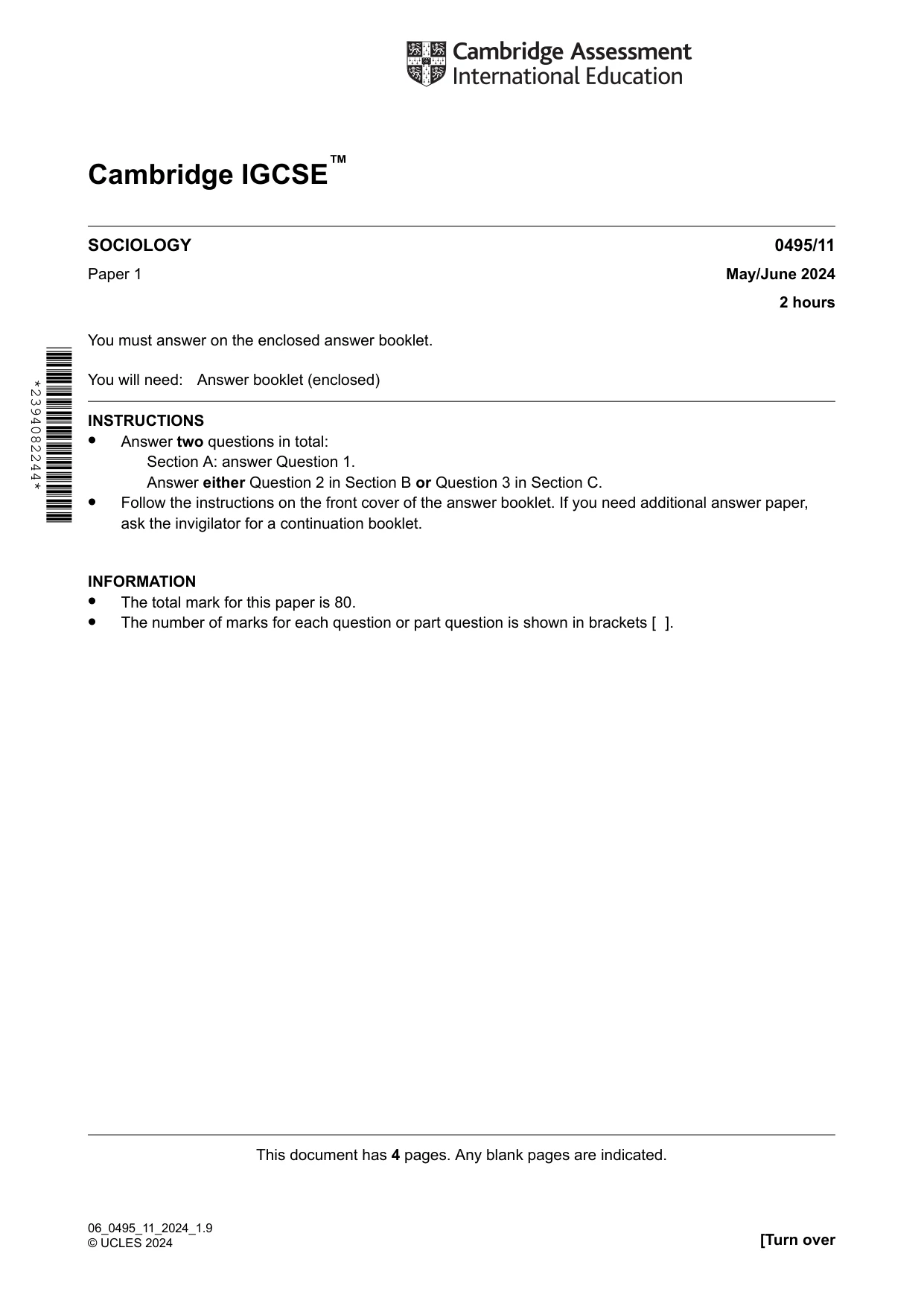
Cambridge IGCSE™ 0495/11 May/June 2024 2 hours SOCIOLOGY Paper 1 You must answer on the enclosed answer booklet. You will need: Answer booklet (enclosed) INSTRUCTIONS • Answer two questions in total: Section A: answer Question 1. Answer either Question 2 in Section B or Question 3 in Section C. • Follow the instructions on the front cover of the answer booklet. If you need additional answer paper, ask the invigilator for a continuation booklet. INFORMATION • The total mark for this paper is 80. • The number of marks for each question or part question is shown in brackets [ ]. This document has 4 pages. Any blank pages are indicated. [Turn over 06_0495_11_2024_1.9 © UCLES 2024 *2394082244*
Question paper, page 2
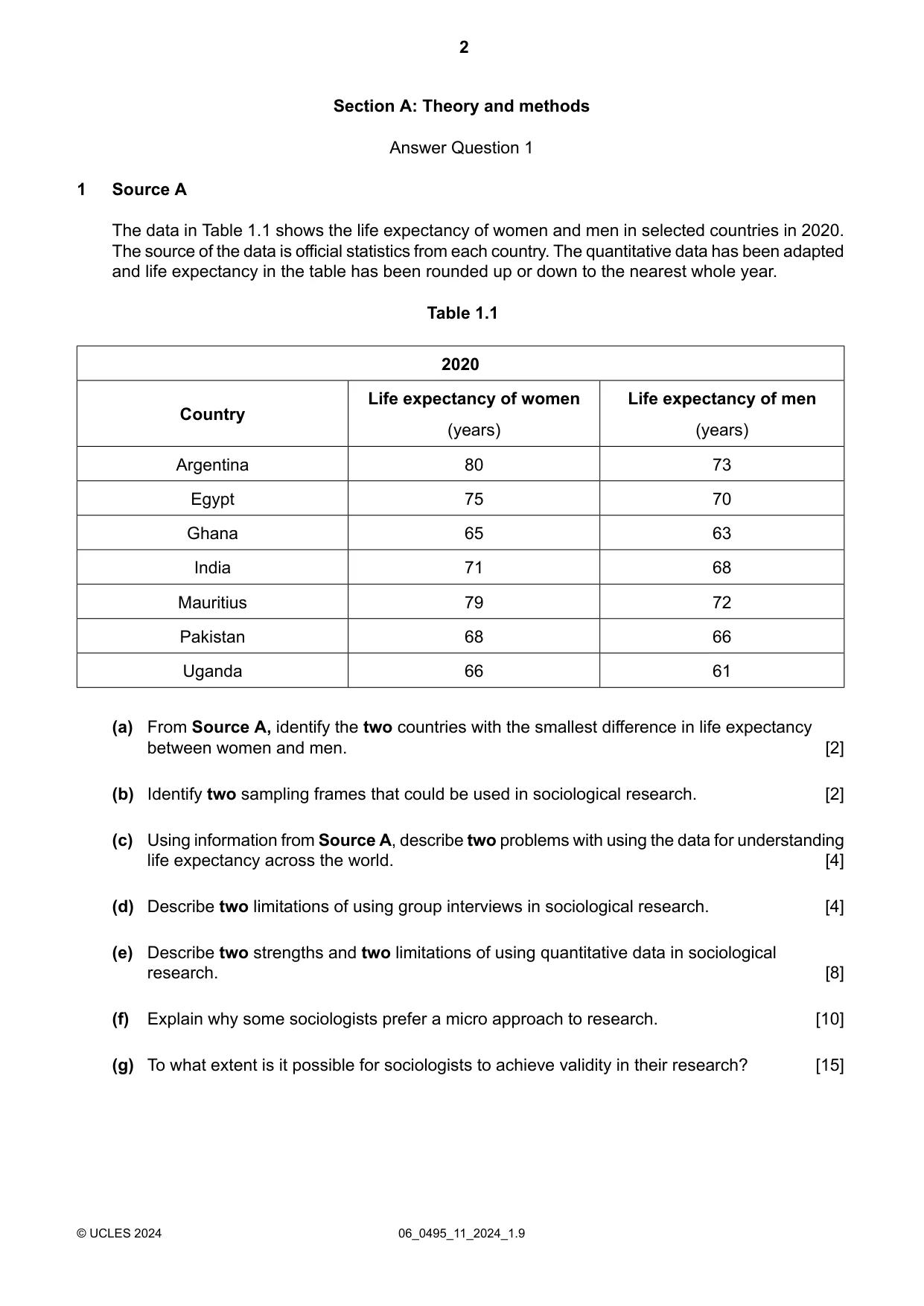
Section A: Theory and methods Answer Question 1 Source A 1 The data in Table 1.1 shows the life expectancy of women and men in selected countries in 2020. The source of the data is official statistics from each country. The quantitative data has been adapted and life expectancy in the table has been rounded up or down to the nearest whole year. Table 1.1 2020 Life expectancy of men (years) Life expectancy of women (years) Country 73 80 Argentina 70 75 Egypt 63 65 Ghana 68 71 India 72 79 Mauritius 66 68 Pakistan 61 66 Uganda From Source A, identify the two countries with the smallest difference in life expectancy between women and men. [2] (a) Identify two sampling frames that could be used in sociological research. [2] (b) Using information from Source A, describe two problems with using the data for understanding life expectancy across the world. [4] (c) Describe two limitations of using group interviews in sociological research. [4] (d) Describe two strengths and two limitations of using quantitative data in sociological research. [8] (e) Explain why some sociologists prefer a micro approach to research. [10] (f) To what extent is it possible for sociologists to achieve validity in their research? [15] (g) 06_0495_11_2024_1.9 © UCLES 2024 2
Question paper, page 3
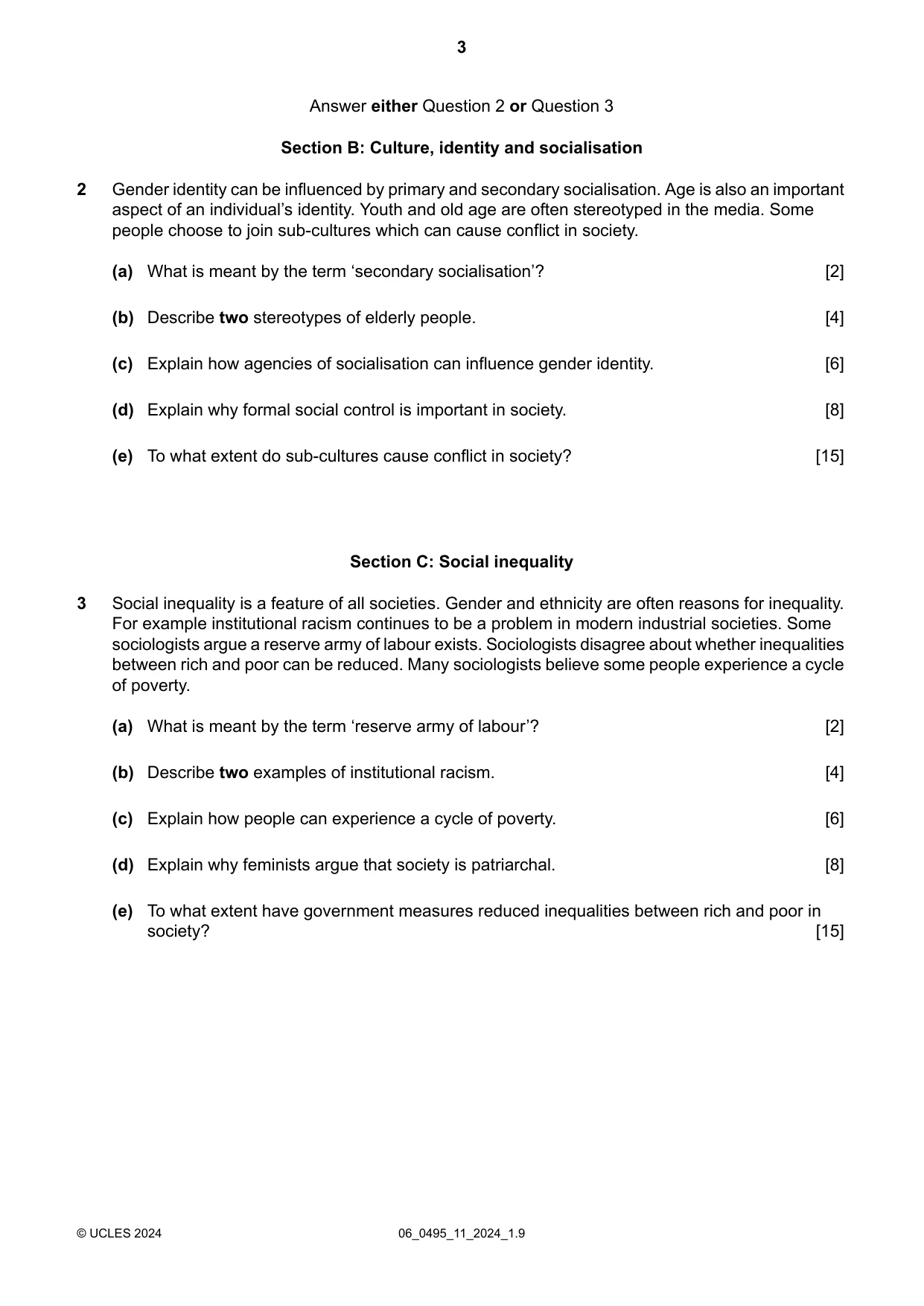
Answer either Question 2 or Question 3 Section B: Culture, identity and socialisation Gender identity can be influenced by primary and secondary socialisation. Age is also an important aspect of an individual’s identity. Youth and old age are often stereotyped in the media. Some people choose to join sub-cultures which can cause conflict in society. 2 What is meant by the term ‘secondary socialisation’? [2] (a) Describe two stereotypes of elderly people. [4] (b) Explain how agencies of socialisation can influence gender identity. [6] (c) Explain why formal social control is important in society. [8] (d) To what extent do sub-cultures cause conflict in society? [15] (e) Section C: Social inequality Social inequality is a feature of all societies. Gender and ethnicity are often reasons for inequality. For example institutional racism continues to be a problem in modern industrial societies. Some 3 sociologists argue a reserve army of labour exists. Sociologists disagree about whether inequalities between rich and poor can be reduced. Many sociologists believe some people experience a cycle of poverty. What is meant by the term ‘reserve army of labour’? [2] (a) Describe two examples of institutional racism. [4] (b) Explain how people can experience a cycle of poverty. [6] (c) Explain why feminists argue that society is patriarchal. [8] (d) To what extent have government measures reduced inequalities between rich and poor in society? [15] (e) 06_0495_11_2024_1.9 © UCLES 2024 3
Question paper, page 4
BLANK PAGE Permission to reproduce items where third-party owned material protected by copyright is included has been sought and cleared where possible. Every reasonable effort has been made by the publisher (UCLES) to trace copyright holders, but if any items requiring clearance have unwittingly been included, the publisher will be pleased to make amends at the earliest possible opportunity. To avoid the issue of disclosure of answer-related information to candidates, all copyright acknowledgements are reproduced online in the Cambridge Assessment International Education Copyright Acknowledgements Booklet. This is produced for each series of examinations and is freely available to download at www.cambridgeinternational.org after the live examination series. Cambridge Assessment International Education is part of Cambridge Assessment. Cambridge Assessment is the brand name of the University of Cambridge Local Examinations Syndicate (UCLES), which is a department of the University of Cambridge. 06_0495_11_2024_1.9 © UCLES 2024 4
Mark scheme, page 1
This document consists of 21 printed pages. © Cambridge University Press & Assessment 2024 [Turn over Cambridge IGCSE™ SOCIOLOGY 0495/11 Paper 1 May/June 2024 MARK SCHEME Maximum Mark: 80 Published This mark scheme is published as an aid to teachers and candidates, to indicate the requirements of the examination. It shows the basis on which Examiners were instructed to award marks. It does not indicate the details of the discussions that took place at an Examiners’ meeting before marking began, which would have considered the acceptability of alternative answers. Mark schemes should be read in conjunction with the question paper and the Principal Examiner Report for Teachers. Cambridge International will not enter into discussions about these mark schemes. Cambridge International is publishing the mark schemes for the May/June 2024 series for most Cambridge IGCSE, Cambridge International A and AS Level and Cambridge Pre-U components, and some Cambridge O Level components.
Mark scheme, page 2
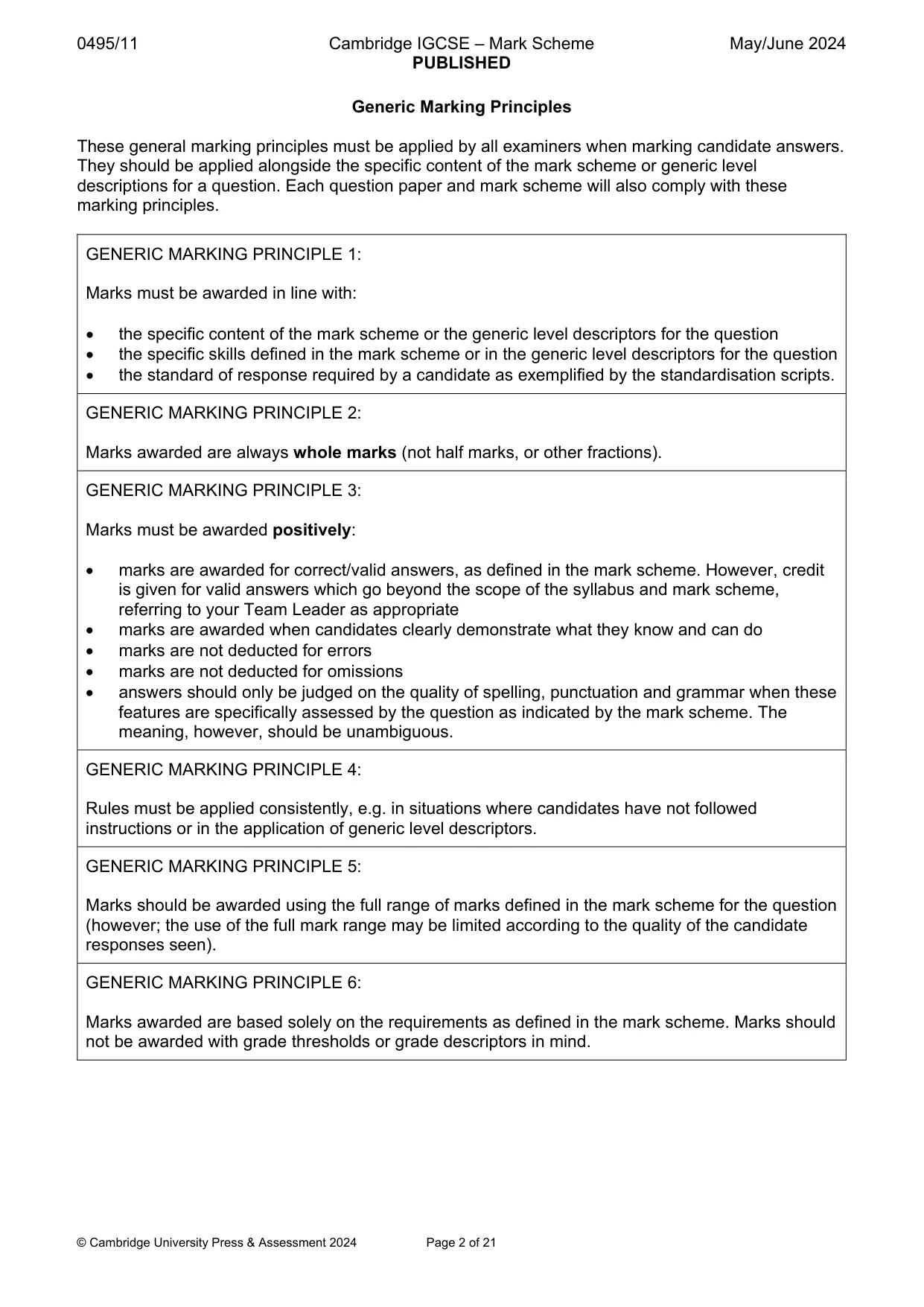
0495/11 Cambridge IGCSE – Mark Scheme PUBLISHED May/June 2024 © Cambridge University Press & Assessment 2024 Page 2 of 21 Generic Marking Principles These general marking principles must be applied by all examiners when marking candidate answers. They should be applied alongside the specific content of the mark scheme or generic level descriptions for a question. Each question paper and mark scheme will also comply with these marking principles. GENERIC MARKING PRINCIPLE 1: Marks must be awarded in line with: the specific content of the mark scheme or the generic level descriptors for the question the specific skills defined in the mark scheme or in the generic level descriptors for the question the standard of response required by a candidate as exemplified by the standardisation scripts. GENERIC MARKING PRINCIPLE 2: Marks awarded are always whole marks (not half marks, or other fractions). GENERIC MARKING PRINCIPLE 3: Marks must be awarded positively: marks are awarded for correct/valid answers, as defined in the mark scheme. However, credit is given for valid answers which go beyond the scope of the syllabus and mark scheme, referring to your Team Leader as appropriate marks are awarded when candidates clearly demonstrate what they know and can do marks are not deducted for errors marks are not deducted for omissions answers should only be judged on the quality of spelling, punctuation and grammar when these features are specifically assessed by the question as indicated by the mark scheme. The meaning, however, should be unambiguous. GENERIC MARKING PRINCIPLE 4: Rules must be applied consistently, e.g. in situations where candidates have not followed instructions or in the application of generic level descriptors. GENERIC MARKING PRINCIPLE 5: Marks should be awarded using the full range of marks defined in the mark scheme for the question (however; the use of the full mark range may be limited according to the quality of the candidate responses seen). GENERIC MARKING PRINCIPLE 6: Marks awarded are based solely on the requirements as defined in the mark scheme. Marks should not be awarded with grade thresholds or grade descriptors in mind.
Mark scheme, page 3
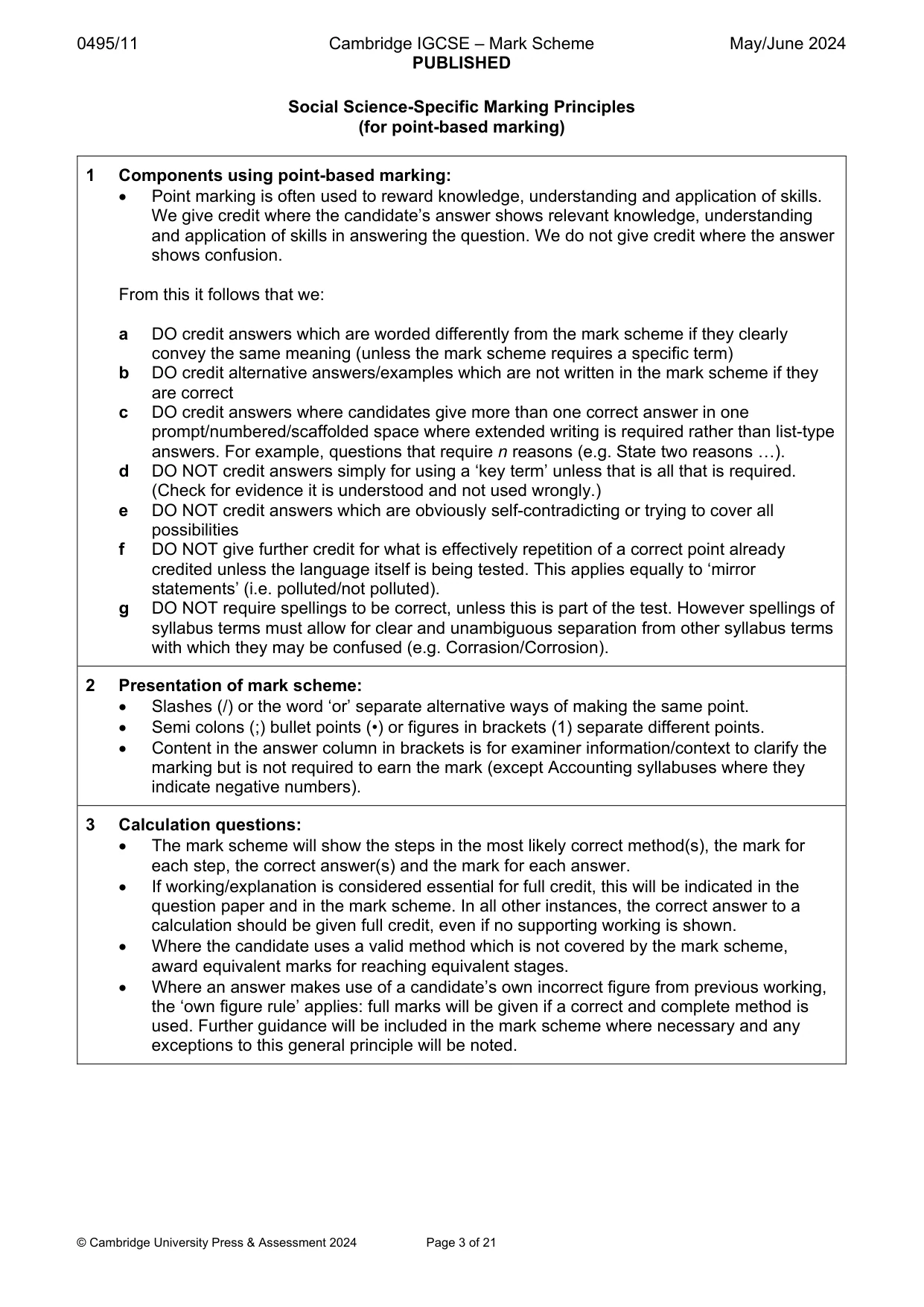
0495/11 Cambridge IGCSE – Mark Scheme PUBLISHED May/June 2024 © Cambridge University Press & Assessment 2024 Page 3 of 21 Social Science-Specific Marking Principles (for point-based marking) 1 Components using point-based marking: Point marking is often used to reward knowledge, understanding and application of skills. We give credit where the candidate’s answer shows relevant knowledge, understanding and application of skills in answering the question. We do not give credit where the answer shows confusion. From this it follows that we: a DO credit answers which are worded differently from the mark scheme if they clearly convey the same meaning (unless the mark scheme requires a specific term) b DO credit alternative answers/examples which are not written in the mark scheme if they are correct c DO credit answers where candidates give more than one correct answer in one prompt/numbered/scaffolded space where extended writing is required rather than list-type answers. For example, questions that require n reasons (e.g. State two reasons …). d DO NOT credit answers simply for using a ‘key term’ unless that is all that is required. (Check for evidence it is understood and not used wrongly.) e DO NOT credit answers which are obviously self-contradicting or trying to cover all possibilities f DO NOT give further credit for what is effectively repetition of a correct point already credited unless the language itself is being tested. This applies equally to ‘mirror statements’ (i.e. polluted/not polluted). g DO NOT require spellings to be correct, unless this is part of the test. However spellings of syllabus terms must allow for clear and unambiguous separation from other syllabus terms with which they may be confused (e.g. Corrasion/Corrosion). 2 Presentation of mark scheme: Slashes (/) or the word ‘or’ separate alternative ways of making the same point. Semi colons (;) bullet points (•) or figures in brackets (1) separate different points. Content in the answer column in brackets is for examiner information/context to clarify the marking but is not required to earn the mark (except Accounting syllabuses where they indicate negative numbers). 3 Calculation questions: The mark scheme will show the steps in the most likely correct method(s), the mark for each step, the correct answer(s) and the mark for each answer. If working/explanation is considered essential for full credit, this will be indicated in the question paper and in the mark scheme. In all other instances, the correct answer to a calculation should be given full credit, even if no supporting working is shown. Where the candidate uses a valid method which is not covered by the mark scheme, award equivalent marks for reaching equivalent stages. Where an answer makes use of a candidate’s own incorrect figure from previous working, the ‘own figure rule’ applies: full marks will be given if a correct and complete method is used. Further guidance will be included in the mark scheme where necessary and any exceptions to this general principle will be noted.
Mark scheme, page 4
0495/11 Cambridge IGCSE – Mark Scheme PUBLISHED May/June 2024 © Cambridge University Press & Assessment 2024 Page 4 of 21 4 Annotation: For point marking, ticks can be used to indicate correct answers and crosses can be used to indicate wrong answers. There is no direct relationship between ticks and marks. Ticks have no defined meaning for levels of response marking. For levels of response marking, the level awarded should be annotated on the script. Other annotations will be used by examiners as agreed during standardisation, and the meaning will be understood by all examiners who marked that paper.
Mark scheme, page 5
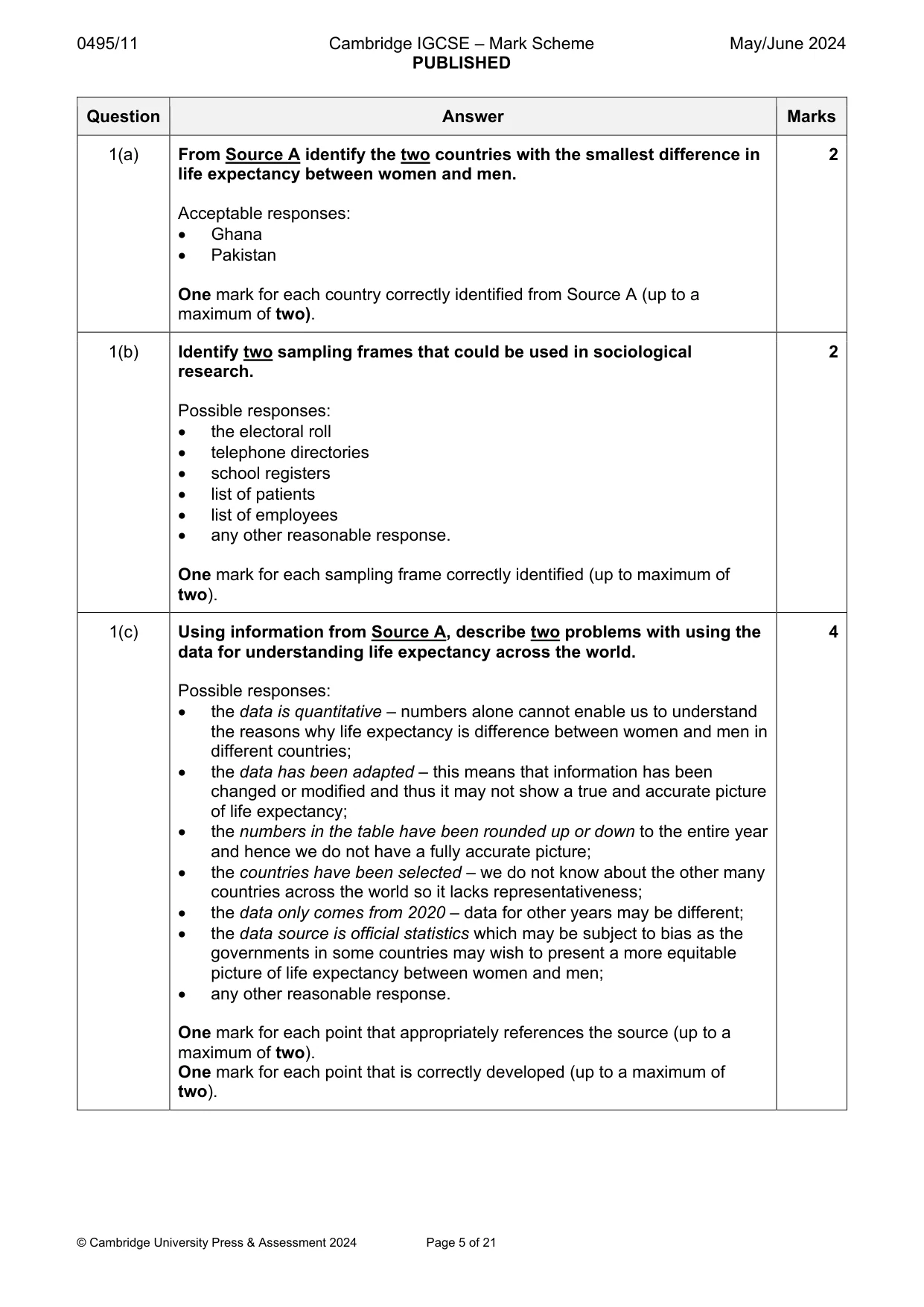
0495/11 Cambridge IGCSE – Mark Scheme PUBLISHED May/June 2024 © Cambridge University Press & Assessment 2024 Page 5 of 21 Question Answer Marks 1(a) From Source A identify the two countries with the smallest difference in life expectancy between women and men. Acceptable responses: Ghana Pakistan One mark for each country correctly identified from Source A (up to a maximum of two). 2 1(b) Identify two sampling frames that could be used in sociological research. Possible responses: the electoral roll telephone directories school registers list of patients list of employees any other reasonable response. One mark for each sampling frame correctly identified (up to maximum of two). 2 1(c) Using information from Source A, describe two problems with using the data for understanding life expectancy across the world. Possible responses: the data is quantitative – numbers alone cannot enable us to understand the reasons why life expectancy is difference between women and men in different countries; the data has been adapted – this means that information has been changed or modified and thus it may not show a true and accurate picture of life expectancy; the numbers in the table have been rounded up or down to the entire year and hence we do not have a fully accurate picture; the countries have been selected – we do not know about the other many countries across the world so it lacks representativeness; the data only comes from 2020 – data for other years may be different; the data source is official statistics which may be subject to bias as the governments in some countries may wish to present a more equitable picture of life expectancy between women and men; any other reasonable response. One mark for each point that appropriately references the source (up to a maximum of two). One mark for each point that is correctly developed (up to a maximum of two). 4
Mark scheme, page 6
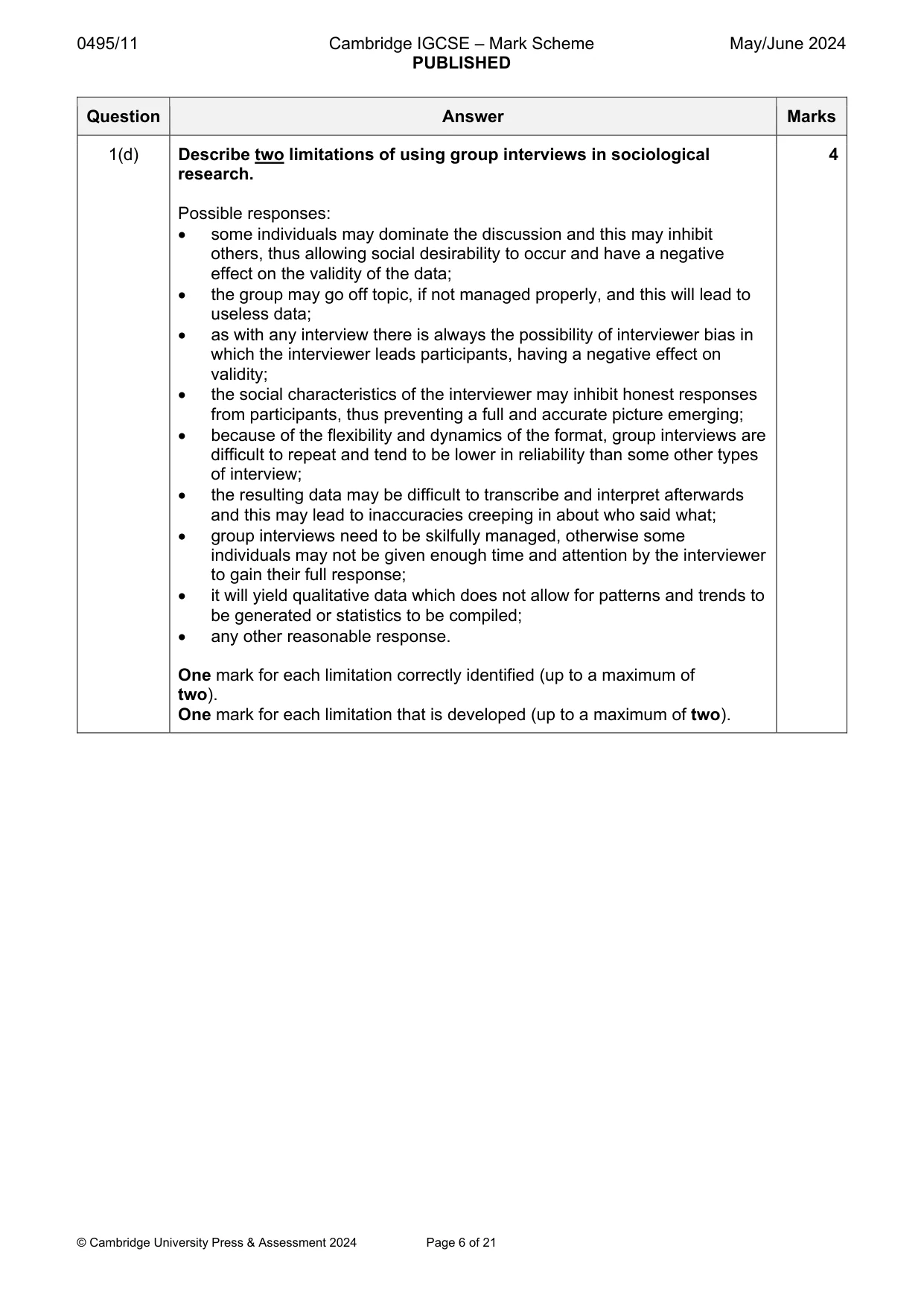
0495/11 Cambridge IGCSE – Mark Scheme PUBLISHED May/June 2024 © Cambridge University Press & Assessment 2024 Page 6 of 21 Question Answer Marks 1(d) Describe two limitations of using group interviews in sociological research. Possible responses: some individuals may dominate the discussion and this may inhibit others, thus allowing social desirability to occur and have a negative effect on the validity of the data; the group may go off topic, if not managed properly, and this will lead to useless data; as with any interview there is always the possibility of interviewer bias in which the interviewer leads participants, having a negative effect on validity; the social characteristics of the interviewer may inhibit honest responses from participants, thus preventing a full and accurate picture emerging; because of the flexibility and dynamics of the format, group interviews are difficult to repeat and tend to be lower in reliability than some other types of interview; the resulting data may be difficult to transcribe and interpret afterwards and this may lead to inaccuracies creeping in about who said what; group interviews need to be skilfully managed, otherwise some individuals may not be given enough time and attention by the interviewer to gain their full response; it will yield qualitative data which does not allow for patterns and trends to be generated or statistics to be compiled; any other reasonable response. One mark for each limitation correctly identified (up to a maximum of two). One mark for each limitation that is developed (up to a maximum of two). 4
Mark scheme, page 7
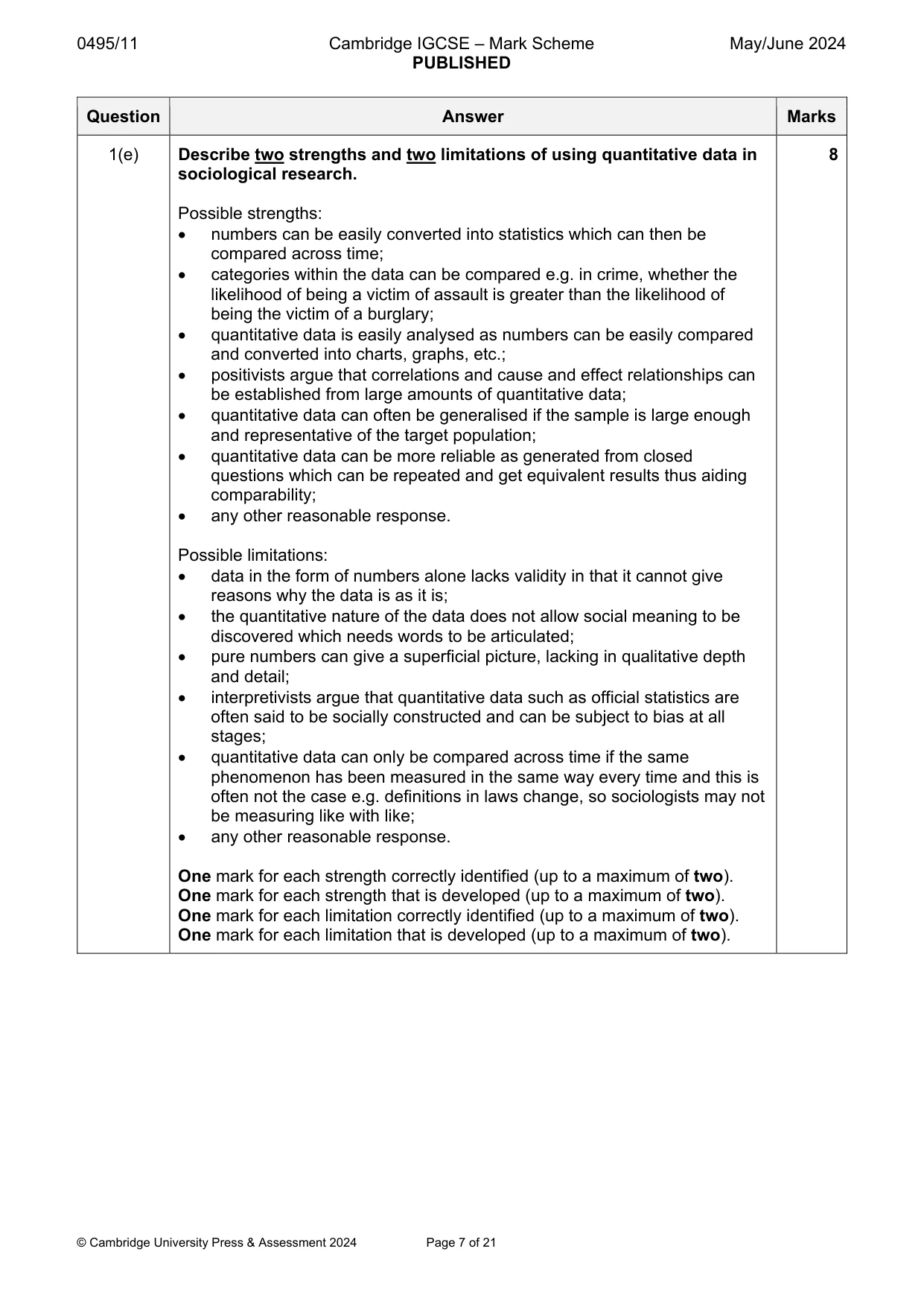
0495/11 Cambridge IGCSE – Mark Scheme PUBLISHED May/June 2024 © Cambridge University Press & Assessment 2024 Page 7 of 21 Question Answer Marks 1(e) Describe two strengths and two limitations of using quantitative data in sociological research. Possible strengths: numbers can be easily converted into statistics which can then be compared across time; categories within the data can be compared e.g. in crime, whether the likelihood of being a victim of assault is greater than the likelihood of being the victim of a burglary; quantitative data is easily analysed as numbers can be easily compared and converted into charts, graphs, etc.; positivists argue that correlations and cause and effect relationships can be established from large amounts of quantitative data; quantitative data can often be generalised if the sample is large enough and representative of the target population; quantitative data can be more reliable as generated from closed questions which can be repeated and get equivalent results thus aiding comparability; any other reasonable response. Possible limitations: data in the form of numbers alone lacks validity in that it cannot give reasons why the data is as it is; the quantitative nature of the data does not allow social meaning to be discovered which needs words to be articulated; pure numbers can give a superficial picture, lacking in qualitative depth and detail; interpretivists argue that quantitative data such as official statistics are often said to be socially constructed and can be subject to bias at all stages; quantitative data can only be compared across time if the same phenomenon has been measured in the same way every time and this is often not the case e.g. definitions in laws change, so sociologists may not be measuring like with like; any other reasonable response. One mark for each strength correctly identified (up to a maximum of two). One mark for each strength that is developed (up to a maximum of two). One mark for each limitation correctly identified (up to a maximum of two). One mark for each limitation that is developed (up to a maximum of two). 8
Mark scheme, page 8
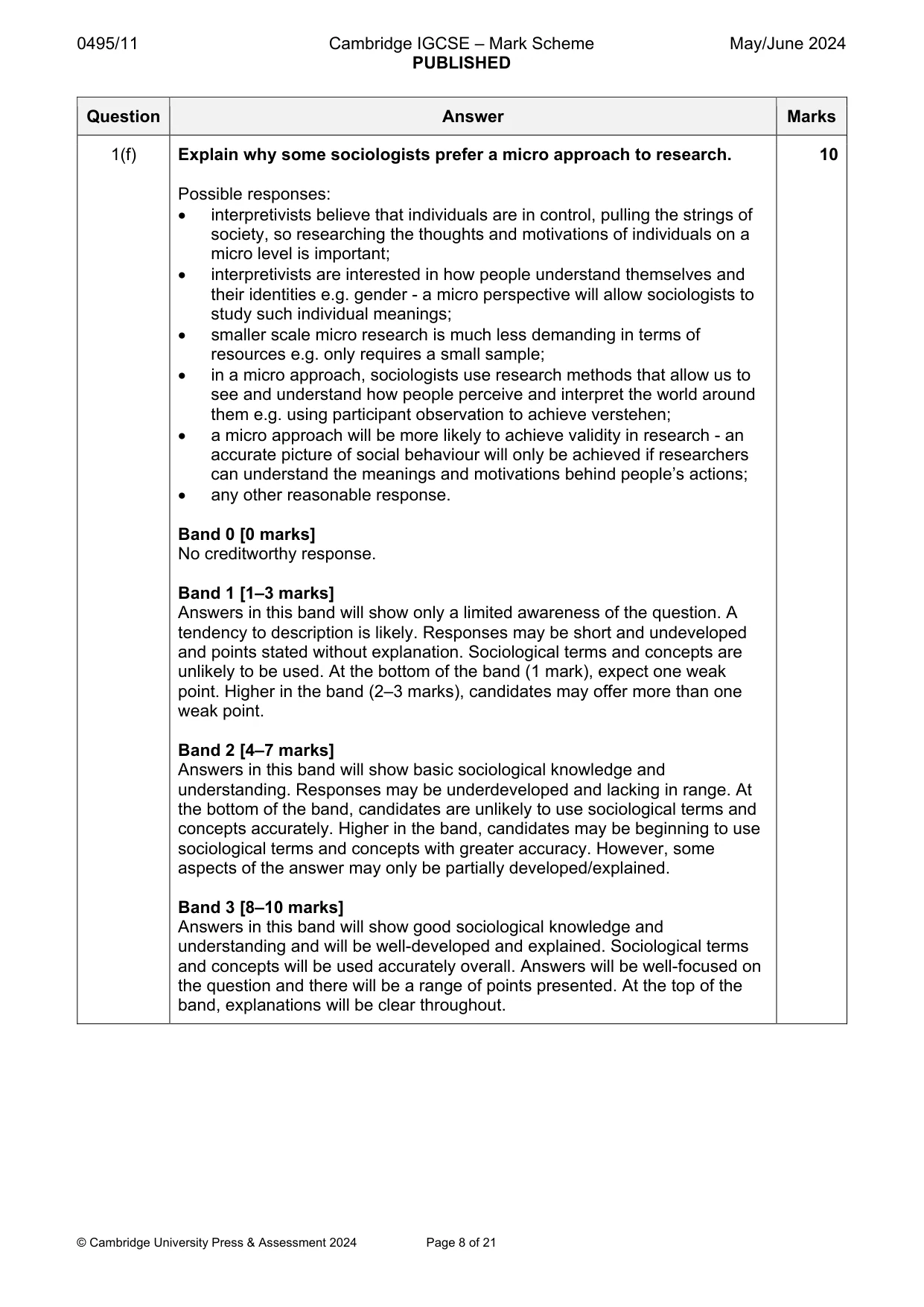
0495/11 Cambridge IGCSE – Mark Scheme PUBLISHED May/June 2024 © Cambridge University Press & Assessment 2024 Page 8 of 21 Question Answer Marks 1(f) Explain why some sociologists prefer a micro approach to research. Possible responses: interpretivists believe that individuals are in control, pulling the strings of society, so researching the thoughts and motivations of individuals on a micro level is important; interpretivists are interested in how people understand themselves and their identities e.g. gender - a micro perspective will allow sociologists to study such individual meanings; smaller scale micro research is much less demanding in terms of resources e.g. only requires a small sample; in a micro approach, sociologists use research methods that allow us to see and understand how people perceive and interpret the world around them e.g. using participant observation to achieve verstehen; a micro approach will be more likely to achieve validity in research - an accurate picture of social behaviour will only be achieved if researchers can understand the meanings and motivations behind people’s actions; any other reasonable response. Band 0 [0 marks] No creditworthy response. Band 1 [1–3 marks] Answers in this band will show only a limited awareness of the question. A tendency to description is likely. Responses may be short and undeveloped and points stated without explanation. Sociological terms and concepts are unlikely to be used. At the bottom of the band (1 mark), expect one weak point. Higher in the band (2–3 marks), candidates may offer more than one weak point. Band 2 [4–7 marks] Answers in this band will show basic sociological knowledge and understanding. Responses may be underdeveloped and lacking in range. At the bottom of the band, candidates are unlikely to use sociological terms and concepts accurately. Higher in the band, candidates may be beginning to use sociological terms and concepts with greater accuracy. However, some aspects of the answer may only be partially developed/explained. Band 3 [8–10 marks] Answers in this band will show good sociological knowledge and understanding and will be well-developed and explained. Sociological terms and concepts will be used accurately overall. Answers will be well-focused on the question and there will be a range of points presented. At the top of the band, explanations will be clear throughout. 10
Mark scheme, page 9
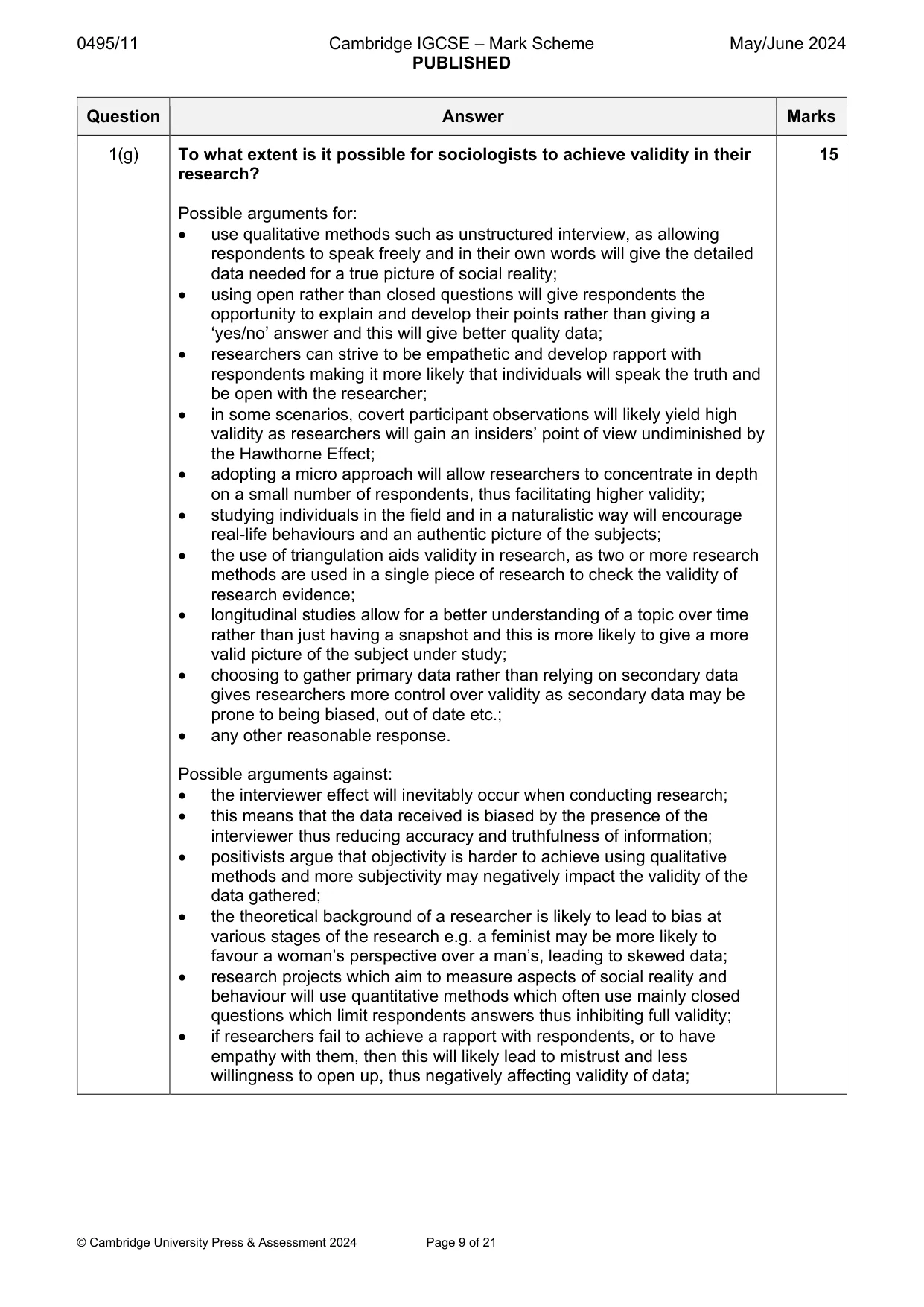
0495/11 Cambridge IGCSE – Mark Scheme PUBLISHED May/June 2024 © Cambridge University Press & Assessment 2024 Page 9 of 21 Question Answer Marks 1(g) To what extent is it possible for sociologists to achieve validity in their research? Possible arguments for: use qualitative methods such as unstructured interview, as allowing respondents to speak freely and in their own words will give the detailed data needed for a true picture of social reality; using open rather than closed questions will give respondents the opportunity to explain and develop their points rather than giving a ‘yes/no’ answer and this will give better quality data; researchers can strive to be empathetic and develop rapport with respondents making it more likely that individuals will speak the truth and be open with the researcher; in some scenarios, covert participant observations will likely yield high validity as researchers will gain an insiders’ point of view undiminished by the Hawthorne Effect; adopting a micro approach will allow researchers to concentrate in depth on a small number of respondents, thus facilitating higher validity; studying individuals in the field and in a naturalistic way will encourage real-life behaviours and an authentic picture of the subjects; the use of triangulation aids validity in research, as two or more research methods are used in a single piece of research to check the validity of research evidence; longitudinal studies allow for a better understanding of a topic over time rather than just having a snapshot and this is more likely to give a more valid picture of the subject under study; choosing to gather primary data rather than relying on secondary data gives researchers more control over validity as secondary data may be prone to being biased, out of date etc.; any other reasonable response. Possible arguments against: the interviewer effect will inevitably occur when conducting research; this means that the data received is biased by the presence of the interviewer thus reducing accuracy and truthfulness of information; positivists argue that objectivity is harder to achieve using qualitative methods and more subjectivity may negatively impact the validity of the data gathered; the theoretical background of a researcher is likely to lead to bias at various stages of the research e.g. a feminist may be more likely to favour a woman’s perspective over a man’s, leading to skewed data; research projects which aim to measure aspects of social reality and behaviour will use quantitative methods which often use mainly closed questions which limit respondents answers thus inhibiting full validity; if researchers fail to achieve a rapport with respondents, or to have empathy with them, then this will likely lead to mistrust and less willingness to open up, thus negatively affecting validity of data; 15
Mark scheme, page 10
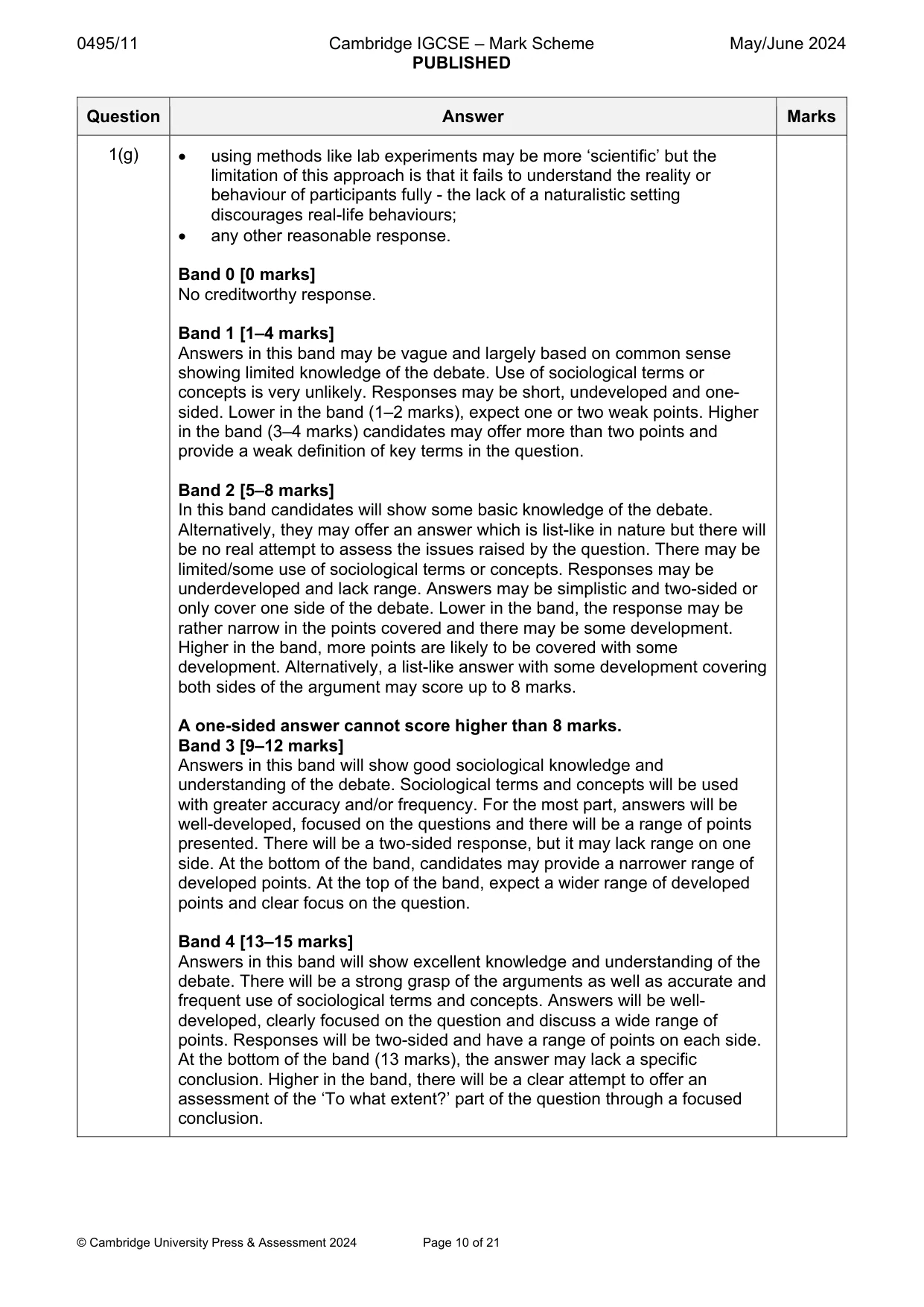
0495/11 Cambridge IGCSE – Mark Scheme PUBLISHED May/June 2024 © Cambridge University Press & Assessment 2024 Page 10 of 21 Question Answer Marks 1(g) using methods like lab experiments may be more ‘scientific’ but the limitation of this approach is that it fails to understand the reality or behaviour of participants fully - the lack of a naturalistic setting discourages real-life behaviours; any other reasonable response. Band 0 [0 marks] No creditworthy response. Band 1 [1–4 marks] Answers in this band may be vague and largely based on common sense showing limited knowledge of the debate. Use of sociological terms or concepts is very unlikely. Responses may be short, undeveloped and one- sided. Lower in the band (1–2 marks), expect one or two weak points. Higher in the band (3–4 marks) candidates may offer more than two points and provide a weak definition of key terms in the question. Band 2 [5–8 marks] In this band candidates will show some basic knowledge of the debate. Alternatively, they may offer an answer which is list-like in nature but there will be no real attempt to assess the issues raised by the question. There may be limited/some use of sociological terms or concepts. Responses may be underdeveloped and lack range. Answers may be simplistic and two-sided or only cover one side of the debate. Lower in the band, the response may be rather narrow in the points covered and there may be some development. Higher in the band, more points are likely to be covered with some development. Alternatively, a list-like answer with some development covering both sides of the argument may score up to 8 marks. A one-sided answer cannot score higher than 8 marks. Band 3 [9–12 marks] Answers in this band will show good sociological knowledge and understanding of the debate. Sociological terms and concepts will be used with greater accuracy and/or frequency. For the most part, answers will be well-developed, focused on the questions and there will be a range of points presented. There will be a two-sided response, but it may lack range on one side. At the bottom of the band, candidates may provide a narrower range of developed points. At the top of the band, expect a wider range of developed points and clear focus on the question. Band 4 [13–15 marks] Answers in this band will show excellent knowledge and understanding of the debate. There will be a strong grasp of the arguments as well as accurate and frequent use of sociological terms and concepts. Answers will be well- developed, clearly focused on the question and discuss a wide range of points. Responses will be two-sided and have a range of points on each side. At the bottom of the band (13 marks), the answer may lack a specific conclusion. Higher in the band, there will be a clear attempt to offer an assessment of the ‘To what extent?’ part of the question through a focused conclusion.
Mark scheme, page 11
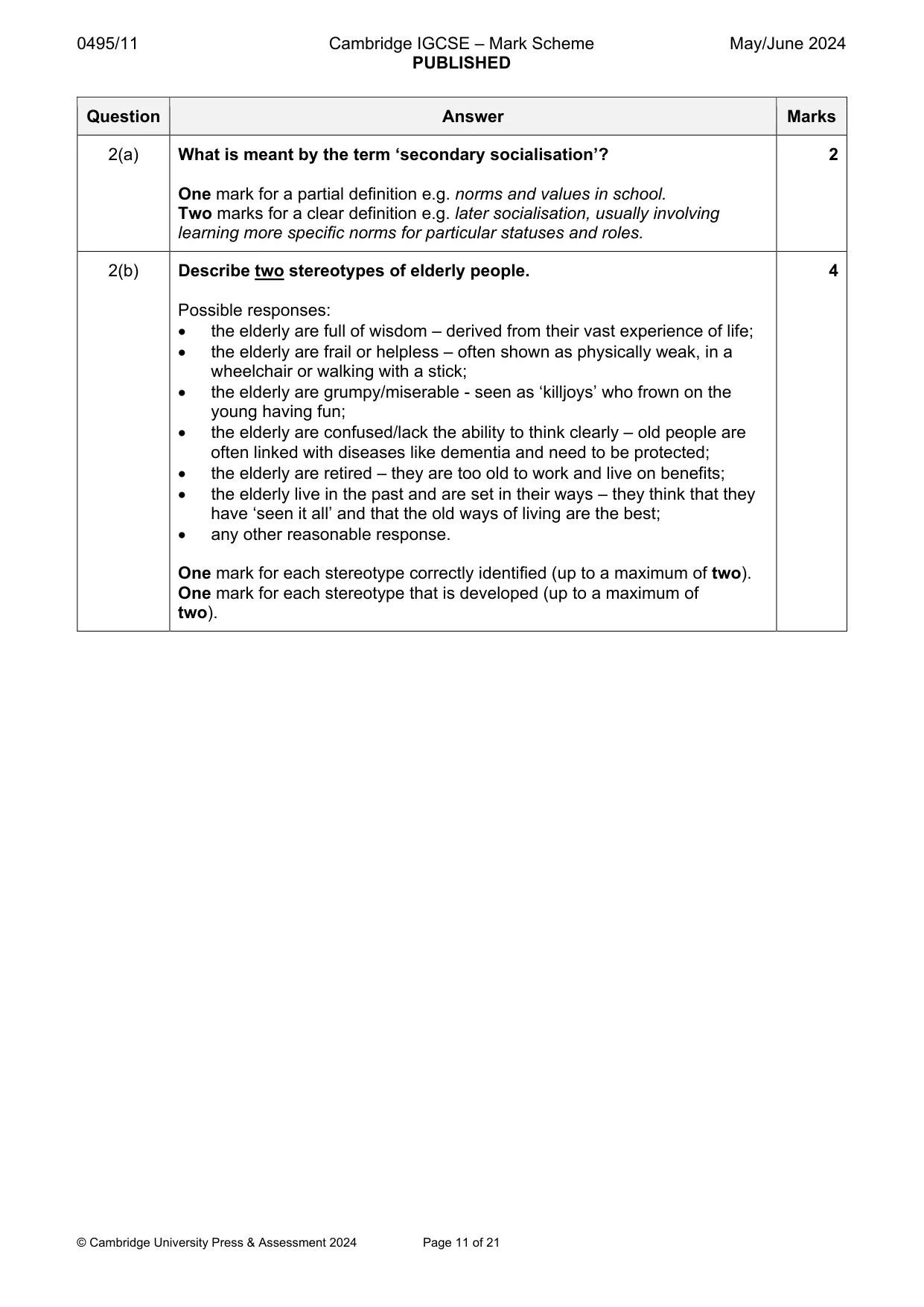
0495/11 Cambridge IGCSE – Mark Scheme PUBLISHED May/June 2024 © Cambridge University Press & Assessment 2024 Page 11 of 21 Question Answer Marks 2(a) What is meant by the term ‘secondary socialisation’? One mark for a partial definition e.g. norms and values in school. Two marks for a clear definition e.g. later socialisation, usually involving learning more specific norms for particular statuses and roles. 2 2(b) Describe two stereotypes of elderly people. Possible responses: the elderly are full of wisdom – derived from their vast experience of life; the elderly are frail or helpless – often shown as physically weak, in a wheelchair or walking with a stick; the elderly are grumpy/miserable - seen as ‘killjoys’ who frown on the young having fun; the elderly are confused/lack the ability to think clearly – old people are often linked with diseases like dementia and need to be protected; the elderly are retired – they are too old to work and live on benefits; the elderly live in the past and are set in their ways – they think that they have ‘seen it all’ and that the old ways of living are the best; any other reasonable response. One mark for each stereotype correctly identified (up to a maximum of two). One mark for each stereotype that is developed (up to a maximum of two). 4
Mark scheme, page 12
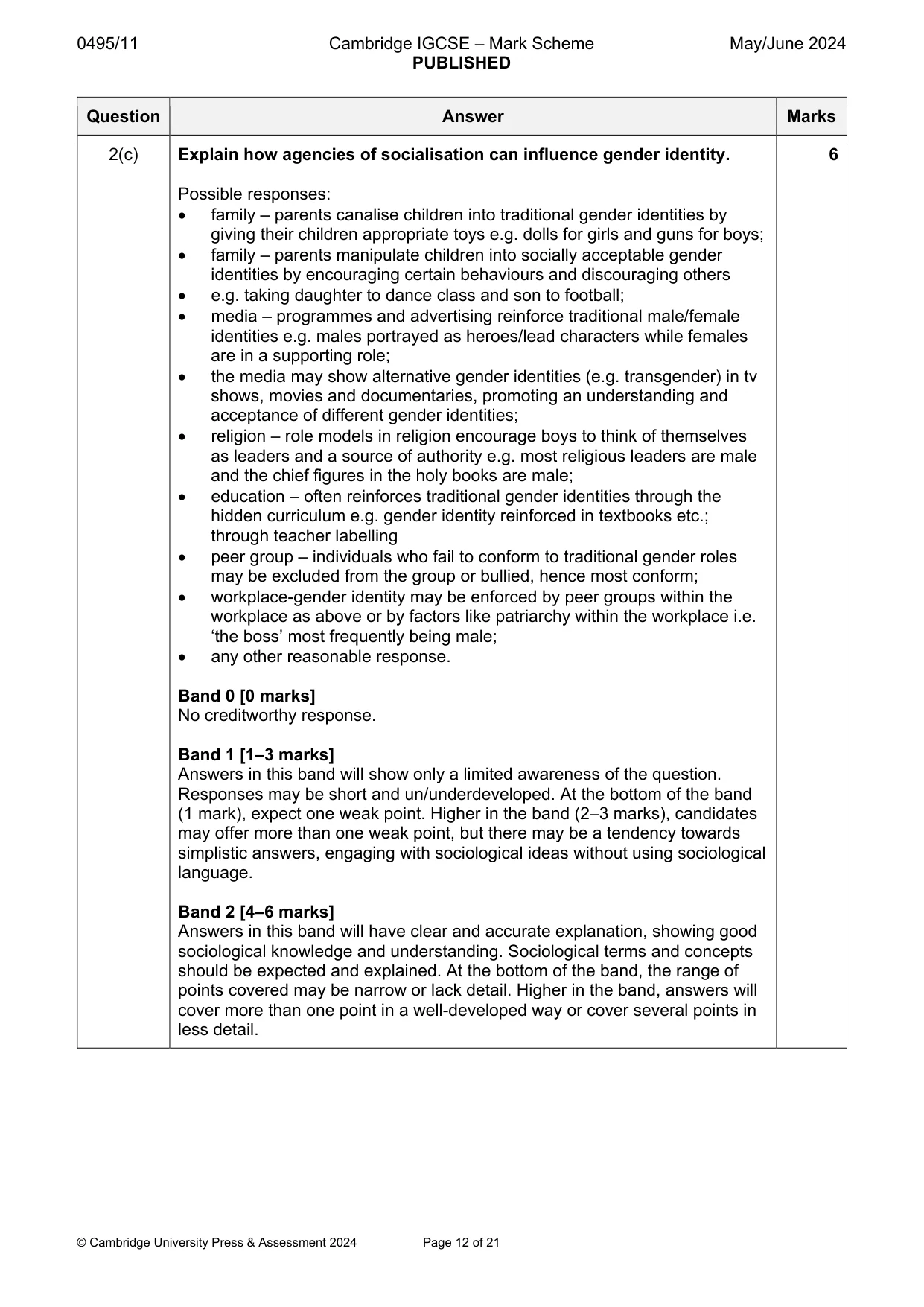
0495/11 Cambridge IGCSE – Mark Scheme PUBLISHED May/June 2024 © Cambridge University Press & Assessment 2024 Page 12 of 21 Question Answer Marks 2(c) Explain how agencies of socialisation can influence gender identity. Possible responses: family – parents canalise children into traditional gender identities by giving their children appropriate toys e.g. dolls for girls and guns for boys; family – parents manipulate children into socially acceptable gender identities by encouraging certain behaviours and discouraging others e.g. taking daughter to dance class and son to football; media – programmes and advertising reinforce traditional male/female identities e.g. males portrayed as heroes/lead characters while females are in a supporting role; the media may show alternative gender identities (e.g. transgender) in tv shows, movies and documentaries, promoting an understanding and acceptance of different gender identities; religion – role models in religion encourage boys to think of themselves as leaders and a source of authority e.g. most religious leaders are male and the chief figures in the holy books are male; education – often reinforces traditional gender identities through the hidden curriculum e.g. gender identity reinforced in textbooks etc.; through teacher labelling peer group – individuals who fail to conform to traditional gender roles may be excluded from the group or bullied, hence most conform; workplace-gender identity may be enforced by peer groups within the workplace as above or by factors like patriarchy within the workplace i.e. ‘the boss’ most frequently being male; any other reasonable response. Band 0 [0 marks] No creditworthy response. Band 1 [1–3 marks] Answers in this band will show only a limited awareness of the question. Responses may be short and un/underdeveloped. At the bottom of the band (1 mark), expect one weak point. Higher in the band (2–3 marks), candidates may offer more than one weak point, but there may be a tendency towards simplistic answers, engaging with sociological ideas without using sociological language. Band 2 [4–6 marks] Answers in this band will have clear and accurate explanation, showing good sociological knowledge and understanding. Sociological terms and concepts should be expected and explained. At the bottom of the band, the range of points covered may be narrow or lack detail. Higher in the band, answers will cover more than one point in a well-developed way or cover several points in less detail. 6
Mark scheme, page 13
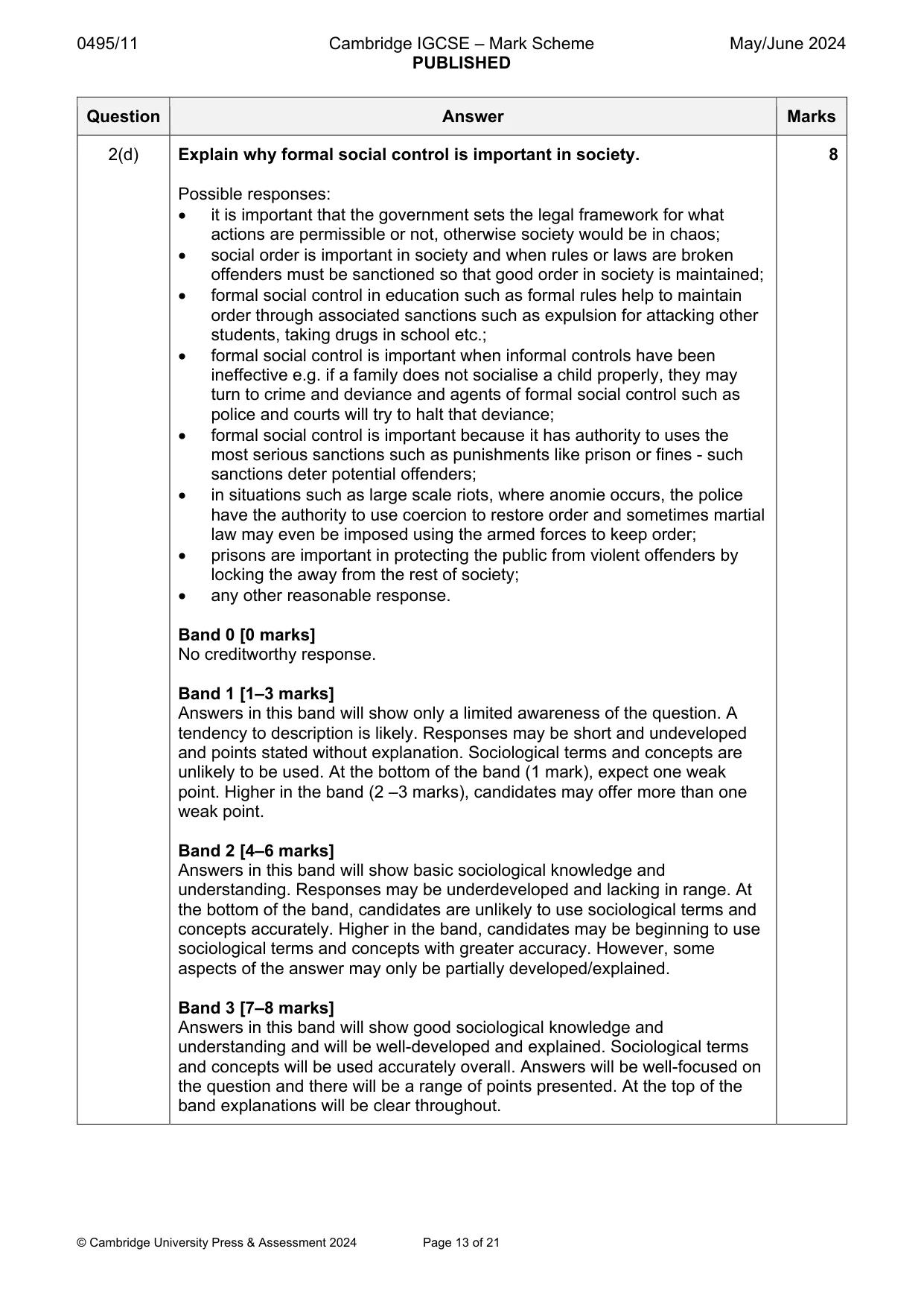
0495/11 Cambridge IGCSE – Mark Scheme PUBLISHED May/June 2024 © Cambridge University Press & Assessment 2024 Page 13 of 21 Question Answer Marks 2(d) Explain why formal social control is important in society. Possible responses: it is important that the government sets the legal framework for what actions are permissible or not, otherwise society would be in chaos; social order is important in society and when rules or laws are broken offenders must be sanctioned so that good order in society is maintained; formal social control in education such as formal rules help to maintain order through associated sanctions such as expulsion for attacking other students, taking drugs in school etc.; formal social control is important when informal controls have been ineffective e.g. if a family does not socialise a child properly, they may turn to crime and deviance and agents of formal social control such as police and courts will try to halt that deviance; formal social control is important because it has authority to uses the most serious sanctions such as punishments like prison or fines - such sanctions deter potential offenders; in situations such as large scale riots, where anomie occurs, the police have the authority to use coercion to restore order and sometimes martial law may even be imposed using the armed forces to keep order; prisons are important in protecting the public from violent offenders by locking the away from the rest of society; any other reasonable response. Band 0 [0 marks] No creditworthy response. Band 1 [1–3 marks] Answers in this band will show only a limited awareness of the question. A tendency to description is likely. Responses may be short and undeveloped and points stated without explanation. Sociological terms and concepts are unlikely to be used. At the bottom of the band (1 mark), expect one weak point. Higher in the band (2 –3 marks), candidates may offer more than one weak point. Band 2 [4–6 marks] Answers in this band will show basic sociological knowledge and understanding. Responses may be underdeveloped and lacking in range. At the bottom of the band, candidates are unlikely to use sociological terms and concepts accurately. Higher in the band, candidates may be beginning to use sociological terms and concepts with greater accuracy. However, some aspects of the answer may only be partially developed/explained. Band 3 [7–8 marks] Answers in this band will show good sociological knowledge and understanding and will be well-developed and explained. Sociological terms and concepts will be used accurately overall. Answers will be well-focused on the question and there will be a range of points presented. At the top of the band explanations will be clear throughout. 8
Mark scheme, page 14
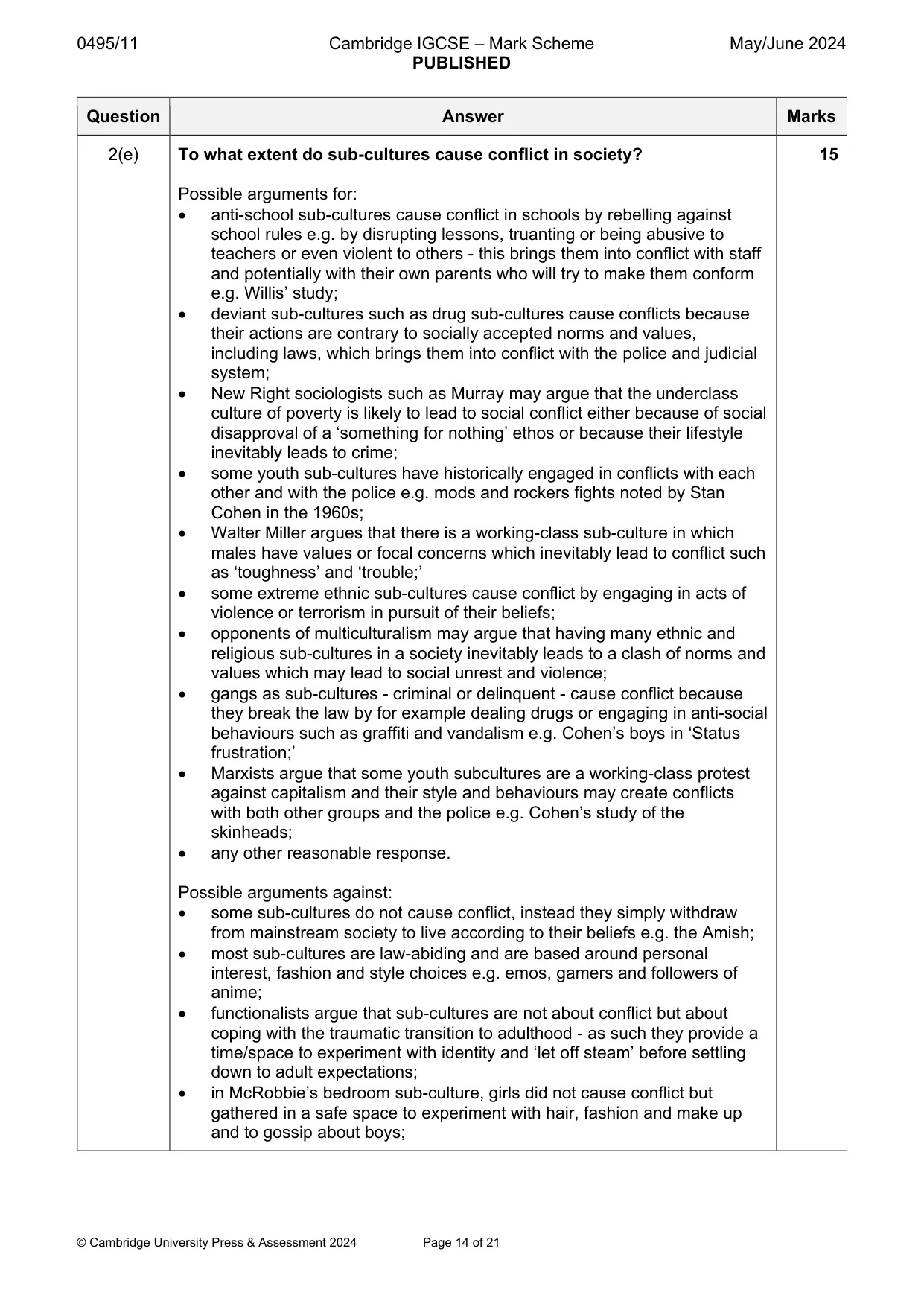
0495/11 Cambridge IGCSE – Mark Scheme PUBLISHED May/June 2024 © Cambridge University Press & Assessment 2024 Page 14 of 21 Question Answer Marks 2(e) To what extent do sub-cultures cause conflict in society? Possible arguments for: anti-school sub-cultures cause conflict in schools by rebelling against school rules e.g. by disrupting lessons, truanting or being abusive to teachers or even violent to others - this brings them into conflict with staff and potentially with their own parents who will try to make them conform e.g. Willis’ study; deviant sub-cultures such as drug sub-cultures cause conflicts because their actions are contrary to socially accepted norms and values, including laws, which brings them into conflict with the police and judicial system; New Right sociologists such as Murray may argue that the underclass culture of poverty is likely to lead to social conflict either because of social disapproval of a ‘something for nothing’ ethos or because their lifestyle inevitably leads to crime; some youth sub-cultures have historically engaged in conflicts with each other and with the police e.g. mods and rockers fights noted by Stan Cohen in the 1960s; Walter Miller argues that there is a working-class sub-culture in which males have values or focal concerns which inevitably lead to conflict such as ‘toughness’ and ‘trouble;’ some extreme ethnic sub-cultures cause conflict by engaging in acts of violence or terrorism in pursuit of their beliefs; opponents of multiculturalism may argue that having many ethnic and religious sub-cultures in a society inevitably leads to a clash of norms and values which may lead to social unrest and violence; gangs as sub-cultures - criminal or delinquent - cause conflict because they break the law by for example dealing drugs or engaging in anti-social behaviours such as graffiti and vandalism e.g. Cohen’s boys in ‘Status frustration;’ Marxists argue that some youth subcultures are a working-class protest against capitalism and their style and behaviours may create conflicts with both other groups and the police e.g. Cohen’s study of the skinheads; any other reasonable response. Possible arguments against: some sub-cultures do not cause conflict, instead they simply withdraw from mainstream society to live according to their beliefs e.g. the Amish; most sub-cultures are law-abiding and are based around personal interest, fashion and style choices e.g. emos, gamers and followers of anime; functionalists argue that sub-cultures are not about conflict but about coping with the traumatic transition to adulthood - as such they provide a time/space to experiment with identity and ‘let off steam’ before settling down to adult expectations; in McRobbie’s bedroom sub-culture, girls did not cause conflict but gathered in a safe space to experiment with hair, fashion and make up and to gossip about boys; 15
Mark scheme, page 15
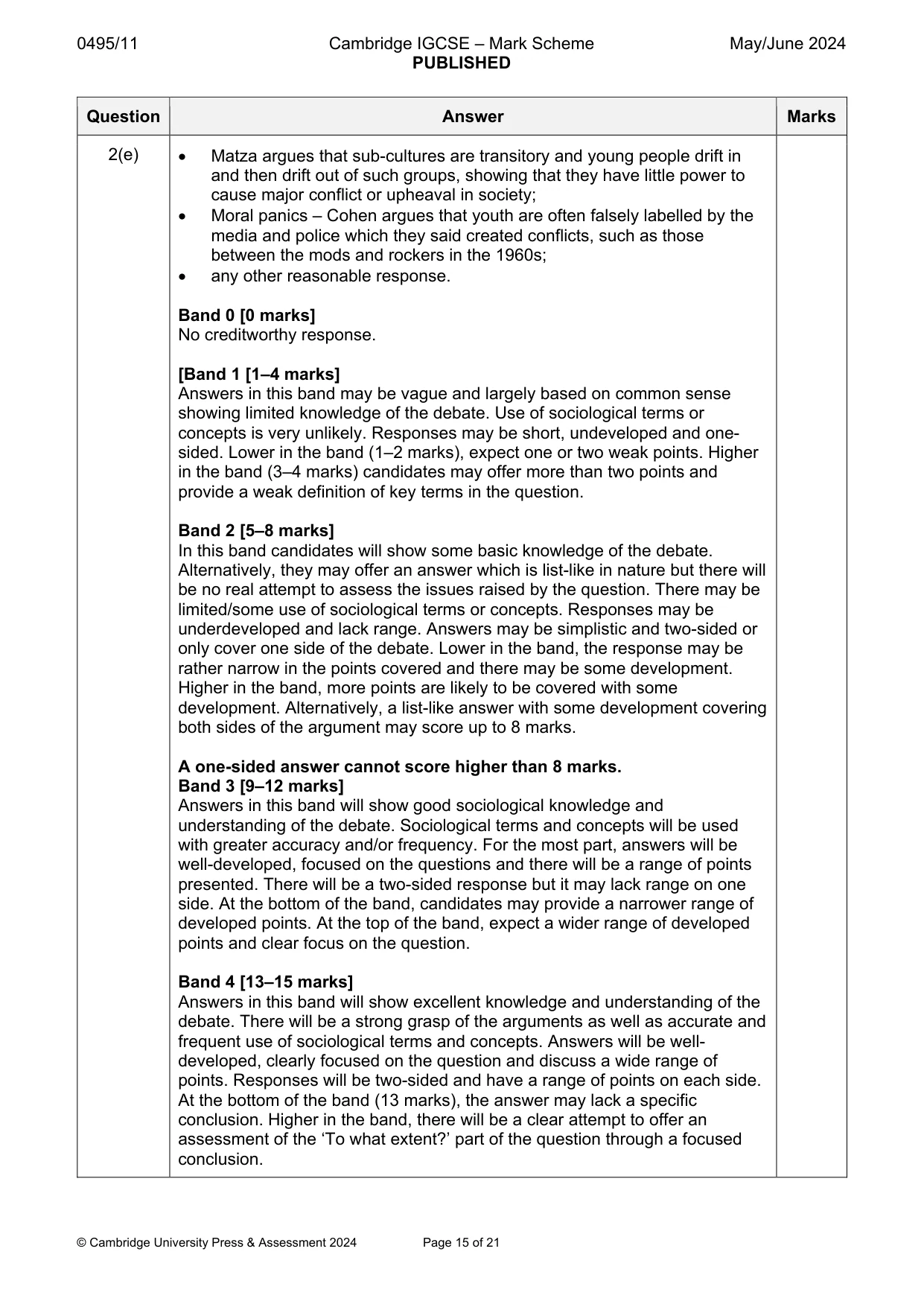
0495/11 Cambridge IGCSE – Mark Scheme PUBLISHED May/June 2024 © Cambridge University Press & Assessment 2024 Page 15 of 21 Question Answer Marks 2(e) Matza argues that sub-cultures are transitory and young people drift in and then drift out of such groups, showing that they have little power to cause major conflict or upheaval in society; Moral panics – Cohen argues that youth are often falsely labelled by the media and police which they said created conflicts, such as those between the mods and rockers in the 1960s; any other reasonable response. Band 0 [0 marks] No creditworthy response. [Band 1 [1–4 marks] Answers in this band may be vague and largely based on common sense showing limited knowledge of the debate. Use of sociological terms or concepts is very unlikely. Responses may be short, undeveloped and one- sided. Lower in the band (1–2 marks), expect one or two weak points. Higher in the band (3–4 marks) candidates may offer more than two points and provide a weak definition of key terms in the question. Band 2 [5–8 marks] In this band candidates will show some basic knowledge of the debate. Alternatively, they may offer an answer which is list-like in nature but there will be no real attempt to assess the issues raised by the question. There may be limited/some use of sociological terms or concepts. Responses may be underdeveloped and lack range. Answers may be simplistic and two-sided or only cover one side of the debate. Lower in the band, the response may be rather narrow in the points covered and there may be some development. Higher in the band, more points are likely to be covered with some development. Alternatively, a list-like answer with some development covering both sides of the argument may score up to 8 marks. A one-sided answer cannot score higher than 8 marks. Band 3 [9–12 marks] Answers in this band will show good sociological knowledge and understanding of the debate. Sociological terms and concepts will be used with greater accuracy and/or frequency. For the most part, answers will be well-developed, focused on the questions and there will be a range of points presented. There will be a two-sided response but it may lack range on one side. At the bottom of the band, candidates may provide a narrower range of developed points. At the top of the band, expect a wider range of developed points and clear focus on the question. Band 4 [13–15 marks] Answers in this band will show excellent knowledge and understanding of the debate. There will be a strong grasp of the arguments as well as accurate and frequent use of sociological terms and concepts. Answers will be well- developed, clearly focused on the question and discuss a wide range of points. Responses will be two-sided and have a range of points on each side. At the bottom of the band (13 marks), the answer may lack a specific conclusion. Higher in the band, there will be a clear attempt to offer an assessment of the ‘To what extent?’ part of the question through a focused conclusion.
Mark scheme, page 16
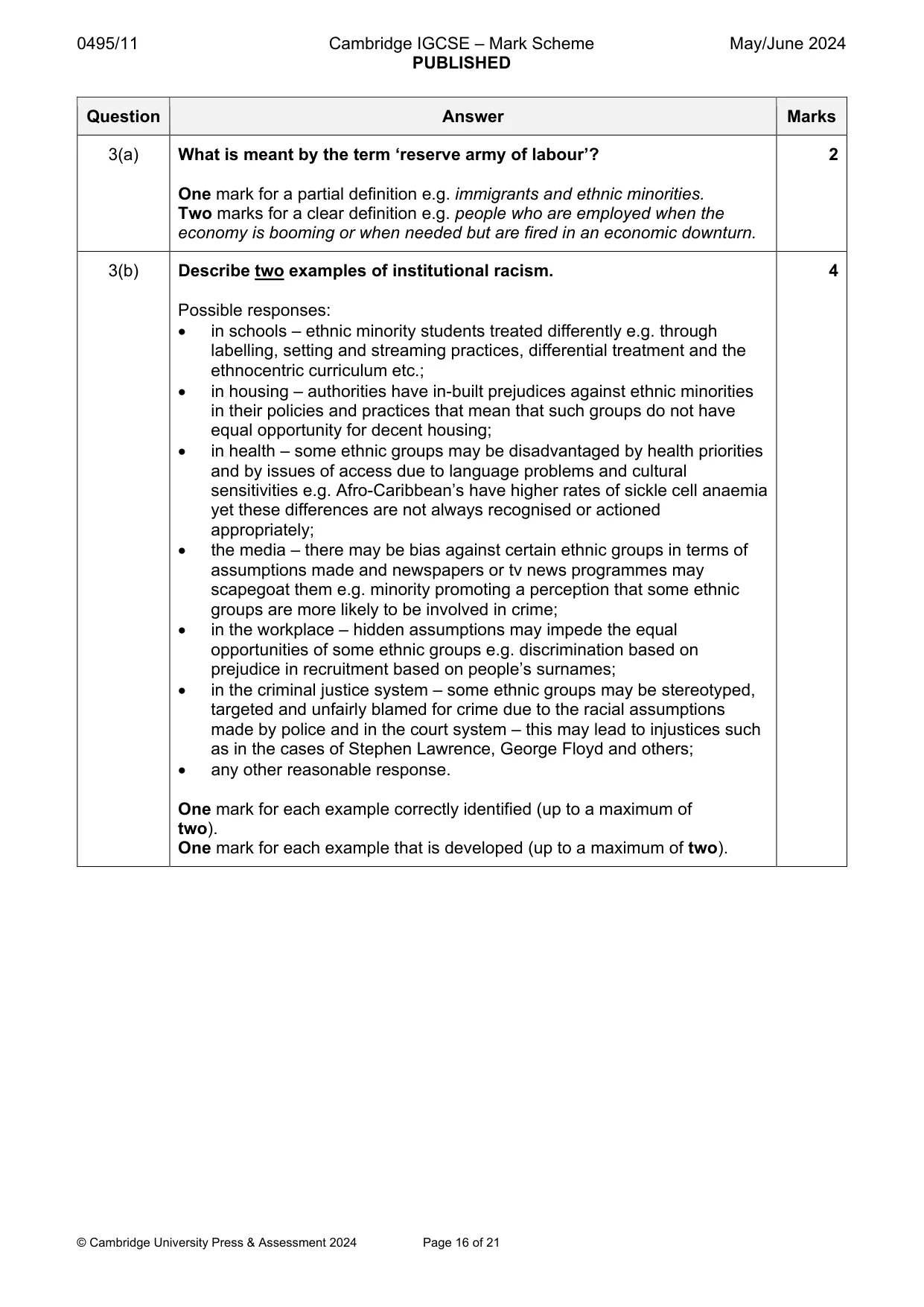
0495/11 Cambridge IGCSE – Mark Scheme PUBLISHED May/June 2024 © Cambridge University Press & Assessment 2024 Page 16 of 21 Question Answer Marks 3(a) What is meant by the term ‘reserve army of labour’? One mark for a partial definition e.g. immigrants and ethnic minorities. Two marks for a clear definition e.g. people who are employed when the economy is booming or when needed but are fired in an economic downturn. 2 3(b) Describe two examples of institutional racism. Possible responses: in schools – ethnic minority students treated differently e.g. through labelling, setting and streaming practices, differential treatment and the ethnocentric curriculum etc.; in housing – authorities have in-built prejudices against ethnic minorities in their policies and practices that mean that such groups do not have equal opportunity for decent housing; in health – some ethnic groups may be disadvantaged by health priorities and by issues of access due to language problems and cultural sensitivities e.g. Afro-Caribbean’s have higher rates of sickle cell anaemia yet these differences are not always recognised or actioned appropriately; the media – there may be bias against certain ethnic groups in terms of assumptions made and newspapers or tv news programmes may scapegoat them e.g. minority promoting a perception that some ethnic groups are more likely to be involved in crime; in the workplace – hidden assumptions may impede the equal opportunities of some ethnic groups e.g. discrimination based on prejudice in recruitment based on people’s surnames; in the criminal justice system – some ethnic groups may be stereotyped, targeted and unfairly blamed for crime due to the racial assumptions made by police and in the court system – this may lead to injustices such as in the cases of Stephen Lawrence, George Floyd and others; any other reasonable response. One mark for each example correctly identified (up to a maximum of two). One mark for each example that is developed (up to a maximum of two). 4
Mark scheme, page 17
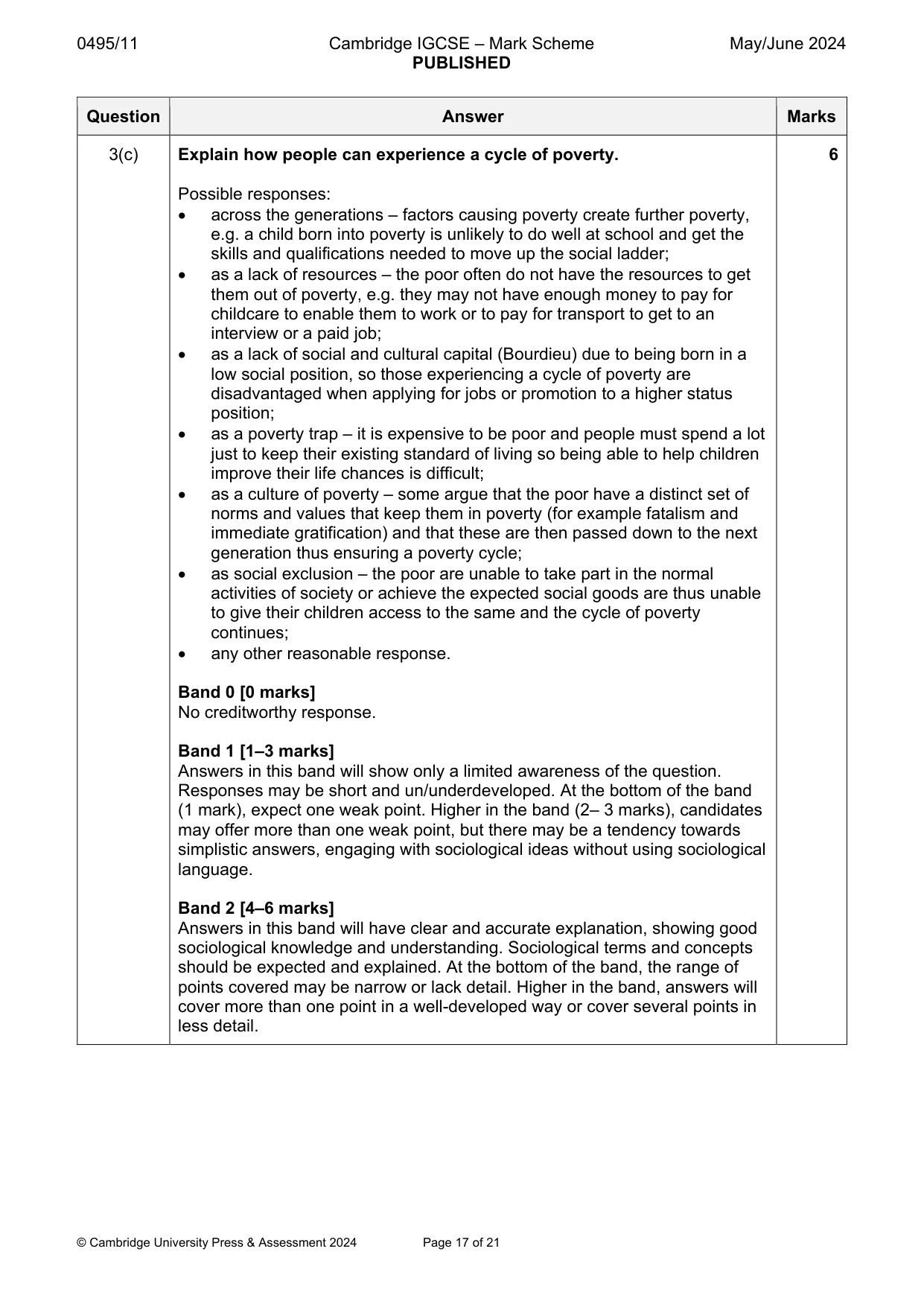
0495/11 Cambridge IGCSE – Mark Scheme PUBLISHED May/June 2024 © Cambridge University Press & Assessment 2024 Page 17 of 21 Question Answer Marks 3(c) Explain how people can experience a cycle of poverty. Possible responses: across the generations – factors causing poverty create further poverty, e.g. a child born into poverty is unlikely to do well at school and get the skills and qualifications needed to move up the social ladder; as a lack of resources – the poor often do not have the resources to get them out of poverty, e.g. they may not have enough money to pay for childcare to enable them to work or to pay for transport to get to an interview or a paid job; as a lack of social and cultural capital (Bourdieu) due to being born in a low social position, so those experiencing a cycle of poverty are disadvantaged when applying for jobs or promotion to a higher status position; as a poverty trap – it is expensive to be poor and people must spend a lot just to keep their existing standard of living so being able to help children improve their life chances is difficult; as a culture of poverty – some argue that the poor have a distinct set of norms and values that keep them in poverty (for example fatalism and immediate gratification) and that these are then passed down to the next generation thus ensuring a poverty cycle; as social exclusion – the poor are unable to take part in the normal activities of society or achieve the expected social goods are thus unable to give their children access to the same and the cycle of poverty continues; any other reasonable response. Band 0 [0 marks] No creditworthy response. Band 1 [1–3 marks] Answers in this band will show only a limited awareness of the question. Responses may be short and un/underdeveloped. At the bottom of the band (1 mark), expect one weak point. Higher in the band (2– 3 marks), candidates may offer more than one weak point, but there may be a tendency towards simplistic answers, engaging with sociological ideas without using sociological language. Band 2 [4–6 marks] Answers in this band will have clear and accurate explanation, showing good sociological knowledge and understanding. Sociological terms and concepts should be expected and explained. At the bottom of the band, the range of points covered may be narrow or lack detail. Higher in the band, answers will cover more than one point in a well-developed way or cover several points in less detail. 6
Mark scheme, page 18
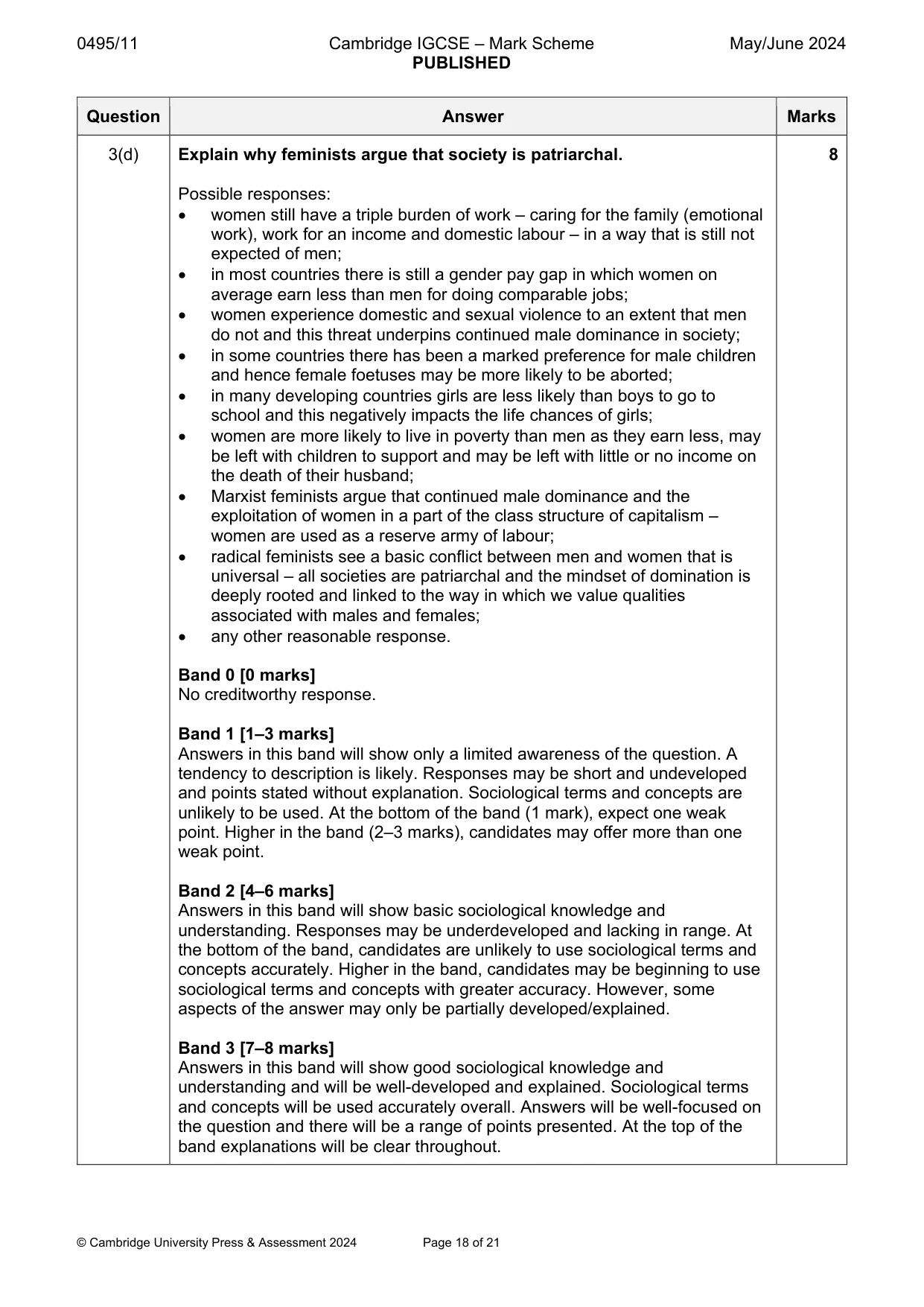
0495/11 Cambridge IGCSE – Mark Scheme PUBLISHED May/June 2024 © Cambridge University Press & Assessment 2024 Page 18 of 21 Question Answer Marks 3(d) Explain why feminists argue that society is patriarchal. Possible responses: women still have a triple burden of work – caring for the family (emotional work), work for an income and domestic labour – in a way that is still not expected of men; in most countries there is still a gender pay gap in which women on average earn less than men for doing comparable jobs; women experience domestic and sexual violence to an extent that men do not and this threat underpins continued male dominance in society; in some countries there has been a marked preference for male children and hence female foetuses may be more likely to be aborted; in many developing countries girls are less likely than boys to go to school and this negatively impacts the life chances of girls; women are more likely to live in poverty than men as they earn less, may be left with children to support and may be left with little or no income on the death of their husband; Marxist feminists argue that continued male dominance and the exploitation of women in a part of the class structure of capitalism – women are used as a reserve army of labour; radical feminists see a basic conflict between men and women that is universal – all societies are patriarchal and the mindset of domination is deeply rooted and linked to the way in which we value qualities associated with males and females; any other reasonable response. Band 0 [0 marks] No creditworthy response. Band 1 [1–3 marks] Answers in this band will show only a limited awareness of the question. A tendency to description is likely. Responses may be short and undeveloped and points stated without explanation. Sociological terms and concepts are unlikely to be used. At the bottom of the band (1 mark), expect one weak point. Higher in the band (2–3 marks), candidates may offer more than one weak point. Band 2 [4–6 marks] Answers in this band will show basic sociological knowledge and understanding. Responses may be underdeveloped and lacking in range. At the bottom of the band, candidates are unlikely to use sociological terms and concepts accurately. Higher in the band, candidates may be beginning to use sociological terms and concepts with greater accuracy. However, some aspects of the answer may only be partially developed/explained. Band 3 [7–8 marks] Answers in this band will show good sociological knowledge and understanding and will be well-developed and explained. Sociological terms and concepts will be used accurately overall. Answers will be well-focused on the question and there will be a range of points presented. At the top of the band explanations will be clear throughout. 8
Mark scheme, page 19
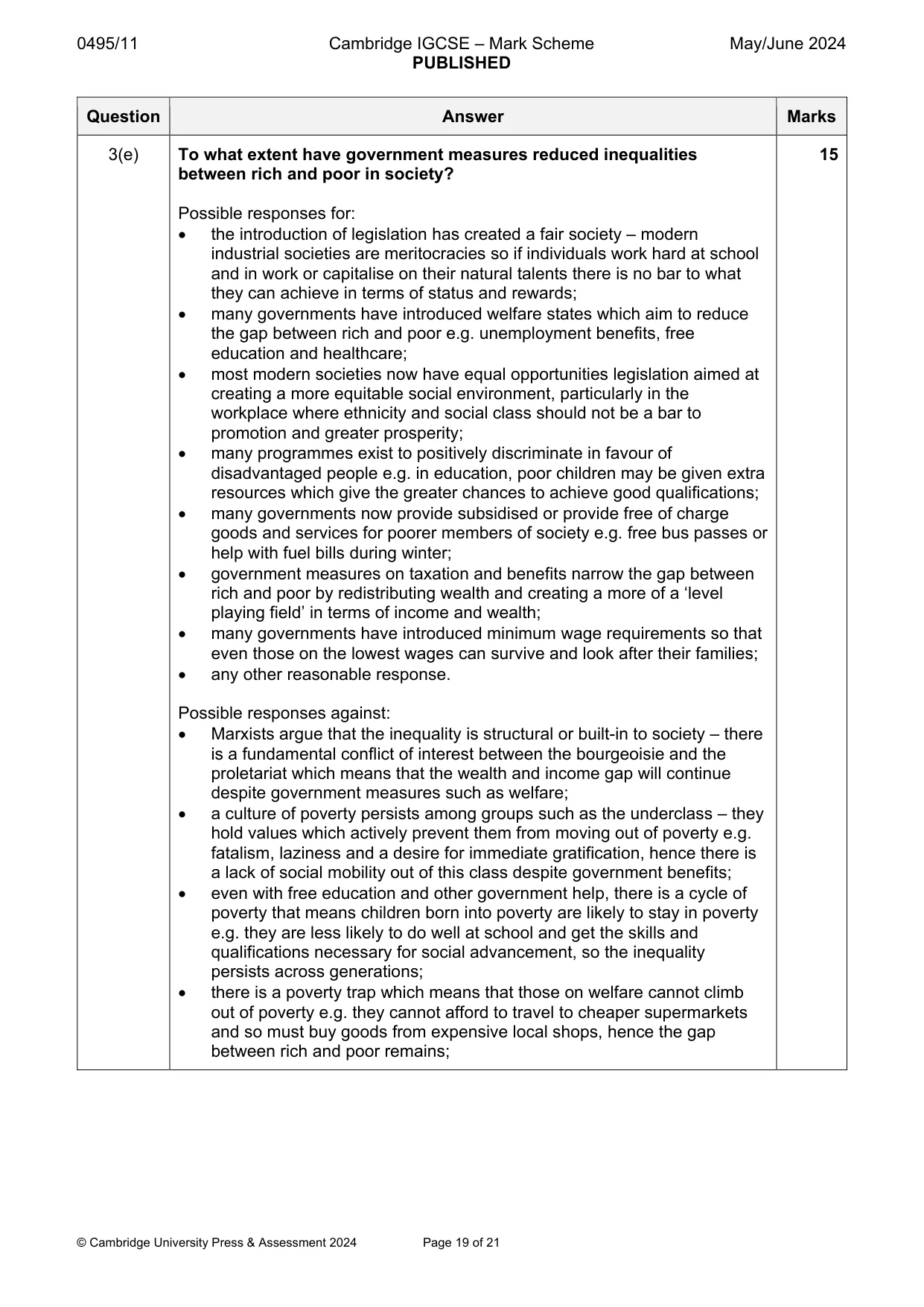
0495/11 Cambridge IGCSE – Mark Scheme PUBLISHED May/June 2024 © Cambridge University Press & Assessment 2024 Page 19 of 21 Question Answer Marks 3(e) To what extent have government measures reduced inequalities between rich and poor in society? Possible responses for: the introduction of legislation has created a fair society – modern industrial societies are meritocracies so if individuals work hard at school and in work or capitalise on their natural talents there is no bar to what they can achieve in terms of status and rewards; many governments have introduced welfare states which aim to reduce the gap between rich and poor e.g. unemployment benefits, free education and healthcare; most modern societies now have equal opportunities legislation aimed at creating a more equitable social environment, particularly in the workplace where ethnicity and social class should not be a bar to promotion and greater prosperity; many programmes exist to positively discriminate in favour of disadvantaged people e.g. in education, poor children may be given extra resources which give the greater chances to achieve good qualifications; many governments now provide subsidised or provide free of charge goods and services for poorer members of society e.g. free bus passes or help with fuel bills during winter; government measures on taxation and benefits narrow the gap between rich and poor by redistributing wealth and creating a more of a ‘level playing field’ in terms of income and wealth; many governments have introduced minimum wage requirements so that even those on the lowest wages can survive and look after their families; any other reasonable response. Possible responses against: Marxists argue that the inequality is structural or built-in to society – there is a fundamental conflict of interest between the bourgeoisie and the proletariat which means that the wealth and income gap will continue despite government measures such as welfare; a culture of poverty persists among groups such as the underclass – they hold values which actively prevent them from moving out of poverty e.g. fatalism, laziness and a desire for immediate gratification, hence there is a lack of social mobility out of this class despite government benefits; even with free education and other government help, there is a cycle of poverty that means children born into poverty are likely to stay in poverty e.g. they are less likely to do well at school and get the skills and qualifications necessary for social advancement, so the inequality persists across generations; there is a poverty trap which means that those on welfare cannot climb out of poverty e.g. they cannot afford to travel to cheaper supermarkets and so must buy goods from expensive local shops, hence the gap between rich and poor remains; 15
Mark scheme, page 20
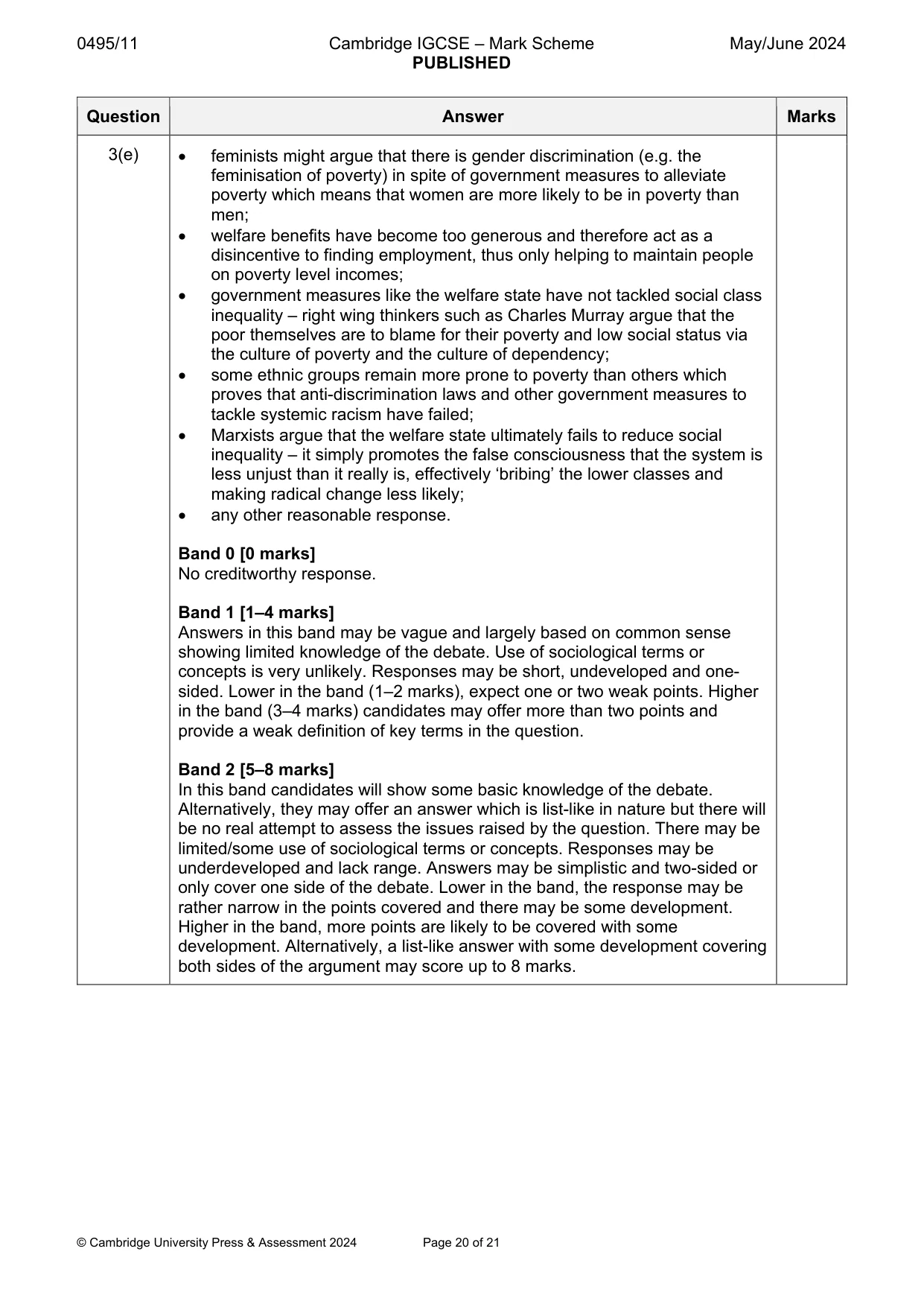
0495/11 Cambridge IGCSE – Mark Scheme PUBLISHED May/June 2024 © Cambridge University Press & Assessment 2024 Page 20 of 21 Question Answer Marks 3(e) feminists might argue that there is gender discrimination (e.g. the feminisation of poverty) in spite of government measures to alleviate poverty which means that women are more likely to be in poverty than men; welfare benefits have become too generous and therefore act as a disincentive to finding employment, thus only helping to maintain people on poverty level incomes; government measures like the welfare state have not tackled social class inequality – right wing thinkers such as Charles Murray argue that the poor themselves are to blame for their poverty and low social status via the culture of poverty and the culture of dependency; some ethnic groups remain more prone to poverty than others which proves that anti-discrimination laws and other government measures to tackle systemic racism have failed; Marxists argue that the welfare state ultimately fails to reduce social inequality – it simply promotes the false consciousness that the system is less unjust than it really is, effectively ‘bribing’ the lower classes and making radical change less likely; any other reasonable response. Band 0 [0 marks] No creditworthy response. Band 1 [1–4 marks] Answers in this band may be vague and largely based on common sense showing limited knowledge of the debate. Use of sociological terms or concepts is very unlikely. Responses may be short, undeveloped and one- sided. Lower in the band (1–2 marks), expect one or two weak points. Higher in the band (3–4 marks) candidates may offer more than two points and provide a weak definition of key terms in the question. Band 2 [5–8 marks] In this band candidates will show some basic knowledge of the debate. Alternatively, they may offer an answer which is list-like in nature but there will be no real attempt to assess the issues raised by the question. There may be limited/some use of sociological terms or concepts. Responses may be underdeveloped and lack range. Answers may be simplistic and two-sided or only cover one side of the debate. Lower in the band, the response may be rather narrow in the points covered and there may be some development. Higher in the band, more points are likely to be covered with some development. Alternatively, a list-like answer with some development covering both sides of the argument may score up to 8 marks.
Mark scheme, page 21
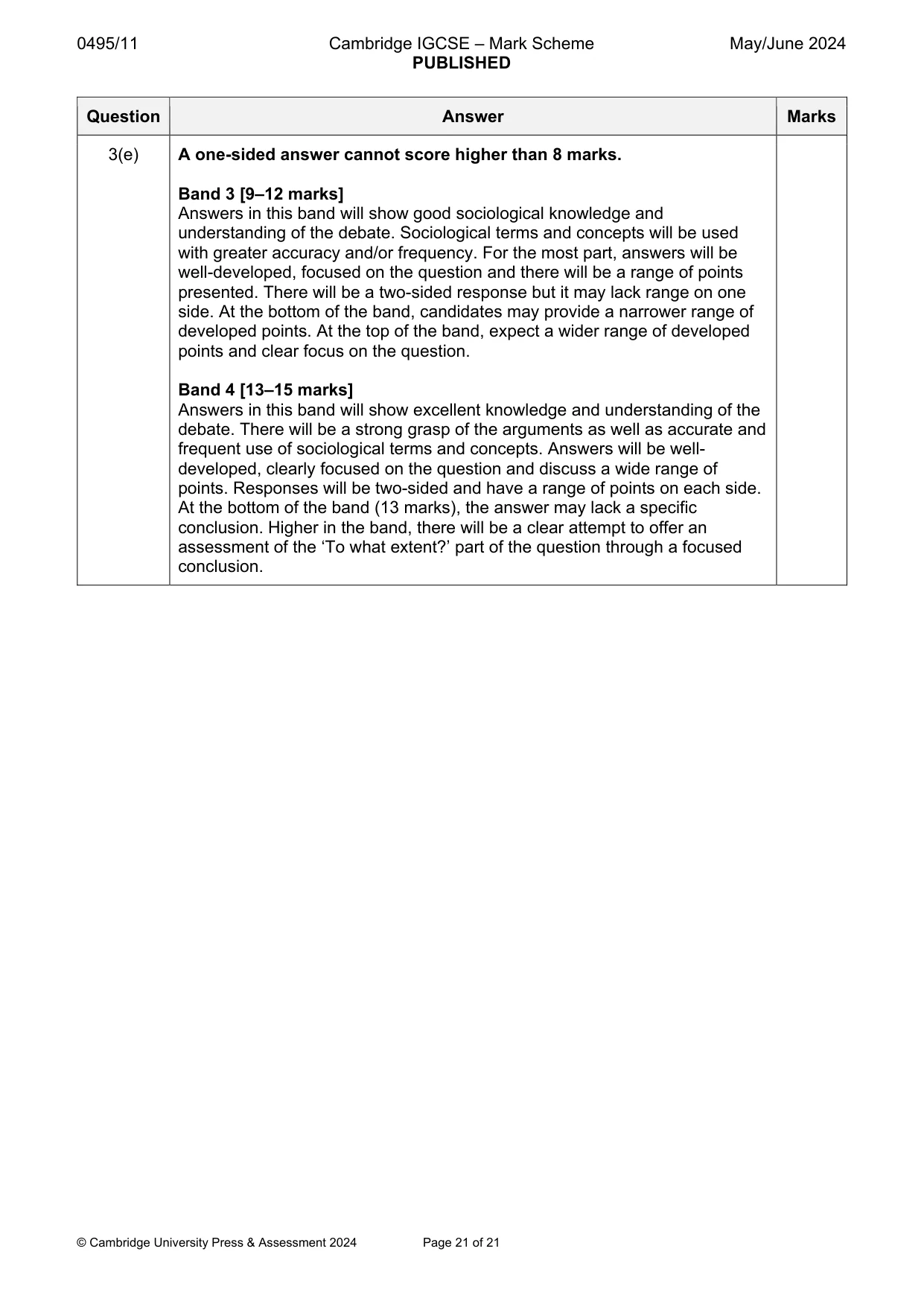
0495/11 Cambridge IGCSE – Mark Scheme PUBLISHED May/June 2024 © Cambridge University Press & Assessment 2024 Page 21 of 21 Question Answer Marks 3(e) A one-sided answer cannot score higher than 8 marks. Band 3 [9–12 marks] Answers in this band will show good sociological knowledge and understanding of the debate. Sociological terms and concepts will be used with greater accuracy and/or frequency. For the most part, answers will be well-developed, focused on the question and there will be a range of points presented. There will be a two-sided response but it may lack range on one side. At the bottom of the band, candidates may provide a narrower range of developed points. At the top of the band, expect a wider range of developed points and clear focus on the question. Band 4 [13–15 marks] Answers in this band will show excellent knowledge and understanding of the debate. There will be a strong grasp of the arguments as well as accurate and frequent use of sociological terms and concepts. Answers will be well- developed, clearly focused on the question and discuss a wide range of points. Responses will be two-sided and have a range of points on each side. At the bottom of the band (13 marks), the answer may lack a specific conclusion. Higher in the band, there will be a clear attempt to offer an assessment of the ‘To what extent?’ part of the question through a focused conclusion.
What you needed in this session
Cambridge’s own grade thresholds for 2024 May/June, Paper 1 · Variant 1. A higher threshold means an easier paper — the bar moves with how the cohort did.