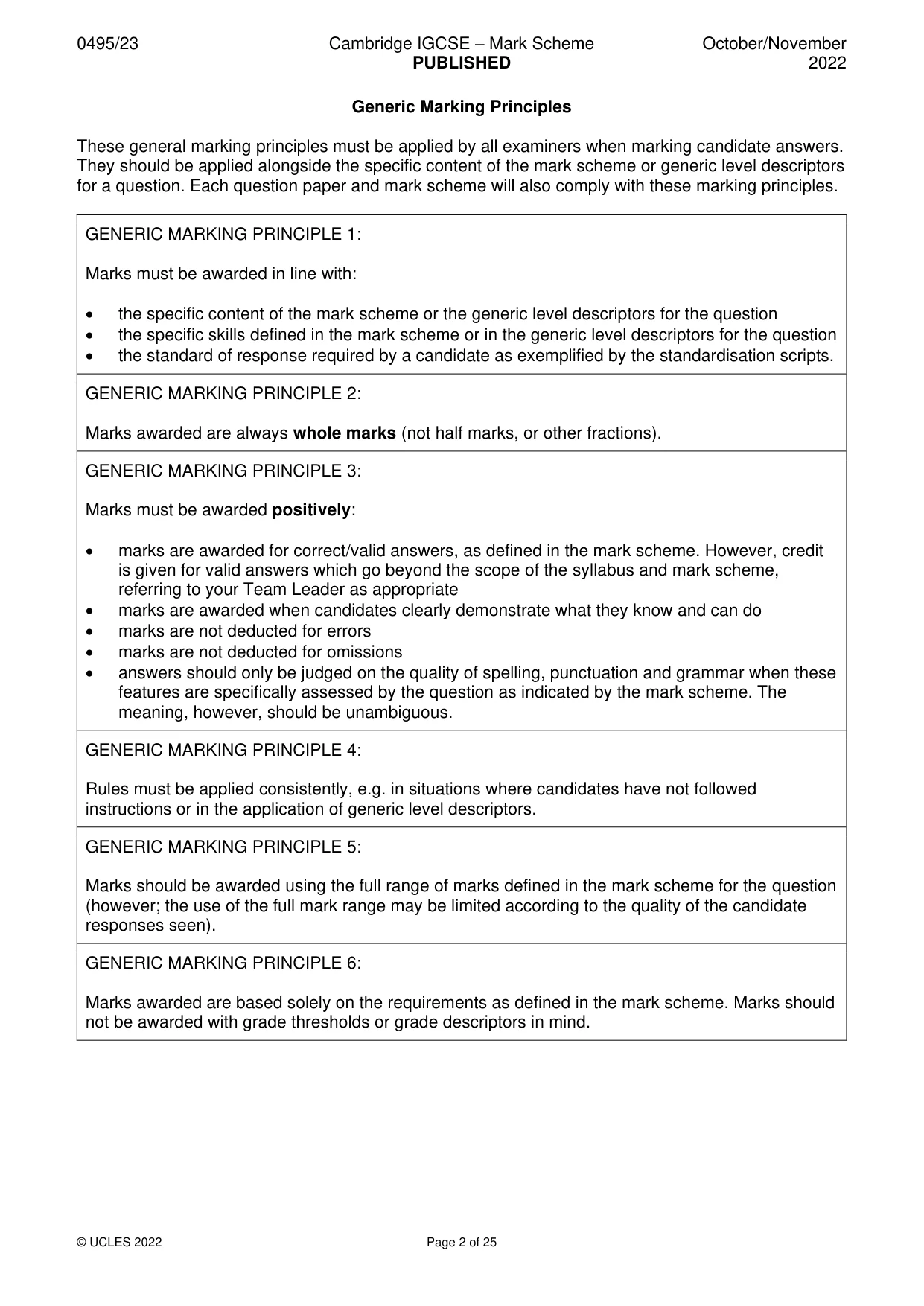
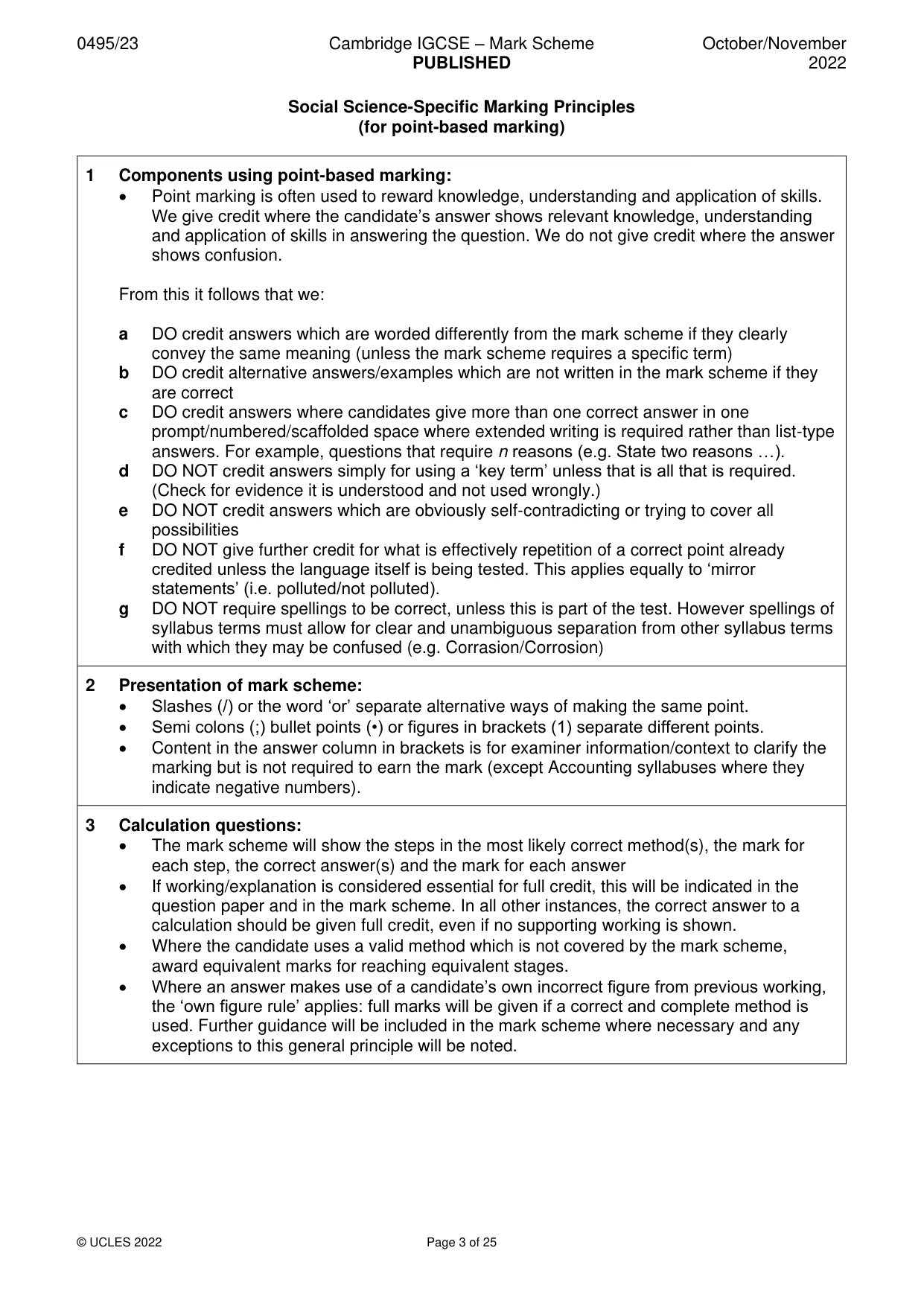
Cambridge IGCSE Sociology 0495 — 2022 Oct/Nov Paper 2 · Variant 3
0495/23/O/N/22 · 4 questions · 70 marks · ≈79 min
The question paper and its mark scheme, free to read here and free to download. This is Cambridge’s own paper, exactly as it was sat.
Question paper4 pages

Mark scheme25 pages
Answers below. Sit the paper first if you are practising.


Questions as text
Q1 · Families and marriages are changing
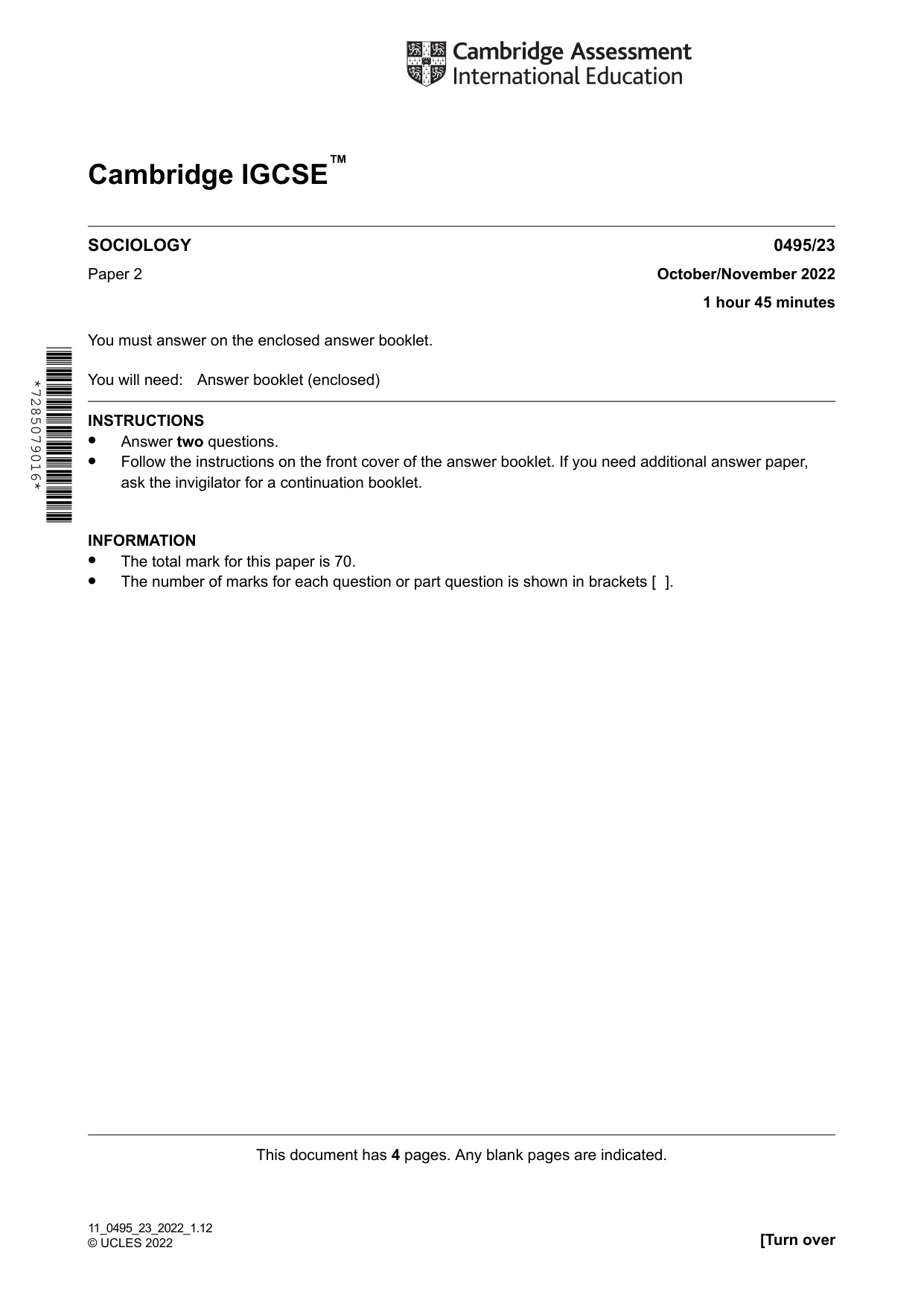
1 Families and marriages are changing. Feminism and an ageing population are two of the factors that have changed conjugal roles in families in modern industrial societies. The declining marriage rate is also important as many individuals no longer get married, choosing alternatives to marriage instead. (a) What is meant by the term ‘feminism’? [2] (b) Describe two alternatives to marriage. [4] (c) Explain how an ageing population has affected family life. [6] (d) Explain why some people may choose to stay in an empty-shell marriage. [8] (e) To what extent have conjugal roles in the family changed in modern industrial societies? [15]
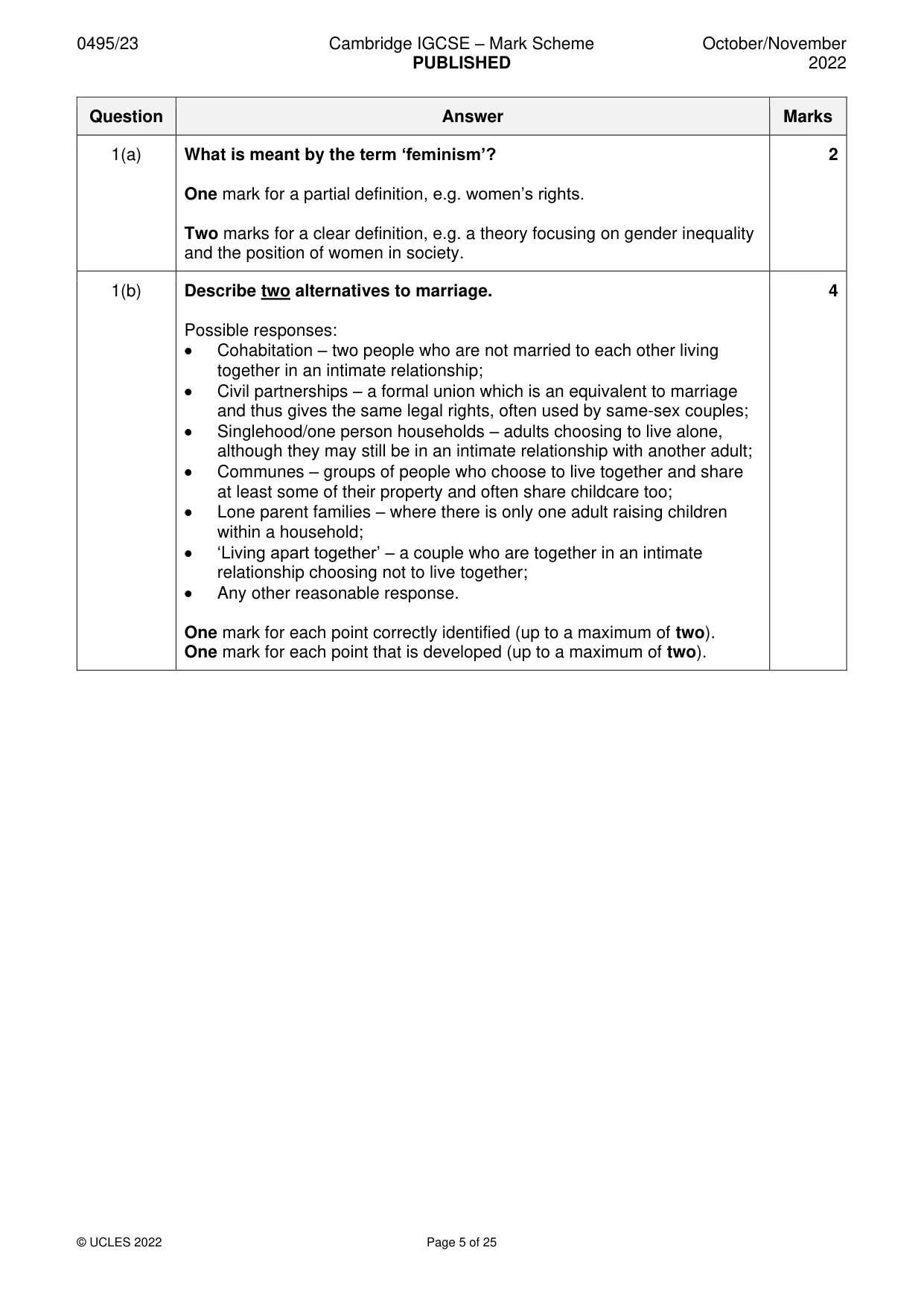
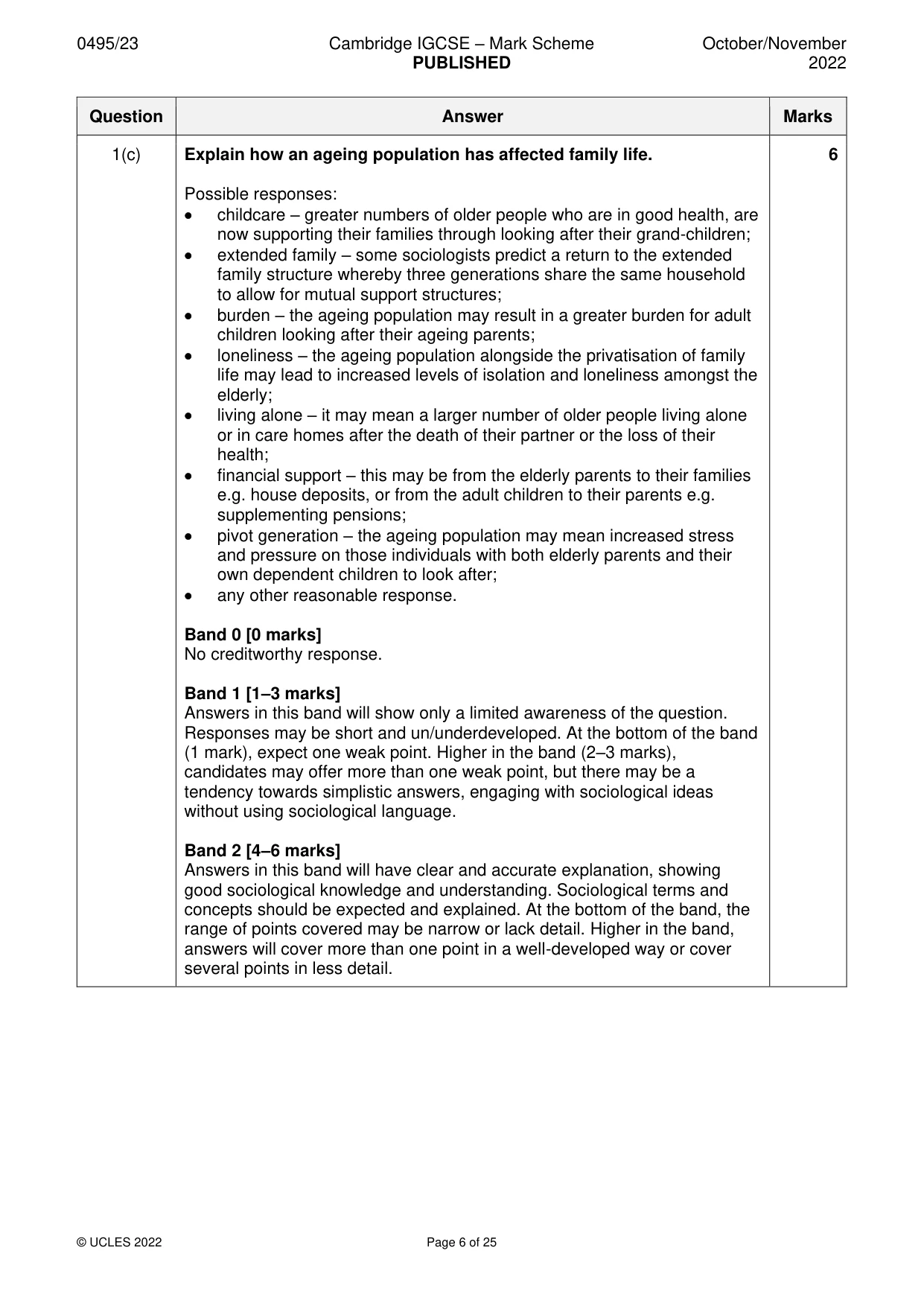
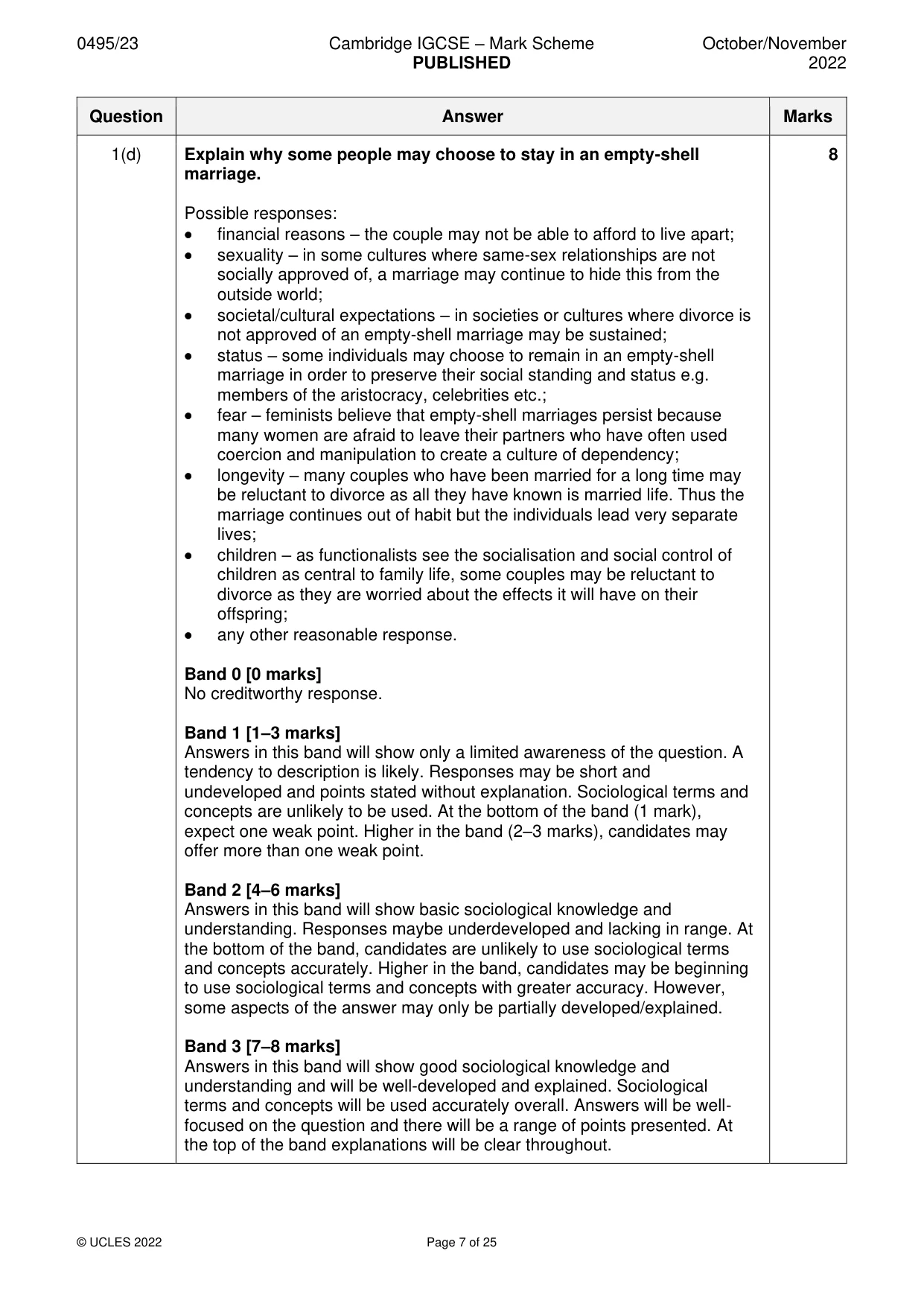
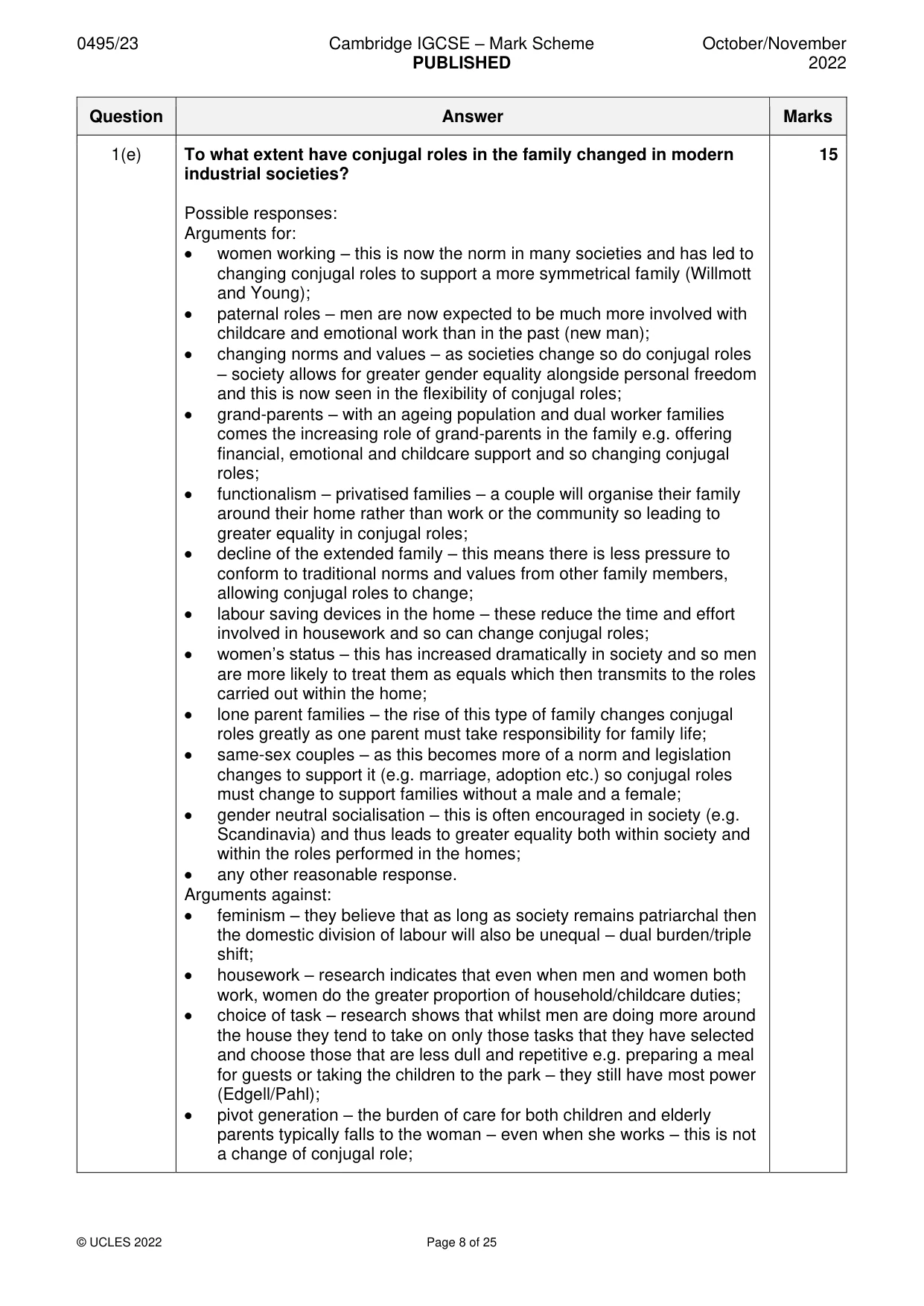
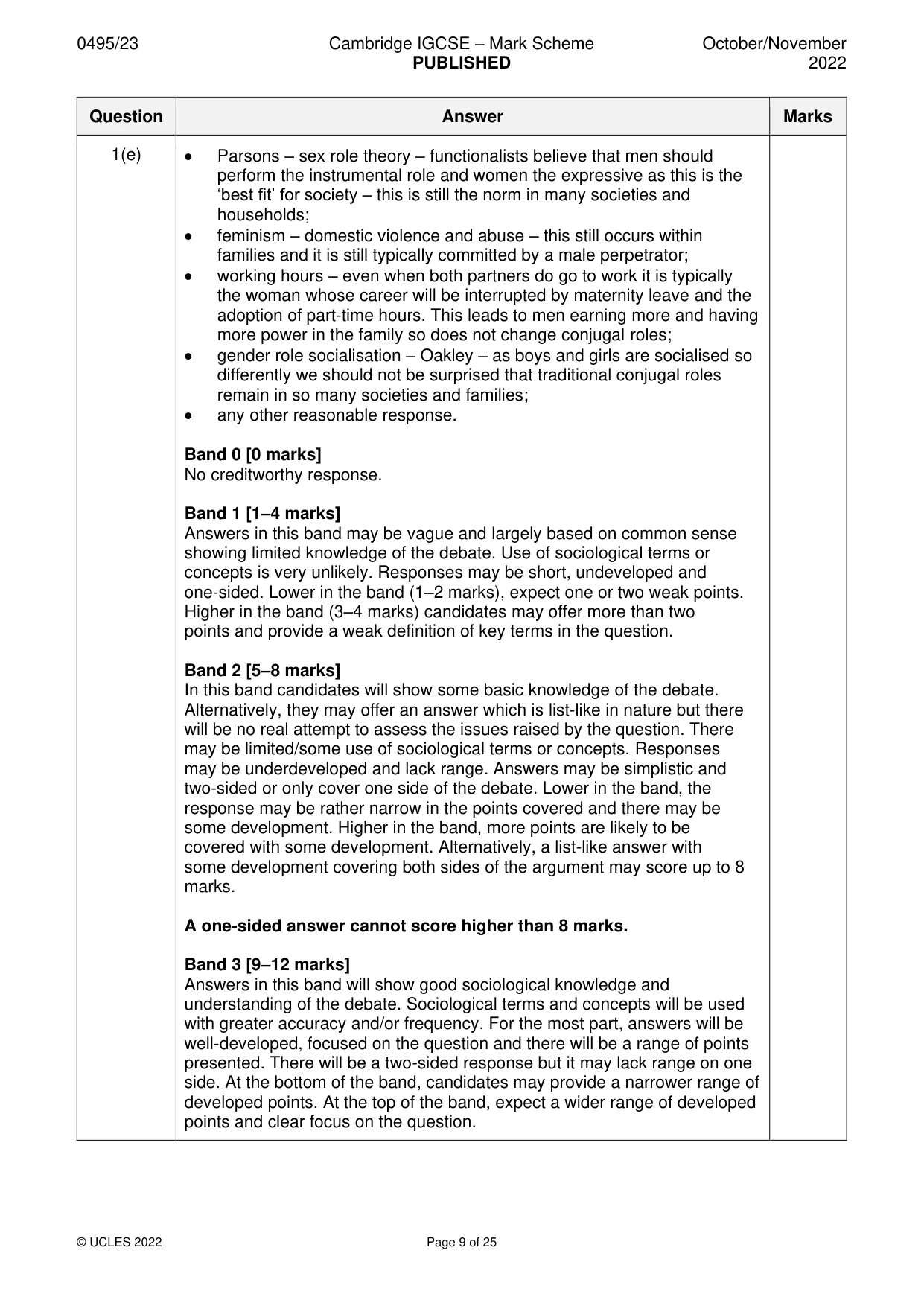
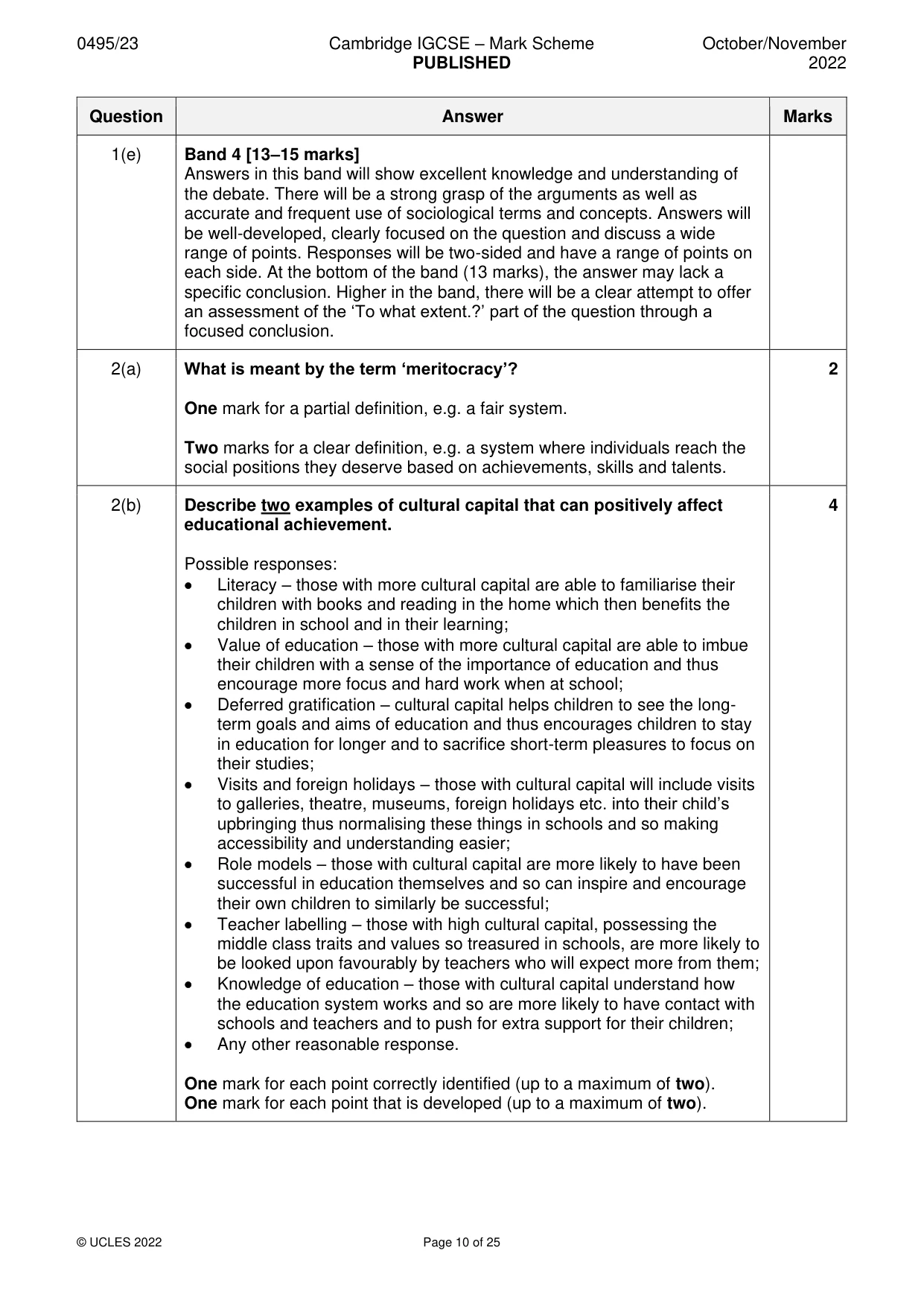
Mark scheme: Question Answer Marks 1(a) What is meant by the term ‘feminism’? 2 One mark for a partial definition, e.g. women’s rights. Two marks for a clear definition, e.g. a theory focusing on gender inequality and the position of women in society. 1(b) Describe two alternatives to marriage. 4 Possible responses: • Cohabitation – two people who are not married to each other living together in an intimate relationship; • Civil partnerships – a formal union which is an equivalent to marriage and thus gives the same legal rights, often used by same-sex couples; • Singlehood/one person households – adults choosing to live alone, although they may still be in an intimate relationship with another adult; • Communes – groups of people who choose to live together and share at least some of their property and often share childcare too; • Lone parent families – where there is only one adult raising children within a household; • ‘Living apart together’ – a couple who are together in an intimate relationship choosing not to live together; • Any other reasonable response. One mark for each point correctly identified (up to a maximum of two). One mark for each point that is developed (up to a maximum of two). 1(c) Explain how an ageing population has affected family life. 6 Possible responses: • childcare – greater numbers of older people who are in good health, are now supporting their families through looking after their grand-children; • extended family – some sociologists predict a return to the extended family structure whereby three generations share the same household to allow for mutual support structures; • burden – the ageing population may result in a greater burden for adult children looking after their ageing parents; • loneliness – the ageing population alongside the privatisation of family life may lead to increased levels of isolation and loneliness amongst the elderly; • living alone – it may mean a larger number of older people living alone or in care homes after the death of their partner or the loss of their health; • financial support – this may be from the elderly parents to their families e.g. house deposits, or from the adult children to their parents e.g. supplementing pensions; • pivot generation – the ageing population may mean increased stress and pressure on those individuals with both elderly parents and their own dependent children to look after; • any other reasonable response. Band 0 [0 marks] No creditworthy response. Band 1 [1–3 marks] Answers in this band will show only a limited awareness of the question. Responses may be short and un/underdeveloped. At the bottom of the band (1 mark), expect one weak point. Higher in the band (2–3 marks), candidates may offer more than one weak point, but there may be a tendency towards simplistic answers, engaging with sociological ideas without using sociological language. Band 2 [4–6 marks] Answers in this band will have clear and accurate explanation, showing good sociological knowledge and understanding. Sociological terms and concepts should be expected and explained. At the bottom of the band, the range of points covered may be narrow or lack detail. Higher in the band, answers will cover more than one point in a well-developed way or cover several points in less detail. 1(d) Explain why some people may choose to stay in an empty-shell 8 marriage. Possible responses: • financial reasons – the couple may not be able to afford to live apart; • sexuality – in some cultures where same-sex relationships are not socially approved of, a marriage may continue to hide this from the outside world; • societal/cultural expectations – in societies or cultures where divorce is not approved of an empty-shell marriage may be sustained; • status – some individuals may choose to remain in an empty-shell marriage in order to preserve their social standing and status e.g. members of the aristocracy, celebrities etc.; • fear – feminists believe that empty-shell marriages persist because many women are afraid to leave their partners who have often used coercion and manipulation to create a culture of dependency; • longevity – many couples who have been married for a long time may be reluctant to divorce as all they have known is married life. Thus the marriage continues out of habit but the individuals lead very separate lives; • children – as functionalists see the socialisation and social control of children as central to family life, some couples may be reluctant to divorce as they are worried about the effects it will have on their offspring; • any other reasonable response. Band 0 [0 marks] No creditworthy response. Band 1 [1–3 marks] Answers in this band will show only a limited awareness of the question. A tendency to description is likely. Responses may be short and undeveloped and points stated without explanation. Sociological terms and concepts are unlikely to be used. At the bottom of the band (1 mark), expect one weak point. Higher in the band (2–3 marks), candidates may offer more than one weak point. Band 2 [4–6 marks] Answers in this band will show basic sociological knowledge and understanding. Responses maybe underdeveloped and lacking in range. At the bottom of the band, candidates are unlikely to use sociological terms and concepts accurately. Higher in the band, candidates may be beginning to use sociological terms and concepts with greater accuracy. However, some aspects of the answer may only be partially developed/explained. Band 3 [7–8 marks] Answers in this band will show good sociological knowledge and understanding and will be well-developed and explained. Sociological terms and concepts will be used accurately overall. Answers will be well- focused on the question and there will be a range of points presented. At the top of the band explanations will be clear throughout. 1(e) To what extent have conjugal roles in the family changed in modern 15 industrial societies? Possible responses: Arguments for: • women working – this is now the norm in many societies and has led to changing conjugal roles to support a more symmetrical family (Willmott and Young); • paternal roles – men are now expected to be much more involved with childcare and emotional work than in the past (new man); • changing norms and values – as societies change so do conjugal roles – society allows for greater gender equality alongside personal freedom and this is now seen in the flexibility of conjugal roles; • grand-parents – with an ageing population and dual worker families comes the increasing role of grand-parents in the family e.g. offering financial, emotional and childcare support and so changing conjugal roles; • functionalism – privatised families – a couple will organise their family around their home rather than work or the community so leading to greater equality in conjugal roles; • decline of the extended family – this means there is less pressure to conform to traditional norms and values from other family members, allowing conjugal roles to change; • labour saving devices in the home – these reduce the time and effort involved in housework and so can change conjugal roles; • women’s status – this has increased dramatically in society and so men are more likely to treat them as equals which then transmits to the roles carried out within the home; • lone parent families – the rise of this type of family changes conjugal roles greatly as one parent must take responsibility for family life; • same-sex couples – as this becomes more of a norm and legislation changes to support it (e.g. marriage, adoption etc.) so conjugal roles must change to support families without a male and a female; • gender neutral socialisation – this is often encouraged in society (e.g. Scandinavia) and thus leads to greater equality both within society and within the roles performed in the homes; • any other reasonable response. Arguments against: • feminism – they believe that as long as society remains patriarchal then the domestic division of labour will also be unequal – dual burden/triple shift; • housework – research indicates that even when men and women both work, women do the greater proportion of household/childcare duties; • choice of task – research shows that whilst men are doing more around the house they tend to take on only those tasks that they have selected and choose those that are less dull and repetitive e.g. preparing a meal for guests or taking the children to the park – they still have most power (Edgell/Pahl); • pivot generation – the burden of care for both children and elderly parents typically falls to the woman – even when she works – this is not a change of conjugal role; 1(e) • Parsons – sex role theory – functionalists believe that men should perform the instrumental role and women the expressive as this is the ‘best fit’ for society – this is still the norm in many societies and households; • feminism – domestic violence and abuse – this still occurs within families and it is still typically committed by a male perpetrator; • working hours – even when both partners do go to work it is typically the woman whose career will be interrupted by maternity leave and the adoption of part-time hours. This leads to men earning more and having more power in the family so does not change conjugal roles; • gender role socialisation – Oakley – as boys and girls are socialised so differently we should not be surprised that traditional conjugal roles remain in so many societies and families; • any other reasonable response. Band 0 [0 marks] No creditworthy response. Band 1 [1–4 marks] Answers in this band may be vague and largely based on common sense showing limited knowledge of the debate. Use of sociological terms or concepts is very unlikely. Responses may be short, undeveloped and one-sided. Lower in the band (1–2 marks), expect one or two weak points. Higher in the band (3–4 marks) candidates may offer more than two points and provide a weak definition of key terms in the question. Band 2 [5–8 marks] In this band candidates will show some basic knowledge of the debate. Alternatively, they may offer an answer which is list-like in nature but there will be no real attempt to assess the issues raised by the question. There may be limited/some use of sociological terms or concepts. Responses may be underdeveloped and lack range. Answers may be simplistic and two-sided or only cover one side of the debate. Lower in the band, the response may be rather narrow in the points covered and there may be some development. Higher in the band, more points are likely to be covered with some development. Alternatively, a list-like answer with some development covering both sides of the argument may score up to 8 marks. A one-sided answer cannot score higher than 8 marks. Band 3 [9–12 marks] Answers in this band will show good sociological knowledge and understanding of the debate. Sociological terms and concepts will be used with greater accuracy and/or frequency. For the most part, answers will be well-developed, focused on the question and there will be a range of points presented. There will be a two-sided response but it may lack range on one side. At the bottom of the band, candidates may provide a narrower range of developed points. At the top of the band, expect a wider range of developed points and clear focus on the question. 1(e) Band 4 [13–15 marks] Answers in this band will show excellent knowledge and understanding of the debate. There will be a strong grasp of the arguments as well as accurate and frequent use of sociological terms and concepts. Answers will be well-developed, clearly focused on the question and discuss a wide range of points. Responses will be two-sided and have a range of points on each side. At the bottom of the band (13 marks), the answer may lack a specific conclusion. Higher in the band, there will be a clear attempt to offer an assessment of the ‘To what extent.?’ part of the question through a focused conclusion.
Q2 · Functionalists believe education is a meritocracy
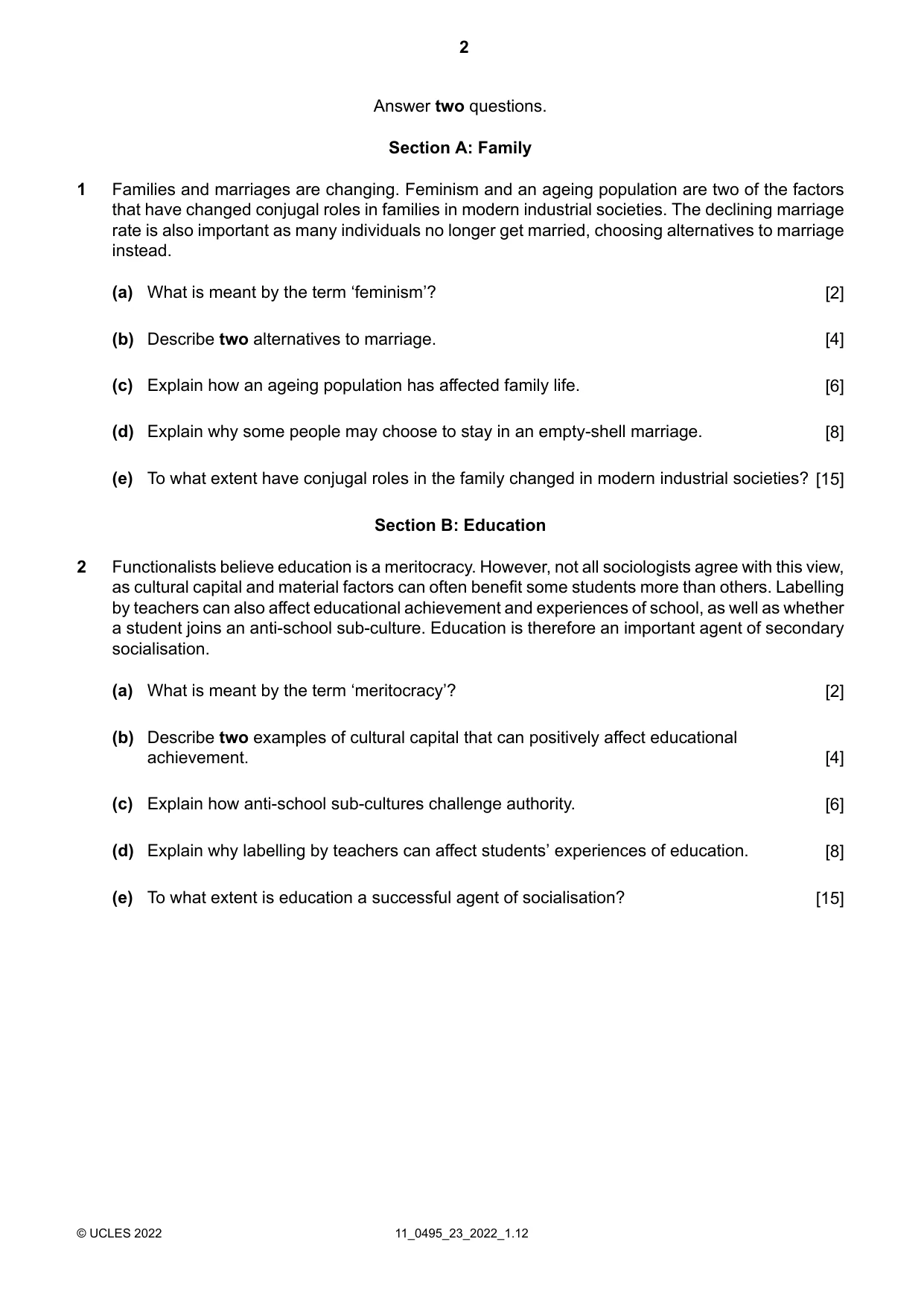
2 Functionalists believe education is a meritocracy. However, not all sociologists agree with this view, as cultural capital and material factors can often benefit some students more than others. Labelling by teachers can also affect educational achievement and experiences of school, as well as whether a student joins an anti-school sub-culture. Education is therefore an important agent of secondary socialisation. (a) What is meant by the term ‘meritocracy’? [2] (b) Describe two examples of cultural capital that can positively affect educational achievement. [4] (c) Explain how anti-school sub-cultures challenge authority. [6] (d) Explain why labelling by teachers can affect students’ experiences of education. [8] (e) To what extent is education a successful agent of socialisation? [15] Section C: Crime, deviance and social control
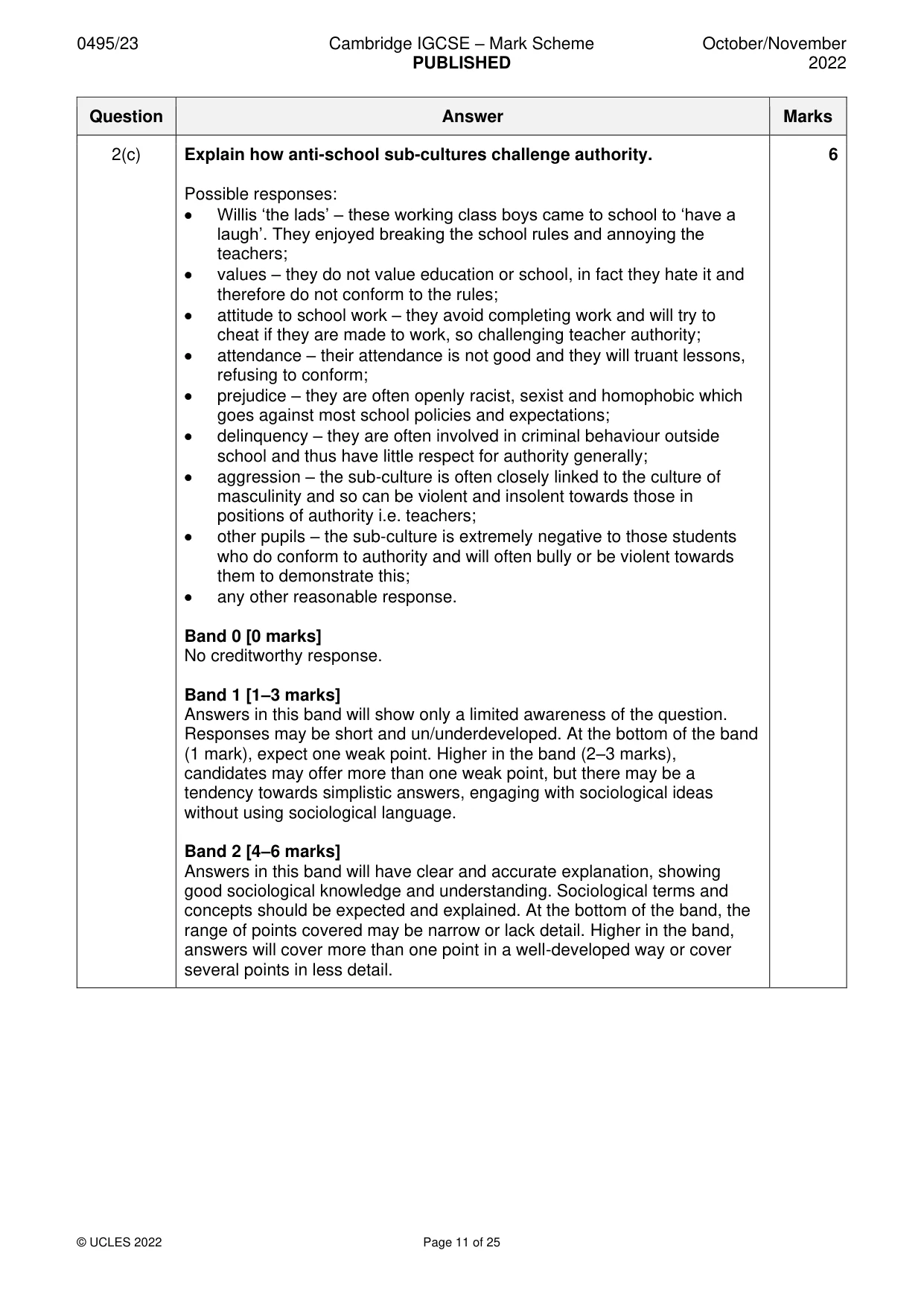
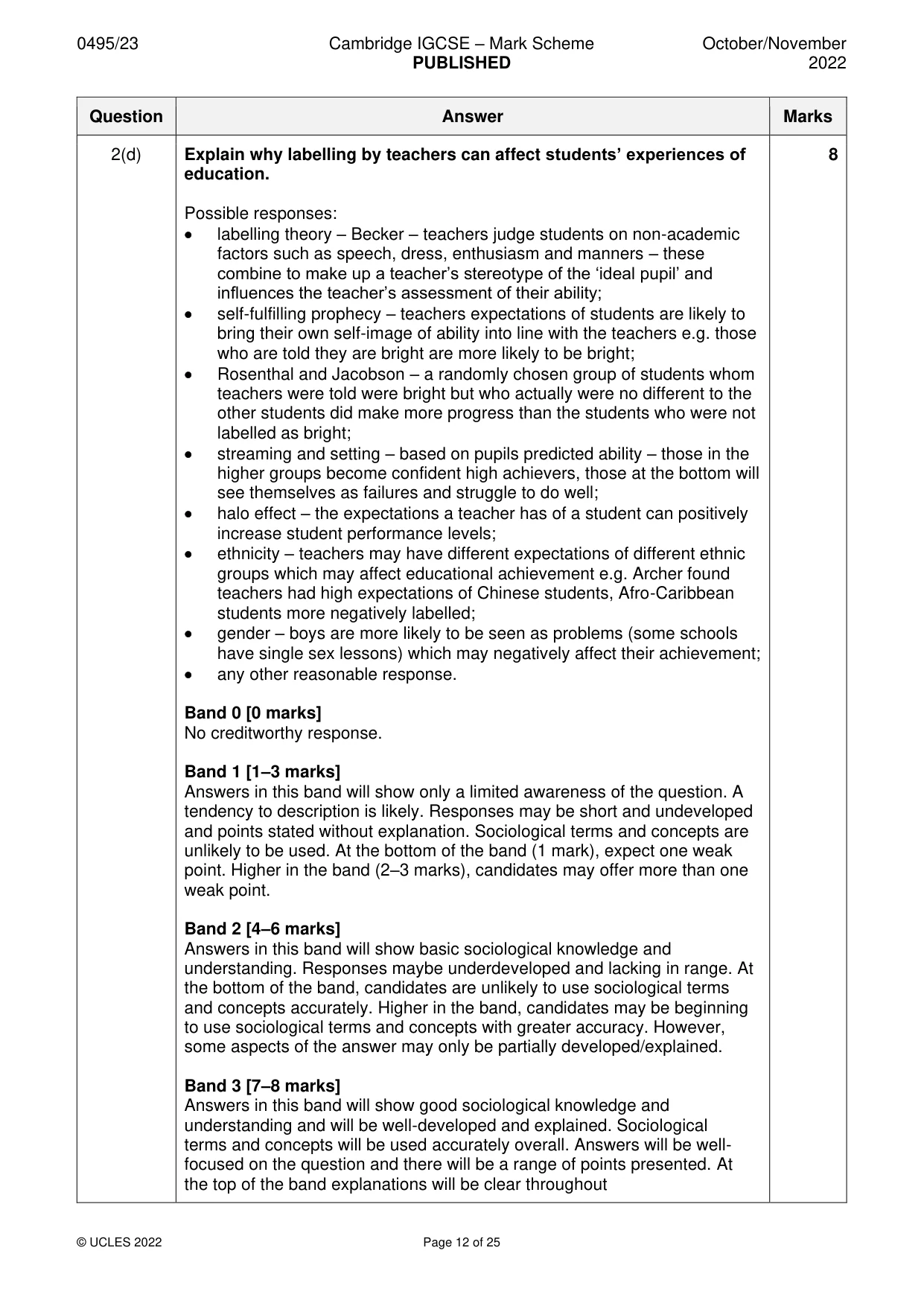
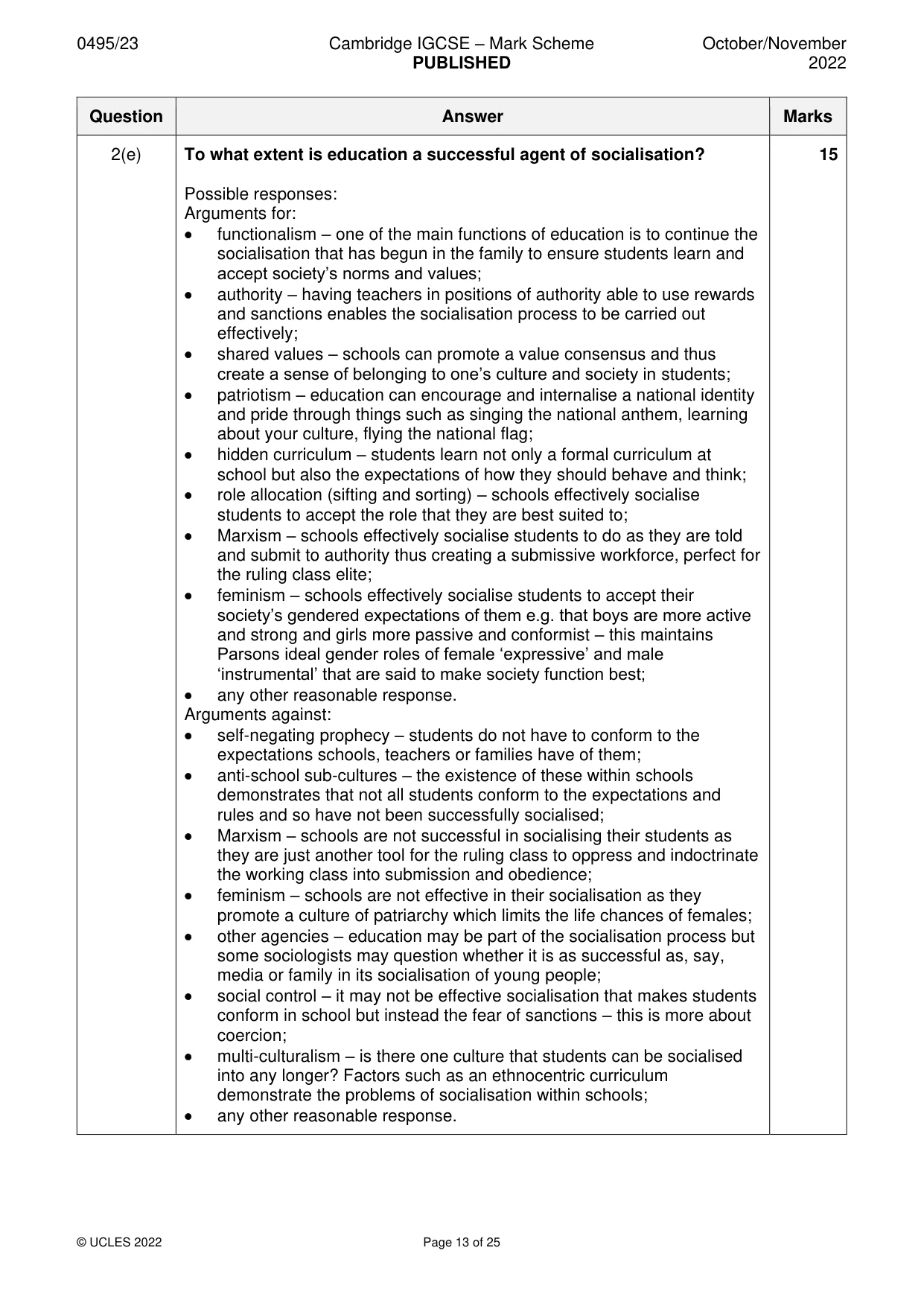
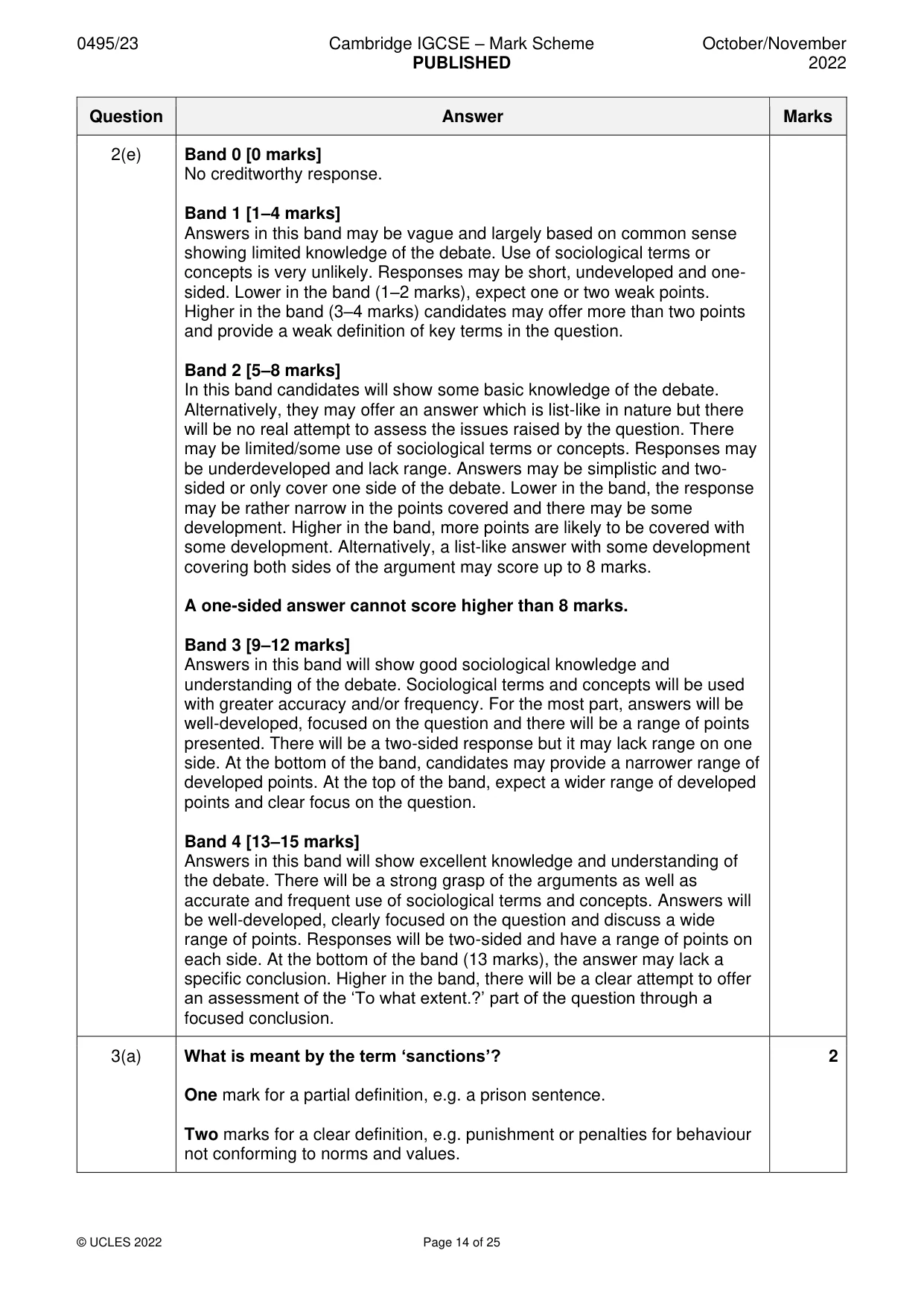
Mark scheme: 2(a) What is meant by the term ‘meritocracy’? 2 One mark for a partial definition, e.g. a fair system. Two marks for a clear definition, e.g. a system where individuals reach the social positions they deserve based on achievements, skills and talents. 2(b) Describe two examples of cultural capital that can positively affect 4 educational achievement. Possible responses: • Literacy – those with more cultural capital are able to familiarise their children with books and reading in the home which then benefits the children in school and in their learning; • Value of education – those with more cultural capital are able to imbue their children with a sense of the importance of education and thus encourage more focus and hard work when at school; • Deferred gratification – cultural capital helps children to see the long- term goals and aims of education and thus encourages children to stay in education for longer and to sacrifice short-term pleasures to focus on their studies; • Visits and foreign holidays – those with cultural capital will include visits to galleries, theatre, museums, foreign holidays etc. into their child’s upbringing thus normalising these things in schools and so making accessibility and understanding easier; • Role models – those with cultural capital are more likely to have been successful in education themselves and so can inspire and encourage their own children to similarly be successful; • Teacher labelling – those with high cultural capital, possessing the middle class traits and values so treasured in schools, are more likely to be looked upon favourably by teachers who will expect more from them; • Knowledge of education – those with cultural capital understand how the education system works and so are more likely to have contact with schools and teachers and to push for extra support for their children; • Any other reasonable response. One mark for each point correctly identified (up to a maximum of two). One mark for each point that is developed (up to a maximum of two). 2(c) Explain how anti-school sub-cultures challenge authority. 6 Possible responses: • Willis ‘the lads’ – these working class boys came to school to ‘have a laugh’. They enjoyed breaking the school rules and annoying the teachers; • values – they do not value education or school, in fact they hate it and therefore do not conform to the rules; • attitude to school work – they avoid completing work and will try to cheat if they are made to work, so challenging teacher authority; • attendance – their attendance is not good and they will truant lessons, refusing to conform; • prejudice – they are often openly racist, sexist and homophobic which goes against most school policies and expectations; • delinquency – they are often involved in criminal behaviour outside school and thus have little respect for authority generally; • aggression – the sub-culture is often closely linked to the culture of masculinity and so can be violent and insolent towards those in positions of authority i.e. teachers; • other pupils – the sub-culture is extremely negative to those students who do conform to authority and will often bully or be violent towards them to demonstrate this; • any other reasonable response. Band 0 [0 marks] No creditworthy response. Band 1 [1–3 marks] Answers in this band will show only a limited awareness of the question. Responses may be short and un/underdeveloped. At the bottom of the band (1 mark), expect one weak point. Higher in the band (2–3 marks), candidates may offer more than one weak point, but there may be a tendency towards simplistic answers, engaging with sociological ideas without using sociological language. Band 2 [4–6 marks] Answers in this band will have clear and accurate explanation, showing good sociological knowledge and understanding. Sociological terms and concepts should be expected and explained. At the bottom of the band, the range of points covered may be narrow or lack detail. Higher in the band, answers will cover more than one point in a well-developed way or cover several points in less detail. 2(d) Explain why labelling by teachers can affect students’ experiences of 8 education. Possible responses: • labelling theory – Becker – teachers judge students on non-academic factors such as speech, dress, enthusiasm and manners – these combine to make up a teacher’s stereotype of the ‘ideal pupil’ and influences the teacher’s assessment of their ability; • self-fulfilling prophecy – teachers expectations of students are likely to bring their own self-image of ability into line with the teachers e.g. those who are told they are bright are more likely to be bright; • Rosenthal and Jacobson – a randomly chosen group of students whom teachers were told were bright but who actually were no different to the other students did make more progress than the students who were not labelled as bright; • streaming and setting – based on pupils predicted ability – those in the higher groups become confident high achievers, those at the bottom will see themselves as failures and struggle to do well; • halo effect – the expectations a teacher has of a student can positively increase student performance levels; • ethnicity – teachers may have different expectations of different ethnic groups which may affect educational achievement e.g. Archer found teachers had high expectations of Chinese students, Afro-Caribbean students more negatively labelled; • gender – boys are more likely to be seen as problems (some schools have single sex lessons) which may negatively affect their achievement; • any other reasonable response. Band 0 [0 marks] No creditworthy response. Band 1 [1–3 marks] Answers in this band will show only a limited awareness of the question. A tendency to description is likely. Responses may be short and undeveloped and points stated without explanation. Sociological terms and concepts are unlikely to be used. At the bottom of the band (1 mark), expect one weak point. Higher in the band (2–3 marks), candidates may offer more than one weak point. Band 2 [4–6 marks] Answers in this band will show basic sociological knowledge and understanding. Responses maybe underdeveloped and lacking in range. At the bottom of the band, candidates are unlikely to use sociological terms and concepts accurately. Higher in the band, candidates may be beginning to use sociological terms and concepts with greater accuracy. However, some aspects of the answer may only be partially developed/explained. Band 3 [7–8 marks] Answers in this band will show good sociological knowledge and understanding and will be well-developed and explained. Sociological terms and concepts will be used accurately overall. Answers will be well- focused on the question and there will be a range of points presented. At the top of the band explanations will be clear throughout 2(e) To what extent is education a successful agent of socialisation? 15 Possible responses: Arguments for: • functionalism – one of the main functions of education is to continue the socialisation that has begun in the family to ensure students learn and accept society’s norms and values; • authority – having teachers in positions of authority able to use rewards and sanctions enables the socialisation process to be carried out effectively; • shared values – schools can promote a value consensus and thus create a sense of belonging to one’s culture and society in students; • patriotism – education can encourage and internalise a national identity and pride through things such as singing the national anthem, learning about your culture, flying the national flag; • hidden curriculum – students learn not only a formal curriculum at school but also the expectations of how they should behave and think; • role allocation (sifting and sorting) – schools effectively socialise students to accept the role that they are best suited to; • Marxism – schools effectively socialise students to do as they are told and submit to authority thus creating a submissive workforce, perfect for the ruling class elite; • feminism – schools effectively socialise students to accept their society’s gendered expectations of them e.g. that boys are more active and strong and girls more passive and conformist – this maintains Parsons ideal gender roles of female ‘expressive’ and male ‘instrumental’ that are said to make society function best; • any other reasonable response. Arguments against: • self-negating prophecy – students do not have to conform to the expectations schools, teachers or families have of them; • anti-school sub-cultures – the existence of these within schools demonstrates that not all students conform to the expectations and rules and so have not been successfully socialised; • Marxism – schools are not successful in socialising their students as they are just another tool for the ruling class to oppress and indoctrinate the working class into submission and obedience; • feminism – schools are not effective in their socialisation as they promote a culture of patriarchy which limits the life chances of females; • other agencies – education may be part of the socialisation process but some sociologists may question whether it is as successful as, say, media or family in its socialisation of young people; • social control – it may not be effective socialisation that makes students conform in school but instead the fear of sanctions – this is more about coercion; • multi-culturalism – is there one culture that students can be socialised into any longer? Factors such as an ethnocentric curriculum demonstrate the problems of socialisation within schools; • any other reasonable response. 2(e) Band 0 [0 marks] No creditworthy response. Band 1 [1–4 marks] Answers in this band may be vague and largely based on common sense showing limited knowledge of the debate. Use of sociological terms or concepts is very unlikely. Responses may be short, undeveloped and one- sided. Lower in the band (1–2 marks), expect one or two weak points. Higher in the band (3–4 marks) candidates may offer more than two points and provide a weak definition of key terms in the question. Band 2 [5–8 marks] In this band candidates will show some basic knowledge of the debate. Alternatively, they may offer an answer which is list-like in nature but there will be no real attempt to assess the issues raised by the question. There may be limited/some use of sociological terms or concepts. Responses may be underdeveloped and lack range. Answers may be simplistic and two- sided or only cover one side of the debate. Lower in the band, the response may be rather narrow in the points covered and there may be some development. Higher in the band, more points are likely to be covered with some development. Alternatively, a list-like answer with some development covering both sides of the argument may score up to 8 marks. A one-sided answer cannot score higher than 8 marks. Band 3 [9–12 marks] Answers in this band will show good sociological knowledge and understanding of the debate. Sociological terms and concepts will be used with greater accuracy and/or frequency. For the most part, answers will be well-developed, focused on the question and there will be a range of points presented. There will be a two-sided response but it may lack range on one side. At the bottom of the band, candidates may provide a narrower range of developed points. At the top of the band, expect a wider range of developed points and clear focus on the question. Band 4 [13–15 marks] Answers in this band will show excellent knowledge and understanding of the debate. There will be a strong grasp of the arguments as well as accurate and frequent use of sociological terms and concepts. Answers will be well-developed, clearly focused on the question and discuss a wide range of points. Responses will be two-sided and have a range of points on each side. At the bottom of the band (13 marks), the answer may lack a specific conclusion. Higher in the band, there will be a clear attempt to offer an assessment of the ‘To what extent.?’ part of the question through a focused conclusion.
Q3 · In most societies the police are employed to control and prevent crime by using a range…
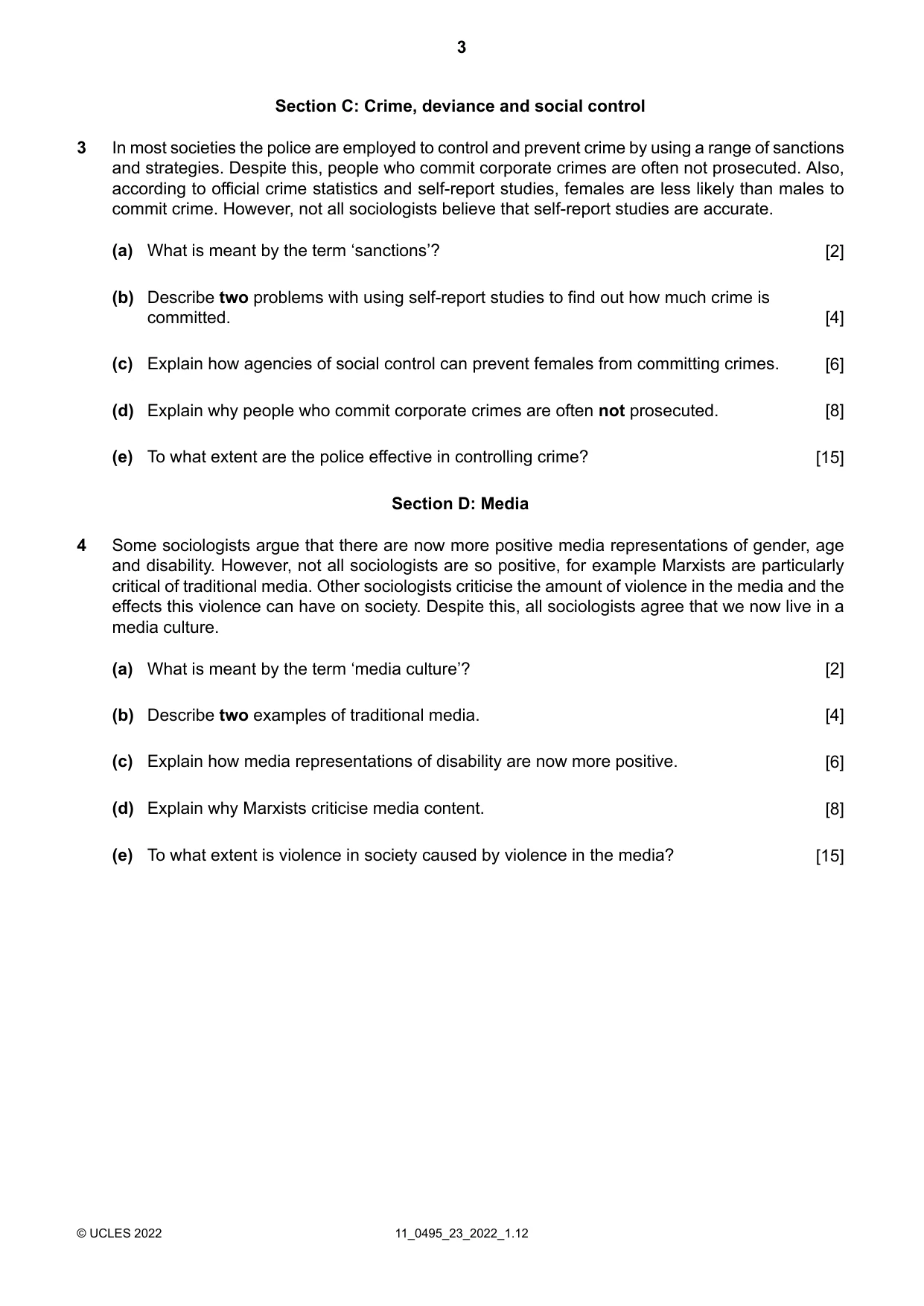
3 In most societies the police are employed to control and prevent crime by using a range of sanctions and strategies. Despite this, people who commit corporate crimes are often not prosecuted. Also, according to official crime statistics and self-report studies, females are less likely than males to commit crime. However, not all sociologists believe that self-report studies are accurate. (a) What is meant by the term ‘sanctions’? [2] (b) Describe two problems with using self-report studies to find out how much crime is committed. [4] (c) Explain how agencies of social control can prevent females from committing crimes. [6] (d) Explain why people who commit corporate crimes are often not prosecuted. [8] (e) To what extent are the police effective in controlling crime? [15] Section D: Media
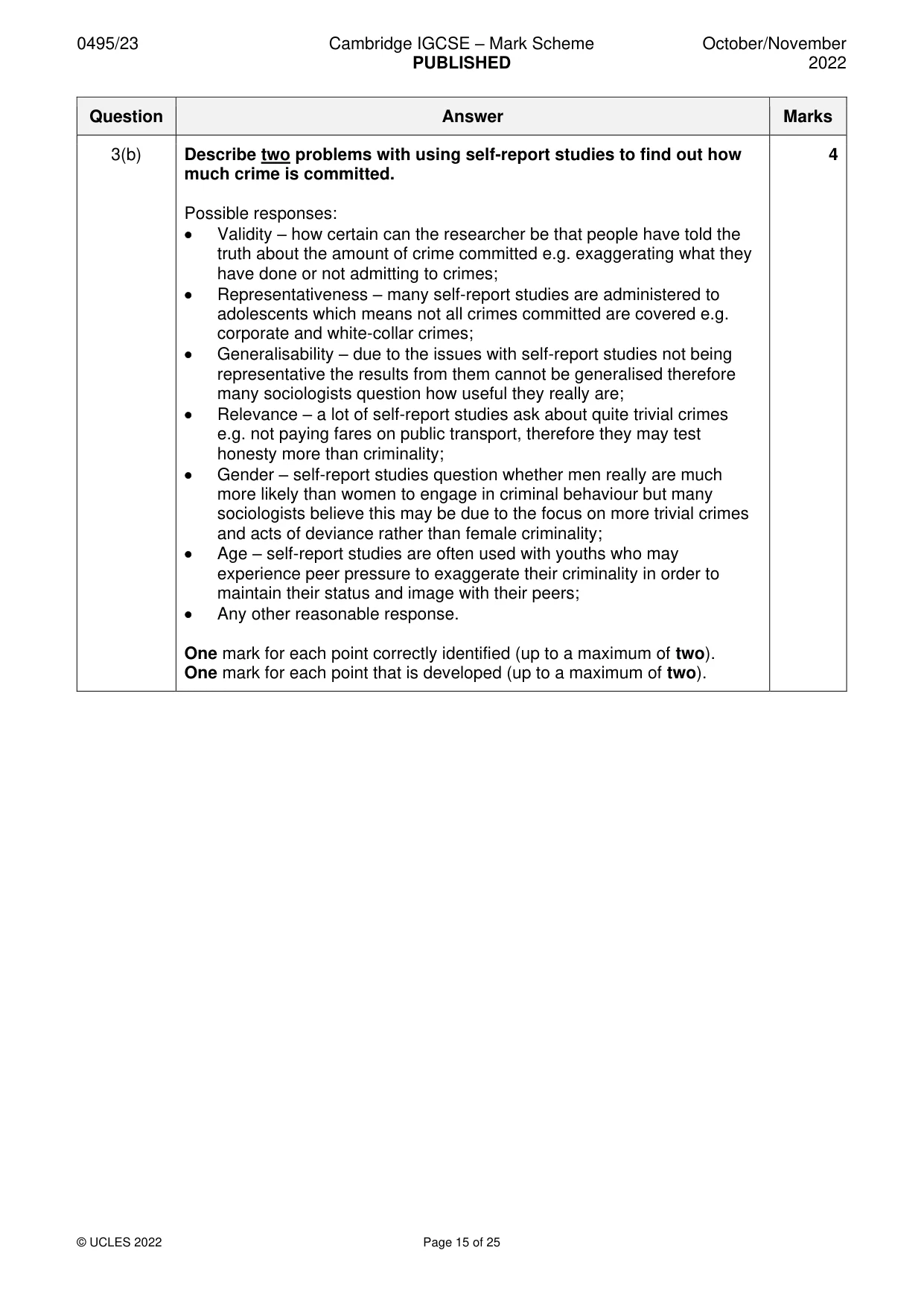
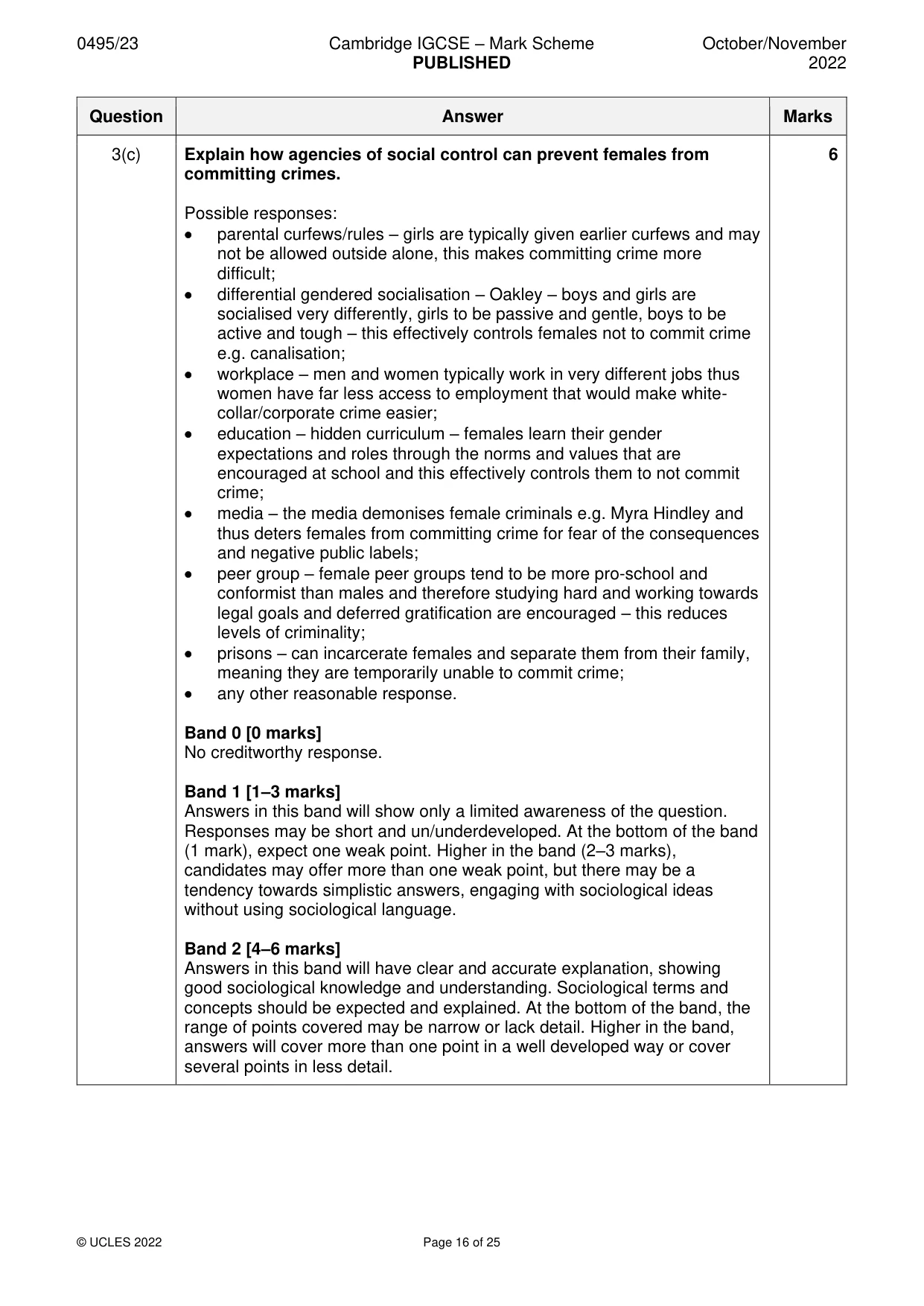
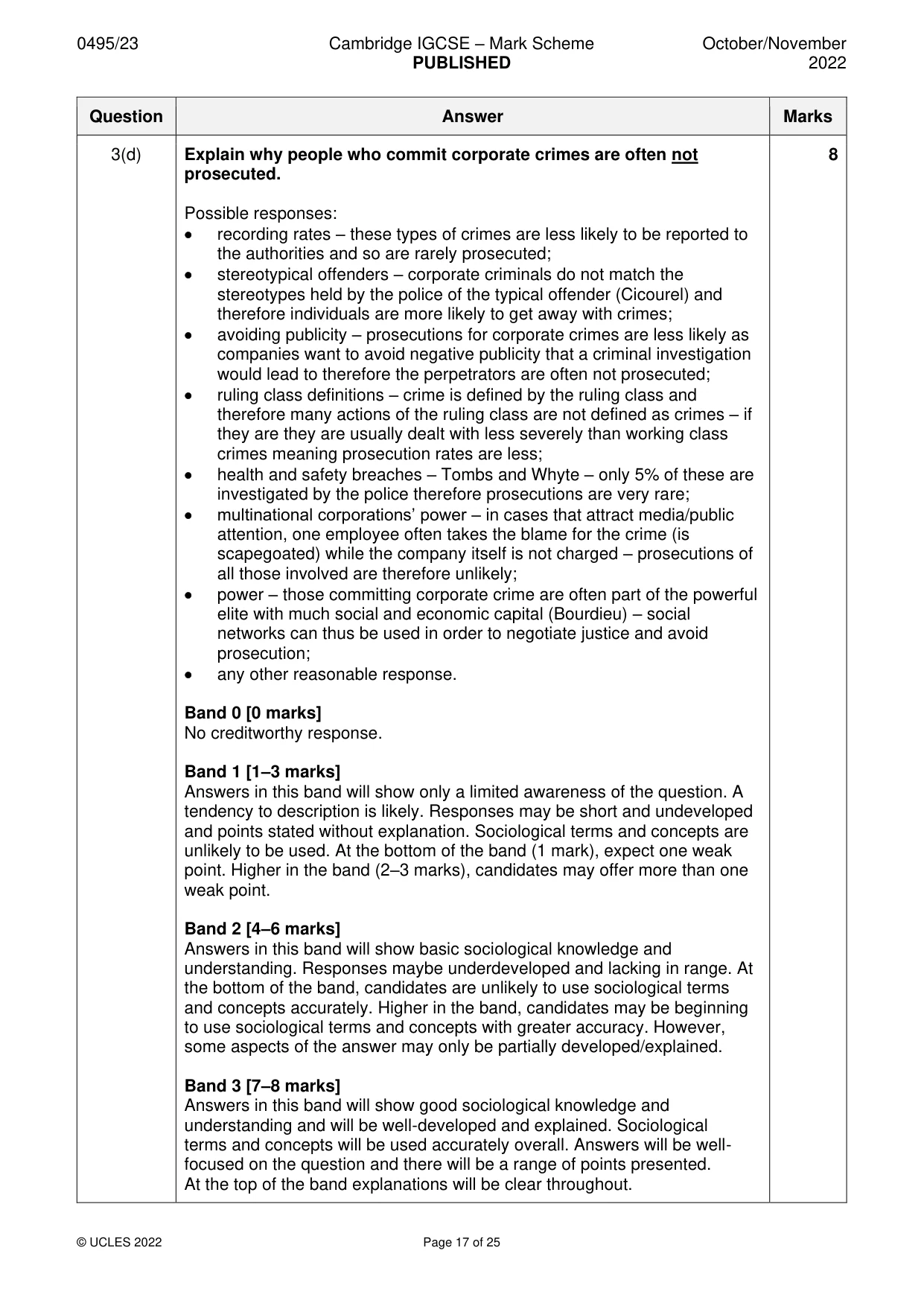
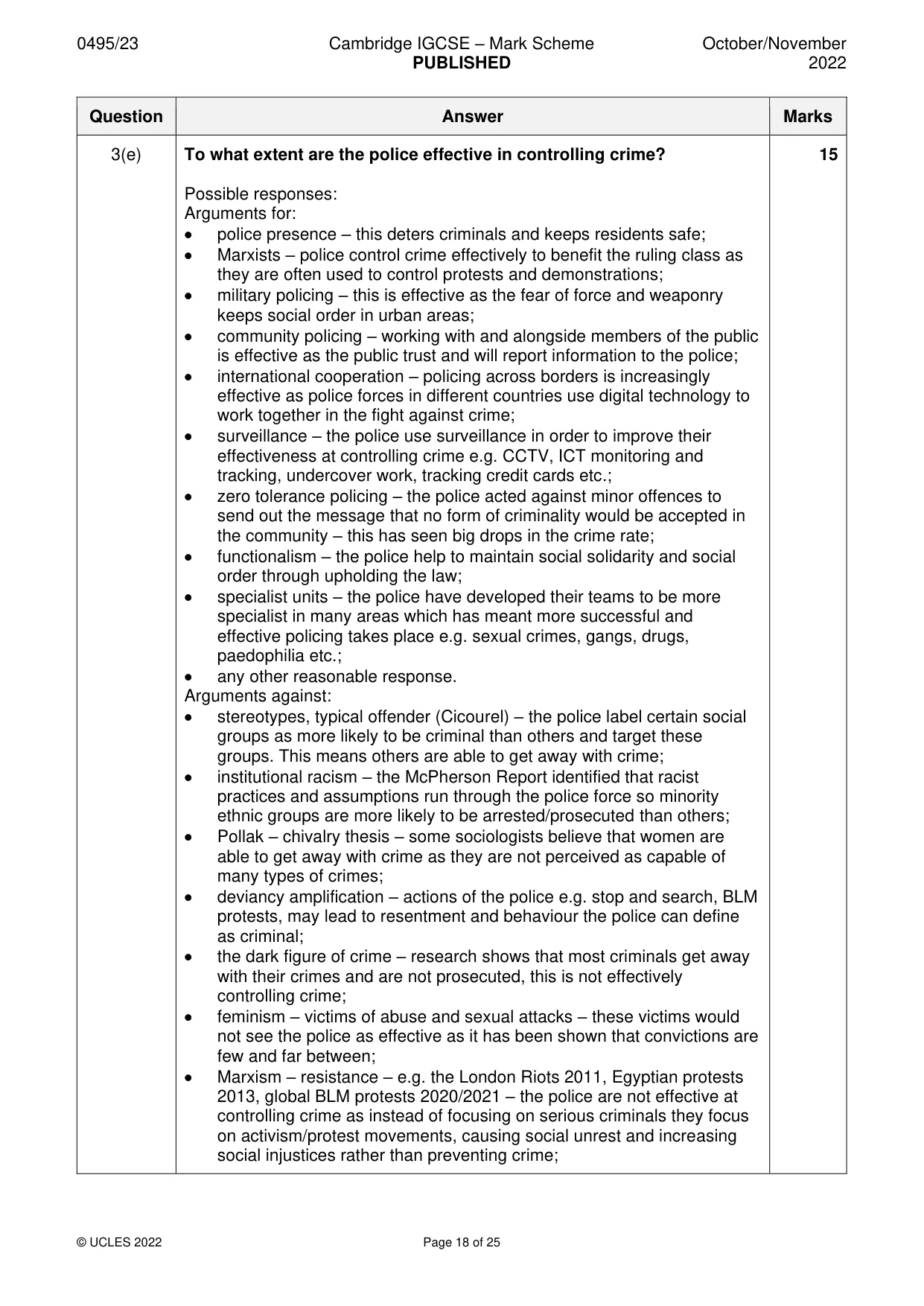
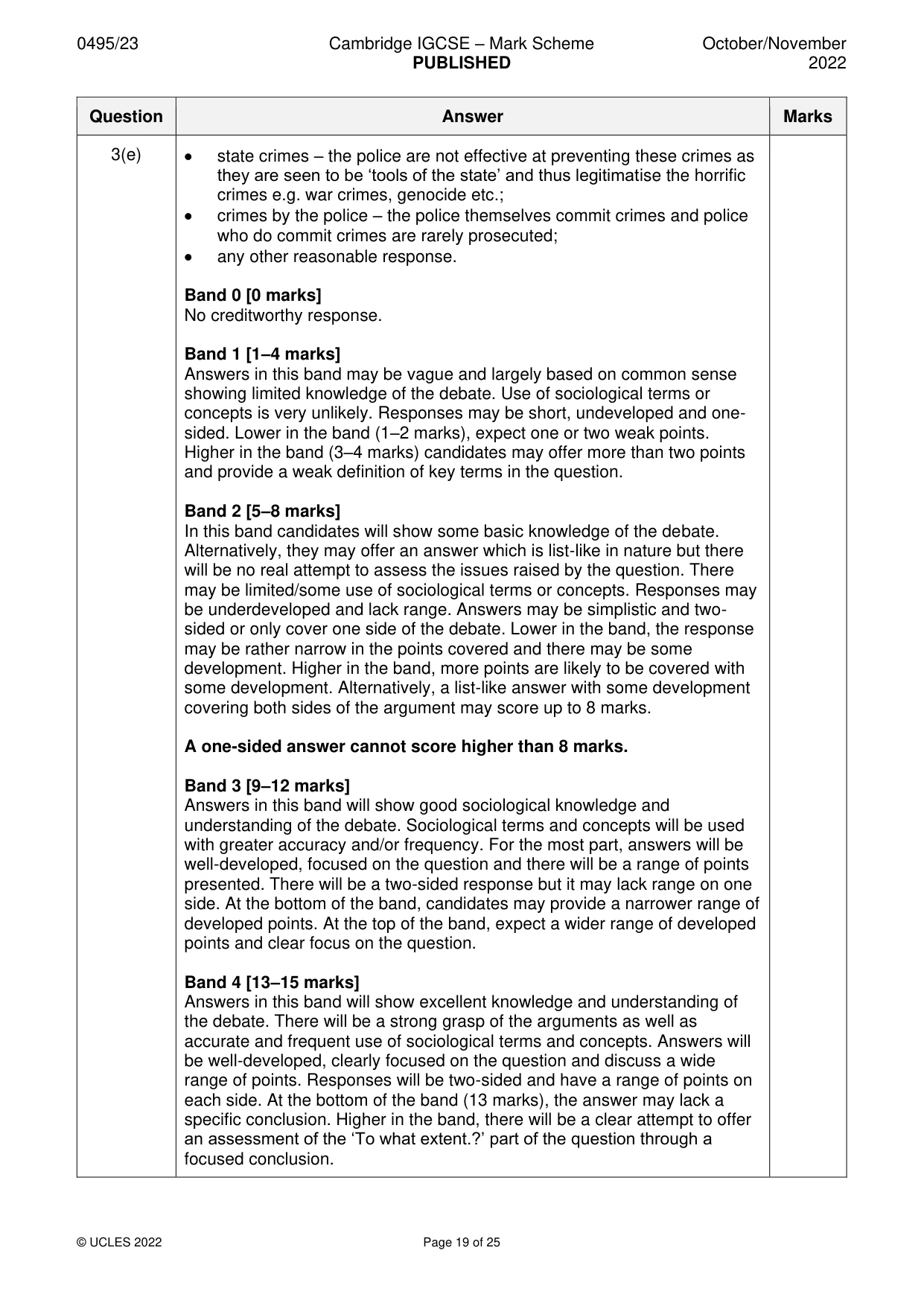
Mark scheme: 3(a) What is meant by the term ‘sanctions’? 2 One mark for a partial definition, e.g. a prison sentence. Two marks for a clear definition, e.g. punishment or penalties for behaviour not conforming to norms and values. 3(b) Describe two problems with using self-report studies to find out how 4 much crime is committed. Possible responses: • Validity – how certain can the researcher be that people have told the truth about the amount of crime committed e.g. exaggerating what they have done or not admitting to crimes; • Representativeness – many self-report studies are administered to adolescents which means not all crimes committed are covered e.g. corporate and white-collar crimes; • Generalisability – due to the issues with self-report studies not being representative the results from them cannot be generalised therefore many sociologists question how useful they really are; • Relevance – a lot of self-report studies ask about quite trivial crimes e.g. not paying fares on public transport, therefore they may test honesty more than criminality; • Gender – self-report studies question whether men really are much more likely than women to engage in criminal behaviour but many sociologists believe this may be due to the focus on more trivial crimes and acts of deviance rather than female criminality; • Age – self-report studies are often used with youths who may experience peer pressure to exaggerate their criminality in order to maintain their status and image with their peers; • Any other reasonable response. One mark for each point correctly identified (up to a maximum of two). One mark for each point that is developed (up to a maximum of two). 3(c) Explain how agencies of social control can prevent females from 6 committing crimes. Possible responses: • parental curfews/rules – girls are typically given earlier curfews and may not be allowed outside alone, this makes committing crime more difficult; • differential gendered socialisation – Oakley – boys and girls are socialised very differently, girls to be passive and gentle, boys to be active and tough – this effectively controls females not to commit crime e.g. canalisation; • workplace – men and women typically work in very different jobs thus women have far less access to employment that would make white- collar/corporate crime easier; • education – hidden curriculum – females learn their gender expectations and roles through the norms and values that are encouraged at school and this effectively controls them to not commit crime; • media – the media demonises female criminals e.g. Myra Hindley and thus deters females from committing crime for fear of the consequences and negative public labels; • peer group – female peer groups tend to be more pro-school and conformist than males and therefore studying hard and working towards legal goals and deferred gratification are encouraged – this reduces levels of criminality; • prisons – can incarcerate females and separate them from their family, meaning they are temporarily unable to commit crime; • any other reasonable response. Band 0 [0 marks] No creditworthy response. Band 1 [1–3 marks] Answers in this band will show only a limited awareness of the question. Responses may be short and un/underdeveloped. At the bottom of the band (1 mark), expect one weak point. Higher in the band (2–3 marks), candidates may offer more than one weak point, but there may be a tendency towards simplistic answers, engaging with sociological ideas without using sociological language. Band 2 [4–6 marks] Answers in this band will have clear and accurate explanation, showing good sociological knowledge and understanding. Sociological terms and concepts should be expected and explained. At the bottom of the band, the range of points covered may be narrow or lack detail. Higher in the band, answers will cover more than one point in a well developed way or cover several points in less detail. 3(d) Explain why people who commit corporate crimes are often not 8 prosecuted. Possible responses: • recording rates – these types of crimes are less likely to be reported to the authorities and so are rarely prosecuted; • stereotypical offenders – corporate criminals do not match the stereotypes held by the police of the typical offender (Cicourel) and therefore individuals are more likely to get away with crimes; • avoiding publicity – prosecutions for corporate crimes are less likely as companies want to avoid negative publicity that a criminal investigation would lead to therefore the perpetrators are often not prosecuted; • ruling class definitions – crime is defined by the ruling class and therefore many actions of the ruling class are not defined as crimes – if they are they are usually dealt with less severely than working class crimes meaning prosecution rates are less; • health and safety breaches – Tombs and Whyte – only 5% of these are investigated by the police therefore prosecutions are very rare; • multinational corporations’ power – in cases that attract media/public attention, one employee often takes the blame for the crime (is scapegoated) while the company itself is not charged – prosecutions of all those involved are therefore unlikely; • power – those committing corporate crime are often part of the powerful elite with much social and economic capital (Bourdieu) – social networks can thus be used in order to negotiate justice and avoid prosecution; • any other reasonable response. Band 0 [0 marks] No creditworthy response. Band 1 [1–3 marks] Answers in this band will show only a limited awareness of the question. A tendency to description is likely. Responses may be short and undeveloped and points stated without explanation. Sociological terms and concepts are unlikely to be used. At the bottom of the band (1 mark), expect one weak point. Higher in the band (2–3 marks), candidates may offer more than one weak point. Band 2 [4–6 marks] Answers in this band will show basic sociological knowledge and understanding. Responses maybe underdeveloped and lacking in range. At the bottom of the band, candidates are unlikely to use sociological terms and concepts accurately. Higher in the band, candidates may be beginning to use sociological terms and concepts with greater accuracy. However, some aspects of the answer may only be partially developed/explained. Band 3 [7–8 marks] Answers in this band will show good sociological knowledge and understanding and will be well-developed and explained. Sociological terms and concepts will be used accurately overall. Answers will be well- focused on the question and there will be a range of points presented. At the top of the band explanations will be clear throughout. 3(e) To what extent are the police effective in controlling crime? 15 Possible responses: Arguments for: • police presence – this deters criminals and keeps residents safe; • Marxists – police control crime effectively to benefit the ruling class as they are often used to control protests and demonstrations; • military policing – this is effective as the fear of force and weaponry keeps social order in urban areas; • community policing – working with and alongside members of the public is effective as the public trust and will report information to the police; • international cooperation – policing across borders is increasingly effective as police forces in different countries use digital technology to work together in the fight against crime; • surveillance – the police use surveillance in order to improve their effectiveness at controlling crime e.g. CCTV, ICT monitoring and tracking, undercover work, tracking credit cards etc.; • zero tolerance policing – the police acted against minor offences to send out the message that no form of criminality would be accepted in the community – this has seen big drops in the crime rate; • functionalism – the police help to maintain social solidarity and social order through upholding the law; • specialist units – the police have developed their teams to be more specialist in many areas which has meant more successful and effective policing takes place e.g. sexual crimes, gangs, drugs, paedophilia etc.; • any other reasonable response. Arguments against: • stereotypes, typical offender (Cicourel) – the police label certain social groups as more likely to be criminal than others and target these groups. This means others are able to get away with crime; • institutional racism – the McPherson Report identified that racist practices and assumptions run through the police force so minority ethnic groups are more likely to be arrested/prosecuted than others; • Pollak – chivalry thesis – some sociologists believe that women are able to get away with crime as they are not perceived as capable of many types of crimes; • deviancy amplification – actions of the police e.g. stop and search, BLM protests, may lead to resentment and behaviour the police can define as criminal; • the dark figure of crime – research shows that most criminals get away with their crimes and are not prosecuted, this is not effectively controlling crime; • feminism – victims of abuse and sexual attacks – these victims would not see the police as effective as it has been shown that convictions are few and far between; • Marxism – resistance – e.g. the London Riots 2011, Egyptian protests 2013, global BLM protests 2020/2021 – the police are not effective at controlling crime as instead of focusing on serious criminals they focus on activism/protest movements, causing social unrest and increasing social injustices rather than preventing crime; 3(e) • state crimes – the police are not effective at preventing these crimes as they are seen to be ‘tools of the state’ and thus legitimatise the horrific crimes e.g. war crimes, genocide etc.; • crimes by the police – the police themselves commit crimes and police who do commit crimes are rarely prosecuted; • any other reasonable response. Band 0 [0 marks] No creditworthy response. Band 1 [1–4 marks] Answers in this band may be vague and largely based on common sense showing limited knowledge of the debate. Use of sociological terms or concepts is very unlikely. Responses may be short, undeveloped and one- sided. Lower in the band (1–2 marks), expect one or two weak points. Higher in the band (3–4 marks) candidates may offer more than two points and provide a weak definition of key terms in the question. Band 2 [5–8 marks] In this band candidates will show some basic knowledge of the debate. Alternatively, they may offer an answer which is list-like in nature but there will be no real attempt to assess the issues raised by the question. There may be limited/some use of sociological terms or concepts. Responses may be underdeveloped and lack range. Answers may be simplistic and two- sided or only cover one side of the debate. Lower in the band, the response may be rather narrow in the points covered and there may be some development. Higher in the band, more points are likely to be covered with some development. Alternatively, a list-like answer with some development covering both sides of the argument may score up to 8 marks. A one-sided answer cannot score higher than 8 marks. Band 3 [9–12 marks] Answers in this band will show good sociological knowledge and understanding of the debate. Sociological terms and concepts will be used with greater accuracy and/or frequency. For the most part, answers will be well-developed, focused on the question and there will be a range of points presented. There will be a two-sided response but it may lack range on one side. At the bottom of the band, candidates may provide a narrower range of developed points. At the top of the band, expect a wider range of developed points and clear focus on the question. Band 4 [13–15 marks] Answers in this band will show excellent knowledge and understanding of the debate. There will be a strong grasp of the arguments as well as accurate and frequent use of sociological terms and concepts. Answers will be well-developed, clearly focused on the question and discuss a wide range of points. Responses will be two-sided and have a range of points on each side. At the bottom of the band (13 marks), the answer may lack a specific conclusion. Higher in the band, there will be a clear attempt to offer an assessment of the ‘To what extent.?’ part of the question through a focused conclusion.
Q4 · Some sociologists argue that there are now more positive media representations of gender…
4 Some sociologists argue that there are now more positive media representations of gender, age and disability. However, not all sociologists are so positive, for example Marxists are particularly critical of traditional media. Other sociologists criticise the amount of violence in the media and the effects this violence can have on society. Despite this, all sociologists agree that we now live in a media culture. (a) What is meant by the term ‘media culture’? [2] (b) Describe two examples of traditional media. [4] (c) Explain how media representations of disability are now more positive. [6] (d) Explain why Marxists criticise media content. [8] (e) To what extent is violence in society caused by violence in the media? [15]
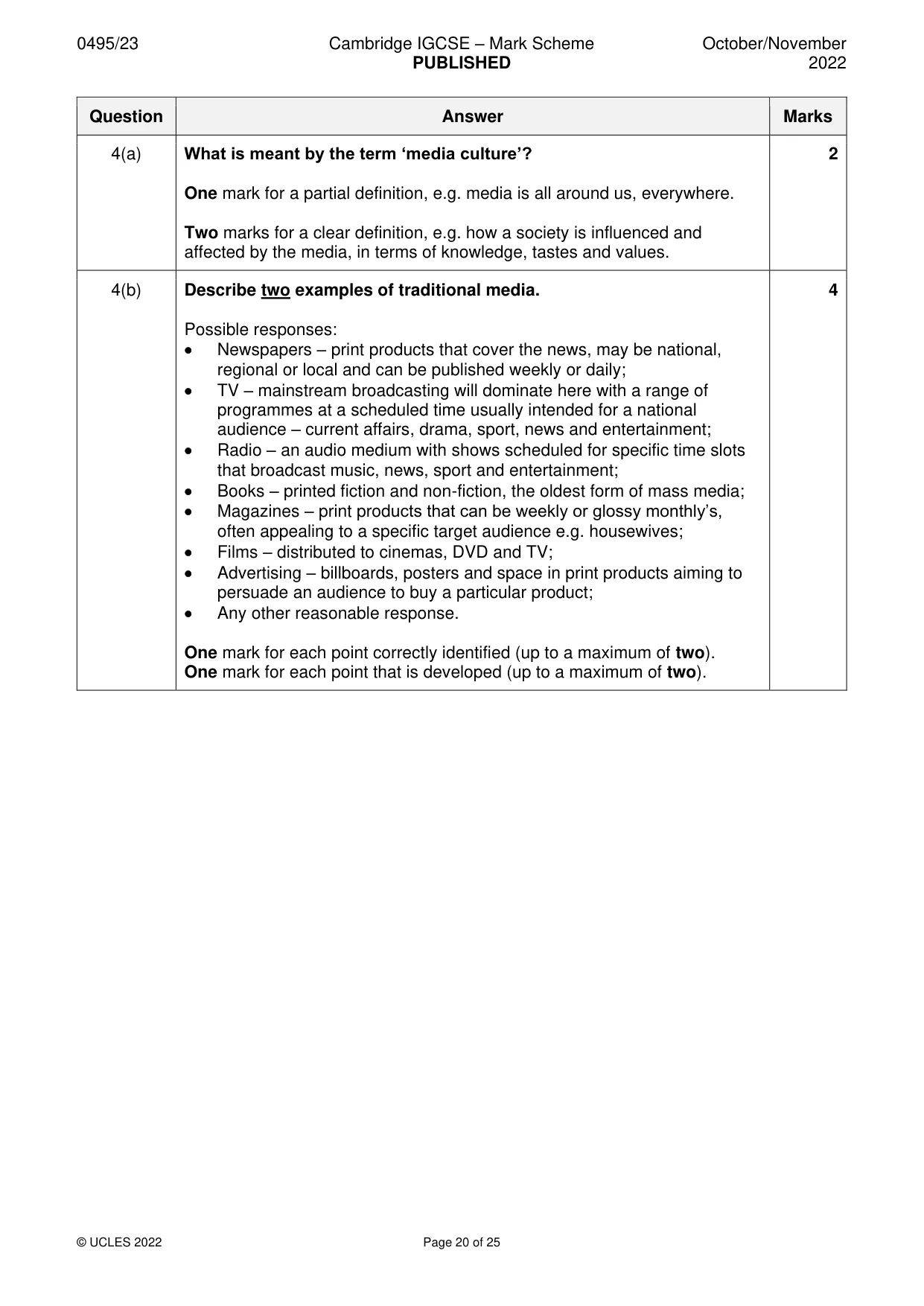
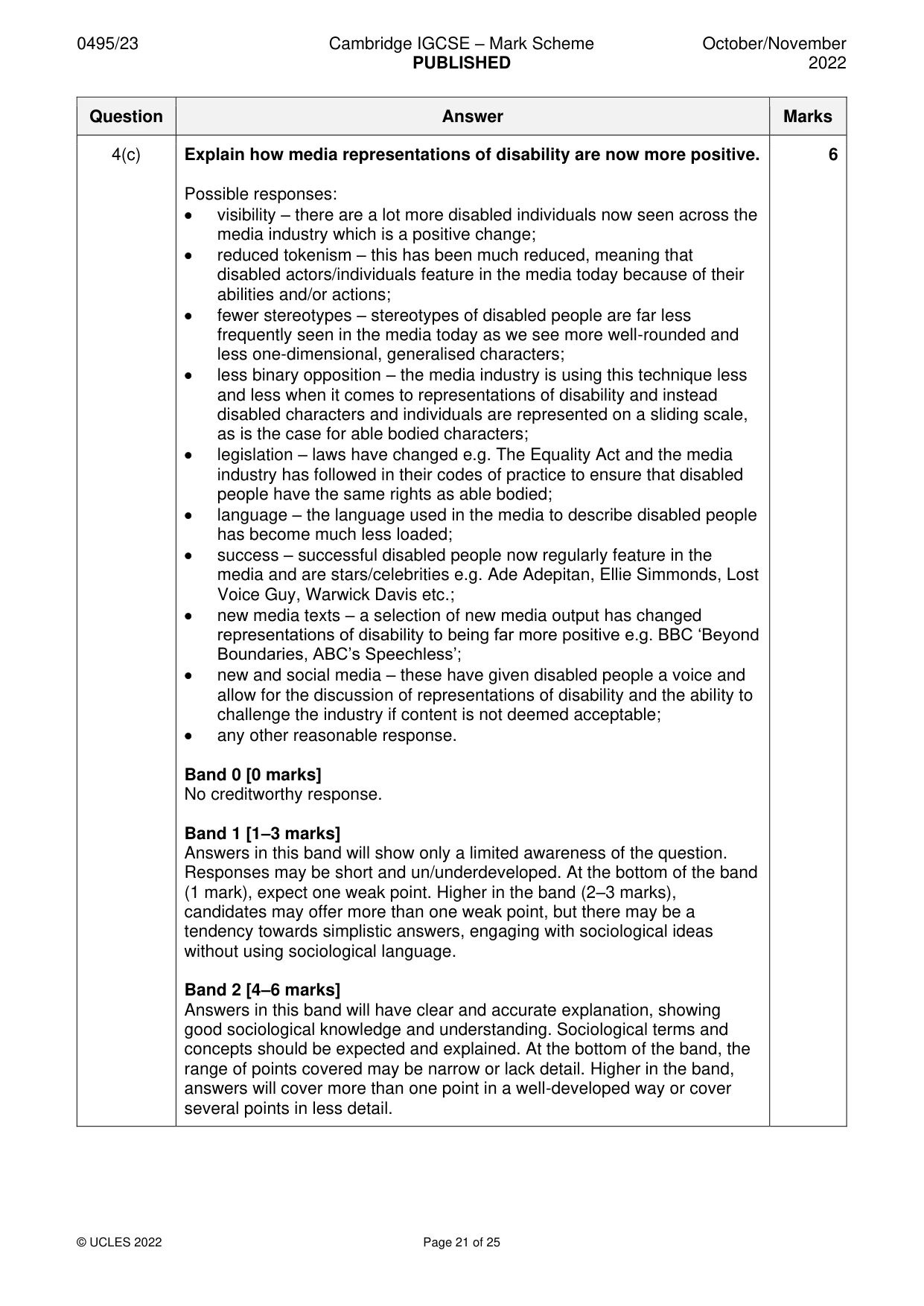
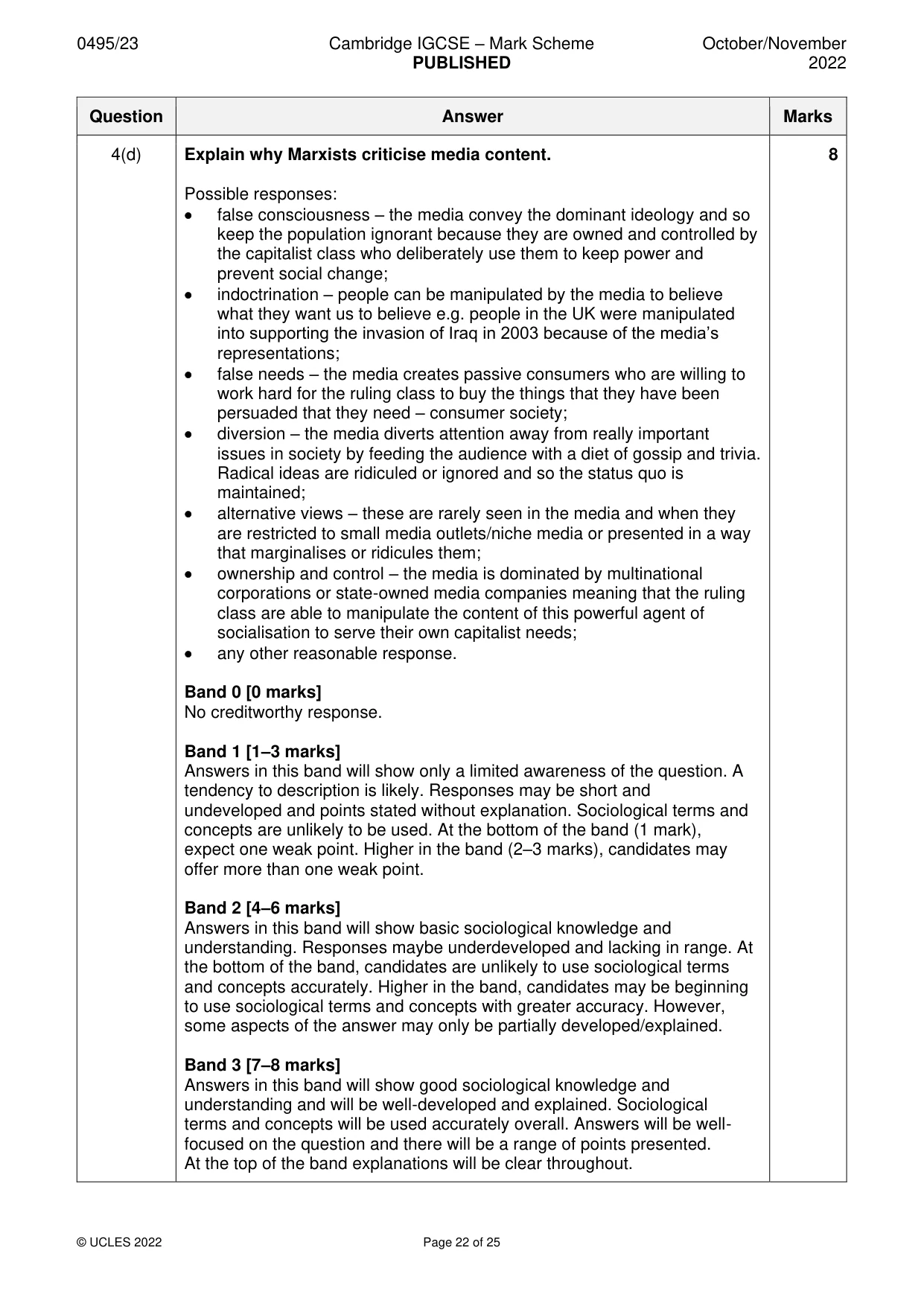
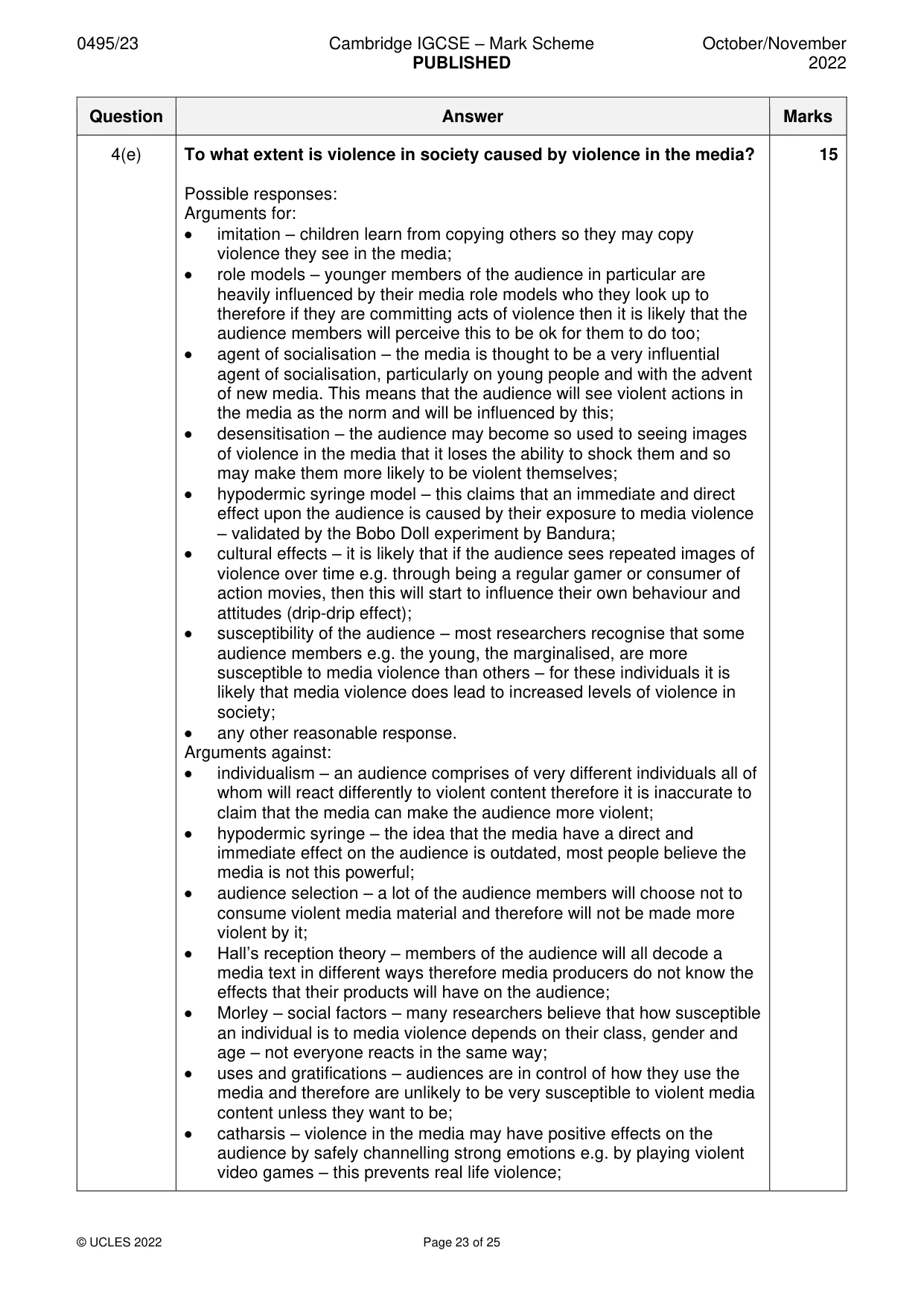
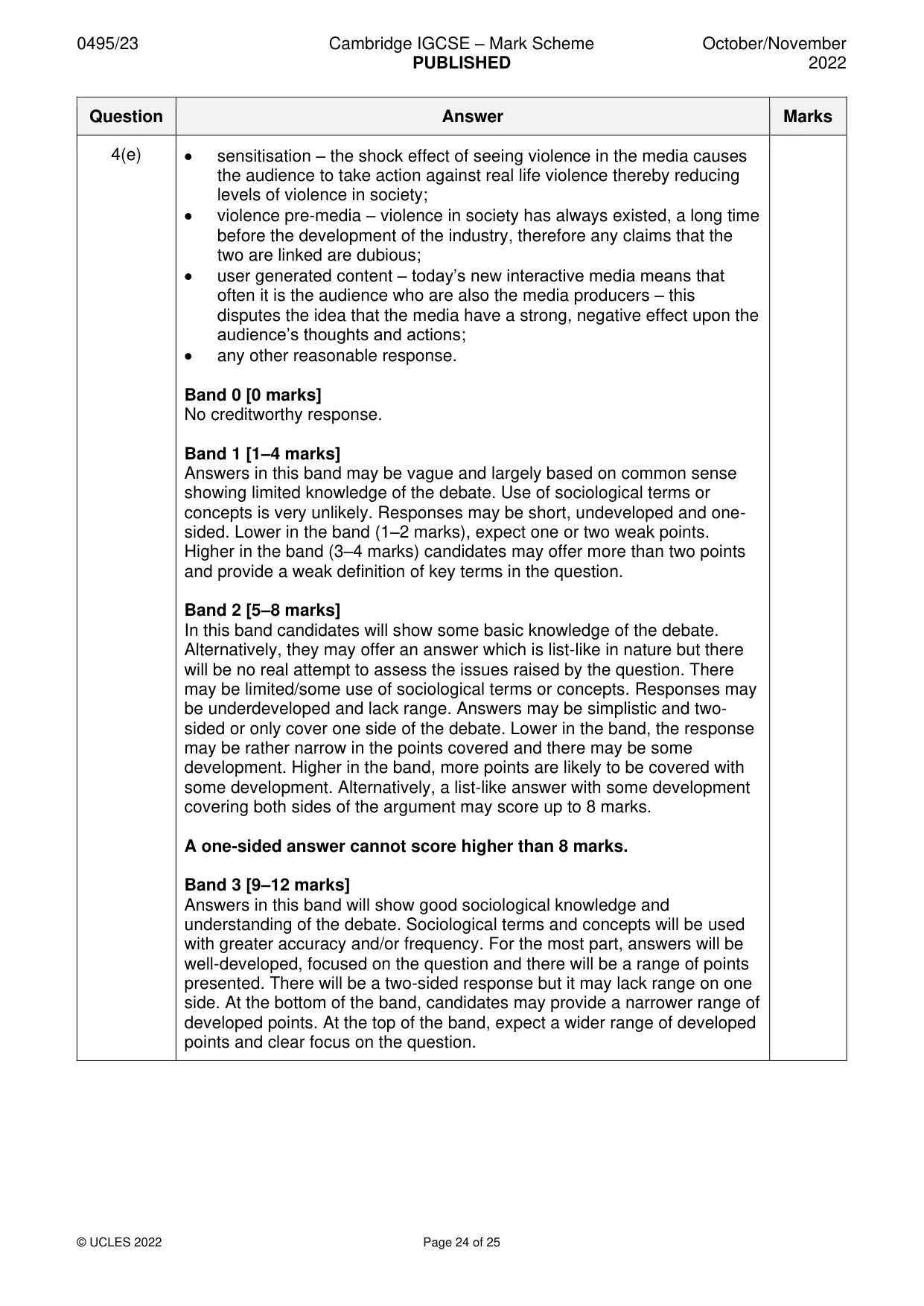
Mark scheme: 4(a) What is meant by the term ‘media culture’? 2 One mark for a partial definition, e.g. media is all around us, everywhere. Two marks for a clear definition, e.g. how a society is influenced and affected by the media, in terms of knowledge, tastes and values. 4(b) Describe two examples of traditional media. 4 Possible responses: • Newspapers – print products that cover the news, may be national, regional or local and can be published weekly or daily; • TV – mainstream broadcasting will dominate here with a range of programmes at a scheduled time usually intended for a national audience – current affairs, drama, sport, news and entertainment; • Radio – an audio medium with shows scheduled for specific time slots that broadcast music, news, sport and entertainment; • Books – printed fiction and non-fiction, the oldest form of mass media; • Magazines – print products that can be weekly or glossy monthly’s, often appealing to a specific target audience e.g. housewives; • Films – distributed to cinemas, DVD and TV; • Advertising – billboards, posters and space in print products aiming to persuade an audience to buy a particular product; • Any other reasonable response. One mark for each point correctly identified (up to a maximum of two). One mark for each point that is developed (up to a maximum of two). 4(c) Explain how media representations of disability are now more positive. 6 Possible responses: • visibility – there are a lot more disabled individuals now seen across the media industry which is a positive change; • reduced tokenism – this has been much reduced, meaning that disabled actors/individuals feature in the media today because of their abilities and/or actions; • fewer stereotypes – stereotypes of disabled people are far less frequently seen in the media today as we see more well-rounded and less one-dimensional, generalised characters; • less binary opposition – the media industry is using this technique less and less when it comes to representations of disability and instead disabled characters and individuals are represented on a sliding scale, as is the case for able bodied characters; • legislation – laws have changed e.g. The Equality Act and the media industry has followed in their codes of practice to ensure that disabled people have the same rights as able bodied; • language – the language used in the media to describe disabled people has become much less loaded; • success – successful disabled people now regularly feature in the media and are stars/celebrities e.g. Ade Adepitan, Ellie Simmonds, Lost Voice Guy, Warwick Davis etc.; • new media texts – a selection of new media output has changed representations of disability to being far more positive e.g. BBC ‘Beyond Boundaries, ABC’s Speechless’; • new and social media – these have given disabled people a voice and allow for the discussion of representations of disability and the ability to challenge the industry if content is not deemed acceptable; • any other reasonable response. Band 0 [0 marks] No creditworthy response. Band 1 [1–3 marks] Answers in this band will show only a limited awareness of the question. Responses may be short and un/underdeveloped. At the bottom of the band (1 mark), expect one weak point. Higher in the band (2–3 marks), candidates may offer more than one weak point, but there may be a tendency towards simplistic answers, engaging with sociological ideas without using sociological language. Band 2 [4–6 marks] Answers in this band will have clear and accurate explanation, showing good sociological knowledge and understanding. Sociological terms and concepts should be expected and explained. At the bottom of the band, the range of points covered may be narrow or lack detail. Higher in the band, answers will cover more than one point in a well-developed way or cover several points in less detail. 4(d) Explain why Marxists criticise media content. 8 Possible responses: • false consciousness – the media convey the dominant ideology and so keep the population ignorant because they are owned and controlled by the capitalist class who deliberately use them to keep power and prevent social change; • indoctrination – people can be manipulated by the media to believe what they want us to believe e.g. people in the UK were manipulated into supporting the invasion of Iraq in 2003 because of the media’s representations; • false needs – the media creates passive consumers who are willing to work hard for the ruling class to buy the things that they have been persuaded that they need – consumer society; • diversion – the media diverts attention away from really important issues in society by feeding the audience with a diet of gossip and trivia. Radical ideas are ridiculed or ignored and so the status quo is maintained; • alternative views – these are rarely seen in the media and when they are restricted to small media outlets/niche media or presented in a way that marginalises or ridicules them; • ownership and control – the media is dominated by multinational corporations or state-owned media companies meaning that the ruling class are able to manipulate the content of this powerful agent of socialisation to serve their own capitalist needs; • any other reasonable response. Band 0 [0 marks] No creditworthy response. Band 1 [1–3 marks] Answers in this band will show only a limited awareness of the question. A tendency to description is likely. Responses may be short and undeveloped and points stated without explanation. Sociological terms and concepts are unlikely to be used. At the bottom of the band (1 mark), expect one weak point. Higher in the band (2–3 marks), candidates may offer more than one weak point. Band 2 [4–6 marks] Answers in this band will show basic sociological knowledge and understanding. Responses maybe underdeveloped and lacking in range. At the bottom of the band, candidates are unlikely to use sociological terms and concepts accurately. Higher in the band, candidates may be beginning to use sociological terms and concepts with greater accuracy. However, some aspects of the answer may only be partially developed/explained. Band 3 [7–8 marks] Answers in this band will show good sociological knowledge and understanding and will be well-developed and explained. Sociological terms and concepts will be used accurately overall. Answers will be well- focused on the question and there will be a range of points presented. At the top of the band explanations will be clear throughout. 4(e) To what extent is violence in society caused by violence in the media? 15 Possible responses: Arguments for: • imitation – children learn from copying others so they may copy violence they see in the media; • role models – younger members of the audience in particular are heavily influenced by their media role models who they look up to therefore if they are committing acts of violence then it is likely that the audience members will perceive this to be ok for them to do too; • agent of socialisation – the media is thought to be a very influential agent of socialisation, particularly on young people and with the advent of new media. This means that the audience will see violent actions in the media as the norm and will be influenced by this; • desensitisation – the audience may become so used to seeing images of violence in the media that it loses the ability to shock them and so may make them more likely to be violent themselves; • hypodermic syringe model – this claims that an immediate and direct effect upon the audience is caused by their exposure to media violence – validated by the Bobo Doll experiment by Bandura; • cultural effects – it is likely that if the audience sees repeated images of violence over time e.g. through being a regular gamer or consumer of action movies, then this will start to influence their own behaviour and attitudes (drip-drip effect); • susceptibility of the audience – most researchers recognise that some audience members e.g. the young, the marginalised, are more susceptible to media violence than others – for these individuals it is likely that media violence does lead to increased levels of violence in society; • any other reasonable response. Arguments against: • individualism – an audience comprises of very different individuals all of whom will react differently to violent content therefore it is inaccurate to claim that the media can make the audience more violent; • hypodermic syringe – the idea that the media have a direct and immediate effect on the audience is outdated, most people believe the media is not this powerful; • audience selection – a lot of the audience members will choose not to consume violent media material and therefore will not be made more violent by it; • Hall’s reception theory – members of the audience will all decode a media text in different ways therefore media producers do not know the effects that their products will have on the audience; • Morley – social factors – many researchers believe that how susceptible an individual is to media violence depends on their class, gender and age – not everyone reacts in the same way; • uses and gratifications – audiences are in control of how they use the media and therefore are unlikely to be very susceptible to violent media content unless they want to be; • catharsis – violence in the media may have positive effects on the audience by safely channelling strong emotions e.g. by playing violent video games – this prevents real life violence; 4(e) • sensitisation – the shock effect of seeing violence in the media causes the audience to take action against real life violence thereby reducing levels of violence in society; • violence pre-media – violence in society has always existed, a long time before the development of the industry, therefore any claims that the two are linked are dubious; • user generated content – today’s new interactive media means that often it is the audience who are also the media producers – this disputes the idea that the media have a strong, negative effect upon the audience’s thoughts and actions; • any other reasonable response. Band 0 [0 marks] No creditworthy response. Band 1 [1–4 marks] Answers in this band may be vague and largely based on common sense showing limited knowledge of the debate. Use of sociological terms or concepts is very unlikely. Responses may be short, undeveloped and one- sided. Lower in the band (1–2 marks), expect one or two weak points. Higher in the band (3–4 marks) candidates may offer more than two points and provide a weak definition of key terms in the question. Band 2 [5–8 marks] In this band candidates will show some basic knowledge of the debate. Alternatively, they may offer an answer which is list-like in nature but there will be no real attempt to assess the issues raised by the question. There may be limited/some use of sociological terms or concepts. Responses may be underdeveloped and lack range. Answers may be simplistic and two- sided or only cover one side of the debate. Lower in the band, the response may be rather narrow in the points covered and there may be some development. Higher in the band, more points are likely to be covered with some development. Alternatively, a list-like answer with some development covering both sides of the argument may score up to 8 marks. A one-sided answer cannot score higher than 8 marks. Band 3 [9–12 marks] Answers in this band will show good sociological knowledge and understanding of the debate. Sociological terms and concepts will be used with greater accuracy and/or frequency. For the most part, answers will be well-developed, focused on the question and there will be a range of points presented. There will be a two-sided response but it may lack range on one side. At the bottom of the band, candidates may provide a narrower range of developed points. At the top of the band, expect a wider range of developed points and clear focus on the question. 4(e) Band 4 [13–15 marks] Answers in this band will show excellent knowledge and understanding of the debate. There will be a strong grasp of the arguments as well as accurate and frequent use of sociological terms and concepts. Answers will be well-developed, clearly focused on the question and discuss a wide range of points. Responses will be two-sided and have a range of points on each side. At the bottom of the band (13 marks), the answer may lack a specific conclusion. Higher in the band, there will be a clear attempt to offer an assessment of the ‘To what extent.?’ part of the question through a focused conclusion.
What was in this paper
The subtopics covered by these 4 questions, and how many questions each got. Open one in a new tab to see every Cambridge question on it.
What you needed in this session
Cambridge’s own grade thresholds for 2022 Oct/Nov, Paper 2 · Variant 3. A higher threshold means an easier paper — the bar moves with how the cohort did.