Cambridge IGCSE Sociology 0495 — 2022 Oct/Nov Paper 2 · Variant 2
0495/22/O/N/22 · 4 questions · 70 marks · ≈79 min
The question paper and its mark scheme, free to read here and free to download. This is Cambridge’s own paper, exactly as it was sat.
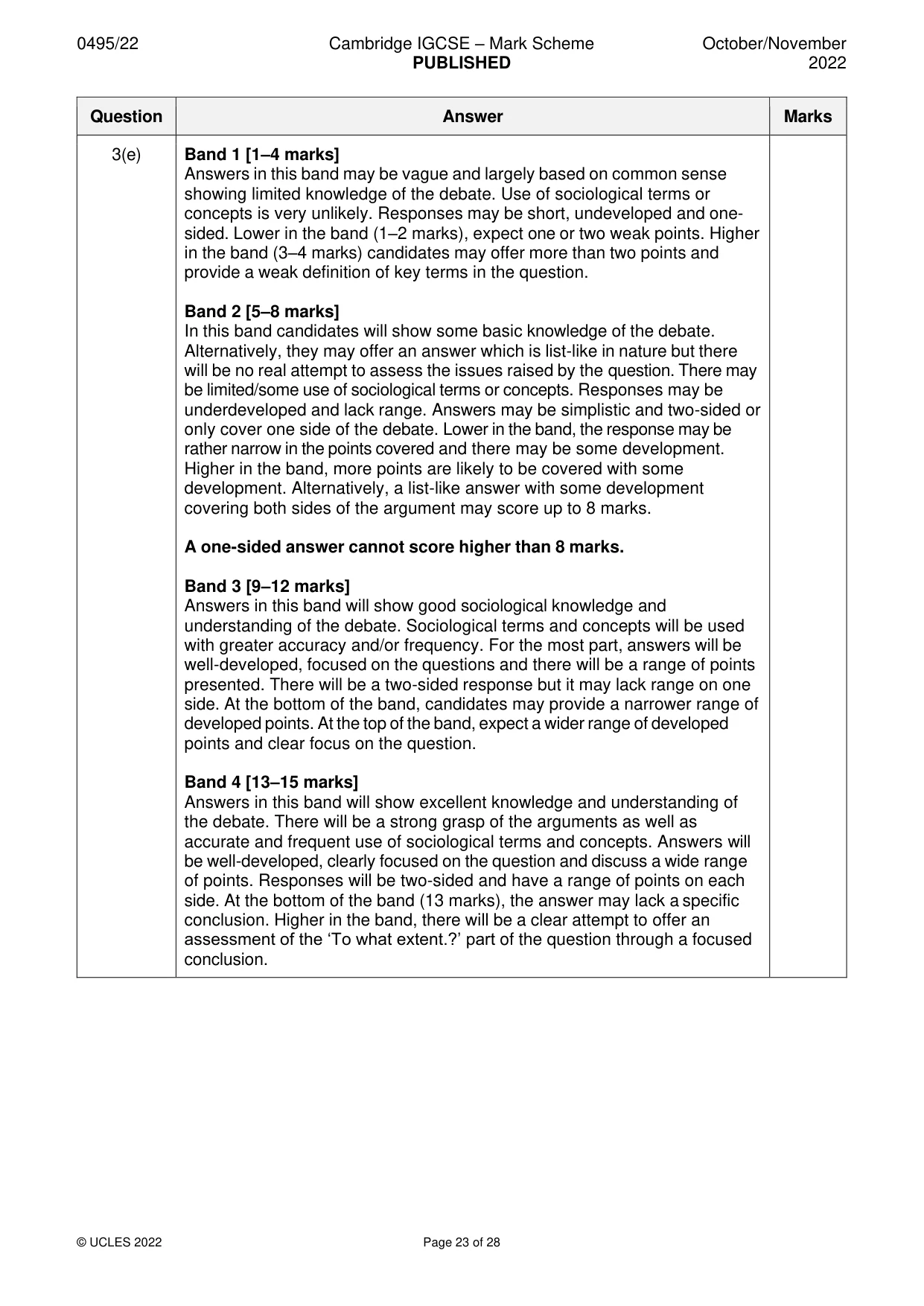
Question paper4 pages
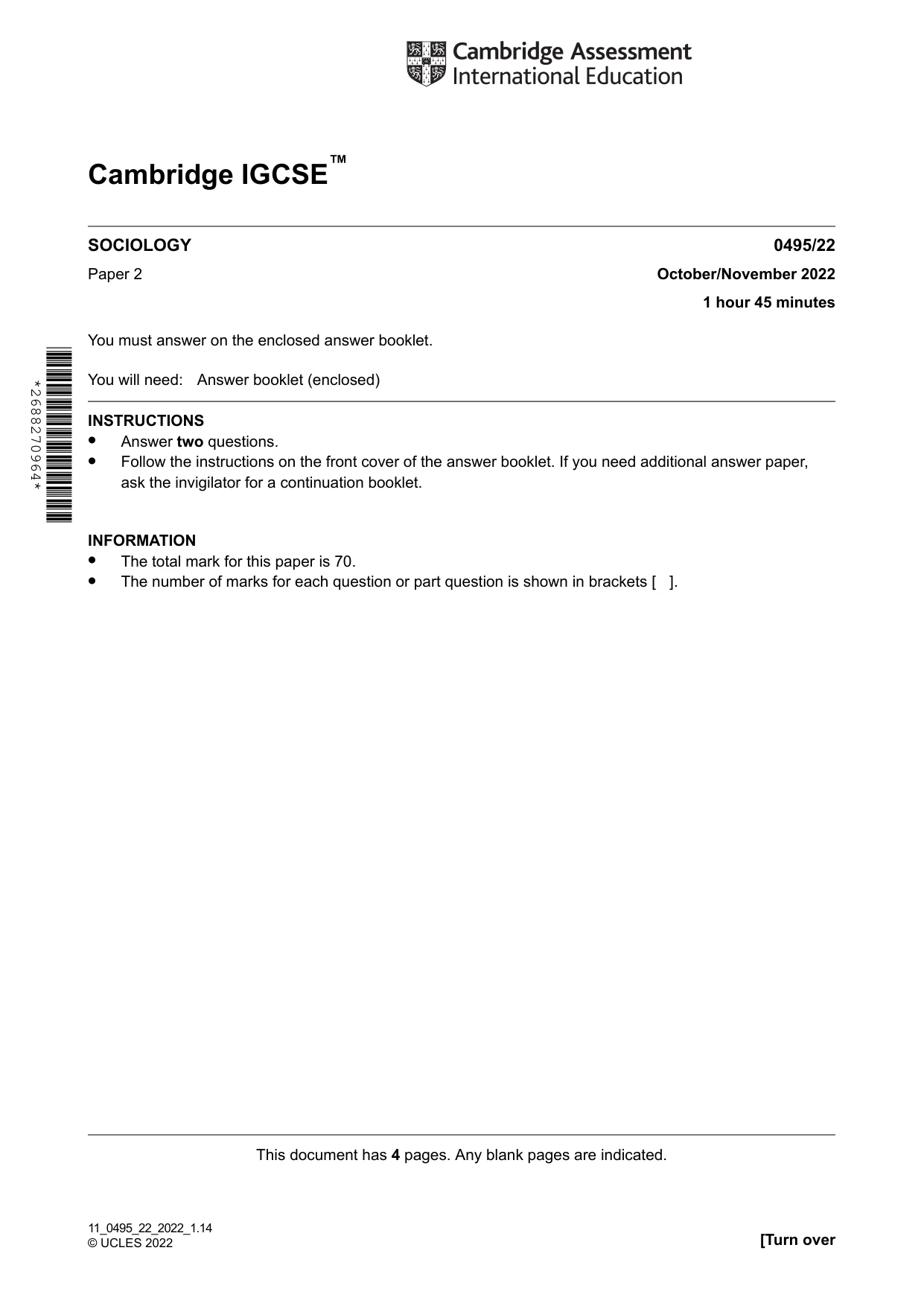
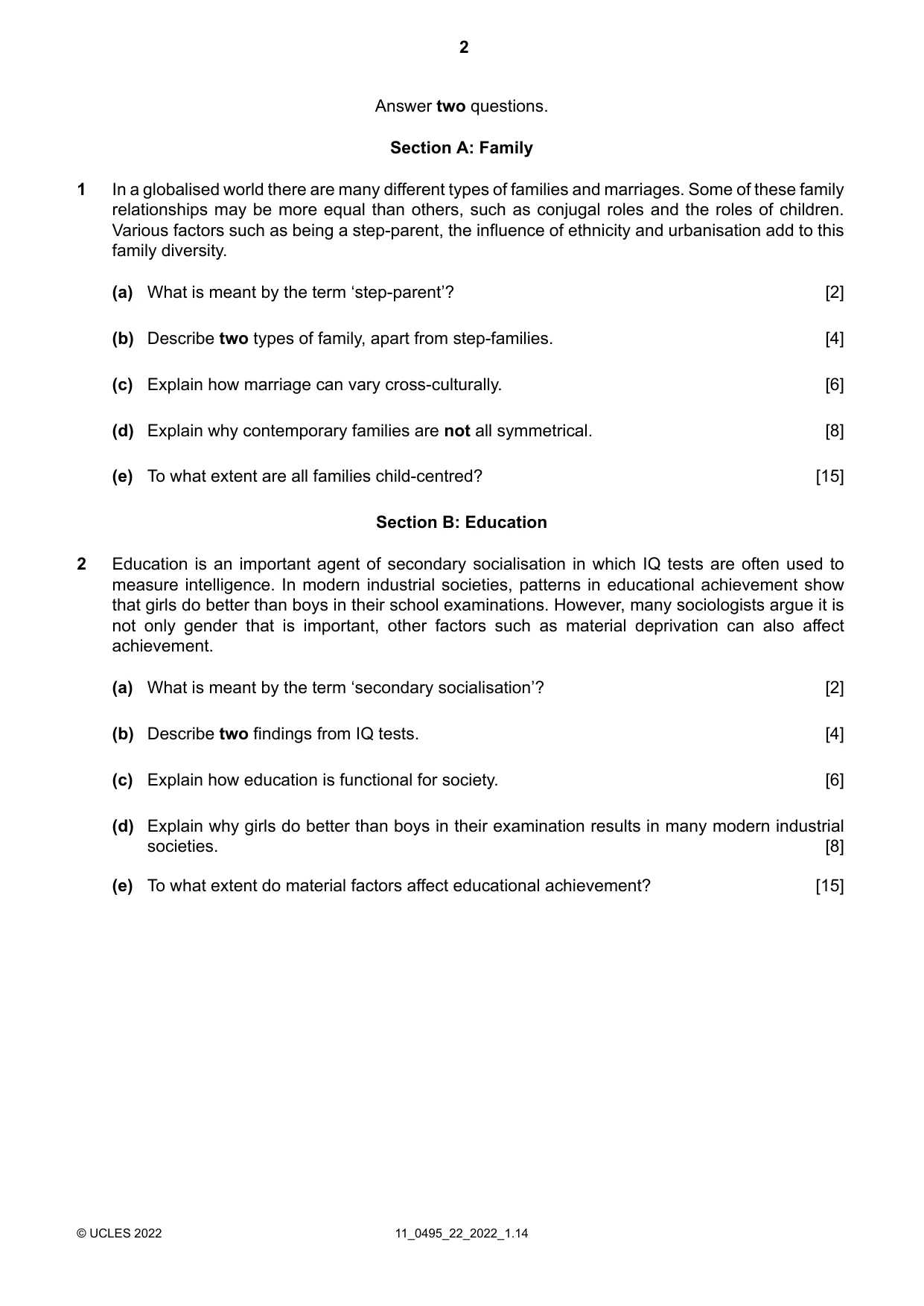
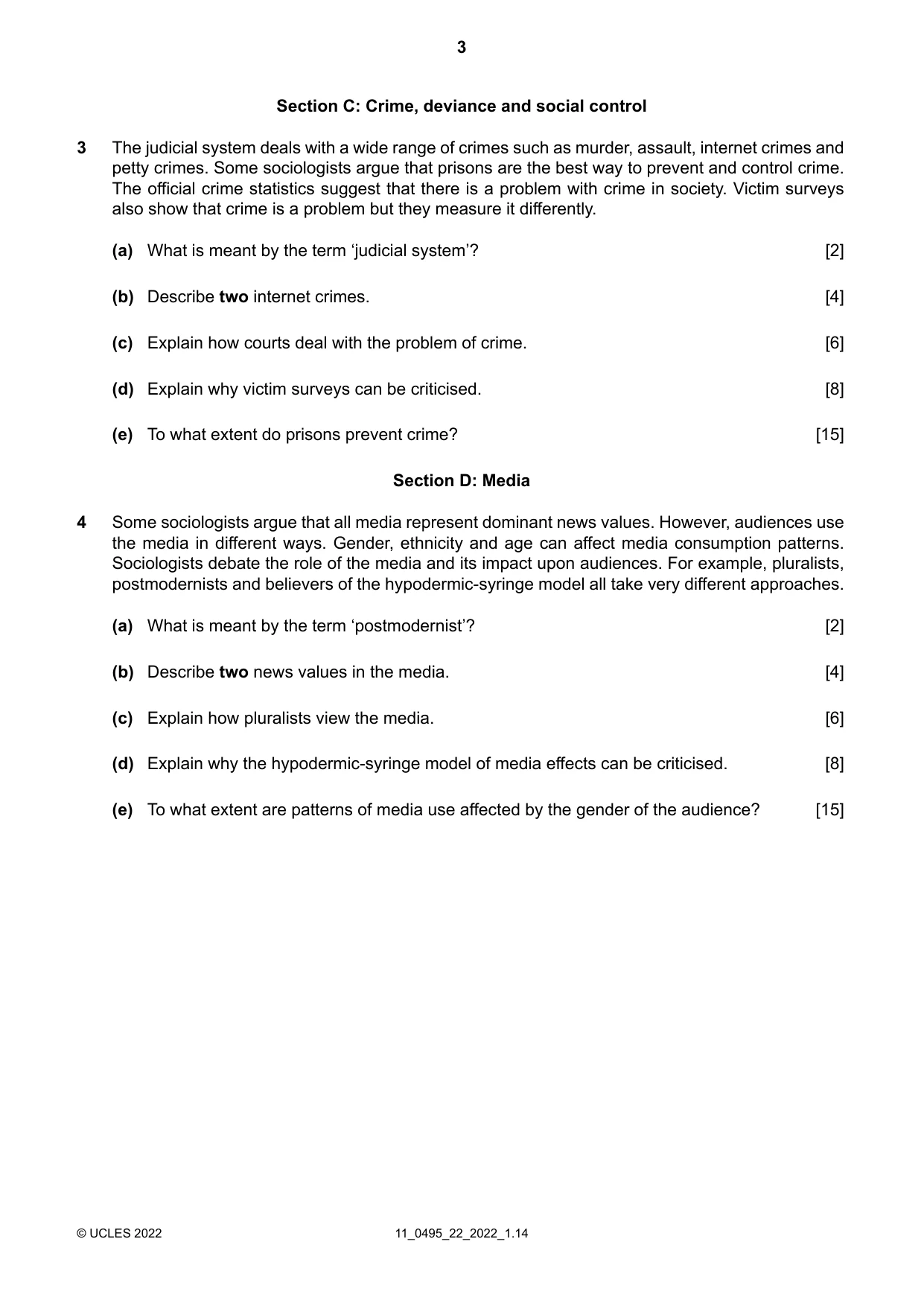

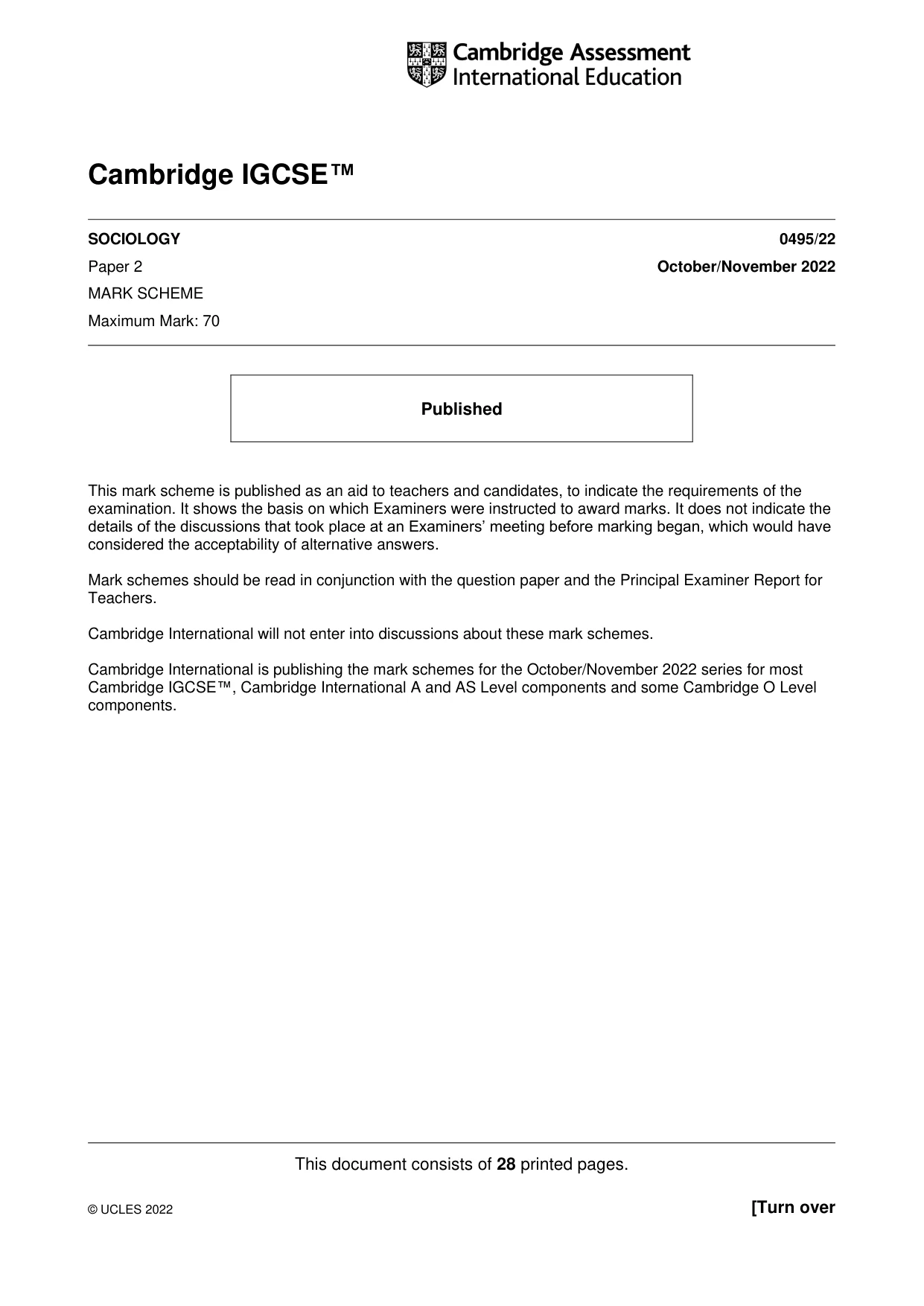
Mark scheme28 pages
Answers below. Sit the paper first if you are practising.





Questions as text
Q1 · In a globalised world there are many different types of families and marriages
1 In a globalised world there are many different types of families and marriages. Some of these family relationships may be more equal than others, such as conjugal roles and the roles of children. Various factors such as being a step-parent, the influence of ethnicity and urbanisation add to this family diversity. (a) What is meant by the term ‘step-parent’? [2] (b) Describe two types of family, apart from step-families. [4] (c) Explain how marriage can vary cross-culturally. [6] (d) Explain why contemporary families are not all symmetrical. [8] (e) To what extent are all families child-centred? [15]
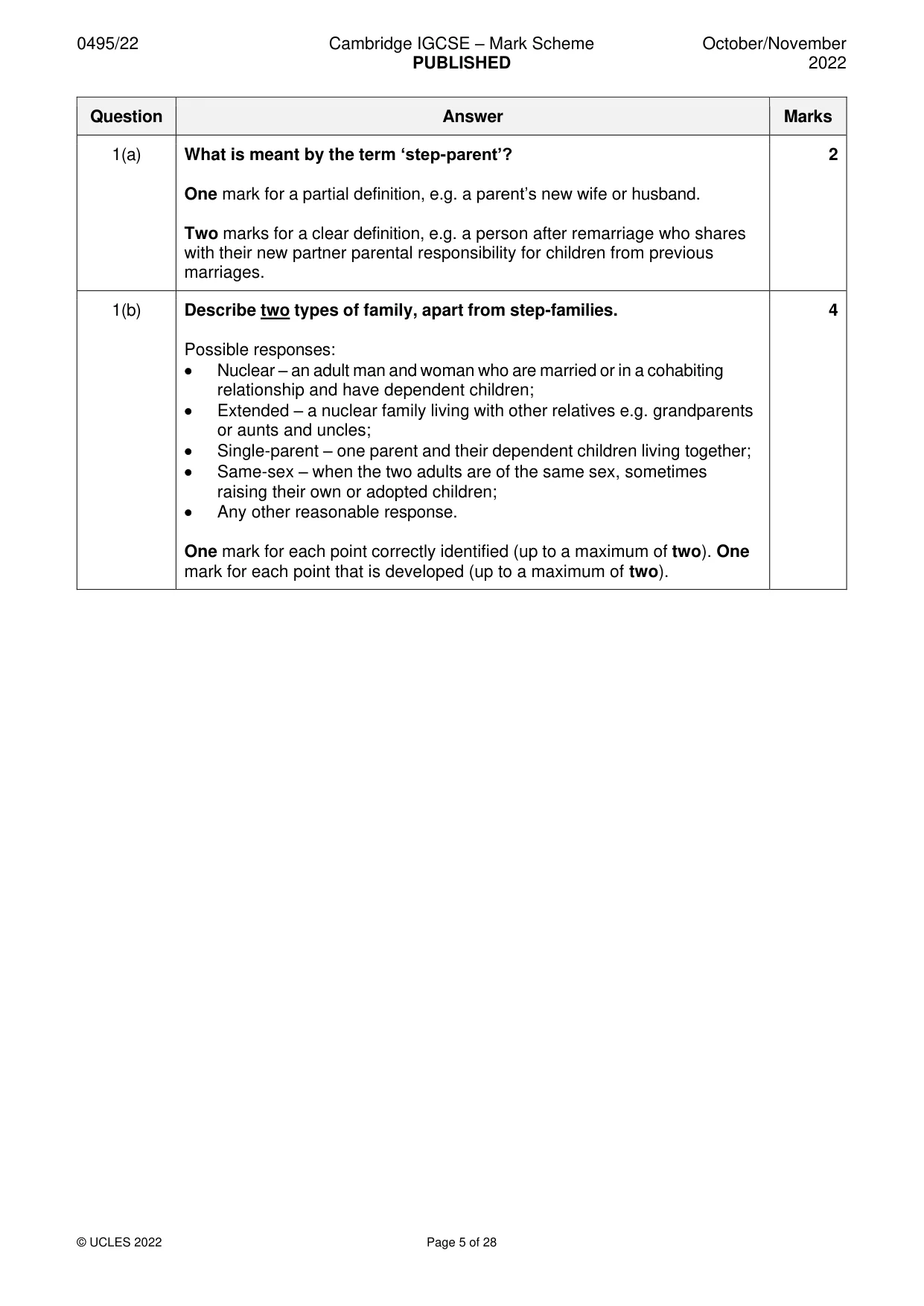
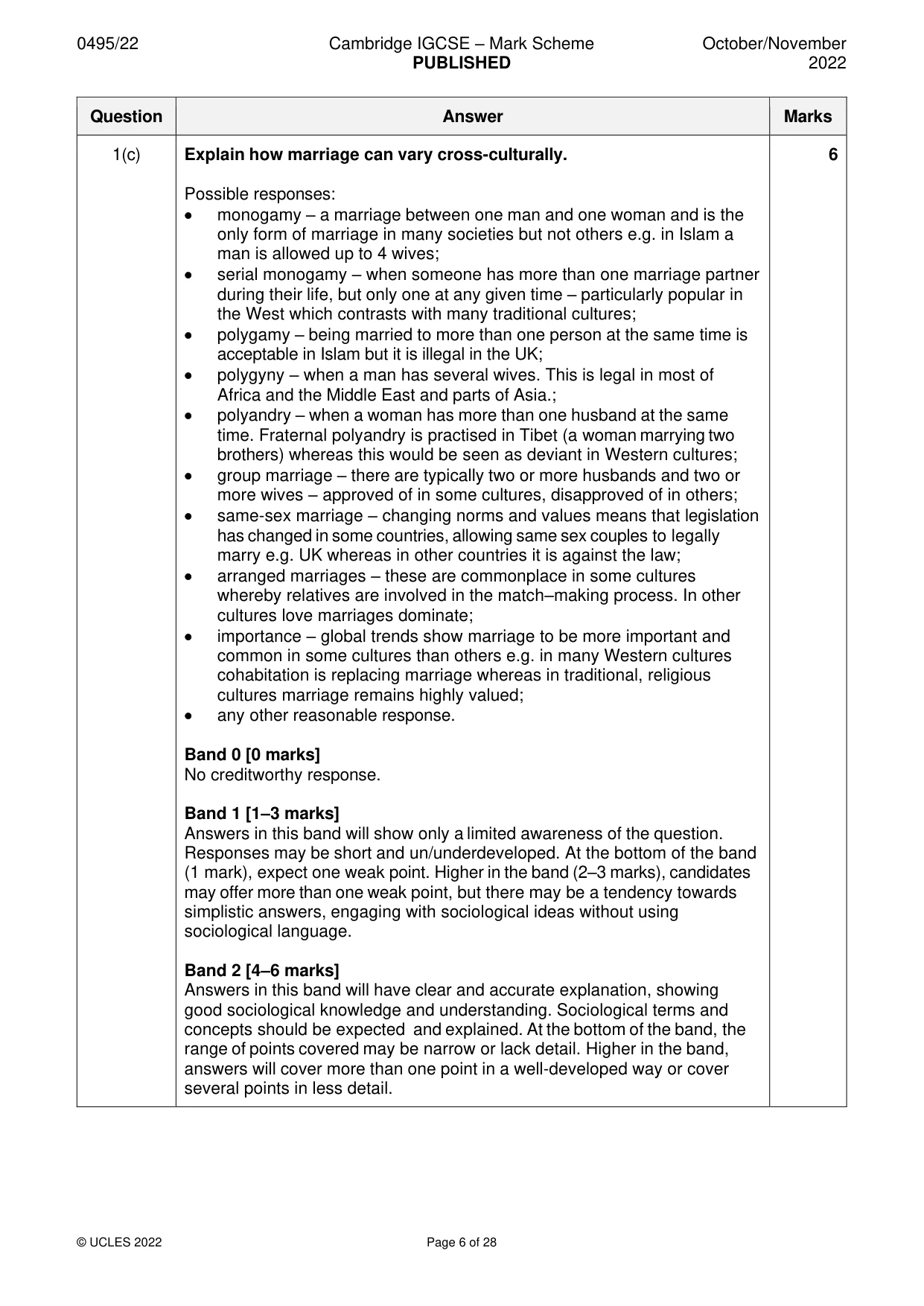
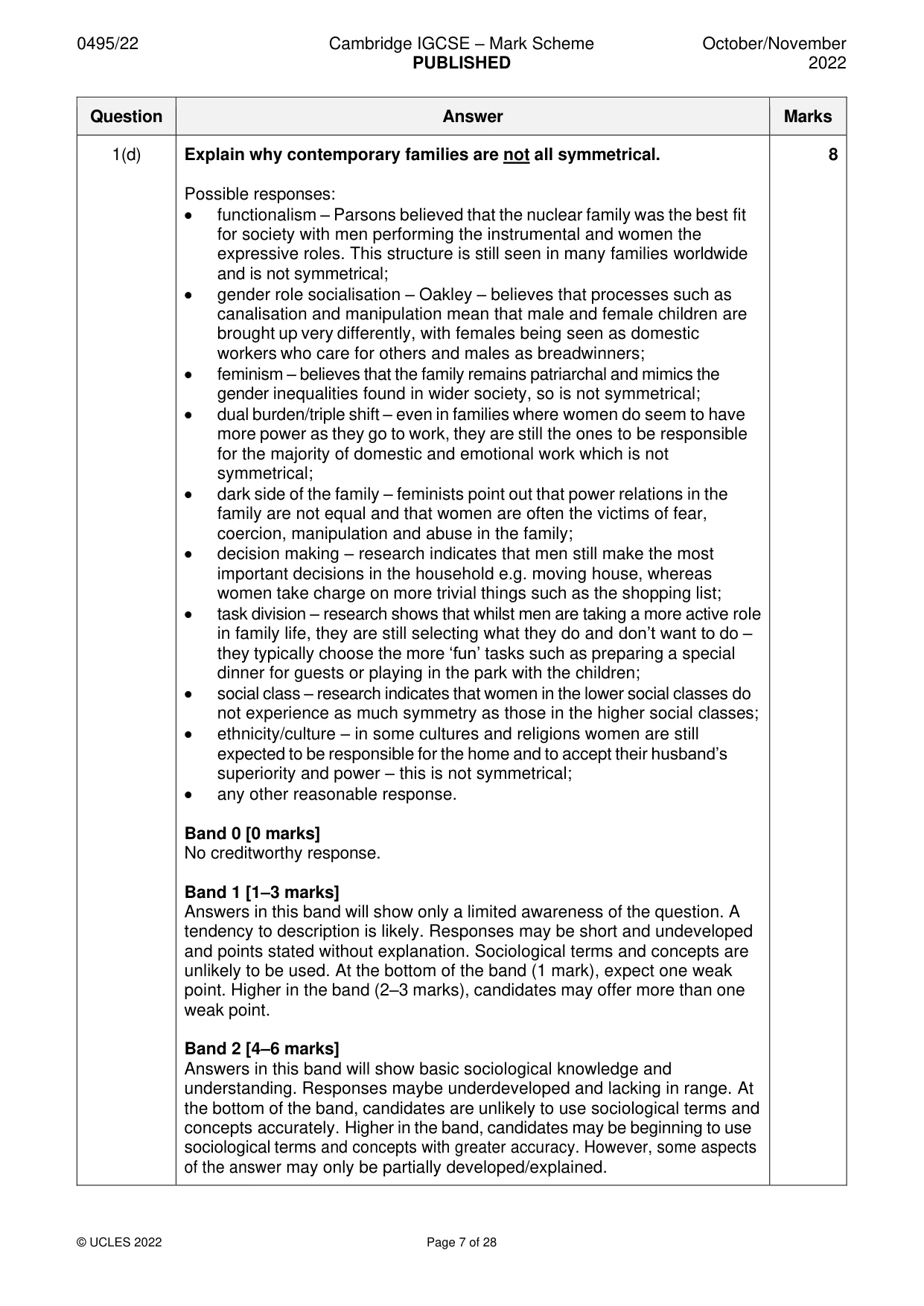
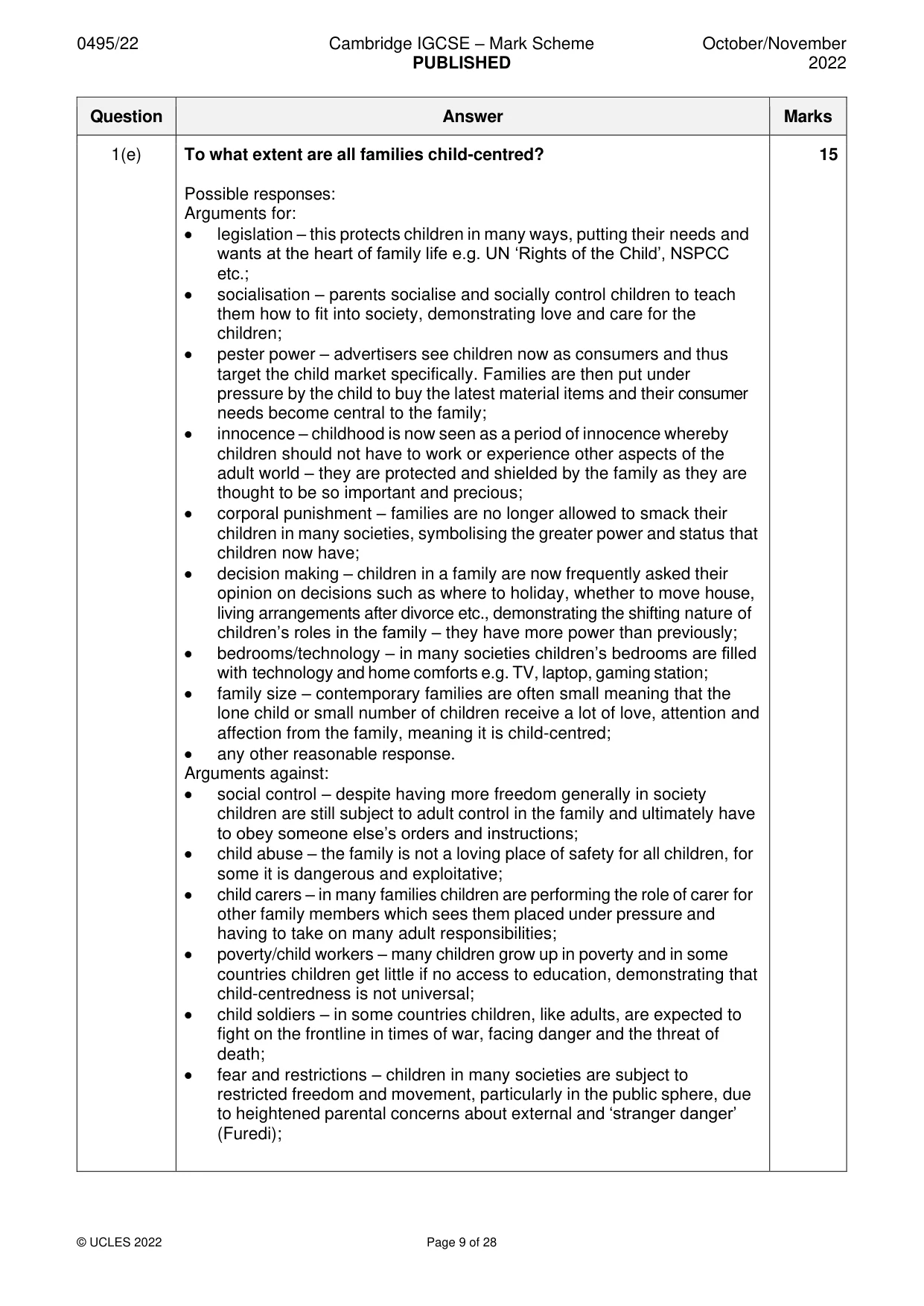
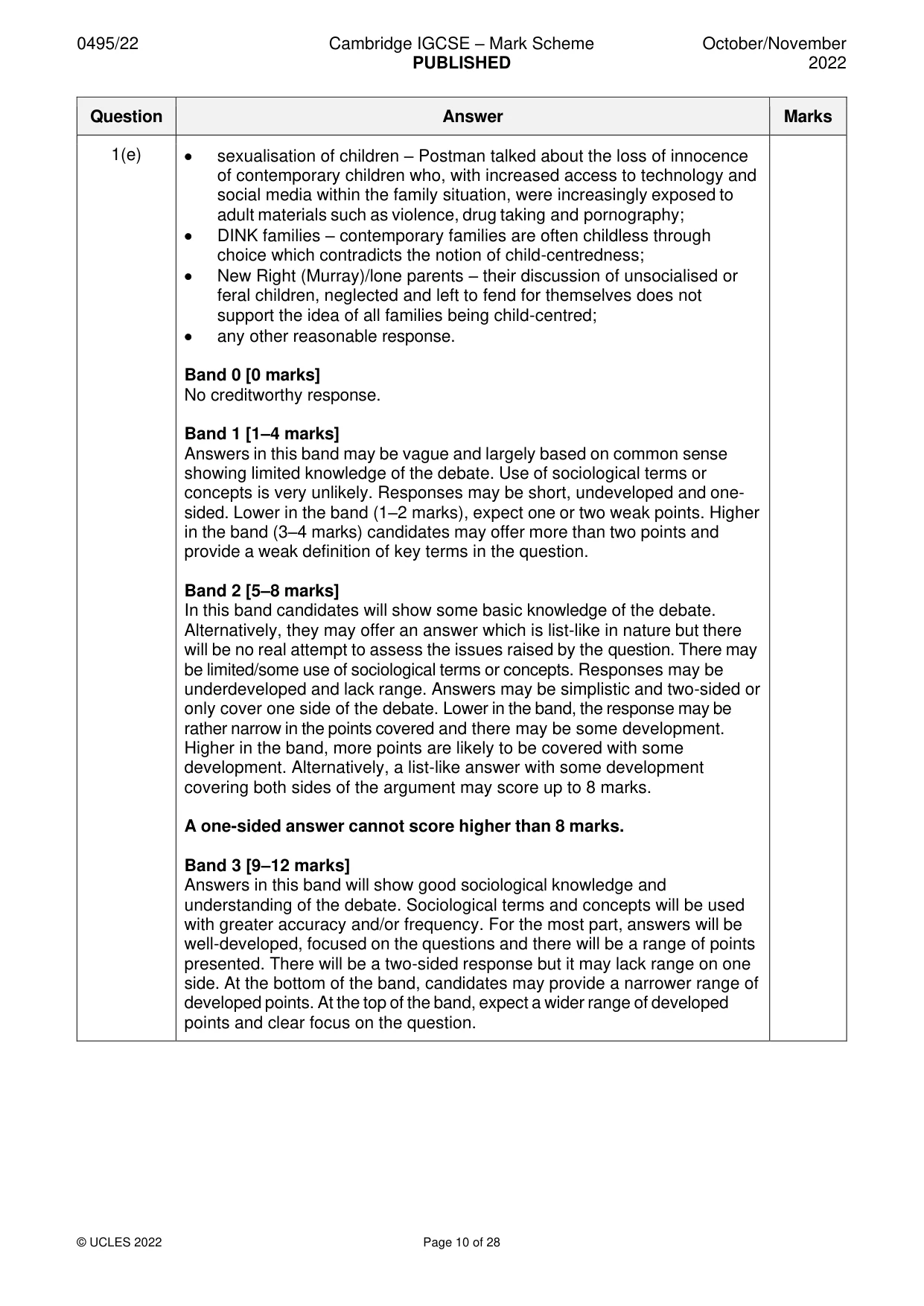
Mark scheme: Question Answer Marks 1(a) What is meant by the term ‘step-parent’? 2 One mark for a partial definition, e.g. a parent’s new wife or husband. Two marks for a clear definition, e.g. a person after remarriage who shares with their new partner parental responsibility for children from previous marriages. 1(b) Describe two types of family, apart from step-families. 4 Possible responses: • Nuclear – an adult man and woman who are married or in a cohabiting relationship and have dependent children; • Extended – a nuclear family living with other relatives e.g. grandparents or aunts and uncles; • Single-parent – one parent and their dependent children living together; • Same-sex – when the two adults are of the same sex, sometimes raising their own or adopted children; • Any other reasonable response. One mark for each point correctly identified (up to a maximum of two). One mark for each point that is developed (up to a maximum of two). 1(c) Explain how marriage can vary cross-culturally. 6 Possible responses: • monogamy – a marriage between one man and one woman and is the only form of marriage in many societies but not others e.g. in Islam a man is allowed up to 4 wives; • serial monogamy – when someone has more than one marriage partner during their life, but only one at any given time – particularly popular in the West which contrasts with many traditional cultures; • polygamy – being married to more than one person at the same time is acceptable in Islam but it is illegal in the UK; • polygyny – when a man has several wives. This is legal in most of Africa and the Middle East and parts of Asia.; • polyandry – when a woman has more than one husband at the same time. Fraternal polyandry is practised in Tibet (a woman marrying two brothers) whereas this would be seen as deviant in Western cultures; • group marriage – there are typically two or more husbands and two or more wives – approved of in some cultures, disapproved of in others; • same-sex marriage – changing norms and values means that legislation has changed in some countries, allowing same sex couples to legally marry e.g. UK whereas in other countries it is against the law; • arranged marriages – these are commonplace in some cultures whereby relatives are involved in the match–making process. In other cultures love marriages dominate; • importance – global trends show marriage to be more important and common in some cultures than others e.g. in many Western cultures cohabitation is replacing marriage whereas in traditional, religious cultures marriage remains highly valued; • any other reasonable response. Band 0 [0 marks] No creditworthy response. Band 1 [1–3 marks] Answers in this band will show only a limited awareness of the question. Responses may be short and un/underdeveloped. At the bottom of the band (1 mark), expect one weak point. Higher in the band (2–3 marks), candidates may offer more than one weak point, but there may be a tendency towards simplistic answers, engaging with sociological ideas without using sociological language. Band 2 [4–6 marks] Answers in this band will have clear and accurate explanation, showing good sociological knowledge and understanding. Sociological terms and concepts should be expected and explained. At the bottom of the band, the range of points covered may be narrow or lack detail. Higher in the band, answers will cover more than one point in a well-developed way or cover several points in less detail. 1(d) Explain why contemporary families are not all symmetrical. 8 Possible responses: • functionalism – Parsons believed that the nuclear family was the best fit for society with men performing the instrumental and women the expressive roles. This structure is still seen in many families worldwide and is not symmetrical; • gender role socialisation – Oakley – believes that processes such as canalisation and manipulation mean that male and female children are brought up very differently, with females being seen as domestic workers who care for others and males as breadwinners; • feminism – believes that the family remains patriarchal and mimics the gender inequalities found in wider society, so is not symmetrical; • dual burden/triple shift – even in families where women do seem to have more power as they go to work, they are still the ones to be responsible for the majority of domestic and emotional work which is not symmetrical; • dark side of the family – feminists point out that power relations in the family are not equal and that women are often the victims of fear, coercion, manipulation and abuse in the family; • decision making – research indicates that men still make the most important decisions in the household e.g. moving house, whereas women take charge on more trivial things such as the shopping list; • task division – research shows that whilst men are taking a more active role in family life, they are still selecting what they do and don’t want to do – they typically choose the more ‘fun’ tasks such as preparing a special dinner for guests or playing in the park with the children; • social class – research indicates that women in the lower social classes do not experience as much symmetry as those in the higher social classes; • ethnicity/culture – in some cultures and religions women are still expected to be responsible for the home and to accept their husband’s superiority and power – this is not symmetrical; • any other reasonable response. Band 0 [0 marks] No creditworthy response. Band 1 [1–3 marks] Answers in this band will show only a limited awareness of the question. A tendency to description is likely. Responses may be short and undeveloped and points stated without explanation. Sociological terms and concepts are unlikely to be used. At the bottom of the band (1 mark), expect one weak point. Higher in the band (2–3 marks), candidates may offer more than one weak point. Band 2 [4–6 marks] Answers in this band will show basic sociological knowledge and understanding. Responses maybe underdeveloped and lacking in range. At the bottom of the band, candidates are unlikely to use sociological terms and concepts accurately. Higher in the band, candidates may be beginning to use sociological terms and concepts with greater accuracy. However, some aspects of the answer may only be partially developed/explained. 1(d) Band 3 [7–8 marks] Answers in this band will show good sociological knowledge and understanding and will be well-developed and explained. Sociological terms and concepts will be used accurately overall. Answers will be well-focused on the question and there will be a range of points presented. At the top of the band explanations will be clear throughout. 1(e) To what extent are all families child-centred? 15 Possible responses: Arguments for: • legislation – this protects children in many ways, putting their needs and wants at the heart of family life e.g. UN ‘Rights of the Child’, NSPCC etc.; • socialisation – parents socialise and socially control children to teach them how to fit into society, demonstrating love and care for the children; • pester power – advertisers see children now as consumers and thus target the child market specifically. Families are then put under pressure by the child to buy the latest material items and their consumer needs become central to the family; • innocence – childhood is now seen as a period of innocence whereby children should not have to work or experience other aspects of the adult world – they are protected and shielded by the family as they are thought to be so important and precious; • corporal punishment – families are no longer allowed to smack their children in many societies, symbolising the greater power and status that children now have; • decision making – children in a family are now frequently asked their opinion on decisions such as where to holiday, whether to move house, living arrangements after divorce etc., demonstrating the shifting nature of children’s roles in the family – they have more power than previously; • bedrooms/technology – in many societies children’s bedrooms are filled with technology and home comforts e.g. TV, laptop, gaming station; • family size – contemporary families are often small meaning that the lone child or small number of children receive a lot of love, attention and affection from the family, meaning it is child-centred; • any other reasonable response. Arguments against: • social control – despite having more freedom generally in society children are still subject to adult control in the family and ultimately have to obey someone else’s orders and instructions; • child abuse – the family is not a loving place of safety for all children, for some it is dangerous and exploitative; • child carers – in many families children are performing the role of carer for other family members which sees them placed under pressure and having to take on many adult responsibilities; • poverty/child workers – many children grow up in poverty and in some countries children get little if no access to education, demonstrating that child-centredness is not universal; • child soldiers – in some countries children, like adults, are expected to fight on the frontline in times of war, facing danger and the threat of death; • fear and restrictions – children in many societies are subject to restricted freedom and movement, particularly in the public sphere, due to heightened parental concerns about external and ‘stranger danger’ (Furedi); 1(e) • sexualisation of children – Postman talked about the loss of innocence of contemporary children who, with increased access to technology and social media within the family situation, were increasingly exposed to adult materials such as violence, drug taking and pornography; • DINK families – contemporary families are often childless through choice which contradicts the notion of child-centredness; • New Right (Murray)/lone parents – their discussion of unsocialised or feral children, neglected and left to fend for themselves does not support the idea of all families being child-centred; • any other reasonable response. Band 0 [0 marks] No creditworthy response. Band 1 [1–4 marks] Answers in this band may be vague and largely based on common sense showing limited knowledge of the debate. Use of sociological terms or concepts is very unlikely. Responses may be short, undeveloped and one- sided. Lower in the band (1–2 marks), expect one or two weak points. Higher in the band (3–4 marks) candidates may offer more than two points and provide a weak definition of key terms in the question. Band 2 [5–8 marks] In this band candidates will show some basic knowledge of the debate. Alternatively, they may offer an answer which is list-like in nature but there will be no real attempt to assess the issues raised by the question. There may be limited/some use of sociological terms or concepts. Responses may be underdeveloped and lack range. Answers may be simplistic and two-sided or only cover one side of the debate. Lower in the band, the response may be rather narrow in the points covered and there may be some development. Higher in the band, more points are likely to be covered with some development. Alternatively, a list-like answer with some development covering both sides of the argument may score up to 8 marks. A one-sided answer cannot score higher than 8 marks. Band 3 [9–12 marks] Answers in this band will show good sociological knowledge and understanding of the debate. Sociological terms and concepts will be used with greater accuracy and/or frequency. For the most part, answers will be well-developed, focused on the questions and there will be a range of points presented. There will be a two-sided response but it may lack range on one side. At the bottom of the band, candidates may provide a narrower range of developed points. At the top of the band, expect a wider range of developed points and clear focus on the question. 1(e) Band 4 [13–15 marks] Answers in this band will show excellent knowledge and understanding of the debate. There will be a strong grasp of the arguments as well as accurate and frequent use of sociological terms and concepts. Answers will be well-developed, clearly focused on the question and discuss a wide range of points. Responses will be two-sided and have a range of points on each side. At the bottom of the band (13 marks), the answer may lack a specific conclusion. Higher in the band, there will be a clear attempt to offer an assessment of the ‘To what extent.?’ part of the question through a focused conclusion.
Q2 · Education is an important agent of secondary socialisation in which IQ tests are often…
2 Education is an important agent of secondary socialisation in which IQ tests are often used to measure intelligence. In modern industrial societies, patterns in educational achievement show that girls do better than boys in their school examinations. However, many sociologists argue it is not only gender that is important, other factors such as material deprivation can also affect achievement. (a) What is meant by the term ‘secondary socialisation’? [2] (b) Describe two findings from IQ tests. [4] (c) Explain how education is functional for society. [6] (d) Explain why girls do better than boys in their examination results in many modern industrial societies. [8] (e) To what extent do material factors affect educational achievement? [15] Section C: Crime, deviance and social control
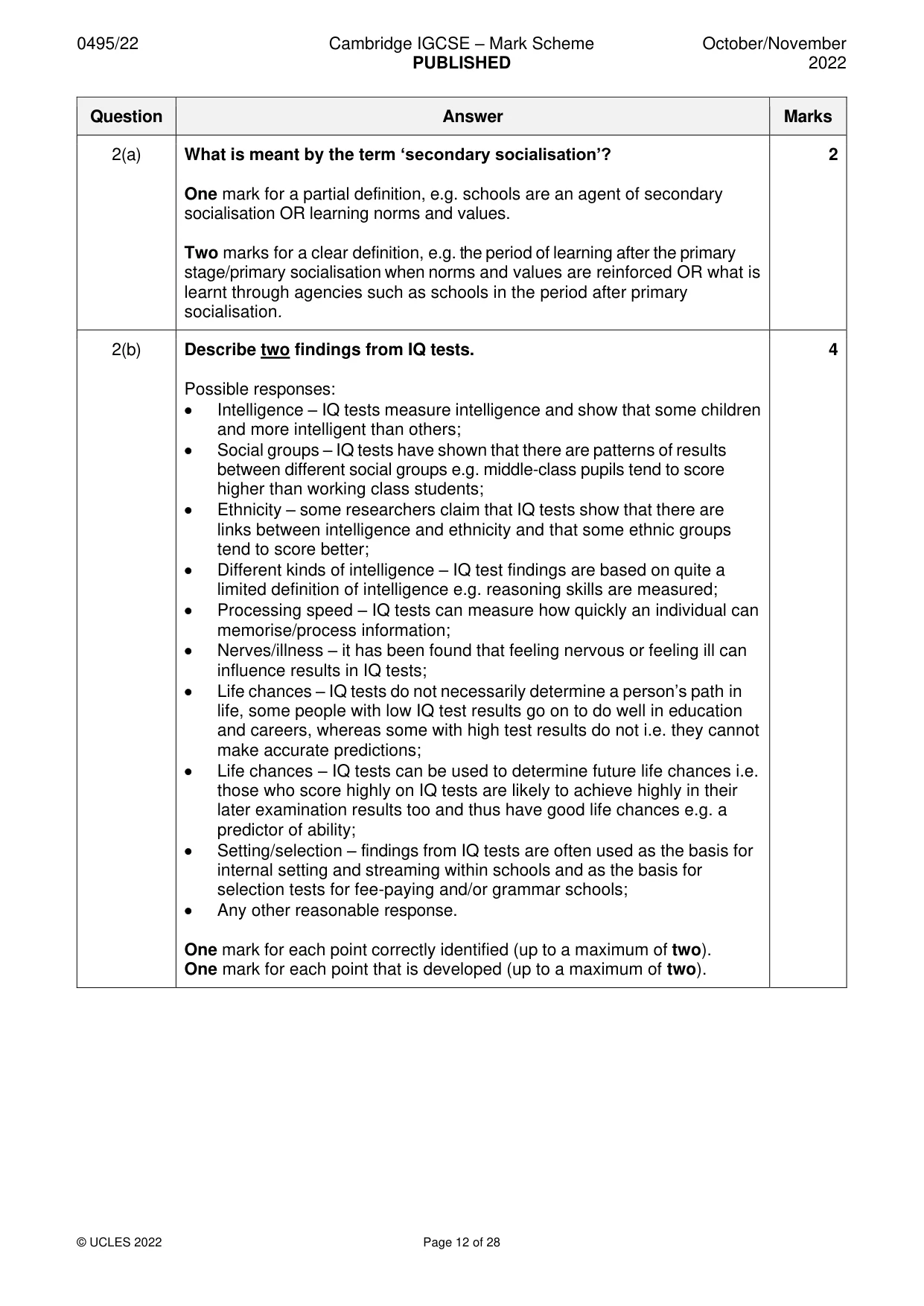
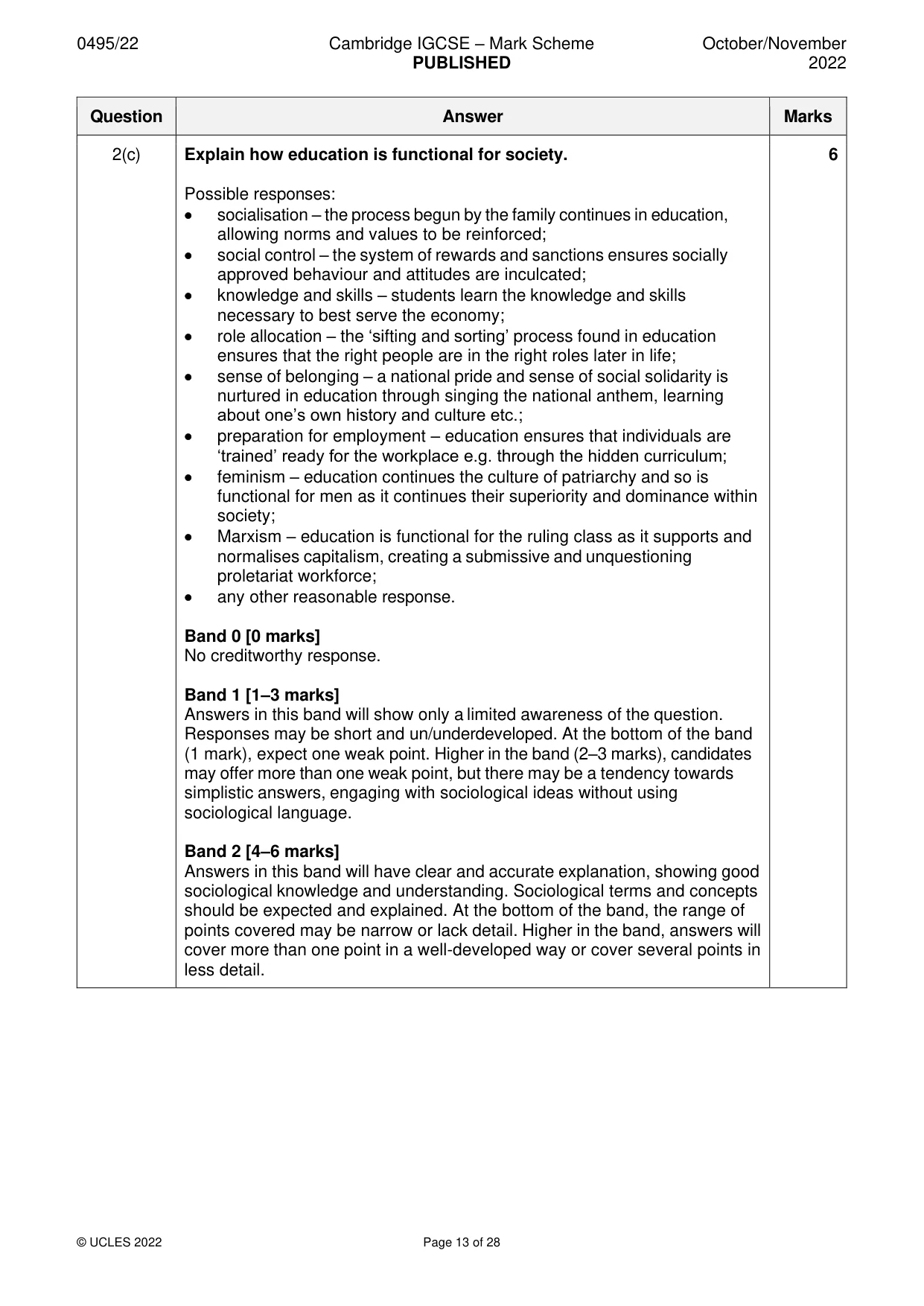
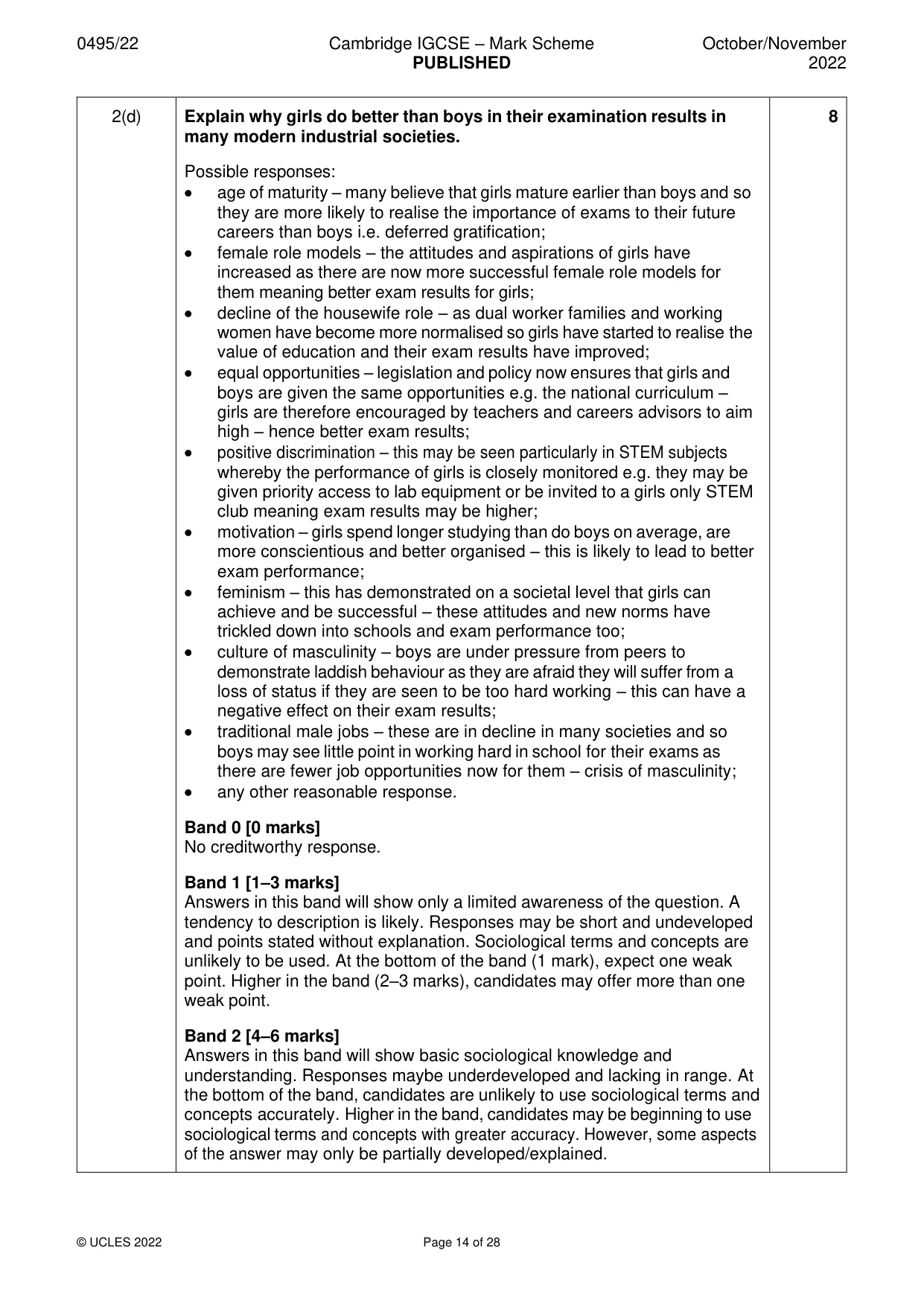
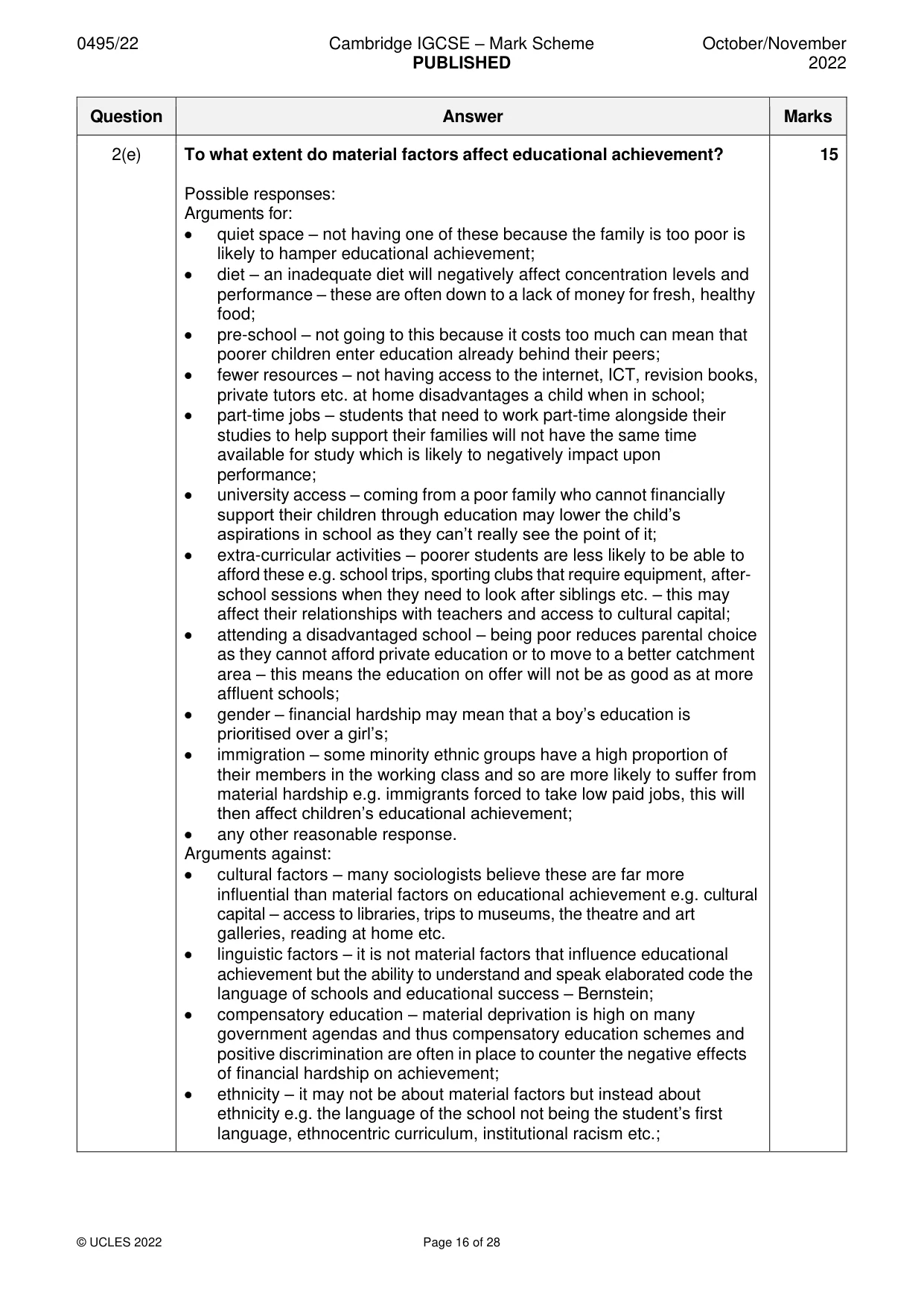
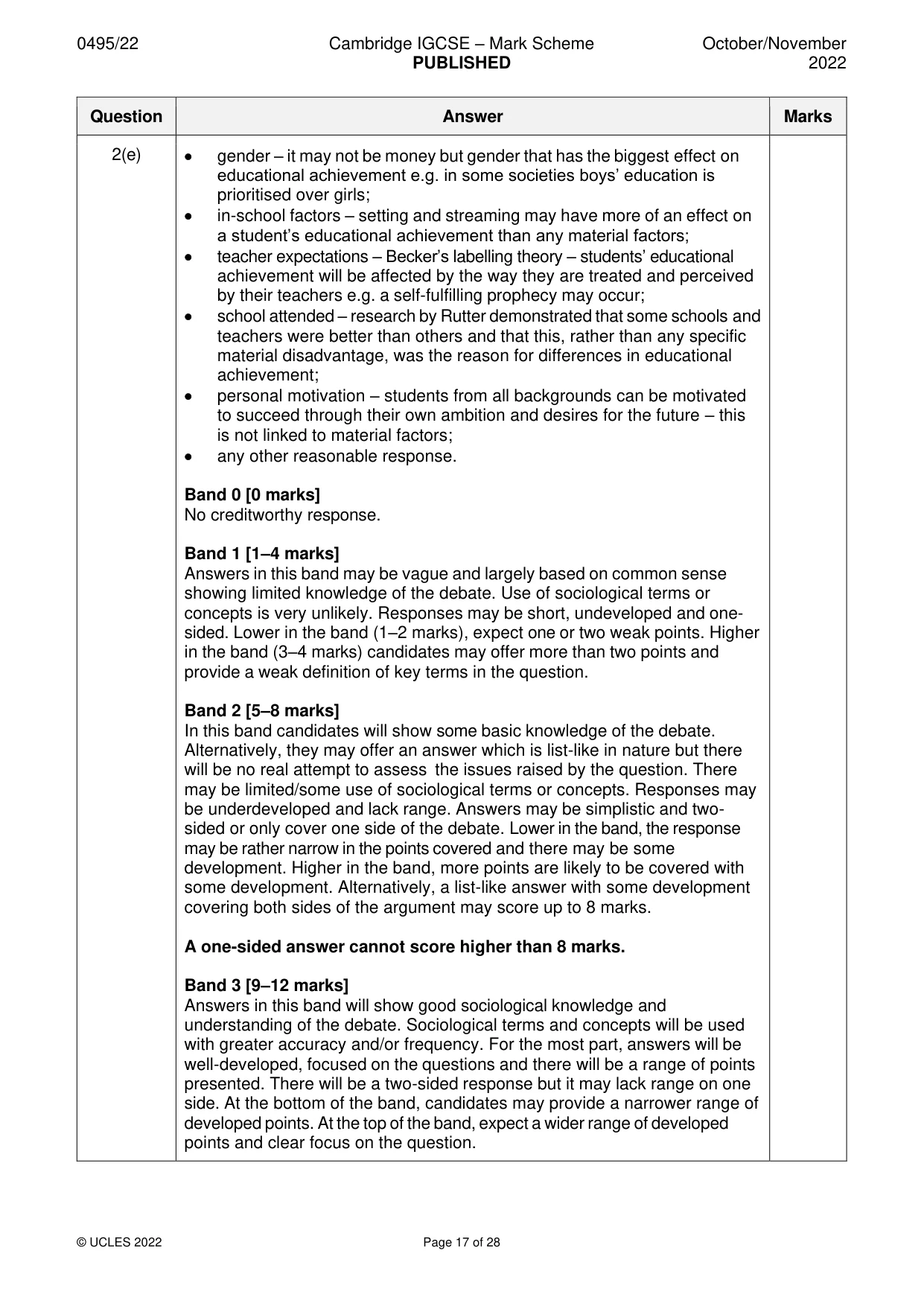
Mark scheme: 2(a) What is meant by the term ‘secondary socialisation’? 2 One mark for a partial definition, e.g. schools are an agent of secondary socialisation OR learning norms and values. Two marks for a clear definition, e.g. the period of learning after the primary stage/primary socialisation when norms and values are reinforced OR what is learnt through agencies such as schools in the period after primary socialisation. 2(b) Describe two findings from IQ tests. 4 Possible responses: • Intelligence – IQ tests measure intelligence and show that some children and more intelligent than others; • Social groups – IQ tests have shown that there are patterns of results between different social groups e.g. middle-class pupils tend to score higher than working class students; • Ethnicity – some researchers claim that IQ tests show that there are links between intelligence and ethnicity and that some ethnic groups tend to score better; • Different kinds of intelligence – IQ test findings are based on quite a limited definition of intelligence e.g. reasoning skills are measured; • Processing speed – IQ tests can measure how quickly an individual can memorise/process information; • Nerves/illness – it has been found that feeling nervous or feeling ill can influence results in IQ tests; • Life chances – IQ tests do not necessarily determine a person’s path in life, some people with low IQ test results go on to do well in education and careers, whereas some with high test results do not i.e. they cannot make accurate predictions; • Life chances – IQ tests can be used to determine future life chances i.e. those who score highly on IQ tests are likely to achieve highly in their later examination results too and thus have good life chances e.g. a predictor of ability; • Setting/selection – findings from IQ tests are often used as the basis for internal setting and streaming within schools and as the basis for selection tests for fee-paying and/or grammar schools; • Any other reasonable response. One mark for each point correctly identified (up to a maximum of two). One mark for each point that is developed (up to a maximum of two). 2(c) Explain how education is functional for society. 6 Possible responses: • socialisation – the process begun by the family continues in education, allowing norms and values to be reinforced; • social control – the system of rewards and sanctions ensures socially approved behaviour and attitudes are inculcated; • knowledge and skills – students learn the knowledge and skills necessary to best serve the economy; • role allocation – the ‘sifting and sorting’ process found in education ensures that the right people are in the right roles later in life; • sense of belonging – a national pride and sense of social solidarity is nurtured in education through singing the national anthem, learning about one’s own history and culture etc.; • preparation for employment – education ensures that individuals are ‘trained’ ready for the workplace e.g. through the hidden curriculum; • feminism – education continues the culture of patriarchy and so is functional for men as it continues their superiority and dominance within society; • Marxism – education is functional for the ruling class as it supports and normalises capitalism, creating a submissive and unquestioning proletariat workforce; • any other reasonable response. Band 0 [0 marks] No creditworthy response. Band 1 [1–3 marks] Answers in this band will show only a limited awareness of the question. Responses may be short and un/underdeveloped. At the bottom of the band (1 mark), expect one weak point. Higher in the band (2–3 marks), candidates may offer more than one weak point, but there may be a tendency towards simplistic answers, engaging with sociological ideas without using sociological language. Band 2 [4–6 marks] Answers in this band will have clear and accurate explanation, showing good sociological knowledge and understanding. Sociological terms and concepts should be expected and explained. At the bottom of the band, the range of points covered may be narrow or lack detail. Higher in the band, answers will cover more than one point in a well-developed way or cover several points in less detail. 2(d) Explain why girls do better than boys in their examination results in 8 many modern industrial societies. Possible responses: • age of maturity – many believe that girls mature earlier than boys and so they are more likely to realise the importance of exams to their future careers than boys i.e. deferred gratification; • female role models – the attitudes and aspirations of girls have increased as there are now more successful female role models for them meaning better exam results for girls; • decline of the housewife role – as dual worker families and working women have become more normalised so girls have started to realise the value of education and their exam results have improved; • equal opportunities – legislation and policy now ensures that girls and boys are given the same opportunities e.g. the national curriculum – girls are therefore encouraged by teachers and careers advisors to aim high – hence better exam results; • positive discrimination – this may be seen particularly in STEM subjects whereby the performance of girls is closely monitored e.g. they may be given priority access to lab equipment or be invited to a girls only STEM club meaning exam results may be higher; • motivation – girls spend longer studying than do boys on average, are more conscientious and better organised – this is likely to lead to better exam performance; • feminism – this has demonstrated on a societal level that girls can achieve and be successful – these attitudes and new norms have trickled down into schools and exam performance too; • culture of masculinity – boys are under pressure from peers to demonstrate laddish behaviour as they are afraid they will suffer from a loss of status if they are seen to be too hard working – this can have a negative effect on their exam results; • traditional male jobs – these are in decline in many societies and so boys may see little point in working hard in school for their exams as there are fewer job opportunities now for them – crisis of masculinity; • any other reasonable response. Band 0 [0 marks] No creditworthy response. Band 1 [1–3 marks] Answers in this band will show only a limited awareness of the question. A tendency to description is likely. Responses may be short and undeveloped and points stated without explanation. Sociological terms and concepts are unlikely to be used. At the bottom of the band (1 mark), expect one weak point. Higher in the band (2–3 marks), candidates may offer more than one weak point. Band 2 [4–6 marks] Answers in this band will show basic sociological knowledge and understanding. Responses maybe underdeveloped and lacking in range. At the bottom of the band, candidates are unlikely to use sociological terms and concepts accurately. Higher in the band, candidates may be beginning to use sociological terms and concepts with greater accuracy. However, some aspects of the answer may only be partially developed/explained. 2(d) Band 3 [7–8 marks] Answers in this band will show good sociological knowledge and understanding and will be well-developed and explained. Sociological terms and concepts will be used accurately overall. Answers will be well-focused on the question and there will be a range of points presented. At the top of the band explanations will be clear throughout. 2(e) To what extent do material factors affect educational achievement? 15 Possible responses: Arguments for: • quiet space – not having one of these because the family is too poor is likely to hamper educational achievement; • diet – an inadequate diet will negatively affect concentration levels and performance – these are often down to a lack of money for fresh, healthy food; • pre-school – not going to this because it costs too much can mean that poorer children enter education already behind their peers; • fewer resources – not having access to the internet, ICT, revision books, private tutors etc. at home disadvantages a child when in school; • part-time jobs – students that need to work part-time alongside their studies to help support their families will not have the same time available for study which is likely to negatively impact upon performance; • university access – coming from a poor family who cannot financially support their children through education may lower the child’s aspirations in school as they can’t really see the point of it; • extra-curricular activities – poorer students are less likely to be able to afford these e.g. school trips, sporting clubs that require equipment, after- school sessions when they need to look after siblings etc. – this may affect their relationships with teachers and access to cultural capital; • attending a disadvantaged school – being poor reduces parental choice as they cannot afford private education or to move to a better catchment area – this means the education on offer will not be as good as at more affluent schools; • gender – financial hardship may mean that a boy’s education is prioritised over a girl’s; • immigration – some minority ethnic groups have a high proportion of their members in the working class and so are more likely to suffer from material hardship e.g. immigrants forced to take low paid jobs, this will then affect children’s educational achievement; • any other reasonable response. Arguments against: • cultural factors – many sociologists believe these are far more influential than material factors on educational achievement e.g. cultural capital – access to libraries, trips to museums, the theatre and art galleries, reading at home etc. • linguistic factors – it is not material factors that influence educational achievement but the ability to understand and speak elaborated code the language of schools and educational success – Bernstein; • compensatory education – material deprivation is high on many government agendas and thus compensatory education schemes and positive discrimination are often in place to counter the negative effects of financial hardship on achievement; • ethnicity – it may not be about material factors but instead about ethnicity e.g. the language of the school not being the student’s first language, ethnocentric curriculum, institutional racism etc.; 2(e) • gender – it may not be money but gender that has the biggest effect on educational achievement e.g. in some societies boys’ education is prioritised over girls; • in-school factors – setting and streaming may have more of an effect on a student’s educational achievement than any material factors; • teacher expectations – Becker’s labelling theory – students’ educational achievement will be affected by the way they are treated and perceived by their teachers e.g. a self-fulfilling prophecy may occur; • school attended – research by Rutter demonstrated that some schools and teachers were better than others and that this, rather than any specific material disadvantage, was the reason for differences in educational achievement; • personal motivation – students from all backgrounds can be motivated to succeed through their own ambition and desires for the future – this is not linked to material factors; • any other reasonable response. Band 0 [0 marks] No creditworthy response. Band 1 [1–4 marks] Answers in this band may be vague and largely based on common sense showing limited knowledge of the debate. Use of sociological terms or concepts is very unlikely. Responses may be short, undeveloped and one- sided. Lower in the band (1–2 marks), expect one or two weak points. Higher in the band (3–4 marks) candidates may offer more than two points and provide a weak definition of key terms in the question. Band 2 [5–8 marks] In this band candidates will show some basic knowledge of the debate. Alternatively, they may offer an answer which is list-like in nature but there will be no real attempt to assess the issues raised by the question. There may be limited/some use of sociological terms or concepts. Responses may be underdeveloped and lack range. Answers may be simplistic and two- sided or only cover one side of the debate. Lower in the band, the response may be rather narrow in the points covered and there may be some development. Higher in the band, more points are likely to be covered with some development. Alternatively, a list-like answer with some development covering both sides of the argument may score up to 8 marks. A one-sided answer cannot score higher than 8 marks. Band 3 [9–12 marks] Answers in this band will show good sociological knowledge and understanding of the debate. Sociological terms and concepts will be used with greater accuracy and/or frequency. For the most part, answers will be well-developed, focused on the questions and there will be a range of points presented. There will be a two-sided response but it may lack range on one side. At the bottom of the band, candidates may provide a narrower range of developed points. At the top of the band, expect a wider range of developed points and clear focus on the question. 2(e) Band 4 [13–15 marks] Answers in this band will show excellent knowledge and understanding of the debate. There will be a strong grasp of the arguments as well as accurate and frequent use of sociological terms and concepts. Answers will be well-developed, clearly focused on the question and discuss a wide range of points. Responses will be two-sided and have a range of points on each side. At the bottom of the band (13 marks), the answer may lack a specific conclusion. Higher in the band, there will be a clear attempt to offer an assessment of the ‘To what extent.?’ part of the question through a focused conclusion.
Q3 · The judicial system deals with a wide range of crimes such as murder, assault, internet…
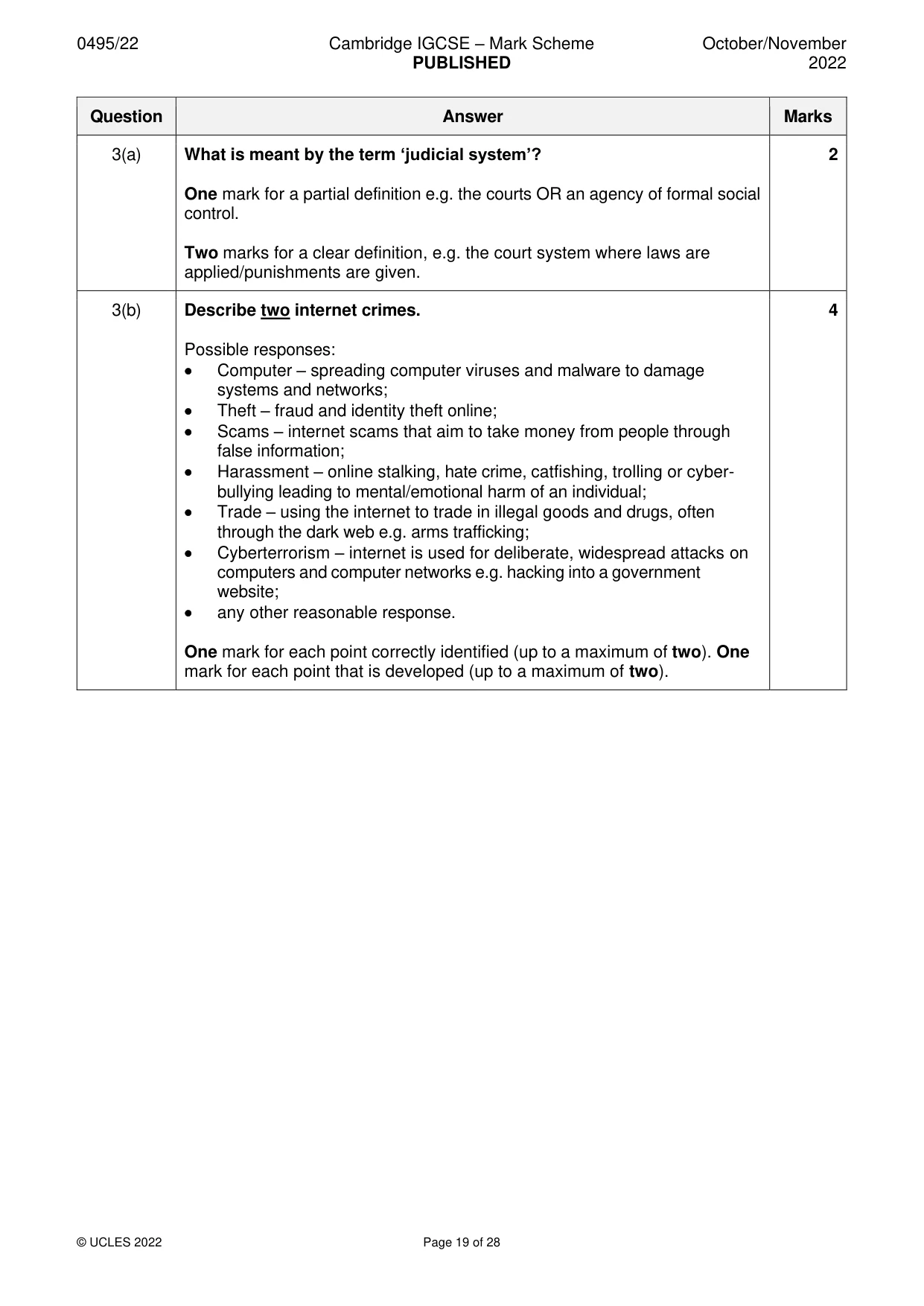
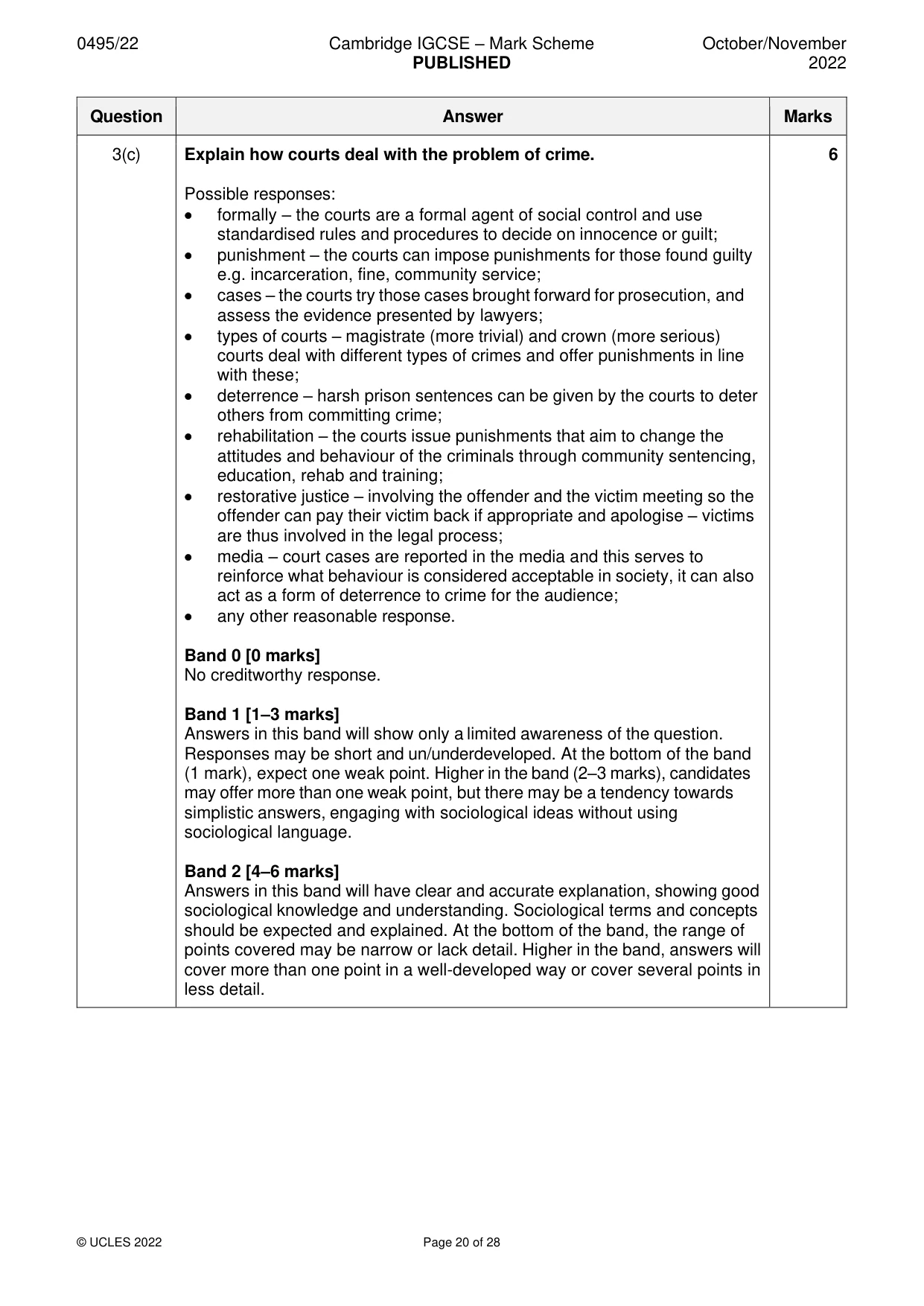
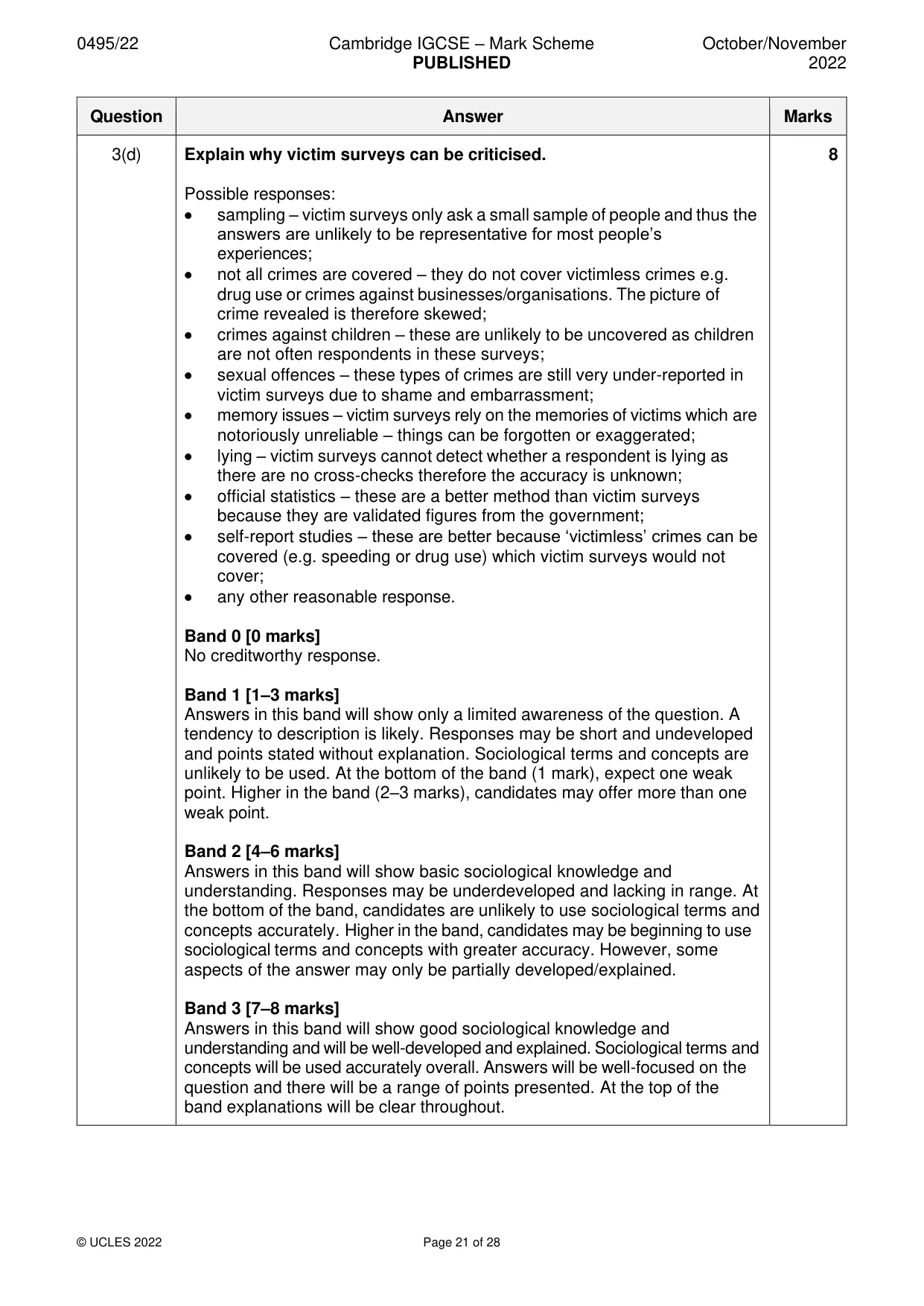
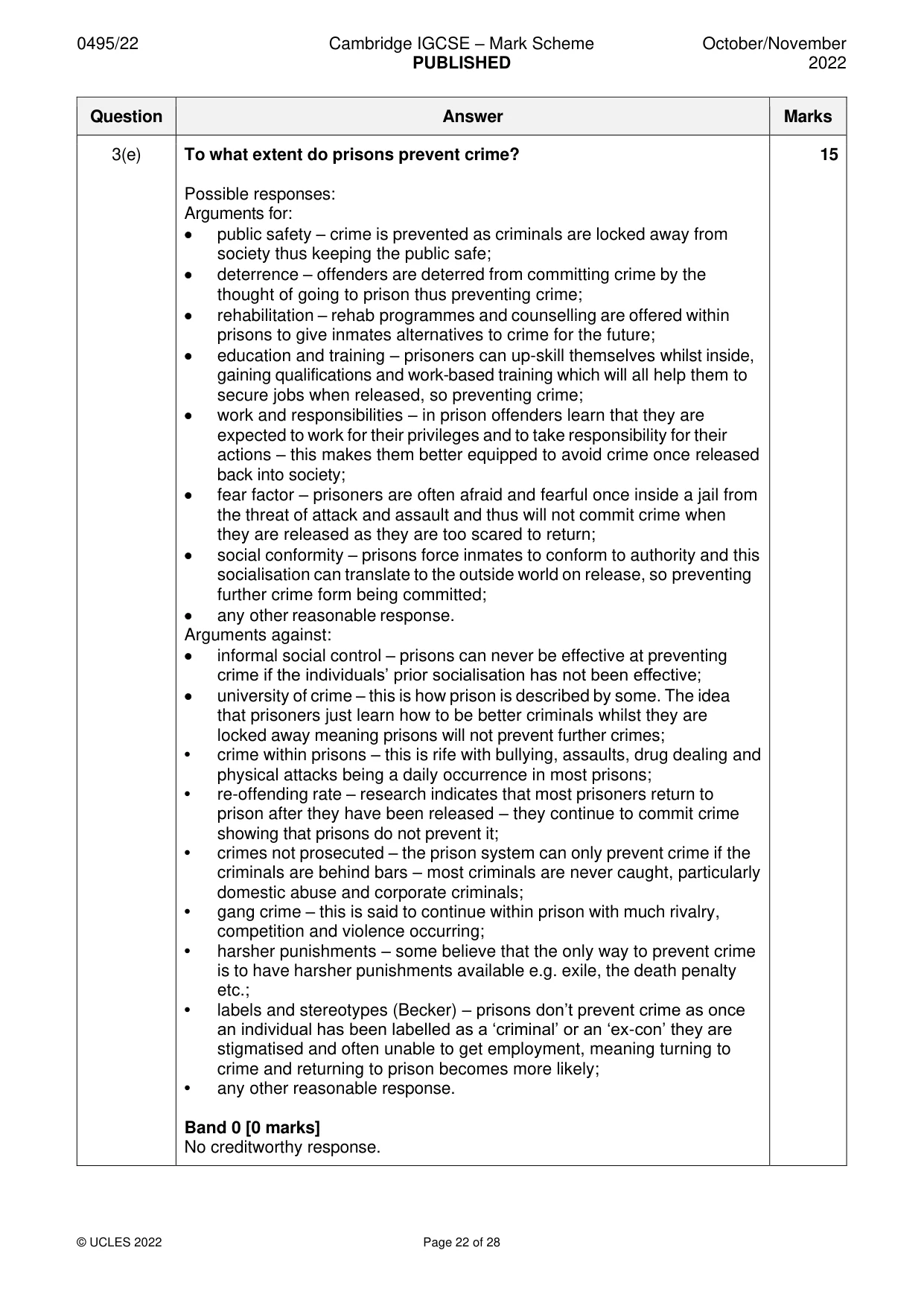
3 The judicial system deals with a wide range of crimes such as murder, assault, internet crimes and petty crimes. Some sociologists argue that prisons are the best way to prevent and control crime. The official crime statistics suggest that there is a problem with crime in society. Victim surveys also show that crime is a problem but they measure it differently. (a) What is meant by the term ‘judicial system’? [2] (b) Describe two internet crimes. [4] (c) Explain how courts deal with the problem of crime. [6] (d) Explain why victim surveys can be criticised. [8] (e) To what extent do prisons prevent crime? [15] Section D: Media
Mark scheme: 3(a) What is meant by the term ‘judicial system’? 2 One mark for a partial definition e.g. the courts OR an agency of formal social control. Two marks for a clear definition, e.g. the court system where laws are applied/punishments are given. 3(b) Describe two internet crimes. 4 Possible responses: • Computer – spreading computer viruses and malware to damage systems and networks; • Theft – fraud and identity theft online; • Scams – internet scams that aim to take money from people through false information; • Harassment – online stalking, hate crime, catfishing, trolling or cyber- bullying leading to mental/emotional harm of an individual; • Trade – using the internet to trade in illegal goods and drugs, often through the dark web e.g. arms trafficking; • Cyberterrorism – internet is used for deliberate, widespread attacks on computers and computer networks e.g. hacking into a government website; • any other reasonable response. One mark for each point correctly identified (up to a maximum of two). One mark for each point that is developed (up to a maximum of two). 3(c) Explain how courts deal with the problem of crime. 6 Possible responses: • formally – the courts are a formal agent of social control and use standardised rules and procedures to decide on innocence or guilt; • punishment – the courts can impose punishments for those found guilty e.g. incarceration, fine, community service; • cases – the courts try those cases brought forward for prosecution, and assess the evidence presented by lawyers; • types of courts – magistrate (more trivial) and crown (more serious) courts deal with different types of crimes and offer punishments in line with these; • deterrence – harsh prison sentences can be given by the courts to deter others from committing crime; • rehabilitation – the courts issue punishments that aim to change the attitudes and behaviour of the criminals through community sentencing, education, rehab and training; • restorative justice – involving the offender and the victim meeting so the offender can pay their victim back if appropriate and apologise – victims are thus involved in the legal process; • media – court cases are reported in the media and this serves to reinforce what behaviour is considered acceptable in society, it can also act as a form of deterrence to crime for the audience; • any other reasonable response. Band 0 [0 marks] No creditworthy response. Band 1 [1–3 marks] Answers in this band will show only a limited awareness of the question. Responses may be short and un/underdeveloped. At the bottom of the band (1 mark), expect one weak point. Higher in the band (2–3 marks), candidates may offer more than one weak point, but there may be a tendency towards simplistic answers, engaging with sociological ideas without using sociological language. Band 2 [4–6 marks] Answers in this band will have clear and accurate explanation, showing good sociological knowledge and understanding. Sociological terms and concepts should be expected and explained. At the bottom of the band, the range of points covered may be narrow or lack detail. Higher in the band, answers will cover more than one point in a well-developed way or cover several points in less detail. 3(d) Explain why victim surveys can be criticised. 8 Possible responses: • sampling – victim surveys only ask a small sample of people and thus the answers are unlikely to be representative for most people’s experiences; • not all crimes are covered – they do not cover victimless crimes e.g. drug use or crimes against businesses/organisations. The picture of crime revealed is therefore skewed; • crimes against children – these are unlikely to be uncovered as children are not often respondents in these surveys; • sexual offences – these types of crimes are still very under-reported in victim surveys due to shame and embarrassment; • memory issues – victim surveys rely on the memories of victims which are notoriously unreliable – things can be forgotten or exaggerated; • lying – victim surveys cannot detect whether a respondent is lying as there are no cross-checks therefore the accuracy is unknown; • official statistics – these are a better method than victim surveys because they are validated figures from the government; • self-report studies – these are better because ‘victimless’ crimes can be covered (e.g. speeding or drug use) which victim surveys would not cover; • any other reasonable response. Band 0 [0 marks] No creditworthy response. Band 1 [1–3 marks] Answers in this band will show only a limited awareness of the question. A tendency to description is likely. Responses may be short and undeveloped and points stated without explanation. Sociological terms and concepts are unlikely to be used. At the bottom of the band (1 mark), expect one weak point. Higher in the band (2–3 marks), candidates may offer more than one weak point. Band 2 [4–6 marks] Answers in this band will show basic sociological knowledge and understanding. Responses may be underdeveloped and lacking in range. At the bottom of the band, candidates are unlikely to use sociological terms and concepts accurately. Higher in the band, candidates may be beginning to use sociological terms and concepts with greater accuracy. However, some aspects of the answer may only be partially developed/explained. Band 3 [7–8 marks] Answers in this band will show good sociological knowledge and understanding and will be well-developed and explained. Sociological terms and concepts will be used accurately overall. Answers will be well-focused on the question and there will be a range of points presented. At the top of the band explanations will be clear throughout. 3(e) To what extent do prisons prevent crime? 15 Possible responses: Arguments for: • public safety – crime is prevented as criminals are locked away from society thus keeping the public safe; • deterrence – offenders are deterred from committing crime by the thought of going to prison thus preventing crime; • rehabilitation – rehab programmes and counselling are offered within prisons to give inmates alternatives to crime for the future; • education and training – prisoners can up-skill themselves whilst inside, gaining qualifications and work-based training which will all help them to secure jobs when released, so preventing crime; • work and responsibilities – in prison offenders learn that they are expected to work for their privileges and to take responsibility for their actions – this makes them better equipped to avoid crime once released back into society; • fear factor – prisoners are often afraid and fearful once inside a jail from the threat of attack and assault and thus will not commit crime when they are released as they are too scared to return; • social conformity – prisons force inmates to conform to authority and this socialisation can translate to the outside world on release, so preventing further crime form being committed; • any other reasonable response. Arguments against: • informal social control – prisons can never be effective at preventing crime if the individuals’ prior socialisation has not been effective; • university of crime – this is how prison is described by some. The idea that prisoners just learn how to be better criminals whilst they are locked away meaning prisons will not prevent further crimes; • crime within prisons – this is rife with bullying, assaults, drug dealing and physical attacks being a daily occurrence in most prisons; • re-offending rate – research indicates that most prisoners return to prison after they have been released – they continue to commit crime showing that prisons do not prevent it; • crimes not prosecuted – the prison system can only prevent crime if the criminals are behind bars – most criminals are never caught, particularly domestic abuse and corporate criminals; • gang crime – this is said to continue within prison with much rivalry, competition and violence occurring; • harsher punishments – some believe that the only way to prevent crime is to have harsher punishments available e.g. exile, the death penalty etc.; • labels and stereotypes (Becker) – prisons don’t prevent crime as once an individual has been labelled as a ‘criminal’ or an ‘ex-con’ they are stigmatised and often unable to get employment, meaning turning to crime and returning to prison becomes more likely; • any other reasonable response. Band 0 [0 marks] No creditworthy response. 3(e) Band 1 [1–4 marks] Answers in this band may be vague and largely based on common sense showing limited knowledge of the debate. Use of sociological terms or concepts is very unlikely. Responses may be short, undeveloped and one- sided. Lower in the band (1–2 marks), expect one or two weak points. Higher in the band (3–4 marks) candidates may offer more than two points and provide a weak definition of key terms in the question. Band 2 [5–8 marks] In this band candidates will show some basic knowledge of the debate. Alternatively, they may offer an answer which is list-like in nature but there will be no real attempt to assess the issues raised by the question. There may be limited/some use of sociological terms or concepts. Responses may be underdeveloped and lack range. Answers may be simplistic and two-sided or only cover one side of the debate. Lower in the band, the response may be rather narrow in the points covered and there may be some development. Higher in the band, more points are likely to be covered with some development. Alternatively, a list-like answer with some development covering both sides of the argument may score up to 8 marks. A one-sided answer cannot score higher than 8 marks. Band 3 [9–12 marks] Answers in this band will show good sociological knowledge and understanding of the debate. Sociological terms and concepts will be used with greater accuracy and/or frequency. For the most part, answers will be well-developed, focused on the questions and there will be a range of points presented. There will be a two-sided response but it may lack range on one side. At the bottom of the band, candidates may provide a narrower range of developed points. At the top of the band, expect a wider range of developed points and clear focus on the question. Band 4 [13–15 marks] Answers in this band will show excellent knowledge and understanding of the debate. There will be a strong grasp of the arguments as well as accurate and frequent use of sociological terms and concepts. Answers will be well-developed, clearly focused on the question and discuss a wide range of points. Responses will be two-sided and have a range of points on each side. At the bottom of the band (13 marks), the answer may lack a specific conclusion. Higher in the band, there will be a clear attempt to offer an assessment of the ‘To what extent.?’ part of the question through a focused conclusion.
Q4 · Some sociologists argue that all media represent dominant news values
4 Some sociologists argue that all media represent dominant news values. However, audiences use the media in different ways. Gender, ethnicity and age can affect media consumption patterns. Sociologists debate the role of the media and its impact upon audiences. For example, pluralists, postmodernists and believers of the hypodermic-syringe model all take very different approaches. (a) What is meant by the term ‘postmodernist’? [2] (b) Describe two news values in the media. [4] (c) Explain how pluralists view the media. [6] (d) Explain why the hypodermic-syringe model of media effects can be criticised. [8] (e) To what extent are patterns of media use affected by the gender of the audience? [15]
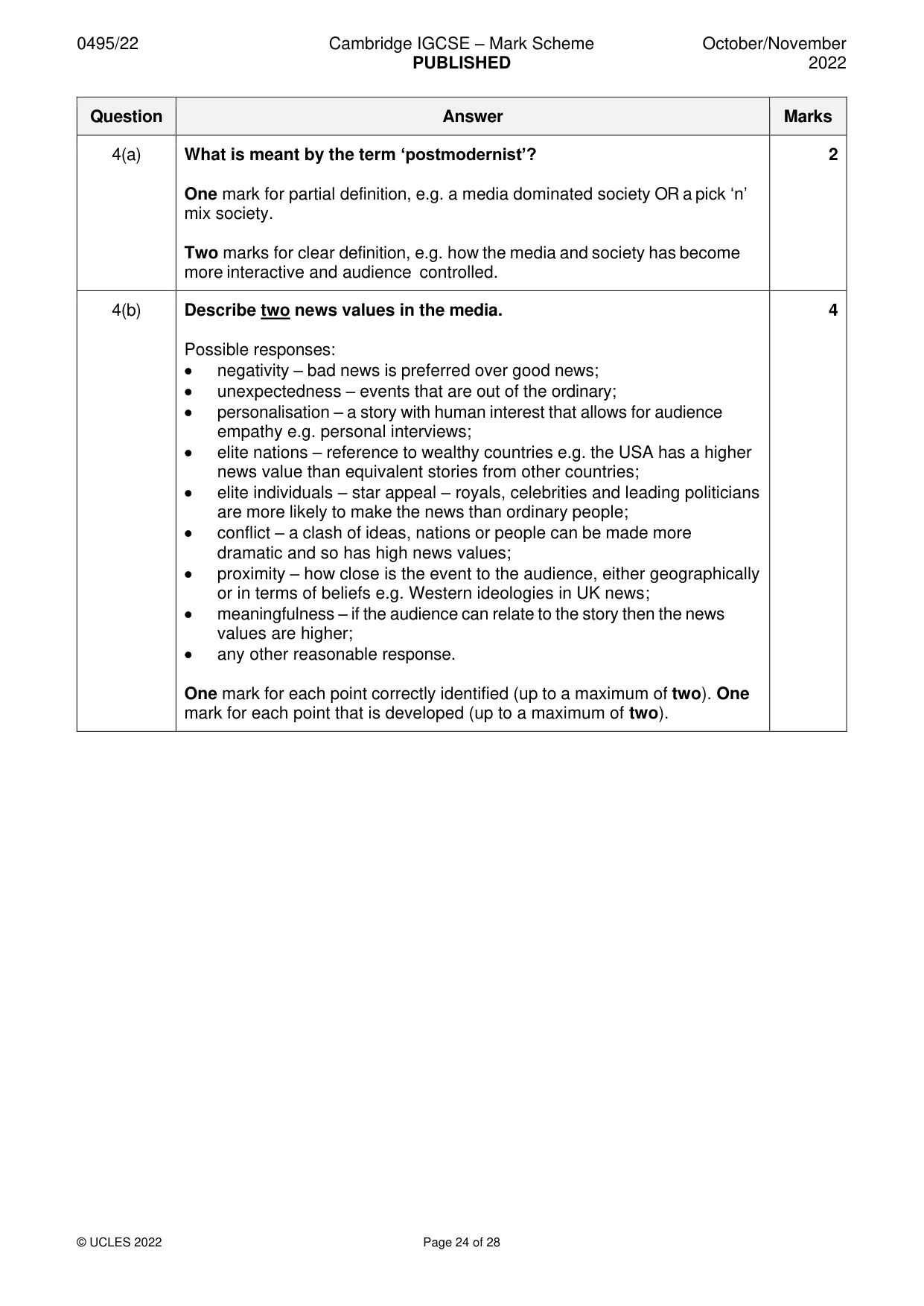
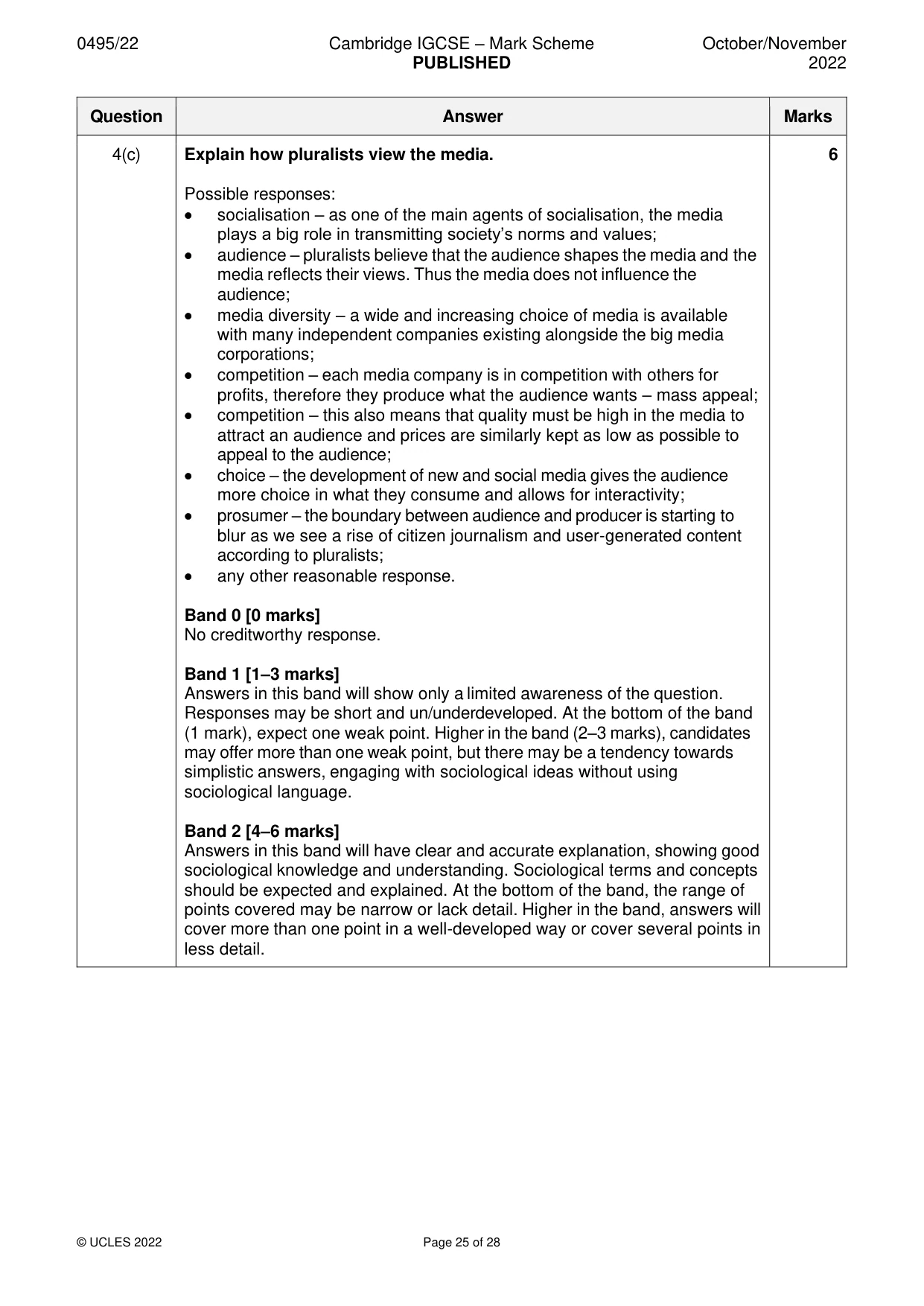
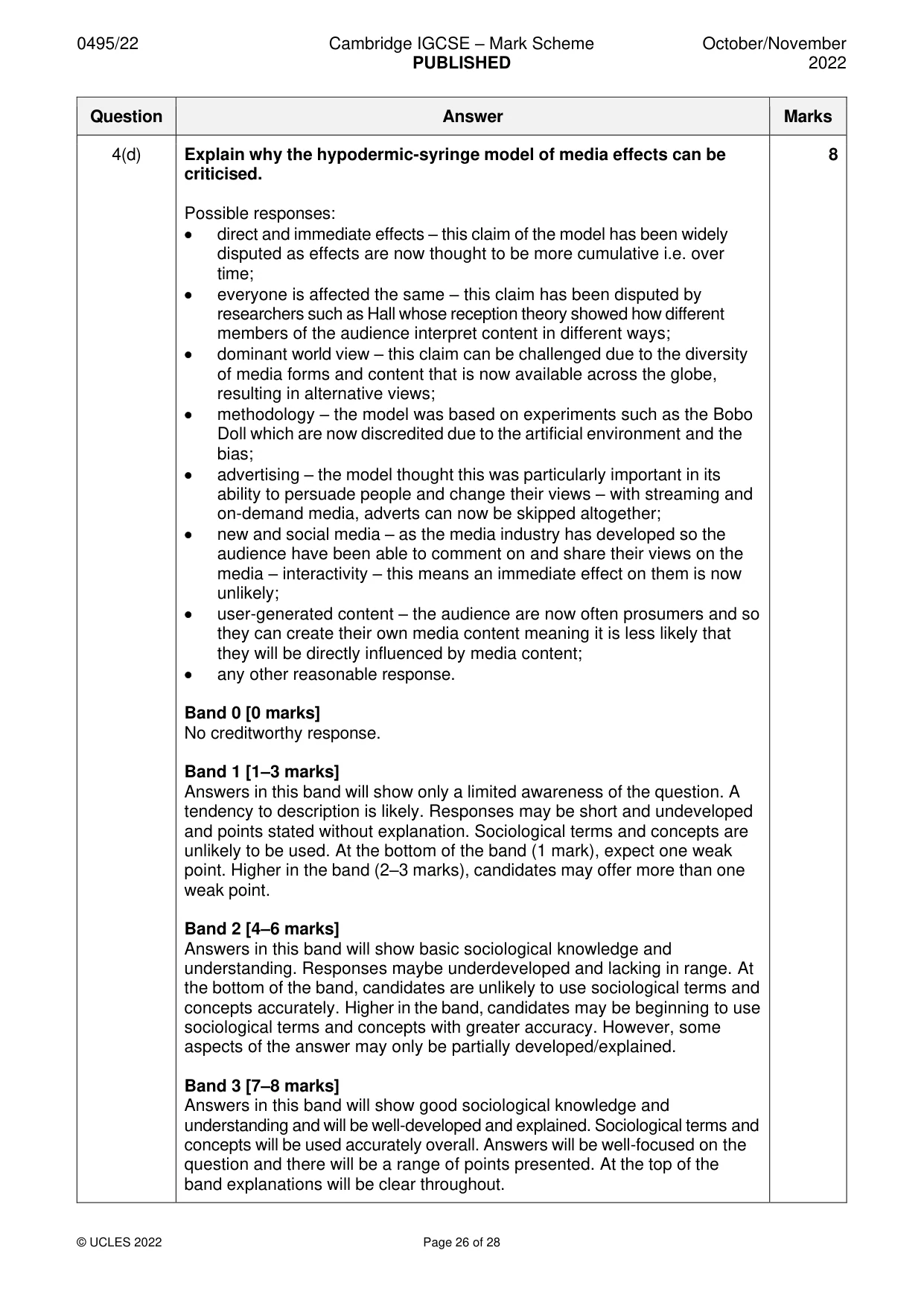
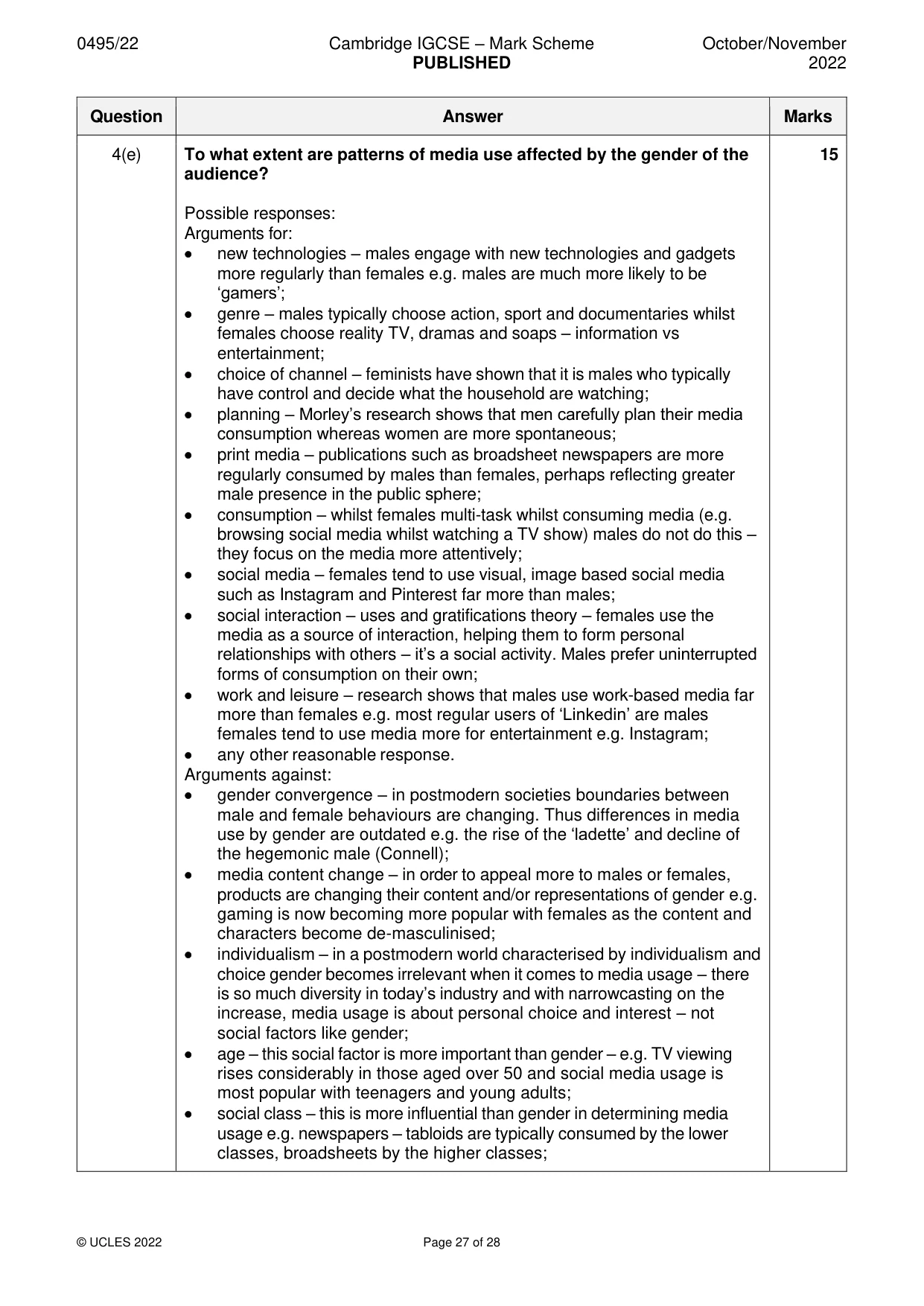
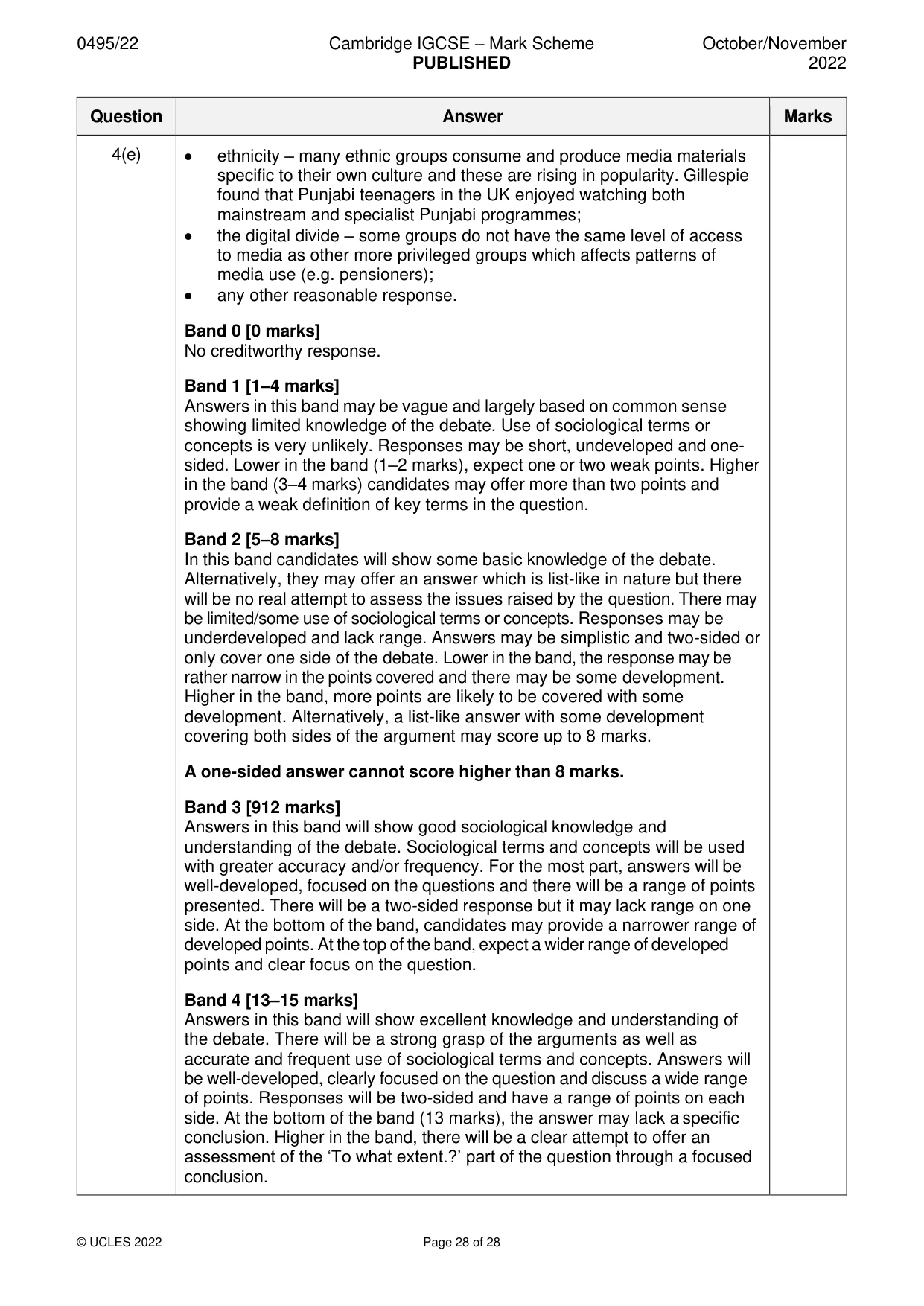
Mark scheme: 4(a) What is meant by the term ‘postmodernist’? 2 One mark for partial definition, e.g. a media dominated society OR a pick ‘n’ mix society. Two marks for clear definition, e.g. how the media and society has become more interactive and audience controlled. 4(b) Describe two news values in the media. 4 Possible responses: • negativity – bad news is preferred over good news; • unexpectedness – events that are out of the ordinary; • personalisation – a story with human interest that allows for audience empathy e.g. personal interviews; • elite nations – reference to wealthy countries e.g. the USA has a higher news value than equivalent stories from other countries; • elite individuals – star appeal – royals, celebrities and leading politicians are more likely to make the news than ordinary people; • conflict – a clash of ideas, nations or people can be made more dramatic and so has high news values; • proximity – how close is the event to the audience, either geographically or in terms of beliefs e.g. Western ideologies in UK news; • meaningfulness – if the audience can relate to the story then the news values are higher; • any other reasonable response. One mark for each point correctly identified (up to a maximum of two). One mark for each point that is developed (up to a maximum of two). 4(c) Explain how pluralists view the media. 6 Possible responses: • socialisation – as one of the main agents of socialisation, the media plays a big role in transmitting society’s norms and values; • audience – pluralists believe that the audience shapes the media and the media reflects their views. Thus the media does not influence the audience; • media diversity – a wide and increasing choice of media is available with many independent companies existing alongside the big media corporations; • competition – each media company is in competition with others for profits, therefore they produce what the audience wants – mass appeal; • competition – this also means that quality must be high in the media to attract an audience and prices are similarly kept as low as possible to appeal to the audience; • choice – the development of new and social media gives the audience more choice in what they consume and allows for interactivity; • prosumer – the boundary between audience and producer is starting to blur as we see a rise of citizen journalism and user-generated content according to pluralists; • any other reasonable response. Band 0 [0 marks] No creditworthy response. Band 1 [1–3 marks] Answers in this band will show only a limited awareness of the question. Responses may be short and un/underdeveloped. At the bottom of the band (1 mark), expect one weak point. Higher in the band (2–3 marks), candidates may offer more than one weak point, but there may be a tendency towards simplistic answers, engaging with sociological ideas without using sociological language. Band 2 [4–6 marks] Answers in this band will have clear and accurate explanation, showing good sociological knowledge and understanding. Sociological terms and concepts should be expected and explained. At the bottom of the band, the range of points covered may be narrow or lack detail. Higher in the band, answers will cover more than one point in a well-developed way or cover several points in less detail. 4(d) Explain why the hypodermic-syringe model of media effects can be 8 criticised. Possible responses: • direct and immediate effects – this claim of the model has been widely disputed as effects are now thought to be more cumulative i.e. over time; • everyone is affected the same – this claim has been disputed by researchers such as Hall whose reception theory showed how different members of the audience interpret content in different ways; • dominant world view – this claim can be challenged due to the diversity of media forms and content that is now available across the globe, resulting in alternative views; • methodology – the model was based on experiments such as the Bobo Doll which are now discredited due to the artificial environment and the bias; • advertising – the model thought this was particularly important in its ability to persuade people and change their views – with streaming and on-demand media, adverts can now be skipped altogether; • new and social media – as the media industry has developed so the audience have been able to comment on and share their views on the media – interactivity – this means an immediate effect on them is now unlikely; • user-generated content – the audience are now often prosumers and so they can create their own media content meaning it is less likely that they will be directly influenced by media content; • any other reasonable response. Band 0 [0 marks] No creditworthy response. Band 1 [1–3 marks] Answers in this band will show only a limited awareness of the question. A tendency to description is likely. Responses may be short and undeveloped and points stated without explanation. Sociological terms and concepts are unlikely to be used. At the bottom of the band (1 mark), expect one weak point. Higher in the band (2–3 marks), candidates may offer more than one weak point. Band 2 [4–6 marks] Answers in this band will show basic sociological knowledge and understanding. Responses maybe underdeveloped and lacking in range. At the bottom of the band, candidates are unlikely to use sociological terms and concepts accurately. Higher in the band, candidates may be beginning to use sociological terms and concepts with greater accuracy. However, some aspects of the answer may only be partially developed/explained. Band 3 [7–8 marks] Answers in this band will show good sociological knowledge and understanding and will be well-developed and explained. Sociological terms and concepts will be used accurately overall. Answers will be well-focused on the question and there will be a range of points presented. At the top of the band explanations will be clear throughout. 4(e) To what extent are patterns of media use affected by the gender of the 15 audience? Possible responses: Arguments for: • new technologies – males engage with new technologies and gadgets more regularly than females e.g. males are much more likely to be ‘gamers’; • genre – males typically choose action, sport and documentaries whilst females choose reality TV, dramas and soaps – information vs entertainment; • choice of channel – feminists have shown that it is males who typically have control and decide what the household are watching; • planning – Morley’s research shows that men carefully plan their media consumption whereas women are more spontaneous; • print media – publications such as broadsheet newspapers are more regularly consumed by males than females, perhaps reflecting greater male presence in the public sphere; • consumption – whilst females multi-task whilst consuming media (e.g. browsing social media whilst watching a TV show) males do not do this – they focus on the media more attentively; • social media – females tend to use visual, image based social media such as Instagram and Pinterest far more than males; • social interaction – uses and gratifications theory – females use the media as a source of interaction, helping them to form personal relationships with others – it’s a social activity. Males prefer uninterrupted forms of consumption on their own; • work and leisure – research shows that males use work-based media far more than females e.g. most regular users of ‘Linkedin’ are males females tend to use media more for entertainment e.g. Instagram; • any other reasonable response. Arguments against: • gender convergence – in postmodern societies boundaries between male and female behaviours are changing. Thus differences in media use by gender are outdated e.g. the rise of the ‘ladette’ and decline of the hegemonic male (Connell); • media content change – in order to appeal more to males or females, products are changing their content and/or representations of gender e.g. gaming is now becoming more popular with females as the content and characters become de-masculinised; • individualism – in a postmodern world characterised by individualism and choice gender becomes irrelevant when it comes to media usage – there is so much diversity in today’s industry and with narrowcasting on the increase, media usage is about personal choice and interest – not social factors like gender; • age – this social factor is more important than gender – e.g. TV viewing rises considerably in those aged over 50 and social media usage is most popular with teenagers and young adults; • social class – this is more influential than gender in determining media usage e.g. newspapers – tabloids are typically consumed by the lower classes, broadsheets by the higher classes; 4(e) • ethnicity – many ethnic groups consume and produce media materials specific to their own culture and these are rising in popularity. Gillespie found that Punjabi teenagers in the UK enjoyed watching both mainstream and specialist Punjabi programmes; • the digital divide – some groups do not have the same level of access to media as other more privileged groups which affects patterns of media use (e.g. pensioners); • any other reasonable response. Band 0 [0 marks] No creditworthy response. Band 1 [1–4 marks] Answers in this band may be vague and largely based on common sense showing limited knowledge of the debate. Use of sociological terms or concepts is very unlikely. Responses may be short, undeveloped and one- sided. Lower in the band (1–2 marks), expect one or two weak points. Higher in the band (3–4 marks) candidates may offer more than two points and provide a weak definition of key terms in the question. Band 2 [5–8 marks] In this band candidates will show some basic knowledge of the debate. Alternatively, they may offer an answer which is list-like in nature but there will be no real attempt to assess the issues raised by the question. There may be limited/some use of sociological terms or concepts. Responses may be underdeveloped and lack range. Answers may be simplistic and two-sided or only cover one side of the debate. Lower in the band, the response may be rather narrow in the points covered and there may be some development. Higher in the band, more points are likely to be covered with some development. Alternatively, a list-like answer with some development covering both sides of the argument may score up to 8 marks. A one-sided answer cannot score higher than 8 marks. Band 3 [912 marks] Answers in this band will show good sociological knowledge and understanding of the debate. Sociological terms and concepts will be used with greater accuracy and/or frequency. For the most part, answers will be well-developed, focused on the questions and there will be a range of points presented. There will be a two-sided response but it may lack range on one side. At the bottom of the band, candidates may provide a narrower range of developed points. At the top of the band, expect a wider range of developed points and clear focus on the question. Band 4 [13–15 marks] Answers in this band will show excellent knowledge and understanding of the debate. There will be a strong grasp of the arguments as well as accurate and frequent use of sociological terms and concepts. Answers will be well-developed, clearly focused on the question and discuss a wide range of points. Responses will be two-sided and have a range of points on each side. At the bottom of the band (13 marks), the answer may lack a specific conclusion. Higher in the band, there will be a clear attempt to offer an assessment of the ‘To what extent.?’ part of the question through a focused conclusion.
More questions on How do sociologists approach the study of society?
What was in this paper
The subtopics covered by these 4 questions, and how many questions each got. Open one in a new tab to see every Cambridge question on it.
What you needed in this session
Cambridge’s own grade thresholds for 2022 Oct/Nov, Paper 2 · Variant 2. A higher threshold means an easier paper — the bar moves with how the cohort did.