Cambridge IGCSE Sociology 0495 — 2022 Oct/Nov Paper 1 · Variant 3
0495/13/O/N/22 · 80 marks · ≈90 min
The question paper and its mark scheme, free to read here and free to download. This is Cambridge’s own paper, exactly as it was sat.
Question paper4 pages

Mark scheme19 pages
Answers below. Sit the paper first if you are practising.

Paper as text
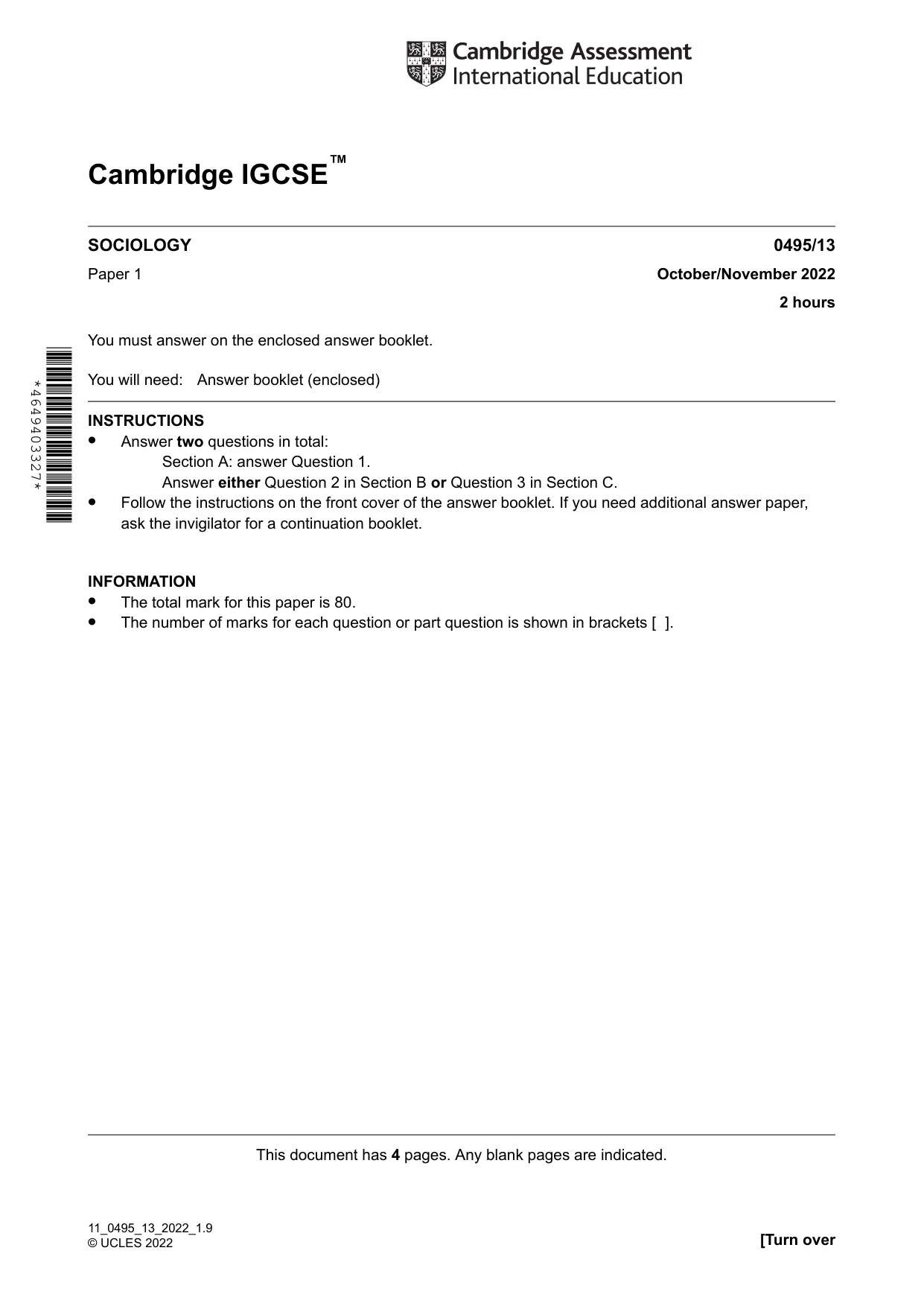
Question paper, page 1
Cambridge IGCSE™ 0495/13 October/November 2022 2 hours SOCIOLOGY Paper 1 You must answer on the enclosed answer booklet. You will need: Answer booklet (enclosed) INSTRUCTIONS • Answer two questions in total: Section A: answer Question 1. Answer either Question 2 in Section B or Question 3 in Section C. • Follow the instructions on the front cover of the answer booklet. If you need additional answer paper, ask the invigilator for a continuation booklet. INFORMATION • The total mark for this paper is 80. • The number of marks for each question or part question is shown in brackets [ ]. This document has 4 pages. Any blank pages are indicated. [Turn over 11_0495_13_2022_1.9 © UCLES 2022 *4649403327*
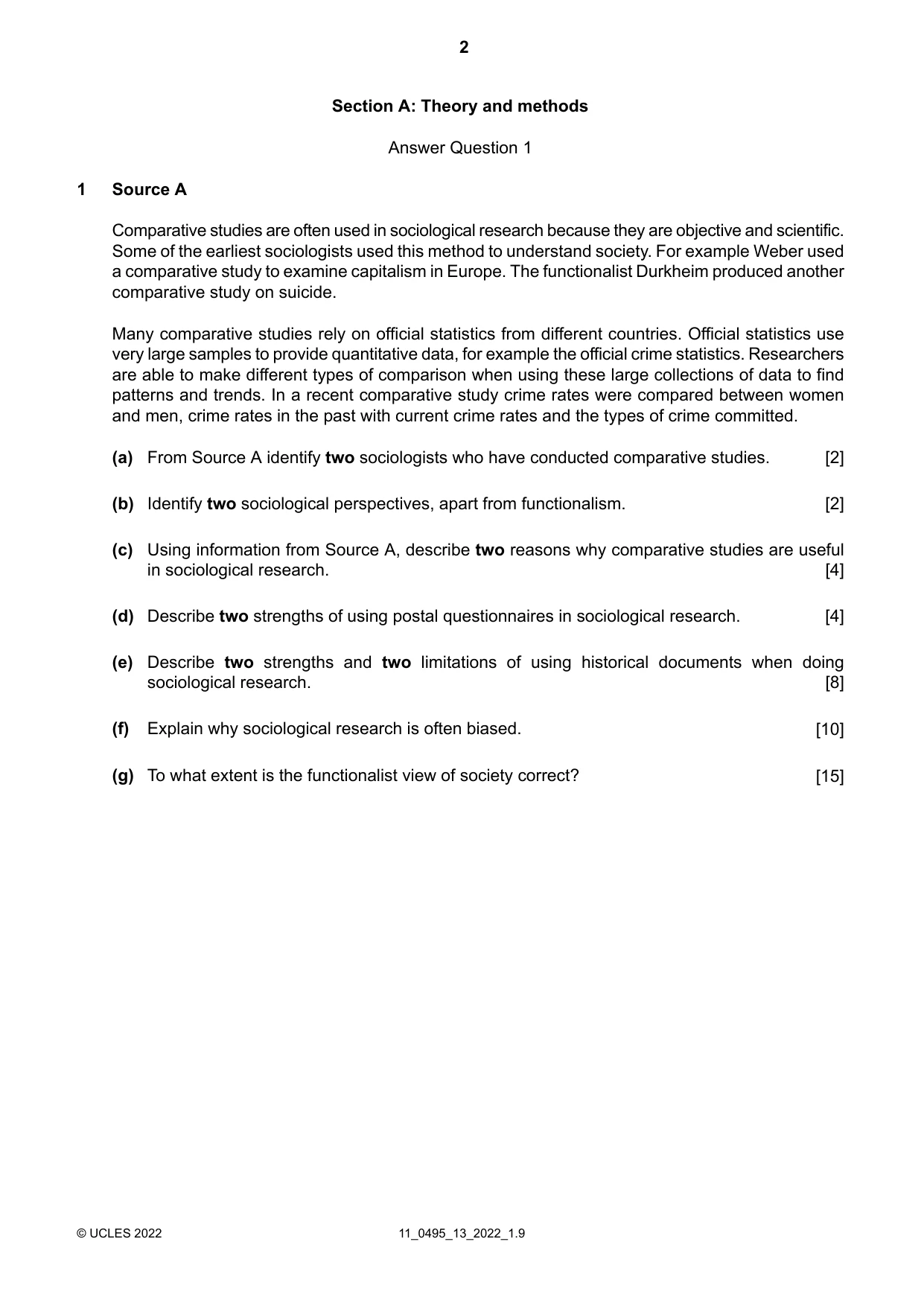
Question paper, page 2
Section A: Theory and methods Answer Question 1 Source A 1 Comparative studies are often used in sociological research because they are objective and scientific. Some of the earliest sociologists used this method to understand society. For example Weber used a comparative study to examine capitalism in Europe. The functionalist Durkheim produced another comparative study on suicide. Many comparative studies rely on official statistics from different countries. Official statistics use very large samples to provide quantitative data, for example the official crime statistics. Researchers are able to make different types of comparison when using these large collections of data to find patterns and trends. In a recent comparative study crime rates were compared between women and men, crime rates in the past with current crime rates and the types of crime committed. From Source A identify two sociologists who have conducted comparative studies. [2] (a) Identify two sociological perspectives, apart from functionalism. [2] (b) Using information from Source A, describe two reasons why comparative studies are useful in sociological research. [4] (c) Describe two strengths of using postal questionnaires in sociological research. [4] (d) Describe two strengths and two limitations of using historical documents when doing sociological research. [8] (e) Explain why sociological research is often biased. [10] (f) To what extent is the functionalist view of society correct? [15] (g) 11_0495_13_2022_1.9 © UCLES 2022 2
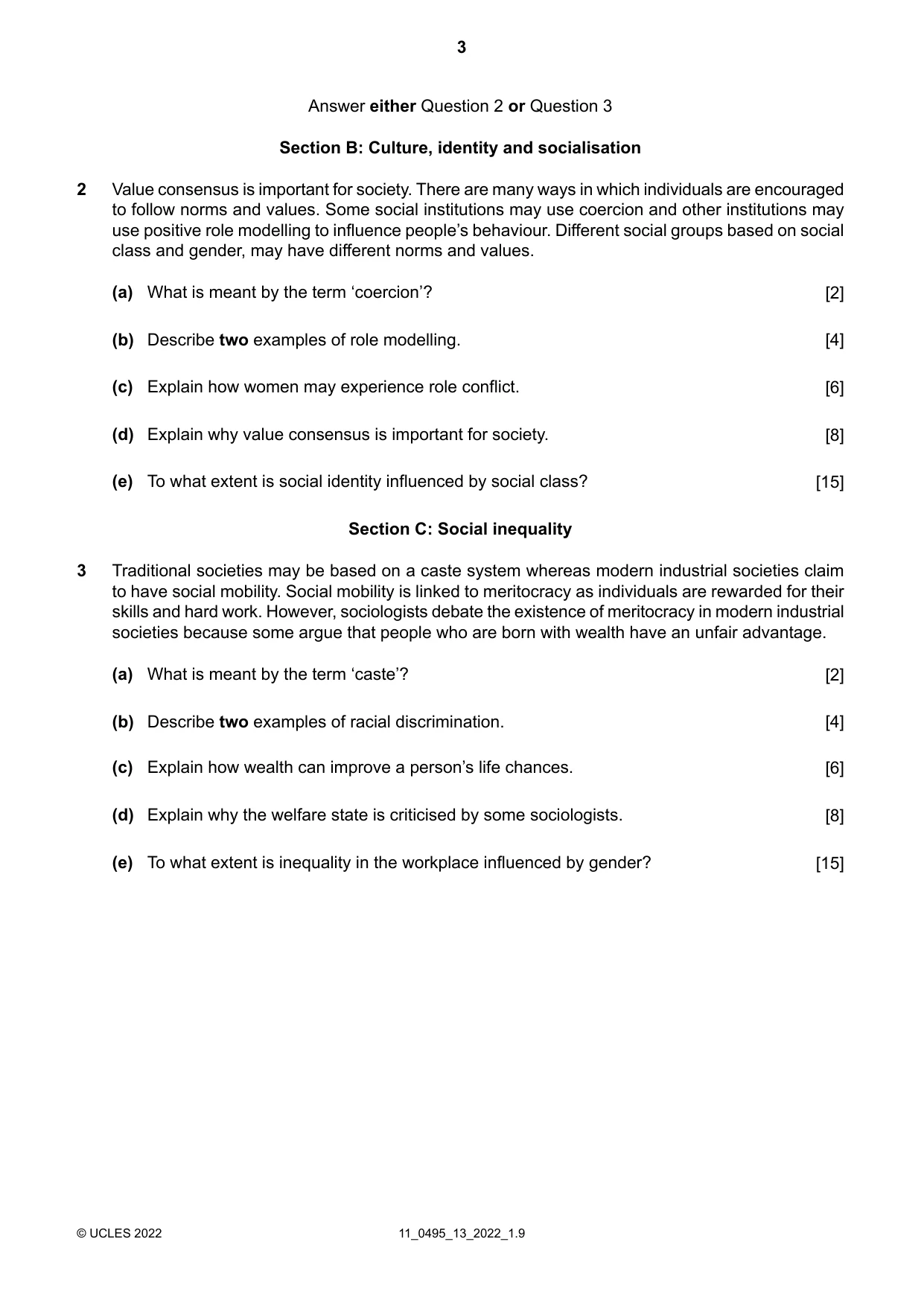
Question paper, page 3
Answer either Question 2 or Question 3 Section B: Culture, identity and socialisation Value consensus is important for society. There are many ways in which individuals are encouraged to follow norms and values. Some social institutions may use coercion and other institutions may 2 use positive role modelling to influence people’s behaviour. Different social groups based on social class and gender, may have different norms and values. What is meant by the term ‘coercion’? [2] (a) Describe two examples of role modelling. [4] (b) Explain how women may experience role conflict. [6] (c) Explain why value consensus is important for society. [8] (d) To what extent is social identity influenced by social class? [15] (e) Section C: Social inequality Traditional societies may be based on a caste system whereas modern industrial societies claim to have social mobility. Social mobility is linked to meritocracy as individuals are rewarded for their 3 skills and hard work. However, sociologists debate the existence of meritocracy in modern industrial societies because some argue that people who are born with wealth have an unfair advantage. What is meant by the term ‘caste’? [2] (a) Describe two examples of racial discrimination. [4] (b) Explain how wealth can improve a person’s life chances. [6] (c) Explain why the welfare state is criticised by some sociologists. [8] (d) To what extent is inequality in the workplace influenced by gender? [15] (e) 11_0495_13_2022_1.9 © UCLES 2022 3
Question paper, page 4
BLANK PAGE Permission to reproduce items where third-party owned material protected by copyright is included has been sought and cleared where possible. Every reasonable effort has been made by the publisher (UCLES) to trace copyright holders, but if any items requiring clearance have unwittingly been included, the publisher will be pleased to make amends at the earliest possible opportunity. To avoid the issue of disclosure of answer-related information to candidates, all copyright acknowledgements are reproduced online in the Cambridge Assessment International Education Copyright Acknowledgements Booklet. This is produced for each series of examinations and is freely available to download at www.cambridgeinternational.org after the live examination series. Cambridge Assessment International Education is part of Cambridge Assessment. Cambridge Assessment is the brand name of the University of Cambridge Local Examinations Syndicate (UCLES), which is a department of the University of Cambridge. 11_0495_13_2022_1.9 © UCLES 2022 4
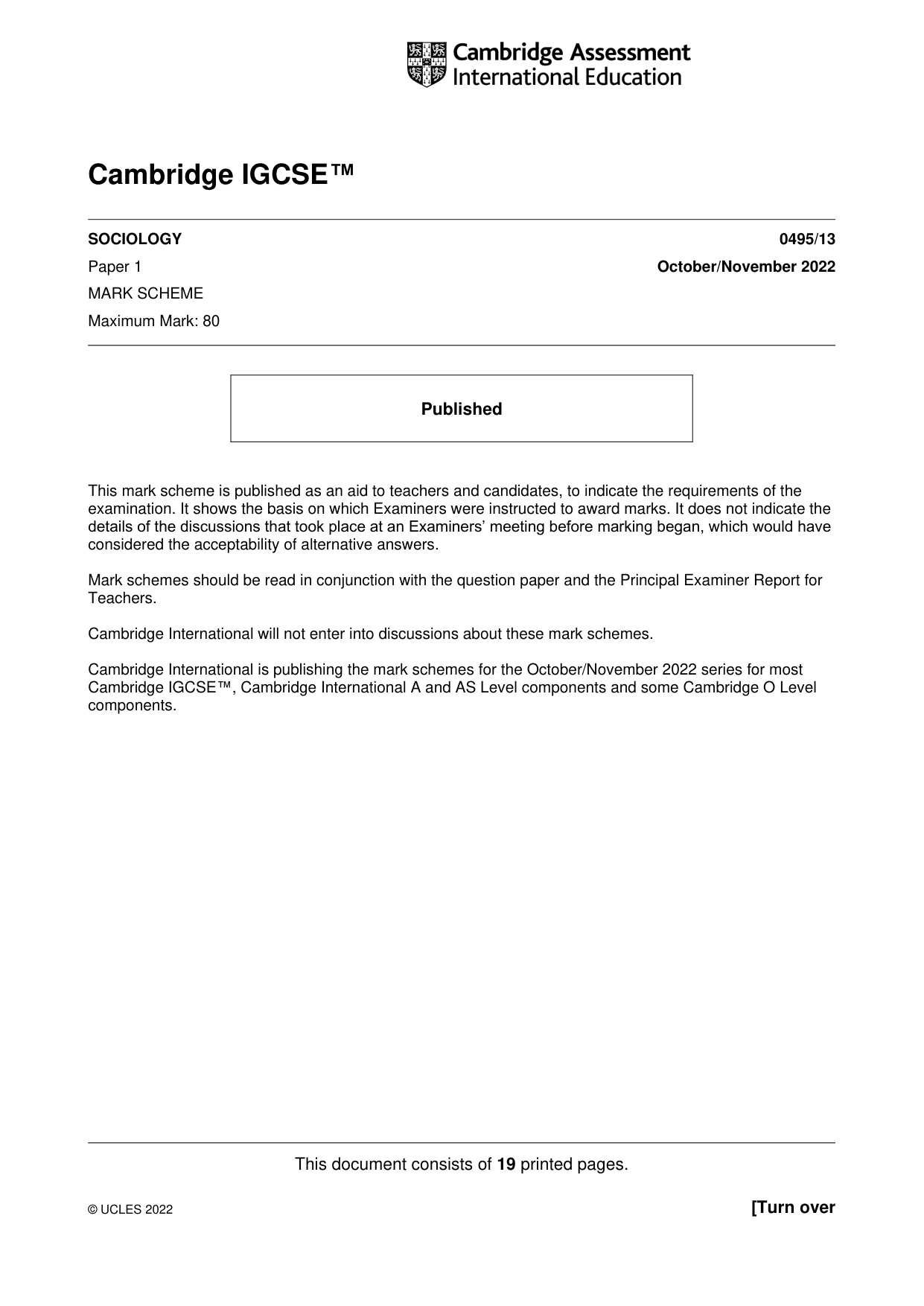
Mark scheme, page 1
This document consists of 19 printed pages. © UCLES 2022 [Turn over Cambridge IGCSE™ SOCIOLOGY 0495/13 Paper 1 October/November 2022 MARK SCHEME Maximum Mark: 80 Published This mark scheme is published as an aid to teachers and candidates, to indicate the requirements of the examination. It shows the basis on which Examiners were instructed to award marks. It does not indicate the details of the discussions that took place at an Examiners’ meeting before marking began, which would have considered the acceptability of alternative answers. Mark schemes should be read in conjunction with the question paper and the Principal Examiner Report for Teachers. Cambridge International will not enter into discussions about these mark schemes. Cambridge International is publishing the mark schemes for the October/November 2022 series for most Cambridge IGCSE™, Cambridge International A and AS Level components and some Cambridge O Level components.
Mark scheme, page 2
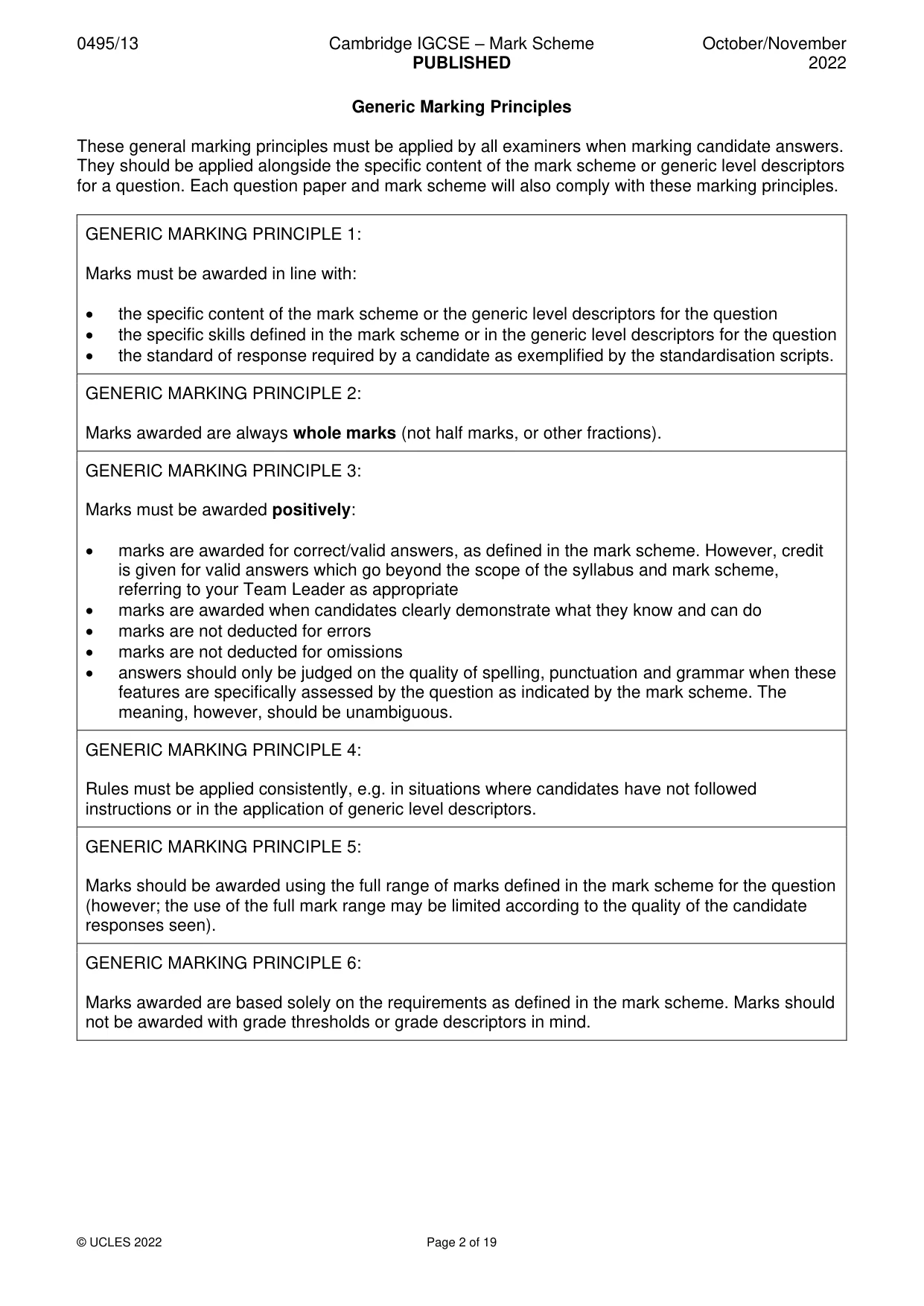
0495/13 Cambridge IGCSE – Mark Scheme PUBLISHED October/November 2022 © UCLES 2022 Page 2 of 19 Generic Marking Principles These general marking principles must be applied by all examiners when marking candidate answers. They should be applied alongside the specific content of the mark scheme or generic level descriptors for a question. Each question paper and mark scheme will also comply with these marking principles. GENERIC MARKING PRINCIPLE 1: Marks must be awarded in line with: • the specific content of the mark scheme or the generic level descriptors for the question • the specific skills defined in the mark scheme or in the generic level descriptors for the question • the standard of response required by a candidate as exemplified by the standardisation scripts. GENERIC MARKING PRINCIPLE 2: Marks awarded are always whole marks (not half marks, or other fractions). GENERIC MARKING PRINCIPLE 3: Marks must be awarded positively: • marks are awarded for correct/valid answers, as defined in the mark scheme. However, credit is given for valid answers which go beyond the scope of the syllabus and mark scheme, referring to your Team Leader as appropriate • marks are awarded when candidates clearly demonstrate what they know and can do • marks are not deducted for errors • marks are not deducted for omissions • answers should only be judged on the quality of spelling, punctuation and grammar when these features are specifically assessed by the question as indicated by the mark scheme. The meaning, however, should be unambiguous. GENERIC MARKING PRINCIPLE 4: Rules must be applied consistently, e.g. in situations where candidates have not followed instructions or in the application of generic level descriptors. GENERIC MARKING PRINCIPLE 5: Marks should be awarded using the full range of marks defined in the mark scheme for the question (however; the use of the full mark range may be limited according to the quality of the candidate responses seen). GENERIC MARKING PRINCIPLE 6: Marks awarded are based solely on the requirements as defined in the mark scheme. Marks should not be awarded with grade thresholds or grade descriptors in mind.
Mark scheme, page 3
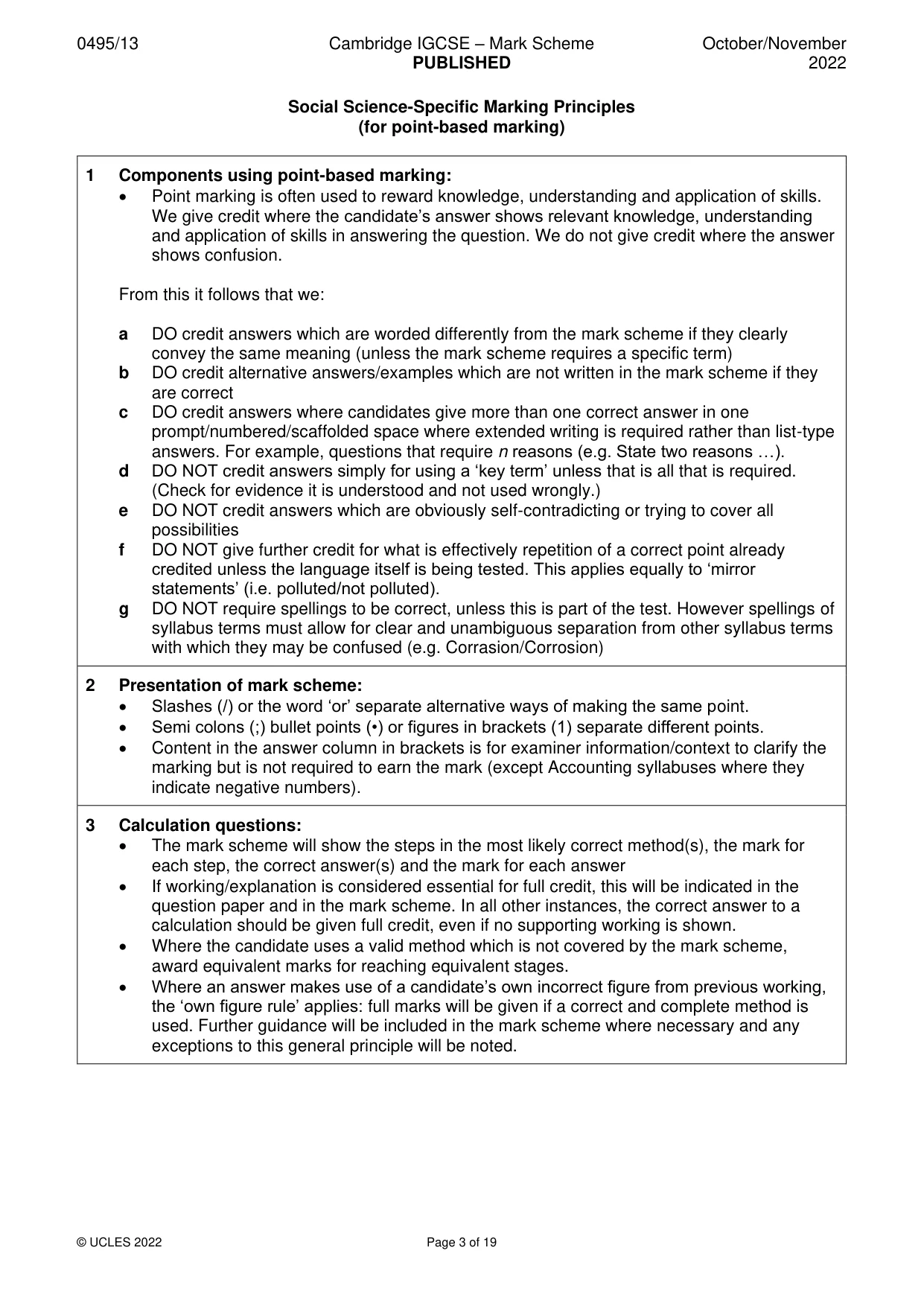
0495/13 Cambridge IGCSE – Mark Scheme PUBLISHED October/November 2022 © UCLES 2022 Page 3 of 19 Social Science-Specific Marking Principles (for point-based marking) 1 Components using point-based marking: • Point marking is often used to reward knowledge, understanding and application of skills. We give credit where the candidate’s answer shows relevant knowledge, understanding and application of skills in answering the question. We do not give credit where the answer shows confusion. From this it follows that we: a DO credit answers which are worded differently from the mark scheme if they clearly convey the same meaning (unless the mark scheme requires a specific term) b DO credit alternative answers/examples which are not written in the mark scheme if they are correct c DO credit answers where candidates give more than one correct answer in one prompt/numbered/scaffolded space where extended writing is required rather than list-type answers. For example, questions that require n reasons (e.g. State two reasons …). d DO NOT credit answers simply for using a ‘key term’ unless that is all that is required. (Check for evidence it is understood and not used wrongly.) e DO NOT credit answers which are obviously self-contradicting or trying to cover all possibilities f DO NOT give further credit for what is effectively repetition of a correct point already credited unless the language itself is being tested. This applies equally to ‘mirror statements’ (i.e. polluted/not polluted). g DO NOT require spellings to be correct, unless this is part of the test. However spellings of syllabus terms must allow for clear and unambiguous separation from other syllabus terms with which they may be confused (e.g. Corrasion/Corrosion) 2 Presentation of mark scheme: • Slashes (/) or the word ‘or’ separate alternative ways of making the same point. • Semi colons (;) bullet points (•) or figures in brackets (1) separate different points. • Content in the answer column in brackets is for examiner information/context to clarify the marking but is not required to earn the mark (except Accounting syllabuses where they indicate negative numbers). 3 Calculation questions: • The mark scheme will show the steps in the most likely correct method(s), the mark for each step, the correct answer(s) and the mark for each answer • If working/explanation is considered essential for full credit, this will be indicated in the question paper and in the mark scheme. In all other instances, the correct answer to a calculation should be given full credit, even if no supporting working is shown. • Where the candidate uses a valid method which is not covered by the mark scheme, award equivalent marks for reaching equivalent stages. • Where an answer makes use of a candidate’s own incorrect figure from previous working, the ‘own figure rule’ applies: full marks will be given if a correct and complete method is used. Further guidance will be included in the mark scheme where necessary and any exceptions to this general principle will be noted.
Mark scheme, page 4
0495/13 Cambridge IGCSE – Mark Scheme PUBLISHED October/November 2022 © UCLES 2022 Page 4 of 19 4 Annotation: • For point marking, ticks can be used to indicate correct answers and crosses can be used to indicate wrong answers. There is no direct relationship between ticks and marks. Ticks have no defined meaning for levels of response marking. • For levels of response marking, the level awarded should be annotated on the script. • Other annotations will be used by examiners as agreed during standardisation, and the meaning will be understood by all examiners who marked that paper.
Mark scheme, page 5
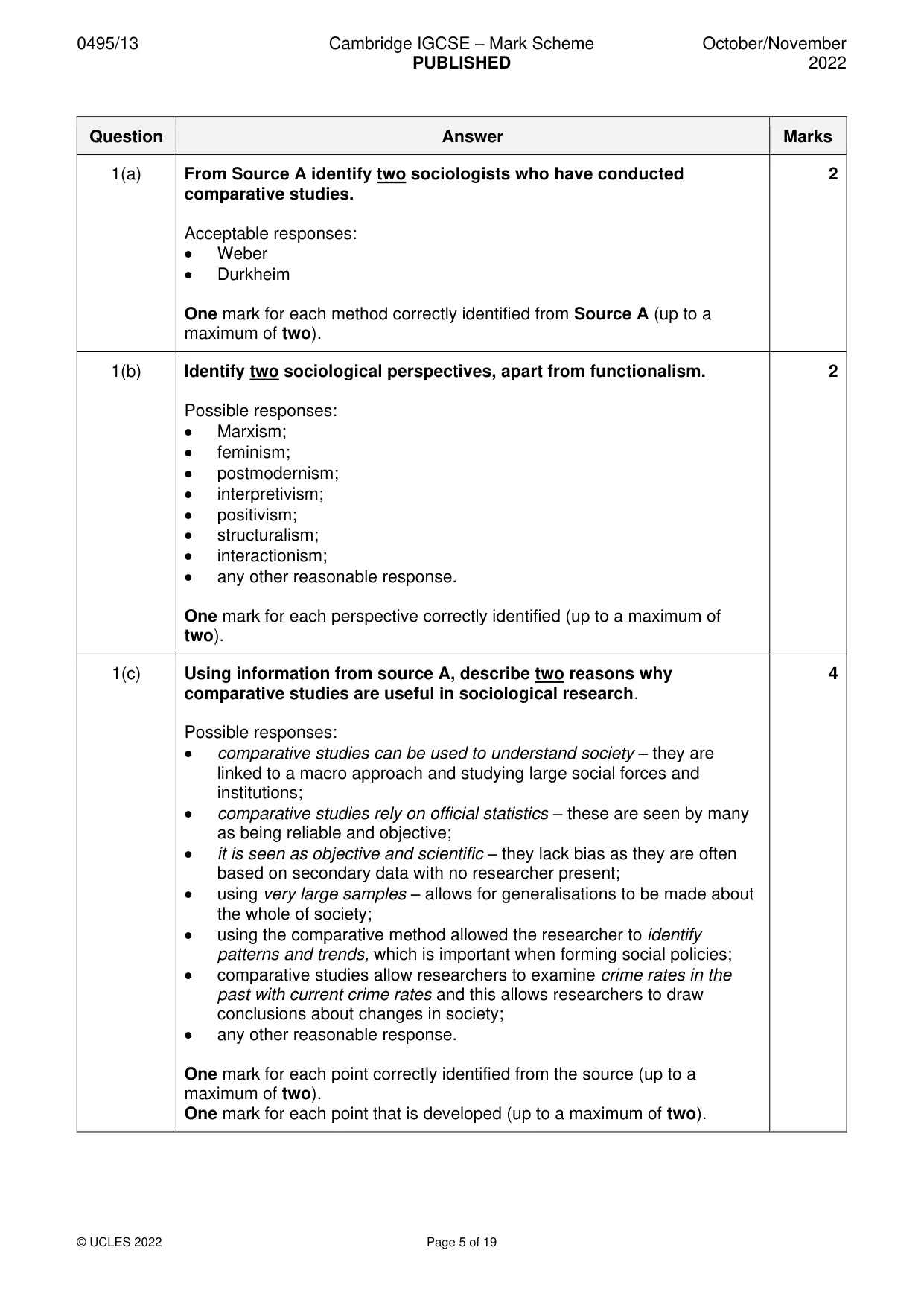
0495/13 Cambridge IGCSE – Mark Scheme PUBLISHED October/November 2022 © UCLES 2022 Page 5 of 19 Question Answer Marks 1(a) From Source A identify two sociologists who have conducted comparative studies. Acceptable responses: • Weber • Durkheim One mark for each method correctly identified from Source A (up to a maximum of two). 2 1(b) Identify two sociological perspectives, apart from functionalism. Possible responses: • Marxism; • feminism; • postmodernism; • interpretivism; • positivism; • structuralism; • interactionism; • any other reasonable response. One mark for each perspective correctly identified (up to a maximum of two). 2 1(c) Using information from source A, describe two reasons why comparative studies are useful in sociological research. Possible responses: • comparative studies can be used to understand society – they are linked to a macro approach and studying large social forces and institutions; • comparative studies rely on official statistics – these are seen by many as being reliable and objective; • it is seen as objective and scientific – they lack bias as they are often based on secondary data with no researcher present; • using very large samples – allows for generalisations to be made about the whole of society; • using the comparative method allowed the researcher to identify patterns and trends, which is important when forming social policies; • comparative studies allow researchers to examine crime rates in the past with current crime rates and this allows researchers to draw conclusions about changes in society; • any other reasonable response. One mark for each point correctly identified from the source (up to a maximum of two). One mark for each point that is developed (up to a maximum of two). 4
Mark scheme, page 6
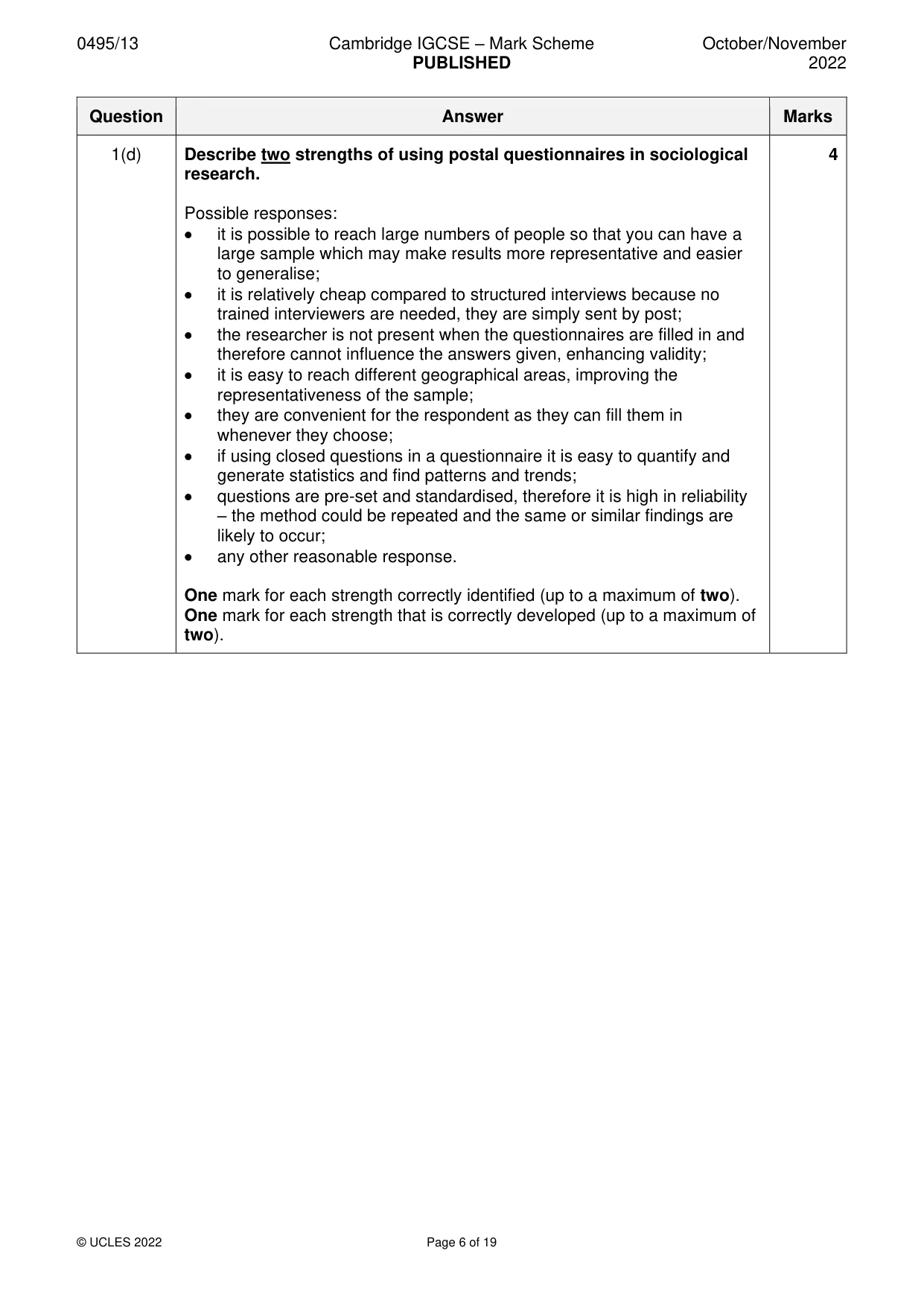
0495/13 Cambridge IGCSE – Mark Scheme PUBLISHED October/November 2022 © UCLES 2022 Page 6 of 19 Question Answer Marks 1(d) Describe two strengths of using postal questionnaires in sociological research. Possible responses: • it is possible to reach large numbers of people so that you can have a large sample which may make results more representative and easier to generalise; • it is relatively cheap compared to structured interviews because no trained interviewers are needed, they are simply sent by post; • the researcher is not present when the questionnaires are filled in and therefore cannot influence the answers given, enhancing validity; • it is easy to reach different geographical areas, improving the representativeness of the sample; • they are convenient for the respondent as they can fill them in whenever they choose; • if using closed questions in a questionnaire it is easy to quantify and generate statistics and find patterns and trends; • questions are pre-set and standardised, therefore it is high in reliability – the method could be repeated and the same or similar findings are likely to occur; • any other reasonable response. One mark for each strength correctly identified (up to a maximum of two). One mark for each strength that is correctly developed (up to a maximum of two). 4
Mark scheme, page 7
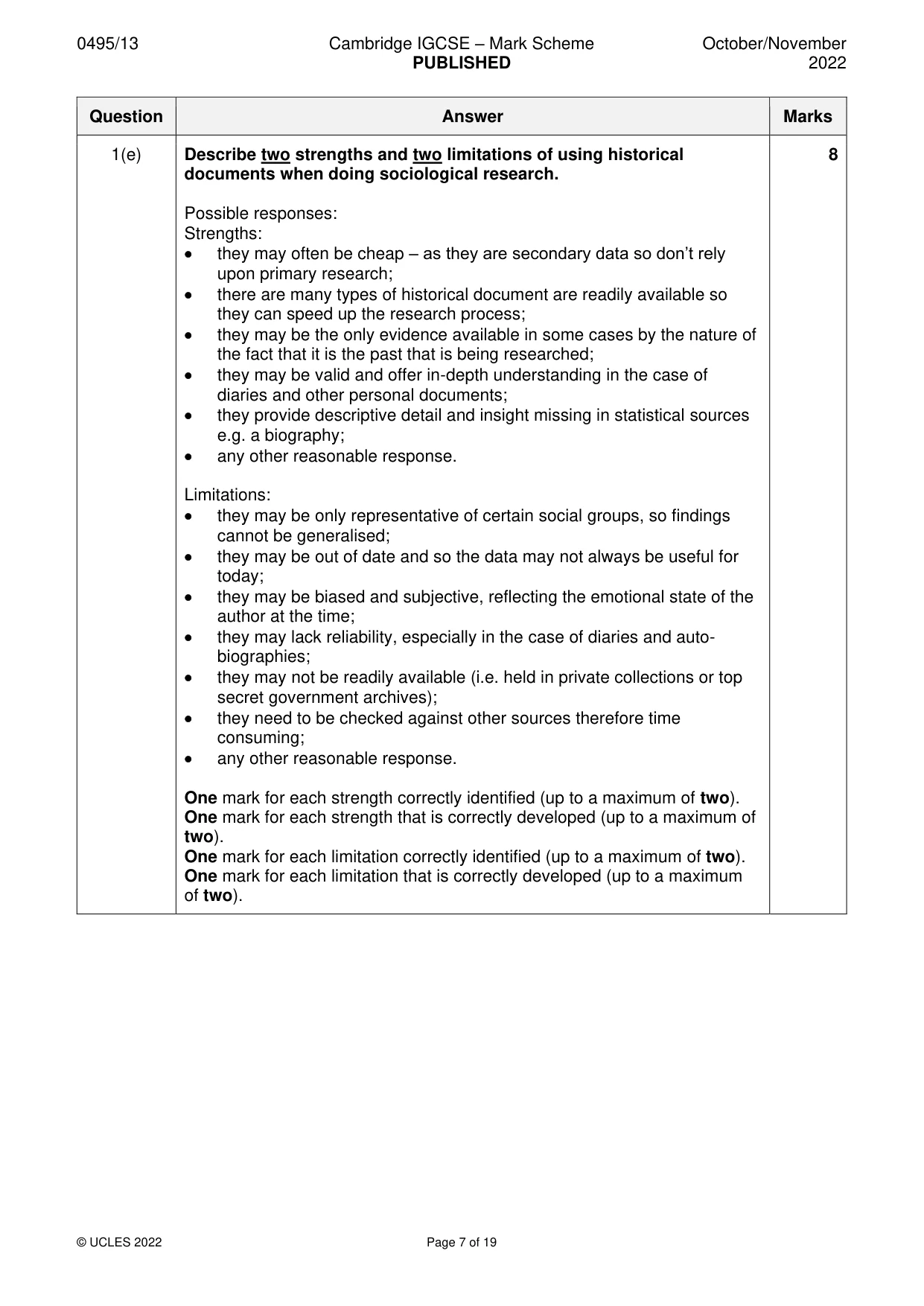
0495/13 Cambridge IGCSE – Mark Scheme PUBLISHED October/November 2022 © UCLES 2022 Page 7 of 19 Question Answer Marks 1(e) Describe two strengths and two limitations of using historical documents when doing sociological research. Possible responses: Strengths: • they may often be cheap – as they are secondary data so don’t rely upon primary research; • there are many types of historical document are readily available so they can speed up the research process; • they may be the only evidence available in some cases by the nature of the fact that it is the past that is being researched; • they may be valid and offer in-depth understanding in the case of diaries and other personal documents; • they provide descriptive detail and insight missing in statistical sources e.g. a biography; • any other reasonable response. Limitations: • they may be only representative of certain social groups, so findings cannot be generalised; • they may be out of date and so the data may not always be useful for today; • they may be biased and subjective, reflecting the emotional state of the author at the time; • they may lack reliability, especially in the case of diaries and auto- biographies; • they may not be readily available (i.e. held in private collections or top secret government archives); • they need to be checked against other sources therefore time consuming; • any other reasonable response. One mark for each strength correctly identified (up to a maximum of two). One mark for each strength that is correctly developed (up to a maximum of two). One mark for each limitation correctly identified (up to a maximum of two). One mark for each limitation that is correctly developed (up to a maximum of two). 8
Mark scheme, page 8
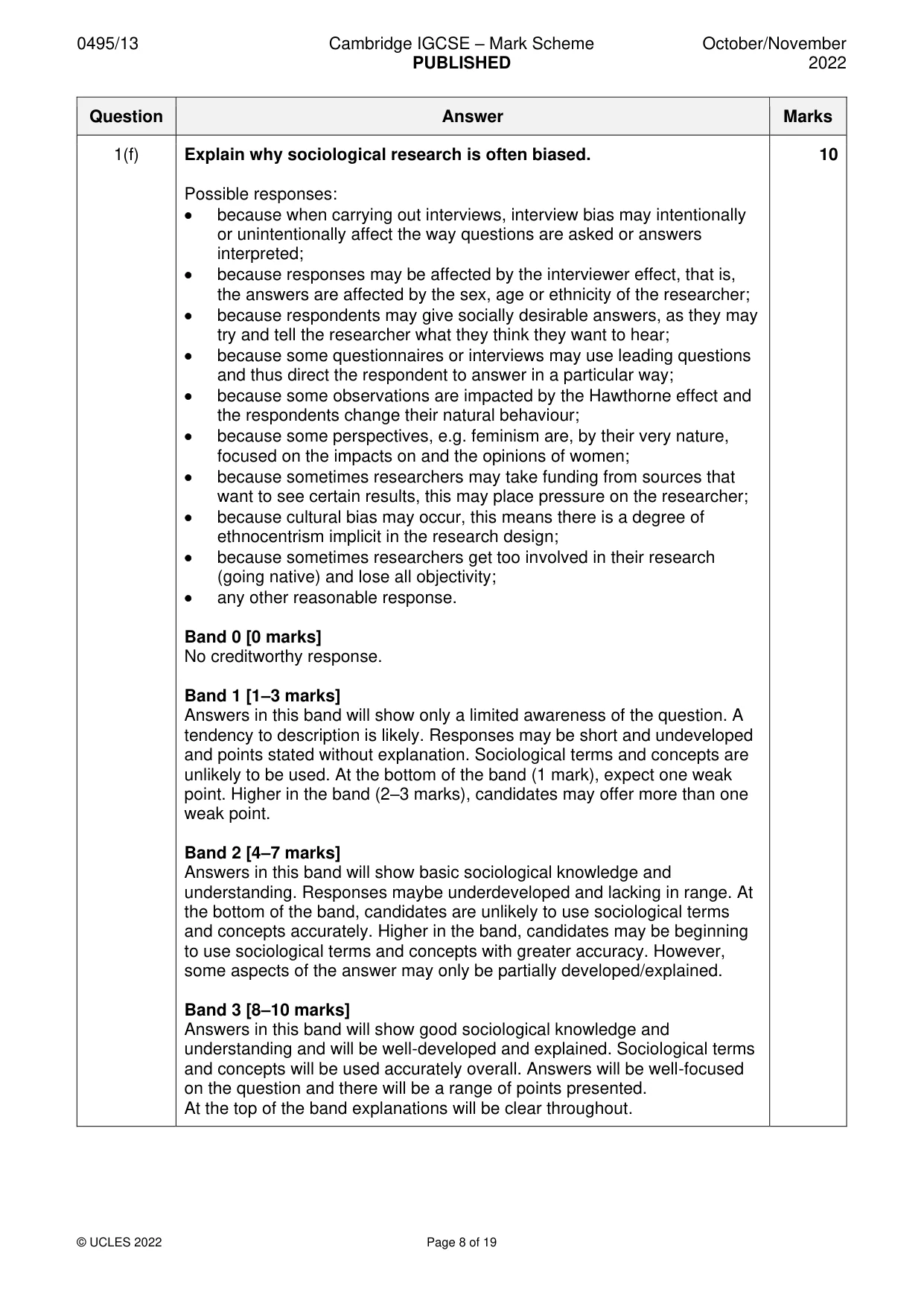
0495/13 Cambridge IGCSE – Mark Scheme PUBLISHED October/November 2022 © UCLES 2022 Page 8 of 19 Question Answer Marks 1(f) Explain why sociological research is often biased. Possible responses: • because when carrying out interviews, interview bias may intentionally or unintentionally affect the way questions are asked or answers interpreted; • because responses may be affected by the interviewer effect, that is, the answers are affected by the sex, age or ethnicity of the researcher; • because respondents may give socially desirable answers, as they may try and tell the researcher what they think they want to hear; • because some questionnaires or interviews may use leading questions and thus direct the respondent to answer in a particular way; • because some observations are impacted by the Hawthorne effect and the respondents change their natural behaviour; • because some perspectives, e.g. feminism are, by their very nature, focused on the impacts on and the opinions of women; • because sometimes researchers may take funding from sources that want to see certain results, this may place pressure on the researcher; • because cultural bias may occur, this means there is a degree of ethnocentrism implicit in the research design; • because sometimes researchers get too involved in their research (going native) and lose all objectivity; • any other reasonable response. Band 0 [0 marks] No creditworthy response. Band 1 [1–3 marks] Answers in this band will show only a limited awareness of the question. A tendency to description is likely. Responses may be short and undeveloped and points stated without explanation. Sociological terms and concepts are unlikely to be used. At the bottom of the band (1 mark), expect one weak point. Higher in the band (2–3 marks), candidates may offer more than one weak point. Band 2 [4–7 marks] Answers in this band will show basic sociological knowledge and understanding. Responses maybe underdeveloped and lacking in range. At the bottom of the band, candidates are unlikely to use sociological terms and concepts accurately. Higher in the band, candidates may be beginning to use sociological terms and concepts with greater accuracy. However, some aspects of the answer may only be partially developed/explained. Band 3 [8–10 marks] Answers in this band will show good sociological knowledge and understanding and will be well-developed and explained. Sociological terms and concepts will be used accurately overall. Answers will be well-focused on the question and there will be a range of points presented. At the top of the band explanations will be clear throughout. 10
Mark scheme, page 9
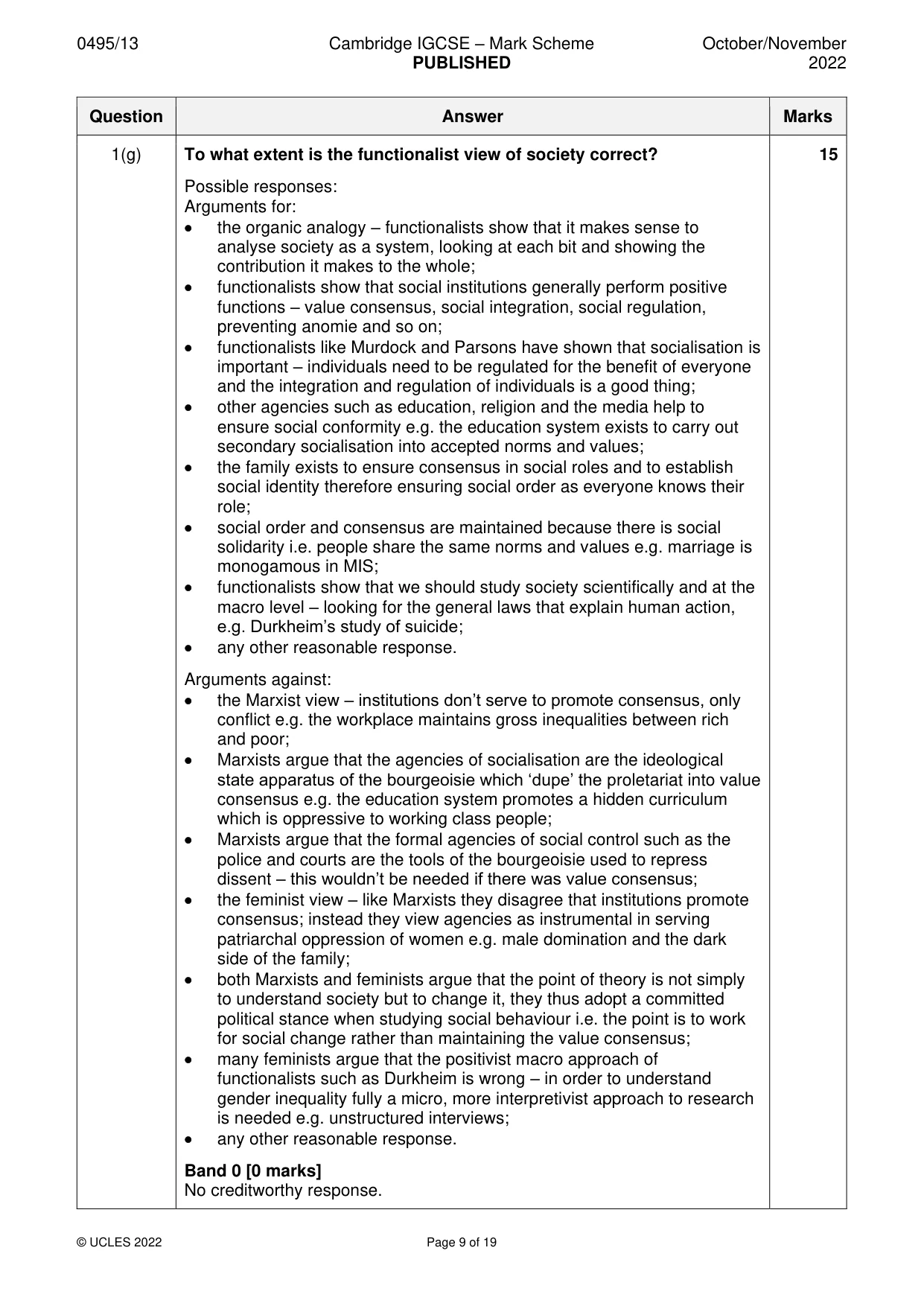
0495/13 Cambridge IGCSE – Mark Scheme PUBLISHED October/November 2022 © UCLES 2022 Page 9 of 19 Question Answer Marks 1(g) To what extent is the functionalist view of society correct? Possible responses: Arguments for: • the organic analogy – functionalists show that it makes sense to analyse society as a system, looking at each bit and showing the contribution it makes to the whole; • functionalists show that social institutions generally perform positive functions – value consensus, social integration, social regulation, preventing anomie and so on; • functionalists like Murdock and Parsons have shown that socialisation is important – individuals need to be regulated for the benefit of everyone and the integration and regulation of individuals is a good thing; • other agencies such as education, religion and the media help to ensure social conformity e.g. the education system exists to carry out secondary socialisation into accepted norms and values; • the family exists to ensure consensus in social roles and to establish social identity therefore ensuring social order as everyone knows their role; • social order and consensus are maintained because there is social solidarity i.e. people share the same norms and values e.g. marriage is monogamous in MIS; • functionalists show that we should study society scientifically and at the macro level – looking for the general laws that explain human action, e.g. Durkheim’s study of suicide; • any other reasonable response. Arguments against: • the Marxist view – institutions don’t serve to promote consensus, only conflict e.g. the workplace maintains gross inequalities between rich and poor; • Marxists argue that the agencies of socialisation are the ideological state apparatus of the bourgeoisie which ‘dupe’ the proletariat into value consensus e.g. the education system promotes a hidden curriculum which is oppressive to working class people; • Marxists argue that the formal agencies of social control such as the police and courts are the tools of the bourgeoisie used to repress dissent – this wouldn’t be needed if there was value consensus; • the feminist view – like Marxists they disagree that institutions promote consensus; instead they view agencies as instrumental in serving patriarchal oppression of women e.g. male domination and the dark side of the family; • both Marxists and feminists argue that the point of theory is not simply to understand society but to change it, they thus adopt a committed political stance when studying social behaviour i.e. the point is to work for social change rather than maintaining the value consensus; • many feminists argue that the positivist macro approach of functionalists such as Durkheim is wrong – in order to understand gender inequality fully a micro, more interpretivist approach to research is needed e.g. unstructured interviews; • any other reasonable response. Band 0 [0 marks] No creditworthy response. 15
Mark scheme, page 10
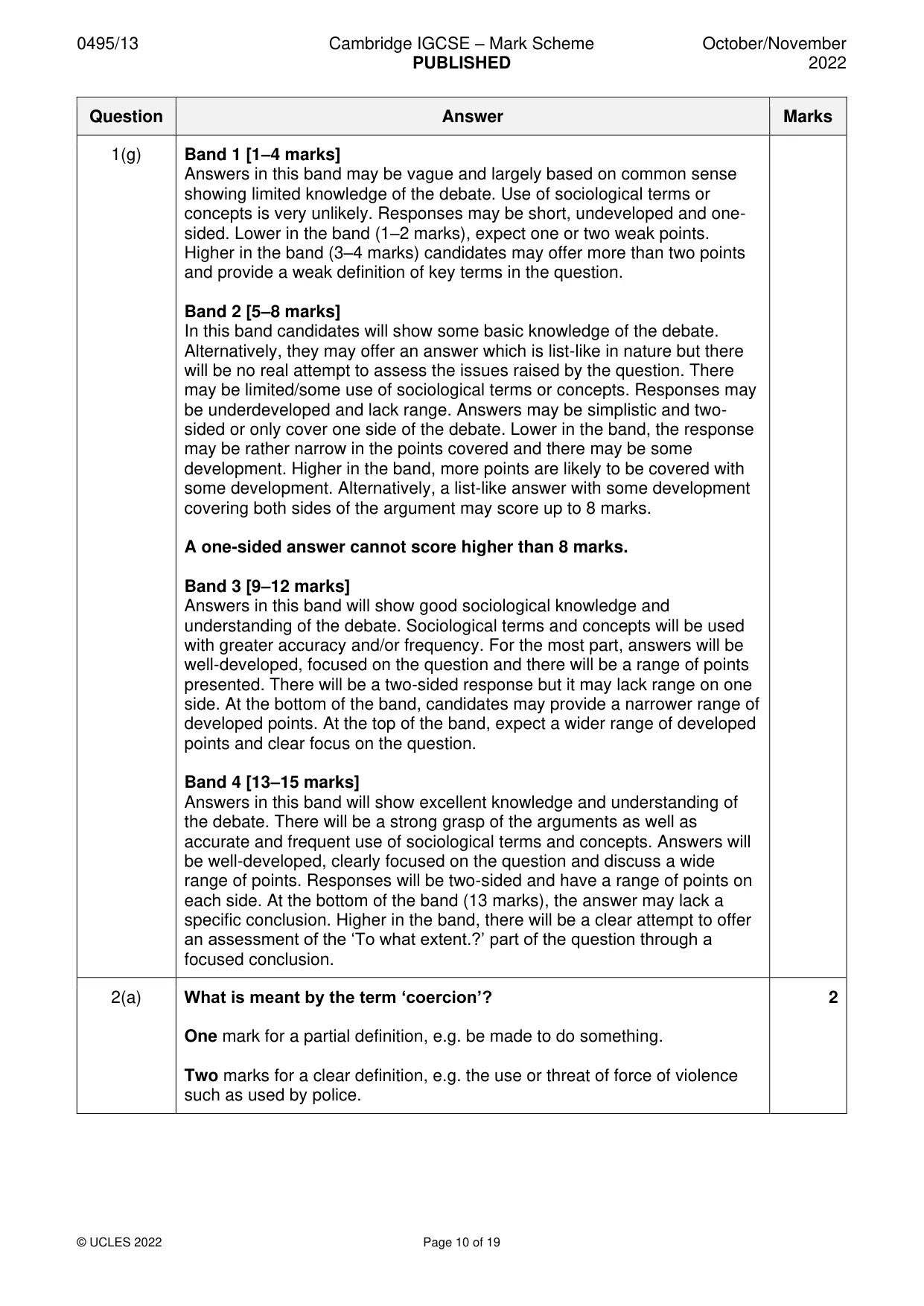
0495/13 Cambridge IGCSE – Mark Scheme PUBLISHED October/November 2022 © UCLES 2022 Page 10 of 19 Question Answer Marks 1(g) Band 1 [1–4 marks] Answers in this band may be vague and largely based on common sense showing limited knowledge of the debate. Use of sociological terms or concepts is very unlikely. Responses may be short, undeveloped and one- sided. Lower in the band (1–2 marks), expect one or two weak points. Higher in the band (3–4 marks) candidates may offer more than two points and provide a weak definition of key terms in the question. Band 2 [5–8 marks] In this band candidates will show some basic knowledge of the debate. Alternatively, they may offer an answer which is list-like in nature but there will be no real attempt to assess the issues raised by the question. There may be limited/some use of sociological terms or concepts. Responses may be underdeveloped and lack range. Answers may be simplistic and two- sided or only cover one side of the debate. Lower in the band, the response may be rather narrow in the points covered and there may be some development. Higher in the band, more points are likely to be covered with some development. Alternatively, a list-like answer with some development covering both sides of the argument may score up to 8 marks. A one-sided answer cannot score higher than 8 marks. Band 3 [9–12 marks] Answers in this band will show good sociological knowledge and understanding of the debate. Sociological terms and concepts will be used with greater accuracy and/or frequency. For the most part, answers will be well-developed, focused on the question and there will be a range of points presented. There will be a two-sided response but it may lack range on one side. At the bottom of the band, candidates may provide a narrower range of developed points. At the top of the band, expect a wider range of developed points and clear focus on the question. Band 4 [13–15 marks] Answers in this band will show excellent knowledge and understanding of the debate. There will be a strong grasp of the arguments as well as accurate and frequent use of sociological terms and concepts. Answers will be well-developed, clearly focused on the question and discuss a wide range of points. Responses will be two-sided and have a range of points on each side. At the bottom of the band (13 marks), the answer may lack a specific conclusion. Higher in the band, there will be a clear attempt to offer an assessment of the ‘To what extent.?’ part of the question through a focused conclusion. 2(a) What is meant by the term ‘coercion’? One mark for a partial definition, e.g. be made to do something. Two marks for a clear definition, e.g. the use or threat of force of violence such as used by police. 2
Mark scheme, page 11
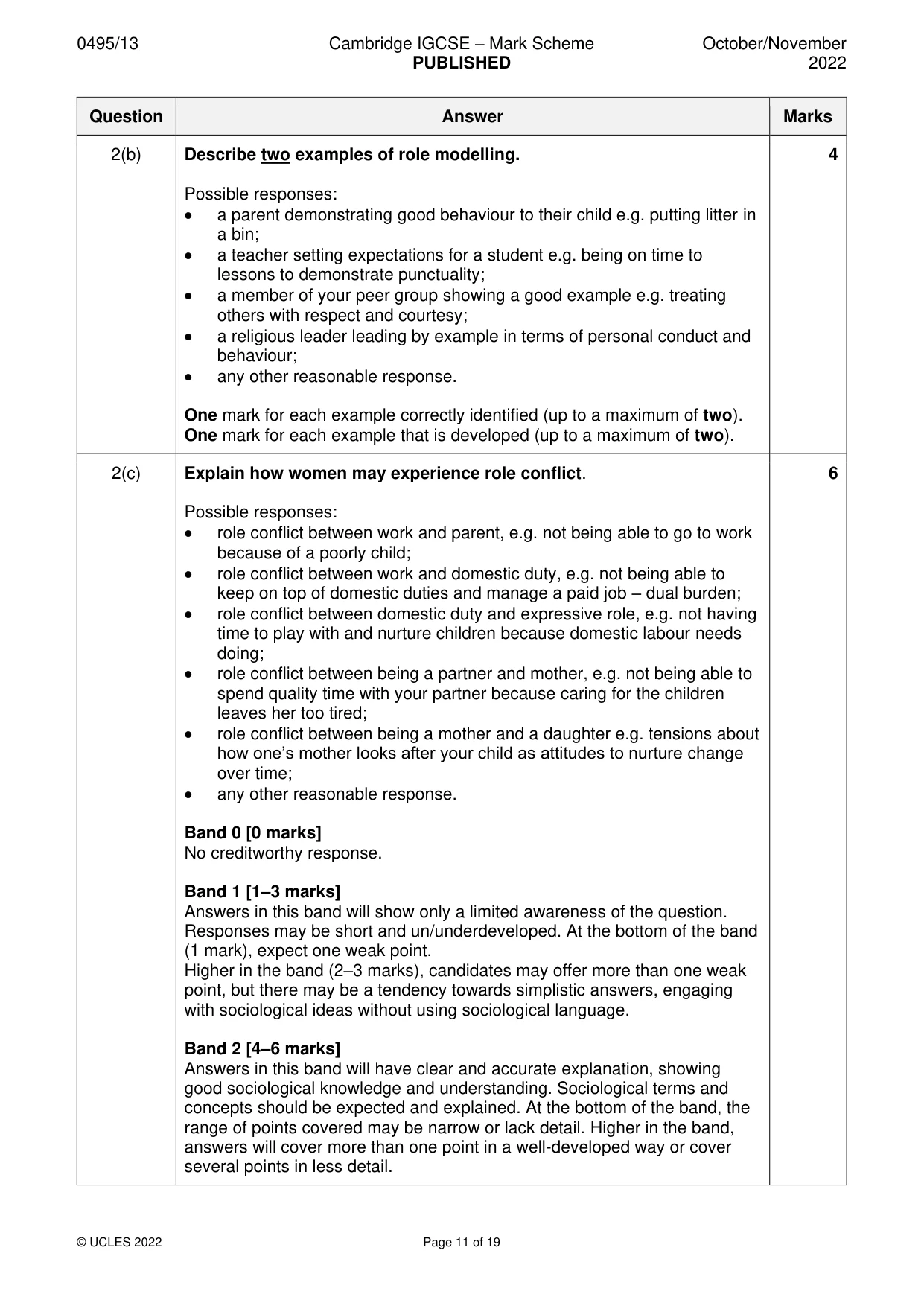
0495/13 Cambridge IGCSE – Mark Scheme PUBLISHED October/November 2022 © UCLES 2022 Page 11 of 19 Question Answer Marks 2(b) Describe two examples of role modelling. Possible responses: • a parent demonstrating good behaviour to their child e.g. putting litter in a bin; • a teacher setting expectations for a student e.g. being on time to lessons to demonstrate punctuality; • a member of your peer group showing a good example e.g. treating others with respect and courtesy; • a religious leader leading by example in terms of personal conduct and behaviour; • any other reasonable response. One mark for each example correctly identified (up to a maximum of two). One mark for each example that is developed (up to a maximum of two). 4 2(c) Explain how women may experience role conflict. Possible responses: • role conflict between work and parent, e.g. not being able to go to work because of a poorly child; • role conflict between work and domestic duty, e.g. not being able to keep on top of domestic duties and manage a paid job – dual burden; • role conflict between domestic duty and expressive role, e.g. not having time to play with and nurture children because domestic labour needs doing; • role conflict between being a partner and mother, e.g. not being able to spend quality time with your partner because caring for the children leaves her too tired; • role conflict between being a mother and a daughter e.g. tensions about how one’s mother looks after your child as attitudes to nurture change over time; • any other reasonable response. Band 0 [0 marks] No creditworthy response. Band 1 [1–3 marks] Answers in this band will show only a limited awareness of the question. Responses may be short and un/underdeveloped. At the bottom of the band (1 mark), expect one weak point. Higher in the band (2–3 marks), candidates may offer more than one weak point, but there may be a tendency towards simplistic answers, engaging with sociological ideas without using sociological language. Band 2 [4–6 marks] Answers in this band will have clear and accurate explanation, showing good sociological knowledge and understanding. Sociological terms and concepts should be expected and explained. At the bottom of the band, the range of points covered may be narrow or lack detail. Higher in the band, answers will cover more than one point in a well-developed way or cover several points in less detail. 6
Mark scheme, page 12
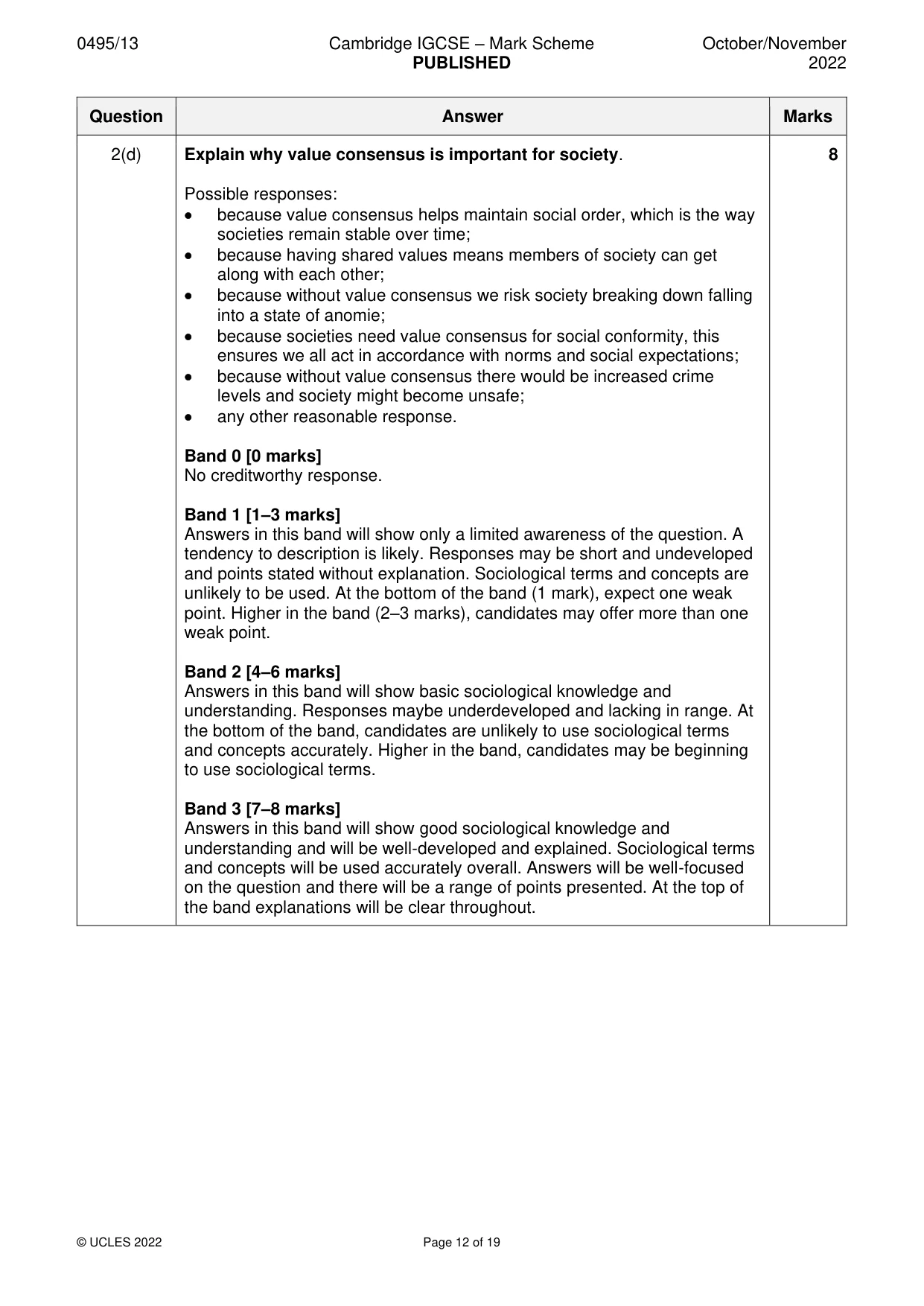
0495/13 Cambridge IGCSE – Mark Scheme PUBLISHED October/November 2022 © UCLES 2022 Page 12 of 19 Question Answer Marks 2(d) Explain why value consensus is important for society. Possible responses: • because value consensus helps maintain social order, which is the way societies remain stable over time; • because having shared values means members of society can get along with each other; • because without value consensus we risk society breaking down falling into a state of anomie; • because societies need value consensus for social conformity, this ensures we all act in accordance with norms and social expectations; • because without value consensus there would be increased crime levels and society might become unsafe; • any other reasonable response. Band 0 [0 marks] No creditworthy response. Band 1 [1–3 marks] Answers in this band will show only a limited awareness of the question. A tendency to description is likely. Responses may be short and undeveloped and points stated without explanation. Sociological terms and concepts are unlikely to be used. At the bottom of the band (1 mark), expect one weak point. Higher in the band (2–3 marks), candidates may offer more than one weak point. Band 2 [4–6 marks] Answers in this band will show basic sociological knowledge and understanding. Responses maybe underdeveloped and lacking in range. At the bottom of the band, candidates are unlikely to use sociological terms and concepts accurately. Higher in the band, candidates may be beginning to use sociological terms. Band 3 [7–8 marks] Answers in this band will show good sociological knowledge and understanding and will be well-developed and explained. Sociological terms and concepts will be used accurately overall. Answers will be well-focused on the question and there will be a range of points presented. At the top of the band explanations will be clear throughout. 8
Mark scheme, page 13
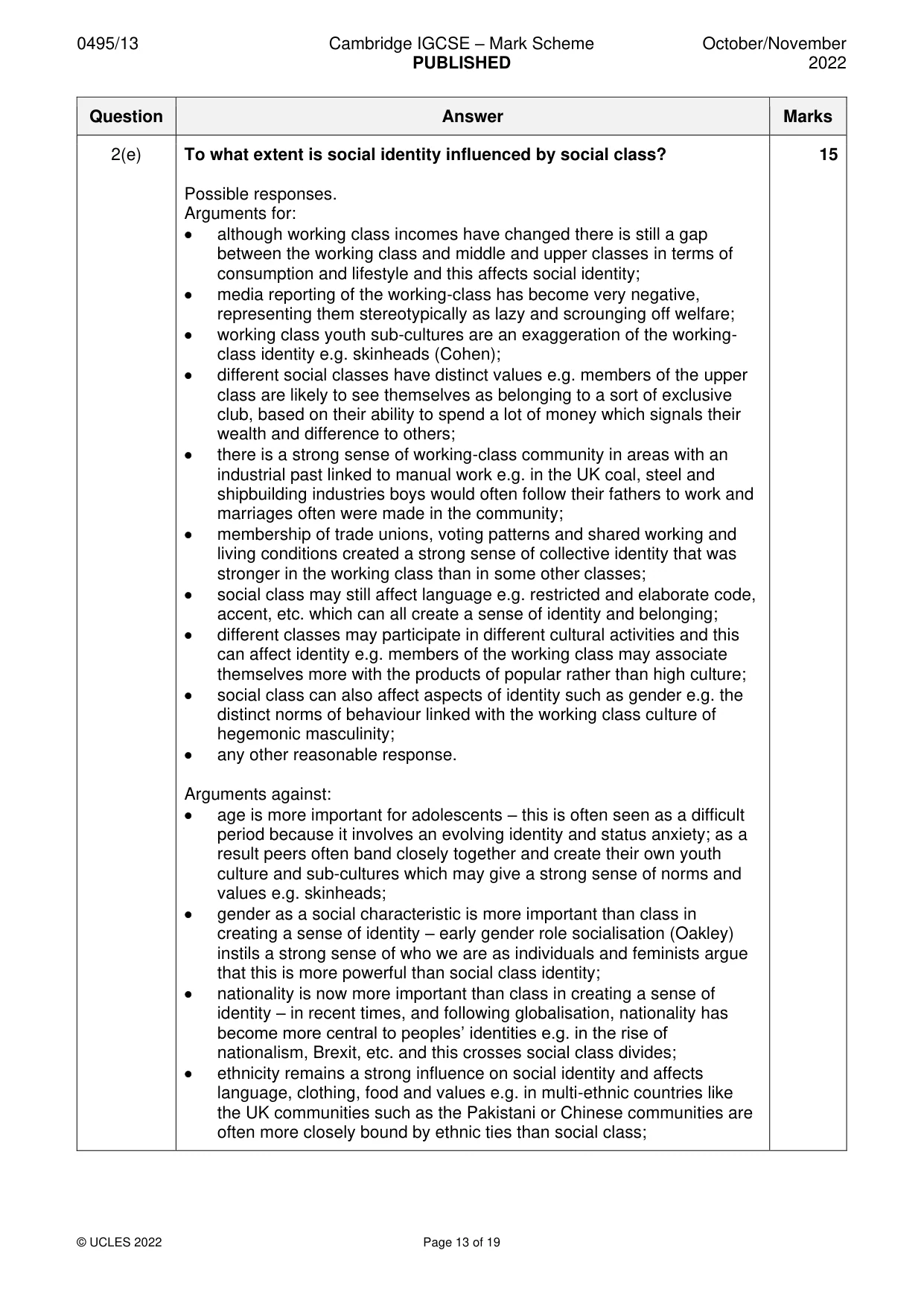
0495/13 Cambridge IGCSE – Mark Scheme PUBLISHED October/November 2022 © UCLES 2022 Page 13 of 19 Question Answer Marks 2(e) To what extent is social identity influenced by social class? Possible responses. Arguments for: • although working class incomes have changed there is still a gap between the working class and middle and upper classes in terms of consumption and lifestyle and this affects social identity; • media reporting of the working-class has become very negative, representing them stereotypically as lazy and scrounging off welfare; • working class youth sub-cultures are an exaggeration of the working- class identity e.g. skinheads (Cohen); • different social classes have distinct values e.g. members of the upper class are likely to see themselves as belonging to a sort of exclusive club, based on their ability to spend a lot of money which signals their wealth and difference to others; • there is a strong sense of working-class community in areas with an industrial past linked to manual work e.g. in the UK coal, steel and shipbuilding industries boys would often follow their fathers to work and marriages often were made in the community; • membership of trade unions, voting patterns and shared working and living conditions created a strong sense of collective identity that was stronger in the working class than in some other classes; • social class may still affect language e.g. restricted and elaborate code, accent, etc. which can all create a sense of identity and belonging; • different classes may participate in different cultural activities and this can affect identity e.g. members of the working class may associate themselves more with the products of popular rather than high culture; • social class can also affect aspects of identity such as gender e.g. the distinct norms of behaviour linked with the working class culture of hegemonic masculinity; • any other reasonable response. Arguments against: • age is more important for adolescents – this is often seen as a difficult period because it involves an evolving identity and status anxiety; as a result peers often band closely together and create their own youth culture and sub-cultures which may give a strong sense of norms and values e.g. skinheads; • gender as a social characteristic is more important than class in creating a sense of identity – early gender role socialisation (Oakley) instils a strong sense of who we are as individuals and feminists argue that this is more powerful than social class identity; • nationality is now more important than class in creating a sense of identity – in recent times, and following globalisation, nationality has become more central to peoples’ identities e.g. in the rise of nationalism, Brexit, etc. and this crosses social class divides; • ethnicity remains a strong influence on social identity and affects language, clothing, food and values e.g. in multi-ethnic countries like the UK communities such as the Pakistani or Chinese communities are often more closely bound by ethnic ties than social class; 15
Mark scheme, page 14
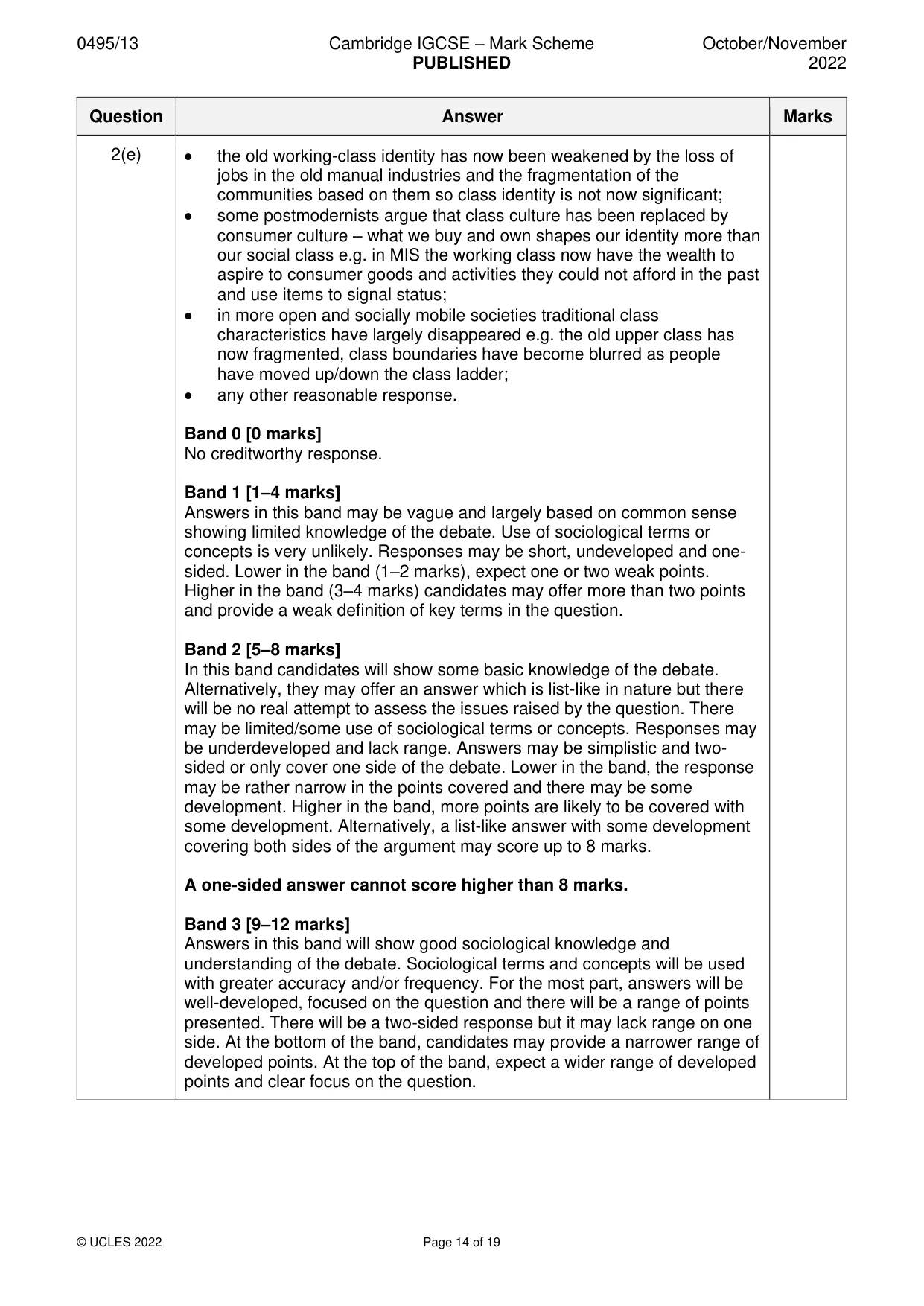
0495/13 Cambridge IGCSE – Mark Scheme PUBLISHED October/November 2022 © UCLES 2022 Page 14 of 19 Question Answer Marks 2(e) • the old working-class identity has now been weakened by the loss of jobs in the old manual industries and the fragmentation of the communities based on them so class identity is not now significant; • some postmodernists argue that class culture has been replaced by consumer culture – what we buy and own shapes our identity more than our social class e.g. in MIS the working class now have the wealth to aspire to consumer goods and activities they could not afford in the past and use items to signal status; • in more open and socially mobile societies traditional class characteristics have largely disappeared e.g. the old upper class has now fragmented, class boundaries have become blurred as people have moved up/down the class ladder; • any other reasonable response. Band 0 [0 marks] No creditworthy response. Band 1 [1–4 marks] Answers in this band may be vague and largely based on common sense showing limited knowledge of the debate. Use of sociological terms or concepts is very unlikely. Responses may be short, undeveloped and one- sided. Lower in the band (1–2 marks), expect one or two weak points. Higher in the band (3–4 marks) candidates may offer more than two points and provide a weak definition of key terms in the question. Band 2 [5–8 marks] In this band candidates will show some basic knowledge of the debate. Alternatively, they may offer an answer which is list-like in nature but there will be no real attempt to assess the issues raised by the question. There may be limited/some use of sociological terms or concepts. Responses may be underdeveloped and lack range. Answers may be simplistic and two- sided or only cover one side of the debate. Lower in the band, the response may be rather narrow in the points covered and there may be some development. Higher in the band, more points are likely to be covered with some development. Alternatively, a list-like answer with some development covering both sides of the argument may score up to 8 marks. A one-sided answer cannot score higher than 8 marks. Band 3 [9–12 marks] Answers in this band will show good sociological knowledge and understanding of the debate. Sociological terms and concepts will be used with greater accuracy and/or frequency. For the most part, answers will be well-developed, focused on the question and there will be a range of points presented. There will be a two-sided response but it may lack range on one side. At the bottom of the band, candidates may provide a narrower range of developed points. At the top of the band, expect a wider range of developed points and clear focus on the question.
Mark scheme, page 15
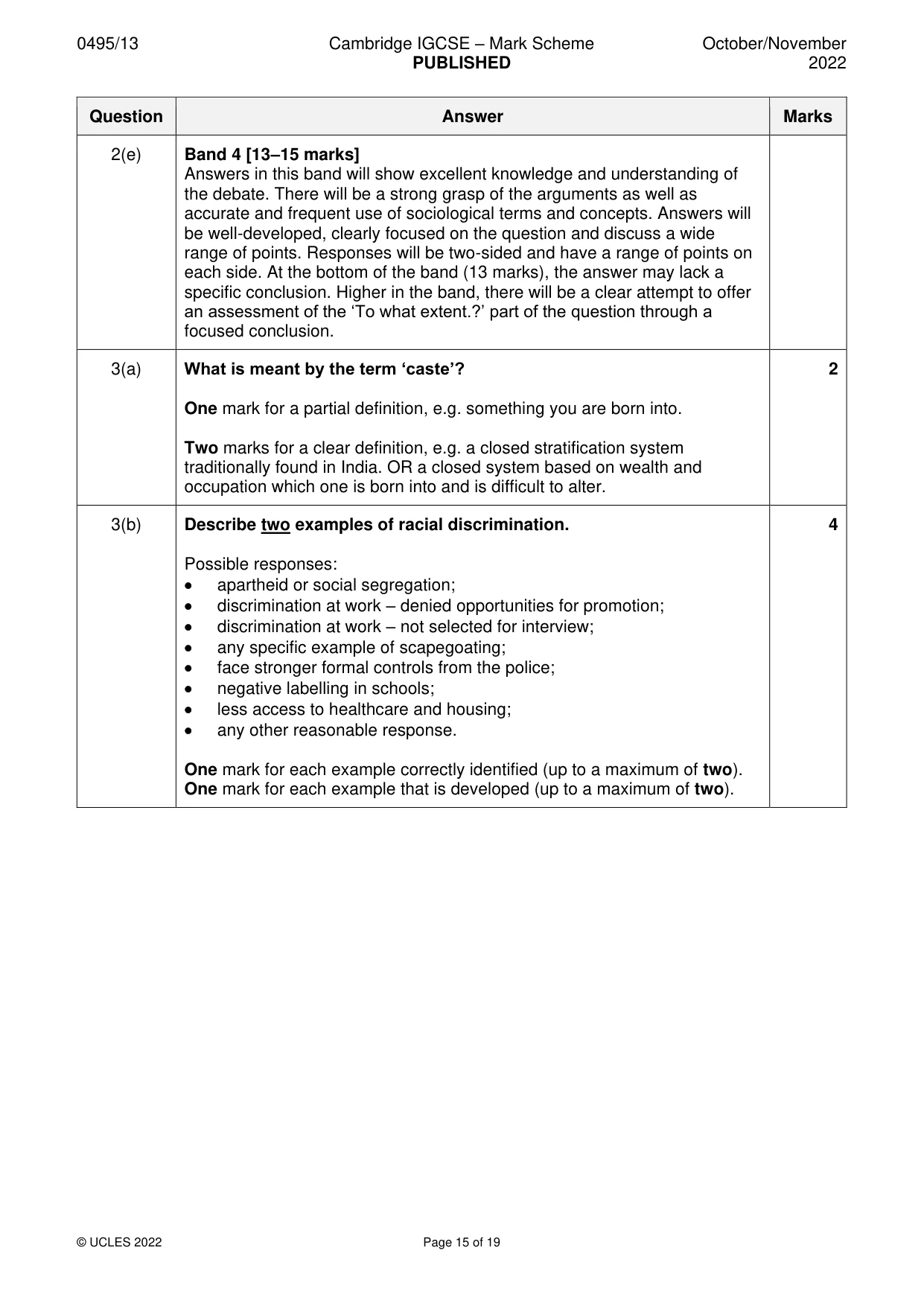
0495/13 Cambridge IGCSE – Mark Scheme PUBLISHED October/November 2022 © UCLES 2022 Page 15 of 19 Question Answer Marks 2(e) Band 4 [13–15 marks] Answers in this band will show excellent knowledge and understanding of the debate. There will be a strong grasp of the arguments as well as accurate and frequent use of sociological terms and concepts. Answers will be well-developed, clearly focused on the question and discuss a wide range of points. Responses will be two-sided and have a range of points on each side. At the bottom of the band (13 marks), the answer may lack a specific conclusion. Higher in the band, there will be a clear attempt to offer an assessment of the ‘To what extent.?’ part of the question through a focused conclusion. 3(a) What is meant by the term ‘caste’? One mark for a partial definition, e.g. something you are born into. Two marks for a clear definition, e.g. a closed stratification system traditionally found in India. OR a closed system based on wealth and occupation which one is born into and is difficult to alter. 2 3(b) Describe two examples of racial discrimination. Possible responses: • apartheid or social segregation; • discrimination at work – denied opportunities for promotion; • discrimination at work – not selected for interview; • any specific example of scapegoating; • face stronger formal controls from the police; • negative labelling in schools; • less access to healthcare and housing; • any other reasonable response. One mark for each example correctly identified (up to a maximum of two). One mark for each example that is developed (up to a maximum of two). 4
Mark scheme, page 16
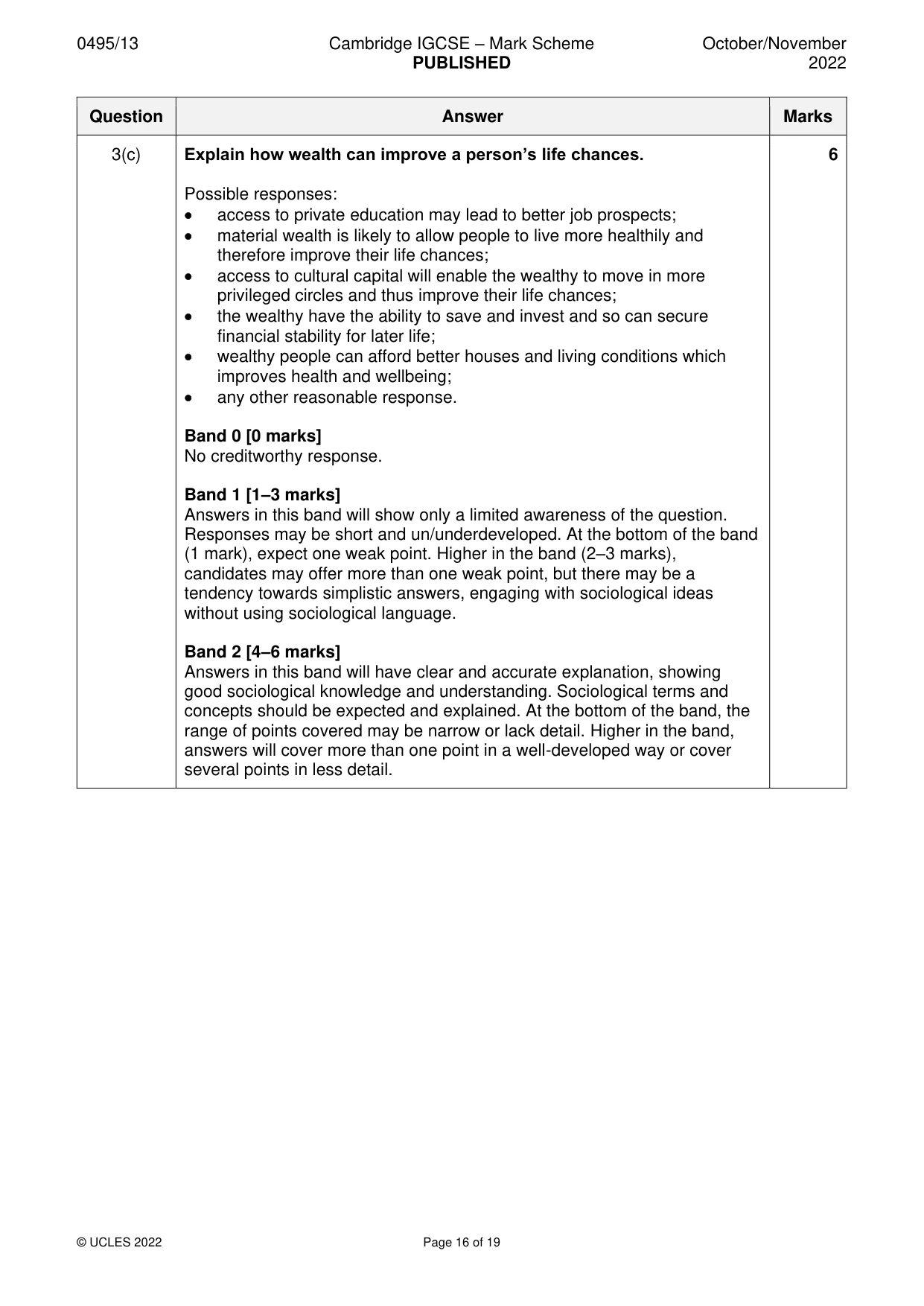
0495/13 Cambridge IGCSE – Mark Scheme PUBLISHED October/November 2022 © UCLES 2022 Page 16 of 19 Question Answer Marks 3(c) Explain how wealth can improve a person’s life chances. Possible responses: • access to private education may lead to better job prospects; • material wealth is likely to allow people to live more healthily and therefore improve their life chances; • access to cultural capital will enable the wealthy to move in more privileged circles and thus improve their life chances; • the wealthy have the ability to save and invest and so can secure financial stability for later life; • wealthy people can afford better houses and living conditions which improves health and wellbeing; • any other reasonable response. Band 0 [0 marks] No creditworthy response. Band 1 [1–3 marks] Answers in this band will show only a limited awareness of the question. Responses may be short and un/underdeveloped. At the bottom of the band (1 mark), expect one weak point. Higher in the band (2–3 marks), candidates may offer more than one weak point, but there may be a tendency towards simplistic answers, engaging with sociological ideas without using sociological language. Band 2 [4–6 marks] Answers in this band will have clear and accurate explanation, showing good sociological knowledge and understanding. Sociological terms and concepts should be expected and explained. At the bottom of the band, the range of points covered may be narrow or lack detail. Higher in the band, answers will cover more than one point in a well-developed way or cover several points in less detail. 6
Mark scheme, page 17
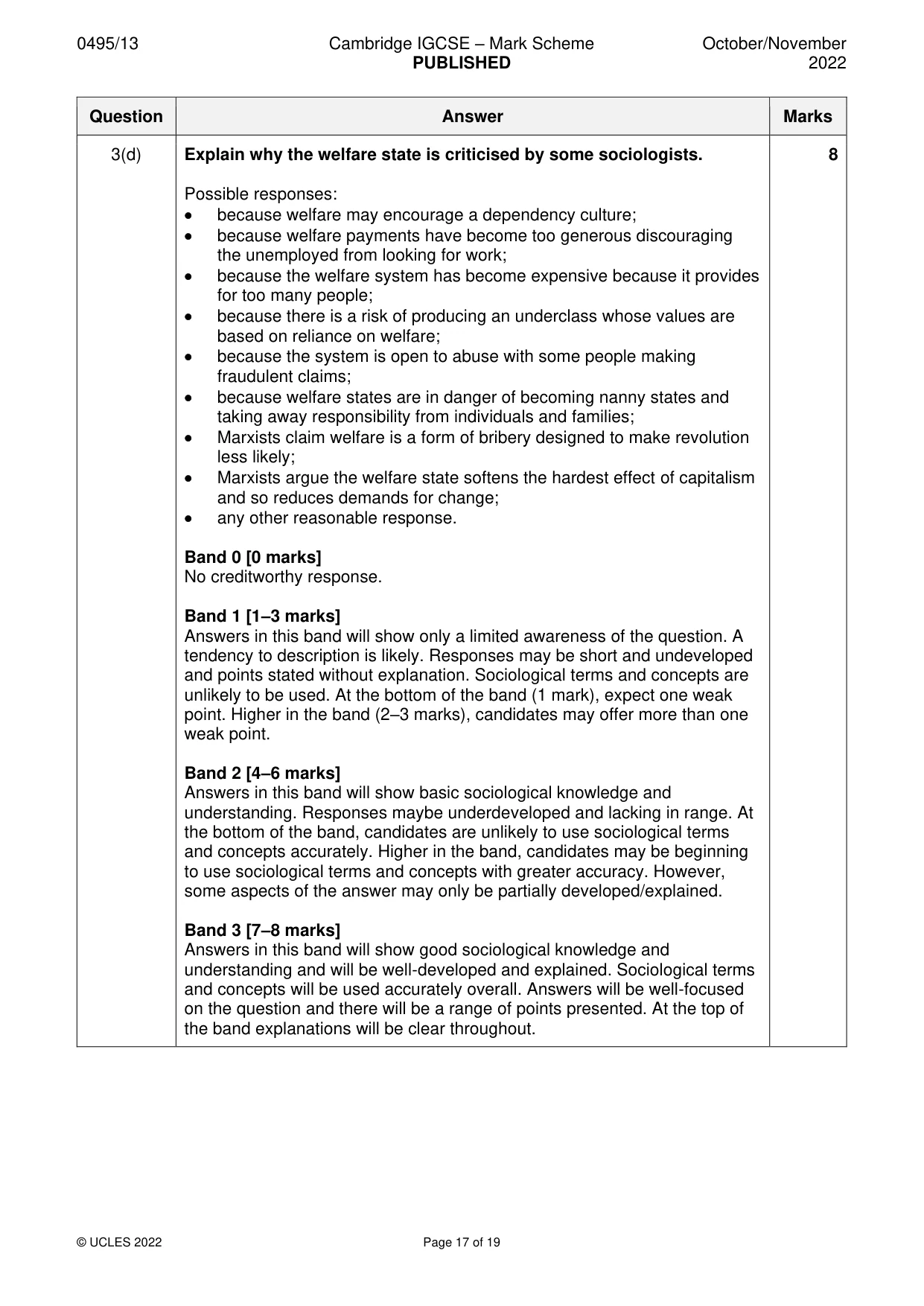
0495/13 Cambridge IGCSE – Mark Scheme PUBLISHED October/November 2022 © UCLES 2022 Page 17 of 19 Question Answer Marks 3(d) Explain why the welfare state is criticised by some sociologists. Possible responses: • because welfare may encourage a dependency culture; • because welfare payments have become too generous discouraging the unemployed from looking for work; • because the welfare system has become expensive because it provides for too many people; • because there is a risk of producing an underclass whose values are based on reliance on welfare; • because the system is open to abuse with some people making fraudulent claims; • because welfare states are in danger of becoming nanny states and taking away responsibility from individuals and families; • Marxists claim welfare is a form of bribery designed to make revolution less likely; • Marxists argue the welfare state softens the hardest effect of capitalism and so reduces demands for change; • any other reasonable response. Band 0 [0 marks] No creditworthy response. Band 1 [1–3 marks] Answers in this band will show only a limited awareness of the question. A tendency to description is likely. Responses may be short and undeveloped and points stated without explanation. Sociological terms and concepts are unlikely to be used. At the bottom of the band (1 mark), expect one weak point. Higher in the band (2–3 marks), candidates may offer more than one weak point. Band 2 [4–6 marks] Answers in this band will show basic sociological knowledge and understanding. Responses maybe underdeveloped and lacking in range. At the bottom of the band, candidates are unlikely to use sociological terms and concepts accurately. Higher in the band, candidates may be beginning to use sociological terms and concepts with greater accuracy. However, some aspects of the answer may only be partially developed/explained. Band 3 [7–8 marks] Answers in this band will show good sociological knowledge and understanding and will be well-developed and explained. Sociological terms and concepts will be used accurately overall. Answers will be well-focused on the question and there will be a range of points presented. At the top of the band explanations will be clear throughout. 8
Mark scheme, page 18
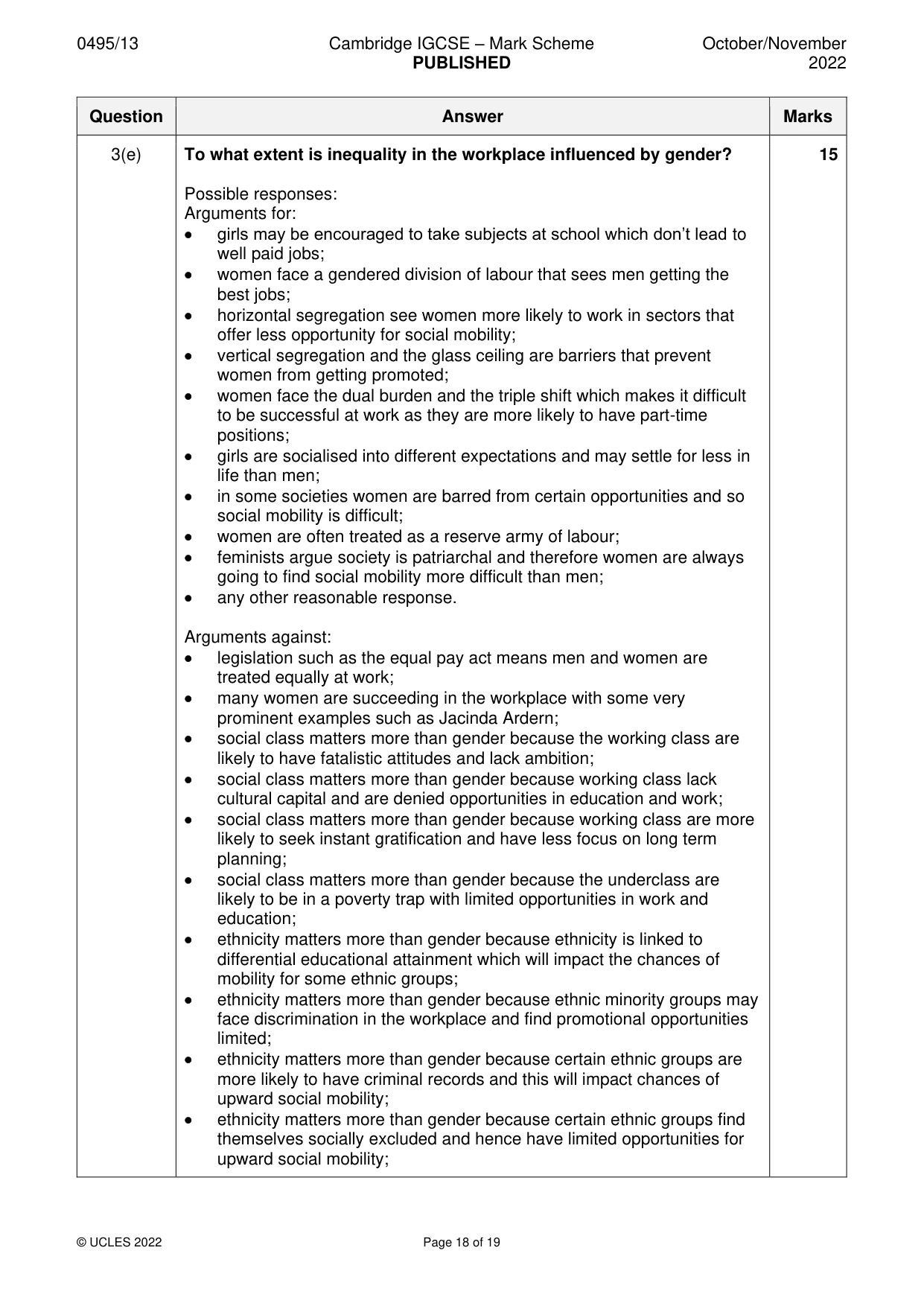
0495/13 Cambridge IGCSE – Mark Scheme PUBLISHED October/November 2022 © UCLES 2022 Page 18 of 19 Question Answer Marks 3(e) To what extent is inequality in the workplace influenced by gender? Possible responses: Arguments for: • girls may be encouraged to take subjects at school which don’t lead to well paid jobs; • women face a gendered division of labour that sees men getting the best jobs; • horizontal segregation see women more likely to work in sectors that offer less opportunity for social mobility; • vertical segregation and the glass ceiling are barriers that prevent women from getting promoted; • women face the dual burden and the triple shift which makes it difficult to be successful at work as they are more likely to have part-time positions; • girls are socialised into different expectations and may settle for less in life than men; • in some societies women are barred from certain opportunities and so social mobility is difficult; • women are often treated as a reserve army of labour; • feminists argue society is patriarchal and therefore women are always going to find social mobility more difficult than men; • any other reasonable response. Arguments against: • legislation such as the equal pay act means men and women are treated equally at work; • many women are succeeding in the workplace with some very prominent examples such as Jacinda Ardern; • social class matters more than gender because the working class are likely to have fatalistic attitudes and lack ambition; • social class matters more than gender because working class lack cultural capital and are denied opportunities in education and work; • social class matters more than gender because working class are more likely to seek instant gratification and have less focus on long term planning; • social class matters more than gender because the underclass are likely to be in a poverty trap with limited opportunities in work and education; • ethnicity matters more than gender because ethnicity is linked to differential educational attainment which will impact the chances of mobility for some ethnic groups; • ethnicity matters more than gender because ethnic minority groups may face discrimination in the workplace and find promotional opportunities limited; • ethnicity matters more than gender because certain ethnic groups are more likely to have criminal records and this will impact chances of upward social mobility; • ethnicity matters more than gender because certain ethnic groups find themselves socially excluded and hence have limited opportunities for upward social mobility; 15
Mark scheme, page 19
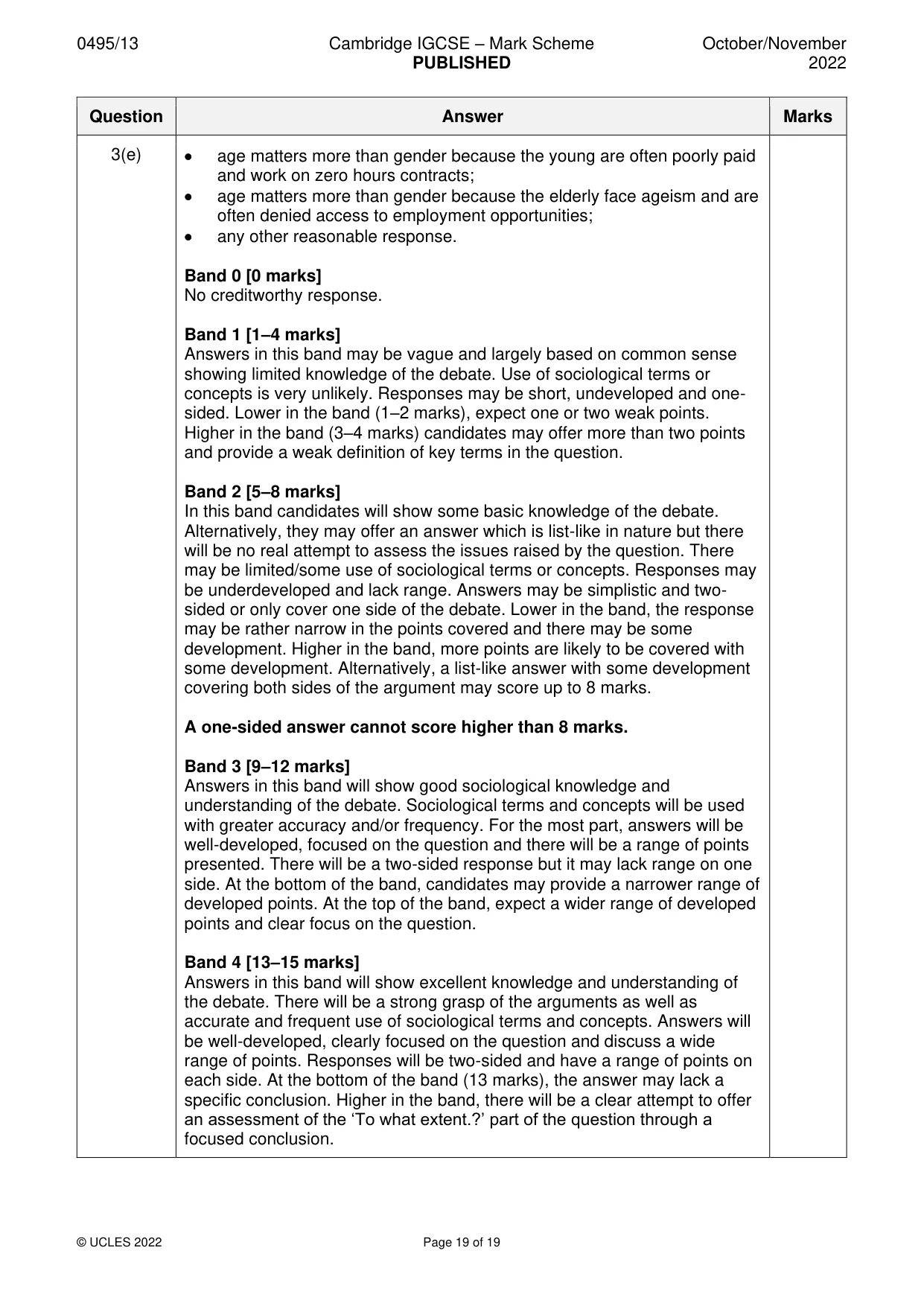
0495/13 Cambridge IGCSE – Mark Scheme PUBLISHED October/November 2022 © UCLES 2022 Page 19 of 19 Question Answer Marks 3(e) • age matters more than gender because the young are often poorly paid and work on zero hours contracts; • age matters more than gender because the elderly face ageism and are often denied access to employment opportunities; • any other reasonable response. Band 0 [0 marks] No creditworthy response. Band 1 [1–4 marks] Answers in this band may be vague and largely based on common sense showing limited knowledge of the debate. Use of sociological terms or concepts is very unlikely. Responses may be short, undeveloped and one- sided. Lower in the band (1–2 marks), expect one or two weak points. Higher in the band (3–4 marks) candidates may offer more than two points and provide a weak definition of key terms in the question. Band 2 [5–8 marks] In this band candidates will show some basic knowledge of the debate. Alternatively, they may offer an answer which is list-like in nature but there will be no real attempt to assess the issues raised by the question. There may be limited/some use of sociological terms or concepts. Responses may be underdeveloped and lack range. Answers may be simplistic and two- sided or only cover one side of the debate. Lower in the band, the response may be rather narrow in the points covered and there may be some development. Higher in the band, more points are likely to be covered with some development. Alternatively, a list-like answer with some development covering both sides of the argument may score up to 8 marks. A one-sided answer cannot score higher than 8 marks. Band 3 [9–12 marks] Answers in this band will show good sociological knowledge and understanding of the debate. Sociological terms and concepts will be used with greater accuracy and/or frequency. For the most part, answers will be well-developed, focused on the question and there will be a range of points presented. There will be a two-sided response but it may lack range on one side. At the bottom of the band, candidates may provide a narrower range of developed points. At the top of the band, expect a wider range of developed points and clear focus on the question. Band 4 [13–15 marks] Answers in this band will show excellent knowledge and understanding of the debate. There will be a strong grasp of the arguments as well as accurate and frequent use of sociological terms and concepts. Answers will be well-developed, clearly focused on the question and discuss a wide range of points. Responses will be two-sided and have a range of points on each side. At the bottom of the band (13 marks), the answer may lack a specific conclusion. Higher in the band, there will be a clear attempt to offer an assessment of the ‘To what extent.?’ part of the question through a focused conclusion.
What you needed in this session
Cambridge’s own grade thresholds for 2022 Oct/Nov, Paper 1 · Variant 3. A higher threshold means an easier paper — the bar moves with how the cohort did.