Cambridge IGCSE Sociology 0495 — 2022 Oct/Nov Paper 1 · Variant 2
0495/12/O/N/22 · 80 marks · ≈90 min
The question paper and its mark scheme, free to read here and free to download. This is Cambridge’s own paper, exactly as it was sat.
Question paper4 pages

Mark scheme20 pages
Answers below. Sit the paper first if you are practising.

Paper as text
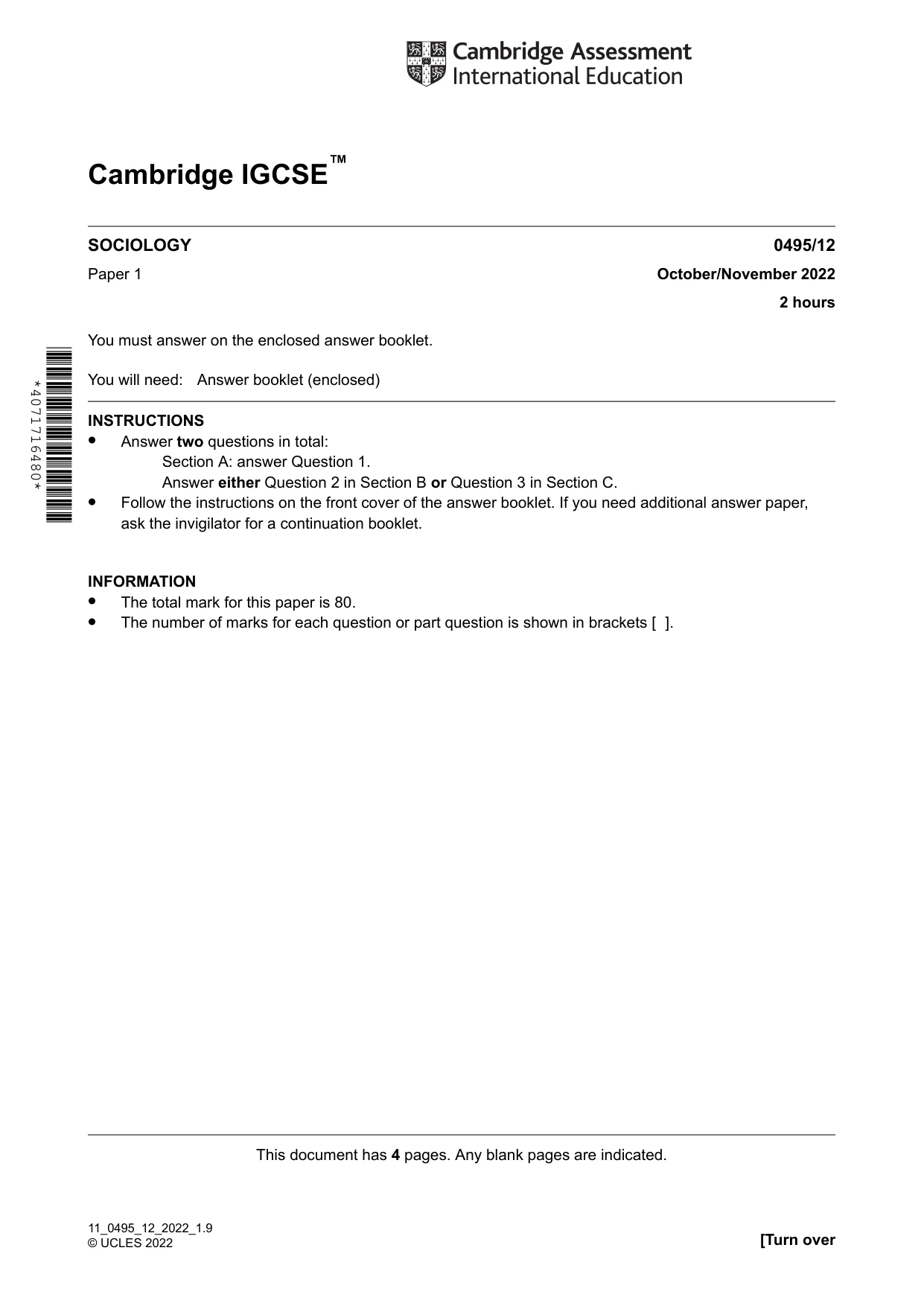
Question paper, page 1
Cambridge IGCSE™ 0495/12 October/November 2022 2 hours SOCIOLOGY Paper 1 You must answer on the enclosed answer booklet. You will need: Answer booklet (enclosed) INSTRUCTIONS • Answer two questions in total: Section A: answer Question 1. Answer either Question 2 in Section B or Question 3 in Section C. • Follow the instructions on the front cover of the answer booklet. If you need additional answer paper, ask the invigilator for a continuation booklet. INFORMATION • The total mark for this paper is 80. • The number of marks for each question or part question is shown in brackets [ ]. This document has 4 pages. Any blank pages are indicated. [Turn over 11_0495_12_2022_1.9 © UCLES 2022 *4071716480*
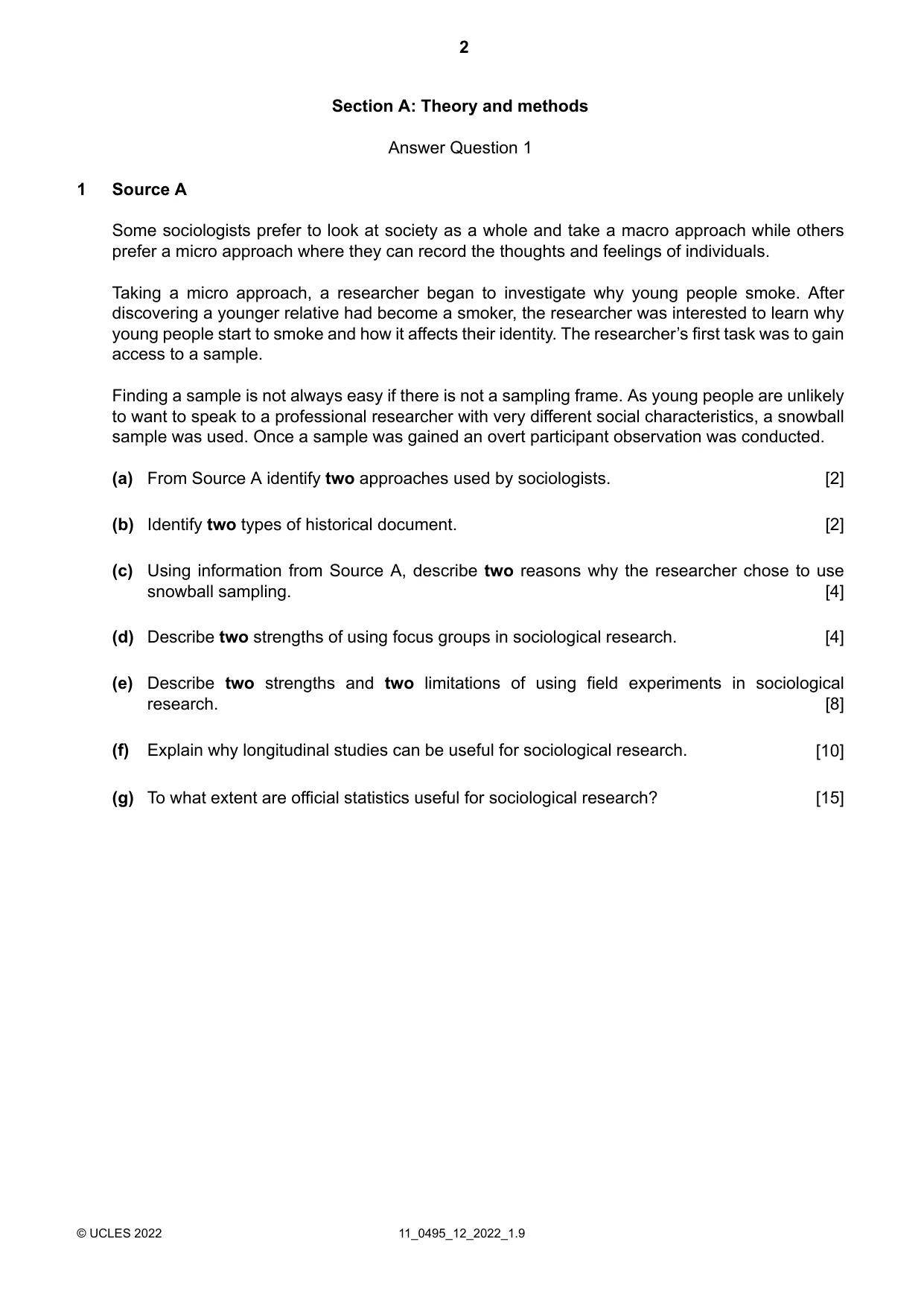
Question paper, page 2
Section A: Theory and methods Answer Question 1 Source A 1 Some sociologists prefer to look at society as a whole and take a macro approach while others prefer a micro approach where they can record the thoughts and feelings of individuals. Taking a micro approach, a researcher began to investigate why young people smoke. After discovering a younger relative had become a smoker, the researcher was interested to learn why young people start to smoke and how it affects their identity. The researcher’s first task was to gain access to a sample. Finding a sample is not always easy if there is not a sampling frame. As young people are unlikely to want to speak to a professional researcher with very different social characteristics, a snowball sample was used. Once a sample was gained an overt participant observation was conducted. From Source A identify two approaches used by sociologists. [2] (a) Identify two types of historical document. [2] (b) Using information from Source A, describe two reasons why the researcher chose to use snowball sampling. [4] (c) Describe two strengths of using focus groups in sociological research. [4] (d) Describe two strengths and two limitations of using field experiments in sociological research. [8] (e) Explain why longitudinal studies can be useful for sociological research. [10] (f) To what extent are official statistics useful for sociological research? [15] (g) 11_0495_12_2022_1.9 © UCLES 2022 2
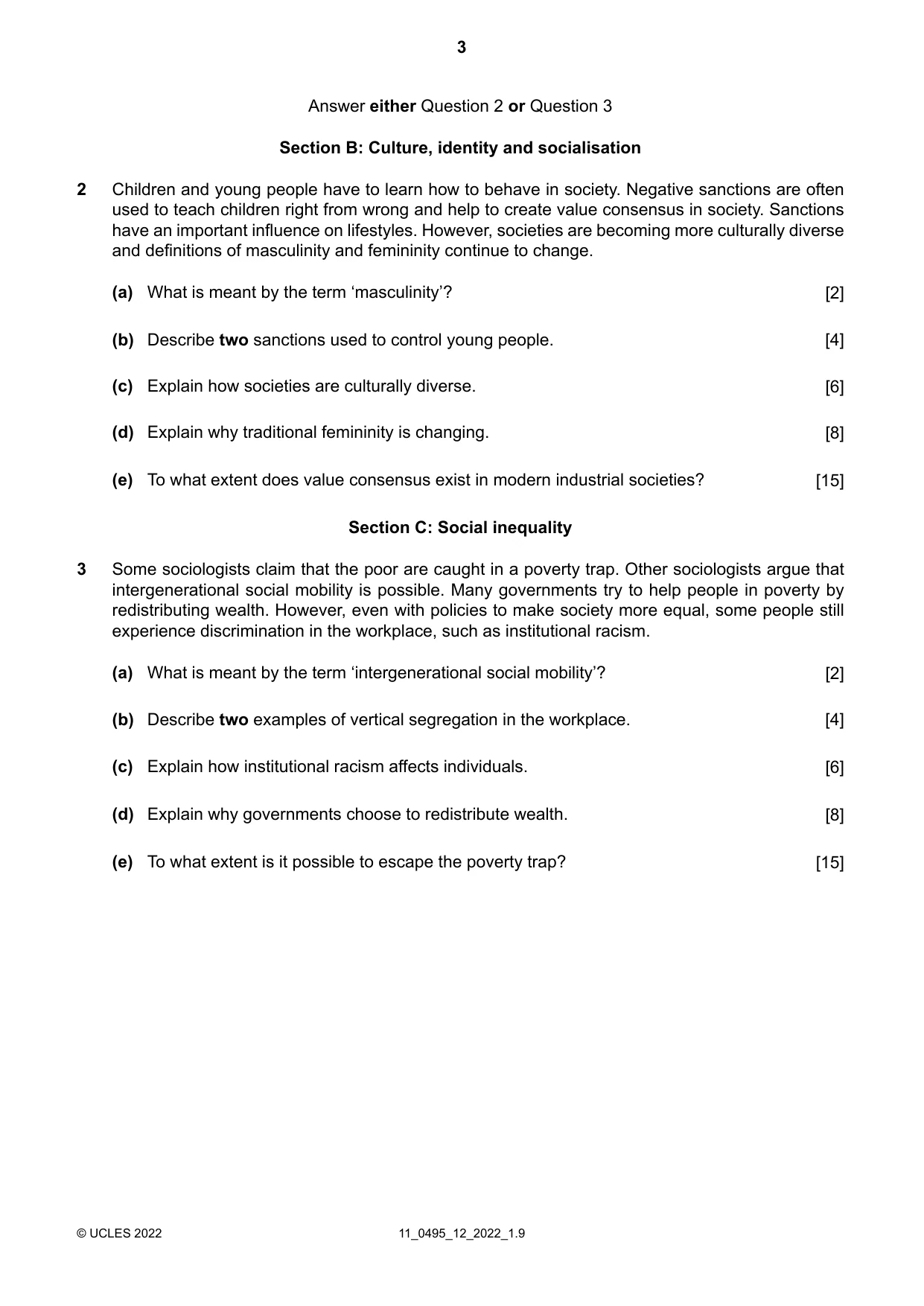
Question paper, page 3
Answer either Question 2 or Question 3 Section B: Culture, identity and socialisation Children and young people have to learn how to behave in society. Negative sanctions are often used to teach children right from wrong and help to create value consensus in society. Sanctions 2 have an important influence on lifestyles. However, societies are becoming more culturally diverse and definitions of masculinity and femininity continue to change. What is meant by the term ‘masculinity’? [2] (a) Describe two sanctions used to control young people. [4] (b) Explain how societies are culturally diverse. [6] (c) Explain why traditional femininity is changing. [8] (d) To what extent does value consensus exist in modern industrial societies? [15] (e) Section C: Social inequality Some sociologists claim that the poor are caught in a poverty trap. Other sociologists argue that intergenerational social mobility is possible. Many governments try to help people in poverty by 3 redistributing wealth. However, even with policies to make society more equal, some people still experience discrimination in the workplace, such as institutional racism. What is meant by the term ‘intergenerational social mobility’? [2] (a) Describe two examples of vertical segregation in the workplace. [4] (b) Explain how institutional racism affects individuals. [6] (c) Explain why governments choose to redistribute wealth. [8] (d) To what extent is it possible to escape the poverty trap? [15] (e) 11_0495_12_2022_1.9 © UCLES 2022 3
Question paper, page 4
BLANK PAGE Permission to reproduce items where third-party owned material protected by copyright is included has been sought and cleared where possible. Every reasonable effort has been made by the publisher (UCLES) to trace copyright holders, but if any items requiring clearance have unwittingly been included, the publisher will be pleased to make amends at the earliest possible opportunity. To avoid the issue of disclosure of answer-related information to candidates, all copyright acknowledgements are reproduced online in the Cambridge Assessment International Education Copyright Acknowledgements Booklet. This is produced for each series of examinations and is freely available to download at www.cambridgeinternational.org after the live examination series. Cambridge Assessment International Education is part of Cambridge Assessment. Cambridge Assessment is the brand name of the University of Cambridge Local Examinations Syndicate (UCLES), which is a department of the University of Cambridge. 11_0495_12_2022_1.9 © UCLES 2022 4
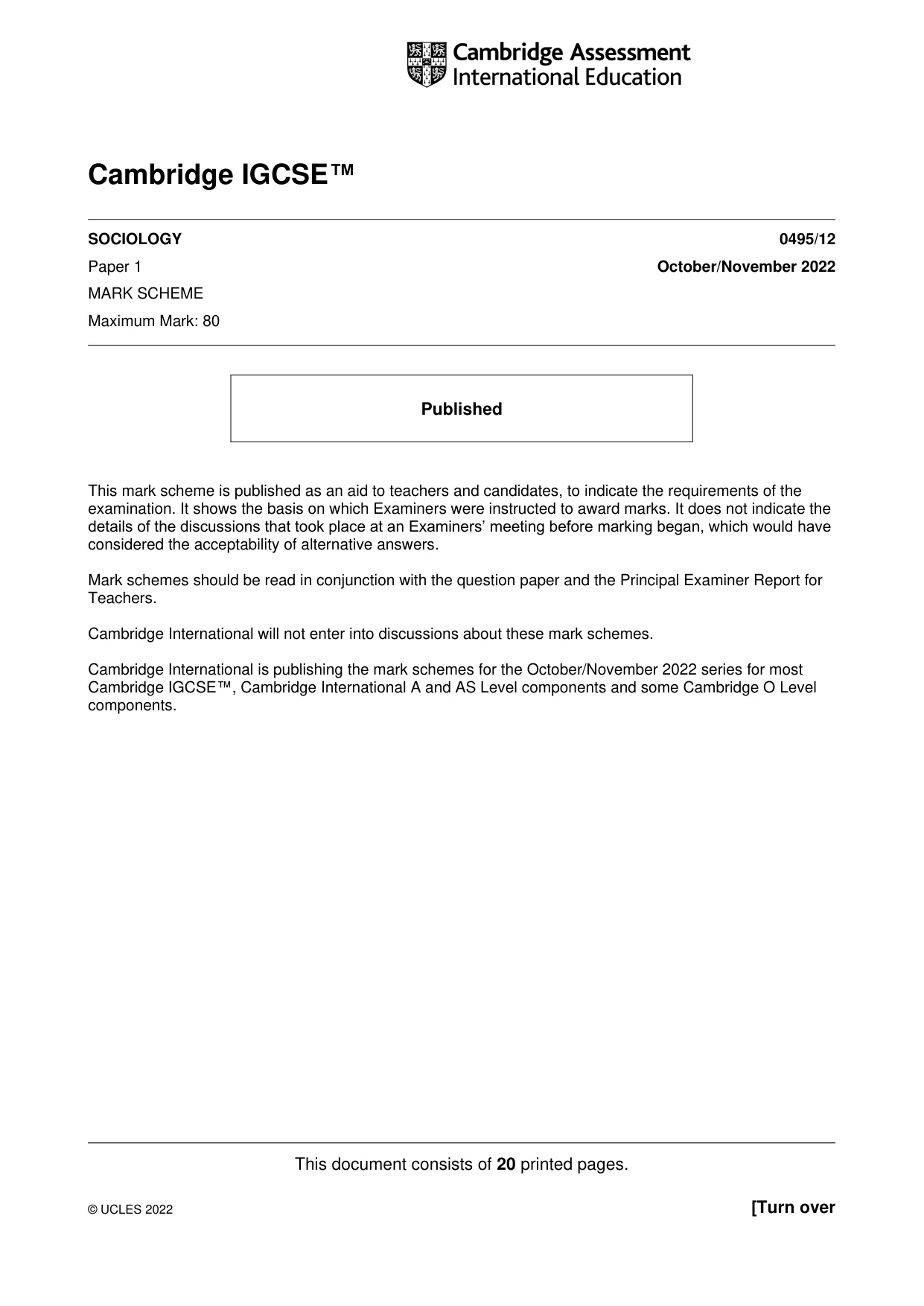
Mark scheme, page 1
This document consists of 20 printed pages. © UCLES 2022 [Turn over Cambridge IGCSE™ SOCIOLOGY 0495/12 Paper 1 October/November 2022 MARK SCHEME Maximum Mark: 80 Published This mark scheme is published as an aid to teachers and candidates, to indicate the requirements of the examination. It shows the basis on which Examiners were instructed to award marks. It does not indicate the details of the discussions that took place at an Examiners’ meeting before marking began, which would have considered the acceptability of alternative answers. Mark schemes should be read in conjunction with the question paper and the Principal Examiner Report for Teachers. Cambridge International will not enter into discussions about these mark schemes. Cambridge International is publishing the mark schemes for the October/November 2022 series for most Cambridge IGCSE™, Cambridge International A and AS Level components and some Cambridge O Level components.
Mark scheme, page 2
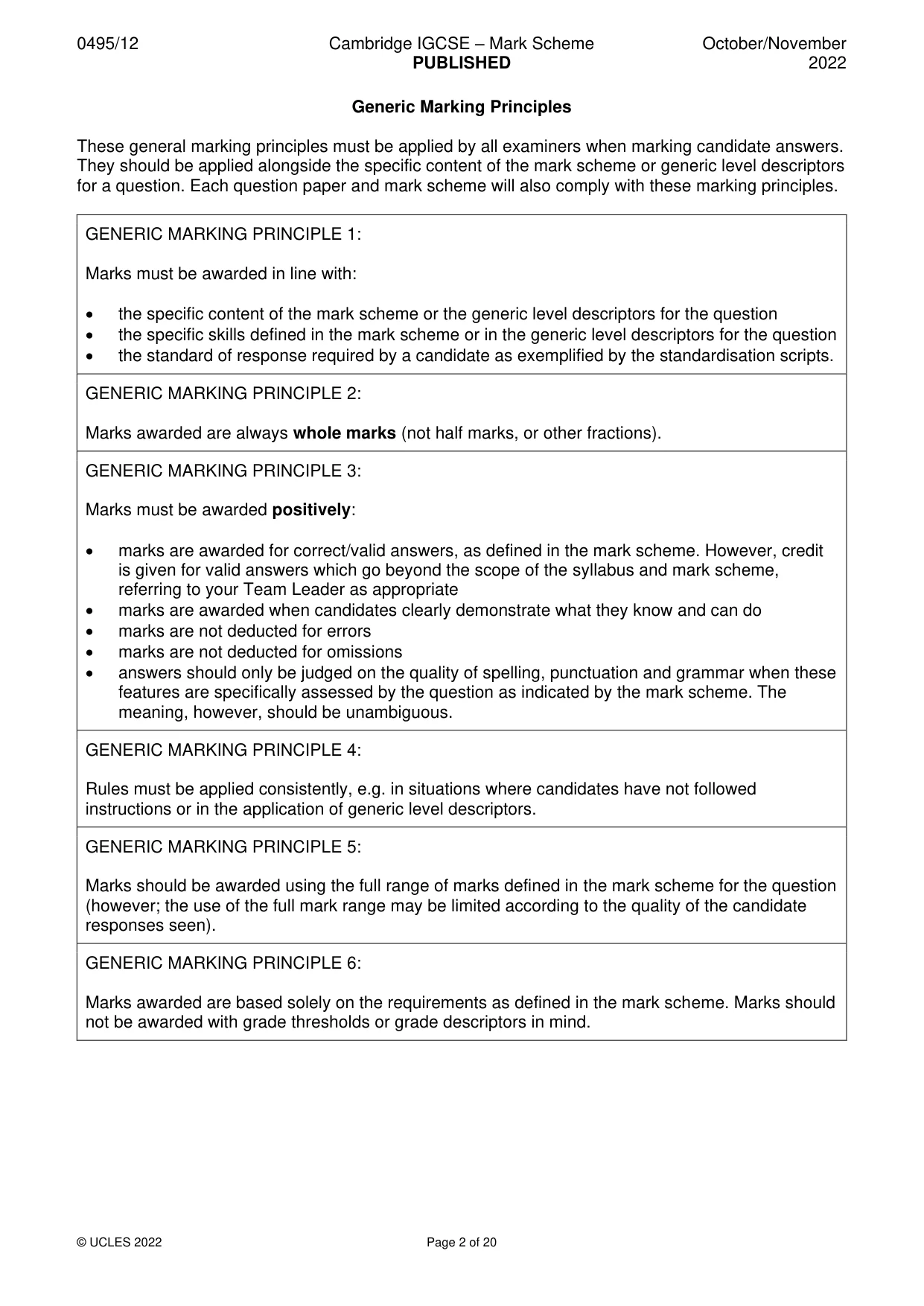
0495/12 Cambridge IGCSE – Mark Scheme PUBLISHED October/November 2022 © UCLES 2022 Page 2 of 20 Generic Marking Principles These general marking principles must be applied by all examiners when marking candidate answers. They should be applied alongside the specific content of the mark scheme or generic level descriptors for a question. Each question paper and mark scheme will also comply with these marking principles. GENERIC MARKING PRINCIPLE 1: Marks must be awarded in line with: • the specific content of the mark scheme or the generic level descriptors for the question • the specific skills defined in the mark scheme or in the generic level descriptors for the question • the standard of response required by a candidate as exemplified by the standardisation scripts. GENERIC MARKING PRINCIPLE 2: Marks awarded are always whole marks (not half marks, or other fractions). GENERIC MARKING PRINCIPLE 3: Marks must be awarded positively: • marks are awarded for correct/valid answers, as defined in the mark scheme. However, credit is given for valid answers which go beyond the scope of the syllabus and mark scheme, referring to your Team Leader as appropriate • marks are awarded when candidates clearly demonstrate what they know and can do • marks are not deducted for errors • marks are not deducted for omissions • answers should only be judged on the quality of spelling, punctuation and grammar when these features are specifically assessed by the question as indicated by the mark scheme. The meaning, however, should be unambiguous. GENERIC MARKING PRINCIPLE 4: Rules must be applied consistently, e.g. in situations where candidates have not followed instructions or in the application of generic level descriptors. GENERIC MARKING PRINCIPLE 5: Marks should be awarded using the full range of marks defined in the mark scheme for the question (however; the use of the full mark range may be limited according to the quality of the candidate responses seen). GENERIC MARKING PRINCIPLE 6: Marks awarded are based solely on the requirements as defined in the mark scheme. Marks should not be awarded with grade thresholds or grade descriptors in mind.
Mark scheme, page 3
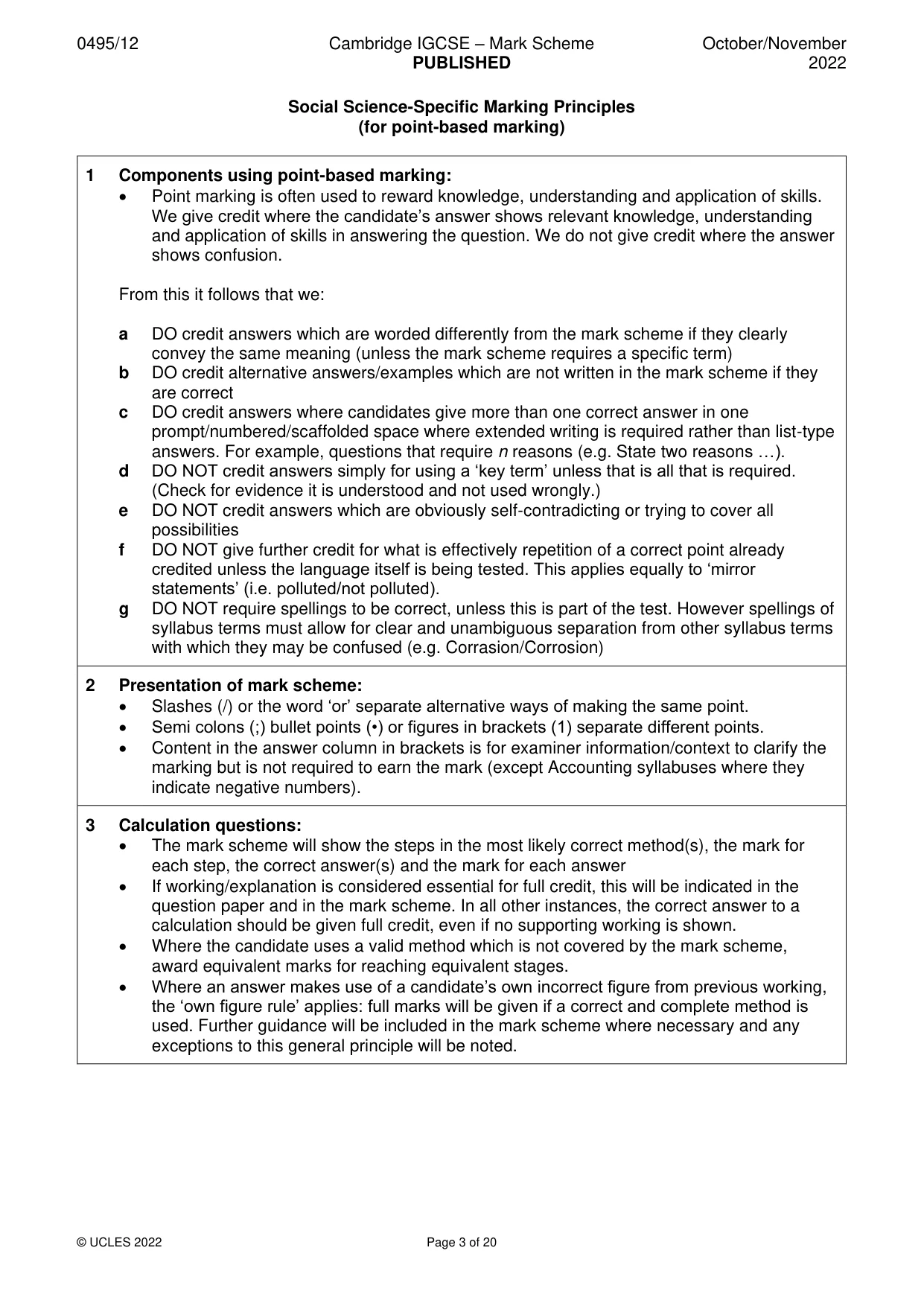
0495/12 Cambridge IGCSE – Mark Scheme PUBLISHED October/November 2022 © UCLES 2022 Page 3 of 20 Social Science-Specific Marking Principles (for point-based marking) 1 Components using point-based marking: • Point marking is often used to reward knowledge, understanding and application of skills. We give credit where the candidate’s answer shows relevant knowledge, understanding and application of skills in answering the question. We do not give credit where the answer shows confusion. From this it follows that we: a DO credit answers which are worded differently from the mark scheme if they clearly convey the same meaning (unless the mark scheme requires a specific term) b DO credit alternative answers/examples which are not written in the mark scheme if they are correct c DO credit answers where candidates give more than one correct answer in one prompt/numbered/scaffolded space where extended writing is required rather than list-type answers. For example, questions that require n reasons (e.g. State two reasons …). d DO NOT credit answers simply for using a ‘key term’ unless that is all that is required. (Check for evidence it is understood and not used wrongly.) e DO NOT credit answers which are obviously self-contradicting or trying to cover all possibilities f DO NOT give further credit for what is effectively repetition of a correct point already credited unless the language itself is being tested. This applies equally to ‘mirror statements’ (i.e. polluted/not polluted). g DO NOT require spellings to be correct, unless this is part of the test. However spellings of syllabus terms must allow for clear and unambiguous separation from other syllabus terms with which they may be confused (e.g. Corrasion/Corrosion) 2 Presentation of mark scheme: • Slashes (/) or the word ‘or’ separate alternative ways of making the same point. • Semi colons (;) bullet points (•) or figures in brackets (1) separate different points. • Content in the answer column in brackets is for examiner information/context to clarify the marking but is not required to earn the mark (except Accounting syllabuses where they indicate negative numbers). 3 Calculation questions: • The mark scheme will show the steps in the most likely correct method(s), the mark for each step, the correct answer(s) and the mark for each answer • If working/explanation is considered essential for full credit, this will be indicated in the question paper and in the mark scheme. In all other instances, the correct answer to a calculation should be given full credit, even if no supporting working is shown. • Where the candidate uses a valid method which is not covered by the mark scheme, award equivalent marks for reaching equivalent stages. • Where an answer makes use of a candidate’s own incorrect figure from previous working, the ‘own figure rule’ applies: full marks will be given if a correct and complete method is used. Further guidance will be included in the mark scheme where necessary and any exceptions to this general principle will be noted.
Mark scheme, page 4
0495/12 Cambridge IGCSE – Mark Scheme PUBLISHED October/November 2022 © UCLES 2022 Page 4 of 20 4 Annotation: • For point marking, ticks can be used to indicate correct answers and crosses can be used to indicate wrong answers. There is no direct relationship between ticks and marks. Ticks have no defined meaning for levels of response marking. • For levels of response marking, the level awarded should be annotated on the script. • Other annotations will be used by examiners as agreed during standardisation, and the meaning will be understood by all examiners who marked that paper.
Mark scheme, page 5
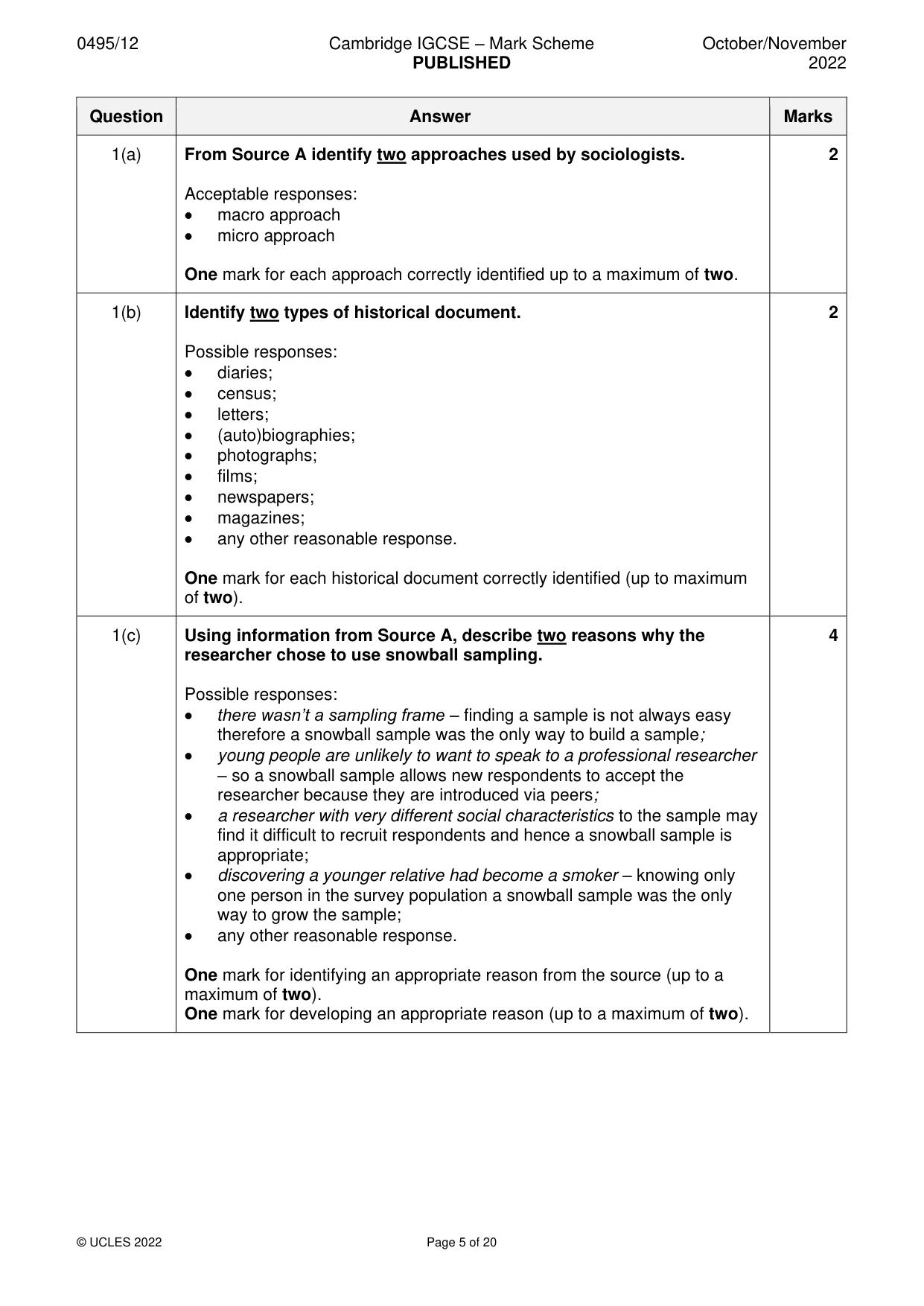
0495/12 Cambridge IGCSE – Mark Scheme PUBLISHED October/November 2022 © UCLES 2022 Page 5 of 20 Question Answer Marks 1(a) From Source A identify two approaches used by sociologists. Acceptable responses: • macro approach • micro approach One mark for each approach correctly identified up to a maximum of two. 2 1(b) Identify two types of historical document. Possible responses: • diaries; • census; • letters; • (auto)biographies; • photographs; • films; • newspapers; • magazines; • any other reasonable response. One mark for each historical document correctly identified (up to maximum of two). 2 1(c) Using information from Source A, describe two reasons why the researcher chose to use snowball sampling. Possible responses: • there wasn’t a sampling frame – finding a sample is not always easy therefore a snowball sample was the only way to build a sample; • young people are unlikely to want to speak to a professional researcher – so a snowball sample allows new respondents to accept the researcher because they are introduced via peers; • a researcher with very different social characteristics to the sample may find it difficult to recruit respondents and hence a snowball sample is appropriate; • discovering a younger relative had become a smoker – knowing only one person in the survey population a snowball sample was the only way to grow the sample; • any other reasonable response. One mark for identifying an appropriate reason from the source (up to a maximum of two). One mark for developing an appropriate reason (up to a maximum of two). 4
Mark scheme, page 6
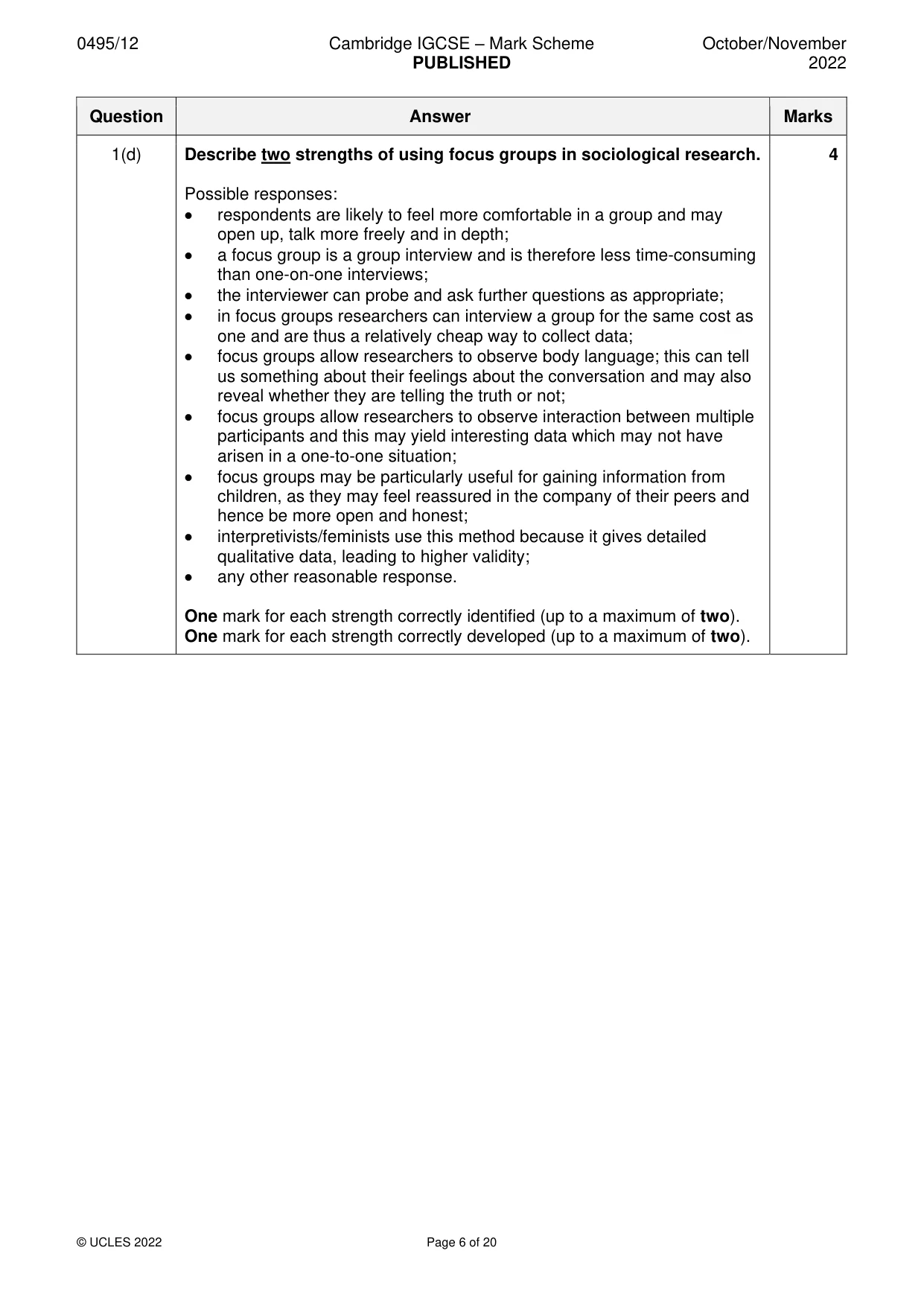
0495/12 Cambridge IGCSE – Mark Scheme PUBLISHED October/November 2022 © UCLES 2022 Page 6 of 20 Question Answer Marks 1(d) Describe two strengths of using focus groups in sociological research. Possible responses: • respondents are likely to feel more comfortable in a group and may open up, talk more freely and in depth; • a focus group is a group interview and is therefore less time-consuming than one-on-one interviews; • the interviewer can probe and ask further questions as appropriate; • in focus groups researchers can interview a group for the same cost as one and are thus a relatively cheap way to collect data; • focus groups allow researchers to observe body language; this can tell us something about their feelings about the conversation and may also reveal whether they are telling the truth or not; • focus groups allow researchers to observe interaction between multiple participants and this may yield interesting data which may not have arisen in a one-to-one situation; • focus groups may be particularly useful for gaining information from children, as they may feel reassured in the company of their peers and hence be more open and honest; • interpretivists/feminists use this method because it gives detailed qualitative data, leading to higher validity; • any other reasonable response. One mark for each strength correctly identified (up to a maximum of two). One mark for each strength correctly developed (up to a maximum of two). 4
Mark scheme, page 7
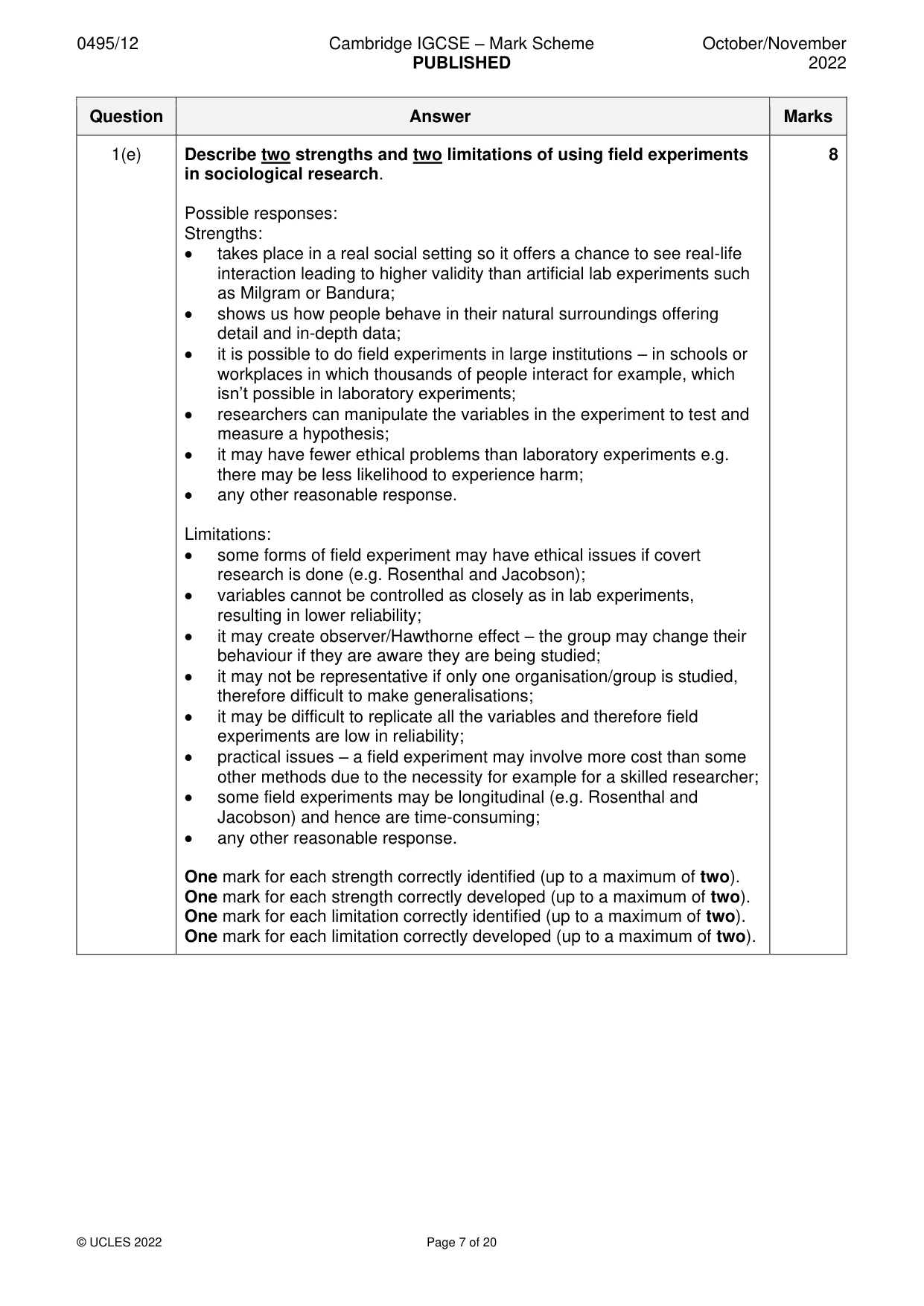
0495/12 Cambridge IGCSE – Mark Scheme PUBLISHED October/November 2022 © UCLES 2022 Page 7 of 20 Question Answer Marks 1(e) Describe two strengths and two limitations of using field experiments in sociological research. Possible responses: Strengths: • takes place in a real social setting so it offers a chance to see real-life interaction leading to higher validity than artificial lab experiments such as Milgram or Bandura; • shows us how people behave in their natural surroundings offering detail and in-depth data; • it is possible to do field experiments in large institutions – in schools or workplaces in which thousands of people interact for example, which isn’t possible in laboratory experiments; • researchers can manipulate the variables in the experiment to test and measure a hypothesis; • it may have fewer ethical problems than laboratory experiments e.g. there may be less likelihood to experience harm; • any other reasonable response. Limitations: • some forms of field experiment may have ethical issues if covert research is done (e.g. Rosenthal and Jacobson); • variables cannot be controlled as closely as in lab experiments, resulting in lower reliability; • it may create observer/Hawthorne effect – the group may change their behaviour if they are aware they are being studied; • it may not be representative if only one organisation/group is studied, therefore difficult to make generalisations; • it may be difficult to replicate all the variables and therefore field experiments are low in reliability; • practical issues – a field experiment may involve more cost than some other methods due to the necessity for example for a skilled researcher; • some field experiments may be longitudinal (e.g. Rosenthal and Jacobson) and hence are time-consuming; • any other reasonable response. One mark for each strength correctly identified (up to a maximum of two). One mark for each strength correctly developed (up to a maximum of two). One mark for each limitation correctly identified (up to a maximum of two). One mark for each limitation correctly developed (up to a maximum of two). 8
Mark scheme, page 8
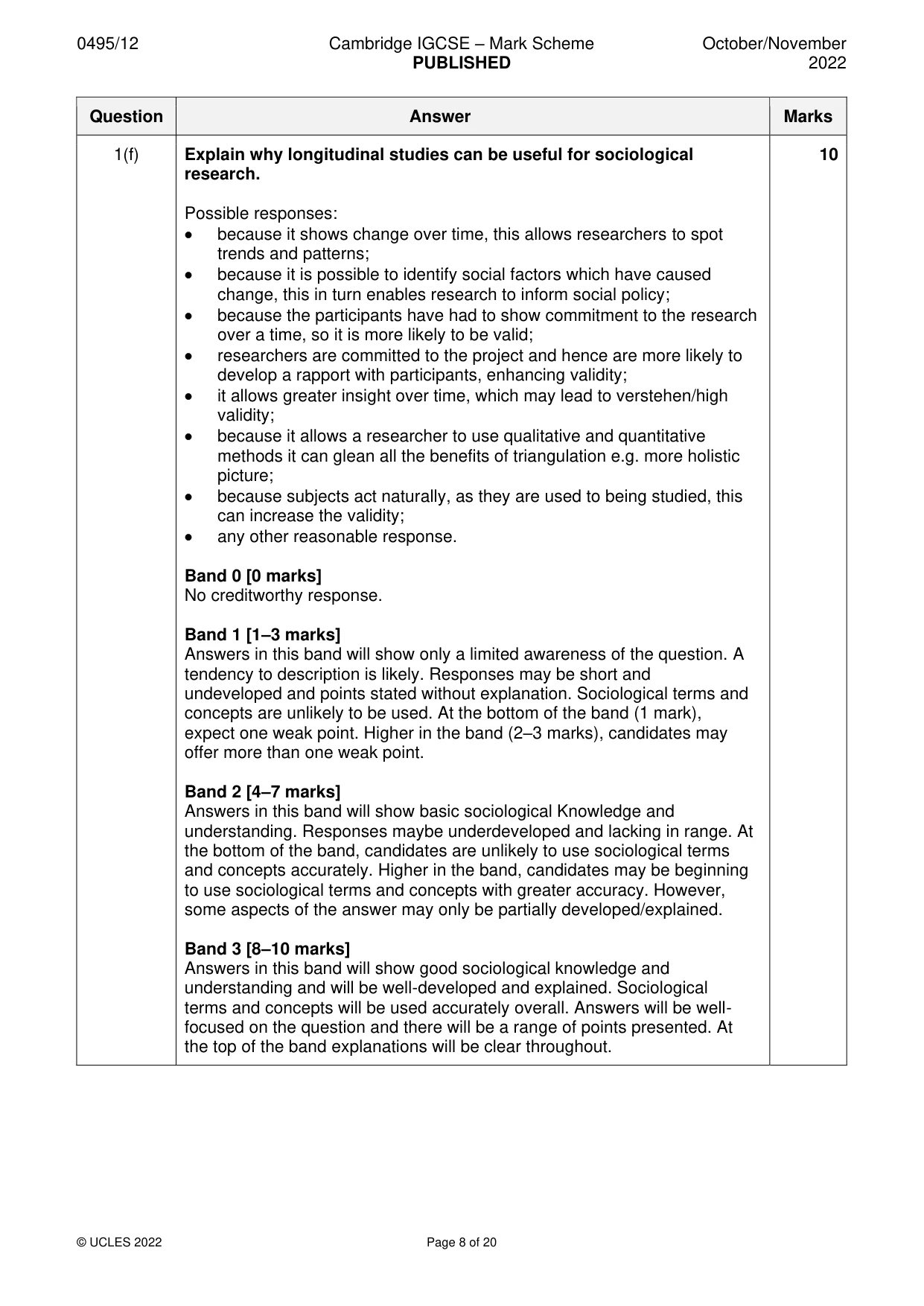
0495/12 Cambridge IGCSE – Mark Scheme PUBLISHED October/November 2022 © UCLES 2022 Page 8 of 20 Question Answer Marks 1(f) Explain why longitudinal studies can be useful for sociological research. Possible responses: • because it shows change over time, this allows researchers to spot trends and patterns; • because it is possible to identify social factors which have caused change, this in turn enables research to inform social policy; • because the participants have had to show commitment to the research over a time, so it is more likely to be valid; • researchers are committed to the project and hence are more likely to develop a rapport with participants, enhancing validity; • it allows greater insight over time, which may lead to verstehen/high validity; • because it allows a researcher to use qualitative and quantitative methods it can glean all the benefits of triangulation e.g. more holistic picture; • because subjects act naturally, as they are used to being studied, this can increase the validity; • any other reasonable response. Band 0 [0 marks] No creditworthy response. Band 1 [1–3 marks] Answers in this band will show only a limited awareness of the question. A tendency to description is likely. Responses may be short and undeveloped and points stated without explanation. Sociological terms and concepts are unlikely to be used. At the bottom of the band (1 mark), expect one weak point. Higher in the band (2–3 marks), candidates may offer more than one weak point. Band 2 [4–7 marks] Answers in this band will show basic sociological Knowledge and understanding. Responses maybe underdeveloped and lacking in range. At the bottom of the band, candidates are unlikely to use sociological terms and concepts accurately. Higher in the band, candidates may be beginning to use sociological terms and concepts with greater accuracy. However, some aspects of the answer may only be partially developed/explained. Band 3 [8–10 marks] Answers in this band will show good sociological knowledge and understanding and will be well-developed and explained. Sociological terms and concepts will be used accurately overall. Answers will be well- focused on the question and there will be a range of points presented. At the top of the band explanations will be clear throughout. 10
Mark scheme, page 9
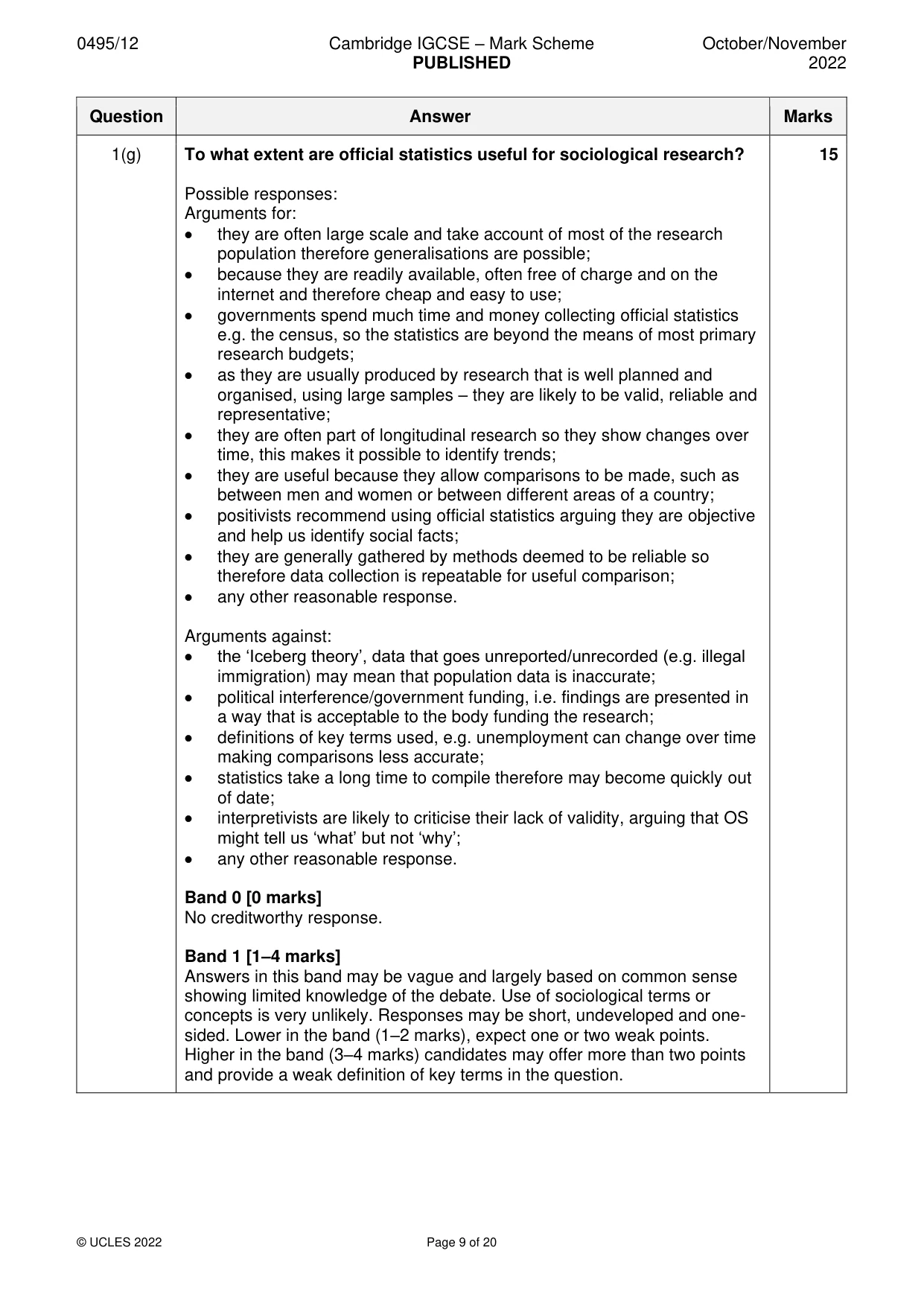
0495/12 Cambridge IGCSE – Mark Scheme PUBLISHED October/November 2022 © UCLES 2022 Page 9 of 20 Question Answer Marks 1(g) To what extent are official statistics useful for sociological research? Possible responses: Arguments for: • they are often large scale and take account of most of the research population therefore generalisations are possible; • because they are readily available, often free of charge and on the internet and therefore cheap and easy to use; • governments spend much time and money collecting official statistics e.g. the census, so the statistics are beyond the means of most primary research budgets; • as they are usually produced by research that is well planned and organised, using large samples – they are likely to be valid, reliable and representative; • they are often part of longitudinal research so they show changes over time, this makes it possible to identify trends; • they are useful because they allow comparisons to be made, such as between men and women or between different areas of a country; • positivists recommend using official statistics arguing they are objective and help us identify social facts; • they are generally gathered by methods deemed to be reliable so therefore data collection is repeatable for useful comparison; • any other reasonable response. Arguments against: • the ‘Iceberg theory’, data that goes unreported/unrecorded (e.g. illegal immigration) may mean that population data is inaccurate; • political interference/government funding, i.e. findings are presented in a way that is acceptable to the body funding the research; • definitions of key terms used, e.g. unemployment can change over time making comparisons less accurate; • statistics take a long time to compile therefore may become quickly out of date; • interpretivists are likely to criticise their lack of validity, arguing that OS might tell us ‘what’ but not ‘why’; • any other reasonable response. Band 0 [0 marks] No creditworthy response. Band 1 [1–4 marks] Answers in this band may be vague and largely based on common sense showing limited knowledge of the debate. Use of sociological terms or concepts is very unlikely. Responses may be short, undeveloped and one- sided. Lower in the band (1–2 marks), expect one or two weak points. Higher in the band (3–4 marks) candidates may offer more than two points and provide a weak definition of key terms in the question. 15
Mark scheme, page 10
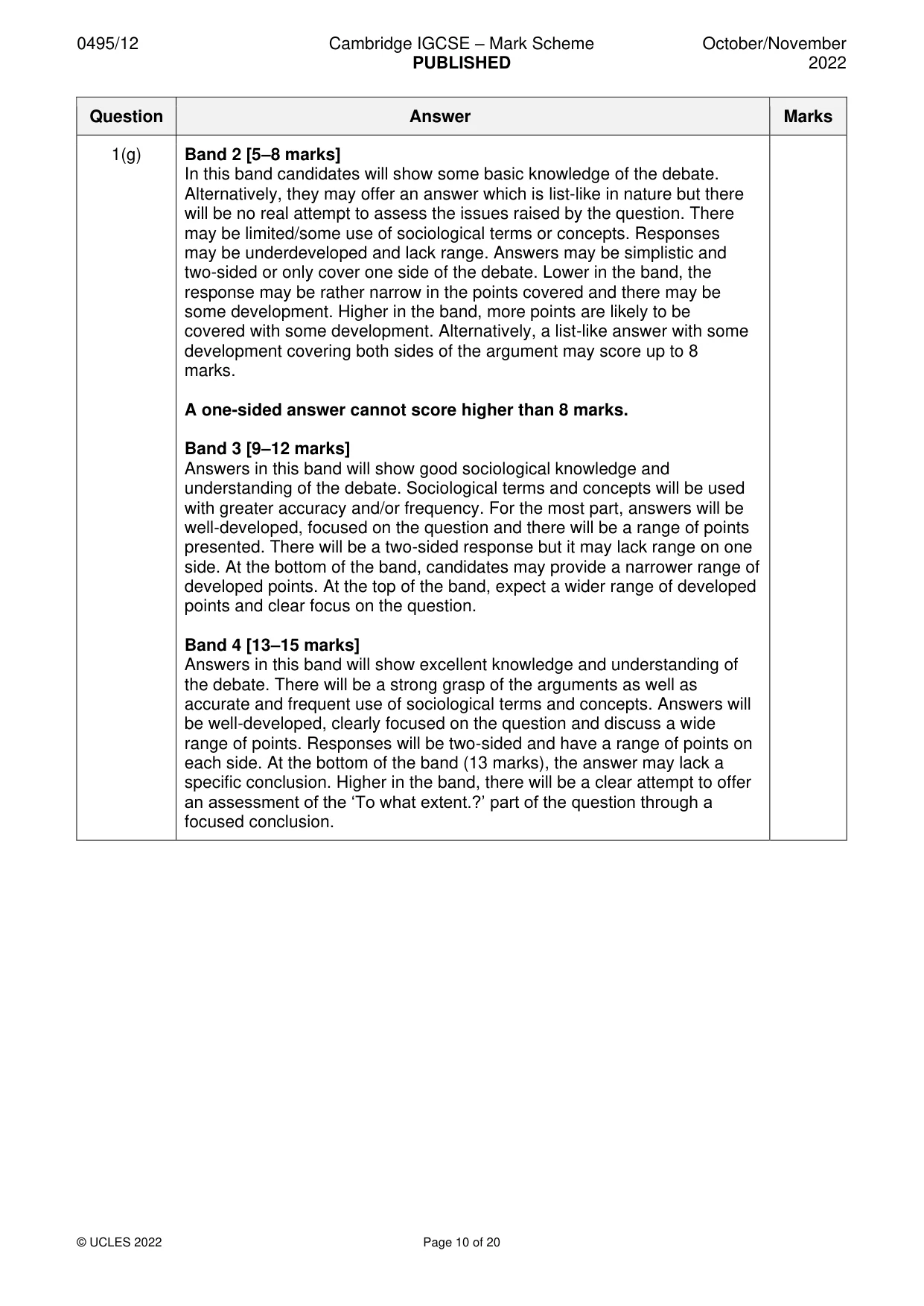
0495/12 Cambridge IGCSE – Mark Scheme PUBLISHED October/November 2022 © UCLES 2022 Page 10 of 20 Question Answer Marks 1(g) Band 2 [5–8 marks] In this band candidates will show some basic knowledge of the debate. Alternatively, they may offer an answer which is list-like in nature but there will be no real attempt to assess the issues raised by the question. There may be limited/some use of sociological terms or concepts. Responses may be underdeveloped and lack range. Answers may be simplistic and two-sided or only cover one side of the debate. Lower in the band, the response may be rather narrow in the points covered and there may be some development. Higher in the band, more points are likely to be covered with some development. Alternatively, a list-like answer with some development covering both sides of the argument may score up to 8 marks. A one-sided answer cannot score higher than 8 marks. Band 3 [9–12 marks] Answers in this band will show good sociological knowledge and understanding of the debate. Sociological terms and concepts will be used with greater accuracy and/or frequency. For the most part, answers will be well-developed, focused on the question and there will be a range of points presented. There will be a two-sided response but it may lack range on one side. At the bottom of the band, candidates may provide a narrower range of developed points. At the top of the band, expect a wider range of developed points and clear focus on the question. Band 4 [13–15 marks] Answers in this band will show excellent knowledge and understanding of the debate. There will be a strong grasp of the arguments as well as accurate and frequent use of sociological terms and concepts. Answers will be well-developed, clearly focused on the question and discuss a wide range of points. Responses will be two-sided and have a range of points on each side. At the bottom of the band (13 marks), the answer may lack a specific conclusion. Higher in the band, there will be a clear attempt to offer an assessment of the ‘To what extent.?’ part of the question through a focused conclusion.
Mark scheme, page 11
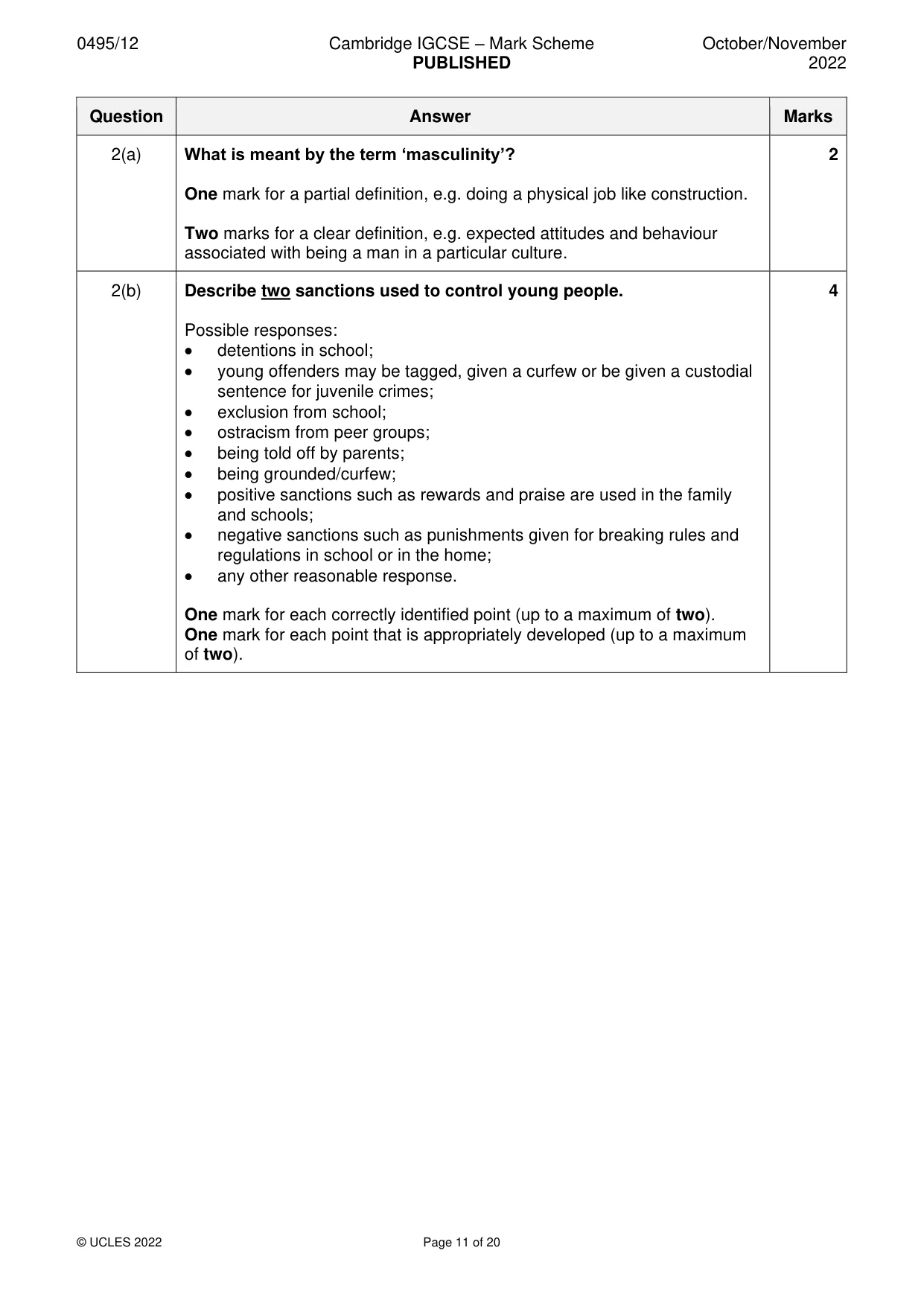
0495/12 Cambridge IGCSE – Mark Scheme PUBLISHED October/November 2022 © UCLES 2022 Page 11 of 20 Question Answer Marks 2(a) What is meant by the term ‘masculinity’? One mark for a partial definition, e.g. doing a physical job like construction. Two marks for a clear definition, e.g. expected attitudes and behaviour associated with being a man in a particular culture. 2 2(b) Describe two sanctions used to control young people. Possible responses: • detentions in school; • young offenders may be tagged, given a curfew or be given a custodial sentence for juvenile crimes; • exclusion from school; • ostracism from peer groups; • being told off by parents; • being grounded/curfew; • positive sanctions such as rewards and praise are used in the family and schools; • negative sanctions such as punishments given for breaking rules and regulations in school or in the home; • any other reasonable response. One mark for each correctly identified point (up to a maximum of two). One mark for each point that is appropriately developed (up to a maximum of two). 4
Mark scheme, page 12
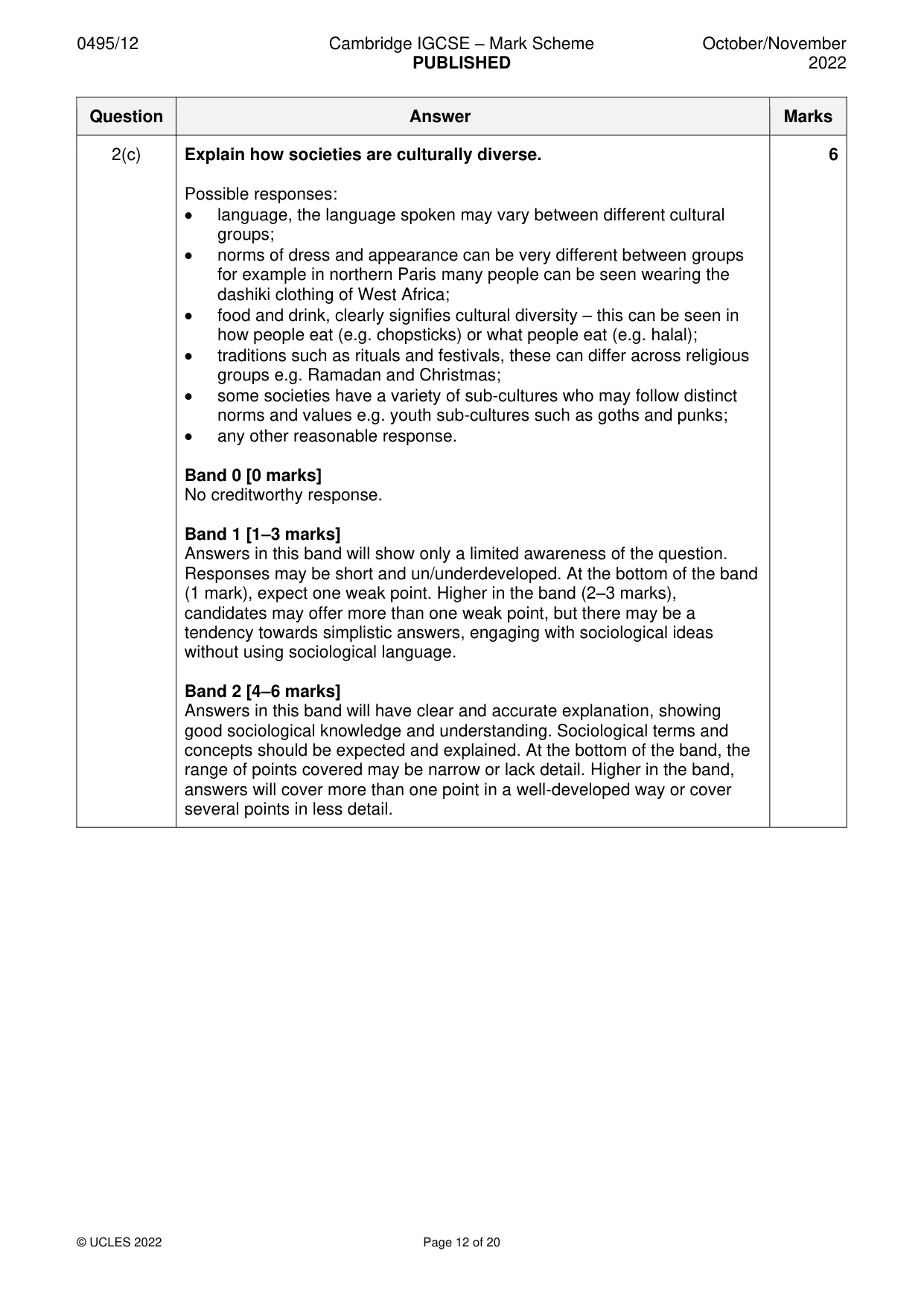
0495/12 Cambridge IGCSE – Mark Scheme PUBLISHED October/November 2022 © UCLES 2022 Page 12 of 20 Question Answer Marks 2(c) Explain how societies are culturally diverse. Possible responses: • language, the language spoken may vary between different cultural groups; • norms of dress and appearance can be very different between groups for example in northern Paris many people can be seen wearing the dashiki clothing of West Africa; • food and drink, clearly signifies cultural diversity – this can be seen in how people eat (e.g. chopsticks) or what people eat (e.g. halal); • traditions such as rituals and festivals, these can differ across religious groups e.g. Ramadan and Christmas; • some societies have a variety of sub-cultures who may follow distinct norms and values e.g. youth sub-cultures such as goths and punks; • any other reasonable response. Band 0 [0 marks] No creditworthy response. Band 1 [1–3 marks] Answers in this band will show only a limited awareness of the question. Responses may be short and un/underdeveloped. At the bottom of the band (1 mark), expect one weak point. Higher in the band (2–3 marks), candidates may offer more than one weak point, but there may be a tendency towards simplistic answers, engaging with sociological ideas without using sociological language. Band 2 [4–6 marks] Answers in this band will have clear and accurate explanation, showing good sociological knowledge and understanding. Sociological terms and concepts should be expected and explained. At the bottom of the band, the range of points covered may be narrow or lack detail. Higher in the band, answers will cover more than one point in a well-developed way or cover several points in less detail. 6
Mark scheme, page 13
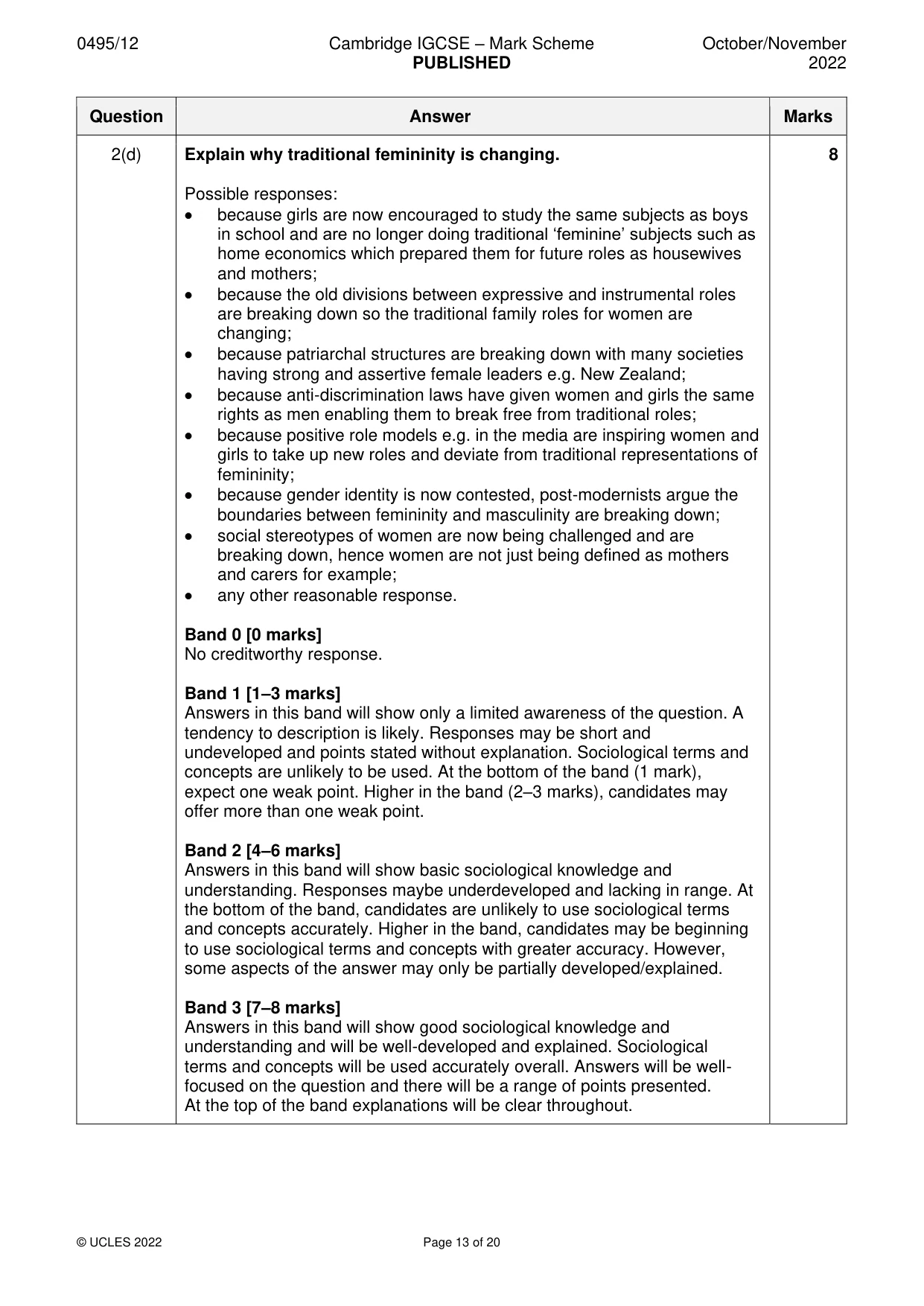
0495/12 Cambridge IGCSE – Mark Scheme PUBLISHED October/November 2022 © UCLES 2022 Page 13 of 20 Question Answer Marks 2(d) Explain why traditional femininity is changing. Possible responses: • because girls are now encouraged to study the same subjects as boys in school and are no longer doing traditional ‘feminine’ subjects such as home economics which prepared them for future roles as housewives and mothers; • because the old divisions between expressive and instrumental roles are breaking down so the traditional family roles for women are changing; • because patriarchal structures are breaking down with many societies having strong and assertive female leaders e.g. New Zealand; • because anti-discrimination laws have given women and girls the same rights as men enabling them to break free from traditional roles; • because positive role models e.g. in the media are inspiring women and girls to take up new roles and deviate from traditional representations of femininity; • because gender identity is now contested, post-modernists argue the boundaries between femininity and masculinity are breaking down; • social stereotypes of women are now being challenged and are breaking down, hence women are not just being defined as mothers and carers for example; • any other reasonable response. Band 0 [0 marks] No creditworthy response. Band 1 [1–3 marks] Answers in this band will show only a limited awareness of the question. A tendency to description is likely. Responses may be short and undeveloped and points stated without explanation. Sociological terms and concepts are unlikely to be used. At the bottom of the band (1 mark), expect one weak point. Higher in the band (2–3 marks), candidates may offer more than one weak point. Band 2 [4–6 marks] Answers in this band will show basic sociological knowledge and understanding. Responses maybe underdeveloped and lacking in range. At the bottom of the band, candidates are unlikely to use sociological terms and concepts accurately. Higher in the band, candidates may be beginning to use sociological terms and concepts with greater accuracy. However, some aspects of the answer may only be partially developed/explained. Band 3 [7–8 marks] Answers in this band will show good sociological knowledge and understanding and will be well-developed and explained. Sociological terms and concepts will be used accurately overall. Answers will be well- focused on the question and there will be a range of points presented. At the top of the band explanations will be clear throughout. 8
Mark scheme, page 14
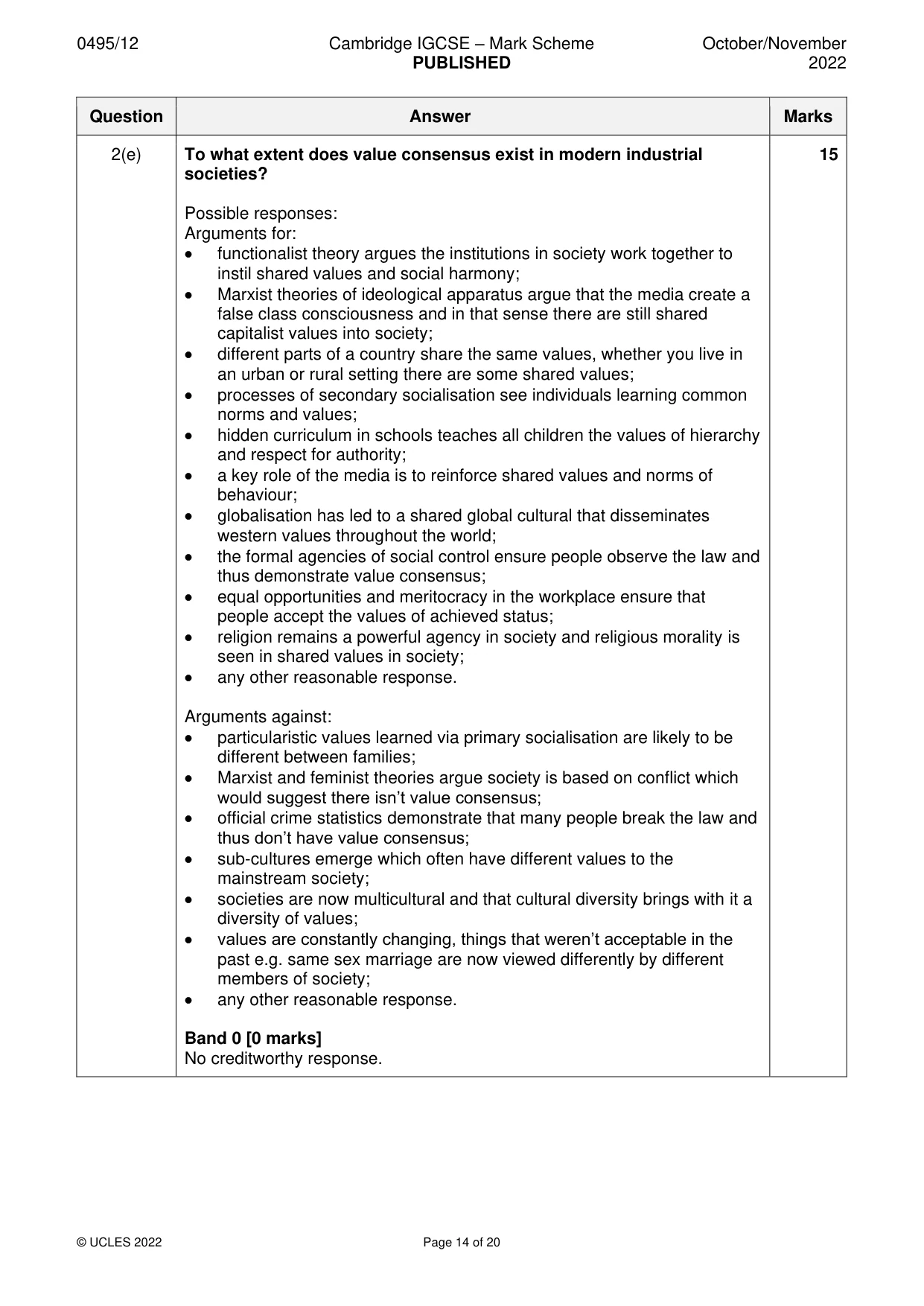
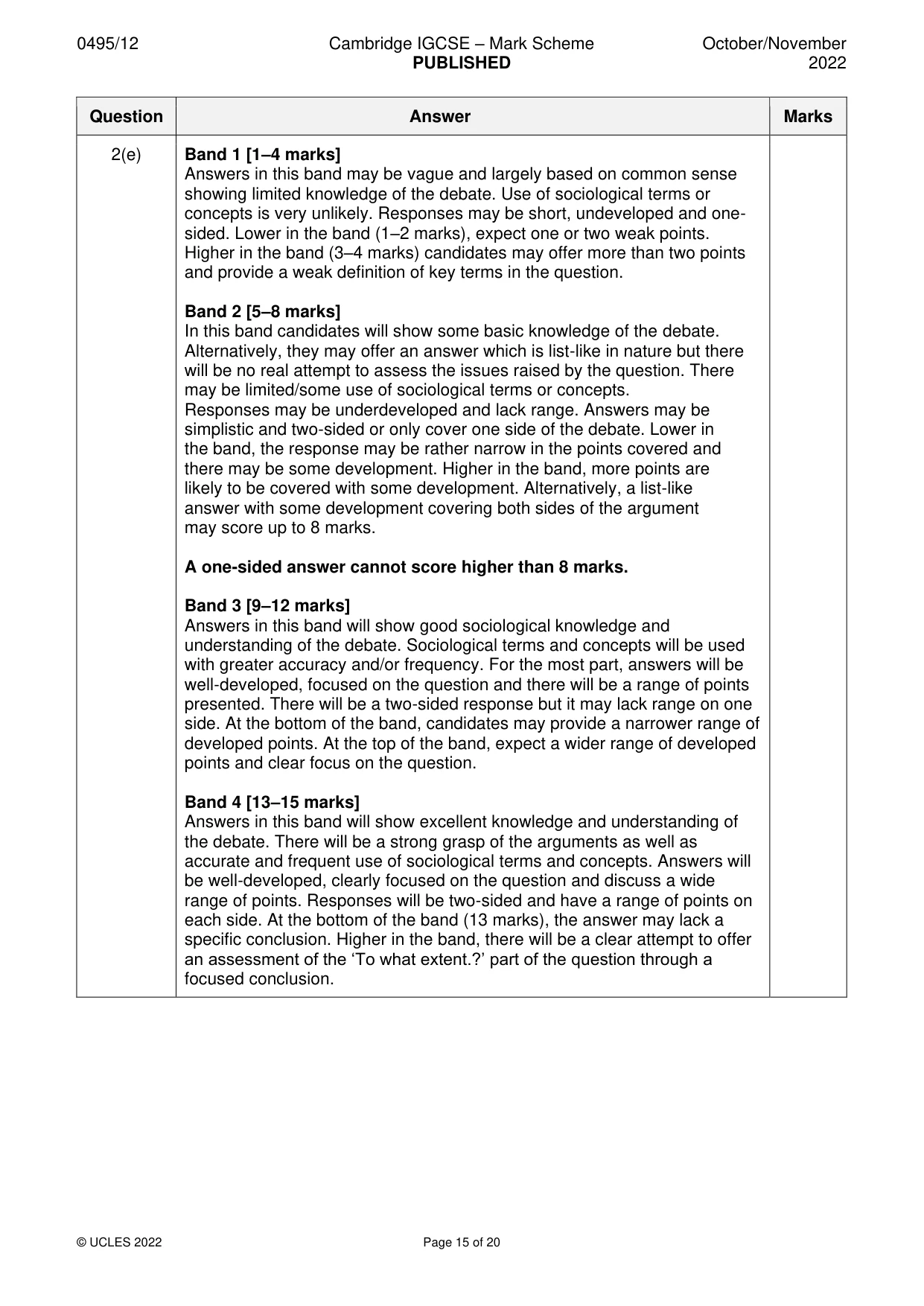
0495/12 Cambridge IGCSE – Mark Scheme PUBLISHED October/November 2022 © UCLES 2022 Page 14 of 20 Question Answer Marks 2(e) To what extent does value consensus exist in modern industrial societies? Possible responses: Arguments for: • functionalist theory argues the institutions in society work together to instil shared values and social harmony; • Marxist theories of ideological apparatus argue that the media create a false class consciousness and in that sense there are still shared capitalist values into society; • different parts of a country share the same values, whether you live in an urban or rural setting there are some shared values; • processes of secondary socialisation see individuals learning common norms and values; • hidden curriculum in schools teaches all children the values of hierarchy and respect for authority; • a key role of the media is to reinforce shared values and norms of behaviour; • globalisation has led to a shared global cultural that disseminates western values throughout the world; • the formal agencies of social control ensure people observe the law and thus demonstrate value consensus; • equal opportunities and meritocracy in the workplace ensure that people accept the values of achieved status; • religion remains a powerful agency in society and religious morality is seen in shared values in society; • any other reasonable response. Arguments against: • particularistic values learned via primary socialisation are likely to be different between families; • Marxist and feminist theories argue society is based on conflict which would suggest there isn’t value consensus; • official crime statistics demonstrate that many people break the law and thus don’t have value consensus; • sub-cultures emerge which often have different values to the mainstream society; • societies are now multicultural and that cultural diversity brings with it a diversity of values; • values are constantly changing, things that weren’t acceptable in the past e.g. same sex marriage are now viewed differently by different members of society; • any other reasonable response. Band 0 [0 marks] No creditworthy response. 15
Mark scheme, page 15
0495/12 Cambridge IGCSE – Mark Scheme PUBLISHED October/November 2022 © UCLES 2022 Page 15 of 20 Question Answer Marks 2(e) Band 1 [1–4 marks] Answers in this band may be vague and largely based on common sense showing limited knowledge of the debate. Use of sociological terms or concepts is very unlikely. Responses may be short, undeveloped and one- sided. Lower in the band (1–2 marks), expect one or two weak points. Higher in the band (3–4 marks) candidates may offer more than two points and provide a weak definition of key terms in the question. Band 2 [5–8 marks] In this band candidates will show some basic knowledge of the debate. Alternatively, they may offer an answer which is list-like in nature but there will be no real attempt to assess the issues raised by the question. There may be limited/some use of sociological terms or concepts. Responses may be underdeveloped and lack range. Answers may be simplistic and two-sided or only cover one side of the debate. Lower in the band, the response may be rather narrow in the points covered and there may be some development. Higher in the band, more points are likely to be covered with some development. Alternatively, a list-like answer with some development covering both sides of the argument may score up to 8 marks. A one-sided answer cannot score higher than 8 marks. Band 3 [9–12 marks] Answers in this band will show good sociological knowledge and understanding of the debate. Sociological terms and concepts will be used with greater accuracy and/or frequency. For the most part, answers will be well-developed, focused on the question and there will be a range of points presented. There will be a two-sided response but it may lack range on one side. At the bottom of the band, candidates may provide a narrower range of developed points. At the top of the band, expect a wider range of developed points and clear focus on the question. Band 4 [13–15 marks] Answers in this band will show excellent knowledge and understanding of the debate. There will be a strong grasp of the arguments as well as accurate and frequent use of sociological terms and concepts. Answers will be well-developed, clearly focused on the question and discuss a wide range of points. Responses will be two-sided and have a range of points on each side. At the bottom of the band (13 marks), the answer may lack a specific conclusion. Higher in the band, there will be a clear attempt to offer an assessment of the ‘To what extent.?’ part of the question through a focused conclusion.
Mark scheme, page 16
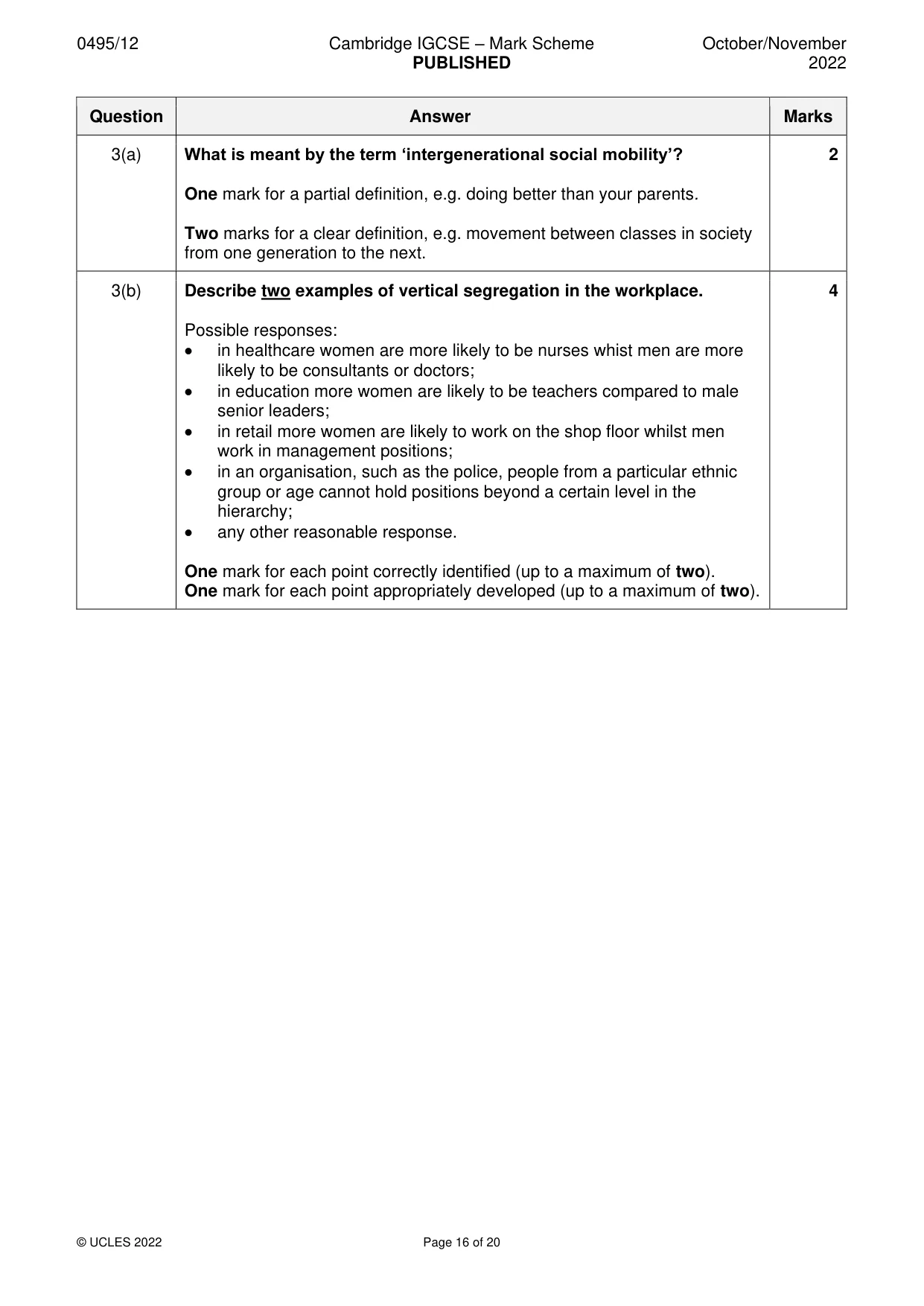
0495/12 Cambridge IGCSE – Mark Scheme PUBLISHED October/November 2022 © UCLES 2022 Page 16 of 20 Question Answer Marks 3(a) What is meant by the term ‘intergenerational social mobility’? One mark for a partial definition, e.g. doing better than your parents. Two marks for a clear definition, e.g. movement between classes in society from one generation to the next. 2 3(b) Describe two examples of vertical segregation in the workplace. Possible responses: • in healthcare women are more likely to be nurses whist men are more likely to be consultants or doctors; • in education more women are likely to be teachers compared to male senior leaders; • in retail more women are likely to work on the shop floor whilst men work in management positions; • in an organisation, such as the police, people from a particular ethnic group or age cannot hold positions beyond a certain level in the hierarchy; • any other reasonable response. One mark for each point correctly identified (up to a maximum of two). One mark for each point appropriately developed (up to a maximum of two). 4
Mark scheme, page 17
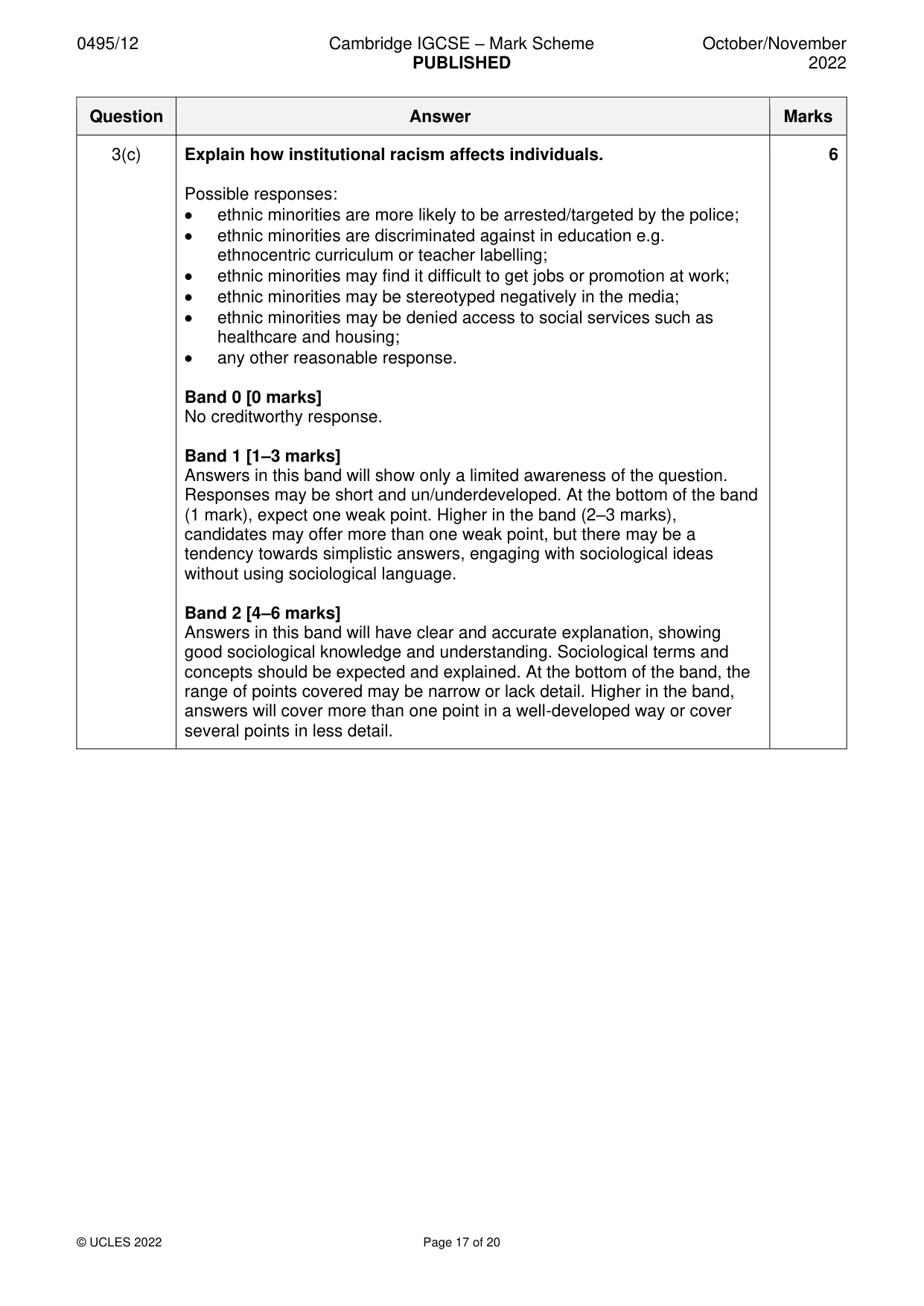
0495/12 Cambridge IGCSE – Mark Scheme PUBLISHED October/November 2022 © UCLES 2022 Page 17 of 20 Question Answer Marks 3(c) Explain how institutional racism affects individuals. Possible responses: • ethnic minorities are more likely to be arrested/targeted by the police; • ethnic minorities are discriminated against in education e.g. ethnocentric curriculum or teacher labelling; • ethnic minorities may find it difficult to get jobs or promotion at work; • ethnic minorities may be stereotyped negatively in the media; • ethnic minorities may be denied access to social services such as healthcare and housing; • any other reasonable response. Band 0 [0 marks] No creditworthy response. Band 1 [1–3 marks] Answers in this band will show only a limited awareness of the question. Responses may be short and un/underdeveloped. At the bottom of the band (1 mark), expect one weak point. Higher in the band (2–3 marks), candidates may offer more than one weak point, but there may be a tendency towards simplistic answers, engaging with sociological ideas without using sociological language. Band 2 [4–6 marks] Answers in this band will have clear and accurate explanation, showing good sociological knowledge and understanding. Sociological terms and concepts should be expected and explained. At the bottom of the band, the range of points covered may be narrow or lack detail. Higher in the band, answers will cover more than one point in a well-developed way or cover several points in less detail. 6
Mark scheme, page 18
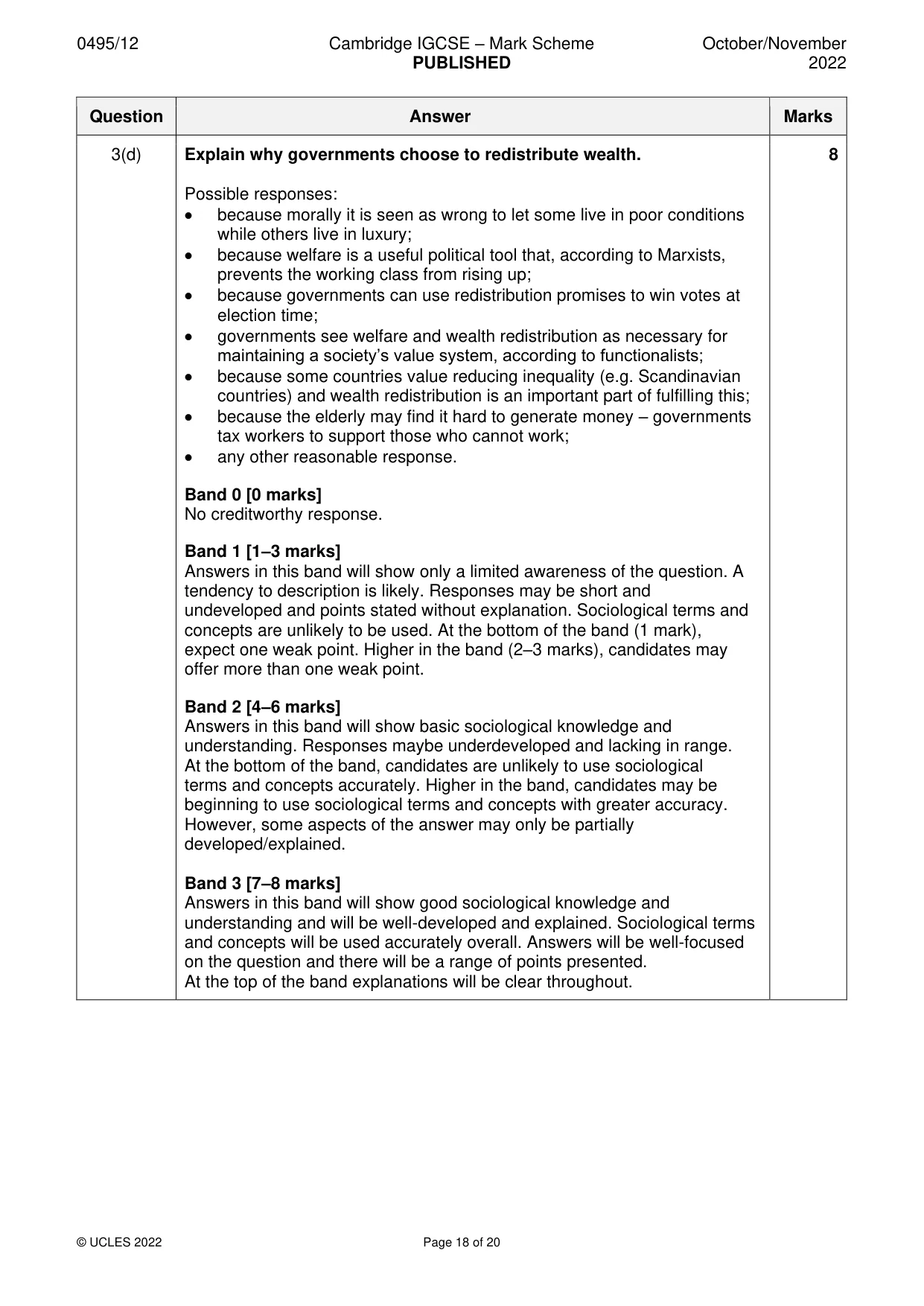
0495/12 Cambridge IGCSE – Mark Scheme PUBLISHED October/November 2022 © UCLES 2022 Page 18 of 20 Question Answer Marks 3(d) Explain why governments choose to redistribute wealth. Possible responses: • because morally it is seen as wrong to let some live in poor conditions while others live in luxury; • because welfare is a useful political tool that, according to Marxists, prevents the working class from rising up; • because governments can use redistribution promises to win votes at election time; • governments see welfare and wealth redistribution as necessary for maintaining a society’s value system, according to functionalists; • because some countries value reducing inequality (e.g. Scandinavian countries) and wealth redistribution is an important part of fulfilling this; • because the elderly may find it hard to generate money – governments tax workers to support those who cannot work; • any other reasonable response. Band 0 [0 marks] No creditworthy response. Band 1 [1–3 marks] Answers in this band will show only a limited awareness of the question. A tendency to description is likely. Responses may be short and undeveloped and points stated without explanation. Sociological terms and concepts are unlikely to be used. At the bottom of the band (1 mark), expect one weak point. Higher in the band (2–3 marks), candidates may offer more than one weak point. Band 2 [4–6 marks] Answers in this band will show basic sociological knowledge and understanding. Responses maybe underdeveloped and lacking in range. At the bottom of the band, candidates are unlikely to use sociological terms and concepts accurately. Higher in the band, candidates may be beginning to use sociological terms and concepts with greater accuracy. However, some aspects of the answer may only be partially developed/explained. Band 3 [7–8 marks] Answers in this band will show good sociological knowledge and understanding and will be well-developed and explained. Sociological terms and concepts will be used accurately overall. Answers will be well-focused on the question and there will be a range of points presented. At the top of the band explanations will be clear throughout. 8
Mark scheme, page 19
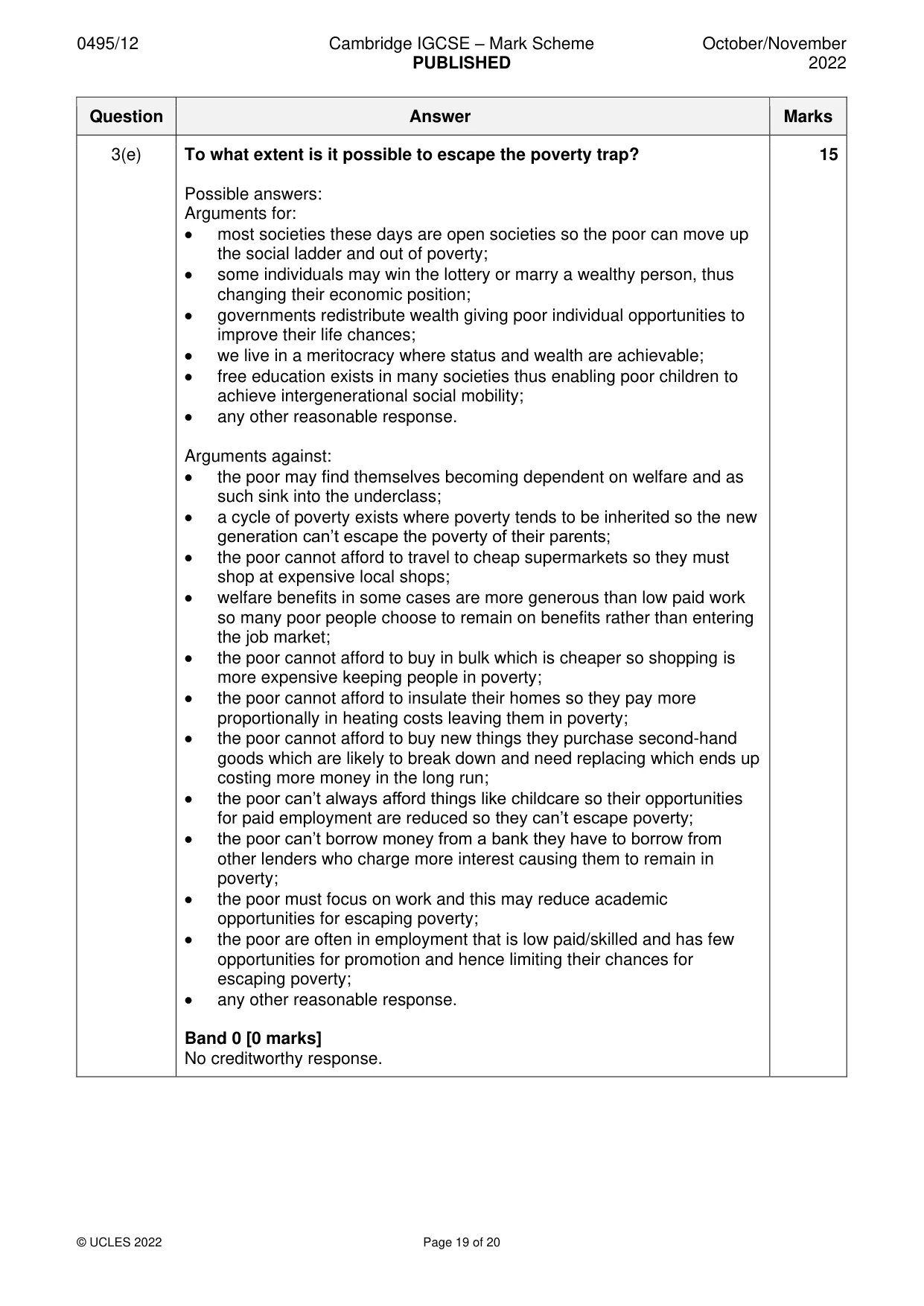
0495/12 Cambridge IGCSE – Mark Scheme PUBLISHED October/November 2022 © UCLES 2022 Page 19 of 20 Question Answer Marks 3(e) To what extent is it possible to escape the poverty trap? Possible answers: Arguments for: • most societies these days are open societies so the poor can move up the social ladder and out of poverty; • some individuals may win the lottery or marry a wealthy person, thus changing their economic position; • governments redistribute wealth giving poor individual opportunities to improve their life chances; • we live in a meritocracy where status and wealth are achievable; • free education exists in many societies thus enabling poor children to achieve intergenerational social mobility; • any other reasonable response. Arguments against: • the poor may find themselves becoming dependent on welfare and as such sink into the underclass; • a cycle of poverty exists where poverty tends to be inherited so the new generation can’t escape the poverty of their parents; • the poor cannot afford to travel to cheap supermarkets so they must shop at expensive local shops; • welfare benefits in some cases are more generous than low paid work so many poor people choose to remain on benefits rather than entering the job market; • the poor cannot afford to buy in bulk which is cheaper so shopping is more expensive keeping people in poverty; • the poor cannot afford to insulate their homes so they pay more proportionally in heating costs leaving them in poverty; • the poor cannot afford to buy new things they purchase second-hand goods which are likely to break down and need replacing which ends up costing more money in the long run; • the poor can’t always afford things like childcare so their opportunities for paid employment are reduced so they can’t escape poverty; • the poor can’t borrow money from a bank they have to borrow from other lenders who charge more interest causing them to remain in poverty; • the poor must focus on work and this may reduce academic opportunities for escaping poverty; • the poor are often in employment that is low paid/skilled and has few opportunities for promotion and hence limiting their chances for escaping poverty; • any other reasonable response. Band 0 [0 marks] No creditworthy response. 15
Mark scheme, page 20
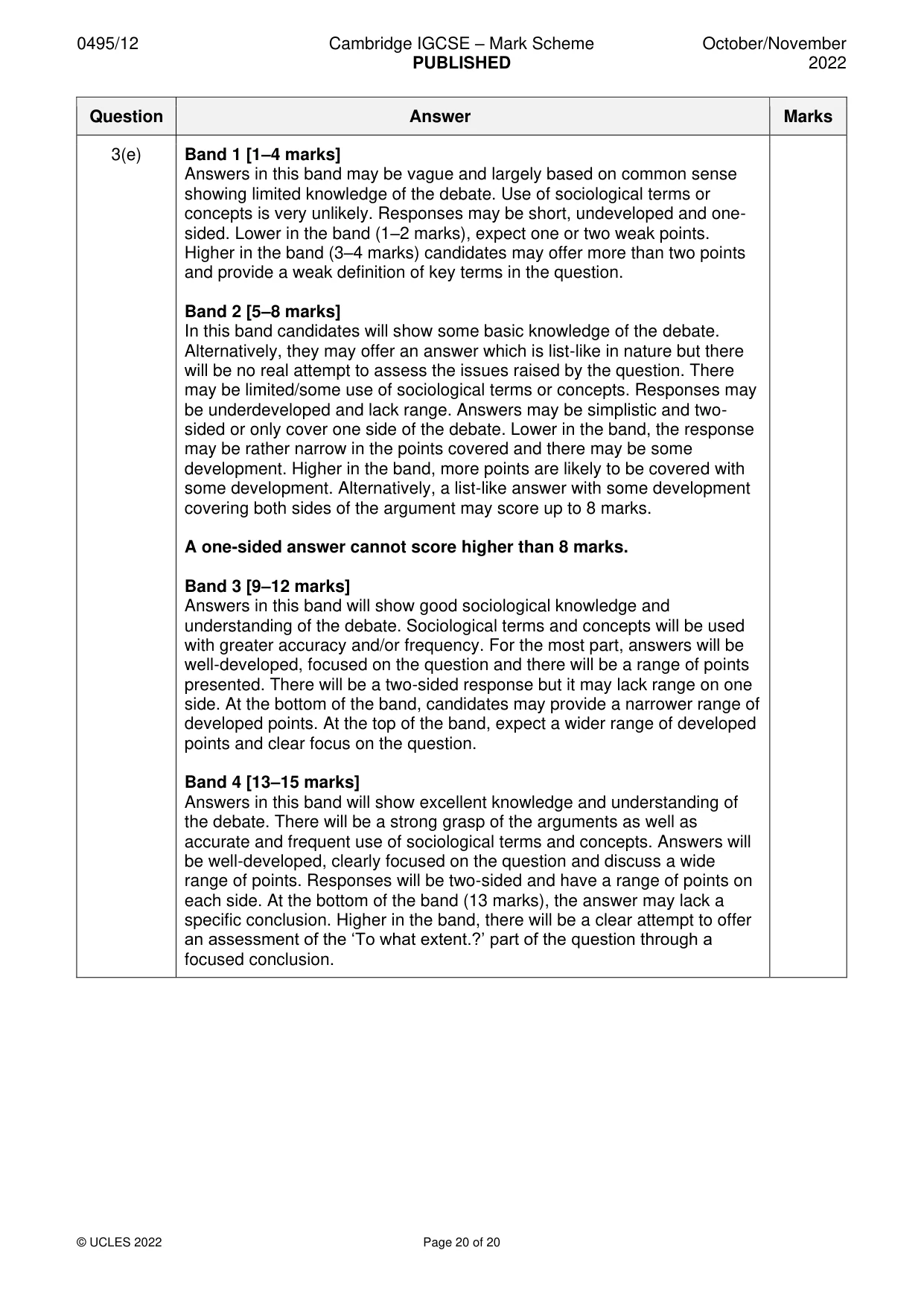
0495/12 Cambridge IGCSE – Mark Scheme PUBLISHED October/November 2022 © UCLES 2022 Page 20 of 20 Question Answer Marks 3(e) Band 1 [1–4 marks] Answers in this band may be vague and largely based on common sense showing limited knowledge of the debate. Use of sociological terms or concepts is very unlikely. Responses may be short, undeveloped and one- sided. Lower in the band (1–2 marks), expect one or two weak points. Higher in the band (3–4 marks) candidates may offer more than two points and provide a weak definition of key terms in the question. Band 2 [5–8 marks] In this band candidates will show some basic knowledge of the debate. Alternatively, they may offer an answer which is list-like in nature but there will be no real attempt to assess the issues raised by the question. There may be limited/some use of sociological terms or concepts. Responses may be underdeveloped and lack range. Answers may be simplistic and two- sided or only cover one side of the debate. Lower in the band, the response may be rather narrow in the points covered and there may be some development. Higher in the band, more points are likely to be covered with some development. Alternatively, a list-like answer with some development covering both sides of the argument may score up to 8 marks. A one-sided answer cannot score higher than 8 marks. Band 3 [9–12 marks] Answers in this band will show good sociological knowledge and understanding of the debate. Sociological terms and concepts will be used with greater accuracy and/or frequency. For the most part, answers will be well-developed, focused on the question and there will be a range of points presented. There will be a two-sided response but it may lack range on one side. At the bottom of the band, candidates may provide a narrower range of developed points. At the top of the band, expect a wider range of developed points and clear focus on the question. Band 4 [13–15 marks] Answers in this band will show excellent knowledge and understanding of the debate. There will be a strong grasp of the arguments as well as accurate and frequent use of sociological terms and concepts. Answers will be well-developed, clearly focused on the question and discuss a wide range of points. Responses will be two-sided and have a range of points on each side. At the bottom of the band (13 marks), the answer may lack a specific conclusion. Higher in the band, there will be a clear attempt to offer an assessment of the ‘To what extent.?’ part of the question through a focused conclusion.
What you needed in this session
Cambridge’s own grade thresholds for 2022 Oct/Nov, Paper 1 · Variant 2. A higher threshold means an easier paper — the bar moves with how the cohort did.