Cambridge IGCSE Sociology 0495 — 2022 Oct/Nov Paper 1 · Variant 1
0495/11/O/N/22 · 80 marks · ≈90 min
The question paper and its mark scheme, free to read here and free to download. This is Cambridge’s own paper, exactly as it was sat.
Question paper4 pages

Mark scheme20 pages
Answers below. Sit the paper first if you are practising.

Paper as text
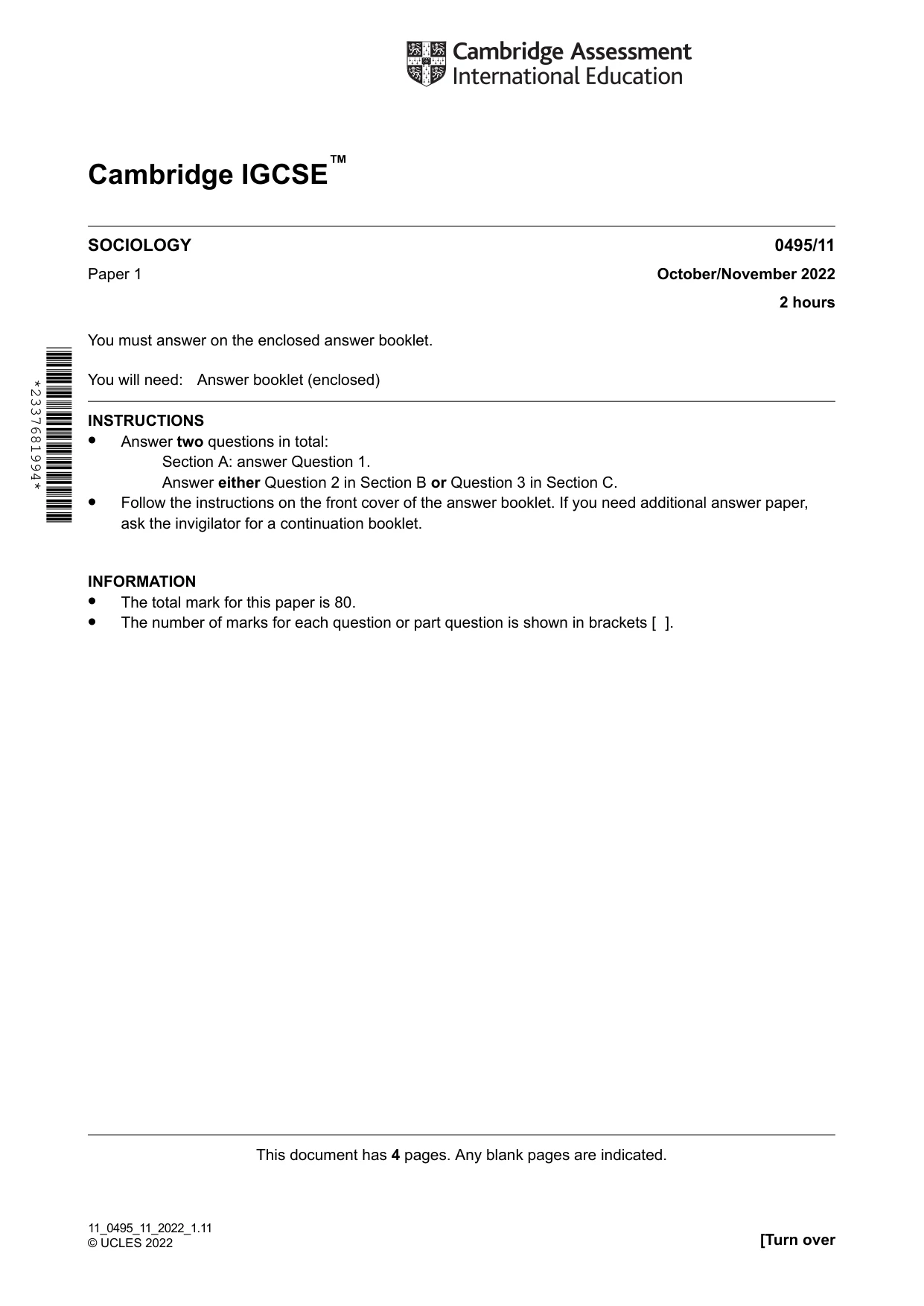
Question paper, page 1
Cambridge IGCSE™ 0495/11 October/November 2022 2 hours SOCIOLOGY Paper 1 You must answer on the enclosed answer booklet. You will need: Answer booklet (enclosed) INSTRUCTIONS • Answer two questions in total: Section A: answer Question 1. Answer either Question 2 in Section B or Question 3 in Section C. • Follow the instructions on the front cover of the answer booklet. If you need additional answer paper, ask the invigilator for a continuation booklet. INFORMATION • The total mark for this paper is 80. • The number of marks for each question or part question is shown in brackets [ ]. This document has 4 pages. Any blank pages are indicated. [Turn over 11_0495_11_2022_1.11 © UCLES 2022 *2337681994*
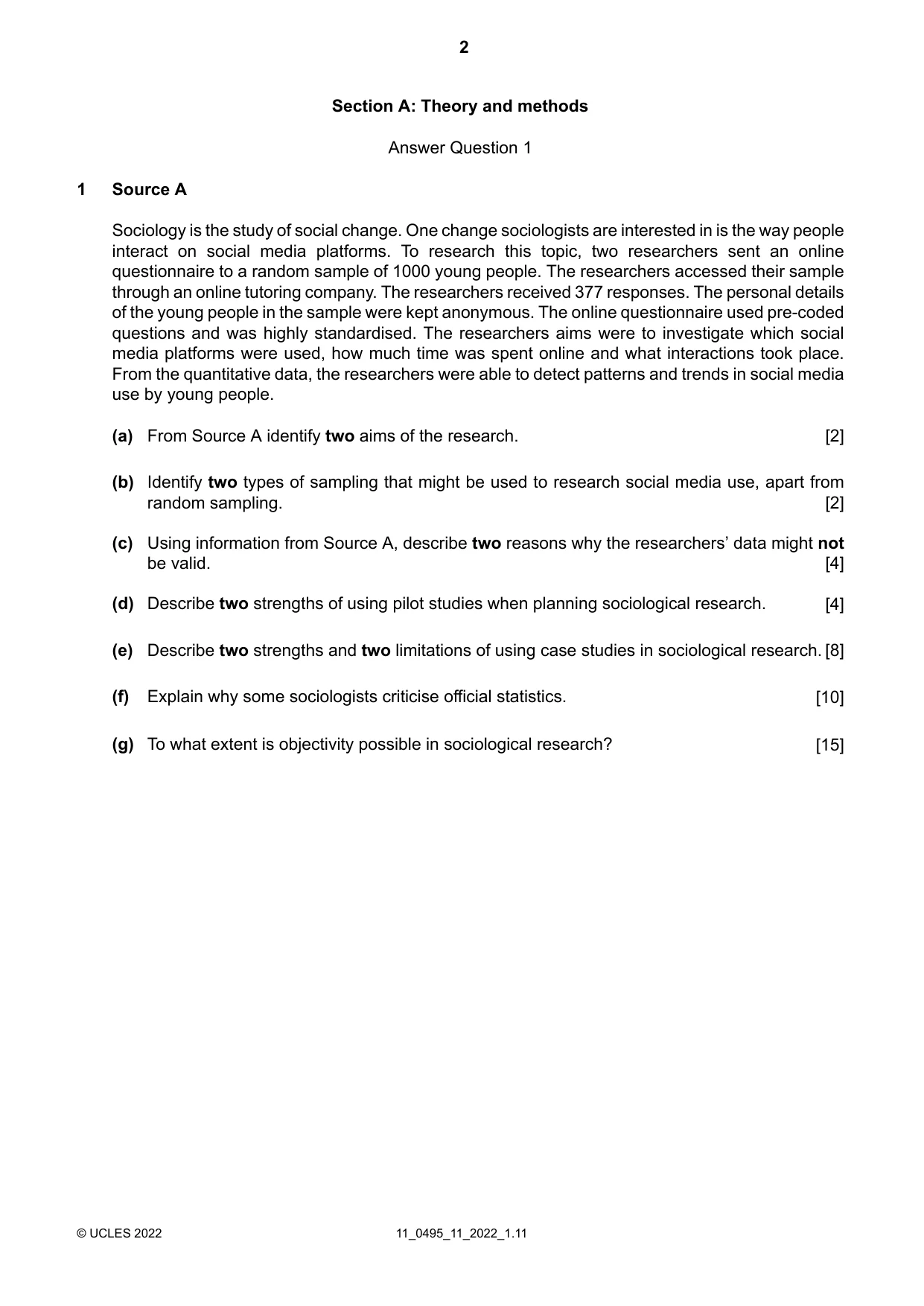
Question paper, page 2
Section A: Theory and methods Answer Question 1 Source A 1 Sociology is the study of social change. One change sociologists are interested in is the way people interact on social media platforms. To research this topic, two researchers sent an online questionnaire to a random sample of 1000 young people. The researchers accessed their sample through an online tutoring company. The researchers received 377 responses. The personal details of the young people in the sample were kept anonymous. The online questionnaire used pre-coded questions and was highly standardised. The researchers aims were to investigate which social media platforms were used, how much time was spent online and what interactions took place. From the quantitative data, the researchers were able to detect patterns and trends in social media use by young people. From Source A identify two aims of the research. [2] (a) Identify two types of sampling that might be used to research social media use, apart from random sampling. [2] (b) Using information from Source A, describe two reasons why the researchers’ data might not be valid. [4] (c) Describe two strengths of using pilot studies when planning sociological research. [4] (d) Describe two strengths and two limitations of using case studies in sociological research. [8] (e) Explain why some sociologists criticise official statistics. [10] (f) To what extent is objectivity possible in sociological research? [15] (g) 11_0495_11_2022_1.11 © UCLES 2022 2
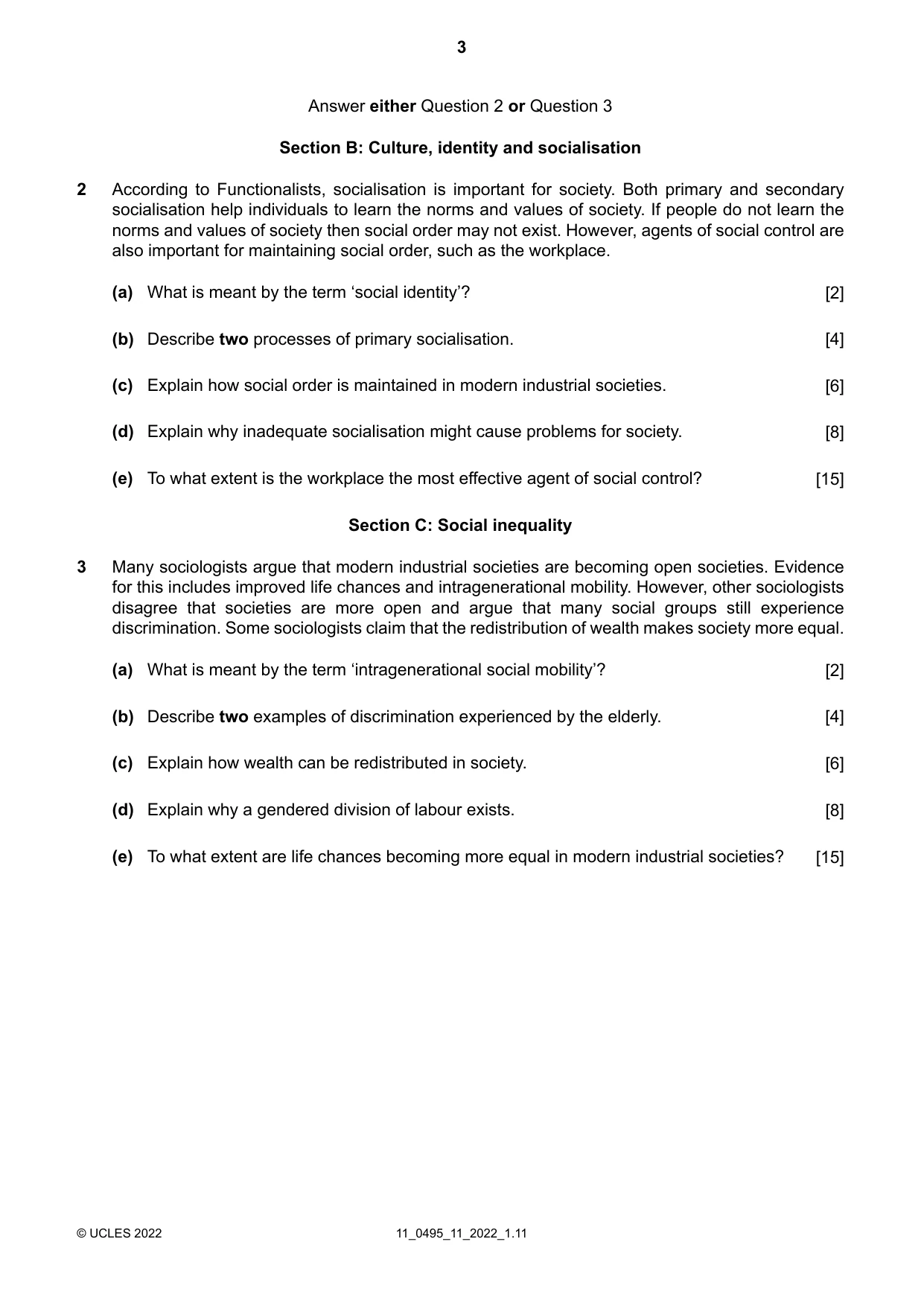
Question paper, page 3
Answer either Question 2 or Question 3 Section B: Culture, identity and socialisation According to Functionalists, socialisation is important for society. Both primary and secondary socialisation help individuals to learn the norms and values of society. If people do not learn the 2 norms and values of society then social order may not exist. However, agents of social control are also important for maintaining social order, such as the workplace. What is meant by the term ‘social identity’? [2] (a) Describe two processes of primary socialisation. [4] (b) Explain how social order is maintained in modern industrial societies. [6] (c) Explain why inadequate socialisation might cause problems for society. [8] (d) To what extent is the workplace the most effective agent of social control? [15] (e) Section C: Social inequality Many sociologists argue that modern industrial societies are becoming open societies. Evidence for this includes improved life chances and intragenerational mobility. However, other sociologists 3 disagree that societies are more open and argue that many social groups still experience discrimination. Some sociologists claim that the redistribution of wealth makes society more equal. What is meant by the term ‘intragenerational social mobility’? [2] (a) Describe two examples of discrimination experienced by the elderly. [4] (b) Explain how wealth can be redistributed in society. [6] (c) Explain why a gendered division of labour exists. [8] (d) To what extent are life chances becoming more equal in modern industrial societies? [15] (e) 11_0495_11_2022_1.11 © UCLES 2022 3
Question paper, page 4
BLANK PAGE Permission to reproduce items where third-party owned material protected by copyright is included has been sought and cleared where possible. Every reasonable effort has been made by the publisher (UCLES) to trace copyright holders, but if any items requiring clearance have unwittingly been included, the publisher will be pleased to make amends at the earliest possible opportunity. To avoid the issue of disclosure of answer-related information to candidates, all copyright acknowledgements are reproduced online in the Cambridge Assessment International Education Copyright Acknowledgements Booklet. This is produced for each series of examinations and is freely available to download at www.cambridgeinternational.org after the live examination series. Cambridge Assessment International Education is part of Cambridge Assessment. Cambridge Assessment is the brand name of the University of Cambridge Local Examinations Syndicate (UCLES), which is a department of the University of Cambridge. 11_0495_11_2022_1.11 © UCLES 2022 4
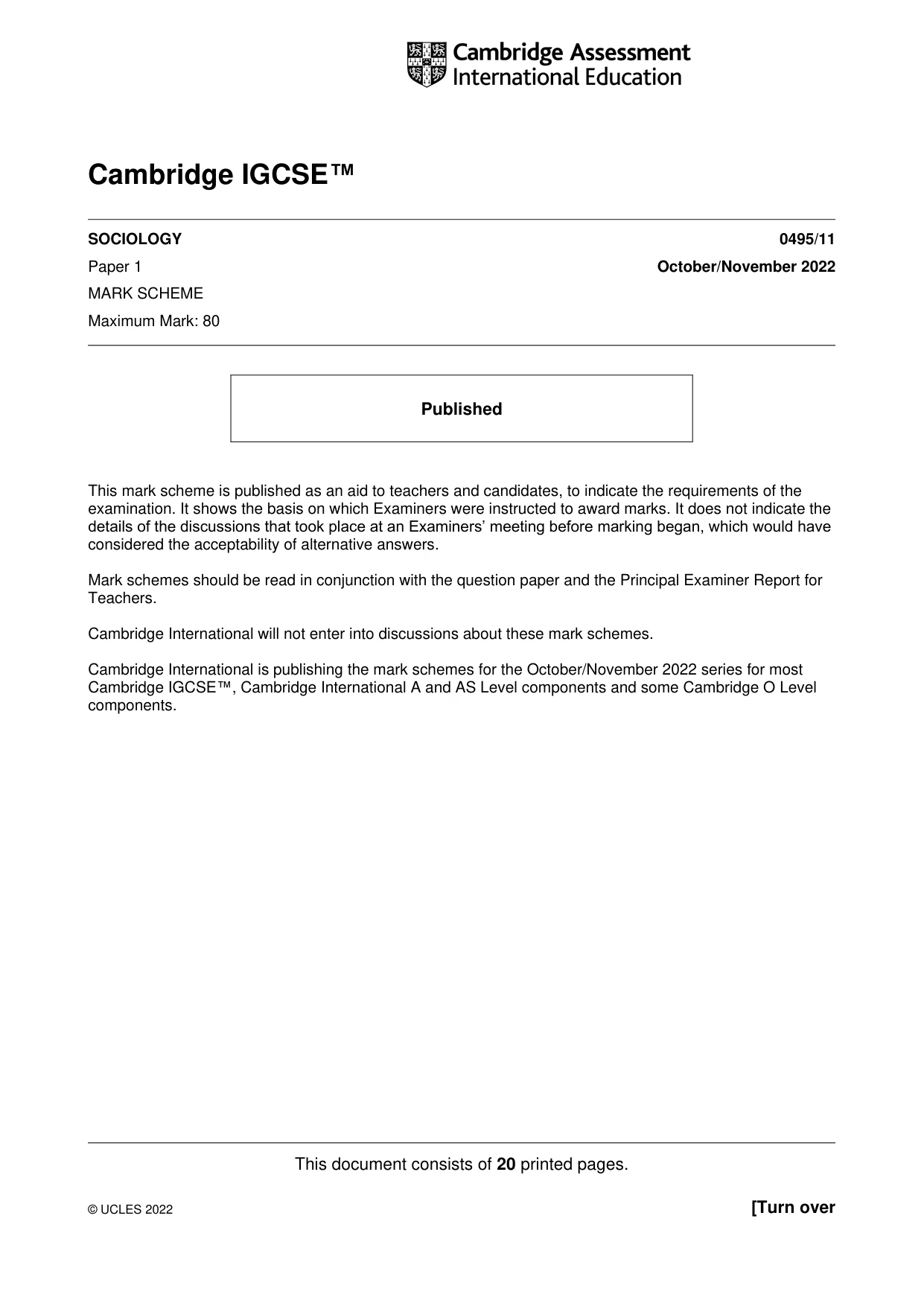
Mark scheme, page 1
This document consists of 20 printed pages. © UCLES 2022 [Turn over Cambridge IGCSE™ SOCIOLOGY 0495/11 Paper 1 October/November 2022 MARK SCHEME Maximum Mark: 80 Published This mark scheme is published as an aid to teachers and candidates, to indicate the requirements of the examination. It shows the basis on which Examiners were instructed to award marks. It does not indicate the details of the discussions that took place at an Examiners’ meeting before marking began, which would have considered the acceptability of alternative answers. Mark schemes should be read in conjunction with the question paper and the Principal Examiner Report for Teachers. Cambridge International will not enter into discussions about these mark schemes. Cambridge International is publishing the mark schemes for the October/November 2022 series for most Cambridge IGCSE™, Cambridge International A and AS Level components and some Cambridge O Level components.
Mark scheme, page 2
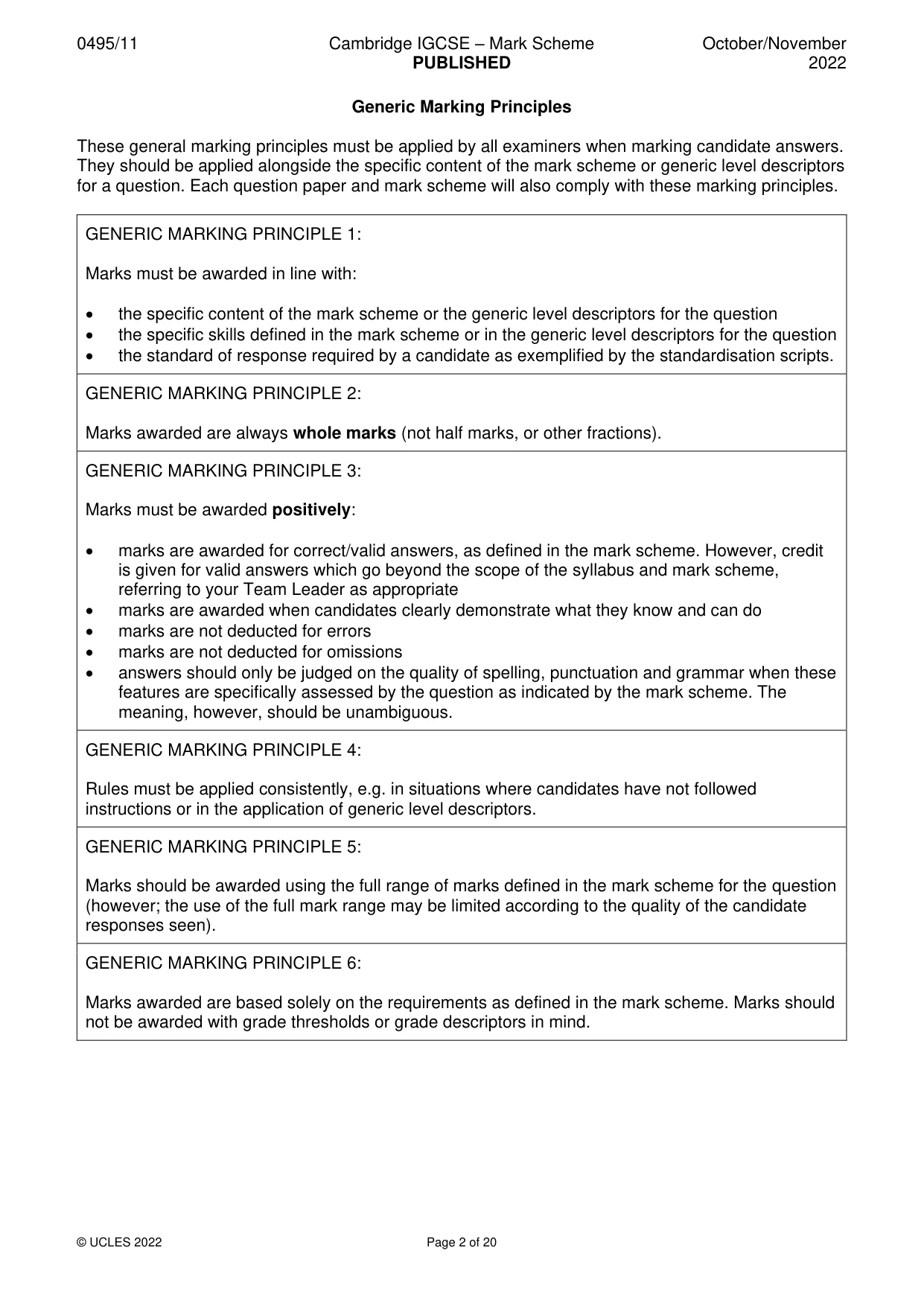
0495/11 Cambridge IGCSE – Mark Scheme PUBLISHED October/November 2022 © UCLES 2022 Page 2 of 20 Generic Marking Principles These general marking principles must be applied by all examiners when marking candidate answers. They should be applied alongside the specific content of the mark scheme or generic level descriptors for a question. Each question paper and mark scheme will also comply with these marking principles. GENERIC MARKING PRINCIPLE 1: Marks must be awarded in line with: • the specific content of the mark scheme or the generic level descriptors for the question • the specific skills defined in the mark scheme or in the generic level descriptors for the question • the standard of response required by a candidate as exemplified by the standardisation scripts. GENERIC MARKING PRINCIPLE 2: Marks awarded are always whole marks (not half marks, or other fractions). GENERIC MARKING PRINCIPLE 3: Marks must be awarded positively: • marks are awarded for correct/valid answers, as defined in the mark scheme. However, credit is given for valid answers which go beyond the scope of the syllabus and mark scheme, referring to your Team Leader as appropriate • marks are awarded when candidates clearly demonstrate what they know and can do • marks are not deducted for errors • marks are not deducted for omissions • answers should only be judged on the quality of spelling, punctuation and grammar when these features are specifically assessed by the question as indicated by the mark scheme. The meaning, however, should be unambiguous. GENERIC MARKING PRINCIPLE 4: Rules must be applied consistently, e.g. in situations where candidates have not followed instructions or in the application of generic level descriptors. GENERIC MARKING PRINCIPLE 5: Marks should be awarded using the full range of marks defined in the mark scheme for the question (however; the use of the full mark range may be limited according to the quality of the candidate responses seen). GENERIC MARKING PRINCIPLE 6: Marks awarded are based solely on the requirements as defined in the mark scheme. Marks should not be awarded with grade thresholds or grade descriptors in mind.
Mark scheme, page 3
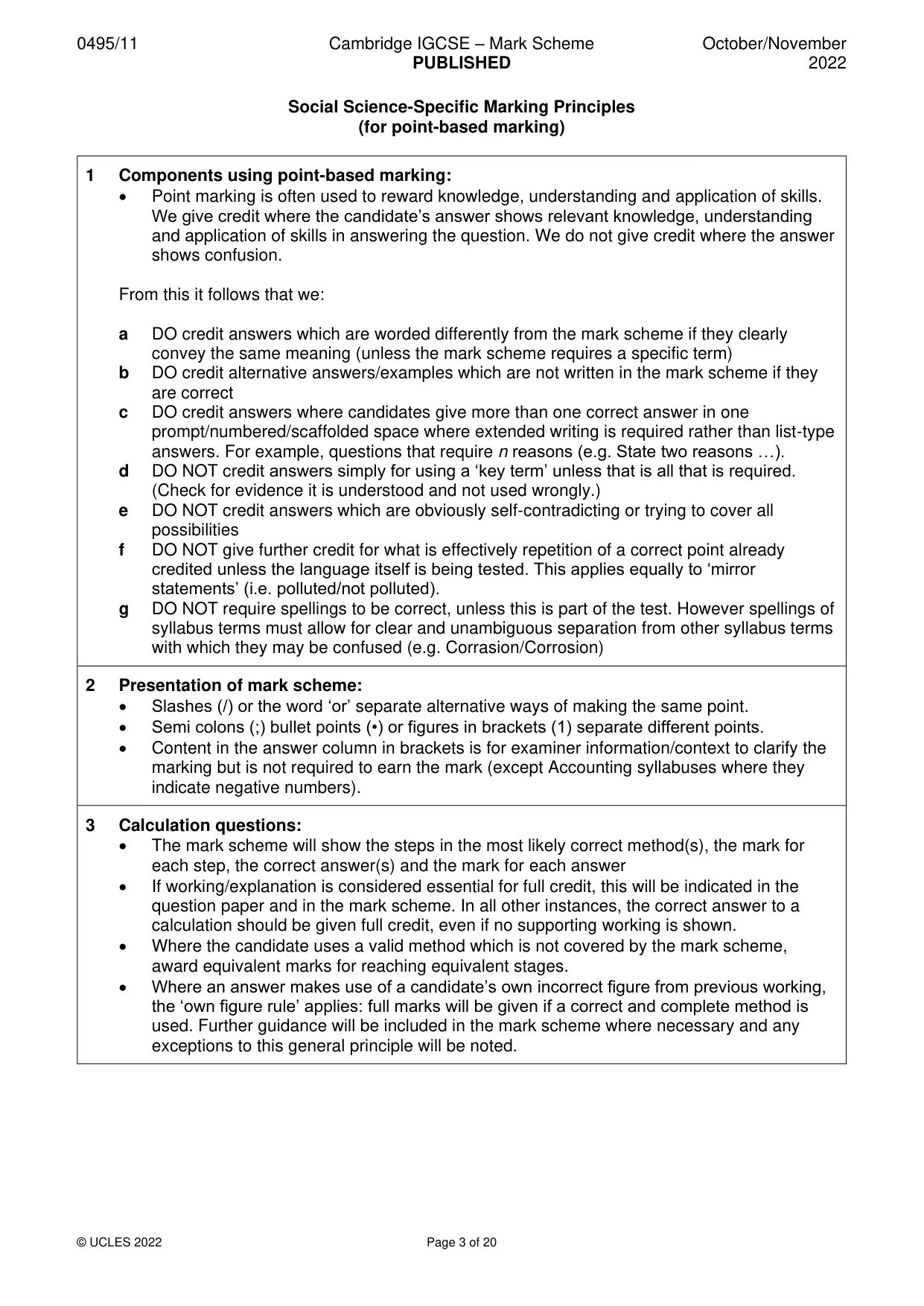
0495/11 Cambridge IGCSE – Mark Scheme PUBLISHED October/November 2022 © UCLES 2022 Page 3 of 20 Social Science-Specific Marking Principles (for point-based marking) 1 Components using point-based marking: • Point marking is often used to reward knowledge, understanding and application of skills. We give credit where the candidate’s answer shows relevant knowledge, understanding and application of skills in answering the question. We do not give credit where the answer shows confusion. From this it follows that we: a DO credit answers which are worded differently from the mark scheme if they clearly convey the same meaning (unless the mark scheme requires a specific term) b DO credit alternative answers/examples which are not written in the mark scheme if they are correct c DO credit answers where candidates give more than one correct answer in one prompt/numbered/scaffolded space where extended writing is required rather than list-type answers. For example, questions that require n reasons (e.g. State two reasons …). d DO NOT credit answers simply for using a ‘key term’ unless that is all that is required. (Check for evidence it is understood and not used wrongly.) e DO NOT credit answers which are obviously self-contradicting or trying to cover all possibilities f DO NOT give further credit for what is effectively repetition of a correct point already credited unless the language itself is being tested. This applies equally to ‘mirror statements’ (i.e. polluted/not polluted). g DO NOT require spellings to be correct, unless this is part of the test. However spellings of syllabus terms must allow for clear and unambiguous separation from other syllabus terms with which they may be confused (e.g. Corrasion/Corrosion) 2 Presentation of mark scheme: • Slashes (/) or the word ‘or’ separate alternative ways of making the same point. • Semi colons (;) bullet points (•) or figures in brackets (1) separate different points. • Content in the answer column in brackets is for examiner information/context to clarify the marking but is not required to earn the mark (except Accounting syllabuses where they indicate negative numbers). 3 Calculation questions: • The mark scheme will show the steps in the most likely correct method(s), the mark for each step, the correct answer(s) and the mark for each answer • If working/explanation is considered essential for full credit, this will be indicated in the question paper and in the mark scheme. In all other instances, the correct answer to a calculation should be given full credit, even if no supporting working is shown. • Where the candidate uses a valid method which is not covered by the mark scheme, award equivalent marks for reaching equivalent stages. • Where an answer makes use of a candidate’s own incorrect figure from previous working, the ‘own figure rule’ applies: full marks will be given if a correct and complete method is used. Further guidance will be included in the mark scheme where necessary and any exceptions to this general principle will be noted.
Mark scheme, page 4
0495/11 Cambridge IGCSE – Mark Scheme PUBLISHED October/November 2022 © UCLES 2022 Page 4 of 20 4 Annotation: • For point marking, ticks can be used to indicate correct answers and crosses can be used to indicate wrong answers. There is no direct relationship between ticks and marks. Ticks have no defined meaning for levels of response marking. • For levels of response marking, the level awarded should be annotated on the script. • Other annotations will be used by examiners as agreed during standardisation, and the meaning will be understood by all examiners who marked that paper.
Mark scheme, page 5
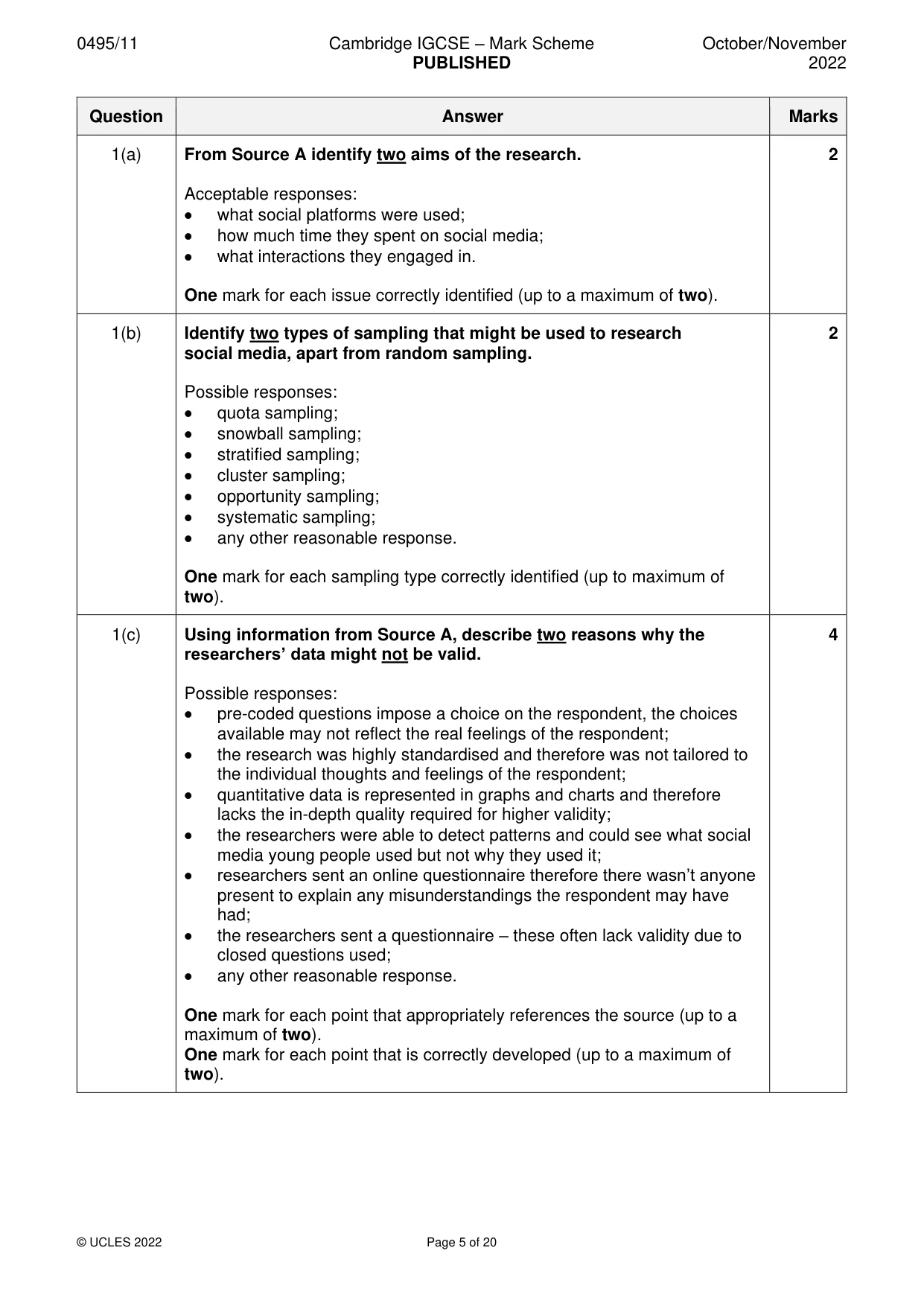
0495/11 Cambridge IGCSE – Mark Scheme PUBLISHED October/November 2022 © UCLES 2022 Page 5 of 20 Question Answer Marks 1(a) From Source A identify two aims of the research. Acceptable responses: • what social platforms were used; • how much time they spent on social media; • what interactions they engaged in. One mark for each issue correctly identified (up to a maximum of two). 2 1(b) Identify two types of sampling that might be used to research social media, apart from random sampling. Possible responses: • quota sampling; • snowball sampling; • stratified sampling; • cluster sampling; • opportunity sampling; • systematic sampling; • any other reasonable response. One mark for each sampling type correctly identified (up to maximum of two). 2 1(c) Using information from Source A, describe two reasons why the researchers’ data might not be valid. Possible responses: • pre-coded questions impose a choice on the respondent, the choices available may not reflect the real feelings of the respondent; • the research was highly standardised and therefore was not tailored to the individual thoughts and feelings of the respondent; • quantitative data is represented in graphs and charts and therefore lacks the in-depth quality required for higher validity; • the researchers were able to detect patterns and could see what social media young people used but not why they used it; • researchers sent an online questionnaire therefore there wasn’t anyone present to explain any misunderstandings the respondent may have had; • the researchers sent a questionnaire – these often lack validity due to closed questions used; • any other reasonable response. One mark for each point that appropriately references the source (up to a maximum of two). One mark for each point that is correctly developed (up to a maximum of two). 4
Mark scheme, page 6
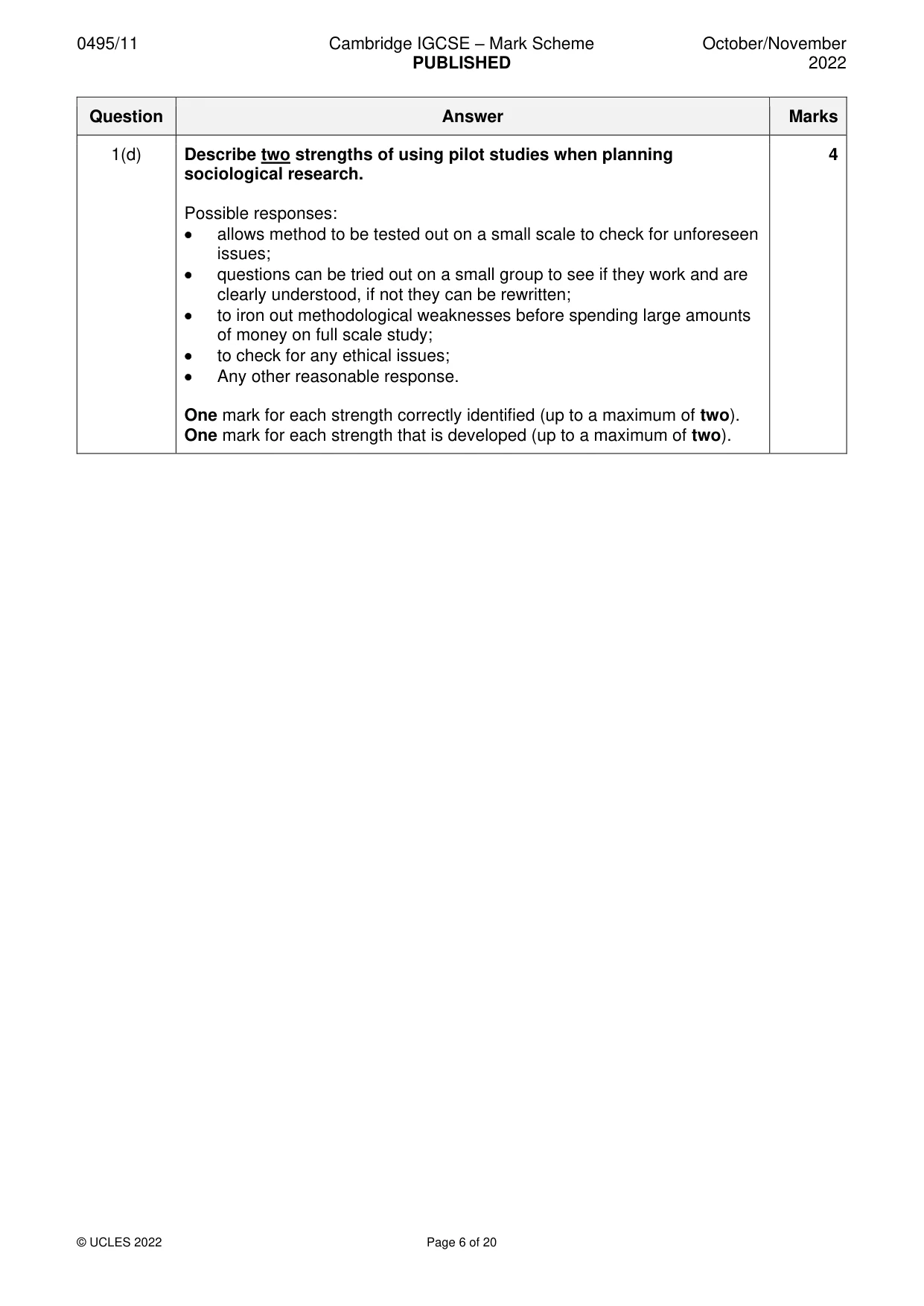
0495/11 Cambridge IGCSE – Mark Scheme PUBLISHED October/November 2022 © UCLES 2022 Page 6 of 20 Question Answer Marks 1(d) Describe two strengths of using pilot studies when planning sociological research. Possible responses: • allows method to be tested out on a small scale to check for unforeseen issues; • questions can be tried out on a small group to see if they work and are clearly understood, if not they can be rewritten; • to iron out methodological weaknesses before spending large amounts of money on full scale study; • to check for any ethical issues; • Any other reasonable response. One mark for each strength correctly identified (up to a maximum of two). One mark for each strength that is developed (up to a maximum of two). 4
Mark scheme, page 7
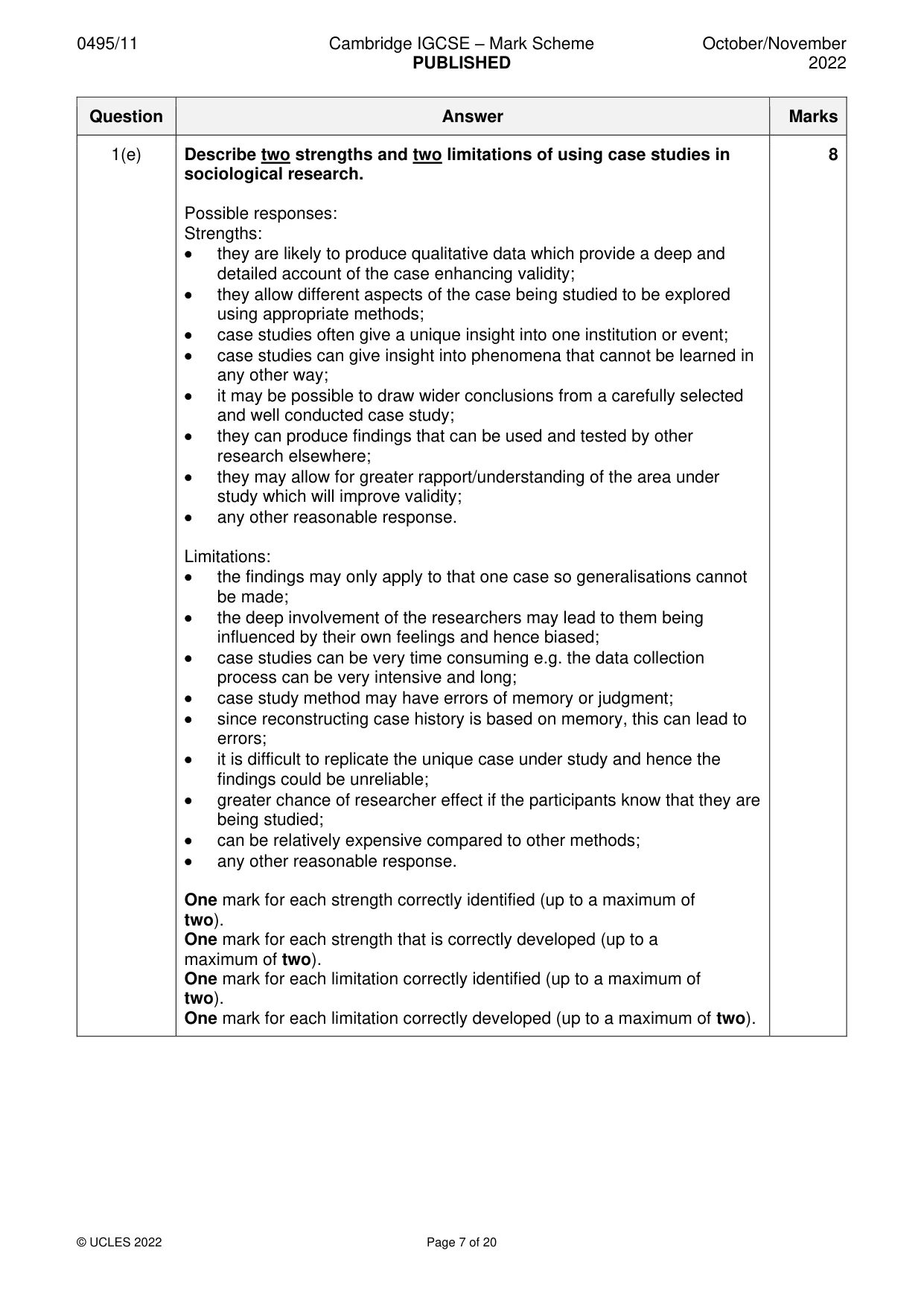
0495/11 Cambridge IGCSE – Mark Scheme PUBLISHED October/November 2022 © UCLES 2022 Page 7 of 20 Question Answer Marks 1(e) Describe two strengths and two limitations of using case studies in sociological research. Possible responses: Strengths: • they are likely to produce qualitative data which provide a deep and detailed account of the case enhancing validity; • they allow different aspects of the case being studied to be explored using appropriate methods; • case studies often give a unique insight into one institution or event; • case studies can give insight into phenomena that cannot be learned in any other way; • it may be possible to draw wider conclusions from a carefully selected and well conducted case study; • they can produce findings that can be used and tested by other research elsewhere; • they may allow for greater rapport/understanding of the area under study which will improve validity; • any other reasonable response. Limitations: • the findings may only apply to that one case so generalisations cannot be made; • the deep involvement of the researchers may lead to them being influenced by their own feelings and hence biased; • case studies can be very time consuming e.g. the data collection process can be very intensive and long; • case study method may have errors of memory or judgment; • since reconstructing case history is based on memory, this can lead to errors; • it is difficult to replicate the unique case under study and hence the findings could be unreliable; • greater chance of researcher effect if the participants know that they are being studied; • can be relatively expensive compared to other methods; • any other reasonable response. One mark for each strength correctly identified (up to a maximum of two). One mark for each strength that is correctly developed (up to a maximum of two). One mark for each limitation correctly identified (up to a maximum of two). One mark for each limitation correctly developed (up to a maximum of two). 8
Mark scheme, page 8
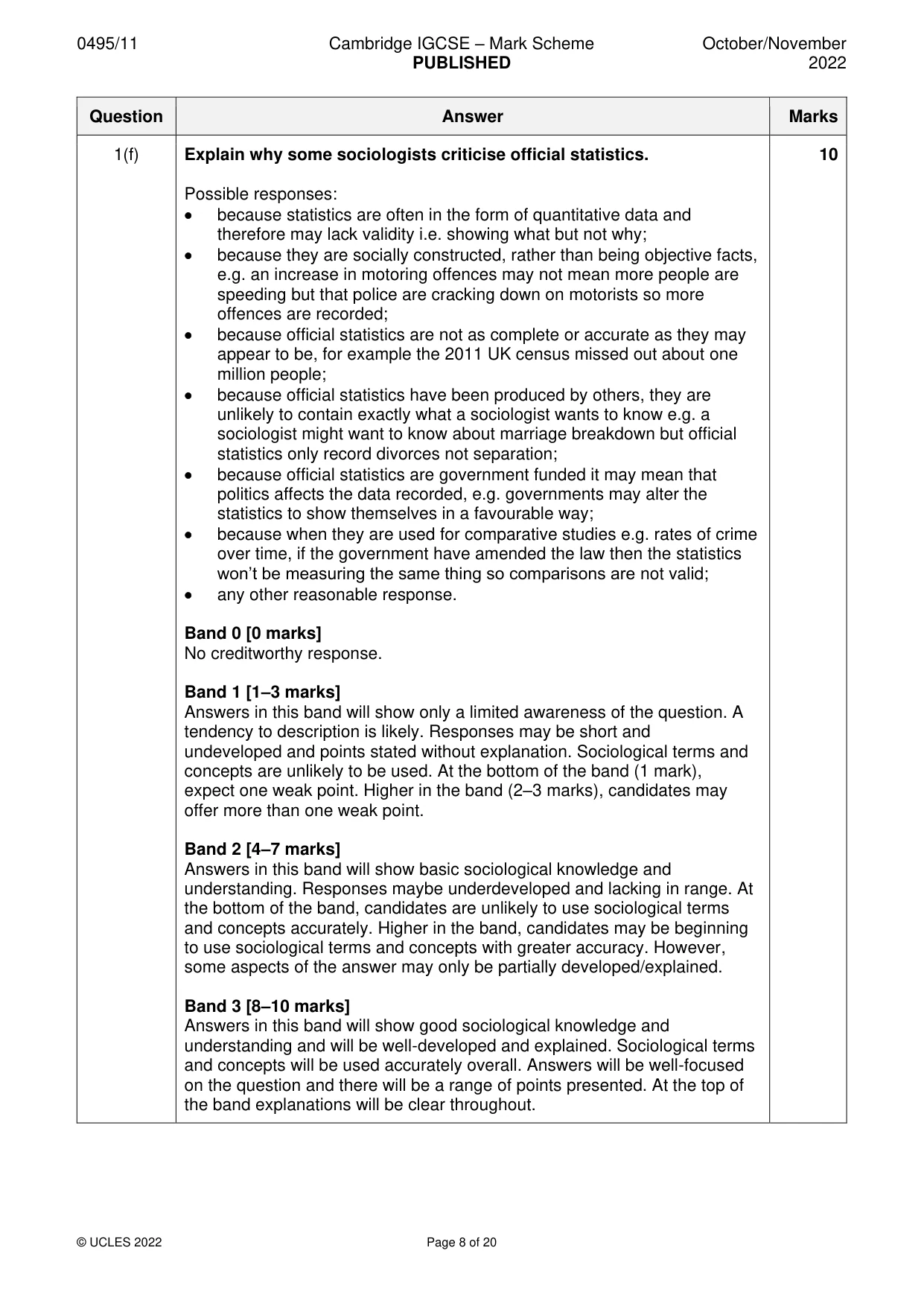
0495/11 Cambridge IGCSE – Mark Scheme PUBLISHED October/November 2022 © UCLES 2022 Page 8 of 20 Question Answer Marks 1(f) Explain why some sociologists criticise official statistics. Possible responses: • because statistics are often in the form of quantitative data and therefore may lack validity i.e. showing what but not why; • because they are socially constructed, rather than being objective facts, e.g. an increase in motoring offences may not mean more people are speeding but that police are cracking down on motorists so more offences are recorded; • because official statistics are not as complete or accurate as they may appear to be, for example the 2011 UK census missed out about one million people; • because official statistics have been produced by others, they are unlikely to contain exactly what a sociologist wants to know e.g. a sociologist might want to know about marriage breakdown but official statistics only record divorces not separation; • because official statistics are government funded it may mean that politics affects the data recorded, e.g. governments may alter the statistics to show themselves in a favourable way; • because when they are used for comparative studies e.g. rates of crime over time, if the government have amended the law then the statistics won’t be measuring the same thing so comparisons are not valid; • any other reasonable response. Band 0 [0 marks] No creditworthy response. Band 1 [1–3 marks] Answers in this band will show only a limited awareness of the question. A tendency to description is likely. Responses may be short and undeveloped and points stated without explanation. Sociological terms and concepts are unlikely to be used. At the bottom of the band (1 mark), expect one weak point. Higher in the band (2–3 marks), candidates may offer more than one weak point. Band 2 [4–7 marks] Answers in this band will show basic sociological knowledge and understanding. Responses maybe underdeveloped and lacking in range. At the bottom of the band, candidates are unlikely to use sociological terms and concepts accurately. Higher in the band, candidates may be beginning to use sociological terms and concepts with greater accuracy. However, some aspects of the answer may only be partially developed/explained. Band 3 [8–10 marks] Answers in this band will show good sociological knowledge and understanding and will be well-developed and explained. Sociological terms and concepts will be used accurately overall. Answers will be well-focused on the question and there will be a range of points presented. At the top of the band explanations will be clear throughout. 10
Mark scheme, page 9
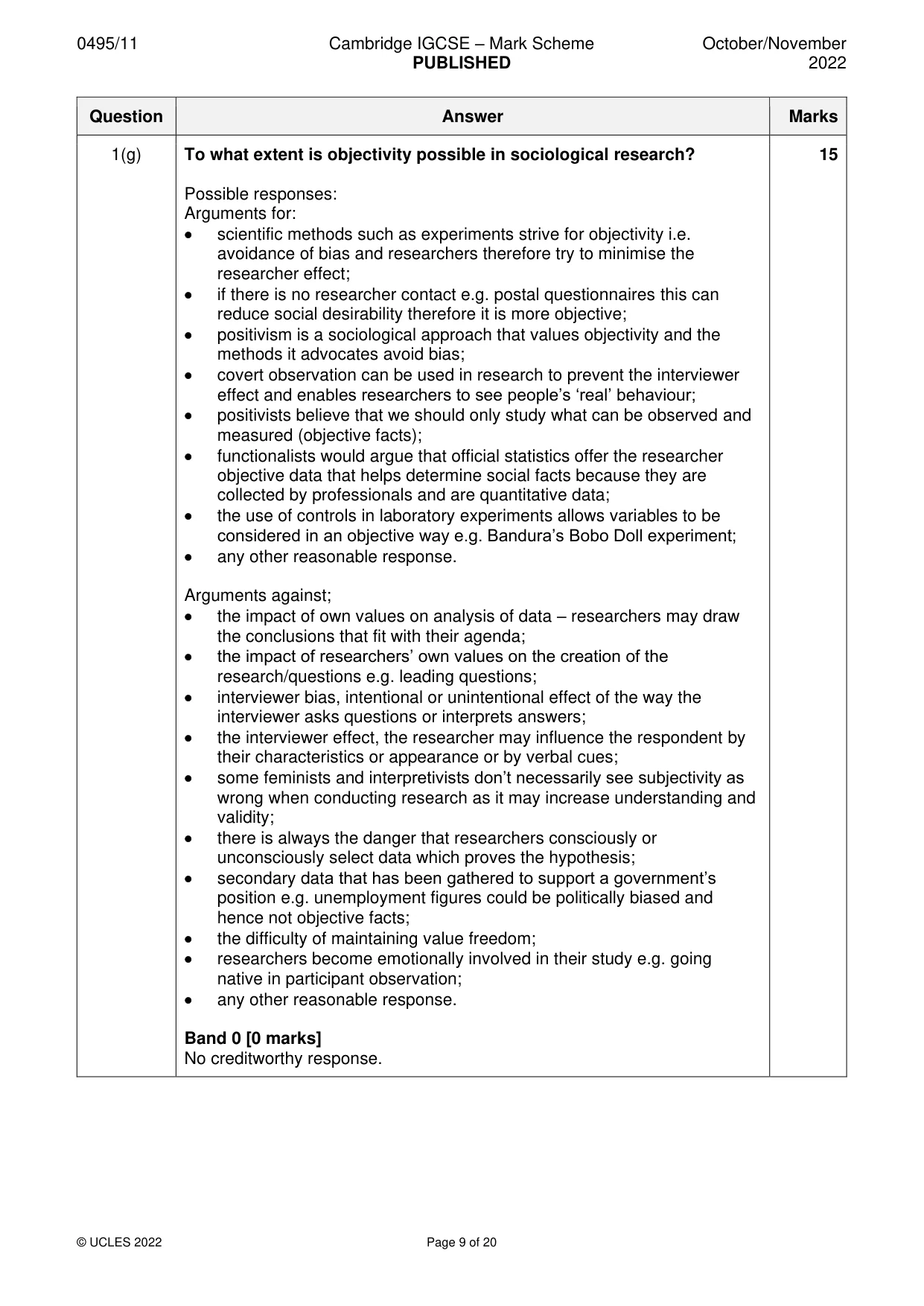
0495/11 Cambridge IGCSE – Mark Scheme PUBLISHED October/November 2022 © UCLES 2022 Page 9 of 20 Question Answer Marks 1(g) To what extent is objectivity possible in sociological research? Possible responses: Arguments for: • scientific methods such as experiments strive for objectivity i.e. avoidance of bias and researchers therefore try to minimise the researcher effect; • if there is no researcher contact e.g. postal questionnaires this can reduce social desirability therefore it is more objective; • positivism is a sociological approach that values objectivity and the methods it advocates avoid bias; • covert observation can be used in research to prevent the interviewer effect and enables researchers to see people’s ‘real’ behaviour; • positivists believe that we should only study what can be observed and measured (objective facts); • functionalists would argue that official statistics offer the researcher objective data that helps determine social facts because they are collected by professionals and are quantitative data; • the use of controls in laboratory experiments allows variables to be considered in an objective way e.g. Bandura’s Bobo Doll experiment; • any other reasonable response. Arguments against; • the impact of own values on analysis of data – researchers may draw the conclusions that fit with their agenda; • the impact of researchers’ own values on the creation of the research/questions e.g. leading questions; • interviewer bias, intentional or unintentional effect of the way the interviewer asks questions or interprets answers; • the interviewer effect, the researcher may influence the respondent by their characteristics or appearance or by verbal cues; • some feminists and interpretivists don’t necessarily see subjectivity as wrong when conducting research as it may increase understanding and validity; • there is always the danger that researchers consciously or unconsciously select data which proves the hypothesis; • secondary data that has been gathered to support a government’s position e.g. unemployment figures could be politically biased and hence not objective facts; • the difficulty of maintaining value freedom; • researchers become emotionally involved in their study e.g. going native in participant observation; • any other reasonable response. Band 0 [0 marks] No creditworthy response. 15
Mark scheme, page 10
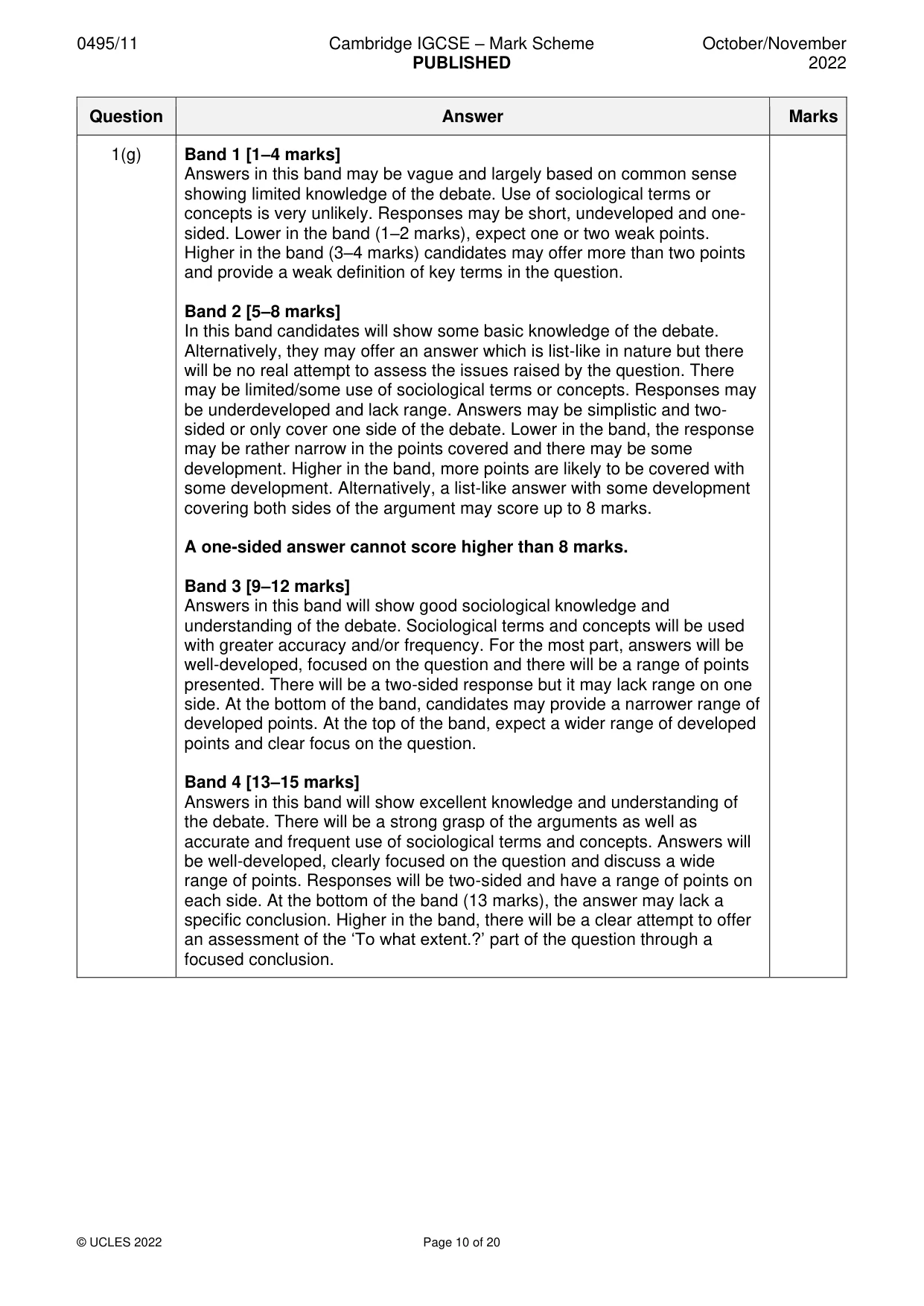
0495/11 Cambridge IGCSE – Mark Scheme PUBLISHED October/November 2022 © UCLES 2022 Page 10 of 20 Question Answer Marks 1(g) Band 1 [1–4 marks] Answers in this band may be vague and largely based on common sense showing limited knowledge of the debate. Use of sociological terms or concepts is very unlikely. Responses may be short, undeveloped and one- sided. Lower in the band (1–2 marks), expect one or two weak points. Higher in the band (3–4 marks) candidates may offer more than two points and provide a weak definition of key terms in the question. Band 2 [5–8 marks] In this band candidates will show some basic knowledge of the debate. Alternatively, they may offer an answer which is list-like in nature but there will be no real attempt to assess the issues raised by the question. There may be limited/some use of sociological terms or concepts. Responses may be underdeveloped and lack range. Answers may be simplistic and two- sided or only cover one side of the debate. Lower in the band, the response may be rather narrow in the points covered and there may be some development. Higher in the band, more points are likely to be covered with some development. Alternatively, a list-like answer with some development covering both sides of the argument may score up to 8 marks. A one-sided answer cannot score higher than 8 marks. Band 3 [9–12 marks] Answers in this band will show good sociological knowledge and understanding of the debate. Sociological terms and concepts will be used with greater accuracy and/or frequency. For the most part, answers will be well-developed, focused on the question and there will be a range of points presented. There will be a two-sided response but it may lack range on one side. At the bottom of the band, candidates may provide a narrower range of developed points. At the top of the band, expect a wider range of developed points and clear focus on the question. Band 4 [13–15 marks] Answers in this band will show excellent knowledge and understanding of the debate. There will be a strong grasp of the arguments as well as accurate and frequent use of sociological terms and concepts. Answers will be well-developed, clearly focused on the question and discuss a wide range of points. Responses will be two-sided and have a range of points on each side. At the bottom of the band (13 marks), the answer may lack a specific conclusion. Higher in the band, there will be a clear attempt to offer an assessment of the ‘To what extent.?’ part of the question through a focused conclusion.
Mark scheme, page 11
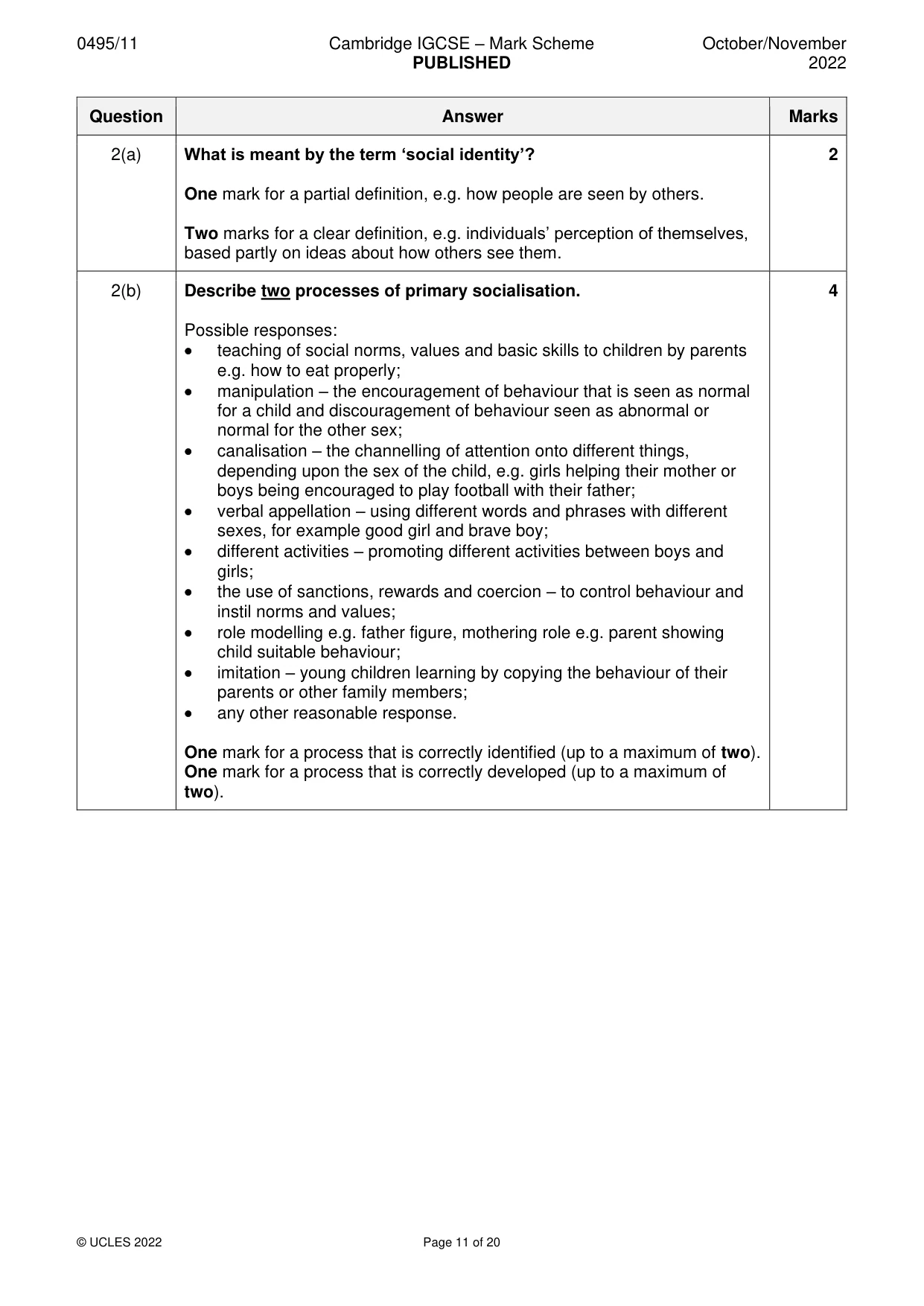
0495/11 Cambridge IGCSE – Mark Scheme PUBLISHED October/November 2022 © UCLES 2022 Page 11 of 20 Question Answer Marks 2(a) What is meant by the term ‘social identity’? One mark for a partial definition, e.g. how people are seen by others. Two marks for a clear definition, e.g. individuals’ perception of themselves, based partly on ideas about how others see them. 2 2(b) Describe two processes of primary socialisation. Possible responses: • teaching of social norms, values and basic skills to children by parents e.g. how to eat properly; • manipulation – the encouragement of behaviour that is seen as normal for a child and discouragement of behaviour seen as abnormal or normal for the other sex; • canalisation – the channelling of attention onto different things, depending upon the sex of the child, e.g. girls helping their mother or boys being encouraged to play football with their father; • verbal appellation – using different words and phrases with different sexes, for example good girl and brave boy; • different activities – promoting different activities between boys and girls; • the use of sanctions, rewards and coercion – to control behaviour and instil norms and values; • role modelling e.g. father figure, mothering role e.g. parent showing child suitable behaviour; • imitation – young children learning by copying the behaviour of their parents or other family members; • any other reasonable response. One mark for a process that is correctly identified (up to a maximum of two). One mark for a process that is correctly developed (up to a maximum of two). 4
Mark scheme, page 12
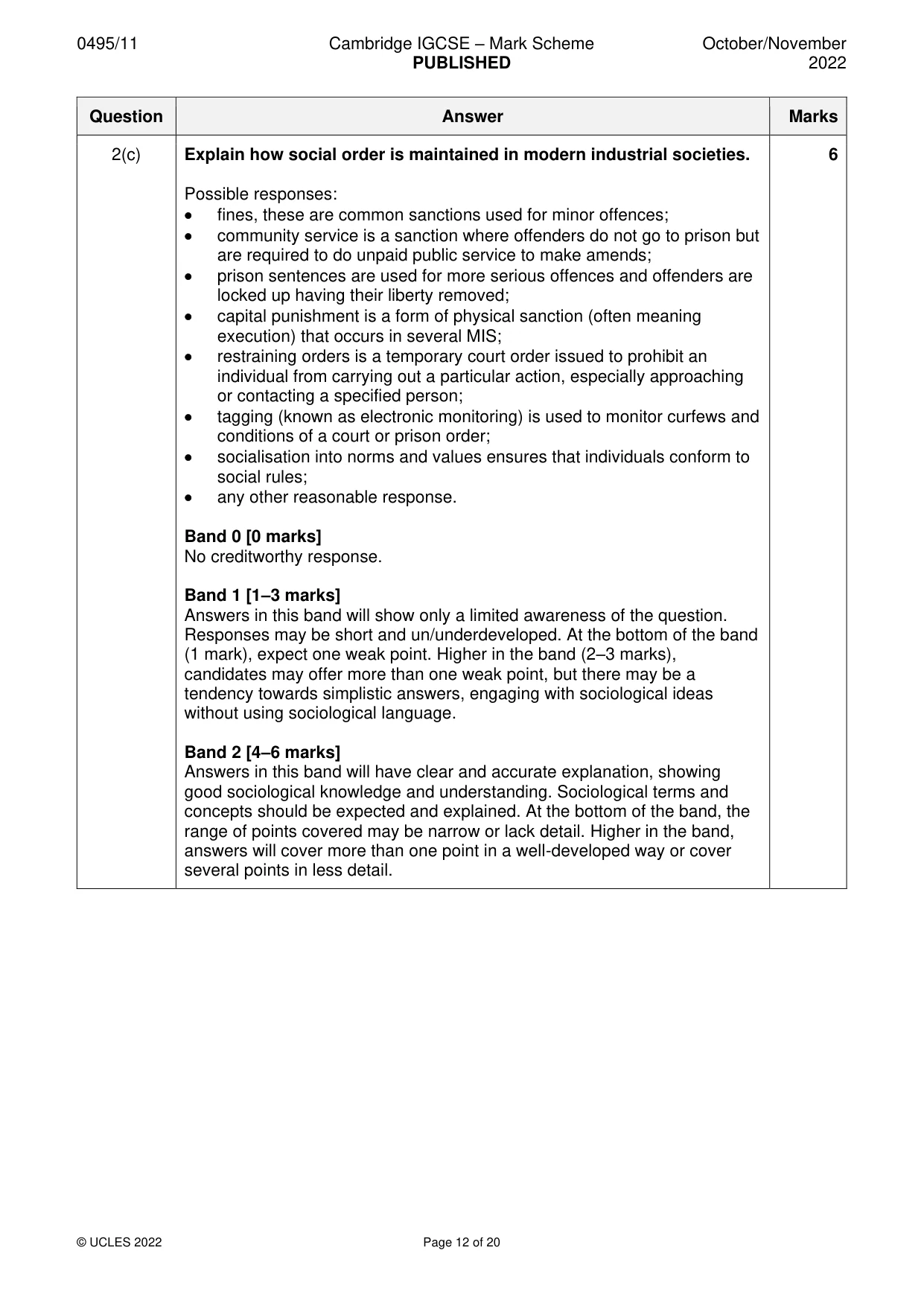
0495/11 Cambridge IGCSE – Mark Scheme PUBLISHED October/November 2022 © UCLES 2022 Page 12 of 20 Question Answer Marks 2(c) Explain how social order is maintained in modern industrial societies. Possible responses: • fines, these are common sanctions used for minor offences; • community service is a sanction where offenders do not go to prison but are required to do unpaid public service to make amends; • prison sentences are used for more serious offences and offenders are locked up having their liberty removed; • capital punishment is a form of physical sanction (often meaning execution) that occurs in several MIS; • restraining orders is a temporary court order issued to prohibit an individual from carrying out a particular action, especially approaching or contacting a specified person; • tagging (known as electronic monitoring) is used to monitor curfews and conditions of a court or prison order; • socialisation into norms and values ensures that individuals conform to social rules; • any other reasonable response. Band 0 [0 marks] No creditworthy response. Band 1 [1–3 marks] Answers in this band will show only a limited awareness of the question. Responses may be short and un/underdeveloped. At the bottom of the band (1 mark), expect one weak point. Higher in the band (2–3 marks), candidates may offer more than one weak point, but there may be a tendency towards simplistic answers, engaging with sociological ideas without using sociological language. Band 2 [4–6 marks] Answers in this band will have clear and accurate explanation, showing good sociological knowledge and understanding. Sociological terms and concepts should be expected and explained. At the bottom of the band, the range of points covered may be narrow or lack detail. Higher in the band, answers will cover more than one point in a well-developed way or cover several points in less detail. 6
Mark scheme, page 13
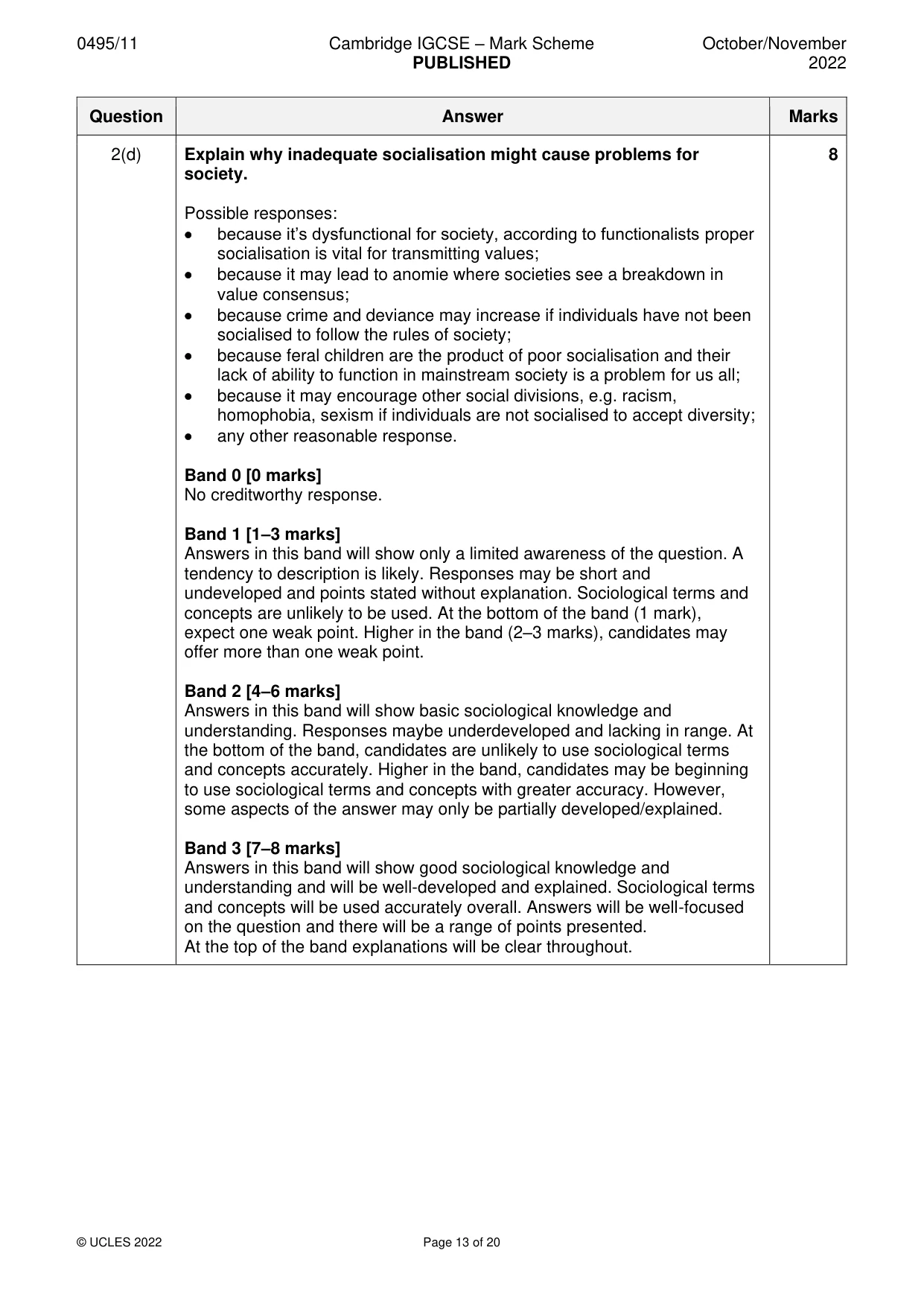
0495/11 Cambridge IGCSE – Mark Scheme PUBLISHED October/November 2022 © UCLES 2022 Page 13 of 20 Question Answer Marks 2(d) Explain why inadequate socialisation might cause problems for society. Possible responses: • because it’s dysfunctional for society, according to functionalists proper socialisation is vital for transmitting values; • because it may lead to anomie where societies see a breakdown in value consensus; • because crime and deviance may increase if individuals have not been socialised to follow the rules of society; • because feral children are the product of poor socialisation and their lack of ability to function in mainstream society is a problem for us all; • because it may encourage other social divisions, e.g. racism, homophobia, sexism if individuals are not socialised to accept diversity; • any other reasonable response. Band 0 [0 marks] No creditworthy response. Band 1 [1–3 marks] Answers in this band will show only a limited awareness of the question. A tendency to description is likely. Responses may be short and undeveloped and points stated without explanation. Sociological terms and concepts are unlikely to be used. At the bottom of the band (1 mark), expect one weak point. Higher in the band (2–3 marks), candidates may offer more than one weak point. Band 2 [4–6 marks] Answers in this band will show basic sociological knowledge and understanding. Responses maybe underdeveloped and lacking in range. At the bottom of the band, candidates are unlikely to use sociological terms and concepts accurately. Higher in the band, candidates may be beginning to use sociological terms and concepts with greater accuracy. However, some aspects of the answer may only be partially developed/explained. Band 3 [7–8 marks] Answers in this band will show good sociological knowledge and understanding and will be well-developed and explained. Sociological terms and concepts will be used accurately overall. Answers will be well-focused on the question and there will be a range of points presented. At the top of the band explanations will be clear throughout. 8
Mark scheme, page 14
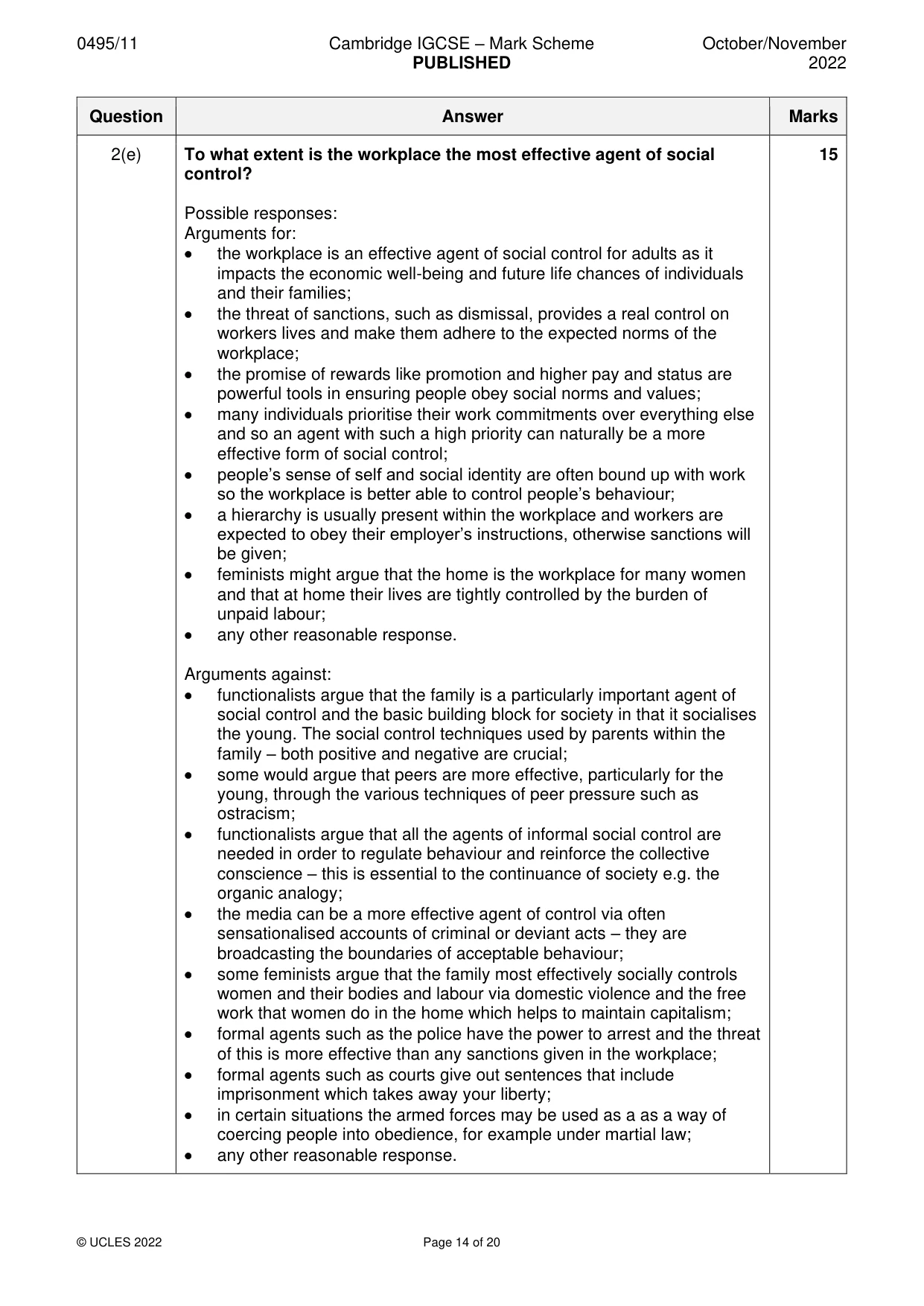
0495/11 Cambridge IGCSE – Mark Scheme PUBLISHED October/November 2022 © UCLES 2022 Page 14 of 20 Question Answer Marks 2(e) To what extent is the workplace the most effective agent of social control? Possible responses: Arguments for: • the workplace is an effective agent of social control for adults as it impacts the economic well-being and future life chances of individuals and their families; • the threat of sanctions, such as dismissal, provides a real control on workers lives and make them adhere to the expected norms of the workplace; • the promise of rewards like promotion and higher pay and status are powerful tools in ensuring people obey social norms and values; • many individuals prioritise their work commitments over everything else and so an agent with such a high priority can naturally be a more effective form of social control; • people’s sense of self and social identity are often bound up with work so the workplace is better able to control people’s behaviour; • a hierarchy is usually present within the workplace and workers are expected to obey their employer’s instructions, otherwise sanctions will be given; • feminists might argue that the home is the workplace for many women and that at home their lives are tightly controlled by the burden of unpaid labour; • any other reasonable response. Arguments against: • functionalists argue that the family is a particularly important agent of social control and the basic building block for society in that it socialises the young. The social control techniques used by parents within the family – both positive and negative are crucial; • some would argue that peers are more effective, particularly for the young, through the various techniques of peer pressure such as ostracism; • functionalists argue that all the agents of informal social control are needed in order to regulate behaviour and reinforce the collective conscience – this is essential to the continuance of society e.g. the organic analogy; • the media can be a more effective agent of control via often sensationalised accounts of criminal or deviant acts – they are broadcasting the boundaries of acceptable behaviour; • some feminists argue that the family most effectively socially controls women and their bodies and labour via domestic violence and the free work that women do in the home which helps to maintain capitalism; • formal agents such as the police have the power to arrest and the threat of this is more effective than any sanctions given in the workplace; • formal agents such as courts give out sentences that include imprisonment which takes away your liberty; • in certain situations the armed forces may be used as a as a way of coercing people into obedience, for example under martial law; • any other reasonable response. 15
Mark scheme, page 15
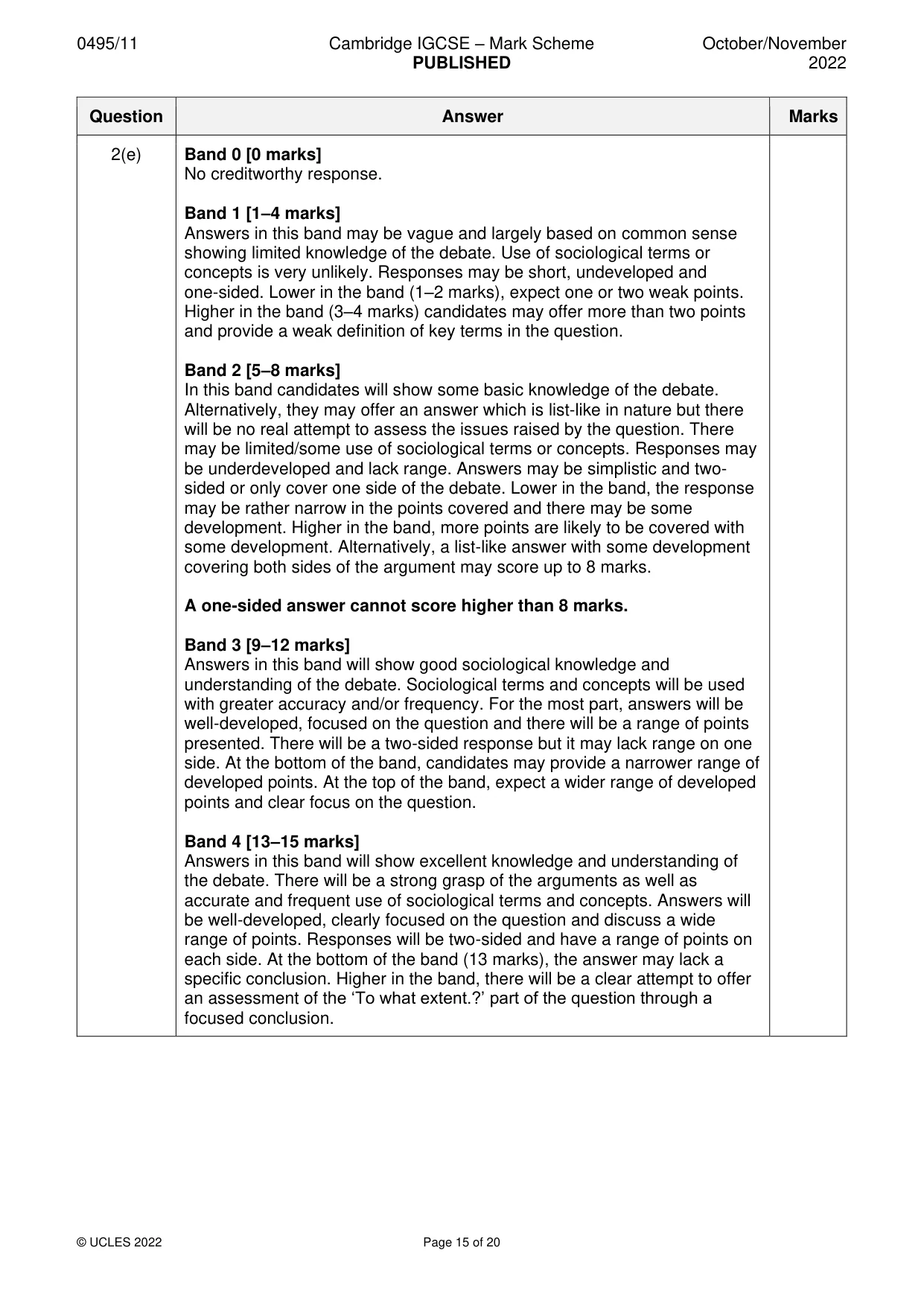
0495/11 Cambridge IGCSE – Mark Scheme PUBLISHED October/November 2022 © UCLES 2022 Page 15 of 20 Question Answer Marks 2(e) Band 0 [0 marks] No creditworthy response. Band 1 [1–4 marks] Answers in this band may be vague and largely based on common sense showing limited knowledge of the debate. Use of sociological terms or concepts is very unlikely. Responses may be short, undeveloped and one-sided. Lower in the band (1–2 marks), expect one or two weak points. Higher in the band (3–4 marks) candidates may offer more than two points and provide a weak definition of key terms in the question. Band 2 [5–8 marks] In this band candidates will show some basic knowledge of the debate. Alternatively, they may offer an answer which is list-like in nature but there will be no real attempt to assess the issues raised by the question. There may be limited/some use of sociological terms or concepts. Responses may be underdeveloped and lack range. Answers may be simplistic and two- sided or only cover one side of the debate. Lower in the band, the response may be rather narrow in the points covered and there may be some development. Higher in the band, more points are likely to be covered with some development. Alternatively, a list-like answer with some development covering both sides of the argument may score up to 8 marks. A one-sided answer cannot score higher than 8 marks. Band 3 [9–12 marks] Answers in this band will show good sociological knowledge and understanding of the debate. Sociological terms and concepts will be used with greater accuracy and/or frequency. For the most part, answers will be well-developed, focused on the question and there will be a range of points presented. There will be a two-sided response but it may lack range on one side. At the bottom of the band, candidates may provide a narrower range of developed points. At the top of the band, expect a wider range of developed points and clear focus on the question. Band 4 [13–15 marks] Answers in this band will show excellent knowledge and understanding of the debate. There will be a strong grasp of the arguments as well as accurate and frequent use of sociological terms and concepts. Answers will be well-developed, clearly focused on the question and discuss a wide range of points. Responses will be two-sided and have a range of points on each side. At the bottom of the band (13 marks), the answer may lack a specific conclusion. Higher in the band, there will be a clear attempt to offer an assessment of the ‘To what extent.?’ part of the question through a focused conclusion.
Mark scheme, page 16
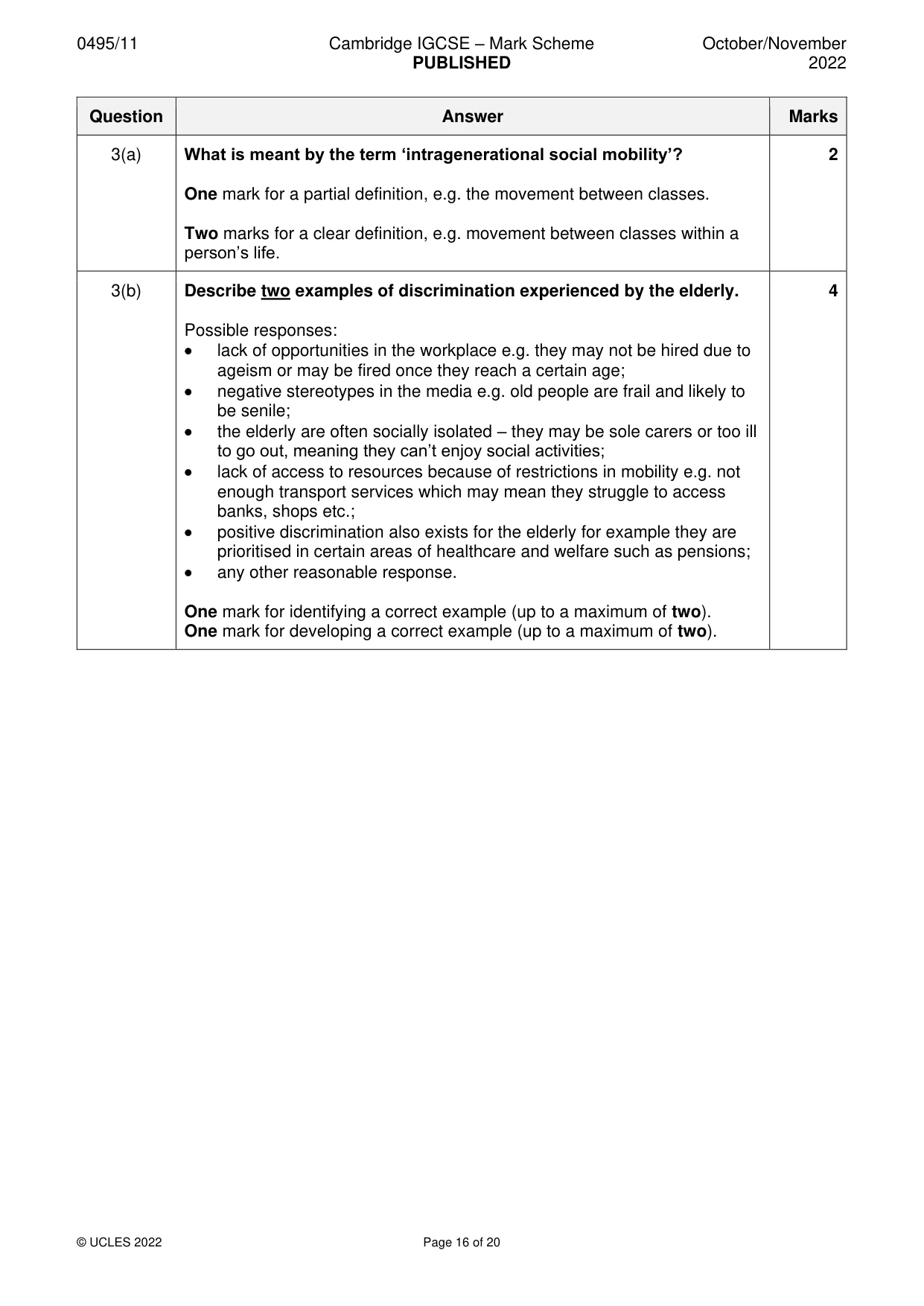
0495/11 Cambridge IGCSE – Mark Scheme PUBLISHED October/November 2022 © UCLES 2022 Page 16 of 20 Question Answer Marks 3(a) What is meant by the term ‘intragenerational social mobility’? One mark for a partial definition, e.g. the movement between classes. Two marks for a clear definition, e.g. movement between classes within a person’s life. 2 3(b) Describe two examples of discrimination experienced by the elderly. Possible responses: • lack of opportunities in the workplace e.g. they may not be hired due to ageism or may be fired once they reach a certain age; • negative stereotypes in the media e.g. old people are frail and likely to be senile; • the elderly are often socially isolated – they may be sole carers or too ill to go out, meaning they can’t enjoy social activities; • lack of access to resources because of restrictions in mobility e.g. not enough transport services which may mean they struggle to access banks, shops etc.; • positive discrimination also exists for the elderly for example they are prioritised in certain areas of healthcare and welfare such as pensions; • any other reasonable response. One mark for identifying a correct example (up to a maximum of two). One mark for developing a correct example (up to a maximum of two). 4
Mark scheme, page 17
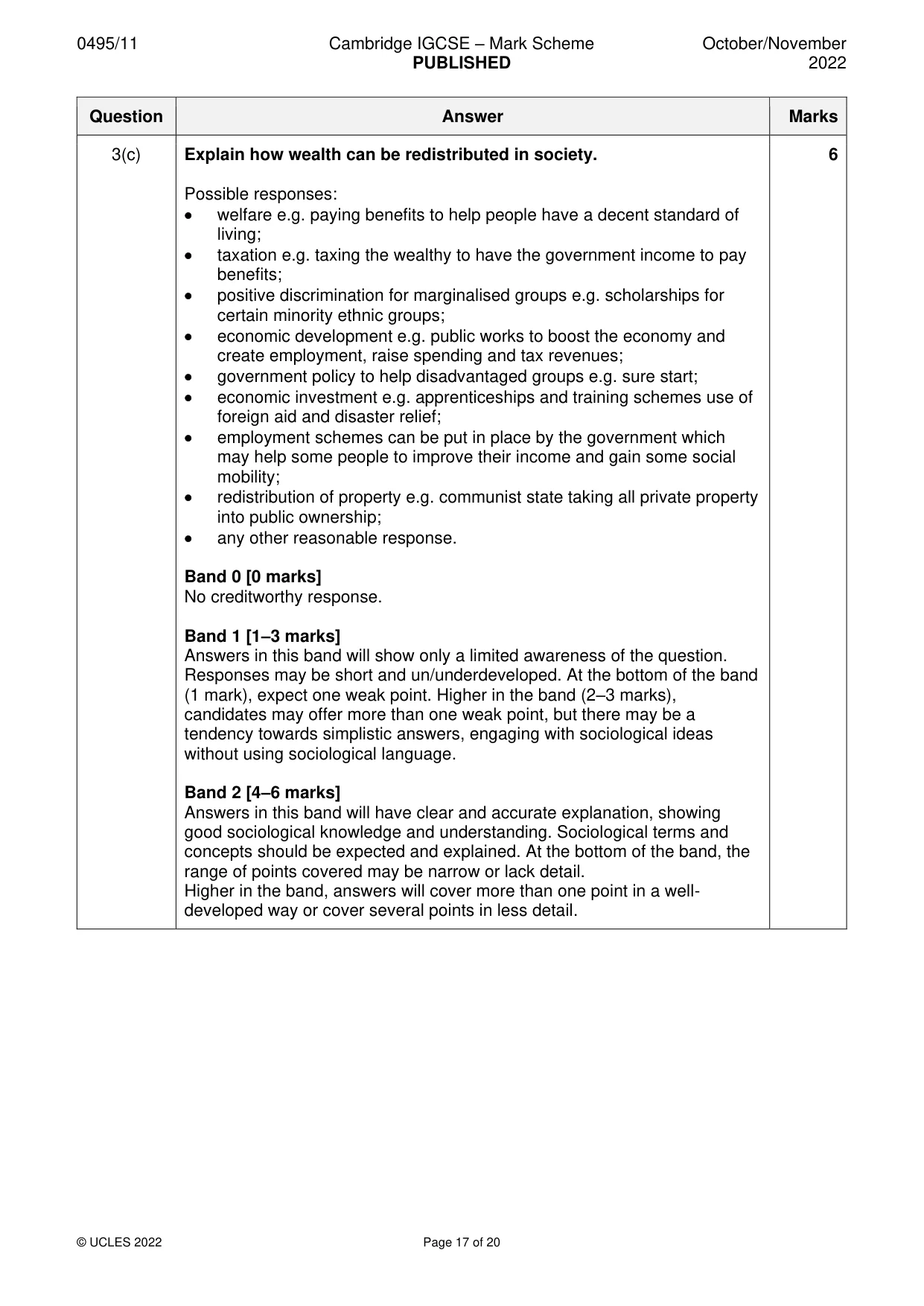
0495/11 Cambridge IGCSE – Mark Scheme PUBLISHED October/November 2022 © UCLES 2022 Page 17 of 20 Question Answer Marks 3(c) Explain how wealth can be redistributed in society. Possible responses: • welfare e.g. paying benefits to help people have a decent standard of living; • taxation e.g. taxing the wealthy to have the government income to pay benefits; • positive discrimination for marginalised groups e.g. scholarships for certain minority ethnic groups; • economic development e.g. public works to boost the economy and create employment, raise spending and tax revenues; • government policy to help disadvantaged groups e.g. sure start; • economic investment e.g. apprenticeships and training schemes use of foreign aid and disaster relief; • employment schemes can be put in place by the government which may help some people to improve their income and gain some social mobility; • redistribution of property e.g. communist state taking all private property into public ownership; • any other reasonable response. Band 0 [0 marks] No creditworthy response. Band 1 [1–3 marks] Answers in this band will show only a limited awareness of the question. Responses may be short and un/underdeveloped. At the bottom of the band (1 mark), expect one weak point. Higher in the band (2–3 marks), candidates may offer more than one weak point, but there may be a tendency towards simplistic answers, engaging with sociological ideas without using sociological language. Band 2 [4–6 marks] Answers in this band will have clear and accurate explanation, showing good sociological knowledge and understanding. Sociological terms and concepts should be expected and explained. At the bottom of the band, the range of points covered may be narrow or lack detail. Higher in the band, answers will cover more than one point in a well- developed way or cover several points in less detail. 6
Mark scheme, page 18
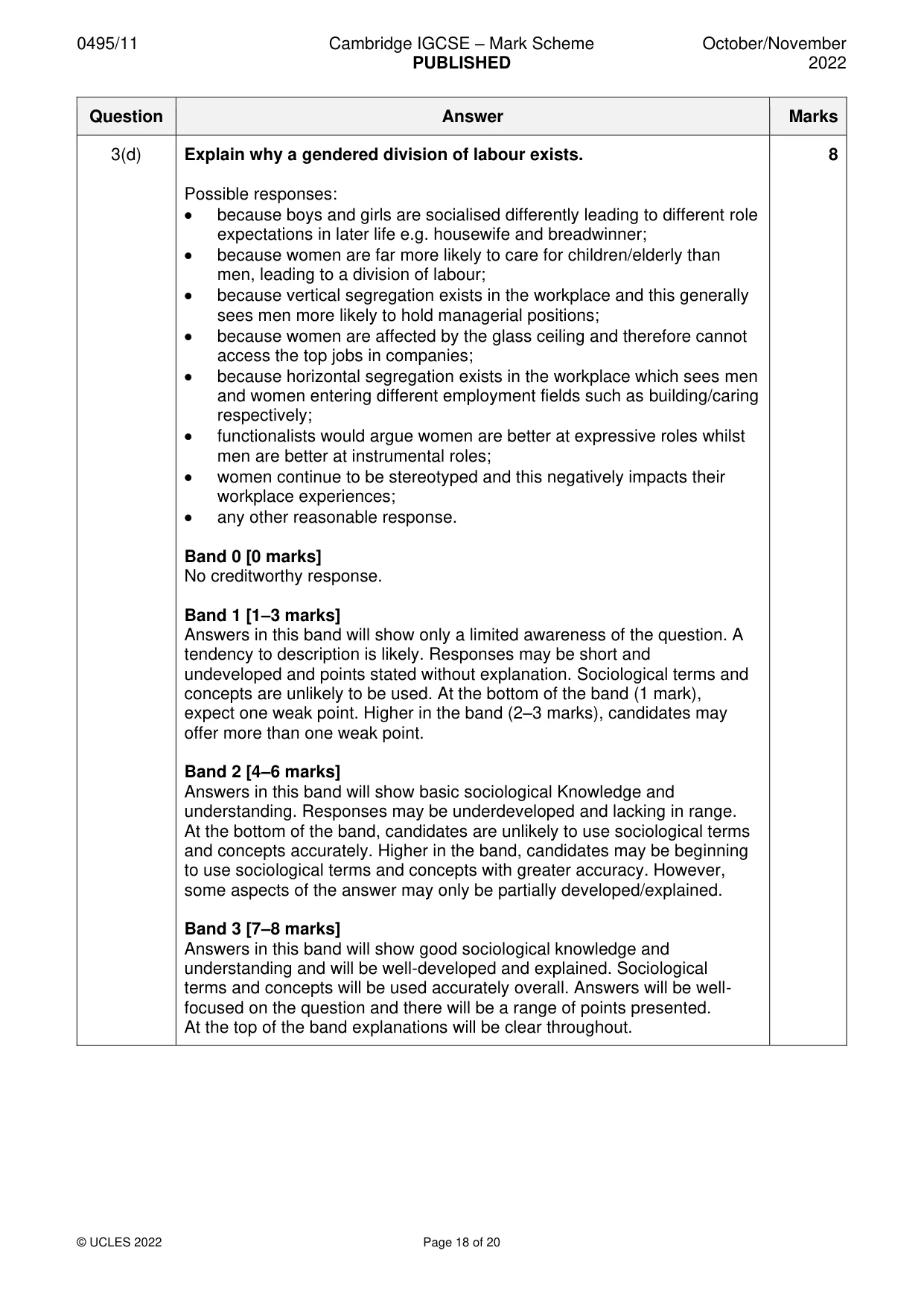
0495/11 Cambridge IGCSE – Mark Scheme PUBLISHED October/November 2022 © UCLES 2022 Page 18 of 20 Question Answer Marks 3(d) Explain why a gendered division of labour exists. Possible responses: • because boys and girls are socialised differently leading to different role expectations in later life e.g. housewife and breadwinner; • because women are far more likely to care for children/elderly than men, leading to a division of labour; • because vertical segregation exists in the workplace and this generally sees men more likely to hold managerial positions; • because women are affected by the glass ceiling and therefore cannot access the top jobs in companies; • because horizontal segregation exists in the workplace which sees men and women entering different employment fields such as building/caring respectively; • functionalists would argue women are better at expressive roles whilst men are better at instrumental roles; • women continue to be stereotyped and this negatively impacts their workplace experiences; • any other reasonable response. Band 0 [0 marks] No creditworthy response. Band 1 [1–3 marks] Answers in this band will show only a limited awareness of the question. A tendency to description is likely. Responses may be short and undeveloped and points stated without explanation. Sociological terms and concepts are unlikely to be used. At the bottom of the band (1 mark), expect one weak point. Higher in the band (2–3 marks), candidates may offer more than one weak point. Band 2 [4–6 marks] Answers in this band will show basic sociological Knowledge and understanding. Responses may be underdeveloped and lacking in range. At the bottom of the band, candidates are unlikely to use sociological terms and concepts accurately. Higher in the band, candidates may be beginning to use sociological terms and concepts with greater accuracy. However, some aspects of the answer may only be partially developed/explained. Band 3 [7–8 marks] Answers in this band will show good sociological knowledge and understanding and will be well-developed and explained. Sociological terms and concepts will be used accurately overall. Answers will be well- focused on the question and there will be a range of points presented. At the top of the band explanations will be clear throughout. 8
Mark scheme, page 19
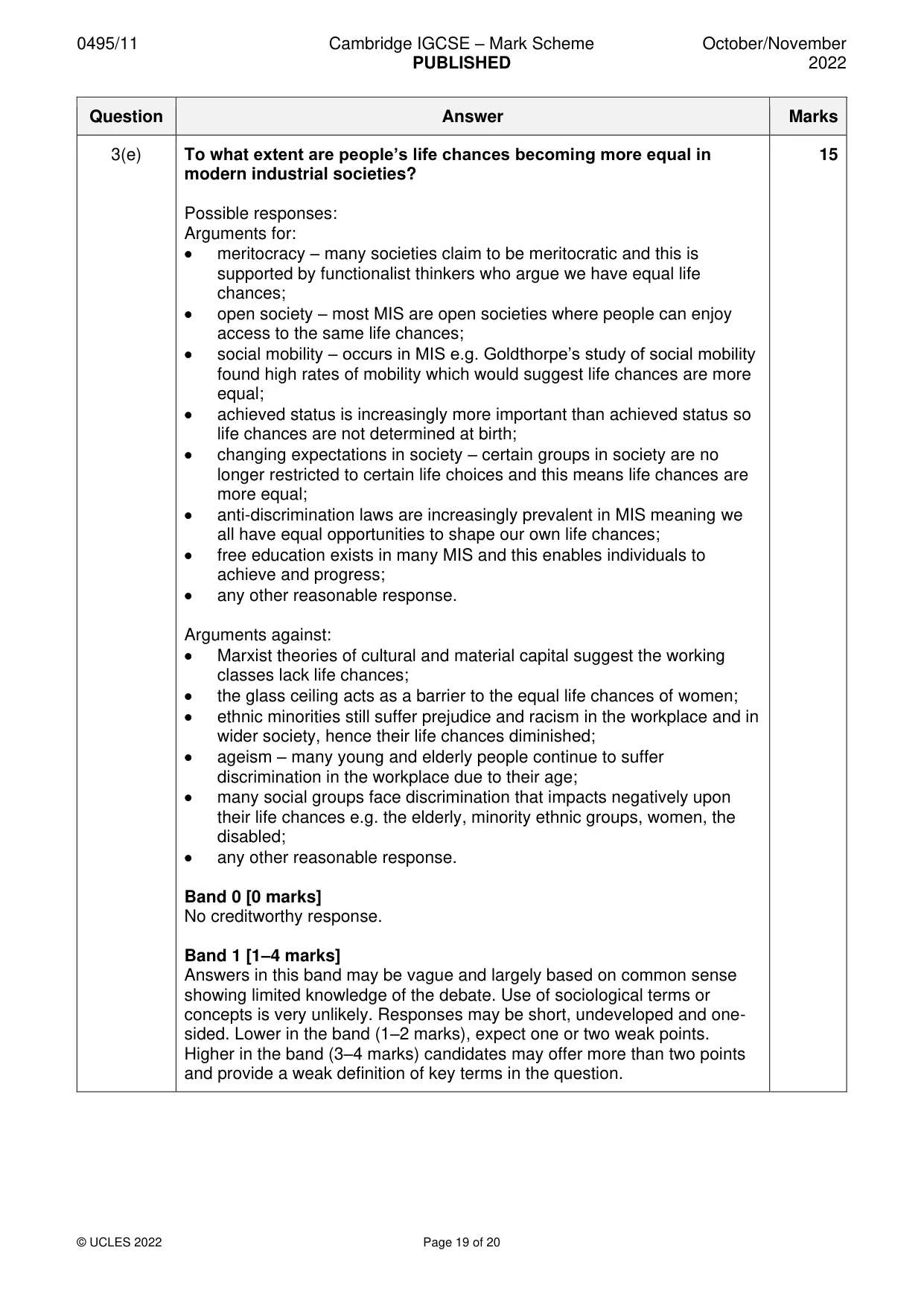
0495/11 Cambridge IGCSE – Mark Scheme PUBLISHED October/November 2022 © UCLES 2022 Page 19 of 20 Question Answer Marks 3(e) To what extent are people’s life chances becoming more equal in modern industrial societies? Possible responses: Arguments for: • meritocracy – many societies claim to be meritocratic and this is supported by functionalist thinkers who argue we have equal life chances; • open society – most MIS are open societies where people can enjoy access to the same life chances; • social mobility – occurs in MIS e.g. Goldthorpe’s study of social mobility found high rates of mobility which would suggest life chances are more equal; • achieved status is increasingly more important than achieved status so life chances are not determined at birth; • changing expectations in society – certain groups in society are no longer restricted to certain life choices and this means life chances are more equal; • anti-discrimination laws are increasingly prevalent in MIS meaning we all have equal opportunities to shape our own life chances; • free education exists in many MIS and this enables individuals to achieve and progress; • any other reasonable response. Arguments against: • Marxist theories of cultural and material capital suggest the working classes lack life chances; • the glass ceiling acts as a barrier to the equal life chances of women; • ethnic minorities still suffer prejudice and racism in the workplace and in wider society, hence their life chances diminished; • ageism – many young and elderly people continue to suffer discrimination in the workplace due to their age; • many social groups face discrimination that impacts negatively upon their life chances e.g. the elderly, minority ethnic groups, women, the disabled; • any other reasonable response. Band 0 [0 marks] No creditworthy response. Band 1 [1–4 marks] Answers in this band may be vague and largely based on common sense showing limited knowledge of the debate. Use of sociological terms or concepts is very unlikely. Responses may be short, undeveloped and one- sided. Lower in the band (1–2 marks), expect one or two weak points. Higher in the band (3–4 marks) candidates may offer more than two points and provide a weak definition of key terms in the question. 15
Mark scheme, page 20
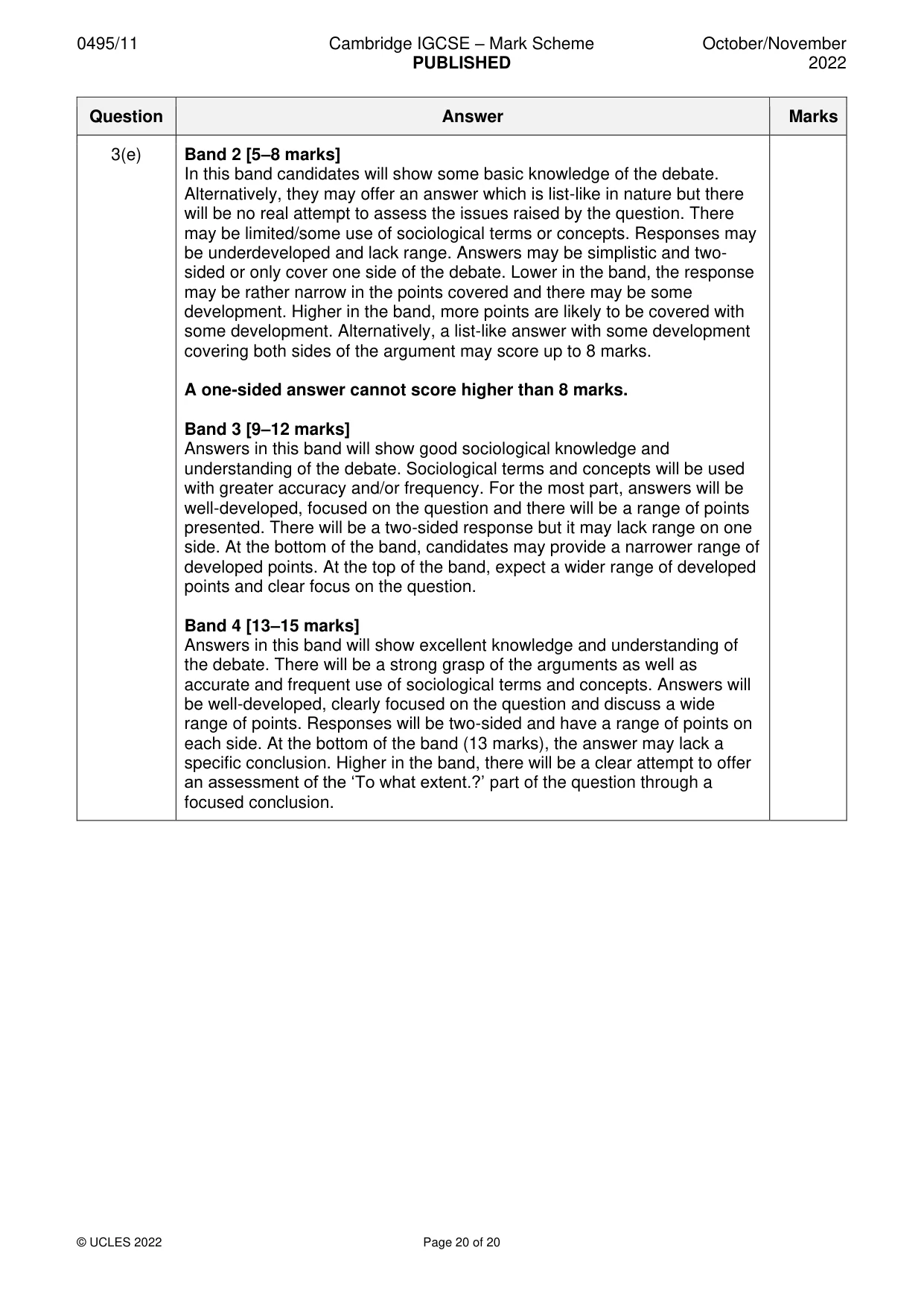
0495/11 Cambridge IGCSE – Mark Scheme PUBLISHED October/November 2022 © UCLES 2022 Page 20 of 20 Question Answer Marks 3(e) Band 2 [5–8 marks] In this band candidates will show some basic knowledge of the debate. Alternatively, they may offer an answer which is list-like in nature but there will be no real attempt to assess the issues raised by the question. There may be limited/some use of sociological terms or concepts. Responses may be underdeveloped and lack range. Answers may be simplistic and two- sided or only cover one side of the debate. Lower in the band, the response may be rather narrow in the points covered and there may be some development. Higher in the band, more points are likely to be covered with some development. Alternatively, a list-like answer with some development covering both sides of the argument may score up to 8 marks. A one-sided answer cannot score higher than 8 marks. Band 3 [9–12 marks] Answers in this band will show good sociological knowledge and understanding of the debate. Sociological terms and concepts will be used with greater accuracy and/or frequency. For the most part, answers will be well-developed, focused on the question and there will be a range of points presented. There will be a two-sided response but it may lack range on one side. At the bottom of the band, candidates may provide a narrower range of developed points. At the top of the band, expect a wider range of developed points and clear focus on the question. Band 4 [13–15 marks] Answers in this band will show excellent knowledge and understanding of the debate. There will be a strong grasp of the arguments as well as accurate and frequent use of sociological terms and concepts. Answers will be well-developed, clearly focused on the question and discuss a wide range of points. Responses will be two-sided and have a range of points on each side. At the bottom of the band (13 marks), the answer may lack a specific conclusion. Higher in the band, there will be a clear attempt to offer an assessment of the ‘To what extent.?’ part of the question through a focused conclusion.
What you needed in this session
Cambridge’s own grade thresholds for 2022 Oct/Nov, Paper 1 · Variant 1. A higher threshold means an easier paper — the bar moves with how the cohort did.