Cambridge IGCSE Sociology 0495 — 2021 Oct/Nov Paper 2 · Variant 1
0495/21/O/N/21 · 4 questions · 70 marks · ≈79 min
The question paper and its mark scheme, free to read here and free to download. This is Cambridge’s own paper, exactly as it was sat.
Question paper4 pages
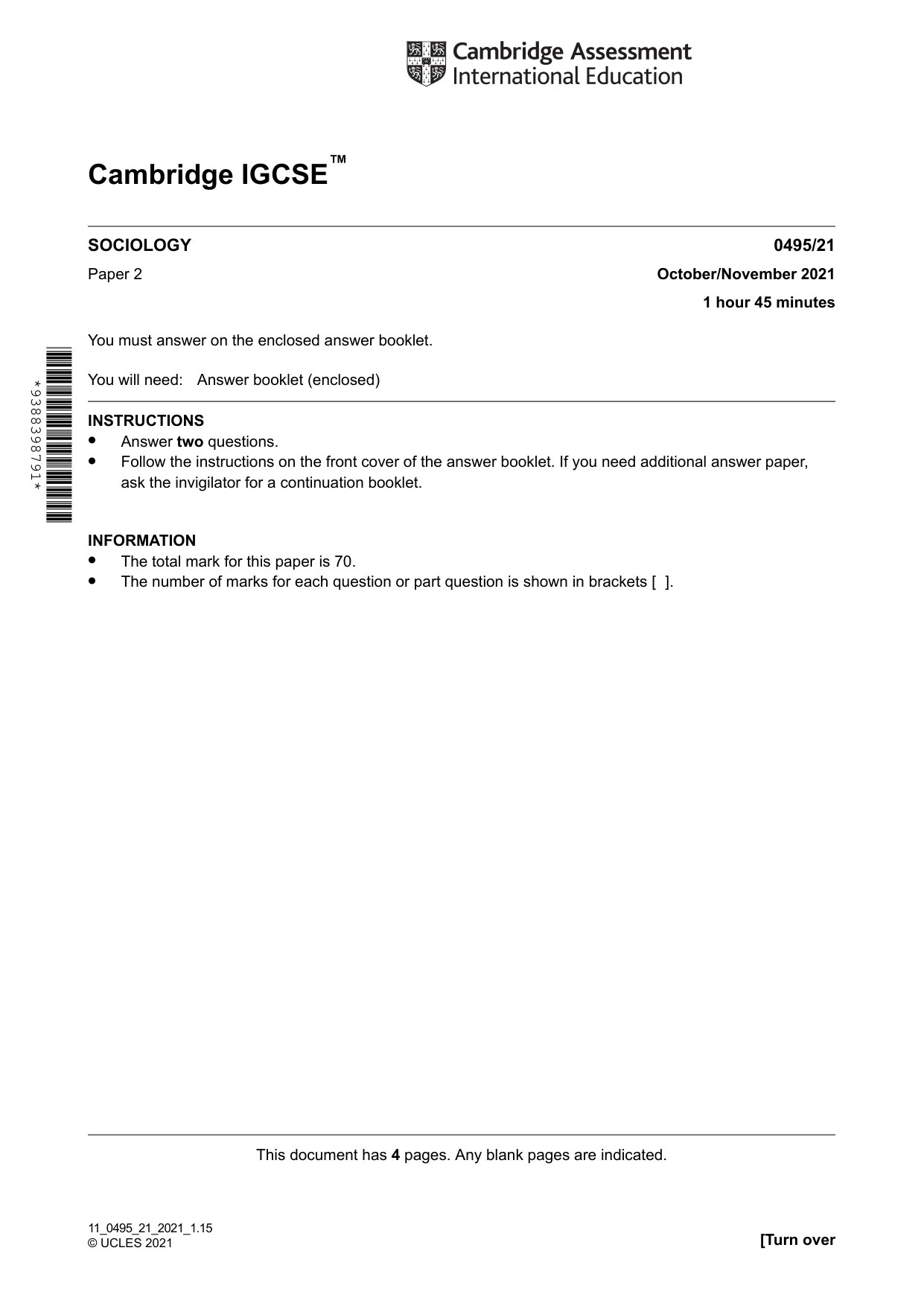

Mark scheme29 pages
Answers below. Sit the paper first if you are practising.



Questions as text
Q1 · The family has existed for a long time and as an institution has been through major…
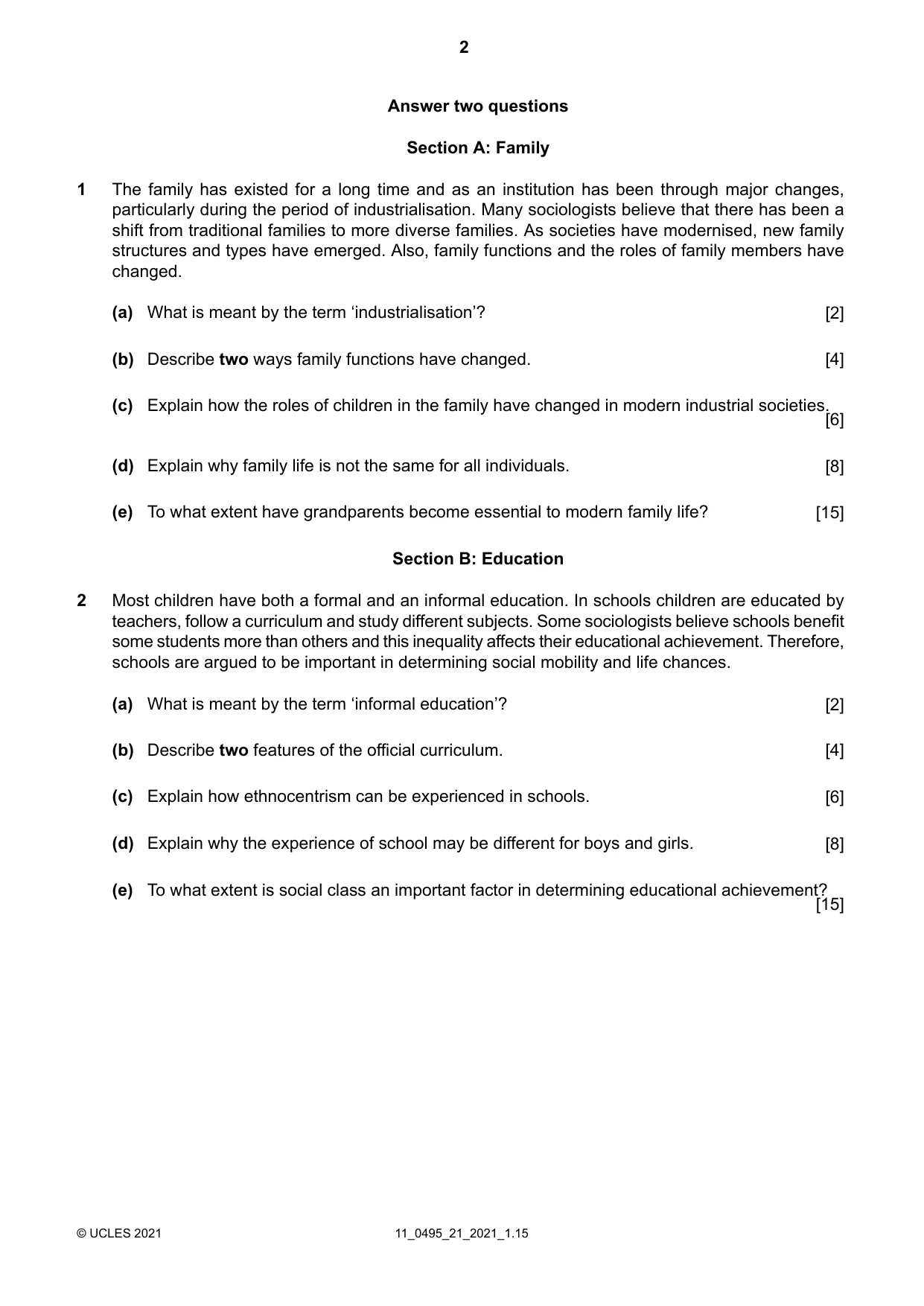
1 The family has existed for a long time and as an institution has been through major changes, particularly during the period of industrialisation. Many sociologists believe that there has been a shift from traditional families to more diverse families. As societies have modernised, new family structures and types have emerged. Also, family functions and the roles of family members have changed. (a) What is meant by the term ‘industrialisation’? [2] (b) Describe two ways family functions have changed. [4] (c) Explain how the roles of children in the family have changed in modern industrial societies. [6] (d) Explain why family life is not the same for all individuals. [8] (e) To what extent have grandparents become essential to modern family life? [15]
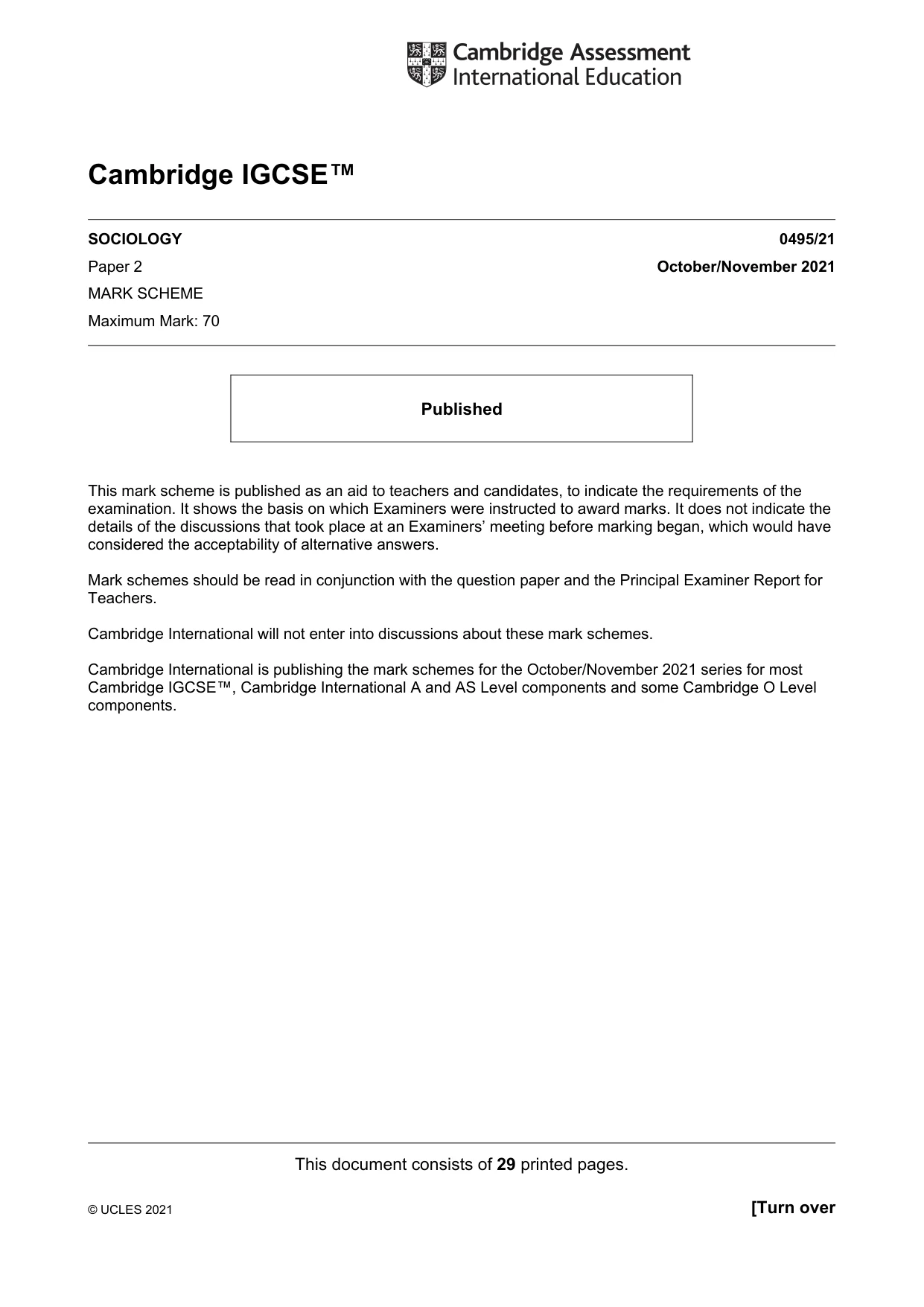
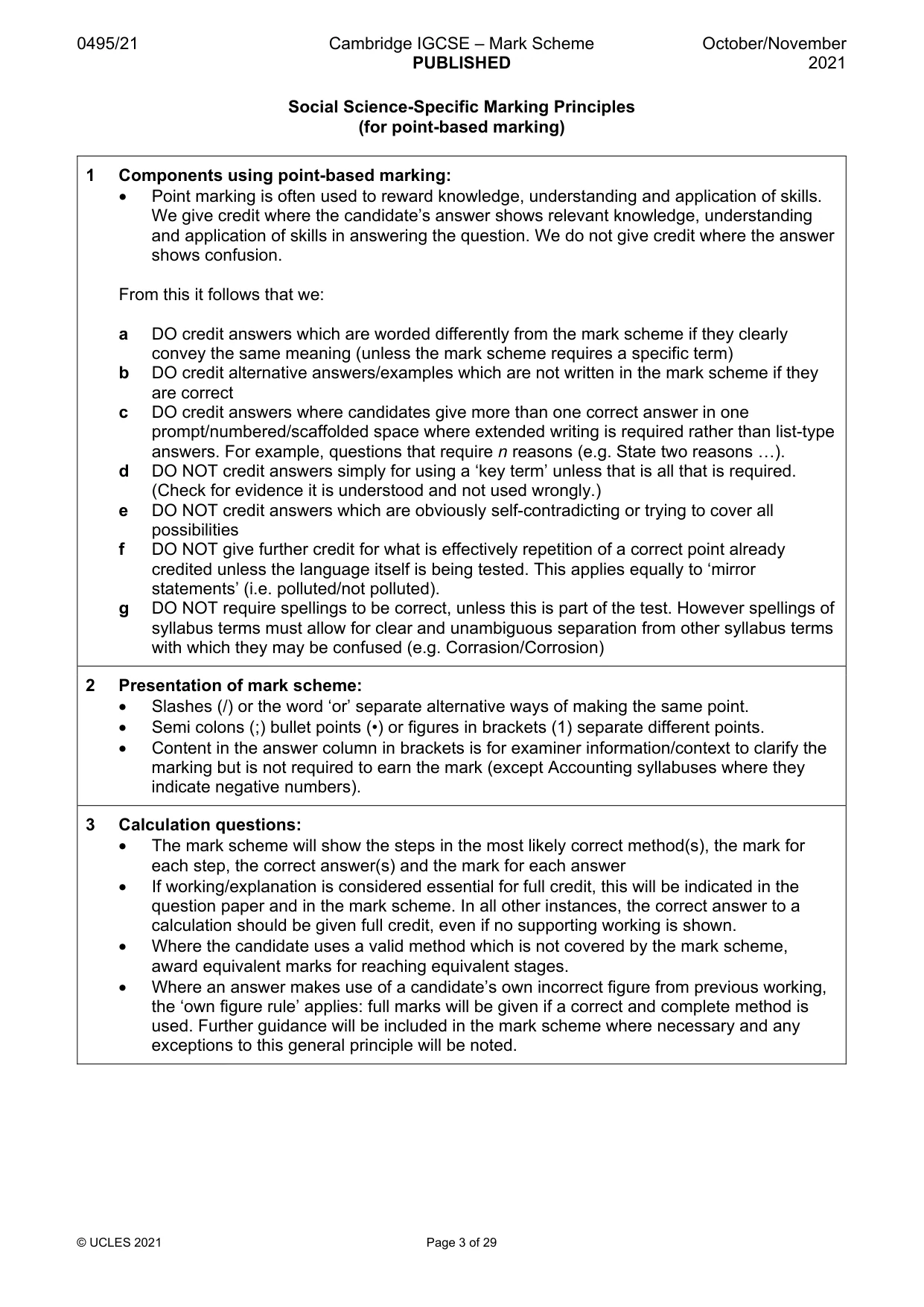
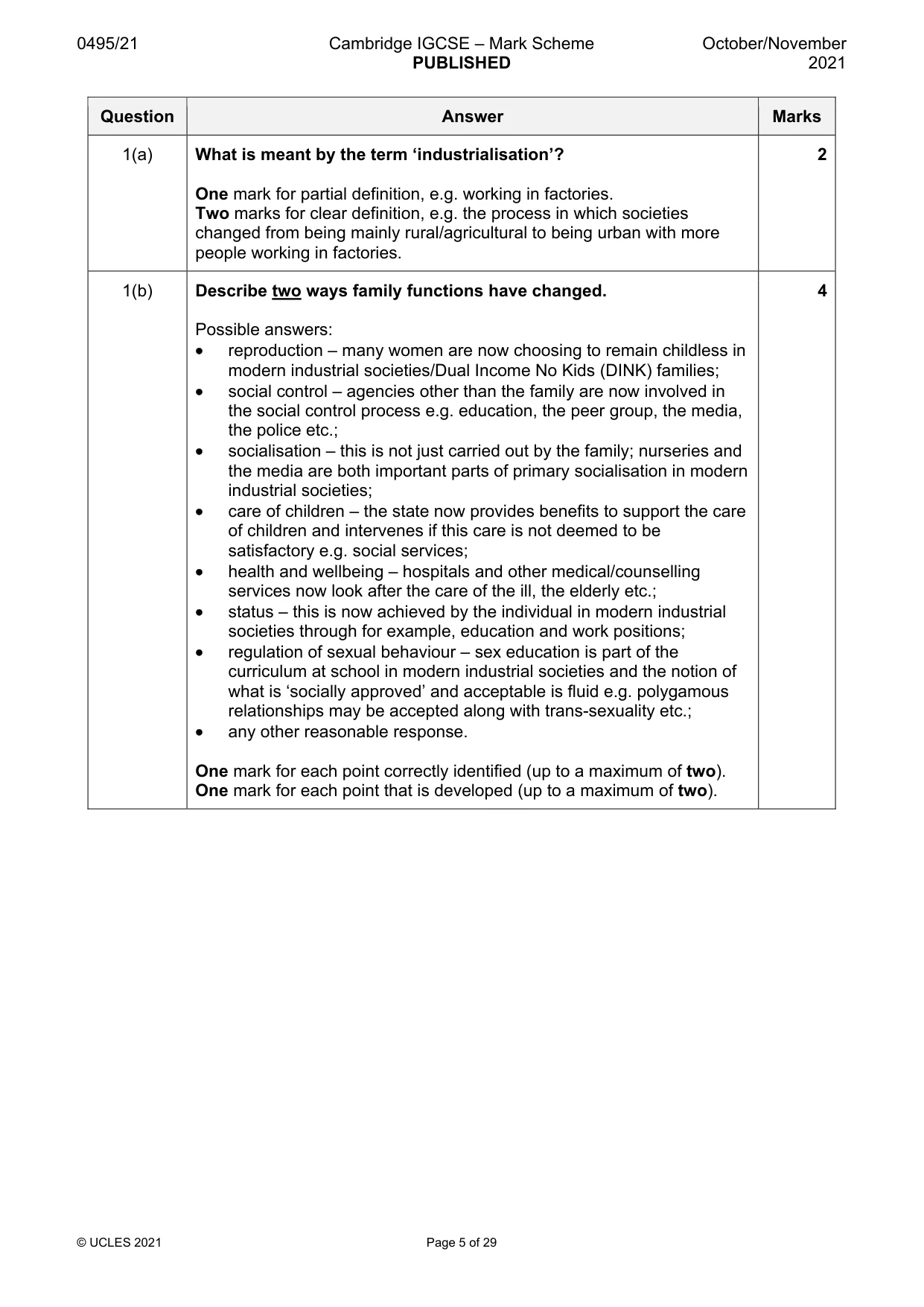
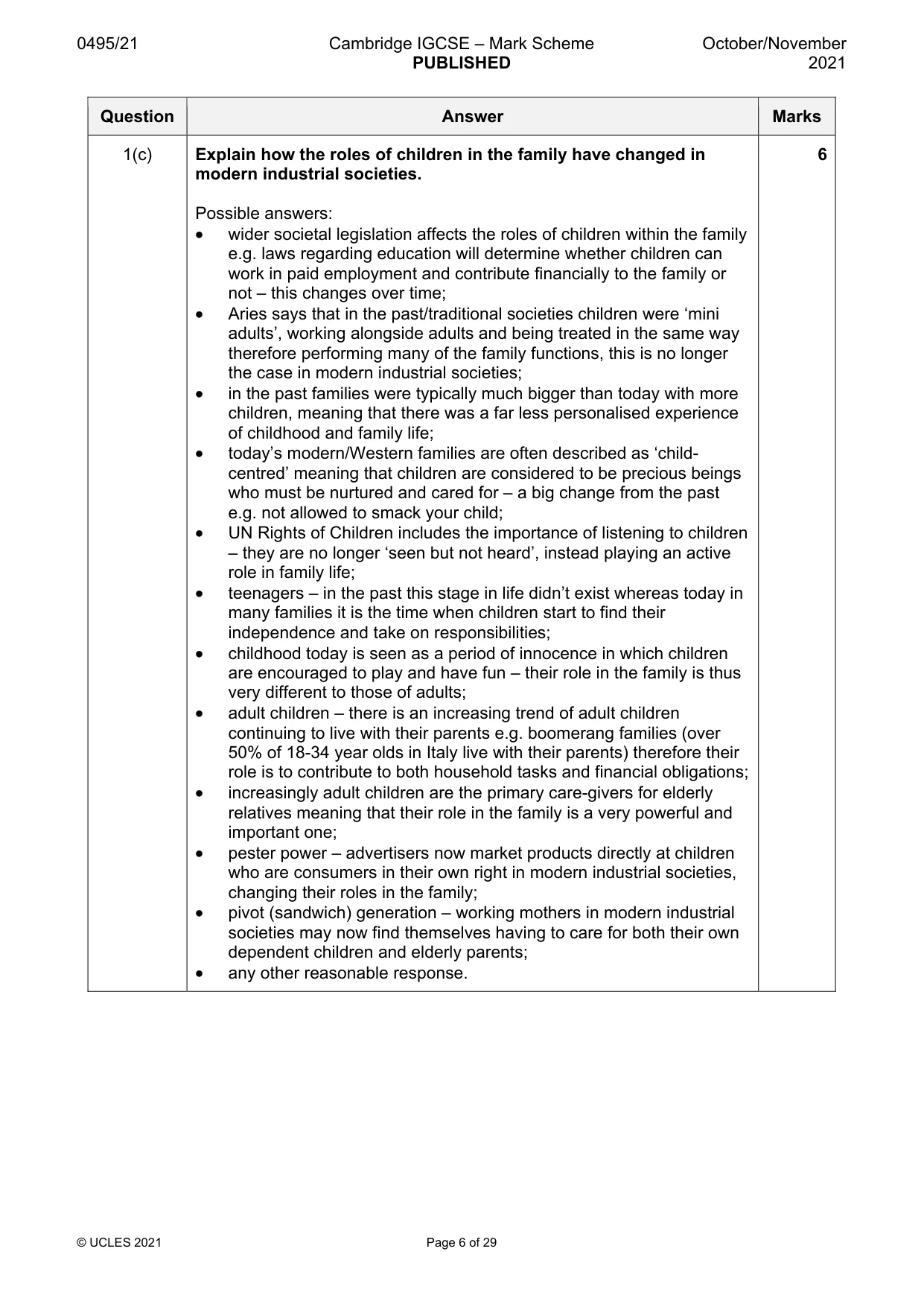
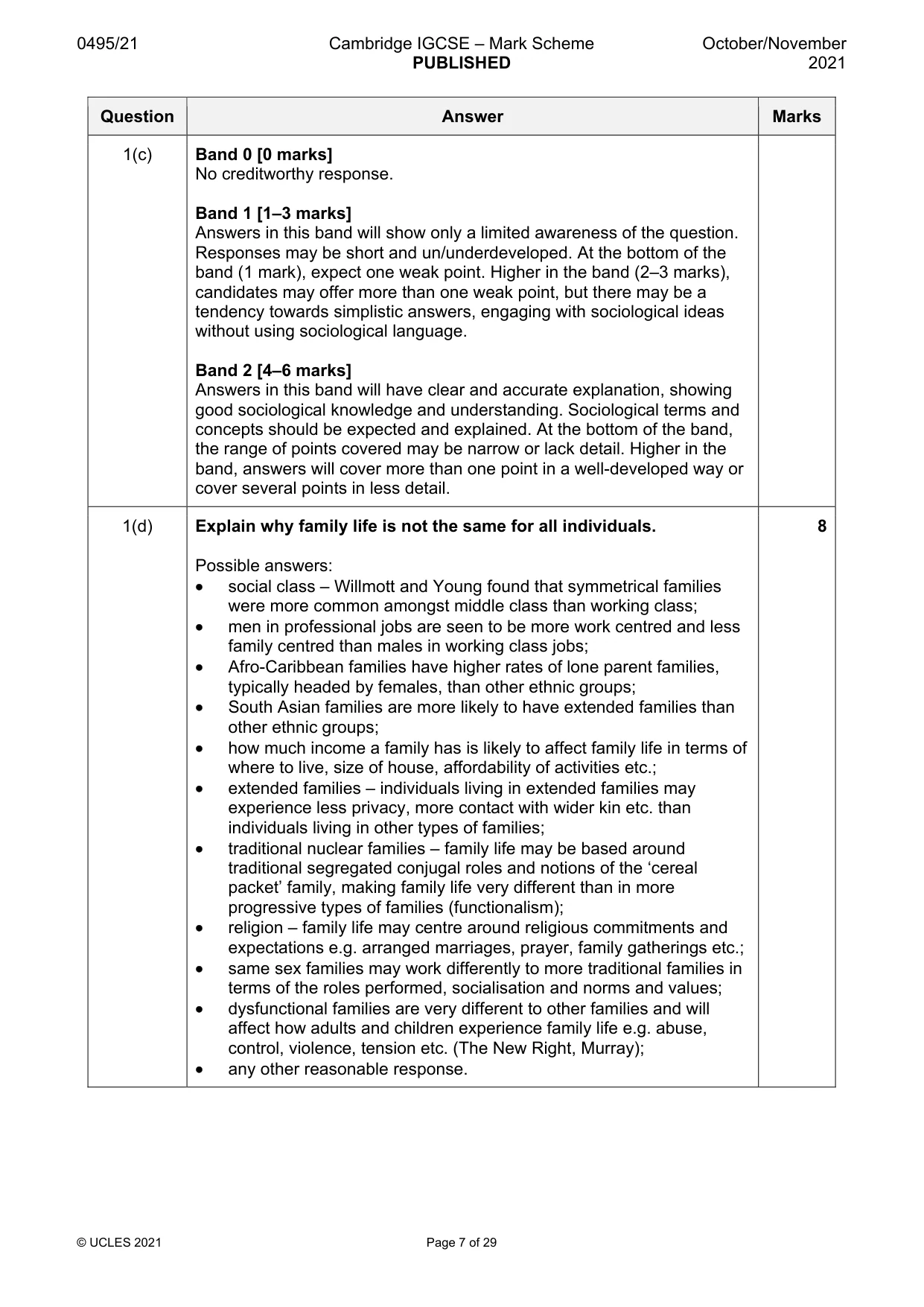
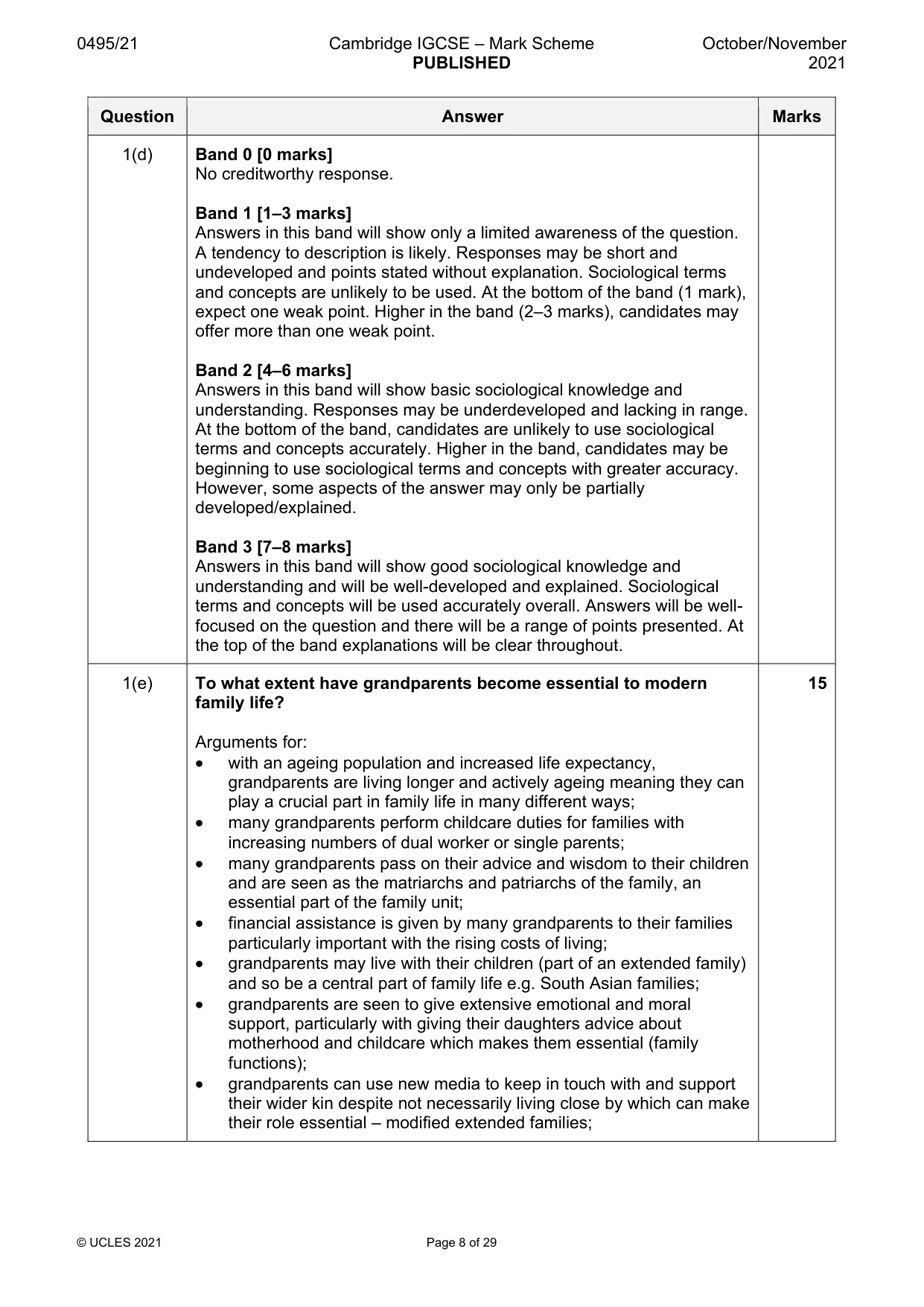
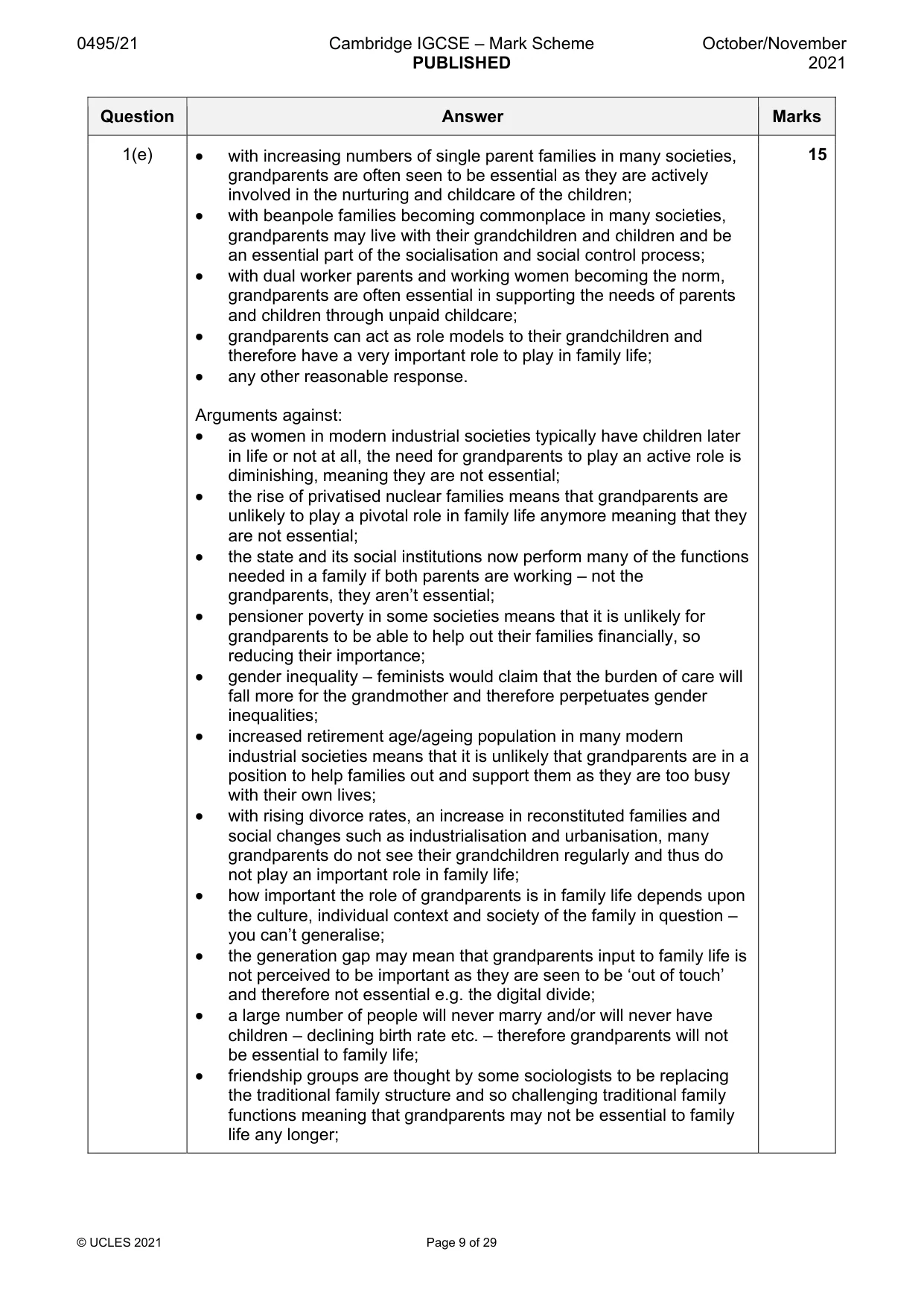
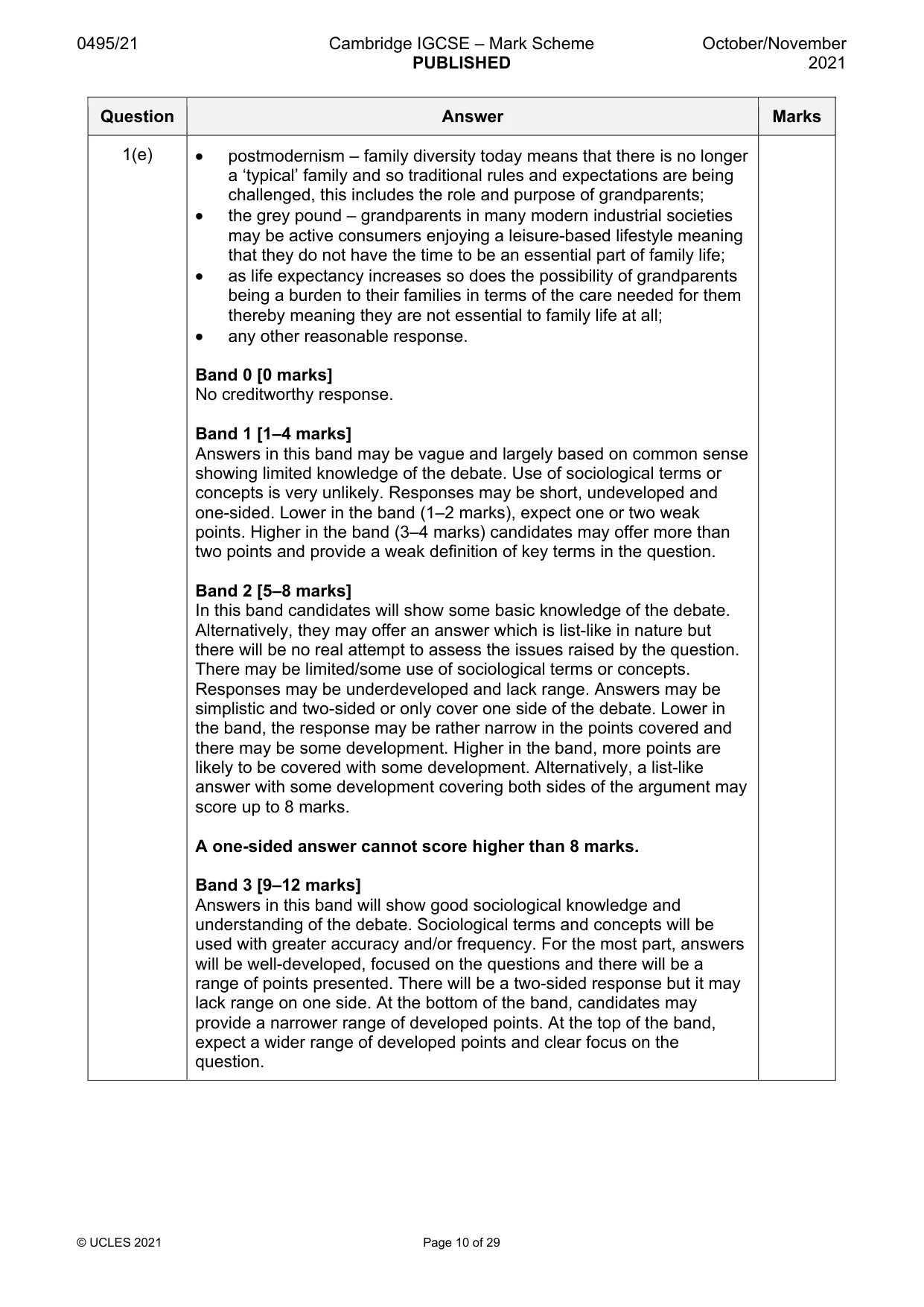
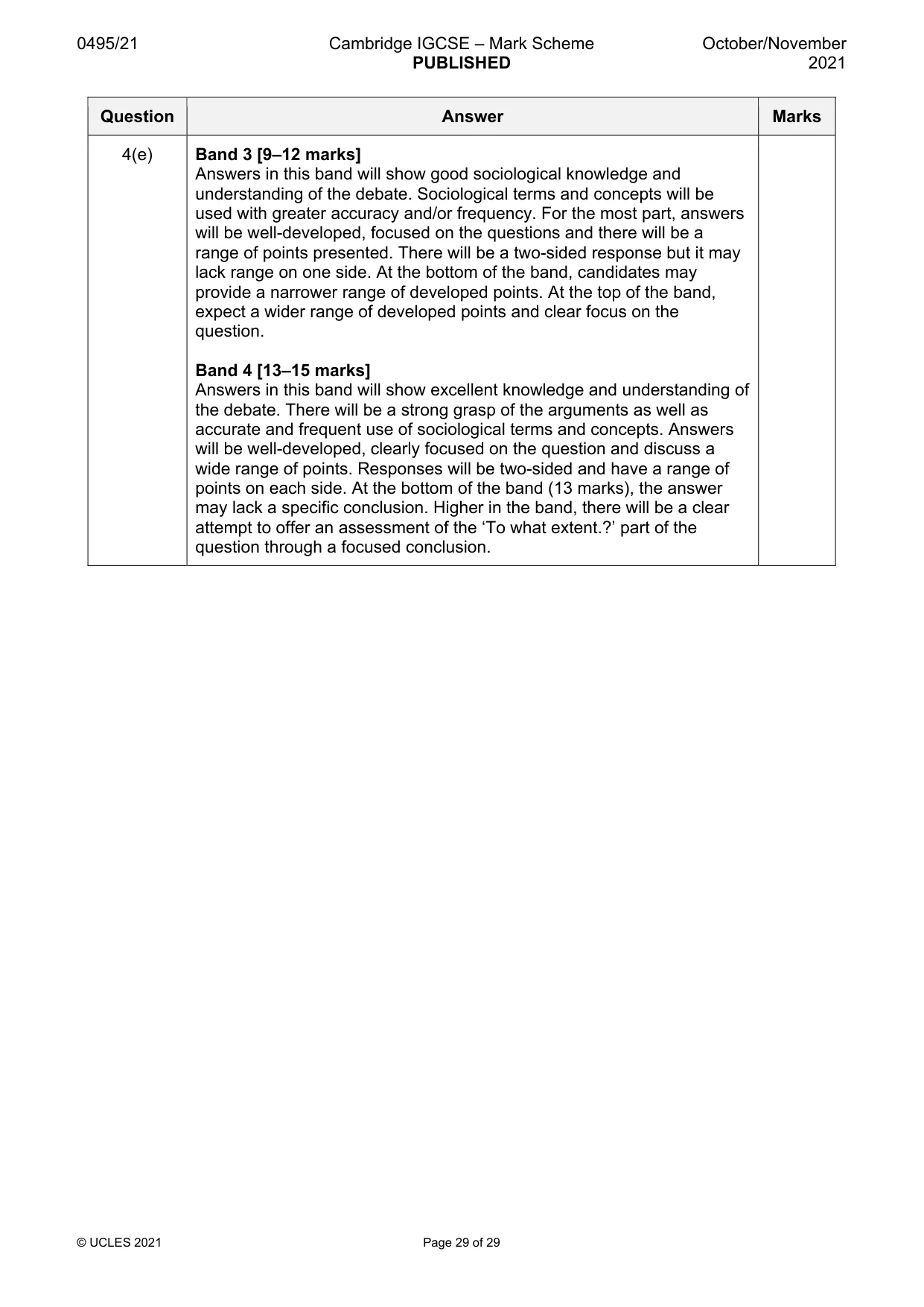
Mark scheme: Question Answer Marks 1(a) What is meant by the term ‘industrialisation’? 2 One mark for partial definition, e.g. working in factories. Two marks for clear definition, e.g. the process in which societies changed from being mainly rural/agricultural to being urban with more people working in factories. 1(b) Describe two ways family functions have changed. 4 Possible answers: • reproduction – many women are now choosing to remain childless in modern industrial societies/Dual Income No Kids (DINK) families; • social control – agencies other than the family are now involved in the social control process e.g. education, the peer group, the media, the police etc.; • socialisation – this is not just carried out by the family; nurseries and the media are both important parts of primary socialisation in modern industrial societies; • care of children – the state now provides benefits to support the care of children and intervenes if this care is not deemed to be satisfactory e.g. social services; • health and wellbeing – hospitals and other medical/counselling services now look after the care of the ill, the elderly etc.; • status – this is now achieved by the individual in modern industrial societies through for example, education and work positions; • regulation of sexual behaviour – sex education is part of the curriculum at school in modern industrial societies and the notion of what is ‘socially approved’ and acceptable is fluid e.g. polygamous relationships may be accepted along with trans-sexuality etc.; • any other reasonable response. One mark for each point correctly identified (up to a maximum of two). One mark for each point that is developed (up to a maximum of two). 1(c) Explain how the roles of children in the family have changed in 6 modern industrial societies. Possible answers: • wider societal legislation affects the roles of children within the family e.g. laws regarding education will determine whether children can work in paid employment and contribute financially to the family or not – this changes over time; • Aries says that in the past/traditional societies children were ‘mini adults’, working alongside adults and being treated in the same way therefore performing many of the family functions, this is no longer the case in modern industrial societies; • in the past families were typically much bigger than today with more children, meaning that there was a far less personalised experience of childhood and family life; • today’s modern/Western families are often described as ‘child- centred’ meaning that children are considered to be precious beings who must be nurtured and cared for – a big change from the past e.g. not allowed to smack your child; • UN Rights of Children includes the importance of listening to children – they are no longer ‘seen but not heard’, instead playing an active role in family life; • teenagers – in the past this stage in life didn’t exist whereas today in many families it is the time when children start to find their independence and take on responsibilities; • childhood today is seen as a period of innocence in which children are encouraged to play and have fun – their role in the family is thus very different to those of adults; • adult children – there is an increasing trend of adult children continuing to live with their parents e.g. boomerang families (over 50% of 18-34 year olds in Italy live with their parents) therefore their role is to contribute to both household tasks and financial obligations; • increasingly adult children are the primary care-givers for elderly relatives meaning that their role in the family is a very powerful and important one; • pester power – advertisers now market products directly at children who are consumers in their own right in modern industrial societies, changing their roles in the family; • pivot (sandwich) generation – working mothers in modern industrial societies may now find themselves having to care for both their own dependent children and elderly parents; • any other reasonable response. 1(c) Band 0 [0 marks] No creditworthy response. Band 1 [1–3 marks] Answers in this band will show only a limited awareness of the question. Responses may be short and un/underdeveloped. At the bottom of the band (1 mark), expect one weak point. Higher in the band (2–3 marks), candidates may offer more than one weak point, but there may be a tendency towards simplistic answers, engaging with sociological ideas without using sociological language. Band 2 [4–6 marks] Answers in this band will have clear and accurate explanation, showing good sociological knowledge and understanding. Sociological terms and concepts should be expected and explained. At the bottom of the band, the range of points covered may be narrow or lack detail. Higher in the band, answers will cover more than one point in a well-developed way or cover several points in less detail. 1(d) Explain why family life is not the same for all individuals. 8 Possible answers: • social class – Willmott and Young found that symmetrical families were more common amongst middle class than working class; • men in professional jobs are seen to be more work centred and less family centred than males in working class jobs; • Afro-Caribbean families have higher rates of lone parent families, typically headed by females, than other ethnic groups; • South Asian families are more likely to have extended families than other ethnic groups; • how much income a family has is likely to affect family life in terms of where to live, size of house, affordability of activities etc.; • extended families – individuals living in extended families may experience less privacy, more contact with wider kin etc. than individuals living in other types of families; • traditional nuclear families – family life may be based around traditional segregated conjugal roles and notions of the ‘cereal packet’ family, making family life very different than in more progressive types of families (functionalism); • religion – family life may centre around religious commitments and expectations e.g. arranged marriages, prayer, family gatherings etc.; • same sex families may work differently to more traditional families in terms of the roles performed, socialisation and norms and values; • dysfunctional families are very different to other families and will affect how adults and children experience family life e.g. abuse, control, violence, tension etc. (The New Right, Murray); • any other reasonable response. 1(d) Band 0 [0 marks] No creditworthy response. Band 1 [1–3 marks] Answers in this band will show only a limited awareness of the question. A tendency to description is likely. Responses may be short and undeveloped and points stated without explanation. Sociological terms and concepts are unlikely to be used. At the bottom of the band (1 mark), expect one weak point. Higher in the band (2–3 marks), candidates may offer more than one weak point. Band 2 [4–6 marks] Answers in this band will show basic sociological knowledge and understanding. Responses may be underdeveloped and lacking in range. At the bottom of the band, candidates are unlikely to use sociological terms and concepts accurately. Higher in the band, candidates may be beginning to use sociological terms and concepts with greater accuracy. However, some aspects of the answer may only be partially developed/explained. Band 3 [7–8 marks] Answers in this band will show good sociological knowledge and understanding and will be well-developed and explained. Sociological terms and concepts will be used accurately overall. Answers will be well- focused on the question and there will be a range of points presented. At the top of the band explanations will be clear throughout. 1(e) To what extent have grandparents become essential to modern 15 family life? Arguments for: • with an ageing population and increased life expectancy, grandparents are living longer and actively ageing meaning they can play a crucial part in family life in many different ways; • many grandparents perform childcare duties for families with increasing numbers of dual worker or single parents; • many grandparents pass on their advice and wisdom to their children and are seen as the matriarchs and patriarchs of the family, an essential part of the family unit; • financial assistance is given by many grandparents to their families particularly important with the rising costs of living; • grandparents may live with their children (part of an extended family) and so be a central part of family life e.g. South Asian families; • grandparents are seen to give extensive emotional and moral support, particularly with giving their daughters advice about motherhood and childcare which makes them essential (family functions); • grandparents can use new media to keep in touch with and support their wider kin despite not necessarily living close by which can make their role essential – modified extended families; 1(e) • with increasing numbers of single parent families in many societies, 15 grandparents are often seen to be essential as they are actively involved in the nurturing and childcare of the children; • with beanpole families becoming commonplace in many societies, grandparents may live with their grandchildren and children and be an essential part of the socialisation and social control process; • with dual worker parents and working women becoming the norm, grandparents are often essential in supporting the needs of parents and children through unpaid childcare; • grandparents can act as role models to their grandchildren and therefore have a very important role to play in family life; • any other reasonable response. Arguments against: • as women in modern industrial societies typically have children later in life or not at all, the need for grandparents to play an active role is diminishing, meaning they are not essential; • the rise of privatised nuclear families means that grandparents are unlikely to play a pivotal role in family life anymore meaning that they are not essential; • the state and its social institutions now perform many of the functions needed in a family if both parents are working – not the grandparents, they aren’t essential; • pensioner poverty in some societies means that it is unlikely for grandparents to be able to help out their families financially, so reducing their importance; • gender inequality – feminists would claim that the burden of care will fall more for the grandmother and therefore perpetuates gender inequalities; • increased retirement age/ageing population in many modern industrial societies means that it is unlikely that grandparents are in a position to help families out and support them as they are too busy with their own lives; • with rising divorce rates, an increase in reconstituted families and social changes such as industrialisation and urbanisation, many grandparents do not see their grandchildren regularly and thus do not play an important role in family life; • how important the role of grandparents is in family life depends upon the culture, individual context and society of the family in question – you can’t generalise; • the generation gap may mean that grandparents input to family life is not perceived to be important as they are seen to be ‘out of touch’ and therefore not essential e.g. the digital divide; • a large number of people will never marry and/or will never have children – declining birth rate etc. – therefore grandparents will not be essential to family life; • friendship groups are thought by some sociologists to be replacing the traditional family structure and so challenging traditional family functions meaning that grandparents may not be essential to family life any longer; 1(e) • postmodernism – family diversity today means that there is no longer a ‘typical’ family and so traditional rules and expectations are being challenged, this includes the role and purpose of grandparents; • the grey pound – grandparents in many modern industrial societies may be active consumers enjoying a leisure-based lifestyle meaning that they do not have the time to be an essential part of family life; • as life expectancy increases so does the possibility of grandparents being a burden to their families in terms of the care needed for them thereby meaning they are not essential to family life at all; • any other reasonable response. Band 0 [0 marks] No creditworthy response. Band 1 [1–4 marks] Answers in this band may be vague and largely based on common sense showing limited knowledge of the debate. Use of sociological terms or concepts is very unlikely. Responses may be short, undeveloped and one-sided. Lower in the band (1–2 marks), expect one or two weak points. Higher in the band (3–4 marks) candidates may offer more than two points and provide a weak definition of key terms in the question. Band 2 [5–8 marks] In this band candidates will show some basic knowledge of the debate. Alternatively, they may offer an answer which is list-like in nature but there will be no real attempt to assess the issues raised by the question. There may be limited/some use of sociological terms or concepts. Responses may be underdeveloped and lack range. Answers may be simplistic and two-sided or only cover one side of the debate. Lower in the band, the response may be rather narrow in the points covered and there may be some development. Higher in the band, more points are likely to be covered with some development. Alternatively, a list-like answer with some development covering both sides of the argument may score up to 8 marks. A one-sided answer cannot score higher than 8 marks. Band 3 [9–12 marks] Answers in this band will show good sociological knowledge and understanding of the debate. Sociological terms and concepts will be used with greater accuracy and/or frequency. For the most part, answers will be well-developed, focused on the questions and there will be a range of points presented. There will be a two-sided response but it may lack range on one side. At the bottom of the band, candidates may provide a narrower range of developed points. At the top of the band, expect a wider range of developed points and clear focus on the question. 1(e) Band 4 [13–15 marks] Answers in this band will show excellent knowledge and understanding of the debate. There will be a strong grasp of the arguments as well as accurate and frequent use of sociological terms and concepts. Answers will be well-developed, clearly focused on the question and discuss a wide range of points. Responses will be two-sided and have a range of points on each side. At the bottom of the band (13 marks), the answer may lack a specific conclusion. Higher in the band, there will be a clear attempt to offer an assessment of the ‘To what extent.?’ part of the question through a focused conclusion.
Q2 · Most children have both a formal and an informal education
2 Most children have both a formal and an informal education. In schools children are educated by teachers, follow a curriculum and study different subjects. Some sociologists believe schools benefit some students more than others and this inequality affects their educational achievement. Therefore, schools are argued to be important in determining social mobility and life chances. (a) What is meant by the term ‘informal education’? [2] (b) Describe two features of the official curriculum. [4] (c) Explain how ethnocentrism can be experienced in schools. [6] (d) Explain why the experience of school may be different for boys and girls. [8] (e) To what extent is social class an important factor in determining educational achievement? [15] Section C: Crime, deviance and social control
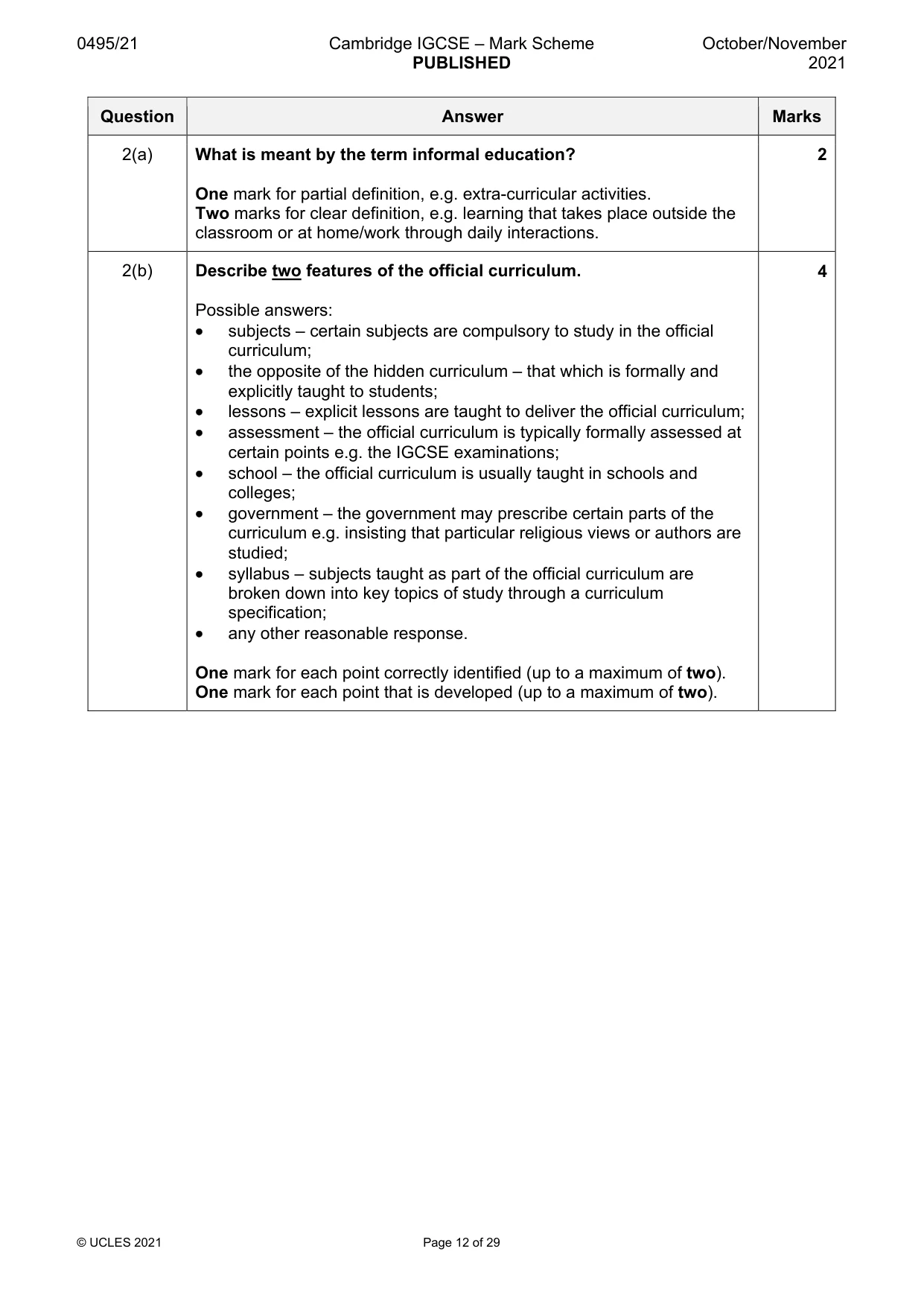
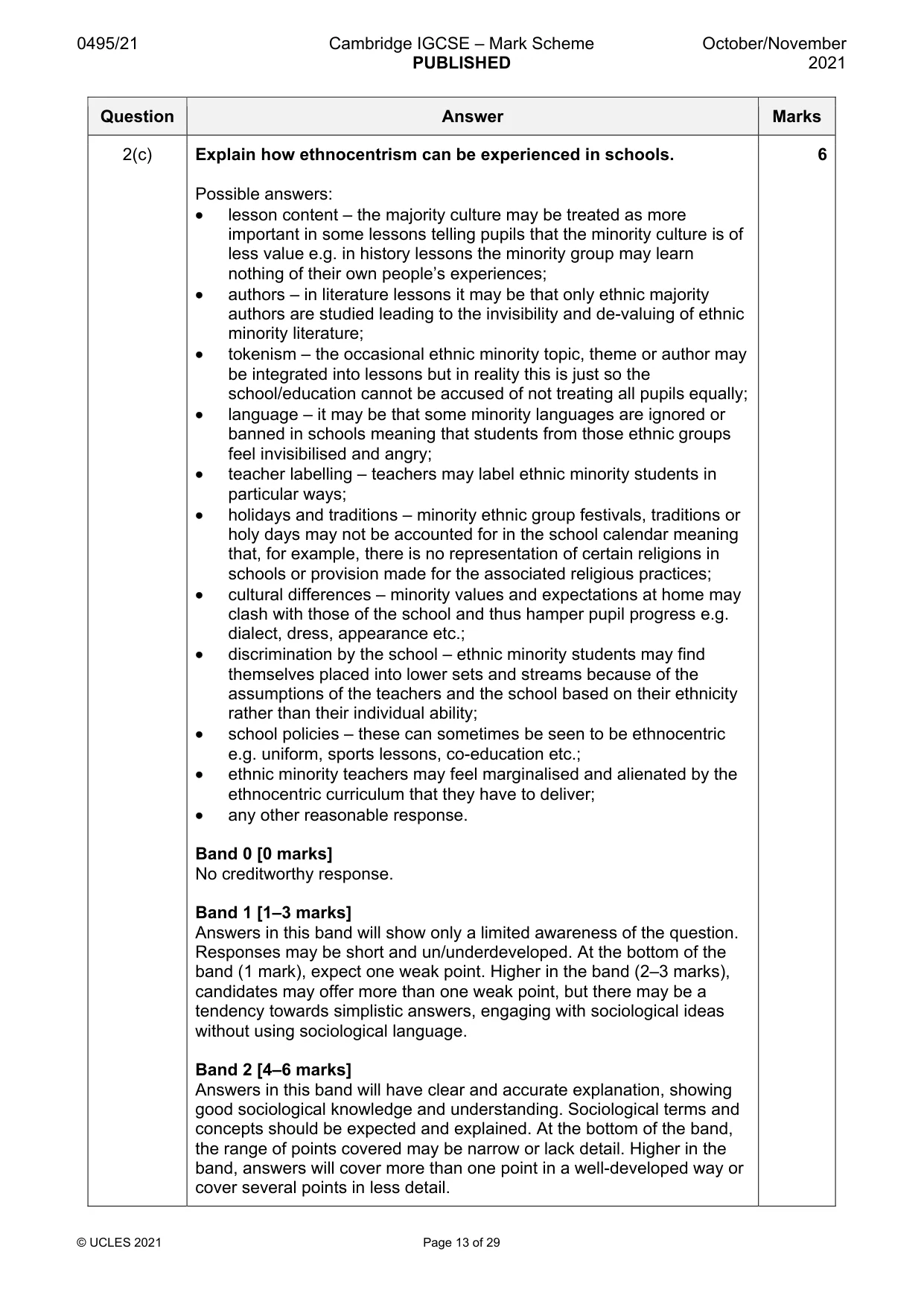
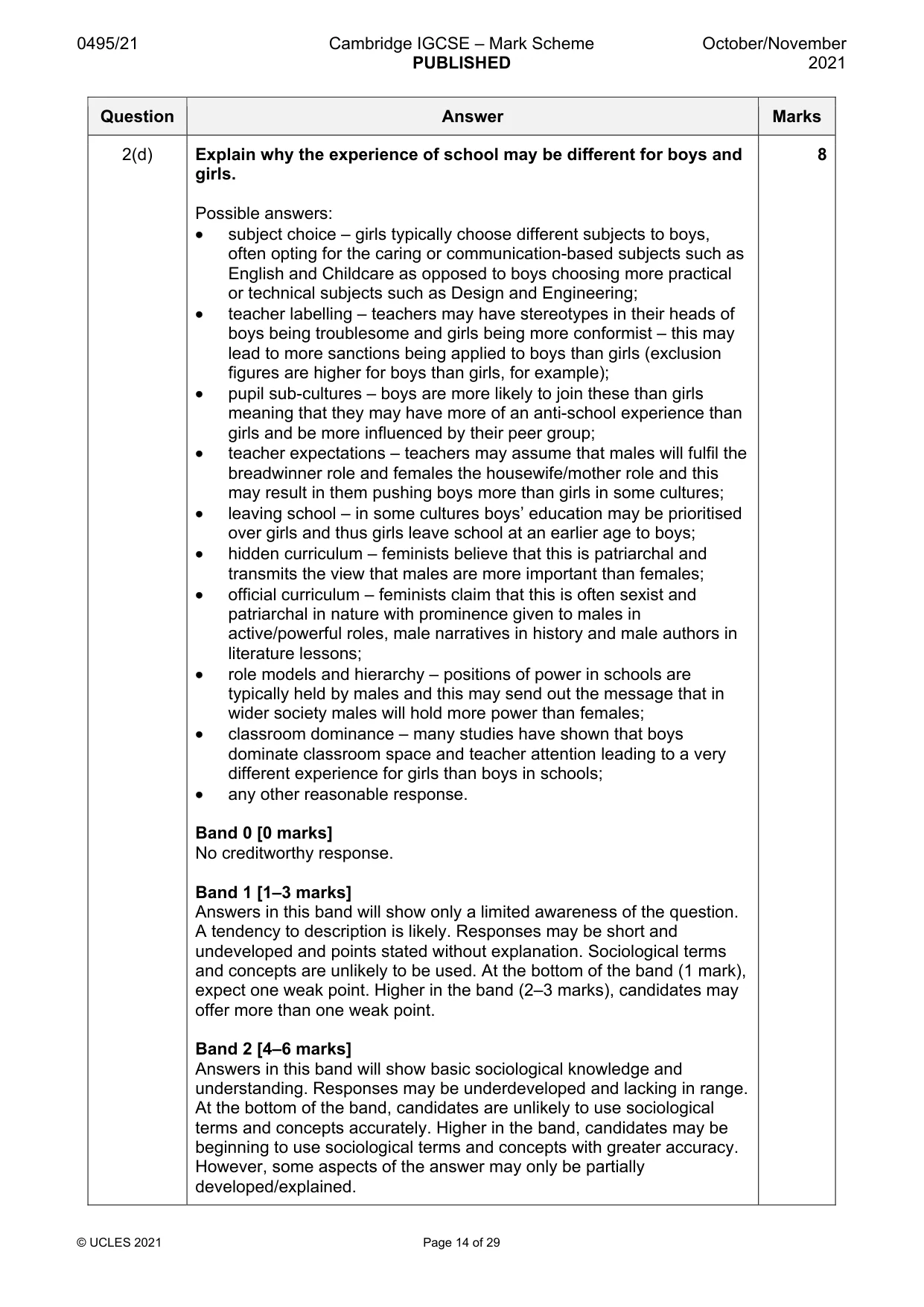
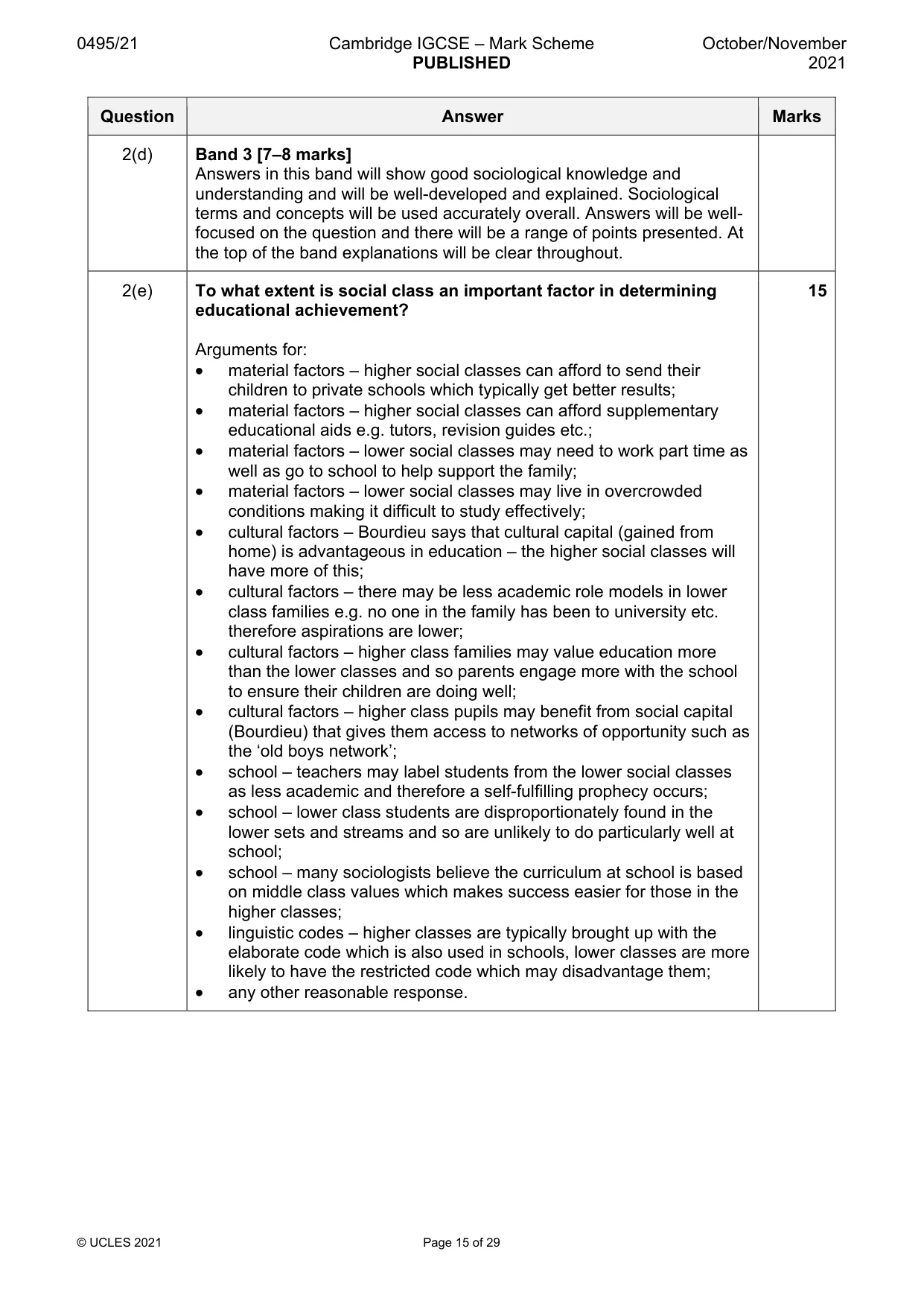
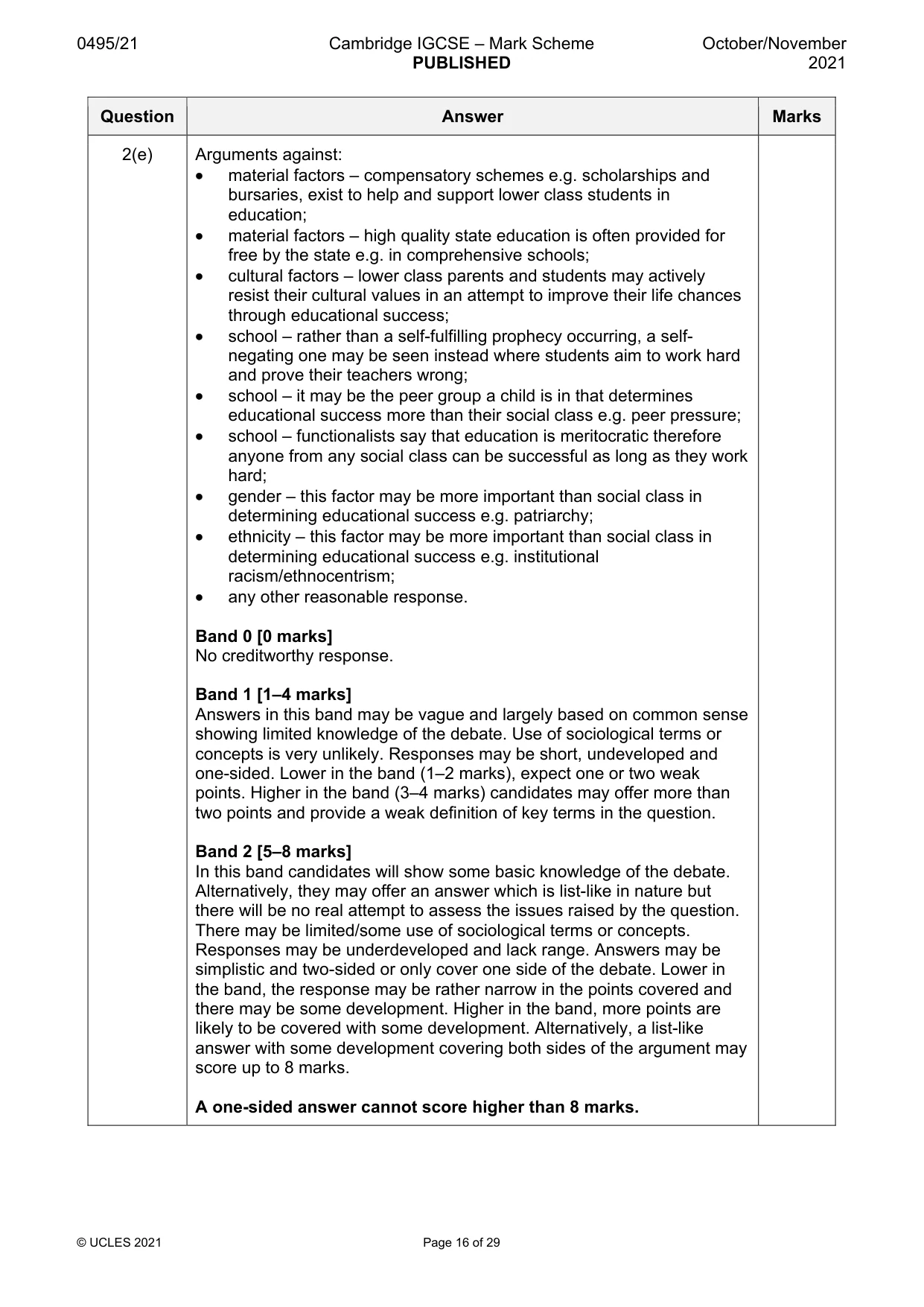
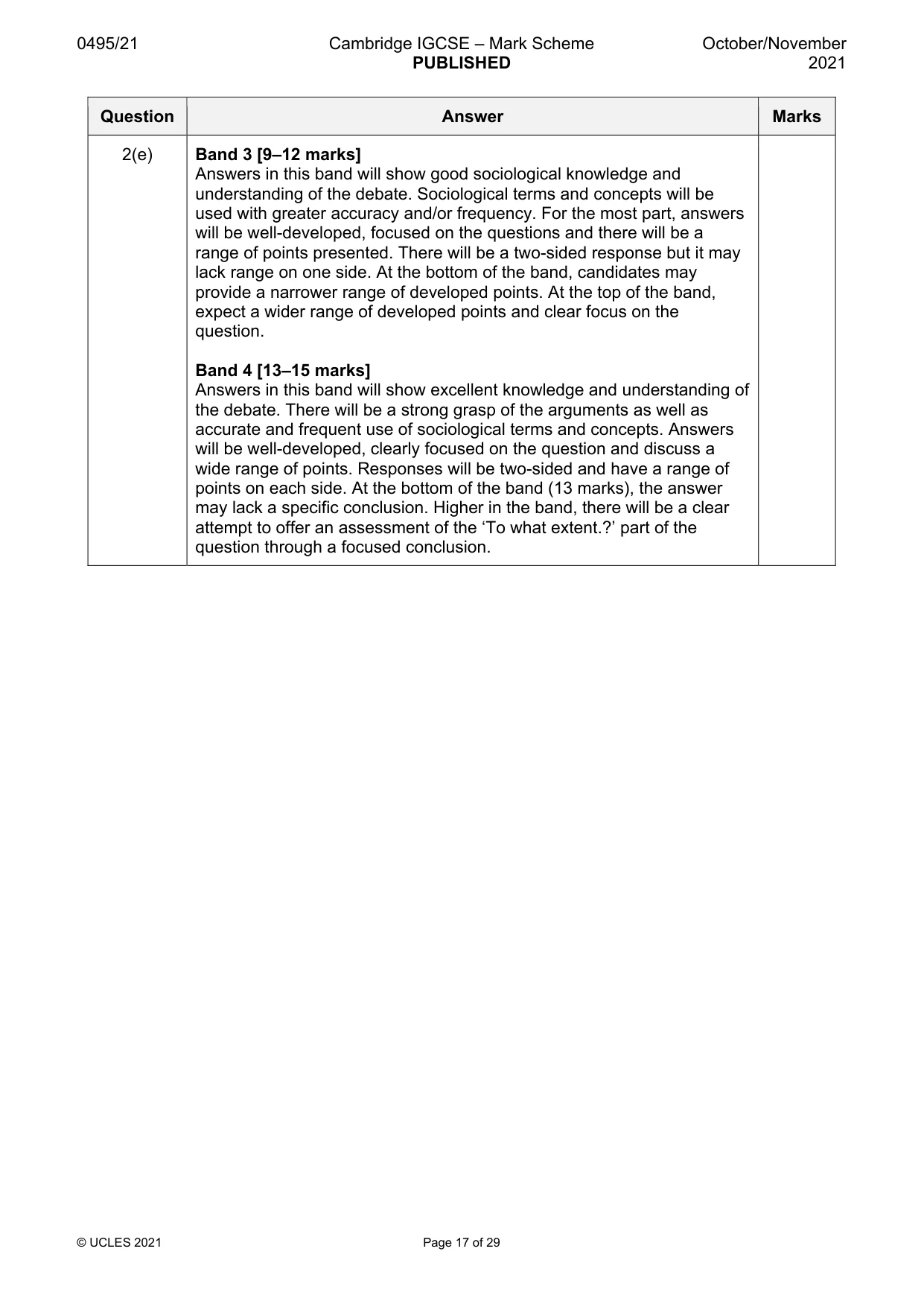
Mark scheme: 2(a) What is meant by the term informal education? 2 One mark for partial definition, e.g. extra-curricular activities. Two marks for clear definition, e.g. learning that takes place outside the classroom or at home/work through daily interactions. 2(b) Describe two features of the official curriculum. 4 Possible answers: • subjects – certain subjects are compulsory to study in the official curriculum; • the opposite of the hidden curriculum – that which is formally and explicitly taught to students; • lessons – explicit lessons are taught to deliver the official curriculum; • assessment – the official curriculum is typically formally assessed at certain points e.g. the IGCSE examinations; • school – the official curriculum is usually taught in schools and colleges; • government – the government may prescribe certain parts of the curriculum e.g. insisting that particular religious views or authors are studied; • syllabus – subjects taught as part of the official curriculum are broken down into key topics of study through a curriculum specification; • any other reasonable response. One mark for each point correctly identified (up to a maximum of two). One mark for each point that is developed (up to a maximum of two). 2(c) Explain how ethnocentrism can be experienced in schools. 6 Possible answers: • lesson content – the majority culture may be treated as more important in some lessons telling pupils that the minority culture is of less value e.g. in history lessons the minority group may learn nothing of their own people’s experiences; • authors – in literature lessons it may be that only ethnic majority authors are studied leading to the invisibility and de-valuing of ethnic minority literature; • tokenism – the occasional ethnic minority topic, theme or author may be integrated into lessons but in reality this is just so the school/education cannot be accused of not treating all pupils equally; • language – it may be that some minority languages are ignored or banned in schools meaning that students from those ethnic groups feel invisibilised and angry; • teacher labelling – teachers may label ethnic minority students in particular ways; • holidays and traditions – minority ethnic group festivals, traditions or holy days may not be accounted for in the school calendar meaning that, for example, there is no representation of certain religions in schools or provision made for the associated religious practices; • cultural differences – minority values and expectations at home may clash with those of the school and thus hamper pupil progress e.g. dialect, dress, appearance etc.; • discrimination by the school – ethnic minority students may find themselves placed into lower sets and streams because of the assumptions of the teachers and the school based on their ethnicity rather than their individual ability; • school policies – these can sometimes be seen to be ethnocentric e.g. uniform, sports lessons, co-education etc.; • ethnic minority teachers may feel marginalised and alienated by the ethnocentric curriculum that they have to deliver; • any other reasonable response. Band 0 [0 marks] No creditworthy response. Band 1 [1–3 marks] Answers in this band will show only a limited awareness of the question. Responses may be short and un/underdeveloped. At the bottom of the band (1 mark), expect one weak point. Higher in the band (2–3 marks), candidates may offer more than one weak point, but there may be a tendency towards simplistic answers, engaging with sociological ideas without using sociological language. Band 2 [4–6 marks] Answers in this band will have clear and accurate explanation, showing good sociological knowledge and understanding. Sociological terms and concepts should be expected and explained. At the bottom of the band, the range of points covered may be narrow or lack detail. Higher in the band, answers will cover more than one point in a well-developed way or cover several points in less detail. 2(d) Explain why the experience of school may be different for boys and 8 girls. Possible answers: • subject choice – girls typically choose different subjects to boys, often opting for the caring or communication-based subjects such as English and Childcare as opposed to boys choosing more practical or technical subjects such as Design and Engineering; • teacher labelling – teachers may have stereotypes in their heads of boys being troublesome and girls being more conformist – this may lead to more sanctions being applied to boys than girls (exclusion figures are higher for boys than girls, for example); • pupil sub-cultures – boys are more likely to join these than girls meaning that they may have more of an anti-school experience than girls and be more influenced by their peer group; • teacher expectations – teachers may assume that males will fulfil the breadwinner role and females the housewife/mother role and this may result in them pushing boys more than girls in some cultures; • leaving school – in some cultures boys’ education may be prioritised over girls and thus girls leave school at an earlier age to boys; • hidden curriculum – feminists believe that this is patriarchal and transmits the view that males are more important than females; • official curriculum – feminists claim that this is often sexist and patriarchal in nature with prominence given to males in active/powerful roles, male narratives in history and male authors in literature lessons; • role models and hierarchy – positions of power in schools are typically held by males and this may send out the message that in wider society males will hold more power than females; • classroom dominance – many studies have shown that boys dominate classroom space and teacher attention leading to a very different experience for girls than boys in schools; • any other reasonable response. Band 0 [0 marks] No creditworthy response. Band 1 [1–3 marks] Answers in this band will show only a limited awareness of the question. A tendency to description is likely. Responses may be short and undeveloped and points stated without explanation. Sociological terms and concepts are unlikely to be used. At the bottom of the band (1 mark), expect one weak point. Higher in the band (2–3 marks), candidates may offer more than one weak point. Band 2 [4–6 marks] Answers in this band will show basic sociological knowledge and understanding. Responses may be underdeveloped and lacking in range. At the bottom of the band, candidates are unlikely to use sociological terms and concepts accurately. Higher in the band, candidates may be beginning to use sociological terms and concepts with greater accuracy. However, some aspects of the answer may only be partially developed/explained. 2(d) Band 3 [7–8 marks] Answers in this band will show good sociological knowledge and understanding and will be well-developed and explained. Sociological terms and concepts will be used accurately overall. Answers will be well- focused on the question and there will be a range of points presented. At the top of the band explanations will be clear throughout. 2(e) To what extent is social class an important factor in determining 15 educational achievement? Arguments for: • material factors – higher social classes can afford to send their children to private schools which typically get better results; • material factors – higher social classes can afford supplementary educational aids e.g. tutors, revision guides etc.; • material factors – lower social classes may need to work part time as well as go to school to help support the family; • material factors – lower social classes may live in overcrowded conditions making it difficult to study effectively; • cultural factors – Bourdieu says that cultural capital (gained from home) is advantageous in education – the higher social classes will have more of this; • cultural factors – there may be less academic role models in lower class families e.g. no one in the family has been to university etc. therefore aspirations are lower; • cultural factors – higher class families may value education more than the lower classes and so parents engage more with the school to ensure their children are doing well; • cultural factors – higher class pupils may benefit from social capital (Bourdieu) that gives them access to networks of opportunity such as the ‘old boys network’; • school – teachers may label students from the lower social classes as less academic and therefore a self-fulfilling prophecy occurs; • school – lower class students are disproportionately found in the lower sets and streams and so are unlikely to do particularly well at school; • school – many sociologists believe the curriculum at school is based on middle class values which makes success easier for those in the higher classes; • linguistic codes – higher classes are typically brought up with the elaborate code which is also used in schools, lower classes are more likely to have the restricted code which may disadvantage them; • any other reasonable response. 2(e) Arguments against: • material factors – compensatory schemes e.g. scholarships and bursaries, exist to help and support lower class students in education; • material factors – high quality state education is often provided for free by the state e.g. in comprehensive schools; • cultural factors – lower class parents and students may actively resist their cultural values in an attempt to improve their life chances through educational success; • school – rather than a self-fulfilling prophecy occurring, a self- negating one may be seen instead where students aim to work hard and prove their teachers wrong; • school – it may be the peer group a child is in that determines educational success more than their social class e.g. peer pressure; • school – functionalists say that education is meritocratic therefore anyone from any social class can be successful as long as they work hard; • gender – this factor may be more important than social class in determining educational success e.g. patriarchy; • ethnicity – this factor may be more important than social class in determining educational success e.g. institutional racism/ethnocentrism; • any other reasonable response. Band 0 [0 marks] No creditworthy response. Band 1 [1–4 marks] Answers in this band may be vague and largely based on common sense showing limited knowledge of the debate. Use of sociological terms or concepts is very unlikely. Responses may be short, undeveloped and one-sided. Lower in the band (1–2 marks), expect one or two weak points. Higher in the band (3–4 marks) candidates may offer more than two points and provide a weak definition of key terms in the question. Band 2 [5–8 marks] In this band candidates will show some basic knowledge of the debate. Alternatively, they may offer an answer which is list-like in nature but there will be no real attempt to assess the issues raised by the question. There may be limited/some use of sociological terms or concepts. Responses may be underdeveloped and lack range. Answers may be simplistic and two-sided or only cover one side of the debate. Lower in the band, the response may be rather narrow in the points covered and there may be some development. Higher in the band, more points are likely to be covered with some development. Alternatively, a list-like answer with some development covering both sides of the argument may score up to 8 marks. A one-sided answer cannot score higher than 8 marks. 2(e) Band 3 [9–12 marks] Answers in this band will show good sociological knowledge and understanding of the debate. Sociological terms and concepts will be used with greater accuracy and/or frequency. For the most part, answers will be well-developed, focused on the questions and there will be a range of points presented. There will be a two-sided response but it may lack range on one side. At the bottom of the band, candidates may provide a narrower range of developed points. At the top of the band, expect a wider range of developed points and clear focus on the question. Band 4 [13–15 marks] Answers in this band will show excellent knowledge and understanding of the debate. There will be a strong grasp of the arguments as well as accurate and frequent use of sociological terms and concepts. Answers will be well-developed, clearly focused on the question and discuss a wide range of points. Responses will be two-sided and have a range of points on each side. At the bottom of the band (13 marks), the answer may lack a specific conclusion. Higher in the band, there will be a clear attempt to offer an assessment of the ‘To what extent.?’ part of the question through a focused conclusion.
Q3 · Despite the relativity of crime and deviance, all societies and their agents of social…
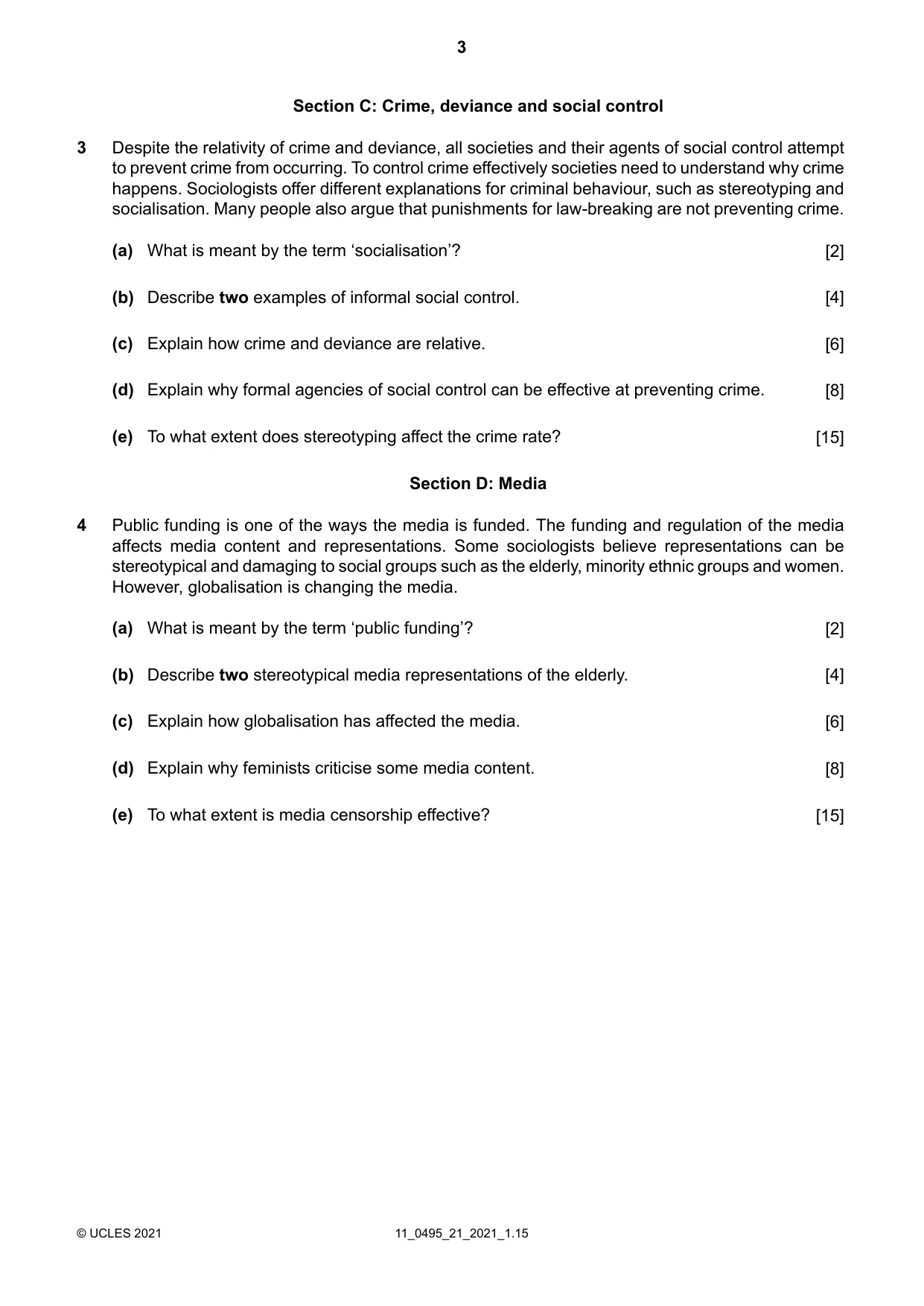
3 Despite the relativity of crime and deviance, all societies and their agents of social control attempt to prevent crime from occurring. To control crime effectively societies need to understand why crime happens. Sociologists offer different explanations for criminal behaviour, such as stereotyping and socialisation. Many people also argue that punishments for law-breaking are not preventing crime. (a) What is meant by the term ‘socialisation’? [2] (b) Describe two examples of informal social control. [4] (c) Explain how crime and deviance are relative. [6] (d) Explain why formal agencies of social control can be effective at preventing crime. [8] (e) To what extent does stereotyping affect the crime rate? [15] Section D: Media
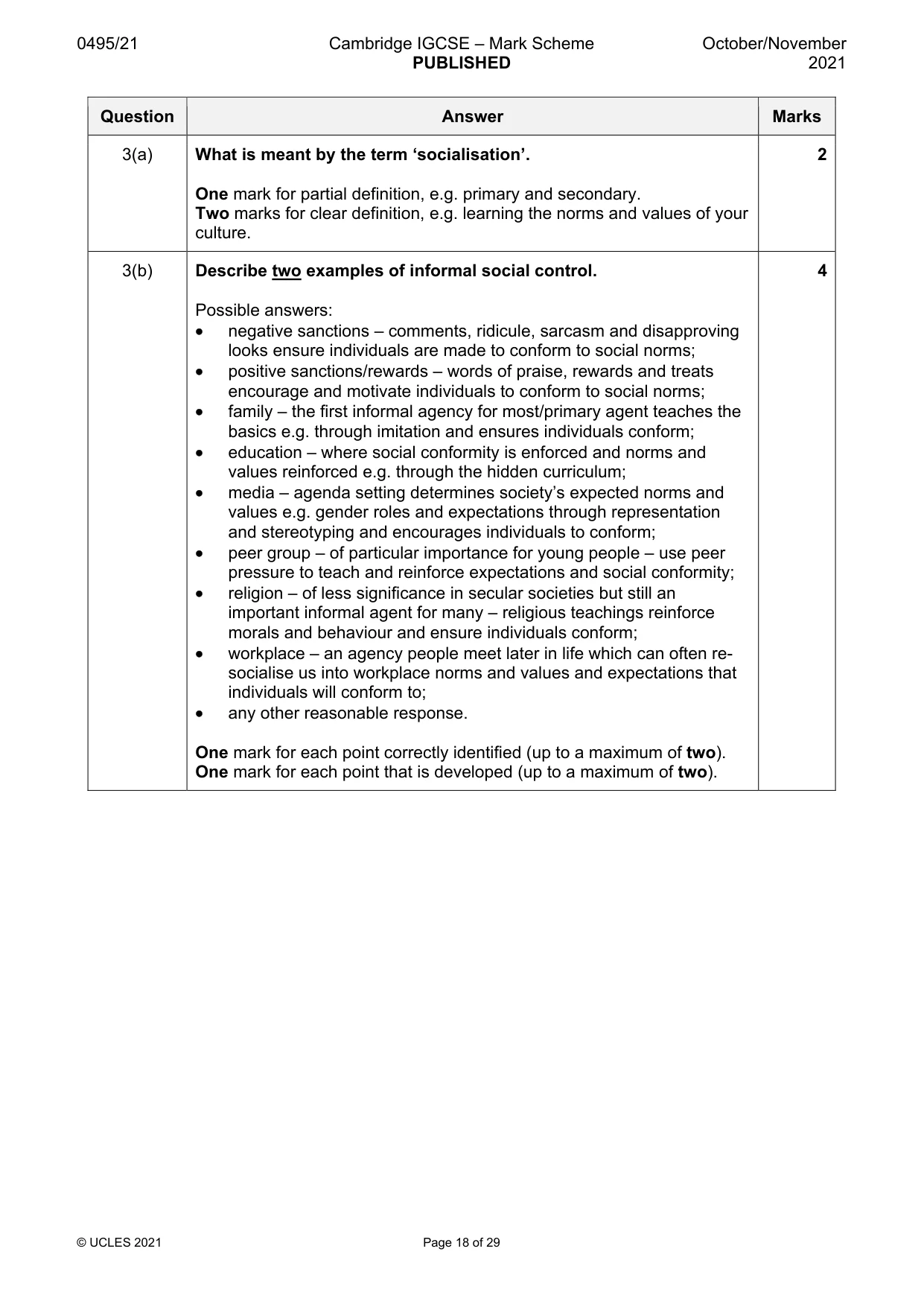
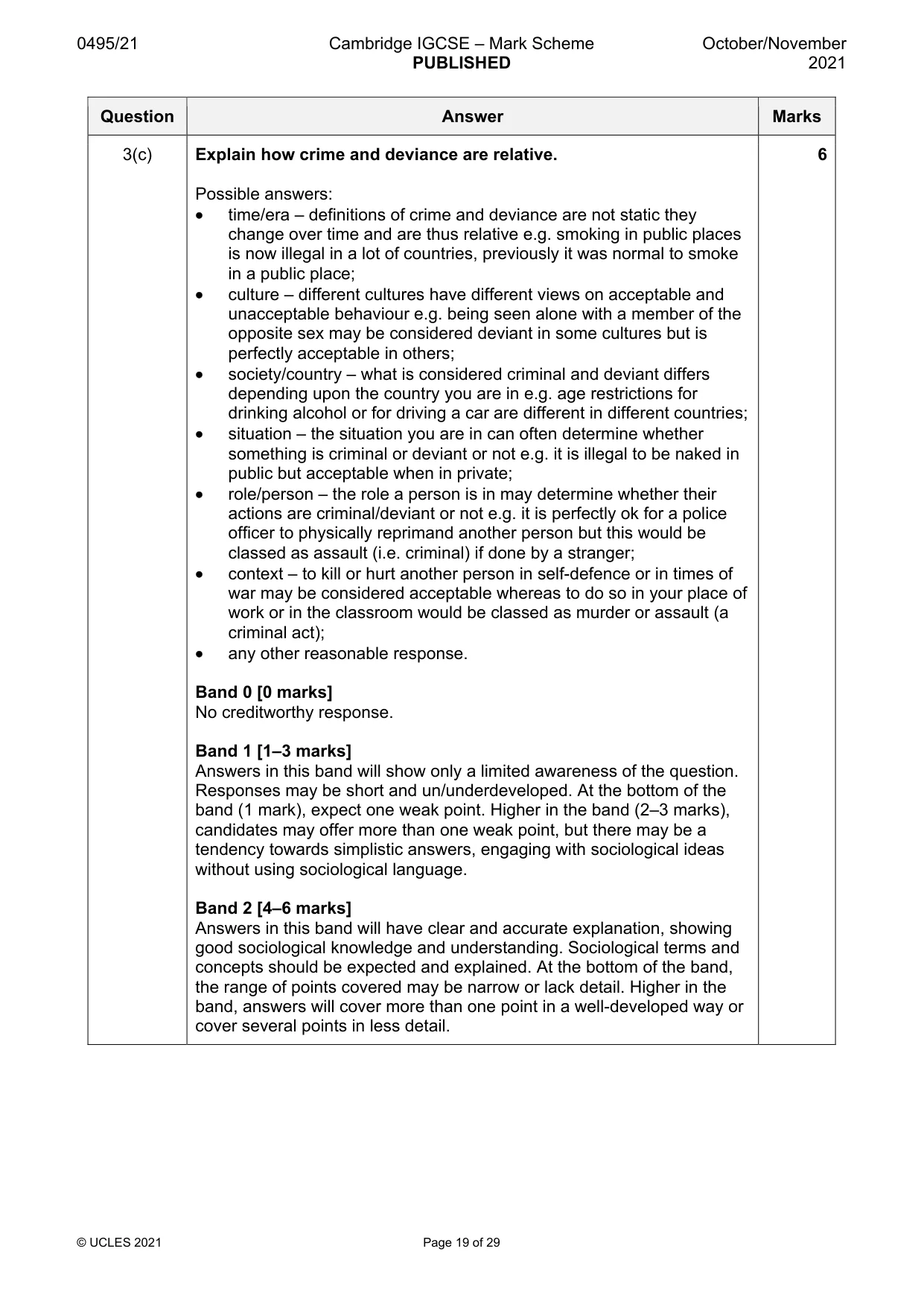
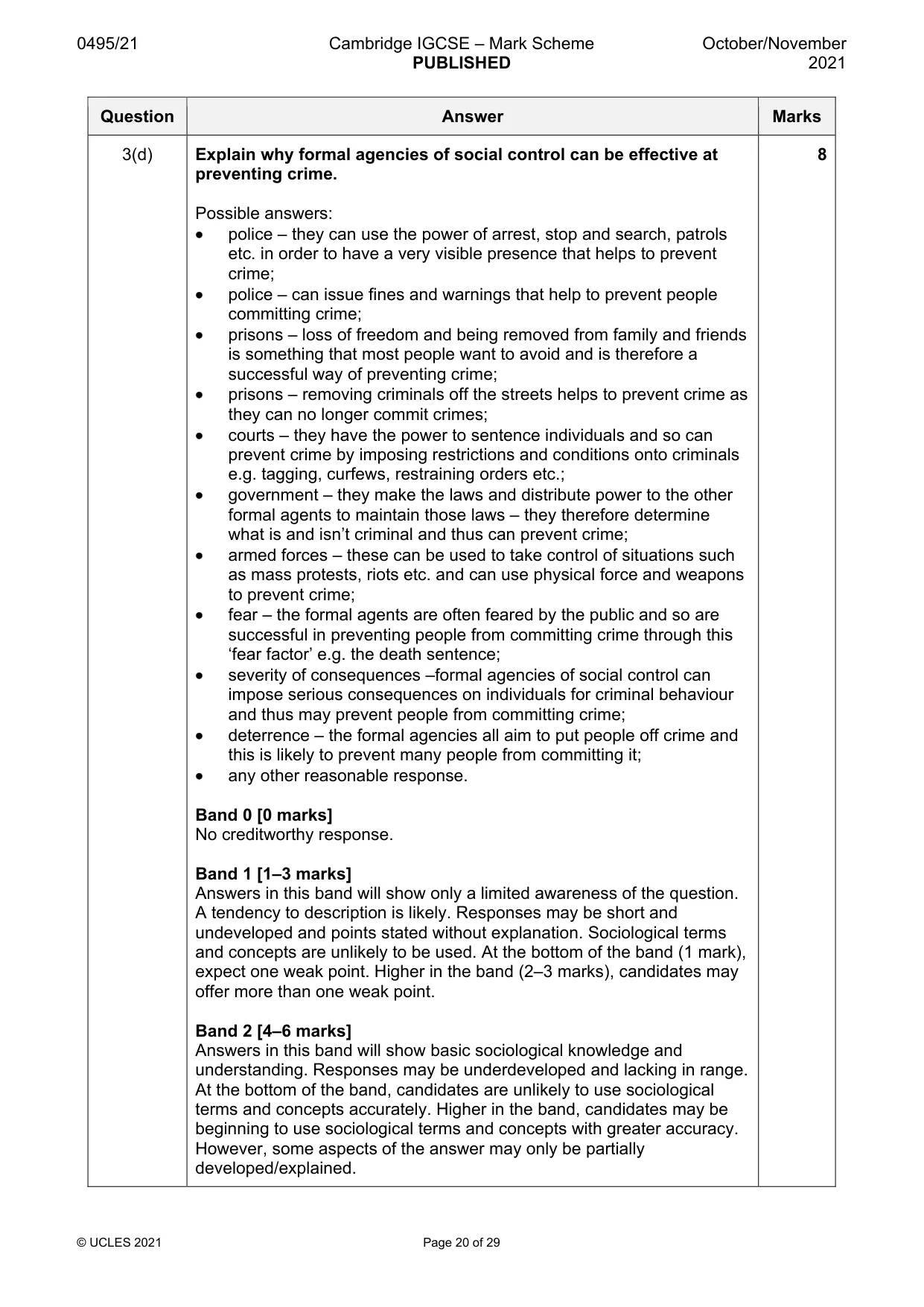
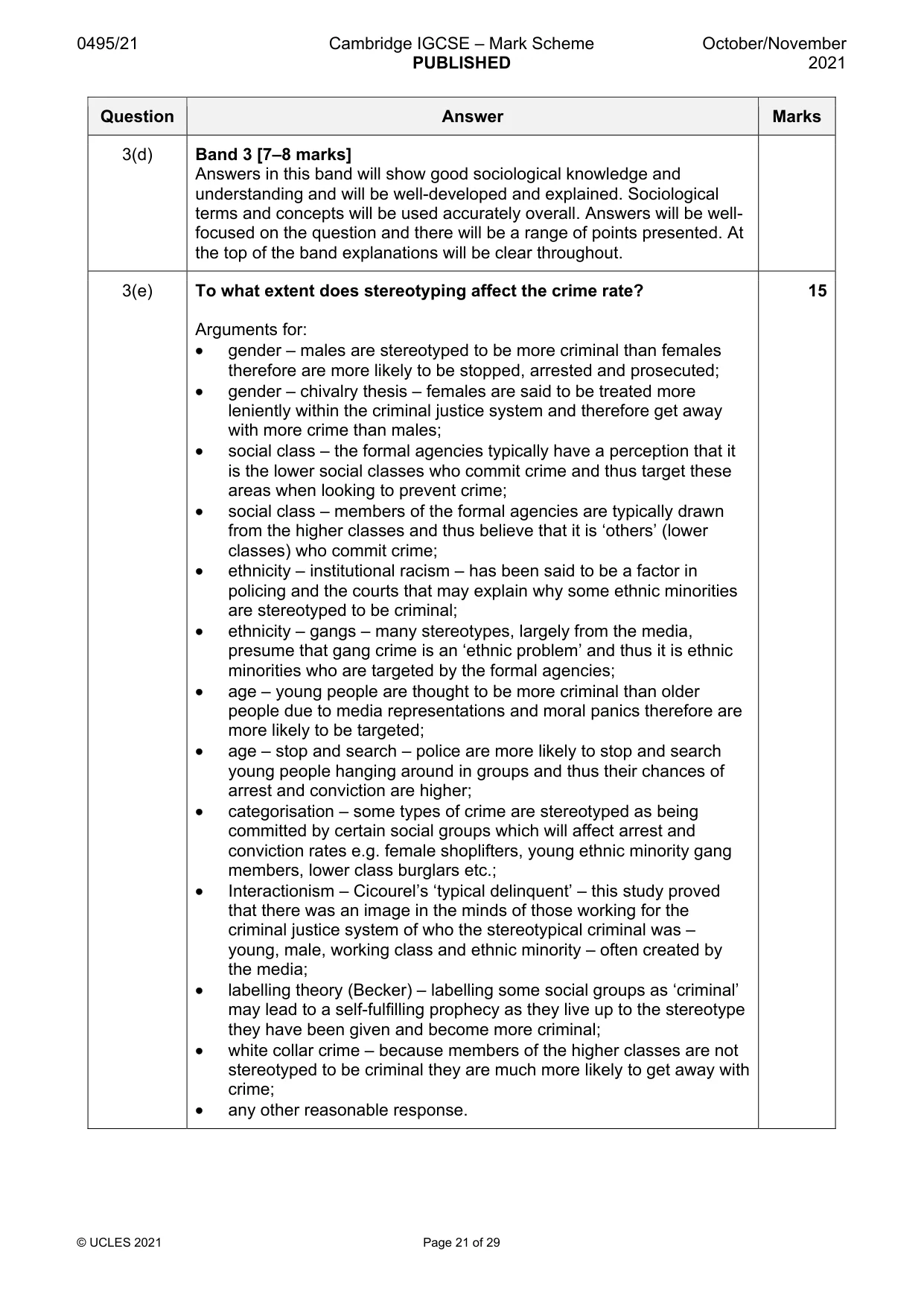
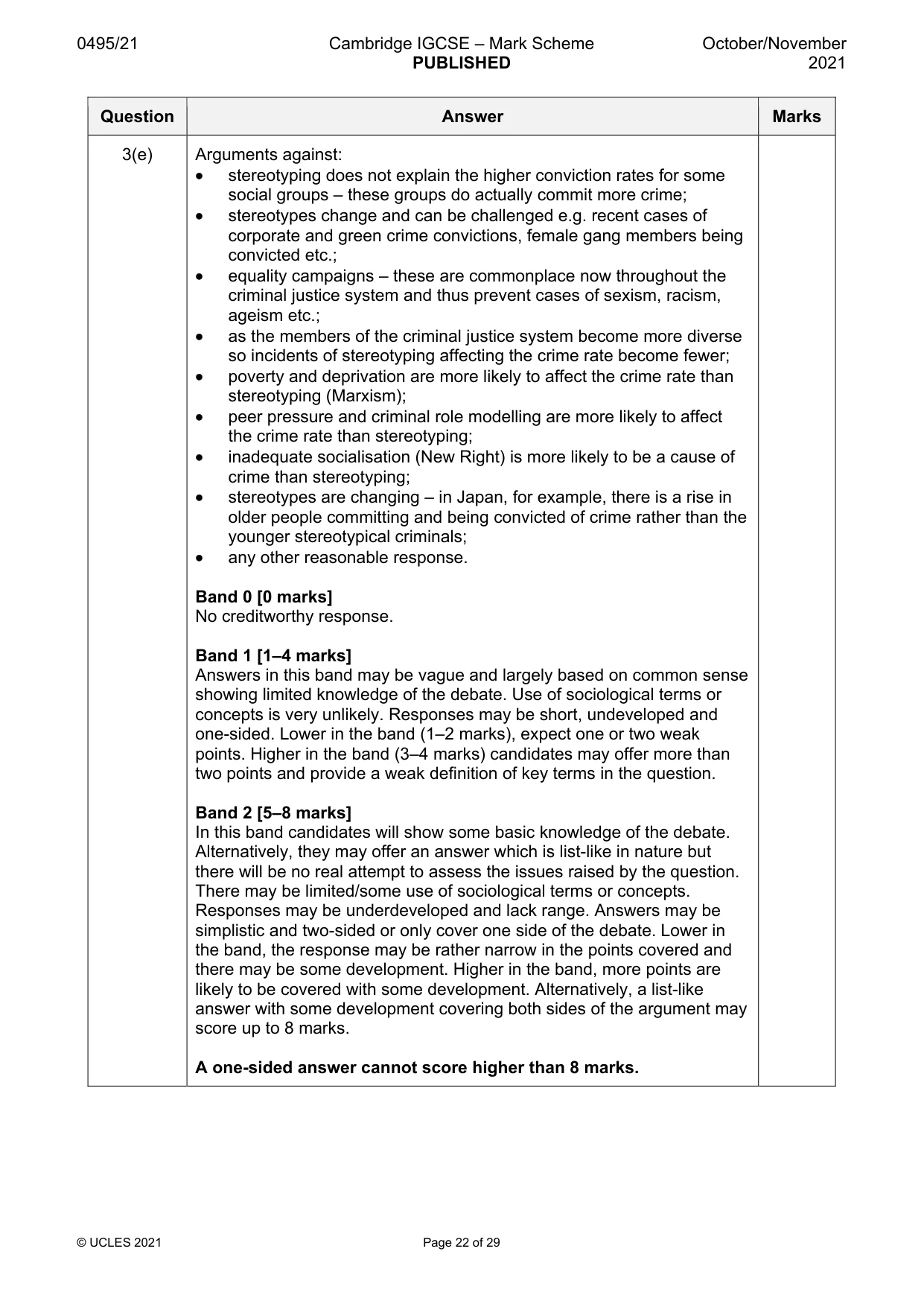
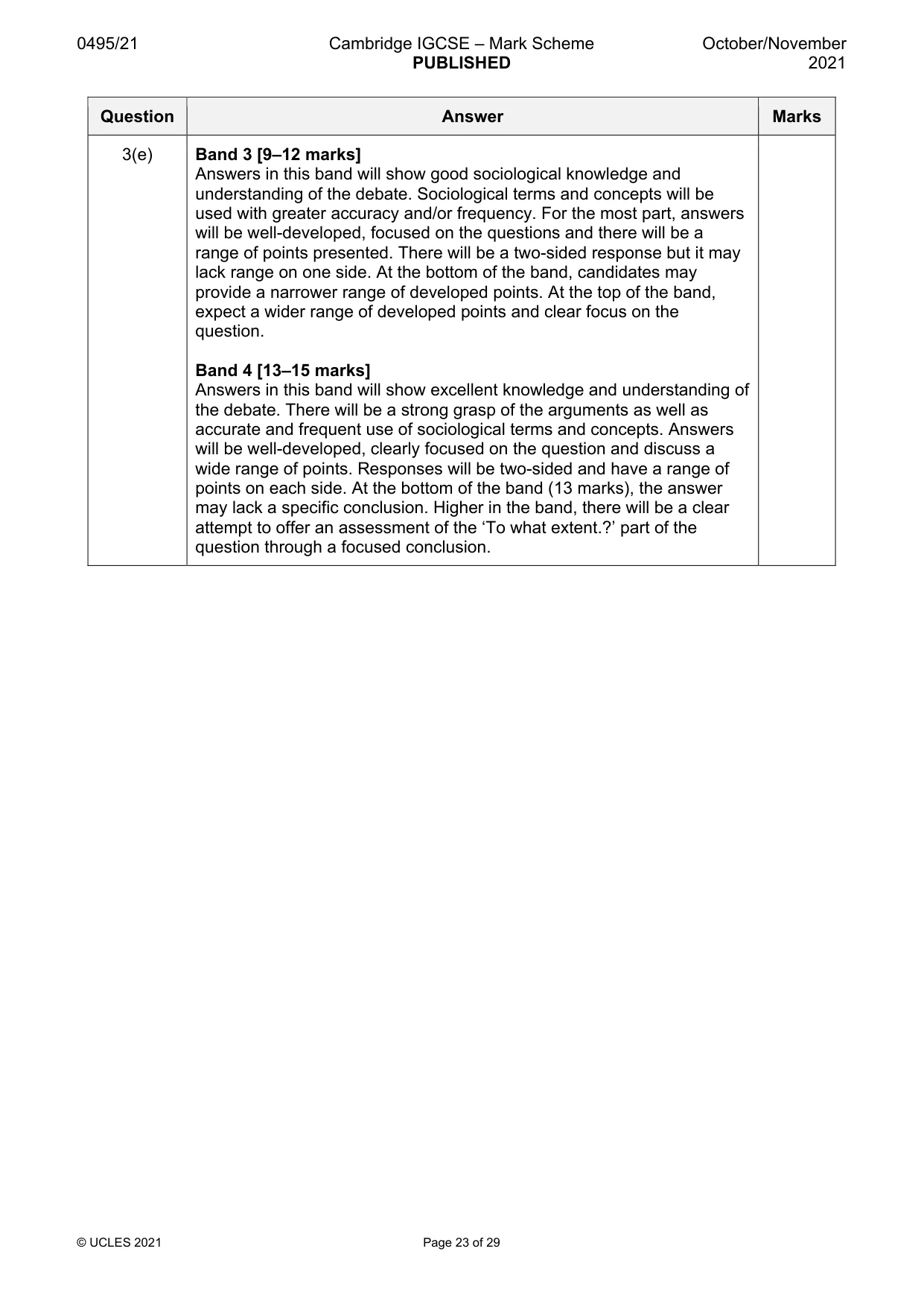
Mark scheme: 3(a) What is meant by the term ‘socialisation’. 2 One mark for partial definition, e.g. primary and secondary. Two marks for clear definition, e.g. learning the norms and values of your culture. 3(b) Describe two examples of informal social control. 4 Possible answers: • negative sanctions – comments, ridicule, sarcasm and disapproving looks ensure individuals are made to conform to social norms; • positive sanctions/rewards – words of praise, rewards and treats encourage and motivate individuals to conform to social norms; • family – the first informal agency for most/primary agent teaches the basics e.g. through imitation and ensures individuals conform; • education – where social conformity is enforced and norms and values reinforced e.g. through the hidden curriculum; • media – agenda setting determines society’s expected norms and values e.g. gender roles and expectations through representation and stereotyping and encourages individuals to conform; • peer group – of particular importance for young people – use peer pressure to teach and reinforce expectations and social conformity; • religion – of less significance in secular societies but still an important informal agent for many – religious teachings reinforce morals and behaviour and ensure individuals conform; • workplace – an agency people meet later in life which can often re- socialise us into workplace norms and values and expectations that individuals will conform to; • any other reasonable response. One mark for each point correctly identified (up to a maximum of two). One mark for each point that is developed (up to a maximum of two). 3(c) Explain how crime and deviance are relative. 6 Possible answers: • time/era – definitions of crime and deviance are not static they change over time and are thus relative e.g. smoking in public places is now illegal in a lot of countries, previously it was normal to smoke in a public place; • culture – different cultures have different views on acceptable and unacceptable behaviour e.g. being seen alone with a member of the opposite sex may be considered deviant in some cultures but is perfectly acceptable in others; • society/country – what is considered criminal and deviant differs depending upon the country you are in e.g. age restrictions for drinking alcohol or for driving a car are different in different countries; • situation – the situation you are in can often determine whether something is criminal or deviant or not e.g. it is illegal to be naked in public but acceptable when in private; • role/person – the role a person is in may determine whether their actions are criminal/deviant or not e.g. it is perfectly ok for a police officer to physically reprimand another person but this would be classed as assault (i.e. criminal) if done by a stranger; • context – to kill or hurt another person in self-defence or in times of war may be considered acceptable whereas to do so in your place of work or in the classroom would be classed as murder or assault (a criminal act); • any other reasonable response. Band 0 [0 marks] No creditworthy response. Band 1 [1–3 marks] Answers in this band will show only a limited awareness of the question. Responses may be short and un/underdeveloped. At the bottom of the band (1 mark), expect one weak point. Higher in the band (2–3 marks), candidates may offer more than one weak point, but there may be a tendency towards simplistic answers, engaging with sociological ideas without using sociological language. Band 2 [4–6 marks] Answers in this band will have clear and accurate explanation, showing good sociological knowledge and understanding. Sociological terms and concepts should be expected and explained. At the bottom of the band, the range of points covered may be narrow or lack detail. Higher in the band, answers will cover more than one point in a well-developed way or cover several points in less detail. 3(d) Explain why formal agencies of social control can be effective at 8 preventing crime. Possible answers: • police – they can use the power of arrest, stop and search, patrols etc. in order to have a very visible presence that helps to prevent crime; • police – can issue fines and warnings that help to prevent people committing crime; • prisons – loss of freedom and being removed from family and friends is something that most people want to avoid and is therefore a successful way of preventing crime; • prisons – removing criminals off the streets helps to prevent crime as they can no longer commit crimes; • courts – they have the power to sentence individuals and so can prevent crime by imposing restrictions and conditions onto criminals e.g. tagging, curfews, restraining orders etc.; • government – they make the laws and distribute power to the other formal agents to maintain those laws – they therefore determine what is and isn’t criminal and thus can prevent crime; • armed forces – these can be used to take control of situations such as mass protests, riots etc. and can use physical force and weapons to prevent crime; • fear – the formal agents are often feared by the public and so are successful in preventing people from committing crime through this ‘fear factor’ e.g. the death sentence; • severity of consequences –formal agencies of social control can impose serious consequences on individuals for criminal behaviour and thus may prevent people from committing crime; • deterrence – the formal agencies all aim to put people off crime and this is likely to prevent many people from committing it; • any other reasonable response. Band 0 [0 marks] No creditworthy response. Band 1 [1–3 marks] Answers in this band will show only a limited awareness of the question. A tendency to description is likely. Responses may be short and undeveloped and points stated without explanation. Sociological terms and concepts are unlikely to be used. At the bottom of the band (1 mark), expect one weak point. Higher in the band (2–3 marks), candidates may offer more than one weak point. Band 2 [4–6 marks] Answers in this band will show basic sociological knowledge and understanding. Responses may be underdeveloped and lacking in range. At the bottom of the band, candidates are unlikely to use sociological terms and concepts accurately. Higher in the band, candidates may be beginning to use sociological terms and concepts with greater accuracy. However, some aspects of the answer may only be partially developed/explained. 3(d) Band 3 [7–8 marks] Answers in this band will show good sociological knowledge and understanding and will be well-developed and explained. Sociological terms and concepts will be used accurately overall. Answers will be well- focused on the question and there will be a range of points presented. At the top of the band explanations will be clear throughout. 3(e) To what extent does stereotyping affect the crime rate? 15 Arguments for: • gender – males are stereotyped to be more criminal than females therefore are more likely to be stopped, arrested and prosecuted; • gender – chivalry thesis – females are said to be treated more leniently within the criminal justice system and therefore get away with more crime than males; • social class – the formal agencies typically have a perception that it is the lower social classes who commit crime and thus target these areas when looking to prevent crime; • social class – members of the formal agencies are typically drawn from the higher classes and thus believe that it is ‘others’ (lower classes) who commit crime; • ethnicity – institutional racism – has been said to be a factor in policing and the courts that may explain why some ethnic minorities are stereotyped to be criminal; • ethnicity – gangs – many stereotypes, largely from the media, presume that gang crime is an ‘ethnic problem’ and thus it is ethnic minorities who are targeted by the formal agencies; • age – young people are thought to be more criminal than older people due to media representations and moral panics therefore are more likely to be targeted; • age – stop and search – police are more likely to stop and search young people hanging around in groups and thus their chances of arrest and conviction are higher; • categorisation – some types of crime are stereotyped as being committed by certain social groups which will affect arrest and conviction rates e.g. female shoplifters, young ethnic minority gang members, lower class burglars etc.; • Interactionism – Cicourel’s ‘typical delinquent’ – this study proved that there was an image in the minds of those working for the criminal justice system of who the stereotypical criminal was – young, male, working class and ethnic minority – often created by the media; • labelling theory (Becker) – labelling some social groups as ‘criminal’ may lead to a self-fulfilling prophecy as they live up to the stereotype they have been given and become more criminal; • white collar crime – because members of the higher classes are not stereotyped to be criminal they are much more likely to get away with crime; • any other reasonable response. 3(e) Arguments against: • stereotyping does not explain the higher conviction rates for some social groups – these groups do actually commit more crime; • stereotypes change and can be challenged e.g. recent cases of corporate and green crime convictions, female gang members being convicted etc.; • equality campaigns – these are commonplace now throughout the criminal justice system and thus prevent cases of sexism, racism, ageism etc.; • as the members of the criminal justice system become more diverse so incidents of stereotyping affecting the crime rate become fewer; • poverty and deprivation are more likely to affect the crime rate than stereotyping (Marxism); • peer pressure and criminal role modelling are more likely to affect the crime rate than stereotyping; • inadequate socialisation (New Right) is more likely to be a cause of crime than stereotyping; • stereotypes are changing – in Japan, for example, there is a rise in older people committing and being convicted of crime rather than the younger stereotypical criminals; • any other reasonable response. Band 0 [0 marks] No creditworthy response. Band 1 [1–4 marks] Answers in this band may be vague and largely based on common sense showing limited knowledge of the debate. Use of sociological terms or concepts is very unlikely. Responses may be short, undeveloped and one-sided. Lower in the band (1–2 marks), expect one or two weak points. Higher in the band (3–4 marks) candidates may offer more than two points and provide a weak definition of key terms in the question. Band 2 [5–8 marks] In this band candidates will show some basic knowledge of the debate. Alternatively, they may offer an answer which is list-like in nature but there will be no real attempt to assess the issues raised by the question. There may be limited/some use of sociological terms or concepts. Responses may be underdeveloped and lack range. Answers may be simplistic and two-sided or only cover one side of the debate. Lower in the band, the response may be rather narrow in the points covered and there may be some development. Higher in the band, more points are likely to be covered with some development. Alternatively, a list-like answer with some development covering both sides of the argument may score up to 8 marks. A one-sided answer cannot score higher than 8 marks. 3(e) Band 3 [9–12 marks] Answers in this band will show good sociological knowledge and understanding of the debate. Sociological terms and concepts will be used with greater accuracy and/or frequency. For the most part, answers will be well-developed, focused on the questions and there will be a range of points presented. There will be a two-sided response but it may lack range on one side. At the bottom of the band, candidates may provide a narrower range of developed points. At the top of the band, expect a wider range of developed points and clear focus on the question. Band 4 [13–15 marks] Answers in this band will show excellent knowledge and understanding of the debate. There will be a strong grasp of the arguments as well as accurate and frequent use of sociological terms and concepts. Answers will be well-developed, clearly focused on the question and discuss a wide range of points. Responses will be two-sided and have a range of points on each side. At the bottom of the band (13 marks), the answer may lack a specific conclusion. Higher in the band, there will be a clear attempt to offer an assessment of the ‘To what extent.?’ part of the question through a focused conclusion.
Q4 · Public funding is one of the ways the media is funded
4 Public funding is one of the ways the media is funded. The funding and regulation of the media affects media content and representations. Some sociologists believe representations can be stereotypical and damaging to social groups such as the elderly, minority ethnic groups and women. However, globalisation is changing the media. (a) What is meant by the term ‘public funding’? [2] (b) Describe two stereotypical media representations of the elderly. [4] (c) Explain how globalisation has affected the media. [6] (d) Explain why feminists criticise some media content. [8] (e) To what extent is media censorship effective? [15]
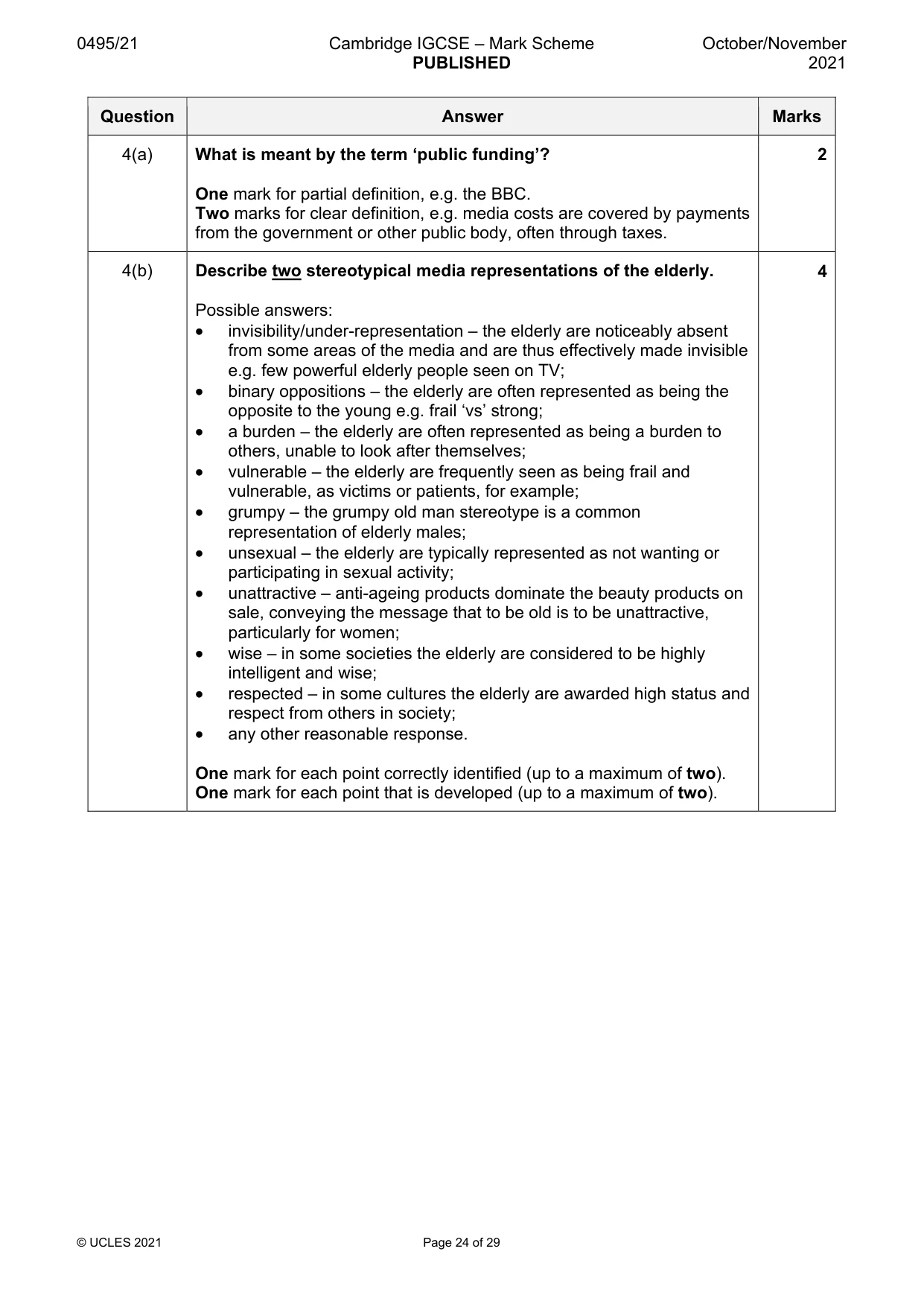
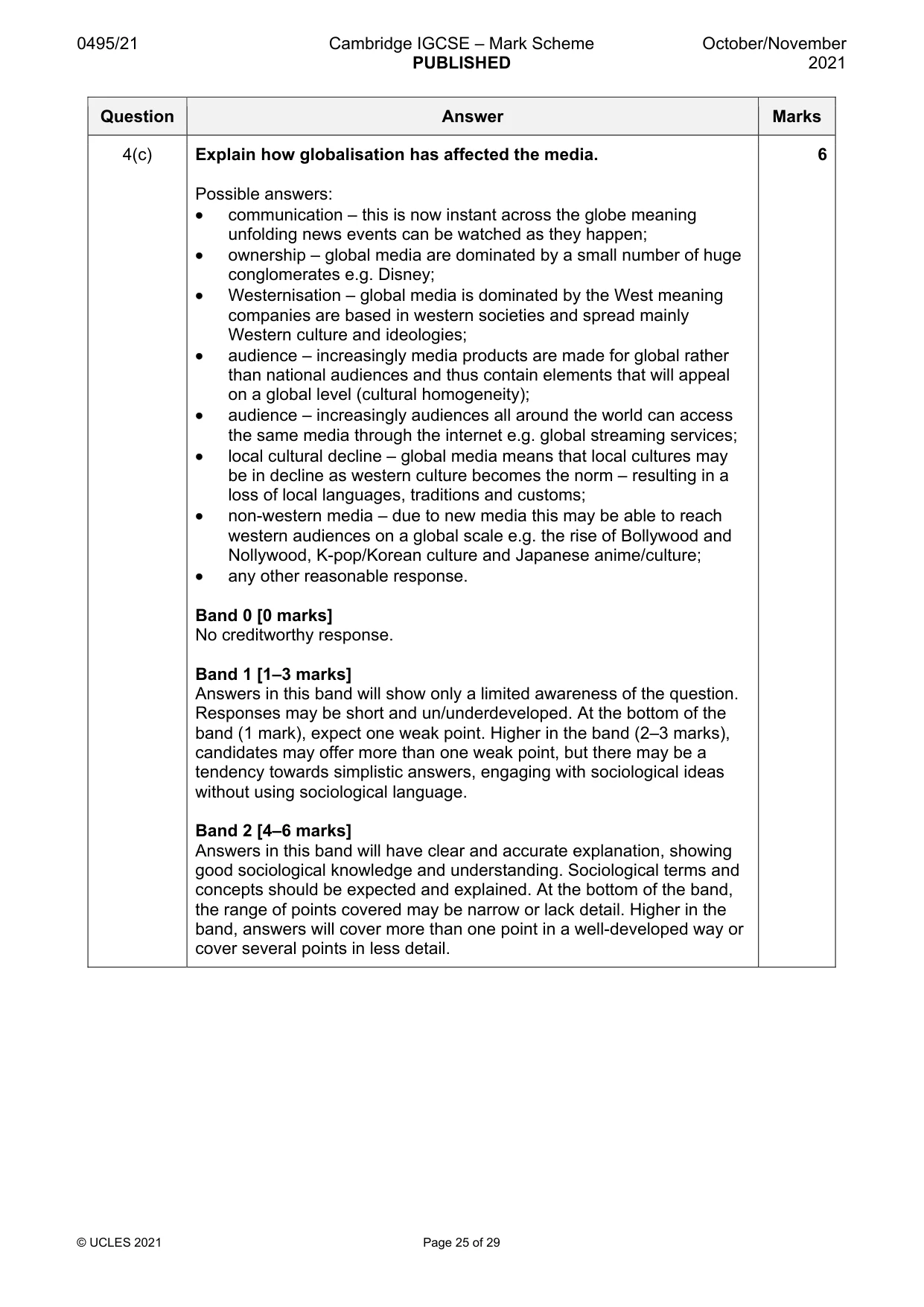
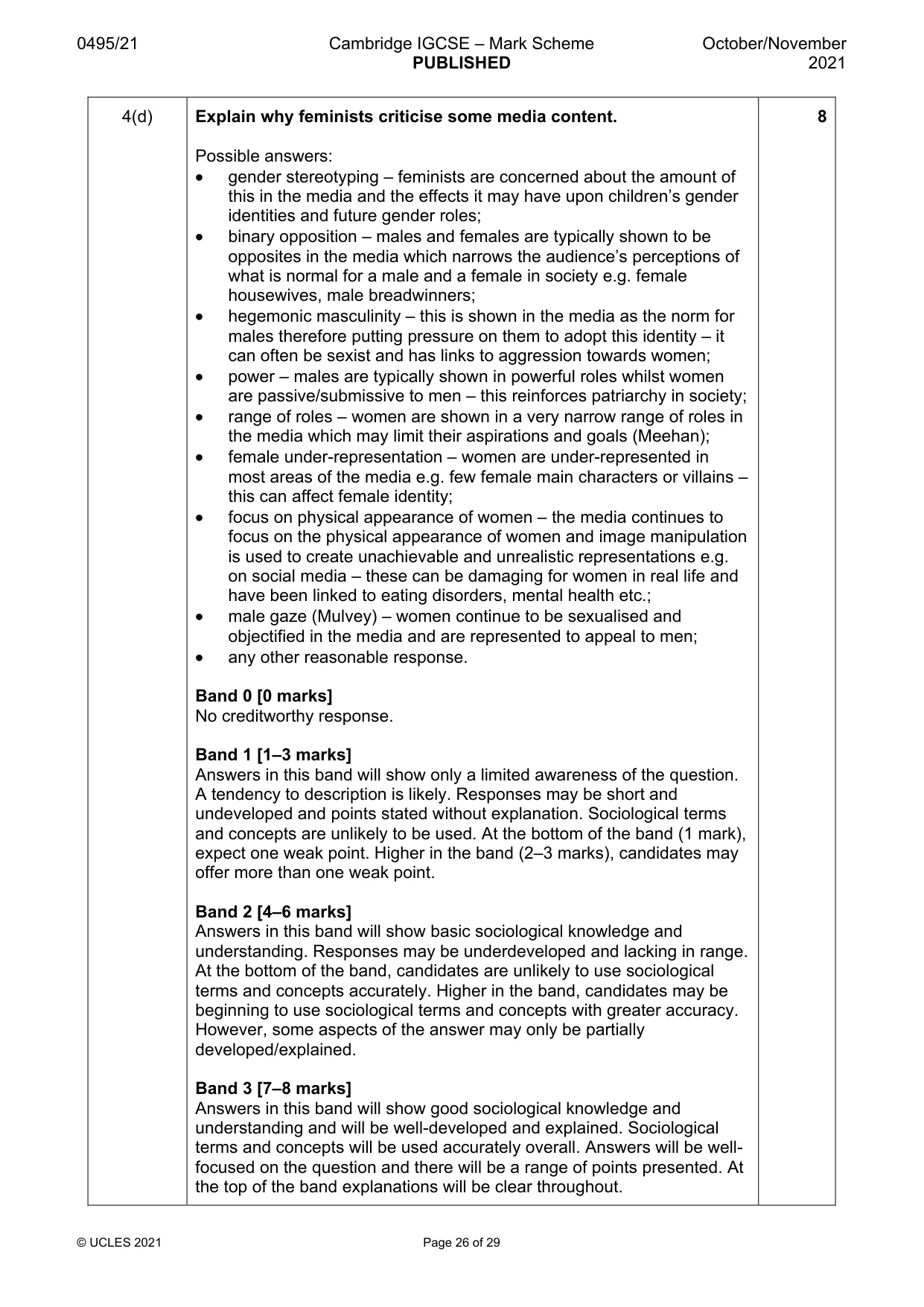
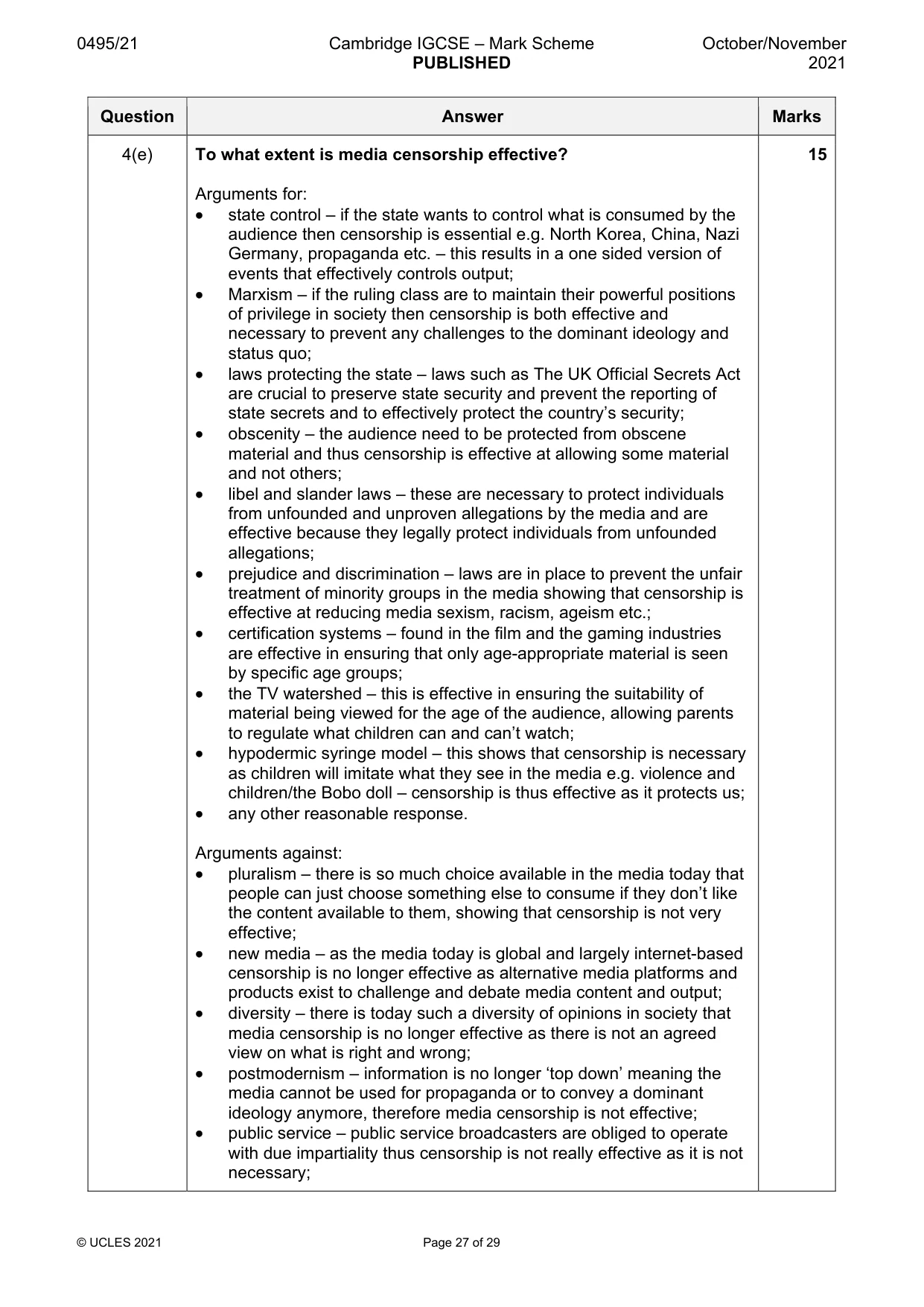
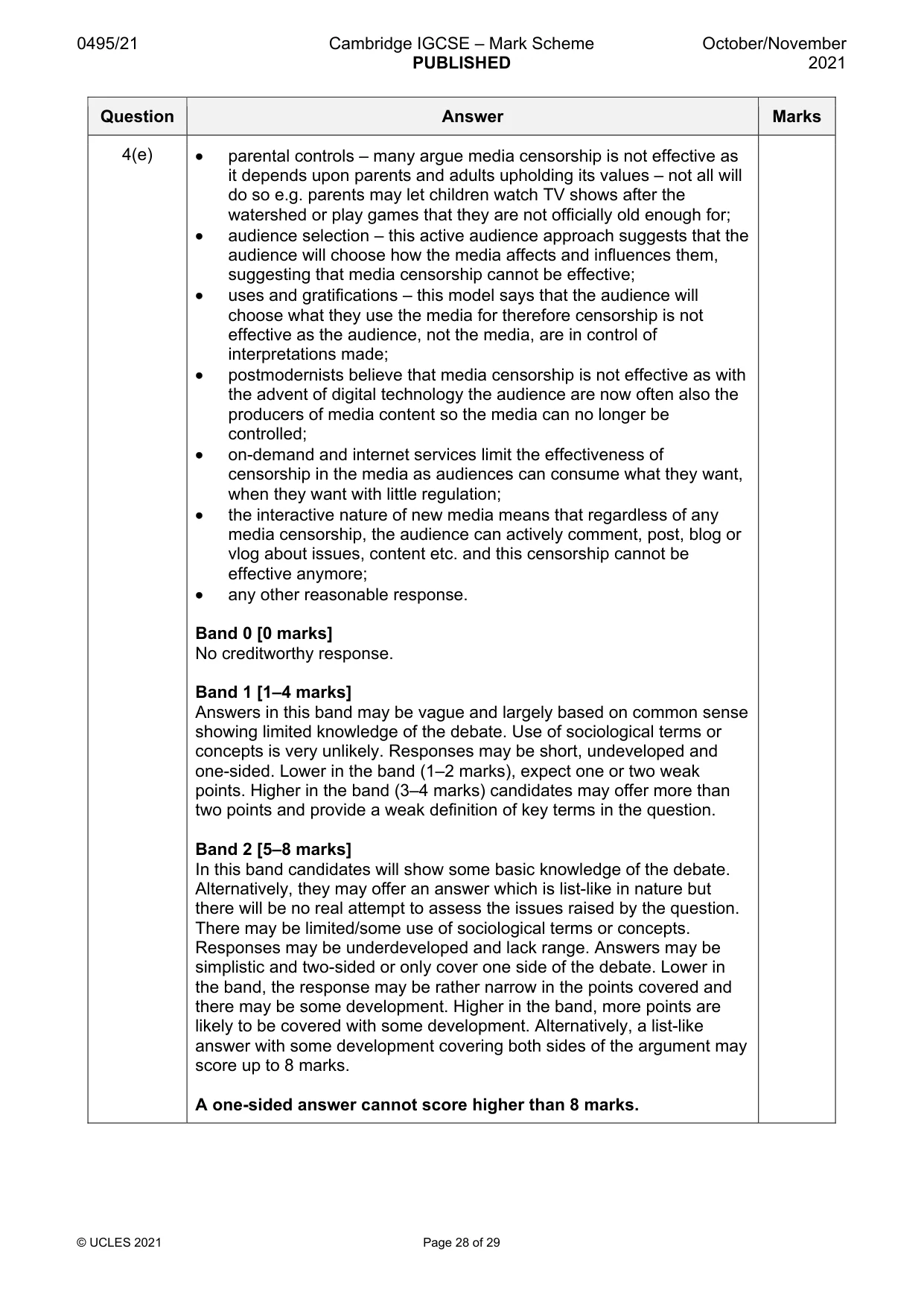
Mark scheme: 4(a) What is meant by the term ‘public funding’? 2 One mark for partial definition, e.g. the BBC. Two marks for clear definition, e.g. media costs are covered by payments from the government or other public body, often through taxes. 4(b) Describe two stereotypical media representations of the elderly. 4 Possible answers: • invisibility/under-representation – the elderly are noticeably absent from some areas of the media and are thus effectively made invisible e.g. few powerful elderly people seen on TV; • binary oppositions – the elderly are often represented as being the opposite to the young e.g. frail ‘vs’ strong; • a burden – the elderly are often represented as being a burden to others, unable to look after themselves; • vulnerable – the elderly are frequently seen as being frail and vulnerable, as victims or patients, for example; • grumpy – the grumpy old man stereotype is a common representation of elderly males; • unsexual – the elderly are typically represented as not wanting or participating in sexual activity; • unattractive – anti-ageing products dominate the beauty products on sale, conveying the message that to be old is to be unattractive, particularly for women; • wise – in some societies the elderly are considered to be highly intelligent and wise; • respected – in some cultures the elderly are awarded high status and respect from others in society; • any other reasonable response. One mark for each point correctly identified (up to a maximum of two). One mark for each point that is developed (up to a maximum of two). 4(c) Explain how globalisation has affected the media. 6 Possible answers: • communication – this is now instant across the globe meaning unfolding news events can be watched as they happen; • ownership – global media are dominated by a small number of huge conglomerates e.g. Disney; • Westernisation – global media is dominated by the West meaning companies are based in western societies and spread mainly Western culture and ideologies; • audience – increasingly media products are made for global rather than national audiences and thus contain elements that will appeal on a global level (cultural homogeneity); • audience – increasingly audiences all around the world can access the same media through the internet e.g. global streaming services; • local cultural decline – global media means that local cultures may be in decline as western culture becomes the norm – resulting in a loss of local languages, traditions and customs; • non-western media – due to new media this may be able to reach western audiences on a global scale e.g. the rise of Bollywood and Nollywood, K-pop/Korean culture and Japanese anime/culture; • any other reasonable response. Band 0 [0 marks] No creditworthy response. Band 1 [1–3 marks] Answers in this band will show only a limited awareness of the question. Responses may be short and un/underdeveloped. At the bottom of the band (1 mark), expect one weak point. Higher in the band (2–3 marks), candidates may offer more than one weak point, but there may be a tendency towards simplistic answers, engaging with sociological ideas without using sociological language. Band 2 [4–6 marks] Answers in this band will have clear and accurate explanation, showing good sociological knowledge and understanding. Sociological terms and concepts should be expected and explained. At the bottom of the band, the range of points covered may be narrow or lack detail. Higher in the band, answers will cover more than one point in a well-developed way or cover several points in less detail. 4(d) Explain why feminists criticise some media content. 8 Possible answers: • gender stereotyping – feminists are concerned about the amount of this in the media and the effects it may have upon children’s gender identities and future gender roles; • binary opposition – males and females are typically shown to be opposites in the media which narrows the audience’s perceptions of what is normal for a male and a female in society e.g. female housewives, male breadwinners; • hegemonic masculinity – this is shown in the media as the norm for males therefore putting pressure on them to adopt this identity – it can often be sexist and has links to aggression towards women; • power – males are typically shown in powerful roles whilst women are passive/submissive to men – this reinforces patriarchy in society; • range of roles – women are shown in a very narrow range of roles in the media which may limit their aspirations and goals (Meehan); • female under-representation – women are under-represented in most areas of the media e.g. few female main characters or villains – this can affect female identity; • focus on physical appearance of women – the media continues to focus on the physical appearance of women and image manipulation is used to create unachievable and unrealistic representations e.g. on social media – these can be damaging for women in real life and have been linked to eating disorders, mental health etc.; • male gaze (Mulvey) – women continue to be sexualised and objectified in the media and are represented to appeal to men; • any other reasonable response. Band 0 [0 marks] No creditworthy response. Band 1 [1–3 marks] Answers in this band will show only a limited awareness of the question. A tendency to description is likely. Responses may be short and undeveloped and points stated without explanation. Sociological terms and concepts are unlikely to be used. At the bottom of the band (1 mark), expect one weak point. Higher in the band (2–3 marks), candidates may offer more than one weak point. Band 2 [4–6 marks] Answers in this band will show basic sociological knowledge and understanding. Responses may be underdeveloped and lacking in range. At the bottom of the band, candidates are unlikely to use sociological terms and concepts accurately. Higher in the band, candidates may be beginning to use sociological terms and concepts with greater accuracy. However, some aspects of the answer may only be partially developed/explained. Band 3 [7–8 marks] Answers in this band will show good sociological knowledge and understanding and will be well-developed and explained. Sociological terms and concepts will be used accurately overall. Answers will be well- focused on the question and there will be a range of points presented. At the top of the band explanations will be clear throughout. 4(e) To what extent is media censorship effective? 15 Arguments for: • state control – if the state wants to control what is consumed by the audience then censorship is essential e.g. North Korea, China, Nazi Germany, propaganda etc. – this results in a one sided version of events that effectively controls output; • Marxism – if the ruling class are to maintain their powerful positions of privilege in society then censorship is both effective and necessary to prevent any challenges to the dominant ideology and status quo; • laws protecting the state – laws such as The UK Official Secrets Act are crucial to preserve state security and prevent the reporting of state secrets and to effectively protect the country’s security; • obscenity – the audience need to be protected from obscene material and thus censorship is effective at allowing some material and not others; • libel and slander laws – these are necessary to protect individuals from unfounded and unproven allegations by the media and are effective because they legally protect individuals from unfounded allegations; • prejudice and discrimination – laws are in place to prevent the unfair treatment of minority groups in the media showing that censorship is effective at reducing media sexism, racism, ageism etc.; • certification systems – found in the film and the gaming industries are effective in ensuring that only age-appropriate material is seen by specific age groups; • the TV watershed – this is effective in ensuring the suitability of material being viewed for the age of the audience, allowing parents to regulate what children can and can’t watch; • hypodermic syringe model – this shows that censorship is necessary as children will imitate what they see in the media e.g. violence and children/the Bobo doll – censorship is thus effective as it protects us; • any other reasonable response. Arguments against: • pluralism – there is so much choice available in the media today that people can just choose something else to consume if they don’t like the content available to them, showing that censorship is not very effective; • new media – as the media today is global and largely internet-based censorship is no longer effective as alternative media platforms and products exist to challenge and debate media content and output; • diversity – there is today such a diversity of opinions in society that media censorship is no longer effective as there is not an agreed view on what is right and wrong; • postmodernism – information is no longer ‘top down’ meaning the media cannot be used for propaganda or to convey a dominant ideology anymore, therefore media censorship is not effective; • public service – public service broadcasters are obliged to operate with due impartiality thus censorship is not really effective as it is not necessary; 4(e) • parental controls – many argue media censorship is not effective as it depends upon parents and adults upholding its values – not all will do so e.g. parents may let children watch TV shows after the watershed or play games that they are not officially old enough for; • audience selection – this active audience approach suggests that the audience will choose how the media affects and influences them, suggesting that media censorship cannot be effective; • uses and gratifications – this model says that the audience will choose what they use the media for therefore censorship is not effective as the audience, not the media, are in control of interpretations made; • postmodernists believe that media censorship is not effective as with the advent of digital technology the audience are now often also the producers of media content so the media can no longer be controlled; • on-demand and internet services limit the effectiveness of censorship in the media as audiences can consume what they want, when they want with little regulation; • the interactive nature of new media means that regardless of any media censorship, the audience can actively comment, post, blog or vlog about issues, content etc. and this censorship cannot be effective anymore; • any other reasonable response. Band 0 [0 marks] No creditworthy response. Band 1 [1–4 marks] Answers in this band may be vague and largely based on common sense showing limited knowledge of the debate. Use of sociological terms or concepts is very unlikely. Responses may be short, undeveloped and one-sided. Lower in the band (1–2 marks), expect one or two weak points. Higher in the band (3–4 marks) candidates may offer more than two points and provide a weak definition of key terms in the question. Band 2 [5–8 marks] In this band candidates will show some basic knowledge of the debate. Alternatively, they may offer an answer which is list-like in nature but there will be no real attempt to assess the issues raised by the question. There may be limited/some use of sociological terms or concepts. Responses may be underdeveloped and lack range. Answers may be simplistic and two-sided or only cover one side of the debate. Lower in the band, the response may be rather narrow in the points covered and there may be some development. Higher in the band, more points are likely to be covered with some development. Alternatively, a list-like answer with some development covering both sides of the argument may score up to 8 marks. A one-sided answer cannot score higher than 8 marks. 4(e) Band 3 [9–12 marks] Answers in this band will show good sociological knowledge and understanding of the debate. Sociological terms and concepts will be used with greater accuracy and/or frequency. For the most part, answers will be well-developed, focused on the questions and there will be a range of points presented. There will be a two-sided response but it may lack range on one side. At the bottom of the band, candidates may provide a narrower range of developed points. At the top of the band, expect a wider range of developed points and clear focus on the question. Band 4 [13–15 marks] Answers in this band will show excellent knowledge and understanding of the debate. There will be a strong grasp of the arguments as well as accurate and frequent use of sociological terms and concepts. Answers will be well-developed, clearly focused on the question and discuss a wide range of points. Responses will be two-sided and have a range of points on each side. At the bottom of the band (13 marks), the answer may lack a specific conclusion. Higher in the band, there will be a clear attempt to offer an assessment of the ‘To what extent.?’ part of the question through a focused conclusion.
What was in this paper
The subtopics covered by these 4 questions, and how many questions each got. Open one in a new tab to see every Cambridge question on it.
What you needed in this session
Cambridge’s own grade thresholds for 2021 Oct/Nov, Paper 2 · Variant 1. A higher threshold means an easier paper — the bar moves with how the cohort did.