Cambridge IGCSE Sociology 0495 — 2021 Oct/Nov Paper 2 · Variant 2
0495/22/O/N/21 · 4 questions · 70 marks · ≈79 min
The question paper and its mark scheme, free to read here and free to download. This is Cambridge’s own paper, exactly as it was sat.
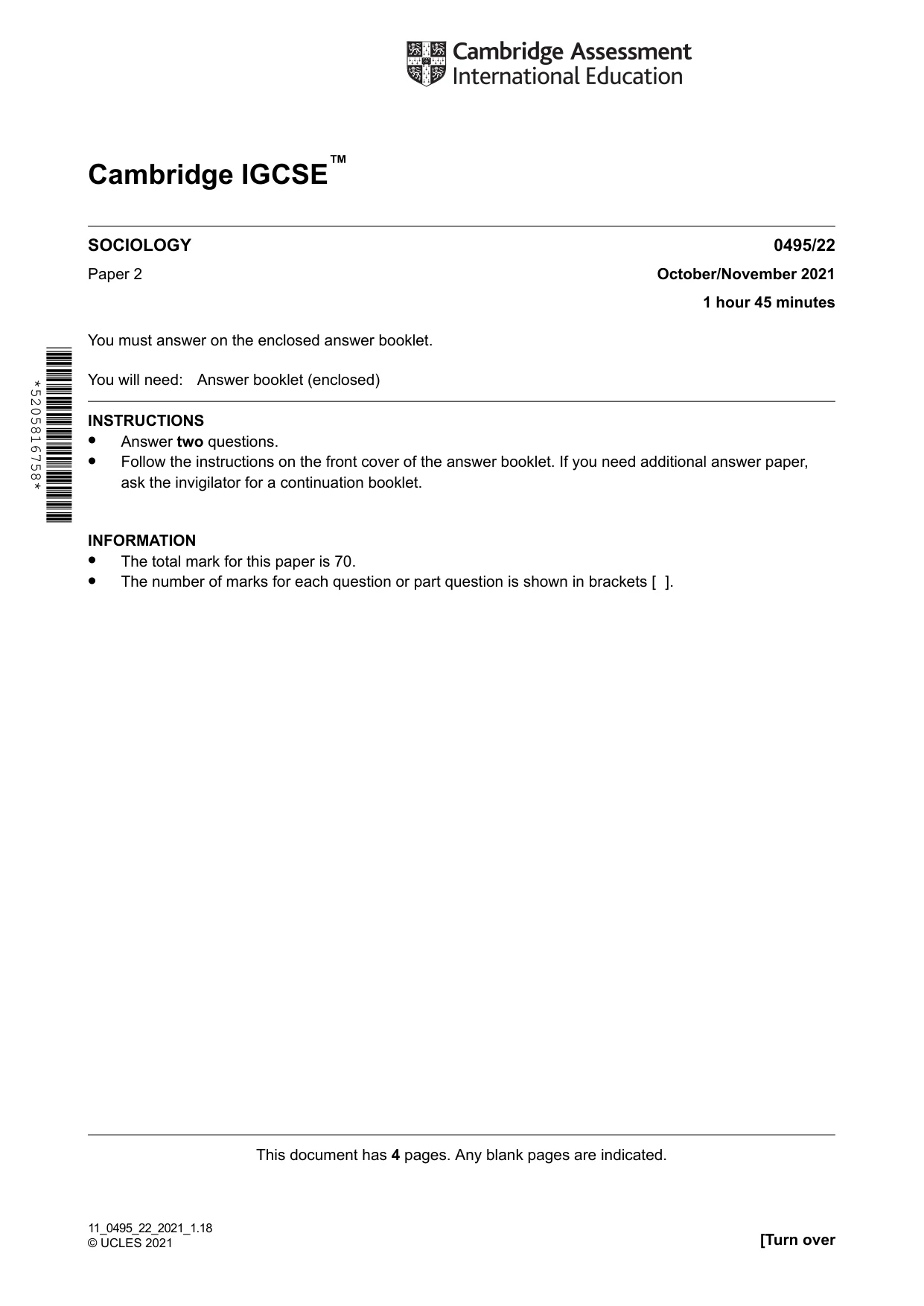
Question paper4 pages

Mark scheme31 pages
Answers below. Sit the paper first if you are practising.





Questions as text
Q1 · Marriage and family relationships are constantly changing in the postmodern world
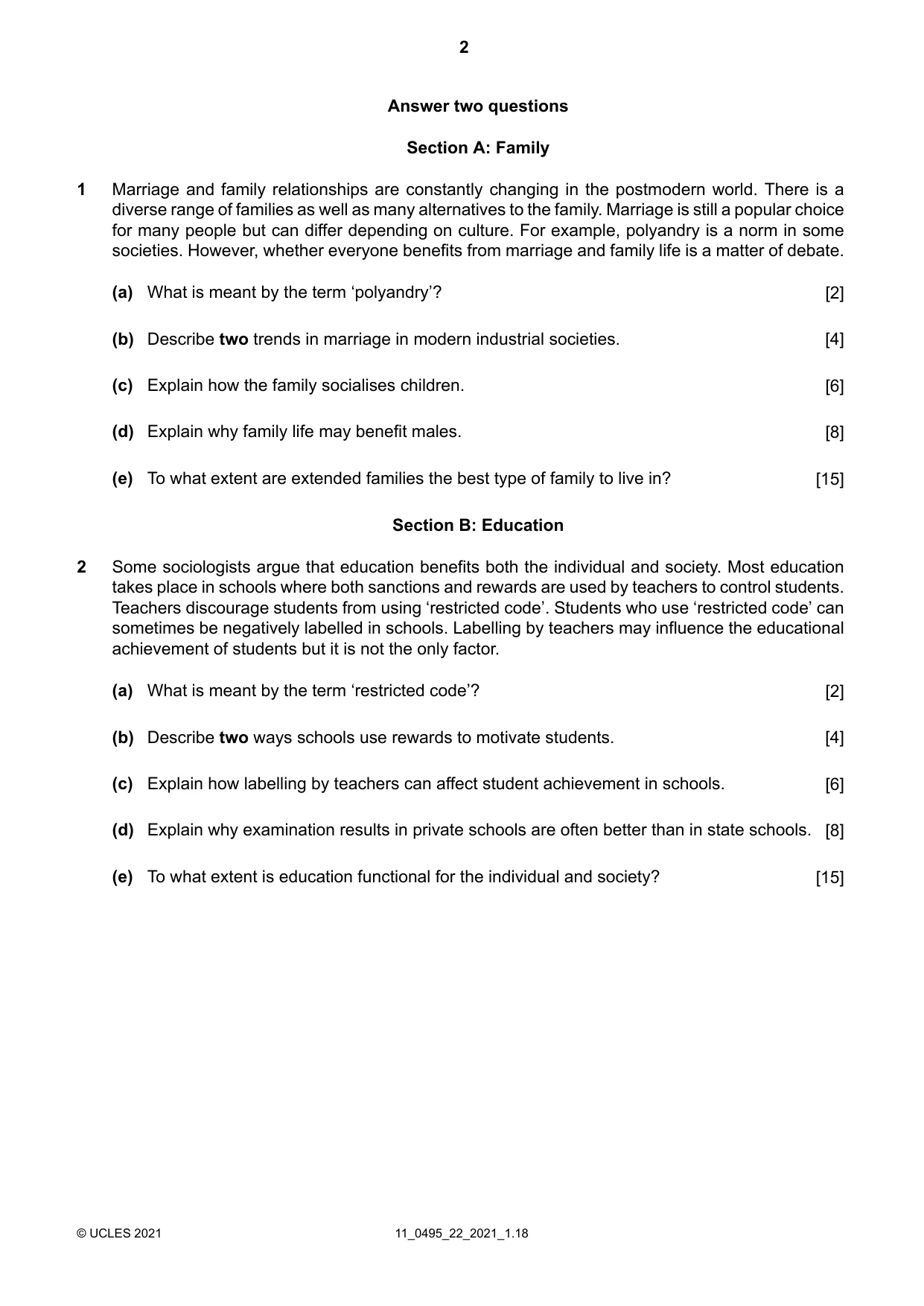
1 Marriage and family relationships are constantly changing in the postmodern world. There is a diverse range of families as well as many alternatives to the family. Marriage is still a popular choice for many people but can differ depending on culture. For example, polyandry is a norm in some societies. However, whether everyone benefits from marriage and family life is a matter of debate. (a) What is meant by the term ‘polyandry’? [2] (b) Describe two trends in marriage in modern industrial societies. [4] (c) Explain how the family socialises children. [6] (d) Explain why family life may benefit males. [8] (e) To what extent are extended families the best type of family to live in? [15]
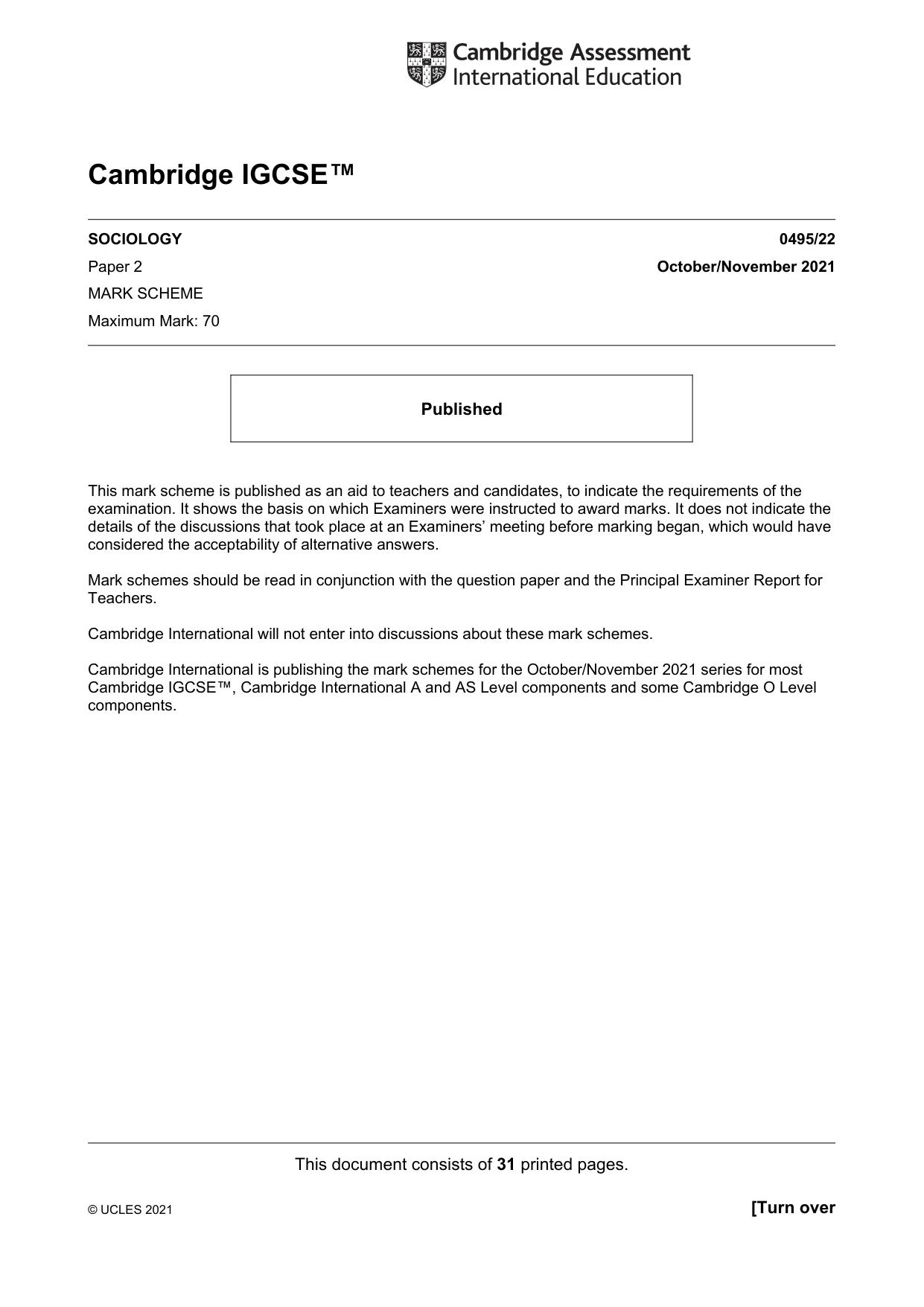
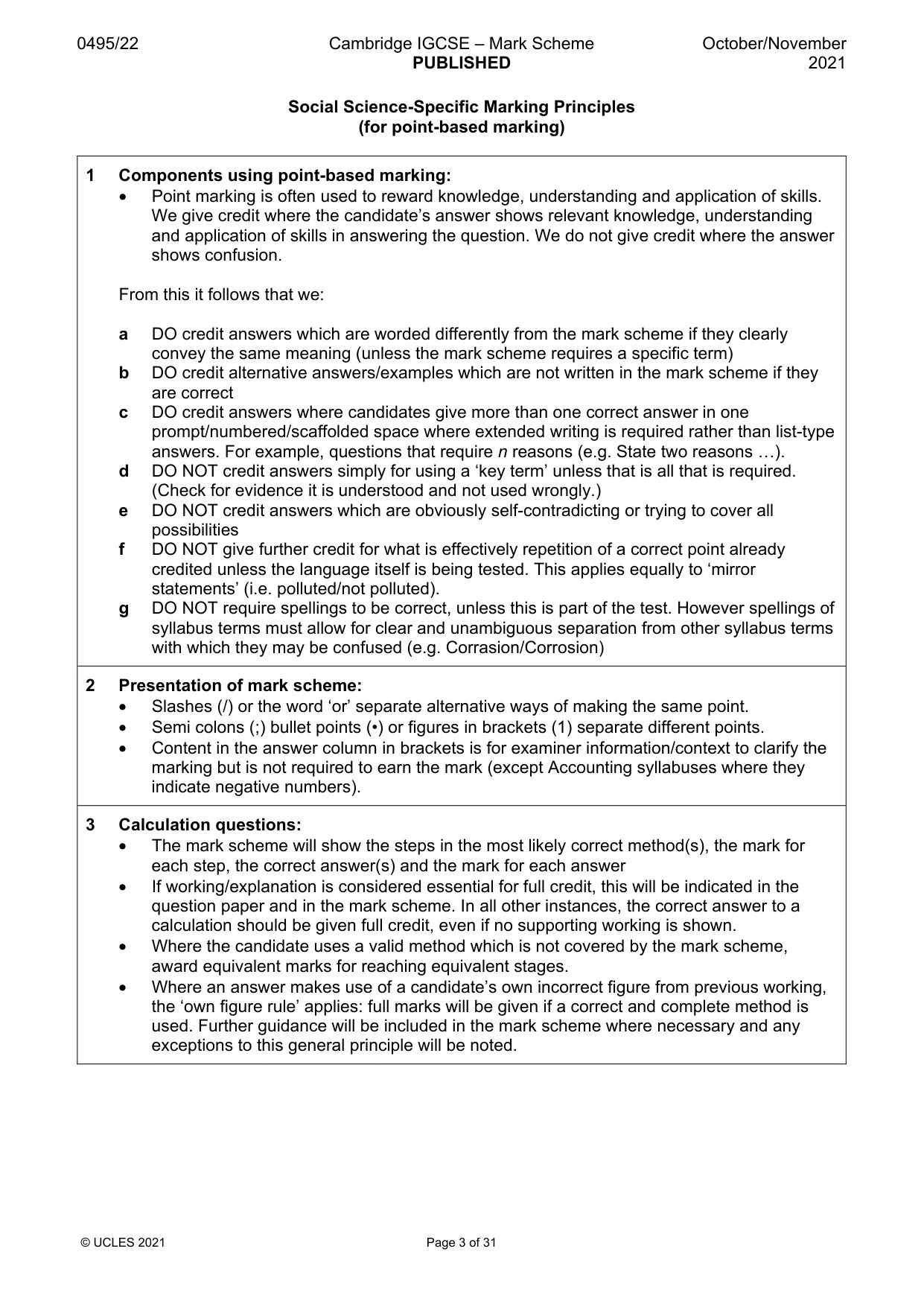
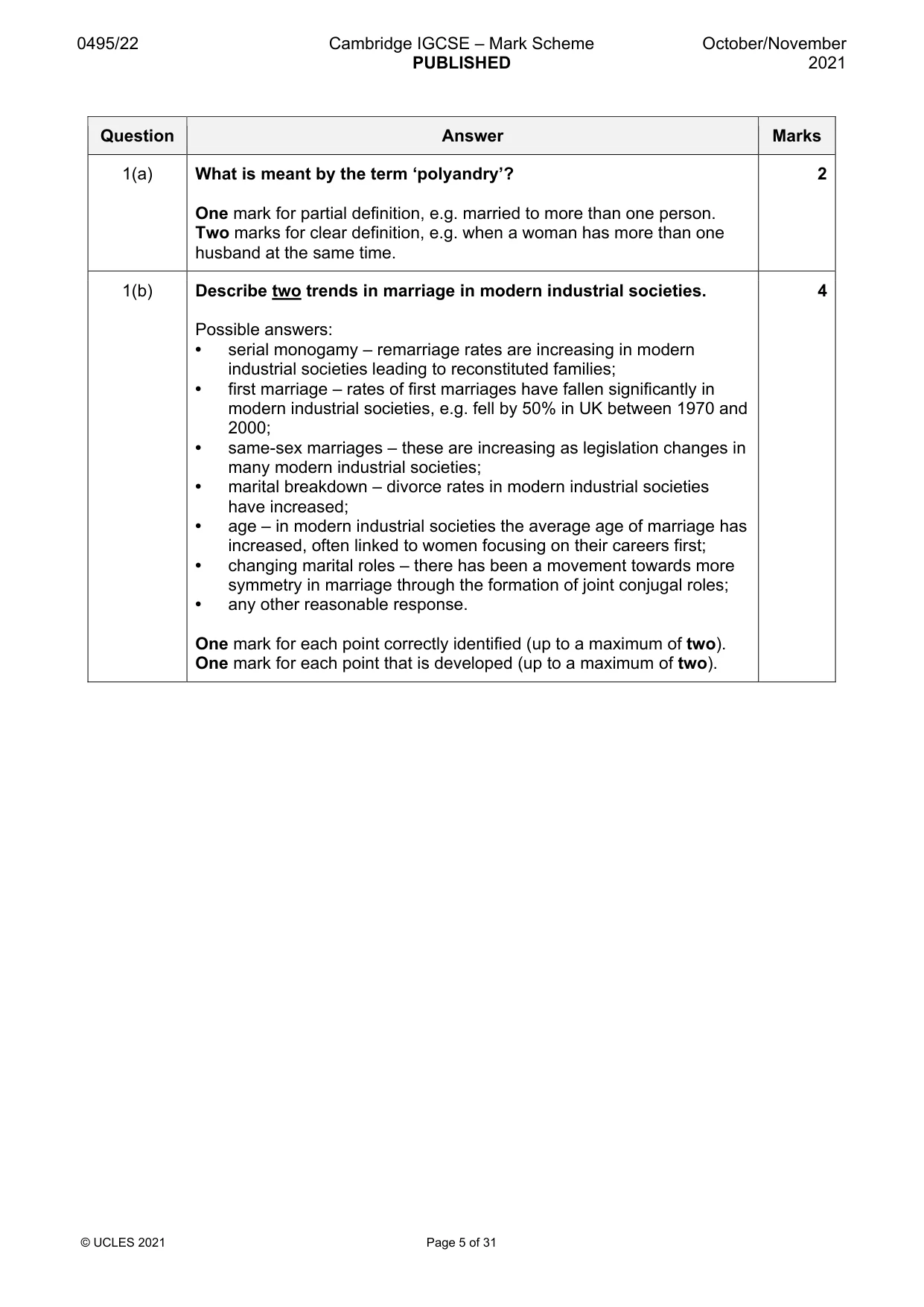
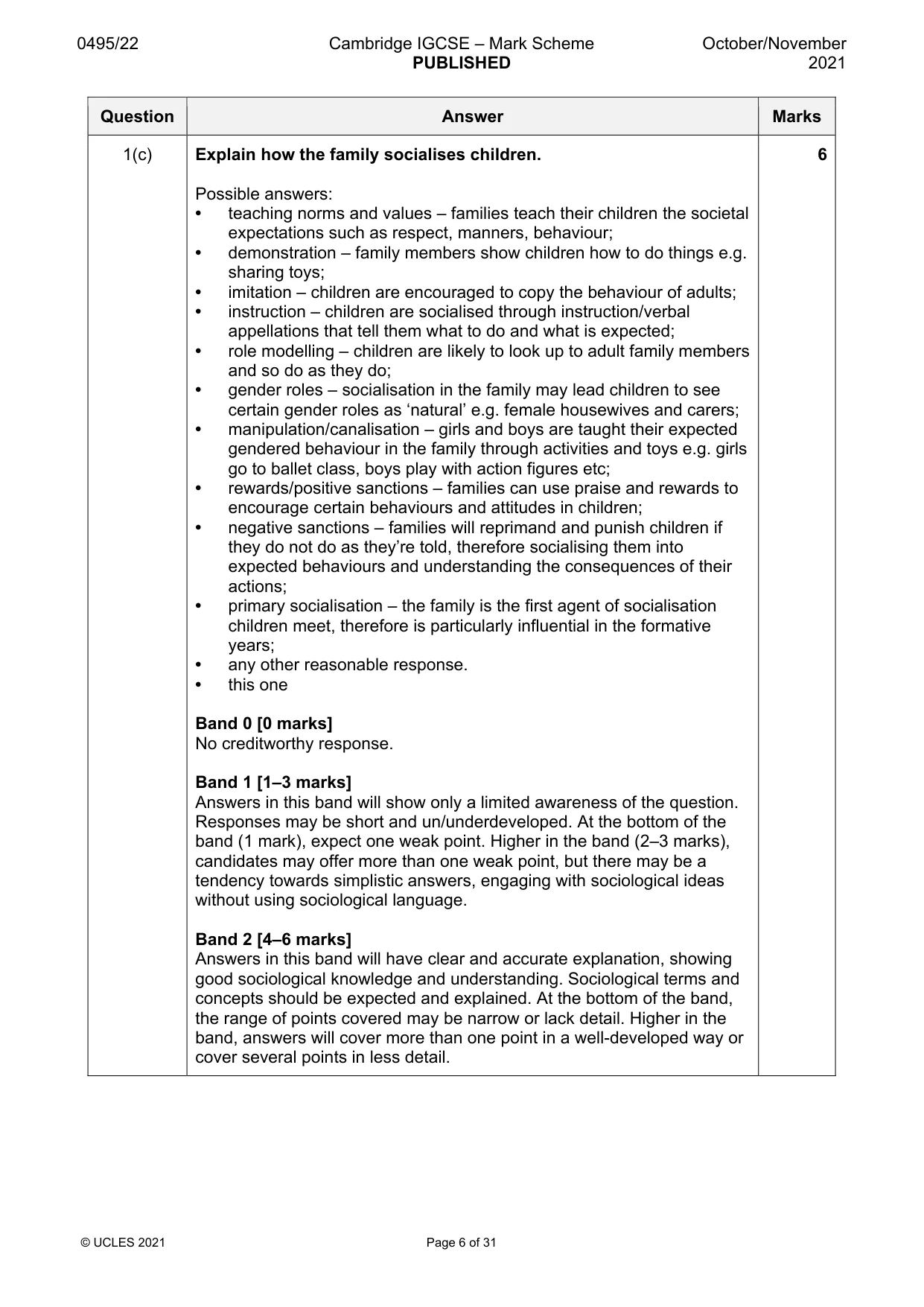
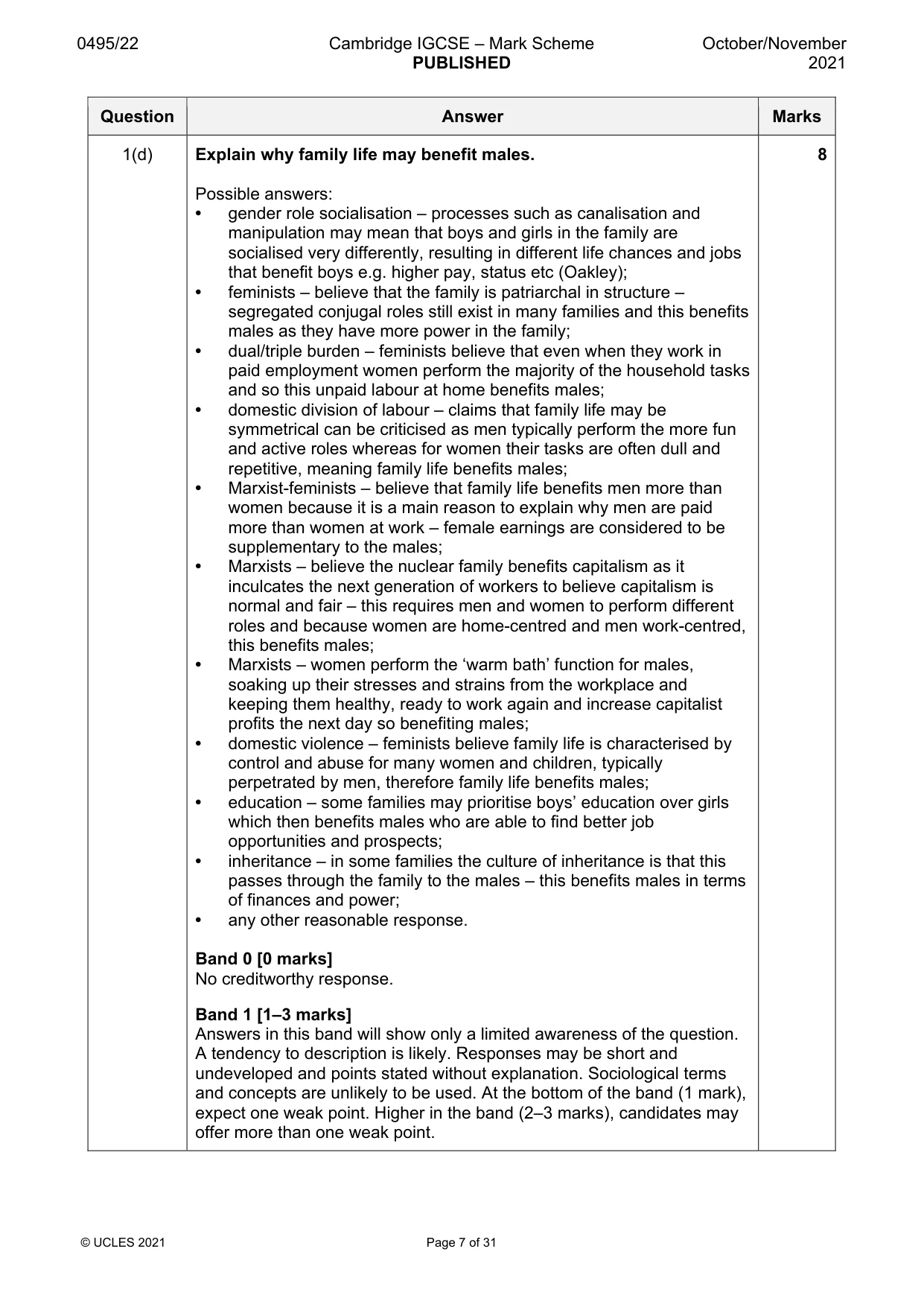
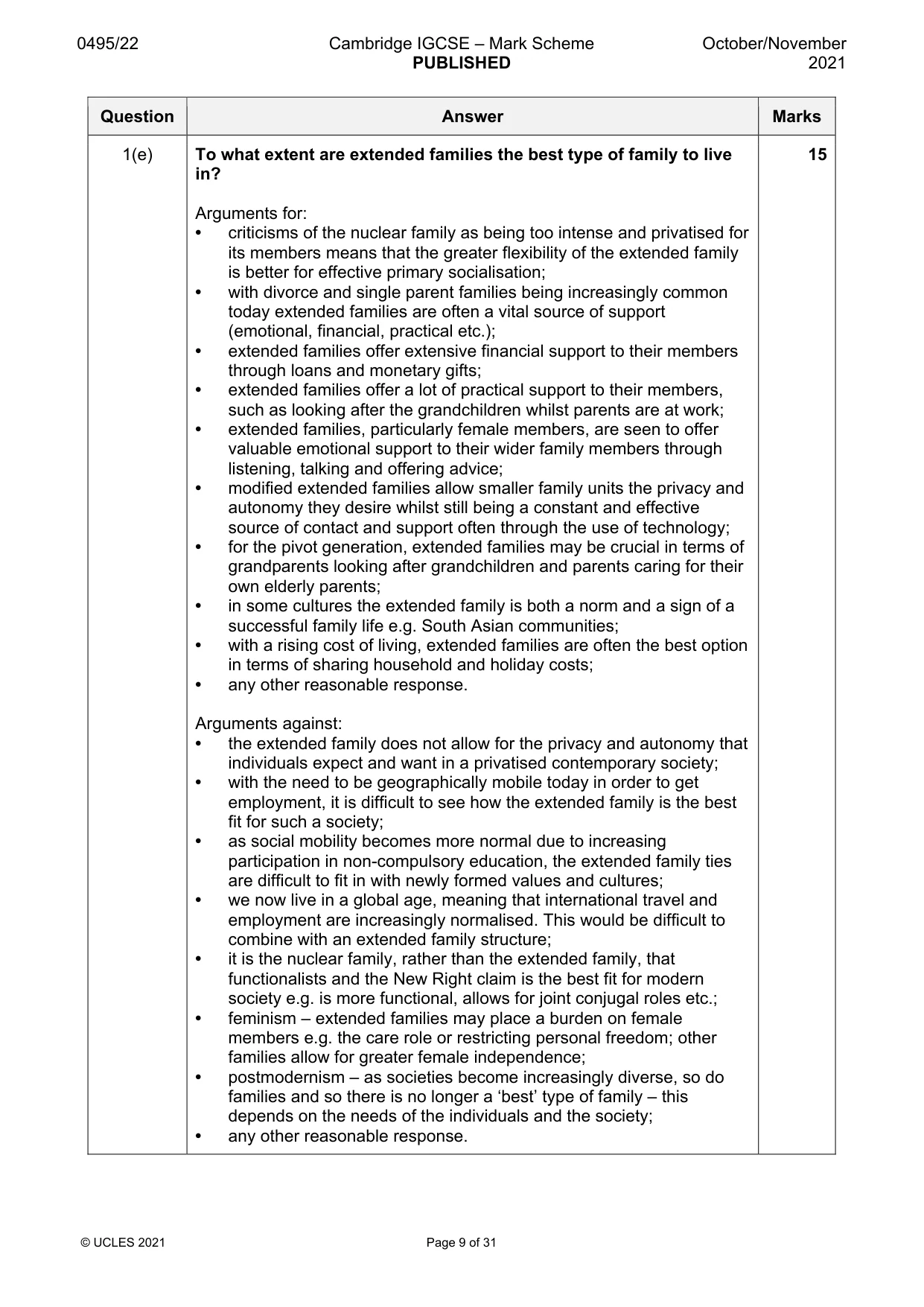
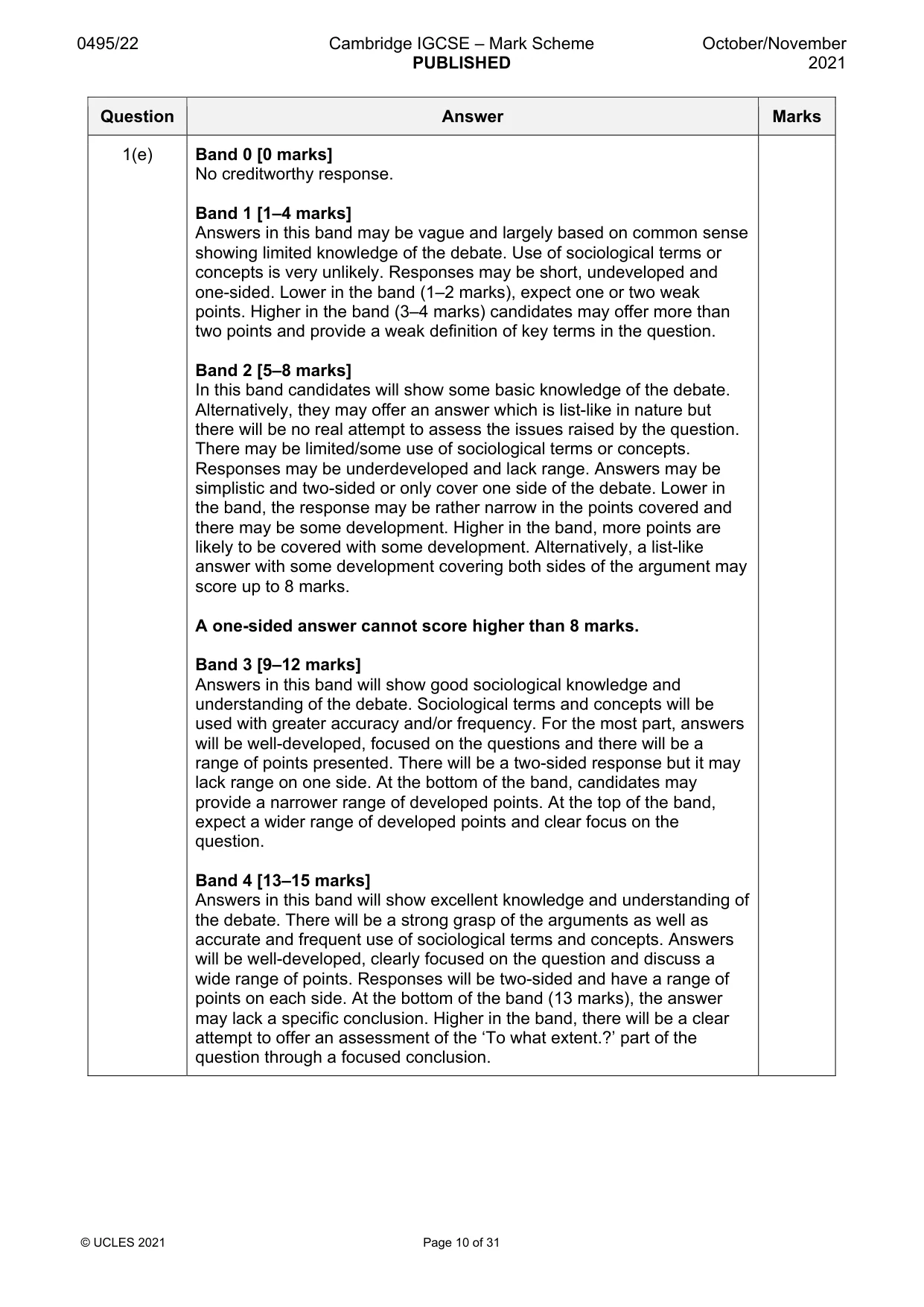
Mark scheme: Question Answer Marks 1(a) What is meant by the term ‘polyandry’? 2 One mark for partial definition, e.g. married to more than one person. Two marks for clear definition, e.g. when a woman has more than one husband at the same time. 1(b) Describe two trends in marriage in modern industrial societies. 4 Possible answers: • serial monogamy – remarriage rates are increasing in modern industrial societies leading to reconstituted families; • first marriage – rates of first marriages have fallen significantly in modern industrial societies, e.g. fell by 50% in UK between 1970 and 2000; • same-sex marriages – these are increasing as legislation changes in many modern industrial societies; • marital breakdown – divorce rates in modern industrial societies have increased; • age – in modern industrial societies the average age of marriage has increased, often linked to women focusing on their careers first; • changing marital roles – there has been a movement towards more symmetry in marriage through the formation of joint conjugal roles; • any other reasonable response. One mark for each point correctly identified (up to a maximum of two). One mark for each point that is developed (up to a maximum of two). 1(c) Explain how the family socialises children. 6 Possible answers: • teaching norms and values – families teach their children the societal expectations such as respect, manners, behaviour; • demonstration – family members show children how to do things e.g. sharing toys; • imitation – children are encouraged to copy the behaviour of adults; • instruction – children are socialised through instruction/verbal appellations that tell them what to do and what is expected; • role modelling – children are likely to look up to adult family members and so do as they do; • gender roles – socialisation in the family may lead children to see certain gender roles as ‘natural’ e.g. female housewives and carers; • manipulation/canalisation – girls and boys are taught their expected gendered behaviour in the family through activities and toys e.g. girls go to ballet class, boys play with action figures etc; • rewards/positive sanctions – families can use praise and rewards to encourage certain behaviours and attitudes in children; • negative sanctions – families will reprimand and punish children if they do not do as they’re told, therefore socialising them into expected behaviours and understanding the consequences of their actions; • primary socialisation – the family is the first agent of socialisation children meet, therefore is particularly influential in the formative years; • any other reasonable response. • this one Band 0 [0 marks] No creditworthy response. Band 1 [1–3 marks] Answers in this band will show only a limited awareness of the question. Responses may be short and un/underdeveloped. At the bottom of the band (1 mark), expect one weak point. Higher in the band (2–3 marks), candidates may offer more than one weak point, but there may be a tendency towards simplistic answers, engaging with sociological ideas without using sociological language. Band 2 [4–6 marks] Answers in this band will have clear and accurate explanation, showing good sociological knowledge and understanding. Sociological terms and concepts should be expected and explained. At the bottom of the band, the range of points covered may be narrow or lack detail. Higher in the band, answers will cover more than one point in a well-developed way or cover several points in less detail. 1(d) Explain why family life may benefit males. 8 Possible answers: • gender role socialisation – processes such as canalisation and manipulation may mean that boys and girls in the family are socialised very differently, resulting in different life chances and jobs that benefit boys e.g. higher pay, status etc (Oakley); • feminists – believe that the family is patriarchal in structure – segregated conjugal roles still exist in many families and this benefits males as they have more power in the family; • dual/triple burden – feminists believe that even when they work in paid employment women perform the majority of the household tasks and so this unpaid labour at home benefits males; • domestic division of labour – claims that family life may be symmetrical can be criticised as men typically perform the more fun and active roles whereas for women their tasks are often dull and repetitive, meaning family life benefits males; • Marxist-feminists – believe that family life benefits men more than women because it is a main reason to explain why men are paid more than women at work – female earnings are considered to be supplementary to the males; • Marxists – believe the nuclear family benefits capitalism as it inculcates the next generation of workers to believe capitalism is normal and fair – this requires men and women to perform different roles and because women are home-centred and men work-centred, this benefits males; • Marxists – women perform the ‘warm bath’ function for males, soaking up their stresses and strains from the workplace and keeping them healthy, ready to work again and increase capitalist profits the next day so benefiting males; • domestic violence – feminists believe family life is characterised by control and abuse for many women and children, typically perpetrated by men, therefore family life benefits males; • education – some families may prioritise boys’ education over girls which then benefits males who are able to find better job opportunities and prospects; • inheritance – in some families the culture of inheritance is that this passes through the family to the males – this benefits males in terms of finances and power; • any other reasonable response. Band 0 [0 marks] No creditworthy response. Band 1 [1–3 marks] Answers in this band will show only a limited awareness of the question. A tendency to description is likely. Responses may be short and undeveloped and points stated without explanation. Sociological terms and concepts are unlikely to be used. At the bottom of the band (1 mark), expect one weak point. Higher in the band (2–3 marks), candidates may offer more than one weak point. 1(d) Band 2 [4–6 marks] Answers in this band will show basic sociological knowledge and understanding. Responses may be underdeveloped and lacking in range. At the bottom of the band, candidates are unlikely to use sociological terms and concepts accurately. Higher in the band, candidates may be beginning to use sociological terms and concepts with greater accuracy. However, some aspects of the answer may only be partially developed/explained. Band 3 [7–8 marks] Answers in this band will show good sociological knowledge and understanding and will be well-developed and explained. Sociological terms and concepts will be used accurately overall. Answers will be well- focused on the question and there will be a range of points presented. At the top of the band explanations will be clear throughout. 1(e) To what extent are extended families the best type of family to live 15 in? Arguments for: • criticisms of the nuclear family as being too intense and privatised for its members means that the greater flexibility of the extended family is better for effective primary socialisation; • with divorce and single parent families being increasingly common today extended families are often a vital source of support (emotional, financial, practical etc.); • extended families offer extensive financial support to their members through loans and monetary gifts; • extended families offer a lot of practical support to their members, such as looking after the grandchildren whilst parents are at work; • extended families, particularly female members, are seen to offer valuable emotional support to their wider family members through listening, talking and offering advice; • modified extended families allow smaller family units the privacy and autonomy they desire whilst still being a constant and effective source of contact and support often through the use of technology; • for the pivot generation, extended families may be crucial in terms of grandparents looking after grandchildren and parents caring for their own elderly parents; • in some cultures the extended family is both a norm and a sign of a successful family life e.g. South Asian communities; • with a rising cost of living, extended families are often the best option in terms of sharing household and holiday costs; • any other reasonable response. Arguments against: • the extended family does not allow for the privacy and autonomy that individuals expect and want in a privatised contemporary society; • with the need to be geographically mobile today in order to get employment, it is difficult to see how the extended family is the best fit for such a society; • as social mobility becomes more normal due to increasing participation in non-compulsory education, the extended family ties are difficult to fit in with newly formed values and cultures; • we now live in a global age, meaning that international travel and employment are increasingly normalised. This would be difficult to combine with an extended family structure; • it is the nuclear family, rather than the extended family, that functionalists and the New Right claim is the best fit for modern society e.g. is more functional, allows for joint conjugal roles etc.; • feminism – extended families may place a burden on female members e.g. the care role or restricting personal freedom; other families allow for greater female independence; • postmodernism – as societies become increasingly diverse, so do families and so there is no longer a ‘best’ type of family – this depends on the needs of the individuals and the society; • any other reasonable response. 1(e) Band 0 [0 marks] No creditworthy response. Band 1 [1–4 marks] Answers in this band may be vague and largely based on common sense showing limited knowledge of the debate. Use of sociological terms or concepts is very unlikely. Responses may be short, undeveloped and one-sided. Lower in the band (1–2 marks), expect one or two weak points. Higher in the band (3–4 marks) candidates may offer more than two points and provide a weak definition of key terms in the question. Band 2 [5–8 marks] In this band candidates will show some basic knowledge of the debate. Alternatively, they may offer an answer which is list-like in nature but there will be no real attempt to assess the issues raised by the question. There may be limited/some use of sociological terms or concepts. Responses may be underdeveloped and lack range. Answers may be simplistic and two-sided or only cover one side of the debate. Lower in the band, the response may be rather narrow in the points covered and there may be some development. Higher in the band, more points are likely to be covered with some development. Alternatively, a list-like answer with some development covering both sides of the argument may score up to 8 marks. A one-sided answer cannot score higher than 8 marks. Band 3 [9–12 marks] Answers in this band will show good sociological knowledge and understanding of the debate. Sociological terms and concepts will be used with greater accuracy and/or frequency. For the most part, answers will be well-developed, focused on the questions and there will be a range of points presented. There will be a two-sided response but it may lack range on one side. At the bottom of the band, candidates may provide a narrower range of developed points. At the top of the band, expect a wider range of developed points and clear focus on the question. Band 4 [13–15 marks] Answers in this band will show excellent knowledge and understanding of the debate. There will be a strong grasp of the arguments as well as accurate and frequent use of sociological terms and concepts. Answers will be well-developed, clearly focused on the question and discuss a wide range of points. Responses will be two-sided and have a range of points on each side. At the bottom of the band (13 marks), the answer may lack a specific conclusion. Higher in the band, there will be a clear attempt to offer an assessment of the ‘To what extent.?’ part of the question through a focused conclusion.
Q2 · Some sociologists argue that education benefits both the individual and society
2 Some sociologists argue that education benefits both the individual and society. Most education takes place in schools where both sanctions and rewards are used by teachers to control students. Teachers discourage students from using ‘restricted code’. Students who use ‘restricted code’ can sometimes be negatively labelled in schools. Labelling by teachers may influence the educational achievement of students but it is not the only factor. (a) What is meant by the term ‘restricted code’? [2] (b) Describe two ways schools use rewards to motivate students. [4] (c) Explain how labelling by teachers can affect student achievement in schools. [6] (d) Explain why examination results in private schools are often better than in state schools. [8] (e) To what extent is education functional for the individual and society? [15] Section C: Crime, deviance and social control
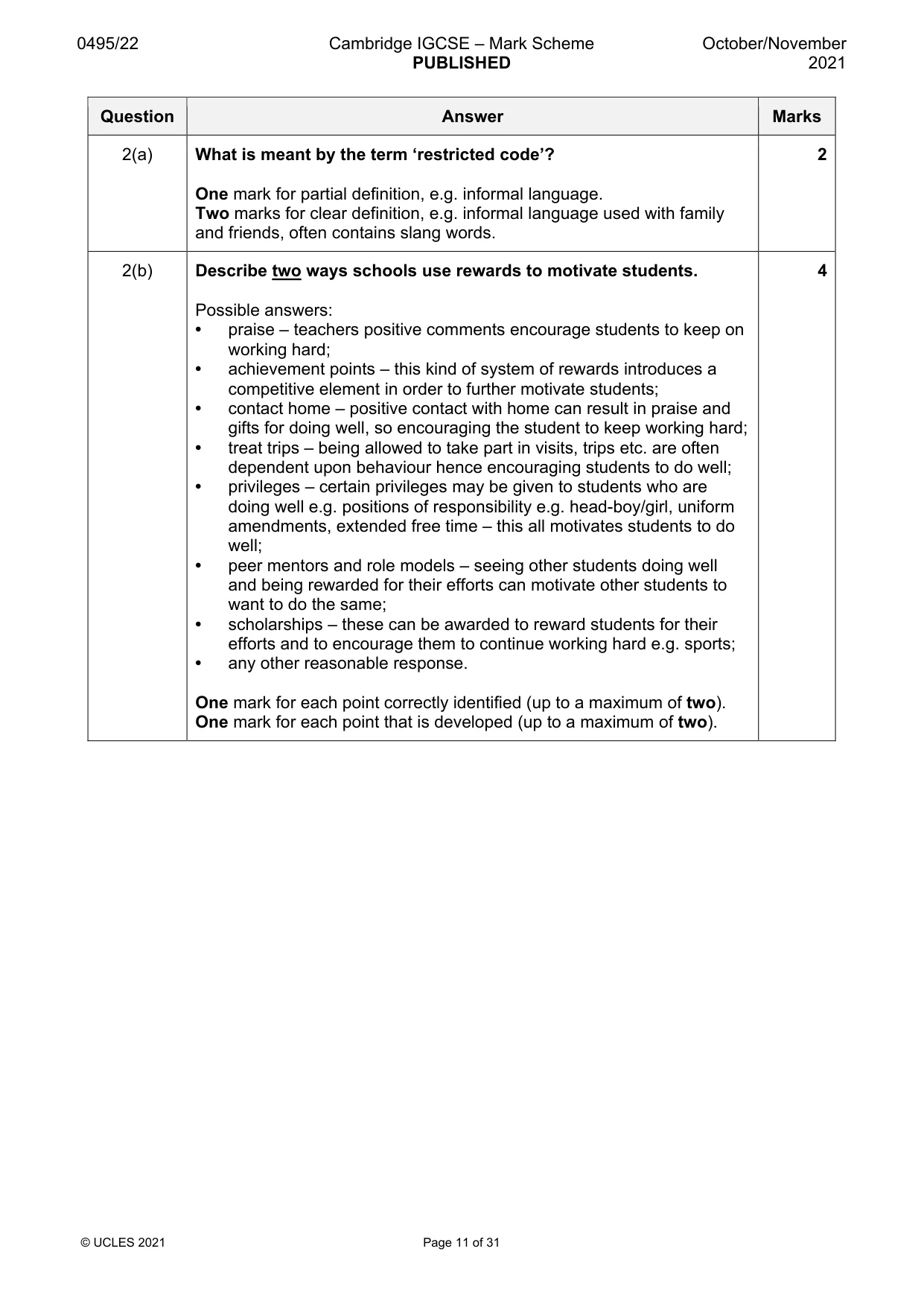
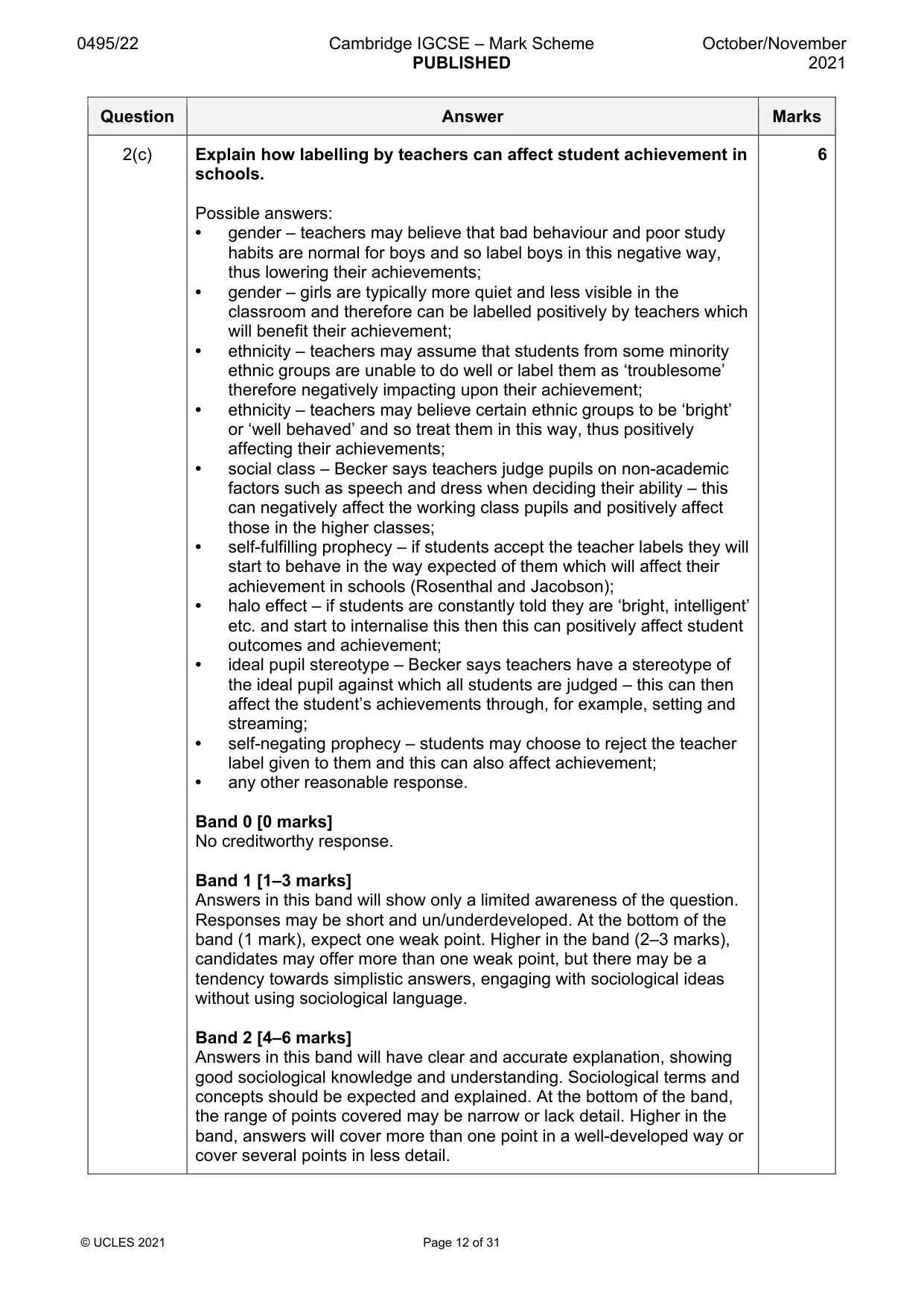
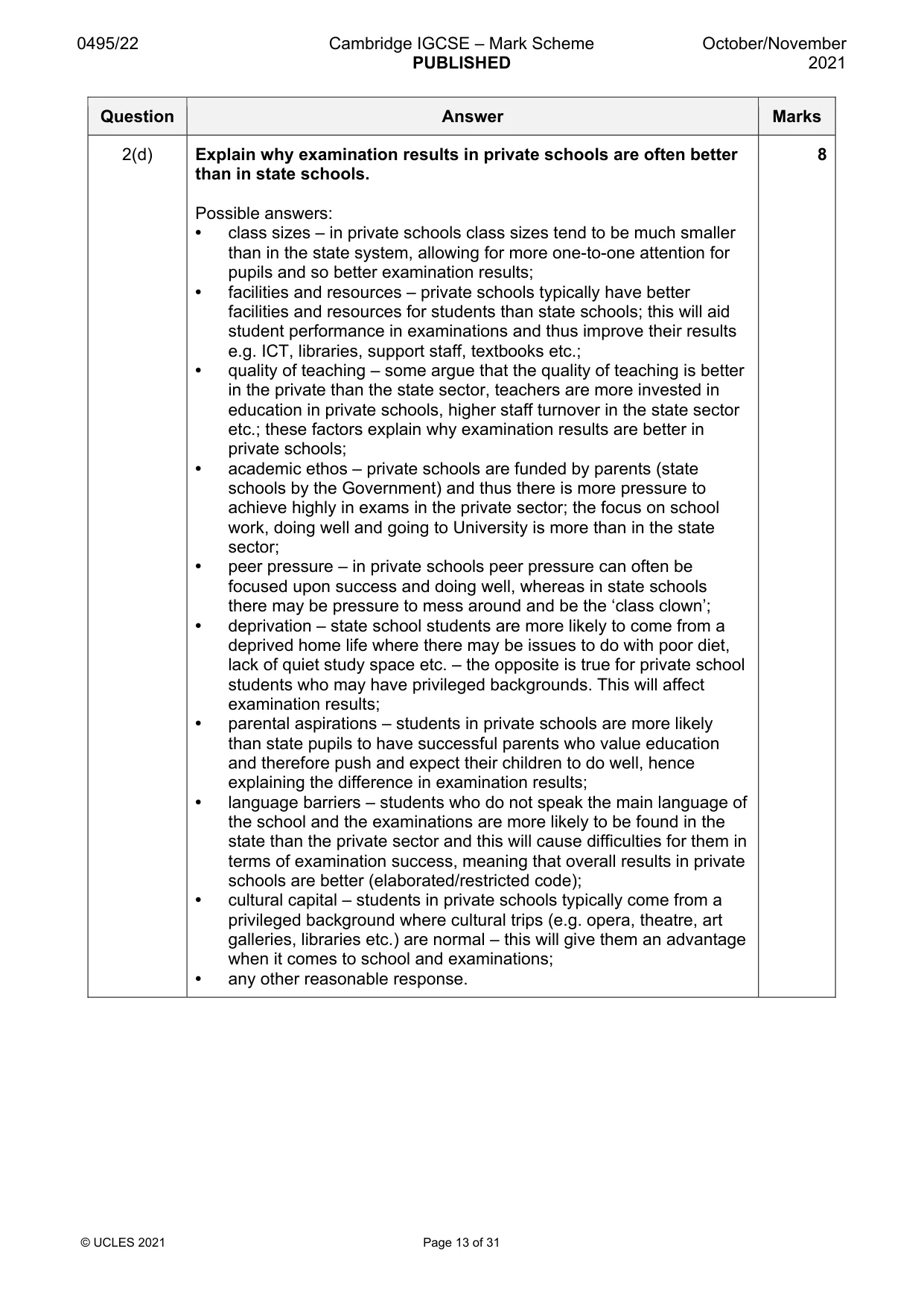
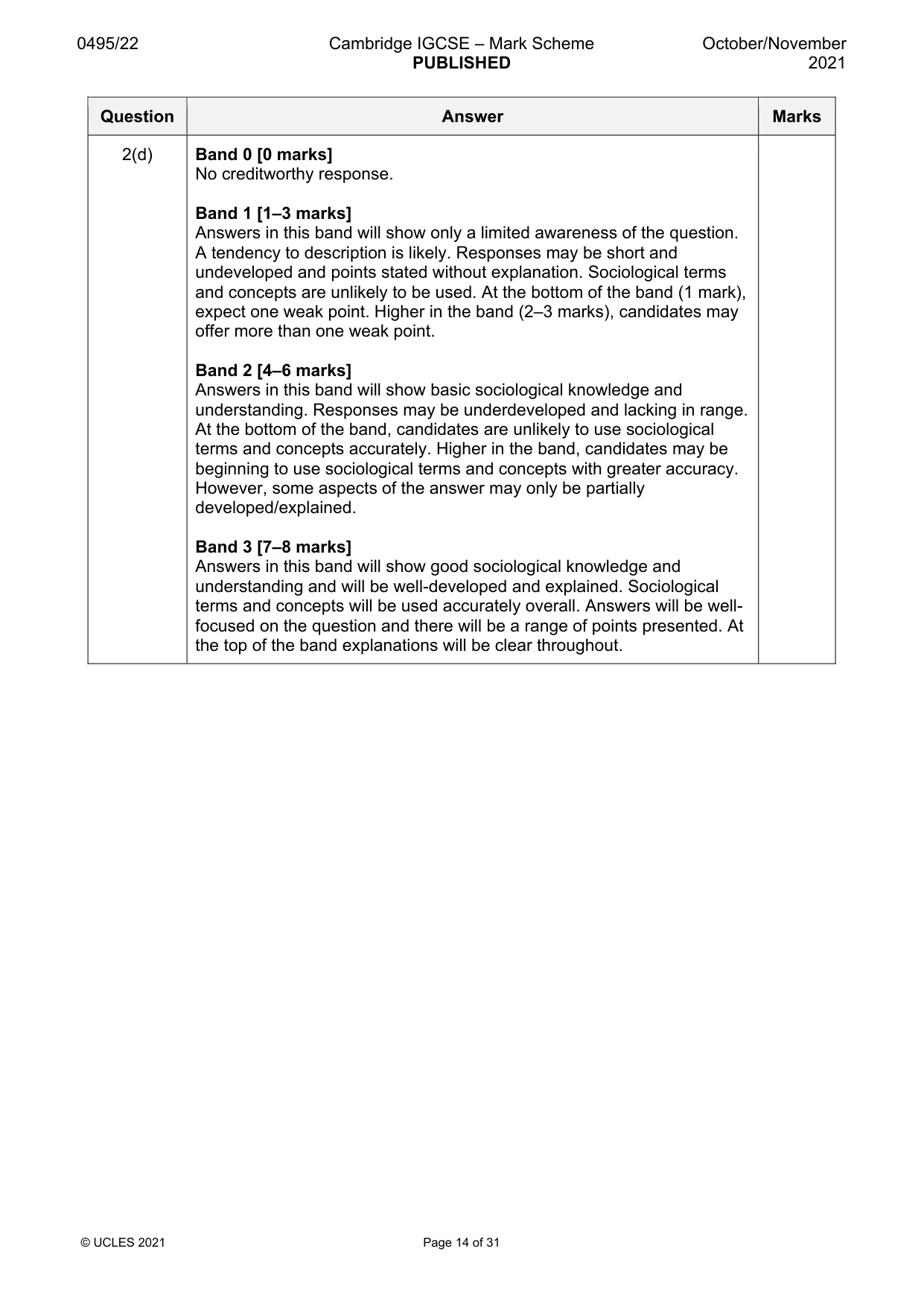
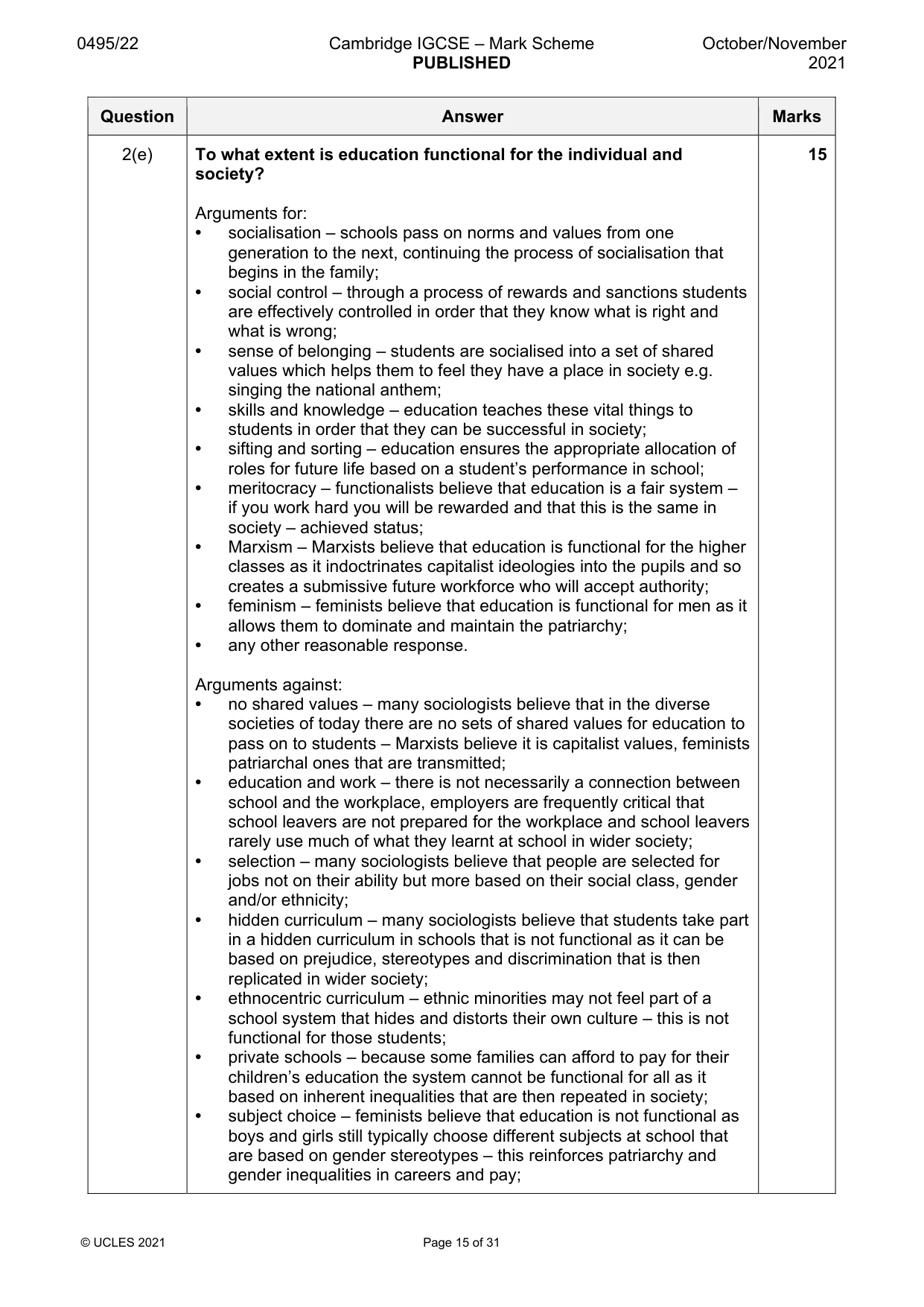
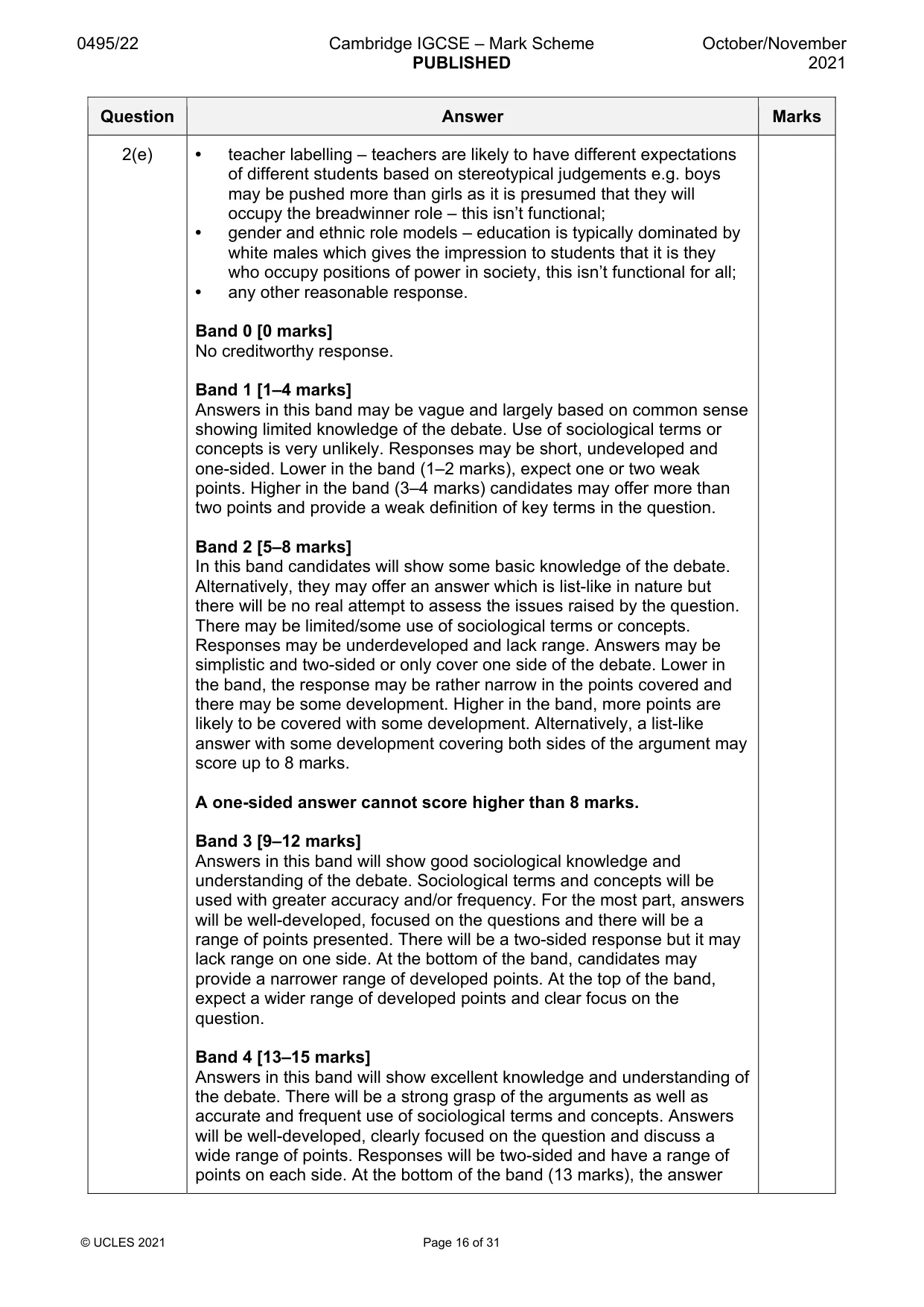
Mark scheme: 2(a) What is meant by the term ‘restricted code’? 2 One mark for partial definition, e.g. informal language. Two marks for clear definition, e.g. informal language used with family and friends, often contains slang words. 2(b) Describe two ways schools use rewards to motivate students. 4 Possible answers: • praise – teachers positive comments encourage students to keep on working hard; • achievement points – this kind of system of rewards introduces a competitive element in order to further motivate students; • contact home – positive contact with home can result in praise and gifts for doing well, so encouraging the student to keep working hard; • treat trips – being allowed to take part in visits, trips etc. are often dependent upon behaviour hence encouraging students to do well; • privileges – certain privileges may be given to students who are doing well e.g. positions of responsibility e.g. head-boy/girl, uniform amendments, extended free time – this all motivates students to do well; • peer mentors and role models – seeing other students doing well and being rewarded for their efforts can motivate other students to want to do the same; • scholarships – these can be awarded to reward students for their efforts and to encourage them to continue working hard e.g. sports; • any other reasonable response. One mark for each point correctly identified (up to a maximum of two). One mark for each point that is developed (up to a maximum of two). 2(c) Explain how labelling by teachers can affect student achievement in 6 schools. Possible answers: • gender – teachers may believe that bad behaviour and poor study habits are normal for boys and so label boys in this negative way, thus lowering their achievements; • gender – girls are typically more quiet and less visible in the classroom and therefore can be labelled positively by teachers which will benefit their achievement; • ethnicity – teachers may assume that students from some minority ethnic groups are unable to do well or label them as ‘troublesome’ therefore negatively impacting upon their achievement; • ethnicity – teachers may believe certain ethnic groups to be ‘bright’ or ‘well behaved’ and so treat them in this way, thus positively affecting their achievements; • social class – Becker says teachers judge pupils on non-academic factors such as speech and dress when deciding their ability – this can negatively affect the working class pupils and positively affect those in the higher classes; • self-fulfilling prophecy – if students accept the teacher labels they will start to behave in the way expected of them which will affect their achievement in schools (Rosenthal and Jacobson); • halo effect – if students are constantly told they are ‘bright, intelligent’ etc. and start to internalise this then this can positively affect student outcomes and achievement; • ideal pupil stereotype – Becker says teachers have a stereotype of the ideal pupil against which all students are judged – this can then affect the student’s achievements through, for example, setting and streaming; • self-negating prophecy – students may choose to reject the teacher label given to them and this can also affect achievement; • any other reasonable response. Band 0 [0 marks] No creditworthy response. Band 1 [1–3 marks] Answers in this band will show only a limited awareness of the question. Responses may be short and un/underdeveloped. At the bottom of the band (1 mark), expect one weak point. Higher in the band (2–3 marks), candidates may offer more than one weak point, but there may be a tendency towards simplistic answers, engaging with sociological ideas without using sociological language. Band 2 [4–6 marks] Answers in this band will have clear and accurate explanation, showing good sociological knowledge and understanding. Sociological terms and concepts should be expected and explained. At the bottom of the band, the range of points covered may be narrow or lack detail. Higher in the band, answers will cover more than one point in a well-developed way or cover several points in less detail. 2(d) Explain why examination results in private schools are often better 8 than in state schools. Possible answers: • class sizes – in private schools class sizes tend to be much smaller than in the state system, allowing for more one-to-one attention for pupils and so better examination results; • facilities and resources – private schools typically have better facilities and resources for students than state schools; this will aid student performance in examinations and thus improve their results e.g. ICT, libraries, support staff, textbooks etc.; • quality of teaching – some argue that the quality of teaching is better in the private than the state sector, teachers are more invested in education in private schools, higher staff turnover in the state sector etc.; these factors explain why examination results are better in private schools; • academic ethos – private schools are funded by parents (state schools by the Government) and thus there is more pressure to achieve highly in exams in the private sector; the focus on school work, doing well and going to University is more than in the state sector; • peer pressure – in private schools peer pressure can often be focused upon success and doing well, whereas in state schools there may be pressure to mess around and be the ‘class clown’; • deprivation – state school students are more likely to come from a deprived home life where there may be issues to do with poor diet, lack of quiet study space etc. – the opposite is true for private school students who may have privileged backgrounds. This will affect examination results; • parental aspirations – students in private schools are more likely than state pupils to have successful parents who value education and therefore push and expect their children to do well, hence explaining the difference in examination results; • language barriers – students who do not speak the main language of the school and the examinations are more likely to be found in the state than the private sector and this will cause difficulties for them in terms of examination success, meaning that overall results in private schools are better (elaborated/restricted code); • cultural capital – students in private schools typically come from a privileged background where cultural trips (e.g. opera, theatre, art galleries, libraries etc.) are normal – this will give them an advantage when it comes to school and examinations; • any other reasonable response. 2(d) Band 0 [0 marks] No creditworthy response. Band 1 [1–3 marks] Answers in this band will show only a limited awareness of the question. A tendency to description is likely. Responses may be short and undeveloped and points stated without explanation. Sociological terms and concepts are unlikely to be used. At the bottom of the band (1 mark), expect one weak point. Higher in the band (2–3 marks), candidates may offer more than one weak point. Band 2 [4–6 marks] Answers in this band will show basic sociological knowledge and understanding. Responses may be underdeveloped and lacking in range. At the bottom of the band, candidates are unlikely to use sociological terms and concepts accurately. Higher in the band, candidates may be beginning to use sociological terms and concepts with greater accuracy. However, some aspects of the answer may only be partially developed/explained. Band 3 [7–8 marks] Answers in this band will show good sociological knowledge and understanding and will be well-developed and explained. Sociological terms and concepts will be used accurately overall. Answers will be well- focused on the question and there will be a range of points presented. At the top of the band explanations will be clear throughout. 2(e) To what extent is education functional for the individual and 15 society? Arguments for: • socialisation – schools pass on norms and values from one generation to the next, continuing the process of socialisation that begins in the family; • social control – through a process of rewards and sanctions students are effectively controlled in order that they know what is right and what is wrong; • sense of belonging – students are socialised into a set of shared values which helps them to feel they have a place in society e.g. singing the national anthem; • skills and knowledge – education teaches these vital things to students in order that they can be successful in society; • sifting and sorting – education ensures the appropriate allocation of roles for future life based on a student’s performance in school; • meritocracy – functionalists believe that education is a fair system – if you work hard you will be rewarded and that this is the same in society – achieved status; • Marxism – Marxists believe that education is functional for the higher classes as it indoctrinates capitalist ideologies into the pupils and so creates a submissive future workforce who will accept authority; • feminism – feminists believe that education is functional for men as it allows them to dominate and maintain the patriarchy; • any other reasonable response. Arguments against: • no shared values – many sociologists believe that in the diverse societies of today there are no sets of shared values for education to pass on to students – Marxists believe it is capitalist values, feminists patriarchal ones that are transmitted; • education and work – there is not necessarily a connection between school and the workplace, employers are frequently critical that school leavers are not prepared for the workplace and school leavers rarely use much of what they learnt at school in wider society; • selection – many sociologists believe that people are selected for jobs not on their ability but more based on their social class, gender and/or ethnicity; • hidden curriculum – many sociologists believe that students take part in a hidden curriculum in schools that is not functional as it can be based on prejudice, stereotypes and discrimination that is then replicated in wider society; • ethnocentric curriculum – ethnic minorities may not feel part of a school system that hides and distorts their own culture – this is not functional for those students; • private schools – because some families can afford to pay for their children’s education the system cannot be functional for all as it based on inherent inequalities that are then repeated in society; • subject choice – feminists believe that education is not functional as boys and girls still typically choose different subjects at school that are based on gender stereotypes – this reinforces patriarchy and gender inequalities in careers and pay; 2(e) • teacher labelling – teachers are likely to have different expectations of different students based on stereotypical judgements e.g. boys may be pushed more than girls as it is presumed that they will occupy the breadwinner role – this isn’t functional; • gender and ethnic role models – education is typically dominated by white males which gives the impression to students that it is they who occupy positions of power in society, this isn’t functional for all; • any other reasonable response. Band 0 [0 marks] No creditworthy response. Band 1 [1–4 marks] Answers in this band may be vague and largely based on common sense showing limited knowledge of the debate. Use of sociological terms or concepts is very unlikely. Responses may be short, undeveloped and one-sided. Lower in the band (1–2 marks), expect one or two weak points. Higher in the band (3–4 marks) candidates may offer more than two points and provide a weak definition of key terms in the question. Band 2 [5–8 marks] In this band candidates will show some basic knowledge of the debate. Alternatively, they may offer an answer which is list-like in nature but there will be no real attempt to assess the issues raised by the question. There may be limited/some use of sociological terms or concepts. Responses may be underdeveloped and lack range. Answers may be simplistic and two-sided or only cover one side of the debate. Lower in the band, the response may be rather narrow in the points covered and there may be some development. Higher in the band, more points are likely to be covered with some development. Alternatively, a list-like answer with some development covering both sides of the argument may score up to 8 marks. A one-sided answer cannot score higher than 8 marks. Band 3 [9–12 marks] Answers in this band will show good sociological knowledge and understanding of the debate. Sociological terms and concepts will be used with greater accuracy and/or frequency. For the most part, answers will be well-developed, focused on the questions and there will be a range of points presented. There will be a two-sided response but it may lack range on one side. At the bottom of the band, candidates may provide a narrower range of developed points. At the top of the band, expect a wider range of developed points and clear focus on the question. Band 4 [13–15 marks] Answers in this band will show excellent knowledge and understanding of the debate. There will be a strong grasp of the arguments as well as accurate and frequent use of sociological terms and concepts. Answers will be well-developed, clearly focused on the question and discuss a wide range of points. Responses will be two-sided and have a range of points on each side. At the bottom of the band (13 marks), the answer 2(e) may lack a specific conclusion. Higher in the band, there will be a clear attempt to offer an assessment of the ‘To what extent.?’ part of the question through a focused conclusion.
More questions on How do sociologists approach the study of society?
Q3 · Some social groups are more likely than others to feature in the official crime…
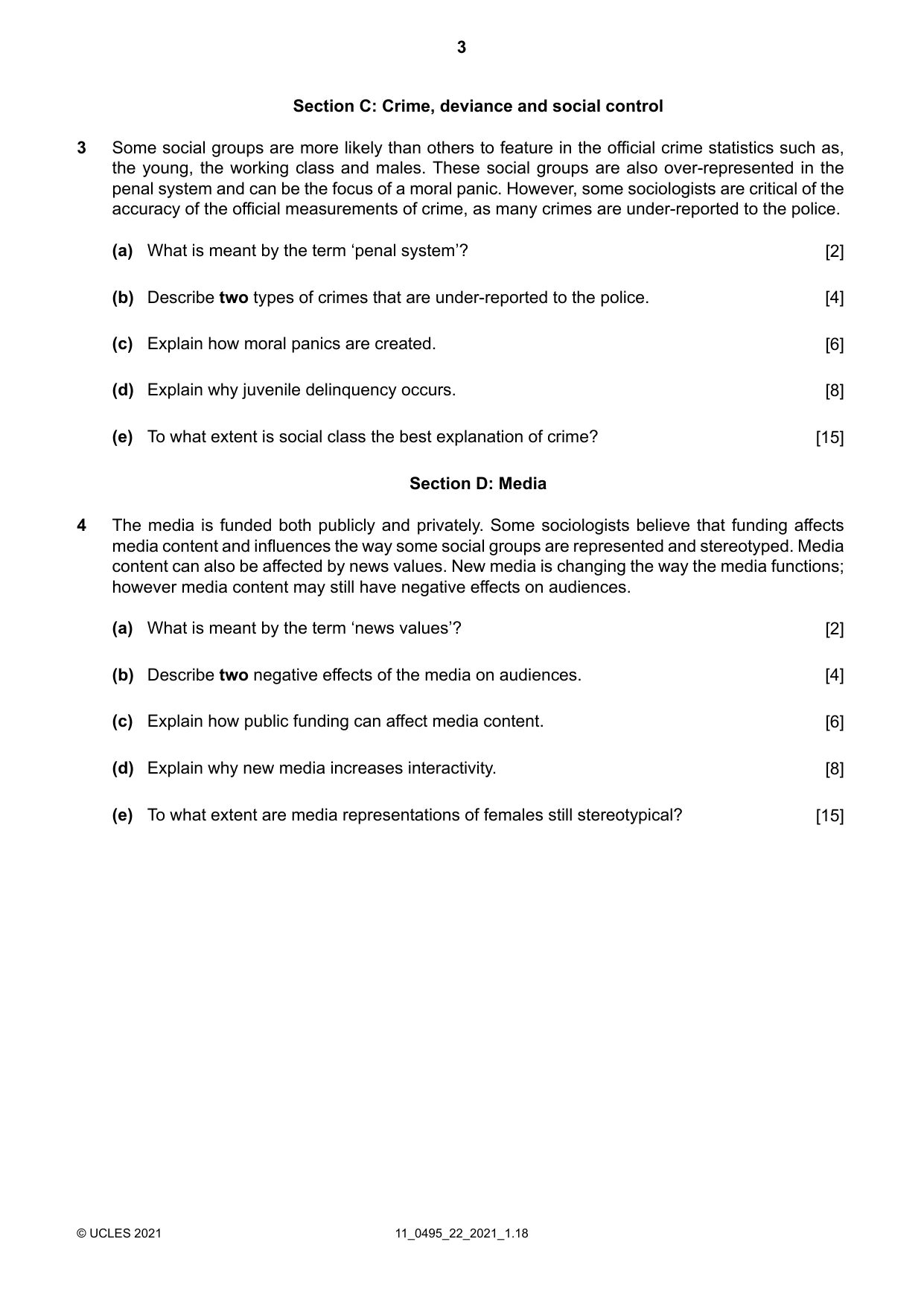
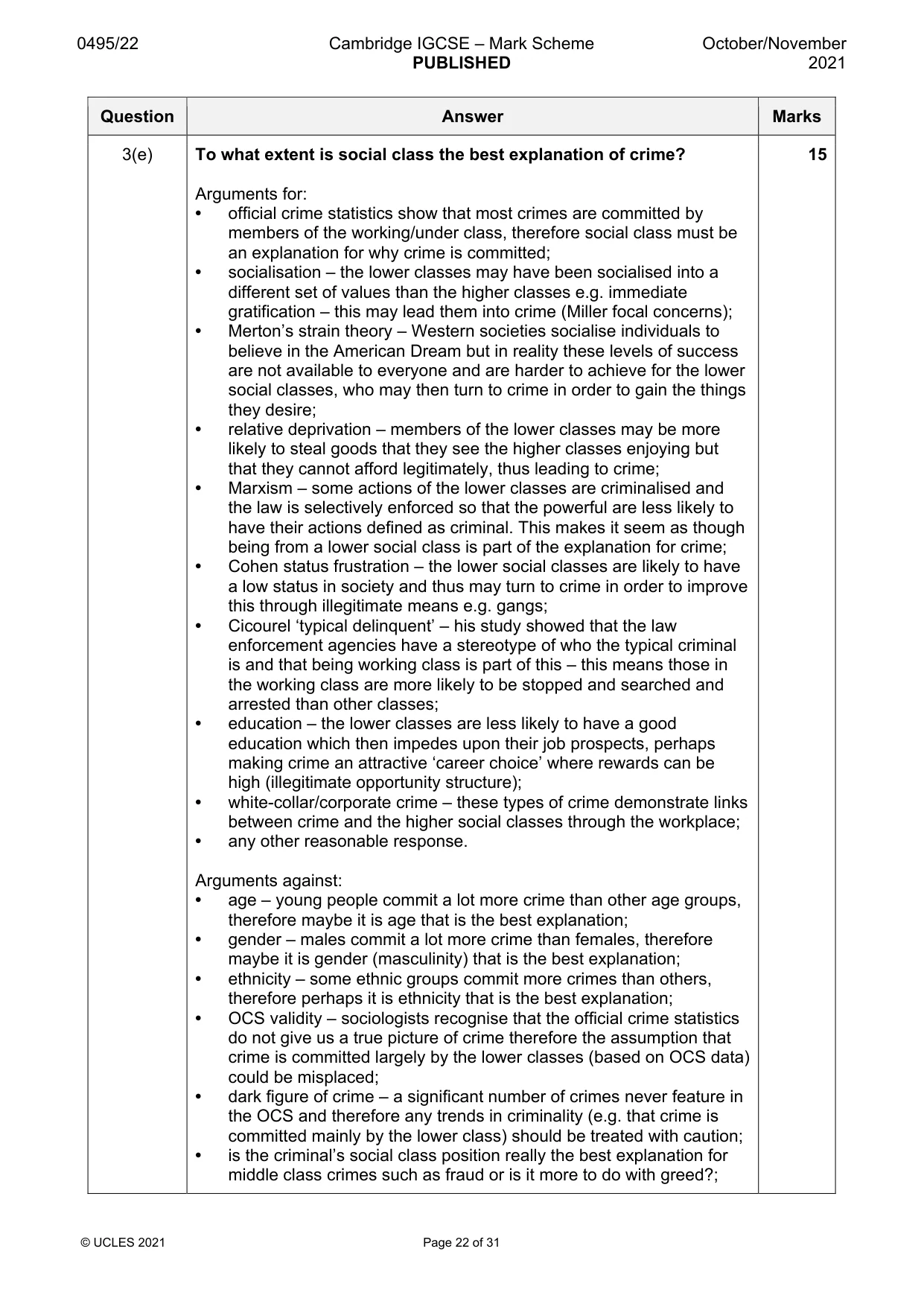
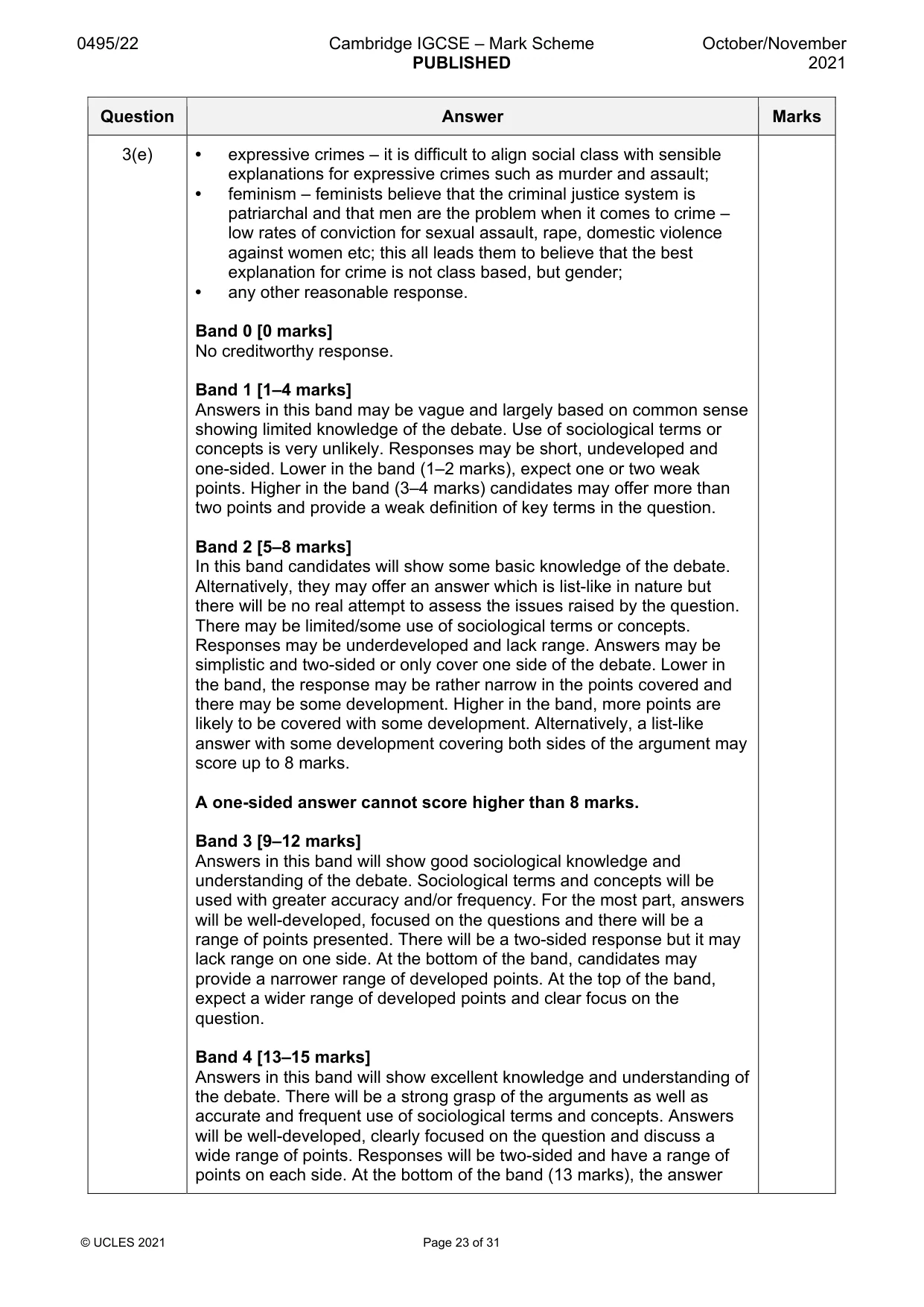
3 Some social groups are more likely than others to feature in the official crime statistics such as, the young, the working class and males. These social groups are also over-represented in the penal system and can be the focus of a moral panic. However, some sociologists are critical of the accuracy of the official measurements of crime, as many crimes are under-reported to the police. (a) What is meant by the term ‘penal system’? [2] (b) Describe two types of crimes that are under-reported to the police. [4] (c) Explain how moral panics are created. [6] (d) Explain why juvenile delinquency occurs. [8] (e) To what extent is social class the best explanation of crime? [15] Section D: Media
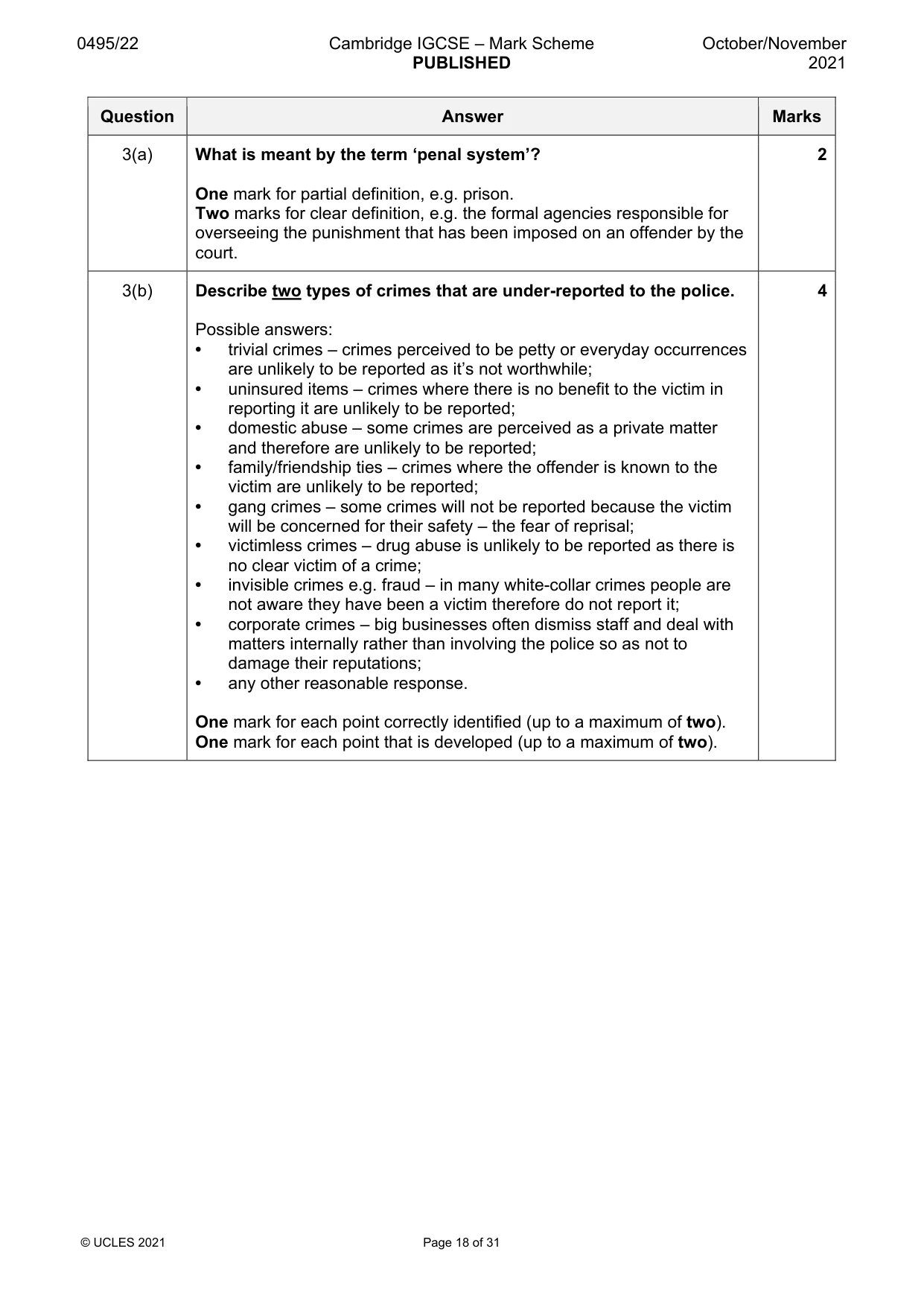
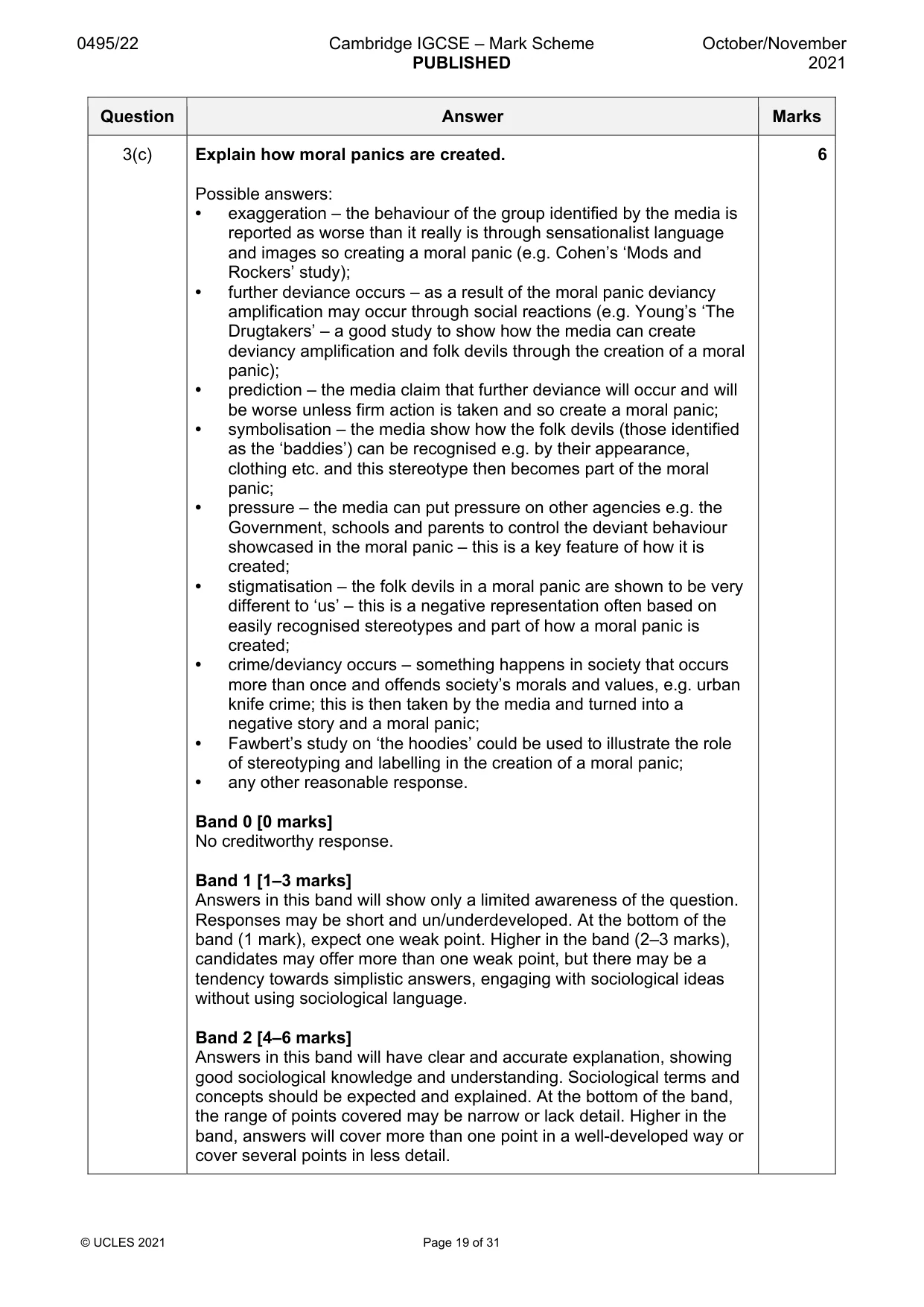
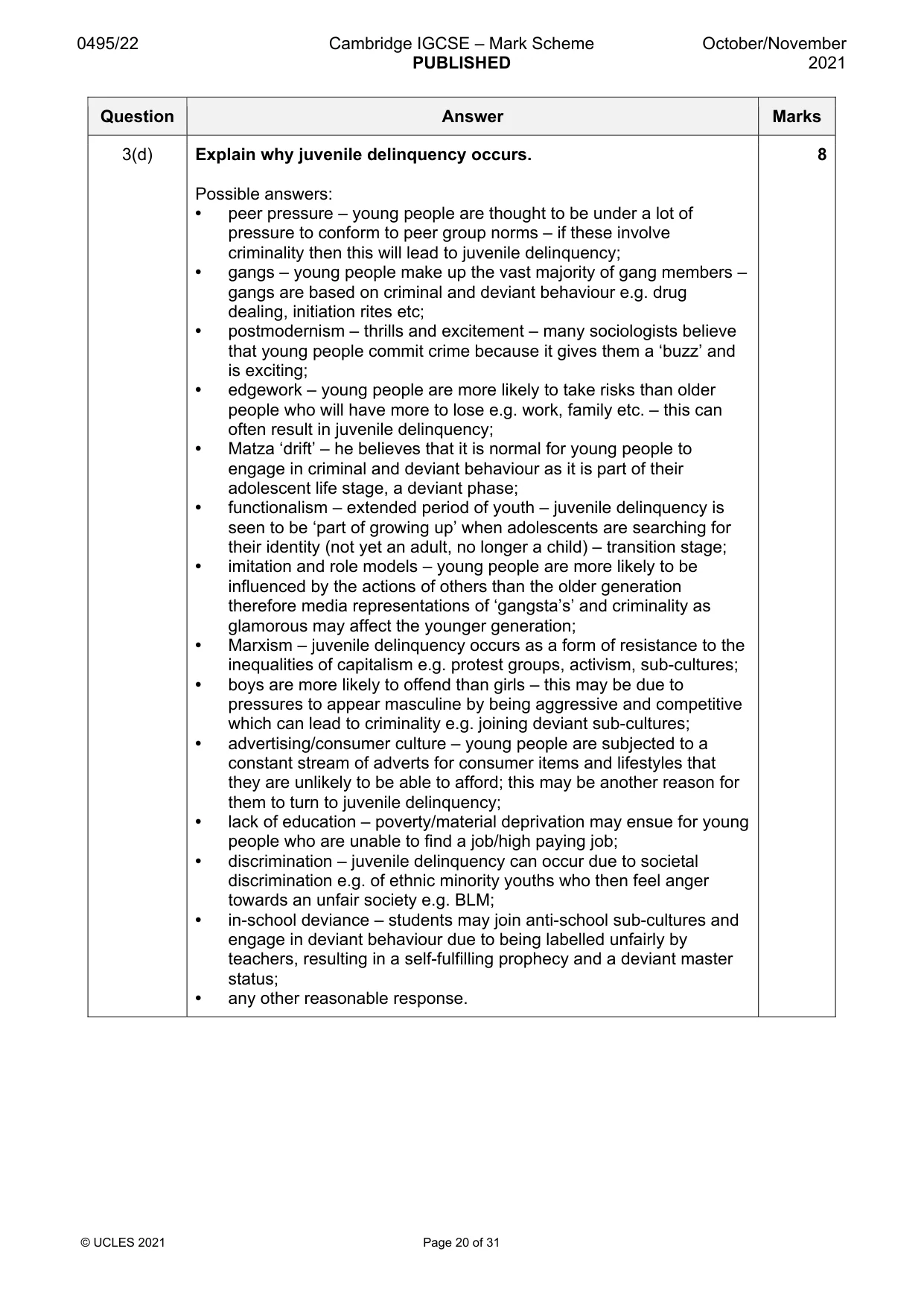
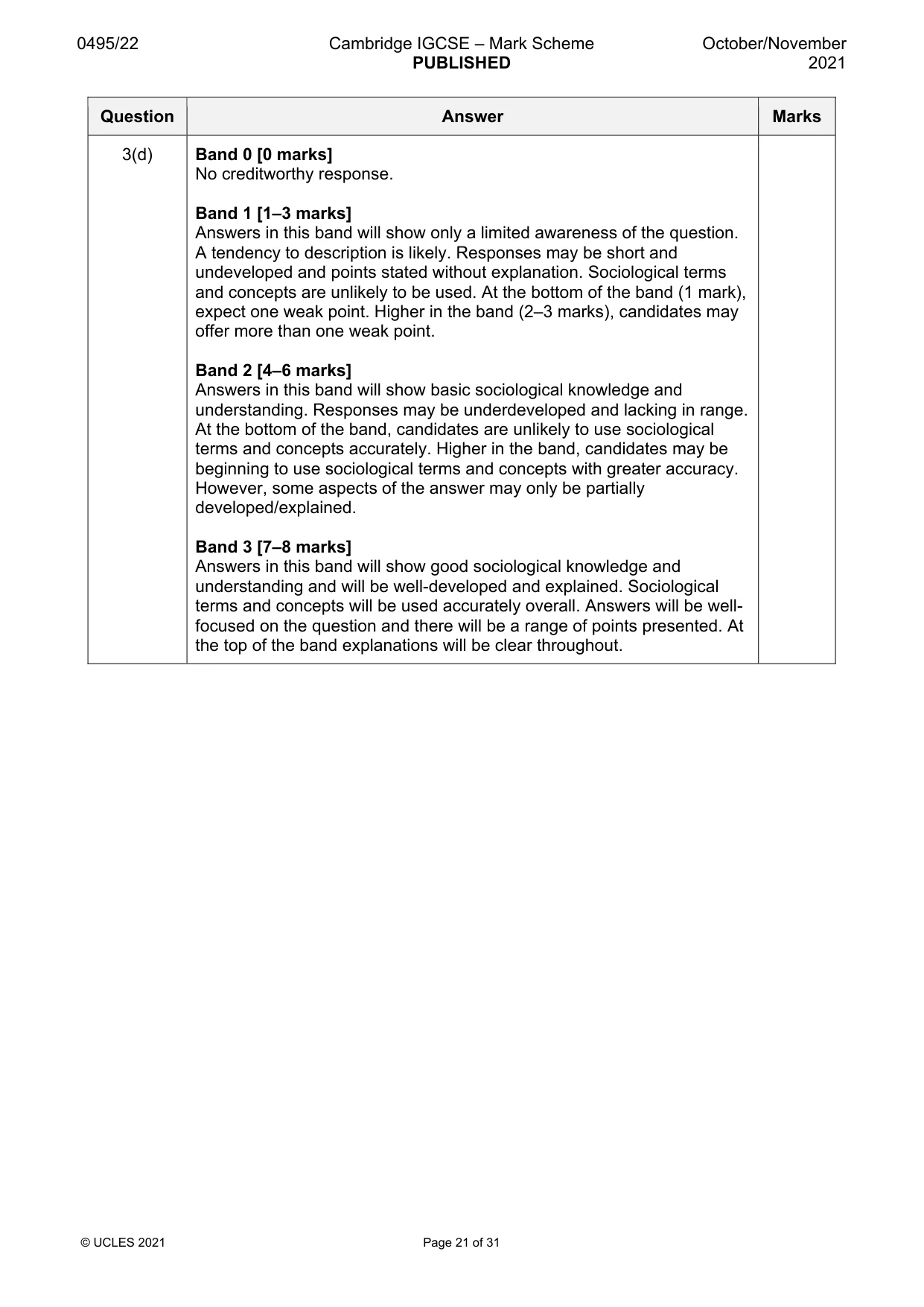
Mark scheme: 3(a) What is meant by the term ‘penal system’? 2 One mark for partial definition, e.g. prison. Two marks for clear definition, e.g. the formal agencies responsible for overseeing the punishment that has been imposed on an offender by the court. 3(b) Describe two types of crimes that are under-reported to the police. 4 Possible answers: • trivial crimes – crimes perceived to be petty or everyday occurrences are unlikely to be reported as it’s not worthwhile; • uninsured items – crimes where there is no benefit to the victim in reporting it are unlikely to be reported; • domestic abuse – some crimes are perceived as a private matter and therefore are unlikely to be reported; • family/friendship ties – crimes where the offender is known to the victim are unlikely to be reported; • gang crimes – some crimes will not be reported because the victim will be concerned for their safety – the fear of reprisal; • victimless crimes – drug abuse is unlikely to be reported as there is no clear victim of a crime; • invisible crimes e.g. fraud – in many white-collar crimes people are not aware they have been a victim therefore do not report it; • corporate crimes – big businesses often dismiss staff and deal with matters internally rather than involving the police so as not to damage their reputations; • any other reasonable response. One mark for each point correctly identified (up to a maximum of two). One mark for each point that is developed (up to a maximum of two). 3(c) Explain how moral panics are created. 6 Possible answers: • exaggeration – the behaviour of the group identified by the media is reported as worse than it really is through sensationalist language and images so creating a moral panic (e.g. Cohen’s ‘Mods and Rockers’ study); • further deviance occurs – as a result of the moral panic deviancy amplification may occur through social reactions (e.g. Young’s ‘The Drugtakers’ – a good study to show how the media can create deviancy amplification and folk devils through the creation of a moral panic); • prediction – the media claim that further deviance will occur and will be worse unless firm action is taken and so create a moral panic; • symbolisation – the media show how the folk devils (those identified as the ‘baddies’) can be recognised e.g. by their appearance, clothing etc. and this stereotype then becomes part of the moral panic; • pressure – the media can put pressure on other agencies e.g. the Government, schools and parents to control the deviant behaviour showcased in the moral panic – this is a key feature of how it is created; • stigmatisation – the folk devils in a moral panic are shown to be very different to ‘us’ – this is a negative representation often based on easily recognised stereotypes and part of how a moral panic is created; • crime/deviancy occurs – something happens in society that occurs more than once and offends society’s morals and values, e.g. urban knife crime; this is then taken by the media and turned into a negative story and a moral panic; • Fawbert’s study on ‘the hoodies’ could be used to illustrate the role of stereotyping and labelling in the creation of a moral panic; • any other reasonable response. Band 0 [0 marks] No creditworthy response. Band 1 [1–3 marks] Answers in this band will show only a limited awareness of the question. Responses may be short and un/underdeveloped. At the bottom of the band (1 mark), expect one weak point. Higher in the band (2–3 marks), candidates may offer more than one weak point, but there may be a tendency towards simplistic answers, engaging with sociological ideas without using sociological language. Band 2 [4–6 marks] Answers in this band will have clear and accurate explanation, showing good sociological knowledge and understanding. Sociological terms and concepts should be expected and explained. At the bottom of the band, the range of points covered may be narrow or lack detail. Higher in the band, answers will cover more than one point in a well-developed way or cover several points in less detail. 3(d) Explain why juvenile delinquency occurs. 8 Possible answers: • peer pressure – young people are thought to be under a lot of pressure to conform to peer group norms – if these involve criminality then this will lead to juvenile delinquency; • gangs – young people make up the vast majority of gang members – gangs are based on criminal and deviant behaviour e.g. drug dealing, initiation rites etc; • postmodernism – thrills and excitement – many sociologists believe that young people commit crime because it gives them a ‘buzz’ and is exciting; • edgework – young people are more likely to take risks than older people who will have more to lose e.g. work, family etc. – this can often result in juvenile delinquency; • Matza ‘drift’ – he believes that it is normal for young people to engage in criminal and deviant behaviour as it is part of their adolescent life stage, a deviant phase; • functionalism – extended period of youth – juvenile delinquency is seen to be ‘part of growing up’ when adolescents are searching for their identity (not yet an adult, no longer a child) – transition stage; • imitation and role models – young people are more likely to be influenced by the actions of others than the older generation therefore media representations of ‘gangsta’s’ and criminality as glamorous may affect the younger generation; • Marxism – juvenile delinquency occurs as a form of resistance to the inequalities of capitalism e.g. protest groups, activism, sub-cultures; • boys are more likely to offend than girls – this may be due to pressures to appear masculine by being aggressive and competitive which can lead to criminality e.g. joining deviant sub-cultures; • advertising/consumer culture – young people are subjected to a constant stream of adverts for consumer items and lifestyles that they are unlikely to be able to afford; this may be another reason for them to turn to juvenile delinquency; • lack of education – poverty/material deprivation may ensue for young people who are unable to find a job/high paying job; • discrimination – juvenile delinquency can occur due to societal discrimination e.g. of ethnic minority youths who then feel anger towards an unfair society e.g. BLM; • in-school deviance – students may join anti-school sub-cultures and engage in deviant behaviour due to being labelled unfairly by teachers, resulting in a self-fulfilling prophecy and a deviant master status; • any other reasonable response. 3(d) Band 0 [0 marks] No creditworthy response. Band 1 [1–3 marks] Answers in this band will show only a limited awareness of the question. A tendency to description is likely. Responses may be short and undeveloped and points stated without explanation. Sociological terms and concepts are unlikely to be used. At the bottom of the band (1 mark), expect one weak point. Higher in the band (2–3 marks), candidates may offer more than one weak point. Band 2 [4–6 marks] Answers in this band will show basic sociological knowledge and understanding. Responses may be underdeveloped and lacking in range. At the bottom of the band, candidates are unlikely to use sociological terms and concepts accurately. Higher in the band, candidates may be beginning to use sociological terms and concepts with greater accuracy. However, some aspects of the answer may only be partially developed/explained. Band 3 [7–8 marks] Answers in this band will show good sociological knowledge and understanding and will be well-developed and explained. Sociological terms and concepts will be used accurately overall. Answers will be well- focused on the question and there will be a range of points presented. At the top of the band explanations will be clear throughout. 3(e) To what extent is social class the best explanation of crime? 15 Arguments for: • official crime statistics show that most crimes are committed by members of the working/under class, therefore social class must be an explanation for why crime is committed; • socialisation – the lower classes may have been socialised into a different set of values than the higher classes e.g. immediate gratification – this may lead them into crime (Miller focal concerns); • Merton’s strain theory – Western societies socialise individuals to believe in the American Dream but in reality these levels of success are not available to everyone and are harder to achieve for the lower social classes, who may then turn to crime in order to gain the things they desire; • relative deprivation – members of the lower classes may be more likely to steal goods that they see the higher classes enjoying but that they cannot afford legitimately, thus leading to crime; • Marxism – some actions of the lower classes are criminalised and the law is selectively enforced so that the powerful are less likely to have their actions defined as criminal. This makes it seem as though being from a lower social class is part of the explanation for crime; • Cohen status frustration – the lower social classes are likely to have a low status in society and thus may turn to crime in order to improve this through illegitimate means e.g. gangs; • Cicourel ‘typical delinquent’ – his study showed that the law enforcement agencies have a stereotype of who the typical criminal is and that being working class is part of this – this means those in the working class are more likely to be stopped and searched and arrested than other classes; • education – the lower classes are less likely to have a good education which then impedes upon their job prospects, perhaps making crime an attractive ‘career choice’ where rewards can be high (illegitimate opportunity structure); • white-collar/corporate crime – these types of crime demonstrate links between crime and the higher social classes through the workplace; • any other reasonable response. Arguments against: • age – young people commit a lot more crime than other age groups, therefore maybe it is age that is the best explanation; • gender – males commit a lot more crime than females, therefore maybe it is gender (masculinity) that is the best explanation; • ethnicity – some ethnic groups commit more crimes than others, therefore perhaps it is ethnicity that is the best explanation; • OCS validity – sociologists recognise that the official crime statistics do not give us a true picture of crime therefore the assumption that crime is committed largely by the lower classes (based on OCS data) could be misplaced; • dark figure of crime – a significant number of crimes never feature in the OCS and therefore any trends in criminality (e.g. that crime is committed mainly by the lower class) should be treated with caution; • is the criminal’s social class position really the best explanation for middle class crimes such as fraud or is it more to do with greed?; 3(e) • expressive crimes – it is difficult to align social class with sensible explanations for expressive crimes such as murder and assault; • feminism – feminists believe that the criminal justice system is patriarchal and that men are the problem when it comes to crime – low rates of conviction for sexual assault, rape, domestic violence against women etc; this all leads them to believe that the best explanation for crime is not class based, but gender; • any other reasonable response. Band 0 [0 marks] No creditworthy response. Band 1 [1–4 marks] Answers in this band may be vague and largely based on common sense showing limited knowledge of the debate. Use of sociological terms or concepts is very unlikely. Responses may be short, undeveloped and one-sided. Lower in the band (1–2 marks), expect one or two weak points. Higher in the band (3–4 marks) candidates may offer more than two points and provide a weak definition of key terms in the question. Band 2 [5–8 marks] In this band candidates will show some basic knowledge of the debate. Alternatively, they may offer an answer which is list-like in nature but there will be no real attempt to assess the issues raised by the question. There may be limited/some use of sociological terms or concepts. Responses may be underdeveloped and lack range. Answers may be simplistic and two-sided or only cover one side of the debate. Lower in the band, the response may be rather narrow in the points covered and there may be some development. Higher in the band, more points are likely to be covered with some development. Alternatively, a list-like answer with some development covering both sides of the argument may score up to 8 marks. A one-sided answer cannot score higher than 8 marks. Band 3 [9–12 marks] Answers in this band will show good sociological knowledge and understanding of the debate. Sociological terms and concepts will be used with greater accuracy and/or frequency. For the most part, answers will be well-developed, focused on the questions and there will be a range of points presented. There will be a two-sided response but it may lack range on one side. At the bottom of the band, candidates may provide a narrower range of developed points. At the top of the band, expect a wider range of developed points and clear focus on the question. Band 4 [13–15 marks] Answers in this band will show excellent knowledge and understanding of the debate. There will be a strong grasp of the arguments as well as accurate and frequent use of sociological terms and concepts. Answers will be well-developed, clearly focused on the question and discuss a wide range of points. Responses will be two-sided and have a range of points on each side. At the bottom of the band (13 marks), the answer 3(e) may lack a specific conclusion. Higher in the band, there will be a clear attempt to offer an assessment of the ‘To what extent.?’ part of the question through a focused conclusion.
Q4 · The media is funded both publicly and privately
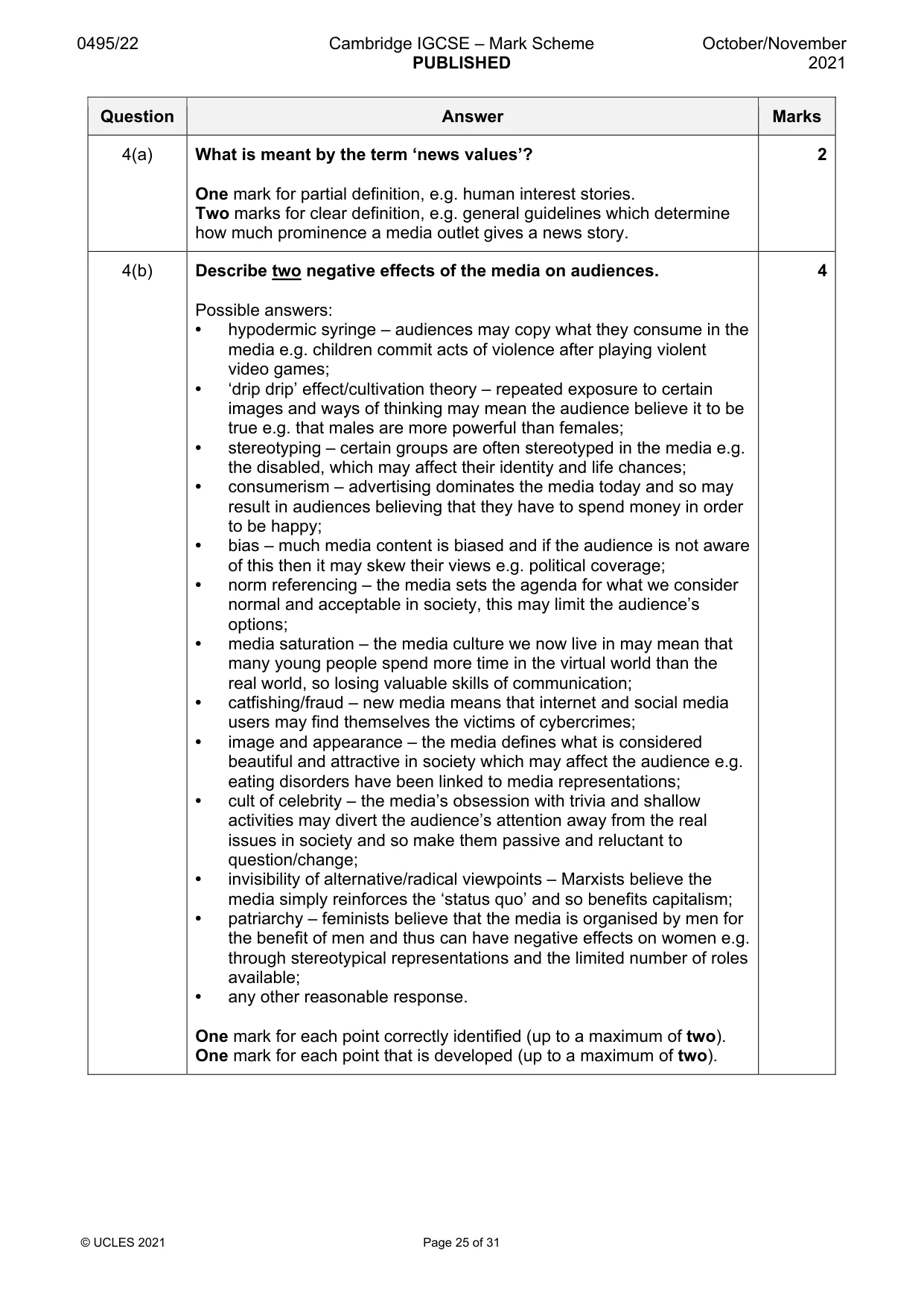
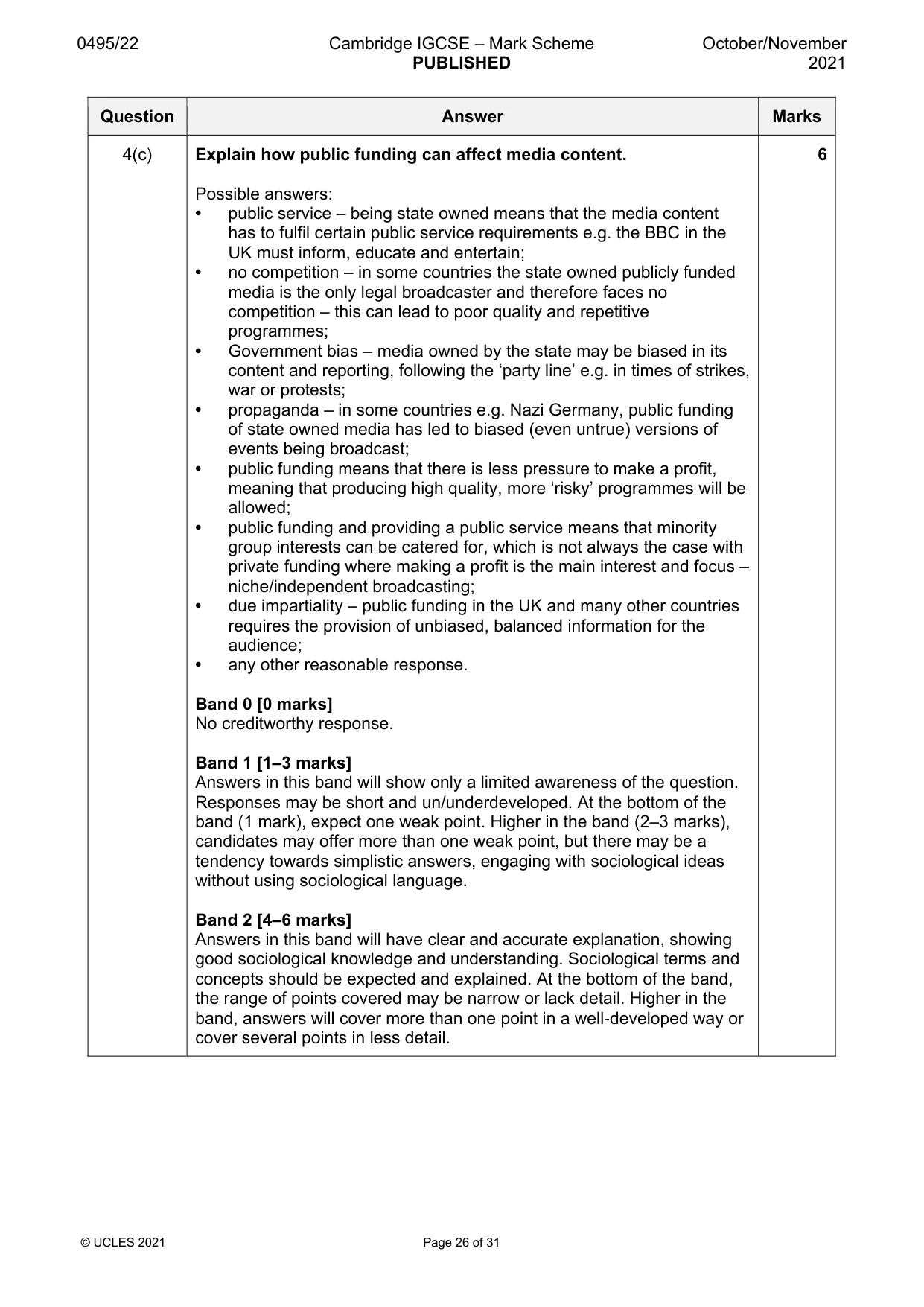
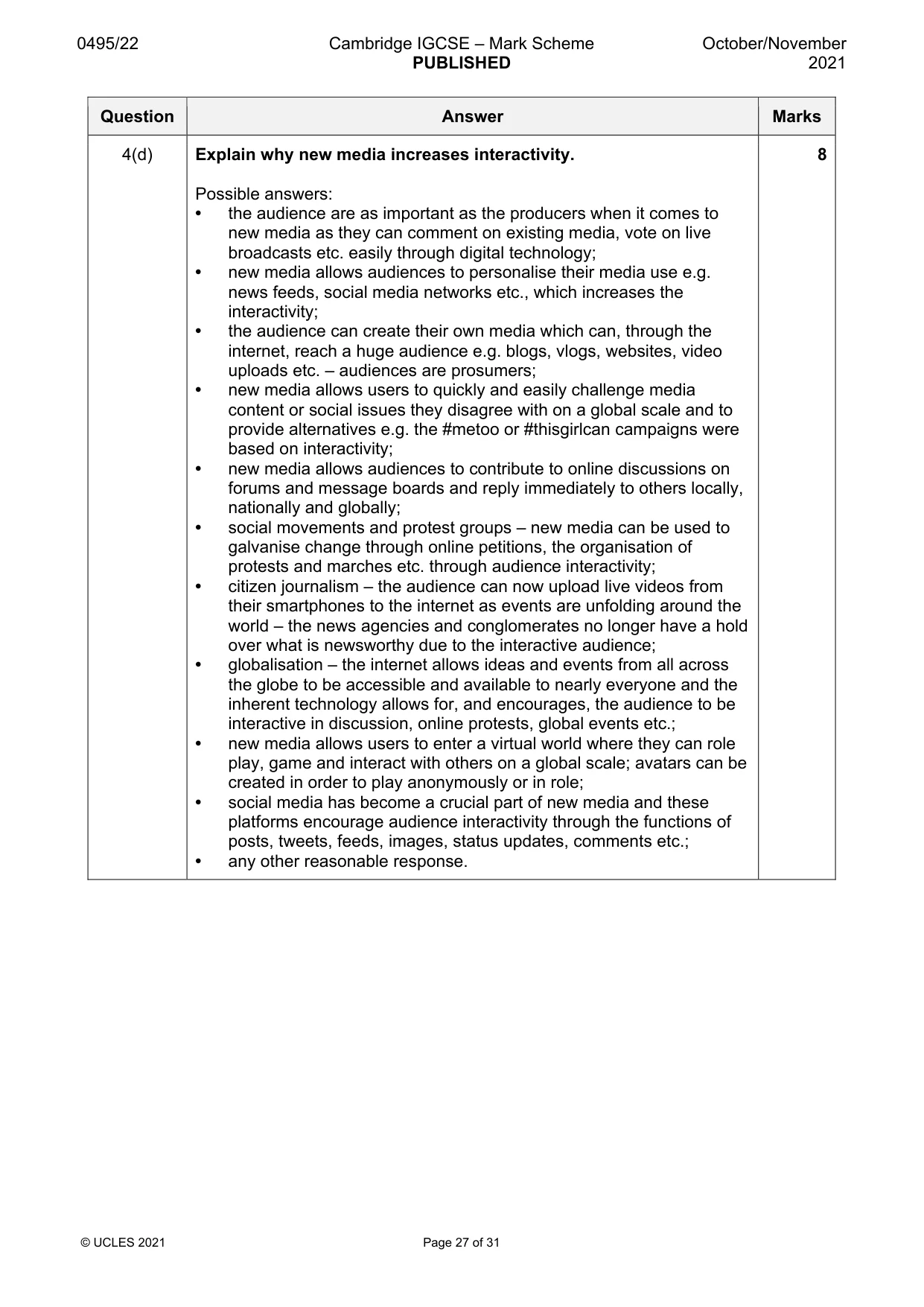
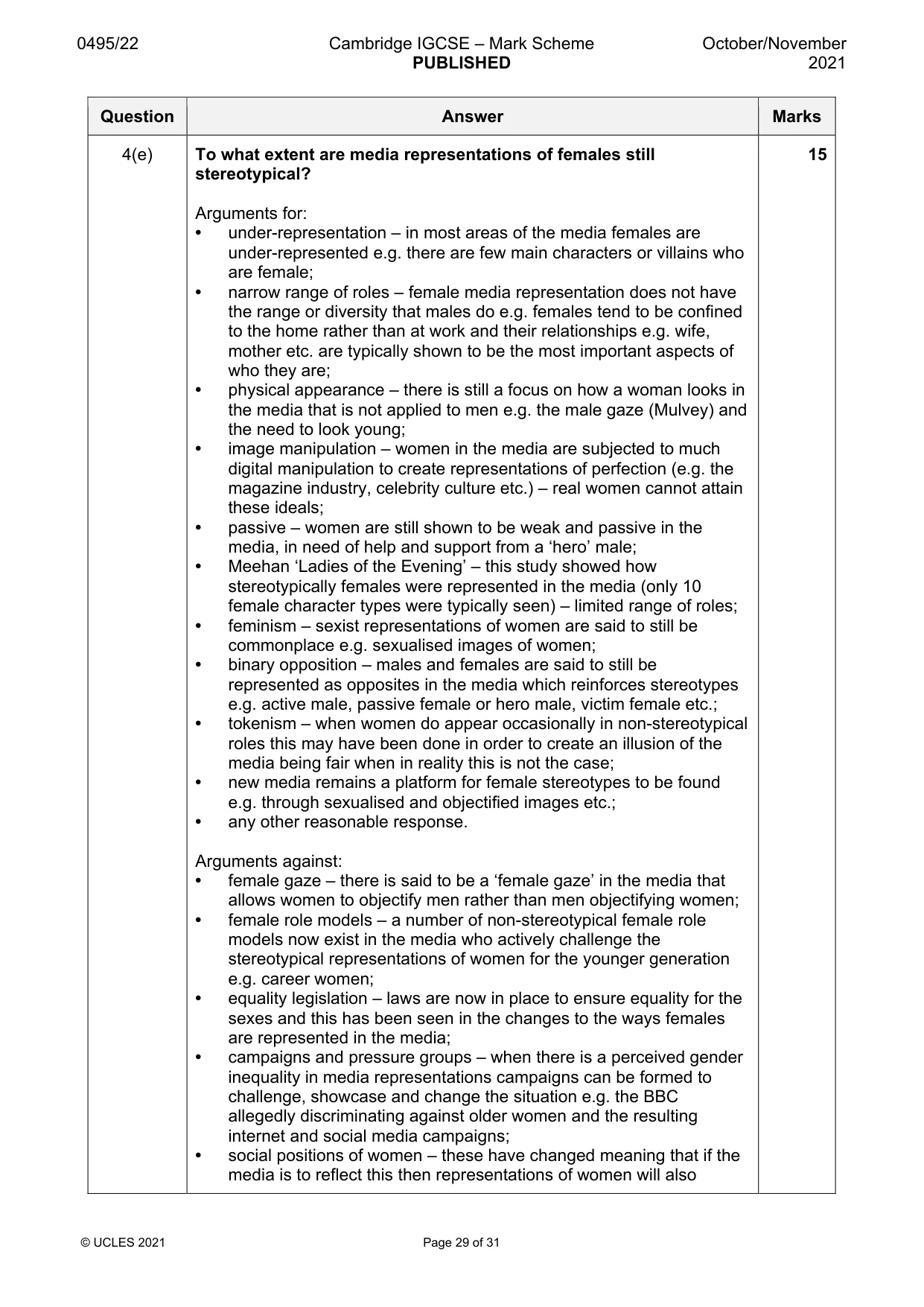
4 The media is funded both publicly and privately. Some sociologists believe that funding affects media content and influences the way some social groups are represented and stereotyped. Media content can also be affected by news values. New media is changing the way the media functions; however media content may still have negative effects on audiences. (a) What is meant by the term ‘news values’? [2] (b) Describe two negative effects of the media on audiences. [4] (c) Explain how public funding can affect media content. [6] (d) Explain why new media increases interactivity. [8] (e) To what extent are media representations of females still stereotypical? [15]
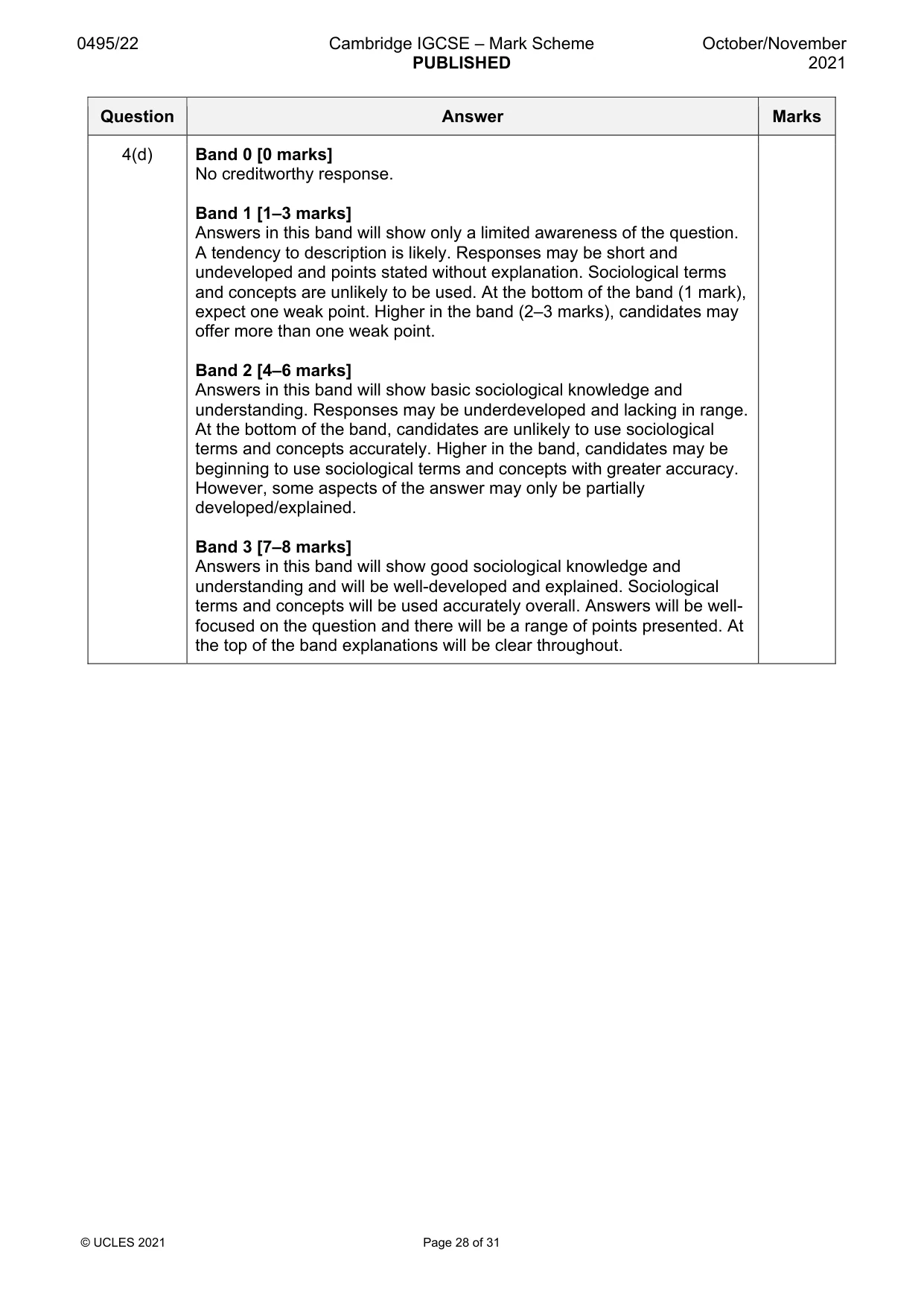
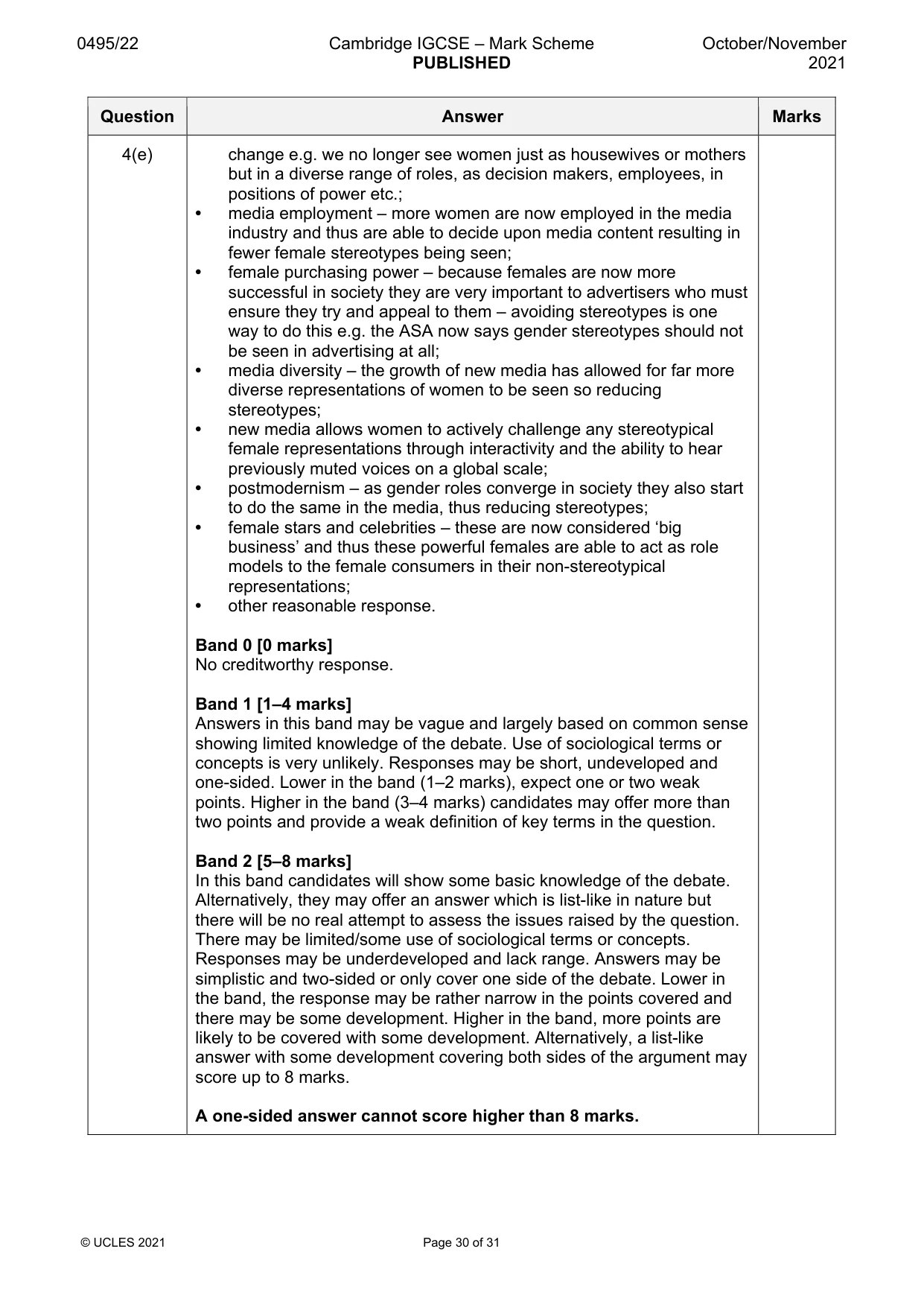
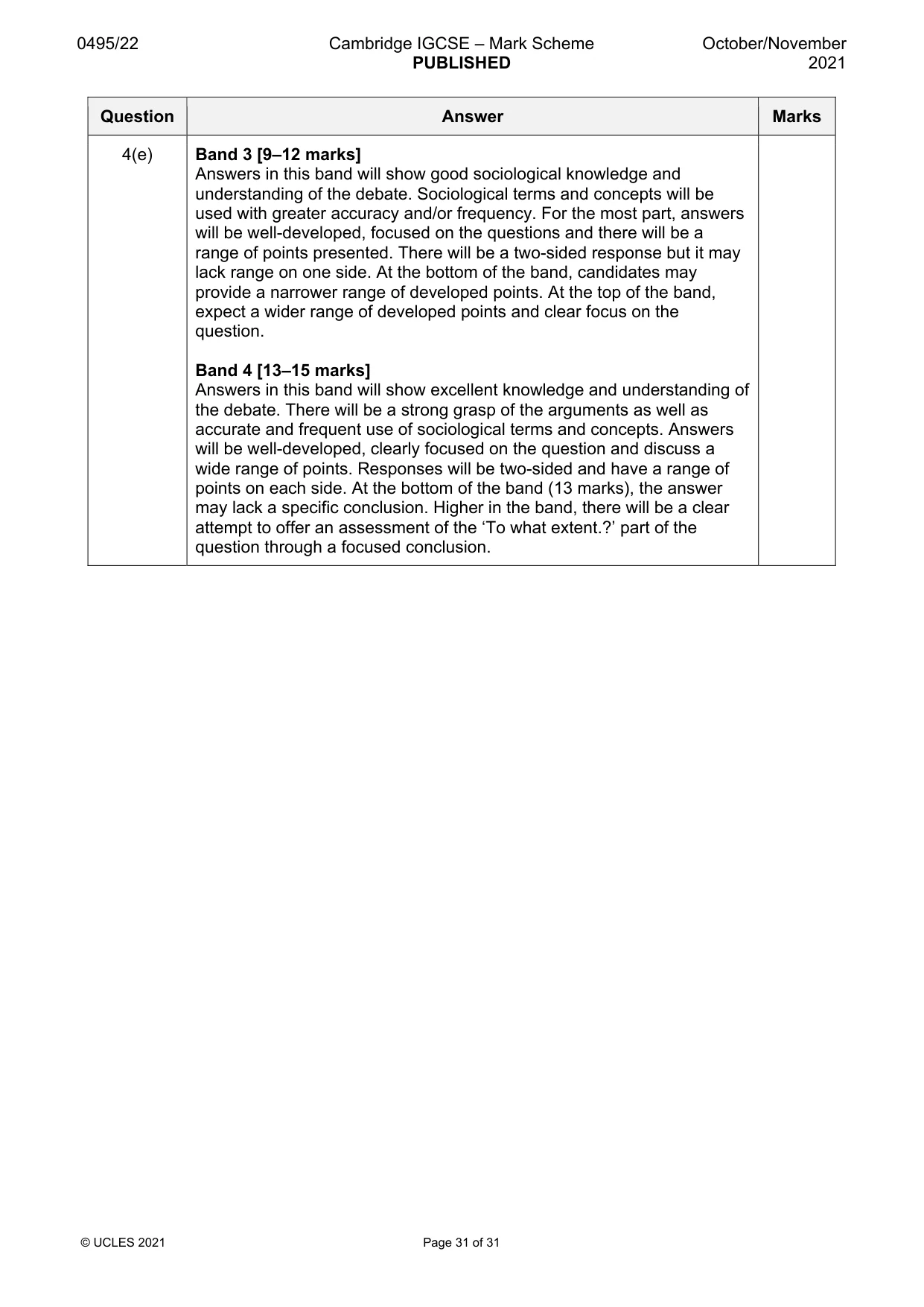
Mark scheme: 4(a) What is meant by the term ‘news values’? 2 One mark for partial definition, e.g. human interest stories. Two marks for clear definition, e.g. general guidelines which determine how much prominence a media outlet gives a news story. 4(b) Describe two negative effects of the media on audiences. 4 Possible answers: • hypodermic syringe – audiences may copy what they consume in the media e.g. children commit acts of violence after playing violent video games; • ‘drip drip’ effect/cultivation theory – repeated exposure to certain images and ways of thinking may mean the audience believe it to be true e.g. that males are more powerful than females; • stereotyping – certain groups are often stereotyped in the media e.g. the disabled, which may affect their identity and life chances; • consumerism – advertising dominates the media today and so may result in audiences believing that they have to spend money in order to be happy; • bias – much media content is biased and if the audience is not aware of this then it may skew their views e.g. political coverage; • norm referencing – the media sets the agenda for what we consider normal and acceptable in society, this may limit the audience’s options; • media saturation – the media culture we now live in may mean that many young people spend more time in the virtual world than the real world, so losing valuable skills of communication; • catfishing/fraud – new media means that internet and social media users may find themselves the victims of cybercrimes; • image and appearance – the media defines what is considered beautiful and attractive in society which may affect the audience e.g. eating disorders have been linked to media representations; • cult of celebrity – the media’s obsession with trivia and shallow activities may divert the audience’s attention away from the real issues in society and so make them passive and reluctant to question/change; • invisibility of alternative/radical viewpoints – Marxists believe the media simply reinforces the ‘status quo’ and so benefits capitalism; • patriarchy – feminists believe that the media is organised by men for the benefit of men and thus can have negative effects on women e.g. through stereotypical representations and the limited number of roles available; • any other reasonable response. One mark for each point correctly identified (up to a maximum of two). One mark for each point that is developed (up to a maximum of two). 4(c) Explain how public funding can affect media content. 6 Possible answers: • public service – being state owned means that the media content has to fulfil certain public service requirements e.g. the BBC in the UK must inform, educate and entertain; • no competition – in some countries the state owned publicly funded media is the only legal broadcaster and therefore faces no competition – this can lead to poor quality and repetitive programmes; • Government bias – media owned by the state may be biased in its content and reporting, following the ‘party line’ e.g. in times of strikes, war or protests; • propaganda – in some countries e.g. Nazi Germany, public funding of state owned media has led to biased (even untrue) versions of events being broadcast; • public funding means that there is less pressure to make a profit, meaning that producing high quality, more ‘risky’ programmes will be allowed; • public funding and providing a public service means that minority group interests can be catered for, which is not always the case with private funding where making a profit is the main interest and focus – niche/independent broadcasting; • due impartiality – public funding in the UK and many other countries requires the provision of unbiased, balanced information for the audience; • any other reasonable response. Band 0 [0 marks] No creditworthy response. Band 1 [1–3 marks] Answers in this band will show only a limited awareness of the question. Responses may be short and un/underdeveloped. At the bottom of the band (1 mark), expect one weak point. Higher in the band (2–3 marks), candidates may offer more than one weak point, but there may be a tendency towards simplistic answers, engaging with sociological ideas without using sociological language. Band 2 [4–6 marks] Answers in this band will have clear and accurate explanation, showing good sociological knowledge and understanding. Sociological terms and concepts should be expected and explained. At the bottom of the band, the range of points covered may be narrow or lack detail. Higher in the band, answers will cover more than one point in a well-developed way or cover several points in less detail. 4(d) Explain why new media increases interactivity. 8 Possible answers: • the audience are as important as the producers when it comes to new media as they can comment on existing media, vote on live broadcasts etc. easily through digital technology; • new media allows audiences to personalise their media use e.g. news feeds, social media networks etc., which increases the interactivity; • the audience can create their own media which can, through the internet, reach a huge audience e.g. blogs, vlogs, websites, video uploads etc. – audiences are prosumers; • new media allows users to quickly and easily challenge media content or social issues they disagree with on a global scale and to provide alternatives e.g. the #metoo or #thisgirlcan campaigns were based on interactivity; • new media allows audiences to contribute to online discussions on forums and message boards and reply immediately to others locally, nationally and globally; • social movements and protest groups – new media can be used to galvanise change through online petitions, the organisation of protests and marches etc. through audience interactivity; • citizen journalism – the audience can now upload live videos from their smartphones to the internet as events are unfolding around the world – the news agencies and conglomerates no longer have a hold over what is newsworthy due to the interactive audience; • globalisation – the internet allows ideas and events from all across the globe to be accessible and available to nearly everyone and the inherent technology allows for, and encourages, the audience to be interactive in discussion, online protests, global events etc.; • new media allows users to enter a virtual world where they can role play, game and interact with others on a global scale; avatars can be created in order to play anonymously or in role; • social media has become a crucial part of new media and these platforms encourage audience interactivity through the functions of posts, tweets, feeds, images, status updates, comments etc.; • any other reasonable response. 4(d) Band 0 [0 marks] No creditworthy response. Band 1 [1–3 marks] Answers in this band will show only a limited awareness of the question. A tendency to description is likely. Responses may be short and undeveloped and points stated without explanation. Sociological terms and concepts are unlikely to be used. At the bottom of the band (1 mark), expect one weak point. Higher in the band (2–3 marks), candidates may offer more than one weak point. Band 2 [4–6 marks] Answers in this band will show basic sociological knowledge and understanding. Responses may be underdeveloped and lacking in range. At the bottom of the band, candidates are unlikely to use sociological terms and concepts accurately. Higher in the band, candidates may be beginning to use sociological terms and concepts with greater accuracy. However, some aspects of the answer may only be partially developed/explained. Band 3 [7–8 marks] Answers in this band will show good sociological knowledge and understanding and will be well-developed and explained. Sociological terms and concepts will be used accurately overall. Answers will be well- focused on the question and there will be a range of points presented. At the top of the band explanations will be clear throughout. 4(e) To what extent are media representations of females still 15 stereotypical? Arguments for: • under-representation – in most areas of the media females are under-represented e.g. there are few main characters or villains who are female; • narrow range of roles – female media representation does not have the range or diversity that males do e.g. females tend to be confined to the home rather than at work and their relationships e.g. wife, mother etc. are typically shown to be the most important aspects of who they are; • physical appearance – there is still a focus on how a woman looks in the media that is not applied to men e.g. the male gaze (Mulvey) and the need to look young; • image manipulation – women in the media are subjected to much digital manipulation to create representations of perfection (e.g. the magazine industry, celebrity culture etc.) – real women cannot attain these ideals; • passive – women are still shown to be weak and passive in the media, in need of help and support from a ‘hero’ male; • Meehan ‘Ladies of the Evening’ – this study showed how stereotypically females were represented in the media (only 10 female character types were typically seen) – limited range of roles; • feminism – sexist representations of women are said to still be commonplace e.g. sexualised images of women; • binary opposition – males and females are said to still be represented as opposites in the media which reinforces stereotypes e.g. active male, passive female or hero male, victim female etc.; • tokenism – when women do appear occasionally in non-stereotypical roles this may have been done in order to create an illusion of the media being fair when in reality this is not the case; • new media remains a platform for female stereotypes to be found e.g. through sexualised and objectified images etc.; • any other reasonable response. Arguments against: • female gaze – there is said to be a ‘female gaze’ in the media that allows women to objectify men rather than men objectifying women; • female role models – a number of non-stereotypical female role models now exist in the media who actively challenge the stereotypical representations of women for the younger generation e.g. career women; • equality legislation – laws are now in place to ensure equality for the sexes and this has been seen in the changes to the ways females are represented in the media; • campaigns and pressure groups – when there is a perceived gender inequality in media representations campaigns can be formed to challenge, showcase and change the situation e.g. the BBC allegedly discriminating against older women and the resulting internet and social media campaigns; • social positions of women – these have changed meaning that if the media is to reflect this then representations of women will also 4(e) change e.g. we no longer see women just as housewives or mothers but in a diverse range of roles, as decision makers, employees, in positions of power etc.; • media employment – more women are now employed in the media industry and thus are able to decide upon media content resulting in fewer female stereotypes being seen; • female purchasing power – because females are now more successful in society they are very important to advertisers who must ensure they try and appeal to them – avoiding stereotypes is one way to do this e.g. the ASA now says gender stereotypes should not be seen in advertising at all; • media diversity – the growth of new media has allowed for far more diverse representations of women to be seen so reducing stereotypes; • new media allows women to actively challenge any stereotypical female representations through interactivity and the ability to hear previously muted voices on a global scale; • postmodernism – as gender roles converge in society they also start to do the same in the media, thus reducing stereotypes; • female stars and celebrities – these are now considered ‘big business’ and thus these powerful females are able to act as role models to the female consumers in their non-stereotypical representations; • other reasonable response. Band 0 [0 marks] No creditworthy response. Band 1 [1–4 marks] Answers in this band may be vague and largely based on common sense showing limited knowledge of the debate. Use of sociological terms or concepts is very unlikely. Responses may be short, undeveloped and one-sided. Lower in the band (1–2 marks), expect one or two weak points. Higher in the band (3–4 marks) candidates may offer more than two points and provide a weak definition of key terms in the question. Band 2 [5–8 marks] In this band candidates will show some basic knowledge of the debate. Alternatively, they may offer an answer which is list-like in nature but there will be no real attempt to assess the issues raised by the question. There may be limited/some use of sociological terms or concepts. Responses may be underdeveloped and lack range. Answers may be simplistic and two-sided or only cover one side of the debate. Lower in the band, the response may be rather narrow in the points covered and there may be some development. Higher in the band, more points are likely to be covered with some development. Alternatively, a list-like answer with some development covering both sides of the argument may score up to 8 marks. A one-sided answer cannot score higher than 8 marks. 4(e) Band 3 [9–12 marks] Answers in this band will show good sociological knowledge and understanding of the debate. Sociological terms and concepts will be used with greater accuracy and/or frequency. For the most part, answers will be well-developed, focused on the questions and there will be a range of points presented. There will be a two-sided response but it may lack range on one side. At the bottom of the band, candidates may provide a narrower range of developed points. At the top of the band, expect a wider range of developed points and clear focus on the question. Band 4 [13–15 marks] Answers in this band will show excellent knowledge and understanding of the debate. There will be a strong grasp of the arguments as well as accurate and frequent use of sociological terms and concepts. Answers will be well-developed, clearly focused on the question and discuss a wide range of points. Responses will be two-sided and have a range of points on each side. At the bottom of the band (13 marks), the answer may lack a specific conclusion. Higher in the band, there will be a clear attempt to offer an assessment of the ‘To what extent.?’ part of the question through a focused conclusion.
More questions on How do sociologists approach the study of society?
What was in this paper
The subtopics covered by these 4 questions, and how many questions each got. Open one in a new tab to see every Cambridge question on it.
What you needed in this session
Cambridge’s own grade thresholds for 2021 Oct/Nov, Paper 2 · Variant 2. A higher threshold means an easier paper — the bar moves with how the cohort did.