Cambridge IGCSE Sociology 0495 — 2020 May/June Paper 2 · Variant 3
0495/23/M/J/20 · 4 questions · 140 marks · ≈158 min
The question paper and its mark scheme, free to read here and free to download. This is Cambridge’s own paper, exactly as it was sat.
Question paper4 pages


Mark scheme33 pages
Answers below. Sit the paper first if you are practising.








Questions as text
Q1 · Some sociologists claim that dysfunctional families cause problems in society
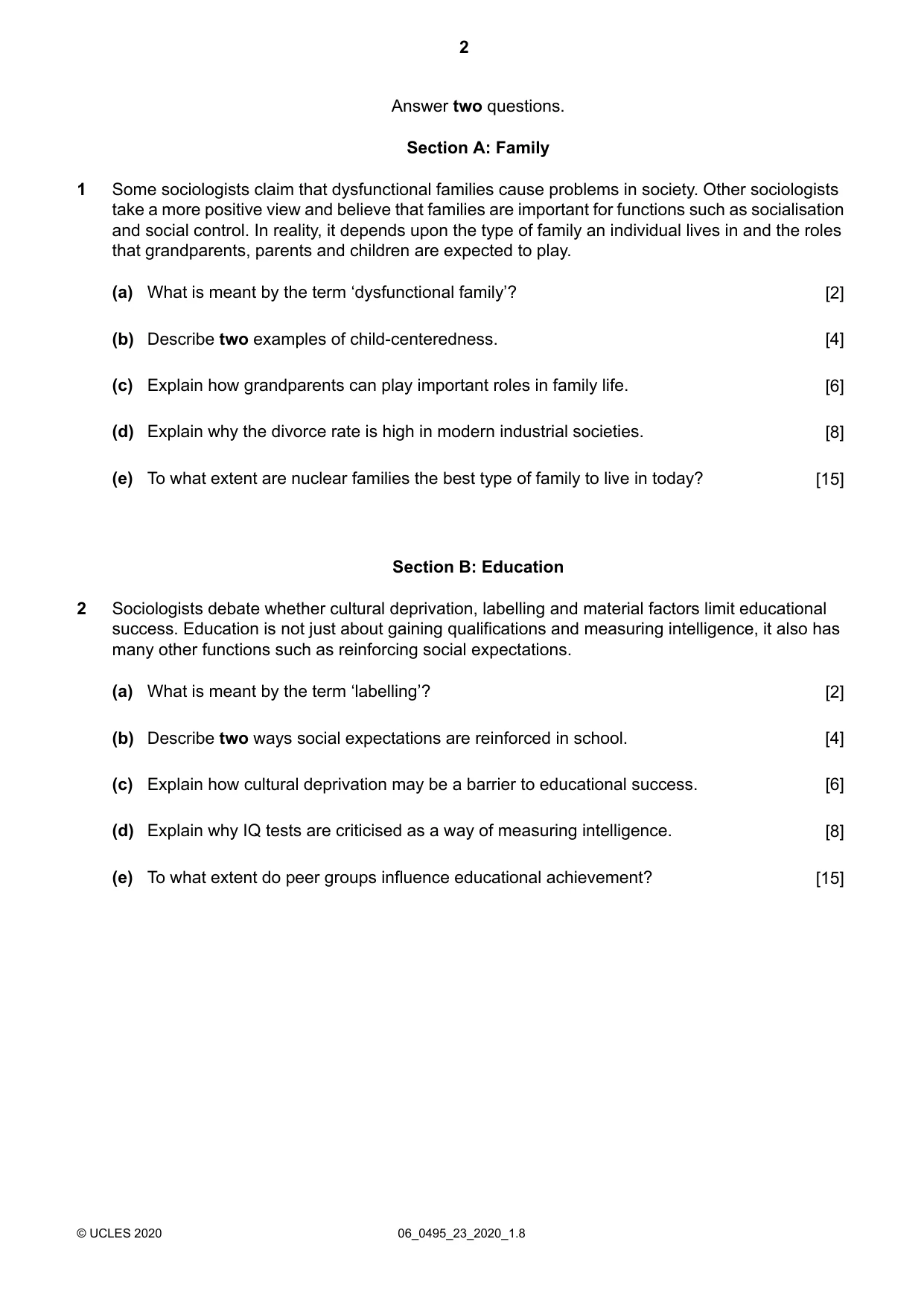
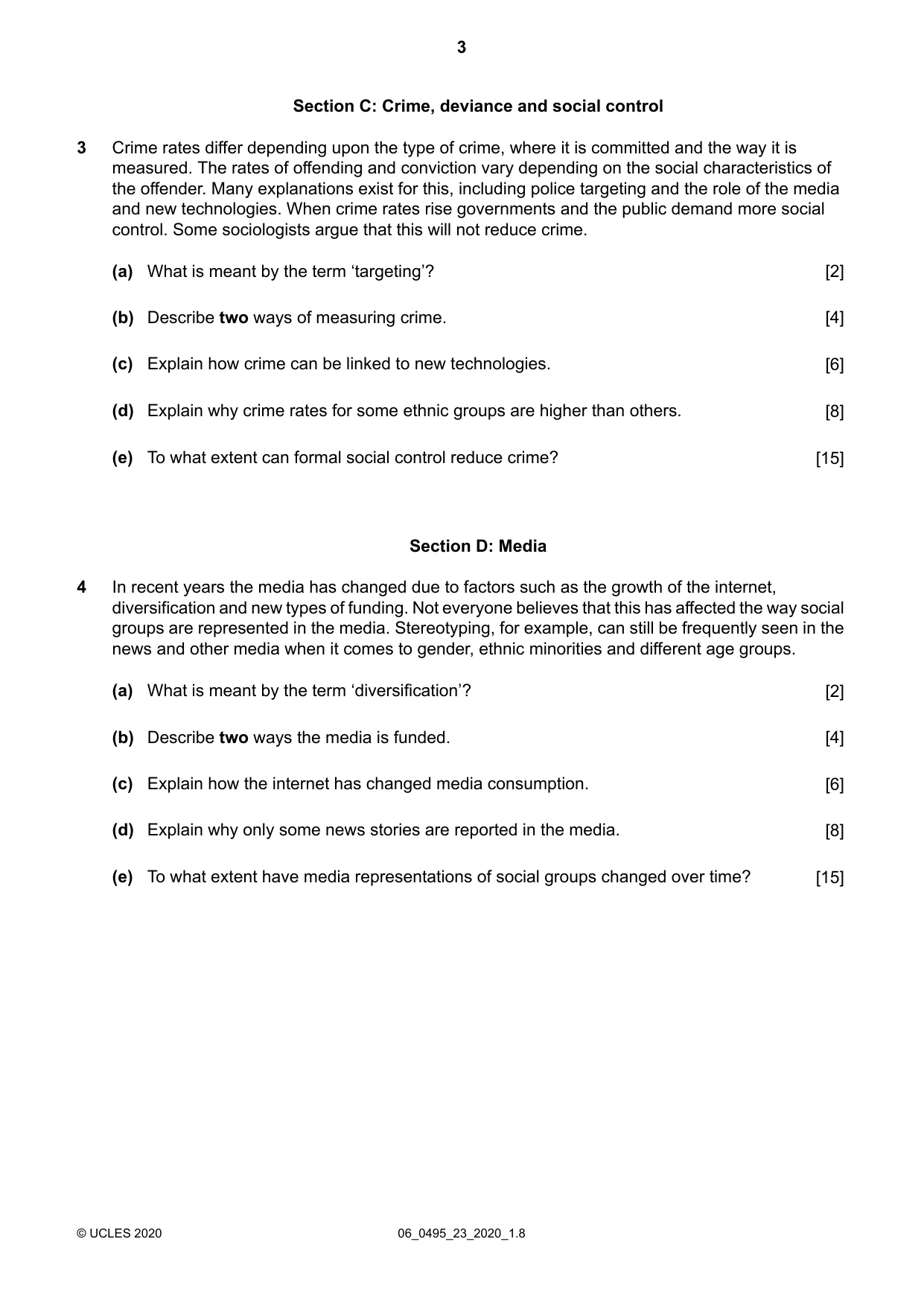
1 Some sociologists claim that dysfunctional families cause problems in society. Other sociologists take a more positive view and believe that families are important for functions such as socialisation and social control. In reality, it depends upon the type of family an individual lives in and the roles that grandparents, parents and children are expected to play. (a) What is meant by the term ‘dysfunctional family’? [2] (b) Describe two examples of child-centeredness. [4] (c) Explain how grandparents can play important roles in family life. [6] (d) Explain why the divorce rate is high in modern industrial societies. [8] (e) To what extent are nuclear families the best type of family to live in today? [15]
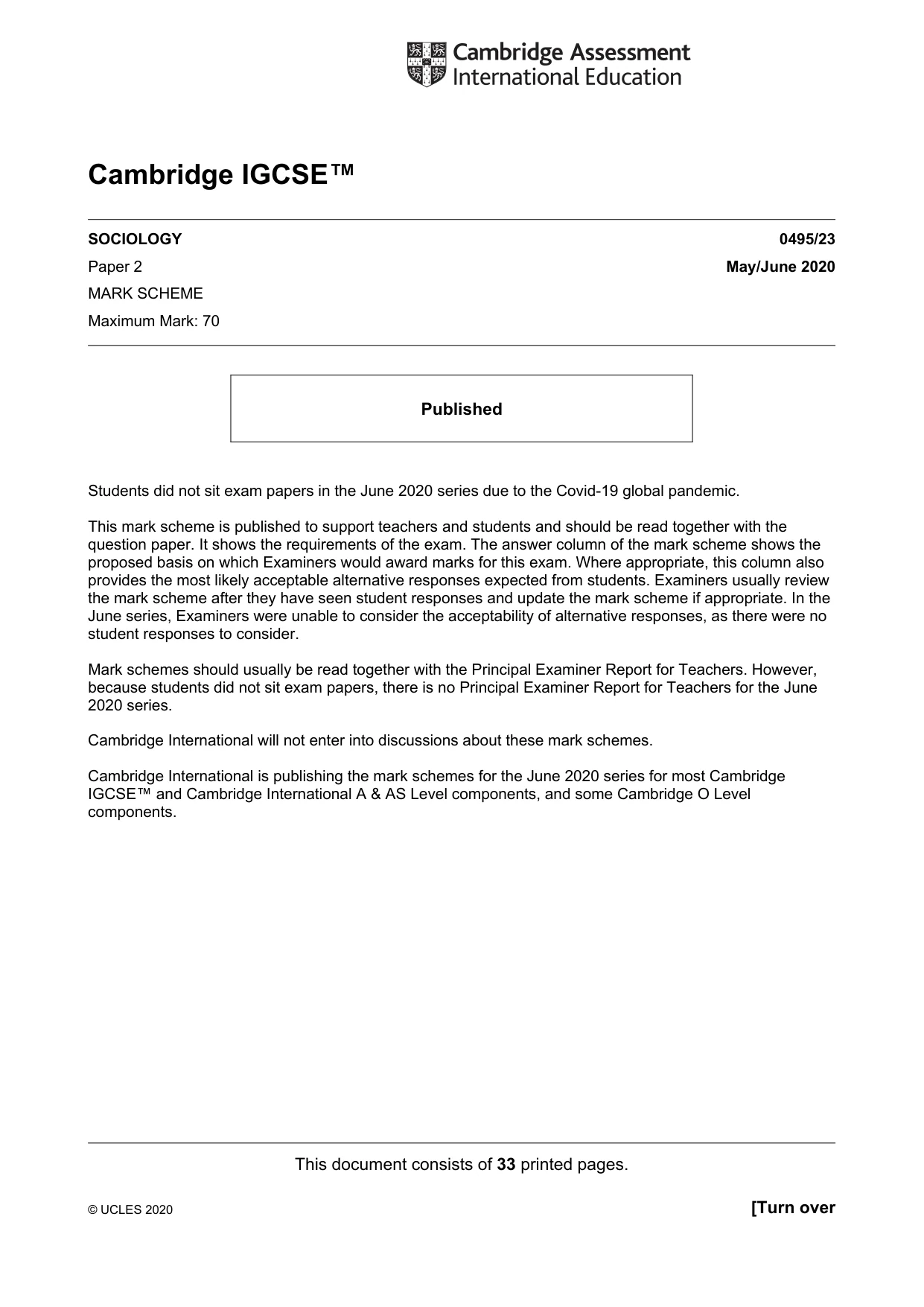
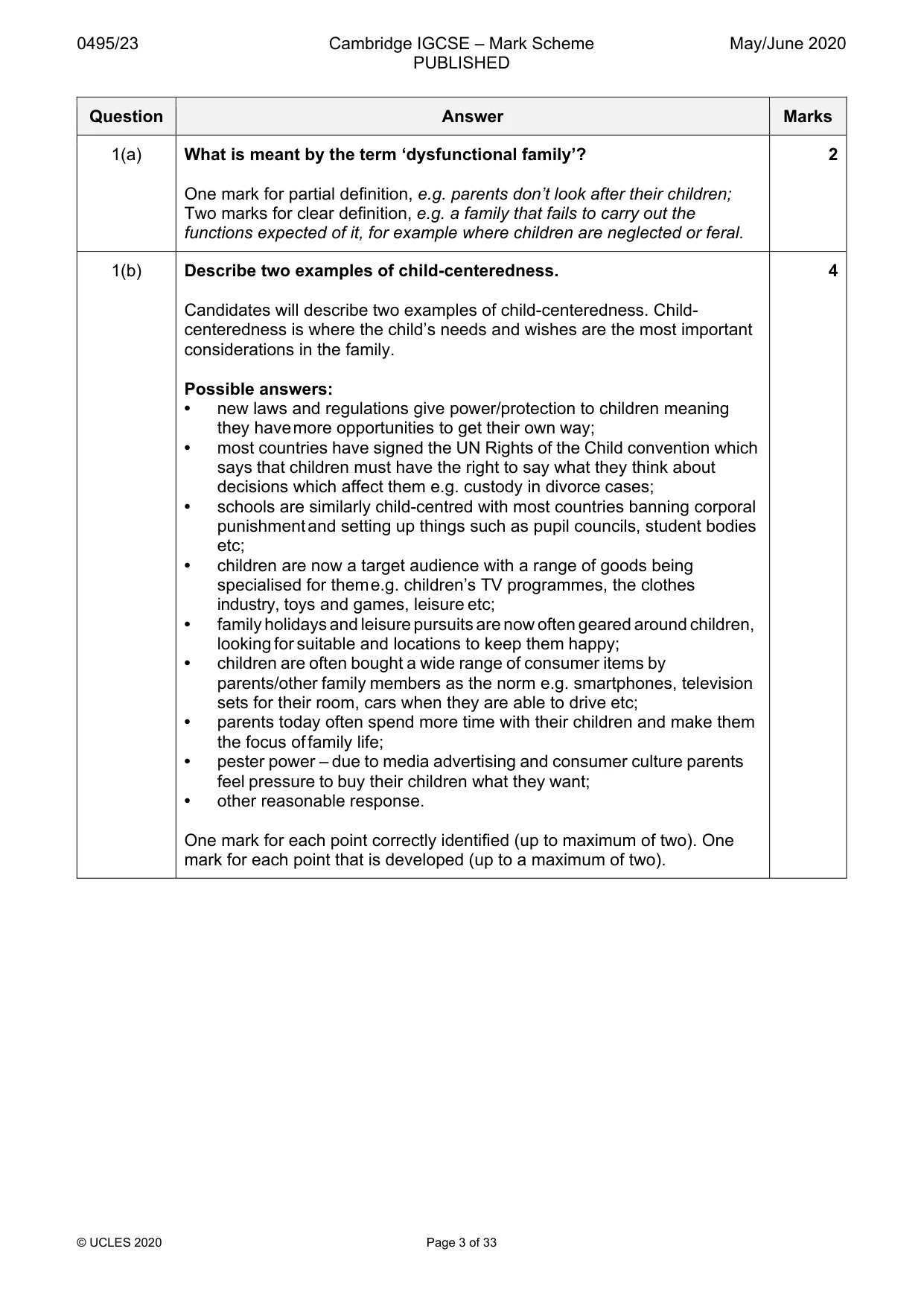
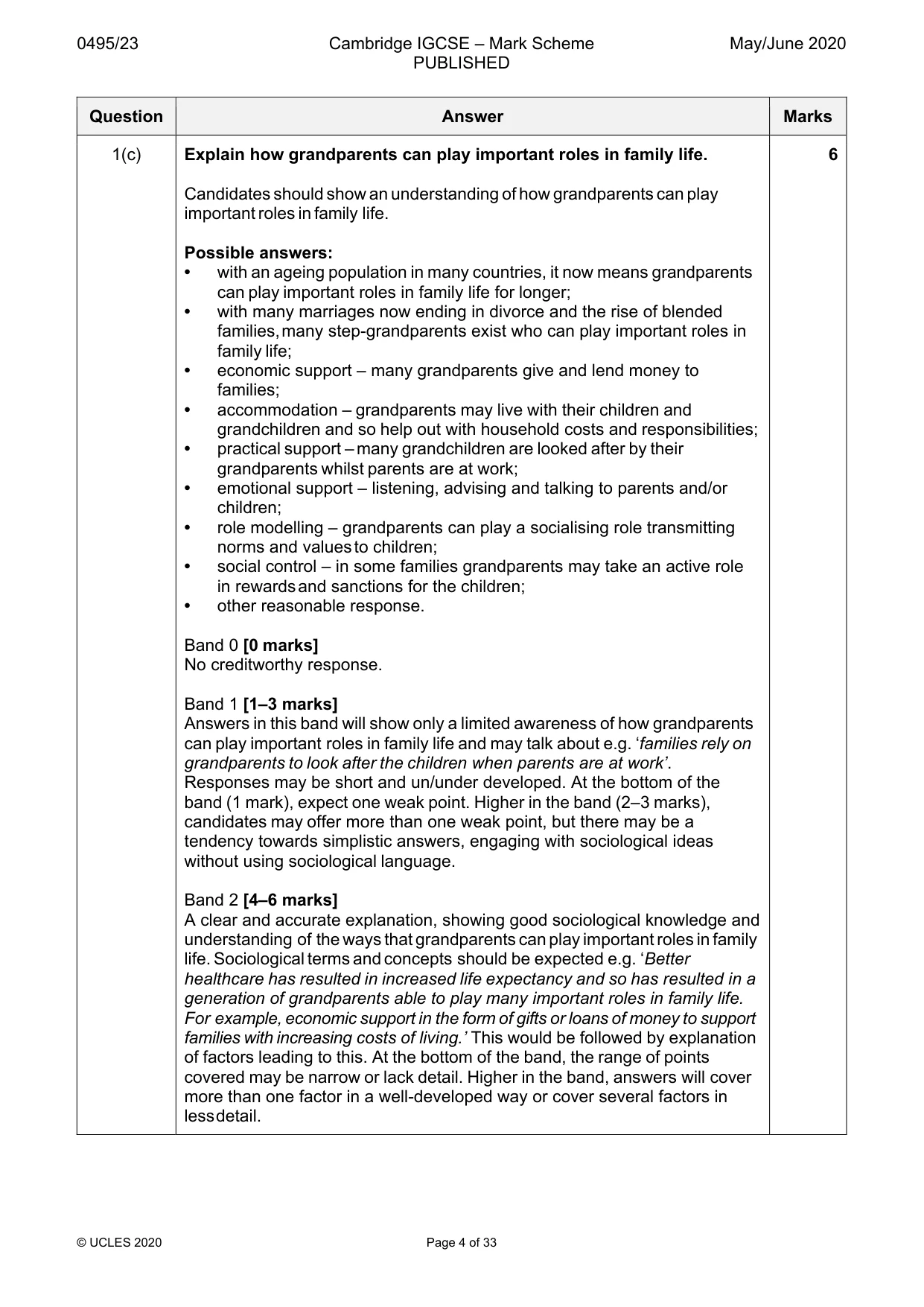
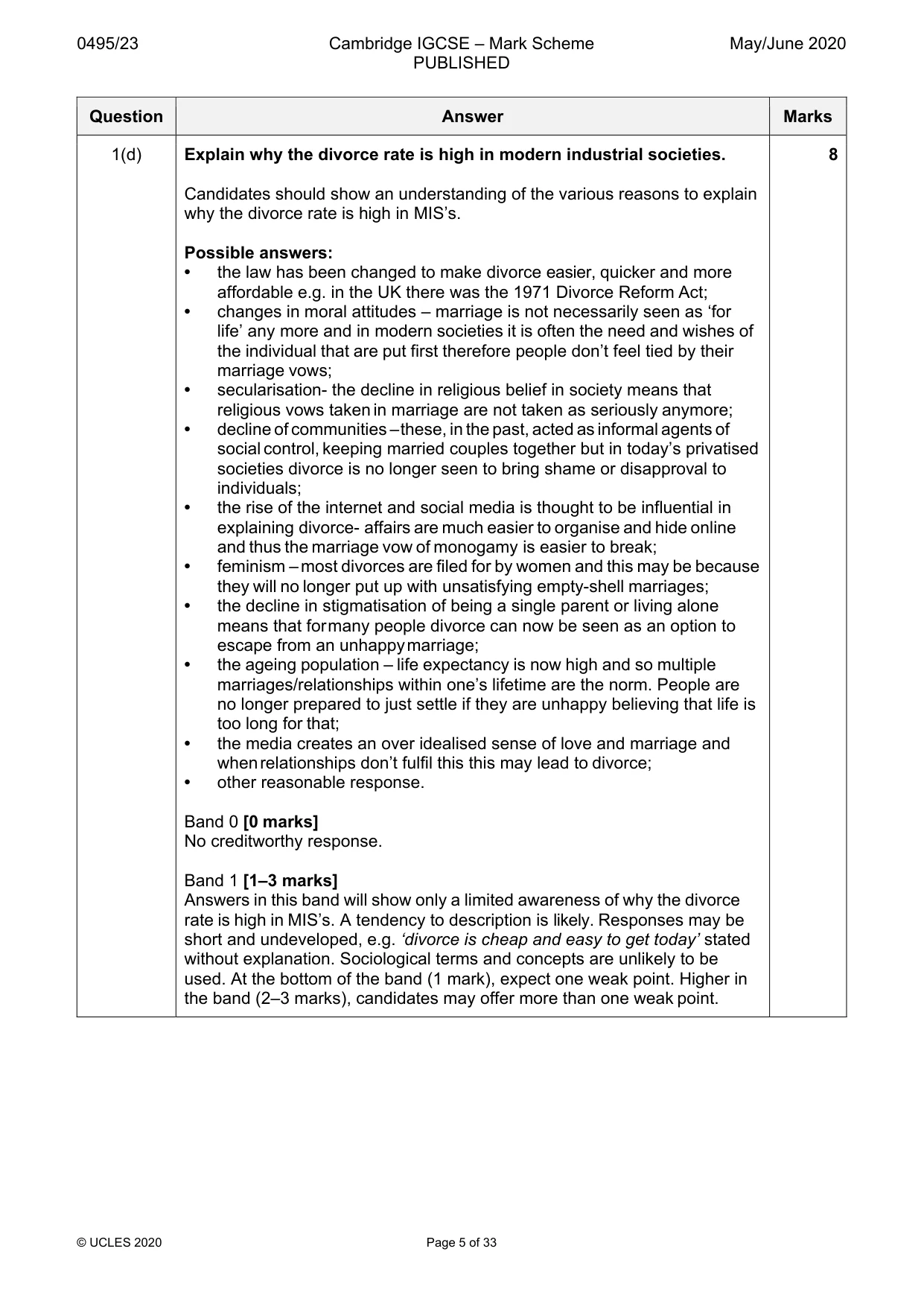
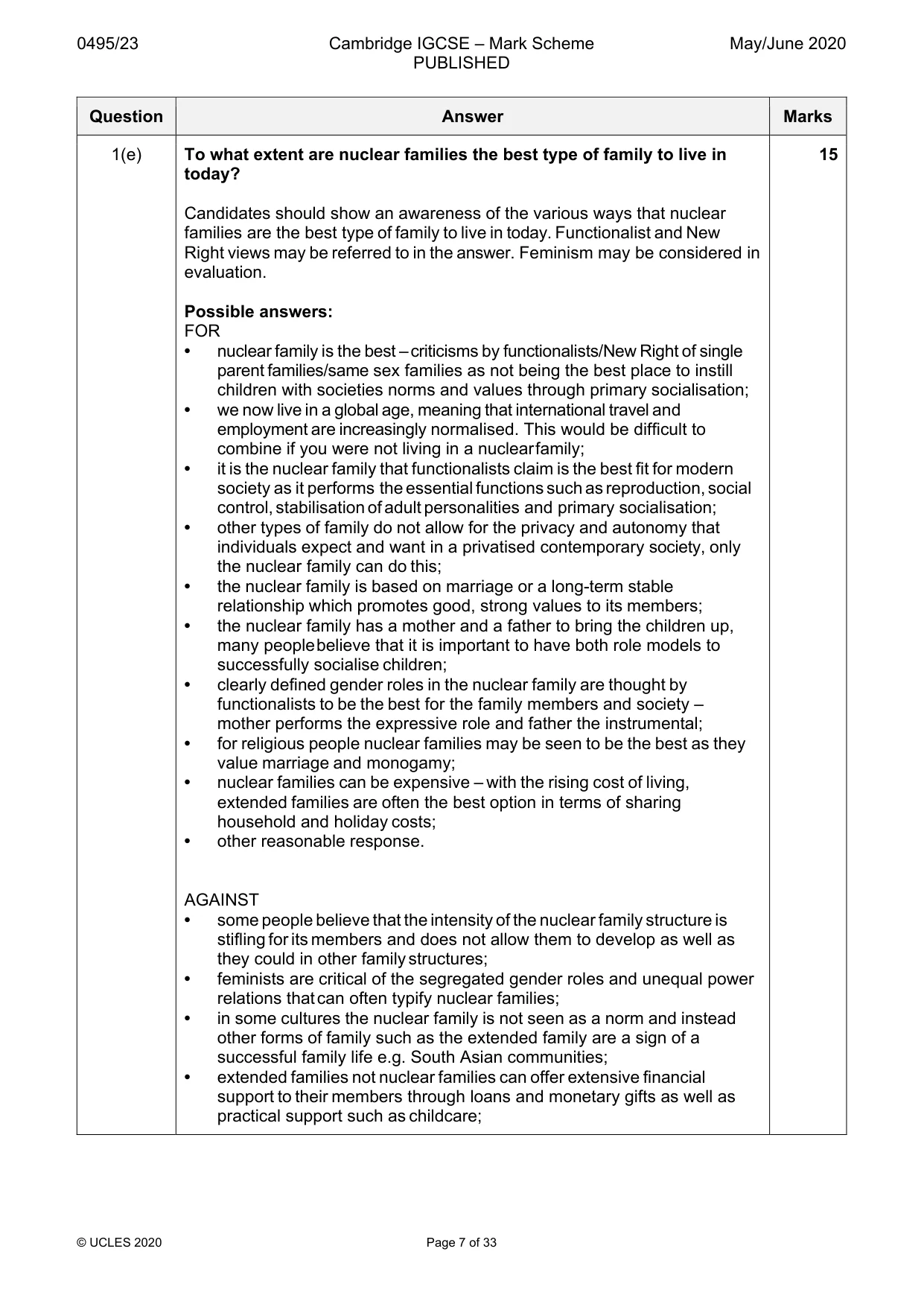
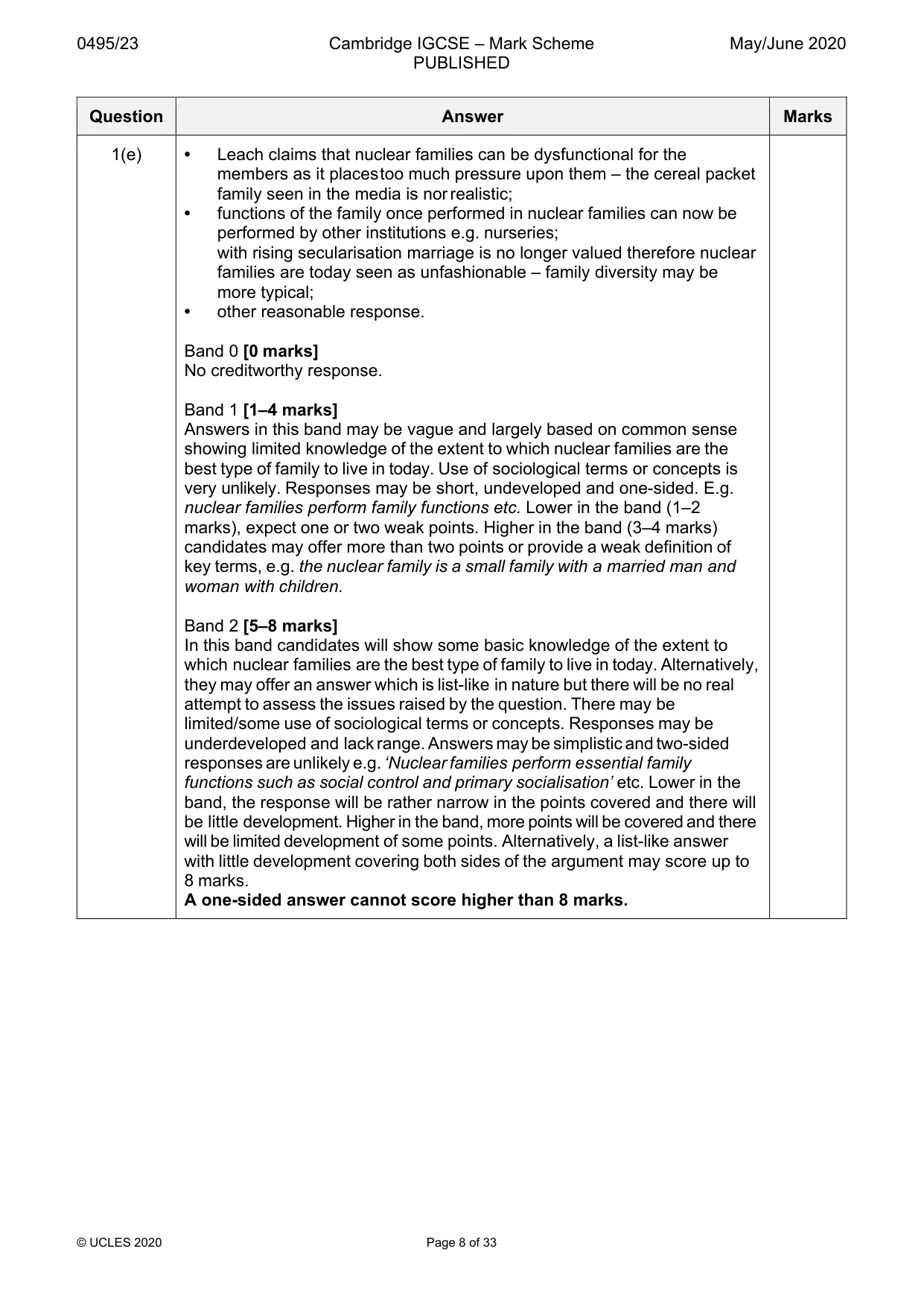
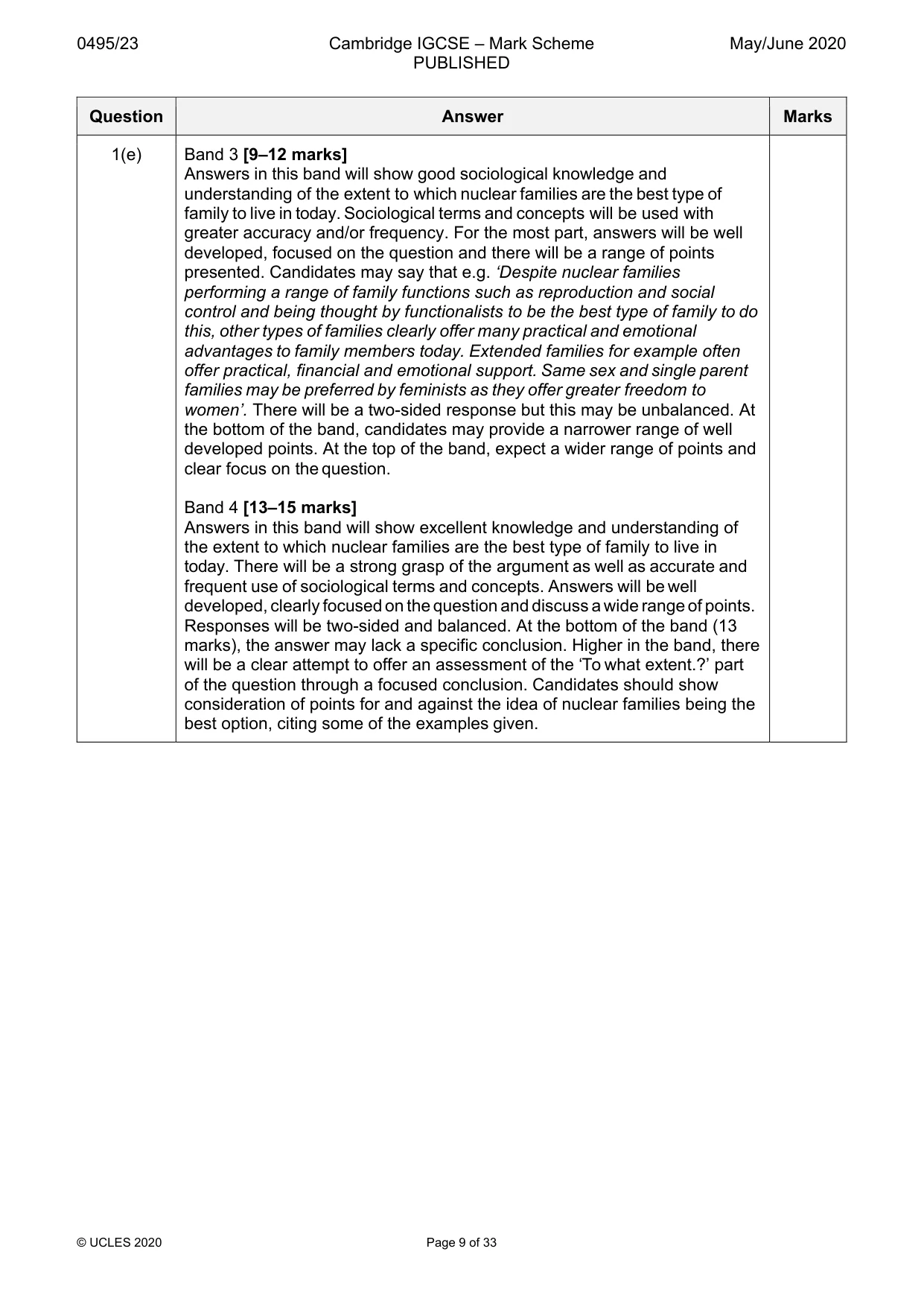
Mark scheme: Question Answer Marks 1(a) What is meant by the term ‘dysfunctional family’? 2 One mark for partial definition, e.g. parents don’t look after their children; Two marks for clear definition, e.g. a family that fails to carry out the functions expected of it, for example where children are neglected or feral. 1(b) Describe two examples of child-centeredness. 4 Candidates will describe two examples of child-centeredness. Child- centeredness is where the child’s needs and wishes are the most important considerations in the family. Possible answers: • new laws and regulations give power/protection to children meaning they have more opportunities to get their own way; • most countries have signed the UN Rights of the Child convention which says that children must have the right to say what they think about decisions which affect them e.g. custody in divorce cases; • schools are similarly child-centred with most countries banning corporal punishment and setting up things such as pupil councils, student bodies etc; • children are now a target audience with a range of goods being specialised for them e.g. children’s TV programmes, the clothes industry, toys and games, leisure etc; • family holidays and leisure pursuits are now often geared around children, looking for suitable and locations to keep them happy; • children are often bought a wide range of consumer items by parents/other family members as the norm e.g. smartphones, television sets for their room, cars when they are able to drive etc; • parents today often spend more time with their children and make them the focus of family life; • pester power – due to media advertising and consumer culture parents feel pressure to buy their children what they want; • other reasonable response. One mark for each point correctly identified (up to maximum of two). One mark for each point that is developed (up to a maximum of two). 1(c) Explain how grandparents can play important roles in family life. 6 Candidates should show an understanding of how grandparents can play important roles in family life. Possible answers: • with an ageing population in many countries, it now means grandparents can play important roles in family life for longer; • with many marriages now ending in divorce and the rise of blended families, many step-grandparents exist who can play important roles in family life; • economic support – many grandparents give and lend money to families; • accommodation – grandparents may live with their children and grandchildren and so help out with household costs and responsibilities; • practical support – many grandchildren are looked after by their grandparents whilst parents are at work; • emotional support – listening, advising and talking to parents and/or children; • role modelling – grandparents can play a socialising role transmitting norms and values to children; • social control – in some families grandparents may take an active role in rewards and sanctions for the children; • other reasonable response. Band 0 [0 marks] No creditworthy response. Band 1 [1–3 marks] Answers in this band will show only a limited awareness of how grandparents can play important roles in family life and may talk about e.g. ‘families rely on grandparents to look after the children when parents are at work’. Responses may be short and un/under developed. At the bottom of the band (1 mark), expect one weak point. Higher in the band (2–3 marks), candidates may offer more than one weak point, but there may be a tendency towards simplistic answers, engaging with sociological ideas without using sociological language. Band 2 [4–6 marks] A clear and accurate explanation, showing good sociological knowledge and understanding of the ways that grandparents can play important roles in family life. Sociological terms and concepts should be expected e.g. ‘Better healthcare has resulted in increased life expectancy and so has resulted in a generation of grandparents able to play many important roles in family life. For example, economic support in the form of gifts or loans of money to support families with increasing costs of living.’ This would be followed by explanation of factors leading to this. At the bottom of the band, the range of points covered may be narrow or lack detail. Higher in the band, answers will cover more than one factor in a well-developed way or cover several factors in less detail. 1(d) Explain why the divorce rate is high in modern industrial societies. 8 Candidates should show an understanding of the various reasons to explain why the divorce rate is high in MIS’s. Possible answers: • the law has been changed to make divorce easier, quicker and more affordable e.g. in the UK there was the 1971 Divorce Reform Act; • changes in moral attitudes – marriage is not necessarily seen as ‘for life’ any more and in modern societies it is often the need and wishes of the individual that are put first therefore people don’t feel tied by their marriage vows; • secularisation- the decline in religious belief in society means that religious vows taken in marriage are not taken as seriously anymore; • decline of communities – these, in the past, acted as informal agents of social control, keeping married couples together but in today’s privatised societies divorce is no longer seen to bring shame or disapproval to individuals; • the rise of the internet and social media is thought to be influential in explaining divorce- affairs are much easier to organise and hide online and thus the marriage vow of monogamy is easier to break; • feminism – most divorces are filed for by women and this may be because they will no longer put up with unsatisfying empty-shell marriages; • the decline in stigmatisation of being a single parent or living alone means that for many people divorce can now be seen as an option to escape from an unhappy marriage; • the ageing population – life expectancy is now high and so multiple marriages/relationships within one’s lifetime are the norm. People are no longer prepared to just settle if they are unhappy believing that life is too long for that; • the media creates an over idealised sense of love and marriage and when relationships don’t fulfil this this may lead to divorce; • other reasonable response. Band 0 [0 marks] No creditworthy response. Band 1 [1–3 marks] Answers in this band will show only a limited awareness of why the divorce rate is high in MIS’s. A tendency to description is likely. Responses may be short and undeveloped, e.g. ‘divorce is cheap and easy to get today’ stated without explanation. Sociological terms and concepts are unlikely to be used. At the bottom of the band (1 mark), expect one weak point. Higher in the band (2–3 marks), candidates may offer more than one weak point. 1(d) Band 2 [4–6 marks] Answers in this band will show basic sociological knowledge and understanding of why the divorce rate is high in MIS’s. Responses may be underdeveloped and lacking in range. e.g. ‘Moral attitudes have changed in secular societies and divorce is no longer seen as a sin. This allows people in unhappy marriages to end these through divorce’ etc. At the bottom of the band, candidates are unlikely to use sociological terms and concepts accurately. Higher in the band, candidates may be beginning to use sociological terms and concepts with greater accuracy. However, some aspects of the answer may only be partially developed/explained. Band 3 [7–8 marks] Answers in this band will show good sociological knowledge and understanding of why the divorce rate is high in MIS’s and will be well developed and explained. e.g. ‘The expectation in women for equality created by the Feminist movement has meant that often expectations of married life are high. It is women who are most likely to file for divorce if family life isn’t satisfying or egalitarian enough. There is no real stigma attached to being a single parent or to being single today which allows for greater choice to be made’. They can then expand on the explanation of this and other factors as necessary. Sociological terms and concepts will be used accurately overall. Answers will be well focused on the question and there will be a range of reasons presented. At the top of the band explanations will be clear throughout. 1(e) To what extent are nuclear families the best type of family to live in 15 today? Candidates should show an awareness of the various ways that nuclear families are the best type of family to live in today. Functionalist and New Right views may be referred to in the answer. Feminism may be considered in evaluation. Possible answers: FOR • nuclear family is the best – criticisms by functionalists/New Right of single parent families/same sex families as not being the best place to instill children with societies norms and values through primary socialisation; • we now live in a global age, meaning that international travel and employment are increasingly normalised. This would be difficult to combine if you were not living in a nuclear family; • it is the nuclear family that functionalists claim is the best fit for modern society as it performs the essential functions such as reproduction, social control, stabilisation of adult personalities and primary socialisation; • other types of family do not allow for the privacy and autonomy that individuals expect and want in a privatised contemporary society, only the nuclear family can do this; • the nuclear family is based on marriage or a long-term stable relationship which promotes good, strong values to its members; • the nuclear family has a mother and a father to bring the children up, many people believe that it is important to have both role models to successfully socialise children; • clearly defined gender roles in the nuclear family are thought by functionalists to be the best for the family members and society – mother performs the expressive role and father the instrumental; • for religious people nuclear families may be seen to be the best as they value marriage and monogamy; • nuclear families can be expensive – with the rising cost of living, extended families are often the best option in terms of sharing household and holiday costs; • other reasonable response. AGAINST • some people believe that the intensity of the nuclear family structure is stifling for its members and does not allow them to develop as well as they could in other family structures; • feminists are critical of the segregated gender roles and unequal power relations that can often typify nuclear families; • in some cultures the nuclear family is not seen as a norm and instead other forms of family such as the extended family are a sign of a successful family life e.g. South Asian communities; • extended families not nuclear families can offer extensive financial support to their members through loans and monetary gifts as well as practical support such as childcare; 1(e) • Leach claims that nuclear families can be dysfunctional for the members as it places too much pressure upon them – the cereal packet family seen in the media is nor realistic; • functions of the family once performed in nuclear families can now be performed by other institutions e.g. nurseries; with rising secularisation marriage is no longer valued therefore nuclear families are today seen as unfashionable – family diversity may be more typical; • other reasonable response. Band 0 [0 marks] No creditworthy response. Band 1 [1–4 marks] Answers in this band may be vague and largely based on common sense showing limited knowledge of the extent to which nuclear families are the best type of family to live in today. Use of sociological terms or concepts is very unlikely. Responses may be short, undeveloped and one-sided. E.g. nuclear families perform family functions etc. Lower in the band (1–2 marks), expect one or two weak points. Higher in the band (3–4 marks) candidates may offer more than two points or provide a weak definition of key terms, e.g. the nuclear family is a small family with a married man and woman with children. Band 2 [5–8 marks] In this band candidates will show some basic knowledge of the extent to which nuclear families are the best type of family to live in today. Alternatively, they may offer an answer which is list-like in nature but there will be no real attempt to assess the issues raised by the question. There may be limited/some use of sociological terms or concepts. Responses may be underdeveloped and lack range. Answers may be simplistic and two-sided responses are unlikely e.g. ‘Nuclear families perform essential family functions such as social control and primary socialisation’ etc. Lower in the band, the response will be rather narrow in the points covered and there will be little development. Higher in the band, more points will be covered and there will be limited development of some points. Alternatively, a list-like answer with little development covering both sides of the argument may score up to 8 marks. A one-sided answer cannot score higher than 8 marks. 1(e) Band 3 [9–12 marks] Answers in this band will show good sociological knowledge and understanding of the extent to which nuclear families are the best type of family to live in today. Sociological terms and concepts will be used with greater accuracy and/or frequency. For the most part, answers will be well developed, focused on the question and there will be a range of points presented. Candidates may say that e.g. ‘Despite nuclear families performing a range of family functions such as reproduction and social control and being thought by functionalists to be the best type of family to do this, other types of families clearly offer many practical and emotional advantages to family members today. Extended families for example often offer practical, financial and emotional support. Same sex and single parent families may be preferred by feminists as they offer greater freedom to women’. There will be a two-sided response but this may be unbalanced. At the bottom of the band, candidates may provide a narrower range of well developed points. At the top of the band, expect a wider range of points and clear focus on the question. Band 4 [13–15 marks] Answers in this band will show excellent knowledge and understanding of the extent to which nuclear families are the best type of family to live in today. There will be a strong grasp of the argument as well as accurate and frequent use of sociological terms and concepts. Answers will be well developed, clearly focused on the question and discuss a wide range of points. Responses will be two-sided and balanced. At the bottom of the band (13 marks), the answer may lack a specific conclusion. Higher in the band, there will be a clear attempt to offer an assessment of the ‘To what extent.?’ part of the question through a focused conclusion. Candidates should show consideration of points for and against the idea of nuclear families being the best option, citing some of the examples given.
Q2 · Sociologists debate whether cultural deprivation, labelling and material factors limit…
2 Sociologists debate whether cultural deprivation, labelling and material factors limit educational success. Education is not just about gaining qualifications and measuring intelligence, it also has many other functions such as reinforcing social expectations. (a) What is meant by the term ‘labelling’? [2] (b) Describe two ways social expectations are reinforced in school. [4] (c) Explain how cultural deprivation may be a barrier to educational success. [6] (d) Explain why IQ tests are criticised as a way of measuring intelligence. [8] (e) To what extent do peer groups influence educational achievement? [15] Section C: Crime, deviance and social control
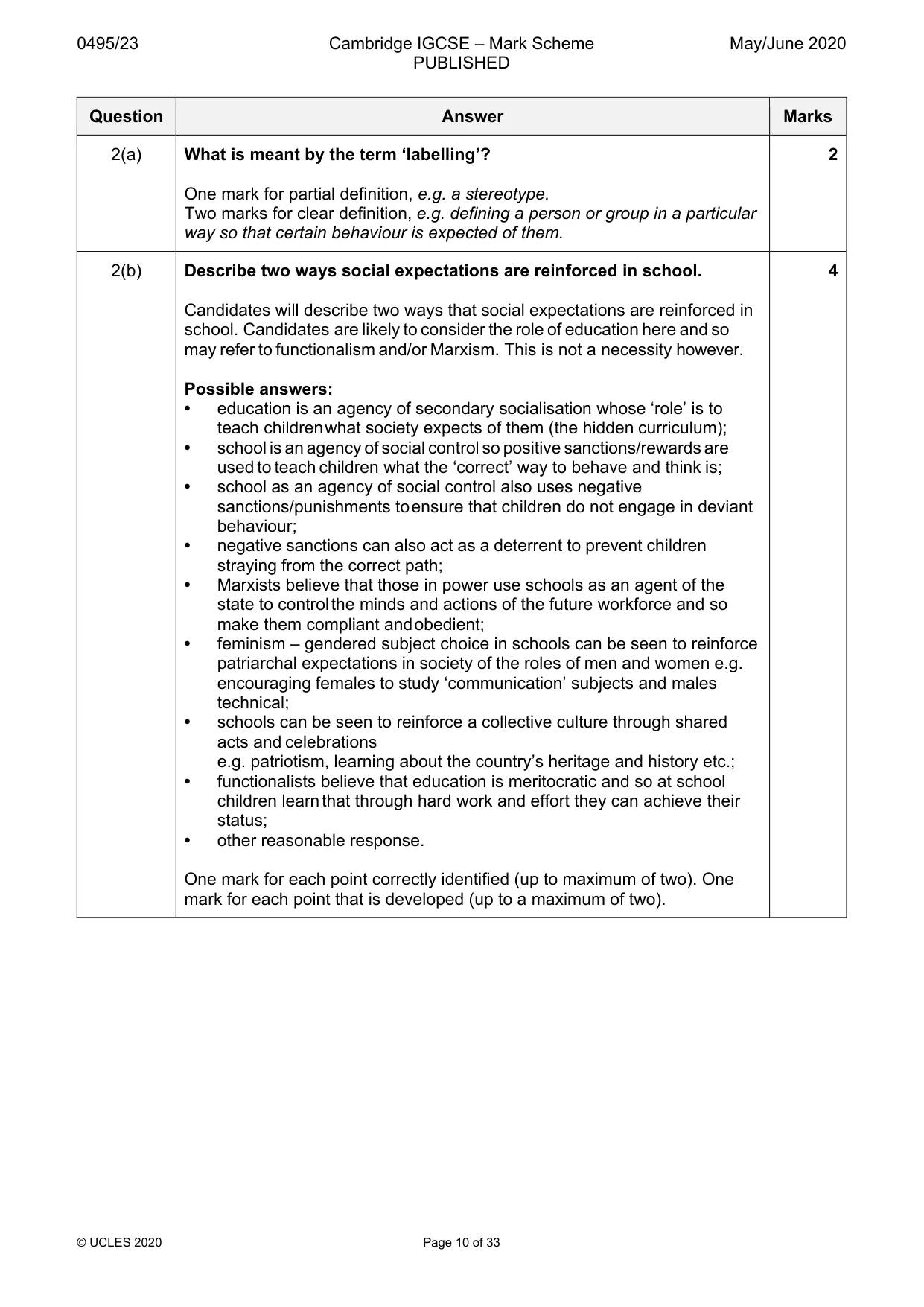
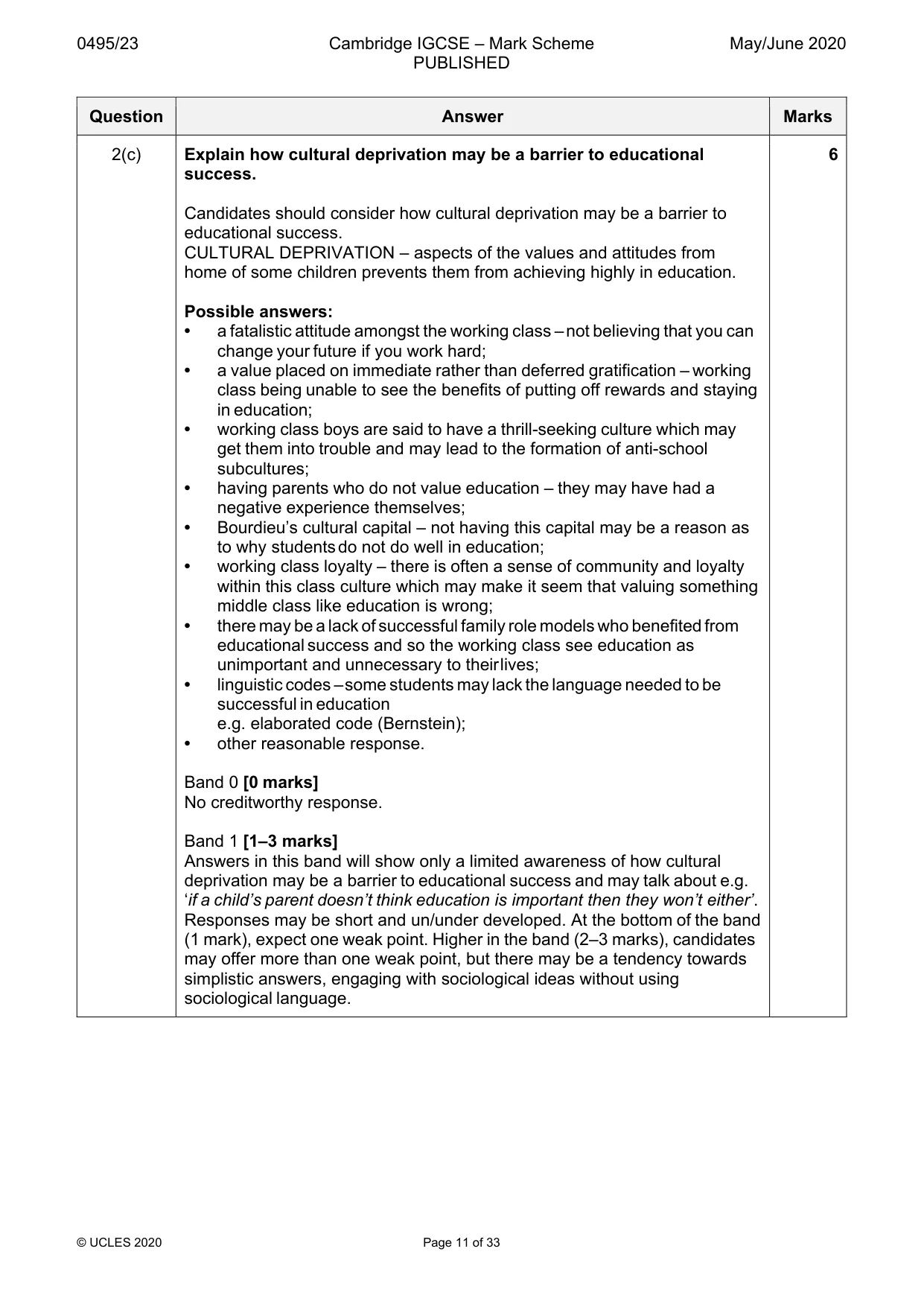
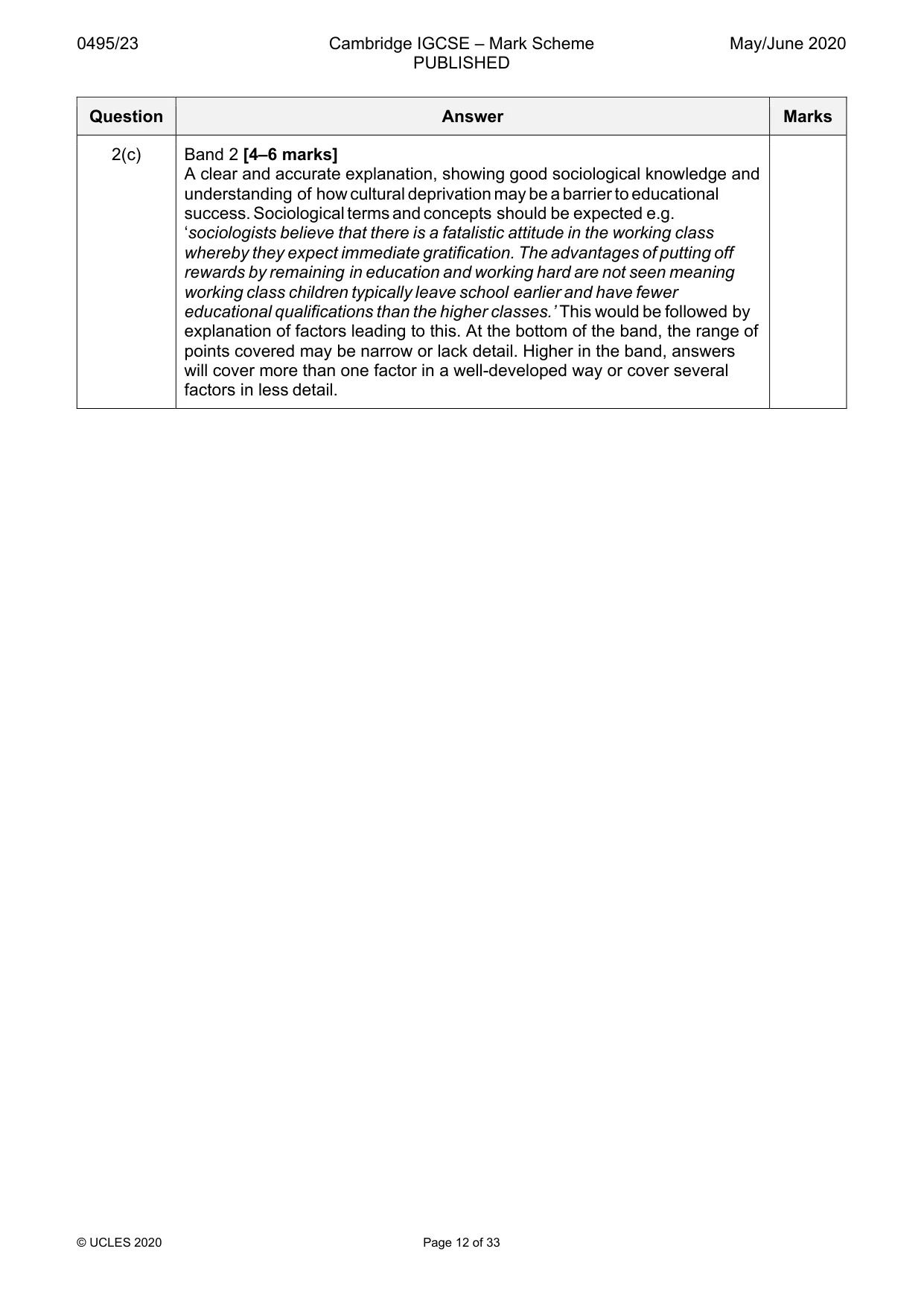
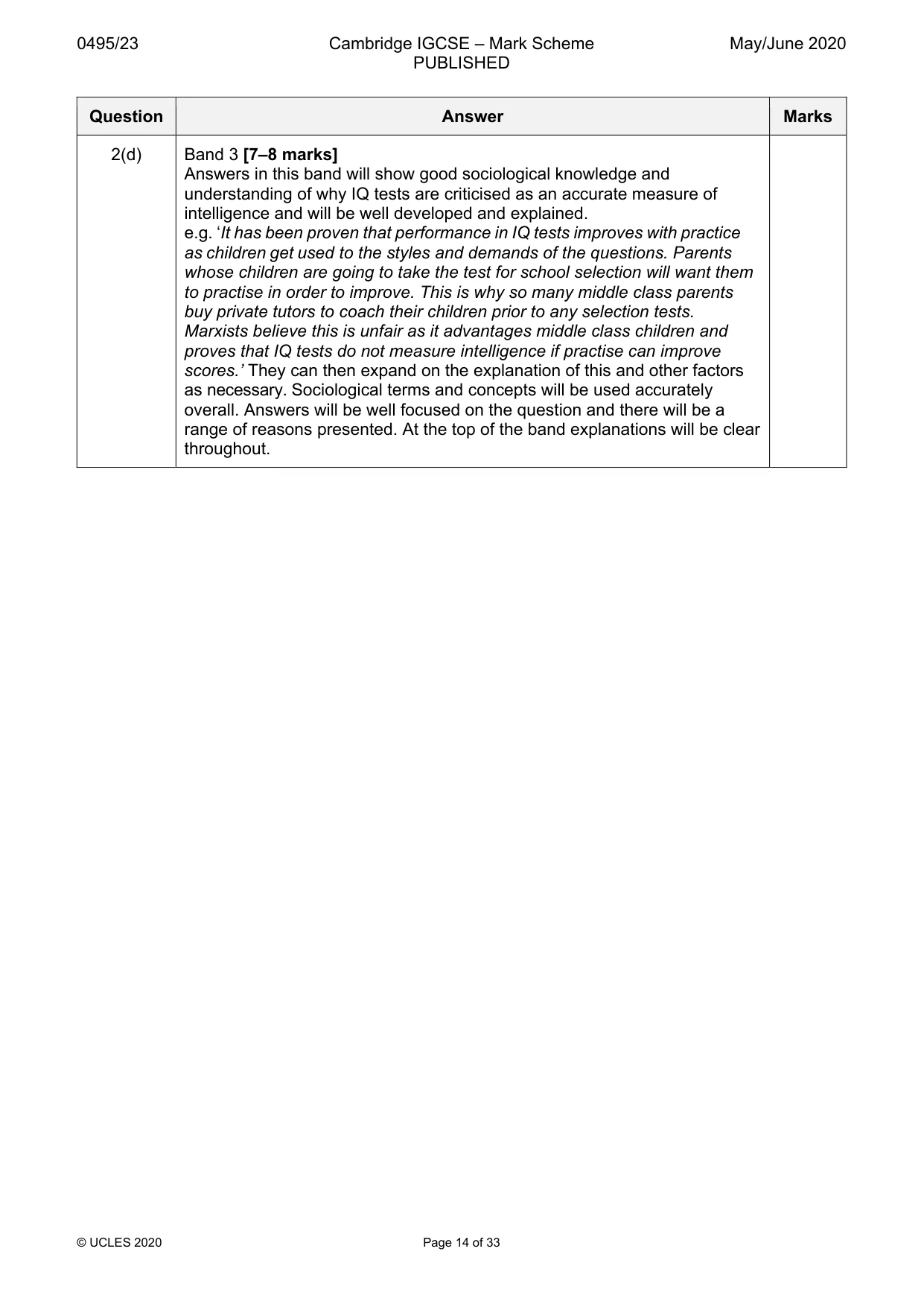
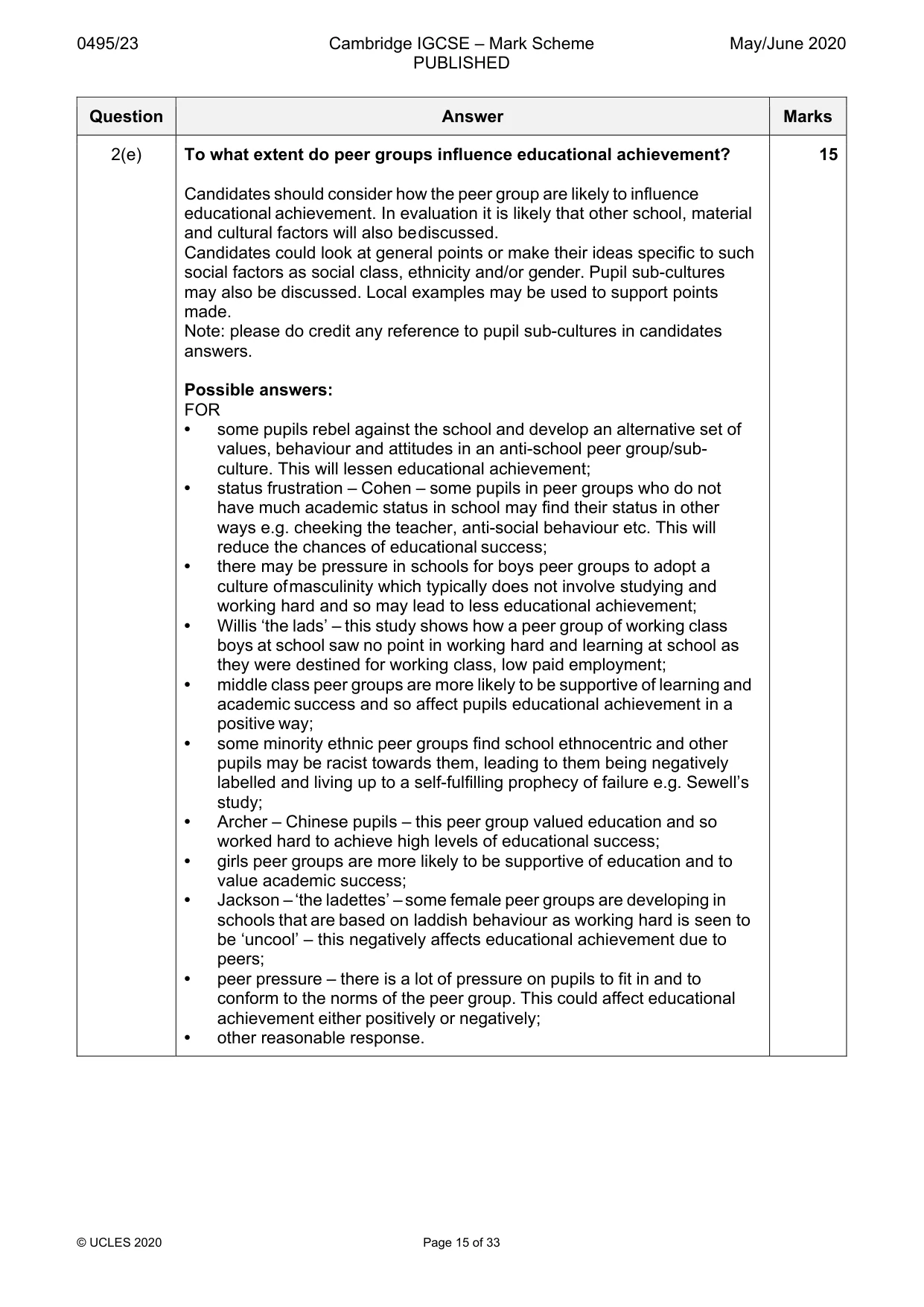
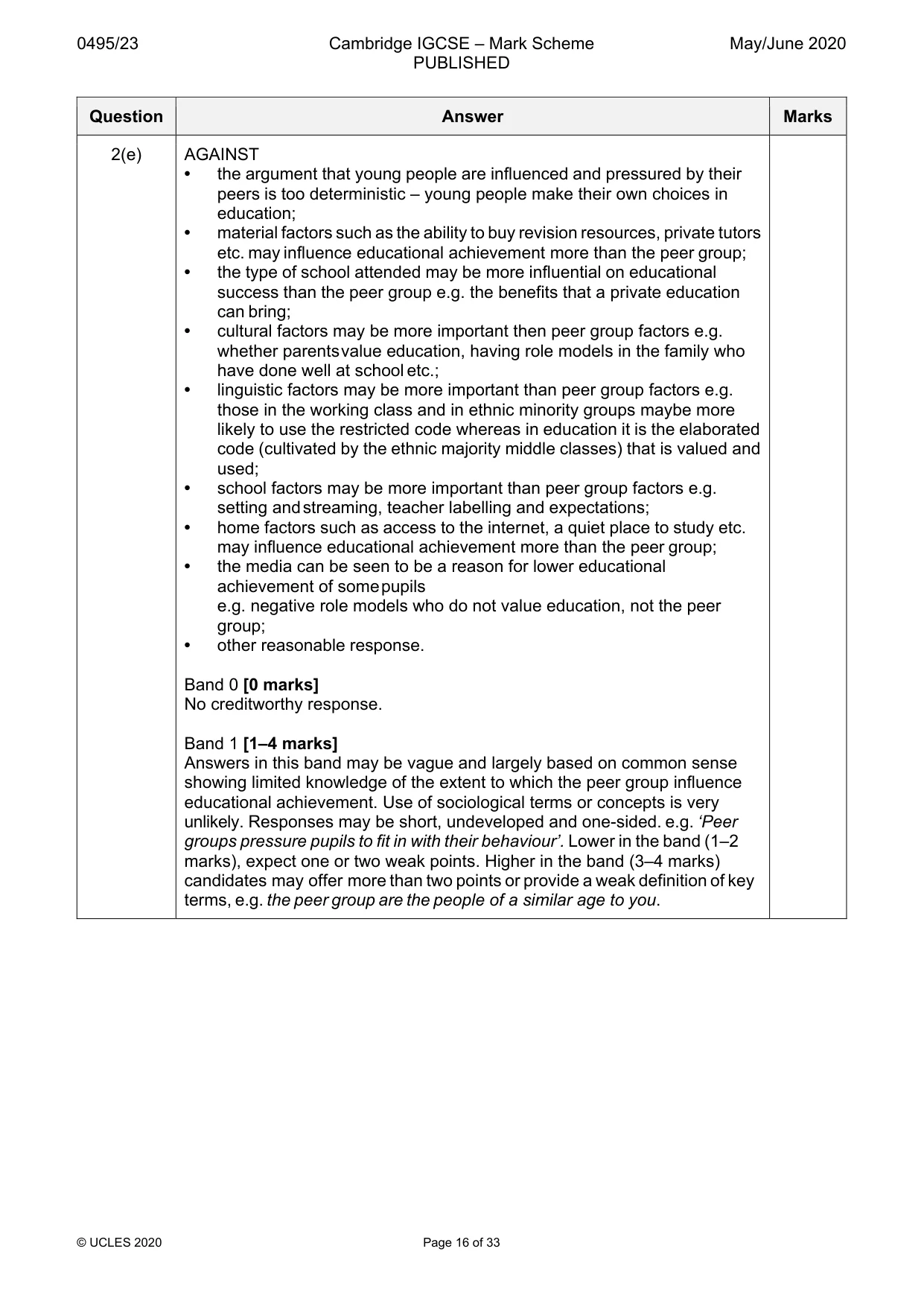
Mark scheme: 2(a) What is meant by the term ‘labelling’? 2 One mark for partial definition, e.g. a stereotype. Two marks for clear definition, e.g. defining a person or group in a particular way so that certain behaviour is expected of them. 2(b) Describe two ways social expectations are reinforced in school. 4 Candidates will describe two ways that social expectations are reinforced in school. Candidates are likely to consider the role of education here and so may refer to functionalism and/or Marxism. This is not a necessity however. Possible answers: • education is an agency of secondary socialisation whose ‘role’ is to teach children what society expects of them (the hidden curriculum); • school is an agency of social control so positive sanctions/rewards are used to teach children what the ‘correct’ way to behave and think is; • school as an agency of social control also uses negative sanctions/punishments to ensure that children do not engage in deviant behaviour; • negative sanctions can also act as a deterrent to prevent children straying from the correct path; • Marxists believe that those in power use schools as an agent of the state to control the minds and actions of the future workforce and so make them compliant and obedient; • feminism – gendered subject choice in schools can be seen to reinforce patriarchal expectations in society of the roles of men and women e.g. encouraging females to study ‘communication’ subjects and males technical; • schools can be seen to reinforce a collective culture through shared acts and celebrations e.g. patriotism, learning about the country’s heritage and history etc.; • functionalists believe that education is meritocratic and so at school children learn that through hard work and effort they can achieve their status; • other reasonable response. One mark for each point correctly identified (up to maximum of two). One mark for each point that is developed (up to a maximum of two). 2(c) Explain how cultural deprivation may be a barrier to educational 6 success. Candidates should consider how cultural deprivation may be a barrier to educational success. CULTURAL DEPRIVATION – aspects of the values and attitudes from home of some children prevents them from achieving highly in education. Possible answers: • a fatalistic attitude amongst the working class – not believing that you can change your future if you work hard; • a value placed on immediate rather than deferred gratification – working class being unable to see the benefits of putting off rewards and staying in education; • working class boys are said to have a thrill-seeking culture which may get them into trouble and may lead to the formation of anti-school subcultures; • having parents who do not value education – they may have had a negative experience themselves; • Bourdieu’s cultural capital – not having this capital may be a reason as to why students do not do well in education; • working class loyalty – there is often a sense of community and loyalty within this class culture which may make it seem that valuing something middle class like education is wrong; • there may be a lack of successful family role models who benefited from educational success and so the working class see education as unimportant and unnecessary to their lives; • linguistic codes – some students may lack the language needed to be successful in education e.g. elaborated code (Bernstein); • other reasonable response. Band 0 [0 marks] No creditworthy response. Band 1 [1–3 marks] Answers in this band will show only a limited awareness of how cultural deprivation may be a barrier to educational success and may talk about e.g. ‘if a child’s parent doesn’t think education is important then they won’t either’. Responses may be short and un/under developed. At the bottom of the band (1 mark), expect one weak point. Higher in the band (2–3 marks), candidates may offer more than one weak point, but there may be a tendency towards simplistic answers, engaging with sociological ideas without using sociological language. 2(c) Band 2 [4–6 marks] A clear and accurate explanation, showing good sociological knowledge and understanding of how cultural deprivation may be a barrier to educational success. Sociological terms and concepts should be expected e.g. ‘sociologists believe that there is a fatalistic attitude in the working class whereby they expect immediate gratification. The advantages of putting off rewards by remaining in education and working hard are not seen meaning working class children typically leave school earlier and have fewer educational qualifications than the higher classes.’ This would be followed by explanation of factors leading to this. At the bottom of the band, the range of points covered may be narrow or lack detail. Higher in the band, answers will cover more than one factor in a well-developed way or cover several factors in less detail. 2(d) Explain why IQ tests are criticised as a way of measuring intelligence. 8 Candidates need to explain different reasons why IQ tests are criticised as a way of measuring intelligence. Possible answers: • some people with low scores on IQ tests go on to do well in their education and career whilst those who do well are not always successful in life – is this really an accurate measure of intelligence?; • performance in IQ tests improves with practice – parents often buy in tutors to coach their children. This leads many sociologists to question whether the IQ tests actually do measure intelligence; • how well a person does on an IQ test can be affected by things like illness and anxiety – this therefore can’t be an accurate measure of intelligence; • IQ tests measure ability at just one point in time, intelligence doesn’t work like this. Intelligence develops and changes over time so the IQ tests cannot be accurate; • IQ tests are based on a narrow range of skills – intelligence is far broader than this; • IQ tests are written from a middle class perspective which will inevitably include their cultural biases and assumptions – those not from this culture will therefore always find the test more difficult; • other reasonable response. Band 0 [0 marks] No creditworthy response. Band 1 [1–3 marks] Answers in this band will show only a limited awareness of why IQ tests are criticised as a way of measuring intelligence. A tendency to description is likely. Responses may be short and undeveloped, e.g. ‘the tests are written by the middle class’, stated without explanation. Sociological terms and concepts are unlikely to be used. At the bottom of the band (1 mark), expect one weak point. Higher in the band (2–3 marks), candidates may offer more than one weak point. Band 2 [4–6 marks] Answers in this band will show basic sociological knowledge and understanding of why IQ tests are criticised as a way of measuring intelligence. Responses may be underdeveloped and lacking in range. e.g. ‘IQ tests only measure how much a person can do at one moment in time. They might be unwell or stressed. This means the test may not be an accurate measure of intelligence.’ etc. At the bottom of the band, candidates are unlikely to use sociological terms and concepts accurately. Higher in the band, candidates may be beginning to use sociological terms and concepts with greater accuracy. However, some aspects of the answer may only be partially developed/explained. 2(d) Band 3 [7–8 marks] Answers in this band will show good sociological knowledge and understanding of why IQ tests are criticised as an accurate measure of intelligence and will be well developed and explained. e.g. ‘It has been proven that performance in IQ tests improves with practice as children get used to the styles and demands of the questions. Parents whose children are going to take the test for school selection will want them to practise in order to improve. This is why so many middle class parents buy private tutors to coach their children prior to any selection tests. Marxists believe this is unfair as it advantages middle class children and proves that IQ tests do not measure intelligence if practise can improve scores.’ They can then expand on the explanation of this and other factors as necessary. Sociological terms and concepts will be used accurately overall. Answers will be well focused on the question and there will be a range of reasons presented. At the top of the band explanations will be clear throughout. 2(e) To what extent do peer groups influence educational achievement? 15 Candidates should consider how the peer group are likely to influence educational achievement. In evaluation it is likely that other school, material and cultural factors will also be discussed. Candidates could look at general points or make their ideas specific to such social factors as social class, ethnicity and/or gender. Pupil sub-cultures may also be discussed. Local examples may be used to support points made. Note: please do credit any reference to pupil sub-cultures in candidates answers. Possible answers: FOR • some pupils rebel against the school and develop an alternative set of values, behaviour and attitudes in an anti-school peer group/sub- culture. This will lessen educational achievement; • status frustration – Cohen – some pupils in peer groups who do not have much academic status in school may find their status in other ways e.g. cheeking the teacher, anti-social behaviour etc. This will reduce the chances of educational success; • there may be pressure in schools for boys peer groups to adopt a culture of masculinity which typically does not involve studying and working hard and so may lead to less educational achievement; • Willis ‘the lads’ – this study shows how a peer group of working class boys at school saw no point in working hard and learning at school as they were destined for working class, low paid employment; • middle class peer groups are more likely to be supportive of learning and academic success and so affect pupils educational achievement in a positive way; • some minority ethnic peer groups find school ethnocentric and other pupils may be racist towards them, leading to them being negatively labelled and living up to a self-fulfilling prophecy of failure e.g. Sewell’s study; • Archer – Chinese pupils – this peer group valued education and so worked hard to achieve high levels of educational success; • girls peer groups are more likely to be supportive of education and to value academic success; • Jackson – ‘the ladettes’ – some female peer groups are developing in schools that are based on laddish behaviour as working hard is seen to be ‘uncool’ – this negatively affects educational achievement due to peers; • peer pressure – there is a lot of pressure on pupils to fit in and to conform to the norms of the peer group. This could affect educational achievement either positively or negatively; • other reasonable response. 2(e) AGAINST • the argument that young people are influenced and pressured by their peers is too deterministic – young people make their own choices in education; • material factors such as the ability to buy revision resources, private tutors etc. may influence educational achievement more than the peer group; • the type of school attended may be more influential on educational success than the peer group e.g. the benefits that a private education can bring; • cultural factors may be more important then peer group factors e.g. whether parents value education, having role models in the family who have done well at school etc.; • linguistic factors may be more important than peer group factors e.g. those in the working class and in ethnic minority groups maybe more likely to use the restricted code whereas in education it is the elaborated code (cultivated by the ethnic majority middle classes) that is valued and used; • school factors may be more important than peer group factors e.g. setting and streaming, teacher labelling and expectations; • home factors such as access to the internet, a quiet place to study etc. may influence educational achievement more than the peer group; • the media can be seen to be a reason for lower educational achievement of some pupils e.g. negative role models who do not value education, not the peer group; • other reasonable response. Band 0 [0 marks] No creditworthy response. Band 1 [1–4 marks] Answers in this band may be vague and largely based on common sense showing limited knowledge of the extent to which the peer group influence educational achievement. Use of sociological terms or concepts is very unlikely. Responses may be short, undeveloped and one-sided. e.g. ‘Peer groups pressure pupils to fit in with their behaviour’. Lower in the band (1–2 marks), expect one or two weak points. Higher in the band (3–4 marks) candidates may offer more than two points or provide a weak definition of key terms, e.g. the peer group are the people of a similar age to you. 2(e) Band 2 [5–8 marks] In this band candidates will show some basic knowledge of the extent to which the peer group influence educational achievement. Alternatively, they may offer an answer which is list-like in nature but there will be no real attempt to assess the issues raised by the question. There may be limited/some use of sociological terms or concepts. Responses may be underdeveloped and lack range. Answers may be simplistic and two-sided responses are unlikely e.g. ‘If a pupil comes from an ethnic minority background they may experience racism in school and so rebel against it through their peer group’ etc. Lower in the band, the response will be rather narrow in the points covered and there will be little development. Higher in the band, more points will be covered and there will be limited development of some points. Alternatively, a list-like answer with little development covering both sides of the argument may score up to 8 marks. A one-sided answer cannot score higher than 8 marks. Band 3 [9–12 marks] Answers in this band will show good sociological knowledge and understanding of the extent to which the peer group influence educational achievement. Sociological terms and concepts will be used with greater accuracy and/or frequency. For the most part, answers will be well developed, focused on the question and there will be a range of points presented. Candidates may say that e.g. ‘Despite there being many examples of how peer group factors can affect educational achievement, either negatively through an anti-school sub-culture such as the lads or positively through a pro-school sub-culture, other factors are also influential. It may be, for example, that material factors such as the ability to pay for a private education through economic capital are more important. Marxists would agree with this believing that the education system is not at all meritocratic.’ There will be a two-sided response but this may be unbalanced. At the bottom of the band, candidates may provide a narrower range of well developed points. At the top of the band, expect a wider range of points and clear focus on the question. Band 4 [13–15 marks] Answers in this band will show excellent knowledge and understanding of the extent to which the peer group influence educational achievement. There will be a strong grasp of the argument as well as accurate and frequent use of sociological terms and concepts. Answers will be well developed, clearly focused on the question and discuss a wide range of points. Responses will be two-sided and balanced. At the bottom of the band (13 marks), the answer may lack a specific conclusion. Higher in the band, there will be a clear attempt to offer an assessment of the ‘To what extent.?’ part of the question through a focused conclusion. Candidates should show consideration of points for and against the idea of the peer group influencing educational achievement, citing some of the examples given.
Q3 · Crime rates differ depending upon the type of crime, where it is committed and the way it…
3 Crime rates differ depending upon the type of crime, where it is committed and the way it is measured. The rates of offending and conviction vary depending on the social characteristics of the offender. Many explanations exist for this, including police targeting and the role of the media and new technologies. When crime rates rise governments and the public demand more social control. Some sociologists argue that this will not reduce crime. (a) What is meant by the term ‘targeting’? [2] (b) Describe two ways of measuring crime. [4] (c) Explain how crime can be linked to new technologies. [6] (d) Explain why crime rates for some ethnic groups are higher than others. [8] (e) To what extent can formal social control reduce crime? [15] Section D: Media
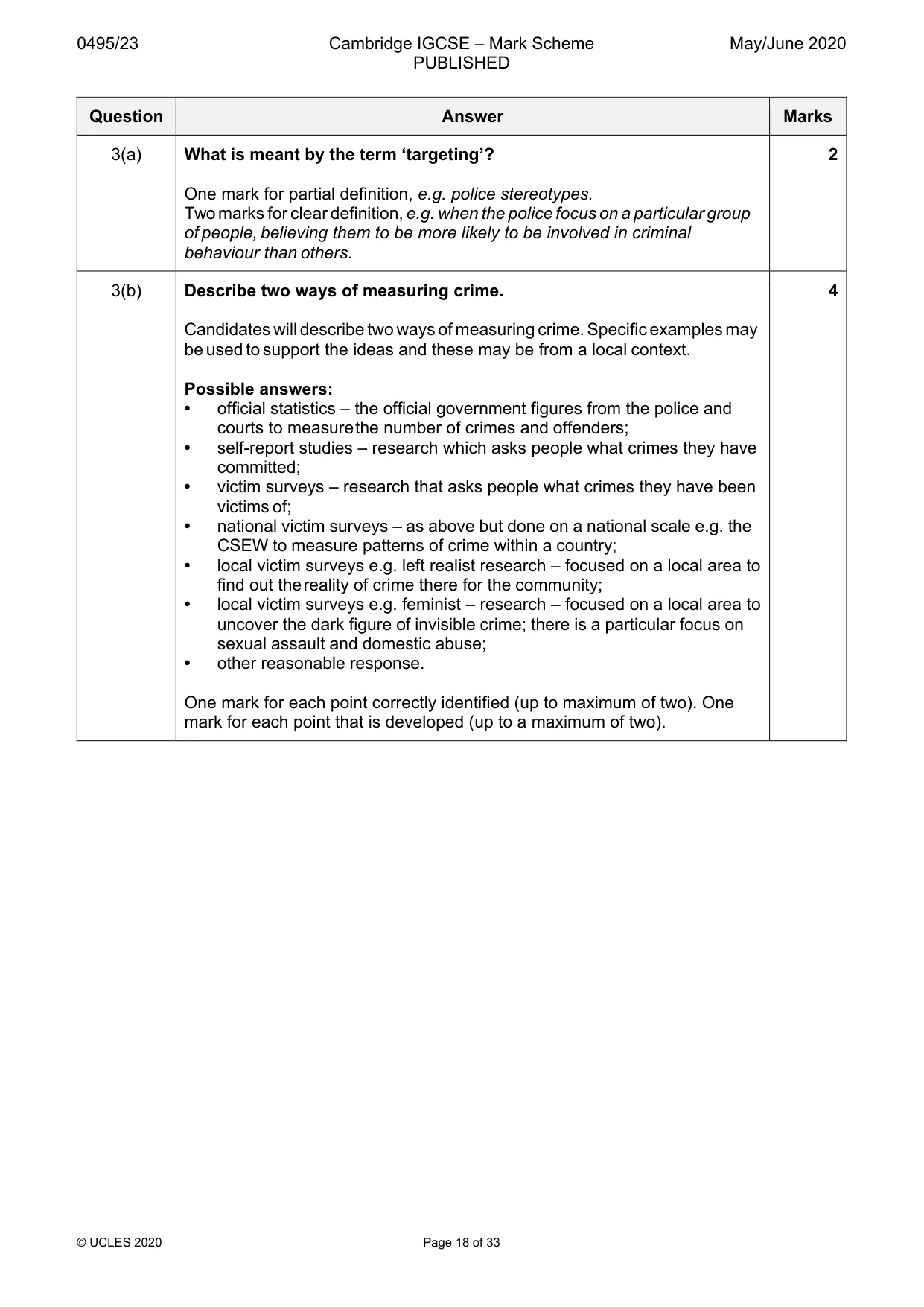
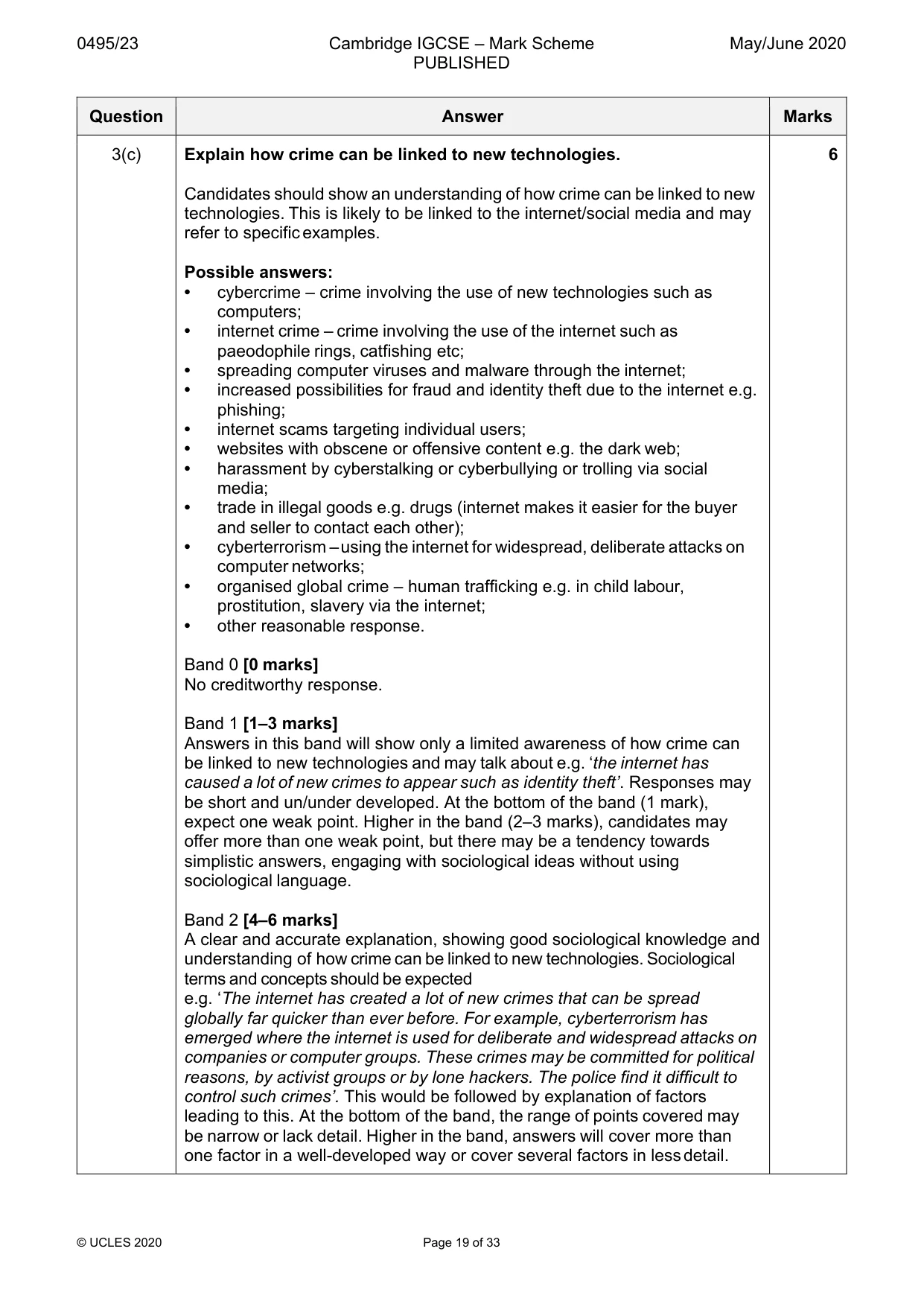
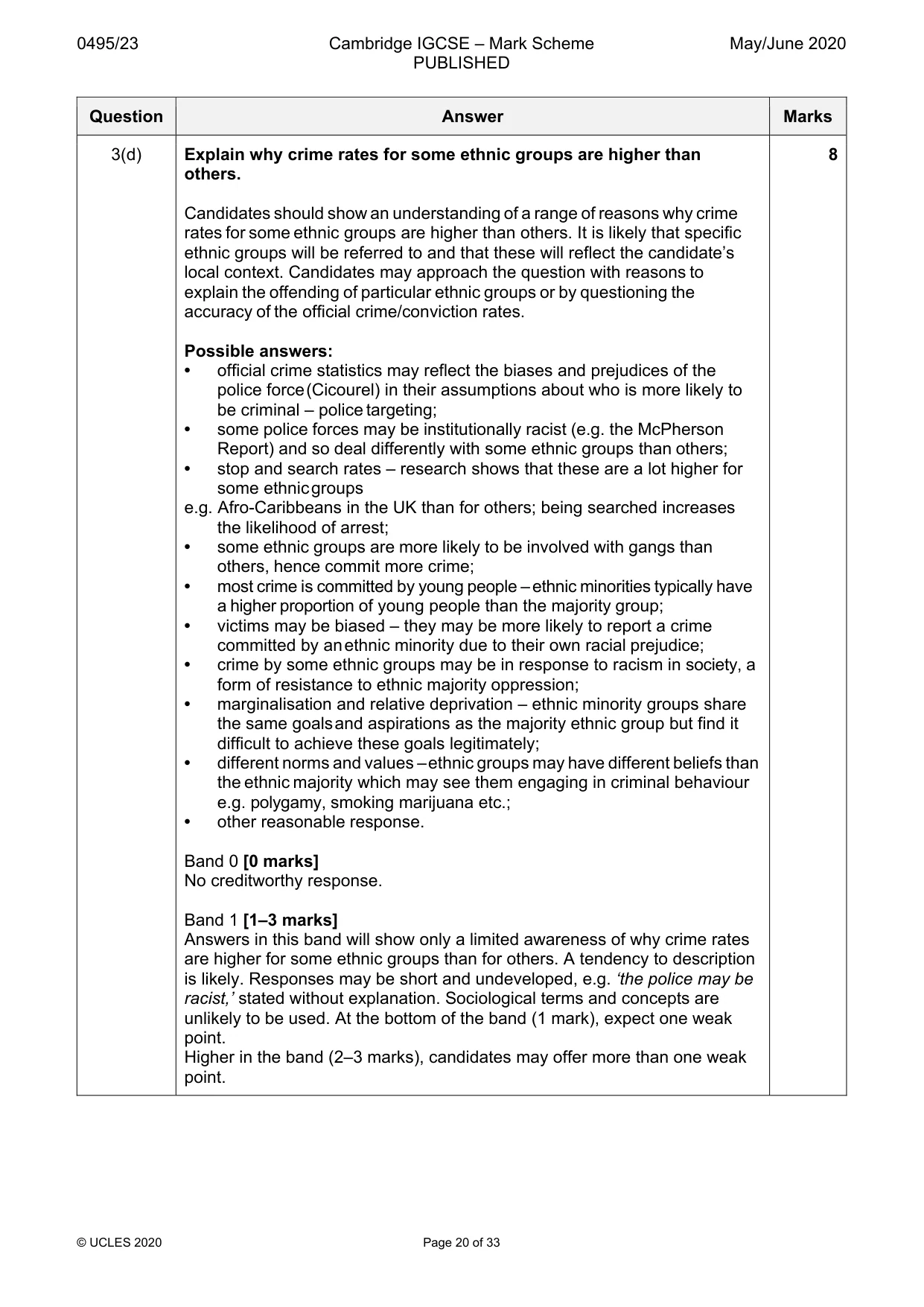
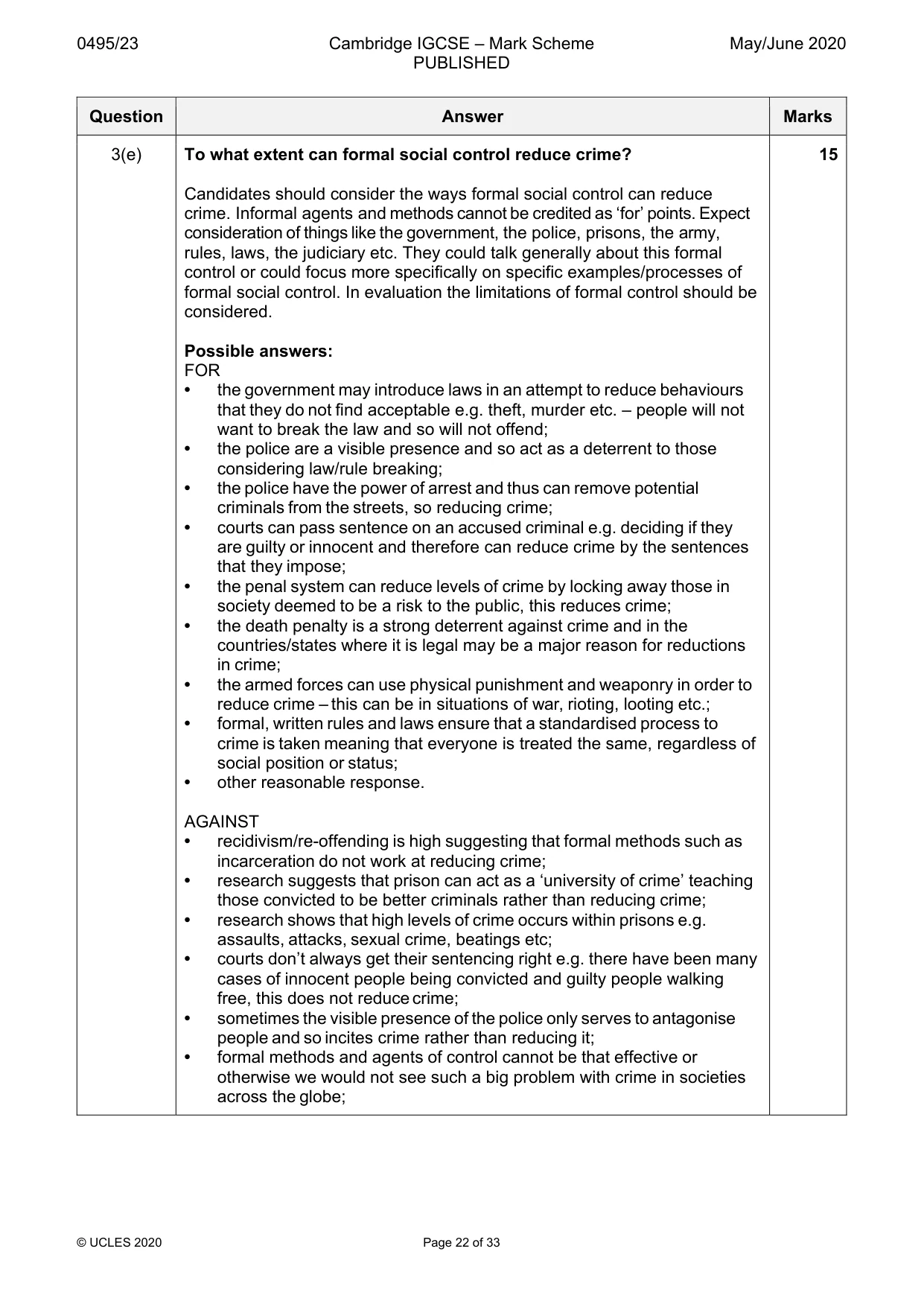
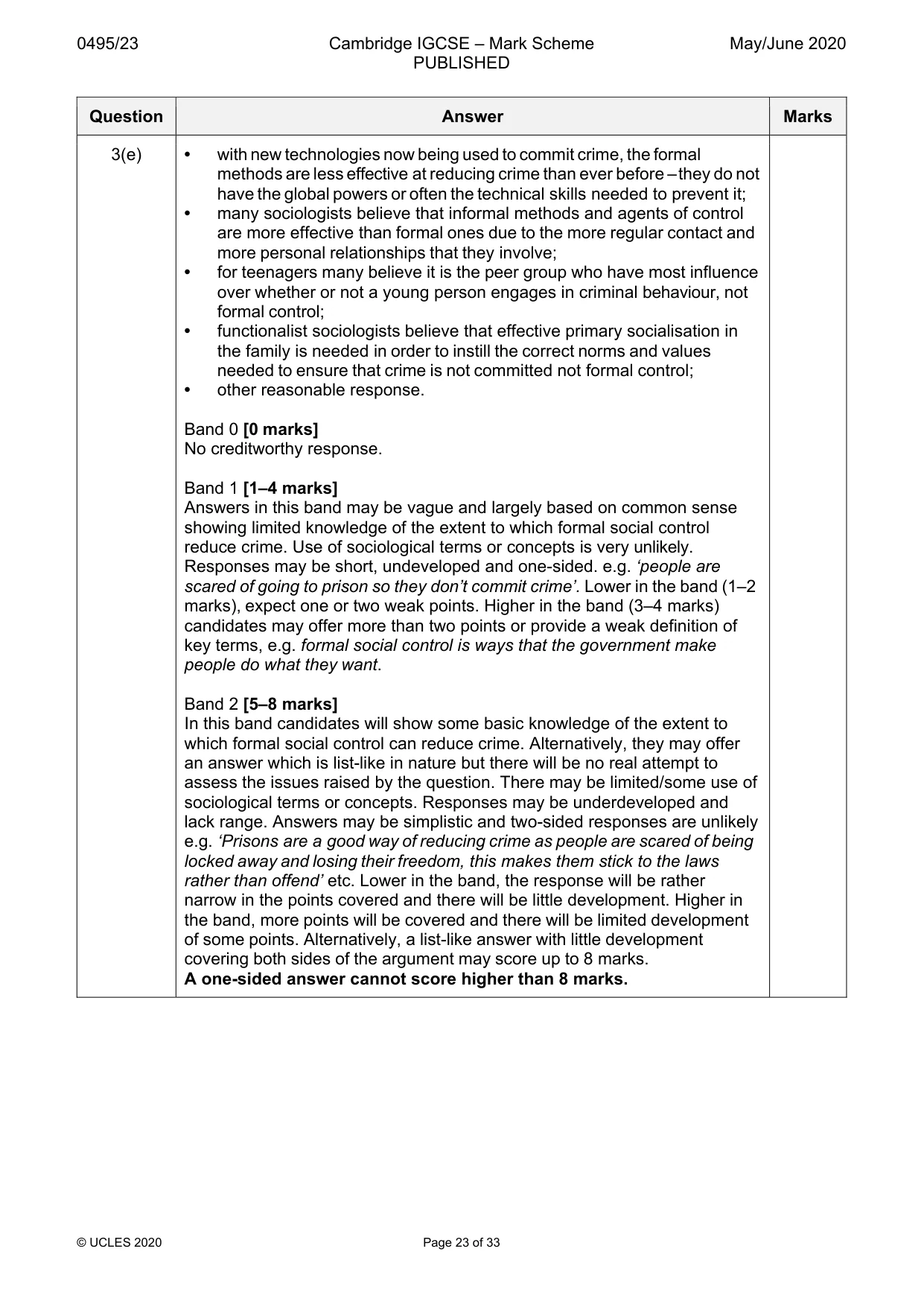
Mark scheme: 3(a) What is meant by the term ‘targeting’? 2 One mark for partial definition, e.g. police stereotypes. Two marks for clear definition, e.g. when the police focus on a particular group of people, believing them to be more likely to be involved in criminal behaviour than others. 3(b) Describe two ways of measuring crime. 4 Candidates will describe two ways of measuring crime. Specific examples may be used to support the ideas and these may be from a local context. Possible answers: • official statistics – the official government figures from the police and courts to measure the number of crimes and offenders; • self-report studies – research which asks people what crimes they have committed; • victim surveys – research that asks people what crimes they have been victims of; • national victim surveys – as above but done on a national scale e.g. the CSEW to measure patterns of crime within a country; • local victim surveys e.g. left realist research – focused on a local area to find out the reality of crime there for the community; • local victim surveys e.g. feminist – research – focused on a local area to uncover the dark figure of invisible crime; there is a particular focus on sexual assault and domestic abuse; • other reasonable response. One mark for each point correctly identified (up to maximum of two). One mark for each point that is developed (up to a maximum of two). 3(c) Explain how crime can be linked to new technologies. 6 Candidates should show an understanding of how crime can be linked to new technologies. This is likely to be linked to the internet/social media and may refer to specific examples. Possible answers: • cybercrime – crime involving the use of new technologies such as computers; • internet crime – crime involving the use of the internet such as paeodophile rings, catfishing etc; • spreading computer viruses and malware through the internet; • increased possibilities for fraud and identity theft due to the internet e.g. phishing; • internet scams targeting individual users; • websites with obscene or offensive content e.g. the dark web; • harassment by cyberstalking or cyberbullying or trolling via social media; • trade in illegal goods e.g. drugs (internet makes it easier for the buyer and seller to contact each other); • cyberterrorism – using the internet for widespread, deliberate attacks on computer networks; • organised global crime – human trafficking e.g. in child labour, prostitution, slavery via the internet; • other reasonable response. Band 0 [0 marks] No creditworthy response. Band 1 [1–3 marks] Answers in this band will show only a limited awareness of how crime can be linked to new technologies and may talk about e.g. ‘the internet has caused a lot of new crimes to appear such as identity theft’. Responses may be short and un/under developed. At the bottom of the band (1 mark), expect one weak point. Higher in the band (2–3 marks), candidates may offer more than one weak point, but there may be a tendency towards simplistic answers, engaging with sociological ideas without using sociological language. Band 2 [4–6 marks] A clear and accurate explanation, showing good sociological knowledge and understanding of how crime can be linked to new technologies. Sociological terms and concepts should be expected e.g. ‘The internet has created a lot of new crimes that can be spread globally far quicker than ever before. For example, cyberterrorism has emerged where the internet is used for deliberate and widespread attacks on companies or computer groups. These crimes may be committed for political reasons, by activist groups or by lone hackers. The police find it difficult to control such crimes’. This would be followed by explanation of factors leading to this. At the bottom of the band, the range of points covered may be narrow or lack detail. Higher in the band, answers will cover more than one factor in a well-developed way or cover several factors in less detail. 3(d) Explain why crime rates for some ethnic groups are higher than 8 others. Candidates should show an understanding of a range of reasons why crime rates for some ethnic groups are higher than others. It is likely that specific ethnic groups will be referred to and that these will reflect the candidate’s local context. Candidates may approach the question with reasons to explain the offending of particular ethnic groups or by questioning the accuracy of the official crime/conviction rates. Possible answers: • official crime statistics may reflect the biases and prejudices of the police force (Cicourel) in their assumptions about who is more likely to be criminal – police targeting; • some police forces may be institutionally racist (e.g. the McPherson Report) and so deal differently with some ethnic groups than others; • stop and search rates – research shows that these are a lot higher for some ethnic groups e.g. Afro-Caribbeans in the UK than for others; being searched increases the likelihood of arrest; • some ethnic groups are more likely to be involved with gangs than others, hence commit more crime; • most crime is committed by young people – ethnic minorities typically have a higher proportion of young people than the majority group; • victims may be biased – they may be more likely to report a crime committed by an ethnic minority due to their own racial prejudice; • crime by some ethnic groups may be in response to racism in society, a form of resistance to ethnic majority oppression; • marginalisation and relative deprivation – ethnic minority groups share the same goals and aspirations as the majority ethnic group but find it difficult to achieve these goals legitimately; • different norms and values – ethnic groups may have different beliefs than the ethnic majority which may see them engaging in criminal behaviour e.g. polygamy, smoking marijuana etc.; • other reasonable response. Band 0 [0 marks] No creditworthy response. Band 1 [1–3 marks] Answers in this band will show only a limited awareness of why crime rates are higher for some ethnic groups than for others. A tendency to description is likely. Responses may be short and undeveloped, e.g. ‘the police may be racist,’ stated without explanation. Sociological terms and concepts are unlikely to be used. At the bottom of the band (1 mark), expect one weak point. Higher in the band (2–3 marks), candidates may offer more than one weak point. 3(d) Band 2 [4–6 marks] Answers in this band will show basic sociological knowledge and understanding of why crime rates are higher for some ethnic groups than for others. Responses may be underdeveloped and lacking in range. e.g. ‘Some ethnic groups commit more crime because they feel marginalised in society. They may struggle to get a good job and so turn to crime instead as a way to gain material goods’ etc. At the bottom of the band, candidates are unlikely to use sociological terms and concepts accurately. Higher in the band, candidates may be beginning to use sociological terms and concepts with greater accuracy. However, some aspects of the answer may only be partially developed/explained. Band 3 [7–8 marks] Answers in this band will show good sociological knowledge and understanding of why crime rates are higher for some ethnic groups than for others and will be well developed and explained. e.g. ‘Crime rates indicate that some ethnic groups are more criminal than others but is this really the case? Interactionist sociologists refer to the official figures as a social construct as they are believed to show the prejudices of the law enforcement agencies. Police target particular groups of people based on their perception of who is most likely to be criminal and this can often be ethnic minorities, often due to biased media reporting. This then leads to higher stop and search rates and so more arrests. Some police forces have even been called institutionally racist’. They can then expand on the explanation of this and other factors as necessary. Sociological terms and concepts will be used accurately overall. Answers will be well focused on the question and there will be a range of reasons presented. At the top of the band explanations will be clear throughout. 3(e) To what extent can formal social control reduce crime? 15 Candidates should consider the ways formal social control can reduce crime. Informal agents and methods cannot be credited as ‘for’ points. Expect consideration of things like the government, the police, prisons, the army, rules, laws, the judiciary etc. They could talk generally about this formal control or could focus more specifically on specific examples/processes of formal social control. In evaluation the limitations of formal control should be considered. Possible answers: FOR • the government may introduce laws in an attempt to reduce behaviours that they do not find acceptable e.g. theft, murder etc. – people will not want to break the law and so will not offend; • the police are a visible presence and so act as a deterrent to those considering law/rule breaking; • the police have the power of arrest and thus can remove potential criminals from the streets, so reducing crime; • courts can pass sentence on an accused criminal e.g. deciding if they are guilty or innocent and therefore can reduce crime by the sentences that they impose; • the penal system can reduce levels of crime by locking away those in society deemed to be a risk to the public, this reduces crime; • the death penalty is a strong deterrent against crime and in the countries/states where it is legal may be a major reason for reductions in crime; • the armed forces can use physical punishment and weaponry in order to reduce crime – this can be in situations of war, rioting, looting etc.; • formal, written rules and laws ensure that a standardised process to crime is taken meaning that everyone is treated the same, regardless of social position or status; • other reasonable response. AGAINST • recidivism/re-offending is high suggesting that formal methods such as incarceration do not work at reducing crime; • research suggests that prison can act as a ‘university of crime’ teaching those convicted to be better criminals rather than reducing crime; • research shows that high levels of crime occurs within prisons e.g. assaults, attacks, sexual crime, beatings etc; • courts don’t always get their sentencing right e.g. there have been many cases of innocent people being convicted and guilty people walking free, this does not reduce crime; • sometimes the visible presence of the police only serves to antagonise people and so incites crime rather than reducing it; • formal methods and agents of control cannot be that effective or otherwise we would not see such a big problem with crime in societies across the globe; 3(e) • with new technologies now being used to commit crime, the formal methods are less effective at reducing crime than ever before – they do not have the global powers or often the technical skills needed to prevent it; • many sociologists believe that informal methods and agents of control are more effective than formal ones due to the more regular contact and more personal relationships that they involve; • for teenagers many believe it is the peer group who have most influence over whether or not a young person engages in criminal behaviour, not formal control; • functionalist sociologists believe that effective primary socialisation in the family is needed in order to instill the correct norms and values needed to ensure that crime is not committed not formal control; • other reasonable response. Band 0 [0 marks] No creditworthy response. Band 1 [1–4 marks] Answers in this band may be vague and largely based on common sense showing limited knowledge of the extent to which formal social control reduce crime. Use of sociological terms or concepts is very unlikely. Responses may be short, undeveloped and one-sided. e.g. ‘people are scared of going to prison so they don’t commit crime’. Lower in the band (1–2 marks), expect one or two weak points. Higher in the band (3–4 marks) candidates may offer more than two points or provide a weak definition of key terms, e.g. formal social control is ways that the government make people do what they want. Band 2 [5–8 marks] In this band candidates will show some basic knowledge of the extent to which formal social control can reduce crime. Alternatively, they may offer an answer which is list-like in nature but there will be no real attempt to assess the issues raised by the question. There may be limited/some use of sociological terms or concepts. Responses may be underdeveloped and lack range. Answers may be simplistic and two-sided responses are unlikely e.g. ‘Prisons are a good way of reducing crime as people are scared of being locked away and losing their freedom, this makes them stick to the laws rather than offend’ etc. Lower in the band, the response will be rather narrow in the points covered and there will be little development. Higher in the band, more points will be covered and there will be limited development of some points. Alternatively, a list-like answer with little development covering both sides of the argument may score up to 8 marks. A one-sided answer cannot score higher than 8 marks. 3(e) Band 3 [9–12 marks] Answers in this band will show good sociological knowledge and understanding of the extent to which formal social control can reduce crime. Sociological terms and concepts will be used with greater accuracy and/or frequency. For the most part, answers will be well developed, focused on the question and there will be a range of points presented. Candidates may say that e.g. ‘despite formal social control clearly having a role to play in reducing crime, it is not always successful. Rates of re-offending once released from prison are high which suggests that prison doesn’t always work. Prisons themselves have also been accused of being training grounds for criminality, places where criminals can mix together and share offending tips – this does not reduce crime. Crimes committed within prison are also high, again suggesting that this formal agent is not particularly effective at reducing crime’. There will be a two-sided response but this may be unbalanced. At the bottom of the band, candidates may provide a narrower range of well developed points. At the top of the band, expect a wider range of points and clear focus on the question. Band 4 [13–15 marks] Answers in this band will show excellent knowledge and understanding of the extent to which formal social control can reduce crime. There will be a strong grasp of the argument as well as accurate and frequent use of sociological terms and concepts. Answers will be well developed, clearly focused on the question and discuss a wide range of points. Responses will be two-sided and balanced. At the bottom of the band (13 marks), the answer may lack a specific conclusion. Higher in the band, there will be a clear attempt to offer an assessment of the ‘To what extent.?’ part of the question through a focused conclusion. Candidates should show consideration of points for and against the idea of whether formal social control can reduce crime, citing some of the examples given.
Q4 · In recent years the media has changed due to factors such as the growth of the internet…
4 In recent years the media has changed due to factors such as the growth of the internet, diversification and new types of funding. Not everyone believes that this has affected the way social groups are represented in the media. Stereotyping, for example, can still be frequently seen in the news and other media when it comes to gender, ethnic minorities and different age groups. (a) What is meant by the term ‘diversification’? [2] (b) Describe two ways the media is funded. [4] (c) Explain how the internet has changed media consumption. [6] (d) Explain why only some news stories are reported in the media. [8] (e) To what extent have media representations of social groups changed over time? [15]
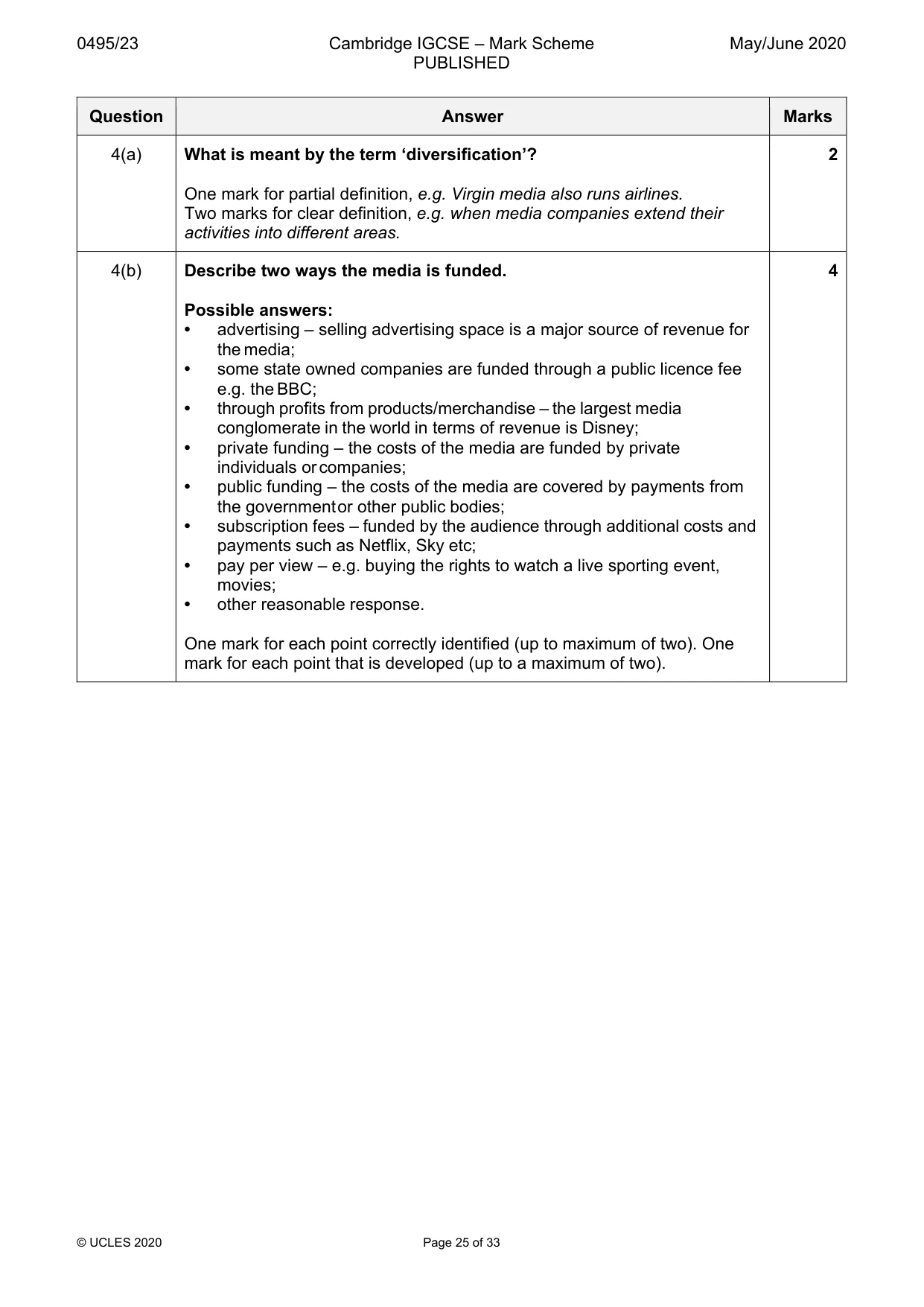
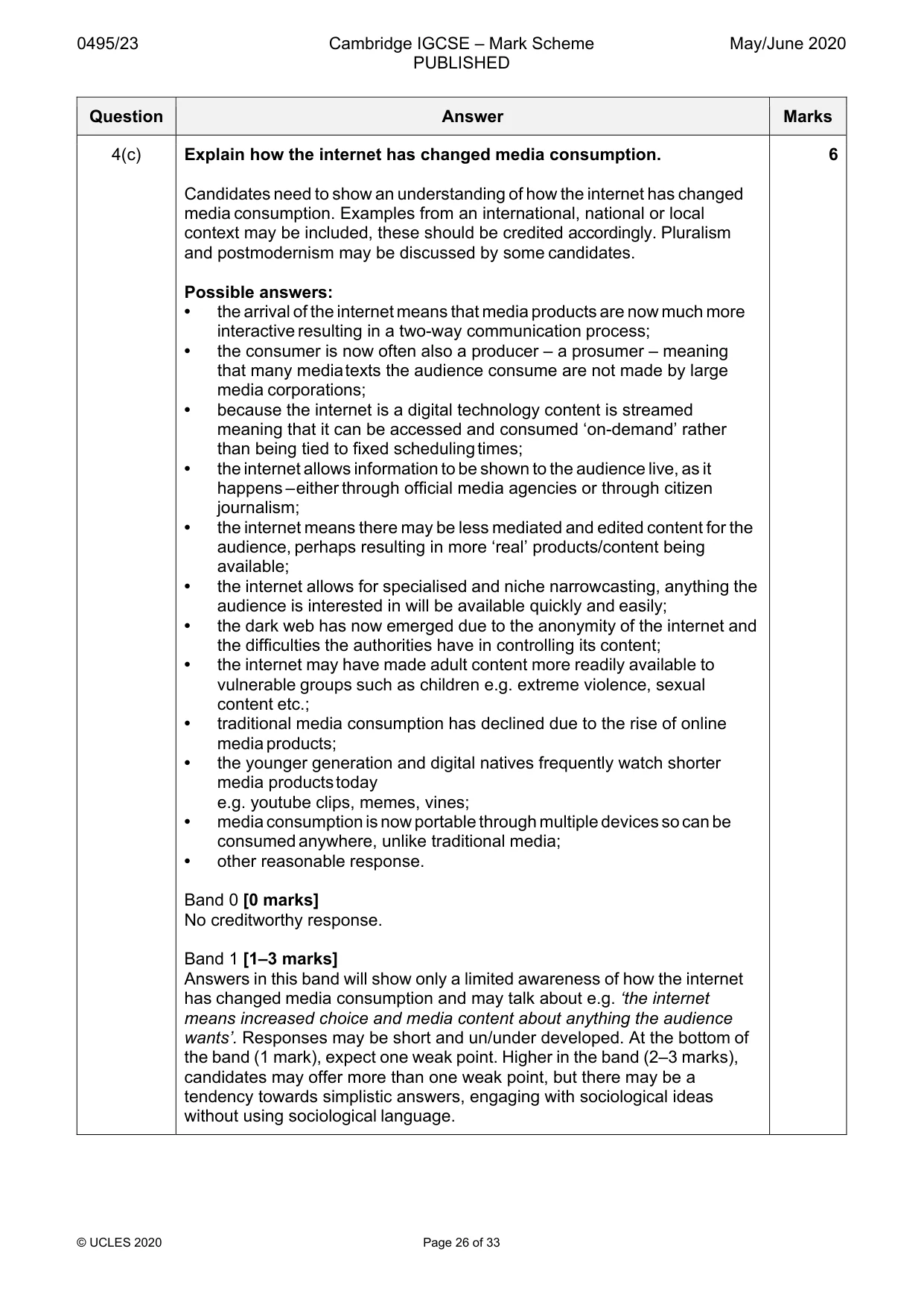
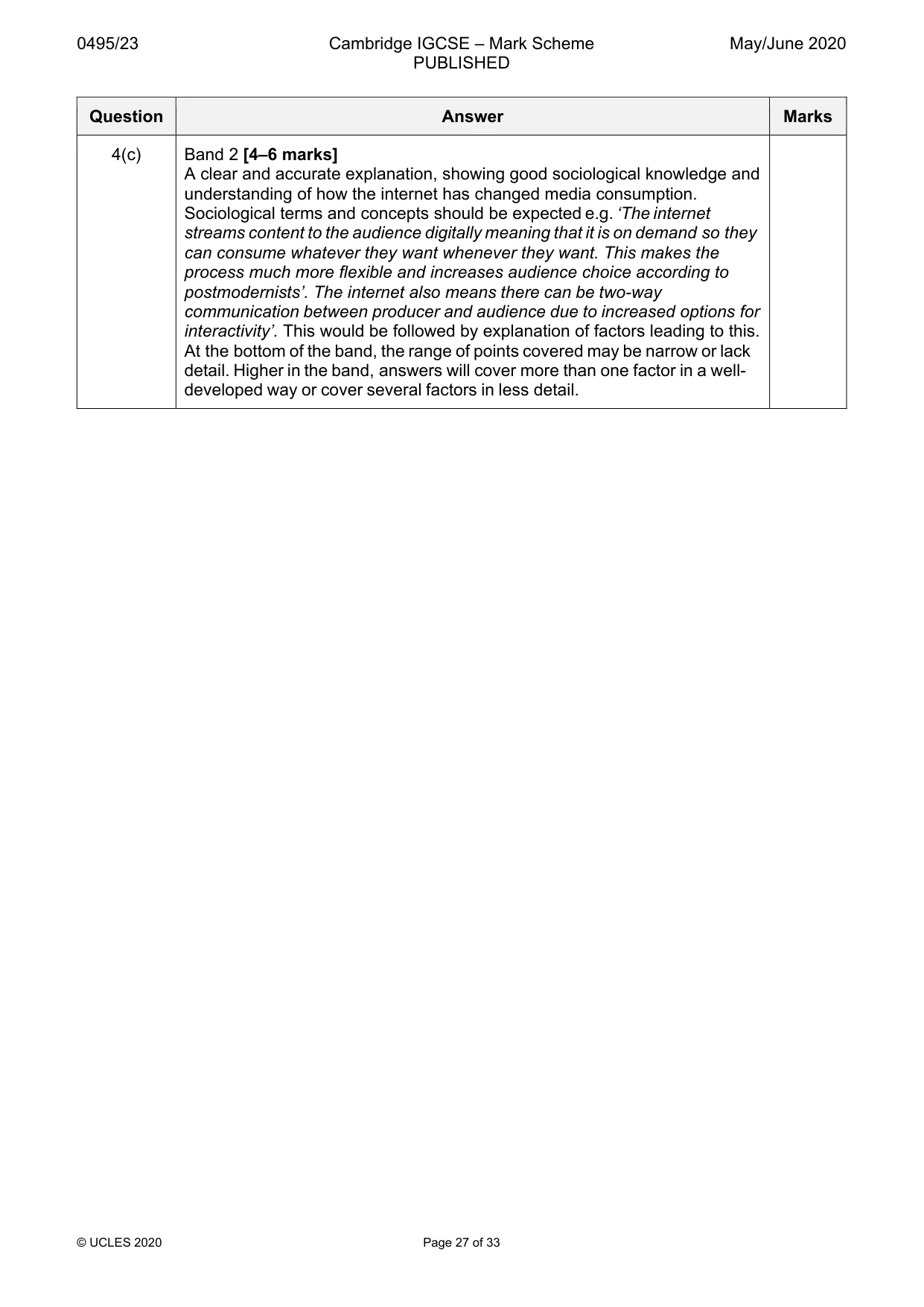
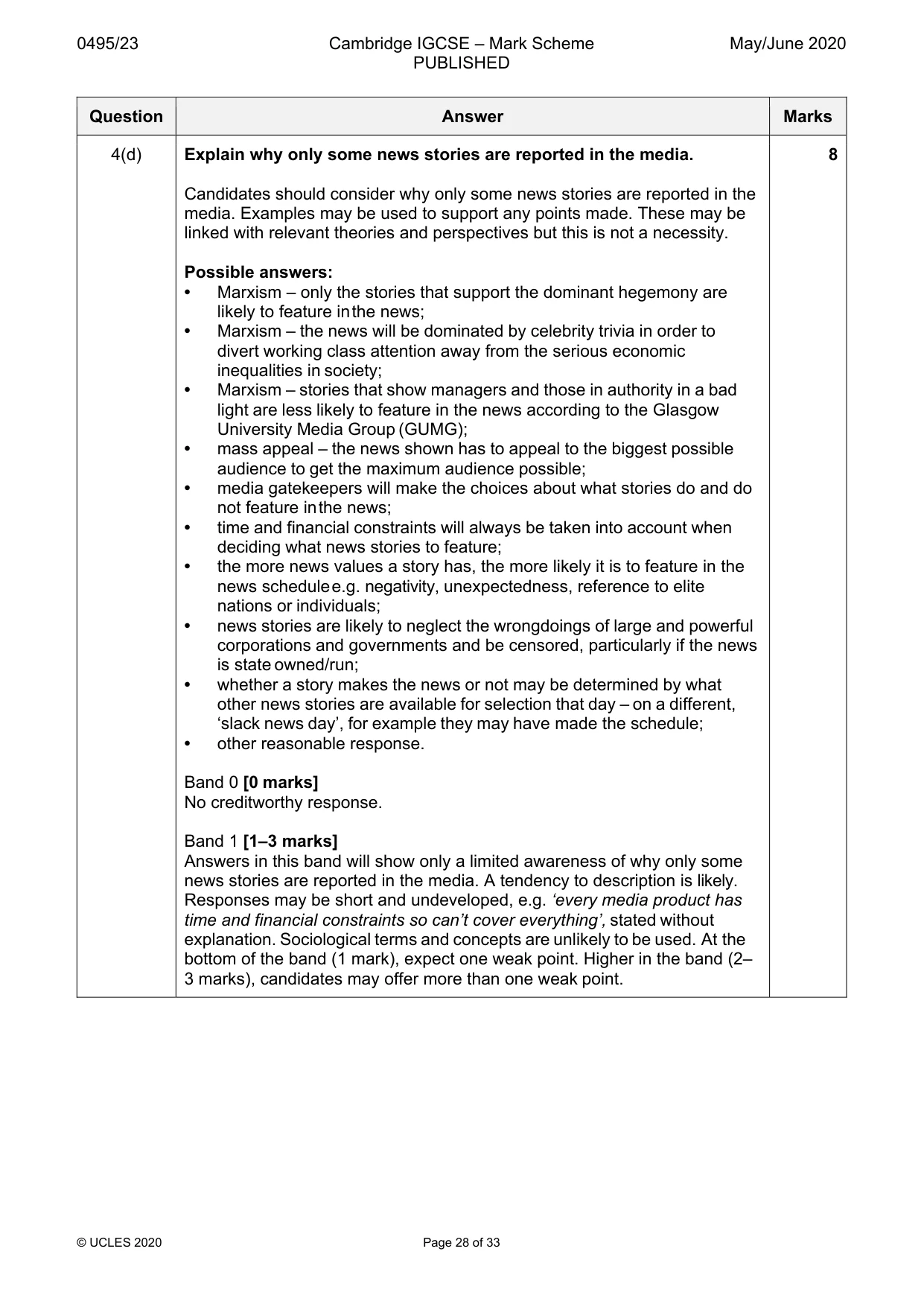
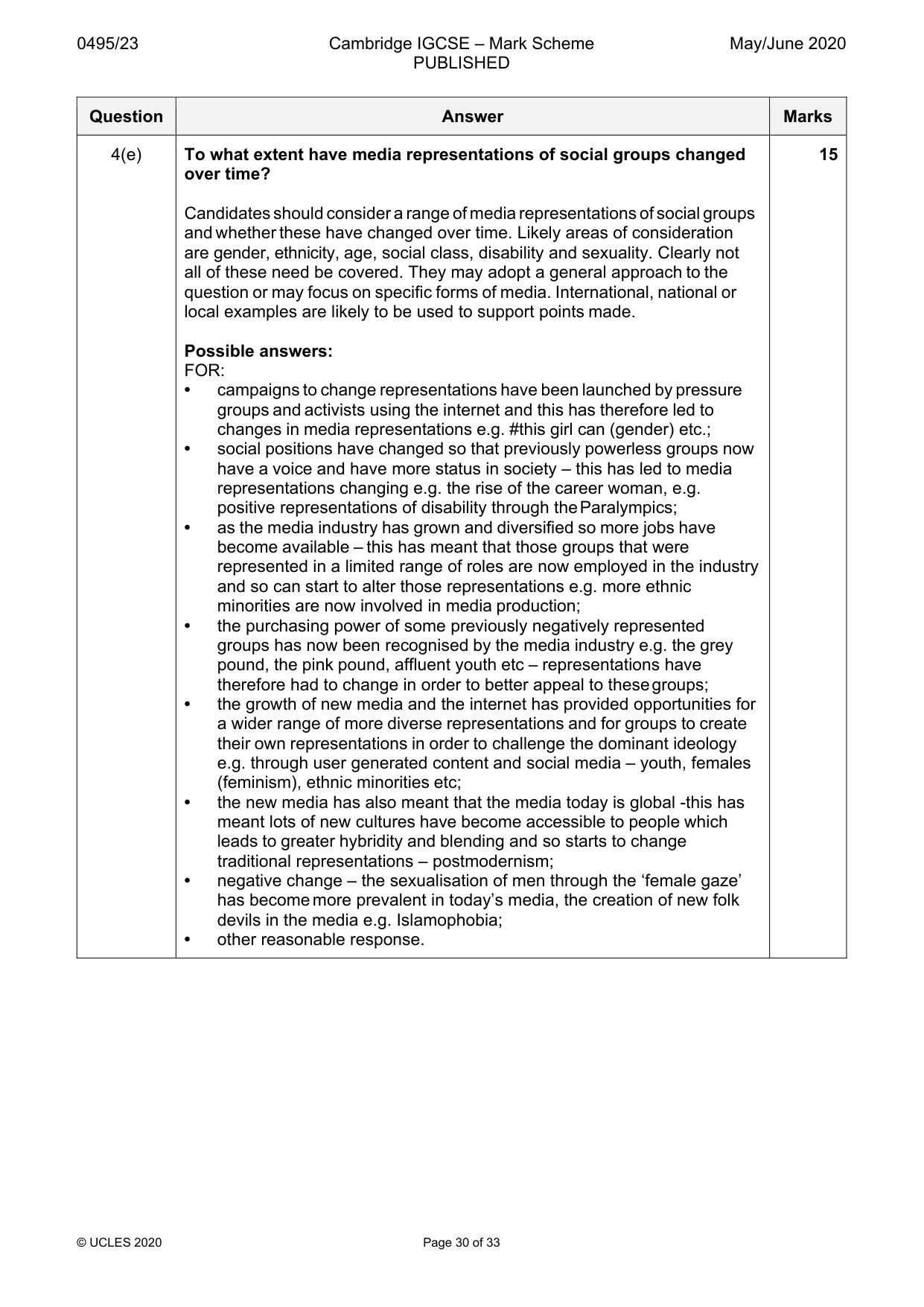
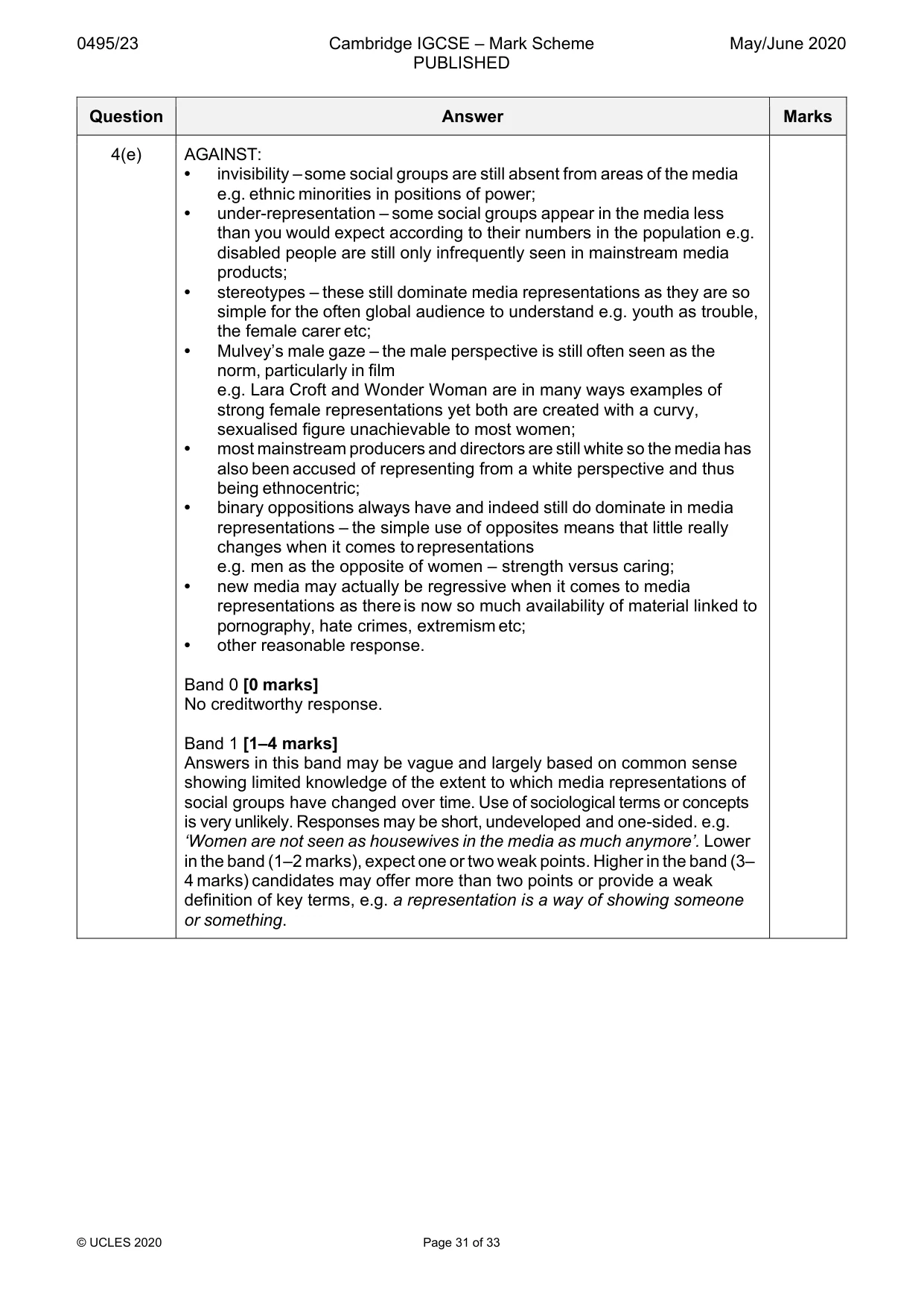
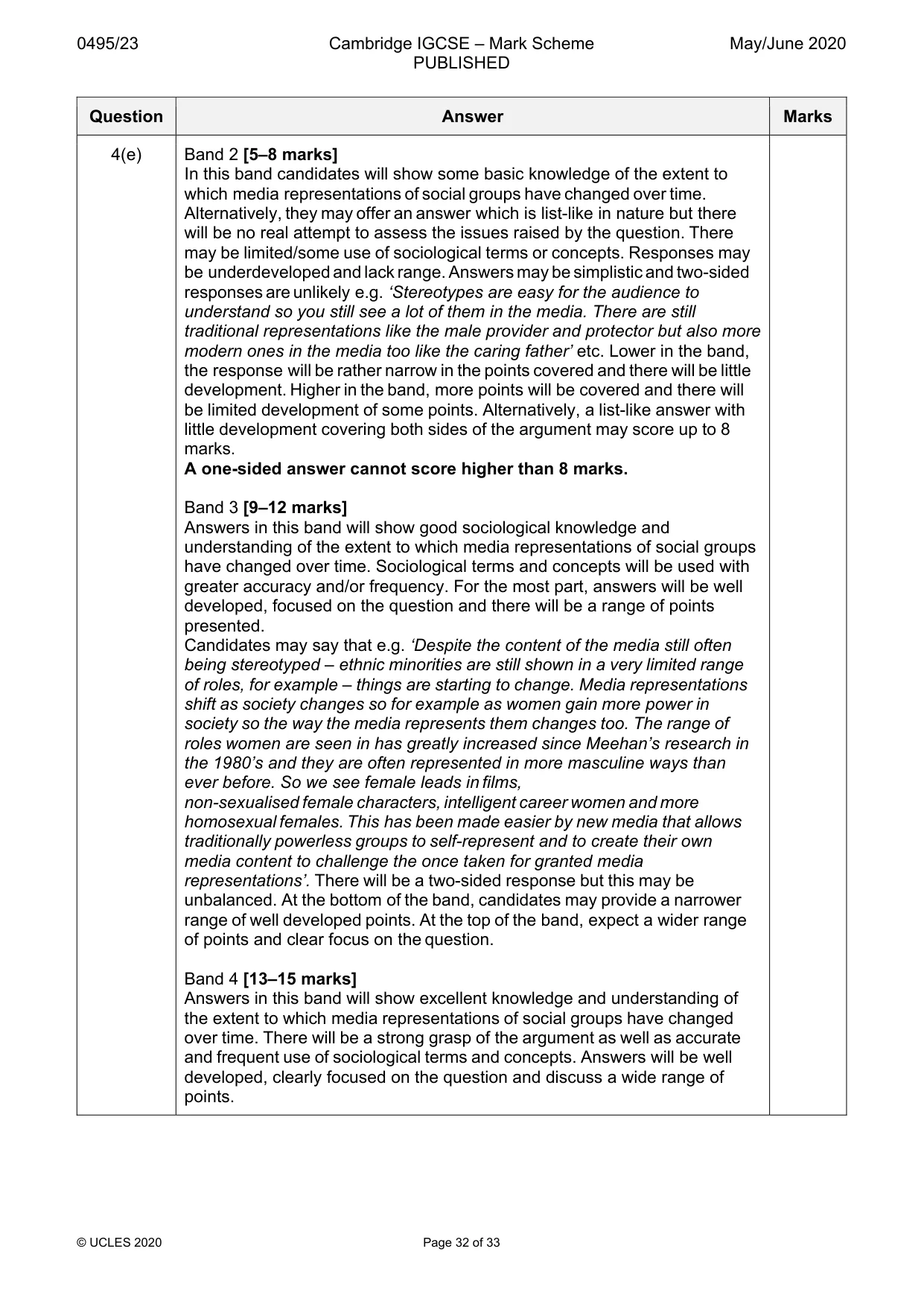
Mark scheme: 4(a) What is meant by the term ‘diversification’? 2 One mark for partial definition, e.g. Virgin media also runs airlines. Two marks for clear definition, e.g. when media companies extend their activities into different areas. 4(b) Describe two ways the media is funded. 4 Possible answers: • advertising – selling advertising space is a major source of revenue for the media; • some state owned companies are funded through a public licence fee e.g. the BBC; • through profits from products/merchandise – the largest media conglomerate in the world in terms of revenue is Disney; • private funding – the costs of the media are funded by private individuals or companies; • public funding – the costs of the media are covered by payments from the government or other public bodies; • subscription fees – funded by the audience through additional costs and payments such as Netflix, Sky etc; • pay per view – e.g. buying the rights to watch a live sporting event, movies; • other reasonable response. One mark for each point correctly identified (up to maximum of two). One mark for each point that is developed (up to a maximum of two). 4(c) Explain how the internet has changed media consumption. 6 Candidates need to show an understanding of how the internet has changed media consumption. Examples from an international, national or local context may be included, these should be credited accordingly. Pluralism and postmodernism may be discussed by some candidates. Possible answers: • the arrival of the internet means that media products are now much more interactive resulting in a two-way communication process; • the consumer is now often also a producer – a prosumer – meaning that many media texts the audience consume are not made by large media corporations; • because the internet is a digital technology content is streamed meaning that it can be accessed and consumed ‘on-demand’ rather than being tied to fixed scheduling times; • the internet allows information to be shown to the audience live, as it happens – either through official media agencies or through citizen journalism; • the internet means there may be less mediated and edited content for the audience, perhaps resulting in more ‘real’ products/content being available; • the internet allows for specialised and niche narrowcasting, anything the audience is interested in will be available quickly and easily; • the dark web has now emerged due to the anonymity of the internet and the difficulties the authorities have in controlling its content; • the internet may have made adult content more readily available to vulnerable groups such as children e.g. extreme violence, sexual content etc.; • traditional media consumption has declined due to the rise of online media products; • the younger generation and digital natives frequently watch shorter media products today e.g. youtube clips, memes, vines; • media consumption is now portable through multiple devices so can be consumed anywhere, unlike traditional media; • other reasonable response. Band 0 [0 marks] No creditworthy response. Band 1 [1–3 marks] Answers in this band will show only a limited awareness of how the internet has changed media consumption and may talk about e.g. ‘the internet means increased choice and media content about anything the audience wants’. Responses may be short and un/under developed. At the bottom of the band (1 mark), expect one weak point. Higher in the band (2–3 marks), candidates may offer more than one weak point, but there may be a tendency towards simplistic answers, engaging with sociological ideas without using sociological language. 4(c) Band 2 [4–6 marks] A clear and accurate explanation, showing good sociological knowledge and understanding of how the internet has changed media consumption. Sociological terms and concepts should be expected e.g. ‘The internet streams content to the audience digitally meaning that it is on demand so they can consume whatever they want whenever they want. This makes the process much more flexible and increases audience choice according to postmodernists’. The internet also means there can be two-way communication between producer and audience due to increased options for interactivity’. This would be followed by explanation of factors leading to this. At the bottom of the band, the range of points covered may be narrow or lack detail. Higher in the band, answers will cover more than one factor in a well- developed way or cover several factors in less detail. 4(d) Explain why only some news stories are reported in the media. 8 Candidates should consider why only some news stories are reported in the media. Examples may be used to support any points made. These may be linked with relevant theories and perspectives but this is not a necessity. Possible answers: • Marxism – only the stories that support the dominant hegemony are likely to feature in the news; • Marxism – the news will be dominated by celebrity trivia in order to divert working class attention away from the serious economic inequalities in society; • Marxism – stories that show managers and those in authority in a bad light are less likely to feature in the news according to the Glasgow University Media Group (GUMG); • mass appeal – the news shown has to appeal to the biggest possible audience to get the maximum audience possible; • media gatekeepers will make the choices about what stories do and do not feature in the news; • time and financial constraints will always be taken into account when deciding what news stories to feature; • the more news values a story has, the more likely it is to feature in the news schedule e.g. negativity, unexpectedness, reference to elite nations or individuals; • news stories are likely to neglect the wrongdoings of large and powerful corporations and governments and be censored, particularly if the news is state owned/run; • whether a story makes the news or not may be determined by what other news stories are available for selection that day – on a different, ‘slack news day’, for example they may have made the schedule; • other reasonable response. Band 0 [0 marks] No creditworthy response. Band 1 [1–3 marks] Answers in this band will show only a limited awareness of why only some news stories are reported in the media. A tendency to description is likely. Responses may be short and undeveloped, e.g. ‘every media product has time and financial constraints so can’t cover everything’, stated without explanation. Sociological terms and concepts are unlikely to be used. At the bottom of the band (1 mark), expect one weak point. Higher in the band (2– 3 marks), candidates may offer more than one weak point. 4(d) Band 2 [4–6 marks] Answers in this band will show basic sociological knowledge and understanding of why only some news stories are reported in the media. Responses may be underdeveloped and lacking in range. e.g. ‘The media will cover those news events that it feels will attract the largest audience. This means that the event needs to be associated with recognisable news values for it to be covered. This could be featuring elite personnel and being extremely shocking’ etc. At the bottom of the band, candidates are unlikely to use sociological terms and concepts accurately. Higher in the band, candidates may be beginning to use sociological terms and concepts with greater accuracy. However, some aspects of the answer may only be partially developed/explained. Band 3 [7–8 marks] Answers in this band will show good sociological knowledge and understanding of why only some news stories are reported by the media and will be well developed and explained. e.g. ‘Marxists believe that the news is an example of agenda setting. It is a tool used by the elite to divert working class attention away from societal problems and the wrongdoings of the higher classes through a diet of trivia and celebrity gossip. Stories that portray capitalism in a good light or alternative ideologies negatively are more likely to feature too as these fit the dominant hegemony created by the upper class owners. Stories that portray management or those in authority in a bad light are therefore far less likely to feature. This was shown by the GUMG’. They can then expand on the explanation of this and other factors as necessary. Sociological terms and concepts will be used accurately overall. Answers will be well focused on the question and there will be a range of reasons presented. At the top of the band explanations will be clear throughout. 4(e) To what extent have media representations of social groups changed 15 over time? Candidates should consider a range of media representations of social groups and whether these have changed over time. Likely areas of consideration are gender, ethnicity, age, social class, disability and sexuality. Clearly not all of these need be covered. They may adopt a general approach to the question or may focus on specific forms of media. International, national or local examples are likely to be used to support points made. Possible answers: FOR: • campaigns to change representations have been launched by pressure groups and activists using the internet and this has therefore led to changes in media representations e.g. #this girl can (gender) etc.; • social positions have changed so that previously powerless groups now have a voice and have more status in society – this has led to media representations changing e.g. the rise of the career woman, e.g. positive representations of disability through the Paralympics; • as the media industry has grown and diversified so more jobs have become available – this has meant that those groups that were represented in a limited range of roles are now employed in the industry and so can start to alter those representations e.g. more ethnic minorities are now involved in media production; • the purchasing power of some previously negatively represented groups has now been recognised by the media industry e.g. the grey pound, the pink pound, affluent youth etc – representations have therefore had to change in order to better appeal to these groups; • the growth of new media and the internet has provided opportunities for a wider range of more diverse representations and for groups to create their own representations in order to challenge the dominant ideology e.g. through user generated content and social media – youth, females (feminism), ethnic minorities etc; • the new media has also meant that the media today is global -this has meant lots of new cultures have become accessible to people which leads to greater hybridity and blending and so starts to change traditional representations – postmodernism; • negative change – the sexualisation of men through the ‘female gaze’ has become more prevalent in today’s media, the creation of new folk devils in the media e.g. Islamophobia; • other reasonable response. 4(e) AGAINST: • invisibility – some social groups are still absent from areas of the media e.g. ethnic minorities in positions of power; • under-representation – some social groups appear in the media less than you would expect according to their numbers in the population e.g. disabled people are still only infrequently seen in mainstream media products; • stereotypes – these still dominate media representations as they are so simple for the often global audience to understand e.g. youth as trouble, the female carer etc; • Mulvey’s male gaze – the male perspective is still often seen as the norm, particularly in film e.g. Lara Croft and Wonder Woman are in many ways examples of strong female representations yet both are created with a curvy, sexualised figure unachievable to most women; • most mainstream producers and directors are still white so the media has also been accused of representing from a white perspective and thus being ethnocentric; • binary oppositions always have and indeed still do dominate in media representations – the simple use of opposites means that little really changes when it comes to representations e.g. men as the opposite of women – strength versus caring; • new media may actually be regressive when it comes to media representations as there is now so much availability of material linked to pornography, hate crimes, extremism etc; • other reasonable response. Band 0 [0 marks] No creditworthy response. Band 1 [1–4 marks] Answers in this band may be vague and largely based on common sense showing limited knowledge of the extent to which media representations of social groups have changed over time. Use of sociological terms or concepts is very unlikely. Responses may be short, undeveloped and one-sided. e.g. ‘Women are not seen as housewives in the media as much anymore’. Lower in the band (1–2 marks), expect one or two weak points. Higher in the band (3– 4 marks) candidates may offer more than two points or provide a weak definition of key terms, e.g. a representation is a way of showing someone or something. 4(e) Band 2 [5–8 marks] In this band candidates will show some basic knowledge of the extent to which media representations of social groups have changed over time. Alternatively, they may offer an answer which is list-like in nature but there will be no real attempt to assess the issues raised by the question. There may be limited/some use of sociological terms or concepts. Responses may be underdeveloped and lack range. Answers may be simplistic and two-sided responses are unlikely e.g. ‘Stereotypes are easy for the audience to understand so you still see a lot of them in the media. There are still traditional representations like the male provider and protector but also more modern ones in the media too like the caring father’ etc. Lower in the band, the response will be rather narrow in the points covered and there will be little development. Higher in the band, more points will be covered and there will be limited development of some points. Alternatively, a list-like answer with little development covering both sides of the argument may score up to 8 marks. A one-sided answer cannot score higher than 8 marks. Band 3 [9–12 marks] Answers in this band will show good sociological knowledge and understanding of the extent to which media representations of social groups have changed over time. Sociological terms and concepts will be used with greater accuracy and/or frequency. For the most part, answers will be well developed, focused on the question and there will be a range of points presented. Candidates may say that e.g. ‘Despite the content of the media still often being stereotyped – ethnic minorities are still shown in a very limited range of roles, for example – things are starting to change. Media representations shift as society changes so for example as women gain more power in society so the way the media represents them changes too. The range of roles women are seen in has greatly increased since Meehan’s research in the 1980’s and they are often represented in more masculine ways than ever before. So we see female leads in films, non-sexualised female characters, intelligent career women and more homosexual females. This has been made easier by new media that allows traditionally powerless groups to self-represent and to create their own media content to challenge the once taken for granted media representations’. There will be a two-sided response but this may be unbalanced. At the bottom of the band, candidates may provide a narrower range of well developed points. At the top of the band, expect a wider range of points and clear focus on the question. Band 4 [13–15 marks] Answers in this band will show excellent knowledge and understanding of the extent to which media representations of social groups have changed over time. There will be a strong grasp of the argument as well as accurate and frequent use of sociological terms and concepts. Answers will be well developed, clearly focused on the question and discuss a wide range of points. 4(e) Responses will be two-sided and balanced. At the bottom of the band (13 marks), the answer may lack a specific conclusion. Higher in the band, there will be a clear attempt to offer an assessment of the ‘To what extent.?’ part of the question through a focused conclusion. Candidates should show consideration of points for and against the idea of media representations of social groups changing over time, citing some of the examples given.
More questions on How do sociologists approach the study of society?
What was in this paper
The subtopics covered by these 4 questions, and how many questions each got. Open one in a new tab to see every Cambridge question on it.