Cambridge IGCSE Sociology 0495 — 2020 May/June Paper 2 · Variant 2
0495/22/M/J/20 · 4 questions · 140 marks · ≈158 min
The question paper and its mark scheme, free to read here and free to download. This is Cambridge’s own paper, exactly as it was sat.
Question paper4 pages
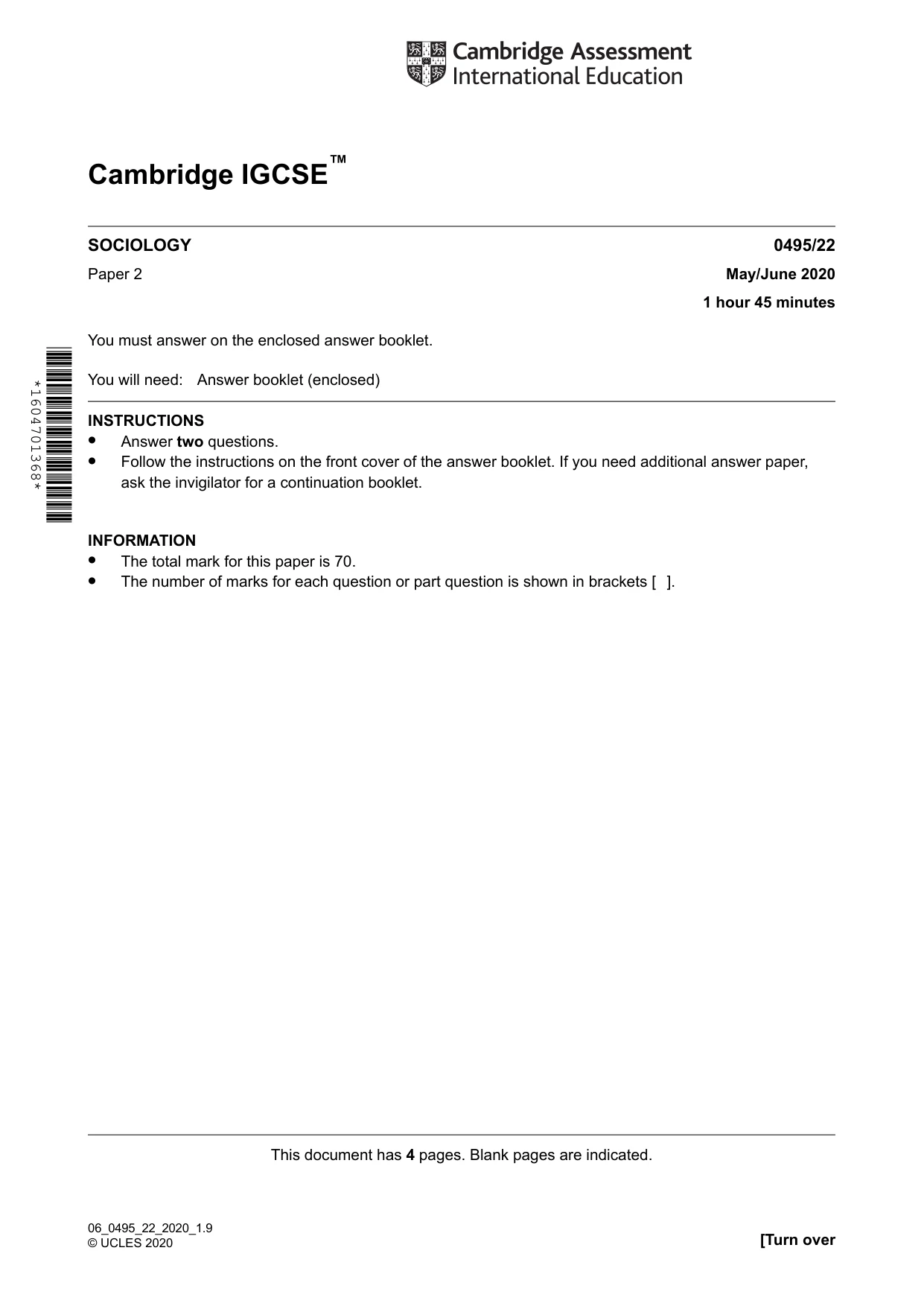
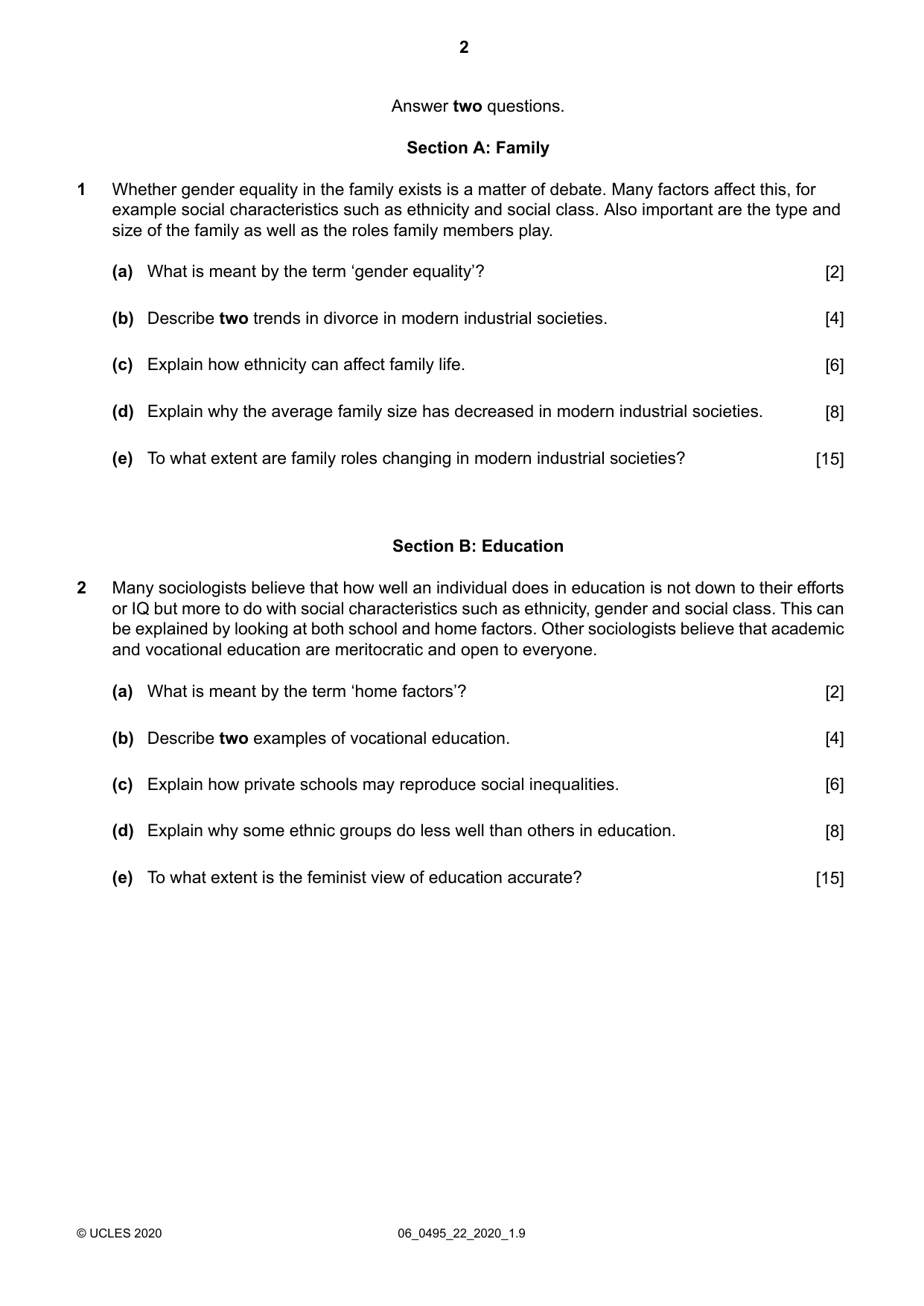
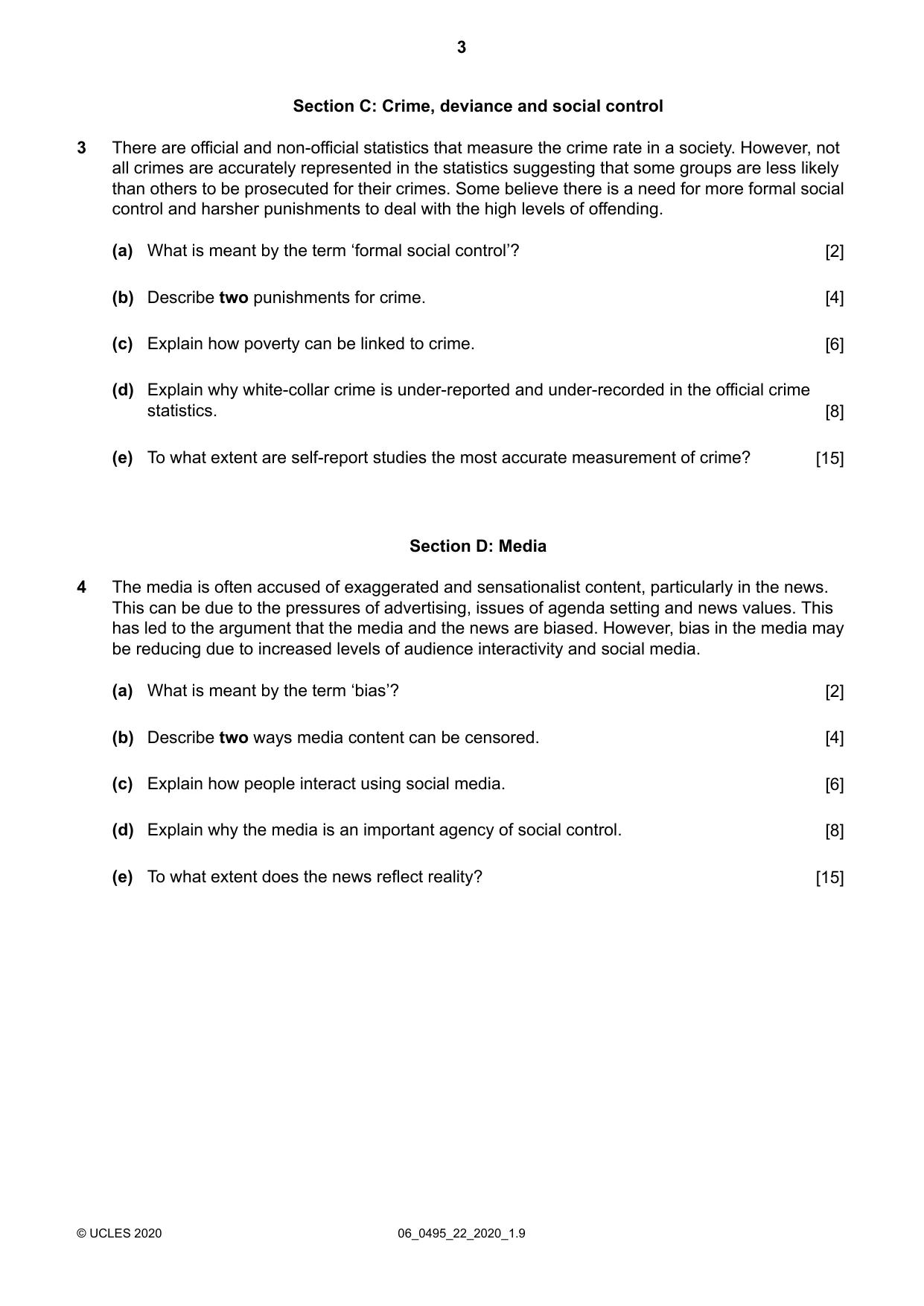

Mark scheme32 pages
Answers below. Sit the paper first if you are practising.
Questions as text
Q1 · Whether gender equality in the family exists is a matter of debate
1 Whether gender equality in the family exists is a matter of debate. Many factors affect this, for example social characteristics such as ethnicity and social class. Also important are the type and size of the family as well as the roles family members play. (a) What is meant by the term ‘gender equality’? [2] (b) Describe two trends in divorce in modern industrial societies. [4] (c) Explain how ethnicity can affect family life. [6] (d) Explain why the average family size has decreased in modern industrial societies. [8] (e) To what extent are family roles changing in modern industrial societies? [15]
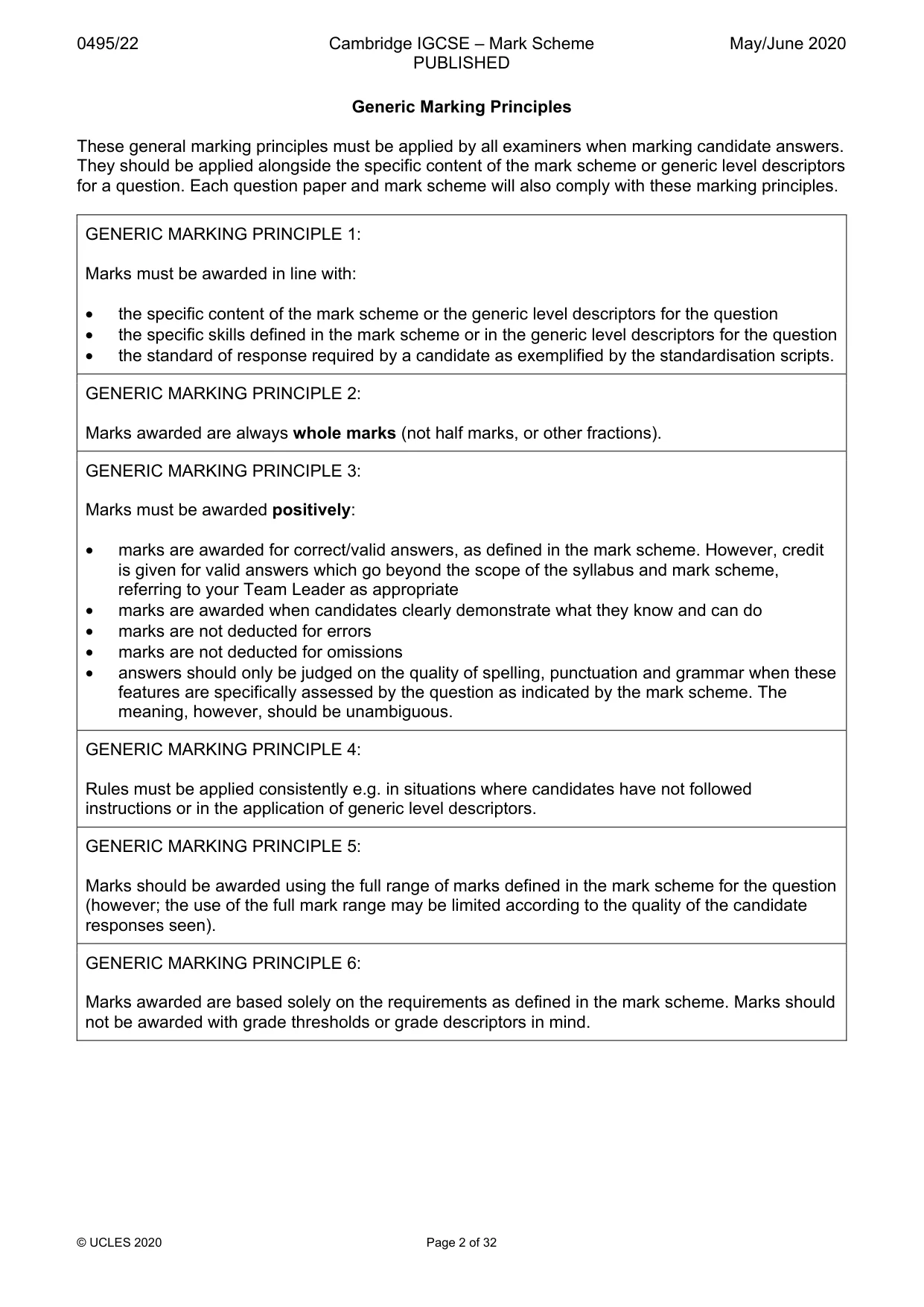
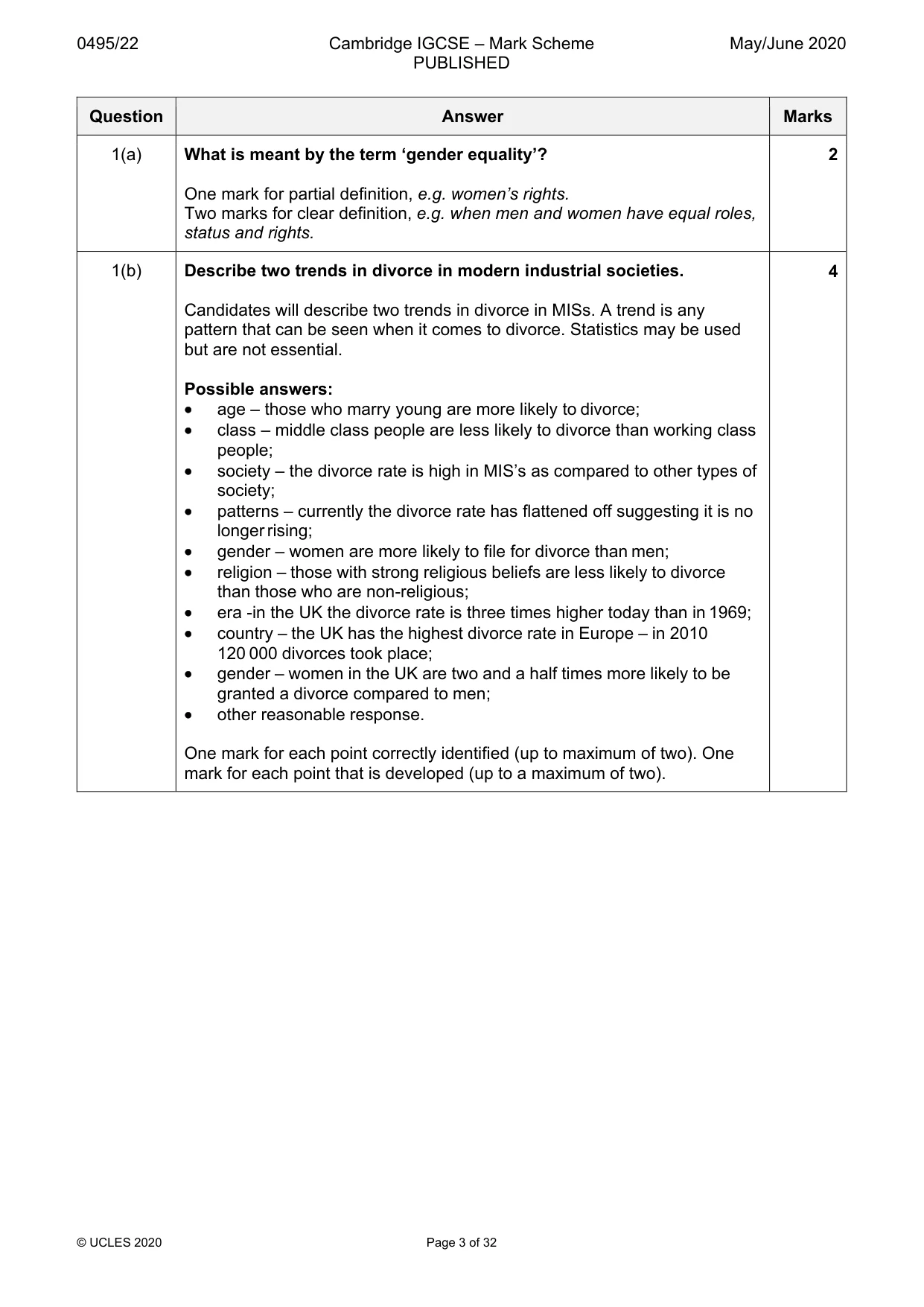
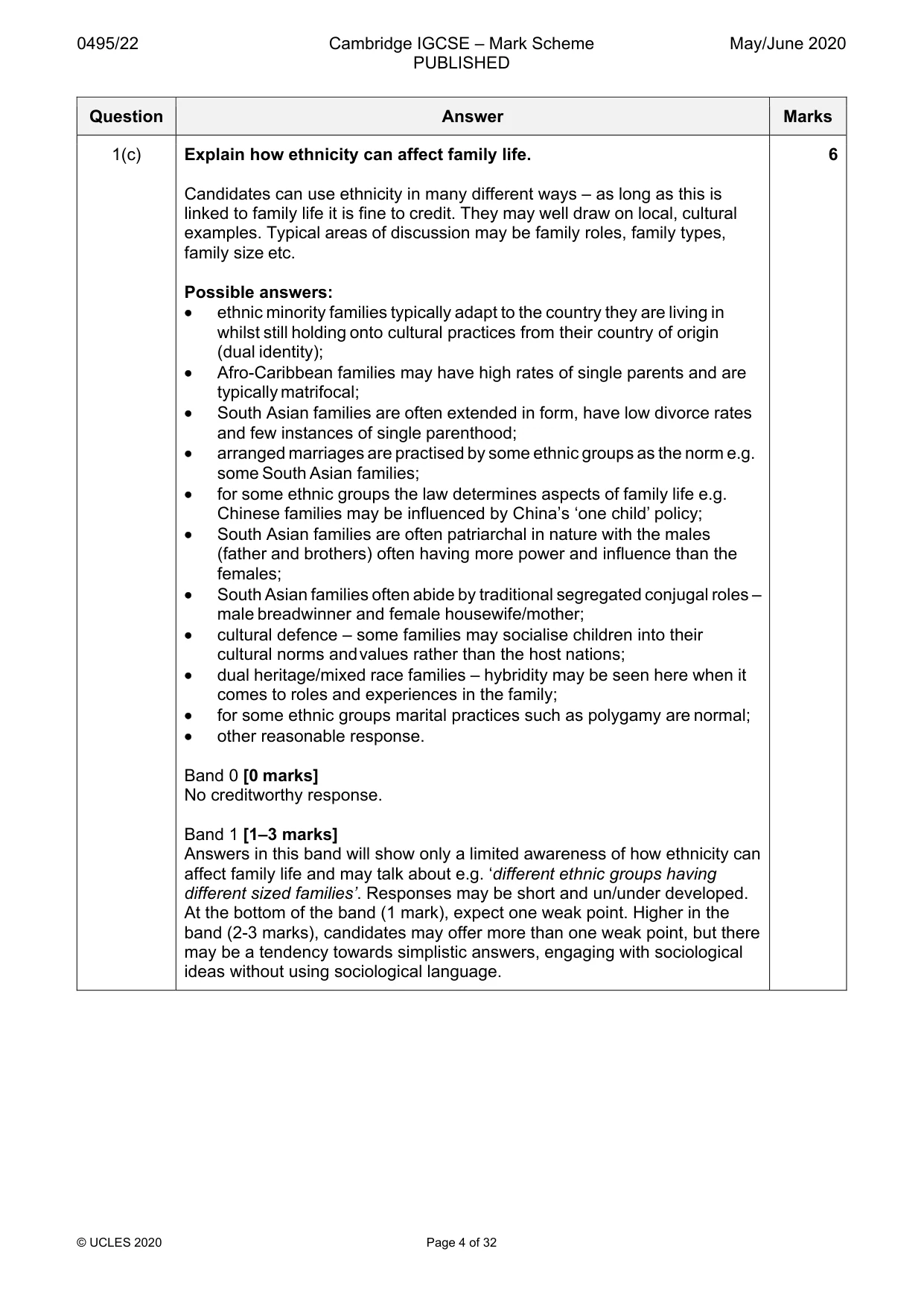
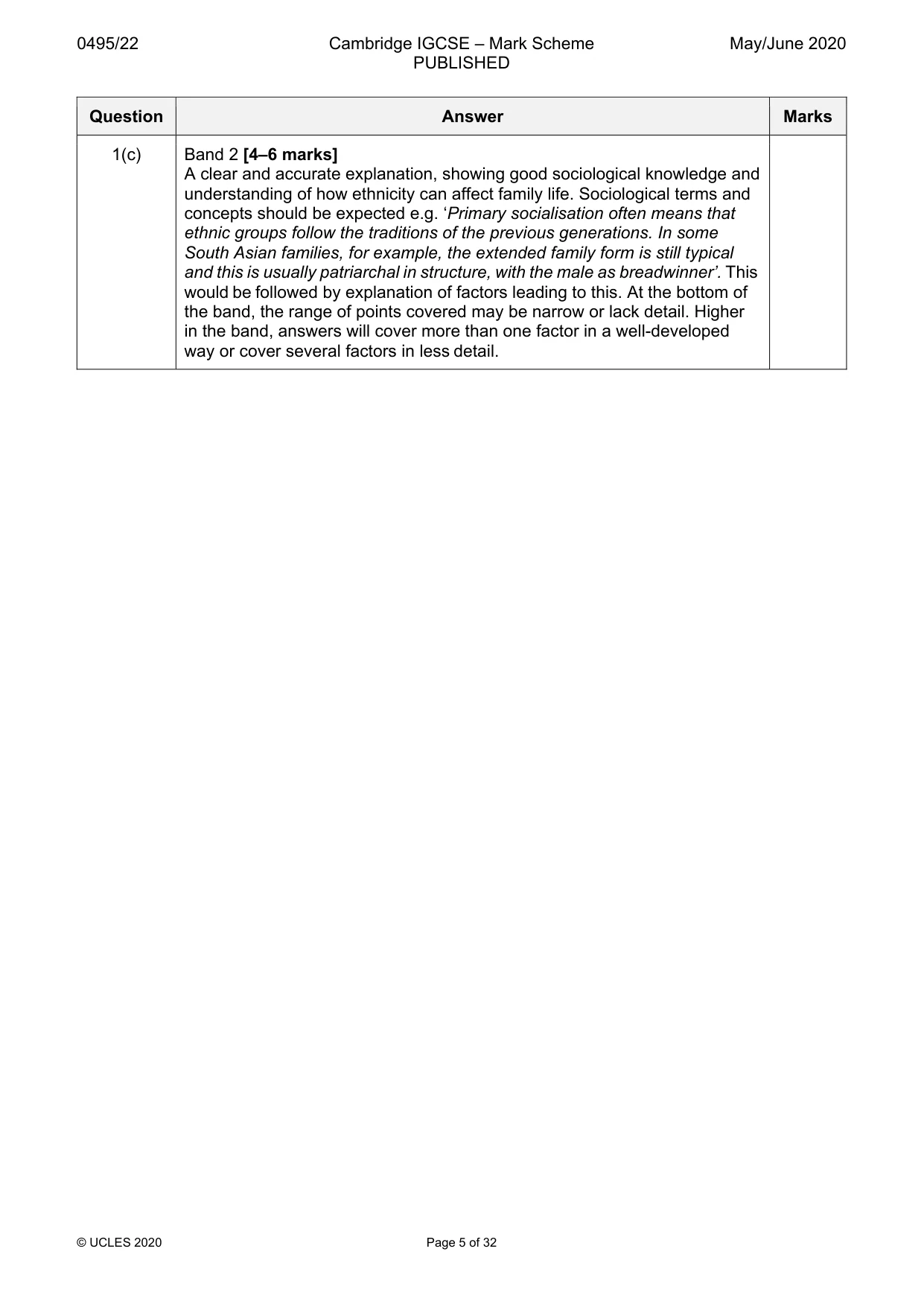
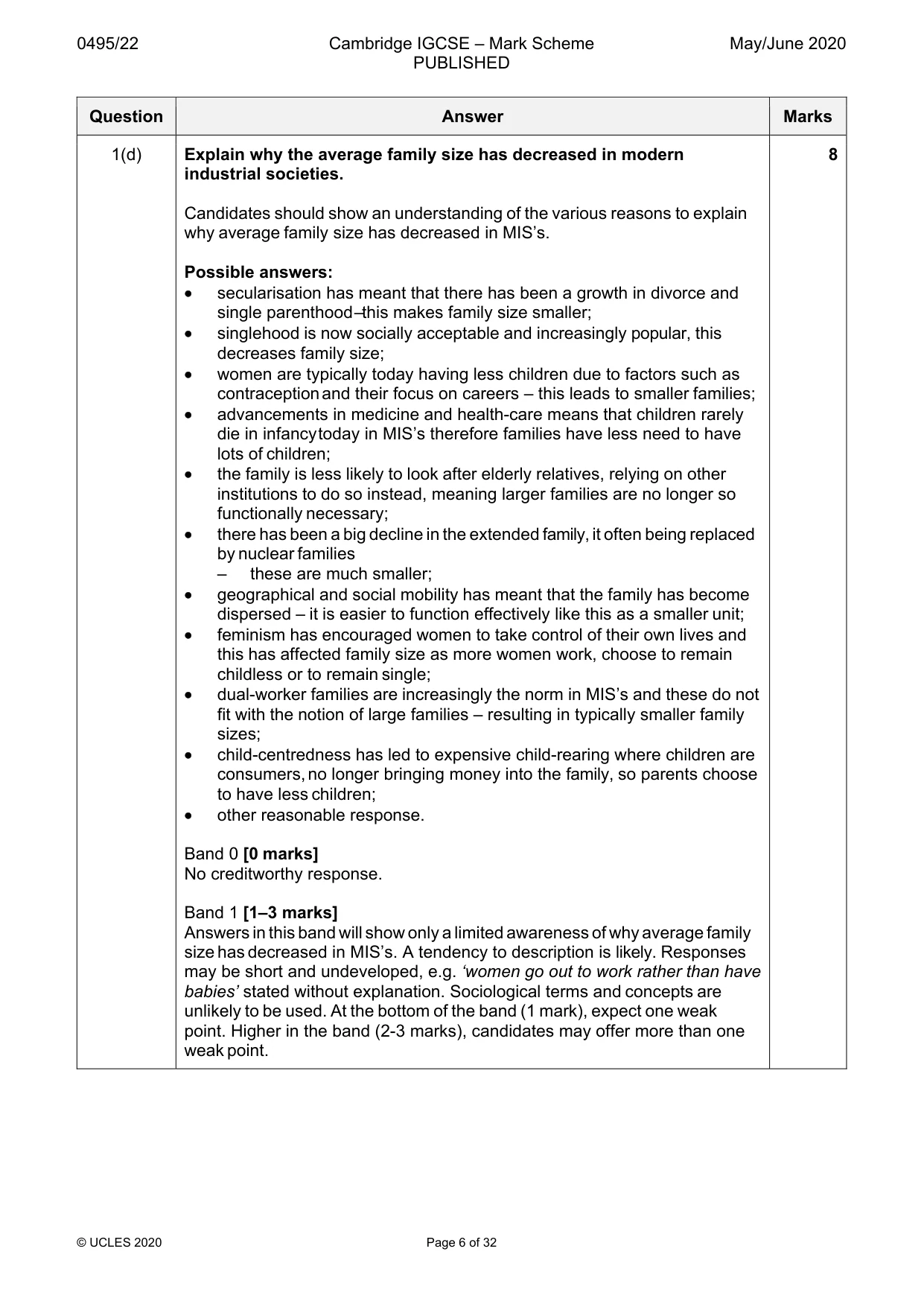
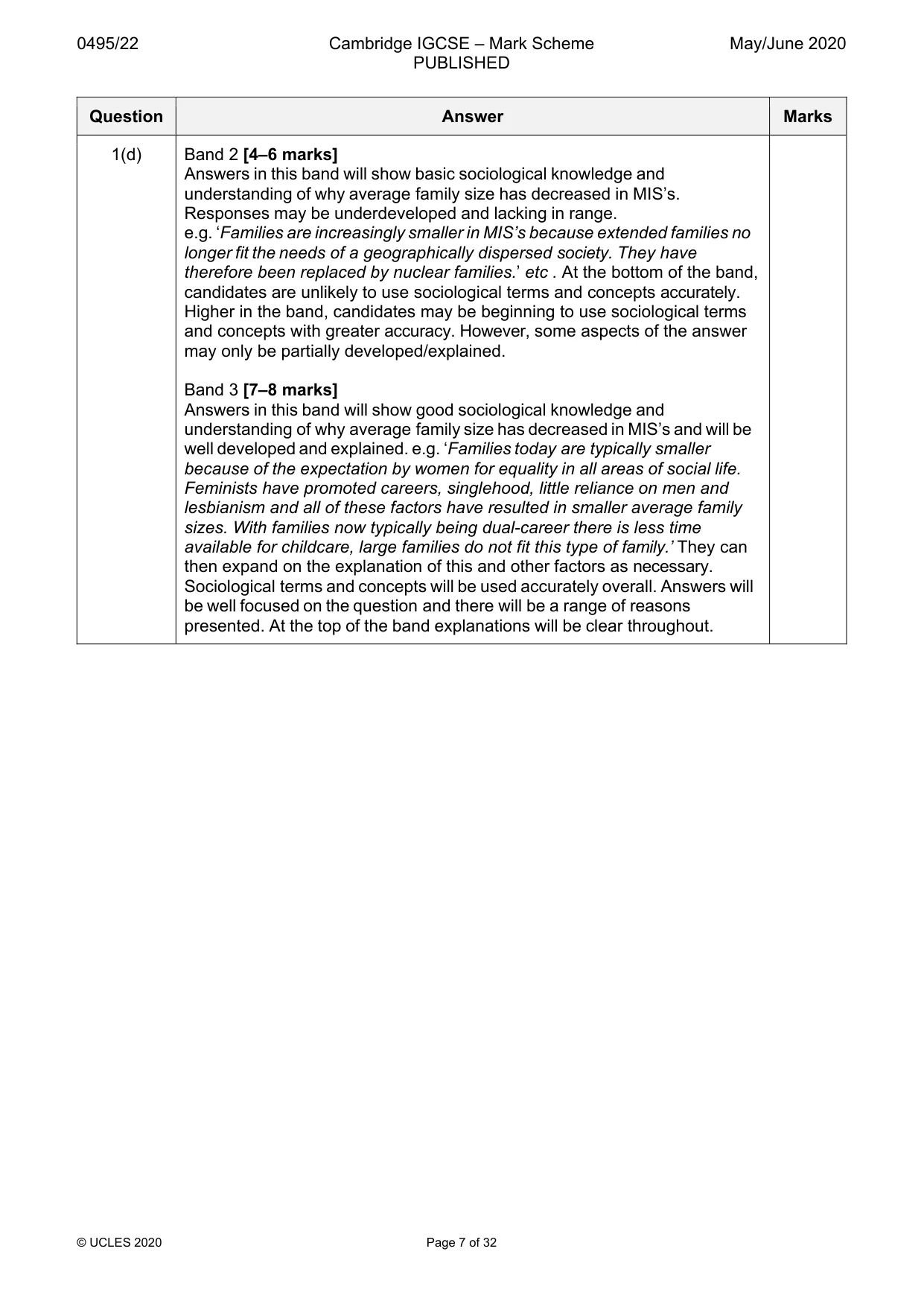
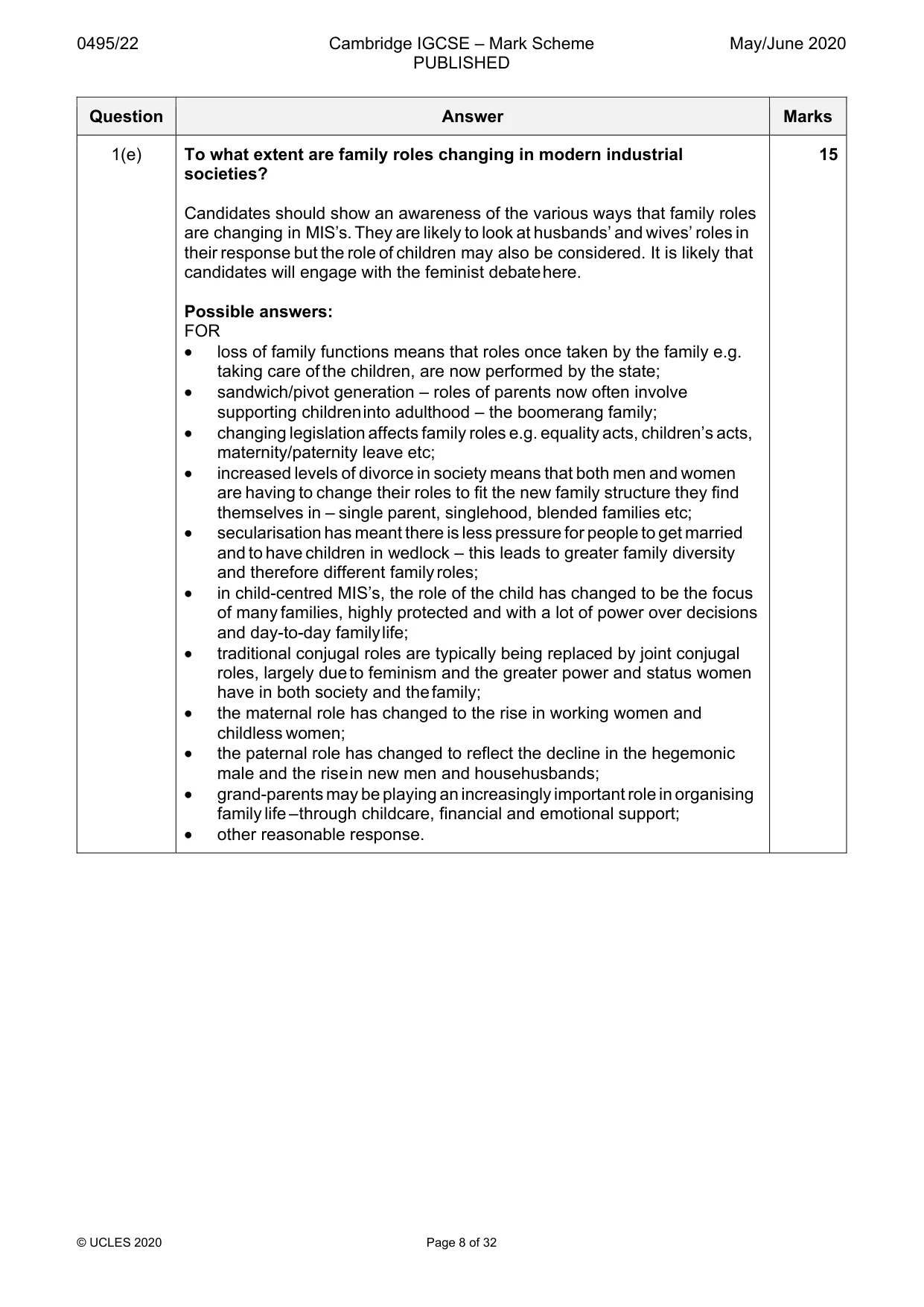
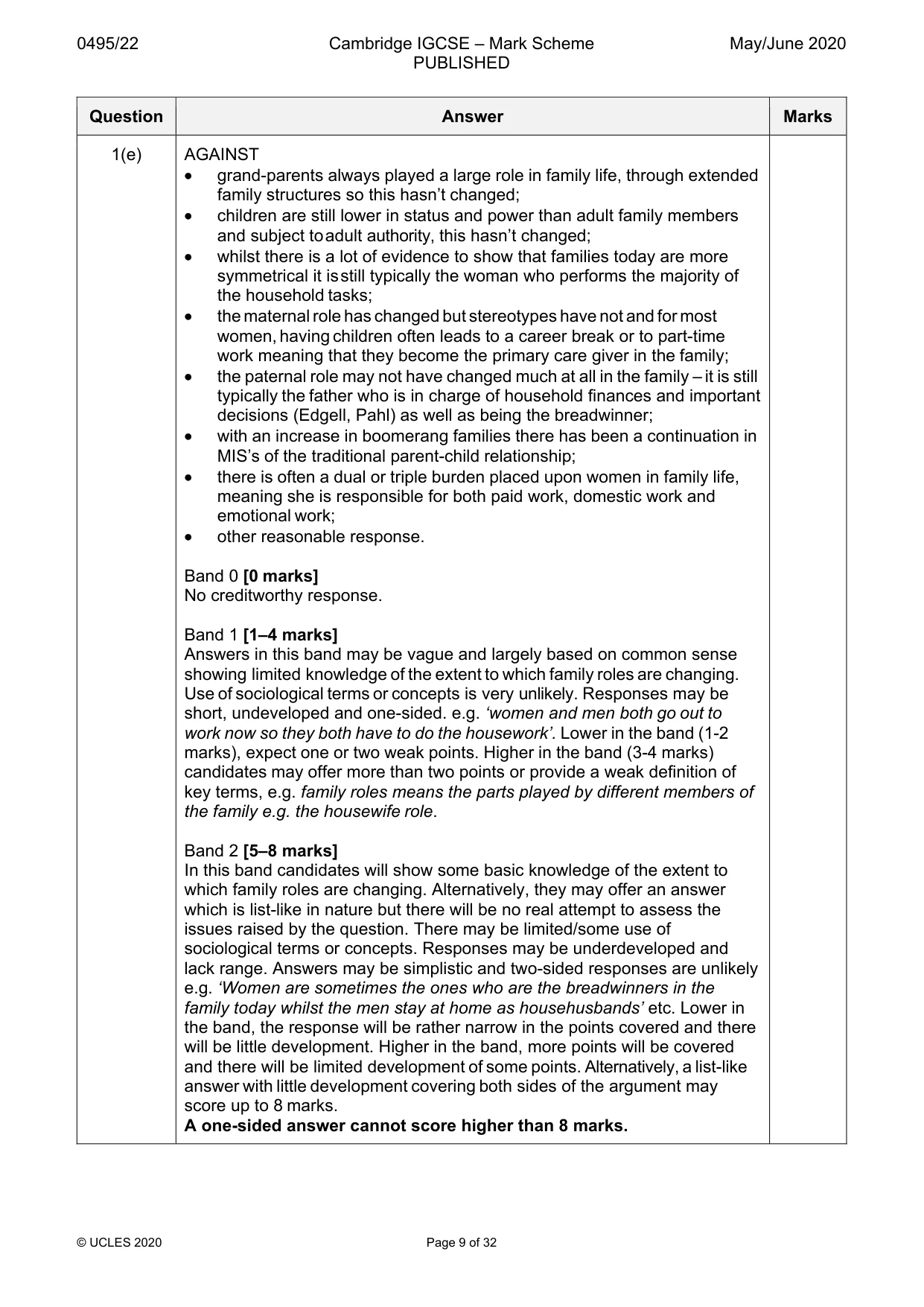
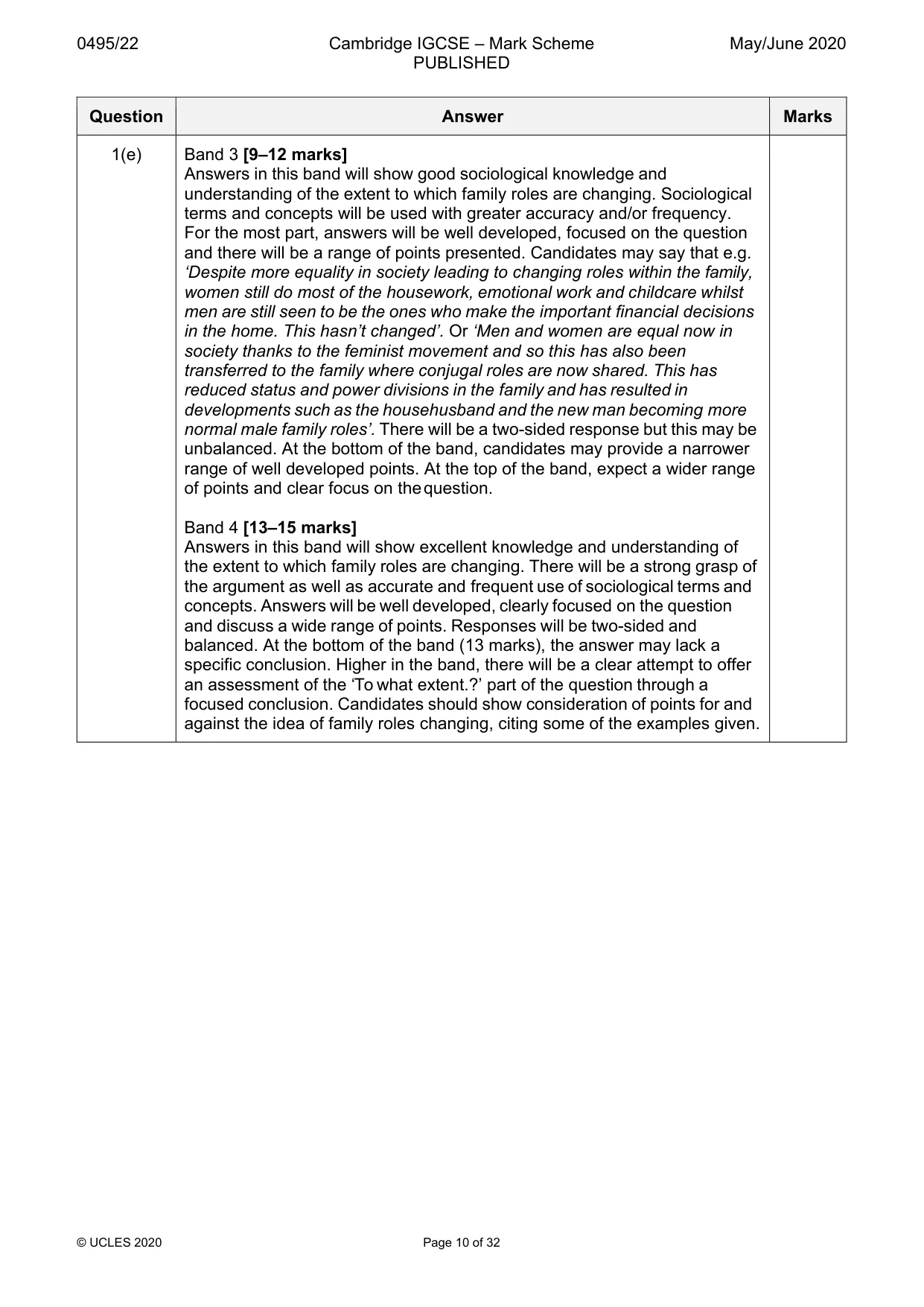
Mark scheme: Question Answer Marks 1(a) What is meant by the term ‘gender equality’? 2 One mark for partial definition, e.g. women’s rights. Two marks for clear definition, e.g. when men and women have equal roles, status and rights. 1(b) Describe two trends in divorce in modern industrial societies. 4 Candidates will describe two trends in divorce in MISs. A trend is any pattern that can be seen when it comes to divorce. Statistics may be used but are not essential. Possible answers: • age – those who marry young are more likely to divorce; • class – middle class people are less likely to divorce than working class people; • society – the divorce rate is high in MIS’s as compared to other types of society; • patterns – currently the divorce rate has flattened off suggesting it is no longer rising; • gender – women are more likely to file for divorce than men; • religion – those with strong religious beliefs are less likely to divorce than those who are non-religious; • era -in the UK the divorce rate is three times higher today than in 1969; • country – the UK has the highest divorce rate in Europe – in 2010 120 000 divorces took place; • gender – women in the UK are two and a half times more likely to be granted a divorce compared to men; • other reasonable response. One mark for each point correctly identified (up to maximum of two). One mark for each point that is developed (up to a maximum of two). 1(c) Explain how ethnicity can affect family life. 6 Candidates can use ethnicity in many different ways – as long as this is linked to family life it is fine to credit. They may well draw on local, cultural examples. Typical areas of discussion may be family roles, family types, family size etc. Possible answers: • ethnic minority families typically adapt to the country they are living in whilst still holding onto cultural practices from their country of origin (dual identity); • Afro-Caribbean families may have high rates of single parents and are typically matrifocal; • South Asian families are often extended in form, have low divorce rates and few instances of single parenthood; • arranged marriages are practised by some ethnic groups as the norm e.g. some South Asian families; • for some ethnic groups the law determines aspects of family life e.g. Chinese families may be influenced by China’s ‘one child’ policy; • South Asian families are often patriarchal in nature with the males (father and brothers) often having more power and influence than the females; • South Asian families often abide by traditional segregated conjugal roles – male breadwinner and female housewife/mother; • cultural defence – some families may socialise children into their cultural norms and values rather than the host nations; • dual heritage/mixed race families – hybridity may be seen here when it comes to roles and experiences in the family; • for some ethnic groups marital practices such as polygamy are normal; • other reasonable response. Band 0 [0 marks] No creditworthy response. Band 1 [1–3 marks] Answers in this band will show only a limited awareness of how ethnicity can affect family life and may talk about e.g. ‘different ethnic groups having different sized families’. Responses may be short and un/under developed. At the bottom of the band (1 mark), expect one weak point. Higher in the band (2-3 marks), candidates may offer more than one weak point, but there may be a tendency towards simplistic answers, engaging with sociological ideas without using sociological language. 1(c) Band 2 [4–6 marks] A clear and accurate explanation, showing good sociological knowledge and understanding of how ethnicity can affect family life. Sociological terms and concepts should be expected e.g. ‘Primary socialisation often means that ethnic groups follow the traditions of the previous generations. In some South Asian families, for example, the extended family form is still typical and this is usually patriarchal in structure, with the male as breadwinner’. This would be followed by explanation of factors leading to this. At the bottom of the band, the range of points covered may be narrow or lack detail. Higher in the band, answers will cover more than one factor in a well-developed way or cover several factors in less detail. 1(d) Explain why the average family size has decreased in modern 8 industrial societies. Candidates should show an understanding of the various reasons to explain why average family size has decreased in MIS’s. Possible answers: • secularisation has meant that there has been a growth in divorce and single parenthood –this makes family size smaller; • singlehood is now socially acceptable and increasingly popular, this decreases family size; • women are typically today having less children due to factors such as contraception and their focus on careers – this leads to smaller families; • advancements in medicine and health-care means that children rarely die in infancy today in MIS’s therefore families have less need to have lots of children; • the family is less likely to look after elderly relatives, relying on other institutions to do so instead, meaning larger families are no longer so functionally necessary; • there has been a big decline in the extended family, it often being replaced by nuclear families – these are much smaller; • geographical and social mobility has meant that the family has become dispersed – it is easier to function effectively like this as a smaller unit; • feminism has encouraged women to take control of their own lives and this has affected family size as more women work, choose to remain childless or to remain single; • dual-worker families are increasingly the norm in MIS’s and these do not fit with the notion of large families – resulting in typically smaller family sizes; • child-centredness has led to expensive child-rearing where children are consumers, no longer bringing money into the family, so parents choose to have less children; • other reasonable response. Band 0 [0 marks] No creditworthy response. Band 1 [1–3 marks] Answers in this band will show only a limited awareness of why average family size has decreased in MIS’s. A tendency to description is likely. Responses may be short and undeveloped, e.g. ‘women go out to work rather than have babies’ stated without explanation. Sociological terms and concepts are unlikely to be used. At the bottom of the band (1 mark), expect one weak point. Higher in the band (2-3 marks), candidates may offer more than one weak point. 1(d) Band 2 [4–6 marks] Answers in this band will show basic sociological knowledge and understanding of why average family size has decreased in MIS’s. Responses may be underdeveloped and lacking in range. e.g. ‘Families are increasingly smaller in MIS’s because extended families no longer fit the needs of a geographically dispersed society. They have therefore been replaced by nuclear families.’ etc . At the bottom of the band, candidates are unlikely to use sociological terms and concepts accurately. Higher in the band, candidates may be beginning to use sociological terms and concepts with greater accuracy. However, some aspects of the answer may only be partially developed/explained. Band 3 [7–8 marks] Answers in this band will show good sociological knowledge and understanding of why average family size has decreased in MIS’s and will be well developed and explained. e.g. ‘Families today are typically smaller because of the expectation by women for equality in all areas of social life. Feminists have promoted careers, singlehood, little reliance on men and lesbianism and all of these factors have resulted in smaller average family sizes. With families now typically being dual-career there is less time available for childcare, large families do not fit this type of family.’ They can then expand on the explanation of this and other factors as necessary. Sociological terms and concepts will be used accurately overall. Answers will be well focused on the question and there will be a range of reasons presented. At the top of the band explanations will be clear throughout. 1(e) To what extent are family roles changing in modern industrial 15 societies? Candidates should show an awareness of the various ways that family roles are changing in MIS’s. They are likely to look at husbands’ and wives’ roles in their response but the role of children may also be considered. It is likely that candidates will engage with the feminist debate here. Possible answers: FOR • loss of family functions means that roles once taken by the family e.g. taking care of the children, are now performed by the state; • sandwich/pivot generation – roles of parents now often involve supporting children into adulthood – the boomerang family; • changing legislation affects family roles e.g. equality acts, children’s acts, maternity/paternity leave etc; • increased levels of divorce in society means that both men and women are having to change their roles to fit the new family structure they find themselves in – single parent, singlehood, blended families etc; • secularisation has meant there is less pressure for people to get married and to have children in wedlock – this leads to greater family diversity and therefore different family roles; • in child-centred MIS’s, the role of the child has changed to be the focus of many families, highly protected and with a lot of power over decisions and day-to-day family life; • traditional conjugal roles are typically being replaced by joint conjugal roles, largely due to feminism and the greater power and status women have in both society and the family; • the maternal role has changed to the rise in working women and childless women; • the paternal role has changed to reflect the decline in the hegemonic male and the rise in new men and househusbands; • grand-parents may be playing an increasingly important role in organising family life – through childcare, financial and emotional support; • other reasonable response. 1(e) AGAINST • grand-parents always played a large role in family life, through extended family structures so this hasn’t changed; • children are still lower in status and power than adult family members and subject to adult authority, this hasn’t changed; • whilst there is a lot of evidence to show that families today are more symmetrical it is still typically the woman who performs the majority of the household tasks; • the maternal role has changed but stereotypes have not and for most women, having children often leads to a career break or to part-time work meaning that they become the primary care giver in the family; • the paternal role may not have changed much at all in the family – it is still typically the father who is in charge of household finances and important decisions (Edgell, Pahl) as well as being the breadwinner; • with an increase in boomerang families there has been a continuation in MIS’s of the traditional parent-child relationship; • there is often a dual or triple burden placed upon women in family life, meaning she is responsible for both paid work, domestic work and emotional work; • other reasonable response. Band 0 [0 marks] No creditworthy response. Band 1 [1–4 marks] Answers in this band may be vague and largely based on common sense showing limited knowledge of the extent to which family roles are changing. Use of sociological terms or concepts is very unlikely. Responses may be short, undeveloped and one-sided. e.g. ‘women and men both go out to work now so they both have to do the housework’. Lower in the band (1-2 marks), expect one or two weak points. Higher in the band (3-4 marks) candidates may offer more than two points or provide a weak definition of key terms, e.g. family roles means the parts played by different members of the family e.g. the housewife role. Band 2 [5–8 marks] In this band candidates will show some basic knowledge of the extent to which family roles are changing. Alternatively, they may offer an answer which is list-like in nature but there will be no real attempt to assess the issues raised by the question. There may be limited/some use of sociological terms or concepts. Responses may be underdeveloped and lack range. Answers may be simplistic and two-sided responses are unlikely e.g. ‘Women are sometimes the ones who are the breadwinners in the family today whilst the men stay at home as househusbands’ etc. Lower in the band, the response will be rather narrow in the points covered and there will be little development. Higher in the band, more points will be covered and there will be limited development of some points. Alternatively, a list-like answer with little development covering both sides of the argument may score up to 8 marks. A one-sided answer cannot score higher than 8 marks. 1(e) Band 3 [9–12 marks] Answers in this band will show good sociological knowledge and understanding of the extent to which family roles are changing. Sociological terms and concepts will be used with greater accuracy and/or frequency. For the most part, answers will be well developed, focused on the question and there will be a range of points presented. Candidates may say that e.g. ‘Despite more equality in society leading to changing roles within the family, women still do most of the housework, emotional work and childcare whilst men are still seen to be the ones who make the important financial decisions in the home. This hasn’t changed’. Or ‘Men and women are equal now in society thanks to the feminist movement and so this has also been transferred to the family where conjugal roles are now shared. This has reduced status and power divisions in the family and has resulted in developments such as the househusband and the new man becoming more normal male family roles’. There will be a two-sided response but this may be unbalanced. At the bottom of the band, candidates may provide a narrower range of well developed points. At the top of the band, expect a wider range of points and clear focus on the question. Band 4 [13–15 marks] Answers in this band will show excellent knowledge and understanding of the extent to which family roles are changing. There will be a strong grasp of the argument as well as accurate and frequent use of sociological terms and concepts. Answers will be well developed, clearly focused on the question and discuss a wide range of points. Responses will be two-sided and balanced. At the bottom of the band (13 marks), the answer may lack a specific conclusion. Higher in the band, there will be a clear attempt to offer an assessment of the ‘To what extent.?’ part of the question through a focused conclusion. Candidates should show consideration of points for and against the idea of family roles changing, citing some of the examples given.
More questions on How do sociologists approach the study of society?
Q2 · Many sociologists believe that how well an individual does in education is not down to…
2 Many sociologists believe that how well an individual does in education is not down to their efforts or IQ but more to do with social characteristics such as ethnicity, gender and social class. This can be explained by looking at both school and home factors. Other sociologists believe that academic and vocational education are meritocratic and open to everyone. (a) What is meant by the term ‘home factors’? [2] (b) Describe two examples of vocational education. [4] (c) Explain how private schools may reproduce social inequalities. [6] (d) Explain why some ethnic groups do less well than others in education. [8] (e) To what extent is the feminist view of education accurate? [15] Section C: Crime, deviance and social control
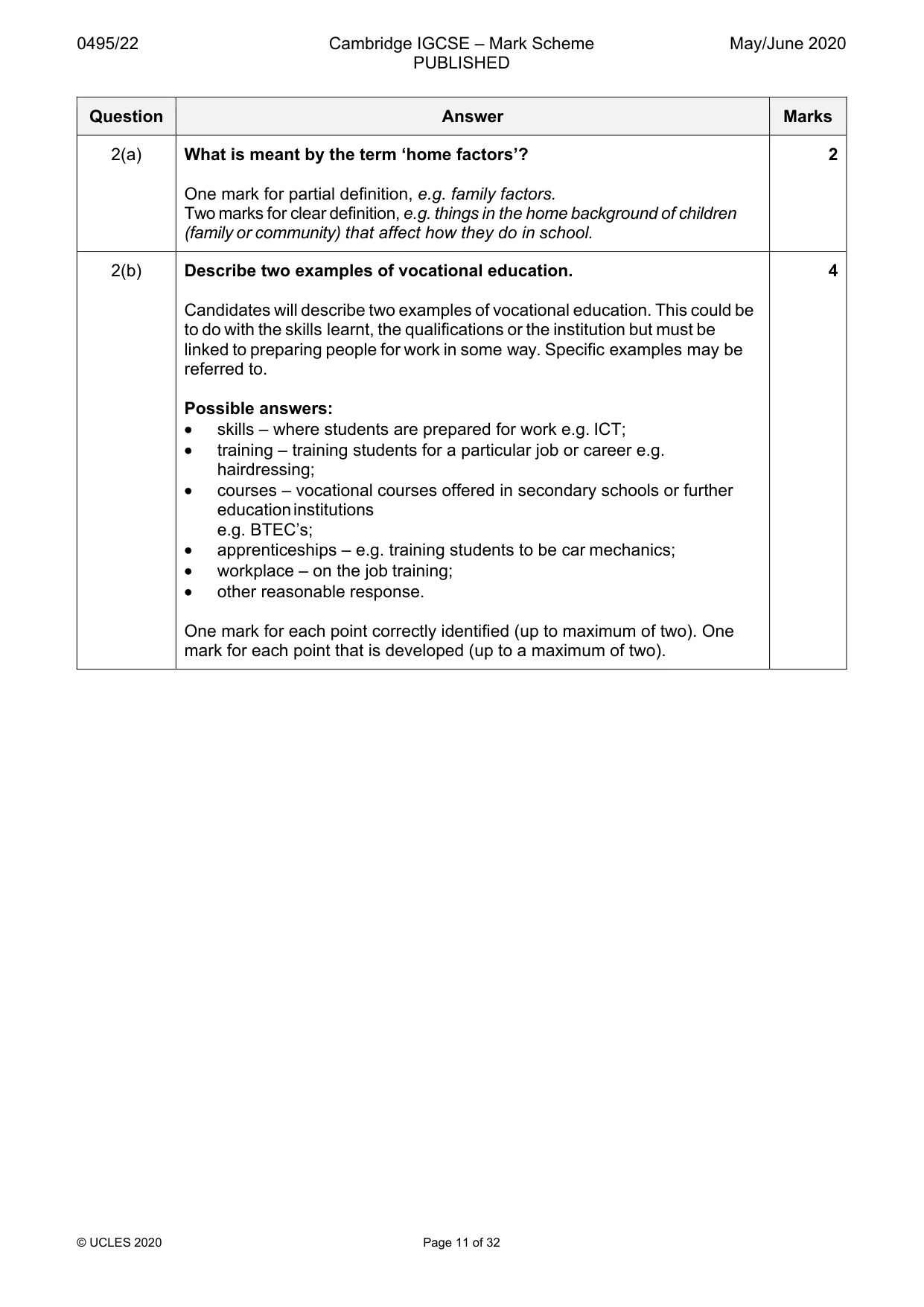
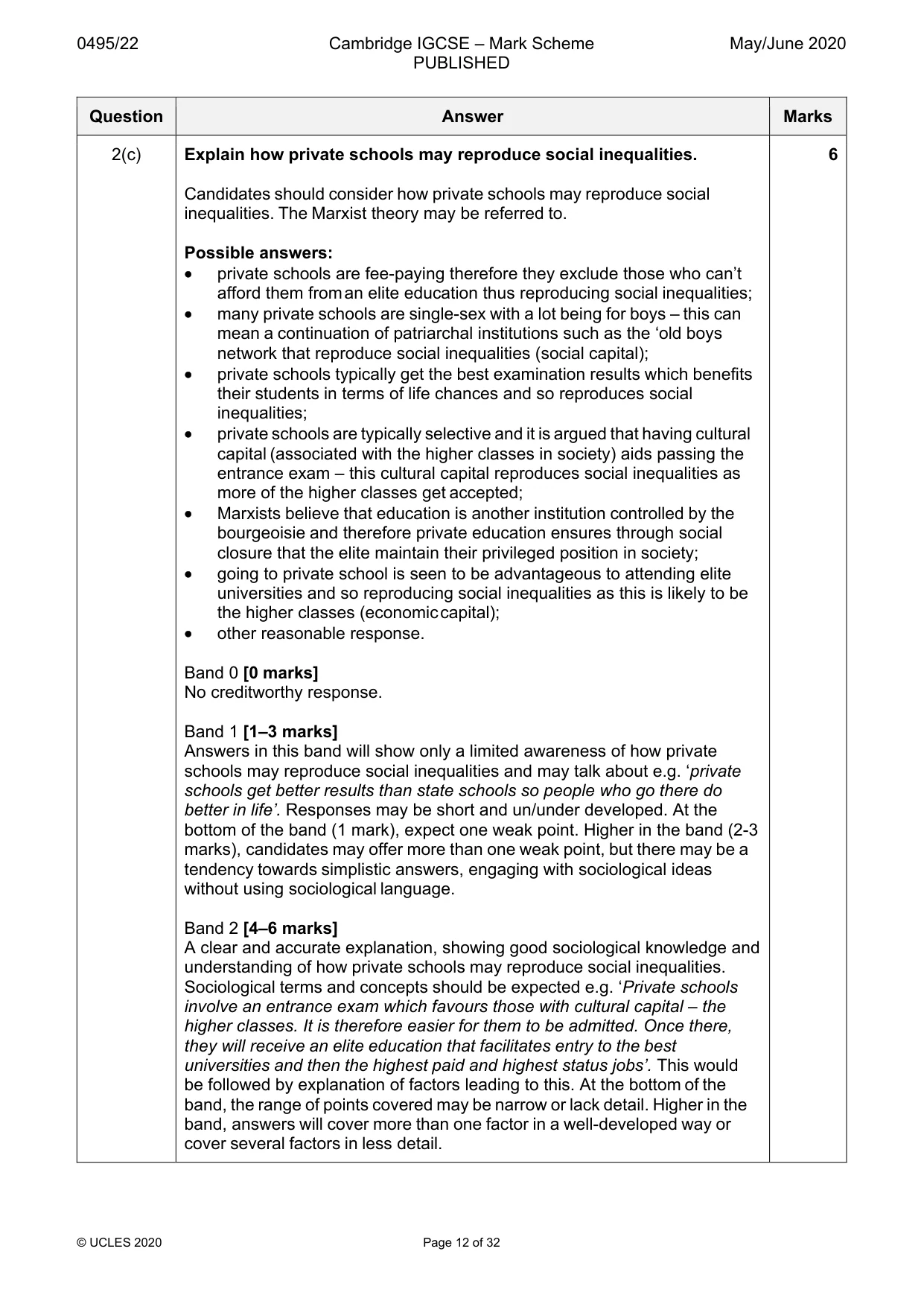
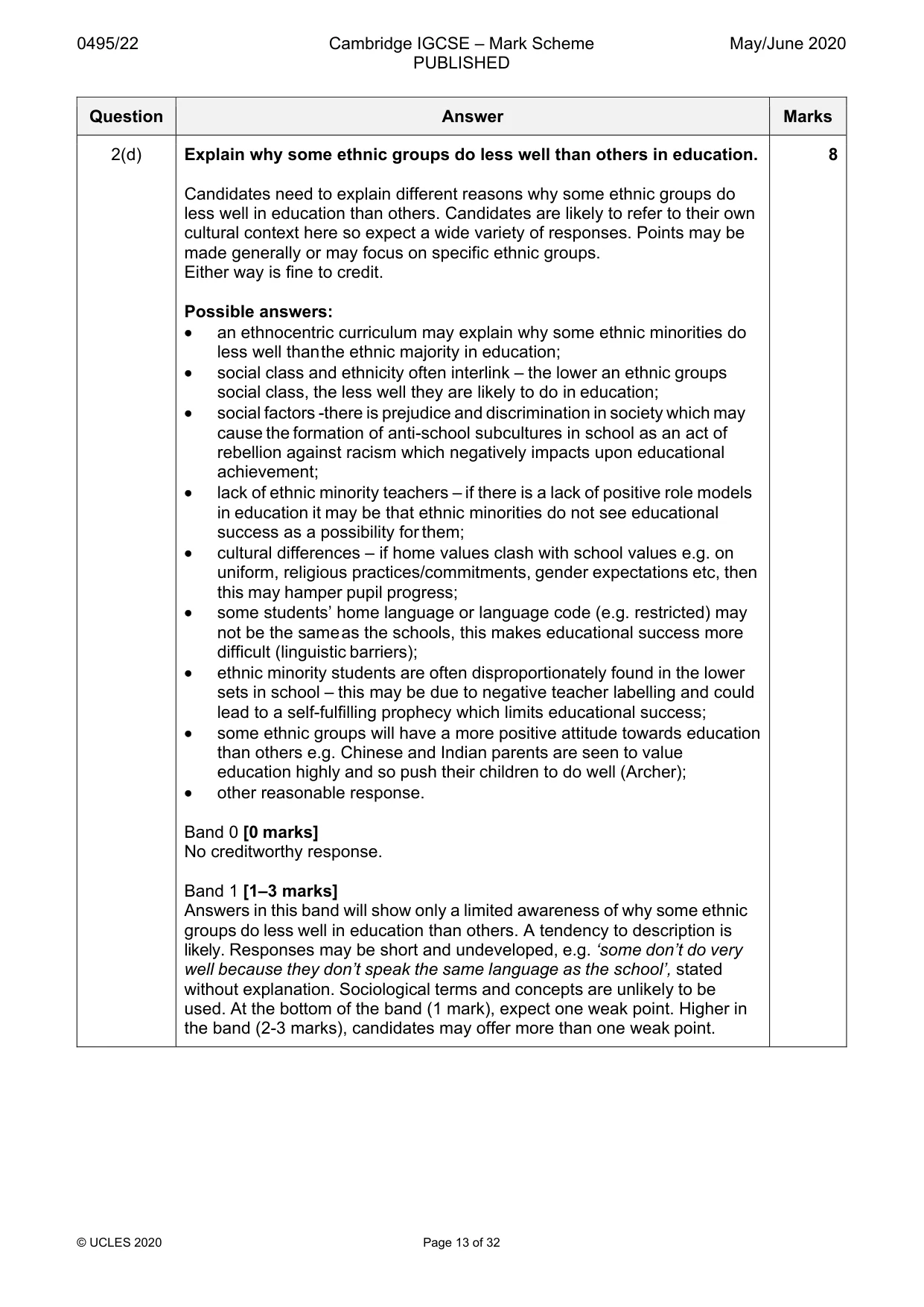
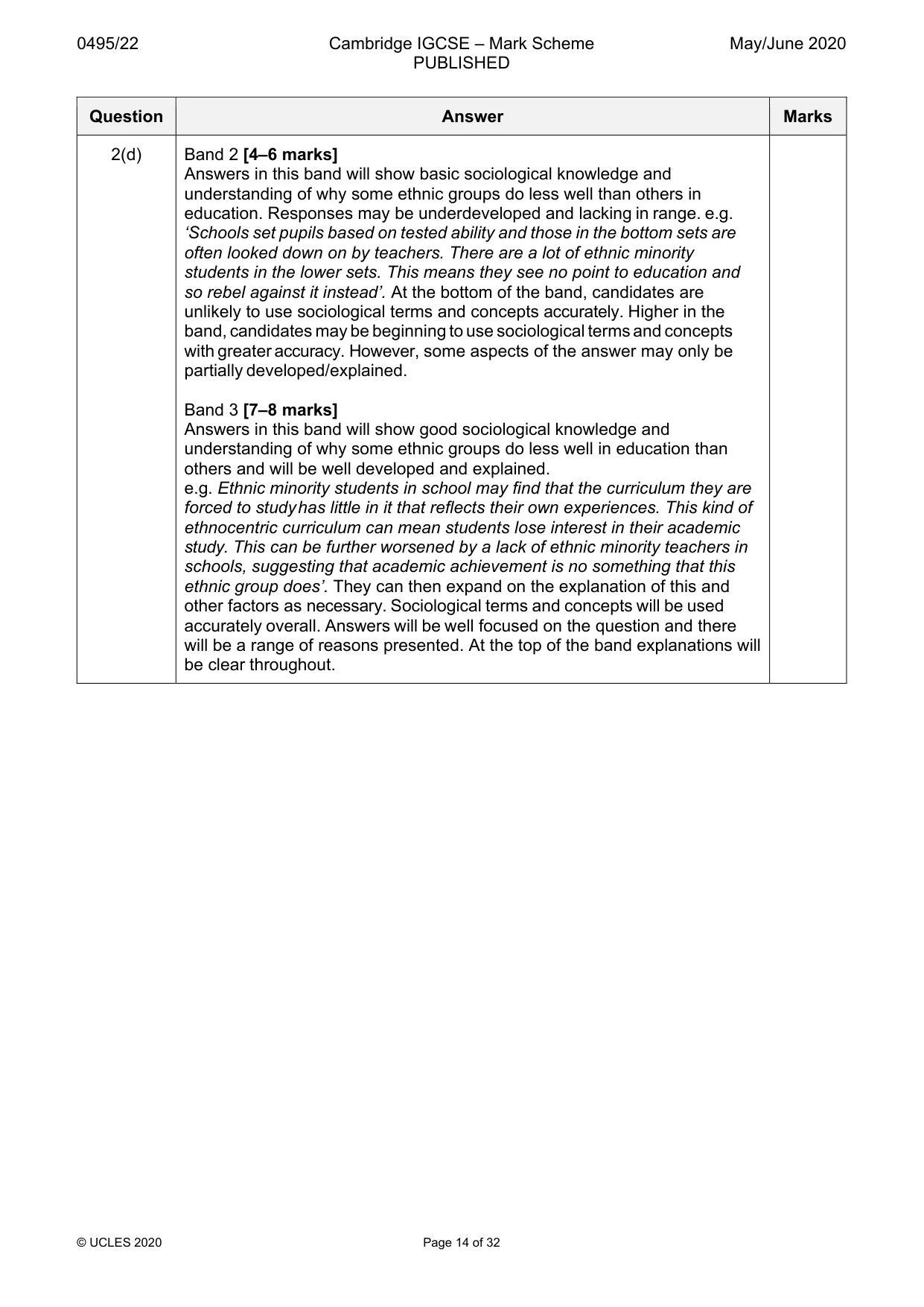
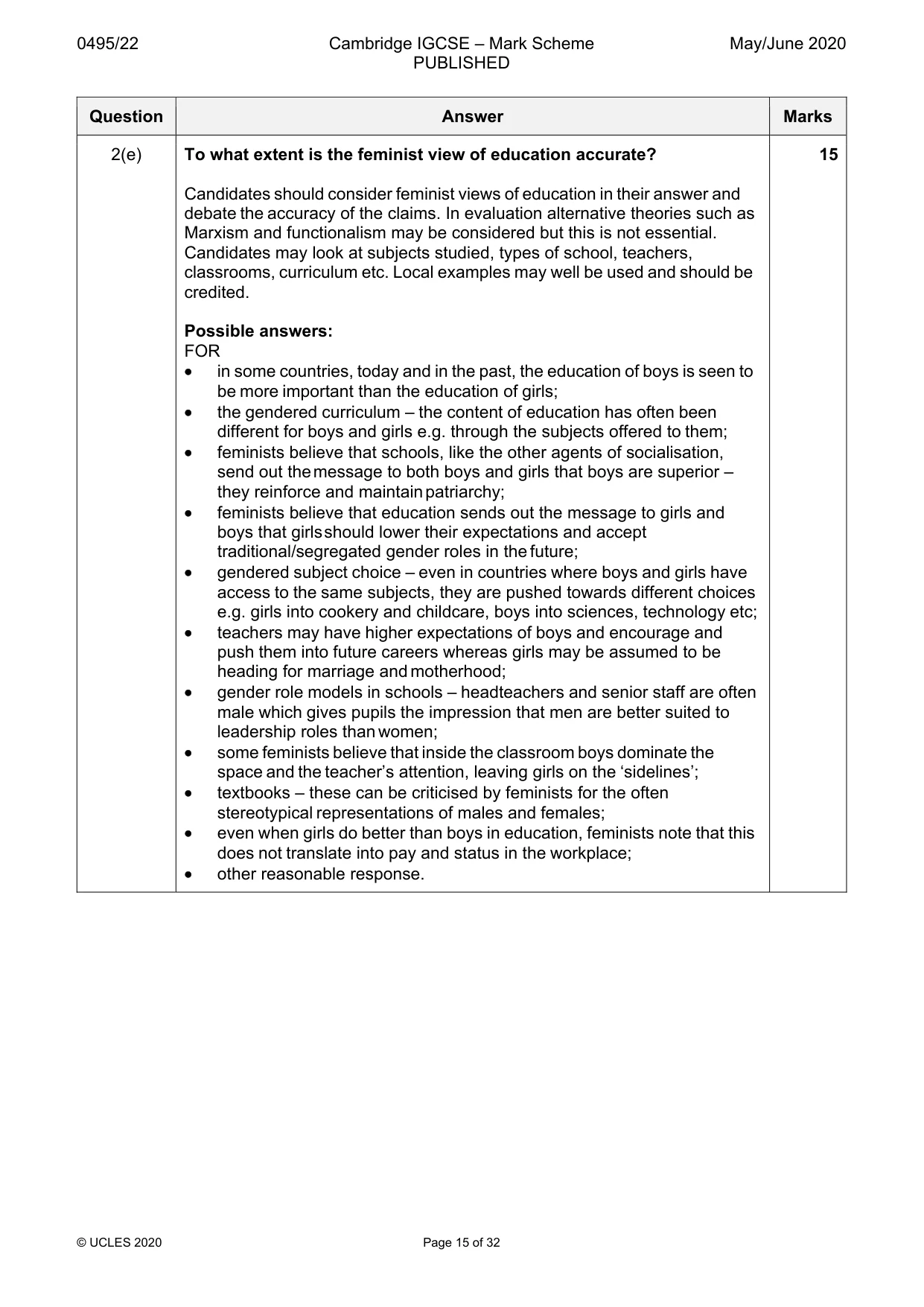
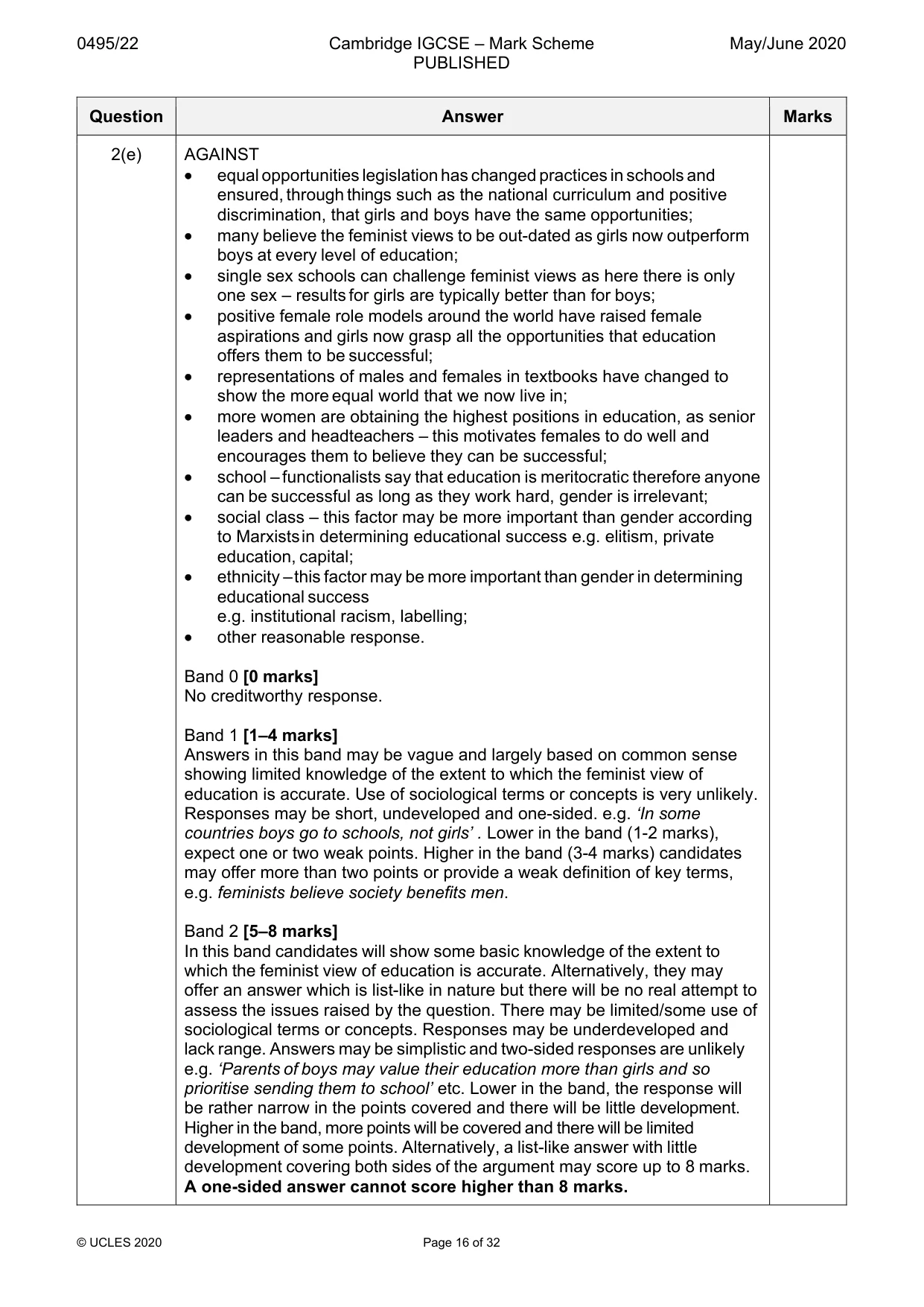
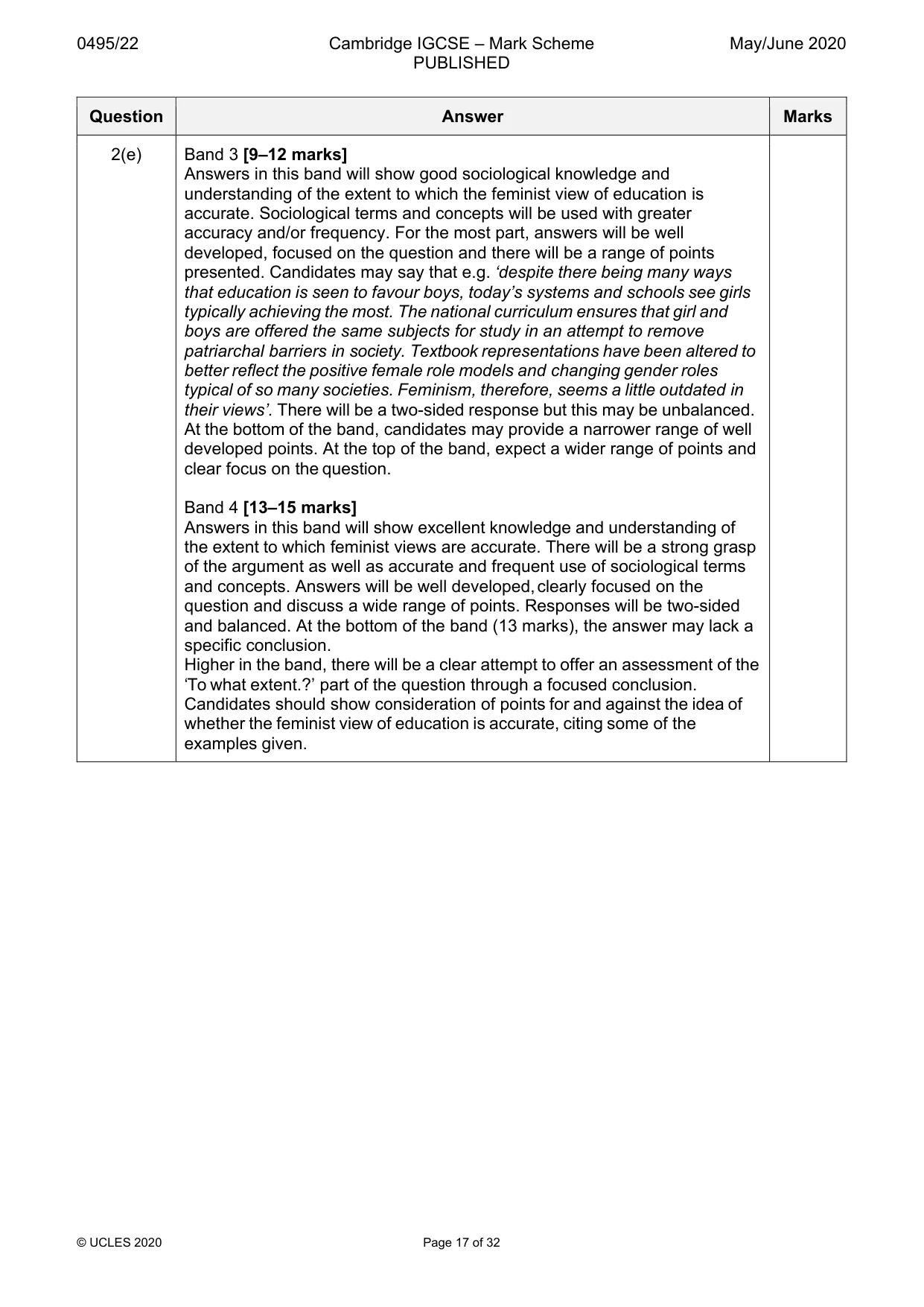
Mark scheme: 2(a) What is meant by the term ‘home factors’? 2 One mark for partial definition, e.g. family factors. Two marks for clear definition, e.g. things in the home background of children (family or community) that affect how they do in school. 2(b) Describe two examples of vocational education. 4 Candidates will describe two examples of vocational education. This could be to do with the skills learnt, the qualifications or the institution but must be linked to preparing people for work in some way. Specific examples may be referred to. Possible answers: • skills – where students are prepared for work e.g. ICT; • training – training students for a particular job or career e.g. hairdressing; • courses – vocational courses offered in secondary schools or further education institutions e.g. BTEC’s; • apprenticeships – e.g. training students to be car mechanics; • workplace – on the job training; • other reasonable response. One mark for each point correctly identified (up to maximum of two). One mark for each point that is developed (up to a maximum of two). 2(c) Explain how private schools may reproduce social inequalities. 6 Candidates should consider how private schools may reproduce social inequalities. The Marxist theory may be referred to. Possible answers: • private schools are fee-paying therefore they exclude those who can’t afford them from an elite education thus reproducing social inequalities; • many private schools are single-sex with a lot being for boys – this can mean a continuation of patriarchal institutions such as the ‘old boys network that reproduce social inequalities (social capital); • private schools typically get the best examination results which benefits their students in terms of life chances and so reproduces social inequalities; • private schools are typically selective and it is argued that having cultural capital (associated with the higher classes in society) aids passing the entrance exam – this cultural capital reproduces social inequalities as more of the higher classes get accepted; • Marxists believe that education is another institution controlled by the bourgeoisie and therefore private education ensures through social closure that the elite maintain their privileged position in society; • going to private school is seen to be advantageous to attending elite universities and so reproducing social inequalities as this is likely to be the higher classes (economic capital); • other reasonable response. Band 0 [0 marks] No creditworthy response. Band 1 [1–3 marks] Answers in this band will show only a limited awareness of how private schools may reproduce social inequalities and may talk about e.g. ‘private schools get better results than state schools so people who go there do better in life’. Responses may be short and un/under developed. At the bottom of the band (1 mark), expect one weak point. Higher in the band (2-3 marks), candidates may offer more than one weak point, but there may be a tendency towards simplistic answers, engaging with sociological ideas without using sociological language. Band 2 [4–6 marks] A clear and accurate explanation, showing good sociological knowledge and understanding of how private schools may reproduce social inequalities. Sociological terms and concepts should be expected e.g. ‘Private schools involve an entrance exam which favours those with cultural capital – the higher classes. It is therefore easier for them to be admitted. Once there, they will receive an elite education that facilitates entry to the best universities and then the highest paid and highest status jobs’. This would be followed by explanation of factors leading to this. At the bottom of the band, the range of points covered may be narrow or lack detail. Higher in the band, answers will cover more than one factor in a well-developed way or cover several factors in less detail. 2(d) Explain why some ethnic groups do less well than others in education. 8 Candidates need to explain different reasons why some ethnic groups do less well in education than others. Candidates are likely to refer to their own cultural context here so expect a wide variety of responses. Points may be made generally or may focus on specific ethnic groups. Either way is fine to credit. Possible answers: • an ethnocentric curriculum may explain why some ethnic minorities do less well than the ethnic majority in education; • social class and ethnicity often interlink – the lower an ethnic groups social class, the less well they are likely to do in education; • social factors -there is prejudice and discrimination in society which may cause the formation of anti-school subcultures in school as an act of rebellion against racism which negatively impacts upon educational achievement; • lack of ethnic minority teachers – if there is a lack of positive role models in education it may be that ethnic minorities do not see educational success as a possibility for them; • cultural differences – if home values clash with school values e.g. on uniform, religious practices/commitments, gender expectations etc, then this may hamper pupil progress; • some students’ home language or language code (e.g. restricted) may not be the same as the schools, this makes educational success more difficult (linguistic barriers); • ethnic minority students are often disproportionately found in the lower sets in school – this may be due to negative teacher labelling and could lead to a self-fulfilling prophecy which limits educational success; • some ethnic groups will have a more positive attitude towards education than others e.g. Chinese and Indian parents are seen to value education highly and so push their children to do well (Archer); • other reasonable response. Band 0 [0 marks] No creditworthy response. Band 1 [1–3 marks] Answers in this band will show only a limited awareness of why some ethnic groups do less well in education than others. A tendency to description is likely. Responses may be short and undeveloped, e.g. ‘some don’t do very well because they don’t speak the same language as the school’, stated without explanation. Sociological terms and concepts are unlikely to be used. At the bottom of the band (1 mark), expect one weak point. Higher in the band (2-3 marks), candidates may offer more than one weak point. 2(d) Band 2 [4–6 marks] Answers in this band will show basic sociological knowledge and understanding of why some ethnic groups do less well than others in education. Responses may be underdeveloped and lacking in range. e.g. ‘Schools set pupils based on tested ability and those in the bottom sets are often looked down on by teachers. There are a lot of ethnic minority students in the lower sets. This means they see no point to education and so rebel against it instead’. At the bottom of the band, candidates are unlikely to use sociological terms and concepts accurately. Higher in the band, candidates may be beginning to use sociological terms and concepts with greater accuracy. However, some aspects of the answer may only be partially developed/explained. Band 3 [7–8 marks] Answers in this band will show good sociological knowledge and understanding of why some ethnic groups do less well in education than others and will be well developed and explained. e.g. Ethnic minority students in school may find that the curriculum they are forced to study has little in it that reflects their own experiences. This kind of ethnocentric curriculum can mean students lose interest in their academic study. This can be further worsened by a lack of ethnic minority teachers in schools, suggesting that academic achievement is no something that this ethnic group does’. They can then expand on the explanation of this and other factors as necessary. Sociological terms and concepts will be used accurately overall. Answers will be well focused on the question and there will be a range of reasons presented. At the top of the band explanations will be clear throughout. 2(e) To what extent is the feminist view of education accurate? 15 Candidates should consider feminist views of education in their answer and debate the accuracy of the claims. In evaluation alternative theories such as Marxism and functionalism may be considered but this is not essential. Candidates may look at subjects studied, types of school, teachers, classrooms, curriculum etc. Local examples may well be used and should be credited. Possible answers: FOR • in some countries, today and in the past, the education of boys is seen to be more important than the education of girls; • the gendered curriculum – the content of education has often been different for boys and girls e.g. through the subjects offered to them; • feminists believe that schools, like the other agents of socialisation, send out the message to both boys and girls that boys are superior – they reinforce and maintain patriarchy; • feminists believe that education sends out the message to girls and boys that girls should lower their expectations and accept traditional/segregated gender roles in the future; • gendered subject choice – even in countries where boys and girls have access to the same subjects, they are pushed towards different choices e.g. girls into cookery and childcare, boys into sciences, technology etc; • teachers may have higher expectations of boys and encourage and push them into future careers whereas girls may be assumed to be heading for marriage and motherhood; • gender role models in schools – headteachers and senior staff are often male which gives pupils the impression that men are better suited to leadership roles than women; • some feminists believe that inside the classroom boys dominate the space and the teacher’s attention, leaving girls on the ‘sidelines’; • textbooks – these can be criticised by feminists for the often stereotypical representations of males and females; • even when girls do better than boys in education, feminists note that this does not translate into pay and status in the workplace; • other reasonable response. 2(e) AGAINST • equal opportunities legislation has changed practices in schools and ensured, through things such as the national curriculum and positive discrimination, that girls and boys have the same opportunities; • many believe the feminist views to be out-dated as girls now outperform boys at every level of education; • single sex schools can challenge feminist views as here there is only one sex – results for girls are typically better than for boys; • positive female role models around the world have raised female aspirations and girls now grasp all the opportunities that education offers them to be successful; • representations of males and females in textbooks have changed to show the more equal world that we now live in; • more women are obtaining the highest positions in education, as senior leaders and headteachers – this motivates females to do well and encourages them to believe they can be successful; • school – functionalists say that education is meritocratic therefore anyone can be successful as long as they work hard, gender is irrelevant; • social class – this factor may be more important than gender according to Marxists in determining educational success e.g. elitism, private education, capital; • ethnicity – this factor may be more important than gender in determining educational success e.g. institutional racism, labelling; • other reasonable response. Band 0 [0 marks] No creditworthy response. Band 1 [1–4 marks] Answers in this band may be vague and largely based on common sense showing limited knowledge of the extent to which the feminist view of education is accurate. Use of sociological terms or concepts is very unlikely. Responses may be short, undeveloped and one-sided. e.g. ‘In some countries boys go to schools, not girls’ . Lower in the band (1-2 marks), expect one or two weak points. Higher in the band (3-4 marks) candidates may offer more than two points or provide a weak definition of key terms, e.g. feminists believe society benefits men. Band 2 [5–8 marks] In this band candidates will show some basic knowledge of the extent to which the feminist view of education is accurate. Alternatively, they may offer an answer which is list-like in nature but there will be no real attempt to assess the issues raised by the question. There may be limited/some use of sociological terms or concepts. Responses may be underdeveloped and lack range. Answers may be simplistic and two-sided responses are unlikely e.g. ‘Parents of boys may value their education more than girls and so prioritise sending them to school’ etc. Lower in the band, the response will be rather narrow in the points covered and there will be little development. Higher in the band, more points will be covered and there will be limited development of some points. Alternatively, a list-like answer with little development covering both sides of the argument may score up to 8 marks. A one-sided answer cannot score higher than 8 marks. 2(e) Band 3 [9–12 marks] Answers in this band will show good sociological knowledge and understanding of the extent to which the feminist view of education is accurate. Sociological terms and concepts will be used with greater accuracy and/or frequency. For the most part, answers will be well developed, focused on the question and there will be a range of points presented. Candidates may say that e.g. ‘despite there being many ways that education is seen to favour boys, today’s systems and schools see girls typically achieving the most. The national curriculum ensures that girl and boys are offered the same subjects for study in an attempt to remove patriarchal barriers in society. Textbook representations have been altered to better reflect the positive female role models and changing gender roles typical of so many societies. Feminism, therefore, seems a little outdated in their views’. There will be a two-sided response but this may be unbalanced. At the bottom of the band, candidates may provide a narrower range of well developed points. At the top of the band, expect a wider range of points and clear focus on the question. Band 4 [13–15 marks] Answers in this band will show excellent knowledge and understanding of the extent to which feminist views are accurate. There will be a strong grasp of the argument as well as accurate and frequent use of sociological terms and concepts. Answers will be well developed, clearly focused on the question and discuss a wide range of points. Responses will be two-sided and balanced. At the bottom of the band (13 marks), the answer may lack a specific conclusion. Higher in the band, there will be a clear attempt to offer an assessment of the ‘To what extent.?’ part of the question through a focused conclusion. Candidates should show consideration of points for and against the idea of whether the feminist view of education is accurate, citing some of the examples given.
Q3 · There are official and non-official statistics that measure the crime rate in a society
3 There are official and non-official statistics that measure the crime rate in a society. However, not all crimes are accurately represented in the statistics suggesting that some groups are less likely than others to be prosecuted for their crimes. Some believe there is a need for more formal social control and harsher punishments to deal with the high levels of offending. (a) What is meant by the term ‘formal social control’? [2] (b) Describe two punishments for crime. [4] (c) Explain how poverty can be linked to crime. [6] (d) Explain why white-collar crime is under-reported and under-recorded in the official crime statistics. [8] (e) To what extent are self-report studies the most accurate measurement of crime? [15] Section D: Media
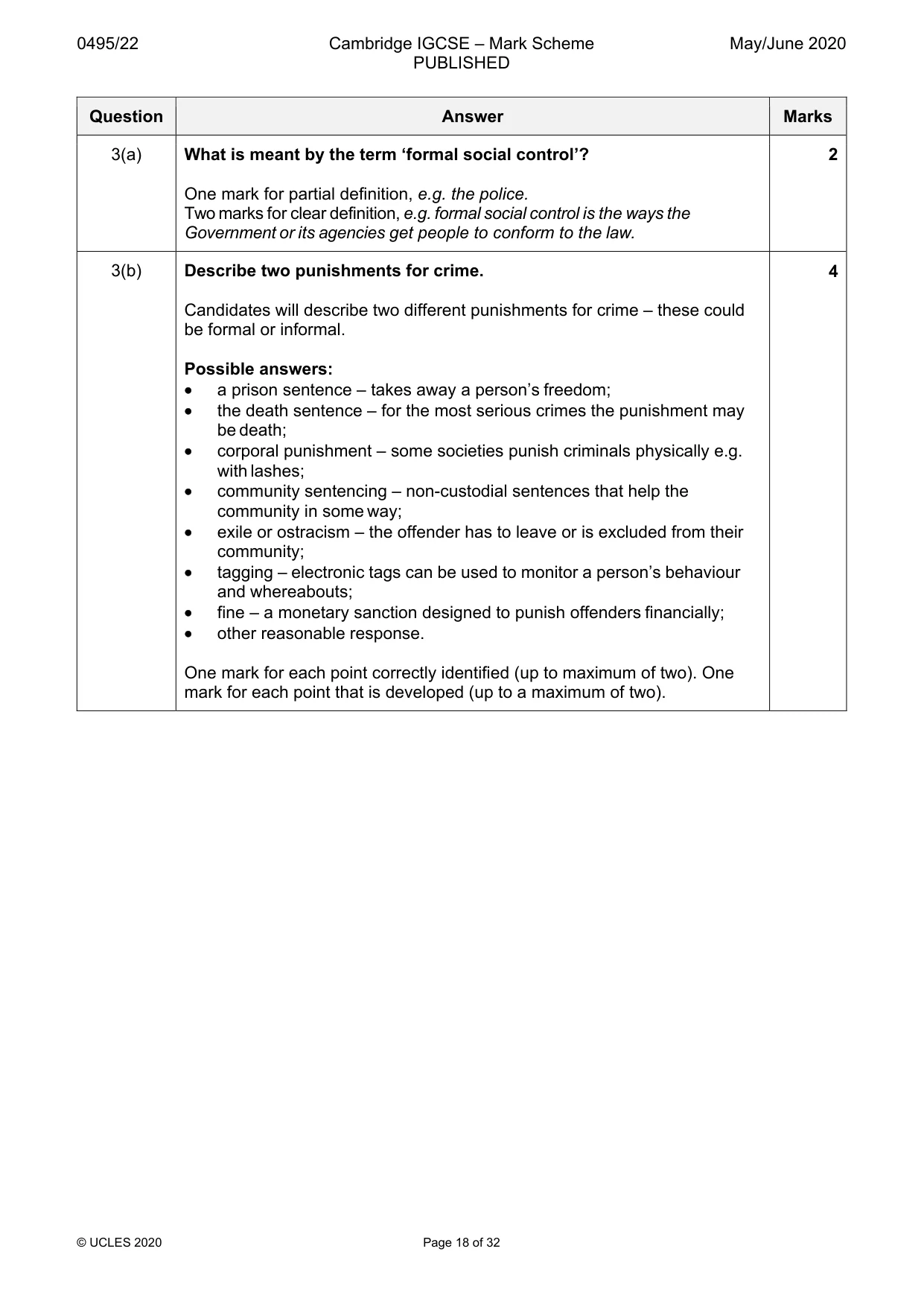
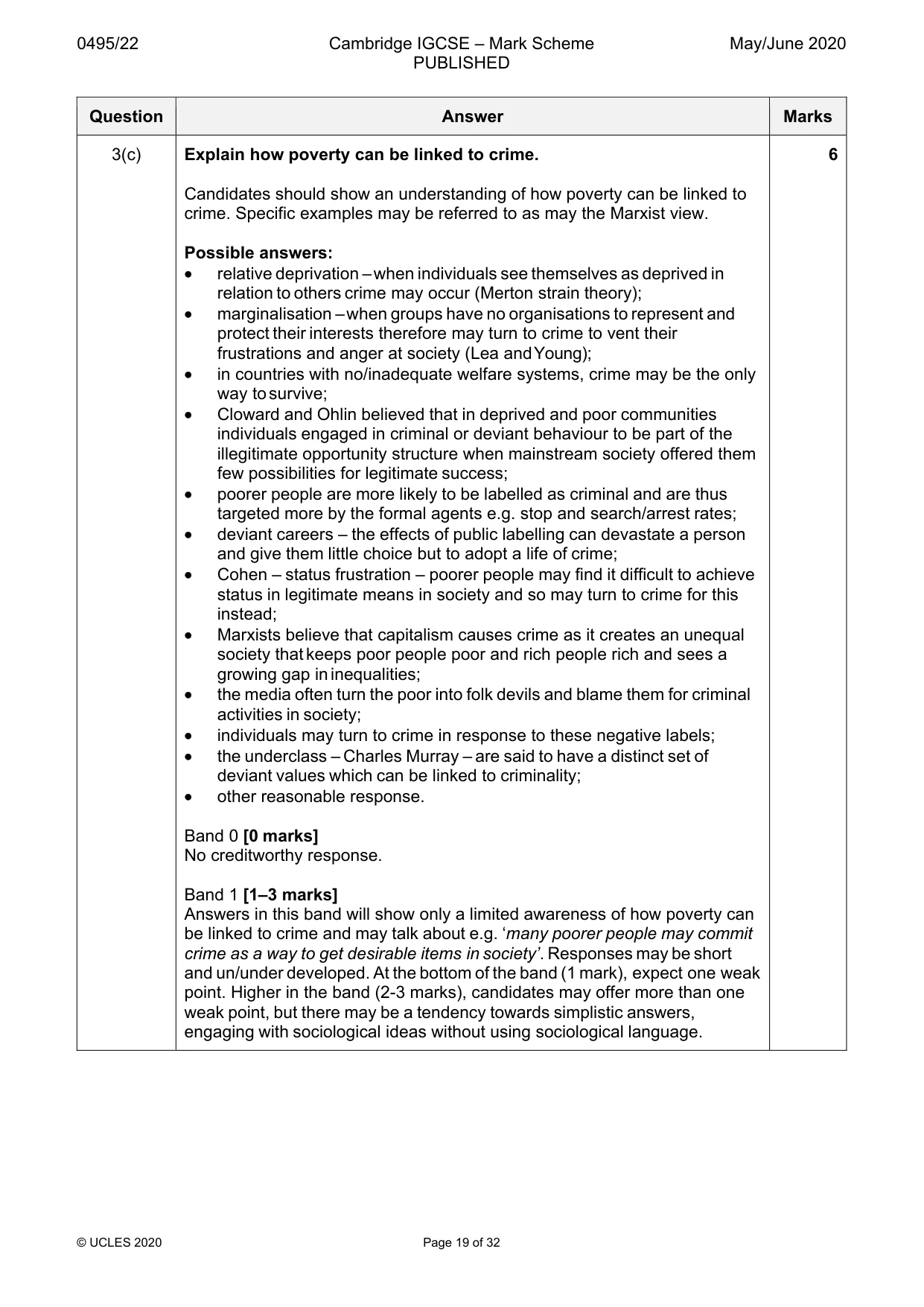
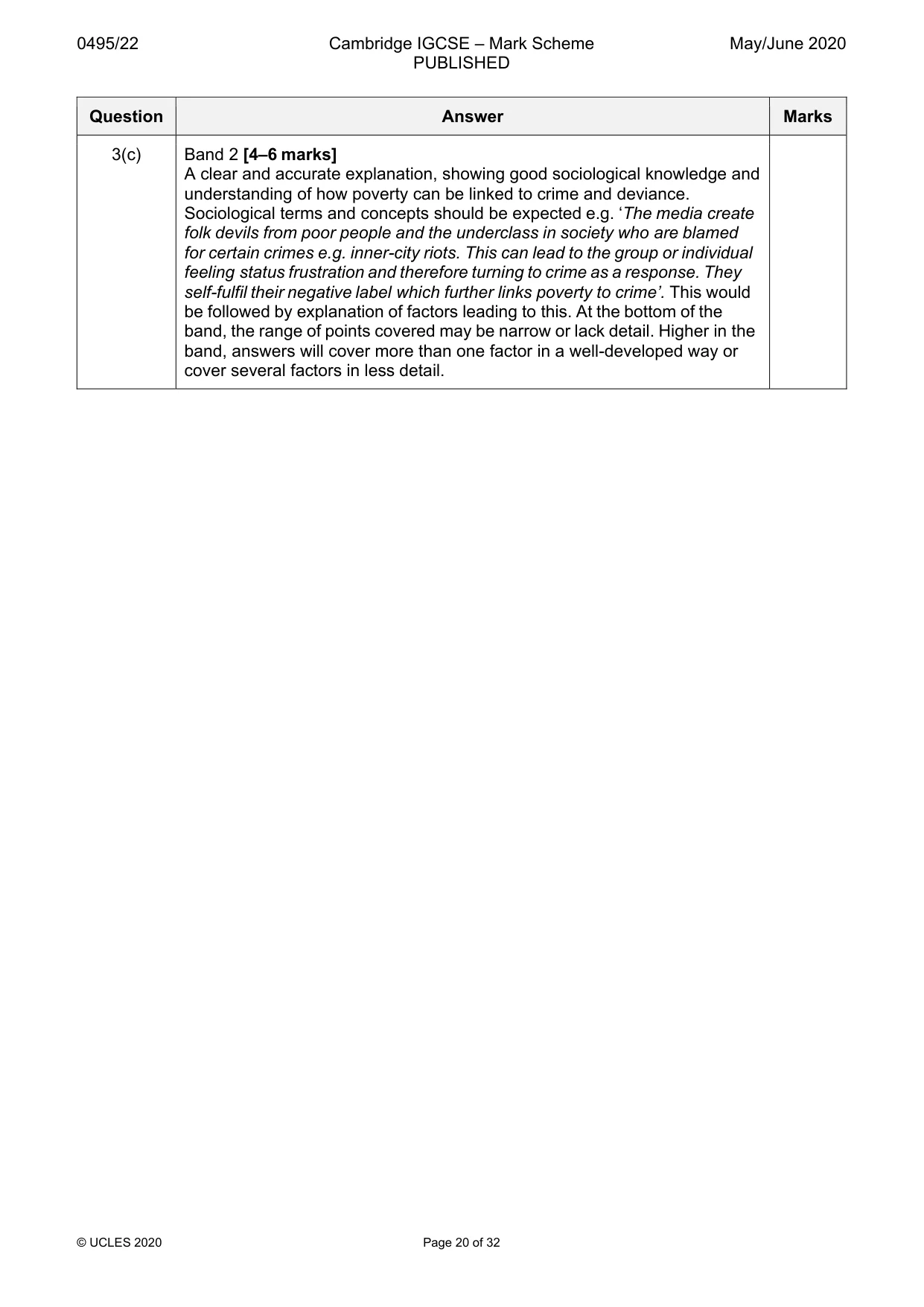
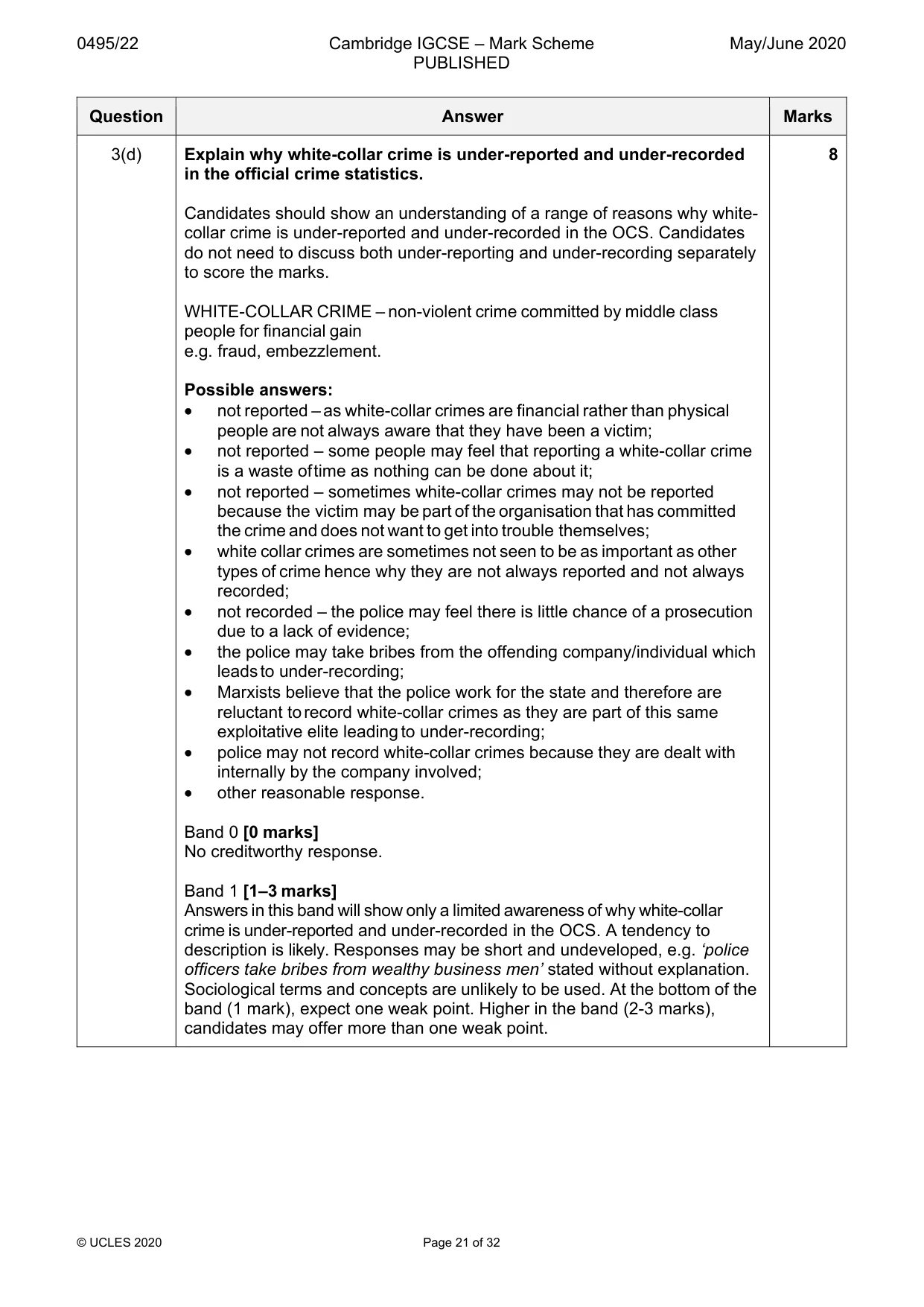
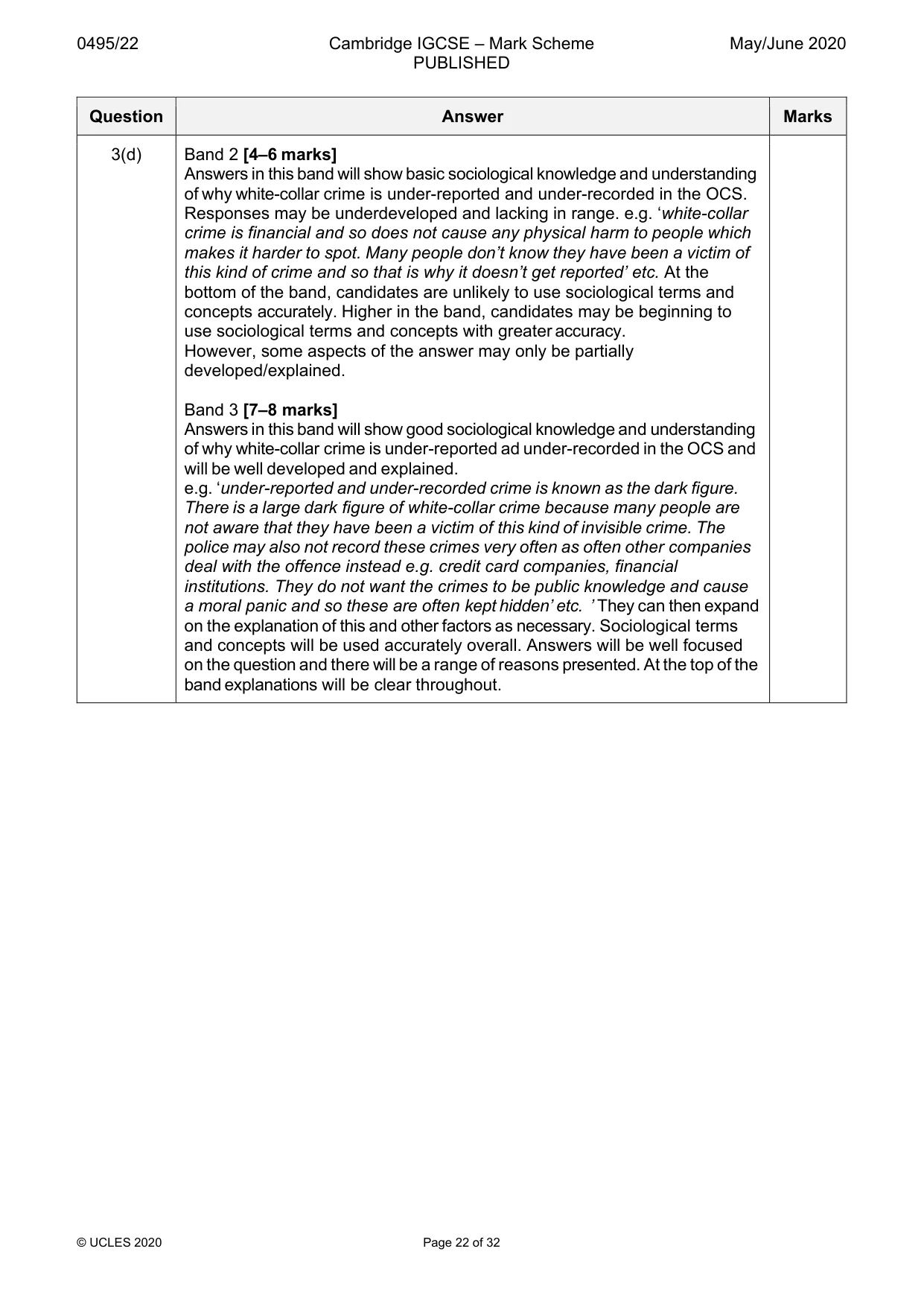
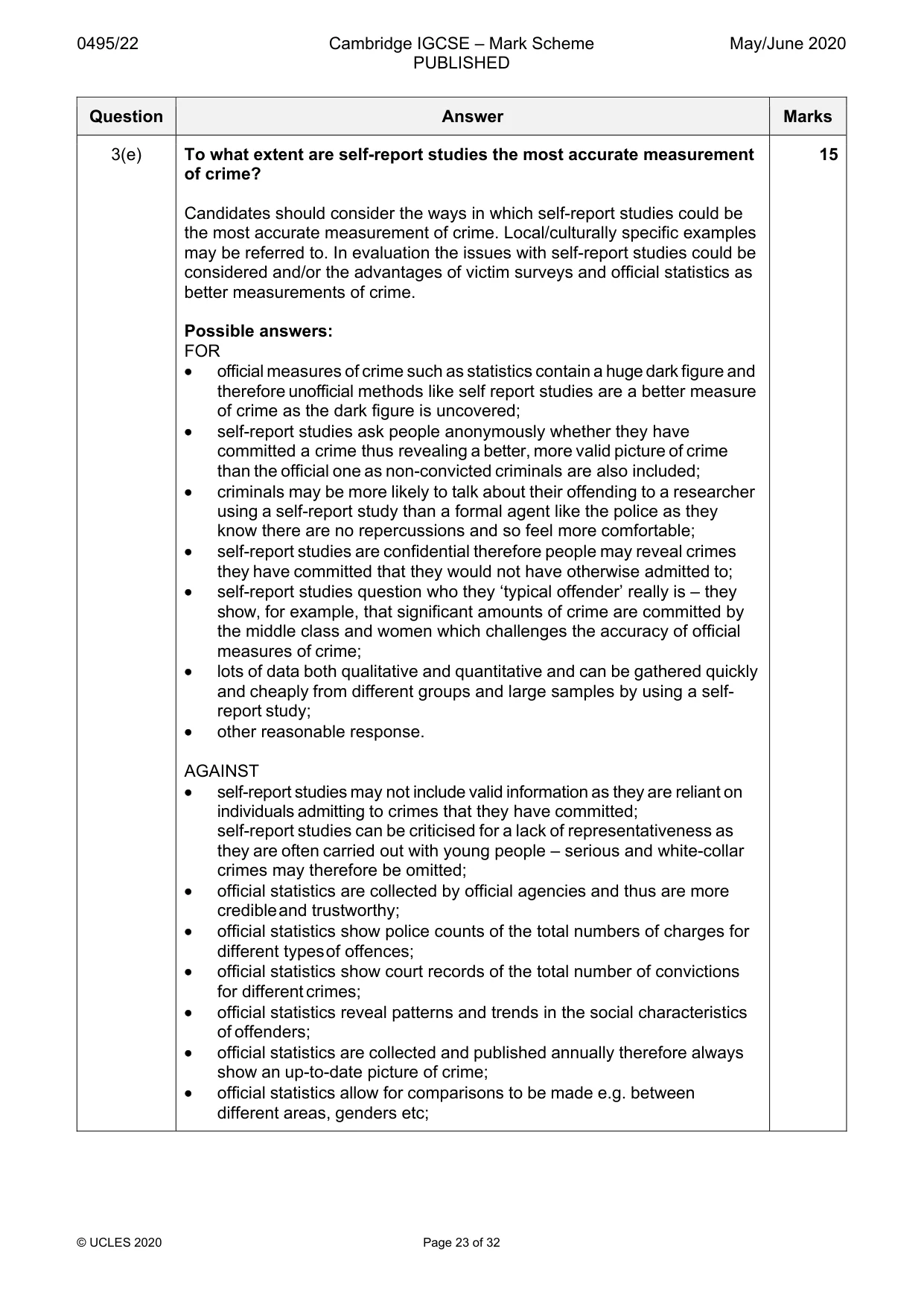
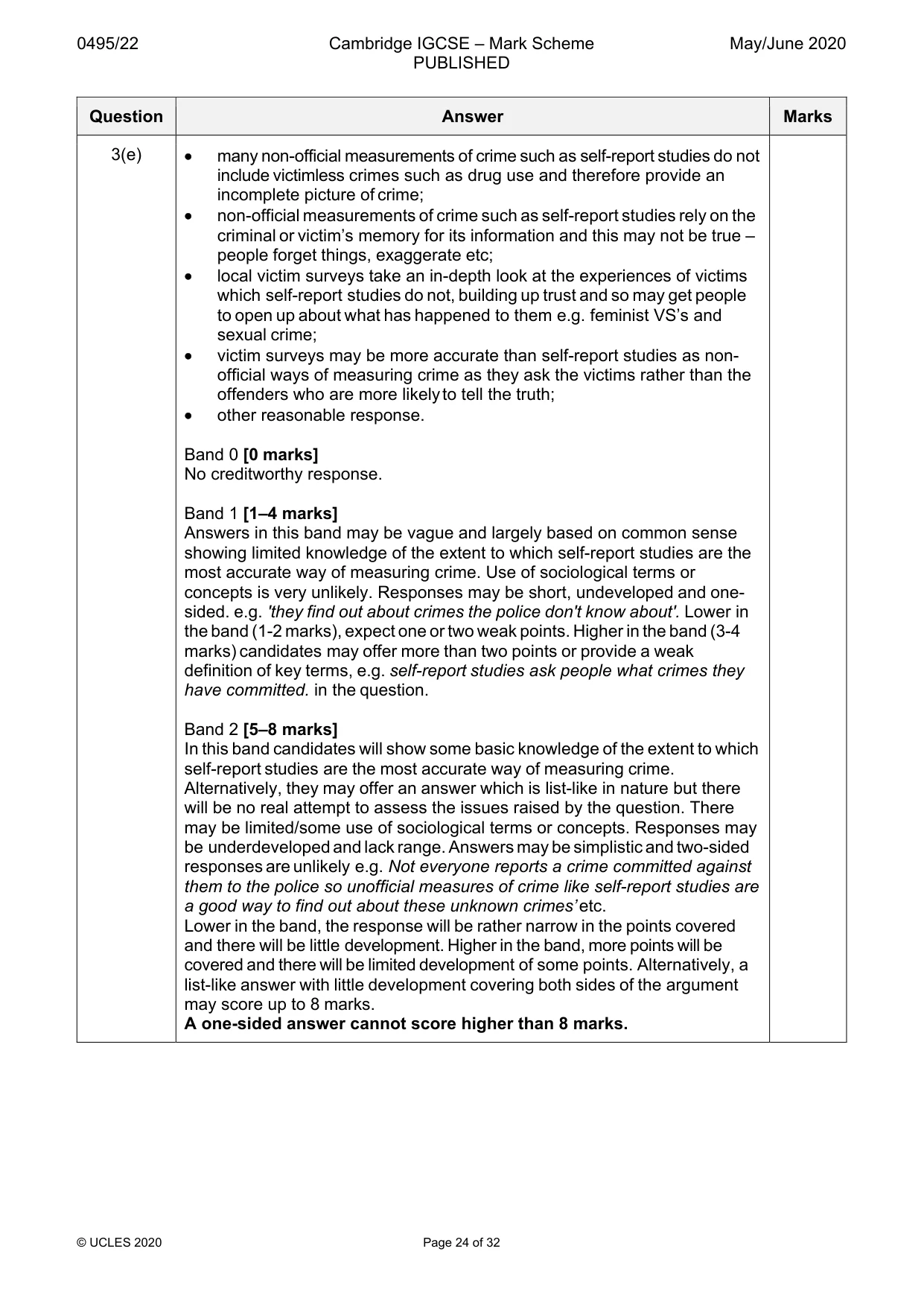
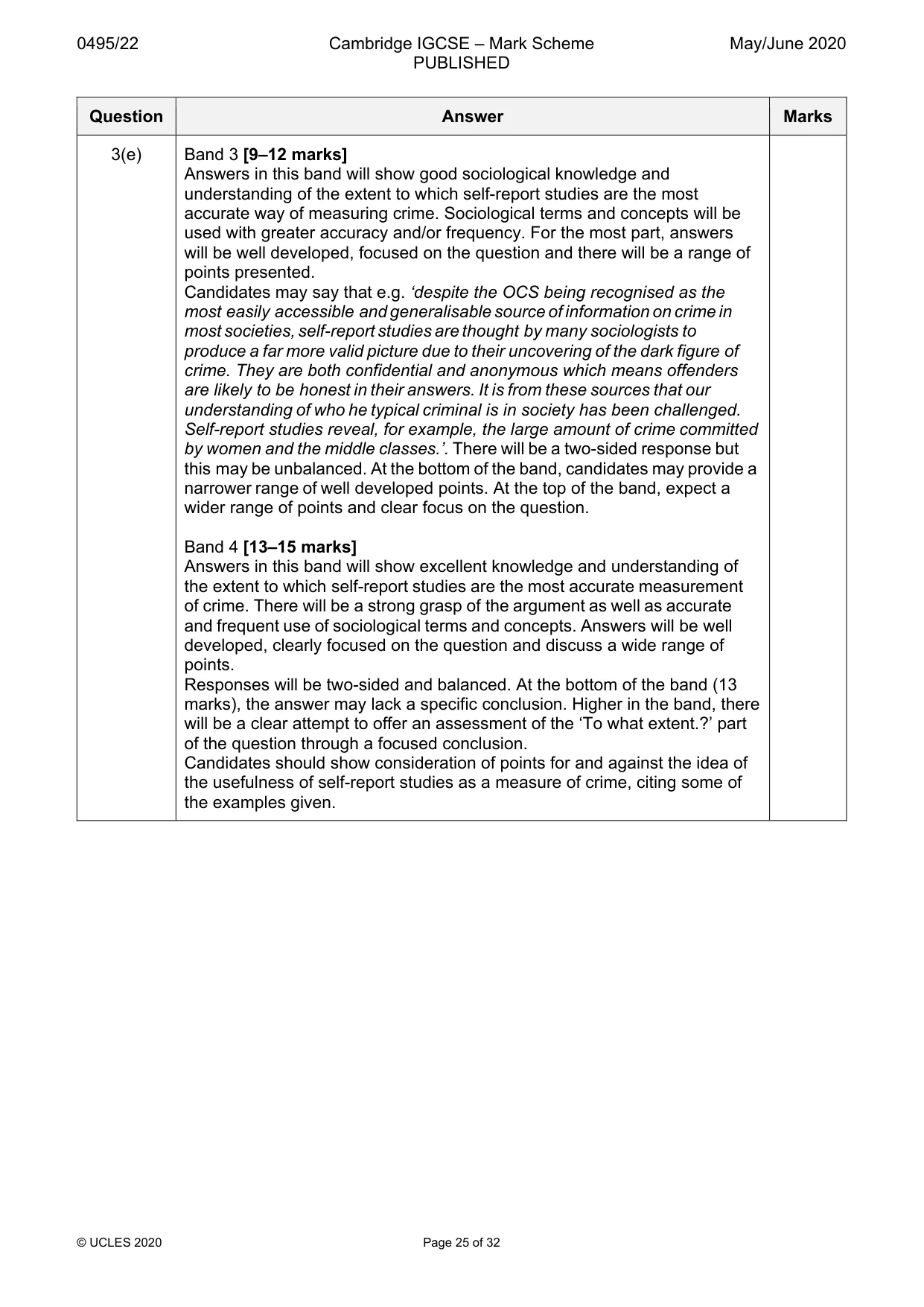
Mark scheme: 3(a) What is meant by the term ‘formal social control’? 2 One mark for partial definition, e.g. the police. Two marks for clear definition, e.g. formal social control is the ways the Government or its agencies get people to conform to the law. 3(b) Describe two punishments for crime. 4 Candidates will describe two different punishments for crime – these could be formal or informal. Possible answers: • a prison sentence – takes away a person’s freedom; • the death sentence – for the most serious crimes the punishment may be death; • corporal punishment – some societies punish criminals physically e.g. with lashes; • community sentencing – non-custodial sentences that help the community in some way; • exile or ostracism – the offender has to leave or is excluded from their community; • tagging – electronic tags can be used to monitor a person’s behaviour and whereabouts; • fine – a monetary sanction designed to punish offenders financially; • other reasonable response. One mark for each point correctly identified (up to maximum of two). One mark for each point that is developed (up to a maximum of two). 3(c) Explain how poverty can be linked to crime. 6 Candidates should show an understanding of how poverty can be linked to crime. Specific examples may be referred to as may the Marxist view. Possible answers: • relative deprivation – when individuals see themselves as deprived in relation to others crime may occur (Merton strain theory); • marginalisation – when groups have no organisations to represent and protect their interests therefore may turn to crime to vent their frustrations and anger at society (Lea and Young); • in countries with no/inadequate welfare systems, crime may be the only way to survive; • Cloward and Ohlin believed that in deprived and poor communities individuals engaged in criminal or deviant behaviour to be part of the illegitimate opportunity structure when mainstream society offered them few possibilities for legitimate success; • poorer people are more likely to be labelled as criminal and are thus targeted more by the formal agents e.g. stop and search/arrest rates; • deviant careers – the effects of public labelling can devastate a person and give them little choice but to adopt a life of crime; • Cohen – status frustration – poorer people may find it difficult to achieve status in legitimate means in society and so may turn to crime for this instead; • Marxists believe that capitalism causes crime as it creates an unequal society that keeps poor people poor and rich people rich and sees a growing gap in inequalities; • the media often turn the poor into folk devils and blame them for criminal activities in society; • individuals may turn to crime in response to these negative labels; • the underclass – Charles Murray – are said to have a distinct set of deviant values which can be linked to criminality; • other reasonable response. Band 0 [0 marks] No creditworthy response. Band 1 [1–3 marks] Answers in this band will show only a limited awareness of how poverty can be linked to crime and may talk about e.g. ‘many poorer people may commit crime as a way to get desirable items in society’. Responses may be short and un/under developed. At the bottom of the band (1 mark), expect one weak point. Higher in the band (2-3 marks), candidates may offer more than one weak point, but there may be a tendency towards simplistic answers, engaging with sociological ideas without using sociological language. 3(c) Band 2 [4–6 marks] A clear and accurate explanation, showing good sociological knowledge and understanding of how poverty can be linked to crime and deviance. Sociological terms and concepts should be expected e.g. ‘The media create folk devils from poor people and the underclass in society who are blamed for certain crimes e.g. inner-city riots. This can lead to the group or individual feeling status frustration and therefore turning to crime as a response. They self-fulfil their negative label which further links poverty to crime’. This would be followed by explanation of factors leading to this. At the bottom of the band, the range of points covered may be narrow or lack detail. Higher in the band, answers will cover more than one factor in a well-developed way or cover several factors in less detail. 3(d) Explain why white-collar crime is under-reported and under-recorded 8 in the official crime statistics. Candidates should show an understanding of a range of reasons why white- collar crime is under-reported and under-recorded in the OCS. Candidates do not need to discuss both under-reporting and under-recording separately to score the marks. WHITE-COLLAR CRIME – non-violent crime committed by middle class people for financial gain e.g. fraud, embezzlement. Possible answers: • not reported – as white-collar crimes are financial rather than physical people are not always aware that they have been a victim; • not reported – some people may feel that reporting a white-collar crime is a waste of time as nothing can be done about it; • not reported – sometimes white-collar crimes may not be reported because the victim may be part of the organisation that has committed the crime and does not want to get into trouble themselves; • white collar crimes are sometimes not seen to be as important as other types of crime hence why they are not always reported and not always recorded; • not recorded – the police may feel there is little chance of a prosecution due to a lack of evidence; • the police may take bribes from the offending company/individual which leads to under-recording; • Marxists believe that the police work for the state and therefore are reluctant to record white-collar crimes as they are part of this same exploitative elite leading to under-recording; • police may not record white-collar crimes because they are dealt with internally by the company involved; • other reasonable response. Band 0 [0 marks] No creditworthy response. Band 1 [1–3 marks] Answers in this band will show only a limited awareness of why white-collar crime is under-reported and under-recorded in the OCS. A tendency to description is likely. Responses may be short and undeveloped, e.g. ‘police officers take bribes from wealthy business men’ stated without explanation. Sociological terms and concepts are unlikely to be used. At the bottom of the band (1 mark), expect one weak point. Higher in the band (2-3 marks), candidates may offer more than one weak point. 3(d) Band 2 [4–6 marks] Answers in this band will show basic sociological knowledge and understanding of why white-collar crime is under-reported and under-recorded in the OCS. Responses may be underdeveloped and lacking in range. e.g. ‘white-collar crime is financial and so does not cause any physical harm to people which makes it harder to spot. Many people don’t know they have been a victim of this kind of crime and so that is why it doesn’t get reported’ etc. At the bottom of the band, candidates are unlikely to use sociological terms and concepts accurately. Higher in the band, candidates may be beginning to use sociological terms and concepts with greater accuracy. However, some aspects of the answer may only be partially developed/explained. Band 3 [7–8 marks] Answers in this band will show good sociological knowledge and understanding of why white-collar crime is under-reported ad under-recorded in the OCS and will be well developed and explained. e.g. ‘under-reported and under-recorded crime is known as the dark figure. There is a large dark figure of white-collar crime because many people are not aware that they have been a victim of this kind of invisible crime. The police may also not record these crimes very often as often other companies deal with the offence instead e.g. credit card companies, financial institutions. They do not want the crimes to be public knowledge and cause a moral panic and so these are often kept hidden’ etc. ’ They can then expand on the explanation of this and other factors as necessary. Sociological terms and concepts will be used accurately overall. Answers will be well focused on the question and there will be a range of reasons presented. At the top of the band explanations will be clear throughout. 3(e) To what extent are self-report studies the most accurate measurement 15 of crime? Candidates should consider the ways in which self-report studies could be the most accurate measurement of crime. Local/culturally specific examples may be referred to. In evaluation the issues with self-report studies could be considered and/or the advantages of victim surveys and official statistics as better measurements of crime. Possible answers: FOR • official measures of crime such as statistics contain a huge dark figure and therefore unofficial methods like self report studies are a better measure of crime as the dark figure is uncovered; • self-report studies ask people anonymously whether they have committed a crime thus revealing a better, more valid picture of crime than the official one as non-convicted criminals are also included; • criminals may be more likely to talk about their offending to a researcher using a self-report study than a formal agent like the police as they know there are no repercussions and so feel more comfortable; • self-report studies are confidential therefore people may reveal crimes they have committed that they would not have otherwise admitted to; • self-report studies question who they ‘typical offender’ really is – they show, for example, that significant amounts of crime are committed by the middle class and women which challenges the accuracy of official measures of crime; • lots of data both qualitative and quantitative and can be gathered quickly and cheaply from different groups and large samples by using a self- report study; • other reasonable response. AGAINST • self-report studies may not include valid information as they are reliant on individuals admitting to crimes that they have committed; self-report studies can be criticised for a lack of representativeness as they are often carried out with young people – serious and white-collar crimes may therefore be omitted; • official statistics are collected by official agencies and thus are more credible and trustworthy; • official statistics show police counts of the total numbers of charges for different types of offences; • official statistics show court records of the total number of convictions for different crimes; • official statistics reveal patterns and trends in the social characteristics of offenders; • official statistics are collected and published annually therefore always show an up-to-date picture of crime; • official statistics allow for comparisons to be made e.g. between different areas, genders etc; 3(e) • many non-official measurements of crime such as self-report studies do not include victimless crimes such as drug use and therefore provide an incomplete picture of crime; • non-official measurements of crime such as self-report studies rely on the criminal or victim’s memory for its information and this may not be true – people forget things, exaggerate etc; • local victim surveys take an in-depth look at the experiences of victims which self-report studies do not, building up trust and so may get people to open up about what has happened to them e.g. feminist VS’s and sexual crime; • victim surveys may be more accurate than self-report studies as non- official ways of measuring crime as they ask the victims rather than the offenders who are more likely to tell the truth; • other reasonable response. Band 0 [0 marks] No creditworthy response. Band 1 [1–4 marks] Answers in this band may be vague and largely based on common sense showing limited knowledge of the extent to which self-report studies are the most accurate way of measuring crime. Use of sociological terms or concepts is very unlikely. Responses may be short, undeveloped and one- sided. e.g. 'they find out about crimes the police don't know about'. Lower in the band (1-2 marks), expect one or two weak points. Higher in the band (3-4 marks) candidates may offer more than two points or provide a weak definition of key terms, e.g. self-report studies ask people what crimes they have committed. in the question. Band 2 [5–8 marks] In this band candidates will show some basic knowledge of the extent to which self-report studies are the most accurate way of measuring crime. Alternatively, they may offer an answer which is list-like in nature but there will be no real attempt to assess the issues raised by the question. There may be limited/some use of sociological terms or concepts. Responses may be underdeveloped and lack range. Answers may be simplistic and two-sided responses are unlikely e.g. Not everyone reports a crime committed against them to the police so unofficial measures of crime like self-report studies are a good way to find out about these unknown crimes’ etc. Lower in the band, the response will be rather narrow in the points covered and there will be little development. Higher in the band, more points will be covered and there will be limited development of some points. Alternatively, a list-like answer with little development covering both sides of the argument may score up to 8 marks. A one-sided answer cannot score higher than 8 marks. 3(e) Band 3 [9–12 marks] Answers in this band will show good sociological knowledge and understanding of the extent to which self-report studies are the most accurate way of measuring crime. Sociological terms and concepts will be used with greater accuracy and/or frequency. For the most part, answers will be well developed, focused on the question and there will be a range of points presented. Candidates may say that e.g. ‘despite the OCS being recognised as the most easily accessible and generalisable source of information on crime in most societies, self-report studies are thought by many sociologists to produce a far more valid picture due to their uncovering of the dark figure of crime. They are both confidential and anonymous which means offenders are likely to be honest in their answers. It is from these sources that our understanding of who he typical criminal is in society has been challenged. Self-report studies reveal, for example, the large amount of crime committed by women and the middle classes.’. There will be a two-sided response but this may be unbalanced. At the bottom of the band, candidates may provide a narrower range of well developed points. At the top of the band, expect a wider range of points and clear focus on the question. Band 4 [13–15 marks] Answers in this band will show excellent knowledge and understanding of the extent to which self-report studies are the most accurate measurement of crime. There will be a strong grasp of the argument as well as accurate and frequent use of sociological terms and concepts. Answers will be well developed, clearly focused on the question and discuss a wide range of points. Responses will be two-sided and balanced. At the bottom of the band (13 marks), the answer may lack a specific conclusion. Higher in the band, there will be a clear attempt to offer an assessment of the ‘To what extent.?’ part of the question through a focused conclusion. Candidates should show consideration of points for and against the idea of the usefulness of self-report studies as a measure of crime, citing some of the examples given.
More questions on How do sociologists investigate society? (continued)
Q4 · The media is often accused of exaggerated and sensationalist content, particularly in the…
4 The media is often accused of exaggerated and sensationalist content, particularly in the news. This can be due to the pressures of advertising, issues of agenda setting and news values. This has led to the argument that the media and the news are biased. However, bias in the media may be reducing due to increased levels of audience interactivity and social media. (a) What is meant by the term ‘bias’? [2] (b) Describe two ways media content can be censored. [4] (c) Explain how people interact using social media. [6] (d) Explain why the media is an important agency of social control. [8] (e) To what extent does the news reflect reality? [15]
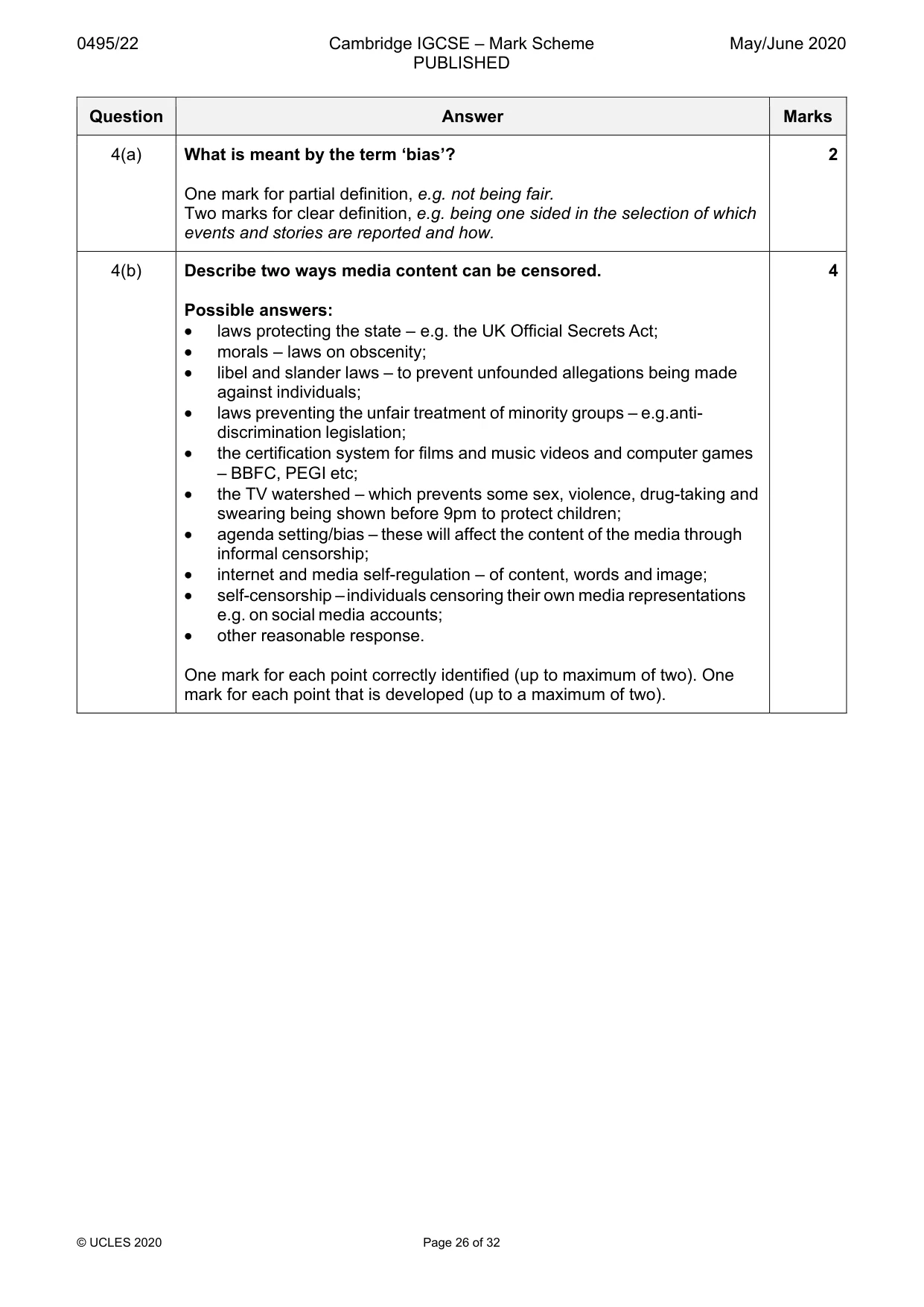
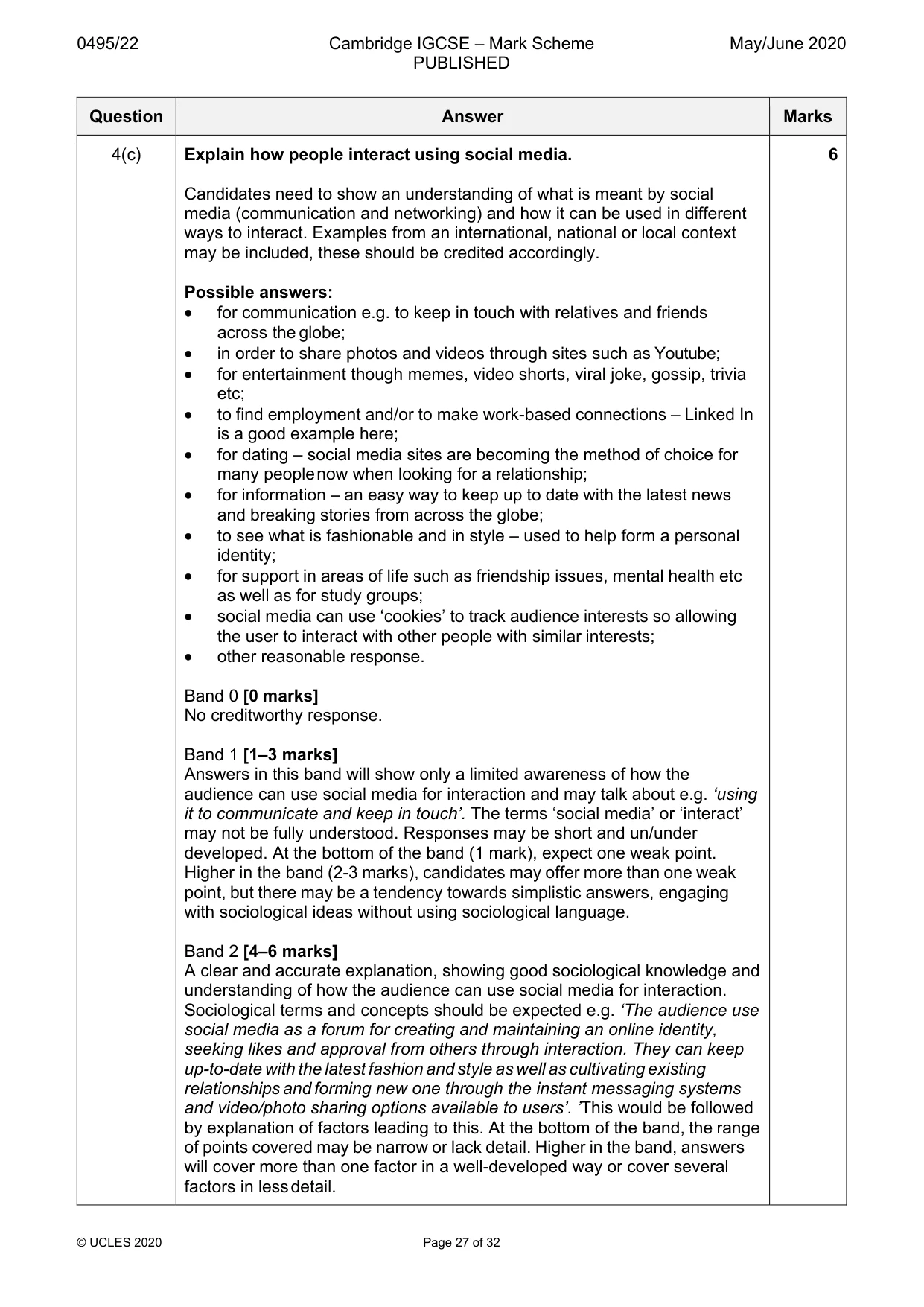
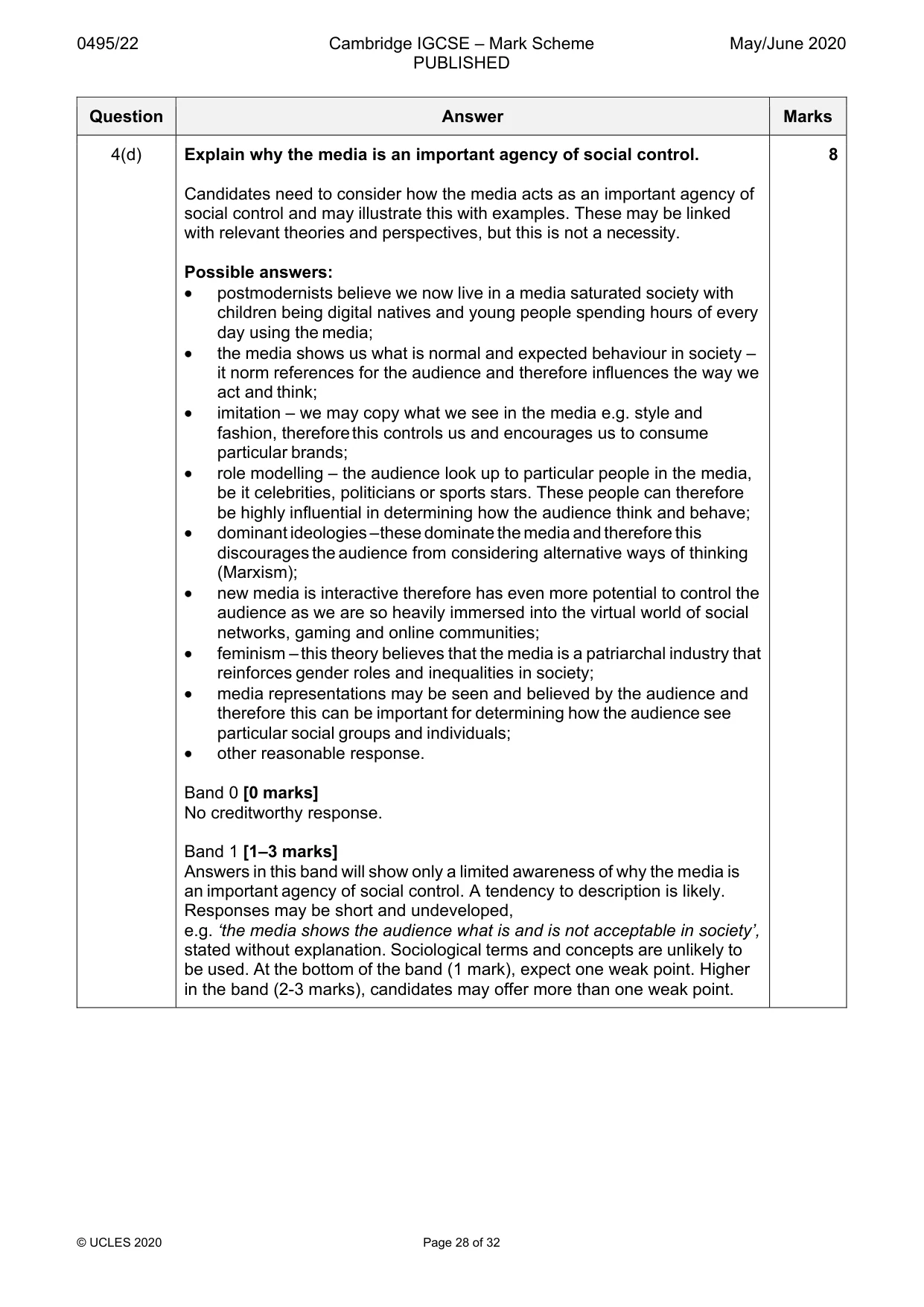
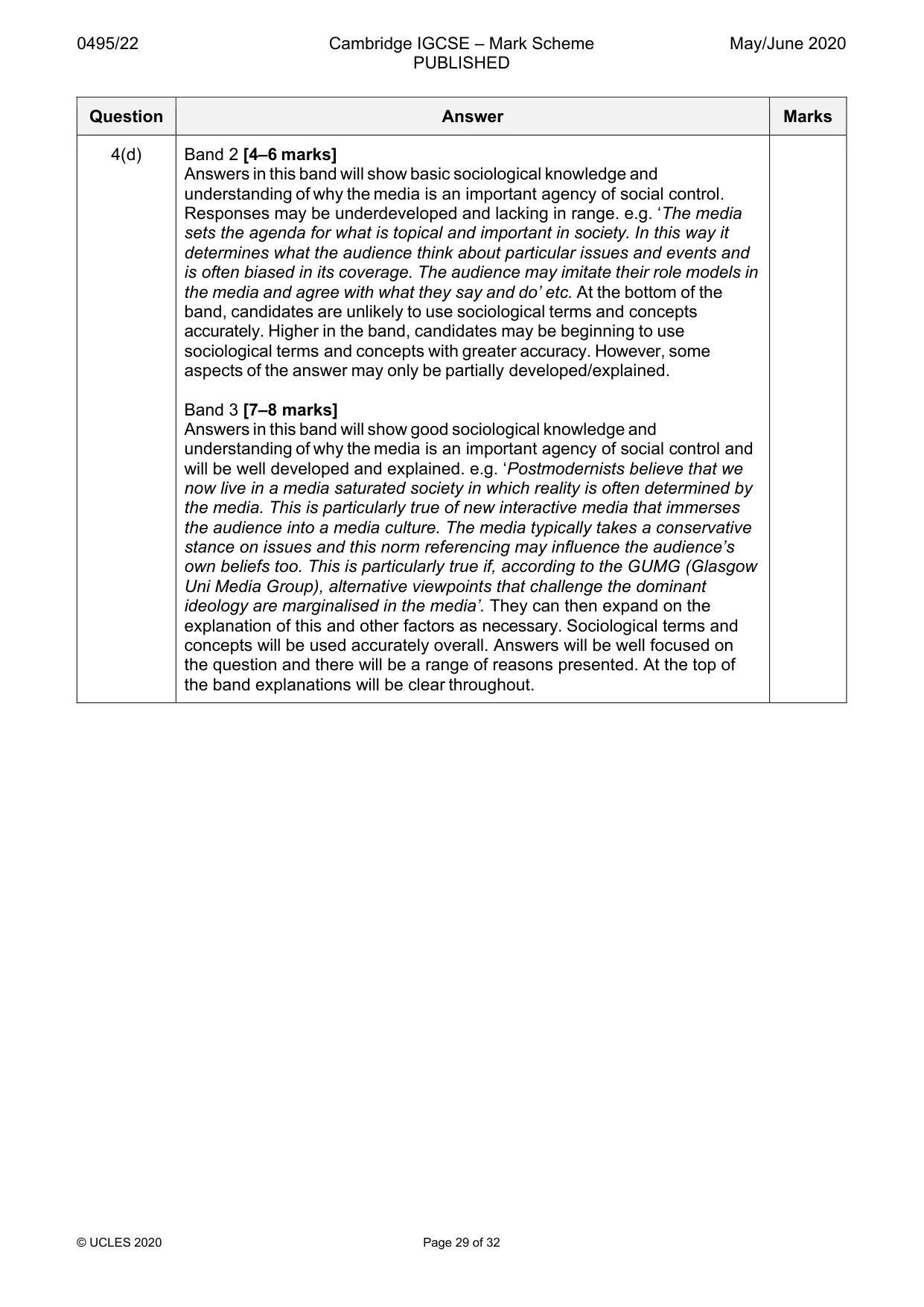
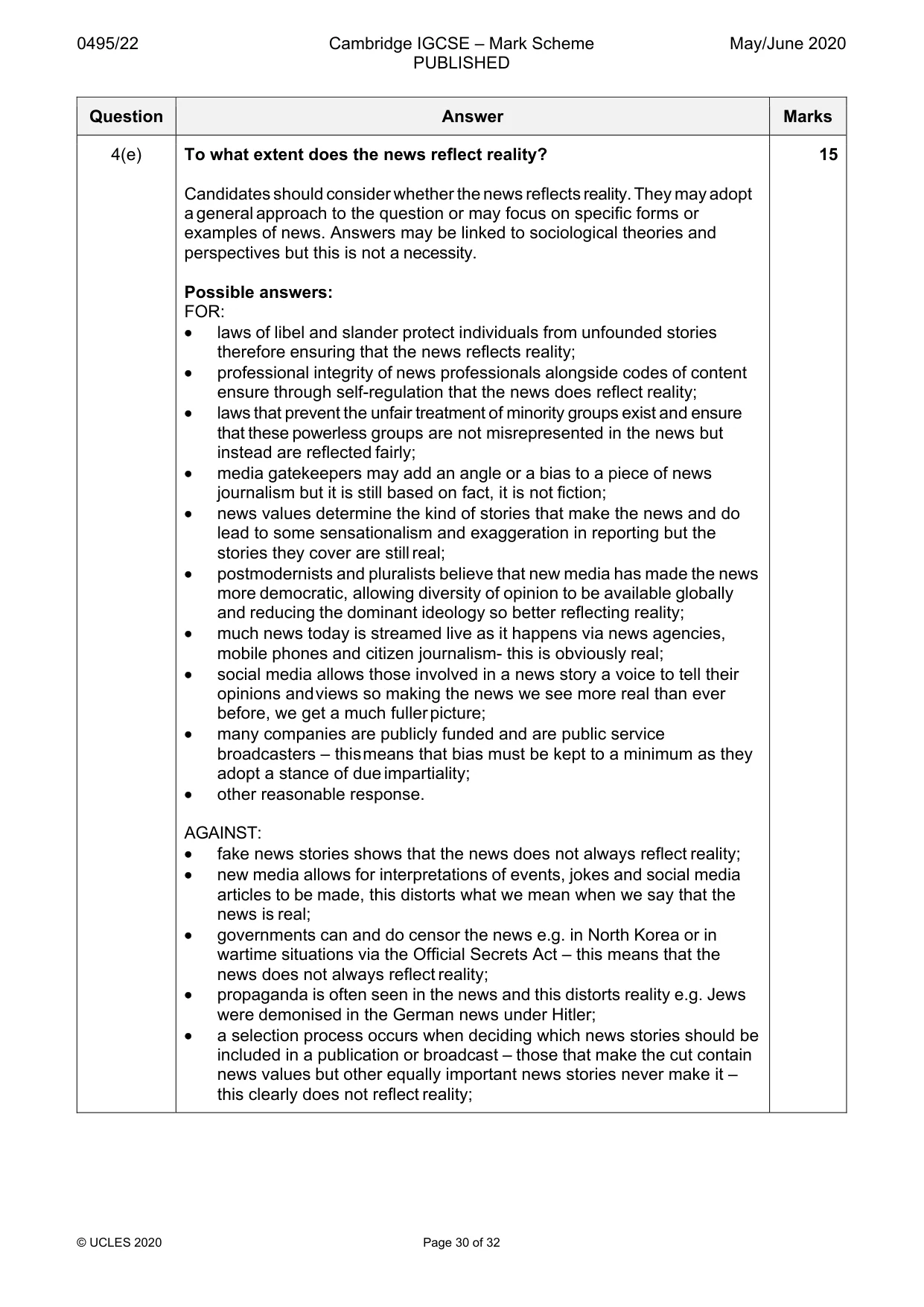
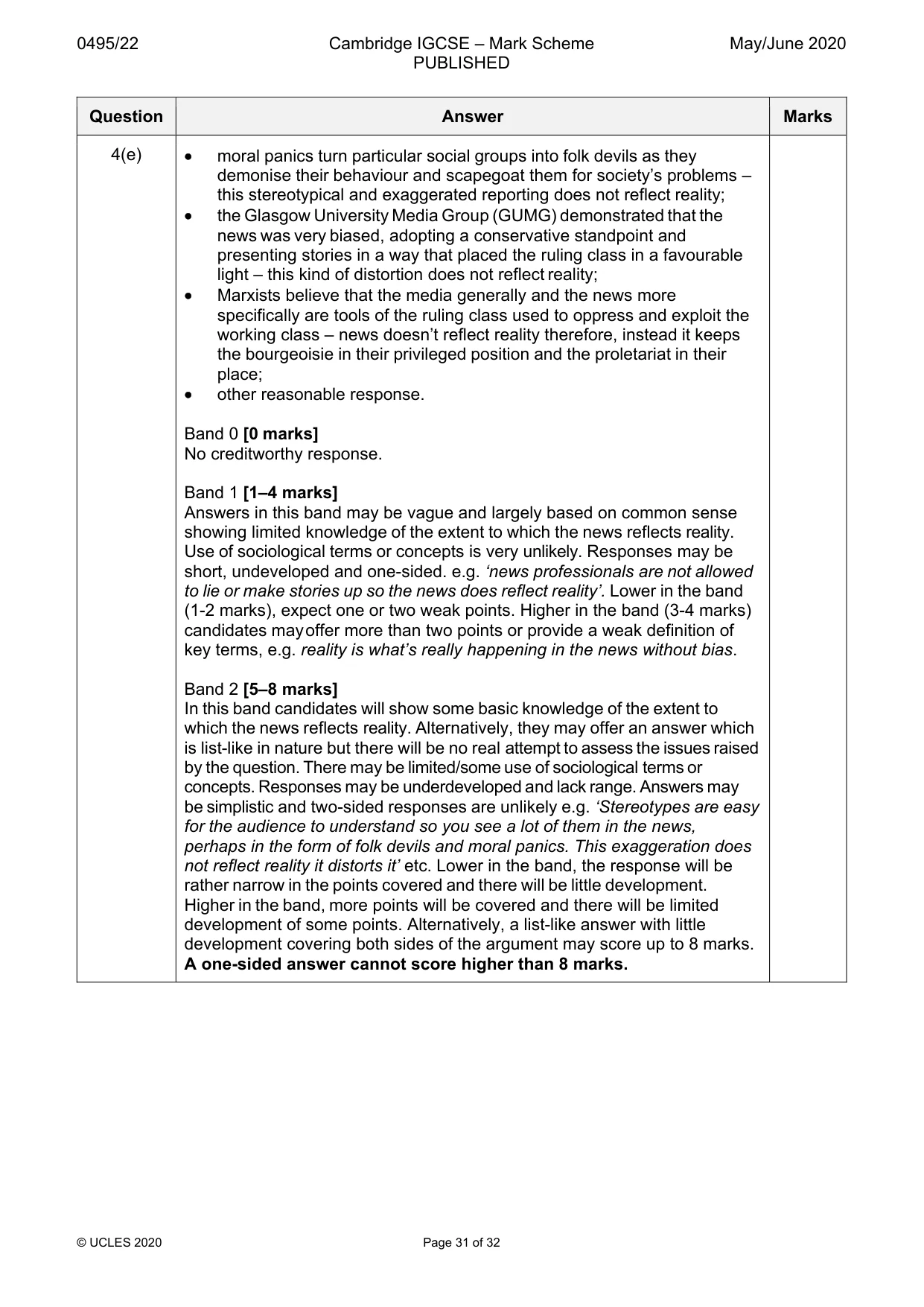
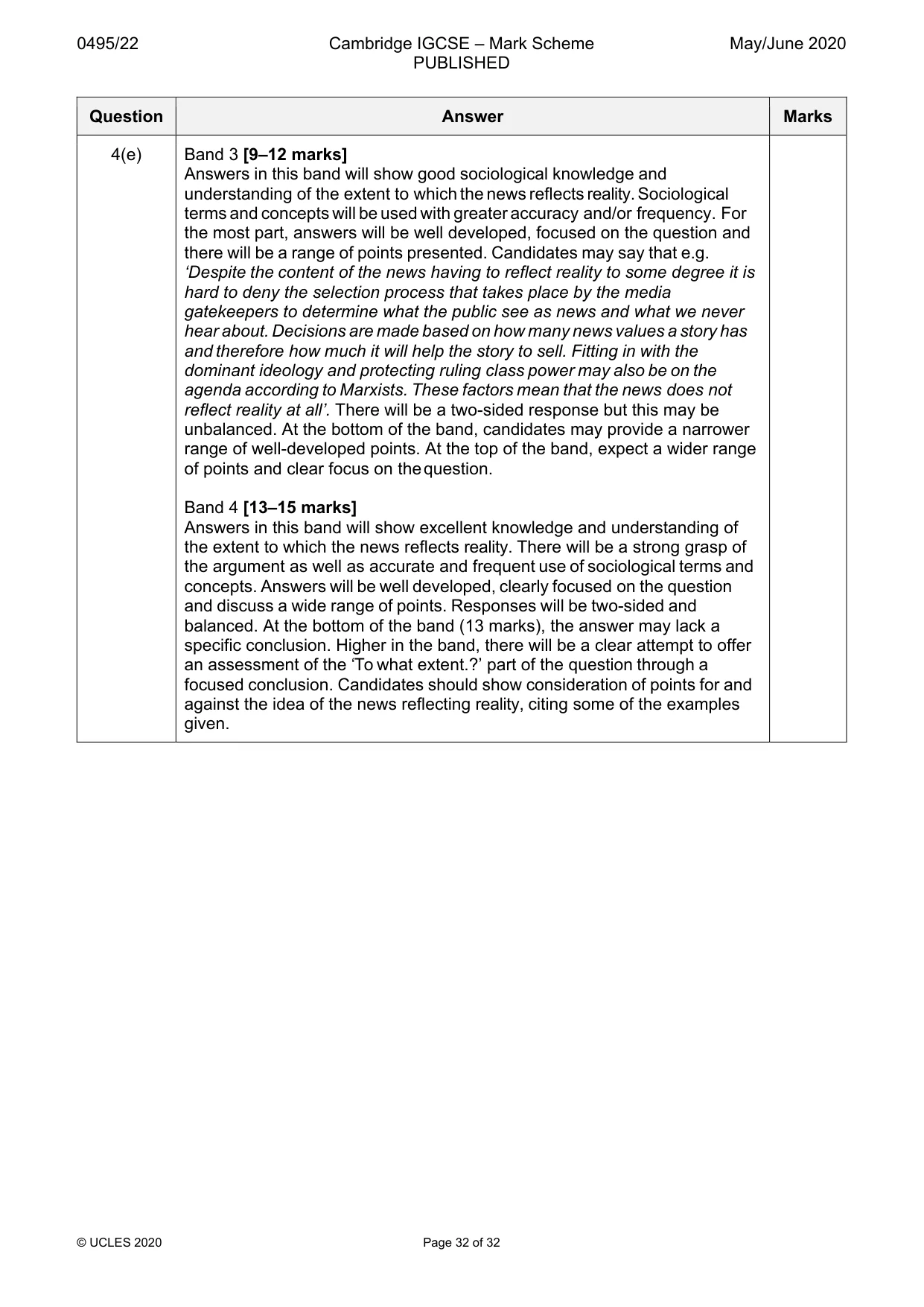
Mark scheme: 4(a) What is meant by the term ‘bias’? 2 One mark for partial definition, e.g. not being fair. Two marks for clear definition, e.g. being one sided in the selection of which events and stories are reported and how. 4(b) Describe two ways media content can be censored. 4 Possible answers: • laws protecting the state – e.g. the UK Official Secrets Act; • morals – laws on obscenity; • libel and slander laws – to prevent unfounded allegations being made against individuals; • laws preventing the unfair treatment of minority groups – e.g.anti- discrimination legislation; • the certification system for films and music videos and computer games – BBFC, PEGI etc; • the TV watershed – which prevents some sex, violence, drug-taking and swearing being shown before 9pm to protect children; • agenda setting/bias – these will affect the content of the media through informal censorship; • internet and media self-regulation – of content, words and image; • self-censorship – individuals censoring their own media representations e.g. on social media accounts; • other reasonable response. One mark for each point correctly identified (up to maximum of two). One mark for each point that is developed (up to a maximum of two). 4(c) Explain how people interact using social media. 6 Candidates need to show an understanding of what is meant by social media (communication and networking) and how it can be used in different ways to interact. Examples from an international, national or local context may be included, these should be credited accordingly. Possible answers: • for communication e.g. to keep in touch with relatives and friends across the globe; • in order to share photos and videos through sites such as Youtube; • for entertainment though memes, video shorts, viral joke, gossip, trivia etc; • to find employment and/or to make work-based connections – Linked In is a good example here; • for dating – social media sites are becoming the method of choice for many people now when looking for a relationship; • for information – an easy way to keep up to date with the latest news and breaking stories from across the globe; • to see what is fashionable and in style – used to help form a personal identity; • for support in areas of life such as friendship issues, mental health etc as well as for study groups; • social media can use ‘cookies’ to track audience interests so allowing the user to interact with other people with similar interests; • other reasonable response. Band 0 [0 marks] No creditworthy response. Band 1 [1–3 marks] Answers in this band will show only a limited awareness of how the audience can use social media for interaction and may talk about e.g. ‘using it to communicate and keep in touch’. The terms ‘social media’ or ‘interact’ may not be fully understood. Responses may be short and un/under developed. At the bottom of the band (1 mark), expect one weak point. Higher in the band (2-3 marks), candidates may offer more than one weak point, but there may be a tendency towards simplistic answers, engaging with sociological ideas without using sociological language. Band 2 [4–6 marks] A clear and accurate explanation, showing good sociological knowledge and understanding of how the audience can use social media for interaction. Sociological terms and concepts should be expected e.g. ‘The audience use social media as a forum for creating and maintaining an online identity, seeking likes and approval from others through interaction. They can keep up-to-date with the latest fashion and style as well as cultivating existing relationships and forming new one through the instant messaging systems and video/photo sharing options available to users’. ’This would be followed by explanation of factors leading to this. At the bottom of the band, the range of points covered may be narrow or lack detail. Higher in the band, answers will cover more than one factor in a well-developed way or cover several factors in less detail. 4(d) Explain why the media is an important agency of social control. 8 Candidates need to consider how the media acts as an important agency of social control and may illustrate this with examples. These may be linked with relevant theories and perspectives, but this is not a necessity. Possible answers: • postmodernists believe we now live in a media saturated society with children being digital natives and young people spending hours of every day using the media; • the media shows us what is normal and expected behaviour in society – it norm references for the audience and therefore influences the way we act and think; • imitation – we may copy what we see in the media e.g. style and fashion, therefore this controls us and encourages us to consume particular brands; • role modelling – the audience look up to particular people in the media, be it celebrities, politicians or sports stars. These people can therefore be highly influential in determining how the audience think and behave; • dominant ideologies – these dominate the media and therefore this discourages the audience from considering alternative ways of thinking (Marxism); • new media is interactive therefore has even more potential to control the audience as we are so heavily immersed into the virtual world of social networks, gaming and online communities; • feminism – this theory believes that the media is a patriarchal industry that reinforces gender roles and inequalities in society; • media representations may be seen and believed by the audience and therefore this can be important for determining how the audience see particular social groups and individuals; • other reasonable response. Band 0 [0 marks] No creditworthy response. Band 1 [1–3 marks] Answers in this band will show only a limited awareness of why the media is an important agency of social control. A tendency to description is likely. Responses may be short and undeveloped, e.g. ‘the media shows the audience what is and is not acceptable in society’, stated without explanation. Sociological terms and concepts are unlikely to be used. At the bottom of the band (1 mark), expect one weak point. Higher in the band (2-3 marks), candidates may offer more than one weak point. 4(d) Band 2 [4–6 marks] Answers in this band will show basic sociological knowledge and understanding of why the media is an important agency of social control. Responses may be underdeveloped and lacking in range. e.g. ‘The media sets the agenda for what is topical and important in society. In this way it determines what the audience think about particular issues and events and is often biased in its coverage. The audience may imitate their role models in the media and agree with what they say and do’ etc. At the bottom of the band, candidates are unlikely to use sociological terms and concepts accurately. Higher in the band, candidates may be beginning to use sociological terms and concepts with greater accuracy. However, some aspects of the answer may only be partially developed/explained. Band 3 [7–8 marks] Answers in this band will show good sociological knowledge and understanding of why the media is an important agency of social control and will be well developed and explained. e.g. ‘Postmodernists believe that we now live in a media saturated society in which reality is often determined by the media. This is particularly true of new interactive media that immerses the audience into a media culture. The media typically takes a conservative stance on issues and this norm referencing may influence the audience’s own beliefs too. This is particularly true if, according to the GUMG (Glasgow Uni Media Group), alternative viewpoints that challenge the dominant ideology are marginalised in the media’. They can then expand on the explanation of this and other factors as necessary. Sociological terms and concepts will be used accurately overall. Answers will be well focused on the question and there will be a range of reasons presented. At the top of the band explanations will be clear throughout. 4(e) To what extent does the news reflect reality? 15 Candidates should consider whether the news reflects reality. They may adopt a general approach to the question or may focus on specific forms or examples of news. Answers may be linked to sociological theories and perspectives but this is not a necessity. Possible answers: FOR: • laws of libel and slander protect individuals from unfounded stories therefore ensuring that the news reflects reality; • professional integrity of news professionals alongside codes of content ensure through self-regulation that the news does reflect reality; • laws that prevent the unfair treatment of minority groups exist and ensure that these powerless groups are not misrepresented in the news but instead are reflected fairly; • media gatekeepers may add an angle or a bias to a piece of news journalism but it is still based on fact, it is not fiction; • news values determine the kind of stories that make the news and do lead to some sensationalism and exaggeration in reporting but the stories they cover are still real; • postmodernists and pluralists believe that new media has made the news more democratic, allowing diversity of opinion to be available globally and reducing the dominant ideology so better reflecting reality; • much news today is streamed live as it happens via news agencies, mobile phones and citizen journalism- this is obviously real; • social media allows those involved in a news story a voice to tell their opinions and views so making the news we see more real than ever before, we get a much fuller picture; • many companies are publicly funded and are public service broadcasters – this means that bias must be kept to a minimum as they adopt a stance of due impartiality; • other reasonable response. AGAINST: • fake news stories shows that the news does not always reflect reality; • new media allows for interpretations of events, jokes and social media articles to be made, this distorts what we mean when we say that the news is real; • governments can and do censor the news e.g. in North Korea or in wartime situations via the Official Secrets Act – this means that the news does not always reflect reality; • propaganda is often seen in the news and this distorts reality e.g. Jews were demonised in the German news under Hitler; • a selection process occurs when deciding which news stories should be included in a publication or broadcast – those that make the cut contain news values but other equally important news stories never make it – this clearly does not reflect reality; 4(e) • moral panics turn particular social groups into folk devils as they demonise their behaviour and scapegoat them for society’s problems – this stereotypical and exaggerated reporting does not reflect reality; • the Glasgow University Media Group (GUMG) demonstrated that the news was very biased, adopting a conservative standpoint and presenting stories in a way that placed the ruling class in a favourable light – this kind of distortion does not reflect reality; • Marxists believe that the media generally and the news more specifically are tools of the ruling class used to oppress and exploit the working class – news doesn’t reflect reality therefore, instead it keeps the bourgeoisie in their privileged position and the proletariat in their place; • other reasonable response. Band 0 [0 marks] No creditworthy response. Band 1 [1–4 marks] Answers in this band may be vague and largely based on common sense showing limited knowledge of the extent to which the news reflects reality. Use of sociological terms or concepts is very unlikely. Responses may be short, undeveloped and one-sided. e.g. ‘news professionals are not allowed to lie or make stories up so the news does reflect reality’. Lower in the band (1-2 marks), expect one or two weak points. Higher in the band (3-4 marks) candidates may offer more than two points or provide a weak definition of key terms, e.g. reality is what’s really happening in the news without bias. Band 2 [5–8 marks] In this band candidates will show some basic knowledge of the extent to which the news reflects reality. Alternatively, they may offer an answer which is list-like in nature but there will be no real attempt to assess the issues raised by the question. There may be limited/some use of sociological terms or concepts. Responses may be underdeveloped and lack range. Answers may be simplistic and two-sided responses are unlikely e.g. ‘Stereotypes are easy for the audience to understand so you see a lot of them in the news, perhaps in the form of folk devils and moral panics. This exaggeration does not reflect reality it distorts it’ etc. Lower in the band, the response will be rather narrow in the points covered and there will be little development. Higher in the band, more points will be covered and there will be limited development of some points. Alternatively, a list-like answer with little development covering both sides of the argument may score up to 8 marks. A one-sided answer cannot score higher than 8 marks. 4(e) Band 3 [9–12 marks] Answers in this band will show good sociological knowledge and understanding of the extent to which the news reflects reality. Sociological terms and concepts will be used with greater accuracy and/or frequency. For the most part, answers will be well developed, focused on the question and there will be a range of points presented. Candidates may say that e.g. ‘Despite the content of the news having to reflect reality to some degree it is hard to deny the selection process that takes place by the media gatekeepers to determine what the public see as news and what we never hear about. Decisions are made based on how many news values a story has and therefore how much it will help the story to sell. Fitting in with the dominant ideology and protecting ruling class power may also be on the agenda according to Marxists. These factors mean that the news does not reflect reality at all’. There will be a two-sided response but this may be unbalanced. At the bottom of the band, candidates may provide a narrower range of well-developed points. At the top of the band, expect a wider range of points and clear focus on the question. Band 4 [13–15 marks] Answers in this band will show excellent knowledge and understanding of the extent to which the news reflects reality. There will be a strong grasp of the argument as well as accurate and frequent use of sociological terms and concepts. Answers will be well developed, clearly focused on the question and discuss a wide range of points. Responses will be two-sided and balanced. At the bottom of the band (13 marks), the answer may lack a specific conclusion. Higher in the band, there will be a clear attempt to offer an assessment of the ‘To what extent.?’ part of the question through a focused conclusion. Candidates should show consideration of points for and against the idea of the news reflecting reality, citing some of the examples given.
More questions on What types of data and evidence do sociologists use?
What was in this paper
The subtopics covered by these 4 questions, and how many questions each got. Open one in a new tab to see every Cambridge question on it.