Cambridge IGCSE Sociology 0495 — 2020 May/June Paper 1 · Variant 3
0495/13/M/J/20
The question paper and its mark scheme, free to read here and free to download. This is Cambridge’s own paper, exactly as it was sat.
Question paper4 pages

Mark scheme19 pages
Answers below. Sit the paper first if you are practising.
Paper as text
Question paper, page 1
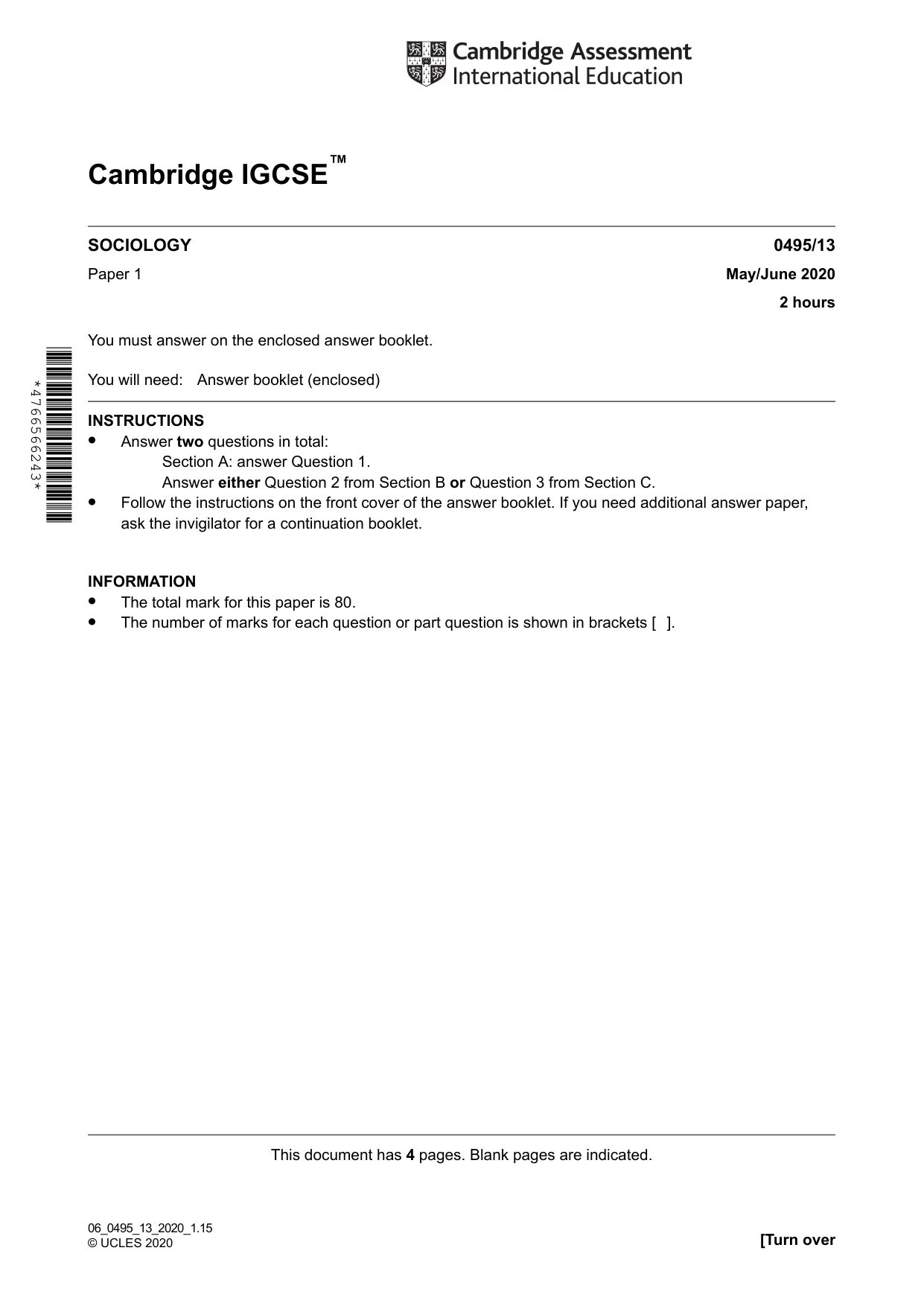
Cambridge IGCSE™ 0495/13 May/June 2020 2 hours SOCIOLOGY Paper 1 You must answer on the enclosed answer booklet. You will need: Answer booklet (enclosed) INSTRUCTIONS • Answer two questions in total: Section A: answer Question 1. Answer either Question 2 from Section B or Question 3 from Section C. • Follow the instructions on the front cover of the answer booklet. If you need additional answer paper, ask the invigilator for a continuation booklet. INFORMATION • The total mark for this paper is 80. • The number of marks for each question or part question is shown in brackets [ ]. This document has 4 pages. Blank pages are indicated. [Turn over 06_0495_13_2020_1.15 © UCLES 2020 *4766566243*
Question paper, page 2
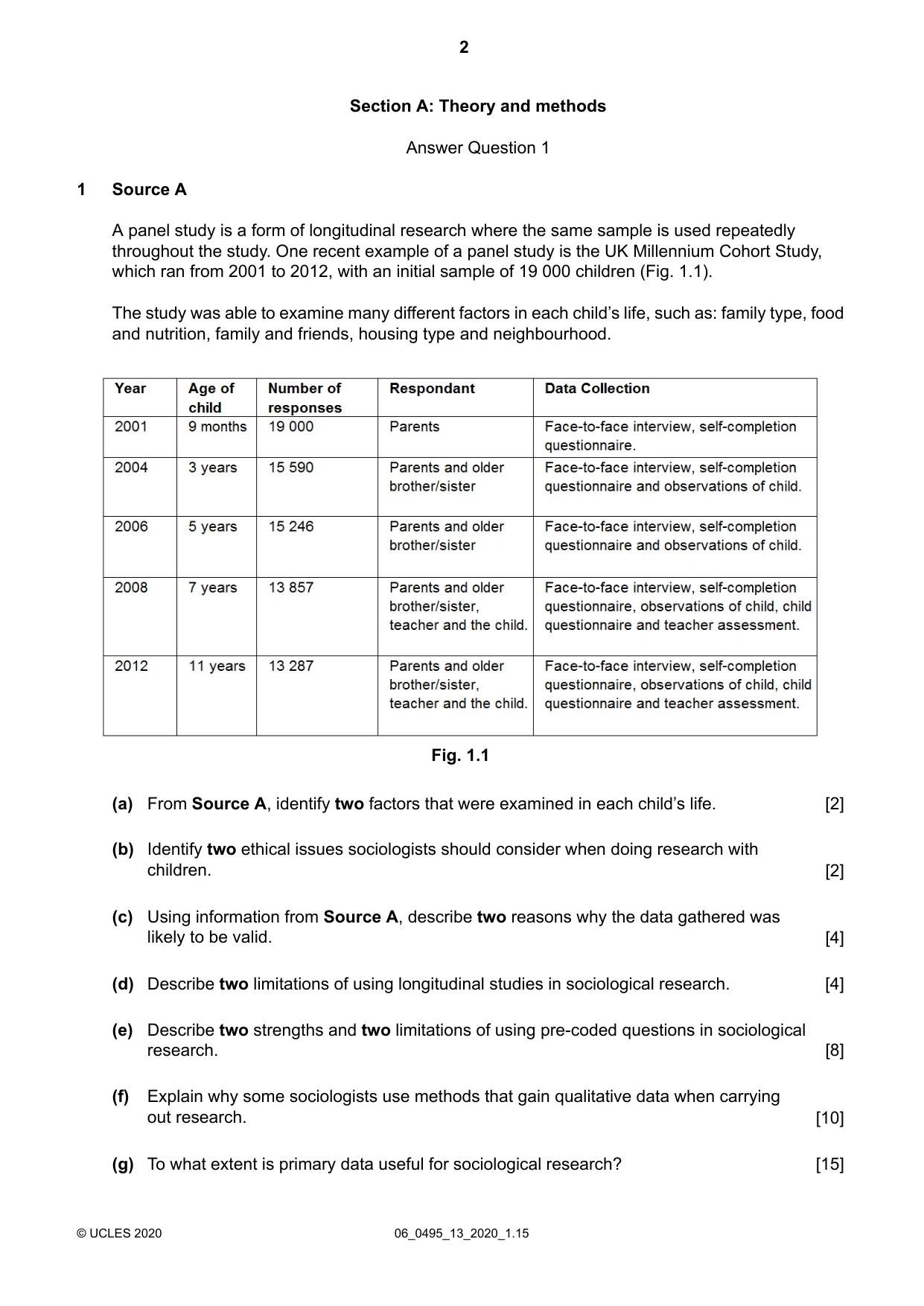
Section A: Theory and methods Answer Question 1 Source A 1 A panel study is a form of longitudinal research where the same sample is used repeatedly throughout the study. One recent example of a panel study is the UK Millennium Cohort Study, which ran from 2001 to 2012, with an initial sample of 19 000 children (Fig. 1.1). The study was able to examine many different factors in each child’s life, such as: family type, food and nutrition, family and friends, housing type and neighbourhood. Fig. 1.1 From Source A, identify two factors that were examined in each child’s life. [2] (a) Identify two ethical issues sociologists should consider when doing research with children. [2] (b) Using information from Source A, describe two reasons why the data gathered was likely to be valid. [4] (c) Describe two limitations of using longitudinal studies in sociological research. [4] (d) Describe two strengths and two limitations of using pre-coded questions in sociological research. [8] (e) Explain why some sociologists use methods that gain qualitative data when carrying out research. [10] (f) To what extent is primary data useful for sociological research? [15] (g) 06_0495_13_2020_1.15 © UCLES 2020 2
Question paper, page 3
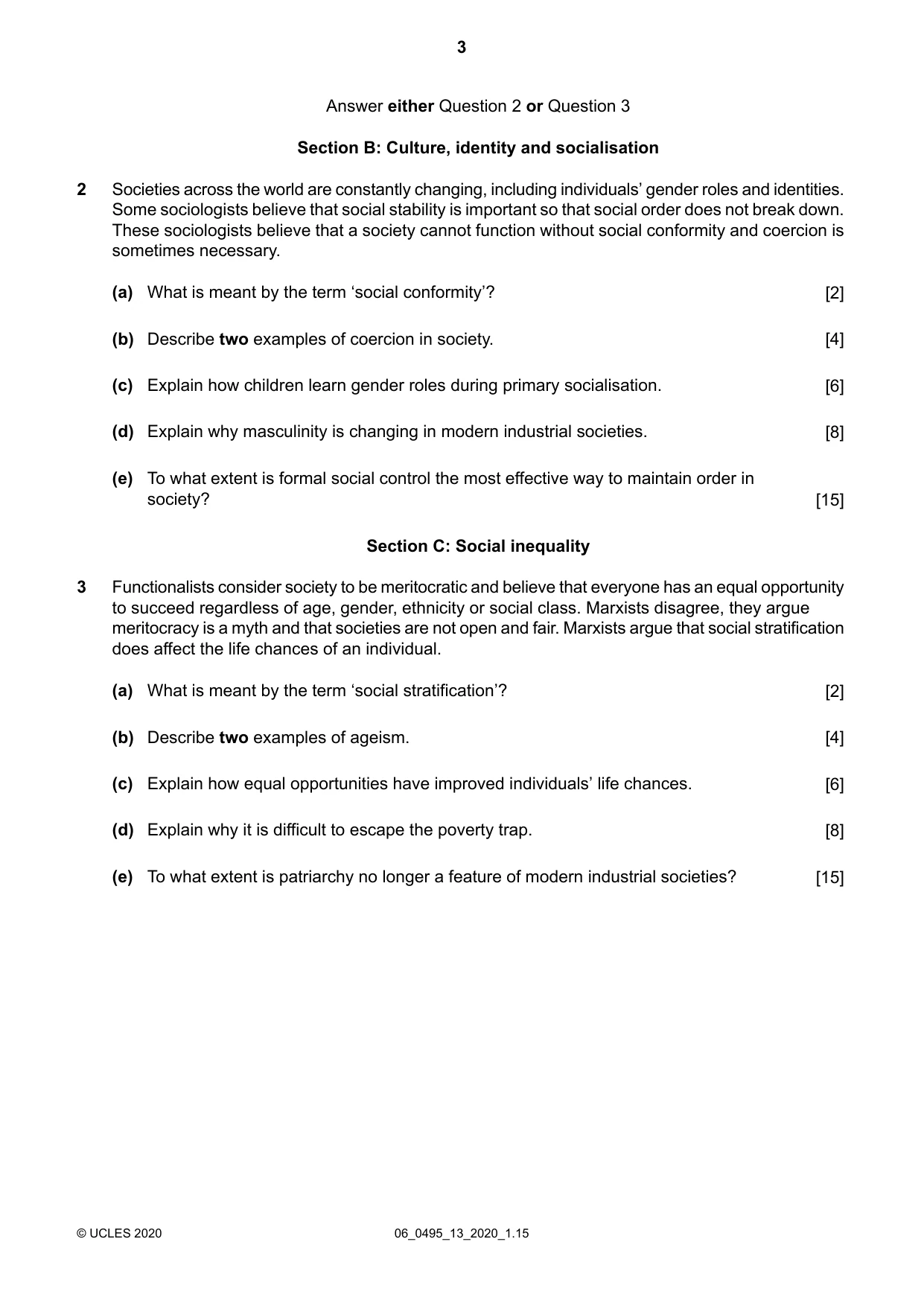
Answer either Question 2 or Question 3 Section B: Culture, identity and socialisation Societies across the world are constantly changing, including individuals’ gender roles and identities. Some sociologists believe that social stability is important so that social order does not break down. 2 These sociologists believe that a society cannot function without social conformity and coercion is sometimes necessary. What is meant by the term ‘social conformity’? [2] (a) Describe two examples of coercion in society. [4] (b) Explain how children learn gender roles during primary socialisation. [6] (c) Explain why masculinity is changing in modern industrial societies. [8] (d) To what extent is formal social control the most effective way to maintain order in society? [15] (e) Section C: Social inequality Functionalists consider society to be meritocratic and believe that everyone has an equal opportunity to succeed regardless of age, gender, ethnicity or social class. Marxists disagree, they argue 3 meritocracy is a myth and that societies are not open and fair. Marxists argue that social stratification does affect the life chances of an individual. What is meant by the term ‘social stratification’? [2] (a) Describe two examples of ageism. [4] (b) Explain how equal opportunities have improved individuals’ life chances. [6] (c) Explain why it is difficult to escape the poverty trap. [8] (d) To what extent is patriarchy no longer a feature of modern industrial societies? [15] (e) 06_0495_13_2020_1.15 © UCLES 2020 3
Question paper, page 4
BLANK PAGE Permission to reproduce items where third-party owned material protected by copyright is included has been sought and cleared where possible. Every reasonable effort has been made by the publisher (UCLES) to trace copyright holders, but if any items requiring clearance have unwittingly been included, the publisher will be pleased to make amends at the earliest possible opportunity. To avoid the issue of disclosure of answer-related information to candidates, all copyright acknowledgements are reproduced online in the Cambridge Assessment International Education Copyright Acknowledgements Booklet. This is produced for each series of examinations and is freely available to download at www.cambridgeinternational.org after the live examination series. Cambridge Assessment International Education is part of the Cambridge Assessment Group. Cambridge Assessment is the brand name of the University of Cambridge Local Examinations Syndicate (UCLES), which itself is a department of the University of Cambridge. 06_0495_13_2020_1.15 © UCLES 2020 4
Mark scheme, page 1
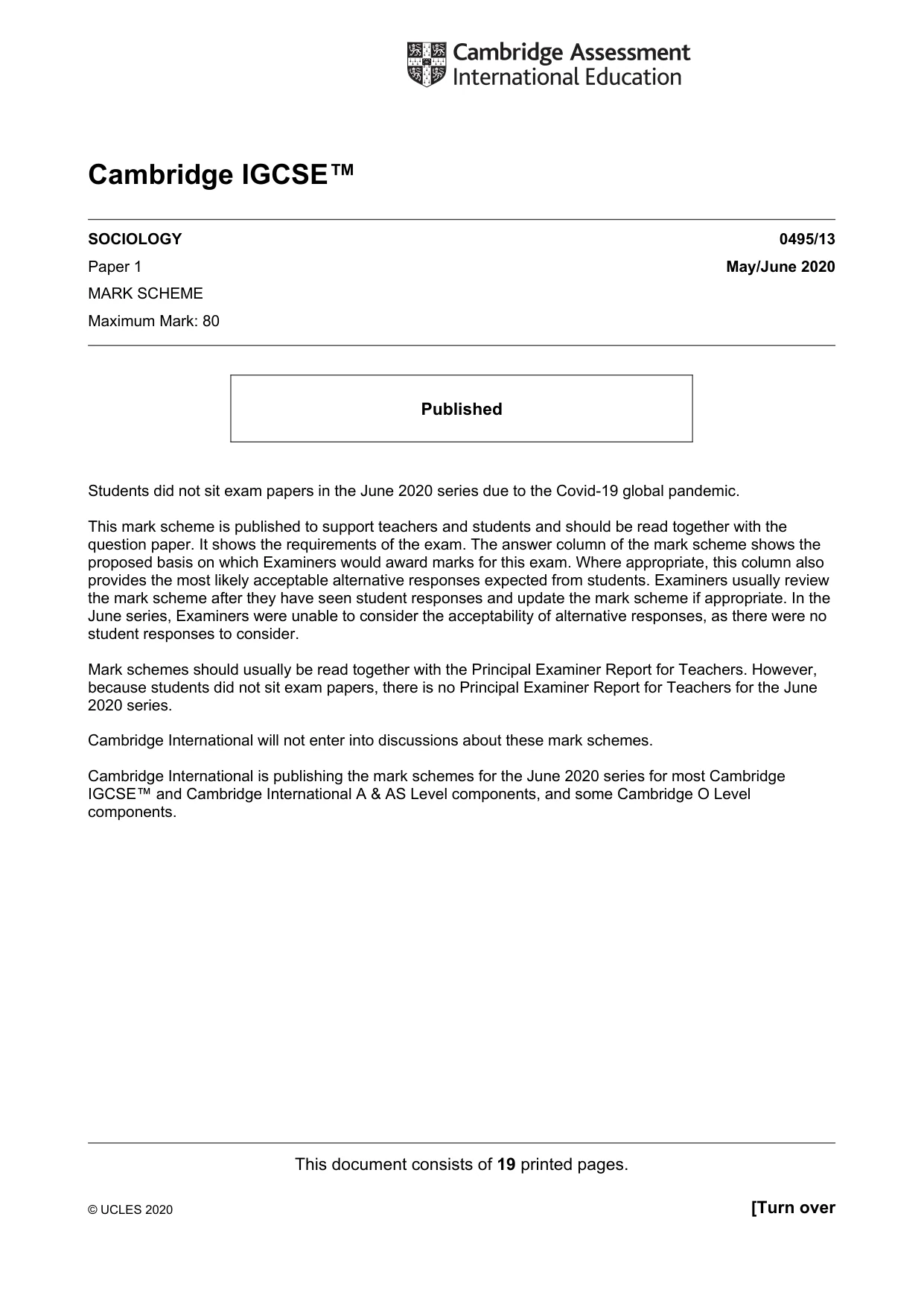
This document consists of 19 printed pages. © UCLES 2020 [Turn over Cambridge IGCSE™ SOCIOLOGY 0495/13 Paper 1 May/June 2020 MARK SCHEME Maximum Mark: 80 Published Students did not sit exam papers in the June 2020 series due to the Covid-19 global pandemic. This mark scheme is published to support teachers and students and should be read together with the question paper. It shows the requirements of the exam. The answer column of the mark scheme shows the proposed basis on which Examiners would award marks for this exam. Where appropriate, this column also provides the most likely acceptable alternative responses expected from students. Examiners usually review the mark scheme after they have seen student responses and update the mark scheme if appropriate. In the June series, Examiners were unable to consider the acceptability of alternative responses, as there were no student responses to consider. Mark schemes should usually be read together with the Principal Examiner Report for Teachers. However, because students did not sit exam papers, there is no Principal Examiner Report for Teachers for the June 2020 series. Cambridge International will not enter into discussions about these mark schemes. Cambridge International is publishing the mark schemes for the June 2020 series for most Cambridge IGCSE™ and Cambridge International A & AS Level components, and some Cambridge O Level components.
Mark scheme, page 2
0495/13 Cambridge IGCSE – Mark Scheme PUBLISHED May/June 2020 © UCLES 2020 Page 2 of 19 Generic Marking Principles These general marking principles must be applied by all examiners when marking candidate answers. They should be applied alongside the specific content of the mark scheme or generic level descriptors for a question. Each question paper and mark scheme will also comply with these marking principles. GENERIC MARKING PRINCIPLE 1: Marks must be awarded in line with: • the specific content of the mark scheme or the generic level descriptors for the question • the specific skills defined in the mark scheme or in the generic level descriptors for the question • the standard of response required by a candidate as exemplified by the standardisation scripts. GENERIC MARKING PRINCIPLE 2: Marks awarded are always whole marks (not half marks, or other fractions). GENERIC MARKING PRINCIPLE 3: Marks must be awarded positively: • marks are awarded for correct/valid answers, as defined in the mark scheme. However, credit is given for valid answers which go beyond the scope of the syllabus and mark scheme, referring to your Team Leader as appropriate • marks are awarded when candidates clearly demonstrate what they know and can do • marks are not deducted for errors • marks are not deducted for omissions • answers should only be judged on the quality of spelling, punctuation and grammar when these features are specifically assessed by the question as indicated by the mark scheme. The meaning, however, should be unambiguous. GENERIC MARKING PRINCIPLE 4: Rules must be applied consistently e.g. in situations where candidates have not followed instructions or in the application of generic level descriptors. GENERIC MARKING PRINCIPLE 5: Marks should be awarded using the full range of marks defined in the mark scheme for the question (however; the use of the full mark range may be limited according to the quality of the candidate responses seen). GENERIC MARKING PRINCIPLE 6: Marks awarded are based solely on the requirements as defined in the mark scheme. Marks should not be awarded with grade thresholds or grade descriptors in mind.
Mark scheme, page 3
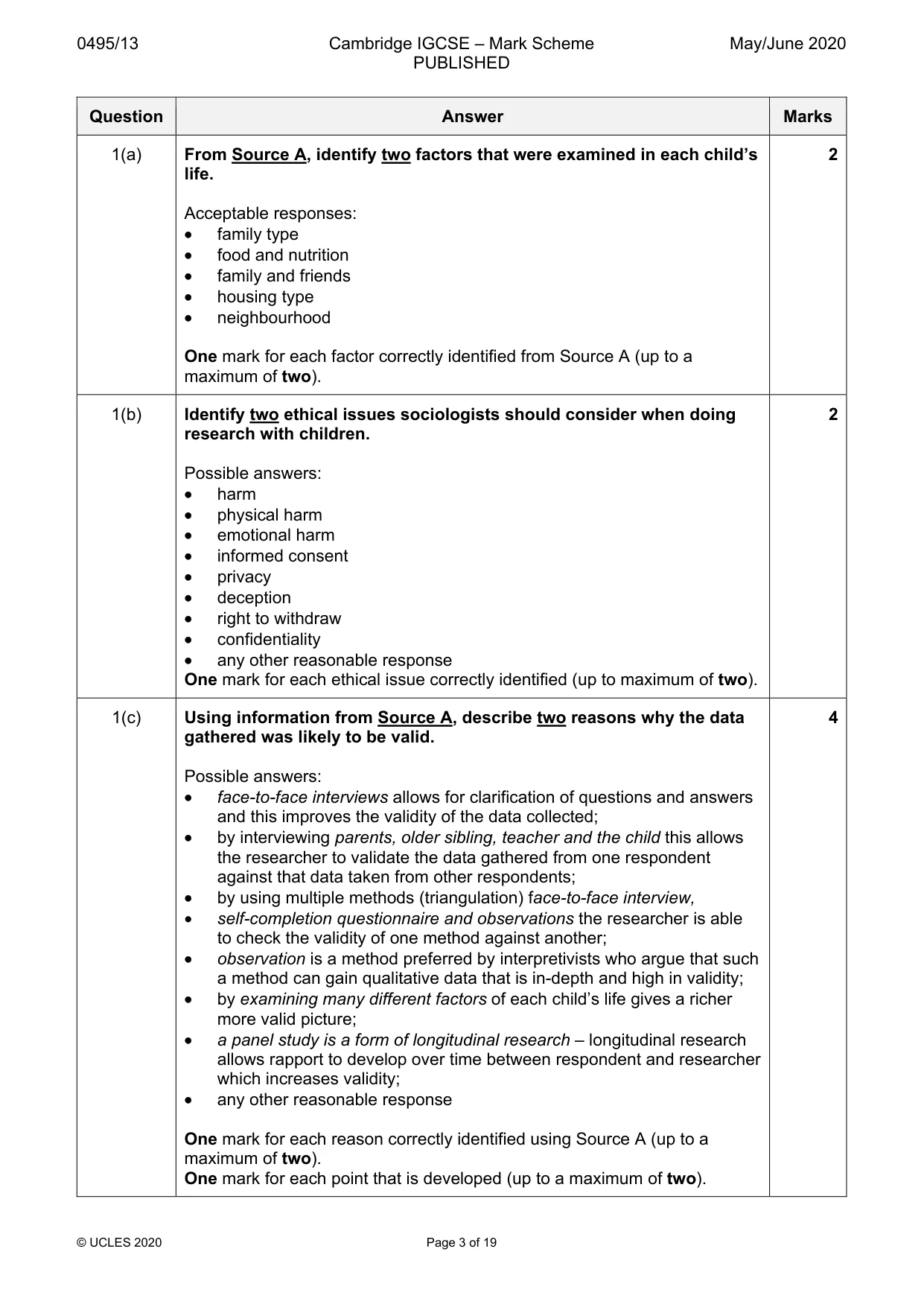
0495/13 Cambridge IGCSE – Mark Scheme PUBLISHED May/June 2020 © UCLES 2020 Page 3 of 19 Question Answer Marks 1(a) From Source A, identify two factors that were examined in each child’s life. Acceptable responses: • family type • food and nutrition • family and friends • housing type • neighbourhood One mark for each factor correctly identified from Source A (up to a maximum of two). 2 1(b) Identify two ethical issues sociologists should consider when doing research with children. Possible answers: • harm • physical harm • emotional harm • informed consent • privacy • deception • right to withdraw • confidentiality • any other reasonable response One mark for each ethical issue correctly identified (up to maximum of two). 2 1(c) Using information from Source A, describe two reasons why the data gathered was likely to be valid. Possible answers: • face-to-face interviews allows for clarification of questions and answers and this improves the validity of the data collected; • by interviewing parents, older sibling, teacher and the child this allows the researcher to validate the data gathered from one respondent against that data taken from other respondents; • by using multiple methods (triangulation) face-to-face interview, • self-completion questionnaire and observations the researcher is able to check the validity of one method against another; • observation is a method preferred by interpretivists who argue that such a method can gain qualitative data that is in-depth and high in validity; • by examining many different factors of each child’s life gives a richer more valid picture; • a panel study is a form of longitudinal research – longitudinal research allows rapport to develop over time between respondent and researcher which increases validity; • any other reasonable response One mark for each reason correctly identified using Source A (up to a maximum of two). One mark for each point that is developed (up to a maximum of two). 4
Mark scheme, page 4
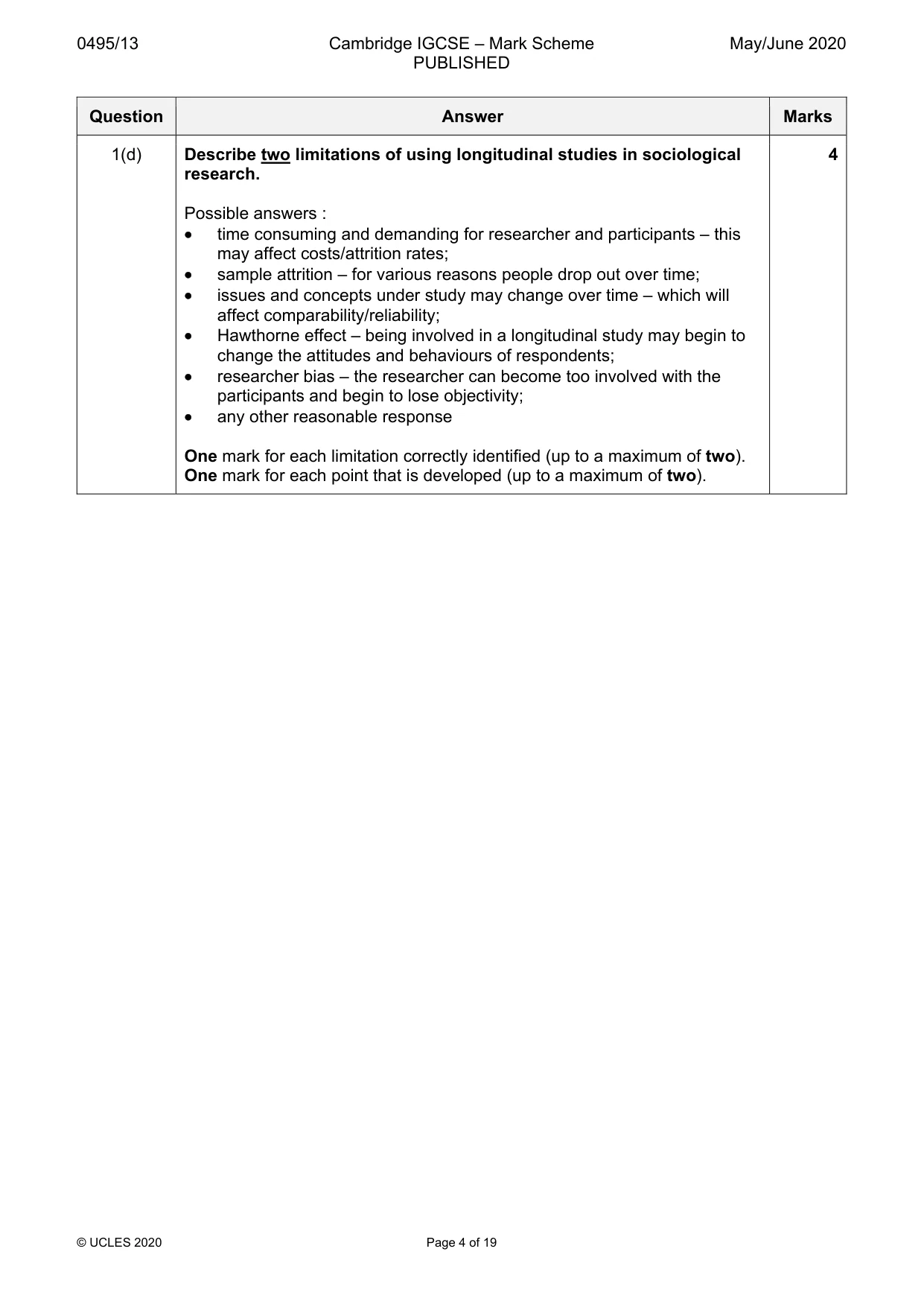
0495/13 Cambridge IGCSE – Mark Scheme PUBLISHED May/June 2020 © UCLES 2020 Page 4 of 19 Question Answer Marks 1(d) Describe two limitations of using longitudinal studies in sociological research. Possible answers : • time consuming and demanding for researcher and participants – this may affect costs/attrition rates; • sample attrition – for various reasons people drop out over time; • issues and concepts under study may change over time – which will affect comparability/reliability; • Hawthorne effect – being involved in a longitudinal study may begin to change the attitudes and behaviours of respondents; • researcher bias – the researcher can become too involved with the participants and begin to lose objectivity; • any other reasonable response One mark for each limitation correctly identified (up to a maximum of two). One mark for each point that is developed (up to a maximum of two). 4
Mark scheme, page 5
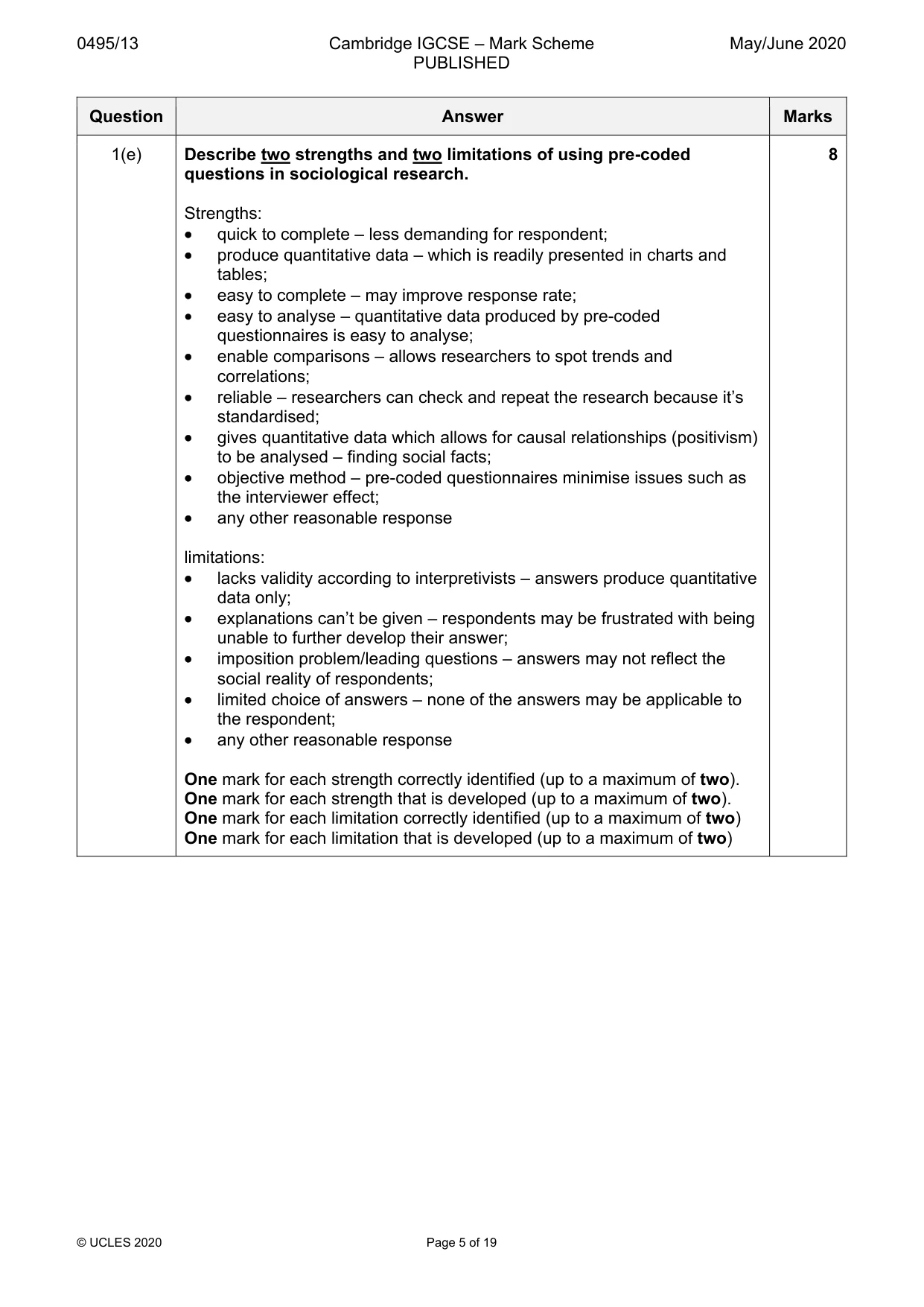
0495/13 Cambridge IGCSE – Mark Scheme PUBLISHED May/June 2020 © UCLES 2020 Page 5 of 19 Question Answer Marks 1(e) Describe two strengths and two limitations of using pre-coded questions in sociological research. Strengths: • quick to complete – less demanding for respondent; • produce quantitative data – which is readily presented in charts and tables; • easy to complete – may improve response rate; • easy to analyse – quantitative data produced by pre-coded questionnaires is easy to analyse; • enable comparisons – allows researchers to spot trends and correlations; • reliable – researchers can check and repeat the research because it’s standardised; • gives quantitative data which allows for causal relationships (positivism) to be analysed – finding social facts; • objective method – pre-coded questionnaires minimise issues such as the interviewer effect; • any other reasonable response limitations: • lacks validity according to interpretivists – answers produce quantitative data only; • explanations can’t be given – respondents may be frustrated with being unable to further develop their answer; • imposition problem/leading questions – answers may not reflect the social reality of respondents; • limited choice of answers – none of the answers may be applicable to the respondent; • any other reasonable response One mark for each strength correctly identified (up to a maximum of two). One mark for each strength that is developed (up to a maximum of two). One mark for each limitation correctly identified (up to a maximum of two) One mark for each limitation that is developed (up to a maximum of two) 8
Mark scheme, page 6
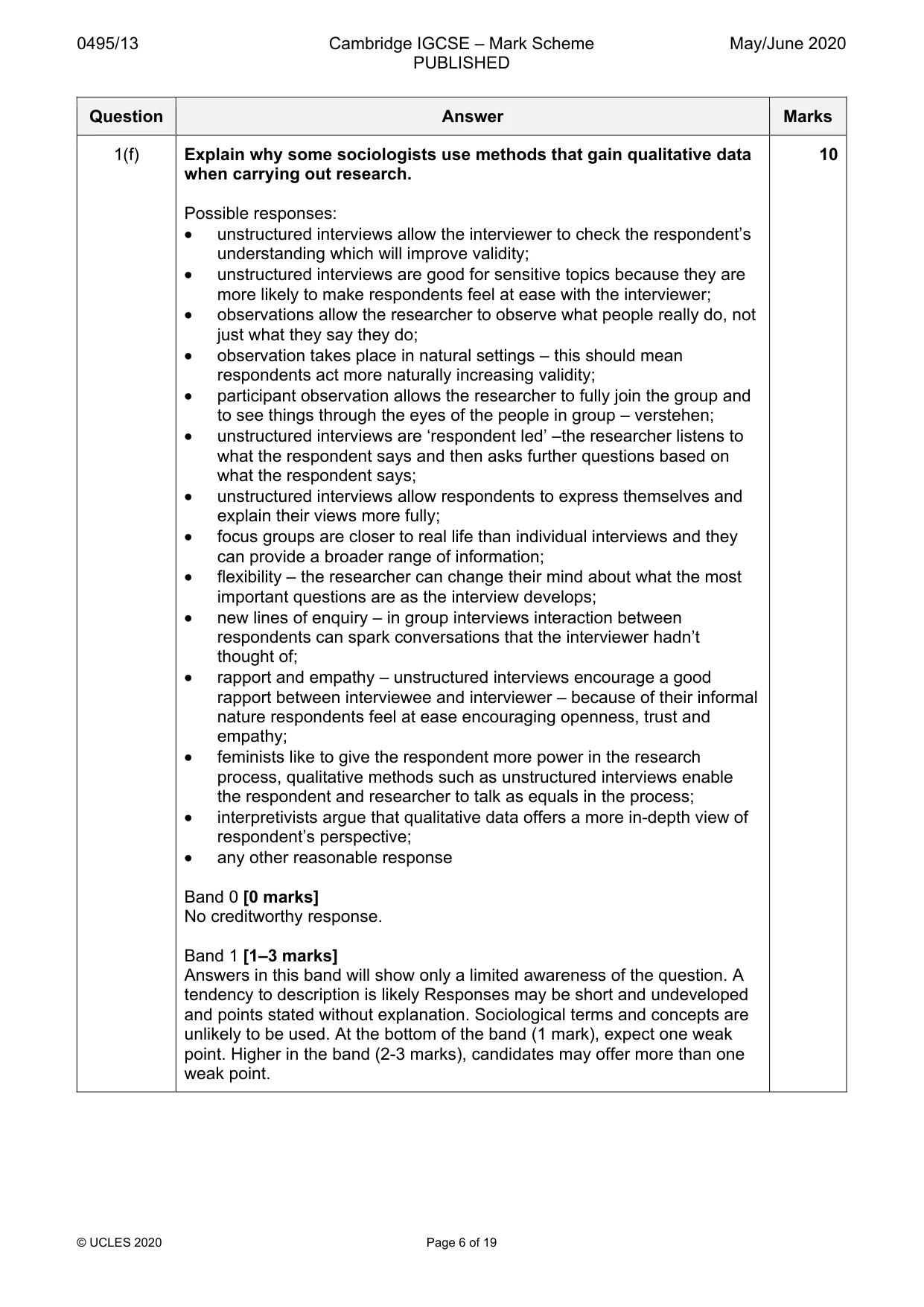
0495/13 Cambridge IGCSE – Mark Scheme PUBLISHED May/June 2020 © UCLES 2020 Page 6 of 19 Question Answer Marks 1(f) Explain why some sociologists use methods that gain qualitative data when carrying out research. Possible responses: • unstructured interviews allow the interviewer to check the respondent’s understanding which will improve validity; • unstructured interviews are good for sensitive topics because they are more likely to make respondents feel at ease with the interviewer; • observations allow the researcher to observe what people really do, not just what they say they do; • observation takes place in natural settings – this should mean respondents act more naturally increasing validity; • participant observation allows the researcher to fully join the group and to see things through the eyes of the people in group – verstehen; • unstructured interviews are ‘respondent led’ –the researcher listens to what the respondent says and then asks further questions based on what the respondent says; • unstructured interviews allow respondents to express themselves and explain their views more fully; • focus groups are closer to real life than individual interviews and they can provide a broader range of information; • flexibility – the researcher can change their mind about what the most important questions are as the interview develops; • new lines of enquiry – in group interviews interaction between respondents can spark conversations that the interviewer hadn’t thought of; • rapport and empathy – unstructured interviews encourage a good rapport between interviewee and interviewer – because of their informal nature respondents feel at ease encouraging openness, trust and empathy; • feminists like to give the respondent more power in the research process, qualitative methods such as unstructured interviews enable the respondent and researcher to talk as equals in the process; • interpretivists argue that qualitative data offers a more in-depth view of respondent’s perspective; • any other reasonable response Band 0 [0 marks] No creditworthy response. Band 1 [1–3 marks] Answers in this band will show only a limited awareness of the question. A tendency to description is likely Responses may be short and undeveloped and points stated without explanation. Sociological terms and concepts are unlikely to be used. At the bottom of the band (1 mark), expect one weak point. Higher in the band (2-3 marks), candidates may offer more than one weak point. 10
Mark scheme, page 7
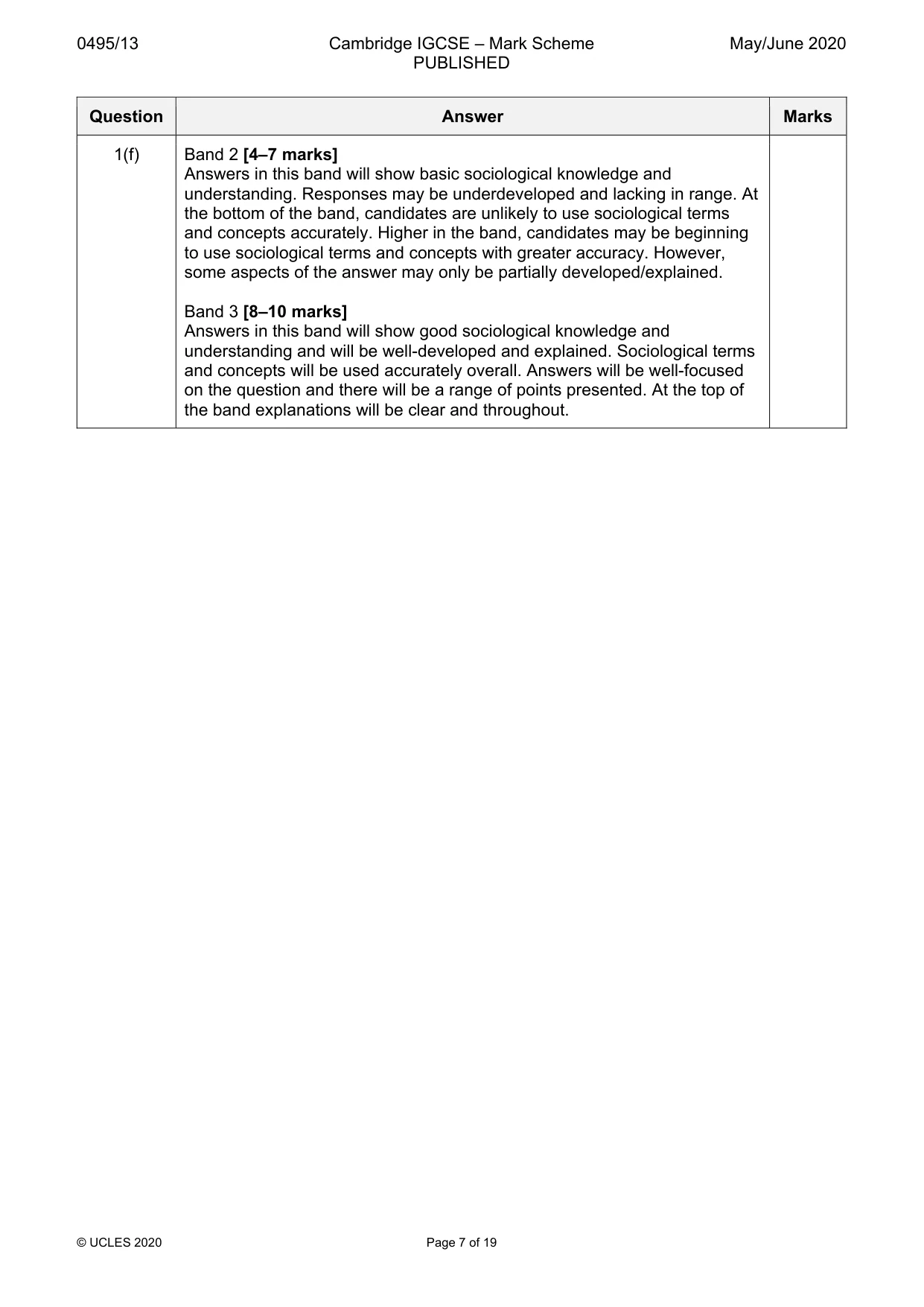
0495/13 Cambridge IGCSE – Mark Scheme PUBLISHED May/June 2020 © UCLES 2020 Page 7 of 19 Question Answer Marks 1(f) Band 2 [4–7 marks] Answers in this band will show basic sociological knowledge and understanding. Responses may be underdeveloped and lacking in range. At the bottom of the band, candidates are unlikely to use sociological terms and concepts accurately. Higher in the band, candidates may be beginning to use sociological terms and concepts with greater accuracy. However, some aspects of the answer may only be partially developed/explained. Band 3 [8–10 marks] Answers in this band will show good sociological knowledge and understanding and will be well-developed and explained. Sociological terms and concepts will be used accurately overall. Answers will be well-focused on the question and there will be a range of points presented. At the top of the band explanations will be clear and throughout.
Mark scheme, page 8
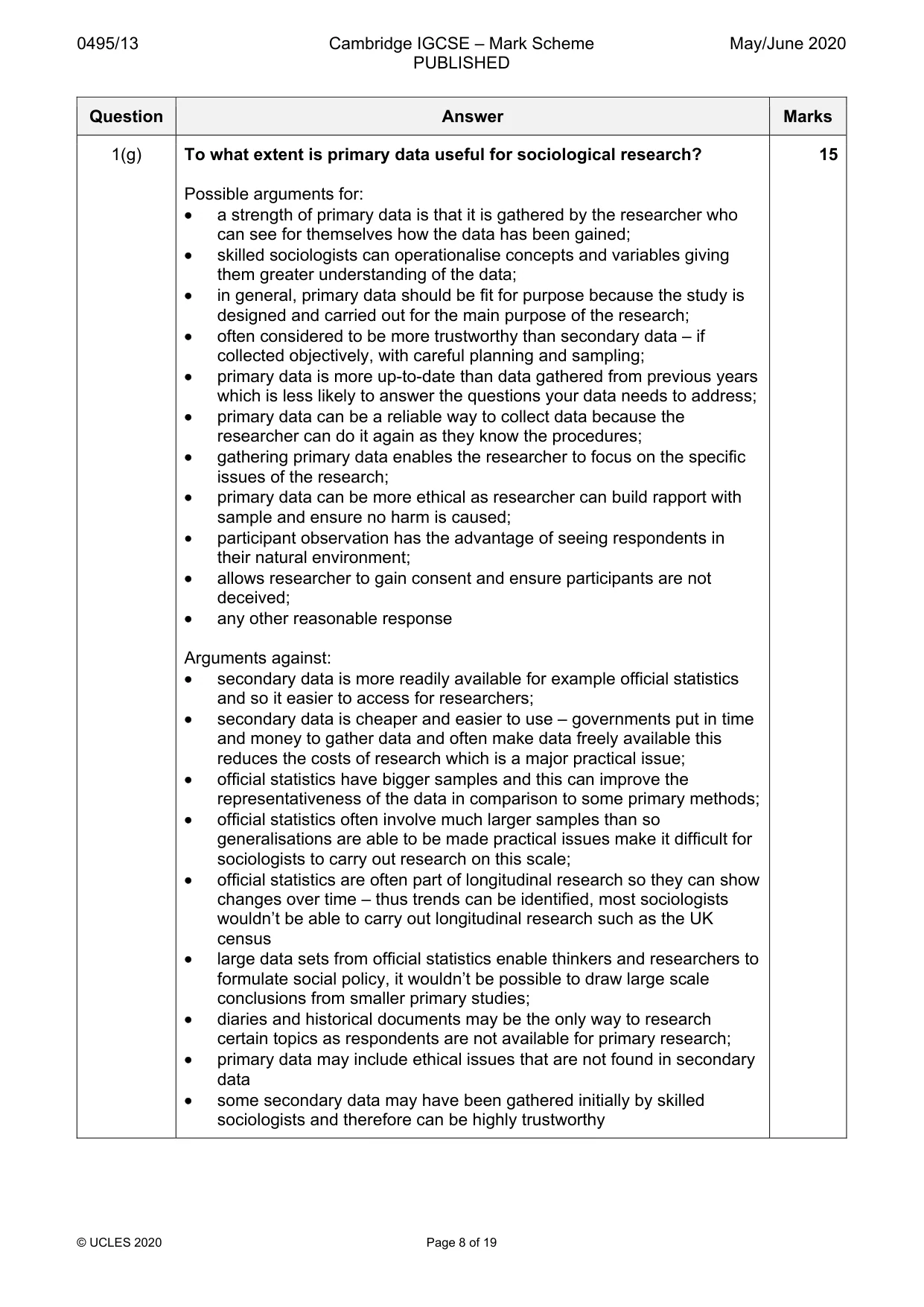
0495/13 Cambridge IGCSE – Mark Scheme PUBLISHED May/June 2020 © UCLES 2020 Page 8 of 19 Question Answer Marks 1(g) To what extent is primary data useful for sociological research? Possible arguments for: • a strength of primary data is that it is gathered by the researcher who can see for themselves how the data has been gained; • skilled sociologists can operationalise concepts and variables giving them greater understanding of the data; • in general, primary data should be fit for purpose because the study is designed and carried out for the main purpose of the research; • often considered to be more trustworthy than secondary data – if collected objectively, with careful planning and sampling; • primary data is more up-to-date than data gathered from previous years which is less likely to answer the questions your data needs to address; • primary data can be a reliable way to collect data because the researcher can do it again as they know the procedures; • gathering primary data enables the researcher to focus on the specific issues of the research; • primary data can be more ethical as researcher can build rapport with sample and ensure no harm is caused; • participant observation has the advantage of seeing respondents in their natural environment; • allows researcher to gain consent and ensure participants are not deceived; • any other reasonable response Arguments against: • secondary data is more readily available for example official statistics and so it easier to access for researchers; • secondary data is cheaper and easier to use – governments put in time and money to gather data and often make data freely available this reduces the costs of research which is a major practical issue; • official statistics have bigger samples and this can improve the representativeness of the data in comparison to some primary methods; • official statistics often involve much larger samples than so generalisations are able to be made practical issues make it difficult for sociologists to carry out research on this scale; • official statistics are often part of longitudinal research so they can show changes over time – thus trends can be identified, most sociologists wouldn’t be able to carry out longitudinal research such as the UK census • large data sets from official statistics enable thinkers and researchers to formulate social policy, it wouldn’t be possible to draw large scale conclusions from smaller primary studies; • diaries and historical documents may be the only way to research certain topics as respondents are not available for primary research; • primary data may include ethical issues that are not found in secondary data • some secondary data may have been gathered initially by skilled sociologists and therefore can be highly trustworthy 15
Mark scheme, page 9
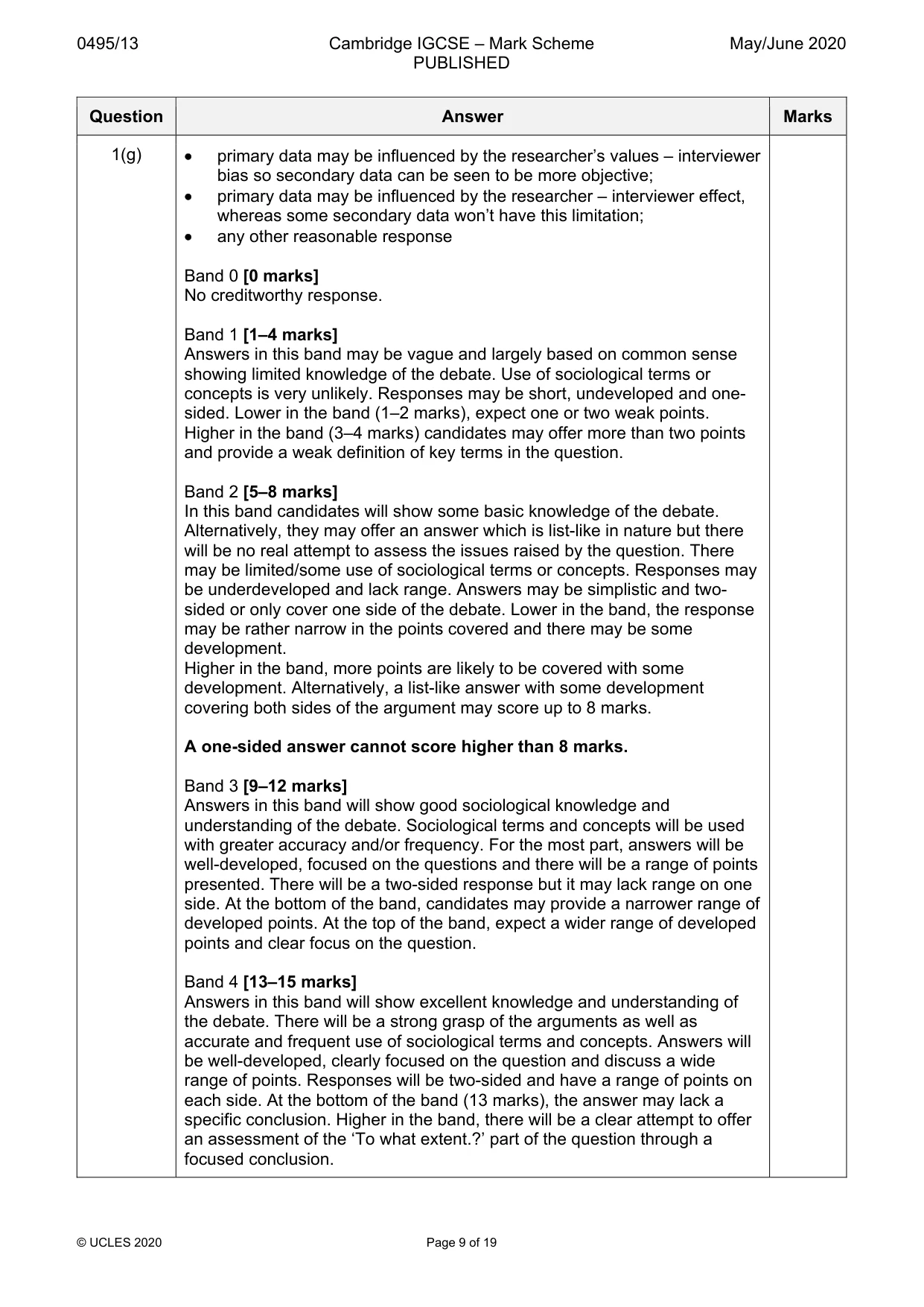
0495/13 Cambridge IGCSE – Mark Scheme PUBLISHED May/June 2020 © UCLES 2020 Page 9 of 19 Question Answer Marks 1(g) • primary data may be influenced by the researcher’s values – interviewer bias so secondary data can be seen to be more objective; • primary data may be influenced by the researcher – interviewer effect, whereas some secondary data won’t have this limitation; • any other reasonable response Band 0 [0 marks] No creditworthy response. Band 1 [1–4 marks] Answers in this band may be vague and largely based on common sense showing limited knowledge of the debate. Use of sociological terms or concepts is very unlikely. Responses may be short, undeveloped and one- sided. Lower in the band (1–2 marks), expect one or two weak points. Higher in the band (3–4 marks) candidates may offer more than two points and provide a weak definition of key terms in the question. Band 2 [5–8 marks] In this band candidates will show some basic knowledge of the debate. Alternatively, they may offer an answer which is list-like in nature but there will be no real attempt to assess the issues raised by the question. There may be limited/some use of sociological terms or concepts. Responses may be underdeveloped and lack range. Answers may be simplistic and two- sided or only cover one side of the debate. Lower in the band, the response may be rather narrow in the points covered and there may be some development. Higher in the band, more points are likely to be covered with some development. Alternatively, a list-like answer with some development covering both sides of the argument may score up to 8 marks. A one-sided answer cannot score higher than 8 marks. Band 3 [9–12 marks] Answers in this band will show good sociological knowledge and understanding of the debate. Sociological terms and concepts will be used with greater accuracy and/or frequency. For the most part, answers will be well-developed, focused on the questions and there will be a range of points presented. There will be a two-sided response but it may lack range on one side. At the bottom of the band, candidates may provide a narrower range of developed points. At the top of the band, expect a wider range of developed points and clear focus on the question. Band 4 [13–15 marks] Answers in this band will show excellent knowledge and understanding of the debate. There will be a strong grasp of the arguments as well as accurate and frequent use of sociological terms and concepts. Answers will be well-developed, clearly focused on the question and discuss a wide range of points. Responses will be two-sided and have a range of points on each side. At the bottom of the band (13 marks), the answer may lack a specific conclusion. Higher in the band, there will be a clear attempt to offer an assessment of the ‘To what extent.?’ part of the question through a focused conclusion.
Mark scheme, page 10
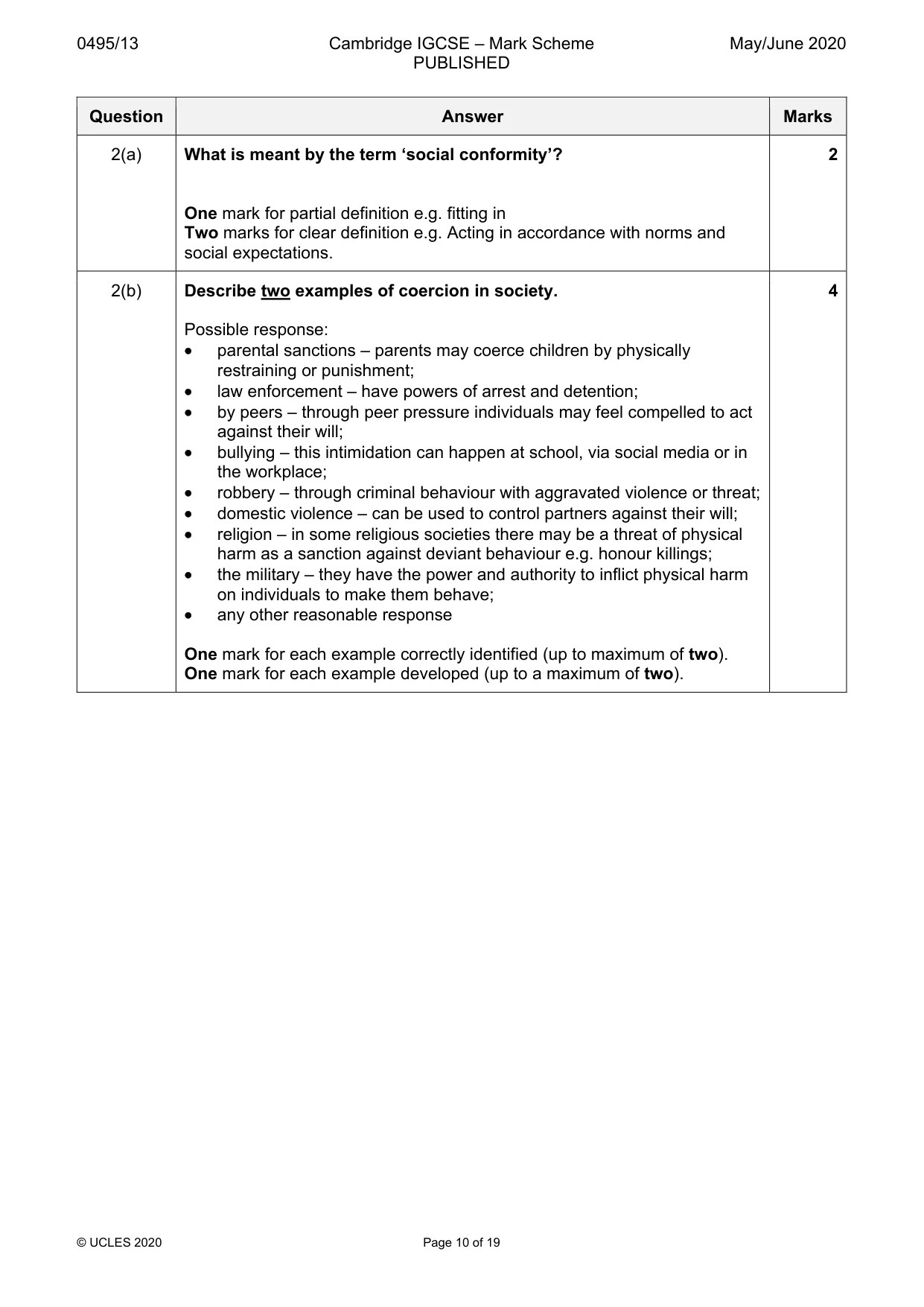
0495/13 Cambridge IGCSE – Mark Scheme PUBLISHED May/June 2020 © UCLES 2020 Page 10 of 19 Question Answer Marks 2(a) What is meant by the term ‘social conformity’? One mark for partial definition e.g. fitting in Two marks for clear definition e.g. Acting in accordance with norms and social expectations. 2 2(b) Describe two examples of coercion in society. Possible response: • parental sanctions – parents may coerce children by physically restraining or punishment; • law enforcement – have powers of arrest and detention; • by peers – through peer pressure individuals may feel compelled to act against their will; • bullying – this intimidation can happen at school, via social media or in the workplace; • robbery – through criminal behaviour with aggravated violence or threat; • domestic violence – can be used to control partners against their will; • religion – in some religious societies there may be a threat of physical harm as a sanction against deviant behaviour e.g. honour killings; • the military – they have the power and authority to inflict physical harm on individuals to make them behave; • any other reasonable response One mark for each example correctly identified (up to maximum of two). One mark for each example developed (up to a maximum of two). 4
Mark scheme, page 11
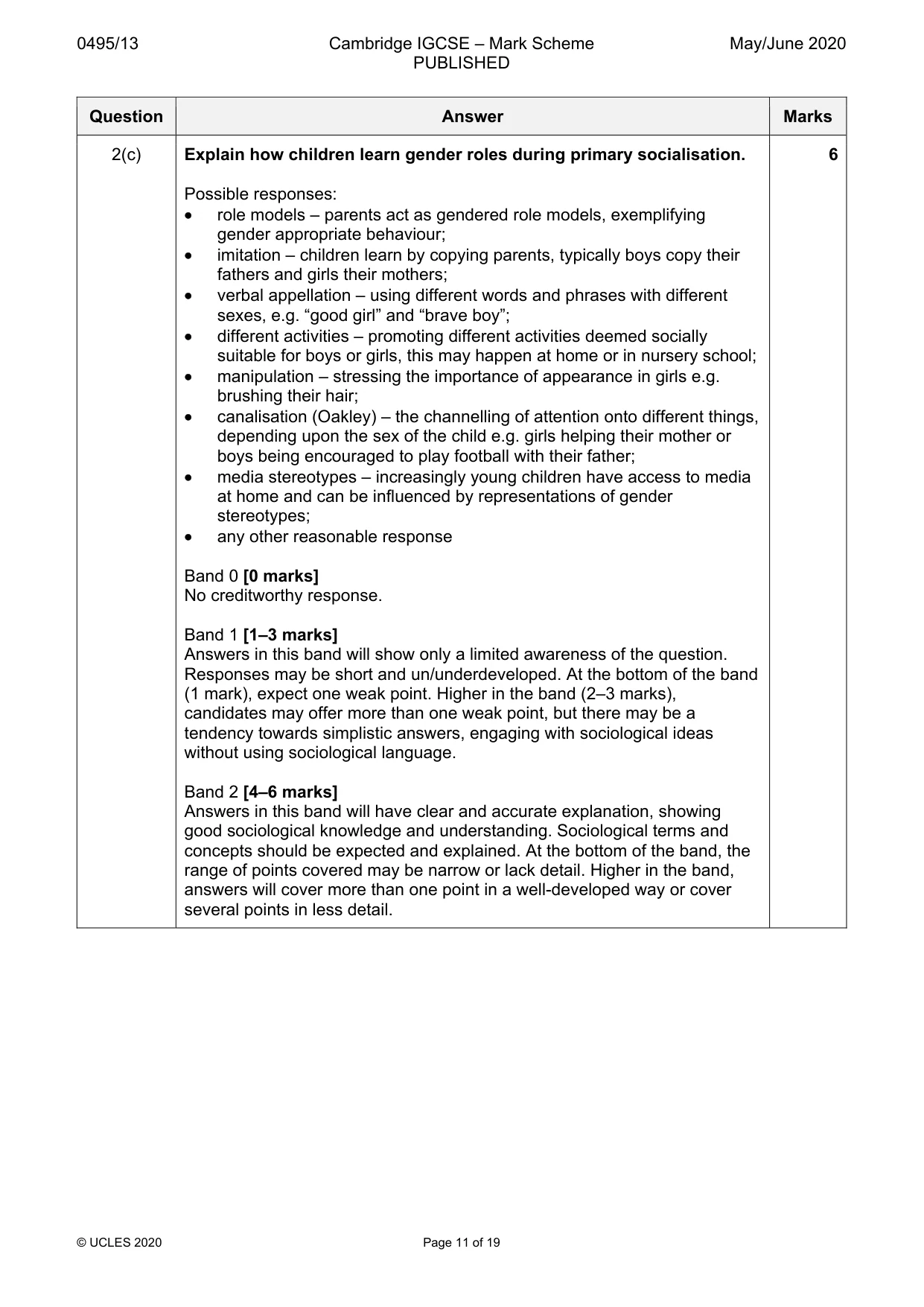
0495/13 Cambridge IGCSE – Mark Scheme PUBLISHED May/June 2020 © UCLES 2020 Page 11 of 19 Question Answer Marks 2(c) Explain how children learn gender roles during primary socialisation. Possible responses: • role models – parents act as gendered role models, exemplifying gender appropriate behaviour; • imitation – children learn by copying parents, typically boys copy their fathers and girls their mothers; • verbal appellation – using different words and phrases with different sexes, e.g. “good girl” and “brave boy”; • different activities – promoting different activities deemed socially suitable for boys or girls, this may happen at home or in nursery school; • manipulation – stressing the importance of appearance in girls e.g. brushing their hair; • canalisation (Oakley) – the channelling of attention onto different things, depending upon the sex of the child e.g. girls helping their mother or boys being encouraged to play football with their father; • media stereotypes – increasingly young children have access to media at home and can be influenced by representations of gender stereotypes; • any other reasonable response Band 0 [0 marks] No creditworthy response. Band 1 [1–3 marks] Answers in this band will show only a limited awareness of the question. Responses may be short and un/underdeveloped. At the bottom of the band (1 mark), expect one weak point. Higher in the band (2–3 marks), candidates may offer more than one weak point, but there may be a tendency towards simplistic answers, engaging with sociological ideas without using sociological language. Band 2 [4–6 marks] Answers in this band will have clear and accurate explanation, showing good sociological knowledge and understanding. Sociological terms and concepts should be expected and explained. At the bottom of the band, the range of points covered may be narrow or lack detail. Higher in the band, answers will cover more than one point in a well-developed way or cover several points in less detail. 6
Mark scheme, page 12
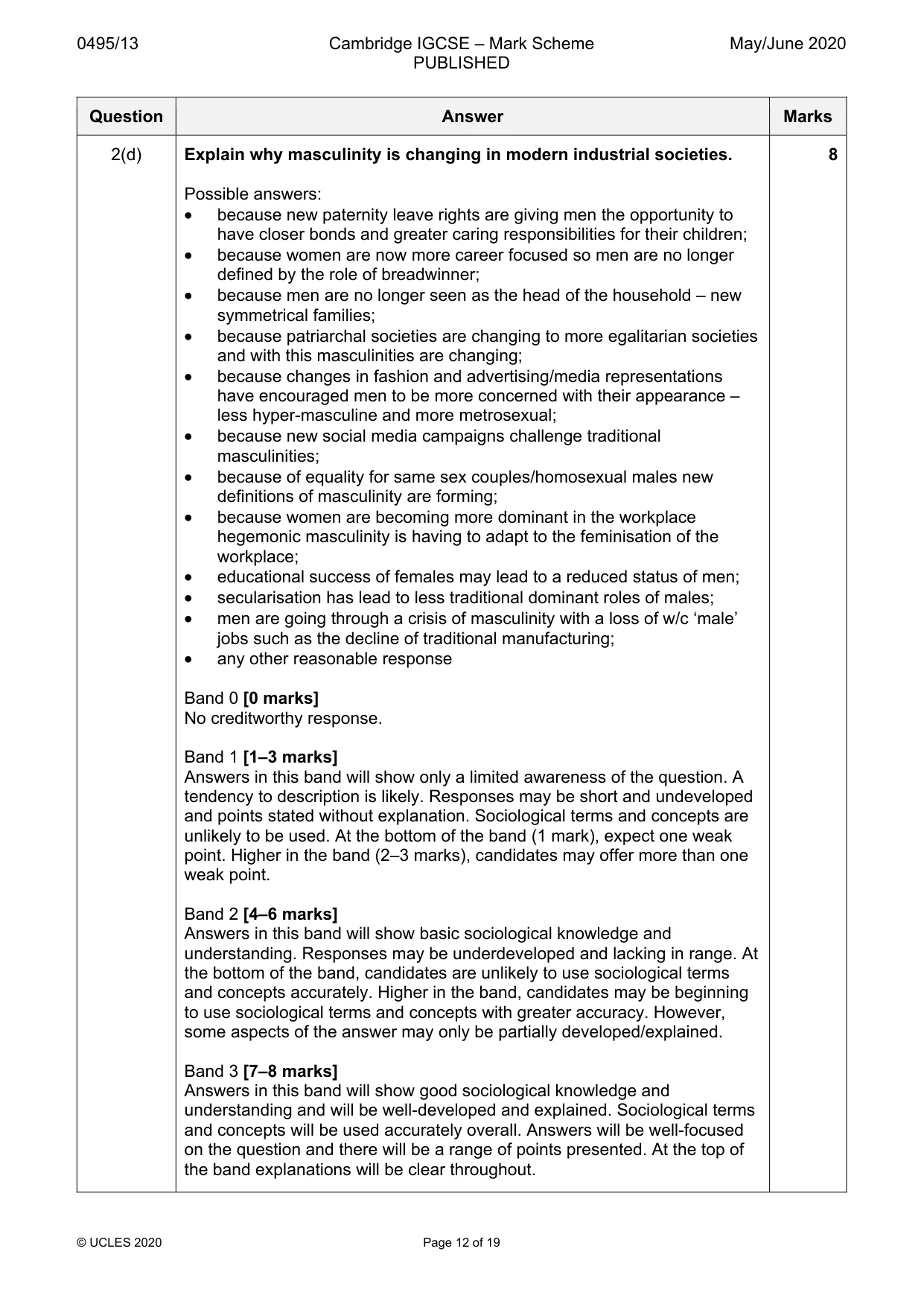
0495/13 Cambridge IGCSE – Mark Scheme PUBLISHED May/June 2020 © UCLES 2020 Page 12 of 19 Question Answer Marks 2(d) Explain why masculinity is changing in modern industrial societies. Possible answers: • because new paternity leave rights are giving men the opportunity to have closer bonds and greater caring responsibilities for their children; • because women are now more career focused so men are no longer defined by the role of breadwinner; • because men are no longer seen as the head of the household – new symmetrical families; • because patriarchal societies are changing to more egalitarian societies and with this masculinities are changing; • because changes in fashion and advertising/media representations have encouraged men to be more concerned with their appearance – less hyper-masculine and more metrosexual; • because new social media campaigns challenge traditional masculinities; • because of equality for same sex couples/homosexual males new definitions of masculinity are forming; • because women are becoming more dominant in the workplace hegemonic masculinity is having to adapt to the feminisation of the workplace; • educational success of females may lead to a reduced status of men; • secularisation has lead to less traditional dominant roles of males; • men are going through a crisis of masculinity with a loss of w/c ‘male’ jobs such as the decline of traditional manufacturing; • any other reasonable response Band 0 [0 marks] No creditworthy response. Band 1 [1–3 marks] Answers in this band will show only a limited awareness of the question. A tendency to description is likely. Responses may be short and undeveloped and points stated without explanation. Sociological terms and concepts are unlikely to be used. At the bottom of the band (1 mark), expect one weak point. Higher in the band (2–3 marks), candidates may offer more than one weak point. Band 2 [4–6 marks] Answers in this band will show basic sociological knowledge and understanding. Responses may be underdeveloped and lacking in range. At the bottom of the band, candidates are unlikely to use sociological terms and concepts accurately. Higher in the band, candidates may be beginning to use sociological terms and concepts with greater accuracy. However, some aspects of the answer may only be partially developed/explained. Band 3 [7–8 marks] Answers in this band will show good sociological knowledge and understanding and will be well-developed and explained. Sociological terms and concepts will be used accurately overall. Answers will be well-focused on the question and there will be a range of points presented. At the top of the band explanations will be clear throughout. 8
Mark scheme, page 13
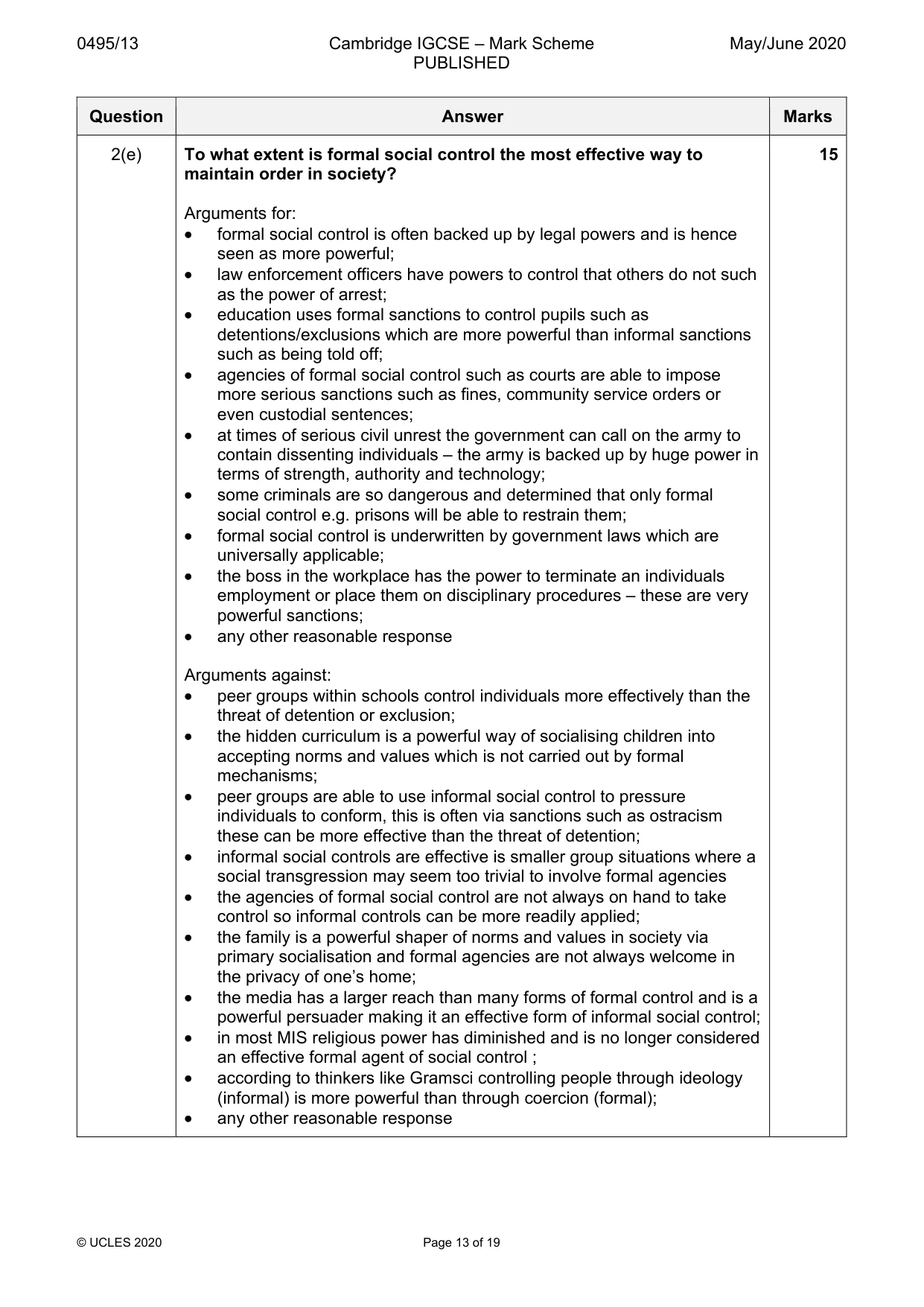
0495/13 Cambridge IGCSE – Mark Scheme PUBLISHED May/June 2020 © UCLES 2020 Page 13 of 19 Question Answer Marks 2(e) To what extent is formal social control the most effective way to maintain order in society? Arguments for: • formal social control is often backed up by legal powers and is hence seen as more powerful; • law enforcement officers have powers to control that others do not such as the power of arrest; • education uses formal sanctions to control pupils such as detentions/exclusions which are more powerful than informal sanctions such as being told off; • agencies of formal social control such as courts are able to impose more serious sanctions such as fines, community service orders or even custodial sentences; • at times of serious civil unrest the government can call on the army to contain dissenting individuals – the army is backed up by huge power in terms of strength, authority and technology; • some criminals are so dangerous and determined that only formal social control e.g. prisons will be able to restrain them; • formal social control is underwritten by government laws which are universally applicable; • the boss in the workplace has the power to terminate an individuals employment or place them on disciplinary procedures – these are very powerful sanctions; • any other reasonable response Arguments against: • peer groups within schools control individuals more effectively than the threat of detention or exclusion; • the hidden curriculum is a powerful way of socialising children into accepting norms and values which is not carried out by formal mechanisms; • peer groups are able to use informal social control to pressure individuals to conform, this is often via sanctions such as ostracism these can be more effective than the threat of detention; • informal social controls are effective is smaller group situations where a social transgression may seem too trivial to involve formal agencies • the agencies of formal social control are not always on hand to take control so informal controls can be more readily applied; • the family is a powerful shaper of norms and values in society via primary socialisation and formal agencies are not always welcome in the privacy of one’s home; • the media has a larger reach than many forms of formal control and is a powerful persuader making it an effective form of informal social control; • in most MIS religious power has diminished and is no longer considered an effective formal agent of social control ; • according to thinkers like Gramsci controlling people through ideology (informal) is more powerful than through coercion (formal); • any other reasonable response 15
Mark scheme, page 14
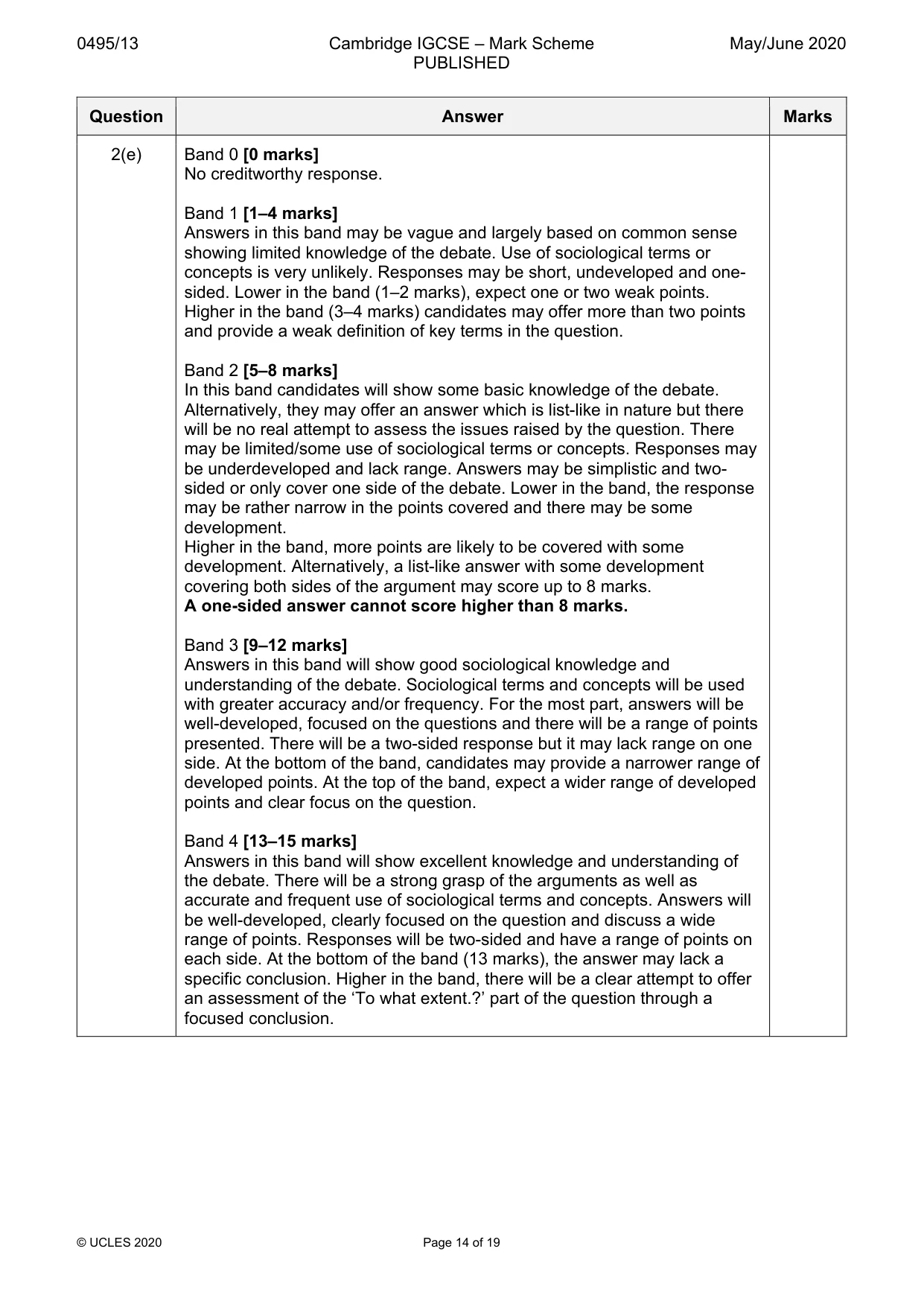
0495/13 Cambridge IGCSE – Mark Scheme PUBLISHED May/June 2020 © UCLES 2020 Page 14 of 19 Question Answer Marks 2(e) Band 0 [0 marks] No creditworthy response. Band 1 [1–4 marks] Answers in this band may be vague and largely based on common sense showing limited knowledge of the debate. Use of sociological terms or concepts is very unlikely. Responses may be short, undeveloped and one- sided. Lower in the band (1–2 marks), expect one or two weak points. Higher in the band (3–4 marks) candidates may offer more than two points and provide a weak definition of key terms in the question. Band 2 [5–8 marks] In this band candidates will show some basic knowledge of the debate. Alternatively, they may offer an answer which is list-like in nature but there will be no real attempt to assess the issues raised by the question. There may be limited/some use of sociological terms or concepts. Responses may be underdeveloped and lack range. Answers may be simplistic and two- sided or only cover one side of the debate. Lower in the band, the response may be rather narrow in the points covered and there may be some development. Higher in the band, more points are likely to be covered with some development. Alternatively, a list-like answer with some development covering both sides of the argument may score up to 8 marks. A one-sided answer cannot score higher than 8 marks. Band 3 [9–12 marks] Answers in this band will show good sociological knowledge and understanding of the debate. Sociological terms and concepts will be used with greater accuracy and/or frequency. For the most part, answers will be well-developed, focused on the questions and there will be a range of points presented. There will be a two-sided response but it may lack range on one side. At the bottom of the band, candidates may provide a narrower range of developed points. At the top of the band, expect a wider range of developed points and clear focus on the question. Band 4 [13–15 marks] Answers in this band will show excellent knowledge and understanding of the debate. There will be a strong grasp of the arguments as well as accurate and frequent use of sociological terms and concepts. Answers will be well-developed, clearly focused on the question and discuss a wide range of points. Responses will be two-sided and have a range of points on each side. At the bottom of the band (13 marks), the answer may lack a specific conclusion. Higher in the band, there will be a clear attempt to offer an assessment of the ‘To what extent.?’ part of the question through a focused conclusion.
Mark scheme, page 15
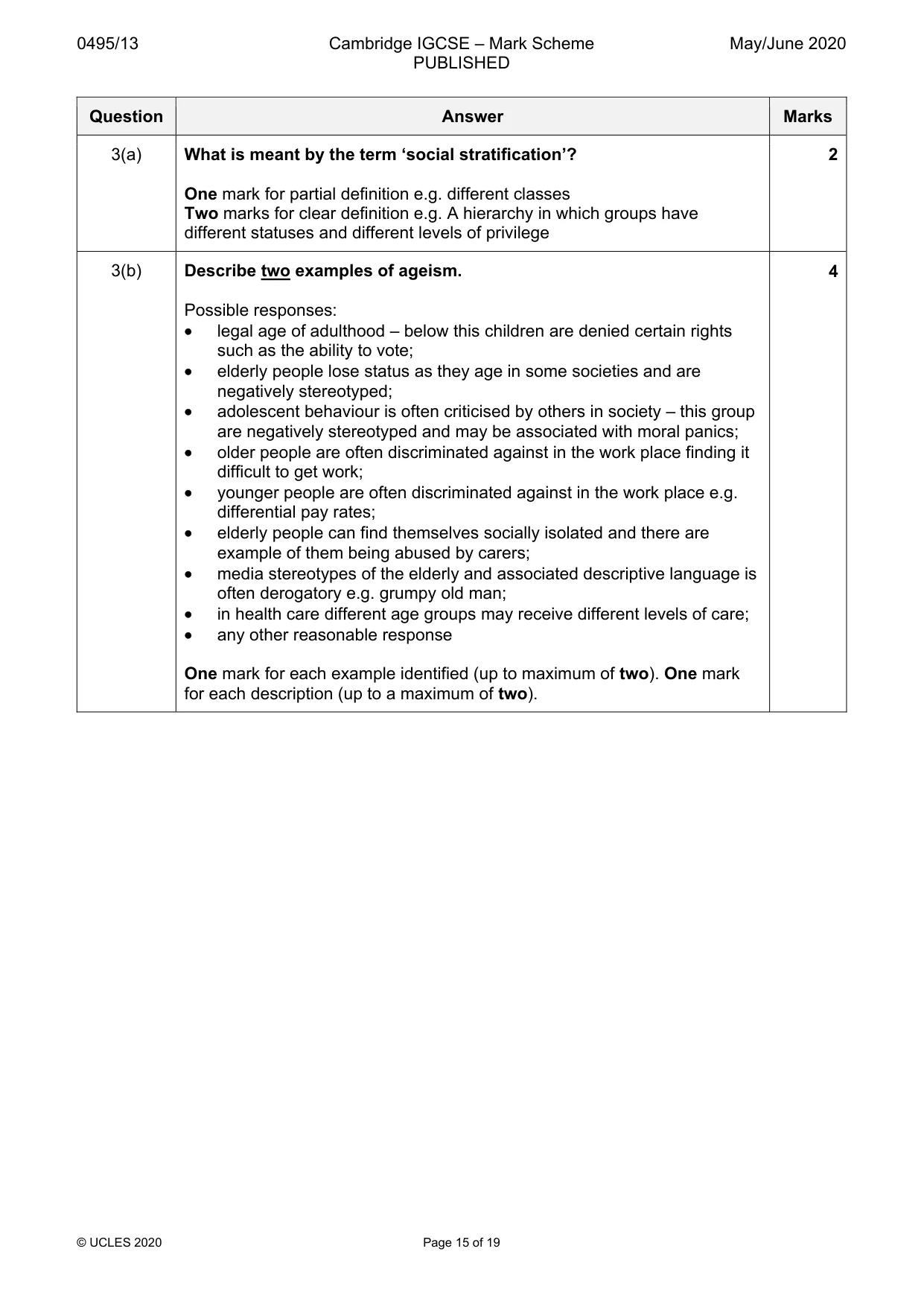
0495/13 Cambridge IGCSE – Mark Scheme PUBLISHED May/June 2020 © UCLES 2020 Page 15 of 19 Question Answer Marks 3(a) What is meant by the term ‘social stratification’? One mark for partial definition e.g. different classes Two marks for clear definition e.g. A hierarchy in which groups have different statuses and different levels of privilege 2 3(b) Describe two examples of ageism. Possible responses: • legal age of adulthood – below this children are denied certain rights such as the ability to vote; • elderly people lose status as they age in some societies and are negatively stereotyped; • adolescent behaviour is often criticised by others in society – this group are negatively stereotyped and may be associated with moral panics; • older people are often discriminated against in the work place finding it difficult to get work; • younger people are often discriminated against in the work place e.g. differential pay rates; • elderly people can find themselves socially isolated and there are example of them being abused by carers; • media stereotypes of the elderly and associated descriptive language is often derogatory e.g. grumpy old man; • in health care different age groups may receive different levels of care; • any other reasonable response One mark for each example identified (up to maximum of two). One mark for each description (up to a maximum of two). 4
Mark scheme, page 16
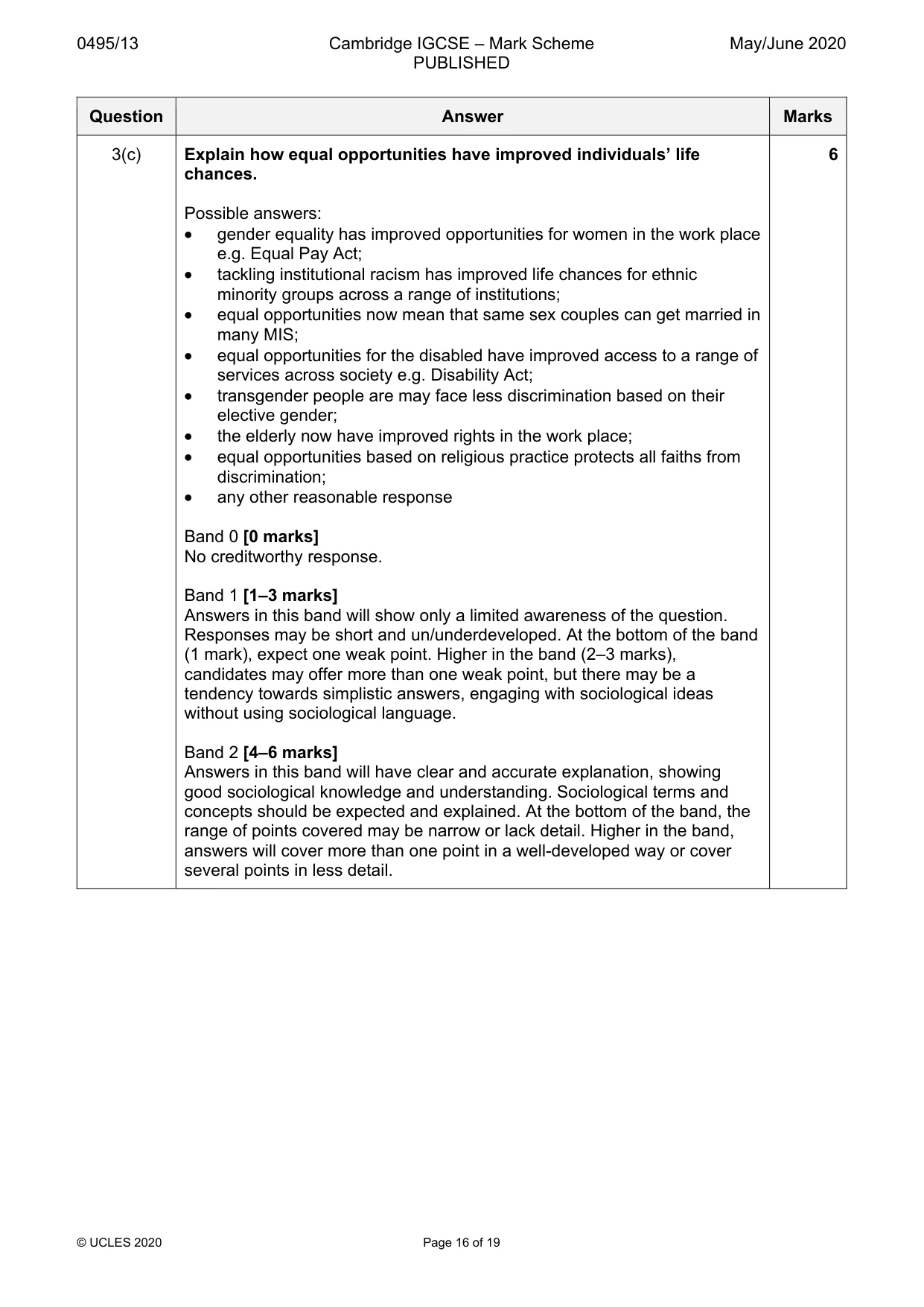
0495/13 Cambridge IGCSE – Mark Scheme PUBLISHED May/June 2020 © UCLES 2020 Page 16 of 19 Question Answer Marks 3(c) Explain how equal opportunities have improved individuals’ life chances. Possible answers: • gender equality has improved opportunities for women in the work place e.g. Equal Pay Act; • tackling institutional racism has improved life chances for ethnic minority groups across a range of institutions; • equal opportunities now mean that same sex couples can get married in many MIS; • equal opportunities for the disabled have improved access to a range of services across society e.g. Disability Act; • transgender people are may face less discrimination based on their elective gender; • the elderly now have improved rights in the work place; • equal opportunities based on religious practice protects all faiths from discrimination; • any other reasonable response Band 0 [0 marks] No creditworthy response. Band 1 [1–3 marks] Answers in this band will show only a limited awareness of the question. Responses may be short and un/underdeveloped. At the bottom of the band (1 mark), expect one weak point. Higher in the band (2–3 marks), candidates may offer more than one weak point, but there may be a tendency towards simplistic answers, engaging with sociological ideas without using sociological language. Band 2 [4–6 marks] Answers in this band will have clear and accurate explanation, showing good sociological knowledge and understanding. Sociological terms and concepts should be expected and explained. At the bottom of the band, the range of points covered may be narrow or lack detail. Higher in the band, answers will cover more than one point in a well-developed way or cover several points in less detail. 6
Mark scheme, page 17
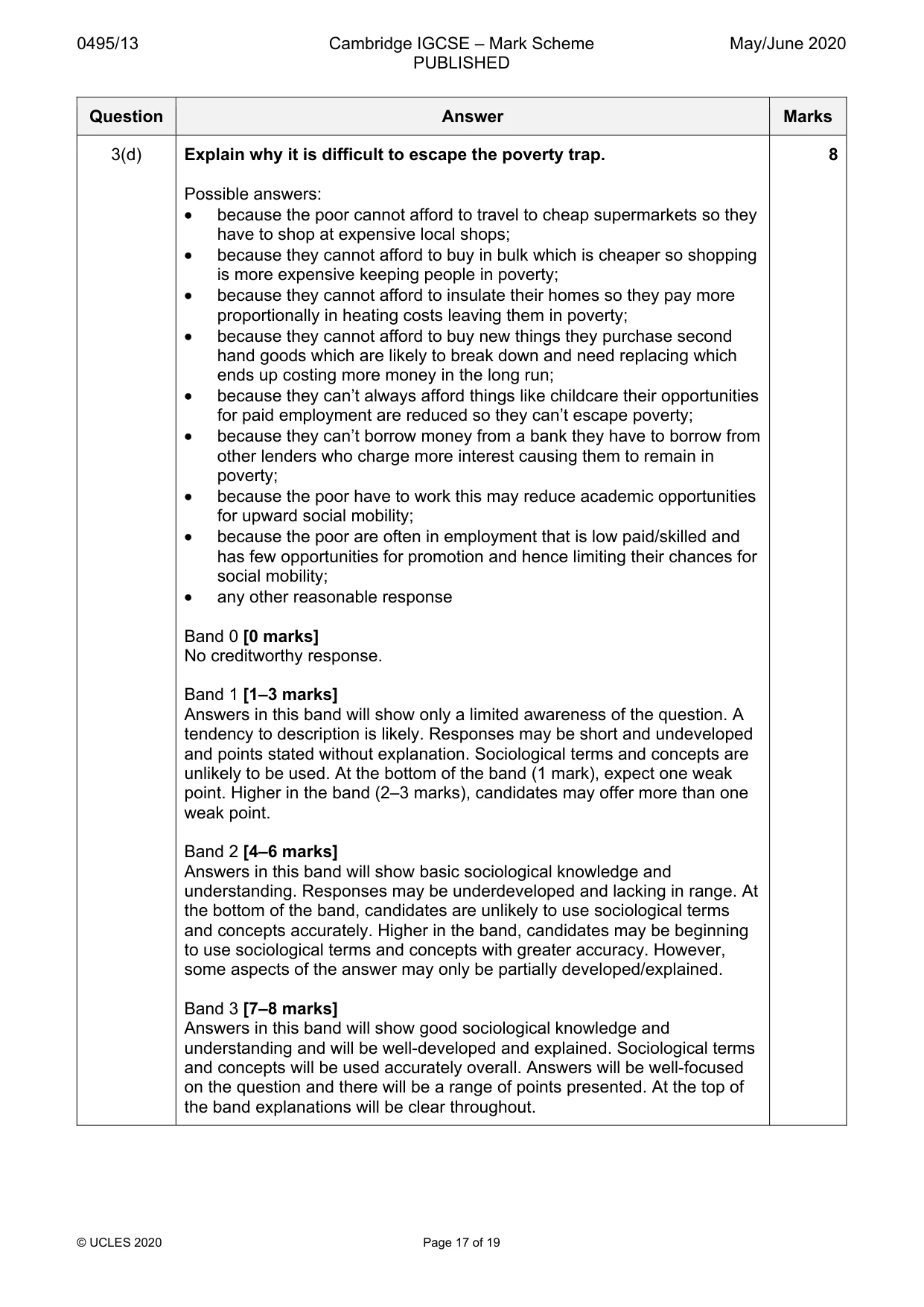
0495/13 Cambridge IGCSE – Mark Scheme PUBLISHED May/June 2020 © UCLES 2020 Page 17 of 19 Question Answer Marks 3(d) Explain why it is difficult to escape the poverty trap. Possible answers: • because the poor cannot afford to travel to cheap supermarkets so they have to shop at expensive local shops; • because they cannot afford to buy in bulk which is cheaper so shopping is more expensive keeping people in poverty; • because they cannot afford to insulate their homes so they pay more proportionally in heating costs leaving them in poverty; • because they cannot afford to buy new things they purchase second hand goods which are likely to break down and need replacing which ends up costing more money in the long run; • because they can’t always afford things like childcare their opportunities for paid employment are reduced so they can’t escape poverty; • because they can’t borrow money from a bank they have to borrow from other lenders who charge more interest causing them to remain in poverty; • because the poor have to work this may reduce academic opportunities for upward social mobility; • because the poor are often in employment that is low paid/skilled and has few opportunities for promotion and hence limiting their chances for social mobility; • any other reasonable response Band 0 [0 marks] No creditworthy response. Band 1 [1–3 marks] Answers in this band will show only a limited awareness of the question. A tendency to description is likely. Responses may be short and undeveloped and points stated without explanation. Sociological terms and concepts are unlikely to be used. At the bottom of the band (1 mark), expect one weak point. Higher in the band (2–3 marks), candidates may offer more than one weak point. Band 2 [4–6 marks] Answers in this band will show basic sociological knowledge and understanding. Responses may be underdeveloped and lacking in range. At the bottom of the band, candidates are unlikely to use sociological terms and concepts accurately. Higher in the band, candidates may be beginning to use sociological terms and concepts with greater accuracy. However, some aspects of the answer may only be partially developed/explained. Band 3 [7–8 marks] Answers in this band will show good sociological knowledge and understanding and will be well-developed and explained. Sociological terms and concepts will be used accurately overall. Answers will be well-focused on the question and there will be a range of points presented. At the top of the band explanations will be clear throughout. 8
Mark scheme, page 18
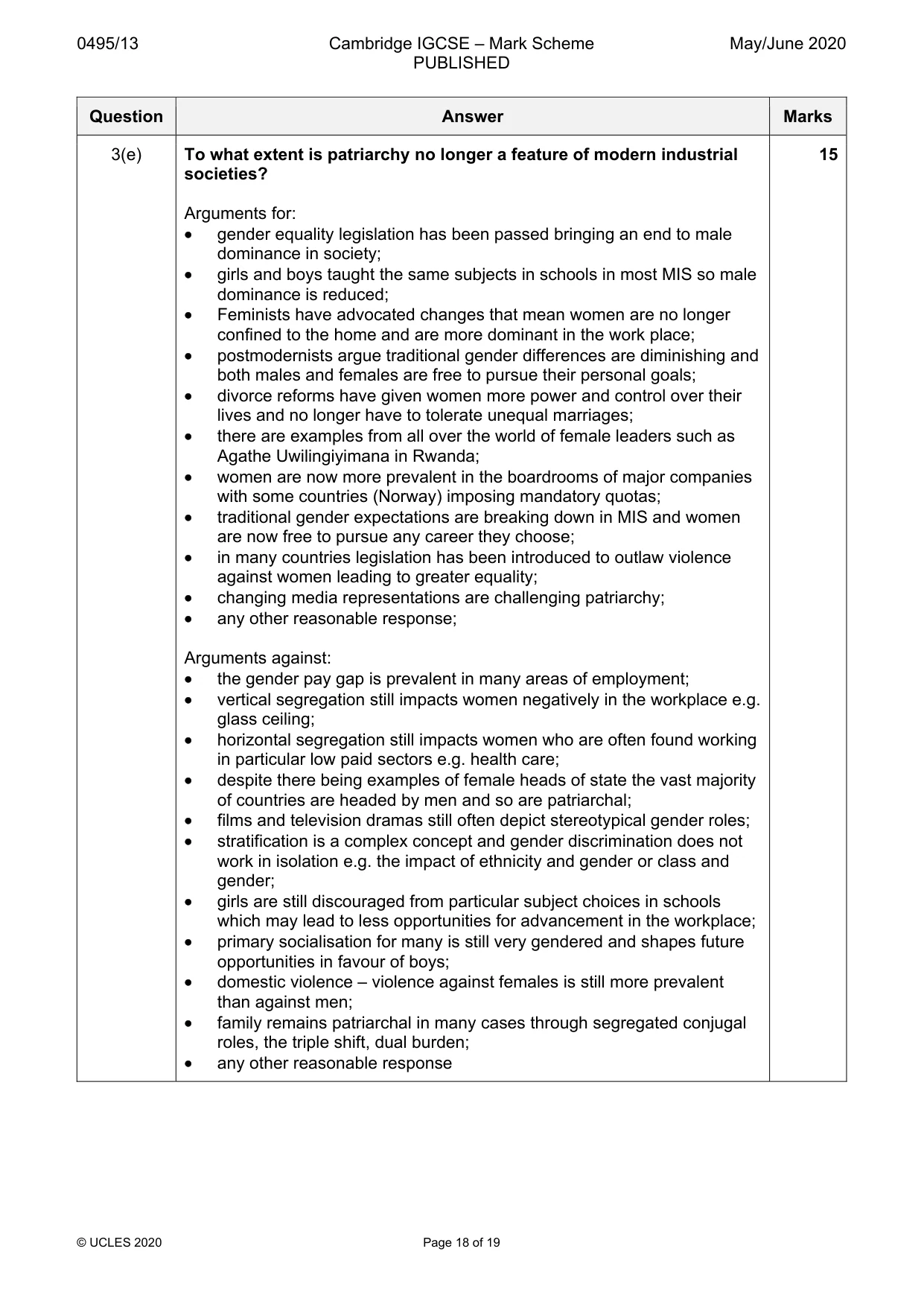
0495/13 Cambridge IGCSE – Mark Scheme PUBLISHED May/June 2020 © UCLES 2020 Page 18 of 19 Question Answer Marks 3(e) To what extent is patriarchy no longer a feature of modern industrial societies? Arguments for: • gender equality legislation has been passed bringing an end to male dominance in society; • girls and boys taught the same subjects in schools in most MIS so male dominance is reduced; • Feminists have advocated changes that mean women are no longer confined to the home and are more dominant in the work place; • postmodernists argue traditional gender differences are diminishing and both males and females are free to pursue their personal goals; • divorce reforms have given women more power and control over their lives and no longer have to tolerate unequal marriages; • there are examples from all over the world of female leaders such as Agathe Uwilingiyimana in Rwanda; • women are now more prevalent in the boardrooms of major companies with some countries (Norway) imposing mandatory quotas; • traditional gender expectations are breaking down in MIS and women are now free to pursue any career they choose; • in many countries legislation has been introduced to outlaw violence against women leading to greater equality; • changing media representations are challenging patriarchy; • any other reasonable response; Arguments against: • the gender pay gap is prevalent in many areas of employment; • vertical segregation still impacts women negatively in the workplace e.g. glass ceiling; • horizontal segregation still impacts women who are often found working in particular low paid sectors e.g. health care; • despite there being examples of female heads of state the vast majority of countries are headed by men and so are patriarchal; • films and television dramas still often depict stereotypical gender roles; • stratification is a complex concept and gender discrimination does not work in isolation e.g. the impact of ethnicity and gender or class and gender; • girls are still discouraged from particular subject choices in schools which may lead to less opportunities for advancement in the workplace; • primary socialisation for many is still very gendered and shapes future opportunities in favour of boys; • domestic violence – violence against females is still more prevalent than against men; • family remains patriarchal in many cases through segregated conjugal roles, the triple shift, dual burden; • any other reasonable response 15
Mark scheme, page 19
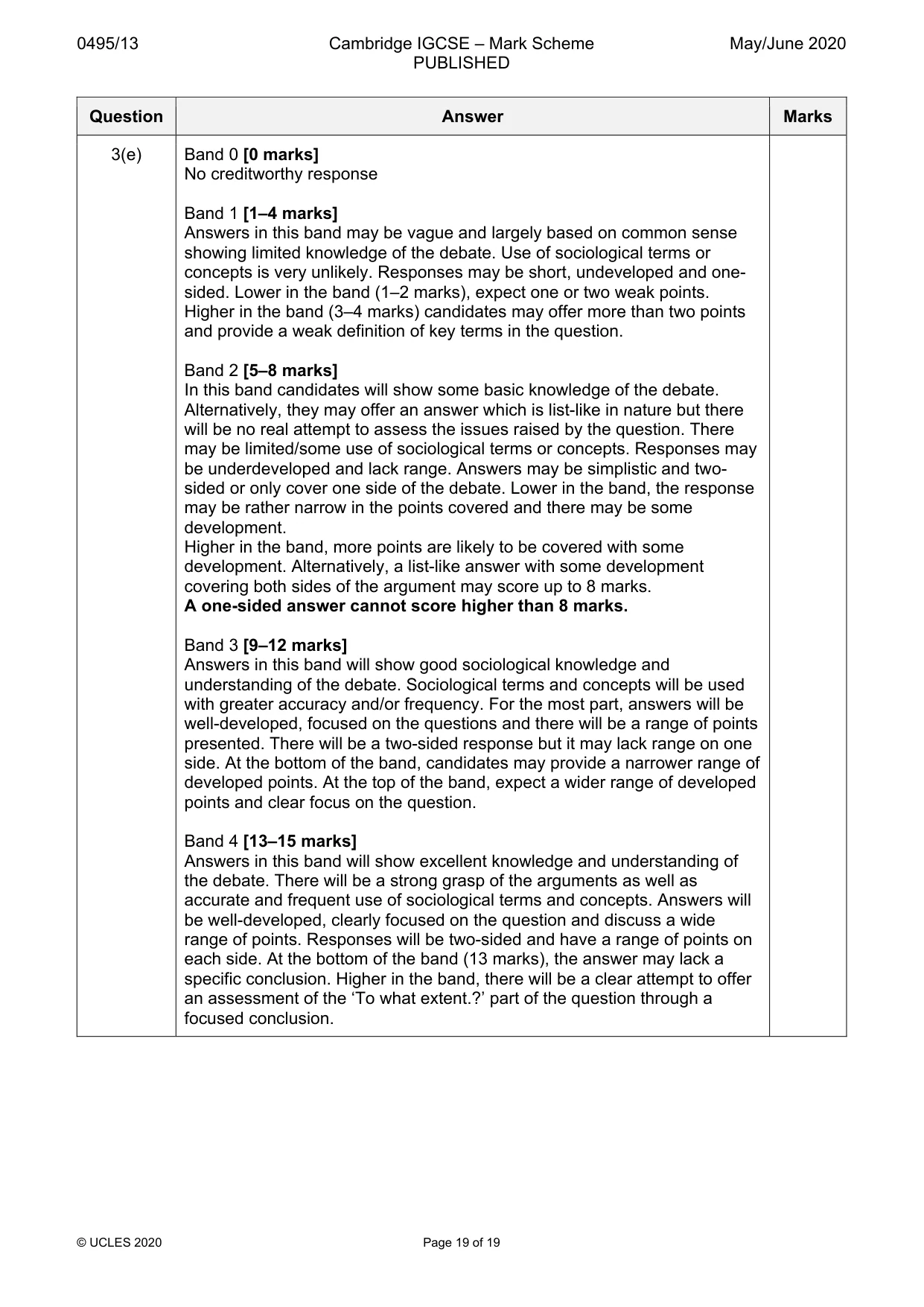
0495/13 Cambridge IGCSE – Mark Scheme PUBLISHED May/June 2020 © UCLES 2020 Page 19 of 19 Question Answer Marks 3(e) Band 0 [0 marks] No creditworthy response Band 1 [1–4 marks] Answers in this band may be vague and largely based on common sense showing limited knowledge of the debate. Use of sociological terms or concepts is very unlikely. Responses may be short, undeveloped and one- sided. Lower in the band (1–2 marks), expect one or two weak points. Higher in the band (3–4 marks) candidates may offer more than two points and provide a weak definition of key terms in the question. Band 2 [5–8 marks] In this band candidates will show some basic knowledge of the debate. Alternatively, they may offer an answer which is list-like in nature but there will be no real attempt to assess the issues raised by the question. There may be limited/some use of sociological terms or concepts. Responses may be underdeveloped and lack range. Answers may be simplistic and two- sided or only cover one side of the debate. Lower in the band, the response may be rather narrow in the points covered and there may be some development. Higher in the band, more points are likely to be covered with some development. Alternatively, a list-like answer with some development covering both sides of the argument may score up to 8 marks. A one-sided answer cannot score higher than 8 marks. Band 3 [9–12 marks] Answers in this band will show good sociological knowledge and understanding of the debate. Sociological terms and concepts will be used with greater accuracy and/or frequency. For the most part, answers will be well-developed, focused on the questions and there will be a range of points presented. There will be a two-sided response but it may lack range on one side. At the bottom of the band, candidates may provide a narrower range of developed points. At the top of the band, expect a wider range of developed points and clear focus on the question. Band 4 [13–15 marks] Answers in this band will show excellent knowledge and understanding of the debate. There will be a strong grasp of the arguments as well as accurate and frequent use of sociological terms and concepts. Answers will be well-developed, clearly focused on the question and discuss a wide range of points. Responses will be two-sided and have a range of points on each side. At the bottom of the band (13 marks), the answer may lack a specific conclusion. Higher in the band, there will be a clear attempt to offer an assessment of the ‘To what extent.?’ part of the question through a focused conclusion.