Cambridge IGCSE Sociology 0495 — 2020 May/June Paper 1 · Variant 2
0495/12/M/J/20
The question paper and its mark scheme, free to read here and free to download. This is Cambridge’s own paper, exactly as it was sat.
Question paper4 pages

Mark scheme21 pages
Answers below. Sit the paper first if you are practising.

Paper as text
Question paper, page 1
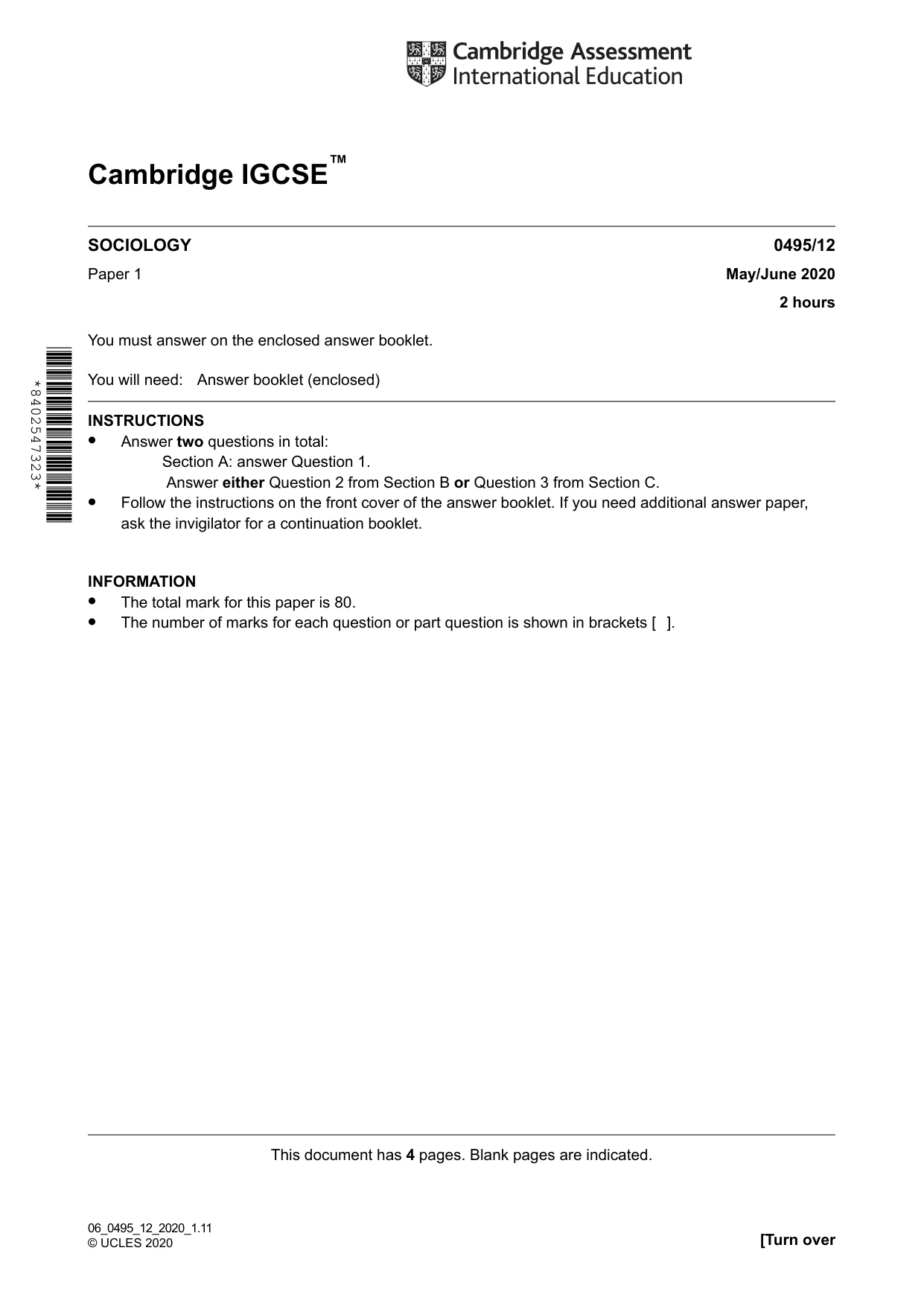
Cambridge IGCSE™ 0495/12 May/June 2020 2 hours SOCIOLOGY Paper 1 You must answer on the enclosed answer booklet. You will need: Answer booklet (enclosed) INSTRUCTIONS • Answer two questions in total: Section A: answer Question 1. Answer either Question 2 from Section B or Question 3 from Section C. • Follow the instructions on the front cover of the answer booklet. If you need additional answer paper, ask the invigilator for a continuation booklet. INFORMATION • The total mark for this paper is 80. • The number of marks for each question or part question is shown in brackets [ ]. This document has 4 pages. Blank pages are indicated. [Turn over 06_0495_12_2020_1.11 © UCLES 2020 *8402547323*
Question paper, page 2
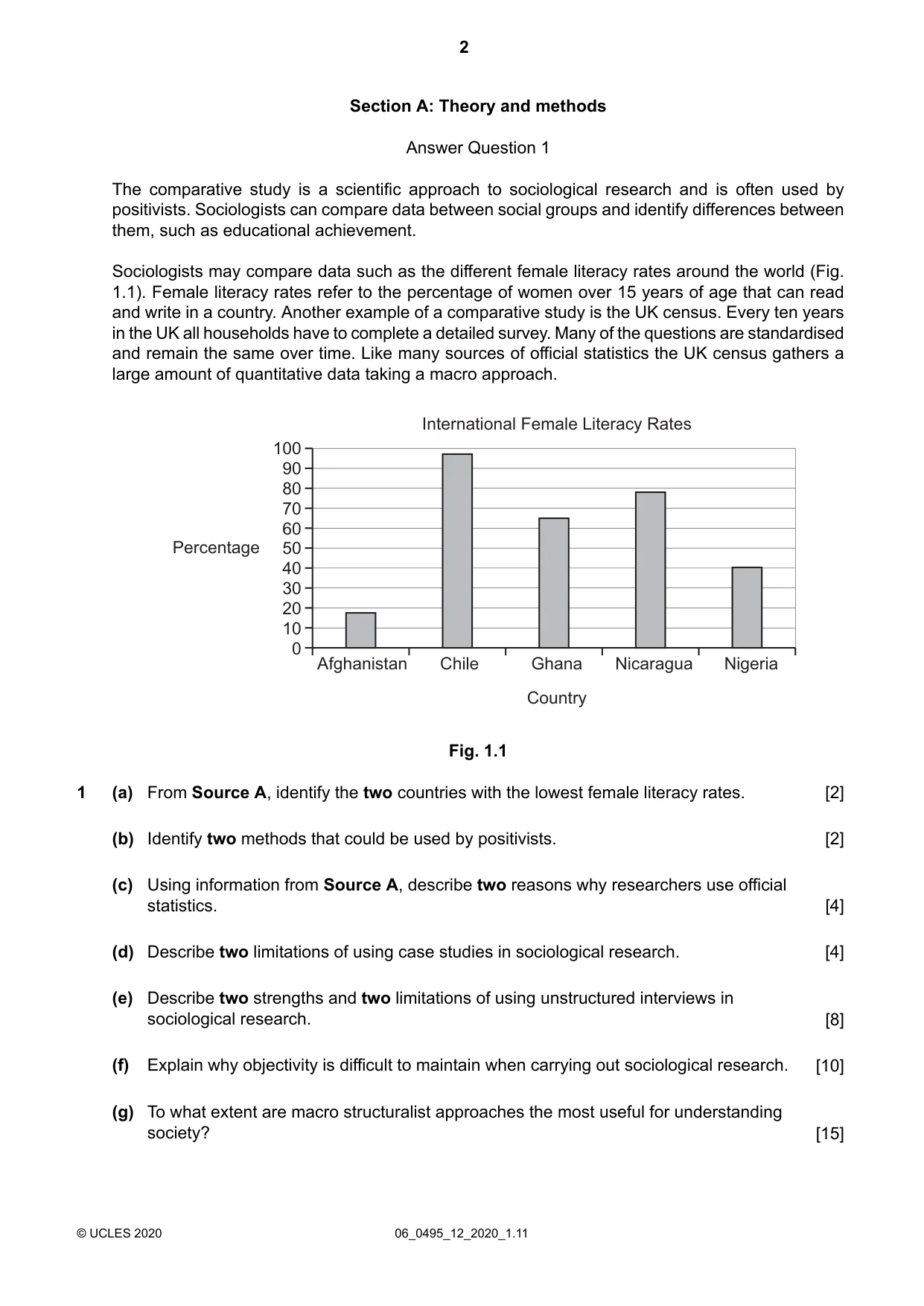
Section A: Theory and methods Answer Question 1 The comparative study is a scientific approach to sociological research and is often used by positivists. Sociologists can compare data between social groups and identify differences between them, such as educational achievement. Sociologists may compare data such as the different female literacy rates around the world (Fig. 1.1). Female literacy rates refer to the percentage of women over 15 years of age that can read and write in a country. Another example of a comparative study is the UK census. Every ten years in the UK all households have to complete a detailed survey. Many of the questions are standardised and remain the same over time. Like many sources of official statistics the UK census gathers a large amount of quantitative data taking a macro approach. Afghanistan Chile Ghana Country International Female Literacy Rates Nicaragua Nigeria 100 90 80 70 60 50 40 30 20 10 0 Percentage Fig. 1.1 From Source A, identify the two countries with the lowest female literacy rates. [2] (a) 1 Identify two methods that could be used by positivists. [2] (b) Using information from Source A, describe two reasons why researchers use official statistics. [4] (c) Describe two limitations of using case studies in sociological research. [4] (d) Describe two strengths and two limitations of using unstructured interviews in sociological research. [8] (e) Explain why objectivity is difficult to maintain when carrying out sociological research. [10] (f) To what extent are macro structuralist approaches the most useful for understanding society? [15] (g) 06_0495_12_2020_1.11 © UCLES 2020 2
Question paper, page 3
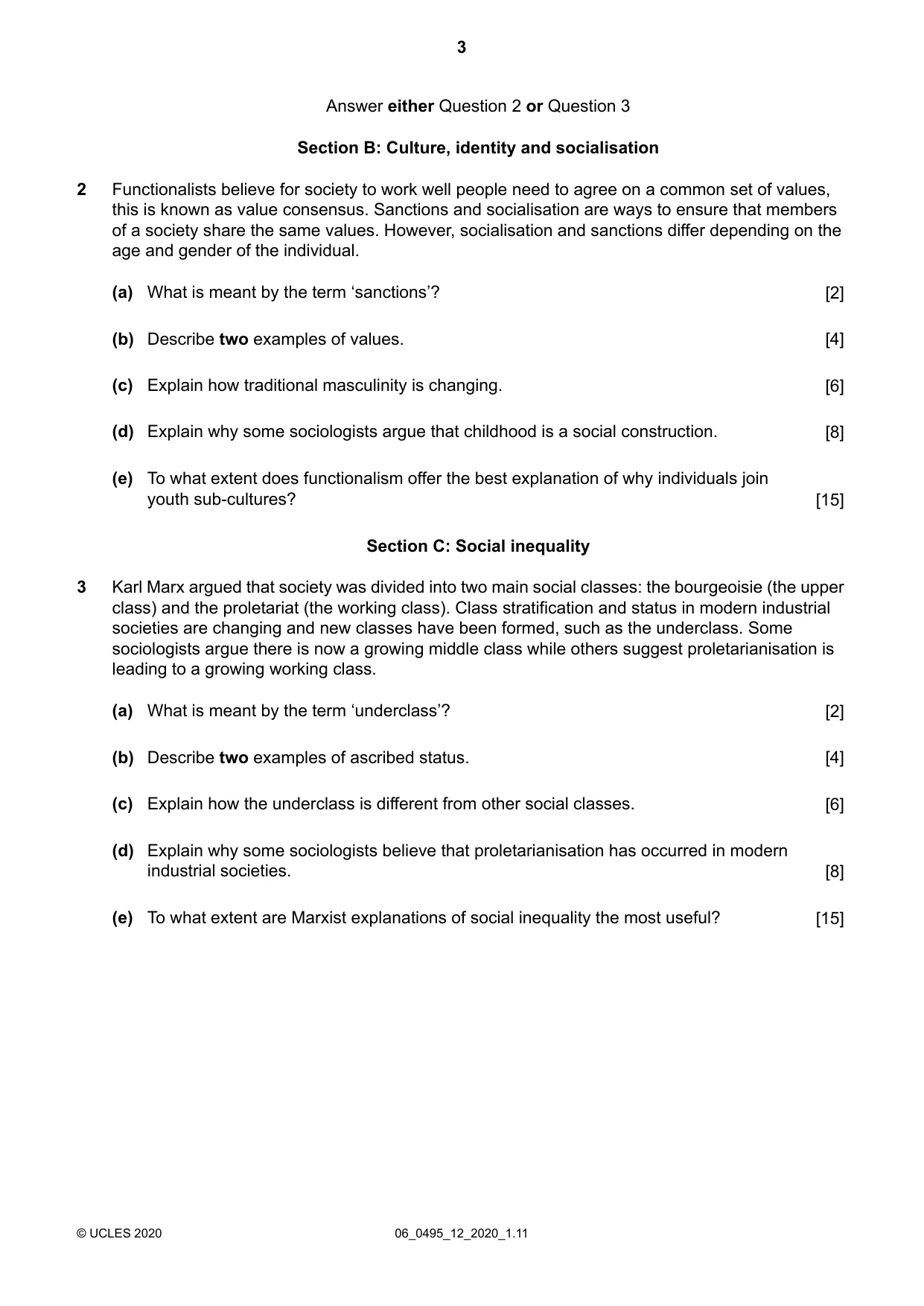
Answer either Question 2 or Question 3 Section B: Culture, identity and socialisation Functionalists believe for society to work well people need to agree on a common set of values, this is known as value consensus. Sanctions and socialisation are ways to ensure that members 2 of a society share the same values. However, socialisation and sanctions differ depending on the age and gender of the individual. What is meant by the term ‘sanctions’? [2] (a) Describe two examples of values. [4] (b) Explain how traditional masculinity is changing. [6] (c) Explain why some sociologists argue that childhood is a social construction. [8] (d) To what extent does functionalism offer the best explanation of why individuals join youth sub-cultures? [15] (e) Section C: Social inequality Karl Marx argued that society was divided into two main social classes: the bourgeoisie (the upper class) and the proletariat (the working class). Class stratification and status in modern industrial 3 societies are changing and new classes have been formed, such as the underclass. Some sociologists argue there is now a growing middle class while others suggest proletarianisation is leading to a growing working class. What is meant by the term ‘underclass’? [2] (a) Describe two examples of ascribed status. [4] (b) Explain how the underclass is different from other social classes. [6] (c) Explain why some sociologists believe that proletarianisation has occurred in modern industrial societies. [8] (d) To what extent are Marxist explanations of social inequality the most useful? [15] (e) 06_0495_12_2020_1.11 © UCLES 2020 3
Question paper, page 4
BLANK PAGE Permission to reproduce items where third-party owned material protected by copyright is included has been sought and cleared where possible. Every reasonable effort has been made by the publisher (UCLES) to trace copyright holders, but if any items requiring clearance have unwittingly been included, the publisher will be pleased to make amends at the earliest possible opportunity. To avoid the issue of disclosure of answer-related information to candidates, all copyright acknowledgements are reproduced online in the Cambridge Assessment International Education Copyright Acknowledgements Booklet. This is produced for each series of examinations and is freely available to download at www.cambridgeinternational.org after the live examination series. Cambridge Assessment International Education is part of the Cambridge Assessment Group. Cambridge Assessment is the brand name of the University of Cambridge Local Examinations Syndicate (UCLES), which itself is a department of the University of Cambridge. 06_0495_12_2020_1.11 © UCLES 2020 4
Mark scheme, page 1
This document consists of 21 printed pages. © UCLES 2020 [Turn over Cambridge IGCSE™ SOCIOLOGY 0495/12 Paper 1 May/June 2020 MARK SCHEME Maximum Mark: 80 Published Students did not sit exam papers in the June 2020 series due to the Covid-19 global pandemic. This mark scheme is published to support teachers and students and should be read together with the question paper. It shows the requirements of the exam. The answer column of the mark scheme shows the proposed basis on which Examiners would award marks for this exam. Where appropriate, this column also provides the most likely acceptable alternative responses expected from students. Examiners usually review the mark scheme after they have seen student responses and update the mark scheme if appropriate. In the June series, Examiners were unable to consider the acceptability of alternative responses, as there were no student responses to consider. Mark schemes should usually be read together with the Principal Examiner Report for Teachers. However, because students did not sit exam papers, there is no Principal Examiner Report for Teachers for the June 2020 series. Cambridge International will not enter into discussions about these mark schemes. Cambridge International is publishing the mark schemes for the June 2020 series for most Cambridge IGCSE™ and Cambridge International A & AS Level components, and some Cambridge O Level components.
Mark scheme, page 2
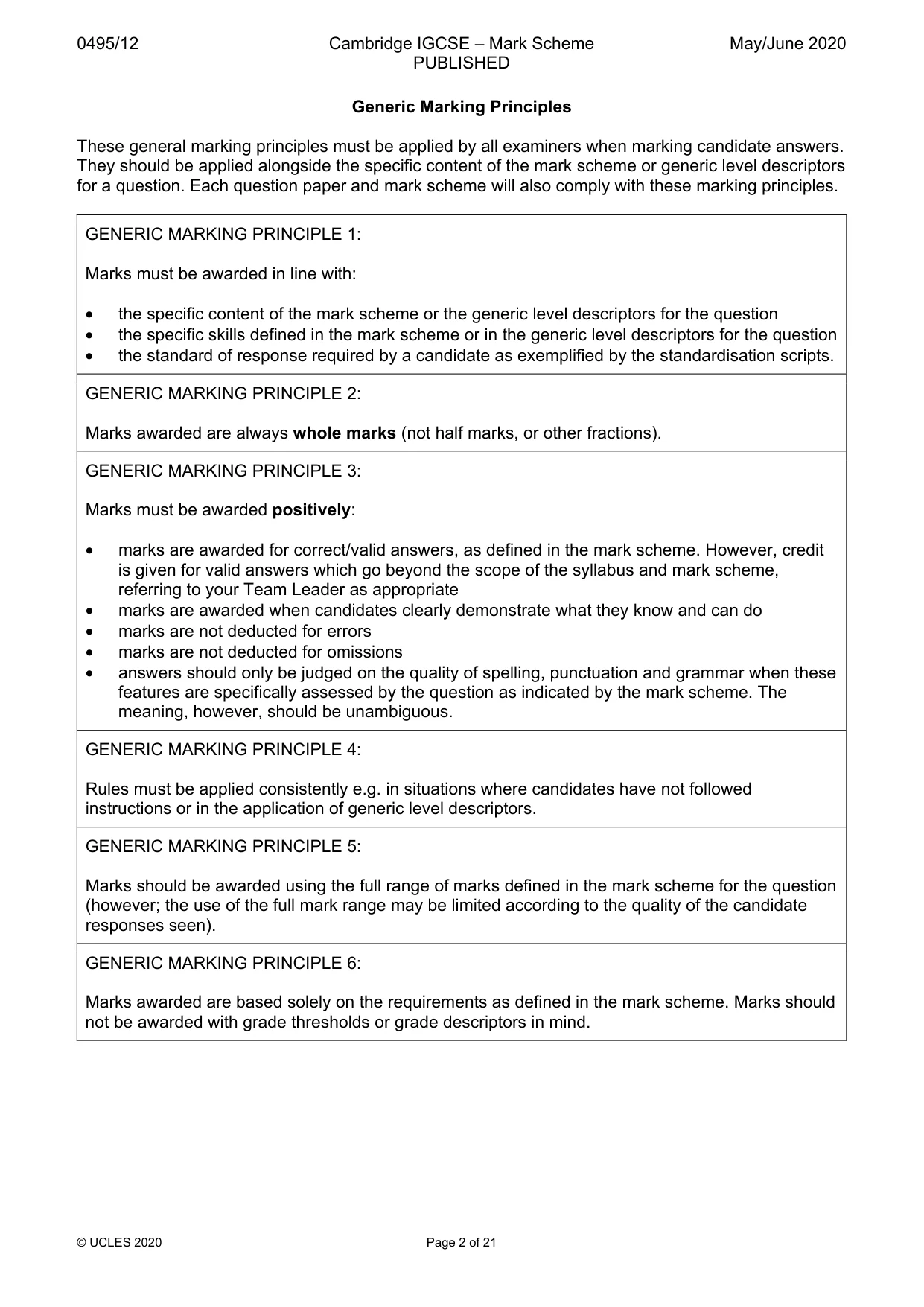
0495/12 Cambridge IGCSE – Mark Scheme PUBLISHED May/June 2020 © UCLES 2020 Page 2 of 21 Generic Marking Principles These general marking principles must be applied by all examiners when marking candidate answers. They should be applied alongside the specific content of the mark scheme or generic level descriptors for a question. Each question paper and mark scheme will also comply with these marking principles. GENERIC MARKING PRINCIPLE 1: Marks must be awarded in line with: • the specific content of the mark scheme or the generic level descriptors for the question • the specific skills defined in the mark scheme or in the generic level descriptors for the question • the standard of response required by a candidate as exemplified by the standardisation scripts. GENERIC MARKING PRINCIPLE 2: Marks awarded are always whole marks (not half marks, or other fractions). GENERIC MARKING PRINCIPLE 3: Marks must be awarded positively: • marks are awarded for correct/valid answers, as defined in the mark scheme. However, credit is given for valid answers which go beyond the scope of the syllabus and mark scheme, referring to your Team Leader as appropriate • marks are awarded when candidates clearly demonstrate what they know and can do • marks are not deducted for errors • marks are not deducted for omissions • answers should only be judged on the quality of spelling, punctuation and grammar when these features are specifically assessed by the question as indicated by the mark scheme. The meaning, however, should be unambiguous. GENERIC MARKING PRINCIPLE 4: Rules must be applied consistently e.g. in situations where candidates have not followed instructions or in the application of generic level descriptors. GENERIC MARKING PRINCIPLE 5: Marks should be awarded using the full range of marks defined in the mark scheme for the question (however; the use of the full mark range may be limited according to the quality of the candidate responses seen). GENERIC MARKING PRINCIPLE 6: Marks awarded are based solely on the requirements as defined in the mark scheme. Marks should not be awarded with grade thresholds or grade descriptors in mind.
Mark scheme, page 3
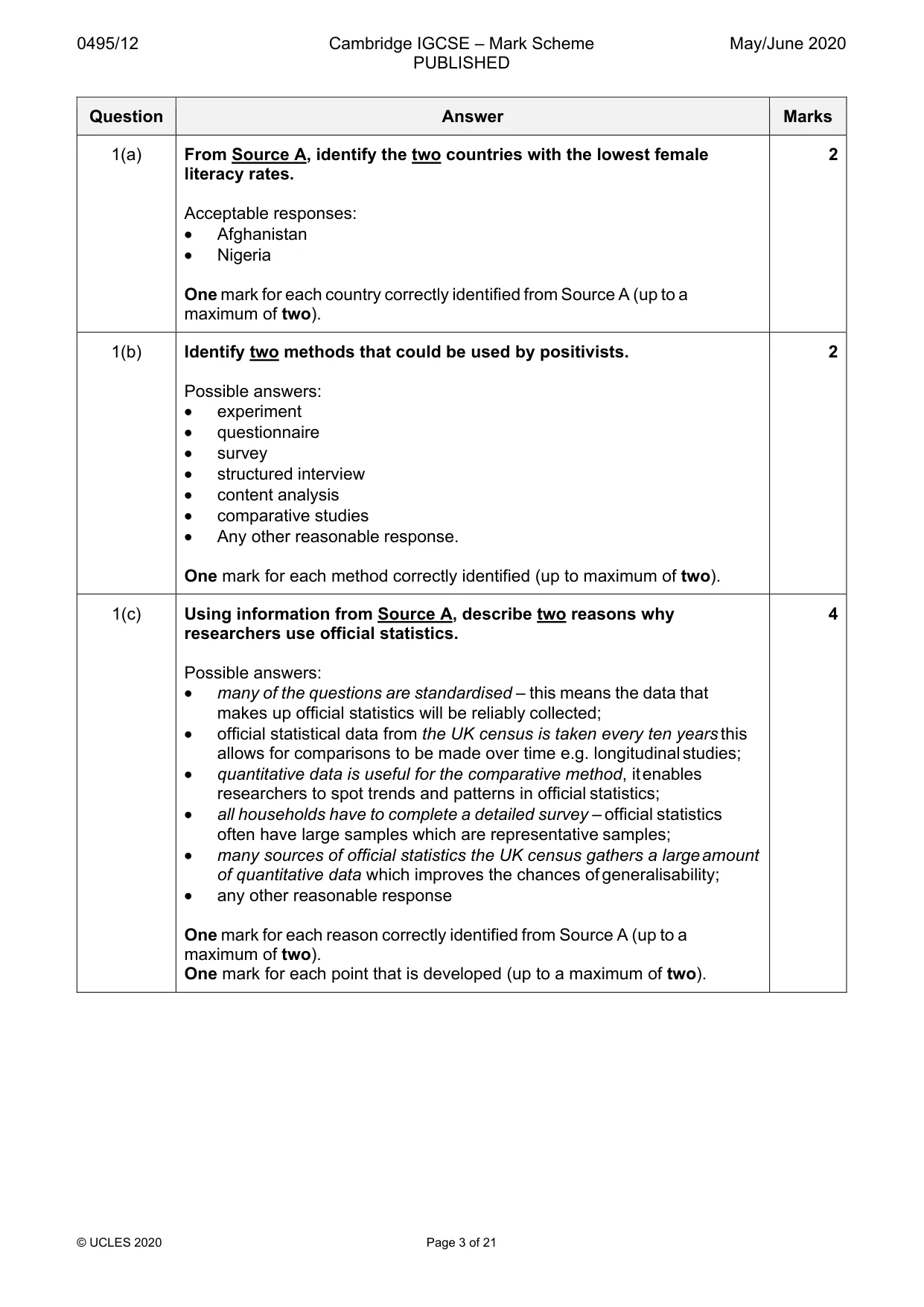
0495/12 Cambridge IGCSE – Mark Scheme PUBLISHED May/June 2020 © UCLES 2020 Page 3 of 21 Question Answer Marks 1(a) From Source A, identify the two countries with the lowest female literacy rates. Acceptable responses: • Afghanistan • Nigeria One mark for each country correctly identified from Source A (up to a maximum of two). 2 1(b) Identify two methods that could be used by positivists. Possible answers: • experiment • questionnaire • survey • structured interview • content analysis • comparative studies • Any other reasonable response. One mark for each method correctly identified (up to maximum of two). 2 1(c) Using information from Source A, describe two reasons why researchers use official statistics. Possible answers: • many of the questions are standardised – this means the data that makes up official statistics will be reliably collected; • official statistical data from the UK census is taken every ten years this allows for comparisons to be made over time e.g. longitudinal studies; • quantitative data is useful for the comparative method, it enables researchers to spot trends and patterns in official statistics; • all households have to complete a detailed survey – official statistics often have large samples which are representative samples; • many sources of official statistics the UK census gathers a large amount of quantitative data which improves the chances of generalisability; • any other reasonable response One mark for each reason correctly identified from Source A (up to a maximum of two). One mark for each point that is developed (up to a maximum of two). 4
Mark scheme, page 4
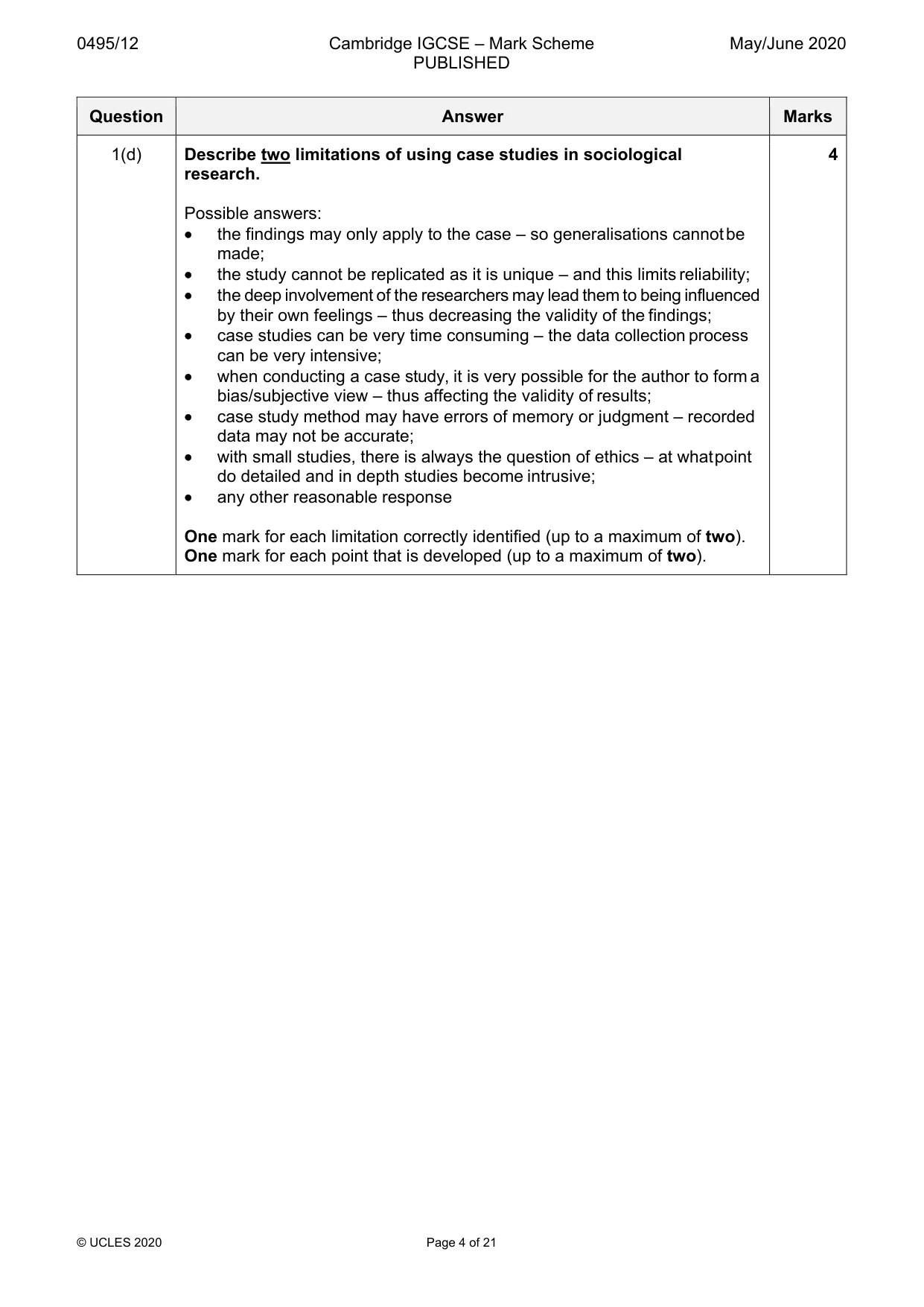
0495/12 Cambridge IGCSE – Mark Scheme PUBLISHED May/June 2020 © UCLES 2020 Page 4 of 21 Question Answer Marks 1(d) Describe two limitations of using case studies in sociological research. Possible answers: • the findings may only apply to the case – so generalisations cannot be made; • the study cannot be replicated as it is unique – and this limits reliability; • the deep involvement of the researchers may lead them to being influenced by their own feelings – thus decreasing the validity of the findings; • case studies can be very time consuming – the data collection process can be very intensive; • when conducting a case study, it is very possible for the author to form a bias/subjective view – thus affecting the validity of results; • case study method may have errors of memory or judgment – recorded data may not be accurate; • with small studies, there is always the question of ethics – at what point do detailed and in depth studies become intrusive; • any other reasonable response One mark for each limitation correctly identified (up to a maximum of two). One mark for each point that is developed (up to a maximum of two). 4
Mark scheme, page 5
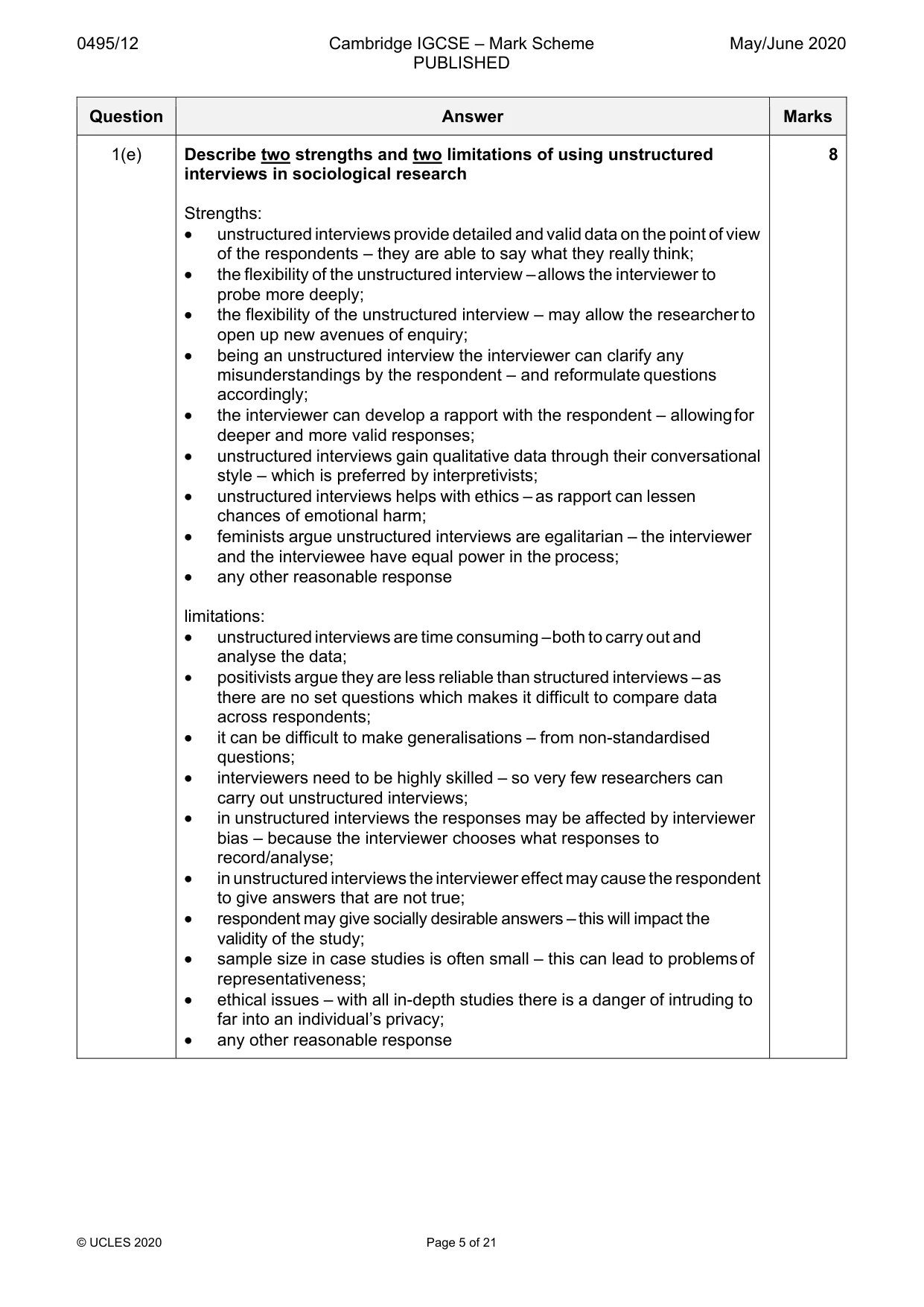
0495/12 Cambridge IGCSE – Mark Scheme PUBLISHED May/June 2020 © UCLES 2020 Page 5 of 21 Question Answer Marks 1(e) Describe two strengths and two limitations of using unstructured interviews in sociological research Strengths: • unstructured interviews provide detailed and valid data on the point of view of the respondents – they are able to say what they really think; • the flexibility of the unstructured interview – allows the interviewer to probe more deeply; • the flexibility of the unstructured interview – may allow the researcher to open up new avenues of enquiry; • being an unstructured interview the interviewer can clarify any misunderstandings by the respondent – and reformulate questions accordingly; • the interviewer can develop a rapport with the respondent – allowing for deeper and more valid responses; • unstructured interviews gain qualitative data through their conversational style – which is preferred by interpretivists; • unstructured interviews helps with ethics – as rapport can lessen chances of emotional harm; • feminists argue unstructured interviews are egalitarian – the interviewer and the interviewee have equal power in the process; • any other reasonable response limitations: • unstructured interviews are time consuming – both to carry out and analyse the data; • positivists argue they are less reliable than structured interviews – as there are no set questions which makes it difficult to compare data across respondents; • it can be difficult to make generalisations – from non-standardised questions; • interviewers need to be highly skilled – so very few researchers can carry out unstructured interviews; • in unstructured interviews the responses may be affected by interviewer bias – because the interviewer chooses what responses to record/analyse; • in unstructured interviews the interviewer effect may cause the respondent to give answers that are not true; • respondent may give socially desirable answers – this will impact the validity of the study; • sample size in case studies is often small – this can lead to problems of representativeness; • ethical issues – with all in-depth studies there is a danger of intruding to far into an individual’s privacy; • any other reasonable response 8
Mark scheme, page 6
0495/12 Cambridge IGCSE – Mark Scheme PUBLISHED May/June 2020 © UCLES 2020 Page 6 of 21 Question Answer Marks 1(e) One mark for each strength correctly identified (up to a maximum of two). One mark for each strength that is developed with reference to unstructured interviews (up to a maximum of two). One mark for each limitation correctly identified (up to a maximum of two) One mark for each limitation that is developed with reference to unstructured interviews (up to a maximum of two)
Mark scheme, page 7
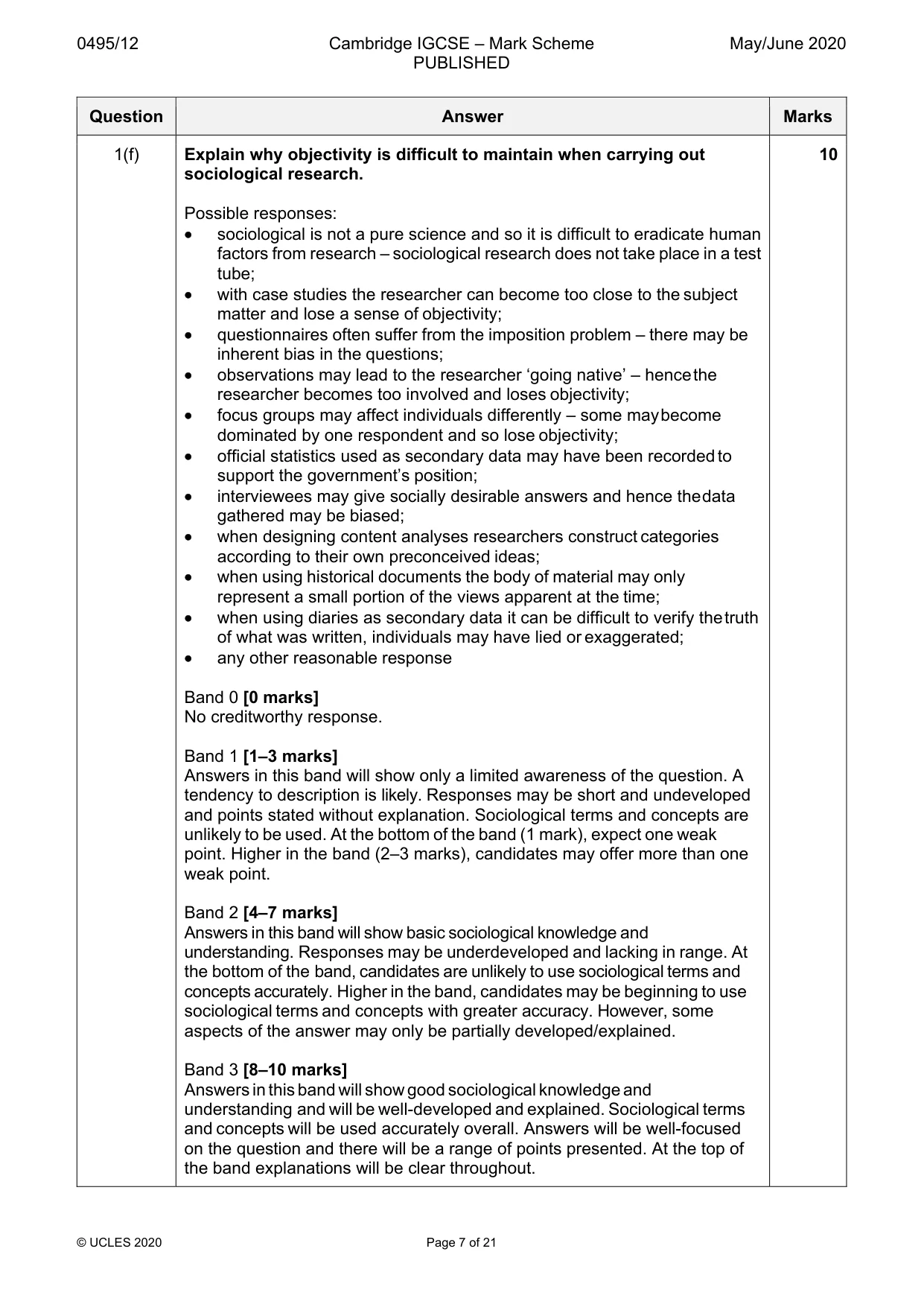
0495/12 Cambridge IGCSE – Mark Scheme PUBLISHED May/June 2020 © UCLES 2020 Page 7 of 21 Question Answer Marks 1(f) Explain why objectivity is difficult to maintain when carrying out sociological research. Possible responses: • sociological is not a pure science and so it is difficult to eradicate human factors from research – sociological research does not take place in a test tube; • with case studies the researcher can become too close to the subject matter and lose a sense of objectivity; • questionnaires often suffer from the imposition problem – there may be inherent bias in the questions; • observations may lead to the researcher ‘going native’ – hence the researcher becomes too involved and loses objectivity; • focus groups may affect individuals differently – some may become dominated by one respondent and so lose objectivity; • official statistics used as secondary data may have been recorded to support the government’s position; • interviewees may give socially desirable answers and hence the data gathered may be biased; • when designing content analyses researchers construct categories according to their own preconceived ideas; • when using historical documents the body of material may only represent a small portion of the views apparent at the time; • when using diaries as secondary data it can be difficult to verify the truth of what was written, individuals may have lied or exaggerated; • any other reasonable response Band 0 [0 marks] No creditworthy response. Band 1 [1–3 marks] Answers in this band will show only a limited awareness of the question. A tendency to description is likely. Responses may be short and undeveloped and points stated without explanation. Sociological terms and concepts are unlikely to be used. At the bottom of the band (1 mark), expect one weak point. Higher in the band (2–3 marks), candidates may offer more than one weak point. Band 2 [4–7 marks] Answers in this band will show basic sociological knowledge and understanding. Responses may be underdeveloped and lacking in range. At the bottom of the band, candidates are unlikely to use sociological terms and concepts accurately. Higher in the band, candidates may be beginning to use sociological terms and concepts with greater accuracy. However, some aspects of the answer may only be partially developed/explained. Band 3 [8–10 marks] Answers in this band will show good sociological knowledge and understanding and will be well-developed and explained. Sociological terms and concepts will be used accurately overall. Answers will be well-focused on the question and there will be a range of points presented. At the top of the band explanations will be clear throughout. 10
Mark scheme, page 8
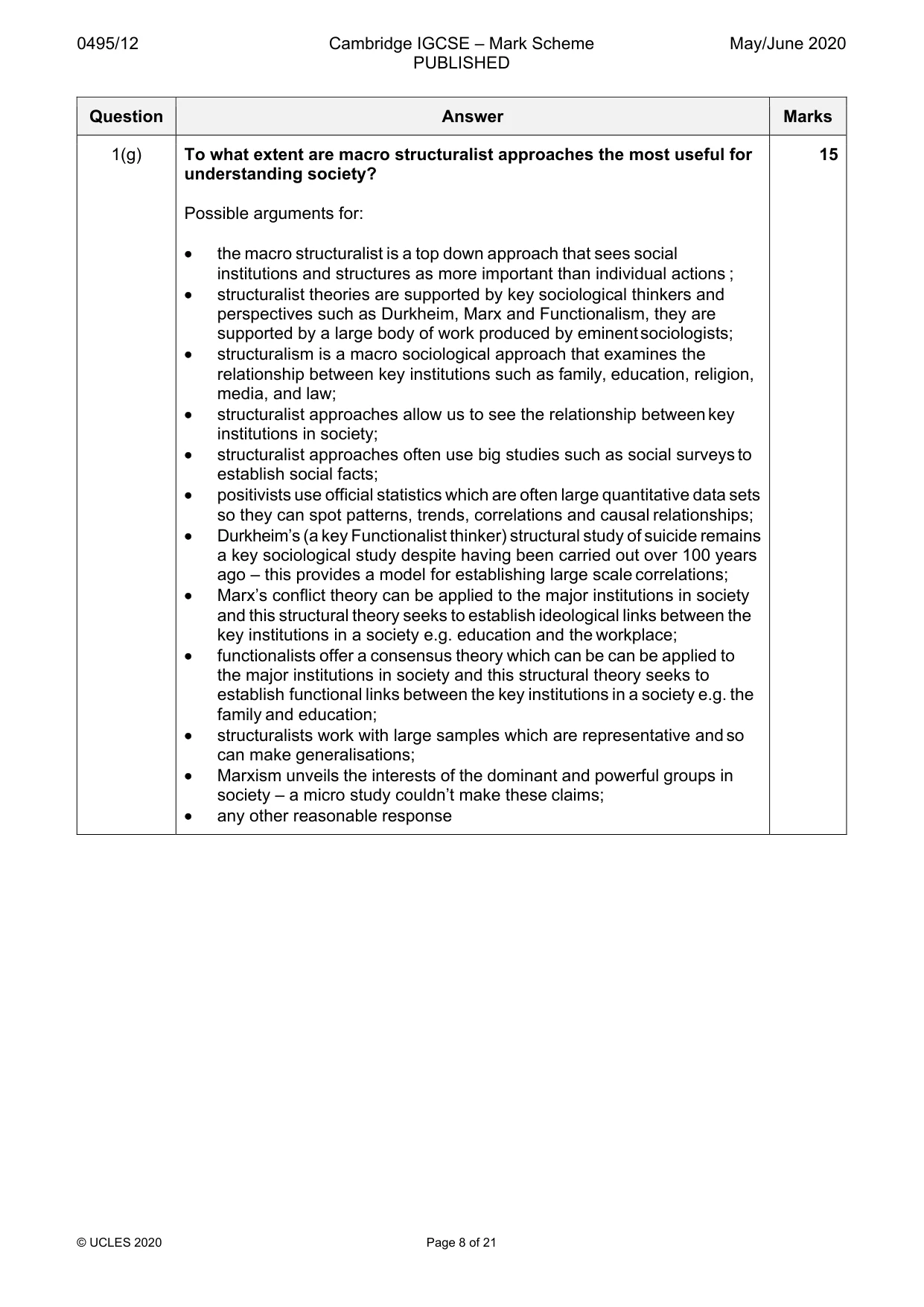
0495/12 Cambridge IGCSE – Mark Scheme PUBLISHED May/June 2020 © UCLES 2020 Page 8 of 21 Question Answer Marks 1(g) To what extent are macro structuralist approaches the most useful for understanding society? Possible arguments for: • the macro structuralist is a top down approach that sees social institutions and structures as more important than individual actions ; • structuralist theories are supported by key sociological thinkers and perspectives such as Durkheim, Marx and Functionalism, they are supported by a large body of work produced by eminent sociologists; • structuralism is a macro sociological approach that examines the relationship between key institutions such as family, education, religion, media, and law; • structuralist approaches allow us to see the relationship between key institutions in society; • structuralist approaches often use big studies such as social surveys to establish social facts; • positivists use official statistics which are often large quantitative data sets so they can spot patterns, trends, correlations and causal relationships; • Durkheim’s (a key Functionalist thinker) structural study of suicide remains a key sociological study despite having been carried out over 100 years ago – this provides a model for establishing large scale correlations; • Marx’s conflict theory can be applied to the major institutions in society and this structural theory seeks to establish ideological links between the key institutions in a society e.g. education and the workplace; • functionalists offer a consensus theory which can be can be applied to the major institutions in society and this structural theory seeks to establish functional links between the key institutions in a society e.g. the family and education; • structuralists work with large samples which are representative and so can make generalisations; • Marxism unveils the interests of the dominant and powerful groups in society – a micro study couldn’t make these claims; • any other reasonable response 15
Mark scheme, page 9
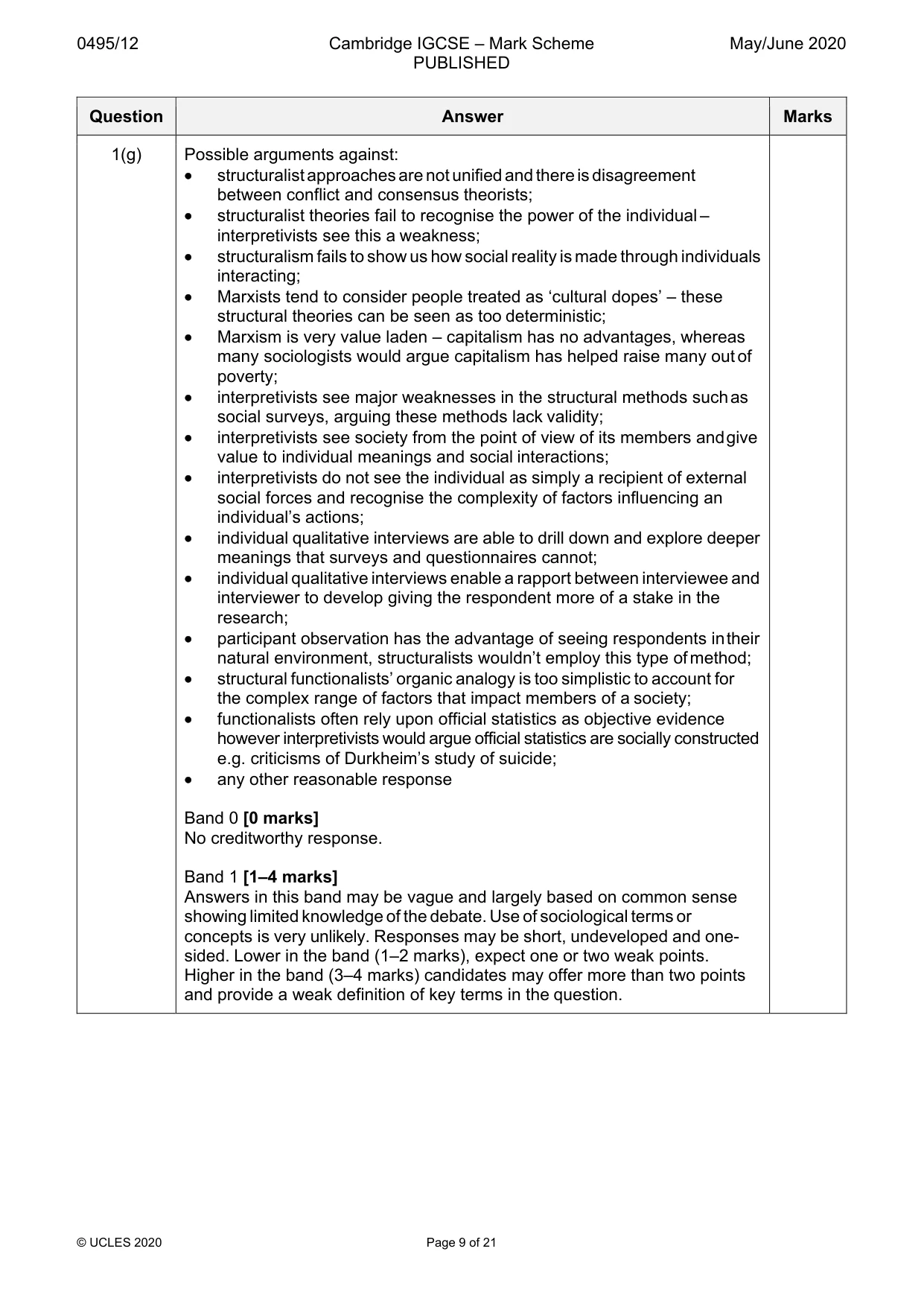
0495/12 Cambridge IGCSE – Mark Scheme PUBLISHED May/June 2020 © UCLES 2020 Page 9 of 21 Question Answer Marks 1(g) Possible arguments against: • structuralist approaches are not unified and there is disagreement between conflict and consensus theorists; • structuralist theories fail to recognise the power of the individual – interpretivists see this a weakness; • structuralism fails to show us how social reality is made through individuals interacting; • Marxists tend to consider people treated as ‘cultural dopes’ – these structural theories can be seen as too deterministic; • Marxism is very value laden – capitalism has no advantages, whereas many sociologists would argue capitalism has helped raise many out of poverty; • interpretivists see major weaknesses in the structural methods such as social surveys, arguing these methods lack validity; • interpretivists see society from the point of view of its members and give value to individual meanings and social interactions; • interpretivists do not see the individual as simply a recipient of external social forces and recognise the complexity of factors influencing an individual’s actions; • individual qualitative interviews are able to drill down and explore deeper meanings that surveys and questionnaires cannot; • individual qualitative interviews enable a rapport between interviewee and interviewer to develop giving the respondent more of a stake in the research; • participant observation has the advantage of seeing respondents in their natural environment, structuralists wouldn’t employ this type of method; • structural functionalists’ organic analogy is too simplistic to account for the complex range of factors that impact members of a society; • functionalists often rely upon official statistics as objective evidence however interpretivists would argue official statistics are socially constructed e.g. criticisms of Durkheim’s study of suicide; • any other reasonable response Band 0 [0 marks] No creditworthy response. Band 1 [1–4 marks] Answers in this band may be vague and largely based on common sense showing limited knowledge of the debate. Use of sociological terms or concepts is very unlikely. Responses may be short, undeveloped and one- sided. Lower in the band (1–2 marks), expect one or two weak points. Higher in the band (3–4 marks) candidates may offer more than two points and provide a weak definition of key terms in the question.
Mark scheme, page 10
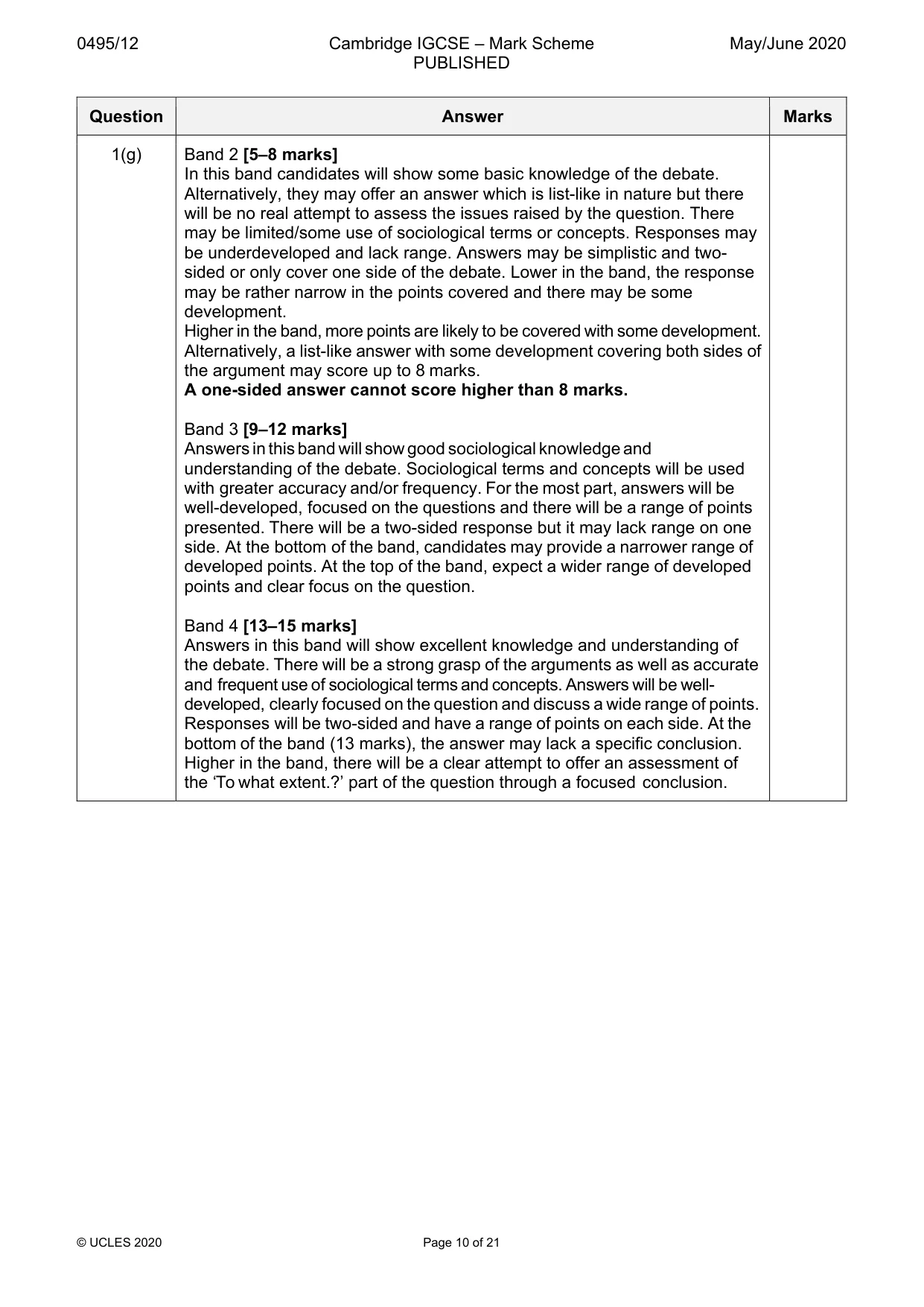
0495/12 Cambridge IGCSE – Mark Scheme PUBLISHED May/June 2020 © UCLES 2020 Page 10 of 21 Question Answer Marks 1(g) Band 2 [5–8 marks] In this band candidates will show some basic knowledge of the debate. Alternatively, they may offer an answer which is list-like in nature but there will be no real attempt to assess the issues raised by the question. There may be limited/some use of sociological terms or concepts. Responses may be underdeveloped and lack range. Answers may be simplistic and two- sided or only cover one side of the debate. Lower in the band, the response may be rather narrow in the points covered and there may be some development. Higher in the band, more points are likely to be covered with some development. Alternatively, a list-like answer with some development covering both sides of the argument may score up to 8 marks. A one-sided answer cannot score higher than 8 marks. Band 3 [9–12 marks] Answers in this band will show good sociological knowledge and understanding of the debate. Sociological terms and concepts will be used with greater accuracy and/or frequency. For the most part, answers will be well-developed, focused on the questions and there will be a range of points presented. There will be a two-sided response but it may lack range on one side. At the bottom of the band, candidates may provide a narrower range of developed points. At the top of the band, expect a wider range of developed points and clear focus on the question. Band 4 [13–15 marks] Answers in this band will show excellent knowledge and understanding of the debate. There will be a strong grasp of the arguments as well as accurate and frequent use of sociological terms and concepts. Answers will be well- developed, clearly focused on the question and discuss a wide range of points. Responses will be two-sided and have a range of points on each side. At the bottom of the band (13 marks), the answer may lack a specific conclusion. Higher in the band, there will be a clear attempt to offer an assessment of the ‘To what extent.?’ part of the question through a focused conclusion.
Mark scheme, page 11
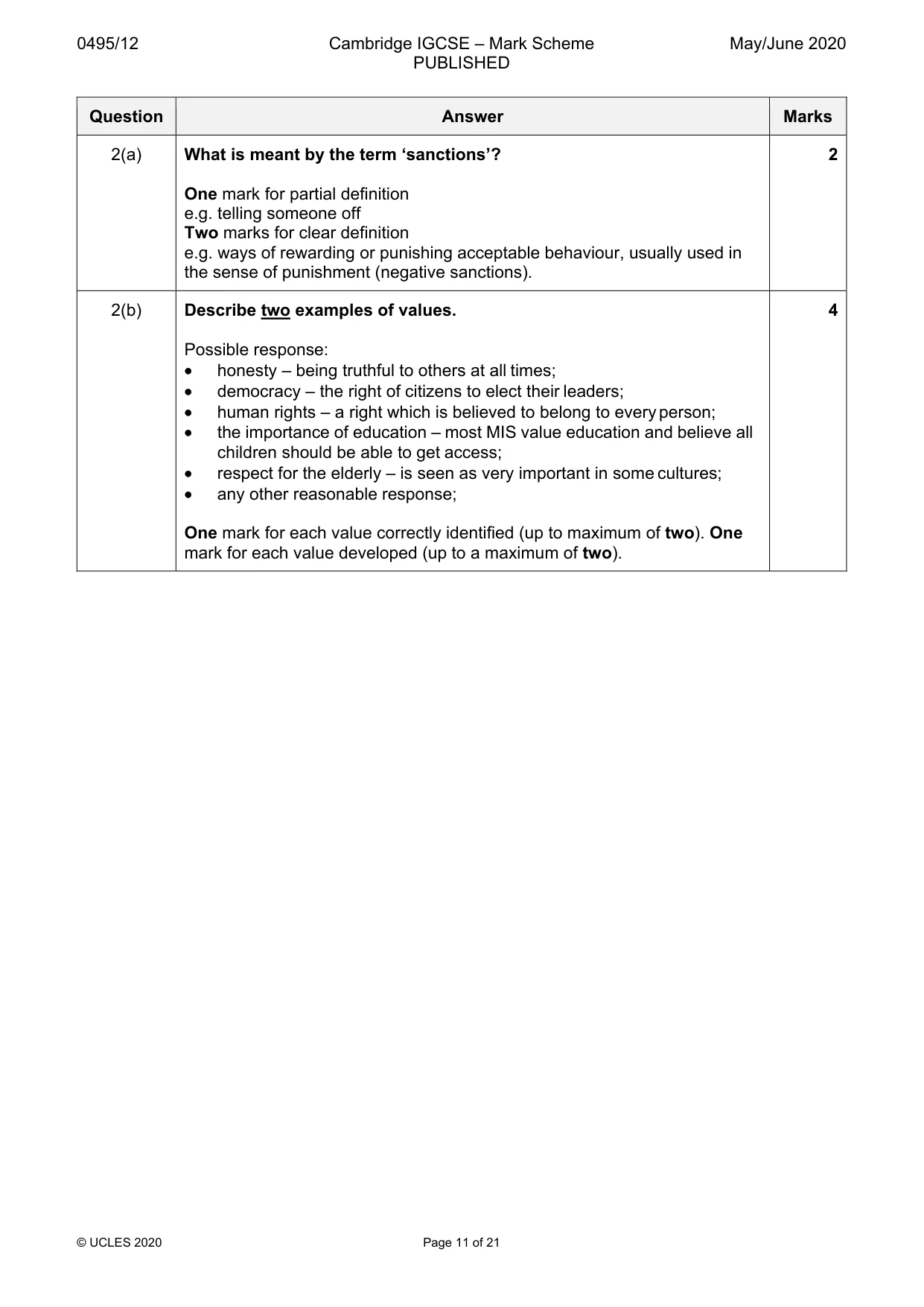
0495/12 Cambridge IGCSE – Mark Scheme PUBLISHED May/June 2020 © UCLES 2020 Page 11 of 21 Question Answer Marks 2(a) What is meant by the term ‘sanctions’? One mark for partial definition e.g. telling someone off Two marks for clear definition e.g. ways of rewarding or punishing acceptable behaviour, usually used in the sense of punishment (negative sanctions). 2 2(b) Describe two examples of values. Possible response: • honesty – being truthful to others at all times; • democracy – the right of citizens to elect their leaders; • human rights – a right which is believed to belong to every person; • the importance of education – most MIS value education and believe all children should be able to get access; • respect for the elderly – is seen as very important in some cultures; • any other reasonable response; One mark for each value correctly identified (up to maximum of two). One mark for each value developed (up to a maximum of two). 4
Mark scheme, page 12
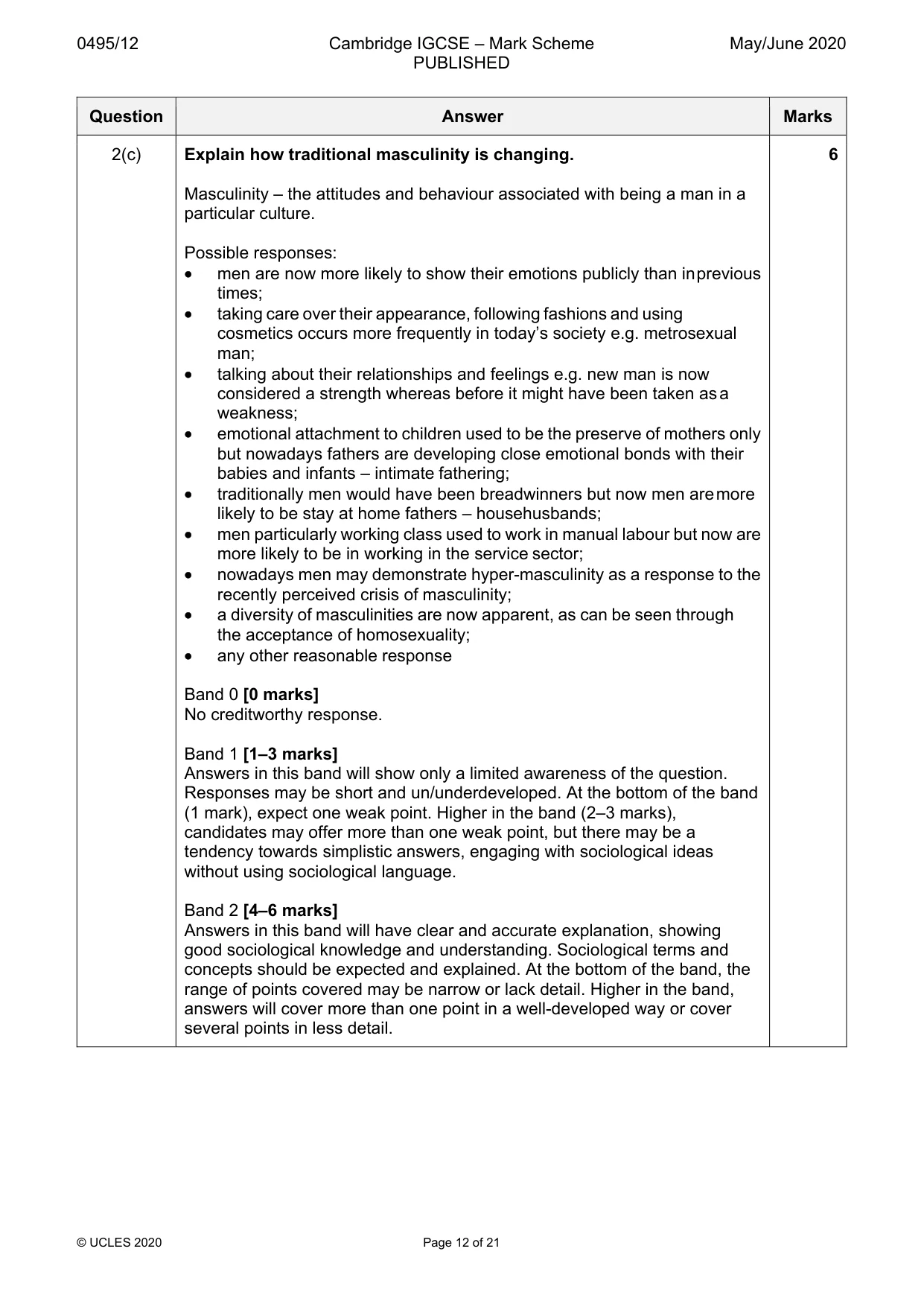
0495/12 Cambridge IGCSE – Mark Scheme PUBLISHED May/June 2020 © UCLES 2020 Page 12 of 21 Question Answer Marks 2(c) Explain how traditional masculinity is changing. Masculinity – the attitudes and behaviour associated with being a man in a particular culture. Possible responses: • men are now more likely to show their emotions publicly than in previous times; • taking care over their appearance, following fashions and using cosmetics occurs more frequently in today’s society e.g. metrosexual man; • talking about their relationships and feelings e.g. new man is now considered a strength whereas before it might have been taken as a weakness; • emotional attachment to children used to be the preserve of mothers only but nowadays fathers are developing close emotional bonds with their babies and infants – intimate fathering; • traditionally men would have been breadwinners but now men are more likely to be stay at home fathers – househusbands; • men particularly working class used to work in manual labour but now are more likely to be in working in the service sector; • nowadays men may demonstrate hyper-masculinity as a response to the recently perceived crisis of masculinity; • a diversity of masculinities are now apparent, as can be seen through the acceptance of homosexuality; • any other reasonable response Band 0 [0 marks] No creditworthy response. Band 1 [1–3 marks] Answers in this band will show only a limited awareness of the question. Responses may be short and un/underdeveloped. At the bottom of the band (1 mark), expect one weak point. Higher in the band (2–3 marks), candidates may offer more than one weak point, but there may be a tendency towards simplistic answers, engaging with sociological ideas without using sociological language. Band 2 [4–6 marks] Answers in this band will have clear and accurate explanation, showing good sociological knowledge and understanding. Sociological terms and concepts should be expected and explained. At the bottom of the band, the range of points covered may be narrow or lack detail. Higher in the band, answers will cover more than one point in a well-developed way or cover several points in less detail. 6
Mark scheme, page 13
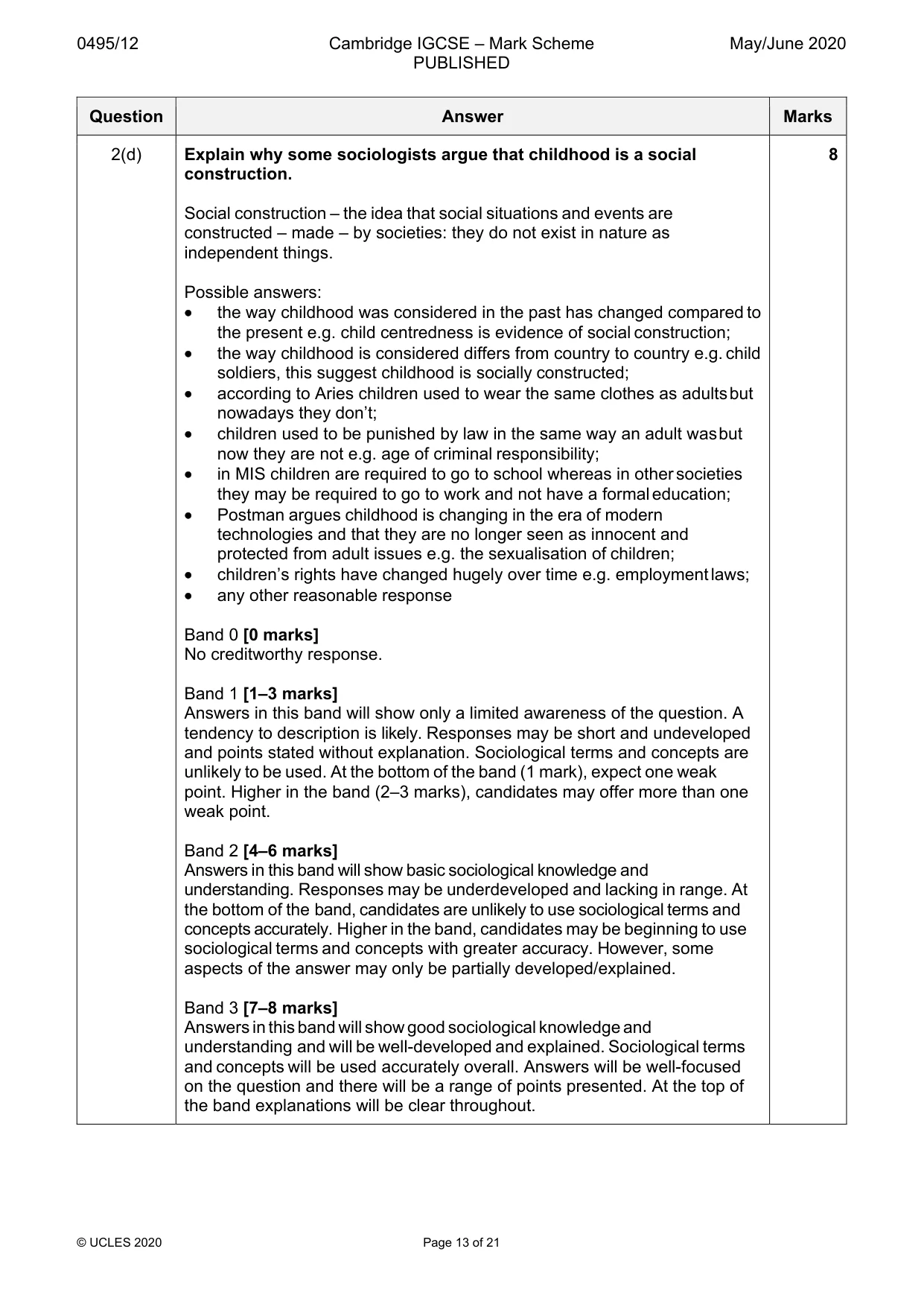
0495/12 Cambridge IGCSE – Mark Scheme PUBLISHED May/June 2020 © UCLES 2020 Page 13 of 21 Question Answer Marks 2(d) Explain why some sociologists argue that childhood is a social construction. Social construction – the idea that social situations and events are constructed – made – by societies: they do not exist in nature as independent things. Possible answers: • the way childhood was considered in the past has changed compared to the present e.g. child centredness is evidence of social construction; • the way childhood is considered differs from country to country e.g. child soldiers, this suggest childhood is socially constructed; • according to Aries children used to wear the same clothes as adults but nowadays they don’t; • children used to be punished by law in the same way an adult was but now they are not e.g. age of criminal responsibility; • in MIS children are required to go to school whereas in other societies they may be required to go to work and not have a formal education; • Postman argues childhood is changing in the era of modern technologies and that they are no longer seen as innocent and protected from adult issues e.g. the sexualisation of children; • children’s rights have changed hugely over time e.g. employment laws; • any other reasonable response Band 0 [0 marks] No creditworthy response. Band 1 [1–3 marks] Answers in this band will show only a limited awareness of the question. A tendency to description is likely. Responses may be short and undeveloped and points stated without explanation. Sociological terms and concepts are unlikely to be used. At the bottom of the band (1 mark), expect one weak point. Higher in the band (2–3 marks), candidates may offer more than one weak point. Band 2 [4–6 marks] Answers in this band will show basic sociological knowledge and understanding. Responses may be underdeveloped and lacking in range. At the bottom of the band, candidates are unlikely to use sociological terms and concepts accurately. Higher in the band, candidates may be beginning to use sociological terms and concepts with greater accuracy. However, some aspects of the answer may only be partially developed/explained. Band 3 [7–8 marks] Answers in this band will show good sociological knowledge and understanding and will be well-developed and explained. Sociological terms and concepts will be used accurately overall. Answers will be well-focused on the question and there will be a range of points presented. At the top of the band explanations will be clear throughout. 8
Mark scheme, page 14
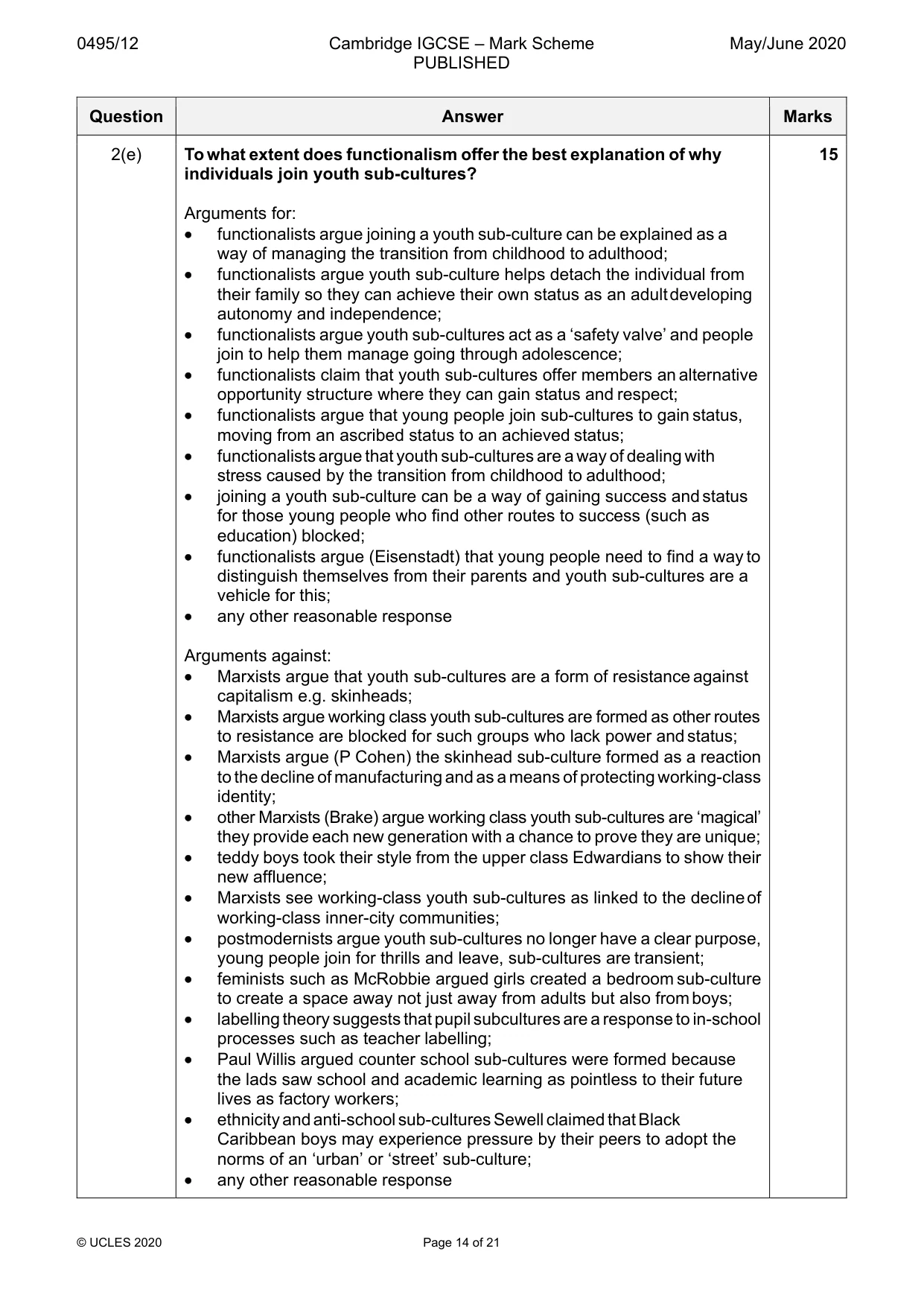
0495/12 Cambridge IGCSE – Mark Scheme PUBLISHED May/June 2020 © UCLES 2020 Page 14 of 21 Question Answer Marks 2(e) To what extent does functionalism offer the best explanation of why individuals join youth sub-cultures? Arguments for: • functionalists argue joining a youth sub-culture can be explained as a way of managing the transition from childhood to adulthood; • functionalists argue youth sub-culture helps detach the individual from their family so they can achieve their own status as an adult developing autonomy and independence; • functionalists argue youth sub-cultures act as a ‘safety valve’ and people join to help them manage going through adolescence; • functionalists claim that youth sub-cultures offer members an alternative opportunity structure where they can gain status and respect; • functionalists argue that young people join sub-cultures to gain status, moving from an ascribed status to an achieved status; • functionalists argue that youth sub-cultures are a way of dealing with stress caused by the transition from childhood to adulthood; • joining a youth sub-culture can be a way of gaining success and status for those young people who find other routes to success (such as education) blocked; • functionalists argue (Eisenstadt) that young people need to find a way to distinguish themselves from their parents and youth sub-cultures are a vehicle for this; • any other reasonable response Arguments against: • Marxists argue that youth sub-cultures are a form of resistance against capitalism e.g. skinheads; • Marxists argue working class youth sub-cultures are formed as other routes to resistance are blocked for such groups who lack power and status; • Marxists argue (P Cohen) the skinhead sub-culture formed as a reaction to the decline of manufacturing and as a means of protecting working-class identity; • other Marxists (Brake) argue working class youth sub-cultures are ‘magical’ they provide each new generation with a chance to prove they are unique; • teddy boys took their style from the upper class Edwardians to show their new affluence; • Marxists see working-class youth sub-cultures as linked to the decline of working-class inner-city communities; • postmodernists argue youth sub-cultures no longer have a clear purpose, young people join for thrills and leave, sub-cultures are transient; • feminists such as McRobbie argued girls created a bedroom sub-culture to create a space away not just away from adults but also from boys; • labelling theory suggests that pupil subcultures are a response to in-school processes such as teacher labelling; • Paul Willis argued counter school sub-cultures were formed because the lads saw school and academic learning as pointless to their future lives as factory workers; • ethnicity and anti-school sub-cultures Sewell claimed that Black Caribbean boys may experience pressure by their peers to adopt the norms of an ‘urban’ or ‘street’ sub-culture; • any other reasonable response 15
Mark scheme, page 15
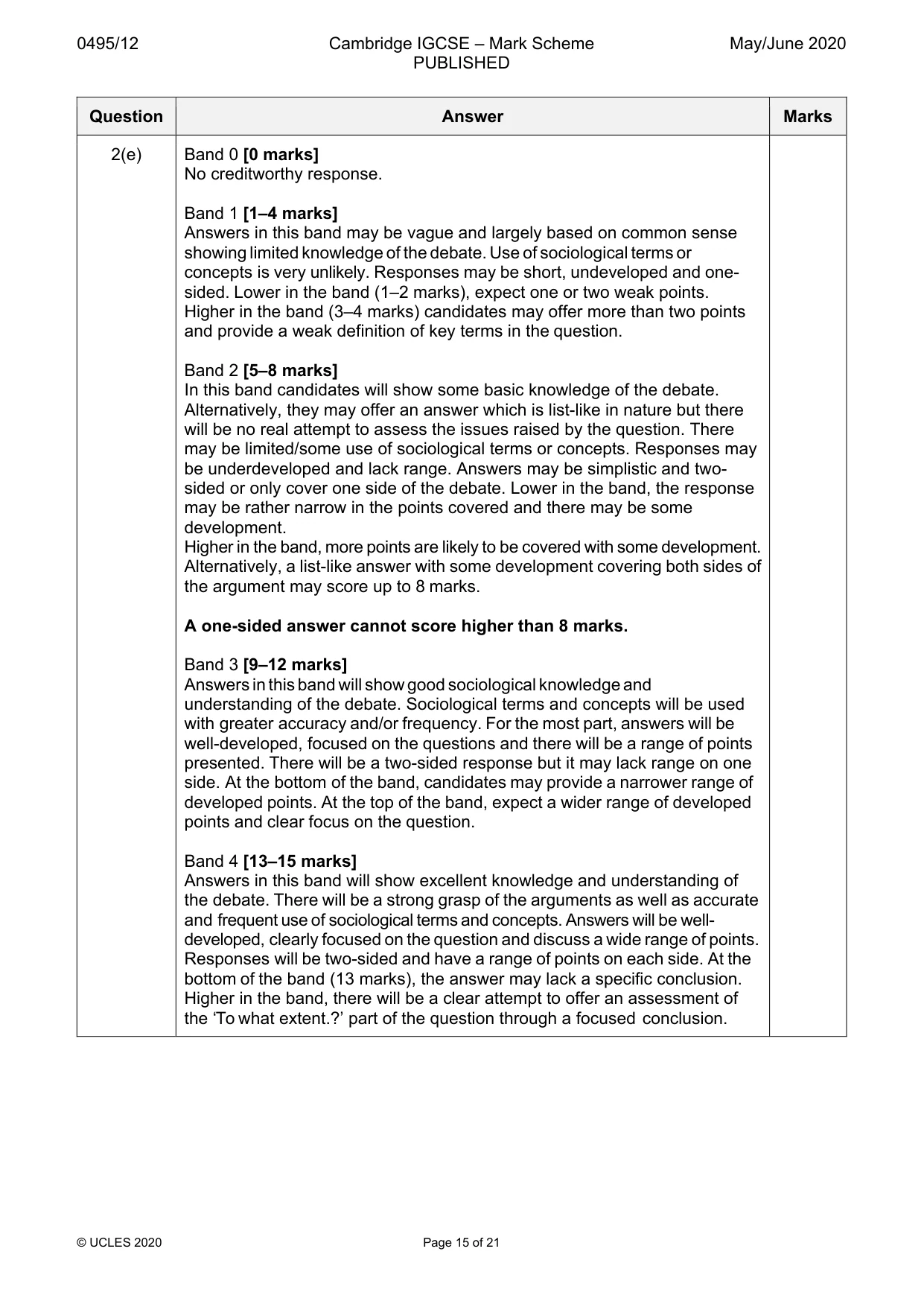
0495/12 Cambridge IGCSE – Mark Scheme PUBLISHED May/June 2020 © UCLES 2020 Page 15 of 21 Question Answer Marks 2(e) Band 0 [0 marks] No creditworthy response. Band 1 [1–4 marks] Answers in this band may be vague and largely based on common sense showing limited knowledge of the debate. Use of sociological terms or concepts is very unlikely. Responses may be short, undeveloped and one- sided. Lower in the band (1–2 marks), expect one or two weak points. Higher in the band (3–4 marks) candidates may offer more than two points and provide a weak definition of key terms in the question. Band 2 [5–8 marks] In this band candidates will show some basic knowledge of the debate. Alternatively, they may offer an answer which is list-like in nature but there will be no real attempt to assess the issues raised by the question. There may be limited/some use of sociological terms or concepts. Responses may be underdeveloped and lack range. Answers may be simplistic and two- sided or only cover one side of the debate. Lower in the band, the response may be rather narrow in the points covered and there may be some development. Higher in the band, more points are likely to be covered with some development. Alternatively, a list-like answer with some development covering both sides of the argument may score up to 8 marks. A one-sided answer cannot score higher than 8 marks. Band 3 [9–12 marks] Answers in this band will show good sociological knowledge and understanding of the debate. Sociological terms and concepts will be used with greater accuracy and/or frequency. For the most part, answers will be well-developed, focused on the questions and there will be a range of points presented. There will be a two-sided response but it may lack range on one side. At the bottom of the band, candidates may provide a narrower range of developed points. At the top of the band, expect a wider range of developed points and clear focus on the question. Band 4 [13–15 marks] Answers in this band will show excellent knowledge and understanding of the debate. There will be a strong grasp of the arguments as well as accurate and frequent use of sociological terms and concepts. Answers will be well- developed, clearly focused on the question and discuss a wide range of points. Responses will be two-sided and have a range of points on each side. At the bottom of the band (13 marks), the answer may lack a specific conclusion. Higher in the band, there will be a clear attempt to offer an assessment of the ‘To what extent.?’ part of the question through a focused conclusion.
Mark scheme, page 16
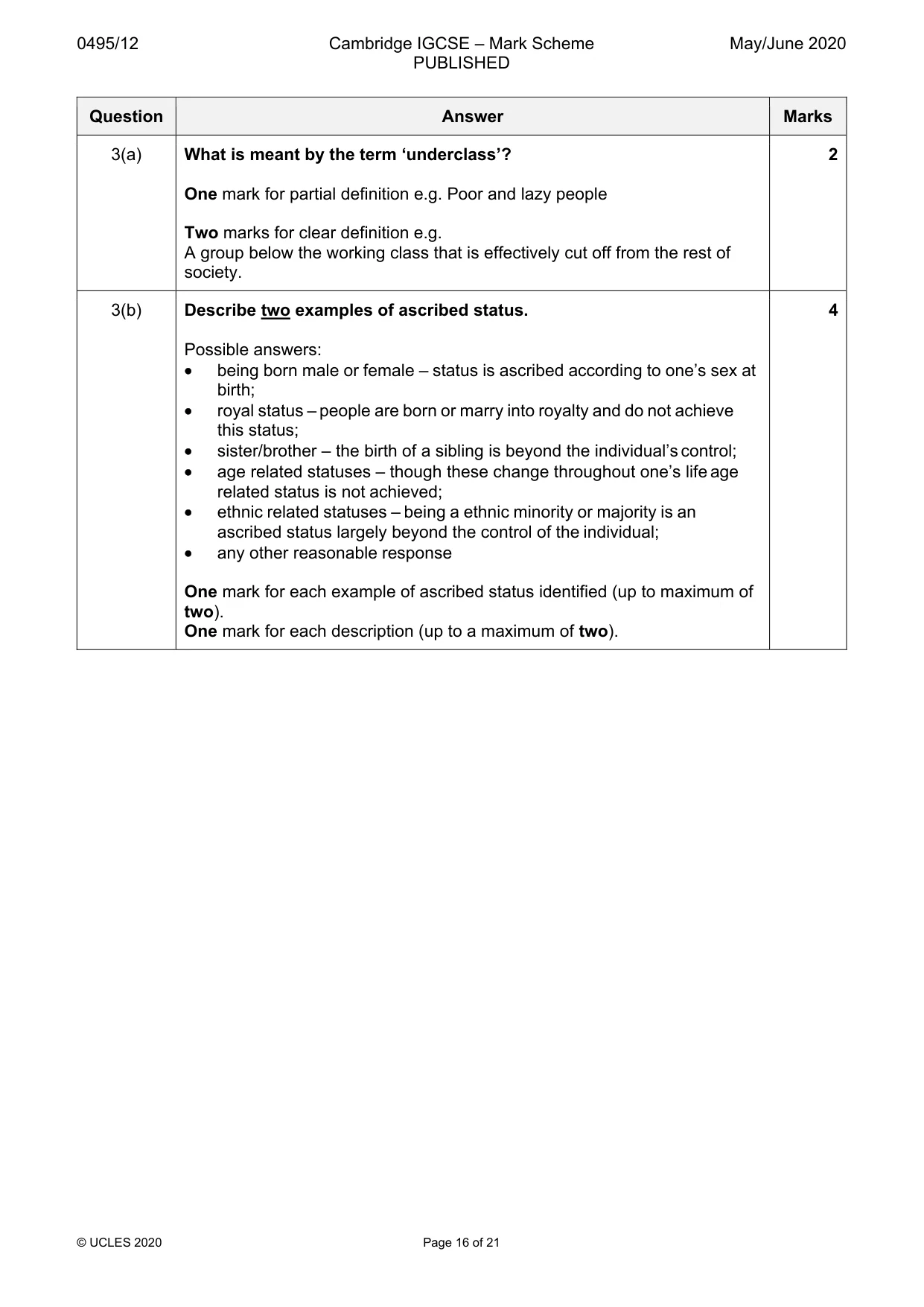
0495/12 Cambridge IGCSE – Mark Scheme PUBLISHED May/June 2020 © UCLES 2020 Page 16 of 21 Question Answer Marks 3(a) What is meant by the term ‘underclass’? One mark for partial definition e.g. Poor and lazy people Two marks for clear definition e.g. A group below the working class that is effectively cut off from the rest of society. 2 3(b) Describe two examples of ascribed status. Possible answers: • being born male or female – status is ascribed according to one’s sex at birth; • royal status – people are born or marry into royalty and do not achieve this status; • sister/brother – the birth of a sibling is beyond the individual’s control; • age related statuses – though these change throughout one’s life age related status is not achieved; • ethnic related statuses – being a ethnic minority or majority is an ascribed status largely beyond the control of the individual; • any other reasonable response One mark for each example of ascribed status identified (up to maximum of two). One mark for each description (up to a maximum of two). 4
Mark scheme, page 17
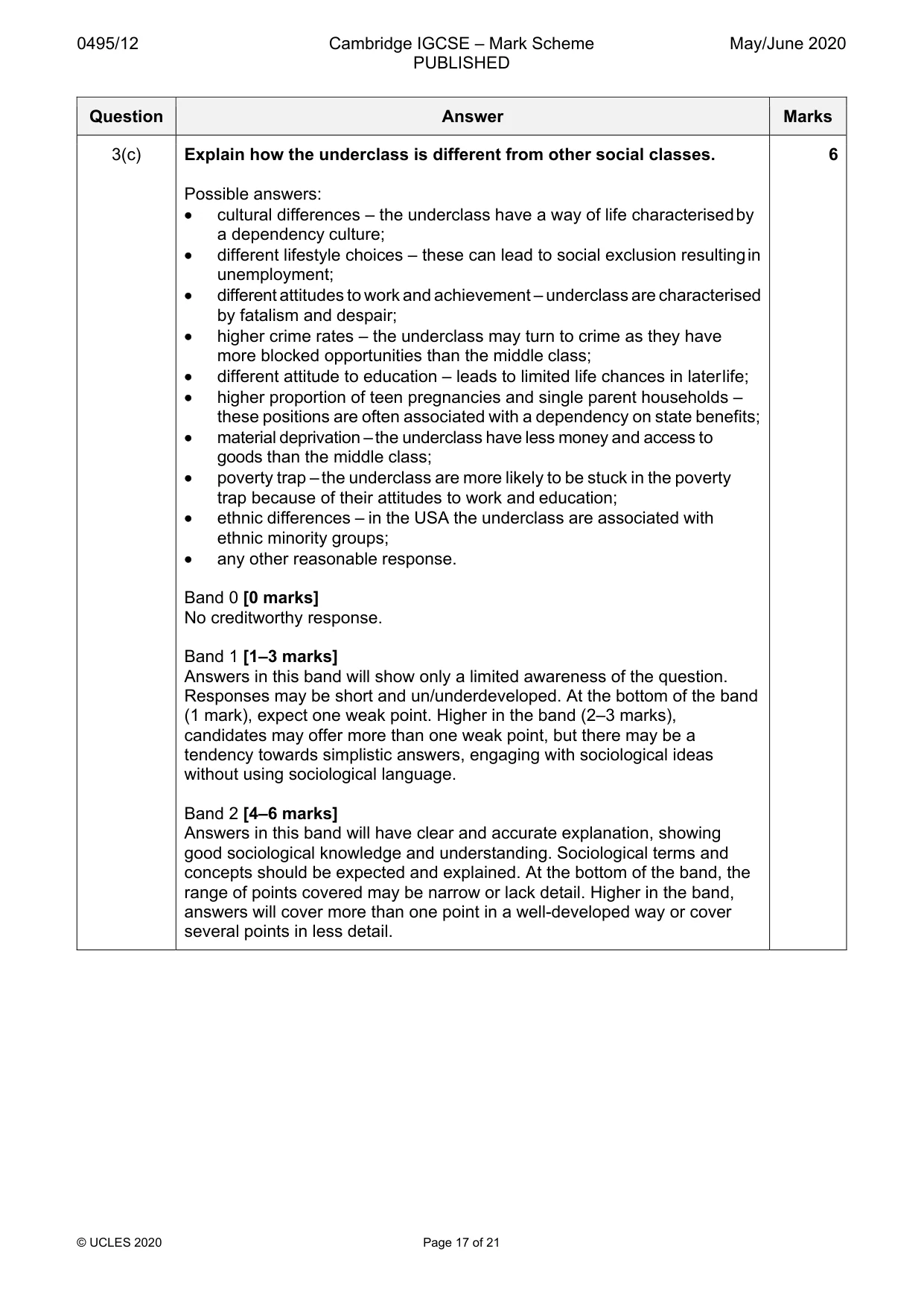
0495/12 Cambridge IGCSE – Mark Scheme PUBLISHED May/June 2020 © UCLES 2020 Page 17 of 21 Question Answer Marks 3(c) Explain how the underclass is different from other social classes. Possible answers: • cultural differences – the underclass have a way of life characterised by a dependency culture; • different lifestyle choices – these can lead to social exclusion resulting in unemployment; • different attitudes to work and achievement – underclass are characterised by fatalism and despair; • higher crime rates – the underclass may turn to crime as they have more blocked opportunities than the middle class; • different attitude to education – leads to limited life chances in later life; • higher proportion of teen pregnancies and single parent households – these positions are often associated with a dependency on state benefits; • material deprivation – the underclass have less money and access to goods than the middle class; • poverty trap – the underclass are more likely to be stuck in the poverty trap because of their attitudes to work and education; • ethnic differences – in the USA the underclass are associated with ethnic minority groups; • any other reasonable response. Band 0 [0 marks] No creditworthy response. Band 1 [1–3 marks] Answers in this band will show only a limited awareness of the question. Responses may be short and un/underdeveloped. At the bottom of the band (1 mark), expect one weak point. Higher in the band (2–3 marks), candidates may offer more than one weak point, but there may be a tendency towards simplistic answers, engaging with sociological ideas without using sociological language. Band 2 [4–6 marks] Answers in this band will have clear and accurate explanation, showing good sociological knowledge and understanding. Sociological terms and concepts should be expected and explained. At the bottom of the band, the range of points covered may be narrow or lack detail. Higher in the band, answers will cover more than one point in a well-developed way or cover several points in less detail. 6
Mark scheme, page 18
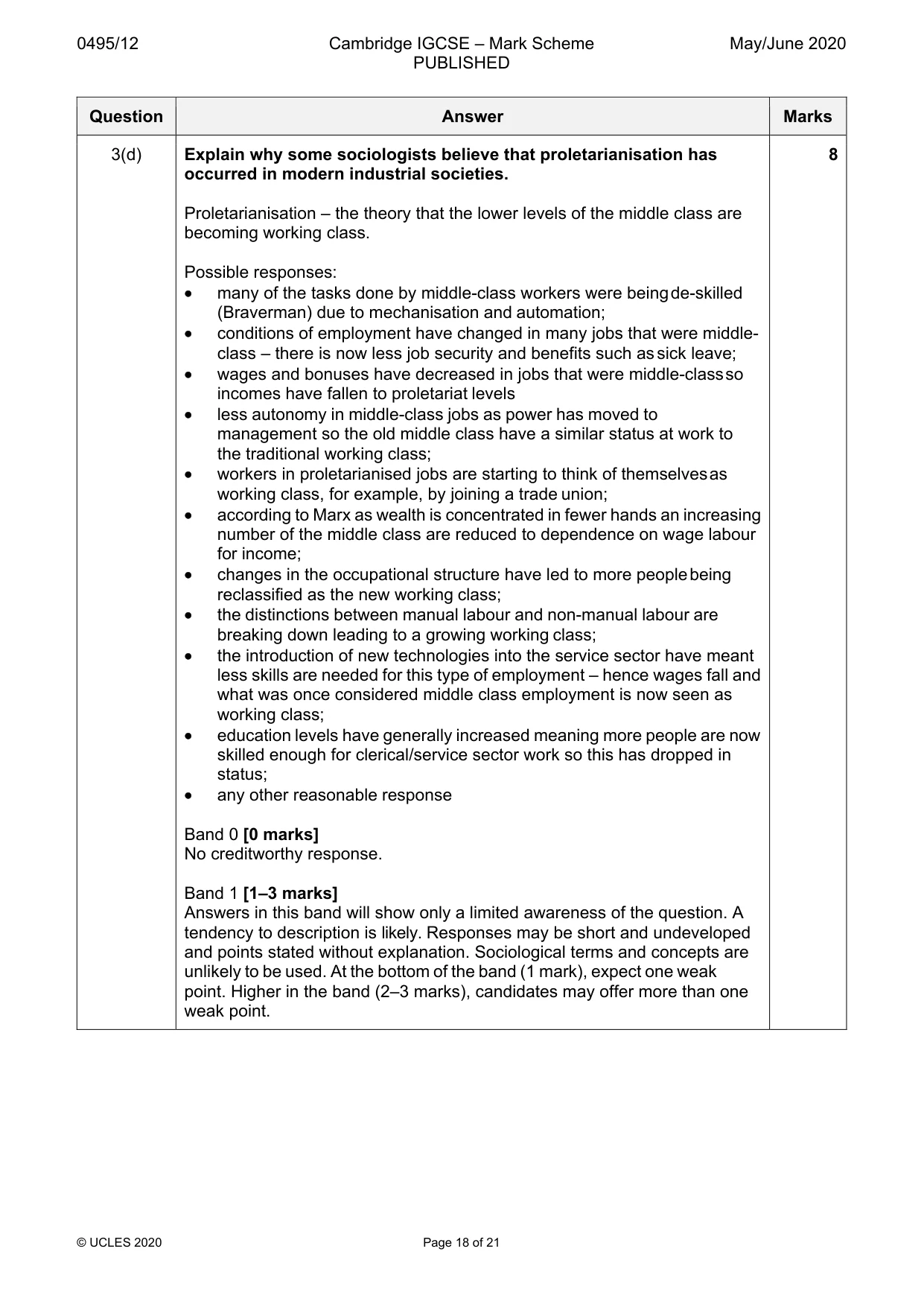
0495/12 Cambridge IGCSE – Mark Scheme PUBLISHED May/June 2020 © UCLES 2020 Page 18 of 21 Question Answer Marks 3(d) Explain why some sociologists believe that proletarianisation has occurred in modern industrial societies. Proletarianisation – the theory that the lower levels of the middle class are becoming working class. Possible responses: • many of the tasks done by middle-class workers were being de-skilled (Braverman) due to mechanisation and automation; • conditions of employment have changed in many jobs that were middle- class – there is now less job security and benefits such as sick leave; • wages and bonuses have decreased in jobs that were middle-class so incomes have fallen to proletariat levels • less autonomy in middle-class jobs as power has moved to management so the old middle class have a similar status at work to the traditional working class; • workers in proletarianised jobs are starting to think of themselves as working class, for example, by joining a trade union; • according to Marx as wealth is concentrated in fewer hands an increasing number of the middle class are reduced to dependence on wage labour for income; • changes in the occupational structure have led to more people being reclassified as the new working class; • the distinctions between manual labour and non-manual labour are breaking down leading to a growing working class; • the introduction of new technologies into the service sector have meant less skills are needed for this type of employment – hence wages fall and what was once considered middle class employment is now seen as working class; • education levels have generally increased meaning more people are now skilled enough for clerical/service sector work so this has dropped in status; • any other reasonable response Band 0 [0 marks] No creditworthy response. Band 1 [1–3 marks] Answers in this band will show only a limited awareness of the question. A tendency to description is likely. Responses may be short and undeveloped and points stated without explanation. Sociological terms and concepts are unlikely to be used. At the bottom of the band (1 mark), expect one weak point. Higher in the band (2–3 marks), candidates may offer more than one weak point. 8
Mark scheme, page 19
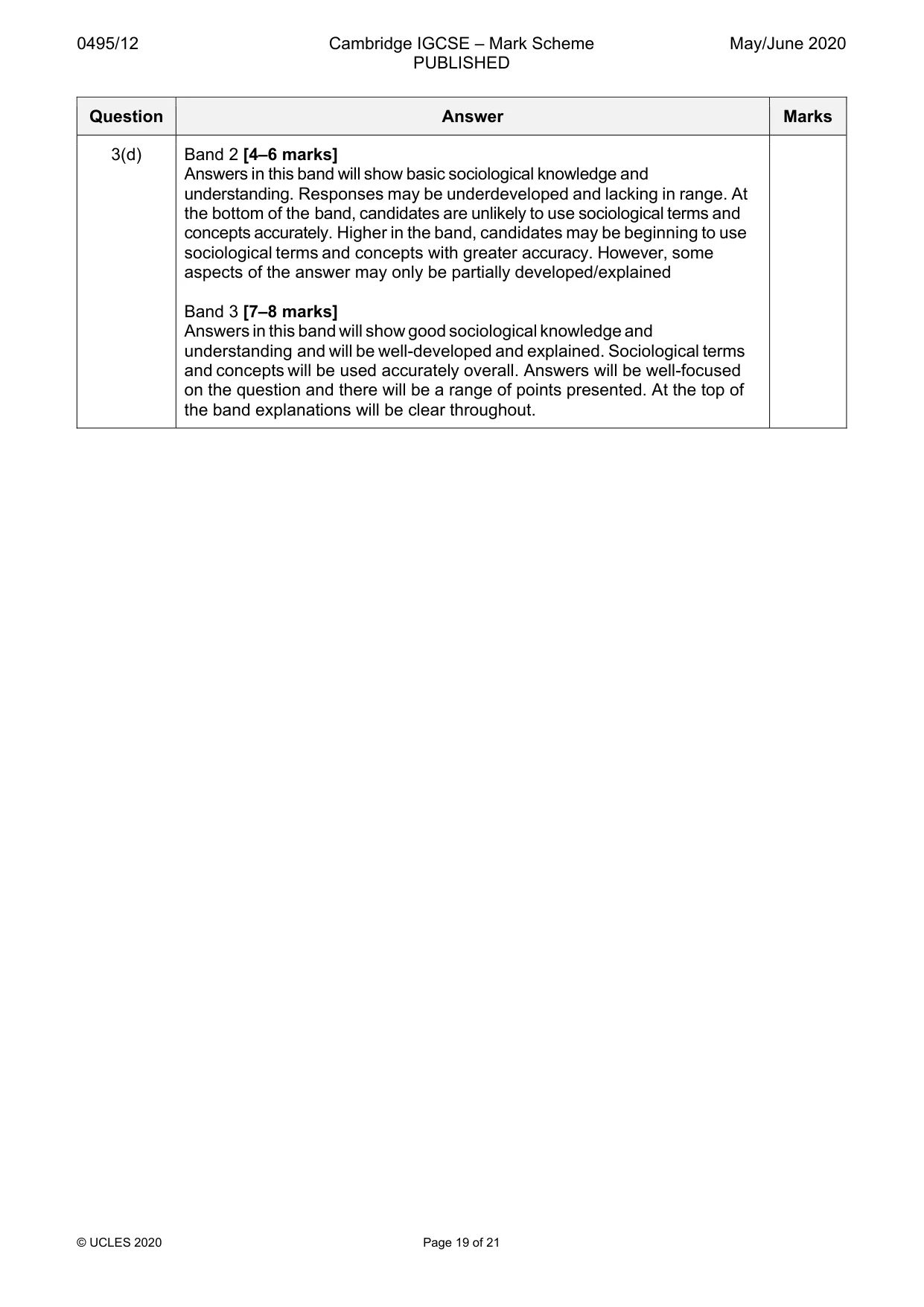
0495/12 Cambridge IGCSE – Mark Scheme PUBLISHED May/June 2020 © UCLES 2020 Page 19 of 21 Question Answer Marks 3(d) Band 2 [4–6 marks] Answers in this band will show basic sociological knowledge and understanding. Responses may be underdeveloped and lacking in range. At the bottom of the band, candidates are unlikely to use sociological terms and concepts accurately. Higher in the band, candidates may be beginning to use sociological terms and concepts with greater accuracy. However, some aspects of the answer may only be partially developed/explained Band 3 [7–8 marks] Answers in this band will show good sociological knowledge and understanding and will be well-developed and explained. Sociological terms and concepts will be used accurately overall. Answers will be well-focused on the question and there will be a range of points presented. At the top of the band explanations will be clear throughout.
Mark scheme, page 20
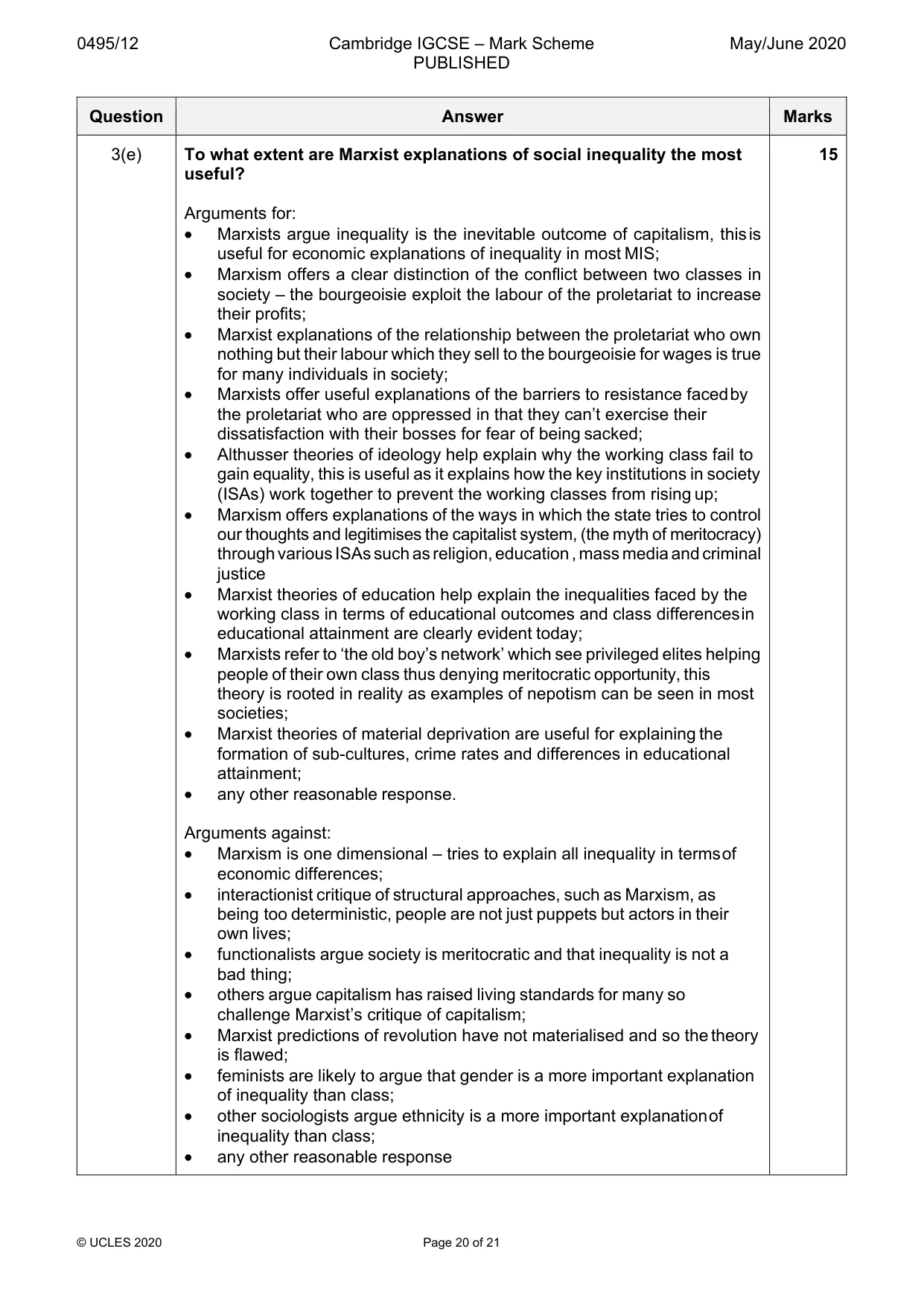
0495/12 Cambridge IGCSE – Mark Scheme PUBLISHED May/June 2020 © UCLES 2020 Page 20 of 21 Question Answer Marks 3(e) To what extent are Marxist explanations of social inequality the most useful? Arguments for: • Marxists argue inequality is the inevitable outcome of capitalism, this is useful for economic explanations of inequality in most MIS; • Marxism offers a clear distinction of the conflict between two classes in society – the bourgeoisie exploit the labour of the proletariat to increase their profits; • Marxist explanations of the relationship between the proletariat who own nothing but their labour which they sell to the bourgeoisie for wages is true for many individuals in society; • Marxists offer useful explanations of the barriers to resistance faced by the proletariat who are oppressed in that they can’t exercise their dissatisfaction with their bosses for fear of being sacked; • Althusser theories of ideology help explain why the working class fail to gain equality, this is useful as it explains how the key institutions in society (ISAs) work together to prevent the working classes from rising up; • Marxism offers explanations of the ways in which the state tries to control our thoughts and legitimises the capitalist system, (the myth of meritocracy) through various ISAs such as religion, education , mass media and criminal justice • Marxist theories of education help explain the inequalities faced by the working class in terms of educational outcomes and class differences in educational attainment are clearly evident today; • Marxists refer to ‘the old boy’s network’ which see privileged elites helping people of their own class thus denying meritocratic opportunity, this theory is rooted in reality as examples of nepotism can be seen in most societies; • Marxist theories of material deprivation are useful for explaining the formation of sub-cultures, crime rates and differences in educational attainment; • any other reasonable response. Arguments against: • Marxism is one dimensional – tries to explain all inequality in terms of economic differences; • interactionist critique of structural approaches, such as Marxism, as being too deterministic, people are not just puppets but actors in their own lives; • functionalists argue society is meritocratic and that inequality is not a bad thing; • others argue capitalism has raised living standards for many so challenge Marxist’s critique of capitalism; • Marxist predictions of revolution have not materialised and so the theory is flawed; • feminists are likely to argue that gender is a more important explanation of inequality than class; • other sociologists argue ethnicity is a more important explanation of inequality than class; • any other reasonable response 15
Mark scheme, page 21
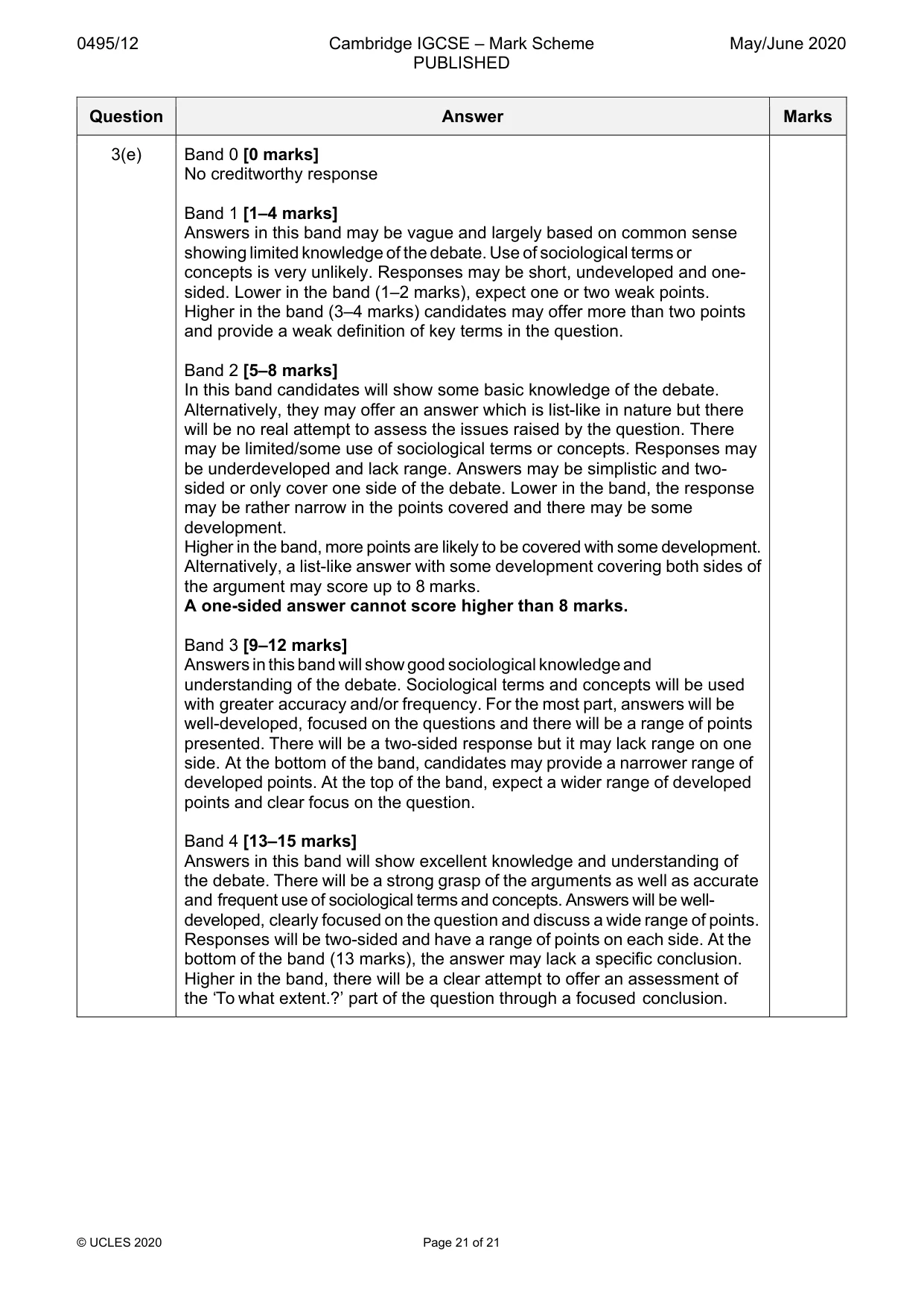
0495/12 Cambridge IGCSE – Mark Scheme PUBLISHED May/June 2020 © UCLES 2020 Page 21 of 21 Question Answer Marks 3(e) Band 0 [0 marks] No creditworthy response Band 1 [1–4 marks] Answers in this band may be vague and largely based on common sense showing limited knowledge of the debate. Use of sociological terms or concepts is very unlikely. Responses may be short, undeveloped and one- sided. Lower in the band (1–2 marks), expect one or two weak points. Higher in the band (3–4 marks) candidates may offer more than two points and provide a weak definition of key terms in the question. Band 2 [5–8 marks] In this band candidates will show some basic knowledge of the debate. Alternatively, they may offer an answer which is list-like in nature but there will be no real attempt to assess the issues raised by the question. There may be limited/some use of sociological terms or concepts. Responses may be underdeveloped and lack range. Answers may be simplistic and two- sided or only cover one side of the debate. Lower in the band, the response may be rather narrow in the points covered and there may be some development. Higher in the band, more points are likely to be covered with some development. Alternatively, a list-like answer with some development covering both sides of the argument may score up to 8 marks. A one-sided answer cannot score higher than 8 marks. Band 3 [9–12 marks] Answers in this band will show good sociological knowledge and understanding of the debate. Sociological terms and concepts will be used with greater accuracy and/or frequency. For the most part, answers will be well-developed, focused on the questions and there will be a range of points presented. There will be a two-sided response but it may lack range on one side. At the bottom of the band, candidates may provide a narrower range of developed points. At the top of the band, expect a wider range of developed points and clear focus on the question. Band 4 [13–15 marks] Answers in this band will show excellent knowledge and understanding of the debate. There will be a strong grasp of the arguments as well as accurate and frequent use of sociological terms and concepts. Answers will be well- developed, clearly focused on the question and discuss a wide range of points. Responses will be two-sided and have a range of points on each side. At the bottom of the band (13 marks), the answer may lack a specific conclusion. Higher in the band, there will be a clear attempt to offer an assessment of the ‘To what extent.?’ part of the question through a focused conclusion.