Cambridge IGCSE Sociology 0495 — 2020 May/June Paper 1 · Variant 1
0495/11/M/J/20
The question paper and its mark scheme, free to read here and free to download. This is Cambridge’s own paper, exactly as it was sat.
Question paper4 pages

Mark scheme19 pages
Answers below. Sit the paper first if you are practising.
Paper as text
Question paper, page 1
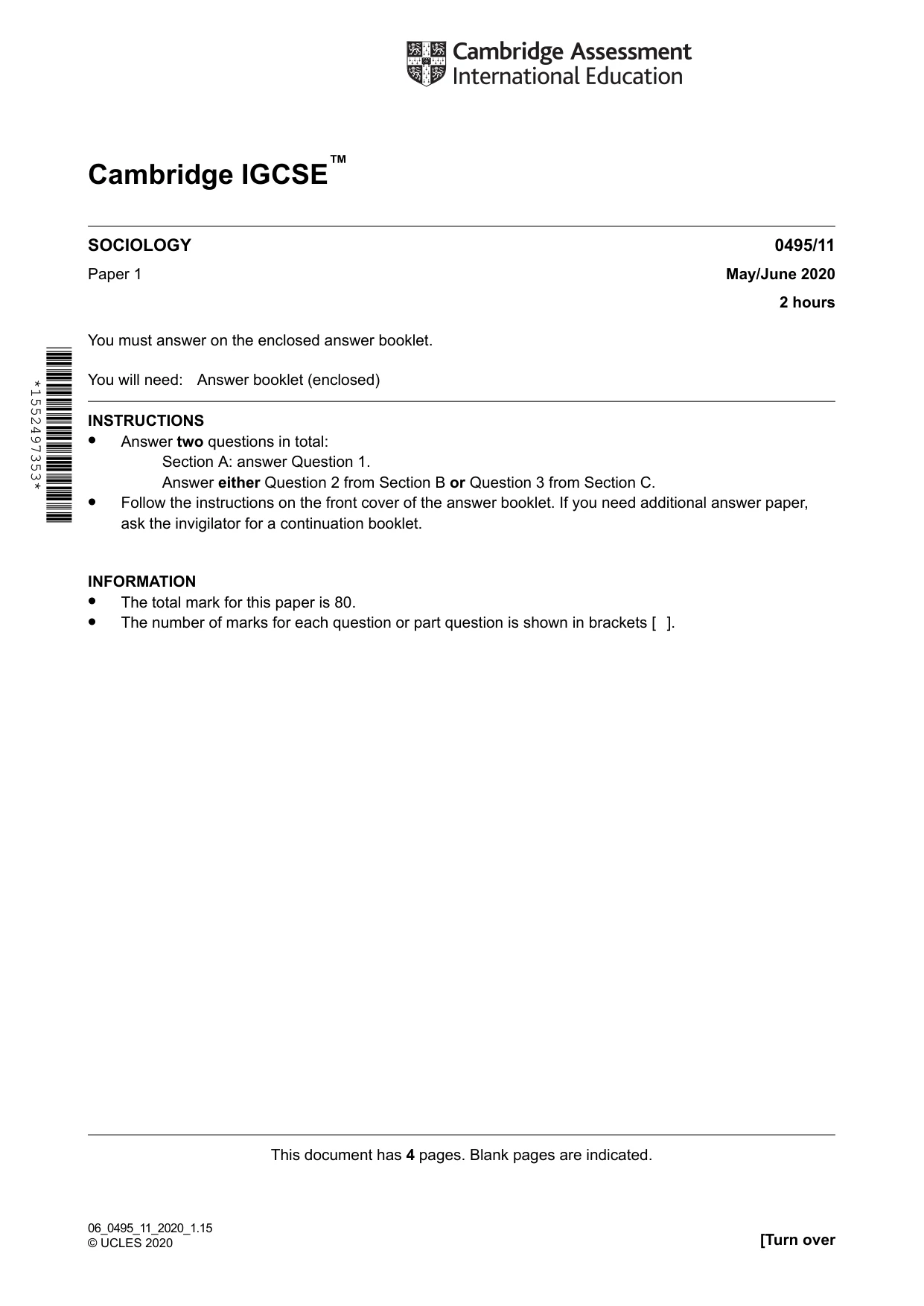
Cambridge IGCSE™ 0495/11 May/June 2020 2 hours SOCIOLOGY Paper 1 You must answer on the enclosed answer booklet. You will need: Answer booklet (enclosed) INSTRUCTIONS • Answer two questions in total: Section A: answer Question 1. Answer either Question 2 from Section B or Question 3 from Section C. • Follow the instructions on the front cover of the answer booklet. If you need additional answer paper, ask the invigilator for a continuation booklet. INFORMATION • The total mark for this paper is 80. • The number of marks for each question or part question is shown in brackets [ ]. This document has 4 pages. Blank pages are indicated. [Turn over 06_0495_11_2020_1.15 © UCLES 2020 *1552497353*
Question paper, page 2
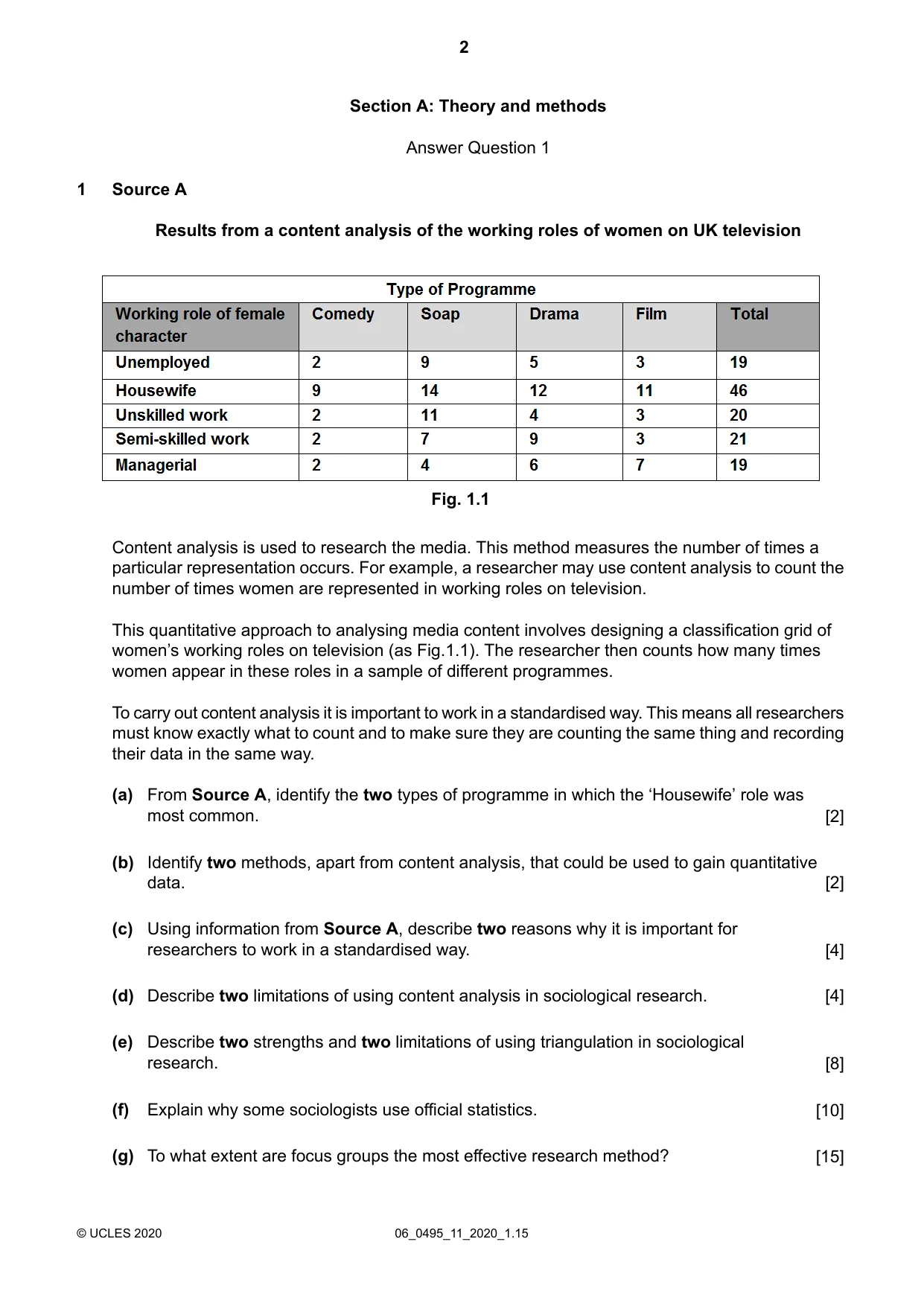
Section A: Theory and methods Answer Question 1 Source A 1 Results from a content analysis of the working roles of women on UK television Fig. 1.1 Content analysis is used to research the media. This method measures the number of times a particular representation occurs. For example, a researcher may use content analysis to count the number of times women are represented in working roles on television. This quantitative approach to analysing media content involves designing a classification grid of women’s working roles on television (as Fig.1.1). The researcher then counts how many times women appear in these roles in a sample of different programmes. To carry out content analysis it is important to work in a standardised way. This means all researchers must know exactly what to count and to make sure they are counting the same thing and recording their data in the same way. From Source A, identify the two types of programme in which the ‘Housewife’ role was most common. [2] (a) Identify two methods, apart from content analysis, that could be used to gain quantitative data. [2] (b) Using information from Source A, describe two reasons why it is important for researchers to work in a standardised way. [4] (c) Describe two limitations of using content analysis in sociological research. [4] (d) Describe two strengths and two limitations of using triangulation in sociological research. [8] (e) Explain why some sociologists use official statistics. [10] (f) To what extent are focus groups the most effective research method? [15] (g) 06_0495_11_2020_1.15 © UCLES 2020 2
Question paper, page 3
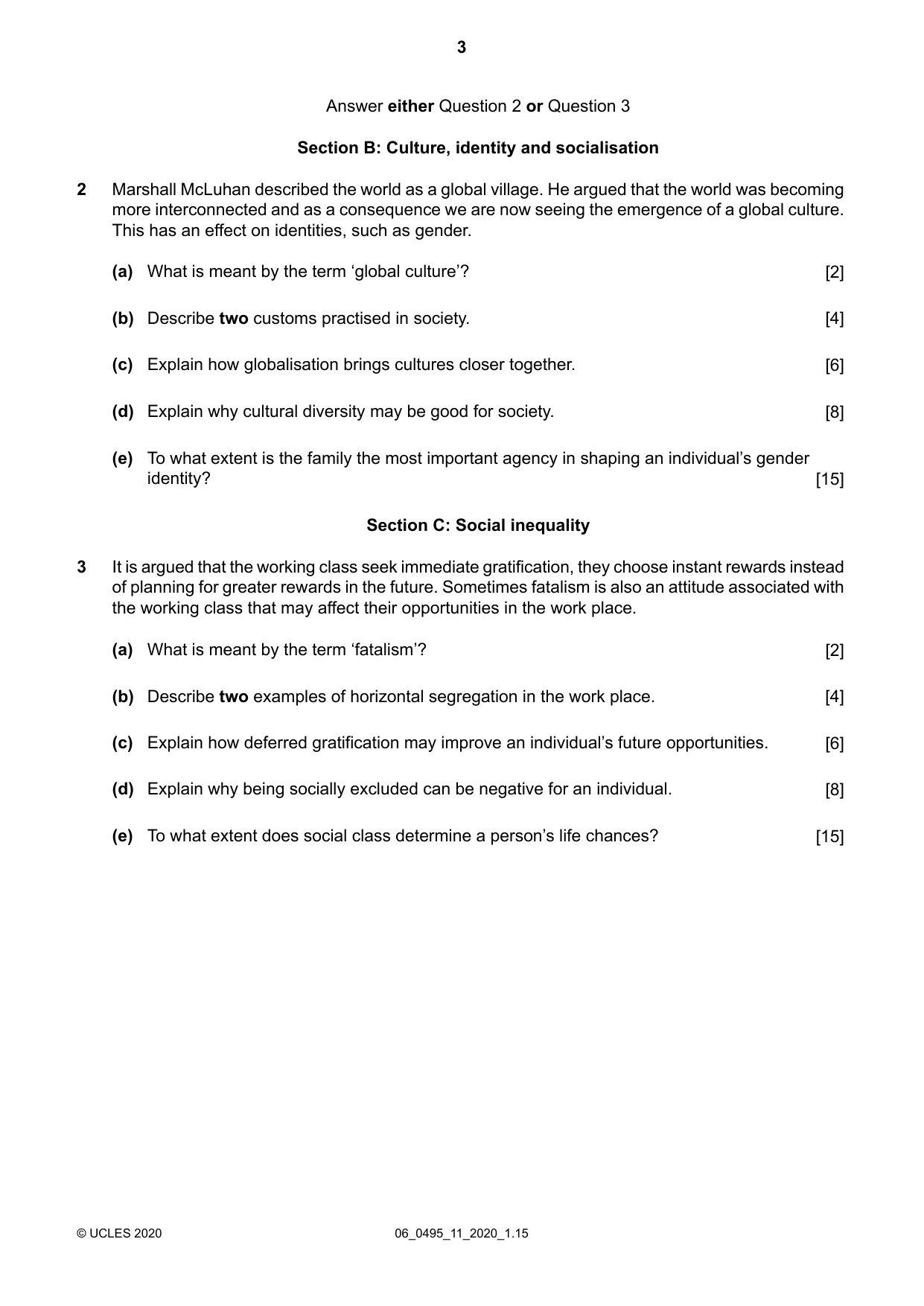
Answer either Question 2 or Question 3 Section B: Culture, identity and socialisation Marshall McLuhan described the world as a global village. He argued that the world was becoming more interconnected and as a consequence we are now seeing the emergence of a global culture. This has an effect on identities, such as gender. 2 What is meant by the term ‘global culture’? [2] (a) Describe two customs practised in society. [4] (b) Explain how globalisation brings cultures closer together. [6] (c) Explain why cultural diversity may be good for society. [8] (d) To what extent is the family the most important agency in shaping an individual’s gender identity? [15] (e) Section C: Social inequality It is argued that the working class seek immediate gratification, they choose instant rewards instead of planning for greater rewards in the future. Sometimes fatalism is also an attitude associated with the working class that may affect their opportunities in the work place. 3 What is meant by the term ‘fatalism’? [2] (a) Describe two examples of horizontal segregation in the work place. [4] (b) Explain how deferred gratification may improve an individual’s future opportunities. [6] (c) Explain why being socially excluded can be negative for an individual. [8] (d) To what extent does social class determine a person’s life chances? [15] (e) 06_0495_11_2020_1.15 © UCLES 2020 3
Question paper, page 4
BLANK PAGE Permission to reproduce items where third-party owned material protected by copyright is included has been sought and cleared where possible. Every reasonable effort has been made by the publisher (UCLES) to trace copyright holders, but if any items requiring clearance have unwittingly been included, the publisher will be pleased to make amends at the earliest possible opportunity. To avoid the issue of disclosure of answer-related information to candidates, all copyright acknowledgements are reproduced online in the Cambridge Assessment International Education Copyright Acknowledgements Booklet. This is produced for each series of examinations and is freely available to download at www.cambridgeinternational.org after the live examination series. Cambridge Assessment International Education is part of the Cambridge Assessment Group. Cambridge Assessment is the brand name of the University of Cambridge Local Examinations Syndicate (UCLES), which itself is a department of the University of Cambridge. 06_0495_11_2020_1.15 © UCLES 2020 4
Mark scheme, page 1
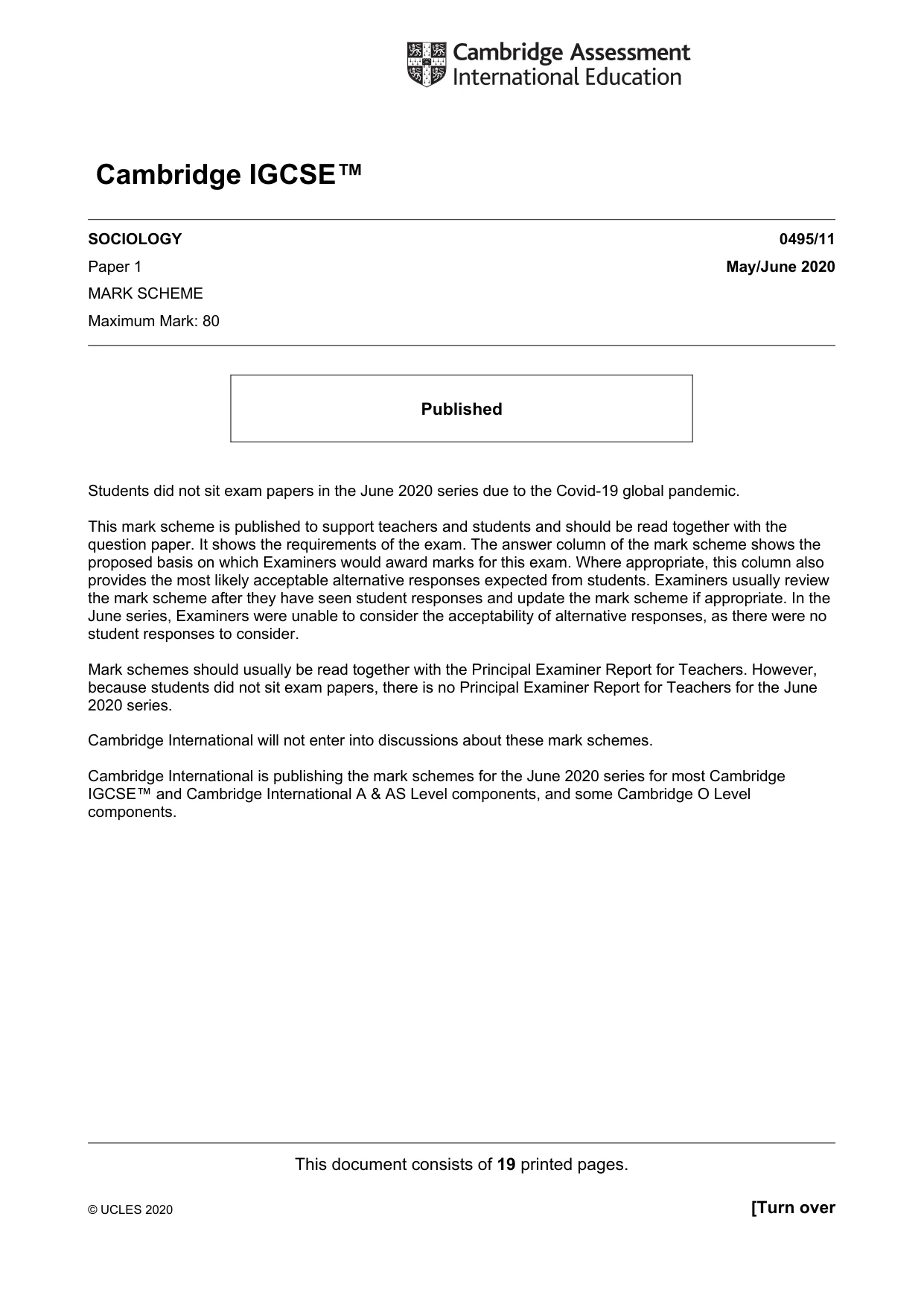
This document consists of 19 printed pages. © UCLES 2020 [Turn over Cambridge IGCSE™ SOCIOLOGY 0495/11 Paper 1 May/June 2020 MARK SCHEME Maximum Mark: 80 Published Students did not sit exam papers in the June 2020 series due to the Covid-19 global pandemic. This mark scheme is published to support teachers and students and should be read together with the question paper. It shows the requirements of the exam. The answer column of the mark scheme shows the proposed basis on which Examiners would award marks for this exam. Where appropriate, this column also provides the most likely acceptable alternative responses expected from students. Examiners usually review the mark scheme after they have seen student responses and update the mark scheme if appropriate. In the June series, Examiners were unable to consider the acceptability of alternative responses, as there were no student responses to consider. Mark schemes should usually be read together with the Principal Examiner Report for Teachers. However, because students did not sit exam papers, there is no Principal Examiner Report for Teachers for the June 2020 series. Cambridge International will not enter into discussions about these mark schemes. Cambridge International is publishing the mark schemes for the June 2020 series for most Cambridge IGCSE™ and Cambridge International A & AS Level components, and some Cambridge O Level components.
Mark scheme, page 2
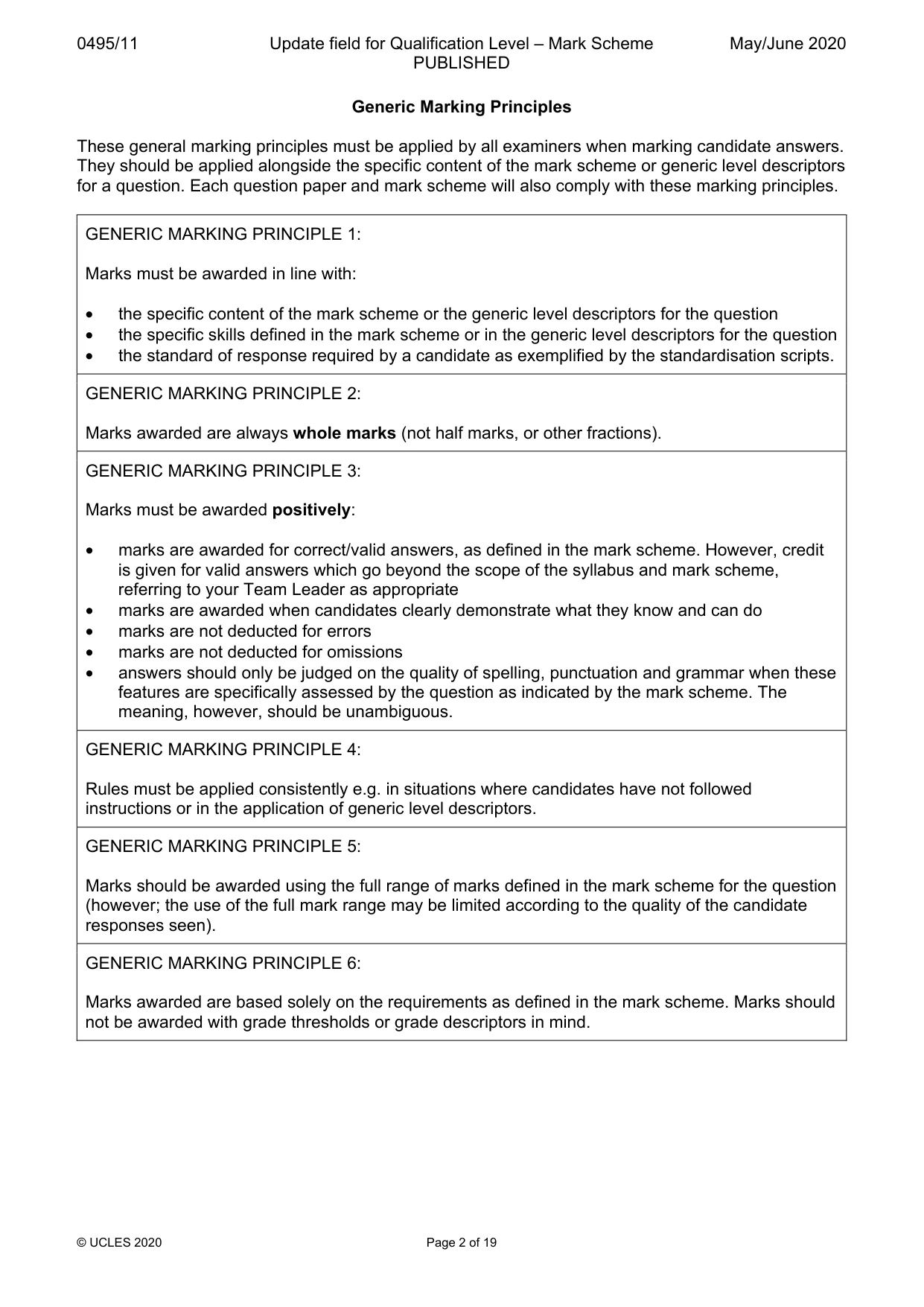
0495/11 Update field for Qualification Level – Mark Scheme PUBLISHED May/June 2020 © UCLES 2020 Page 2 of 19 Generic Marking Principles These general marking principles must be applied by all examiners when marking candidate answers. They should be applied alongside the specific content of the mark scheme or generic level descriptors for a question. Each question paper and mark scheme will also comply with these marking principles. GENERIC MARKING PRINCIPLE 1: Marks must be awarded in line with: • the specific content of the mark scheme or the generic level descriptors for the question • the specific skills defined in the mark scheme or in the generic level descriptors for the question • the standard of response required by a candidate as exemplified by the standardisation scripts. GENERIC MARKING PRINCIPLE 2: Marks awarded are always whole marks (not half marks, or other fractions). GENERIC MARKING PRINCIPLE 3: Marks must be awarded positively: • marks are awarded for correct/valid answers, as defined in the mark scheme. However, credit is given for valid answers which go beyond the scope of the syllabus and mark scheme, referring to your Team Leader as appropriate • marks are awarded when candidates clearly demonstrate what they know and can do • marks are not deducted for errors • marks are not deducted for omissions • answers should only be judged on the quality of spelling, punctuation and grammar when these features are specifically assessed by the question as indicated by the mark scheme. The meaning, however, should be unambiguous. GENERIC MARKING PRINCIPLE 4: Rules must be applied consistently e.g. in situations where candidates have not followed instructions or in the application of generic level descriptors. GENERIC MARKING PRINCIPLE 5: Marks should be awarded using the full range of marks defined in the mark scheme for the question (however; the use of the full mark range may be limited according to the quality of the candidate responses seen). GENERIC MARKING PRINCIPLE 6: Marks awarded are based solely on the requirements as defined in the mark scheme. Marks should not be awarded with grade thresholds or grade descriptors in mind.
Mark scheme, page 3
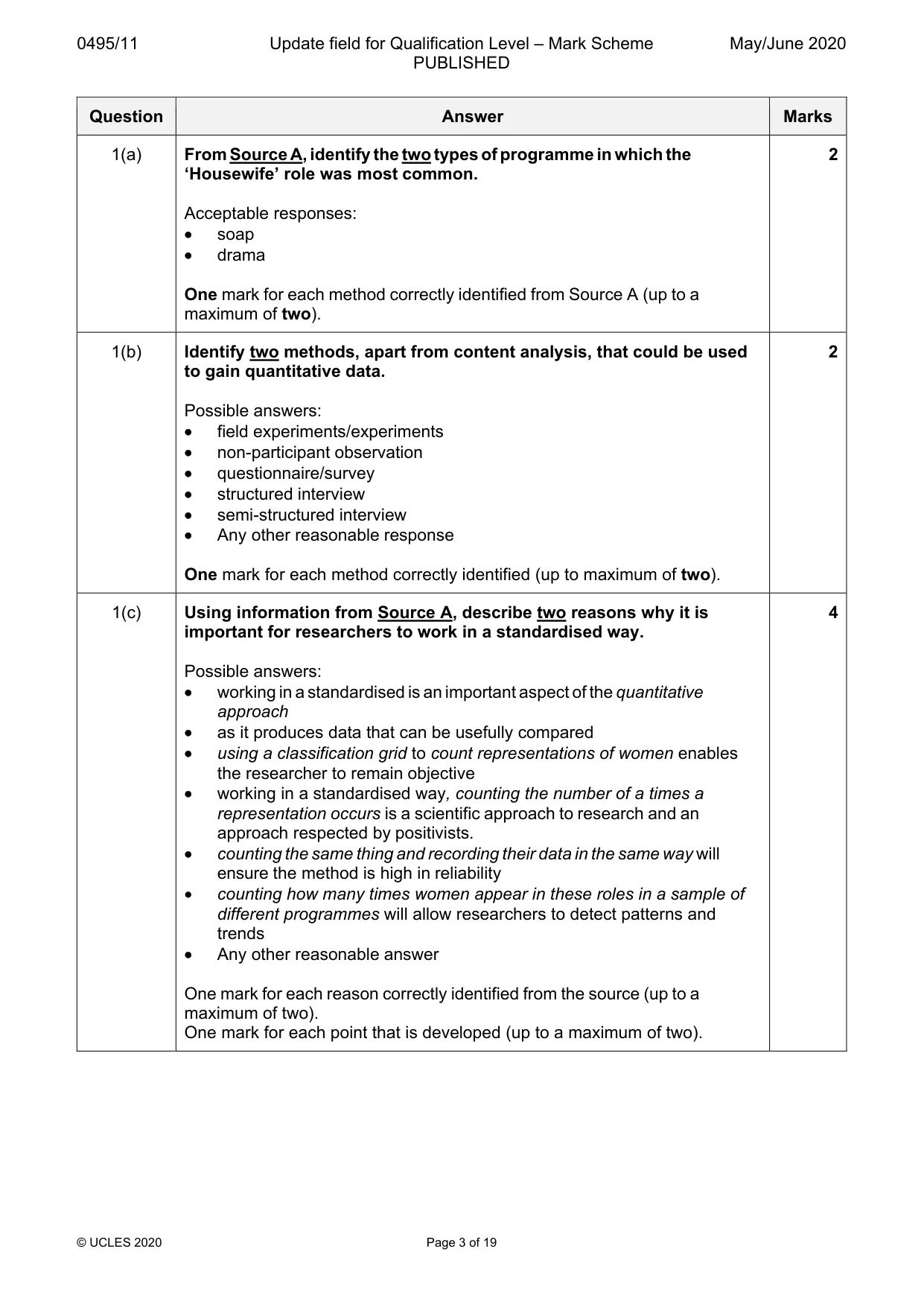
0495/11 Update field for Qualification Level – Mark Scheme PUBLISHED May/June 2020 © UCLES 2020 Page 3 of 19 Question Answer Marks 1(a) From Source A, identify the two types of programme in which the ‘Housewife’ role was most common. Acceptable responses: • soap • drama One mark for each method correctly identified from Source A (up to a maximum of two). 2 1(b) Identify two methods, apart from content analysis, that could be used to gain quantitative data. Possible answers: • field experiments/experiments • non-participant observation • questionnaire/survey • structured interview • semi-structured interview • Any other reasonable response One mark for each method correctly identified (up to maximum of two). 2 1(c) Using information from Source A, describe two reasons why it is important for researchers to work in a standardised way. Possible answers: • working in a standardised is an important aspect of the quantitative approach • as it produces data that can be usefully compared • using a classification grid to count representations of women enables the researcher to remain objective • working in a standardised way, counting the number of a times a representation occurs is a scientific approach to research and an approach respected by positivists. • counting the same thing and recording their data in the same way will ensure the method is high in reliability • counting how many times women appear in these roles in a sample of different programmes will allow researchers to detect patterns and trends • Any other reasonable answer One mark for each reason correctly identified from the source (up to a maximum of two). One mark for each point that is developed (up to a maximum of two). 4
Mark scheme, page 4
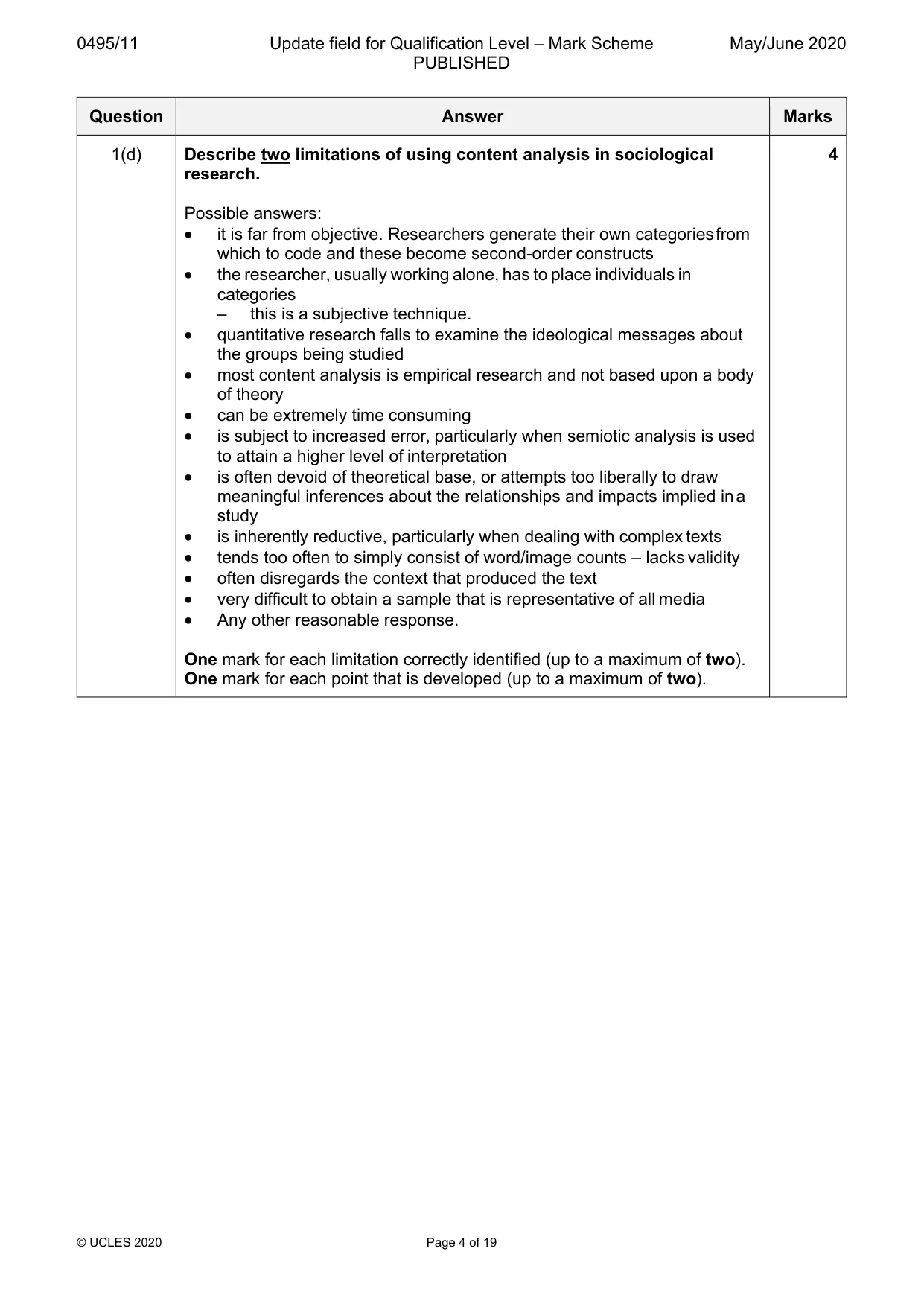
0495/11 Update field for Qualification Level – Mark Scheme PUBLISHED May/June 2020 © UCLES 2020 Page 4 of 19 Question Answer Marks 1(d) Describe two limitations of using content analysis in sociological research. Possible answers: • it is far from objective. Researchers generate their own categories from which to code and these become second-order constructs • the researcher, usually working alone, has to place individuals in categories – this is a subjective technique. • quantitative research falls to examine the ideological messages about the groups being studied • most content analysis is empirical research and not based upon a body of theory • can be extremely time consuming • is subject to increased error, particularly when semiotic analysis is used to attain a higher level of interpretation • is often devoid of theoretical base, or attempts too liberally to draw meaningful inferences about the relationships and impacts implied in a study • is inherently reductive, particularly when dealing with complex texts • tends too often to simply consist of word/image counts – lacks validity • often disregards the context that produced the text • very difficult to obtain a sample that is representative of all media • Any other reasonable response. One mark for each limitation correctly identified (up to a maximum of two). One mark for each point that is developed (up to a maximum of two). 4
Mark scheme, page 5
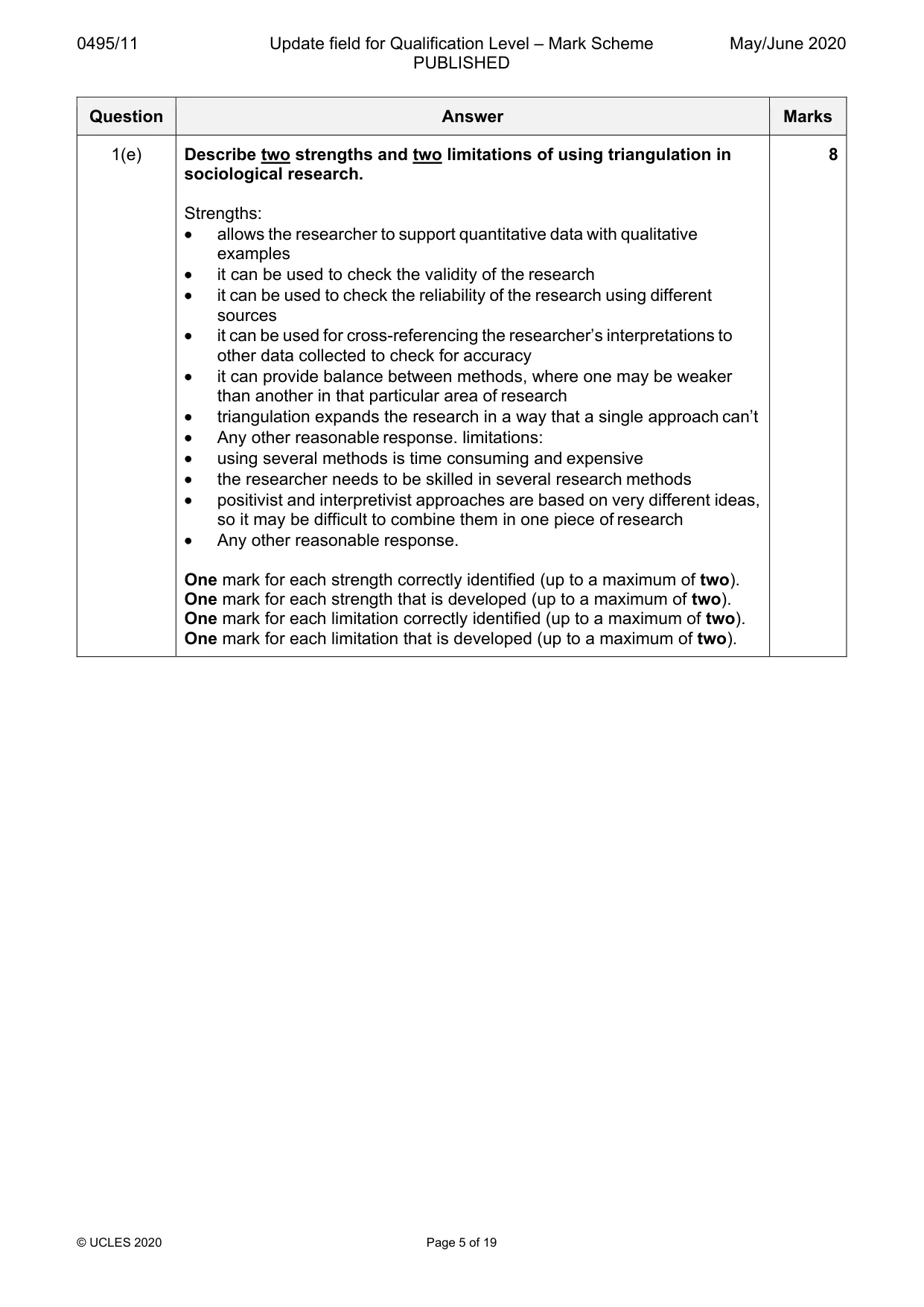
0495/11 Update field for Qualification Level – Mark Scheme PUBLISHED May/June 2020 © UCLES 2020 Page 5 of 19 Question Answer Marks 1(e) Describe two strengths and two limitations of using triangulation in sociological research. Strengths: • allows the researcher to support quantitative data with qualitative examples • it can be used to check the validity of the research • it can be used to check the reliability of the research using different sources • it can be used for cross-referencing the researcher’s interpretations to other data collected to check for accuracy • it can provide balance between methods, where one may be weaker than another in that particular area of research • triangulation expands the research in a way that a single approach can’t • Any other reasonable response. limitations: • using several methods is time consuming and expensive • the researcher needs to be skilled in several research methods • positivist and interpretivist approaches are based on very different ideas, so it may be difficult to combine them in one piece of research • Any other reasonable response. One mark for each strength correctly identified (up to a maximum of two). One mark for each strength that is developed (up to a maximum of two). One mark for each limitation correctly identified (up to a maximum of two). One mark for each limitation that is developed (up to a maximum of two). 8
Mark scheme, page 6
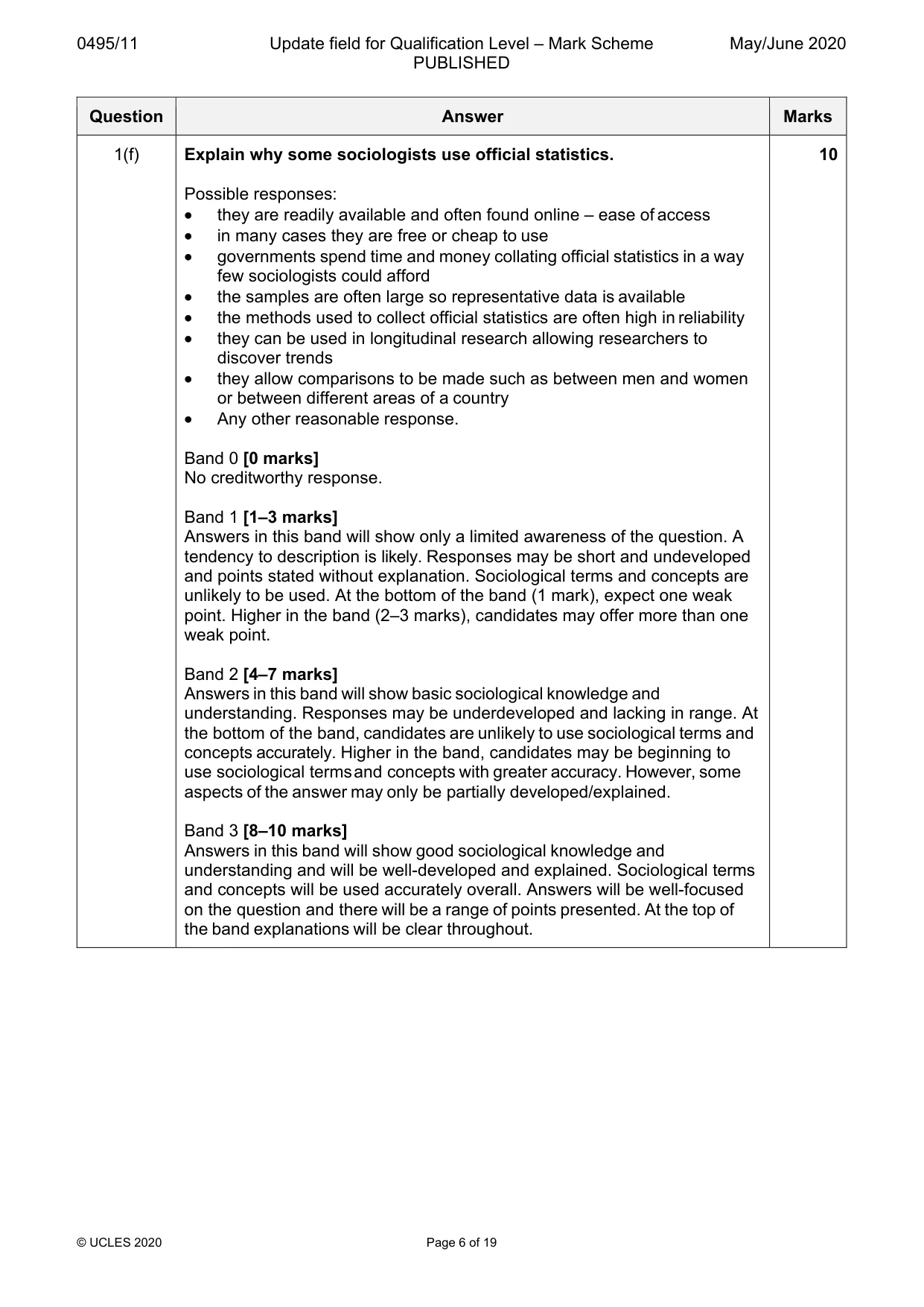
0495/11 Update field for Qualification Level – Mark Scheme PUBLISHED May/June 2020 © UCLES 2020 Page 6 of 19 Question Answer Marks 1(f) Explain why some sociologists use official statistics. Possible responses: • they are readily available and often found online – ease of access • in many cases they are free or cheap to use • governments spend time and money collating official statistics in a way few sociologists could afford • the samples are often large so representative data is available • the methods used to collect official statistics are often high in reliability • they can be used in longitudinal research allowing researchers to discover trends • they allow comparisons to be made such as between men and women or between different areas of a country • Any other reasonable response. Band 0 [0 marks] No creditworthy response. Band 1 [1–3 marks] Answers in this band will show only a limited awareness of the question. A tendency to description is likely. Responses may be short and undeveloped and points stated without explanation. Sociological terms and concepts are unlikely to be used. At the bottom of the band (1 mark), expect one weak point. Higher in the band (2–3 marks), candidates may offer more than one weak point. Band 2 [4–7 marks] Answers in this band will show basic sociological knowledge and understanding. Responses may be underdeveloped and lacking in range. At the bottom of the band, candidates are unlikely to use sociological terms and concepts accurately. Higher in the band, candidates may be beginning to use sociological terms and concepts with greater accuracy. However, some aspects of the answer may only be partially developed/explained. Band 3 [8–10 marks] Answers in this band will show good sociological knowledge and understanding and will be well-developed and explained. Sociological terms and concepts will be used accurately overall. Answers will be well-focused on the question and there will be a range of points presented. At the top of the band explanations will be clear throughout. 10
Mark scheme, page 7
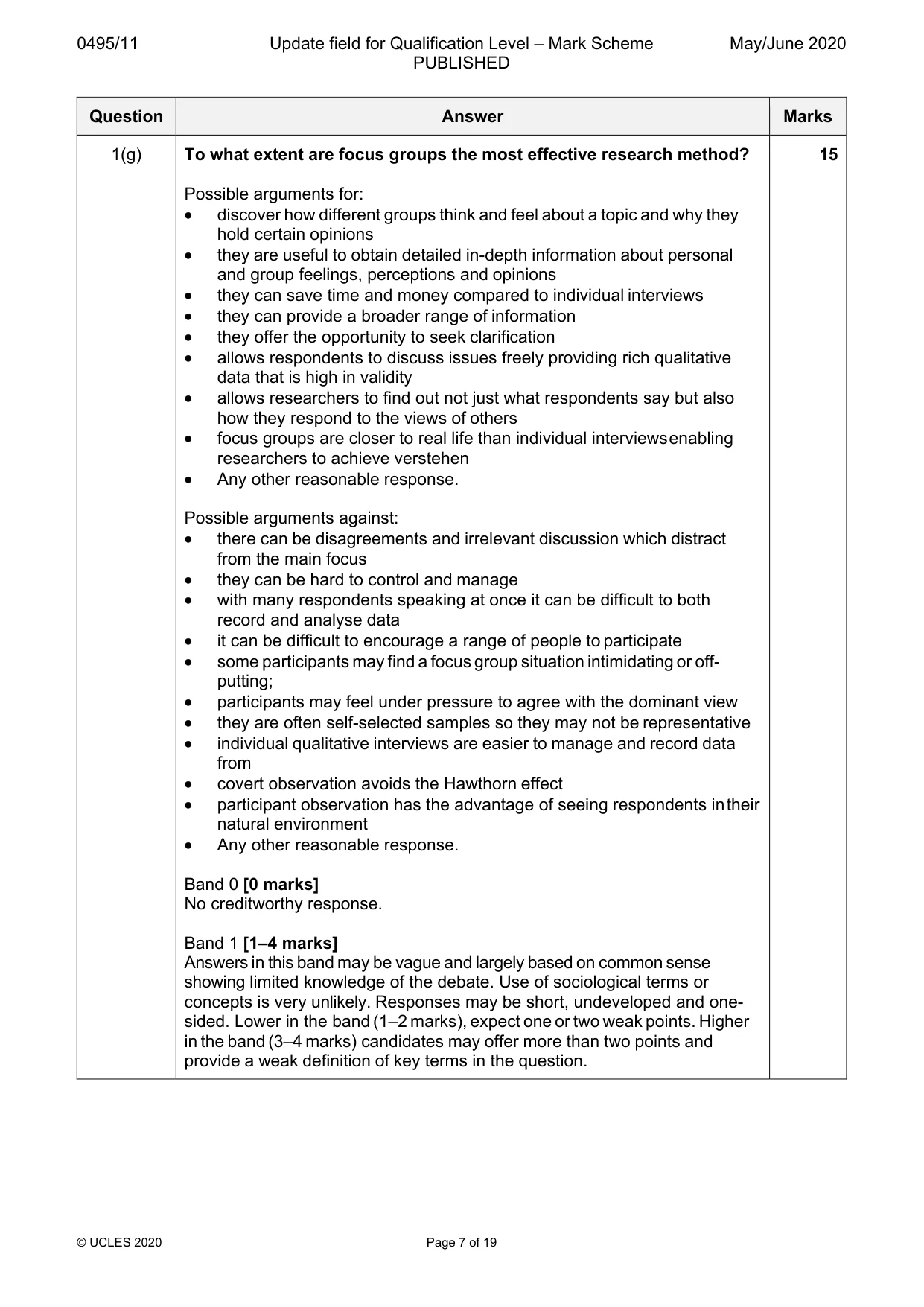
0495/11 Update field for Qualification Level – Mark Scheme PUBLISHED May/June 2020 © UCLES 2020 Page 7 of 19 Question Answer Marks 1(g) To what extent are focus groups the most effective research method? Possible arguments for: • discover how different groups think and feel about a topic and why they hold certain opinions • they are useful to obtain detailed in-depth information about personal and group feelings, perceptions and opinions • they can save time and money compared to individual interviews • they can provide a broader range of information • they offer the opportunity to seek clarification • allows respondents to discuss issues freely providing rich qualitative data that is high in validity • allows researchers to find out not just what respondents say but also how they respond to the views of others • focus groups are closer to real life than individual interviews enabling researchers to achieve verstehen • Any other reasonable response. Possible arguments against: • there can be disagreements and irrelevant discussion which distract from the main focus • they can be hard to control and manage • with many respondents speaking at once it can be difficult to both record and analyse data • it can be difficult to encourage a range of people to participate • some participants may find a focus group situation intimidating or off- putting; • participants may feel under pressure to agree with the dominant view • they are often self-selected samples so they may not be representative • individual qualitative interviews are easier to manage and record data from • covert observation avoids the Hawthorn effect • participant observation has the advantage of seeing respondents in their natural environment • Any other reasonable response. Band 0 [0 marks] No creditworthy response. Band 1 [1–4 marks] Answers in this band may be vague and largely based on common sense showing limited knowledge of the debate. Use of sociological terms or concepts is very unlikely. Responses may be short, undeveloped and one- sided. Lower in the band (1–2 marks), expect one or two weak points. Higher in the band (3–4 marks) candidates may offer more than two points and provide a weak definition of key terms in the question. 15
Mark scheme, page 8
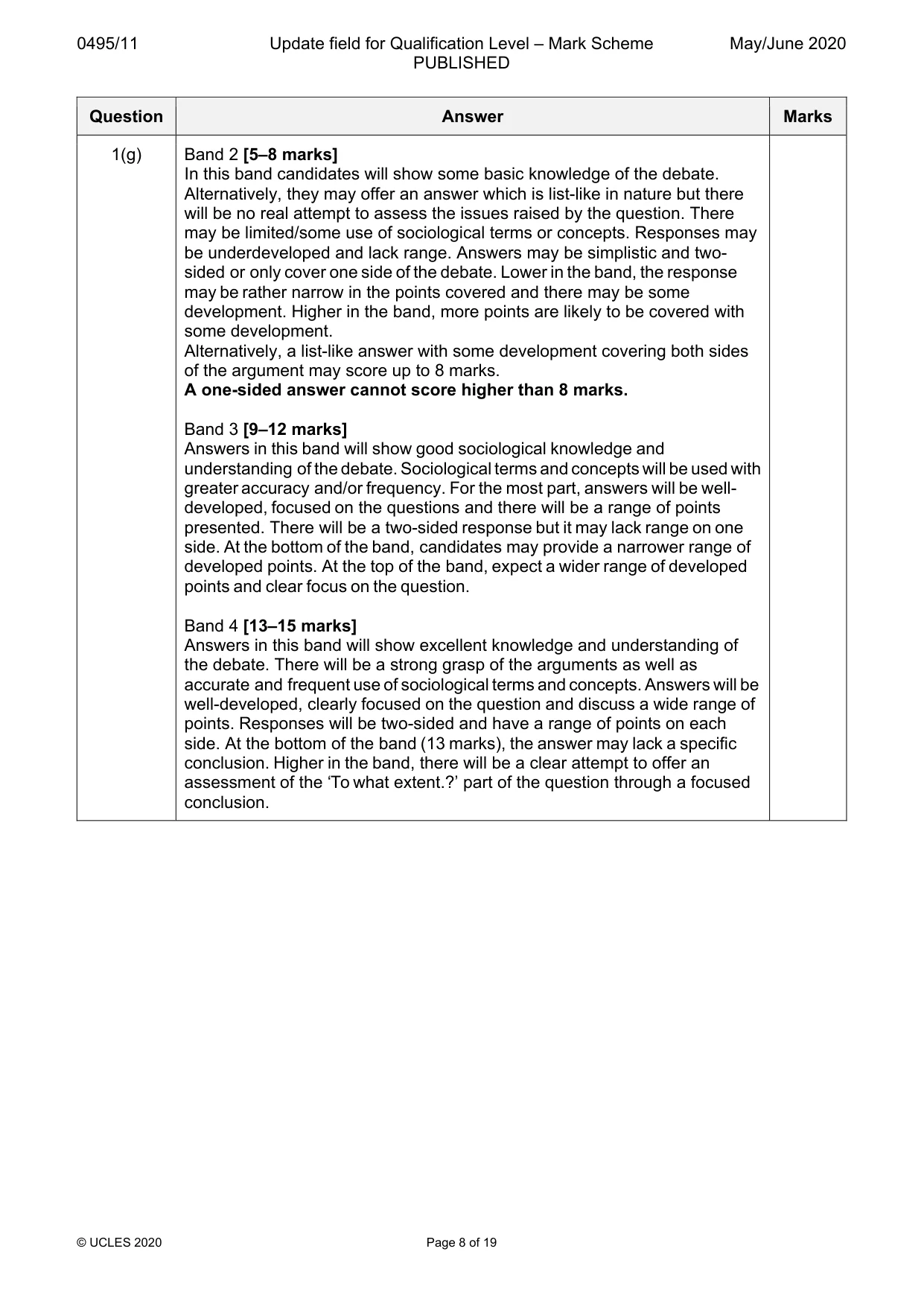
0495/11 Update field for Qualification Level – Mark Scheme PUBLISHED May/June 2020 © UCLES 2020 Page 8 of 19 Question Answer Marks 1(g) Band 2 [5–8 marks] In this band candidates will show some basic knowledge of the debate. Alternatively, they may offer an answer which is list-like in nature but there will be no real attempt to assess the issues raised by the question. There may be limited/some use of sociological terms or concepts. Responses may be underdeveloped and lack range. Answers may be simplistic and two- sided or only cover one side of the debate. Lower in the band, the response may be rather narrow in the points covered and there may be some development. Higher in the band, more points are likely to be covered with some development. Alternatively, a list-like answer with some development covering both sides of the argument may score up to 8 marks. A one-sided answer cannot score higher than 8 marks. Band 3 [9–12 marks] Answers in this band will show good sociological knowledge and understanding of the debate. Sociological terms and concepts will be used with greater accuracy and/or frequency. For the most part, answers will be well- developed, focused on the questions and there will be a range of points presented. There will be a two-sided response but it may lack range on one side. At the bottom of the band, candidates may provide a narrower range of developed points. At the top of the band, expect a wider range of developed points and clear focus on the question. Band 4 [13–15 marks] Answers in this band will show excellent knowledge and understanding of the debate. There will be a strong grasp of the arguments as well as accurate and frequent use of sociological terms and concepts. Answers will be well-developed, clearly focused on the question and discuss a wide range of points. Responses will be two-sided and have a range of points on each side. At the bottom of the band (13 marks), the answer may lack a specific conclusion. Higher in the band, there will be a clear attempt to offer an assessment of the ‘To what extent.?’ part of the question through a focused conclusion.
Mark scheme, page 9
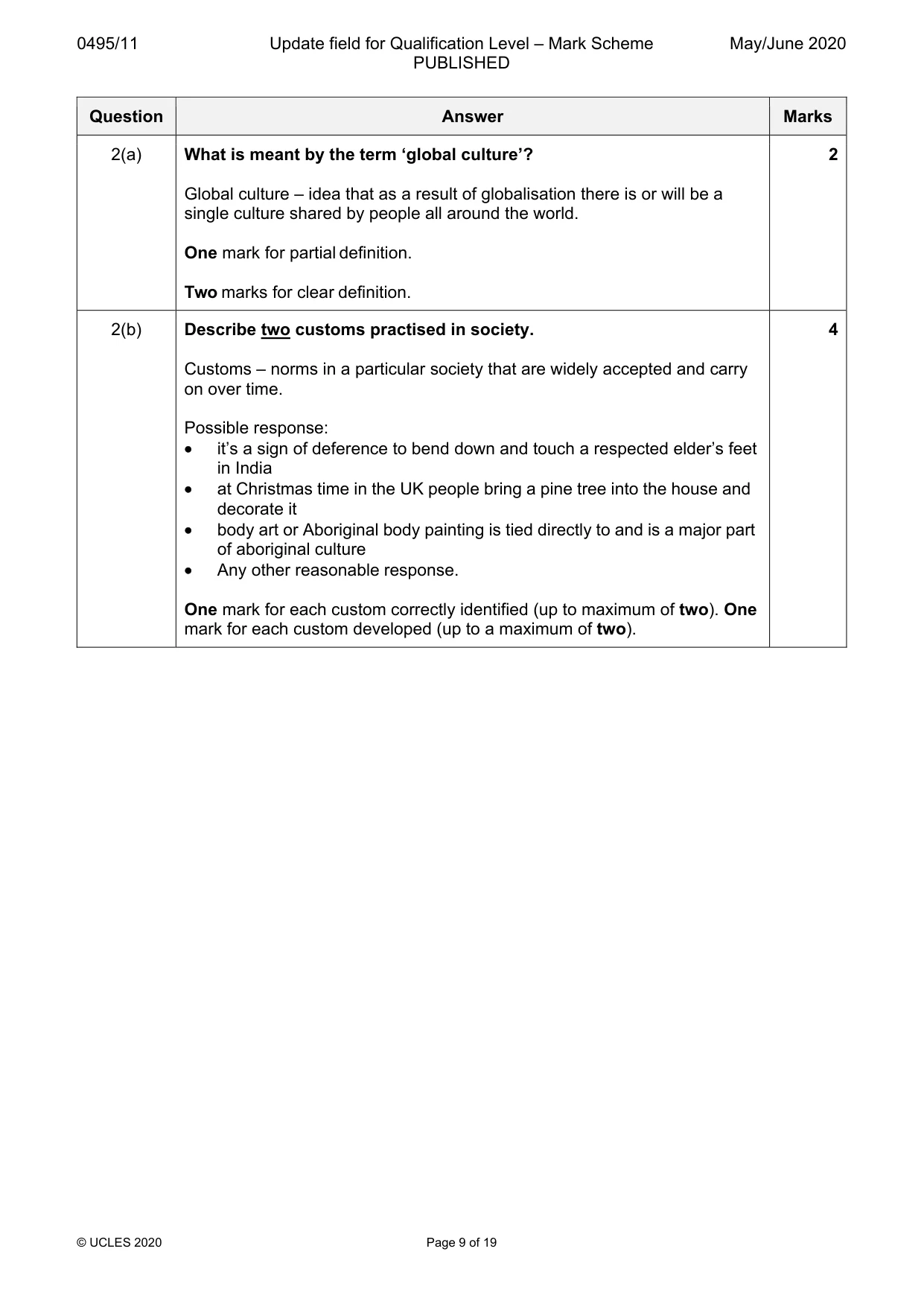
0495/11 Update field for Qualification Level – Mark Scheme PUBLISHED May/June 2020 © UCLES 2020 Page 9 of 19 Question Answer Marks 2(a) What is meant by the term ‘global culture’? Global culture – idea that as a result of globalisation there is or will be a single culture shared by people all around the world. One mark for partial definition. Two marks for clear definition. 2 2(b) Describe two customs practised in society. Customs – norms in a particular society that are widely accepted and carry on over time. Possible response: • it’s a sign of deference to bend down and touch a respected elder’s feet in India • at Christmas time in the UK people bring a pine tree into the house and decorate it • body art or Aboriginal body painting is tied directly to and is a major part of aboriginal culture • Any other reasonable response. One mark for each custom correctly identified (up to maximum of two). One mark for each custom developed (up to a maximum of two). 4
Mark scheme, page 10
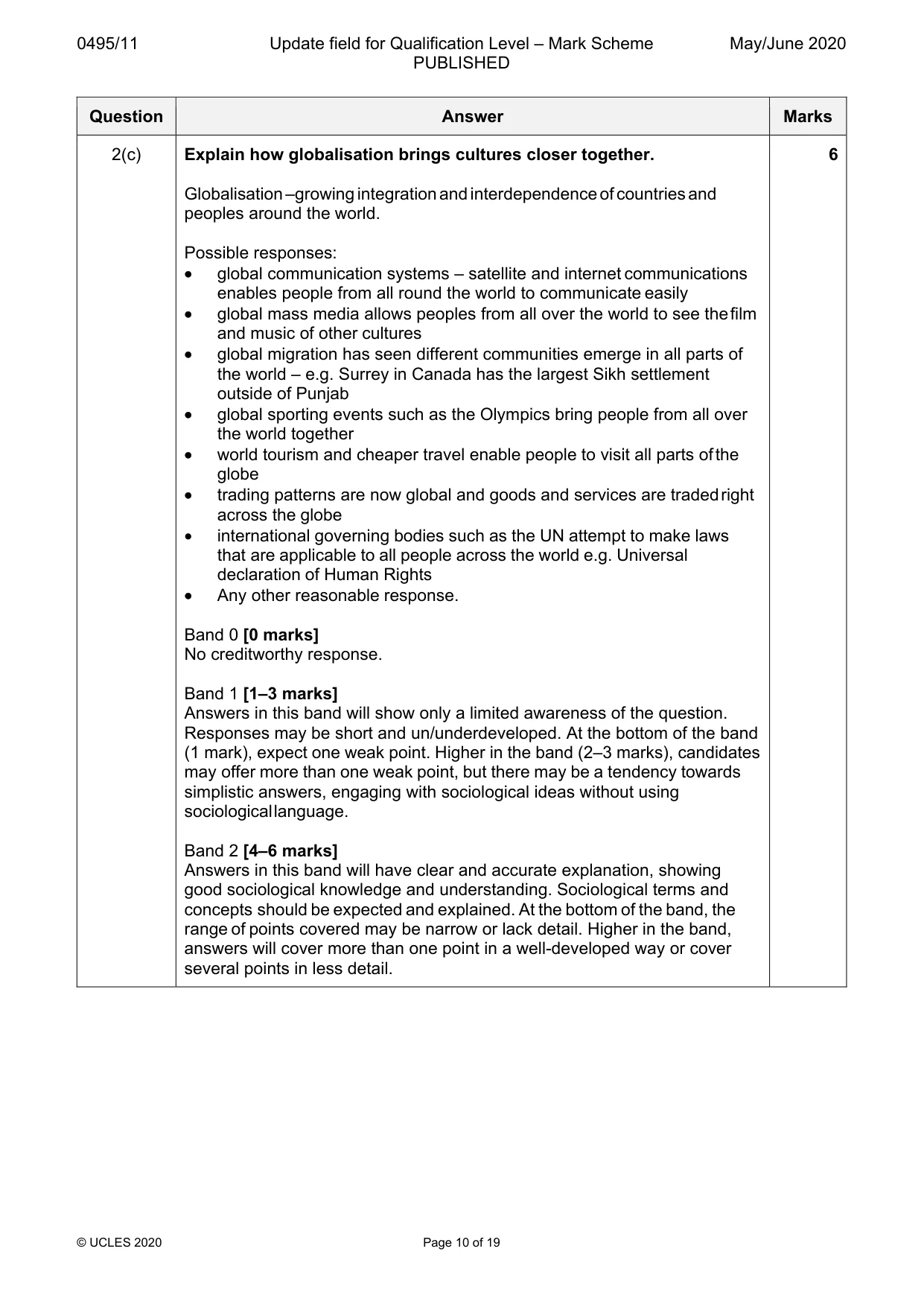
0495/11 Update field for Qualification Level – Mark Scheme PUBLISHED May/June 2020 © UCLES 2020 Page 10 of 19 Question Answer Marks 2(c) Explain how globalisation brings cultures closer together. Globalisation – growing integration and interdependence of countries and peoples around the world. Possible responses: • global communication systems – satellite and internet communications enables people from all round the world to communicate easily • global mass media allows peoples from all over the world to see the film and music of other cultures • global migration has seen different communities emerge in all parts of the world – e.g. Surrey in Canada has the largest Sikh settlement outside of Punjab • global sporting events such as the Olympics bring people from all over the world together • world tourism and cheaper travel enable people to visit all parts of the globe • trading patterns are now global and goods and services are traded right across the globe • international governing bodies such as the UN attempt to make laws that are applicable to all people across the world e.g. Universal declaration of Human Rights • Any other reasonable response. Band 0 [0 marks] No creditworthy response. Band 1 [1–3 marks] Answers in this band will show only a limited awareness of the question. Responses may be short and un/underdeveloped. At the bottom of the band (1 mark), expect one weak point. Higher in the band (2–3 marks), candidates may offer more than one weak point, but there may be a tendency towards simplistic answers, engaging with sociological ideas without using sociological language. Band 2 [4–6 marks] Answers in this band will have clear and accurate explanation, showing good sociological knowledge and understanding. Sociological terms and concepts should be expected and explained. At the bottom of the band, the range of points covered may be narrow or lack detail. Higher in the band, answers will cover more than one point in a well-developed way or cover several points in less detail. 6
Mark scheme, page 11
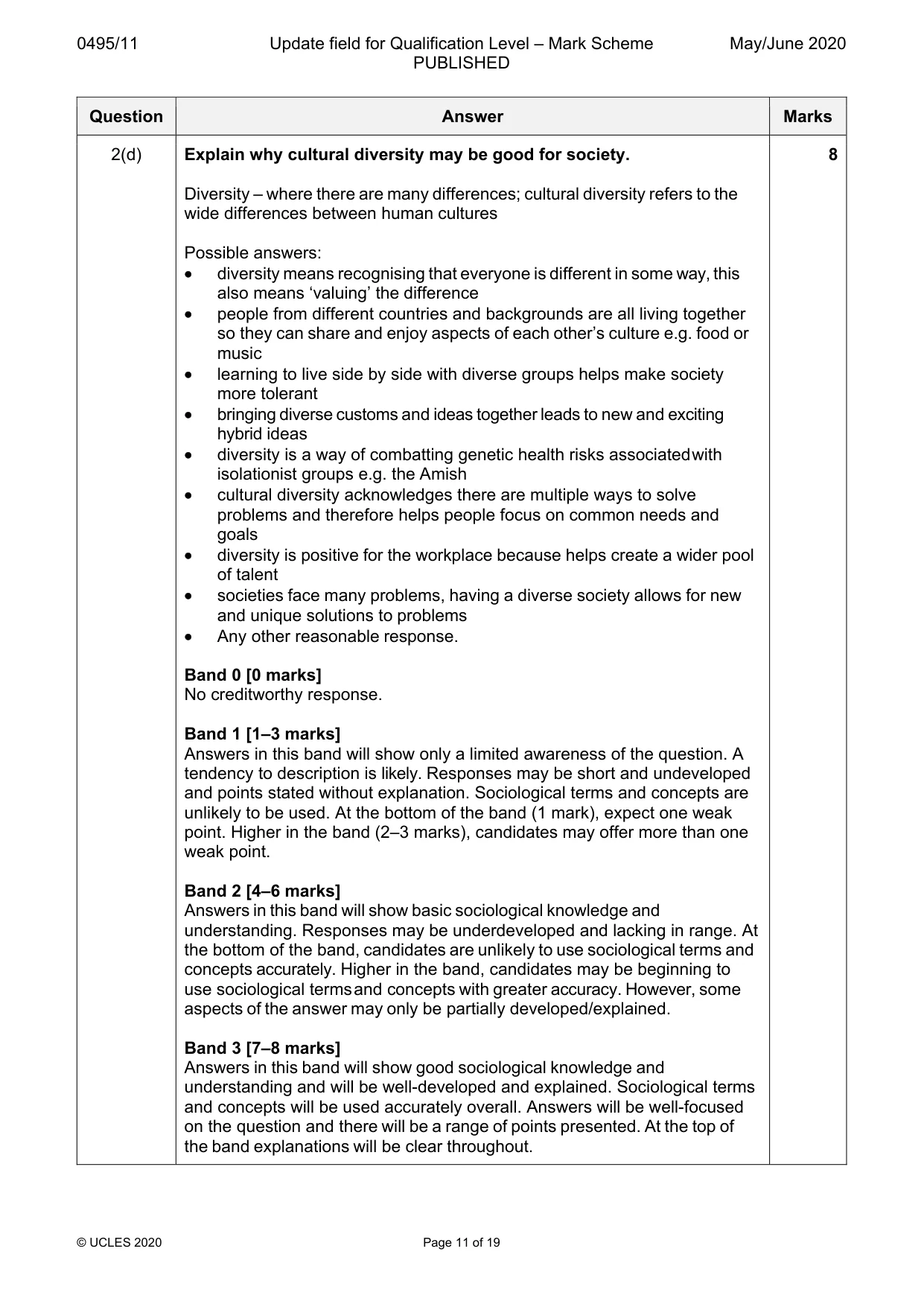
0495/11 Update field for Qualification Level – Mark Scheme PUBLISHED May/June 2020 © UCLES 2020 Page 11 of 19 Question Answer Marks 2(d) Explain why cultural diversity may be good for society. Diversity – where there are many differences; cultural diversity refers to the wide differences between human cultures Possible answers: • diversity means recognising that everyone is different in some way, this also means ‘valuing’ the difference • people from different countries and backgrounds are all living together so they can share and enjoy aspects of each other’s culture e.g. food or music • learning to live side by side with diverse groups helps make society more tolerant • bringing diverse customs and ideas together leads to new and exciting hybrid ideas • diversity is a way of combatting genetic health risks associated with isolationist groups e.g. the Amish • cultural diversity acknowledges there are multiple ways to solve problems and therefore helps people focus on common needs and goals • diversity is positive for the workplace because helps create a wider pool of talent • societies face many problems, having a diverse society allows for new and unique solutions to problems • Any other reasonable response. Band 0 [0 marks] No creditworthy response. Band 1 [1–3 marks] Answers in this band will show only a limited awareness of the question. A tendency to description is likely. Responses may be short and undeveloped and points stated without explanation. Sociological terms and concepts are unlikely to be used. At the bottom of the band (1 mark), expect one weak point. Higher in the band (2–3 marks), candidates may offer more than one weak point. Band 2 [4–6 marks] Answers in this band will show basic sociological knowledge and understanding. Responses may be underdeveloped and lacking in range. At the bottom of the band, candidates are unlikely to use sociological terms and concepts accurately. Higher in the band, candidates may be beginning to use sociological terms and concepts with greater accuracy. However, some aspects of the answer may only be partially developed/explained. Band 3 [7–8 marks] Answers in this band will show good sociological knowledge and understanding and will be well-developed and explained. Sociological terms and concepts will be used accurately overall. Answers will be well-focused on the question and there will be a range of points presented. At the top of the band explanations will be clear throughout. 8
Mark scheme, page 12
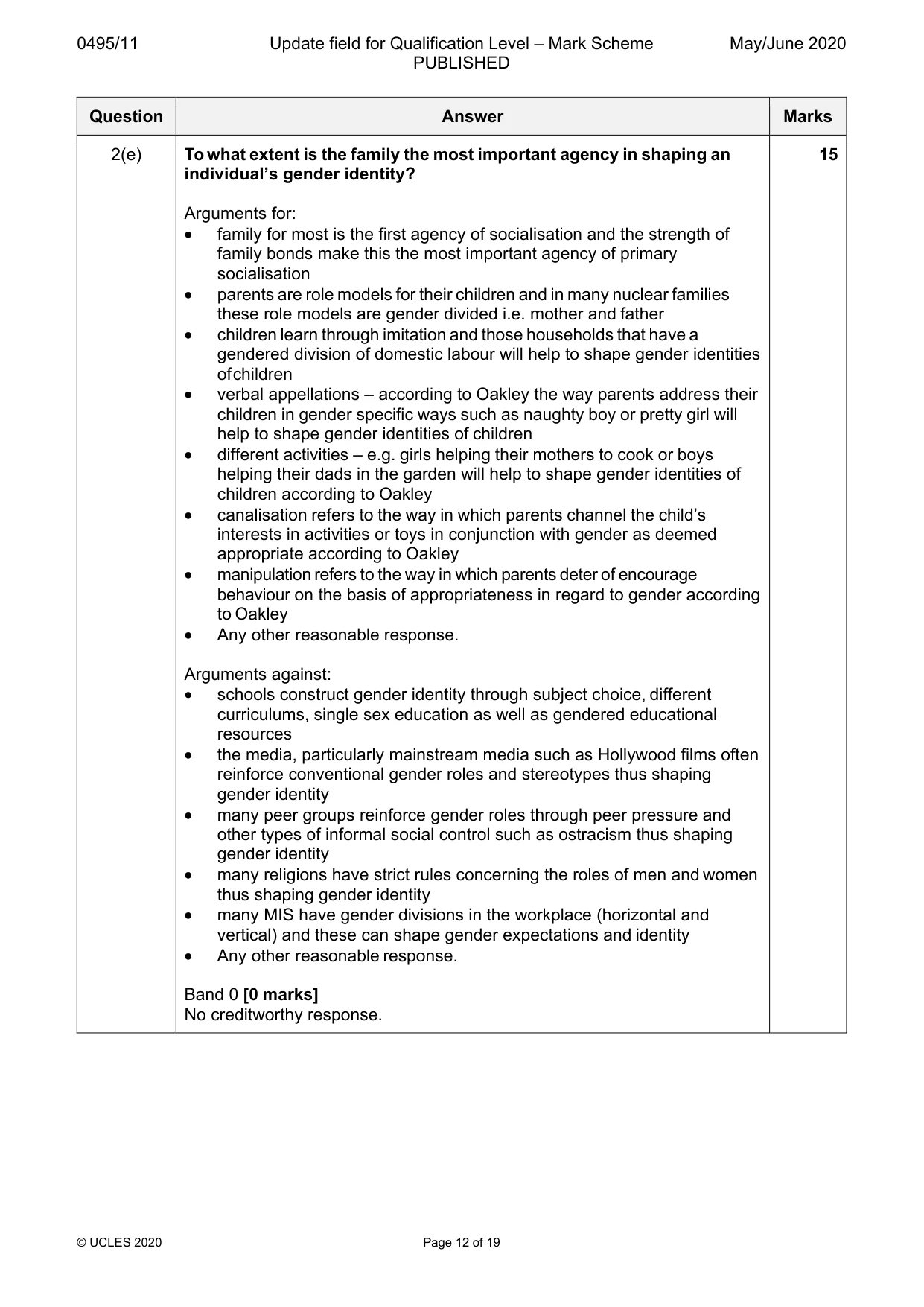
0495/11 Update field for Qualification Level – Mark Scheme PUBLISHED May/June 2020 © UCLES 2020 Page 12 of 19 Question Answer Marks 2(e) To what extent is the family the most important agency in shaping an individual’s gender identity? Arguments for: • family for most is the first agency of socialisation and the strength of family bonds make this the most important agency of primary socialisation • parents are role models for their children and in many nuclear families these role models are gender divided i.e. mother and father • children learn through imitation and those households that have a gendered division of domestic labour will help to shape gender identities of children • verbal appellations – according to Oakley the way parents address their children in gender specific ways such as naughty boy or pretty girl will help to shape gender identities of children • different activities – e.g. girls helping their mothers to cook or boys helping their dads in the garden will help to shape gender identities of children according to Oakley • canalisation refers to the way in which parents channel the child’s interests in activities or toys in conjunction with gender as deemed appropriate according to Oakley • manipulation refers to the way in which parents deter of encourage behaviour on the basis of appropriateness in regard to gender according to Oakley • Any other reasonable response. Arguments against: • schools construct gender identity through subject choice, different curriculums, single sex education as well as gendered educational resources • the media, particularly mainstream media such as Hollywood films often reinforce conventional gender roles and stereotypes thus shaping gender identity • many peer groups reinforce gender roles through peer pressure and other types of informal social control such as ostracism thus shaping gender identity • many religions have strict rules concerning the roles of men and women thus shaping gender identity • many MIS have gender divisions in the workplace (horizontal and vertical) and these can shape gender expectations and identity • Any other reasonable response. Band 0 [0 marks] No creditworthy response. 15
Mark scheme, page 13
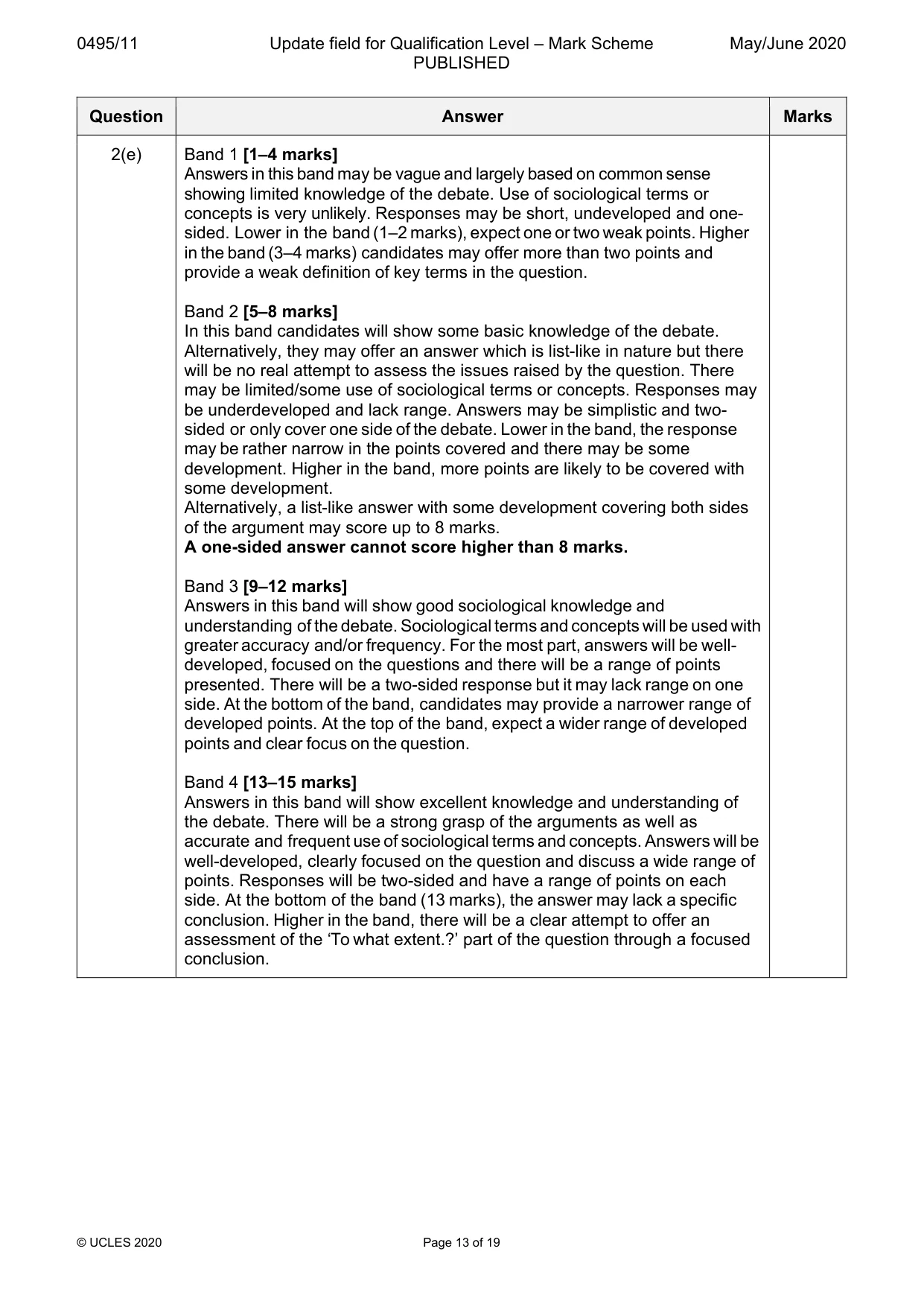
0495/11 Update field for Qualification Level – Mark Scheme PUBLISHED May/June 2020 © UCLES 2020 Page 13 of 19 Question Answer Marks 2(e) Band 1 [1–4 marks] Answers in this band may be vague and largely based on common sense showing limited knowledge of the debate. Use of sociological terms or concepts is very unlikely. Responses may be short, undeveloped and one- sided. Lower in the band (1–2 marks), expect one or two weak points. Higher in the band (3–4 marks) candidates may offer more than two points and provide a weak definition of key terms in the question. Band 2 [5–8 marks] In this band candidates will show some basic knowledge of the debate. Alternatively, they may offer an answer which is list-like in nature but there will be no real attempt to assess the issues raised by the question. There may be limited/some use of sociological terms or concepts. Responses may be underdeveloped and lack range. Answers may be simplistic and two- sided or only cover one side of the debate. Lower in the band, the response may be rather narrow in the points covered and there may be some development. Higher in the band, more points are likely to be covered with some development. Alternatively, a list-like answer with some development covering both sides of the argument may score up to 8 marks. A one-sided answer cannot score higher than 8 marks. Band 3 [9–12 marks] Answers in this band will show good sociological knowledge and understanding of the debate. Sociological terms and concepts will be used with greater accuracy and/or frequency. For the most part, answers will be well- developed, focused on the questions and there will be a range of points presented. There will be a two-sided response but it may lack range on one side. At the bottom of the band, candidates may provide a narrower range of developed points. At the top of the band, expect a wider range of developed points and clear focus on the question. Band 4 [13–15 marks] Answers in this band will show excellent knowledge and understanding of the debate. There will be a strong grasp of the arguments as well as accurate and frequent use of sociological terms and concepts. Answers will be well-developed, clearly focused on the question and discuss a wide range of points. Responses will be two-sided and have a range of points on each side. At the bottom of the band (13 marks), the answer may lack a specific conclusion. Higher in the band, there will be a clear attempt to offer an assessment of the ‘To what extent.?’ part of the question through a focused conclusion.
Mark scheme, page 14
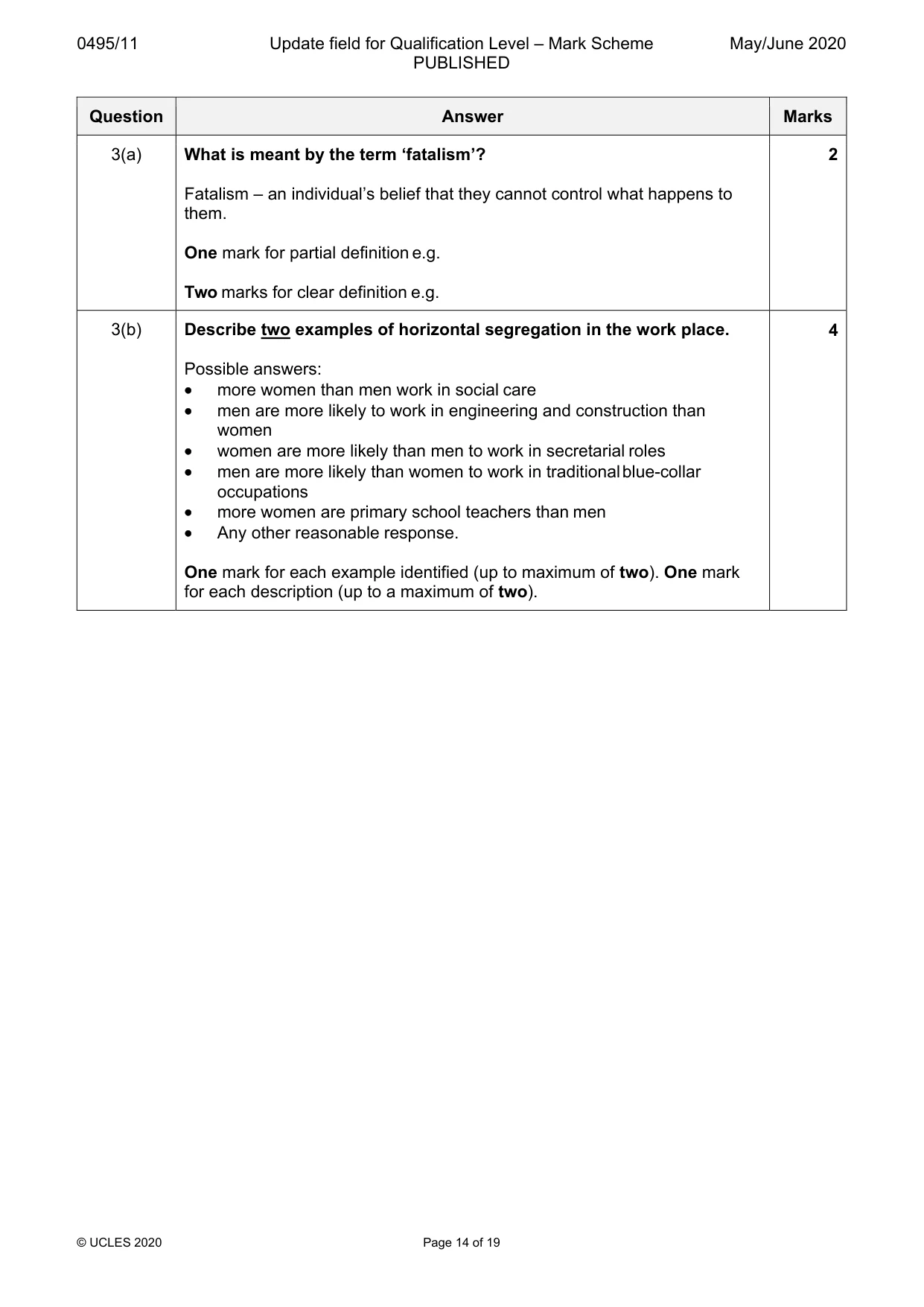
0495/11 Update field for Qualification Level – Mark Scheme PUBLISHED May/June 2020 © UCLES 2020 Page 14 of 19 Question Answer Marks 3(a) What is meant by the term ‘fatalism’? Fatalism – an individual’s belief that they cannot control what happens to them. One mark for partial definition e.g. Two marks for clear definition e.g. 2 3(b) Describe two examples of horizontal segregation in the work place. Possible answers: • more women than men work in social care • men are more likely to work in engineering and construction than women • women are more likely than men to work in secretarial roles • men are more likely than women to work in traditional blue-collar occupations • more women are primary school teachers than men • Any other reasonable response. One mark for each example identified (up to maximum of two). One mark for each description (up to a maximum of two). 4
Mark scheme, page 15
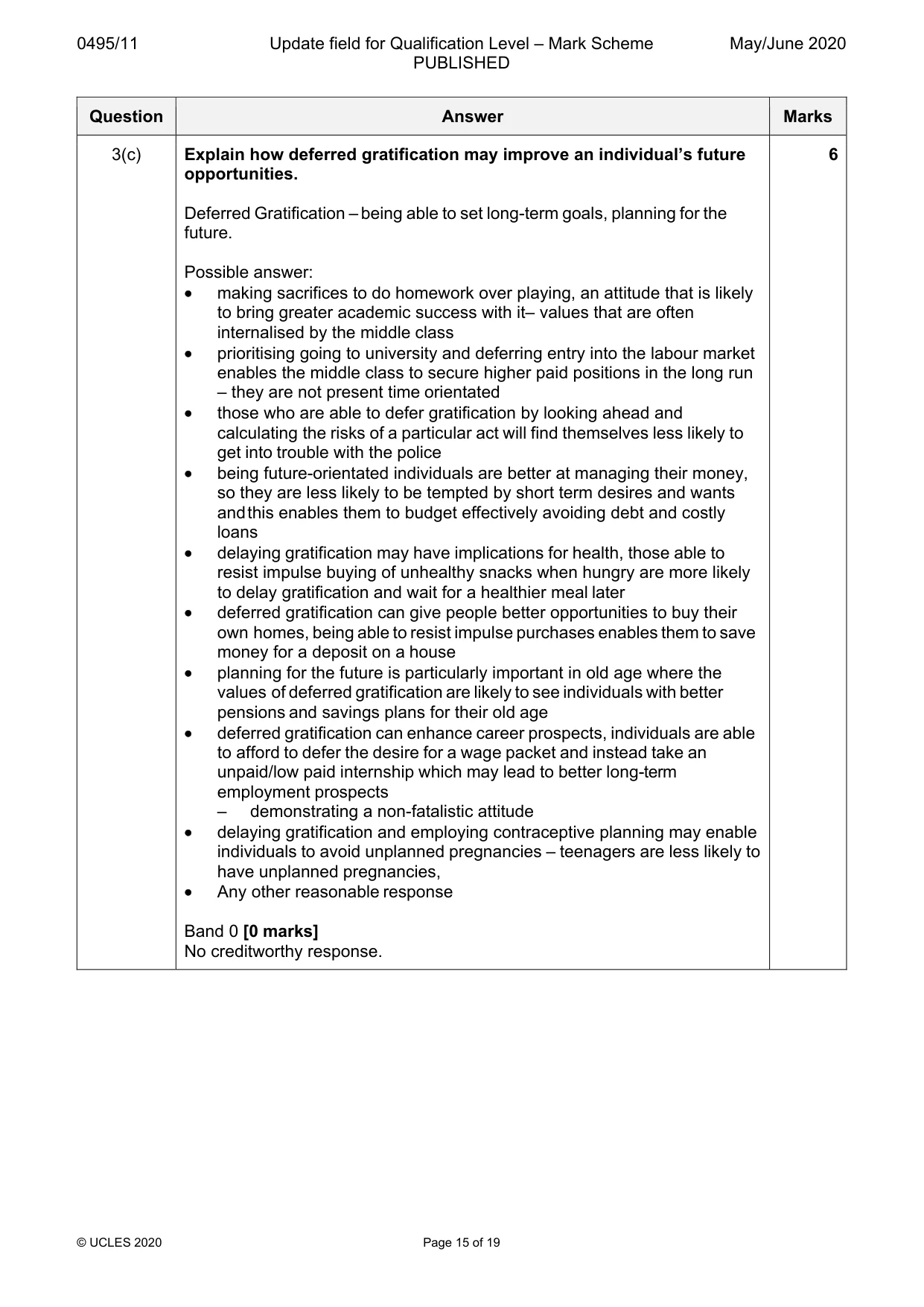
0495/11 Update field for Qualification Level – Mark Scheme PUBLISHED May/June 2020 © UCLES 2020 Page 15 of 19 Question Answer Marks 3(c) Explain how deferred gratification may improve an individual’s future opportunities. Deferred Gratification – being able to set long-term goals, planning for the future. Possible answer: • making sacrifices to do homework over playing, an attitude that is likely to bring greater academic success with it– values that are often internalised by the middle class • prioritising going to university and deferring entry into the labour market enables the middle class to secure higher paid positions in the long run – they are not present time orientated • those who are able to defer gratification by looking ahead and calculating the risks of a particular act will find themselves less likely to get into trouble with the police • being future-orientated individuals are better at managing their money, so they are less likely to be tempted by short term desires and wants and this enables them to budget effectively avoiding debt and costly loans • delaying gratification may have implications for health, those able to resist impulse buying of unhealthy snacks when hungry are more likely to delay gratification and wait for a healthier meal later • deferred gratification can give people better opportunities to buy their own homes, being able to resist impulse purchases enables them to save money for a deposit on a house • planning for the future is particularly important in old age where the values of deferred gratification are likely to see individuals with better pensions and savings plans for their old age • deferred gratification can enhance career prospects, individuals are able to afford to defer the desire for a wage packet and instead take an unpaid/low paid internship which may lead to better long-term employment prospects – demonstrating a non-fatalistic attitude • delaying gratification and employing contraceptive planning may enable individuals to avoid unplanned pregnancies – teenagers are less likely to have unplanned pregnancies, • Any other reasonable response Band 0 [0 marks] No creditworthy response. 6
Mark scheme, page 16
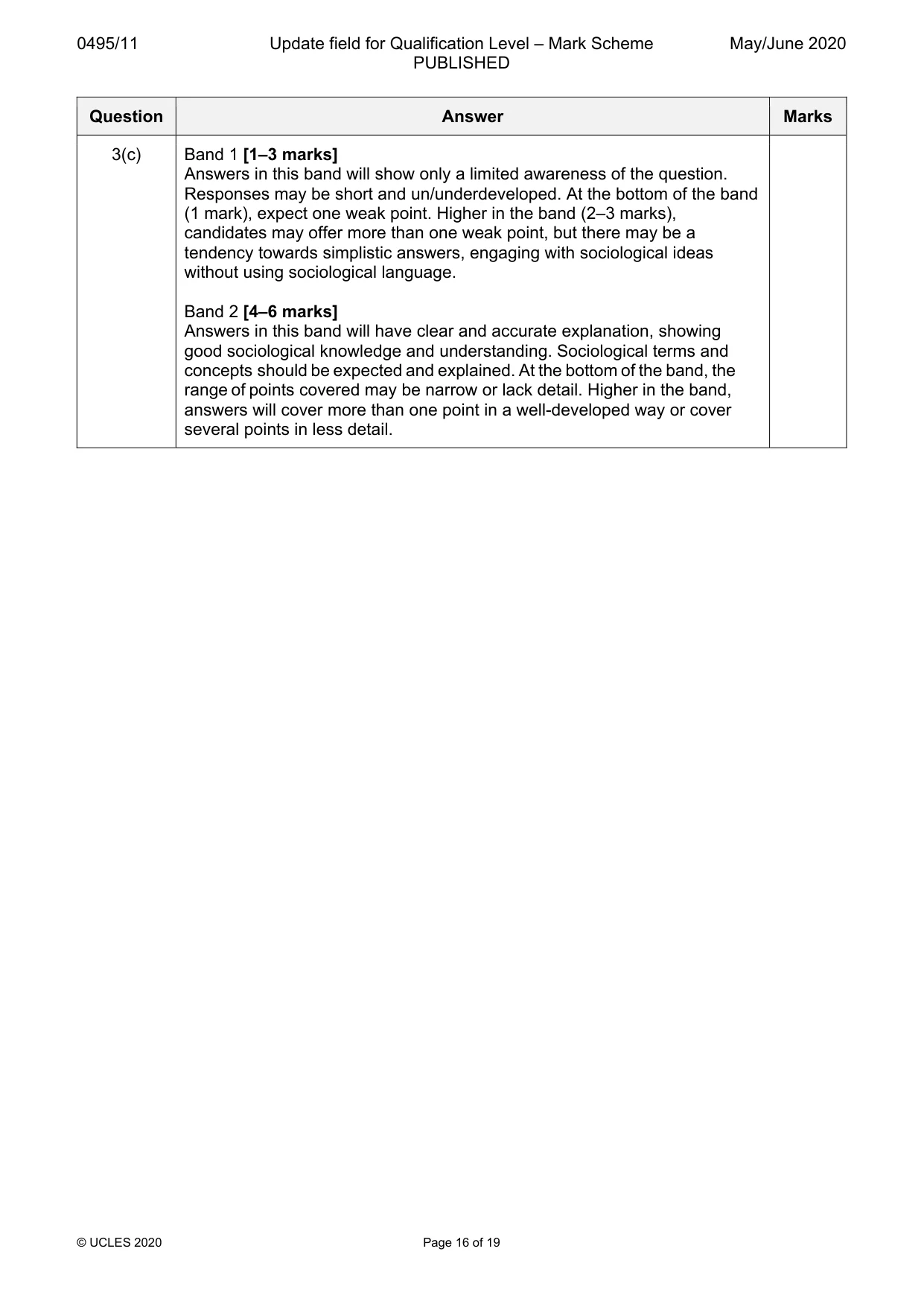
0495/11 Update field for Qualification Level – Mark Scheme PUBLISHED May/June 2020 © UCLES 2020 Page 16 of 19 Question Answer Marks 3(c) Band 1 [1–3 marks] Answers in this band will show only a limited awareness of the question. Responses may be short and un/underdeveloped. At the bottom of the band (1 mark), expect one weak point. Higher in the band (2–3 marks), candidates may offer more than one weak point, but there may be a tendency towards simplistic answers, engaging with sociological ideas without using sociological language. Band 2 [4–6 marks] Answers in this band will have clear and accurate explanation, showing good sociological knowledge and understanding. Sociological terms and concepts should be expected and explained. At the bottom of the band, the range of points covered may be narrow or lack detail. Higher in the band, answers will cover more than one point in a well-developed way or cover several points in less detail.
Mark scheme, page 17
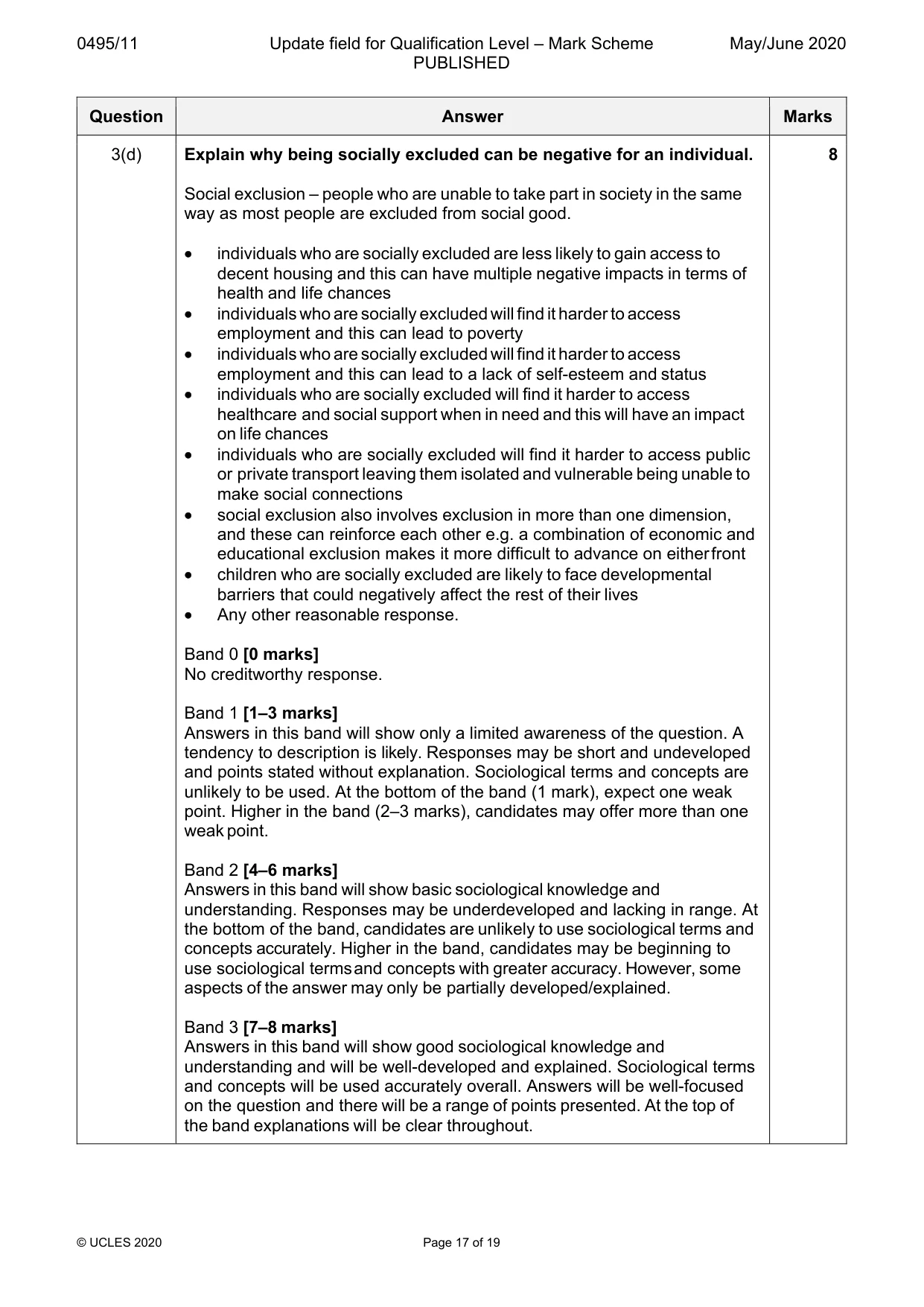
0495/11 Update field for Qualification Level – Mark Scheme PUBLISHED May/June 2020 © UCLES 2020 Page 17 of 19 Question Answer Marks 3(d) Explain why being socially excluded can be negative for an individual. Social exclusion – people who are unable to take part in society in the same way as most people are excluded from social good. • individuals who are socially excluded are less likely to gain access to decent housing and this can have multiple negative impacts in terms of health and life chances • individuals who are socially excluded will find it harder to access employment and this can lead to poverty • individuals who are socially excluded will find it harder to access employment and this can lead to a lack of self-esteem and status • individuals who are socially excluded will find it harder to access healthcare and social support when in need and this will have an impact on life chances • individuals who are socially excluded will find it harder to access public or private transport leaving them isolated and vulnerable being unable to make social connections • social exclusion also involves exclusion in more than one dimension, and these can reinforce each other e.g. a combination of economic and educational exclusion makes it more difficult to advance on either front • children who are socially excluded are likely to face developmental barriers that could negatively affect the rest of their lives • Any other reasonable response. Band 0 [0 marks] No creditworthy response. Band 1 [1–3 marks] Answers in this band will show only a limited awareness of the question. A tendency to description is likely. Responses may be short and undeveloped and points stated without explanation. Sociological terms and concepts are unlikely to be used. At the bottom of the band (1 mark), expect one weak point. Higher in the band (2–3 marks), candidates may offer more than one weak point. Band 2 [4–6 marks] Answers in this band will show basic sociological knowledge and understanding. Responses may be underdeveloped and lacking in range. At the bottom of the band, candidates are unlikely to use sociological terms and concepts accurately. Higher in the band, candidates may be beginning to use sociological terms and concepts with greater accuracy. However, some aspects of the answer may only be partially developed/explained. Band 3 [7–8 marks] Answers in this band will show good sociological knowledge and understanding and will be well-developed and explained. Sociological terms and concepts will be used accurately overall. Answers will be well-focused on the question and there will be a range of points presented. At the top of the band explanations will be clear throughout. 8
Mark scheme, page 18
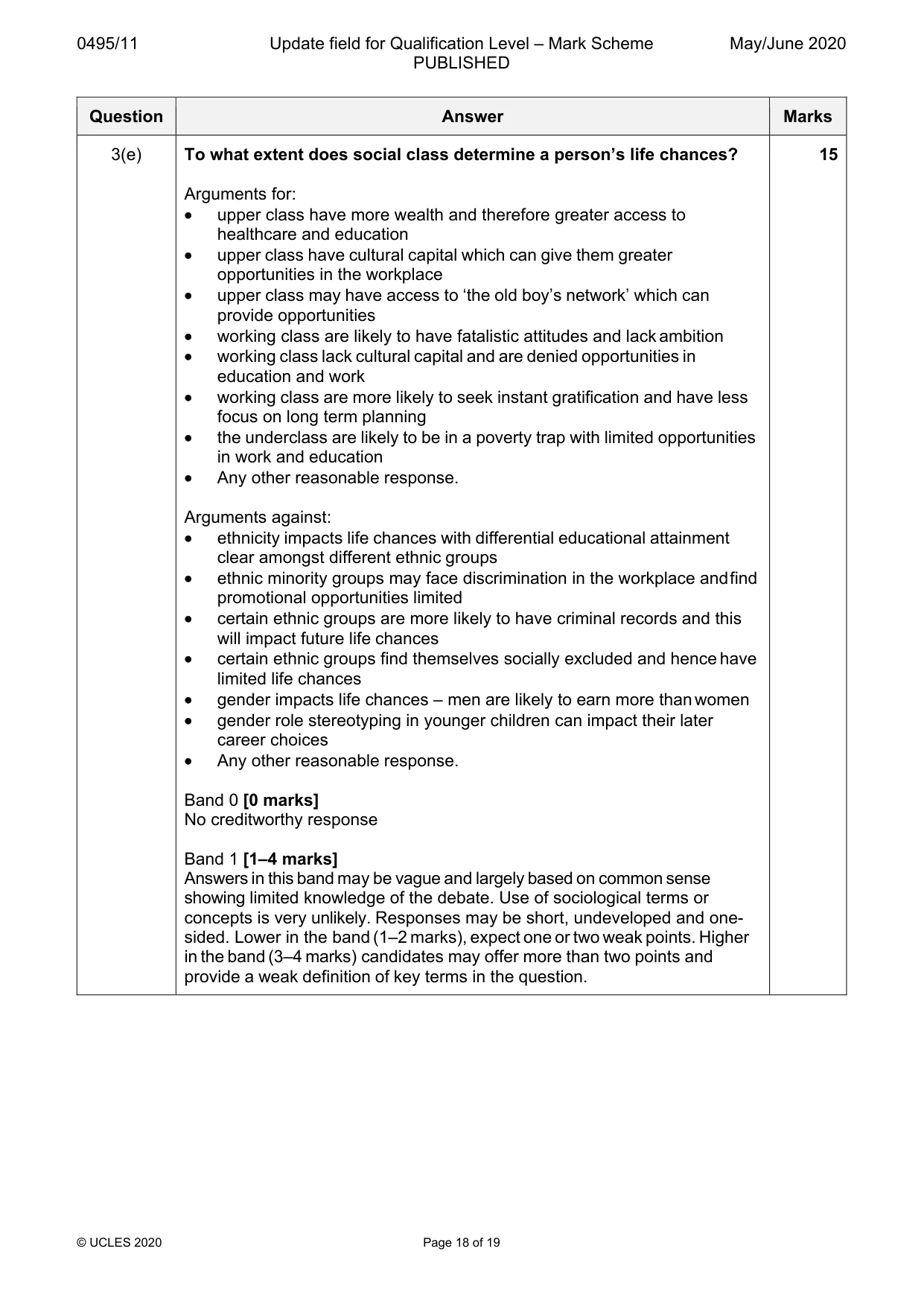
0495/11 Update field for Qualification Level – Mark Scheme PUBLISHED May/June 2020 © UCLES 2020 Page 18 of 19 Question Answer Marks 3(e) To what extent does social class determine a person’s life chances? Arguments for: • upper class have more wealth and therefore greater access to healthcare and education • upper class have cultural capital which can give them greater opportunities in the workplace • upper class may have access to ‘the old boy’s network’ which can provide opportunities • working class are likely to have fatalistic attitudes and lack ambition • working class lack cultural capital and are denied opportunities in education and work • working class are more likely to seek instant gratification and have less focus on long term planning • the underclass are likely to be in a poverty trap with limited opportunities in work and education • Any other reasonable response. Arguments against: • ethnicity impacts life chances with differential educational attainment clear amongst different ethnic groups • ethnic minority groups may face discrimination in the workplace and find promotional opportunities limited • certain ethnic groups are more likely to have criminal records and this will impact future life chances • certain ethnic groups find themselves socially excluded and hence have limited life chances • gender impacts life chances – men are likely to earn more than women • gender role stereotyping in younger children can impact their later career choices • Any other reasonable response. Band 0 [0 marks] No creditworthy response Band 1 [1–4 marks] Answers in this band may be vague and largely based on common sense showing limited knowledge of the debate. Use of sociological terms or concepts is very unlikely. Responses may be short, undeveloped and one- sided. Lower in the band (1–2 marks), expect one or two weak points. Higher in the band (3–4 marks) candidates may offer more than two points and provide a weak definition of key terms in the question. 15
Mark scheme, page 19
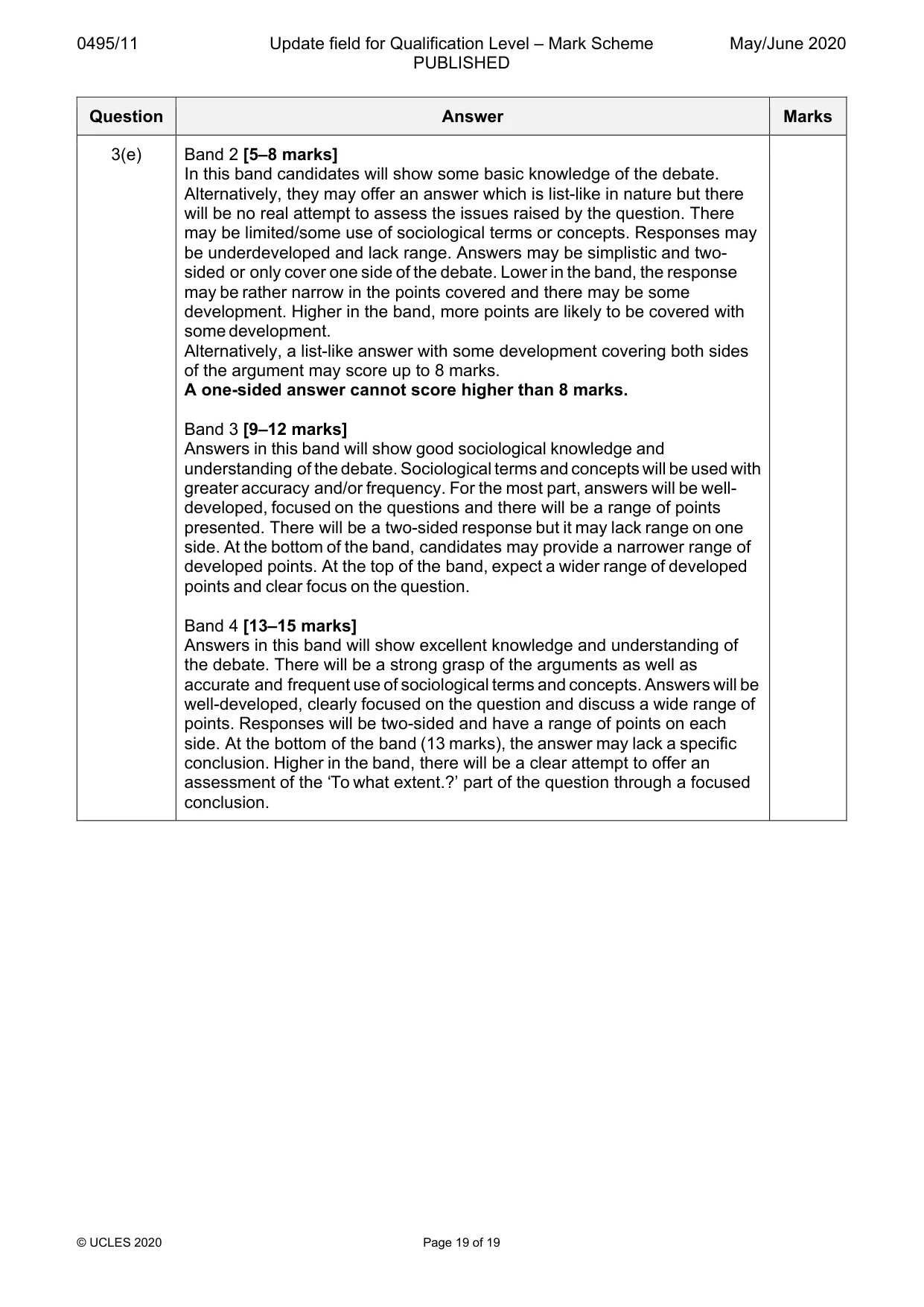
0495/11 Update field for Qualification Level – Mark Scheme PUBLISHED May/June 2020 © UCLES 2020 Page 19 of 19 Question Answer Marks 3(e) Band 2 [5–8 marks] In this band candidates will show some basic knowledge of the debate. Alternatively, they may offer an answer which is list-like in nature but there will be no real attempt to assess the issues raised by the question. There may be limited/some use of sociological terms or concepts. Responses may be underdeveloped and lack range. Answers may be simplistic and two- sided or only cover one side of the debate. Lower in the band, the response may be rather narrow in the points covered and there may be some development. Higher in the band, more points are likely to be covered with some development. Alternatively, a list-like answer with some development covering both sides of the argument may score up to 8 marks. A one-sided answer cannot score higher than 8 marks. Band 3 [9–12 marks] Answers in this band will show good sociological knowledge and understanding of the debate. Sociological terms and concepts will be used with greater accuracy and/or frequency. For the most part, answers will be well- developed, focused on the questions and there will be a range of points presented. There will be a two-sided response but it may lack range on one side. At the bottom of the band, candidates may provide a narrower range of developed points. At the top of the band, expect a wider range of developed points and clear focus on the question. Band 4 [13–15 marks] Answers in this band will show excellent knowledge and understanding of the debate. There will be a strong grasp of the arguments as well as accurate and frequent use of sociological terms and concepts. Answers will be well-developed, clearly focused on the question and discuss a wide range of points. Responses will be two-sided and have a range of points on each side. At the bottom of the band (13 marks), the answer may lack a specific conclusion. Higher in the band, there will be a clear attempt to offer an assessment of the ‘To what extent.?’ part of the question through a focused conclusion.