Cambridge IGCSE Sociology 0495 — 2018 May/June Paper 1 · Variant 3
0495/13/M/J/18 · 80 marks · ≈90 min
The question paper and its mark scheme, free to read here and free to download. This is Cambridge’s own paper, exactly as it was sat.
Question paper4 pages

Mark scheme22 pages
Answers below. Sit the paper first if you are practising.
Paper as text
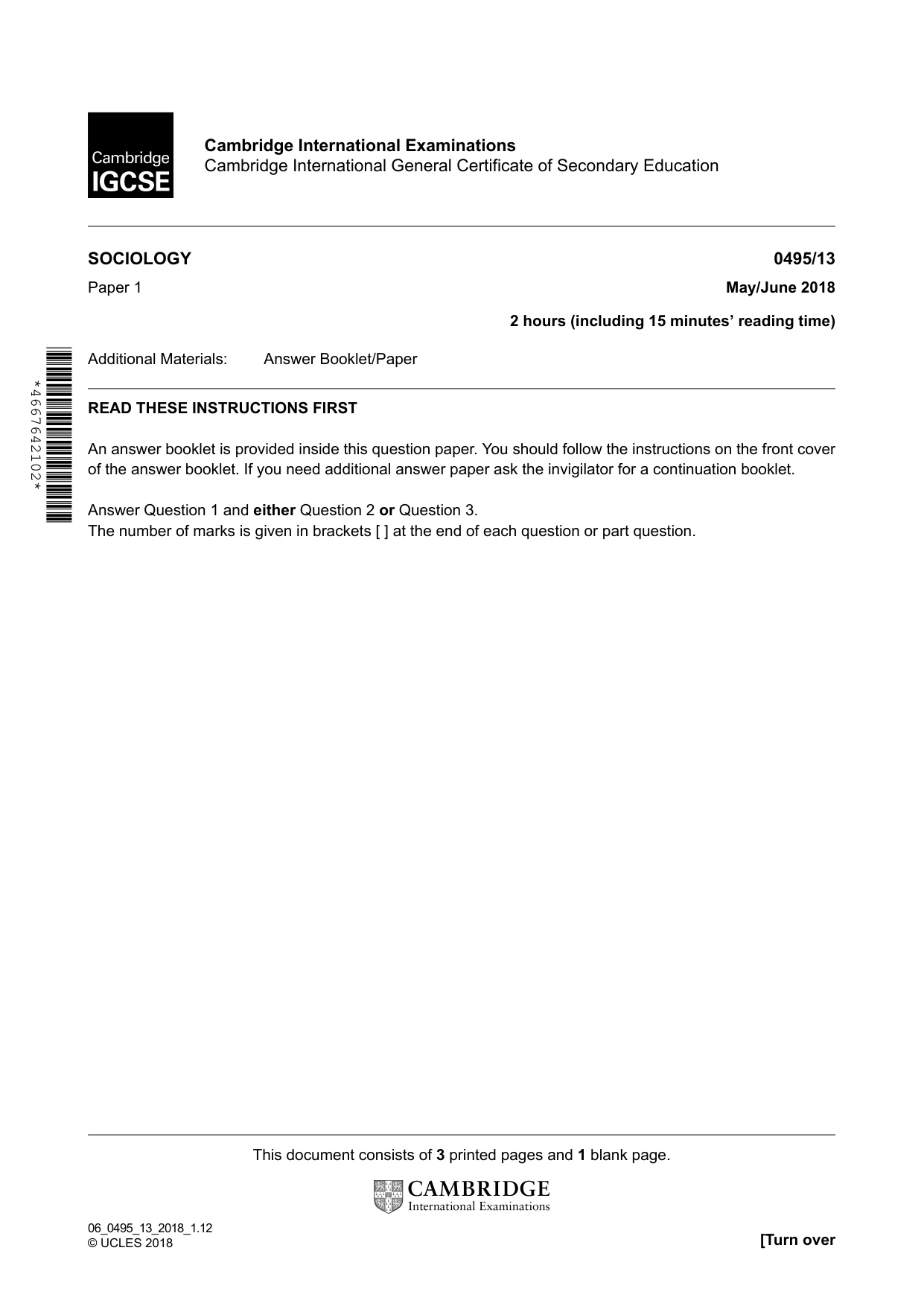
Question paper, page 1
Cambridge International Examinations Cambridge International General Certificate of Secondary Education 0495/13 May/June 2018 SOCIOLOGY Paper 1 2 hours (including 15 minutes’ reading time) Additional Materials: Answer Booklet/Paper READ THESE INSTRUCTIONS FIRST An answer booklet is provided inside this question paper. You should follow the instructions on the front cover of the answer booklet. If you need additional answer paper ask the invigilator for a continuation booklet. Answer Question 1 and either Question 2 or Question 3. The number of marks is given in brackets [ ] at the end of each question or part question. This document consists of 3 printed pages and 1 blank page. [Turn over 06_0495_13_2018_1.12 © UCLES 2018 *4667642102*
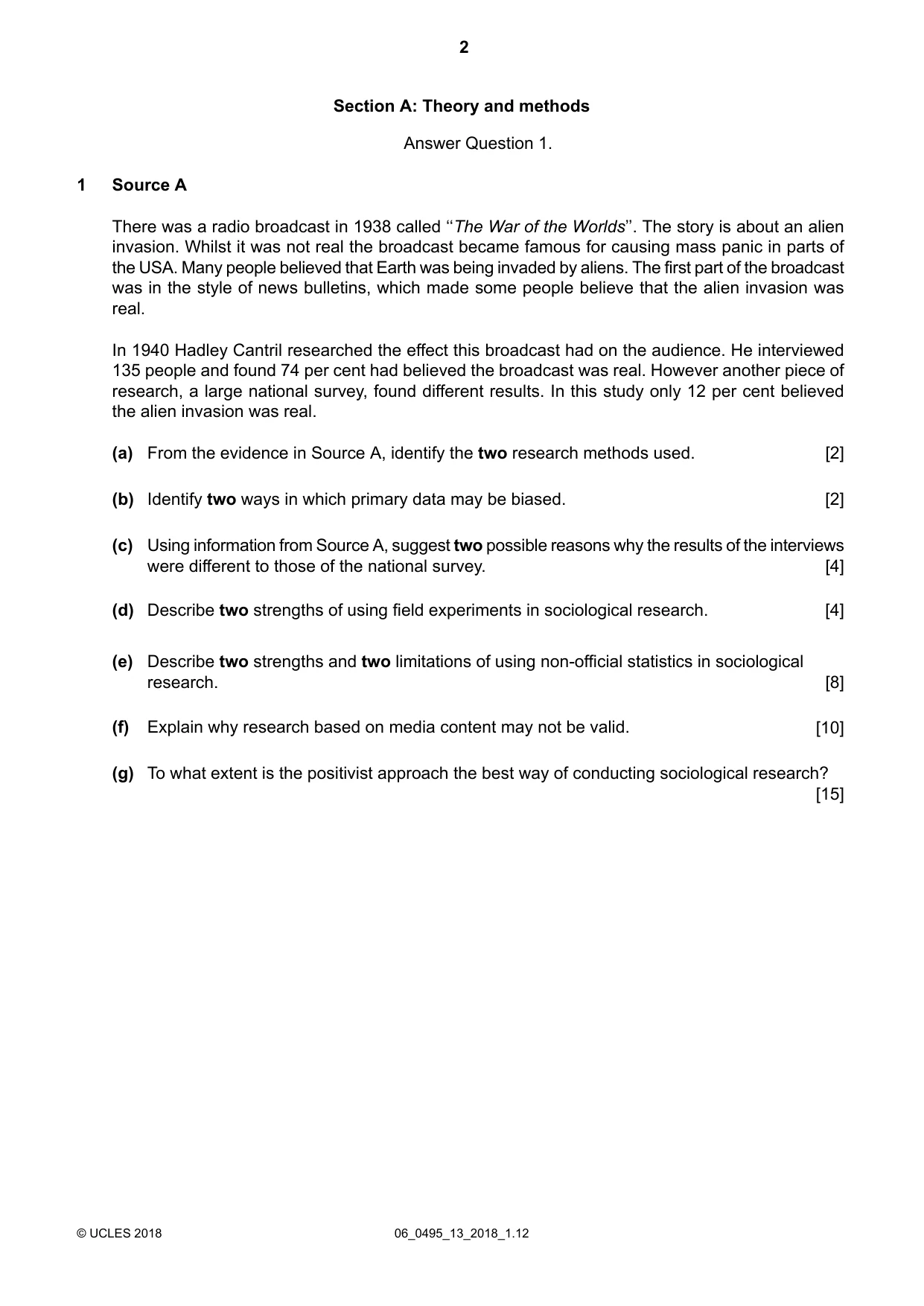
Question paper, page 2
Section A: Theory and methods Answer Question 1. Source A 1 There was a radio broadcast in 1938 called ‘‘The War of the Worlds’’. The story is about an alien invasion. Whilst it was not real the broadcast became famous for causing mass panic in parts of the USA. Many people believed that Earth was being invaded by aliens. The first part of the broadcast was in the style of news bulletins, which made some people believe that the alien invasion was real. In 1940 Hadley Cantril researched the effect this broadcast had on the audience. He interviewed 135 people and found 74 per cent had believed the broadcast was real. However another piece of research, a large national survey, found different results. In this study only 12 per cent believed the alien invasion was real. From the evidence in Source A, identify the two research methods used. [2] (a) Identify two ways in which primary data may be biased. [2] (b) Using information from Source A, suggest two possible reasons why the results of the interviews were different to those of the national survey. [4] (c) Describe two strengths of using field experiments in sociological research. [4] (d) Describe two strengths and two limitations of using non-official statistics in sociological research. [8] (e) Explain why research based on media content may not be valid. [10] (f) To what extent is the positivist approach the best way of conducting sociological research? [15] (g) 06_0495_13_2018_1.12 © UCLES 2018 2
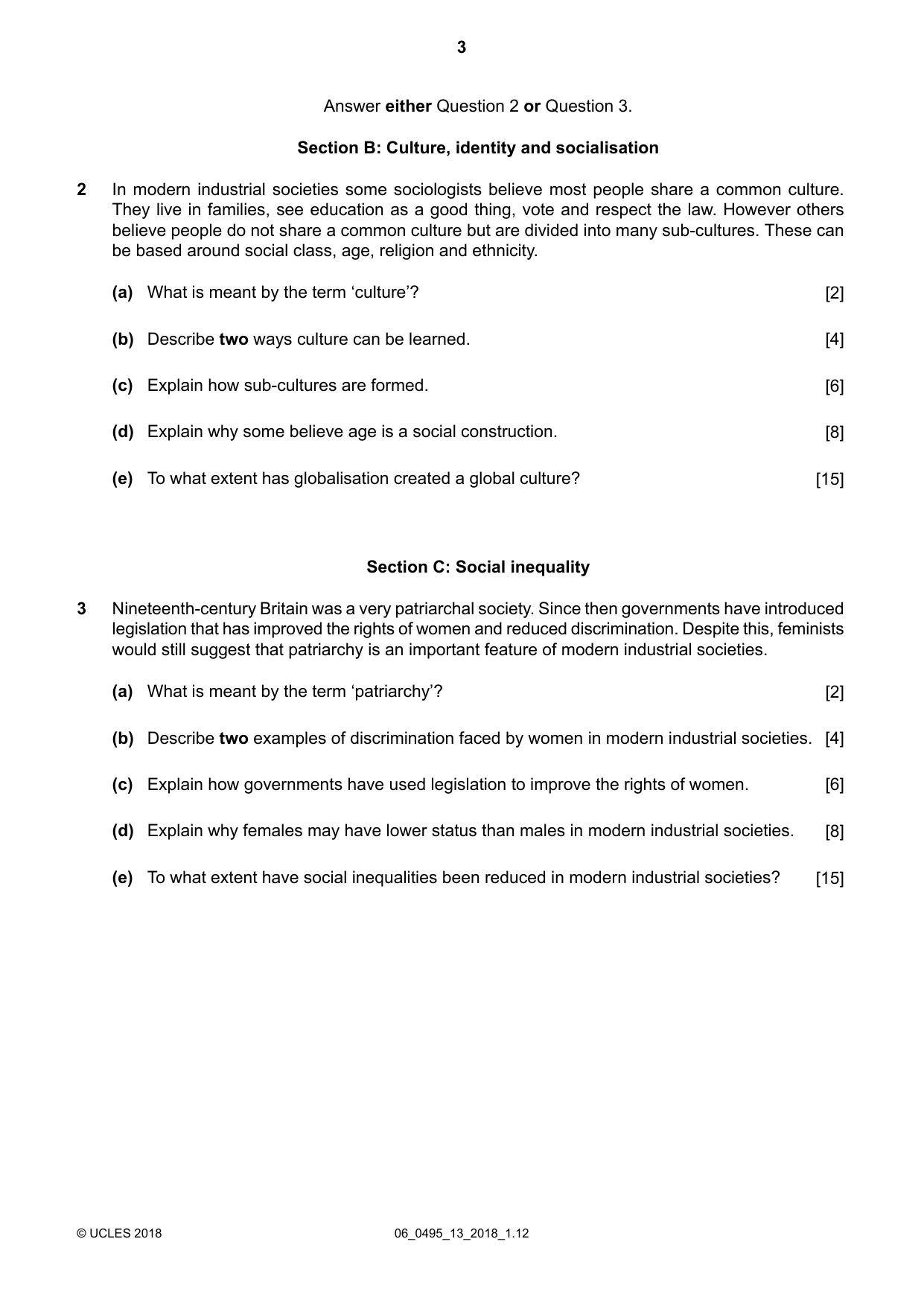
Question paper, page 3
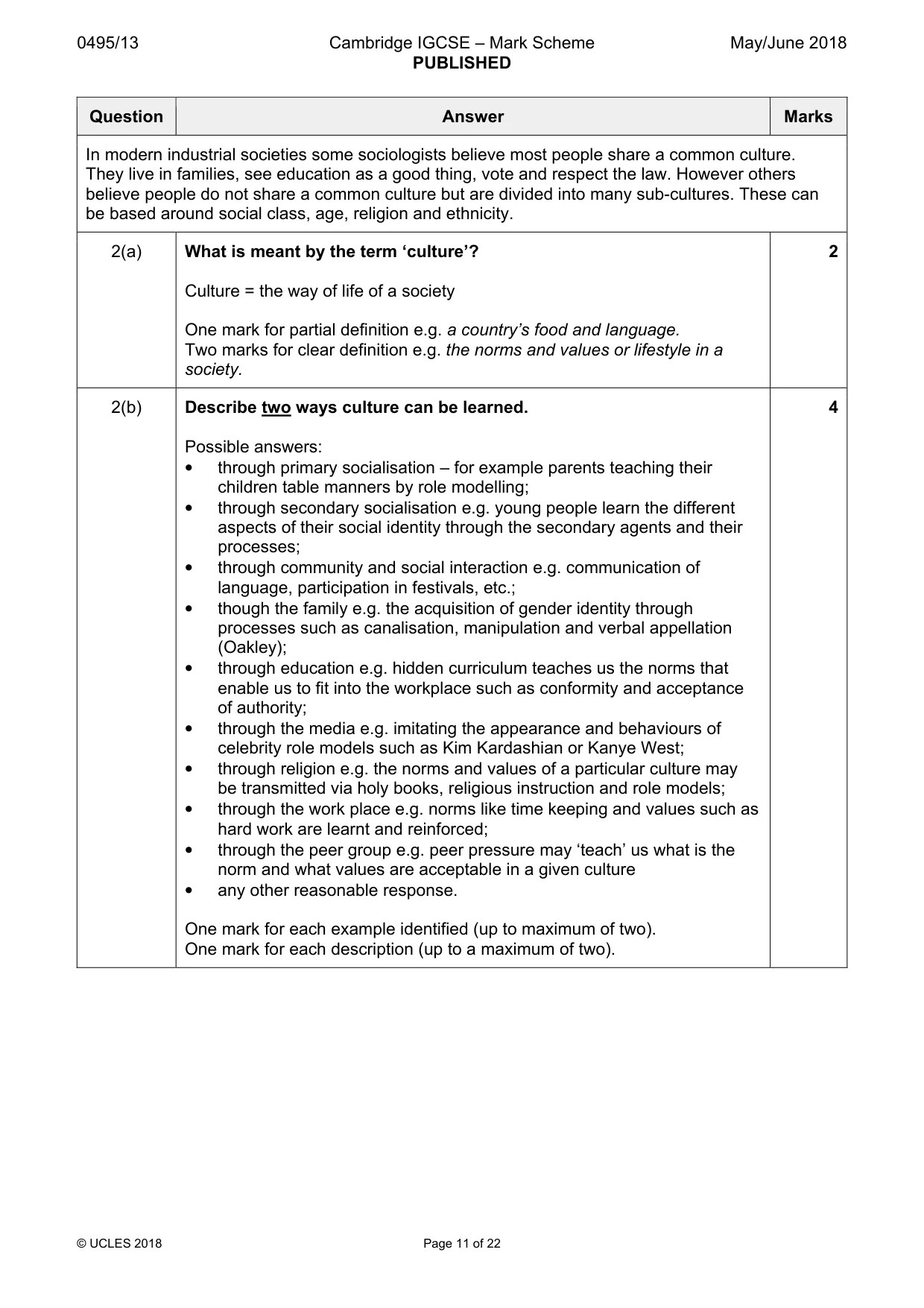
Answer either Question 2 or Question 3. Section B: Culture, identity and socialisation In modern industrial societies some sociologists believe most people share a common culture. They live in families, see education as a good thing, vote and respect the law. However others 2 believe people do not share a common culture but are divided into many sub-cultures. These can be based around social class, age, religion and ethnicity. What is meant by the term ‘culture’? [2] (a) Describe two ways culture can be learned. [4] (b) Explain how sub-cultures are formed. [6] (c) Explain why some believe age is a social construction. [8] (d) To what extent has globalisation created a global culture? [15] (e) Section C: Social inequality Nineteenth-century Britain was a very patriarchal society. Since then governments have introduced legislation that has improved the rights of women and reduced discrimination. Despite this, feminists would still suggest that patriarchy is an important feature of modern industrial societies. 3 What is meant by the term ‘patriarchy’? [2] (a) Describe two examples of discrimination faced by women in modern industrial societies. [4] (b) Explain how governments have used legislation to improve the rights of women. [6] (c) Explain why females may have lower status than males in modern industrial societies. [8] (d) To what extent have social inequalities been reduced in modern industrial societies? [15] (e) 06_0495_13_2018_1.12 © UCLES 2018 3
Question paper, page 4
BLANK PAGE Permission to reproduce items where third-party owned material protected by copyright is included has been sought and cleared where possible. Every reasonable effort has been made by the publisher (UCLES) to trace copyright holders, but if any items requiring clearance have unwittingly been included, the publisher will be pleased to make amends at the earliest possible opportunity. To avoid the issue of disclosure of answer-related information to candidates, all copyright acknowledgements are reproduced online in the Cambridge International Examinations Copyright Acknowledgements Booklet. This is produced for each series of examinations and is freely available to download at www.cie.org.uk after the live examination series. Cambridge International Examinations is part of the Cambridge Assessment Group. Cambridge Assessment is the brand name of University of Cambridge Local Examinations Syndicate (UCLES), which is itself a department of the University of Cambridge. 06_0495_13_2018_1.12 © UCLES 2018 4
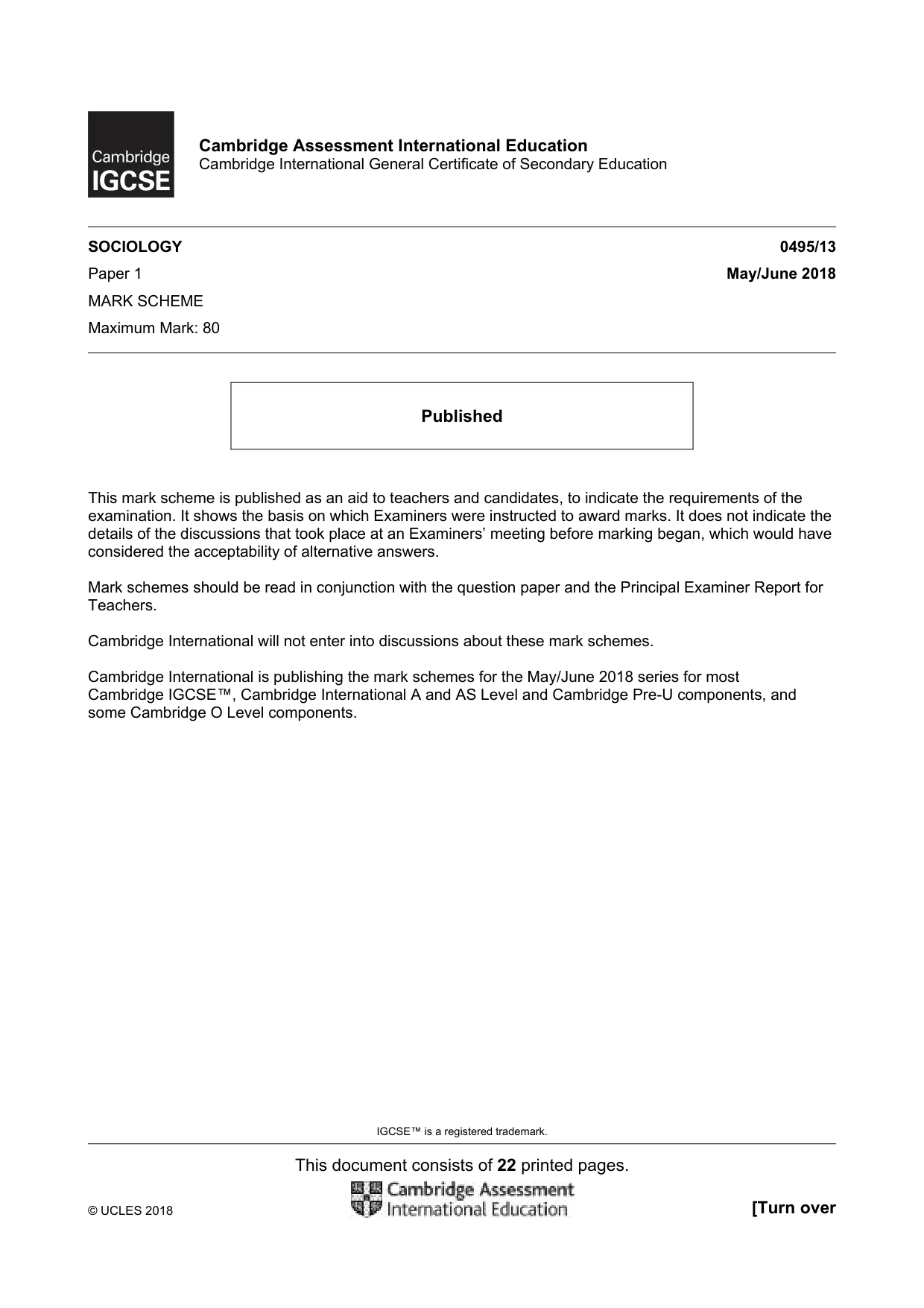
Mark scheme, page 1
IGCSE™ is a registered trademark. This document consists of 22 printed pages. © UCLES 2018 [Turn over Cambridge Assessment International Education Cambridge International General Certificate of Secondary Education SOCIOLOGY 0495/13 Paper 1 May/June 2018 MARK SCHEME Maximum Mark: 80 Published This mark scheme is published as an aid to teachers and candidates, to indicate the requirements of the examination. It shows the basis on which Examiners were instructed to award marks. It does not indicate the details of the discussions that took place at an Examiners’ meeting before marking began, which would have considered the acceptability of alternative answers. Mark schemes should be read in conjunction with the question paper and the Principal Examiner Report for Teachers. Cambridge International will not enter into discussions about these mark schemes. Cambridge International is publishing the mark schemes for the May/June 2018 series for most Cambridge IGCSE™, Cambridge International A and AS Level and Cambridge Pre-U components, and some Cambridge O Level components.
Mark scheme, page 2
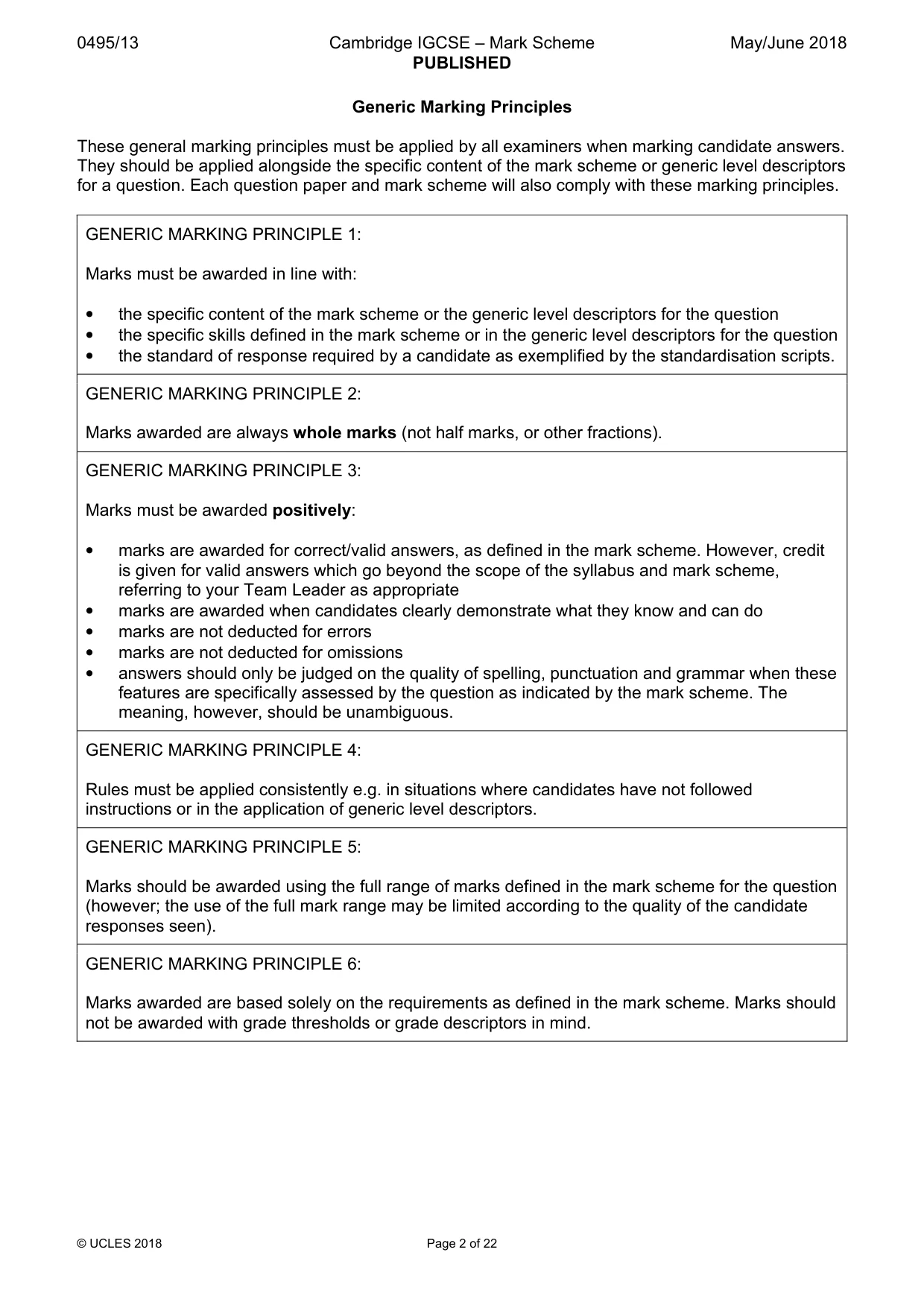
0495/13 Cambridge IGCSE – Mark Scheme PUBLISHED May/June 2018 © UCLES 2018 Page 2 of 22 Generic Marking Principles These general marking principles must be applied by all examiners when marking candidate answers. They should be applied alongside the specific content of the mark scheme or generic level descriptors for a question. Each question paper and mark scheme will also comply with these marking principles. GENERIC MARKING PRINCIPLE 1: Marks must be awarded in line with: • the specific content of the mark scheme or the generic level descriptors for the question • the specific skills defined in the mark scheme or in the generic level descriptors for the question • the standard of response required by a candidate as exemplified by the standardisation scripts. GENERIC MARKING PRINCIPLE 2: Marks awarded are always whole marks (not half marks, or other fractions). GENERIC MARKING PRINCIPLE 3: Marks must be awarded positively: • marks are awarded for correct/valid answers, as defined in the mark scheme. However, credit is given for valid answers which go beyond the scope of the syllabus and mark scheme, referring to your Team Leader as appropriate • marks are awarded when candidates clearly demonstrate what they know and can do • marks are not deducted for errors • marks are not deducted for omissions • answers should only be judged on the quality of spelling, punctuation and grammar when these features are specifically assessed by the question as indicated by the mark scheme. The meaning, however, should be unambiguous. GENERIC MARKING PRINCIPLE 4: Rules must be applied consistently e.g. in situations where candidates have not followed instructions or in the application of generic level descriptors. GENERIC MARKING PRINCIPLE 5: Marks should be awarded using the full range of marks defined in the mark scheme for the question (however; the use of the full mark range may be limited according to the quality of the candidate responses seen). GENERIC MARKING PRINCIPLE 6: Marks awarded are based solely on the requirements as defined in the mark scheme. Marks should not be awarded with grade thresholds or grade descriptors in mind.
Mark scheme, page 3
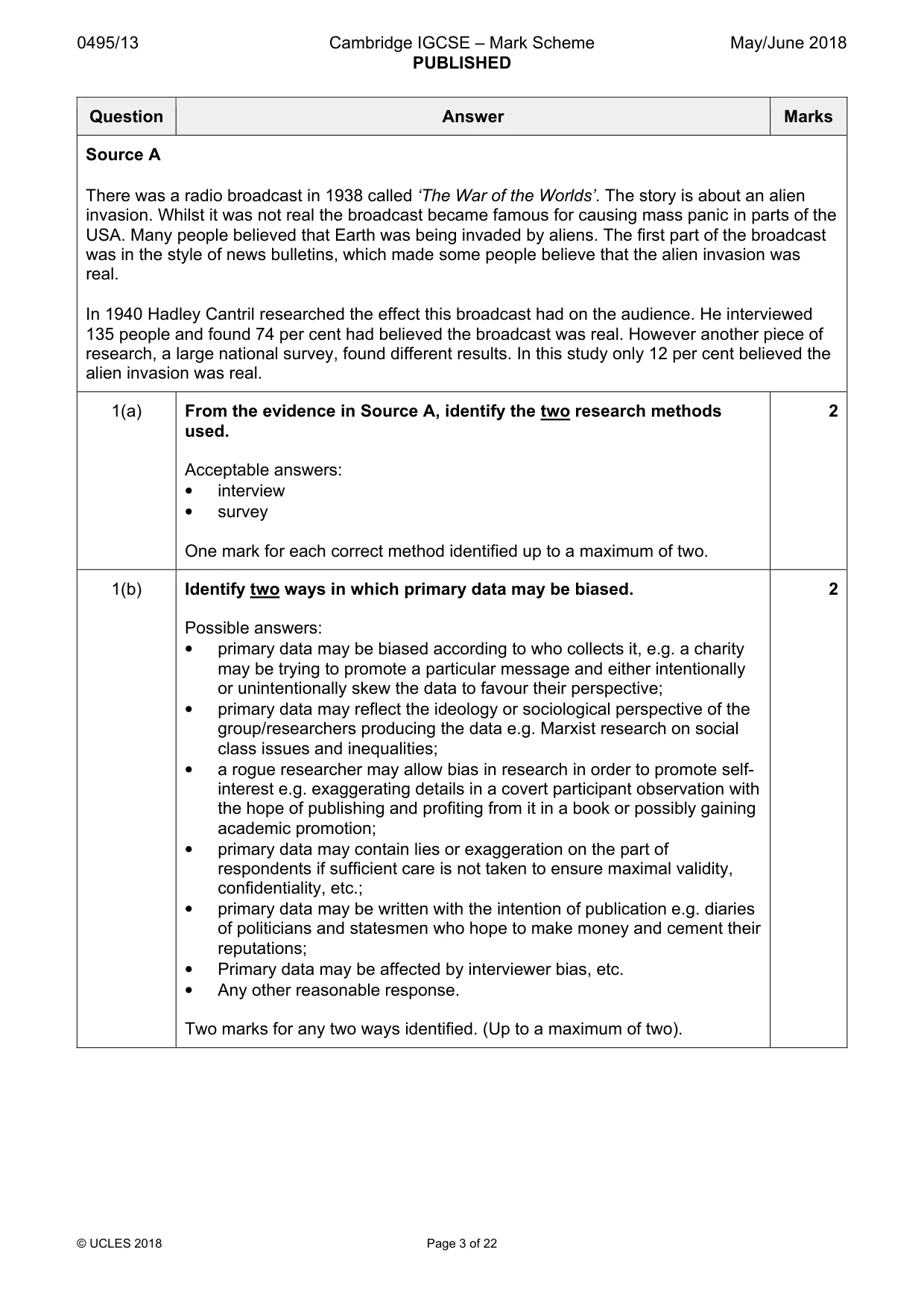
0495/13 Cambridge IGCSE – Mark Scheme PUBLISHED May/June 2018 © UCLES 2018 Page 3 of 22 Question Answer Marks Source A There was a radio broadcast in 1938 called ‘The War of the Worlds’. The story is about an alien invasion. Whilst it was not real the broadcast became famous for causing mass panic in parts of the USA. Many people believed that Earth was being invaded by aliens. The first part of the broadcast was in the style of news bulletins, which made some people believe that the alien invasion was real. In 1940 Hadley Cantril researched the effect this broadcast had on the audience. He interviewed 135 people and found 74 per cent had believed the broadcast was real. However another piece of research, a large national survey, found different results. In this study only 12 per cent believed the alien invasion was real. 1(a) From the evidence in Source A, identify the two research methods used. Acceptable answers: • interview • survey One mark for each correct method identified up to a maximum of two. 2 1(b) Identify two ways in which primary data may be biased. Possible answers: • primary data may be biased according to who collects it, e.g. a charity may be trying to promote a particular message and either intentionally or unintentionally skew the data to favour their perspective; • primary data may reflect the ideology or sociological perspective of the group/researchers producing the data e.g. Marxist research on social class issues and inequalities; • a rogue researcher may allow bias in research in order to promote self- interest e.g. exaggerating details in a covert participant observation with the hope of publishing and profiting from it in a book or possibly gaining academic promotion; • primary data may contain lies or exaggeration on the part of respondents if sufficient care is not taken to ensure maximal validity, confidentiality, etc.; • primary data may be written with the intention of publication e.g. diaries of politicians and statesmen who hope to make money and cement their reputations; • Primary data may be affected by interviewer bias, etc. • Any other reasonable response. Two marks for any two ways identified. (Up to a maximum of two). 2
Mark scheme, page 4
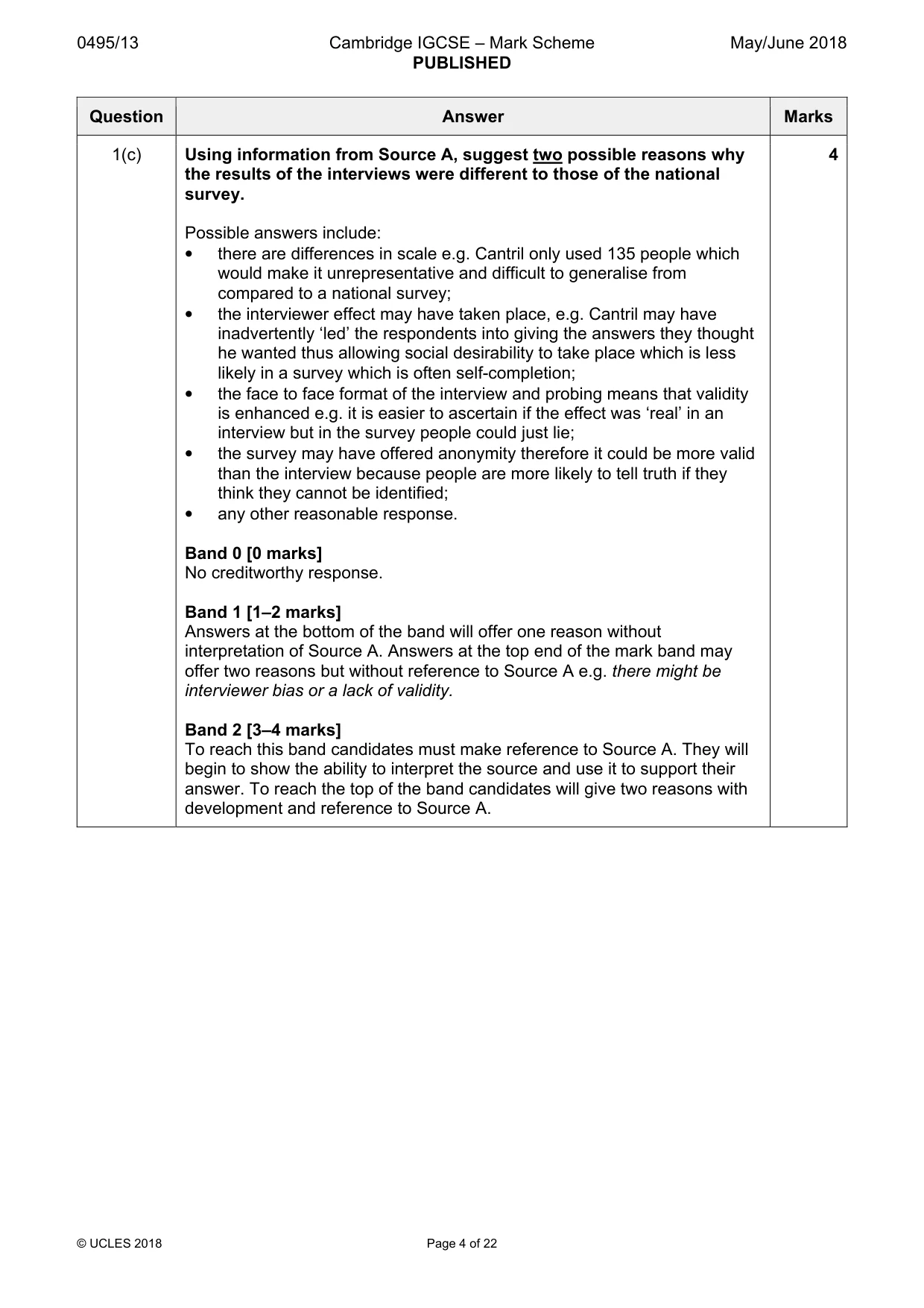
0495/13 Cambridge IGCSE – Mark Scheme PUBLISHED May/June 2018 © UCLES 2018 Page 4 of 22 Question Answer Marks 1(c) Using information from Source A, suggest two possible reasons why the results of the interviews were different to those of the national survey. Possible answers include: • there are differences in scale e.g. Cantril only used 135 people which would make it unrepresentative and difficult to generalise from compared to a national survey; • the interviewer effect may have taken place, e.g. Cantril may have inadvertently ‘led’ the respondents into giving the answers they thought he wanted thus allowing social desirability to take place which is less likely in a survey which is often self-completion; • the face to face format of the interview and probing means that validity is enhanced e.g. it is easier to ascertain if the effect was ‘real’ in an interview but in the survey people could just lie; • the survey may have offered anonymity therefore it could be more valid than the interview because people are more likely to tell truth if they think they cannot be identified; • any other reasonable response. Band 0 [0 marks] No creditworthy response. Band 1 [1–2 marks] Answers at the bottom of the band will offer one reason without interpretation of Source A. Answers at the top end of the mark band may offer two reasons but without reference to Source A e.g. there might be interviewer bias or a lack of validity. Band 2 [3–4 marks] To reach this band candidates must make reference to Source A. They will begin to show the ability to interpret the source and use it to support their answer. To reach the top of the band candidates will give two reasons with development and reference to Source A. 4
Mark scheme, page 5
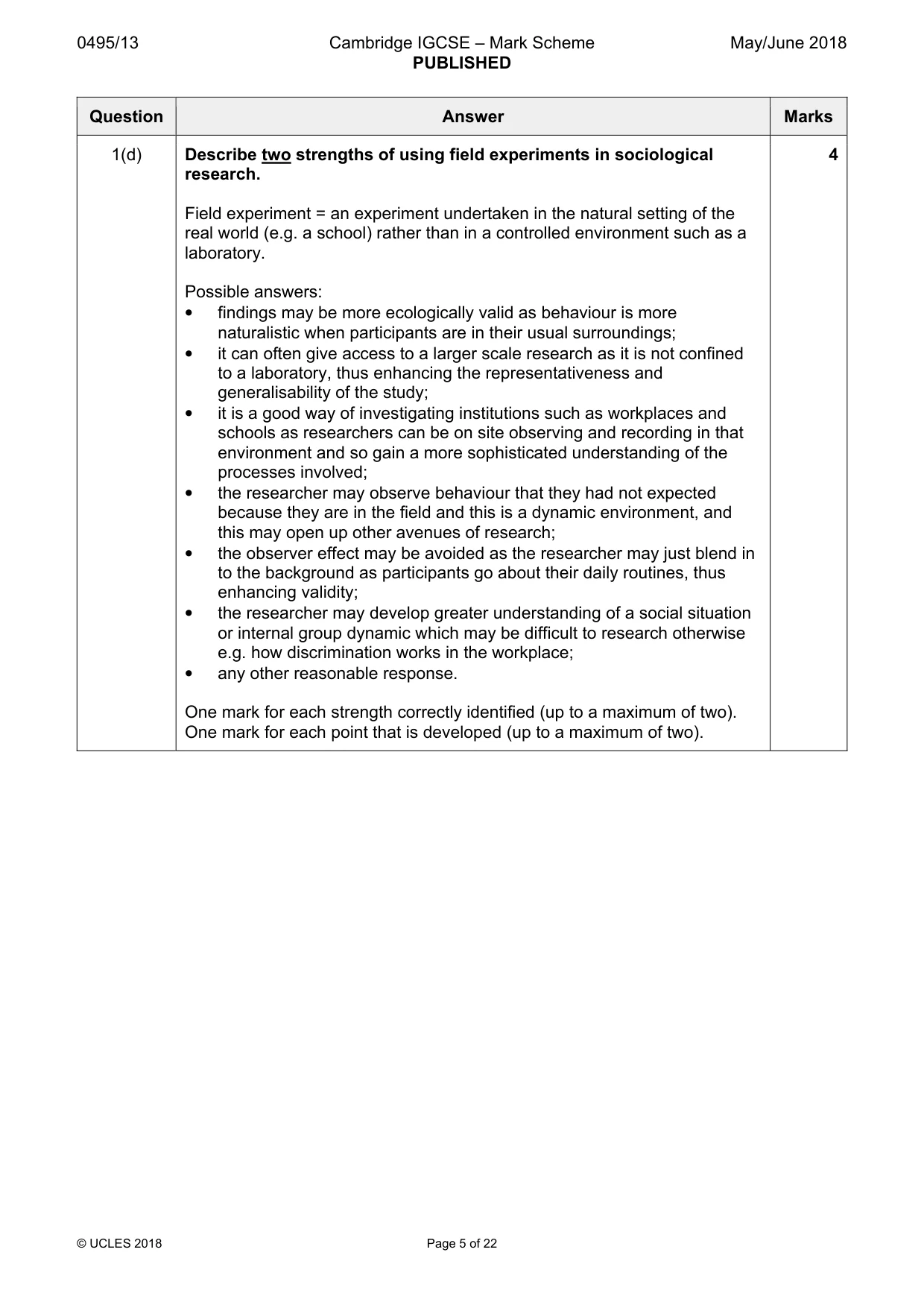
0495/13 Cambridge IGCSE – Mark Scheme PUBLISHED May/June 2018 © UCLES 2018 Page 5 of 22 Question Answer Marks 1(d) Describe two strengths of using field experiments in sociological research. Field experiment = an experiment undertaken in the natural setting of the real world (e.g. a school) rather than in a controlled environment such as a laboratory. Possible answers: • findings may be more ecologically valid as behaviour is more naturalistic when participants are in their usual surroundings; • it can often give access to a larger scale research as it is not confined to a laboratory, thus enhancing the representativeness and generalisability of the study; • it is a good way of investigating institutions such as workplaces and schools as researchers can be on site observing and recording in that environment and so gain a more sophisticated understanding of the processes involved; • the researcher may observe behaviour that they had not expected because they are in the field and this is a dynamic environment, and this may open up other avenues of research; • the observer effect may be avoided as the researcher may just blend in to the background as participants go about their daily routines, thus enhancing validity; • the researcher may develop greater understanding of a social situation or internal group dynamic which may be difficult to research otherwise e.g. how discrimination works in the workplace; • any other reasonable response. One mark for each strength correctly identified (up to a maximum of two). One mark for each point that is developed (up to a maximum of two). 4
Mark scheme, page 6
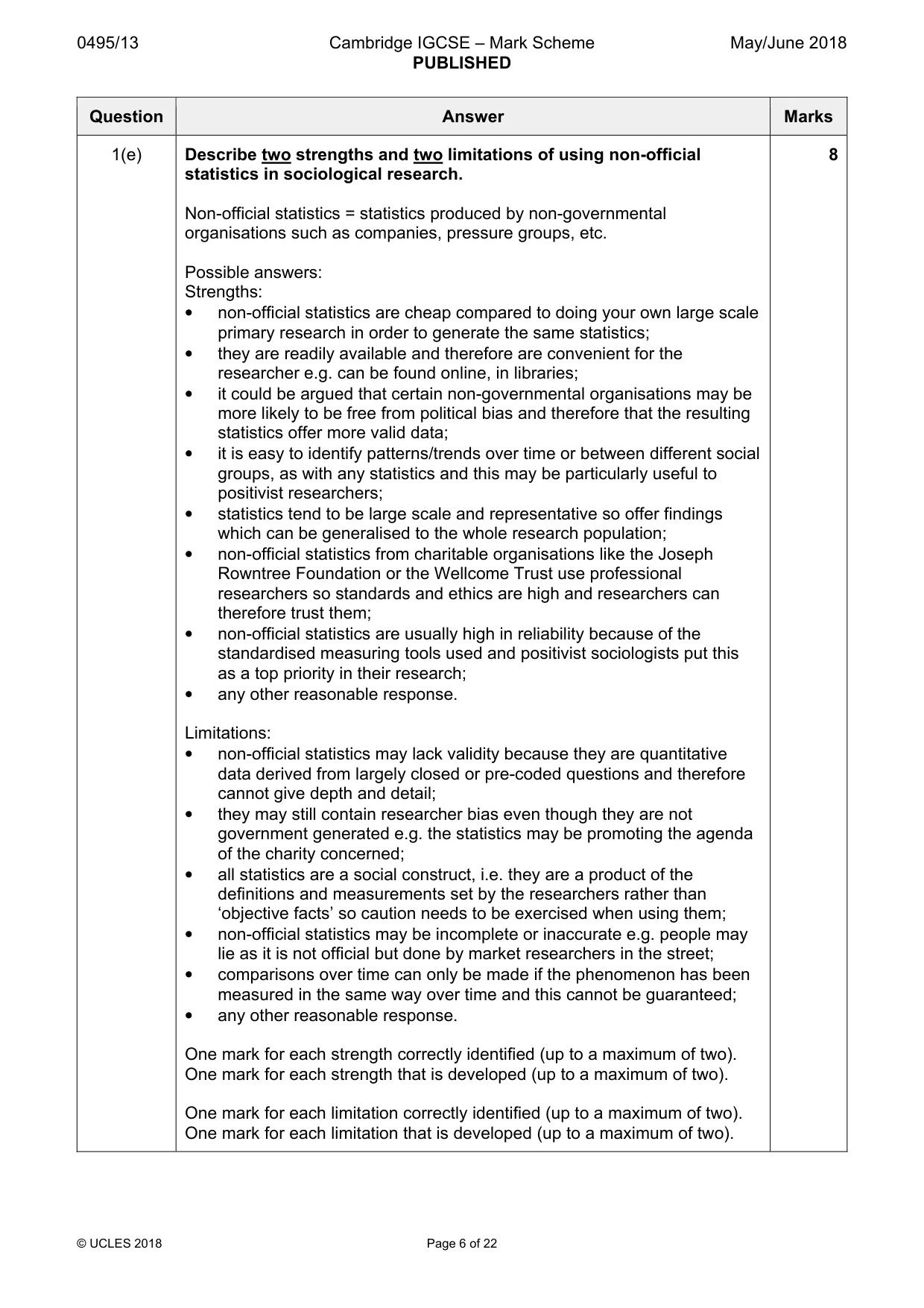
0495/13 Cambridge IGCSE – Mark Scheme PUBLISHED May/June 2018 © UCLES 2018 Page 6 of 22 Question Answer Marks 1(e) Describe two strengths and two limitations of using non-official statistics in sociological research. Non-official statistics = statistics produced by non-governmental organisations such as companies, pressure groups, etc. Possible answers: Strengths: • non-official statistics are cheap compared to doing your own large scale primary research in order to generate the same statistics; • they are readily available and therefore are convenient for the researcher e.g. can be found online, in libraries; • it could be argued that certain non-governmental organisations may be more likely to be free from political bias and therefore that the resulting statistics offer more valid data; • it is easy to identify patterns/trends over time or between different social groups, as with any statistics and this may be particularly useful to positivist researchers; • statistics tend to be large scale and representative so offer findings which can be generalised to the whole research population; • non-official statistics from charitable organisations like the Joseph Rowntree Foundation or the Wellcome Trust use professional researchers so standards and ethics are high and researchers can therefore trust them; • non-official statistics are usually high in reliability because of the standardised measuring tools used and positivist sociologists put this as a top priority in their research; • any other reasonable response. Limitations: • non-official statistics may lack validity because they are quantitative data derived from largely closed or pre-coded questions and therefore cannot give depth and detail; • they may still contain researcher bias even though they are not government generated e.g. the statistics may be promoting the agenda of the charity concerned; • all statistics are a social construct, i.e. they are a product of the definitions and measurements set by the researchers rather than ‘objective facts’ so caution needs to be exercised when using them; • non-official statistics may be incomplete or inaccurate e.g. people may lie as it is not official but done by market researchers in the street; • comparisons over time can only be made if the phenomenon has been measured in the same way over time and this cannot be guaranteed; • any other reasonable response. One mark for each strength correctly identified (up to a maximum of two). One mark for each strength that is developed (up to a maximum of two). One mark for each limitation correctly identified (up to a maximum of two). One mark for each limitation that is developed (up to a maximum of two). 8
Mark scheme, page 7
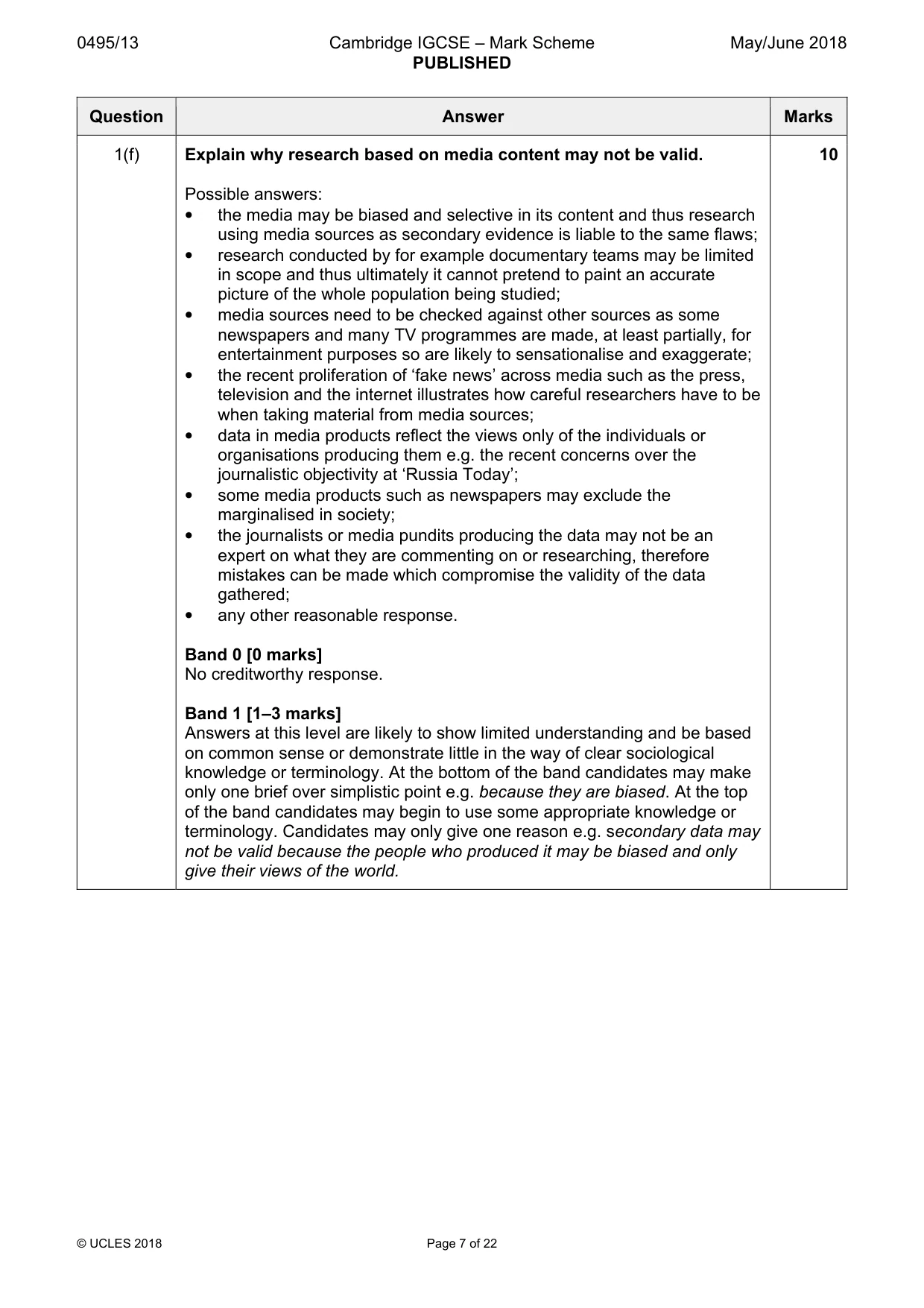
0495/13 Cambridge IGCSE – Mark Scheme PUBLISHED May/June 2018 © UCLES 2018 Page 7 of 22 Question Answer Marks 1(f) Explain why research based on media content may not be valid. Possible answers: • the media may be biased and selective in its content and thus research using media sources as secondary evidence is liable to the same flaws; • research conducted by for example documentary teams may be limited in scope and thus ultimately it cannot pretend to paint an accurate picture of the whole population being studied; • media sources need to be checked against other sources as some newspapers and many TV programmes are made, at least partially, for entertainment purposes so are likely to sensationalise and exaggerate; • the recent proliferation of ‘fake news’ across media such as the press, television and the internet illustrates how careful researchers have to be when taking material from media sources; • data in media products reflect the views only of the individuals or organisations producing them e.g. the recent concerns over the journalistic objectivity at ‘Russia Today’; • some media products such as newspapers may exclude the marginalised in society; • the journalists or media pundits producing the data may not be an expert on what they are commenting on or researching, therefore mistakes can be made which compromise the validity of the data gathered; • any other reasonable response. Band 0 [0 marks] No creditworthy response. Band 1 [1–3 marks] Answers at this level are likely to show limited understanding and be based on common sense or demonstrate little in the way of clear sociological knowledge or terminology. At the bottom of the band candidates may make only one brief over simplistic point e.g. because they are biased. At the top of the band candidates may begin to use some appropriate knowledge or terminology. Candidates may only give one reason e.g. secondary data may not be valid because the people who produced it may be biased and only give their views of the world. 10
Mark scheme, page 8
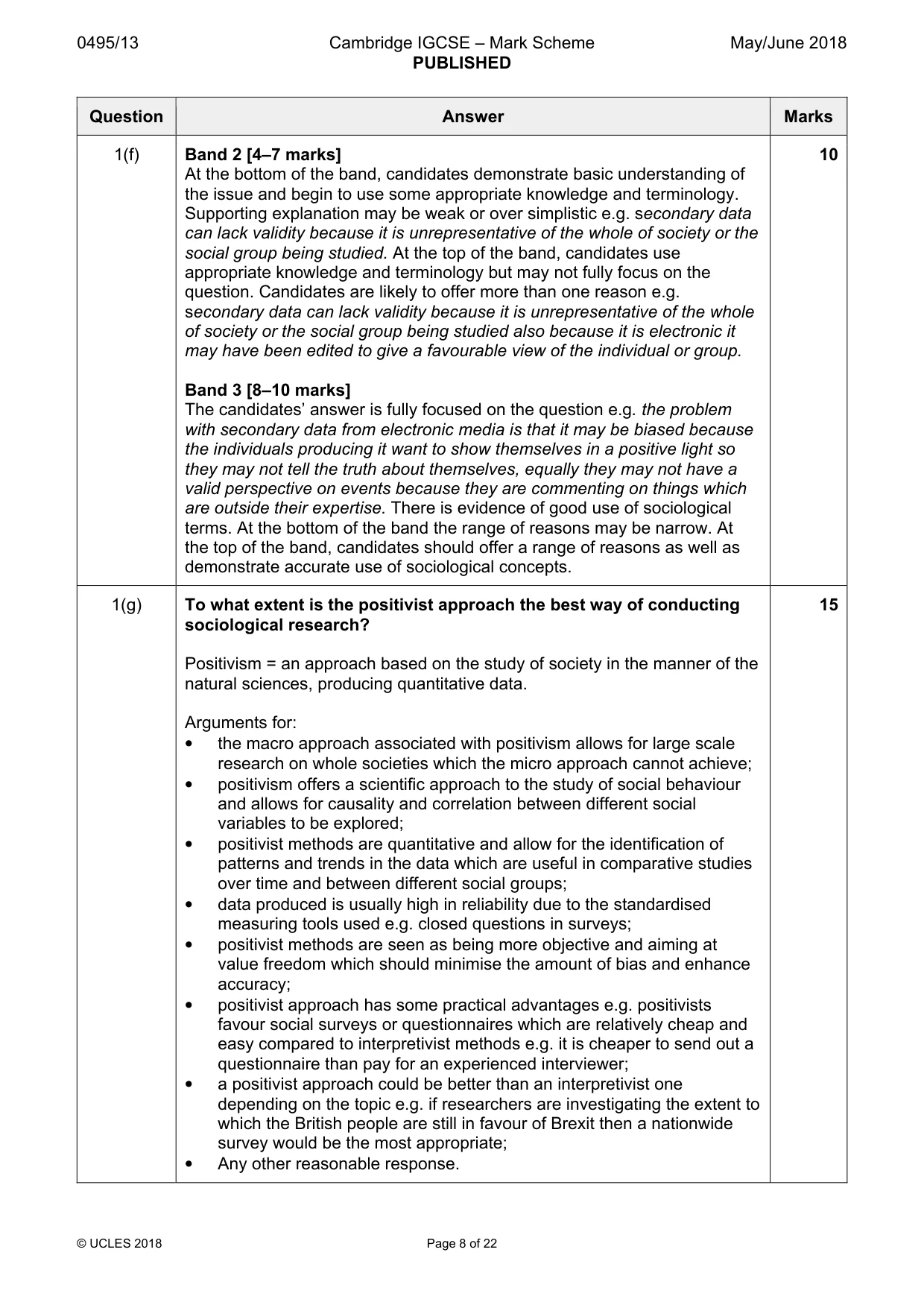
0495/13 Cambridge IGCSE – Mark Scheme PUBLISHED May/June 2018 © UCLES 2018 Page 8 of 22 Question Answer Marks 1(f) Band 2 [4–7 marks] At the bottom of the band, candidates demonstrate basic understanding of the issue and begin to use some appropriate knowledge and terminology. Supporting explanation may be weak or over simplistic e.g. secondary data can lack validity because it is unrepresentative of the whole of society or the social group being studied. At the top of the band, candidates use appropriate knowledge and terminology but may not fully focus on the question. Candidates are likely to offer more than one reason e.g. secondary data can lack validity because it is unrepresentative of the whole of society or the social group being studied also because it is electronic it may have been edited to give a favourable view of the individual or group. Band 3 [8–10 marks] The candidates’ answer is fully focused on the question e.g. the problem with secondary data from electronic media is that it may be biased because the individuals producing it want to show themselves in a positive light so they may not tell the truth about themselves, equally they may not have a valid perspective on events because they are commenting on things which are outside their expertise. There is evidence of good use of sociological terms. At the bottom of the band the range of reasons may be narrow. At the top of the band, candidates should offer a range of reasons as well as demonstrate accurate use of sociological concepts. 10 1(g) To what extent is the positivist approach the best way of conducting sociological research? Positivism = an approach based on the study of society in the manner of the natural sciences, producing quantitative data. Arguments for: • the macro approach associated with positivism allows for large scale research on whole societies which the micro approach cannot achieve; • positivism offers a scientific approach to the study of social behaviour and allows for causality and correlation between different social variables to be explored; • positivist methods are quantitative and allow for the identification of patterns and trends in the data which are useful in comparative studies over time and between different social groups; • data produced is usually high in reliability due to the standardised measuring tools used e.g. closed questions in surveys; • positivist methods are seen as being more objective and aiming at value freedom which should minimise the amount of bias and enhance accuracy; • positivist approach has some practical advantages e.g. positivists favour social surveys or questionnaires which are relatively cheap and easy compared to interpretivist methods e.g. it is cheaper to send out a questionnaire than pay for an experienced interviewer; • a positivist approach could be better than an interpretivist one depending on the topic e.g. if researchers are investigating the extent to which the British people are still in favour of Brexit then a nationwide survey would be the most appropriate; • Any other reasonable response. 15
Mark scheme, page 9
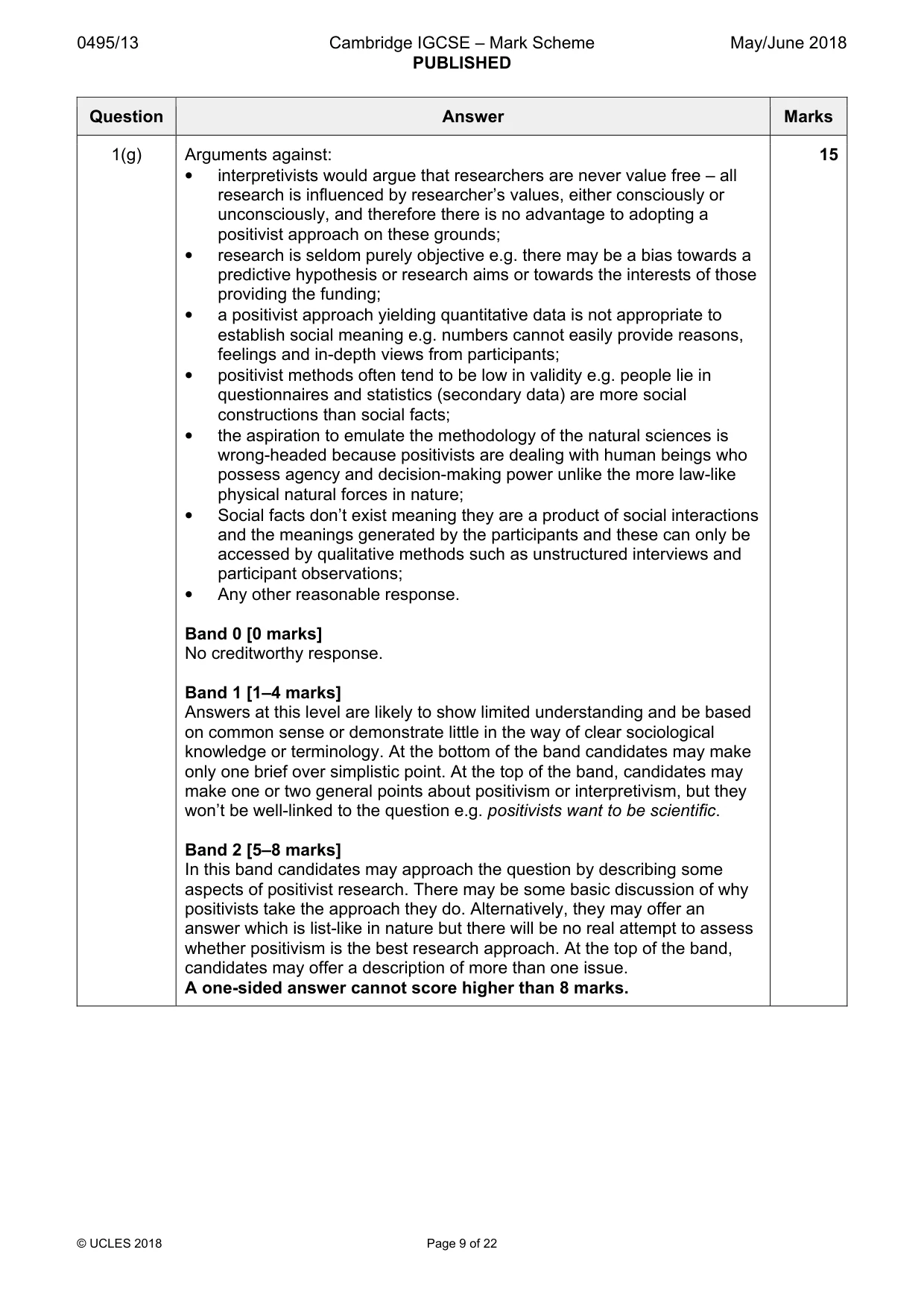
0495/13 Cambridge IGCSE – Mark Scheme PUBLISHED May/June 2018 © UCLES 2018 Page 9 of 22 Question Answer Marks 1(g) Arguments against: • interpretivists would argue that researchers are never value free – all research is influenced by researcher’s values, either consciously or unconsciously, and therefore there is no advantage to adopting a positivist approach on these grounds; • research is seldom purely objective e.g. there may be a bias towards a predictive hypothesis or research aims or towards the interests of those providing the funding; • a positivist approach yielding quantitative data is not appropriate to establish social meaning e.g. numbers cannot easily provide reasons, feelings and in-depth views from participants; • positivist methods often tend to be low in validity e.g. people lie in questionnaires and statistics (secondary data) are more social constructions than social facts; • the aspiration to emulate the methodology of the natural sciences is wrong-headed because positivists are dealing with human beings who possess agency and decision-making power unlike the more law-like physical natural forces in nature; • Social facts don’t exist meaning they are a product of social interactions and the meanings generated by the participants and these can only be accessed by qualitative methods such as unstructured interviews and participant observations; • Any other reasonable response. Band 0 [0 marks] No creditworthy response. Band 1 [1–4 marks] Answers at this level are likely to show limited understanding and be based on common sense or demonstrate little in the way of clear sociological knowledge or terminology. At the bottom of the band candidates may make only one brief over simplistic point. At the top of the band, candidates may make one or two general points about positivism or interpretivism, but they won’t be well-linked to the question e.g. positivists want to be scientific. Band 2 [5–8 marks] In this band candidates may approach the question by describing some aspects of positivist research. There may be some basic discussion of why positivists take the approach they do. Alternatively, they may offer an answer which is list-like in nature but there will be no real attempt to assess whether positivism is the best research approach. At the top of the band, candidates may offer a description of more than one issue. A one-sided answer cannot score higher than 8 marks. 15
Mark scheme, page 10
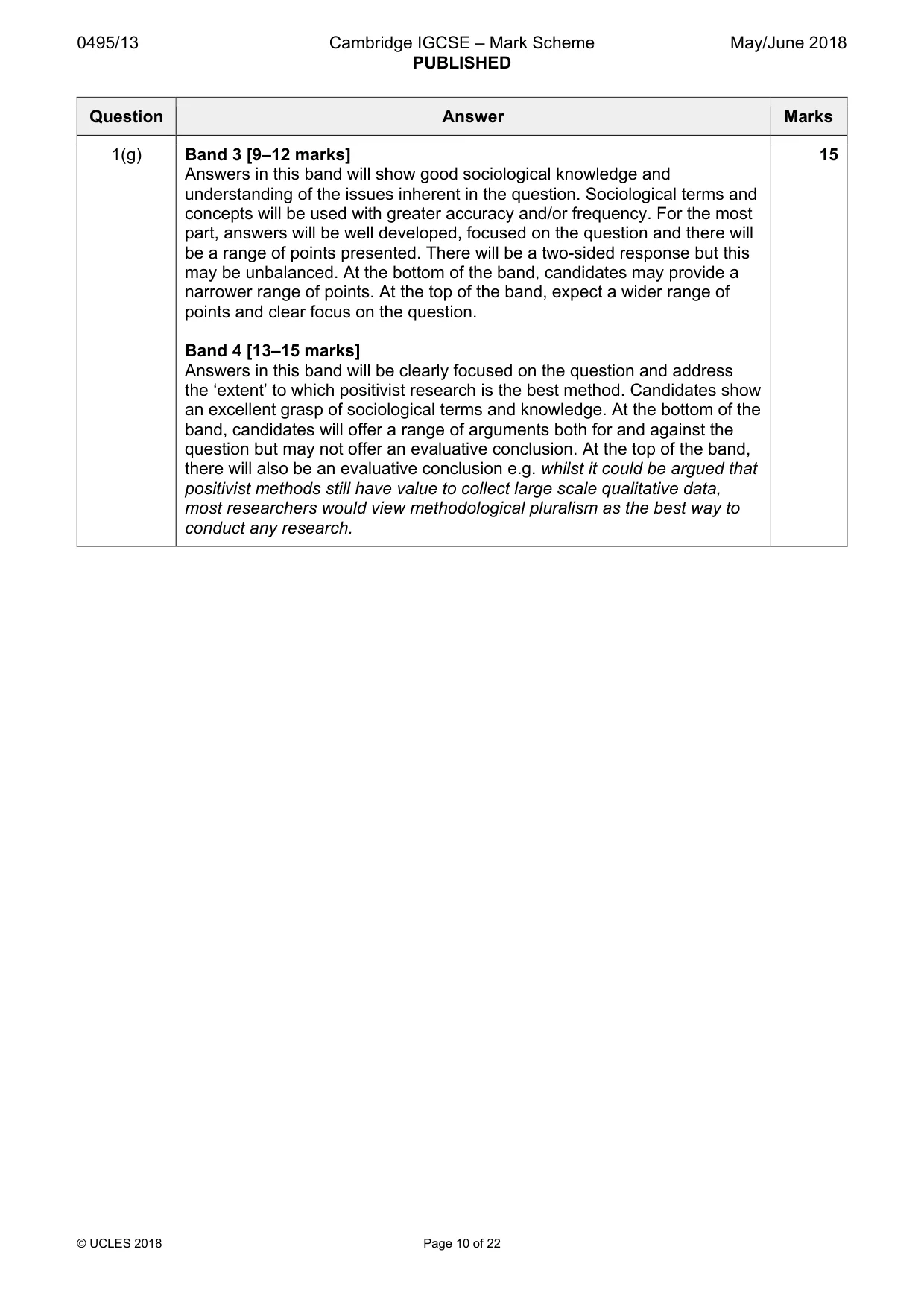
0495/13 Cambridge IGCSE – Mark Scheme PUBLISHED May/June 2018 © UCLES 2018 Page 10 of 22 Question Answer Marks 1(g) Band 3 [9–12 marks] Answers in this band will show good sociological knowledge and understanding of the issues inherent in the question. Sociological terms and concepts will be used with greater accuracy and/or frequency. For the most part, answers will be well developed, focused on the question and there will be a range of points presented. There will be a two-sided response but this may be unbalanced. At the bottom of the band, candidates may provide a narrower range of points. At the top of the band, expect a wider range of points and clear focus on the question. Band 4 [13–15 marks] Answers in this band will be clearly focused on the question and address the ‘extent’ to which positivist research is the best method. Candidates show an excellent grasp of sociological terms and knowledge. At the bottom of the band, candidates will offer a range of arguments both for and against the question but may not offer an evaluative conclusion. At the top of the band, there will also be an evaluative conclusion e.g. whilst it could be argued that positivist methods still have value to collect large scale qualitative data, most researchers would view methodological pluralism as the best way to conduct any research. 15
Mark scheme, page 11
0495/13 Cambridge IGCSE – Mark Scheme PUBLISHED May/June 2018 © UCLES 2018 Page 11 of 22 Question Answer Marks In modern industrial societies some sociologists believe most people share a common culture. They live in families, see education as a good thing, vote and respect the law. However others believe people do not share a common culture but are divided into many sub-cultures. These can be based around social class, age, religion and ethnicity. 2(a) What is meant by the term ‘culture’? Culture = the way of life of a society One mark for partial definition e.g. a country’s food and language. Two marks for clear definition e.g. the norms and values or lifestyle in a society. 2 2(b) Describe two ways culture can be learned. Possible answers: • through primary socialisation – for example parents teaching their children table manners by role modelling; • through secondary socialisation e.g. young people learn the different aspects of their social identity through the secondary agents and their processes; • through community and social interaction e.g. communication of language, participation in festivals, etc.; • though the family e.g. the acquisition of gender identity through processes such as canalisation, manipulation and verbal appellation (Oakley); • through education e.g. hidden curriculum teaches us the norms that enable us to fit into the workplace such as conformity and acceptance of authority; • through the media e.g. imitating the appearance and behaviours of celebrity role models such as Kim Kardashian or Kanye West; • through religion e.g. the norms and values of a particular culture may be transmitted via holy books, religious instruction and role models; • through the work place e.g. norms like time keeping and values such as hard work are learnt and reinforced; • through the peer group e.g. peer pressure may ‘teach’ us what is the norm and what values are acceptable in a given culture • any other reasonable response. One mark for each example identified (up to maximum of two). One mark for each description (up to a maximum of two). 4
Mark scheme, page 12
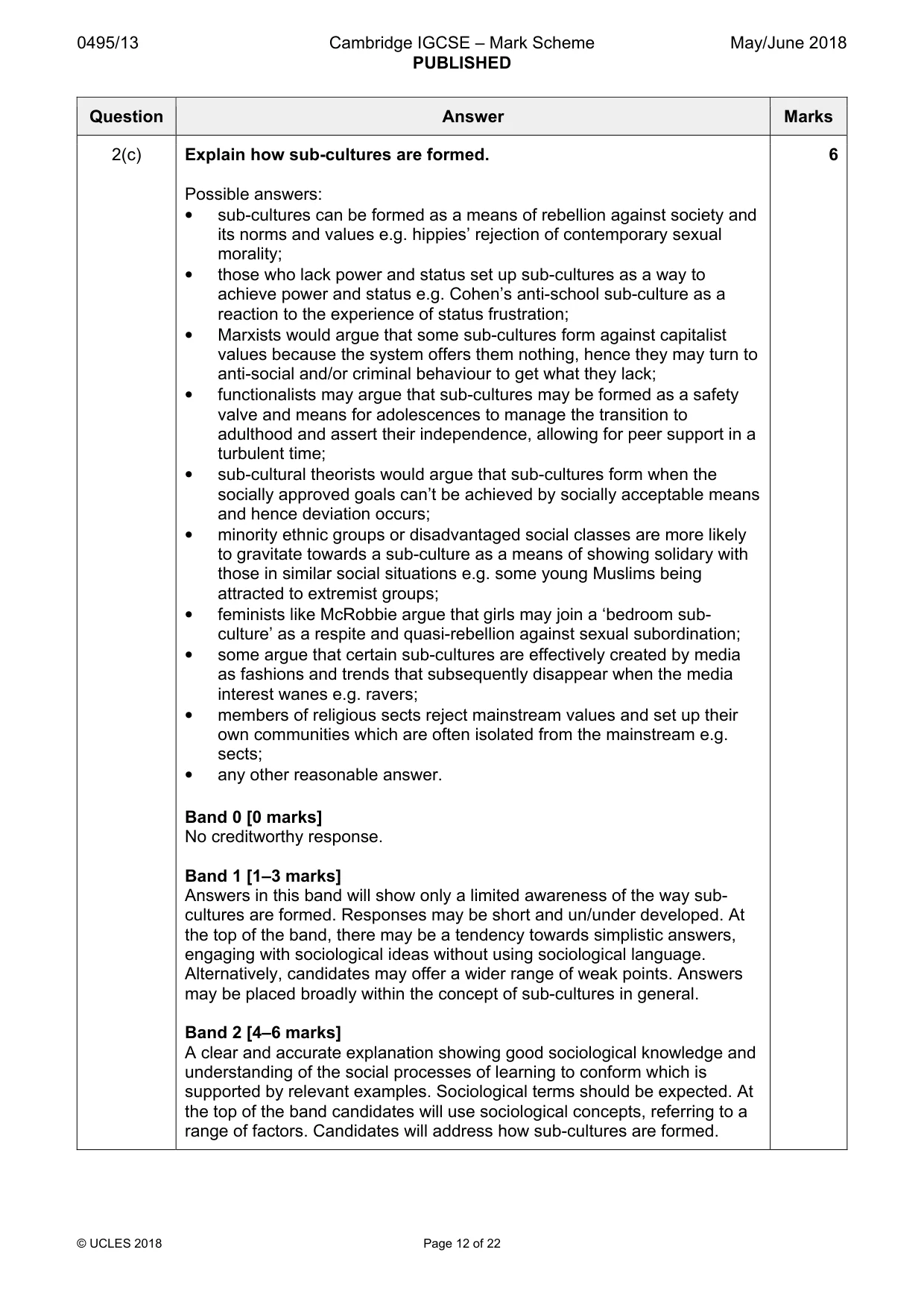
0495/13 Cambridge IGCSE – Mark Scheme PUBLISHED May/June 2018 © UCLES 2018 Page 12 of 22 Question Answer Marks 2(c) Explain how sub-cultures are formed. Possible answers: • sub-cultures can be formed as a means of rebellion against society and its norms and values e.g. hippies’ rejection of contemporary sexual morality; • those who lack power and status set up sub-cultures as a way to achieve power and status e.g. Cohen’s anti-school sub-culture as a reaction to the experience of status frustration; • Marxists would argue that some sub-cultures form against capitalist values because the system offers them nothing, hence they may turn to anti-social and/or criminal behaviour to get what they lack; • functionalists may argue that sub-cultures may be formed as a safety valve and means for adolescences to manage the transition to adulthood and assert their independence, allowing for peer support in a turbulent time; • sub-cultural theorists would argue that sub-cultures form when the socially approved goals can’t be achieved by socially acceptable means and hence deviation occurs; • minority ethnic groups or disadvantaged social classes are more likely to gravitate towards a sub-culture as a means of showing solidary with those in similar social situations e.g. some young Muslims being attracted to extremist groups; • feminists like McRobbie argue that girls may join a ‘bedroom sub- culture’ as a respite and quasi-rebellion against sexual subordination; • some argue that certain sub-cultures are effectively created by media as fashions and trends that subsequently disappear when the media interest wanes e.g. ravers; • members of religious sects reject mainstream values and set up their own communities which are often isolated from the mainstream e.g. sects; • any other reasonable answer. Band 0 [0 marks] No creditworthy response. Band 1 [1–3 marks] Answers in this band will show only a limited awareness of the way sub- cultures are formed. Responses may be short and un/under developed. At the top of the band, there may be a tendency towards simplistic answers, engaging with sociological ideas without using sociological language. Alternatively, candidates may offer a wider range of weak points. Answers may be placed broadly within the concept of sub-cultures in general. Band 2 [4–6 marks] A clear and accurate explanation showing good sociological knowledge and understanding of the social processes of learning to conform which is supported by relevant examples. Sociological terms should be expected. At the top of the band candidates will use sociological concepts, referring to a range of factors. Candidates will address how sub-cultures are formed. 6
Mark scheme, page 13
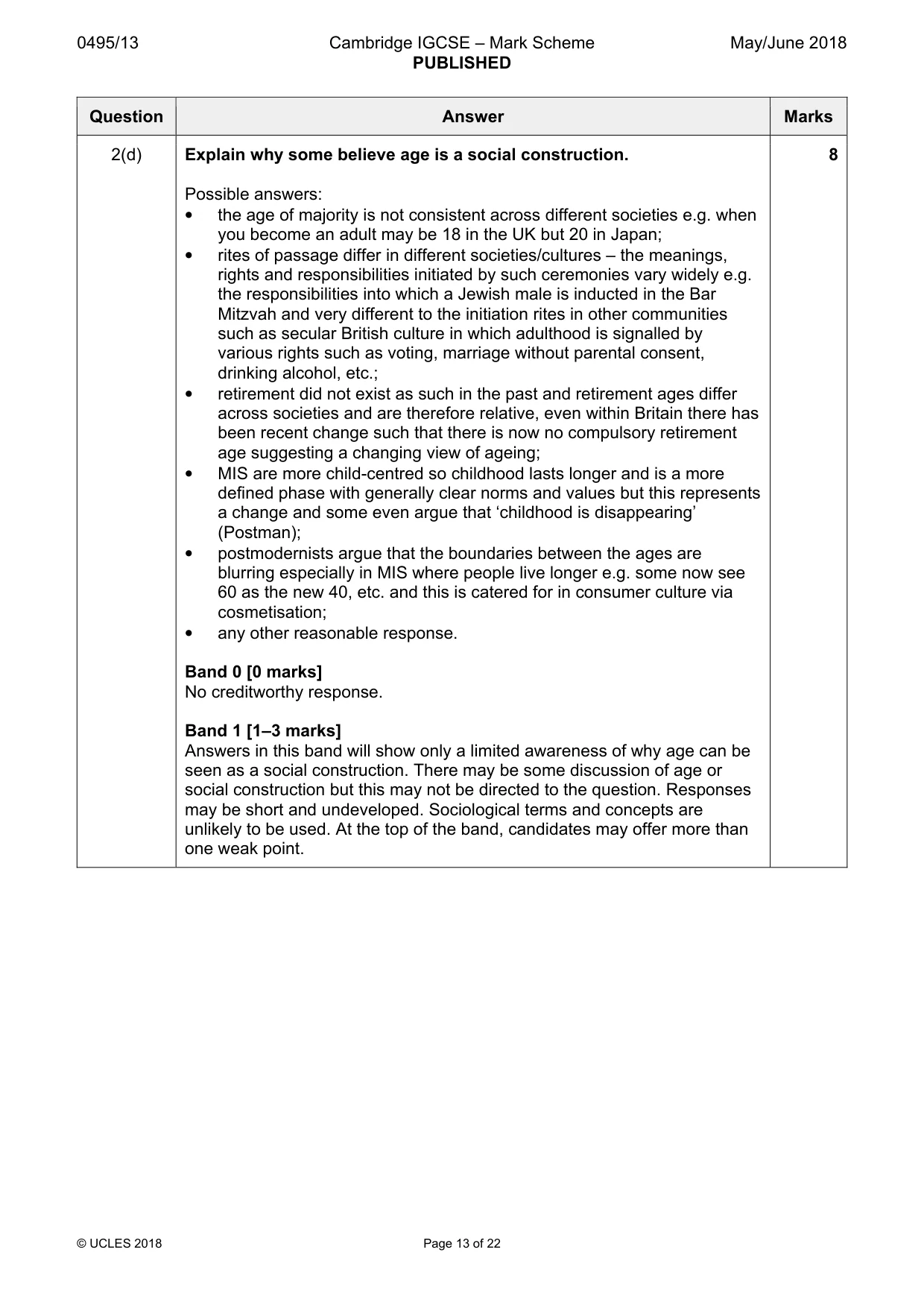
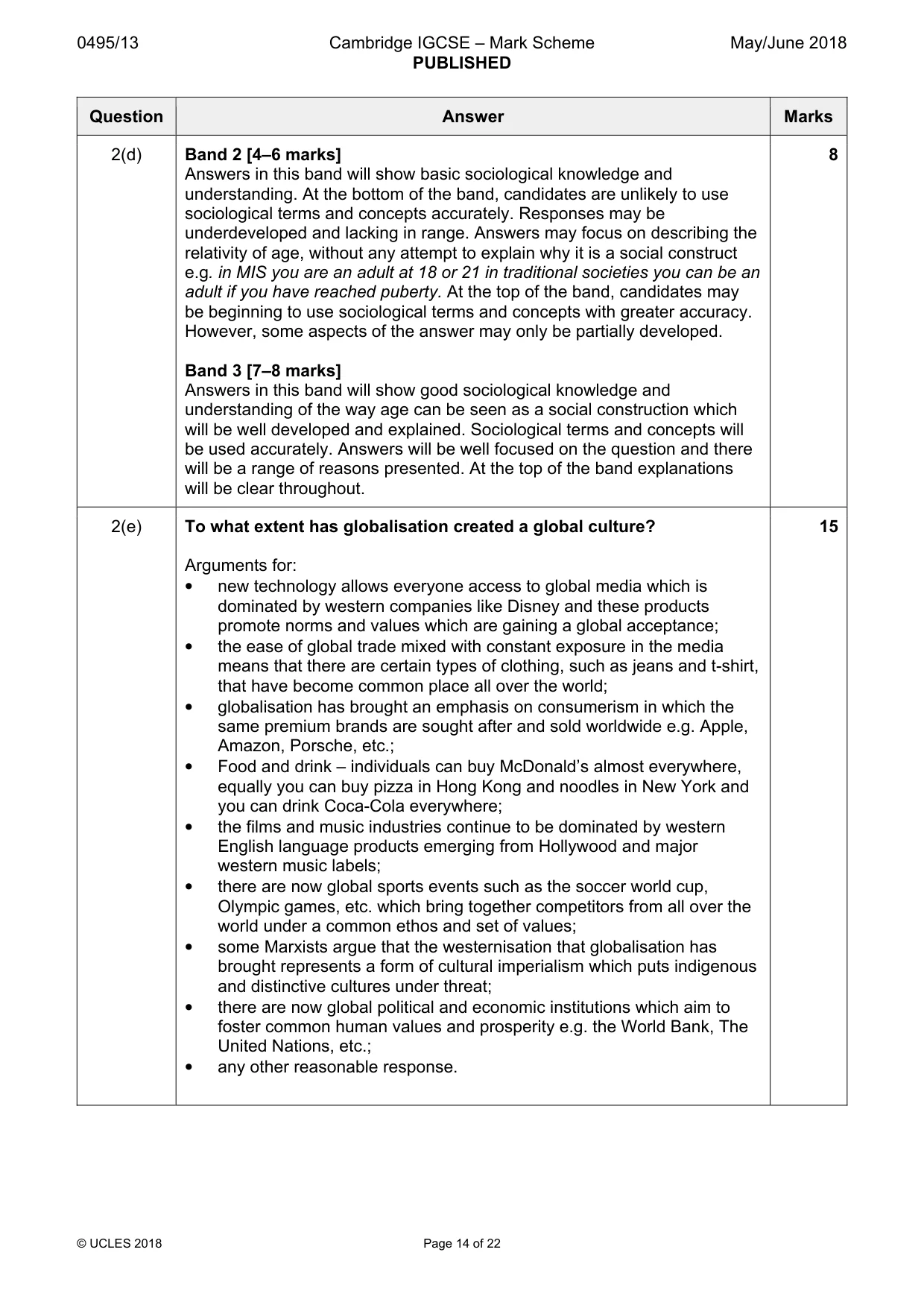
0495/13 Cambridge IGCSE – Mark Scheme PUBLISHED May/June 2018 © UCLES 2018 Page 13 of 22 Question Answer Marks 2(d) Explain why some believe age is a social construction. Possible answers: • the age of majority is not consistent across different societies e.g. when you become an adult may be 18 in the UK but 20 in Japan; • rites of passage differ in different societies/cultures – the meanings, rights and responsibilities initiated by such ceremonies vary widely e.g. the responsibilities into which a Jewish male is inducted in the Bar Mitzvah and very different to the initiation rites in other communities such as secular British culture in which adulthood is signalled by various rights such as voting, marriage without parental consent, drinking alcohol, etc.; • retirement did not exist as such in the past and retirement ages differ across societies and are therefore relative, even within Britain there has been recent change such that there is now no compulsory retirement age suggesting a changing view of ageing; • MIS are more child-centred so childhood lasts longer and is a more defined phase with generally clear norms and values but this represents a change and some even argue that ‘childhood is disappearing’ (Postman); • postmodernists argue that the boundaries between the ages are blurring especially in MIS where people live longer e.g. some now see 60 as the new 40, etc. and this is catered for in consumer culture via cosmetisation; • any other reasonable response. Band 0 [0 marks] No creditworthy response. Band 1 [1–3 marks] Answers in this band will show only a limited awareness of why age can be seen as a social construction. There may be some discussion of age or social construction but this may not be directed to the question. Responses may be short and undeveloped. Sociological terms and concepts are unlikely to be used. At the top of the band, candidates may offer more than one weak point. 8
Mark scheme, page 14
0495/13 Cambridge IGCSE – Mark Scheme PUBLISHED May/June 2018 © UCLES 2018 Page 14 of 22 Question Answer Marks 2(d) Band 2 [4–6 marks] Answers in this band will show basic sociological knowledge and understanding. At the bottom of the band, candidates are unlikely to use sociological terms and concepts accurately. Responses may be underdeveloped and lacking in range. Answers may focus on describing the relativity of age, without any attempt to explain why it is a social construct e.g. in MIS you are an adult at 18 or 21 in traditional societies you can be an adult if you have reached puberty. At the top of the band, candidates may be beginning to use sociological terms and concepts with greater accuracy. However, some aspects of the answer may only be partially developed. Band 3 [7–8 marks] Answers in this band will show good sociological knowledge and understanding of the way age can be seen as a social construction which will be well developed and explained. Sociological terms and concepts will be used accurately. Answers will be well focused on the question and there will be a range of reasons presented. At the top of the band explanations will be clear throughout. 8 2(e) To what extent has globalisation created a global culture? Arguments for: • new technology allows everyone access to global media which is dominated by western companies like Disney and these products promote norms and values which are gaining a global acceptance; • the ease of global trade mixed with constant exposure in the media means that there are certain types of clothing, such as jeans and t-shirt, that have become common place all over the world; • globalisation has brought an emphasis on consumerism in which the same premium brands are sought after and sold worldwide e.g. Apple, Amazon, Porsche, etc.; • Food and drink – individuals can buy McDonald’s almost everywhere, equally you can buy pizza in Hong Kong and noodles in New York and you can drink Coca-Cola everywhere; • the films and music industries continue to be dominated by western English language products emerging from Hollywood and major western music labels; • there are now global sports events such as the soccer world cup, Olympic games, etc. which bring together competitors from all over the world under a common ethos and set of values; • some Marxists argue that the westernisation that globalisation has brought represents a form of cultural imperialism which puts indigenous and distinctive cultures under threat; • there are now global political and economic institutions which aim to foster common human values and prosperity e.g. the World Bank, The United Nations, etc.; • any other reasonable response. 15
Mark scheme, page 15
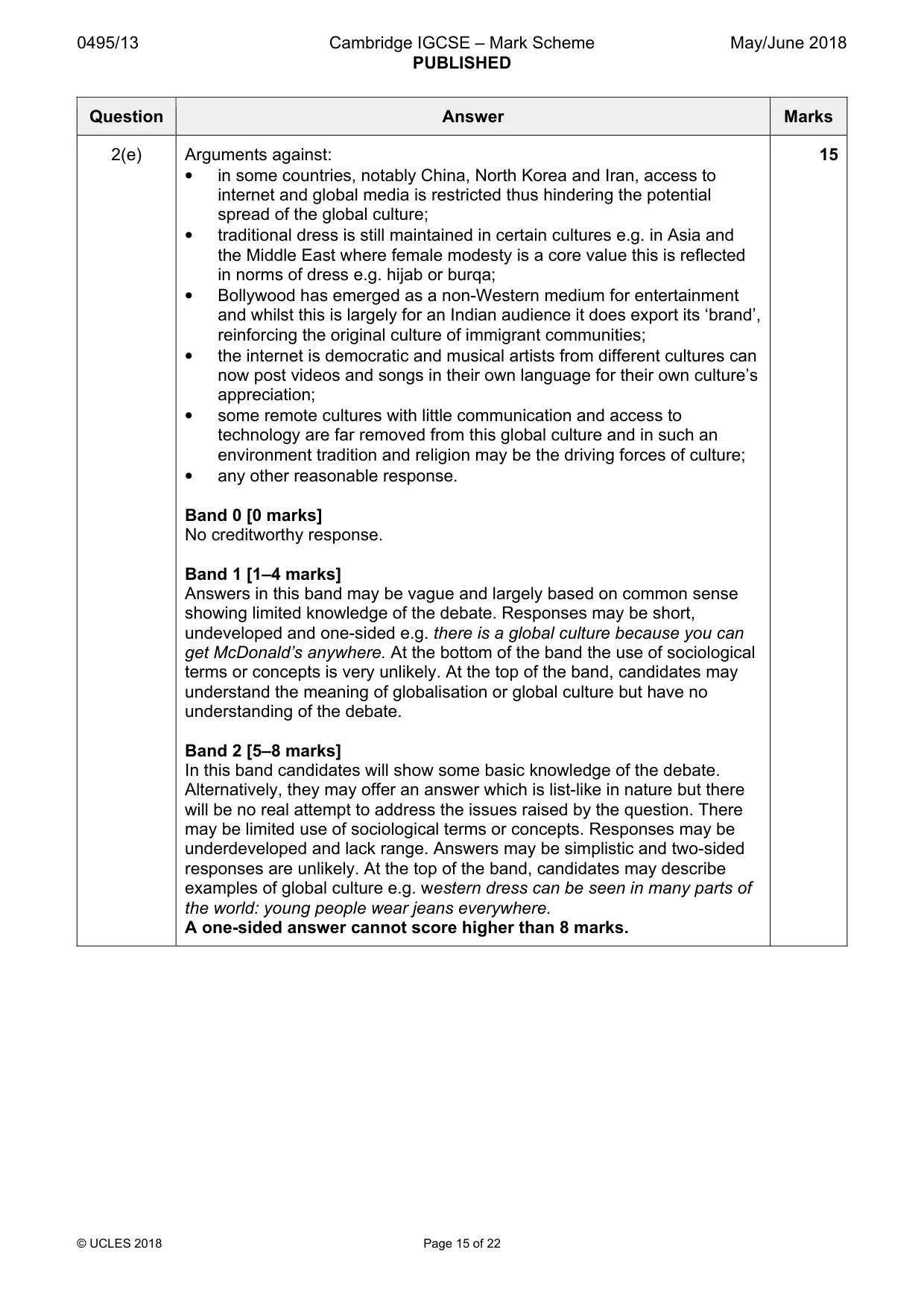
0495/13 Cambridge IGCSE – Mark Scheme PUBLISHED May/June 2018 © UCLES 2018 Page 15 of 22 Question Answer Marks 2(e) Arguments against: • in some countries, notably China, North Korea and Iran, access to internet and global media is restricted thus hindering the potential spread of the global culture; • traditional dress is still maintained in certain cultures e.g. in Asia and the Middle East where female modesty is a core value this is reflected in norms of dress e.g. hijab or burqa; • Bollywood has emerged as a non-Western medium for entertainment and whilst this is largely for an Indian audience it does export its ‘brand’, reinforcing the original culture of immigrant communities; • the internet is democratic and musical artists from different cultures can now post videos and songs in their own language for their own culture’s appreciation; • some remote cultures with little communication and access to technology are far removed from this global culture and in such an environment tradition and religion may be the driving forces of culture; • any other reasonable response. Band 0 [0 marks] No creditworthy response. Band 1 [1–4 marks] Answers in this band may be vague and largely based on common sense showing limited knowledge of the debate. Responses may be short, undeveloped and one-sided e.g. there is a global culture because you can get McDonald’s anywhere. At the bottom of the band the use of sociological terms or concepts is very unlikely. At the top of the band, candidates may understand the meaning of globalisation or global culture but have no understanding of the debate. Band 2 [5–8 marks] In this band candidates will show some basic knowledge of the debate. Alternatively, they may offer an answer which is list-like in nature but there will be no real attempt to address the issues raised by the question. There may be limited use of sociological terms or concepts. Responses may be underdeveloped and lack range. Answers may be simplistic and two-sided responses are unlikely. At the top of the band, candidates may describe examples of global culture e.g. western dress can be seen in many parts of the world: young people wear jeans everywhere. A one-sided answer cannot score higher than 8 marks. 15
Mark scheme, page 16
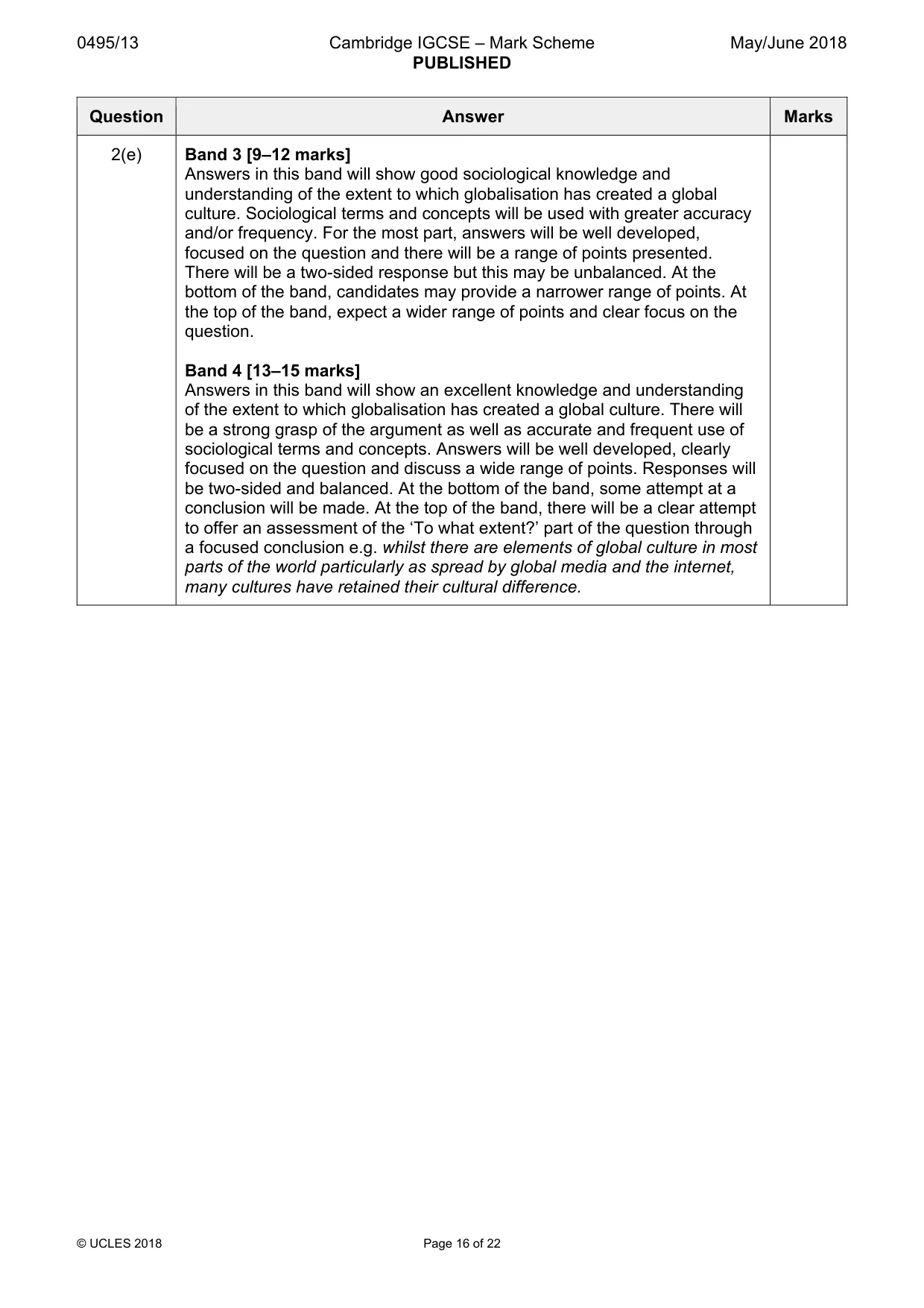
0495/13 Cambridge IGCSE – Mark Scheme PUBLISHED May/June 2018 © UCLES 2018 Page 16 of 22 Question Answer Marks 2(e) Band 3 [9–12 marks] Answers in this band will show good sociological knowledge and understanding of the extent to which globalisation has created a global culture. Sociological terms and concepts will be used with greater accuracy and/or frequency. For the most part, answers will be well developed, focused on the question and there will be a range of points presented. There will be a two-sided response but this may be unbalanced. At the bottom of the band, candidates may provide a narrower range of points. At the top of the band, expect a wider range of points and clear focus on the question. Band 4 [13–15 marks] Answers in this band will show an excellent knowledge and understanding of the extent to which globalisation has created a global culture. There will be a strong grasp of the argument as well as accurate and frequent use of sociological terms and concepts. Answers will be well developed, clearly focused on the question and discuss a wide range of points. Responses will be two-sided and balanced. At the bottom of the band, some attempt at a conclusion will be made. At the top of the band, there will be a clear attempt to offer an assessment of the ‘To what extent?’ part of the question through a focused conclusion e.g. whilst there are elements of global culture in most parts of the world particularly as spread by global media and the internet, many cultures have retained their cultural difference.
Mark scheme, page 17
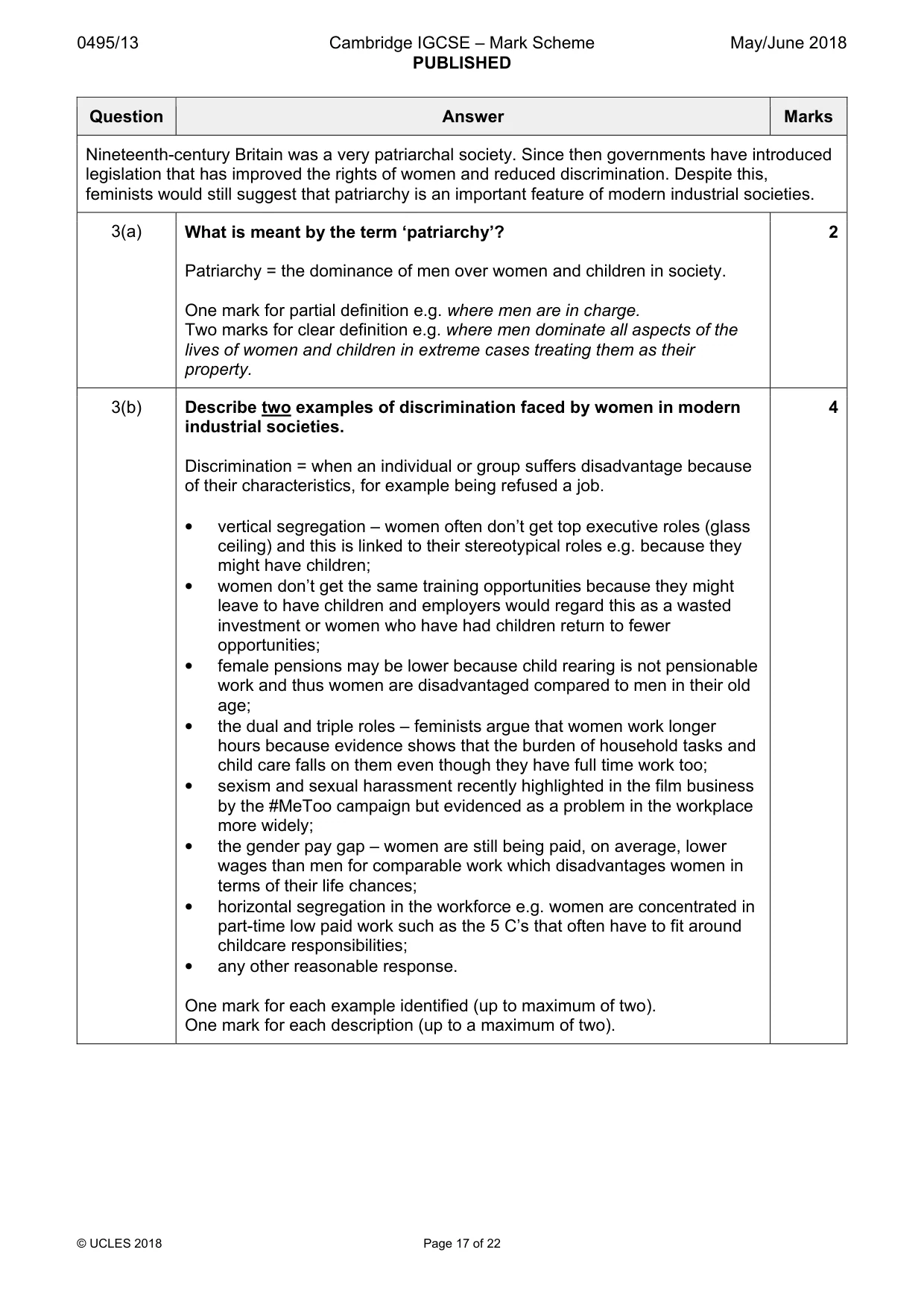
0495/13 Cambridge IGCSE – Mark Scheme PUBLISHED May/June 2018 © UCLES 2018 Page 17 of 22 Question Answer Marks Nineteenth-century Britain was a very patriarchal society. Since then governments have introduced legislation that has improved the rights of women and reduced discrimination. Despite this, feminists would still suggest that patriarchy is an important feature of modern industrial societies. 3(a) What is meant by the term ‘patriarchy’? Patriarchy = the dominance of men over women and children in society. One mark for partial definition e.g. where men are in charge. Two marks for clear definition e.g. where men dominate all aspects of the lives of women and children in extreme cases treating them as their property. 2 3(b) Describe two examples of discrimination faced by women in modern industrial societies. Discrimination = when an individual or group suffers disadvantage because of their characteristics, for example being refused a job. • vertical segregation – women often don’t get top executive roles (glass ceiling) and this is linked to their stereotypical roles e.g. because they might have children; • women don’t get the same training opportunities because they might leave to have children and employers would regard this as a wasted investment or women who have had children return to fewer opportunities; • female pensions may be lower because child rearing is not pensionable work and thus women are disadvantaged compared to men in their old age; • the dual and triple roles – feminists argue that women work longer hours because evidence shows that the burden of household tasks and child care falls on them even though they have full time work too; • sexism and sexual harassment recently highlighted in the film business by the #MeToo campaign but evidenced as a problem in the workplace more widely; • the gender pay gap – women are still being paid, on average, lower wages than men for comparable work which disadvantages women in terms of their life chances; • horizontal segregation in the workforce e.g. women are concentrated in part-time low paid work such as the 5 C’s that often have to fit around childcare responsibilities; • any other reasonable response. One mark for each example identified (up to maximum of two). One mark for each description (up to a maximum of two). 4
Mark scheme, page 18
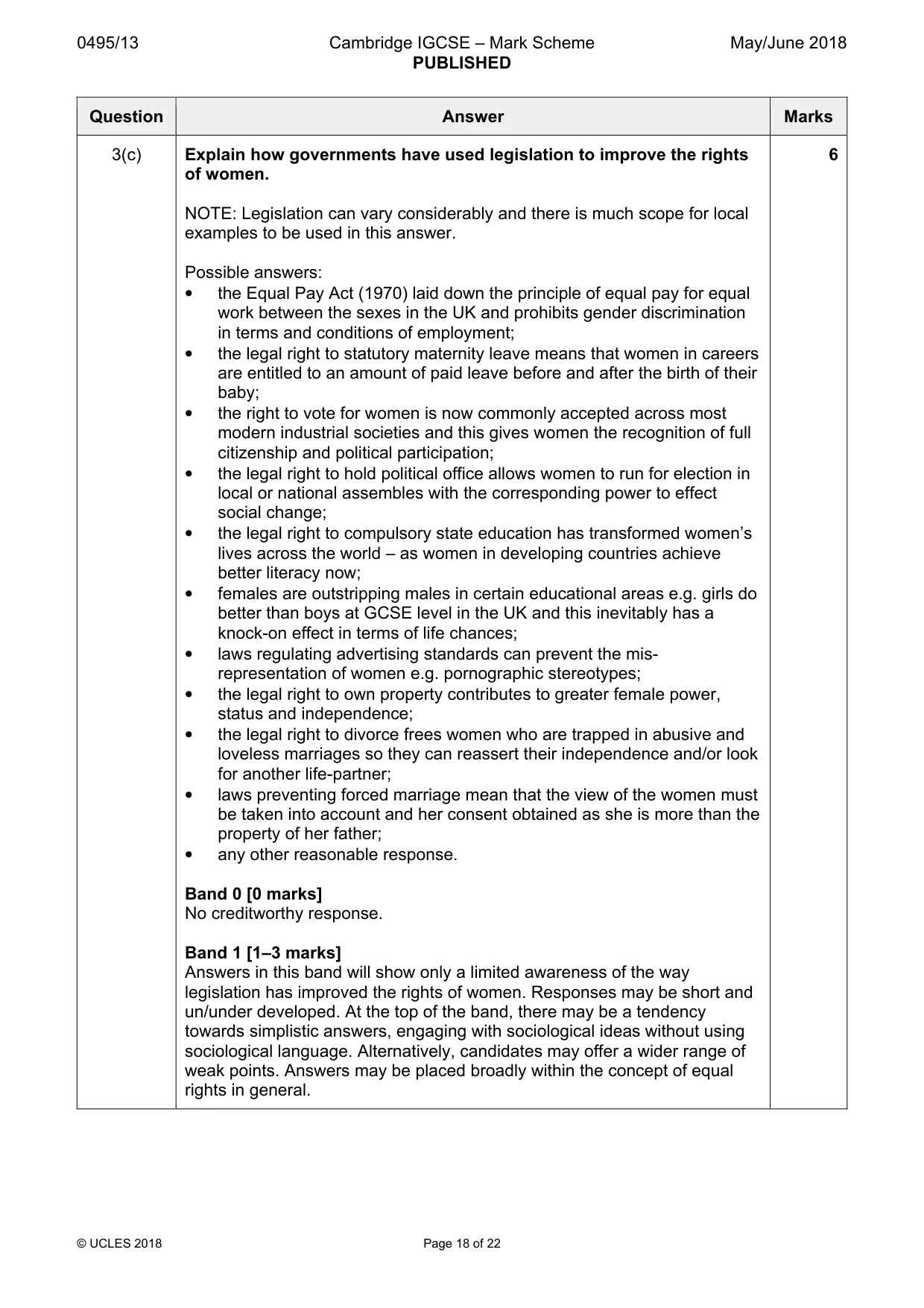
0495/13 Cambridge IGCSE – Mark Scheme PUBLISHED May/June 2018 © UCLES 2018 Page 18 of 22 Question Answer Marks 3(c) Explain how governments have used legislation to improve the rights of women. NOTE: Legislation can vary considerably and there is much scope for local examples to be used in this answer. Possible answers: • the Equal Pay Act (1970) laid down the principle of equal pay for equal work between the sexes in the UK and prohibits gender discrimination in terms and conditions of employment; • the legal right to statutory maternity leave means that women in careers are entitled to an amount of paid leave before and after the birth of their baby; • the right to vote for women is now commonly accepted across most modern industrial societies and this gives women the recognition of full citizenship and political participation; • the legal right to hold political office allows women to run for election in local or national assembles with the corresponding power to effect social change; • the legal right to compulsory state education has transformed women’s lives across the world – as women in developing countries achieve better literacy now; • females are outstripping males in certain educational areas e.g. girls do better than boys at GCSE level in the UK and this inevitably has a knock-on effect in terms of life chances; • laws regulating advertising standards can prevent the mis- representation of women e.g. pornographic stereotypes; • the legal right to own property contributes to greater female power, status and independence; • the legal right to divorce frees women who are trapped in abusive and loveless marriages so they can reassert their independence and/or look for another life-partner; • laws preventing forced marriage mean that the view of the women must be taken into account and her consent obtained as she is more than the property of her father; • any other reasonable response. Band 0 [0 marks] No creditworthy response. Band 1 [1–3 marks] Answers in this band will show only a limited awareness of the way legislation has improved the rights of women. Responses may be short and un/under developed. At the top of the band, there may be a tendency towards simplistic answers, engaging with sociological ideas without using sociological language. Alternatively, candidates may offer a wider range of weak points. Answers may be placed broadly within the concept of equal rights in general. 6
Mark scheme, page 19
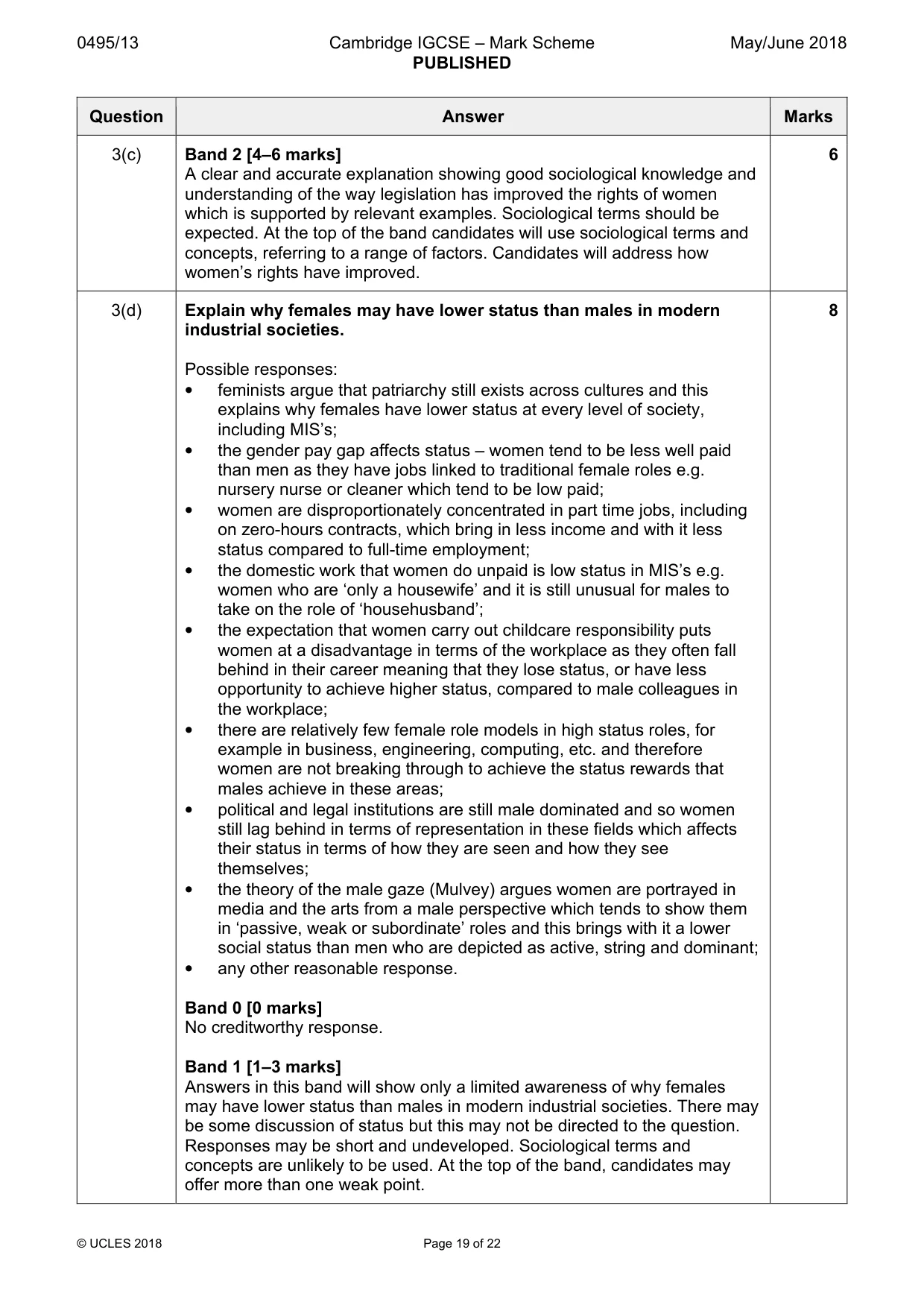
0495/13 Cambridge IGCSE – Mark Scheme PUBLISHED May/June 2018 © UCLES 2018 Page 19 of 22 Question Answer Marks 3(c) Band 2 [4–6 marks] A clear and accurate explanation showing good sociological knowledge and understanding of the way legislation has improved the rights of women which is supported by relevant examples. Sociological terms should be expected. At the top of the band candidates will use sociological terms and concepts, referring to a range of factors. Candidates will address how women’s rights have improved. 6 3(d) Explain why females may have lower status than males in modern industrial societies. Possible responses: • feminists argue that patriarchy still exists across cultures and this explains why females have lower status at every level of society, including MIS’s; • the gender pay gap affects status – women tend to be less well paid than men as they have jobs linked to traditional female roles e.g. nursery nurse or cleaner which tend to be low paid; • women are disproportionately concentrated in part time jobs, including on zero-hours contracts, which bring in less income and with it less status compared to full-time employment; • the domestic work that women do unpaid is low status in MIS’s e.g. women who are ‘only a housewife’ and it is still unusual for males to take on the role of ‘househusband’; • the expectation that women carry out childcare responsibility puts women at a disadvantage in terms of the workplace as they often fall behind in their career meaning that they lose status, or have less opportunity to achieve higher status, compared to male colleagues in the workplace; • there are relatively few female role models in high status roles, for example in business, engineering, computing, etc. and therefore women are not breaking through to achieve the status rewards that males achieve in these areas; • political and legal institutions are still male dominated and so women still lag behind in terms of representation in these fields which affects their status in terms of how they are seen and how they see themselves; • the theory of the male gaze (Mulvey) argues women are portrayed in media and the arts from a male perspective which tends to show them in ‘passive, weak or subordinate’ roles and this brings with it a lower social status than men who are depicted as active, string and dominant; • any other reasonable response. Band 0 [0 marks] No creditworthy response. Band 1 [1–3 marks] Answers in this band will show only a limited awareness of why females may have lower status than males in modern industrial societies. There may be some discussion of status but this may not be directed to the question. Responses may be short and undeveloped. Sociological terms and concepts are unlikely to be used. At the top of the band, candidates may offer more than one weak point. 8
Mark scheme, page 20
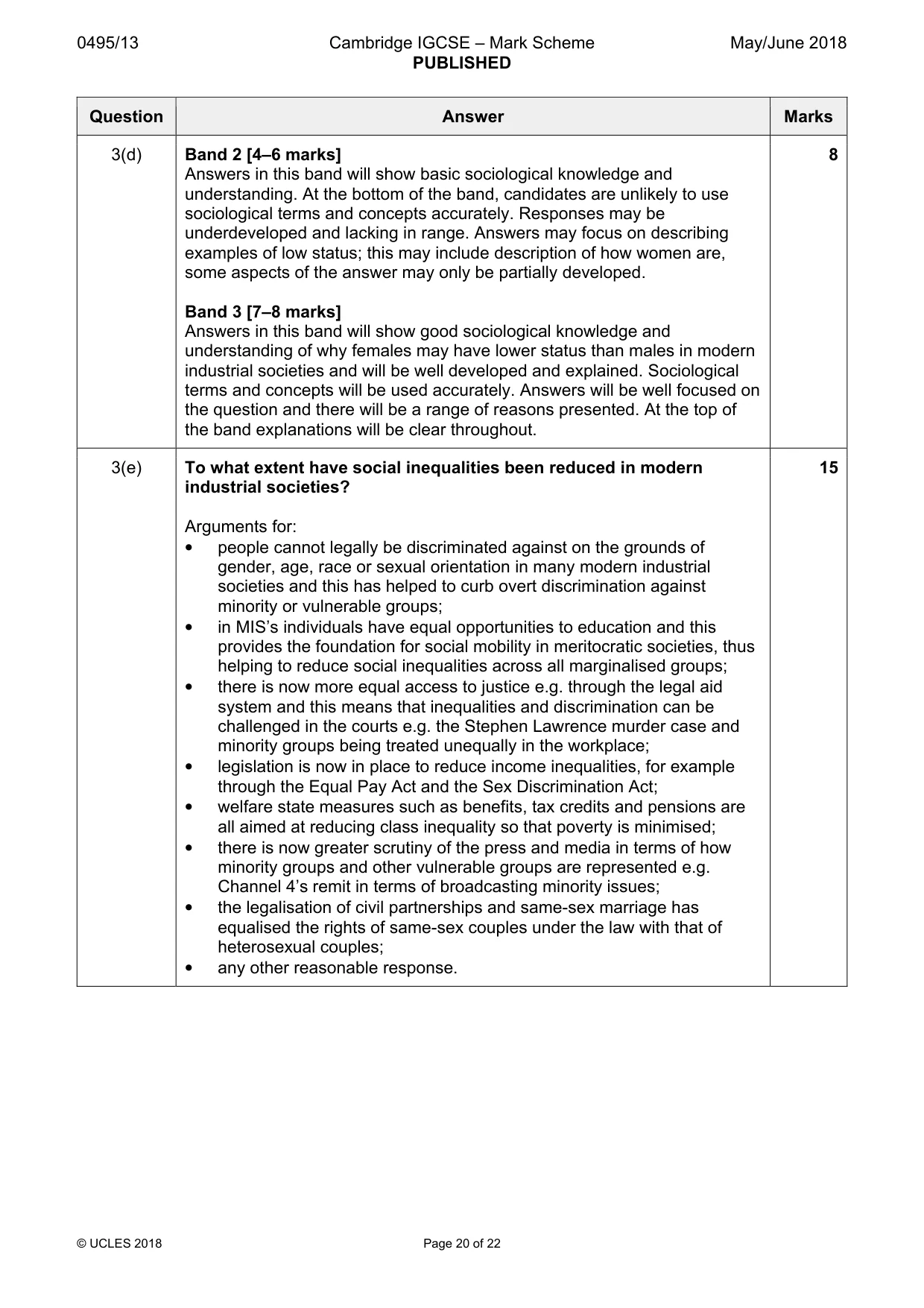
0495/13 Cambridge IGCSE – Mark Scheme PUBLISHED May/June 2018 © UCLES 2018 Page 20 of 22 Question Answer Marks 3(d) Band 2 [4–6 marks] Answers in this band will show basic sociological knowledge and understanding. At the bottom of the band, candidates are unlikely to use sociological terms and concepts accurately. Responses may be underdeveloped and lacking in range. Answers may focus on describing examples of low status; this may include description of how women are, some aspects of the answer may only be partially developed. Band 3 [7–8 marks] Answers in this band will show good sociological knowledge and understanding of why females may have lower status than males in modern industrial societies and will be well developed and explained. Sociological terms and concepts will be used accurately. Answers will be well focused on the question and there will be a range of reasons presented. At the top of the band explanations will be clear throughout. 8 3(e) To what extent have social inequalities been reduced in modern industrial societies? Arguments for: • people cannot legally be discriminated against on the grounds of gender, age, race or sexual orientation in many modern industrial societies and this has helped to curb overt discrimination against minority or vulnerable groups; • in MIS’s individuals have equal opportunities to education and this provides the foundation for social mobility in meritocratic societies, thus helping to reduce social inequalities across all marginalised groups; • there is now more equal access to justice e.g. through the legal aid system and this means that inequalities and discrimination can be challenged in the courts e.g. the Stephen Lawrence murder case and minority groups being treated unequally in the workplace; • legislation is now in place to reduce income inequalities, for example through the Equal Pay Act and the Sex Discrimination Act; • welfare state measures such as benefits, tax credits and pensions are all aimed at reducing class inequality so that poverty is minimised; • there is now greater scrutiny of the press and media in terms of how minority groups and other vulnerable groups are represented e.g. Channel 4’s remit in terms of broadcasting minority issues; • the legalisation of civil partnerships and same-sex marriage has equalised the rights of same-sex couples under the law with that of heterosexual couples; • any other reasonable response. 15
Mark scheme, page 21
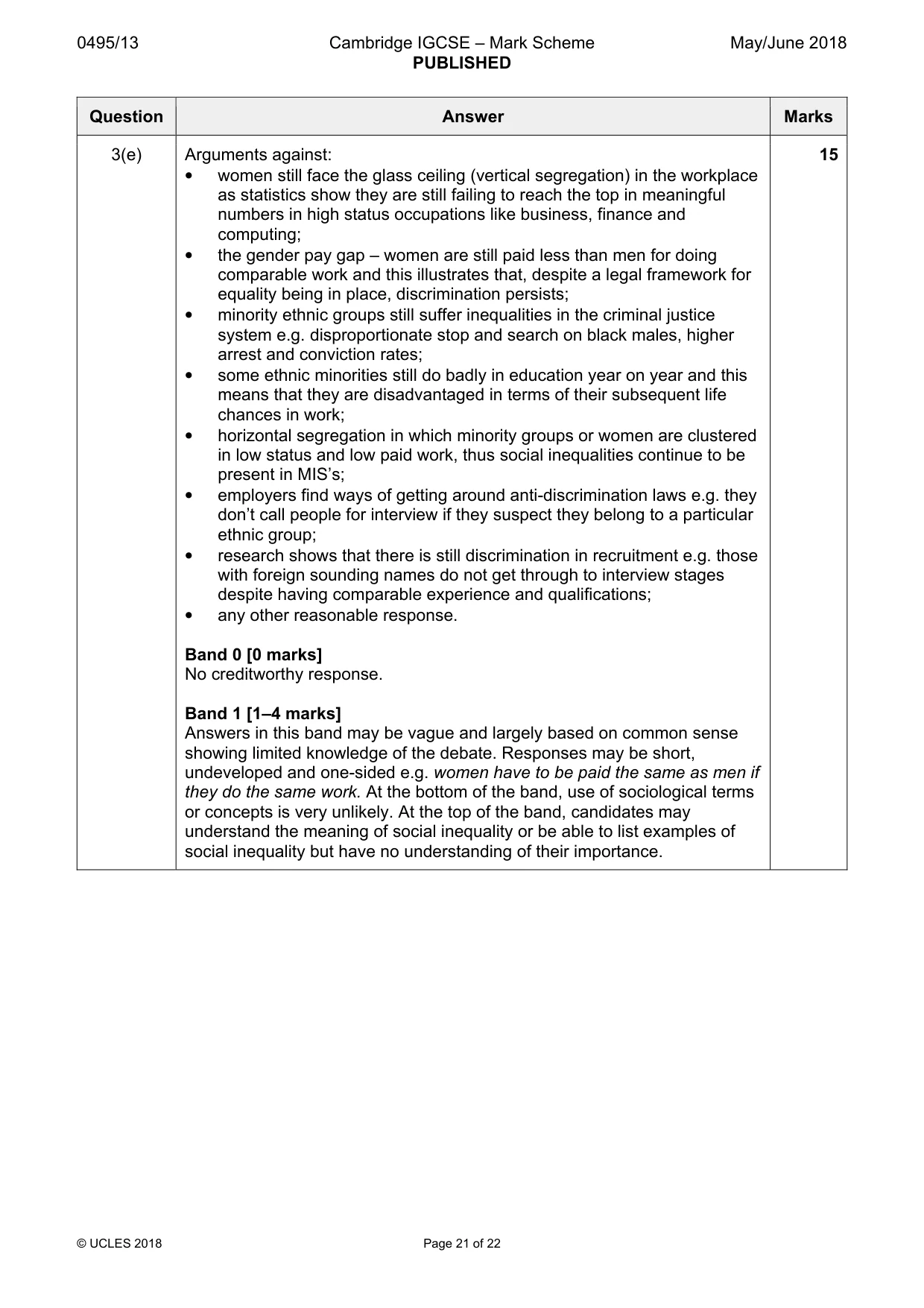
0495/13 Cambridge IGCSE – Mark Scheme PUBLISHED May/June 2018 © UCLES 2018 Page 21 of 22 Question Answer Marks 3(e) Arguments against: • women still face the glass ceiling (vertical segregation) in the workplace as statistics show they are still failing to reach the top in meaningful numbers in high status occupations like business, finance and computing; • the gender pay gap – women are still paid less than men for doing comparable work and this illustrates that, despite a legal framework for equality being in place, discrimination persists; • minority ethnic groups still suffer inequalities in the criminal justice system e.g. disproportionate stop and search on black males, higher arrest and conviction rates; • some ethnic minorities still do badly in education year on year and this means that they are disadvantaged in terms of their subsequent life chances in work; • horizontal segregation in which minority groups or women are clustered in low status and low paid work, thus social inequalities continue to be present in MIS’s; • employers find ways of getting around anti-discrimination laws e.g. they don’t call people for interview if they suspect they belong to a particular ethnic group; • research shows that there is still discrimination in recruitment e.g. those with foreign sounding names do not get through to interview stages despite having comparable experience and qualifications; • any other reasonable response. Band 0 [0 marks] No creditworthy response. Band 1 [1–4 marks] Answers in this band may be vague and largely based on common sense showing limited knowledge of the debate. Responses may be short, undeveloped and one-sided e.g. women have to be paid the same as men if they do the same work. At the bottom of the band, use of sociological terms or concepts is very unlikely. At the top of the band, candidates may understand the meaning of social inequality or be able to list examples of social inequality but have no understanding of their importance. 15
Mark scheme, page 22
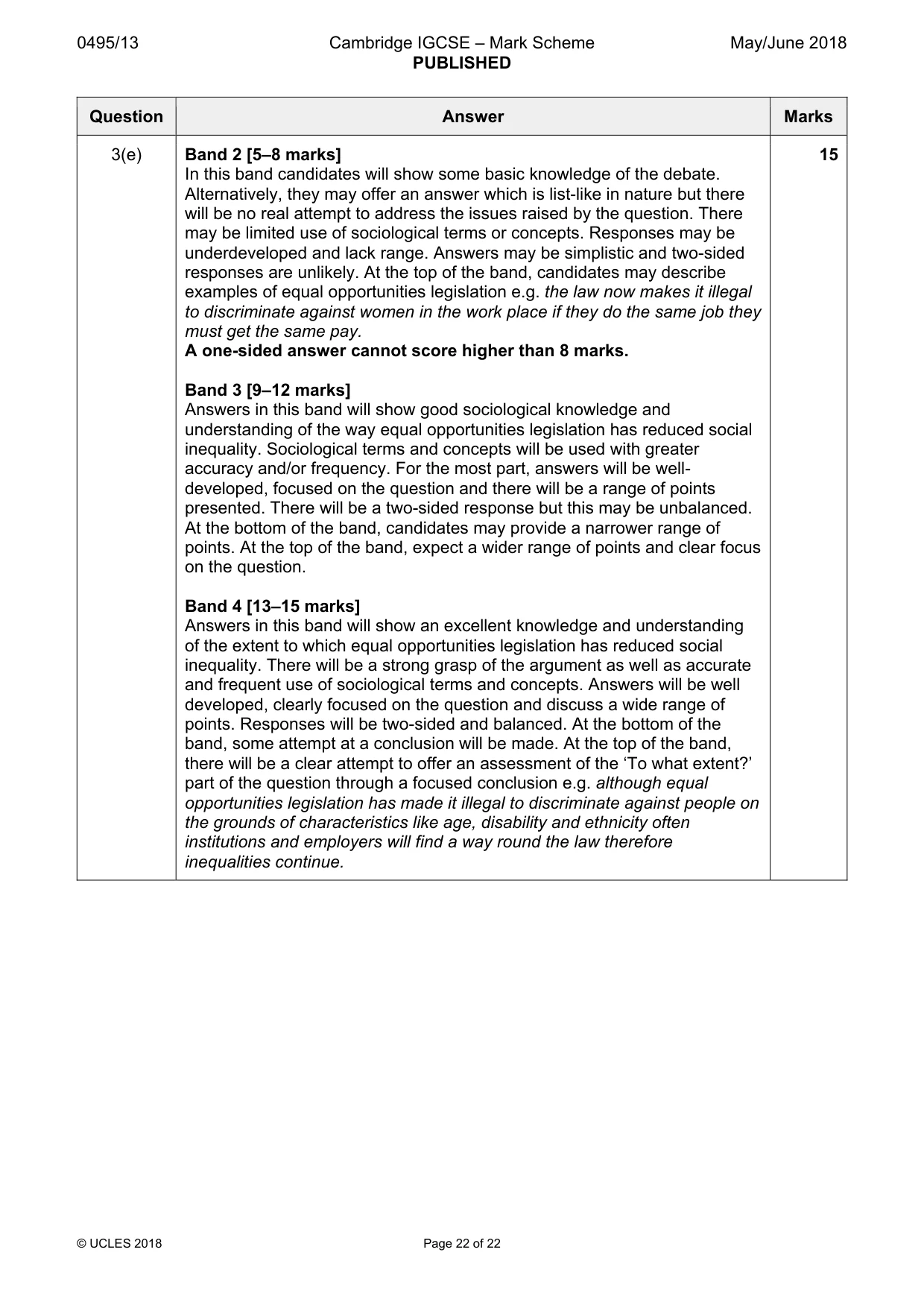
0495/13 Cambridge IGCSE – Mark Scheme PUBLISHED May/June 2018 © UCLES 2018 Page 22 of 22 Question Answer Marks 3(e) Band 2 [5–8 marks] In this band candidates will show some basic knowledge of the debate. Alternatively, they may offer an answer which is list-like in nature but there will be no real attempt to address the issues raised by the question. There may be limited use of sociological terms or concepts. Responses may be underdeveloped and lack range. Answers may be simplistic and two-sided responses are unlikely. At the top of the band, candidates may describe examples of equal opportunities legislation e.g. the law now makes it illegal to discriminate against women in the work place if they do the same job they must get the same pay. A one-sided answer cannot score higher than 8 marks. Band 3 [9–12 marks] Answers in this band will show good sociological knowledge and understanding of the way equal opportunities legislation has reduced social inequality. Sociological terms and concepts will be used with greater accuracy and/or frequency. For the most part, answers will be well- developed, focused on the question and there will be a range of points presented. There will be a two-sided response but this may be unbalanced. At the bottom of the band, candidates may provide a narrower range of points. At the top of the band, expect a wider range of points and clear focus on the question. Band 4 [13–15 marks] Answers in this band will show an excellent knowledge and understanding of the extent to which equal opportunities legislation has reduced social inequality. There will be a strong grasp of the argument as well as accurate and frequent use of sociological terms and concepts. Answers will be well developed, clearly focused on the question and discuss a wide range of points. Responses will be two-sided and balanced. At the bottom of the band, some attempt at a conclusion will be made. At the top of the band, there will be a clear attempt to offer an assessment of the ‘To what extent?’ part of the question through a focused conclusion e.g. although equal opportunities legislation has made it illegal to discriminate against people on the grounds of characteristics like age, disability and ethnicity often institutions and employers will find a way round the law therefore inequalities continue. 15
What you needed in this session
Cambridge’s own grade thresholds for 2018 May/June, Paper 1 · Variant 3. A higher threshold means an easier paper — the bar moves with how the cohort did.