Cambridge IGCSE Sociology 0495 — 2018 May/June Paper 1 · Variant 2
0495/12/M/J/18 · 80 marks · ≈90 min
The question paper and its mark scheme, free to read here and free to download. This is Cambridge’s own paper, exactly as it was sat.
Question paper4 pages

Mark scheme21 pages
Answers below. Sit the paper first if you are practising.


Paper as text
Question paper, page 1
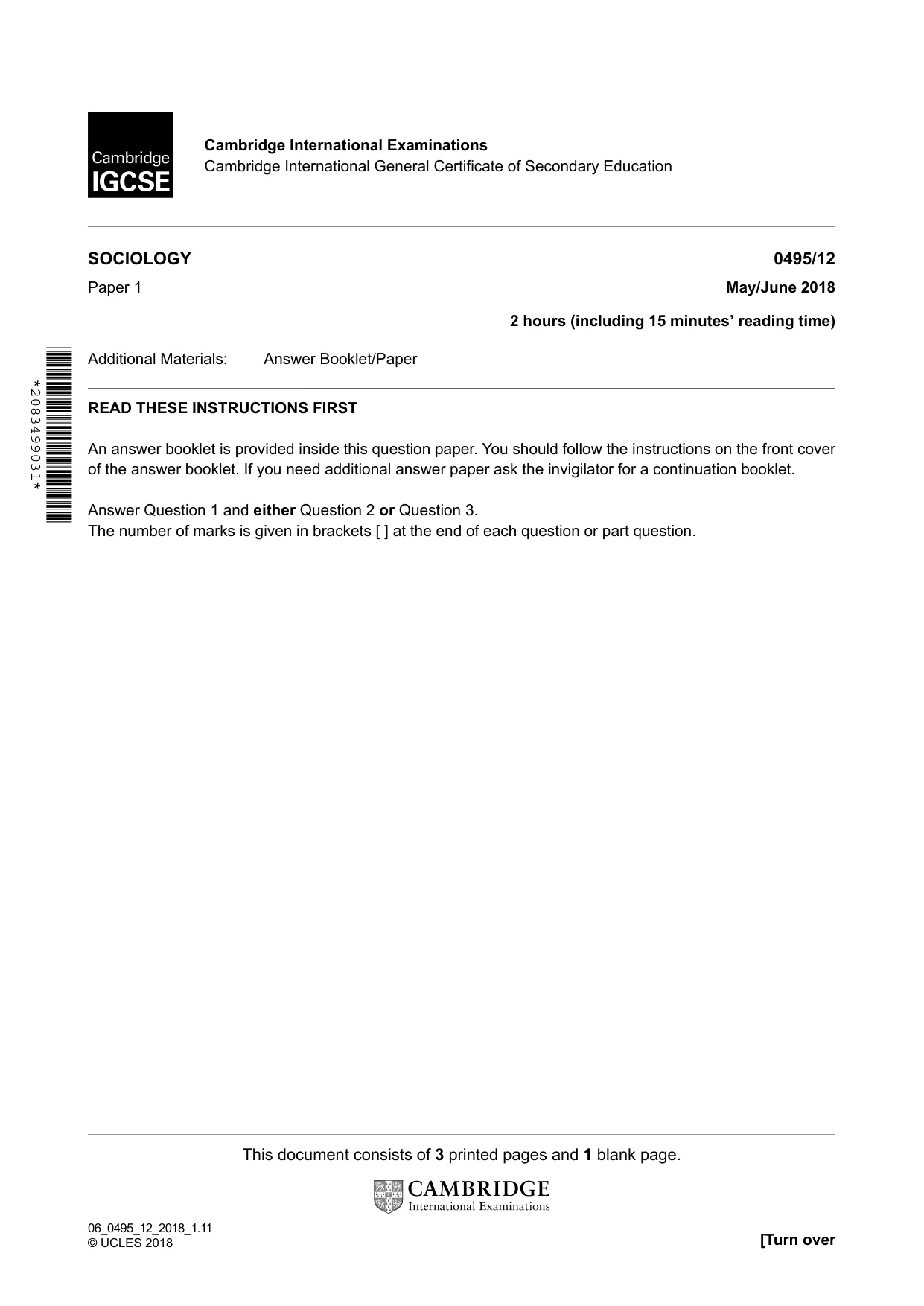
Cambridge International Examinations Cambridge International General Certificate of Secondary Education 0495/12 May/June 2018 SOCIOLOGY Paper 1 2 hours (including 15 minutes’ reading time) Additional Materials: Answer Booklet/Paper READ THESE INSTRUCTIONS FIRST An answer booklet is provided inside this question paper. You should follow the instructions on the front cover of the answer booklet. If you need additional answer paper ask the invigilator for a continuation booklet. Answer Question 1 and either Question 2 or Question 3. The number of marks is given in brackets [ ] at the end of each question or part question. This document consists of 3 printed pages and 1 blank page. [Turn over 06_0495_12_2018_1.11 © UCLES 2018 *2083499031*
Question paper, page 2
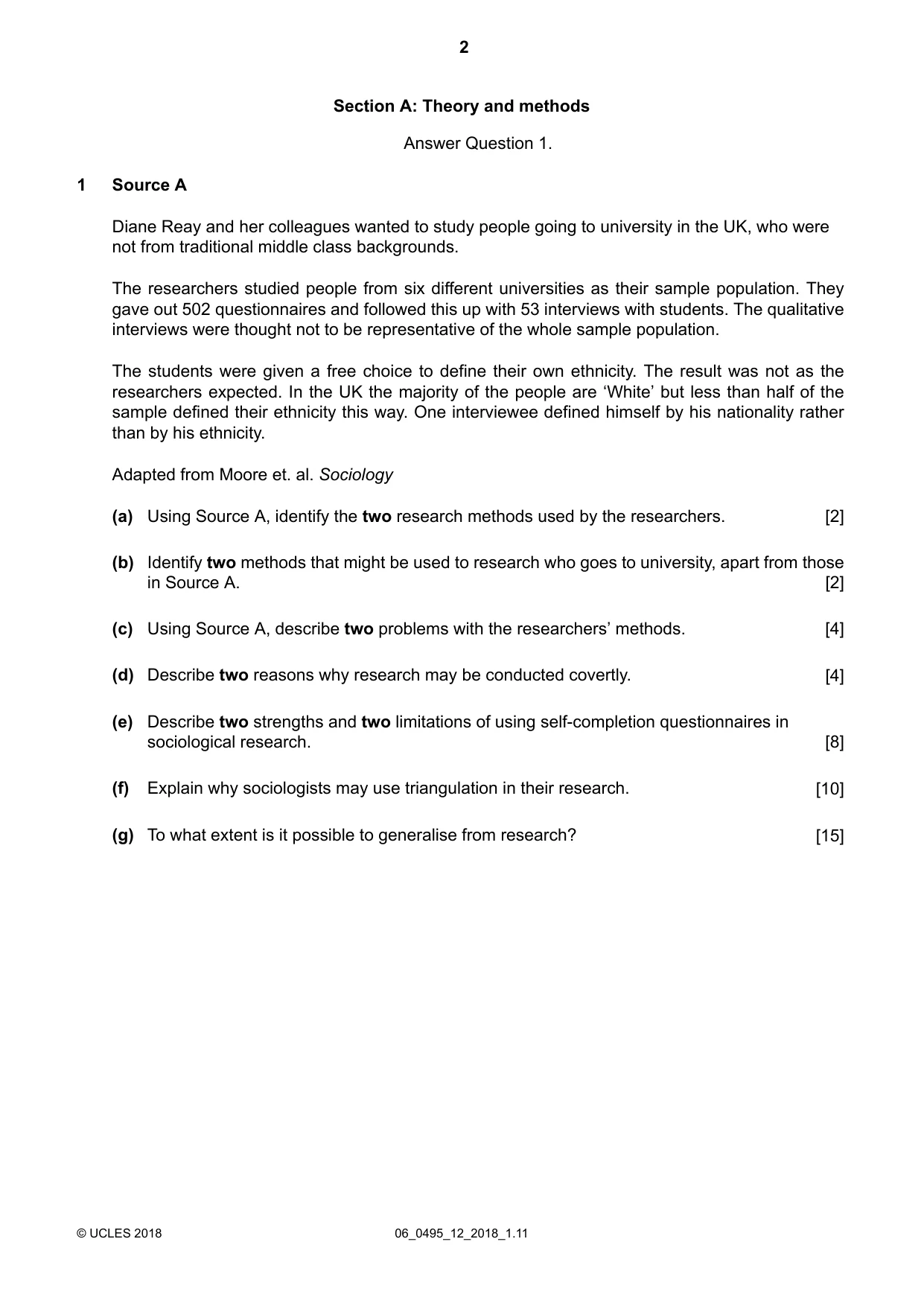
Section A: Theory and methods Answer Question 1. Source A 1 Diane Reay and her colleagues wanted to study people going to university in the UK, who were not from traditional middle class backgrounds. The researchers studied people from six different universities as their sample population. They gave out 502 questionnaires and followed this up with 53 interviews with students. The qualitative interviews were thought not to be representative of the whole sample population. The students were given a free choice to define their own ethnicity. The result was not as the researchers expected. In the UK the majority of the people are ‘White’ but less than half of the sample defined their ethnicity this way. One interviewee defined himself by his nationality rather than by his ethnicity. Adapted from Moore et. al. Sociology Using Source A, identify the two research methods used by the researchers. [2] (a) Identify two methods that might be used to research who goes to university, apart from those in Source A. [2] (b) Using Source A, describe two problems with the researchers’ methods. [4] (c) Describe two reasons why research may be conducted covertly. [4] (d) Describe two strengths and two limitations of using self-completion questionnaires in sociological research. [8] (e) Explain why sociologists may use triangulation in their research. [10] (f) To what extent is it possible to generalise from research? [15] (g) 06_0495_12_2018_1.11 © UCLES 2018 2
Question paper, page 3
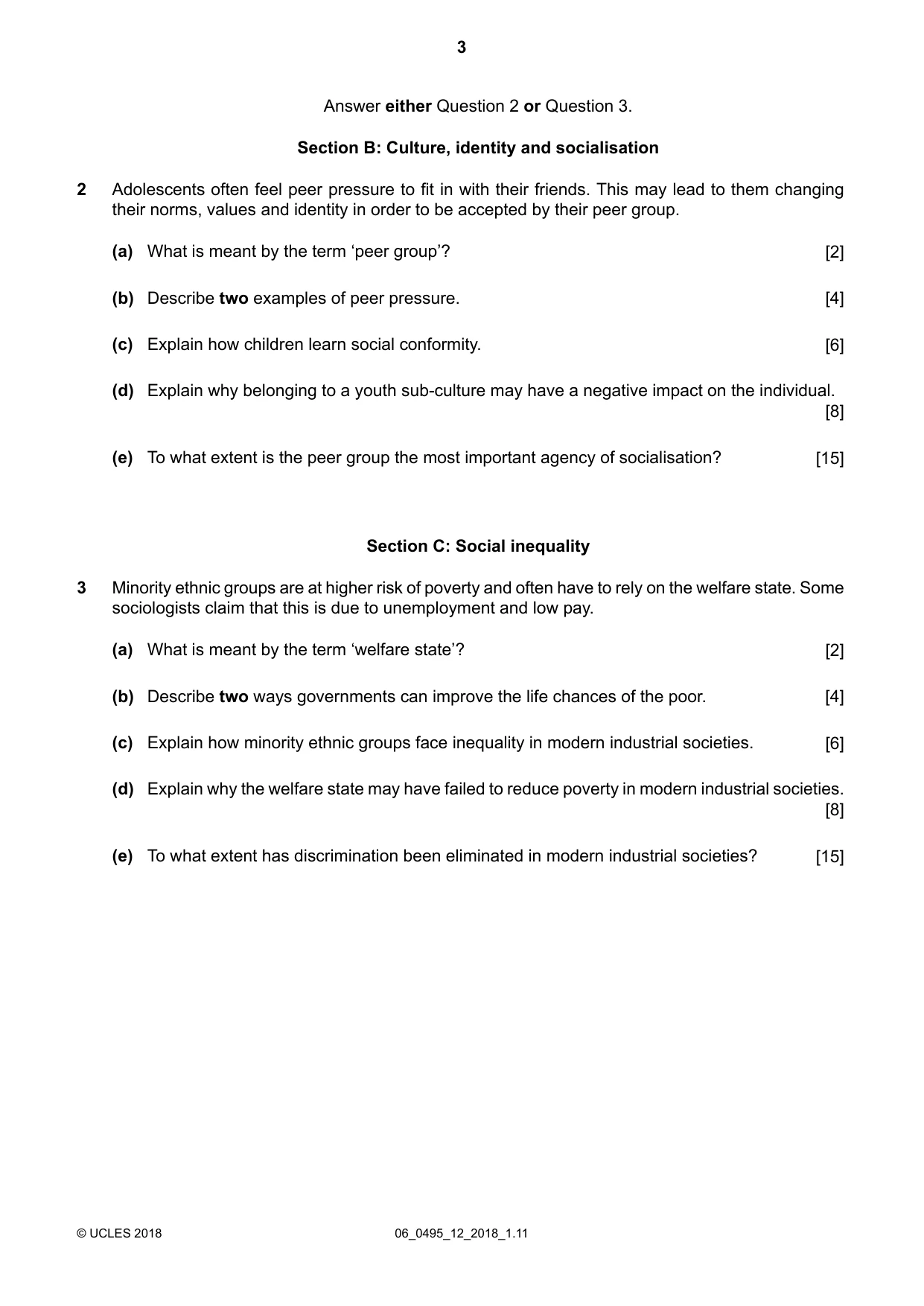
Answer either Question 2 or Question 3. Section B: Culture, identity and socialisation Adolescents often feel peer pressure to fit in with their friends. This may lead to them changing their norms, values and identity in order to be accepted by their peer group. 2 What is meant by the term ‘peer group’? [2] (a) Describe two examples of peer pressure. [4] (b) Explain how children learn social conformity. [6] (c) Explain why belonging to a youth sub-culture may have a negative impact on the individual. [8] (d) To what extent is the peer group the most important agency of socialisation? [15] (e) Section C: Social inequality Minority ethnic groups are at higher risk of poverty and often have to rely on the welfare state. Some sociologists claim that this is due to unemployment and low pay. 3 What is meant by the term ‘welfare state’? [2] (a) Describe two ways governments can improve the life chances of the poor. [4] (b) Explain how minority ethnic groups face inequality in modern industrial societies. [6] (c) Explain why the welfare state may have failed to reduce poverty in modern industrial societies. [8] (d) To what extent has discrimination been eliminated in modern industrial societies? [15] (e) 06_0495_12_2018_1.11 © UCLES 2018 3
Question paper, page 4
BLANK PAGE Permission to reproduce items where third-party owned material protected by copyright is included has been sought and cleared where possible. Every reasonable effort has been made by the publisher (UCLES) to trace copyright holders, but if any items requiring clearance have unwittingly been included, the publisher will be pleased to make amends at the earliest possible opportunity. To avoid the issue of disclosure of answer-related information to candidates, all copyright acknowledgements are reproduced online in the Cambridge International Examinations Copyright Acknowledgements Booklet. This is produced for each series of examinations and is freely available to download at www.cie.org.uk after the live examination series. Cambridge International Examinations is part of the Cambridge Assessment Group. Cambridge Assessment is the brand name of University of Cambridge Local Examinations Syndicate (UCLES), which is itself a department of the University of Cambridge. 06_0495_12_2018_1.11 © UCLES 2018 4
Mark scheme, page 1
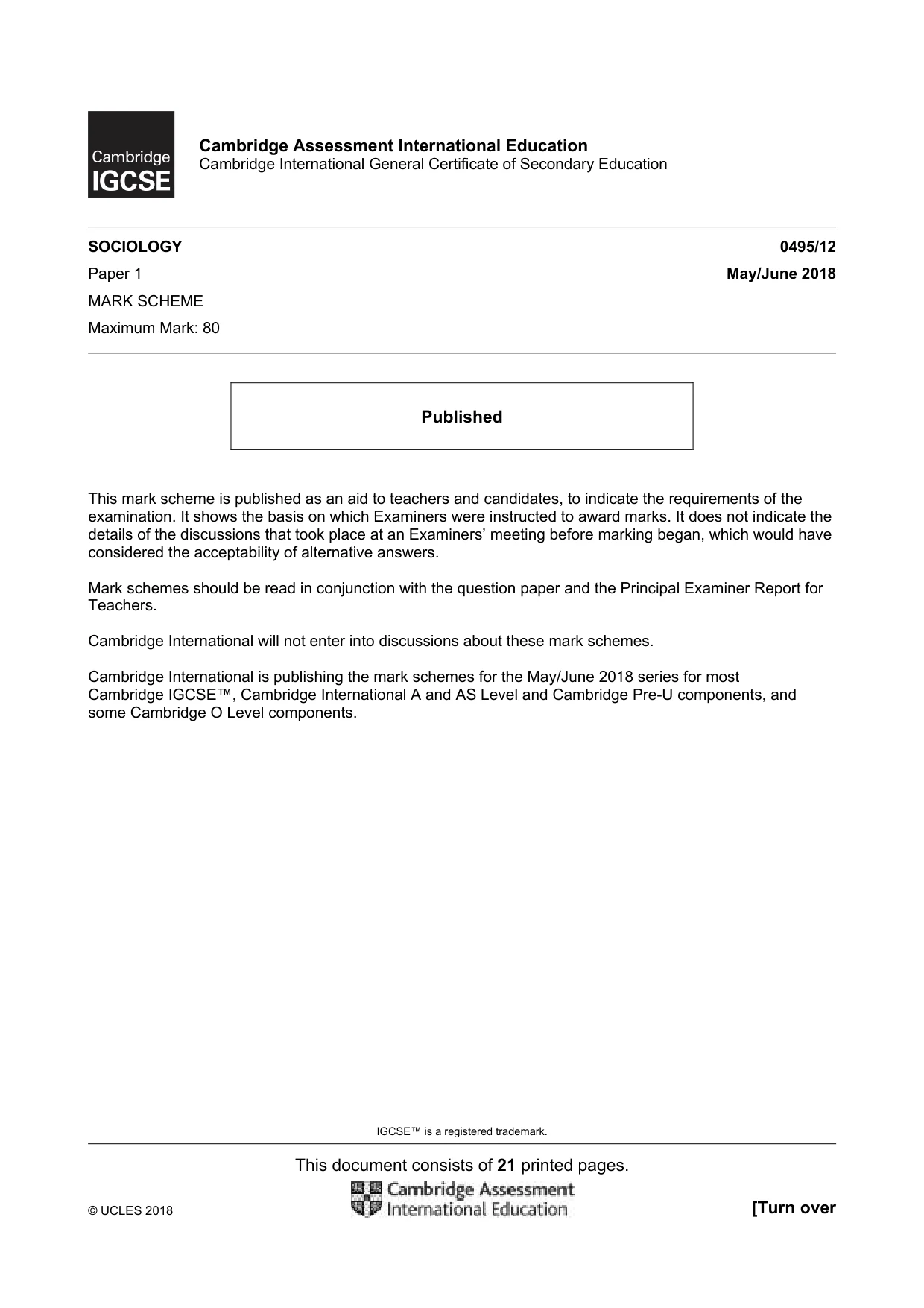
IGCSE™ is a registered trademark. This document consists of 21 printed pages. © UCLES 2018 [Turn over Cambridge Assessment International Education Cambridge International General Certificate of Secondary Education SOCIOLOGY 0495/12 Paper 1 May/June 2018 MARK SCHEME Maximum Mark: 80 Published This mark scheme is published as an aid to teachers and candidates, to indicate the requirements of the examination. It shows the basis on which Examiners were instructed to award marks. It does not indicate the details of the discussions that took place at an Examiners’ meeting before marking began, which would have considered the acceptability of alternative answers. Mark schemes should be read in conjunction with the question paper and the Principal Examiner Report for Teachers. Cambridge International will not enter into discussions about these mark schemes. Cambridge International is publishing the mark schemes for the May/June 2018 series for most Cambridge IGCSE™, Cambridge International A and AS Level and Cambridge Pre-U components, and some Cambridge O Level components.
Mark scheme, page 2
0495/12 Cambridge IGCSE – Mark Scheme PUBLISHED May/June 2018 © UCLES 2018 Page 2 of 21 Generic Marking Principles These general marking principles must be applied by all examiners when marking candidate answers. They should be applied alongside the specific content of the mark scheme or generic level descriptors for a question. Each question paper and mark scheme will also comply with these marking principles. GENERIC MARKING PRINCIPLE 1: Marks must be awarded in line with: • the specific content of the mark scheme or the generic level descriptors for the question • the specific skills defined in the mark scheme or in the generic level descriptors for the question • the standard of response required by a candidate as exemplified by the standardisation scripts. GENERIC MARKING PRINCIPLE 2: Marks awarded are always whole marks (not half marks, or other fractions). GENERIC MARKING PRINCIPLE 3: Marks must be awarded positively: • marks are awarded for correct/valid answers, as defined in the mark scheme. However, credit is given for valid answers which go beyond the scope of the syllabus and mark scheme, referring to your Team Leader as appropriate • marks are awarded when candidates clearly demonstrate what they know and can do • marks are not deducted for errors • marks are not deducted for omissions • answers should only be judged on the quality of spelling, punctuation and grammar when these features are specifically assessed by the question as indicated by the mark scheme. The meaning, however, should be unambiguous. GENERIC MARKING PRINCIPLE 4: Rules must be applied consistently e.g. in situations where candidates have not followed instructions or in the application of generic level descriptors. GENERIC MARKING PRINCIPLE 5: Marks should be awarded using the full range of marks defined in the mark scheme for the question (however; the use of the full mark range may be limited according to the quality of the candidate responses seen). GENERIC MARKING PRINCIPLE 6: Marks awarded are based solely on the requirements as defined in the mark scheme. Marks should not be awarded with grade thresholds or grade descriptors in mind.
Mark scheme, page 3
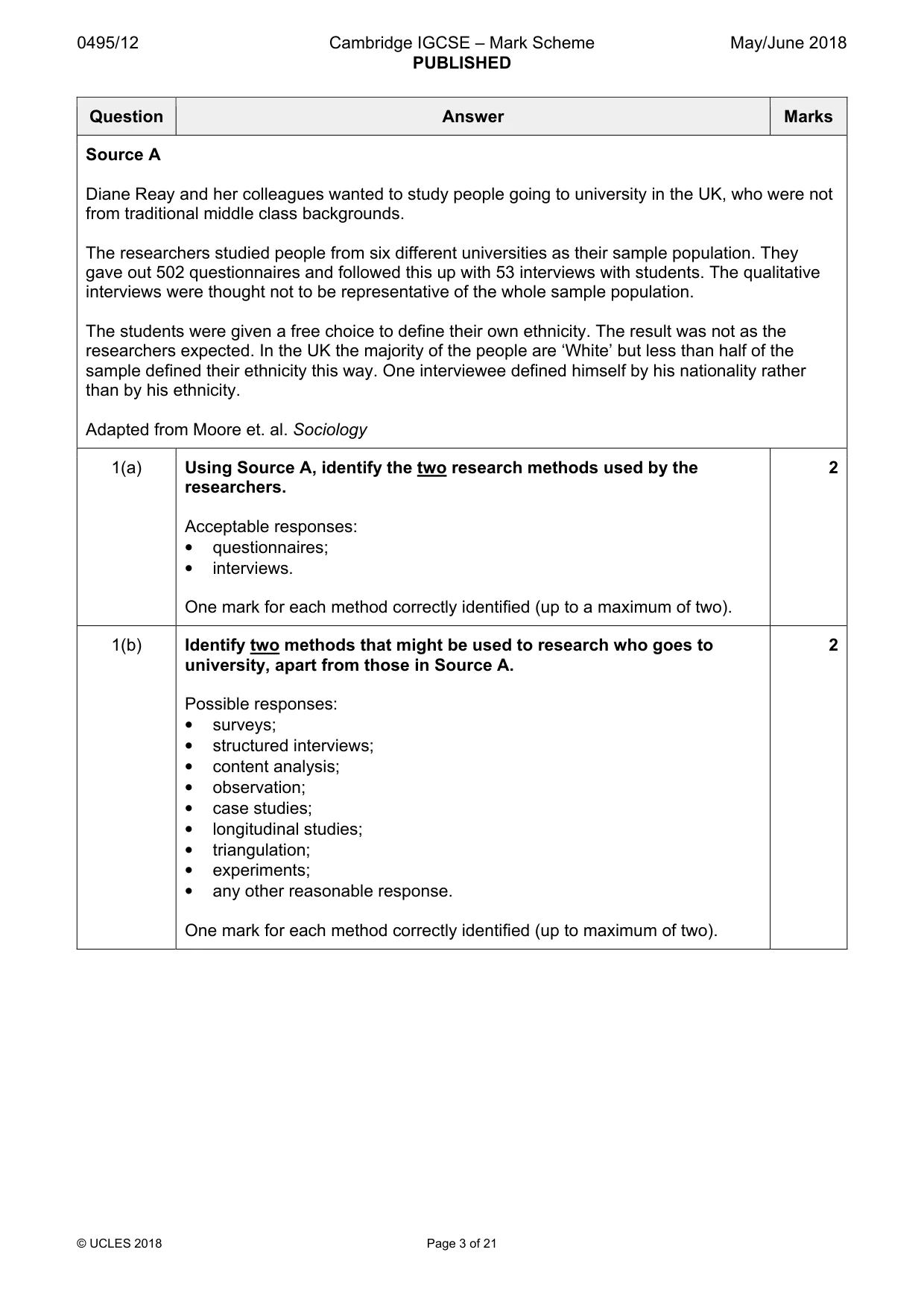
0495/12 Cambridge IGCSE – Mark Scheme PUBLISHED May/June 2018 © UCLES 2018 Page 3 of 21 Question Answer Marks Source A Diane Reay and her colleagues wanted to study people going to university in the UK, who were not from traditional middle class backgrounds. The researchers studied people from six different universities as their sample population. They gave out 502 questionnaires and followed this up with 53 interviews with students. The qualitative interviews were thought not to be representative of the whole sample population. The students were given a free choice to define their own ethnicity. The result was not as the researchers expected. In the UK the majority of the people are ‘White’ but less than half of the sample defined their ethnicity this way. One interviewee defined himself by his nationality rather than by his ethnicity. Adapted from Moore et. al. Sociology 1(a) Using Source A, identify the two research methods used by the researchers. Acceptable responses: • questionnaires; • interviews. One mark for each method correctly identified (up to a maximum of two). 2 1(b) Identify two methods that might be used to research who goes to university, apart from those in Source A. Possible responses: • surveys; • structured interviews; • content analysis; • observation; • case studies; • longitudinal studies; • triangulation; • experiments; • any other reasonable response. One mark for each method correctly identified (up to maximum of two). 2
Mark scheme, page 4
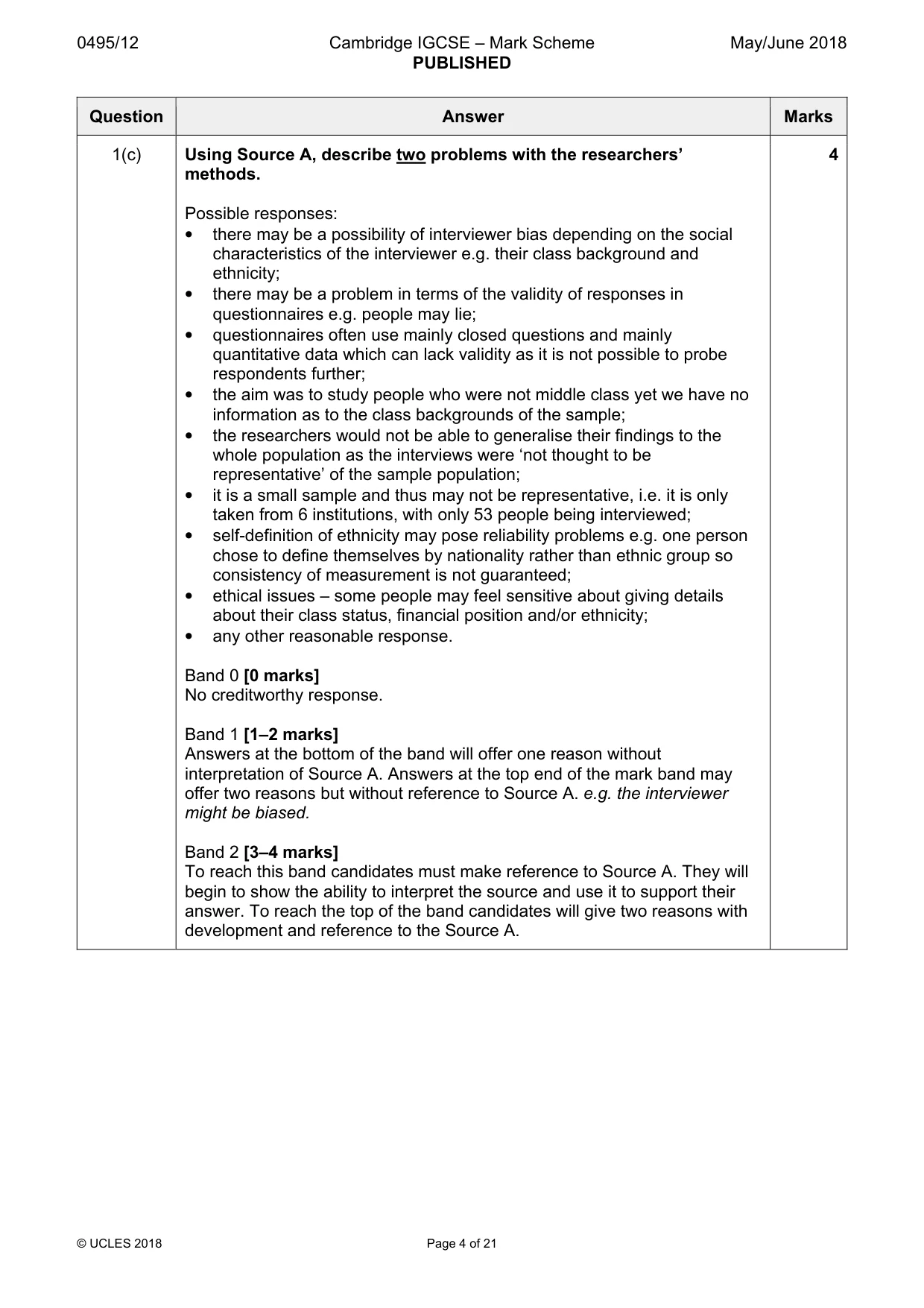
0495/12 Cambridge IGCSE – Mark Scheme PUBLISHED May/June 2018 © UCLES 2018 Page 4 of 21 Question Answer Marks 1(c) Using Source A, describe two problems with the researchers’ methods. Possible responses: • there may be a possibility of interviewer bias depending on the social characteristics of the interviewer e.g. their class background and ethnicity; • there may be a problem in terms of the validity of responses in questionnaires e.g. people may lie; • questionnaires often use mainly closed questions and mainly quantitative data which can lack validity as it is not possible to probe respondents further; • the aim was to study people who were not middle class yet we have no information as to the class backgrounds of the sample; • the researchers would not be able to generalise their findings to the whole population as the interviews were ‘not thought to be representative’ of the sample population; • it is a small sample and thus may not be representative, i.e. it is only taken from 6 institutions, with only 53 people being interviewed; • self-definition of ethnicity may pose reliability problems e.g. one person chose to define themselves by nationality rather than ethnic group so consistency of measurement is not guaranteed; • ethical issues – some people may feel sensitive about giving details about their class status, financial position and/or ethnicity; • any other reasonable response. Band 0 [0 marks] No creditworthy response. Band 1 [1–2 marks] Answers at the bottom of the band will offer one reason without interpretation of Source A. Answers at the top end of the mark band may offer two reasons but without reference to Source A. e.g. the interviewer might be biased. Band 2 [3–4 marks] To reach this band candidates must make reference to Source A. They will begin to show the ability to interpret the source and use it to support their answer. To reach the top of the band candidates will give two reasons with development and reference to the Source A. 4
Mark scheme, page 5
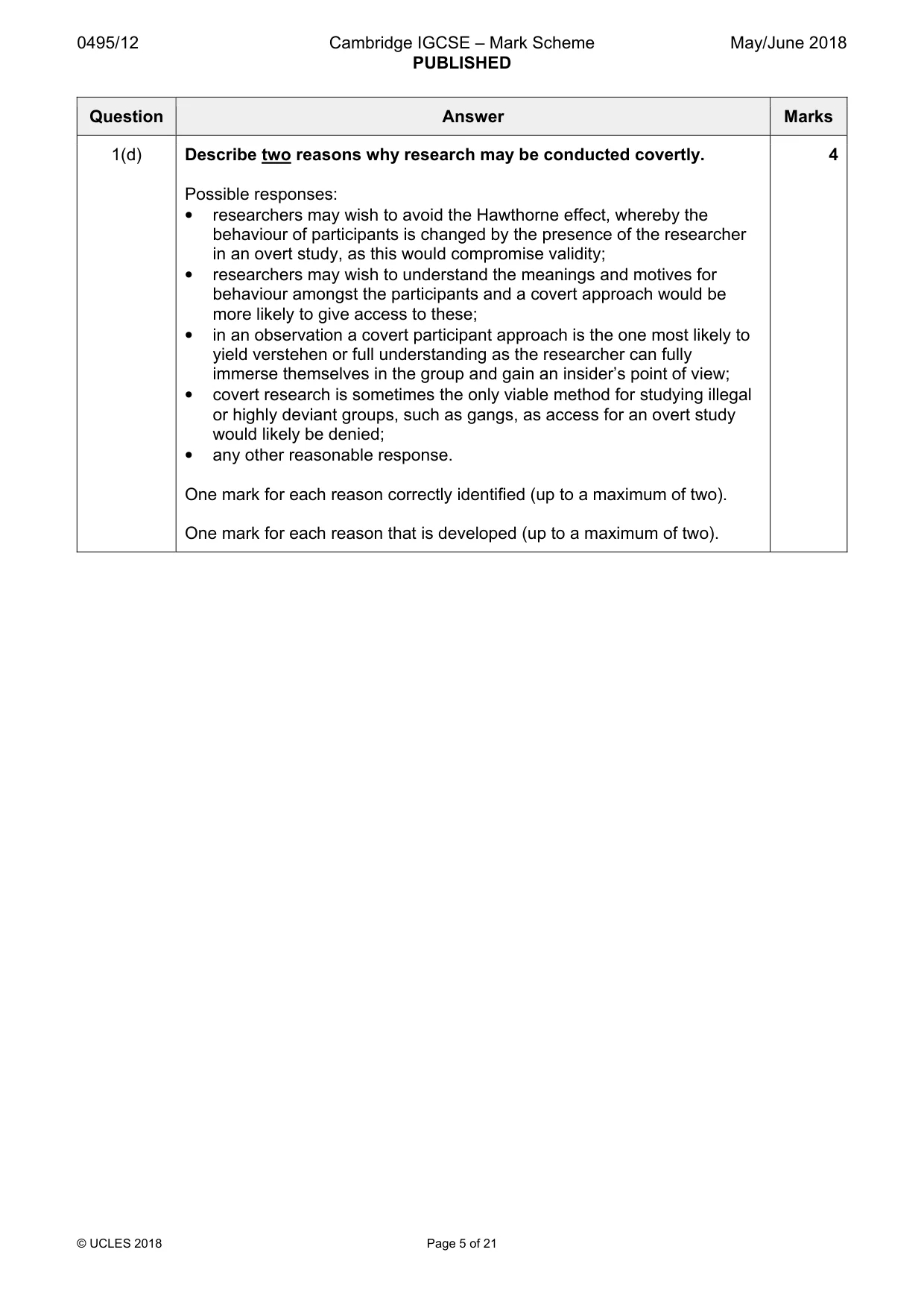
0495/12 Cambridge IGCSE – Mark Scheme PUBLISHED May/June 2018 © UCLES 2018 Page 5 of 21 Question Answer Marks 1(d) Describe two reasons why research may be conducted covertly. Possible responses: • researchers may wish to avoid the Hawthorne effect, whereby the behaviour of participants is changed by the presence of the researcher in an overt study, as this would compromise validity; • researchers may wish to understand the meanings and motives for behaviour amongst the participants and a covert approach would be more likely to give access to these; • in an observation a covert participant approach is the one most likely to yield verstehen or full understanding as the researcher can fully immerse themselves in the group and gain an insider’s point of view; • covert research is sometimes the only viable method for studying illegal or highly deviant groups, such as gangs, as access for an overt study would likely be denied; • any other reasonable response. One mark for each reason correctly identified (up to a maximum of two). One mark for each reason that is developed (up to a maximum of two). 4
Mark scheme, page 6
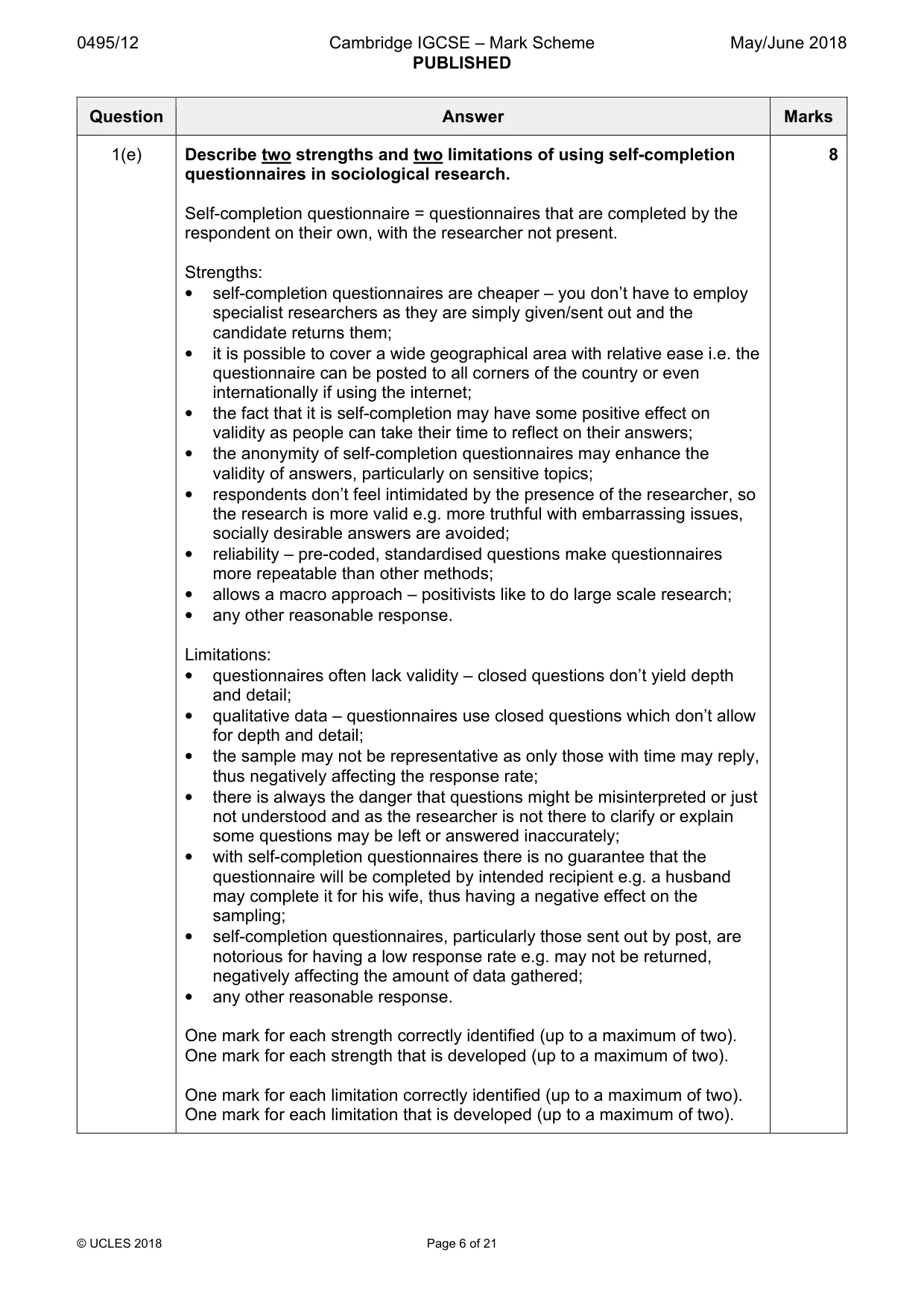
0495/12 Cambridge IGCSE – Mark Scheme PUBLISHED May/June 2018 © UCLES 2018 Page 6 of 21 Question Answer Marks 1(e) Describe two strengths and two limitations of using self-completion questionnaires in sociological research. Self-completion questionnaire = questionnaires that are completed by the respondent on their own, with the researcher not present. Strengths: • self-completion questionnaires are cheaper – you don’t have to employ specialist researchers as they are simply given/sent out and the candidate returns them; • it is possible to cover a wide geographical area with relative ease i.e. the questionnaire can be posted to all corners of the country or even internationally if using the internet; • the fact that it is self-completion may have some positive effect on validity as people can take their time to reflect on their answers; • the anonymity of self-completion questionnaires may enhance the validity of answers, particularly on sensitive topics; • respondents don’t feel intimidated by the presence of the researcher, so the research is more valid e.g. more truthful with embarrassing issues, socially desirable answers are avoided; • reliability – pre-coded, standardised questions make questionnaires more repeatable than other methods; • allows a macro approach – positivists like to do large scale research; • any other reasonable response. Limitations: • questionnaires often lack validity – closed questions don’t yield depth and detail; • qualitative data – questionnaires use closed questions which don’t allow for depth and detail; • the sample may not be representative as only those with time may reply, thus negatively affecting the response rate; • there is always the danger that questions might be misinterpreted or just not understood and as the researcher is not there to clarify or explain some questions may be left or answered inaccurately; • with self-completion questionnaires there is no guarantee that the questionnaire will be completed by intended recipient e.g. a husband may complete it for his wife, thus having a negative effect on the sampling; • self-completion questionnaires, particularly those sent out by post, are notorious for having a low response rate e.g. may not be returned, negatively affecting the amount of data gathered; • any other reasonable response. One mark for each strength correctly identified (up to a maximum of two). One mark for each strength that is developed (up to a maximum of two). One mark for each limitation correctly identified (up to a maximum of two). One mark for each limitation that is developed (up to a maximum of two). 8
Mark scheme, page 7
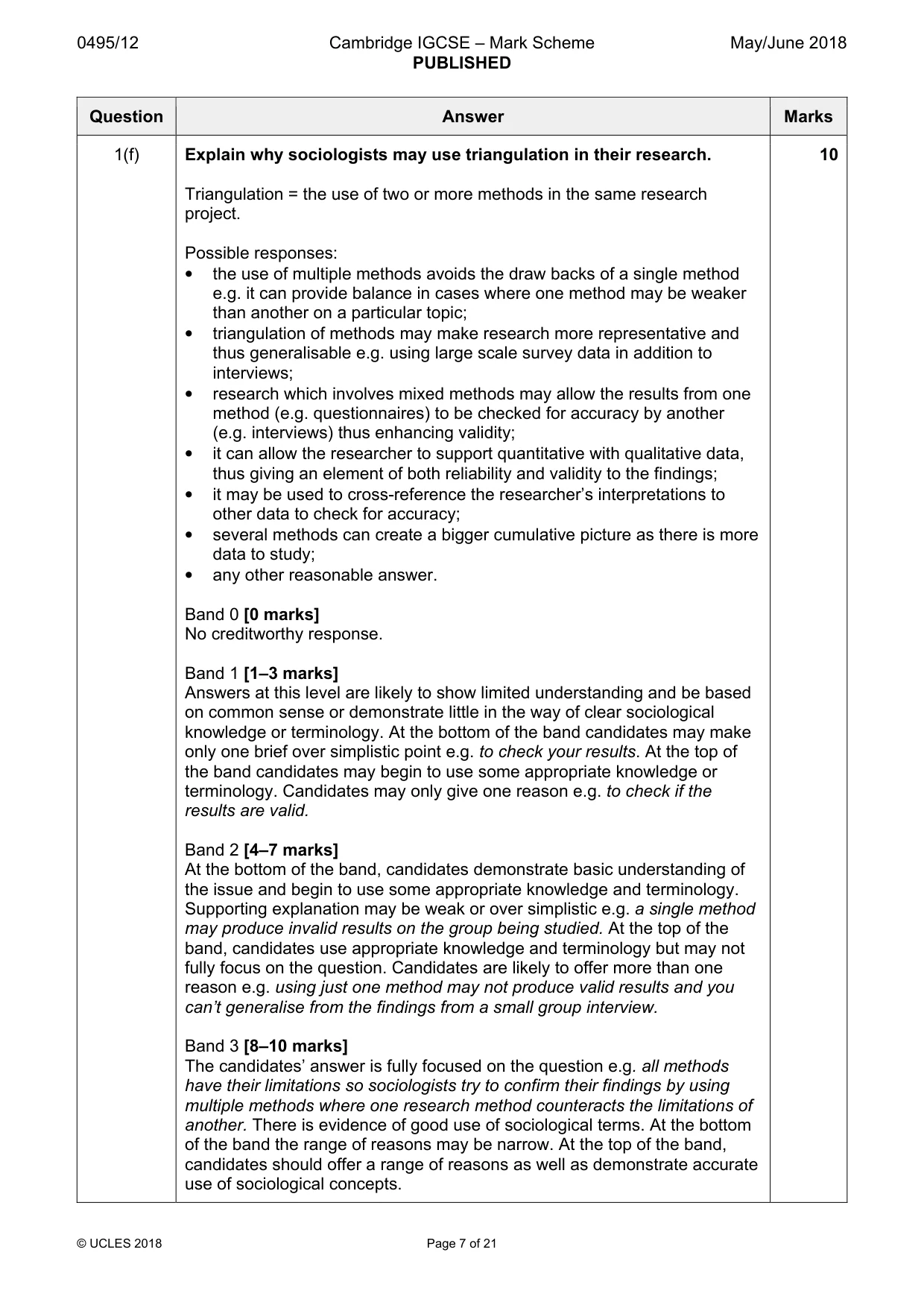
0495/12 Cambridge IGCSE – Mark Scheme PUBLISHED May/June 2018 © UCLES 2018 Page 7 of 21 Question Answer Marks 1(f) Explain why sociologists may use triangulation in their research. Triangulation = the use of two or more methods in the same research project. Possible responses: • the use of multiple methods avoids the draw backs of a single method e.g. it can provide balance in cases where one method may be weaker than another on a particular topic; • triangulation of methods may make research more representative and thus generalisable e.g. using large scale survey data in addition to interviews; • research which involves mixed methods may allow the results from one method (e.g. questionnaires) to be checked for accuracy by another (e.g. interviews) thus enhancing validity; • it can allow the researcher to support quantitative with qualitative data, thus giving an element of both reliability and validity to the findings; • it may be used to cross-reference the researcher’s interpretations to other data to check for accuracy; • several methods can create a bigger cumulative picture as there is more data to study; • any other reasonable answer. Band 0 [0 marks] No creditworthy response. Band 1 [1–3 marks] Answers at this level are likely to show limited understanding and be based on common sense or demonstrate little in the way of clear sociological knowledge or terminology. At the bottom of the band candidates may make only one brief over simplistic point e.g. to check your results. At the top of the band candidates may begin to use some appropriate knowledge or terminology. Candidates may only give one reason e.g. to check if the results are valid. Band 2 [4–7 marks] At the bottom of the band, candidates demonstrate basic understanding of the issue and begin to use some appropriate knowledge and terminology. Supporting explanation may be weak or over simplistic e.g. a single method may produce invalid results on the group being studied. At the top of the band, candidates use appropriate knowledge and terminology but may not fully focus on the question. Candidates are likely to offer more than one reason e.g. using just one method may not produce valid results and you can’t generalise from the findings from a small group interview. Band 3 [8–10 marks] The candidates’ answer is fully focused on the question e.g. all methods have their limitations so sociologists try to confirm their findings by using multiple methods where one research method counteracts the limitations of another. There is evidence of good use of sociological terms. At the bottom of the band the range of reasons may be narrow. At the top of the band, candidates should offer a range of reasons as well as demonstrate accurate use of sociological concepts. 10
Mark scheme, page 8
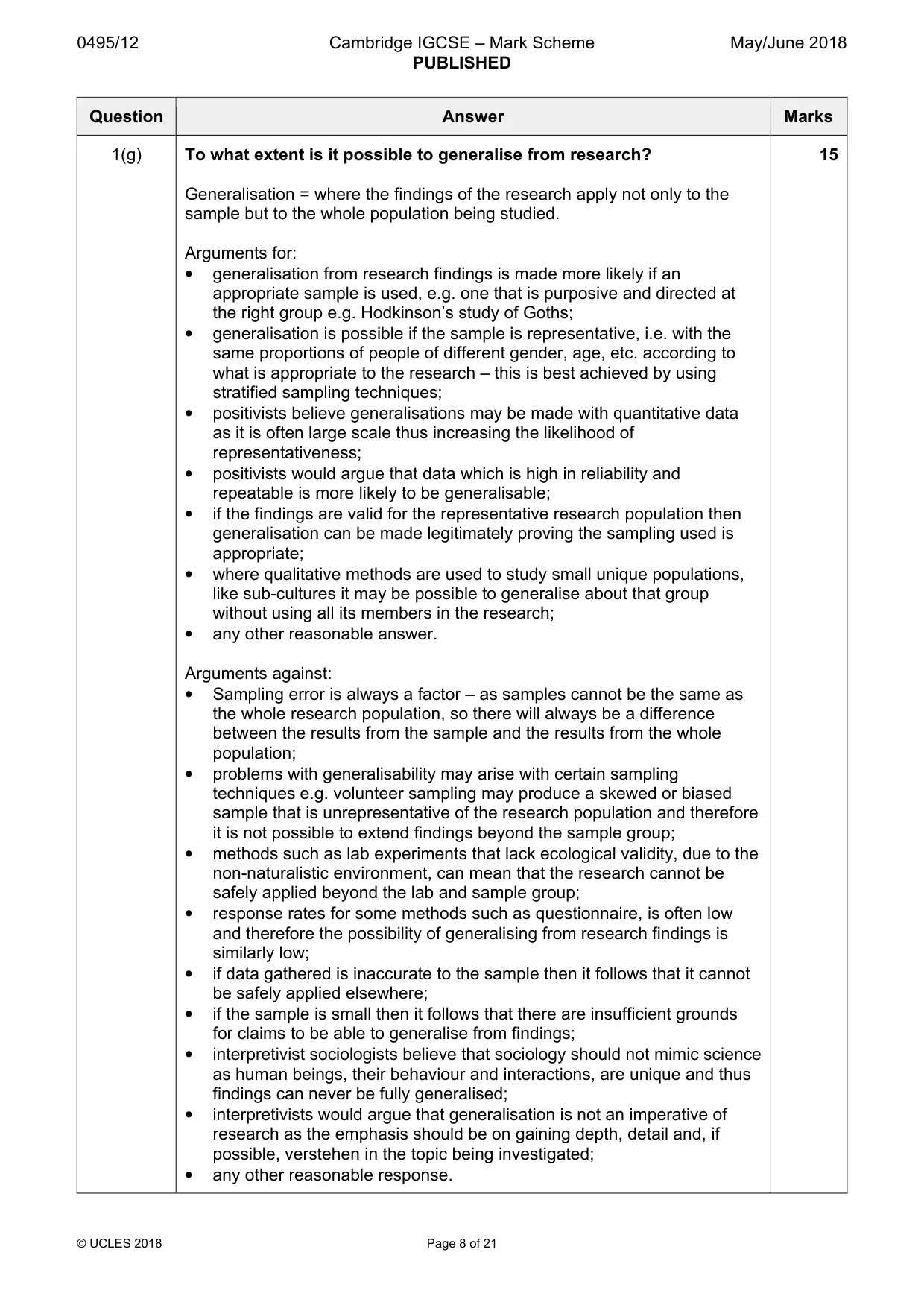
0495/12 Cambridge IGCSE – Mark Scheme PUBLISHED May/June 2018 © UCLES 2018 Page 8 of 21 Question Answer Marks 1(g) To what extent is it possible to generalise from research? Generalisation = where the findings of the research apply not only to the sample but to the whole population being studied. Arguments for: • generalisation from research findings is made more likely if an appropriate sample is used, e.g. one that is purposive and directed at the right group e.g. Hodkinson’s study of Goths; • generalisation is possible if the sample is representative, i.e. with the same proportions of people of different gender, age, etc. according to what is appropriate to the research – this is best achieved by using stratified sampling techniques; • positivists believe generalisations may be made with quantitative data as it is often large scale thus increasing the likelihood of representativeness; • positivists would argue that data which is high in reliability and repeatable is more likely to be generalisable; • if the findings are valid for the representative research population then generalisation can be made legitimately proving the sampling used is appropriate; • where qualitative methods are used to study small unique populations, like sub-cultures it may be possible to generalise about that group without using all its members in the research; • any other reasonable answer. Arguments against: • Sampling error is always a factor – as samples cannot be the same as the whole research population, so there will always be a difference between the results from the sample and the results from the whole population; • problems with generalisability may arise with certain sampling techniques e.g. volunteer sampling may produce a skewed or biased sample that is unrepresentative of the research population and therefore it is not possible to extend findings beyond the sample group; • methods such as lab experiments that lack ecological validity, due to the non-naturalistic environment, can mean that the research cannot be safely applied beyond the lab and sample group; • response rates for some methods such as questionnaire, is often low and therefore the possibility of generalising from research findings is similarly low; • if data gathered is inaccurate to the sample then it follows that it cannot be safely applied elsewhere; • if the sample is small then it follows that there are insufficient grounds for claims to be able to generalise from findings; • interpretivist sociologists believe that sociology should not mimic science as human beings, their behaviour and interactions, are unique and thus findings can never be fully generalised; • interpretivists would argue that generalisation is not an imperative of research as the emphasis should be on gaining depth, detail and, if possible, verstehen in the topic being investigated; • any other reasonable response. 15
Mark scheme, page 9
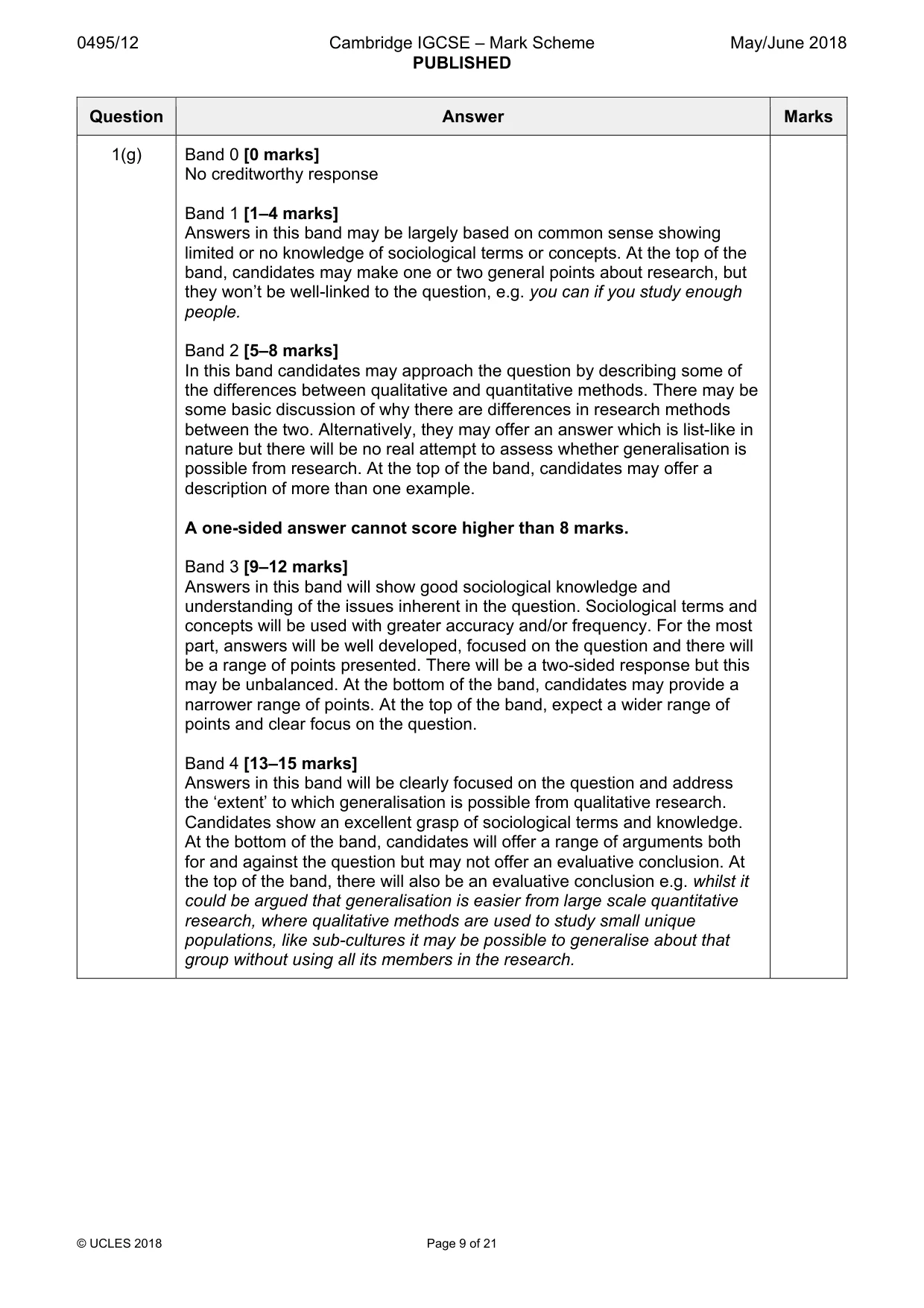
0495/12 Cambridge IGCSE – Mark Scheme PUBLISHED May/June 2018 © UCLES 2018 Page 9 of 21 Question Answer Marks 1(g) Band 0 [0 marks] No creditworthy response Band 1 [1–4 marks] Answers in this band may be largely based on common sense showing limited or no knowledge of sociological terms or concepts. At the top of the band, candidates may make one or two general points about research, but they won’t be well-linked to the question, e.g. you can if you study enough people. Band 2 [5–8 marks] In this band candidates may approach the question by describing some of the differences between qualitative and quantitative methods. There may be some basic discussion of why there are differences in research methods between the two. Alternatively, they may offer an answer which is list-like in nature but there will be no real attempt to assess whether generalisation is possible from research. At the top of the band, candidates may offer a description of more than one example. A one-sided answer cannot score higher than 8 marks. Band 3 [9–12 marks] Answers in this band will show good sociological knowledge and understanding of the issues inherent in the question. Sociological terms and concepts will be used with greater accuracy and/or frequency. For the most part, answers will be well developed, focused on the question and there will be a range of points presented. There will be a two-sided response but this may be unbalanced. At the bottom of the band, candidates may provide a narrower range of points. At the top of the band, expect a wider range of points and clear focus on the question. Band 4 [13–15 marks] Answers in this band will be clearly focused on the question and address the ‘extent’ to which generalisation is possible from qualitative research. Candidates show an excellent grasp of sociological terms and knowledge. At the bottom of the band, candidates will offer a range of arguments both for and against the question but may not offer an evaluative conclusion. At the top of the band, there will also be an evaluative conclusion e.g. whilst it could be argued that generalisation is easier from large scale quantitative research, where qualitative methods are used to study small unique populations, like sub-cultures it may be possible to generalise about that group without using all its members in the research.
Mark scheme, page 10
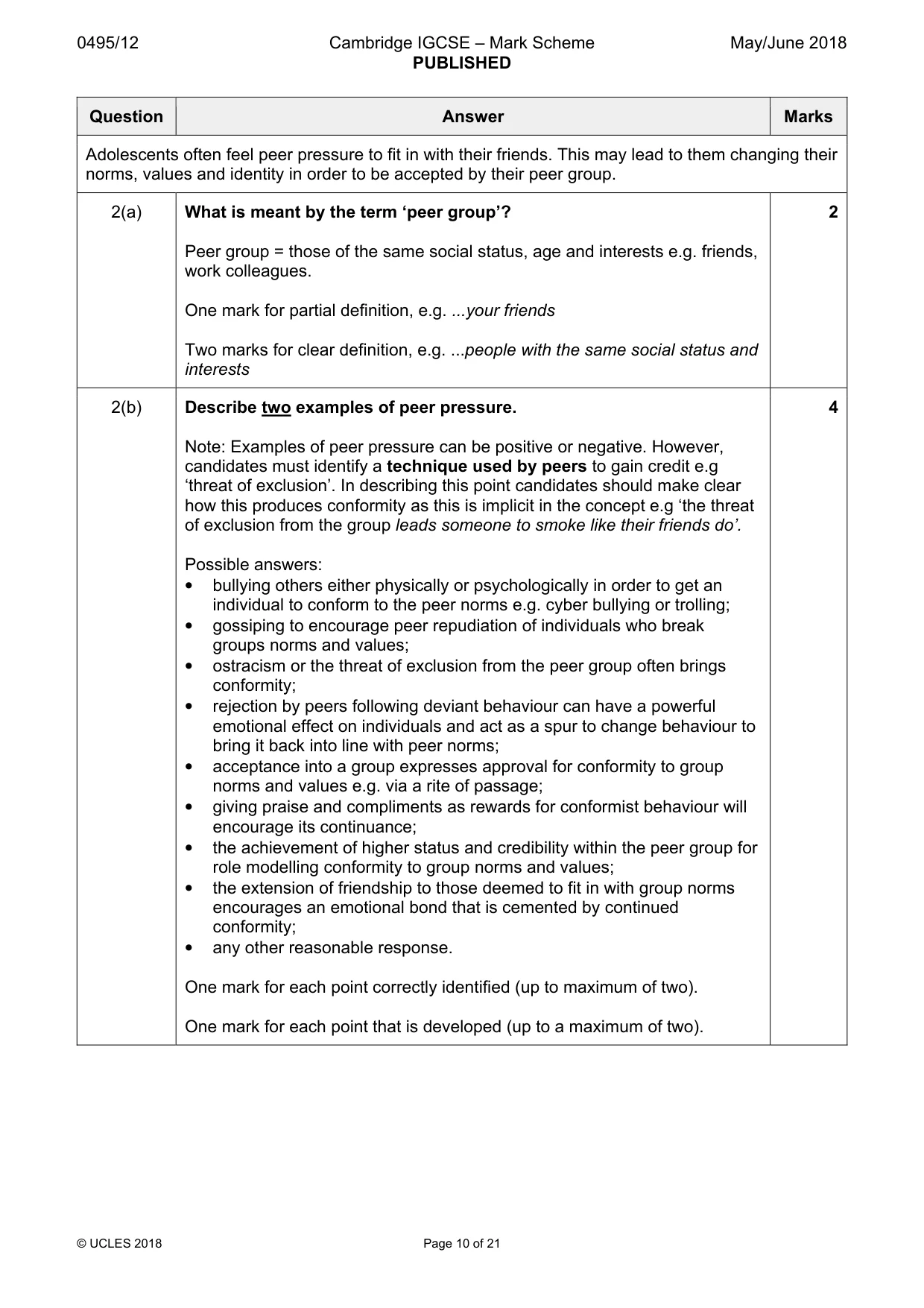
0495/12 Cambridge IGCSE – Mark Scheme PUBLISHED May/June 2018 © UCLES 2018 Page 10 of 21 Question Answer Marks Adolescents often feel peer pressure to fit in with their friends. This may lead to them changing their norms, values and identity in order to be accepted by their peer group. 2(a) What is meant by the term ‘peer group’? Peer group = those of the same social status, age and interests e.g. friends, work colleagues. One mark for partial definition, e.g. ...your friends Two marks for clear definition, e.g. ...people with the same social status and interests 2 2(b) Describe two examples of peer pressure. Note: Examples of peer pressure can be positive or negative. However, candidates must identify a technique used by peers to gain credit e.g ‘threat of exclusion’. In describing this point candidates should make clear how this produces conformity as this is implicit in the concept e.g ‘the threat of exclusion from the group leads someone to smoke like their friends do’. Possible answers: • bullying others either physically or psychologically in order to get an individual to conform to the peer norms e.g. cyber bullying or trolling; • gossiping to encourage peer repudiation of individuals who break groups norms and values; • ostracism or the threat of exclusion from the peer group often brings conformity; • rejection by peers following deviant behaviour can have a powerful emotional effect on individuals and act as a spur to change behaviour to bring it back into line with peer norms; • acceptance into a group expresses approval for conformity to group norms and values e.g. via a rite of passage; • giving praise and compliments as rewards for conformist behaviour will encourage its continuance; • the achievement of higher status and credibility within the peer group for role modelling conformity to group norms and values; • the extension of friendship to those deemed to fit in with group norms encourages an emotional bond that is cemented by continued conformity; • any other reasonable response. One mark for each point correctly identified (up to maximum of two). One mark for each point that is developed (up to a maximum of two). 4
Mark scheme, page 11
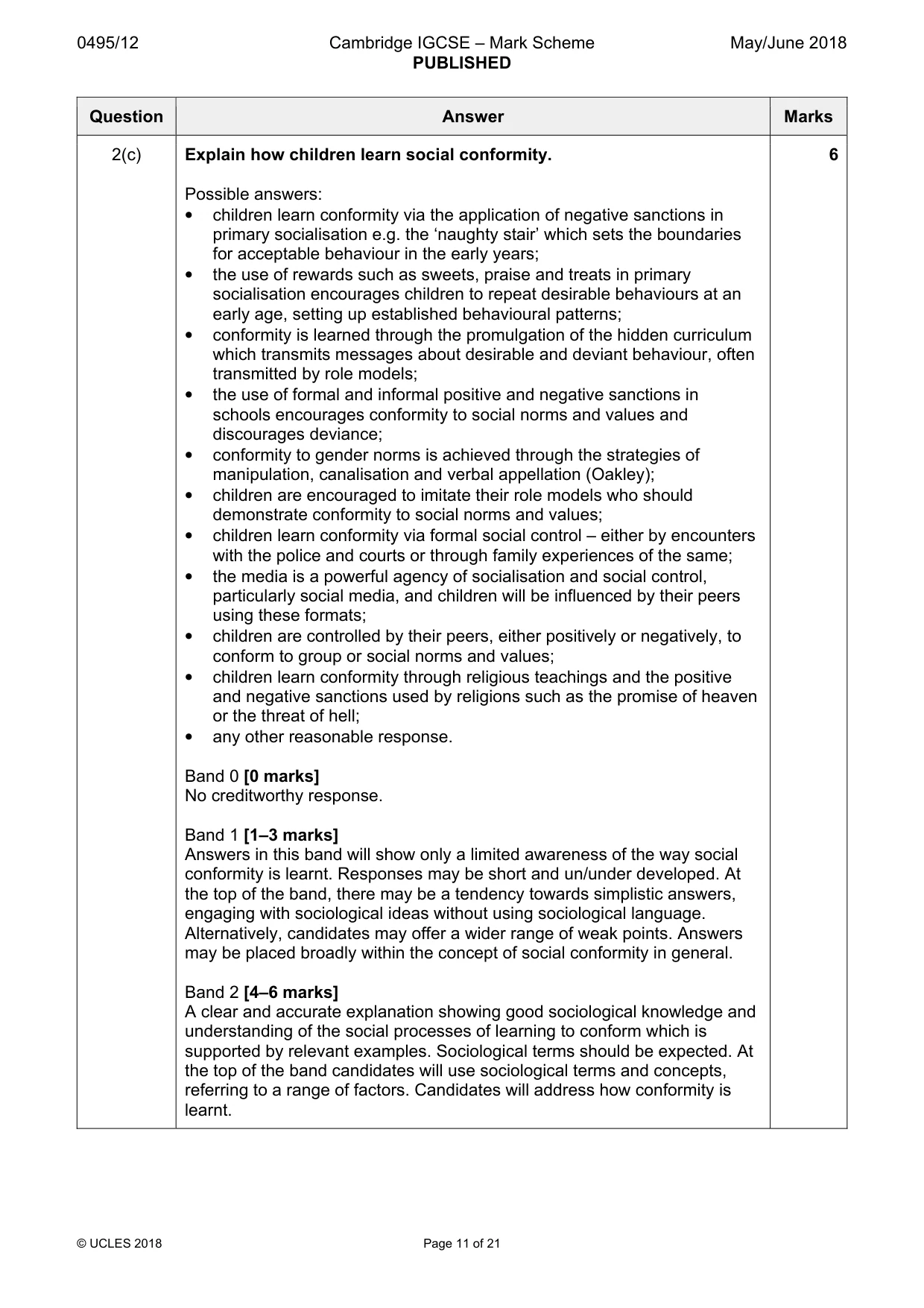
0495/12 Cambridge IGCSE – Mark Scheme PUBLISHED May/June 2018 © UCLES 2018 Page 11 of 21 Question Answer Marks 2(c) Explain how children learn social conformity. Possible answers: • children learn conformity via the application of negative sanctions in primary socialisation e.g. the ‘naughty stair’ which sets the boundaries for acceptable behaviour in the early years; • the use of rewards such as sweets, praise and treats in primary socialisation encourages children to repeat desirable behaviours at an early age, setting up established behavioural patterns; • conformity is learned through the promulgation of the hidden curriculum which transmits messages about desirable and deviant behaviour, often transmitted by role models; • the use of formal and informal positive and negative sanctions in schools encourages conformity to social norms and values and discourages deviance; • conformity to gender norms is achieved through the strategies of manipulation, canalisation and verbal appellation (Oakley); • children are encouraged to imitate their role models who should demonstrate conformity to social norms and values; • children learn conformity via formal social control – either by encounters with the police and courts or through family experiences of the same; • the media is a powerful agency of socialisation and social control, particularly social media, and children will be influenced by their peers using these formats; • children are controlled by their peers, either positively or negatively, to conform to group or social norms and values; • children learn conformity through religious teachings and the positive and negative sanctions used by religions such as the promise of heaven or the threat of hell; • any other reasonable response. Band 0 [0 marks] No creditworthy response. Band 1 [1–3 marks] Answers in this band will show only a limited awareness of the way social conformity is learnt. Responses may be short and un/under developed. At the top of the band, there may be a tendency towards simplistic answers, engaging with sociological ideas without using sociological language. Alternatively, candidates may offer a wider range of weak points. Answers may be placed broadly within the concept of social conformity in general. Band 2 [4–6 marks] A clear and accurate explanation showing good sociological knowledge and understanding of the social processes of learning to conform which is supported by relevant examples. Sociological terms should be expected. At the top of the band candidates will use sociological terms and concepts, referring to a range of factors. Candidates will address how conformity is learnt. 6
Mark scheme, page 12
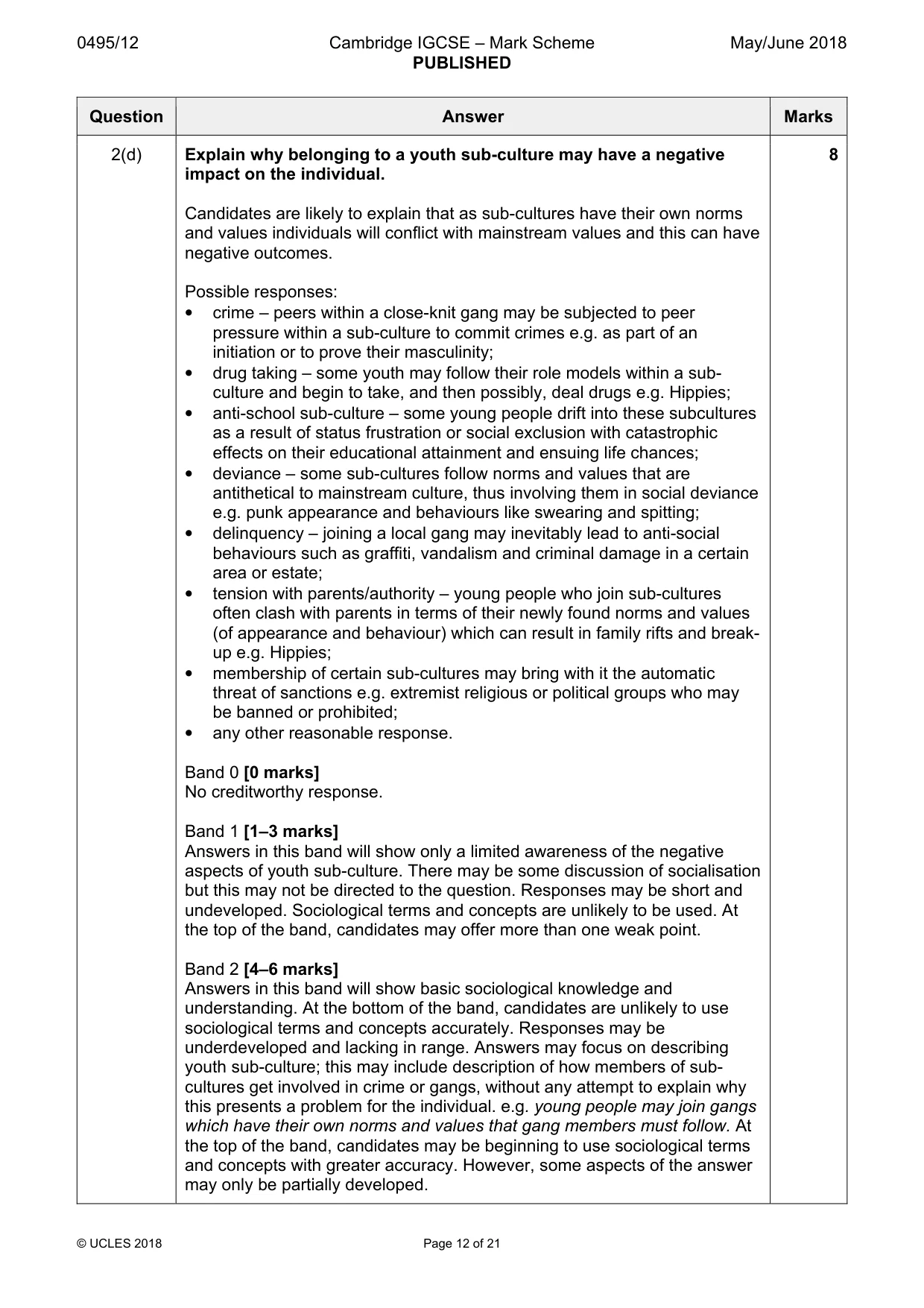
0495/12 Cambridge IGCSE – Mark Scheme PUBLISHED May/June 2018 © UCLES 2018 Page 12 of 21 Question Answer Marks 2(d) Explain why belonging to a youth sub-culture may have a negative impact on the individual. Candidates are likely to explain that as sub-cultures have their own norms and values individuals will conflict with mainstream values and this can have negative outcomes. Possible responses: • crime – peers within a close-knit gang may be subjected to peer pressure within a sub-culture to commit crimes e.g. as part of an initiation or to prove their masculinity; • drug taking – some youth may follow their role models within a sub- culture and begin to take, and then possibly, deal drugs e.g. Hippies; • anti-school sub-culture – some young people drift into these subcultures as a result of status frustration or social exclusion with catastrophic effects on their educational attainment and ensuing life chances; • deviance – some sub-cultures follow norms and values that are antithetical to mainstream culture, thus involving them in social deviance e.g. punk appearance and behaviours like swearing and spitting; • delinquency – joining a local gang may inevitably lead to anti-social behaviours such as graffiti, vandalism and criminal damage in a certain area or estate; • tension with parents/authority – young people who join sub-cultures often clash with parents in terms of their newly found norms and values (of appearance and behaviour) which can result in family rifts and break- up e.g. Hippies; • membership of certain sub-cultures may bring with it the automatic threat of sanctions e.g. extremist religious or political groups who may be banned or prohibited; • any other reasonable response. Band 0 [0 marks] No creditworthy response. Band 1 [1–3 marks] Answers in this band will show only a limited awareness of the negative aspects of youth sub-culture. There may be some discussion of socialisation but this may not be directed to the question. Responses may be short and undeveloped. Sociological terms and concepts are unlikely to be used. At the top of the band, candidates may offer more than one weak point. Band 2 [4–6 marks] Answers in this band will show basic sociological knowledge and understanding. At the bottom of the band, candidates are unlikely to use sociological terms and concepts accurately. Responses may be underdeveloped and lacking in range. Answers may focus on describing youth sub-culture; this may include description of how members of sub- cultures get involved in crime or gangs, without any attempt to explain why this presents a problem for the individual. e.g. young people may join gangs which have their own norms and values that gang members must follow. At the top of the band, candidates may be beginning to use sociological terms and concepts with greater accuracy. However, some aspects of the answer may only be partially developed. 8
Mark scheme, page 13
0495/12 Cambridge IGCSE – Mark Scheme PUBLISHED May/June 2018 © UCLES 2018 Page 13 of 21 Question Answer Marks 2(d) Band 3 [7–8 marks] Answers in this band will show good sociological knowledge and understanding of the negative aspects of youth sub-culture and will be well developed and explained. Sociological terms and concepts will be used accurately. Answers will be well focused on the question and there will be a range of reasons presented. At the top of the band explanations will be clear throughout. 2(e) To what extent is the peer group the most important agency of socialisation? Arguments for: • in the peer group we often see the influence of friendship networks with close emotional and social ties and this can have a more powerful impact – particularly in the teenage years – than any other agency of socialisation; • the peer group within the workplace can be extremely effective as an agency of socialisation, so occupational subcultures involving work mates may exist which can influence individuals into doing things they would ordinarily avoid such as criminal acts e.g. the banking fraternity; • young people especially spend a vast amount of time with their peers – at school and socialising after school – it is thus unsurprising that peers influence each other during the school years; • functionalists argue that youth is a time of transition and the peer group functions as a source of support in the chaotic and turbulent teen years in which they are experimenting with lifestyle and trying to establish their own identity; • the quest for promotion involves individuals in demonstrating work place values in an effort to move up the hierarchy, the influence of this is particularly strong in those who are committed to establishing a successful career; • peer groups are often influential in shaping image and identity via constant positive and negative pressure, above and beyond the influence of agencies such as the media; • anti-school subcultures demonstrate that, despite the good intentions of the family and of teachers, some youth fall under the sway of negative influences which can effectively hamper their future life chances; • any other reasonable answer. Arguments against: • functionalists argue that the family, particularly the nuclear family, is a more important agency of socialisation than the peer group as it provides primary socialisation into socially acceptable norms and values and without this work none of the secondary agencies would be able to function; • the family socialises children into their gender identity (Oakley) which is often fundamental to how we see ourselves, and how others see us, providing a platform for future roles and relationships; • the family is a more important agency of socialisation as it provides the core skills such as speaking, walking and toileting without which individuals would not find acceptance in wider society e.g. feral children; 15
Mark scheme, page 14
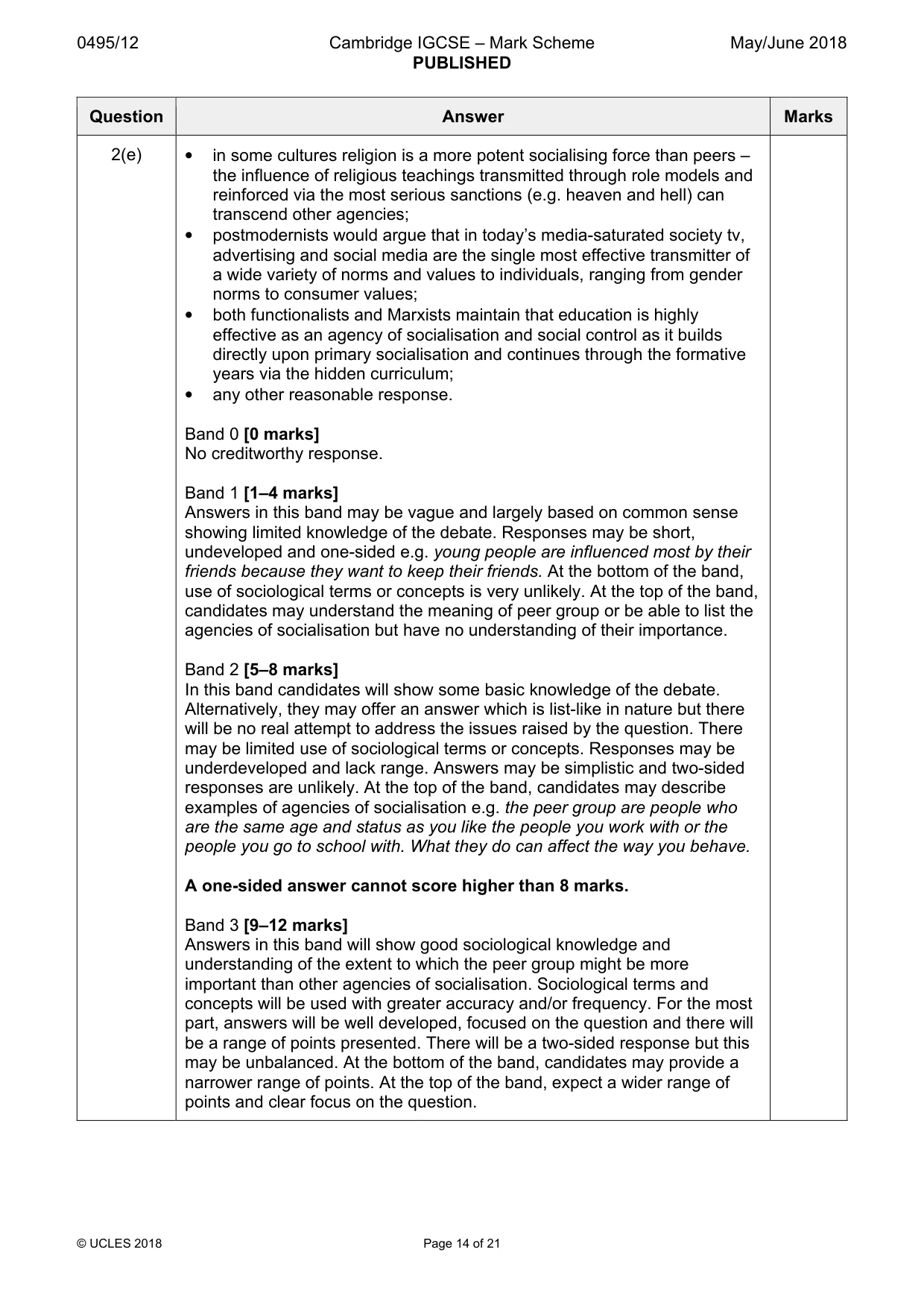
0495/12 Cambridge IGCSE – Mark Scheme PUBLISHED May/June 2018 © UCLES 2018 Page 14 of 21 Question Answer Marks 2(e) • in some cultures religion is a more potent socialising force than peers – the influence of religious teachings transmitted through role models and reinforced via the most serious sanctions (e.g. heaven and hell) can transcend other agencies; • postmodernists would argue that in today’s media-saturated society tv, advertising and social media are the single most effective transmitter of a wide variety of norms and values to individuals, ranging from gender norms to consumer values; • both functionalists and Marxists maintain that education is highly effective as an agency of socialisation and social control as it builds directly upon primary socialisation and continues through the formative years via the hidden curriculum; • any other reasonable response. Band 0 [0 marks] No creditworthy response. Band 1 [1–4 marks] Answers in this band may be vague and largely based on common sense showing limited knowledge of the debate. Responses may be short, undeveloped and one-sided e.g. young people are influenced most by their friends because they want to keep their friends. At the bottom of the band, use of sociological terms or concepts is very unlikely. At the top of the band, candidates may understand the meaning of peer group or be able to list the agencies of socialisation but have no understanding of their importance. Band 2 [5–8 marks] In this band candidates will show some basic knowledge of the debate. Alternatively, they may offer an answer which is list-like in nature but there will be no real attempt to address the issues raised by the question. There may be limited use of sociological terms or concepts. Responses may be underdeveloped and lack range. Answers may be simplistic and two-sided responses are unlikely. At the top of the band, candidates may describe examples of agencies of socialisation e.g. the peer group are people who are the same age and status as you like the people you work with or the people you go to school with. What they do can affect the way you behave. A one-sided answer cannot score higher than 8 marks. Band 3 [9–12 marks] Answers in this band will show good sociological knowledge and understanding of the extent to which the peer group might be more important than other agencies of socialisation. Sociological terms and concepts will be used with greater accuracy and/or frequency. For the most part, answers will be well developed, focused on the question and there will be a range of points presented. There will be a two-sided response but this may be unbalanced. At the bottom of the band, candidates may provide a narrower range of points. At the top of the band, expect a wider range of points and clear focus on the question.
Mark scheme, page 15
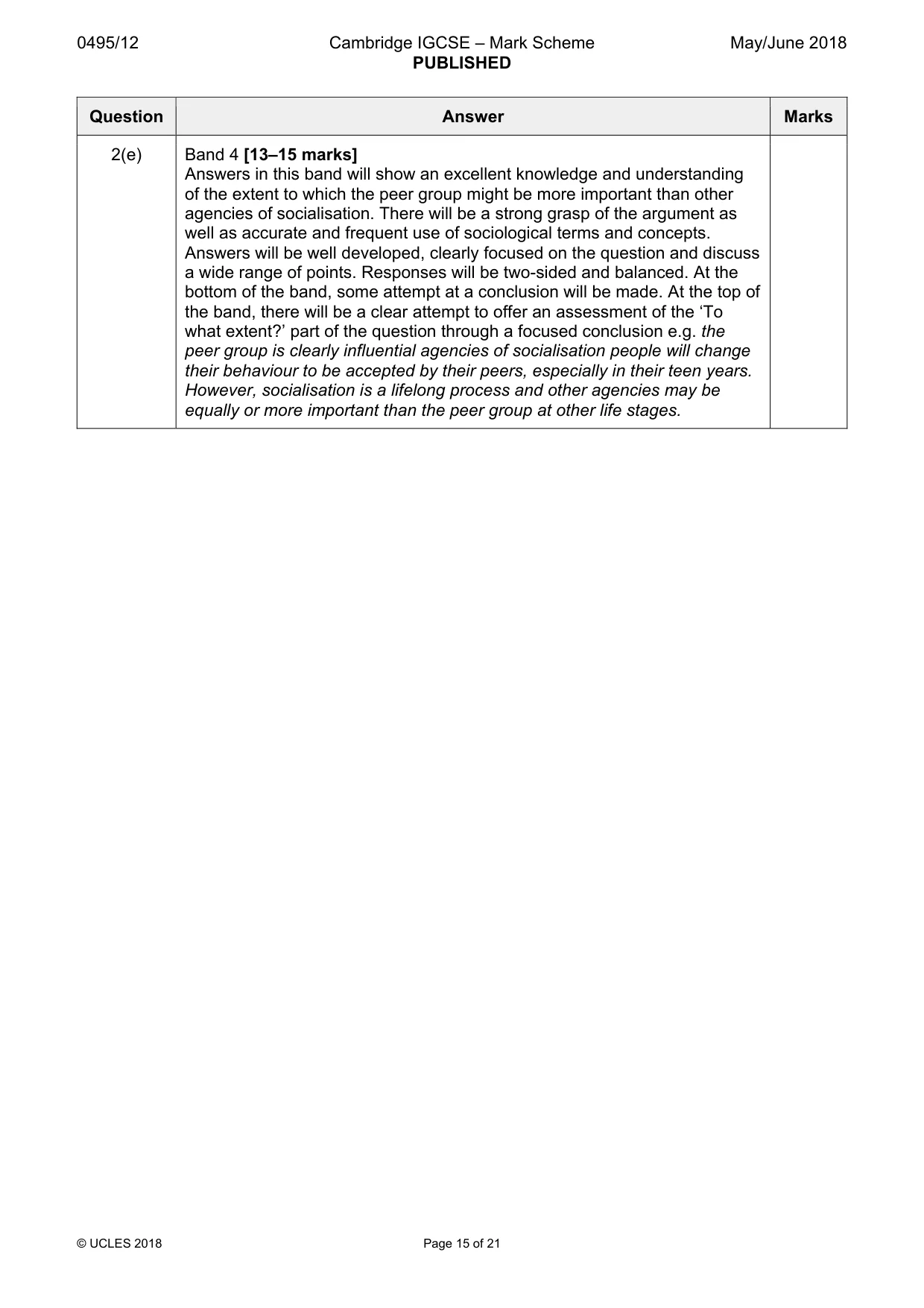
0495/12 Cambridge IGCSE – Mark Scheme PUBLISHED May/June 2018 © UCLES 2018 Page 15 of 21 Question Answer Marks 2(e) Band 4 [13–15 marks] Answers in this band will show an excellent knowledge and understanding of the extent to which the peer group might be more important than other agencies of socialisation. There will be a strong grasp of the argument as well as accurate and frequent use of sociological terms and concepts. Answers will be well developed, clearly focused on the question and discuss a wide range of points. Responses will be two-sided and balanced. At the bottom of the band, some attempt at a conclusion will be made. At the top of the band, there will be a clear attempt to offer an assessment of the ‘To what extent?’ part of the question through a focused conclusion e.g. the peer group is clearly influential agencies of socialisation people will change their behaviour to be accepted by their peers, especially in their teen years. However, socialisation is a lifelong process and other agencies may be equally or more important than the peer group at other life stages.
Mark scheme, page 16
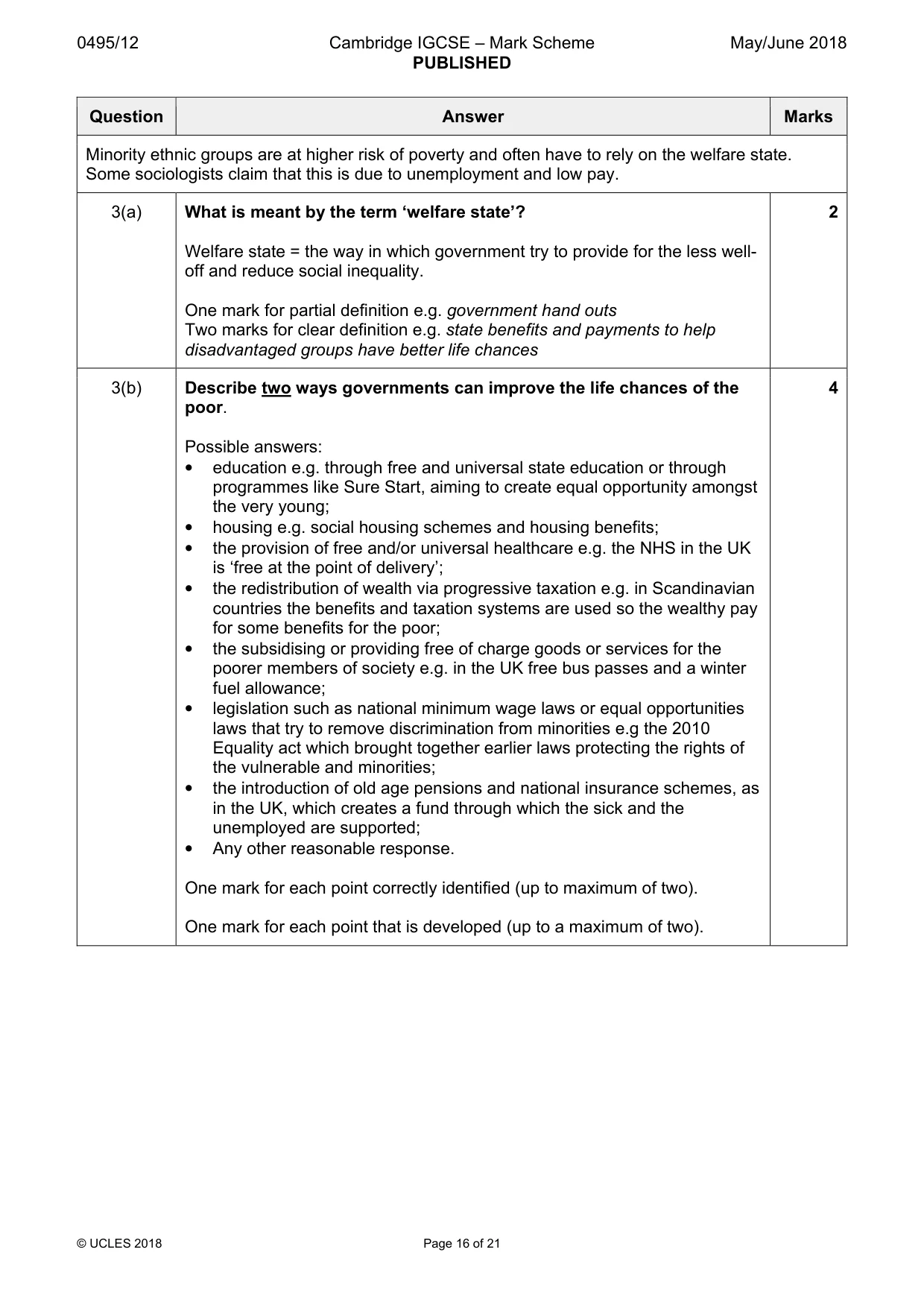
0495/12 Cambridge IGCSE – Mark Scheme PUBLISHED May/June 2018 © UCLES 2018 Page 16 of 21 Question Answer Marks Minority ethnic groups are at higher risk of poverty and often have to rely on the welfare state. Some sociologists claim that this is due to unemployment and low pay. 3(a) What is meant by the term ‘welfare state’? Welfare state = the way in which government try to provide for the less well- off and reduce social inequality. One mark for partial definition e.g. government hand outs Two marks for clear definition e.g. state benefits and payments to help disadvantaged groups have better life chances 2 3(b) Describe two ways governments can improve the life chances of the poor. Possible answers: • education e.g. through free and universal state education or through programmes like Sure Start, aiming to create equal opportunity amongst the very young; • housing e.g. social housing schemes and housing benefits; • the provision of free and/or universal healthcare e.g. the NHS in the UK is ‘free at the point of delivery’; • the redistribution of wealth via progressive taxation e.g. in Scandinavian countries the benefits and taxation systems are used so the wealthy pay for some benefits for the poor; • the subsidising or providing free of charge goods or services for the poorer members of society e.g. in the UK free bus passes and a winter fuel allowance; • legislation such as national minimum wage laws or equal opportunities laws that try to remove discrimination from minorities e.g the 2010 Equality act which brought together earlier laws protecting the rights of the vulnerable and minorities; • the introduction of old age pensions and national insurance schemes, as in the UK, which creates a fund through which the sick and the unemployed are supported; • Any other reasonable response. One mark for each point correctly identified (up to maximum of two). One mark for each point that is developed (up to a maximum of two). 4
Mark scheme, page 17
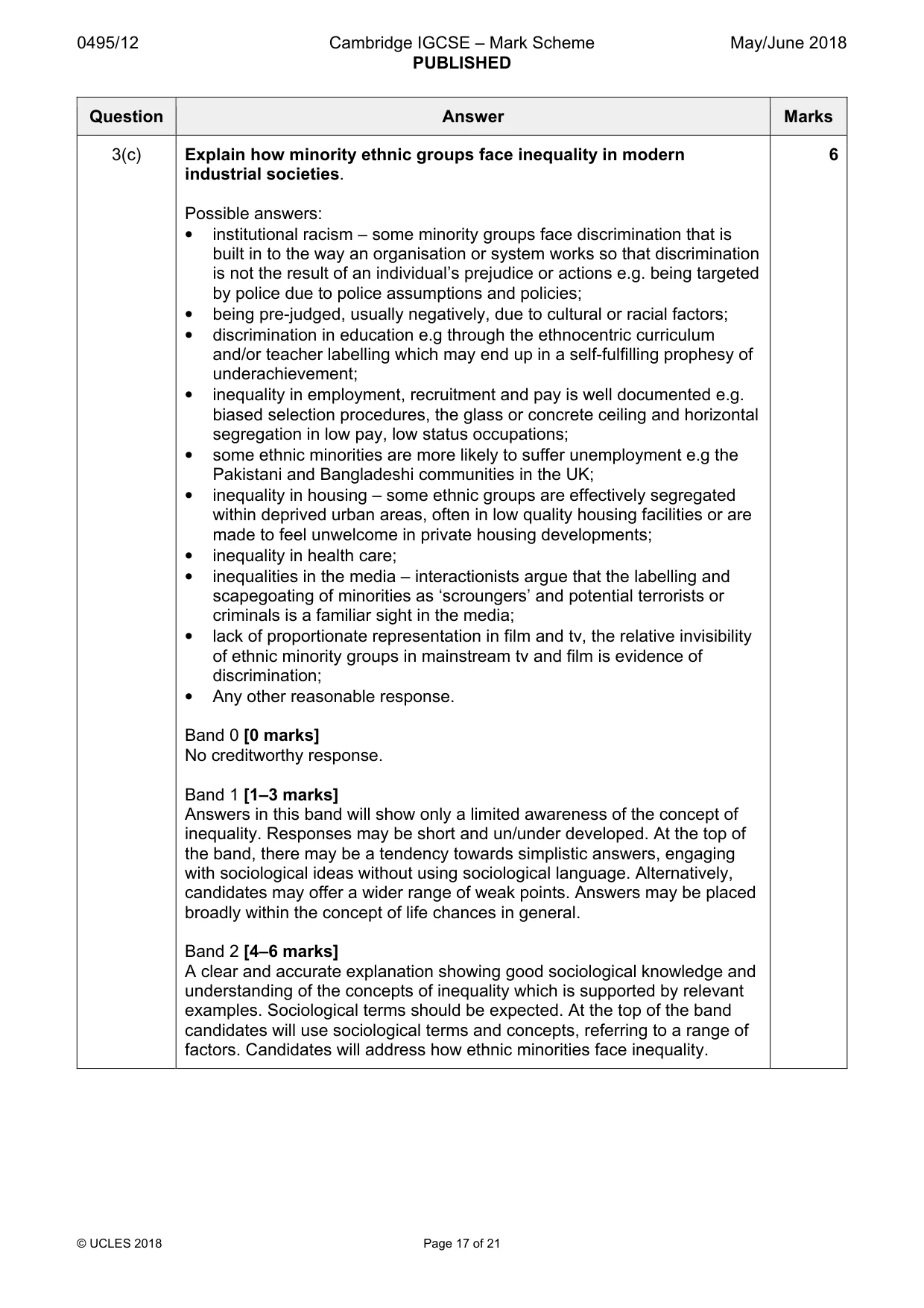
0495/12 Cambridge IGCSE – Mark Scheme PUBLISHED May/June 2018 © UCLES 2018 Page 17 of 21 Question Answer Marks 3(c) Explain how minority ethnic groups face inequality in modern industrial societies. Possible answers: • institutional racism – some minority groups face discrimination that is built in to the way an organisation or system works so that discrimination is not the result of an individual’s prejudice or actions e.g. being targeted by police due to police assumptions and policies; • being pre-judged, usually negatively, due to cultural or racial factors; • discrimination in education e.g through the ethnocentric curriculum and/or teacher labelling which may end up in a self-fulfilling prophesy of underachievement; • inequality in employment, recruitment and pay is well documented e.g. biased selection procedures, the glass or concrete ceiling and horizontal segregation in low pay, low status occupations; • some ethnic minorities are more likely to suffer unemployment e.g the Pakistani and Bangladeshi communities in the UK; • inequality in housing – some ethnic groups are effectively segregated within deprived urban areas, often in low quality housing facilities or are made to feel unwelcome in private housing developments; • inequality in health care; • inequalities in the media – interactionists argue that the labelling and scapegoating of minorities as ‘scroungers’ and potential terrorists or criminals is a familiar sight in the media; • lack of proportionate representation in film and tv, the relative invisibility of ethnic minority groups in mainstream tv and film is evidence of discrimination; • Any other reasonable response. Band 0 [0 marks] No creditworthy response. Band 1 [1–3 marks] Answers in this band will show only a limited awareness of the concept of inequality. Responses may be short and un/under developed. At the top of the band, there may be a tendency towards simplistic answers, engaging with sociological ideas without using sociological language. Alternatively, candidates may offer a wider range of weak points. Answers may be placed broadly within the concept of life chances in general. Band 2 [4–6 marks] A clear and accurate explanation showing good sociological knowledge and understanding of the concepts of inequality which is supported by relevant examples. Sociological terms should be expected. At the top of the band candidates will use sociological terms and concepts, referring to a range of factors. Candidates will address how ethnic minorities face inequality. 6
Mark scheme, page 18
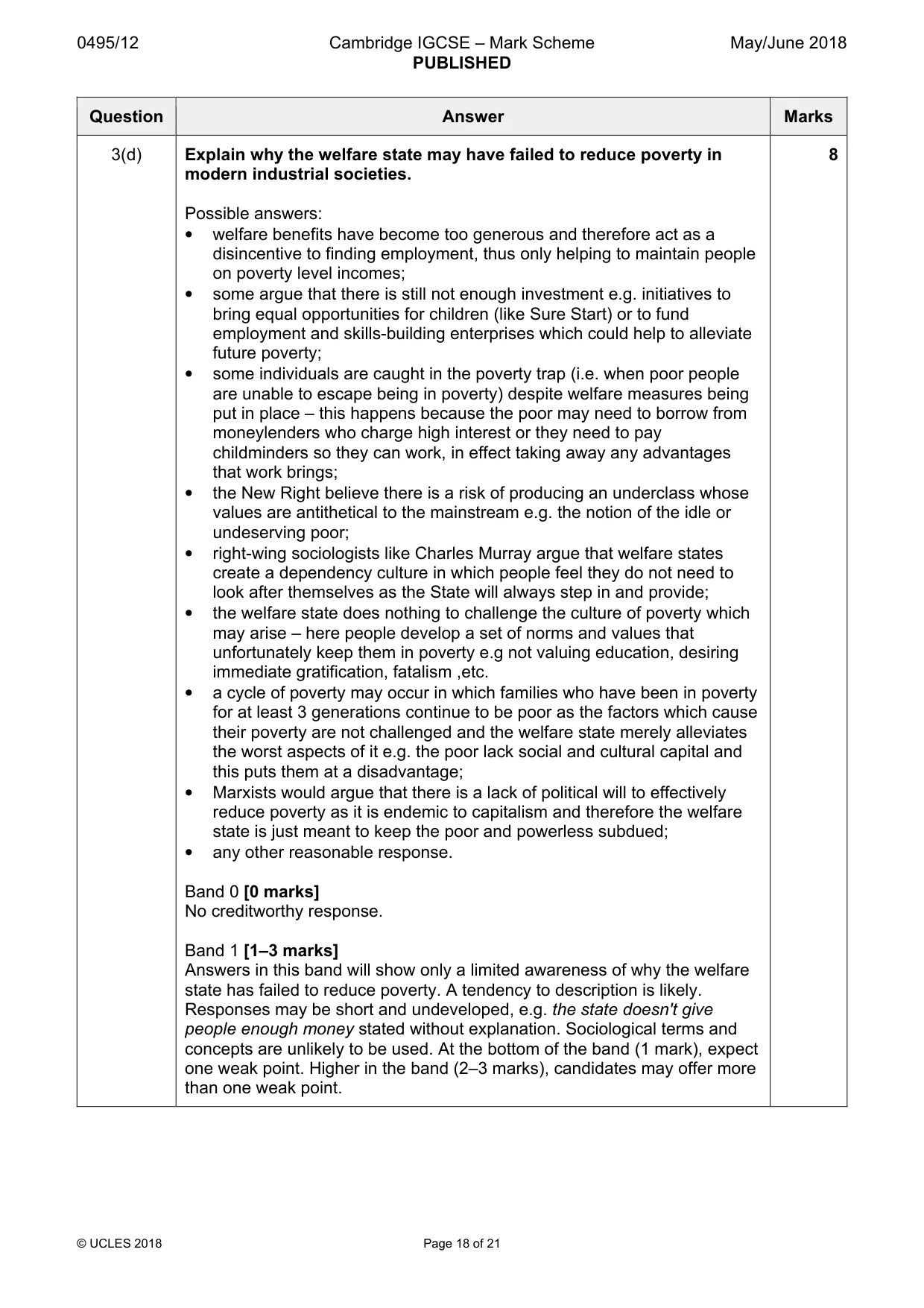
0495/12 Cambridge IGCSE – Mark Scheme PUBLISHED May/June 2018 © UCLES 2018 Page 18 of 21 Question Answer Marks 3(d) Explain why the welfare state may have failed to reduce poverty in modern industrial societies. Possible answers: • welfare benefits have become too generous and therefore act as a disincentive to finding employment, thus only helping to maintain people on poverty level incomes; • some argue that there is still not enough investment e.g. initiatives to bring equal opportunities for children (like Sure Start) or to fund employment and skills-building enterprises which could help to alleviate future poverty; • some individuals are caught in the poverty trap (i.e. when poor people are unable to escape being in poverty) despite welfare measures being put in place – this happens because the poor may need to borrow from moneylenders who charge high interest or they need to pay childminders so they can work, in effect taking away any advantages that work brings; • the New Right believe there is a risk of producing an underclass whose values are antithetical to the mainstream e.g. the notion of the idle or undeserving poor; • right-wing sociologists like Charles Murray argue that welfare states create a dependency culture in which people feel they do not need to look after themselves as the State will always step in and provide; • the welfare state does nothing to challenge the culture of poverty which may arise – here people develop a set of norms and values that unfortunately keep them in poverty e.g not valuing education, desiring immediate gratification, fatalism ,etc. • a cycle of poverty may occur in which families who have been in poverty for at least 3 generations continue to be poor as the factors which cause their poverty are not challenged and the welfare state merely alleviates the worst aspects of it e.g. the poor lack social and cultural capital and this puts them at a disadvantage; • Marxists would argue that there is a lack of political will to effectively reduce poverty as it is endemic to capitalism and therefore the welfare state is just meant to keep the poor and powerless subdued; • any other reasonable response. Band 0 [0 marks] No creditworthy response. Band 1 [1–3 marks] Answers in this band will show only a limited awareness of why the welfare state has failed to reduce poverty. A tendency to description is likely. Responses may be short and undeveloped, e.g. the state doesn't give people enough money stated without explanation. Sociological terms and concepts are unlikely to be used. At the bottom of the band (1 mark), expect one weak point. Higher in the band (2–3 marks), candidates may offer more than one weak point. 8
Mark scheme, page 19
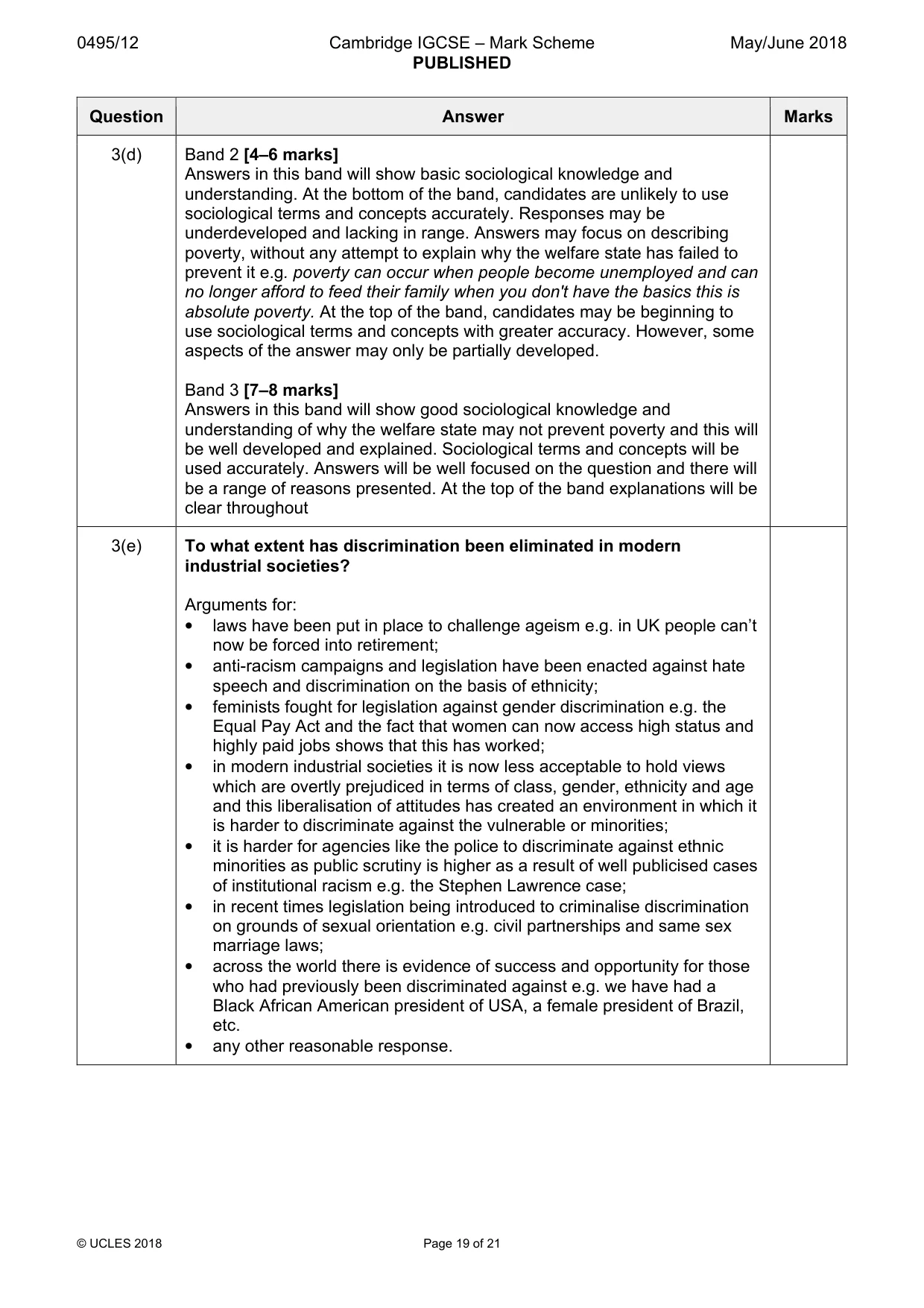
0495/12 Cambridge IGCSE – Mark Scheme PUBLISHED May/June 2018 © UCLES 2018 Page 19 of 21 Question Answer Marks 3(d) Band 2 [4–6 marks] Answers in this band will show basic sociological knowledge and understanding. At the bottom of the band, candidates are unlikely to use sociological terms and concepts accurately. Responses may be underdeveloped and lacking in range. Answers may focus on describing poverty, without any attempt to explain why the welfare state has failed to prevent it e.g. poverty can occur when people become unemployed and can no longer afford to feed their family when you don't have the basics this is absolute poverty. At the top of the band, candidates may be beginning to use sociological terms and concepts with greater accuracy. However, some aspects of the answer may only be partially developed. Band 3 [7–8 marks] Answers in this band will show good sociological knowledge and understanding of why the welfare state may not prevent poverty and this will be well developed and explained. Sociological terms and concepts will be used accurately. Answers will be well focused on the question and there will be a range of reasons presented. At the top of the band explanations will be clear throughout 3(e) To what extent has discrimination been eliminated in modern industrial societies? Arguments for: • laws have been put in place to challenge ageism e.g. in UK people can’t now be forced into retirement; • anti-racism campaigns and legislation have been enacted against hate speech and discrimination on the basis of ethnicity; • feminists fought for legislation against gender discrimination e.g. the Equal Pay Act and the fact that women can now access high status and highly paid jobs shows that this has worked; • in modern industrial societies it is now less acceptable to hold views which are overtly prejudiced in terms of class, gender, ethnicity and age and this liberalisation of attitudes has created an environment in which it is harder to discriminate against the vulnerable or minorities; • it is harder for agencies like the police to discriminate against ethnic minorities as public scrutiny is higher as a result of well publicised cases of institutional racism e.g. the Stephen Lawrence case; • in recent times legislation being introduced to criminalise discrimination on grounds of sexual orientation e.g. civil partnerships and same sex marriage laws; • across the world there is evidence of success and opportunity for those who had previously been discriminated against e.g. we have had a Black African American president of USA, a female president of Brazil, etc. • any other reasonable response.
Mark scheme, page 20
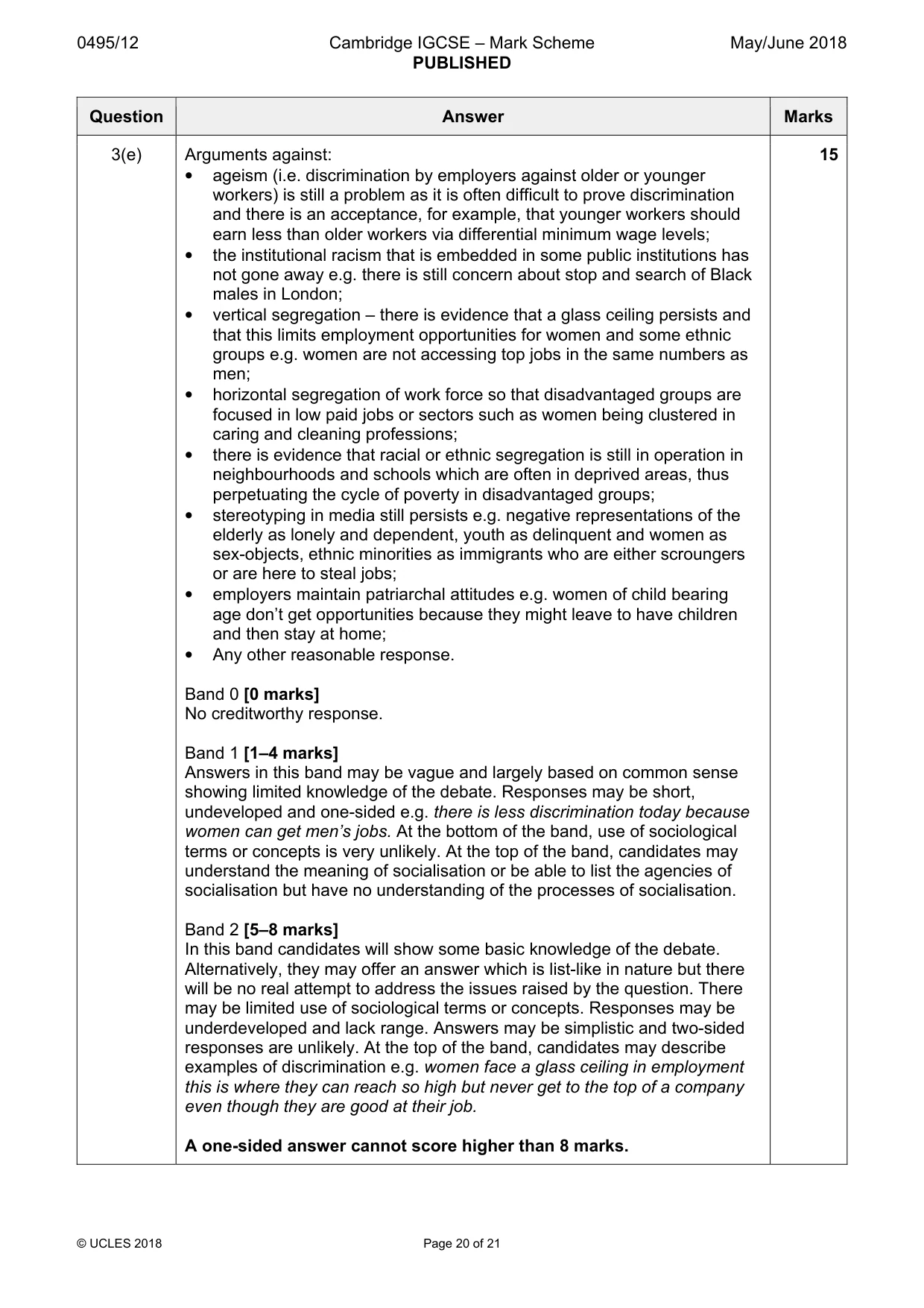
0495/12 Cambridge IGCSE – Mark Scheme PUBLISHED May/June 2018 © UCLES 2018 Page 20 of 21 Question Answer Marks 3(e) Arguments against: • ageism (i.e. discrimination by employers against older or younger workers) is still a problem as it is often difficult to prove discrimination and there is an acceptance, for example, that younger workers should earn less than older workers via differential minimum wage levels; • the institutional racism that is embedded in some public institutions has not gone away e.g. there is still concern about stop and search of Black males in London; • vertical segregation – there is evidence that a glass ceiling persists and that this limits employment opportunities for women and some ethnic groups e.g. women are not accessing top jobs in the same numbers as men; • horizontal segregation of work force so that disadvantaged groups are focused in low paid jobs or sectors such as women being clustered in caring and cleaning professions; • there is evidence that racial or ethnic segregation is still in operation in neighbourhoods and schools which are often in deprived areas, thus perpetuating the cycle of poverty in disadvantaged groups; • stereotyping in media still persists e.g. negative representations of the elderly as lonely and dependent, youth as delinquent and women as sex-objects, ethnic minorities as immigrants who are either scroungers or are here to steal jobs; • employers maintain patriarchal attitudes e.g. women of child bearing age don’t get opportunities because they might leave to have children and then stay at home; • Any other reasonable response. Band 0 [0 marks] No creditworthy response. Band 1 [1–4 marks] Answers in this band may be vague and largely based on common sense showing limited knowledge of the debate. Responses may be short, undeveloped and one-sided e.g. there is less discrimination today because women can get men’s jobs. At the bottom of the band, use of sociological terms or concepts is very unlikely. At the top of the band, candidates may understand the meaning of socialisation or be able to list the agencies of socialisation but have no understanding of the processes of socialisation. Band 2 [5–8 marks] In this band candidates will show some basic knowledge of the debate. Alternatively, they may offer an answer which is list-like in nature but there will be no real attempt to address the issues raised by the question. There may be limited use of sociological terms or concepts. Responses may be underdeveloped and lack range. Answers may be simplistic and two-sided responses are unlikely. At the top of the band, candidates may describe examples of discrimination e.g. women face a glass ceiling in employment this is where they can reach so high but never get to the top of a company even though they are good at their job. A one-sided answer cannot score higher than 8 marks. 15
Mark scheme, page 21
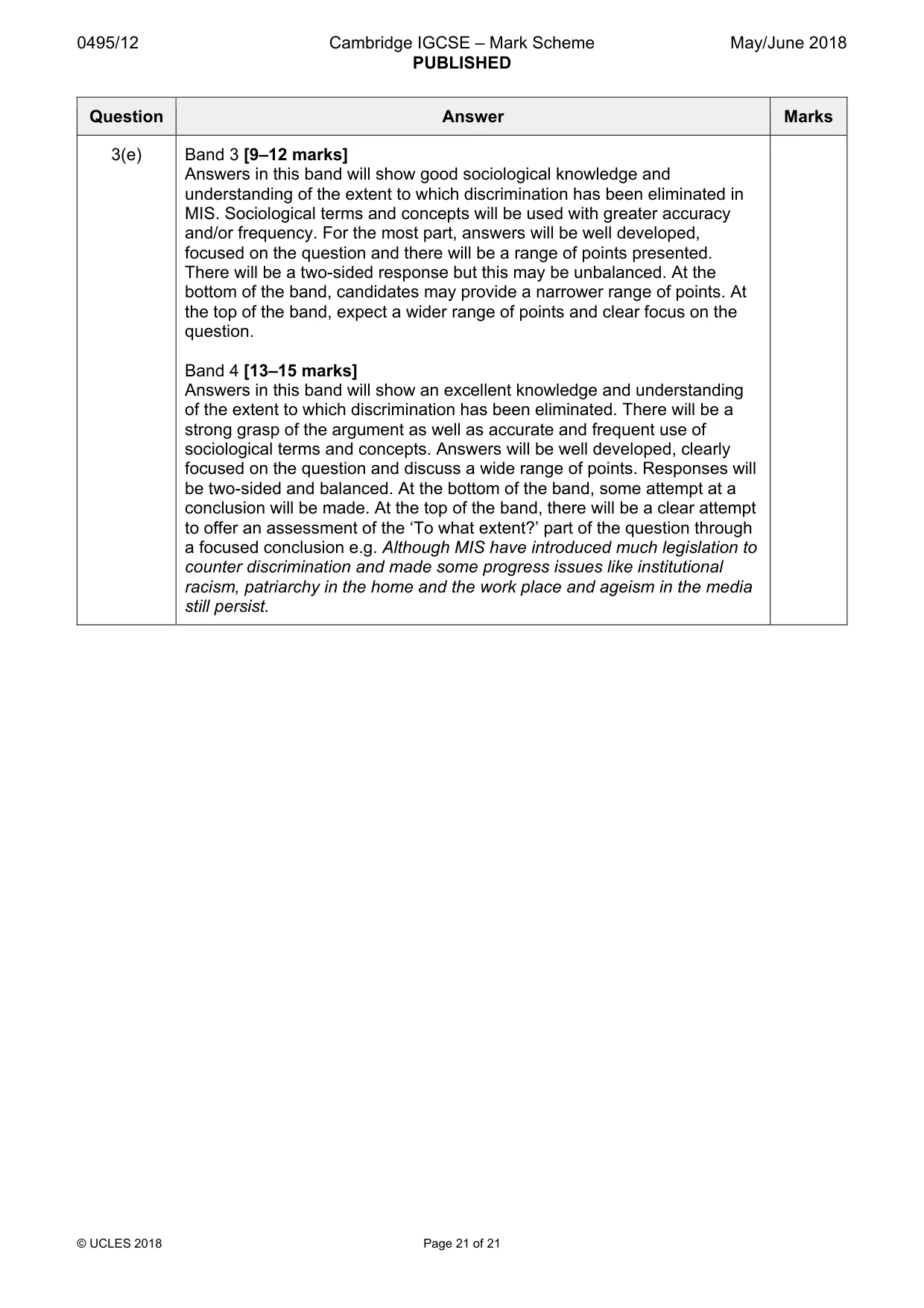
0495/12 Cambridge IGCSE – Mark Scheme PUBLISHED May/June 2018 © UCLES 2018 Page 21 of 21 Question Answer Marks 3(e) Band 3 [9–12 marks] Answers in this band will show good sociological knowledge and understanding of the extent to which discrimination has been eliminated in MIS. Sociological terms and concepts will be used with greater accuracy and/or frequency. For the most part, answers will be well developed, focused on the question and there will be a range of points presented. There will be a two-sided response but this may be unbalanced. At the bottom of the band, candidates may provide a narrower range of points. At the top of the band, expect a wider range of points and clear focus on the question. Band 4 [13–15 marks] Answers in this band will show an excellent knowledge and understanding of the extent to which discrimination has been eliminated. There will be a strong grasp of the argument as well as accurate and frequent use of sociological terms and concepts. Answers will be well developed, clearly focused on the question and discuss a wide range of points. Responses will be two-sided and balanced. At the bottom of the band, some attempt at a conclusion will be made. At the top of the band, there will be a clear attempt to offer an assessment of the ‘To what extent?’ part of the question through a focused conclusion e.g. Although MIS have introduced much legislation to counter discrimination and made some progress issues like institutional racism, patriarchy in the home and the work place and ageism in the media still persist.
What you needed in this session
Cambridge’s own grade thresholds for 2018 May/June, Paper 1 · Variant 2. A higher threshold means an easier paper — the bar moves with how the cohort did.