Cambridge IGCSE Sociology 0495 — 2018 May/June Paper 1 · Variant 1
0495/11/M/J/18 · 80 marks · ≈90 min
The question paper and its mark scheme, free to read here and free to download. This is Cambridge’s own paper, exactly as it was sat.
Question paper4 pages

Mark scheme23 pages
Answers below. Sit the paper first if you are practising.

Paper as text
Question paper, page 1
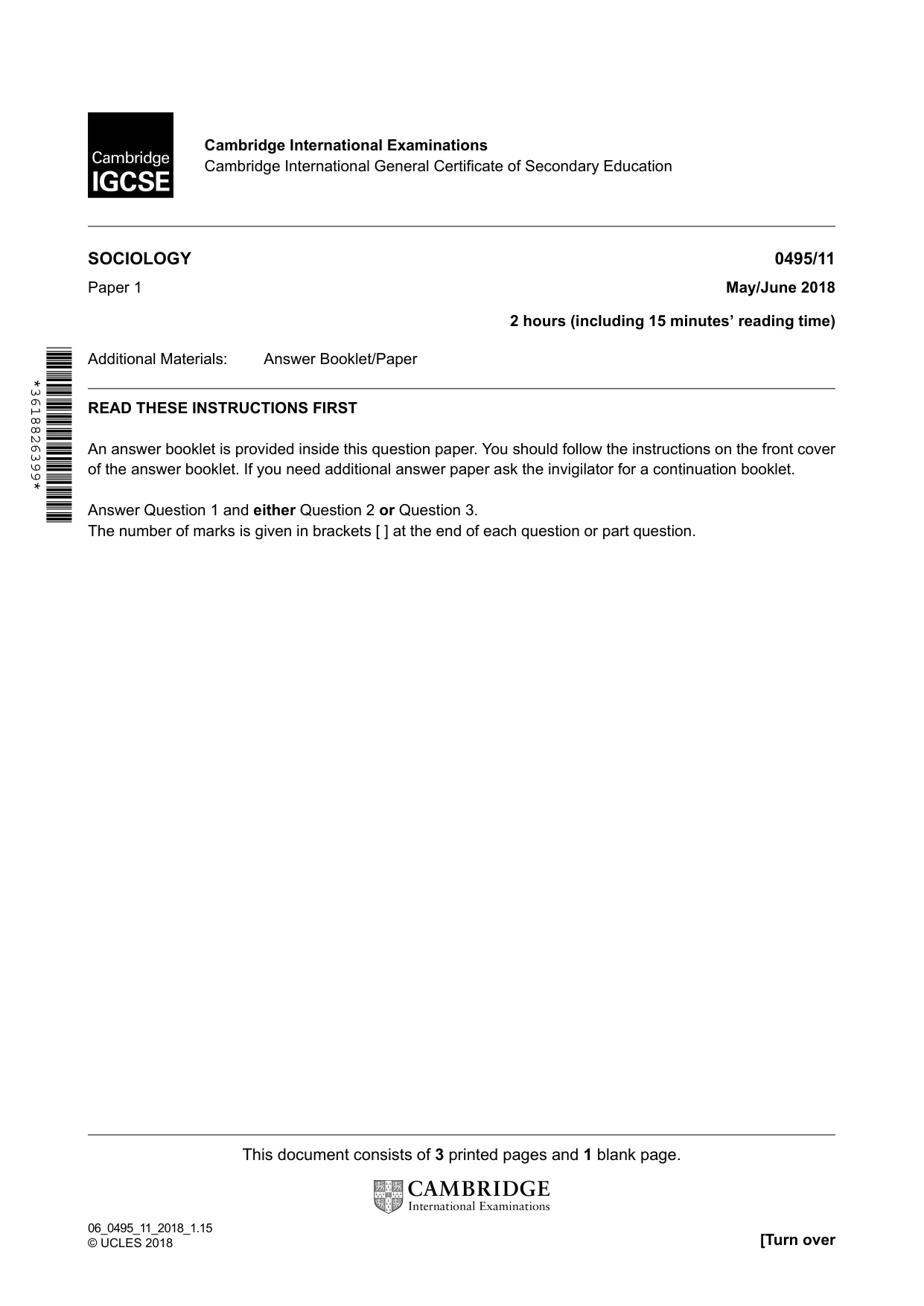
Cambridge International Examinations Cambridge International General Certificate of Secondary Education 0495/11 May/June 2018 SOCIOLOGY Paper 1 2 hours (including 15 minutes’ reading time) Additional Materials: Answer Booklet/Paper READ THESE INSTRUCTIONS FIRST An answer booklet is provided inside this question paper. You should follow the instructions on the front cover of the answer booklet. If you need additional answer paper ask the invigilator for a continuation booklet. Answer Question 1 and either Question 2 or Question 3. The number of marks is given in brackets [ ] at the end of each question or part question. This document consists of 3 printed pages and 1 blank page. [Turn over 06_0495_11_2018_1.15 © UCLES 2018 *3618826399*
Question paper, page 2
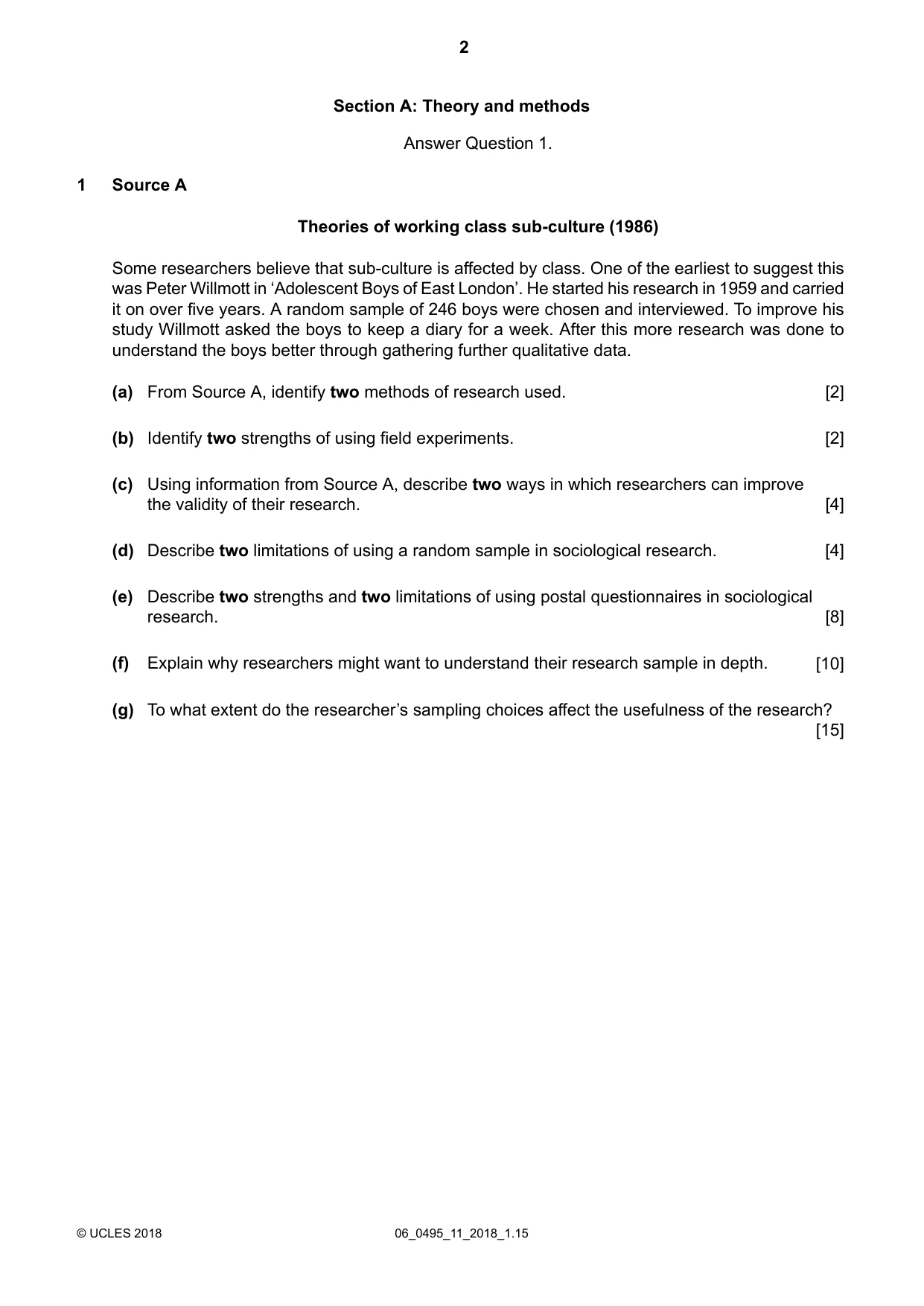
Section A: Theory and methods Answer Question 1. Source A 1 Theories of working class sub-culture (1986) Some researchers believe that sub-culture is affected by class. One of the earliest to suggest this was Peter Willmott in ‘Adolescent Boys of East London’. He started his research in 1959 and carried it on over five years. A random sample of 246 boys were chosen and interviewed. To improve his study Willmott asked the boys to keep a diary for a week. After this more research was done to understand the boys better through gathering further qualitative data. From Source A, identify two methods of research used. [2] (a) Identify two strengths of using field experiments. [2] (b) Using information from Source A, describe two ways in which researchers can improve the validity of their research. [4] (c) Describe two limitations of using a random sample in sociological research. [4] (d) Describe two strengths and two limitations of using postal questionnaires in sociological research. [8] (e) Explain why researchers might want to understand their research sample in depth. [10] (f) To what extent do the researcher’s sampling choices affect the usefulness of the research? [15] (g) 06_0495_11_2018_1.15 © UCLES 2018 2
Question paper, page 3
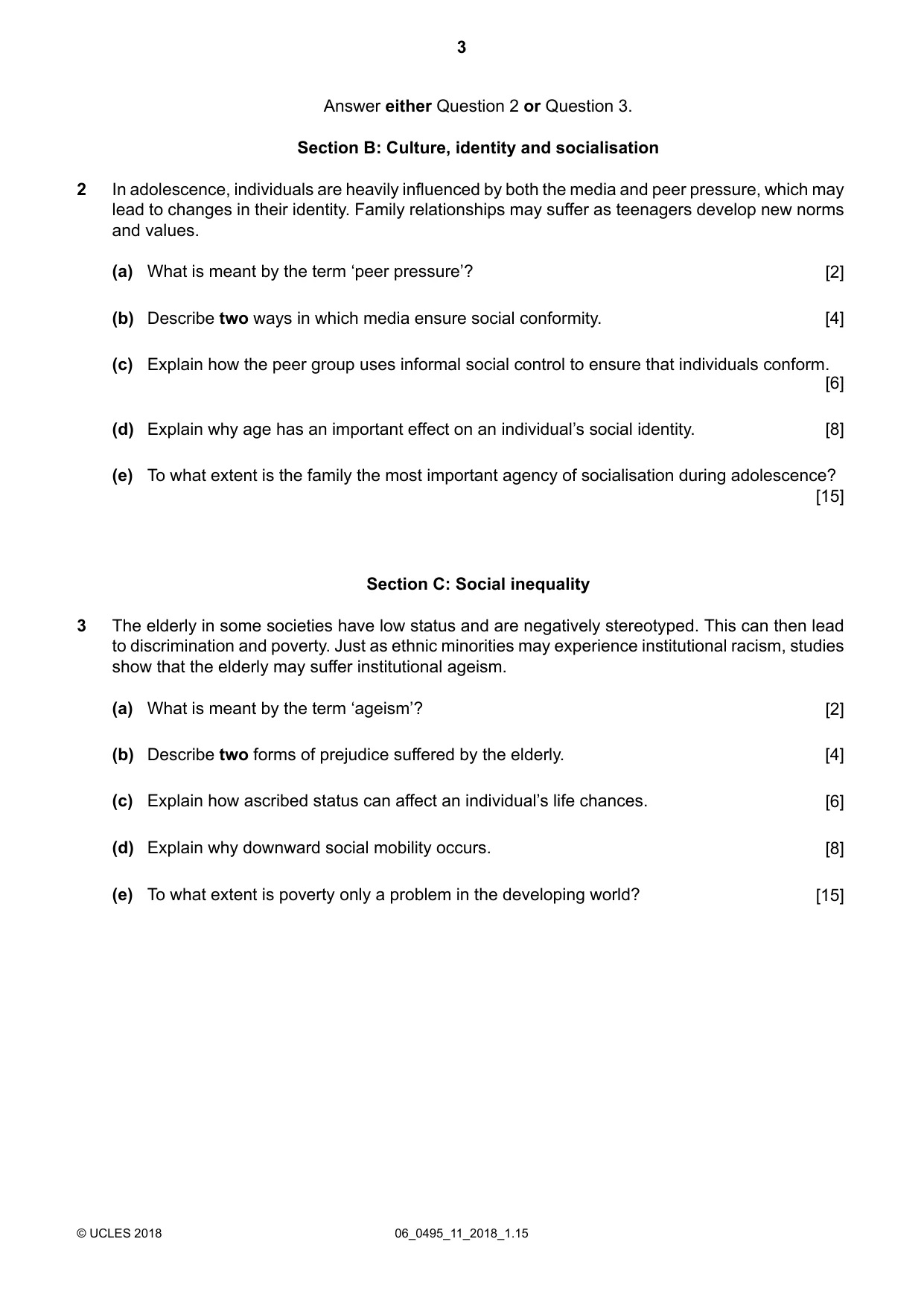
Answer either Question 2 or Question 3. Section B: Culture, identity and socialisation In adolescence, individuals are heavily influenced by both the media and peer pressure, which may lead to changes in their identity. Family relationships may suffer as teenagers develop new norms and values. 2 What is meant by the term ‘peer pressure’? [2] (a) Describe two ways in which media ensure social conformity. [4] (b) Explain how the peer group uses informal social control to ensure that individuals conform. [6] (c) Explain why age has an important effect on an individual’s social identity. [8] (d) To what extent is the family the most important agency of socialisation during adolescence? [15] (e) Section C: Social inequality The elderly in some societies have low status and are negatively stereotyped. This can then lead to discrimination and poverty. Just as ethnic minorities may experience institutional racism, studies show that the elderly may suffer institutional ageism. 3 What is meant by the term ‘ageism’? [2] (a) Describe two forms of prejudice suffered by the elderly. [4] (b) Explain how ascribed status can affect an individual’s life chances. [6] (c) Explain why downward social mobility occurs. [8] (d) To what extent is poverty only a problem in the developing world? [15] (e) 06_0495_11_2018_1.15 © UCLES 2018 3
Question paper, page 4
BLANK PAGE Permission to reproduce items where third-party owned material protected by copyright is included has been sought and cleared where possible. Every reasonable effort has been made by the publisher (UCLES) to trace copyright holders, but if any items requiring clearance have unwittingly been included, the publisher will be pleased to make amends at the earliest possible opportunity. To avoid the issue of disclosure of answer-related information to candidates, all copyright acknowledgements are reproduced online in the Cambridge International Examinations Copyright Acknowledgements Booklet. This is produced for each series of examinations and is freely available to download at www.cie.org.uk after the live examination series. Cambridge International Examinations is part of the Cambridge Assessment Group. Cambridge Assessment is the brand name of University of Cambridge Local Examinations Syndicate (UCLES), which is itself a department of the University of Cambridge. 06_0495_11_2018_1.15 © UCLES 2018 4
Mark scheme, page 1
IGCSE™ is a registered trademark. This document consists of 23 printed pages. © UCLES 2018 [Turn over Cambridge Assessment International Education Cambridge International General Certificate of Secondary Education SOCIOLOGY 0495/11 Paper 1 May/June 2018 MARK SCHEME Maximum Mark: 80 Published This mark scheme is published as an aid to teachers and candidates, to indicate the requirements of the examination. It shows the basis on which Examiners were instructed to award marks. It does not indicate the details of the discussions that took place at an Examiners’ meeting before marking began, which would have considered the acceptability of alternative answers. Mark schemes should be read in conjunction with the question paper and the Principal Examiner Report for Teachers. Cambridge International will not enter into discussions about these mark schemes. Cambridge International is publishing the mark schemes for the May/June 2018 series for most Cambridge IGCSE™, Cambridge International A and AS Level and Cambridge Pre-U components, and some Cambridge O Level components.
Mark scheme, page 2
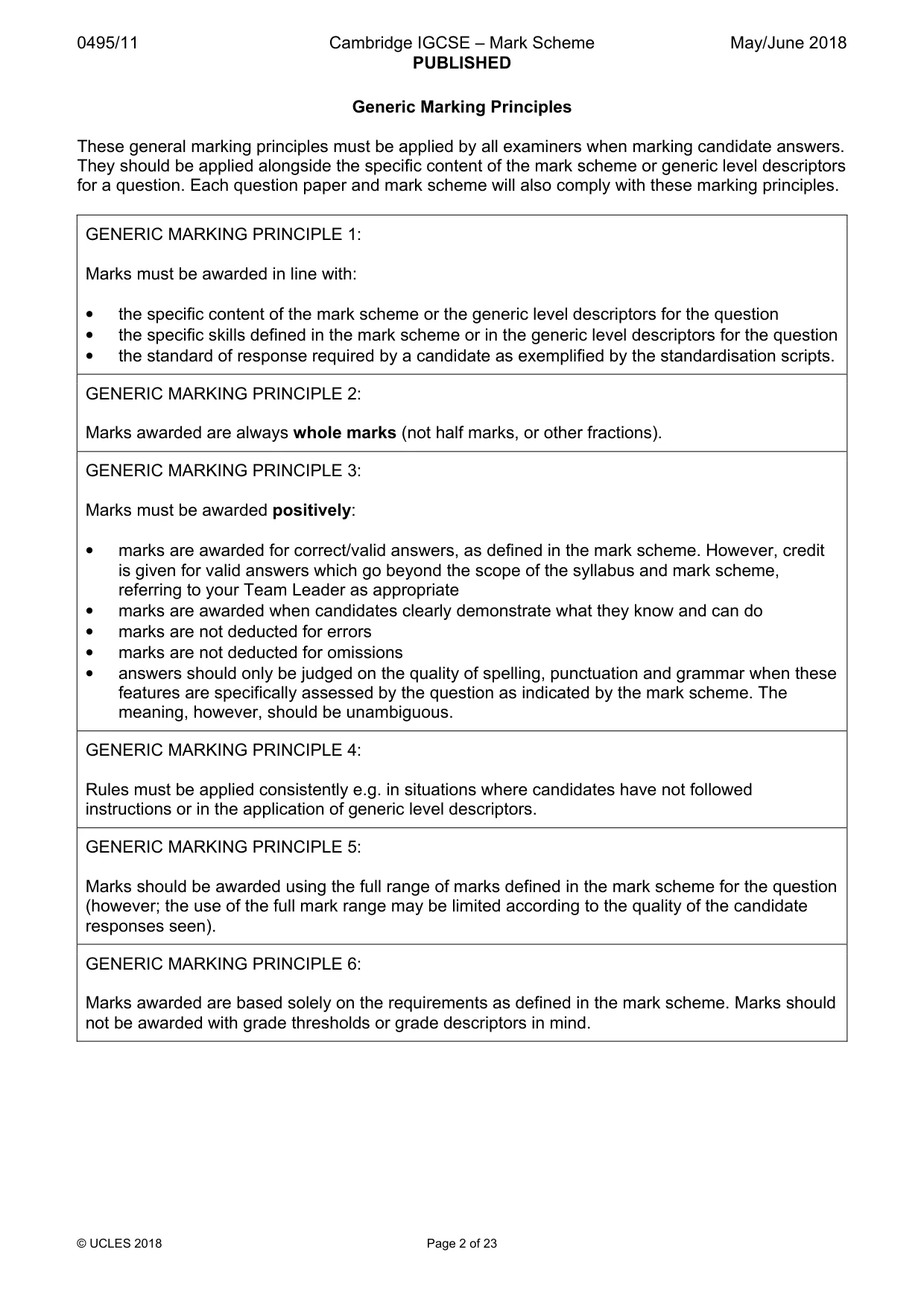
0495/11 Cambridge IGCSE – Mark Scheme PUBLISHED May/June 2018 © UCLES 2018 Page 2 of 23 Generic Marking Principles These general marking principles must be applied by all examiners when marking candidate answers. They should be applied alongside the specific content of the mark scheme or generic level descriptors for a question. Each question paper and mark scheme will also comply with these marking principles. GENERIC MARKING PRINCIPLE 1: Marks must be awarded in line with: • the specific content of the mark scheme or the generic level descriptors for the question • the specific skills defined in the mark scheme or in the generic level descriptors for the question • the standard of response required by a candidate as exemplified by the standardisation scripts. GENERIC MARKING PRINCIPLE 2: Marks awarded are always whole marks (not half marks, or other fractions). GENERIC MARKING PRINCIPLE 3: Marks must be awarded positively: • marks are awarded for correct/valid answers, as defined in the mark scheme. However, credit is given for valid answers which go beyond the scope of the syllabus and mark scheme, referring to your Team Leader as appropriate • marks are awarded when candidates clearly demonstrate what they know and can do • marks are not deducted for errors • marks are not deducted for omissions • answers should only be judged on the quality of spelling, punctuation and grammar when these features are specifically assessed by the question as indicated by the mark scheme. The meaning, however, should be unambiguous. GENERIC MARKING PRINCIPLE 4: Rules must be applied consistently e.g. in situations where candidates have not followed instructions or in the application of generic level descriptors. GENERIC MARKING PRINCIPLE 5: Marks should be awarded using the full range of marks defined in the mark scheme for the question (however; the use of the full mark range may be limited according to the quality of the candidate responses seen). GENERIC MARKING PRINCIPLE 6: Marks awarded are based solely on the requirements as defined in the mark scheme. Marks should not be awarded with grade thresholds or grade descriptors in mind.
Mark scheme, page 3
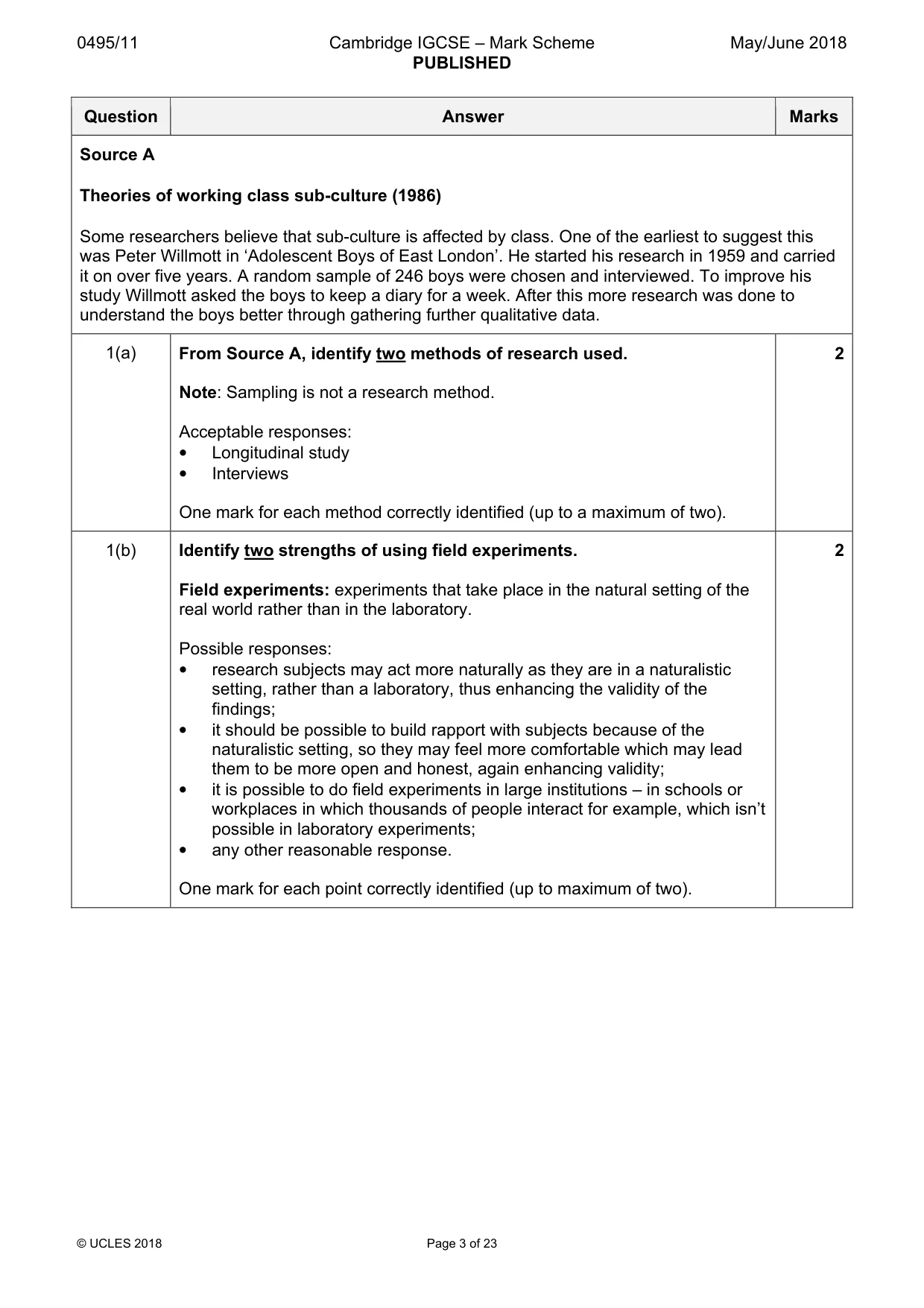
0495/11 Cambridge IGCSE – Mark Scheme PUBLISHED May/June 2018 © UCLES 2018 Page 3 of 23 Question Answer Marks Source A Theories of working class sub-culture (1986) Some researchers believe that sub-culture is affected by class. One of the earliest to suggest this was Peter Willmott in ‘Adolescent Boys of East London’. He started his research in 1959 and carried it on over five years. A random sample of 246 boys were chosen and interviewed. To improve his study Willmott asked the boys to keep a diary for a week. After this more research was done to understand the boys better through gathering further qualitative data. 1(a) From Source A, identify two methods of research used. Note: Sampling is not a research method. Acceptable responses: • Longitudinal study • Interviews One mark for each method correctly identified (up to a maximum of two). 2 1(b) Identify two strengths of using field experiments. Field experiments: experiments that take place in the natural setting of the real world rather than in the laboratory. Possible responses: • research subjects may act more naturally as they are in a naturalistic setting, rather than a laboratory, thus enhancing the validity of the findings; • it should be possible to build rapport with subjects because of the naturalistic setting, so they may feel more comfortable which may lead them to be more open and honest, again enhancing validity; • it is possible to do field experiments in large institutions – in schools or workplaces in which thousands of people interact for example, which isn’t possible in laboratory experiments; • any other reasonable response. One mark for each point correctly identified (up to maximum of two). 2
Mark scheme, page 4
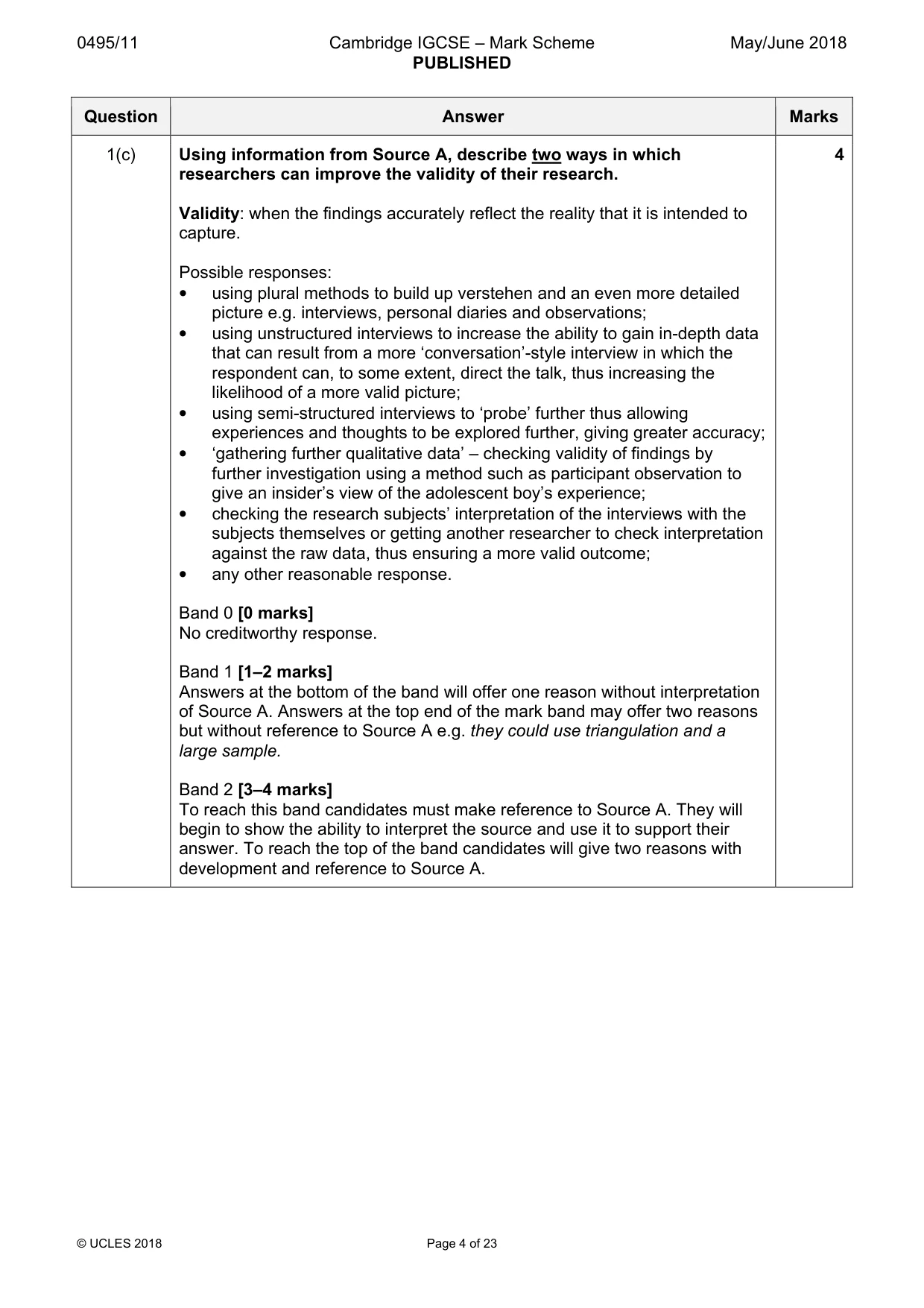
0495/11 Cambridge IGCSE – Mark Scheme PUBLISHED May/June 2018 © UCLES 2018 Page 4 of 23 Question Answer Marks 1(c) Using information from Source A, describe two ways in which researchers can improve the validity of their research. Validity: when the findings accurately reflect the reality that it is intended to capture. Possible responses: • using plural methods to build up verstehen and an even more detailed picture e.g. interviews, personal diaries and observations; • using unstructured interviews to increase the ability to gain in-depth data that can result from a more ‘conversation’-style interview in which the respondent can, to some extent, direct the talk, thus increasing the likelihood of a more valid picture; • using semi-structured interviews to ‘probe’ further thus allowing experiences and thoughts to be explored further, giving greater accuracy; • ‘gathering further qualitative data’ – checking validity of findings by further investigation using a method such as participant observation to give an insider’s view of the adolescent boy’s experience; • checking the research subjects’ interpretation of the interviews with the subjects themselves or getting another researcher to check interpretation against the raw data, thus ensuring a more valid outcome; • any other reasonable response. Band 0 [0 marks] No creditworthy response. Band 1 [1–2 marks] Answers at the bottom of the band will offer one reason without interpretation of Source A. Answers at the top end of the mark band may offer two reasons but without reference to Source A e.g. they could use triangulation and a large sample. Band 2 [3–4 marks] To reach this band candidates must make reference to Source A. They will begin to show the ability to interpret the source and use it to support their answer. To reach the top of the band candidates will give two reasons with development and reference to Source A. 4
Mark scheme, page 5
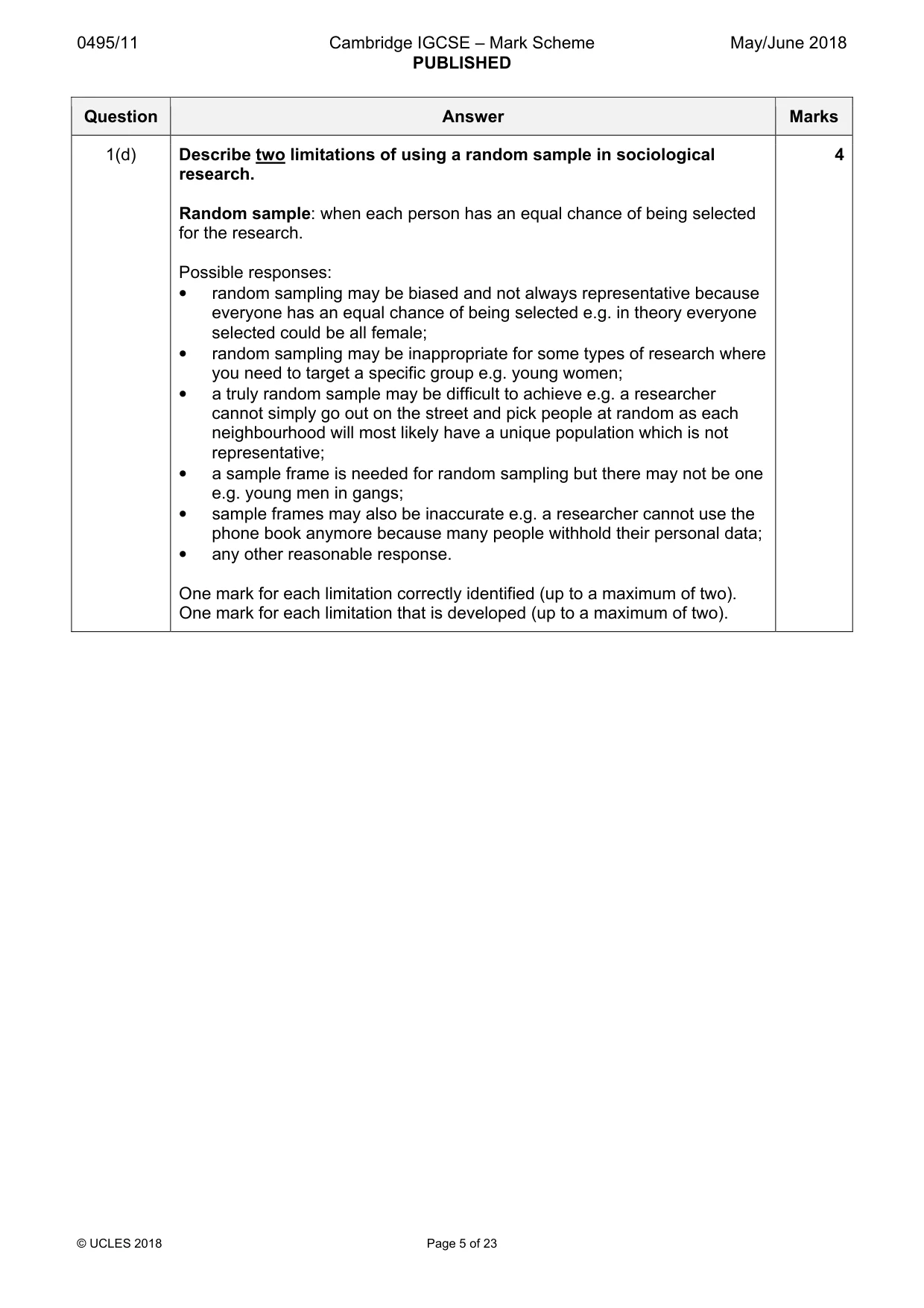
0495/11 Cambridge IGCSE – Mark Scheme PUBLISHED May/June 2018 © UCLES 2018 Page 5 of 23 Question Answer Marks 1(d) Describe two limitations of using a random sample in sociological research. Random sample: when each person has an equal chance of being selected for the research. Possible responses: • random sampling may be biased and not always representative because everyone has an equal chance of being selected e.g. in theory everyone selected could be all female; • random sampling may be inappropriate for some types of research where you need to target a specific group e.g. young women; • a truly random sample may be difficult to achieve e.g. a researcher cannot simply go out on the street and pick people at random as each neighbourhood will most likely have a unique population which is not representative; • a sample frame is needed for random sampling but there may not be one e.g. young men in gangs; • sample frames may also be inaccurate e.g. a researcher cannot use the phone book anymore because many people withhold their personal data; • any other reasonable response. One mark for each limitation correctly identified (up to a maximum of two). One mark for each limitation that is developed (up to a maximum of two). 4
Mark scheme, page 6
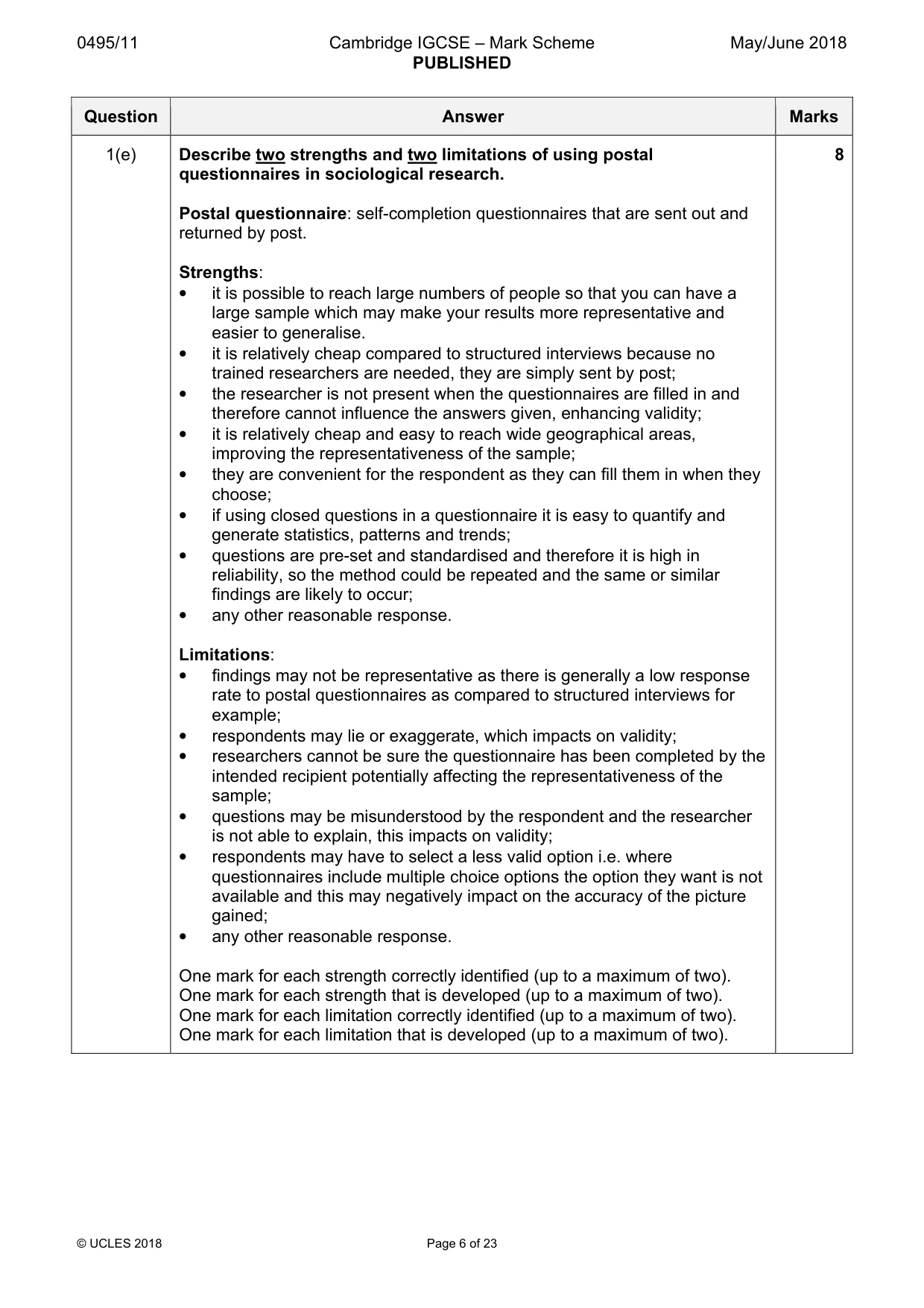
0495/11 Cambridge IGCSE – Mark Scheme PUBLISHED May/June 2018 © UCLES 2018 Page 6 of 23 Question Answer Marks 1(e) Describe two strengths and two limitations of using postal questionnaires in sociological research. Postal questionnaire: self-completion questionnaires that are sent out and returned by post. Strengths: • it is possible to reach large numbers of people so that you can have a large sample which may make your results more representative and easier to generalise. • it is relatively cheap compared to structured interviews because no trained researchers are needed, they are simply sent by post; • the researcher is not present when the questionnaires are filled in and therefore cannot influence the answers given, enhancing validity; • it is relatively cheap and easy to reach wide geographical areas, improving the representativeness of the sample; • they are convenient for the respondent as they can fill them in when they choose; • if using closed questions in a questionnaire it is easy to quantify and generate statistics, patterns and trends; • questions are pre-set and standardised and therefore it is high in reliability, so the method could be repeated and the same or similar findings are likely to occur; • any other reasonable response. Limitations: • findings may not be representative as there is generally a low response rate to postal questionnaires as compared to structured interviews for example; • respondents may lie or exaggerate, which impacts on validity; • researchers cannot be sure the questionnaire has been completed by the intended recipient potentially affecting the representativeness of the sample; • questions may be misunderstood by the respondent and the researcher is not able to explain, this impacts on validity; • respondents may have to select a less valid option i.e. where questionnaires include multiple choice options the option they want is not available and this may negatively impact on the accuracy of the picture gained; • any other reasonable response. One mark for each strength correctly identified (up to a maximum of two). One mark for each strength that is developed (up to a maximum of two). One mark for each limitation correctly identified (up to a maximum of two). One mark for each limitation that is developed (up to a maximum of two). 8
Mark scheme, page 7
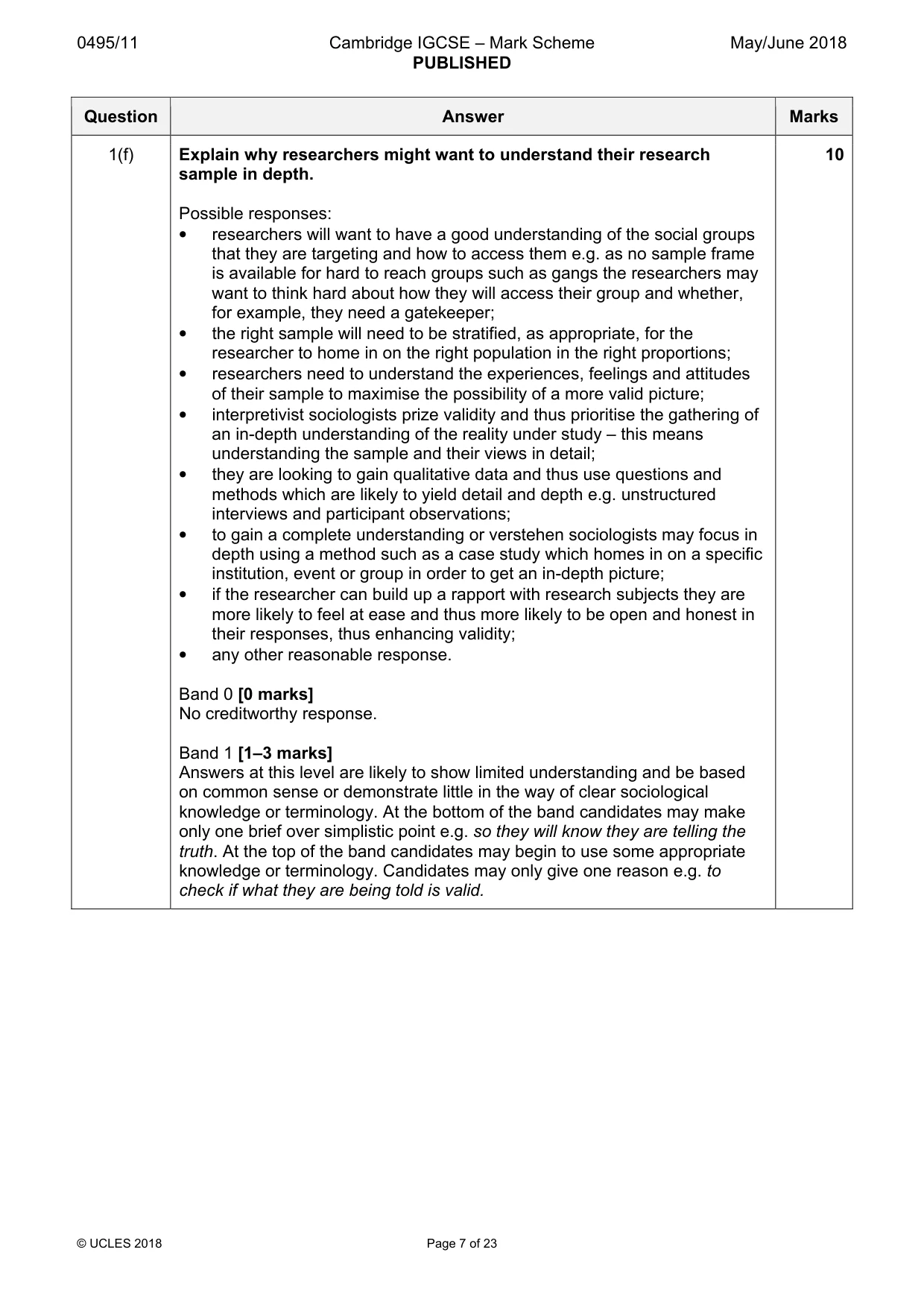
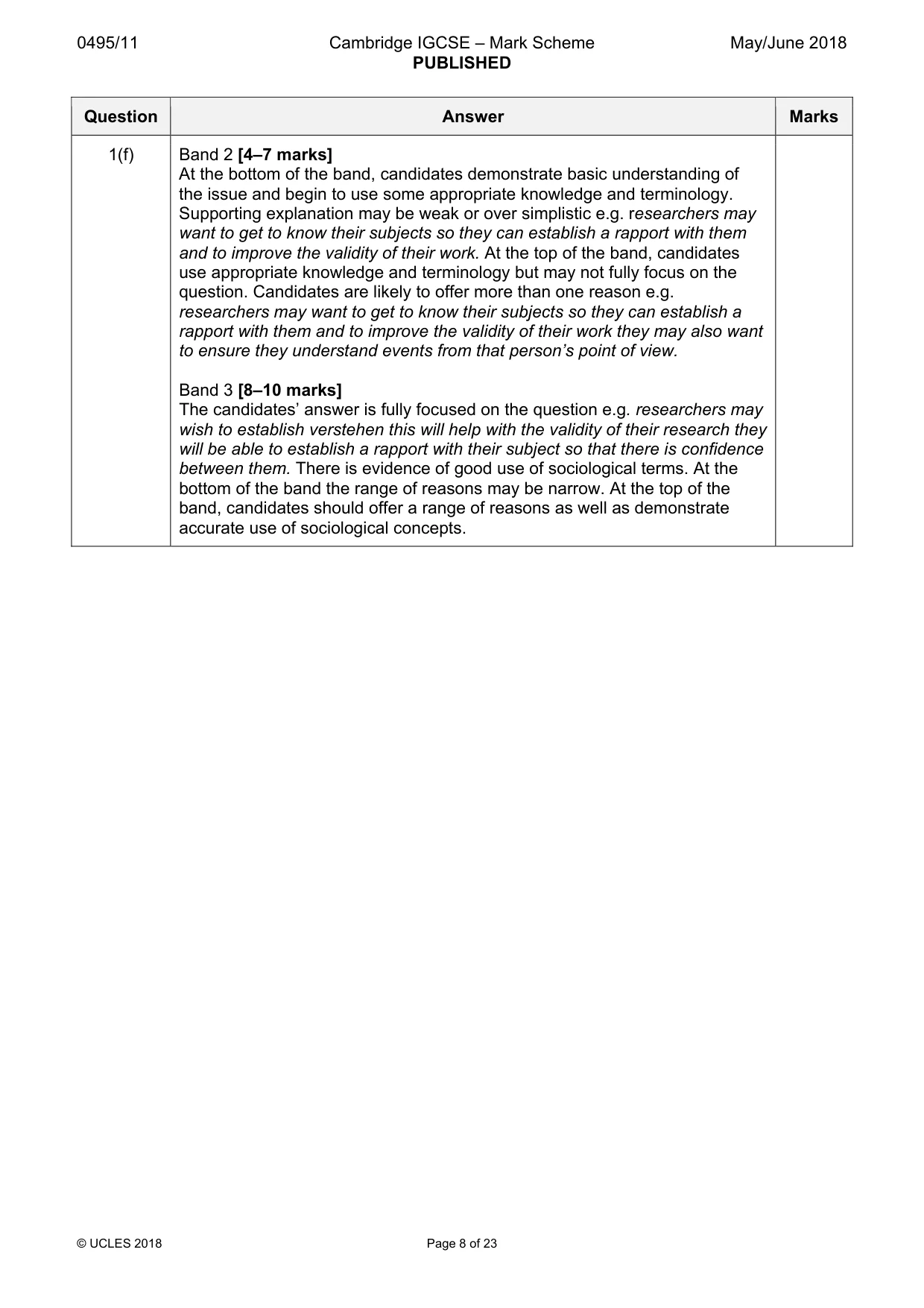
0495/11 Cambridge IGCSE – Mark Scheme PUBLISHED May/June 2018 © UCLES 2018 Page 7 of 23 Question Answer Marks 1(f) Explain why researchers might want to understand their research sample in depth. Possible responses: • researchers will want to have a good understanding of the social groups that they are targeting and how to access them e.g. as no sample frame is available for hard to reach groups such as gangs the researchers may want to think hard about how they will access their group and whether, for example, they need a gatekeeper; • the right sample will need to be stratified, as appropriate, for the researcher to home in on the right population in the right proportions; • researchers need to understand the experiences, feelings and attitudes of their sample to maximise the possibility of a more valid picture; • interpretivist sociologists prize validity and thus prioritise the gathering of an in-depth understanding of the reality under study – this means understanding the sample and their views in detail; • they are looking to gain qualitative data and thus use questions and methods which are likely to yield detail and depth e.g. unstructured interviews and participant observations; • to gain a complete understanding or verstehen sociologists may focus in depth using a method such as a case study which homes in on a specific institution, event or group in order to get an in-depth picture; • if the researcher can build up a rapport with research subjects they are more likely to feel at ease and thus more likely to be open and honest in their responses, thus enhancing validity; • any other reasonable response. Band 0 [0 marks] No creditworthy response. Band 1 [1–3 marks] Answers at this level are likely to show limited understanding and be based on common sense or demonstrate little in the way of clear sociological knowledge or terminology. At the bottom of the band candidates may make only one brief over simplistic point e.g. so they will know they are telling the truth. At the top of the band candidates may begin to use some appropriate knowledge or terminology. Candidates may only give one reason e.g. to check if what they are being told is valid. 10
Mark scheme, page 8
0495/11 Cambridge IGCSE – Mark Scheme PUBLISHED May/June 2018 © UCLES 2018 Page 8 of 23 Question Answer Marks 1(f) Band 2 [4–7 marks] At the bottom of the band, candidates demonstrate basic understanding of the issue and begin to use some appropriate knowledge and terminology. Supporting explanation may be weak or over simplistic e.g. researchers may want to get to know their subjects so they can establish a rapport with them and to improve the validity of their work. At the top of the band, candidates use appropriate knowledge and terminology but may not fully focus on the question. Candidates are likely to offer more than one reason e.g. researchers may want to get to know their subjects so they can establish a rapport with them and to improve the validity of their work they may also want to ensure they understand events from that person’s point of view. Band 3 [8–10 marks] The candidates’ answer is fully focused on the question e.g. researchers may wish to establish verstehen this will help with the validity of their research they will be able to establish a rapport with their subject so that there is confidence between them. There is evidence of good use of sociological terms. At the bottom of the band the range of reasons may be narrow. At the top of the band, candidates should offer a range of reasons as well as demonstrate accurate use of sociological concepts.
Mark scheme, page 9
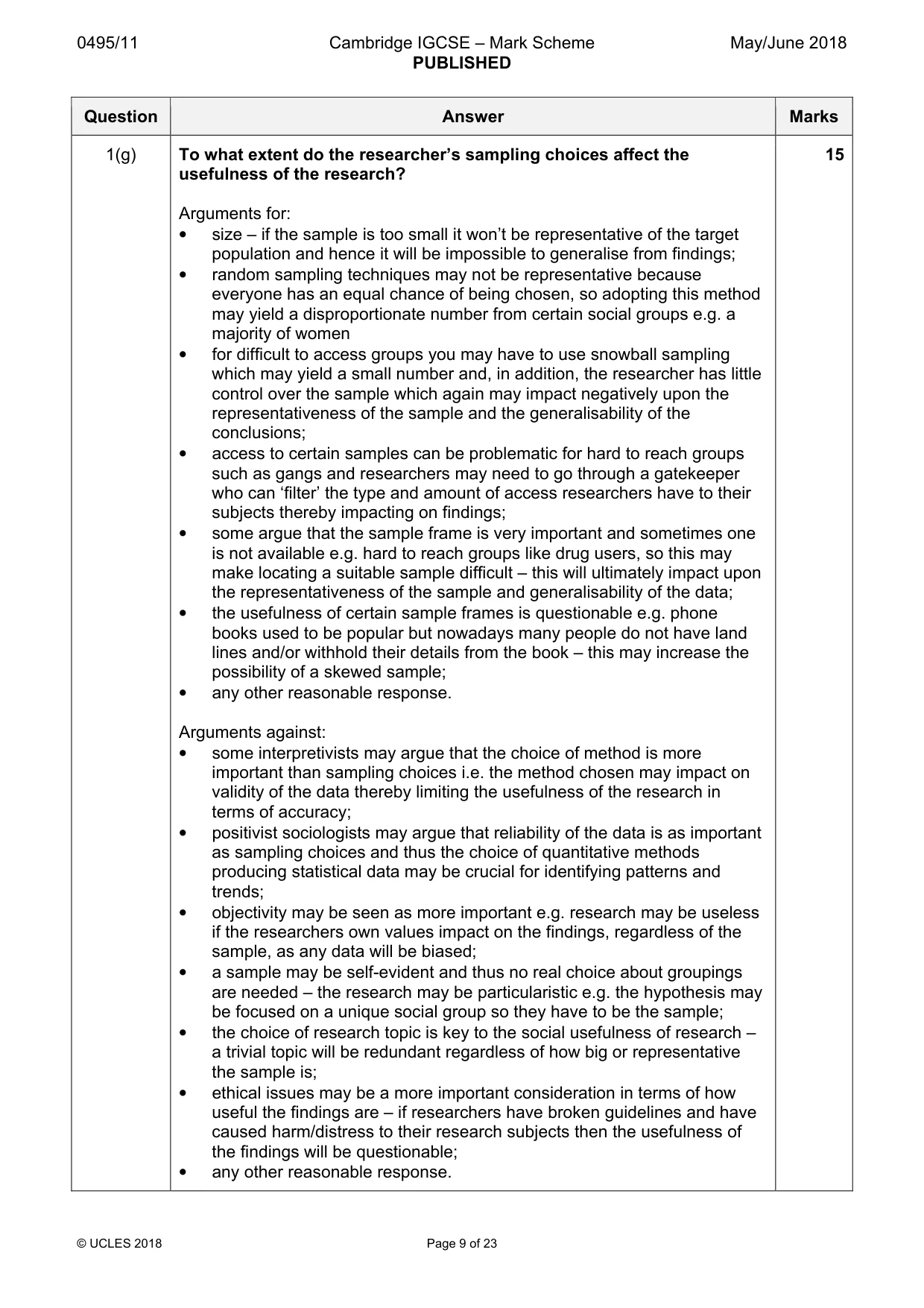
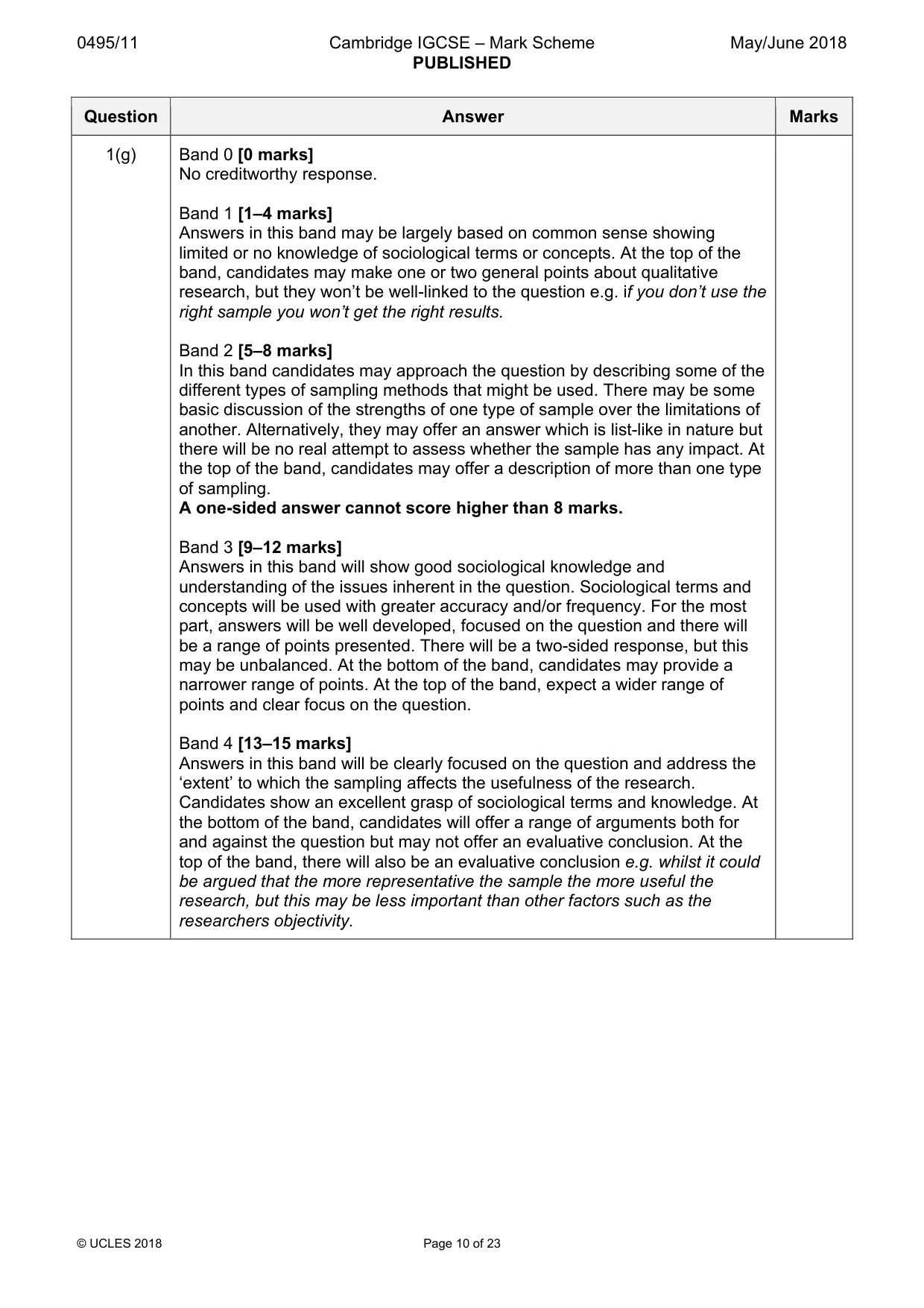
0495/11 Cambridge IGCSE – Mark Scheme PUBLISHED May/June 2018 © UCLES 2018 Page 9 of 23 Question Answer Marks 1(g) To what extent do the researcher’s sampling choices affect the usefulness of the research? Arguments for: • size – if the sample is too small it won’t be representative of the target population and hence it will be impossible to generalise from findings; • random sampling techniques may not be representative because everyone has an equal chance of being chosen, so adopting this method may yield a disproportionate number from certain social groups e.g. a majority of women • for difficult to access groups you may have to use snowball sampling which may yield a small number and, in addition, the researcher has little control over the sample which again may impact negatively upon the representativeness of the sample and the generalisability of the conclusions; • access to certain samples can be problematic for hard to reach groups such as gangs and researchers may need to go through a gatekeeper who can ‘filter’ the type and amount of access researchers have to their subjects thereby impacting on findings; • some argue that the sample frame is very important and sometimes one is not available e.g. hard to reach groups like drug users, so this may make locating a suitable sample difficult – this will ultimately impact upon the representativeness of the sample and generalisability of the data; • the usefulness of certain sample frames is questionable e.g. phone books used to be popular but nowadays many people do not have land lines and/or withhold their details from the book – this may increase the possibility of a skewed sample; • any other reasonable response. Arguments against: • some interpretivists may argue that the choice of method is more important than sampling choices i.e. the method chosen may impact on validity of the data thereby limiting the usefulness of the research in terms of accuracy; • positivist sociologists may argue that reliability of the data is as important as sampling choices and thus the choice of quantitative methods producing statistical data may be crucial for identifying patterns and trends; • objectivity may be seen as more important e.g. research may be useless if the researchers own values impact on the findings, regardless of the sample, as any data will be biased; • a sample may be self-evident and thus no real choice about groupings are needed – the research may be particularistic e.g. the hypothesis may be focused on a unique social group so they have to be the sample; • the choice of research topic is key to the social usefulness of research – a trivial topic will be redundant regardless of how big or representative the sample is; • ethical issues may be a more important consideration in terms of how useful the findings are – if researchers have broken guidelines and have caused harm/distress to their research subjects then the usefulness of the findings will be questionable; • any other reasonable response. 15
Mark scheme, page 10
0495/11 Cambridge IGCSE – Mark Scheme PUBLISHED May/June 2018 © UCLES 2018 Page 10 of 23 Question Answer Marks 1(g) Band 0 [0 marks] No creditworthy response. Band 1 [1–4 marks] Answers in this band may be largely based on common sense showing limited or no knowledge of sociological terms or concepts. At the top of the band, candidates may make one or two general points about qualitative research, but they won’t be well-linked to the question e.g. if you don’t use the right sample you won’t get the right results. Band 2 [5–8 marks] In this band candidates may approach the question by describing some of the different types of sampling methods that might be used. There may be some basic discussion of the strengths of one type of sample over the limitations of another. Alternatively, they may offer an answer which is list-like in nature but there will be no real attempt to assess whether the sample has any impact. At the top of the band, candidates may offer a description of more than one type of sampling. A one-sided answer cannot score higher than 8 marks. Band 3 [9–12 marks] Answers in this band will show good sociological knowledge and understanding of the issues inherent in the question. Sociological terms and concepts will be used with greater accuracy and/or frequency. For the most part, answers will be well developed, focused on the question and there will be a range of points presented. There will be a two-sided response, but this may be unbalanced. At the bottom of the band, candidates may provide a narrower range of points. At the top of the band, expect a wider range of points and clear focus on the question. Band 4 [13–15 marks] Answers in this band will be clearly focused on the question and address the ‘extent’ to which the sampling affects the usefulness of the research. Candidates show an excellent grasp of sociological terms and knowledge. At the bottom of the band, candidates will offer a range of arguments both for and against the question but may not offer an evaluative conclusion. At the top of the band, there will also be an evaluative conclusion e.g. whilst it could be argued that the more representative the sample the more useful the research, but this may be less important than other factors such as the researchers objectivity.
Mark scheme, page 11
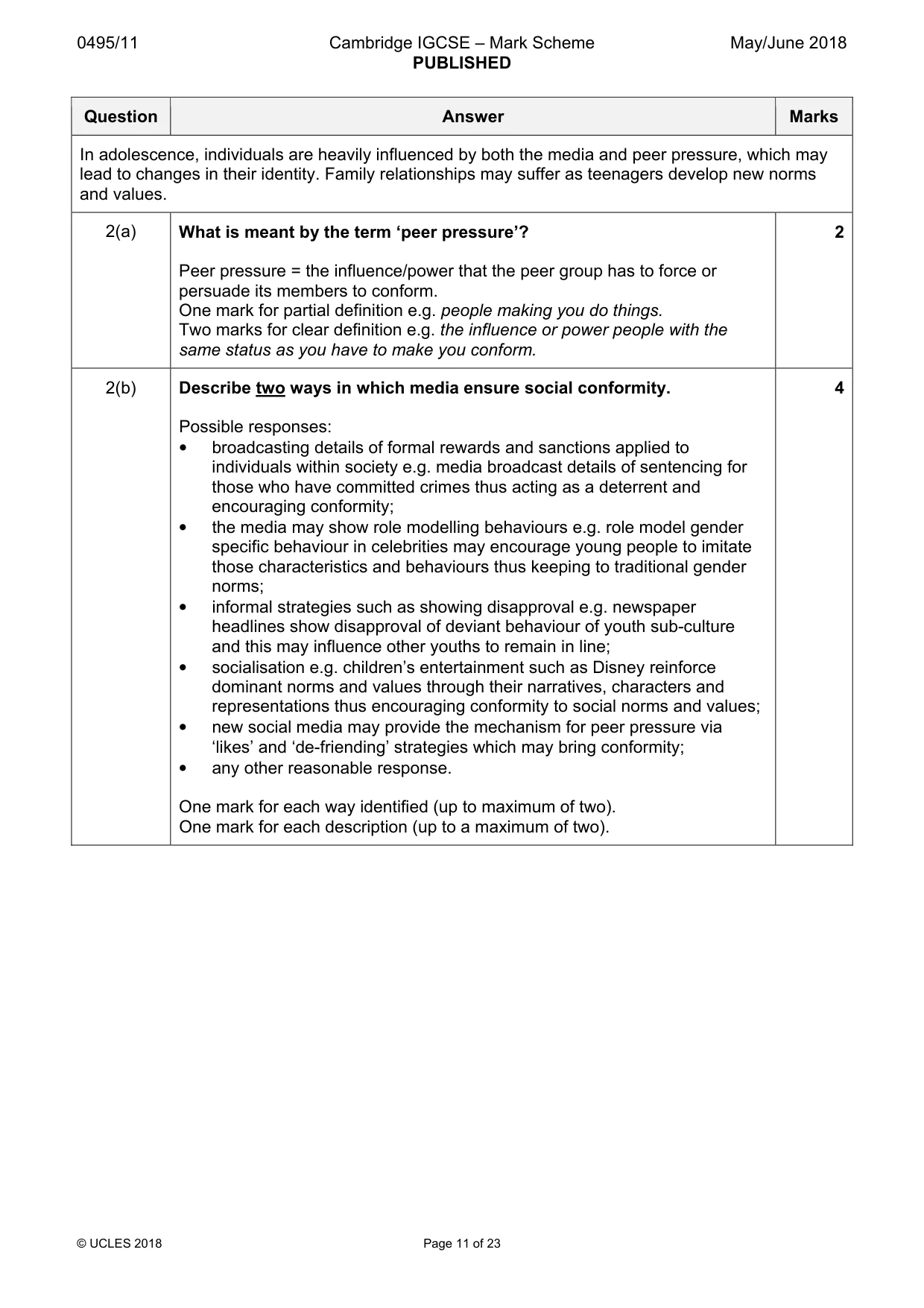
0495/11 Cambridge IGCSE – Mark Scheme PUBLISHED May/June 2018 © UCLES 2018 Page 11 of 23 Question Answer Marks In adolescence, individuals are heavily influenced by both the media and peer pressure, which may lead to changes in their identity. Family relationships may suffer as teenagers develop new norms and values. 2(a) What is meant by the term ‘peer pressure’? Peer pressure = the influence/power that the peer group has to force or persuade its members to conform. One mark for partial definition e.g. people making you do things. Two marks for clear definition e.g. the influence or power people with the same status as you have to make you conform. 2 2(b) Describe two ways in which media ensure social conformity. Possible responses: • broadcasting details of formal rewards and sanctions applied to individuals within society e.g. media broadcast details of sentencing for those who have committed crimes thus acting as a deterrent and encouraging conformity; • the media may show role modelling behaviours e.g. role model gender specific behaviour in celebrities may encourage young people to imitate those characteristics and behaviours thus keeping to traditional gender norms; • informal strategies such as showing disapproval e.g. newspaper headlines show disapproval of deviant behaviour of youth sub-culture and this may influence other youths to remain in line; • socialisation e.g. children’s entertainment such as Disney reinforce dominant norms and values through their narratives, characters and representations thus encouraging conformity to social norms and values; • new social media may provide the mechanism for peer pressure via ‘likes’ and ‘de-friending’ strategies which may bring conformity; • any other reasonable response. One mark for each way identified (up to maximum of two). One mark for each description (up to a maximum of two). 4
Mark scheme, page 12
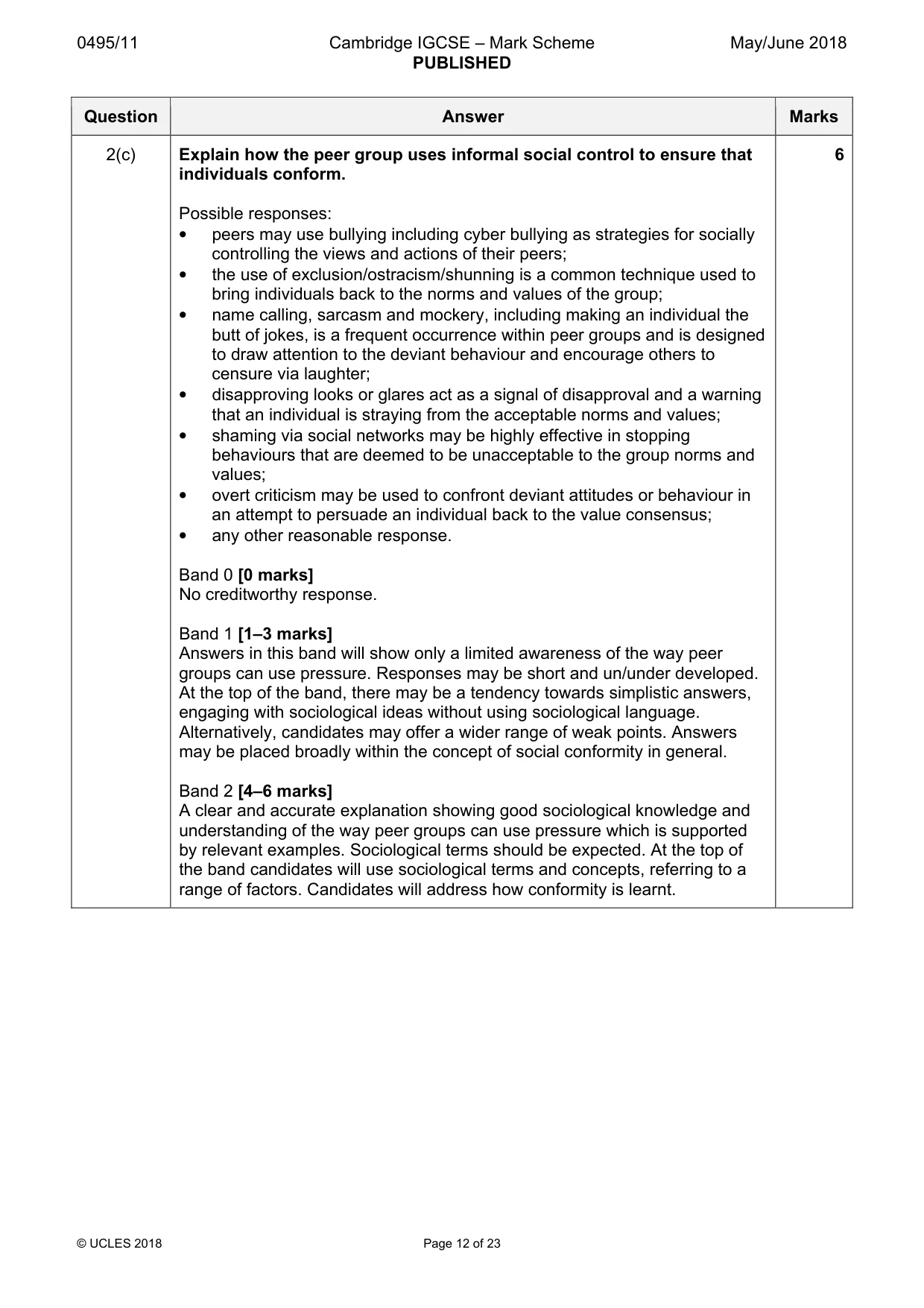
0495/11 Cambridge IGCSE – Mark Scheme PUBLISHED May/June 2018 © UCLES 2018 Page 12 of 23 Question Answer Marks 2(c) Explain how the peer group uses informal social control to ensure that individuals conform. Possible responses: • peers may use bullying including cyber bullying as strategies for socially controlling the views and actions of their peers; • the use of exclusion/ostracism/shunning is a common technique used to bring individuals back to the norms and values of the group; • name calling, sarcasm and mockery, including making an individual the butt of jokes, is a frequent occurrence within peer groups and is designed to draw attention to the deviant behaviour and encourage others to censure via laughter; • disapproving looks or glares act as a signal of disapproval and a warning that an individual is straying from the acceptable norms and values; • shaming via social networks may be highly effective in stopping behaviours that are deemed to be unacceptable to the group norms and values; • overt criticism may be used to confront deviant attitudes or behaviour in an attempt to persuade an individual back to the value consensus; • any other reasonable response. Band 0 [0 marks] No creditworthy response. Band 1 [1–3 marks] Answers in this band will show only a limited awareness of the way peer groups can use pressure. Responses may be short and un/under developed. At the top of the band, there may be a tendency towards simplistic answers, engaging with sociological ideas without using sociological language. Alternatively, candidates may offer a wider range of weak points. Answers may be placed broadly within the concept of social conformity in general. Band 2 [4–6 marks] A clear and accurate explanation showing good sociological knowledge and understanding of the way peer groups can use pressure which is supported by relevant examples. Sociological terms should be expected. At the top of the band candidates will use sociological terms and concepts, referring to a range of factors. Candidates will address how conformity is learnt. 6
Mark scheme, page 13
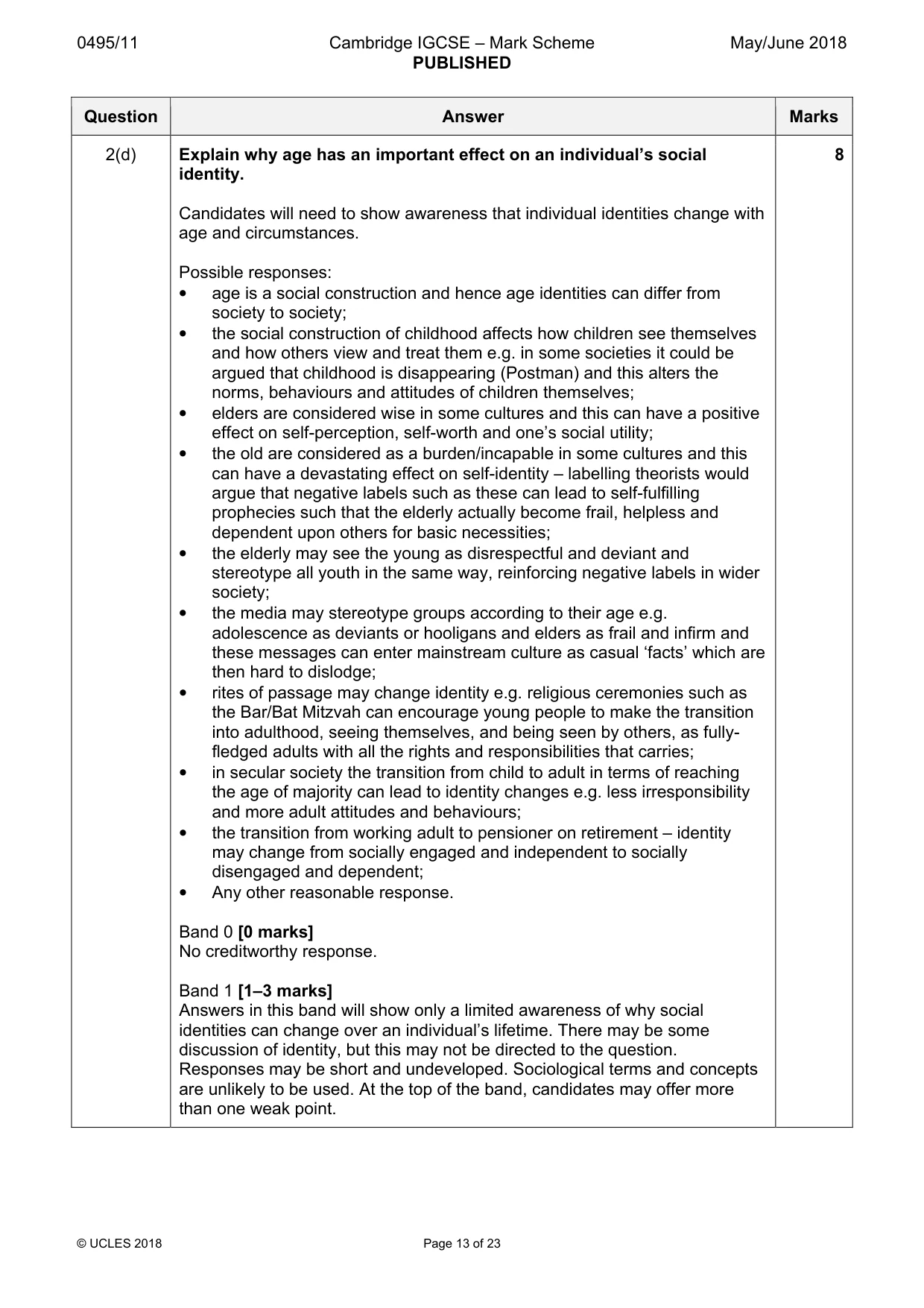
0495/11 Cambridge IGCSE – Mark Scheme PUBLISHED May/June 2018 © UCLES 2018 Page 13 of 23 Question Answer Marks 2(d) Explain why age has an important effect on an individual’s social identity. Candidates will need to show awareness that individual identities change with age and circumstances. Possible responses: • age is a social construction and hence age identities can differ from society to society; • the social construction of childhood affects how children see themselves and how others view and treat them e.g. in some societies it could be argued that childhood is disappearing (Postman) and this alters the norms, behaviours and attitudes of children themselves; • elders are considered wise in some cultures and this can have a positive effect on self-perception, self-worth and one’s social utility; • the old are considered as a burden/incapable in some cultures and this can have a devastating effect on self-identity – labelling theorists would argue that negative labels such as these can lead to self-fulfilling prophecies such that the elderly actually become frail, helpless and dependent upon others for basic necessities; • the elderly may see the young as disrespectful and deviant and stereotype all youth in the same way, reinforcing negative labels in wider society; • the media may stereotype groups according to their age e.g. adolescence as deviants or hooligans and elders as frail and infirm and these messages can enter mainstream culture as casual ‘facts’ which are then hard to dislodge; • rites of passage may change identity e.g. religious ceremonies such as the Bar/Bat Mitzvah can encourage young people to make the transition into adulthood, seeing themselves, and being seen by others, as fully- fledged adults with all the rights and responsibilities that carries; • in secular society the transition from child to adult in terms of reaching the age of majority can lead to identity changes e.g. less irresponsibility and more adult attitudes and behaviours; • the transition from working adult to pensioner on retirement – identity may change from socially engaged and independent to socially disengaged and dependent; • Any other reasonable response. Band 0 [0 marks] No creditworthy response. Band 1 [1–3 marks] Answers in this band will show only a limited awareness of why social identities can change over an individual’s lifetime. There may be some discussion of identity, but this may not be directed to the question. Responses may be short and undeveloped. Sociological terms and concepts are unlikely to be used. At the top of the band, candidates may offer more than one weak point. 8
Mark scheme, page 14
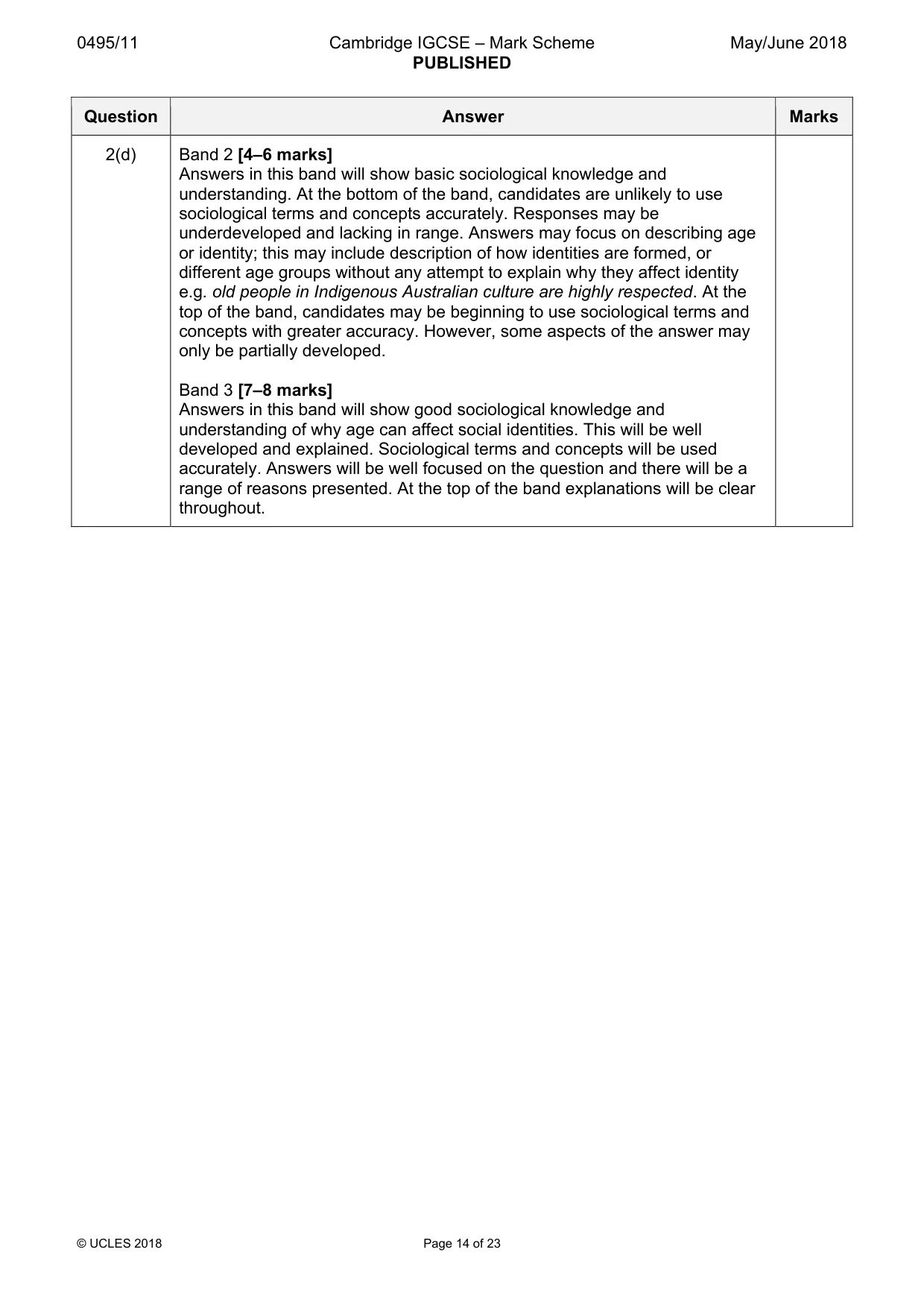
0495/11 Cambridge IGCSE – Mark Scheme PUBLISHED May/June 2018 © UCLES 2018 Page 14 of 23 Question Answer Marks 2(d) Band 2 [4–6 marks] Answers in this band will show basic sociological knowledge and understanding. At the bottom of the band, candidates are unlikely to use sociological terms and concepts accurately. Responses may be underdeveloped and lacking in range. Answers may focus on describing age or identity; this may include description of how identities are formed, or different age groups without any attempt to explain why they affect identity e.g. old people in Indigenous Australian culture are highly respected. At the top of the band, candidates may be beginning to use sociological terms and concepts with greater accuracy. However, some aspects of the answer may only be partially developed. Band 3 [7–8 marks] Answers in this band will show good sociological knowledge and understanding of why age can affect social identities. This will be well developed and explained. Sociological terms and concepts will be used accurately. Answers will be well focused on the question and there will be a range of reasons presented. At the top of the band explanations will be clear throughout.
Mark scheme, page 15
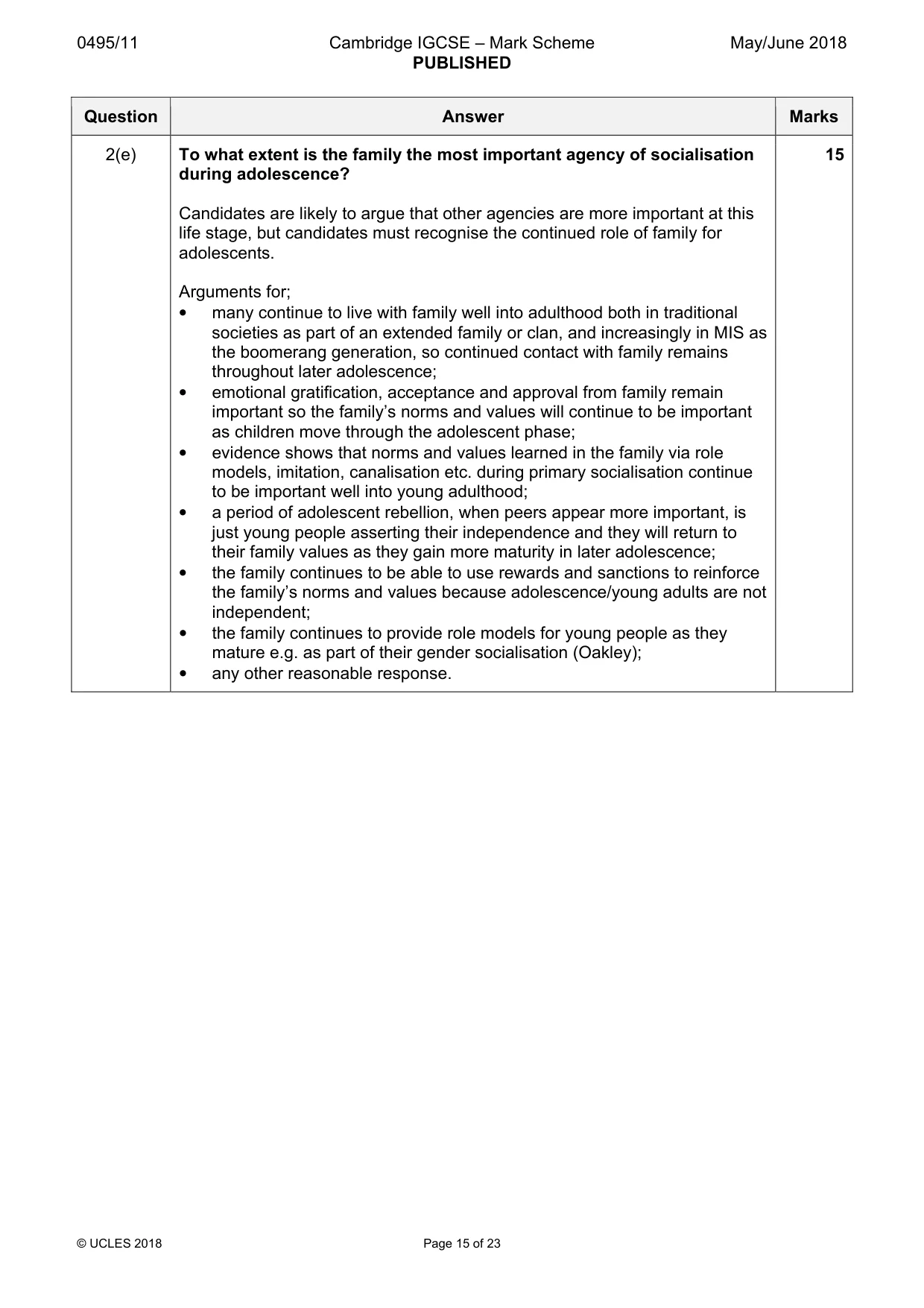
0495/11 Cambridge IGCSE – Mark Scheme PUBLISHED May/June 2018 © UCLES 2018 Page 15 of 23 Question Answer Marks 2(e) To what extent is the family the most important agency of socialisation during adolescence? Candidates are likely to argue that other agencies are more important at this life stage, but candidates must recognise the continued role of family for adolescents. Arguments for; • many continue to live with family well into adulthood both in traditional societies as part of an extended family or clan, and increasingly in MIS as the boomerang generation, so continued contact with family remains throughout later adolescence; • emotional gratification, acceptance and approval from family remain important so the family’s norms and values will continue to be important as children move through the adolescent phase; • evidence shows that norms and values learned in the family via role models, imitation, canalisation etc. during primary socialisation continue to be important well into young adulthood; • a period of adolescent rebellion, when peers appear more important, is just young people asserting their independence and they will return to their family values as they gain more maturity in later adolescence; • the family continues to be able to use rewards and sanctions to reinforce the family’s norms and values because adolescence/young adults are not independent; • the family continues to provide role models for young people as they mature e.g. as part of their gender socialisation (Oakley); • any other reasonable response. 15
Mark scheme, page 16
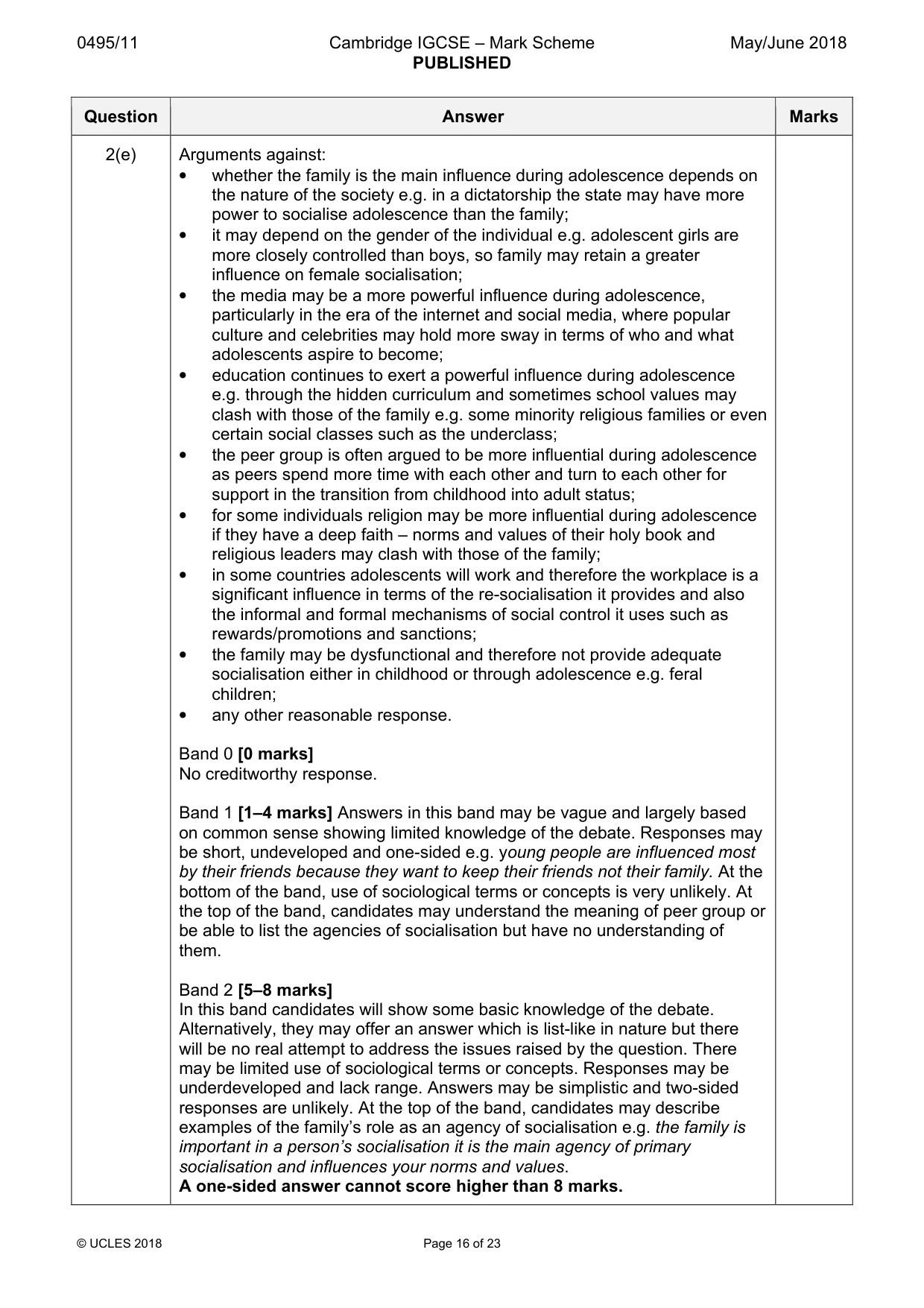
0495/11 Cambridge IGCSE – Mark Scheme PUBLISHED May/June 2018 © UCLES 2018 Page 16 of 23 Question Answer Marks 2(e) Arguments against: • whether the family is the main influence during adolescence depends on the nature of the society e.g. in a dictatorship the state may have more power to socialise adolescence than the family; • it may depend on the gender of the individual e.g. adolescent girls are more closely controlled than boys, so family may retain a greater influence on female socialisation; • the media may be a more powerful influence during adolescence, particularly in the era of the internet and social media, where popular culture and celebrities may hold more sway in terms of who and what adolescents aspire to become; • education continues to exert a powerful influence during adolescence e.g. through the hidden curriculum and sometimes school values may clash with those of the family e.g. some minority religious families or even certain social classes such as the underclass; • the peer group is often argued to be more influential during adolescence as peers spend more time with each other and turn to each other for support in the transition from childhood into adult status; • for some individuals religion may be more influential during adolescence if they have a deep faith – norms and values of their holy book and religious leaders may clash with those of the family; • in some countries adolescents will work and therefore the workplace is a significant influence in terms of the re-socialisation it provides and also the informal and formal mechanisms of social control it uses such as rewards/promotions and sanctions; • the family may be dysfunctional and therefore not provide adequate socialisation either in childhood or through adolescence e.g. feral children; • any other reasonable response. Band 0 [0 marks] No creditworthy response. Band 1 [1–4 marks] Answers in this band may be vague and largely based on common sense showing limited knowledge of the debate. Responses may be short, undeveloped and one-sided e.g. young people are influenced most by their friends because they want to keep their friends not their family. At the bottom of the band, use of sociological terms or concepts is very unlikely. At the top of the band, candidates may understand the meaning of peer group or be able to list the agencies of socialisation but have no understanding of them. Band 2 [5–8 marks] In this band candidates will show some basic knowledge of the debate. Alternatively, they may offer an answer which is list-like in nature but there will be no real attempt to address the issues raised by the question. There may be limited use of sociological terms or concepts. Responses may be underdeveloped and lack range. Answers may be simplistic and two-sided responses are unlikely. At the top of the band, candidates may describe examples of the family’s role as an agency of socialisation e.g. the family is important in a person’s socialisation it is the main agency of primary socialisation and influences your norms and values. A one-sided answer cannot score higher than 8 marks.
Mark scheme, page 17
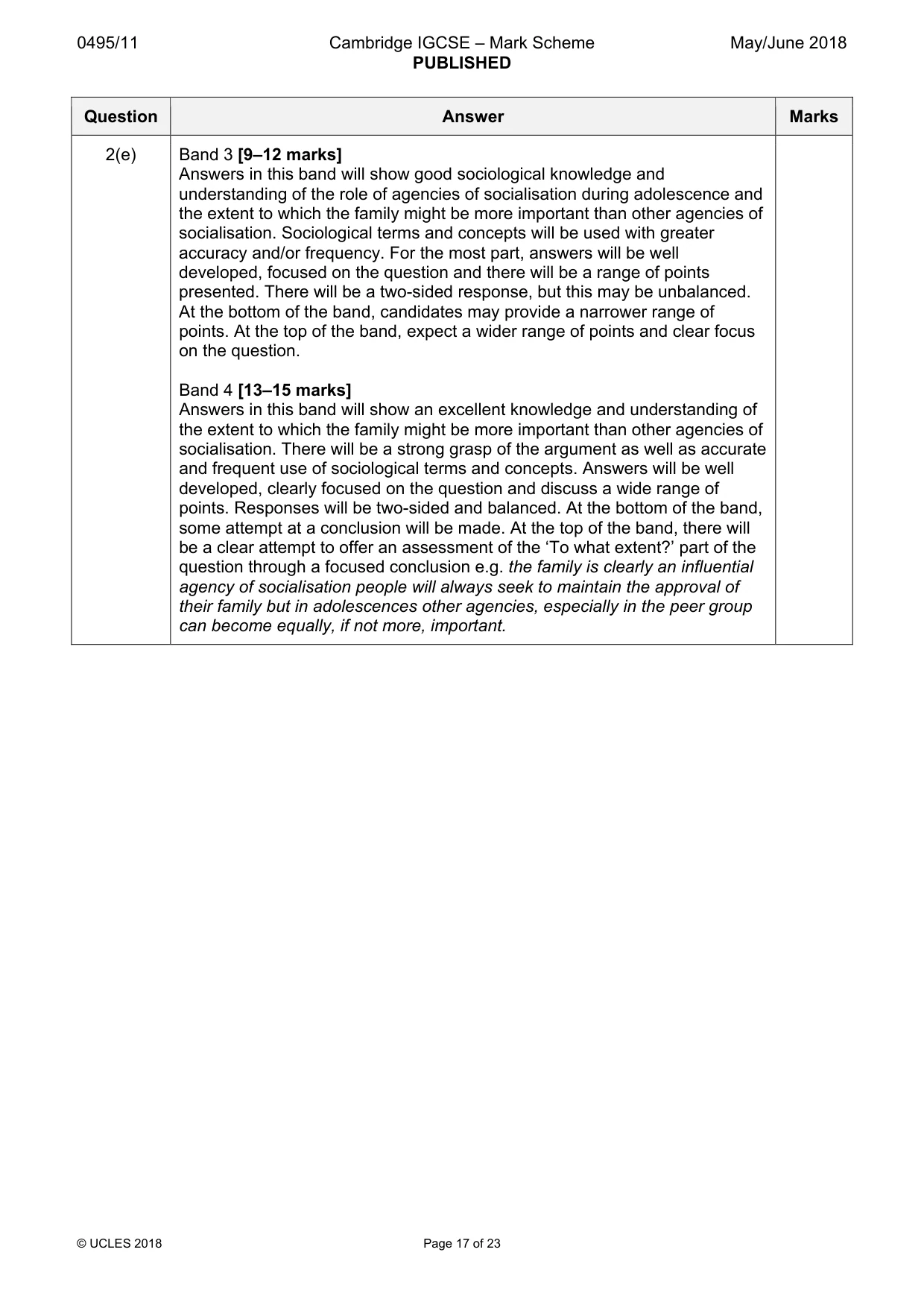
0495/11 Cambridge IGCSE – Mark Scheme PUBLISHED May/June 2018 © UCLES 2018 Page 17 of 23 Question Answer Marks 2(e) Band 3 [9–12 marks] Answers in this band will show good sociological knowledge and understanding of the role of agencies of socialisation during adolescence and the extent to which the family might be more important than other agencies of socialisation. Sociological terms and concepts will be used with greater accuracy and/or frequency. For the most part, answers will be well developed, focused on the question and there will be a range of points presented. There will be a two-sided response, but this may be unbalanced. At the bottom of the band, candidates may provide a narrower range of points. At the top of the band, expect a wider range of points and clear focus on the question. Band 4 [13–15 marks] Answers in this band will show an excellent knowledge and understanding of the extent to which the family might be more important than other agencies of socialisation. There will be a strong grasp of the argument as well as accurate and frequent use of sociological terms and concepts. Answers will be well developed, clearly focused on the question and discuss a wide range of points. Responses will be two-sided and balanced. At the bottom of the band, some attempt at a conclusion will be made. At the top of the band, there will be a clear attempt to offer an assessment of the ‘To what extent?’ part of the question through a focused conclusion e.g. the family is clearly an influential agency of socialisation people will always seek to maintain the approval of their family but in adolescences other agencies, especially in the peer group can become equally, if not more, important.
Mark scheme, page 18
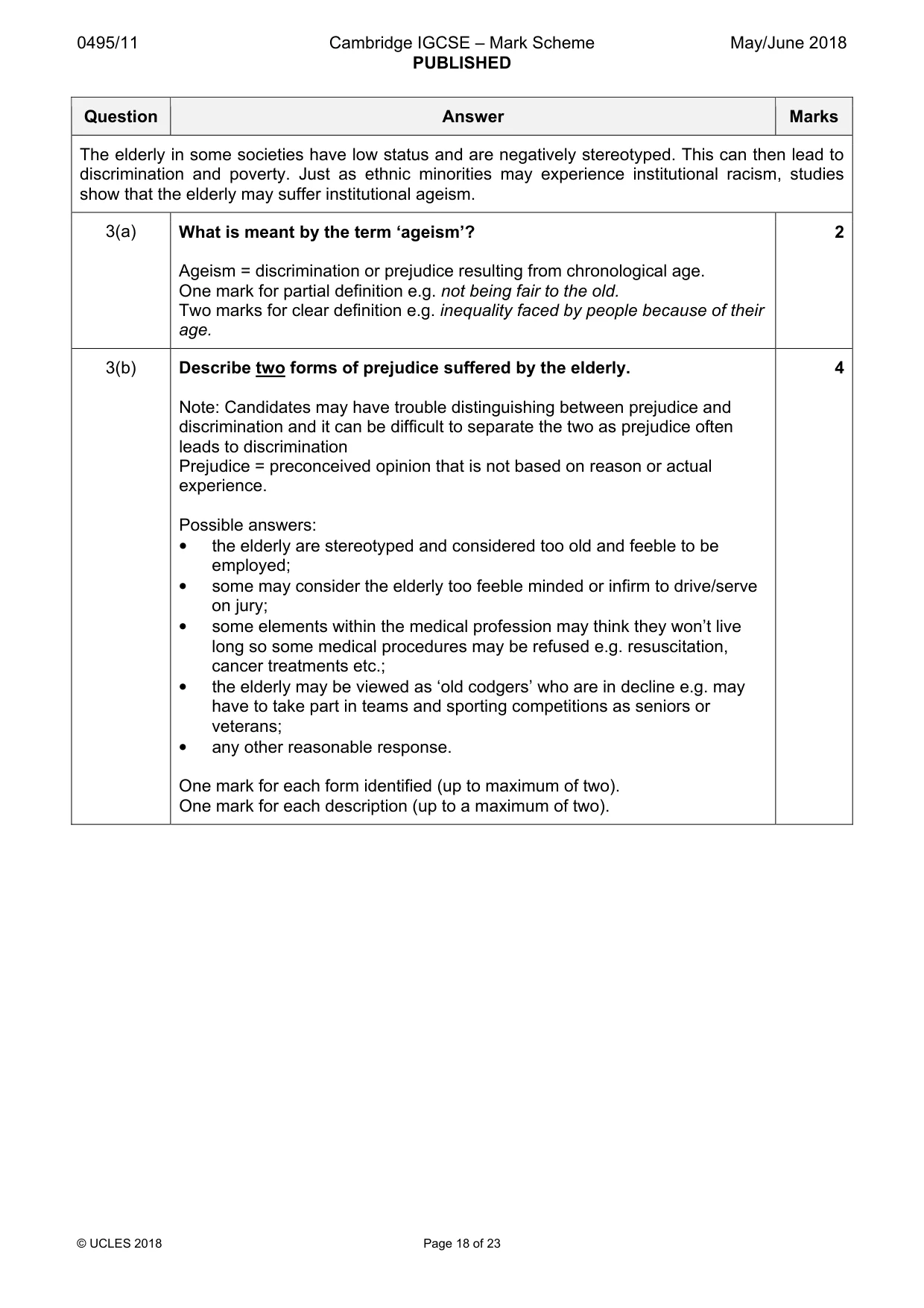
0495/11 Cambridge IGCSE – Mark Scheme PUBLISHED May/June 2018 © UCLES 2018 Page 18 of 23 Question Answer Marks The elderly in some societies have low status and are negatively stereotyped. This can then lead to discrimination and poverty. Just as ethnic minorities may experience institutional racism, studies show that the elderly may suffer institutional ageism. 3(a) What is meant by the term ‘ageism’? Ageism = discrimination or prejudice resulting from chronological age. One mark for partial definition e.g. not being fair to the old. Two marks for clear definition e.g. inequality faced by people because of their age. 2 3(b) Describe two forms of prejudice suffered by the elderly. Note: Candidates may have trouble distinguishing between prejudice and discrimination and it can be difficult to separate the two as prejudice often leads to discrimination Prejudice = preconceived opinion that is not based on reason or actual experience. Possible answers: • the elderly are stereotyped and considered too old and feeble to be employed; • some may consider the elderly too feeble minded or infirm to drive/serve on jury; • some elements within the medical profession may think they won’t live long so some medical procedures may be refused e.g. resuscitation, cancer treatments etc.; • the elderly may be viewed as ‘old codgers’ who are in decline e.g. may have to take part in teams and sporting competitions as seniors or veterans; • any other reasonable response. One mark for each form identified (up to maximum of two). One mark for each description (up to a maximum of two). 4
Mark scheme, page 19
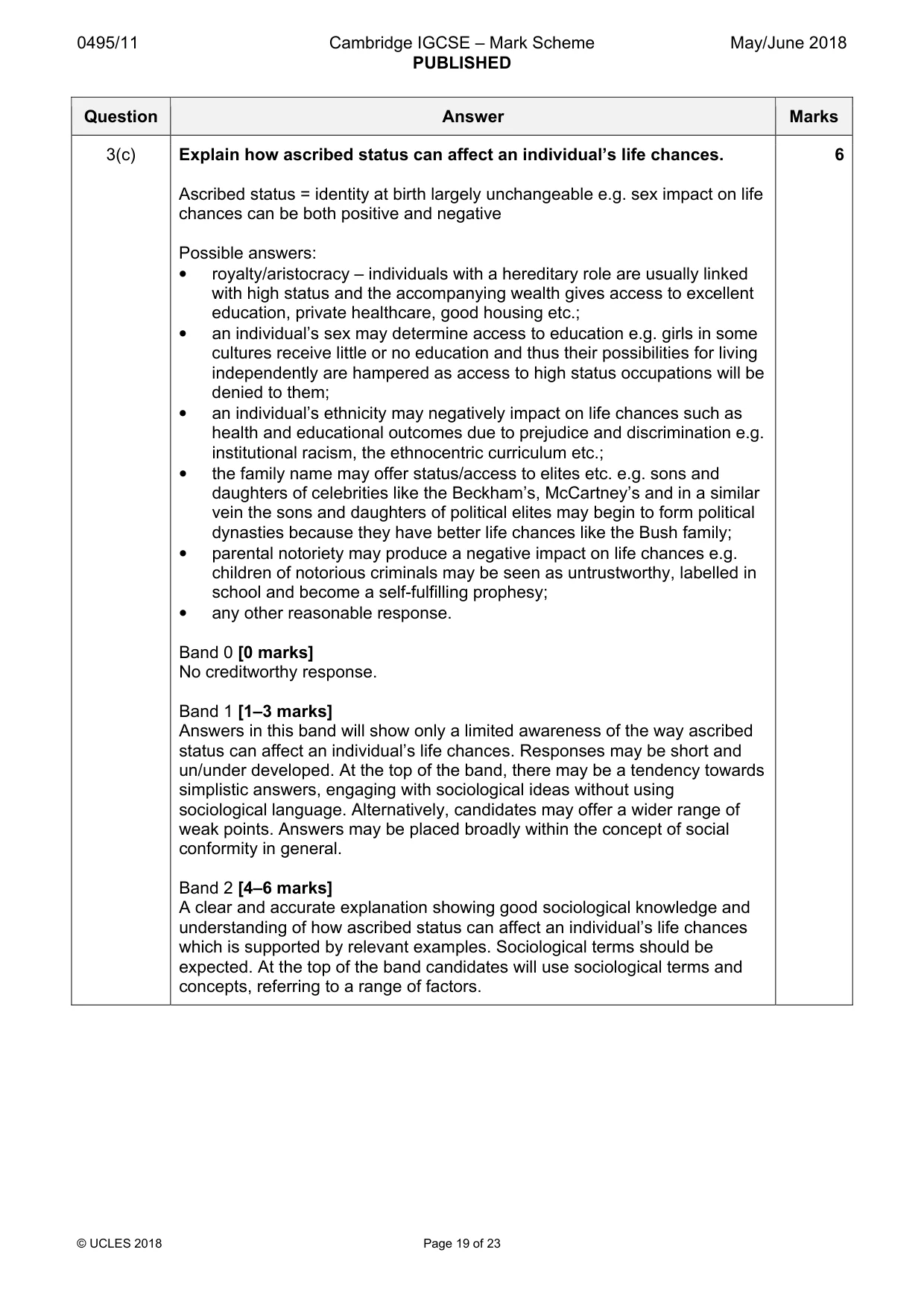
0495/11 Cambridge IGCSE – Mark Scheme PUBLISHED May/June 2018 © UCLES 2018 Page 19 of 23 Question Answer Marks 3(c) Explain how ascribed status can affect an individual’s life chances. Ascribed status = identity at birth largely unchangeable e.g. sex impact on life chances can be both positive and negative Possible answers: • royalty/aristocracy – individuals with a hereditary role are usually linked with high status and the accompanying wealth gives access to excellent education, private healthcare, good housing etc.; • an individual’s sex may determine access to education e.g. girls in some cultures receive little or no education and thus their possibilities for living independently are hampered as access to high status occupations will be denied to them; • an individual’s ethnicity may negatively impact on life chances such as health and educational outcomes due to prejudice and discrimination e.g. institutional racism, the ethnocentric curriculum etc.; • the family name may offer status/access to elites etc. e.g. sons and daughters of celebrities like the Beckham’s, McCartney’s and in a similar vein the sons and daughters of political elites may begin to form political dynasties because they have better life chances like the Bush family; • parental notoriety may produce a negative impact on life chances e.g. children of notorious criminals may be seen as untrustworthy, labelled in school and become a self-fulfilling prophesy; • any other reasonable response. Band 0 [0 marks] No creditworthy response. Band 1 [1–3 marks] Answers in this band will show only a limited awareness of the way ascribed status can affect an individual’s life chances. Responses may be short and un/under developed. At the top of the band, there may be a tendency towards simplistic answers, engaging with sociological ideas without using sociological language. Alternatively, candidates may offer a wider range of weak points. Answers may be placed broadly within the concept of social conformity in general. Band 2 [4–6 marks] A clear and accurate explanation showing good sociological knowledge and understanding of how ascribed status can affect an individual’s life chances which is supported by relevant examples. Sociological terms should be expected. At the top of the band candidates will use sociological terms and concepts, referring to a range of factors. 6
Mark scheme, page 20
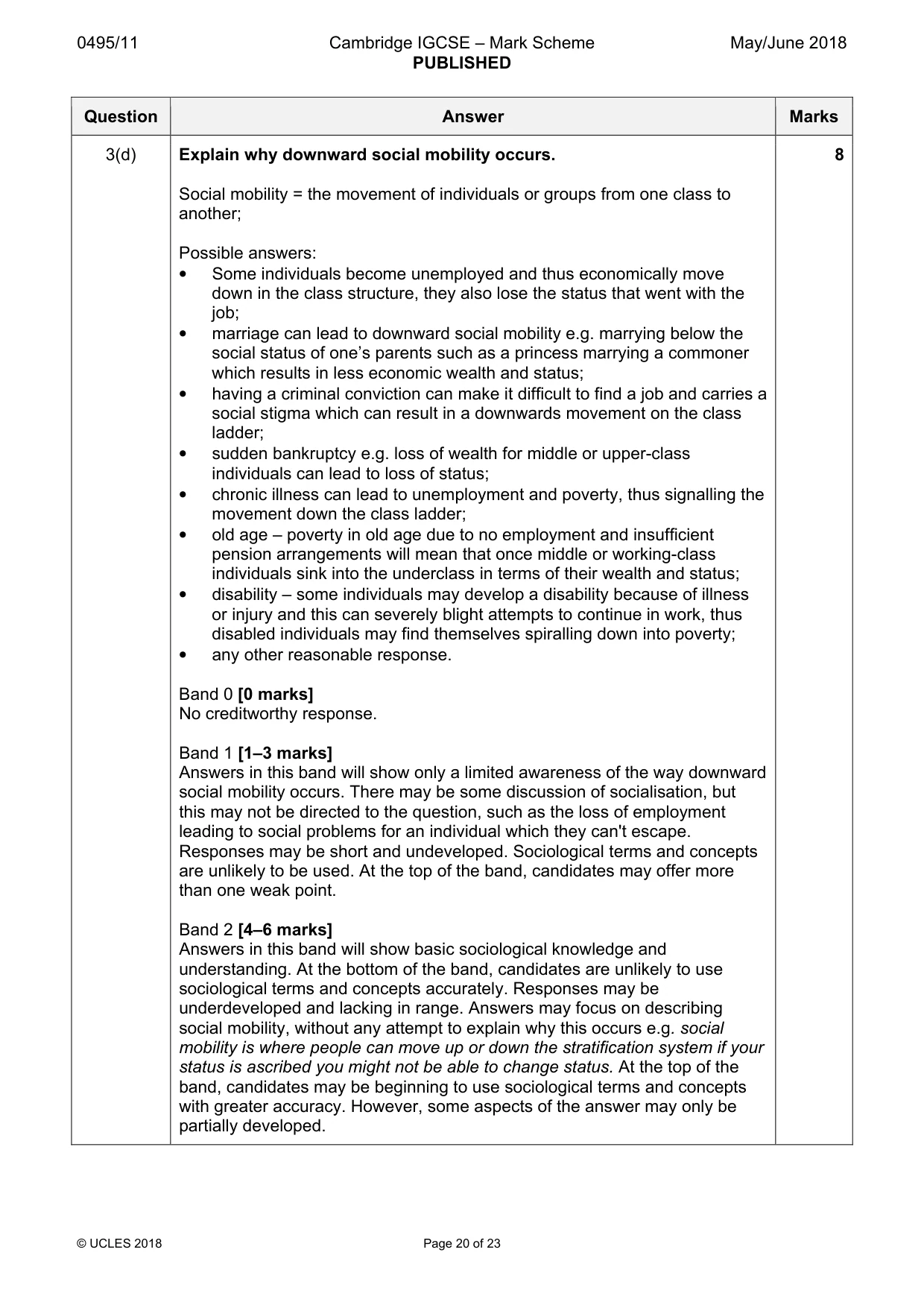
0495/11 Cambridge IGCSE – Mark Scheme PUBLISHED May/June 2018 © UCLES 2018 Page 20 of 23 Question Answer Marks 3(d) Explain why downward social mobility occurs. Social mobility = the movement of individuals or groups from one class to another; Possible answers: • Some individuals become unemployed and thus economically move down in the class structure, they also lose the status that went with the job; • marriage can lead to downward social mobility e.g. marrying below the social status of one’s parents such as a princess marrying a commoner which results in less economic wealth and status; • having a criminal conviction can make it difficult to find a job and carries a social stigma which can result in a downwards movement on the class ladder; • sudden bankruptcy e.g. loss of wealth for middle or upper-class individuals can lead to loss of status; • chronic illness can lead to unemployment and poverty, thus signalling the movement down the class ladder; • old age – poverty in old age due to no employment and insufficient pension arrangements will mean that once middle or working-class individuals sink into the underclass in terms of their wealth and status; • disability – some individuals may develop a disability because of illness or injury and this can severely blight attempts to continue in work, thus disabled individuals may find themselves spiralling down into poverty; • any other reasonable response. Band 0 [0 marks] No creditworthy response. Band 1 [1–3 marks] Answers in this band will show only a limited awareness of the way downward social mobility occurs. There may be some discussion of socialisation, but this may not be directed to the question, such as the loss of employment leading to social problems for an individual which they can't escape. Responses may be short and undeveloped. Sociological terms and concepts are unlikely to be used. At the top of the band, candidates may offer more than one weak point. Band 2 [4–6 marks] Answers in this band will show basic sociological knowledge and understanding. At the bottom of the band, candidates are unlikely to use sociological terms and concepts accurately. Responses may be underdeveloped and lacking in range. Answers may focus on describing social mobility, without any attempt to explain why this occurs e.g. social mobility is where people can move up or down the stratification system if your status is ascribed you might not be able to change status. At the top of the band, candidates may be beginning to use sociological terms and concepts with greater accuracy. However, some aspects of the answer may only be partially developed. 8
Mark scheme, page 21
0495/11 Cambridge IGCSE – Mark Scheme PUBLISHED May/June 2018 © UCLES 2018 Page 21 of 23 Question Answer Marks 3(d) Band 3 [7–8 marks] Answers in this band will show good sociological knowledge and understanding of why downward social mobility occurs and this will be well developed and explained. Sociological terms and concepts will be used accurately. Answers will be well focused on the question and there will be a range of reasons presented. At the top of the band explanations will be clear throughout.
Mark scheme, page 22
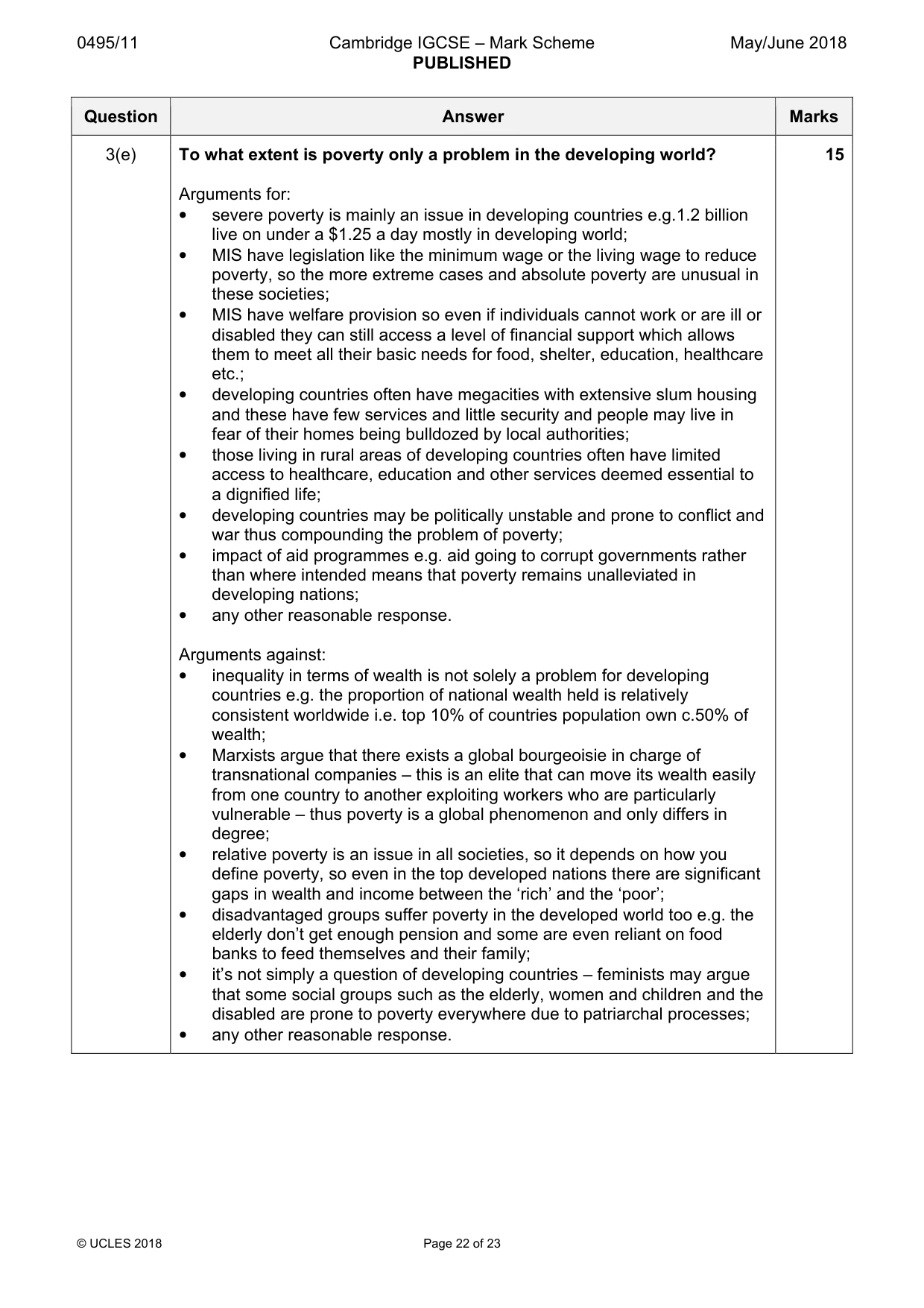
0495/11 Cambridge IGCSE – Mark Scheme PUBLISHED May/June 2018 © UCLES 2018 Page 22 of 23 Question Answer Marks 3(e) To what extent is poverty only a problem in the developing world? Arguments for: • severe poverty is mainly an issue in developing countries e.g.1.2 billion live on under a $1.25 a day mostly in developing world; • MIS have legislation like the minimum wage or the living wage to reduce poverty, so the more extreme cases and absolute poverty are unusual in these societies; • MIS have welfare provision so even if individuals cannot work or are ill or disabled they can still access a level of financial support which allows them to meet all their basic needs for food, shelter, education, healthcare etc.; • developing countries often have megacities with extensive slum housing and these have few services and little security and people may live in fear of their homes being bulldozed by local authorities; • those living in rural areas of developing countries often have limited access to healthcare, education and other services deemed essential to a dignified life; • developing countries may be politically unstable and prone to conflict and war thus compounding the problem of poverty; • impact of aid programmes e.g. aid going to corrupt governments rather than where intended means that poverty remains unalleviated in developing nations; • any other reasonable response. Arguments against: • inequality in terms of wealth is not solely a problem for developing countries e.g. the proportion of national wealth held is relatively consistent worldwide i.e. top 10% of countries population own c.50% of wealth; • Marxists argue that there exists a global bourgeoisie in charge of transnational companies – this is an elite that can move its wealth easily from one country to another exploiting workers who are particularly vulnerable – thus poverty is a global phenomenon and only differs in degree; • relative poverty is an issue in all societies, so it depends on how you define poverty, so even in the top developed nations there are significant gaps in wealth and income between the ‘rich’ and the ‘poor’; • disadvantaged groups suffer poverty in the developed world too e.g. the elderly don’t get enough pension and some are even reliant on food banks to feed themselves and their family; • it’s not simply a question of developing countries – feminists may argue that some social groups such as the elderly, women and children and the disabled are prone to poverty everywhere due to patriarchal processes; • any other reasonable response. 15
Mark scheme, page 23
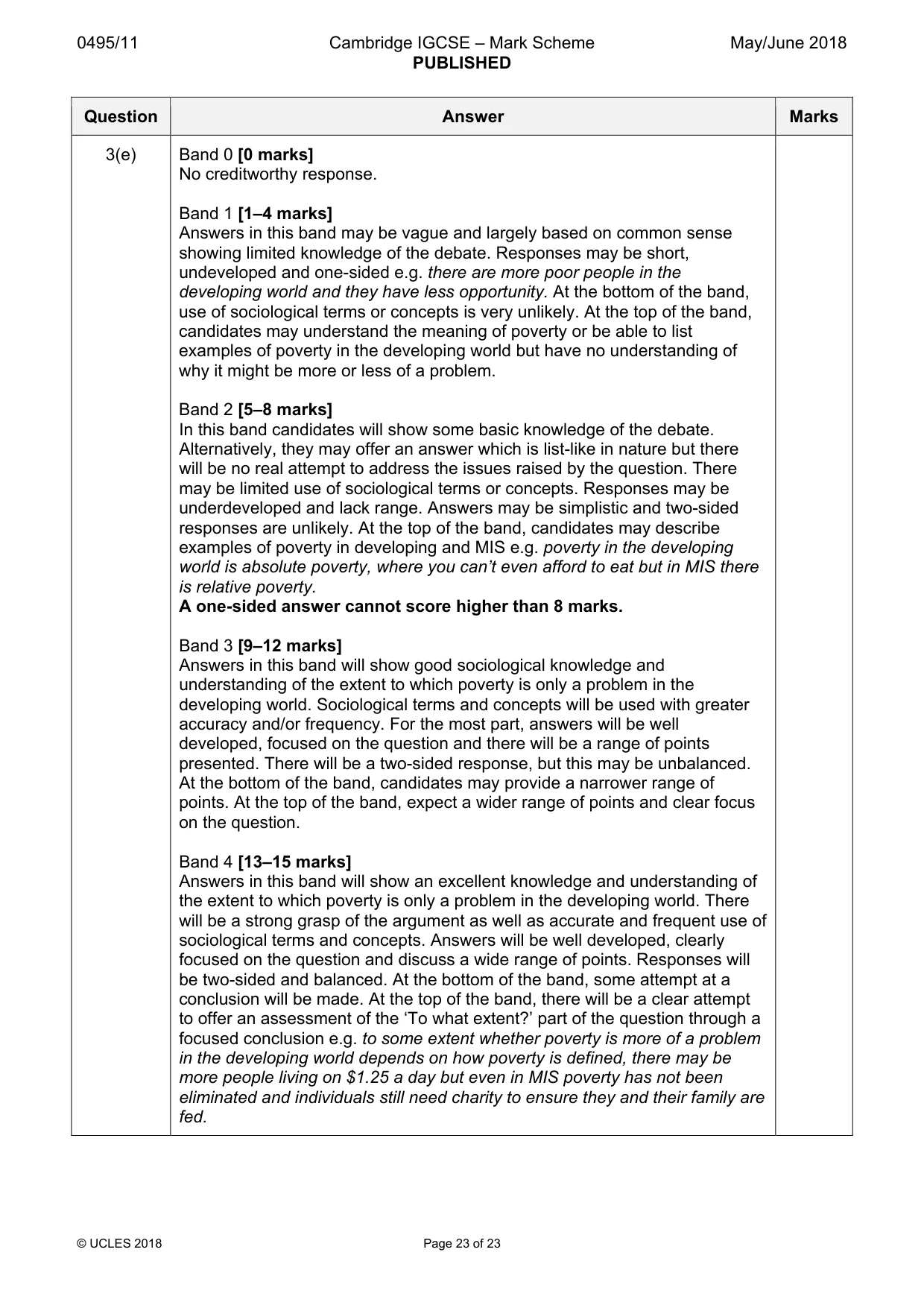
0495/11 Cambridge IGCSE – Mark Scheme PUBLISHED May/June 2018 © UCLES 2018 Page 23 of 23 Question Answer Marks 3(e) Band 0 [0 marks] No creditworthy response. Band 1 [1–4 marks] Answers in this band may be vague and largely based on common sense showing limited knowledge of the debate. Responses may be short, undeveloped and one-sided e.g. there are more poor people in the developing world and they have less opportunity. At the bottom of the band, use of sociological terms or concepts is very unlikely. At the top of the band, candidates may understand the meaning of poverty or be able to list examples of poverty in the developing world but have no understanding of why it might be more or less of a problem. Band 2 [5–8 marks] In this band candidates will show some basic knowledge of the debate. Alternatively, they may offer an answer which is list-like in nature but there will be no real attempt to address the issues raised by the question. There may be limited use of sociological terms or concepts. Responses may be underdeveloped and lack range. Answers may be simplistic and two-sided responses are unlikely. At the top of the band, candidates may describe examples of poverty in developing and MIS e.g. poverty in the developing world is absolute poverty, where you can’t even afford to eat but in MIS there is relative poverty. A one-sided answer cannot score higher than 8 marks. Band 3 [9–12 marks] Answers in this band will show good sociological knowledge and understanding of the extent to which poverty is only a problem in the developing world. Sociological terms and concepts will be used with greater accuracy and/or frequency. For the most part, answers will be well developed, focused on the question and there will be a range of points presented. There will be a two-sided response, but this may be unbalanced. At the bottom of the band, candidates may provide a narrower range of points. At the top of the band, expect a wider range of points and clear focus on the question. Band 4 [13–15 marks] Answers in this band will show an excellent knowledge and understanding of the extent to which poverty is only a problem in the developing world. There will be a strong grasp of the argument as well as accurate and frequent use of sociological terms and concepts. Answers will be well developed, clearly focused on the question and discuss a wide range of points. Responses will be two-sided and balanced. At the bottom of the band, some attempt at a conclusion will be made. At the top of the band, there will be a clear attempt to offer an assessment of the ‘To what extent?’ part of the question through a focused conclusion e.g. to some extent whether poverty is more of a problem in the developing world depends on how poverty is defined, there may be more people living on $1.25 a day but even in MIS poverty has not been eliminated and individuals still need charity to ensure they and their family are fed.
What you needed in this session
Cambridge’s own grade thresholds for 2018 May/June, Paper 1 · Variant 1. A higher threshold means an easier paper — the bar moves with how the cohort did.