Cambridge IGCSE Sociology 0495 — 2017 May/June Paper 1 · Variant 3
0495/13/M/J/17 · 80 marks · ≈90 min
The question paper and its mark scheme, free to read here and free to download. This is Cambridge’s own paper, exactly as it was sat.
Question paper4 pages
Mark scheme20 pages
Answers below. Sit the paper first if you are practising.
Paper as text
Question paper, page 1
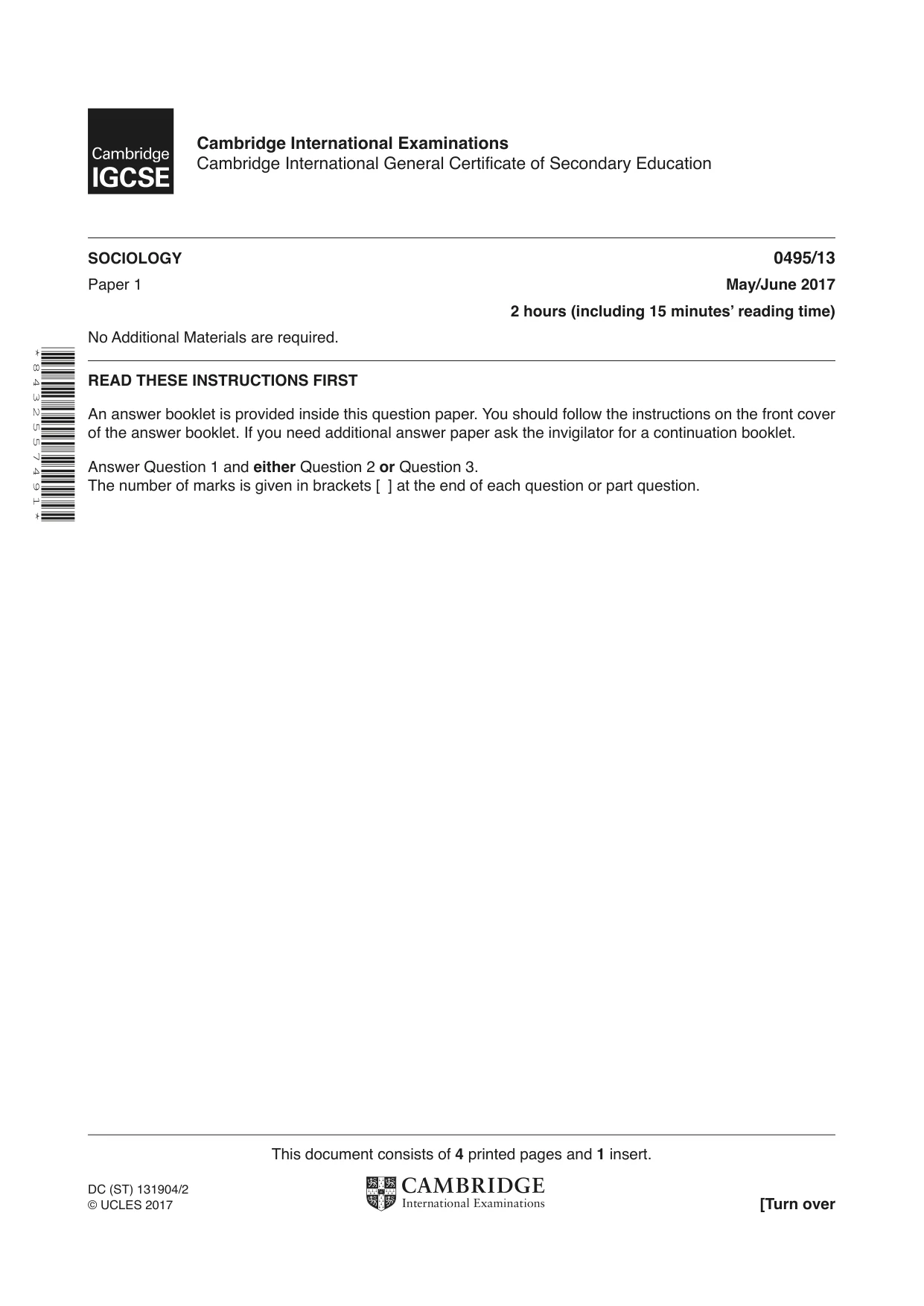
This document consists of 4 printed pages and 1 insert. DC (ST) 131904/2 © UCLES 2017 [Turn over Cambridge International Examinations Cambridge International General Certificate of Secondary Education * 8 4 3 2 5 5 7 4 9 1 * SOCIOLOGY 0495/13 Paper 1 May/June 2017 2 hours (including 15 minutes’ reading time) No Additional Materials are required. READ THESE INSTRUCTIONS FIRST An answer booklet is provided inside this question paper. You should follow the instructions on the front cover of the answer booklet. If you need additional answer paper ask the invigilator for a continuation booklet. Answer Question 1 and either Question 2 or Question 3. The number of marks is given in brackets [ ] at the end of each question or part question.
Question paper, page 2
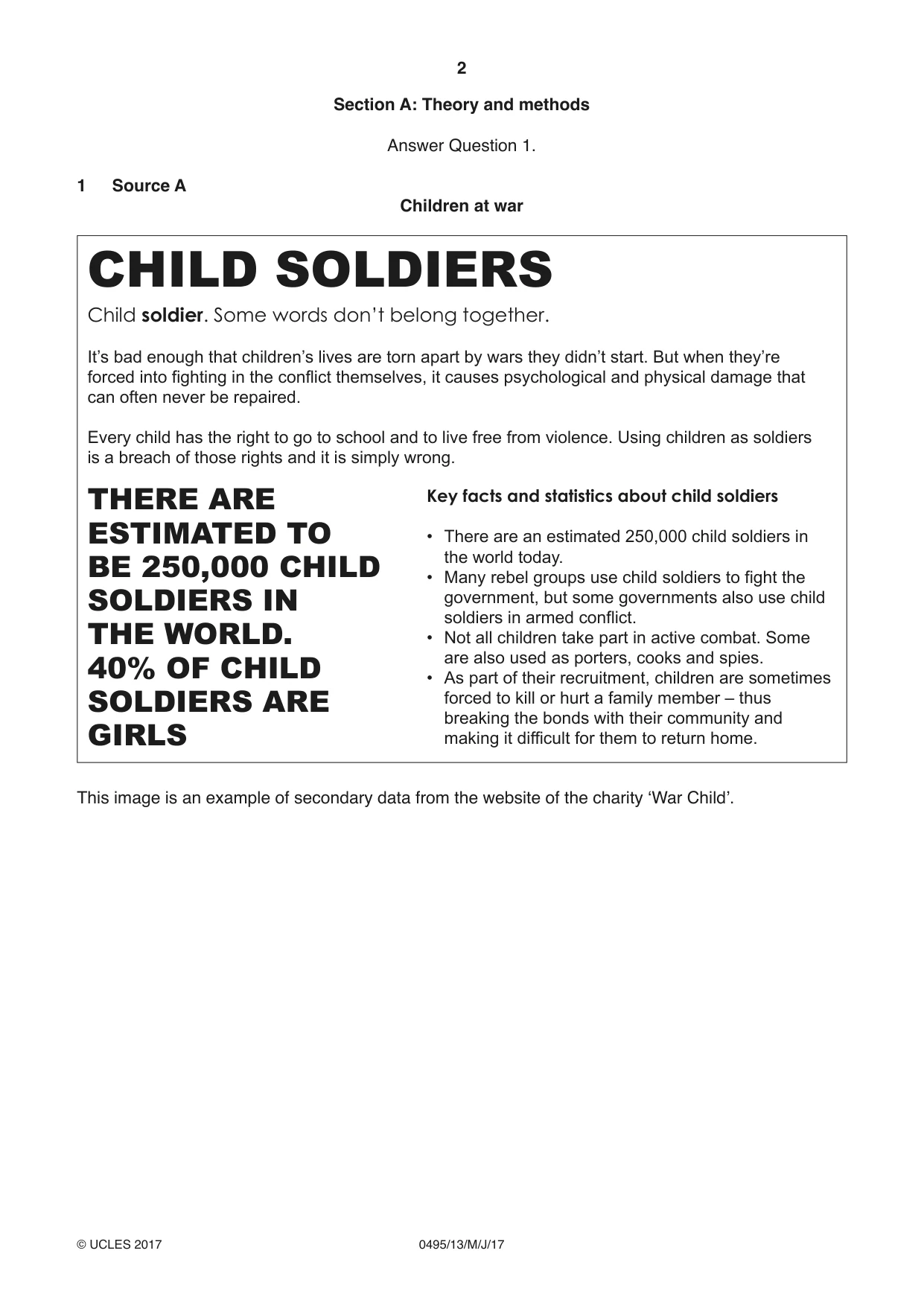
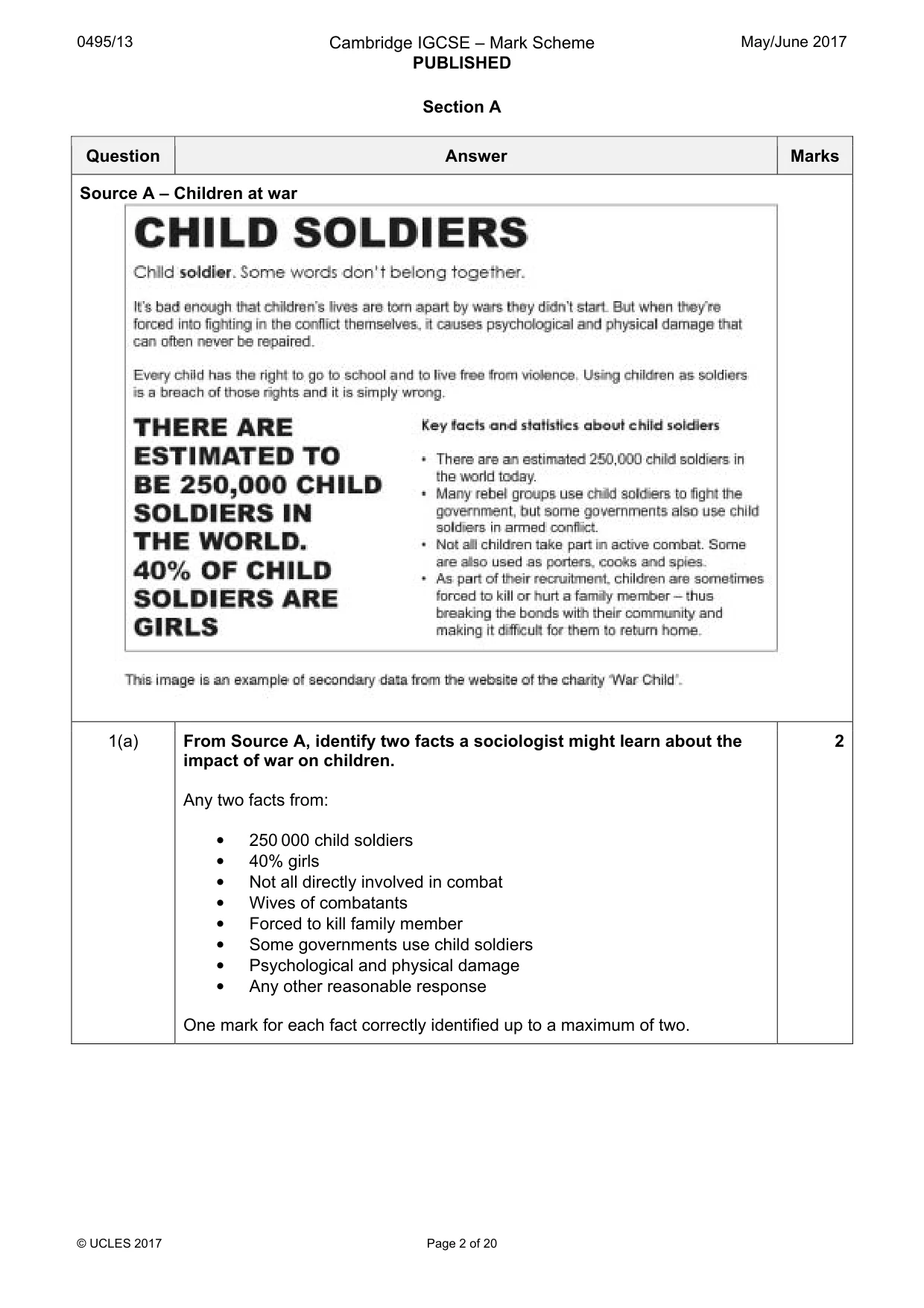
2 0495/13/M/J/17 © UCLES 2017 Section A: Theory and methods Answer Question 1. 1 Source A Children at war CHILD SOLDIERS Child soldier. Some words don’t belong together. It’s bad enough that children’s lives are torn apart by wars they didn’t start. But when they’re forced into fighting in the conflict themselves, it causes psychological and physical damage that can often never be repaired. Every child has the right to go to school and to live free from violence. Using children as soldiers is a breach of those rights and it is simply wrong. THERE ARE ESTIMATED TO BE 250,000 CHILD SOLDIERS IN THE WORLD. 40% OF CHILD SOLDIERS ARE GIRLS Key facts and statistics about child soldiers • There are an estimated 250,000 child soldiers in the world today. • Many rebel groups use child soldiers to fight the government, but some governments also use child soldiers in armed conflict. • Not all children take part in active combat. Some are also used as porters, cooks and spies. • As part of their recruitment, children are sometimes forced to kill or hurt a family member – thus breaking the bonds with their community and making it difficult for them to return home. This image is an example of secondary data from the website of the charity ‘War Child’.
Question paper, page 3
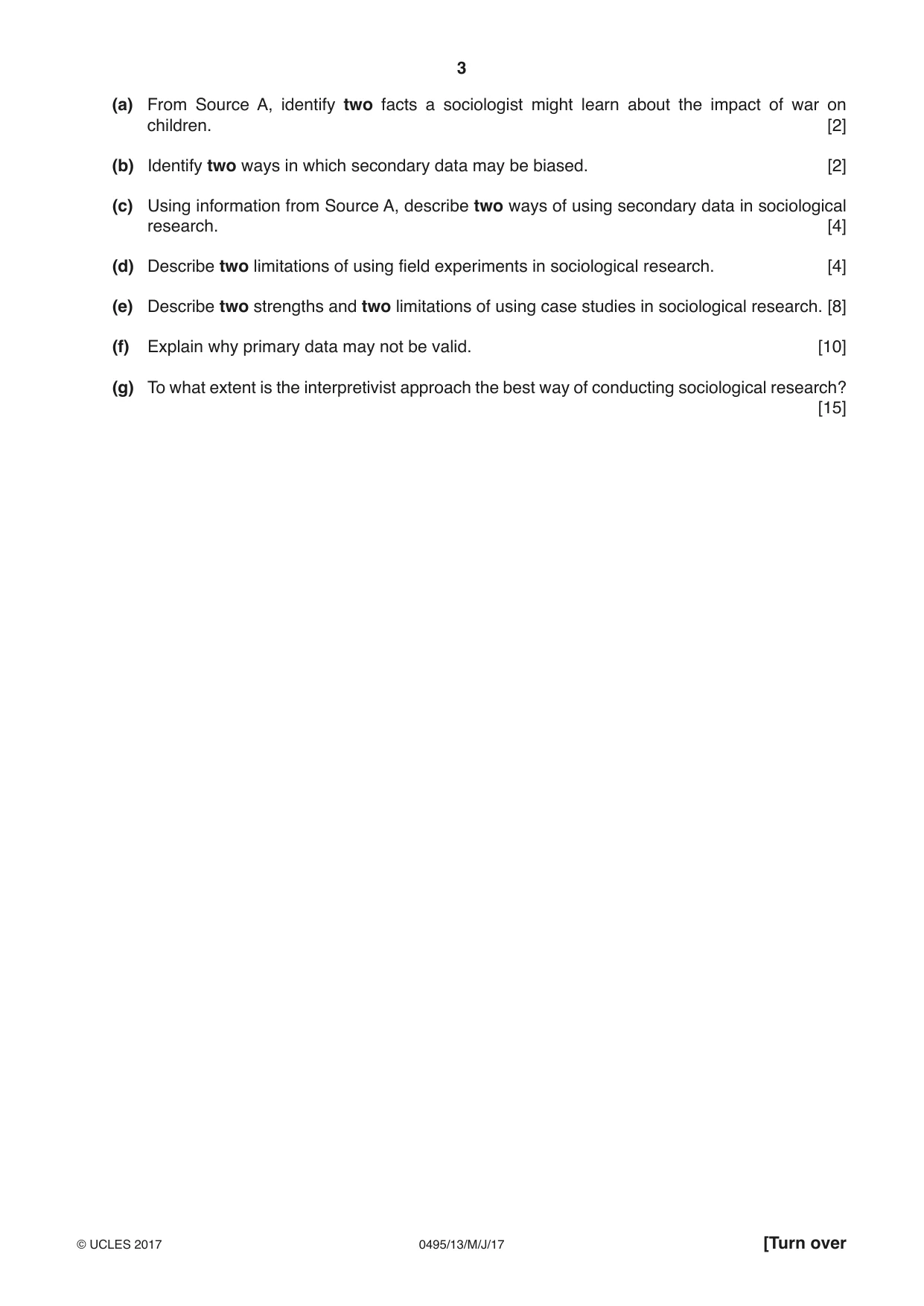
3 0495/13/M/J/17 © UCLES 2017 [Turn over (a) From Source A, identify two facts a sociologist might learn about the impact of war on children. [2] (b) Identify two ways in which secondary data may be biased. [2] (c) Using information from Source A, describe two ways of using secondary data in sociological research. [4] (d) Describe two limitations of using field experiments in sociological research. [4] (e) Describe two strengths and two limitations of using case studies in sociological research. [8] (f) Explain why primary data may not be valid. [10] (g) To what extent is the interpretivist approach the best way of conducting sociological research? [15]
Question paper, page 4
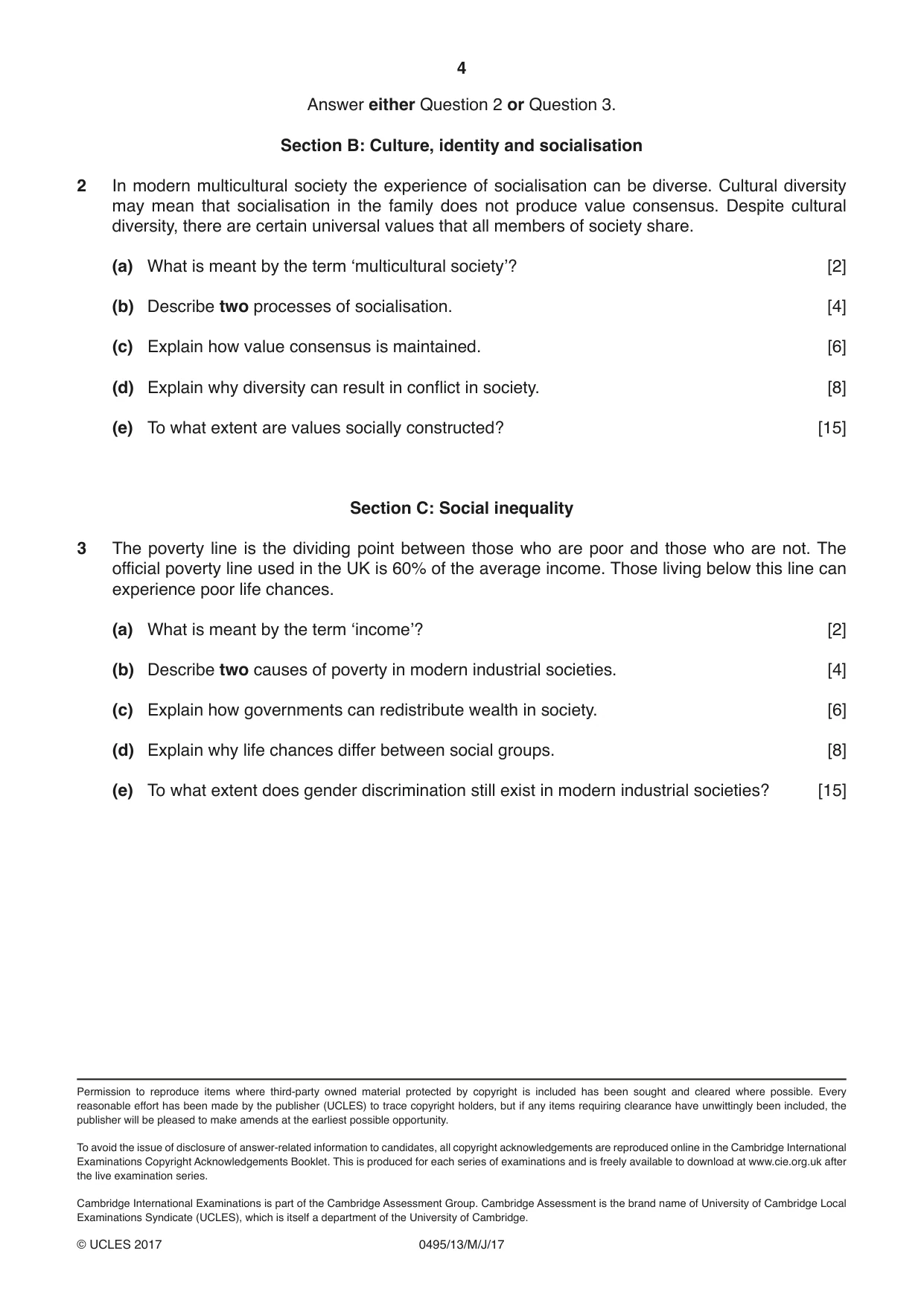
4 0495/13/M/J/17 © UCLES 2017 Answer either Question 2 or Question 3. Section B: Culture, identity and socialisation 2 In modern multicultural society the experience of socialisation can be diverse. Cultural diversity may mean that socialisation in the family does not produce value consensus. Despite cultural diversity, there are certain universal values that all members of society share. (a) What is meant by the term ‘multicultural society’? [2] (b) Describe two processes of socialisation. [4] (c) Explain how value consensus is maintained. [6] (d) Explain why diversity can result in conflict in society. [8] (e) To what extent are values socially constructed? [15] Section C: Social inequality 3 The poverty line is the dividing point between those who are poor and those who are not. The official poverty line used in the UK is 60% of the average income. Those living below this line can experience poor life chances. (a) What is meant by the term ‘income’? [2] (b) Describe two causes of poverty in modern industrial societies. [4] (c) Explain how governments can redistribute wealth in society. [6] (d) Explain why life chances differ between social groups. [8] (e) To what extent does gender discrimination still exist in modern industrial societies? [15] Permission to reproduce items where third-party owned material protected by copyright is included has been sought and cleared where possible. Every reasonable effort has been made by the publisher (UCLES) to trace copyright holders, but if any items requiring clearance have unwittingly been included, the publisher will be pleased to make amends at the earliest possible opportunity. To avoid the issue of disclosure of answer-related information to candidates, all copyright acknowledgements are reproduced online in the Cambridge International Examinations Copyright Acknowledgements Booklet. This is produced for each series of examinations and is freely available to download at www.cie.org.uk after the live examination series. Cambridge International Examinations is part of the Cambridge Assessment Group. Cambridge Assessment is the brand name of University of Cambridge Local Examinations Syndicate (UCLES), which is itself a department of the University of Cambridge.
Mark scheme, page 1
® IGCSE is a registered trademark. This document consists of 20 printed pages. © UCLES 2017 [Turn over Cambridge International Examinations Cambridge International General Certificate of Secondary Education SOCIOLOGY 0495/13 Paper 1 May/June 2017 MARK SCHEME Maximum Mark: 80 Published This mark scheme is published as an aid to teachers and candidates, to indicate the requirements of the examination. It shows the basis on which Examiners were instructed to award marks. It does not indicate the details of the discussions that took place at an Examiners’ meeting before marking began, which would have considered the acceptability of alternative answers. Mark schemes should be read in conjunction with the question paper and the Principal Examiner Report for Teachers. Cambridge will not enter into discussions about these mark schemes. Cambridge is publishing the mark schemes for the May/June 2017 series for most Cambridge IGCSE®, Cambridge International A and AS Level and Cambridge Pre-U components, and some Cambridge O Level components.
Mark scheme, page 2
0495/13 Cambridge IGCSE – Mark Scheme PUBLISHED May/June 2017 © UCLES 2017 Page 2 of 20 Section A Question Answer Marks Source A – Children at war 1(a) From Source A, identify two facts a sociologist might learn about the impact of war on children. Any two facts from: • 250 000 child soldiers • 40% girls • Not all directly involved in combat • Wives of combatants • Forced to kill family member • Some governments use child soldiers • Psychological and physical damage • Any other reasonable response One mark for each fact correctly identified up to a maximum of two. 2
Mark scheme, page 3
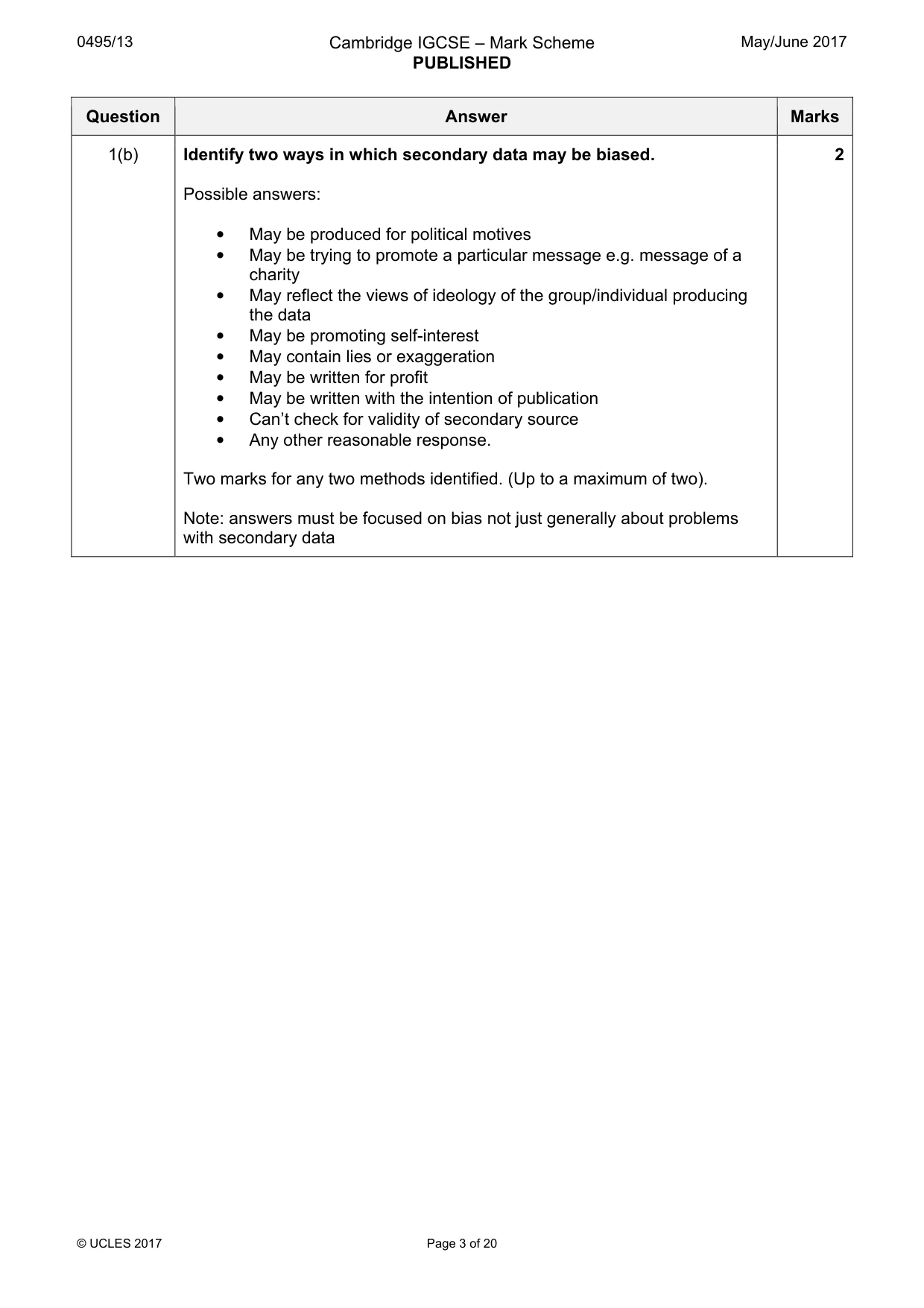
0495/13 Cambridge IGCSE – Mark Scheme PUBLISHED May/June 2017 © UCLES 2017 Page 3 of 20 Question Answer Marks 1(b) Identify two ways in which secondary data may be biased. Possible answers: • May be produced for political motives • May be trying to promote a particular message e.g. message of a charity • May reflect the views of ideology of the group/individual producing the data • May be promoting self-interest • May contain lies or exaggeration • May be written for profit • May be written with the intention of publication • Can’t check for validity of secondary source • Any other reasonable response. Two marks for any two methods identified. (Up to a maximum of two). Note: answers must be focused on bias not just generally about problems with secondary data 2
Mark scheme, page 4
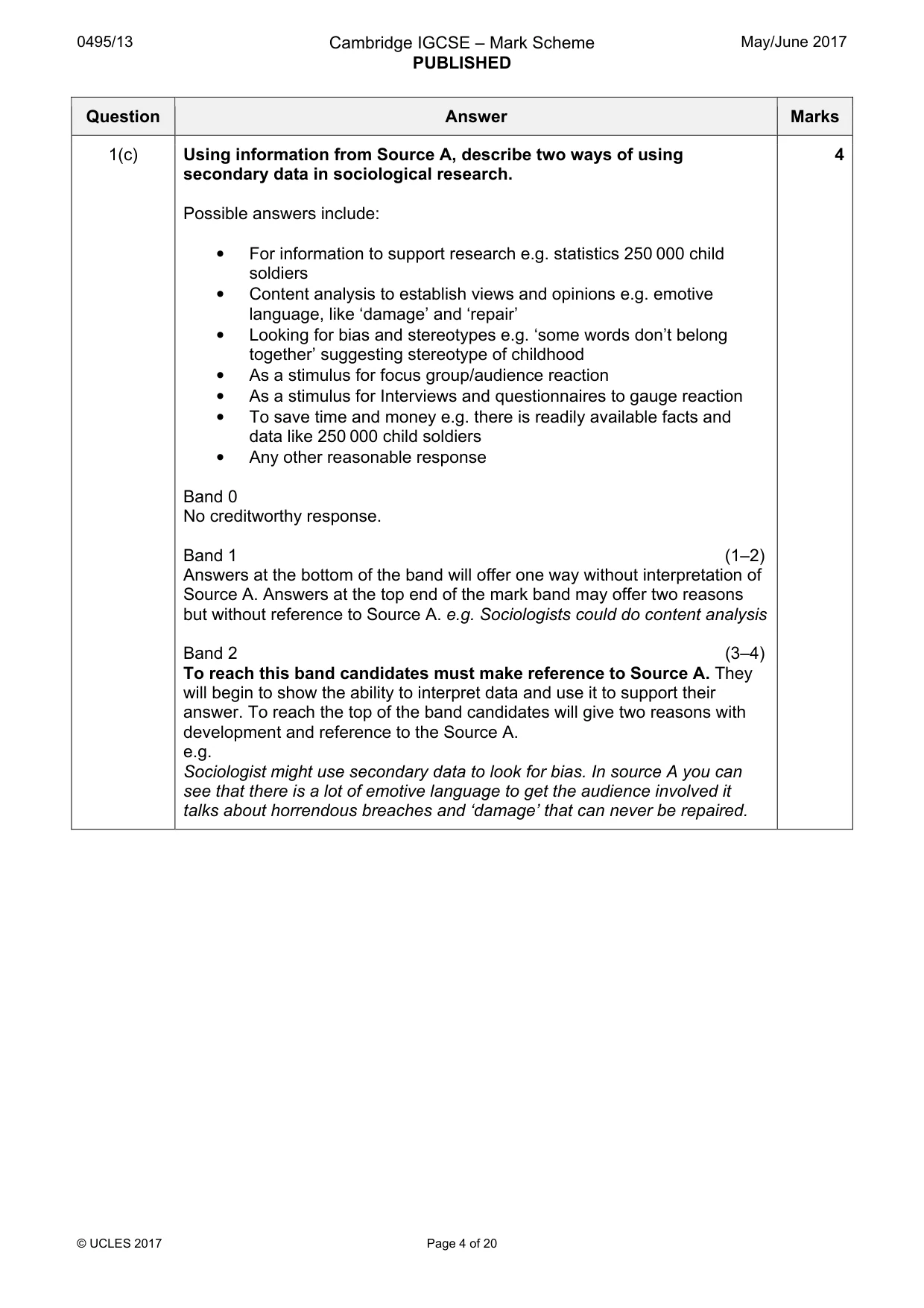
0495/13 Cambridge IGCSE – Mark Scheme PUBLISHED May/June 2017 © UCLES 2017 Page 4 of 20 Question Answer Marks 1(c) Using information from Source A, describe two ways of using secondary data in sociological research. Possible answers include: • For information to support research e.g. statistics 250 000 child soldiers • Content analysis to establish views and opinions e.g. emotive language, like ‘damage’ and ‘repair’ • Looking for bias and stereotypes e.g. ‘some words don’t belong together’ suggesting stereotype of childhood • As a stimulus for focus group/audience reaction • As a stimulus for Interviews and questionnaires to gauge reaction • To save time and money e.g. there is readily available facts and data like 250 000 child soldiers • Any other reasonable response Band 0 No creditworthy response. Band 1 (1–2) Answers at the bottom of the band will offer one way without interpretation of Source A. Answers at the top end of the mark band may offer two reasons but without reference to Source A. e.g. Sociologists could do content analysis Band 2 (3–4) To reach this band candidates must make reference to Source A. They will begin to show the ability to interpret data and use it to support their answer. To reach the top of the band candidates will give two reasons with development and reference to the Source A. e.g. Sociologist might use secondary data to look for bias. In source A you can see that there is a lot of emotive language to get the audience involved it talks about horrendous breaches and ‘damage’ that can never be repaired. 4
Mark scheme, page 5
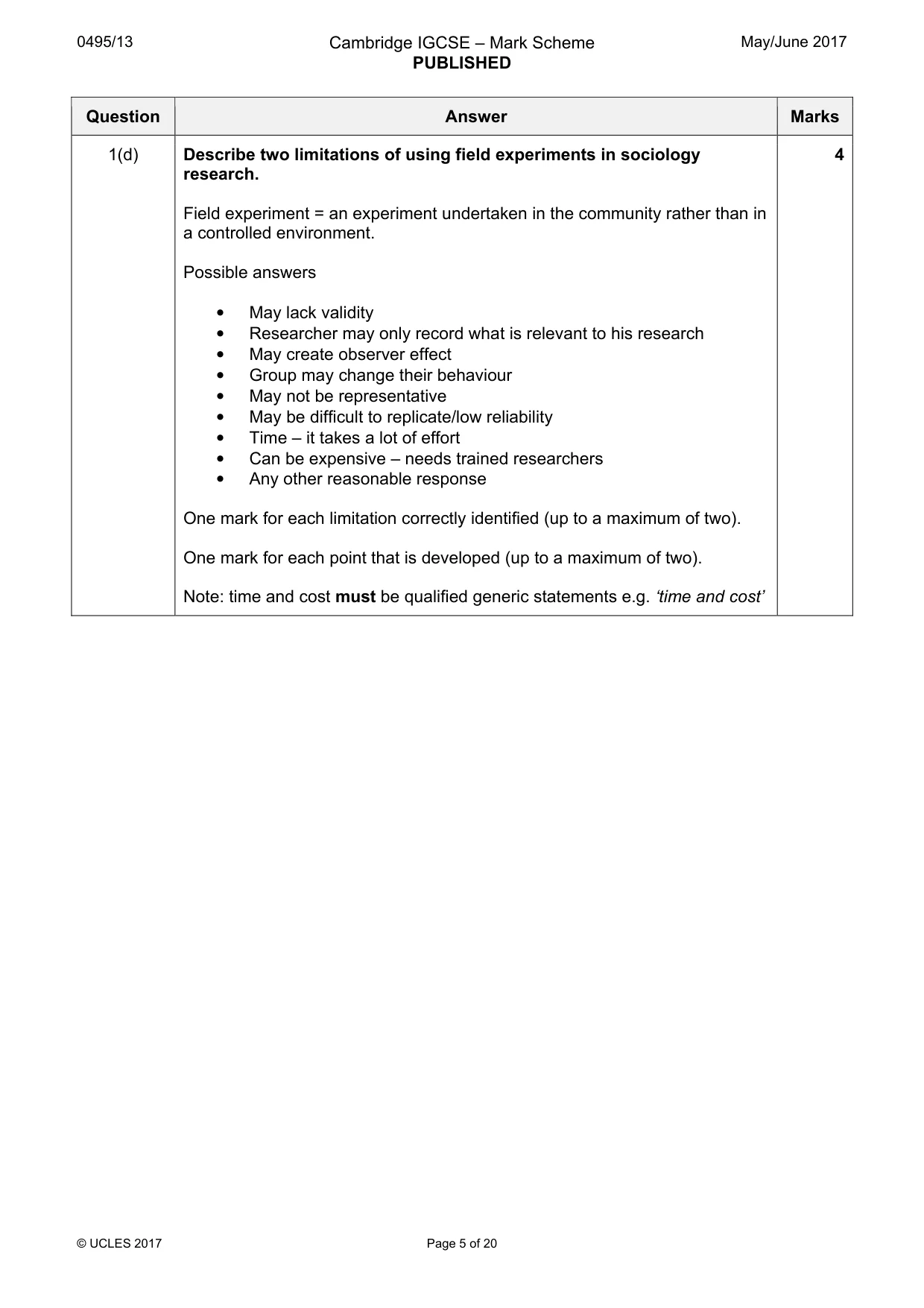
0495/13 Cambridge IGCSE – Mark Scheme PUBLISHED May/June 2017 © UCLES 2017 Page 5 of 20 Question Answer Marks 1(d) Describe two limitations of using field experiments in sociology research. Field experiment = an experiment undertaken in the community rather than in a controlled environment. Possible answers • May lack validity • Researcher may only record what is relevant to his research • May create observer effect • Group may change their behaviour • May not be representative • May be difficult to replicate/low reliability • Time – it takes a lot of effort • Can be expensive – needs trained researchers • Any other reasonable response One mark for each limitation correctly identified (up to a maximum of two). One mark for each point that is developed (up to a maximum of two). Note: time and cost must be qualified generic statements e.g. ‘time and cost’ 4
Mark scheme, page 6
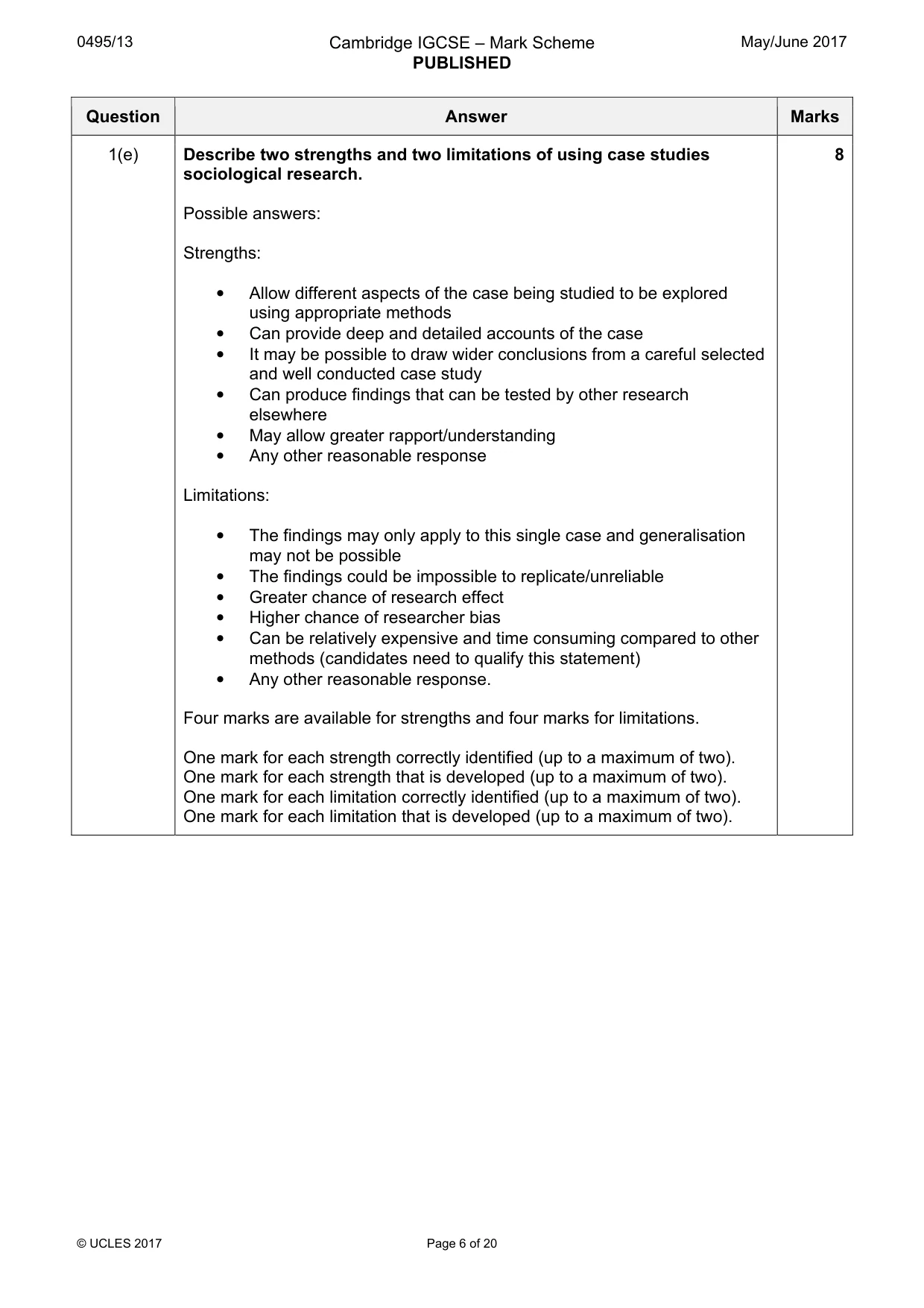
0495/13 Cambridge IGCSE – Mark Scheme PUBLISHED May/June 2017 © UCLES 2017 Page 6 of 20 Question Answer Marks 1(e) Describe two strengths and two limitations of using case studies sociological research. Possible answers: Strengths: • Allow different aspects of the case being studied to be explored using appropriate methods • Can provide deep and detailed accounts of the case • It may be possible to draw wider conclusions from a careful selected and well conducted case study • Can produce findings that can be tested by other research elsewhere • May allow greater rapport/understanding • Any other reasonable response Limitations: • The findings may only apply to this single case and generalisation may not be possible • The findings could be impossible to replicate/unreliable • Greater chance of research effect • Higher chance of researcher bias • Can be relatively expensive and time consuming compared to other methods (candidates need to qualify this statement) • Any other reasonable response. Four marks are available for strengths and four marks for limitations. One mark for each strength correctly identified (up to a maximum of two). One mark for each strength that is developed (up to a maximum of two). One mark for each limitation correctly identified (up to a maximum of two). One mark for each limitation that is developed (up to a maximum of two). 8
Mark scheme, page 7
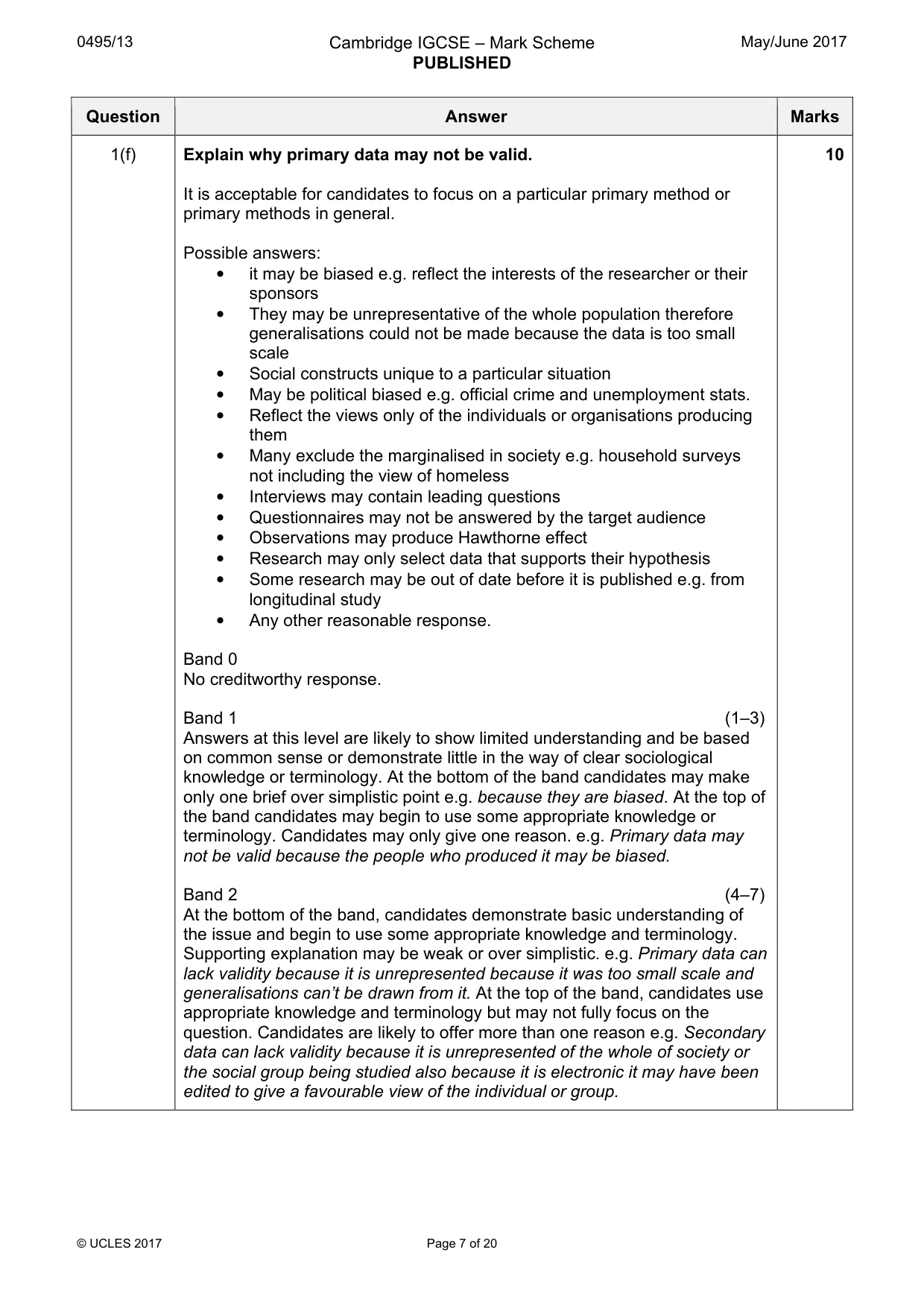
0495/13 Cambridge IGCSE – Mark Scheme PUBLISHED May/June 2017 © UCLES 2017 Page 7 of 20 Question Answer Marks 1(f) Explain why primary data may not be valid. It is acceptable for candidates to focus on a particular primary method or primary methods in general. Possible answers: • it may be biased e.g. reflect the interests of the researcher or their sponsors • They may be unrepresentative of the whole population therefore generalisations could not be made because the data is too small scale • Social constructs unique to a particular situation • May be political biased e.g. official crime and unemployment stats. • Reflect the views only of the individuals or organisations producing them • Many exclude the marginalised in society e.g. household surveys not including the view of homeless • Interviews may contain leading questions • Questionnaires may not be answered by the target audience • Observations may produce Hawthorne effect • Research may only select data that supports their hypothesis • Some research may be out of date before it is published e.g. from longitudinal study • Any other reasonable response. Band 0 No creditworthy response. Band 1 (1–3) Answers at this level are likely to show limited understanding and be based on common sense or demonstrate little in the way of clear sociological knowledge or terminology. At the bottom of the band candidates may make only one brief over simplistic point e.g. because they are biased. At the top of the band candidates may begin to use some appropriate knowledge or terminology. Candidates may only give one reason. e.g. Primary data may not be valid because the people who produced it may be biased. Band 2 (4–7) At the bottom of the band, candidates demonstrate basic understanding of the issue and begin to use some appropriate knowledge and terminology. Supporting explanation may be weak or over simplistic. e.g. Primary data can lack validity because it is unrepresented because it was too small scale and generalisations can’t be drawn from it. At the top of the band, candidates use appropriate knowledge and terminology but may not fully focus on the question. Candidates are likely to offer more than one reason e.g. Secondary data can lack validity because it is unrepresented of the whole of society or the social group being studied also because it is electronic it may have been edited to give a favourable view of the individual or group. 10
Mark scheme, page 8
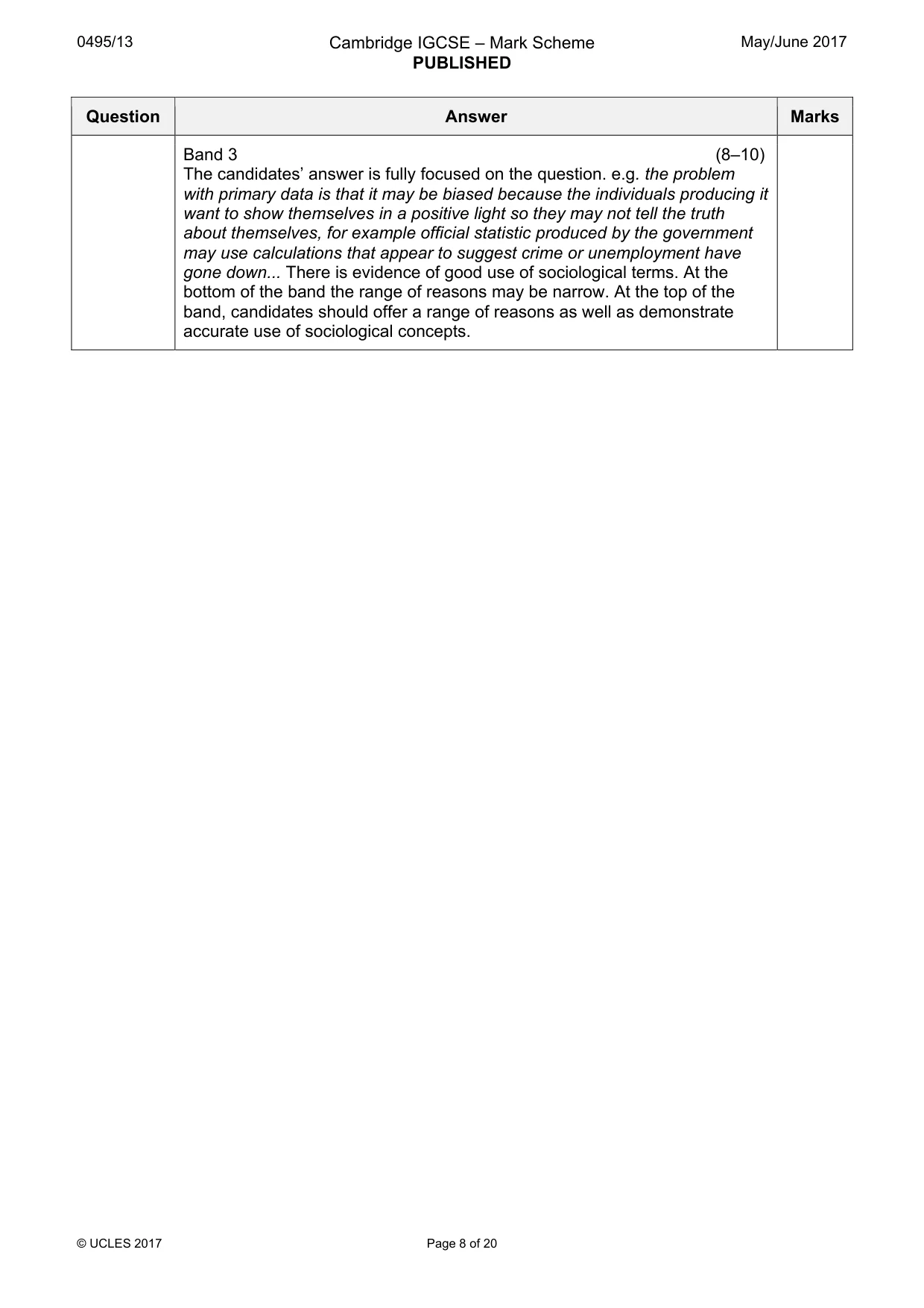
0495/13 Cambridge IGCSE – Mark Scheme PUBLISHED May/June 2017 © UCLES 2017 Page 8 of 20 Question Answer Marks Band 3 (8–10) The candidates’ answer is fully focused on the question. e.g. the problem with primary data is that it may be biased because the individuals producing it want to show themselves in a positive light so they may not tell the truth about themselves, for example official statistic produced by the government may use calculations that appear to suggest crime or unemployment have gone down... There is evidence of good use of sociological terms. At the bottom of the band the range of reasons may be narrow. At the top of the band, candidates should offer a range of reasons as well as demonstrate accurate use of sociological concepts.
Mark scheme, page 9
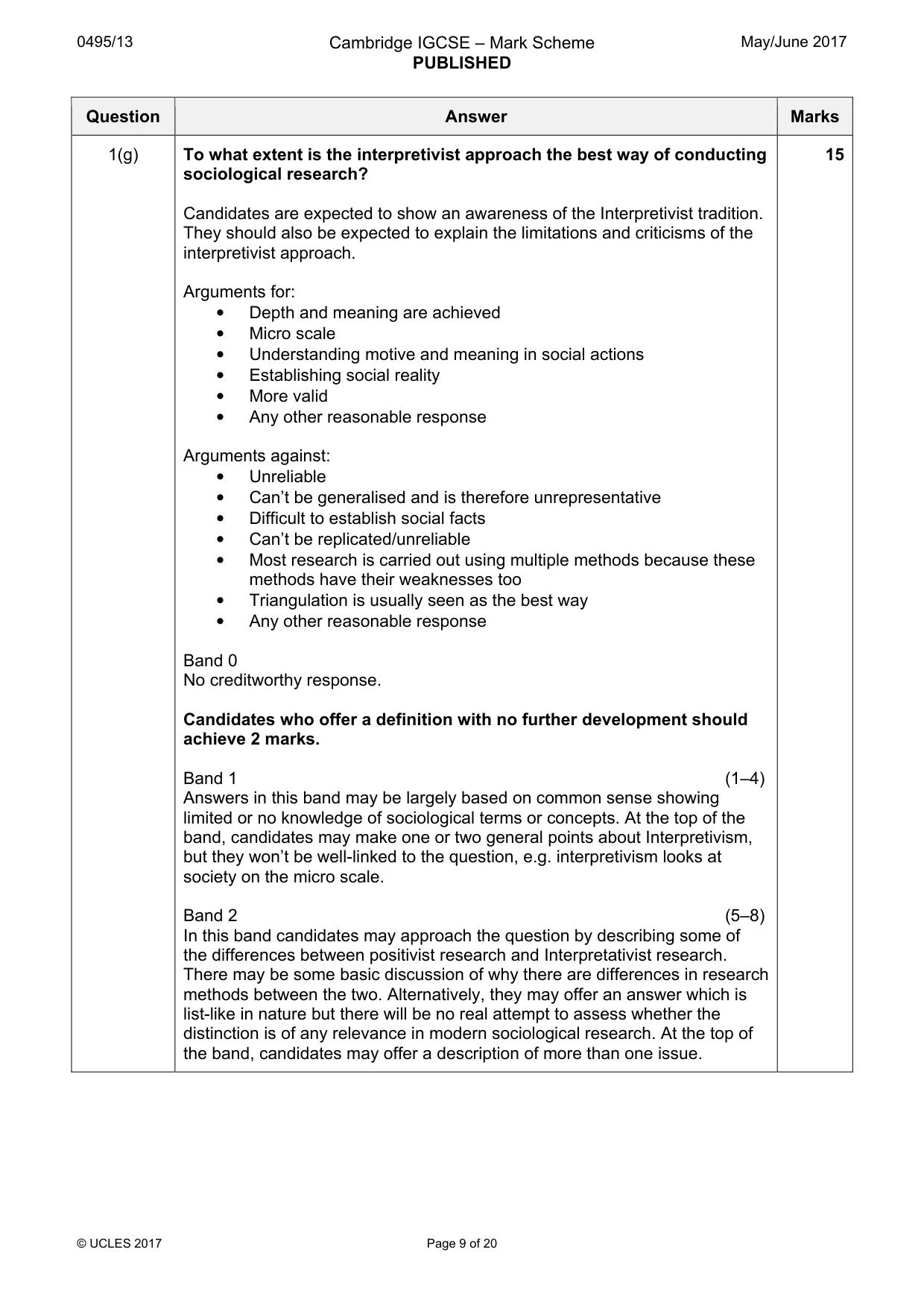
0495/13 Cambridge IGCSE – Mark Scheme PUBLISHED May/June 2017 © UCLES 2017 Page 9 of 20 Question Answer Marks 1(g) To what extent is the interpretivist approach the best way of conducting sociological research? Candidates are expected to show an awareness of the Interpretivist tradition. They should also be expected to explain the limitations and criticisms of the interpretivist approach. Arguments for: • Depth and meaning are achieved • Micro scale • Understanding motive and meaning in social actions • Establishing social reality • More valid • Any other reasonable response Arguments against: • Unreliable • Can’t be generalised and is therefore unrepresentative • Difficult to establish social facts • Can’t be replicated/unreliable • Most research is carried out using multiple methods because these methods have their weaknesses too • Triangulation is usually seen as the best way • Any other reasonable response Band 0 No creditworthy response. Candidates who offer a definition with no further development should achieve 2 marks. Band 1 (1–4) Answers in this band may be largely based on common sense showing limited or no knowledge of sociological terms or concepts. At the top of the band, candidates may make one or two general points about Interpretivism, but they won’t be well-linked to the question, e.g. interpretivism looks at society on the micro scale. Band 2 (5–8) In this band candidates may approach the question by describing some of the differences between positivist research and Interpretativist research. There may be some basic discussion of why there are differences in research methods between the two. Alternatively, they may offer an answer which is list-like in nature but there will be no real attempt to assess whether the distinction is of any relevance in modern sociological research. At the top of the band, candidates may offer a description of more than one issue. 15
Mark scheme, page 10
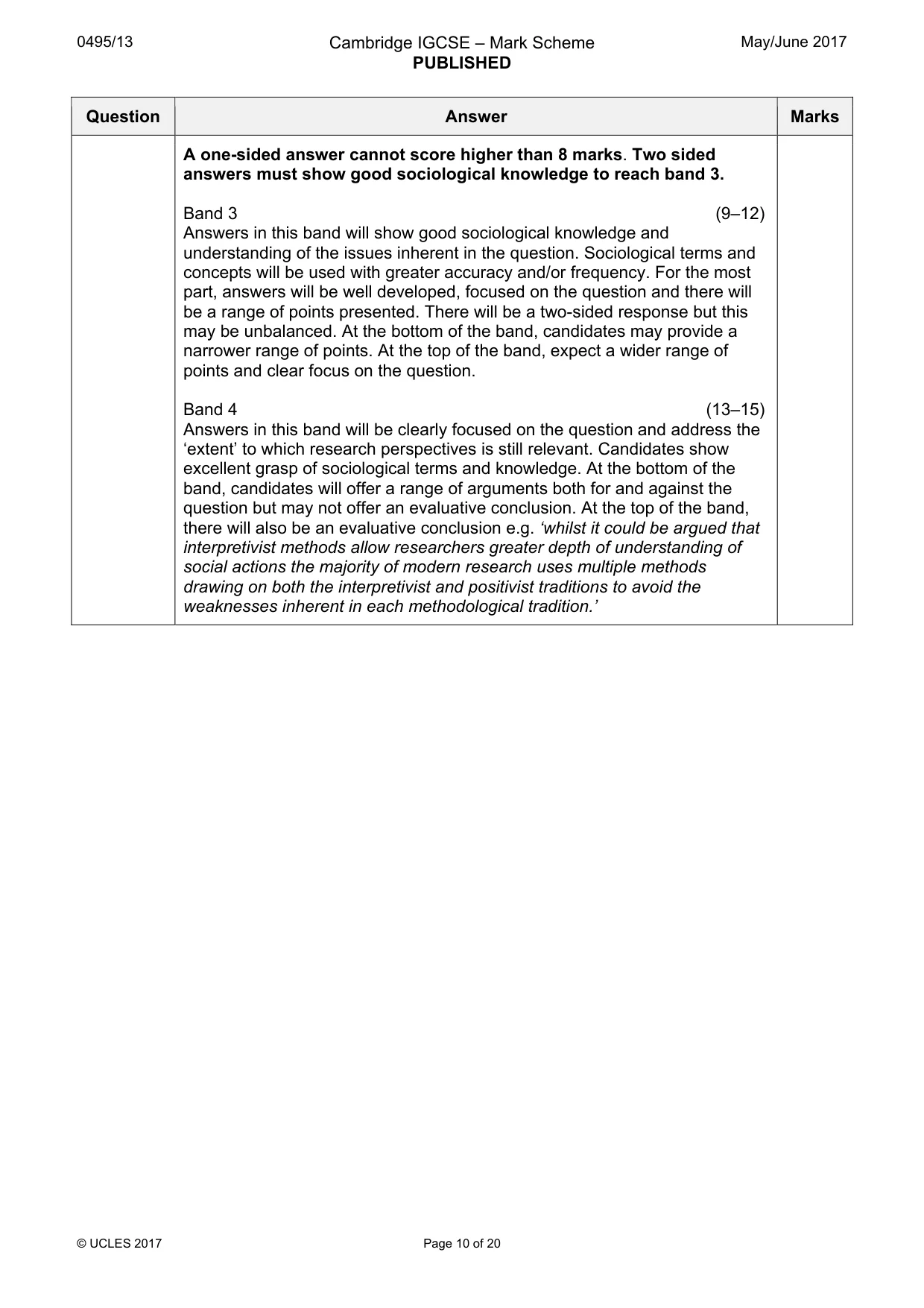
0495/13 Cambridge IGCSE – Mark Scheme PUBLISHED May/June 2017 © UCLES 2017 Page 10 of 20 Question Answer Marks A one-sided answer cannot score higher than 8 marks. Two sided answers must show good sociological knowledge to reach band 3. Band 3 (9–12) Answers in this band will show good sociological knowledge and understanding of the issues inherent in the question. Sociological terms and concepts will be used with greater accuracy and/or frequency. For the most part, answers will be well developed, focused on the question and there will be a range of points presented. There will be a two-sided response but this may be unbalanced. At the bottom of the band, candidates may provide a narrower range of points. At the top of the band, expect a wider range of points and clear focus on the question. Band 4 (13–15) Answers in this band will be clearly focused on the question and address the ‘extent’ to which research perspectives is still relevant. Candidates show excellent grasp of sociological terms and knowledge. At the bottom of the band, candidates will offer a range of arguments both for and against the question but may not offer an evaluative conclusion. At the top of the band, there will also be an evaluative conclusion e.g. ‘whilst it could be argued that interpretivist methods allow researchers greater depth of understanding of social actions the majority of modern research uses multiple methods drawing on both the interpretivist and positivist traditions to avoid the weaknesses inherent in each methodological tradition.’
Mark scheme, page 11
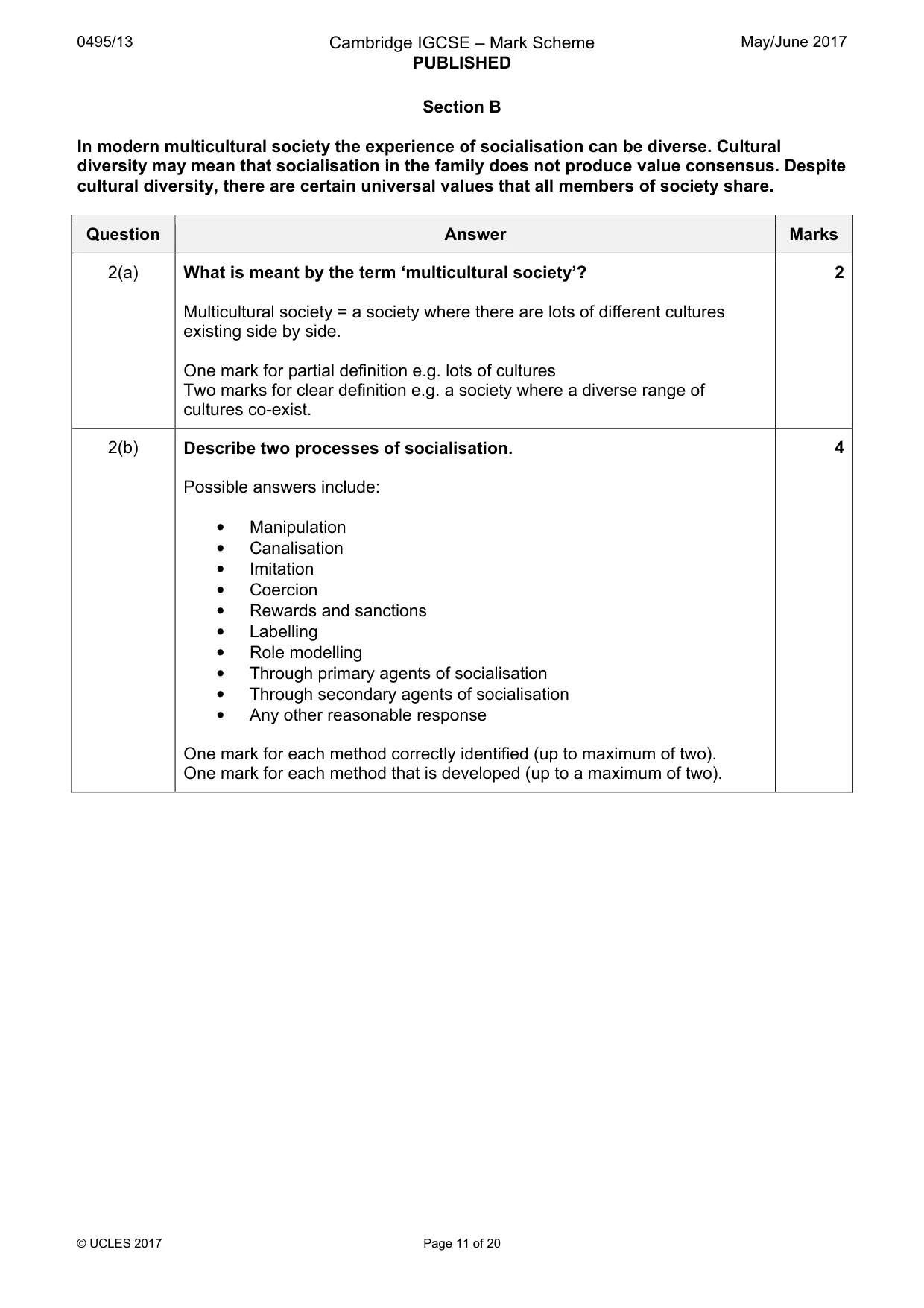
0495/13 Cambridge IGCSE – Mark Scheme PUBLISHED May/June 2017 © UCLES 2017 Page 11 of 20 Section B In modern multicultural society the experience of socialisation can be diverse. Cultural diversity may mean that socialisation in the family does not produce value consensus. Despite cultural diversity, there are certain universal values that all members of society share. Question Answer Marks 2(a) What is meant by the term ‘multicultural society’? Multicultural society = a society where there are lots of different cultures existing side by side. One mark for partial definition e.g. lots of cultures Two marks for clear definition e.g. a society where a diverse range of cultures co-exist. 2 2(b) Describe two processes of socialisation. Possible answers include: • Manipulation • Canalisation • Imitation • Coercion • Rewards and sanctions • Labelling • Role modelling • Through primary agents of socialisation • Through secondary agents of socialisation • Any other reasonable response One mark for each method correctly identified (up to maximum of two). One mark for each method that is developed (up to a maximum of two). 4
Mark scheme, page 12
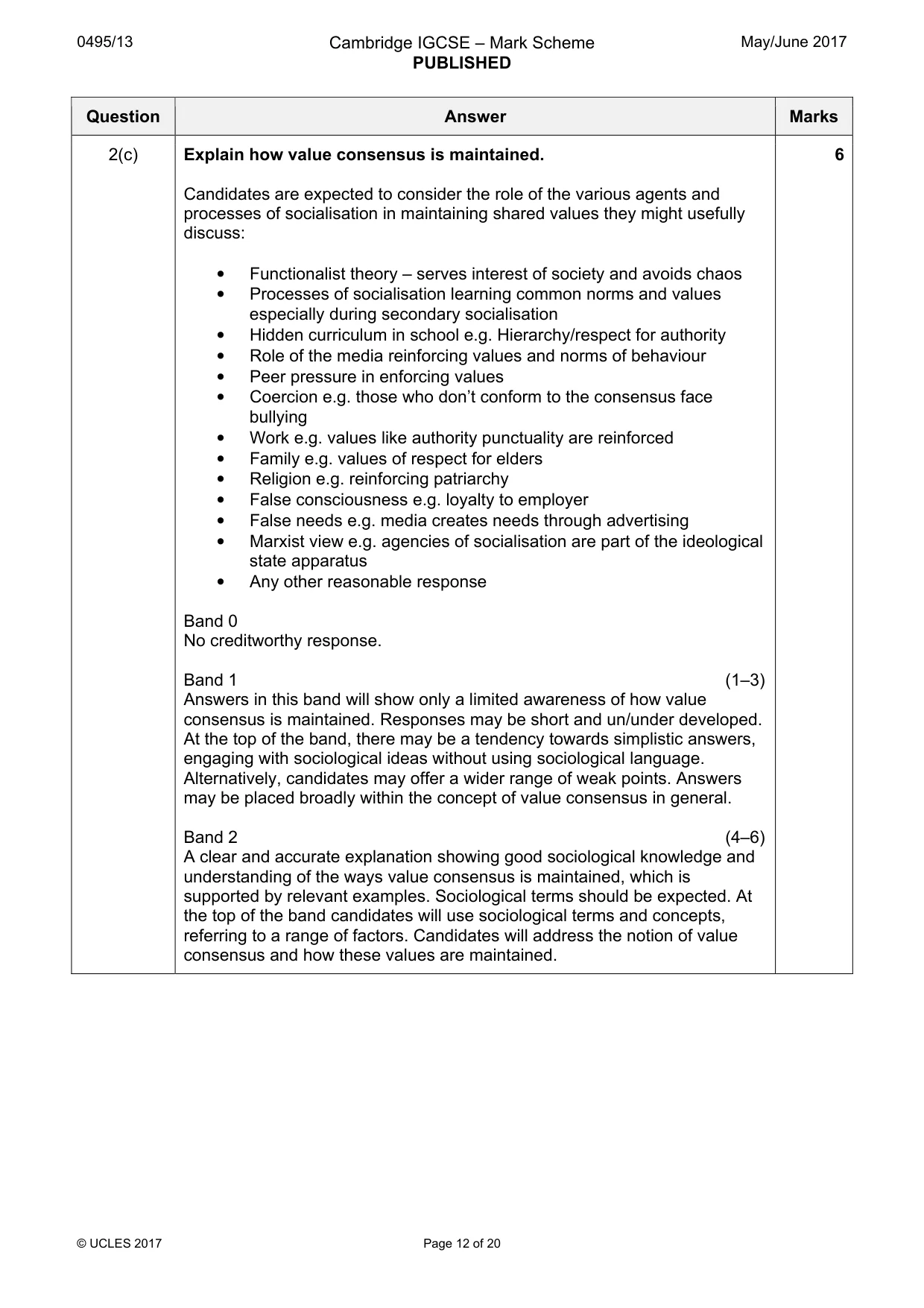
0495/13 Cambridge IGCSE – Mark Scheme PUBLISHED May/June 2017 © UCLES 2017 Page 12 of 20 Question Answer Marks 2(c) Explain how value consensus is maintained. Candidates are expected to consider the role of the various agents and processes of socialisation in maintaining shared values they might usefully discuss: • Functionalist theory – serves interest of society and avoids chaos • Processes of socialisation learning common norms and values especially during secondary socialisation • Hidden curriculum in school e.g. Hierarchy/respect for authority • Role of the media reinforcing values and norms of behaviour • Peer pressure in enforcing values • Coercion e.g. those who don’t conform to the consensus face bullying • Work e.g. values like authority punctuality are reinforced • Family e.g. values of respect for elders • Religion e.g. reinforcing patriarchy • False consciousness e.g. loyalty to employer • False needs e.g. media creates needs through advertising • Marxist view e.g. agencies of socialisation are part of the ideological state apparatus • Any other reasonable response Band 0 No creditworthy response. Band 1 (1–3) Answers in this band will show only a limited awareness of how value consensus is maintained. Responses may be short and un/under developed. At the top of the band, there may be a tendency towards simplistic answers, engaging with sociological ideas without using sociological language. Alternatively, candidates may offer a wider range of weak points. Answers may be placed broadly within the concept of value consensus in general. Band 2 (4–6) A clear and accurate explanation showing good sociological knowledge and understanding of the ways value consensus is maintained, which is supported by relevant examples. Sociological terms should be expected. At the top of the band candidates will use sociological terms and concepts, referring to a range of factors. Candidates will address the notion of value consensus and how these values are maintained. 6
Mark scheme, page 13
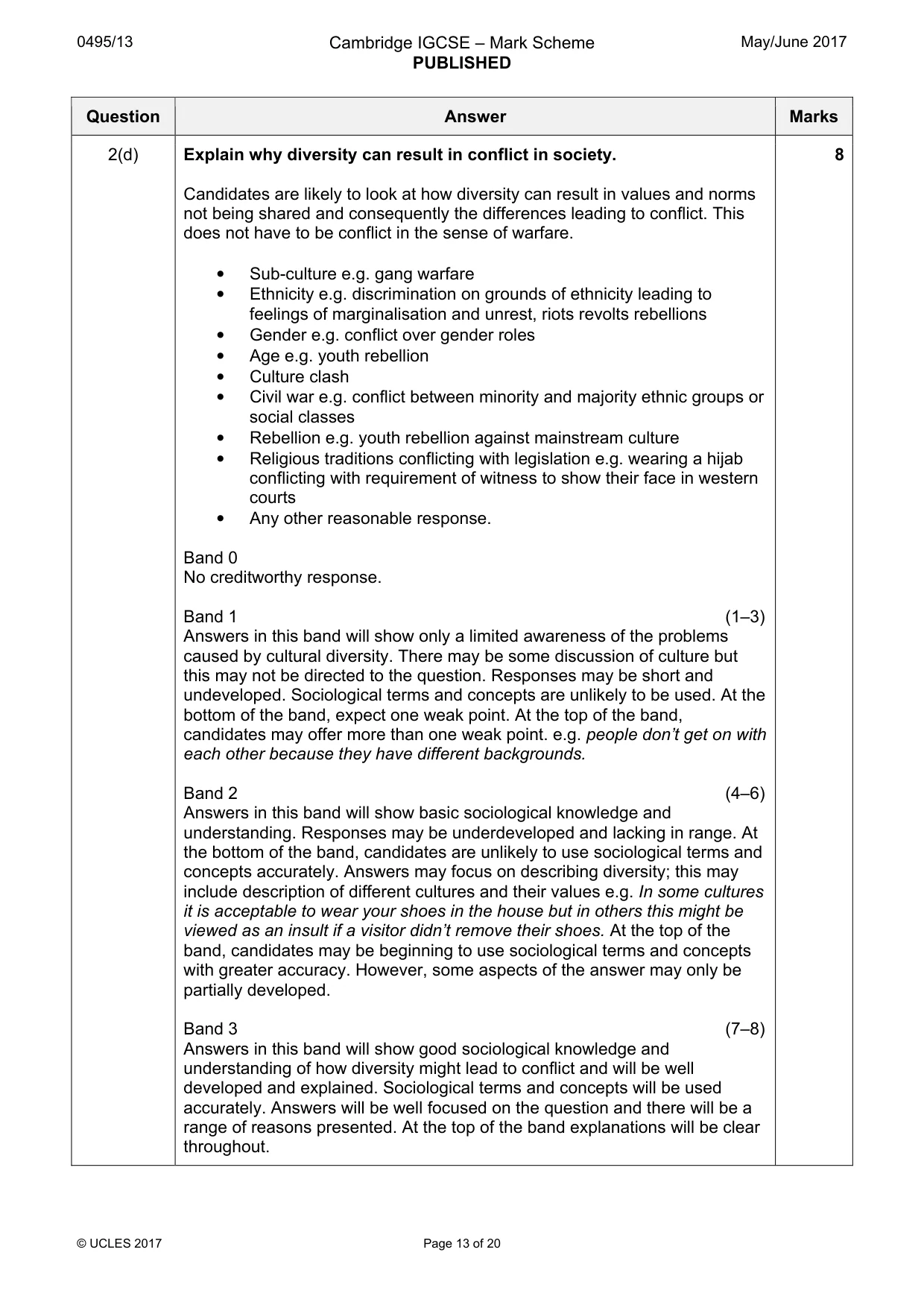
0495/13 Cambridge IGCSE – Mark Scheme PUBLISHED May/June 2017 © UCLES 2017 Page 13 of 20 Question Answer Marks 2(d) Explain why diversity can result in conflict in society. Candidates are likely to look at how diversity can result in values and norms not being shared and consequently the differences leading to conflict. This does not have to be conflict in the sense of warfare. • Sub-culture e.g. gang warfare • Ethnicity e.g. discrimination on grounds of ethnicity leading to feelings of marginalisation and unrest, riots revolts rebellions • Gender e.g. conflict over gender roles • Age e.g. youth rebellion • Culture clash • Civil war e.g. conflict between minority and majority ethnic groups or social classes • Rebellion e.g. youth rebellion against mainstream culture • Religious traditions conflicting with legislation e.g. wearing a hijab conflicting with requirement of witness to show their face in western courts • Any other reasonable response. Band 0 No creditworthy response. Band 1 (1–3) Answers in this band will show only a limited awareness of the problems caused by cultural diversity. There may be some discussion of culture but this may not be directed to the question. Responses may be short and undeveloped. Sociological terms and concepts are unlikely to be used. At the bottom of the band, expect one weak point. At the top of the band, candidates may offer more than one weak point. e.g. people don’t get on with each other because they have different backgrounds. Band 2 (4–6) Answers in this band will show basic sociological knowledge and understanding. Responses may be underdeveloped and lacking in range. At the bottom of the band, candidates are unlikely to use sociological terms and concepts accurately. Answers may focus on describing diversity; this may include description of different cultures and their values e.g. In some cultures it is acceptable to wear your shoes in the house but in others this might be viewed as an insult if a visitor didn’t remove their shoes. At the top of the band, candidates may be beginning to use sociological terms and concepts with greater accuracy. However, some aspects of the answer may only be partially developed. Band 3 (7–8) Answers in this band will show good sociological knowledge and understanding of how diversity might lead to conflict and will be well developed and explained. Sociological terms and concepts will be used accurately. Answers will be well focused on the question and there will be a range of reasons presented. At the top of the band explanations will be clear throughout. 8
Mark scheme, page 14
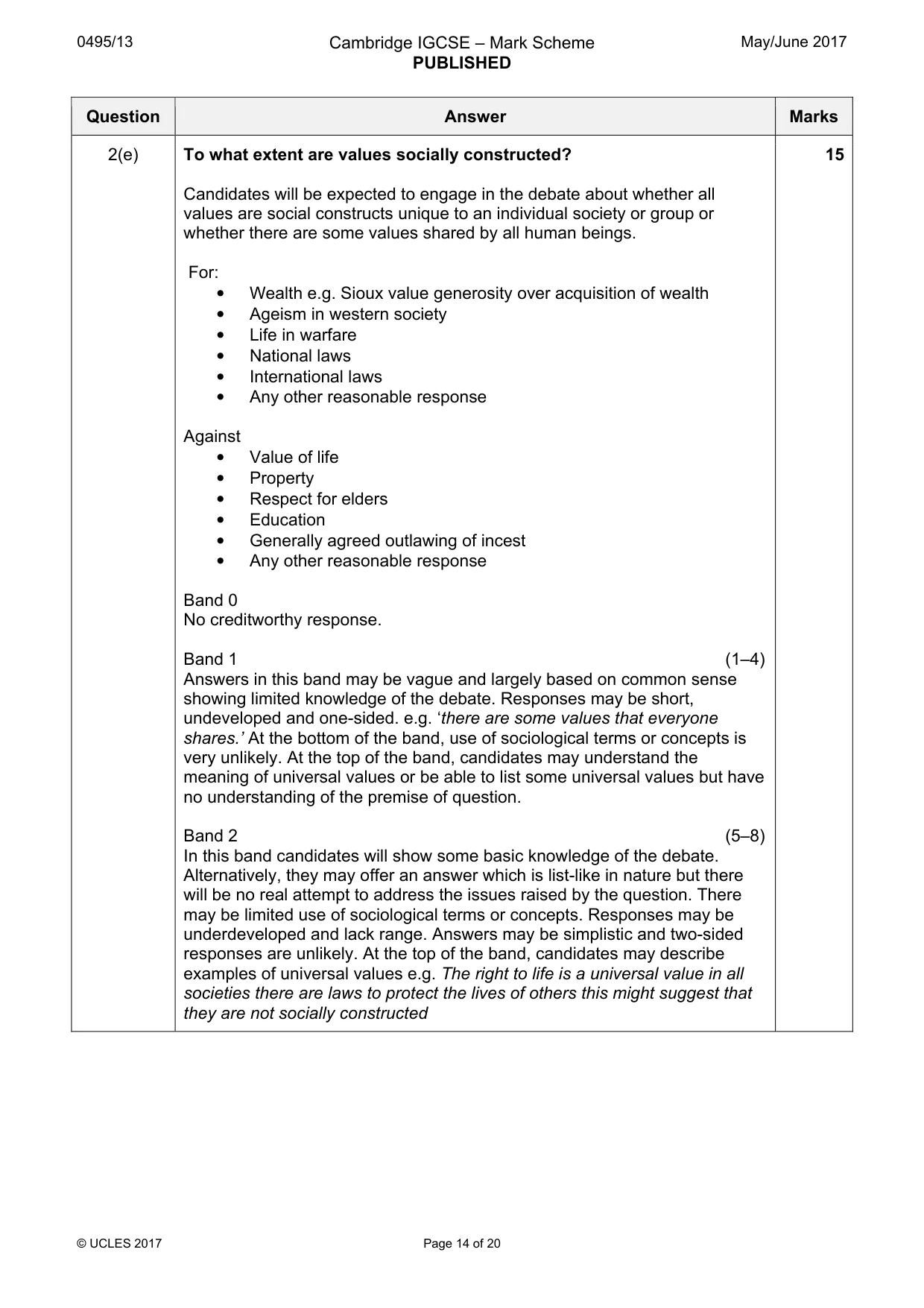
0495/13 Cambridge IGCSE – Mark Scheme PUBLISHED May/June 2017 © UCLES 2017 Page 14 of 20 Question Answer Marks 2(e) To what extent are values socially constructed? Candidates will be expected to engage in the debate about whether all values are social constructs unique to an individual society or group or whether there are some values shared by all human beings. For: • Wealth e.g. Sioux value generosity over acquisition of wealth • Ageism in western society • Life in warfare • National laws • International laws • Any other reasonable response Against • Value of life • Property • Respect for elders • Education • Generally agreed outlawing of incest • Any other reasonable response Band 0 No creditworthy response. Band 1 (1–4) Answers in this band may be vague and largely based on common sense showing limited knowledge of the debate. Responses may be short, undeveloped and one-sided. e.g. ‘there are some values that everyone shares.’ At the bottom of the band, use of sociological terms or concepts is very unlikely. At the top of the band, candidates may understand the meaning of universal values or be able to list some universal values but have no understanding of the premise of question. Band 2 (5–8) In this band candidates will show some basic knowledge of the debate. Alternatively, they may offer an answer which is list-like in nature but there will be no real attempt to address the issues raised by the question. There may be limited use of sociological terms or concepts. Responses may be underdeveloped and lack range. Answers may be simplistic and two-sided responses are unlikely. At the top of the band, candidates may describe examples of universal values e.g. The right to life is a universal value in all societies there are laws to protect the lives of others this might suggest that they are not socially constructed 15
Mark scheme, page 15
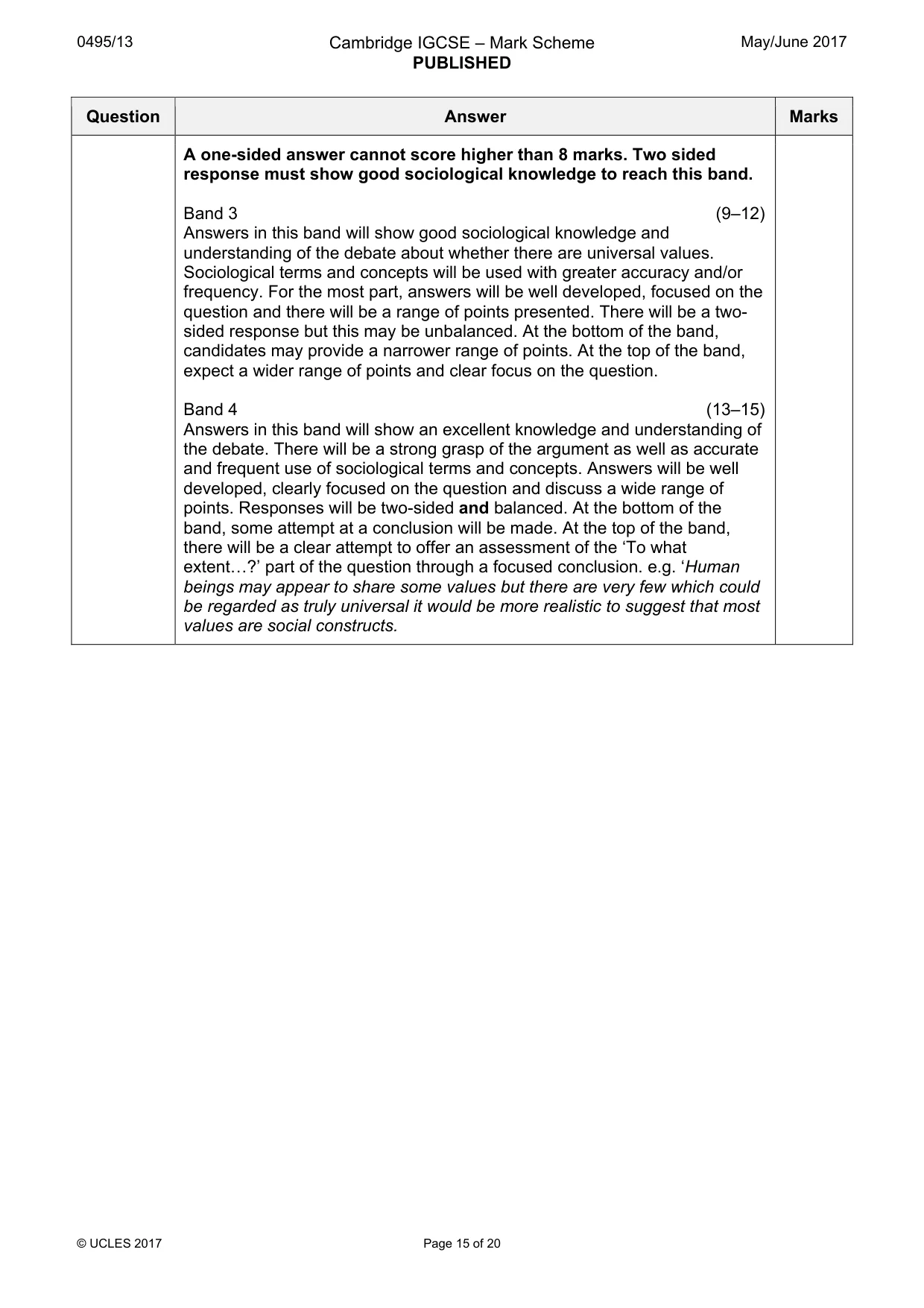
0495/13 Cambridge IGCSE – Mark Scheme PUBLISHED May/June 2017 © UCLES 2017 Page 15 of 20 Question Answer Marks A one-sided answer cannot score higher than 8 marks. Two sided response must show good sociological knowledge to reach this band. Band 3 (9–12) Answers in this band will show good sociological knowledge and understanding of the debate about whether there are universal values. Sociological terms and concepts will be used with greater accuracy and/or frequency. For the most part, answers will be well developed, focused on the question and there will be a range of points presented. There will be a two- sided response but this may be unbalanced. At the bottom of the band, candidates may provide a narrower range of points. At the top of the band, expect a wider range of points and clear focus on the question. Band 4 (13–15) Answers in this band will show an excellent knowledge and understanding of the debate. There will be a strong grasp of the argument as well as accurate and frequent use of sociological terms and concepts. Answers will be well developed, clearly focused on the question and discuss a wide range of points. Responses will be two-sided and balanced. At the bottom of the band, some attempt at a conclusion will be made. At the top of the band, there will be a clear attempt to offer an assessment of the ‘To what extent«?’ part of the question through a focused conclusion. e.g. ‘Human beings may appear to share some values but there are very few which could be regarded as truly universal it would be more realistic to suggest that most values are social constructs.
Mark scheme, page 16
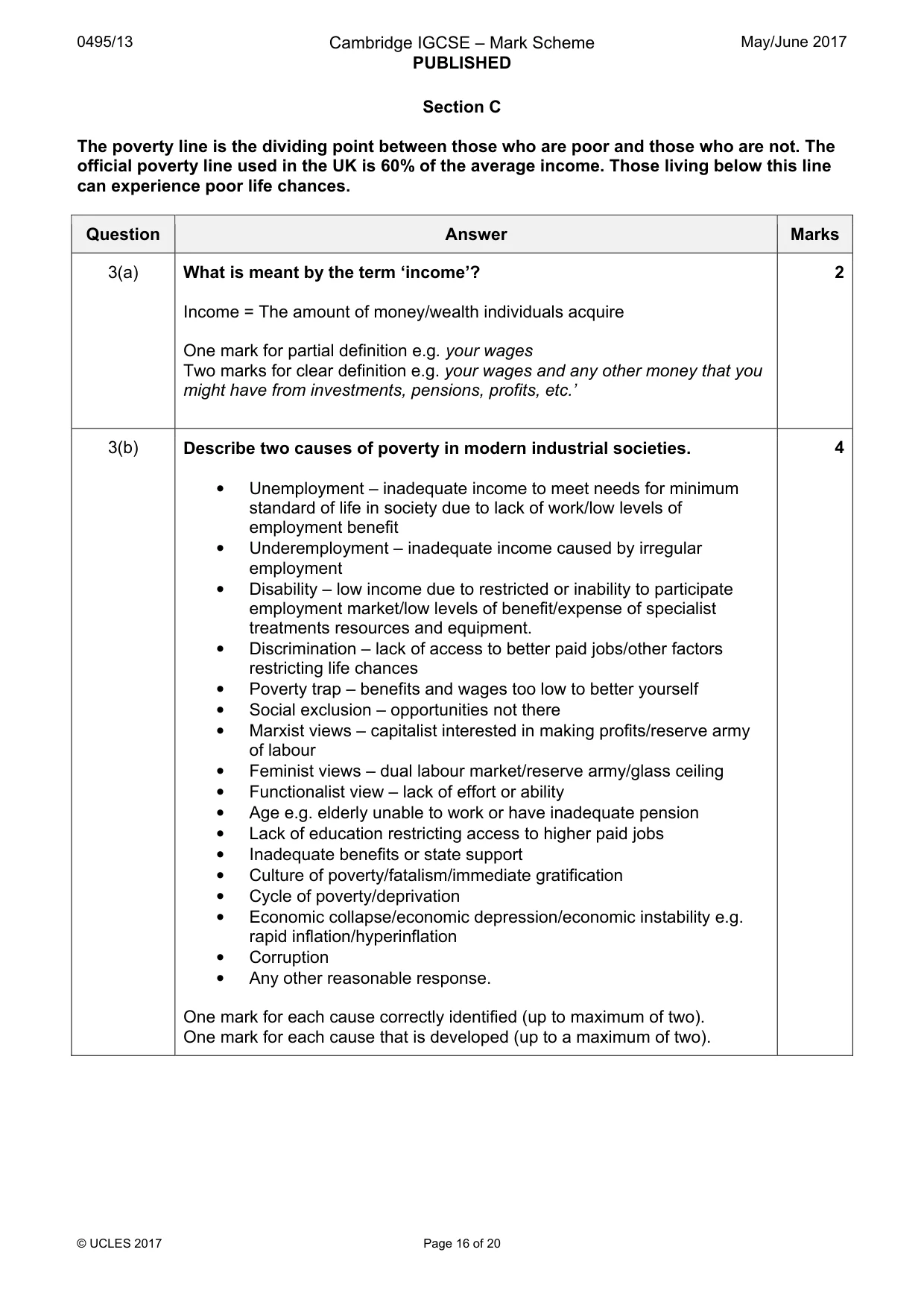
0495/13 Cambridge IGCSE – Mark Scheme PUBLISHED May/June 2017 © UCLES 2017 Page 16 of 20 Section C The poverty line is the dividing point between those who are poor and those who are not. The official poverty line used in the UK is 60% of the average income. Those living below this line can experience poor life chances. Question Answer Marks 3(a) What is meant by the term ‘income’? Income = The amount of money/wealth individuals acquire One mark for partial definition e.g. your wages Two marks for clear definition e.g. your wages and any other money that you might have from investments, pensions, profits, etc.’ 2 3(b) Describe two causes of poverty in modern industrial societies. • Unemployment – inadequate income to meet needs for minimum standard of life in society due to lack of work/low levels of employment benefit • Underemployment – inadequate income caused by irregular employment • Disability – low income due to restricted or inability to participate employment market/low levels of benefit/expense of specialist treatments resources and equipment. • Discrimination – lack of access to better paid jobs/other factors restricting life chances • Poverty trap – benefits and wages too low to better yourself • Social exclusion – opportunities not there • Marxist views – capitalist interested in making profits/reserve army of labour • Feminist views – dual labour market/reserve army/glass ceiling • Functionalist view – lack of effort or ability • Age e.g. elderly unable to work or have inadequate pension • Lack of education restricting access to higher paid jobs • Inadequate benefits or state support • Culture of poverty/fatalism/immediate gratification • Cycle of poverty/deprivation • Economic collapse/economic depression/economic instability e.g. rapid inflation/hyperinflation • Corruption • Any other reasonable response. One mark for each cause correctly identified (up to maximum of two). One mark for each cause that is developed (up to a maximum of two). 4
Mark scheme, page 17
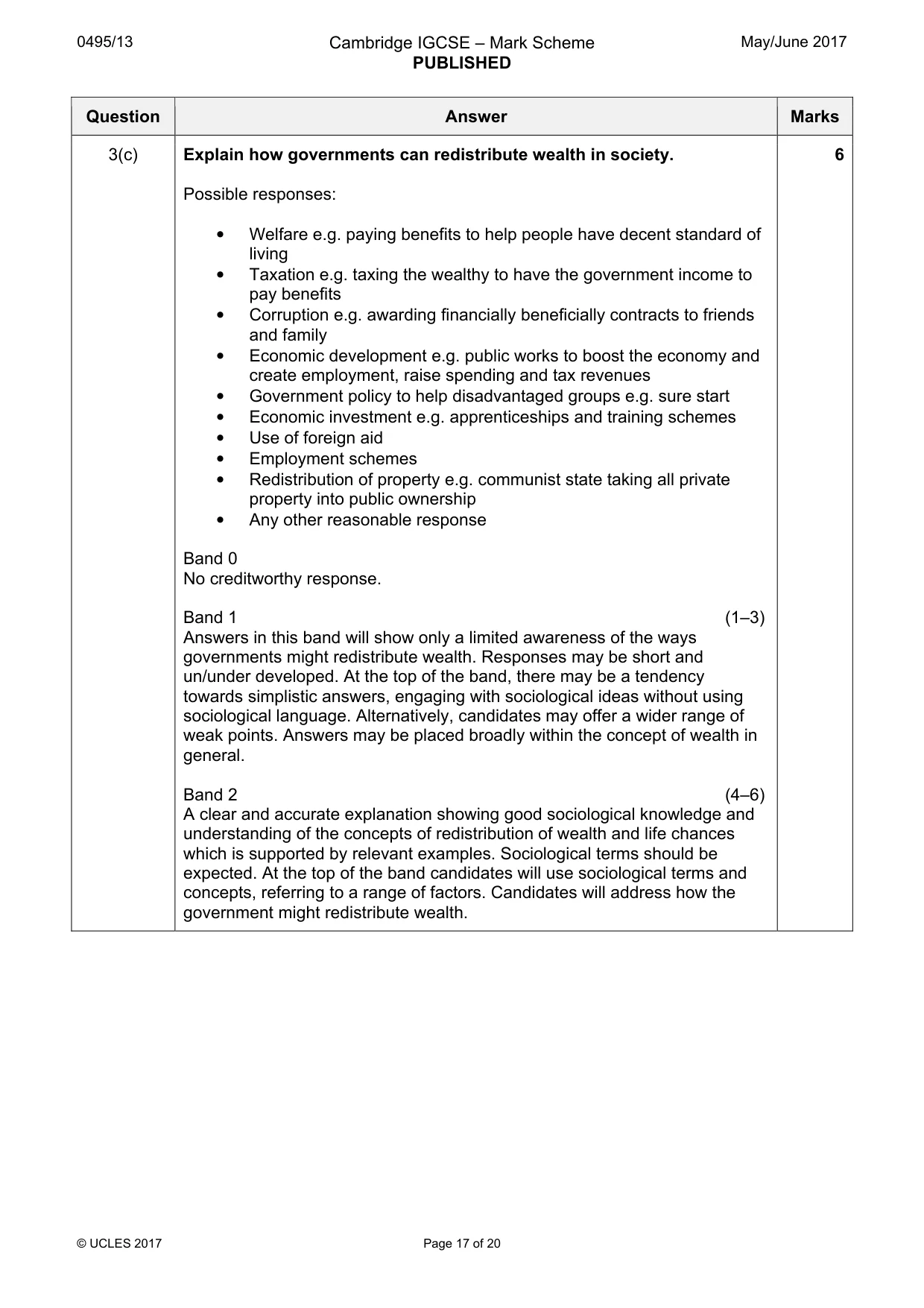
0495/13 Cambridge IGCSE – Mark Scheme PUBLISHED May/June 2017 © UCLES 2017 Page 17 of 20 Question Answer Marks 3(c) Explain how governments can redistribute wealth in society. Possible responses: • Welfare e.g. paying benefits to help people have decent standard of living • Taxation e.g. taxing the wealthy to have the government income to pay benefits • Corruption e.g. awarding financially beneficially contracts to friends and family • Economic development e.g. public works to boost the economy and create employment, raise spending and tax revenues • Government policy to help disadvantaged groups e.g. sure start • Economic investment e.g. apprenticeships and training schemes • Use of foreign aid • Employment schemes • Redistribution of property e.g. communist state taking all private property into public ownership • Any other reasonable response Band 0 No creditworthy response. Band 1 (1–3) Answers in this band will show only a limited awareness of the ways governments might redistribute wealth. Responses may be short and un/under developed. At the top of the band, there may be a tendency towards simplistic answers, engaging with sociological ideas without using sociological language. Alternatively, candidates may offer a wider range of weak points. Answers may be placed broadly within the concept of wealth in general. Band 2 (4–6) A clear and accurate explanation showing good sociological knowledge and understanding of the concepts of redistribution of wealth and life chances which is supported by relevant examples. Sociological terms should be expected. At the top of the band candidates will use sociological terms and concepts, referring to a range of factors. Candidates will address how the government might redistribute wealth. 6
Mark scheme, page 18
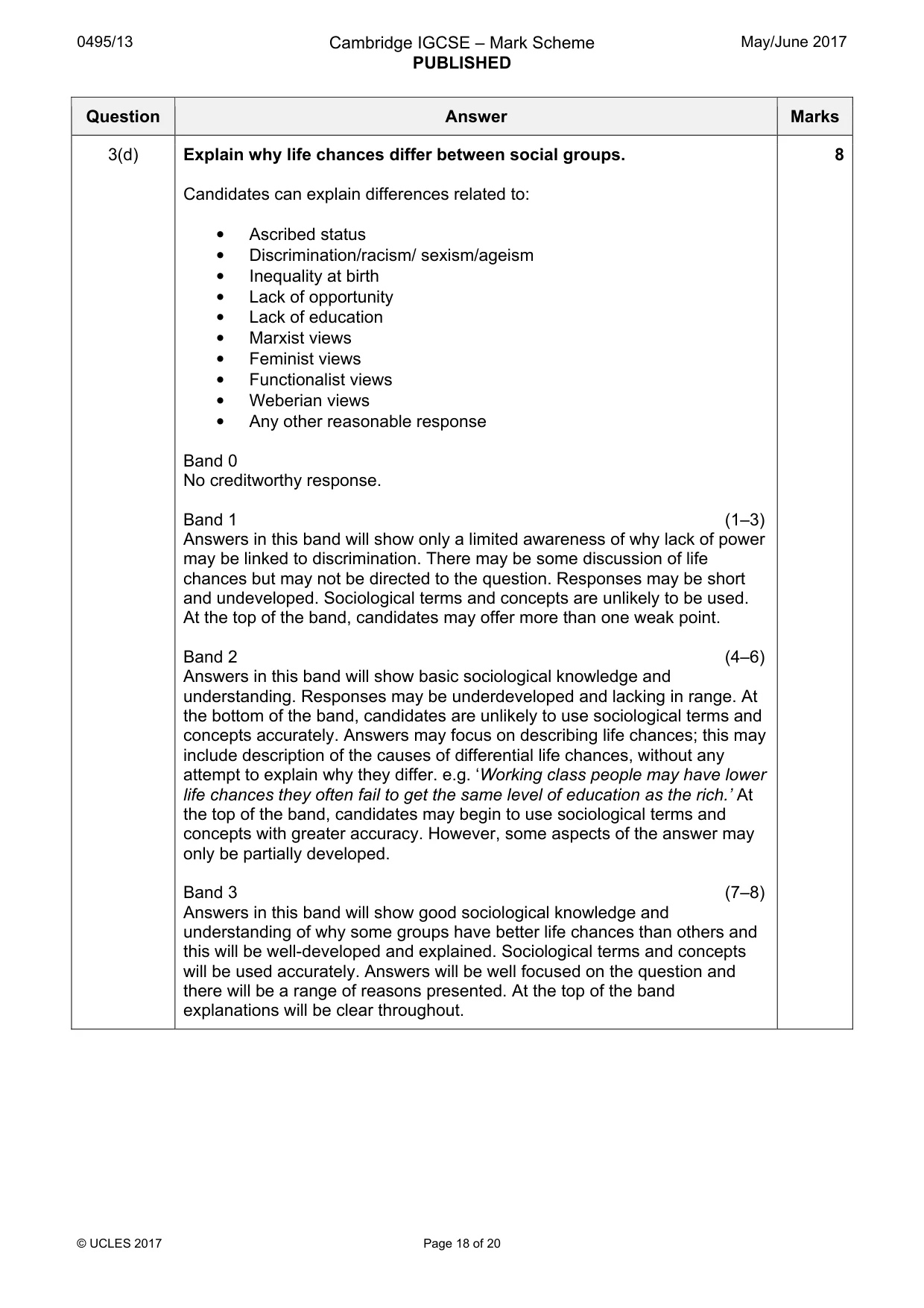
0495/13 Cambridge IGCSE – Mark Scheme PUBLISHED May/June 2017 © UCLES 2017 Page 18 of 20 Question Answer Marks 3(d) Explain why life chances differ between social groups. Candidates can explain differences related to: • Ascribed status • Discrimination/racism/ sexism/ageism • Inequality at birth • Lack of opportunity • Lack of education • Marxist views • Feminist views • Functionalist views • Weberian views • Any other reasonable response Band 0 No creditworthy response. Band 1 (1–3) Answers in this band will show only a limited awareness of why lack of power may be linked to discrimination. There may be some discussion of life chances but may not be directed to the question. Responses may be short and undeveloped. Sociological terms and concepts are unlikely to be used. At the top of the band, candidates may offer more than one weak point. Band 2 (4–6) Answers in this band will show basic sociological knowledge and understanding. Responses may be underdeveloped and lacking in range. At the bottom of the band, candidates are unlikely to use sociological terms and concepts accurately. Answers may focus on describing life chances; this may include description of the causes of differential life chances, without any attempt to explain why they differ. e.g. ‘Working class people may have lower life chances they often fail to get the same level of education as the rich.’ At the top of the band, candidates may begin to use sociological terms and concepts with greater accuracy. However, some aspects of the answer may only be partially developed. Band 3 (7–8) Answers in this band will show good sociological knowledge and understanding of why some groups have better life chances than others and this will be well-developed and explained. Sociological terms and concepts will be used accurately. Answers will be well focused on the question and there will be a range of reasons presented. At the top of the band explanations will be clear throughout. 8
Mark scheme, page 19
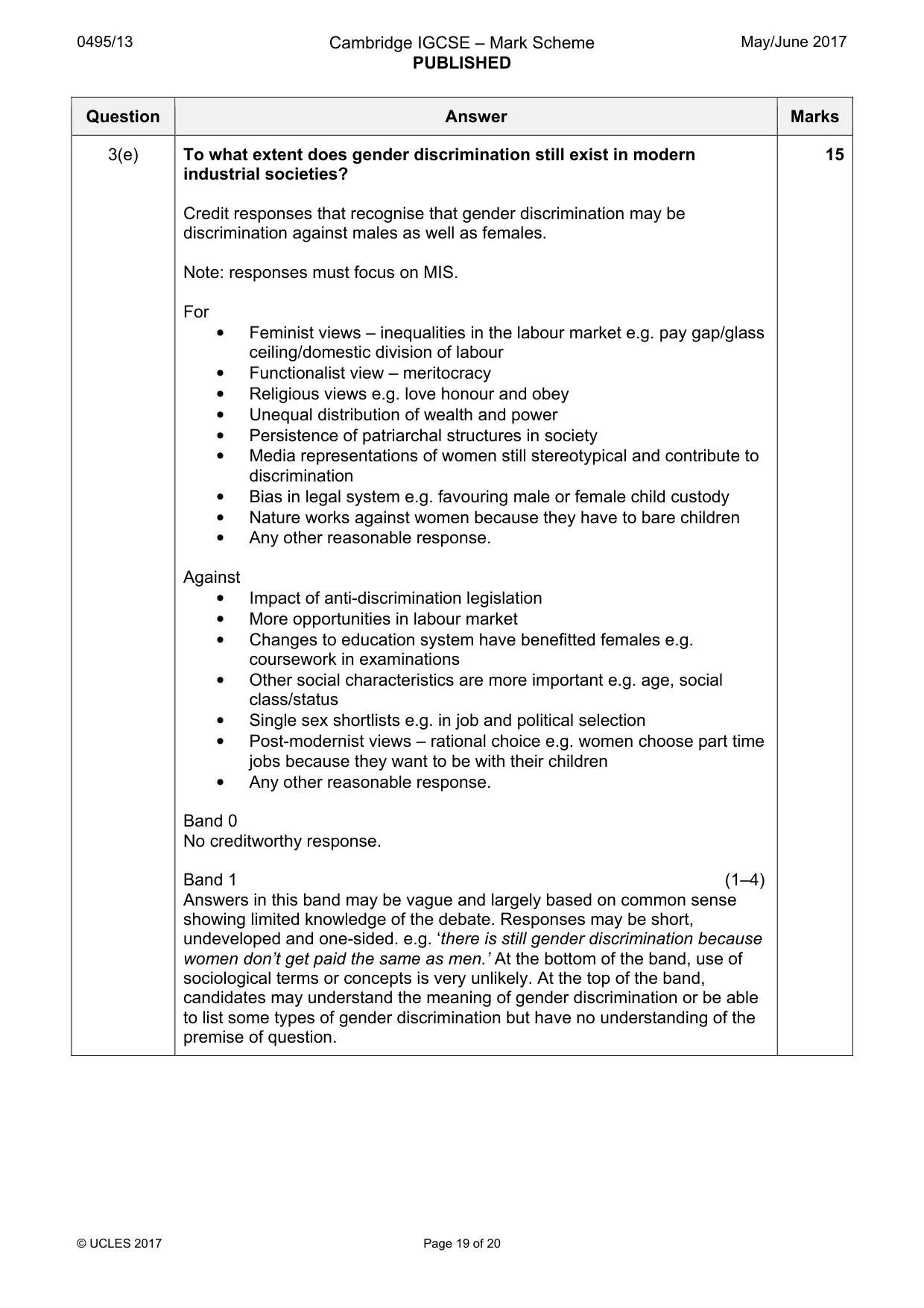
0495/13 Cambridge IGCSE – Mark Scheme PUBLISHED May/June 2017 © UCLES 2017 Page 19 of 20 Question Answer Marks 3(e) To what extent does gender discrimination still exist in modern industrial societies? Credit responses that recognise that gender discrimination may be discrimination against males as well as females. Note: responses must focus on MIS. For • Feminist views – inequalities in the labour market e.g. pay gap/glass ceiling/domestic division of labour • Functionalist view – meritocracy • Religious views e.g. love honour and obey • Unequal distribution of wealth and power • Persistence of patriarchal structures in society • Media representations of women still stereotypical and contribute to discrimination • Bias in legal system e.g. favouring male or female child custody • Nature works against women because they have to bare children • Any other reasonable response. Against • Impact of anti-discrimination legislation • More opportunities in labour market • Changes to education system have benefitted females e.g. coursework in examinations • Other social characteristics are more important e.g. age, social class/status • Single sex shortlists e.g. in job and political selection • Post-modernist views – rational choice e.g. women choose part time jobs because they want to be with their children • Any other reasonable response. Band 0 No creditworthy response. Band 1 (1–4) Answers in this band may be vague and largely based on common sense showing limited knowledge of the debate. Responses may be short, undeveloped and one-sided. e.g. ‘there is still gender discrimination because women don’t get paid the same as men.’ At the bottom of the band, use of sociological terms or concepts is very unlikely. At the top of the band, candidates may understand the meaning of gender discrimination or be able to list some types of gender discrimination but have no understanding of the premise of question. 15
Mark scheme, page 20
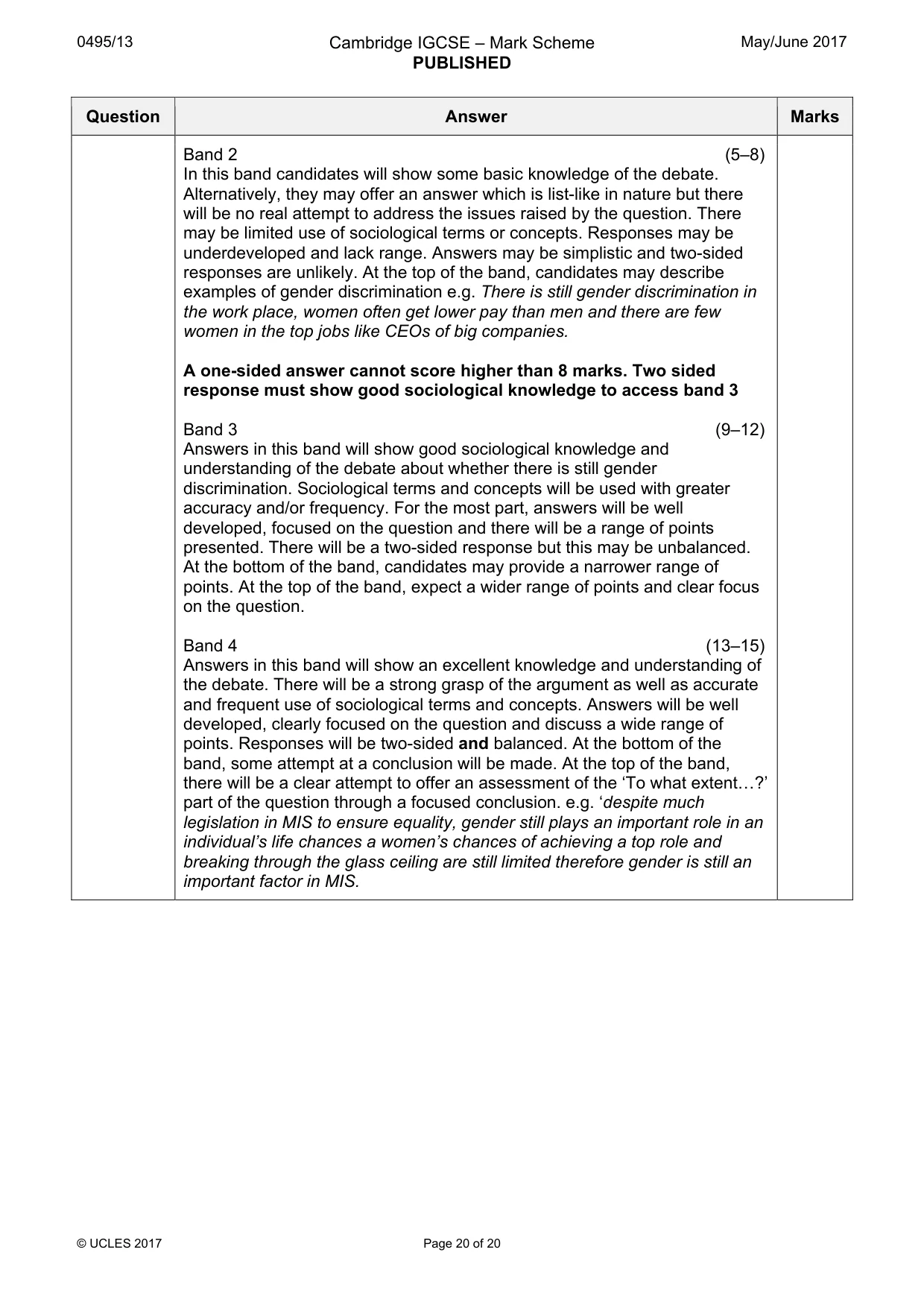
0495/13 Cambridge IGCSE – Mark Scheme PUBLISHED May/June 2017 © UCLES 2017 Page 20 of 20 Question Answer Marks Band 2 (5–8) In this band candidates will show some basic knowledge of the debate. Alternatively, they may offer an answer which is list-like in nature but there will be no real attempt to address the issues raised by the question. There may be limited use of sociological terms or concepts. Responses may be underdeveloped and lack range. Answers may be simplistic and two-sided responses are unlikely. At the top of the band, candidates may describe examples of gender discrimination e.g. There is still gender discrimination in the work place, women often get lower pay than men and there are few women in the top jobs like CEOs of big companies. A one-sided answer cannot score higher than 8 marks. Two sided response must show good sociological knowledge to access band 3 Band 3 (9–12) Answers in this band will show good sociological knowledge and understanding of the debate about whether there is still gender discrimination. Sociological terms and concepts will be used with greater accuracy and/or frequency. For the most part, answers will be well developed, focused on the question and there will be a range of points presented. There will be a two-sided response but this may be unbalanced. At the bottom of the band, candidates may provide a narrower range of points. At the top of the band, expect a wider range of points and clear focus on the question. Band 4 (13–15) Answers in this band will show an excellent knowledge and understanding of the debate. There will be a strong grasp of the argument as well as accurate and frequent use of sociological terms and concepts. Answers will be well developed, clearly focused on the question and discuss a wide range of points. Responses will be two-sided and balanced. At the bottom of the band, some attempt at a conclusion will be made. At the top of the band, there will be a clear attempt to offer an assessment of the ‘To what extent«?’ part of the question through a focused conclusion. e.g. ‘despite much legislation in MIS to ensure equality, gender still plays an important role in an individual’s life chances a women’s chances of achieving a top role and breaking through the glass ceiling are still limited therefore gender is still an important factor in MIS.
What you needed in this session
Cambridge’s own grade thresholds for 2017 May/June, Paper 1 · Variant 3. A higher threshold means an easier paper — the bar moves with how the cohort did.