Cambridge IGCSE Sociology 0495 — 2017 May/June Paper 1 · Variant 1
0495/11/M/J/17 · 80 marks · ≈90 min
The question paper and its mark scheme, free to read here and free to download. This is Cambridge’s own paper, exactly as it was sat.
Question paper4 pages

Mark scheme16 pages
Answers below. Sit the paper first if you are practising.
Paper as text
Question paper, page 1
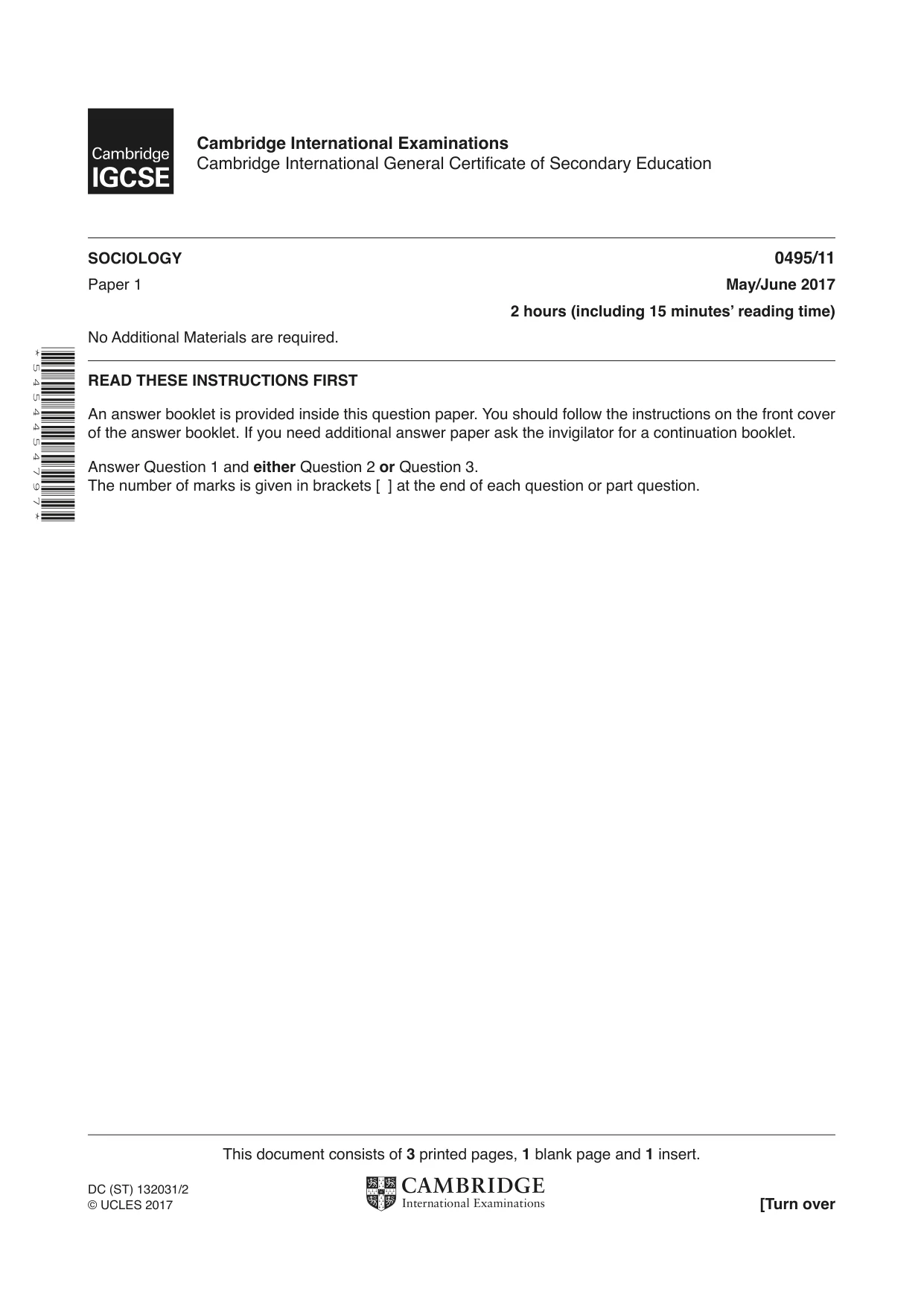
This document consists of 3 printed pages, 1 blank page and 1 insert. DC (ST) 132031/2 © UCLES 2017 [Turn over Cambridge International Examinations Cambridge International General Certificate of Secondary Education * 5 4 5 4 4 5 4 7 9 7 * SOCIOLOGY 0495/11 Paper 1 May/June 2017 2 hours (including 15 minutes’ reading time) No Additional Materials are required. READ THESE INSTRUCTIONS FIRST An answer booklet is provided inside this question paper. You should follow the instructions on the front cover of the answer booklet. If you need additional answer paper ask the invigilator for a continuation booklet. Answer Question 1 and either Question 2 or Question 3. The number of marks is given in brackets [ ] at the end of each question or part question.
Question paper, page 2
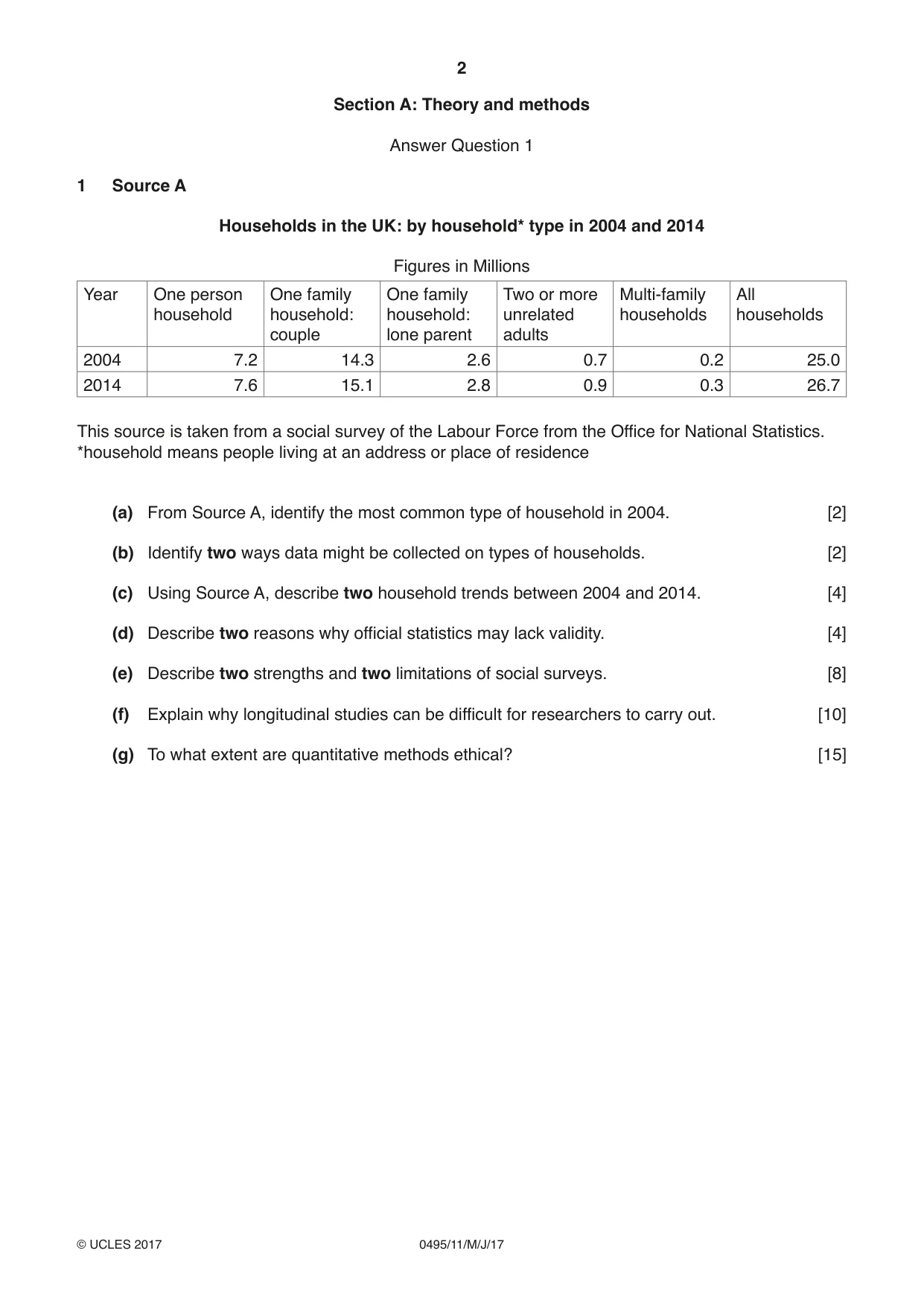
2 0495/11/M/J/17 © UCLES 2017 Section A: Theory and methods Answer Question 1 1 Source A Households in the UK: by household* type in 2004 and 2014 Figures in Millions Year One person household One family household: couple One family household: lone parent Two or more unrelated adults Multi-family households All households 2004 7.2 14.3 2.6 0.7 0.2 25.0 2014 7.6 15.1 2.8 0.9 0.3 26.7 This source is taken from a social survey of the Labour Force from the Office for National Statistics. *household means people living at an address or place of residence (a) From Source A, identify the most common type of household in 2004. [2] (b) Identify two ways data might be collected on types of households. [2] (c) Using Source A, describe two household trends between 2004 and 2014. [4] (d) Describe two reasons why official statistics may lack validity. [4] (e) Describe two strengths and two limitations of social surveys. [8] (f) Explain why longitudinal studies can be difficult for researchers to carry out. [10] (g) To what extent are quantitative methods ethical? [15]
Question paper, page 3
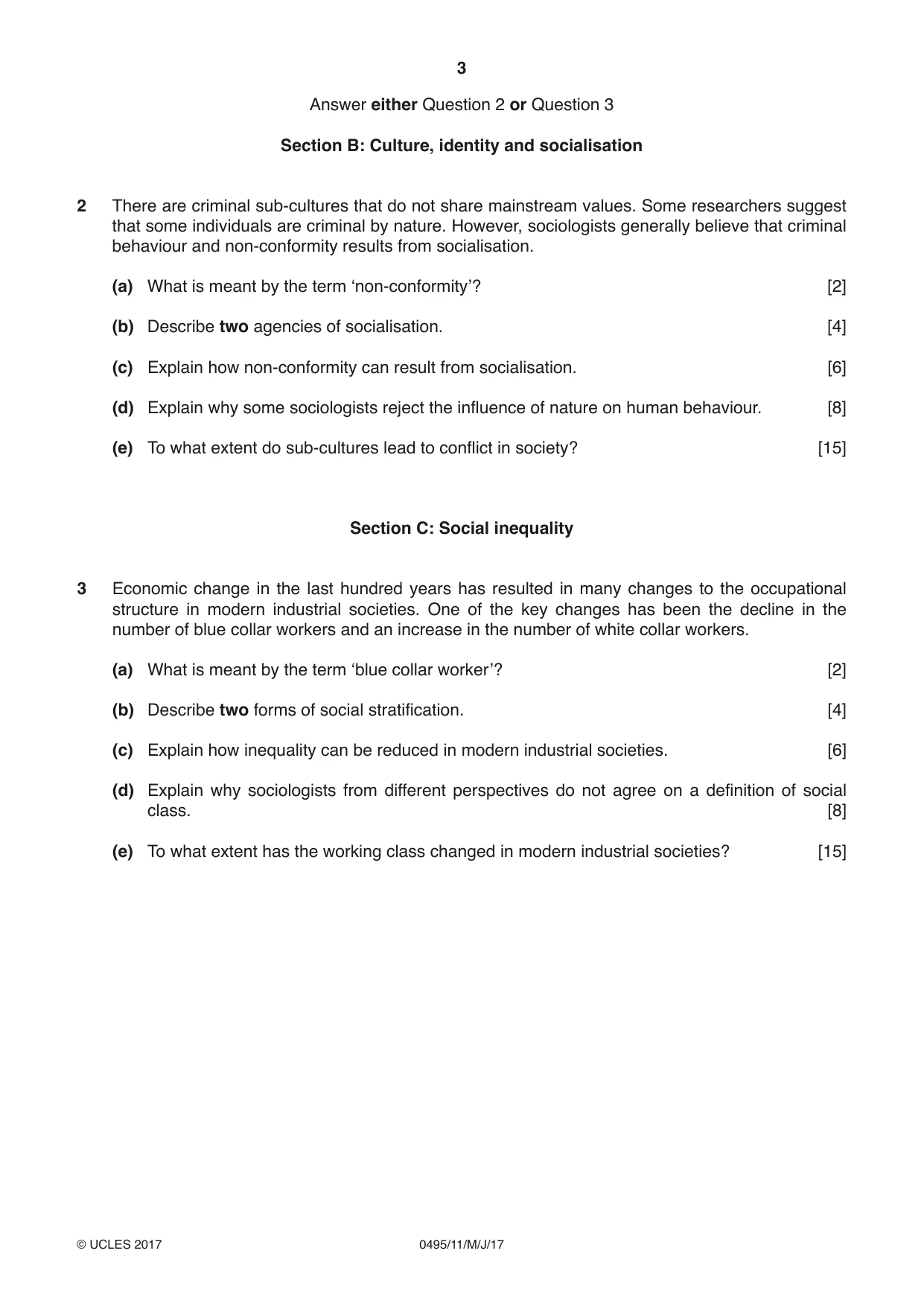
3 0495/11/M/J/17 © UCLES 2017 Answer either Question 2 or Question 3 Section B: Culture, identity and socialisation 2 There are criminal sub-cultures that do not share mainstream values. Some researchers suggest that some individuals are criminal by nature. However, sociologists generally believe that criminal behaviour and non-conformity results from socialisation. (a) What is meant by the term ‘non-conformity’? [2] (b) Describe two agencies of socialisation. [4] (c) Explain how non-conformity can result from socialisation. [6] (d) Explain why some sociologists reject the influence of nature on human behaviour. [8] (e) To what extent do sub-cultures lead to conflict in society? [15] Section C: Social inequality 3 Economic change in the last hundred years has resulted in many changes to the occupational structure in modern industrial societies. One of the key changes has been the decline in the number of blue collar workers and an increase in the number of white collar workers. (a) What is meant by the term ‘blue collar worker’? [2] (b) Describe two forms of social stratification. [4] (c) Explain how inequality can be reduced in modern industrial societies. [6] (d) Explain why sociologists from different perspectives do not agree on a definition of social class. [8] (e) To what extent has the working class changed in modern industrial societies? [15]
Question paper, page 4
4 0495/11/M/J/17 © UCLES 2017 BLANK PAGE Permission to reproduce items where third-party owned material protected by copyright is included has been sought and cleared where possible. Every reasonable effort has been made by the publisher (UCLES) to trace copyright holders, but if any items requiring clearance have unwittingly been included, the publisher will be pleased to make amends at the earliest possible opportunity. To avoid the issue of disclosure of answer-related information to candidates, all copyright acknowledgements are reproduced online in the Cambridge International Examinations Copyright Acknowledgements Booklet. This is produced for each series of examinations and is freely available to download at www.cie.org.uk after the live examination series. Cambridge International Examinations is part of the Cambridge Assessment Group. Cambridge Assessment is the brand name of University of Cambridge Local Examinations Syndicate (UCLES), which is itself a department of the University of Cambridge.
Mark scheme, page 1
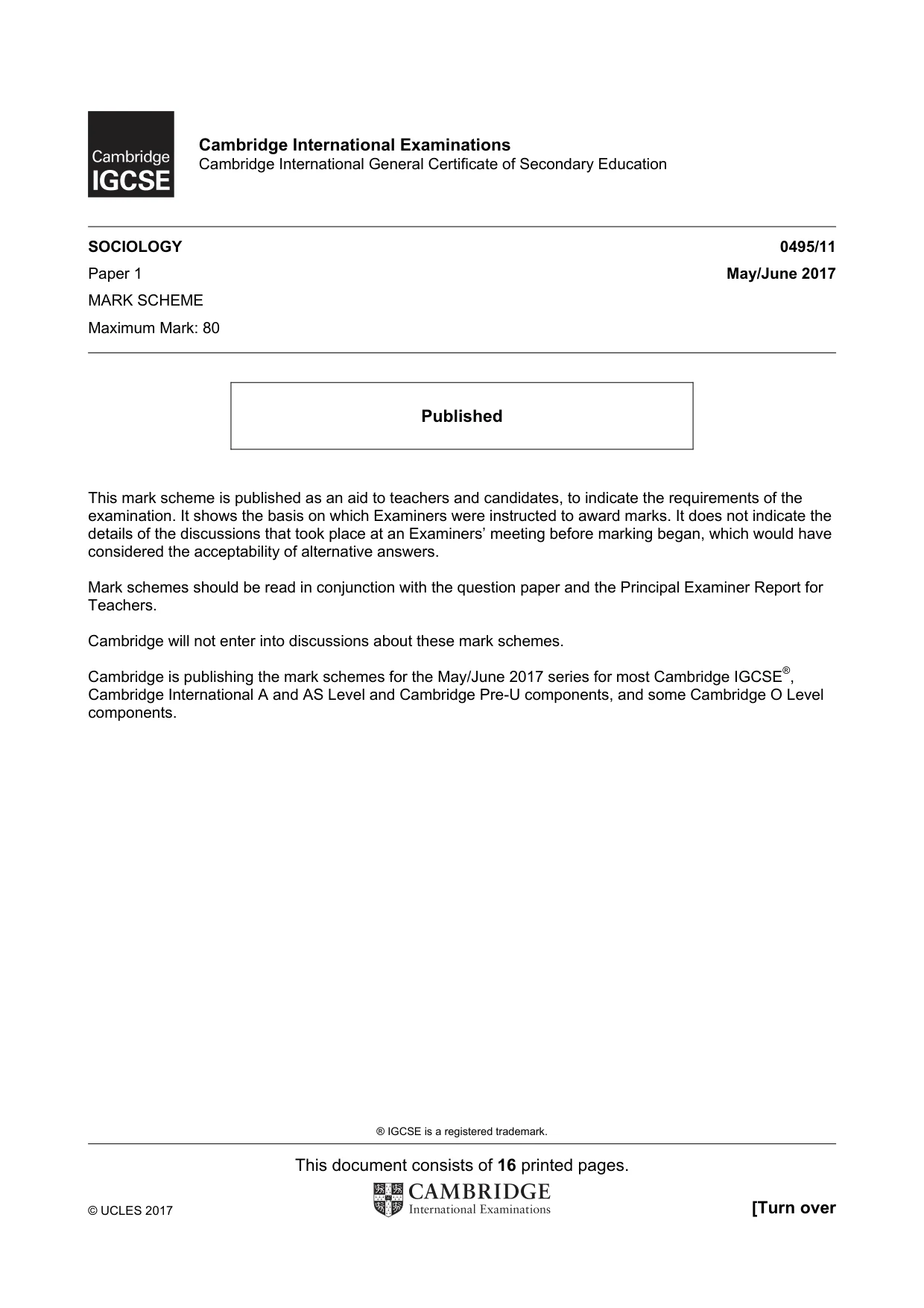
® IGCSE is a registered trademark. This document consists of 16 printed pages. © UCLES 2017 [Turn over Cambridge International Examinations Cambridge International General Certificate of Secondary Education SOCIOLOGY 0495/11 Paper 1 May/June 2017 MARK SCHEME Maximum Mark: 80 Published This mark scheme is published as an aid to teachers and candidates, to indicate the requirements of the examination. It shows the basis on which Examiners were instructed to award marks. It does not indicate the details of the discussions that took place at an Examiners’ meeting before marking began, which would have considered the acceptability of alternative answers. Mark schemes should be read in conjunction with the question paper and the Principal Examiner Report for Teachers. Cambridge will not enter into discussions about these mark schemes. Cambridge is publishing the mark schemes for the May/June 2017 series for most Cambridge IGCSE®, Cambridge International A and AS Level and Cambridge Pre-U components, and some Cambridge O Level components.
Mark scheme, page 2
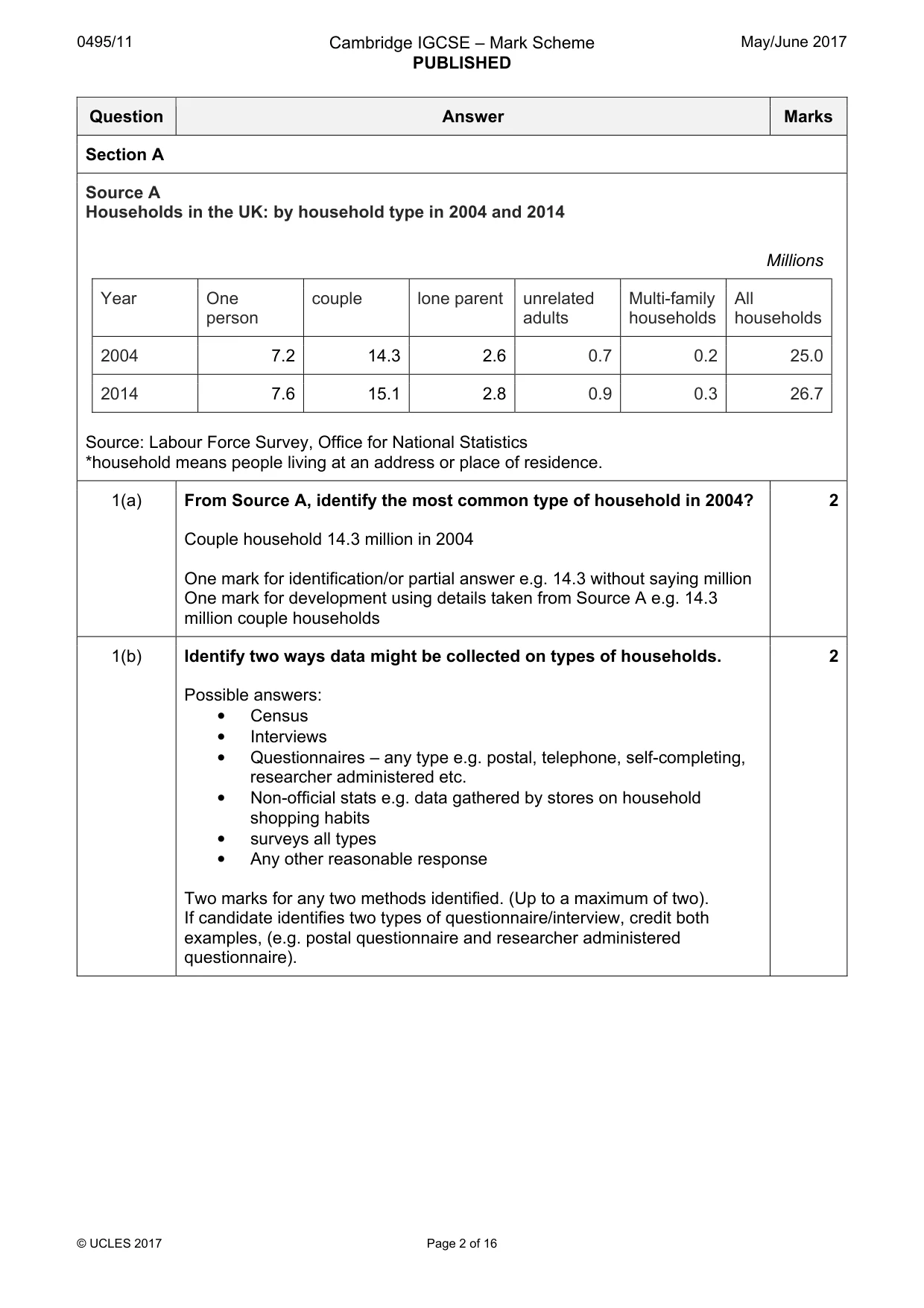
0495/11 Cambridge IGCSE – Mark Scheme PUBLISHED May/June 2017 © UCLES 2017 Page 2 of 16 Question Answer Marks Section A Source A Households in the UK: by household type in 2004 and 2014 Millions Year One person couple lone parent unrelated adults Multi-family households All households 2004 7.2 14.3 2.6 0.7 0.2 25.0 2014 7.6 15.1 2.8 0.9 0.3 26.7 Source: Labour Force Survey, Office for National Statistics *household means people living at an address or place of residence. 1(a) From Source A, identify the most common type of household in 2004? Couple household 14.3 million in 2004 One mark for identification/or partial answer e.g. 14.3 without saying million One mark for development using details taken from Source A e.g. 14.3 million couple households 2 1(b) Identify two ways data might be collected on types of households. Possible answers: • Census • Interviews • Questionnaires – any type e.g. postal, telephone, self-completing, researcher administered etc. • Non-official stats e.g. data gathered by stores on household shopping habits • surveys all types • Any other reasonable response Two marks for any two methods identified. (Up to a maximum of two). If candidate identifies two types of questionnaire/interview, credit both examples, (e.g. postal questionnaire and researcher administered questionnaire). 2
Mark scheme, page 3
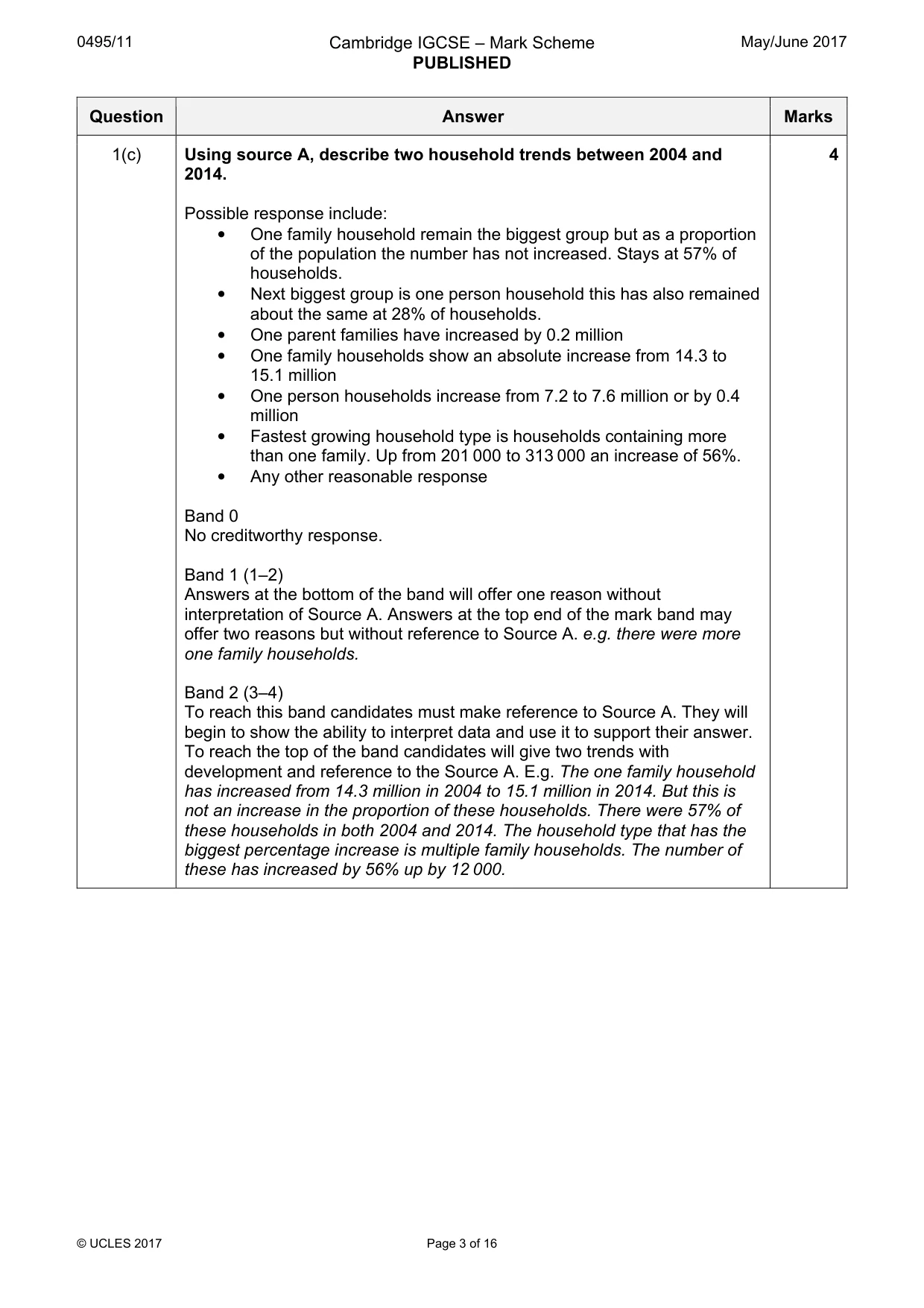
0495/11 Cambridge IGCSE – Mark Scheme PUBLISHED May/June 2017 © UCLES 2017 Page 3 of 16 Question Answer Marks 1(c) Using source A, describe two household trends between 2004 and 2014. Possible response include: • One family household remain the biggest group but as a proportion of the population the number has not increased. Stays at 57% of households. • Next biggest group is one person household this has also remained about the same at 28% of households. • One parent families have increased by 0.2 million • One family households show an absolute increase from 14.3 to 15.1 million • One person households increase from 7.2 to 7.6 million or by 0.4 million • Fastest growing household type is households containing more than one family. Up from 201 000 to 313 000 an increase of 56%. • Any other reasonable response Band 0 No creditworthy response. Band 1 (1–2) Answers at the bottom of the band will offer one reason without interpretation of Source A. Answers at the top end of the mark band may offer two reasons but without reference to Source A. e.g. there were more one family households. Band 2 (3–4) To reach this band candidates must make reference to Source A. They will begin to show the ability to interpret data and use it to support their answer. To reach the top of the band candidates will give two trends with development and reference to the Source A. E.g. The one family household has increased from 14.3 million in 2004 to 15.1 million in 2014. But this is not an increase in the proportion of these households. There were 57% of these households in both 2004 and 2014. The household type that has the biggest percentage increase is multiple family households. The number of these has increased by 56% up by 12 000. 4
Mark scheme, page 4
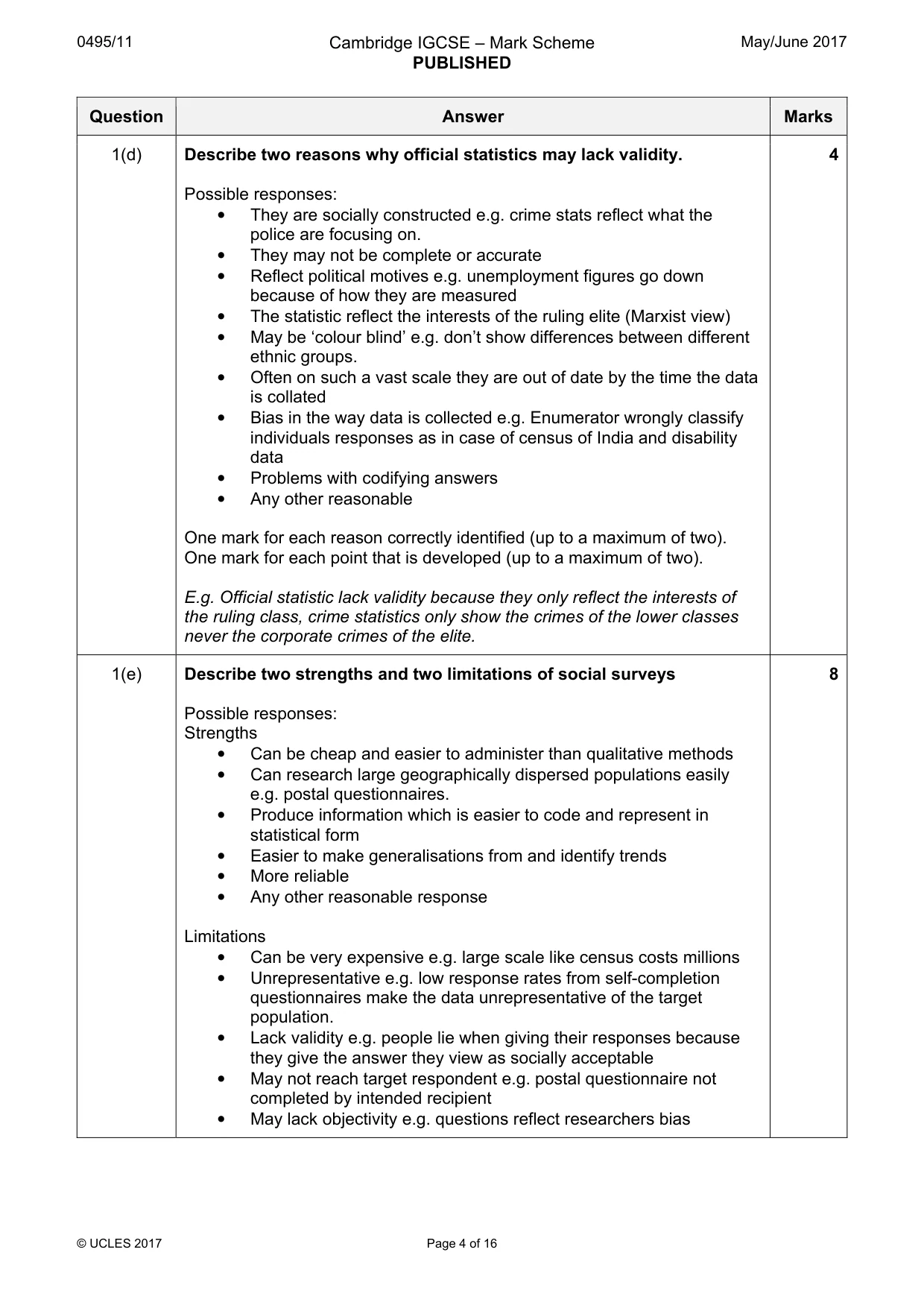
0495/11 Cambridge IGCSE – Mark Scheme PUBLISHED May/June 2017 © UCLES 2017 Page 4 of 16 Question Answer Marks 1(d) Describe two reasons why official statistics may lack validity. Possible responses: • They are socially constructed e.g. crime stats reflect what the police are focusing on. • They may not be complete or accurate • Reflect political motives e.g. unemployment figures go down because of how they are measured • The statistic reflect the interests of the ruling elite (Marxist view) • May be ‘colour blind’ e.g. don’t show differences between different ethnic groups. • Often on such a vast scale they are out of date by the time the data is collated • Bias in the way data is collected e.g. Enumerator wrongly classify individuals responses as in case of census of India and disability data • Problems with codifying answers • Any other reasonable One mark for each reason correctly identified (up to a maximum of two). One mark for each point that is developed (up to a maximum of two). E.g. Official statistic lack validity because they only reflect the interests of the ruling class, crime statistics only show the crimes of the lower classes never the corporate crimes of the elite. 4 1(e) Describe two strengths and two limitations of social surveys Possible responses: Strengths • Can be cheap and easier to administer than qualitative methods • Can research large geographically dispersed populations easily e.g. postal questionnaires. • Produce information which is easier to code and represent in statistical form • Easier to make generalisations from and identify trends • More reliable • Any other reasonable response Limitations • Can be very expensive e.g. large scale like census costs millions • Unrepresentative e.g. low response rates from self-completion questionnaires make the data unrepresentative of the target population. • Lack validity e.g. people lie when giving their responses because they give the answer they view as socially acceptable • May not reach target respondent e.g. postal questionnaire not completed by intended recipient • May lack objectivity e.g. questions reflect researchers bias 8
Mark scheme, page 5
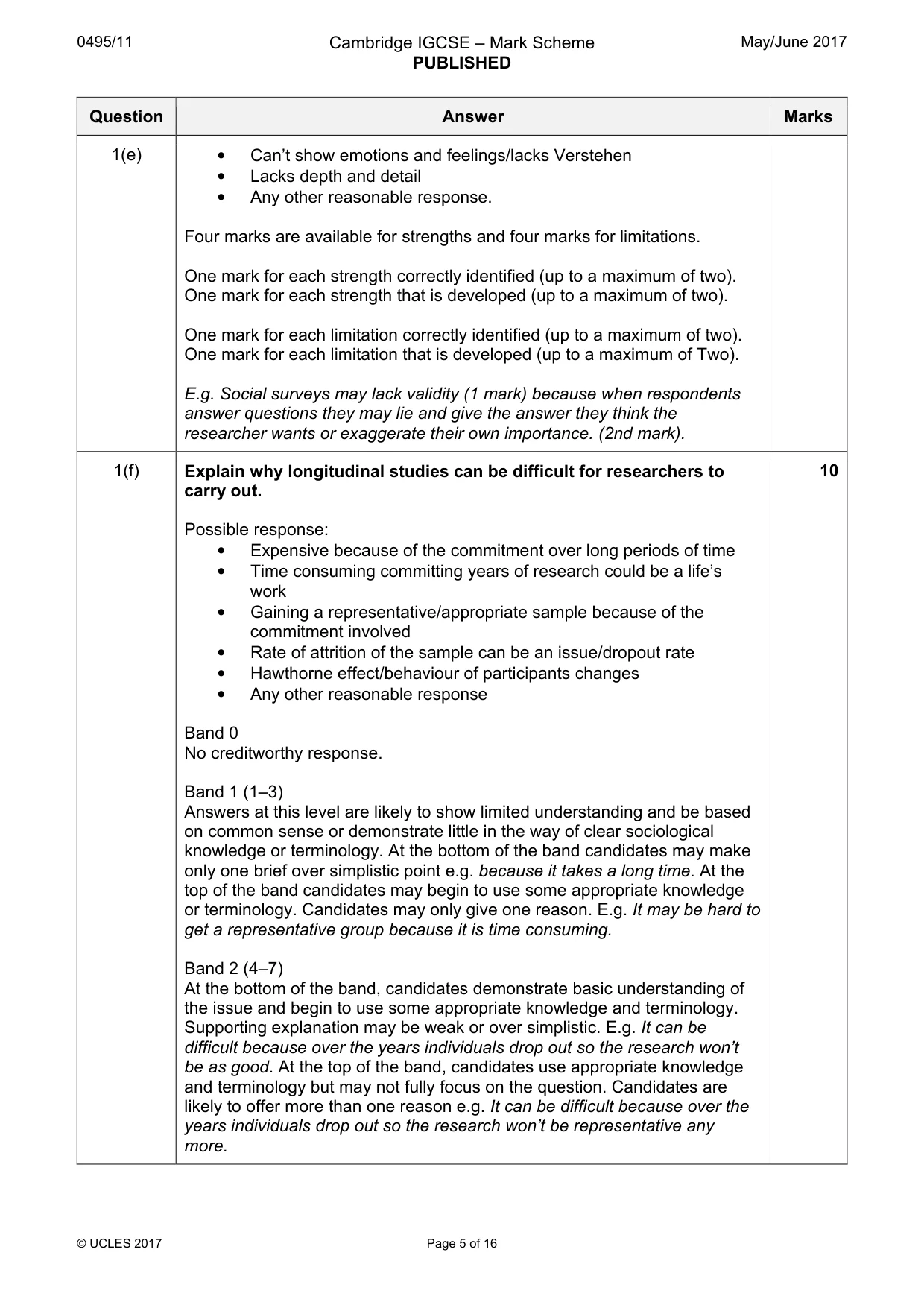
0495/11 Cambridge IGCSE – Mark Scheme PUBLISHED May/June 2017 © UCLES 2017 Page 5 of 16 Question Answer Marks 1(e) • Can’t show emotions and feelings/lacks Verstehen • Lacks depth and detail • Any other reasonable response. Four marks are available for strengths and four marks for limitations. One mark for each strength correctly identified (up to a maximum of two). One mark for each strength that is developed (up to a maximum of two). One mark for each limitation correctly identified (up to a maximum of two). One mark for each limitation that is developed (up to a maximum of Two). E.g. Social surveys may lack validity (1 mark) because when respondents answer questions they may lie and give the answer they think the researcher wants or exaggerate their own importance. (2nd mark). 1(f) Explain why longitudinal studies can be difficult for researchers to carry out. Possible response: • Expensive because of the commitment over long periods of time • Time consuming committing years of research could be a life’s work • Gaining a representative/appropriate sample because of the commitment involved • Rate of attrition of the sample can be an issue/dropout rate • Hawthorne effect/behaviour of participants changes • Any other reasonable response Band 0 No creditworthy response. Band 1 (1–3) Answers at this level are likely to show limited understanding and be based on common sense or demonstrate little in the way of clear sociological knowledge or terminology. At the bottom of the band candidates may make only one brief over simplistic point e.g. because it takes a long time. At the top of the band candidates may begin to use some appropriate knowledge or terminology. Candidates may only give one reason. E.g. It may be hard to get a representative group because it is time consuming. Band 2 (4–7) At the bottom of the band, candidates demonstrate basic understanding of the issue and begin to use some appropriate knowledge and terminology. Supporting explanation may be weak or over simplistic. E.g. It can be difficult because over the years individuals drop out so the research won’t be as good. At the top of the band, candidates use appropriate knowledge and terminology but may not fully focus on the question. Candidates are likely to offer more than one reason e.g. It can be difficult because over the years individuals drop out so the research won’t be representative any more. 10
Mark scheme, page 6
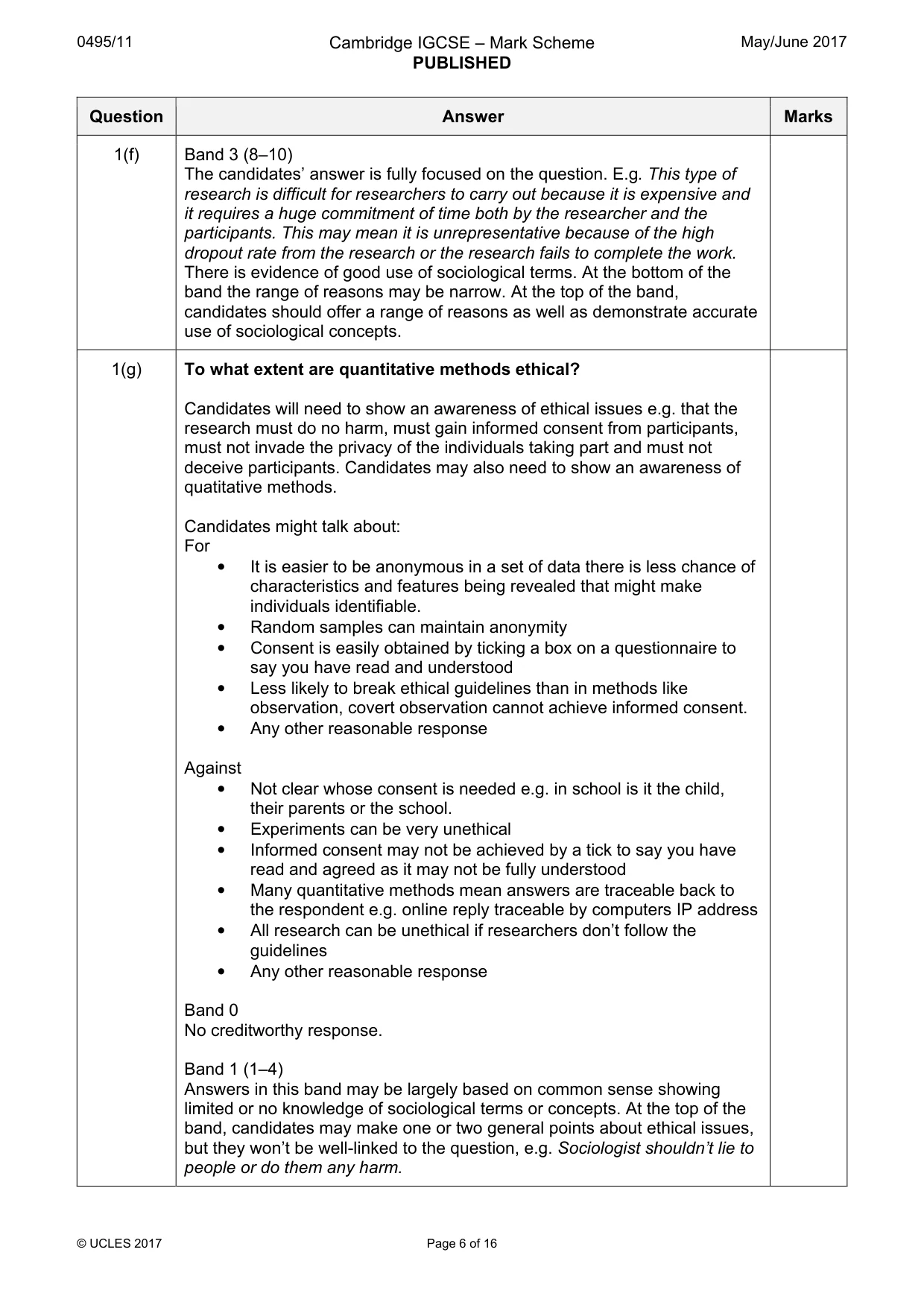
0495/11 Cambridge IGCSE – Mark Scheme PUBLISHED May/June 2017 © UCLES 2017 Page 6 of 16 Question Answer Marks 1(f) Band 3 (8–10) The candidates’ answer is fully focused on the question. E.g. This type of research is difficult for researchers to carry out because it is expensive and it requires a huge commitment of time both by the researcher and the participants. This may mean it is unrepresentative because of the high dropout rate from the research or the research fails to complete the work. There is evidence of good use of sociological terms. At the bottom of the band the range of reasons may be narrow. At the top of the band, candidates should offer a range of reasons as well as demonstrate accurate use of sociological concepts. 1(g) To what extent are quantitative methods ethical? Candidates will need to show an awareness of ethical issues e.g. that the research must do no harm, must gain informed consent from participants, must not invade the privacy of the individuals taking part and must not deceive participants. Candidates may also need to show an awareness of quatitative methods. Candidates might talk about: For • It is easier to be anonymous in a set of data there is less chance of characteristics and features being revealed that might make individuals identifiable. • Random samples can maintain anonymity • Consent is easily obtained by ticking a box on a questionnaire to say you have read and understood • Less likely to break ethical guidelines than in methods like observation, covert observation cannot achieve informed consent. • Any other reasonable response Against • Not clear whose consent is needed e.g. in school is it the child, their parents or the school. • Experiments can be very unethical • Informed consent may not be achieved by a tick to say you have read and agreed as it may not be fully understood • Many quantitative methods mean answers are traceable back to the respondent e.g. online reply traceable by computers IP address • All research can be unethical if researchers don’t follow the guidelines • Any other reasonable response Band 0 No creditworthy response. Band 1 (1–4) Answers in this band may be largely based on common sense showing limited or no knowledge of sociological terms or concepts. At the top of the band, candidates may make one or two general points about ethical issues, but they won’t be well-linked to the question, e.g. Sociologist shouldn’t lie to people or do them any harm.
Mark scheme, page 7
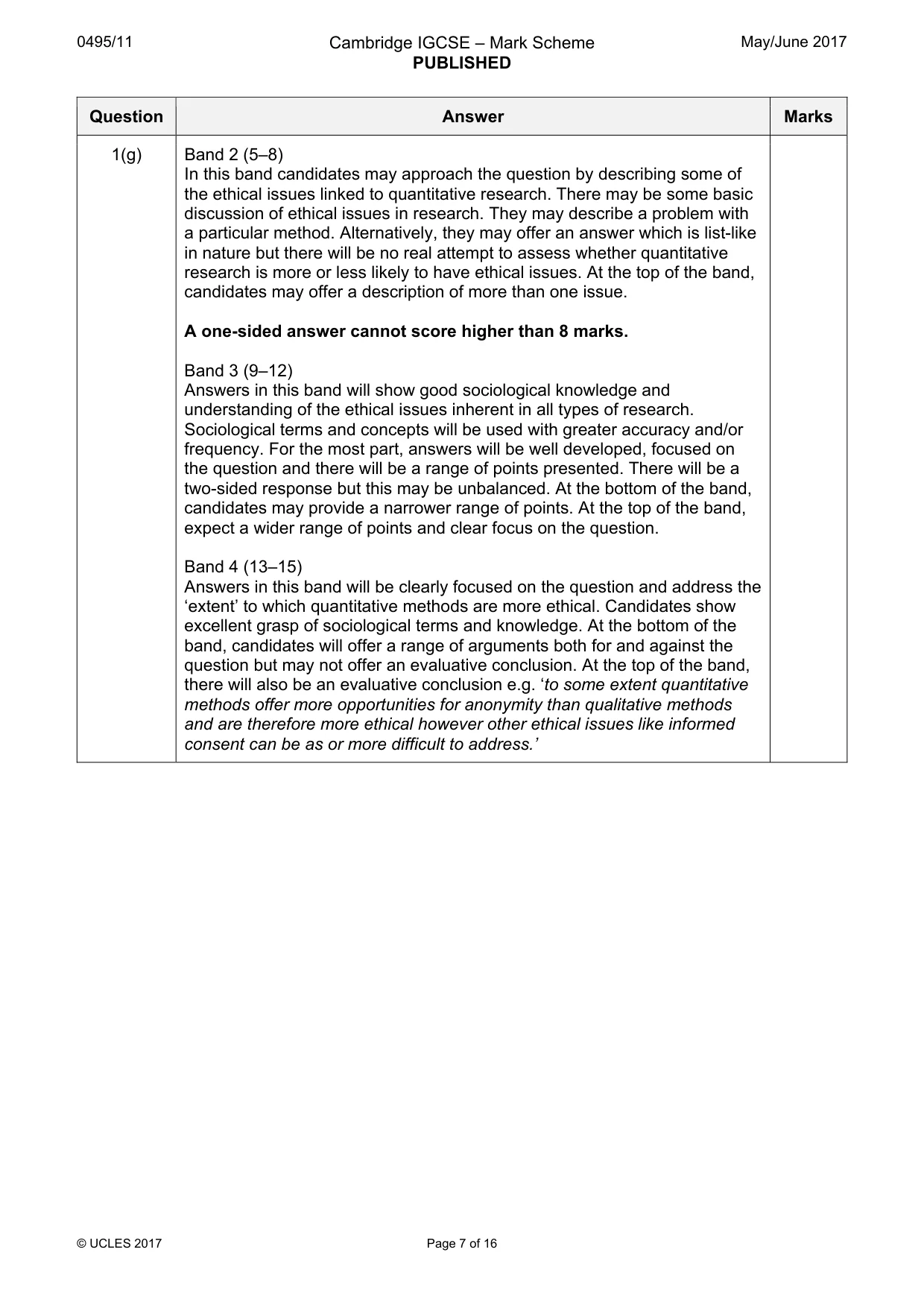
0495/11 Cambridge IGCSE – Mark Scheme PUBLISHED May/June 2017 © UCLES 2017 Page 7 of 16 Question Answer Marks 1(g) Band 2 (5–8) In this band candidates may approach the question by describing some of the ethical issues linked to quantitative research. There may be some basic discussion of ethical issues in research. They may describe a problem with a particular method. Alternatively, they may offer an answer which is list-like in nature but there will be no real attempt to assess whether quantitative research is more or less likely to have ethical issues. At the top of the band, candidates may offer a description of more than one issue. A one-sided answer cannot score higher than 8 marks. Band 3 (9–12) Answers in this band will show good sociological knowledge and understanding of the ethical issues inherent in all types of research. Sociological terms and concepts will be used with greater accuracy and/or frequency. For the most part, answers will be well developed, focused on the question and there will be a range of points presented. There will be a two-sided response but this may be unbalanced. At the bottom of the band, candidates may provide a narrower range of points. At the top of the band, expect a wider range of points and clear focus on the question. Band 4 (13–15) Answers in this band will be clearly focused on the question and address the ‘extent’ to which quantitative methods are more ethical. Candidates show excellent grasp of sociological terms and knowledge. At the bottom of the band, candidates will offer a range of arguments both for and against the question but may not offer an evaluative conclusion. At the top of the band, there will also be an evaluative conclusion e.g. ‘to some extent quantitative methods offer more opportunities for anonymity than qualitative methods and are therefore more ethical however other ethical issues like informed consent can be as or more difficult to address.’
Mark scheme, page 8
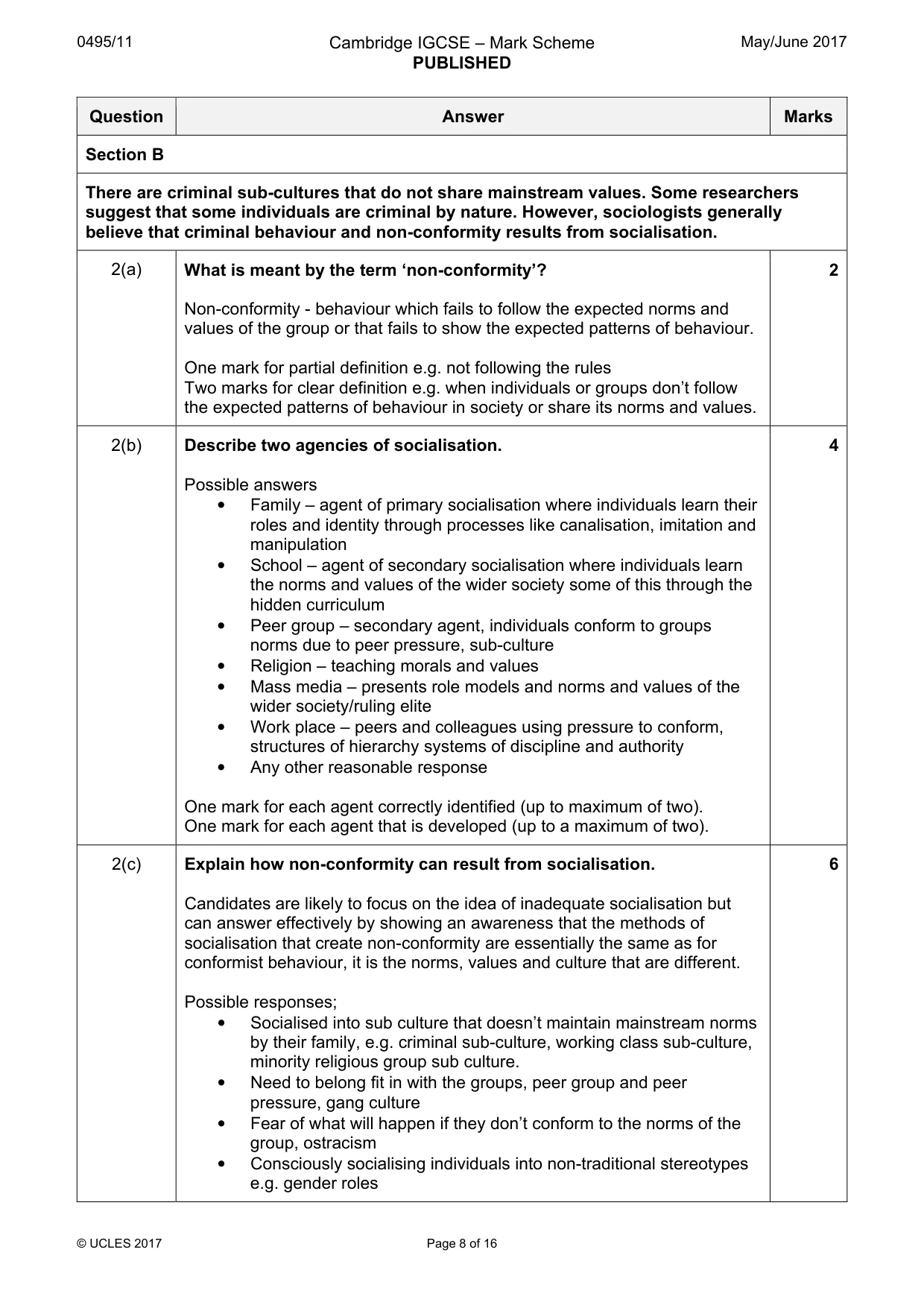
0495/11 Cambridge IGCSE – Mark Scheme PUBLISHED May/June 2017 © UCLES 2017 Page 8 of 16 Question Answer Marks Section B There are criminal sub-cultures that do not share mainstream values. Some researchers suggest that some individuals are criminal by nature. However, sociologists generally believe that criminal behaviour and non-conformity results from socialisation. 2(a) What is meant by the term ‘non-conformity’? Non-conformity - behaviour which fails to follow the expected norms and values of the group or that fails to show the expected patterns of behaviour. One mark for partial definition e.g. not following the rules Two marks for clear definition e.g. when individuals or groups don’t follow the expected patterns of behaviour in society or share its norms and values. 2 2(b) Describe two agencies of socialisation. Possible answers • Family – agent of primary socialisation where individuals learn their roles and identity through processes like canalisation, imitation and manipulation • School – agent of secondary socialisation where individuals learn the norms and values of the wider society some of this through the hidden curriculum • Peer group – secondary agent, individuals conform to groups norms due to peer pressure, sub-culture • Religion – teaching morals and values • Mass media – presents role models and norms and values of the wider society/ruling elite • Work place – peers and colleagues using pressure to conform, structures of hierarchy systems of discipline and authority • Any other reasonable response One mark for each agent correctly identified (up to maximum of two). One mark for each agent that is developed (up to a maximum of two). 4 2(c) Explain how non-conformity can result from socialisation. Candidates are likely to focus on the idea of inadequate socialisation but can answer effectively by showing an awareness that the methods of socialisation that create non-conformity are essentially the same as for conformist behaviour, it is the norms, values and culture that are different. Possible responses; • Socialised into sub culture that doesn’t maintain mainstream norms by their family, e.g. criminal sub-culture, working class sub-culture, minority religious group sub culture. • Need to belong fit in with the groups, peer group and peer pressure, gang culture • Fear of what will happen if they don’t conform to the norms of the group, ostracism • Consciously socialising individuals into non-traditional stereotypes e.g. gender roles 6
Mark scheme, page 9
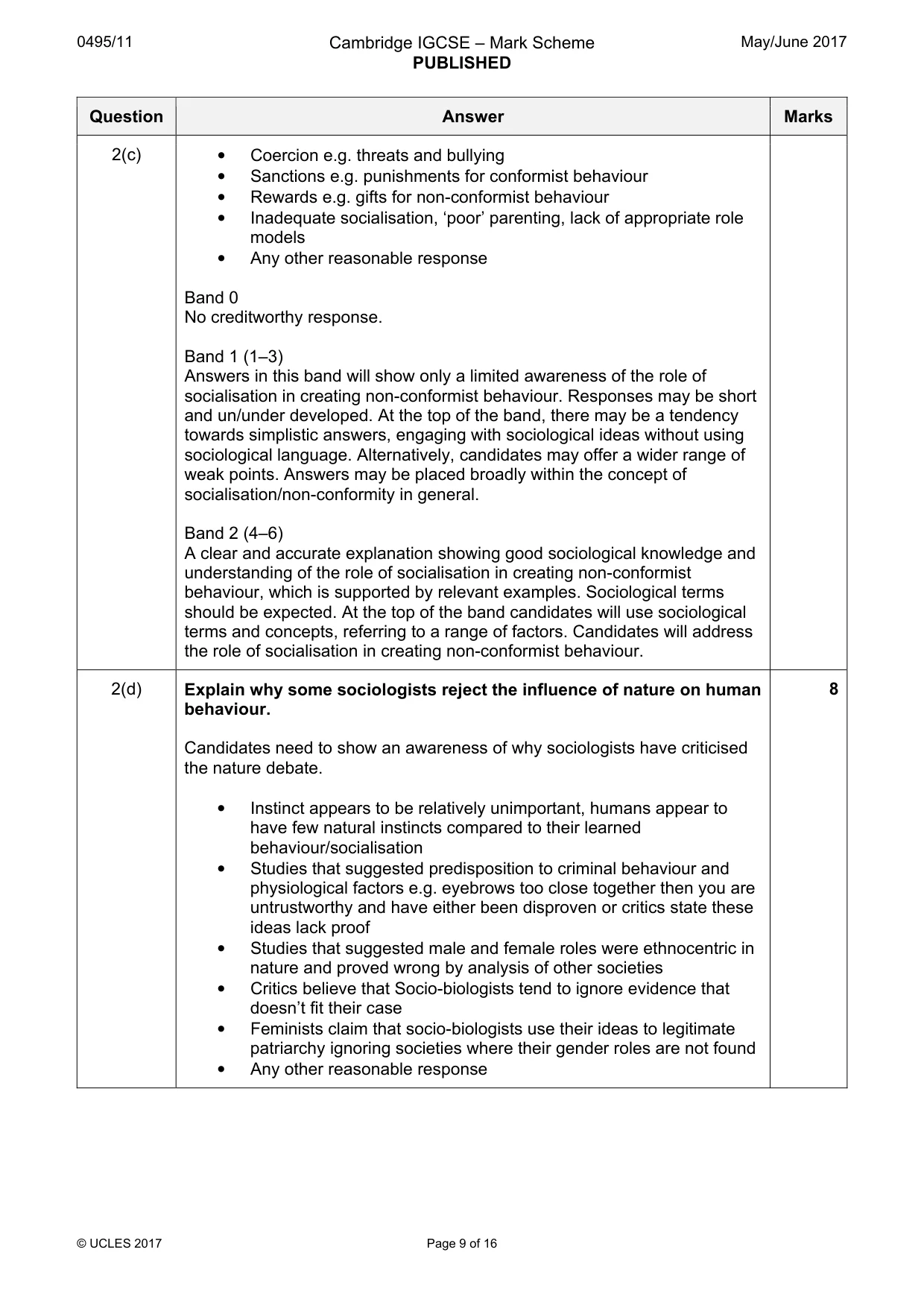
0495/11 Cambridge IGCSE – Mark Scheme PUBLISHED May/June 2017 © UCLES 2017 Page 9 of 16 Question Answer Marks 2(c) • Coercion e.g. threats and bullying • Sanctions e.g. punishments for conformist behaviour • Rewards e.g. gifts for non-conformist behaviour • Inadequate socialisation, ‘poor’ parenting, lack of appropriate role models • Any other reasonable response Band 0 No creditworthy response. Band 1 (1–3) Answers in this band will show only a limited awareness of the role of socialisation in creating non-conformist behaviour. Responses may be short and un/under developed. At the top of the band, there may be a tendency towards simplistic answers, engaging with sociological ideas without using sociological language. Alternatively, candidates may offer a wider range of weak points. Answers may be placed broadly within the concept of socialisation/non-conformity in general. Band 2 (4–6) A clear and accurate explanation showing good sociological knowledge and understanding of the role of socialisation in creating non-conformist behaviour, which is supported by relevant examples. Sociological terms should be expected. At the top of the band candidates will use sociological terms and concepts, referring to a range of factors. Candidates will address the role of socialisation in creating non-conformist behaviour. 2(d) Explain why some sociologists reject the influence of nature on human behaviour. Candidates need to show an awareness of why sociologists have criticised the nature debate. • Instinct appears to be relatively unimportant, humans appear to have few natural instincts compared to their learned behaviour/socialisation • Studies that suggested predisposition to criminal behaviour and physiological factors e.g. eyebrows too close together then you are untrustworthy and have either been disproven or critics state these ideas lack proof • Studies that suggested male and female roles were ethnocentric in nature and proved wrong by analysis of other societies • Critics believe that Socio-biologists tend to ignore evidence that doesn’t fit their case • Feminists claim that socio-biologists use their ideas to legitimate patriarchy ignoring societies where their gender roles are not found • Any other reasonable response 8
Mark scheme, page 10
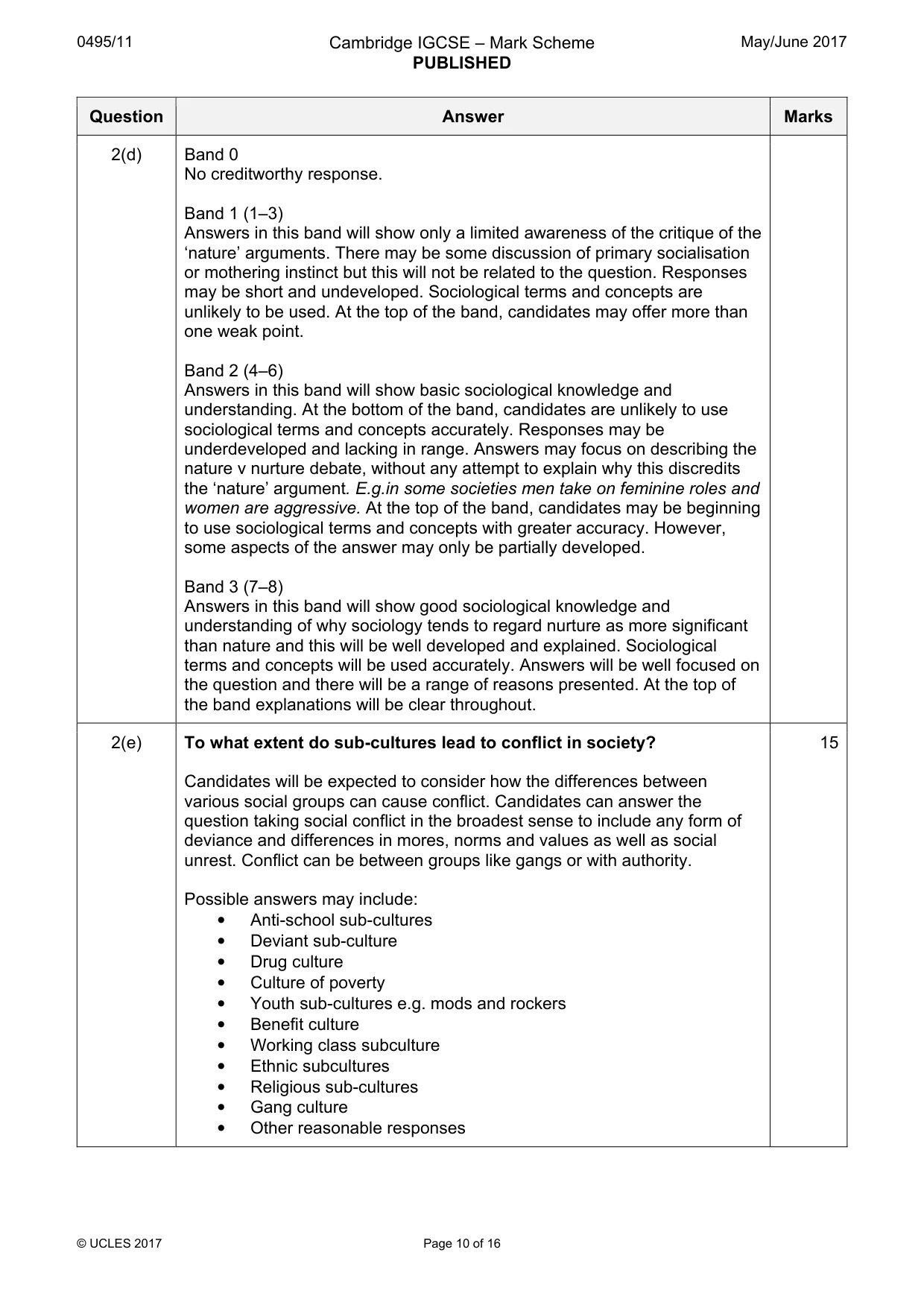
0495/11 Cambridge IGCSE – Mark Scheme PUBLISHED May/June 2017 © UCLES 2017 Page 10 of 16 Question Answer Marks 2(d) Band 0 No creditworthy response. Band 1 (1–3) Answers in this band will show only a limited awareness of the critique of the ‘nature’ arguments. There may be some discussion of primary socialisation or mothering instinct but this will not be related to the question. Responses may be short and undeveloped. Sociological terms and concepts are unlikely to be used. At the top of the band, candidates may offer more than one weak point. Band 2 (4–6) Answers in this band will show basic sociological knowledge and understanding. At the bottom of the band, candidates are unlikely to use sociological terms and concepts accurately. Responses may be underdeveloped and lacking in range. Answers may focus on describing the nature v nurture debate, without any attempt to explain why this discredits the ‘nature’ argument. E.g.in some societies men take on feminine roles and women are aggressive. At the top of the band, candidates may be beginning to use sociological terms and concepts with greater accuracy. However, some aspects of the answer may only be partially developed. Band 3 (7–8) Answers in this band will show good sociological knowledge and understanding of why sociology tends to regard nurture as more significant than nature and this will be well developed and explained. Sociological terms and concepts will be used accurately. Answers will be well focused on the question and there will be a range of reasons presented. At the top of the band explanations will be clear throughout. 2(e) To what extent do sub-cultures lead to conflict in society? Candidates will be expected to consider how the differences between various social groups can cause conflict. Candidates can answer the question taking social conflict in the broadest sense to include any form of deviance and differences in mores, norms and values as well as social unrest. Conflict can be between groups like gangs or with authority. Possible answers may include: • Anti-school sub-cultures • Deviant sub-culture • Drug culture • Culture of poverty • Youth sub-cultures e.g. mods and rockers • Benefit culture • Working class subculture • Ethnic subcultures • Religious sub-cultures • Gang culture • Other reasonable responses 15
Mark scheme, page 11
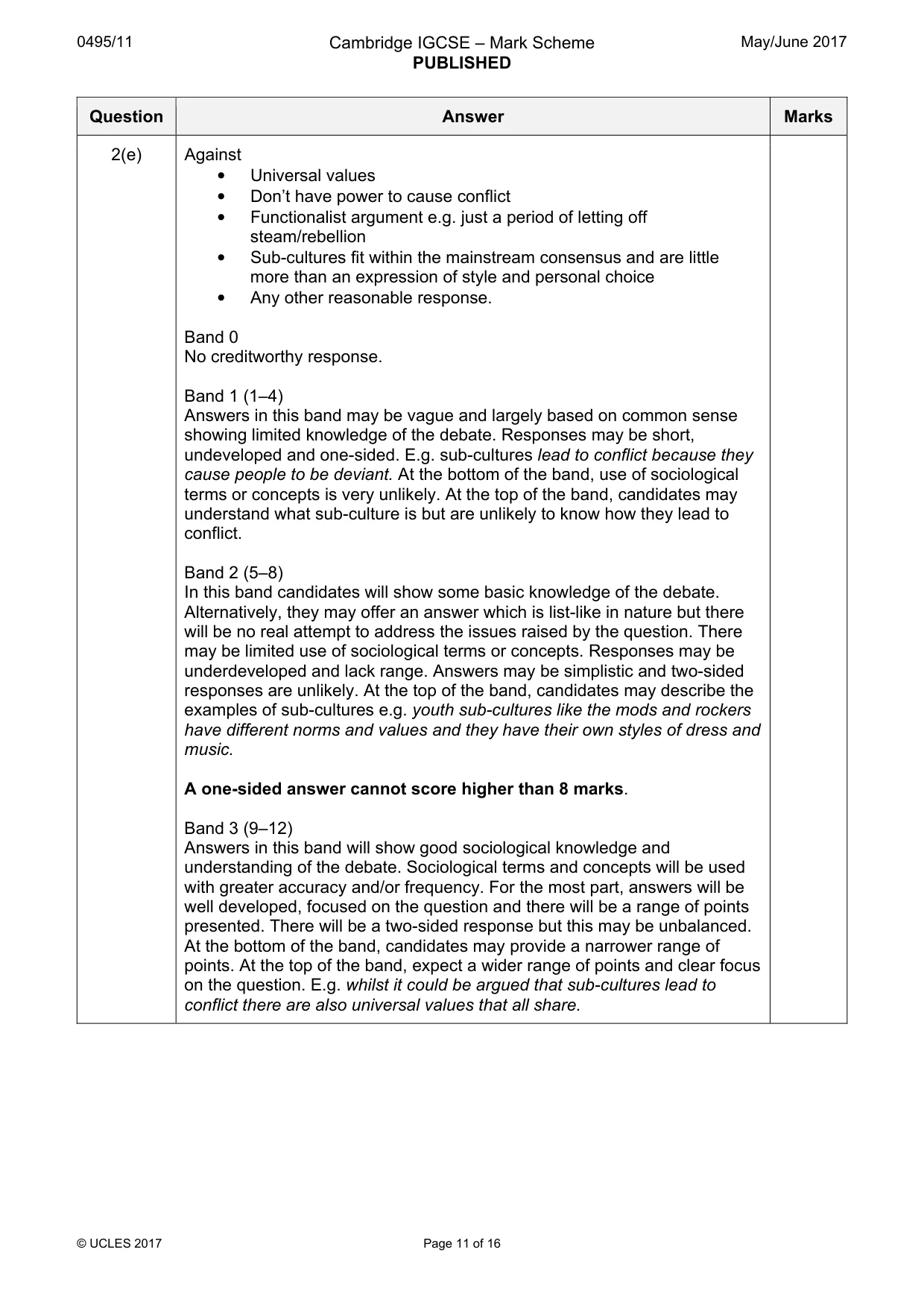
0495/11 Cambridge IGCSE – Mark Scheme PUBLISHED May/June 2017 © UCLES 2017 Page 11 of 16 Question Answer Marks 2(e) Against • Universal values • Don’t have power to cause conflict • Functionalist argument e.g. just a period of letting off steam/rebellion • Sub-cultures fit within the mainstream consensus and are little more than an expression of style and personal choice • Any other reasonable response. Band 0 No creditworthy response. Band 1 (1–4) Answers in this band may be vague and largely based on common sense showing limited knowledge of the debate. Responses may be short, undeveloped and one-sided. E.g. sub-cultures lead to conflict because they cause people to be deviant. At the bottom of the band, use of sociological terms or concepts is very unlikely. At the top of the band, candidates may understand what sub-culture is but are unlikely to know how they lead to conflict. Band 2 (5–8) In this band candidates will show some basic knowledge of the debate. Alternatively, they may offer an answer which is list-like in nature but there will be no real attempt to address the issues raised by the question. There may be limited use of sociological terms or concepts. Responses may be underdeveloped and lack range. Answers may be simplistic and two-sided responses are unlikely. At the top of the band, candidates may describe the examples of sub-cultures e.g. youth sub-cultures like the mods and rockers have different norms and values and they have their own styles of dress and music. A one-sided answer cannot score higher than 8 marks. Band 3 (9–12) Answers in this band will show good sociological knowledge and understanding of the debate. Sociological terms and concepts will be used with greater accuracy and/or frequency. For the most part, answers will be well developed, focused on the question and there will be a range of points presented. There will be a two-sided response but this may be unbalanced. At the bottom of the band, candidates may provide a narrower range of points. At the top of the band, expect a wider range of points and clear focus on the question. E.g. whilst it could be argued that sub-cultures lead to conflict there are also universal values that all share.
Mark scheme, page 12
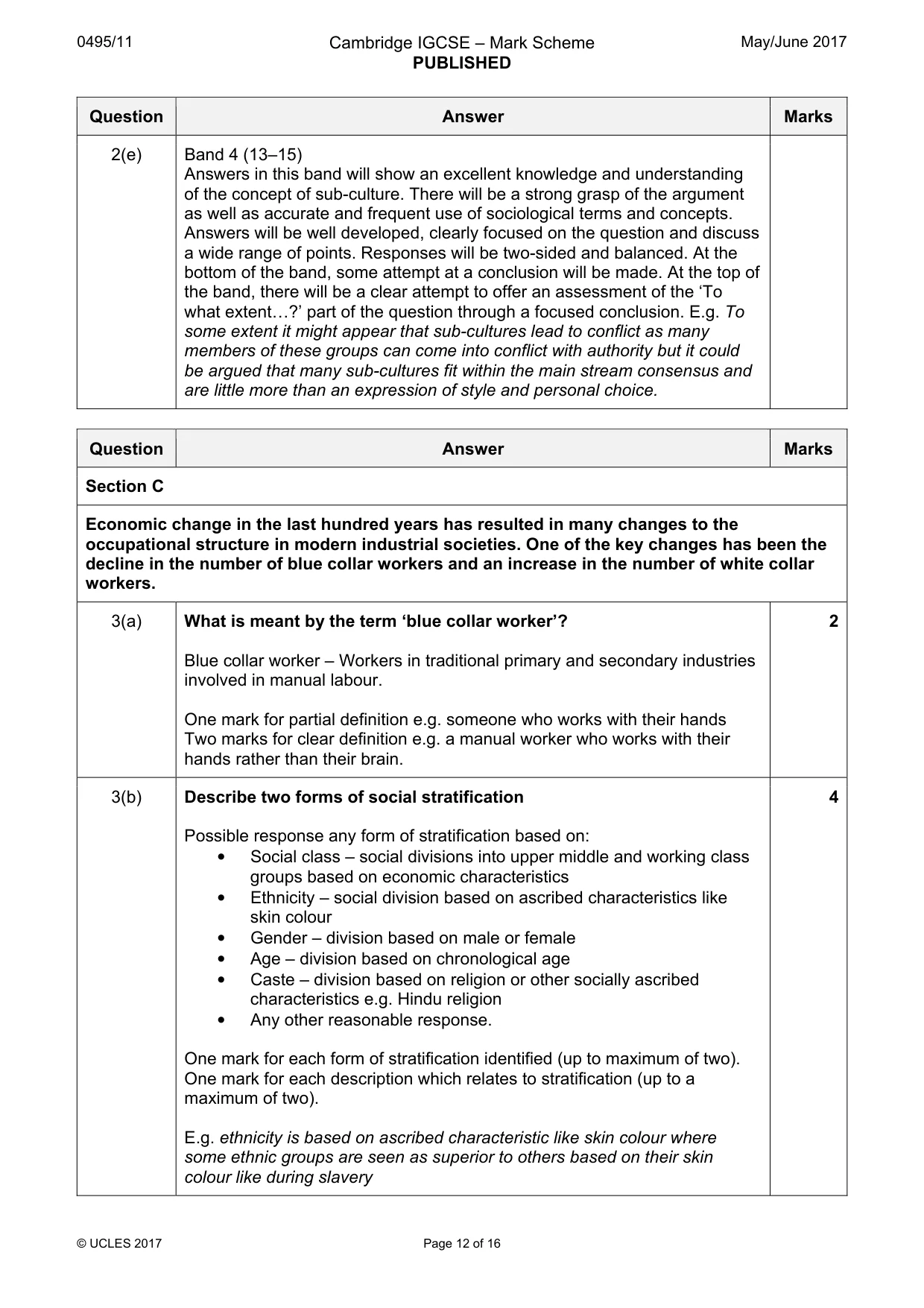
0495/11 Cambridge IGCSE – Mark Scheme PUBLISHED May/June 2017 © UCLES 2017 Page 12 of 16 Question Answer Marks 2(e) Band 4 (13–15) Answers in this band will show an excellent knowledge and understanding of the concept of sub-culture. There will be a strong grasp of the argument as well as accurate and frequent use of sociological terms and concepts. Answers will be well developed, clearly focused on the question and discuss a wide range of points. Responses will be two-sided and balanced. At the bottom of the band, some attempt at a conclusion will be made. At the top of the band, there will be a clear attempt to offer an assessment of the ‘To what extent«?’ part of the question through a focused conclusion. E.g. To some extent it might appear that sub-cultures lead to conflict as many members of these groups can come into conflict with authority but it could be argued that many sub-cultures fit within the main stream consensus and are little more than an expression of style and personal choice. Question Answer Marks Section C Economic change in the last hundred years has resulted in many changes to the occupational structure in modern industrial societies. One of the key changes has been the decline in the number of blue collar workers and an increase in the number of white collar workers. 3(a) What is meant by the term ‘blue collar worker’? Blue collar worker – Workers in traditional primary and secondary industries involved in manual labour. One mark for partial definition e.g. someone who works with their hands Two marks for clear definition e.g. a manual worker who works with their hands rather than their brain. 2 3(b) Describe two forms of social stratification Possible response any form of stratification based on: • Social class – social divisions into upper middle and working class groups based on economic characteristics • Ethnicity – social division based on ascribed characteristics like skin colour • Gender – division based on male or female • Age – division based on chronological age • Caste – division based on religion or other socially ascribed characteristics e.g. Hindu religion • Any other reasonable response. One mark for each form of stratification identified (up to maximum of two). One mark for each description which relates to stratification (up to a maximum of two). E.g. ethnicity is based on ascribed characteristic like skin colour where some ethnic groups are seen as superior to others based on their skin colour like during slavery 4
Mark scheme, page 13
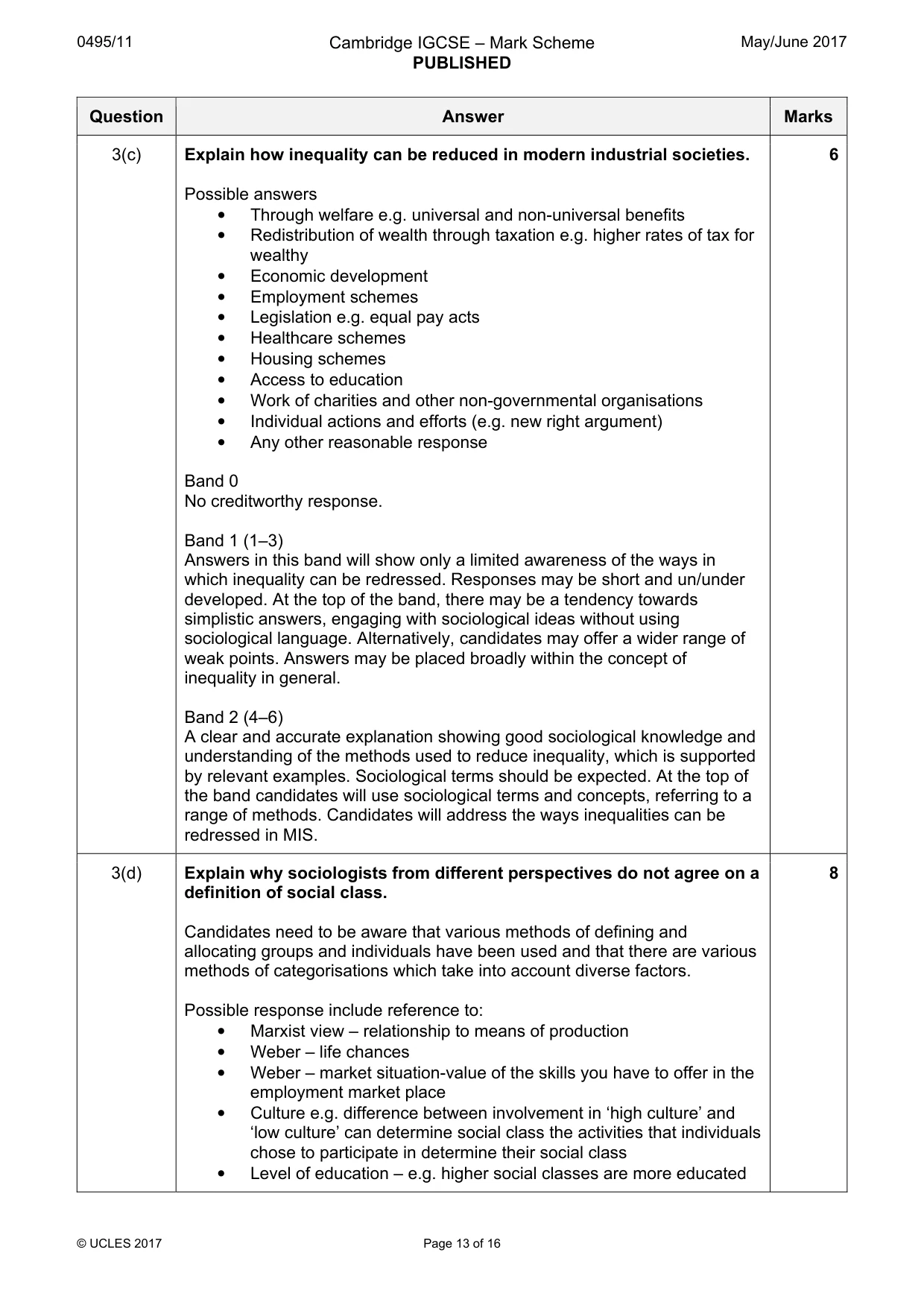
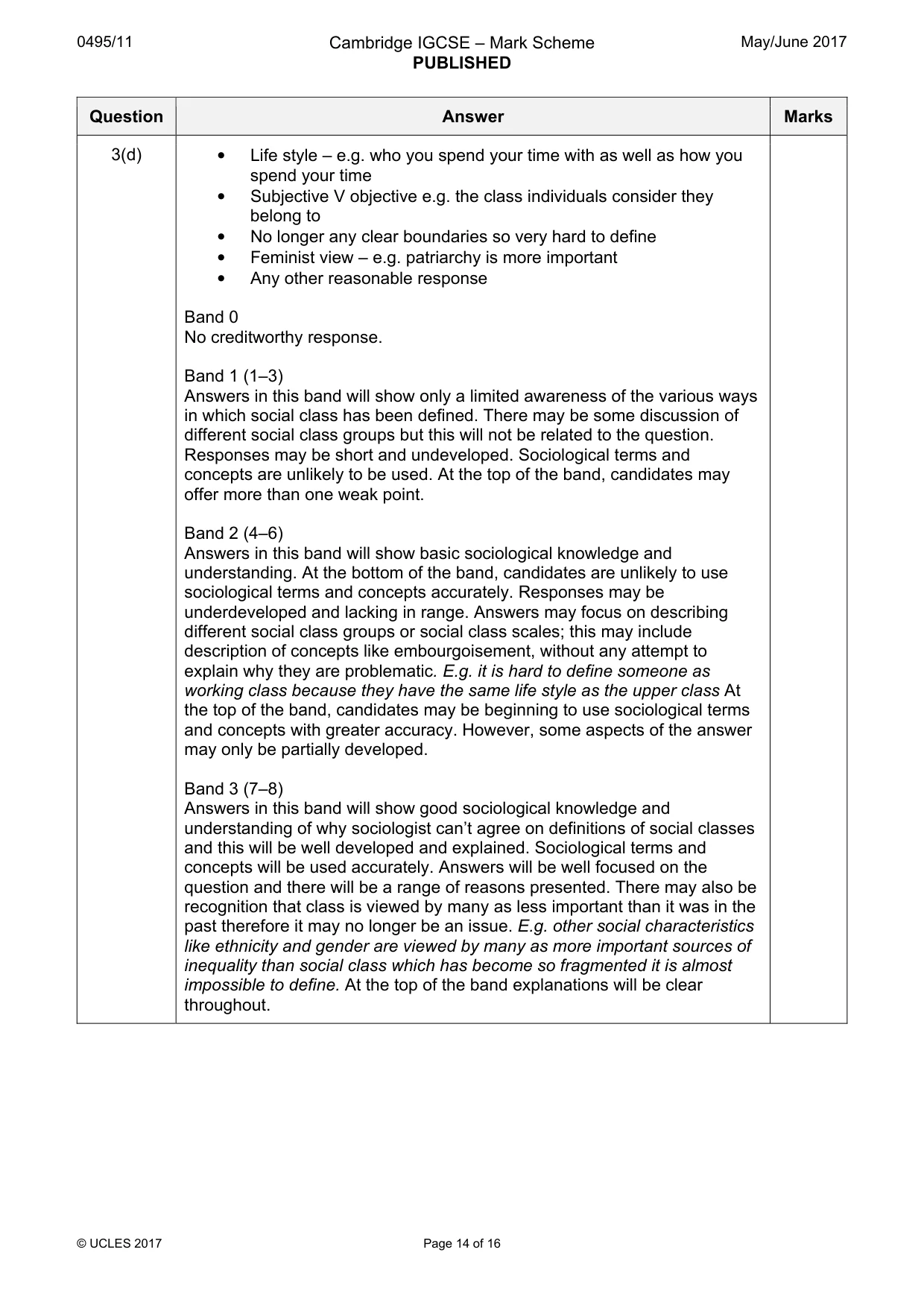
0495/11 Cambridge IGCSE – Mark Scheme PUBLISHED May/June 2017 © UCLES 2017 Page 13 of 16 Question Answer Marks 3(c) Explain how inequality can be reduced in modern industrial societies. Possible answers • Through welfare e.g. universal and non-universal benefits • Redistribution of wealth through taxation e.g. higher rates of tax for wealthy • Economic development • Employment schemes • Legislation e.g. equal pay acts • Healthcare schemes • Housing schemes • Access to education • Work of charities and other non-governmental organisations • Individual actions and efforts (e.g. new right argument) • Any other reasonable response Band 0 No creditworthy response. Band 1 (1–3) Answers in this band will show only a limited awareness of the ways in which inequality can be redressed. Responses may be short and un/under developed. At the top of the band, there may be a tendency towards simplistic answers, engaging with sociological ideas without using sociological language. Alternatively, candidates may offer a wider range of weak points. Answers may be placed broadly within the concept of inequality in general. Band 2 (4–6) A clear and accurate explanation showing good sociological knowledge and understanding of the methods used to reduce inequality, which is supported by relevant examples. Sociological terms should be expected. At the top of the band candidates will use sociological terms and concepts, referring to a range of methods. Candidates will address the ways inequalities can be redressed in MIS. 6 3(d) Explain why sociologists from different perspectives do not agree on a definition of social class. Candidates need to be aware that various methods of defining and allocating groups and individuals have been used and that there are various methods of categorisations which take into account diverse factors. Possible response include reference to: • Marxist view – relationship to means of production • Weber – life chances • Weber – market situation-value of the skills you have to offer in the employment market place • Culture e.g. difference between involvement in ‘high culture’ and ‘low culture’ can determine social class the activities that individuals chose to participate in determine their social class • Level of education – e.g. higher social classes are more educated 8
Mark scheme, page 14
0495/11 Cambridge IGCSE – Mark Scheme PUBLISHED May/June 2017 © UCLES 2017 Page 14 of 16 Question Answer Marks 3(d) • Life style – e.g. who you spend your time with as well as how you spend your time • Subjective V objective e.g. the class individuals consider they belong to • No longer any clear boundaries so very hard to define • Feminist view – e.g. patriarchy is more important • Any other reasonable response Band 0 No creditworthy response. Band 1 (1–3) Answers in this band will show only a limited awareness of the various ways in which social class has been defined. There may be some discussion of different social class groups but this will not be related to the question. Responses may be short and undeveloped. Sociological terms and concepts are unlikely to be used. At the top of the band, candidates may offer more than one weak point. Band 2 (4–6) Answers in this band will show basic sociological knowledge and understanding. At the bottom of the band, candidates are unlikely to use sociological terms and concepts accurately. Responses may be underdeveloped and lacking in range. Answers may focus on describing different social class groups or social class scales; this may include description of concepts like embourgoisement, without any attempt to explain why they are problematic. E.g. it is hard to define someone as working class because they have the same life style as the upper class At the top of the band, candidates may be beginning to use sociological terms and concepts with greater accuracy. However, some aspects of the answer may only be partially developed. Band 3 (7–8) Answers in this band will show good sociological knowledge and understanding of why sociologist can’t agree on definitions of social classes and this will be well developed and explained. Sociological terms and concepts will be used accurately. Answers will be well focused on the question and there will be a range of reasons presented. There may also be recognition that class is viewed by many as less important than it was in the past therefore it may no longer be an issue. E.g. other social characteristics like ethnicity and gender are viewed by many as more important sources of inequality than social class which has become so fragmented it is almost impossible to define. At the top of the band explanations will be clear throughout.
Mark scheme, page 15
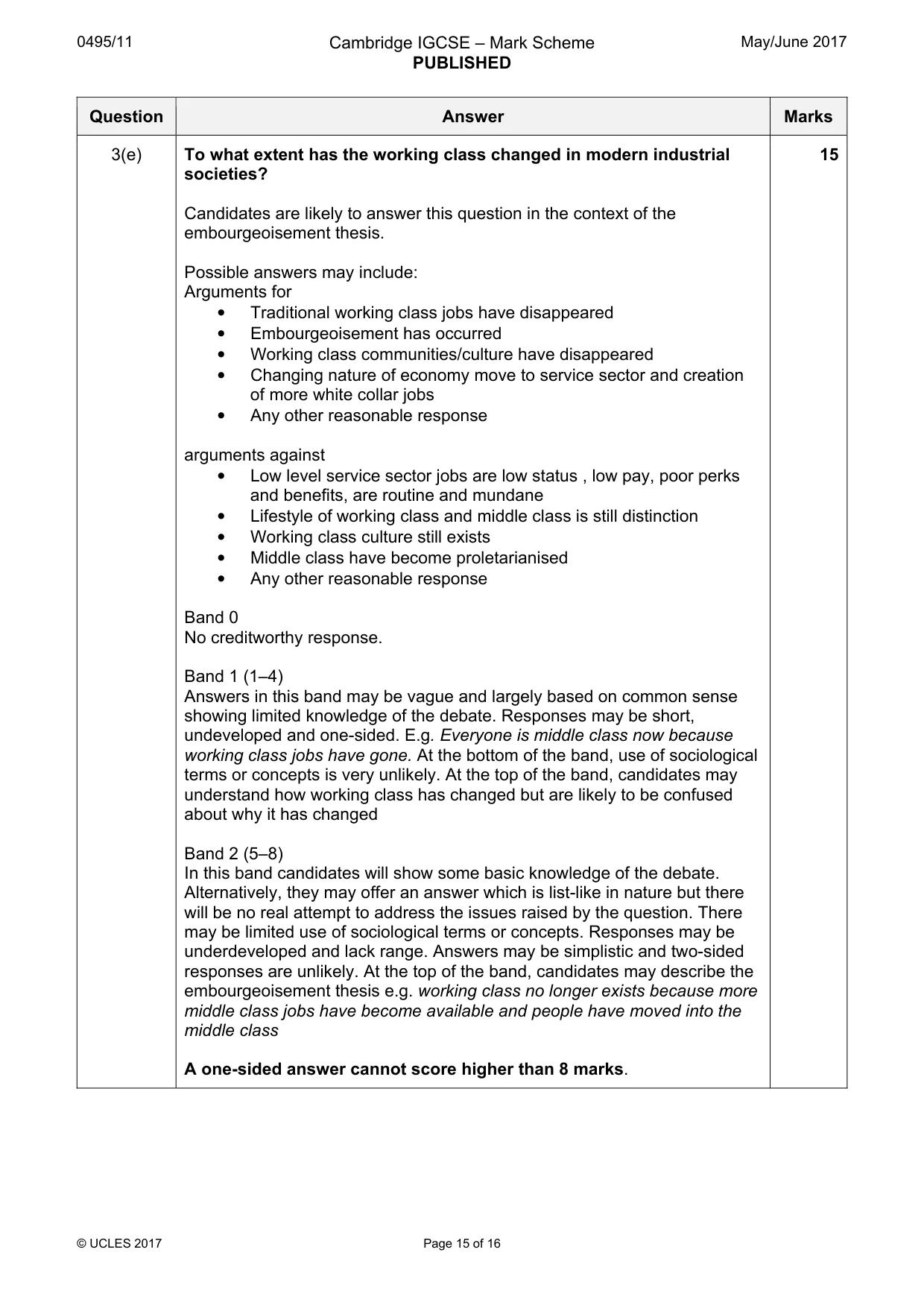
0495/11 Cambridge IGCSE – Mark Scheme PUBLISHED May/June 2017 © UCLES 2017 Page 15 of 16 Question Answer Marks 3(e) To what extent has the working class changed in modern industrial societies? Candidates are likely to answer this question in the context of the embourgeoisement thesis. Possible answers may include: Arguments for • Traditional working class jobs have disappeared • Embourgeoisement has occurred • Working class communities/culture have disappeared • Changing nature of economy move to service sector and creation of more white collar jobs • Any other reasonable response arguments against • Low level service sector jobs are low status , low pay, poor perks and benefits, are routine and mundane • Lifestyle of working class and middle class is still distinction • Working class culture still exists • Middle class have become proletarianised • Any other reasonable response Band 0 No creditworthy response. Band 1 (1–4) Answers in this band may be vague and largely based on common sense showing limited knowledge of the debate. Responses may be short, undeveloped and one-sided. E.g. Everyone is middle class now because working class jobs have gone. At the bottom of the band, use of sociological terms or concepts is very unlikely. At the top of the band, candidates may understand how working class has changed but are likely to be confused about why it has changed Band 2 (5–8) In this band candidates will show some basic knowledge of the debate. Alternatively, they may offer an answer which is list-like in nature but there will be no real attempt to address the issues raised by the question. There may be limited use of sociological terms or concepts. Responses may be underdeveloped and lack range. Answers may be simplistic and two-sided responses are unlikely. At the top of the band, candidates may describe the embourgeoisement thesis e.g. working class no longer exists because more middle class jobs have become available and people have moved into the middle class A one-sided answer cannot score higher than 8 marks. 15
Mark scheme, page 16
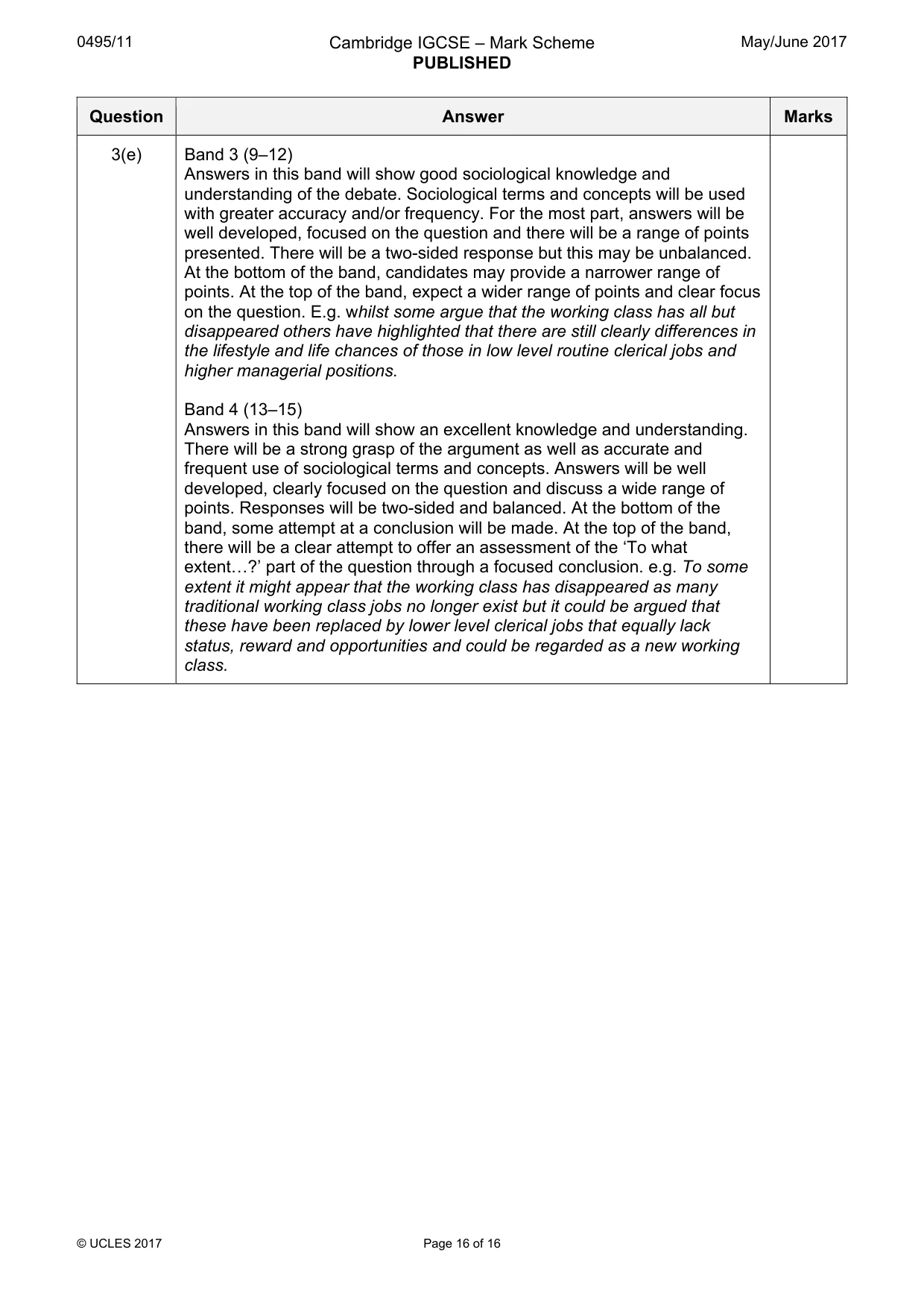
0495/11 Cambridge IGCSE – Mark Scheme PUBLISHED May/June 2017 © UCLES 2017 Page 16 of 16 Question Answer Marks 3(e) Band 3 (9–12) Answers in this band will show good sociological knowledge and understanding of the debate. Sociological terms and concepts will be used with greater accuracy and/or frequency. For the most part, answers will be well developed, focused on the question and there will be a range of points presented. There will be a two-sided response but this may be unbalanced. At the bottom of the band, candidates may provide a narrower range of points. At the top of the band, expect a wider range of points and clear focus on the question. E.g. whilst some argue that the working class has all but disappeared others have highlighted that there are still clearly differences in the lifestyle and life chances of those in low level routine clerical jobs and higher managerial positions. Band 4 (13–15) Answers in this band will show an excellent knowledge and understanding. There will be a strong grasp of the argument as well as accurate and frequent use of sociological terms and concepts. Answers will be well developed, clearly focused on the question and discuss a wide range of points. Responses will be two-sided and balanced. At the bottom of the band, some attempt at a conclusion will be made. At the top of the band, there will be a clear attempt to offer an assessment of the ‘To what extent«?’ part of the question through a focused conclusion. e.g. To some extent it might appear that the working class has disappeared as many traditional working class jobs no longer exist but it could be argued that these have been replaced by lower level clerical jobs that equally lack status, reward and opportunities and could be regarded as a new working class.
What you needed in this session
Cambridge’s own grade thresholds for 2017 May/June, Paper 1 · Variant 1. A higher threshold means an easier paper — the bar moves with how the cohort did.