Cambridge IGCSE Sociology 0495 — 2017 May/June Paper 1 · Variant 2
0495/12/M/J/17 · 80 marks · ≈90 min
The question paper and its mark scheme, free to read here and free to download. This is Cambridge’s own paper, exactly as it was sat.
Question paper4 pages

Mark scheme18 pages
Answers below. Sit the paper first if you are practising.
Paper as text
Question paper, page 1
This document consists of 3 printed pages, 1 blank page and 1 insert. DC (ST/FC) 132034/3 © UCLES 2017 [Turn over Cambridge International Examinations Cambridge International General Certificate of Secondary Education * 1 7 0 4 1 4 1 2 3 2 * SOCIOLOGY 0495/12 Paper 1 May/June 2017 2 hours (including 15 minutes’ reading time) No Additional Materials are required. READ THESE INSTRUCTIONS FIRST An answer booklet is provided inside this question paper. You should follow the instructions on the front cover of the answer booklet. If you need additional answer paper ask the invigilator for a continuation booklet. Answer Question 1 and either Question 2 or Question 3. The number of marks is given in brackets [ ] at the end of each question or part question.
Question paper, page 2
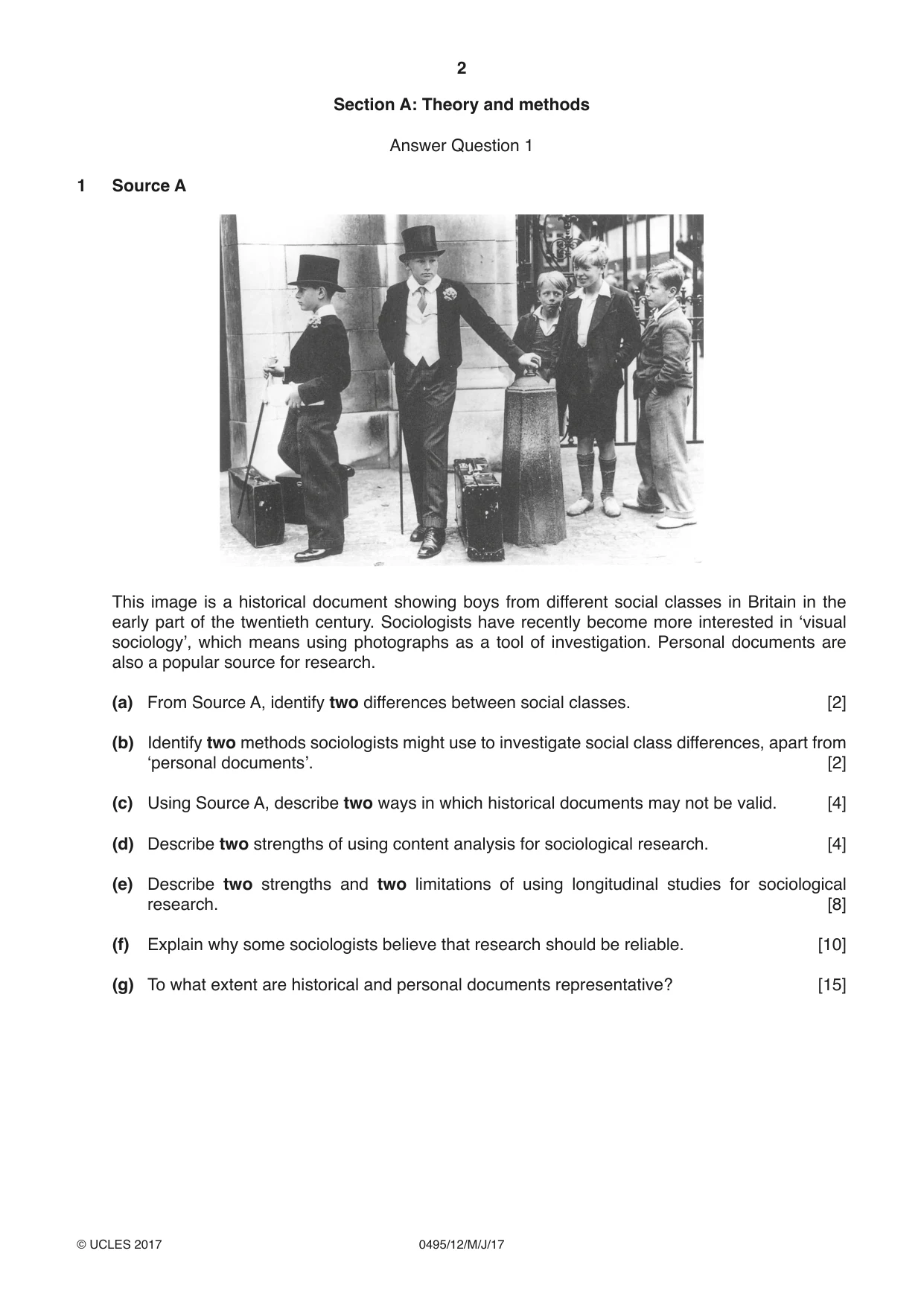
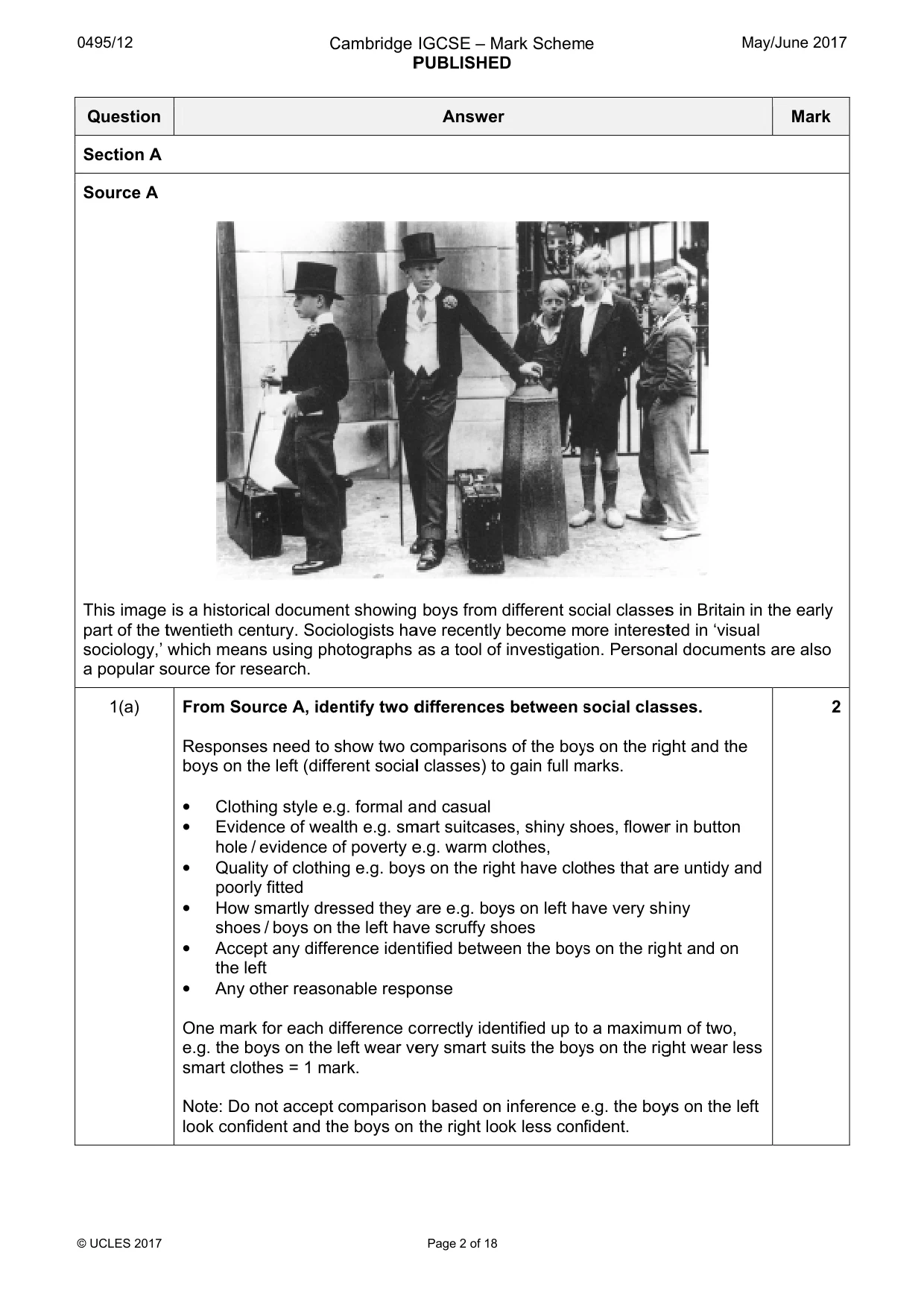
2 0495/12/M/J/17 © UCLES 2017 Section A: Theory and methods Answer Question 1 1 Source A This image is a historical document showing boys from different social classes in Britain in the early part of the twentieth century. Sociologists have recently become more interested in ‘visual sociology’, which means using photographs as a tool of investigation. Personal documents are also a popular source for research. (a) From Source A, identify two differences between social classes. [2] (b) Identify two methods sociologists might use to investigate social class differences, apart from ‘personal documents’. [2] (c) Using Source A, describe two ways in which historical documents may not be valid. [4] (d) Describe two strengths of using content analysis for sociological research. [4] (e) Describe two strengths and two limitations of using longitudinal studies for sociological research. [8] (f) Explain why some sociologists believe that research should be reliable. [10] (g) To what extent are historical and personal documents representative? [15]
Question paper, page 3
3 0495/12/M/J/17 © UCLES 2017 Answer either Question 2 or Question 3 Section B: Culture, identity and socialisation 2 Since the mid-twentieth century modern industrial societies have become increasingly child- centred. Evidence from research carried out in the USA in the ‘Cost of Raising a Child’ report has shown that since 1960 the cost of raising a child has increased dramatically. (a) What is meant by the term ‘child-centred’? [2] (b) Describe two ways childhood has changed over time. [4] (c) Explain how socialisation is carried out within the family. [6] (d) Explain why sanctions are applied to individuals who do not conform. [8] (e) To what extent do the roles of children vary between cultures? [15] Section C: Social inequality 3 In many countries top jobs in government and the legal system are dominated by an elite. This means there is limited social mobility and distinct social classes still exist. (a) What is meant by the term ‘elite’? [2] (b) Describe two social classes. [4] (c) Explain how members of the upper class are able to maintain their social position. [6] (d) Explain why lifestyle can be used as an indicator of an individual’s social class. [8] (e) To what extent do barriers to social mobility remain in modern industrial societies? [15]
Question paper, page 4
4 0495/12/M/J/17 © UCLES 2017 BLANK PAGE Permission to reproduce items where third-party owned material protected by copyright is included has been sought and cleared where possible. Every reasonable effort has been made by the publisher (UCLES) to trace copyright holders, but if any items requiring clearance have unwittingly been included, the publisher will be pleased to make amends at the earliest possible opportunity. To avoid the issue of disclosure of answer-related information to candidates, all copyright acknowledgements are reproduced online in the Cambridge International Examinations Copyright Acknowledgements Booklet. This is produced for each series of examinations and is freely available to download at www.cie.org.uk after the live examination series. Cambridge International Examinations is part of the Cambridge Assessment Group. Cambridge Assessment is the brand name of University of Cambridge Local Examinations Syndicate (UCLES), which is itself a department of the University of Cambridge.
Mark scheme, page 1
® IGCSE is a registered trademark. This document consists of 18 printed pages. © UCLES 2017 [Turn over Cambridge International Examinations Cambridge International General Certificate of Secondary Education SOCIOLOGY 0495/12 Paper 1 May/June 2017 MARK SCHEME Maximum Mark: 80 Published This mark scheme is published as an aid to teachers and candidates, to indicate the requirements of the examination. It shows the basis on which Examiners were instructed to award marks. It does not indicate the details of the discussions that took place at an Examiners’ meeting before marking began, which would have considered the acceptability of alternative answers. Mark schemes should be read in conjunction with the question paper and the Principal Examiner Report for Teachers. Cambridge will not enter into discussions about these mark schemes. Cambridge is publishing the mark schemes for the May/June 2017 series for most Cambridge IGCSE®, Cambridge International A and AS Level and Cambridge Pre-U components, and some Cambridge O Level components.
Mark scheme, page 2
0 © 0495/12 © UCLES 2017 Question Section A Source A This image part of the t sociology,’ a popular s 1(a) is a historic twentieth ce which mea source for re From So Respons boys on t • Cloth • Evide hole • Qual poor • How shoe • Acce the le • Any o One mark e.g. the b smart clo Note: Do look conf C cal docume entury. Soc ns using ph esearch. ource A, ide es need to the left (diffe hing style e. ence of wea / evidence o ity of clothin ly fitted smartly dre es / boys on ept any diffe eft other reaso k for each d boys on the othes = 1 ma not accept fident and th Cambridge P ent showing iologists ha hotographs entify two d show two c erent social .g. formal a alth e.g. sm of poverty e ng e.g. boys essed they a the left hav erence ident onable respo difference co left wear ve ark. compariso he boys on IGCSE – M PUBLISHED Page 2 of 18 Answer boys from ave recently as a tool of differences comparisons l classes) to nd casual mart suitcase e.g. warm c s on the rig are e.g. boy ve scruffy sh tified betwe onse orrectly ide ery smart su n based on the right loo Mark Schem D r different so y become m f investigatio s between s s of the boy o gain full m es, shiny sh lothes, ht have clot ys on left ha hoes een the boys ntified up to uits the boy inference e ok less conf e ocial classes ore interest on. Persona social clas ys on the rig marks. hoes, flower thes that ar ave very sh s on the rig o a maximu ys on the rig e.g. the boy fident. M s in Britain ted in ‘visua al documen sses. ght and the r in button re untidy an iny ht and on m of two, ght wear les ys on the lef May/June 201 Mark in the early al nts are also nd ss ft 2 17 2
Mark scheme, page 3
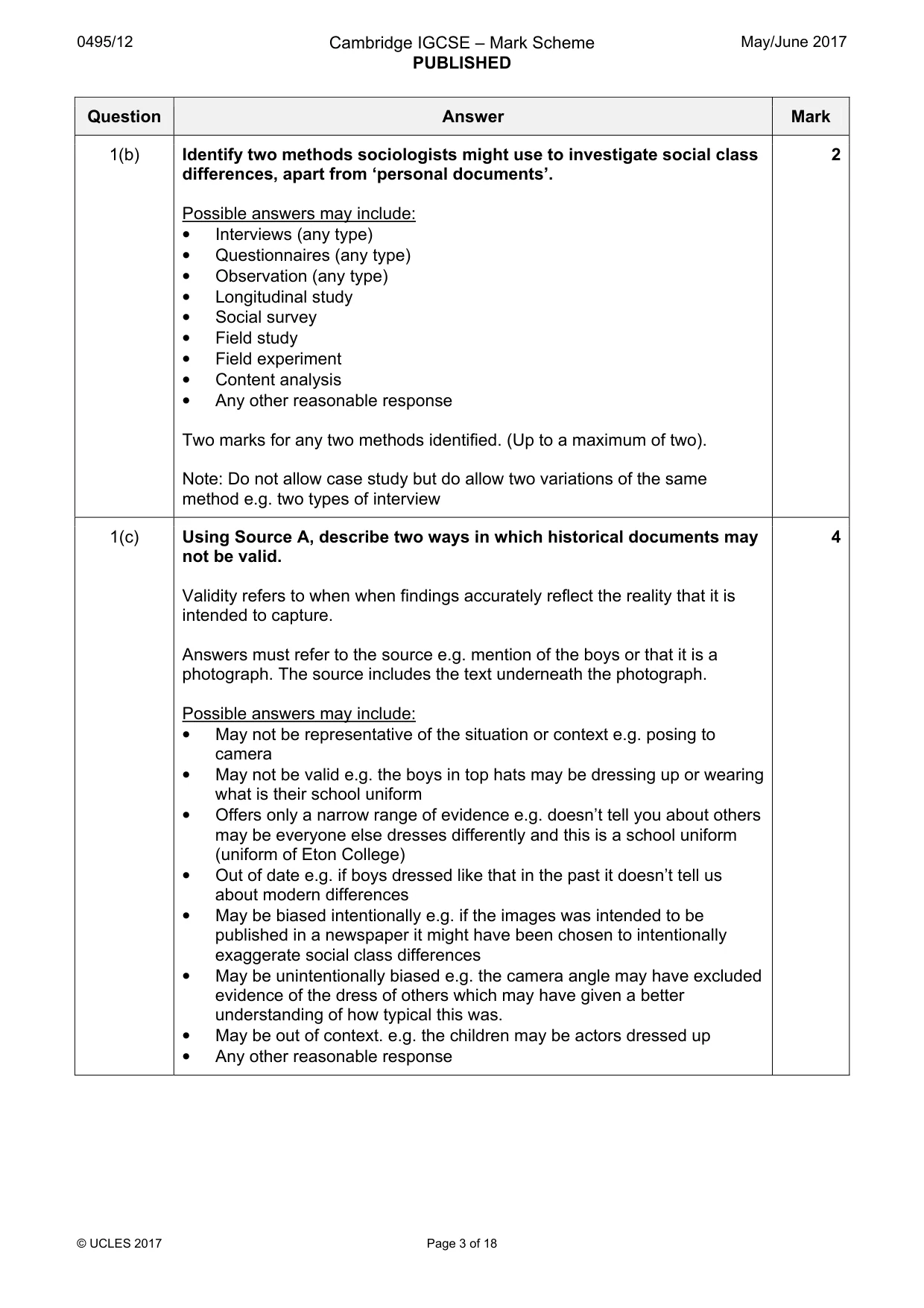
0495/12 Cambridge IGCSE – Mark Scheme PUBLISHED May/June 2017 © UCLES 2017 Page 3 of 18 Question Answer Mark 1(b) Identify two methods sociologists might use to investigate social class differences, apart from ‘personal documents’. Possible answers may include: • Interviews (any type) • Questionnaires (any type) • Observation (any type) • Longitudinal study • Social survey • Field study • Field experiment • Content analysis • Any other reasonable response Two marks for any two methods identified. (Up to a maximum of two). Note: Do not allow case study but do allow two variations of the same method e.g. two types of interview 2 1(c) Using Source A, describe two ways in which historical documents may not be valid. Validity refers to when when findings accurately reflect the reality that it is intended to capture. Answers must refer to the source e.g. mention of the boys or that it is a photograph. The source includes the text underneath the photograph. Possible answers may include: • May not be representative of the situation or context e.g. posing to camera • May not be valid e.g. the boys in top hats may be dressing up or wearing what is their school uniform • Offers only a narrow range of evidence e.g. doesn’t tell you about others may be everyone else dresses differently and this is a school uniform (uniform of Eton College) • Out of date e.g. if boys dressed like that in the past it doesn’t tell us about modern differences • May be biased intentionally e.g. if the images was intended to be published in a newspaper it might have been chosen to intentionally exaggerate social class differences • May be unintentionally biased e.g. the camera angle may have excluded evidence of the dress of others which may have given a better understanding of how typical this was. • May be out of context. e.g. the children may be actors dressed up • Any other reasonable response 4
Mark scheme, page 4
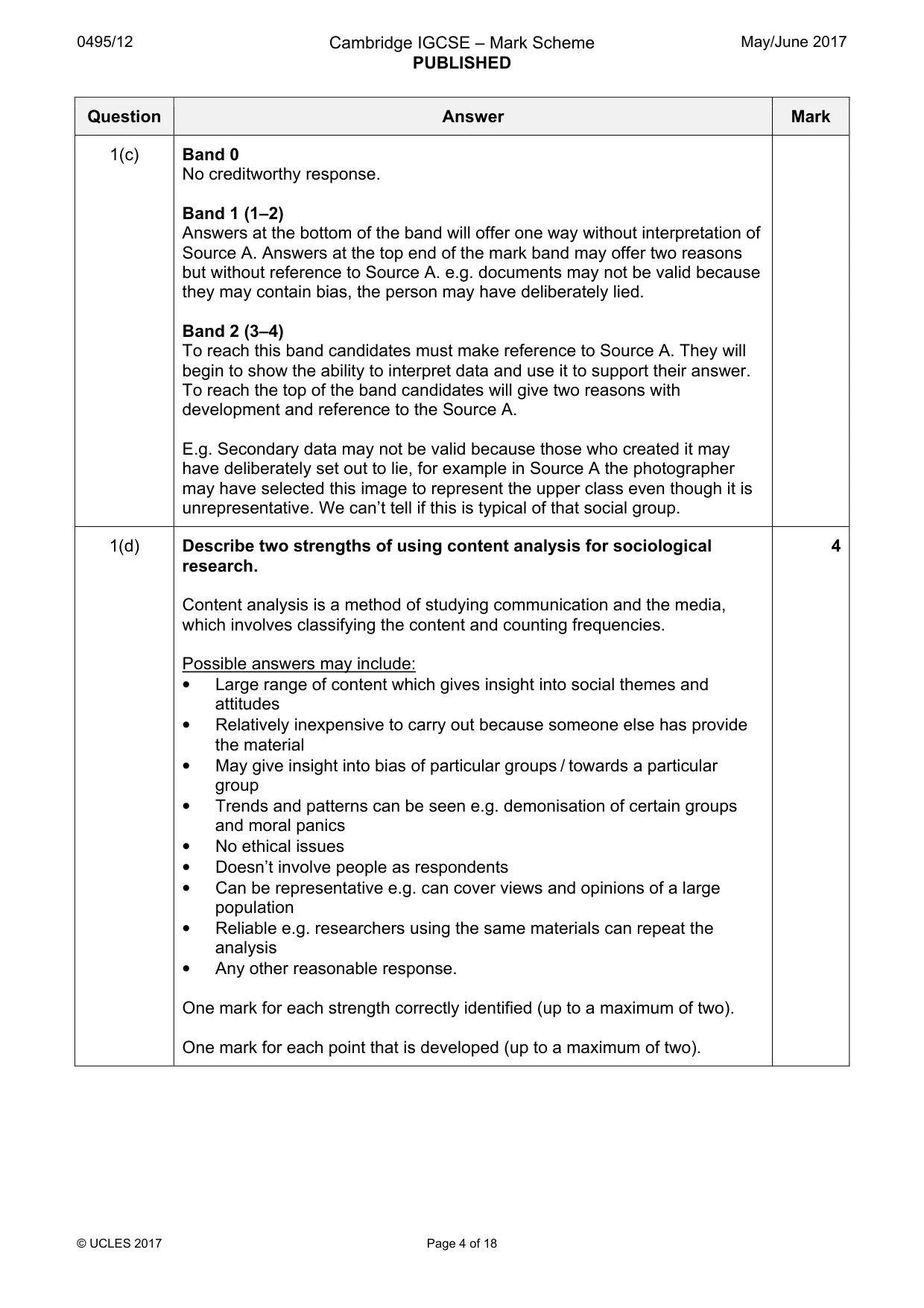
0495/12 Cambridge IGCSE – Mark Scheme PUBLISHED May/June 2017 © UCLES 2017 Page 4 of 18 Question Answer Mark 1(c) Band 0 No creditworthy response. Band 1 (1–2) Answers at the bottom of the band will offer one way without interpretation of Source A. Answers at the top end of the mark band may offer two reasons but without reference to Source A. e.g. documents may not be valid because they may contain bias, the person may have deliberately lied. Band 2 (3–4) To reach this band candidates must make reference to Source A. They will begin to show the ability to interpret data and use it to support their answer. To reach the top of the band candidates will give two reasons with development and reference to the Source A. E.g. Secondary data may not be valid because those who created it may have deliberately set out to lie, for example in Source A the photographer may have selected this image to represent the upper class even though it is unrepresentative. We can’t tell if this is typical of that social group. 1(d) Describe two strengths of using content analysis for sociological research. Content analysis is a method of studying communication and the media, which involves classifying the content and counting frequencies. Possible answers may include: • Large range of content which gives insight into social themes and attitudes • Relatively inexpensive to carry out because someone else has provide the material • May give insight into bias of particular groups / towards a particular group • Trends and patterns can be seen e.g. demonisation of certain groups and moral panics • No ethical issues • Doesn’t involve people as respondents • Can be representative e.g. can cover views and opinions of a large population • Reliable e.g. researchers using the same materials can repeat the analysis • Any other reasonable response. One mark for each strength correctly identified (up to a maximum of two). One mark for each point that is developed (up to a maximum of two). 4
Mark scheme, page 5
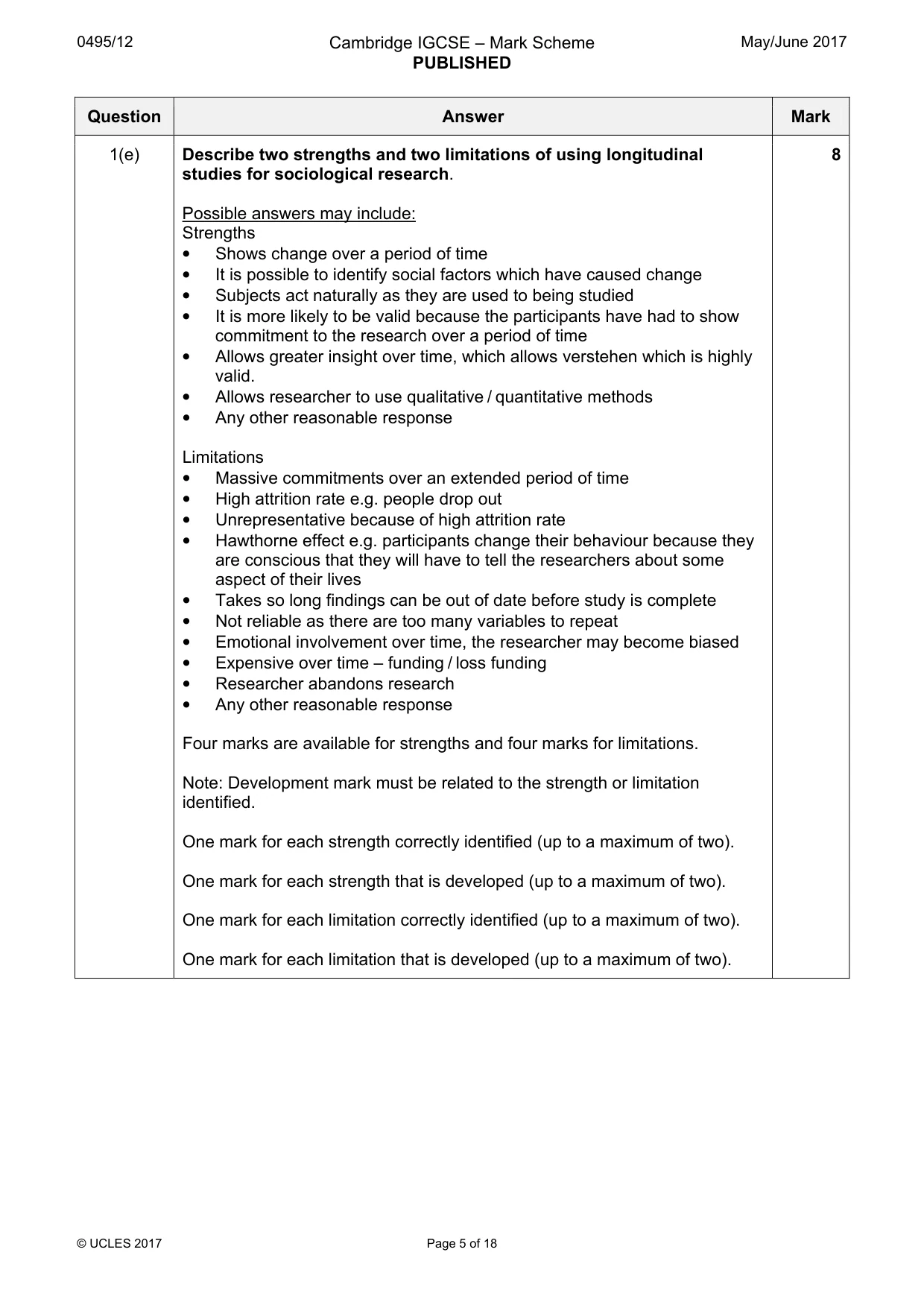
0495/12 Cambridge IGCSE – Mark Scheme PUBLISHED May/June 2017 © UCLES 2017 Page 5 of 18 Question Answer Mark 1(e) Describe two strengths and two limitations of using longitudinal studies for sociological research. Possible answers may include: Strengths • Shows change over a period of time • It is possible to identify social factors which have caused change • Subjects act naturally as they are used to being studied • It is more likely to be valid because the participants have had to show commitment to the research over a period of time • Allows greater insight over time, which allows verstehen which is highly valid. • Allows researcher to use qualitative / quantitative methods • Any other reasonable response Limitations • Massive commitments over an extended period of time • High attrition rate e.g. people drop out • Unrepresentative because of high attrition rate • Hawthorne effect e.g. participants change their behaviour because they are conscious that they will have to tell the researchers about some aspect of their lives • Takes so long findings can be out of date before study is complete • Not reliable as there are too many variables to repeat • Emotional involvement over time, the researcher may become biased • Expensive over time – funding / loss funding • Researcher abandons research • Any other reasonable response Four marks are available for strengths and four marks for limitations. Note: Development mark must be related to the strength or limitation identified. One mark for each strength correctly identified (up to a maximum of two). One mark for each strength that is developed (up to a maximum of two). One mark for each limitation correctly identified (up to a maximum of two). One mark for each limitation that is developed (up to a maximum of two). 8
Mark scheme, page 6
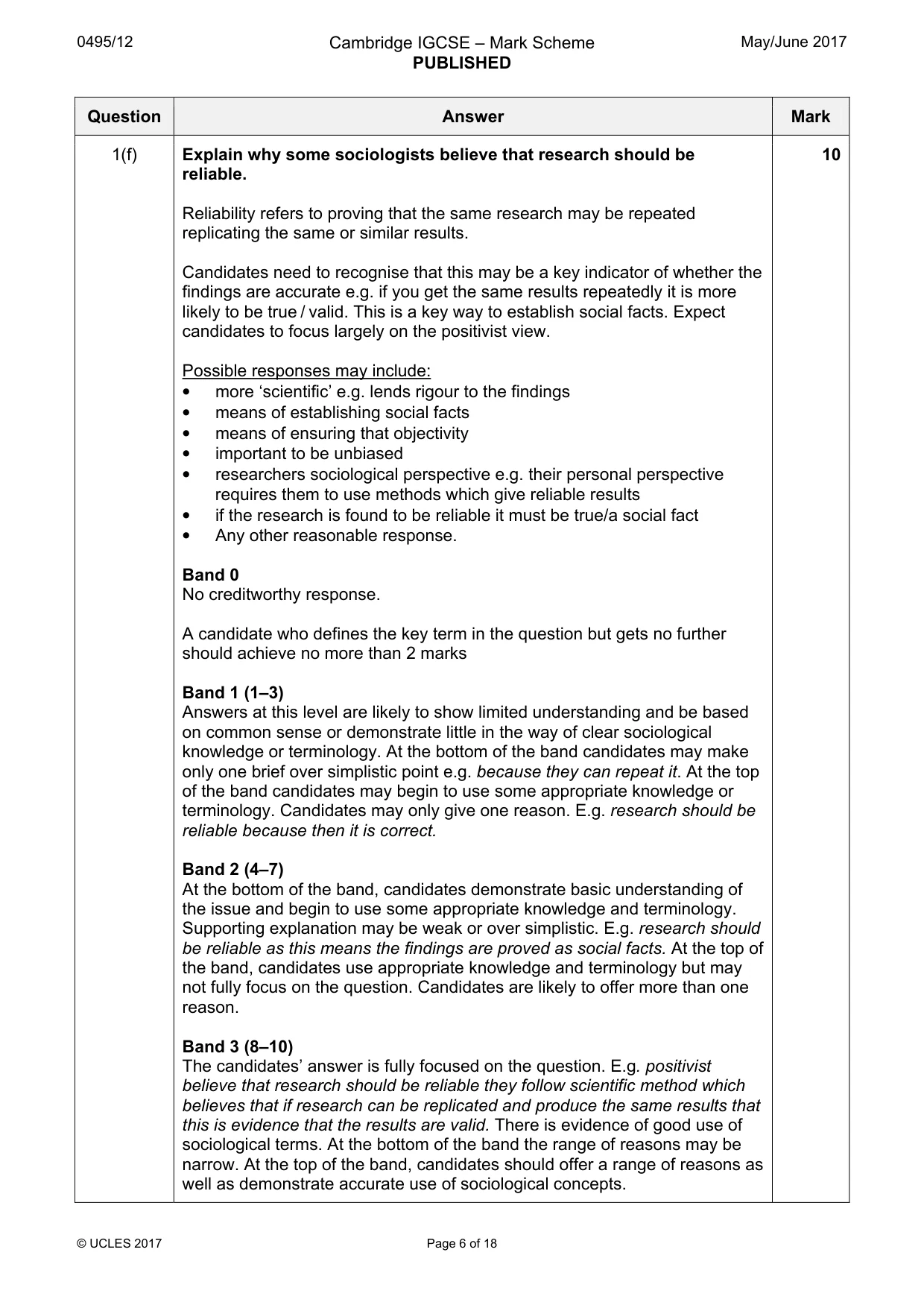
0495/12 Cambridge IGCSE – Mark Scheme PUBLISHED May/June 2017 © UCLES 2017 Page 6 of 18 Question Answer Mark 1(f) Explain why some sociologists believe that research should be reliable. Reliability refers to proving that the same research may be repeated replicating the same or similar results. Candidates need to recognise that this may be a key indicator of whether the findings are accurate e.g. if you get the same results repeatedly it is more likely to be true / valid. This is a key way to establish social facts. Expect candidates to focus largely on the positivist view. Possible responses may include: • more ‘scientific’ e.g. lends rigour to the findings • means of establishing social facts • means of ensuring that objectivity • important to be unbiased • researchers sociological perspective e.g. their personal perspective requires them to use methods which give reliable results • if the research is found to be reliable it must be true/a social fact • Any other reasonable response. Band 0 No creditworthy response. A candidate who defines the key term in the question but gets no further should achieve no more than 2 marks Band 1 (1–3) Answers at this level are likely to show limited understanding and be based on common sense or demonstrate little in the way of clear sociological knowledge or terminology. At the bottom of the band candidates may make only one brief over simplistic point e.g. because they can repeat it. At the top of the band candidates may begin to use some appropriate knowledge or terminology. Candidates may only give one reason. E.g. research should be reliable because then it is correct. Band 2 (4–7) At the bottom of the band, candidates demonstrate basic understanding of the issue and begin to use some appropriate knowledge and terminology. Supporting explanation may be weak or over simplistic. E.g. research should be reliable as this means the findings are proved as social facts. At the top of the band, candidates use appropriate knowledge and terminology but may not fully focus on the question. Candidates are likely to offer more than one reason. Band 3 (8–10) The candidates’ answer is fully focused on the question. E.g. positivist believe that research should be reliable they follow scientific method which believes that if research can be replicated and produce the same results that this is evidence that the results are valid. There is evidence of good use of sociological terms. At the bottom of the band the range of reasons may be narrow. At the top of the band, candidates should offer a range of reasons as well as demonstrate accurate use of sociological concepts. 10
Mark scheme, page 7
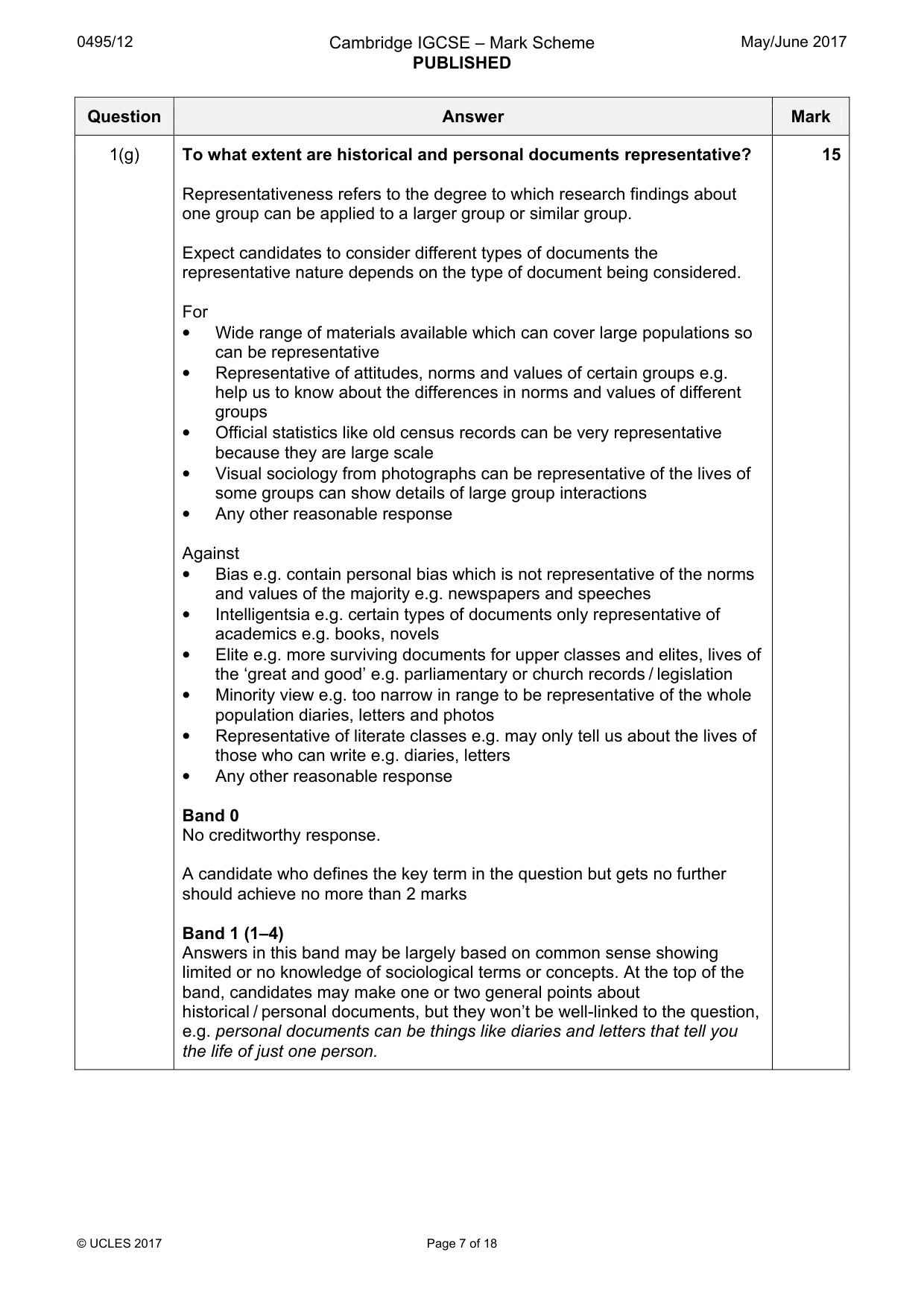
0495/12 Cambridge IGCSE – Mark Scheme PUBLISHED May/June 2017 © UCLES 2017 Page 7 of 18 Question Answer Mark 1(g) To what extent are historical and personal documents representative? Representativeness refers to the degree to which research findings about one group can be applied to a larger group or similar group. Expect candidates to consider different types of documents the representative nature depends on the type of document being considered. For • Wide range of materials available which can cover large populations so can be representative • Representative of attitudes, norms and values of certain groups e.g. help us to know about the differences in norms and values of different groups • Official statistics like old census records can be very representative because they are large scale • Visual sociology from photographs can be representative of the lives of some groups can show details of large group interactions • Any other reasonable response Against • Bias e.g. contain personal bias which is not representative of the norms and values of the majority e.g. newspapers and speeches • Intelligentsia e.g. certain types of documents only representative of academics e.g. books, novels • Elite e.g. more surviving documents for upper classes and elites, lives of the ‘great and good’ e.g. parliamentary or church records / legislation • Minority view e.g. too narrow in range to be representative of the whole population diaries, letters and photos • Representative of literate classes e.g. may only tell us about the lives of those who can write e.g. diaries, letters • Any other reasonable response Band 0 No creditworthy response. A candidate who defines the key term in the question but gets no further should achieve no more than 2 marks Band 1 (1–4) Answers in this band may be largely based on common sense showing limited or no knowledge of sociological terms or concepts. At the top of the band, candidates may make one or two general points about historical / personal documents, but they won’t be well-linked to the question, e.g. personal documents can be things like diaries and letters that tell you the life of just one person. 15
Mark scheme, page 8
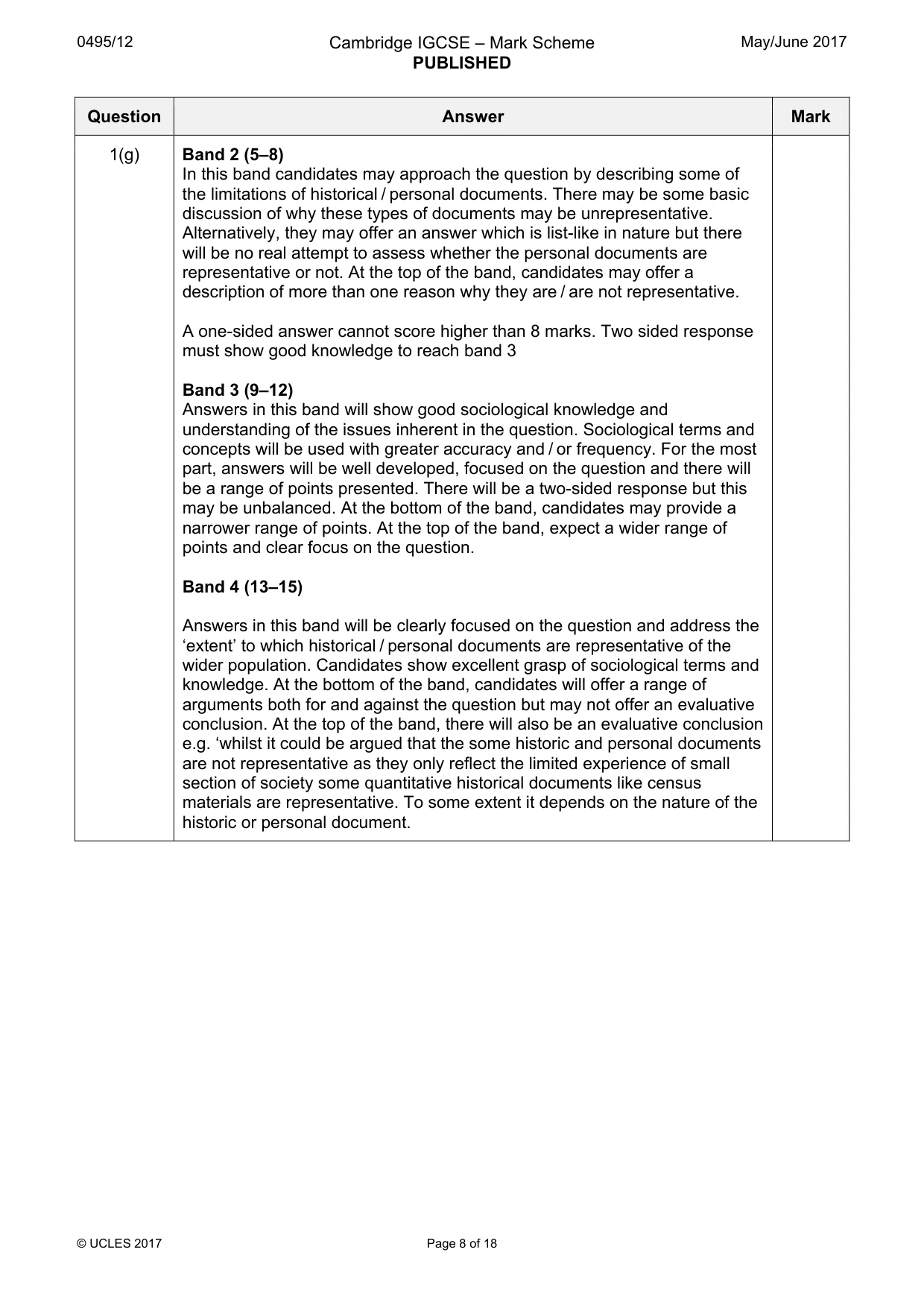
0495/12 Cambridge IGCSE – Mark Scheme PUBLISHED May/June 2017 © UCLES 2017 Page 8 of 18 Question Answer Mark 1(g) Band 2 (5–8) In this band candidates may approach the question by describing some of the limitations of historical / personal documents. There may be some basic discussion of why these types of documents may be unrepresentative. Alternatively, they may offer an answer which is list-like in nature but there will be no real attempt to assess whether the personal documents are representative or not. At the top of the band, candidates may offer a description of more than one reason why they are / are not representative. A one-sided answer cannot score higher than 8 marks. Two sided response must show good knowledge to reach band 3 Band 3 (9–12) Answers in this band will show good sociological knowledge and understanding of the issues inherent in the question. Sociological terms and concepts will be used with greater accuracy and / or frequency. For the most part, answers will be well developed, focused on the question and there will be a range of points presented. There will be a two-sided response but this may be unbalanced. At the bottom of the band, candidates may provide a narrower range of points. At the top of the band, expect a wider range of points and clear focus on the question. Band 4 (13–15) Answers in this band will be clearly focused on the question and address the ‘extent’ to which historical / personal documents are representative of the wider population. Candidates show excellent grasp of sociological terms and knowledge. At the bottom of the band, candidates will offer a range of arguments both for and against the question but may not offer an evaluative conclusion. At the top of the band, there will also be an evaluative conclusion e.g. ‘whilst it could be argued that the some historic and personal documents are not representative as they only reflect the limited experience of small section of society some quantitative historical documents like census materials are representative. To some extent it depends on the nature of the historic or personal document.
Mark scheme, page 9
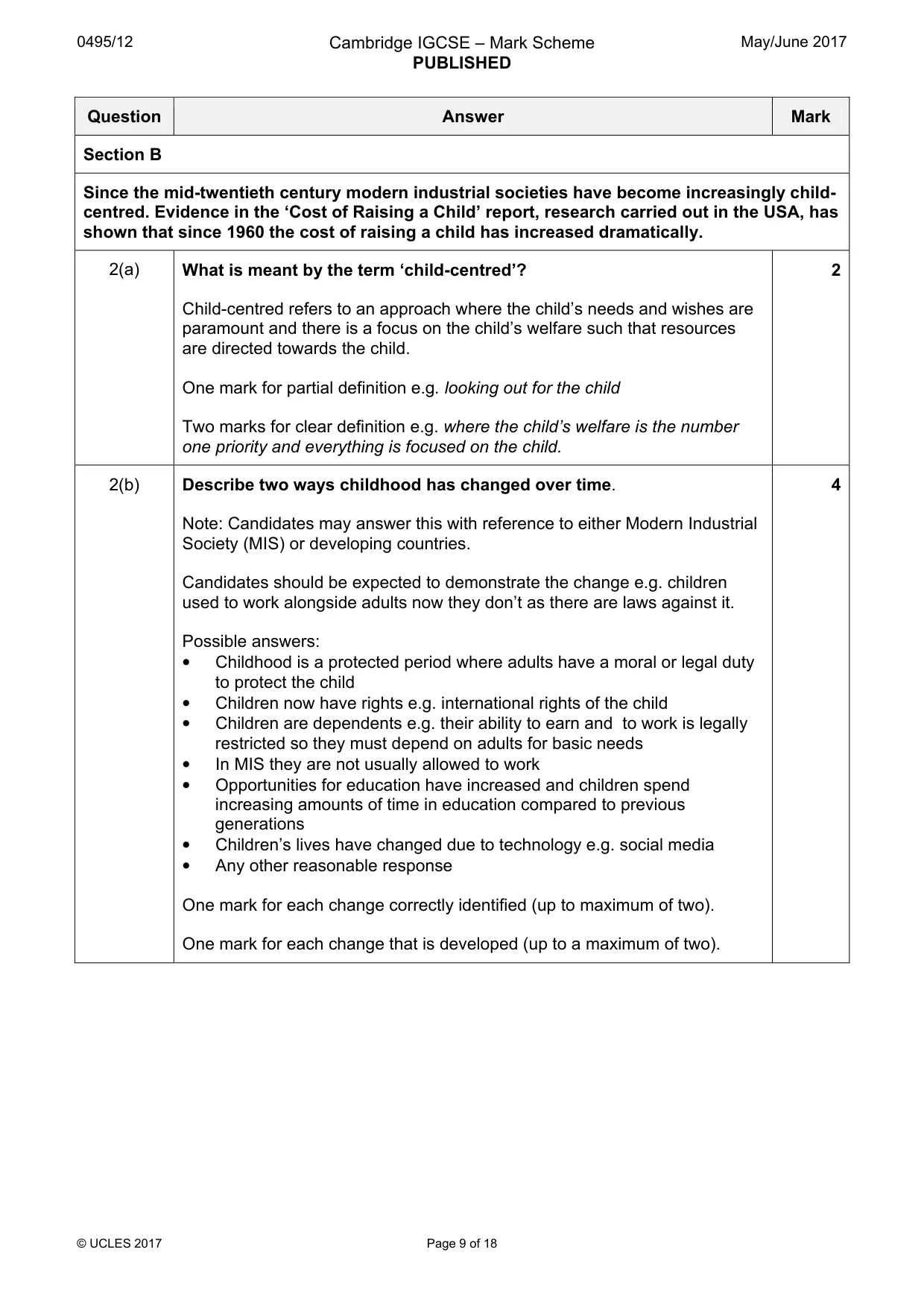
0495/12 Cambridge IGCSE – Mark Scheme PUBLISHED May/June 2017 © UCLES 2017 Page 9 of 18 Question Answer Mark Section B Since the mid-twentieth century modern industrial societies have become increasingly child- centred. Evidence in the ‘Cost of Raising a Child’ report, research carried out in the USA, has shown that since 1960 the cost of raising a child has increased dramatically. 2(a) What is meant by the term ‘child-centred’? Child-centred refers to an approach where the child’s needs and wishes are paramount and there is a focus on the child’s welfare such that resources are directed towards the child. One mark for partial definition e.g. looking out for the child Two marks for clear definition e.g. where the child’s welfare is the number one priority and everything is focused on the child. 2 2(b) Describe two ways childhood has changed over time. Note: Candidates may answer this with reference to either Modern Industrial Society (MIS) or developing countries. Candidates should be expected to demonstrate the change e.g. children used to work alongside adults now they don’t as there are laws against it. Possible answers: • Childhood is a protected period where adults have a moral or legal duty to protect the child • Children now have rights e.g. international rights of the child • Children are dependents e.g. their ability to earn and to work is legally restricted so they must depend on adults for basic needs • In MIS they are not usually allowed to work • Opportunities for education have increased and children spend increasing amounts of time in education compared to previous generations • Children’s lives have changed due to technology e.g. social media • Any other reasonable response One mark for each change correctly identified (up to maximum of two). One mark for each change that is developed (up to a maximum of two). 4
Mark scheme, page 10
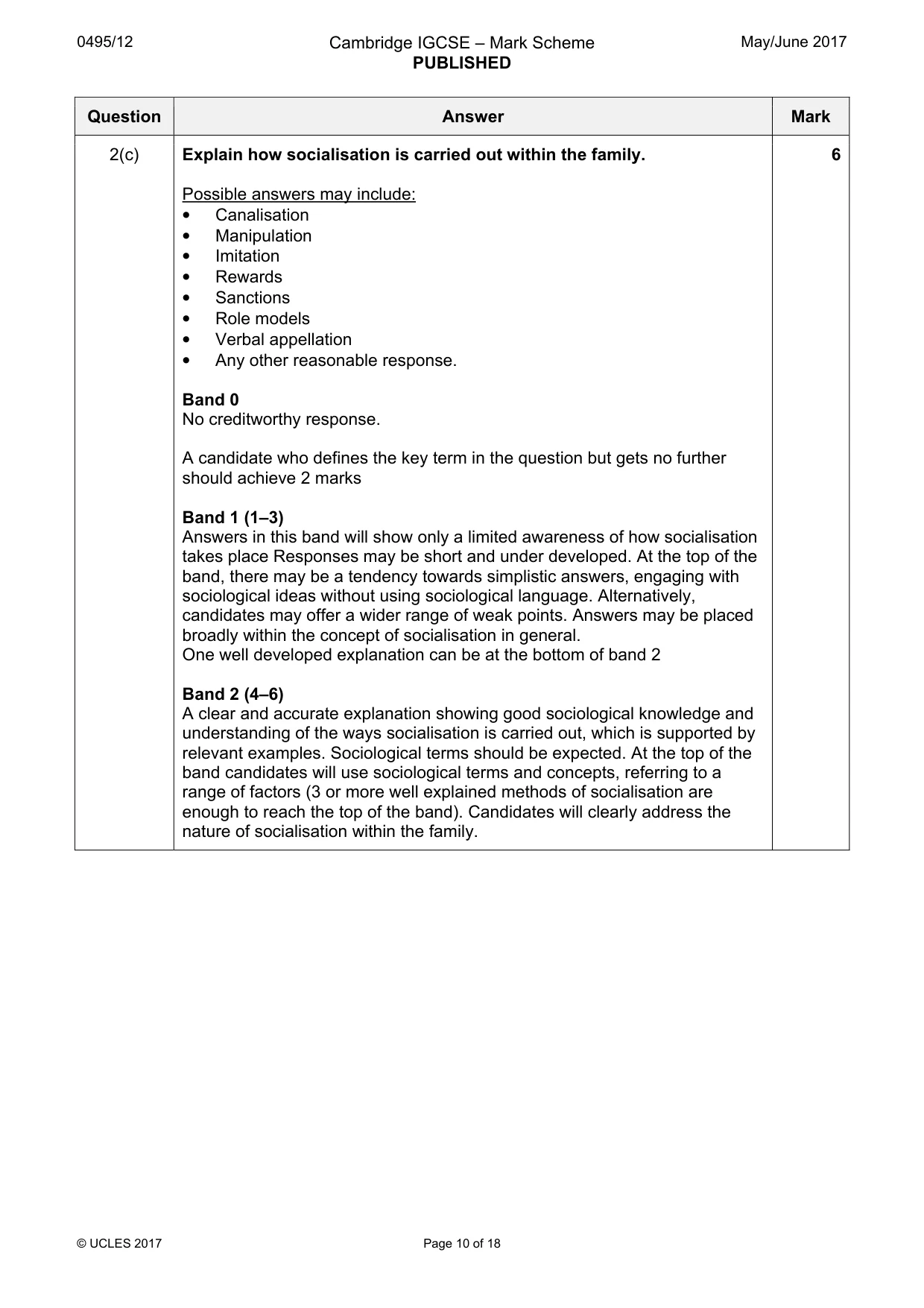
0495/12 Cambridge IGCSE – Mark Scheme PUBLISHED May/June 2017 © UCLES 2017 Page 10 of 18 Question Answer Mark 2(c) Explain how socialisation is carried out within the family. Possible answers may include: • Canalisation • Manipulation • Imitation • Rewards • Sanctions • Role models • Verbal appellation • Any other reasonable response. Band 0 No creditworthy response. A candidate who defines the key term in the question but gets no further should achieve 2 marks Band 1 (1–3) Answers in this band will show only a limited awareness of how socialisation takes place Responses may be short and under developed. At the top of the band, there may be a tendency towards simplistic answers, engaging with sociological ideas without using sociological language. Alternatively, candidates may offer a wider range of weak points. Answers may be placed broadly within the concept of socialisation in general. One well developed explanation can be at the bottom of band 2 Band 2 (4–6) A clear and accurate explanation showing good sociological knowledge and understanding of the ways socialisation is carried out, which is supported by relevant examples. Sociological terms should be expected. At the top of the band candidates will use sociological terms and concepts, referring to a range of factors (3 or more well explained methods of socialisation are enough to reach the top of the band). Candidates will clearly address the nature of socialisation within the family. 6
Mark scheme, page 11
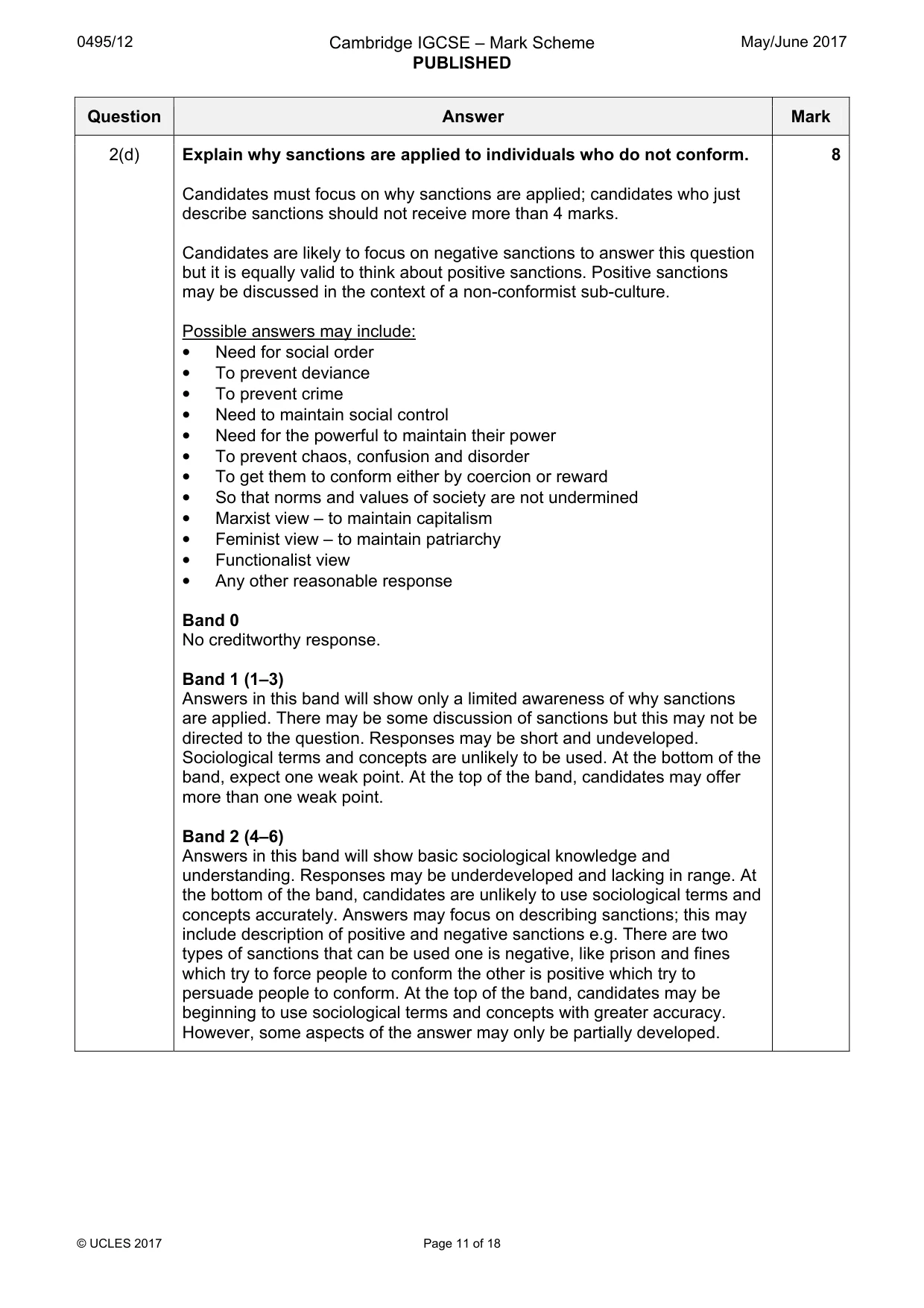
0495/12 Cambridge IGCSE – Mark Scheme PUBLISHED May/June 2017 © UCLES 2017 Page 11 of 18 Question Answer Mark 2(d) Explain why sanctions are applied to individuals who do not conform. Candidates must focus on why sanctions are applied; candidates who just describe sanctions should not receive more than 4 marks. Candidates are likely to focus on negative sanctions to answer this question but it is equally valid to think about positive sanctions. Positive sanctions may be discussed in the context of a non-conformist sub-culture. Possible answers may include: • Need for social order • To prevent deviance • To prevent crime • Need to maintain social control • Need for the powerful to maintain their power • To prevent chaos, confusion and disorder • To get them to conform either by coercion or reward • So that norms and values of society are not undermined • Marxist view – to maintain capitalism • Feminist view – to maintain patriarchy • Functionalist view • Any other reasonable response Band 0 No creditworthy response. Band 1 (1–3) Answers in this band will show only a limited awareness of why sanctions are applied. There may be some discussion of sanctions but this may not be directed to the question. Responses may be short and undeveloped. Sociological terms and concepts are unlikely to be used. At the bottom of the band, expect one weak point. At the top of the band, candidates may offer more than one weak point. Band 2 (4–6) Answers in this band will show basic sociological knowledge and understanding. Responses may be underdeveloped and lacking in range. At the bottom of the band, candidates are unlikely to use sociological terms and concepts accurately. Answers may focus on describing sanctions; this may include description of positive and negative sanctions e.g. There are two types of sanctions that can be used one is negative, like prison and fines which try to force people to conform the other is positive which try to persuade people to conform. At the top of the band, candidates may be beginning to use sociological terms and concepts with greater accuracy. However, some aspects of the answer may only be partially developed. 8
Mark scheme, page 12
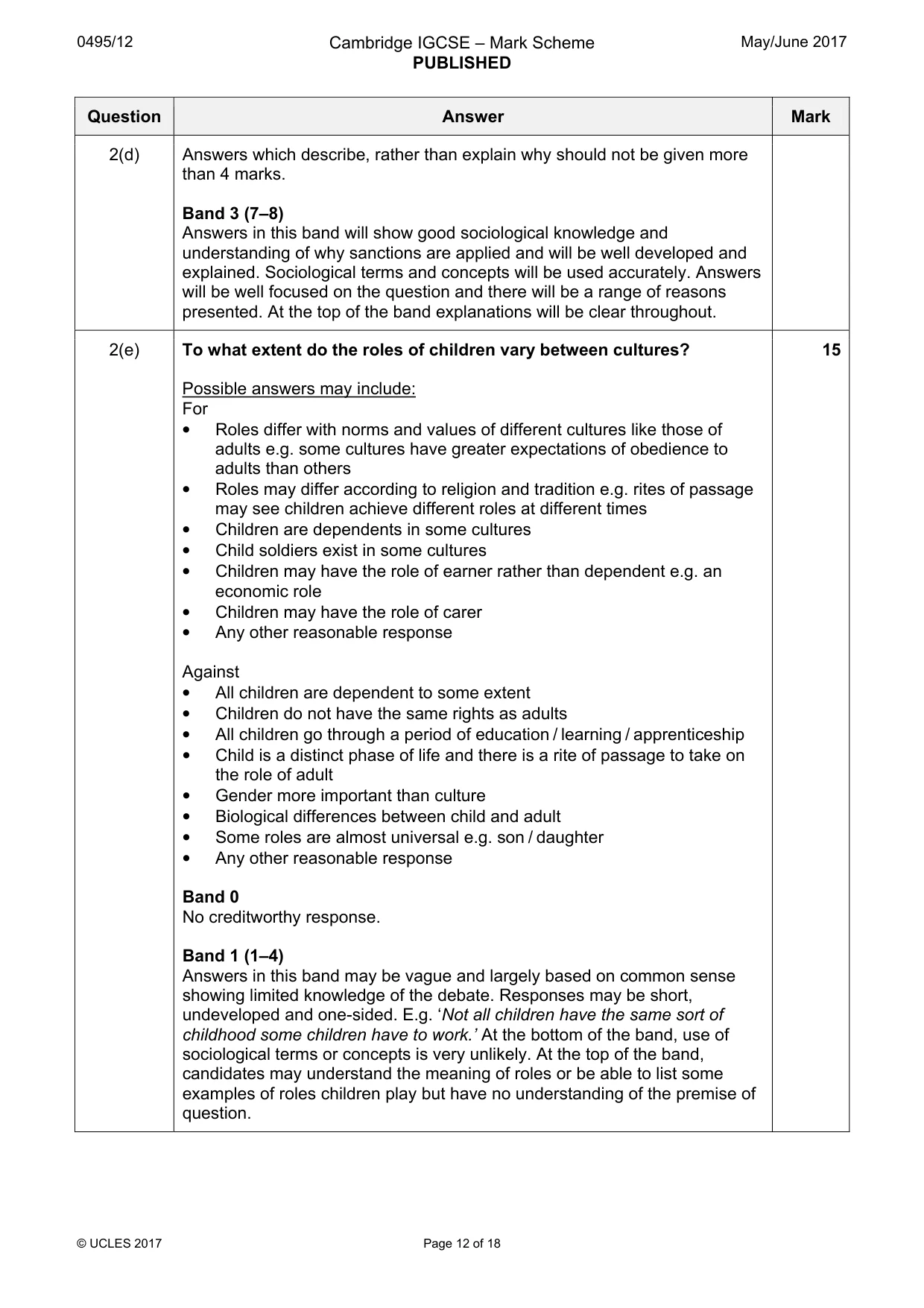
0495/12 Cambridge IGCSE – Mark Scheme PUBLISHED May/June 2017 © UCLES 2017 Page 12 of 18 Question Answer Mark 2(d) Answers which describe, rather than explain why should not be given more than 4 marks. Band 3 (7–8) Answers in this band will show good sociological knowledge and understanding of why sanctions are applied and will be well developed and explained. Sociological terms and concepts will be used accurately. Answers will be well focused on the question and there will be a range of reasons presented. At the top of the band explanations will be clear throughout. 2(e) To what extent do the roles of children vary between cultures? Possible answers may include: For • Roles differ with norms and values of different cultures like those of adults e.g. some cultures have greater expectations of obedience to adults than others • Roles may differ according to religion and tradition e.g. rites of passage may see children achieve different roles at different times • Children are dependents in some cultures • Child soldiers exist in some cultures • Children may have the role of earner rather than dependent e.g. an economic role • Children may have the role of carer • Any other reasonable response Against • All children are dependent to some extent • Children do not have the same rights as adults • All children go through a period of education / learning / apprenticeship • Child is a distinct phase of life and there is a rite of passage to take on the role of adult • Gender more important than culture • Biological differences between child and adult • Some roles are almost universal e.g. son / daughter • Any other reasonable response Band 0 No creditworthy response. Band 1 (1–4) Answers in this band may be vague and largely based on common sense showing limited knowledge of the debate. Responses may be short, undeveloped and one-sided. E.g. ‘Not all children have the same sort of childhood some children have to work.’ At the bottom of the band, use of sociological terms or concepts is very unlikely. At the top of the band, candidates may understand the meaning of roles or be able to list some examples of roles children play but have no understanding of the premise of question. 15
Mark scheme, page 13
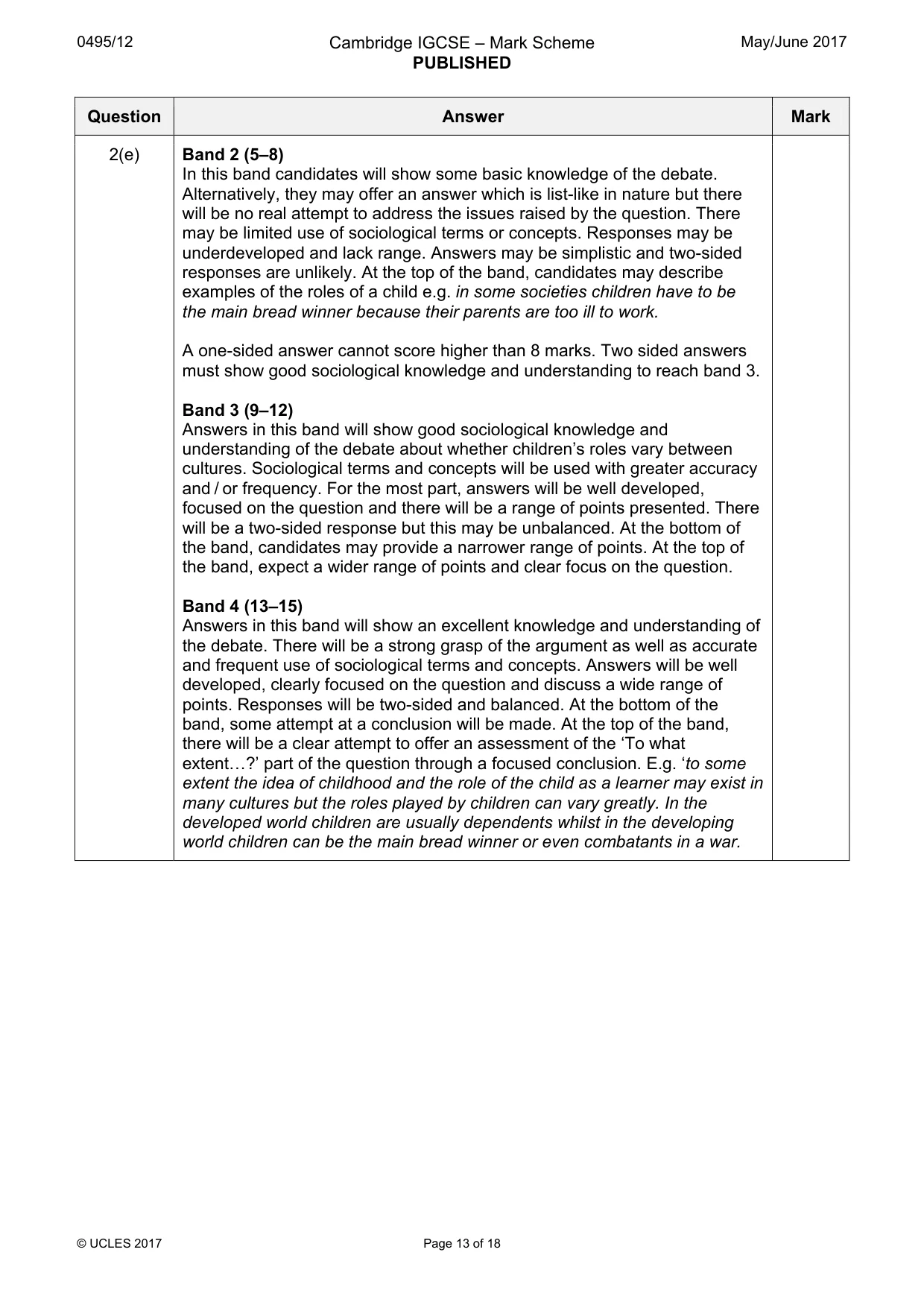
0495/12 Cambridge IGCSE – Mark Scheme PUBLISHED May/June 2017 © UCLES 2017 Page 13 of 18 Question Answer Mark 2(e) Band 2 (5–8) In this band candidates will show some basic knowledge of the debate. Alternatively, they may offer an answer which is list-like in nature but there will be no real attempt to address the issues raised by the question. There may be limited use of sociological terms or concepts. Responses may be underdeveloped and lack range. Answers may be simplistic and two-sided responses are unlikely. At the top of the band, candidates may describe examples of the roles of a child e.g. in some societies children have to be the main bread winner because their parents are too ill to work. A one-sided answer cannot score higher than 8 marks. Two sided answers must show good sociological knowledge and understanding to reach band 3. Band 3 (9–12) Answers in this band will show good sociological knowledge and understanding of the debate about whether children’s roles vary between cultures. Sociological terms and concepts will be used with greater accuracy and / or frequency. For the most part, answers will be well developed, focused on the question and there will be a range of points presented. There will be a two-sided response but this may be unbalanced. At the bottom of the band, candidates may provide a narrower range of points. At the top of the band, expect a wider range of points and clear focus on the question. Band 4 (13–15) Answers in this band will show an excellent knowledge and understanding of the debate. There will be a strong grasp of the argument as well as accurate and frequent use of sociological terms and concepts. Answers will be well developed, clearly focused on the question and discuss a wide range of points. Responses will be two-sided and balanced. At the bottom of the band, some attempt at a conclusion will be made. At the top of the band, there will be a clear attempt to offer an assessment of the ‘To what extent«?’ part of the question through a focused conclusion. E.g. ‘to some extent the idea of childhood and the role of the child as a learner may exist in many cultures but the roles played by children can vary greatly. In the developed world children are usually dependents whilst in the developing world children can be the main bread winner or even combatants in a war.
Mark scheme, page 14
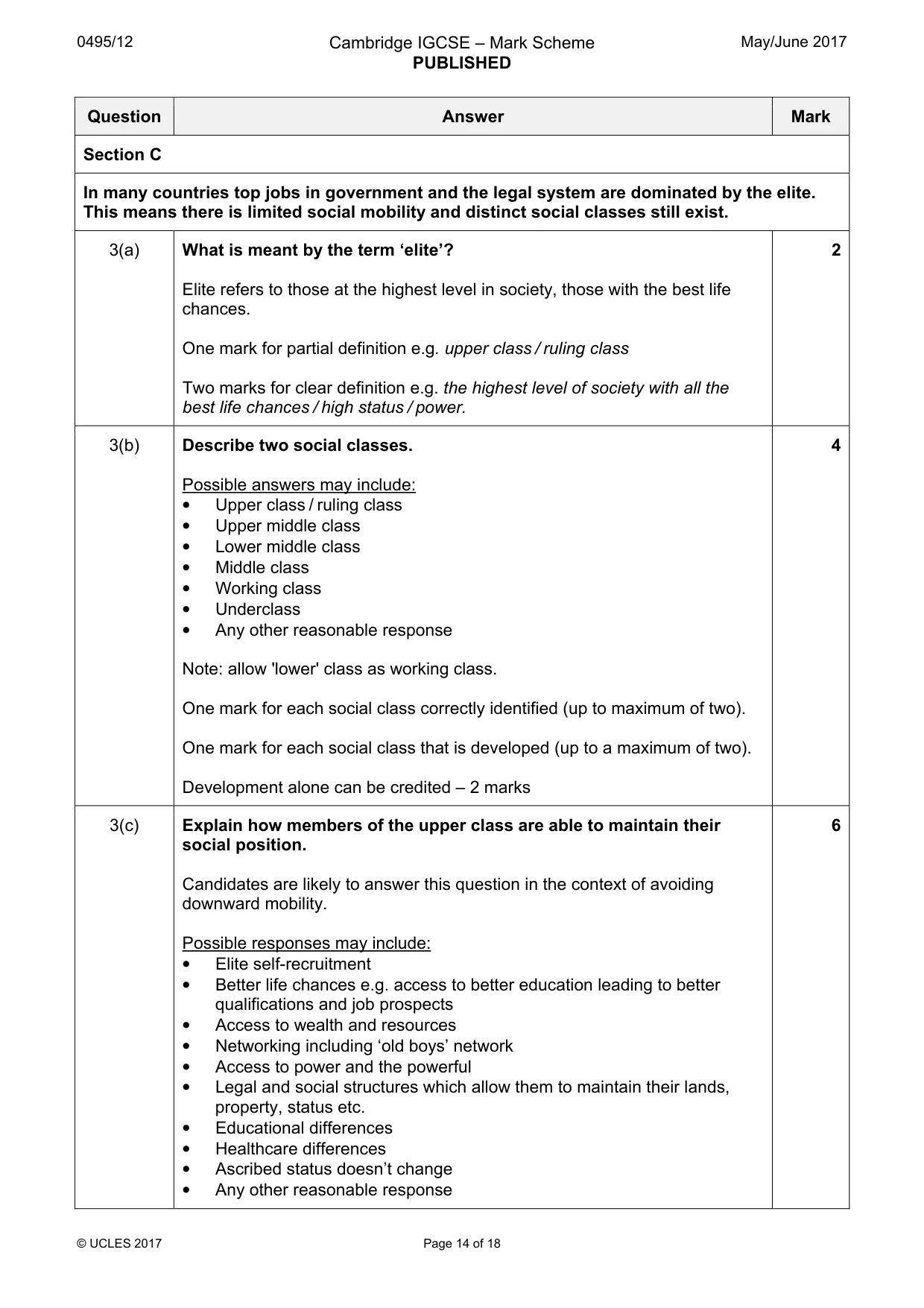
0495/12 Cambridge IGCSE – Mark Scheme PUBLISHED May/June 2017 © UCLES 2017 Page 14 of 18 Question Answer Mark Section C In many countries top jobs in government and the legal system are dominated by the elite. This means there is limited social mobility and distinct social classes still exist. 3(a) What is meant by the term ‘elite’? Elite refers to those at the highest level in society, those with the best life chances. One mark for partial definition e.g. upper class / ruling class Two marks for clear definition e.g. the highest level of society with all the best life chances / high status / power. 2 3(b) Describe two social classes. Possible answers may include: • Upper class / ruling class • Upper middle class • Lower middle class • Middle class • Working class • Underclass • Any other reasonable response Note: allow 'lower' class as working class. One mark for each social class correctly identified (up to maximum of two). One mark for each social class that is developed (up to a maximum of two). Development alone can be credited – 2 marks 4 3(c) Explain how members of the upper class are able to maintain their social position. Candidates are likely to answer this question in the context of avoiding downward mobility. Possible responses may include: • Elite self-recruitment • Better life chances e.g. access to better education leading to better qualifications and job prospects • Access to wealth and resources • Networking including ‘old boys’ network • Access to power and the powerful • Legal and social structures which allow them to maintain their lands, property, status etc. • Educational differences • Healthcare differences • Ascribed status doesn’t change • Any other reasonable response 6
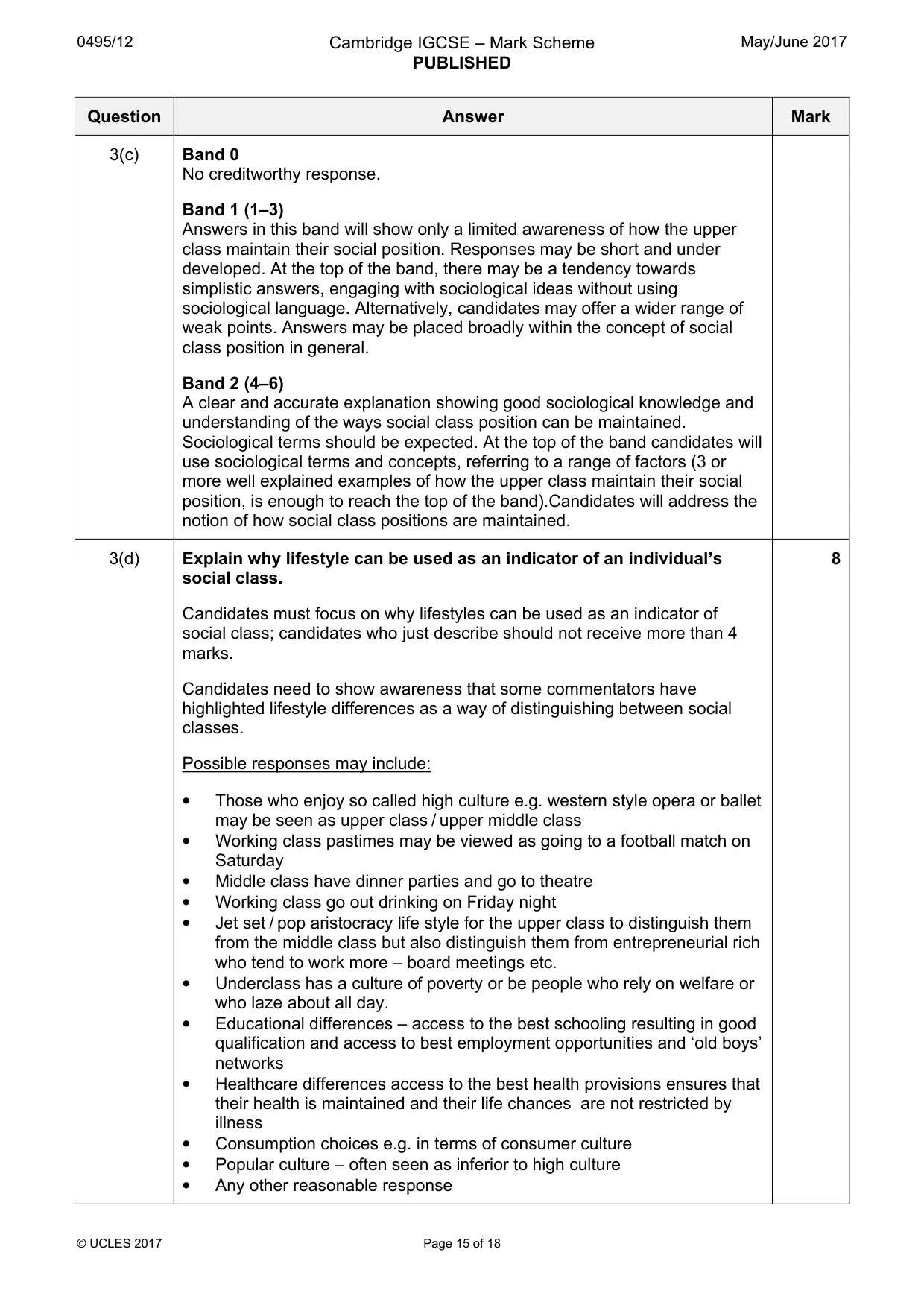
Mark scheme, page 15
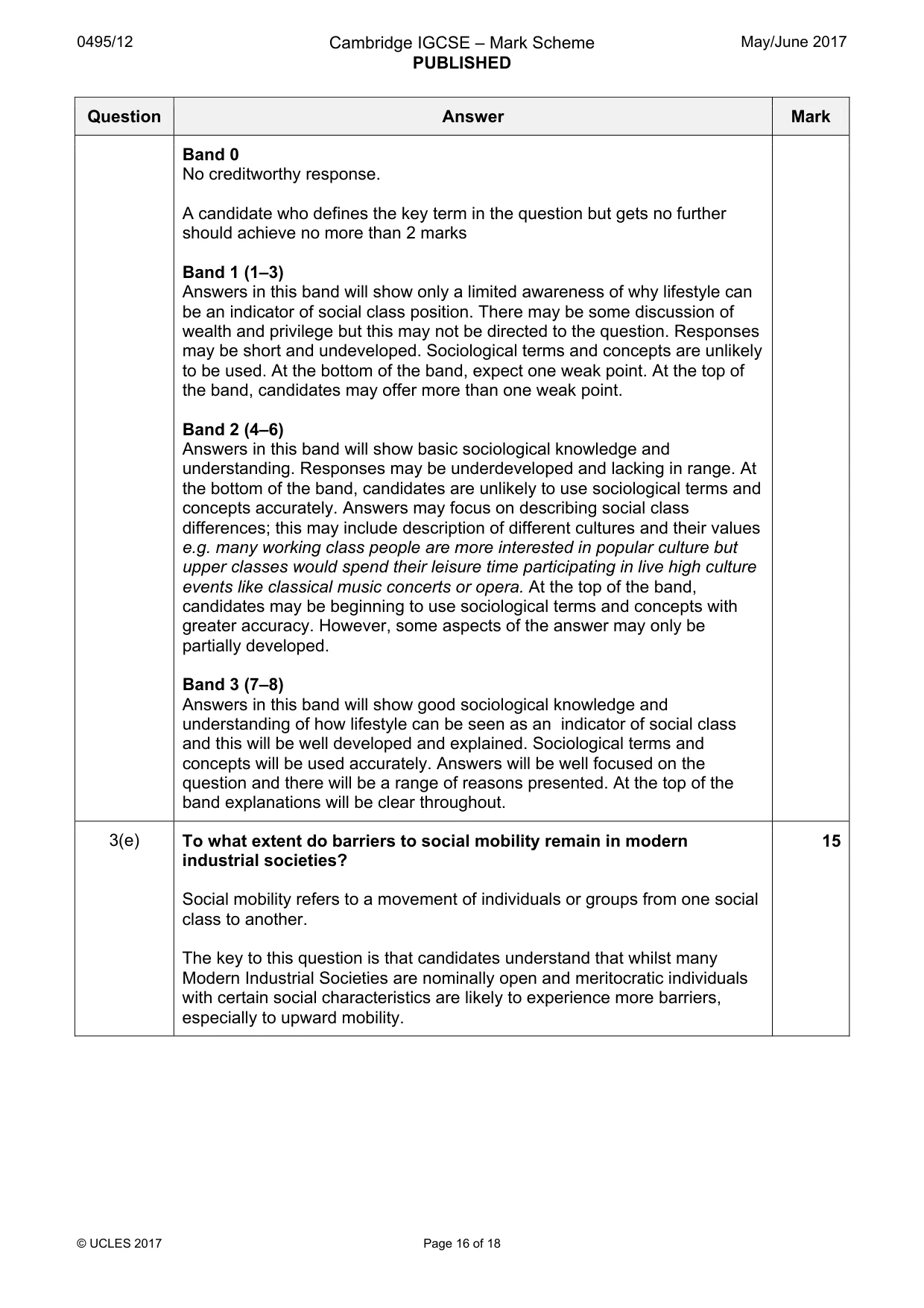
0495/12 Cambridge IGCSE – Mark Scheme PUBLISHED May/June 2017 © UCLES 2017 Page 15 of 18 Question Answer Mark 3(c) Band 0 No creditworthy response. Band 1 (1–3) Answers in this band will show only a limited awareness of how the upper class maintain their social position. Responses may be short and under developed. At the top of the band, there may be a tendency towards simplistic answers, engaging with sociological ideas without using sociological language. Alternatively, candidates may offer a wider range of weak points. Answers may be placed broadly within the concept of social class position in general. Band 2 (4–6) A clear and accurate explanation showing good sociological knowledge and understanding of the ways social class position can be maintained. Sociological terms should be expected. At the top of the band candidates will use sociological terms and concepts, referring to a range of factors (3 or more well explained examples of how the upper class maintain their social position, is enough to reach the top of the band).Candidates will address the notion of how social class positions are maintained. 3(d) Explain why lifestyle can be used as an indicator of an individual’s social class. Candidates must focus on why lifestyles can be used as an indicator of social class; candidates who just describe should not receive more than 4 marks. Candidates need to show awareness that some commentators have highlighted lifestyle differences as a way of distinguishing between social classes. Possible responses may include: • Those who enjoy so called high culture e.g. western style opera or ballet may be seen as upper class / upper middle class • Working class pastimes may be viewed as going to a football match on Saturday • Middle class have dinner parties and go to theatre • Working class go out drinking on Friday night • Jet set / pop aristocracy life style for the upper class to distinguish them from the middle class but also distinguish them from entrepreneurial rich who tend to work more – board meetings etc. • Underclass has a culture of poverty or be people who rely on welfare or who laze about all day. • Educational differences – access to the best schooling resulting in good qualification and access to best employment opportunities and ‘old boys’ networks • Healthcare differences access to the best health provisions ensures that their health is maintained and their life chances are not restricted by illness • Consumption choices e.g. in terms of consumer culture • Popular culture – often seen as inferior to high culture • Any other reasonable response 8
Mark scheme, page 16
0495/12 Cambridge IGCSE – Mark Scheme PUBLISHED May/June 2017 © UCLES 2017 Page 16 of 18 Question Answer Mark Band 0 No creditworthy response. A candidate who defines the key term in the question but gets no further should achieve no more than 2 marks Band 1 (1–3) Answers in this band will show only a limited awareness of why lifestyle can be an indicator of social class position. There may be some discussion of wealth and privilege but this may not be directed to the question. Responses may be short and undeveloped. Sociological terms and concepts are unlikely to be used. At the bottom of the band, expect one weak point. At the top of the band, candidates may offer more than one weak point. Band 2 (4–6) Answers in this band will show basic sociological knowledge and understanding. Responses may be underdeveloped and lacking in range. At the bottom of the band, candidates are unlikely to use sociological terms and concepts accurately. Answers may focus on describing social class differences; this may include description of different cultures and their values e.g. many working class people are more interested in popular culture but upper classes would spend their leisure time participating in live high culture events like classical music concerts or opera. At the top of the band, candidates may be beginning to use sociological terms and concepts with greater accuracy. However, some aspects of the answer may only be partially developed. Band 3 (7–8) Answers in this band will show good sociological knowledge and understanding of how lifestyle can be seen as an indicator of social class and this will be well developed and explained. Sociological terms and concepts will be used accurately. Answers will be well focused on the question and there will be a range of reasons presented. At the top of the band explanations will be clear throughout. 3(e) To what extent do barriers to social mobility remain in modern industrial societies? Social mobility refers to a movement of individuals or groups from one social class to another. The key to this question is that candidates understand that whilst many Modern Industrial Societies are nominally open and meritocratic individuals with certain social characteristics are likely to experience more barriers, especially to upward mobility. 15
Mark scheme, page 17
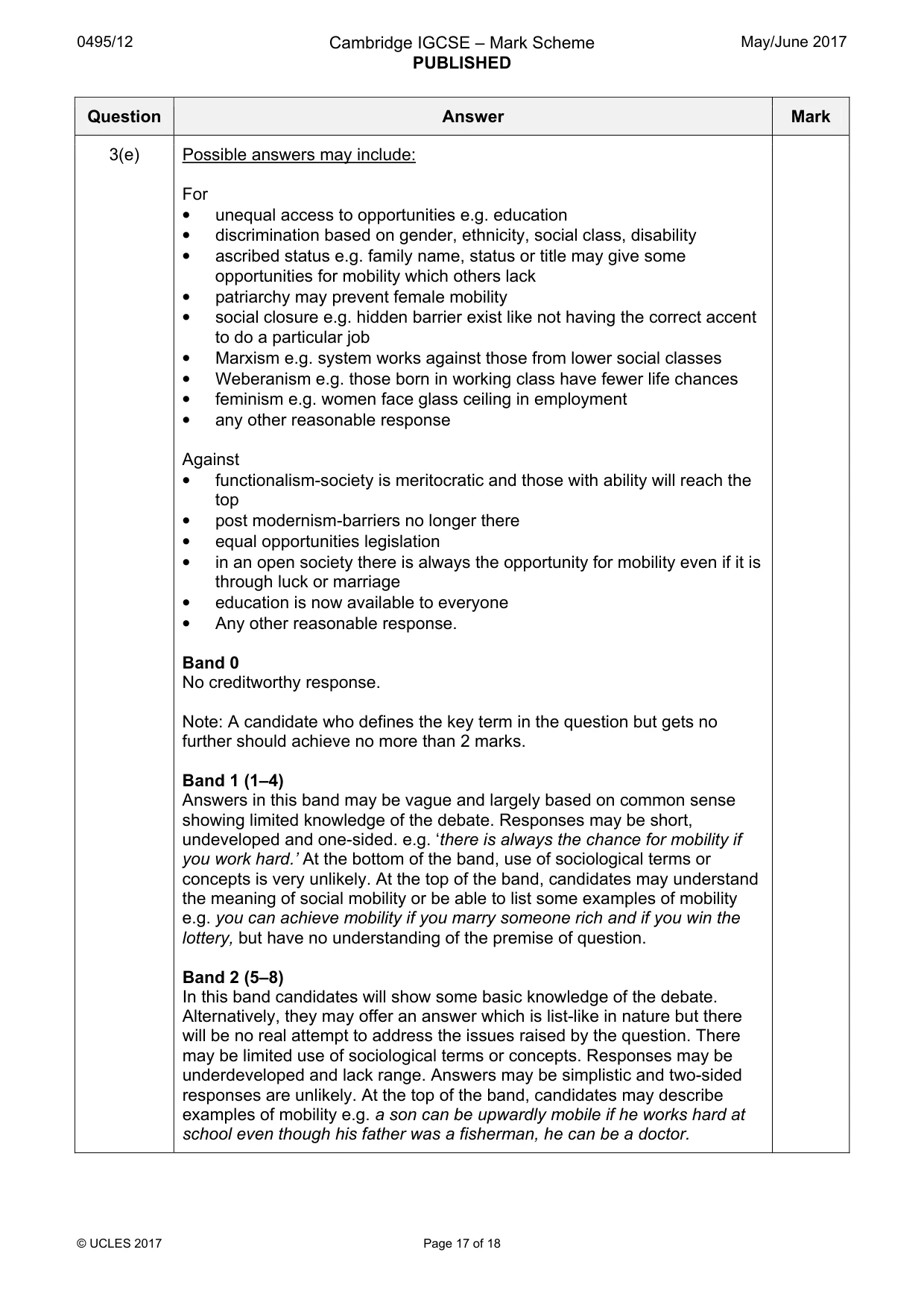
0495/12 Cambridge IGCSE – Mark Scheme PUBLISHED May/June 2017 © UCLES 2017 Page 17 of 18 Question Answer Mark 3(e) Possible answers may include: For • unequal access to opportunities e.g. education • discrimination based on gender, ethnicity, social class, disability • ascribed status e.g. family name, status or title may give some opportunities for mobility which others lack • patriarchy may prevent female mobility • social closure e.g. hidden barrier exist like not having the correct accent to do a particular job • Marxism e.g. system works against those from lower social classes • Weberanism e.g. those born in working class have fewer life chances • feminism e.g. women face glass ceiling in employment • any other reasonable response Against • functionalism-society is meritocratic and those with ability will reach the top • post modernism-barriers no longer there • equal opportunities legislation • in an open society there is always the opportunity for mobility even if it is through luck or marriage • education is now available to everyone • Any other reasonable response. Band 0 No creditworthy response. Note: A candidate who defines the key term in the question but gets no further should achieve no more than 2 marks. Band 1 (1–4) Answers in this band may be vague and largely based on common sense showing limited knowledge of the debate. Responses may be short, undeveloped and one-sided. e.g. ‘there is always the chance for mobility if you work hard.’ At the bottom of the band, use of sociological terms or concepts is very unlikely. At the top of the band, candidates may understand the meaning of social mobility or be able to list some examples of mobility e.g. you can achieve mobility if you marry someone rich and if you win the lottery, but have no understanding of the premise of question. Band 2 (5–8) In this band candidates will show some basic knowledge of the debate. Alternatively, they may offer an answer which is list-like in nature but there will be no real attempt to address the issues raised by the question. There may be limited use of sociological terms or concepts. Responses may be underdeveloped and lack range. Answers may be simplistic and two-sided responses are unlikely. At the top of the band, candidates may describe examples of mobility e.g. a son can be upwardly mobile if he works hard at school even though his father was a fisherman, he can be a doctor.
Mark scheme, page 18
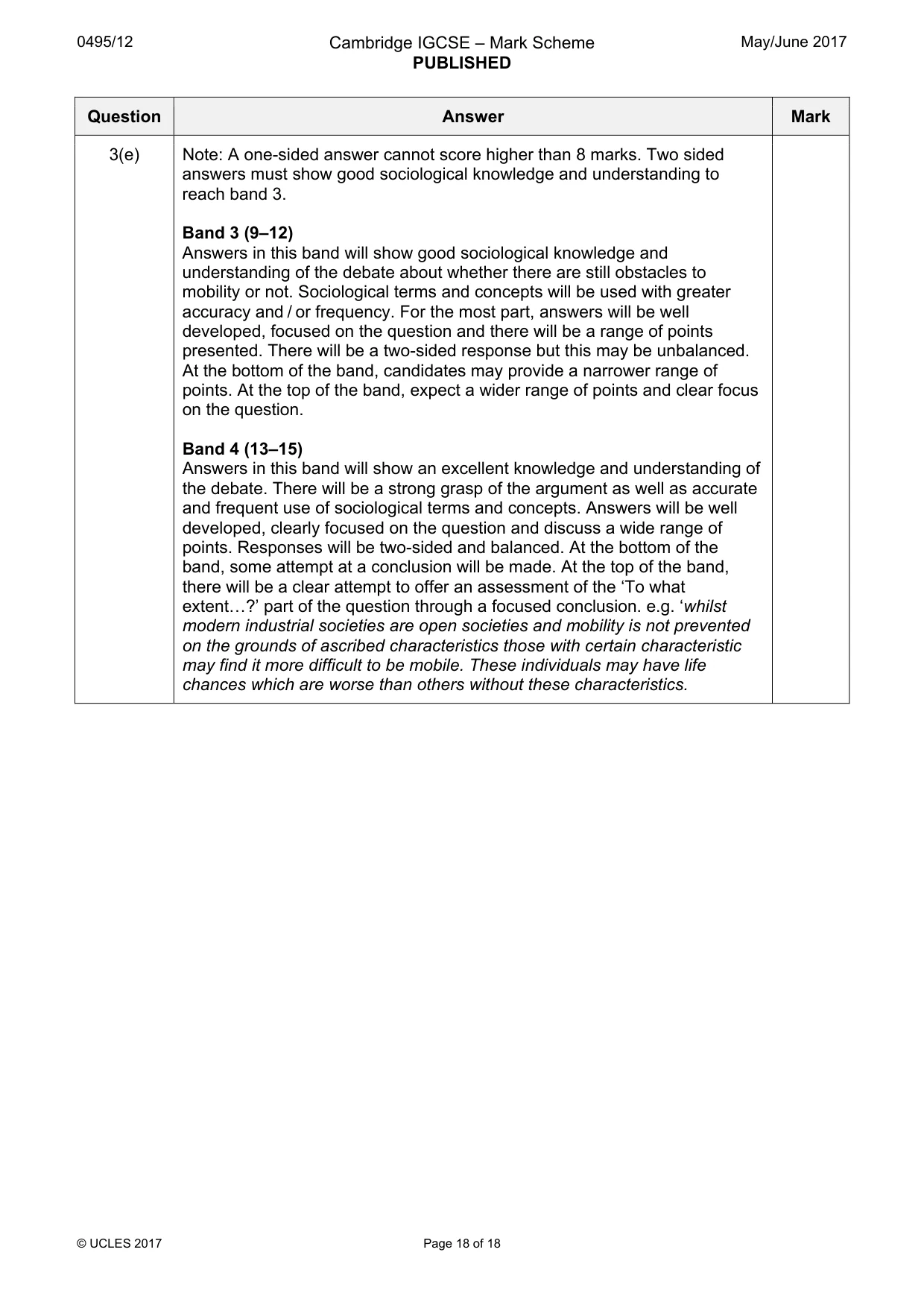
0495/12 Cambridge IGCSE – Mark Scheme PUBLISHED May/June 2017 © UCLES 2017 Page 18 of 18 Question Answer Mark 3(e) Note: A one-sided answer cannot score higher than 8 marks. Two sided answers must show good sociological knowledge and understanding to reach band 3. Band 3 (9–12) Answers in this band will show good sociological knowledge and understanding of the debate about whether there are still obstacles to mobility or not. Sociological terms and concepts will be used with greater accuracy and / or frequency. For the most part, answers will be well developed, focused on the question and there will be a range of points presented. There will be a two-sided response but this may be unbalanced. At the bottom of the band, candidates may provide a narrower range of points. At the top of the band, expect a wider range of points and clear focus on the question. Band 4 (13–15) Answers in this band will show an excellent knowledge and understanding of the debate. There will be a strong grasp of the argument as well as accurate and frequent use of sociological terms and concepts. Answers will be well developed, clearly focused on the question and discuss a wide range of points. Responses will be two-sided and balanced. At the bottom of the band, some attempt at a conclusion will be made. At the top of the band, there will be a clear attempt to offer an assessment of the ‘To what extent«?’ part of the question through a focused conclusion. e.g. ‘whilst modern industrial societies are open societies and mobility is not prevented on the grounds of ascribed characteristics those with certain characteristic may find it more difficult to be mobile. These individuals may have life chances which are worse than others without these characteristics.
What you needed in this session
Cambridge’s own grade thresholds for 2017 May/June, Paper 1 · Variant 2. A higher threshold means an easier paper — the bar moves with how the cohort did.