Questions as text
Q1 · Most of the compounds in petroleum contain only the elements carbon and hydrogen 0654/32 May/June 2017
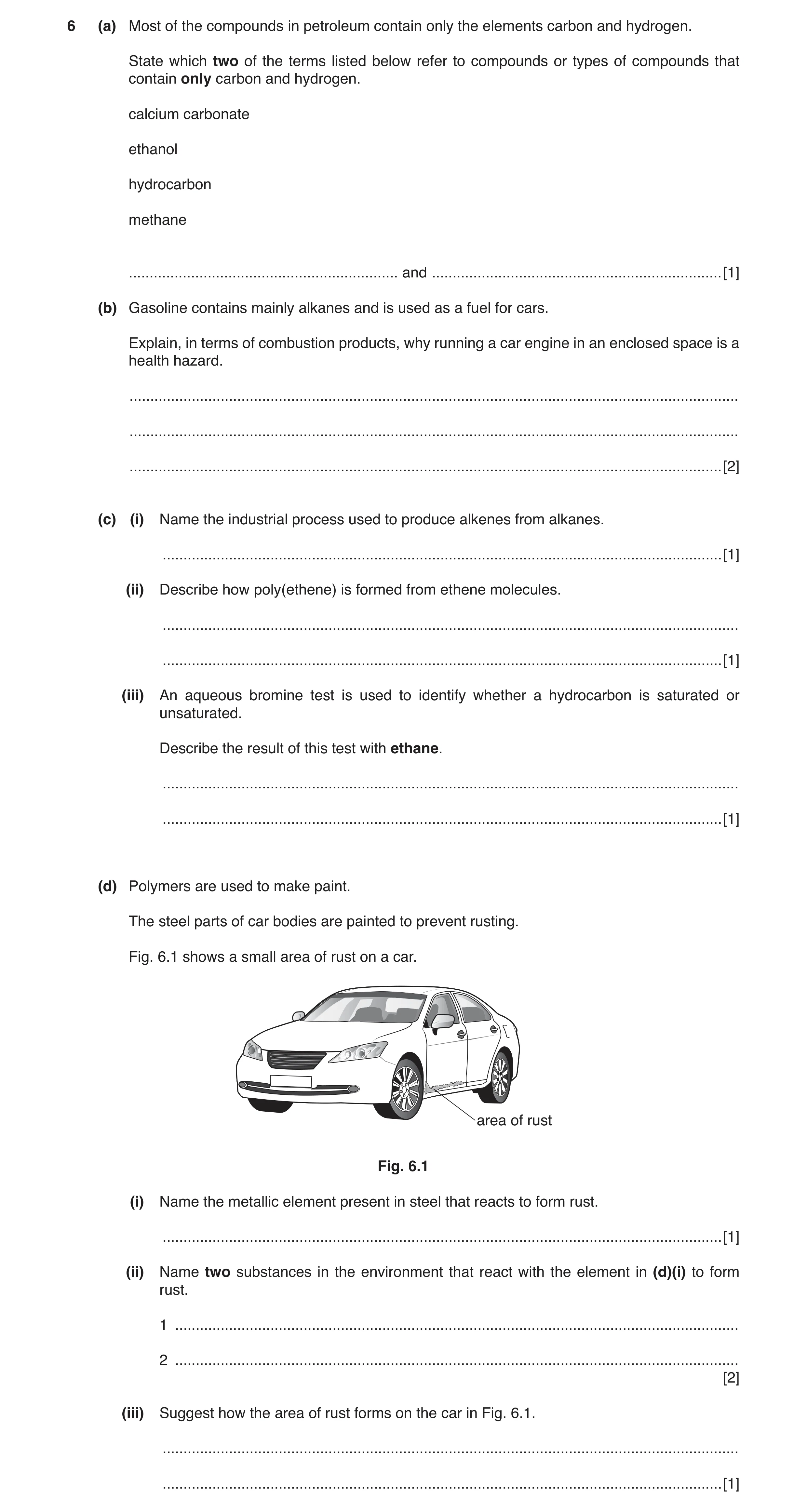
6 (a) Most of the compounds in petroleum contain only the elements carbon and hydrogen. State which two of the terms listed below refer to compounds or types of compounds that contain only carbon and hydrogen. calcium carbonate ethanol hydrocarbon methane … and … [1] (b) Gasoline contains mainly alkanes and is used as a fuel for cars. Explain, in terms of combustion products, why running a car engine in an enclosed space is a health hazard. … … … [2] (c) (i) Name the industrial process used to produce alkenes from alkanes. … [1] (ii) Describe how poly(ethene) is formed from ethene molecules. … … [1] (iii) An aqueous bromine test is used to identify whether a hydrocarbon is saturated or unsaturated. Describe the result of this test with ethane. … … [1] (d) Polymers are used to make paint. The steel parts of car bodies are painted to prevent rusting. Fig. 6.1 shows a small area of rust on a car. area of rust Fig. 6.1 (i) Name the metallic element present in steel that reacts to form rust. … [1] (ii) Name two substances in the environment that react with the element in (d)(i) to form rust. 1 … 2 … [2] (iii) Suggest how the area of rust forms on the car in Fig. 6.1. … … [1]
10 marks
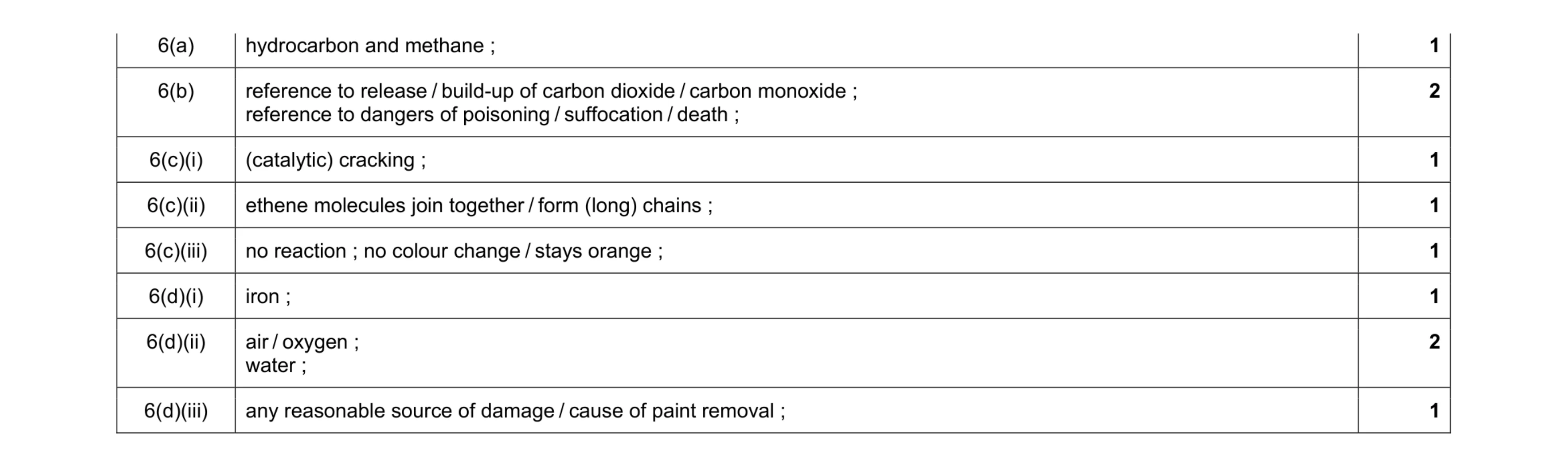
Mark scheme: 6(a) hydrocarbon and methane ; 1 6(b) reference to release / build-up of carbon dioxide / carbon monoxide ; reference to dangers of poisoning / suffocation / death ; 2 6(c)(i) (catalytic) cracking ; 1 6(c)(ii) ethene molecules join together / form (long) chains ; 1 6(c)(iii) no reaction ; no colour change / stays orange ; 1 6(d)(i) iron ; 1 6(d)(ii) air / oxygen ; water ; 2 6(d)(iii) any reasonable source of damage / cause of paint removal ; 1
This question in 0654/32 May/June 2017
Q2 · State the percentage of nitrogen in the air 0654/31 Oct/Nov 2017
5 (a) (i) State the percentage of nitrogen in the air. … % [1] (ii) Nitrogen and oxygen together make up most of the air. Name one other uncombined gaseous element in unpolluted air. … [1] (b) A student investigates the rusting of iron. Table 5.1 shows his experiments and the results. Table 5.1 test-tube experiment result air and water vapour A rust appears iron nail water dry air B no rust iron nail nitrogen gas and water vapour C no rust iron nail water (i) Explain why the iron nails in test-tube B and test-tube C do not rust. test-tube B … test-tube C … [2] (ii) Predict and explain if there is a change in the mass of test-tube A and its contents during the experiment. prediction … explanation … … [1] (c) Nitrogen is used to make ammonia, NH3. Ammonia gas dissolves in water to make an alkaline solution. (i) Describe a test to show that a solution of ammonia is alkaline. test … result … [2] (ii) Suggest the name of the acid that reacts with ammonia to form ammonium nitrate, NH4NO3. … [1] (iii) Explain why farmers add fertiliser containing ammonium nitrate to soil. … … … … [2]
10 marks
Mark scheme: 5(a)(i) 78 ; 1 5(a)(ii) argon / other noble gas ; 1 5(b)(i) B absence of water (vapour) / no water ; C absence of oxygen / no oxygen ; 2 5(b)(ii) no change in mass AND idea that nothing enters or leaves the test-tube ; 1 5(c)(i) use of named indicator e.g.(red) litmus ; correct result e.g. (litmus) turns blue ; 2 5(c)(ii) nitric acid ; 1 Question Answer Marks 5(c)(iii) idea of improving crop yield ; soil does not contain enough nutrients / nitrogen (compounds) or to replace nitrogen compounds ; reference to use of nitrogen in plants to produce amino acids / proteins / DNA ; max 2
This question in 0654/31 Oct/Nov 2017
Q3 · The percentage composition by mass of an alloy of iron 0654/31 Oct/Nov 2018
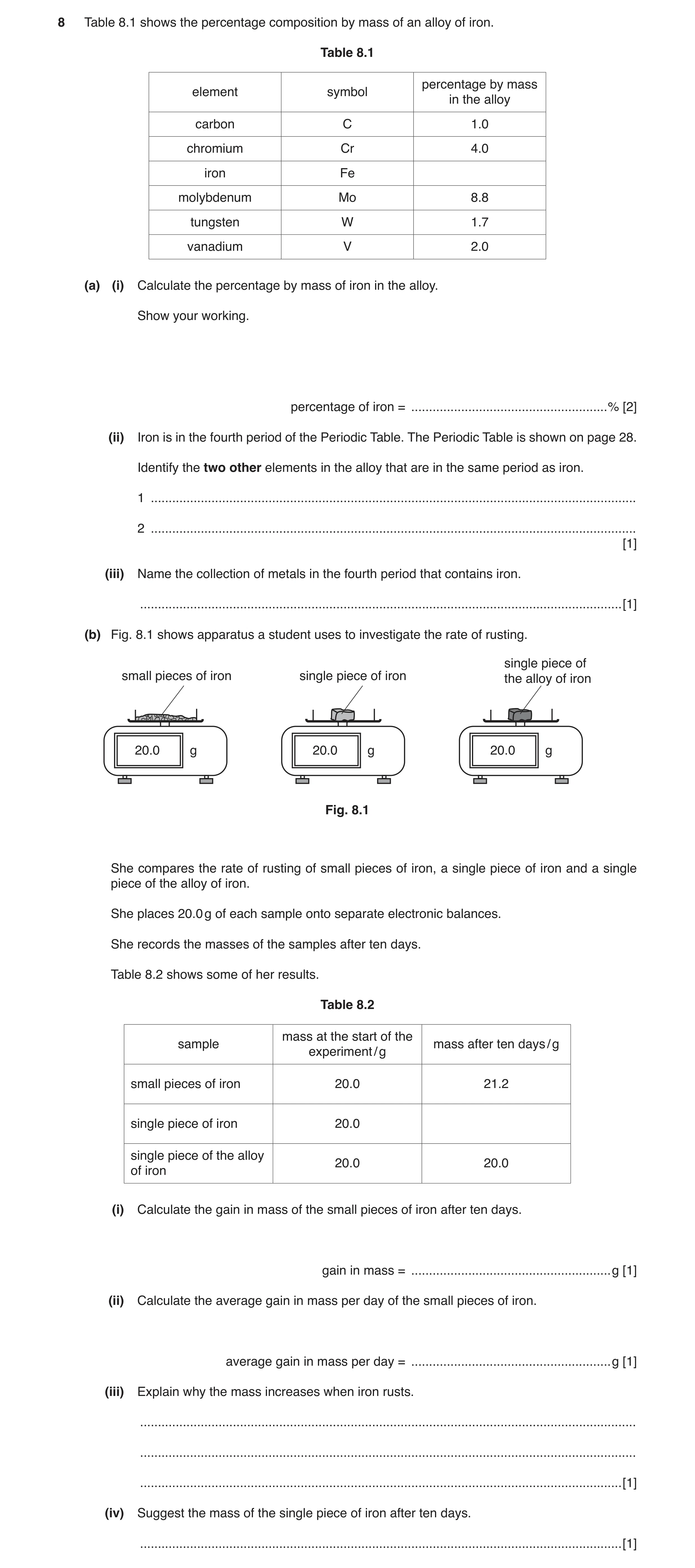
8 Table 8.1 shows the percentage composition by mass of an alloy of iron. Table 8.1 percentage by mass element symbol in the alloy carbon C 1.0 chromium Cr 4.0 iron Fe molybdenum Mo 8.8 tungsten W 1.7 vanadium V 2.0 (a) (i) Calculate the percentage by mass of iron in the alloy. Show your working. percentage of iron = … % [2] (ii) Iron is in the fourth period of the Periodic Table. The Periodic Table is shown on page 28. Identify the two other elements in the alloy that are in the same period as iron. 1 … 2 … [1] (iii) Name the collection of metals in the fourth period that contains iron. … [1] (b) Fig. 8.1 shows apparatus a student uses to investigate the rate of rusting. single piece of small pieces of iron single piece of iron the alloy of iron 20.0 g 20.0 g 20.0 g Fig. 8.1 She compares the rate of rusting of small pieces of iron, a single piece of iron and a single piece of the alloy of iron. She places 20.0 g of each sample onto separate electronic balances. She records the masses of the samples after ten days. Table 8.2 shows some of her results. Table 8.2 mass at the start of the sample mass after ten days / g experiment / g small pieces of iron 20.0 21.2 single piece of iron 20.0 single piece of the alloy 20.0 20.0 of iron (i) Calculate the gain in mass of the small pieces of iron after ten days. gain in mass = … g [1] (ii) Calculate the average gain in mass per day of the small pieces of iron. average gain in mass per day = … g [1] (iii) Explain why the mass increases when iron rusts. … … … [1] (iv) Suggest the mass of the single piece of iron after ten days. … [1]
8 marks
Mark scheme: 8(a)(i) 1.0 + 4.0 + 8.8 + 1.7 + 2.0 = 17.5 ; 100 – 17.5 / 82.5 ; 2 8(a)(ii) chromium, vanadium ; 1 8(a)(iii) transition (metals) ; 1 8(b)(i) (21.2 − 20.0 =) 1.2 (g) ; 1 8(b)(ii) (1.2 ÷ 10) = 0.1(2) (g) ; 1 8(b)(iii) reference to a reaction with oxygen / water ; the idea that oxygen / water (in rust) is added material ; max 1 8(b)(iv) greater than 20.0 g and smaller than 21.2 g ; 1
This question in 0654/31 Oct/Nov 2018
Q4 · A pie chart showing the percentages of some of the elements in the Earth’s crust 0654/32 May/June 2020
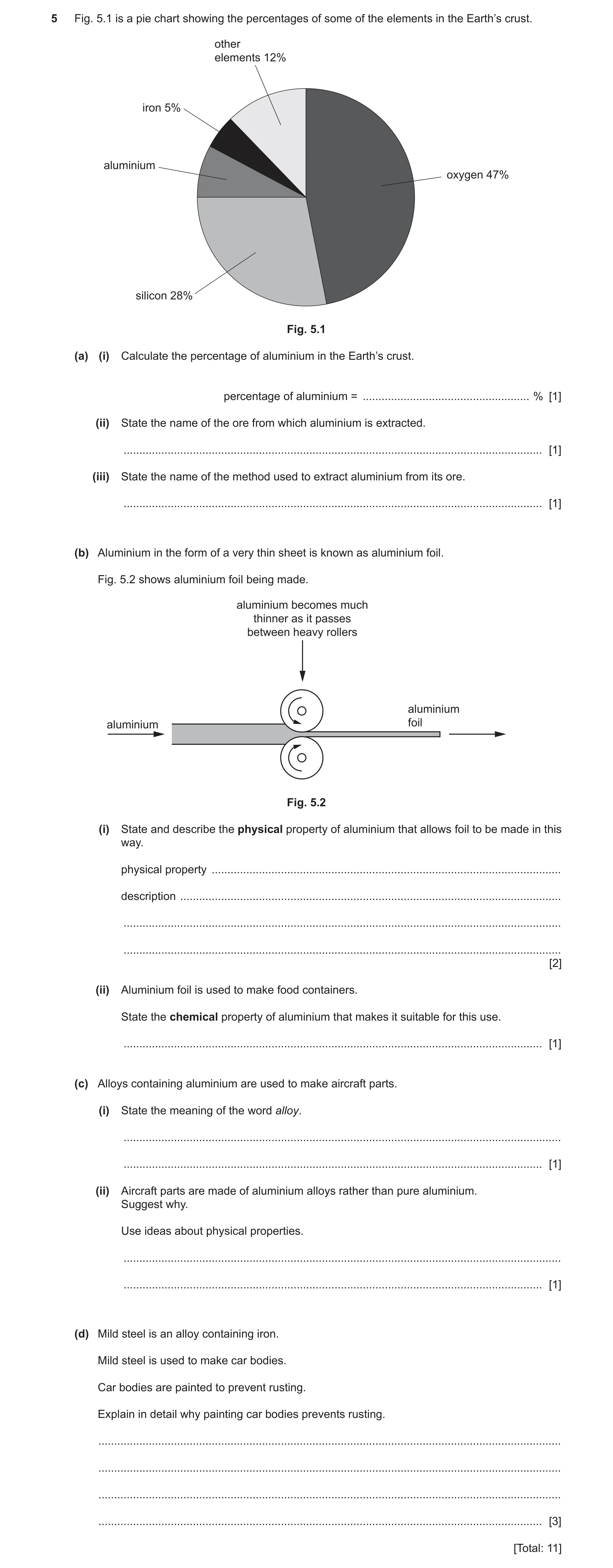
5 Fig. 5.1 is a pie chart showing the percentages of some of the elements in the Earth’s crust. other elements 12% iron 5% aluminium oxygen 47% silicon 28% Fig. 5.1 (a) (i) Calculate the percentage of aluminium in the Earth’s crust. percentage of aluminium = … % [1] (ii) State the name of the ore from which aluminium is extracted. … [1] (iii) State the name of the method used to extract aluminium from its ore. … [1] (b) Aluminium in the form of a very thin sheet is known as aluminium foil. Fig. 5.2 shows aluminium foil being made. aluminium becomes much thinner as it passes between heavy rollers aluminium aluminium foil Fig. 5.2 (i) State and describe the physical property of aluminium that allows foil to be made in this way. physical property … description … … … [2] (ii) Aluminium foil is used to make food containers. State the chemical property of aluminium that makes it suitable for this use. … [1] (c) Alloys containing aluminium are used to make aircraft parts. (i) State the meaning of the word alloy. … … [1] (ii) Aircraft parts are made of aluminium alloys rather than pure aluminium. Suggest why. Use ideas about physical properties. … … [1] (d) Mild steel is an alloy containing iron. Mild steel is used to make car bodies. Car bodies are painted to prevent rusting. Explain in detail why painting car bodies prevents rusting. … … … … [3] [Total: 11]
11 marks
Mark scheme: 5(a)(i) 8(%) ; 1 5(a)(ii) bauxite ; 1 5(a)(iii) electrolysis ; 1 5(b)(i) malleability / it is malleable ; the idea that it can be forced to change shape without breaking ; 2 5(b)(ii) resistant to corrosion / it does not react with food ; 1 5(c)(i) a (solid) mixture containing metals / a mixture of a metal and other elements; 1 Question Answer Marks 5(c)(ii) alloy is stronger / less likely to bend or break ; 1 5(d) reference to reaction with / need for oxygen ; reference to reaction with / need for water ; description of paint as a barrier between steel and oxygen / water ; 3
This question in 0654/32 May/June 2020
Q5 · A pie chart showing the percentages of some of the elements in the Earth’s crust 0654/33 May/June 2020
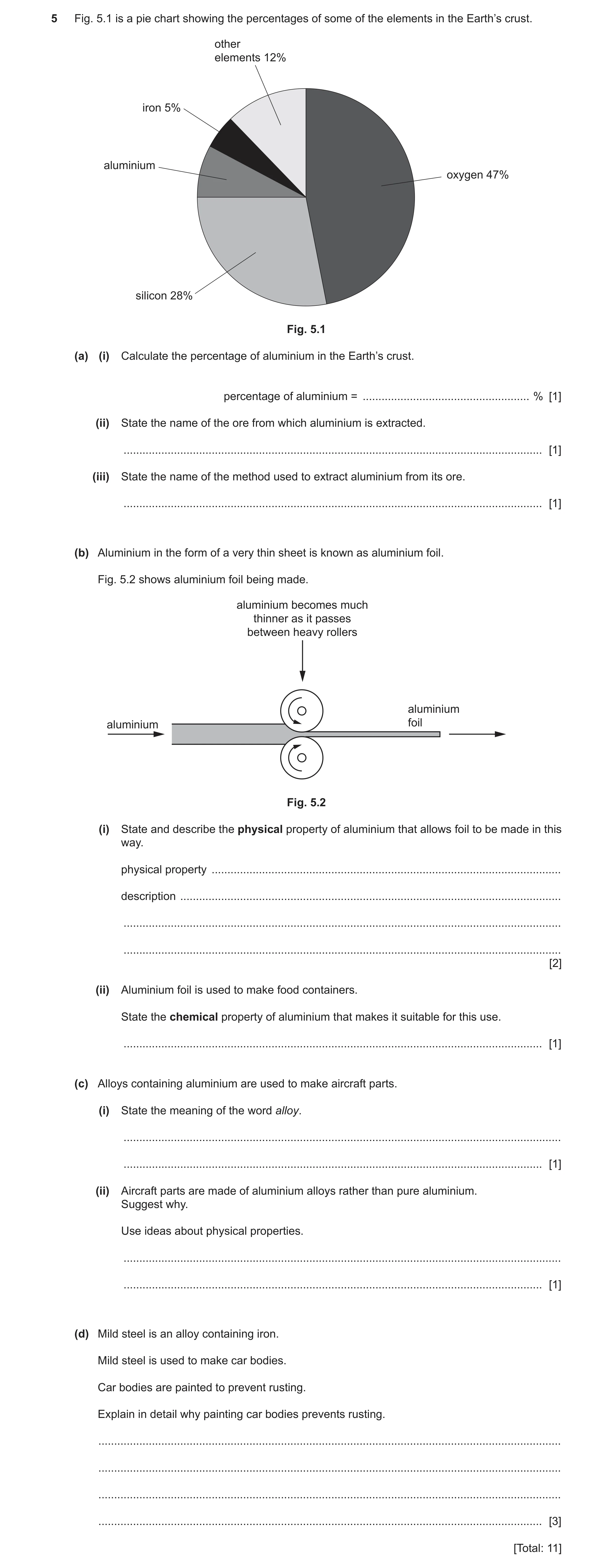
5 Fig. 5.1 is a pie chart showing the percentages of some of the elements in the Earth’s crust. other elements 12% iron 5% aluminium oxygen 47% silicon 28% Fig. 5.1 (a) (i) Calculate the percentage of aluminium in the Earth’s crust. percentage of aluminium = … % [1] (ii) State the name of the ore from which aluminium is extracted. … [1] (iii) State the name of the method used to extract aluminium from its ore. … [1] (b) Aluminium in the form of a very thin sheet is known as aluminium foil. Fig. 5.2 shows aluminium foil being made. aluminium becomes much thinner as it passes between heavy rollers aluminium aluminium foil Fig. 5.2 (i) State and describe the physical property of aluminium that allows foil to be made in this way. physical property … description … … … [2] (ii) Aluminium foil is used to make food containers. State the chemical property of aluminium that makes it suitable for this use. … [1] (c) Alloys containing aluminium are used to make aircraft parts. (i) State the meaning of the word alloy. … … [1] (ii) Aircraft parts are made of aluminium alloys rather than pure aluminium. Suggest why. Use ideas about physical properties. … … [1] (d) Mild steel is an alloy containing iron. Mild steel is used to make car bodies. Car bodies are painted to prevent rusting. Explain in detail why painting car bodies prevents rusting. … … … … [3] [Total: 11]
11 marks
Mark scheme: 5(a)(i) 8(%) ; 1 5(a)(ii) bauxite ; 1 5(a)(iii) electrolysis ; 1 5(b)(i) malleability / it is malleable ; the idea that it can be forced to change shape without breaking ; 2 5(b)(ii) resistant to corrosion / it does not react with food ; 1 5(c)(i) a (solid) mixture containing metals / a mixture of a metal and other elements; 1 Question Answer Marks 5(c)(ii) alloy is stronger / less likely to bend or break ; 1 5(d) reference to reaction with / need for oxygen ; reference to reaction with / need for water ; description of paint as a barrier between steel and oxygen / water ; 3
This question in 0654/33 May/June 2020
Q6 · Metal oxides are formed when metals and oxygen react 0654/31 Oct/Nov 2020
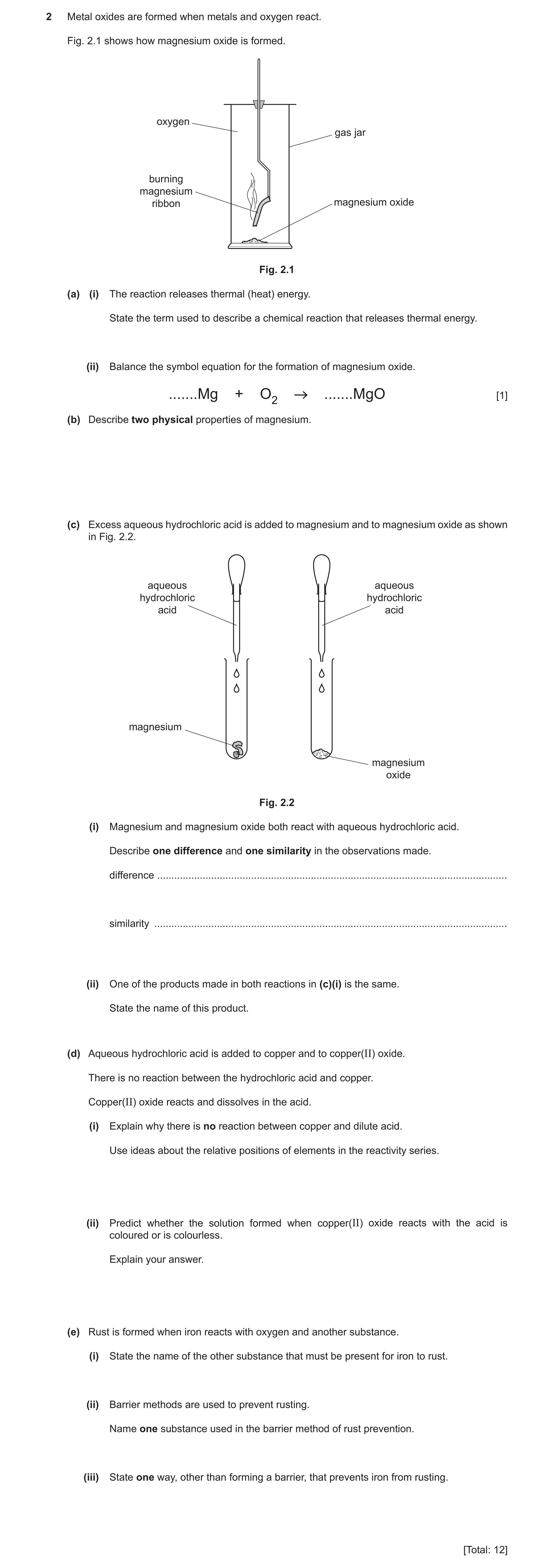
2 Metal oxides are formed when metals and oxygen react. Fig. 2.1 shows how magnesium oxide is formed. oxygen gas jar burning magnesium ribbon magnesium oxide Fig. 2.1 (a) (i) The reaction releases thermal (heat) energy. State the term used to describe a chemical reaction that releases thermal energy. (ii) Balance the symbol equation for the formation of magnesium oxide. [1] … Mg + O2 … MgO (b) Describe two physical properties of magnesium. (c) Excess aqueous hydrochloric acid is added to magnesium and to magnesium oxide as shown in Fig. 2.2. aqueous aqueous hydrochloric hydrochloric acid acid magnesium magnesium oxide Fig. 2.2 (i) Magnesium and magnesium oxide both react with aqueous hydrochloric acid. Describe one difference and one similarity in the observations made. difference �������������������������������������������������������������������������������������������������������������������������� similarity ���������������������������������������������������������������������������������������������������������������������������� (ii) One of the products made in both reactions in (c)(i) is the same. State the name of this product. (d) Aqueous hydrochloric acid is added to copper and to copper(II) oxide. There is no reaction between the hydrochloric acid and copper. Copper(II) oxide reacts and dissolves in the acid. (i) Explain why there is no reaction between copper and dilute acid. Use ideas about the relative positions of elements in the reactivity series. (ii) Predict whether the solution formed when copper(II) oxide reacts with the acid is coloured or is colourless. Explain your answer. (e) Rust is formed when iron reacts with oxygen and another substance. (i) State the name of the other substance that must be present for iron to rust. (ii) Barrier methods are used to prevent rusting. Name one substance used in the barrier method of rust prevention. (iii) State one way, other than forming a barrier, that prevents iron from rusting. [Total: 12]
12 marks
Mark scheme: 2(a)(i) exothermic ; 1 2(a)(ii) 2Mg + O2 → 2MgO ; 1 2(b) (magnesium is) malleable ; ductile ; good (electrical / thermal) conductor ; 2 2(c)(i) difference – gas released with magnesium (and not with the oxide) ; similarity – the solid reacts to form a soluble product / solid dissolves ; 2 2(c)(ii) magnesium chloride / MgCl2 ; 1 Question Answer Marks 2(d)(i) copper is low in the reactivity series ; copper is less reactive than hydrogen ; 1 2(d)(ii) (coloured) copper is a transition metal / transition metal compounds are (usually) coloured / copper compounds are coloured ; 1 2(e)(i) water / water vapour ; 1 2(e)(ii) paint / oil / plastic / (named) unreactive metal ; 1 2(e)(iii) (add other metals to) make it into an alloy / stainless steel ; 1
This question in 0654/31 Oct/Nov 2020
Question 7 0654/31 May/June 2021
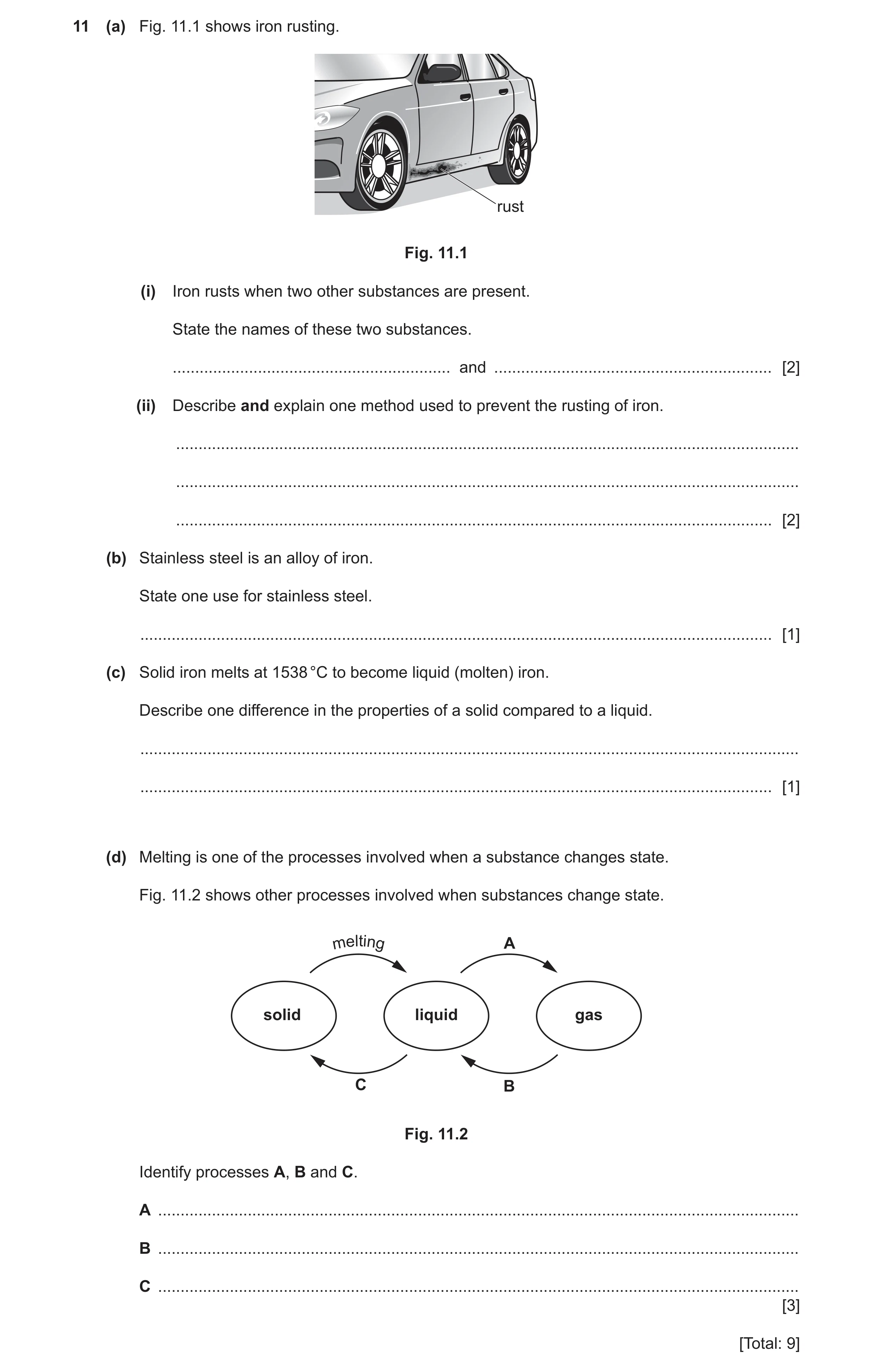
11 (a) Fig. 11.1 shows iron rusting. rust Fig. 11.1 (i) Iron rusts when two other substances are present. State the names of these two substances. … and … [2] (ii) Describe and explain one method used to prevent the rusting of iron. … … … [2] (b) Stainless steel is an alloy of iron. State one use for stainless steel. … [1] (c) Solid iron melts at 1538 °C to become liquid (molten) iron. Describe one difference in the properties of a solid compared to a liquid. … … [1] (d) Melting is one of the processes involved when a substance changes state. Fig. 11.2 shows other processes involved when substances change state. melting A solid liquid gas C B Fig. 11.2 Identify processes A, B and C. A … B … C … [3] [Total: 9]
9 marks
Mark scheme: 11(a)(i) oxygen ; water ; 2 11(a)(ii) painting / greasing / electroplating ; provides a barrier etc ; 2 11(b) cutlery ; 1 11(c) solid has a definite shape / liquid takes up shape of container ; 1 11(d) A boiling ; B condensing ; C freezing ; 3
This question in 0654/31 May/June 2021
Q8 · Iron is an element in Period 4 of the Periodic Table 0654/31 Oct/Nov 2021
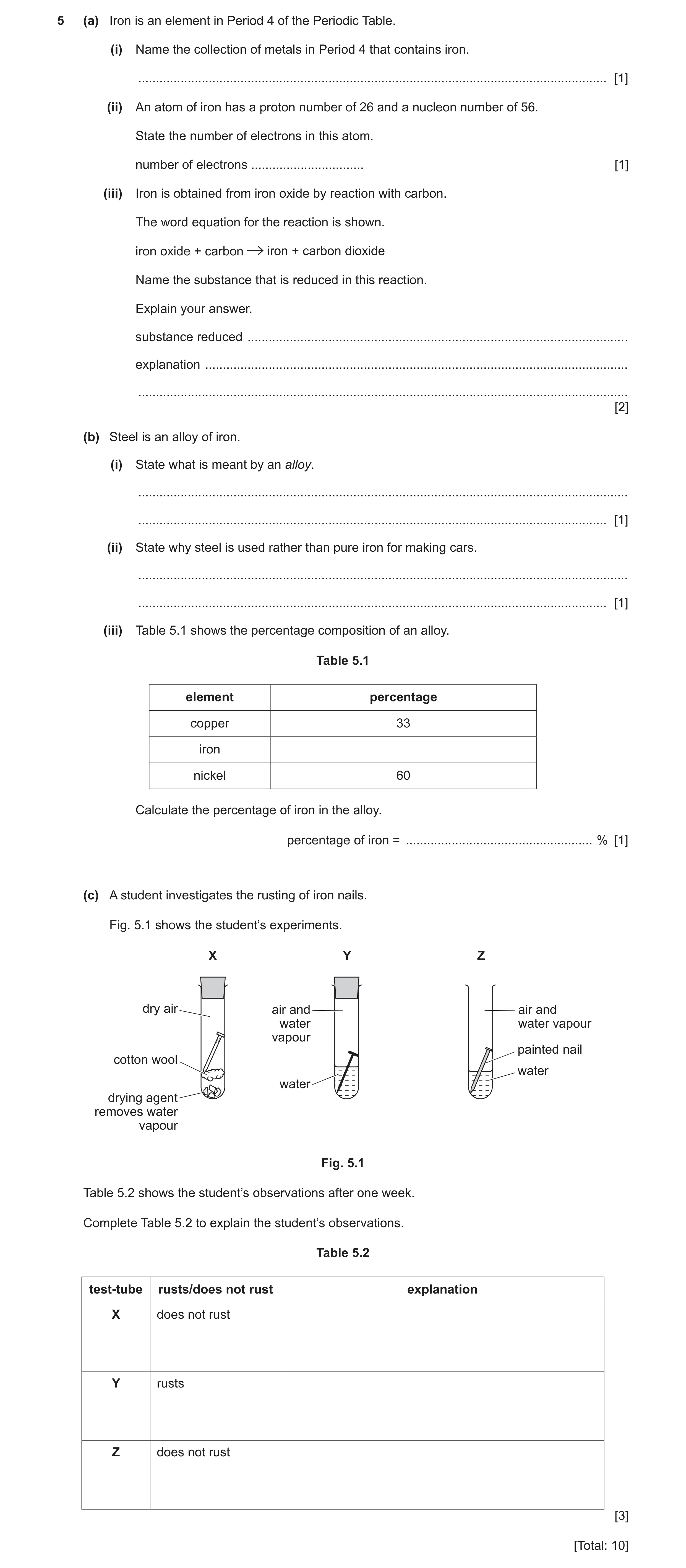
5 (a) Iron is an element in Period 4 of the Periodic Table. (i) Name the collection of metals in Period 4 that contains iron. … [1] (ii) An atom of iron has a proton number of 26 and a nucleon number of 56. State the number of electrons in this atom. number of electrons … [1] (iii) Iron is obtained from iron oxide by reaction with carbon. The word equation for the reaction is shown. iron oxide + carbon iron + carbon dioxide Name the substance that is reduced in this reaction. Explain your answer. substance reduced … explanation … … [2] (b) Steel is an alloy of iron. (i) State what is meant by an alloy. … … [1] (ii) State why steel is used rather than pure iron for making cars. … … [1] (iii) Table 5.1 shows the percentage composition of an alloy. Table 5.1 element percentage copper 33 iron nickel 60 Calculate the percentage of iron in the alloy. percentage of iron = … % [1] (c) A student investigates the rusting of iron nails. Fig. 5.1 shows the student’s experiments. X Y Z dry air air and air and water water vapour vapour painted nail cotton wool water water drying agent removes water vapour Fig. 5.1 Table 5.2 shows the student’s observations after one week. Complete Table 5.2 to explain the student’s observations. Table 5.2 test-tube rusts/does not rust explanation X does not rust Y rusts Z does not rust [3] [Total: 10]
10 marks
Mark scheme: 5(a)(i) transition elements / transition metals ; 1 5(a)(ii) 26 ; 1 5(a)(iii) iron oxide ; loses oxygen ; 2 5(b)(i) mixture of metals / mixture of metal and other element ; 1 5(b)(ii) stronger ; 1 5(b)(iii) 7% ; 1 5(c) (tube X does not rust) – no water present ; (tube Y rusts) – oxygen (air) and water present ; (tube Z does not rust) – no air and water can reach nail ; 3
This question in 0654/31 Oct/Nov 2021
Q9 · Two isotopes of iron are iron-54 and iron-56 0654/33 Oct/Nov 2021
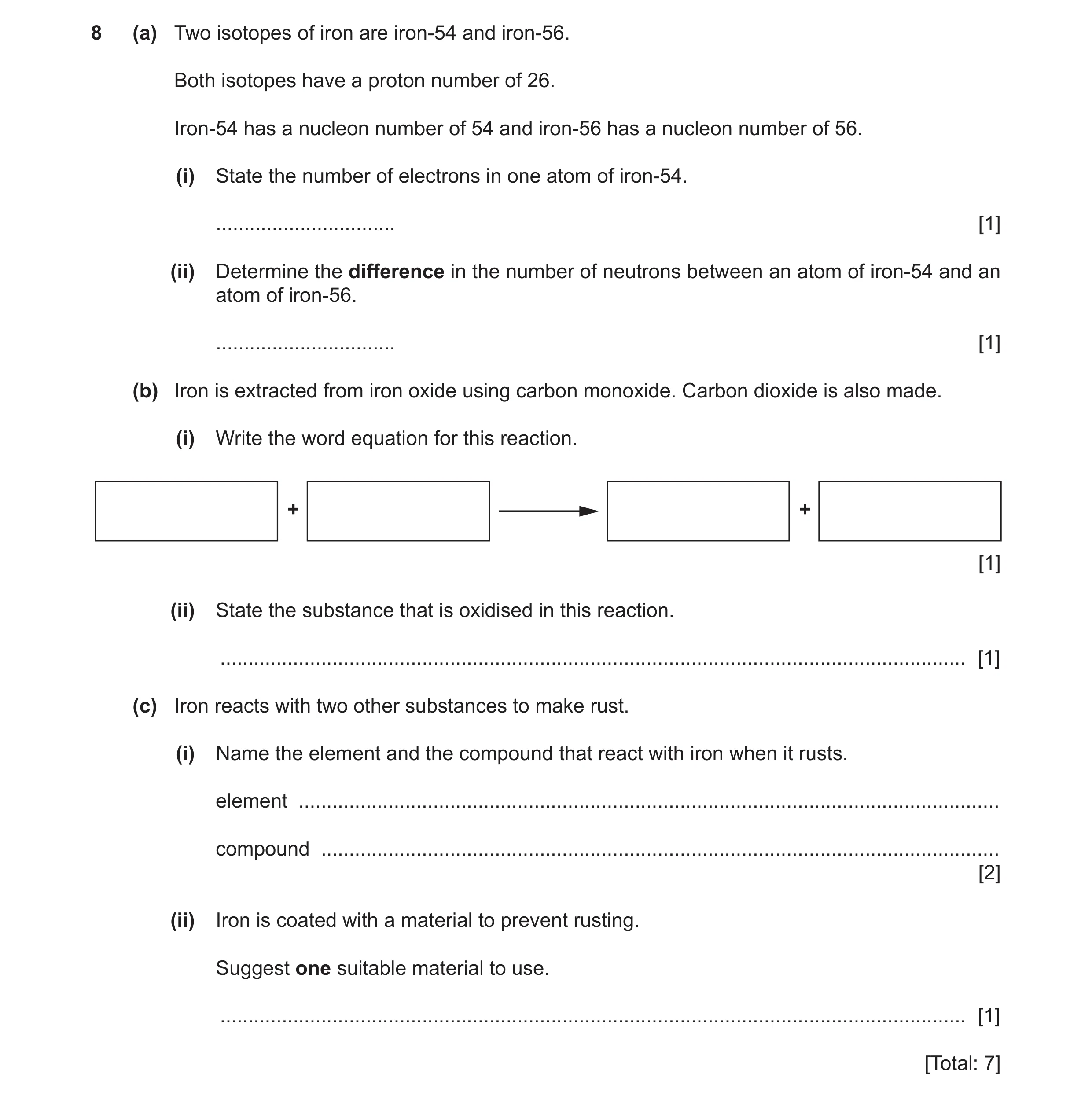
8 (a) Two isotopes of iron are iron-54 and iron-56. Both isotopes have a proton number of 26. Iron-54 has a nucleon number of 54 and iron-56 has a nucleon number of 56. (i) State the number of electrons in one atom of iron-54. … [1] (ii) Determine the difference in the number of neutrons between an atom of iron-54 and an atom of iron-56. … [1] (b) Iron is extracted from iron oxide using carbon monoxide. Carbon dioxide is also made. (i) Write the word equation for this reaction. + + [1] (ii) State the substance that is oxidised in this reaction. … [1] (c) Iron reacts with two other substances to make rust. (i) Name the element and the compound that react with iron when it rusts. element … compound … [2] (ii) Iron is coated with a material to prevent rusting. Suggest one suitable material to use. … [1] [Total: 7]
7 marks
Mark scheme: 8(a)(i) 26 ; 1 8(a)(ii) 2 ; 1 8(b)(i) iron oxide + carbon monoxide → iron + carbon dioxide ; 1 8(b)(ii) carbon monoxide ; 1 8(c)(i) (element) – oxygen ; (compound) – water ; 2 8(c)(ii) paint ; 1
This question in 0654/33 Oct/Nov 2021
Q10 · State the name given to mixtures made from a metal with other elements 0654/32 Feb/March 2023
11 (a) State the name given to mixtures made from a metal with other elements. … [1] (b) Iron is an element in Period 4 of the Periodic Table. State the name of the collection of metals in Period 4 that contains iron. … [1] (c) Describe the test used to identify iron(II) ions and give the observation for a positive result. test … … observation … … [2] (d) State the two substances that react with iron to make rust. 1 … 2 … [2] (e) An isotope of iron has a proton number of 26 and a nucleon number of 58. (i) Deduce the number of neutrons and the number of electrons in this isotope of iron. neutrons = … electrons = … [2] (ii) State the meaning of the term isotope. … … [1] (f) A teacher reacts dilute hydrochloric acid with four metals. The observations are shown in Table 11.1. Table 11.1 metal observation calcium bubbles quickly iron only a few bubbles lithium bubbles very quickly silver no bubbles Place the four metals in order of their reactivity from the most reactive to the least reactive. most reactive … … … least reactive … [2] [Total: 11]
11 marks
Mark scheme: 11(a) alloy ; 1 11(b) transition elements / metals ; 1 11(c) aqueous sodium hydroxide ; 2 green precipitate ; 11(d) oxygen ; 2 water ; 11(e)(i) neutrons = 32 ; 2 electrons = 26 ; 11(e)(ii) atoms of the same element that have different numbers of neutrons ; 1 11(f) lithium 2 calcium iron silver lithium and / or silver correct ; all else correct ;
This question in 0654/32 Feb/March 2023
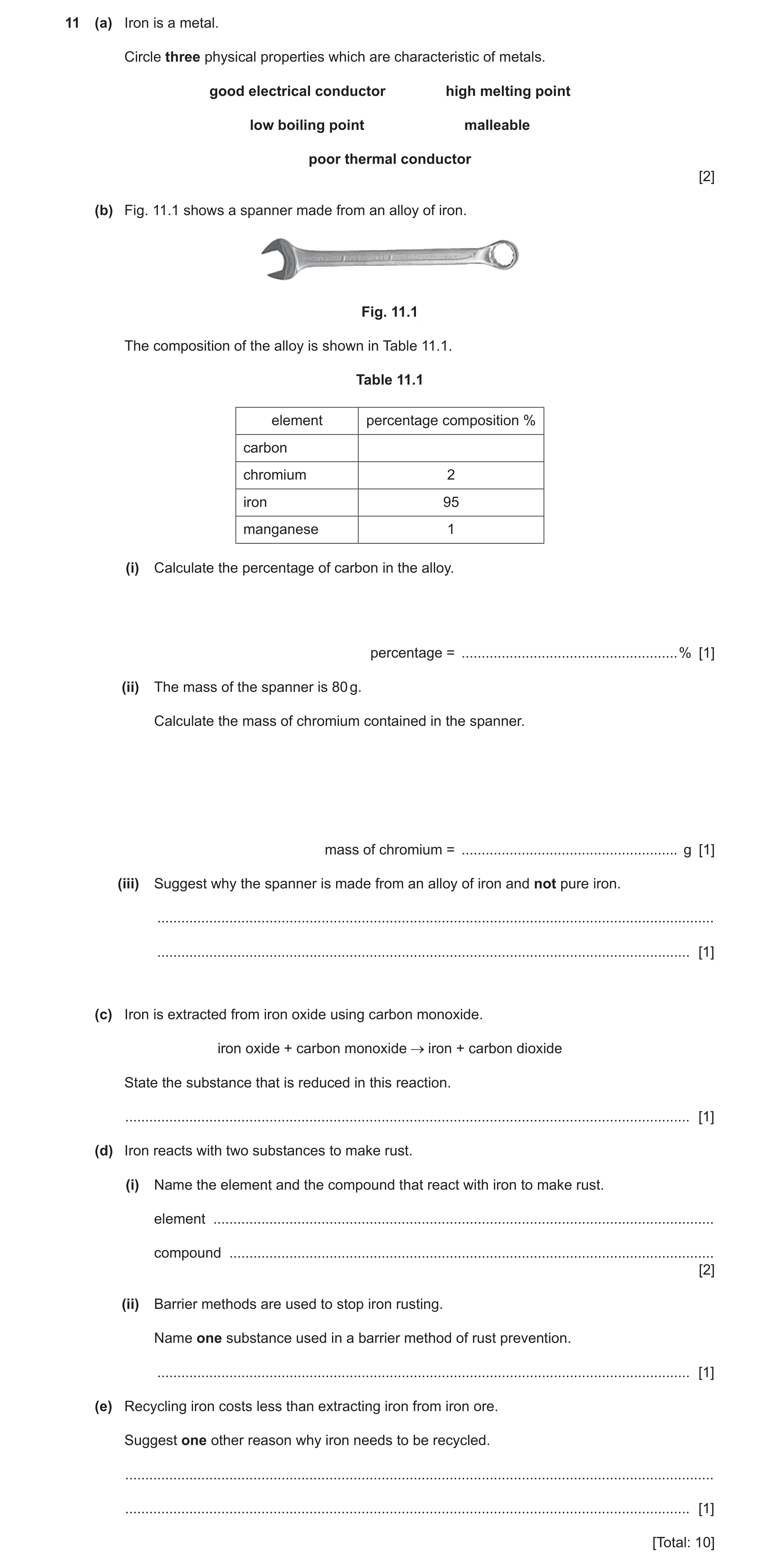
Q11 · Iron is a metal 0654/32 May/June 2024
11 (a) Iron is a metal. Circle three physical properties which are characteristic of metals. good electrical conductor high melting point low boiling point malleable poor thermal conductor [2] (b) Fig. 11.1 shows a spanner made from an alloy of iron. Fig. 11.1 The composition of the alloy is shown in Table 11.1. Table 11.1 element percentage composition % carbon chromium 2 iron 95 manganese 1 (i) Calculate the percentage of carbon in the alloy. percentage = … % [1] (ii) The mass of the spanner is 80 g. Calculate the mass of chromium contained in the spanner. mass of chromium = … g [1] (iii) Suggest why the spanner is made from an alloy of iron and not pure iron. … … [1] (c) Iron is extracted from iron oxide using carbon monoxide. iron oxide + carbon monoxide iron + carbon dioxide State the substance that is reduced in this reaction. … [1] (d) Iron reacts with two substances to make rust. (i) Name the element and the compound that react with iron to make rust. element … compound … [2] (ii) Barrier methods are used to stop iron rusting. Name one substance used in a barrier method of rust prevention. … [1] (e) Recycling iron costs less than extracting iron from iron ore. Suggest one other reason why iron needs to be recycled. … … [1] [Total: 10]
10 marks
Mark scheme: 11(a) good electrical conductor high melting point malleable 1 correct ; 3 correct ; 11(b)(i) 2% ; 1 11(b)(ii) 1.6 (g) ; 1 11(b)(iii) stronger ; 1 11(c) iron oxide ; 1 11(d)(i) element–oxygen ; compound–water ; 2 11(d)(ii) paint / oil / grease ; 1 11(e) iron is a finite resource ; 1
This question in 0654/32 May/June 2024
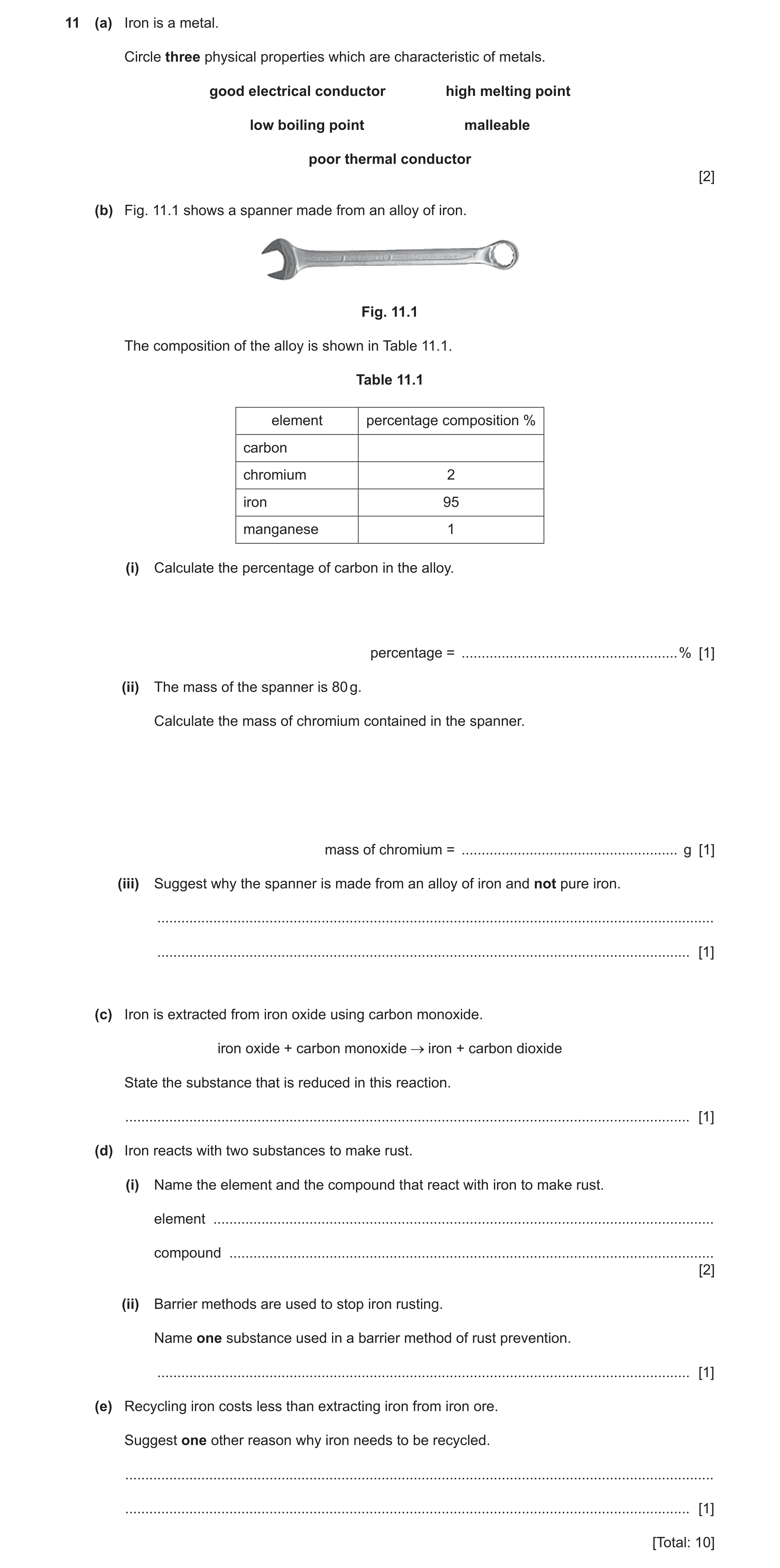
Q12 · Iron is a metal 0654/33 May/June 2024
11 (a) Iron is a metal. Circle three physical properties which are characteristic of metals. good electrical conductor high melting point low boiling point malleable poor thermal conductor [2] (b) Fig. 11.1 shows a spanner made from an alloy of iron. Fig. 11.1 The composition of the alloy is shown in Table 11.1. Table 11.1 element percentage composition % carbon chromium 2 iron 95 manganese 1 (i) Calculate the percentage of carbon in the alloy. percentage = … % [1] (ii) The mass of the spanner is 80 g. Calculate the mass of chromium contained in the spanner. mass of chromium = … g [1] (iii) Suggest why the spanner is made from an alloy of iron and not pure iron. … … [1] (c) Iron is extracted from iron oxide using carbon monoxide. iron oxide + carbon monoxide iron + carbon dioxide State the substance that is reduced in this reaction. … [1] (d) Iron reacts with two substances to make rust. (i) Name the element and the compound that react with iron to make rust. element … compound … [2] (ii) Barrier methods are used to stop iron rusting. Name one substance used in a barrier method of rust prevention. … [1] (e) Recycling iron costs less than extracting iron from iron ore. Suggest one other reason why iron needs to be recycled. … … [1] [Total: 10]
10 marks
Mark scheme: 11(a) good electrical conductor high melting point malleable 1 correct ; 3 correct ; 11(b)(i) 2% ; 1 11(b)(ii) 1.6 (g) ; 1 11(b)(iii) stronger ; 1 11(c) iron oxide ; 1 11(d)(i) element–oxygen ; compound–water ; 2 11(d)(ii) paint / oil / grease ; 1 11(e) iron is a finite resource ; 1
This question in 0654/33 May/June 2024
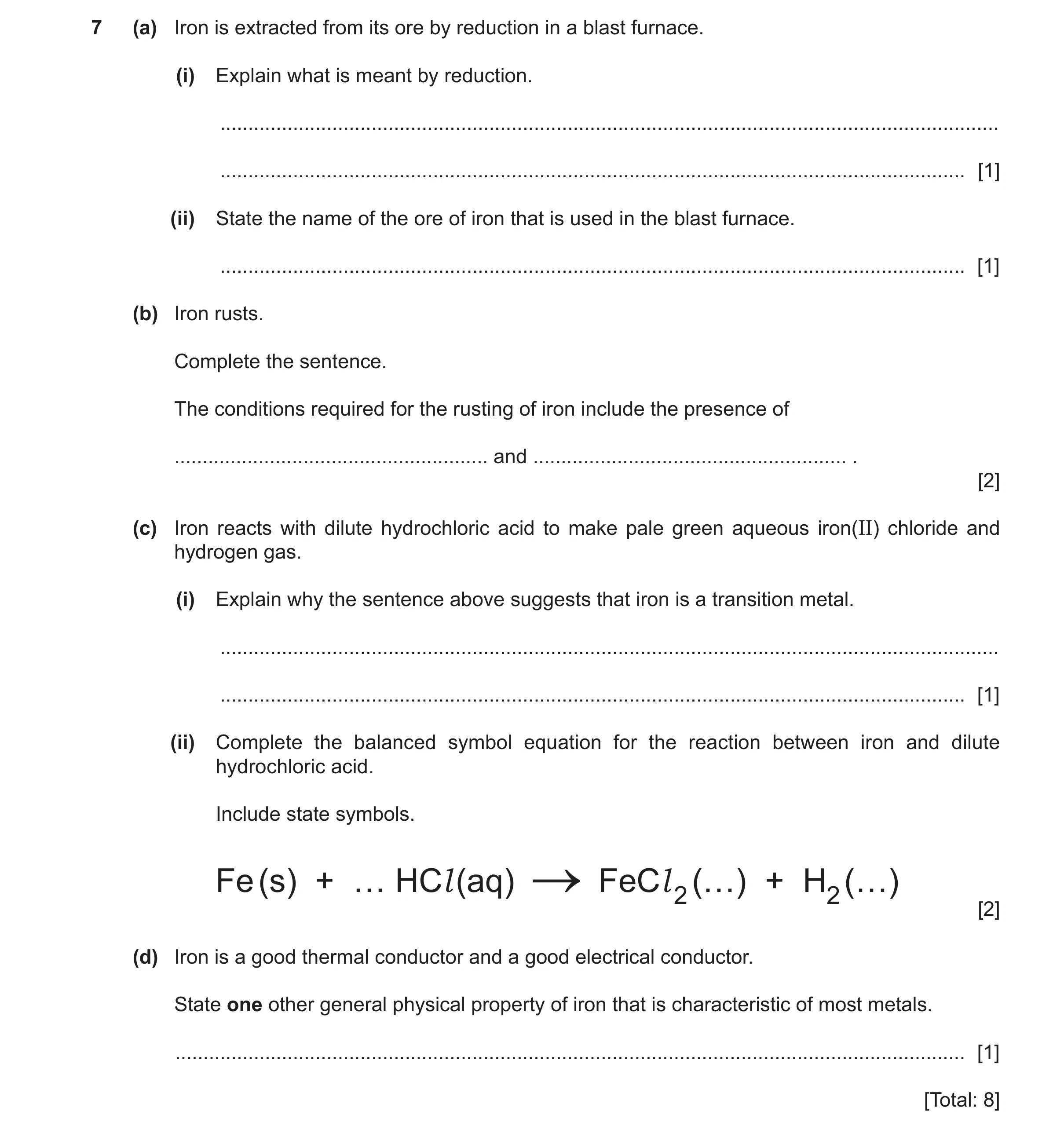
Q13 · Iron is extracted from its ore by reduction in a blast furnace 0654/31 May/June 2025
7 (a) Iron is extracted from its ore by reduction in a blast furnace. (i) Explain what is meant by reduction. … … [1] (ii) State the name of the ore of iron that is used in the blast furnace. … [1] (b) Iron rusts. Complete the sentence. The conditions required for the rusting of iron include the presence of … and … . [2] (c) Iron reacts with dilute hydrochloric acid to make pale green aqueous iron(II) chloride and hydrogen gas. (i) Explain why the sentence above suggests that iron is a transition metal. … … [1] (ii) Complete the balanced symbol equation for the reaction between iron and dilute hydrochloric acid. Include state symbols. Fe (s) + … HCl (aq) FeCl (…) + (…) 2 H2 [2] (d) Iron is a good thermal conductor and a good electrical conductor. State one other general physical property of iron that is characteristic of most metals. … [1] [Total: 8]
8 marks
Mark scheme: 7(a)(i) loss of oxygen ; 1 7(a)(ii) hematite ; 1 7(b) oxygen ; 2 water ; 7(c)(i) forms coloured compound ; 1 7(c)(ii) Fe (s) + 2 HCl (aq) → FeCl2 (aq) + H2 (g) 2 balancing ; both state symbols ; 7(d) high melting/boiling point / malleable / ductile ; 1
This question in 0654/31 May/June 2025
![Question 2: (a) (i) State the percentage of nitrogen in the air. ............................% [1] (ii) Nitrogen and oxygen together make up most of th…](https://img.pastlit.com/crops/7136a29b-98d2-4252-ad65-fef6c6b982c3/q5.webp)
 15 / 20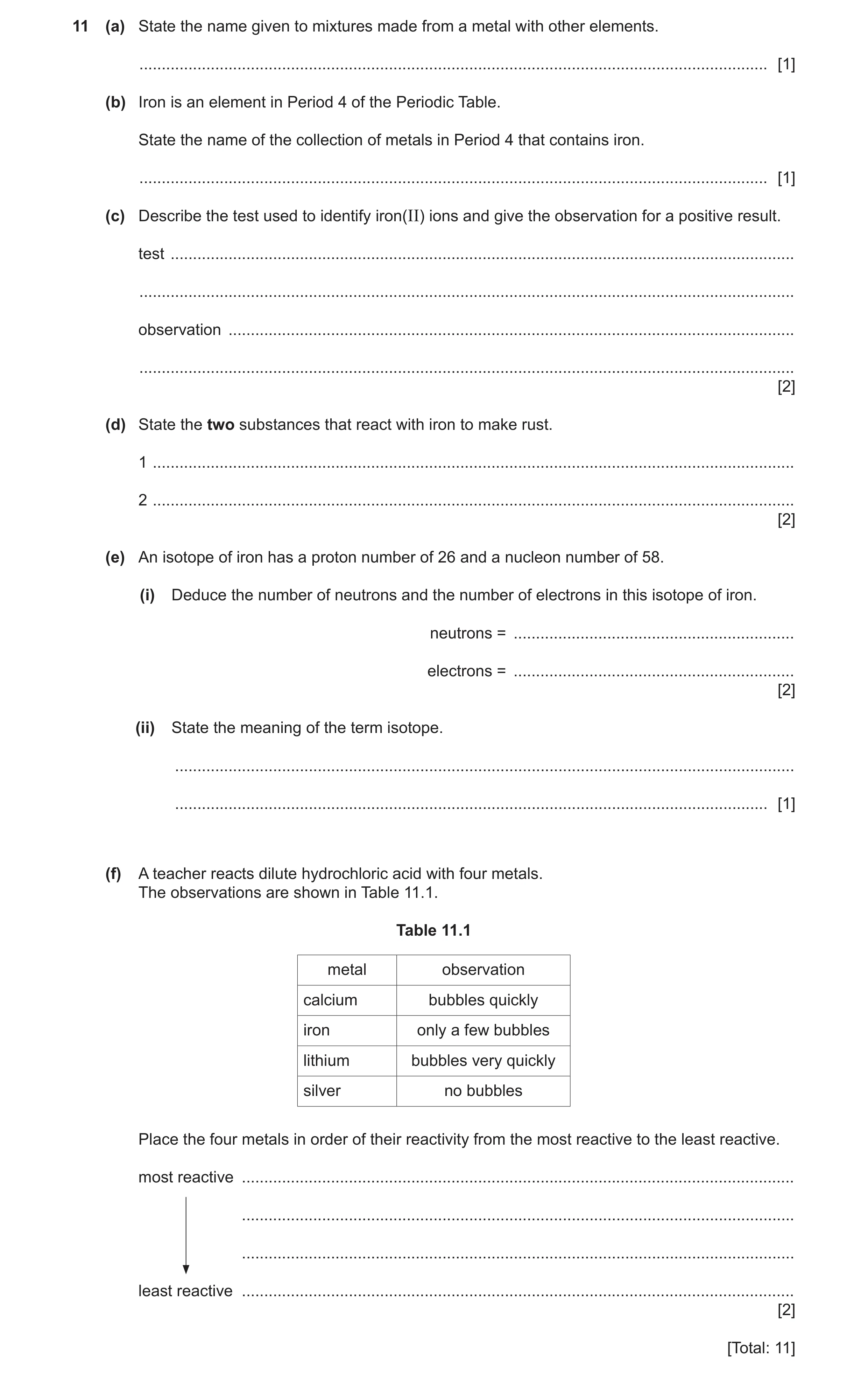
 20 / 20
 10
10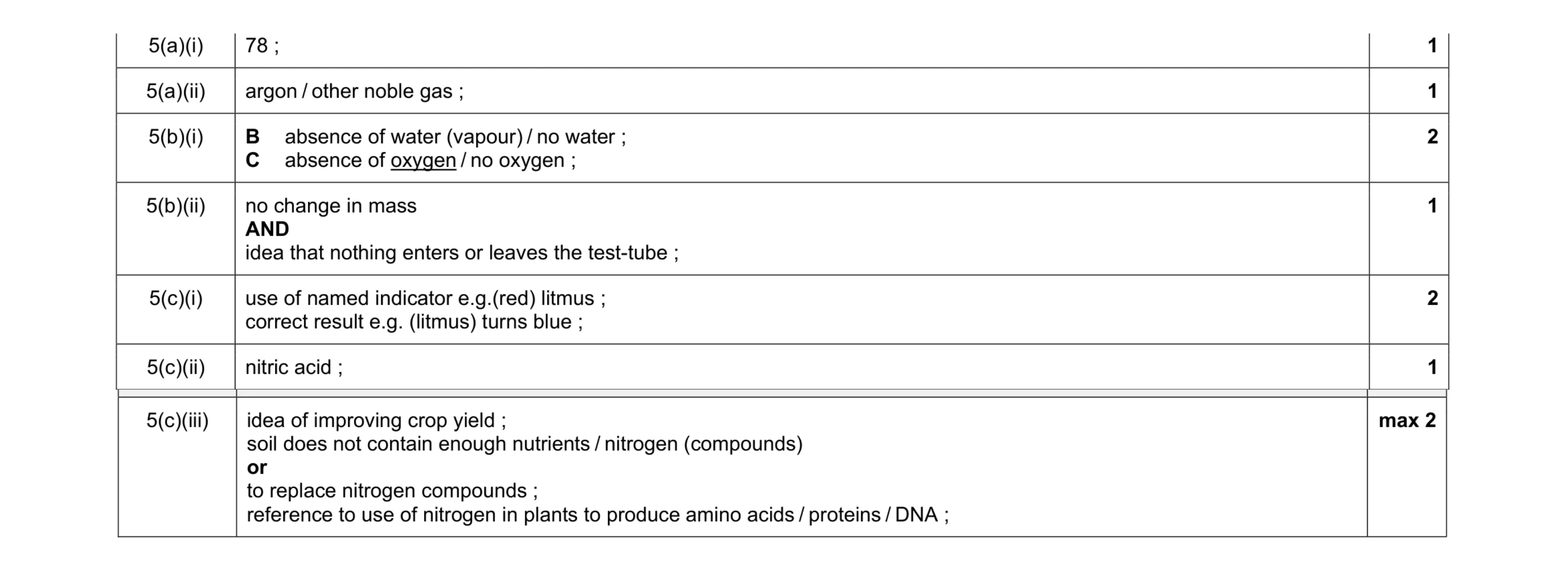 10
10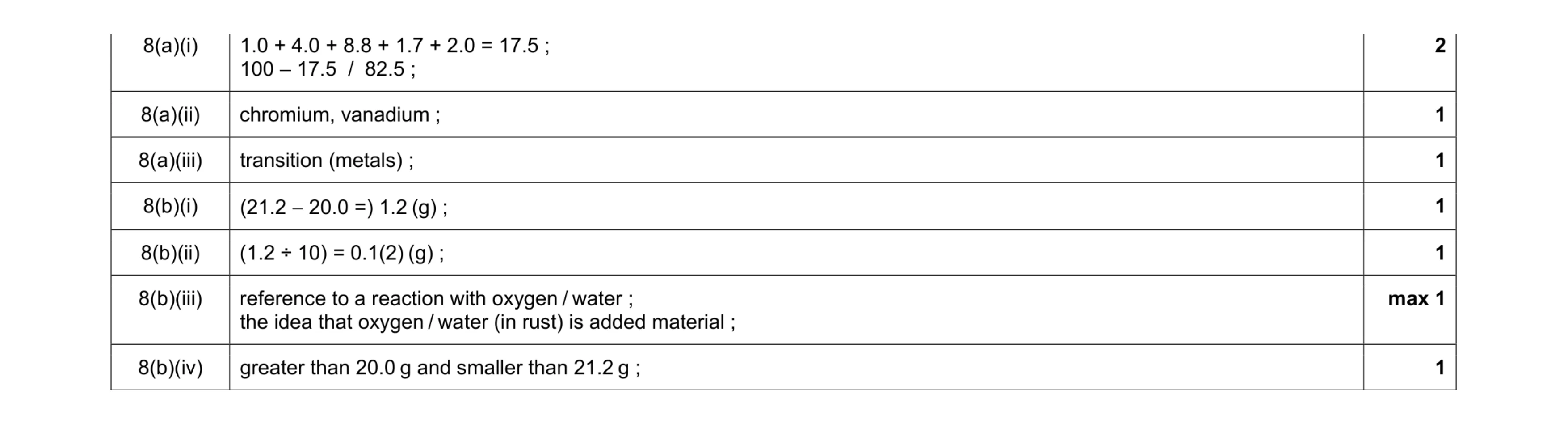 8
8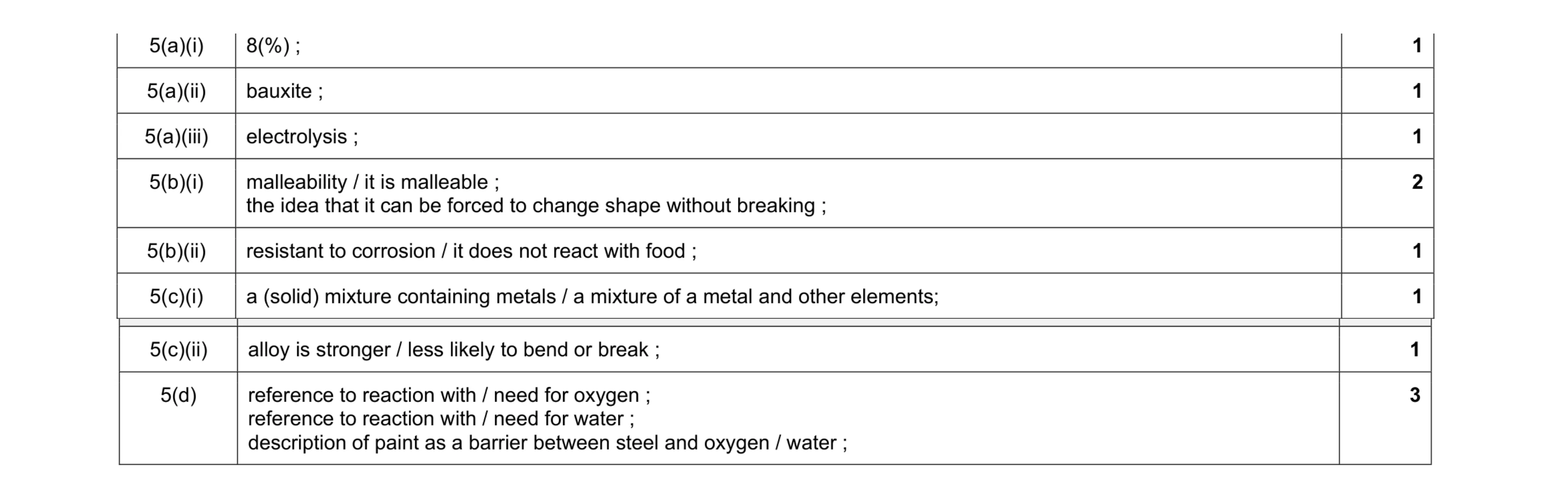 11
11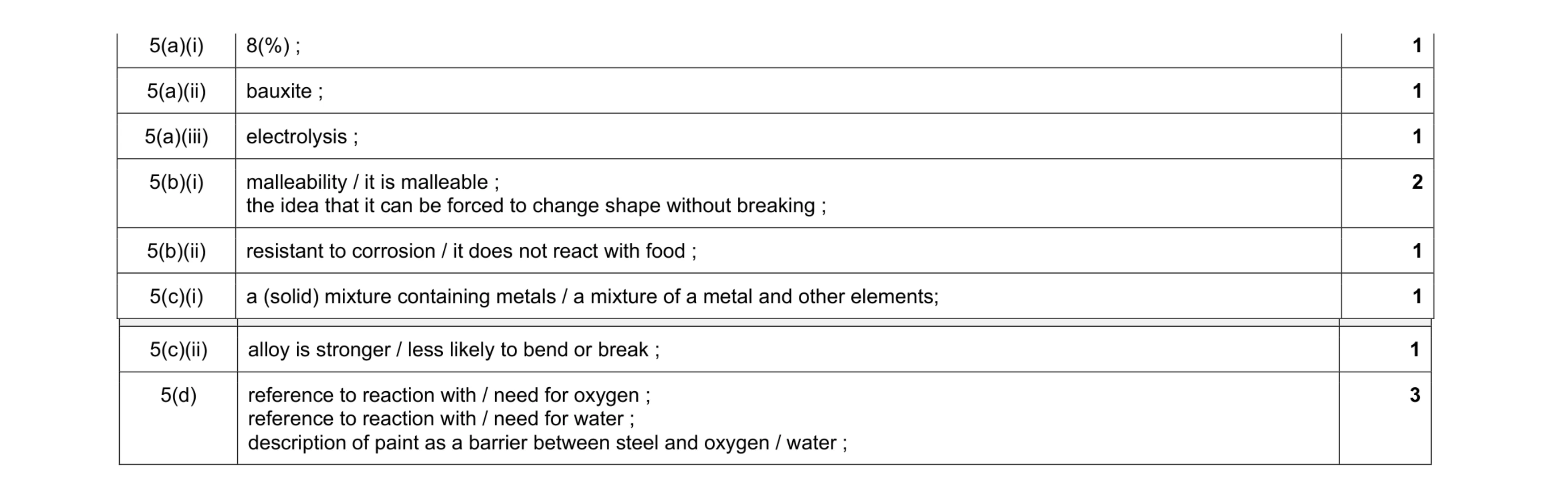 11
11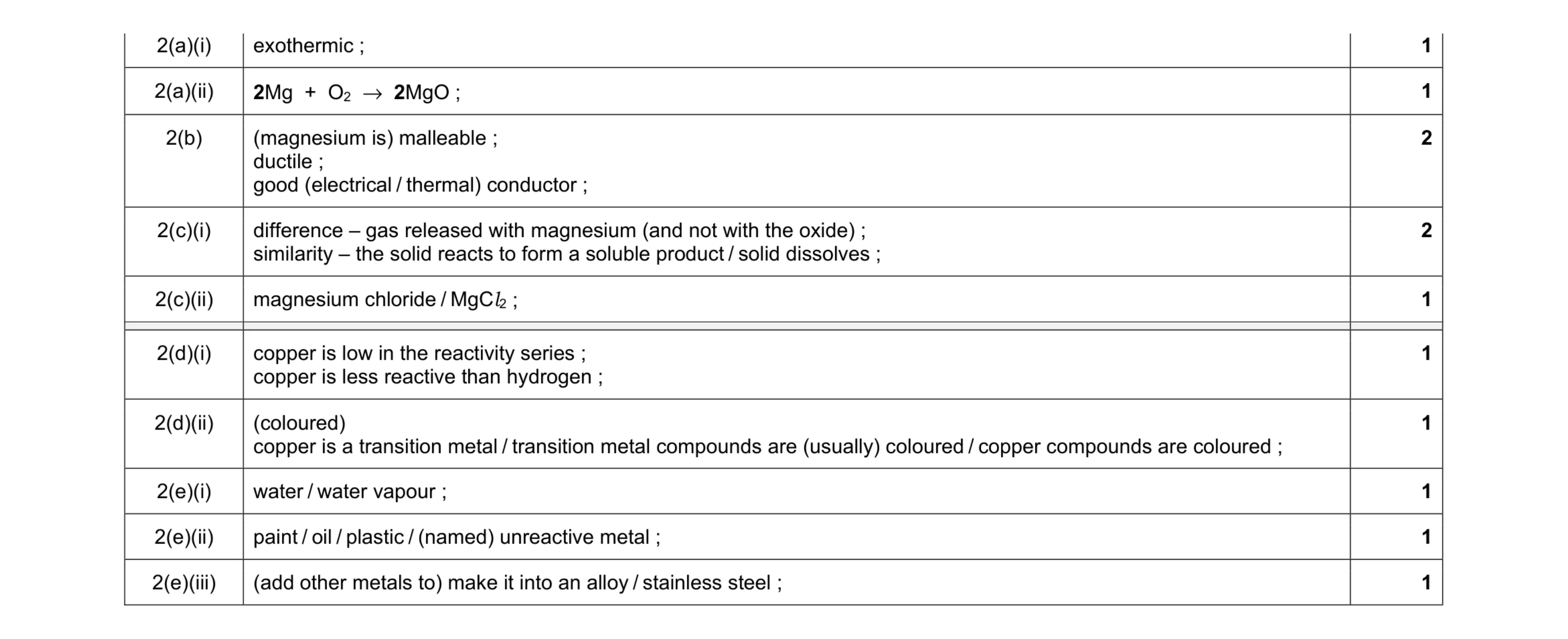 12
12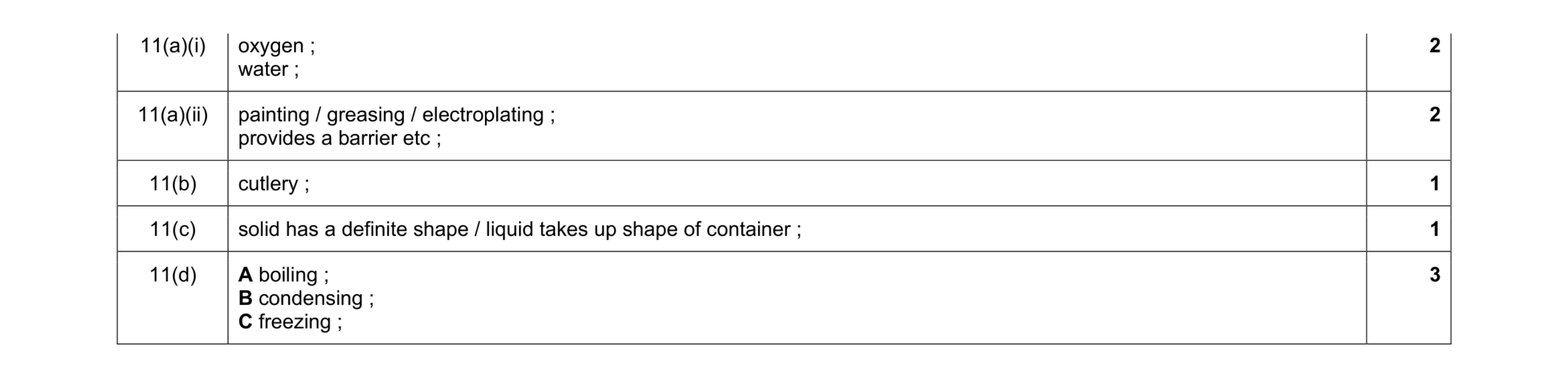 9
9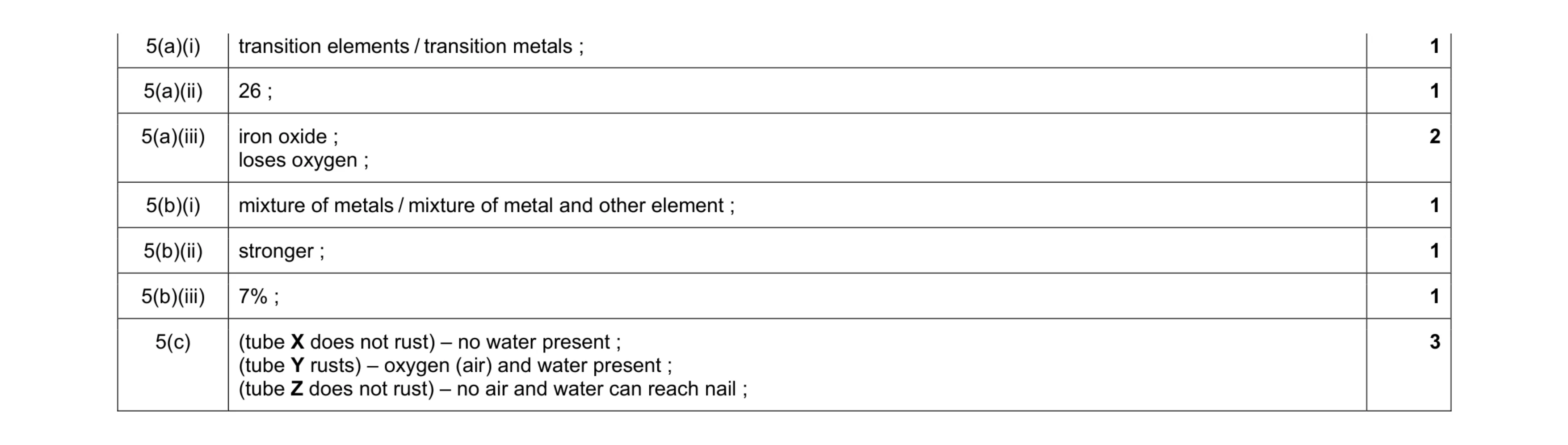 10
10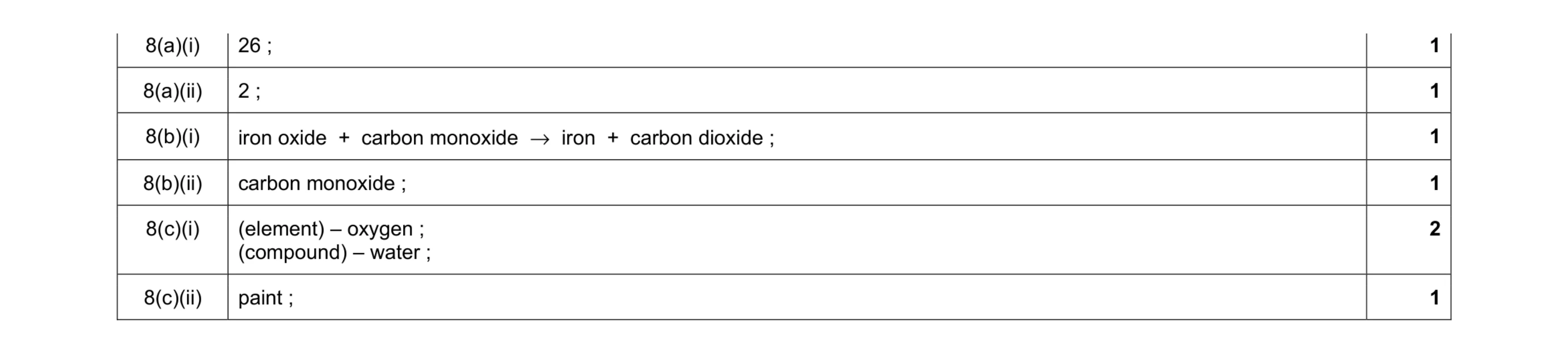 7
7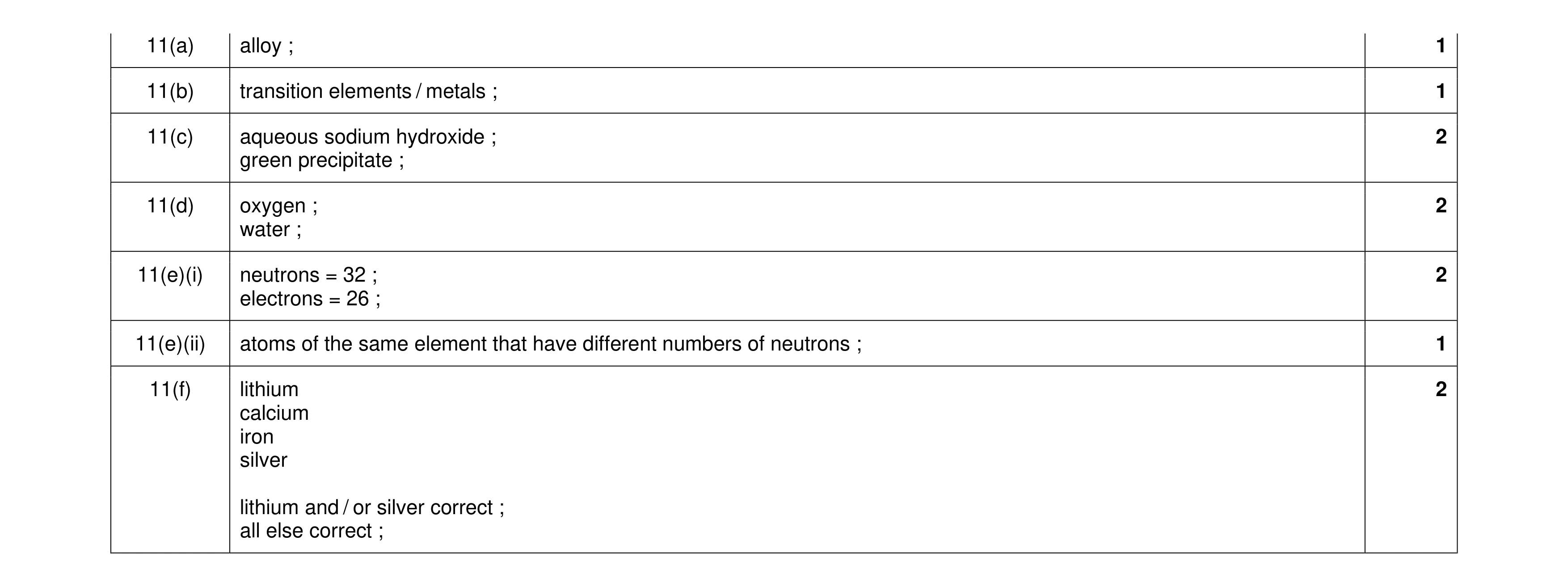 11
11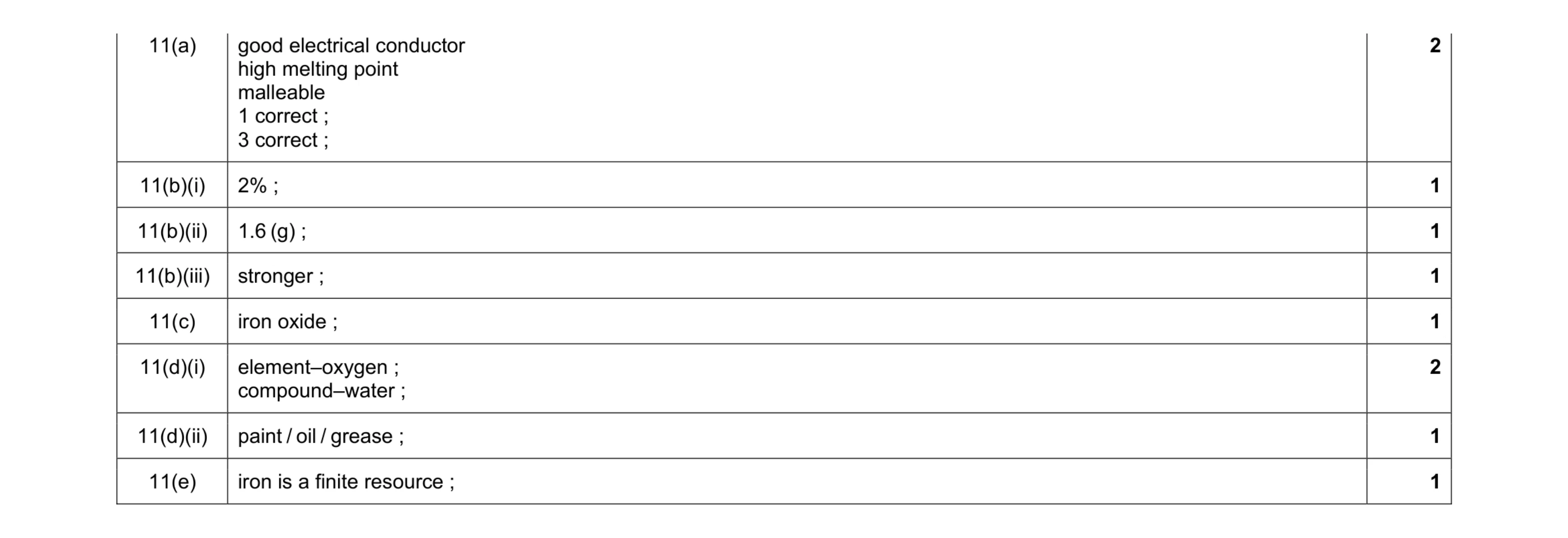 10
10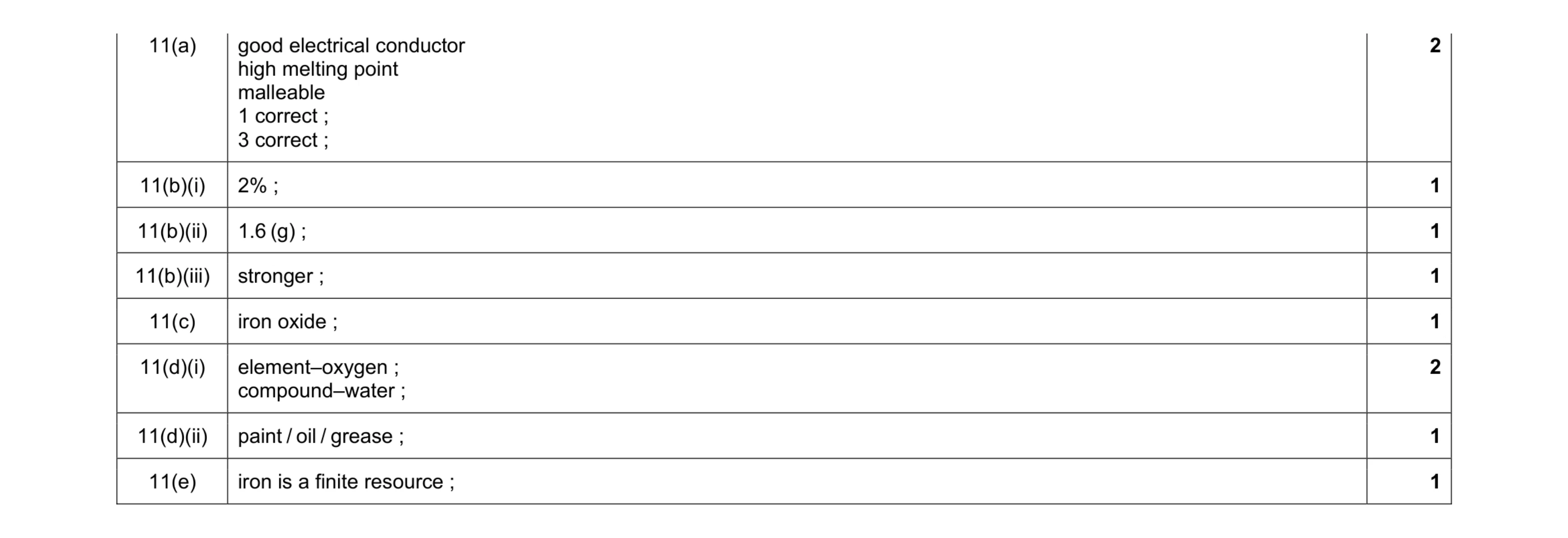 10
10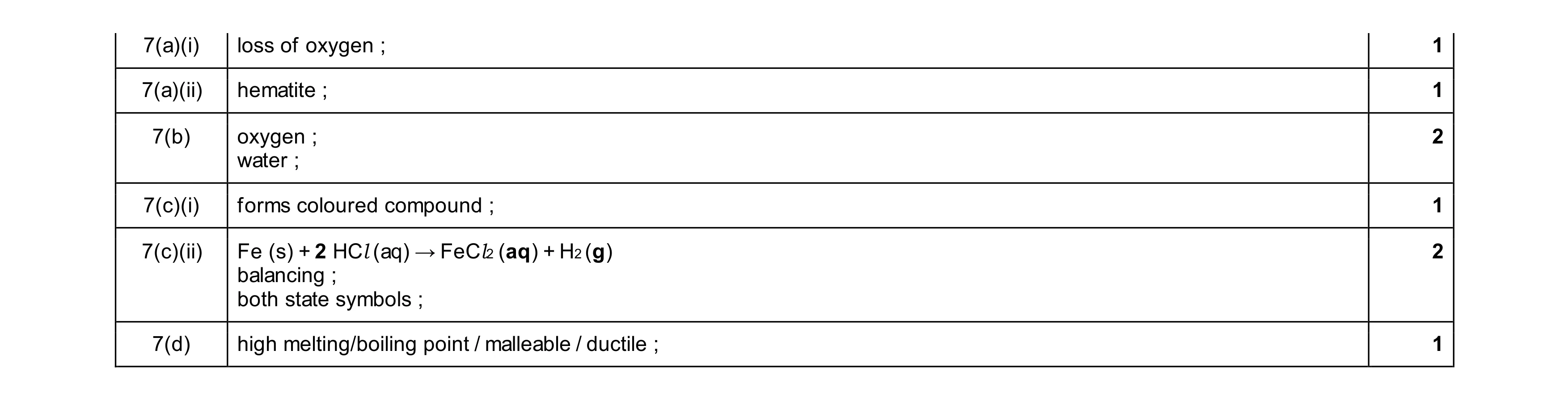 8
8