Cambridge IGCSE Sciences - Co-ordinated (Double) 0654 — 2020 May/June Paper 4 · Variant 3
0654/43/M/J/20
The question paper and its mark scheme, free to read here and free to download. This is Cambridge’s own paper, exactly as it was sat.
Question paper28 pages
Mark scheme13 pages
Answers below. Sit the paper first if you are practising.
Paper as text
Question paper, page 1
Cambridge IGCSE™ DC (JC/CB) 183536/4 © UCLES 2020 [Turn over This document has 28 pages. Blank pages are indicated. * 3 0 4 4 8 0 8 1 9 6 * CO-ORDINATED SCIENCES 0654/43 Paper 4 Theory (Extended) May/June 2020 2 hours You must answer on the question paper. No additional materials are needed. INSTRUCTIONS ● Answer all questions. ● Use a black or dark blue pen. You may use an HB pencil for any diagrams or graphs. ● Write your name, centre number and candidate number in the boxes at the top of the page. ● Write your answer to each question in the space provided. ● Do not use an erasable pen or correction fluid. ● Do not write on any bar codes. ● You may use a calculator. ● You should show all your working and use appropriate units. INFORMATION ● The total mark for this paper is 120. ● The number of marks for each question or part question is shown in brackets [ ]. ● The Periodic Table is printed in the question paper.
Question paper, page 2
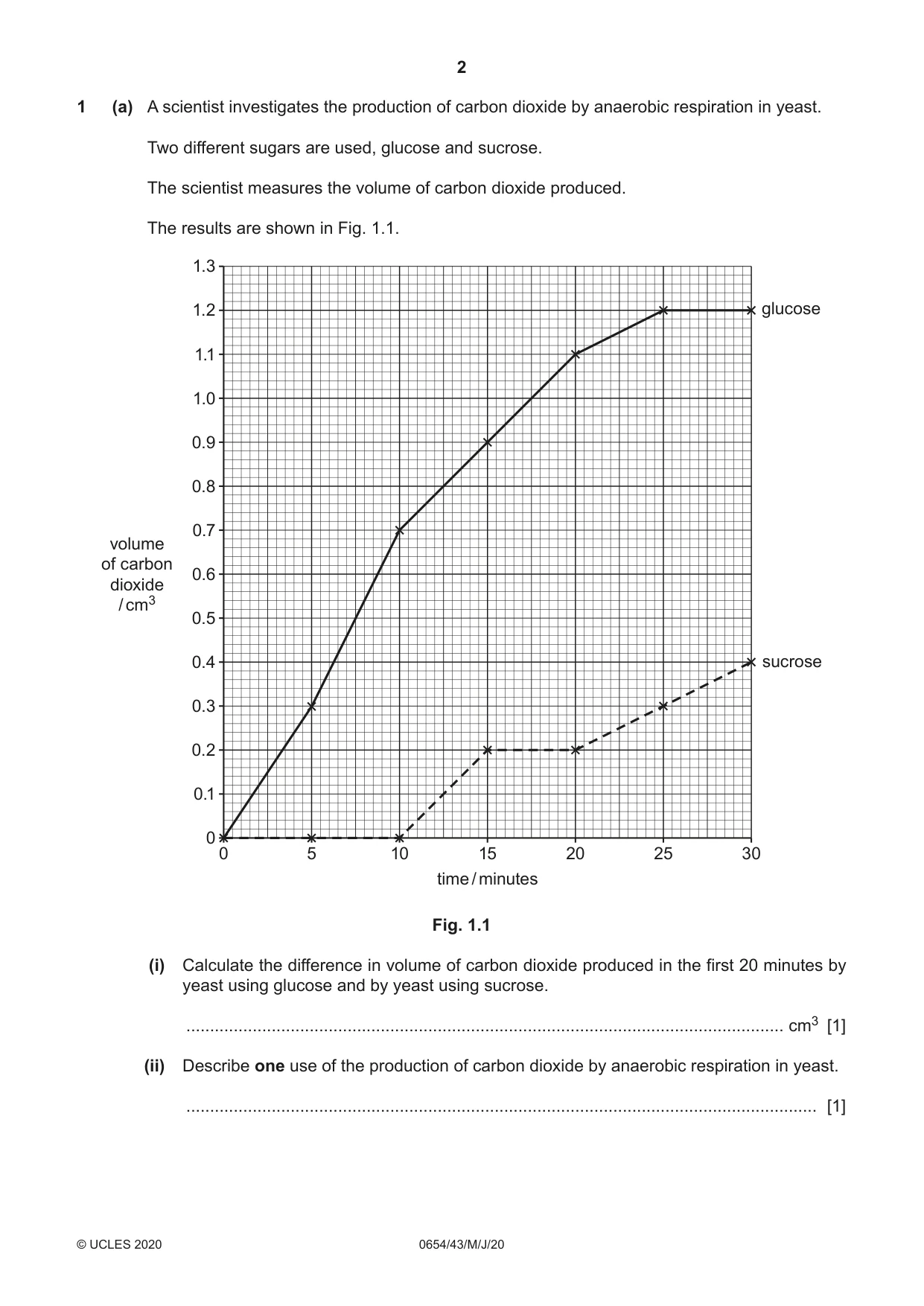
2 0654/43/M/J/20 © UCLES 2020 1 (a) A scientist investigates the production of carbon dioxide by anaerobic respiration in yeast. Two different sugars are used, glucose and sucrose. The scientist measures the volume of carbon dioxide produced. The results are shown in Fig. 1.1. 0 0 0.1 0.2 0.3 0.4 0.5 0.6 0.7 0.8 0.9 1.0 1.1 1.2 1.3 5 10 15 time / minutes sucrose glucose volume of carbon dioxide / cm3 20 25 30 Fig. 1.1 (i) Calculate the difference in volume of carbon dioxide produced in the first 20 minutes by yeast using glucose and by yeast using sucrose. … cm3 [1] (ii) Describe one use of the production of carbon dioxide by anaerobic respiration in yeast. … [1]
Question paper, page 3
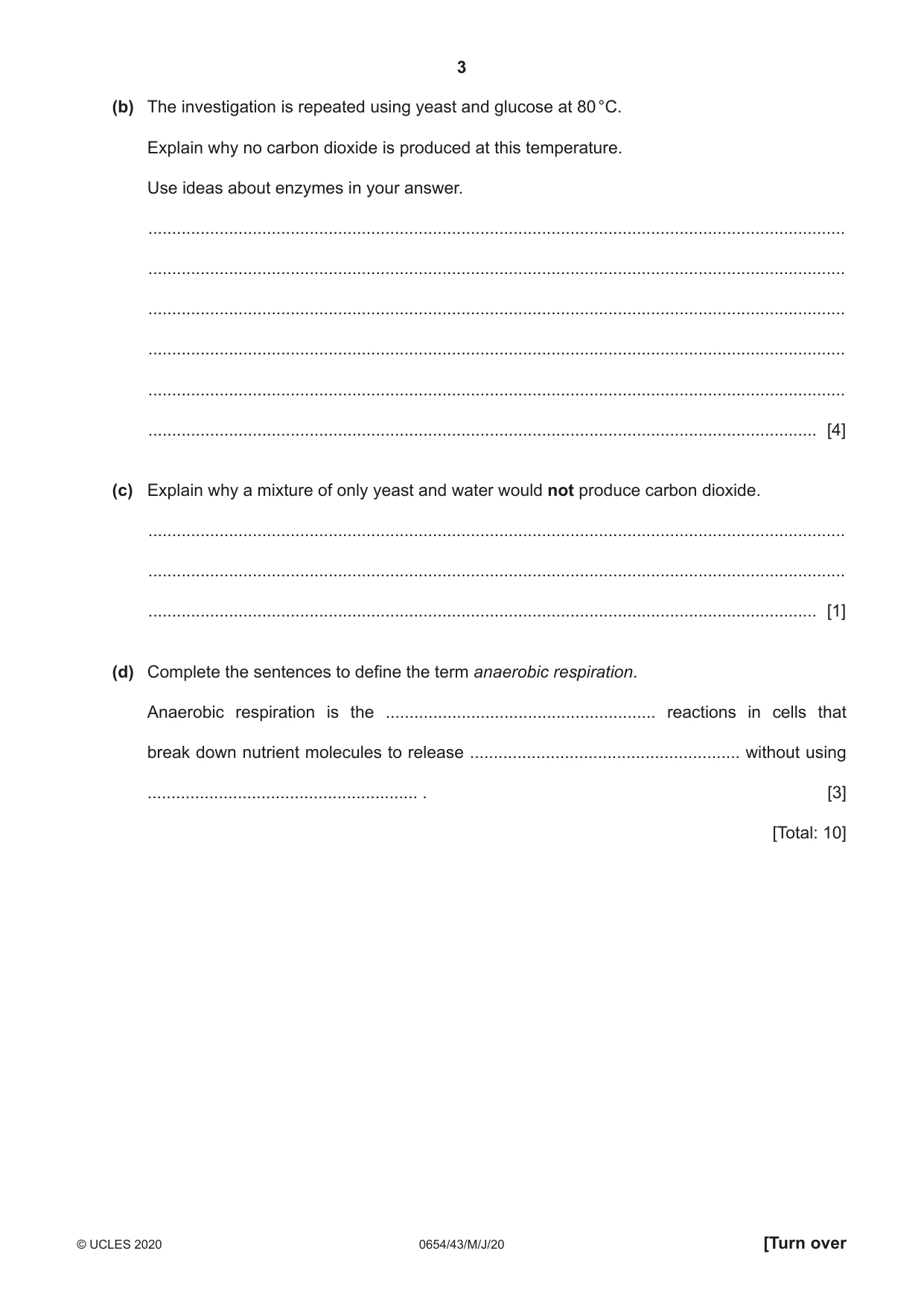
3 0654/43/M/J/20 © UCLES 2020 [Turn over (b) The investigation is repeated using yeast and glucose at 80 °C. Explain why no carbon dioxide is produced at this temperature. Use ideas about enzymes in your answer. … … … … … … [4] (c) Explain why a mixture of only yeast and water would not produce carbon dioxide. … … … [1] (d) Complete the sentences to define the term anaerobic respiration. Anaerobic respiration is the … reactions in cells that break down nutrient molecules to release … without using … . [3] [Total: 10]
Question paper, page 4
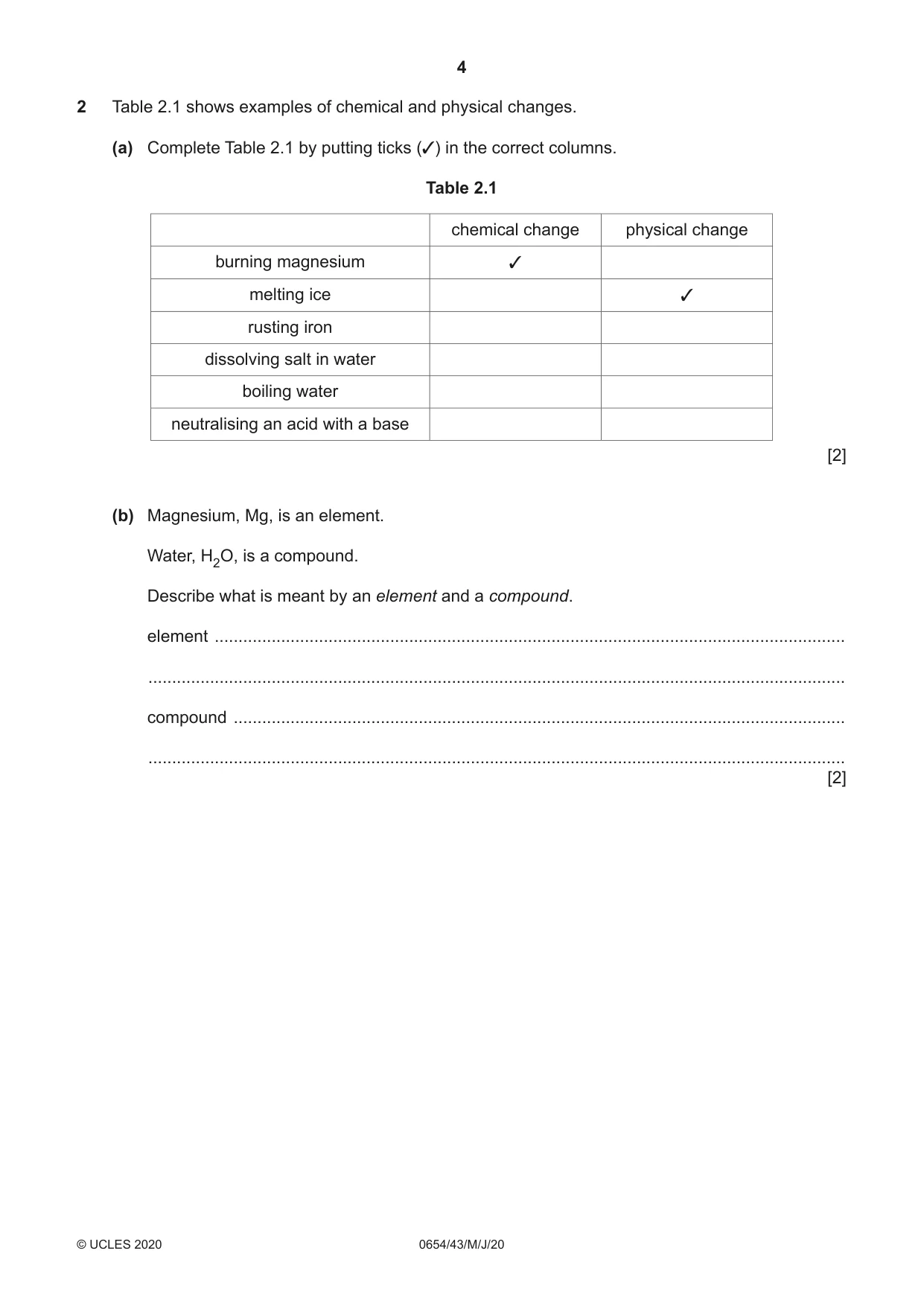
4 0654/43/M/J/20 © UCLES 2020 2 Table 2.1 shows examples of chemical and physical changes. (a) Complete Table 2.1 by putting ticks (3) in the correct columns. Table 2.1 chemical change physical change burning magnesium 3 melting ice 3 rusting iron dissolving salt in water boiling water neutralising an acid with a base [2] (b) Magnesium, Mg, is an element. Water, H2O, is a compound. Describe what is meant by an element and a compound. element … … compound … … [2]
Question paper, page 5
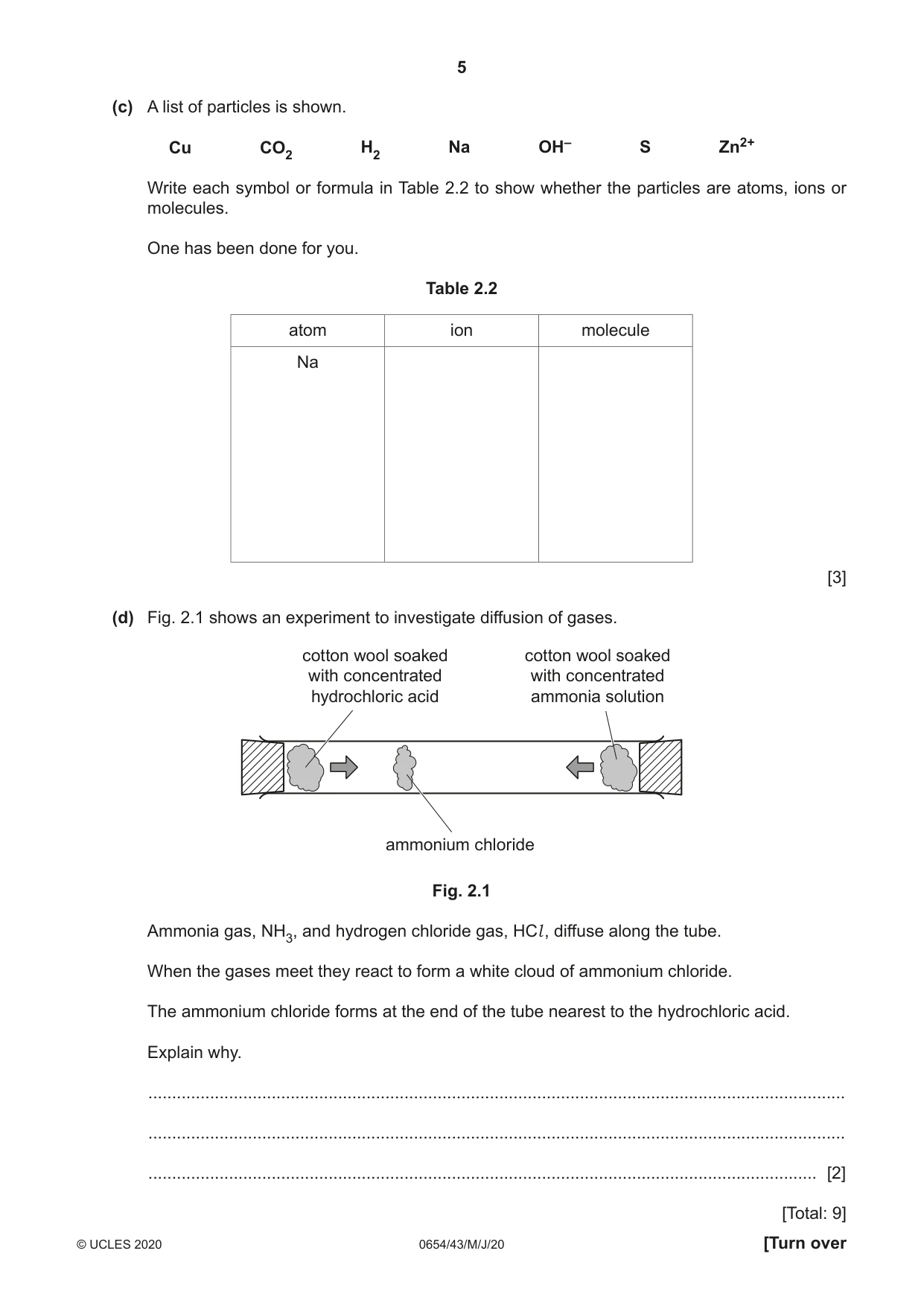
5 0654/43/M/J/20 © UCLES 2020 [Turn over (c) A list of particles is shown. Cu CO2 H2 Na OH– S Zn2+ Write each symbol or formula in Table 2.2 to show whether the particles are atoms, ions or molecules. One has been done for you. Table 2.2 atom ion molecule Na [3] (d) Fig. 2.1 shows an experiment to investigate diffusion of gases. cotton wool soaked with concentrated hydrochloric acid cotton wool soaked with concentrated ammonia solution ammonium chloride Fig. 2.1 Ammonia gas, NH3, and hydrogen chloride gas, HCl , diffuse along the tube. When the gases meet they react to form a white cloud of ammonium chloride. The ammonium chloride forms at the end of the tube nearest to the hydrochloric acid. Explain why. … … … [2] [Total: 9]
Question paper, page 6
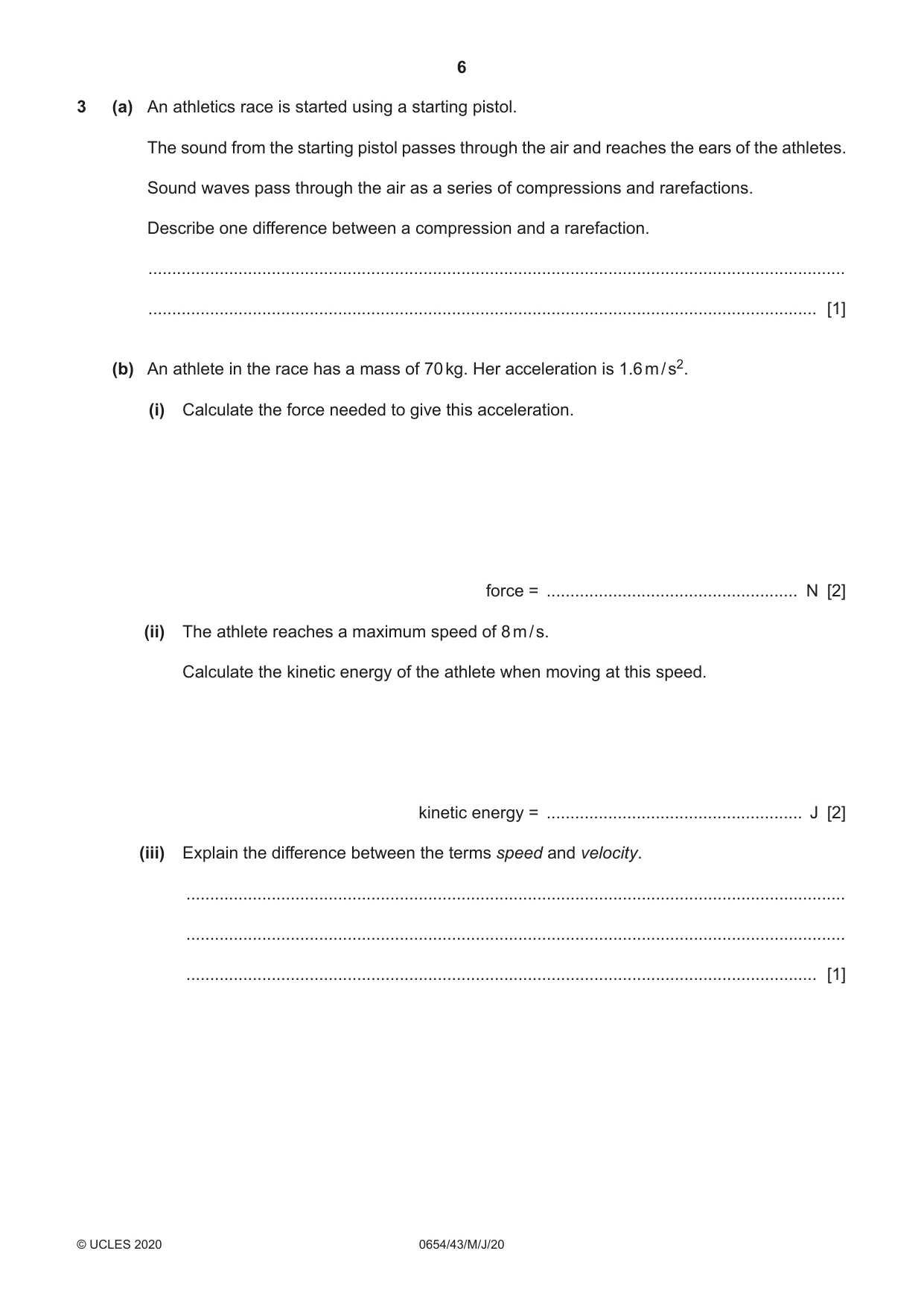
6 0654/43/M/J/20 © UCLES 2020 3 (a) An athletics race is started using a starting pistol. The sound from the starting pistol passes through the air and reaches the ears of the athletes. Sound waves pass through the air as a series of compressions and rarefactions. Describe one difference between a compression and a rarefaction. … … [1] (b) An athlete in the race has a mass of 70 kg. Her acceleration is 1.6 m / s2. (i) Calculate the force needed to give this acceleration. force = … N [2] (ii) The athlete reaches a maximum speed of 8 m / s. Calculate the kinetic energy of the athlete when moving at this speed. kinetic energy = … J [2] (iii) Explain the difference between the terms speed and velocity. … … … [1]
Question paper, page 7
7 0654/43/M/J/20 © UCLES 2020 [Turn over (c) At the end of the race, the athlete is sweating. The sweat of the athlete evaporates faster on a hot day. (i) Suggest in terms of molecules why this happens. … … … [1] (ii) State one other way by which the rate of evaporation from the surface of a liquid can be increased. … [1] (d) At the end of a long race athletes are sometimes wrapped in a shiny foil blanket to reduce thermal energy losses. Explain why the shiny foil blanket helps reduce energy losses. … … … … [2] [Total: 10]
Question paper, page 8
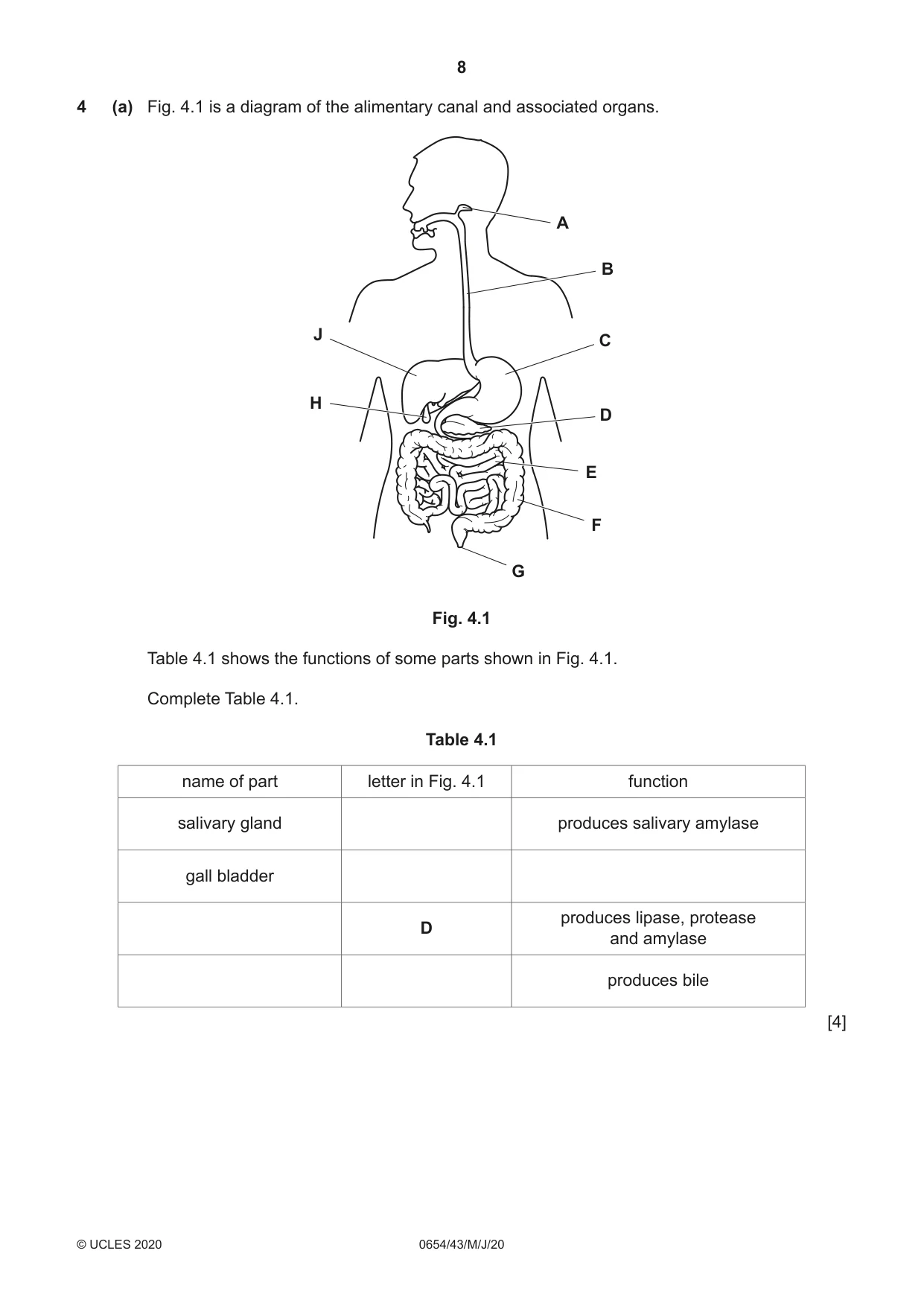
8 0654/43/M/J/20 © UCLES 2020 4 (a) Fig. 4.1 is a diagram of the alimentary canal and associated organs. A B C D E F G H J Fig. 4.1 Table 4.1 shows the functions of some parts shown in Fig. 4.1. Complete Table 4.1. Table 4.1 name of part letter in Fig. 4.1 function salivary gland produces salivary amylase gall bladder D produces lipase, protease and amylase produces bile [4]
Question paper, page 9
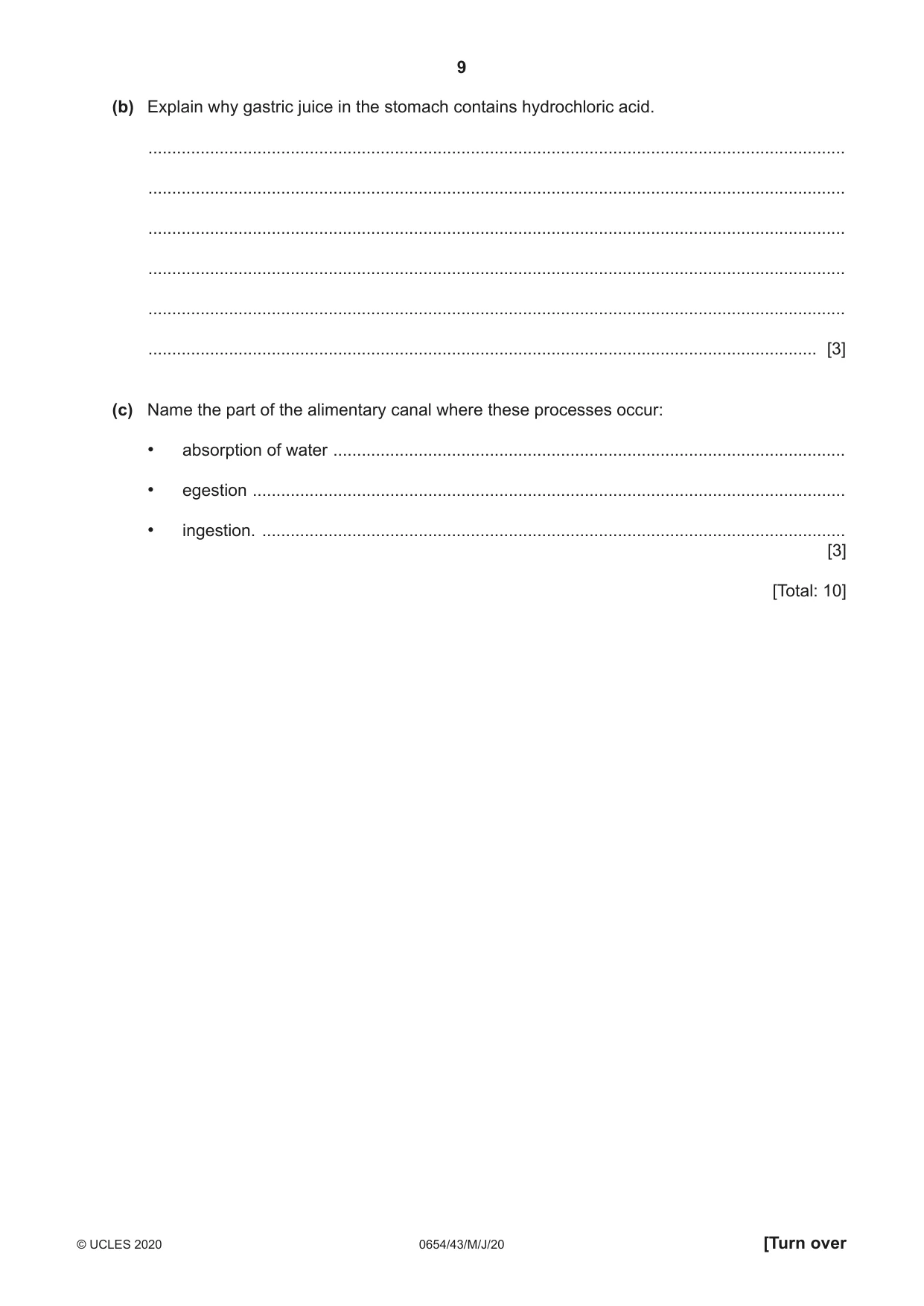
9 0654/43/M/J/20 © UCLES 2020 [Turn over (b) Explain why gastric juice in the stomach contains hydrochloric acid. … … … … … … [3] (c) Name the part of the alimentary canal where these processes occur: • absorption of water … • egestion … • ingestion. … [3] [Total: 10]
Question paper, page 10
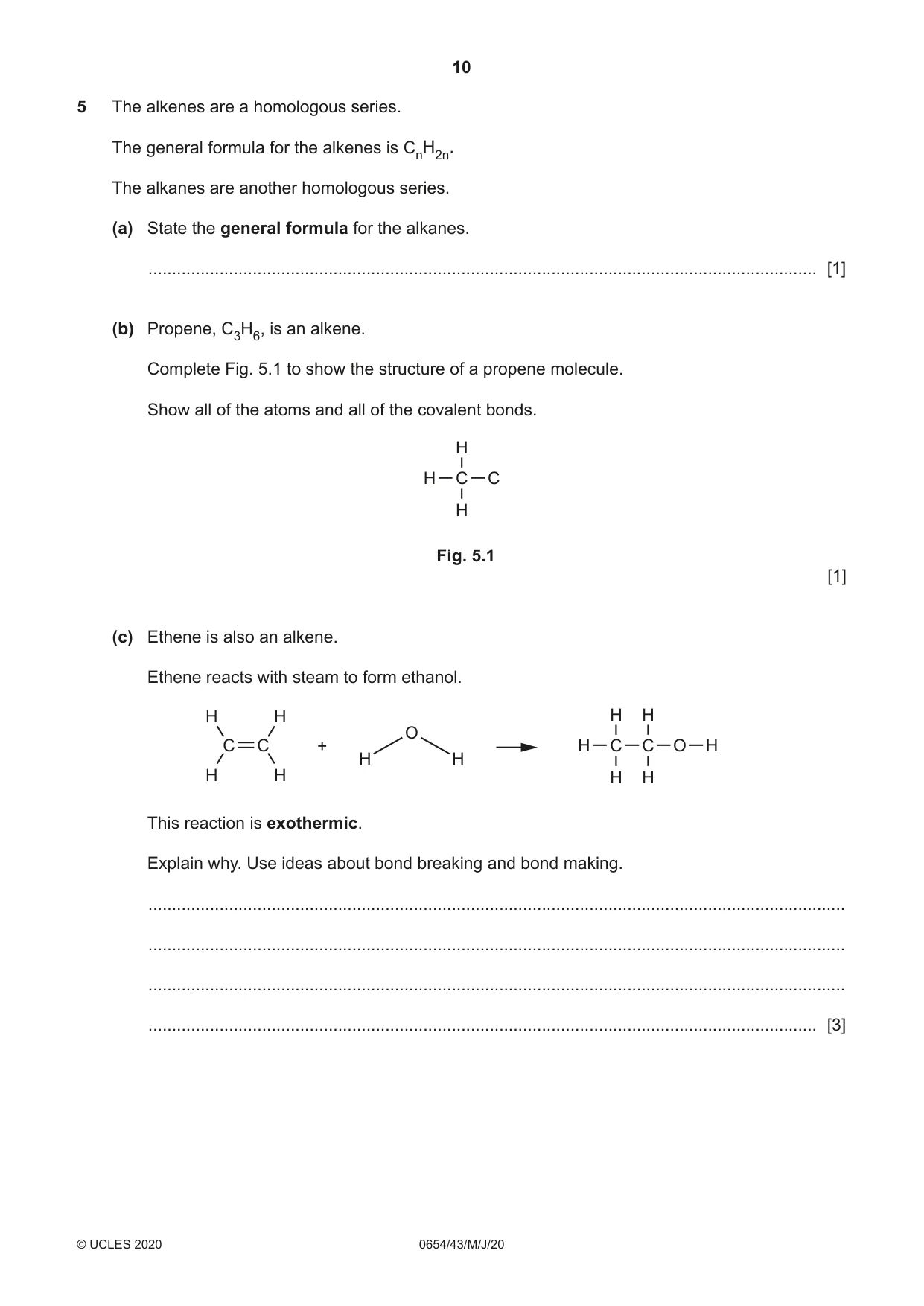
10 0654/43/M/J/20 © UCLES 2020 5 The alkenes are a homologous series. The general formula for the alkenes is CnH2n. The alkanes are another homologous series. (a) State the general formula for the alkanes. … [1] (b) Propene, C3H6, is an alkene. Complete Fig. 5.1 to show the structure of a propene molecule. Show all of the atoms and all of the covalent bonds. C C H H H Fig. 5.1 [1] (c) Ethene is also an alkene. Ethene reacts with steam to form ethanol. + H H H C C H H H O C C H H H H O H H This reaction is exothermic. Explain why. Use ideas about bond breaking and bond making. … … … … [3]
Question paper, page 11
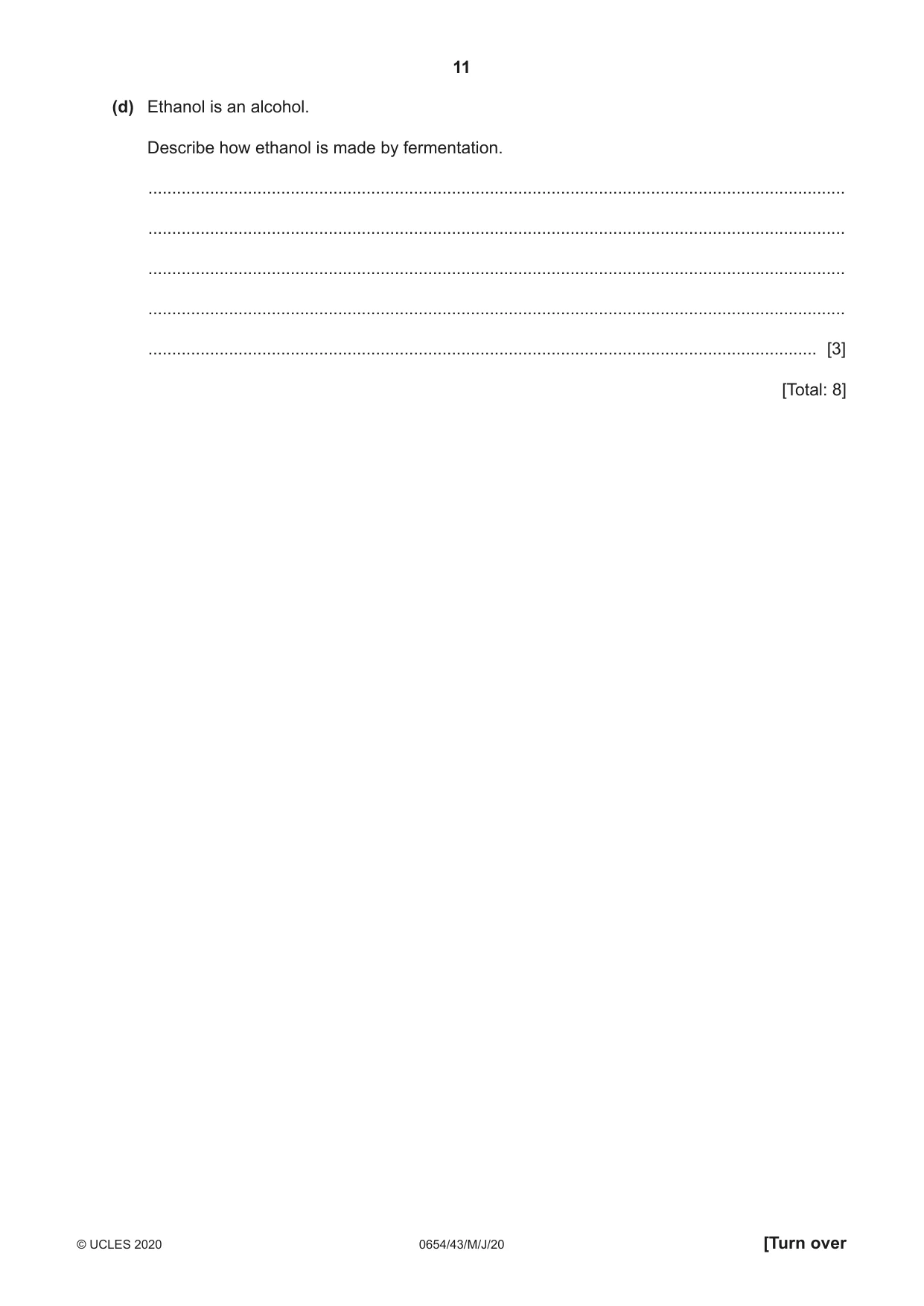
11 0654/43/M/J/20 © UCLES 2020 [Turn over (d) Ethanol is an alcohol. Describe how ethanol is made by fermentation. … … … … … [3] [Total: 8]
Question paper, page 12
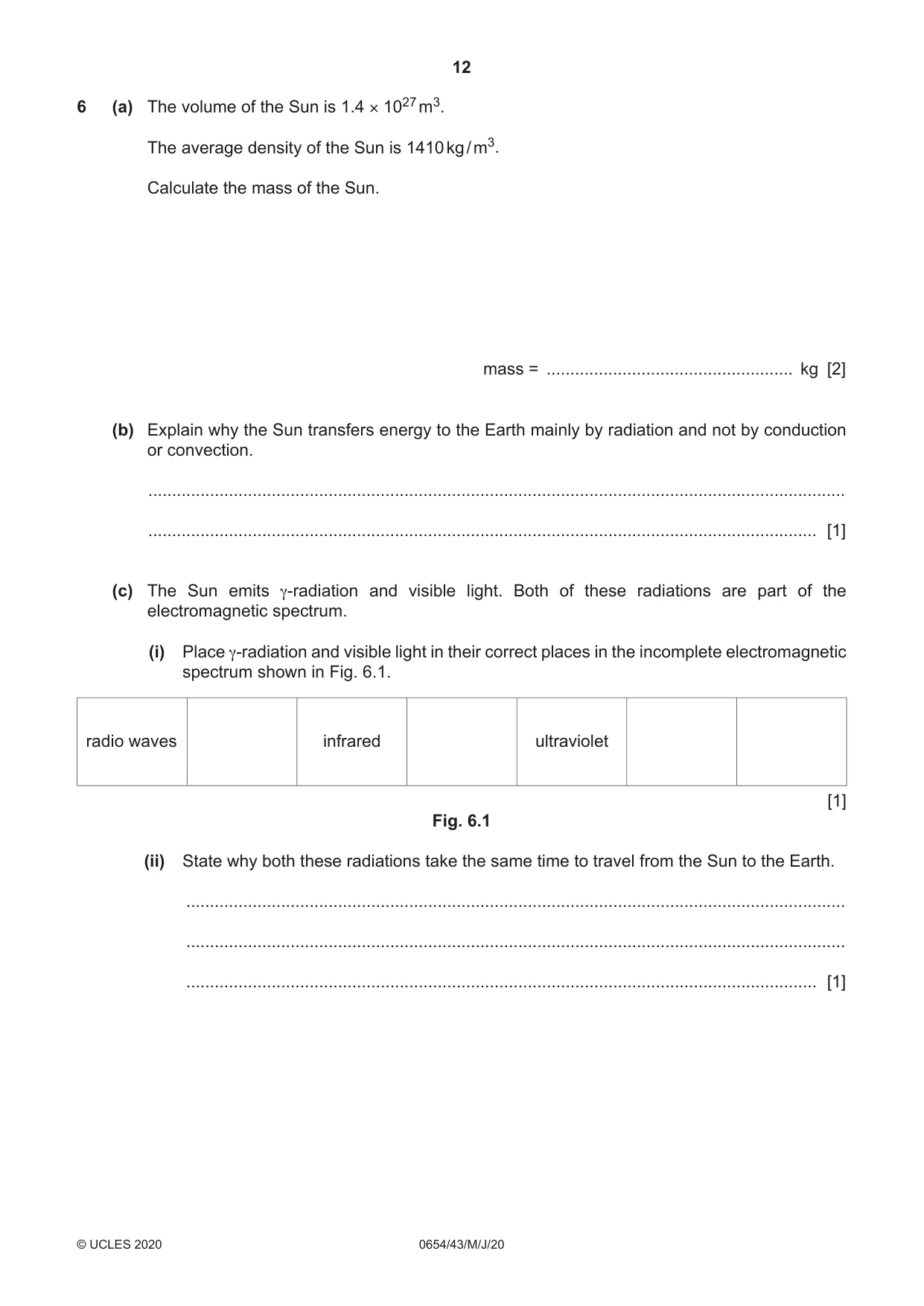
12 0654/43/M/J/20 © UCLES 2020 6 (a) The volume of the Sun is 1.4 × 1027 m3. The average density of the Sun is 1410 kg / m3. Calculate the mass of the Sun. mass = … kg [2] (b) Explain why the Sun transfers energy to the Earth mainly by radiation and not by conduction or convection. … … [1] (c) The Sun emits γ-radiation and visible light. Both of these radiations are part of the electromagnetic spectrum. (i) Place γ-radiation and visible light in their correct places in the incomplete electromagnetic spectrum shown in Fig. 6.1. radio waves infrared ultraviolet [1] Fig. 6.1 (ii) State why both these radiations take the same time to travel from the Sun to the Earth. … … … [1]
Question paper, page 13
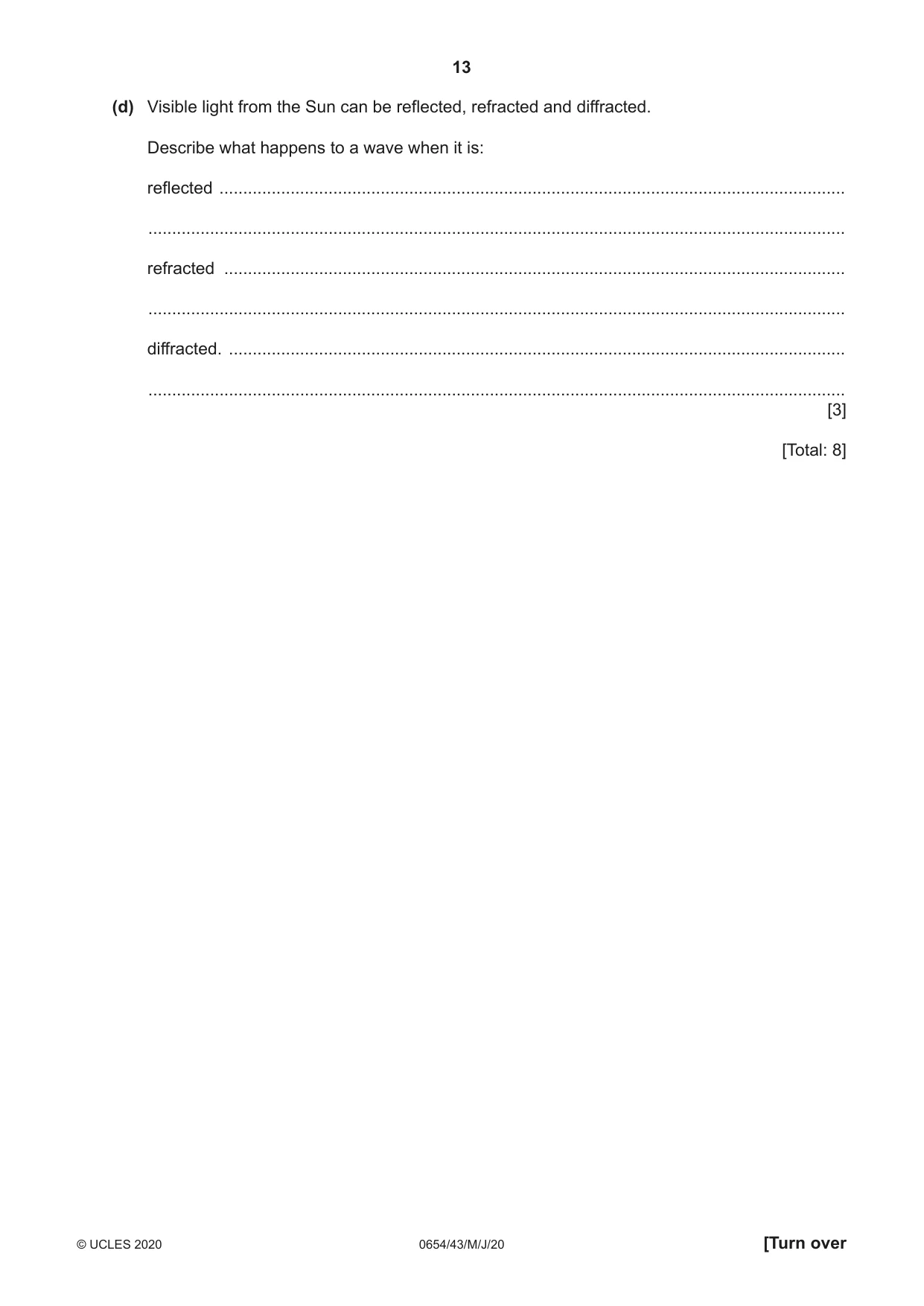
13 0654/43/M/J/20 © UCLES 2020 [Turn over (d) Visible light from the Sun can be reflected, refracted and diffracted. Describe what happens to a wave when it is: reflected … … refracted … … diffracted. … … [3] [Total: 8]
Question paper, page 14
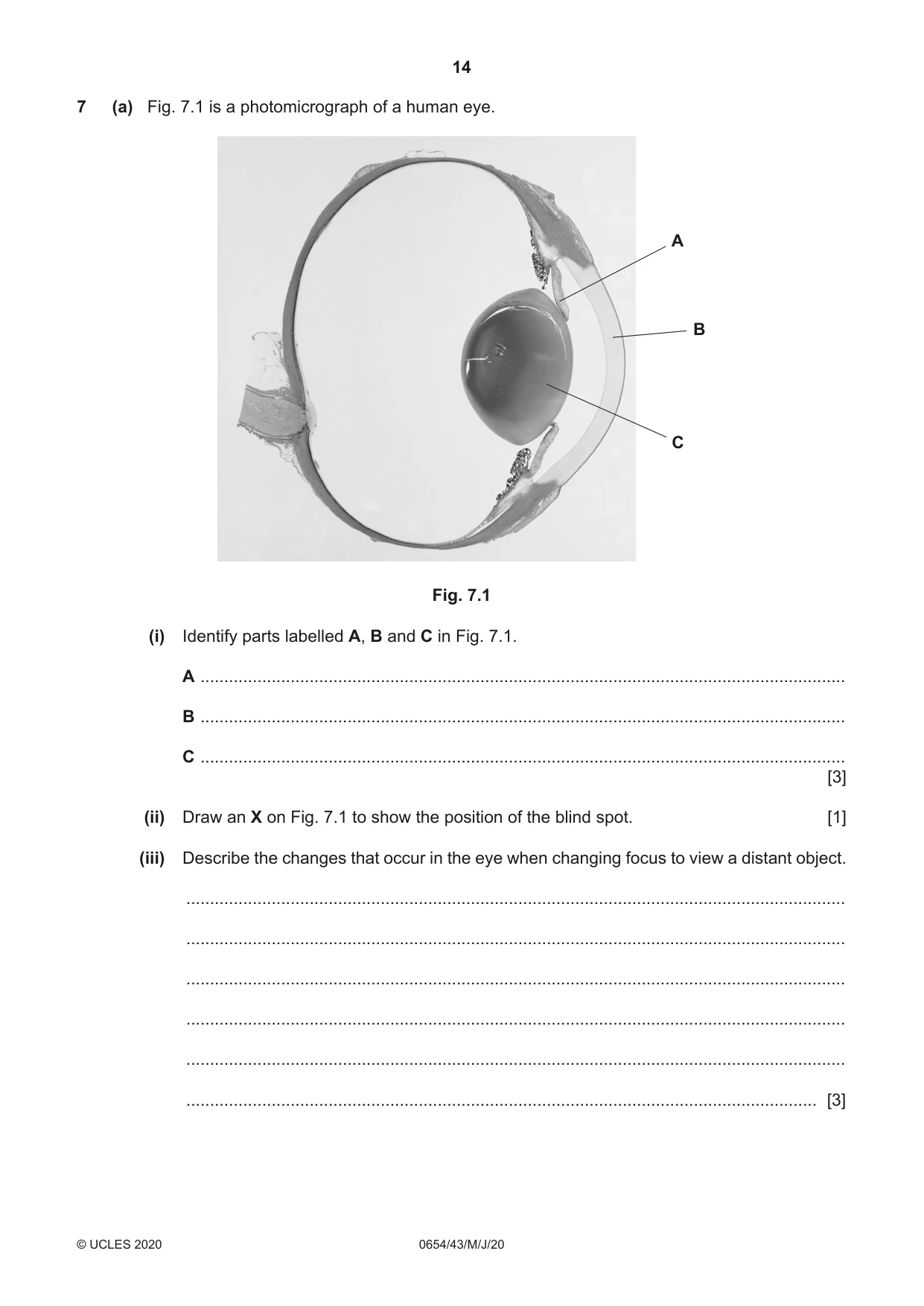
14 0654/43/M/J/20 © UCLES 2020 7 (a) Fig. 7.1 is a photomicrograph of a human eye. A B C Fig. 7.1 (i) Identify parts labelled A, B and C in Fig. 7.1. A … B … C … [3] (ii) Draw an X on Fig. 7.1 to show the position of the blind spot. [1] (iii) Describe the changes that occur in the eye when changing focus to view a distant object. … … … … … … [3]
Question paper, page 15
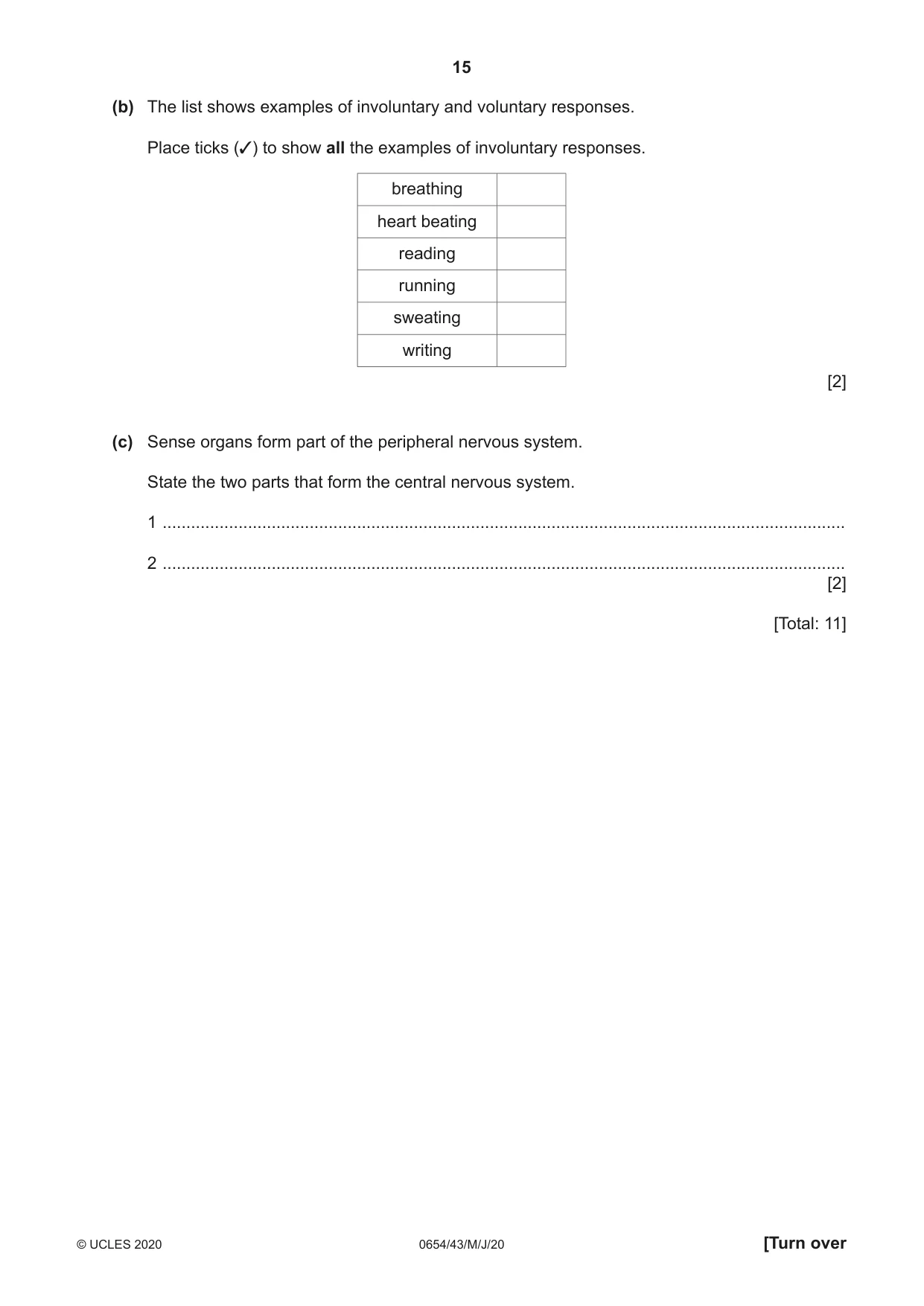
15 0654/43/M/J/20 © UCLES 2020 [Turn over (b) The list shows examples of involuntary and voluntary responses. Place ticks (3) to show all the examples of involuntary responses. breathing heart beating reading running sweating writing [2] (c) Sense organs form part of the peripheral nervous system. State the two parts that form the central nervous system. 1 … 2 … [2] [Total: 11]
Question paper, page 16
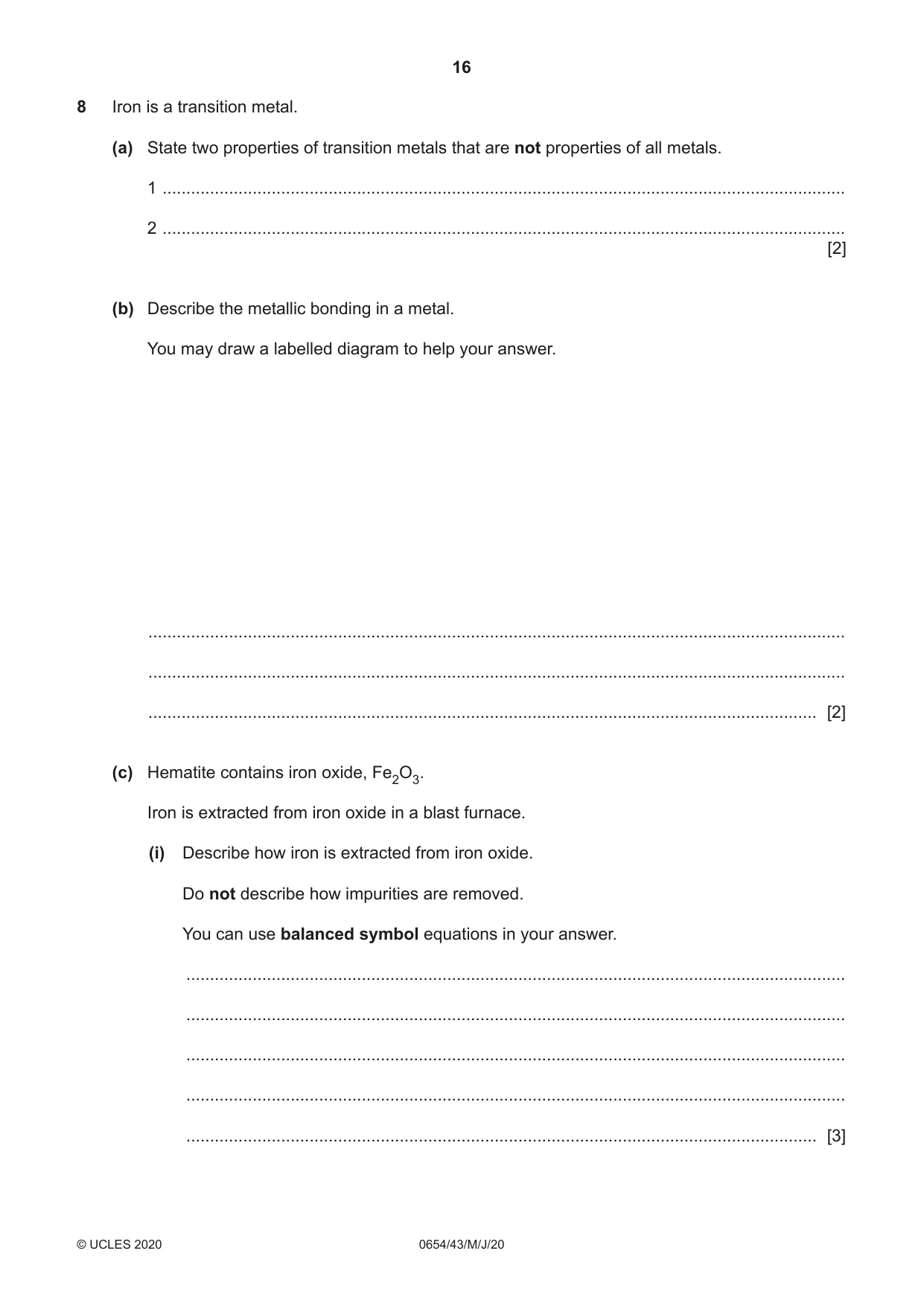
16 0654/43/M/J/20 © UCLES 2020 8 Iron is a transition metal. (a) State two properties of transition metals that are not properties of all metals. 1 … 2 … [2] (b) Describe the metallic bonding in a metal. You may draw a labelled diagram to help your answer. … … … [2] (c) Hematite contains iron oxide, Fe2O3. Iron is extracted from iron oxide in a blast furnace. (i) Describe how iron is extracted from iron oxide. Do not describe how impurities are removed. You can use balanced symbol equations in your answer. … … … … … [3]
Question paper, page 17
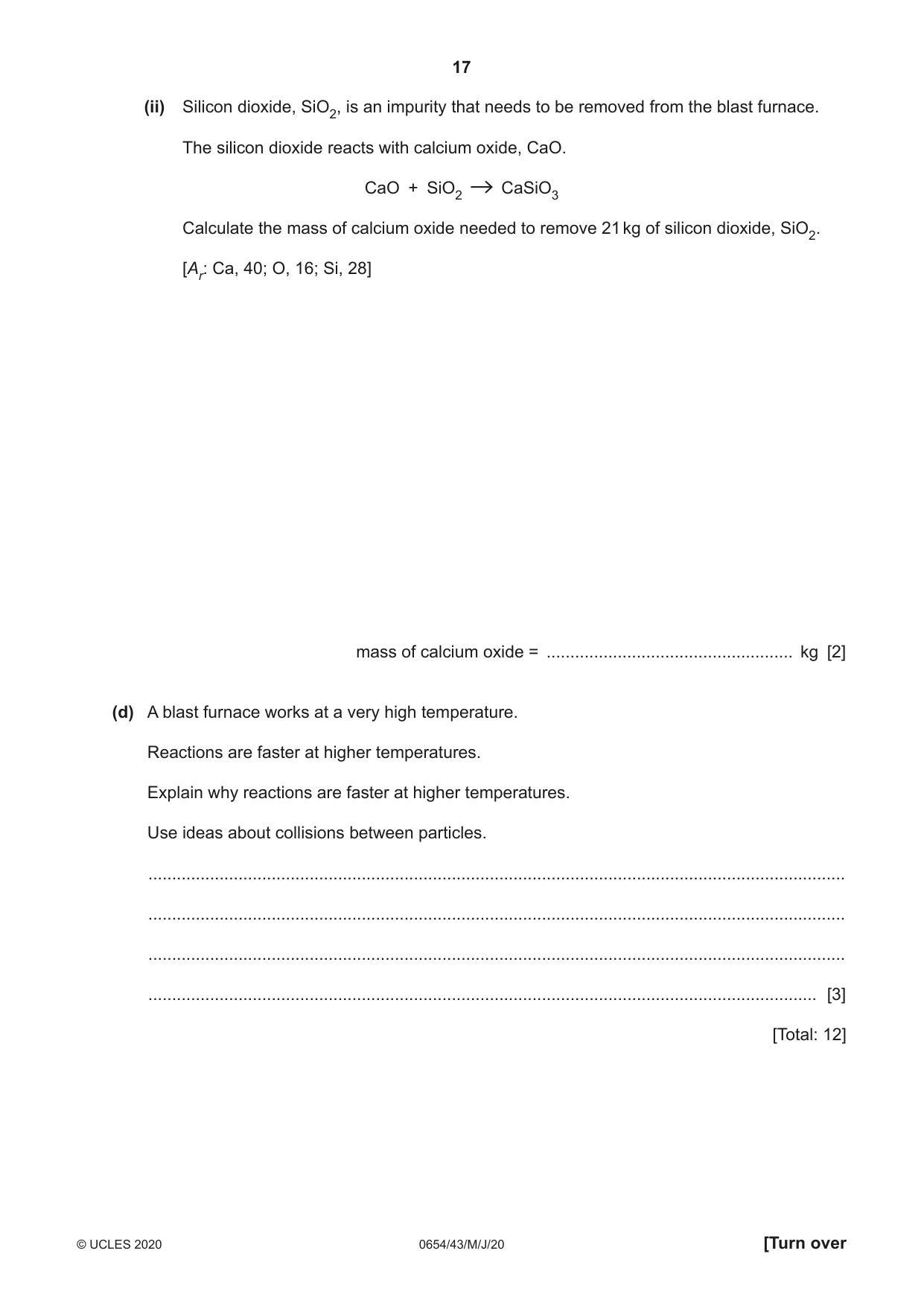
17 0654/43/M/J/20 © UCLES 2020 [Turn over (ii) Silicon dioxide, SiO2, is an impurity that needs to be removed from the blast furnace. The silicon dioxide reacts with calcium oxide, CaO. CaO + SiO2 CaSiO3 Calculate the mass of calcium oxide needed to remove 21 kg of silicon dioxide, SiO2. [Ar: Ca, 40; O, 16; Si, 28] mass of calcium oxide = … kg [2] (d) A blast furnace works at a very high temperature. Reactions are faster at higher temperatures. Explain why reactions are faster at higher temperatures. Use ideas about collisions between particles. … … … … [3] [Total: 12]
Question paper, page 18
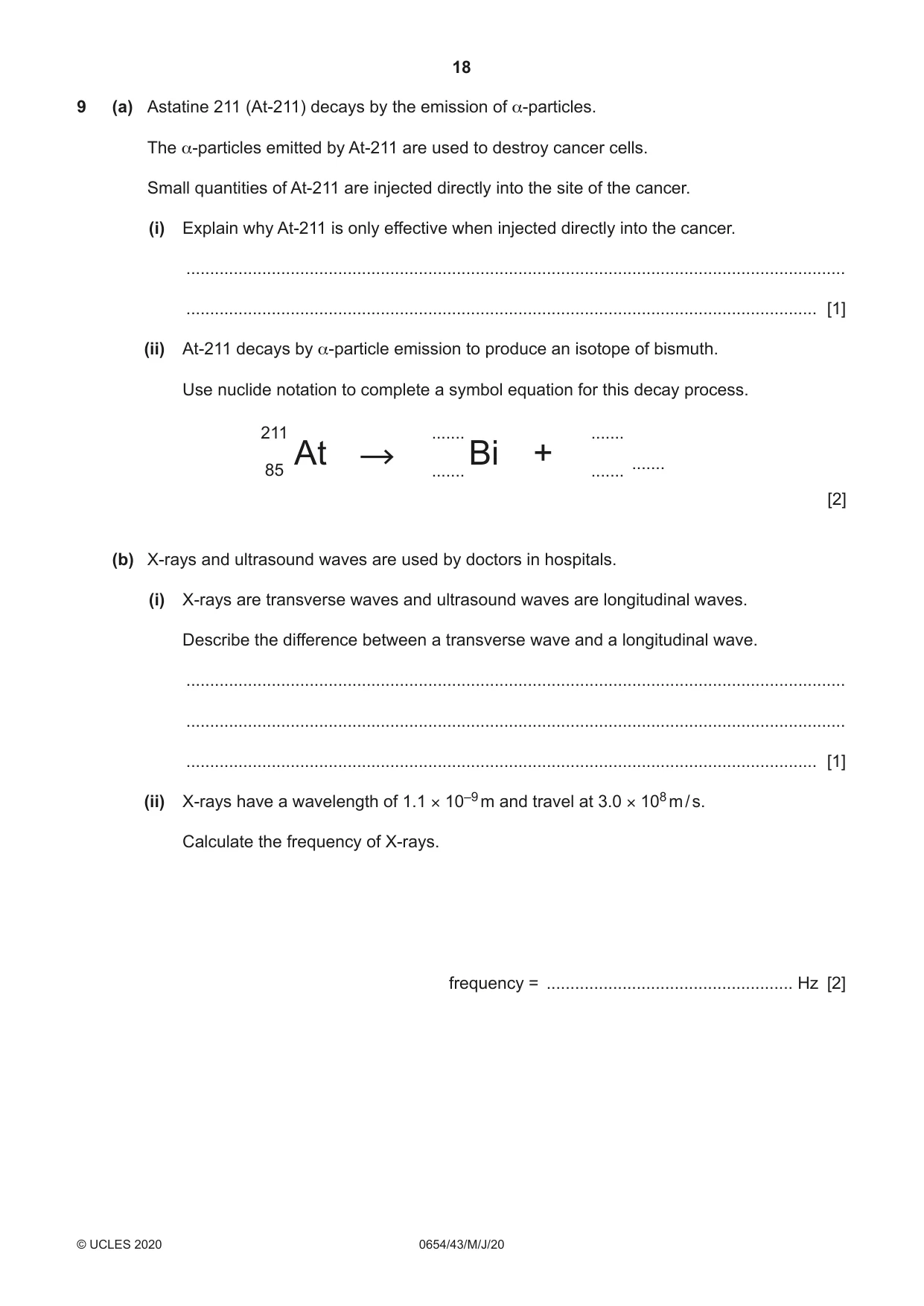
18 0654/43/M/J/20 © UCLES 2020 9 (a) Astatine 211 (At-211) decays by the emission of α-particles. The α-particles emitted by At-211 are used to destroy cancer cells. Small quantities of At-211 are injected directly into the site of the cancer. (i) Explain why At-211 is only effective when injected directly into the cancer. … … [1] (ii) At-211 decays by α-particle emission to produce an isotope of bismuth. Use nuclide notation to complete a symbol equation for this decay process. 211 85 At … …Bi + … … … [2] (b) X-rays and ultrasound waves are used by doctors in hospitals. (i) X-rays are transverse waves and ultrasound waves are longitudinal waves. Describe the difference between a transverse wave and a longitudinal wave. … … … [1] (ii) X-rays have a wavelength of 1.1 × 10⁻⁹ m and travel at 3.0 × 10⁸ m / s. Calculate the frequency of X-rays. frequency = … Hz [2]
Question paper, page 19
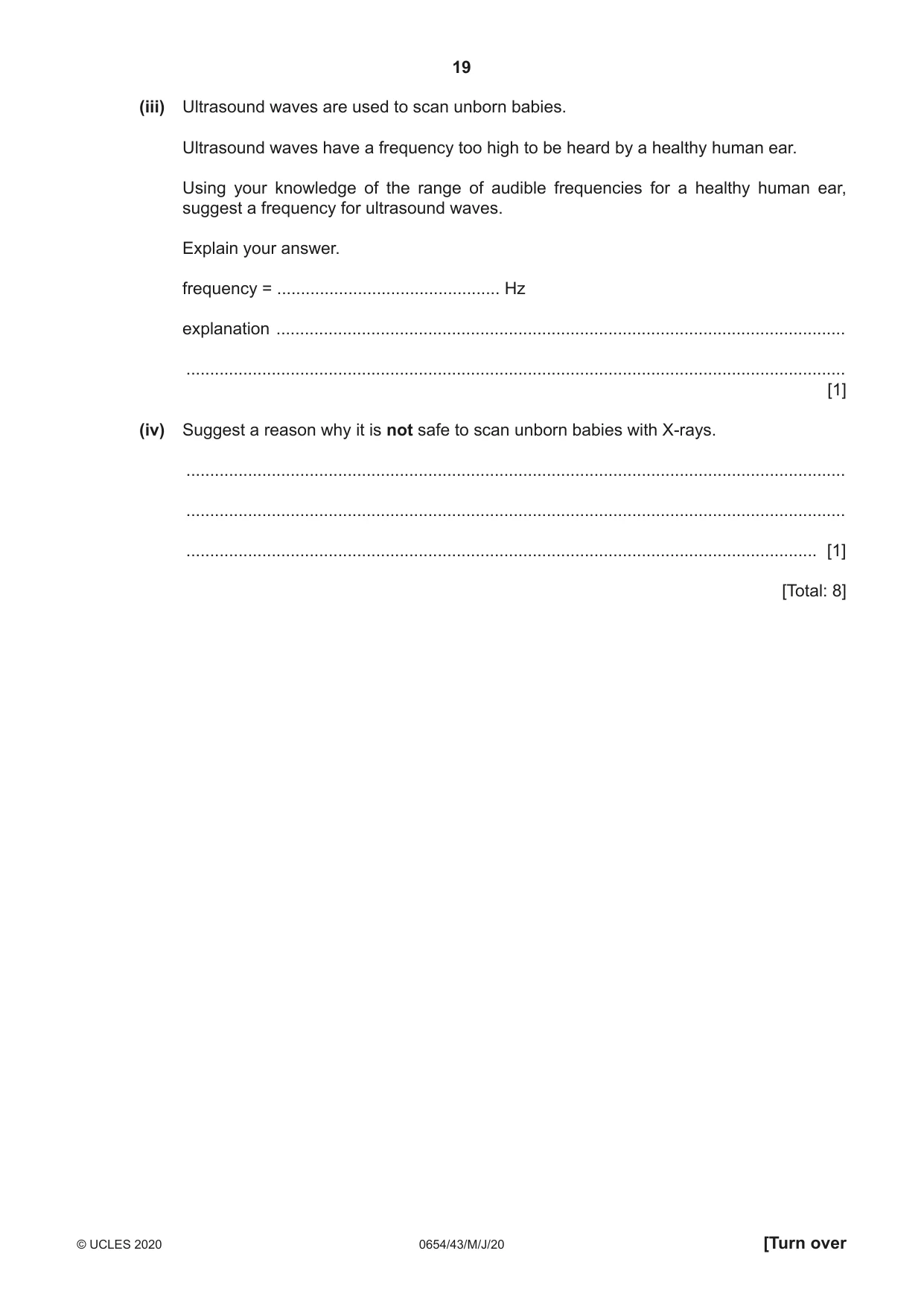
19 0654/43/M/J/20 © UCLES 2020 [Turn over (iii) Ultrasound waves are used to scan unborn babies. Ultrasound waves have a frequency too high to be heard by a healthy human ear. Using your knowledge of the range of audible frequencies for a healthy human ear, suggest a frequency for ultrasound waves. Explain your answer. frequency = … Hz explanation … … [1] (iv) Suggest a reason why it is not safe to scan unborn babies with X-rays. … … … [1] [Total: 8]
Question paper, page 20
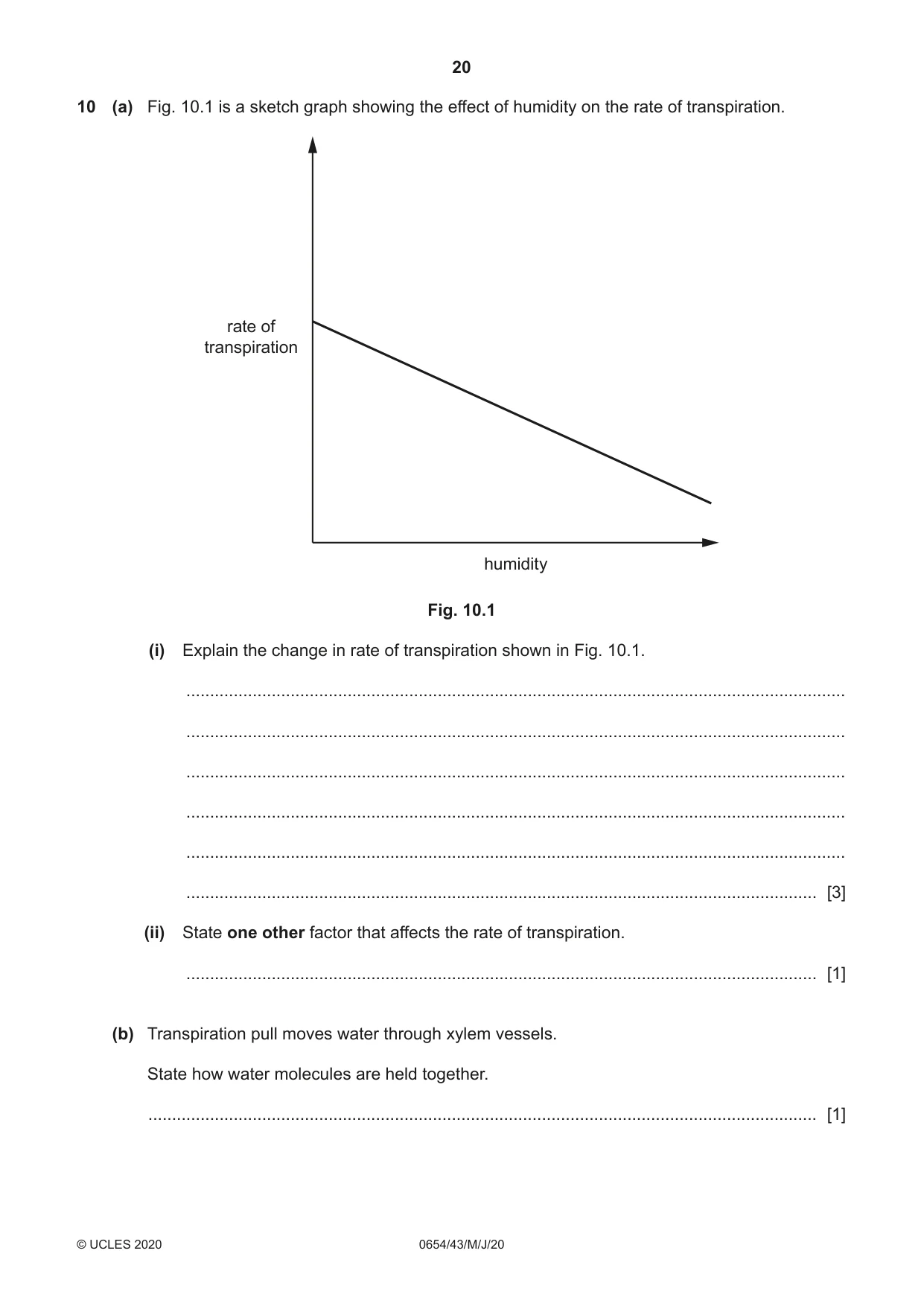
20 0654/43/M/J/20 © UCLES 2020 10 (a) Fig. 10.1 is a sketch graph showing the effect of humidity on the rate of transpiration. humidity rate of transpiration Fig. 10.1 (i) Explain the change in rate of transpiration shown in Fig. 10.1. … … … … … … [3] (ii) State one other factor that affects the rate of transpiration. … [1] (b) Transpiration pull moves water through xylem vessels. State how water molecules are held together. … [1]
Question paper, page 21
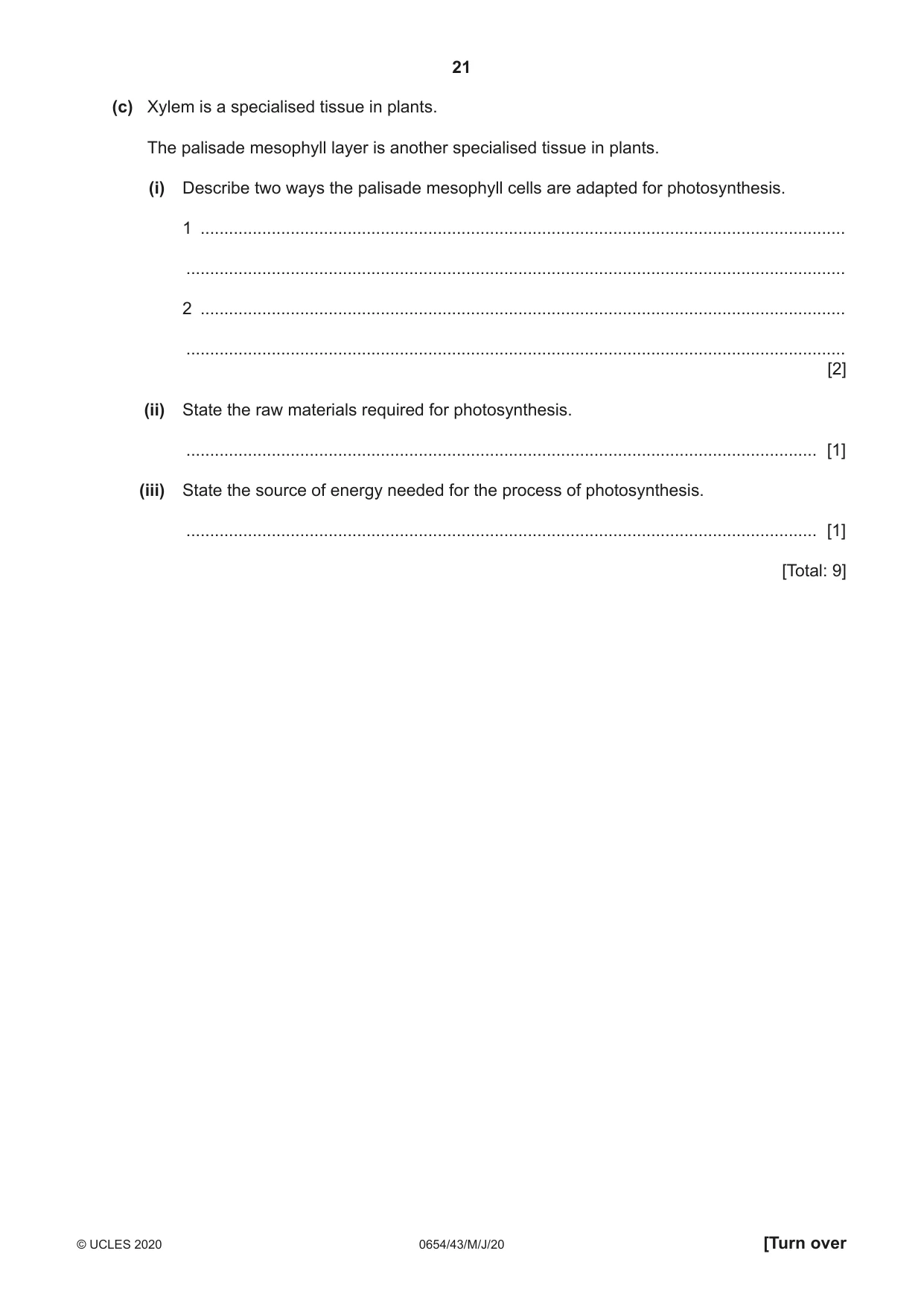
21 0654/43/M/J/20 © UCLES 2020 [Turn over (c) Xylem is a specialised tissue in plants. The palisade mesophyll layer is another specialised tissue in plants. (i) Describe two ways the palisade mesophyll cells are adapted for photosynthesis. 1 … … 2 … … [2] (ii) State the raw materials required for photosynthesis. … [1] (iii) State the source of energy needed for the process of photosynthesis. … [1] [Total: 9]
Question paper, page 22
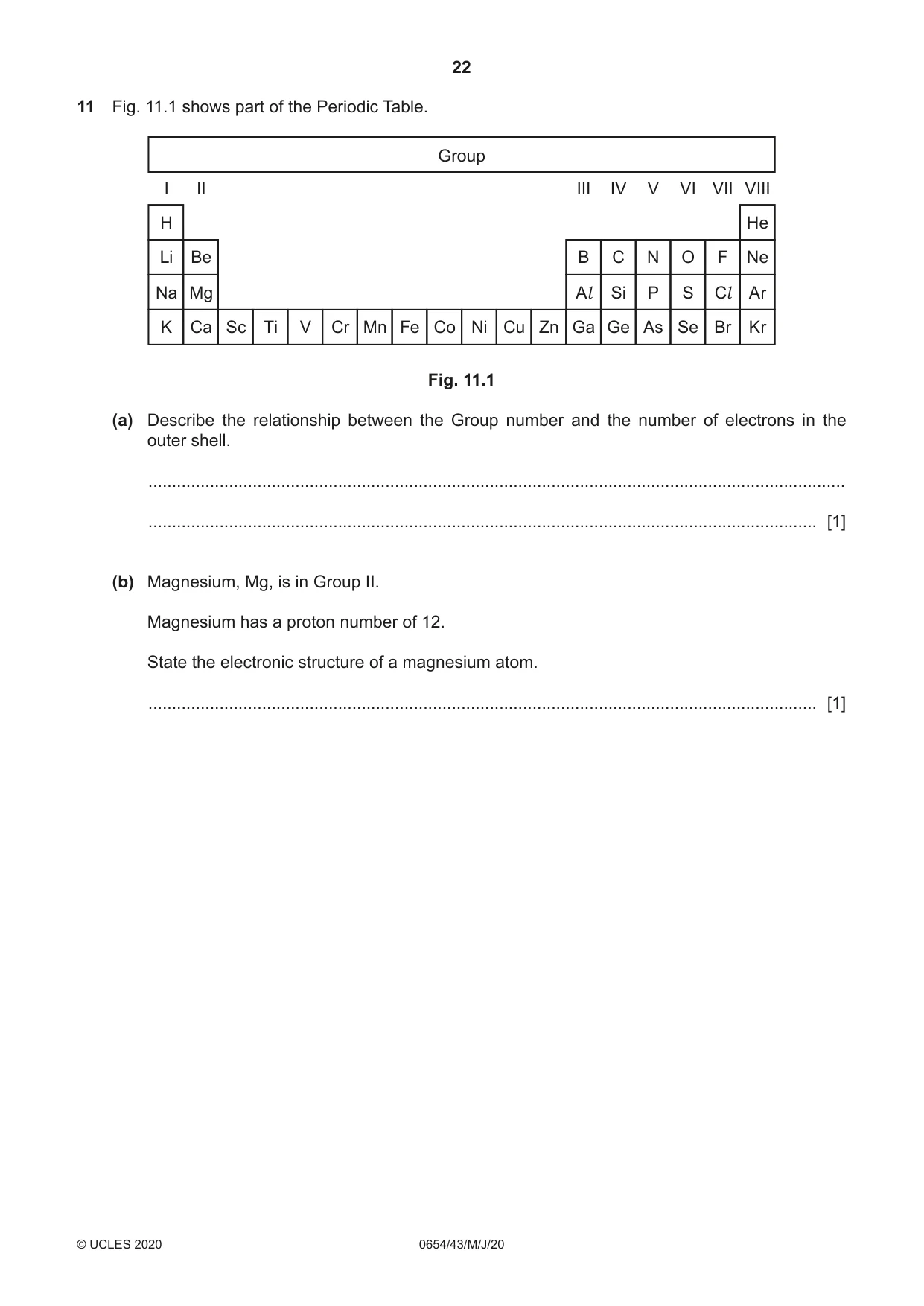
22 0654/43/M/J/20 © UCLES 2020 11 Fig. 11.1 shows part of the Periodic Table. Be Li Mg Na Ca K Ti Sc Cr V Fe Mn Ni Co Zn Group Cu Ge Ga Se As Kr Br Si Al S P Ar Cl C B O N Ne He F H I II III IV V VI VII VIII Fig. 11.1 (a) Describe the relationship between the Group number and the number of electrons in the outer shell. … … [1] (b) Magnesium, Mg, is in Group II. Magnesium has a proton number of 12. State the electronic structure of a magnesium atom. … [1]
Question paper, page 23
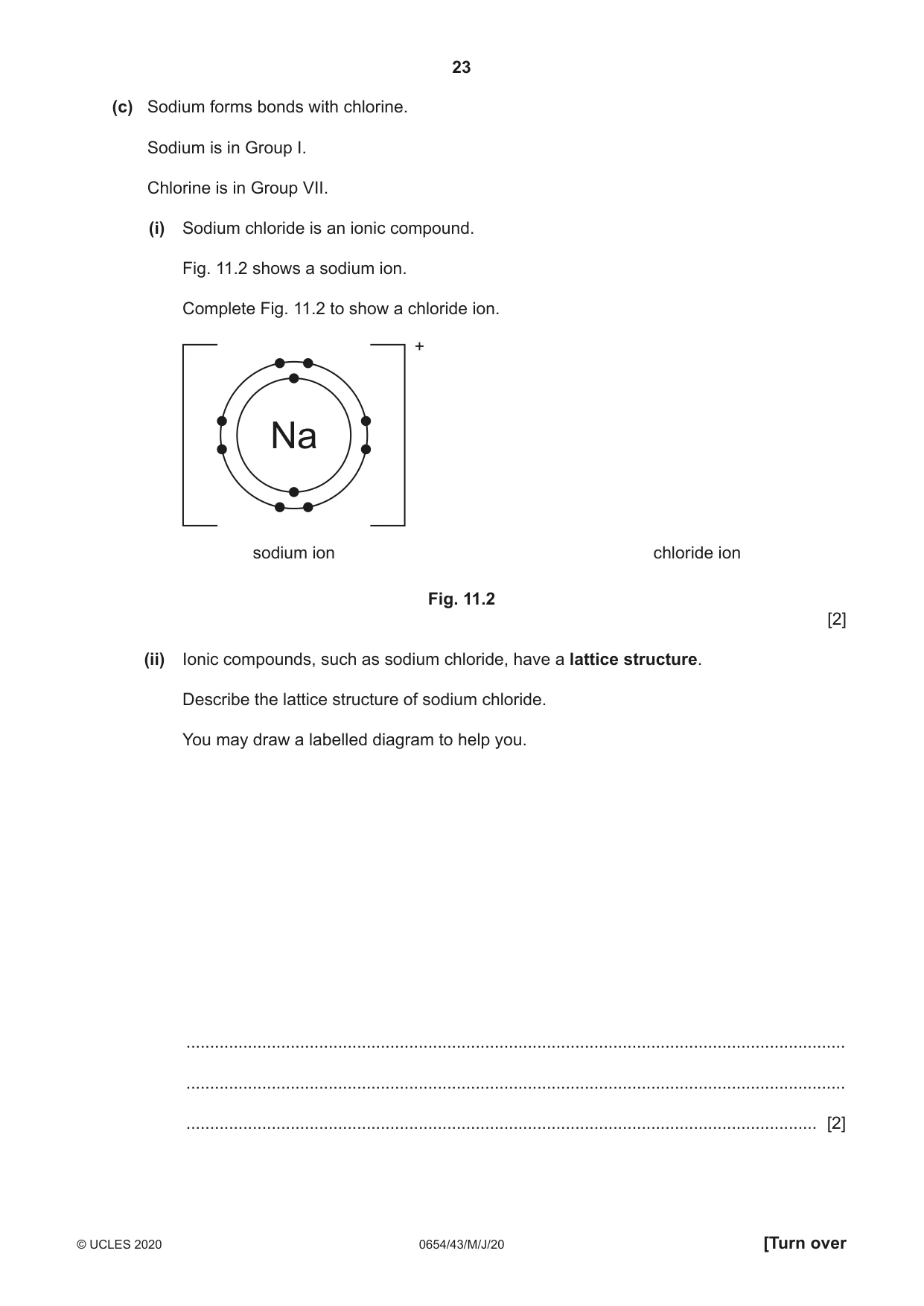
23 0654/43/M/J/20 © UCLES 2020 [Turn over (c) Sodium forms bonds with chlorine. Sodium is in Group I. Chlorine is in Group VII. (i) Sodium chloride is an ionic compound. Fig. 11.2 shows a sodium ion. Complete Fig. 11.2 to show a chloride ion. + sodium ion chloride ion Na Fig. 11.2 [2] (ii) Ionic compounds, such as sodium chloride, have a lattice structure. Describe the lattice structure of sodium chloride. You may draw a labelled diagram to help you. … … … [2]
Question paper, page 24
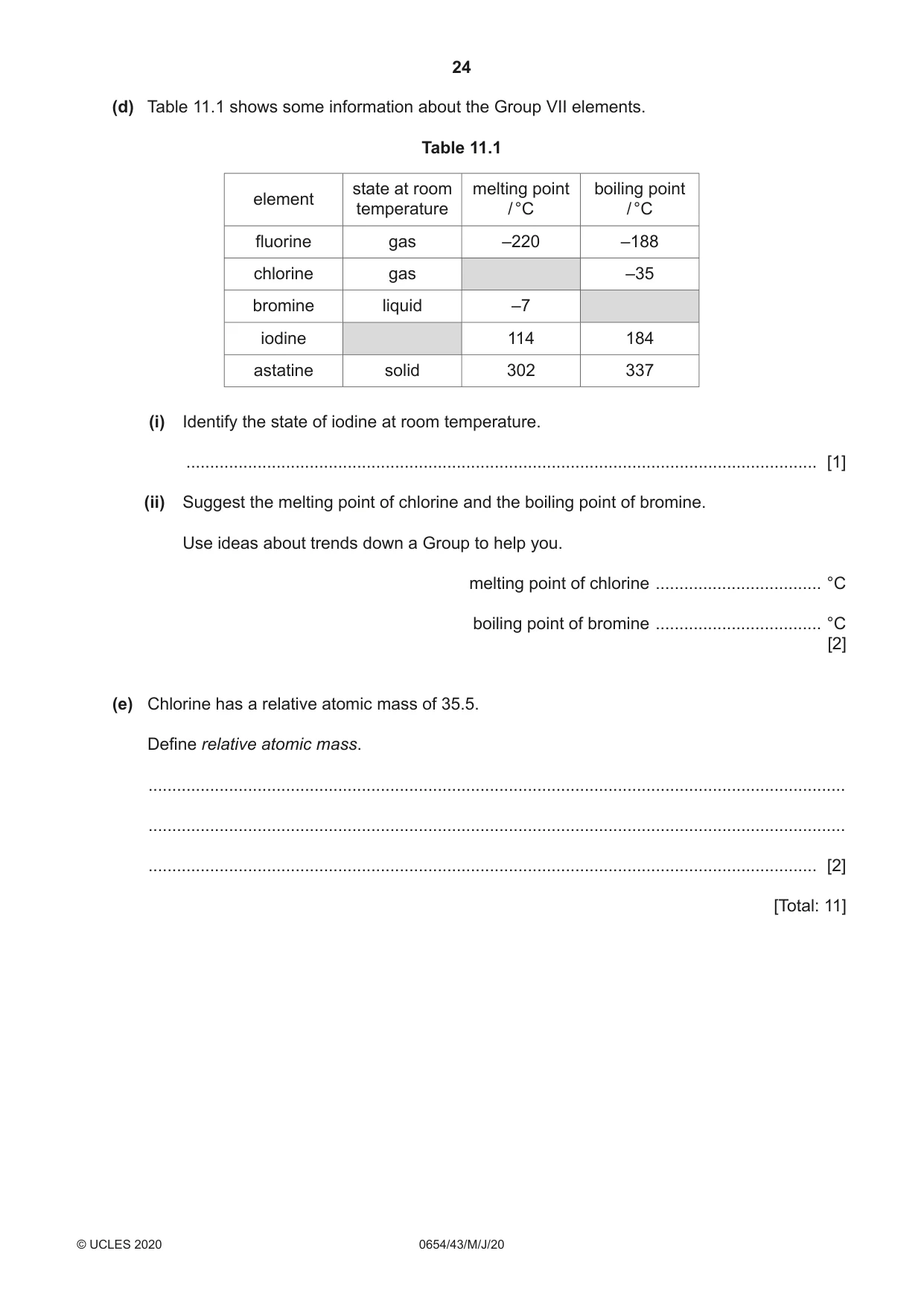
24 0654/43/M/J/20 © UCLES 2020 (d) Table 11.1 shows some information about the Group VII elements. Table 11.1 element state at room temperature melting point / °C boiling point / °C fluorine gas –220 –188 chlorine gas –35 bromine liquid –7 iodine 114 184 astatine solid 302 337 (i) Identify the state of iodine at room temperature. … [1] (ii) Suggest the melting point of chlorine and the boiling point of bromine. Use ideas about trends down a Group to help you. melting point of chlorine … °C boiling point of bromine … °C [2] (e) Chlorine has a relative atomic mass of 35.5. Define relative atomic mass. … … … [2] [Total: 11]
Question paper, page 25
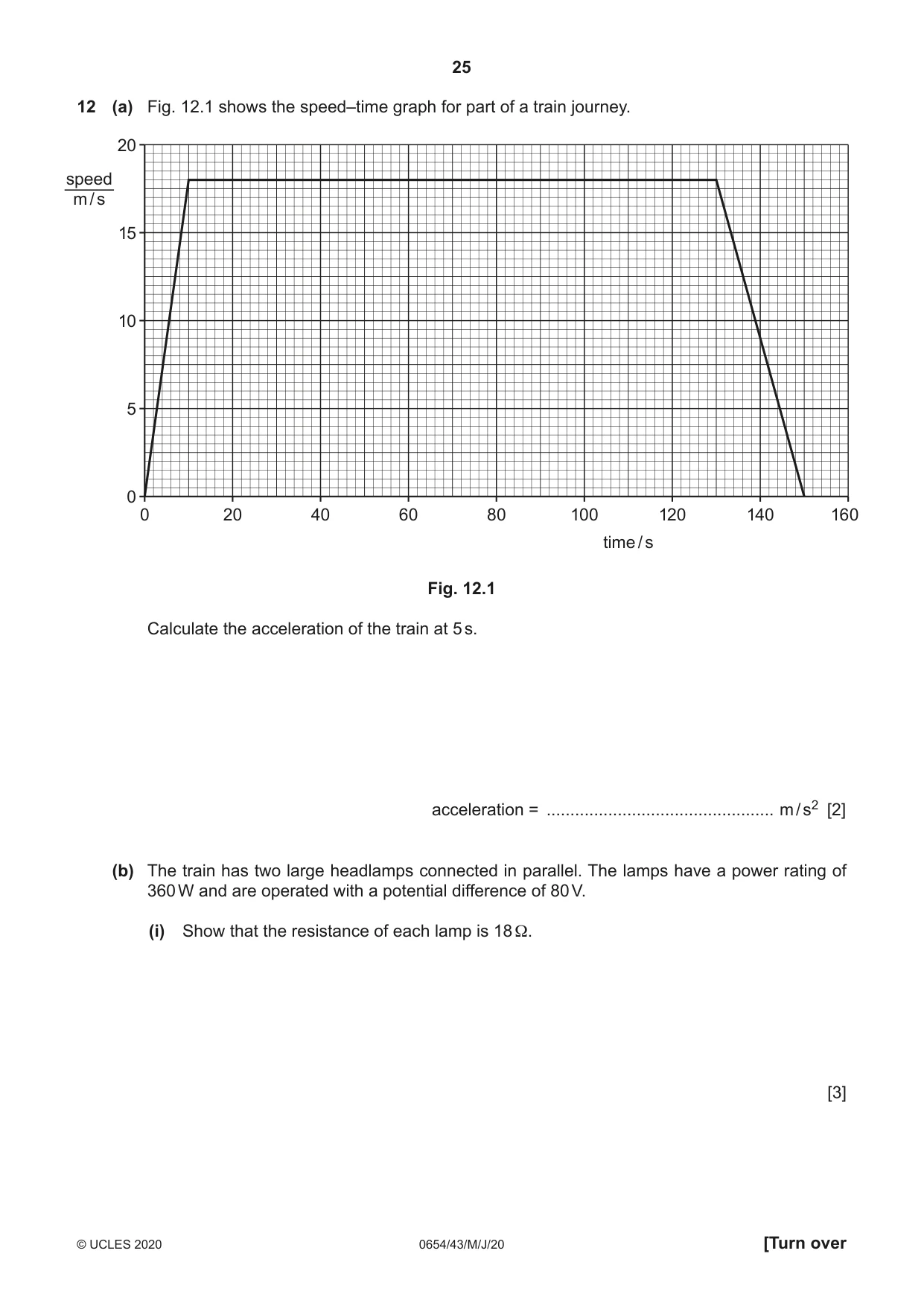
25 0654/43/M/J/20 © UCLES 2020 [Turn over 12 (a) Fig. 12.1 shows the speed–time graph for part of a train journey. 0 20 40 60 80 100 120 time / s 140 160 0 5 10 15 20 speed m / s Fig. 12.1 Calculate the acceleration of the train at 5 s. acceleration = … m / s2 [2] (b) The train has two large headlamps connected in parallel. The lamps have a power rating of 360 W and are operated with a potential difference of 80 V. (i) Show that the resistance of each lamp is 18 Ω. [3]
Question paper, page 26
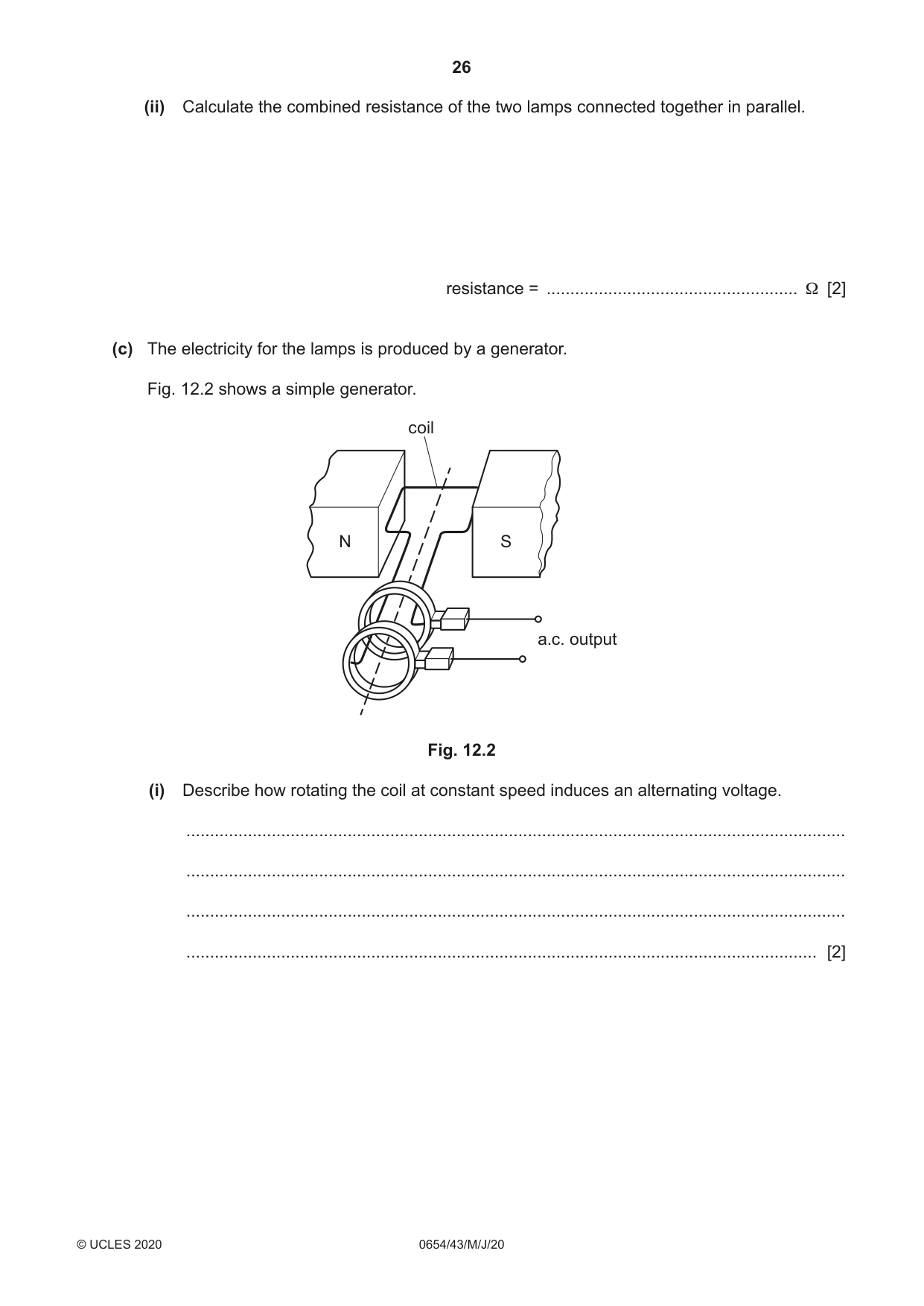
26 0654/43/M/J/20 © UCLES 2020 (ii) Calculate the combined resistance of the two lamps connected together in parallel. resistance = … Ω [2] (c) The electricity for the lamps is produced by a generator. Fig. 12.2 shows a simple generator. coil N S a.c. output Fig. 12.2 (i) Describe how rotating the coil at constant speed induces an alternating voltage. … … … … [2]
Question paper, page 27
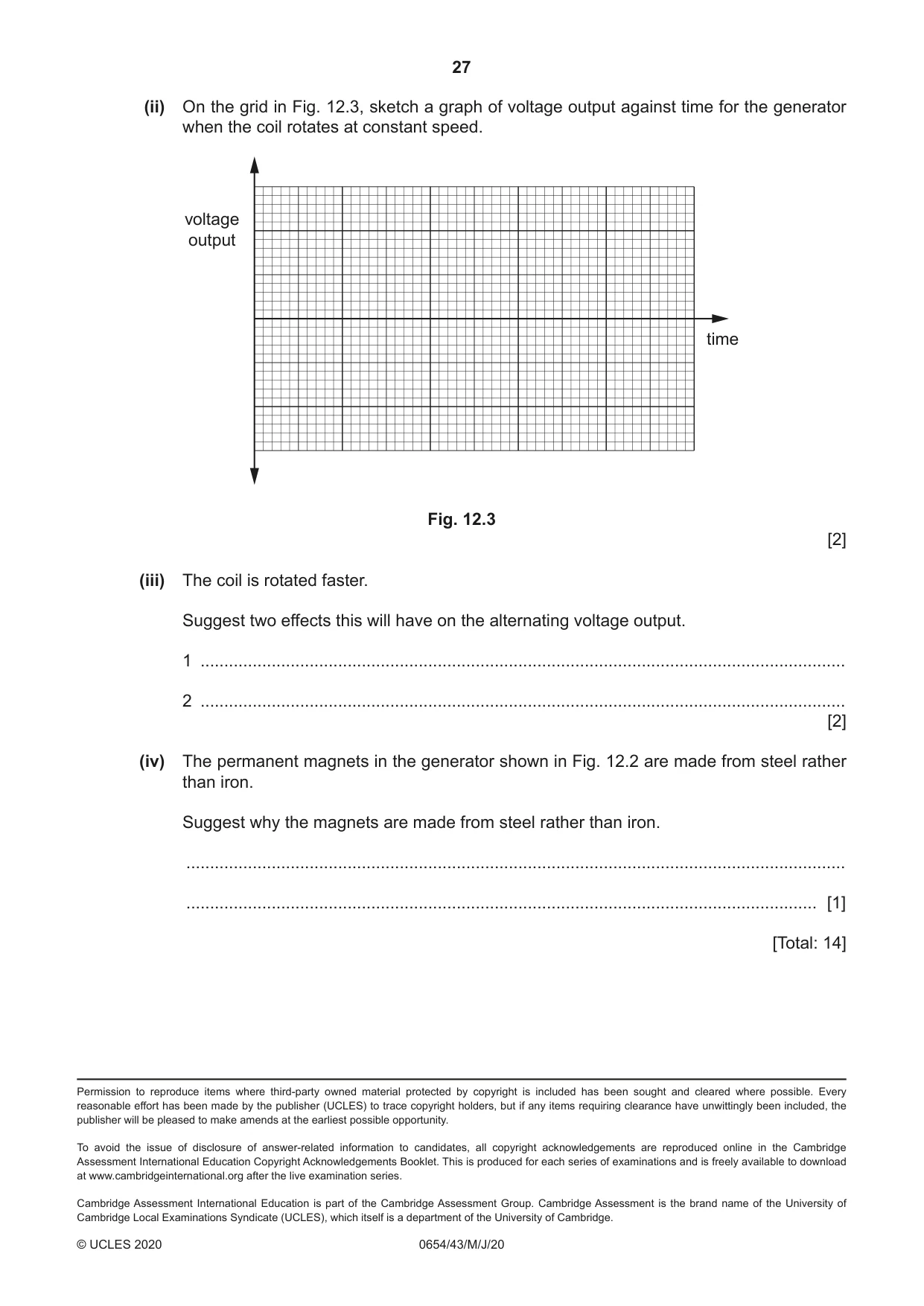
27 0654/43/M/J/20 © UCLES 2020 (ii) On the grid in Fig. 12.3, sketch a graph of voltage output against time for the generator when the coil rotates at constant speed. time voltage output Fig. 12.3 [2] (iii) The coil is rotated faster. Suggest two effects this will have on the alternating voltage output. 1 … 2 … [2] (iv) The permanent magnets in the generator shown in Fig. 12.2 are made from steel rather than iron. Suggest why the magnets are made from steel rather than iron. … … [1] [Total: 14] Permission to reproduce items where third-party owned material protected by copyright is included has been sought and cleared where possible. Every reasonable effort has been made by the publisher (UCLES) to trace copyright holders, but if any items requiring clearance have unwittingly been included, the publisher will be pleased to make amends at the earliest possible opportunity. To avoid the issue of disclosure of answer-related information to candidates, all copyright acknowledgements are reproduced online in the Cambridge Assessment International Education Copyright Acknowledgements Booklet. This is produced for each series of examinations and is freely available to download at www.cambridgeinternational.org after the live examination series. Cambridge Assessment International Education is part of the Cambridge Assessment Group. Cambridge Assessment is the brand name of the University of Cambridge Local Examinations Syndicate (UCLES), which itself is a department of the University of Cambridge.
Question paper, page 28
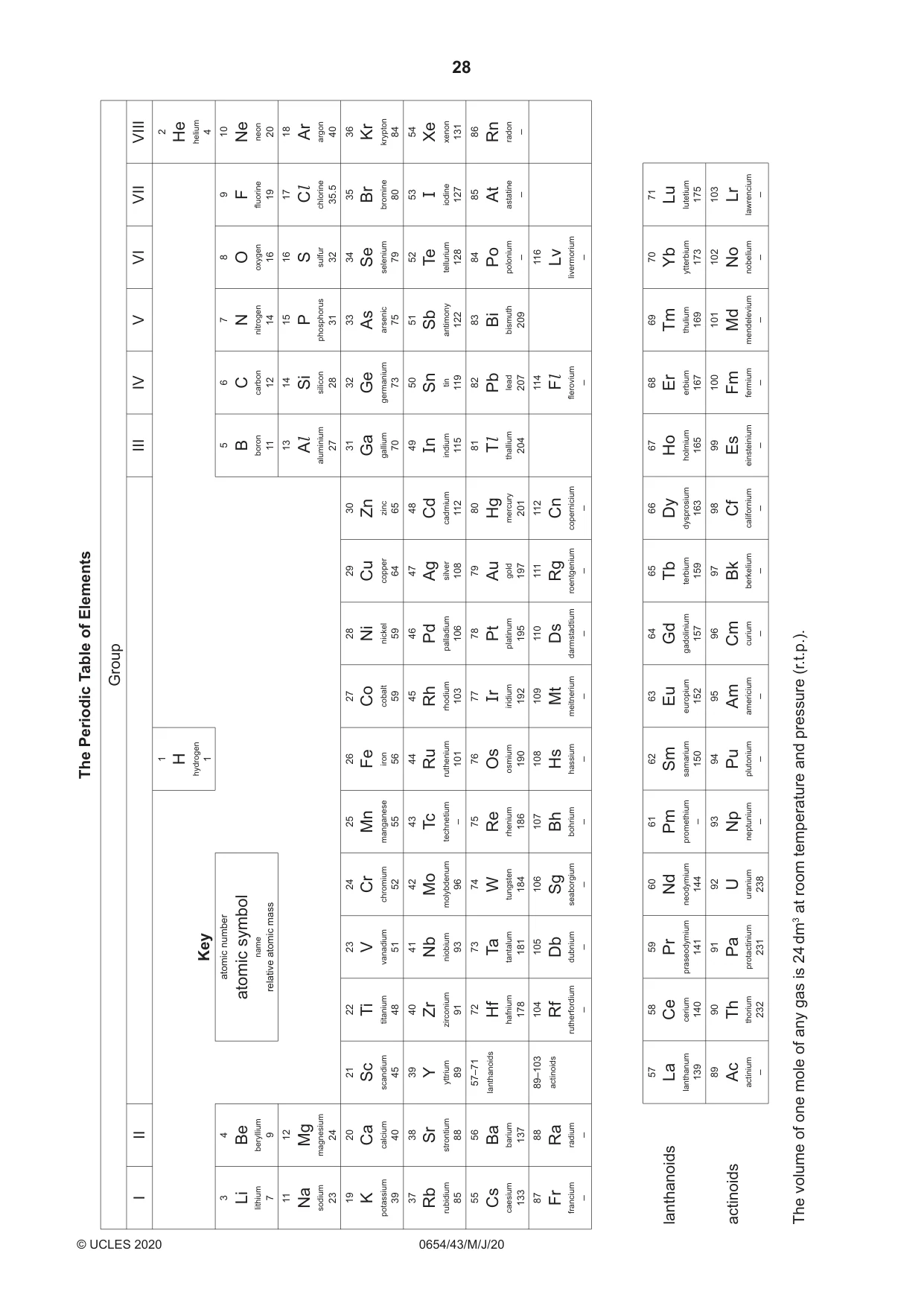
28 0654/43/M/J/20 © UCLES 2020 Group The Periodic Table of Elements 1 H hydrogen 1 2 He helium 4 I II III IV V VI VII VIII 3 Li lithium 7 4 Be beryllium 9 atomic number atomic symbol Key name relative atomic mass 11 Na sodium 23 12 Mg magnesium 24 19 K potassium 39 20 Ca calcium 40 37 Rb rubidium 85 38 Sr strontium 88 55 Cs caesium 133 56 Ba barium 137 87 Fr francium – 88 Ra radium – 5 B boron 11 13 Al aluminium 27 31 Ga gallium 70 49 In indium 115 81 Tl thallium 204 6 C carbon 12 14 Si silicon 28 32 Ge germanium 73 50 Sn tin 119 82 Pb lead 207 22 Ti titanium 48 40 Zr zirconium 91 72 Hf hafnium 178 104 Rf rutherfordium – 23 V vanadium 51 41 Nb niobium 93 73 Ta tantalum 181 105 Db dubnium – 24 Cr chromium 52 42 Mo molybdenum 96 74 W tungsten 184 106 Sg seaborgium – 25 Mn manganese 55 43 Tc technetium – 75 Re rhenium 186 107 Bh bohrium – 26 Fe iron 56 44 Ru ruthenium 101 76 Os osmium 190 108 Hs hassium – 27 Co cobalt 59 45 Rh rhodium 103 77 Ir iridium 192 109 Mt meitnerium – 28 Ni nickel 59 46 Pd palladium 106 78 Pt platinum 195 110 Ds darmstadtium – 29 Cu copper 64 47 Ag silver 108 79 Au gold 197 111 Rg roentgenium – 30 Zn zinc 65 48 Cd cadmium 112 80 Hg mercury 201 112 Cn copernicium – 114 Fl flerovium – 116 Lv livermorium – 7 N nitrogen 14 15 P phosphorus 31 33 As arsenic 75 51 Sb antimony 122 83 Bi bismuth 209 8 O oxygen 16 16 S sulfur 32 34 Se selenium 79 52 Te tellurium 128 84 Po polonium – 9 F fluorine 19 17 Cl chlorine 35.5 35 Br bromine 80 53 I iodine 127 85 At astatine – 10 Ne neon 20 18 Ar argon 40 36 Kr krypton 84 54 Xe xenon 131 86 Rn radon – 21 Sc scandium 45 39 Y yttrium 89 57–71 lanthanoids 89–103 actinoids 57 La lanthanum 139 89 Ac lanthanoids actinoids The volume of one mole of any gas is 24 dm3 at room temperature and pressure (r.t.p.). actinium – 58 Ce cerium 140 90 Th thorium 232 59 Pr praseodymium 141 91 Pa protactinium 231 60 Nd neodymium 144 92 U uranium 238 61 Pm promethium – 93 Np neptunium – 62 Sm samarium 150 94 Pu plutonium – 63 Eu europium 152 95 Am americium – 64 Gd gadolinium 157 96 Cm curium – 65 Tb terbium 159 97 Bk berkelium – 66 Dy dysprosium 163 98 Cf californium – 67 Ho holmium 165 99 Es einsteinium – 68 Er erbium 167 100 Fm fermium – 69 Tm thulium 169 101 Md mendelevium – 70 Yb ytterbium 173 102 No nobelium – 71 Lu lutetium 175 103 Lr lawrencium –
Mark scheme, page 1
This document consists of 13 printed pages. © UCLES 2020 [Turn over Cambridge IGCSE™ CO-ORDINATED SCIENCES 0654/43 Paper 4 Theory (Extended) May/June 2020 MARK SCHEME Maximum Mark: 120 Published Students did not sit exam papers in the June 2020 series due to the Covid-19 global pandemic. This mark scheme is published to support teachers and students and should be read together with the question paper. It shows the requirements of the exam. The answer column of the mark scheme shows the proposed basis on which Examiners would award marks for this exam. Where appropriate, this column also provides the most likely acceptable alternative responses expected from students. Examiners usually review the mark scheme after they have seen student responses and update the mark scheme if appropriate. In the June series, Examiners were unable to consider the acceptability of alternative responses, as there were no student responses to consider. Mark schemes should usually be read together with the Principal Examiner Report for Teachers. However, because students did not sit exam papers, there is no Principal Examiner Report for Teachers for the June 2020 series. Cambridge International will not enter into discussions about these mark schemes. Cambridge International is publishing the mark schemes for the June 2020 series for most Cambridge IGCSE™ and Cambridge International A & AS Level components, and some Cambridge O Level components.
Mark scheme, page 2
0654/43 Cambridge IGCSE – Mark Scheme PUBLISHED May/June 2020 © UCLES 2020 Page 2 of 13 Generic Marking Principles These general marking principles must be applied by all examiners when marking candidate answers. They should be applied alongside the specific content of the mark scheme or generic level descriptors for a question. Each question paper and mark scheme will also comply with these marking principles. GENERIC MARKING PRINCIPLE 1: Marks must be awarded in line with: • the specific content of the mark scheme or the generic level descriptors for the question • the specific skills defined in the mark scheme or in the generic level descriptors for the question • the standard of response required by a candidate as exemplified by the standardisation scripts. GENERIC MARKING PRINCIPLE 2: Marks awarded are always whole marks (not half marks, or other fractions). GENERIC MARKING PRINCIPLE 3: Marks must be awarded positively: • marks are awarded for correct/valid answers, as defined in the mark scheme. However, credit is given for valid answers which go beyond the scope of the syllabus and mark scheme, referring to your Team Leader as appropriate • marks are awarded when candidates clearly demonstrate what they know and can do • marks are not deducted for errors • marks are not deducted for omissions • answers should only be judged on the quality of spelling, punctuation and grammar when these features are specifically assessed by the question as indicated by the mark scheme. The meaning, however, should be unambiguous. GENERIC MARKING PRINCIPLE 4: Rules must be applied consistently e.g. in situations where candidates have not followed instructions or in the application of generic level descriptors.
Mark scheme, page 3
0654/43 Cambridge IGCSE – Mark Scheme PUBLISHED May/June 2020 © UCLES 2020 Page 3 of 13 GENERIC MARKING PRINCIPLE 5: Marks should be awarded using the full range of marks defined in the mark scheme for the question (however; the use of the full mark range may be limited according to the quality of the candidate responses seen). GENERIC MARKING PRINCIPLE 6: Marks awarded are based solely on the requirements as defined in the mark scheme. Marks should not be awarded with grade thresholds or grade descriptors in mind. Science-Specific Marking Principles 1 Examiners should consider the context and scientific use of any keywords when awarding marks. Although keywords may be present, marks should not be awarded if the keywords are used incorrectly. 2 The examiner should not choose between contradictory statements given in the same question part, and credit should not be awarded for any correct statement that is contradicted within the same question part. Wrong science that is irrelevant to the question should be ignored. 3 Although spellings do not have to be correct, spellings of syllabus terms must allow for clear and unambiguous separation from other syllabus terms with which they may be confused (e.g. ethane / ethene, glucagon / glycogen, refraction / reflection). 4 The error carried forward (ecf) principle should be applied, where appropriate. If an incorrect answer is subsequently used in a scientifically correct way, the candidate should be awarded these subsequent marking points. Further guidance will be included in the mark scheme where necessary and any exceptions to this general principle will be noted.
Mark scheme, page 4
0654/43 Cambridge IGCSE – Mark Scheme PUBLISHED May/June 2020 © UCLES 2020 Page 4 of 13 5 ‘List rule’ guidance (see examples below) For questions that require n responses (e.g. State two reasons …): • The response should be read as continuous prose, even when numbered answer spaces are provided • Any response marked ignore in the mark scheme should not count towards n • Incorrect responses should not be awarded credit but will still count towards n • Read the entire response to check for any responses that contradict those that would otherwise be credited. Credit should not be awarded for any responses that are contradicted within the rest of the response. Where two responses contradict one another, this should be treated as a single incorrect response • Non-contradictory responses after the first n responses may be ignored even if they include incorrect science. 6 Calculation specific guidance Correct answers to calculations should be given full credit even if there is no working or incorrect working, unless the question states ‘show your working’. For questions in which the number of significant figures required is not stated, credit should be awarded for correct answers when rounded by the examiner to the number of significant figures given in the mark scheme. This may not apply to measured values. For answers given in standard form, (e.g. a × 10n) in which the convention of restricting the value of the coefficient (a) to a value between 1 and 10 is not followed, credit may still be awarded if the answer can be converted to the answer given in the mark scheme. Unless a separate mark is given for a unit, a missing or incorrect unit will normally mean that the final calculation mark is not awarded. Exceptions to this general principle will be noted in the mark scheme. 7 Guidance for chemical equations Multiples / fractions of coefficients used in chemical equations are acceptable unless stated otherwise in the mark scheme. State symbols given in an equation should be ignored unless asked for in the question or stated otherwise in the mark scheme.
Mark scheme, page 5
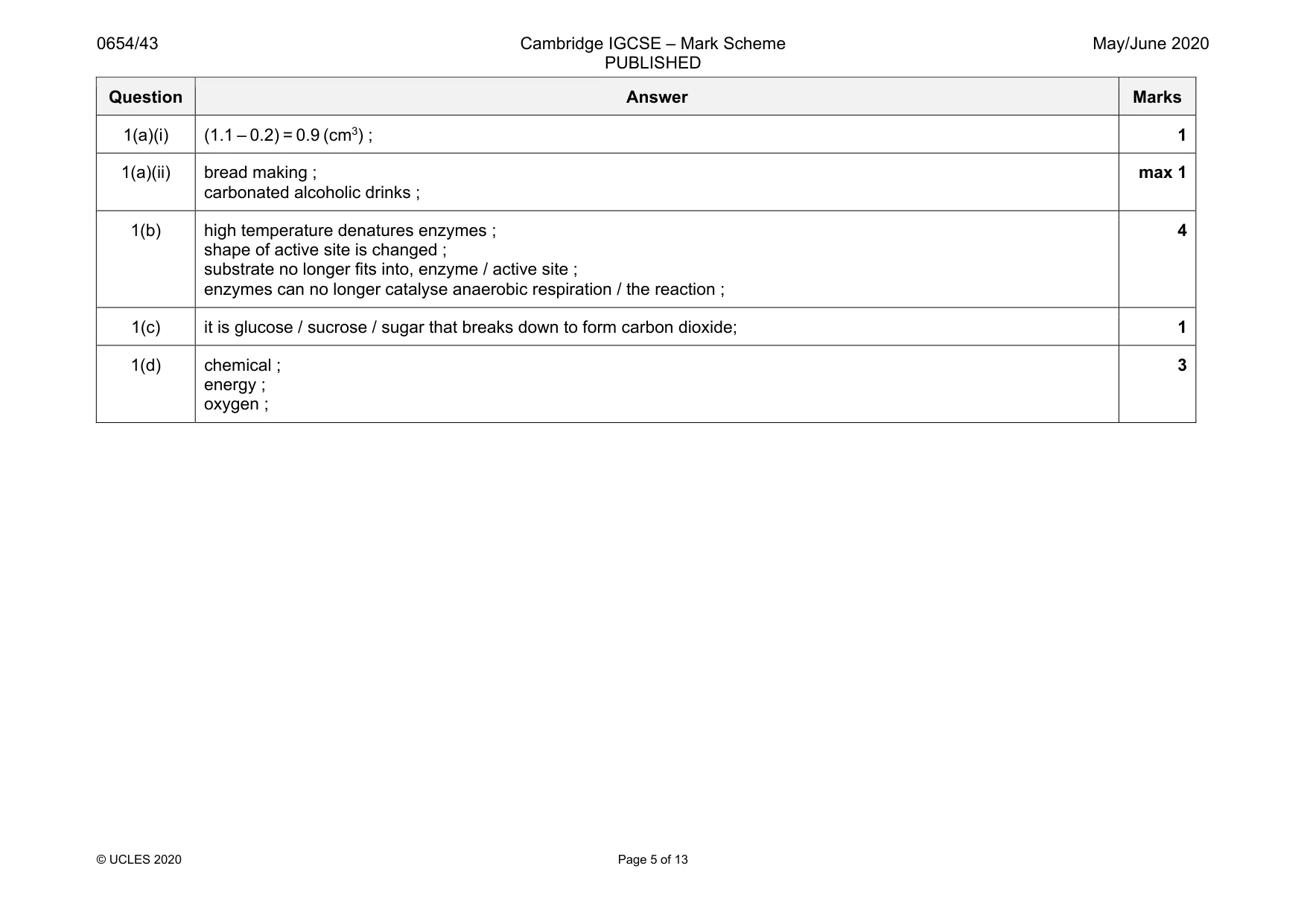
0654/43 Cambridge IGCSE – Mark Scheme PUBLISHED May/June 2020 © UCLES 2020 Page 5 of 13 Question Answer Marks 1(a)(i) (1.1 – 0.2) = 0.9 (cm3) ; 1 1(a)(ii) bread making ; carbonated alcoholic drinks ; max 1 1(b) high temperature denatures enzymes ; shape of active site is changed ; substrate no longer fits into, enzyme / active site ; enzymes can no longer catalyse anaerobic respiration / the reaction ; 4 1(c) it is glucose / sucrose / sugar that breaks down to form carbon dioxide; 1 1(d) chemical ; energy ; oxygen ; 3
Mark scheme, page 6
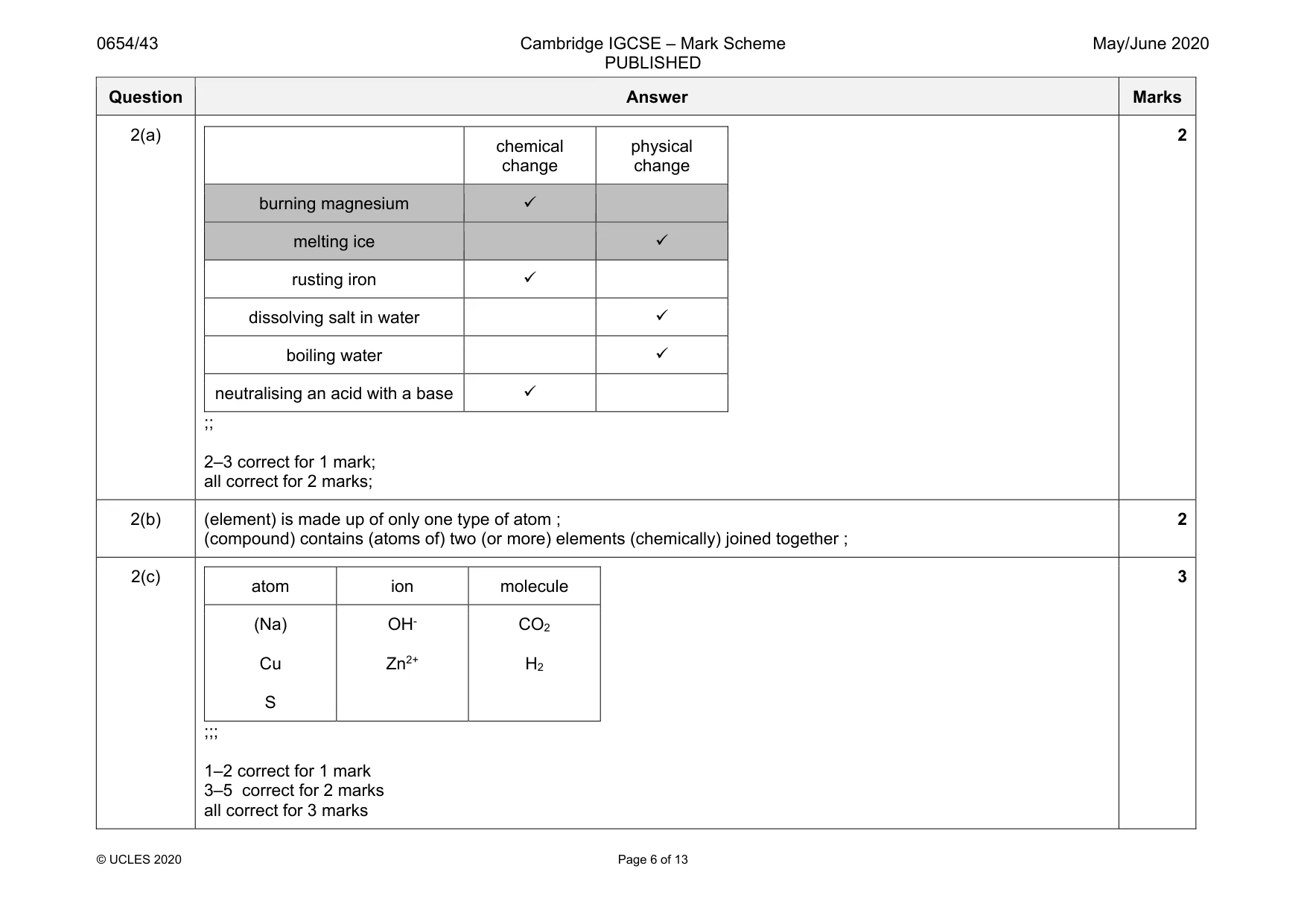
0654/43 Cambridge IGCSE – Mark Scheme PUBLISHED May/June 2020 © UCLES 2020 Page 6 of 13 Question Answer Marks 2(a) chemical change physical change burning magnesium melting ice rusting iron dissolving salt in water boiling water neutralising an acid with a base ;; 2–3 correct for 1 mark; all correct for 2 marks; 2 2(b) (element) is made up of only one type of atom ; (compound) contains (atoms of) two (or more) elements (chemically) joined together ; 2 2(c) atom ion molecule (Na) Cu S OH- Zn2+ CO2 H2 ;;; 1–2 correct for 1 mark 3–5 correct for 2 marks all correct for 3 marks 3
Mark scheme, page 7
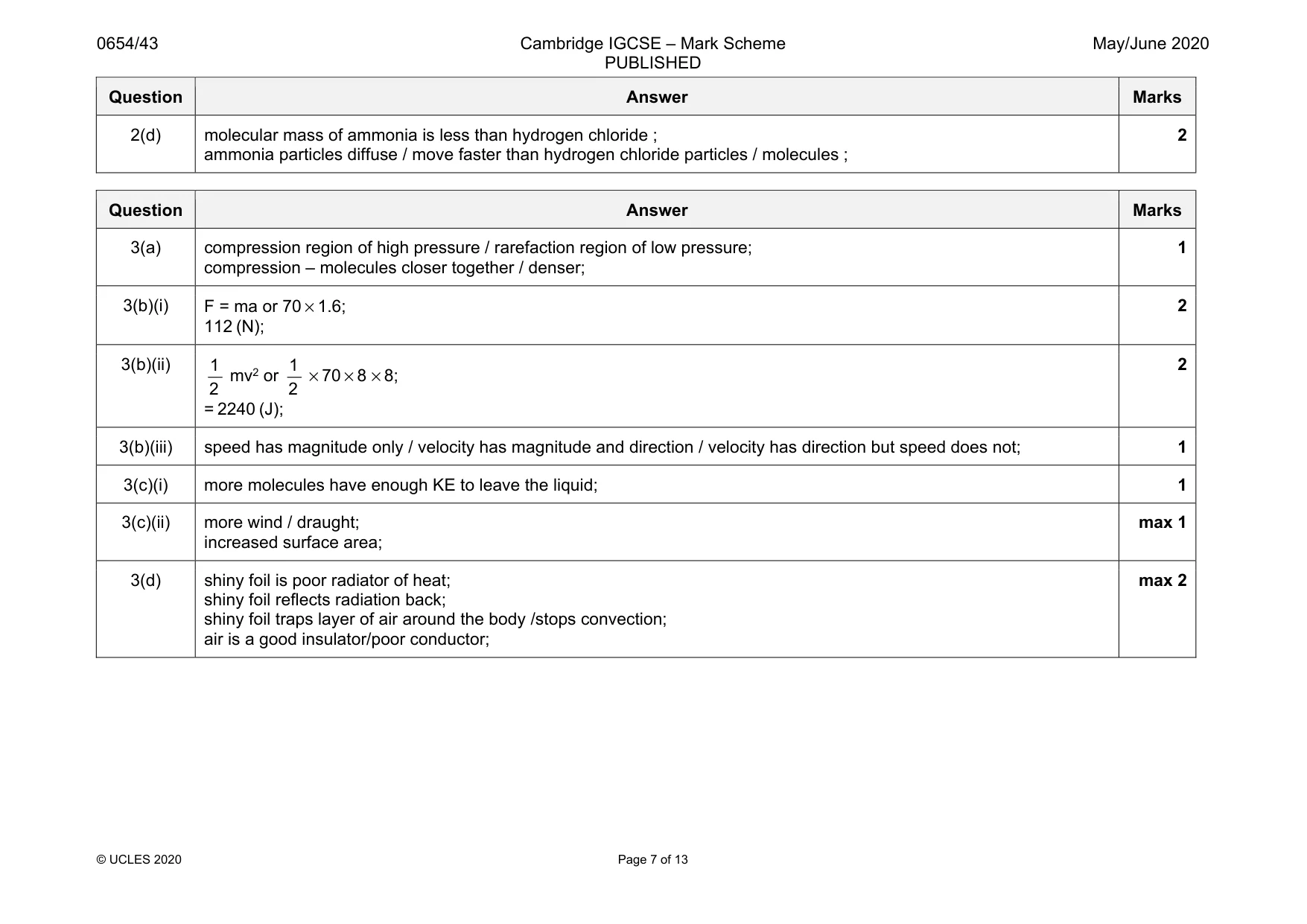
0654/43 Cambridge IGCSE – Mark Scheme PUBLISHED May/June 2020 © UCLES 2020 Page 7 of 13 Question Answer Marks 2(d) molecular mass of ammonia is less than hydrogen chloride ; ammonia particles diffuse / move faster than hydrogen chloride particles / molecules ; 2 Question Answer Marks 3(a) compression region of high pressure / rarefaction region of low pressure; compression – molecules closer together / denser; 1 3(b)(i) F = ma or 70 × 1.6; 112 (N); 2 3(b)(ii) 1 2 mv2 or 1 2 × 70 × 8 × 8; = 2240 (J); 2 3(b)(iii) speed has magnitude only / velocity has magnitude and direction / velocity has direction but speed does not; 1 3(c)(i) more molecules have enough KE to leave the liquid; 1 3(c)(ii) more wind / draught; increased surface area; max 1 3(d) shiny foil is poor radiator of heat; shiny foil reflects radiation back; shiny foil traps layer of air around the body /stops convection; air is a good insulator/poor conductor; max 2
Mark scheme, page 8
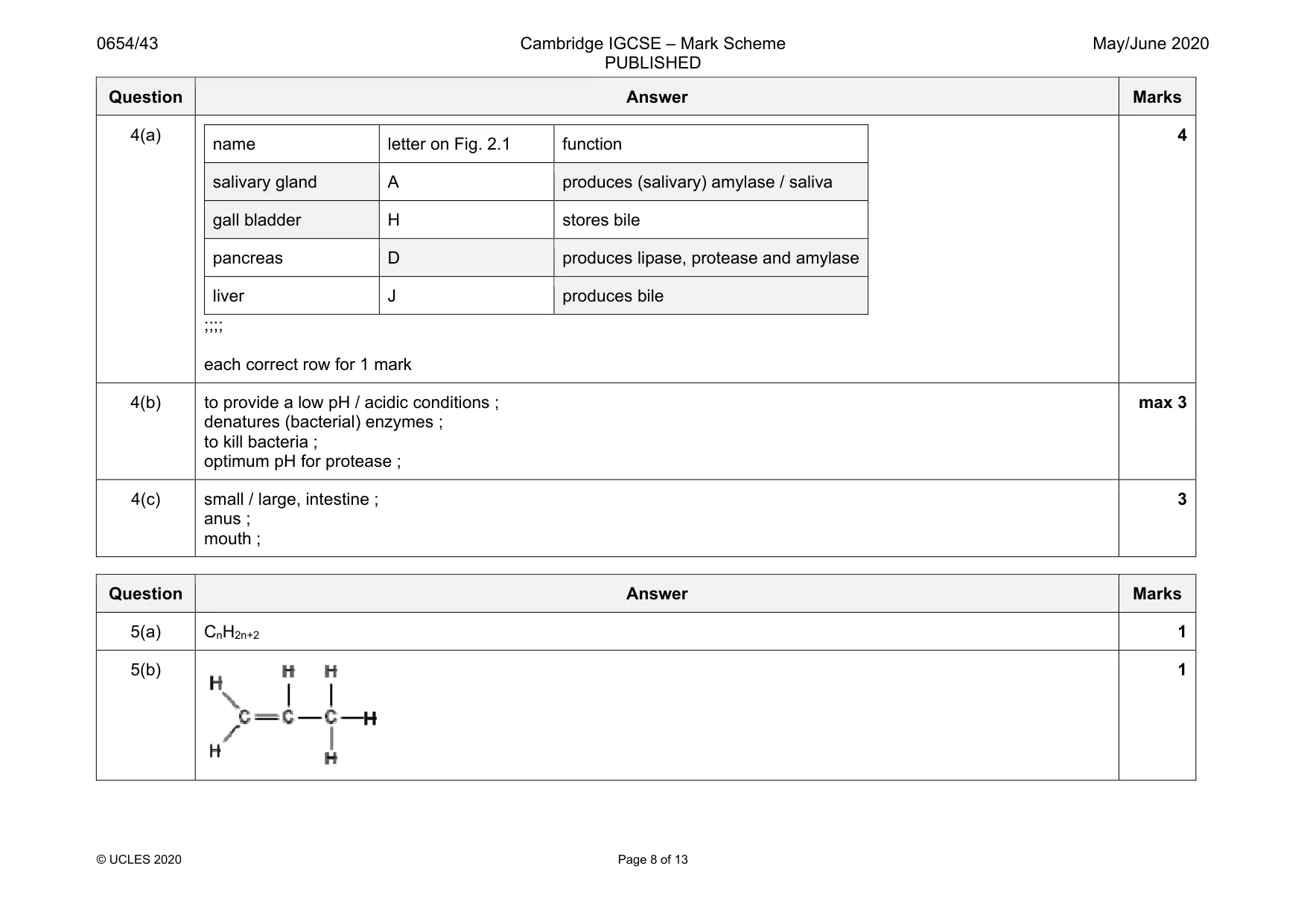
0654/43 Cambridge IGCSE – Mark Scheme PUBLISHED May/June 2020 © UCLES 2020 Page 8 of 13 Question Answer Marks 4(a) name letter on Fig. 2.1 function salivary gland A produces (salivary) amylase / saliva gall bladder H stores bile pancreas D produces lipase, protease and amylase liver J produces bile ;;;; each correct row for 1 mark 4 4(b) to provide a low pH / acidic conditions ; denatures (bacterial) enzymes ; to kill bacteria ; optimum pH for protease ; max 3 4(c) small / large, intestine ; anus ; mouth ; 3 Question Answer Marks 5(a) CnH2n+2 1 5(b) 1
Mark scheme, page 9
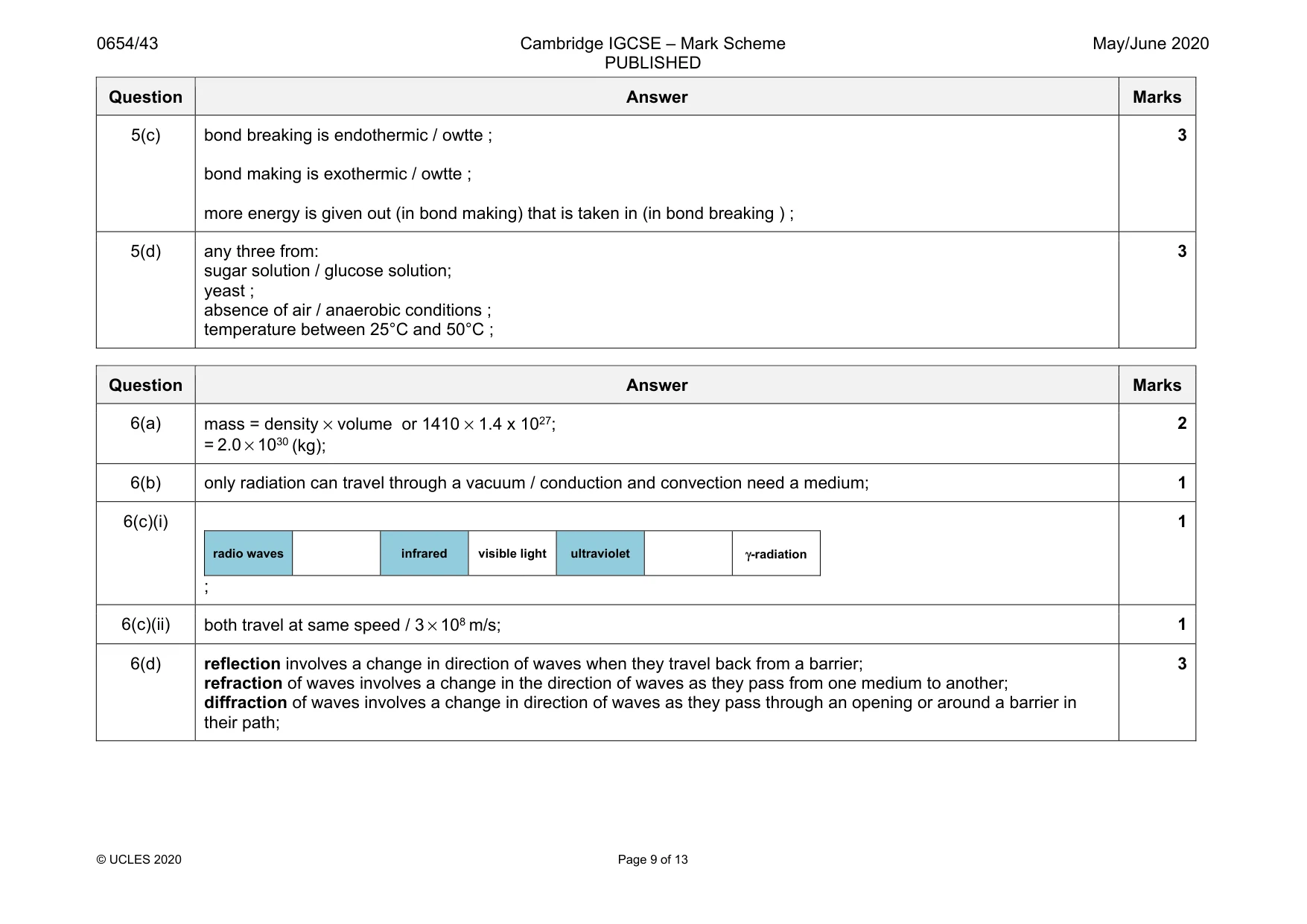
0654/43 Cambridge IGCSE – Mark Scheme PUBLISHED May/June 2020 © UCLES 2020 Page 9 of 13 Question Answer Marks 5(c) bond breaking is endothermic / owtte ; bond making is exothermic / owtte ; more energy is given out (in bond making) that is taken in (in bond breaking ) ; 3 5(d) any three from: sugar solution / glucose solution; yeast ; absence of air / anaerobic conditions ; temperature between 25°C and 50°C ; 3 Question Answer Marks 6(a) mass = density × volume or 1410 × 1.4 x 1027; = 2.0 × 1030 (kg); 2 6(b) only radiation can travel through a vacuum / conduction and convection need a medium; 1 6(c)(i) radio waves infrared visible light ultraviolet γ-radiation ; 1 6(c)(ii) both travel at same speed / 3 × 10⁸ m/s; 1 6(d) reflection involves a change in direction of waves when they travel back from a barrier; refraction of waves involves a change in the direction of waves as they pass from one medium to another; diffraction of waves involves a change in direction of waves as they pass through an opening or around a barrier in their path; 3
Mark scheme, page 10
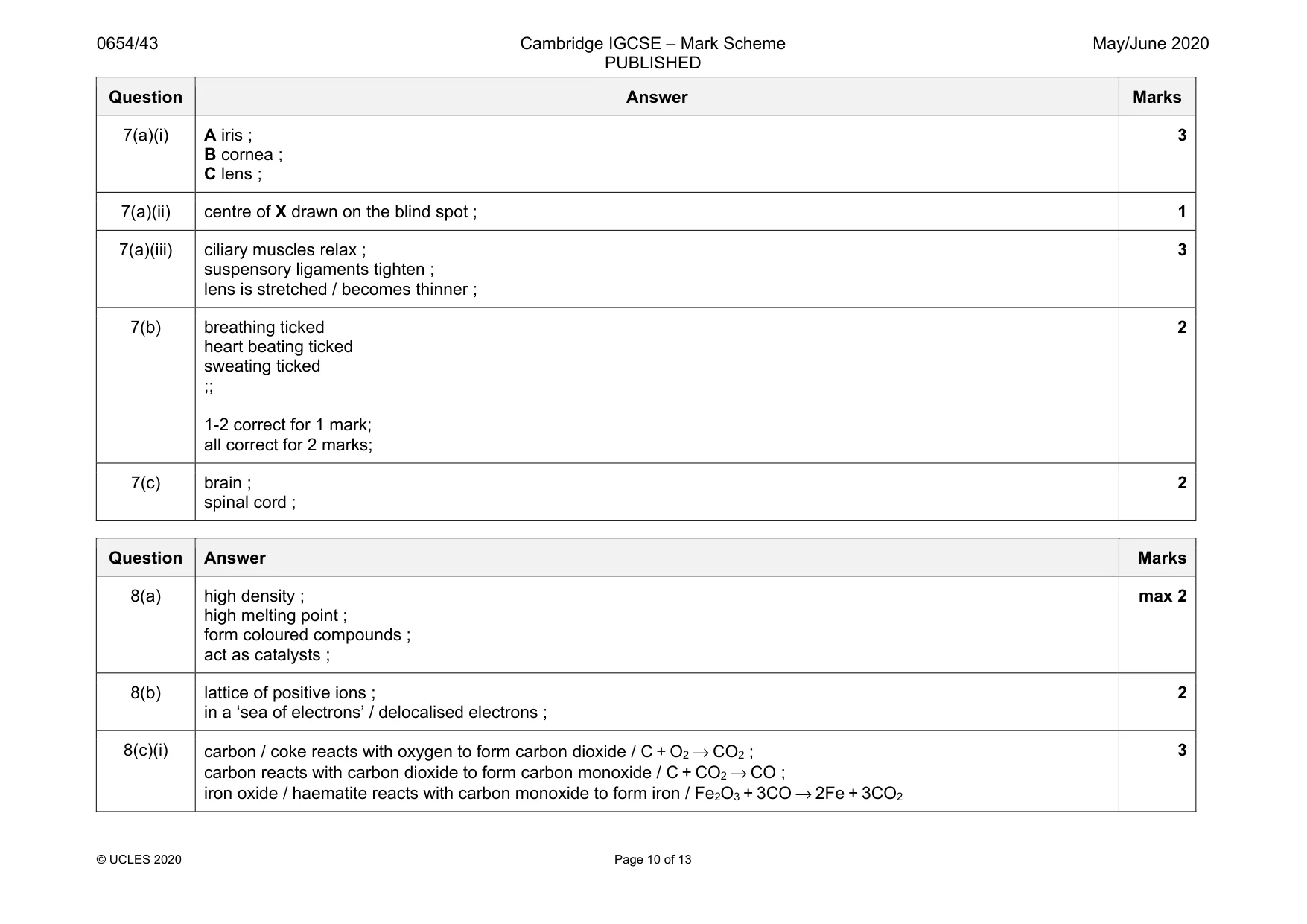
0654/43 Cambridge IGCSE – Mark Scheme PUBLISHED May/June 2020 © UCLES 2020 Page 10 of 13 Question Answer Marks 7(a)(i) A iris ; B cornea ; C lens ; 3 7(a)(ii) centre of X drawn on the blind spot ; 1 7(a)(iii) ciliary muscles relax ; suspensory ligaments tighten ; lens is stretched / becomes thinner ; 3 7(b) breathing ticked heart beating ticked sweating ticked ;; 1-2 correct for 1 mark; all correct for 2 marks; 2 7(c) brain ; spinal cord ; 2 Question Answer Marks 8(a) high density ; high melting point ; form coloured compounds ; act as catalysts ; max 2 8(b) lattice of positive ions ; in a ‘sea of electrons’ / delocalised electrons ; 2 8(c)(i) carbon / coke reacts with oxygen to form carbon dioxide / C + O2 → CO2 ; carbon reacts with carbon dioxide to form carbon monoxide / C + CO2 → CO ; iron oxide / haematite reacts with carbon monoxide to form iron / Fe2O3 + 3CO → 2Fe + 3CO2 3
Mark scheme, page 11
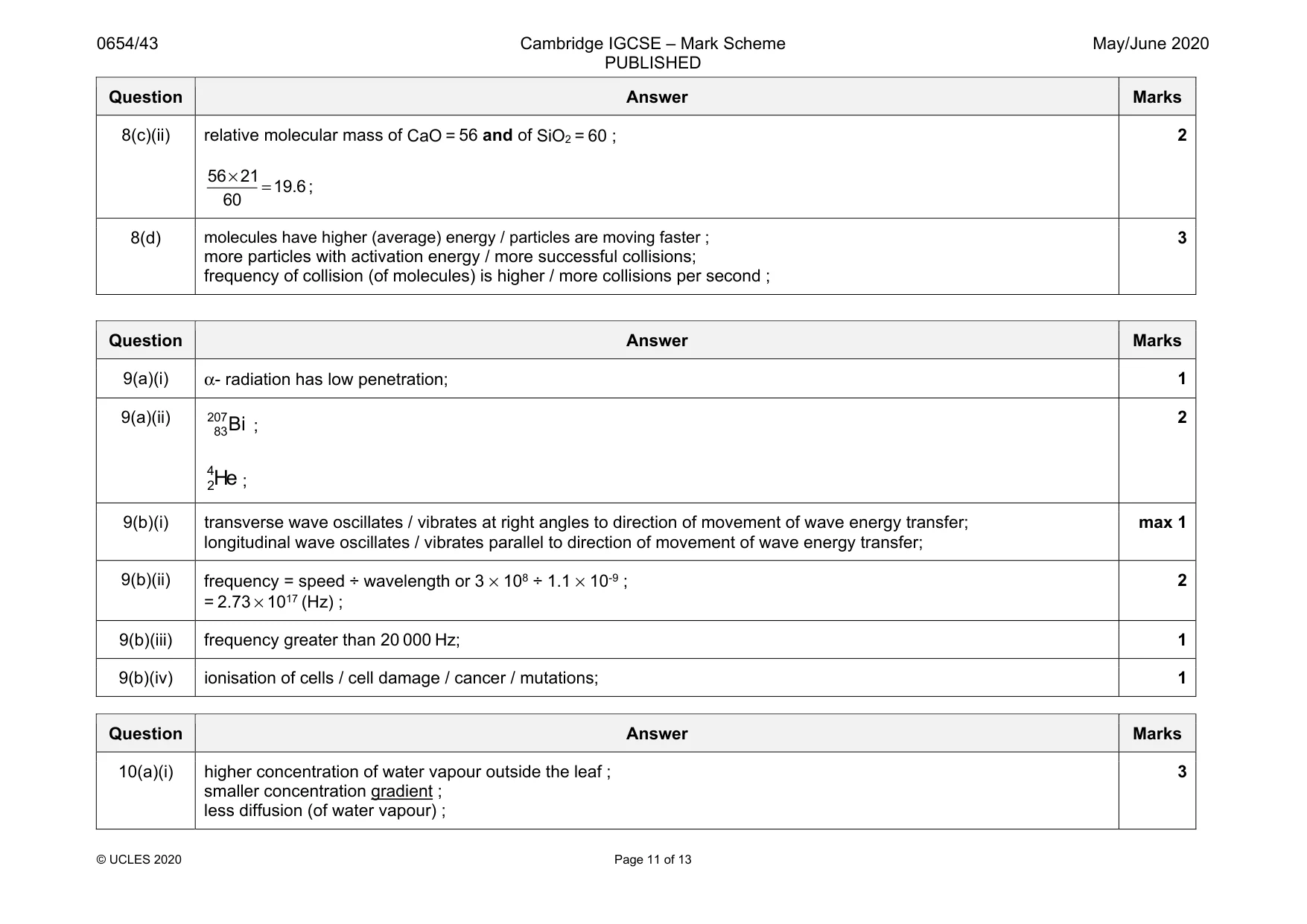
0654/43 Cambridge IGCSE – Mark Scheme PUBLISHED May/June 2020 © UCLES 2020 Page 11 of 13 Question Answer Marks 8(c)(ii) relative molecular mass of CaO = 56 and of SiO2 = 60 ; 56 21 19.6; 60 × = 2 8(d) molecules have higher (average) energy / particles are moving faster ; more particles with activation energy / more successful collisions; frequency of collision (of molecules) is higher / more collisions per second ; 3 Question Answer Marks 9(a)(i) α- radiation has low penetration; 1 9(a)(ii) 207 83Bi ; 4 2He ; 2 9(b)(i) transverse wave oscillates / vibrates at right angles to direction of movement of wave energy transfer; longitudinal wave oscillates / vibrates parallel to direction of movement of wave energy transfer; max 1 9(b)(ii) frequency = speed ÷ wavelength or 3 × 10⁸ ÷ 1.1 × 10⁻⁹ ; = 2.73 × 10¹⁷ (Hz) ; 2 9(b)(iii) frequency greater than 20 000 Hz; 1 9(b)(iv) ionisation of cells / cell damage / cancer / mutations; 1 Question Answer Marks 10(a)(i) higher concentration of water vapour outside the leaf ; smaller concentration gradient ; less diffusion (of water vapour) ; 3
Mark scheme, page 12
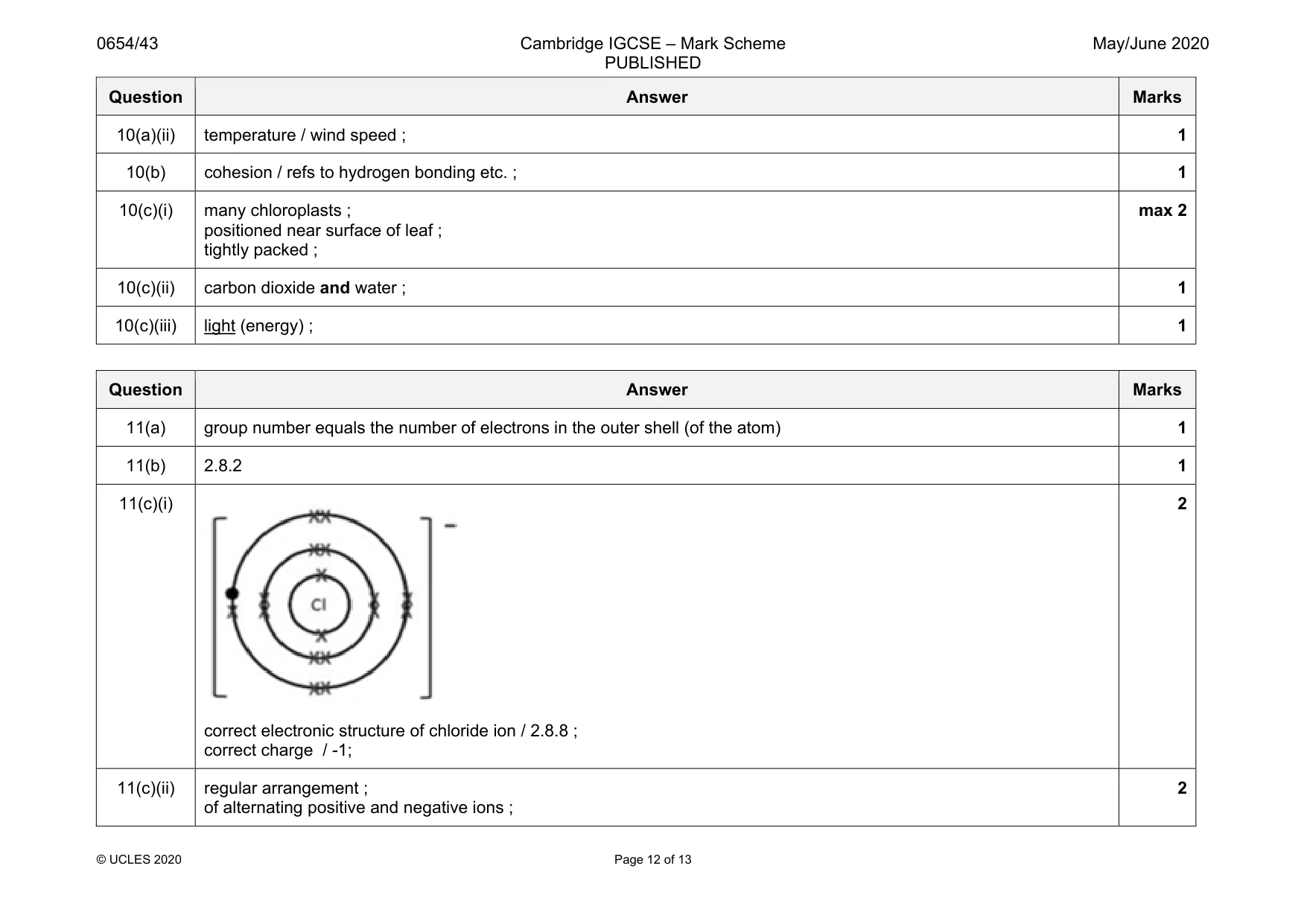
0654/43 Cambridge IGCSE – Mark Scheme PUBLISHED May/June 2020 © UCLES 2020 Page 12 of 13 Question Answer Marks 10(a)(ii) temperature / wind speed ; 1 10(b) cohesion / refs to hydrogen bonding etc. ; 1 10(c)(i) many chloroplasts ; positioned near surface of leaf ; tightly packed ; max 2 10(c)(ii) carbon dioxide and water ; 1 10(c)(iii) light (energy) ; 1 Question Answer Marks 11(a) group number equals the number of electrons in the outer shell (of the atom) 1 11(b) 2.8.2 1 11(c)(i) correct electronic structure of chloride ion / 2.8.8 ; correct charge / -1; 2 11(c)(ii) regular arrangement ; of alternating positive and negative ions ; 2
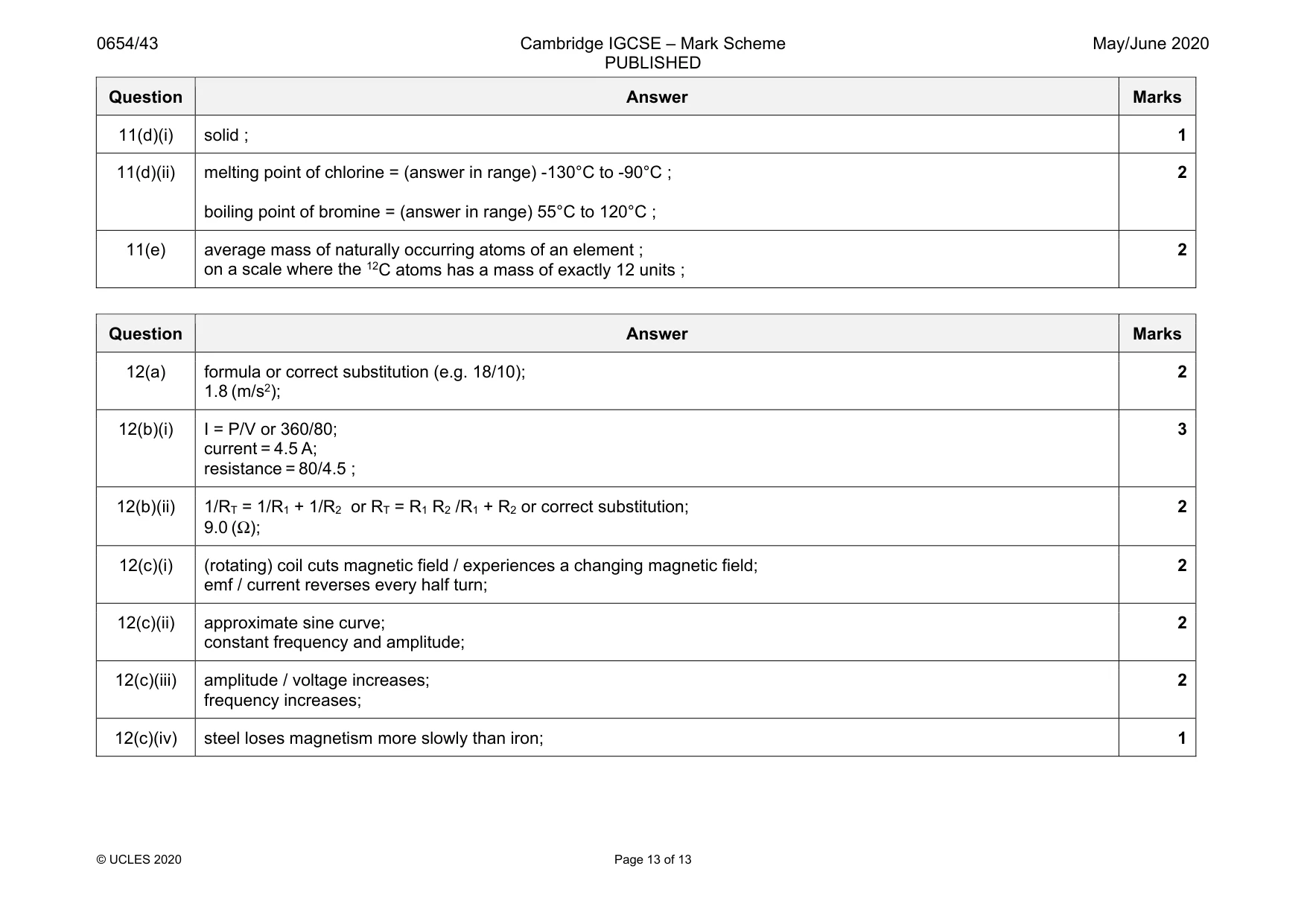
Mark scheme, page 13
0654/43 Cambridge IGCSE – Mark Scheme PUBLISHED May/June 2020 © UCLES 2020 Page 13 of 13 Question Answer Marks 11(d)(i) solid ; 1 11(d)(ii) melting point of chlorine = (answer in range) -130°C to -90°C ; boiling point of bromine = (answer in range) 55°C to 120°C ; 2 11(e) average mass of naturally occurring atoms of an element ; on a scale where the 12C atoms has a mass of exactly 12 units ; 2 Question Answer Marks 12(a) formula or correct substitution (e.g. 18/10); 1.8 (m/s2); 2 12(b)(i) I = P/V or 360/80; current = 4.5 A; resistance = 80/4.5 ; 3 12(b)(ii) 1/RT = 1/R1 + 1/R2 or RT = R1 R2 /R1 + R2 or correct substitution; 9.0 (Ω); 2 12(c)(i) (rotating) coil cuts magnetic field / experiences a changing magnetic field; emf / current reverses every half turn; 2 12(c)(ii) approximate sine curve; constant frequency and amplitude; 2 12(c)(iii) amplitude / voltage increases; frequency increases; 2 12(c)(iv) steel loses magnetism more slowly than iron; 1