Cambridge IGCSE Sciences - Co-ordinated (Double) 0654 — 2017 May/June Paper 4 · Variant 3
0654/43/M/J/17 · 120 marks · ≈135 min
The question paper and its mark scheme, free to read here and free to download. This is Cambridge’s own paper, exactly as it was sat.
Question paper32 pages


Mark scheme11 pages
Answers below. Sit the paper first if you are practising.
Paper as text
Question paper, page 1
* 4 7 8 4 8 4 7 5 6 6 * This document consists of 31 printed pages and 1 blank page. DC (LK/FC) 136489/3 © UCLES 2017 [Turn over Cambridge International Examinations Cambridge International General Certificate of Secondary Education CO-ORDINATED SCIENCES 0654/43 Paper 4 (Extended) May/June 2017 2 hours Candidates answer on the Question Paper. No Additional Materials are required. READ THESE INSTRUCTIONS FIRST Write your Centre number, candidate number and name on all the work you hand in. Write in dark blue or black pen. You may use an HB soft pencil for any diagrams or graphs. Do not use staples, paper clips, glue or correction fluid. DO NOT WRITE IN ANY BARCODES. Answer all questions. Electronic calculators may be used. You may lose marks if you do not show your working or if you do not use appropriate units. A copy of the Periodic Table is printed on page 32. At the end of the examination, fasten all your work securely together. The number of marks is given in brackets [ ] at the end of each question or part question.
Question paper, page 2
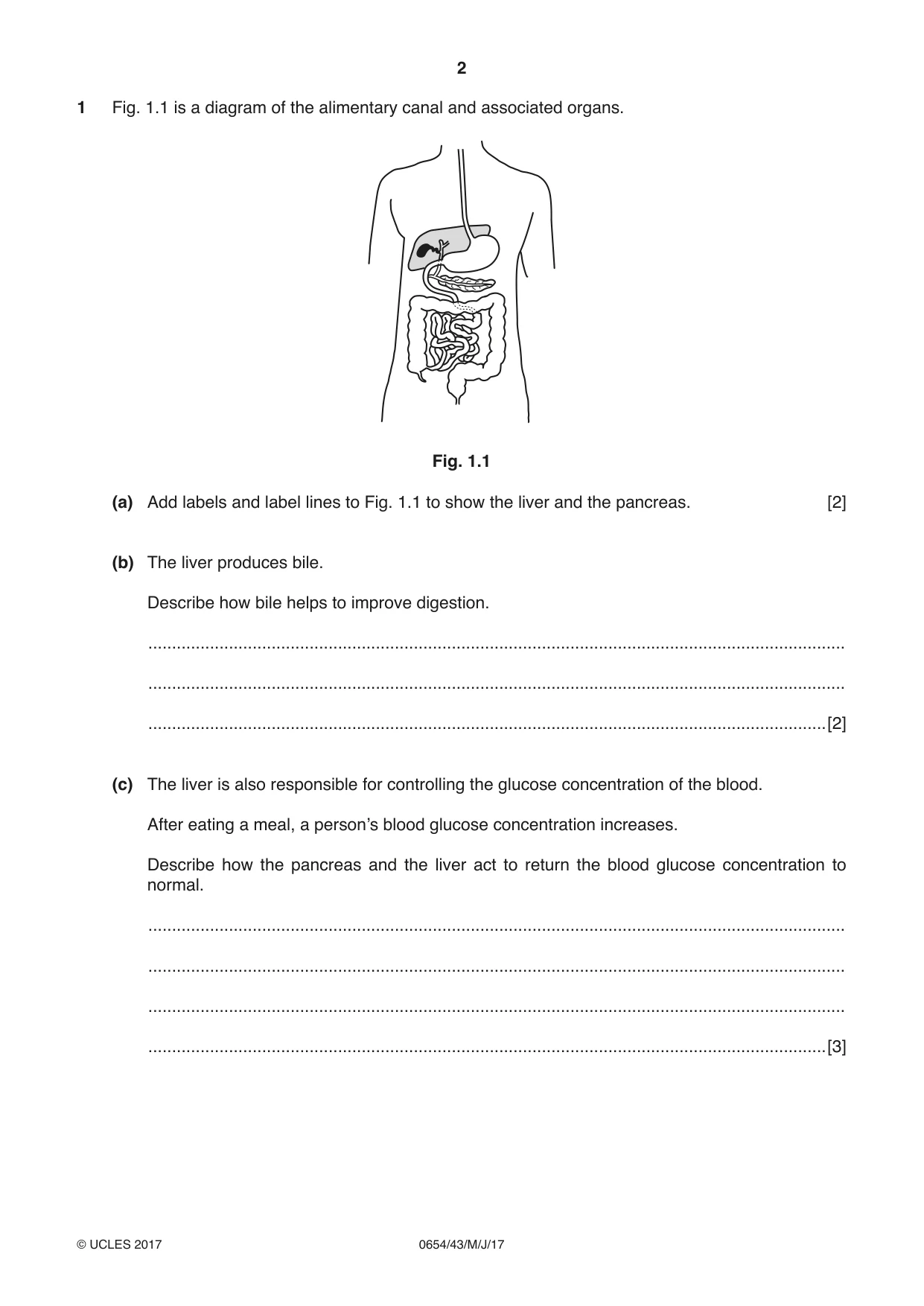
2 0654/43/M/J/17 © UCLES 2017 1 Fig. 1.1 is a diagram of the alimentary canal and associated organs. Fig. 1.1 (a) Add labels and label lines to Fig. 1.1 to show the liver and the pancreas. [2] (b) The liver produces bile. Describe how bile helps to improve digestion. … … …[2] (c) The liver is also responsible for controlling the glucose concentration of the blood. After eating a meal, a person’s blood glucose concentration increases. Describe how the pancreas and the liver act to return the blood glucose concentration to normal. … … … …[3]
Question paper, page 3
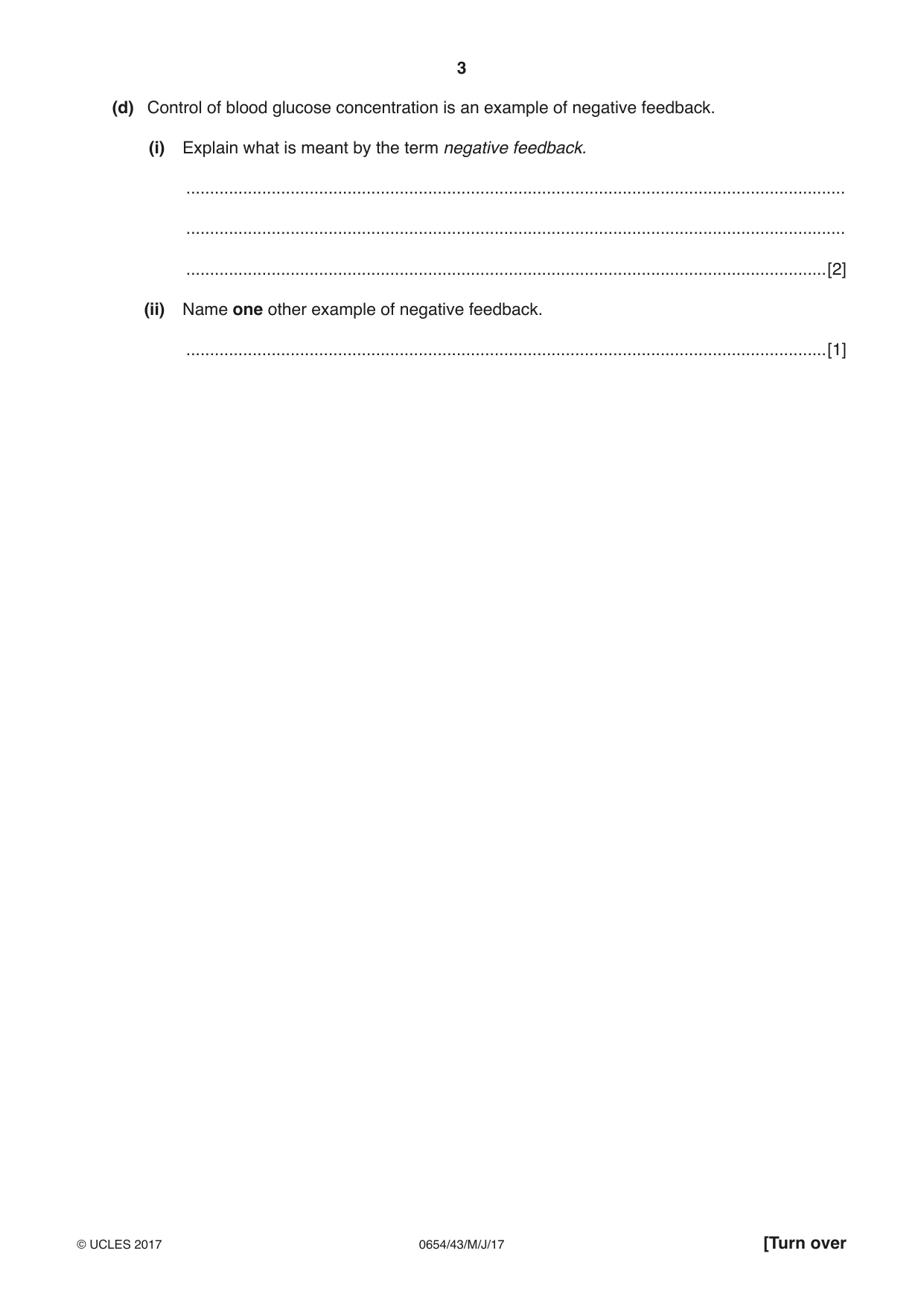
3 0654/43/M/J/17 © UCLES 2017 [Turn over (d) Control of blood glucose concentration is an example of negative feedback. (i) Explain what is meant by the term negative feedback. … … …[2] (ii) Name one other example of negative feedback. …[1]
Question paper, page 4
4 0654/43/M/J/17 © UCLES 2017 BLANK PAGE
Question paper, page 5
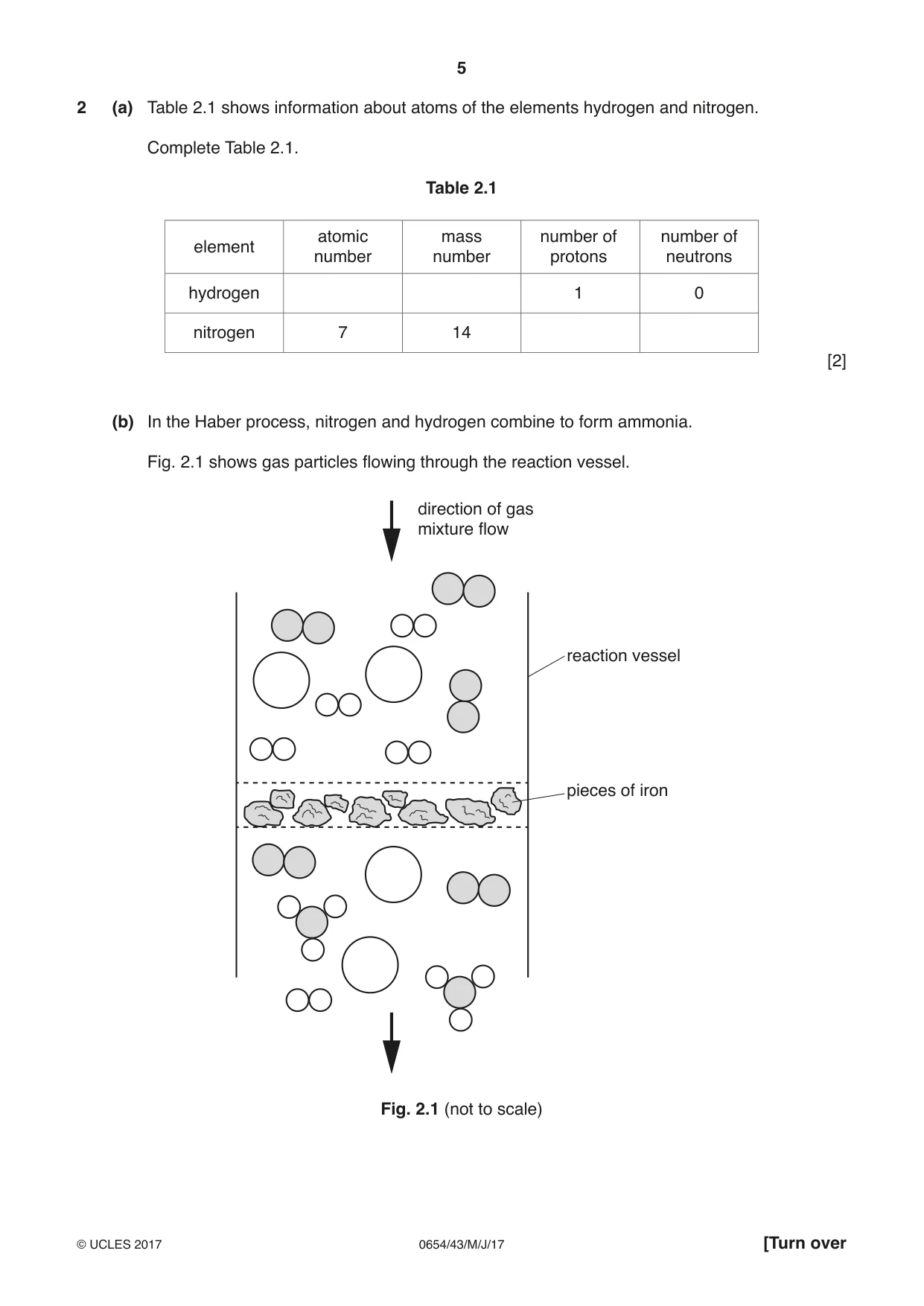
5 0654/43/M/J/17 © UCLES 2017 [Turn over 2 (a) Table 2.1 shows information about atoms of the elements hydrogen and nitrogen. Complete Table 2.1. Table 2.1 element atomic number mass number number of protons number of neutrons hydrogen 1 0 nitrogen 7 14 [2] (b) In the Haber process, nitrogen and hydrogen combine to form ammonia. Fig. 2.1 shows gas particles flowing through the reaction vessel. reaction vessel direction of gas mixture flow pieces of iron Fig. 2.1 (not to scale)
Question paper, page 6
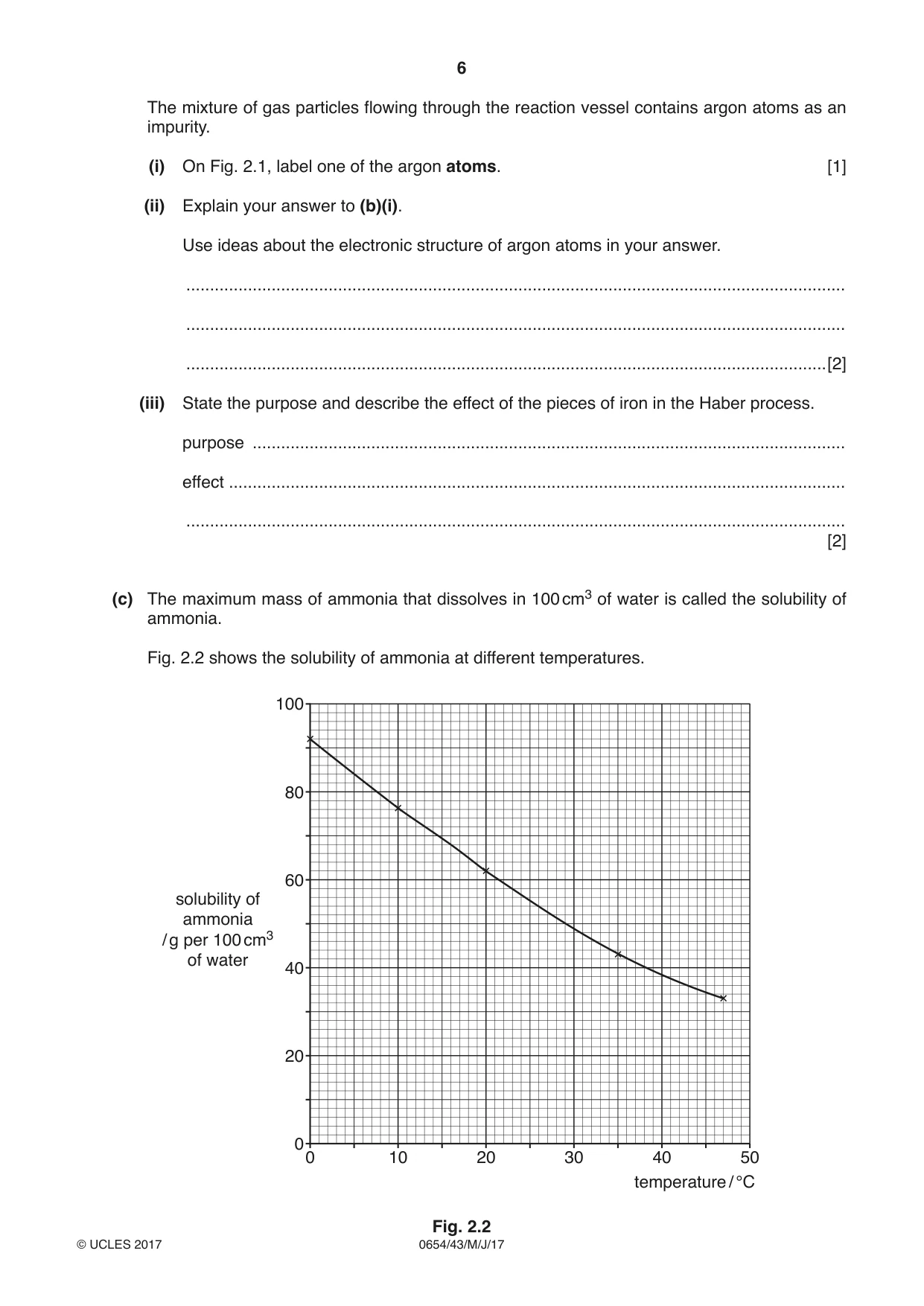
6 0654/43/M/J/17 © UCLES 2017 The mixture of gas particles flowing through the reaction vessel contains argon atoms as an impurity. (i) On Fig. 2.1, label one of the argon atoms. [1] (ii) Explain your answer to (b)(i). Use ideas about the electronic structure of argon atoms in your answer. … … …[2] (iii) State the purpose and describe the effect of the pieces of iron in the Haber process. purpose … effect … … [2] (c) The maximum mass of ammonia that dissolves in 100 cm3 of water is called the solubility of ammonia. Fig. 2.2 shows the solubility of ammonia at different temperatures. 0 0 20 40 60 80 solubility of ammonia / g per 100 cm3 of water 100 10 20 temperature / °C 30 40 50 Fig. 2.2
Question paper, page 7
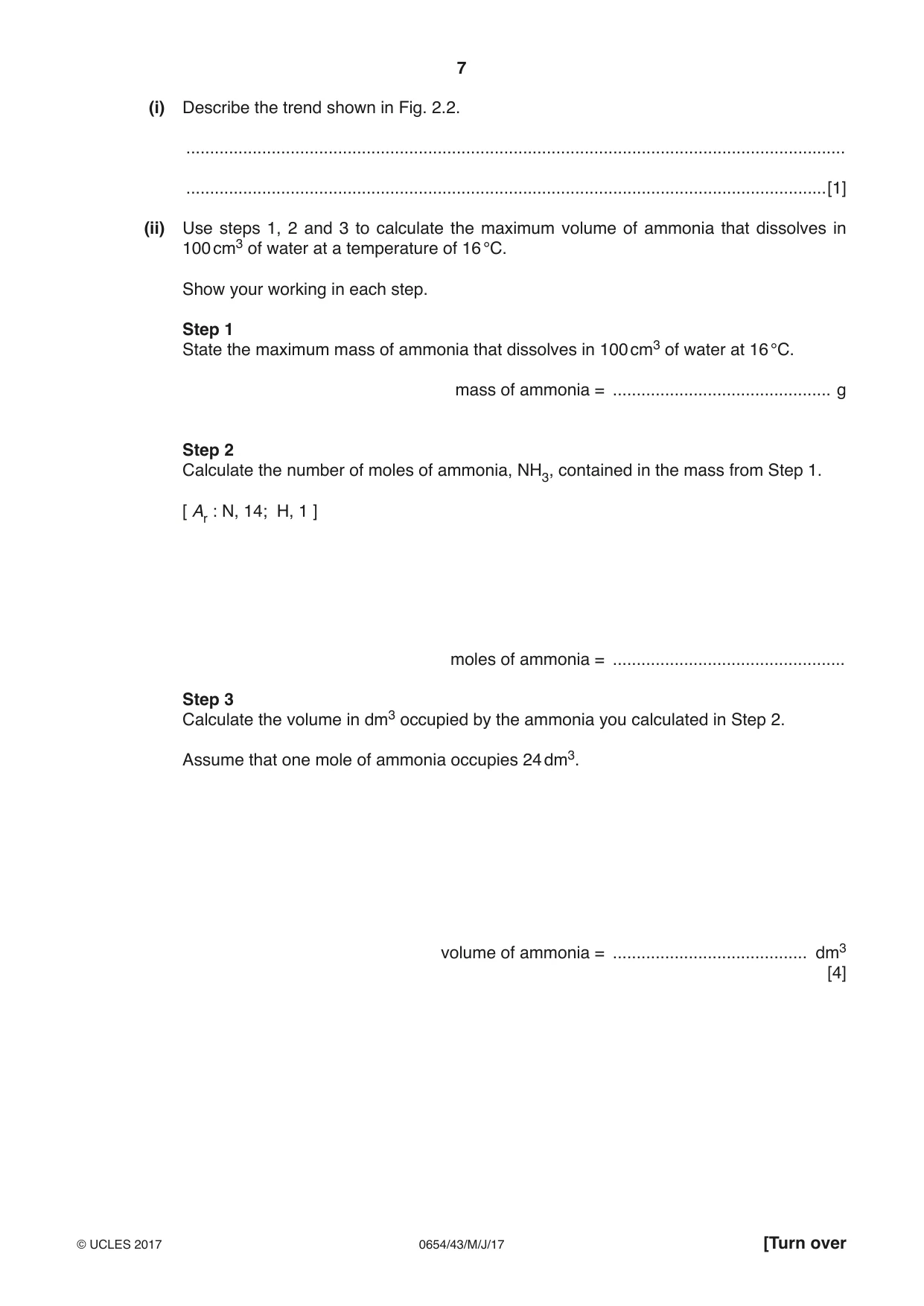
7 0654/43/M/J/17 © UCLES 2017 [Turn over (i) Describe the trend shown in Fig. 2.2. … …[1] (ii) Use steps 1, 2 and 3 to calculate the maximum volume of ammonia that dissolves in 100 cm3 of water at a temperature of 16 °C. Show your working in each step. Step 1 State the maximum mass of ammonia that dissolves in 100 cm3 of water at 16 °C. mass of ammonia = … g Step 2 Calculate the number of moles of ammonia, NH3, contained in the mass from Step 1. [ Ar : N, 14; H, 1 ] moles of ammonia = … Step 3 Calculate the volume in dm3 occupied by the ammonia you calculated in Step 2. Assume that one mole of ammonia occupies 24 dm3. volume of ammonia = … dm3 [4]
Question paper, page 8
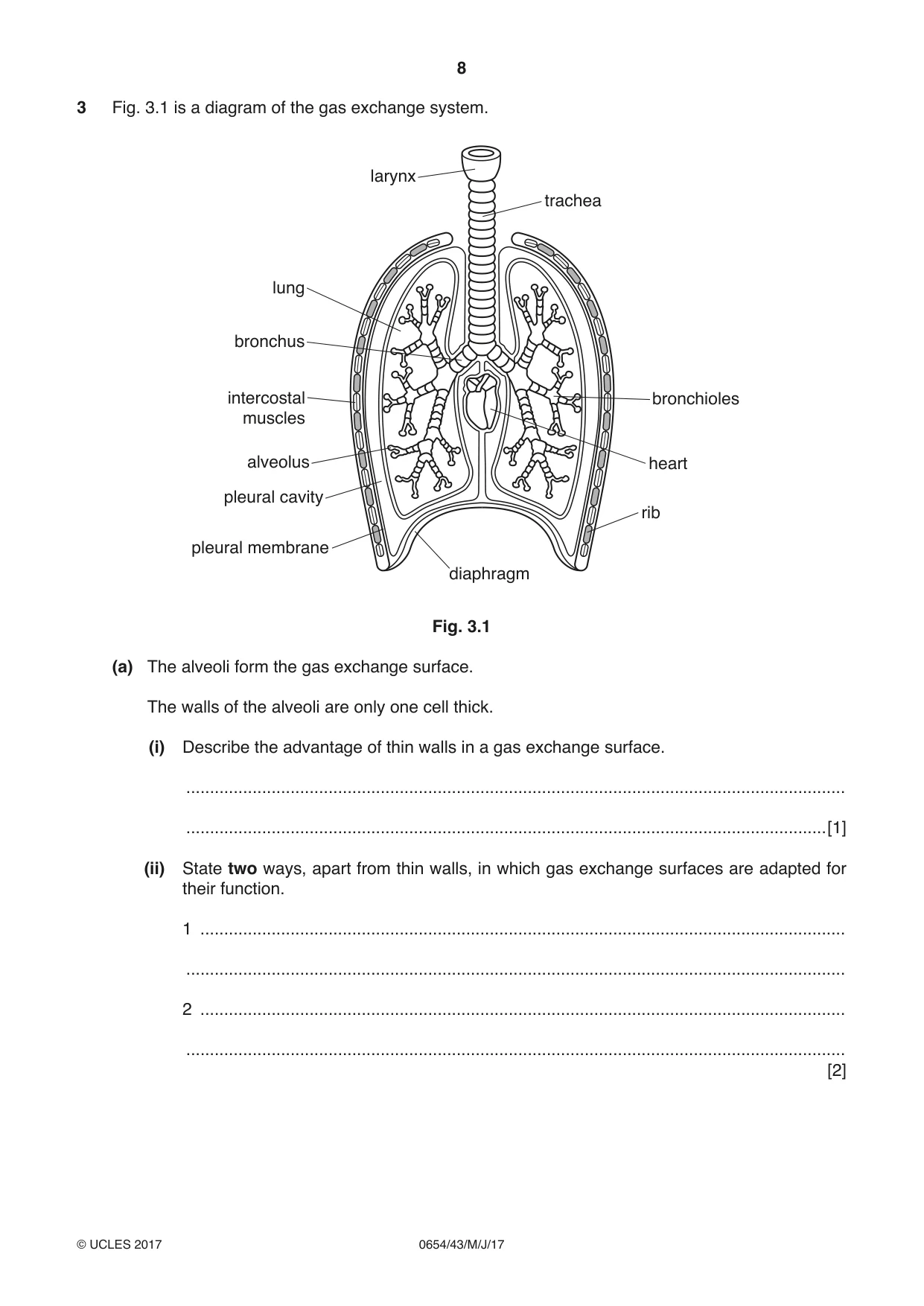
8 0654/43/M/J/17 © UCLES 2017 3 Fig. 3.1 is a diagram of the gas exchange system. larynx rib heart bronchioles trachea lung bronchus intercostal muscles alveolus pleural cavity pleural membrane diaphragm Fig. 3.1 (a) The alveoli form the gas exchange surface. The walls of the alveoli are only one cell thick. (i) Describe the advantage of thin walls in a gas exchange surface. … …[1] (ii) State two ways, apart from thin walls, in which gas exchange surfaces are adapted for their function. 1 … … 2 … … [2]
Question paper, page 9
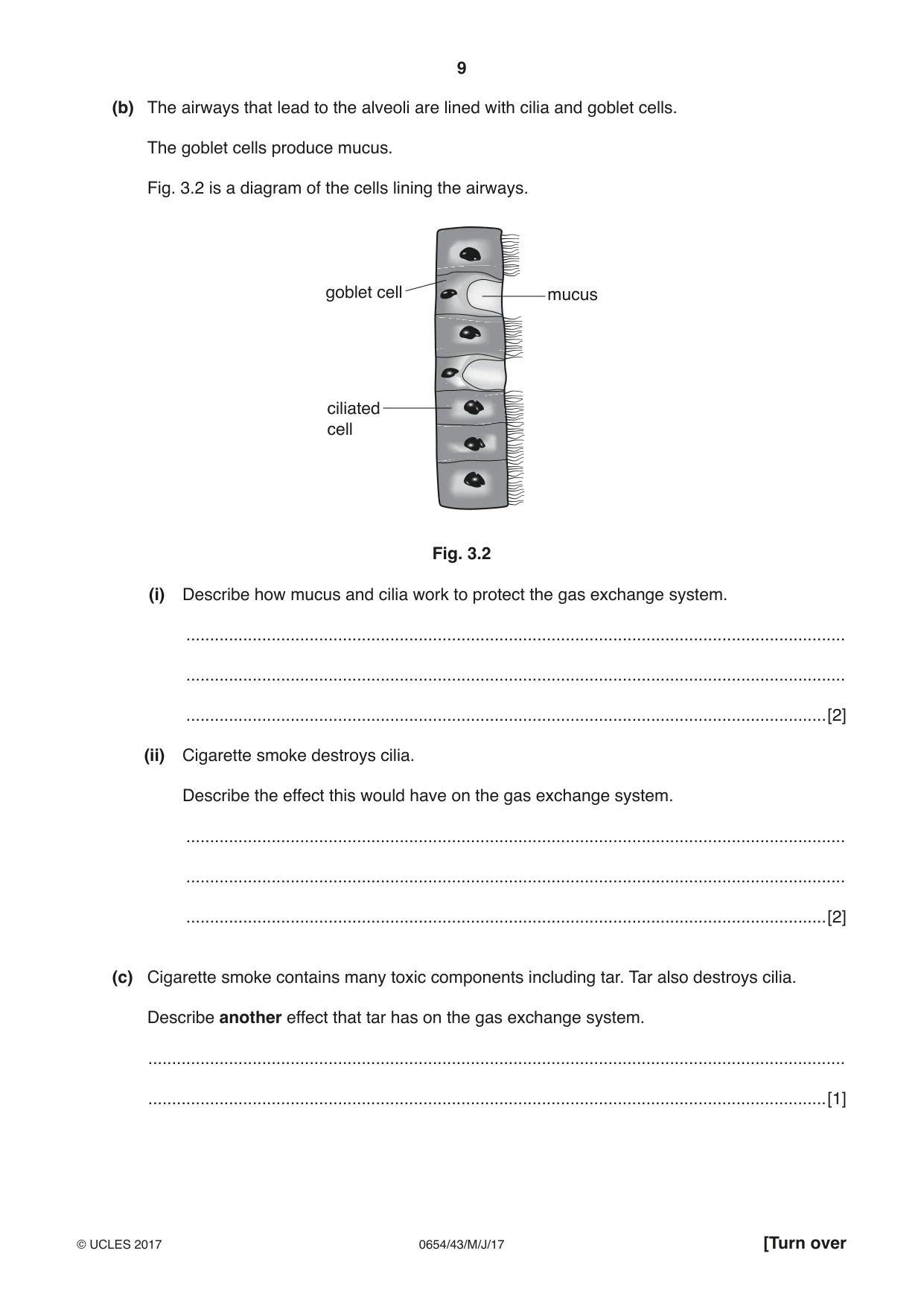
9 0654/43/M/J/17 © UCLES 2017 [Turn over (b) The airways that lead to the alveoli are lined with cilia and goblet cells. The goblet cells produce mucus. Fig. 3.2 is a diagram of the cells lining the airways. goblet cell mucus ciliated cell Fig. 3.2 (i) Describe how mucus and cilia work to protect the gas exchange system. … … …[2] (ii) Cigarette smoke destroys cilia. Describe the effect this would have on the gas exchange system. … … …[2] (c) Cigarette smoke contains many toxic components including tar. Tar also destroys cilia. Describe another effect that tar has on the gas exchange system. … …[1]
Question paper, page 10
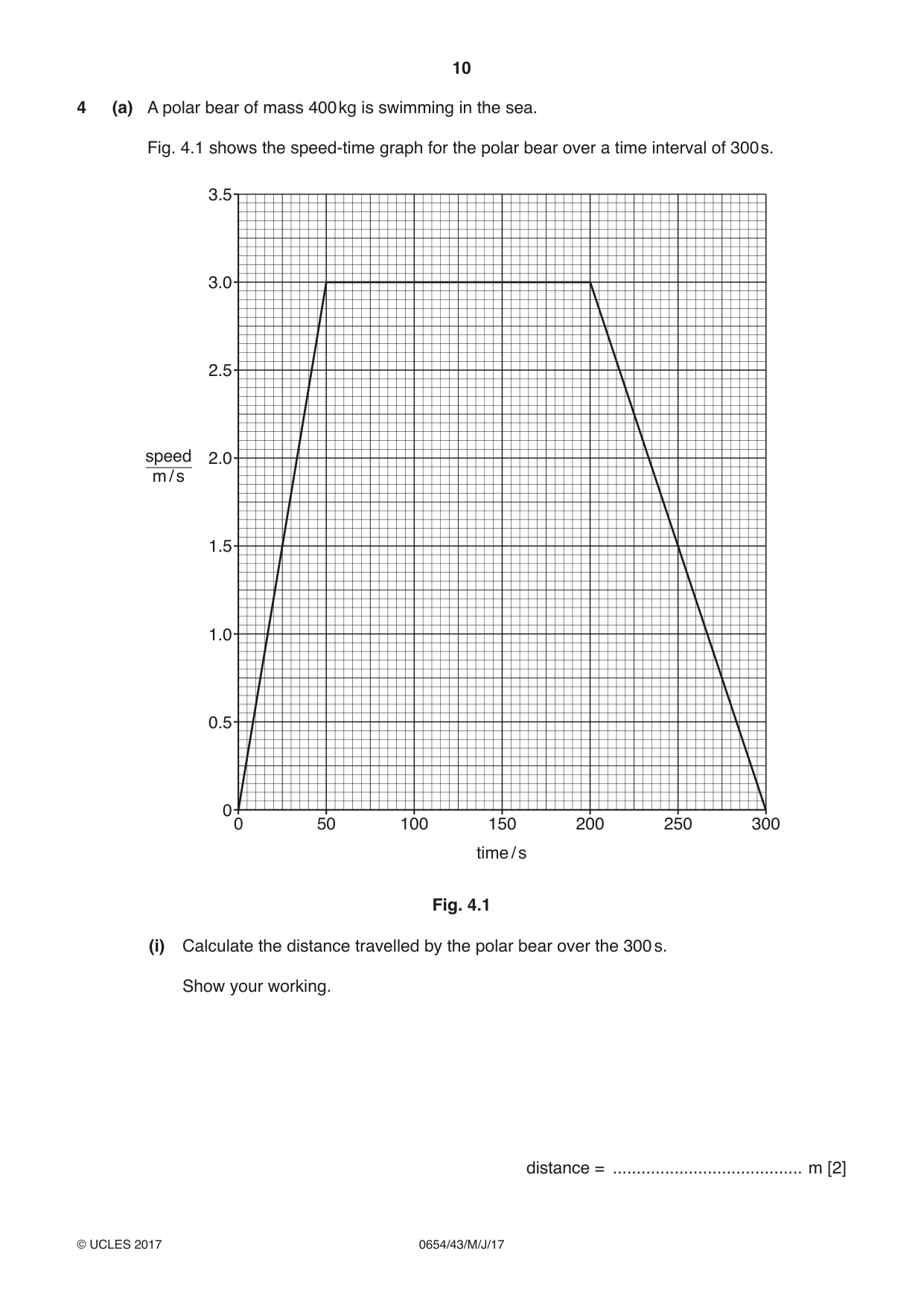
10 0654/43/M/J/17 © UCLES 2017 4 (a) A polar bear of mass 400 kg is swimming in the sea. Fig. 4.1 shows the speed-time graph for the polar bear over a time interval of 300 s. 0 0 0.5 1.0 1.5 2.0 speed m / s 2.5 3.0 3.5 50 100 time / s 150 200 250 300 Fig. 4.1 (i) Calculate the distance travelled by the polar bear over the 300 s. Show your working. distance = … m [2]
Question paper, page 11
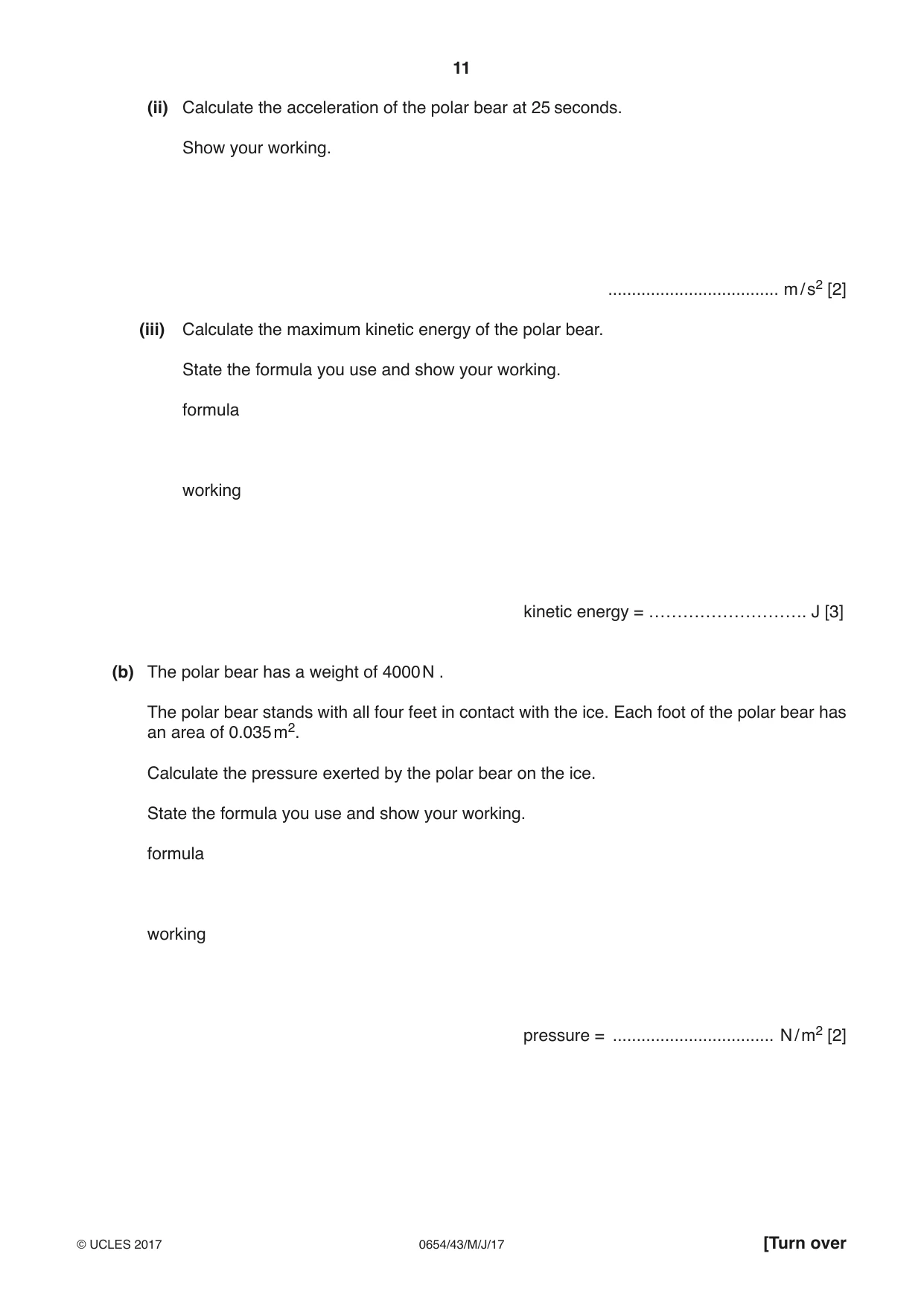
11 0654/43/M/J/17 © UCLES 2017 [Turn over (ii) Calculate the acceleration of the polar bear at 25 seconds. Show your working. … m / s2 [2] (iii) Calculate the maximum kinetic energy of the polar bear. State the formula you use and show your working. formula working kinetic energy = ………………………. J [3] (b) The polar bear has a weight of 4000 N . The polar bear stands with all four feet in contact with the ice. Each foot of the polar bear has an area of 0.035 m2. Calculate the pressure exerted by the polar bear on the ice. State the formula you use and show your working. formula working pressure = … N / m2 [2]
Question paper, page 12
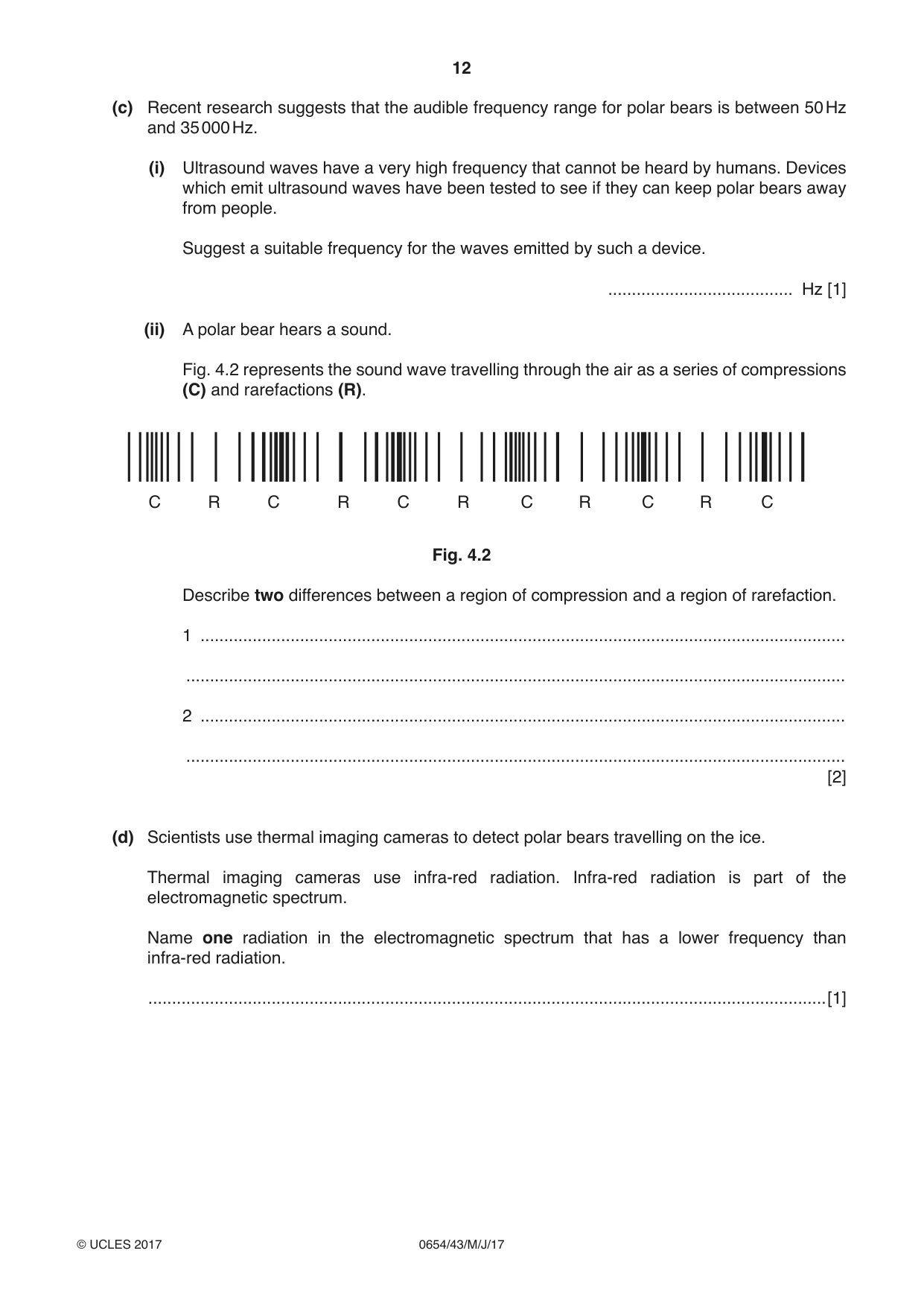
12 0654/43/M/J/17 © UCLES 2017 (c) Recent research suggests that the audible frequency range for polar bears is between 50 Hz and 35 000 Hz. (i) Ultrasound waves have a very high frequency that cannot be heard by humans. Devices which emit ultrasound waves have been tested to see if they can keep polar bears away from people. Suggest a suitable frequency for the waves emitted by such a device. … Hz [1] (ii) A polar bear hears a sound. Fig. 4.2 represents the sound wave travelling through the air as a series of compressions (C) and rarefactions (R). C R C R C R C R C C R Fig. 4.2 Describe two differences between a region of compression and a region of rarefaction. 1 … … 2 … … [2] (d) Scientists use thermal imaging cameras to detect polar bears travelling on the ice. Thermal imaging cameras use infra-red radiation. Infra-red radiation is part of the electromagnetic spectrum. Name one radiation in the electromagnetic spectrum that has a lower frequency than infra-red radiation. …[1]
Question paper, page 13
13 0654/43/M/J/17 © UCLES 2017 [Turn over Question 5 starts on page 14.
Question paper, page 14
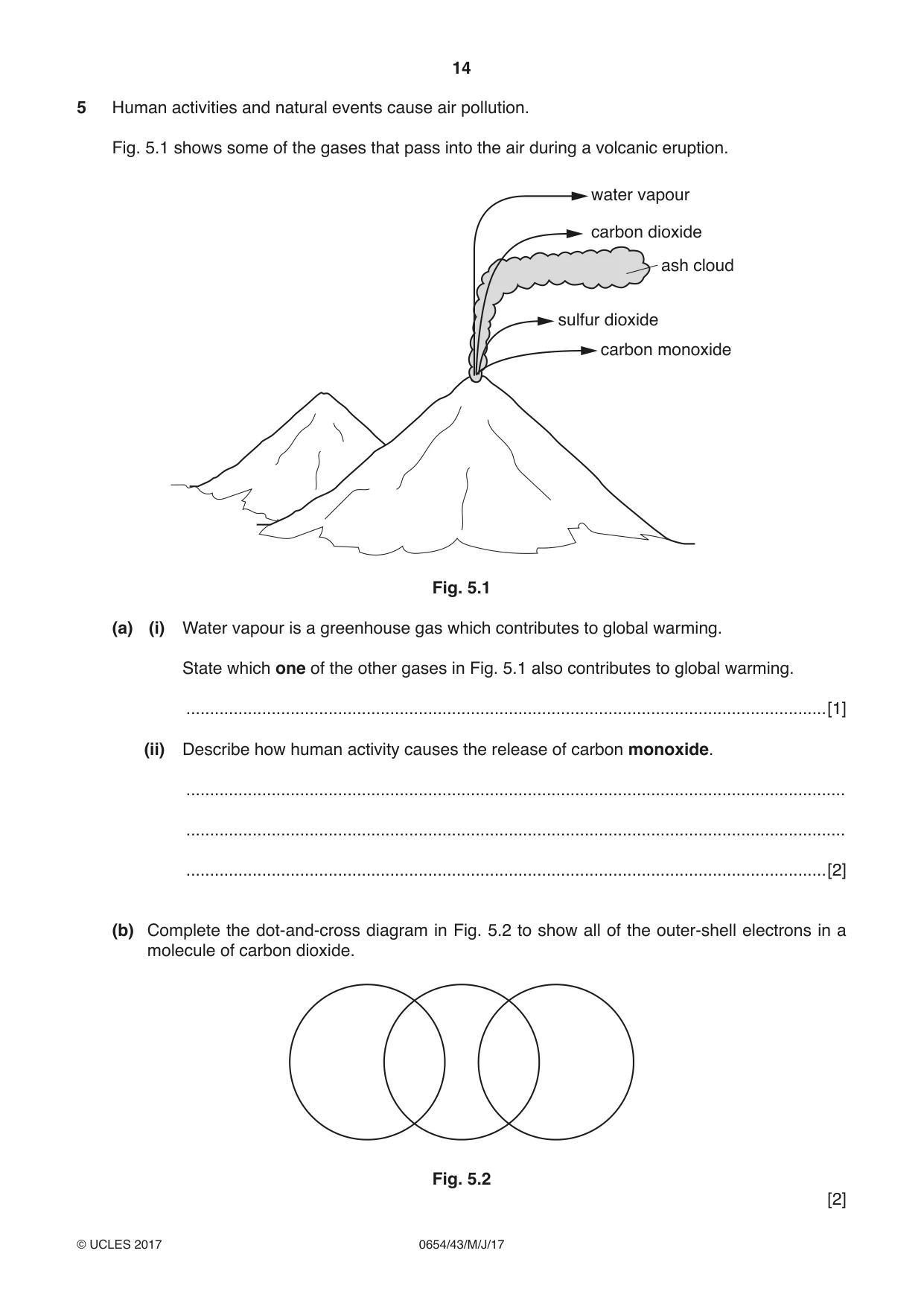
14 0654/43/M/J/17 © UCLES 2017 5 Human activities and natural events cause air pollution. Fig. 5.1 shows some of the gases that pass into the air during a volcanic eruption. water vapour carbon dioxide carbon monoxide sulfur dioxide ash cloud Fig. 5.1 (a) (i) Water vapour is a greenhouse gas which contributes to global warming. State which one of the other gases in Fig. 5.1 also contributes to global warming. …[1] (ii) Describe how human activity causes the release of carbon monoxide. … … …[2] (b) Complete the dot-and-cross diagram in Fig. 5.2 to show all of the outer-shell electrons in a molecule of carbon dioxide. Fig. 5.2 [2]
Question paper, page 15
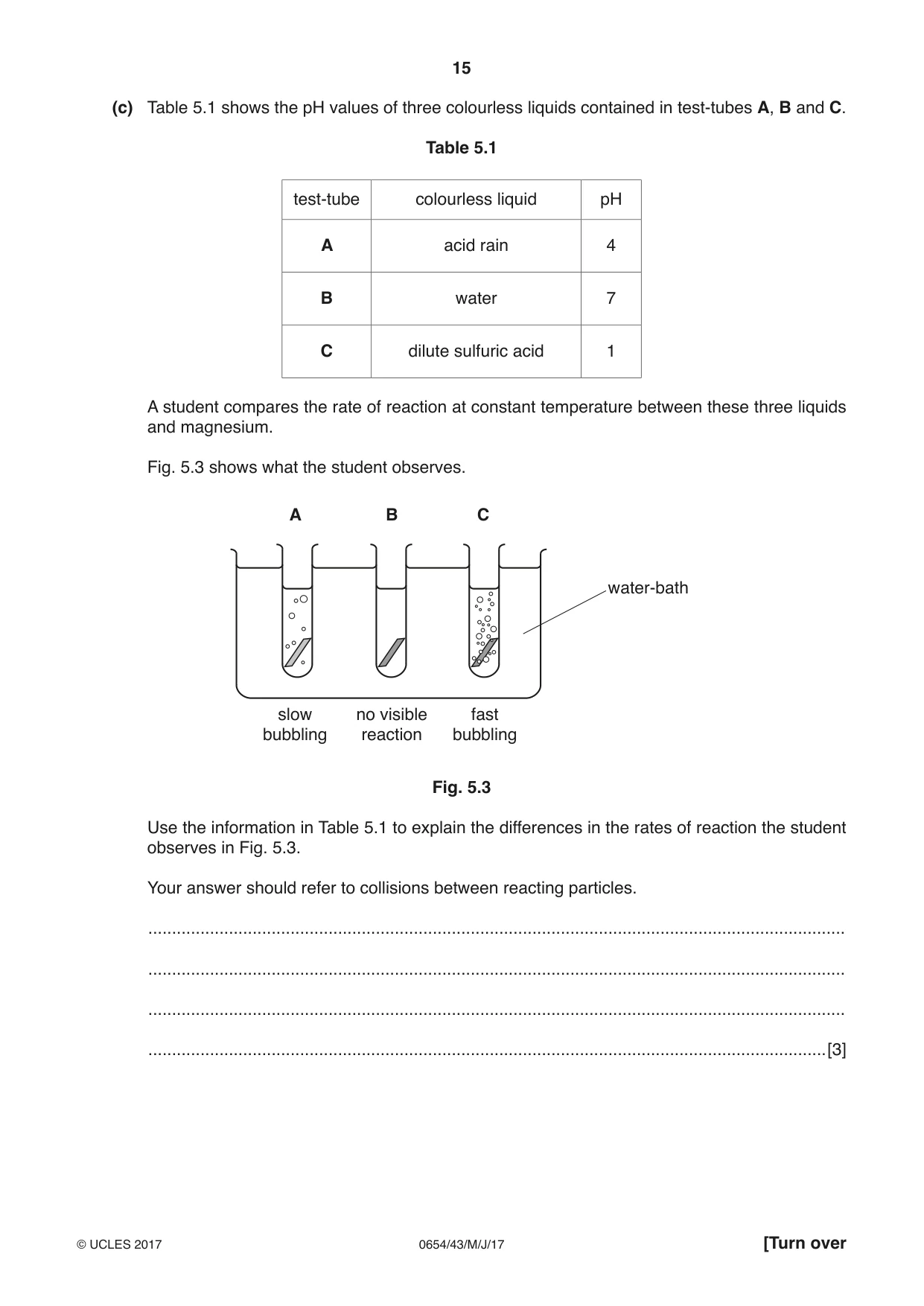
15 0654/43/M/J/17 © UCLES 2017 [Turn over (c) Table 5.1 shows the pH values of three colourless liquids contained in test-tubes A, B and C. Table 5.1 test-tube colourless liquid pH A acid rain 4 B water 7 C dilute sulfuric acid 1 A student compares the rate of reaction at constant temperature between these three liquids and magnesium. Fig. 5.3 shows what the student observes. slow bubbling no visible reaction fast bubbling water-bath A B C Fig. 5.3 Use the information in Table 5.1 to explain the differences in the rates of reaction the student observes in Fig. 5.3. Your answer should refer to collisions between reacting particles. … … … …[3]
Question paper, page 16
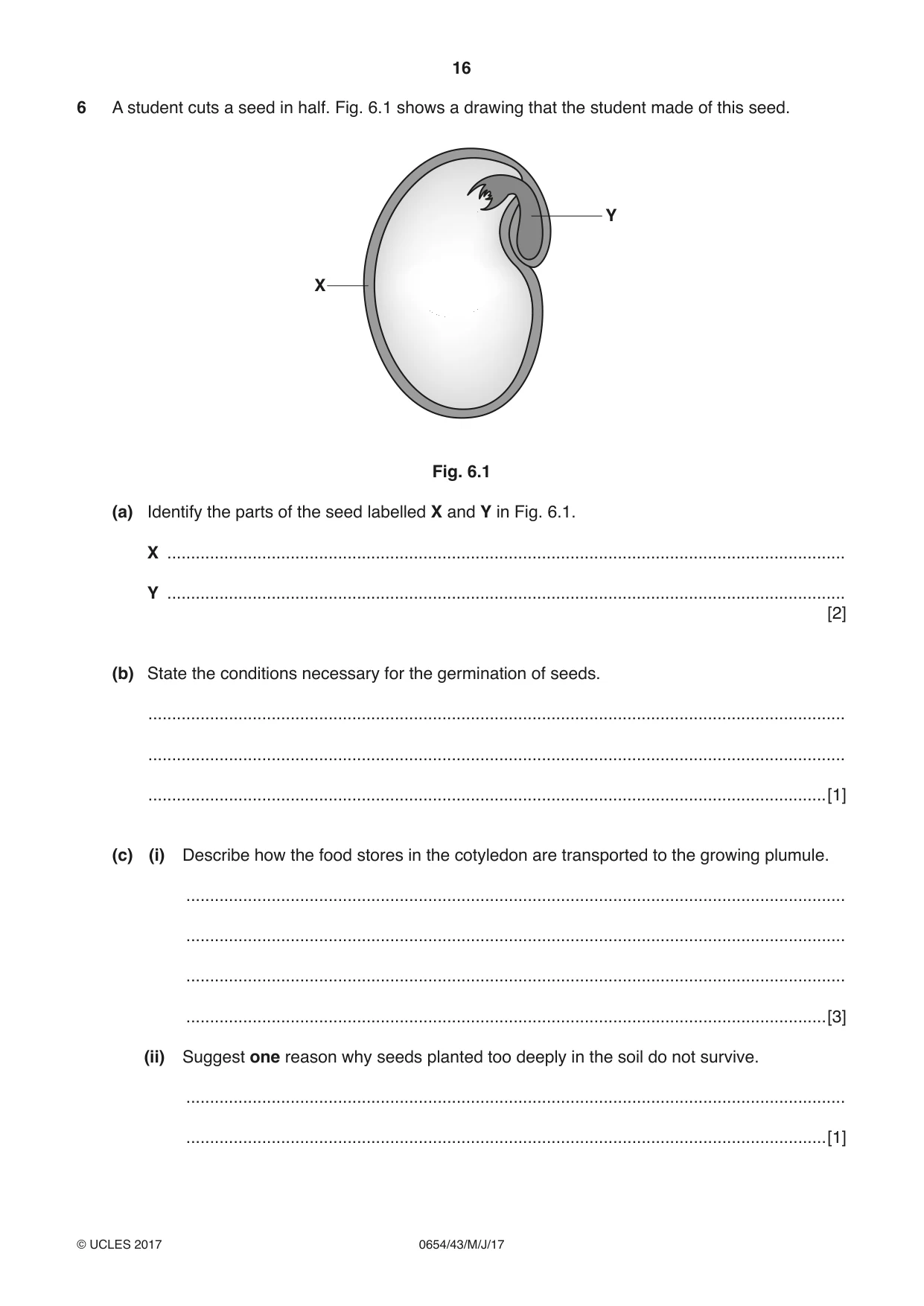
16 0654/43/M/J/17 © UCLES 2017 6 A student cuts a seed in half. Fig. 6.1 shows a drawing that the student made of this seed. Y X Fig. 6.1 (a) Identify the parts of the seed labelled X and Y in Fig. 6.1. X … Y … [2] (b) State the conditions necessary for the germination of seeds. … … …[1] (c) (i) Describe how the food stores in the cotyledon are transported to the growing plumule. … … … …[3] (ii) Suggest one reason why seeds planted too deeply in the soil do not survive. … …[1]
Question paper, page 17
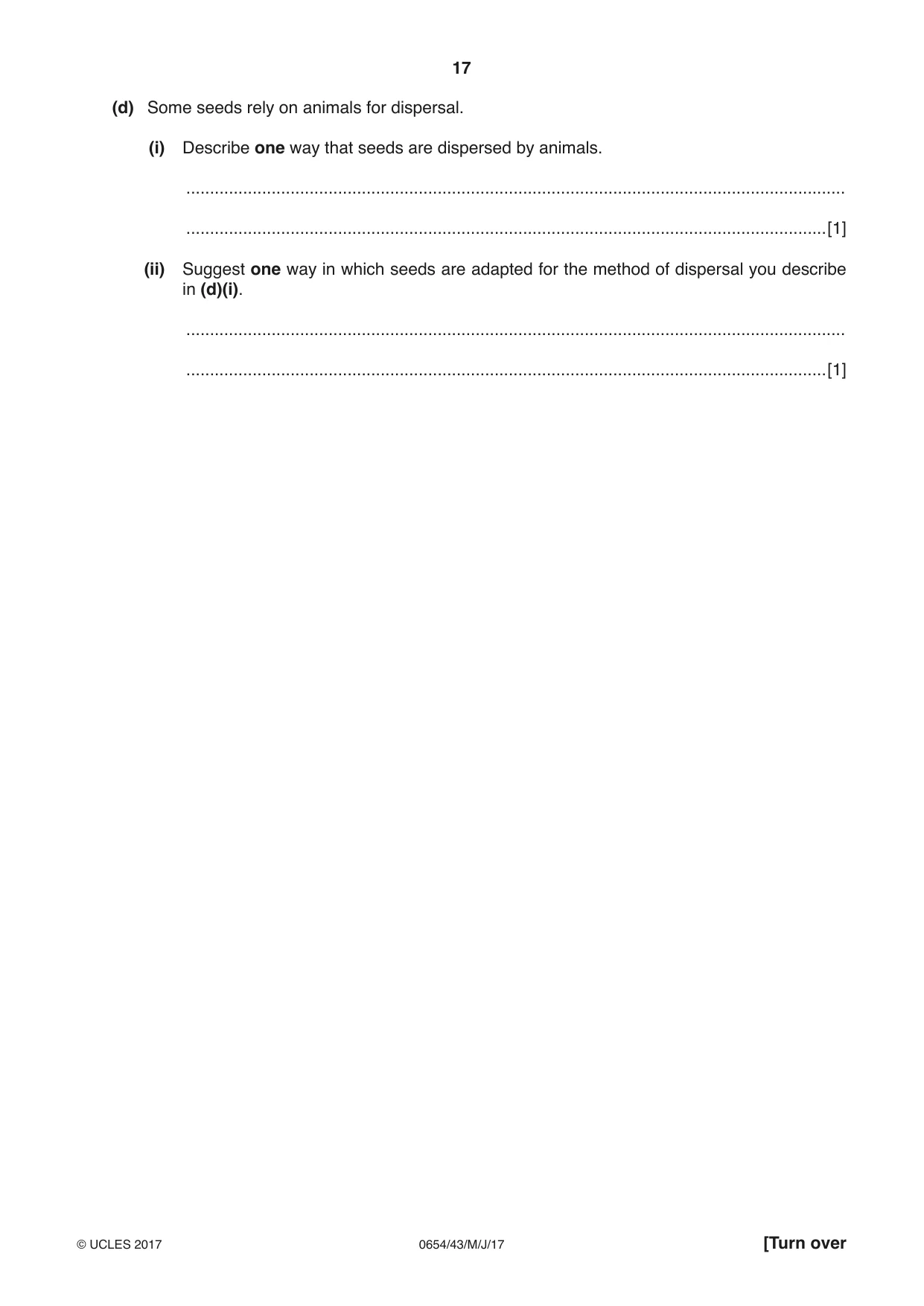
17 0654/43/M/J/17 © UCLES 2017 [Turn over (d) Some seeds rely on animals for dispersal. (i) Describe one way that seeds are dispersed by animals. … …[1] (ii) Suggest one way in which seeds are adapted for the method of dispersal you describe in (d)(i). … …[1]
Question paper, page 18
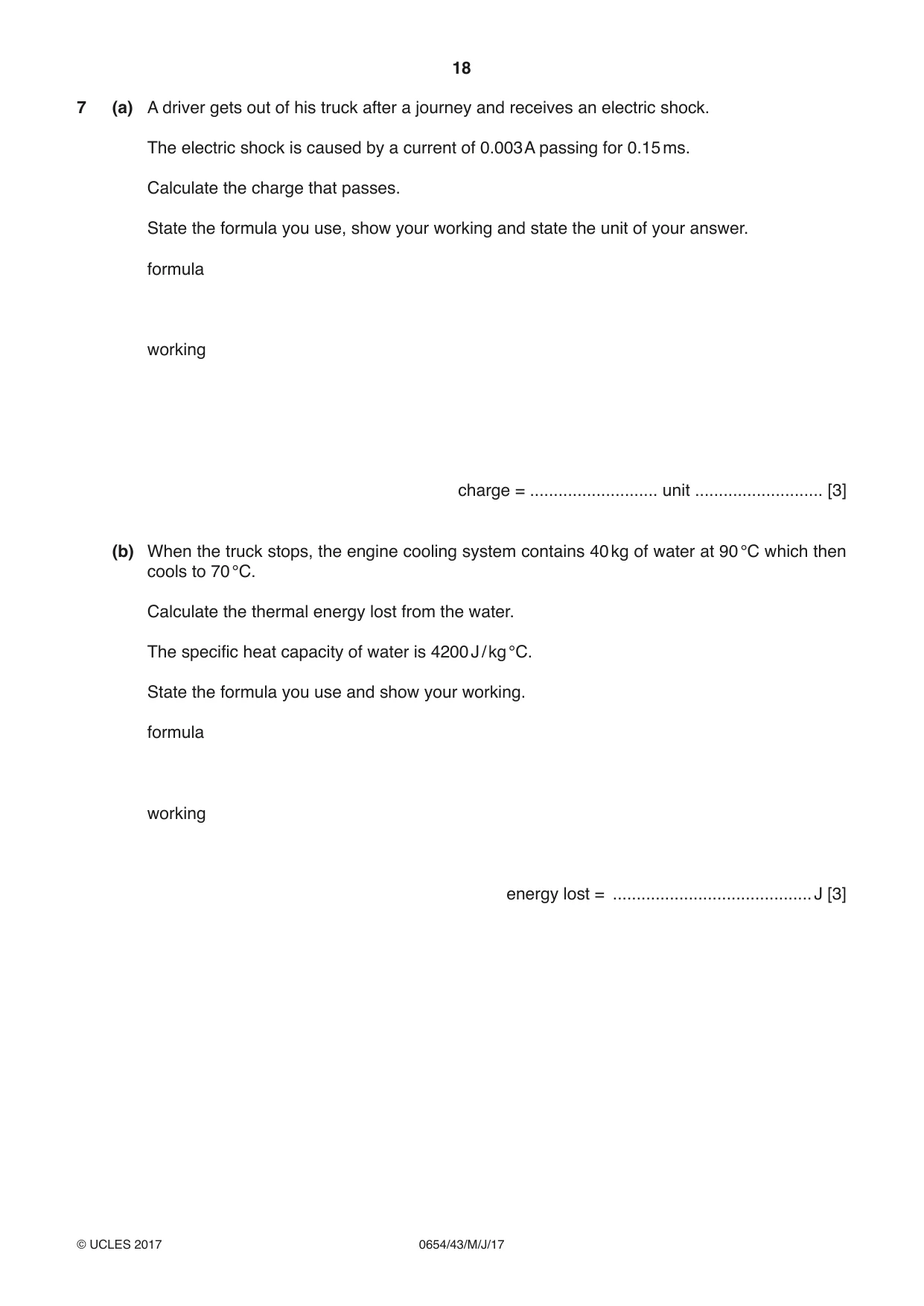
18 0654/43/M/J/17 © UCLES 2017 7 (a) A driver gets out of his truck after a journey and receives an electric shock. The electric shock is caused by a current of 0.003 A passing for 0.15 ms. Calculate the charge that passes. State the formula you use, show your working and state the unit of your answer. formula working charge = … unit … [3] (b) When the truck stops, the engine cooling system contains 40 kg of water at 90 °C which then cools to 70 °C. Calculate the thermal energy lost from the water. The specific heat capacity of water is 4200 J / kg °C. State the formula you use and show your working. formula working energy lost = …J [3]
Question paper, page 19
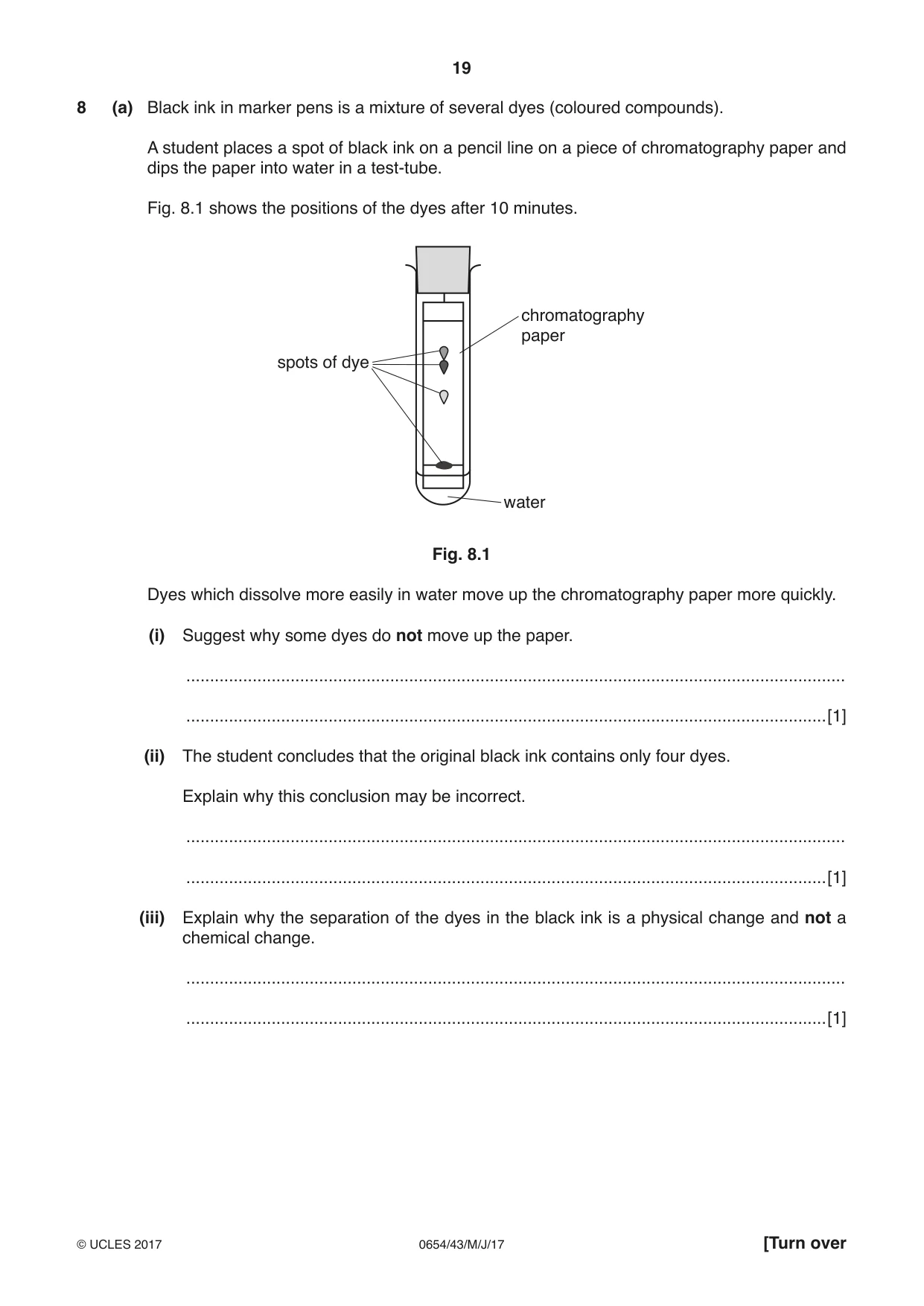
19 0654/43/M/J/17 © UCLES 2017 [Turn over 8 (a) Black ink in marker pens is a mixture of several dyes (coloured compounds). A student places a spot of black ink on a pencil line on a piece of chromatography paper and dips the paper into water in a test-tube. Fig. 8.1 shows the positions of the dyes after 10 minutes. spots of dye chromatography paper water Fig. 8.1 Dyes which dissolve more easily in water move up the chromatography paper more quickly. (i) Suggest why some dyes do not move up the paper. … …[1] (ii) The student concludes that the original black ink contains only four dyes. Explain why this conclusion may be incorrect. … …[1] (iii) Explain why the separation of the dyes in the black ink is a physical change and not a chemical change. … …[1]
Question paper, page 20
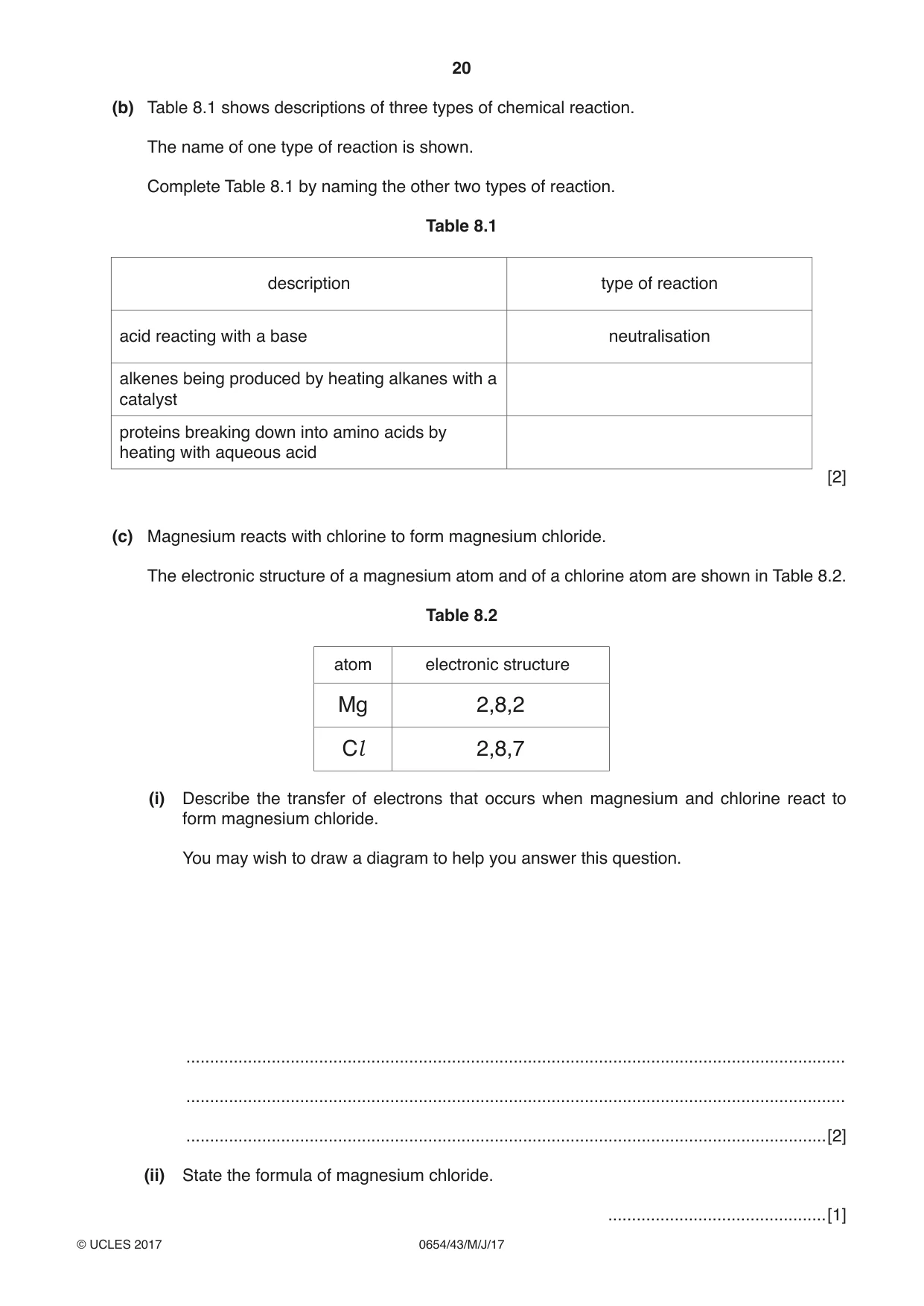
20 0654/43/M/J/17 © UCLES 2017 (b) Table 8.1 shows descriptions of three types of chemical reaction. The name of one type of reaction is shown. Complete Table 8.1 by naming the other two types of reaction. Table 8.1 description type of reaction acid reacting with a base neutralisation alkenes being produced by heating alkanes with a catalyst proteins breaking down into amino acids by heating with aqueous acid [2] (c) Magnesium reacts with chlorine to form magnesium chloride. The electronic structure of a magnesium atom and of a chlorine atom are shown in Table 8.2. Table 8.2 atom electronic structure Mg 2,8,2 Cl 2,8,7 (i) Describe the transfer of electrons that occurs when magnesium and chlorine react to form magnesium chloride. You may wish to draw a diagram to help you answer this question. … … …[2] (ii) State the formula of magnesium chloride. …[1]
Question paper, page 21
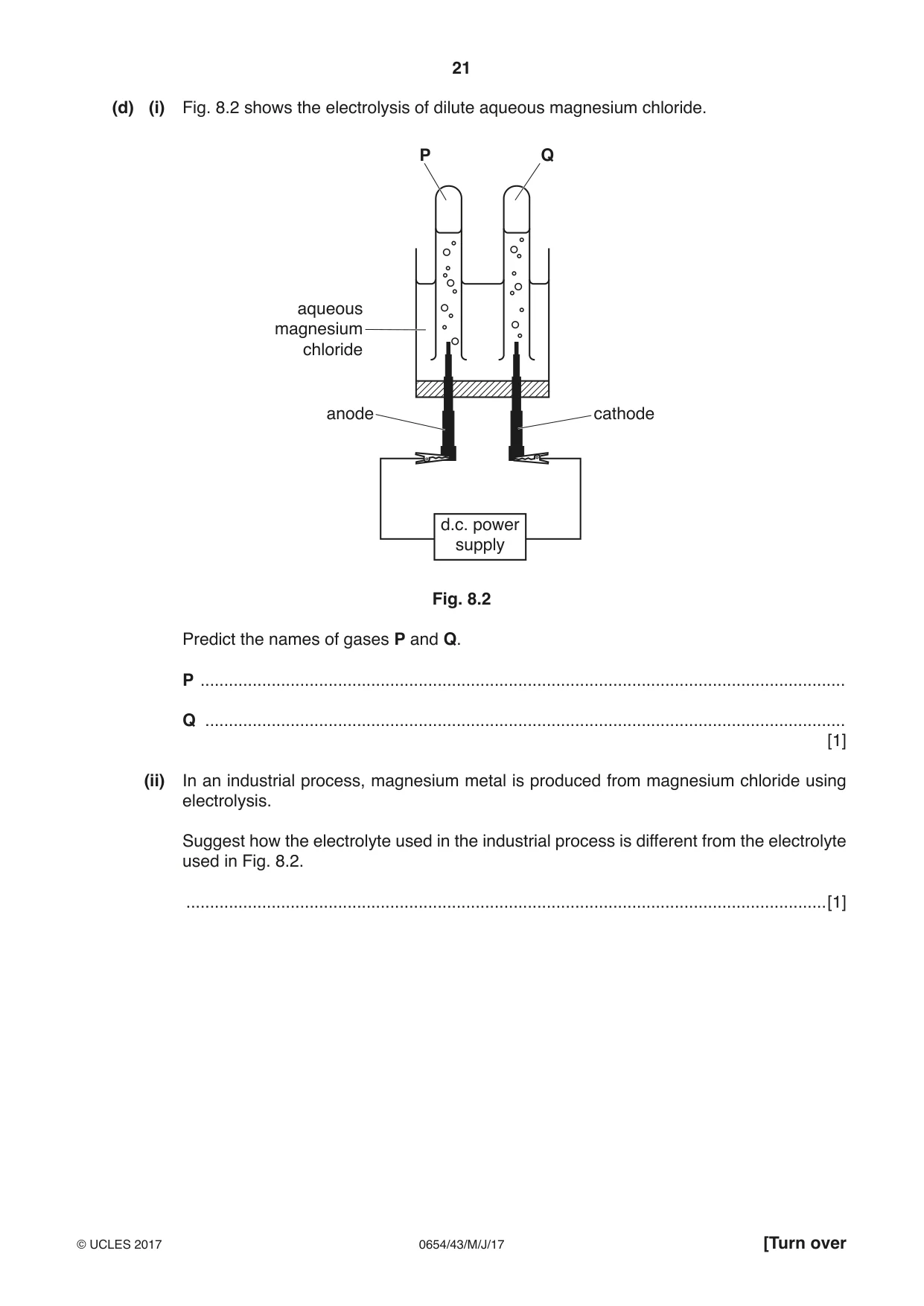
21 0654/43/M/J/17 © UCLES 2017 [Turn over (d) (i) Fig. 8.2 shows the electrolysis of dilute aqueous magnesium chloride. aqueous magnesium chloride P cathode anode Q d.c. power supply Fig. 8.2 Predict the names of gases P and Q. P … Q … [1] (ii) In an industrial process, magnesium metal is produced from magnesium chloride using electrolysis. Suggest how the electrolyte used in the industrial process is different from the electrolyte used in Fig. 8.2. …[1]
Question paper, page 22
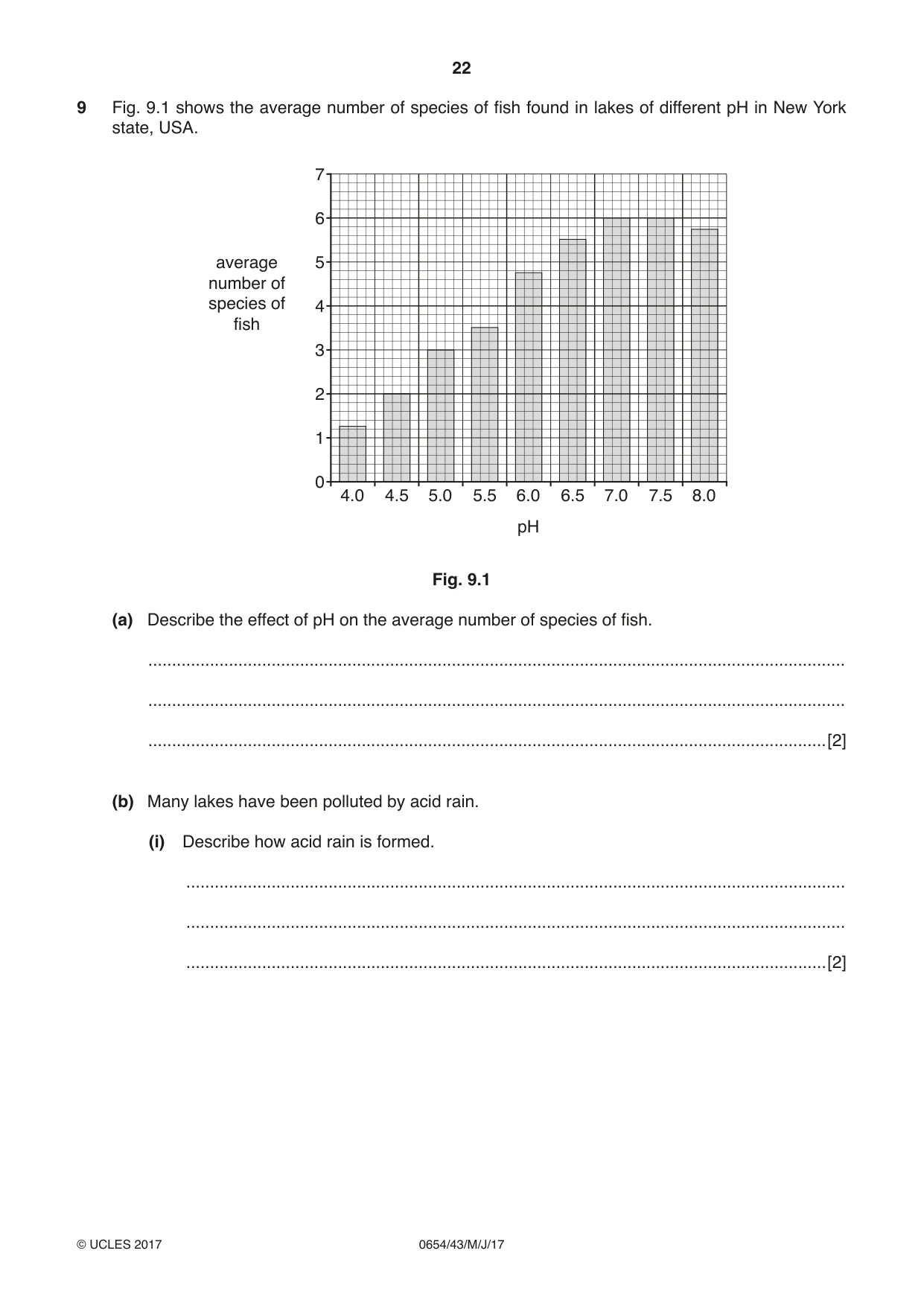
22 0654/43/M/J/17 © UCLES 2017 9 Fig. 9.1 shows the average number of species of fish found in lakes of different pH in New York state, USA. 4.0 0 2 4 6 average number of species of fish 1 3 5 7 5.0 6.0 pH 7.0 8.0 4.5 5.5 6.5 7.5 Fig. 9.1 (a) Describe the effect of pH on the average number of species of fish. … … …[2] (b) Many lakes have been polluted by acid rain. (i) Describe how acid rain is formed. … … …[2]
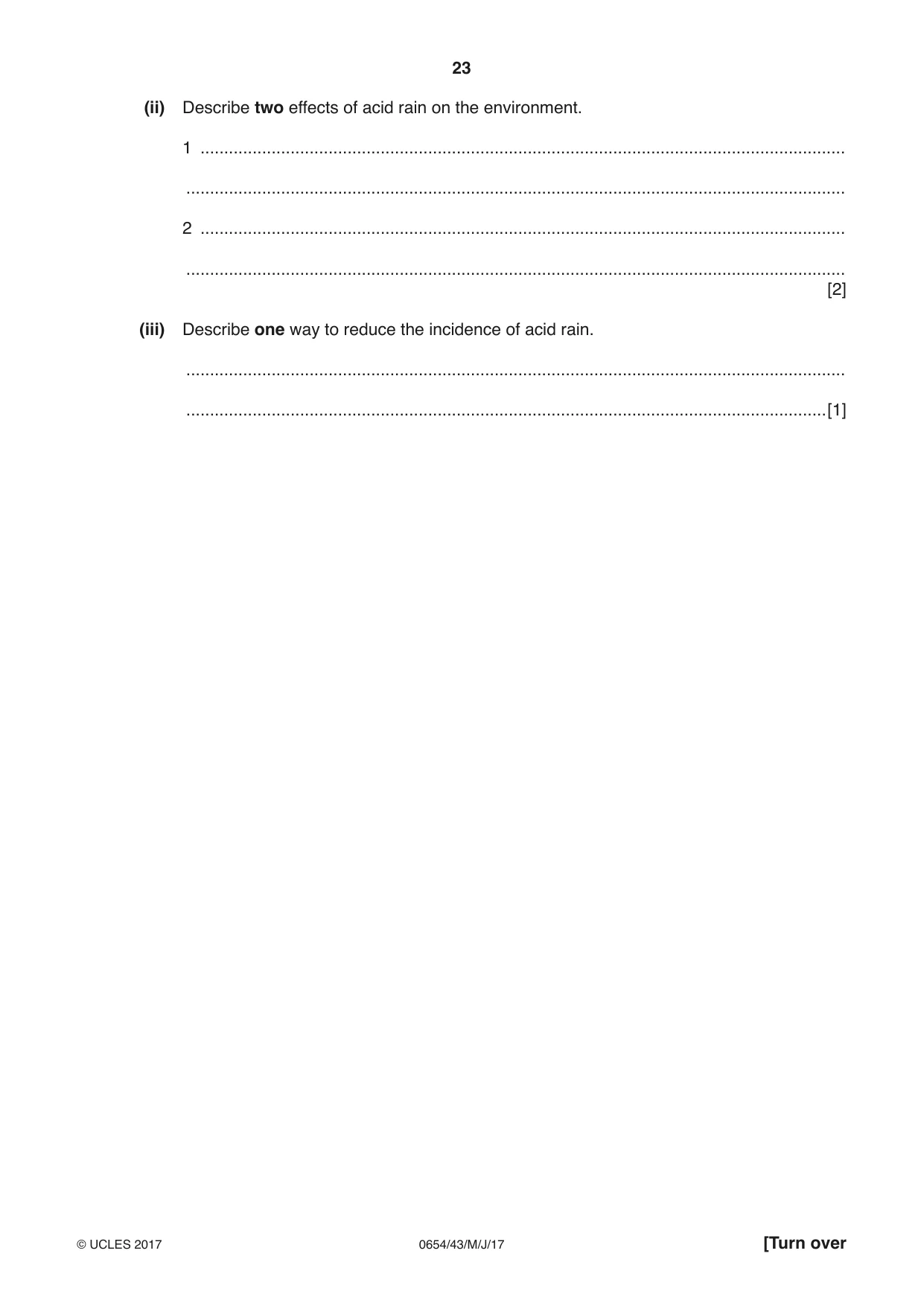
Question paper, page 23
23 0654/43/M/J/17 © UCLES 2017 [Turn over (ii) Describe two effects of acid rain on the environment. 1 … … 2 … … [2] (iii) Describe one way to reduce the incidence of acid rain. … …[1]
Question paper, page 24
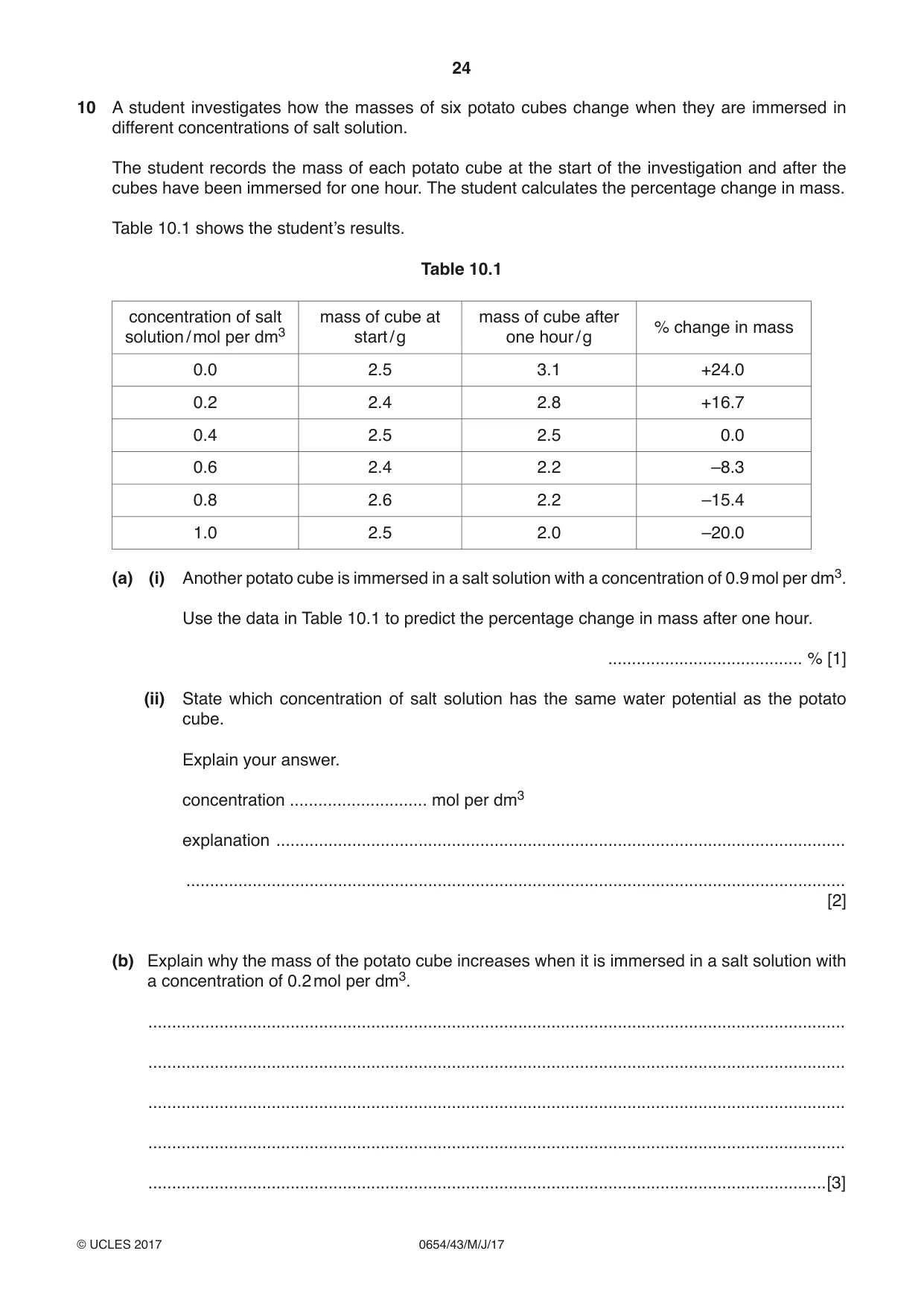
24 0654/43/M/J/17 © UCLES 2017 10 A student investigates how the masses of six potato cubes change when they are immersed in different concentrations of salt solution. The student records the mass of each potato cube at the start of the investigation and after the cubes have been immersed for one hour. The student calculates the percentage change in mass. Table 10.1 shows the student’s results. Table 10.1 concentration of salt solution / mol per dm3 mass of cube at start / g mass of cube after one hour / g % change in mass 0.0 2.5 3.1 +24.0 0.2 2.4 2.8 +16.7 0.4 2.5 2.5 0.0 0.6 2.4 2.2 –8.3 0.8 2.6 2.2 –15.4 1.0 2.5 2.0 –20.0 (a) (i) Another potato cube is immersed in a salt solution with a concentration of 0.9 mol per dm3. Use the data in Table 10.1 to predict the percentage change in mass after one hour. … % [1] (ii) State which concentration of salt solution has the same water potential as the potato cube. Explain your answer. concentration … mol per dm3 explanation … … [2] (b) Explain why the mass of the potato cube increases when it is immersed in a salt solution with a concentration of 0.2 mol per dm3. … … … … …[3]
Question paper, page 25
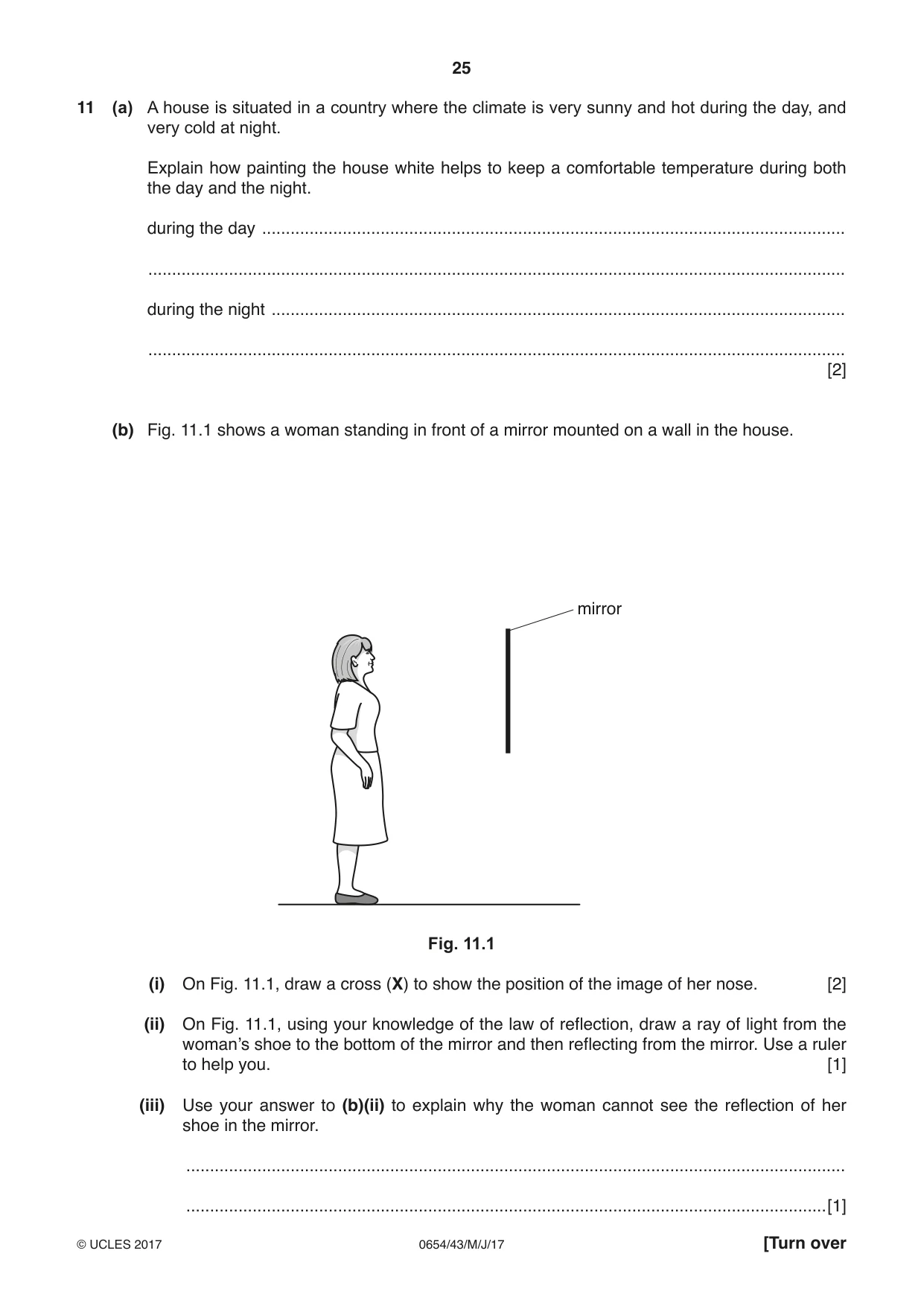
25 0654/43/M/J/17 © UCLES 2017 [Turn over 11 (a) A house is situated in a country where the climate is very sunny and hot during the day, and very cold at night. Explain how painting the house white helps to keep a comfortable temperature during both the day and the night. during the day … … during the night … … [2] (b) Fig. 11.1 shows a woman standing in front of a mirror mounted on a wall in the house. mirror Fig. 11.1 (i) On Fig. 11.1, draw a cross (X) to show the position of the image of her nose. [2] (ii) On Fig. 11.1, using your knowledge of the law of reflection, draw a ray of light from the woman’s shoe to the bottom of the mirror and then reflecting from the mirror. Use a ruler to help you. [1] (iii) Use your answer to (b)(ii) to explain why the woman cannot see the reflection of her shoe in the mirror. … …[1]
Question paper, page 26
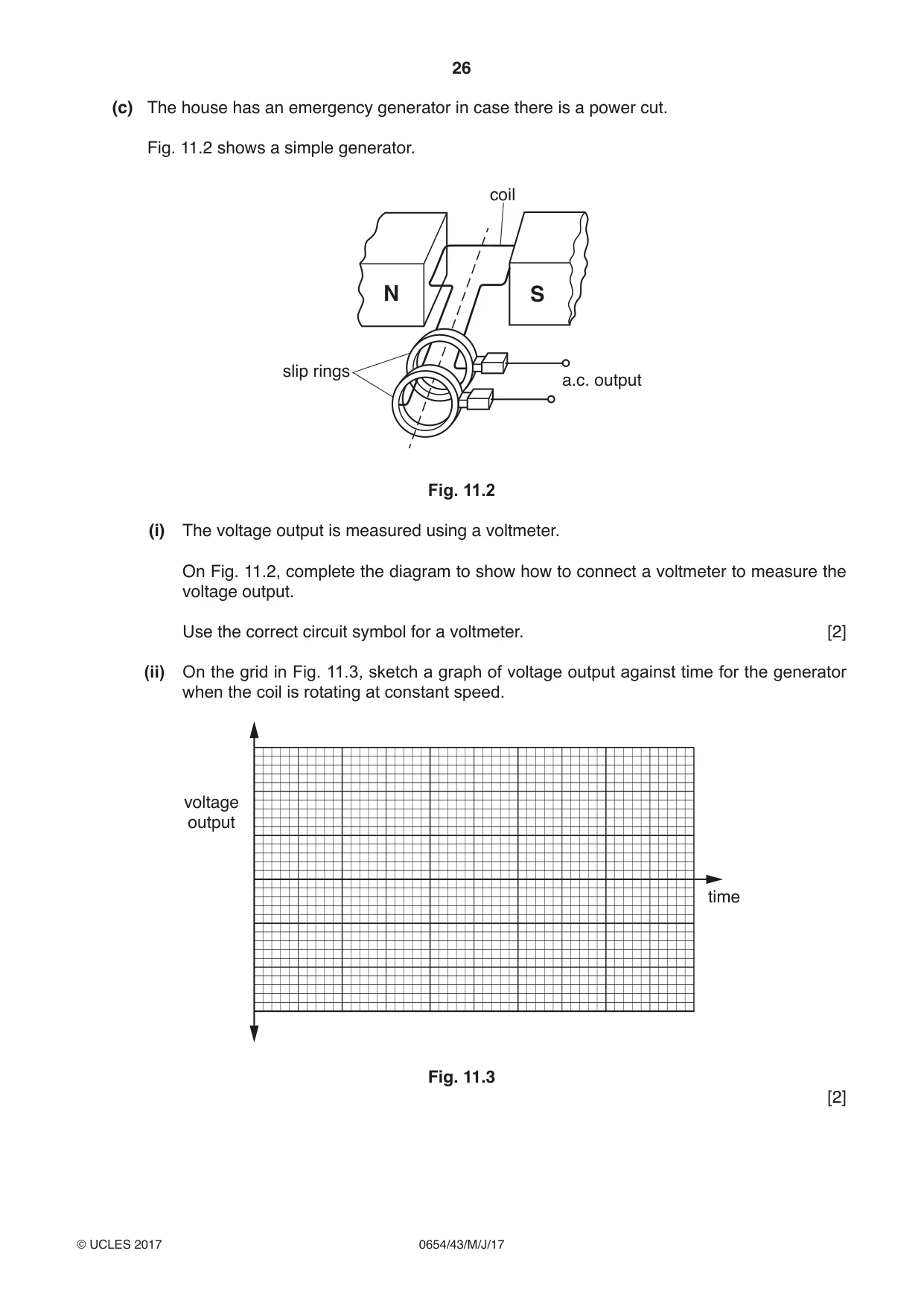
26 0654/43/M/J/17 © UCLES 2017 (c) The house has an emergency generator in case there is a power cut. Fig. 11.2 shows a simple generator. slip rings a.c. output coil S N Fig. 11.2 (i) The voltage output is measured using a voltmeter. On Fig. 11.2, complete the diagram to show how to connect a voltmeter to measure the voltage output. Use the correct circuit symbol for a voltmeter. [2] (ii) On the grid in Fig. 11.3, sketch a graph of voltage output against time for the generator when the coil is rotating at constant speed. voltage output time Fig. 11.3 [2]
Question paper, page 27
27 0654/43/M/J/17 © UCLES 2017 [Turn over (iii) Describe how the rotation of the coil in the magnetic field and the use of slip rings produce an alternating current. … … … … … …[3]
Question paper, page 28
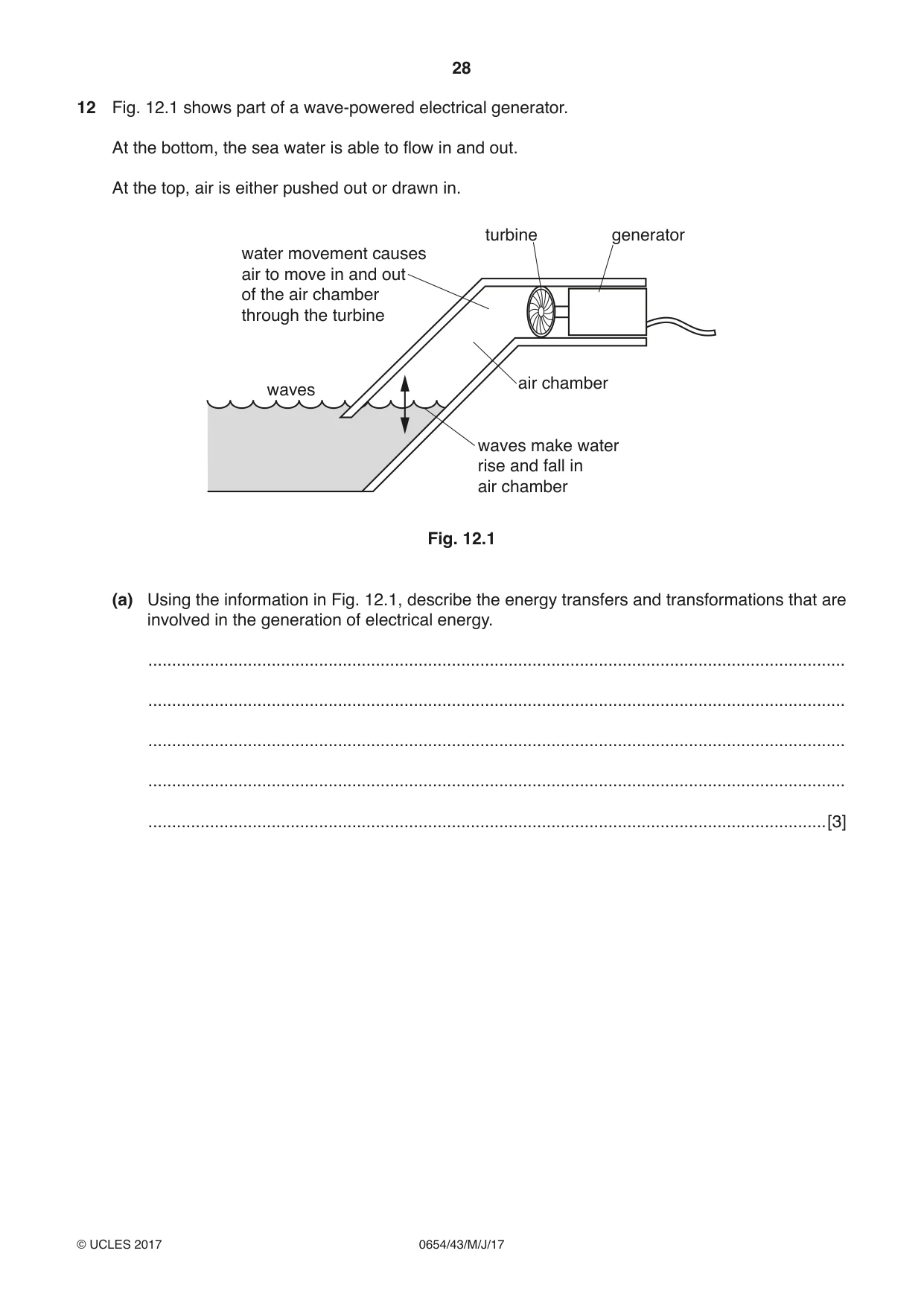
28 0654/43/M/J/17 © UCLES 2017 12 Fig. 12.1 shows part of a wave-powered electrical generator. At the bottom, the sea water is able to flow in and out. At the top, air is either pushed out or drawn in. water movement causes air to move in and out of the air chamber through the turbine waves turbine generator air chamber waves make water rise and fall in air chamber Fig. 12.1 (a) Using the information in Fig. 12.1, describe the energy transfers and transformations that are involved in the generation of electrical energy. … … … … …[3]
Question paper, page 29
29 0654/43/M/J/17 © UCLES 2017 [Turn over (b) The distance between two waves on the surface of the ocean is 12 m. The waves travel at 2.0 m / s along the surface of the ocean. Calculate the frequency of the waves. State the formula you use and show your working. formula working frequency = … Hz [2] (c) Water vapour is produced by the evaporation of water from the ocean. Describe the process of evaporation in terms of the movement and energy of water molecules and the forces between water molecules. … … … … …[3]
Question paper, page 30
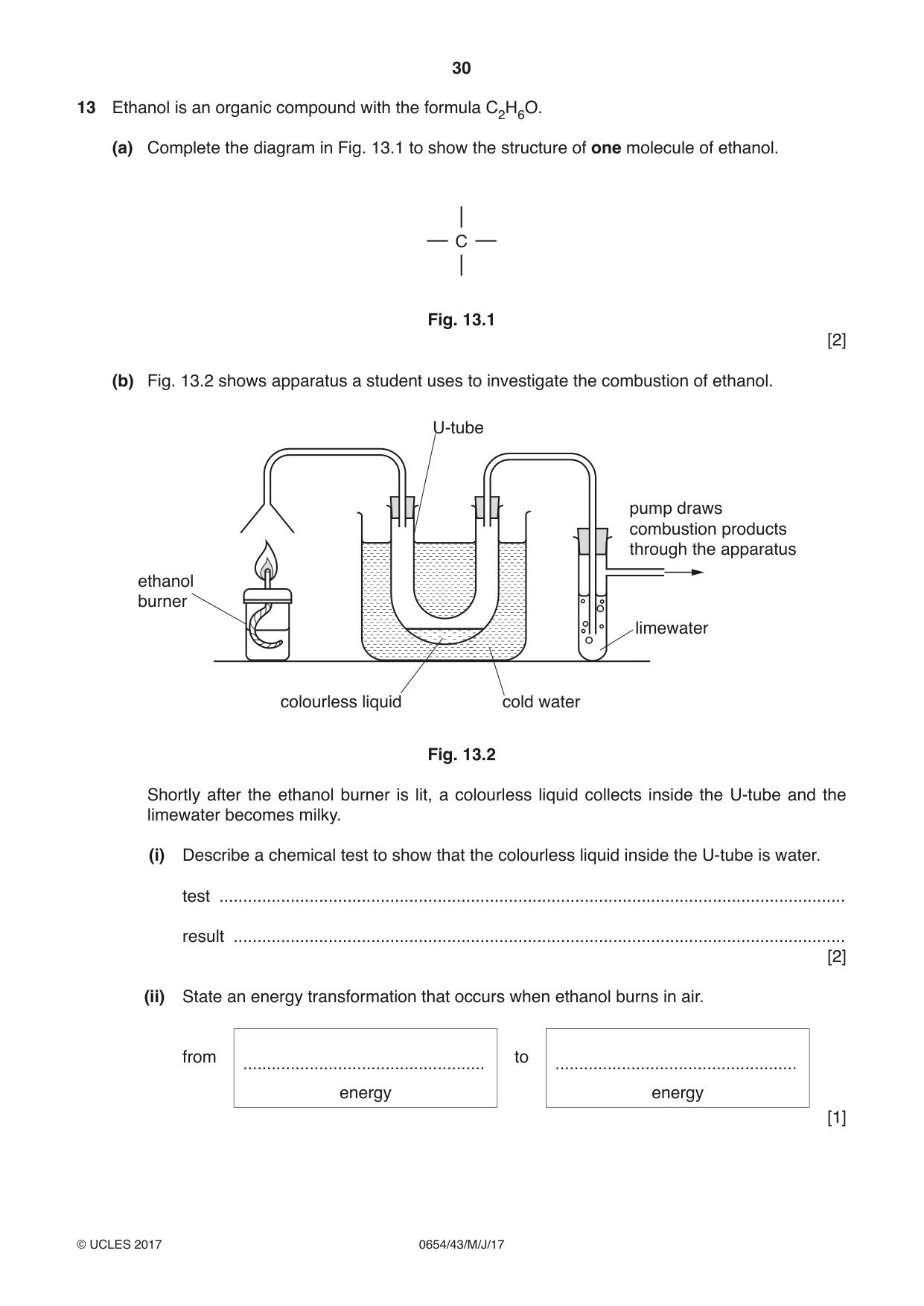
30 0654/43/M/J/17 © UCLES 2017 13 Ethanol is an organic compound with the formula C2H6O. (a) Complete the diagram in Fig. 13.1 to show the structure of one molecule of ethanol. C Fig. 13.1 [2] (b) Fig. 13.2 shows apparatus a student uses to investigate the combustion of ethanol. U-tube ethanol burner colourless liquid cold water limewater pump draws combustion products through the apparatus Fig. 13.2 Shortly after the ethanol burner is lit, a colourless liquid collects inside the U-tube and the limewater becomes milky. (i) Describe a chemical test to show that the colourless liquid inside the U-tube is water. test … result … [2] (ii) State an energy transformation that occurs when ethanol burns in air. from … energy to … energy [1]
Question paper, page 31
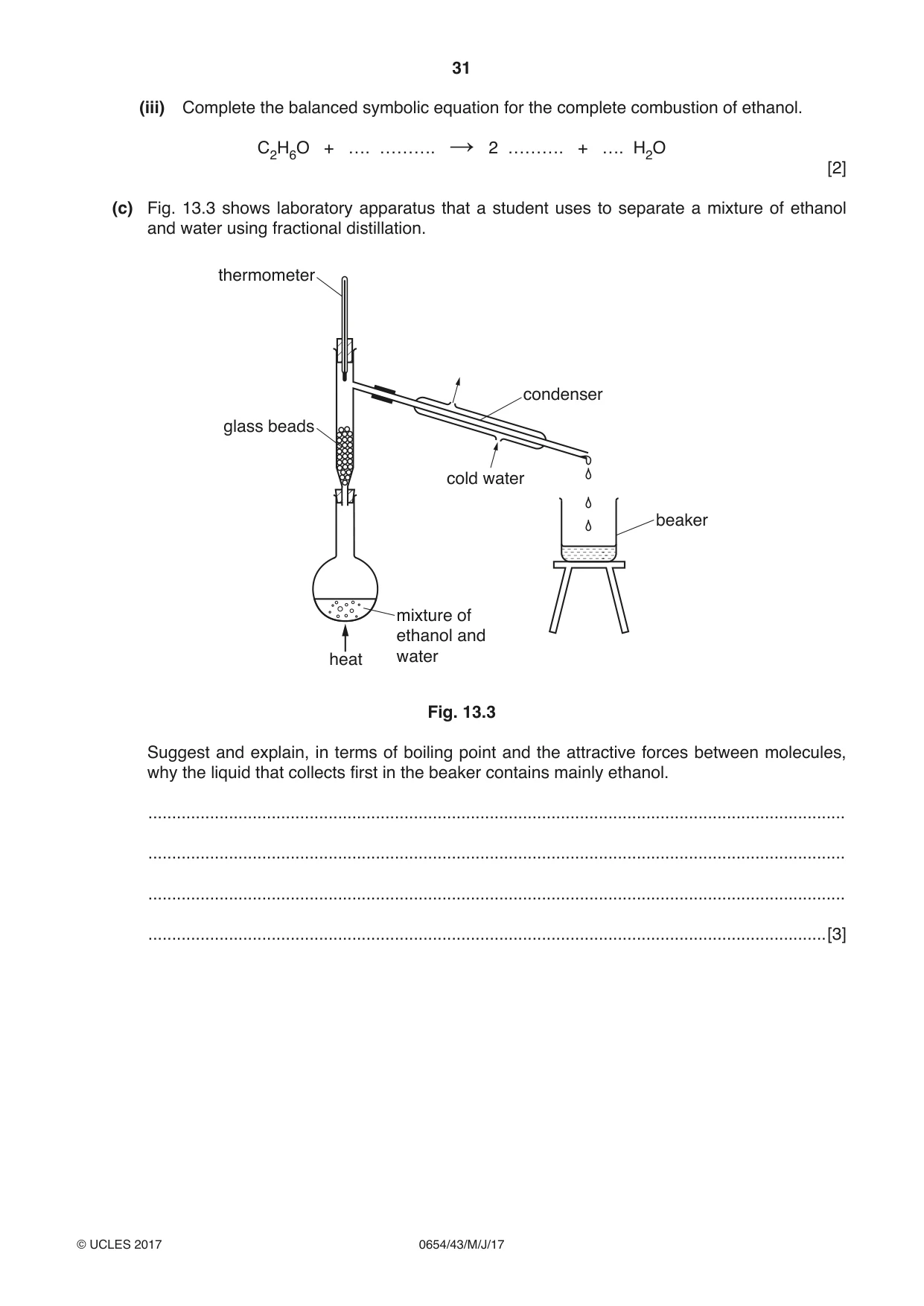
31 0654/43/M/J/17 © UCLES 2017 (iii) Complete the balanced symbolic equation for the complete combustion of ethanol. C2H6O + …. ………. → 2 ………. + …. H2O [2] (c) Fig. 13.3 shows laboratory apparatus that a student uses to separate a mixture of ethanol and water using fractional distillation. thermometer mixture of ethanol and water heat cold water condenser glass beads beaker Fig. 13.3 Suggest and explain, in terms of boiling point and the attractive forces between molecules, why the liquid that collects first in the beaker contains mainly ethanol. … … … …[3]
Question paper, page 32
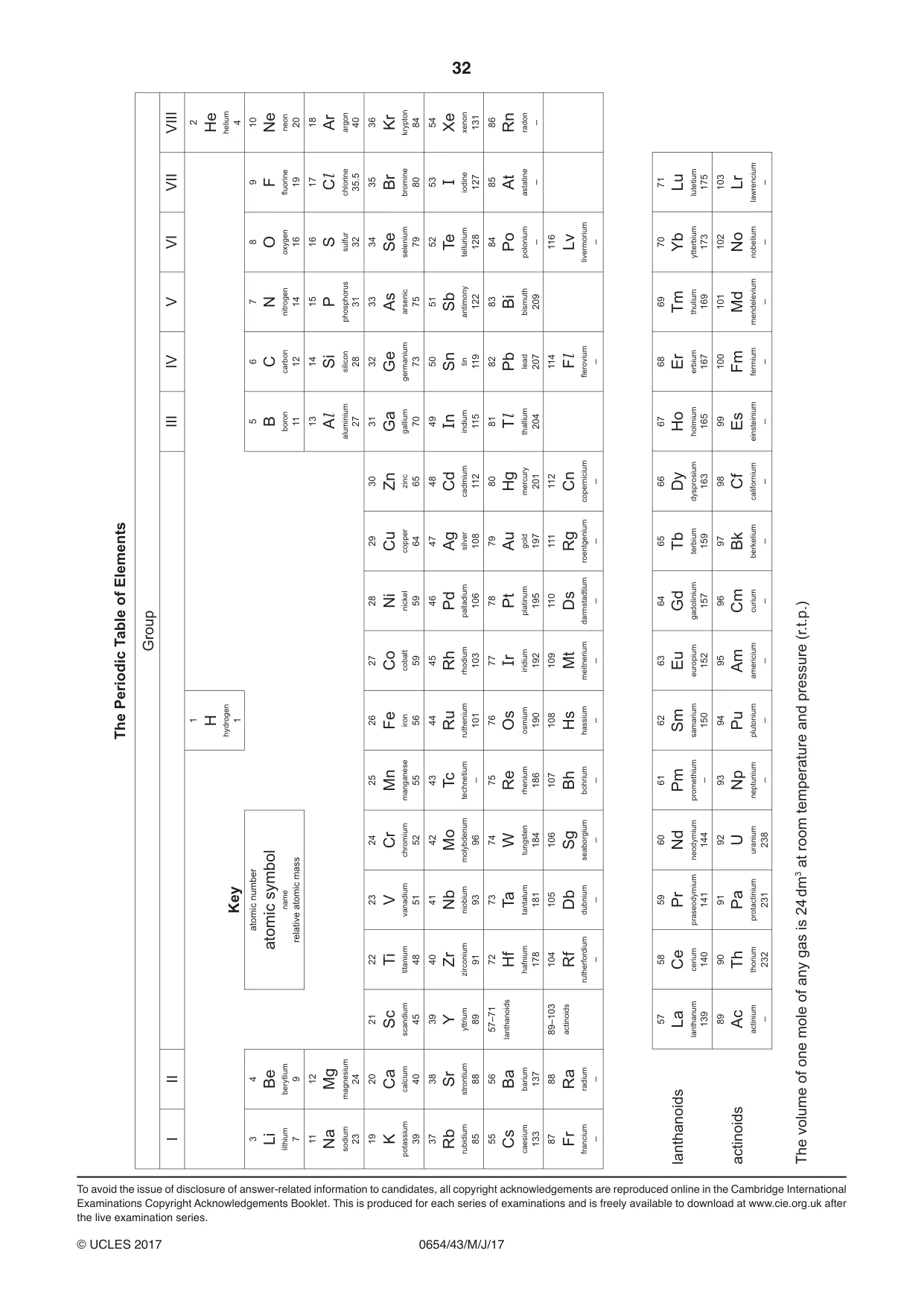
32 0654/43/M/J/17 © UCLES 2017 To avoid the issue of disclosure of answer-related information to candidates, all copyright acknowledgements are reproduced online in the Cambridge International Examinations Copyright Acknowledgements Booklet. This is produced for each series of examinations and is freely available to download at www.cie.org.uk after the live examination series. Group The Periodic Table of Elements 1 H hydrogen 1 2 He helium 4 I II III IV V VI VII VIII 3 Li lithium 7 4 Be beryllium 9 atomic number atomic symbol Key name relative atomic mass 11 Na sodium 23 12 Mg magnesium 24 19 K potassium 39 20 Ca calcium 40 37 Rb rubidium 85 38 Sr strontium 88 55 Cs caesium 133 56 Ba barium 137 87 Fr francium – 88 Ra radium – 5 B boron 11 13 Al aluminium 27 31 Ga gallium 70 49 In indium 115 81 Tl thallium 204 6 C carbon 12 14 Si silicon 28 32 Ge germanium 73 50 Sn tin 119 82 Pb lead 207 22 Ti titanium 48 40 Zr zirconium 91 72 Hf hafnium 178 104 Rf rutherfordium – 23 V vanadium 51 41 Nb niobium 93 73 Ta tantalum 181 105 Db dubnium – 24 Cr chromium 52 42 Mo molybdenum 96 74 W tungsten 184 106 Sg seaborgium – 25 Mn manganese 55 43 Tc technetium – 75 Re rhenium 186 107 Bh bohrium – 26 Fe iron 56 44 Ru ruthenium 101 76 Os osmium 190 108 Hs hassium – 27 Co cobalt 59 45 Rh rhodium 103 77 Ir iridium 192 109 Mt meitnerium – 28 Ni nickel 59 46 Pd palladium 106 78 Pt platinum 195 110 Ds darmstadtium – 29 Cu copper 64 47 Ag silver 108 79 Au gold 197 111 Rg roentgenium – 30 Zn zinc 65 48 Cd cadmium 112 80 Hg mercury 201 112 Cn copernicium – 114 Fl flerovium – 116 Lv livermorium – 7 N nitrogen 14 15 P phosphorus 31 33 As arsenic 75 51 Sb antimony 122 83 Bi bismuth 209 8 O oxygen 16 16 S sulfur 32 34 Se selenium 79 52 Te tellurium 128 84 Po polonium – 9 F fluorine 19 17 Cl chlorine 35.5 35 Br bromine 80 53 I iodine 127 85 At astatine – 10 Ne neon 20 18 Ar argon 40 36 Kr krypton 84 54 Xe xenon 131 86 Rn radon – 21 Sc scandium 45 39 Y yttrium 89 57–71 lanthanoids 89–103 actinoids 57 La lanthanum 139 89 Ac lanthanoids actinoids The volume of one mole of any gas is 24 dm3 at room temperature and pressure (r.t.p.) actinium – 58 Ce cerium 140 90 Th thorium 232 59 Pr praseodymium 141 91 Pa protactinium 231 60 Nd neodymium 144 92 U uranium 238 61 Pm promethium – 93 Np neptunium – 62 Sm samarium 150 94 Pu plutonium – 63 Eu europium 152 95 Am americium – 64 Gd gadolinium 157 96 Cm curium – 65 Tb terbium 159 97 Bk berkelium – 66 Dy dysprosium 163 98 Cf californium – 67 Ho holmium 165 99 Es einsteinium – 68 Er erbium 167 100 Fm fermium – 69 Tm thulium 169 101 Md mendelevium – 70 Yb ytterbium 173 102 No nobelium – 71 Lu lutetium 175 103 Lr lawrencium –
Mark scheme, page 1
® IGCSE is a registered trademark. This document consists of 11 printed pages. © UCLES 2017 [Turn over Cambridge International Examinations Cambridge International General Certificate of Secondary Education CO-ORDINATED SCIENCES 0654/43 Paper 4 Theory (Extended) May/June 2017 MARK SCHEME Maximum Mark: 120 Published This mark scheme is published as an aid to teachers and candidates, to indicate the requirements of the examination. It shows the basis on which Examiners were instructed to award marks. It does not indicate the details of the discussions that took place at an Examiners’ meeting before marking began, which would have considered the acceptability of alternative answers. Mark schemes should be read in conjunction with the question paper and the Principal Examiner Report for Teachers. Cambridge will not enter into discussions about these mark schemes. Cambridge is publishing the mark schemes for the May/June 2017 series for most Cambridge IGCSE®, Cambridge International A and AS Level and Cambridge Pre-U components, and some Cambridge O Level components.
Mark scheme, page 2
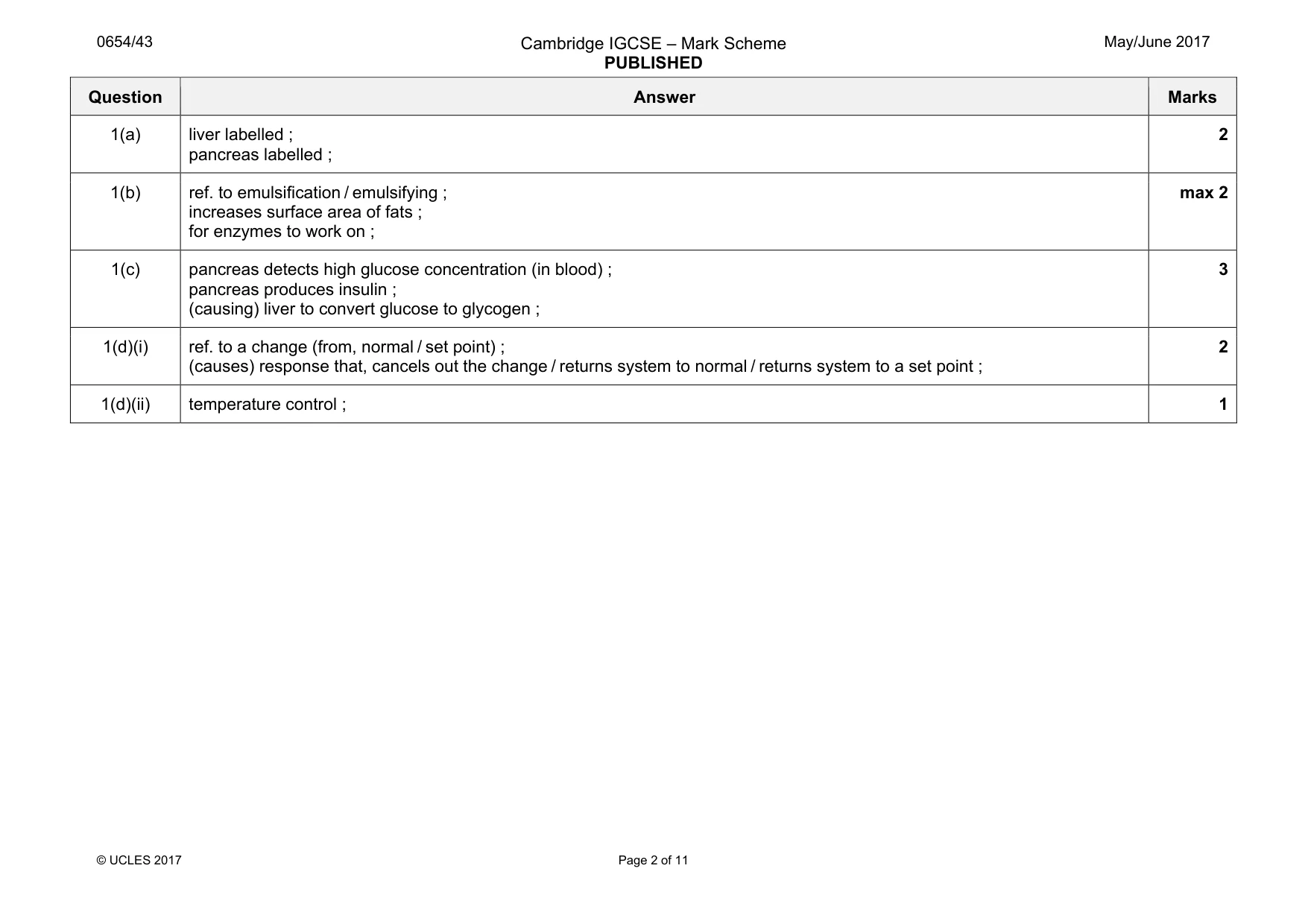
0654/43 Cambridge IGCSE – Mark Scheme PUBLISHED May/June 2017 © UCLES 2017 Page 2 of 11 Question Answer Marks 1(a) liver labelled ; pancreas labelled ; 2 1(b) ref. to emulsification / emulsifying ; increases surface area of fats ; for enzymes to work on ; max 2 1(c) pancreas detects high glucose concentration (in blood) ; pancreas produces insulin ; (causing) liver to convert glucose to glycogen ; 3 1(d)(i) ref. to a change (from, normal / set point) ; (causes) response that, cancels out the change / returns system to normal / returns system to a set point ; 2 1(d)(ii) temperature control ; 1
Mark scheme, page 3
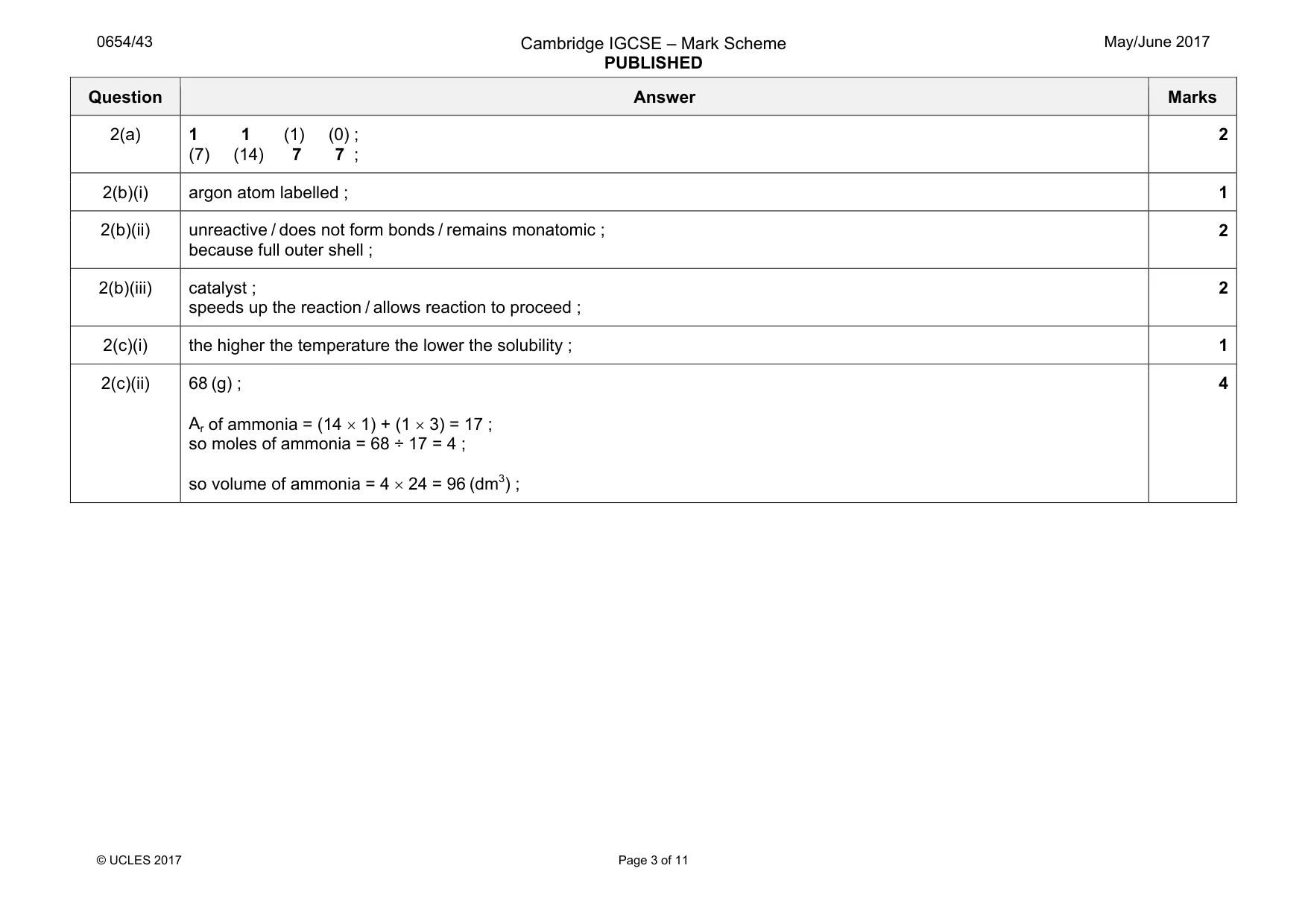
0654/43 Cambridge IGCSE – Mark Scheme PUBLISHED May/June 2017 © UCLES 2017 Page 3 of 11 Question Answer Marks 2(a) 1 1 (1) (0) ; (7) (14) 7 7 ; 2 2(b)(i) argon atom labelled ; 1 2(b)(ii) unreactive / does not form bonds / remains monatomic ; because full outer shell ; 2 2(b)(iii) catalyst ; speeds up the reaction / allows reaction to proceed ; 2 2(c)(i) the higher the temperature the lower the solubility ; 1 2(c)(ii) 68 (g) ; Ar of ammonia = (14 × 1) + (1 × 3) = 17 ; so moles of ammonia = 68 ÷ 17 = 4 ; so volume of ammonia = 4 × 24 = 96 (dm3) ; 4
Mark scheme, page 4
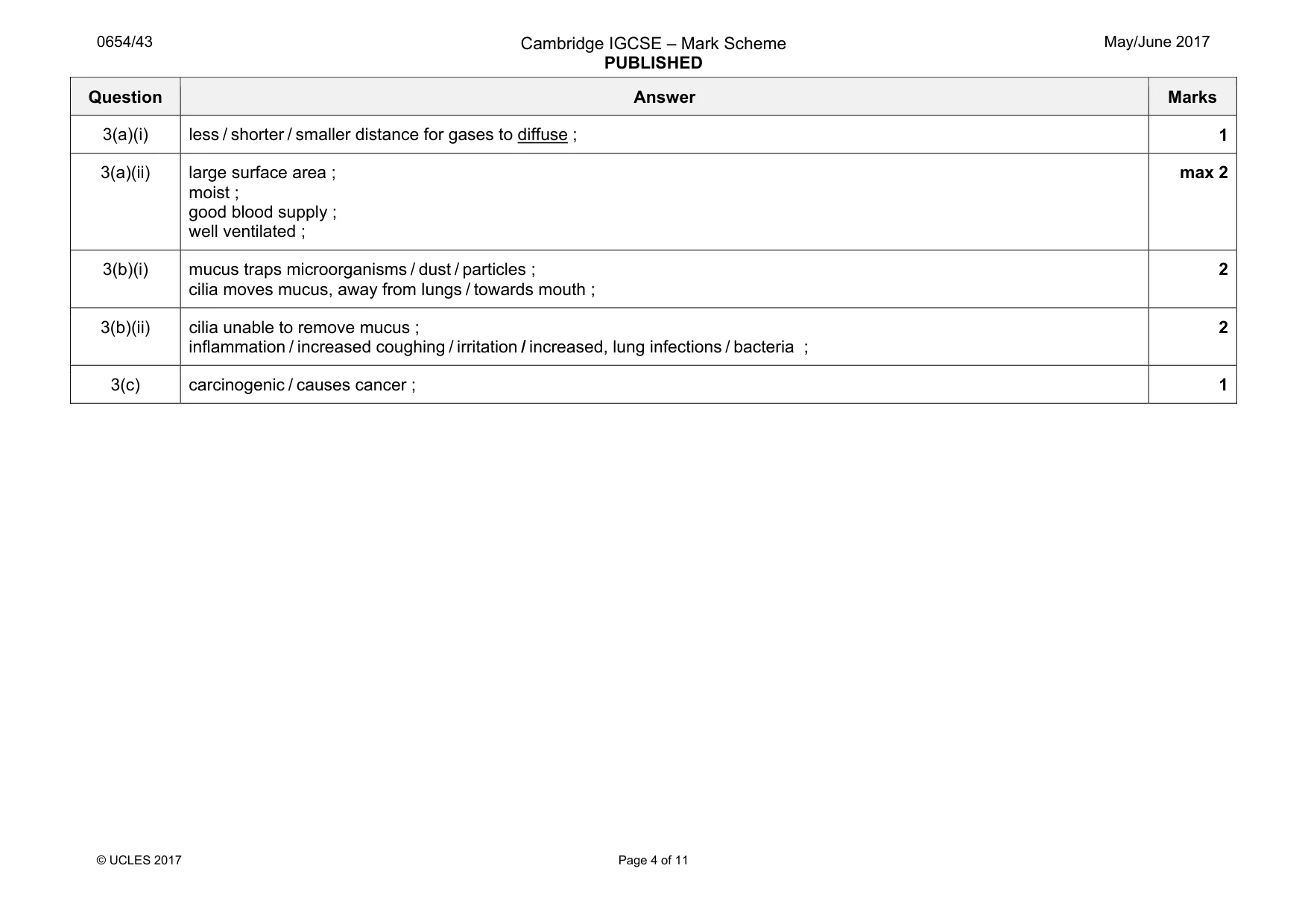
0654/43 Cambridge IGCSE – Mark Scheme PUBLISHED May/June 2017 © UCLES 2017 Page 4 of 11 Question Answer Marks 3(a)(i) less / shorter / smaller distance for gases to diffuse ; 1 3(a)(ii) large surface area ; moist ; good blood supply ; well ventilated ; max 2 3(b)(i) mucus traps microorganisms / dust / particles ; cilia moves mucus, away from lungs / towards mouth ; 2 3(b)(ii) cilia unable to remove mucus ; inflammation / increased coughing / irritation / increased, lung infections / bacteria ; 2 3(c) carcinogenic / causes cancer ; 1
Mark scheme, page 5
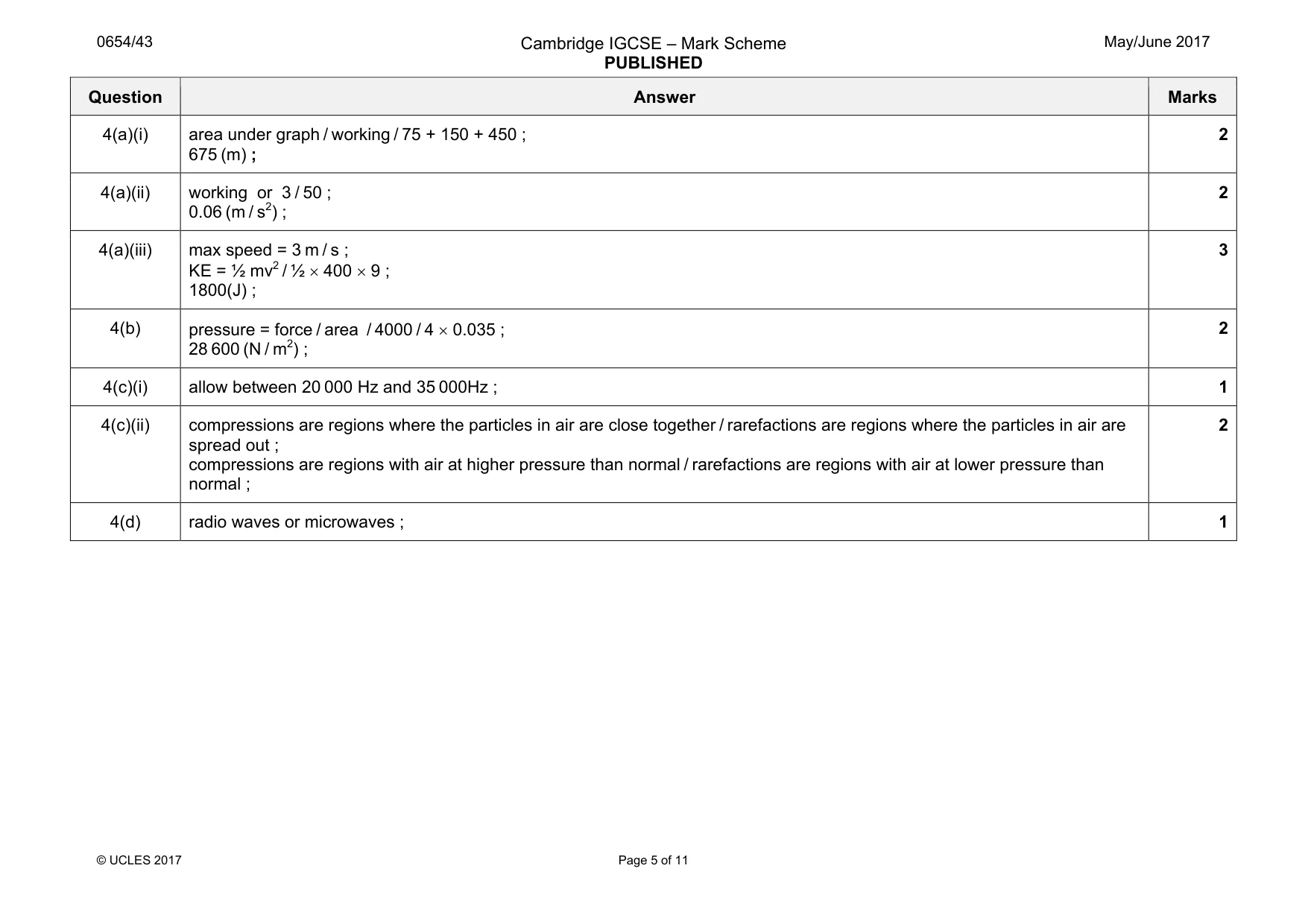
0654/43 Cambridge IGCSE – Mark Scheme PUBLISHED May/June 2017 © UCLES 2017 Page 5 of 11 Question Answer Marks 4(a)(i) area under graph / working / 75 + 150 + 450 ; 675 (m) ; 2 4(a)(ii) working or 3 / 50 ; 0.06 (m / s2) ; 2 4(a)(iii) max speed = 3 m / s ; KE = ½ mv2 / ½ × 400 × 9 ; 1800(J) ; 3 4(b) pressure = force / area / 4000 / 4 × 0.035 ; 28 600 (N / m2) ; 2 4(c)(i) allow between 20 000 Hz and 35 000Hz ; 1 4(c)(ii) compressions are regions where the particles in air are close together / rarefactions are regions where the particles in air are spread out ; compressions are regions with air at higher pressure than normal / rarefactions are regions with air at lower pressure than normal ; 2 4(d) radio waves or microwaves ; 1
Mark scheme, page 6
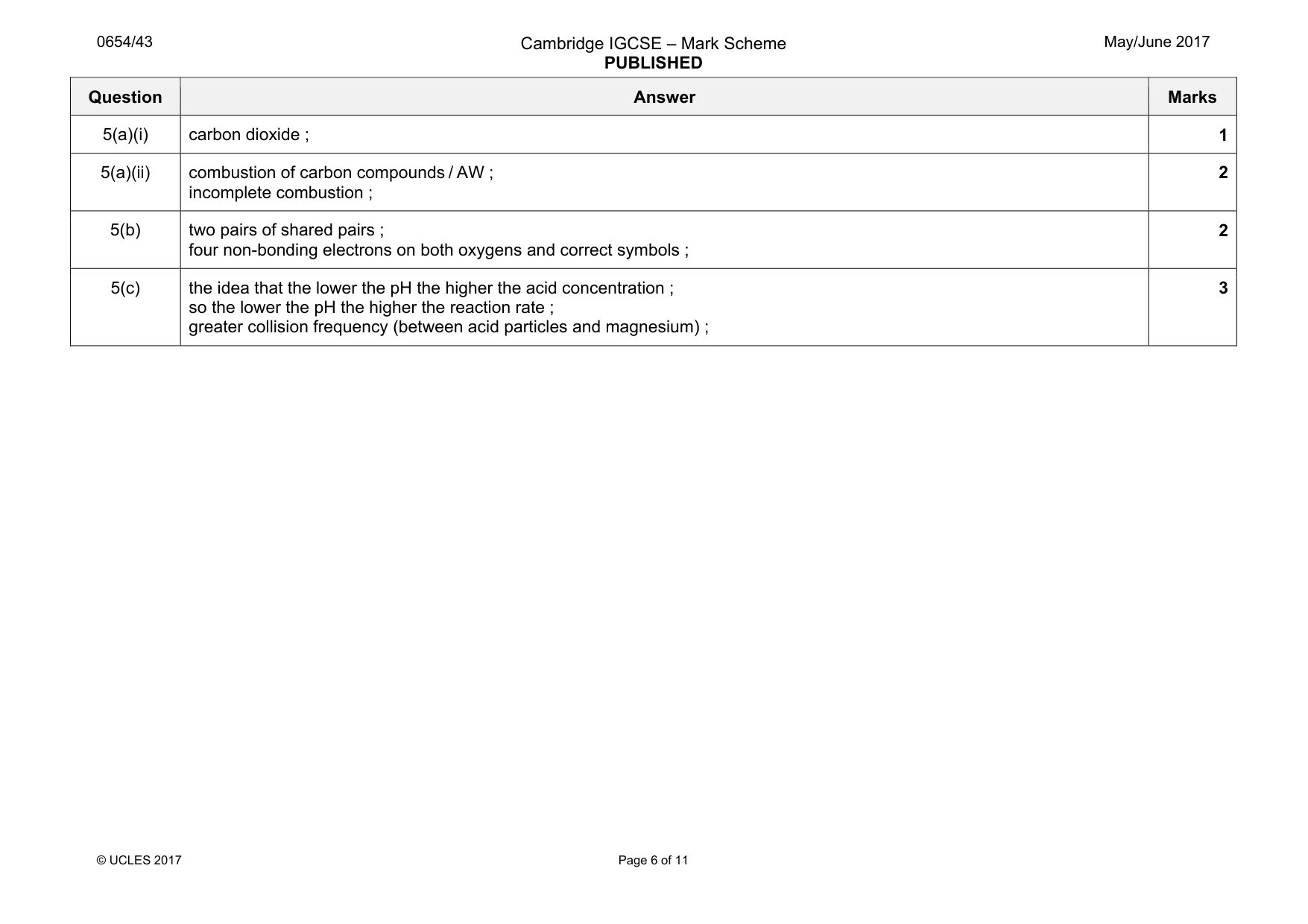
0654/43 Cambridge IGCSE – Mark Scheme PUBLISHED May/June 2017 © UCLES 2017 Page 6 of 11 Question Answer Marks 5(a)(i) carbon dioxide ; 1 5(a)(ii) combustion of carbon compounds / AW ; incomplete combustion ; 2 5(b) two pairs of shared pairs ; four non-bonding electrons on both oxygens and correct symbols ; 2 5(c) the idea that the lower the pH the higher the acid concentration ; so the lower the pH the higher the reaction rate ; greater collision frequency (between acid particles and magnesium) ; 3
Mark scheme, page 7
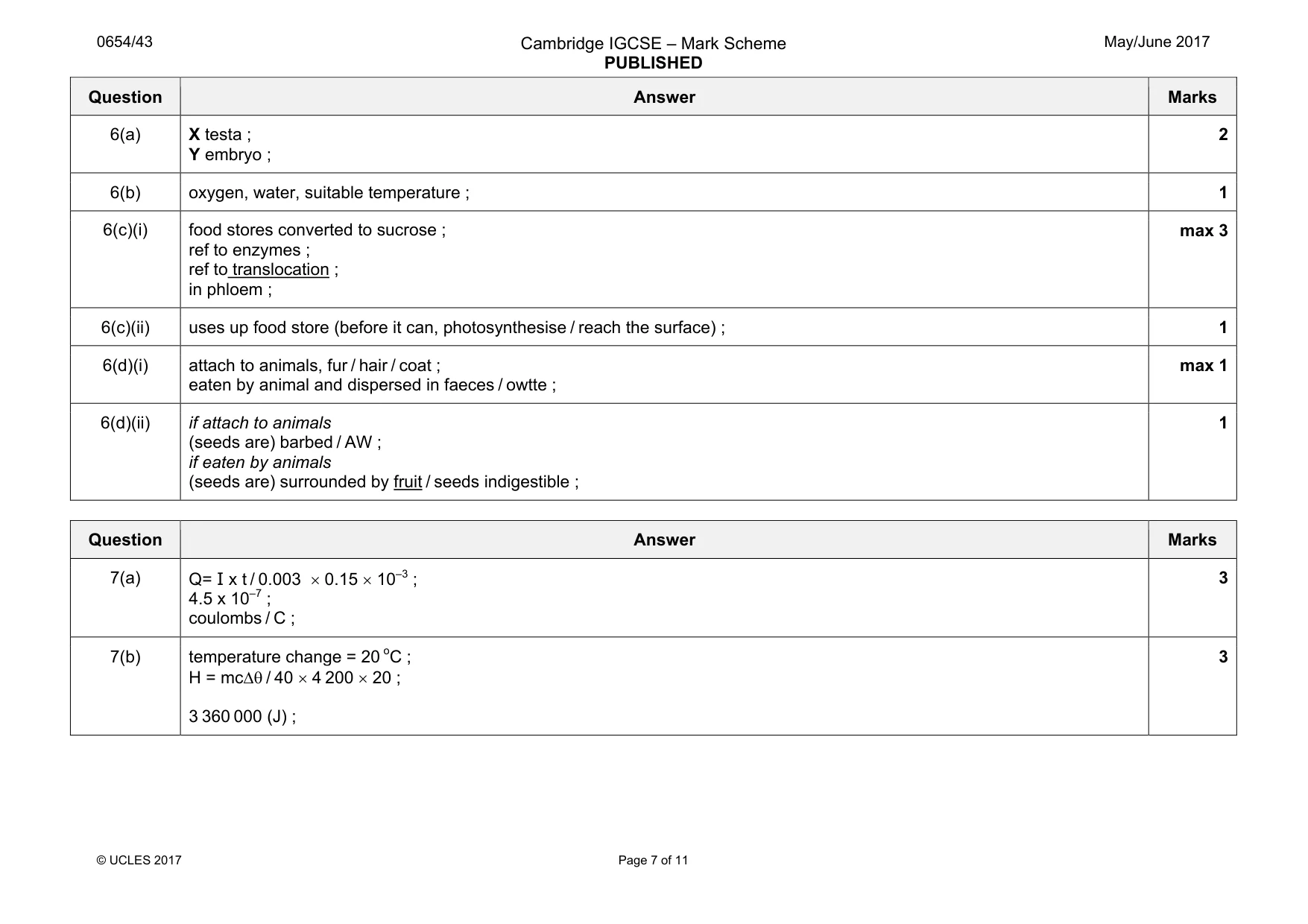
0654/43 Cambridge IGCSE – Mark Scheme PUBLISHED May/June 2017 © UCLES 2017 Page 7 of 11 Question Answer Marks 6(a) X testa ; Y embryo ; 2 6(b) oxygen, water, suitable temperature ; 1 6(c)(i) food stores converted to sucrose ; ref to enzymes ; ref to translocation ; in phloem ; max 3 6(c)(ii) uses up food store (before it can, photosynthesise / reach the surface) ; 1 6(d)(i) attach to animals, fur / hair / coat ; eaten by animal and dispersed in faeces / owtte ; max 1 6(d)(ii) if attach to animals (seeds are) barbed / AW ; if eaten by animals (seeds are) surrounded by fruit / seeds indigestible ; 1 Question Answer Marks 7(a) Q= I x t / 0.003 × 0.15 × 10–3 ; 4.5 x 10⁻⁷ ; coulombs / C ; 3 7(b) temperature change = 20 oC ; H = mc∆θ / 40 × 4 200 × 20 ; 3 360 000 (J) ; 3
Mark scheme, page 8
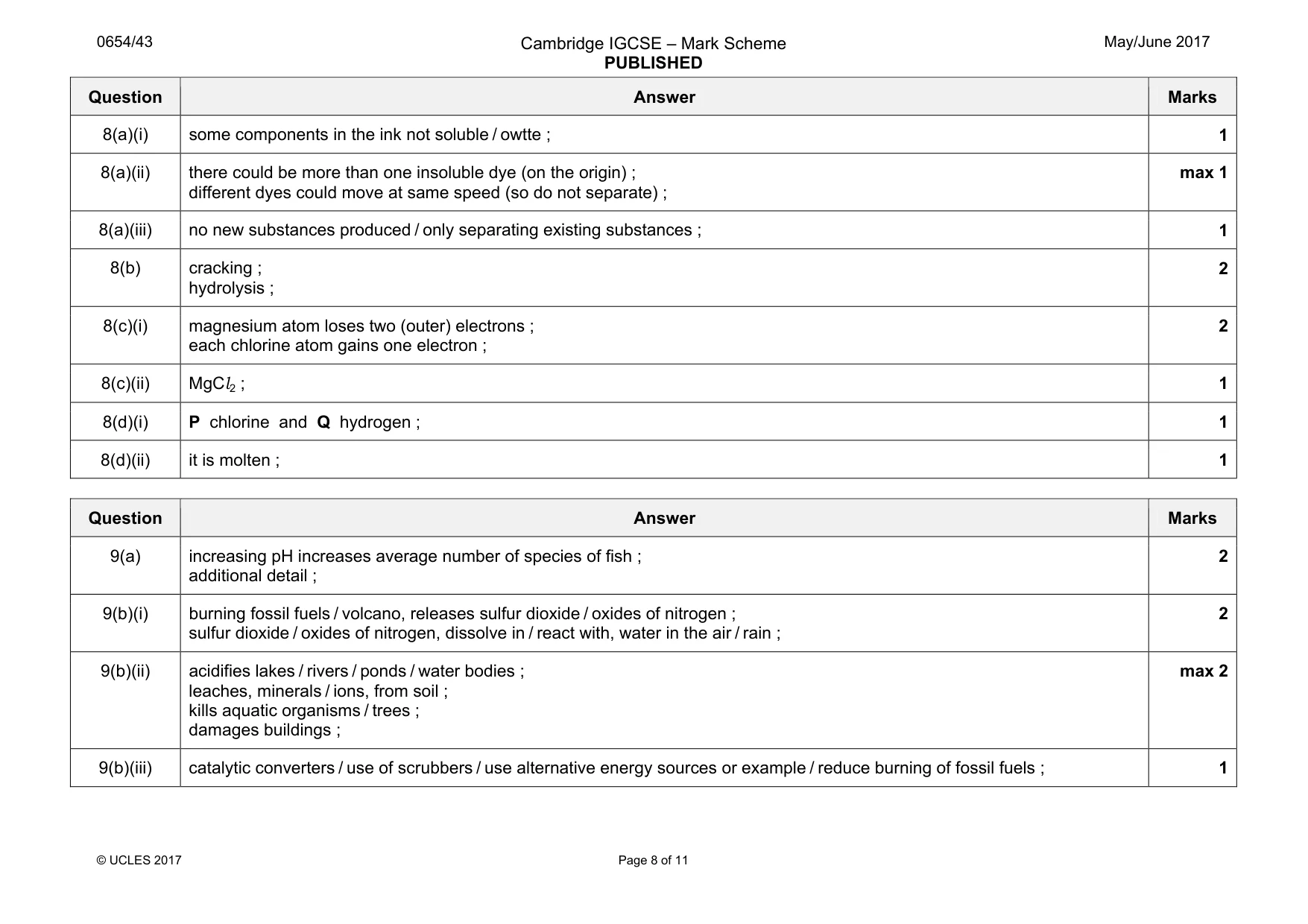
0654/43 Cambridge IGCSE – Mark Scheme PUBLISHED May/June 2017 © UCLES 2017 Page 8 of 11 Question Answer Marks 8(a)(i) some components in the ink not soluble / owtte ; 1 8(a)(ii) there could be more than one insoluble dye (on the origin) ; different dyes could move at same speed (so do not separate) ; max 1 8(a)(iii) no new substances produced / only separating existing substances ; 1 8(b) cracking ; hydrolysis ; 2 8(c)(i) magnesium atom loses two (outer) electrons ; each chlorine atom gains one electron ; 2 8(c)(ii) MgCl2 ; 1 8(d)(i) P chlorine and Q hydrogen ; 1 8(d)(ii) it is molten ; 1 Question Answer Marks 9(a) increasing pH increases average number of species of fish ; additional detail ; 2 9(b)(i) burning fossil fuels / volcano, releases sulfur dioxide / oxides of nitrogen ; sulfur dioxide / oxides of nitrogen, dissolve in / react with, water in the air / rain ; 2 9(b)(ii) acidifies lakes / rivers / ponds / water bodies ; leaches, minerals / ions, from soil ; kills aquatic organisms / trees ; damages buildings ; max 2 9(b)(iii) catalytic converters / use of scrubbers / use alternative energy sources or example / reduce burning of fossil fuels ; 1
Mark scheme, page 9
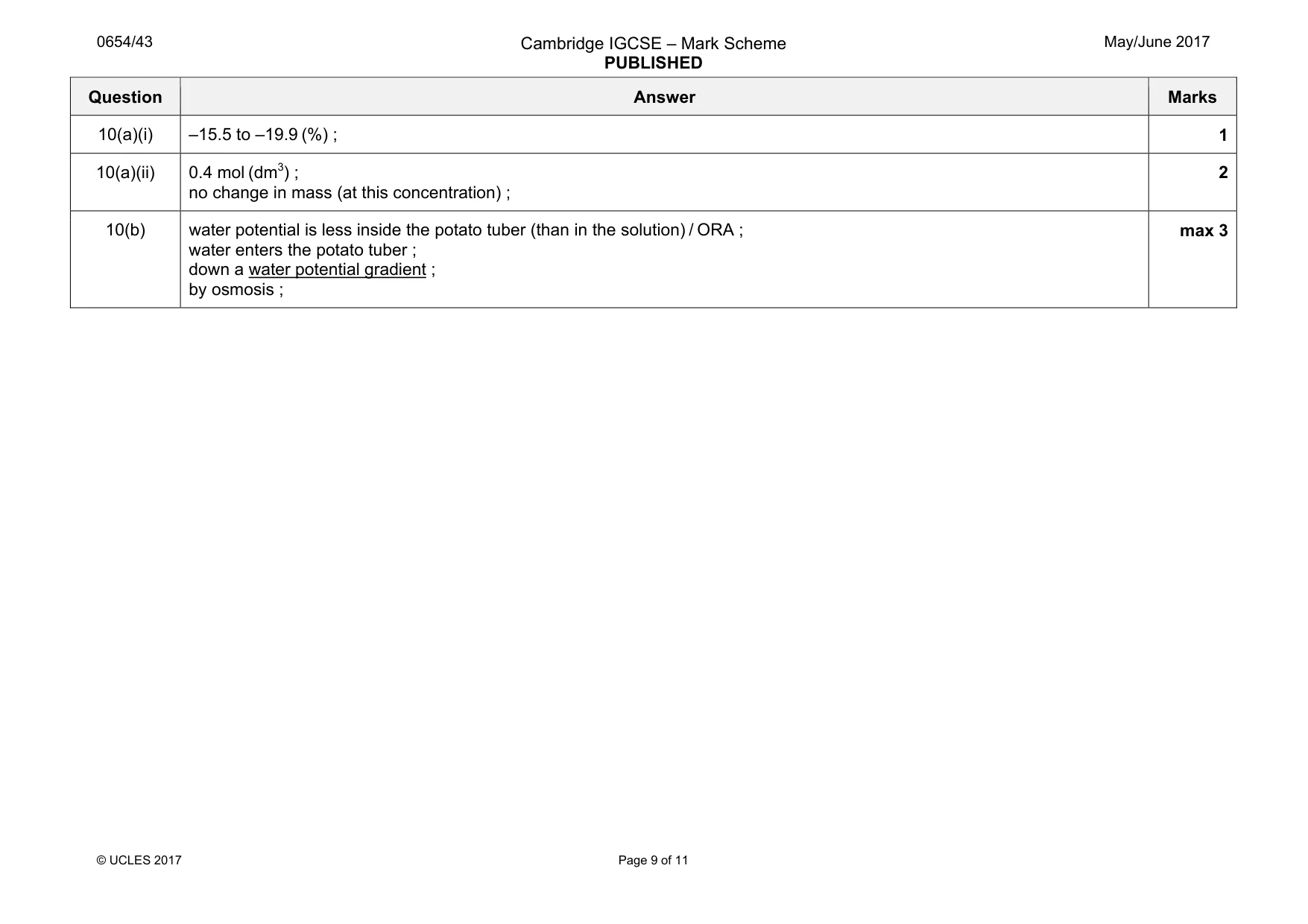
0654/43 Cambridge IGCSE – Mark Scheme PUBLISHED May/June 2017 © UCLES 2017 Page 9 of 11 Question Answer Marks 10(a)(i) –15.5 to –19.9 (%) ; 1 10(a)(ii) 0.4 mol (dm3) ; no change in mass (at this concentration) ; 2 10(b) water potential is less inside the potato tuber (than in the solution) / ORA ; water enters the potato tuber ; down a water potential gradient ; by osmosis ; max 3
Mark scheme, page 10
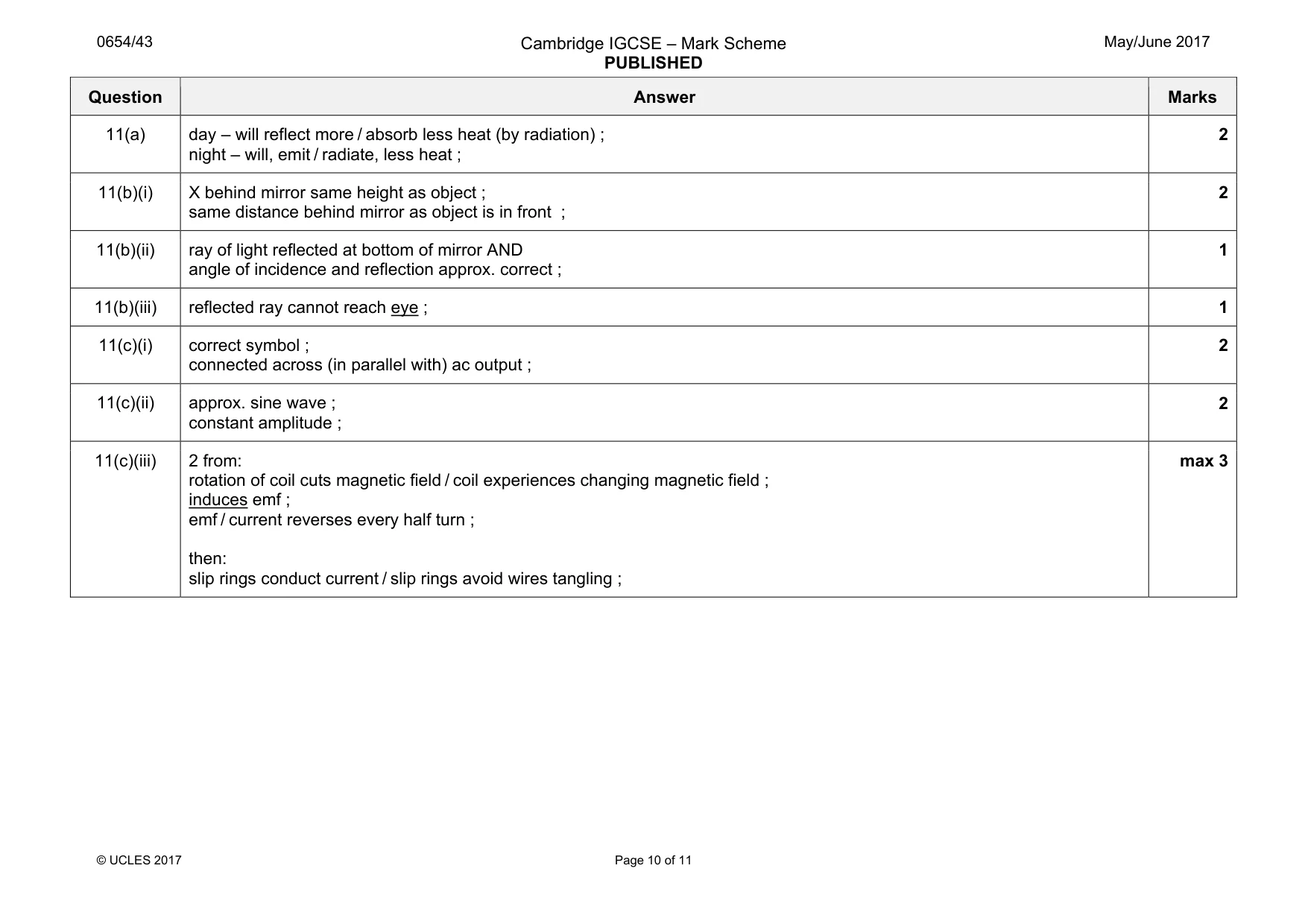
0654/43 Cambridge IGCSE – Mark Scheme PUBLISHED May/June 2017 © UCLES 2017 Page 10 of 11 Question Answer Marks 11(a) day – will reflect more / absorb less heat (by radiation) ; night – will, emit / radiate, less heat ; 2 11(b)(i) X behind mirror same height as object ; same distance behind mirror as object is in front ; 2 11(b)(ii) ray of light reflected at bottom of mirror AND angle of incidence and reflection approx. correct ; 1 11(b)(iii) reflected ray cannot reach eye ; 1 11(c)(i) correct symbol ; connected across (in parallel with) ac output ; 2 11(c)(ii) approx. sine wave ; constant amplitude ; 2 11(c)(iii) 2 from: rotation of coil cuts magnetic field / coil experiences changing magnetic field ; induces emf ; emf / current reverses every half turn ; then: slip rings conduct current / slip rings avoid wires tangling ; max 3
Mark scheme, page 11
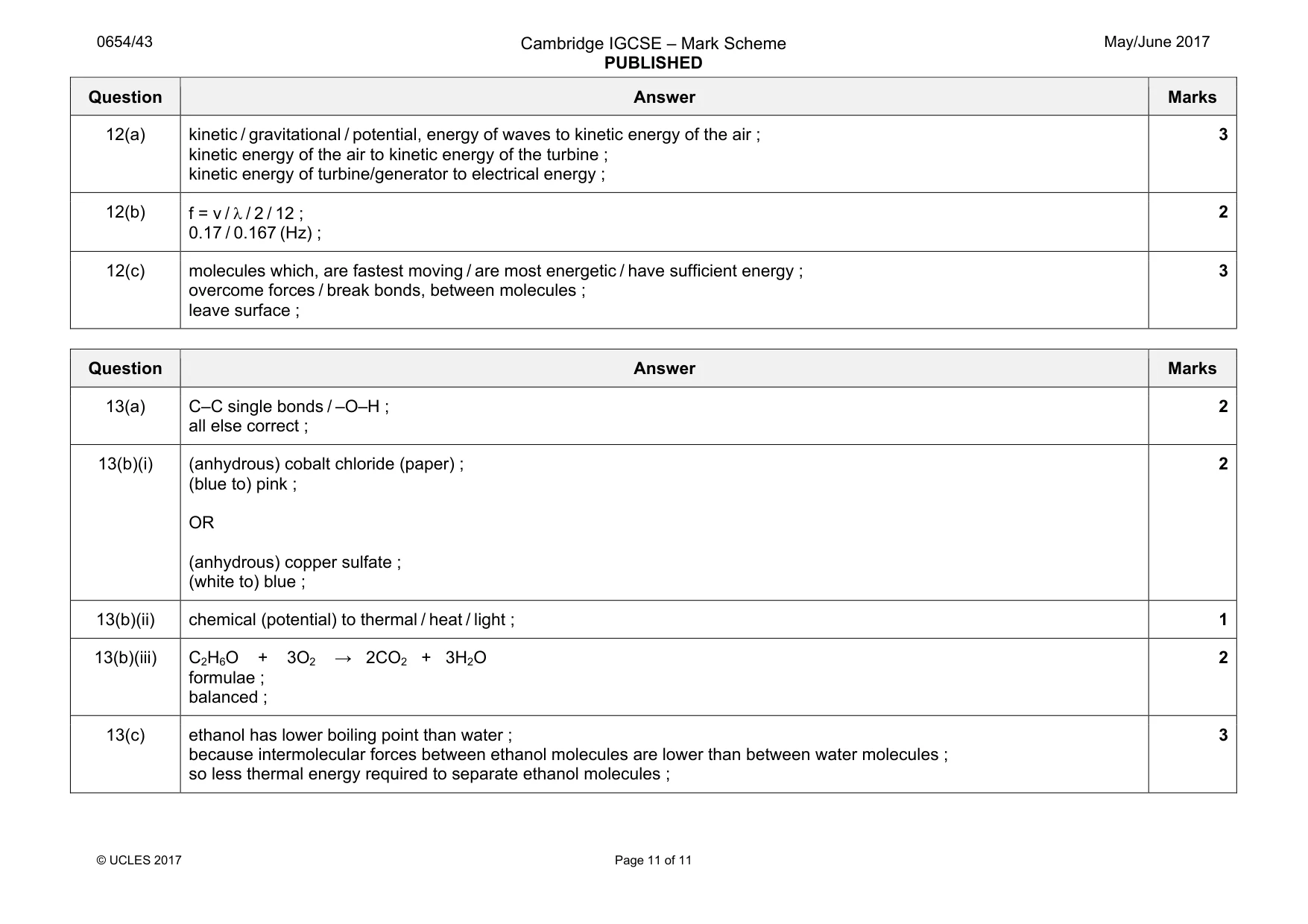
0654/43 Cambridge IGCSE – Mark Scheme PUBLISHED May/June 2017 © UCLES 2017 Page 11 of 11 Question Answer Marks 12(a) kinetic / gravitational / potential, energy of waves to kinetic energy of the air ; kinetic energy of the air to kinetic energy of the turbine ; kinetic energy of turbine/generator to electrical energy ; 3 12(b) f = v / λ / 2 / 12 ; 0.17 / 0.167 (Hz) ; 2 12(c) molecules which, are fastest moving / are most energetic / have sufficient energy ; overcome forces / break bonds, between molecules ; leave surface ; 3 Question Answer Marks 13(a) C–C single bonds / –O–H ; all else correct ; 2 13(b)(i) (anhydrous) cobalt chloride (paper) ; (blue to) pink ; OR (anhydrous) copper sulfate ; (white to) blue ; 2 13(b)(ii) chemical (potential) to thermal / heat / light ; 1 13(b)(iii) C2H6O + 3O2 → 2CO2 + 3H2O formulae ; balanced ; 2 13(c) ethanol has lower boiling point than water ; because intermolecular forces between ethanol molecules are lower than between water molecules ; so less thermal energy required to separate ethanol molecules ; 3
What you needed in this session
Cambridge’s own grade thresholds for 2017 May/June, Paper 4 · Variant 3. A higher threshold means an easier paper — the bar moves with how the cohort did.