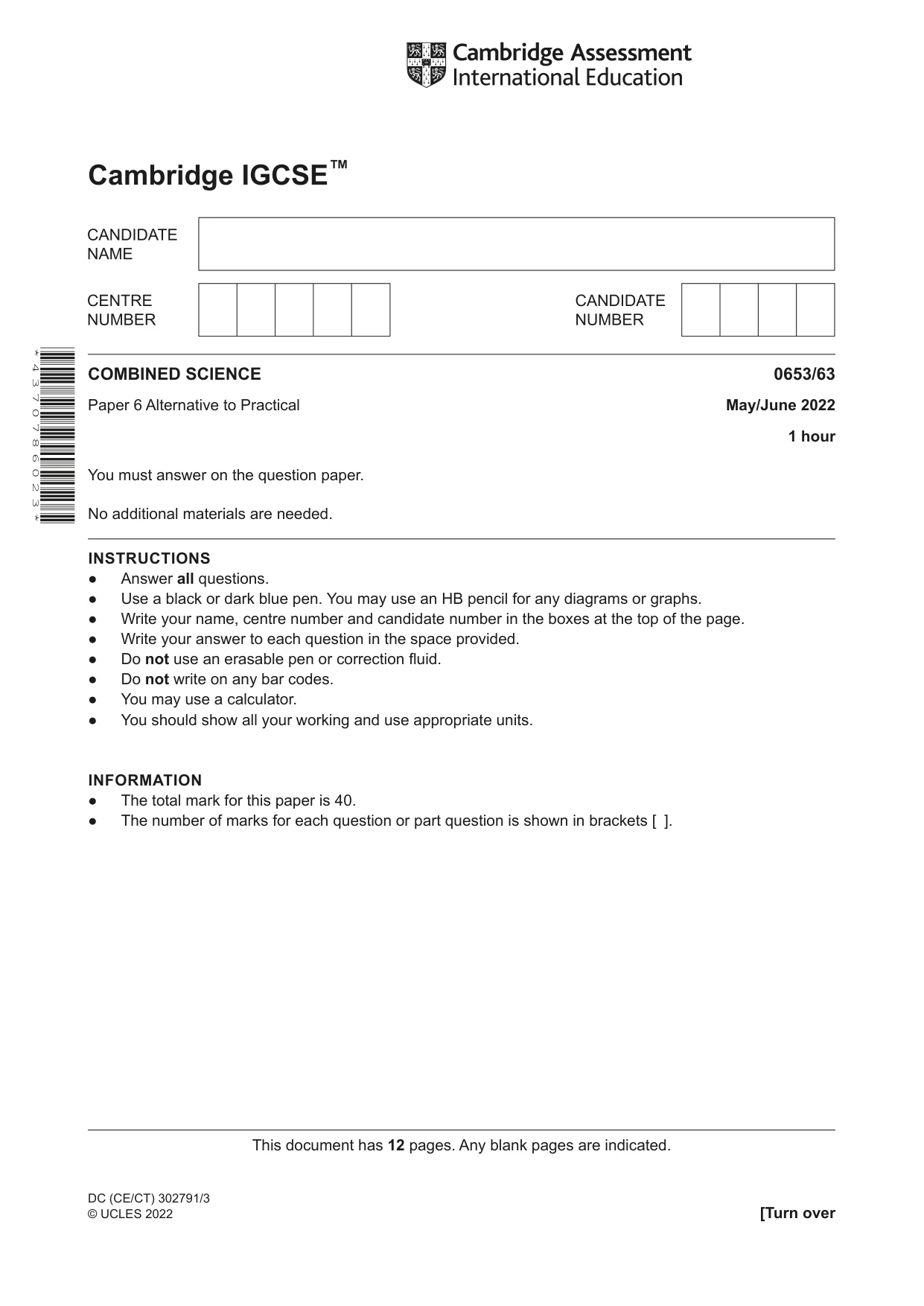
Cambridge IGCSE Science - Combined 0653 — 2022 May/June Paper 6 · Variant 3
0653/63/M/J/22 · 4 questions · 40 marks · ≈45 min
The question paper and its mark scheme, free to read here and free to download. This is Cambridge’s own paper, exactly as it was sat.
Question paper12 pages


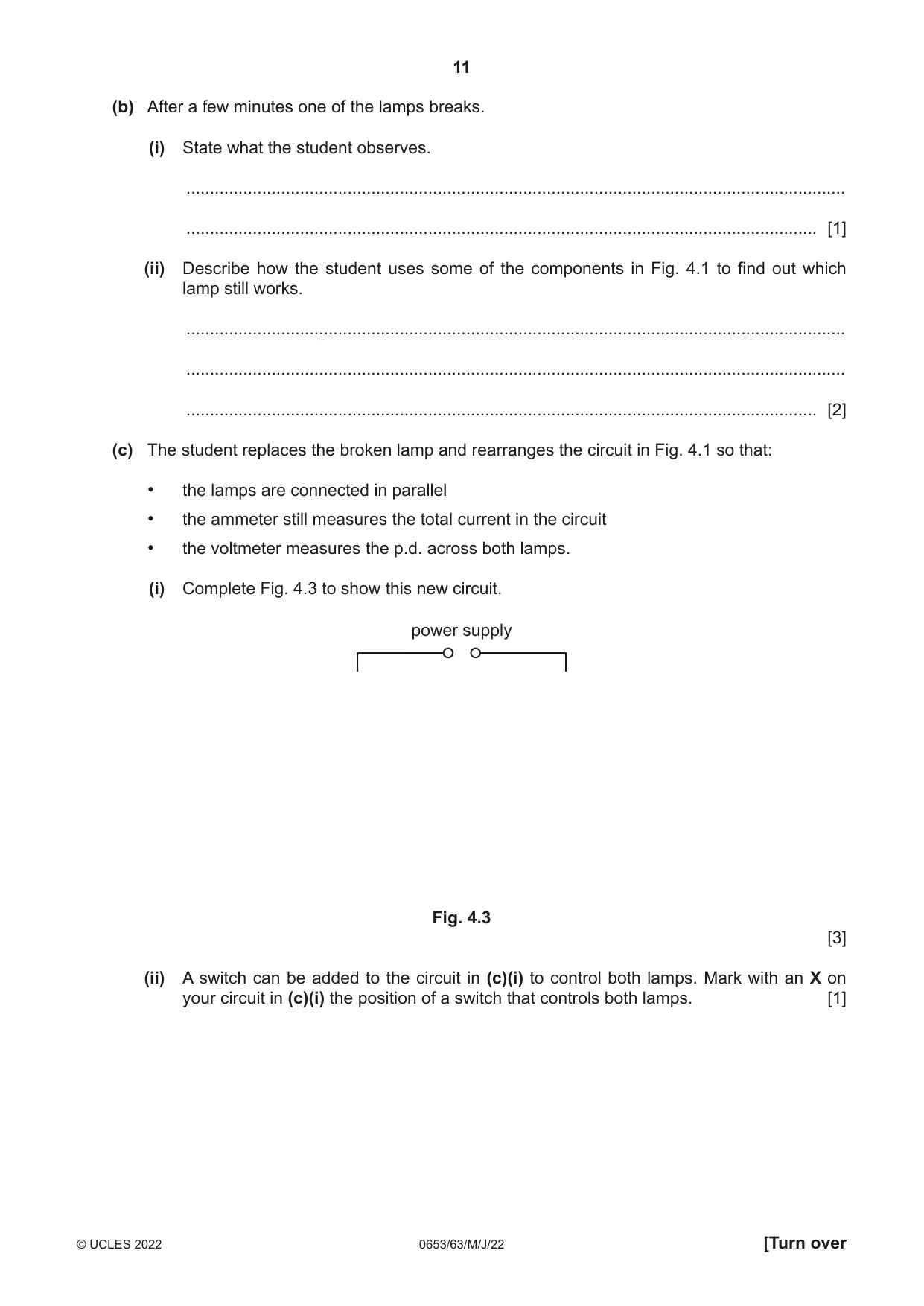
Mark scheme7 pages
Answers below. Sit the paper first if you are practising.
Questions as text
Q1 · A student investigates the effect of oxygen concentration on the germination of cress…
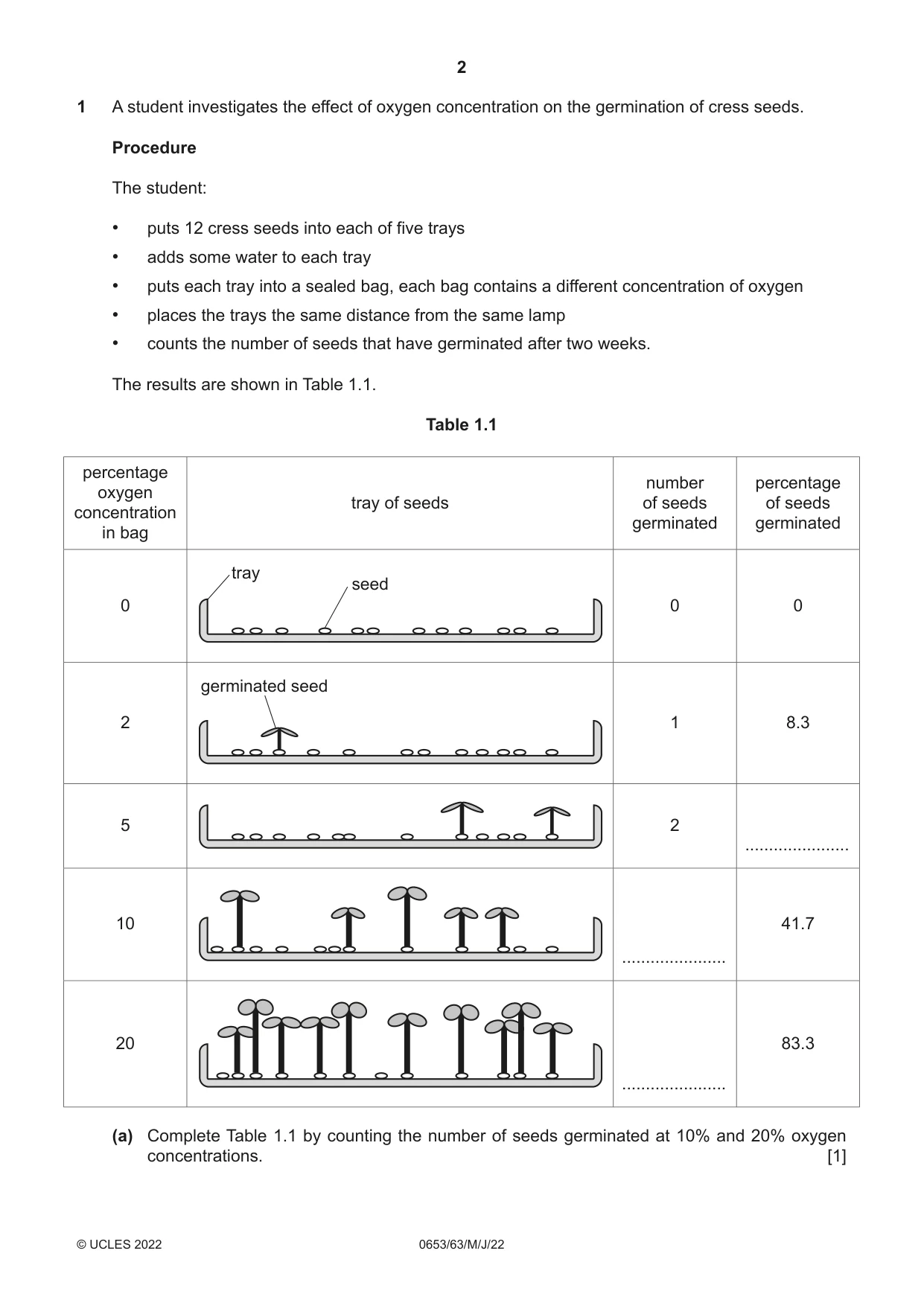
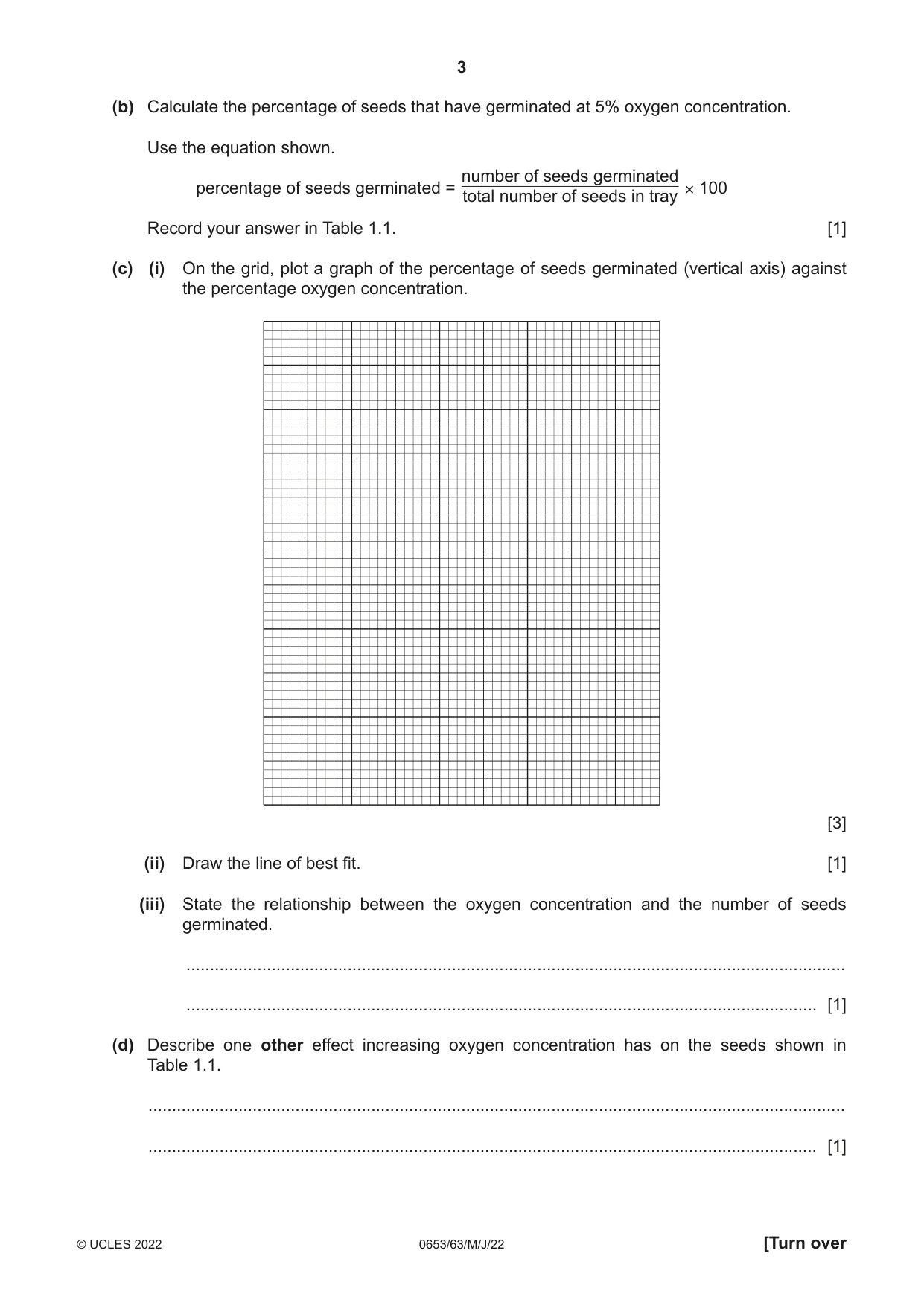
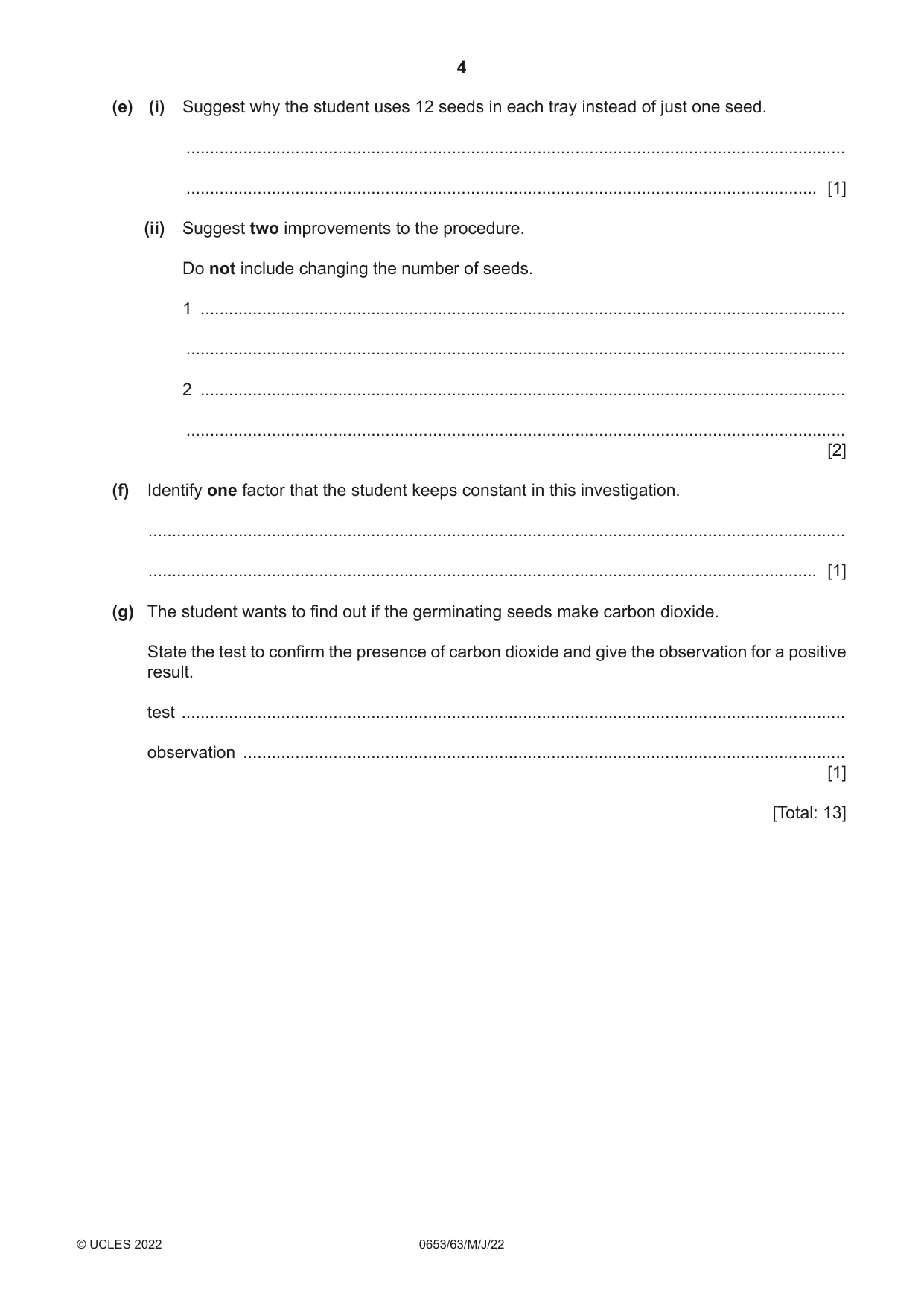
1 A student investigates the effect of oxygen concentration on the germination of cress seeds. Procedure The student: • puts 12 cress seeds into each of five trays • adds some water to each tray • puts each tray into a sealed bag, each bag contains a different concentration of oxygen • places the trays the same distance from the same lamp • counts the number of seeds that have germinated after two weeks. The results are shown in Table 1.1. Table 1.1 percentage number percentage oxygen tray of seeds of seeds of seedsconcentration germinated germinated in bag tray seed 0 0 0 germinated seed 2 1 8.3 5 2 ...................... 10 41.7 ...................... 20 83.3 ...................... (a) Complete Table 1.1 by counting the number of seeds germinated at 10% and 20% oxygen concentrations. [1] (b) Calculate the percentage of seeds that have germinated at 5% oxygen concentration. Use the equation shown. number of seeds germinated percentage of seeds germinated = × 100 total number of seeds in tray Record your answer in Table 1.1. [1] (c) (i) On the grid, plot a graph of the percentage of seeds germinated (vertical axis) against the percentage oxygen concentration. [3] (ii) Draw the line of best fit. [1] (iii) State the relationship between the oxygen concentration and the number of seeds germinated. ........................................................................................................................................... ..................................................................................................................................... [1] (d) Describe one other effect increasing oxygen concentration has on the seeds shown in Table 1.1. ................................................................................................................................................... ............................................................................................................................................. [1] (e) (i) Suggest why the student uses 12 seeds in each tray instead of just one seed. ........................................................................................................................................... ..................................................................................................................................... [1] (ii) Suggest two improvements to the procedure. Do not include changing the number of seeds. 1 ........................................................................................................................................ ........................................................................................................................................... 2 ........................................................................................................................................ ........................................................................................................................................... [2] (f) Identify one factor that the student keeps constant in this investigation. ................................................................................................................................................... ............................................................................................................................................. [1] (g) The student wants to find out if the germinating seeds make carbon dioxide. State the test to confirm the presence of carbon dioxide and give the observation for a positive result. test ............................................................................................................................................ observation ............................................................................................................................... [1] [Total: 13]
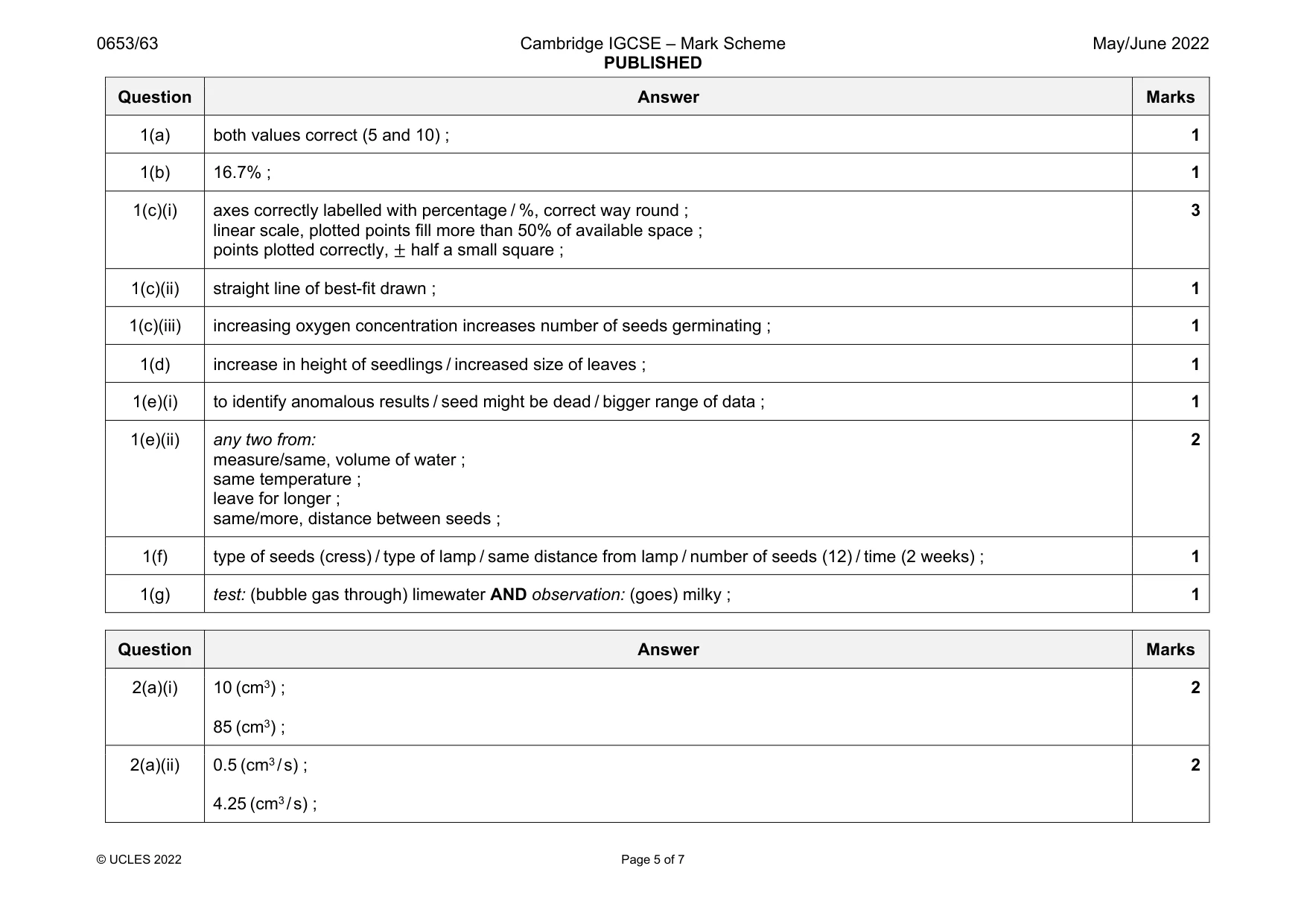
Mark scheme: 1(a) both values correct (5 and 10) ; 1 1(b) 16.7% ; 1 1(c)(i) axes correctly labelled with percentage / %, correct way round ; linear scale, plotted points fill more than 50% of available space ; points plotted correctly, ± half a small square ; 3 1(c)(ii) straight line of best-fit drawn ; 1 1(c)(iii) increasing oxygen concentration increases number of seeds germinating ; 1 1(d) increase in height of seedlings / increased size of leaves ; 1 1(e)(i) to identify anomalous results / seed might be dead / bigger range of data ; 1 1(e)(ii) any two from: measure/same, volume of water ; same temperature ; leave for longer ; same/more, distance between seeds ; 2 1(f) type of seeds (cress) / type of lamp / same distance from lamp / number of seeds (12) / time (2 weeks) ; 1 1(g) test: (bubble gas through) limewater AND observation: (goes) milky ; 1
Q2 · A student investigates some reactions of zinc metal
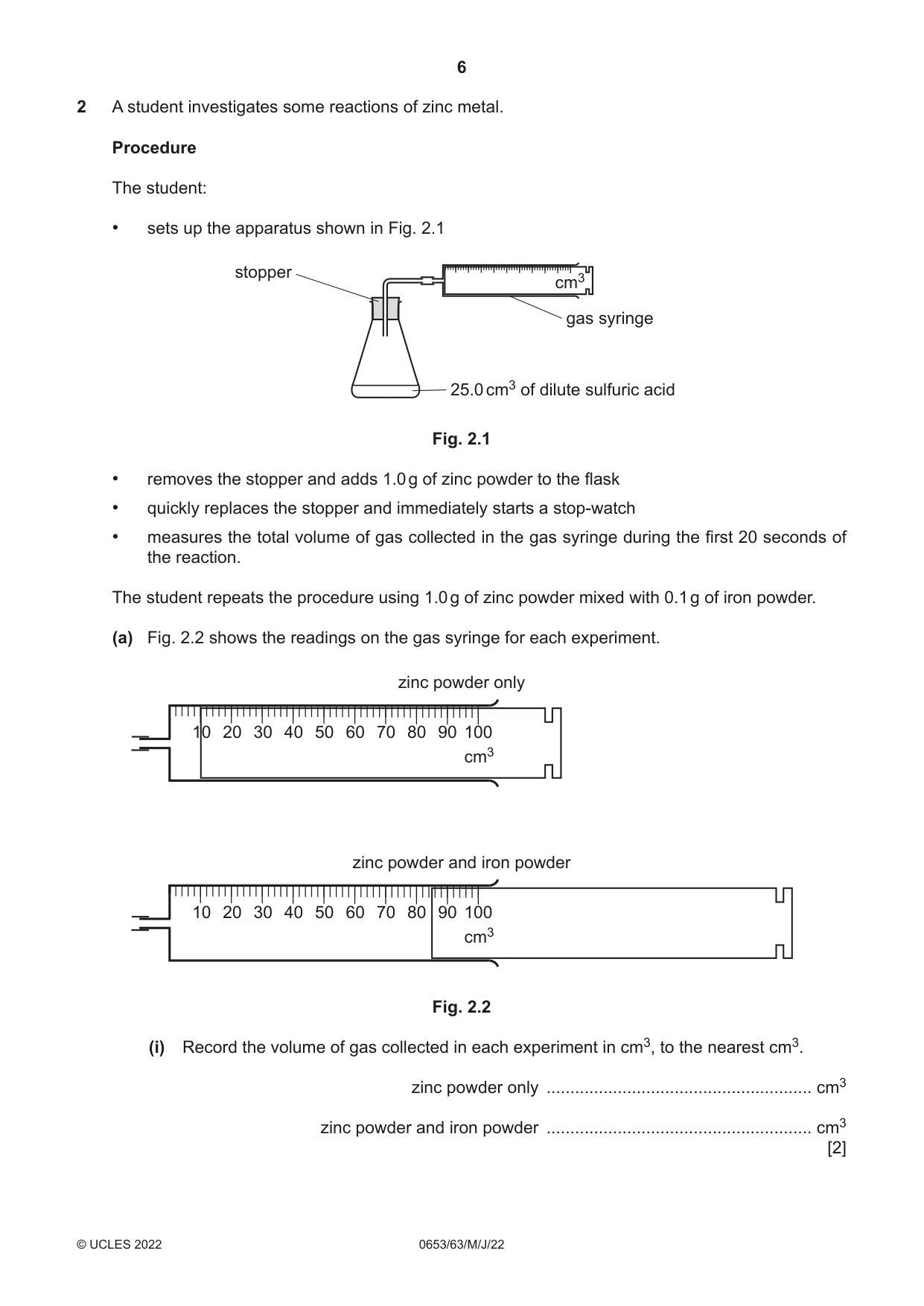
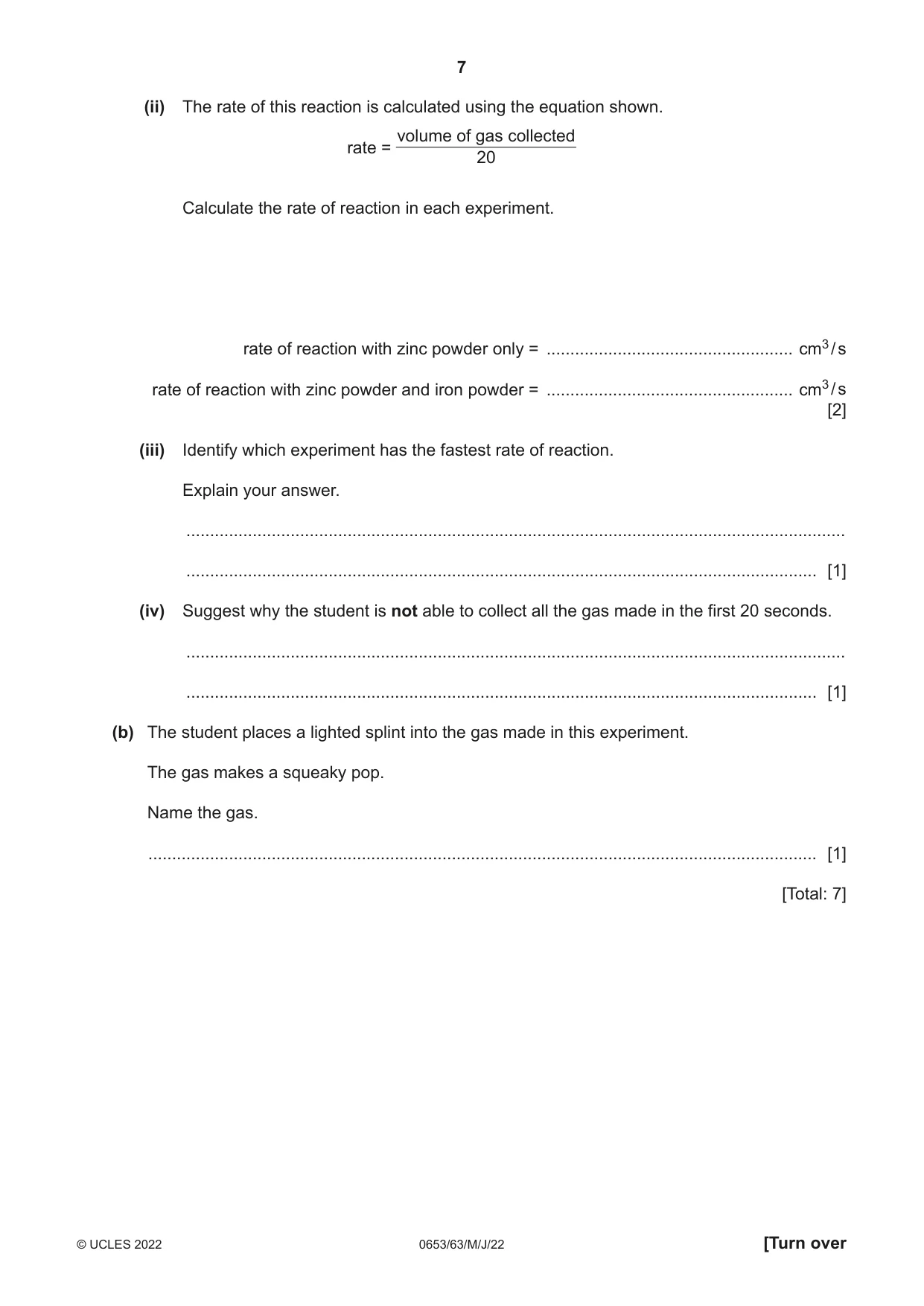
2 A student investigates some reactions of zinc metal. Procedure The student: • sets up the apparatus shown in Fig. 2.1 stopper cm3 gas syringe 25.0 cm3 of dilute sulfuric acid Fig. 2.1 • removes the stopper and adds 1.0 g of zinc powder to the flask • quickly replaces the stopper and immediately starts a stop-watch • measures the total volume of gas collected in the gas syringe during the first 20 seconds of the reaction. The student repeats the procedure using 1.0 g of zinc powder mixed with 0.1 g of iron powder. (a) Fig. 2.2 shows the readings on the gas syringe for each experiment. zinc powder only 10 20 30 40 50 60 70 80 90 100 cm3 zinc powder and iron powder 10 20 30 40 50 60 70 80 90 100 cm3 Fig. 2.2 (i) Record the volume of gas collected in each experiment in cm3, to the nearest cm3. zinc powder only ........................................................ cm3 zinc powder and iron powder ........................................................ cm3 [2] (ii) The rate of this reaction is calculated using the equation shown. volume of gas collected rate = 20 Calculate the rate of reaction in each experiment. rate of reaction with zinc powder only = .................................................... cm3 / s rate of reaction with zinc powder and iron powder = .................................................... cm3 / s [2] (iii) Identify which experiment has the fastest rate of reaction. Explain your answer. ........................................................................................................................................... ..................................................................................................................................... [1] (iv) Suggest why the student is not able to collect all the gas made in the first 20 seconds. ........................................................................................................................................... ..................................................................................................................................... [1] (b) The student places a lighted splint into the gas made in this experiment. The gas makes a squeaky pop. Name the gas. ............................................................................................................................................. [1] [Total: 7]
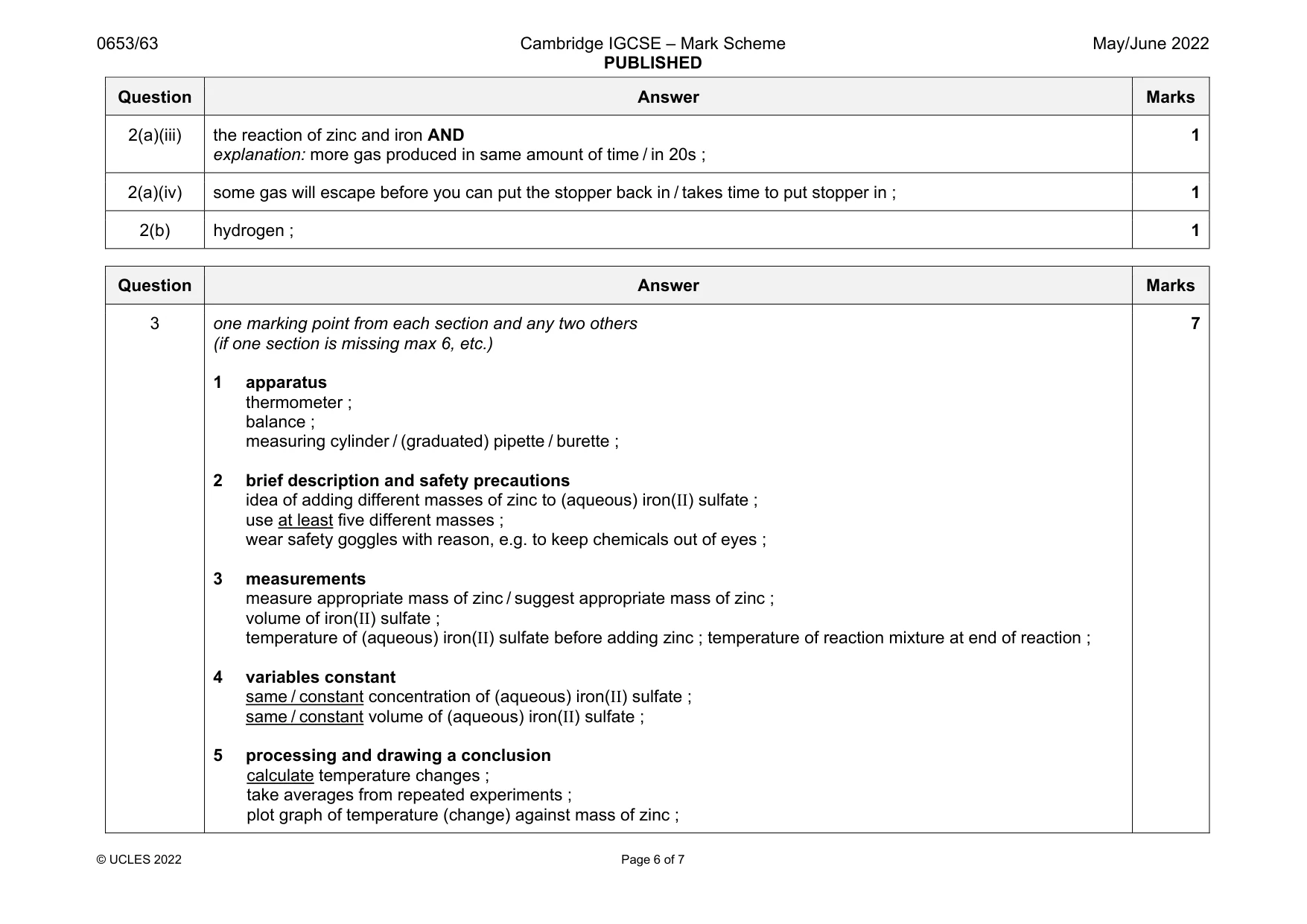
Mark scheme: 2(a)(i) 10 (cm3) ; 85 (cm3) ; 2 2(a)(ii) 0.5 (cm3 / s) ; 4.25 (cm3/s) ; 2 Question Answer Marks 2(a)(iii) the reaction of zinc and iron AND explanation: more gas produced in same amount of time / in 20s ; 1 2(a)(iv) some gas will escape before you can put the stopper back in / takes time to put stopper in ; 1 2(b) hydrogen ; 1
Q3 · Zinc reacts with aqueous iron(II) sulfate as shown in the word equation
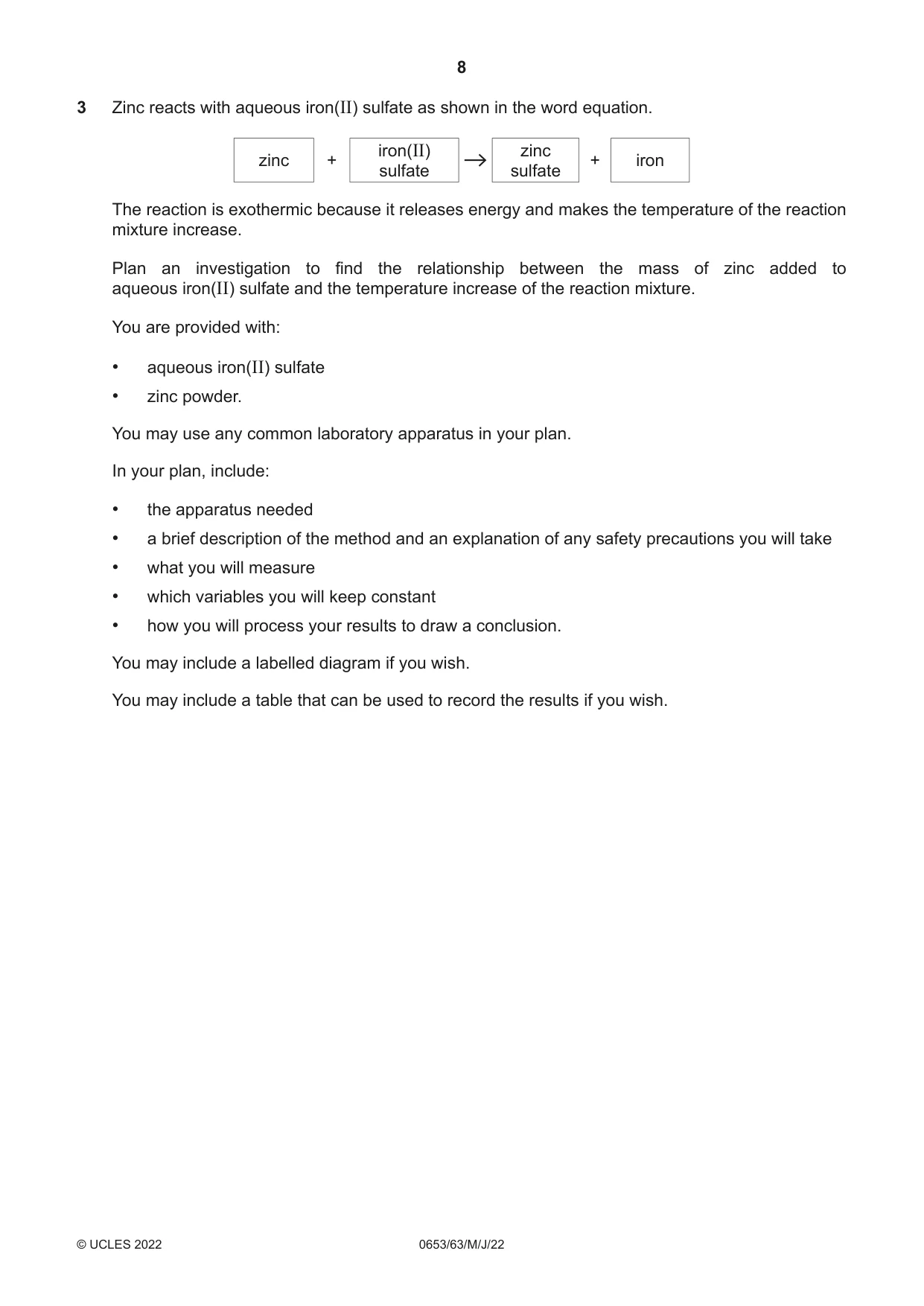
3 Zinc reacts with aqueous iron(II) sulfate as shown in the word equation. iron(II) zinc zinc + + iron sulfate sulfate The reaction is exothermic because it releases energy and makes the temperature of the reaction mixture increase. Plan an investigation to find the relationship between the mass of zinc added to aqueous iron(II) sulfate and the temperature increase of the reaction mixture. You are provided with: • aqueous iron(II) sulfate • zinc powder. You may use any common laboratory apparatus in your plan. In your plan, include: • the apparatus needed • a brief description of the method and an explanation of any safety precautions you will take • what you will measure • which variables you will keep constant • how you will process your results to draw a conclusion. You may include a labelled diagram if you wish. You may include a table that can be used to record the results if you wish. .......................................................................................................................................................... .......................................................................................................................................................... .......................................................................................................................................................... .......................................................................................................................................................... .......................................................................................................................................................... .......................................................................................................................................................... .......................................................................................................................................................... .......................................................................................................................................................... .......................................................................................................................................................... .......................................................................................................................................................... .......................................................................................................................................................... .......................................................................................................................................................... .......................................................................................................................................................... .................................................................................................................................................... [7]
Mark scheme: 3 one marking point from each section and any two others (if one section is missing max 6, etc.) 1 apparatus thermometer ; balance ; measuring cylinder / (graduated) pipette / burette ; 2 brief description and safety precautions idea of adding different masses of zinc to (aqueous) iron(II) sulfate ; use at least five different masses ; wear safety goggles with reason, e.g. to keep chemicals out of eyes ; 3 measurements measure appropriate mass of zinc / suggest appropriate mass of zinc ; volume of iron(II) sulfate ; temperature of (aqueous) iron(II) sulfate before adding zinc ; temperature of reaction mixture at end of reaction ; 4 variables constant same / constant concentration of (aqueous) iron(II) sulfate ; same / constant volume of (aqueous) iron(II) sulfate ; 5 processing and drawing a conclusion calculate temperature changes ; take averages from repeated experiments ; plot graph of temperature (change) against mass of zinc ; 7
Q4 · A student investigates the resistance of two identical lamps connected in series
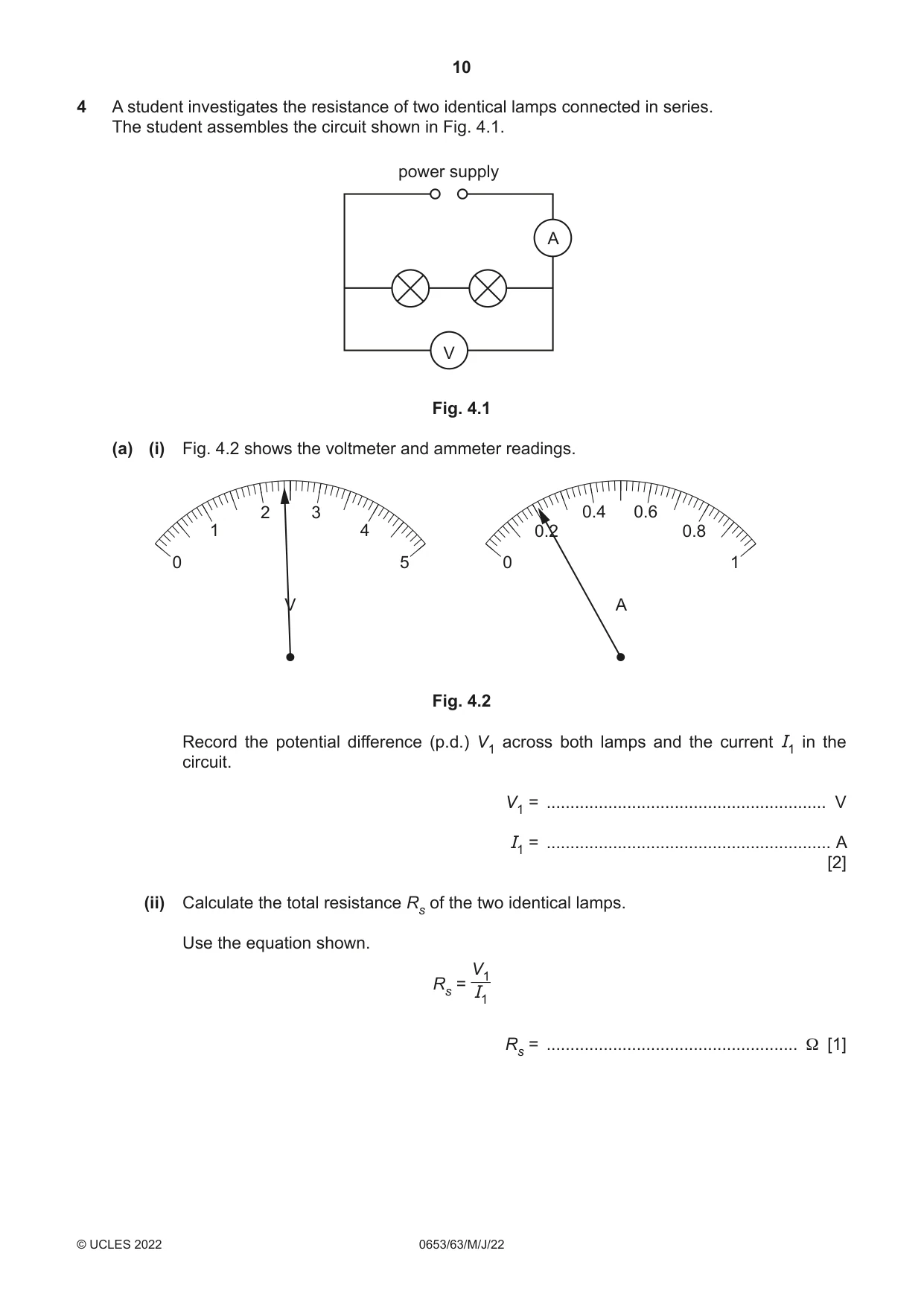
4 A student investigates the resistance of two identical lamps connected in series. The student assembles the circuit shown in Fig. 4.1. power supply A V Fig. 4.1 (a) (i) Fig. 4.2 shows the voltmeter and ammeter readings. 2 3 0.4 0.6 1 4 0.2 0.8 0 5 0 1 V A Fig. 4.2 Record the potential difference (p.d.) V1 across both lamps and the current I1 in the circuit. V1 = ........................................................... V I1 = ............................................................ A [2] (ii) Calculate the total resistance Rs of the two identical lamps. Use the equation shown. V1 Rs = I1 Rs = ..................................................... Ω [1] (b) After a few minutes one of the lamps breaks. (i) State what the student observes. ........................................................................................................................................... ..................................................................................................................................... [1] (ii) Describe how the student uses some of the components in Fig. 4.1 to find out which lamp still works. ........................................................................................................................................... ........................................................................................................................................... ..................................................................................................................................... [2] (c) The student replaces the broken lamp and rearranges the circuit in Fig. 4.1 so that: • the lamps are connected in parallel • the ammeter still measures the total current in the circuit • the voltmeter measures the p.d. across both lamps. (i) Complete Fig. 4.3 to show this new circuit. power supply Fig. 4.3 [3] (ii) A switch can be added to the circuit in (c)(i) to control both lamps. Mark with an X on your circuit in (c)(i) the position of a switch that controls both lamps. [1] (d) In the parallel circuit in (c)(i) the meter readings are: V2 = 2.4 V I2 = 0.84 A (i) Calculate the total resistance Rp of the lamps in this circuit. Give your answer to two significant figures. Rp = ..................................................... Ω [2] (ii) Describe how the brightness of the lamps in the parallel circuit is different from the lamps in the series circuit in Fig. 4.1. ........................................................................................................................................... ..................................................................................................................................... [1] [Total: 13]
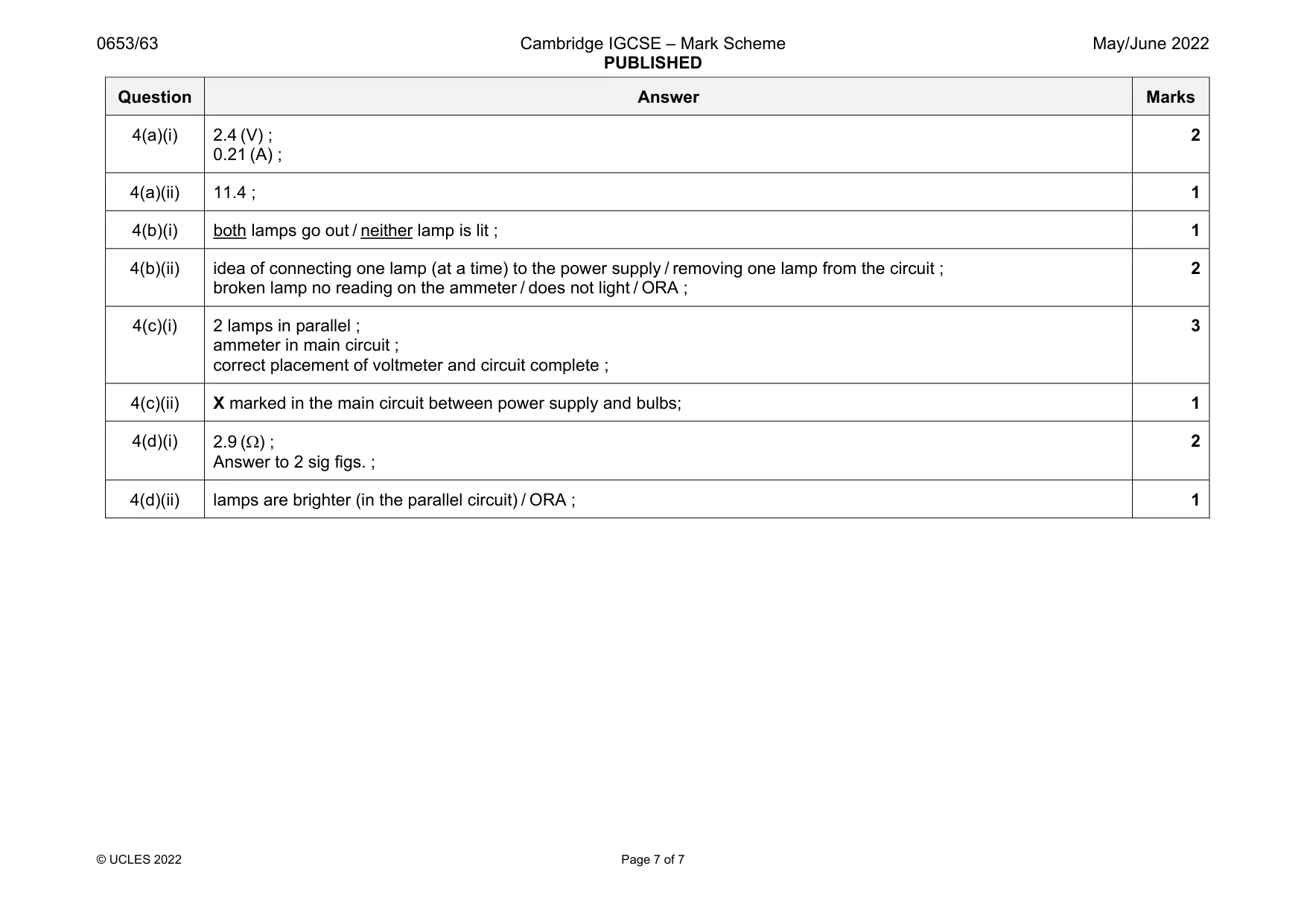
Mark scheme: 4(a)(i) 2.4 (V) ; 0.21 (A) ; 2 4(a)(ii) 11.4 ; 1 4(b)(i) both lamps go out / neither lamp is lit ; 1 4(b)(ii) idea of connecting one lamp (at a time) to the power supply / removing one lamp from the circuit ; broken lamp no reading on the ammeter / does not light / ORA ; 2 4(c)(i) 2 lamps in parallel ; ammeter in main circuit ; correct placement of voltmeter and circuit complete ; 3 4(c)(ii) X marked in the main circuit between power supply and bulbs; 1 4(d)(i) 2.9 () ; Answer to 2 sig figs. ; 2 4(d)(ii) lamps are brighter (in the parallel circuit) / ORA ; 1
What was in this paper
The subtopics covered by these 4 questions, and how many questions each got. Open one in a new tab to see every Cambridge question on it.
What you needed in this session
Cambridge’s own grade thresholds for 2022 May/June, Paper 6 · Variant 3. A higher threshold means an easier paper — the bar moves with how the cohort did.