Cambridge IGCSE Physics 0625 — 2016 Oct/Nov Paper 3 · Variant 2
0625/32/O/N/16 · 80 marks · ≈90 min
The question paper and its mark scheme, free to read here and free to download. This is Cambridge’s own paper, exactly as it was sat.
Question paper16 pages
Mark scheme10 pages
Answers below. Sit the paper first if you are practising.
Paper as text
Question paper, page 1
This document consists of 16 printed pages. DC (NH/AR) 115919/8 © UCLES 2016 [Turn over * 8 7 4 9 9 0 2 4 4 1 * PHYSICS 0625/32 Paper 3 Theory (Core) October/November 2016 1 hour 15 minutes Candidates answer on the Question Paper. No Additional Materials are required. READ THESE INSTRUCTIONS FIRST Write your Centre number, candidate number and name on all the work you hand in. Write in dark blue or black pen. You may use an HB pencil for any diagrams or graphs. Do not use staples, paper clips, glue or correction fluid. DO NOT WRITE IN ANY BARCODES. Answer all questions. Electronic calculators may be used. You may lose marks if you do not show your working or if you do not use appropriate units. Take the weight of 1.0 kg to be 10 N (acceleration of free fall = 10 m / s2). At the end of the examination, fasten all your work securely together. The number of marks is given in brackets [ ] at the end of each question or part question. The syllabus is approved for use in England, Wales and Northern Ireland as a Cambridge International Level 1/Level 2 Certificate. Cambridge International Examinations Cambridge International General Certificate of Secondary Education
Question paper, page 2
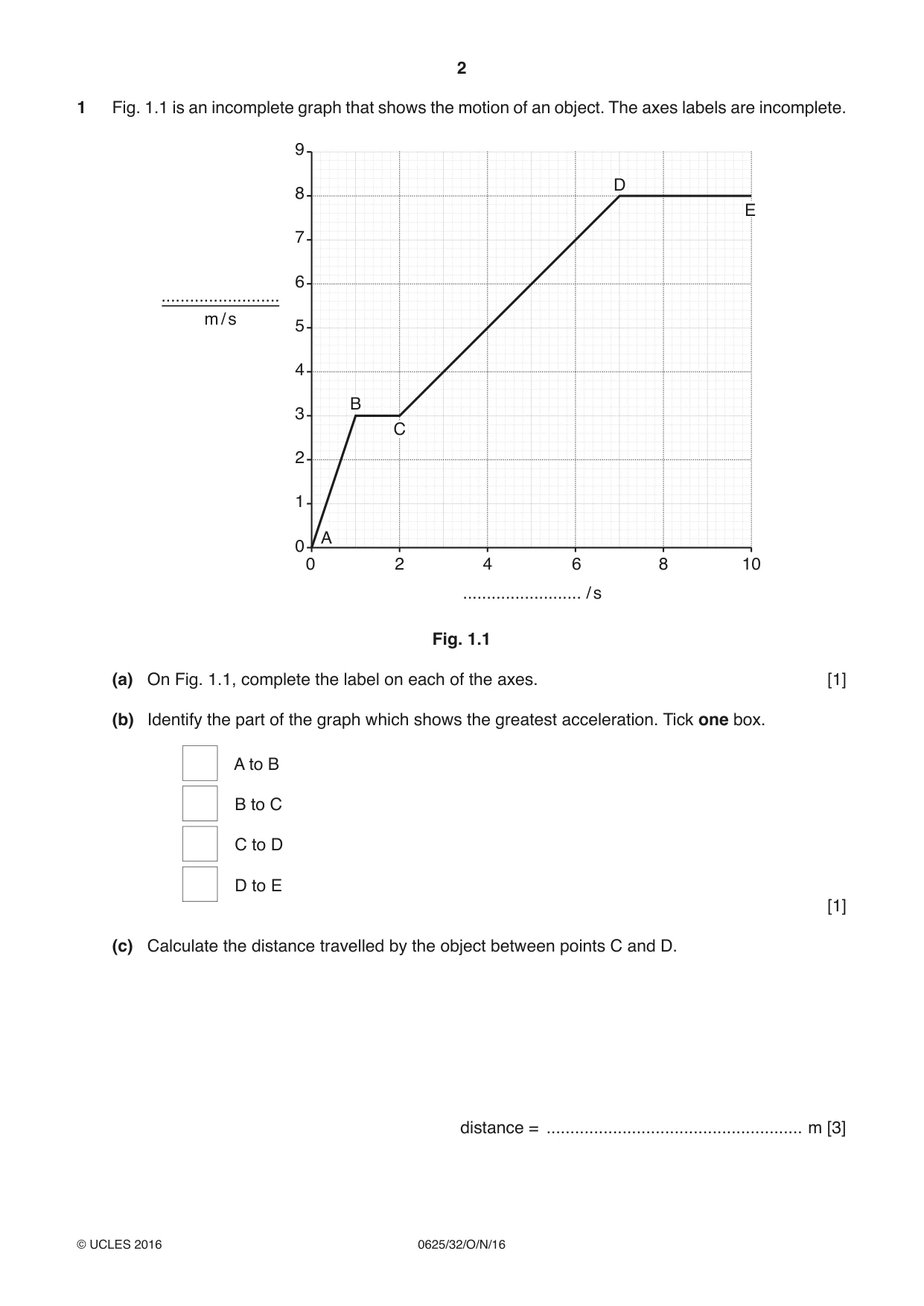
2 0625/32/O/N/16 © UCLES 2016 1 Fig. 1.1 is an incomplete graph that shows the motion of an object. The axes labels are incomplete. 9 8 7 6 6 5 4 3 2 8 4 2 1 0 0 10 … m / s … / s A B C D E Fig. 1.1 (a) On Fig. 1.1, complete the label on each of the axes. [1] (b) Identify the part of the graph which shows the greatest acceleration. Tick one box. A to B B to C C to D D to E [1] (c) Calculate the distance travelled by the object between points C and D. distance = … m [3]
Question paper, page 3
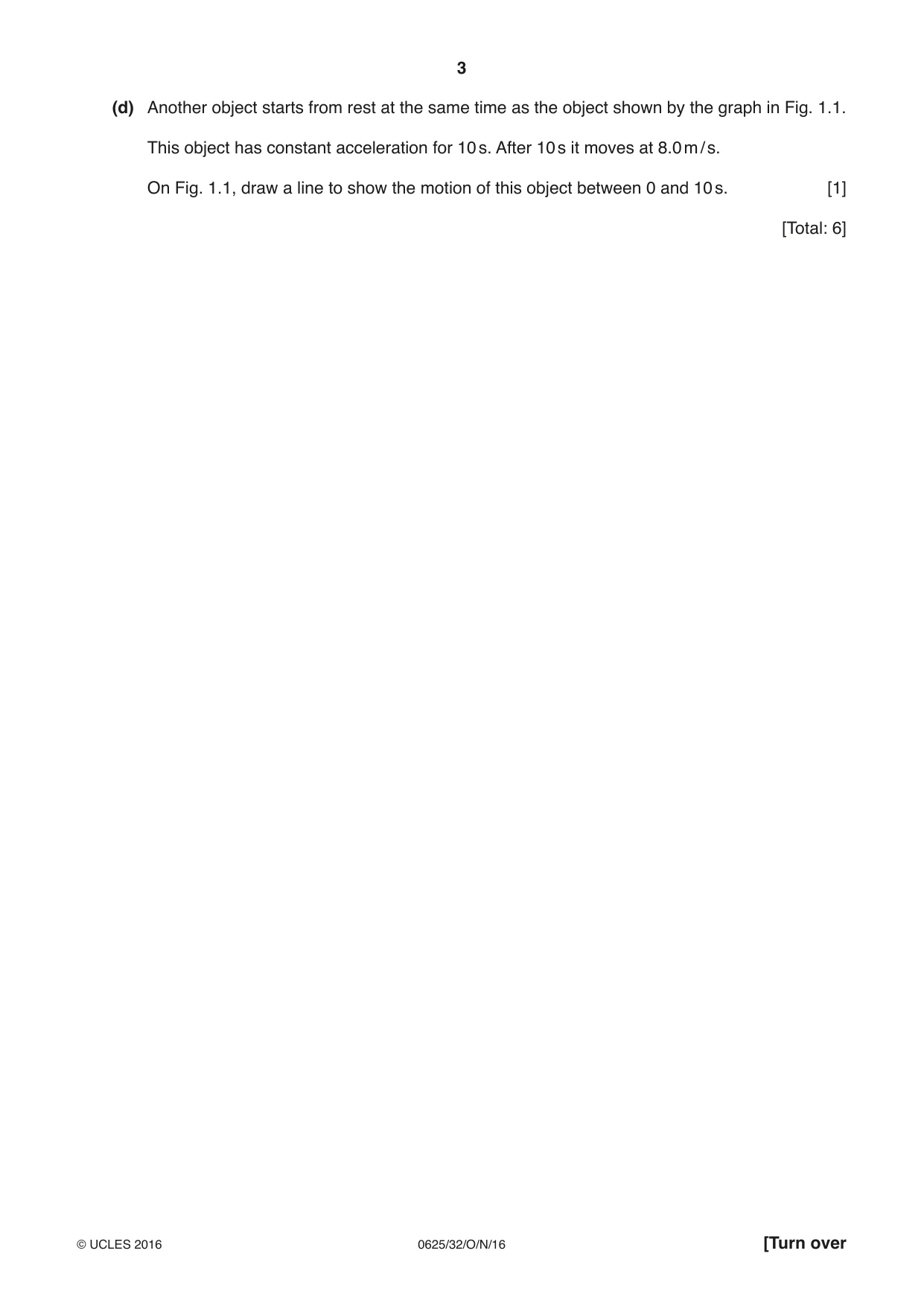
3 0625/32/O/N/16 © UCLES 2016 [Turn over (d) Another object starts from rest at the same time as the object shown by the graph in Fig. 1.1. This object has constant acceleration for 10 s. After 10 s it moves at 8.0 m / s. On Fig. 1.1, draw a line to show the motion of this object between 0 and 10 s. [1] [Total: 6]
Question paper, page 4
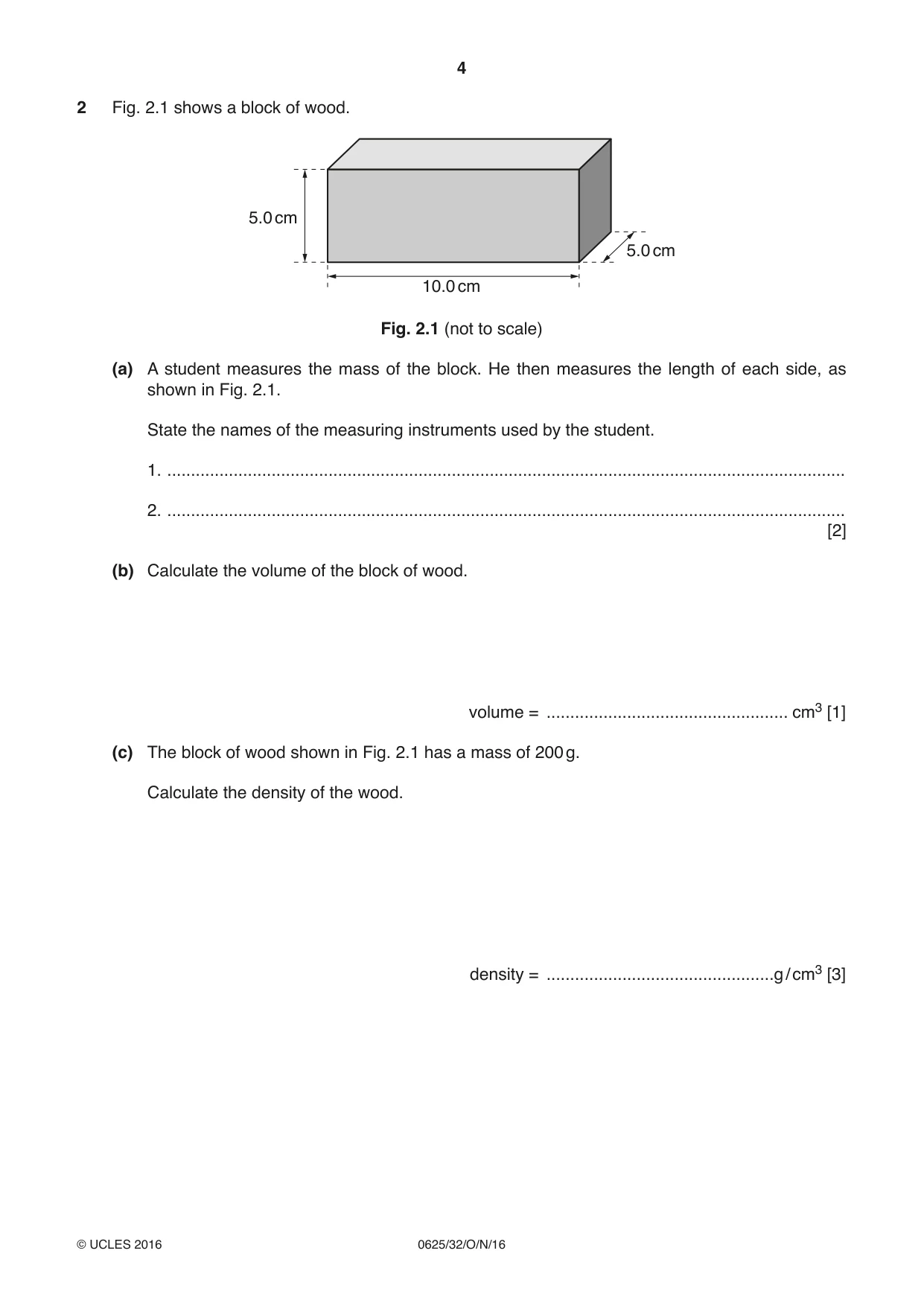
4 0625/32/O/N/16 © UCLES 2016 2 Fig. 2.1 shows a block of wood. 5.0 cm 5.0 cm 10.0 cm Fig. 2.1 (not to scale) (a) A student measures the mass of the block. He then measures the length of each side, as shown in Fig. 2.1. State the names of the measuring instruments used by the student. 1. … 2. … [2] (b) Calculate the volume of the block of wood. volume = … cm3 [1] (c) The block of wood shown in Fig. 2.1 has a mass of 200 g. Calculate the density of the wood. density = …g / cm3 [3]
Question paper, page 5
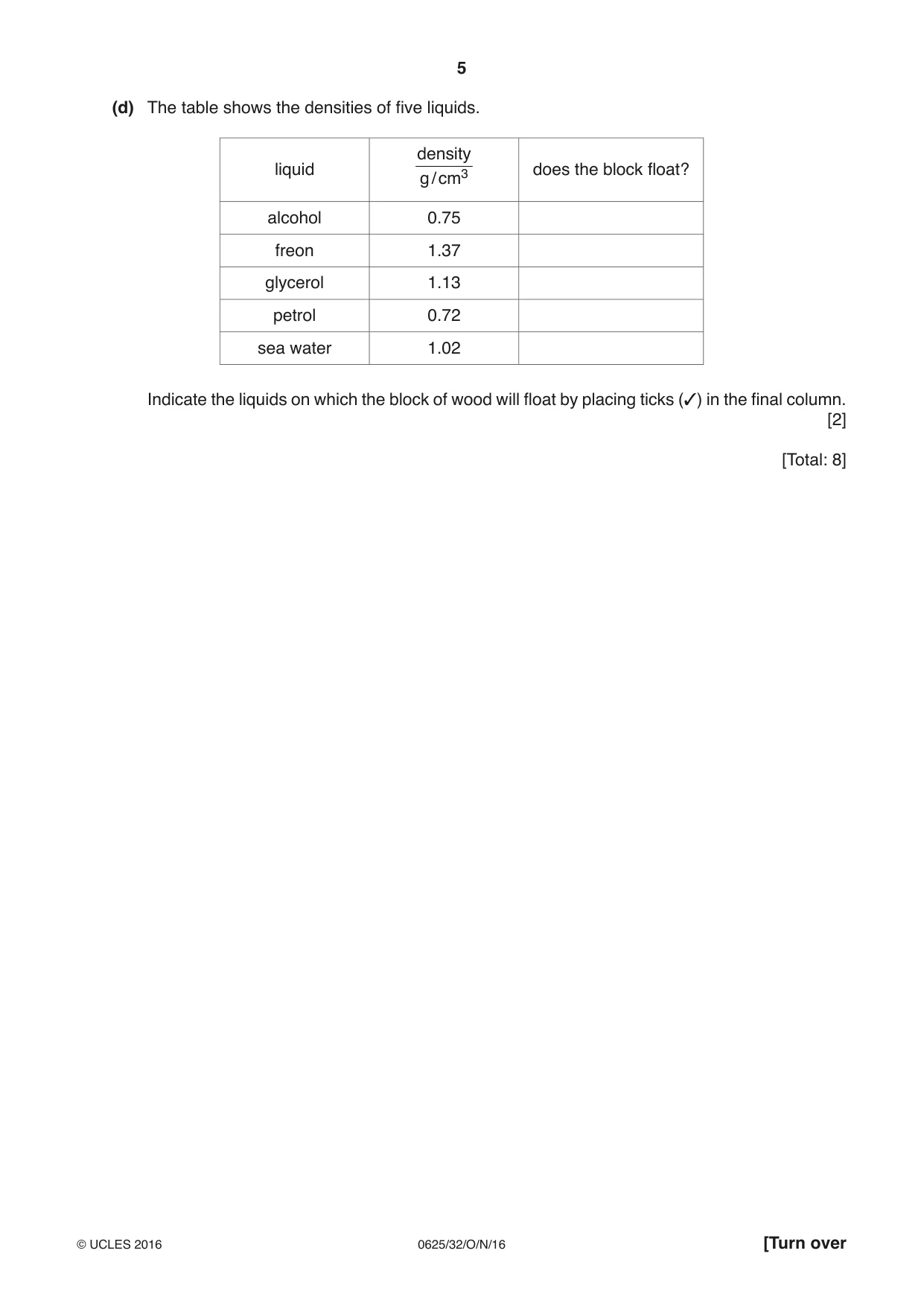
5 0625/32/O/N/16 © UCLES 2016 [Turn over (d) The table shows the densities of five liquids. liquid density g / cm3 does the block float? alcohol 0.75 freon 1.37 glycerol 1.13 petrol 0.72 sea water 1.02 Indicate the liquids on which the block of wood will float by placing ticks (3) in the final column. [2] [Total: 8]
Question paper, page 6
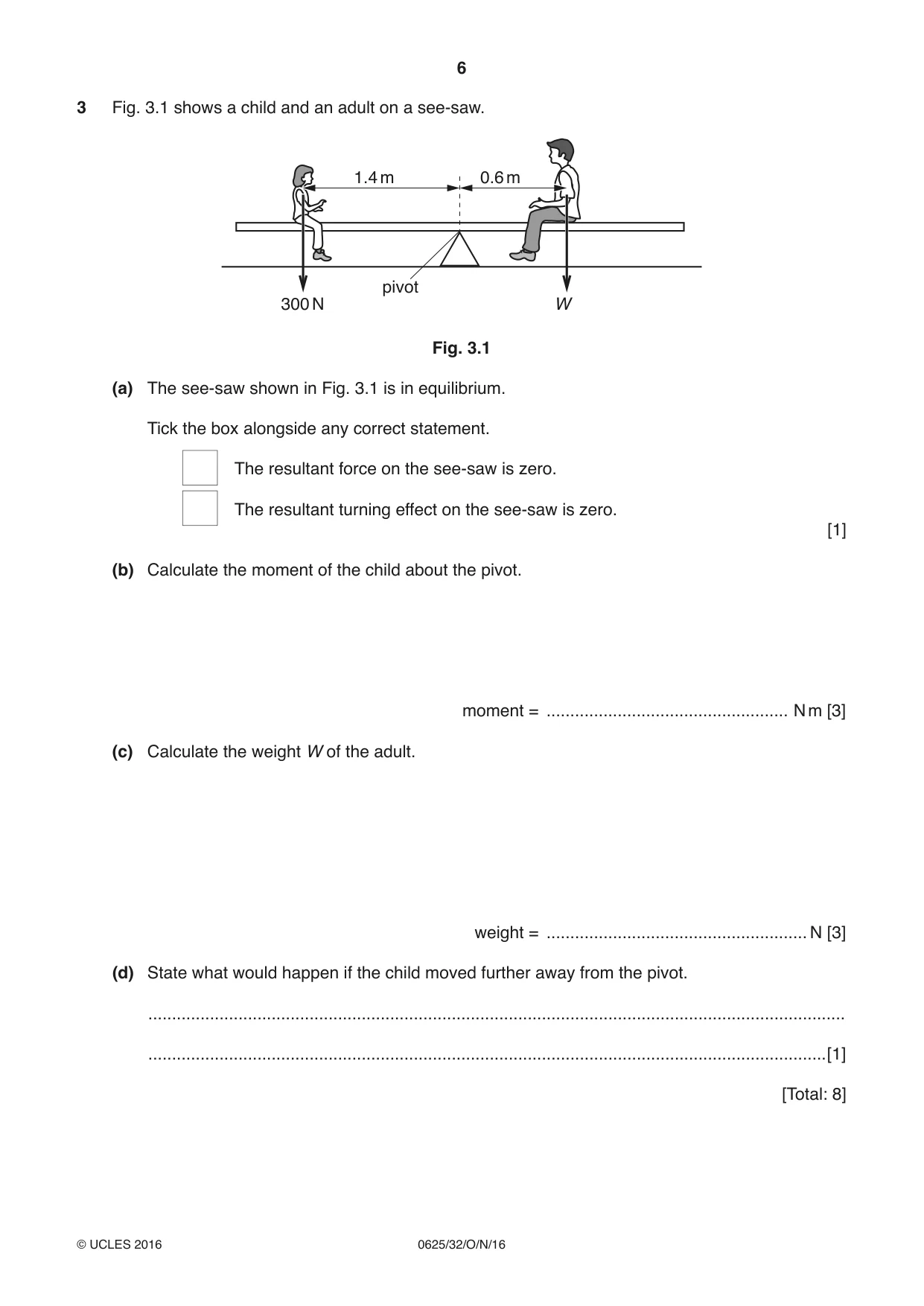
6 0625/32/O/N/16 © UCLES 2016 3 Fig. 3.1 shows a child and an adult on a see-saw. 1.4 m 0.6 m 300 N W pivot Fig. 3.1 (a) The see-saw shown in Fig. 3.1 is in equilibrium. Tick the box alongside any correct statement. The resultant force on the see-saw is zero. The resultant turning effect on the see-saw is zero. [1] (b) Calculate the moment of the child about the pivot. moment = … N m [3] (c) Calculate the weight W of the adult. weight = … N [3] (d) State what would happen if the child moved further away from the pivot. … …[1] [Total: 8]
Question paper, page 7
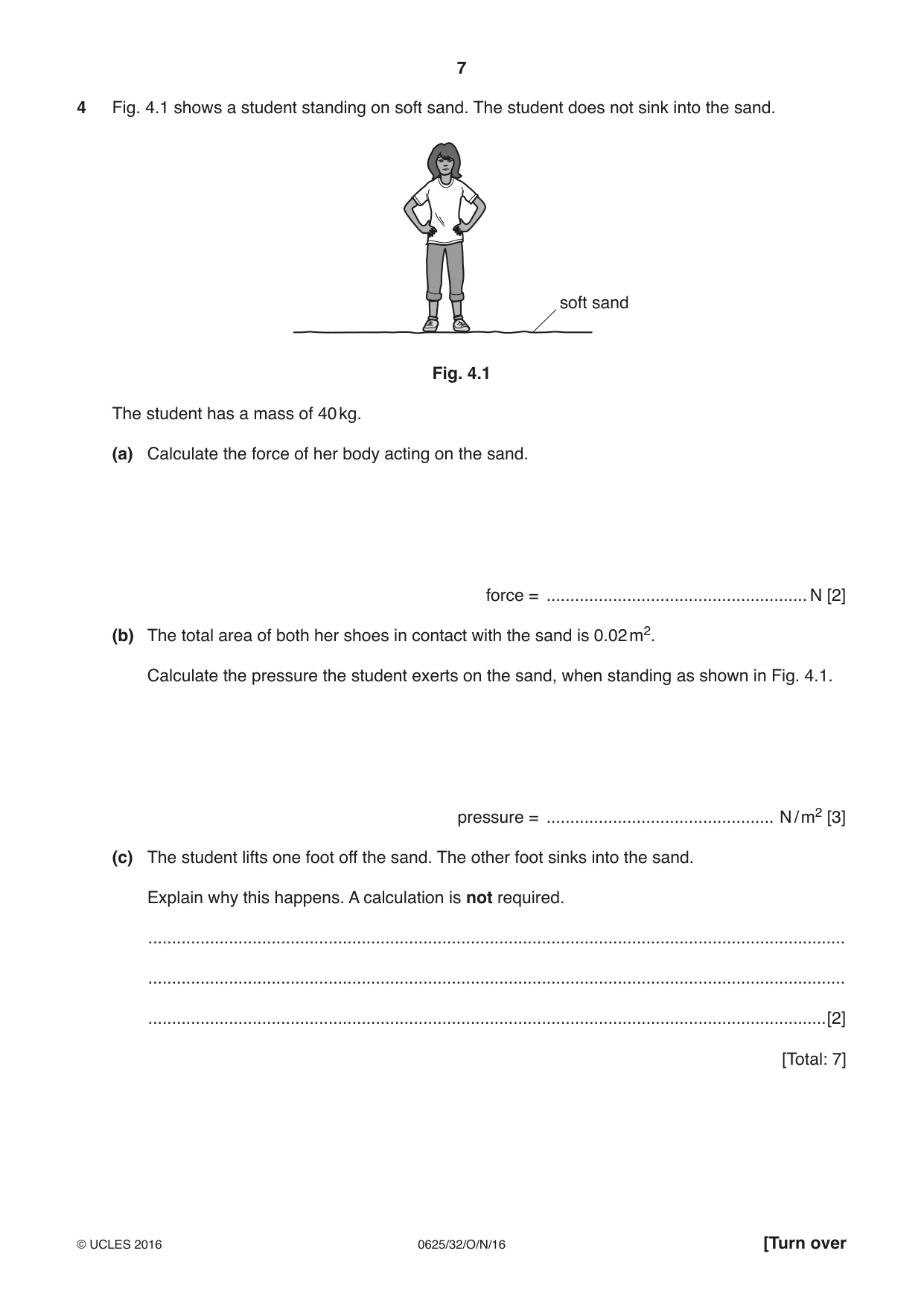
7 0625/32/O/N/16 © UCLES 2016 [Turn over 4 Fig. 4.1 shows a student standing on soft sand. The student does not sink into the sand. soft sand Fig. 4.1 The student has a mass of 40 kg. (a) Calculate the force of her body acting on the sand. force = … N [2] (b) The total area of both her shoes in contact with the sand is 0.02 m2. Calculate the pressure the student exerts on the sand, when standing as shown in Fig. 4.1. pressure = … N / m2 [3] (c) The student lifts one foot off the sand. The other foot sinks into the sand. Explain why this happens. A calculation is not required. … … …[2] [Total: 7]
Question paper, page 8
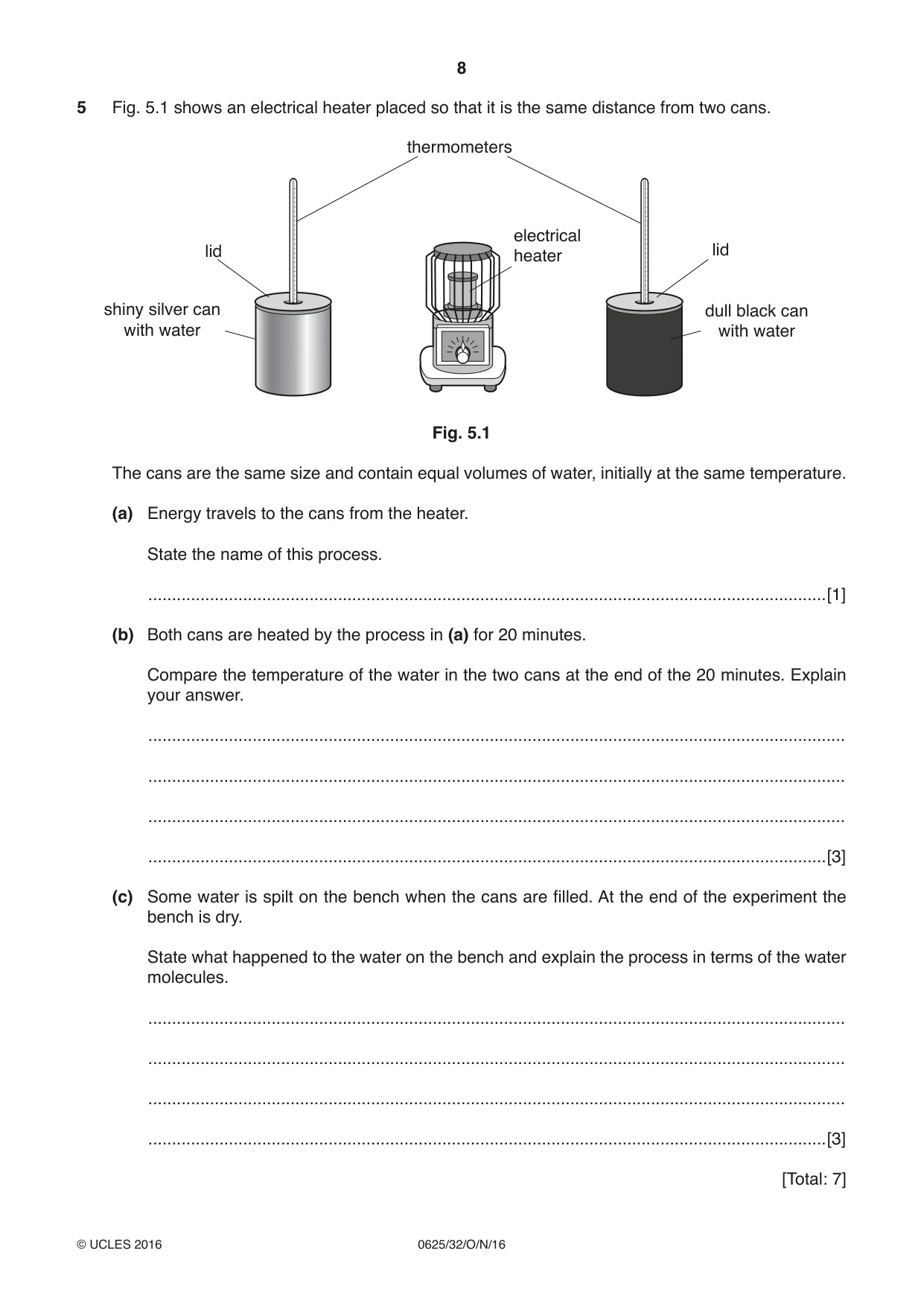
8 0625/32/O/N/16 © UCLES 2016 5 Fig. 5.1 shows an electrical heater placed so that it is the same distance from two cans. shiny silver can with water lid lid dull black can with water thermometers electrical heater Fig. 5.1 The cans are the same size and contain equal volumes of water, initially at the same temperature. (a) Energy travels to the cans from the heater. State the name of this process. …[1] (b) Both cans are heated by the process in (a) for 20 minutes. Compare the temperature of the water in the two cans at the end of the 20 minutes. Explain your answer. … … … …[3] (c) Some water is spilt on the bench when the cans are filled. At the end of the experiment the bench is dry. State what happened to the water on the bench and explain the process in terms of the water molecules. … … … …[3] [Total: 7]
Question paper, page 9
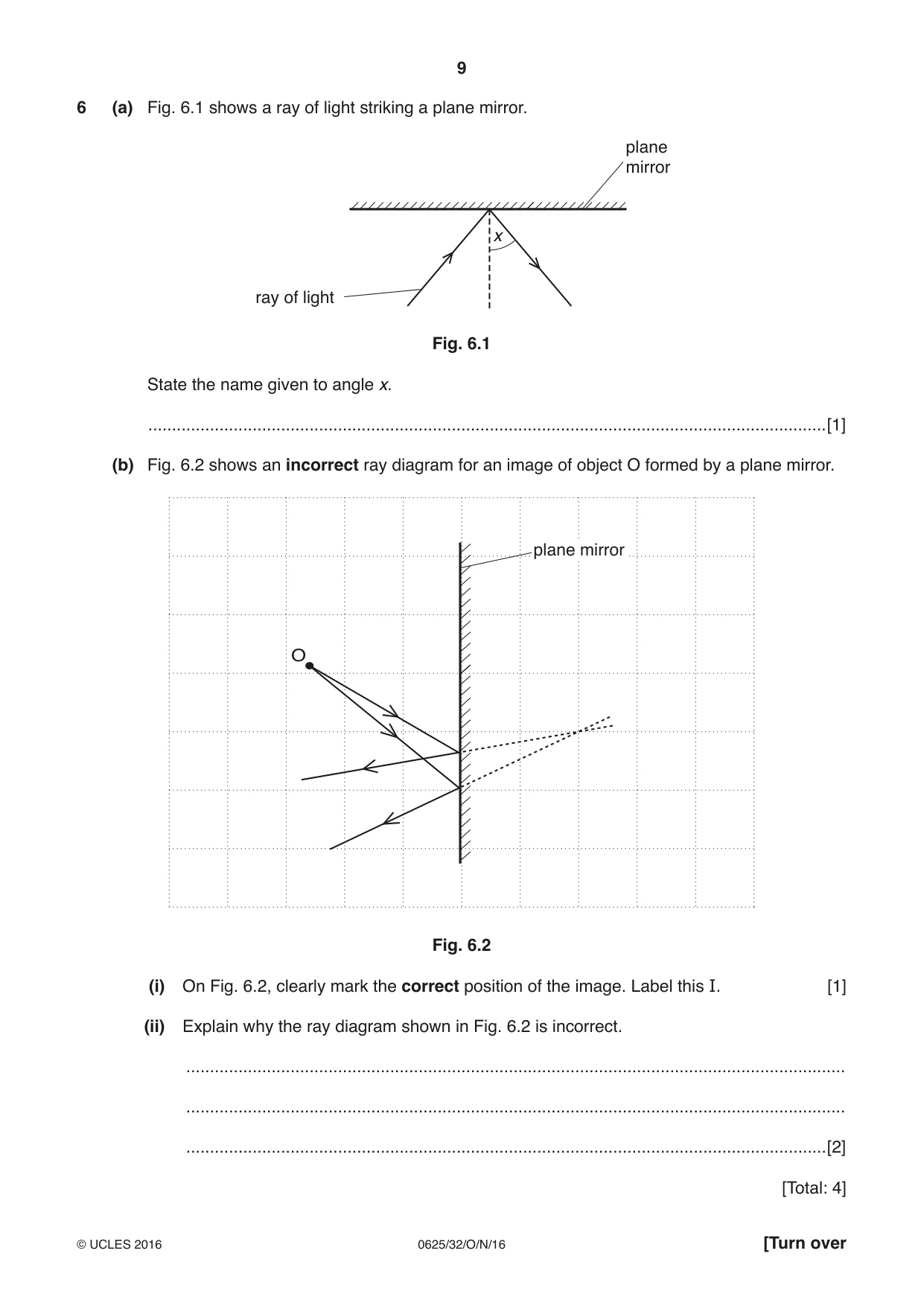
9 0625/32/O/N/16 © UCLES 2016 [Turn over 6 (a) Fig. 6.1 shows a ray of light striking a plane mirror. plane mirror ray of light x Fig. 6.1 State the name given to angle x. …[1] (b) Fig. 6.2 shows an incorrect ray diagram for an image of object O formed by a plane mirror. O plane mirror Fig. 6.2 (i) On Fig. 6.2, clearly mark the correct position of the image. Label this I. [1] (ii) Explain why the ray diagram shown in Fig. 6.2 is incorrect. … … …[2] [Total: 4]
Question paper, page 10
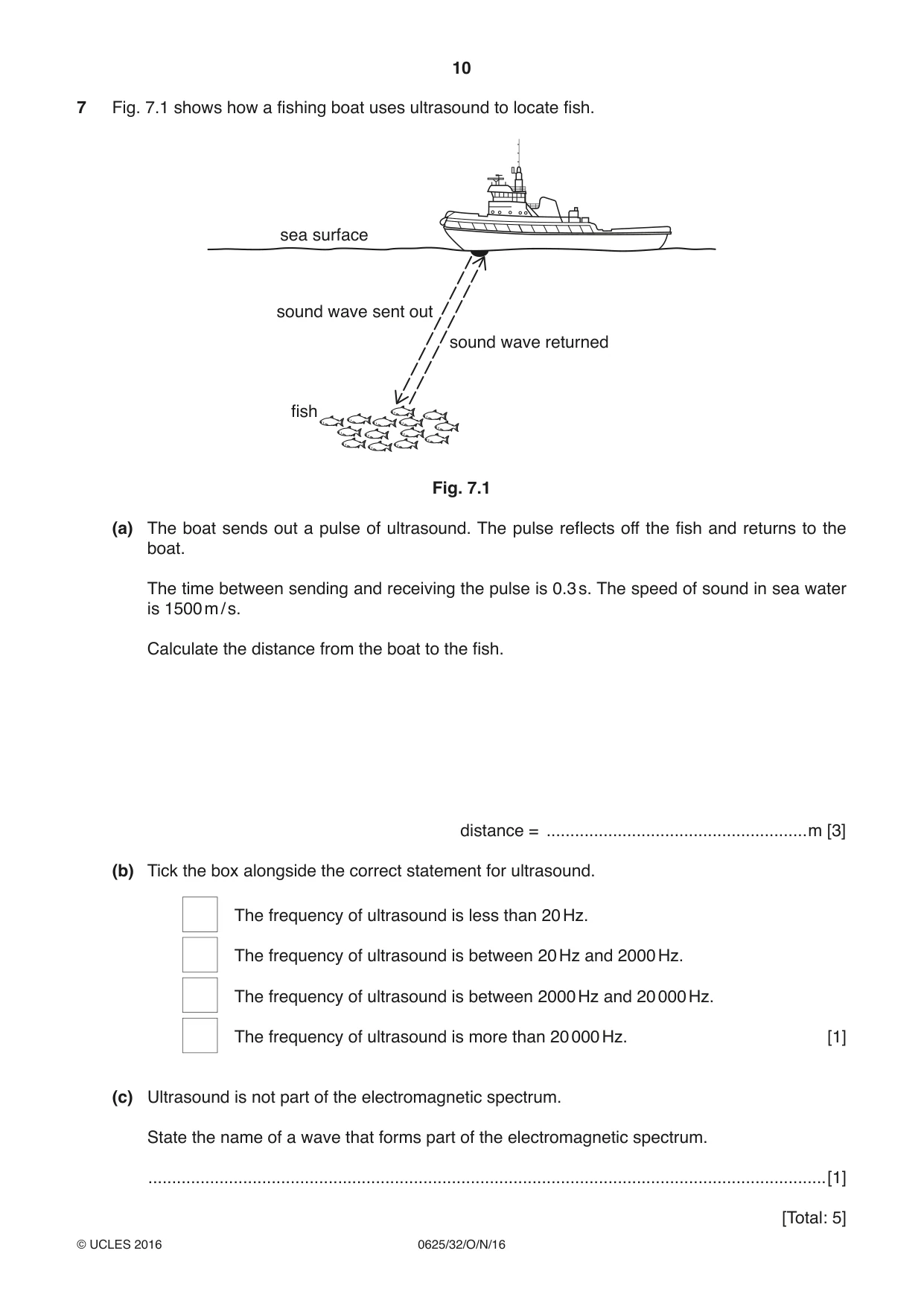
10 0625/32/O/N/16 © UCLES 2016 7 Fig. 7.1 shows how a fishing boat uses ultrasound to locate fish. sea surface fish sound wave returned sound wave sent out Fig. 7.1 (a) The boat sends out a pulse of ultrasound. The pulse reflects off the fish and returns to the boat. The time between sending and receiving the pulse is 0.3 s. The speed of sound in sea water is 1500 m / s. Calculate the distance from the boat to the fish. distance = …m [3] (b) Tick the box alongside the correct statement for ultrasound. The frequency of ultrasound is less than 20 Hz. The frequency of ultrasound is between 20 Hz and 2000 Hz. The frequency of ultrasound is between 2000 Hz and 20 000 Hz. The frequency of ultrasound is more than 20 000 Hz. [1] (c) Ultrasound is not part of the electromagnetic spectrum. State the name of a wave that forms part of the electromagnetic spectrum. …[1] [Total: 5]
Question paper, page 11
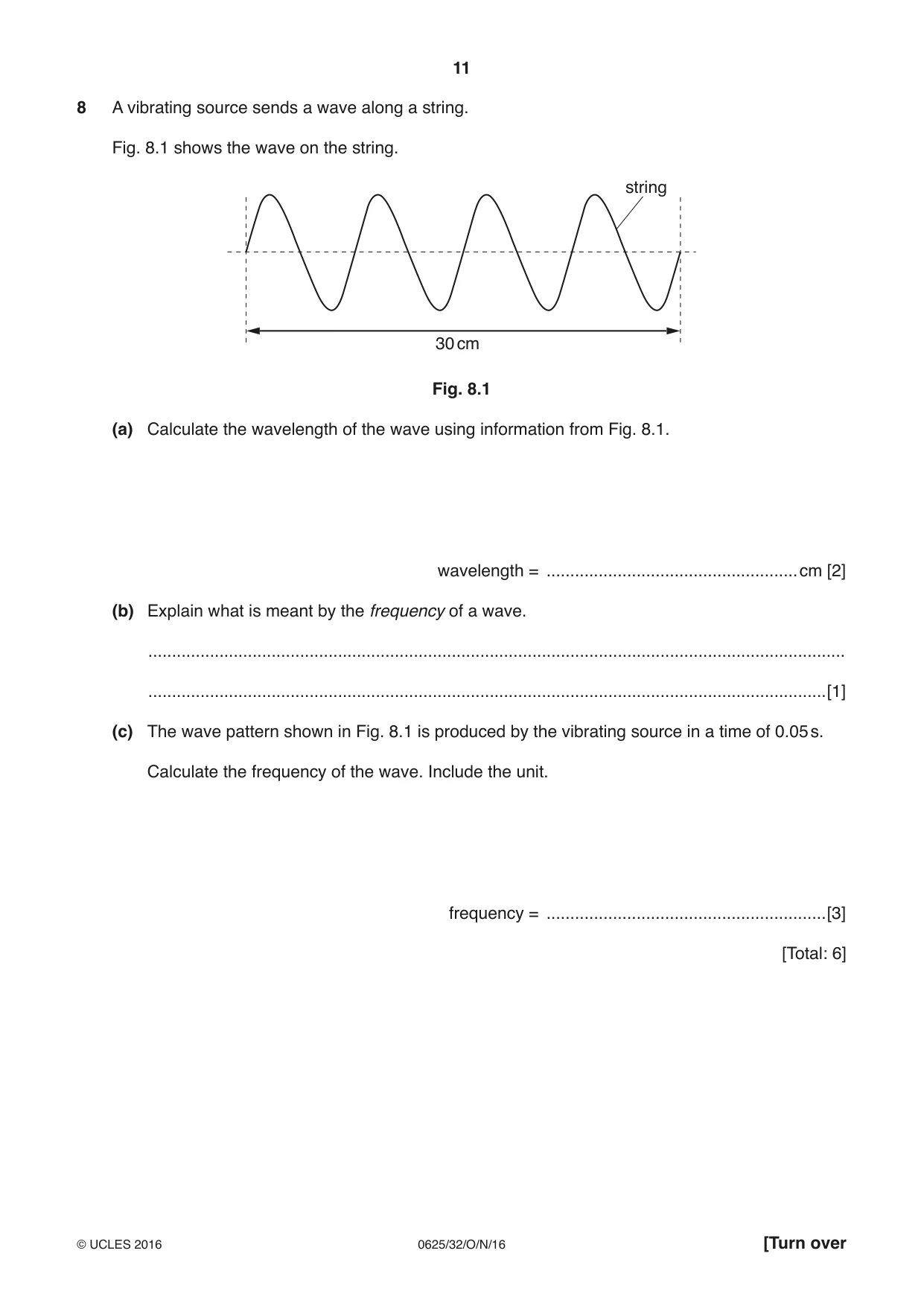
11 0625/32/O/N/16 © UCLES 2016 [Turn over 8 A vibrating source sends a wave along a string. Fig. 8.1 shows the wave on the string. 30 cm string Fig. 8.1 (a) Calculate the wavelength of the wave using information from Fig. 8.1. wavelength = …cm [2] (b) Explain what is meant by the frequency of a wave. … …[1] (c) The wave pattern shown in Fig. 8.1 is produced by the vibrating source in a time of 0.05 s. Calculate the frequency of the wave. Include the unit. frequency = …[3] [Total: 6]
Question paper, page 12
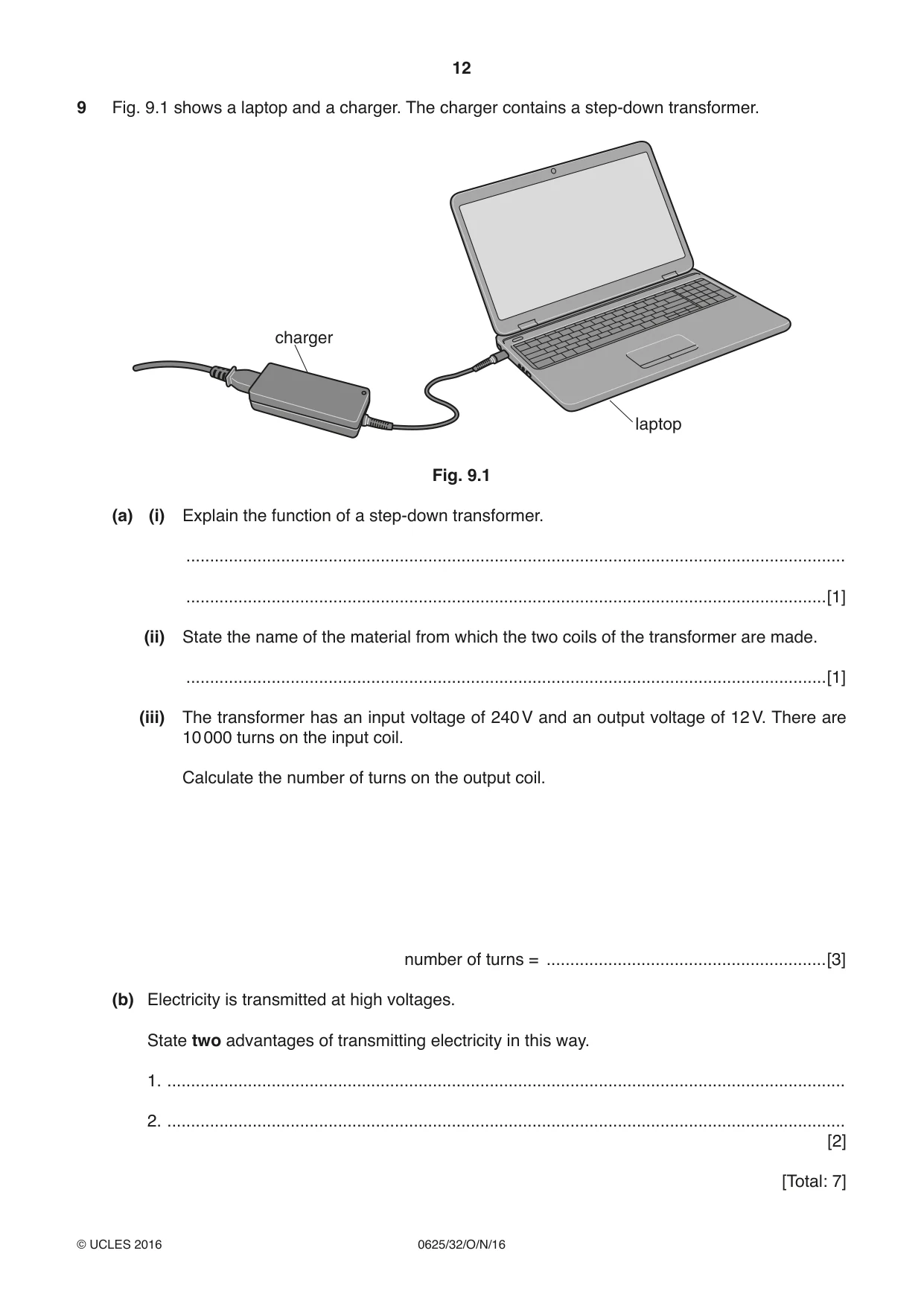
12 0625/32/O/N/16 © UCLES 2016 9 Fig. 9.1 shows a laptop and a charger. The charger contains a step-down transformer. charger laptop Fig. 9.1 (a) (i) Explain the function of a step-down transformer. … …[1] (ii) State the name of the material from which the two coils of the transformer are made. …[1] (iii) The transformer has an input voltage of 240 V and an output voltage of 12 V. There are 10 000 turns on the input coil. Calculate the number of turns on the output coil. number of turns = …[3] (b) Electricity is transmitted at high voltages. State two advantages of transmitting electricity in this way. 1. … 2. … [2] [Total: 7]
Question paper, page 13
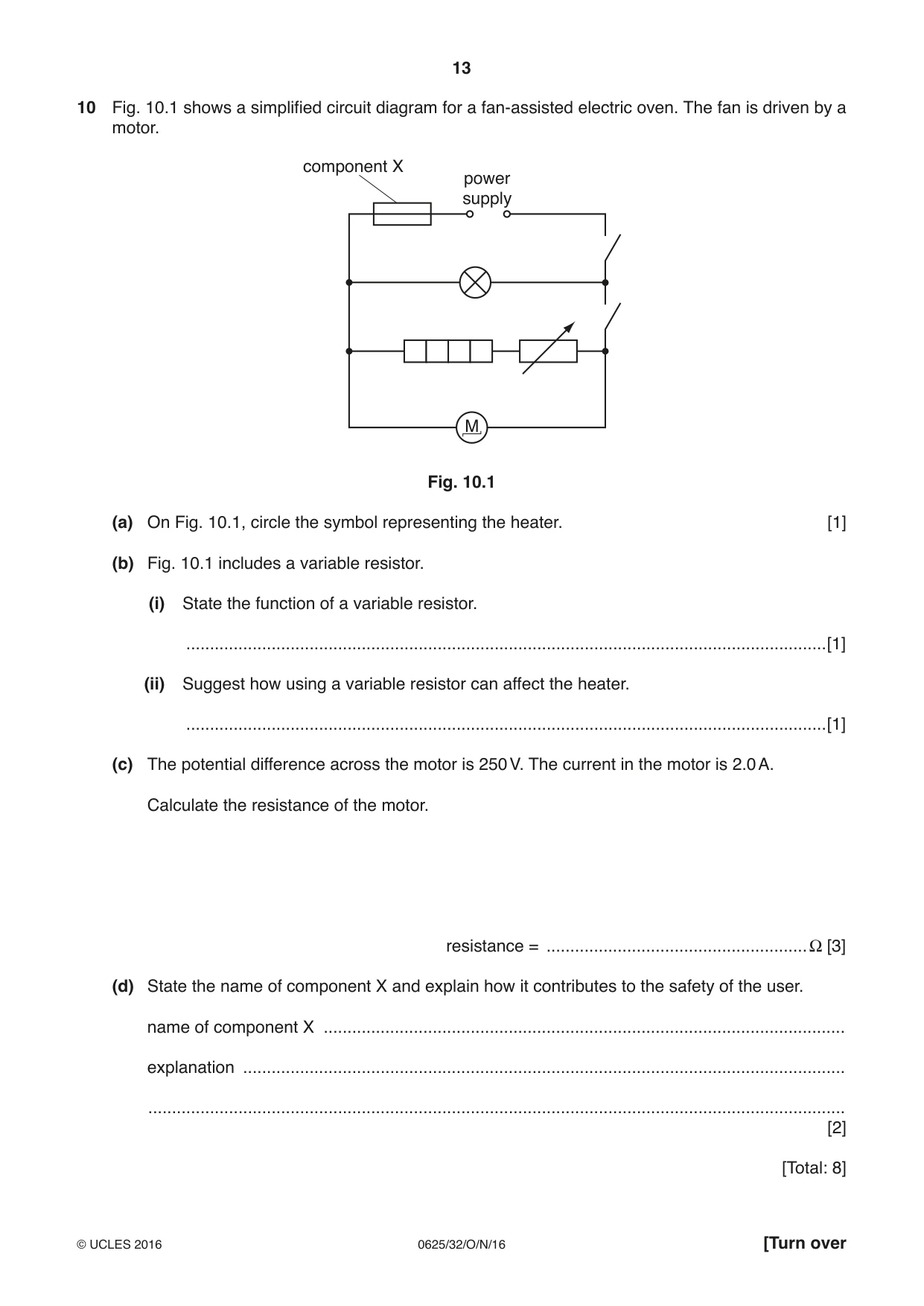
13 0625/32/O/N/16 © UCLES 2016 [Turn over 10 Fig. 10.1 shows a simplified circuit diagram for a fan-assisted electric oven. The fan is driven by a motor. component X power supply M Fig. 10.1 (a) On Fig. 10.1, circle the symbol representing the heater. [1] (b) Fig. 10.1 includes a variable resistor. (i) State the function of a variable resistor. …[1] (ii) Suggest how using a variable resistor can affect the heater. …[1] (c) The potential difference across the motor is 250 V. The current in the motor is 2.0 A. Calculate the resistance of the motor. resistance = …Ω [3] (d) State the name of component X and explain how it contributes to the safety of the user. name of component X … explanation … … [2] [Total: 8]
Question paper, page 14
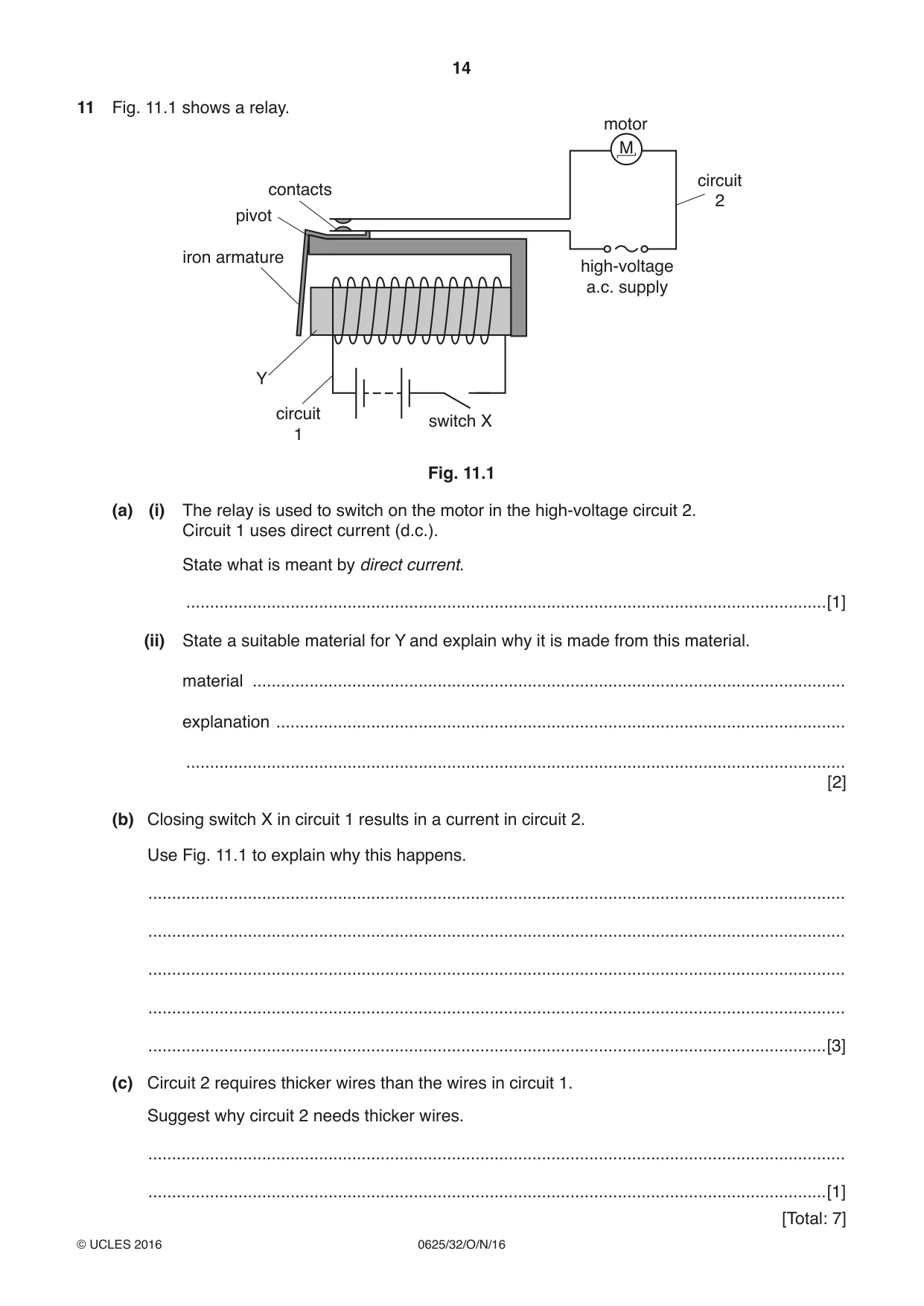
14 0625/32/O/N/16 © UCLES 2016 11 Fig. 11.1 shows a relay. contacts pivot iron armature circuit 1 switch X circuit 2 high-voltage a.c. supply motor Y M Fig. 11.1 (a) (i) The relay is used to switch on the motor in the high-voltage circuit 2. Circuit 1 uses direct current (d.c.). State what is meant by direct current. …[1] (ii) State a suitable material for Y and explain why it is made from this material. material … explanation … … [2] (b) Closing switch X in circuit 1 results in a current in circuit 2. Use Fig. 11.1 to explain why this happens. … … … … …[3] (c) Circuit 2 requires thicker wires than the wires in circuit 1. Suggest why circuit 2 needs thicker wires. … …[1] [Total: 7]
Question paper, page 15
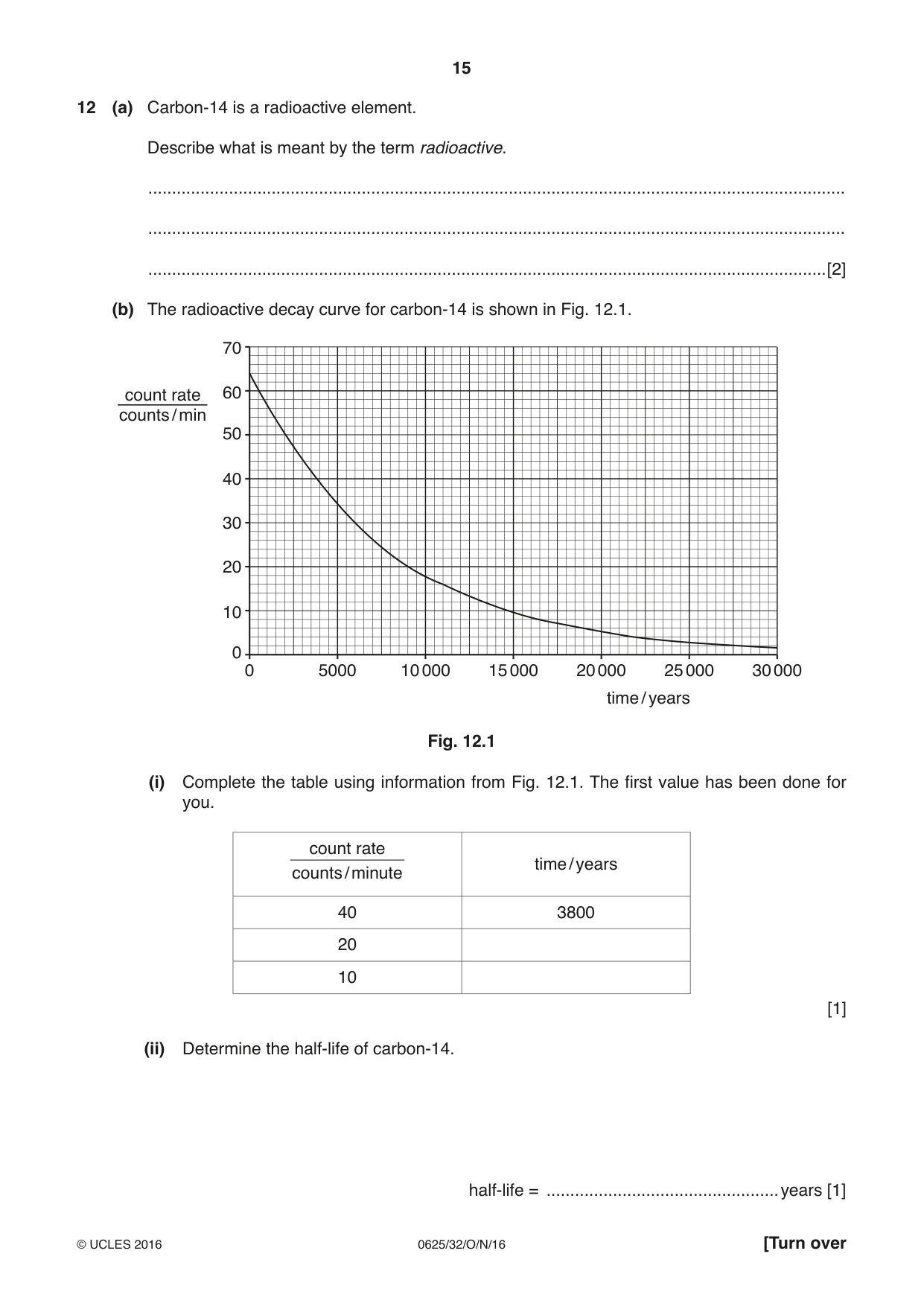
15 0625/32/O/N/16 © UCLES 2016 [Turn over 12 (a) Carbon-14 is a radioactive element. Describe what is meant by the term radioactive. … … …[2] (b) The radioactive decay curve for carbon-14 is shown in Fig. 12.1. count rate counts / min time / years 70 60 50 40 30 20 10 0 0 5000 10 000 15 000 20 000 25 000 30 000 Fig. 12.1 (i) Complete the table using information from Fig. 12.1. The first value has been done for you. count rate counts / minute time / years 40 3800 20 10 [1] (ii) Determine the half-life of carbon-14. half-life = …years [1]
Question paper, page 16
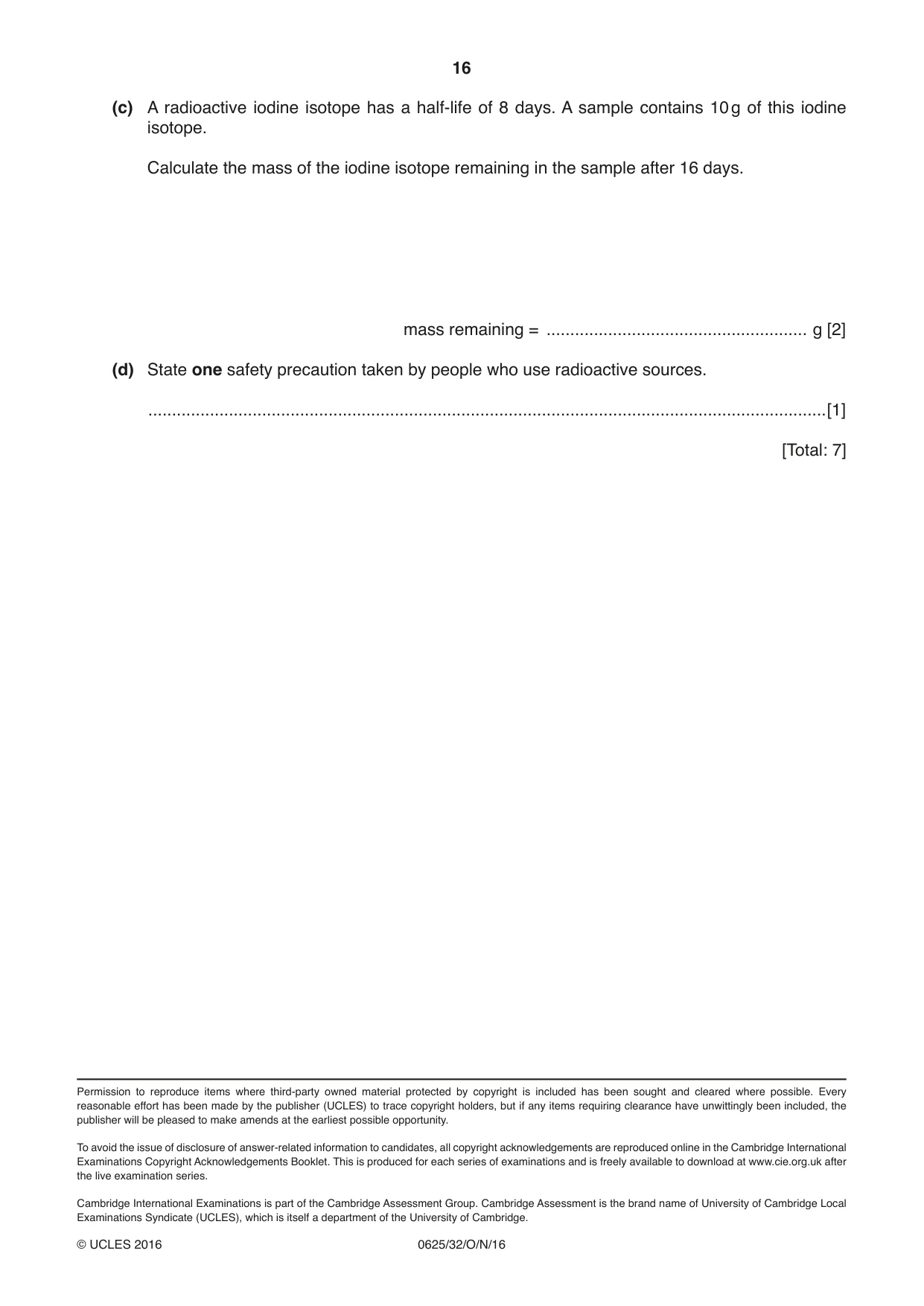
16 0625/32/O/N/16 © UCLES 2016 Permission to reproduce items where third-party owned material protected by copyright is included has been sought and cleared where possible. Every reasonable effort has been made by the publisher (UCLES) to trace copyright holders, but if any items requiring clearance have unwittingly been included, the publisher will be pleased to make amends at the earliest possible opportunity. To avoid the issue of disclosure of answer-related information to candidates, all copyright acknowledgements are reproduced online in the Cambridge International Examinations Copyright Acknowledgements Booklet. This is produced for each series of examinations and is freely available to download at www.cie.org.uk after the live examination series. Cambridge International Examinations is part of the Cambridge Assessment Group. Cambridge Assessment is the brand name of University of Cambridge Local Examinations Syndicate (UCLES), which is itself a department of the University of Cambridge. (c) A radioactive iodine isotope has a half-life of 8 days. A sample contains 10 g of this iodine isotope. Calculate the mass of the iodine isotope remaining in the sample after 16 days. mass remaining = … g [2] (d) State one safety precaution taken by people who use radioactive sources. …[1] [Total: 7]
Mark scheme, page 1
® IGCSE is the registered trademark of Cambridge International Examinations. This syllabus is approved for use in England, Wales and Northern Ireland as a Cambridge International Level 1/Level 2 Certificate. This document consists of 10 printed pages. © UCLES 2016 [Turn over Cambridge International Examinations Cambridge International General Certificate of Secondary Education PHYSICS 0625/32 Paper 3 Core Theory October/November 2016 MARK SCHEME Maximum Mark: 80 Published This mark scheme is published as an aid to teachers and candidates, to indicate the requirements of the examination. It shows the basis on which Examiners were instructed to award marks. It does not indicate the details of the discussions that took place at an Examiners’ meeting before marking began, which would have considered the acceptability of alternative answers. Mark schemes should be read in conjunction with the question paper and the Principal Examiner Report for Teachers. Cambridge will not enter into discussions about these mark schemes. Cambridge is publishing the mark schemes for the October/November 2016 series for most Cambridge IGCSE®, Cambridge International A and AS Level components and some Cambridge O Level components.
Mark scheme, page 2
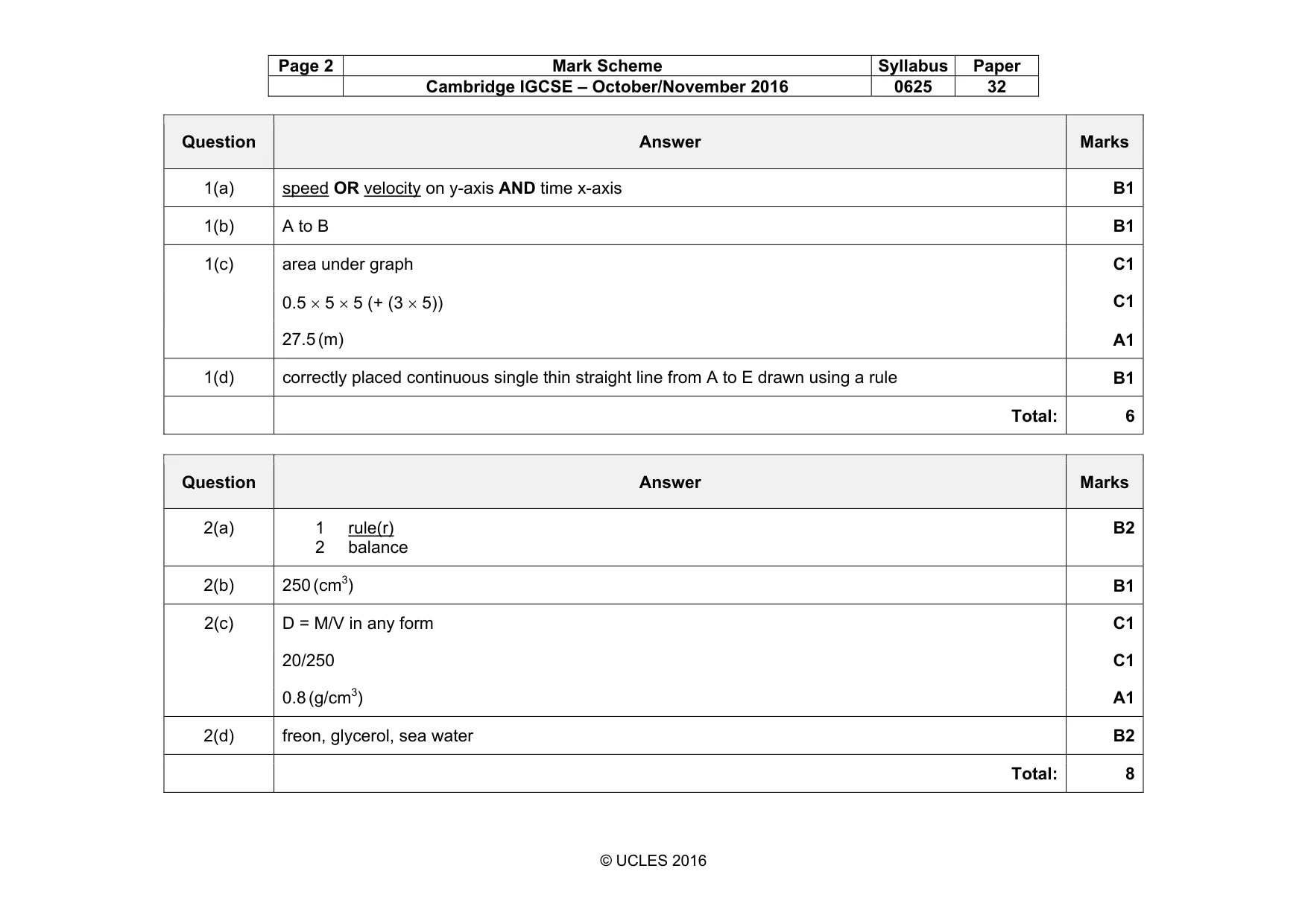
Page 2 Mark Scheme Syllabus Paper Cambridge IGCSE – October/November 2016 0625 32 © UCLES 2016 Question Answer Marks 1(a) speed OR velocity on y-axis AND time x-axis B1 1(b) A to B B1 1(c) area under graph C1 0.5 × 5 × 5 (+ (3 × 5)) C1 27.5 (m) A1 1(d) correctly placed continuous single thin straight line from A to E drawn using a rule B1 Total: 6 Question Answer Marks 2(a) 1 rule(r) 2 balance B2 2(b) 250 (cm3) B1 2(c) D = M/V in any form C1 20/250 C1 0.8 (g/cm3) A1 2(d) freon, glycerol, sea water B2 Total: 8
Mark scheme, page 3
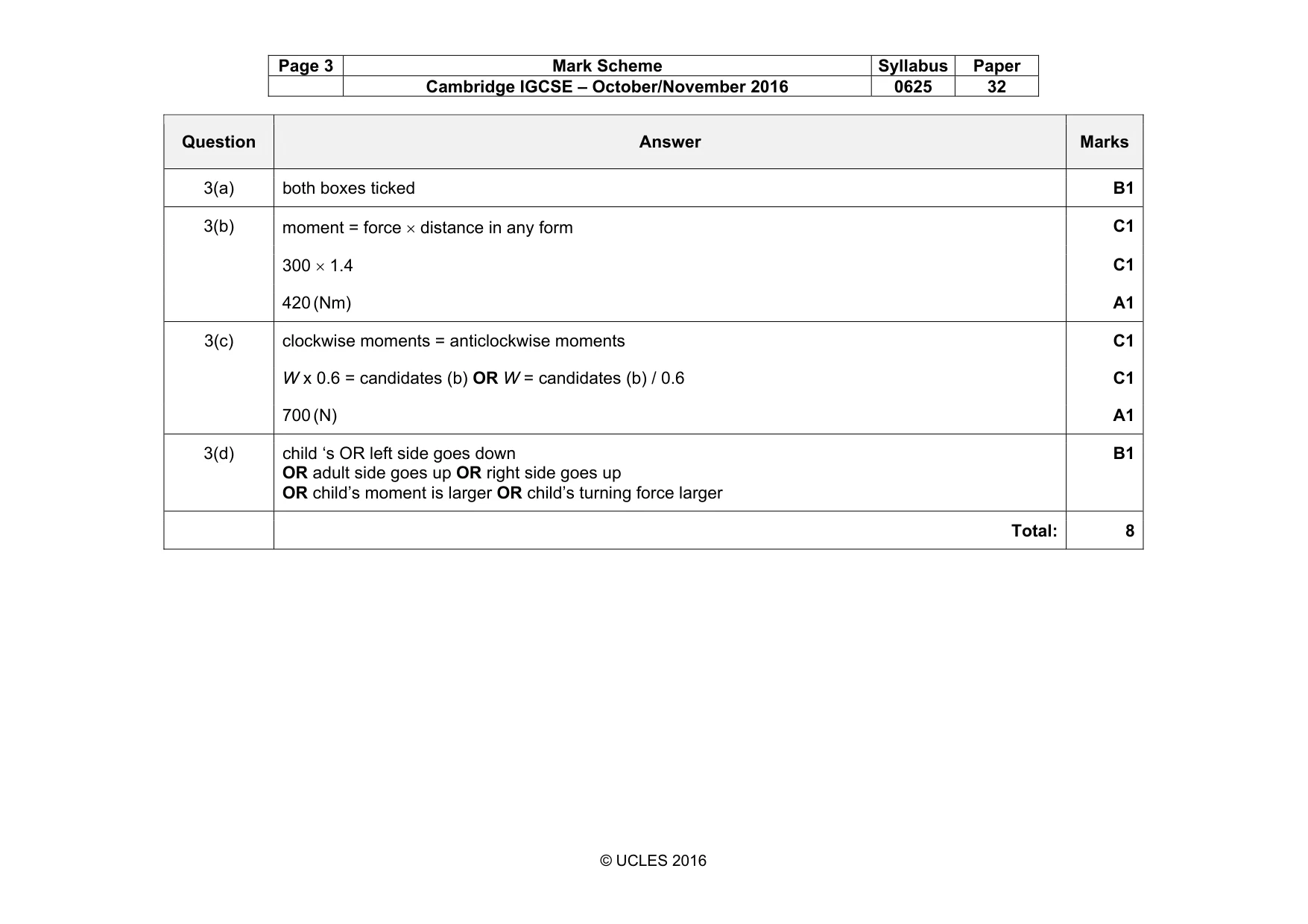
Page 3 Mark Scheme Syllabus Paper Cambridge IGCSE – October/November 2016 0625 32 © UCLES 2016 Question Answer Marks 3(a) both boxes ticked B1 3(b) moment = force × distance in any form C1 300 × 1.4 C1 420 (Nm) A1 3(c) clockwise moments = anticlockwise moments C1 W x 0.6 = candidates (b) OR W = candidates (b) / 0.6 C1 700 (N) A1 3(d) child ‘s OR left side goes down OR adult side goes up OR right side goes up OR child’s moment is larger OR child’s turning force larger B1 Total: 8
Mark scheme, page 4
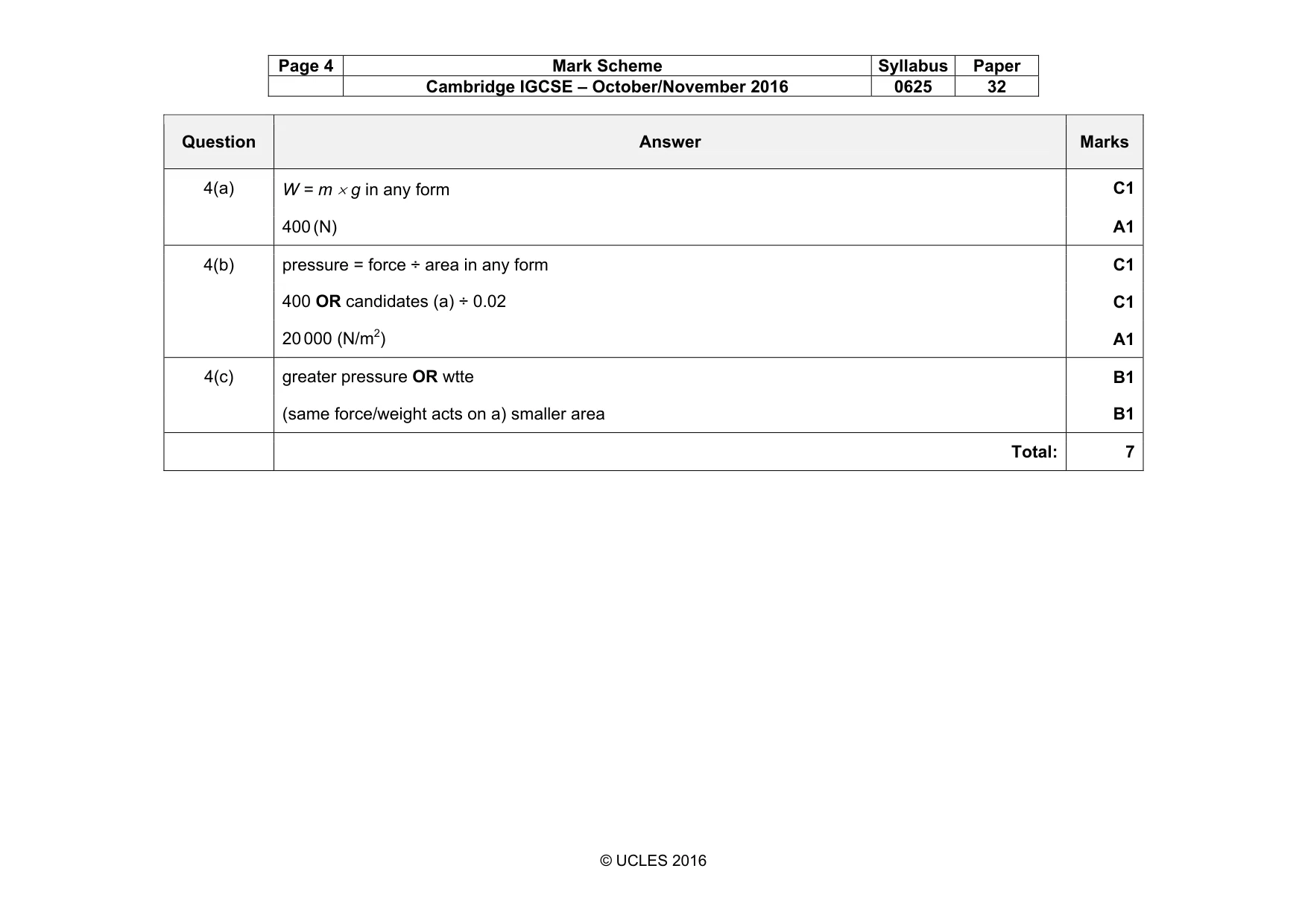
Page 4 Mark Scheme Syllabus Paper Cambridge IGCSE – October/November 2016 0625 32 © UCLES 2016 Question Answer Marks 4(a) W = m × g in any form C1 400 (N) A1 4(b) pressure = force ÷ area in any form C1 400 OR candidates (a) ÷ 0.02 C1 20 000 (N/m2) A1 4(c) greater pressure OR wtte B1 (same force/weight acts on a) smaller area B1 Total: 7
Mark scheme, page 5
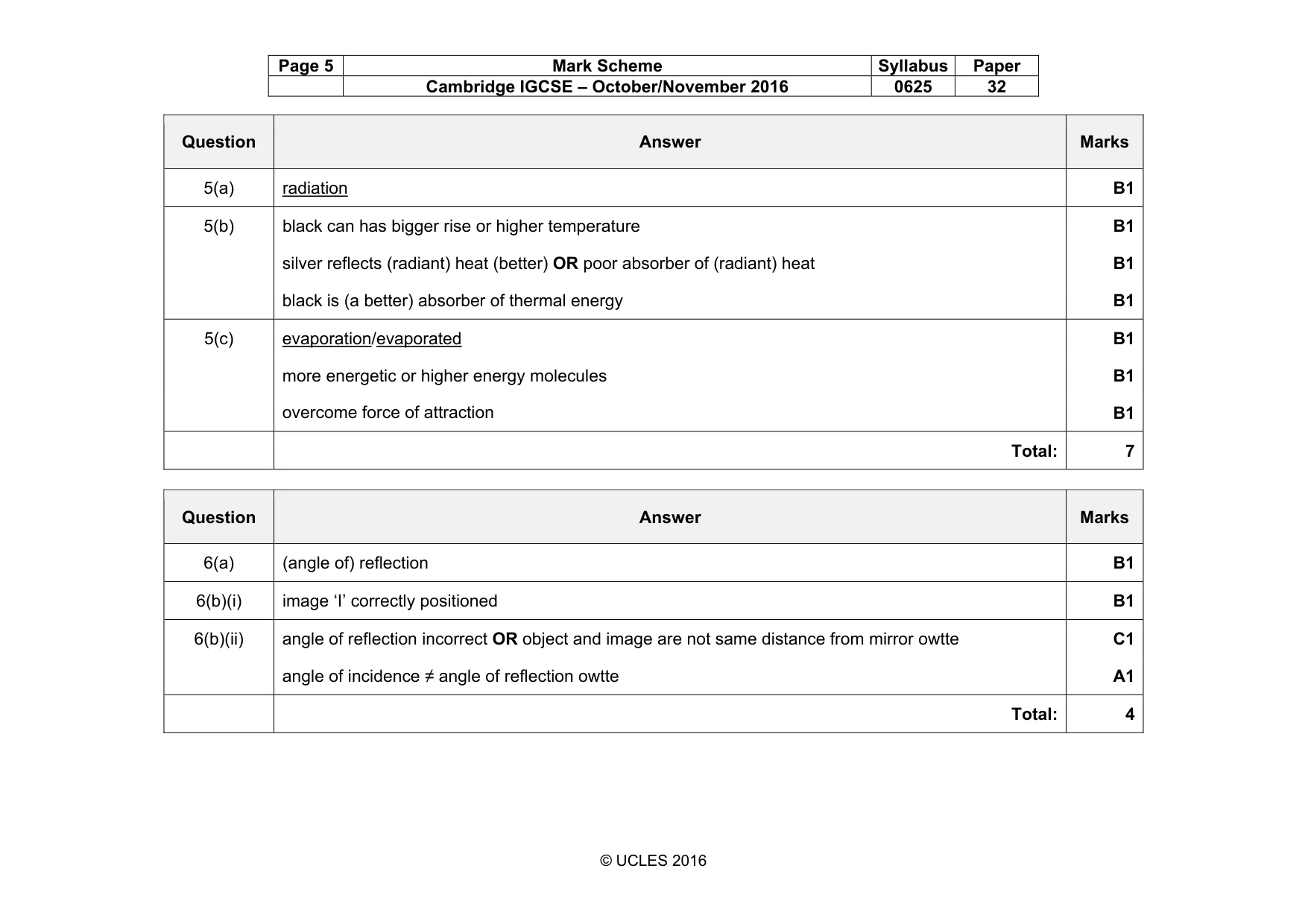
Page 5 Mark Scheme Syllabus Paper Cambridge IGCSE – October/November 2016 0625 32 © UCLES 2016 Question Answer Marks 5(a) radiation B1 5(b) black can has bigger rise or higher temperature B1 silver reflects (radiant) heat (better) OR poor absorber of (radiant) heat B1 black is (a better) absorber of thermal energy B1 5(c) evaporation/evaporated B1 more energetic or higher energy molecules B1 overcome force of attraction B1 Total: 7 Question Answer Marks 6(a) (angle of) reflection B1 6(b)(i) image ‘I’ correctly positioned B1 6(b)(ii) angle of reflection incorrect OR object and image are not same distance from mirror owtte C1 angle of incidence ≠ angle of reflection owtte A1 Total: 4
Mark scheme, page 6
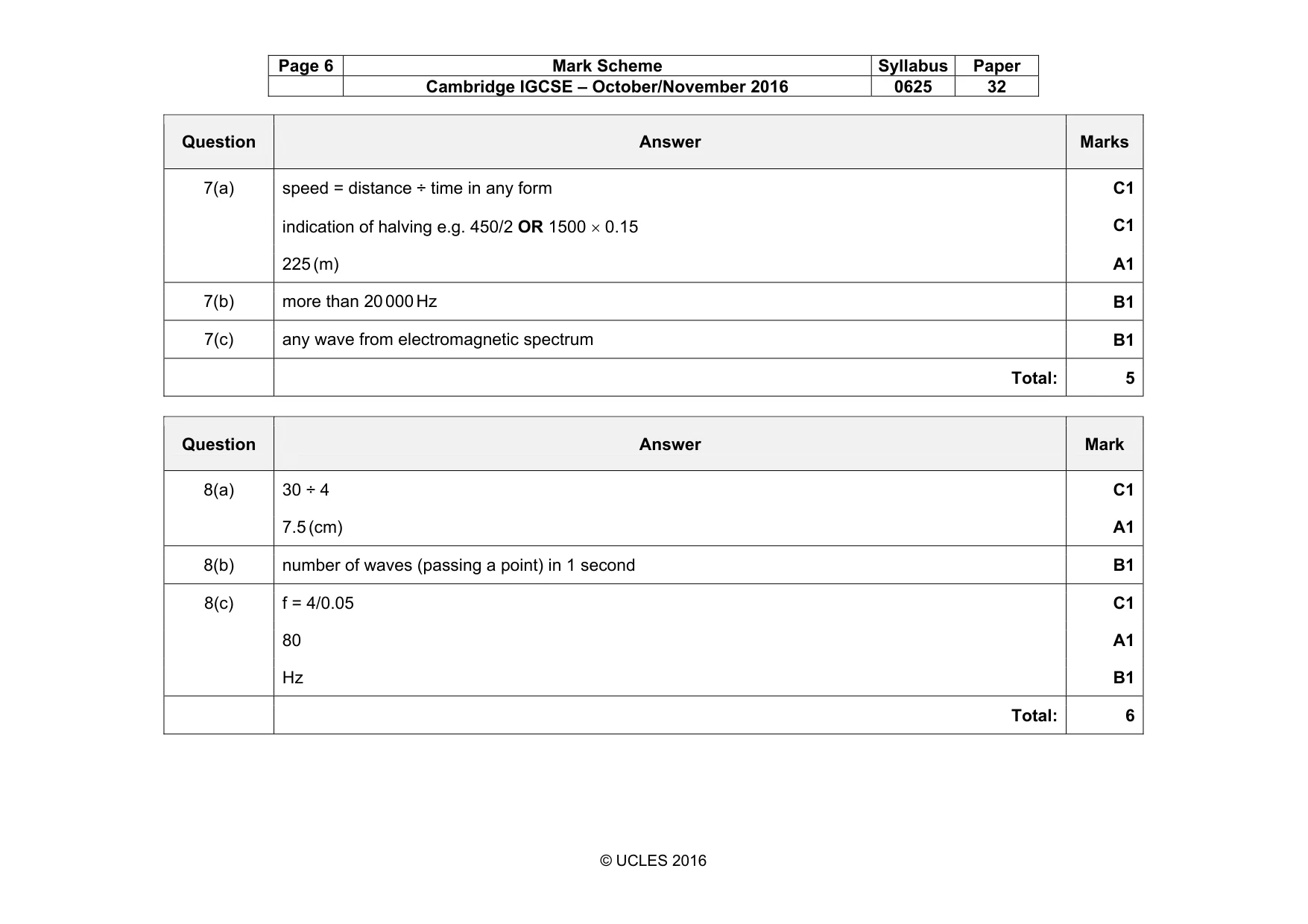
Page 6 Mark Scheme Syllabus Paper Cambridge IGCSE – October/November 2016 0625 32 © UCLES 2016 Question Answer Marks 7(a) speed = distance ÷ time in any form C1 indication of halving e.g. 450/2 OR 1500 × 0.15 C1 225 (m) A1 7(b) more than 20 000 Hz B1 7(c) any wave from electromagnetic spectrum B1 Total: 5 Question Answer Mark 8(a) 30 ÷ 4 C1 7.5 (cm) A1 8(b) number of waves (passing a point) in 1 second B1 8(c) f = 4/0.05 C1 80 A1 Hz B1 Total: 6
Mark scheme, page 7
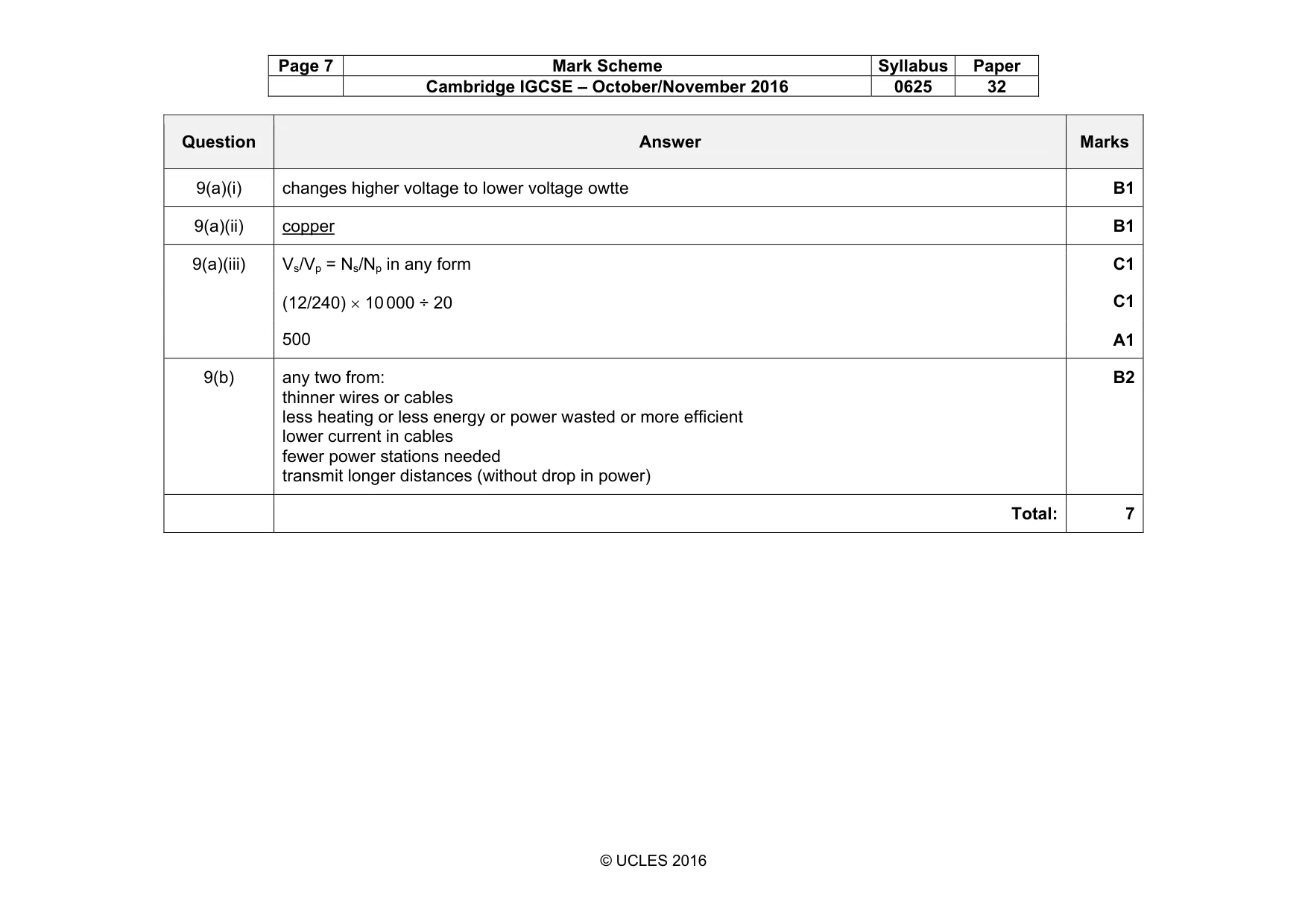
Page 7 Mark Scheme Syllabus Paper Cambridge IGCSE – October/November 2016 0625 32 © UCLES 2016 Question Answer Marks 9(a)(i) changes higher voltage to lower voltage owtte B1 9(a)(ii) copper B1 9(a)(iii) Vs/Vp = Ns/Np in any form C1 (12/240) × 10 000 ÷ 20 C1 500 A1 9(b) any two from: thinner wires or cables less heating or less energy or power wasted or more efficient lower current in cables fewer power stations needed transmit longer distances (without drop in power) B2 Total: 7
Mark scheme, page 8
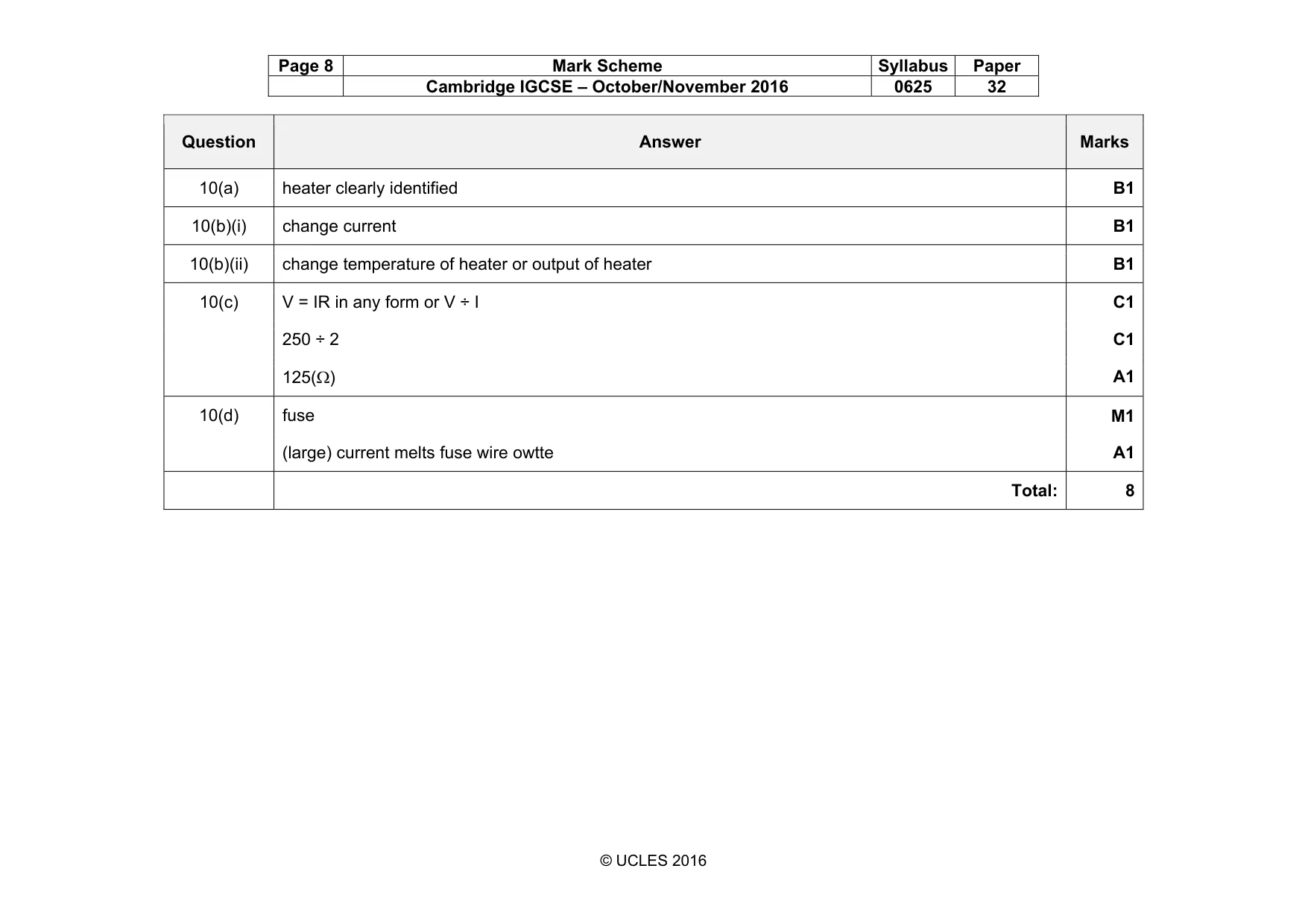
Page 8 Mark Scheme Syllabus Paper Cambridge IGCSE – October/November 2016 0625 32 © UCLES 2016 Question Answer Marks 10(a) heater clearly identified B1 10(b)(i) change current B1 10(b)(ii) change temperature of heater or output of heater B1 10(c) V = IR in any form or V ÷ I C1 250 ÷ 2 C1 125(Ω) A1 10(d) fuse M1 (large) current melts fuse wire owtte A1 Total: 8
Mark scheme, page 9
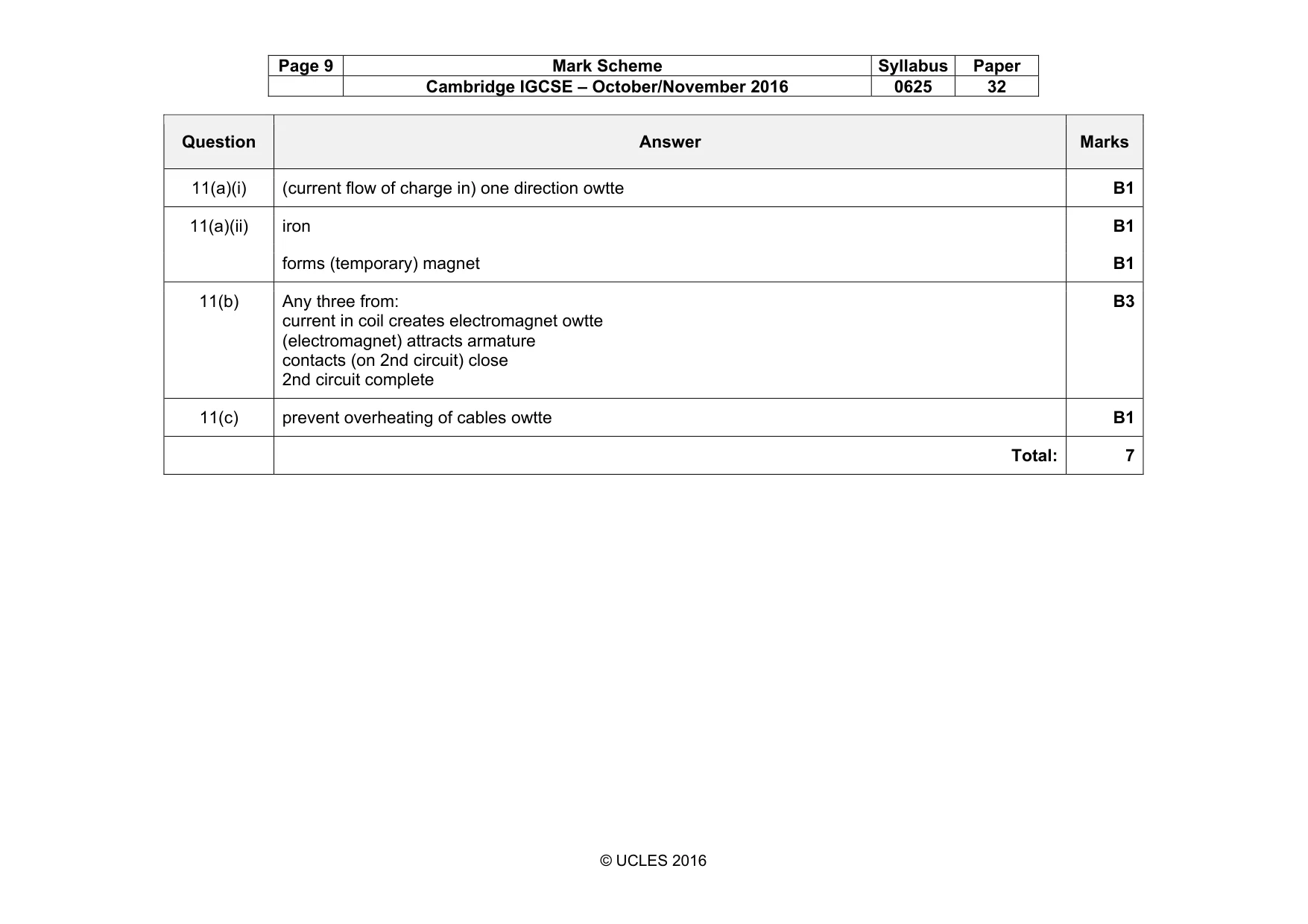
Page 9 Mark Scheme Syllabus Paper Cambridge IGCSE – October/November 2016 0625 32 © UCLES 2016 Question Answer Marks 11(a)(i) (current flow of charge in) one direction owtte B1 11(a)(ii) iron B1 forms (temporary) magnet B1 11(b) Any three from: current in coil creates electromagnet owtte (electromagnet) attracts armature contacts (on 2nd circuit) close 2nd circuit complete B3 11(c) prevent overheating of cables owtte B1 Total: 7
Mark scheme, page 10
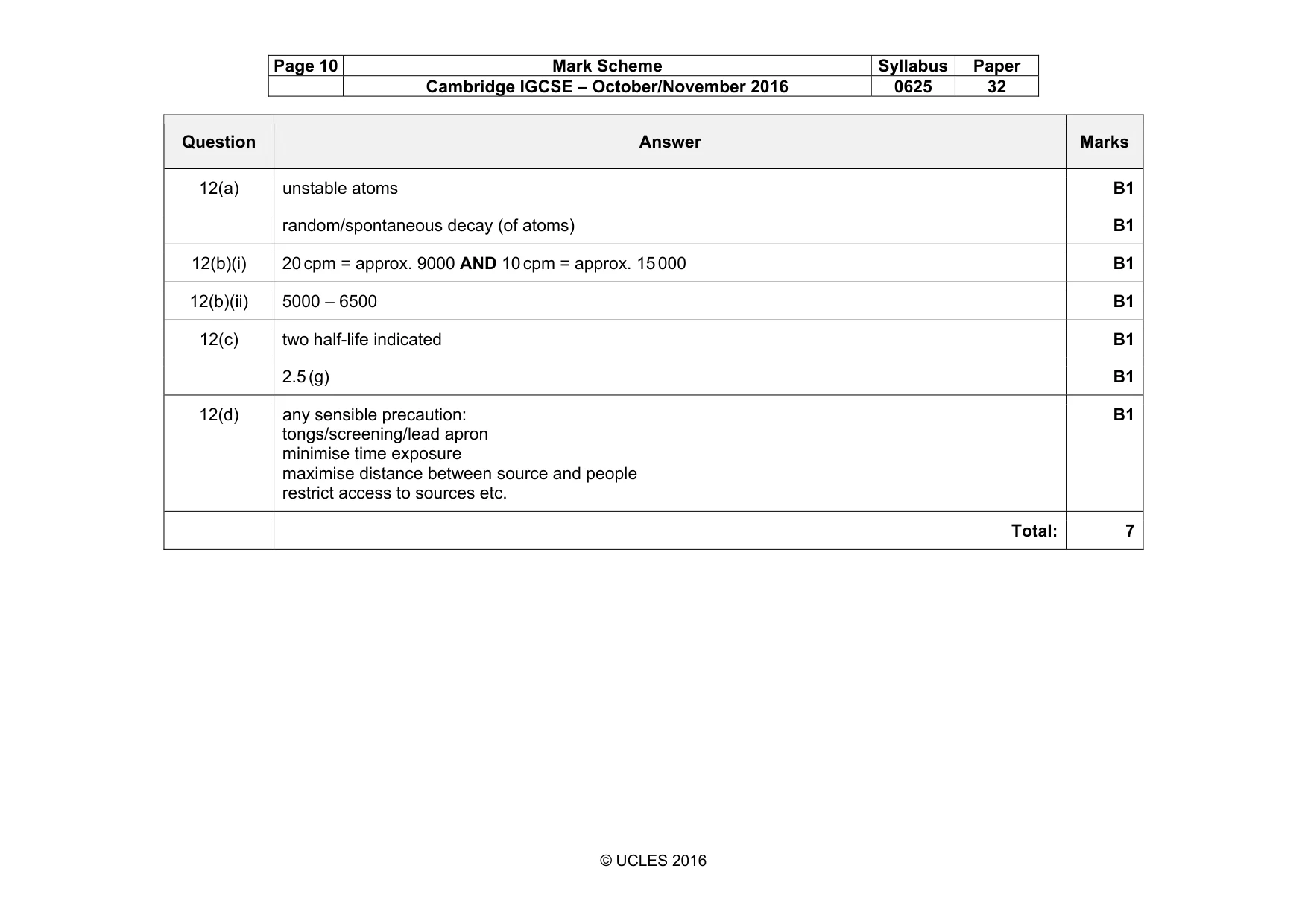
Page 10 Mark Scheme Syllabus Paper Cambridge IGCSE – October/November 2016 0625 32 © UCLES 2016 Question Answer Marks 12(a) unstable atoms B1 random/spontaneous decay (of atoms) B1 12(b)(i) 20 cpm = approx. 9000 AND 10 cpm = approx. 15 000 B1 12(b)(ii) 5000 – 6500 B1 12(c) two half-life indicated B1 2.5 (g) B1 12(d) any sensible precaution: tongs/screening/lead apron minimise time exposure maximise distance between source and people restrict access to sources etc. B1 Total: 7
What you needed in this session
Cambridge’s own grade thresholds for 2016 Oct/Nov, Paper 3 · Variant 2. A higher threshold means an easier paper — the bar moves with how the cohort did.