Cambridge IGCSE Physics 0625 — 2016 Oct/Nov Paper 3 · Variant 1
0625/31/O/N/16 · 80 marks · ≈90 min
The question paper and its mark scheme, free to read here and free to download. This is Cambridge’s own paper, exactly as it was sat.
Question paper20 pages
Mark scheme13 pages
Answers below. Sit the paper first if you are practising.
Paper as text
Question paper, page 1
This document consists of 17 printed pages and 3 blank pages. DC (KN/SG) 115850/8 © UCLES 2016 [Turn over Cambridge International Examinations Cambridge International General Certificate of Secondary Education * 0 5 0 1 7 8 7 9 8 9 * PHYSICS 0625/31 Paper 3 Theory (Core) October/November 2016 1 hour 15 minutes Candidates answer on the Question Paper. No Additional Materials are required. READ THESE INSTRUCTIONS FIRST Write your Centre number, candidate number and name on all the work you hand in. Write in dark blue or black pen. You may use an HB pencil for any diagrams or graphs. Do not use staples, paper clips, glue or correction fluid. DO NOT WRITE IN ANY BARCODES. Answer all questions. Electronic calculators may be used. You may lose marks if you do not show your working or if you do not use appropriate units. Take the weight of 1.0 kg to be 10 N (acceleration of free fall = 10 m / s2). At the end of the examination, fasten all your work securely together. The number of marks is given in brackets [ ] at the end of each question or part question. The syllabus is approved for use in England, Wales and Northern Ireland as a Cambridge International Level 1/Level 2 Certificate.
Question paper, page 2
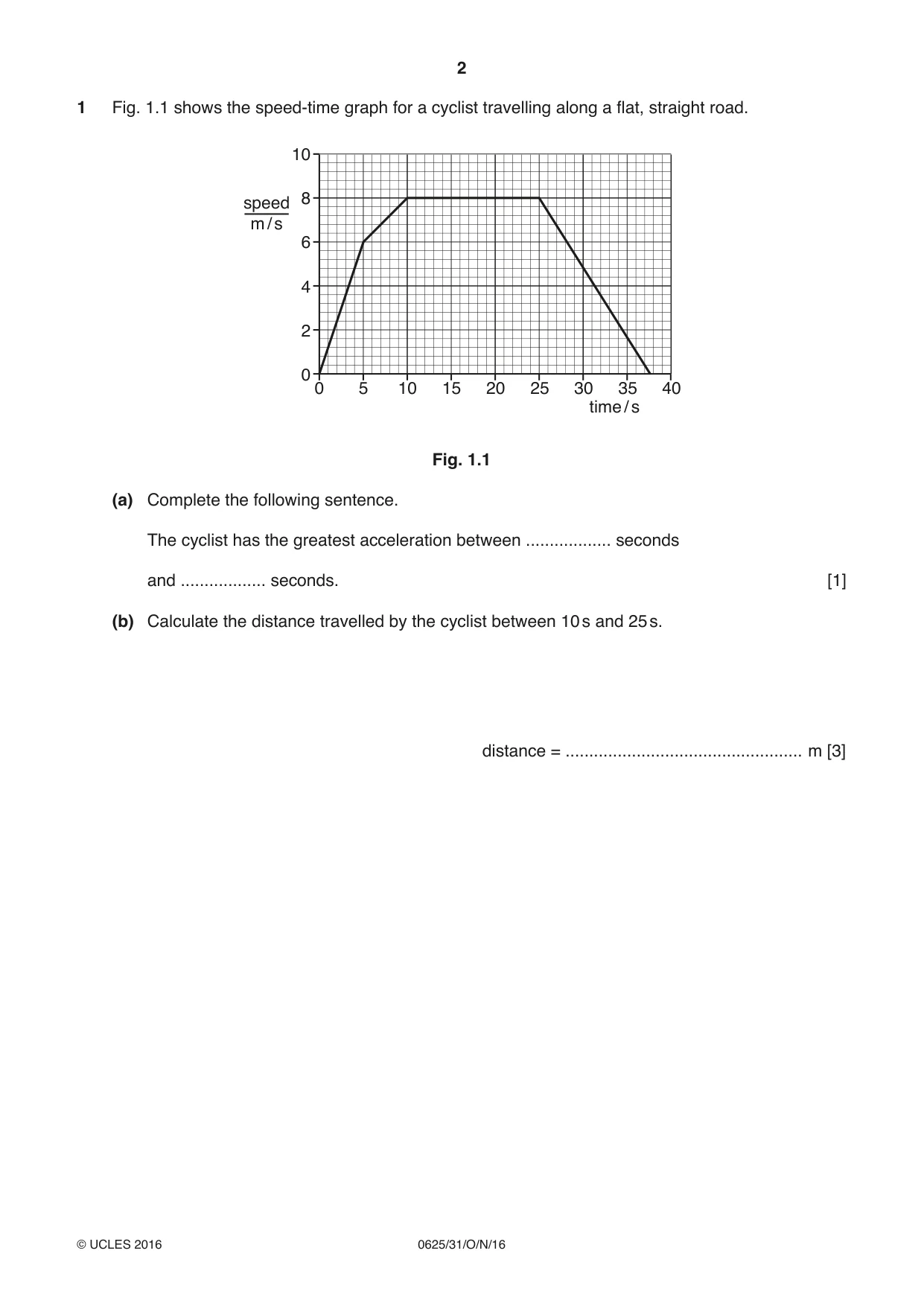
2 0625/31/O/N/16 © UCLES 2016 1 Fig. 1.1 shows the speed-time graph for a cyclist travelling along a flat, straight road. 0 5 10 15 20 25 30 35 40 8 10 6 4 2 0 time / s speed m / s Fig. 1.1 (a) Complete the following sentence. The cyclist has the greatest acceleration between … seconds and … seconds. [1] (b) Calculate the distance travelled by the cyclist between 10 s and 25 s. distance = … m [3]
Question paper, page 3
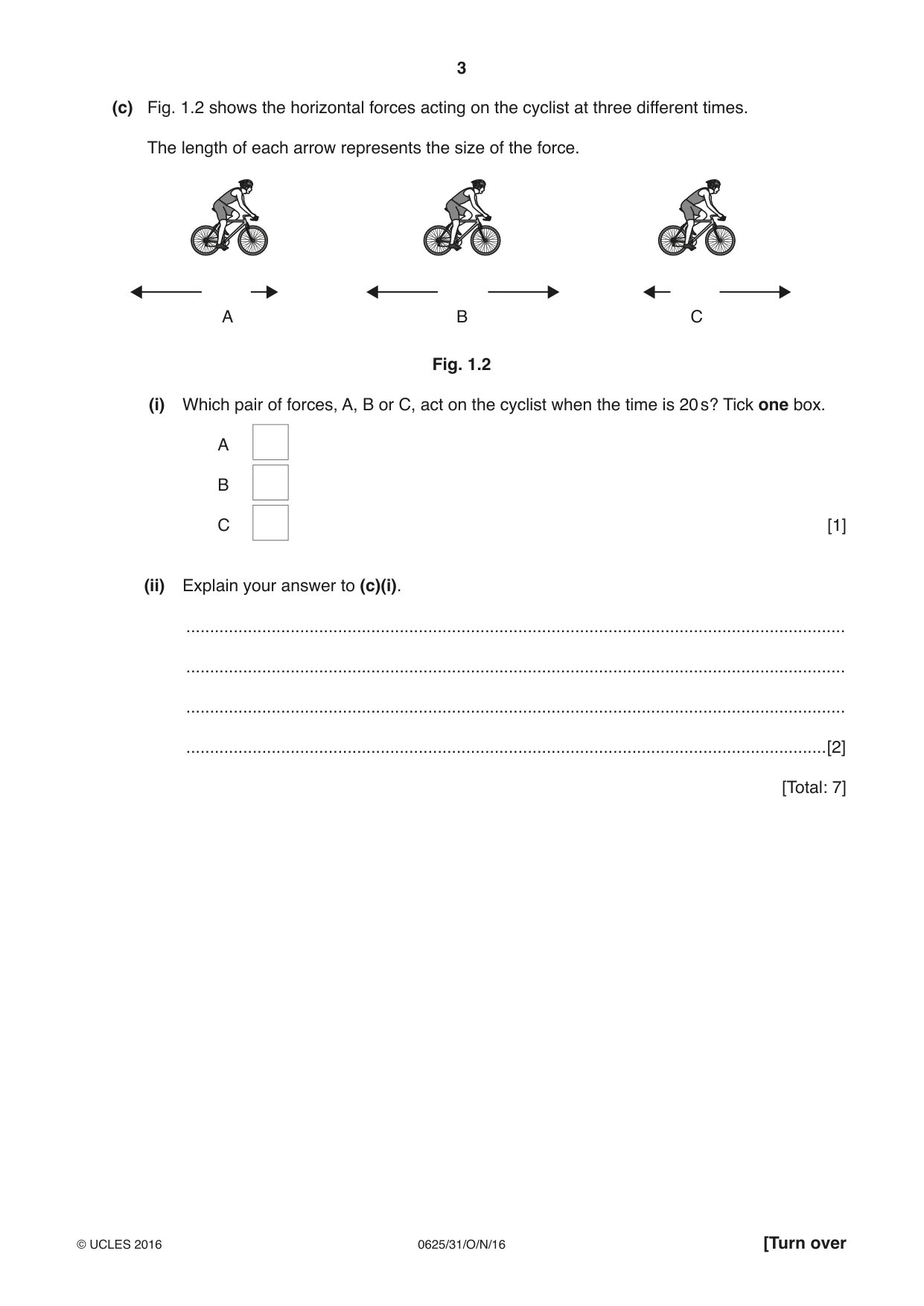
3 0625/31/O/N/16 © UCLES 2016 [Turn over (c) Fig. 1.2 shows the horizontal forces acting on the cyclist at three different times. The length of each arrow represents the size of the force. A B C Fig. 1.2 (i) Which pair of forces, A, B or C, act on the cyclist when the time is 20 s? Tick one box. A B C [1] (ii) Explain your answer to (c)(i). … … … …[2] [Total: 7]
Question paper, page 4
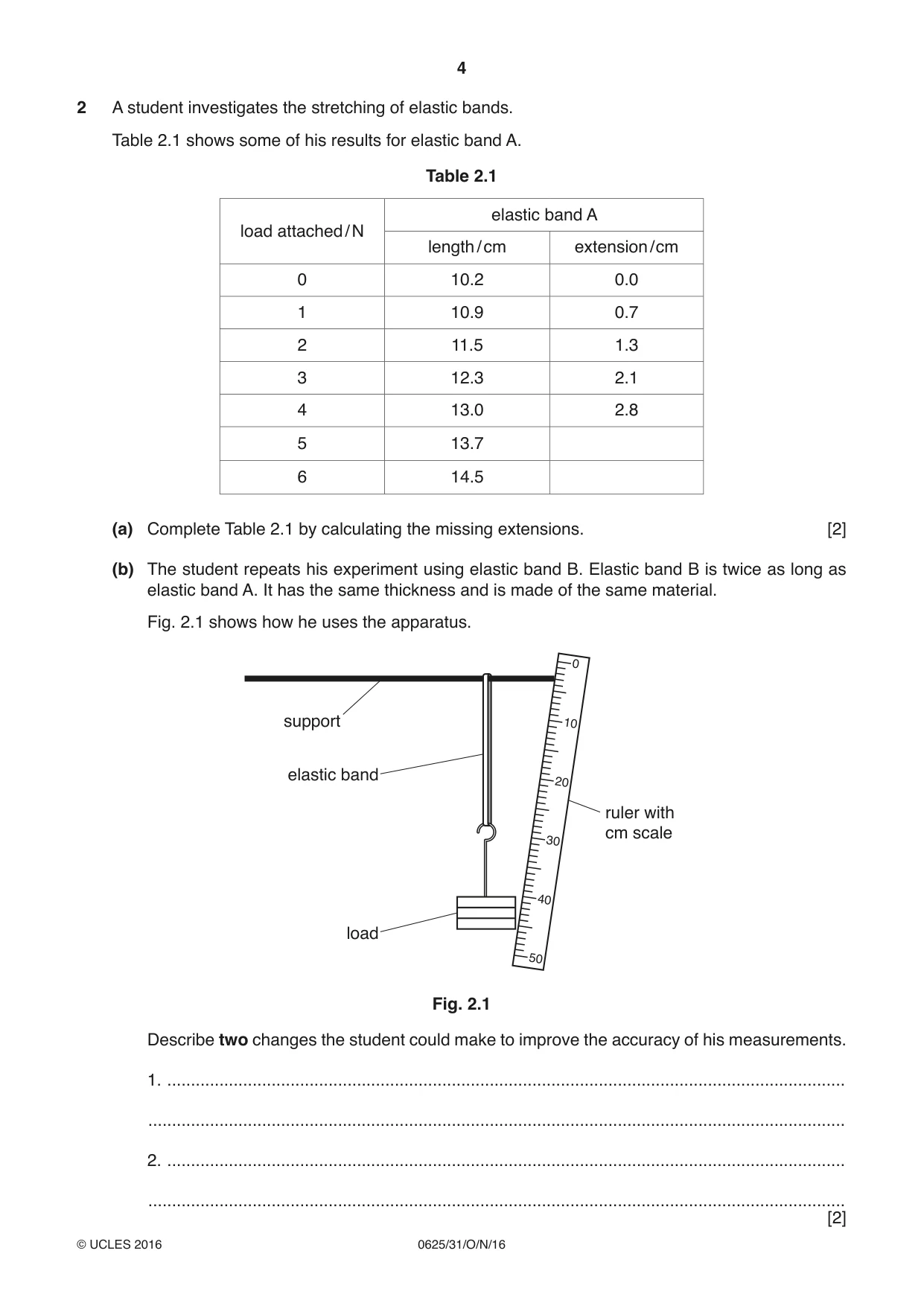
4 0625/31/O/N/16 © UCLES 2016 2 A student investigates the stretching of elastic bands. Table 2.1 shows some of his results for elastic band A. Table 2.1 load attached / N elastic band A length / cm extension / cm 0 10.2 0.0 1 10.9 0.7 2 11.5 1.3 3 12.3 2.1 4 13.0 2.8 5 13.7 6 14.5 (a) Complete Table 2.1 by calculating the missing extensions. [2] (b) The student repeats his experiment using elastic band B. Elastic band B is twice as long as elastic band A. It has the same thickness and is made of the same material. Fig. 2.1 shows how he uses the apparatus. 0 10 20 30 40 50 support elastic band load ruler with cm scale Fig. 2.1 Describe two changes the student could make to improve the accuracy of his measurements. 1. … … 2. … … [2]
Question paper, page 5
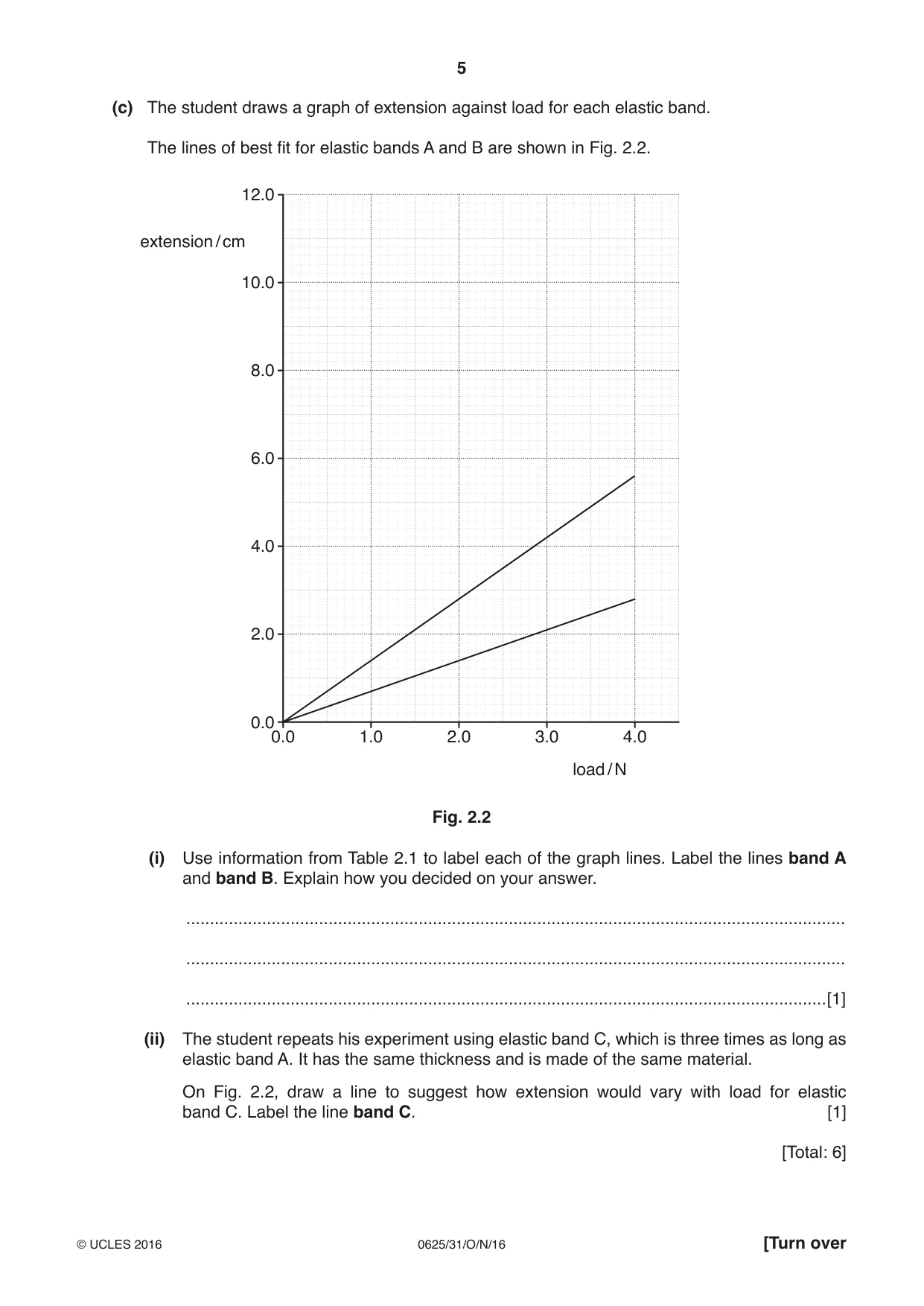
5 0625/31/O/N/16 © UCLES 2016 [Turn over (c) The student draws a graph of extension against load for each elastic band. The lines of best fit for elastic bands A and B are shown in Fig. 2.2. 0.0 0.0 1.0 2.0 3.0 4.0 2.0 4.0 6.0 8.0 10.0 12.0 extension / cm load / N Fig. 2.2 (i) Use information from Table 2.1 to label each of the graph lines. Label the lines band A and band B. Explain how you decided on your answer. … … …[1] (ii) The student repeats his experiment using elastic band C, which is three times as long as elastic band A. It has the same thickness and is made of the same material. On Fig. 2.2, draw a line to suggest how extension would vary with load for elastic band C. Label the line band C. [1] [Total: 6]
Question paper, page 6
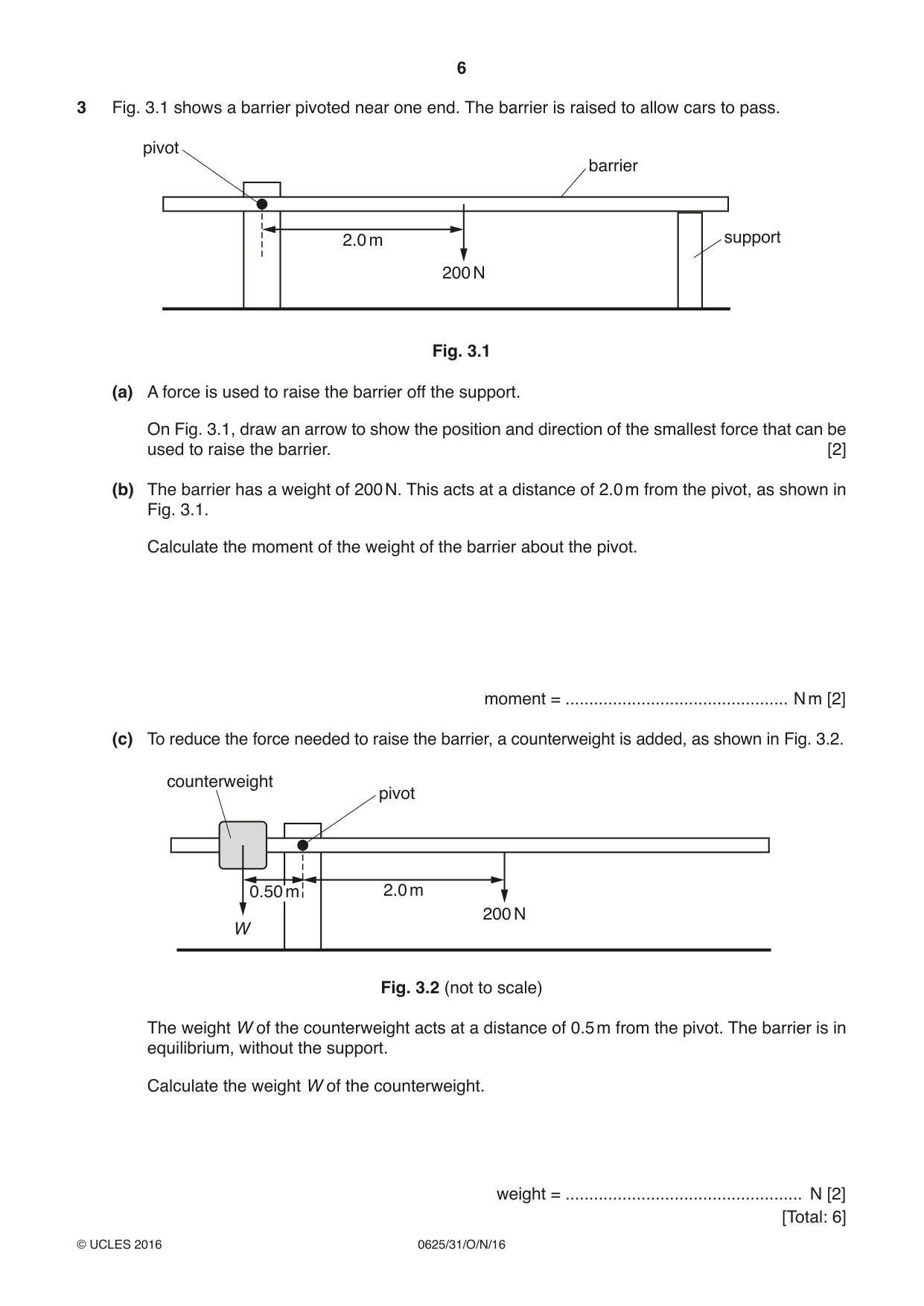
6 0625/31/O/N/16 © UCLES 2016 3 Fig. 3.1 shows a barrier pivoted near one end. The barrier is raised to allow cars to pass. pivot barrier support 2.0 m 200 N Fig. 3.1 (a) A force is used to raise the barrier off the support. On Fig. 3.1, draw an arrow to show the position and direction of the smallest force that can be used to raise the barrier. [2] (b) The barrier has a weight of 200 N. This acts at a distance of 2.0 m from the pivot, as shown in Fig. 3.1. Calculate the moment of the weight of the barrier about the pivot. moment = … N m [2] (c) To reduce the force needed to raise the barrier, a counterweight is added, as shown in Fig. 3.2. pivot 2.0 m 200 N counterweight 0.50 m W Fig. 3.2 (not to scale) The weight W of the counterweight acts at a distance of 0.5 m from the pivot. The barrier is in equilibrium, without the support. Calculate the weight W of the counterweight. weight = … N [2] [Total: 6]
Question paper, page 7
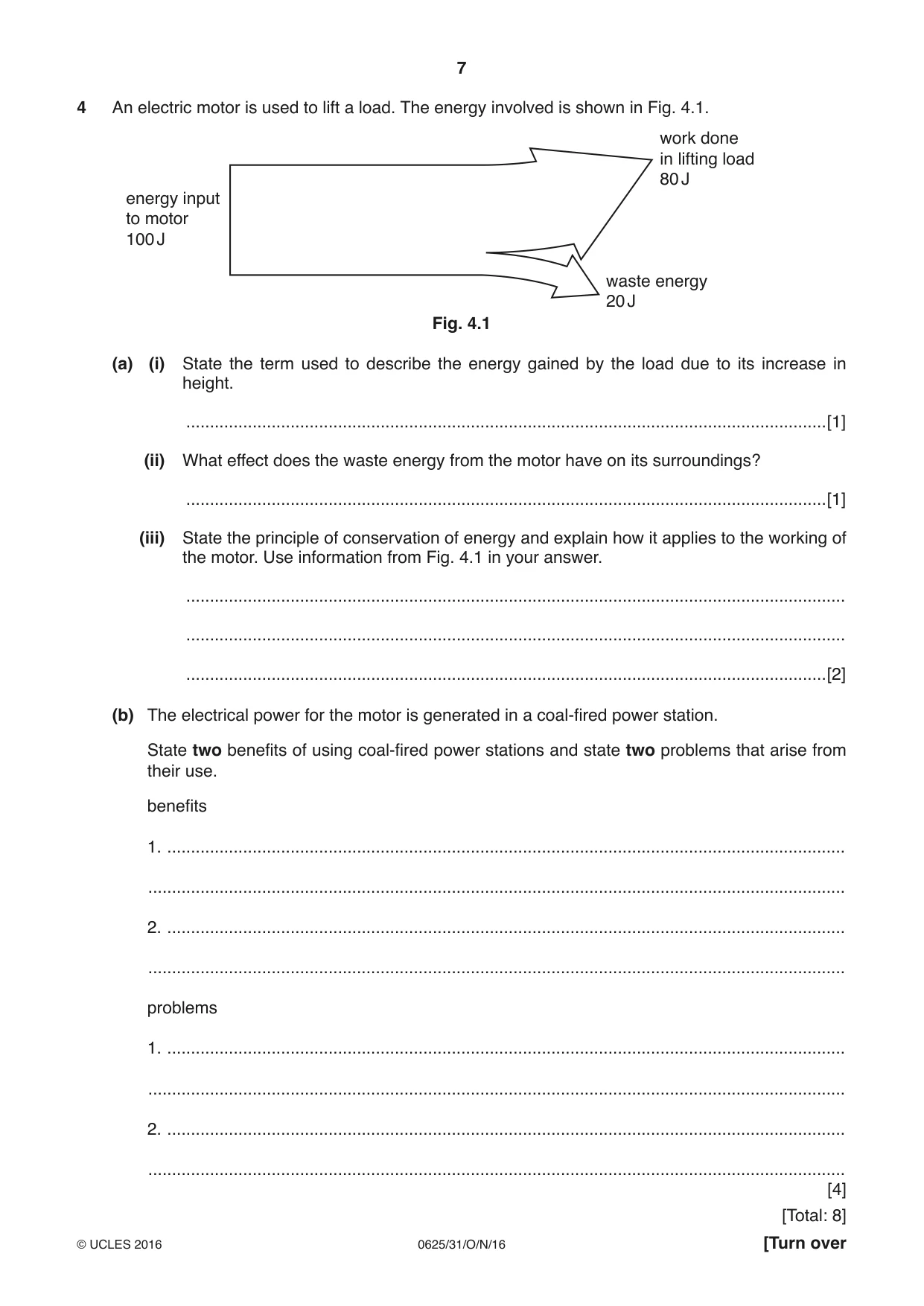
7 0625/31/O/N/16 © UCLES 2016 [Turn over 4 An electric motor is used to lift a load. The energy involved is shown in Fig. 4.1. energy input to motor 100 J work done in lifting load 80 J waste energy 20 J Fig. 4.1 (a) (i) State the term used to describe the energy gained by the load due to its increase in height. …[1] (ii) What effect does the waste energy from the motor have on its surroundings? …[1] (iii) State the principle of conservation of energy and explain how it applies to the working of the motor. Use information from Fig. 4.1 in your answer. … … …[2] (b) The electrical power for the motor is generated in a coal-fired power station. State two benefits of using coal-fired power stations and state two problems that arise from their use. benefits 1. … … 2. … … problems 1. … … 2. … … [4] [Total: 8]
Question paper, page 8
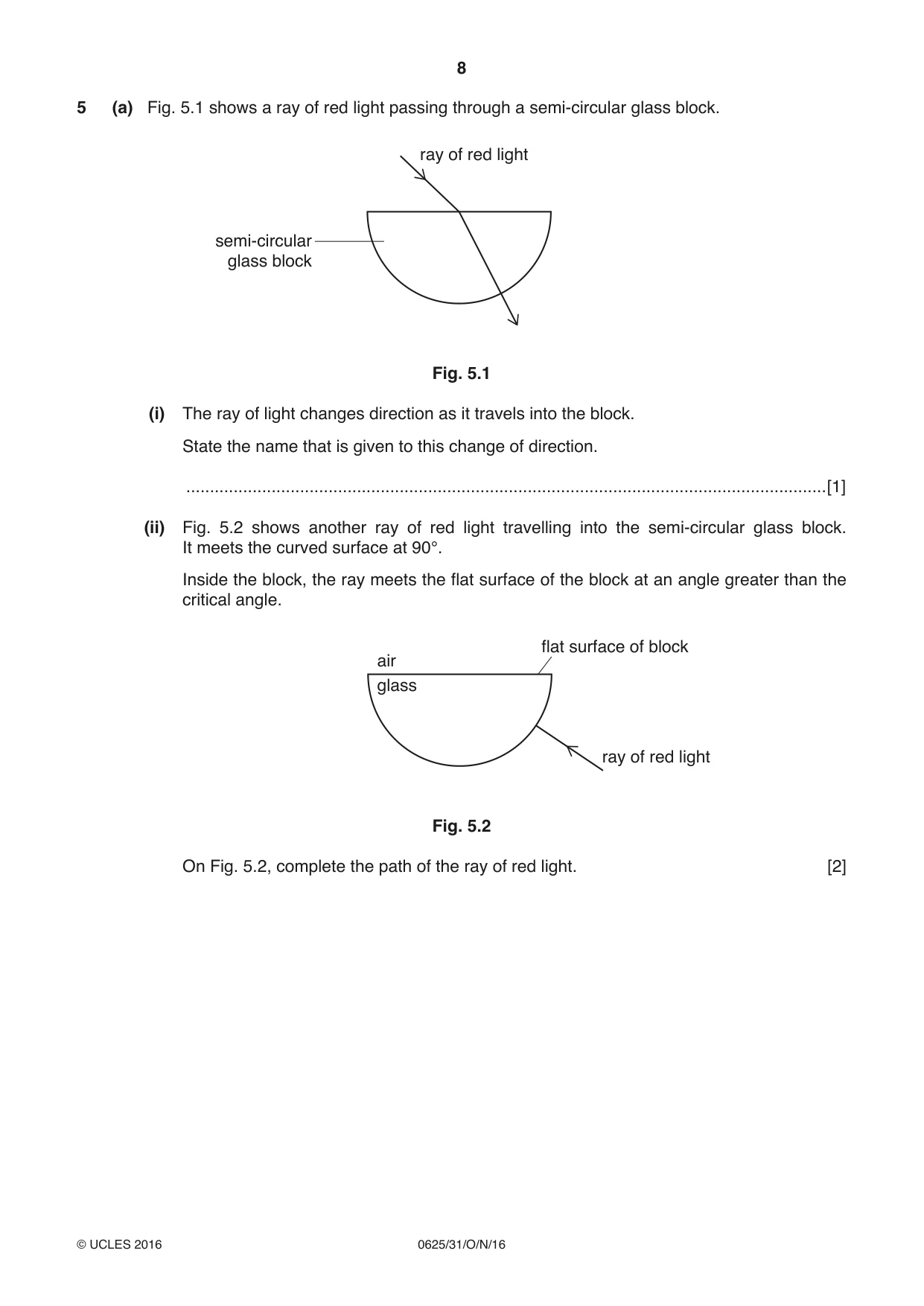
8 0625/31/O/N/16 © UCLES 2016 5 (a) Fig. 5.1 shows a ray of red light passing through a semi-circular glass block. ray of red light semi-circular glass block Fig. 5.1 (i) The ray of light changes direction as it travels into the block. State the name that is given to this change of direction. …[1] (ii) Fig. 5.2 shows another ray of red light travelling into the semi-circular glass block. It meets the curved surface at 90°. Inside the block, the ray meets the flat surface of the block at an angle greater than the critical angle. ray of red light air glass flat surface of block Fig. 5.2 On Fig. 5.2, complete the path of the ray of red light. [2]
Question paper, page 9
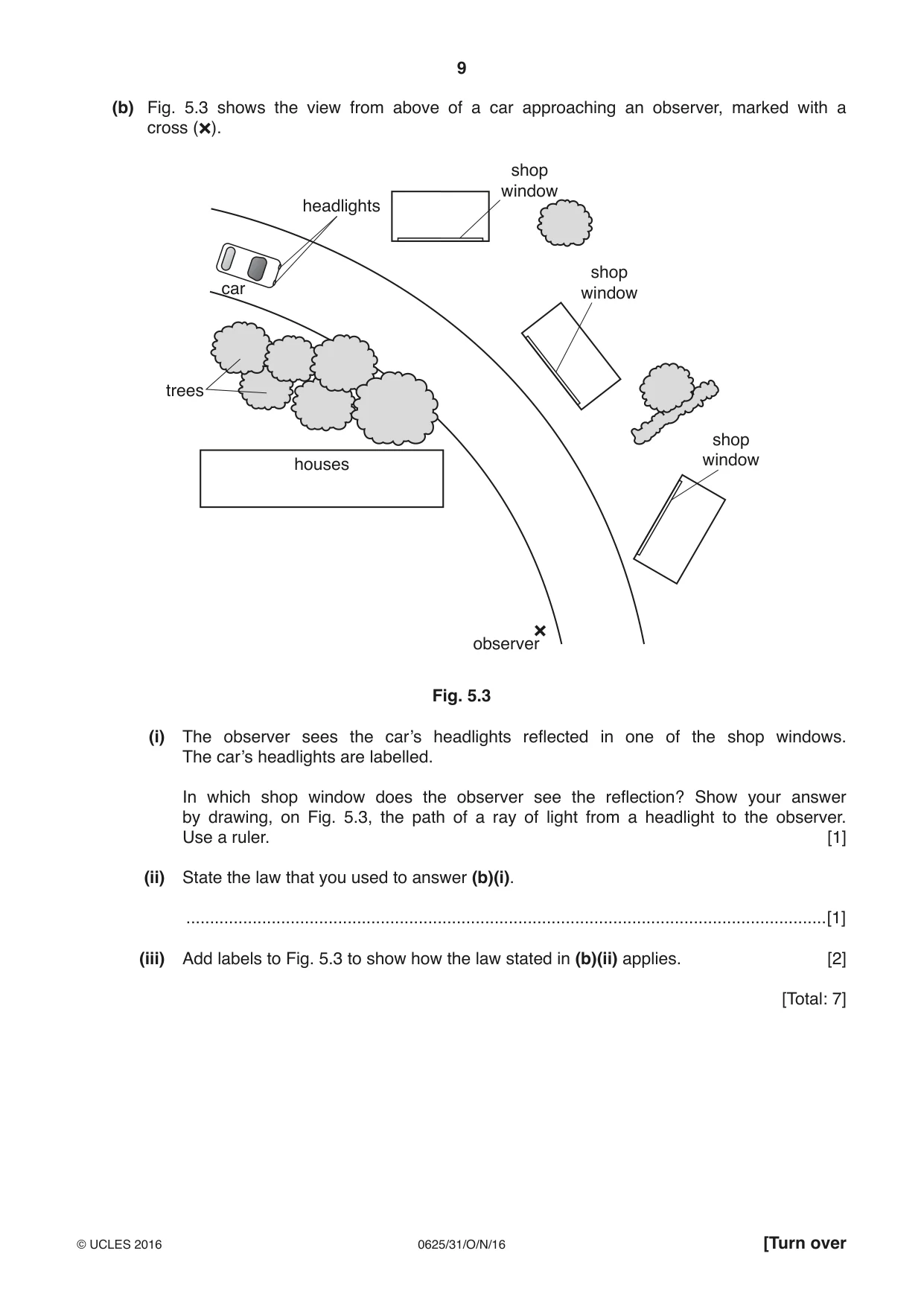
9 0625/31/O/N/16 © UCLES 2016 [Turn over (b) Fig. 5.3 shows the view from above of a car approaching an observer, marked with a cross (×). car headlights trees shop window shop window shop window houses observer× Fig. 5.3 (i) The observer sees the car’s headlights reflected in one of the shop windows. The car’s headlights are labelled. In which shop window does the observer see the reflection? Show your answer by drawing, on Fig. 5.3, the path of a ray of light from a headlight to the observer. Use a ruler. [1] (ii) State the law that you used to answer (b)(i). …[1] (iii) Add labels to Fig. 5.3 to show how the law stated in (b)(ii) applies. [2] [Total: 7]
Question paper, page 10
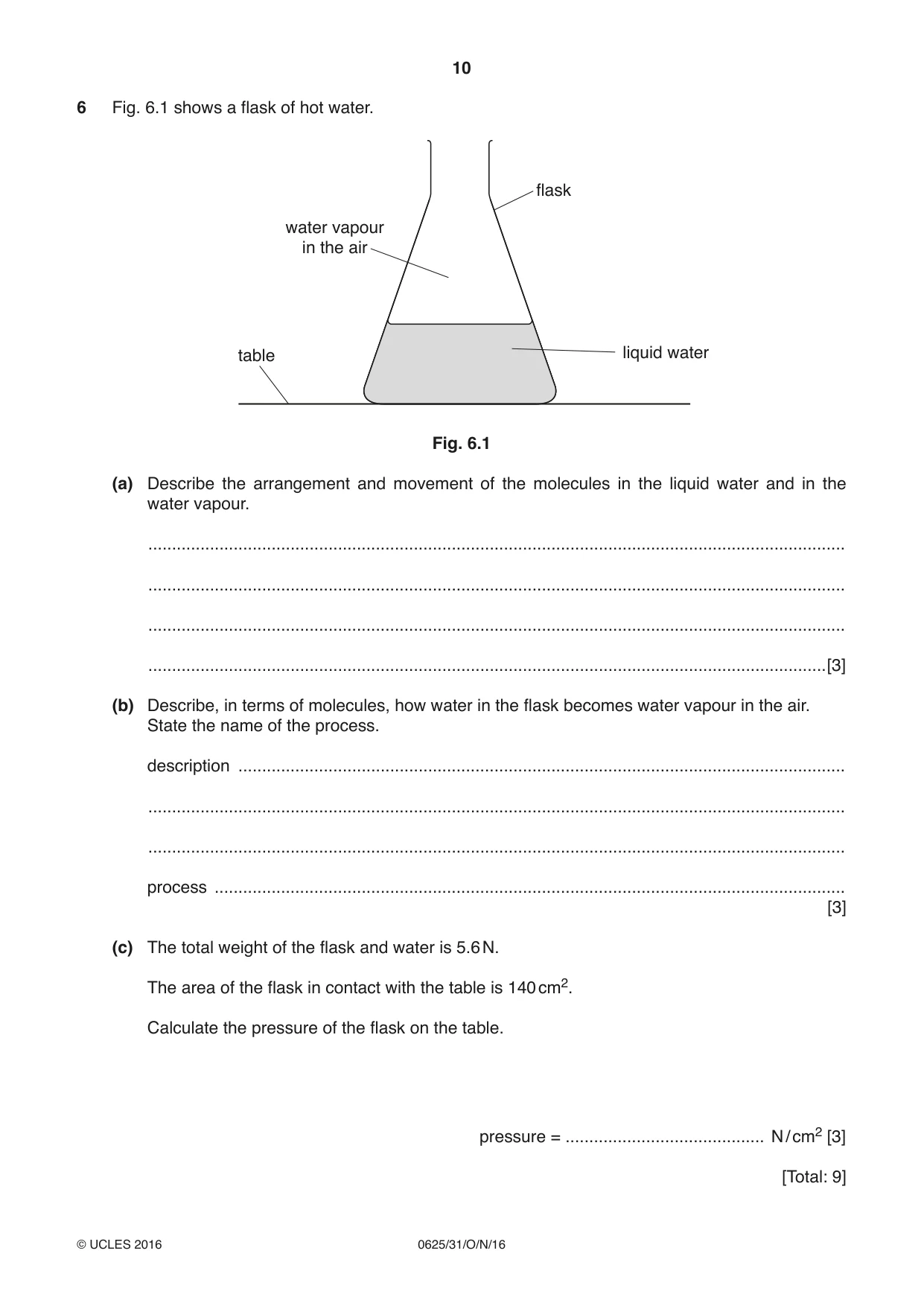
10 0625/31/O/N/16 © UCLES 2016 6 Fig. 6.1 shows a flask of hot water. liquid water flask water vapour in the air table Fig. 6.1 (a) Describe the arrangement and movement of the molecules in the liquid water and in the water vapour. … … … …[3] (b) Describe, in terms of molecules, how water in the flask becomes water vapour in the air. State the name of the process. description … … … process … [3] (c) The total weight of the flask and water is 5.6 N. The area of the flask in contact with the table is 140 cm2. Calculate the pressure of the flask on the table. pressure = … N / cm2 [3] [Total: 9]
Question paper, page 11
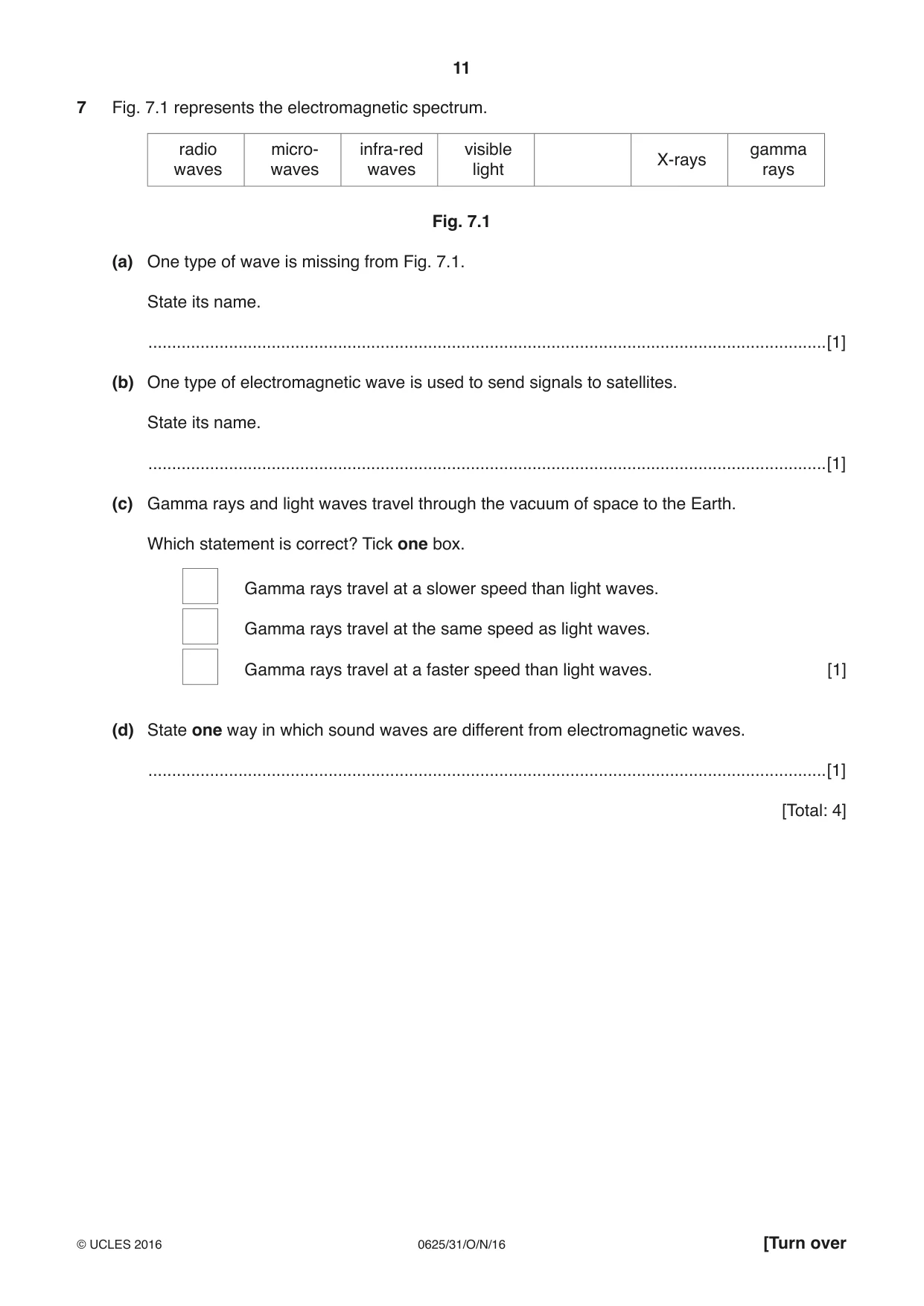
11 0625/31/O/N/16 © UCLES 2016 [Turn over 7 Fig. 7.1 represents the electromagnetic spectrum. radio waves micro- waves infra-red waves visible light X-rays gamma rays Fig. 7.1 (a) One type of wave is missing from Fig. 7.1. State its name. …[1] (b) One type of electromagnetic wave is used to send signals to satellites. State its name. …[1] (c) Gamma rays and light waves travel through the vacuum of space to the Earth. Which statement is correct? Tick one box. Gamma rays travel at a slower speed than light waves. Gamma rays travel at the same speed as light waves. Gamma rays travel at a faster speed than light waves. [1] (d) State one way in which sound waves are different from electromagnetic waves. …[1] [Total: 4]
Question paper, page 12
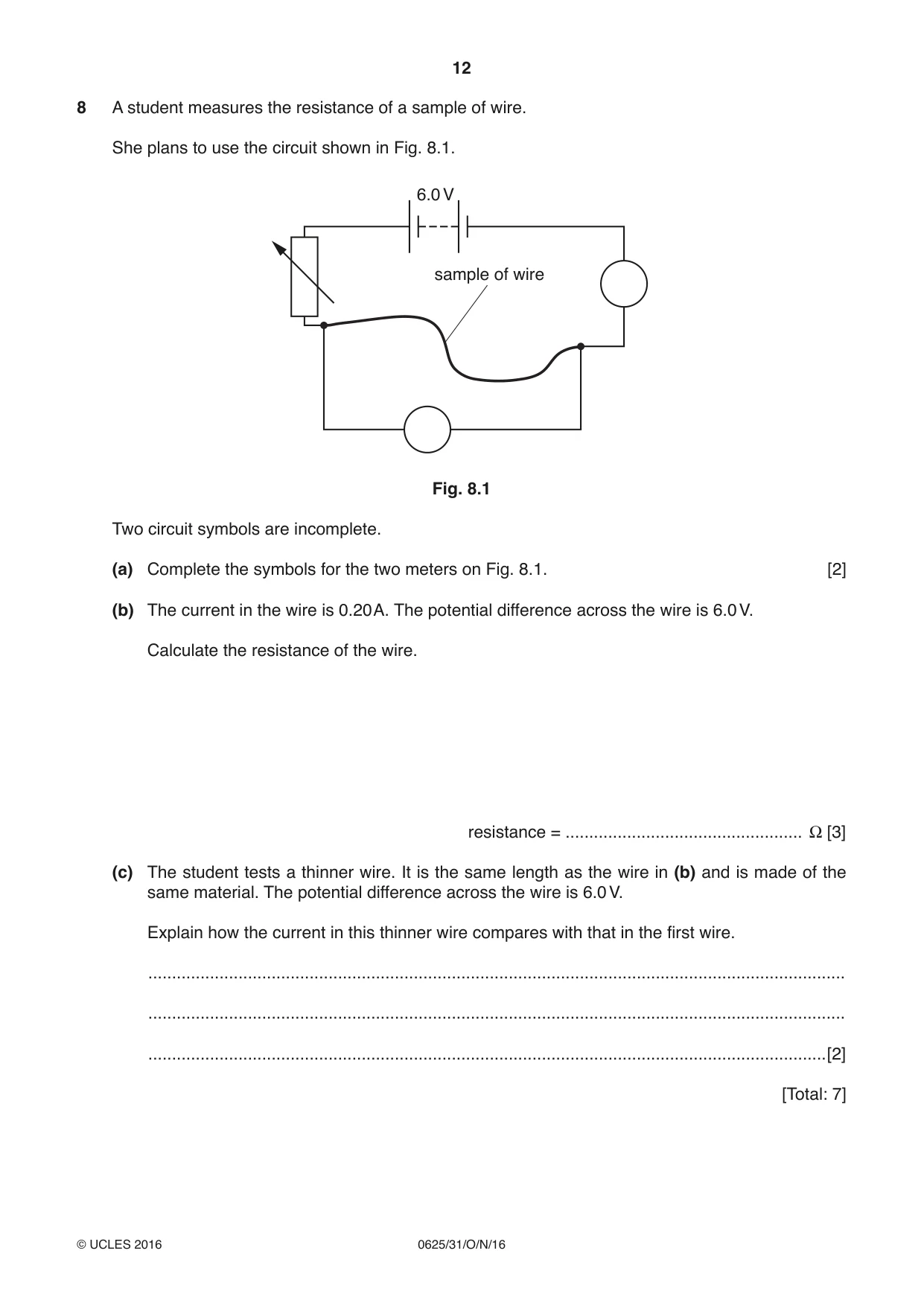
12 0625/31/O/N/16 © UCLES 2016 8 A student measures the resistance of a sample of wire. She plans to use the circuit shown in Fig. 8.1. 6.0 V sample of wire Fig. 8.1 Two circuit symbols are incomplete. (a) Complete the symbols for the two meters on Fig. 8.1. [2] (b) The current in the wire is 0.20 A. The potential difference across the wire is 6.0 V. Calculate the resistance of the wire. resistance = … Ω [3] (c) The student tests a thinner wire. It is the same length as the wire in (b) and is made of the same material. The potential difference across the wire is 6.0 V. Explain how the current in this thinner wire compares with that in the first wire. … … …[2] [Total: 7]
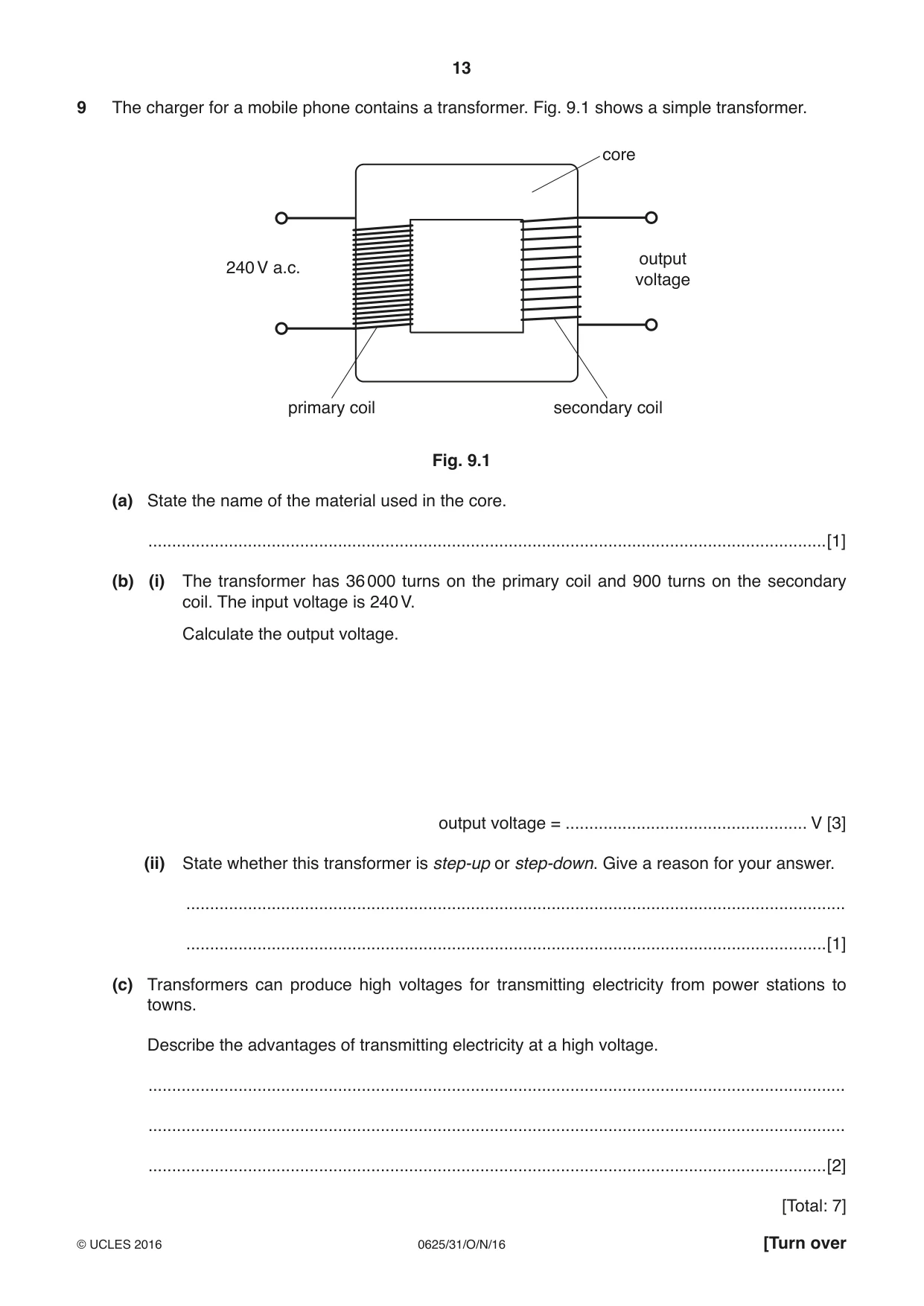
Question paper, page 13
13 0625/31/O/N/16 © UCLES 2016 [Turn over 9 The charger for a mobile phone contains a transformer. Fig. 9.1 shows a simple transformer. output voltage core secondary coil primary coil 240 V a.c. Fig. 9.1 (a) State the name of the material used in the core. …[1] (b) (i) The transformer has 36 000 turns on the primary coil and 900 turns on the secondary coil. The input voltage is 240 V. Calculate the output voltage. output voltage = … V [3] (ii) State whether this transformer is step-up or step-down. Give a reason for your answer. … …[1] (c) Transformers can produce high voltages for transmitting electricity from power stations to towns. Describe the advantages of transmitting electricity at a high voltage. … … …[2] [Total: 7]
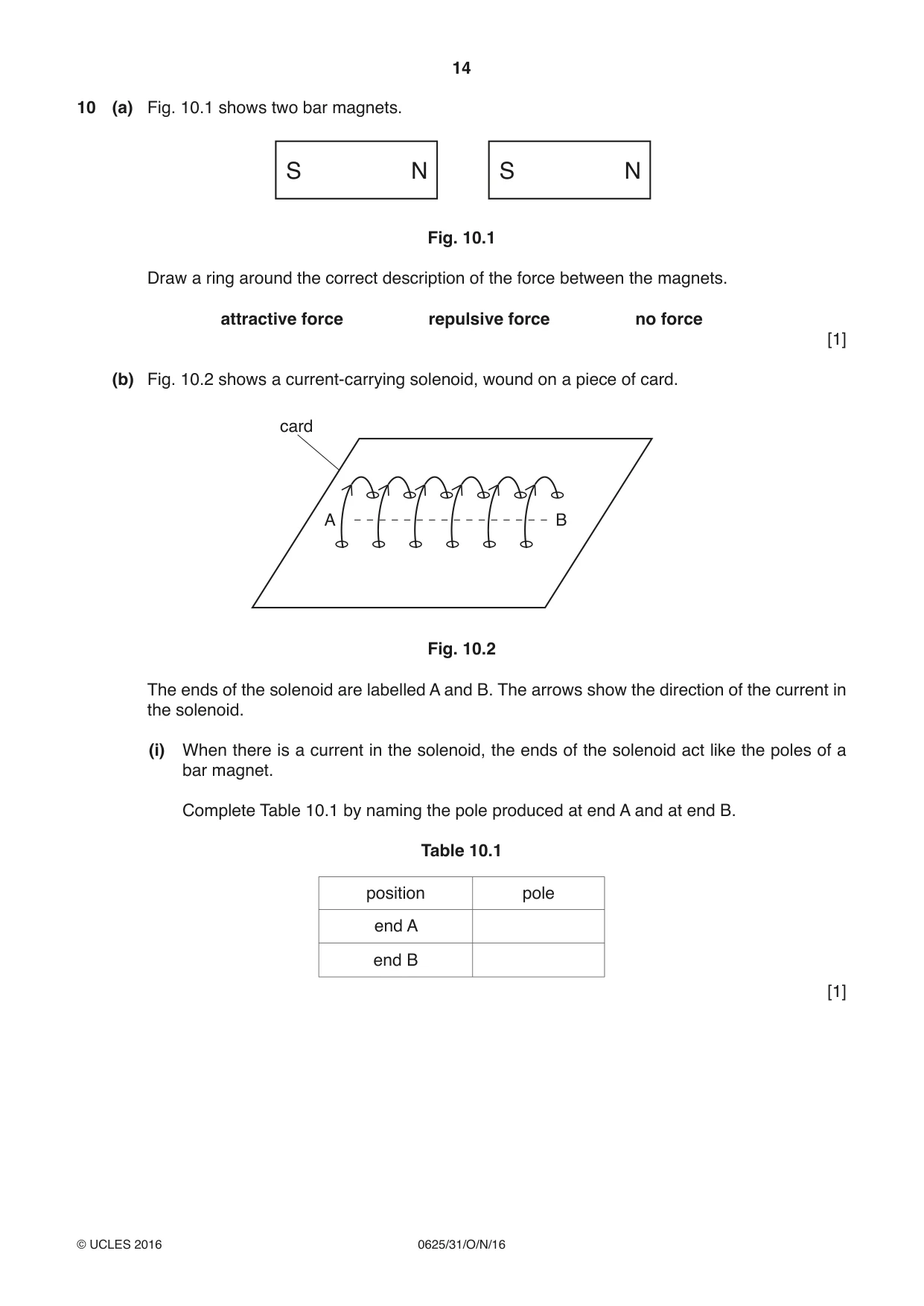
Question paper, page 14
14 0625/31/O/N/16 © UCLES 2016 10 (a) Fig. 10.1 shows two bar magnets. S N S N Fig. 10.1 Draw a ring around the correct description of the force between the magnets. attractive force repulsive force no force [1] (b) Fig. 10.2 shows a current-carrying solenoid, wound on a piece of card. card B A Fig. 10.2 The ends of the solenoid are labelled A and B. The arrows show the direction of the current in the solenoid. (i) When there is a current in the solenoid, the ends of the solenoid act like the poles of a bar magnet. Complete Table 10.1 by naming the pole produced at end A and at end B. Table 10.1 position pole end A end B [1]
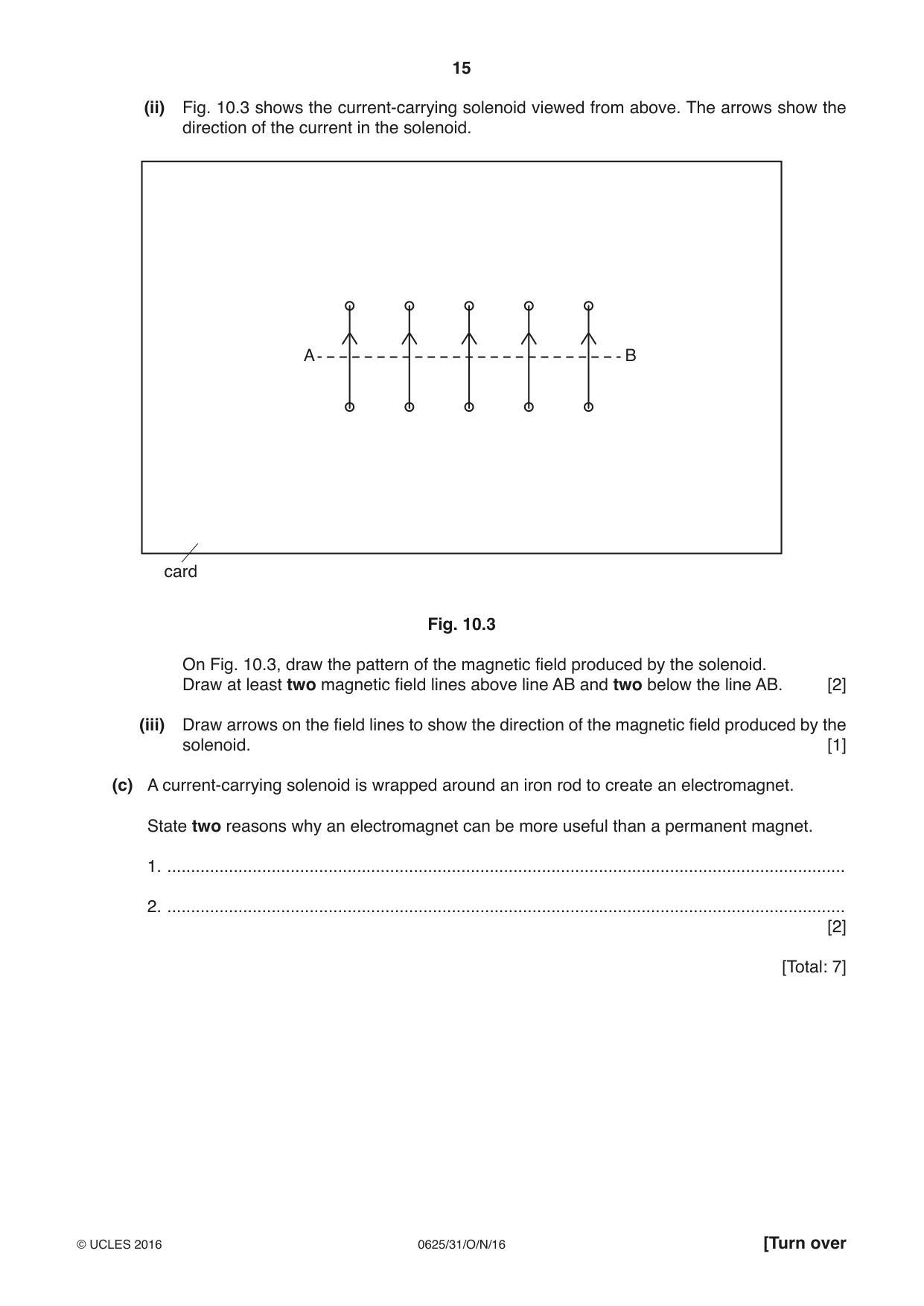
Question paper, page 15
15 0625/31/O/N/16 © UCLES 2016 [Turn over (ii) Fig. 10.3 shows the current-carrying solenoid viewed from above. The arrows show the direction of the current in the solenoid. card B A Fig. 10.3 On Fig. 10.3, draw the pattern of the magnetic field produced by the solenoid. Draw at least two magnetic field lines above line AB and two below the line AB. [2] (iii) Draw arrows on the field lines to show the direction of the magnetic field produced by the solenoid. [1] (c) A current-carrying solenoid is wrapped around an iron rod to create an electromagnet. State two reasons why an electromagnet can be more useful than a permanent magnet. 1. … 2. … [2] [Total: 7]
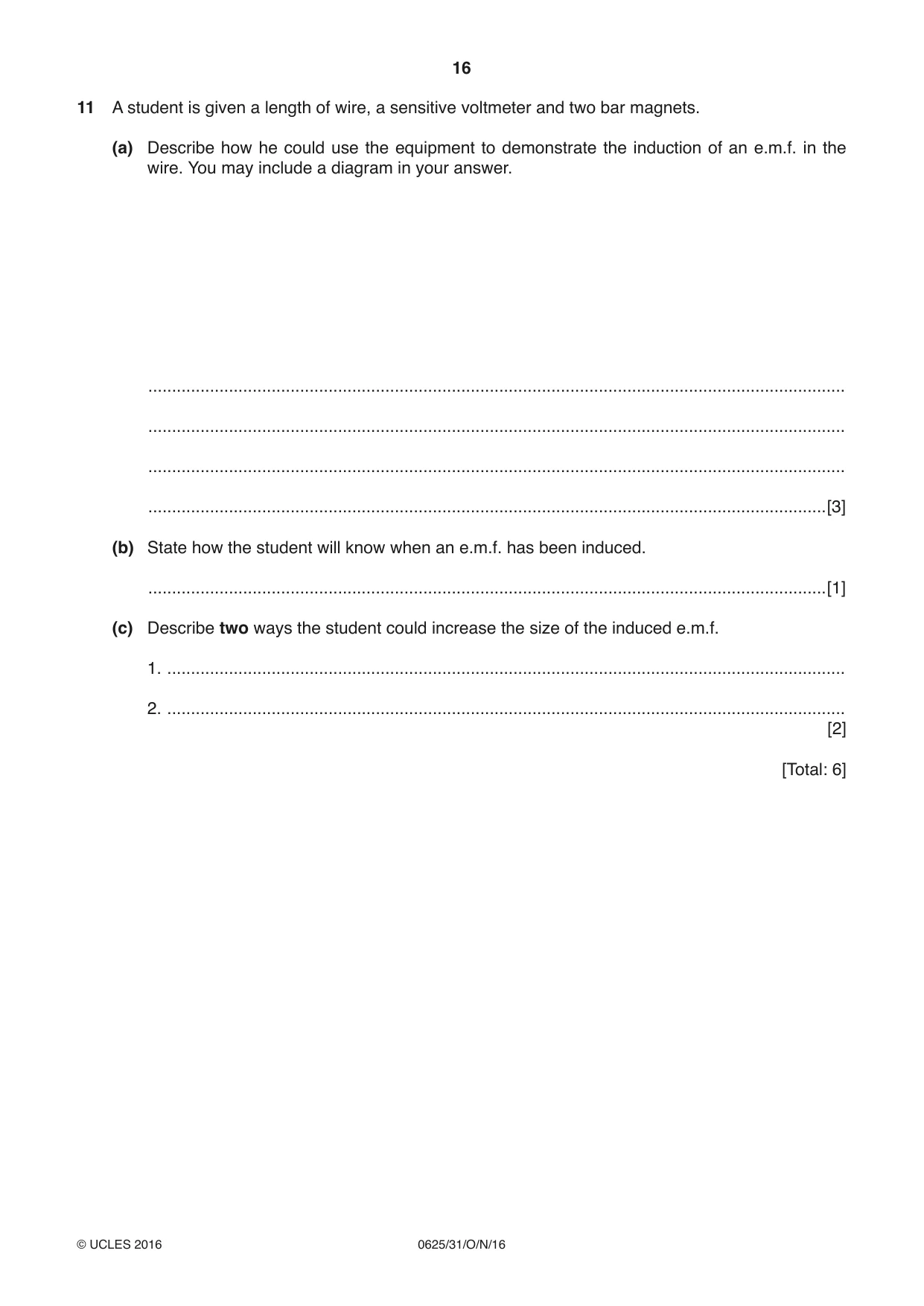
Question paper, page 16
16 0625/31/O/N/16 © UCLES 2016 11 A student is given a length of wire, a sensitive voltmeter and two bar magnets. (a) Describe how he could use the equipment to demonstrate the induction of an e.m.f. in the wire. You may include a diagram in your answer. … … … …[3] (b) State how the student will know when an e.m.f. has been induced. …[1] (c) Describe two ways the student could increase the size of the induced e.m.f. 1. … 2. … [2] [Total: 6]
Question paper, page 17
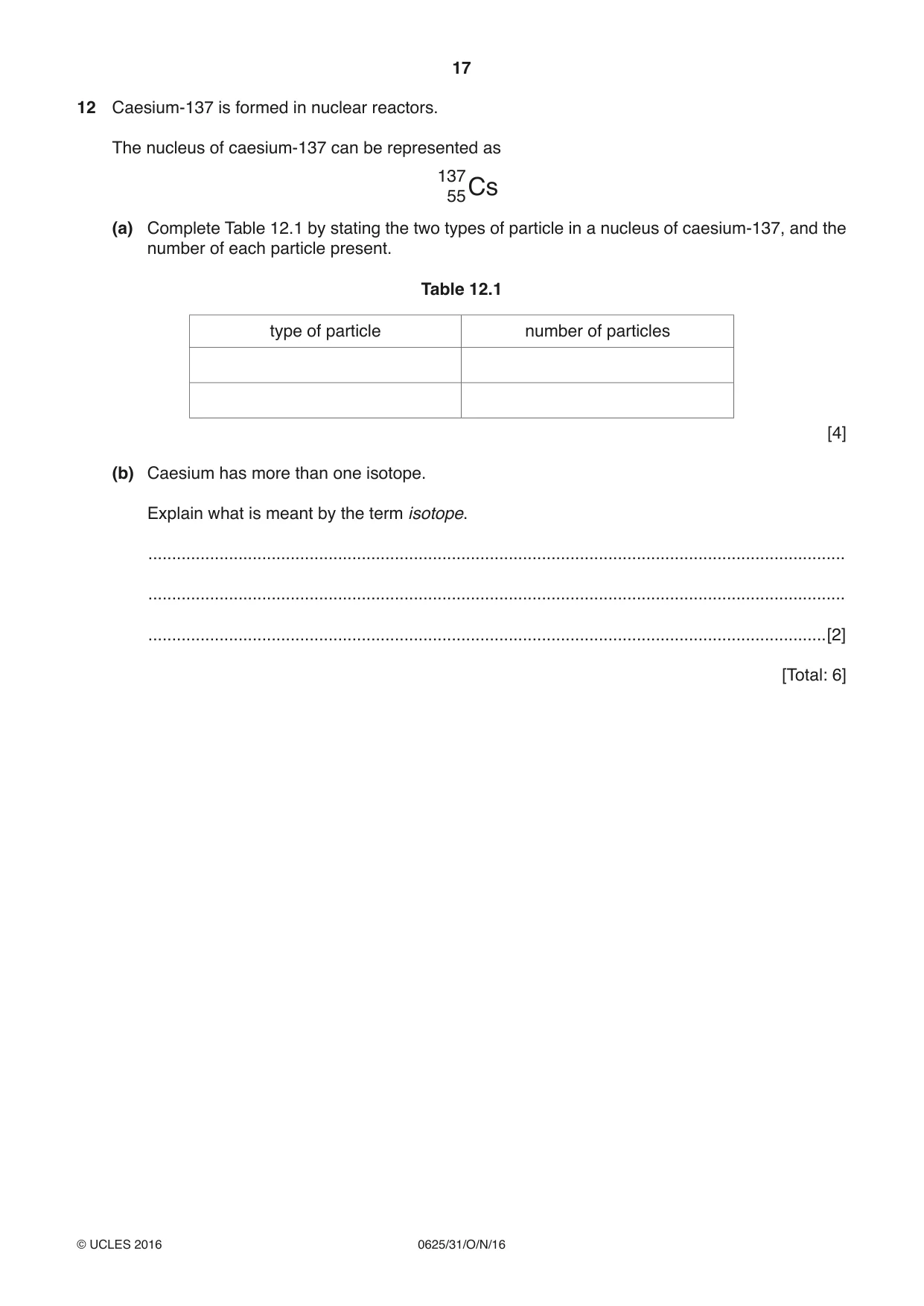
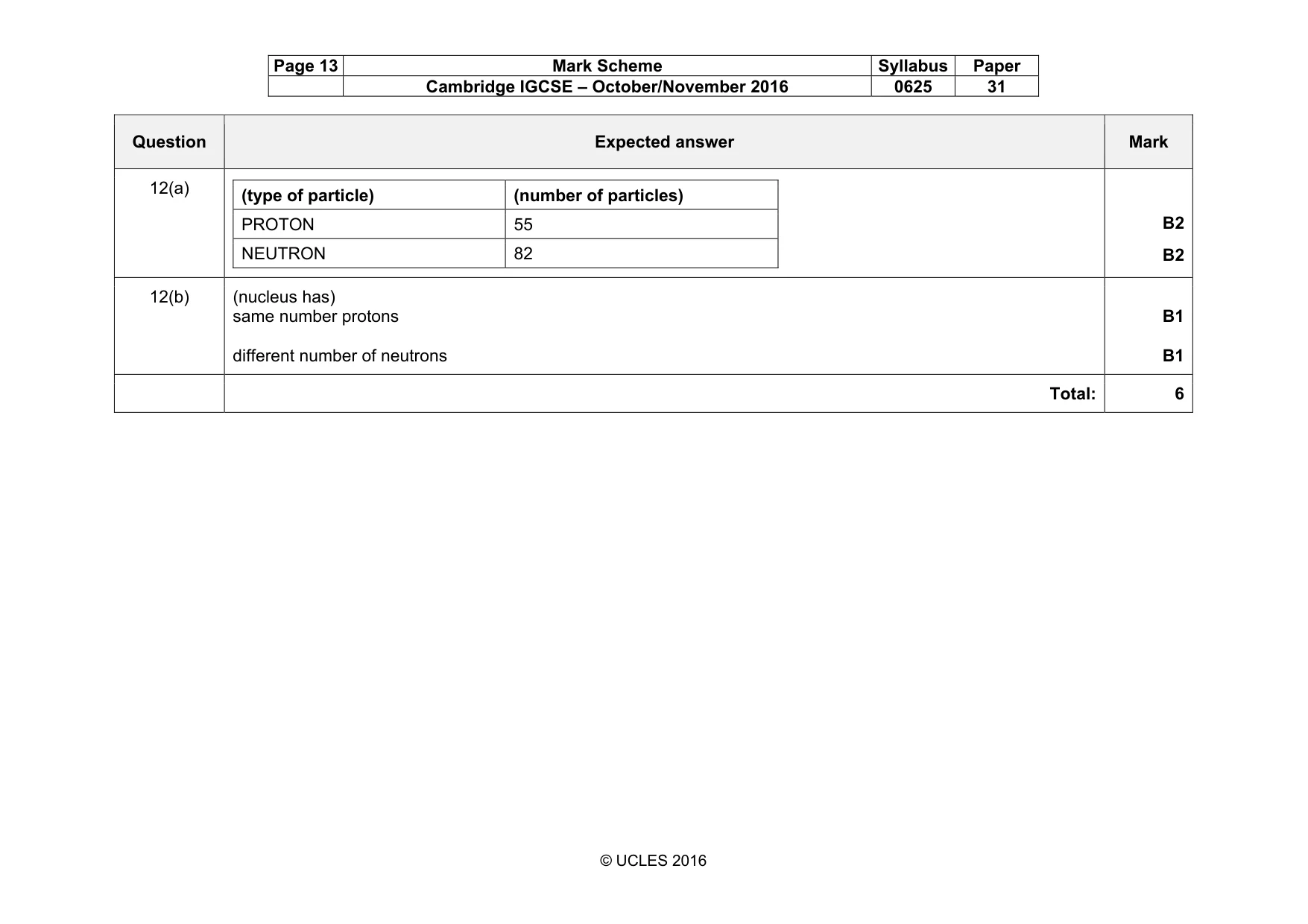
17 0625/31/O/N/16 © UCLES 2016 12 Caesium-137 is formed in nuclear reactors. The nucleus of caesium-137 can be represented as 137 55 Cs (a) Complete Table 12.1 by stating the two types of particle in a nucleus of caesium-137, and the number of each particle present. Table 12.1 type of particle number of particles [4] (b) Caesium has more than one isotope. Explain what is meant by the term isotope. … … …[2] [Total: 6]
Question paper, page 18
18 0625/31/O/N/16 © UCLES 2016 BLANK PAGE
Question paper, page 19
19 0625/31/O/N/16 © UCLES 2016 BLANK PAGE
Question paper, page 20
20 0625/31/O/N/16 © UCLES 2016 Permission to reproduce items where third-party owned material protected by copyright is included has been sought and cleared where possible. Every reasonable effort has been made by the publisher (UCLES) to trace copyright holders, but if any items requiring clearance have unwittingly been included, the publisher will be pleased to make amends at the earliest possible opportunity. To avoid the issue of disclosure of answer-related information to candidates, all copyright acknowledgements are reproduced online in the Cambridge International Examinations Copyright Acknowledgements Booklet. This is produced for each series of examinations and is freely available to download at www.cie.org.uk after the live examination series. Cambridge International Examinations is part of the Cambridge Assessment Group. Cambridge Assessment is the brand name of University of Cambridge Local Examinations Syndicate (UCLES), which is itself a department of the University of Cambridge. BLANK PAGE
Mark scheme, page 1
® IGCSE is the registered trademark of Cambridge International Examinations. This syllabus is approved for use in England, Wales and Northern Ireland as a Cambridge International Level 1/Level 2 Certificate. This document consists of 13 printed pages. © UCLES 2016 [Turn over Cambridge International Examinations Cambridge International General Certificate of Secondary Education PHYSICS 0625/31 Paper 3 Core Theory October/November 2016 MARK SCHEME Maximum Mark: 80 Published This mark scheme is published as an aid to teachers and candidates, to indicate the requirements of the examination. It shows the basis on which Examiners were instructed to award marks. It does not indicate the details of the discussions that took place at an Examiners’ meeting before marking began, which would have considered the acceptability of alternative answers. Mark schemes should be read in conjunction with the question paper and the Principal Examiner Report for Teachers. Cambridge will not enter into discussions about these mark schemes. Cambridge is publishing the mark schemes for the October/November 2016 series for most Cambridge IGCSE®, Cambridge International A and AS Level components and some Cambridge O Level components.
Mark scheme, page 2
Page 2 Mark Scheme Syllabus Paper Cambridge IGCSE – October/November 2016 0625 31 © UCLES 2016 NOTES ABOUT MARK SCHEME SYMBOLS AND OTHER MATTERS M marks are method marks upon which further marks depend. For an M mark to be scored, the point to which it refers must be seen in a candidate's answer. If a candidate fails to score a particular M mark, then none of the dependent marks can be scored. B marks are independent marks, which do not depend on other marks. For a B mark to scored, the point to which it refers must be seen specifically in the candidate’s answers. A marks In general A marks are awarded for final answers to numerical questions. If a final numerical answer, eligible for A marks, is correct, with the correct unit and an acceptable number of significant figures, all the marks for that question are normally awarded. It is very occasionally possible to arrive at a correct answer by an entirely wrong approach. In these rare circumstances, do not award the A marks, but award C marks on their merits. However, correct numerical answers with no working shown gain all the marks available. C marks are compensatory marks in general applicable to numerical questions. These can be scored even if the point to which they refer are not written down by the candidate, provided subsequent working gives evidence that they must have known it. For example, if an equation carries a C mark and the candidate does not write down the actual equation but does correct substitution or working which shows that they knew the equation, then the C mark is scored. A C mark is not awarded if a candidate makes two points which contradict each other. Points which are wrong but irrelevant are ignored. Brackets ( ) around words or units in the mark scheme are intended to indicate wording used to clarify the mark scheme, but the marks do not depend on seeing the words or units in brackets e.g. 10 (J) means that the mark is scored for 10, regardless of the unit given. Underlining indicates that this must be seen in the answer offered, or something very similar. OR / or indicates alternative answers, any one of which is satisfactory for scoring the marks. e.e.o.o. means “each error or omission”. o.w.t.t.e. means “or words to that effect”. Ignore indicates that something which is not correct or irrelevant is to be disregarded and does not cause a right plus wrong penalty. Spelling Be generous about spelling and use of English. If an answer can be understood to mean what we want, give credit. However, beware of and do not allow ambiguities: e.g. spelling which suggests confusion between reflection / refraction / diffraction or thermistor / transistor / transformer. Not/NOT indicates that an incorrect answer is not to be disregarded, but cancels another otherwise correct alternative offered by the candidate i.e. right plus wrong penalty applies.
Mark scheme, page 3
Page 3 Mark Scheme Syllabus Paper Cambridge IGCSE – October/November 2016 0625 31 © UCLES 2016 e.c.f. meaning “error carried forward” and is mainly applicable to numerical questions, but may occasionally be applied in non-numerical questions. This indicates that if a candidate has made an earlier mistake and has carried an incorrect value forward to subsequent stages of working, marks indicated by e.c.f. may be awarded, provided the subsequent working is correct, bearing in mind the earlier error. Significant Answers are normally acceptable to any number of significant figures ⩾ 2. Any figures exceptions to this general rule will be specified in the mark scheme. Units Deduct one mark for each incorrect or missing unit from an answer that would otherwise gain all the marks available for that answer: maximum 1 per question. Arithmetic errors Deduct only one mark if the only error in arriving at a final answer is clearly an arithmetic one. Regard a power-of-ten error as an arithmetic one. Fractions Only accept these where specified in the mark scheme.
Mark scheme, page 4
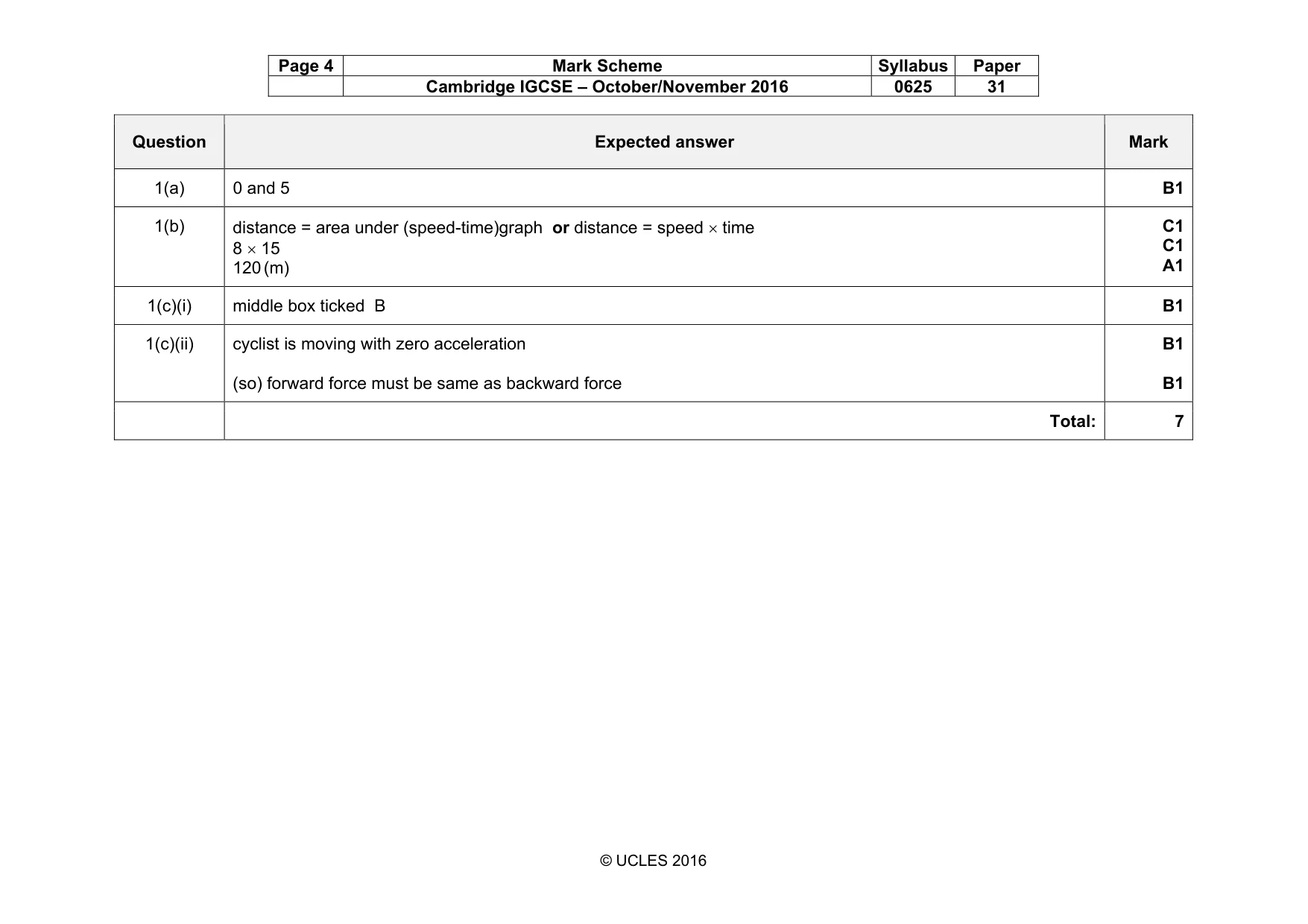
Page 4 Mark Scheme Syllabus Paper Cambridge IGCSE – October/November 2016 0625 31 © UCLES 2016 Question Expected answer Mark 1(a) 0 and 5 B1 1(b) distance = area under (speed-time)graph or distance = speed × time 8 × 15 120 (m) C1 C1 A1 1(c)(i) middle box ticked B B1 1(c)(ii) cyclist is moving with zero acceleration (so) forward force must be same as backward force B1 B1 Total: 7
Mark scheme, page 5
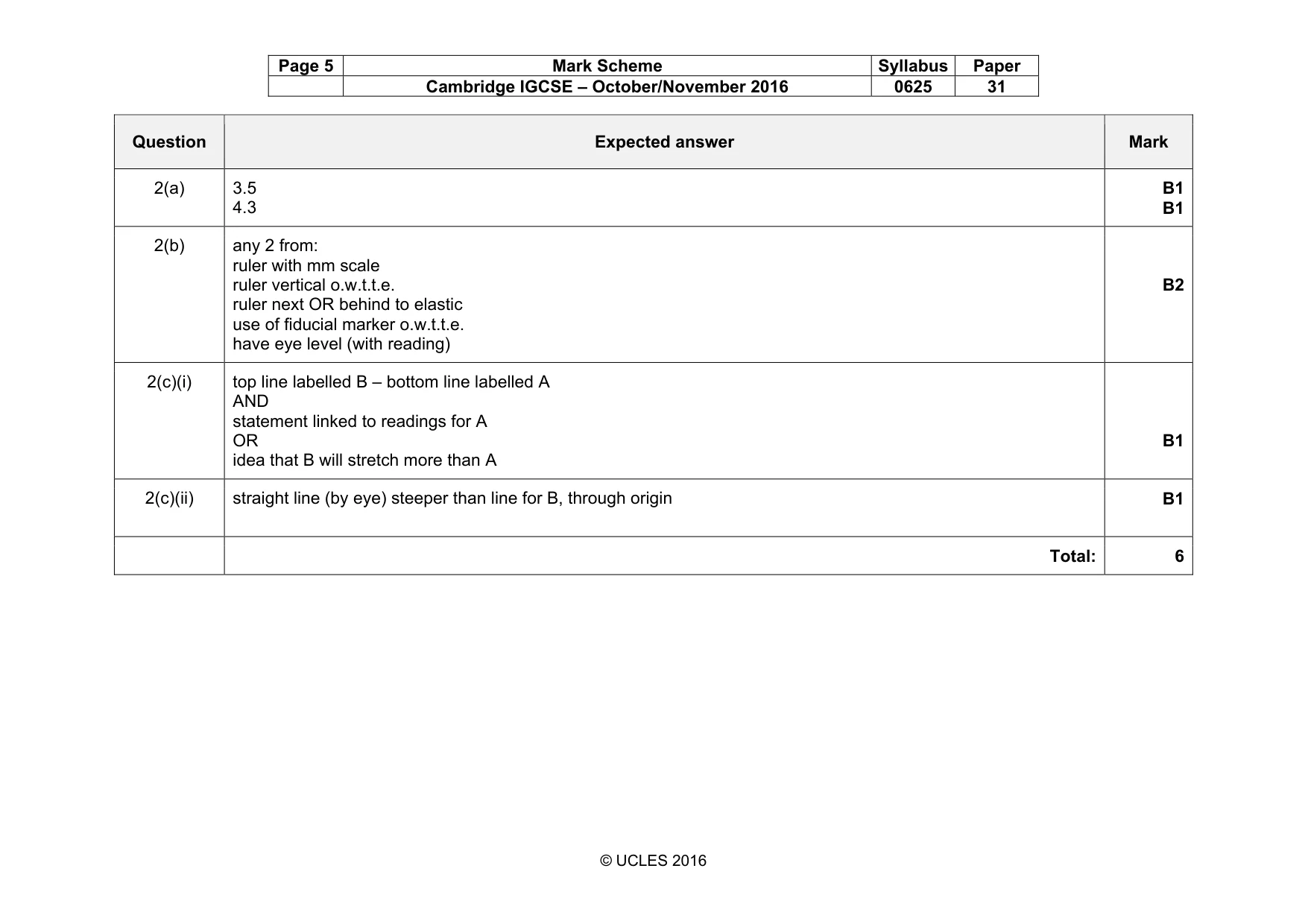
Page 5 Mark Scheme Syllabus Paper Cambridge IGCSE – October/November 2016 0625 31 © UCLES 2016 Question Expected answer Mark 2(a) 3.5 4.3 B1 B1 2(b) any 2 from: ruler with mm scale ruler vertical o.w.t.t.e. ruler next OR behind to elastic use of fiducial marker o.w.t.t.e. have eye level (with reading) B2 2(c)(i) top line labelled B – bottom line labelled A AND statement linked to readings for A OR idea that B will stretch more than A B1 2(c)(ii) straight line (by eye) steeper than line for B, through origin B1 Total: 6
Mark scheme, page 6
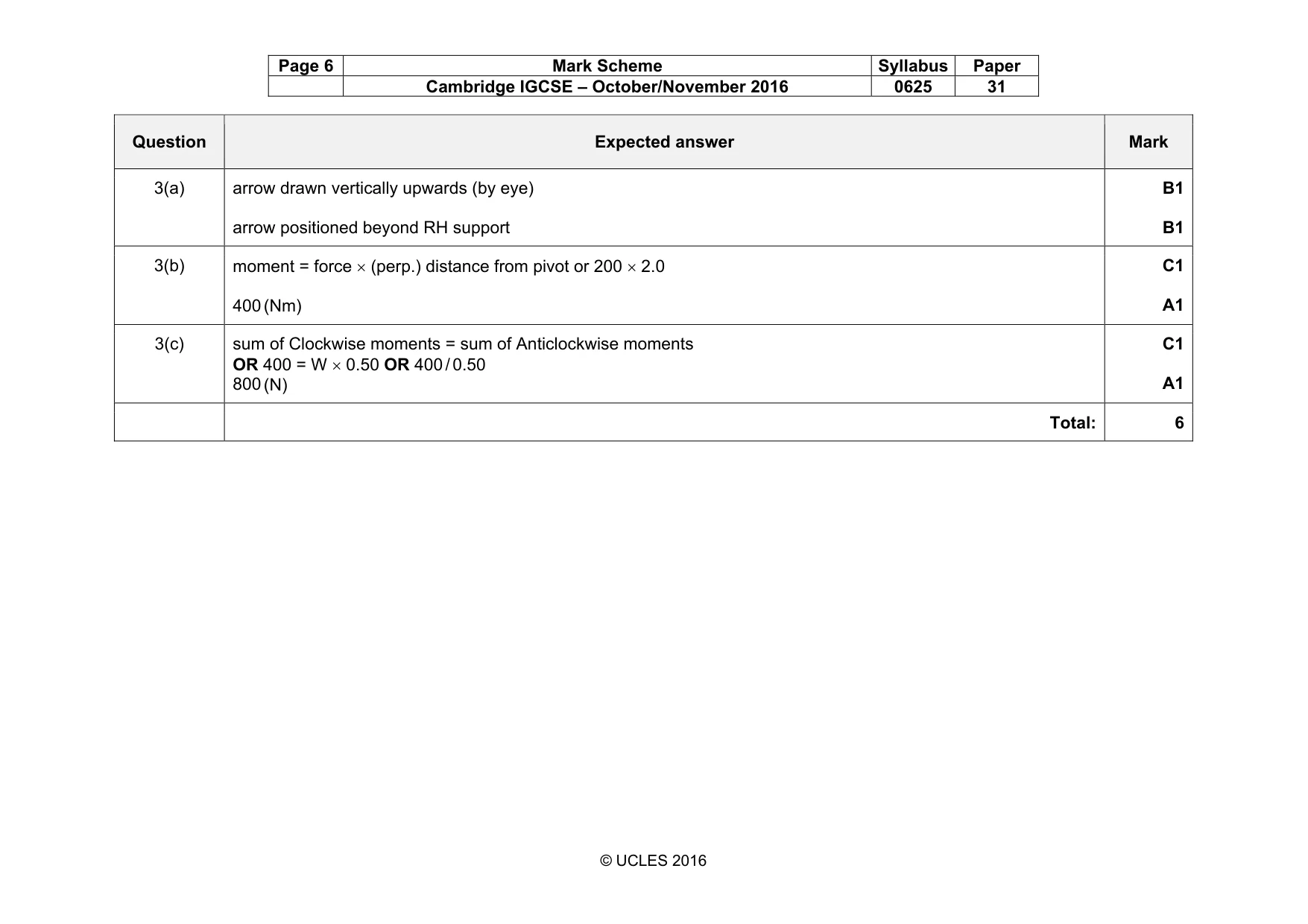
Page 6 Mark Scheme Syllabus Paper Cambridge IGCSE – October/November 2016 0625 31 © UCLES 2016 Question Expected answer Mark 3(a) arrow drawn vertically upwards (by eye) arrow positioned beyond RH support B1 B1 3(b) moment = force × (perp.) distance from pivot or 200 × 2.0 400 (Nm) C1 A1 3(c) sum of Clockwise moments = sum of Anticlockwise moments OR 400 = W × 0.50 OR 400 / 0.50 800 (N) C1 A1 Total: 6
Mark scheme, page 7
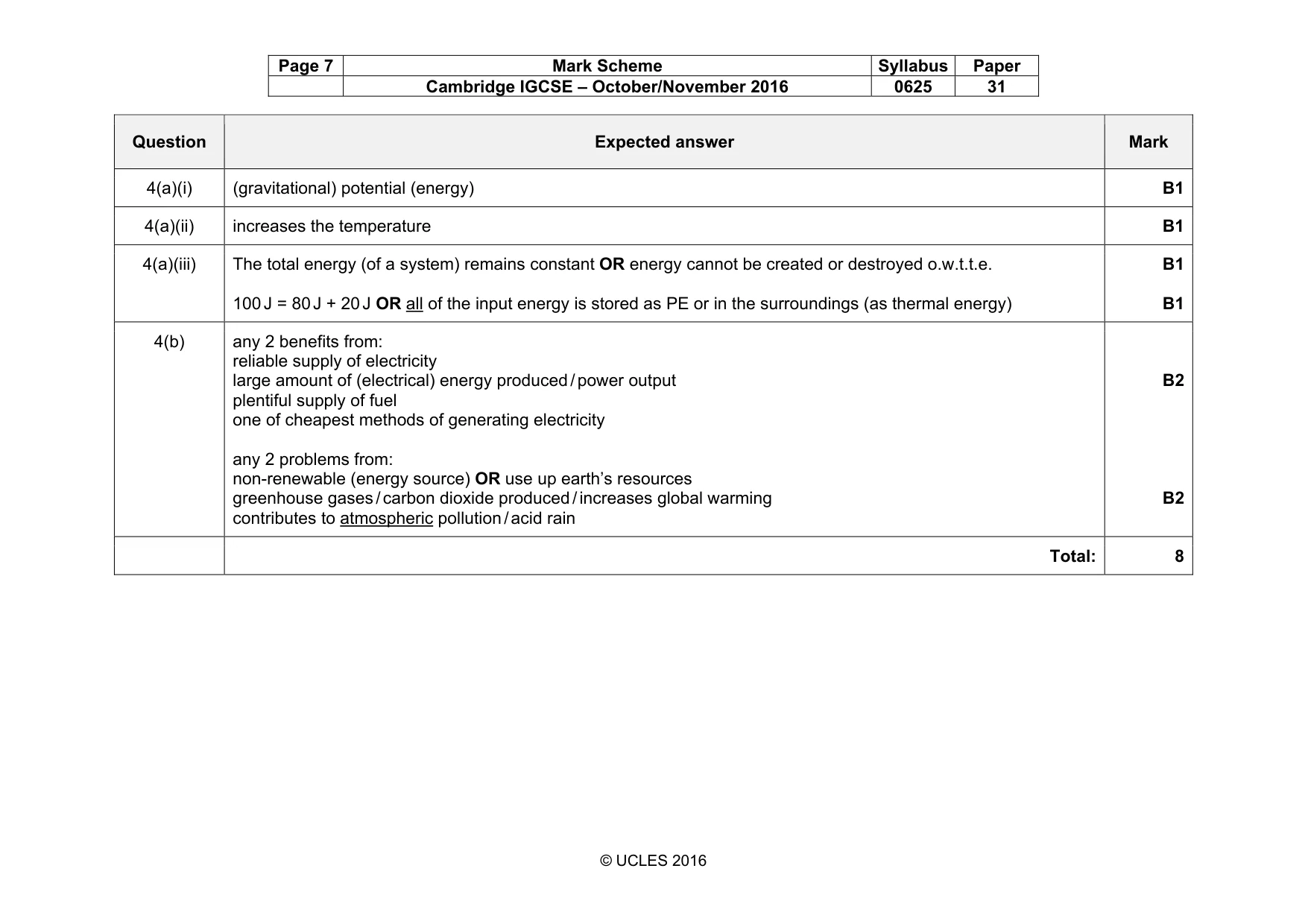
Page 7 Mark Scheme Syllabus Paper Cambridge IGCSE – October/November 2016 0625 31 © UCLES 2016 Question Expected answer Mark 4(a)(i) (gravitational) potential (energy) B1 4(a)(ii) increases the temperature B1 4(a)(iii) The total energy (of a system) remains constant OR energy cannot be created or destroyed o.w.t.t.e. 100 J = 80 J + 20 J OR all of the input energy is stored as PE or in the surroundings (as thermal energy) B1 B1 4(b) any 2 benefits from: reliable supply of electricity large amount of (electrical) energy produced / power output plentiful supply of fuel one of cheapest methods of generating electricity any 2 problems from: non-renewable (energy source) OR use up earth’s resources greenhouse gases / carbon dioxide produced / increases global warming contributes to atmospheric pollution / acid rain B2 B2 Total: 8
Mark scheme, page 8
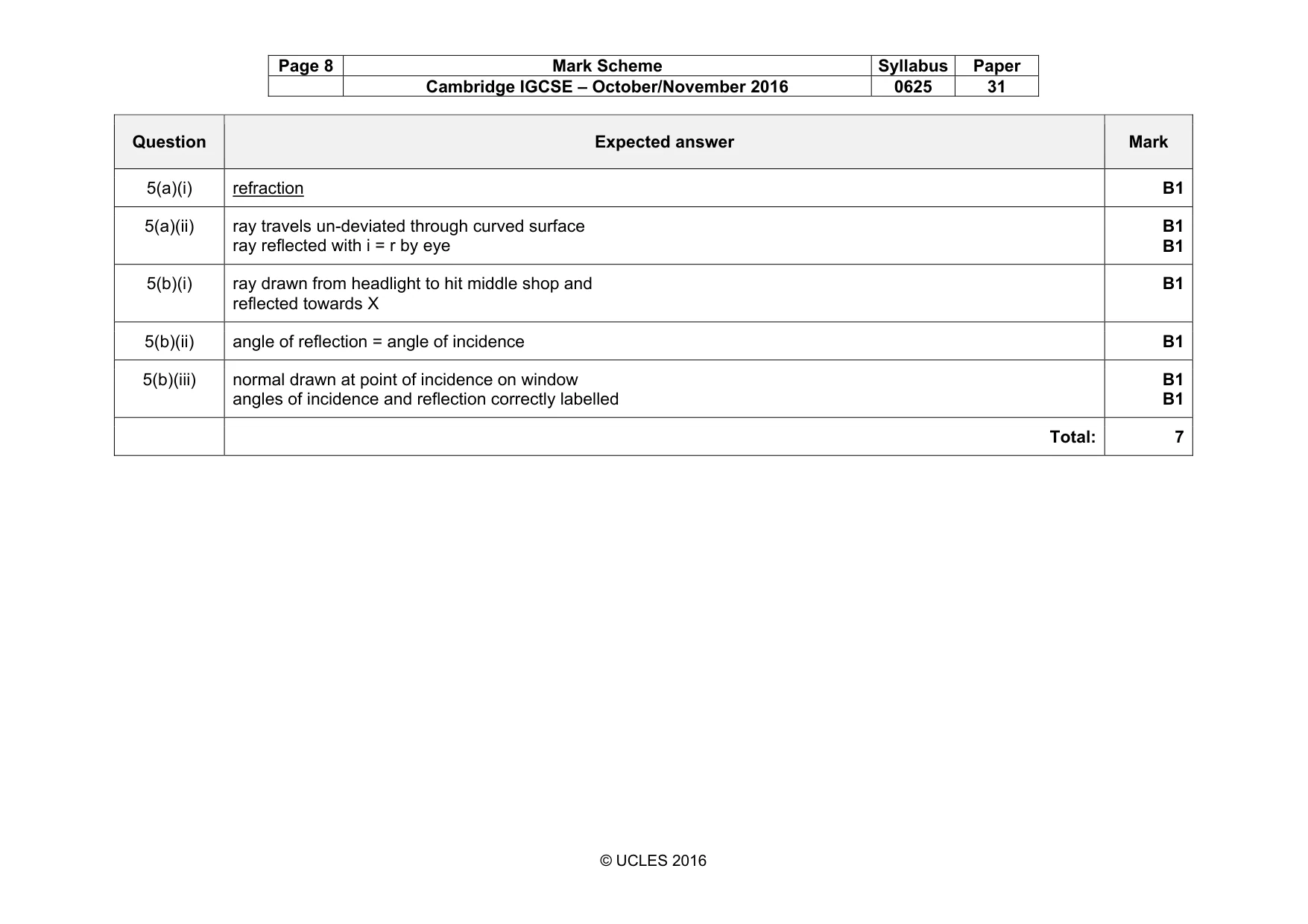
Page 8 Mark Scheme Syllabus Paper Cambridge IGCSE – October/November 2016 0625 31 © UCLES 2016 Question Expected answer Mark 5(a)(i) refraction B1 5(a)(ii) ray travels un-deviated through curved surface ray reflected with i = r by eye B1 B1 5(b)(i) ray drawn from headlight to hit middle shop and reflected towards X B1 5(b)(ii) angle of reflection = angle of incidence B1 5(b)(iii) normal drawn at point of incidence on window angles of incidence and reflection correctly labelled B1 B1 Total: 7
Mark scheme, page 9
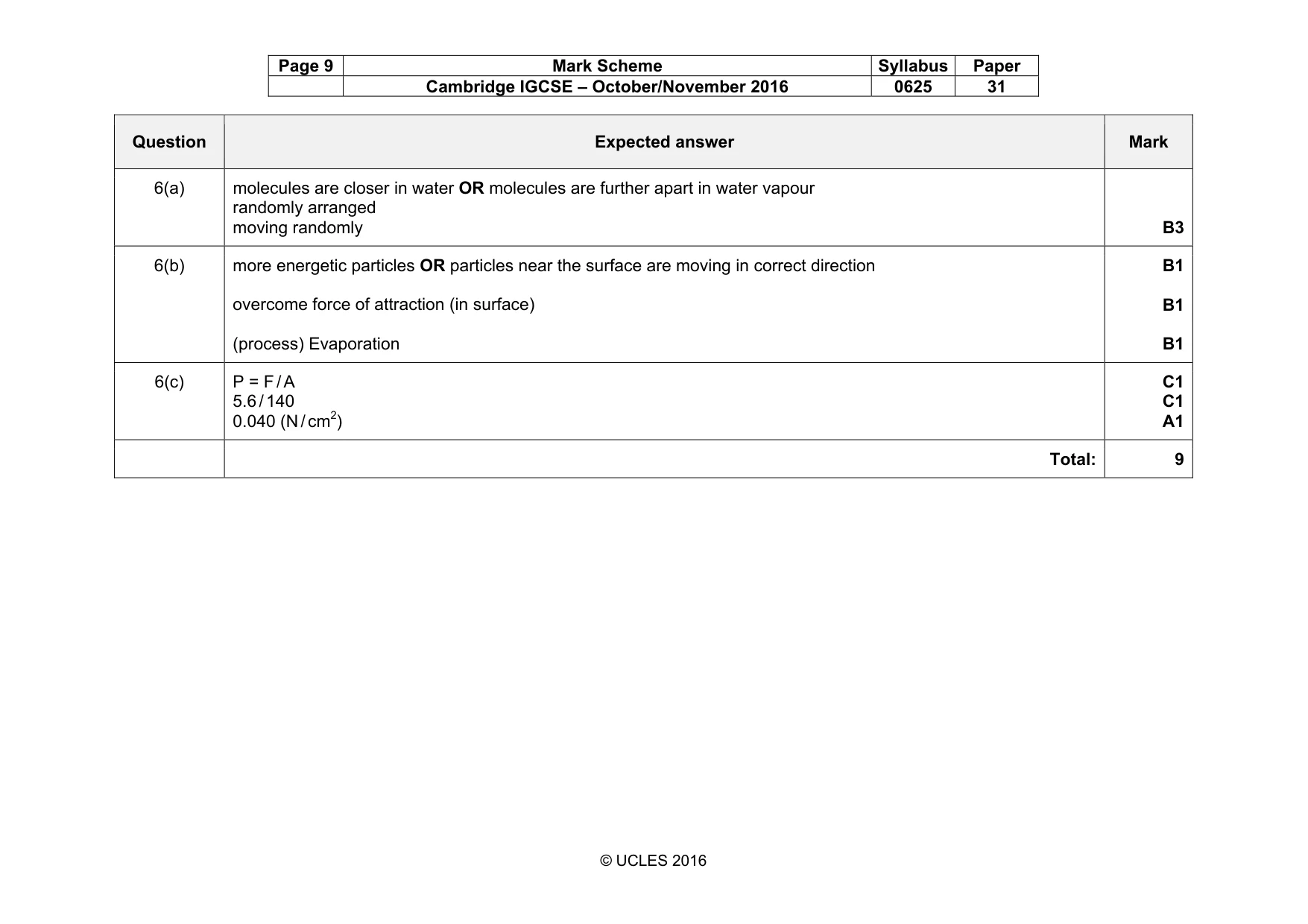
Page 9 Mark Scheme Syllabus Paper Cambridge IGCSE – October/November 2016 0625 31 © UCLES 2016 Question Expected answer Mark 6(a) molecules are closer in water OR molecules are further apart in water vapour randomly arranged moving randomly B3 6(b) more energetic particles OR particles near the surface are moving in correct direction overcome force of attraction (in surface) (process) Evaporation B1 B1 B1 6(c) P = F / A 5.6 / 140 0.040 (N / cm2) C1 C1 A1 Total: 9
Mark scheme, page 10
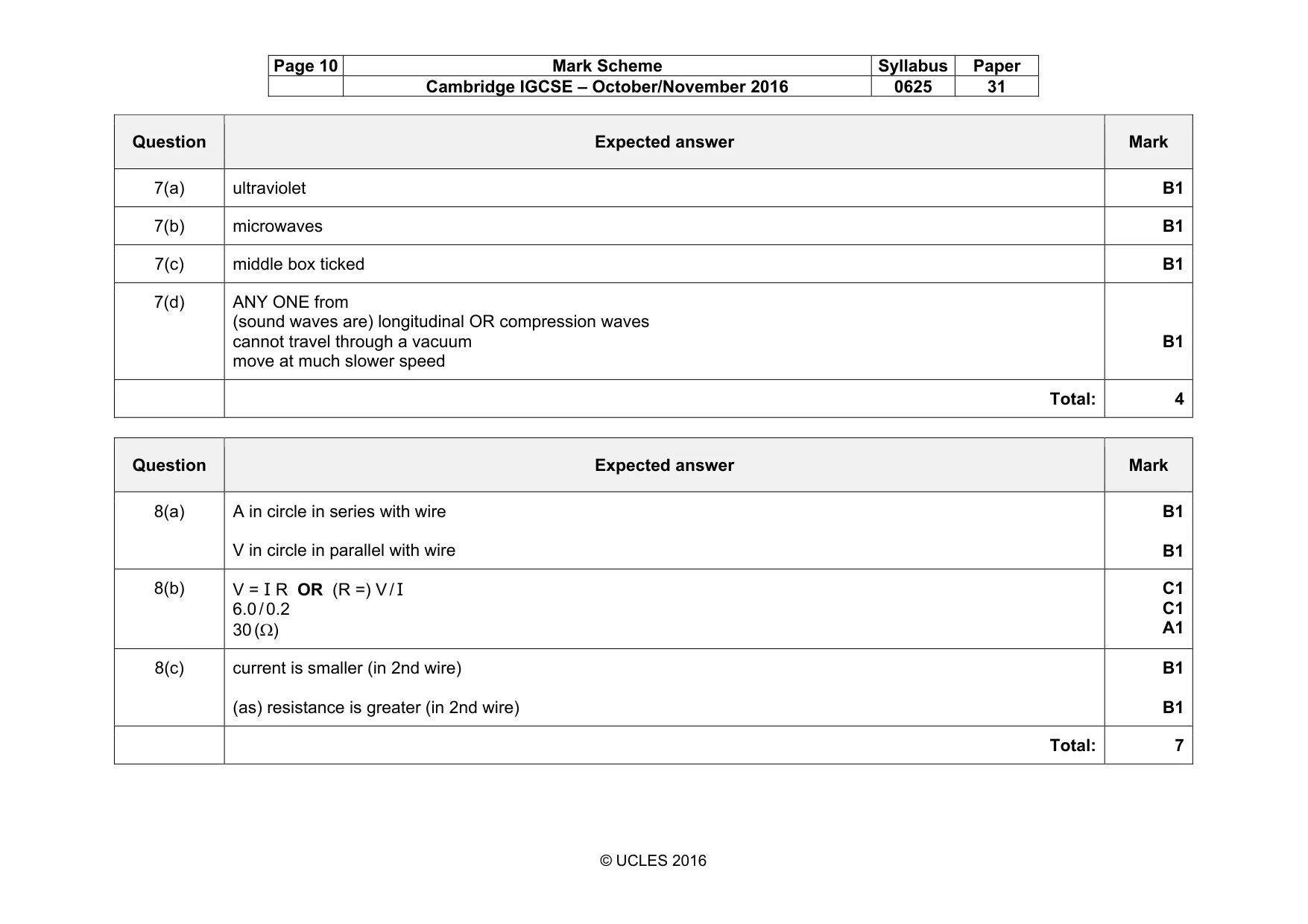
Page 10 Mark Scheme Syllabus Paper Cambridge IGCSE – October/November 2016 0625 31 © UCLES 2016 Question Expected answer Mark 7(a) ultraviolet B1 7(b) microwaves B1 7(c) middle box ticked B1 7(d) ANY ONE from (sound waves are) longitudinal OR compression waves cannot travel through a vacuum move at much slower speed B1 Total: 4 Question Expected answer Mark 8(a) A in circle in series with wire V in circle in parallel with wire B1 B1 8(b) V = I R OR (R =) V / I 6.0 / 0.2 30 (Ω) C1 C1 A1 8(c) current is smaller (in 2nd wire) (as) resistance is greater (in 2nd wire) B1 B1 Total: 7
Mark scheme, page 11
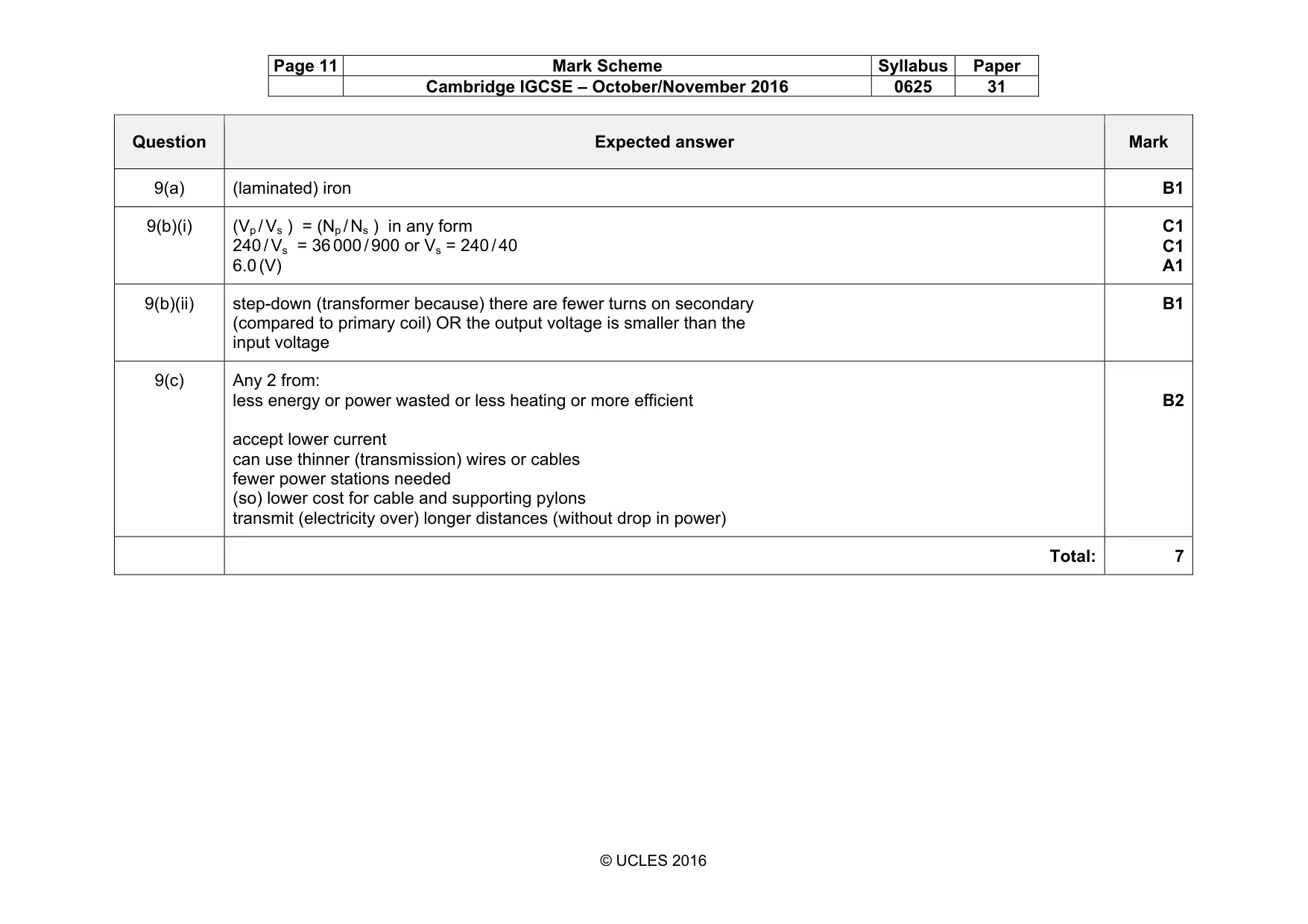
Page 11 Mark Scheme Syllabus Paper Cambridge IGCSE – October/November 2016 0625 31 © UCLES 2016 Question Expected answer Mark 9(a) (laminated) iron B1 9(b)(i) (Vp / Vs ) = (Np / Ns ) in any form 240 / Vs = 36 000 / 900 or Vs = 240 / 40 6.0 (V) C1 C1 A1 9(b)(ii) step-down (transformer because) there are fewer turns on secondary (compared to primary coil) OR the output voltage is smaller than the input voltage B1 9(c) Any 2 from: less energy or power wasted or less heating or more efficient accept lower current can use thinner (transmission) wires or cables fewer power stations needed (so) lower cost for cable and supporting pylons transmit (electricity over) longer distances (without drop in power) B2 Total: 7
Mark scheme, page 12
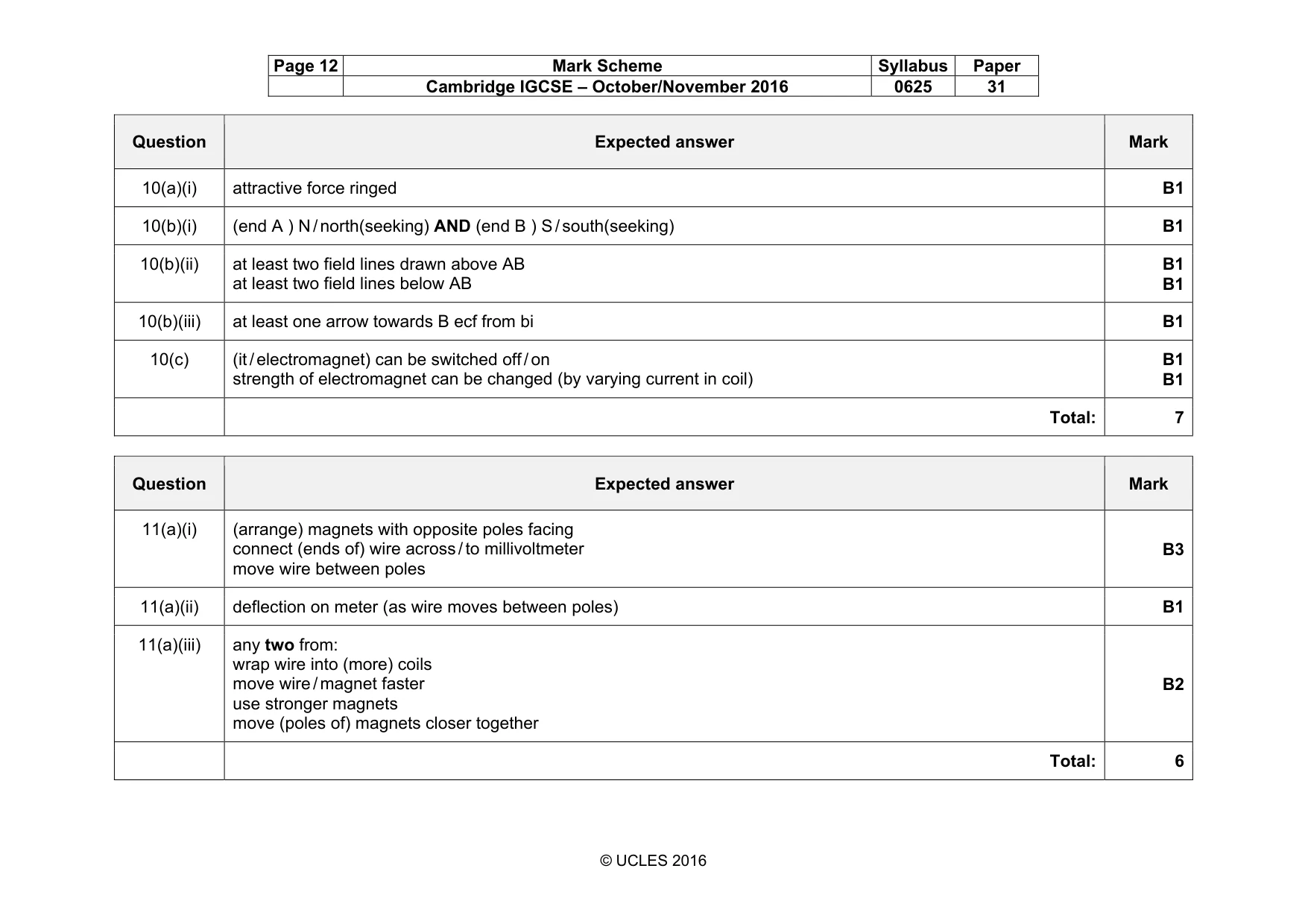
Page 12 Mark Scheme Syllabus Paper Cambridge IGCSE – October/November 2016 0625 31 © UCLES 2016 Question Expected answer Mark 10(a)(i) attractive force ringed B1 10(b)(i) (end A ) N / north(seeking) AND (end B ) S / south(seeking) B1 10(b)(ii) at least two field lines drawn above AB at least two field lines below AB B1 B1 10(b)(iii) at least one arrow towards B ecf from bi B1 10(c) (it / electromagnet) can be switched off / on strength of electromagnet can be changed (by varying current in coil) B1 B1 Total: 7 Question Expected answer Mark 11(a)(i) (arrange) magnets with opposite poles facing connect (ends of) wire across / to millivoltmeter move wire between poles B3 11(a)(ii) deflection on meter (as wire moves between poles) B1 11(a)(iii) any two from: wrap wire into (more) coils move wire / magnet faster use stronger magnets move (poles of) magnets closer together B2 Total: 6
Mark scheme, page 13
Page 13 Mark Scheme Syllabus Paper Cambridge IGCSE – October/November 2016 0625 31 © UCLES 2016 Question Expected answer Mark 12(a) (type of particle) (number of particles) PROTON 55 NEUTRON 82 B2 B2 12(b) (nucleus has) same number protons different number of neutrons B1 B1 Total: 6
What you needed in this session
Cambridge’s own grade thresholds for 2016 Oct/Nov, Paper 3 · Variant 1. A higher threshold means an easier paper — the bar moves with how the cohort did.