Questions as text
Q1 · The elements in Group VI of the Periodic Table show the same trends as the elements in… 0652/21 Oct/Nov 2017
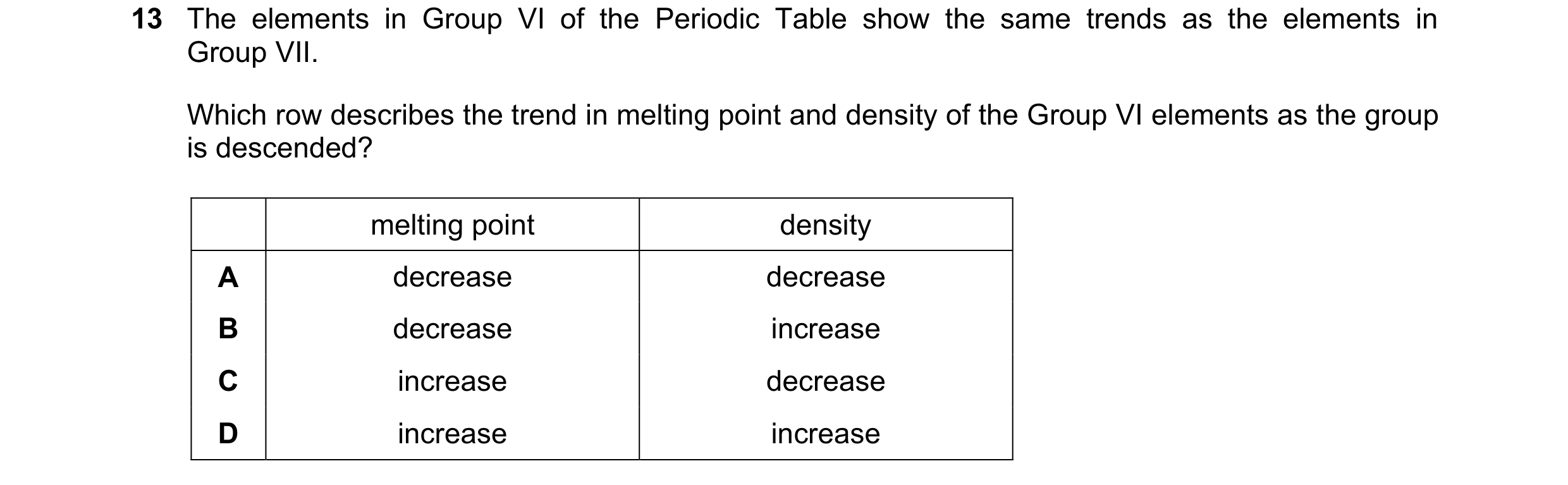
13 The elements in Group VI of the Periodic Table show the same trends as the elements in Group VII. Which row describes the trend in melting point and density of the Group VI elements as the group is descended? melting point density A decrease decrease B decrease increase C increase decrease D increase increase
1 marks
Answer: D
This question in 0652/21 Oct/Nov 2017
Q2 · The elements in Group VI of the Periodic Table show the same trends as the elements in… 0652/22 Oct/Nov 2017
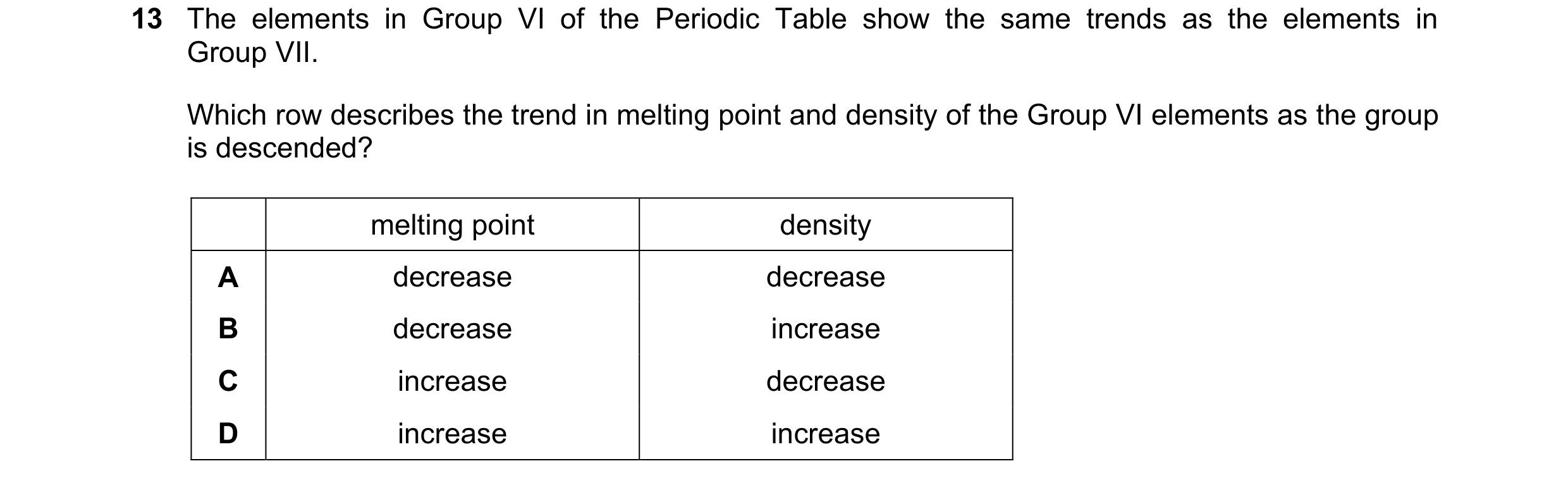
13 The elements in Group VI of the Periodic Table show the same trends as the elements in Group VII. Which row describes the trend in melting point and density of the Group VI elements as the group is descended? melting point density A decrease decrease B decrease increase C increase decrease D increase increase
1 marks
Answer: D
This question in 0652/22 Oct/Nov 2017
Q3 · Aluminium, magnesium and phosphorus are elements in Period III of the Periodic Table 0652/21 Oct/Nov 2018
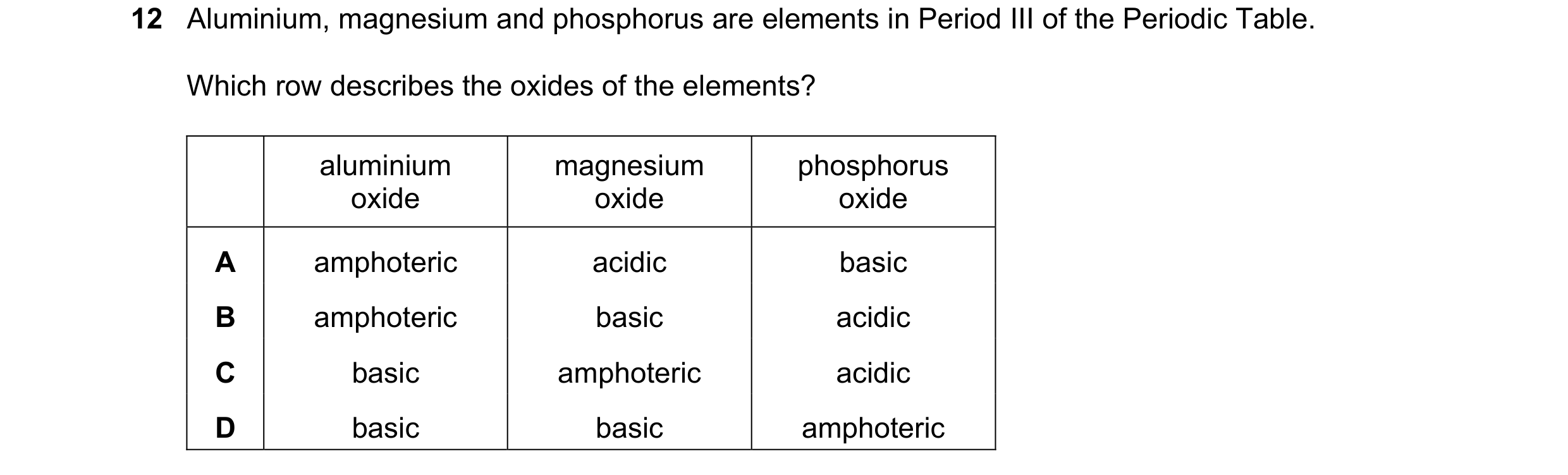
12 Aluminium, magnesium and phosphorus are elements in Period III of the Periodic Table. Which row describes the oxides of the elements? aluminium magnesium phosphorus oxide oxide oxide A amphoteric acidic basic B amphoteric basic acidic C basic amphoteric acidic D basic basic amphoteric
1 marks
Answer: B
This question in 0652/21 Oct/Nov 2018
Q4 · Aluminium, magnesium and phosphorus are elements in Period III of the Periodic Table 0652/22 Oct/Nov 2018
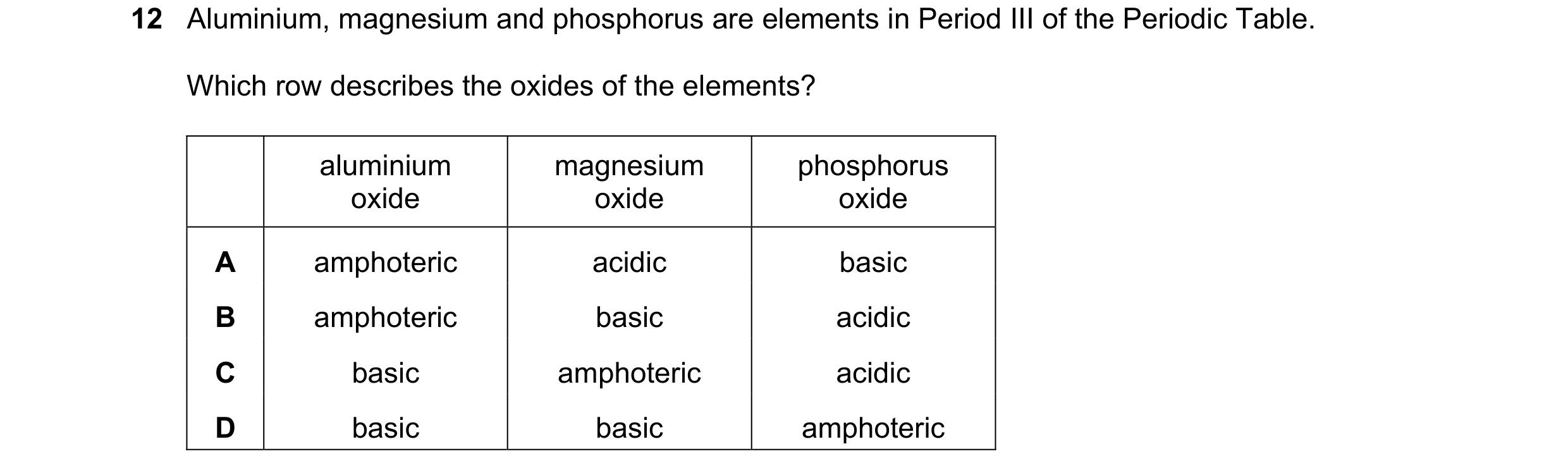
12 Aluminium, magnesium and phosphorus are elements in Period III of the Periodic Table. Which row describes the oxides of the elements? aluminium magnesium phosphorus oxide oxide oxide A amphoteric acidic basic B amphoteric basic acidic C basic amphoteric acidic D basic basic amphoteric
1 marks
Answer: B
This question in 0652/22 Oct/Nov 2018
Q5 · Lithium has a lower density than sodium 0652/21 Oct/Nov 2019
11 Lithium has a lower density than sodium. Sodium is more reactive than lithium. Which sentence predicts the properties of the Group I element, rubidium? A It is less dense and less reactive than sodium. B It is less dense and more reactive than sodium. C It is more dense and less reactive than sodium. D It is more dense and more reactive than sodium.
1 marks
Answer: D
This question in 0652/21 Oct/Nov 2019
Q6 · Lithium has a lower density than sodium 0652/22 Oct/Nov 2019
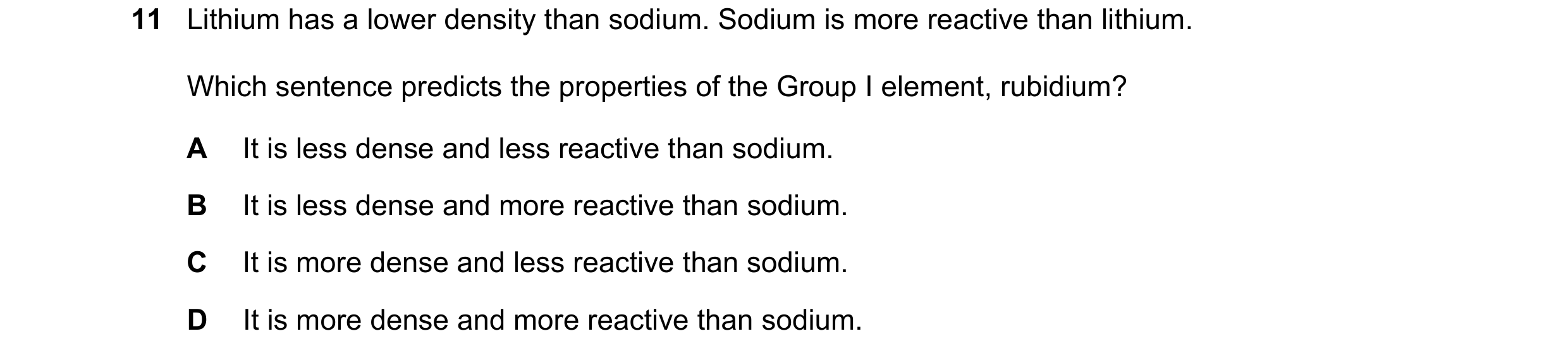
11 Lithium has a lower density than sodium. Sodium is more reactive than lithium. Which sentence predicts the properties of the Group I element, rubidium? A It is less dense and less reactive than sodium. B It is less dense and more reactive than sodium. C It is more dense and less reactive than sodium. D It is more dense and more reactive than sodium.
1 marks
Answer: D
This question in 0652/22 Oct/Nov 2019
Q7 · Which row describes the trends from left to right across a period of the Periodic Table? 0652/21 Oct/Nov 2020
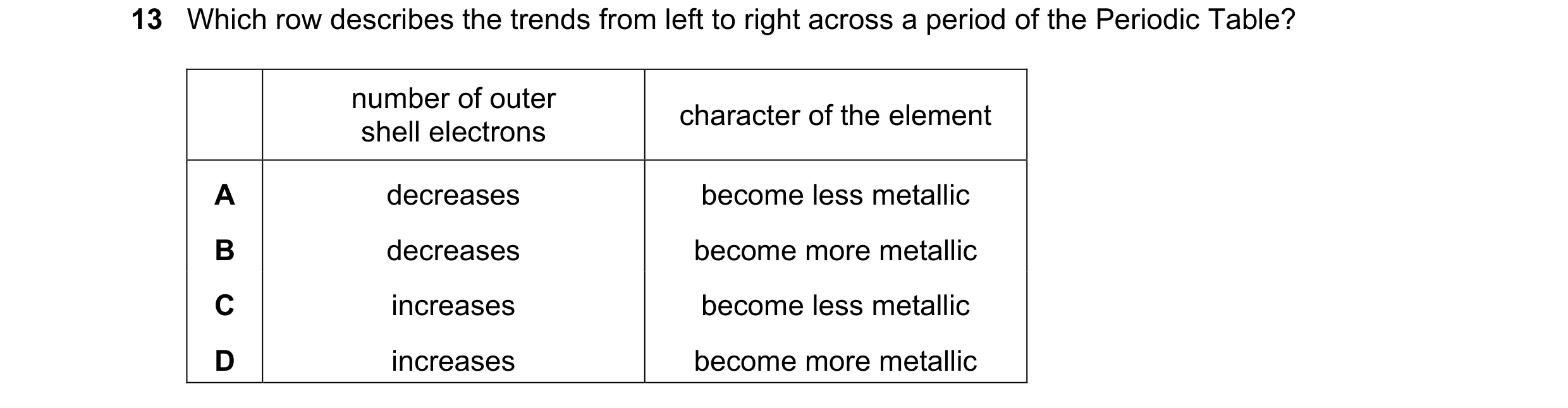
13 Which row describes the trends from left to right across a period of the Periodic Table? number of outer character of the element shell electrons A decreases become less metallic B decreases become more metallic C increases become less metallic D increases become more metallic
1 marks
Answer: C
This question in 0652/21 Oct/Nov 2020
Q8 · Elements W, X, Y and Z are all in the same period of the Periodic Table 0652/22 Oct/Nov 2020
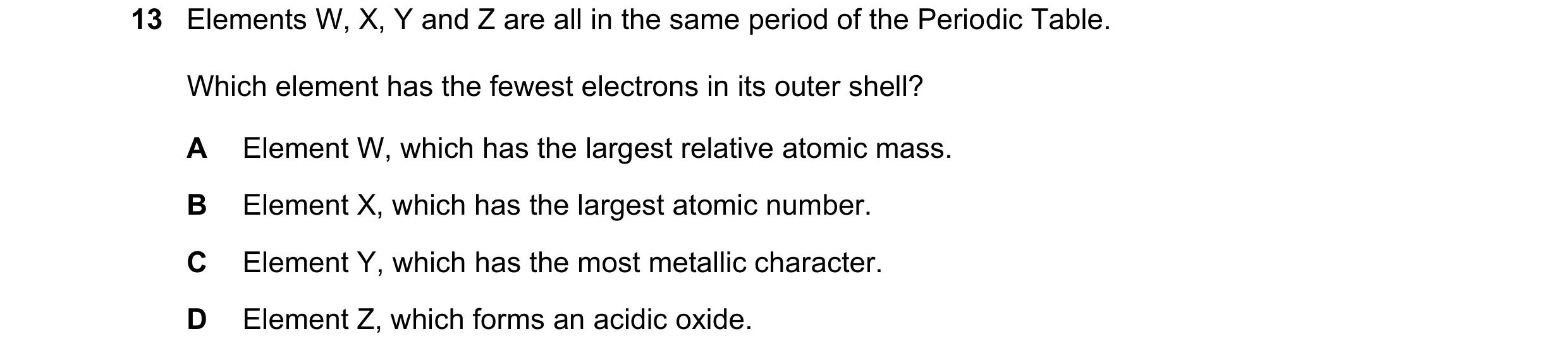
13 Elements W, X, Y and Z are all in the same period of the Periodic Table. Which element has the fewest electrons in its outer shell? A Element W, which has the largest relative atomic mass. B Element X, which has the largest atomic number. C Element Y, which has the most metallic character. D Element Z, which forms an acidic oxide.
1 marks
Answer: C
This question in 0652/22 Oct/Nov 2020
Q9 · Which statement about the Periodic Table is correct? 0652/21 Oct/Nov 2021
14 Which statement about the Periodic Table is correct? A Elements with the highest number of electrons in their outer shell are the most non-metallic. B Non-metallic elements react by losing their outer shell electrons. C The elements with the largest group number are the best electrical conductors. D The group number is the total number of electron shells.
1 marks
Answer: A
This question in 0652/21 Oct/Nov 2021
Q10 · Elements in the Periodic Table are arranged in groups 0652/21 Oct/Nov 2023
15 Elements in the Periodic Table are arranged in groups. Which statements about the groups are correct? 1 The group number of an element is equal to the number of occupied electron shells in an atom of the element. 2 The group number of an element is equal to the number of outer shell electrons in an atom of the element. 3 An element in Group II will show greater metallic character than an element in Group VI. 4 Atoms of an element in Group VII will lose electrons more readily that atoms of an element in Group I. A 1 and 3 B 1 and 4 C 2 and 3 D 2 and 4
1 marks
Answer: C
This question in 0652/21 Oct/Nov 2023
Q11 · Elements in the Periodic Table are arranged in groups 0652/22 Oct/Nov 2023
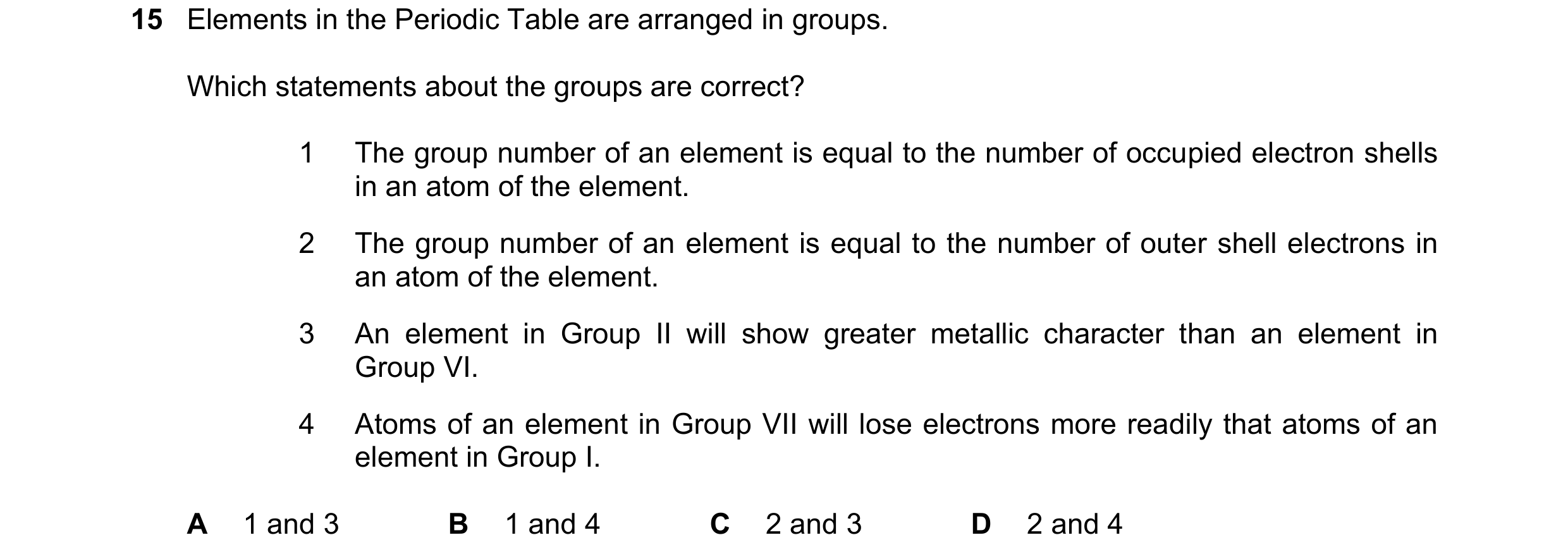
15 Elements in the Periodic Table are arranged in groups. Which statements about the groups are correct? 1 The group number of an element is equal to the number of occupied electron shells in an atom of the element. 2 The group number of an element is equal to the number of outer shell electrons in an atom of the element. 3 An element in Group II will show greater metallic character than an element in Group VI. 4 Atoms of an element in Group VII will lose electrons more readily that atoms of an element in Group I. A 1 and 3 B 1 and 4 C 2 and 3 D 2 and 4
1 marks
Answer: C
This question in 0652/22 Oct/Nov 2023
 1 / 3
1 / 3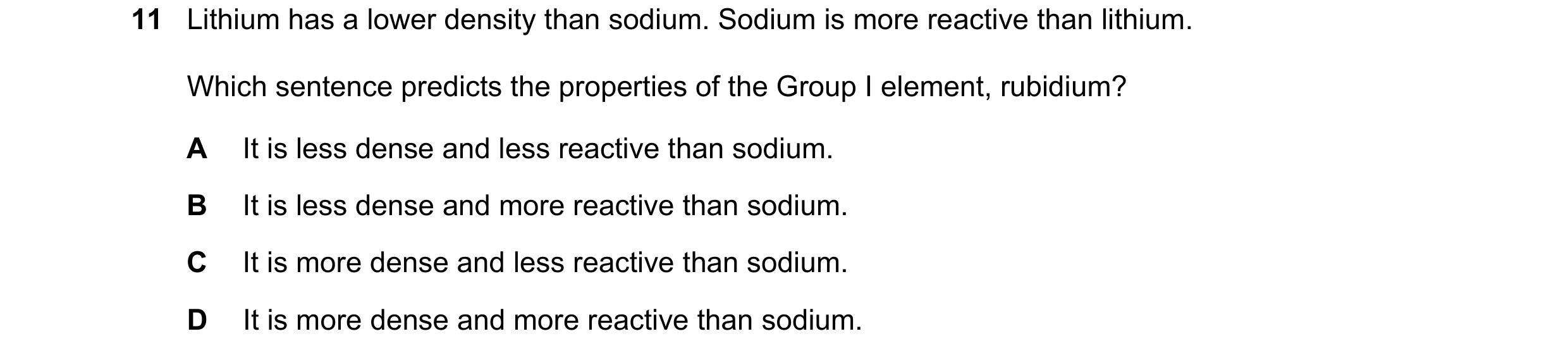
 2 / 3
2 / 3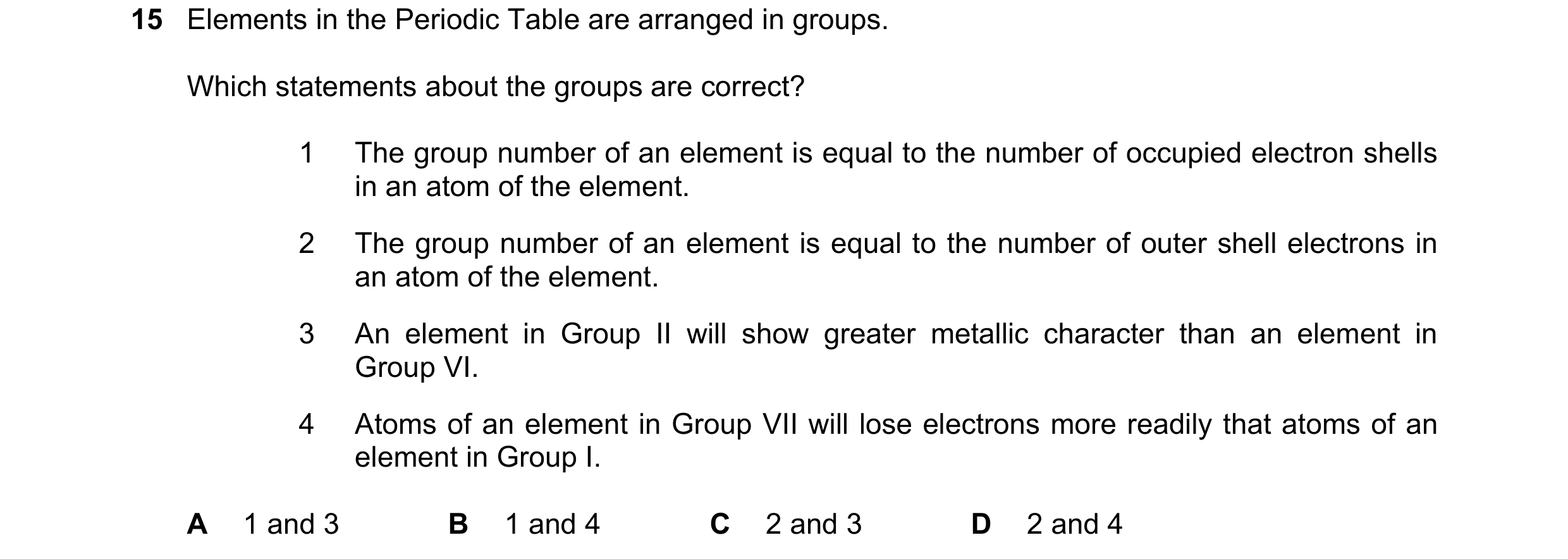
 3 / 3
3 / 3