Questions as text
Q1 · Element Z conducts electricity and forms a basic oxide 0652/11 Oct/Nov 2007
3
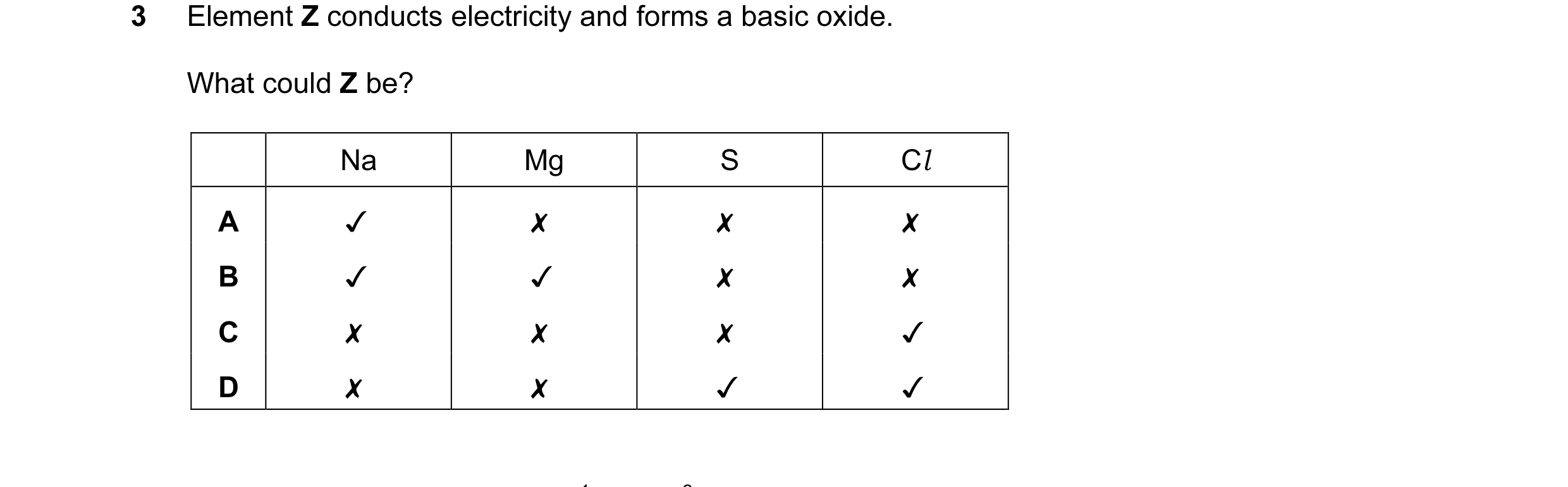
Element Z conducts electricity and forms a basic oxide.
What could Z be?
Na Mg S) Cl
A v x x x
B v v x x
Cc x x x v
D x x v v
1 marks
Answer: B
This question in 0652/11 Oct/Nov 2007
Q2 · In the Periodic Table, how does the metallic character of the elements vary from left to… 0652/11 Oct/Nov 2007
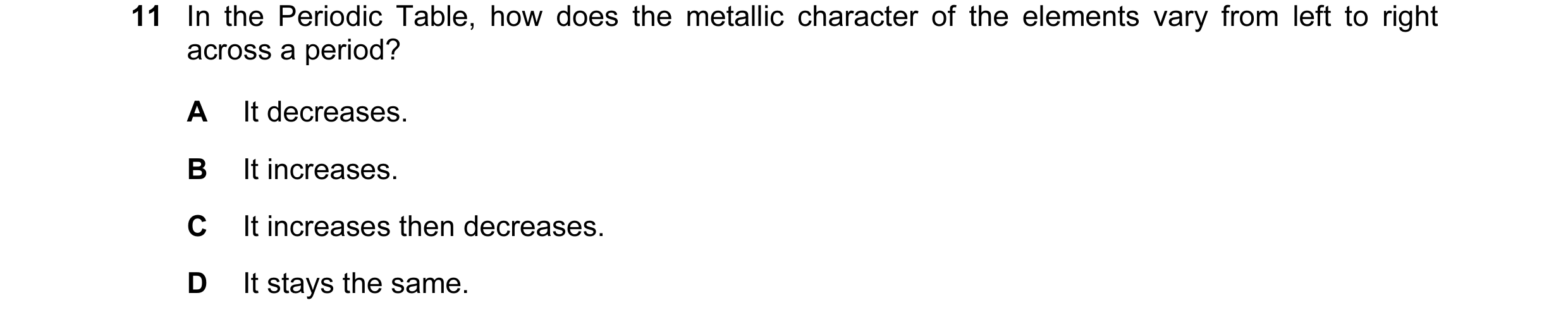
11 In the Periodic Table, how does the metallic character of the elements vary from left to right across a period? A It decreases. B It increases. C It increases then decreases. D It stays the same.
1 marks
Answer: A
This question in 0652/11 Oct/Nov 2007
Q3 · The element technetium, Tc (proton number 43), does not exist in nature 0652/11 Oct/Nov 2008
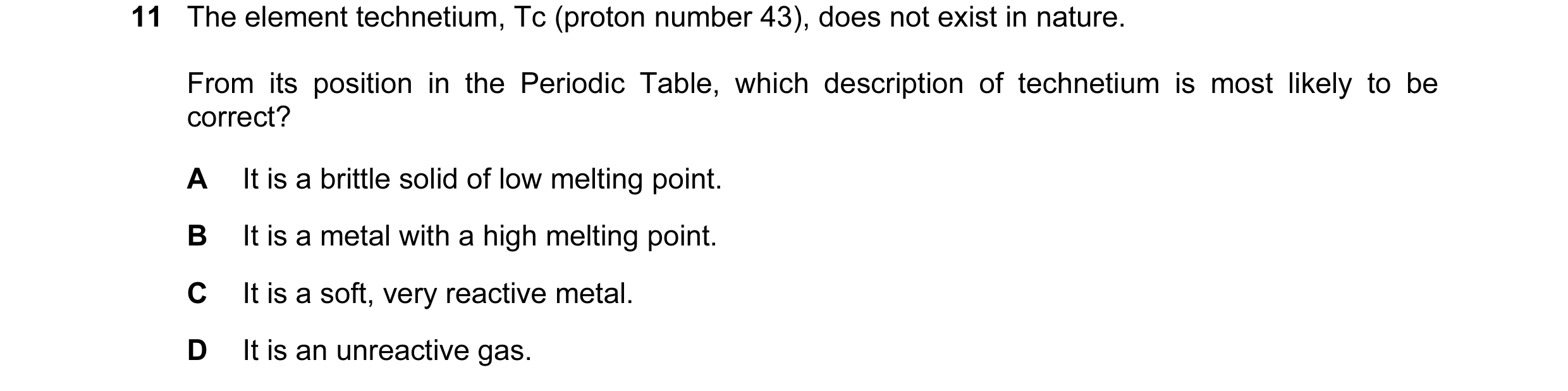
11 The element technetium, Tc (proton number 43), does not exist in nature. From its position in the Periodic Table, which description of technetium is most likely to be correct? A It is a brittle solid of low melting point. B It is a metal with a high melting point. C It is a soft, very reactive metal. D It is an unreactive gas.
1 marks
Answer: B
This question in 0652/11 Oct/Nov 2008
Q4 · Elements X and Y each have a proton number greater than 10 but less than 19 0652/11 Oct/Nov 2010
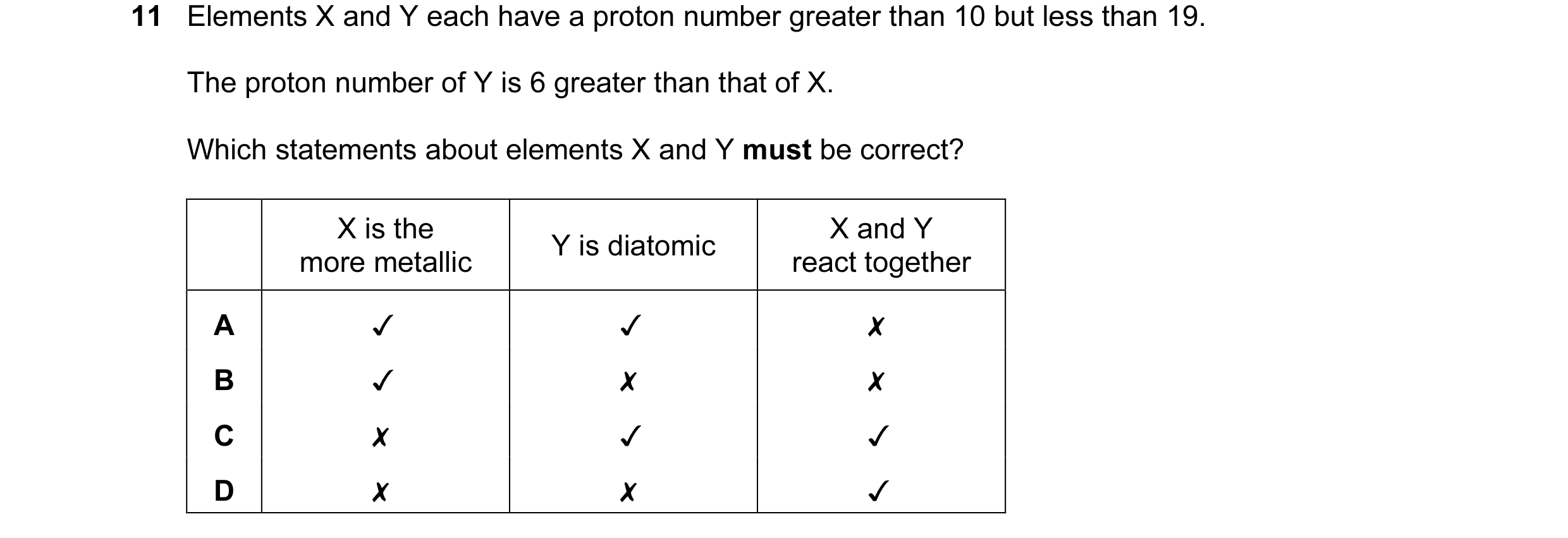
11 Elements X and Y each have a proton number greater than 10 but less than 19.
The proton number of Y is 6 greater than that of X.
Which statements about elements X and Y must be correct?
X is the oon . X and Y
. Y is diatomic
more metallic react together
A Jv Jv x
B Jv x x
Cc x Jv Jv
D x x Jv
1 marks
Answer: B
This question in 0652/11 Oct/Nov 2010
Q5 · The element technetium, Tc (proton number 43), does not exist in nature 0652/11 Oct/Nov 2011
12 The element technetium, Tc (proton number 43), does not exist in nature. From its position in the Periodic Table, which description of technetium is most likely to be correct? A It is a brittle solid of low melting point. B It is a metal with a high melting point. C It is a soft, very reactive metal. D It is an unreactive gas.
1 marks
Answer: B
This question in 0652/11 Oct/Nov 2011
Q6 · The element technetium, Tc (proton number 43), does not exist in nature 0652/12 Oct/Nov 2011
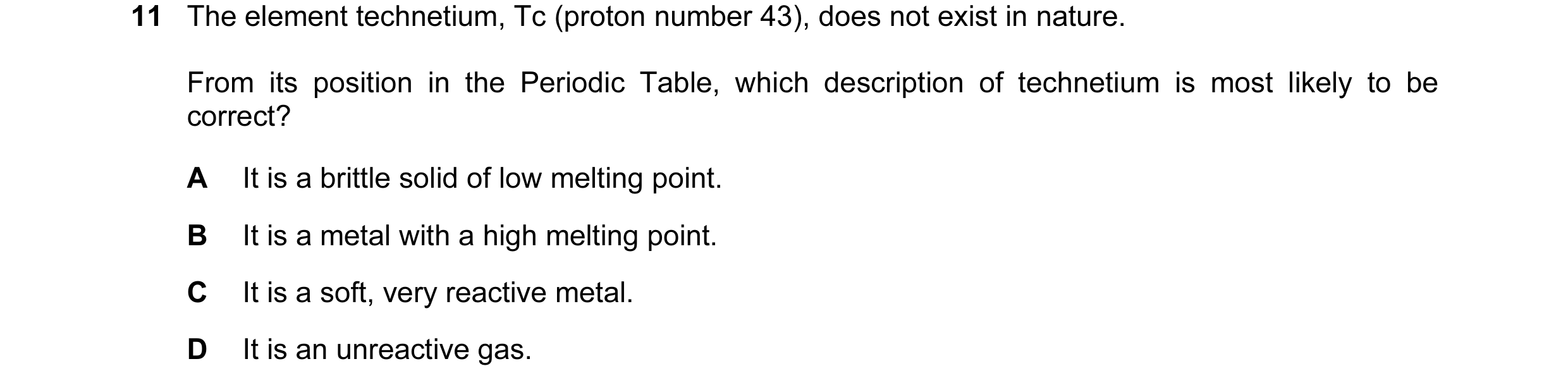
11 The element technetium, Tc (proton number 43), does not exist in nature. From its position in the Periodic Table, which description of technetium is most likely to be correct? A It is a brittle solid of low melting point. B It is a metal with a high melting point. C It is a soft, very reactive metal. D It is an unreactive gas.
1 marks
Answer: B
This question in 0652/12 Oct/Nov 2011
Q7 · Which statement about period 2 in the Periodic Table is correct? 0652/11 Oct/Nov 2015
11 Which statement about period 2 in the Periodic Table is correct? A They are all metals. B They are all non-metals. C They change from metal to non-metal from left to right. D They change from non-metal to metal from left to right.
1 marks
Answer: C
This question in 0652/11 Oct/Nov 2015
Q8 · Which statement about period 2 in the Periodic Table is correct? 0652/12 Oct/Nov 2015
11 Which statement about period 2 in the Periodic Table is correct? A They are all metals. B They are all non-metals. C They change from metal to non-metal from left to right. D They change from non-metal to metal from left to right.
1 marks
Answer: C
This question in 0652/12 Oct/Nov 2015
Q9 · Which row describes the trend in melting point and density of the Group I elements as the… 0652/11 Oct/Nov 2017
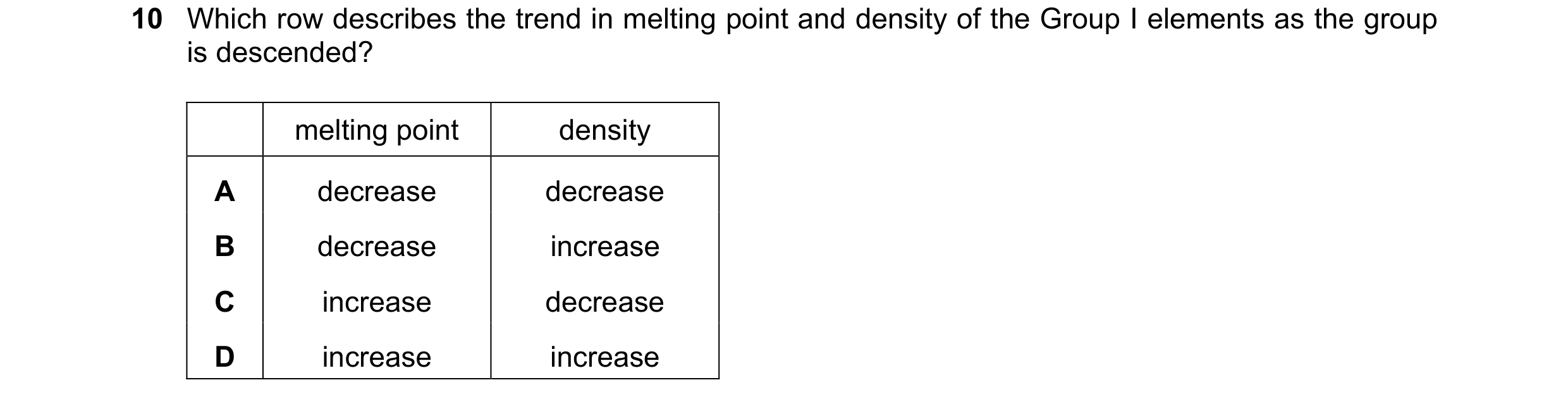
10 Which row describes the trend in melting point and density of the Group I elements as the group is descended? melting point density A decrease decrease B decrease increase C increase decrease D increase increase
1 marks
Answer: B
This question in 0652/11 Oct/Nov 2017
Q10 · Which row describes the trend in melting point and density of the Group I elements as the… 0652/12 Oct/Nov 2017
10 Which row describes the trend in melting point and density of the Group I elements as the group is descended? melting point density A decrease decrease B decrease increase C increase decrease D increase increase
1 marks
Answer: B
This question in 0652/12 Oct/Nov 2017
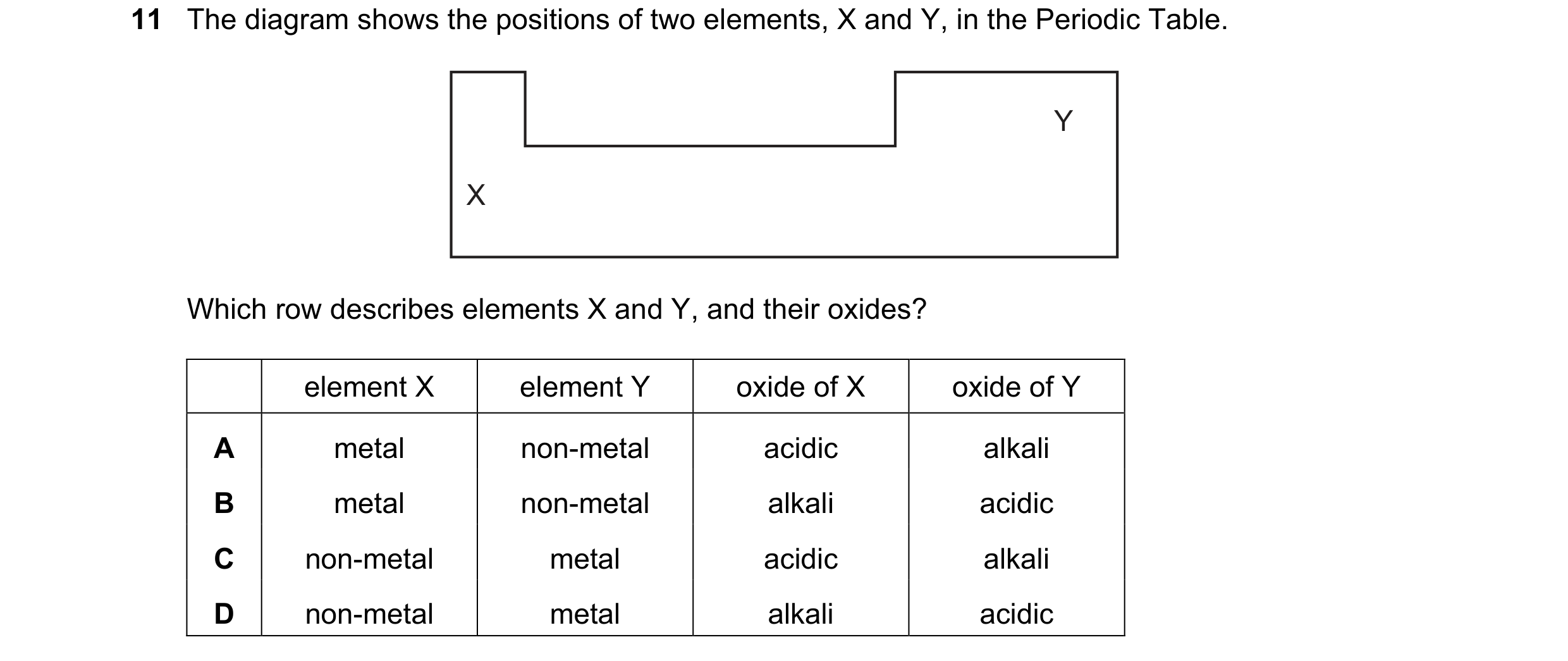
Q11 · The diagram shows the positions of two elements, X and Y, in the Periodic Table 0652/11 Oct/Nov 2019
11 The diagram shows the positions of two elements, X and Y, in the Periodic Table. Y X Which row describes elements X and Y, and their oxides? element X element Y oxide of X oxide of Y A metal non-metal acidic alkali B metal non-metal alkali acidic C non-metal metal acidic alkali D non-metal metal alkali acidic
1 marks
Answer: B
This question in 0652/11 Oct/Nov 2019
 1 / 3
1 / 3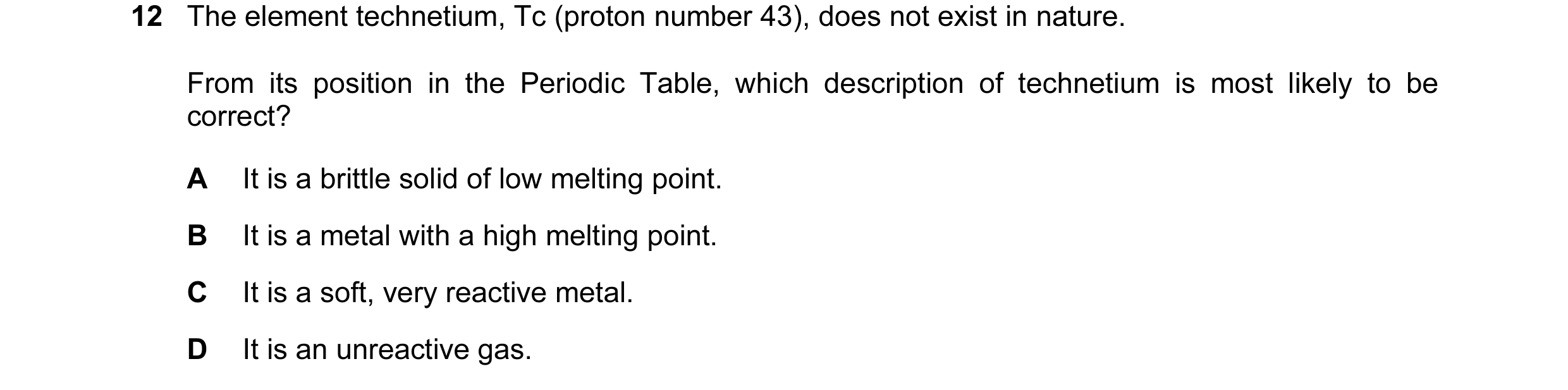


 2 / 3
2 / 3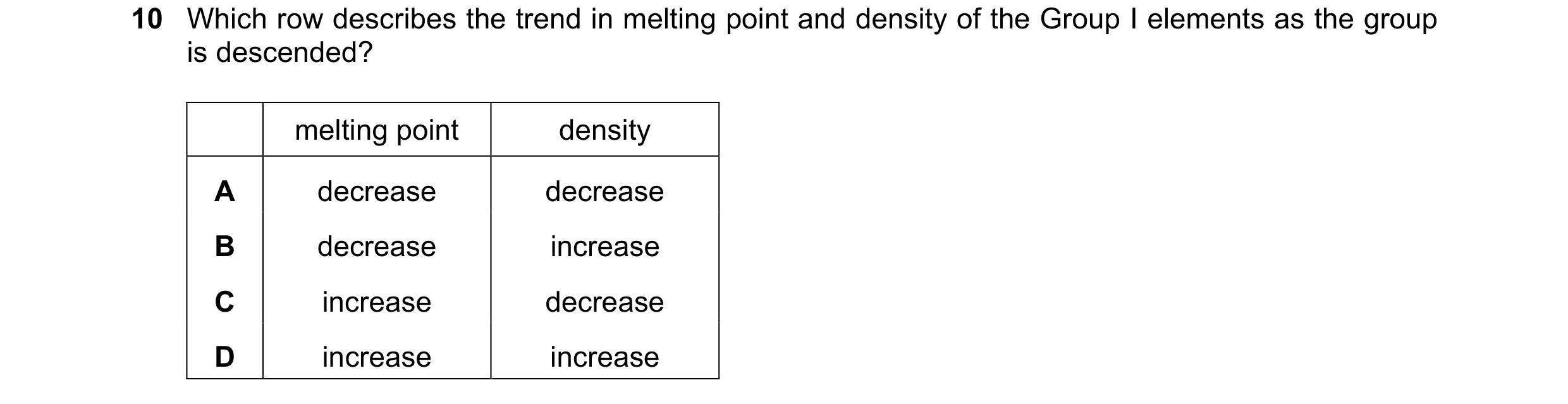
 3 / 3
3 / 3