Questions as text
Q1 · The diagram shows wood burning in air 0652/21 Oct/Nov 2017
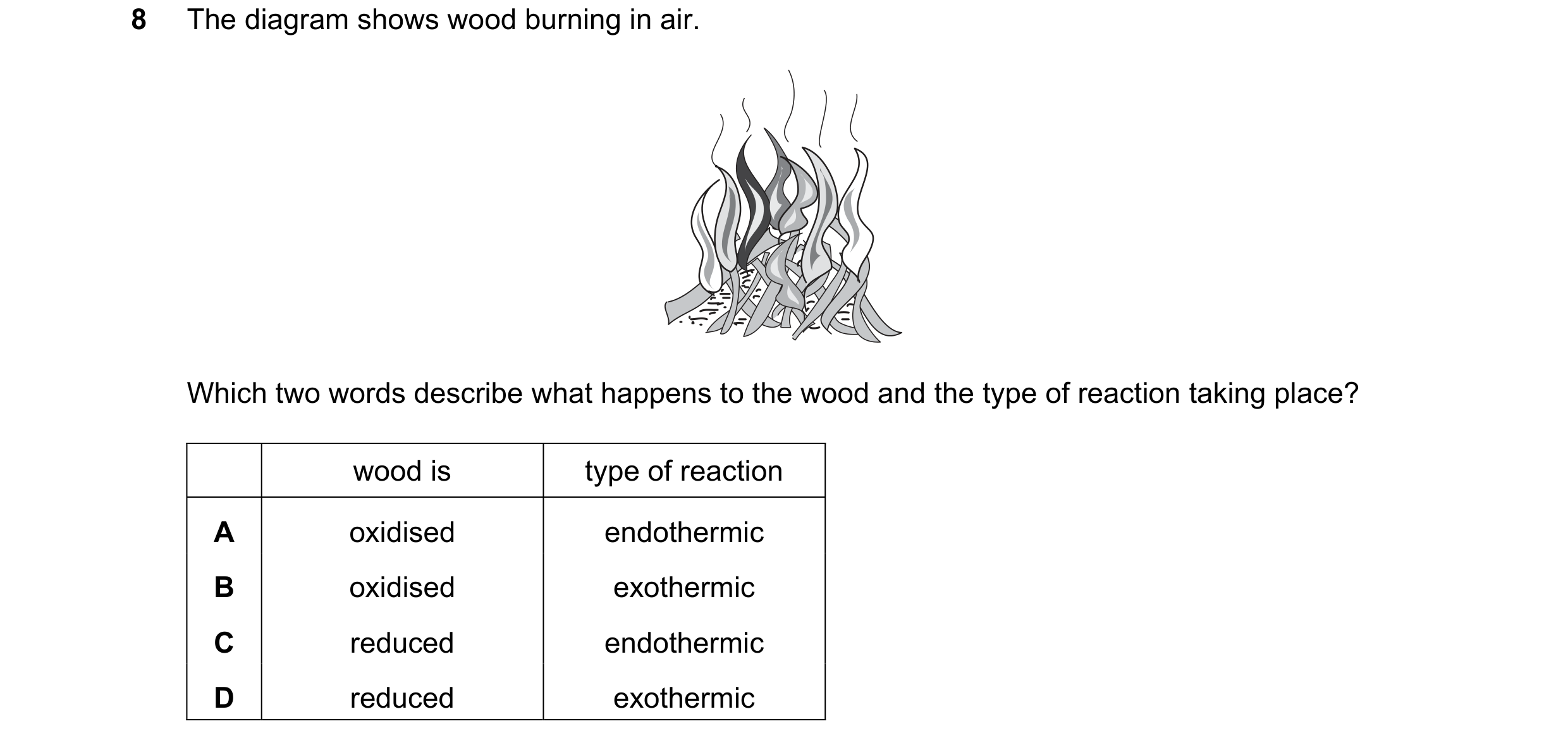
8 The diagram shows wood burning in air. Which two words describe what happens to the wood and the type of reaction taking place? wood is type of reaction A oxidised endothermic B oxidised exothermic C reduced endothermic D reduced exothermic
1 marks
Answer: B
This question in 0652/21 Oct/Nov 2017
Q2 · One of the reactions that occurs in a blast furnace is shown 0652/21 Oct/Nov 2017
15 One of the reactions that occurs in a blast furnace is shown. Fe2O3 + 3CO → 2Fe + 3CO2 Which substance is the reducing agent? A CO B CO2 C Fe D Fe2O3
1 marks
Answer: A
This question in 0652/21 Oct/Nov 2017
Q3 · Nitrogen oxides are produced in a car engine 0652/21 Oct/Nov 2017
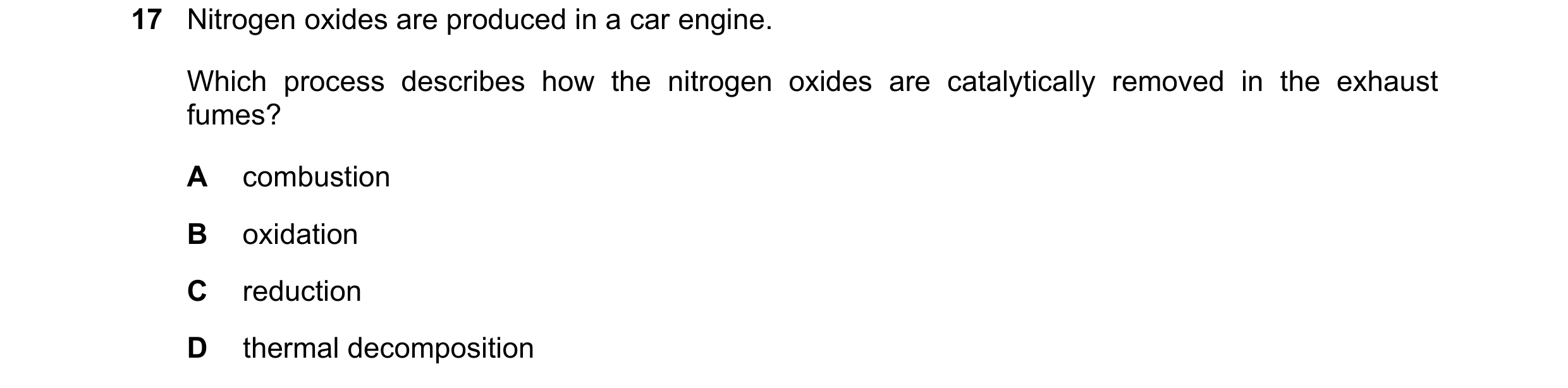
17 Nitrogen oxides are produced in a car engine. Which process describes how the nitrogen oxides are catalytically removed in the exhaust fumes? A combustion B oxidation C reduction D thermal decomposition
1 marks
Answer: C
This question in 0652/21 Oct/Nov 2017
Q4 · The diagram shows wood burning in air 0652/22 Oct/Nov 2017
8 The diagram shows wood burning in air. Which two words describe what happens to the wood and the type of reaction taking place? wood is type of reaction A oxidised endothermic B oxidised exothermic C reduced endothermic D reduced exothermic
1 marks
Answer: B
This question in 0652/22 Oct/Nov 2017
Q5 · One of the reactions that occurs in a blast furnace is shown 0652/22 Oct/Nov 2017
15 One of the reactions that occurs in a blast furnace is shown. Fe2O3 + 3CO → 2Fe + 3CO2 Which substance is the reducing agent? A CO B CO2 C Fe D Fe2O3
1 marks
Answer: A
This question in 0652/22 Oct/Nov 2017
Q6 · Nitrogen oxides are produced in a car engine 0652/22 Oct/Nov 2017
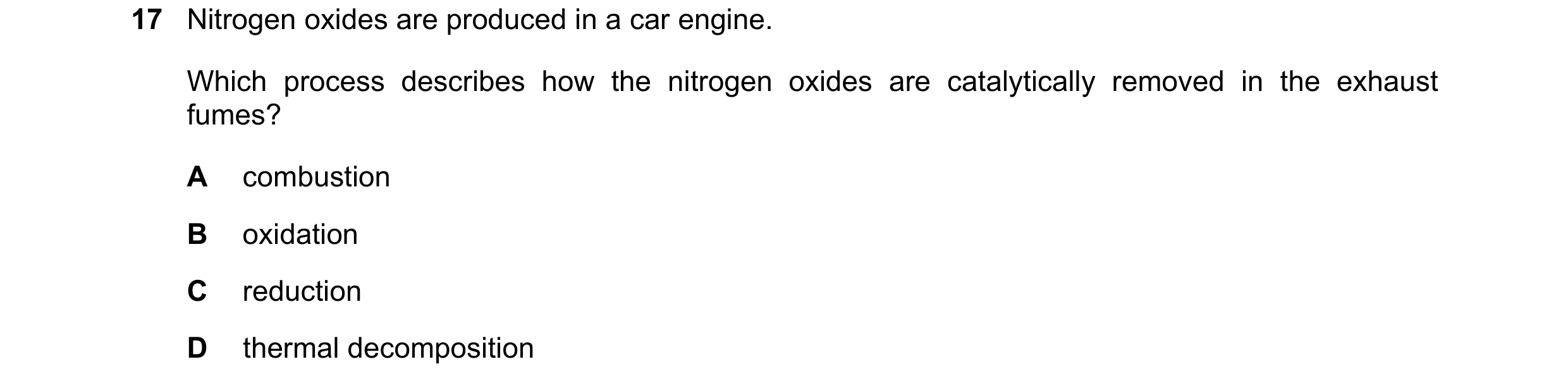
17 Nitrogen oxides are produced in a car engine. Which process describes how the nitrogen oxides are catalytically removed in the exhaust fumes? A combustion B oxidation C reduction D thermal decomposition
1 marks
Answer: C
This question in 0652/22 Oct/Nov 2017
Q7 · Photographic film is coated with a layer of silver salts that contain silver ions 0652/21 Oct/Nov 2018
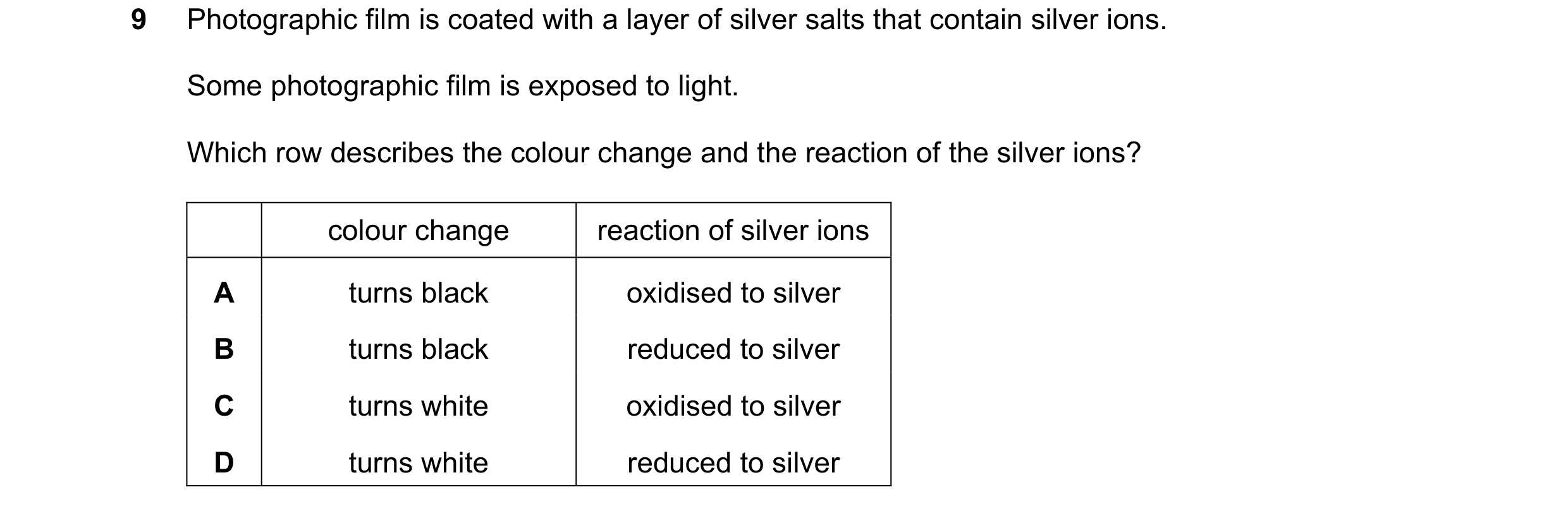
9 Photographic film is coated with a layer of silver salts that contain silver ions. Some photographic film is exposed to light. Which row describes the colour change and the reaction of the silver ions? colour change reaction of silver ions A turns black oxidised to silver B turns black reduced to silver C turns white oxidised to silver D turns white reduced to silver
1 marks
Answer: B
This question in 0652/21 Oct/Nov 2018
Q8 · Which reaction is an oxidation? 0652/21 Oct/Nov 2018
10 Which reaction is an oxidation? A 2SO2 + O2 → 2SO3 B NaOH + HCl → NaCl + H2O C CaCO3 → CaO + CO2 D NH3 + HCl → NH4Cl
1 marks
Answer: A
This question in 0652/21 Oct/Nov 2018
Q9 · Photographic film is coated with a layer of silver salts that contain silver ions 0652/22 Oct/Nov 2018
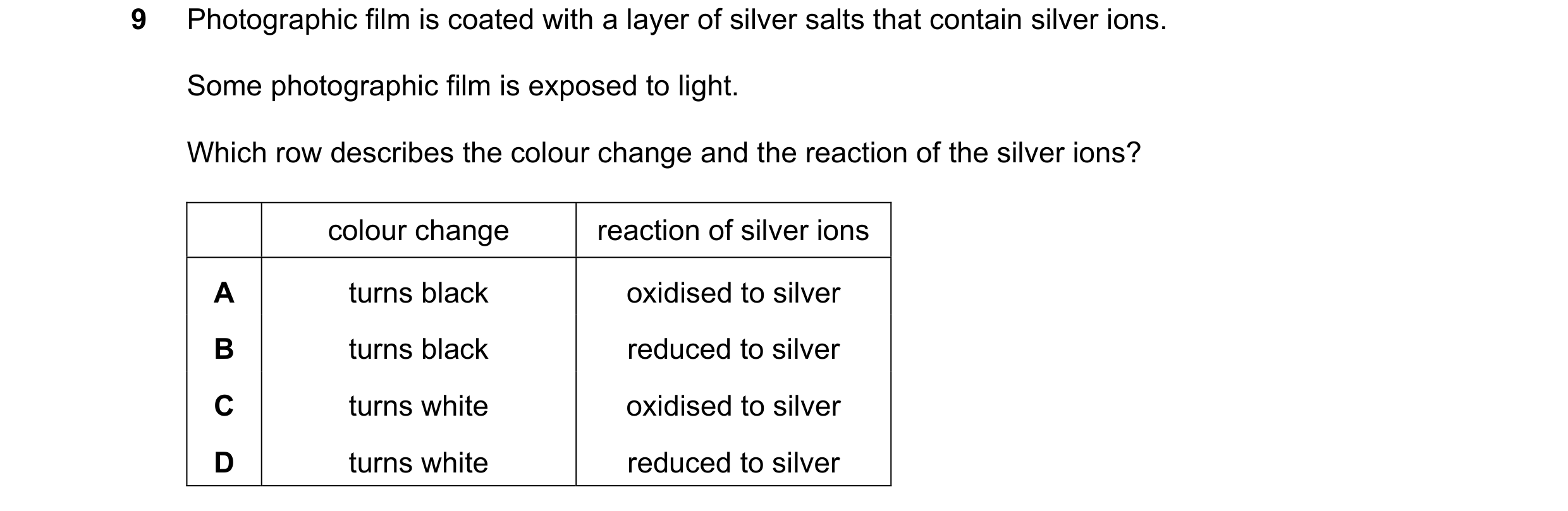
9 Photographic film is coated with a layer of silver salts that contain silver ions. Some photographic film is exposed to light. Which row describes the colour change and the reaction of the silver ions? colour change reaction of silver ions A turns black oxidised to silver B turns black reduced to silver C turns white oxidised to silver D turns white reduced to silver
1 marks
Answer: B
This question in 0652/22 Oct/Nov 2018
Q10 · Which reaction is an oxidation? 0652/22 Oct/Nov 2018
10 Which reaction is an oxidation? A 2SO2 + O2 → 2SO3 B NaOH + HCl → NaCl + H2O C CaCO3 → CaO + CO2 D NH3 + HCl → NH4Cl
1 marks
Answer: A
This question in 0652/22 Oct/Nov 2018
Q11 · The equation for the reaction of magnesium with copper(II) oxide is shown 0652/21 Oct/Nov 2019
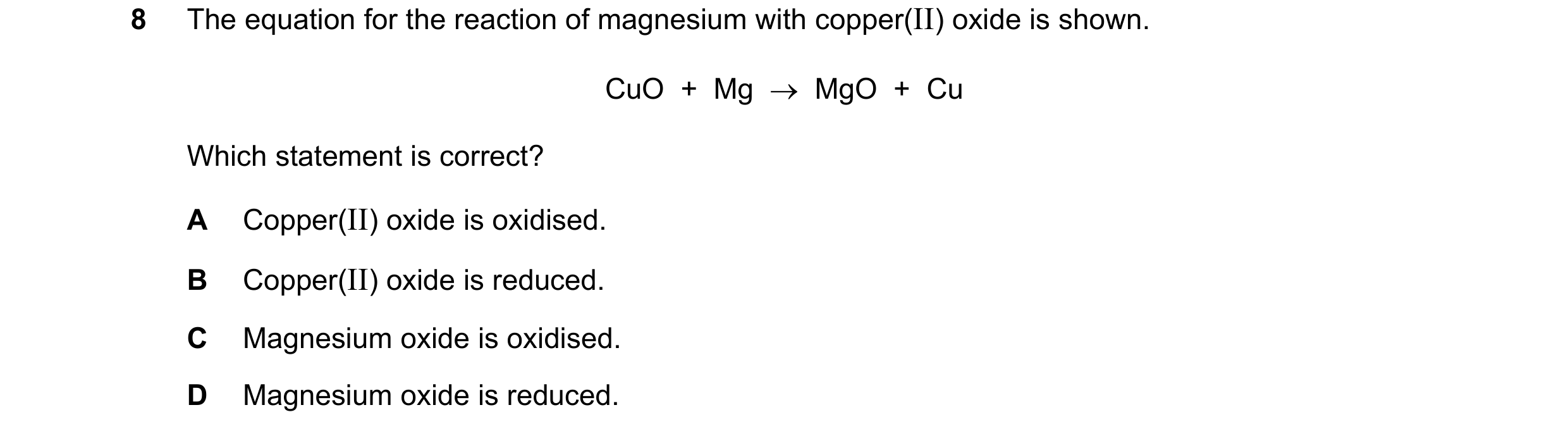
8 The equation for the reaction of magnesium with copper(II) oxide is shown. CuO + Mg → MgO + Cu Which statement is correct? A Copper(II) oxide is oxidised. B Copper(II) oxide is reduced. C Magnesium oxide is oxidised. D Magnesium oxide is reduced.
1 marks
Answer: B
This question in 0652/21 Oct/Nov 2019
Q12 · Which reaction in the extraction of iron from hematite is not a redox reaction? 0652/21 Oct/Nov 2019
14 Which reaction in the extraction of iron from hematite is not a redox reaction? A C + O2 → CO2 B C + CO2 → 2CO C CaCO3 → CaO + CO2 D Fe2O3 + 3CO → 2Fe + 3CO2
1 marks
Answer: C
This question in 0652/21 Oct/Nov 2019
Q13 · The equation for the reaction of magnesium with copper(II) oxide is shown 0652/22 Oct/Nov 2019
8 The equation for the reaction of magnesium with copper(II) oxide is shown. CuO + Mg → MgO + Cu Which statement is correct? A Copper(II) oxide is oxidised. B Copper(II) oxide is reduced. C Magnesium oxide is oxidised. D Magnesium oxide is reduced.
1 marks
Answer: B
This question in 0652/22 Oct/Nov 2019
Q14 · Which reaction in the extraction of iron from hematite is not a redox reaction? 0652/22 Oct/Nov 2019
14 Which reaction in the extraction of iron from hematite is not a redox reaction? A C + O2 → CO2 B C + CO2 → 2CO C CaCO3 → CaO + CO2 D Fe2O3 + 3CO → 2Fe + 3CO2
1 marks
Answer: C
This question in 0652/22 Oct/Nov 2019
Q15 · Word equations for two reactions are shown 0652/21 Oct/Nov 2020
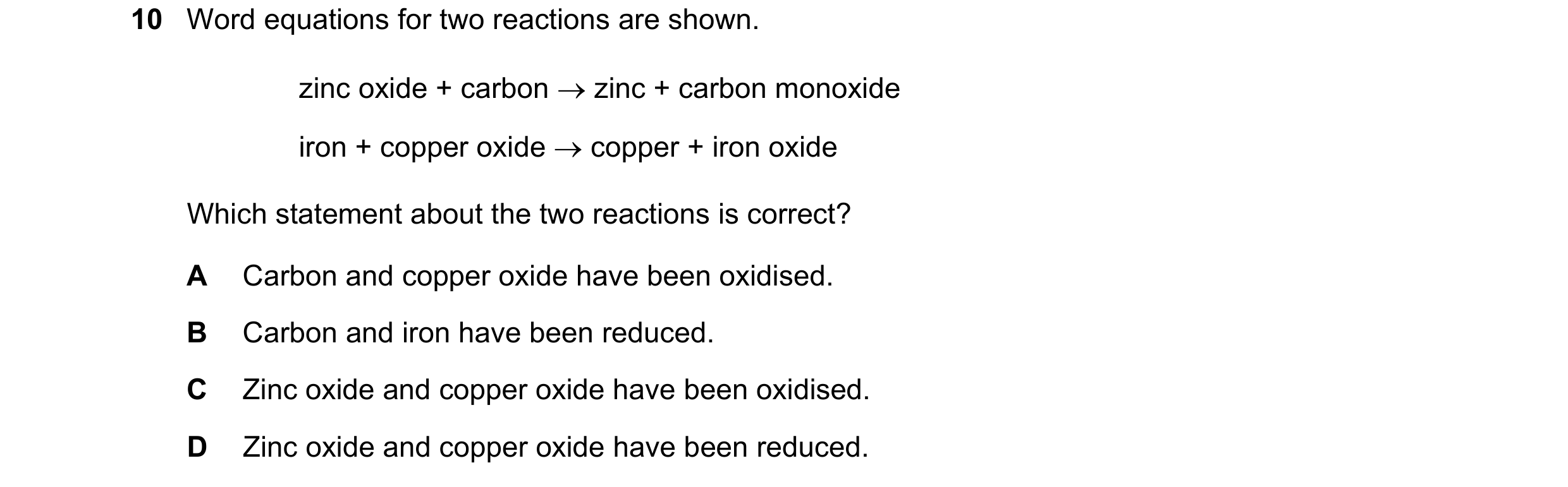
10 Word equations for two reactions are shown. zinc oxide + carbon zinc + carbon monoxide iron + copper oxide copper + iron oxide Which statement about the two reactions is correct? A Carbon and copper oxide have been oxidised. B Carbon and iron have been reduced. C Zinc oxide and copper oxide have been oxidised. D Zinc oxide and copper oxide have been reduced.
1 marks
Answer: D
This question in 0652/21 Oct/Nov 2020
Q16 · Iron is produced from iron oxide using a redox reaction 0652/21 Oct/Nov 2020
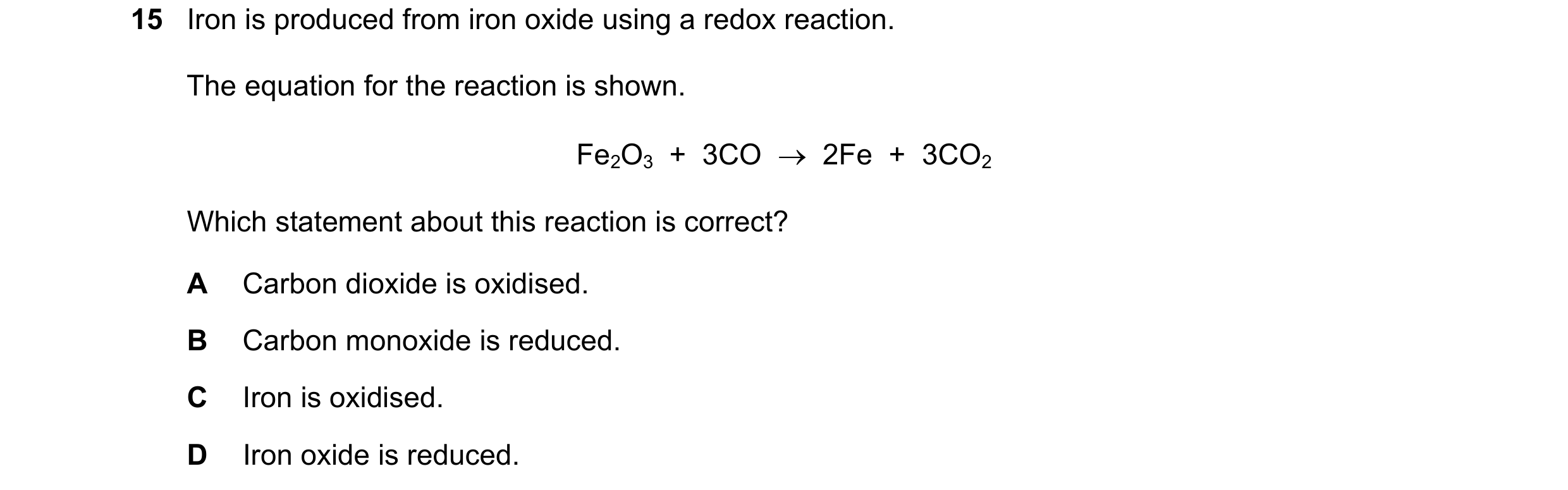
15 Iron is produced from iron oxide using a redox reaction. The equation for the reaction is shown. Fe2O3 + 3CO 2Fe + 3CO2 Which statement about this reaction is correct? A Carbon dioxide is oxidised. B Carbon monoxide is reduced. C Iron is oxidised. D Iron oxide is reduced.
1 marks
Answer: D
This question in 0652/21 Oct/Nov 2020
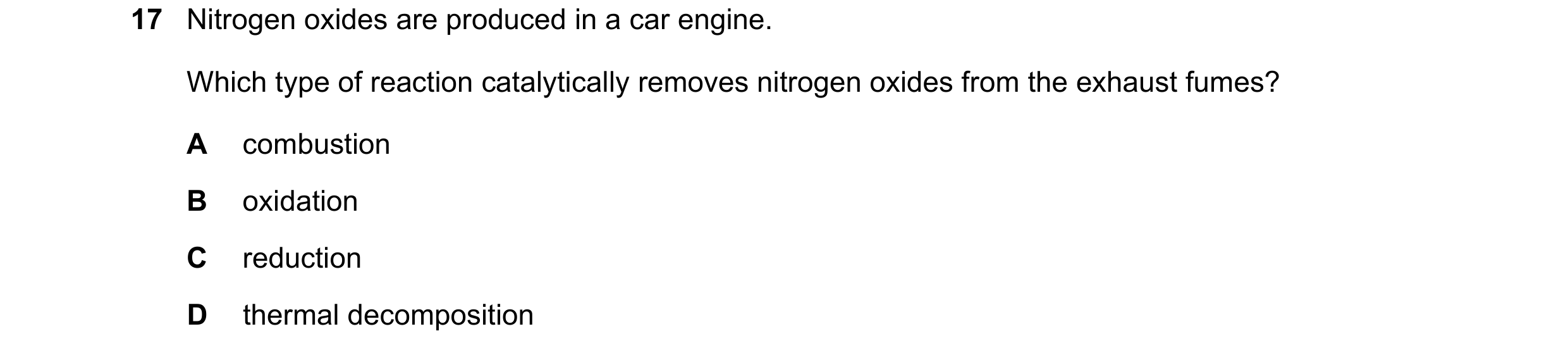
Q17 · Nitrogen oxides are produced in a car engine 0652/21 Oct/Nov 2020
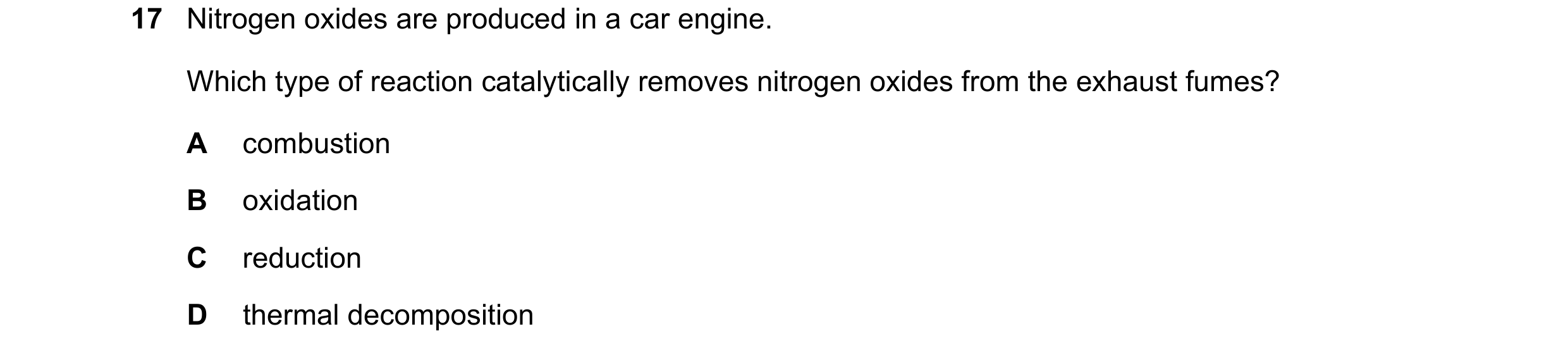
17 Nitrogen oxides are produced in a car engine. Which type of reaction catalytically removes nitrogen oxides from the exhaust fumes? A combustion B oxidation C reduction D thermal decomposition
1 marks
Answer: C
This question in 0652/21 Oct/Nov 2020
Q18 · Word equations for two reactions are shown 0652/22 Oct/Nov 2020
10 Word equations for two reactions are shown. zinc oxide + carbon zinc + carbon monoxide iron + copper oxide copper + iron oxide Which statement about the two reactions is correct? A Carbon and copper oxide have been oxidised. B Carbon and iron have been reduced. C Zinc oxide and copper oxide have been oxidised. D Zinc oxide and copper oxide have been reduced.
1 marks
Answer: D
This question in 0652/22 Oct/Nov 2020
Q19 · Nitrogen oxides are produced in a car engine 0652/22 Oct/Nov 2020
17 Nitrogen oxides are produced in a car engine. Which type of reaction catalytically removes nitrogen oxides from the exhaust fumes? A combustion B oxidation C reduction D thermal decomposition
1 marks
Answer: C
This question in 0652/22 Oct/Nov 2020
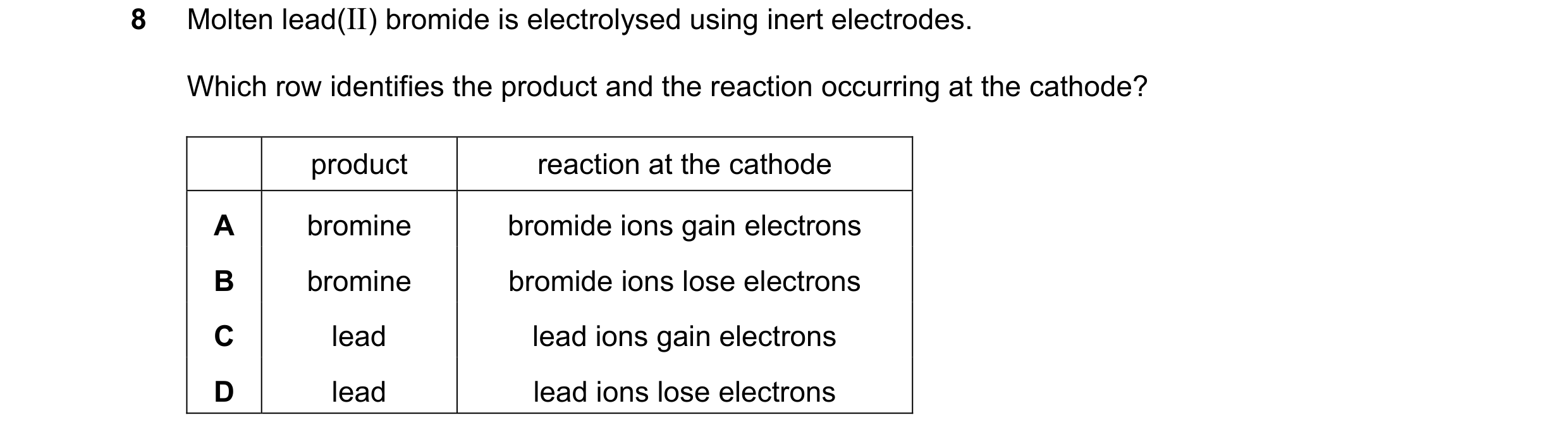
Q20 · Molten lead(II) bromide is electrolysed using inert electrodes 0652/21 Oct/Nov 2021
8 Molten lead(II) bromide is electrolysed using inert electrodes. Which row identifies the product and the reaction occurring at the cathode? product reaction at the cathode A bromine bromide ions gain electrons B bromine bromide ions lose electrons C lead lead ions gain electrons D lead lead ions lose electrons
1 marks
Answer: C
This question in 0652/21 Oct/Nov 2021
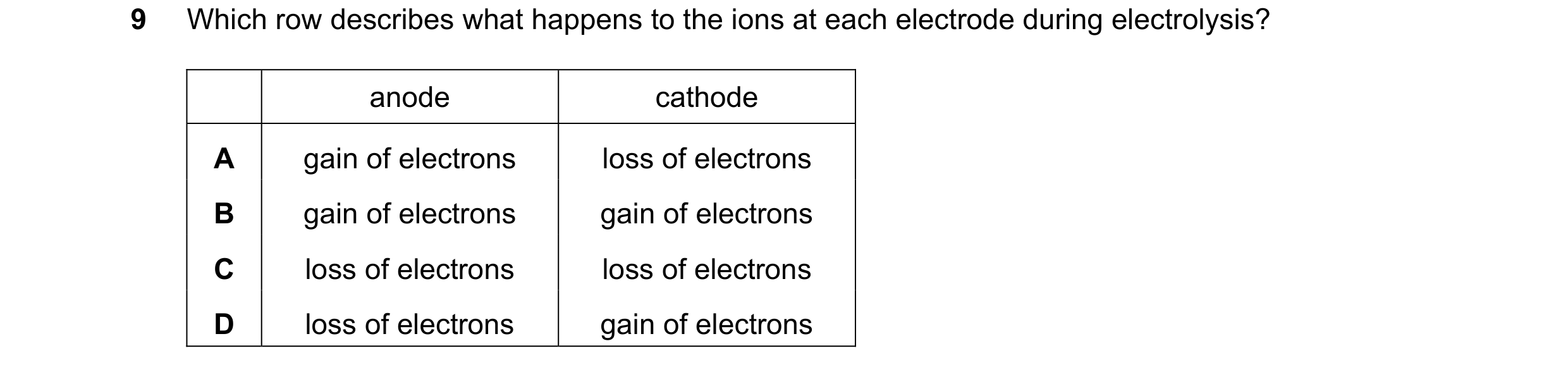
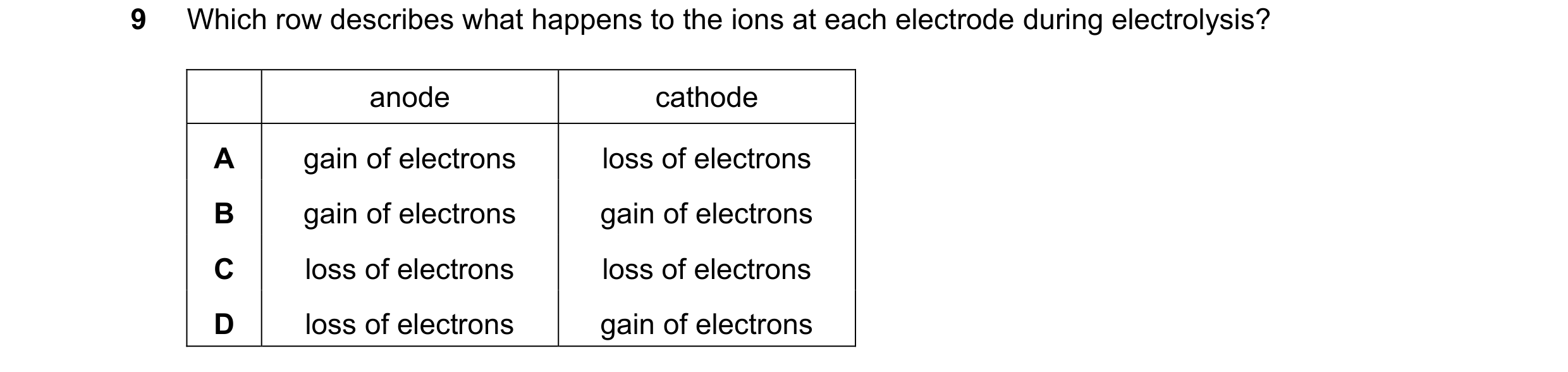
Q21 · Which row describes what happens to the ions at each electrode during electrolysis? 0652/21 Oct/Nov 2023
9 Which row describes what happens to the ions at each electrode during electrolysis? anode cathode A gain of electrons loss of electrons B gain of electrons gain of electrons C loss of electrons loss of electrons D loss of electrons gain of electrons
1 marks
Answer: D
This question in 0652/21 Oct/Nov 2023
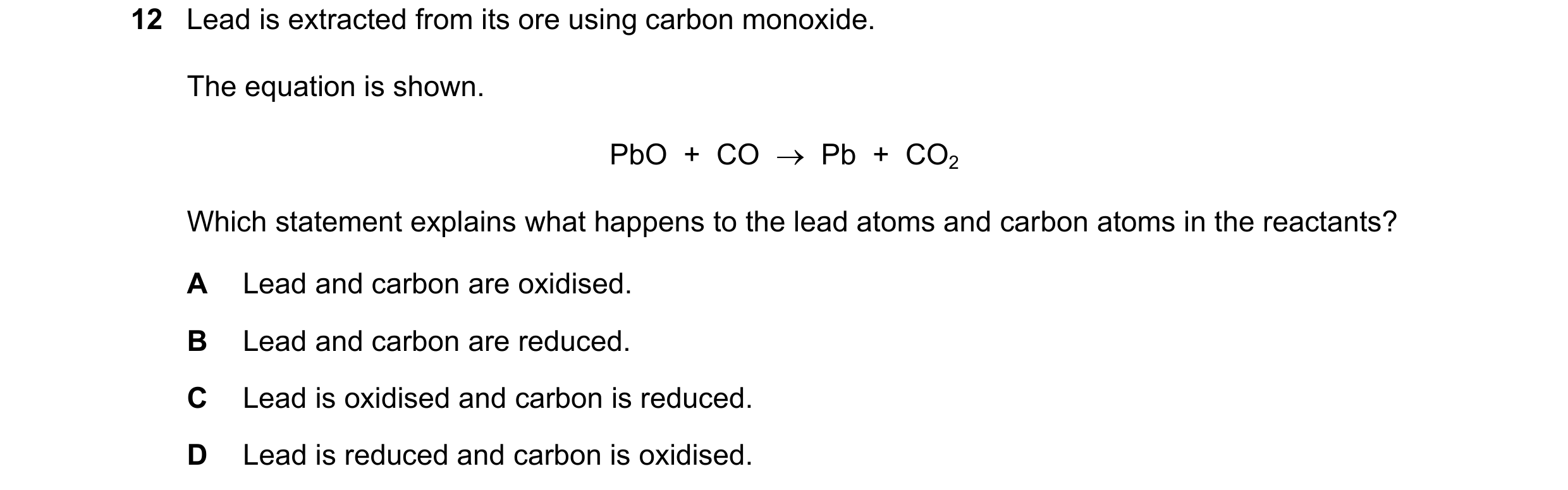
Q22 · Lead is extracted from its ore using carbon monoxide 0652/21 Oct/Nov 2023
12 Lead is extracted from its ore using carbon monoxide. The equation is shown. PbO + CO → Pb + CO2 Which statement explains what happens to the lead atoms and carbon atoms in the reactants? A Lead and carbon are oxidised. B Lead and carbon are reduced. C Lead is oxidised and carbon is reduced. D Lead is reduced and carbon is oxidised.
1 marks
Answer: D
This question in 0652/21 Oct/Nov 2023
Q23 · Which row describes what happens to the ions at each electrode during electrolysis? 0652/22 Oct/Nov 2023
9 Which row describes what happens to the ions at each electrode during electrolysis? anode cathode A gain of electrons loss of electrons B gain of electrons gain of electrons C loss of electrons loss of electrons D loss of electrons gain of electrons
1 marks
Answer: D
This question in 0652/22 Oct/Nov 2023
Q24 · Lead is extracted from its ore using carbon monoxide 0652/22 Oct/Nov 2023
12 Lead is extracted from its ore using carbon monoxide. The equation is shown. PbO + CO Pb + CO2 Which statement explains what happens to the lead atoms and carbon atoms in the reactants? A Lead and carbon are oxidised. B Lead and carbon are reduced. C Lead is oxidised and carbon is reduced. D Lead is reduced and carbon is oxidised.
1 marks
Answer: D
This question in 0652/22 Oct/Nov 2023
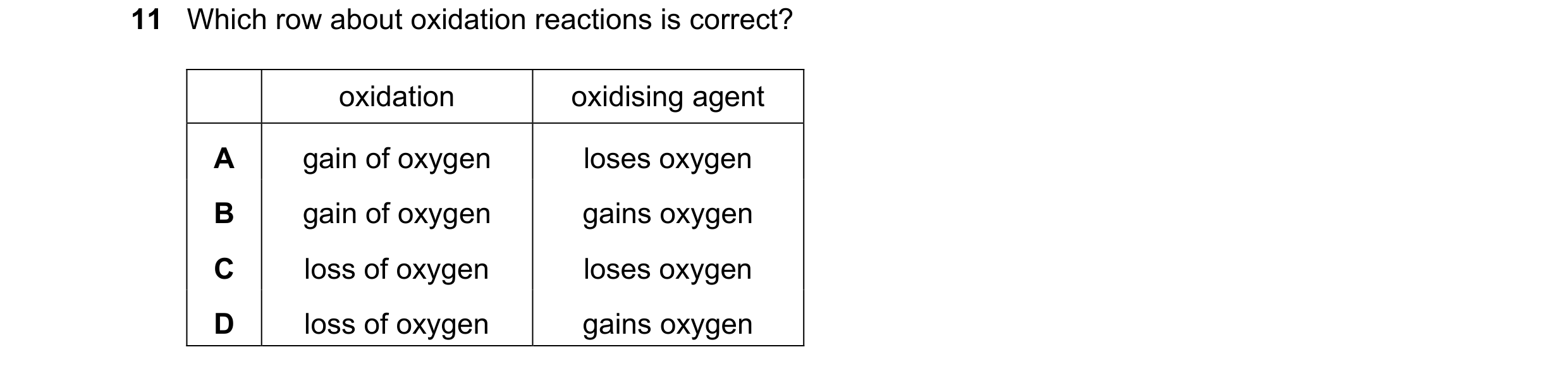
Q25 · Which row about oxidation reactions is correct? 0652/21 Oct/Nov 2024
11 Which row about oxidation reactions is correct? oxidation oxidising agent A gain of oxygen loses oxygen B gain of oxygen gains oxygen C loss of oxygen loses oxygen D loss of oxygen gains oxygen
1 marks
Answer: A
This question in 0652/21 Oct/Nov 2024

 1 / 6
1 / 6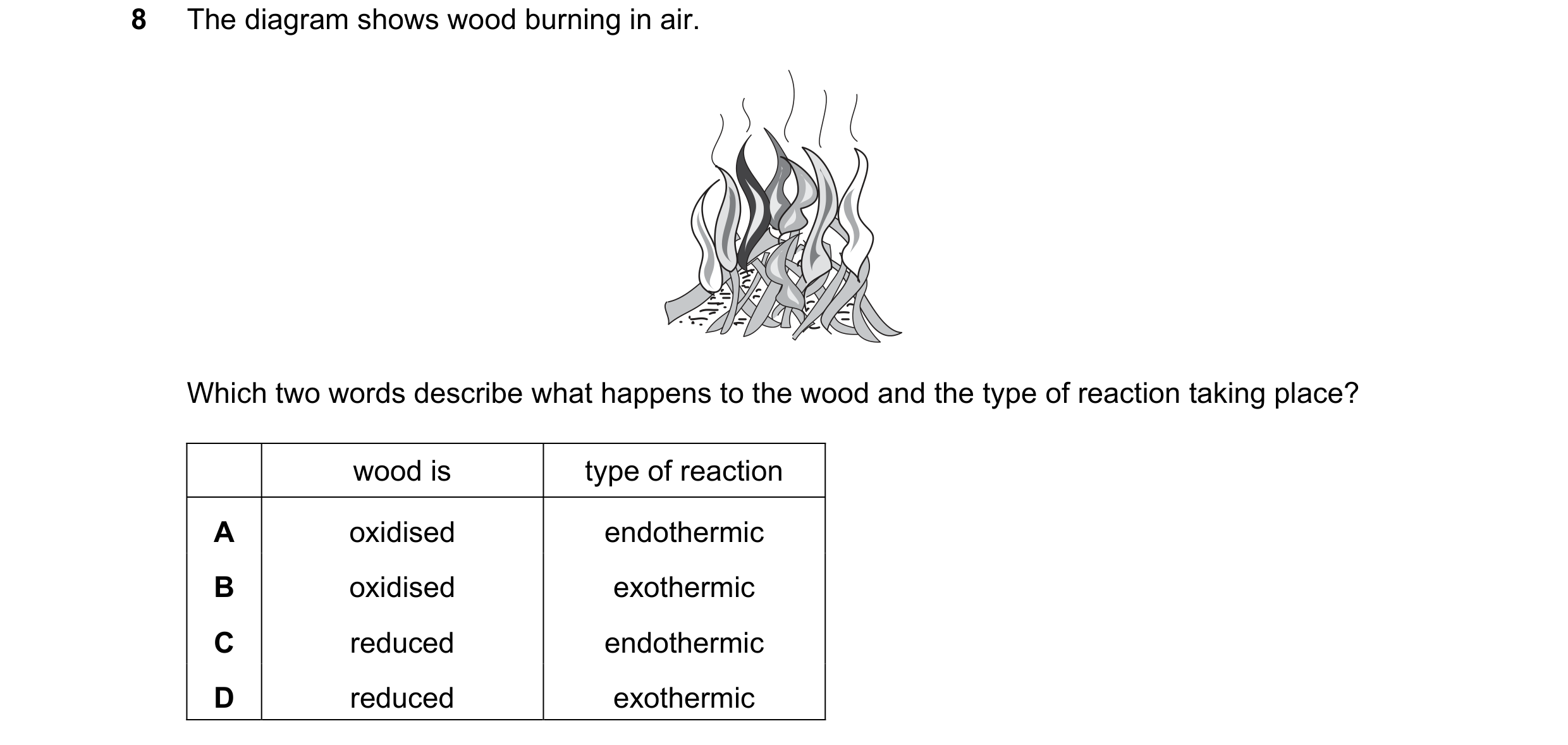

 2 / 6
2 / 6

 3 / 6
3 / 6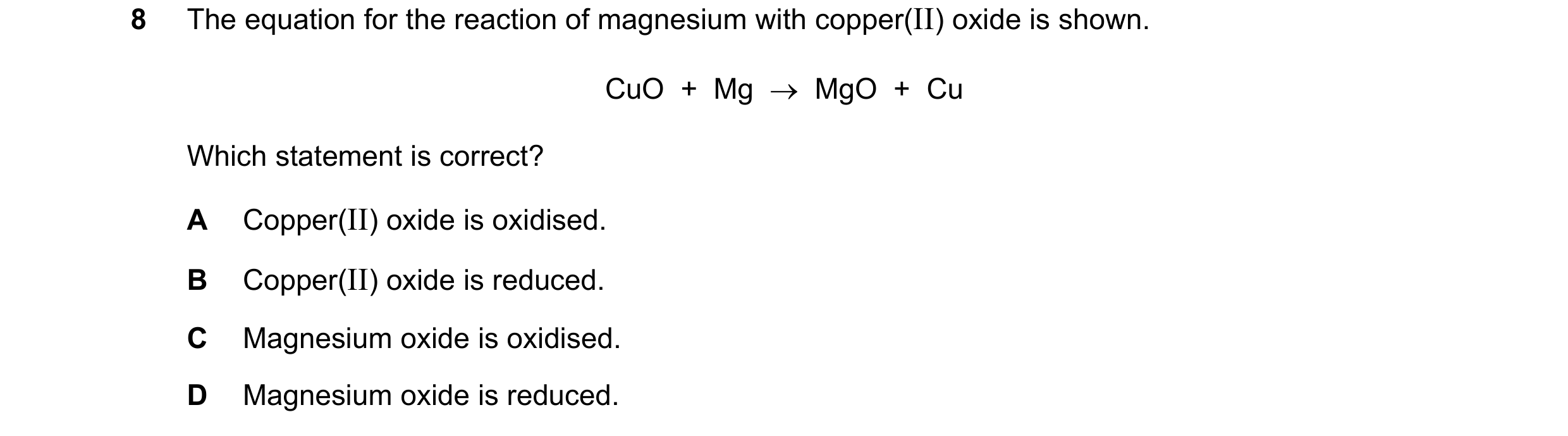

 4 / 6
4 / 6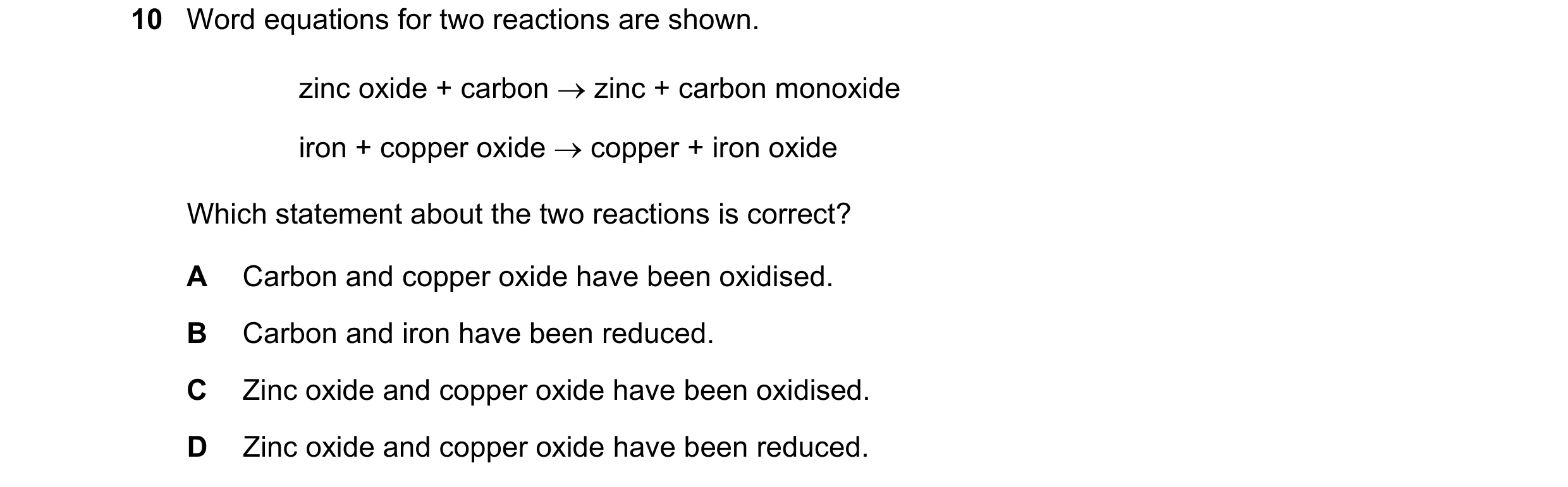
 5 / 6
5 / 6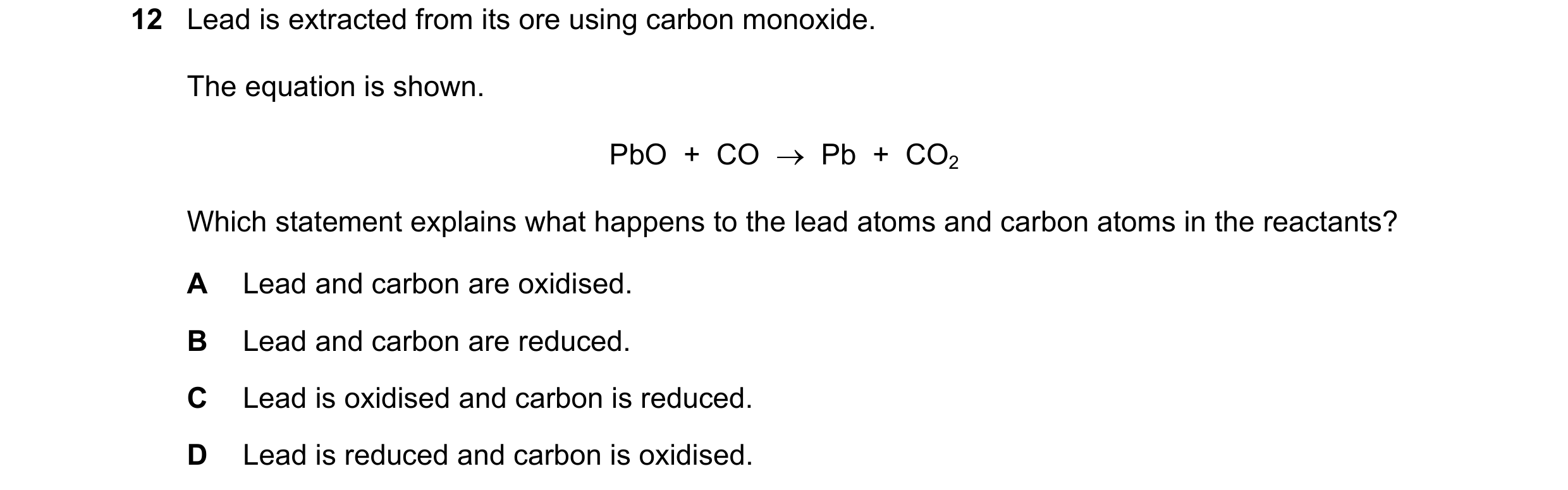
 6 / 6
6 / 6