Questions as text
Q1 · Which statement explains why graphite conducts electricity? 0652/21 Oct/Nov 2017
4 Which statement explains why graphite conducts electricity? A All of the electrons in graphite are free to move through its structure. B Each carbon atom has three covalent bonds and one electron free to move through the structure. C Graphite is a metal and the outer shell electrons are free to move. D The electrons in the covalent bonds are free to move through the structure.
1 marks
Answer: B
This question in 0652/21 Oct/Nov 2017
Q2 · Which statement explains why graphite conducts electricity? 0652/22 Oct/Nov 2017
4 Which statement explains why graphite conducts electricity? A All of the electrons in graphite are free to move through its structure. B Each carbon atom has three covalent bonds and one electron free to move through the structure. C Graphite is a metal and the outer shell electrons are free to move. D The electrons in the covalent bonds are free to move through the structure.
1 marks
Answer: B
This question in 0652/22 Oct/Nov 2017
Q3 · Which statement about the properties and structures of diamond and graphite is correct? 0652/21 Oct/Nov 2018
5 Which statement about the properties and structures of diamond and graphite is correct? A Diamond has a high melting point as it has a giant structure with each carbon atom connected to three others. B Diamond is a good conductor of electricity as it has a large number of shared pairs of electrons. C Graphite has a low melting point as it has a layered structure with weak bonds between the layers. D Graphite is a good conductor of electricity as it has delocalised electrons between layers.
1 marks
Answer: D
This question in 0652/21 Oct/Nov 2018
Q4 · Which statement about the properties and structures of diamond and graphite is correct? 0652/22 Oct/Nov 2018
5 Which statement about the properties and structures of diamond and graphite is correct? A Diamond has a high melting point as it has a giant structure with each carbon atom connected to three others. B Diamond is a good conductor of electricity as it has a large number of shared pairs of electrons. C Graphite has a low melting point as it has a layered structure with weak bonds between the layers. D Graphite is a good conductor of electricity as it has delocalised electrons between layers.
1 marks
Answer: D
This question in 0652/22 Oct/Nov 2018
Q5 · Diamond and graphite are both forms of the element carbon 0652/21 Oct/Nov 2019
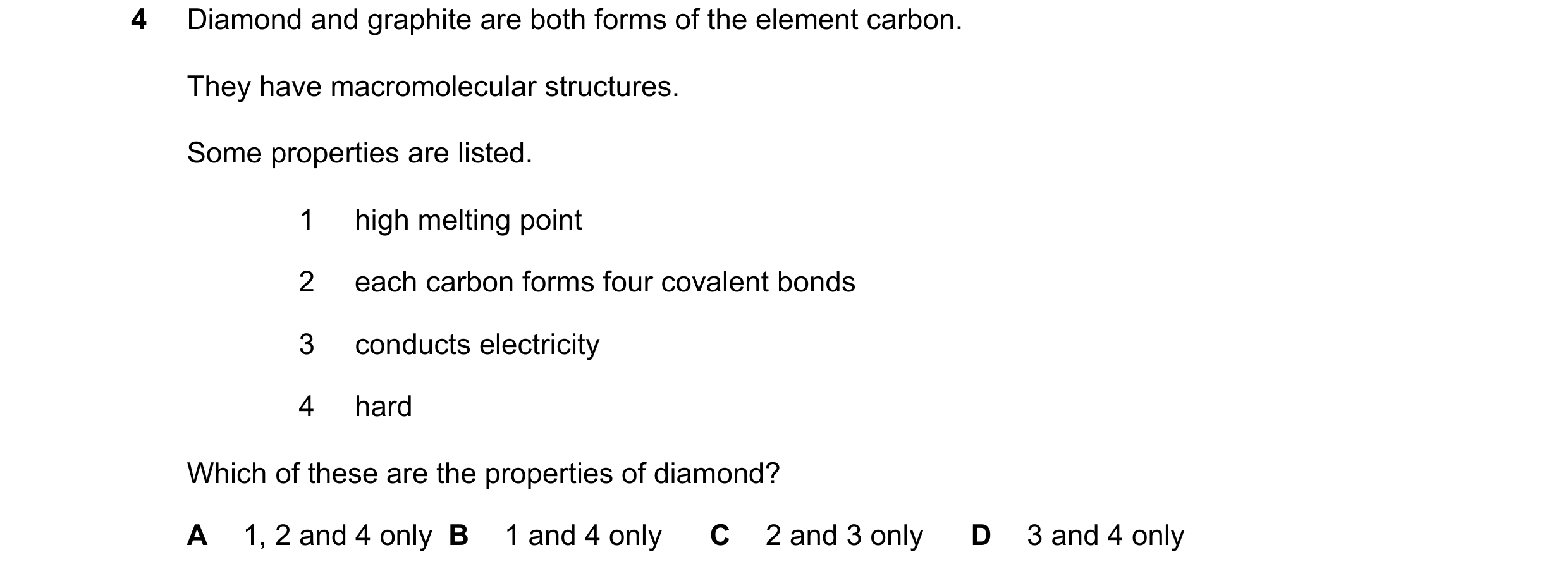
4 Diamond and graphite are both forms of the element carbon. They have macromolecular structures. Some properties are listed. 1 high melting point 2 each carbon forms four covalent bonds 3 conducts electricity 4 hard Which of these are the properties of diamond? A 1, 2 and 4 only B 1 and 4 only C 2 and 3 only D 3 and 4 only
1 marks
Answer: A
This question in 0652/21 Oct/Nov 2019
Q6 · Diamond and graphite are both forms of the element carbon 0652/22 Oct/Nov 2019
4 Diamond and graphite are both forms of the element carbon. They have macromolecular structures. Some properties are listed. 1 high melting point 2 each carbon forms four covalent bonds 3 conducts electricity 4 hard Which of these are the properties of diamond? A 1, 2 and 4 only B 1 and 4 only C 2 and 3 only D 3 and 4 only
1 marks
Answer: A
This question in 0652/22 Oct/Nov 2019
Q7 · Which statement explains why graphite is a good conductor of electricity? 0652/22 Oct/Nov 2020
5 Which statement explains why graphite is a good conductor of electricity? A It has moving electrons. B It has moving ions. C It has strong bonds within its layers of atoms. D It has weak bonds between its layers of atoms.
1 marks
Answer: A
This question in 0652/22 Oct/Nov 2020
Q8 · Two structures X and Y are shown 0652/21 Oct/Nov 2021
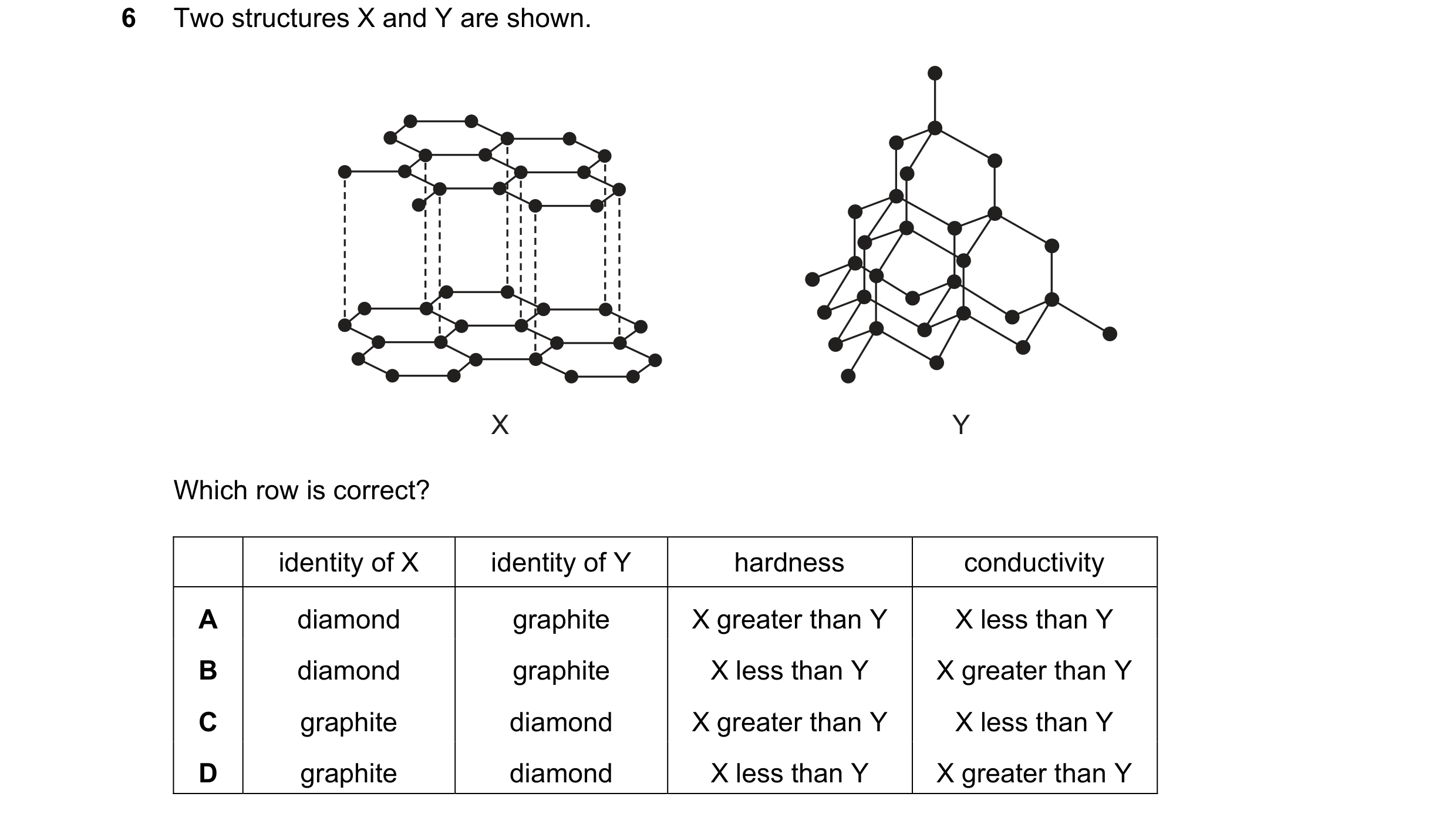
6 Two structures X and Y are shown. X Y Which row is correct? identity of X identity of Y hardness conductivity A diamond graphite X greater than Y X less than Y B diamond graphite X less than Y X greater than Y C graphite diamond X greater than Y X less than Y D graphite diamond X less than Y X greater than Y
1 marks
Answer: D
This question in 0652/21 Oct/Nov 2021
Q9 · Silicon(IV) oxide has a giant covalent structure, very similar to the structure of diamond 0652/21 Oct/Nov 2022
5 Silicon(IV) oxide has a giant covalent structure, very similar to the structure of diamond. Silicon(IV) oxide is a very hard substance with a high melting point and does not conduct electricity, just like diamond. Which statement about the structure of silicon(IV) oxide is correct? A All the covalent bonds between silicon atoms and oxygen atoms are in the same plane. B No outer shell electrons from silicon atoms or oxygen atoms are free to move. C Layers of silicon atoms and oxygen atoms can slide over one another. D There are weak forces of attraction between atoms of silicon and atoms of oxygen.
1 marks
Answer: B
This question in 0652/21 Oct/Nov 2022
Q10 · Silicon(IV) oxide has a giant covalent structure, very similar to the structure of diamond 0652/22 Oct/Nov 2022
5 Silicon(IV) oxide has a giant covalent structure, very similar to the structure of diamond. Silicon(IV) oxide is a very hard substance with a high melting point and does not conduct electricity, just like diamond. Which statement about the structure of silicon(IV) oxide is correct? A All the covalent bonds between silicon atoms and oxygen atoms are in the same plane. B No outer shell electrons from silicon atoms or oxygen atoms are free to move. C Layers of silicon atoms and oxygen atoms can slide over one another. D There are weak forces of attraction between atoms of silicon and atoms of oxygen.
1 marks
Answer: B
This question in 0652/22 Oct/Nov 2022
Q11 · Three statements about diamond and graphite are listed 0652/21 Oct/Nov 2023
6 Three statements about diamond and graphite are listed. 1 They are different solid forms of the same element. 2 They each conduct electricity. 3 They have atoms that form four equally strong bonds. Which statements are correct? A 1 and 3 B 1 only C 2 and 3 D 3 only
1 marks
Answer: B
This question in 0652/21 Oct/Nov 2023
Q12 · Three statements about diamond and graphite are listed 0652/22 Oct/Nov 2023
6 Three statements about diamond and graphite are listed. 1 They are different solid forms of the same element. 2 They each conduct electricity. 3 They have atoms that form four equally strong bonds. Which statements are correct? A 1 and 3 B 1 only C 2 and 3 D 3 only
1 marks
Answer: B
This question in 0652/22 Oct/Nov 2023
Q13 · Which statement about the structure of diamond is correct? 0652/21 Oct/Nov 2024
7 Which statement about the structure of diamond is correct? A Each atom has only three covalent bonds. B Electrons in the structure are free to move. C It is made up of layers of atoms. D It is tetrahedral.
1 marks
Answer: D
This question in 0652/21 Oct/Nov 2024
 1 / 3
1 / 3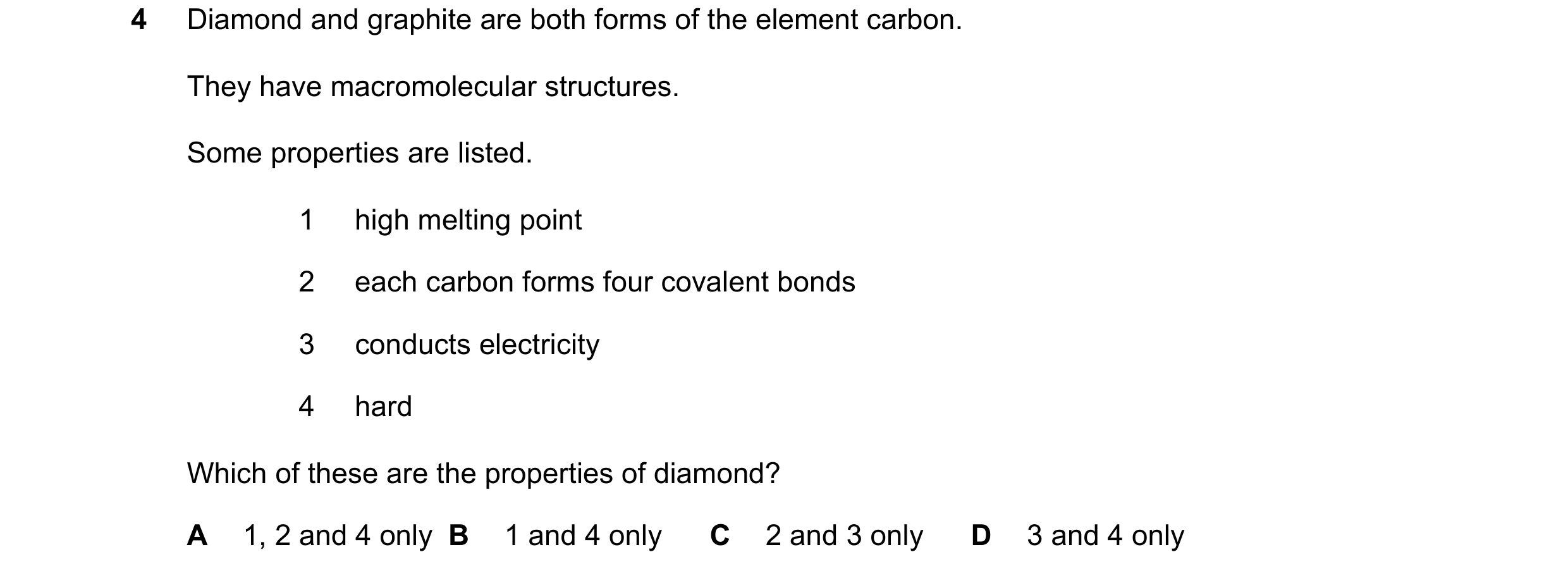

 2 / 3
2 / 3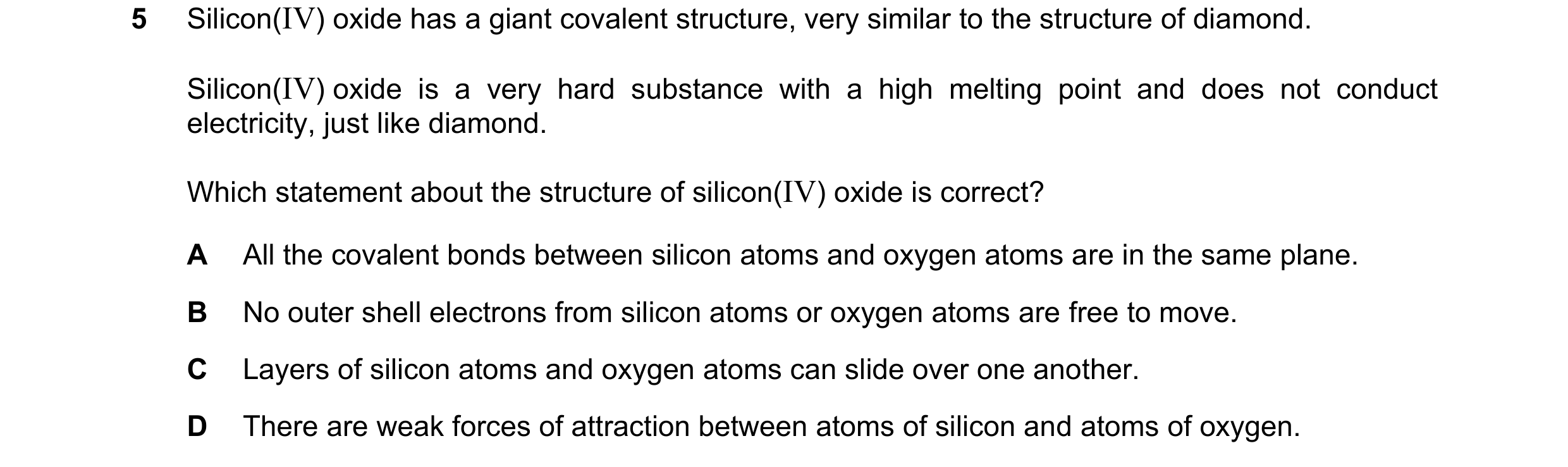


 3 / 3
3 / 3