Questions as text
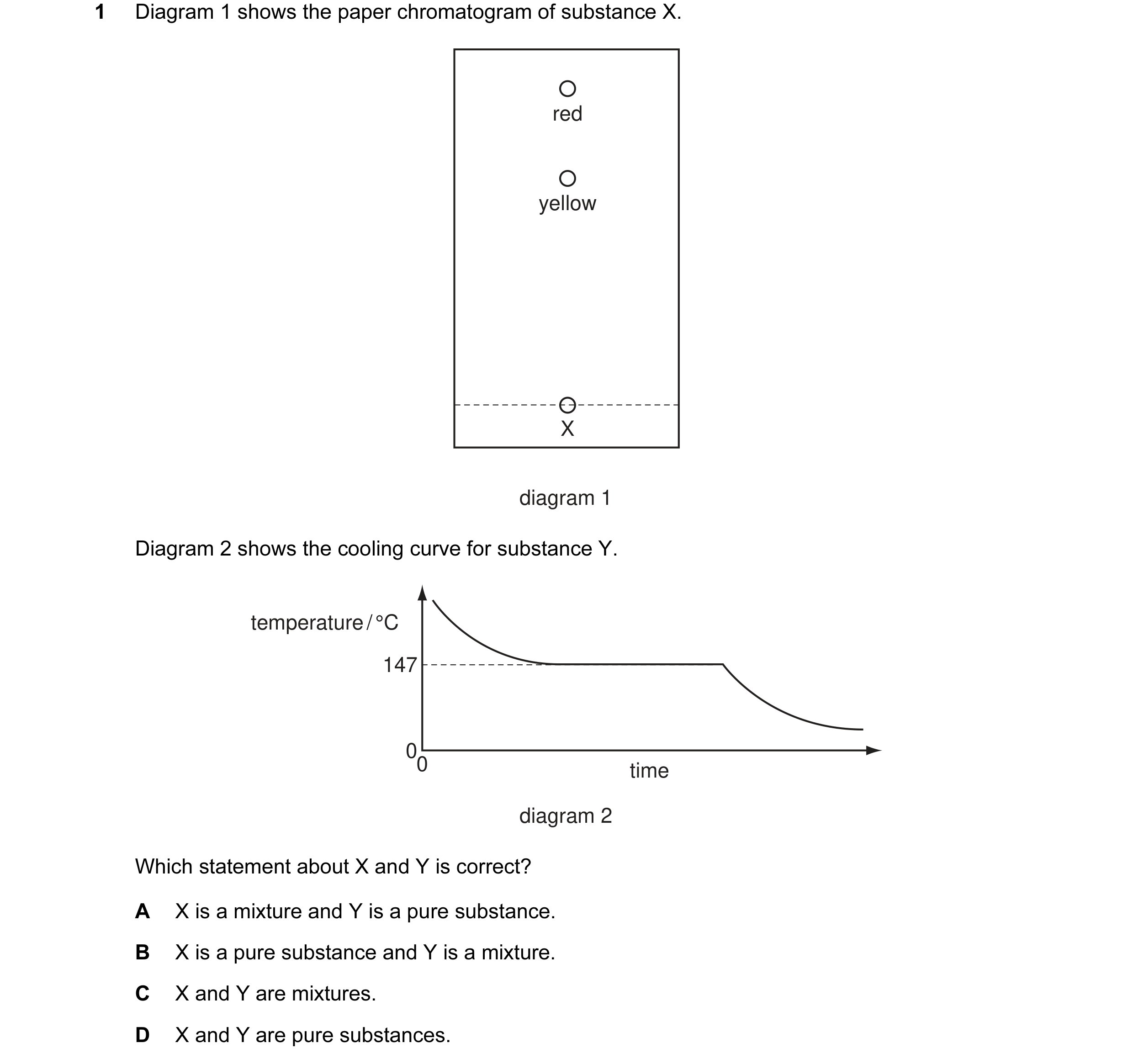
Q1 · The paper chromatogram of substance X 0652/11 Oct/Nov 2008
1 Diagram 1 shows the paper chromatogram of substance X. red yellow X diagram 1 Diagram 2 shows the cooling curve for substance Y. temperature / °C 147 0 0 time diagram 2 Which statement about X and Y is correct? A X is a mixture and Y is a pure substance. B X is a pure substance and Y is a mixture. C X and Y are mixtures. D X and Y are pure substances.
1 marks
Answer: A
This question in 0652/11 Oct/Nov 2008
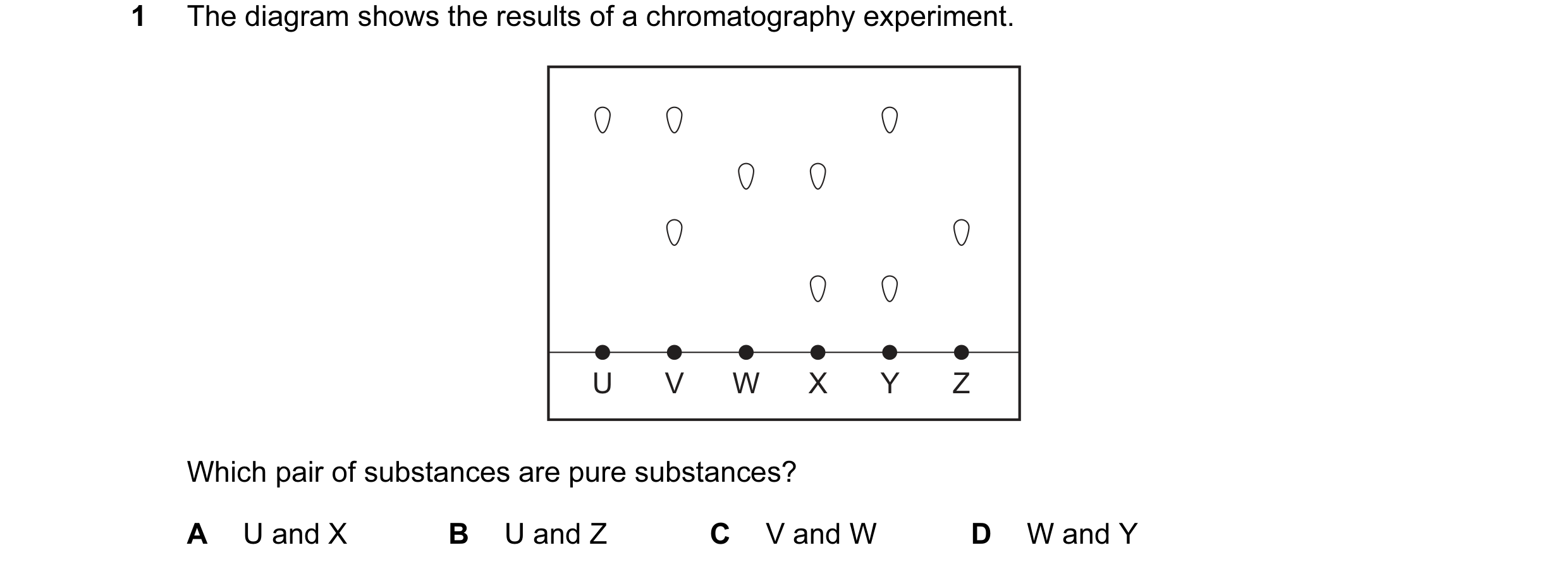
Q2 · The diagram shows the results of a chromatography experiment 0652/11 Oct/Nov 2013
1 The diagram shows the results of a chromatography experiment. U V W X Y Z Which pair of substances are pure substances? A U and X B U and Z C V and W D W and Y
1 marks
Answer: B
This question in 0652/11 Oct/Nov 2013
Q3 · The diagram shows the results of a chromatography experiment 0652/12 Oct/Nov 2013
1 The diagram shows the results of a chromatography experiment. U V W X Y Z Which pair of substances are pure substances? A U and X B U and Z C V and W D W and Y
1 marks
Answer: B
This question in 0652/12 Oct/Nov 2013
Q4 · A substance was heated until it completely melted 0652/11 Oct/Nov 2014
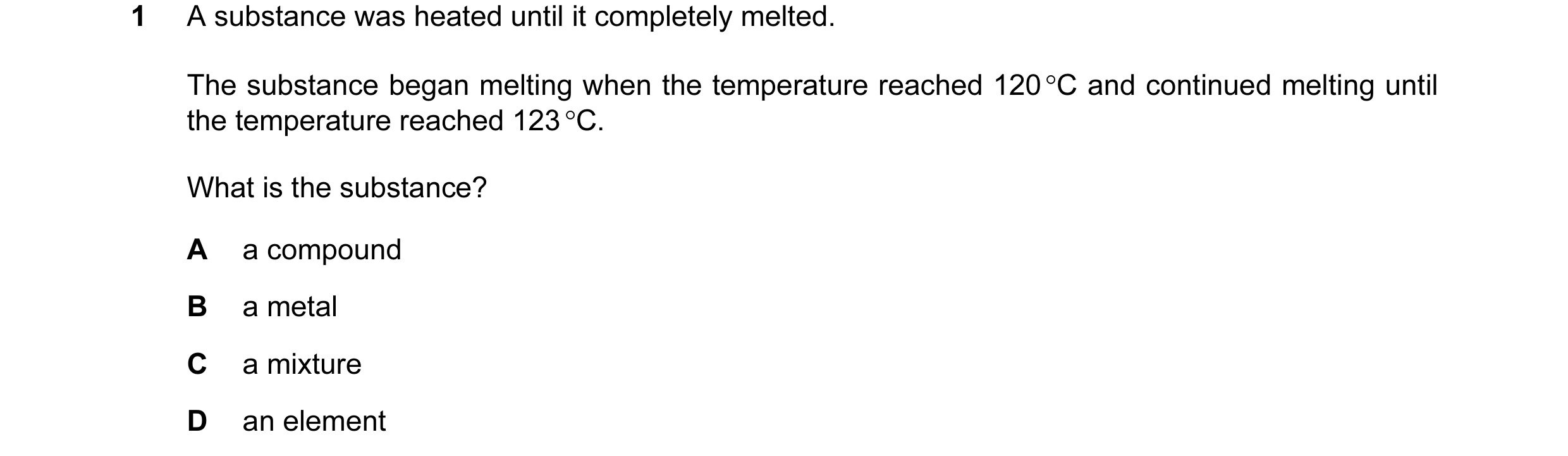
1 A substance was heated until it completely melted. The substance began melting when the temperature reached 120 °C and continued melting until the temperature reached 123 °C. What is the substance? A a compound B a metal C a mixture D an element
1 marks
Answer: C
This question in 0652/11 Oct/Nov 2014
Q5 · A substance was heated until it completely melted 0652/12 Oct/Nov 2014
1 A substance was heated until it completely melted. The substance began melting when the temperature reached 120 °C and continued melting until the temperature reached 123 °C. What is the substance? A a compound B a metal C a mixture D an element
1 marks
Answer: C
This question in 0652/12 Oct/Nov 2014
Q6 · A bottle of a solid is labelled as shown 0652/11 Oct/Nov 2016
3 A bottle of a solid is labelled as shown. CITRIC ACID (anhydrous) melting point: 153 °C The melting point of a sample from the bottle is measured. The sample melts over a temperature range from 140 °C to 150 °C. Which statement explains this observation? A The sample contains a mixture of citric acid and other solids. B The sample is too large. C The sample has a pH less than 7. D The sample is too small.
1 marks
Answer: A
This question in 0652/11 Oct/Nov 2016
Q7 · The chromatogram of black ink and three coloured dyes, X, Y and Z, is shown 0652/12 Oct/Nov 2016
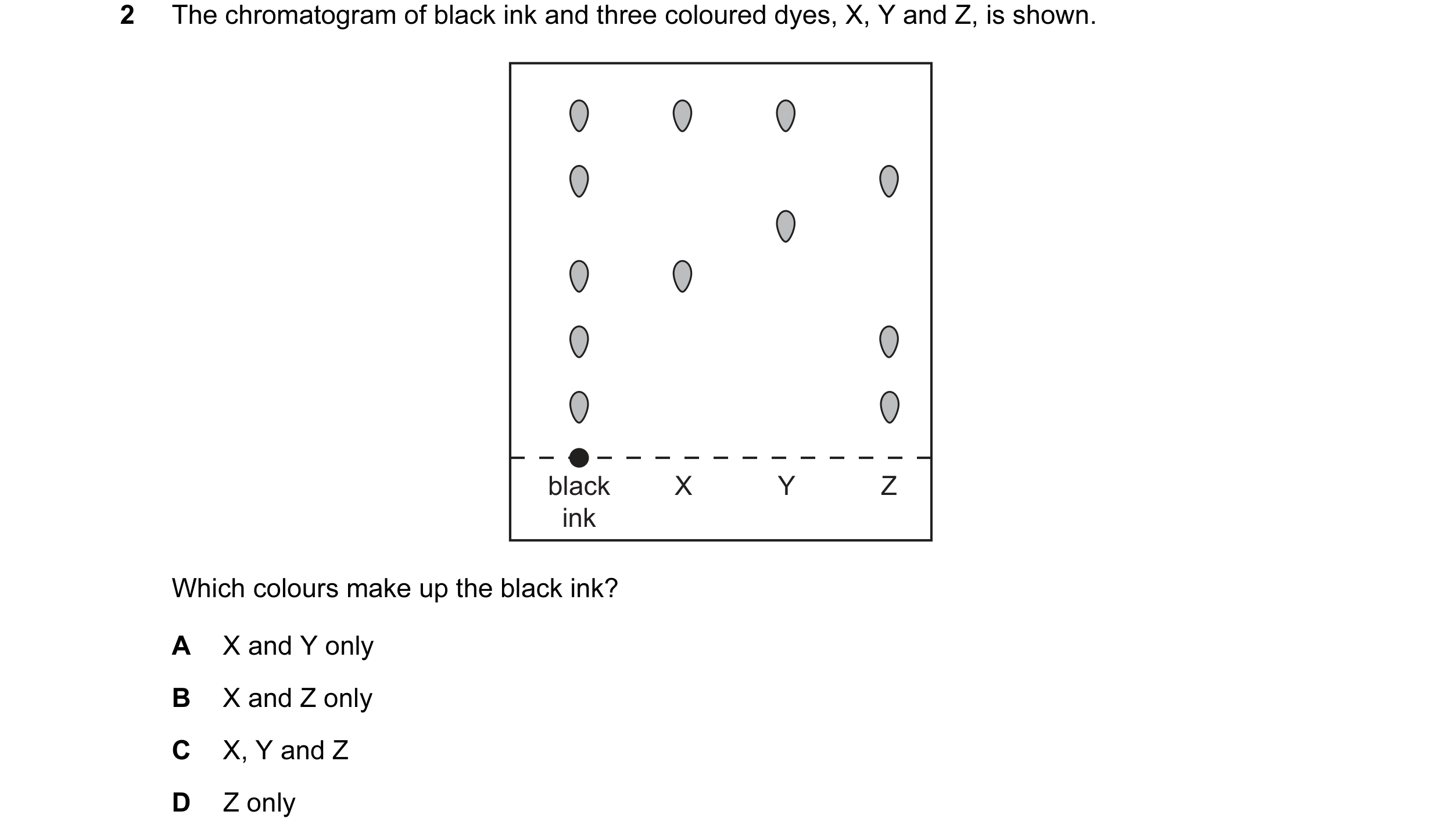
2 The chromatogram of black ink and three coloured dyes, X, Y and Z, is shown. black X Y Z ink Which colours make up the black ink? A X and Y only B X and Z only C X, Y and Z D Z only
1 marks
Answer: B
This question in 0652/12 Oct/Nov 2016
Q8 · A bottle of a solid is labelled as shown 0652/12 Oct/Nov 2016
3 A bottle of a solid is labelled as shown. CITRIC ACID (anhydrous) melting point: 153 °C The melting point of a sample from the bottle is measured. The sample melts over a temperature range from 140 °C to 150 °C. Which statement explains this observation? A The sample contains a mixture of citric acid and other solids. B The sample is too large. C The sample has a pH less than 7. D The sample is too small.
1 marks
Answer: A
This question in 0652/12 Oct/Nov 2016
Q9 · The diagram shows a chromatogram of several different inks 0652/12 Oct/Nov 2019
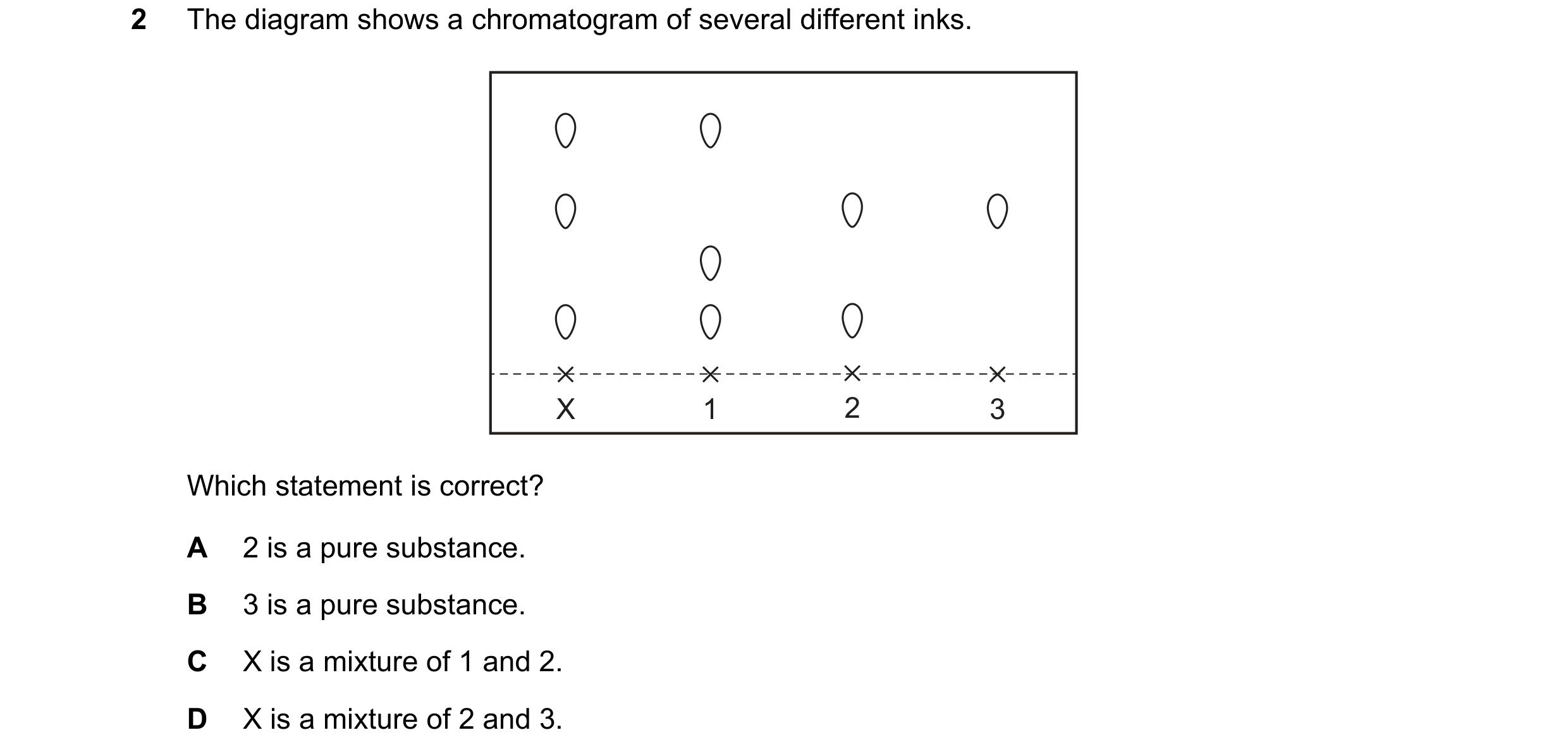
2 The diagram shows a chromatogram of several different inks. X 1 2 3 Which statement is correct? A 2 is a pure substance. B 3 is a pure substance. C X is a mixture of 1 and 2. D X is a mixture of 2 and 3.
1 marks
Answer: B
This question in 0652/12 Oct/Nov 2019
Q10 · A bottle of a solid is labelled as shown 0652/11 Oct/Nov 2020
2 A bottle of a solid is labelled as shown. CITRIC ACID (anhydrous) melting point: 153 C The melting point of a sample from the bottle is measured. The sample melts over a temperature range from 140 C to 150 C. Which statement explains this observation? A The sample contains a mixture of citric acid and other solids. B The sample is too large. C The sample has a pH less than 7. D The sample is too small.
1 marks
Answer: A
This question in 0652/11 Oct/Nov 2020
Q11 · The chromatogram of a black ink and three coloured dyes, X, Y and Z, is shown 0652/11 Oct/Nov 2022
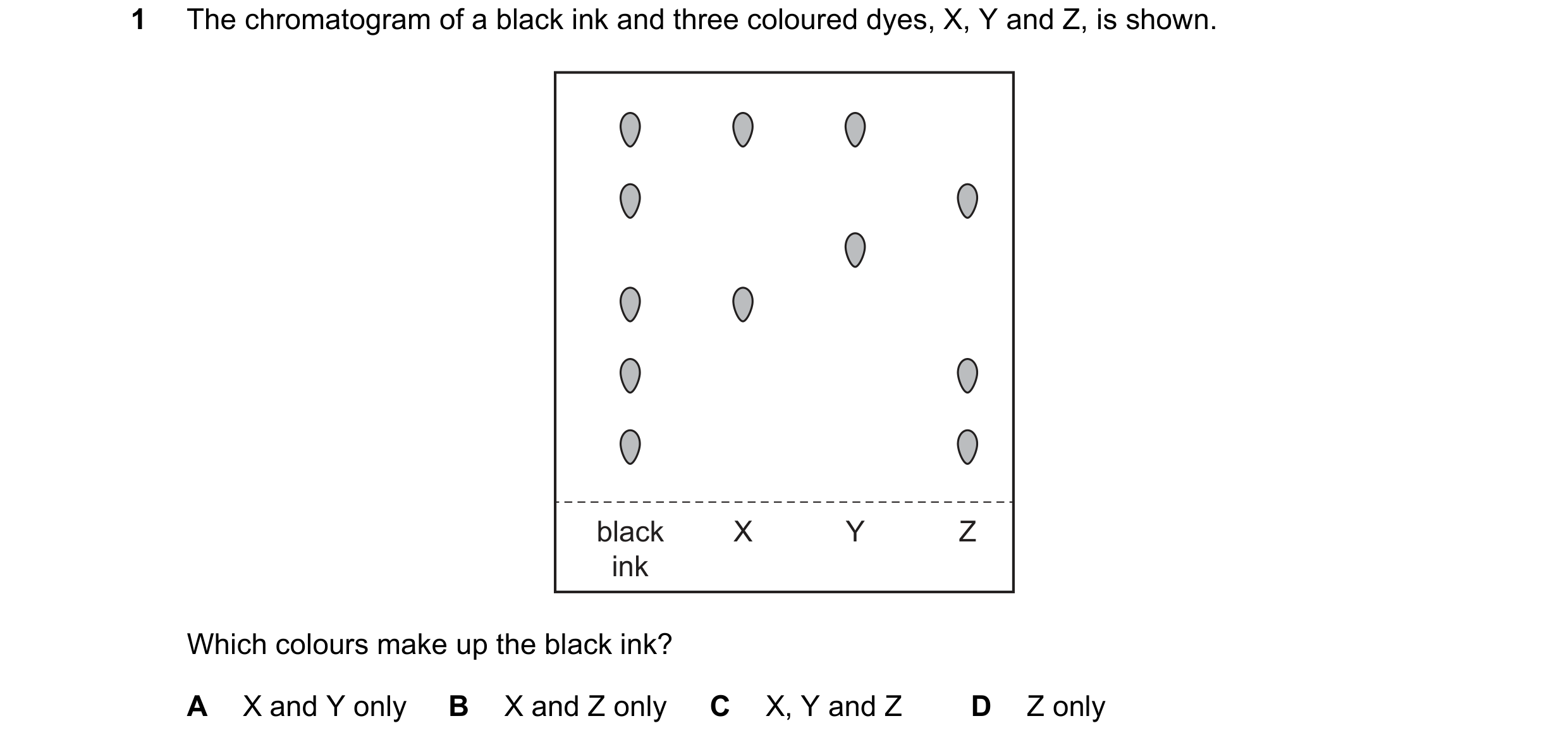
1 The chromatogram of a black ink and three coloured dyes, X, Y and Z, is shown. black X Y Z ink Which colours make up the black ink? A X and Y only B X and Z only C X, Y and Z D Z only
1 marks
Answer: B
This question in 0652/11 Oct/Nov 2022
 1 / 5
1 / 5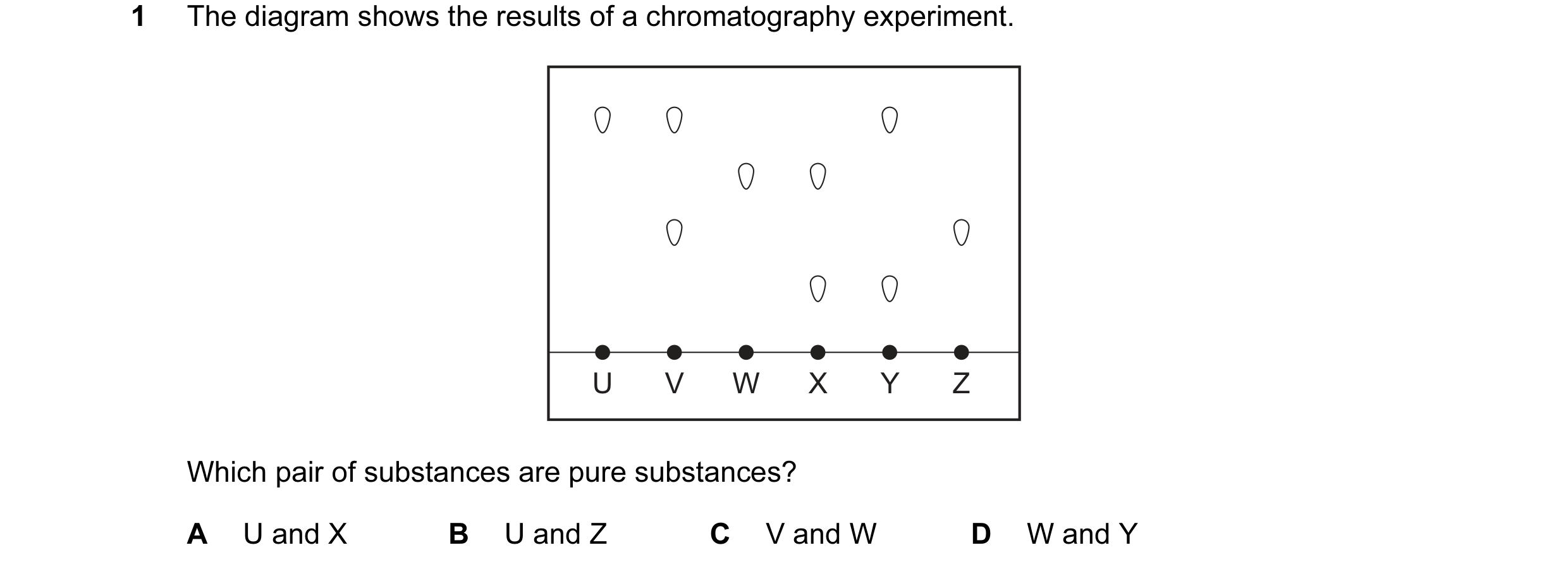
 2 / 5
2 / 5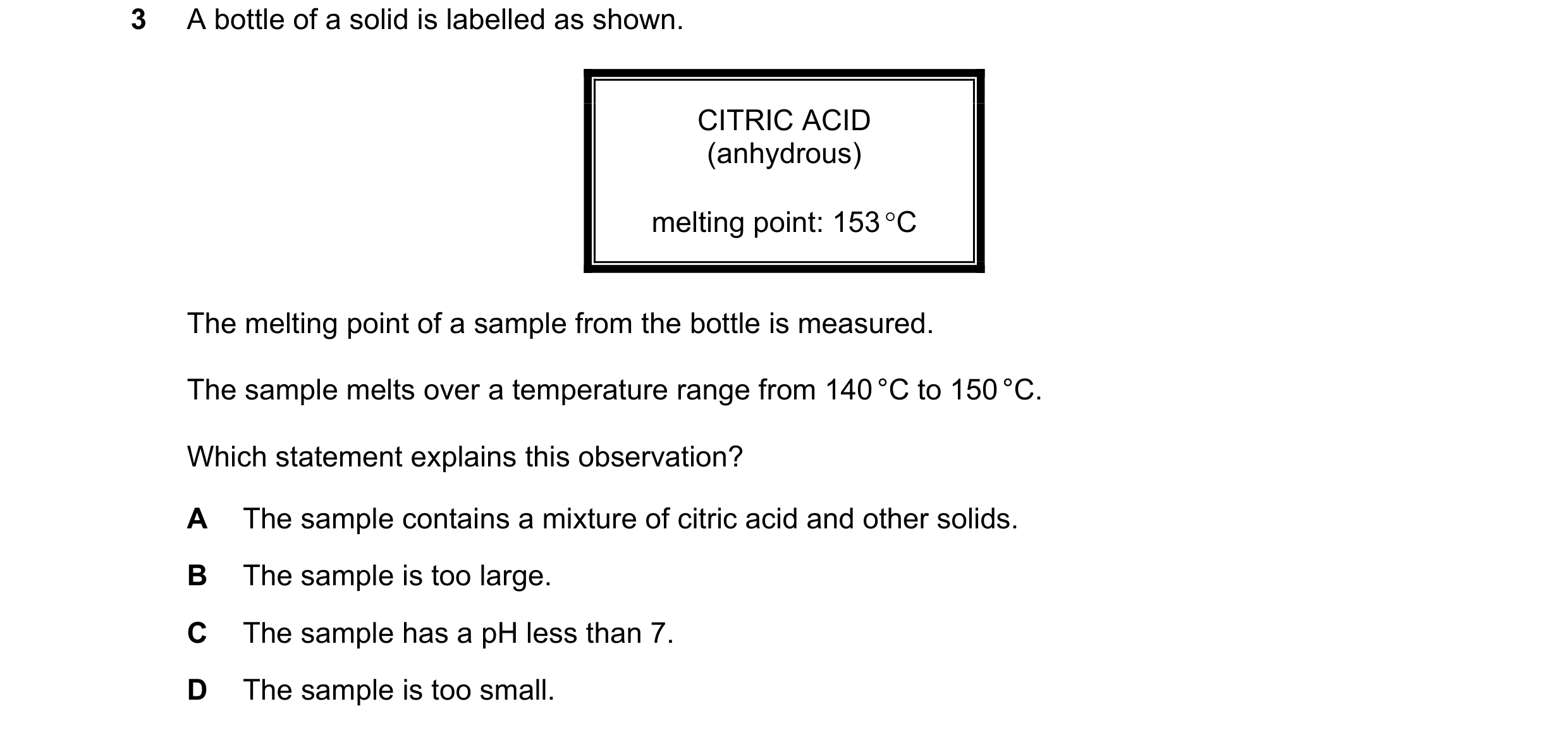
 3 / 5
3 / 5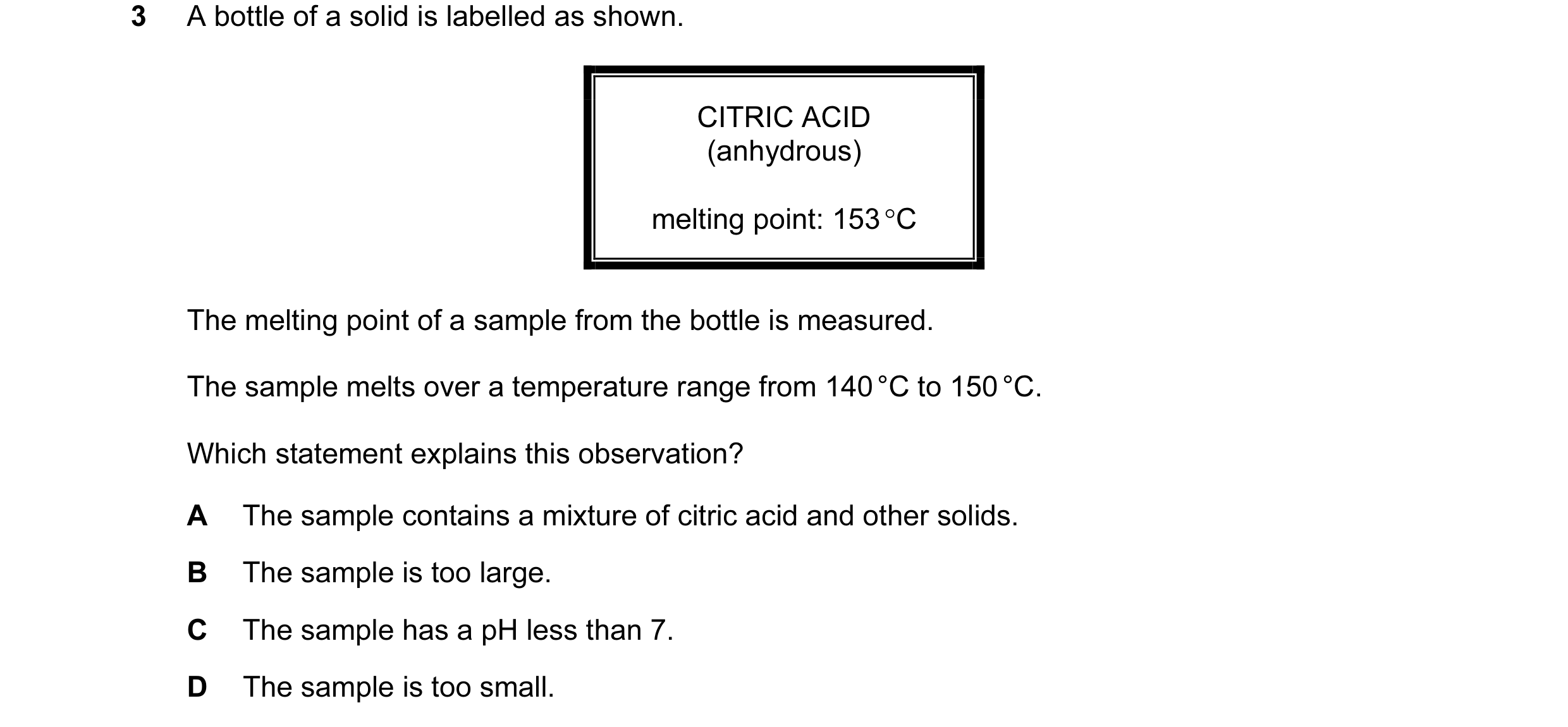
 4 / 5
4 / 5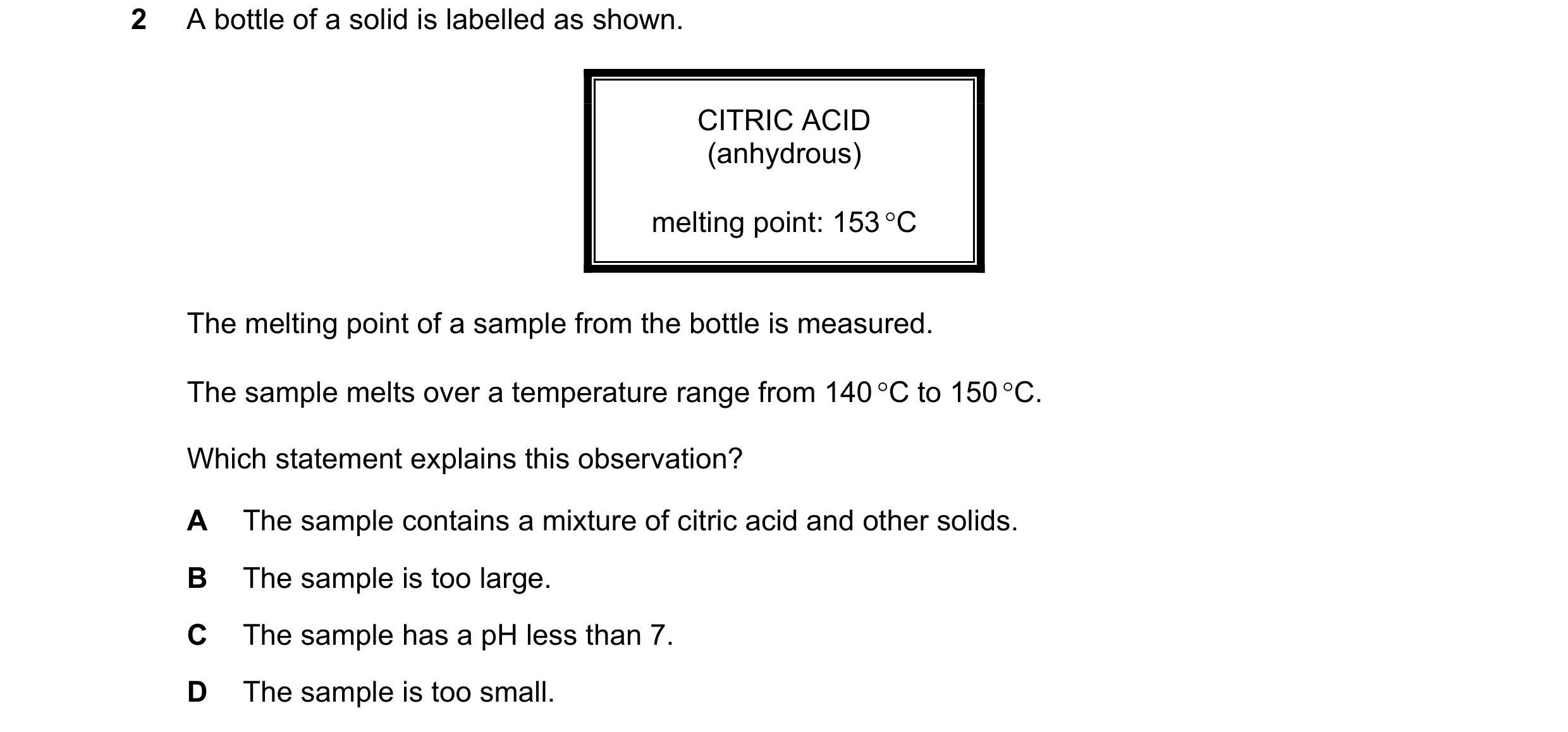
 5 / 5
5 / 5