Questions as text
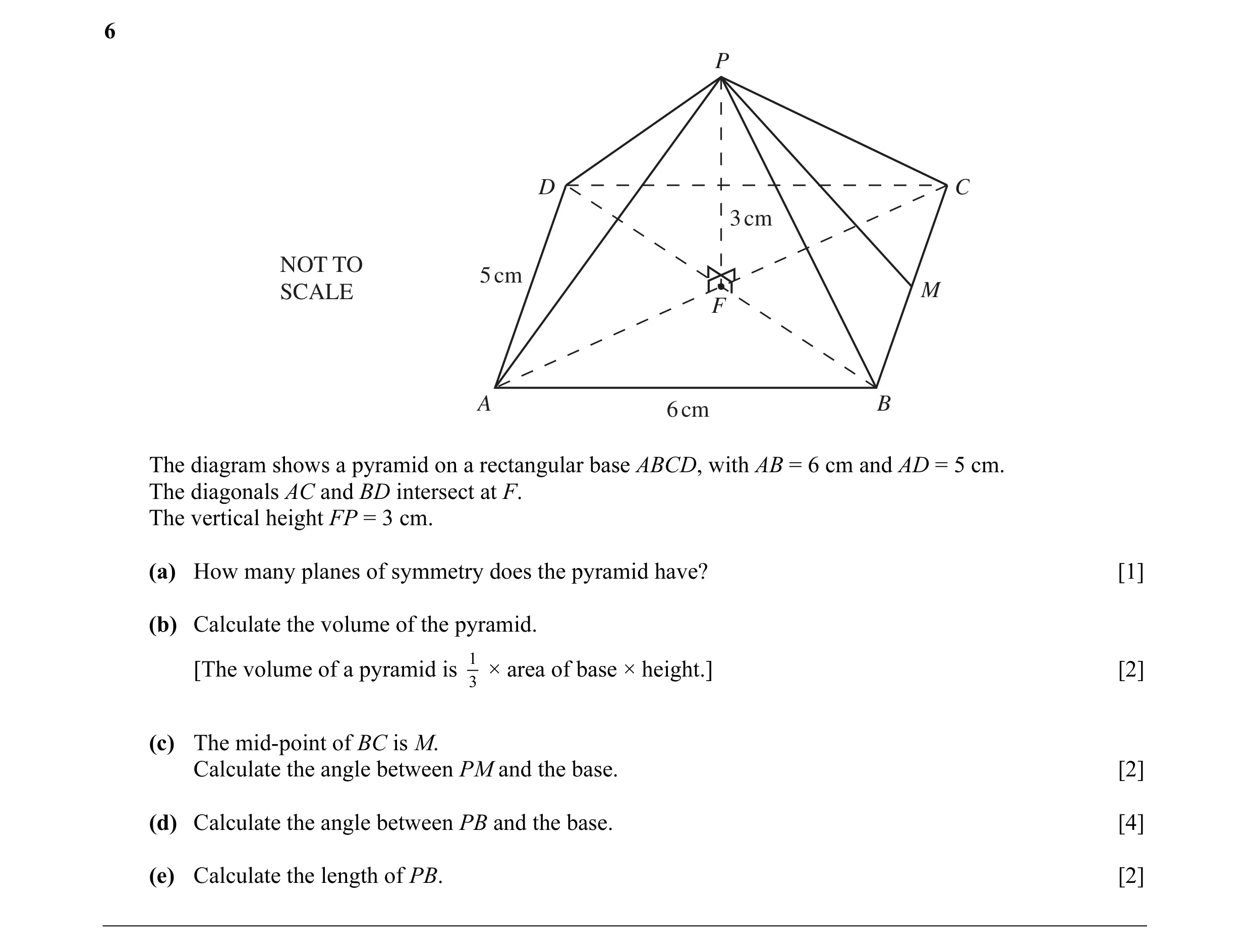
Q1 · P D C 3 cm NOT TO 5 cm SCALE M F A 6 cm B The diagram shows a pyramid on a rectangular… 0580/41 Oct/Nov 2005
6 P D C 3 cm NOT TO 5 cm SCALE M F A 6 cm B The diagram shows a pyramid on a rectangular base ABCD, with AB = 6 cm and AD = 5 cm. The diagonals AC and BD intersect at F. The vertical height FP = 3 cm. (a) How many planes of symmetry does the pyramid have? [1] (b) Calculate the volume of the pyramid. 1 [The volume of a pyramid is × area of base × height.] [2] 3 (c) The mid-point of BC is M. Calculate the angle between PM and the base. [2] (d) Calculate the angle between PB and the base. [4] (e) Calculate the length of PB. [2]
11 marks
Mark scheme: 6 (a) 2 B1 (b) 1 × 6 × 5 × 3 o.e. M1 3 30 A1 (c) 3 M1 Isos. triangle or invtan ( ) o.e. 3 45 A1 www2 (d) 2 2 M1 (BD ) = 6 + 5 o.e. M1 Dep. (BF = 3.905….) BF = 1 BD 2 3 M1 Dep on previous method angle = invtan their BF 37.5 to 37.54 A1 www4 (e) (l2) = 32 + (their FB)2 o.e. M1 Not for FB = 3 4.92 to 4.93 A1 ww2 [11] IGCSE – NOVEMBER 2005 0580/0581 4
This question in 0580/41 Oct/Nov 2005
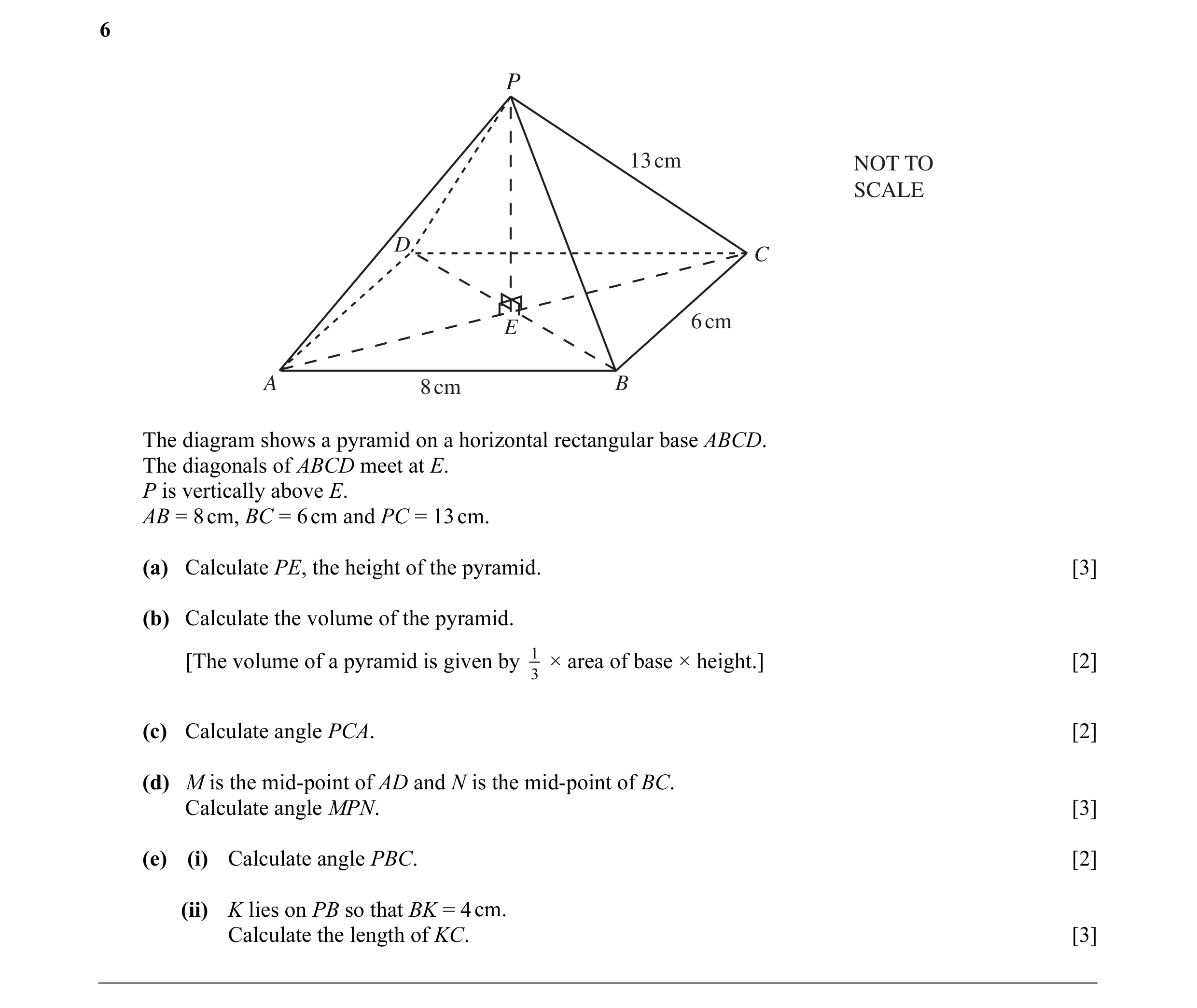
Q2 · P 13 cm NOT TO SCALE D C E 6 cm A 8 cm B The diagram shows a pyramid on a horizontal… 0580/41 May/June 2006
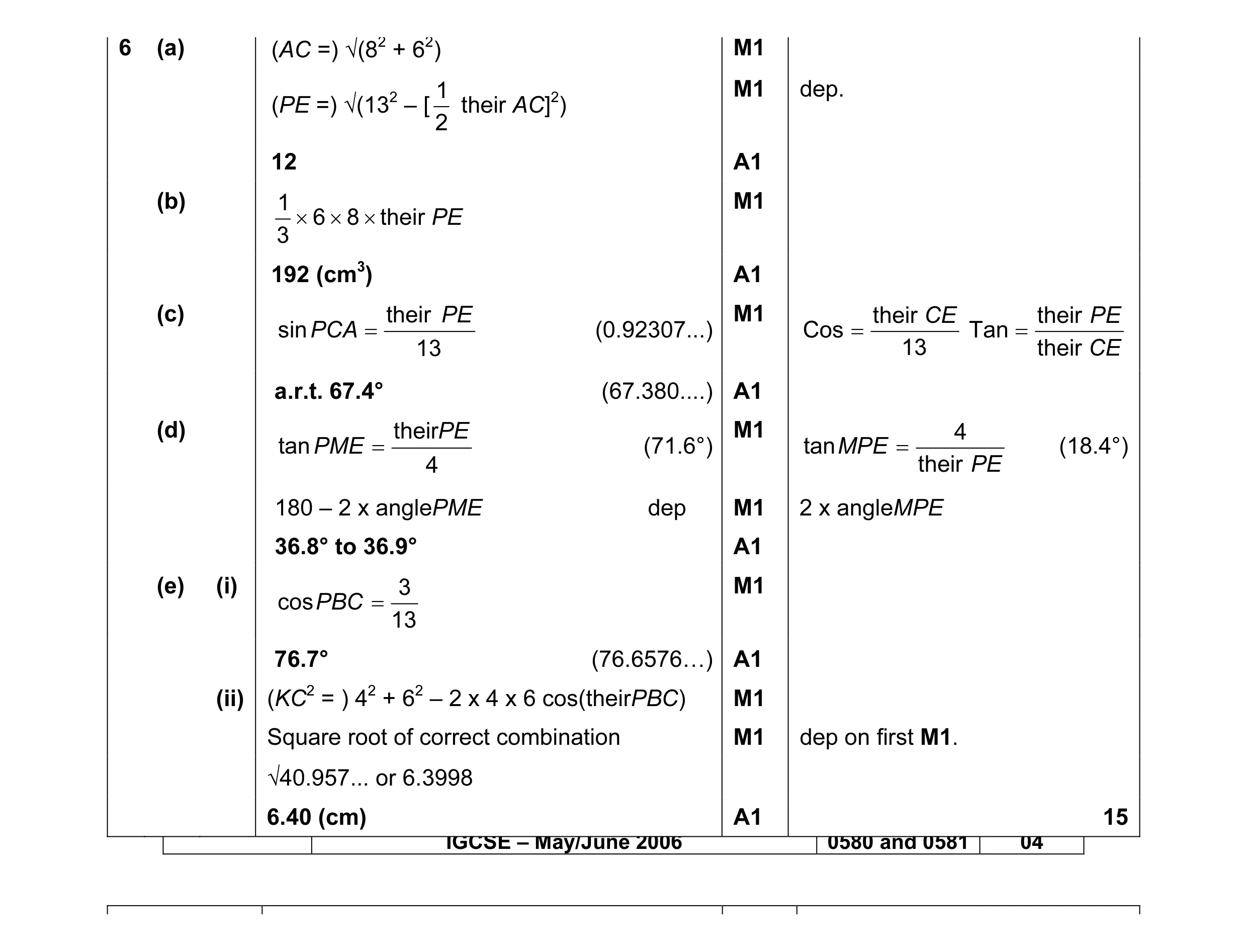
6 P 13 cm NOT TO SCALE D C E 6 cm A 8 cm B The diagram shows a pyramid on a horizontal rectangular base ABCD. The diagonals of ABCD meet at E. P is vertically above E. AB = 8 cm, BC = 6 cm and PC = 13 cm. (a) Calculate PE, the height of the pyramid. [3] (b) Calculate the volume of the pyramid. [The volume of a pyramid is given by 1 × area of base × height.] [2] 3 (c) Calculate angle PCA. [2] (d) M is the mid-point of AD and N is the mid-point of BC. Calculate angle MPN. [3] (e) (i) Calculate angle PBC. [2] (ii) K lies on PB so that BK = 4 cm. Calculate the length of KC. [3]
15 marks
Mark scheme: 6 (a) (AC =) √(82 + 62) M1 1 M1 dep. (PE =) √(132 – [ their AC]2) 2 12 A1 (b) 1 M1 × 6 × 8 × their PE 3 192 (cm3) A1 (c) their PE M1 their CE their PE sin PCA = (0.92307...) Cos = Tan = 13 13 their CE a.r.t. 67.4° (67.380 … ) A1 (d) theirPE M1 4 tan PME = (71.6°) tan MPE = (18.4°) 4 their PE 180 – 2 x anglePME dep M1 2 x angleMPE 36.8° to 36.9° A1 (e) (i) 3 M1 cos PBC = 13 76.7° (76.6576…) A1 (ii) (KC2 = ) 42 + 62 – 2 x 4 x 6 cos(theirPBC) M1 Square root of correct combination M1 dep on first M1. √40.957... or 6.3998 6.40 (cm) A1 15 IGCSE – May/June 2006 0580 and 0581 04
This question in 0580/41 May/June 2006
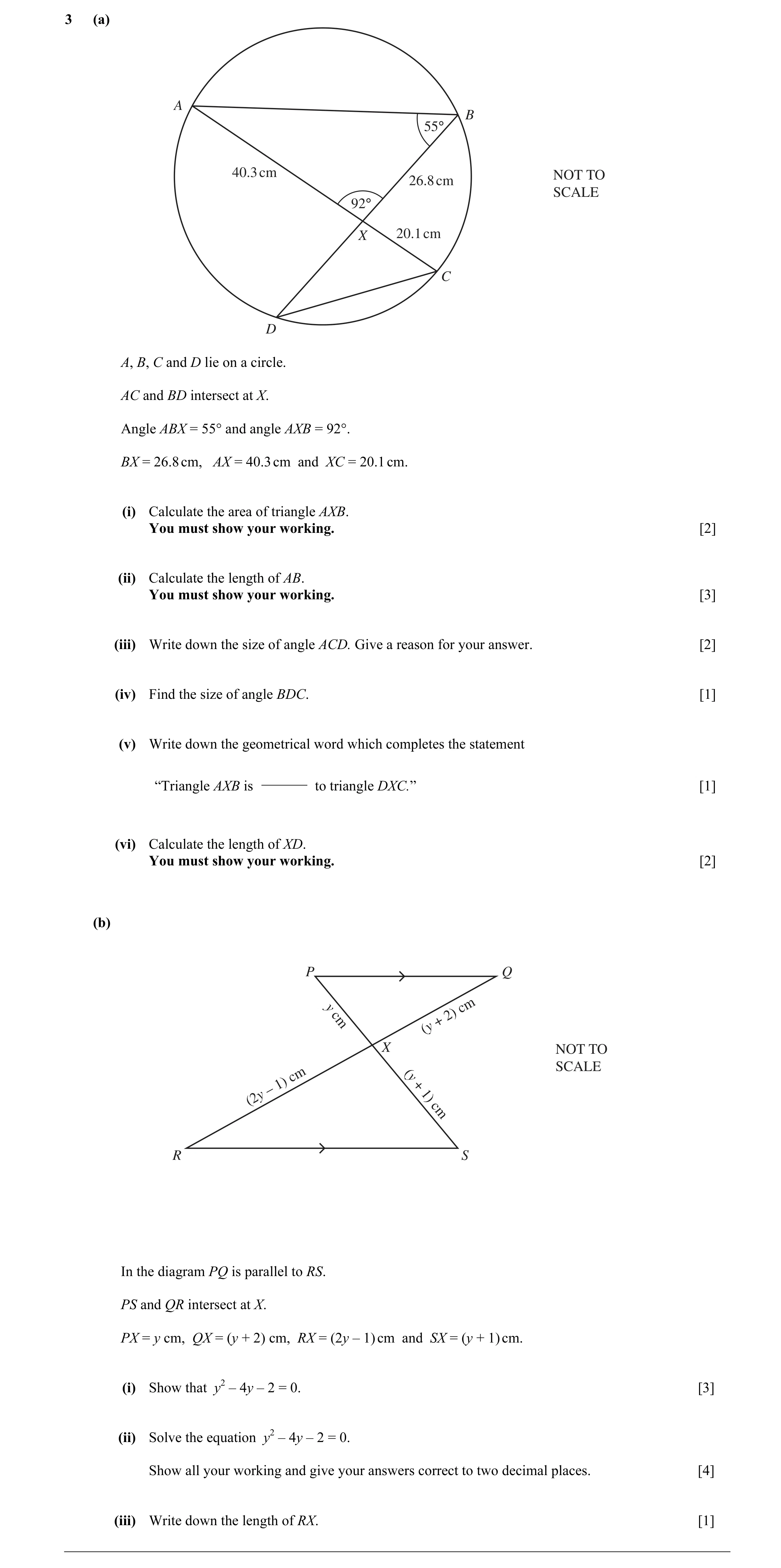
Q3 · A B 55° 40.3 cm NOT TO 26.826.826.8cmcmcm SCALE 92° X 20.120.120.1 cmcmcm C D A, B, C and… 0580/41 May/June 2007
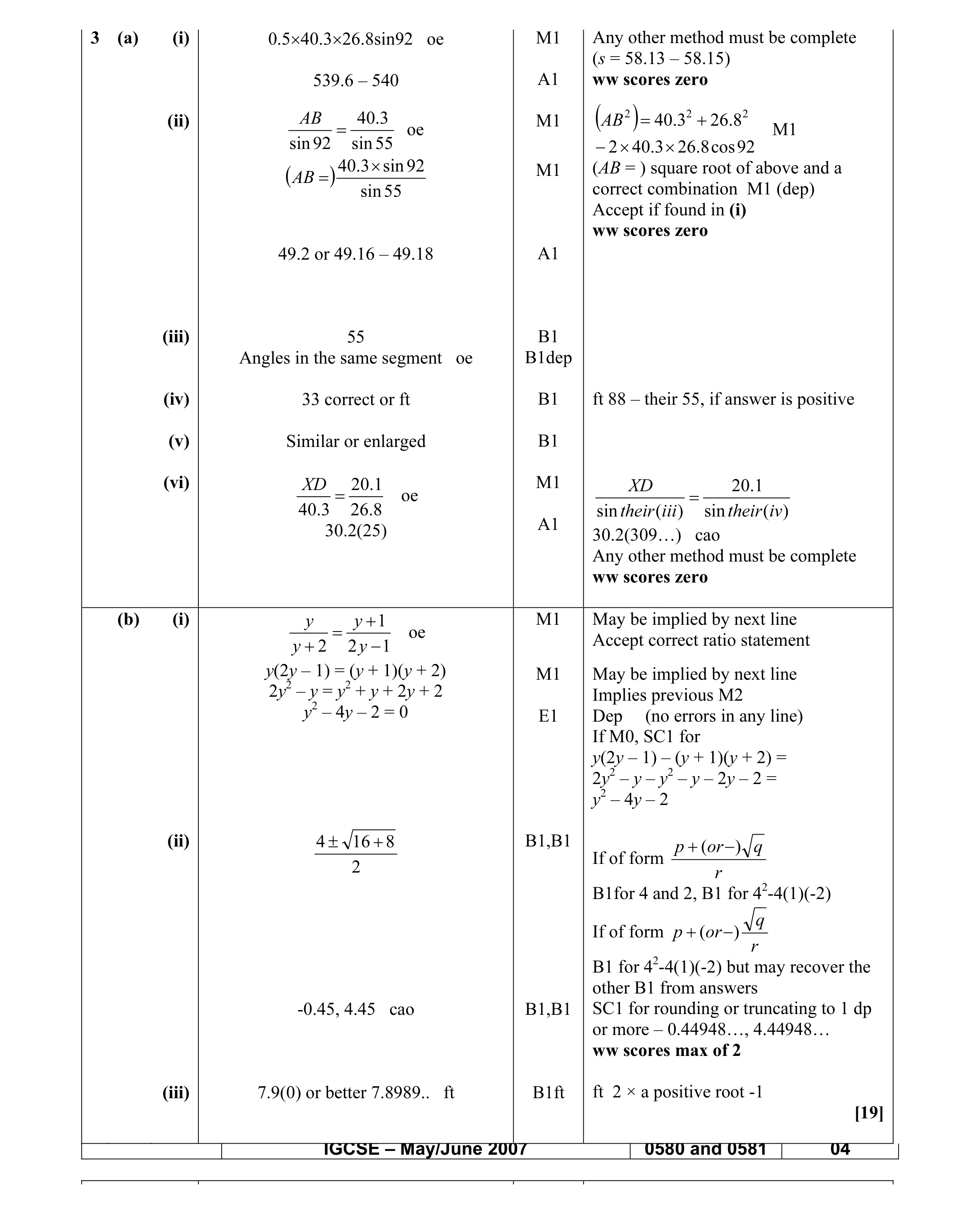
3 (a) A B 55° 40.3 cm NOT TO 26.826.826.8cmcmcm SCALE 92° X 20.120.120.1 cmcmcm C D A, B, C and D lie on a circle. AC and BD intersect at X. Angle ABX = 55° and angle AXB = 92°. BX = 26.8 cm, AX = 40.3 cm and XC = 20.1 cm. (i) Calculate the area of triangle AXB. You must show your working. [2] (ii) Calculate the length of AB. You must show your working. [3] (iii) Write down the size of angle ACD. Give a reason for your answer. [2] (iv) Find the size of angle BDC. [1] (v) Write down the geometrical word which completes the statement “Triangle AXB is to triangle DXC.” [1] (vi) Calculate the length of XD. You must show your working. [2] (b) P Q y cm cm +2) (y X NOT TO SCALE cm (y 1) + – (2y 1) cm R S In the diagram PQ is parallel to RS. PS and QR intersect at X. PX = y cm, QX = (y + 2) cm, RX = (2y – 1) cm and SX = (y + 1) cm. (i) Show that y2 – 4y – 2 = 0. [3] (ii) Solve the equation y2 – 4y – 2 = 0. Show all your working and give your answers correct to two decimal places. [4] (iii) Write down the length of RX. [1]
19 marks
Mark scheme: 3 (a) (i) 0.5×40.3×26.8sin92 oe M1 Any other method must be complete (s = 58.13 – 58.15) 539.6 – 540 A1 ww scores zero 2 2 + 26 8. 2 (ii) AB 403. M1 ( AB ) = 403. = oe M1 sin 92 sin 55 − 2 × 40 3. × 26 8. cos 92 403. × sin 92 ( AB = ) M1 (AB = ) square root of above and a sin 55 correct combination M1 (dep) Accept if found in (i) ww scores zero 49.2 or 49.16 – 49.18 A1 (iii) 55 B1 Angles in the same segment oe B1dep (iv) 33 correct or ft B1 ft 88 – their 55, if answer is positive (v) Similar or enlarged B1 (vi) XD 201. M1 XD 201. = oe = 403. 26 8. sin their (iii ) sin their (iv ) A1 30.2(25) 30.2(309…) cao Any other method must be complete ww scores zero (b) (i) y y + 1 M1 May be implied by next line = oe Accept correct ratio statement y + 2 2 y − 1 y(2y – 1) = (y + 1)(y + 2) M1 May be implied by next line 2y2 – y = y2 + y + 2y + 2 Implies previous M2 y2 – 4y – 2 = 0 E1 Dep (no errors in any line) If M0, SC1 for y(2y – 1) – (y + 1)(y + 2) = 2y2 – y – y2 – y – 2y – 2 = y2 – 4y – 2 (ii) 4 ± 16 + 8 B1,B1 p + ( or − ) q If of form 2 r B1for 4 and 2, B1 for 42-4(1)(-2) q If of form p + ( or − ) r B1 for 42-4(1)(-2) but may recover the other B1 from answers -0.45, 4.45 cao B1,B1 SC1 for rounding or truncating to 1 dp or more – 0.44948…, 4.44948… ww scores max of 2 (iii) 7.9(0) or better 7.8989.. ft B1ft ft 2 × a positive root -1 [19] IGCSE – May/June 2007 0580 and 0581 04
This question in 0580/41 May/June 2007
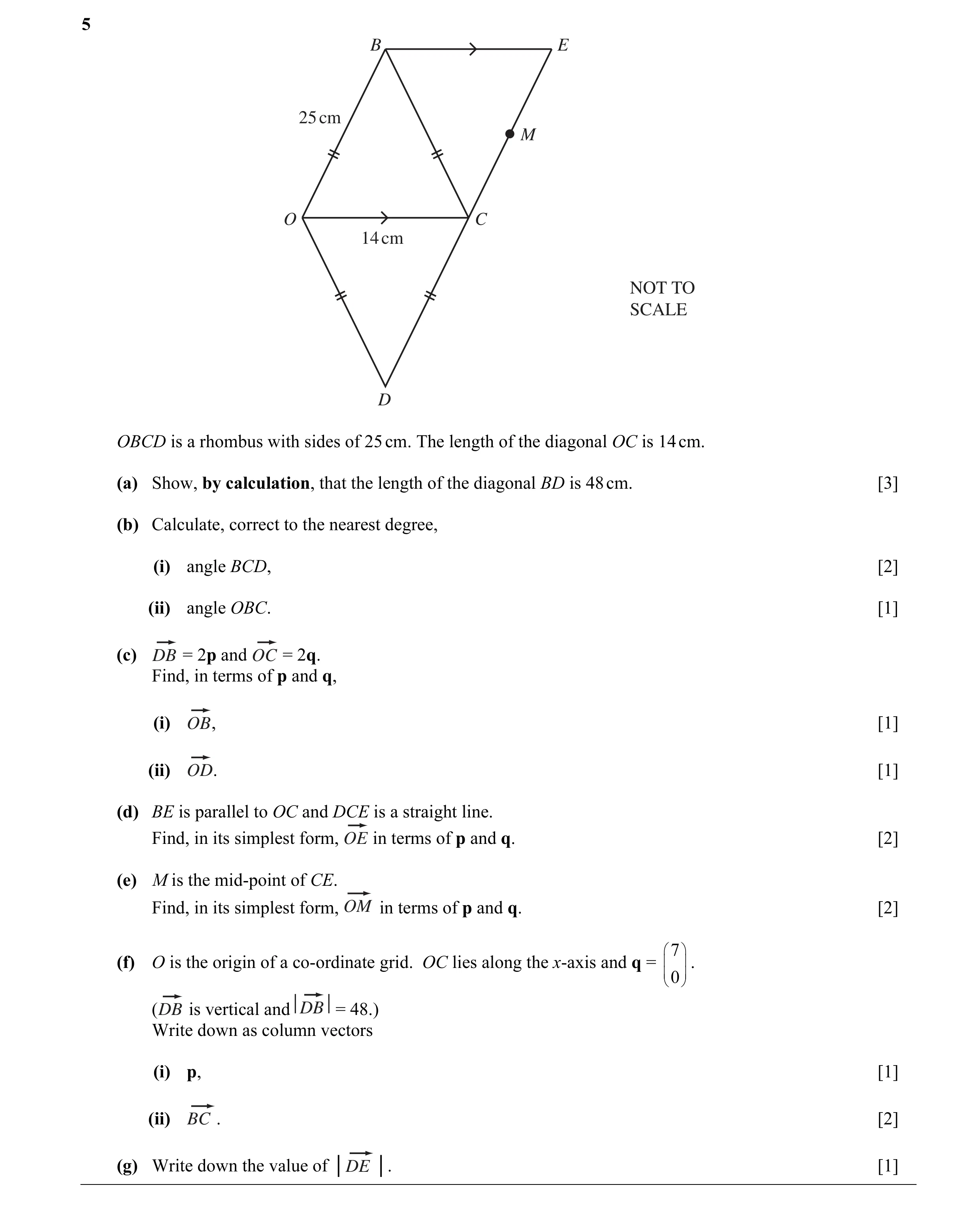
Q4 · B E 25 cm M O C 14 cm NOT TO SCALE D OBCD is a rhombus with sides of 25 cm 0580/41 May/June 2007
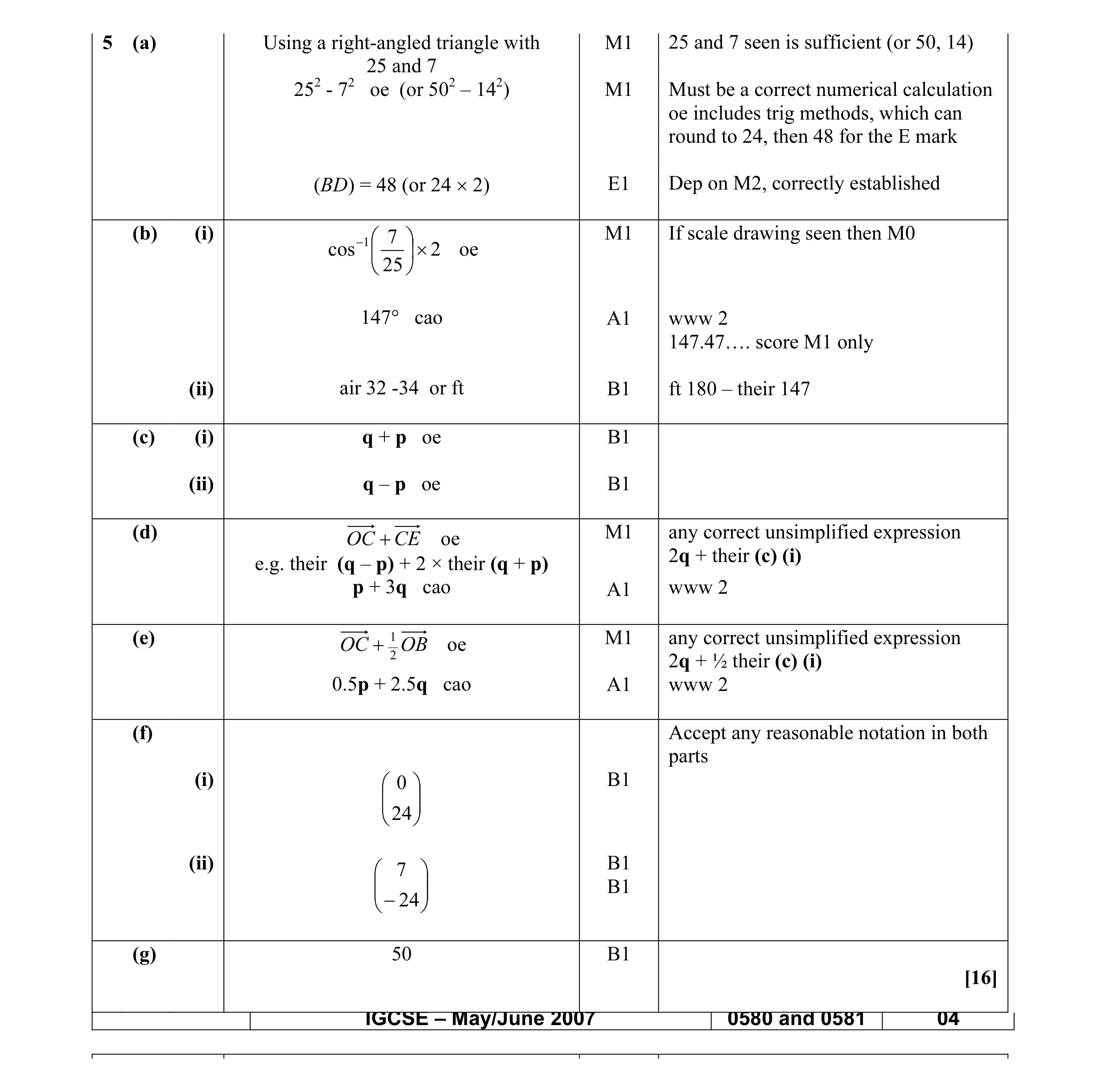
5 B E 25 cm M O C 14 cm NOT TO SCALE D OBCD is a rhombus with sides of 25 cm. The length of the diagonal OC is 14 cm. (a) Show, by calculation, that the length of the diagonal BD is 48 cm. [3] (b) Calculate, correct to the nearest degree, (i) angle BCD, [2] (ii) angle OBC. [1] (c) DB = 2p and OC = 2q. Find, in terms of p and q, (i) OB, [1] (ii) OD. [1] (d) BE is parallel to OC and DCE is a straight line. Find, in its simplest form, OE in terms of p and q. [2] (e) M is the mid-point of CE. Find, in its simplest form, OM in terms of p and q. [2] 7 (f) O is the origin of a co-ordinate grid. OC lies along the x-axis and q = . 0 (DB is vertical and DB = 48.) Write down as column vectors (i) p, [1] (ii) BC . [2] (g) Write down the value of │DE │. [1]
16 marks
Mark scheme: 5 (a) Using a right-angled triangle with M1 25 and 7 seen is sufficient (or 50, 14) 25 and 7 252 - 72 oe (or 502 – 142) M1 Must be a correct numerical calculation oe includes trig methods, which can round to 24, then 48 for the E mark (BD) = 48 (or 24 × 2) E1 Dep on M2, correctly established (b) (i) −1 7 M1 If scale drawing seen then M0 cos × 2 oe 25 147° cao A1 www 2 147.47…. score M1 only (ii) air 32 -34 or ft B1 ft 180 – their 147 (c) (i) q + p oe B1 (ii) q – p oe B1 (d) M1 any correct unsimplified expression OC + CE oe 2q + their (c) (i) e.g. their (q – p) + 2 × their (q + p) p + 3q cao A1 www 2 (e) 1 M1 any correct unsimplified expression OC + OB oe 2 2q + ½ their (c) (i) 0.5p + 2.5q cao A1 www 2 (f) Accept any reasonable notation in both parts (i) 0 B1 24 (ii) B1 7 B1 −24 (g) 50 B1 [16] IGCSE – May/June 2007 0580 and 0581 04
This question in 0580/41 May/June 2007
Q5 · S NOT TO SCALE D C 8 cm P 6 cm N R 7 cm M A B Q The diagram above shows the net of a… 0580/41 Oct/Nov 2007
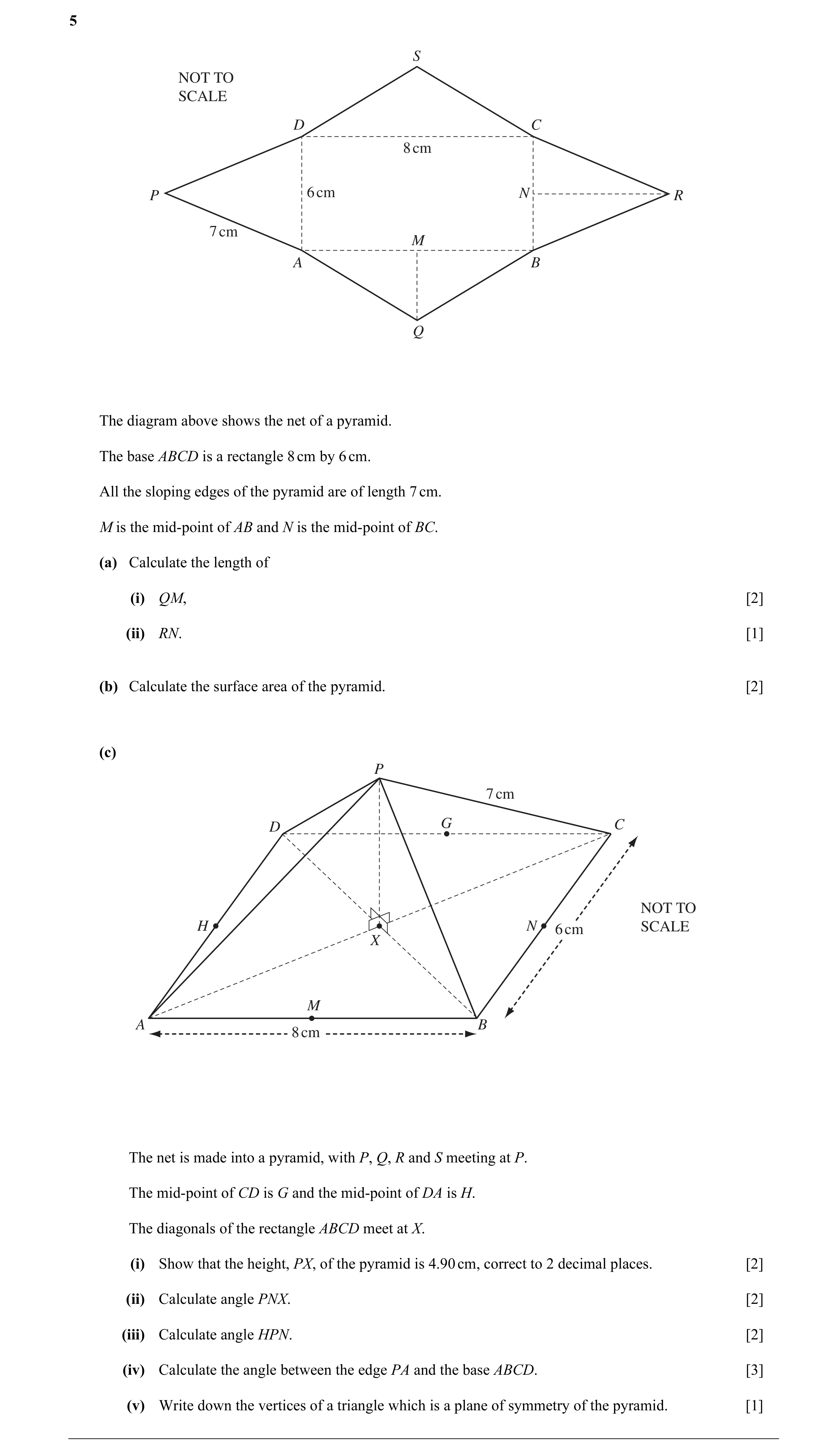
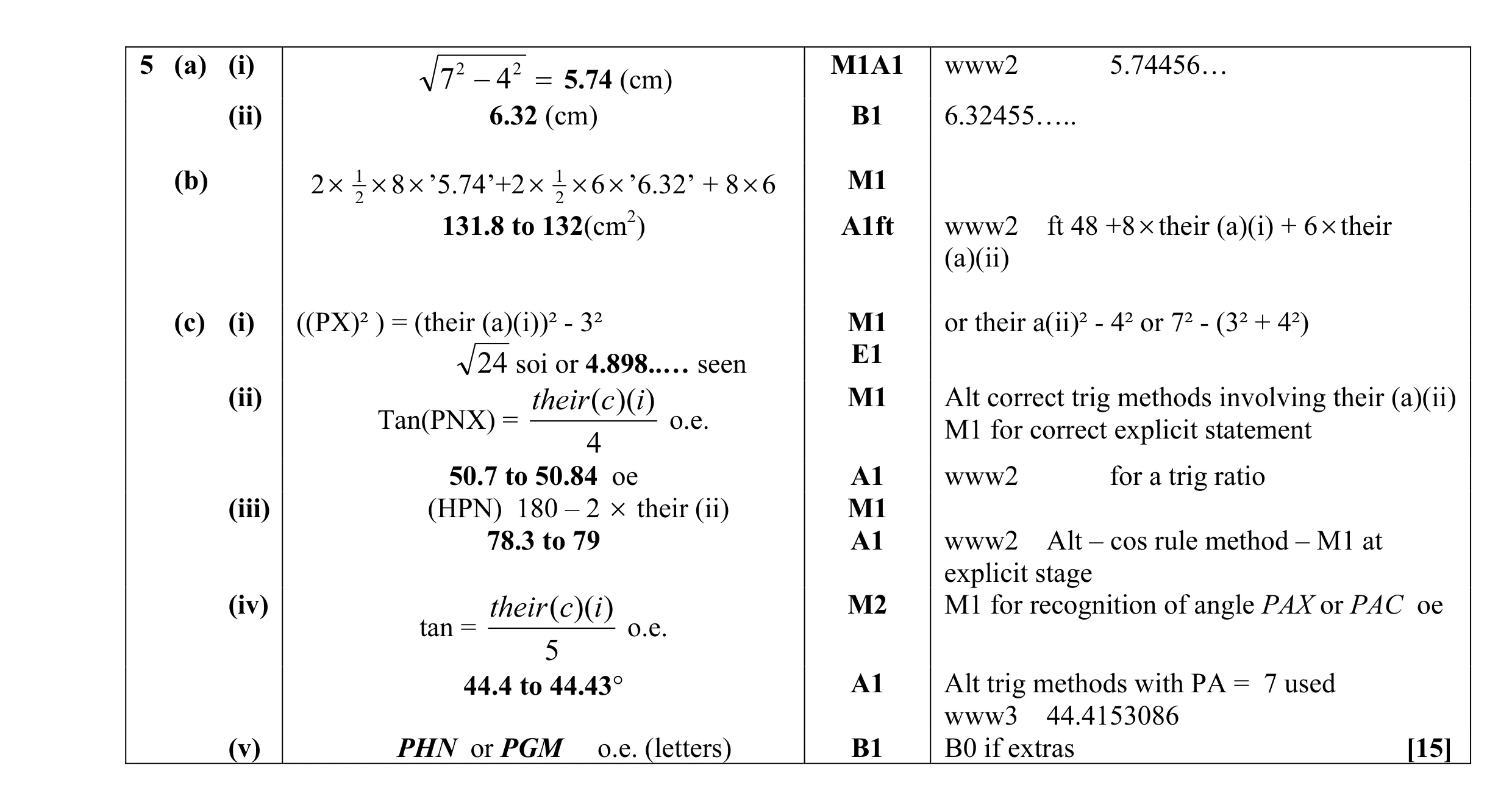
5 S NOT TO SCALE D C 8 cm P 6 cm N R 7 cm M A B Q The diagram above shows the net of a pyramid. The base ABCD is a rectangle 8 cm by 6 cm. All the sloping edges of the pyramid are of length 7 cm. M is the mid-point of AB and N is the mid-point of BC. (a) Calculate the length of (i) QM, [2] (ii) RN. [1] (b) Calculate the surface area of the pyramid. [2] (c) P 7 cm D G C NOT TO H N 6 cm SCALE X M A B 8 cm The net is made into a pyramid, with P, Q, R and S meeting at P. The mid-point of CD is G and the mid-point of DA is H. The diagonals of the rectangle ABCD meet at X. (i) Show that the height, PX, of the pyramid is 4.90 cm, correct to 2 decimal places. [2] (ii) Calculate angle PNX. [2] (iii) Calculate angle HPN. [2] (iv) Calculate the angle between the edge PA and the base ABCD. [3] (v) Write down the vertices of a triangle which is a plane of symmetry of the pyramid. [1]
15 marks
Mark scheme: 5 (a) (i) 2 2 M1A1 www2 5.74456… 7 − 4 = 5.74 (cm) (ii) 6.32 (cm) B1 6.32455….. (b) 1 1 M1 2× 2 × 8×’5.74’+2× 2 × 6×’6.32’ + 8×6 131.8 to 132(cm2) A1ft www2 ft 48 +8×their (a)(i) + 6×their (a)(ii) (c) (i) ((PX)² ) = (their (a)(i))² - 3² M1 or their a(ii)² - 4² or 7² - (3² + 4²) E1 24 soi or 4.898..… seen (ii) their ( c )(i ) M1 Alt correct trig methods involving their (a)(ii) Tan(PNX) = o.e. M1 for correct explicit statement 4 50.7 to 50.84 oe A1 www2 for a trig ratio (iii) (HPN) 180 – 2 × their (ii) M1 78.3 to 79 A1 www2 Alt – cos rule method – M1 at explicit stage (iv) their ( c )(i ) M2 M1 for recognition of angle PAX or PAC oe tan = o.e. 5 44.4 to 44.43° A1 Alt trig methods with PA = 7 used www3 44.4153086 (v) PHN or PGM o.e. (letters) B1 B0 if extras [15]
This question in 0580/41 Oct/Nov 2007
Q6 · E F Q NOT TO SCALE D G O C H P B 12 cm A A circle, centre O, touches all the sides of the… 0580/41 May/June 2008
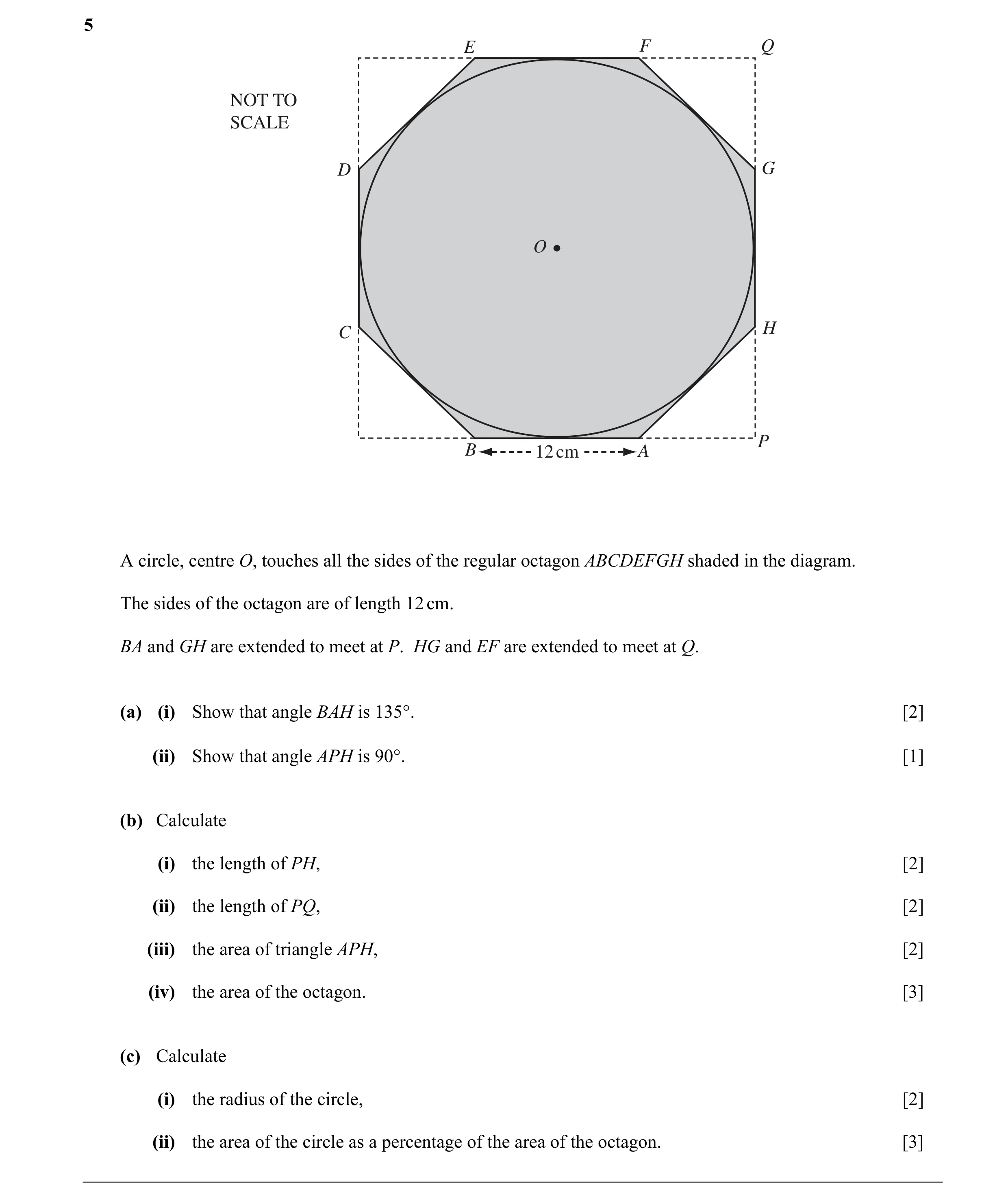
5 E F Q NOT TO SCALE D G O C H P B 12 cm A A circle, centre O, touches all the sides of the regular octagon ABCDEFGH shaded in the diagram. The sides of the octagon are of length 12 cm. BA and GH are extended to meet at P. HG and EF are extended to meet at Q. (a) (i) Show that angle BAH is 135°. [2] (ii) Show that angle APH is 90°. [1] (b) Calculate (i) the length of PH, [2] (ii) the length of PQ, [2] (iii) the area of triangle APH, [2] (iv) the area of the octagon. [3] (c) Calculate (i) the radius of the circle, [2] (ii) the area of the circle as a percentage of the area of the octagon. [3]
17 marks
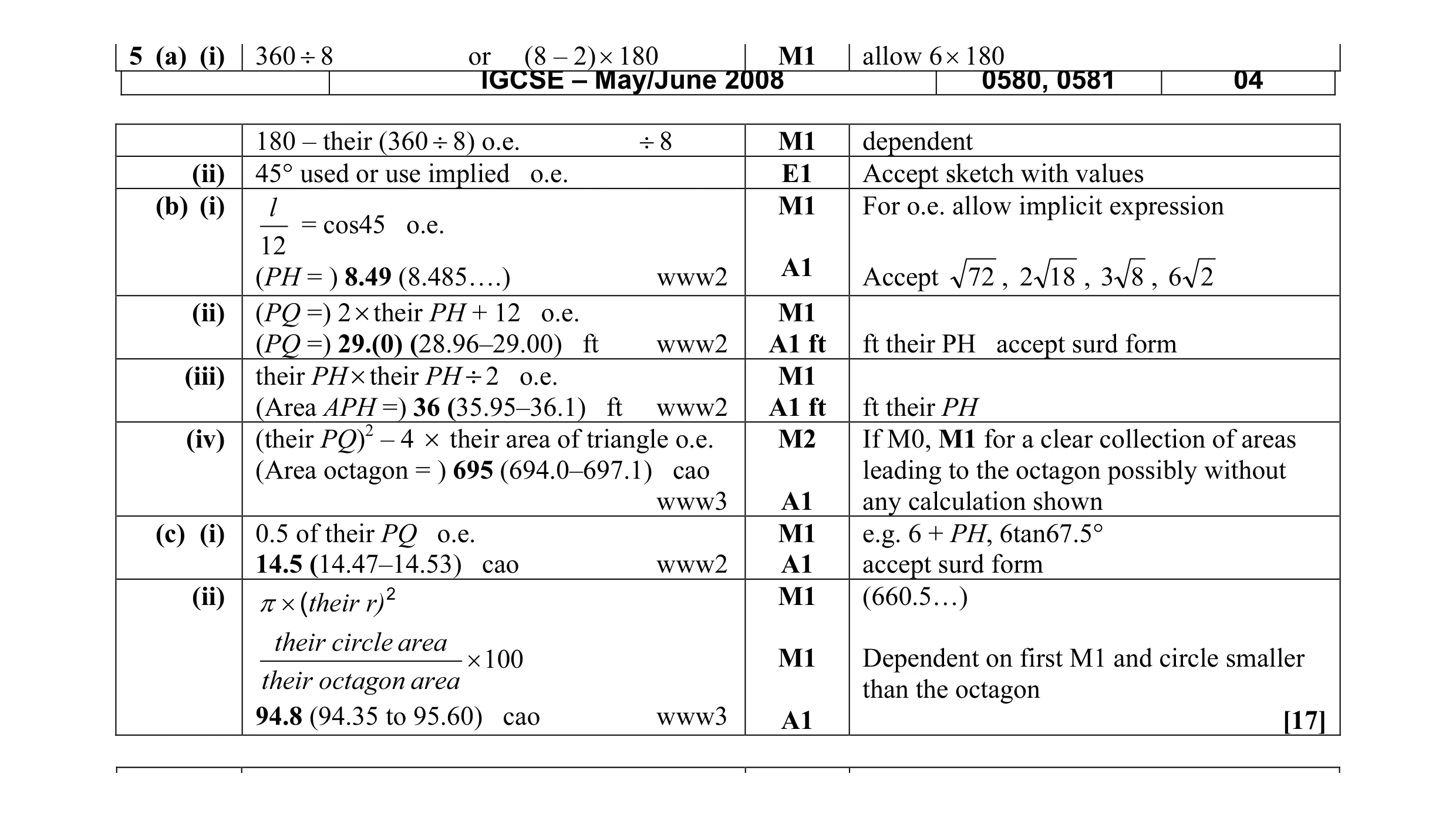
Mark scheme: 5 (a) (i) 360 ÷ 8 or (8 – 2)× 180 M1 allow 6× 180 IGCSE – May/June 2008 0580, 0581 04 180 – their (360 ÷ 8) o.e. ÷ 8 M1 dependent (ii) 45° used or use implied o.e. E1 Accept sketch with values (b) (i) l M1 For o.e. allow implicit expression = cos45 o.e. 12 A1 (PH = ) 8.49 (8.485….) www2 Accept 72 , 2 18 , 3 8 , 6 2 (ii) (PQ =) 2×their PH + 12 o.e. M1 (PQ =) 29.(0) (28.96–29.00) ft www2 A1 ft ft their PH accept surd form (iii) their PH×their PH ÷2 o.e. M1 (Area APH =) 36 (35.95–36.1) ft www2 A1 ft ft their PH (iv) (their PQ)2 – 4 × their area of triangle o.e. M2 If M0, M1 for a clear collection of areas (Area octagon = ) 695 (694.0–697.1) cao leading to the octagon possibly without www3 A1 any calculation shown (c) (i) 0.5 of their PQ o.e. M1 e.g. 6 + PH, 6tan67.5° 14.5 (14.47–14.53) cao www2 A1 accept surd form (ii) π × ( their r) 2 M1 (660.5…) their circle area × 100 M1 Dependent on first M1 and circle smaller their octagon area than the octagon 94.8 (94.35 to 95.60) cao www3 A1 [17]
This question in 0580/41 May/June 2008
Q7 · For Examiner's P Use NOT TO SCALE 10 cm 14 cm Q R In triangle PQR, angle QPR is acute, PQ… 0580/41 May/June 2009
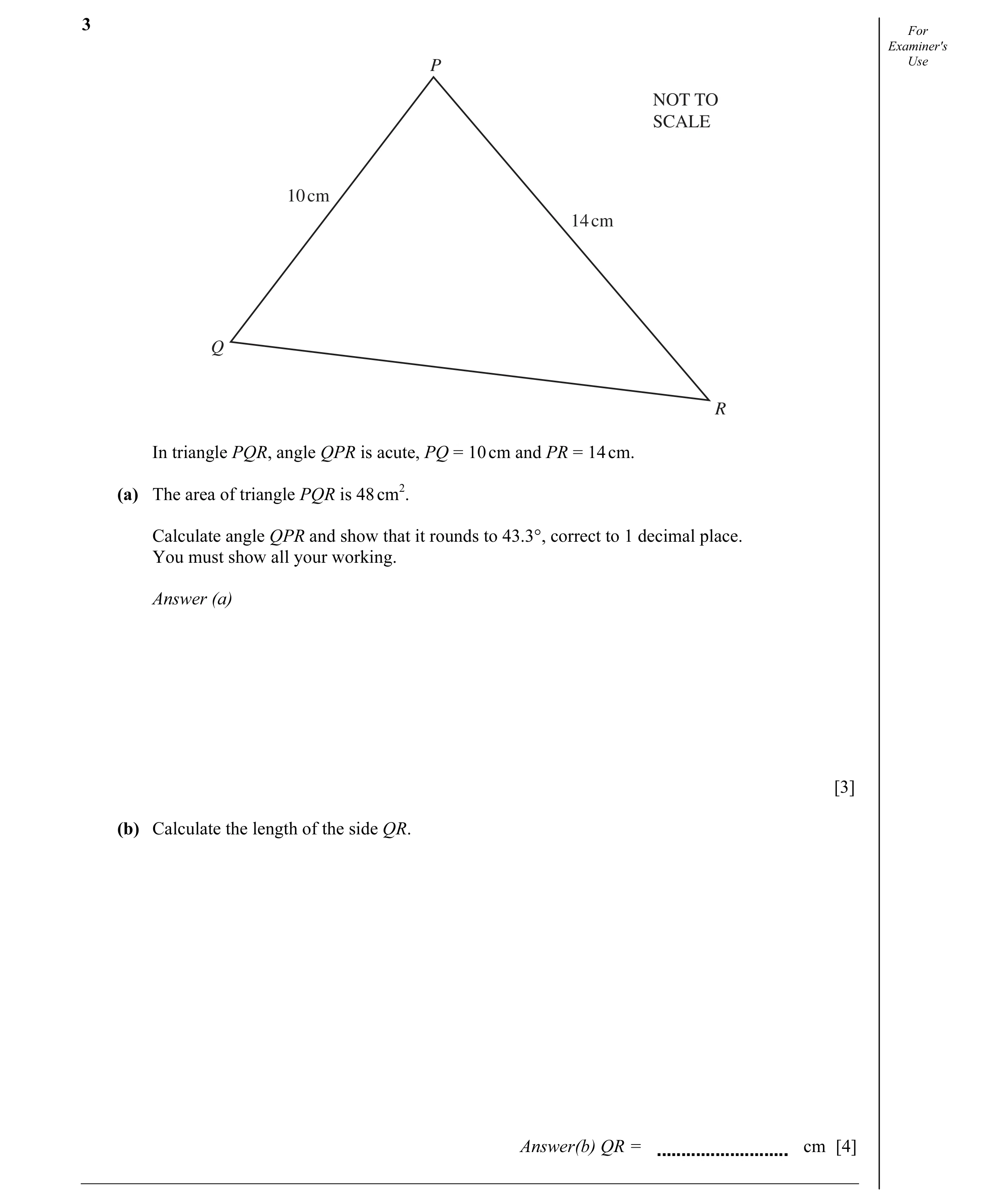
3 For Examiner's P Use NOT TO SCALE 10 cm 14 cm Q R In triangle PQR, angle QPR is acute, PQ = 10 cm and PR = 14 cm. (a) The area of triangle PQR is 48 cm2. Calculate angle QPR and show that it rounds to 43.3°, correct to 1 decimal place. You must show all your working. Answer (a) [3] (b) Calculate the length of the side QR. Answer(b) QR = cm [4]
7 marks
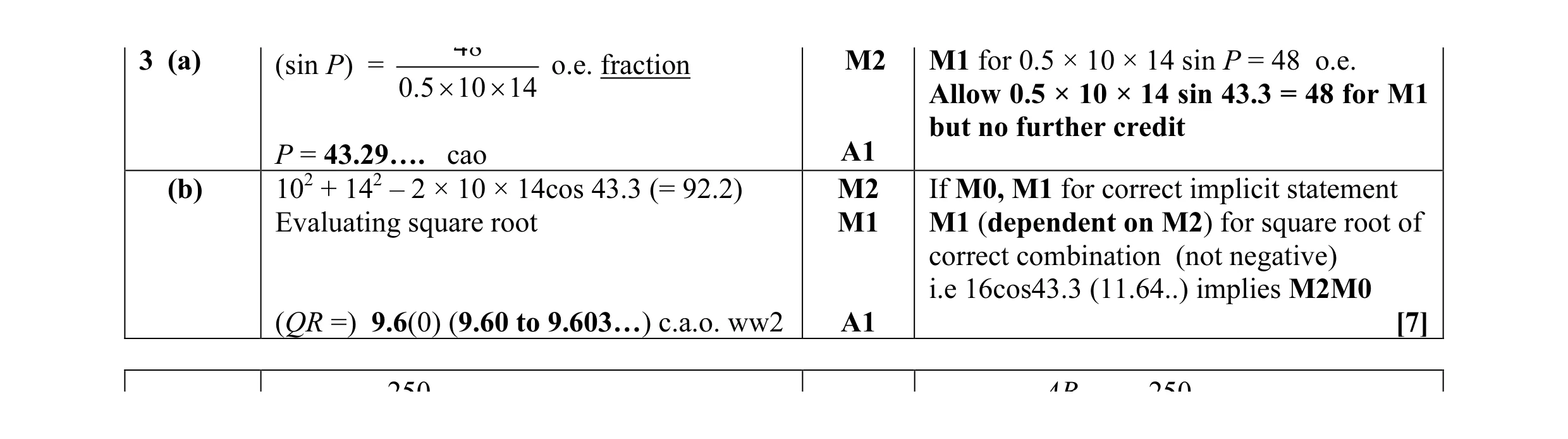
Mark scheme: 48 3 (a) (sin P) = o.e. fraction M2 M1 for 0.5 × 10 × 14 sin P = 48 o.e. 5.0 × 10 × 14 Allow 0.5 × 10 × 14 sin 43.3 = 48 for M1 but no further credit P = 43.29…. cao A1 (b) 102 + 142 – 2 × 10 × 14cos 43.3 (= 92.2) M2 If M0, M1 for correct implicit statement Evaluating square root M1 M1 (dependent on M2) for square root of correct combination (not negative) i.e 16cos43.3 (11.64..) implies M2M0 (QR =) 9.6(0) (9.60 to 9.603…) c.a.o. ww2 A1 [7] 250 AB 250
This question in 0580/41 May/June 2009
Q8 · For A Examiner's Use NOT TO SCALE 17 cm x cm B (x + 7) cm C In the right-angled triangle… 0580/42 Oct/Nov 2010
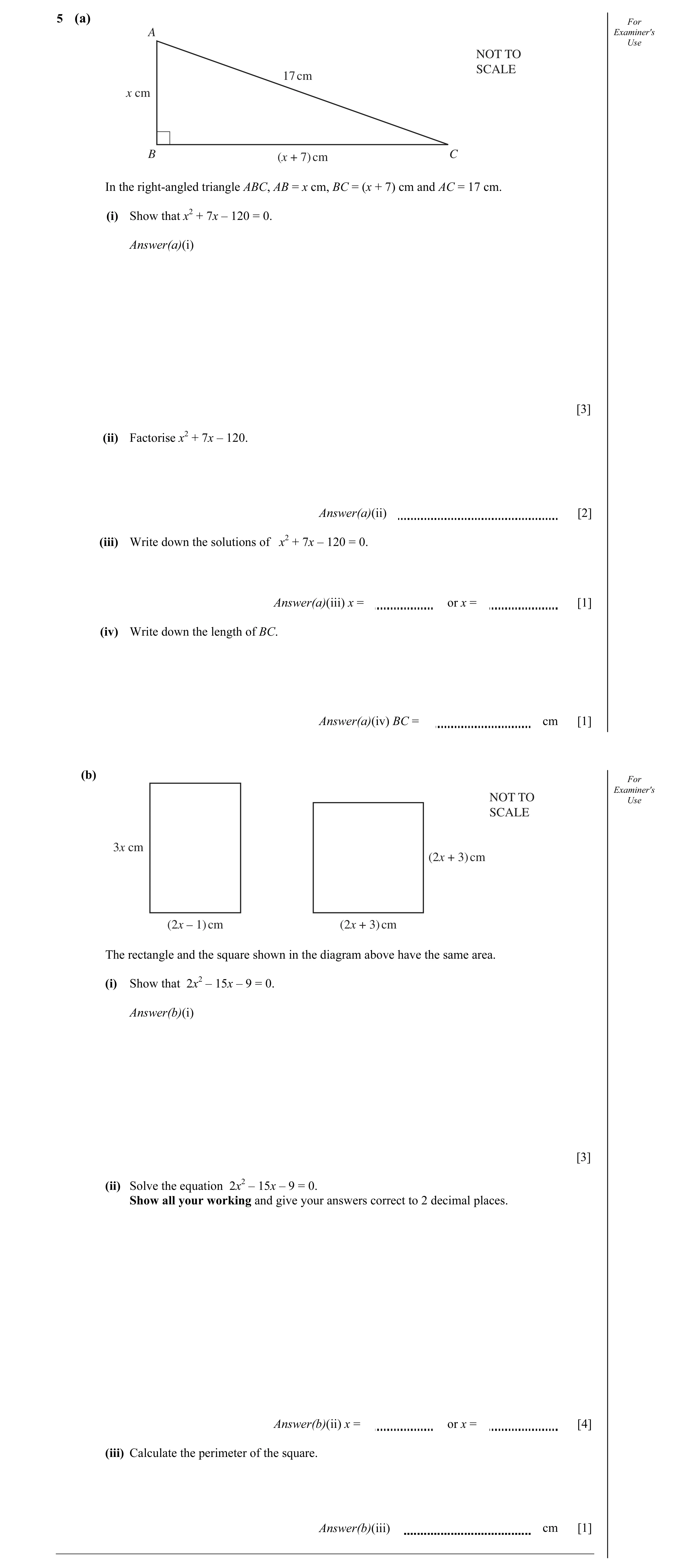
5 (a) For A Examiner's Use NOT TO SCALE 17 cm x cm B (x + 7) cm C In the right-angled triangle ABC, AB = x cm, BC = (x + 7) cm and AC = 17 cm. (i) Show that x2 + 7x – 120 = 0. Answer(a)(i) [3] (ii) Factorise x2 + 7x – 120. Answer(a)(ii) [2] (iii) Write down the solutions of x2 + 7x – 120 = 0. Answer(a)(iii) x = or x = [1] (iv) Write down the length of BC. Answer(a)(iv) BC = cm [1] (b) For Examiner's NOT TO Use SCALE 3x cm (2x + 3) cm (2x – 1) cm (2x + 3) cm The rectangle and the square shown in the diagram above have the same area. (i) Show that 2x2 – 15x – 9 = 0. Answer(b)(i) [3] (ii) Solve the equation 2x2 – 15x – 9 = 0. Show all your working and give your answers correct to 2 decimal places. Answer(b)(ii) x = or x = [4] (iii) Calculate the perimeter of the square. Answer(b)(iii) cm [1]
15 marks
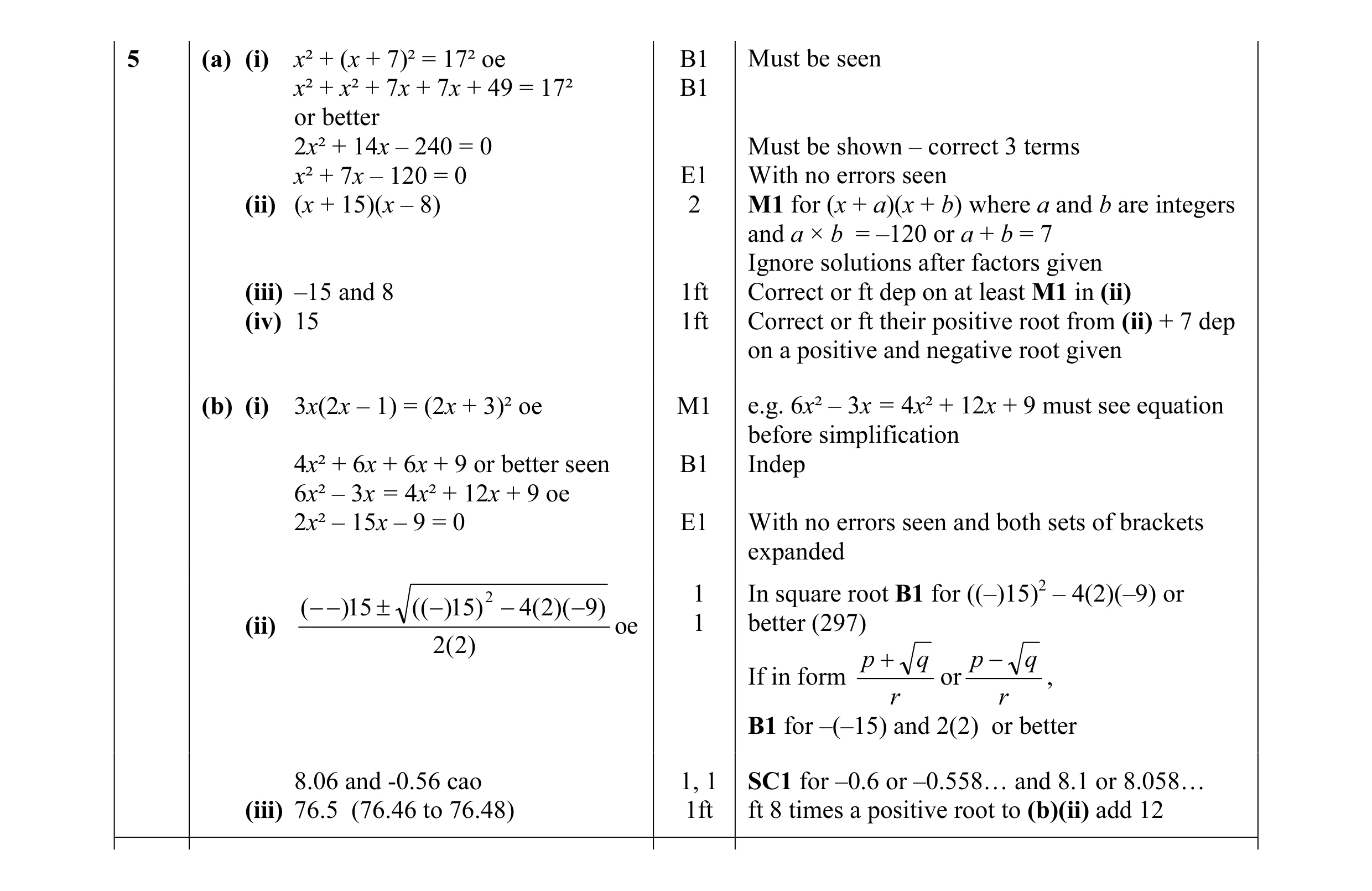
Mark scheme: 5 (a) (i) x² + (x + 7)² = 17² oe B1 Must be seen x² + x² + 7x + 7x + 49 = 17² B1 or better 2x² + 14x – 240 = 0 Must be shown – correct 3 terms x² + 7x – 120 = 0 E1 With no errors seen (ii) (x + 15)(x – 8) 2 M1 for (x + a)(x + b) where a and b are integers and a × b = –120 or a + b = 7 Ignore solutions after factors given (iii) –15 and 8 1ft Correct or ft dep on at least M1 in (ii) (iv) 15 1ft Correct or ft their positive root from (ii) + 7 dep on a positive and negative root given (b) (i) 3x(2x – 1) = (2x + 3)² oe M1 e.g. 6x² – 3x = 4x² + 12x + 9 must see equation before simplification 4x² + 6x + 6x + 9 or better seen B1 Indep 6x² – 3x = 4x² + 12x + 9 oe 2x² – 15x – 9 = 0 E1 With no errors seen and both sets of brackets expanded 2 1 In square root B1 for ((–)15)2 – 4(2)(–9) or ( − − )15 ± (( − )15) − 4( 2)( −9) (ii) oe 1 better (297) 2( 2) p + q p − q If in form or , r r B1 for –(–15) and 2(2) or better 8.06 and -0.56 cao 1, 1 SC1 for –0.6 or –0.558… and 8.1 or 8.058… (iii) 76.5 (76.46 to 76.48) 1ft ft 8 times a positive root to (b)(ii) add 12
This question in 0580/42 Oct/Nov 2010
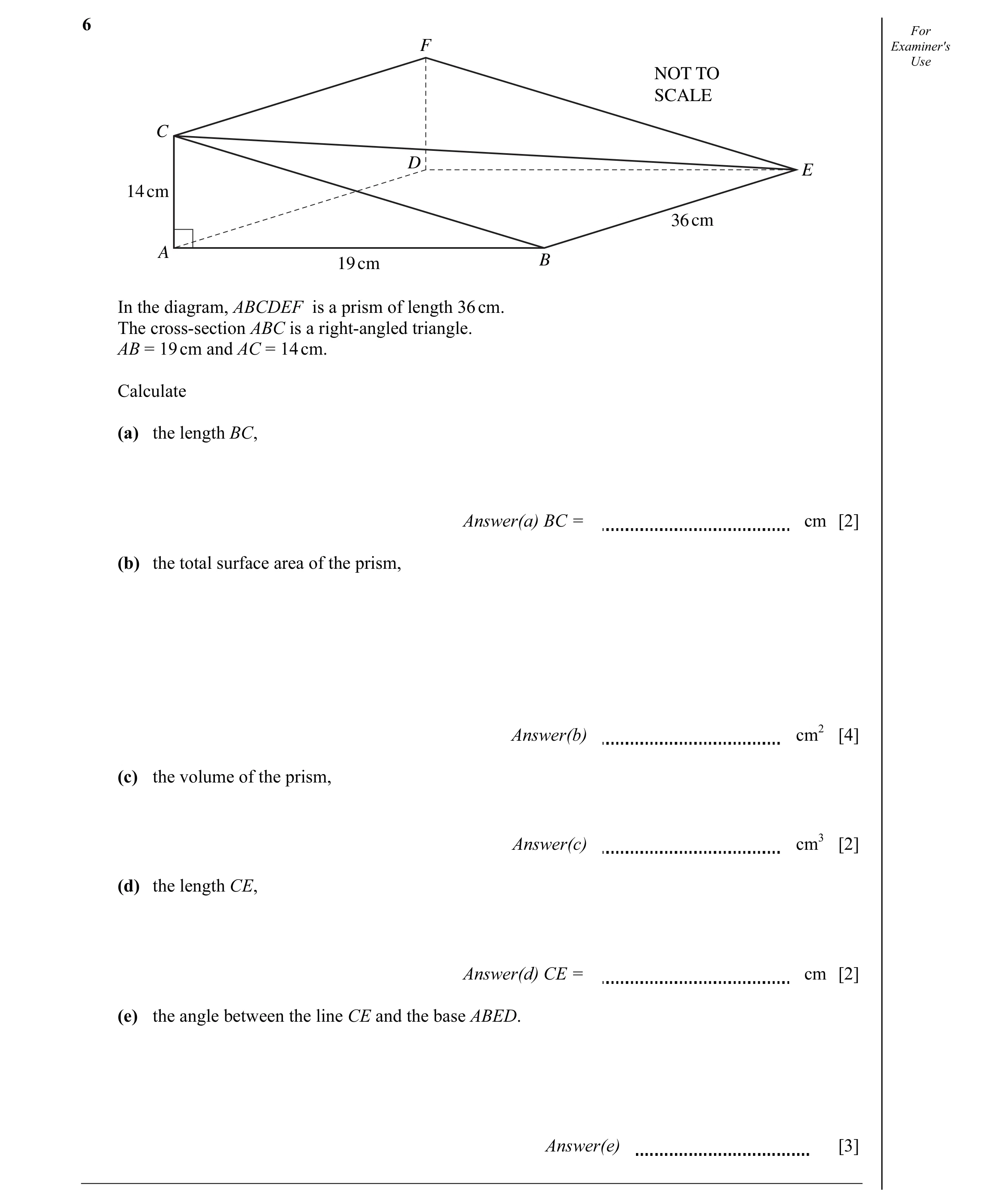
Q9 · For F Examiner's Use NOT TO SCALE C D E 14 cm 36 cm A 19 cm B In the diagram, ABCDEF is a… 0580/41 May/June 2011
6 For F Examiner's Use NOT TO SCALE C D E 14 cm 36 cm A 19 cm B In the diagram, ABCDEF is a prism of length 36 cm. The cross-section ABC is a right-angled triangle. AB = 19 cm and AC = 14 cm. Calculate (a) the length BC, Answer(a) BC = cm [2] (b) the total surface area of the prism, Answer(b) cm2 [4] (c) the volume of the prism, Answer(c) cm3 [2] (d) the length CE, Answer(d) CE = cm [2] (e) the angle between the line CE and the base ABED. Answer(e) [3]
13 marks
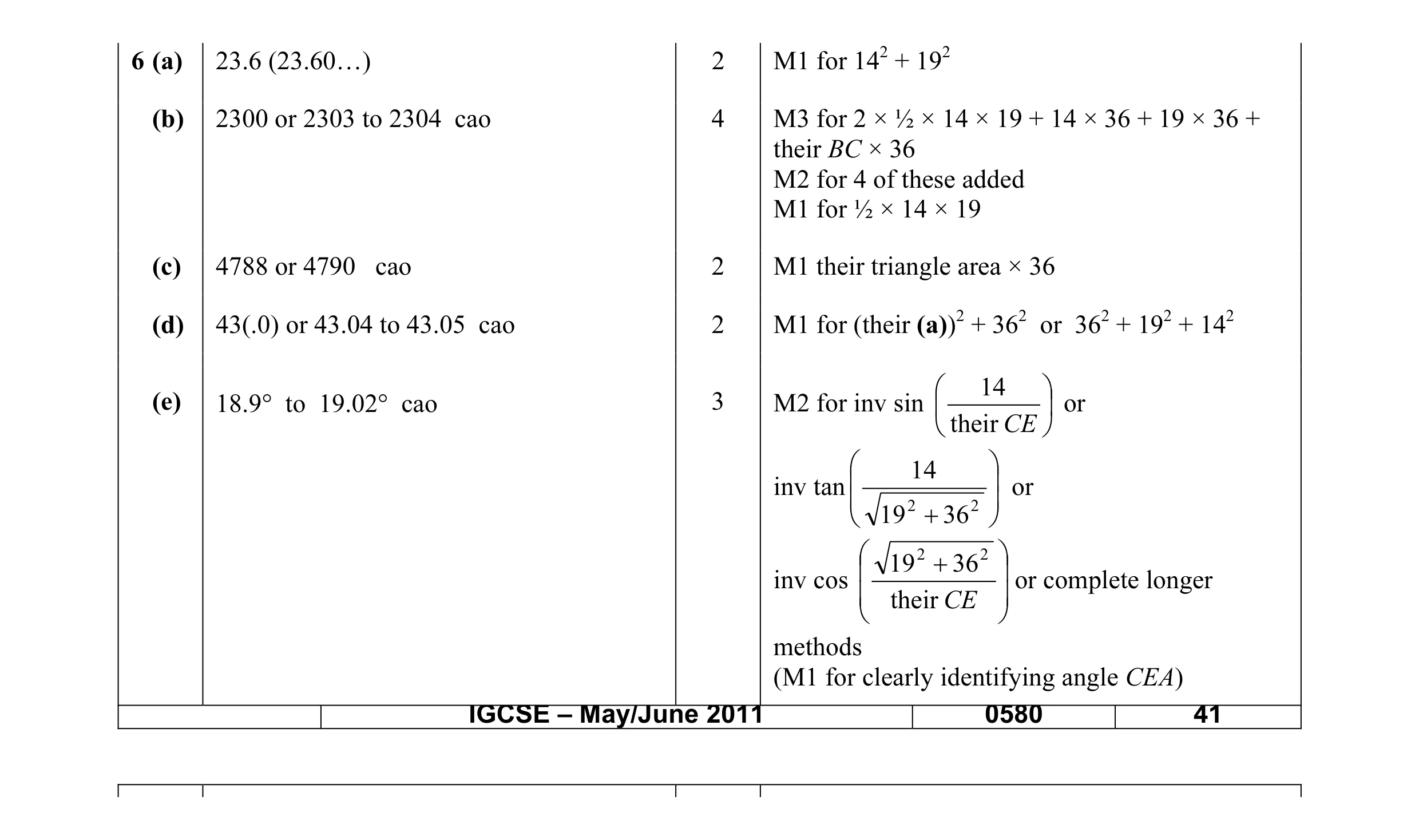
Mark scheme: 6 (a) 23.6 (23.60…) 2 M1 for 142 + 192 (b) 2300 or 2303 to 2304 cao 4 M3 for 2 × ½ × 14 × 19 + 14 × 36 + 19 × 36 + their BC × 36 M2 for 4 of these added M1 for ½ × 14 × 19 (c) 4788 or 4790 cao 2 M1 their triangle area × 36 (d) 43(.0) or 43.04 to 43.05 cao 2 M1 for (their (a))2 + 362 or 362 + 192 + 142 14 (e) 18.9° to 19.02° cao 3 M2 for inv sin or their CE 14 inv tan 2 2 or 19 + 36 2 2 19 + 36 inv cos or complete longer their CE methods (M1 for clearly identifying angle CEA) IGCSE – May/June 2011 0580 41
This question in 0580/41 May/June 2011
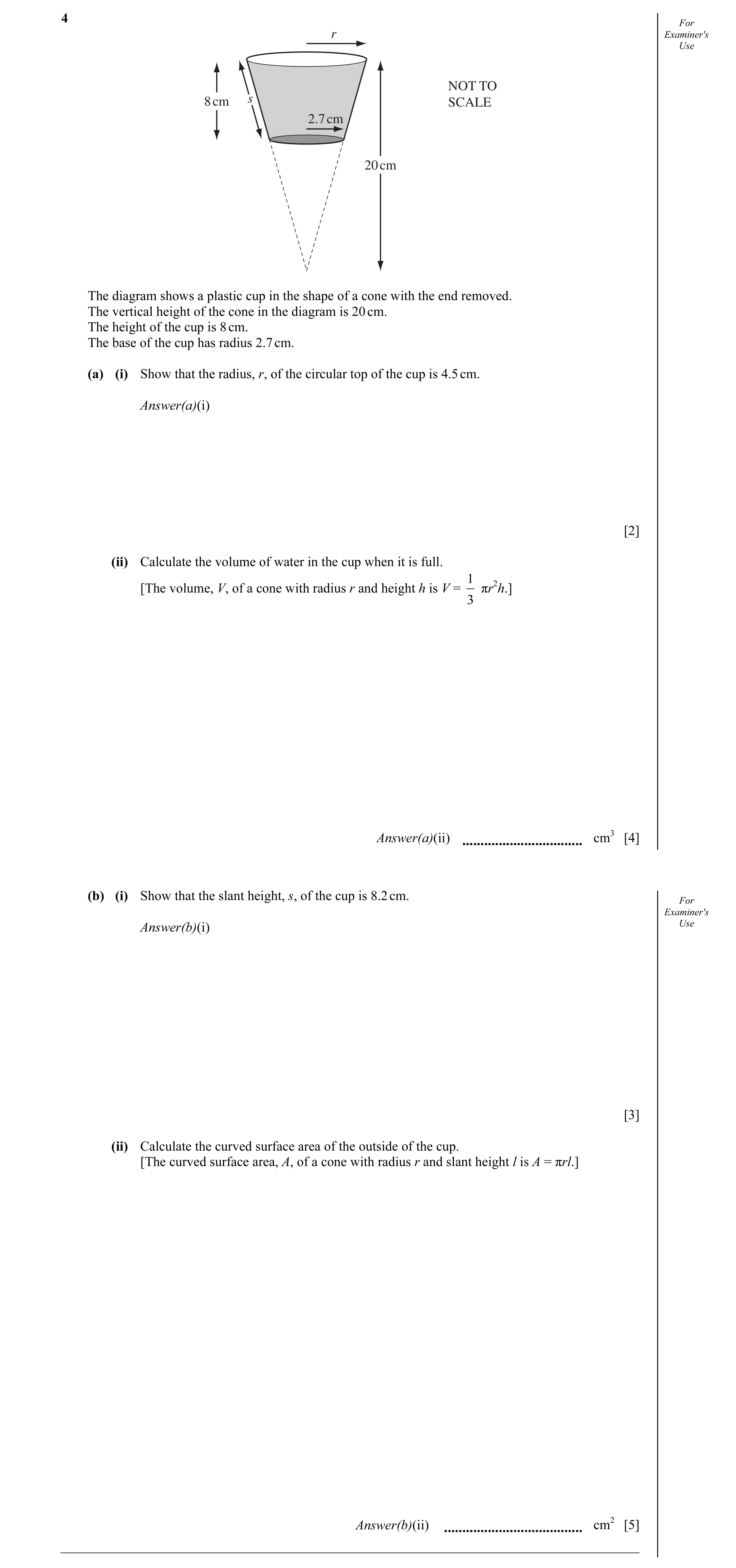
Q10 · For r Examiner's Use NOT TO 8 cm s SCALE 2.7 cm 20 cm The diagram shows a plastic cup in… 0580/41 Oct/Nov 2011
4 For r Examiner's Use NOT TO 8 cm s SCALE 2.7 cm 20 cm The diagram shows a plastic cup in the shape of a cone with the end removed. The vertical height of the cone in the diagram is 20 cm. The height of the cup is 8 cm. The base of the cup has radius 2.7 cm. (a) (i) Show that the radius, r, of the circular top of the cup is 4.5 cm. Answer(a)(i) [2] (ii) Calculate the volume of water in the cup when it is full. 1 [The volume, V, of a cone with radius r and height h is V = πr2h.] 3 Answer(a)(ii) cm3 [4] (b) (i) Show that the slant height, s, of the cup is 8.2 cm. For Examiner's Answer(b)(i) Use [3] (ii) Calculate the curved surface area of the outside of the cup. [The curved surface area, A, of a cone with radius r and slant height l is A = πrl.] Answer(b)(ii) cm2 [5]
14 marks
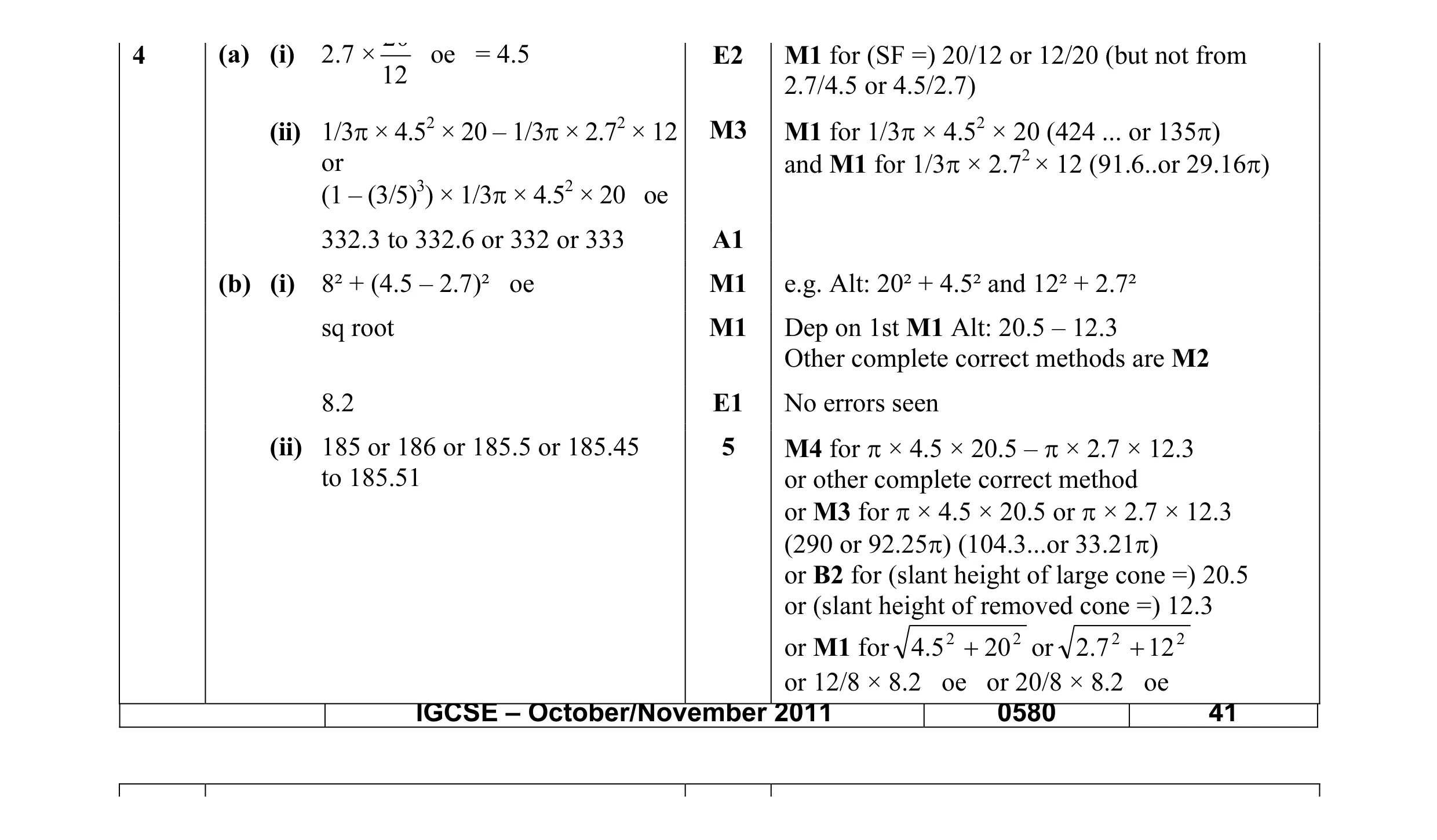
Mark scheme: 20 4 (a) (i) 2.7 × oe = 4.5 E2 M1 for (SF =) 20/12 or 12/20 (but not from 12 2.7/4.5 or 4.5/2.7) (ii) 1/3π × 4.52 × 20 – 1/3π × 2.72 × 12 M3 M1 for 1/3π × 4.52 × 20 (424 ... or 135π) or and M1 for 1/3π × 2.72 × 12 (91.6..or 29.16π) (1 – (3/5)3) × 1/3π × 4.52 × 20 oe 332.3 to 332.6 or 332 or 333 A1 (b) (i) 8² + (4.5 – 2.7)² oe M1 e.g. Alt: 20² + 4.5² and 12² + 2.7² sq root M1 Dep on 1st M1 Alt: 20.5 – 12.3 Other complete correct methods are M2 8.2 E1 No errors seen (ii) 185 or 186 or 185.5 or 185.45 5 M4 for π × 4.5 × 20.5 – π × 2.7 × 12.3 to 185.51 or other complete correct method or M3 for π × 4.5 × 20.5 or π × 2.7 × 12.3 (290 or 92.25π) (104.3...or 33.21π) or B2 for (slant height of large cone =) 20.5 or (slant height of removed cone =) 12.3 or M1 for 5.4 2 + 20 2 or 2.7 2 + 12 2 or 12/8 × 8.2 oe or 20/8 × 8.2 oe IGCSE – October/November 2011 0580 41
This question in 0580/41 Oct/Nov 2011
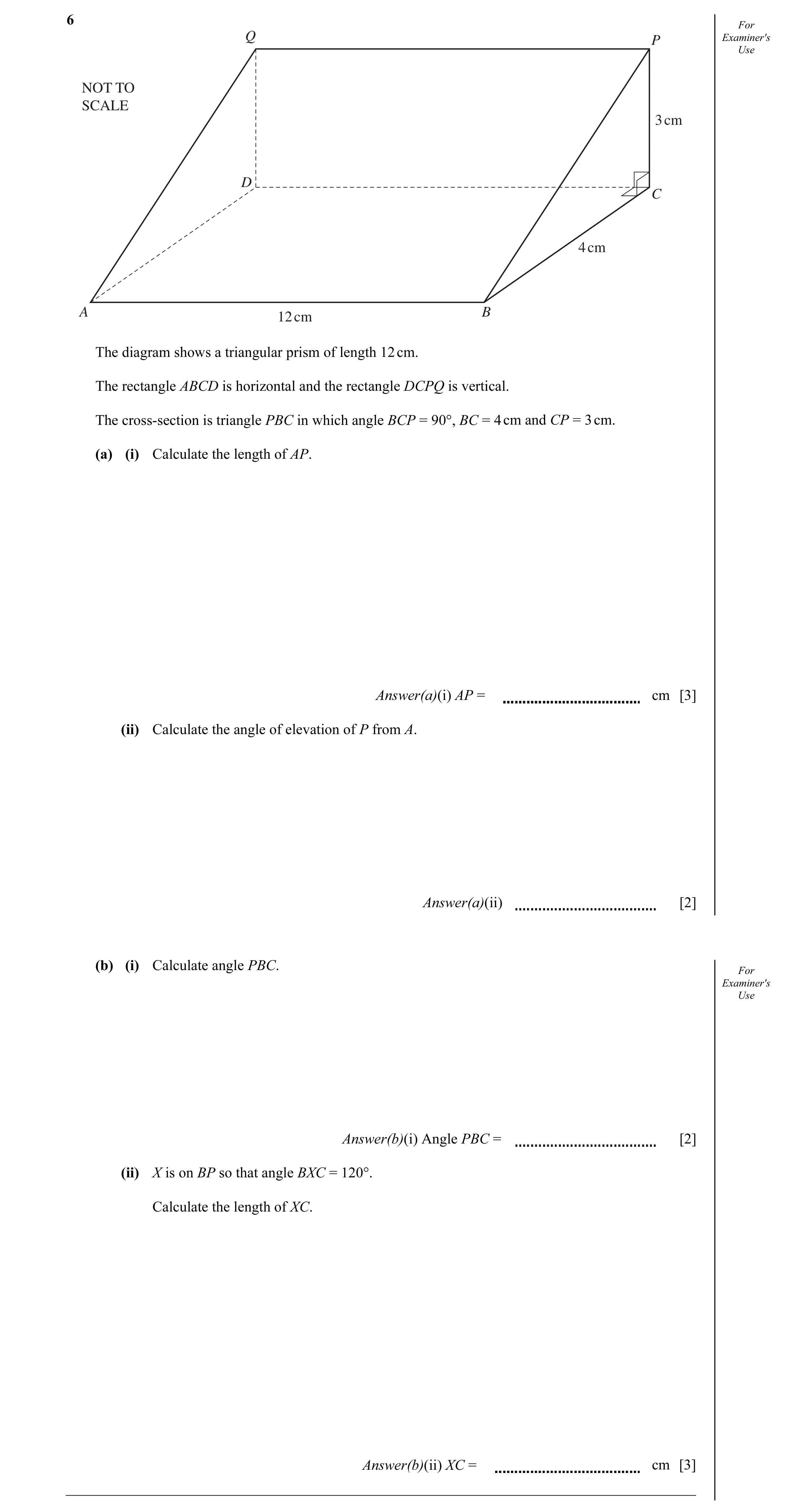
Q11 · For Q P Examiner's Use NOT TO SCALE 3 cm D C 4 cm A B 12 cm The diagram shows a… 0580/43 Oct/Nov 2011
6 For Q P Examiner's Use NOT TO SCALE 3 cm D C 4 cm A B 12 cm The diagram shows a triangular prism of length 12 cm. The rectangle ABCD is horizontal and the rectangle DCPQ is vertical. The cross-section is triangle PBC in which angle BCP = 90°, BC = 4 cm and CP = 3 cm. (a) (i) Calculate the length of AP. Answer(a)(i) AP = cm [3] (ii) Calculate the angle of elevation of P from A. Answer(a)(ii) [2] (b) (i) Calculate angle PBC. For Examiner's Use Answer(b)(i) Angle PBC = [2] (ii) X is on BP so that angle BXC = 120°. Calculate the length of XC. Answer(b)(ii) XC = cm [3]
10 marks
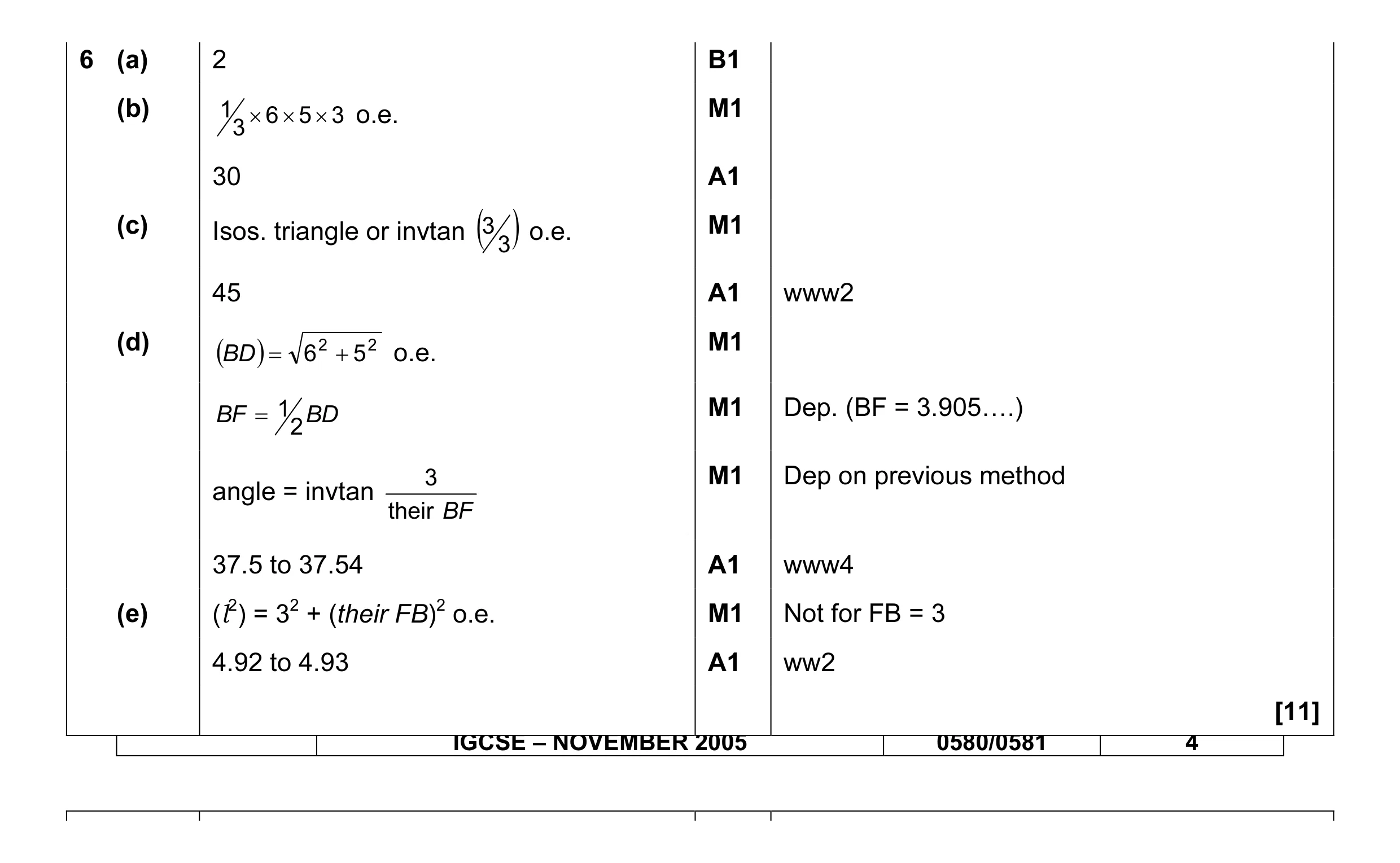
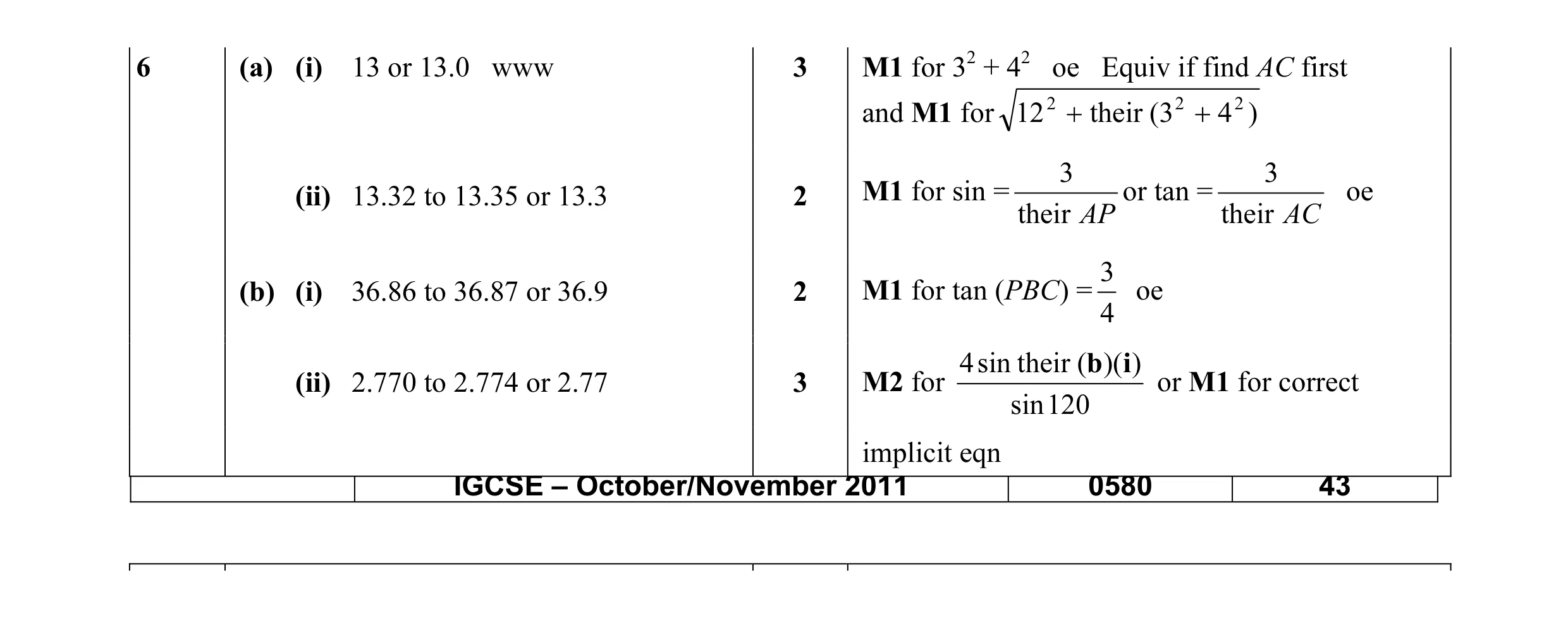
Mark scheme: 6 (a) (i) 13 or 13.0 www 3 M1 for 32 + 42 oe Equiv if find AC first and M1 for 12 2 + their (3 2 + 4 2 ) 3 3 (ii) 13.32 to 13.35 or 13.3 2 M1 for sin = or tan = oe their AP their AC 3 (b) (i) 36.86 to 36.87 or 36.9 2 M1 for tan (PBC) = oe 4 4 sin their (b )( i ) (ii) 2.770 to 2.774 or 2.77 3 M2 for or M1 for correct sin 120 implicit eqn IGCSE – October/November 2011 0580 43
This question in 0580/43 Oct/Nov 2011
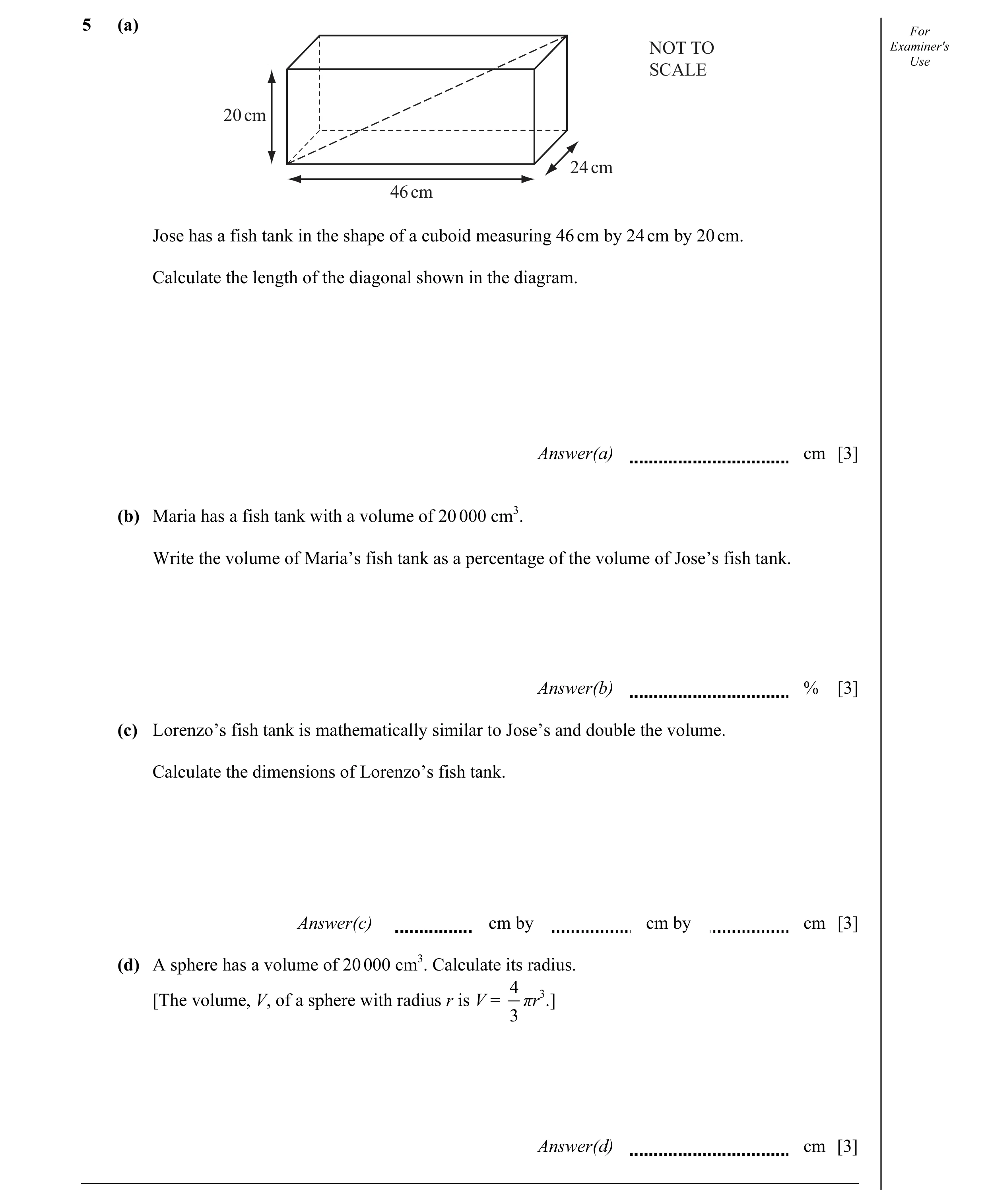
Q12 · For NOT TO Examiner's Use SCALE 20 cm 24 cm 46 cm Jose has a fish tank in the shape of a… 0580/41 Oct/Nov 2012
5 (a) For NOT TO Examiner's Use SCALE 20 cm 24 cm 46 cm Jose has a fish tank in the shape of a cuboid measuring 46 cm by 24 cm by 20 cm. Calculate the length of the diagonal shown in the diagram. Answer(a) cm [3] (b) Maria has a fish tank with a volume of 20 000 cm3. Write the volume of Maria’s fish tank as a percentage of the volume of Jose’s fish tank. Answer(b) % [3] (c) Lorenzo’s fish tank is mathematically similar to Jose’s and double the volume. Calculate the dimensions of Lorenzo’s fish tank. Answer(c) cm by cm by cm [3] (d) A sphere has a volume of 20 000 cm3. Calculate its radius. 4 [The volume, V, of a sphere with radius r is V = πr3.] 3 Answer(d) cm [3]
12 marks
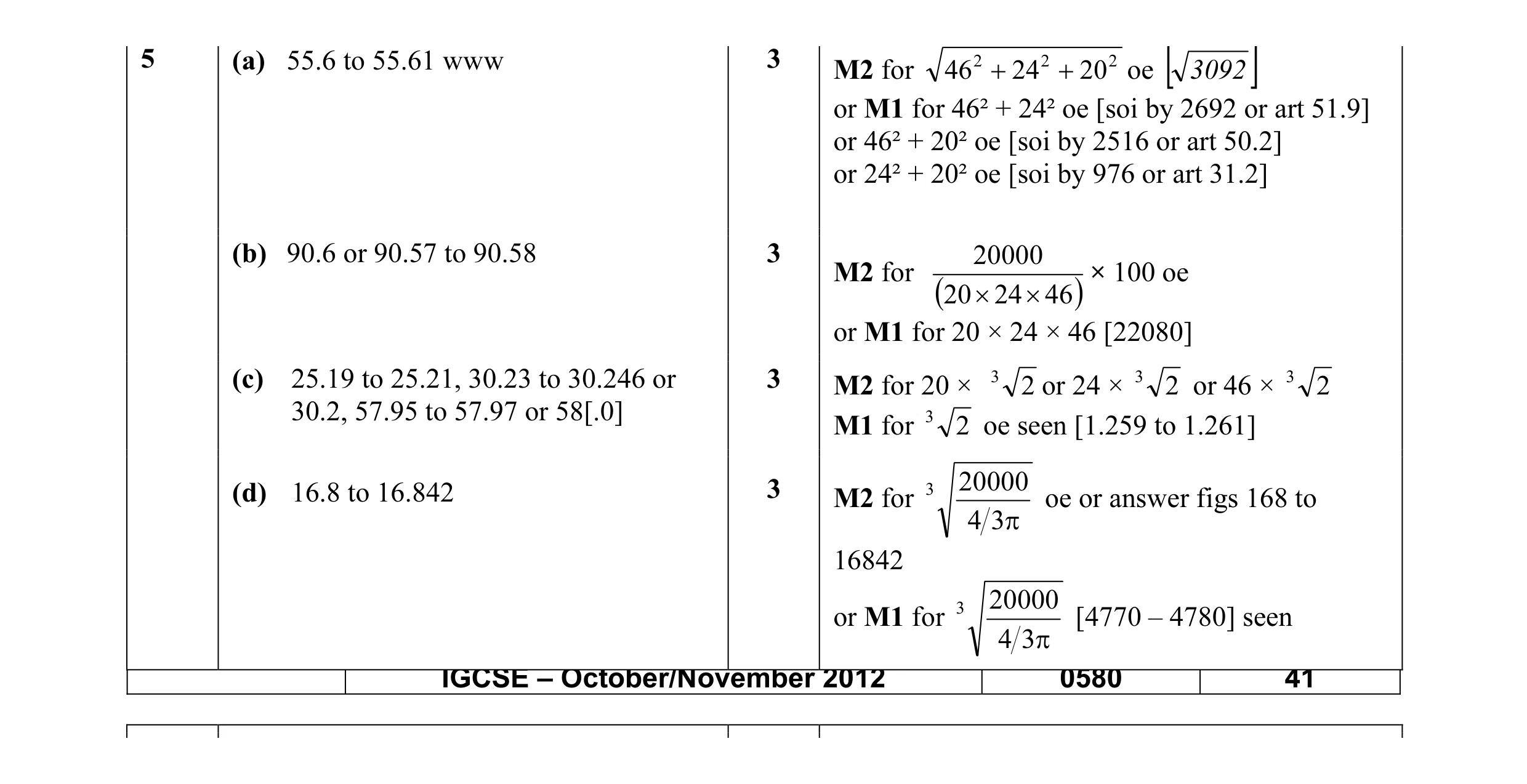
Mark scheme: 5 (a) 55.6 to 55.61 www 3 M2 for 46 2 + 24 2 + 20 2 oe [ 3092 ] or M1 for 46² + 24² oe [soi by 2692 or art 51.9] or 46² + 20² oe [soi by 2516 or art 50.2] or 24² + 20² oe [soi by 976 or art 31.2] (b) 90.6 or 90.57 to 90.58 3 20000 M2 for × 100 oe (20 × 24 × 46 ) or M1 for 20 × 24 × 46 [22080] (c) 25.19 to 25.21, 30.23 to 30.246 or 3 M2 for 20 × 3 2 or 24 × 3 2 or 46 × 3 2 30.2, 57.95 to 57.97 or 58[.0] 3 2 oe seen [1.259 to 1.261] M1 for 3 20000 (d) 16.8 to 16.842 3 M2 for oe or answer figs 168 to 4 3π 16842 3 20000 or M1 for [4770 – 4780] seen 4 3π IGCSE – October/November 2012 0580 41
This question in 0580/41 Oct/Nov 2012
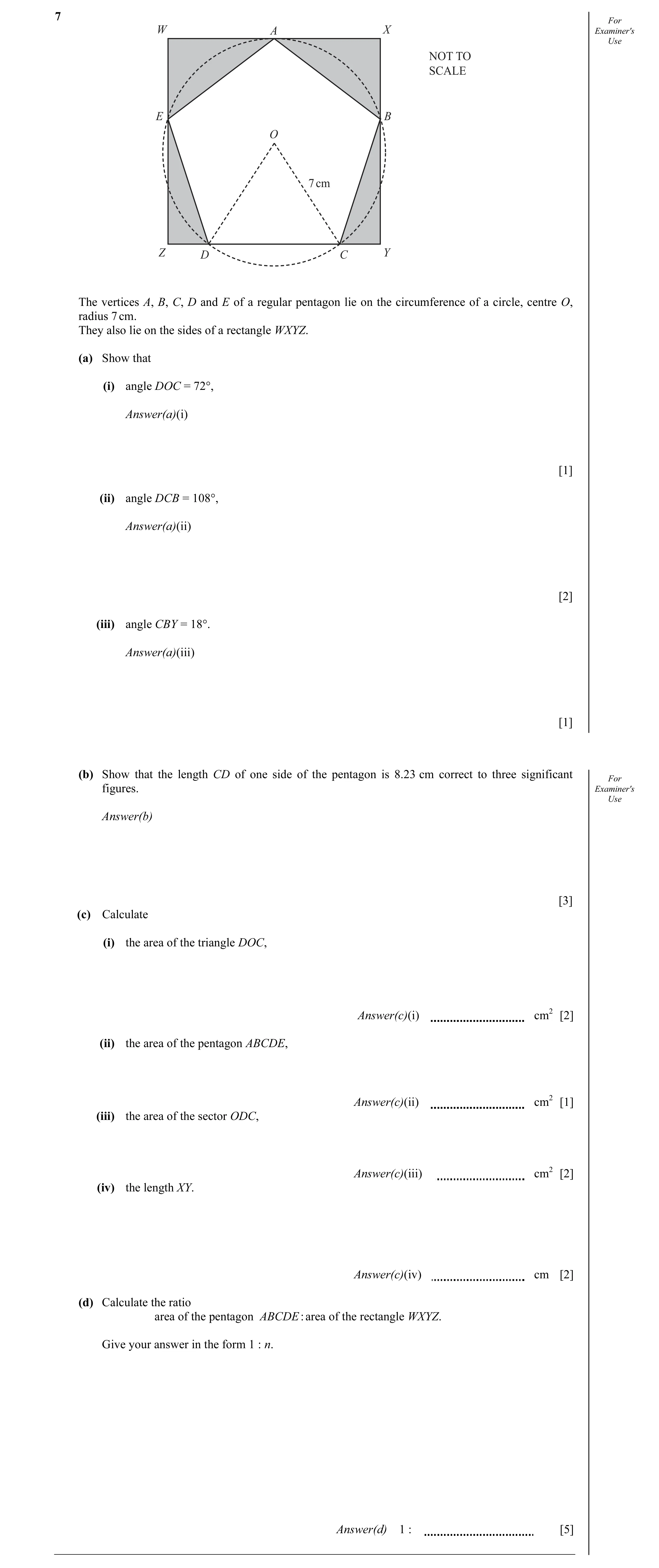
Q13 · For W A X Examiner's Use NOT TO SCALE E B O 7 cm Z D C Y The vertices A, B, C, D and E of… 0580/41 Oct/Nov 2012
7 For W A X Examiner's Use NOT TO SCALE E B O 7 cm Z D C Y The vertices A, B, C, D and E of a regular pentagon lie on the circumference of a circle, centre O, radius 7 cm. They also lie on the sides of a rectangle WXYZ. (a) Show that (i) angle DOC = 72°, Answer(a)(i) [1] (ii) angle DCB = 108°, Answer(a)(ii) [2] (iii) angle CBY = 18°. Answer(a)(iii) [1] (b) Show that the length CD of one side of the pentagon is 8.23 cm correct to three significant For figures. Examiner's Use Answer(b) [3] (c) Calculate (i) the area of the triangle DOC, Answer(c)(i) cm2 [2] (ii) the area of the pentagon ABCDE, Answer(c)(ii) cm2 [1] (iii) the area of the sector ODC, Answer(c)(iii) cm2 [2] (iv) the length XY. Answer(c)(iv) cm [2] (d) Calculate the ratio area of the pentagon ABCDE : area of the rectangle WXYZ. Give your answer in the form 1 : n. Answer(d) 1 : [5]
19 marks
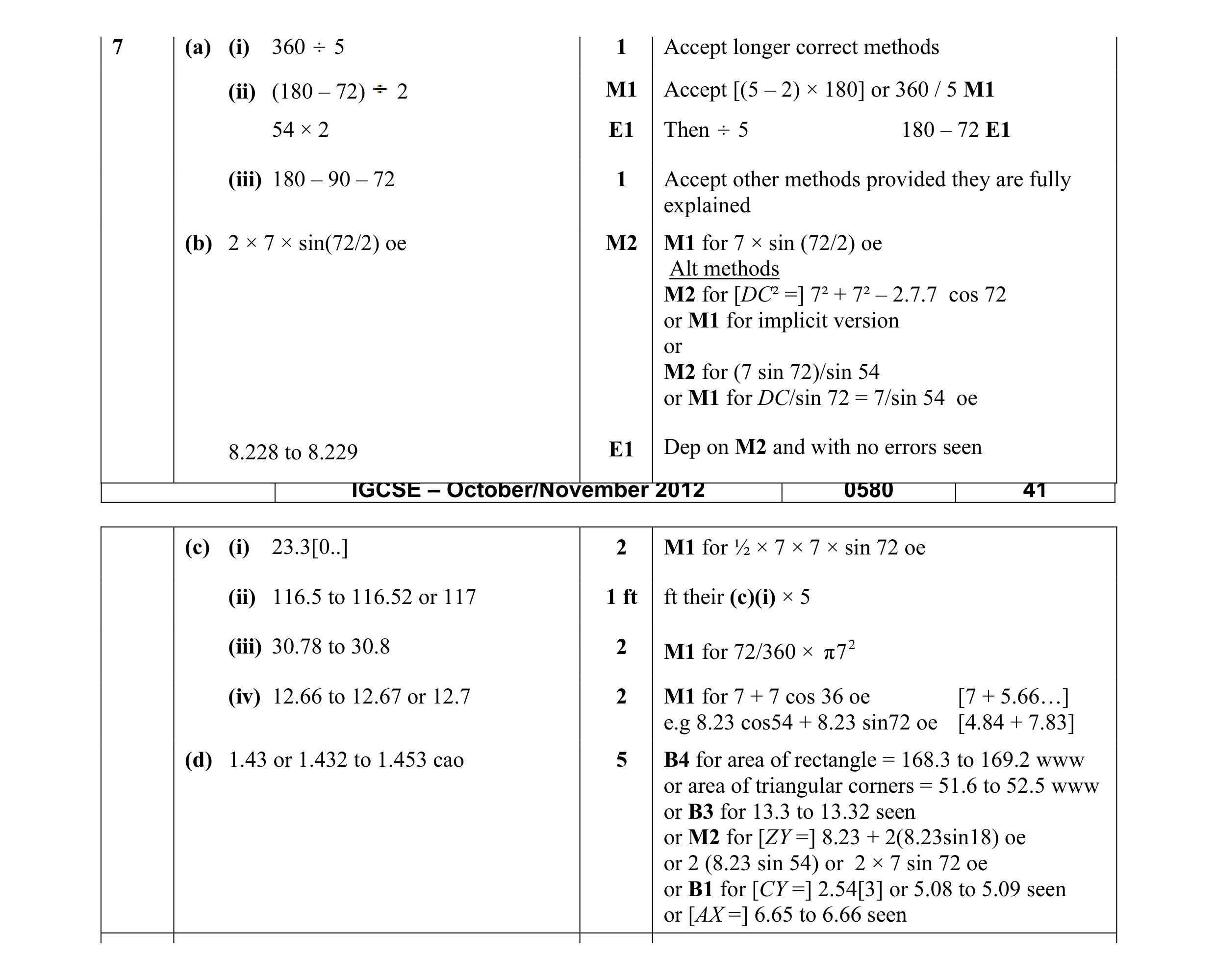
Mark scheme: 7 (a) (i) 360 Q 5 1 Accept longer correct methods (ii) (180 – 72) 2 M1 Accept [(5 – 2) × 180] or 360 / 5 M1 54 × 2 E1 Then Q 5 180 – 72 E1 (iii) 180 – 90 – 72 1 Accept other methods provided they are fully explained (b) 2 × 7 × sin(72/2) oe M2 M1 for 7 × sin (72/2) oe Alt methods M2 for [DC² =] 7² + 7² – 2.7.7 cos 72 or M1 for implicit version or M2 for (7 sin 72)/sin 54 or M1 for DC/sin 72 = 7/sin 54 oe 8.228 to 8.229 E1 Dep on M2 and with no errors seen IGCSE – October/November 2012 0580 41 (c) (i) 23.3[0..] 2 M1 for ½ × 7 × 7 × sin 72 oe (ii) 116.5 to 116.52 or 117 1 ft ft their (c)(i) × 5 (iii) 30.78 to 30.8 2 M1 for 72/360 × π 7 2 (iv) 12.66 to 12.67 or 12.7 2 M1 for 7 + 7 cos 36 oe [7 + 5.66…] e.g 8.23 cos54 + 8.23 sin72 oe [4.84 + 7.83] (d) 1.43 or 1.432 to 1.453 cao 5 B4 for area of rectangle = 168.3 to 169.2 www or area of triangular corners = 51.6 to 52.5 www or B3 for 13.3 to 13.32 seen or M2 for [ZY =] 8.23 + 2(8.23sin18) oe or 2 (8.23 sin 54) or 2 × 7 sin 72 oe or B1 for [CY =] 2.54[3] or 5.08 to 5.09 seen or [AX =] 6.65 to 6.66 seen
This question in 0580/41 Oct/Nov 2012
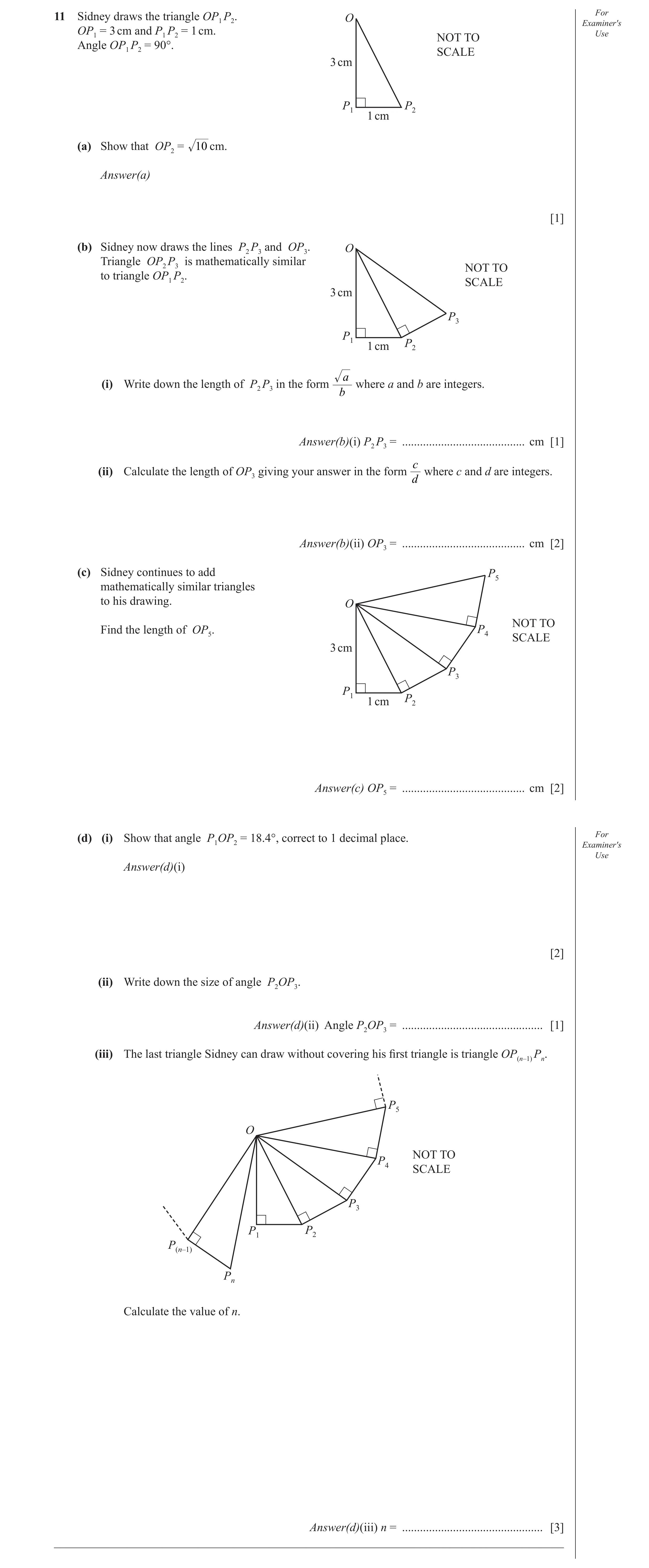
Q14 · Sidney draws the triangle OP1 P2 0580/42 May/June 2013
11 Sidney draws the triangle OP1 P2. O For Examiner′s OP1 = 3 cm and P1 P2 = 1 cm. Use NOT TO Angle OP1 P2 = 90°. SCALE 3 cm P1 P2 1 cm (a) Show that OP2 = 10 cm. Answer(a) [1] (b) Sidney now draws the lines P2 P3 and OP3. O Triangle OP2 P3 is mathematically similar NOT TO to triangle OP1 P2. SCALE 3 cm P3 P1 1 cm P2 a (i) Write down the length of P2 P3 in the form where a and b are integers. b Answer(b)(i) P2 P3 = … cm [1] c (ii) Calculate the length of OP3 giving your answer in the form where c and d are integers. d Answer(b)(ii) OP3 = … cm [2] (c) Sidney continues to add P5 mathematically similar triangles to his drawing. O NOT TO Find the length of OP5. P4 SCALE 3 cm P3 P1 1 cm P2 Answer(c) OP5 = … cm [2] (d) (i) Show that angle P1OP2 = 18.4°, correct to 1 decimal place. For Examiner′s Use Answer(d)(i) [2] (ii) Write down the size of angle P2OP3. Answer(d)(ii) Angle P2OP3 = … [1] (iii) The last triangle Sidney can draw without covering his fi rst triangle is triangle OP(n–1) Pn. P5 O NOT TO P4 SCALE P3 P1 P2 P(n–1) Pn Calculate the value of n. Answer(d)(iii) n = … [3] _____________________________________________________________________________________
12 marks
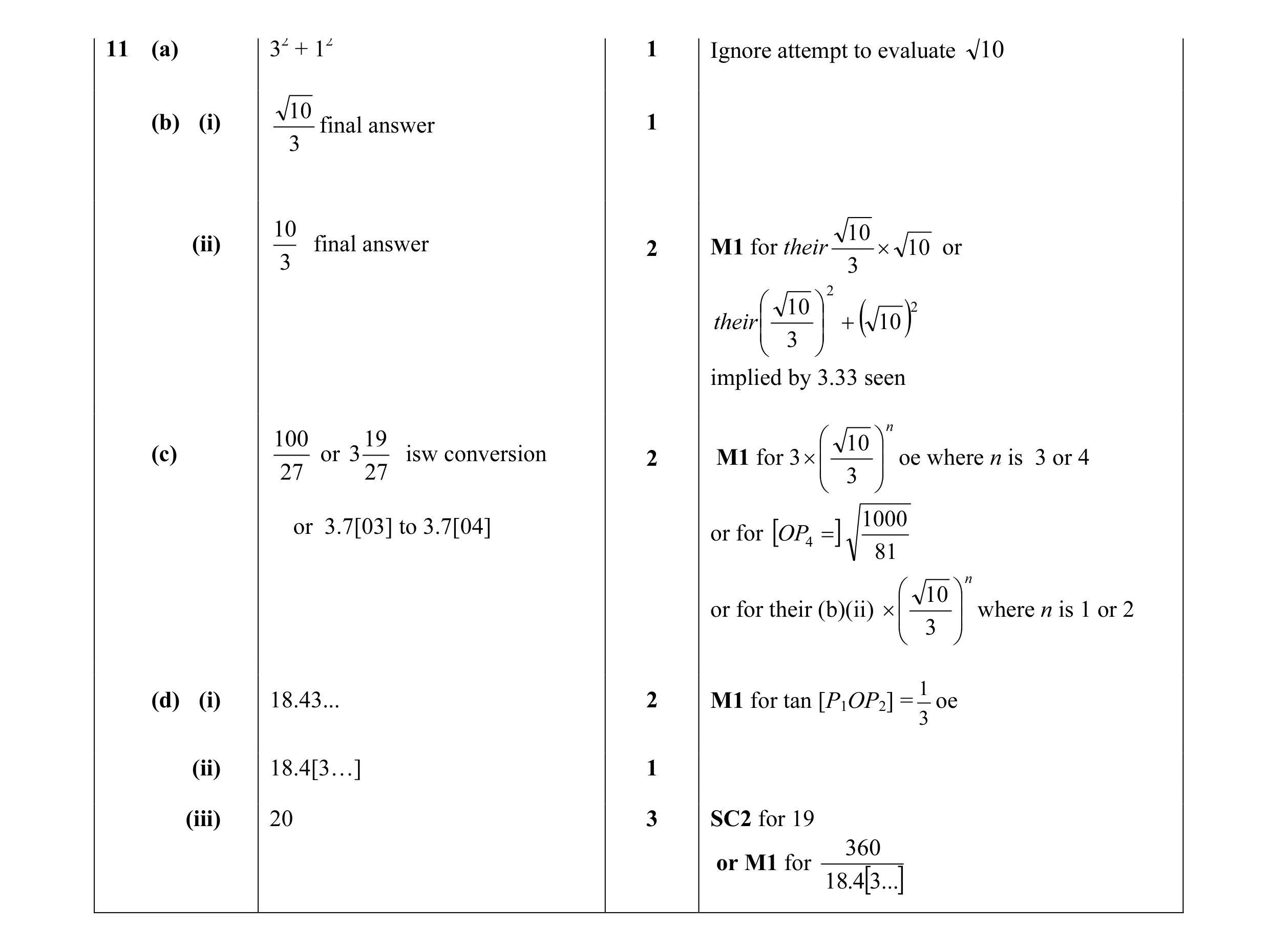
Mark scheme: 11 (a) 32 + 12 1 Ignore attempt to evaluate 10 10 (b) (i) final answer 1 3 10 10 (ii) final answer 2 M1 for their × 10 or 3 3 2 10 2 their 3 + ( 10 ) implied by 3.33 seen n 100 19 10 or 3 (c) oe where n is 3 or 4 27 27 isw conversion 2 M1 for 3 × 3 1000 or 3.7[03] to 3.7[04] or for [OP4 = ] 81 n 10 where n is 1 or 2 or for their (b)(ii) × 3 1 (d) (i) 18.43... 2 M1 for tan [P1OP2] = oe 3 (ii) 18.4[3…] 1 (iii) 20 3 SC2 for 19 360 or M1 for 184.[3...]
This question in 0580/42 May/June 2013
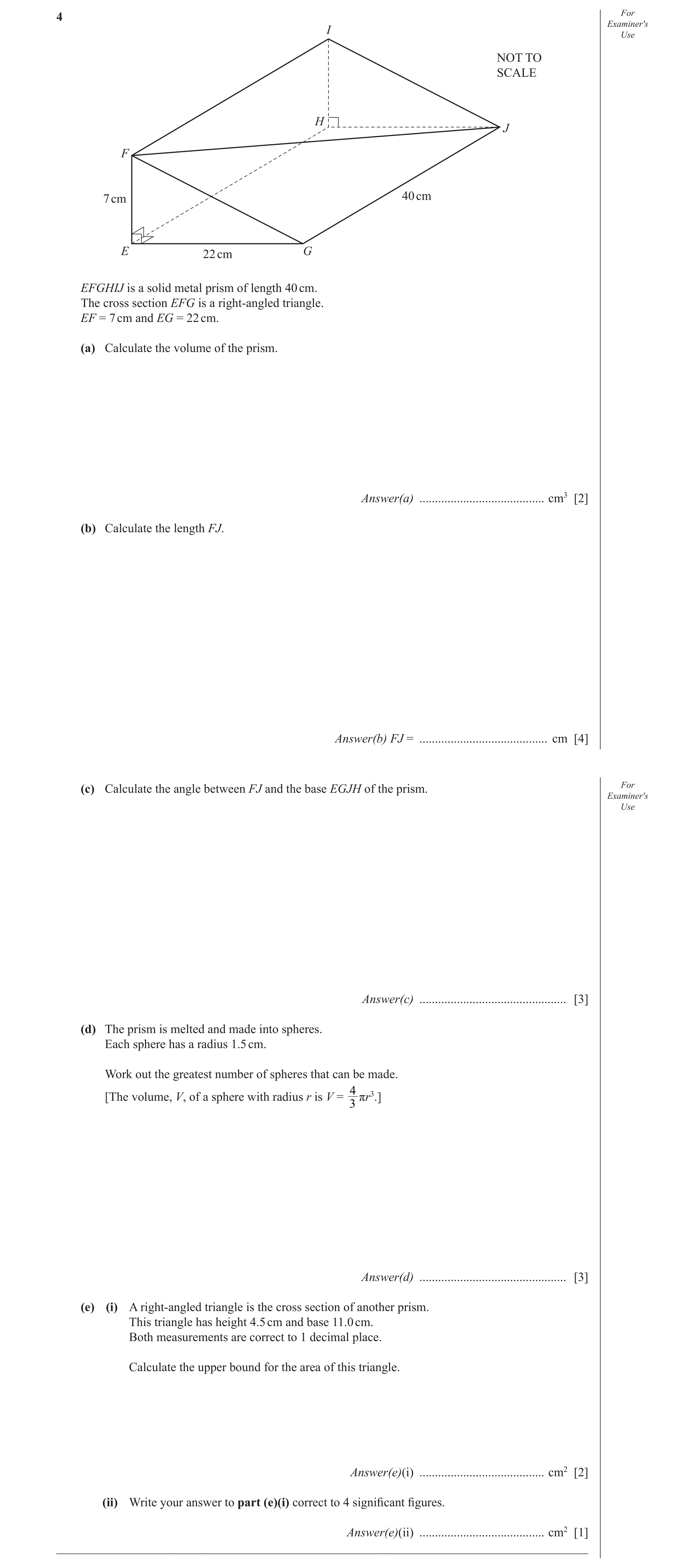
Q15 · For Examiner′s I Use NOT TO SCALE H J F 7 cm 40 cm E 22 cm G EFGHIJ is a solid metal… 0580/43 May/June 2013
4 For Examiner′s I Use NOT TO SCALE H J F 7 cm 40 cm E 22 cm G EFGHIJ is a solid metal prism of length 40 cm. The cross section EFG is a right-angled triangle. EF = 7 cm and EG = 22 cm. (a) Calculate the volume of the prism. Answer(a) … cm3 [2] (b) Calculate the length FJ. Answer(b) FJ = … cm [4] (c) Calculate the angle between FJ and the base EGJH of the prism. For Examiner′s Use Answer(c) … [3] (d) The prism is melted and made into spheres. Each sphere has a radius 1.5 cm. Work out the greatest number of spheres that can be made. 4 [The volume, V, of a sphere with radius r is V = πr3.] 3 Answer(d) … [3] (e) (i) A right-angled triangle is the cross section of another prism. This triangle has height 4.5 cm and base 11.0 cm. Both measurements are correct to 1 decimal place. Calculate the upper bound for the area of this triangle. Answer(e)(i) … cm2 [2] (ii) Write your answer to part (e)(i) correct to 4 signifi cant fi gures. Answer(e)(ii) … cm2 [1] _____________________________________________________________________________________
15 marks
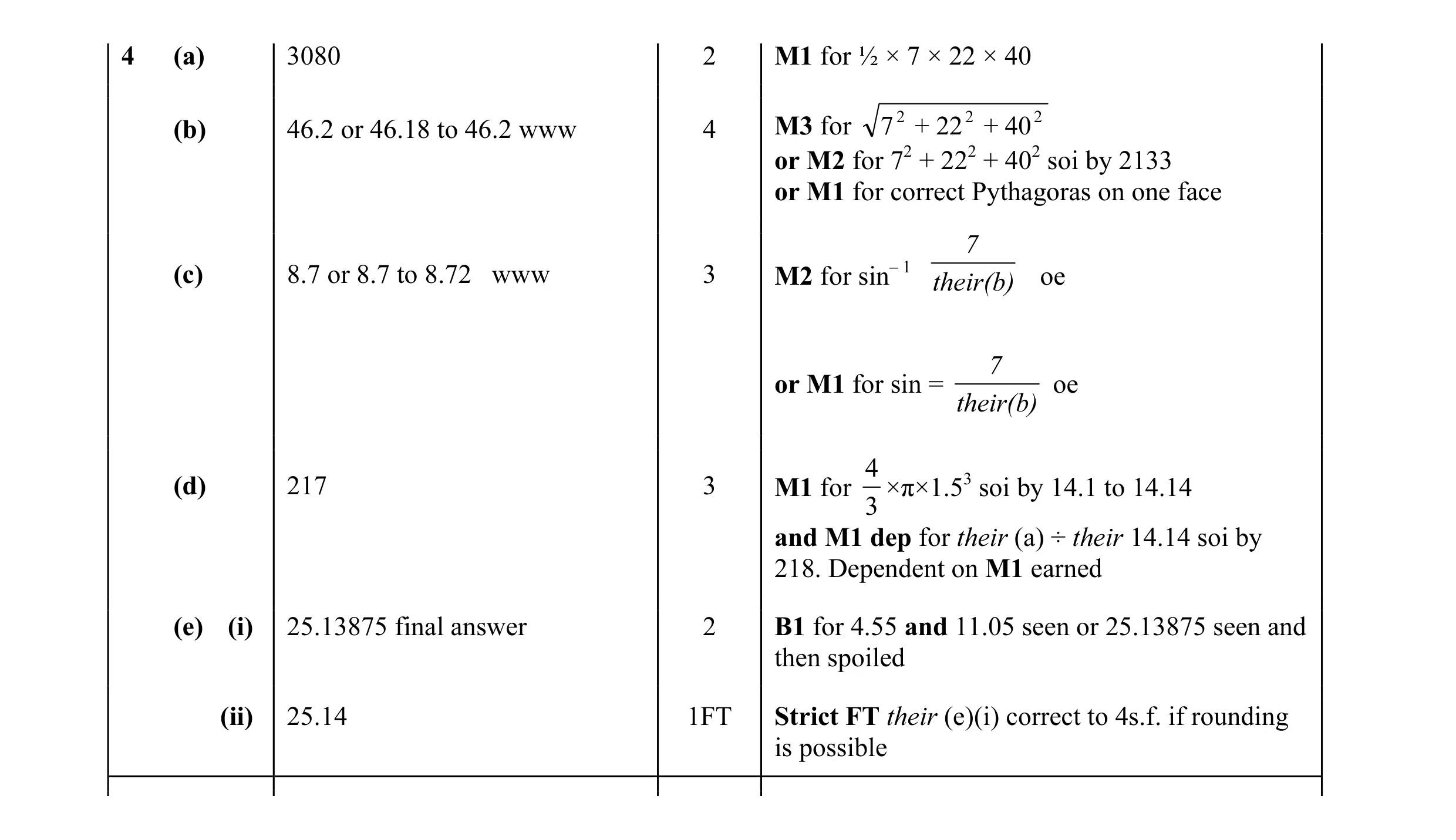
Mark scheme: 4 (a) 3080 2 M1 for ½ × 7 × 22 × 40 (b) 46.2 or 46.18 to 46.2 www 4 M3 for 7 2 + 22 2 + 40 2 or M2 for 72 + 222 + 402 soi by 2133 or M1 for correct Pythagoras on one face 7 (c) 8.7 or 8.7 to 8.72 www 3 M2 for sin– 1 their(b) oe 7 or M1 for sin = oe their(b) 4 (d) 217 3 M1 for ×π×1.53 soi by 14.1 to 14.14 3 and M1 dep for their (a) ÷ their 14.14 soi by 218. Dependent on M1 earned (e) (i) 25.13875 final answer 2 B1 for 4.55 and 11.05 seen or 25.13875 seen and then spoiled (ii) 25.14 1FT Strict FT their (e)(i) correct to 4s.f. if rounding is possible
This question in 0580/43 May/June 2013
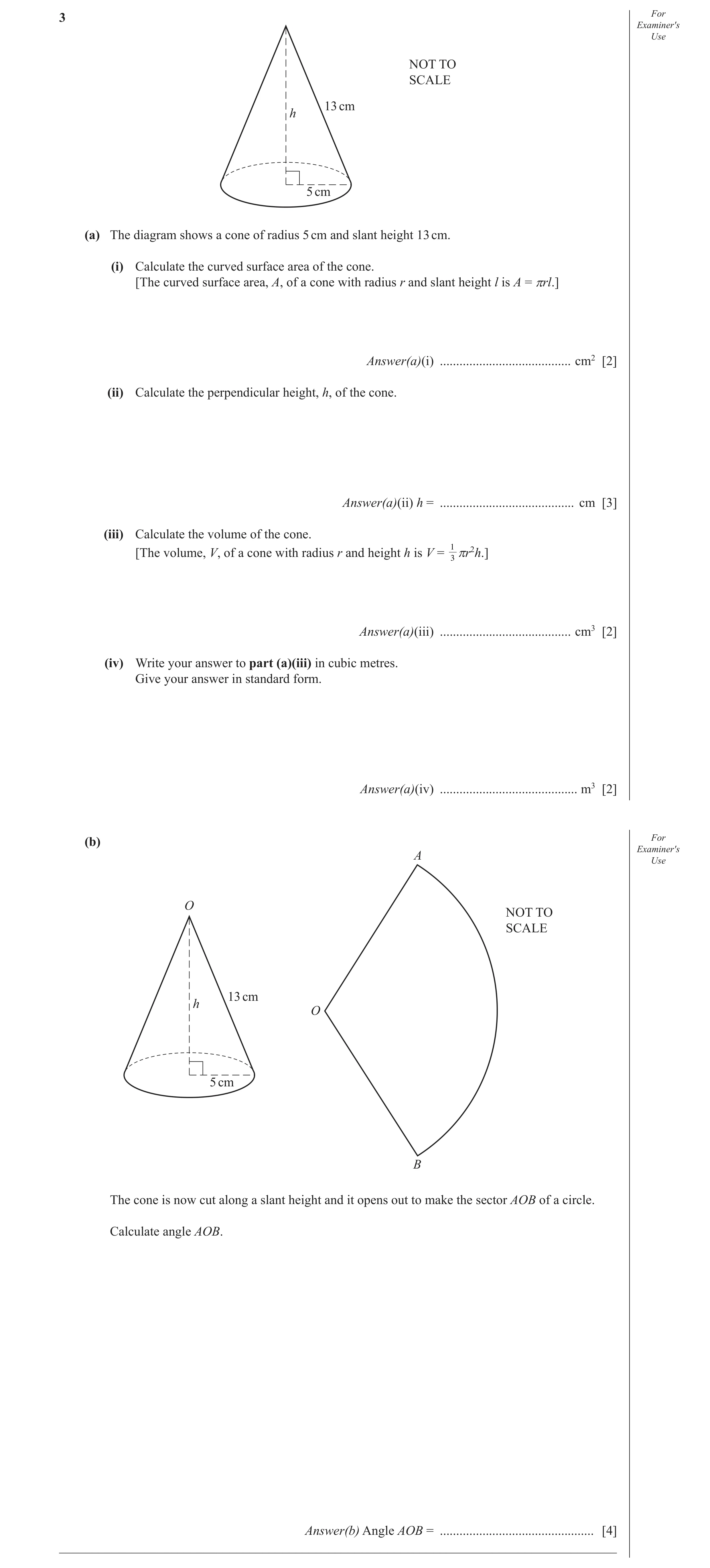
Q16 · For Examiner′s Use NOT TO SCALE 13 cm h 5 cm (a) The diagram shows a cone of radius 5 cm… 0580/41 Oct/Nov 2013
3 For Examiner′s Use NOT TO SCALE 13 cm h 5 cm (a) The diagram shows a cone of radius 5 cm and slant height 13 cm. (i) Calculate the curved surface area of the cone. [The curved surface area, A, of a cone with radius r and slant height l is A = πrl.] Answer(a)(i) … cm2 [2] (ii) Calculate the perpendicular height, h, of the cone. Answer(a)(ii) h = … cm [3] (iii) Calculate the volume of the cone. 1 [The volume, V, of a cone with radius r and height h is V = 3 πr2h.] Answer(a)(iii) … cm3 [2] (iv) Write your answer to part (a)(iii) in cubic metres. Give your answer in standard form. Answer(a)(iv) … m3 [2] (b) For Examiner′s A Use O NOT TO SCALE 13 cm h O 5 cm B The cone is now cut along a slant height and it opens out to make the sector AOB of a circle. Calculate angle AOB. Answer(b) Angle AOB = … [4] _____________________________________________________________________________________
13 marks
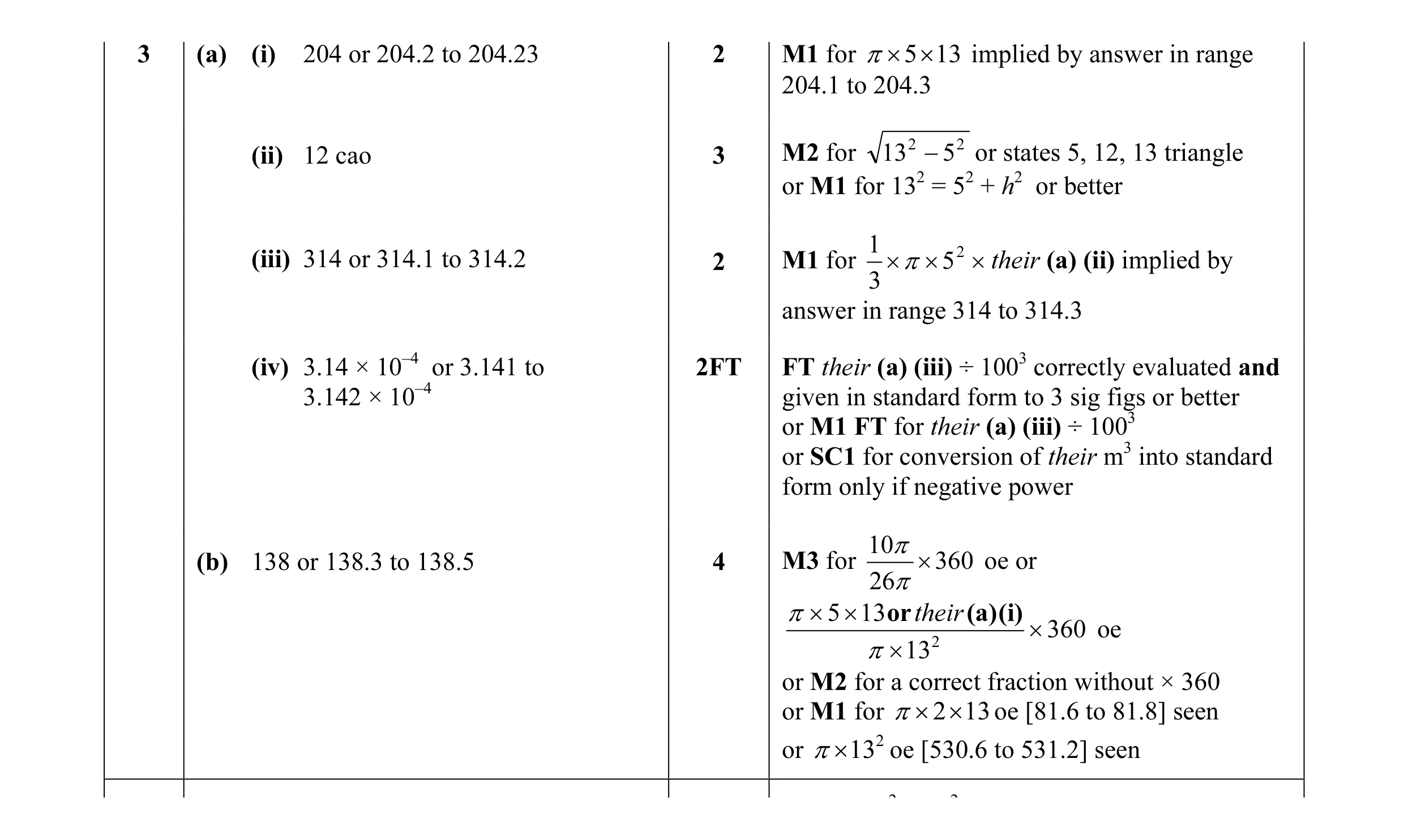
Mark scheme: 3 (a) (i) 204 or 204.2 to 204.23 2 M1 for π × 5× 13 implied by answer in range 204.1 to 204.3 (ii) 12 cao 3 M2 for 13 2 − 5 2 or states 5, 12, 13 triangle or M1 for 132 = 52 + h2 or better 1 2 (iii) 314 or 314.1 to 314.2 2 M1 for × π × 5 × their (a) (ii) implied by 3 answer in range 314 to 314.3 (iv) 3.14 × 10⁻⁴ or 3.141 to 2FT FT their (a) (iii) ÷ 1003 correctly evaluated and 3.142 × 10⁻⁴ given in standard form to 3 sig figs or better or M1 FT for their (a) (iii) ÷ 1003 or SC1 for conversion of their m3 into standard form only if negative power 10π (b) 138 or 138.3 to 138.5 4 M3 for × 360 oe or 26π π × 5 × 13 ortheir (a) (i) × 360 oe 2 π × 13 or M2 for a correct fraction without × 360 or M1 for π × 2× 13 oe [81.6 to 81.8] seen or π × 13 2 oe [530.6 to 531.2] seen 2 2
This question in 0580/41 Oct/Nov 2013
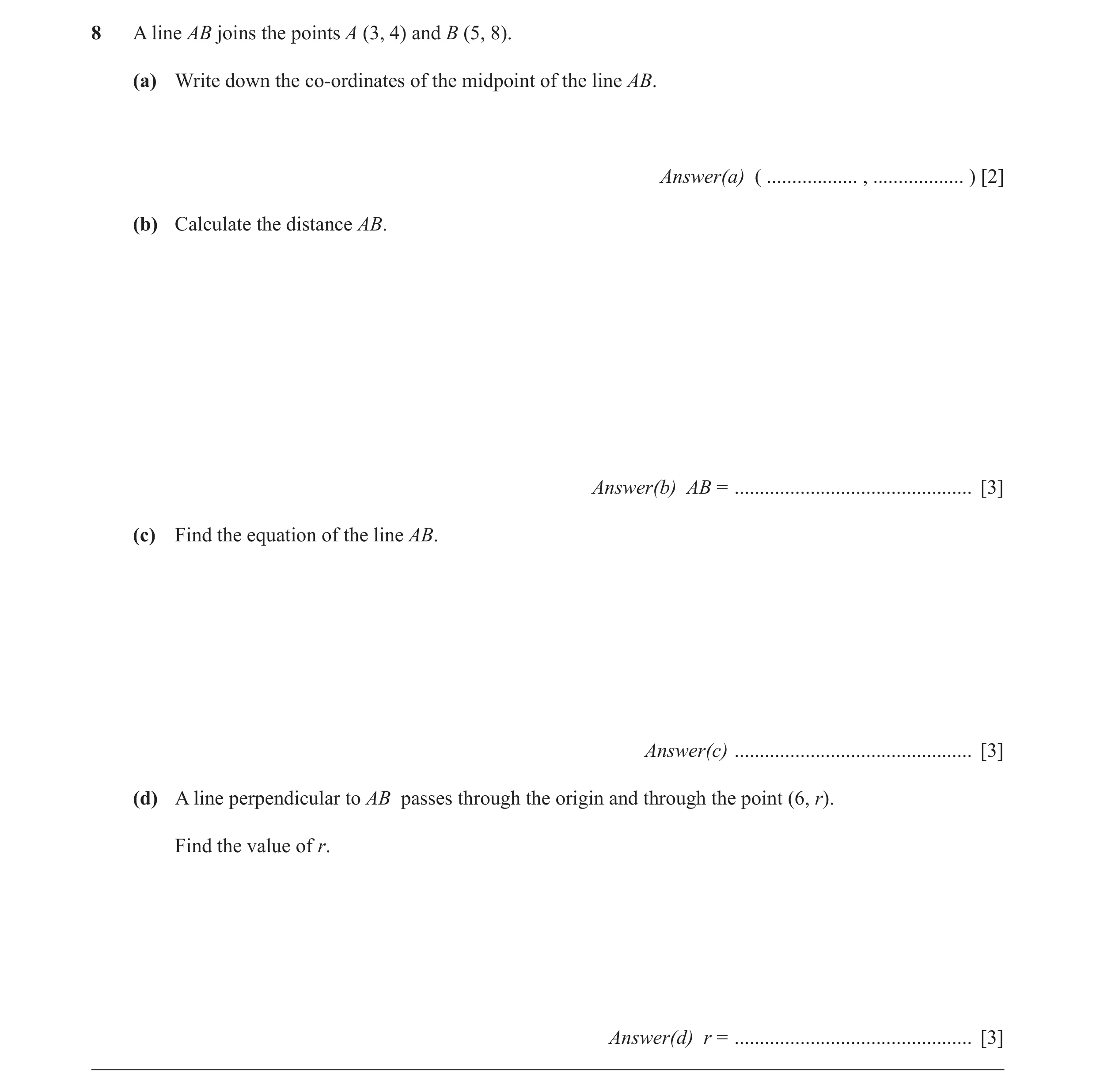
Q17 · A line AB joins the points A (3, 4) and B (5, 8) 0580/42 Oct/Nov 2015
8 A line AB joins the points A (3, 4) and B (5, 8). (a) Write down the co-ordinates of the midpoint of the line AB. Answer(a) ( … , … ) [2] (b) Calculate the distance AB. Answer(b) AB = … [3] (c) Find the equation of the line AB. Answer(c) … [3] (d) A line perpendicular to AB passes through the origin and through the point (6, r). Find the value of r. Answer(d) r = … [3]
11 marks
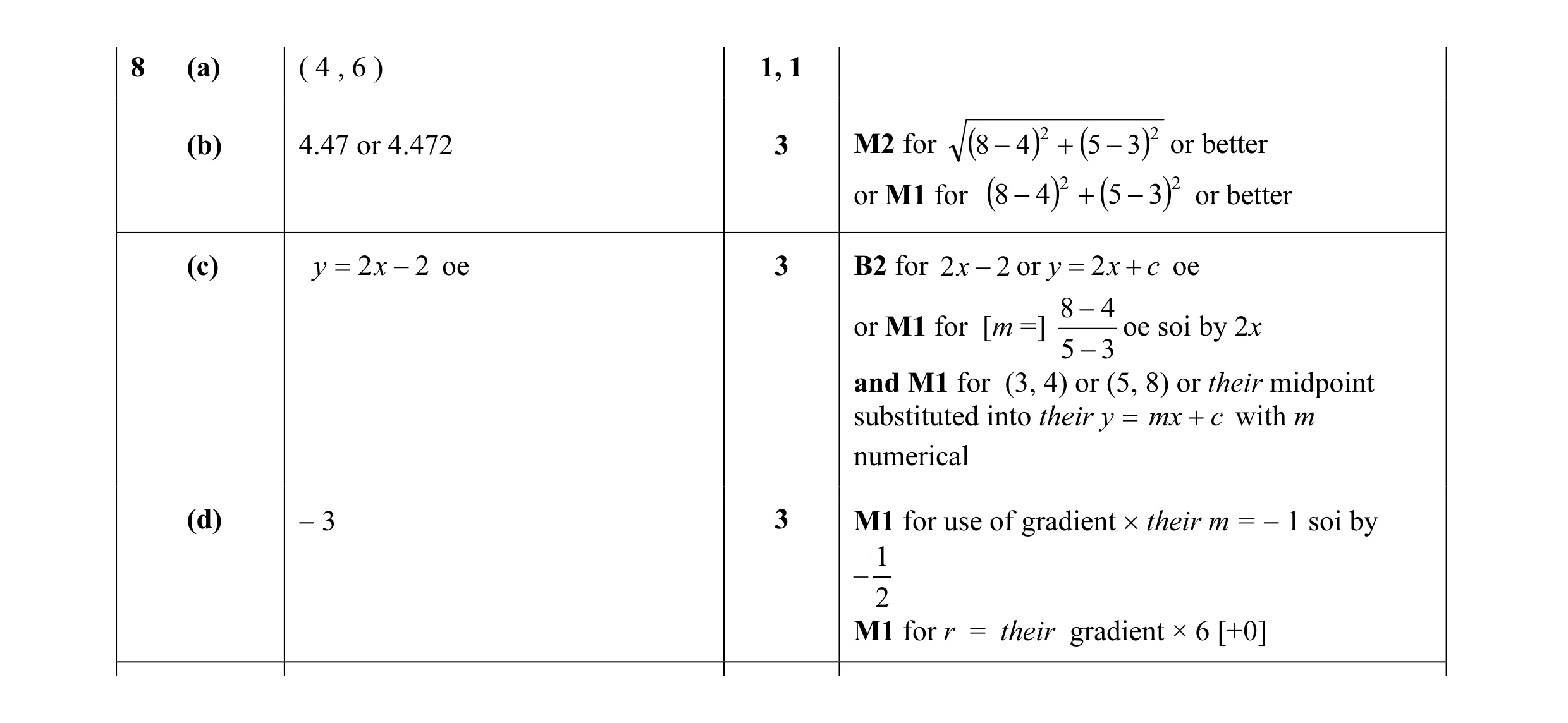
Mark scheme: 8 (a) ( 4 , 6 ) 1, 1 (b) 4.47 or 4.472 3 M2 for (8 − 4 )2 + (5 − 3 )2 or better or M1 for (8 − 4 )2 + (5 − 3)2 or better (c) y = 2 x − 2 oe 3 B2 for 2 x − 2 or y = 2 x + c oe 8 − 4 or M1 for [m =] oe soi by 2x 5 − 3 and M1 for (3, 4) or (5, 8) or their midpoint substituted into their y = mx + c with m numerical (d) − 3 3 M1 for use of gradient × their m = − 1 soi by 1 – 2 M1 for r = their gradient × 6 [+0]
This question in 0580/42 Oct/Nov 2015
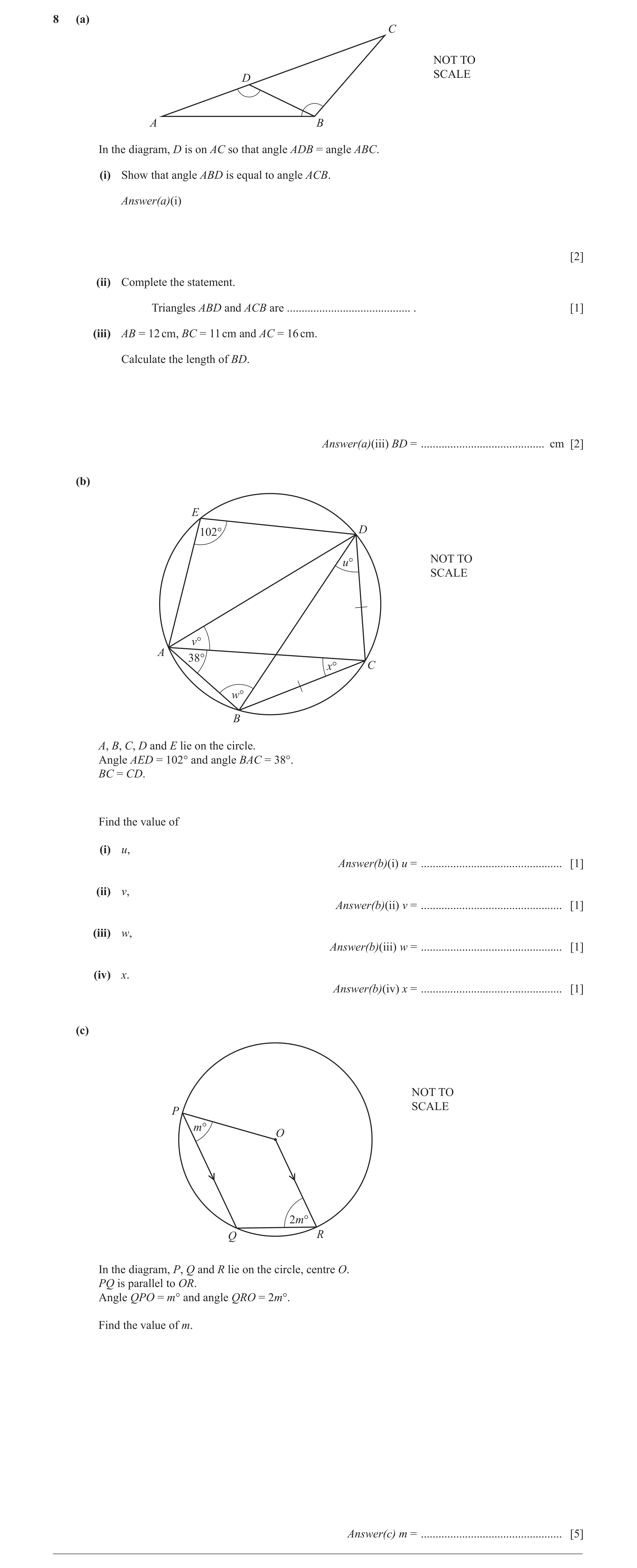
Q18 · C NOT TO SCALE D A B In the diagram, D is on AC so that angle ADB = angle ABC 0580/43 Oct/Nov 2015
8 (a) C NOT TO SCALE D A B In the diagram, D is on AC so that angle ADB = angle ABC. (i) Show that angle ABD is equal to angle ACB. Answer(a)(i) [2] (ii) Complete the statement. Triangles ABD and ACB are … . [1] (iii) AB = 12 cm, BC = 11 cm and AC = 16 cm. Calculate the length of BD. Answer(a)(iii) BD = … cm [2] (b) E 102° D NOT TO u° SCALE v° A 38° x° C w° B A, B, C, D and E lie on the circle. Angle AED = 102° and angle BAC = 38°. BC = CD. Find the value of (i) u, Answer(b)(i) u = … [1] (ii) v, Answer(b)(ii) v = … [1] (iii) w, Answer(b)(iii) w = … [1] (iv) x. Answer(b)(iv) x = … [1] (c) NOT TO SCALE P m° O 2m° Q R In the diagram, P, Q and R lie on the circle, centre O. PQ is parallel to OR. Angle QPO = m° and angle QRO = 2m°. Find the value of m. Answer(c) m = … [5] __________________________________________________________________________________________
14 marks
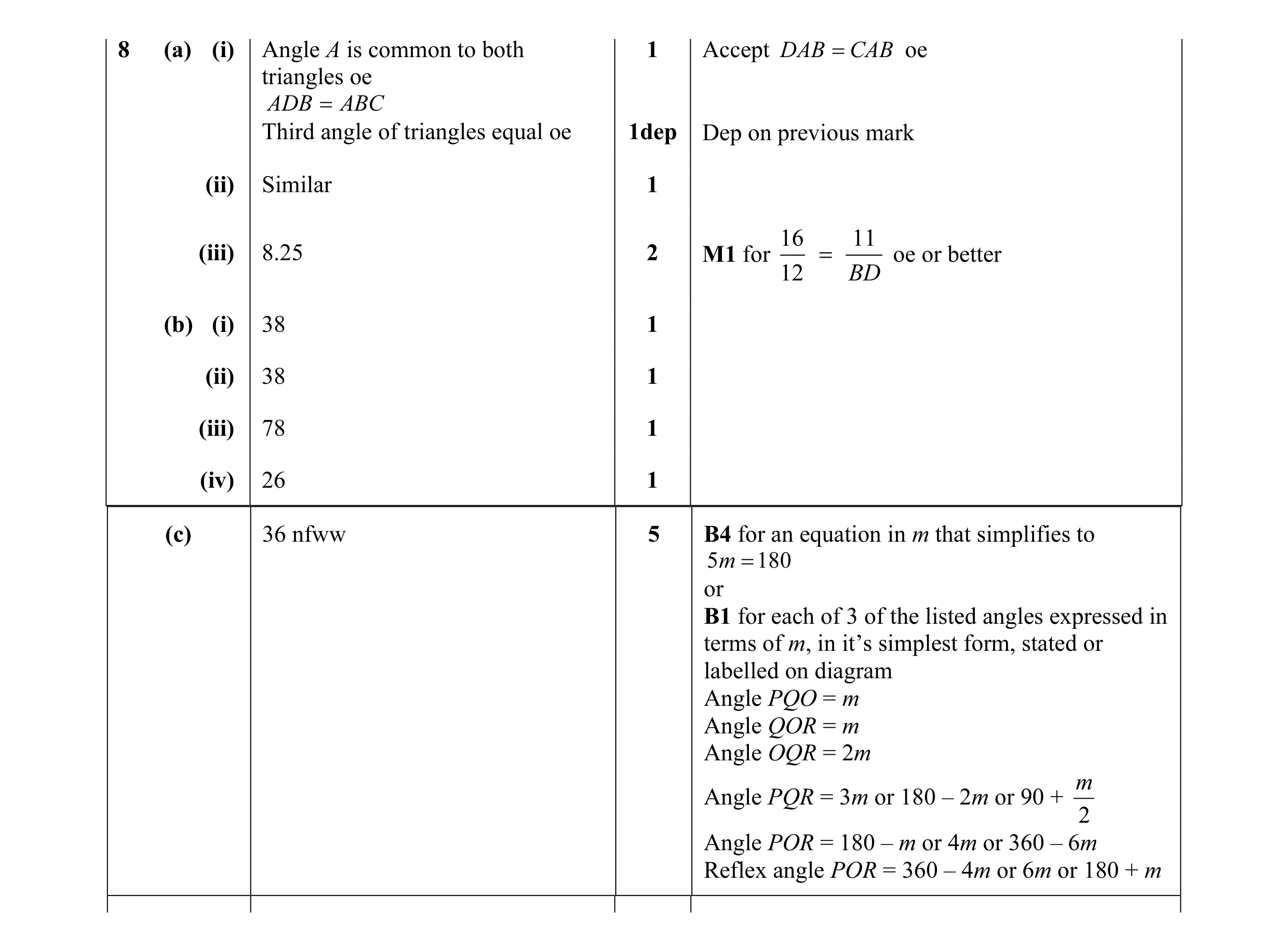
Mark scheme: 8 (a) (i) Angle A is common to both 1 Accept DAB = CAB oe triangles oe ADB = ABC Third angle of triangles equal oe 1dep Dep on previous mark (ii) Similar 1 16 11 (iii) 8.25 2 M1 for = oe or better 12 BD (b) (i) 38 1 (ii) 38 1 (iii) 78 1 (iv) 26 1 (c) 36 nfww 5 B4 for an equation in m that simplifies to 5 m = 180 or B1 for each of 3 of the listed angles expressed in terms of m, in it’s simplest form, stated or labelled on diagram Angle PQO = m Angle QOR = m Angle OQR = 2m m Angle PQR = 3m or 180 – 2m or 90 + 2 Angle POR = 180 – m or 4m or 360 – 6m Reflex angle POR = 360 – 4m or 6m or 180 + m
This question in 0580/43 Oct/Nov 2015
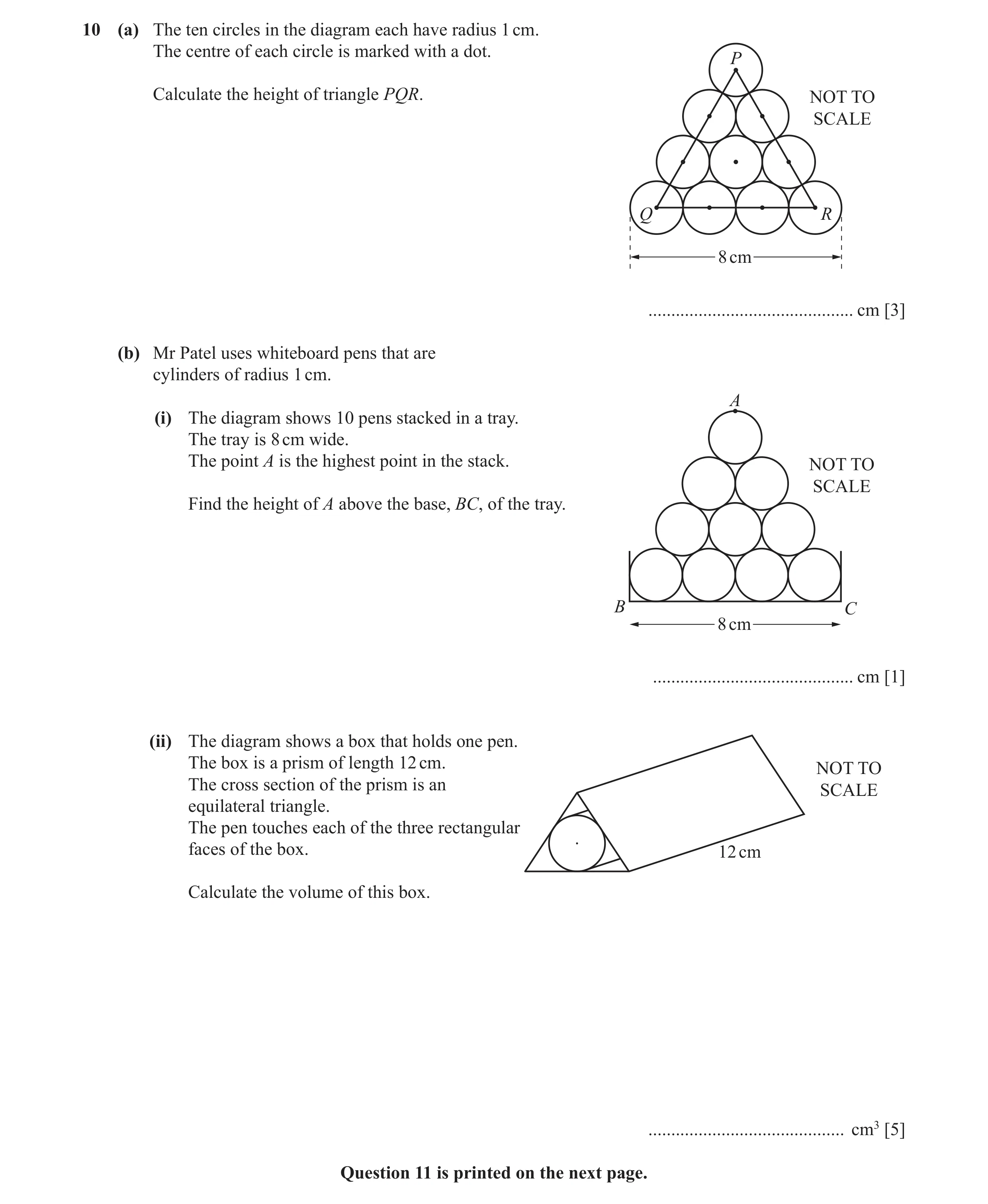
Q19 · The ten circles in the diagram each have radius 1 cm 0580/42 Feb/March 2016
10 (a) The ten circles in the diagram each have radius 1 cm. The centre of each circle is marked with a dot. P Calculate the height of triangle PQR. NOT TO SCALE Q R 8 cm … cm [3] (b) Mr Patel uses whiteboard pens that are cylinders of radius 1 cm. A (i) The diagram shows 10 pens stacked in a tray. The tray is 8 cm wide. The point A is the highest point in the stack. NOT TO SCALE Find the height of A above the base, BC, of the tray. B C 8 cm … cm [1] (ii) The diagram shows a box that holds one pen. The box is a prism of length 12 cm. NOT TO The cross section of the prism is an SCALE equilateral triangle. The pen touches each of the three rectangular faces of the box. 12 cm Calculate the volume of this box. … cm3 [5] Question 11 is printed on the next page.
9 marks
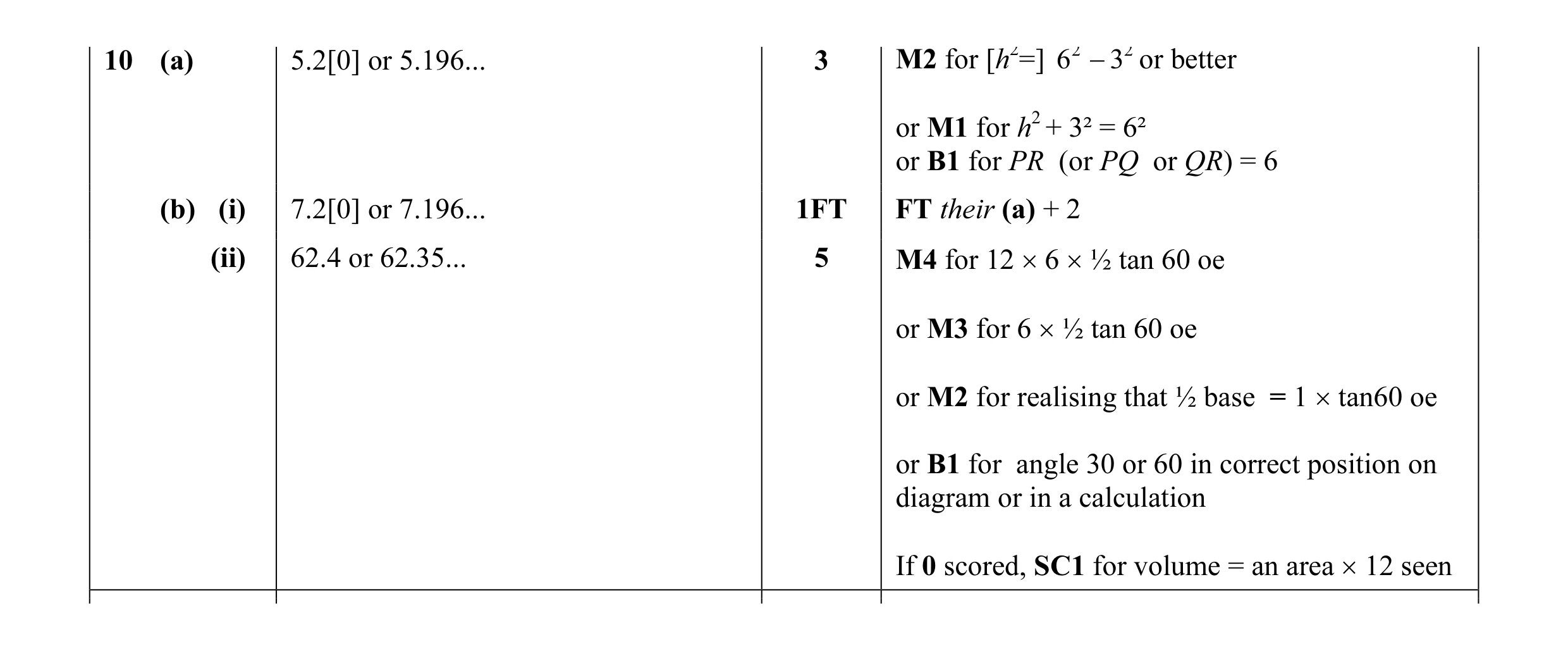
Mark scheme: 10 (a) 5.2[0] or 5.196... 3 M2 for [h2=] 6 2 − 3 2 or better or M1 for h2 + 3² = 6² or B1 for PR (or PQ or QR) = 6 (b) (i) 7.2[0] or 7.196... 1FT FT their (a) + 2 (ii) 62.4 or 62.35... 5 M4 for 12 × 6 × ½ tan 60 oe or M3 for 6 × ½ tan 60 oe or M2 for realising that ½ base = 1 × tan60 oe or B1 for angle 30 or 60 in correct position on diagram or in a calculation If 0 scored, SC1 for volume = an area × 12 seen
This question in 0580/42 Feb/March 2016
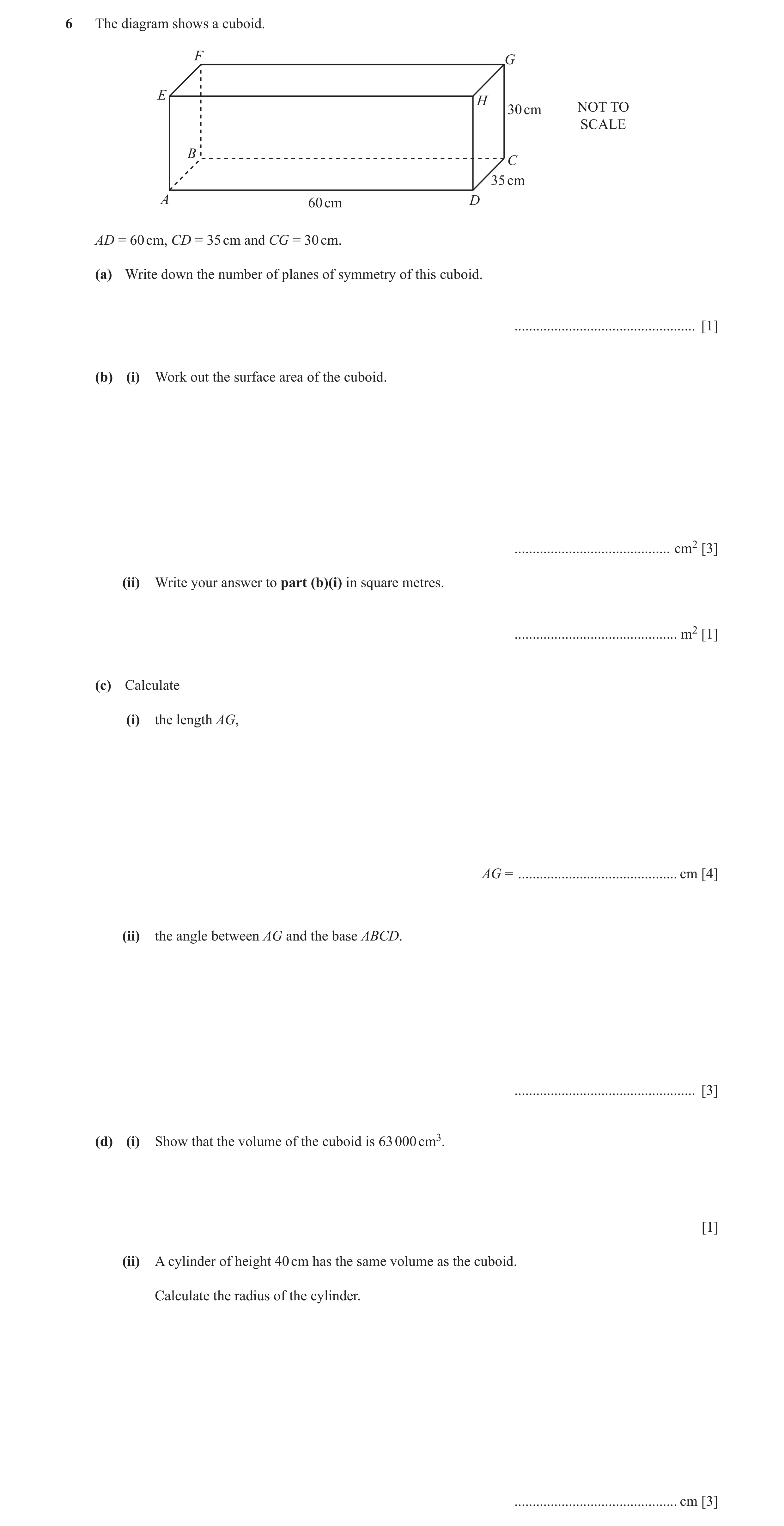
Q20 · The diagram shows a cuboid 0580/42 May/June 2016
6 The diagram shows a cuboid. F G E H 30 cm NOT TO SCALE B C 35 cm A 60 cm D AD = 60 cm, CD = 35 cm and CG = 30 cm. (a) Write down the number of planes of symmetry of this cuboid. … [1] (b) (i) Work out the surface area of the cuboid. … cm2 [3] (ii) Write your answer to part (b)(i) in square metres. … m2 [1] (c) Calculate (i) the length AG, AG = … cm [4] (ii) the angle between AG and the base ABCD. … [3] (d) (i) Show that the volume of the cuboid is 63 000 cm3. [1] (ii) A cylinder of height 40 cm has the same volume as the cuboid. Calculate the radius of the cylinder. … cm [3]
16 marks
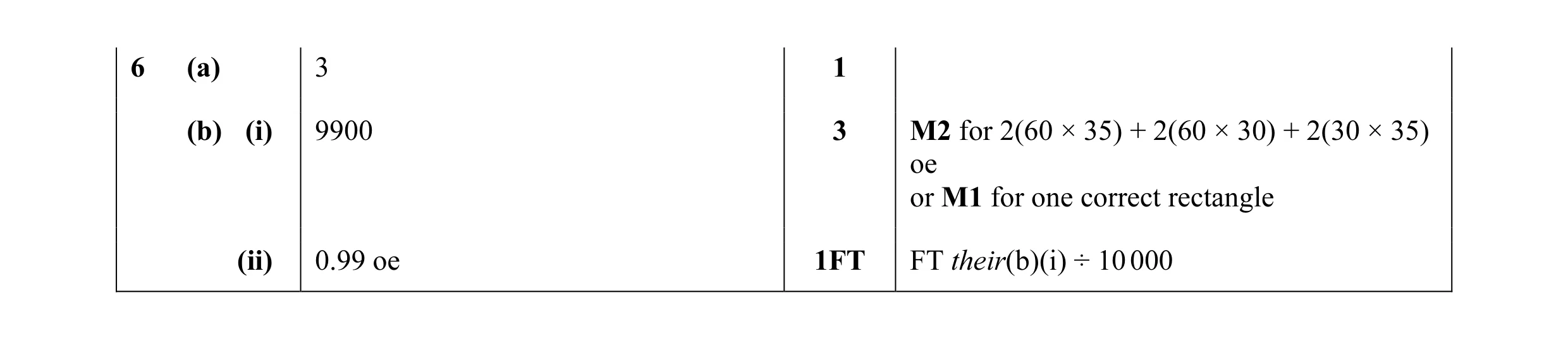
Mark scheme: 6 (a) 3 1 (b) (i) 9900 3 M2 for 2(60 × 35) + 2(60 × 30) + 2(30 × 35) oe or M1 for one correct rectangle (ii) 0.99 oe 1FT FT their(b)(i) ÷ 10 000
This question in 0580/42 May/June 2016
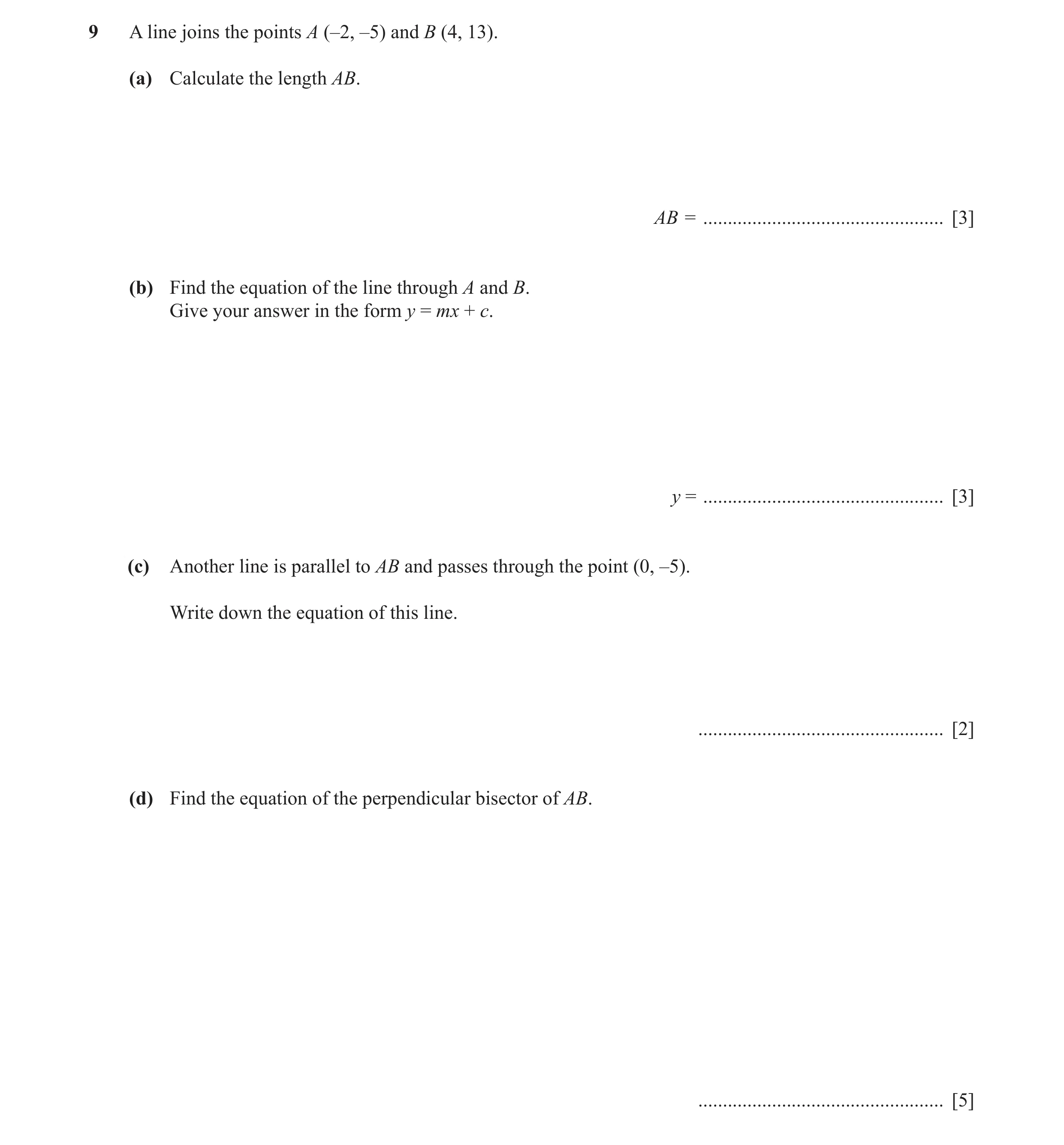
Q21 · A line joins the points A (–2, –5) and B (4, 13) 0580/42 May/June 2016
9 A line joins the points A (–2, –5) and B (4, 13). (a) Calculate the length AB. AB = … [3] (b) Find the equation of the line through A and B. Give your answer in the form y = mx + c. y = … [3] (c) Another line is parallel to AB and passes through the point (0, –5). Write down the equation of this line. … [2] (d) Find the equation of the perpendicular bisector of AB. … [5]
13 marks
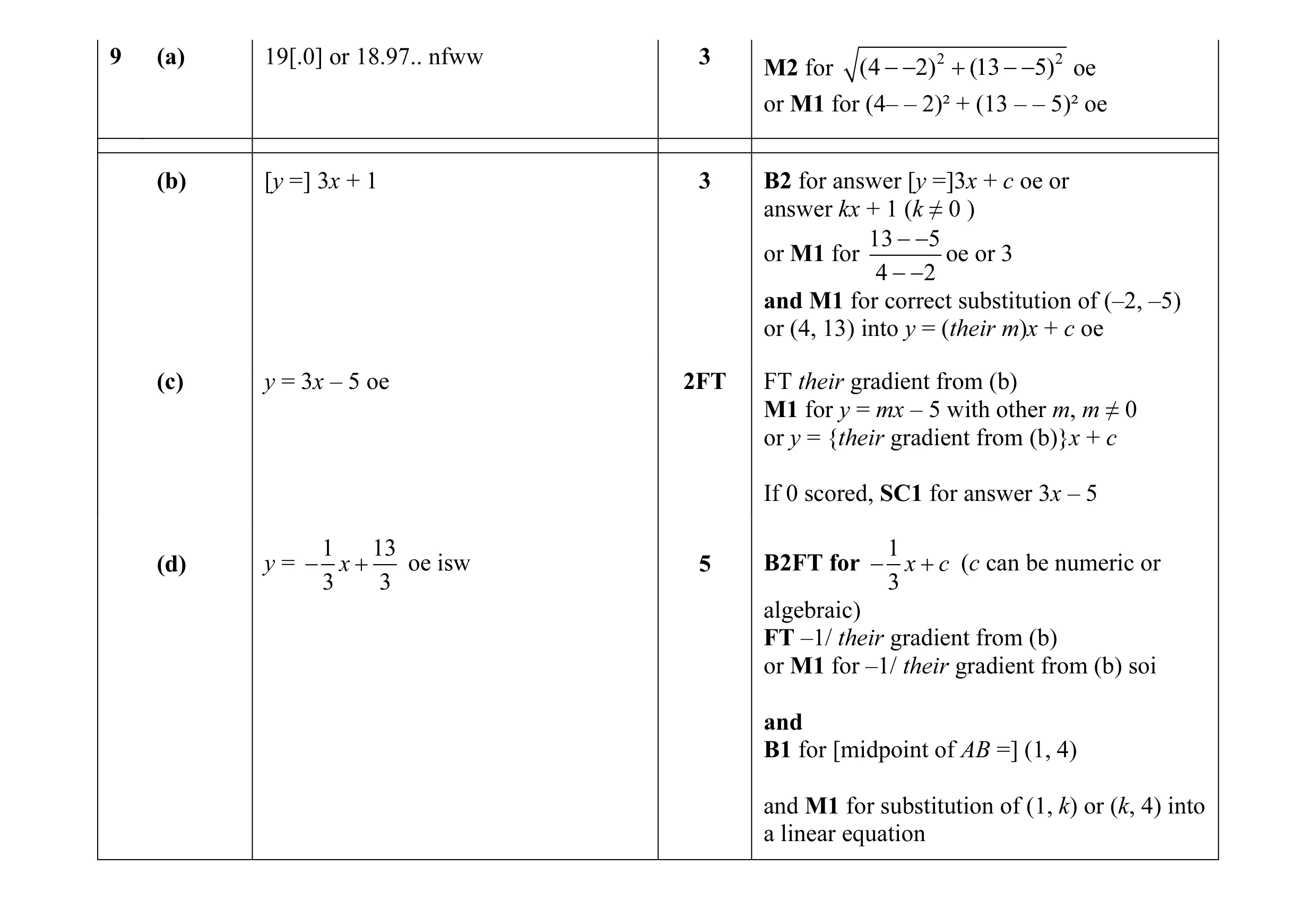
Mark scheme: 2 + (13 −−5) 2 oe9 (a) 19[.0] or 18.97.. nfww 3 M2 for (4 −−2) or M1 for (4– – 2)² + (13 – – 5)² oe (b) [y =] 3x + 1 3 B2 for answer [y =]3x + c oe or answer kx + 1 (k ≠ 0 ) 13 −− 5 or M1 for oe or 3 4 −− 2 and M1 for correct substitution of (–2, –5) or (4, 13) into y = (their m)x + c oe (c) y = 3x – 5 oe 2FT FT their gradient from (b) M1 for y = mx – 5 with other m, m ≠ 0 or y = {their gradient from (b)}x + c If 0 scored, SC1 for answer 3x – 5 1 13 1 (d) y = − x + oe isw 5 B2FT for − x + c (c can be numeric or 3 3 3 algebraic) FT –1/ their gradient from (b) or M1 for –1/ their gradient from (b) soi and B1 for [midpoint of AB =] (1, 4) and M1 for substitution of (1, k) or (k, 4) into a linear equation
This question in 0580/42 May/June 2016
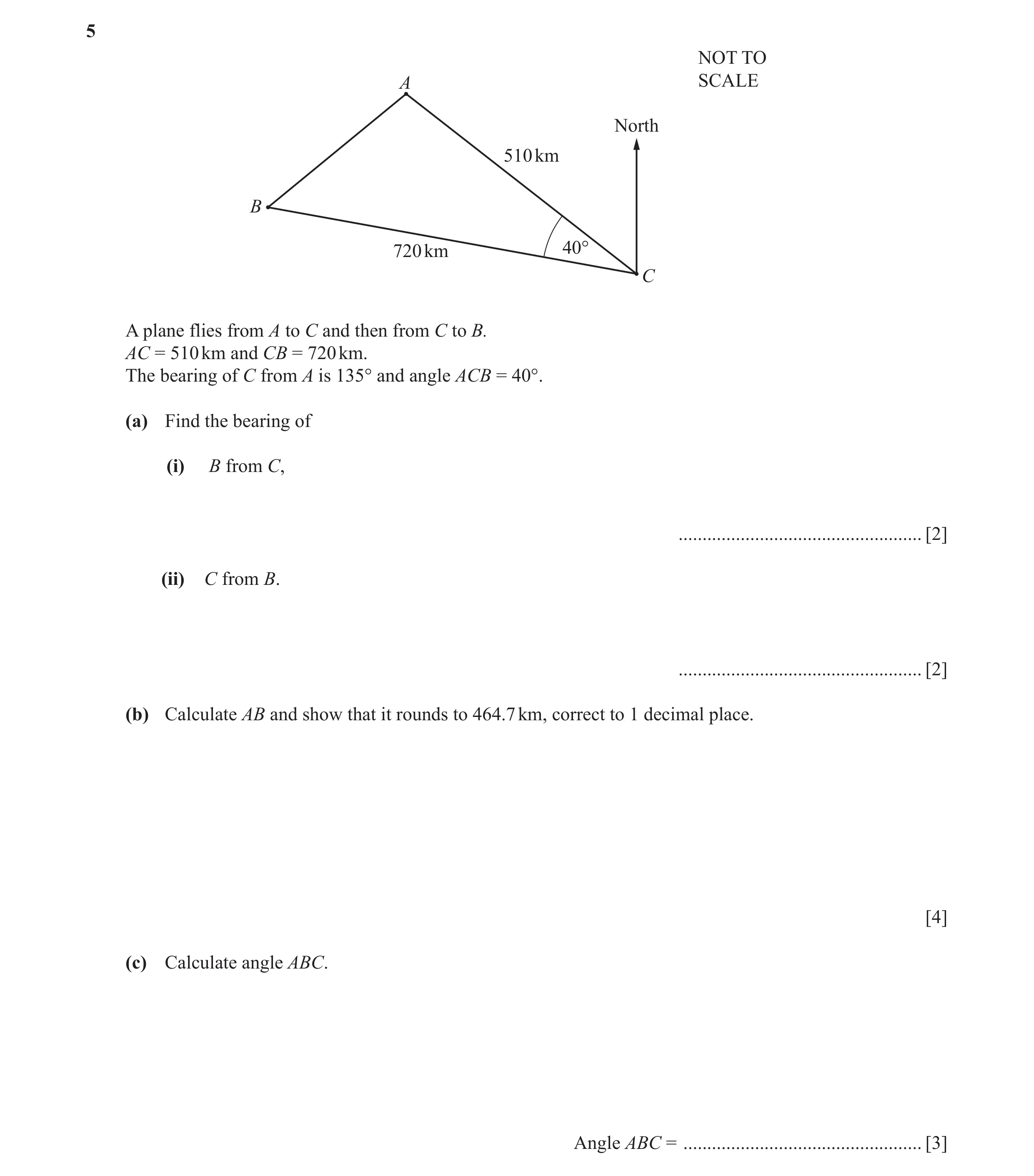
Q22 · NOT TO A SCALE North 510 km B 720 km 40° C A plane flies from A to C and then from C to B 0580/43 May/June 2016
5 NOT TO A SCALE North 510 km B 720 km 40° C A plane flies from A to C and then from C to B. AC = 510 km and CB = 720 km. The bearing of C from A is 135° and angle ACB = 40°. (a) Find the bearing of (i) B from C, … [2] (ii) C from B. … [2] (b) Calculate AB and show that it rounds to 464.7 km, correct to 1 decimal place. [4] (c) Calculate angle ABC. Angle ABC = … [3]
11 marks
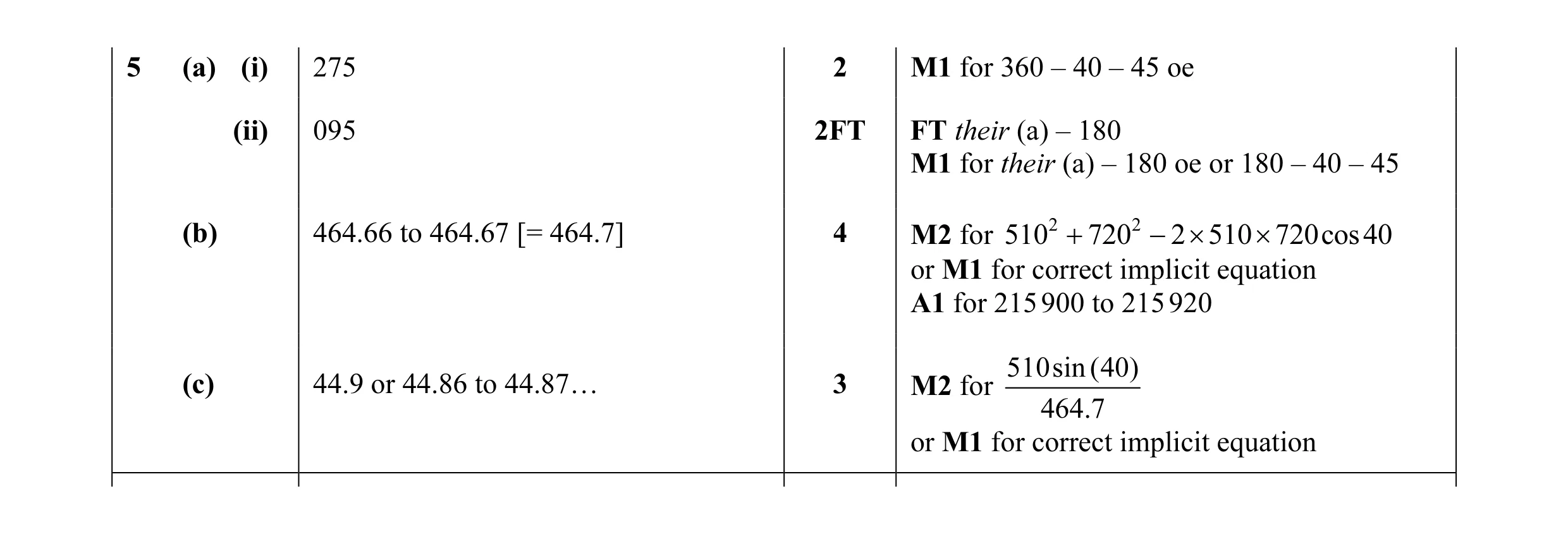
Mark scheme: 5 (a) (i) 275 2 M1 for 360 – 40 – 45 oe (ii) 095 2FT FT their (a) – 180 M1 for their (a) – 180 oe or 180 – 40 – 45 (b) 464.66 to 464.67 [= 464.7] 4 M2 for 510 2 + 720 2 −×2 510 × 720cos40 or M1 for correct implicit equation A1 for 215 900 to 215 920 510sin(40) (c) 44.9 or 44.86 to 44.87… 3 M2 for 464.7 or M1 for correct implicit equation
This question in 0580/43 May/June 2016
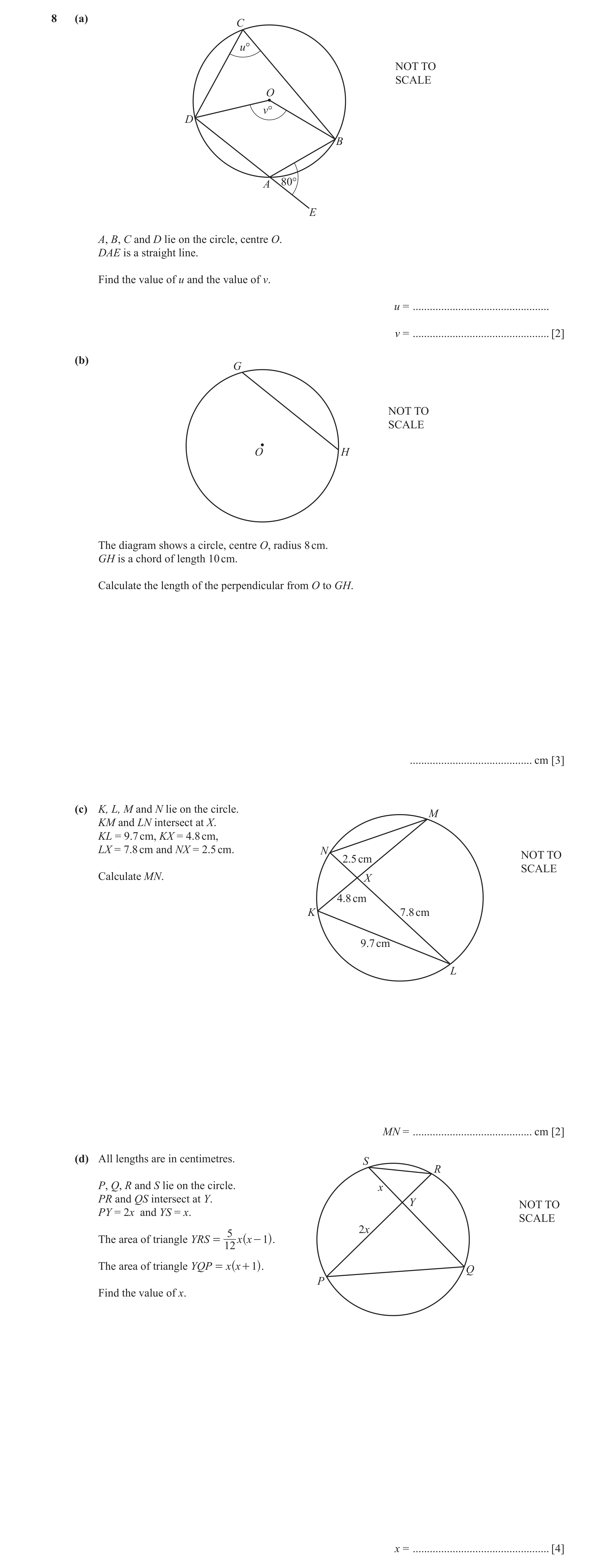
Q23 · C u° NOT TO SCALE O v° D B A 80° E A, B, C and D lie on the circle, centre O 0580/42 Oct/Nov 2016
8 (a) C u° NOT TO SCALE O v° D B A 80° E A, B, C and D lie on the circle, centre O. DAE is a straight line. Find the value of u and the value of v. u = … v = … [2] (b) G NOT TO SCALE O H The diagram shows a circle, centre O, radius 8 cm. GH is a chord of length 10 cm. Calculate the length of the perpendicular from O to GH. … cm [3] (c) K, L, M and N lie on the circle. M KM and LN intersect at X. KL = 9.7 cm, KX = 4.8 cm, LX = 7.8 cm and NX = 2.5 cm. N NOT TO 2.5 cm SCALE Calculate MN. X 4.8 cm K 7.8 cm 9.7 cm L MN = … cm [2] (d) All lengths are in centimetres. S R P, Q, R and S lie on the circle. x PR and QS intersect at Y. Y NOT TO PY = 2x and YS = x. SCALE 2x 5 The area of triangle YRS = x ^x - 1h. 12 The area of triangle YQP = x ^x + 1h. Q P Find the value of x. x = … [4]
11 marks
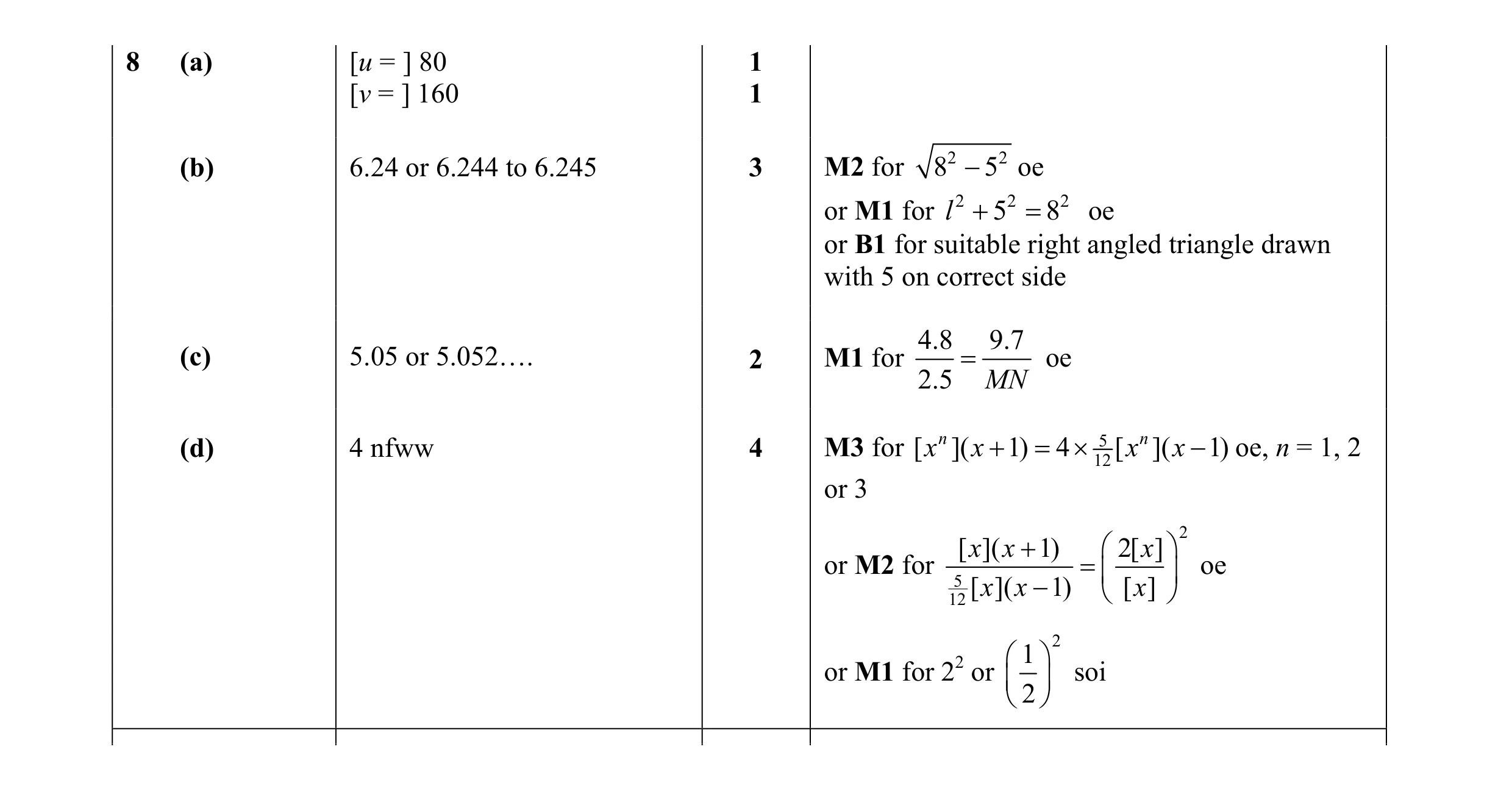
Mark scheme: 8 (a) [u = ] 80 1 [v = ] 160 1 (b) 6.24 or 6.244 to 6.245 3 M2 for 8 2 − 5 2 oe or M1 for l 2 + 52 = 82 oe or B1 for suitable right angled triangle drawn with 5 on correct side 4.8 9.7 (c) 5.05 or 5.052…. 2 M1 for = oe 2.5 MN (d) 4 nfww 4 M3 for [ x n ]( x + 1) = 4 × 125 [ x n ]( x − 1) oe, n = 1, 2 or 3 [ x ]( x + 1) 2[ x ] 2 or M2 for = oe 5 12 [ x ]( x − 1) [ x ] 1 2 or M1 for 22 or soi 2
This question in 0580/42 Oct/Nov 2016
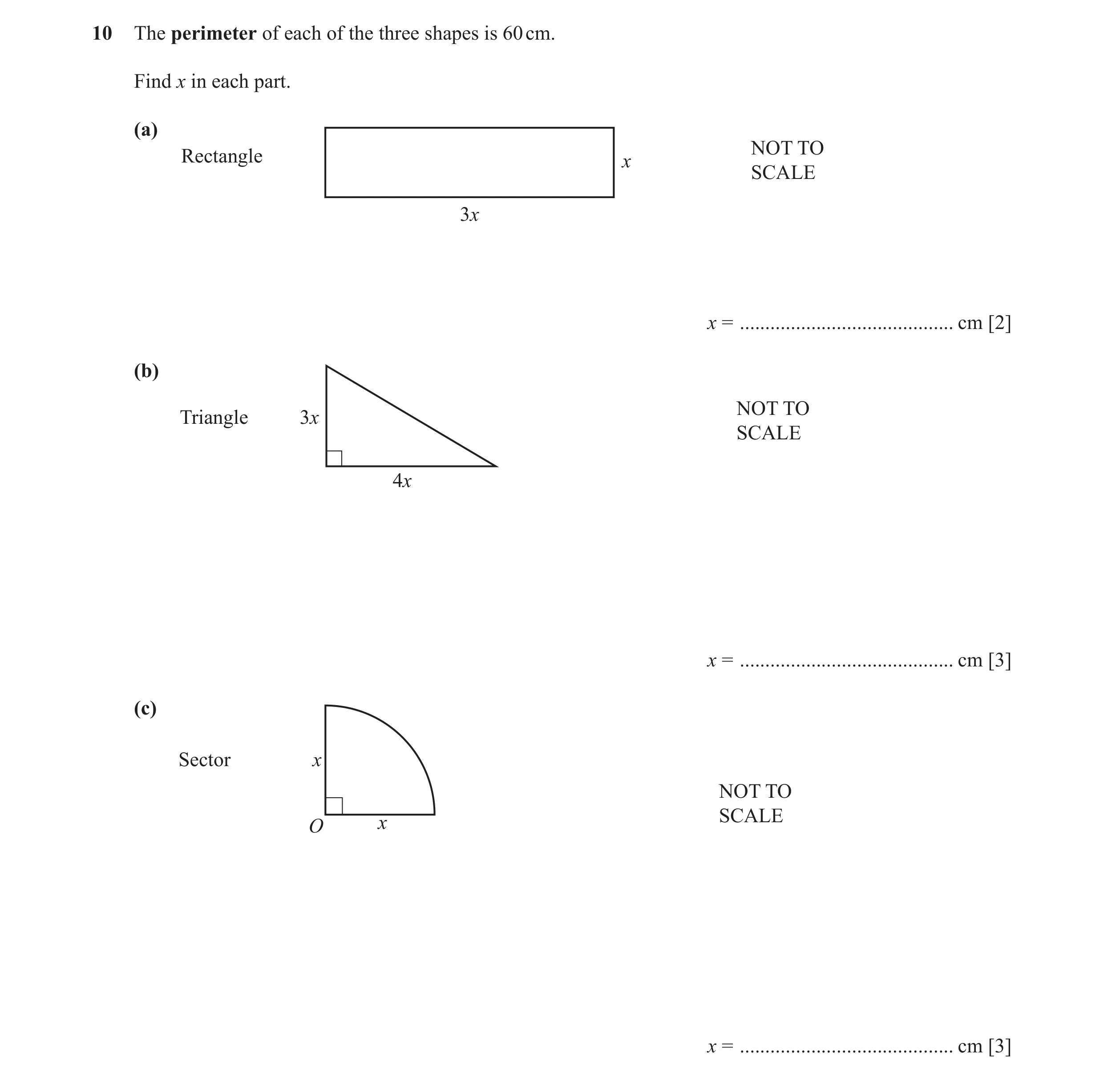
Q24 · The perimeter of each of the three shapes is 60 cm 0580/42 Oct/Nov 2016
10 The perimeter of each of the three shapes is 60 cm. Find x in each part. (a) NOT TO Rectangle x SCALE 3x x = … cm [2] (b) NOT TO Triangle 3x SCALE 4x x = … cm [3] (c) Sector x NOT TO SCALE O x x = … cm [3]
8 marks
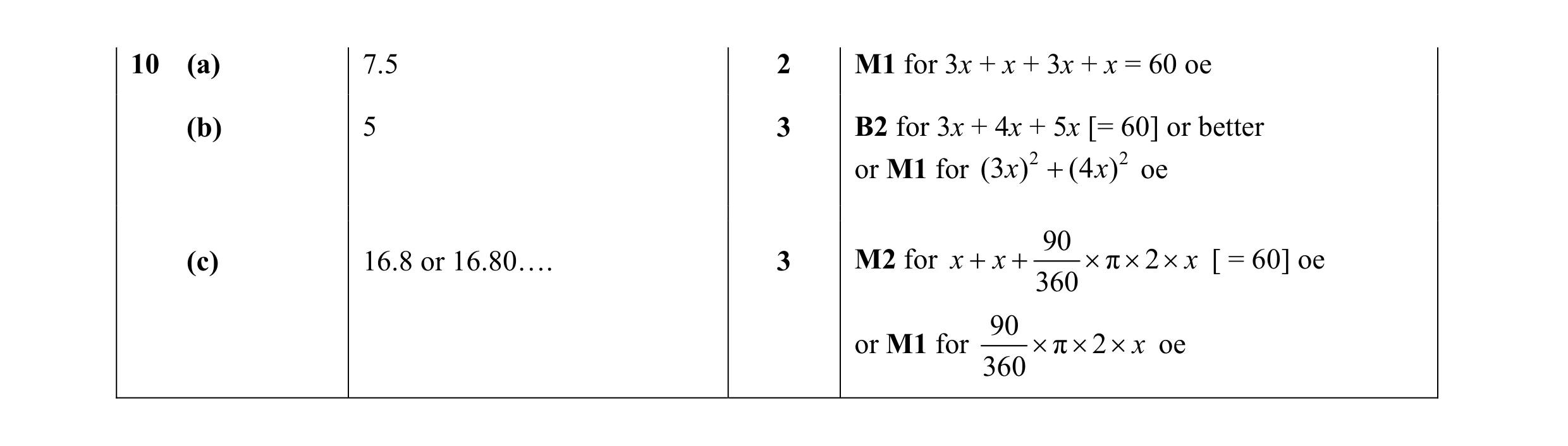
Mark scheme: 10 (a) 7.5 2 M1 for 3x + x + 3x + x = 60 oe (b) 5 3 B2 for 3x + 4x + 5x [= 60] or better or M1 for (3 x ) 2 + (4 x ) 2 oe 90 (c) 16.8 or 16.80…. 3 M2 for x + x + × π × 2 × x [ = 60] oe 360 90 or M1 for × π × 2 × x oe 360
This question in 0580/42 Oct/Nov 2016
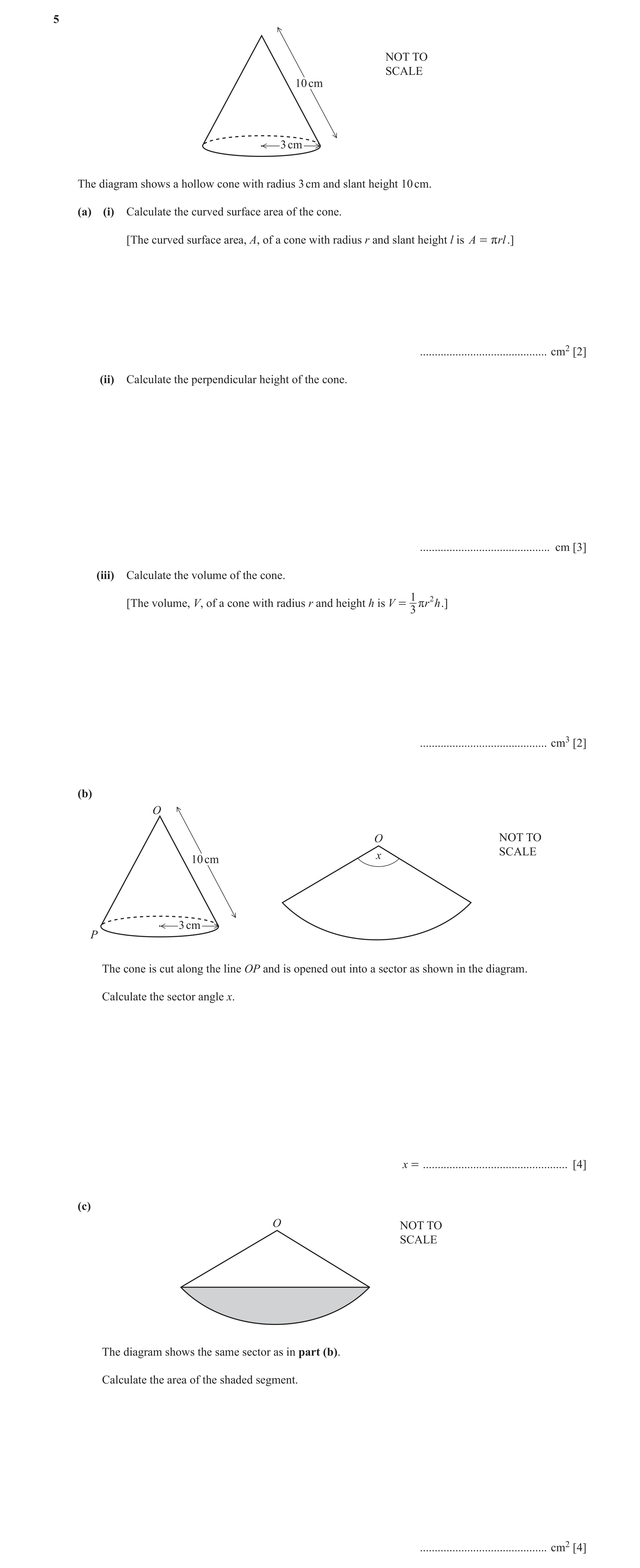
Q25 · NOT TO SCALE 10 cm 3 cm The diagram shows a hollow cone with radius 3 cm and slant height… 0580/42 May/June 2017
5 NOT TO SCALE 10 cm 3 cm The diagram shows a hollow cone with radius 3 cm and slant height 10 cm. (a) (i) Calculate the curved surface area of the cone. [The curved surface area, A, of a cone with radius r and slant height l is A = r rl .] … cm2 [2] (ii) Calculate the perpendicular height of the cone. … cm [3] (iii) Calculate the volume of the cone. 1 2 [The volume, V, of a cone with radius r and height h is V = r r h .] 3 … cm3 [2] (b) O O NOT TO SCALE x 10 cm 3 cm P The cone is cut along the line OP and is opened out into a sector as shown in the diagram. Calculate the sector angle x. x = … [4] (c) O NOT TO SCALE The diagram shows the same sector as in part (b). Calculate the area of the shaded segment. … cm2 [4]
15 marks
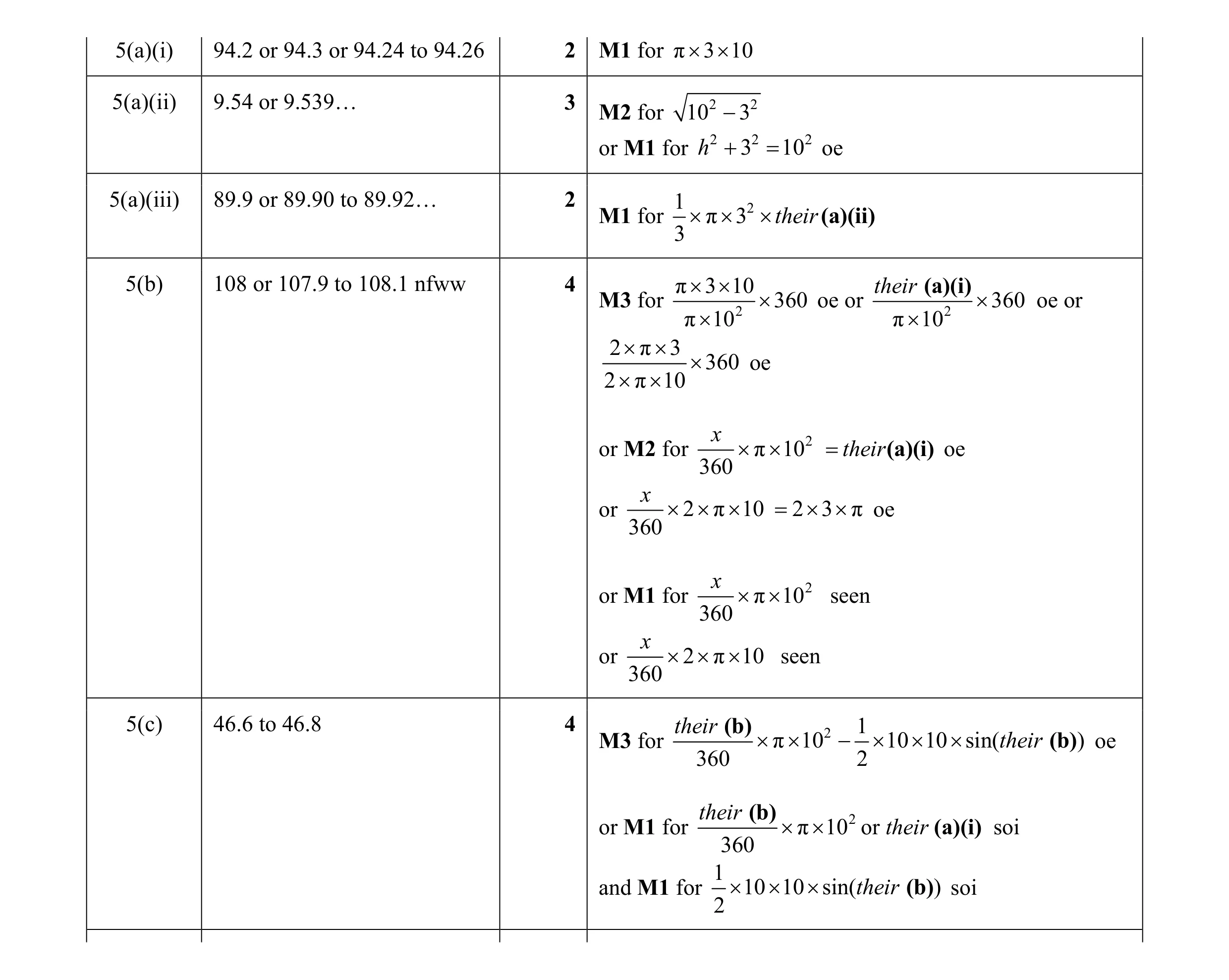
Mark scheme: 5(a)(i) 94.2 or 94.3 or 94.24 to 94.26 2 M1 for π × 3 × 10 5(a)(ii) 9.54 or 9.539… 3 2 2 M2 for 10 − 3 or M1 for h 2 + 32 = 10 2 oe 5(a)(iii) 89.9 or 89.90 to 89.92… 2 1 2 M1 for × π × 3 × their (a)(ii) 3 5(b) 108 or 107.9 to 108.1 nfww 4 π × 3 × 10 their (a)(i) M3 for × 360 oe or × 360 oe or π × 10 2 π × 10 2 2 × π × 3 × 360 oe 2 × π × 10 x 2 or M2 for × π × 10 = their (a)(i) oe 360 x or × 2 × π × 10 = 2 × 3 × π oe 360 x 2 or M1 for × π × 10 seen 360 x or × 2 × π × 10 seen 360 5(c) 46.6 to 46.8 4 their (b) 2 1 M3 for × π × 10 − × 10 × 10 × sin(their (b)) oe 360 2 their (b) 2 or M1 for × π × 10 or their (a)(i) soi 360 1 and M1 for × 10 × 10 × sin(their (b)) soi 2
This question in 0580/42 May/June 2017
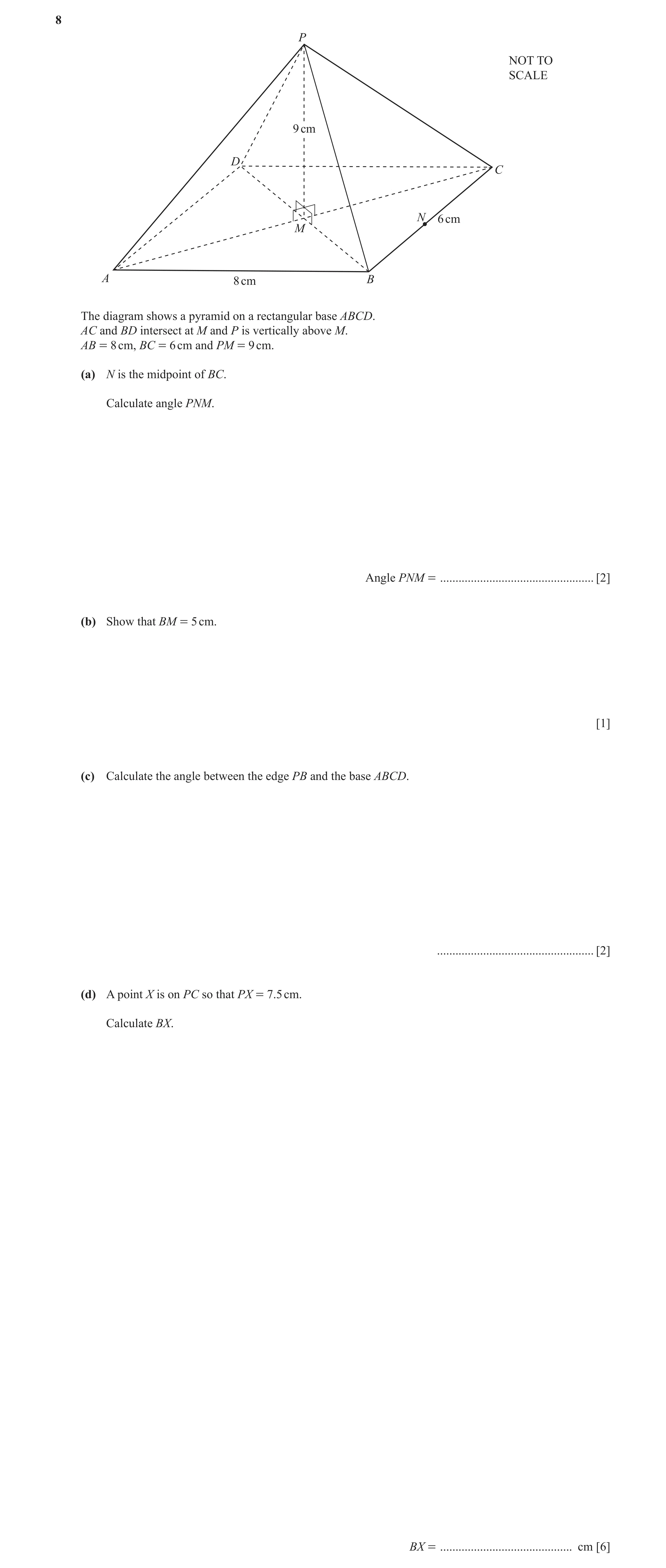
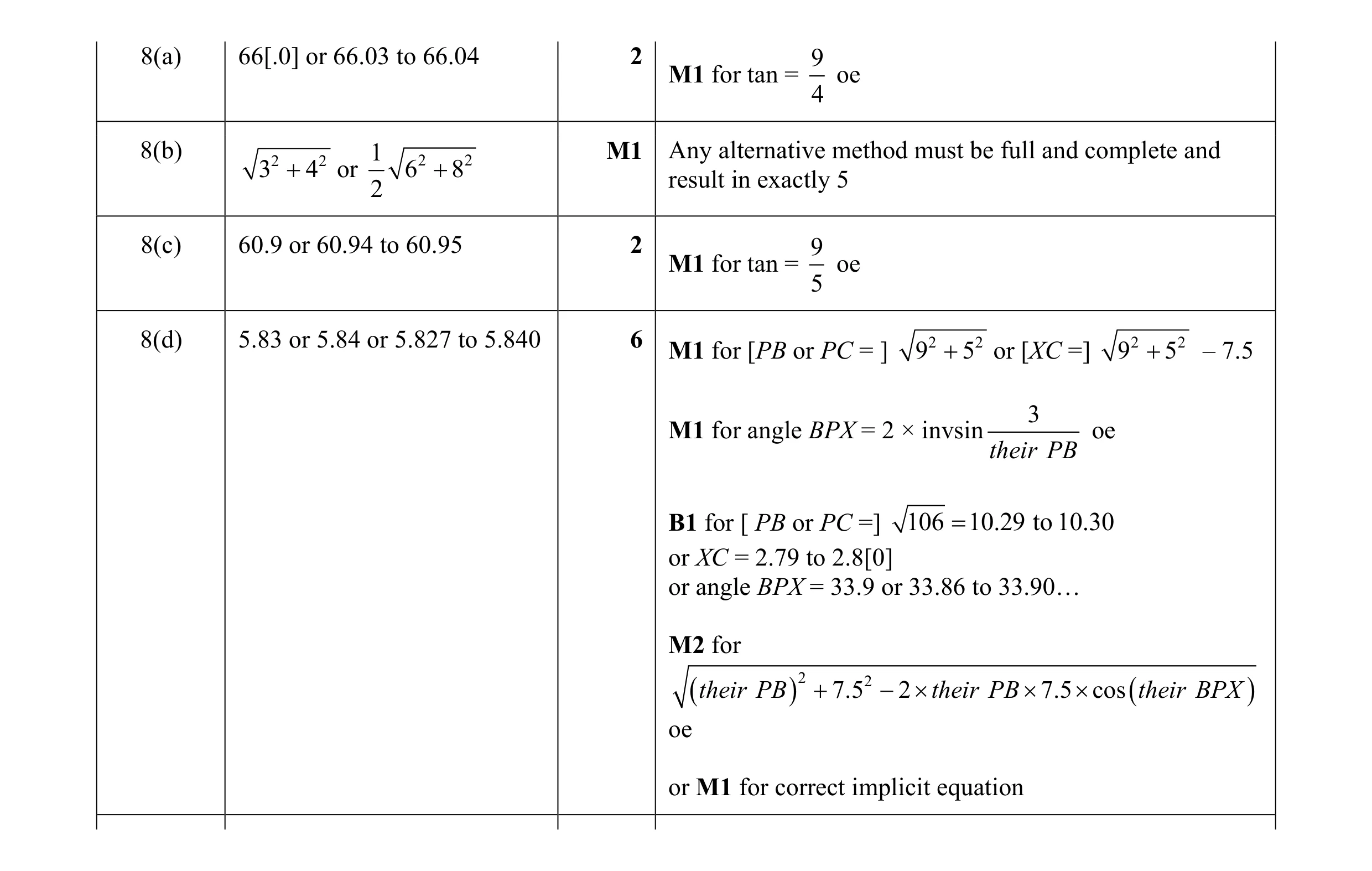
Q26 · P NOT TO SCALE 9 cm D C N 6 cm M A 8 cm B The diagram shows a pyramid on a rectangular… 0580/42 May/June 2017
8 P NOT TO SCALE 9 cm D C N 6 cm M A 8 cm B The diagram shows a pyramid on a rectangular base ABCD. AC and BD intersect at M and P is vertically above M. AB = 8 cm, BC = 6 cm and PM = 9 cm. (a) N is the midpoint of BC. Calculate angle PNM. Angle PNM = … [2] (b) Show that BM = 5 cm. [1] (c) Calculate the angle between the edge PB and the base ABCD. … [2] (d) A point X is on PC so that PX = 7.5 cm. Calculate BX. BX = … cm [6]
11 marks
Mark scheme: 8(a) 66[.0] or 66.03 to 66.04 2 9 M1 for tan = oe 4 8(b) 2 2 1 2 2 M1 Any alternative method must be full and complete and 3 + 4 or 6 + 8 result in exactly 5 2 8(c) 60.9 or 60.94 to 60.95 2 9 M1 for tan = oe 5 8(d) 5.83 or 5.84 or 5.827 to 5.840 6 2 2 2 2 M1 for [PB or PC = ] 9 + 5 or [XC =] 9 + 5 – 7.5 3 M1 for angle BPX = 2 × invsin oe their PB B1 for [ PB or PC =] 106 = 10.29 to 10.30 or XC = 2.79 to 2.8[0] or angle BPX = 33.9 or 33.86 to 33.90… M2 for ( their PB ) 2 + 7.5 2 − 2 × their PB × 7.5 × cos ( their BPX ) oe or M1 for correct implicit equation
This question in 0580/42 May/June 2017
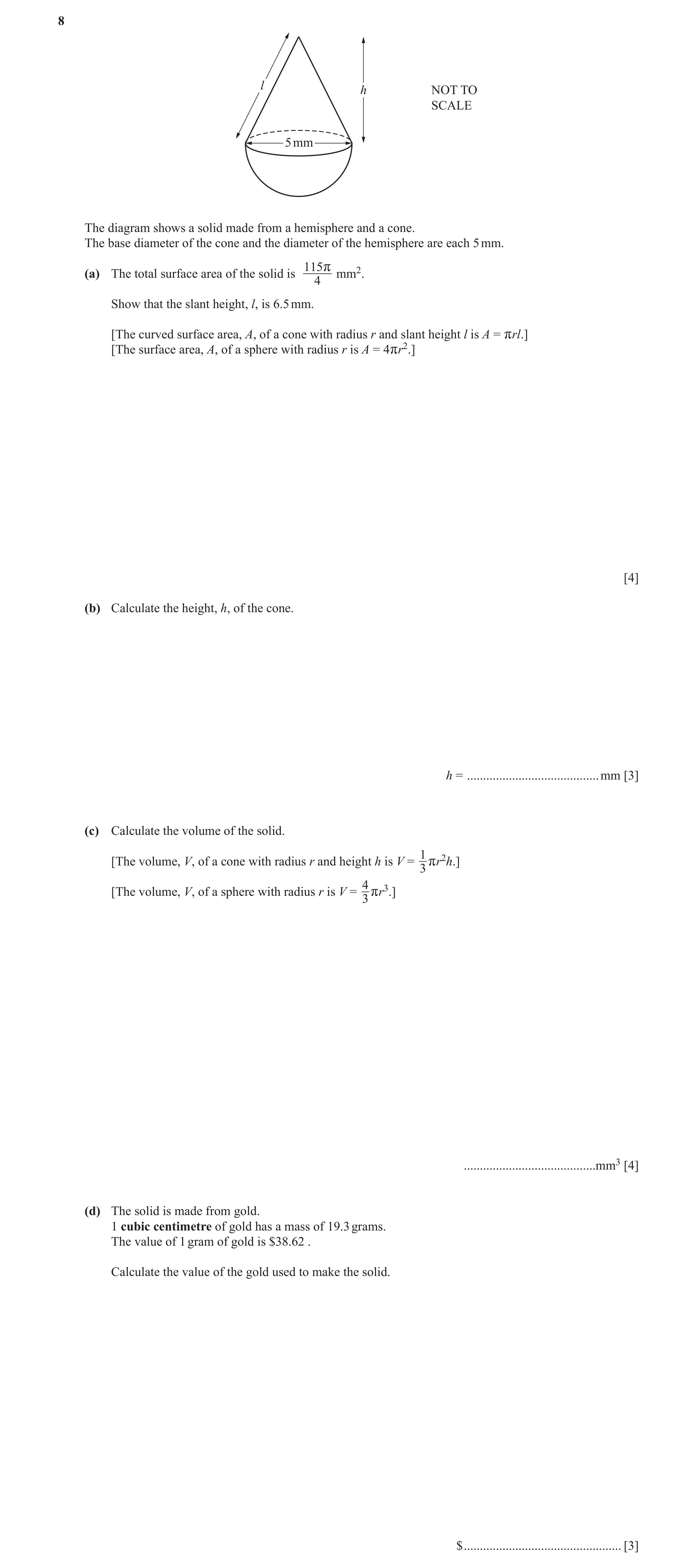
Q27 · L h NOT TO SCALE 5 mm The diagram shows a solid made from a hemisphere and a cone 0580/41 Oct/Nov 2017
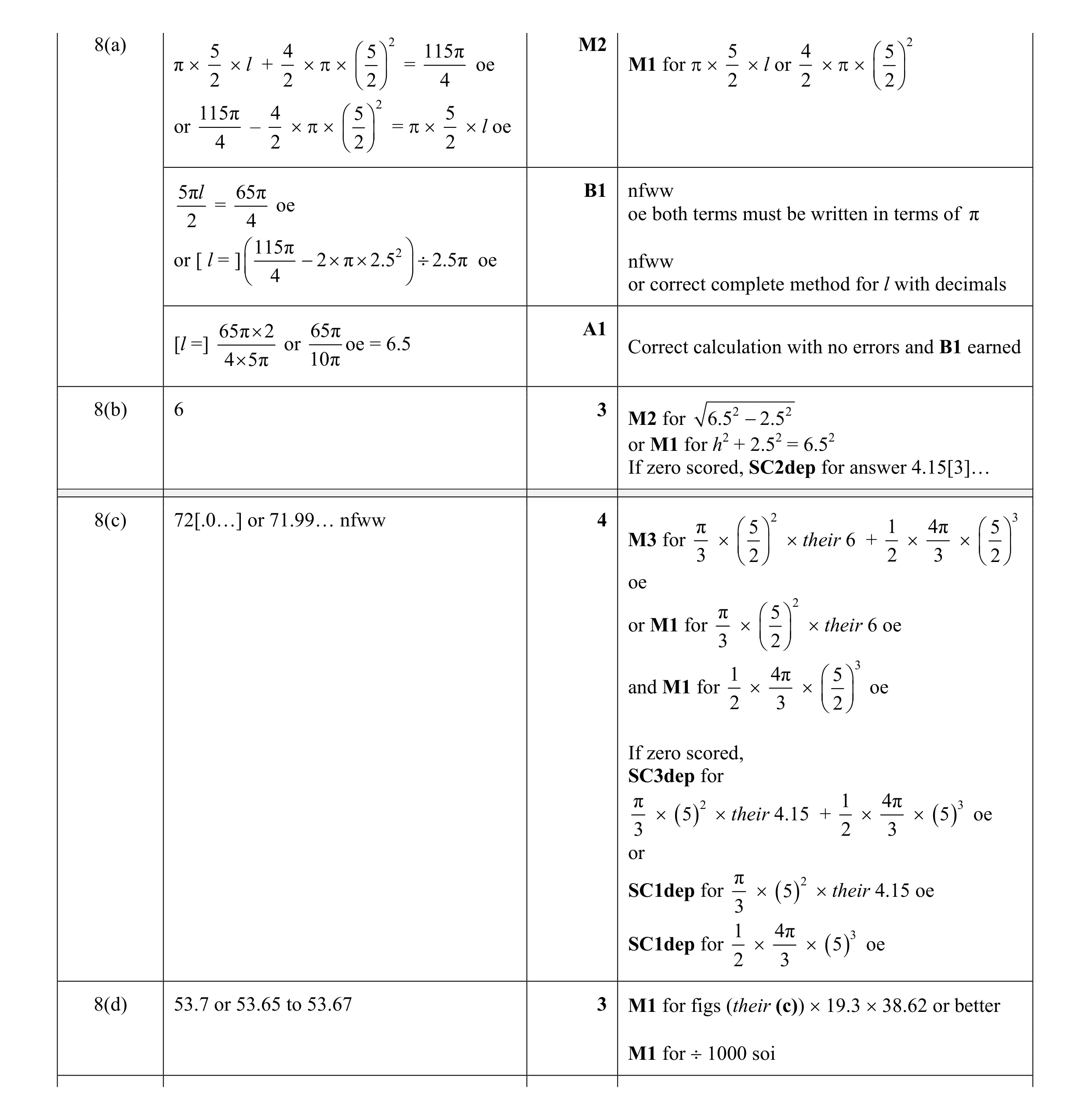
8 l h NOT TO SCALE 5 mm The diagram shows a solid made from a hemisphere and a cone. The base diameter of the cone and the diameter of the hemisphere are each 5 mm. 115r (a) The total surface area of the solid is mm2. 4 Show that the slant height, l, is 6.5 mm. [The curved surface area, A, of a cone with radius r and slant height l is A = rrl.] [The surface area, A, of a sphere with radius r is A = 4rr2.] [4] (b) Calculate the height, h, of the cone. h = … mm [3] (c) Calculate the volume of the solid. 1 [The volume, V, of a cone with radius r and height h is V = rr2h.] 3 4 [The volume, V, of a sphere with radius r is V = rr3.] 3 … mm3 [4] (d) The solid is made from gold. 1 cubic centimetre of gold has a mass of 19.3 grams. The value of 1 gram of gold is $38.62 . Calculate the value of the gold used to make the solid. $ … [3]
14 marks
Mark scheme: 8(a) 2 M2 2 5 4 5 115π 5 4 5 π × × l + × π × = oe M1 for π × × l or × π × 2 2 2 4 2 2 2 115π 4 5 2 5 or – × π × = π × × l oe 4 2 2 2 5πl 65π B1 nfww = oe oe both terms must be written in terms of π 2 4 115π 2 or [ l = ] − 2 × π × 2.5 ÷ 2.5π oe nfww 4 or correct complete method for l with decimals 65π × 2 65π A1 [l =] or oe = 6.5 Correct calculation with no errors and B1 earned 4 × 5π 10π 8(b) 6 3 2 2 M2 for 6.5 − 2.5 or M1 for h2 + 2.52 = 6.52 If zero scored, SC2dep for answer 4.15[3]… 8(c) 72[.0…] or 71.99… nfww 4 2 3 π 5 1 4π 5 M3 for × × their 6 + × × 3 2 2 3 2 oe π 5 2 or M1 for × × their 6 oe 3 2 1 4π 5 3 and M1 for × × oe 2 3 2 If zero scored, SC3dep for π 2 1 4π 3 × ( 5 ) × their 4.15 + × × ( 5 ) oe 3 2 3 or π 2 SC1dep for × ( 5 ) × their 4.15 oe 3 1 4π 3 SC1dep for × × ( 5 ) oe 2 3 8(d) 53.7 or 53.65 to 53.67 3 M1 for figs (their (c)) × 19.3 × 38.62 or better M1 for ÷ 1000 soi
This question in 0580/41 Oct/Nov 2017
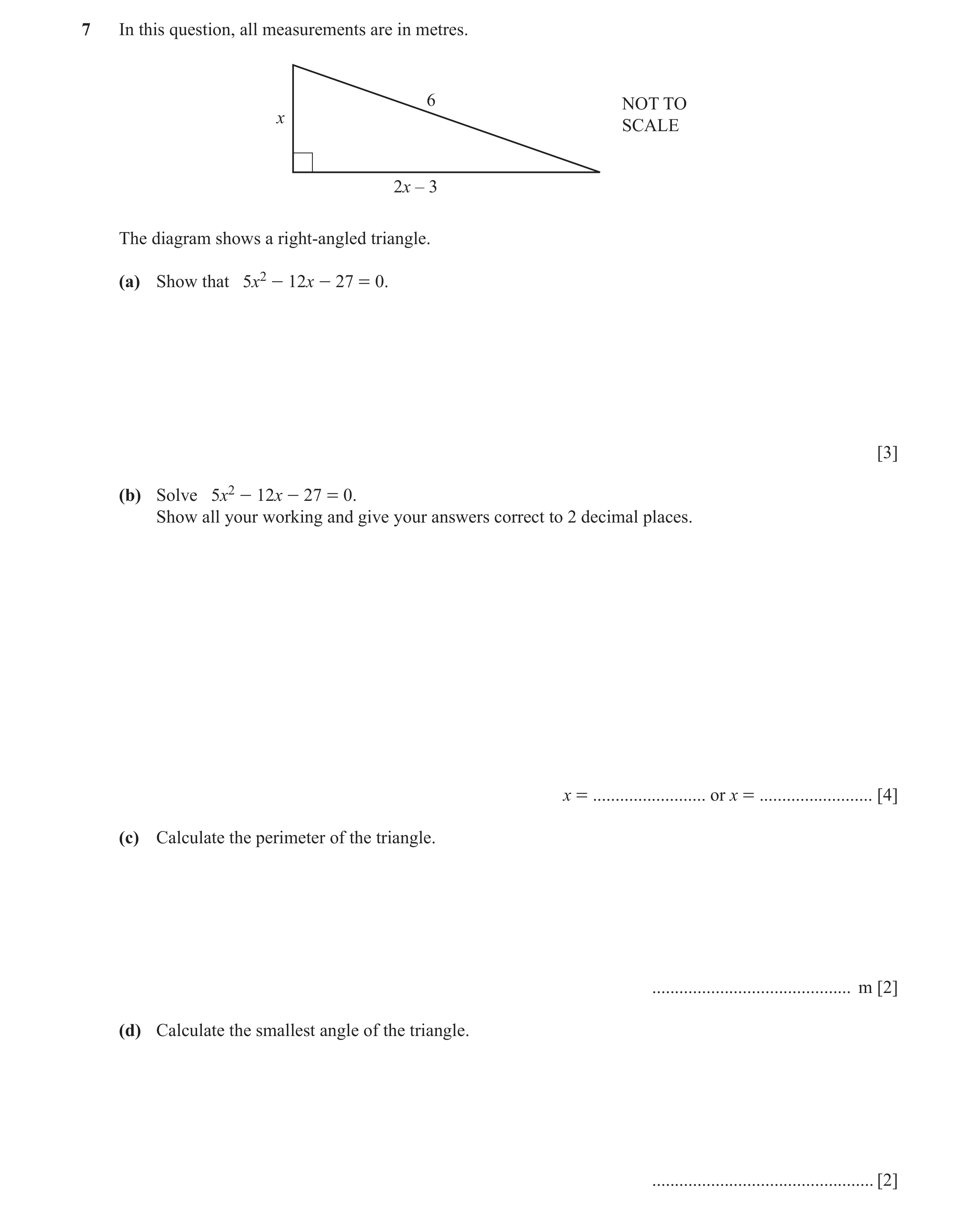
Q28 · In this question, all measurements are in metres 0580/42 May/June 2018
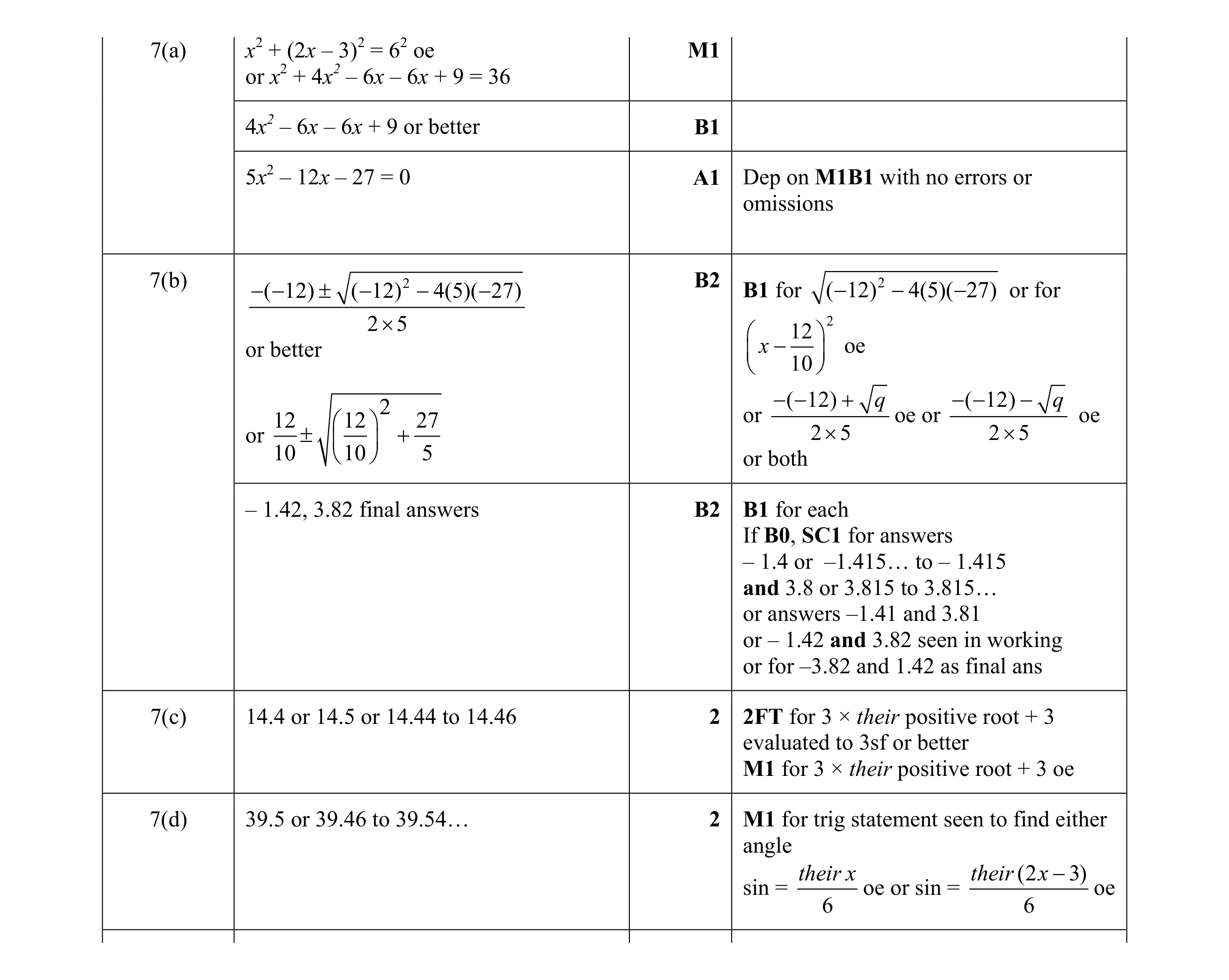
7 In this question, all measurements are in metres. 6 NOT TO x SCALE 2x – 3 The diagram shows a right-angled triangle. (a) Show that 5x2 - 12x - 27 = 0. [3] (b) Solve 5x2 - 12x - 27 = 0. Show all your working and give your answers correct to 2 decimal places. x = … or x = … [4] (c) Calculate the perimeter of the triangle. … m [2] (d) Calculate the smallest angle of the triangle. … [2]
11 marks
Mark scheme: 7(a) x2 + (2x – 3)2 = 62 oe M1 or x2 + 4x2 – 6x – 6x + 9 = 36 4x2 – 6x – 6x + 9 or better B1 5x2 – 12x – 27 = 0 A1 Dep on M1B1 with no errors or omissions 7(b) 2 B2 2 −−( 12) ± ( − 12) − 4(5)( − 27) B1 for ( −12) − 4(5)( −27) or for 2 × 5 2 12 or better x − oe 10 −−( 12) + q −−( 12) − q 2 12 12 27 or oe or oe or ± + 2 × 5 2 × 5 10 10 5 or both – 1.42, 3.82 final answers B2 B1 for each If B0, SC1 for answers – 1.4 or –1.415… to – 1.415 and 3.8 or 3.815 to 3.815… or answers –1.41 and 3.81 or – 1.42 and 3.82 seen in working or for –3.82 and 1.42 as final ans 7(c) 14.4 or 14.5 or 14.44 to 14.46 2 2FT for 3 × their positive root + 3 evaluated to 3sf or better M1 for 3 × their positive root + 3 oe 7(d) 39.5 or 39.46 to 39.54… 2 M1 for trig statement seen to find either angle their x their (2 x − 3) sin = oe or sin = oe 6 6
This question in 0580/42 May/June 2018
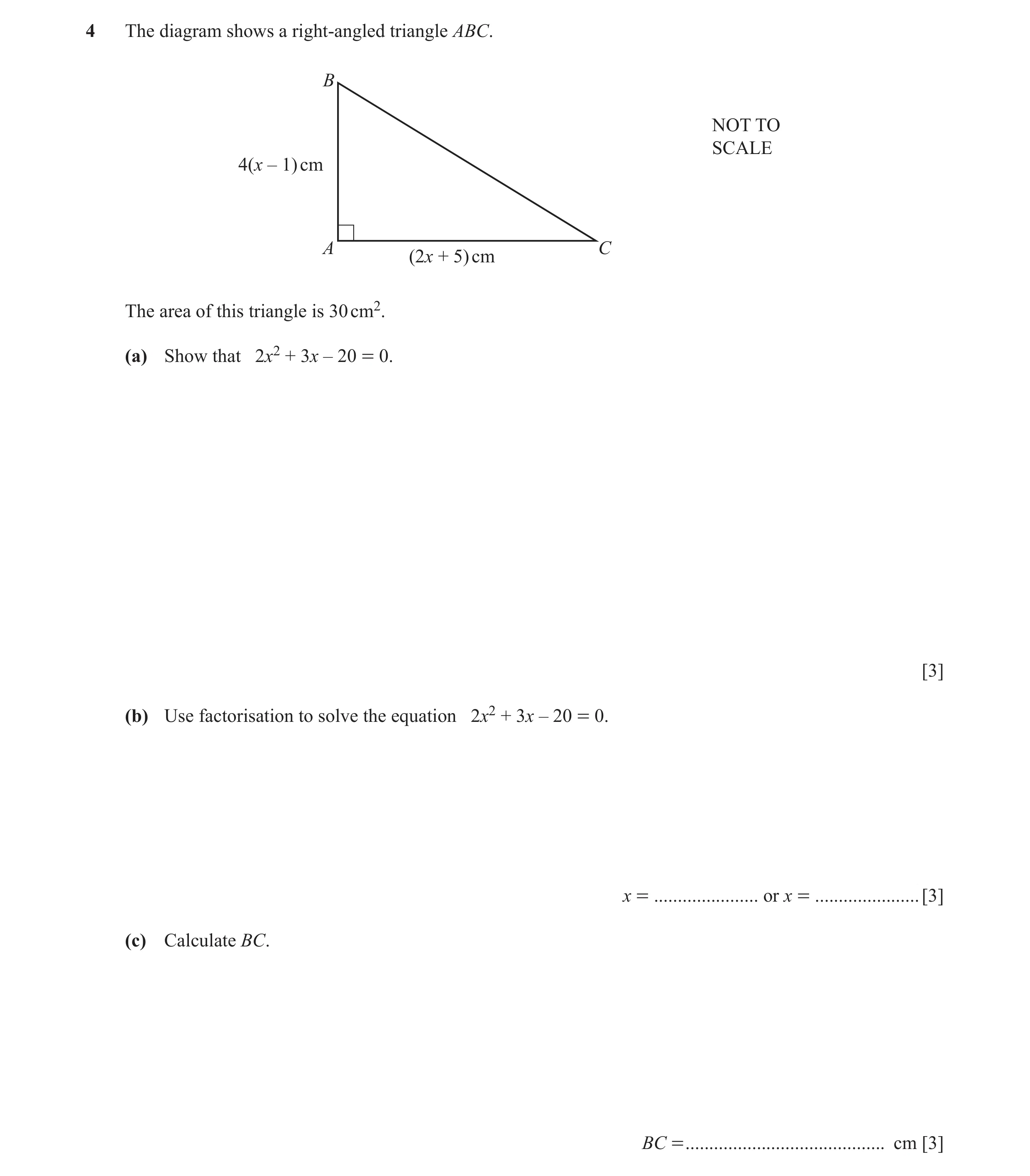
Q29 · The diagram shows a right-angled triangle ABC 0580/42 Oct/Nov 2018
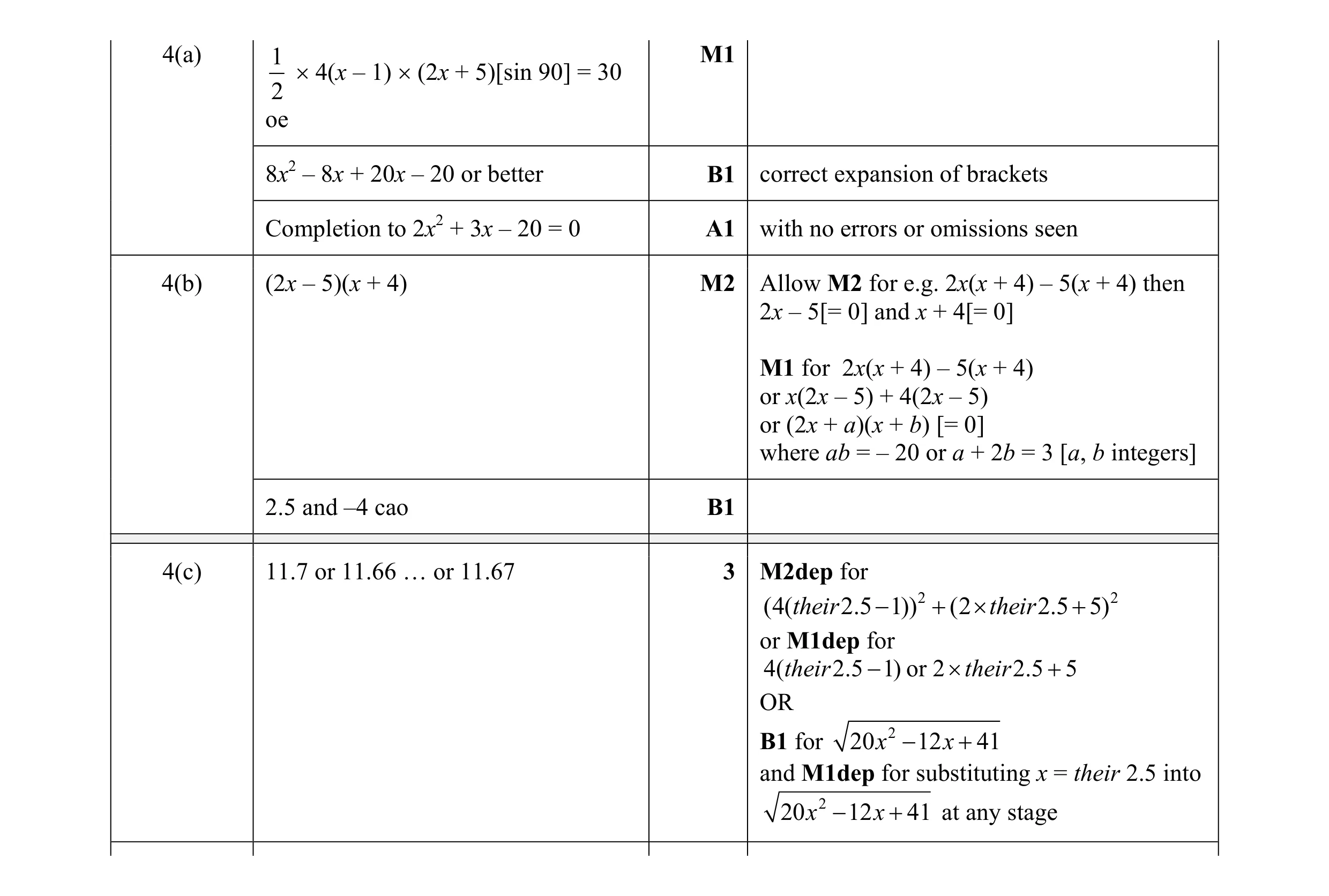
4 The diagram shows a right-angled triangle ABC. B NOT TO SCALE 4(x – 1) cm A C (2x + 5) cm The area of this triangle is 30 cm2. (a) Show that 2x2 + 3x – 20 = 0. [3] (b) Use factorisation to solve the equation 2x2 + 3x – 20 = 0. x = … or x = … [3] (c) Calculate BC. BC = … cm [3]
9 marks
Mark scheme: 4(a) 1 M1 × 4(x – 1) × (2x + 5)[sin 90] = 30 2 oe 8x2 – 8x + 20x – 20 or better B1 correct expansion of brackets Completion to 2x2 + 3x – 20 = 0 A1 with no errors or omissions seen 4(b) (2x – 5)(x + 4) M2 Allow M2 for e.g. 2x(x + 4) – 5(x + 4) then 2x – 5[= 0] and x + 4[= 0] M1 for 2x(x + 4) – 5(x + 4) or x(2x – 5) + 4(2x – 5) or (2x + a)(x + b) [= 0] where ab = – 20 or a + 2b = 3 [a, b integers] 2.5 and –4 cao B1 4(c) 11.7 or 11.66 … or 11.67 3 M2dep for (4(their 2.5 − 1)) 2 + (2 × their 2.5 + 5) 2 or M1dep for 4( their 2.5 − 1) or 2 × their 2.5 + 5 OR B1 for 20 x 2 − 12 x + 41 and M1dep for substituting x = their 2.5 into 20 x 2 − 12 x + 41 at any stage
This question in 0580/42 Oct/Nov 2018
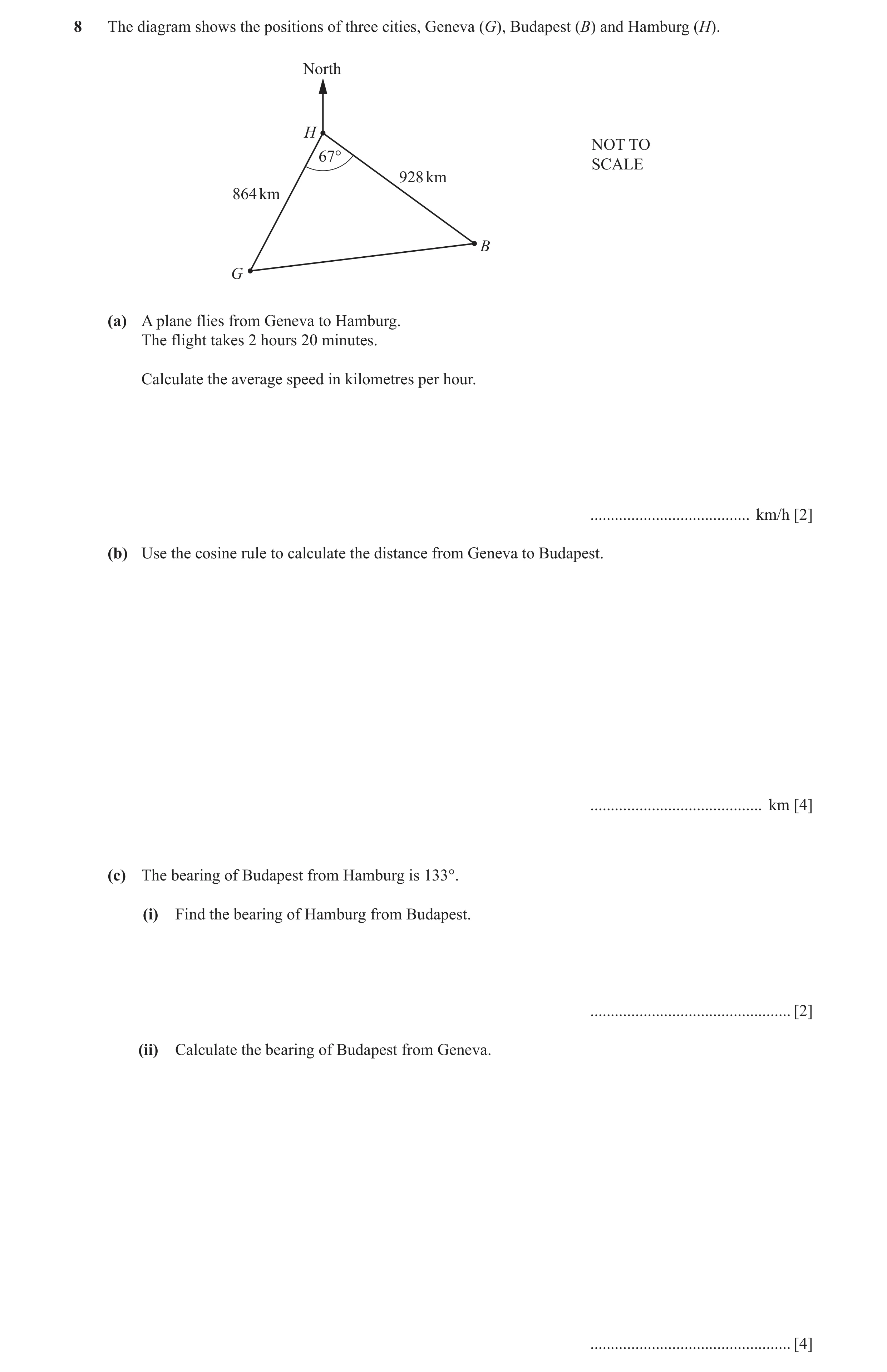
Q30 · The diagram shows the positions of three cities, Geneva (G), Budapest (B) and Hamburg (H) 0580/42 Oct/Nov 2018
8 The diagram shows the positions of three cities, Geneva (G), Budapest (B) and Hamburg (H). North H NOT TO 67° SCALE 928 km 864 km B G (a) A plane flies from Geneva to Hamburg. The flight takes 2 hours 20 minutes. Calculate the average speed in kilometres per hour. … km/h [2] (b) Use the cosine rule to calculate the distance from Geneva to Budapest. … km [4] (c) The bearing of Budapest from Hamburg is 133°. (i) Find the bearing of Hamburg from Budapest. … [2] (ii) Calculate the bearing of Budapest from Geneva. … [4]
12 marks
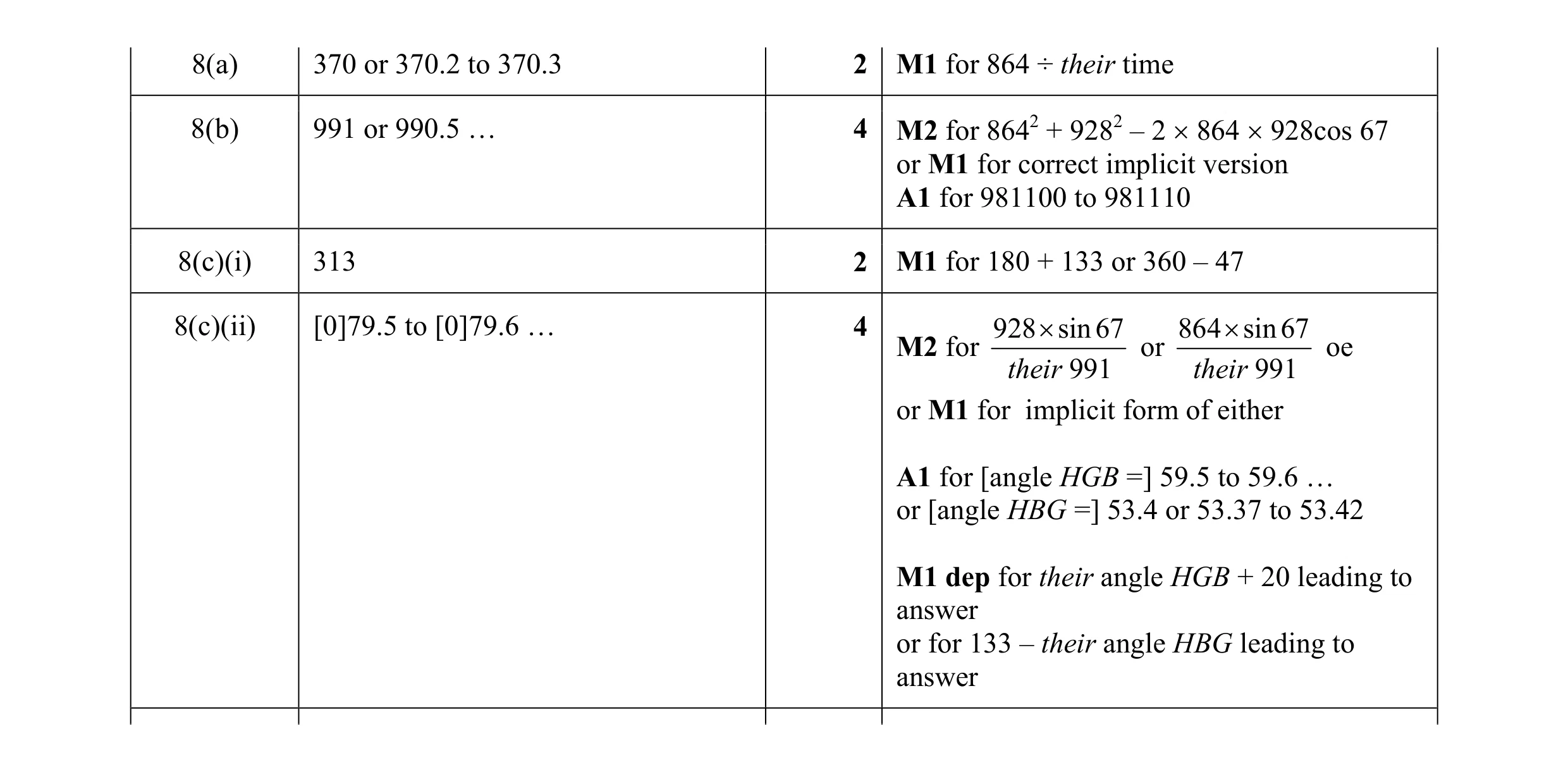
Mark scheme: 8(a) 370 or 370.2 to 370.3 2 M1 for 864 ÷ their time 8(b) 991 or 990.5 … 4 M2 for 8642 + 9282 – 2 × 864 × 928cos 67 or M1 for correct implicit version A1 for 981100 to 981110 8(c)(i) 313 2 M1 for 180 + 133 or 360 – 47 8(c)(ii) [0]79.5 to [0]79.6 … 4 928 × sin67 864 × sin67 M2 for or oe their 991 their 991 or M1 for implicit form of either A1 for [angle HGB =] 59.5 to 59.6 … or [angle HBG =] 53.4 or 53.37 to 53.42 M1 dep for their angle HGB + 20 leading to answer or for 133 – their angle HBG leading to answer
This question in 0580/42 Oct/Nov 2018
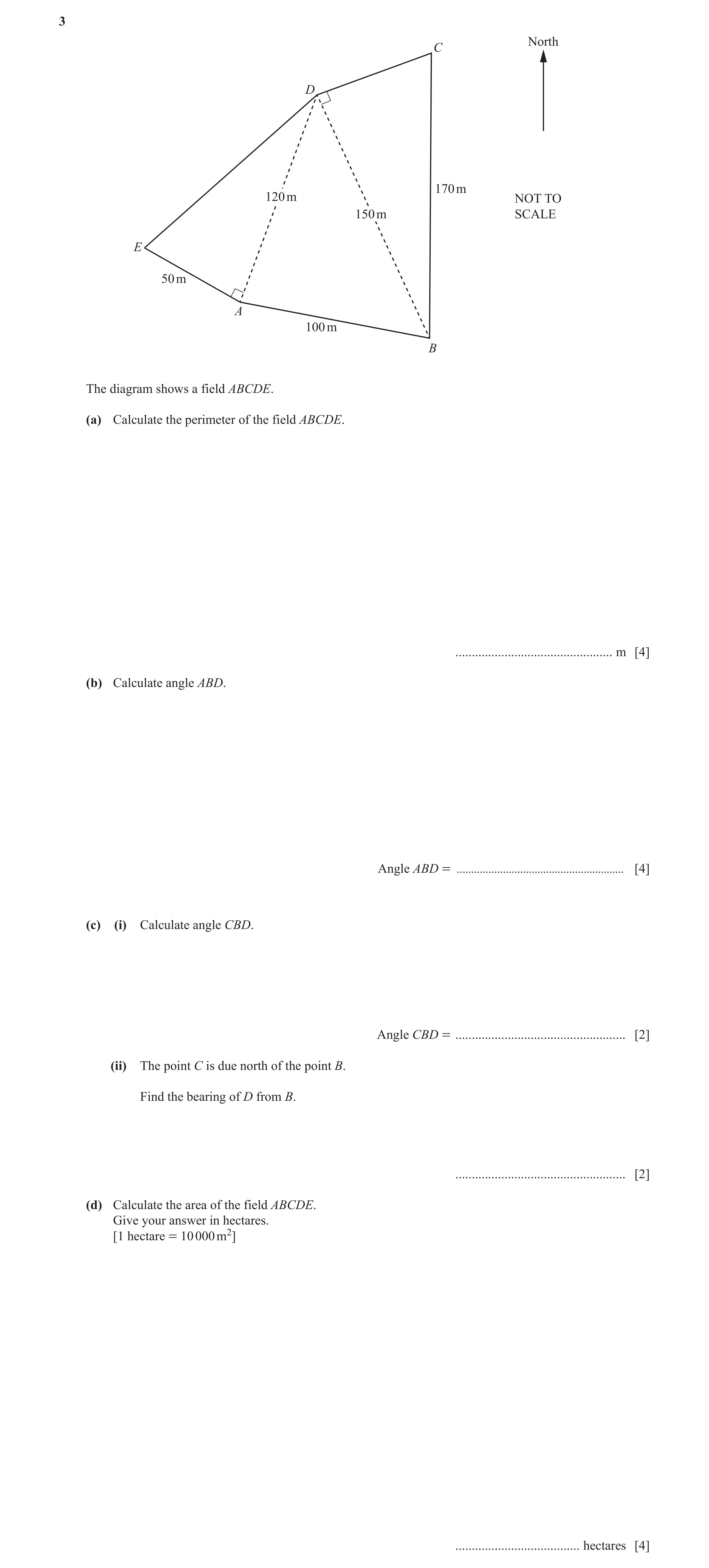
Q31 · North C D 170 m 120 m NOT TO 150 m SCALE E 50 m A 100 m B The diagram shows a field ABCDE 0580/41 May/June 2019
3 North C D 170 m 120 m NOT TO 150 m SCALE E 50 m A 100 m B The diagram shows a field ABCDE. (a) Calculate the perimeter of the field ABCDE. … m [4] (b) Calculate angle ABD. Angle ABD = … [4] (c) (i) Calculate angle CBD. Angle CBD = … [2] (ii) The point C is due north of the point B. Find the bearing of D from B. … [2] (d) Calculate the area of the field ABCDE. Give your answer in hectares. [1 hectare = 10 000 m2] … hectares [4]
16 marks
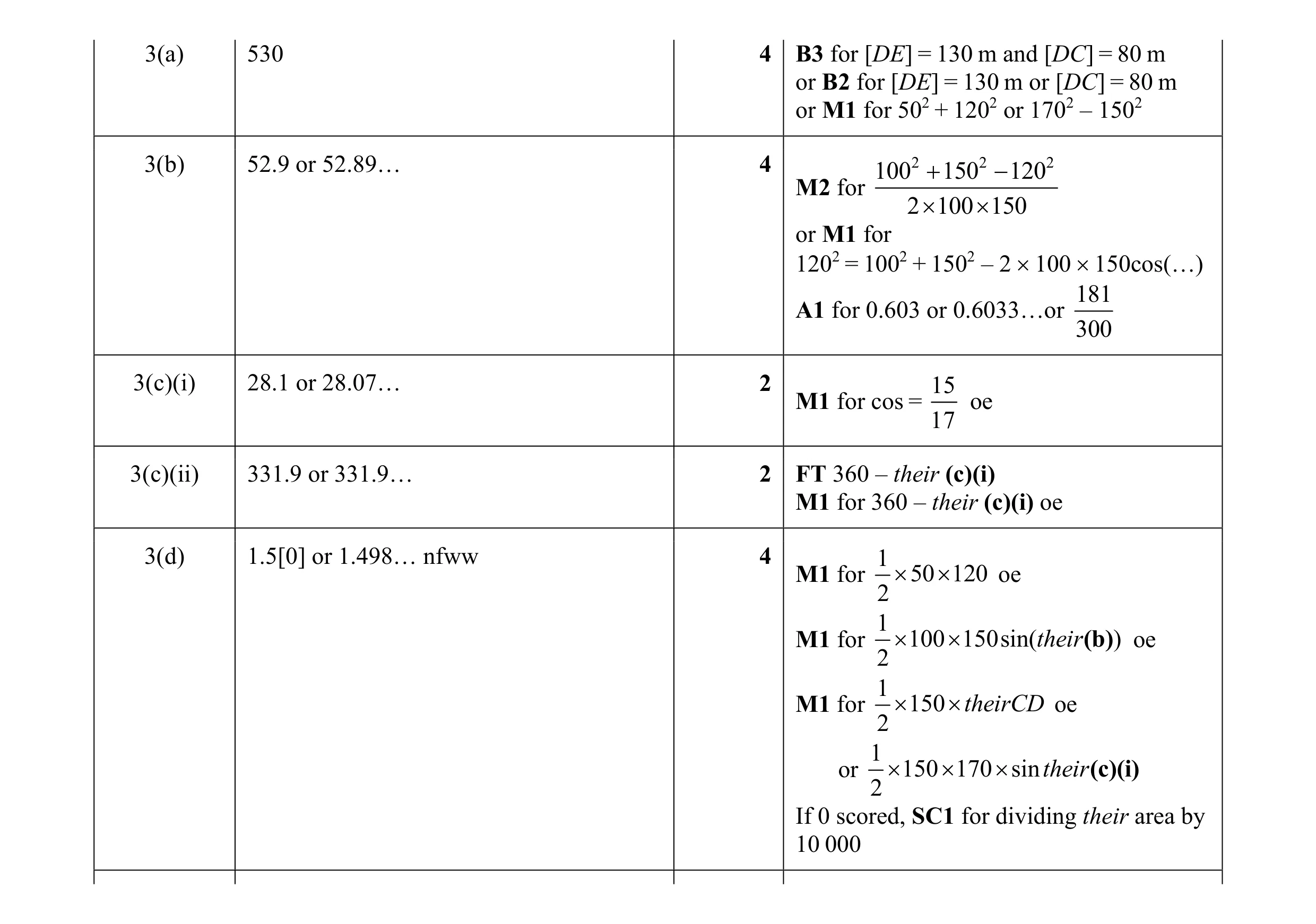
Mark scheme: 3(a) 530 4 B3 for [DE] = 130 m and [DC] = 80 m or B2 for [DE] = 130 m or [DC] = 80 m or M1 for 502 + 1202 or 1702 – 1502 3(b) 52.9 or 52.89… 4 100 2 + 150 2 − 120 2 M2 for 2 × 100 × 150 or M1 for 1202 = 1002 + 1502 – 2 × 100 × 150cos(…) 181 A1 for 0.603 or 0.6033…or 300 3(c)(i) 28.1 or 28.07… 2 15 M1 for cos = oe 17 3(c)(ii) 331.9 or 331.9… 2 FT 360 – their (c)(i) M1 for 360 – their (c)(i) oe 3(d) 1.5[0] or 1.498… nfww 4 1 M1 for × 50 × 120 oe 2 1 M1 for × 100 × 150sin(their (b)) oe 2 1 M1 for × 150 ×theirCD oe 2 1 or × 150 × 170 × sin their (c)(i) 2 If 0 scored, SC1 for dividing their area by 10 000
This question in 0580/41 May/June 2019
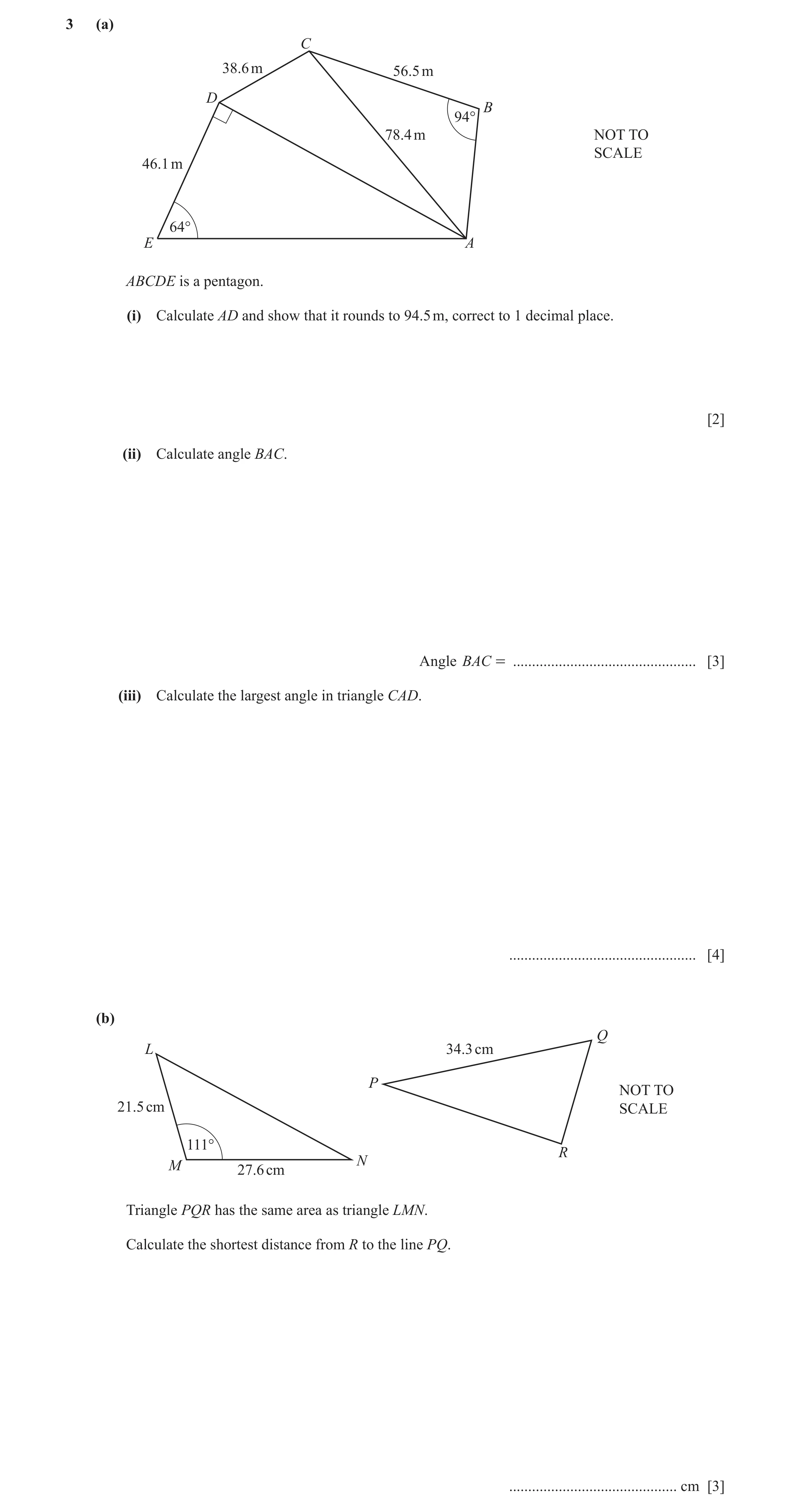
Q32 · C 38.6 m 56.5 m D B 94° 78.4 m NOT TO SCALE 46.1 m 64° E A ABCDE is a pentagon 0580/42 Oct/Nov 2021
3 (a) C 38.6 m 56.5 m D B 94° 78.4 m NOT TO SCALE 46.1 m 64° E A ABCDE is a pentagon. (i) Calculate AD and show that it rounds to 94.5 m, correct to 1 decimal place. [2] (ii) Calculate angle BAC. Angle BAC = … [3] (iii) Calculate the largest angle in triangle CAD. … [4] (b) Q L 34.3 cm P NOT TO 21.5 cm SCALE 111° R N M 27.6 cm Triangle PQR has the same area as triangle LMN. Calculate the shortest distance from R to the line PQ. … cm [3]
12 marks
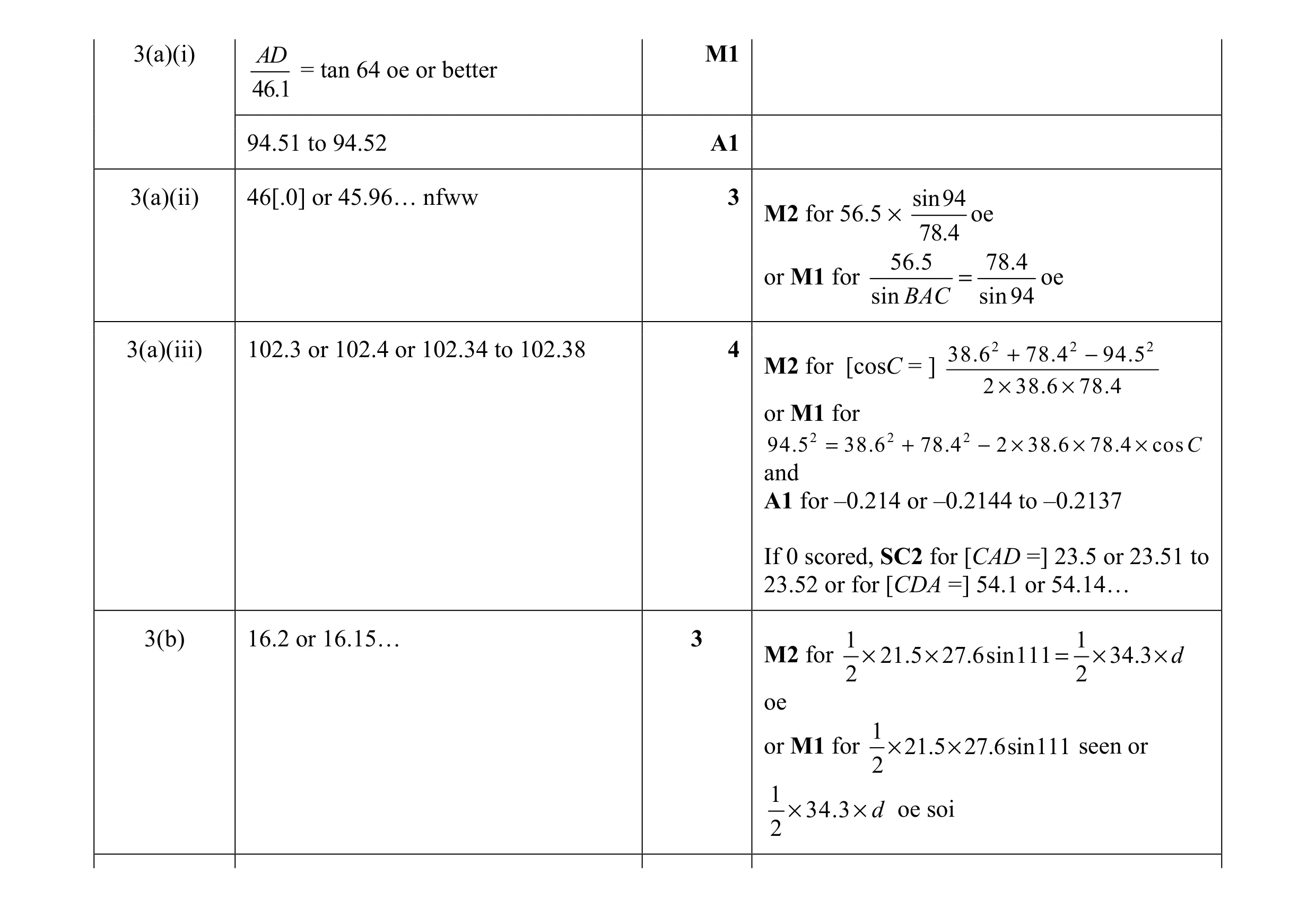
Mark scheme: 3(a)(i) AD M1 = tan 64 oe or better 46.1 94.51 to 94.52 A1 3(a)(ii) 46[.0] or 45.96… nfww 3 sin94 M2 for 56.5 × oe 78.4 56.5 78.4 or M1 for = oe sin BAC sin94 3(a)(iii) 102.3 or 102.4 or 102.34 to 102.38 4 38.6 2 + 78.4 2 − 94.5 2 M2 for [cosC = ] 2 × 38.6 × 78.4 or M1 for 94.5 2 = 38.6 2 + 78.4 2 − 2 × 38.6 × 78.4 × cos C and A1 for –0.214 or –0.2144 to –0.2137 If 0 scored, SC2 for [CAD =] 23.5 or 23.51 to 23.52 or for [CDA =] 54.1 or 54.14… 3(b) 16.2 or 16.15… 3 1 1 M2 for × 21.5 × 27.6sin111 = × 34.3 × d 2 2 oe 1 or M1 for × 21.5 × 27.6sin111 seen or 2 1 × 34.3 × d oe soi 2
This question in 0580/42 Oct/Nov 2021
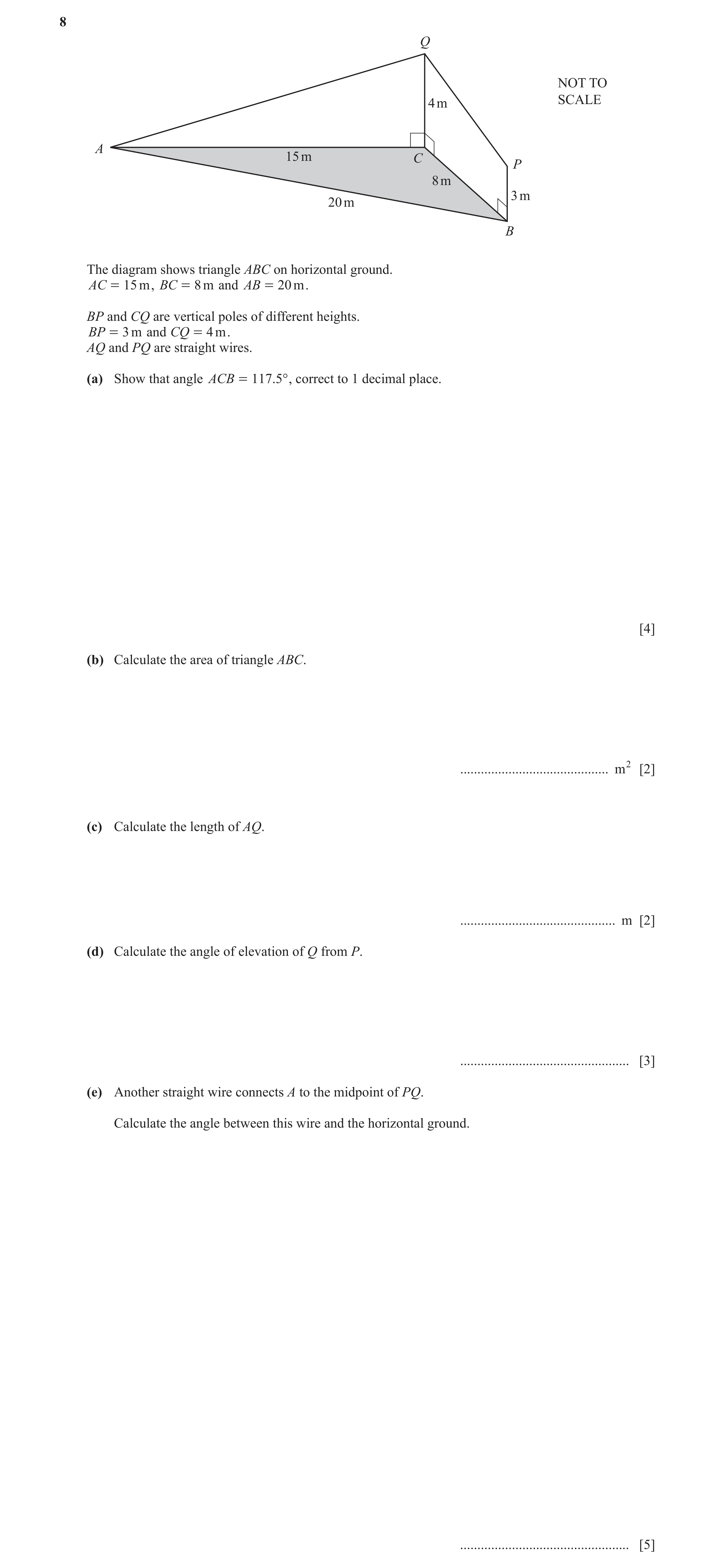
Q33 · Q NOT TO 4 m SCALE A 15 m C P 8 m 3 m 20 m B The diagram shows triangle ABC on horizontal… 0580/41 Oct/Nov 2022
8 Q NOT TO 4 m SCALE A 15 m C P 8 m 3 m 20 m B The diagram shows triangle ABC on horizontal ground. AC = 15 m , BC = 8 m and AB = 20 m . BP and CQ are vertical poles of different heights. BP = 3 m and CQ = 4 m . AQ and PQ are straight wires. (a) Show that angle ACB = 117.5° , correct to 1 decimal place. [4] (b) Calculate the area of triangle ABC. … m2 [2] (c) Calculate the length of AQ. … m [2] (d) Calculate the angle of elevation of Q from P. … [3] (e) Another straight wire connects A to the midpoint of PQ. Calculate the angle between this wire and the horizontal ground. … [5]
16 marks
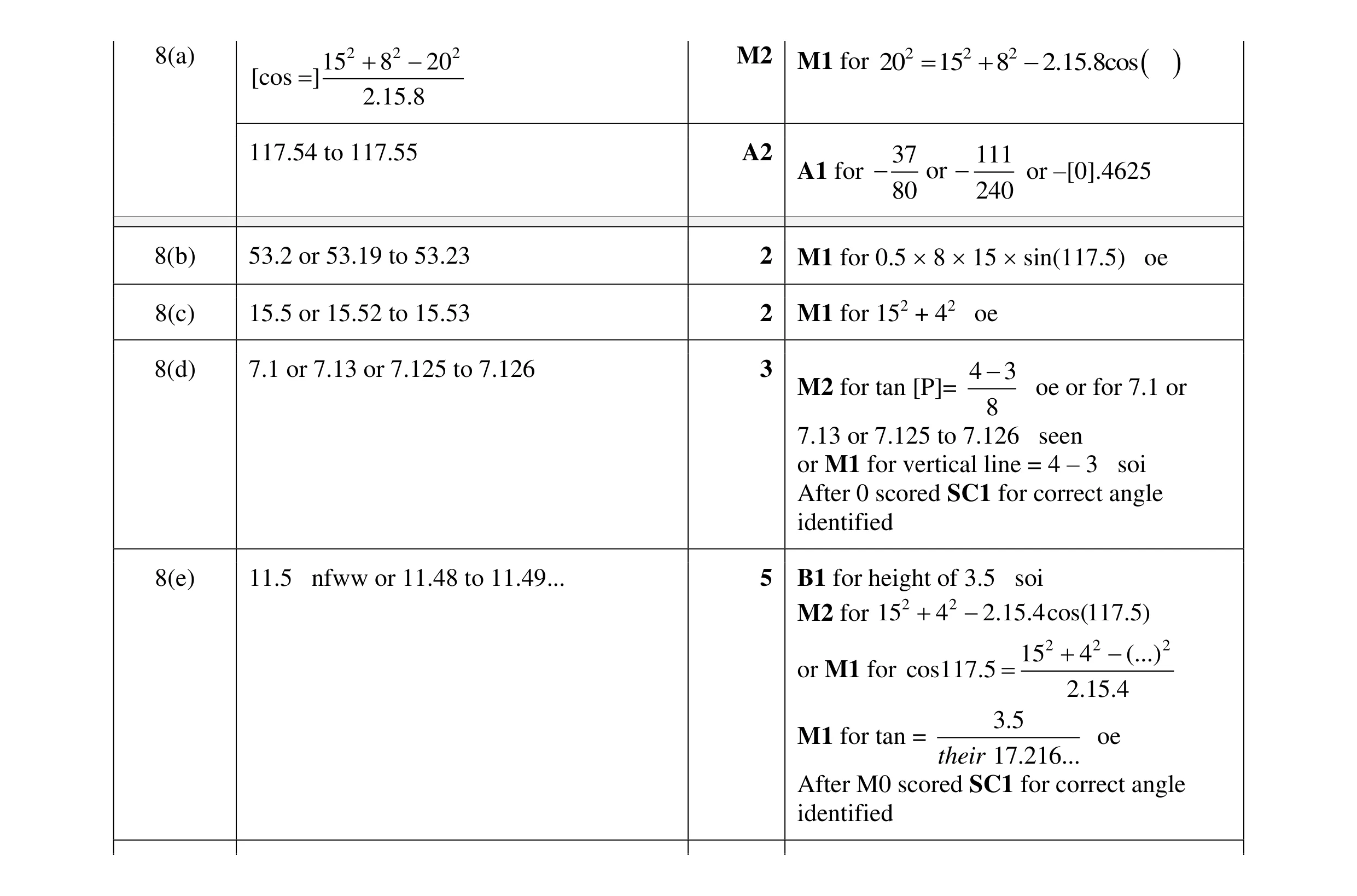
Mark scheme: 8(a) 15 2 + 8 2 − 20 2 M2 M1 for 202 = 152 + 82 − 2.15.8cos ( ) [cos = ] 2.15.8 117.54 to 117.55 A2 37 111 A1 for − or − or –[0].4625 80 240 8(b) 53.2 or 53.19 to 53.23 2 M1 for 0.5 8 15 sin(117.5) oe 8(c) 15.5 or 15.52 to 15.53 2 M1 for 152 + 42 oe 8(d) 7.1 or 7.13 or 7.125 to 7.126 3 4 − 3 M2 for tan [P]= oe or for 7.1 or 8 7.13 or 7.125 to 7.126 seen or M1 for vertical line = 4 – 3 soi After 0 scored SC1 for correct angle identified 8(e) 11.5 nfww or 11.48 to 11.49... 5 B1 for height of 3.5 soi M2 for 15 2 + 4 2 − 2.15.4cos(117.5) 15 2 + 4 2 − (...) 2 or M1 for cos117.5 = 2.15.4 3.5 M1 for tan = oe their 17.216... After M0 scored SC1 for correct angle identified
This question in 0580/41 Oct/Nov 2022
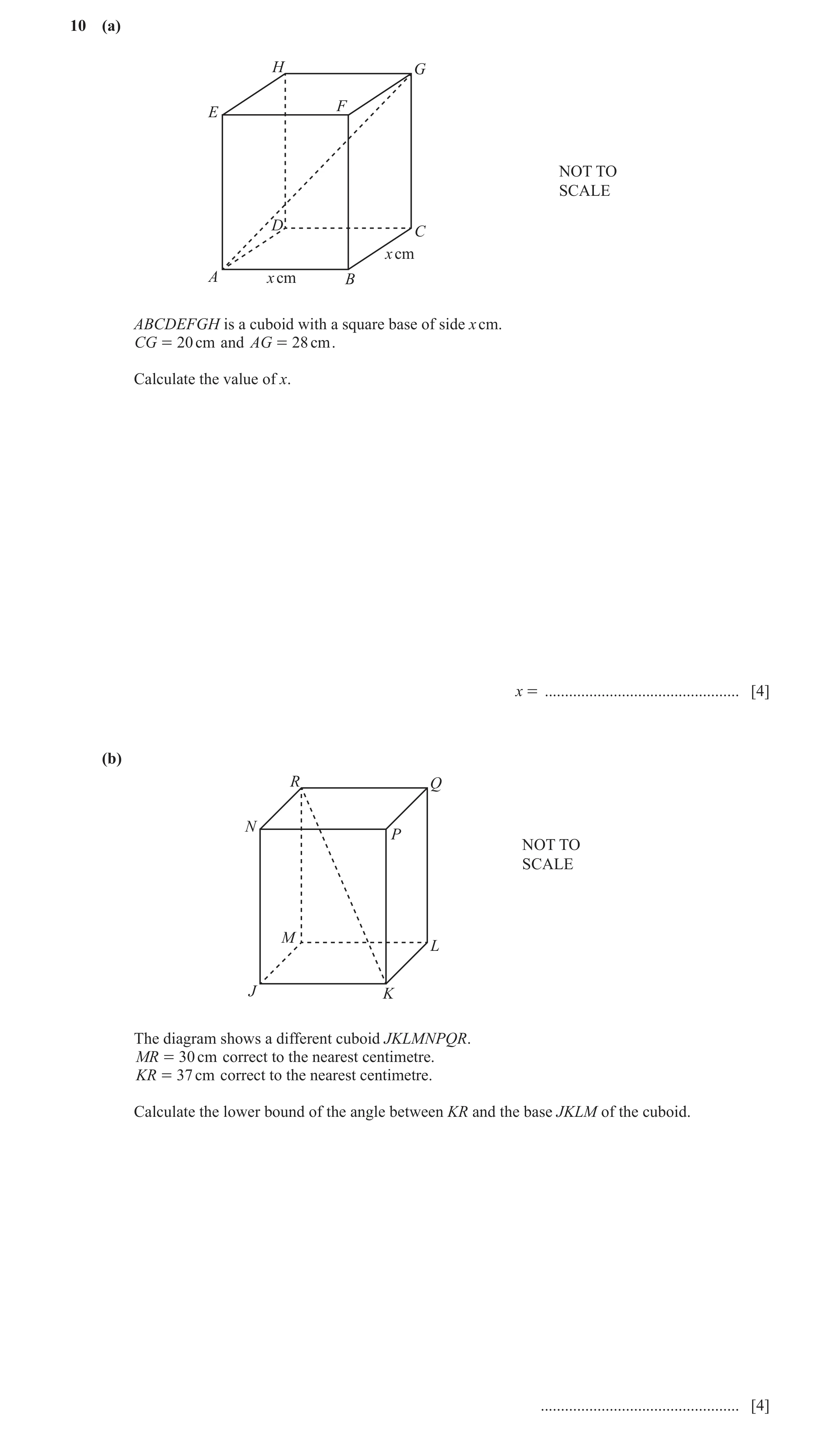
Q34 · H G F E NOT TO SCALE D C x cm A x cm B ABCDEFGH is a cuboid with a square base of side x… 0580/42 May/June 2023
10 (a) H G F E NOT TO SCALE D C x cm A x cm B ABCDEFGH is a cuboid with a square base of side x cm. CG = 20 cm and AG = 28 cm . Calculate the value of x. x = … [4] (b) R Q N P NOT TO SCALE M L J K The diagram shows a different cuboid JKLMNPQR. MR = 30 cm correct to the nearest centimetre. KR = 37 cm correct to the nearest centimetre. Calculate the lower bound of the angle between KR and the base JKLM of the cuboid. … [4]
8 marks
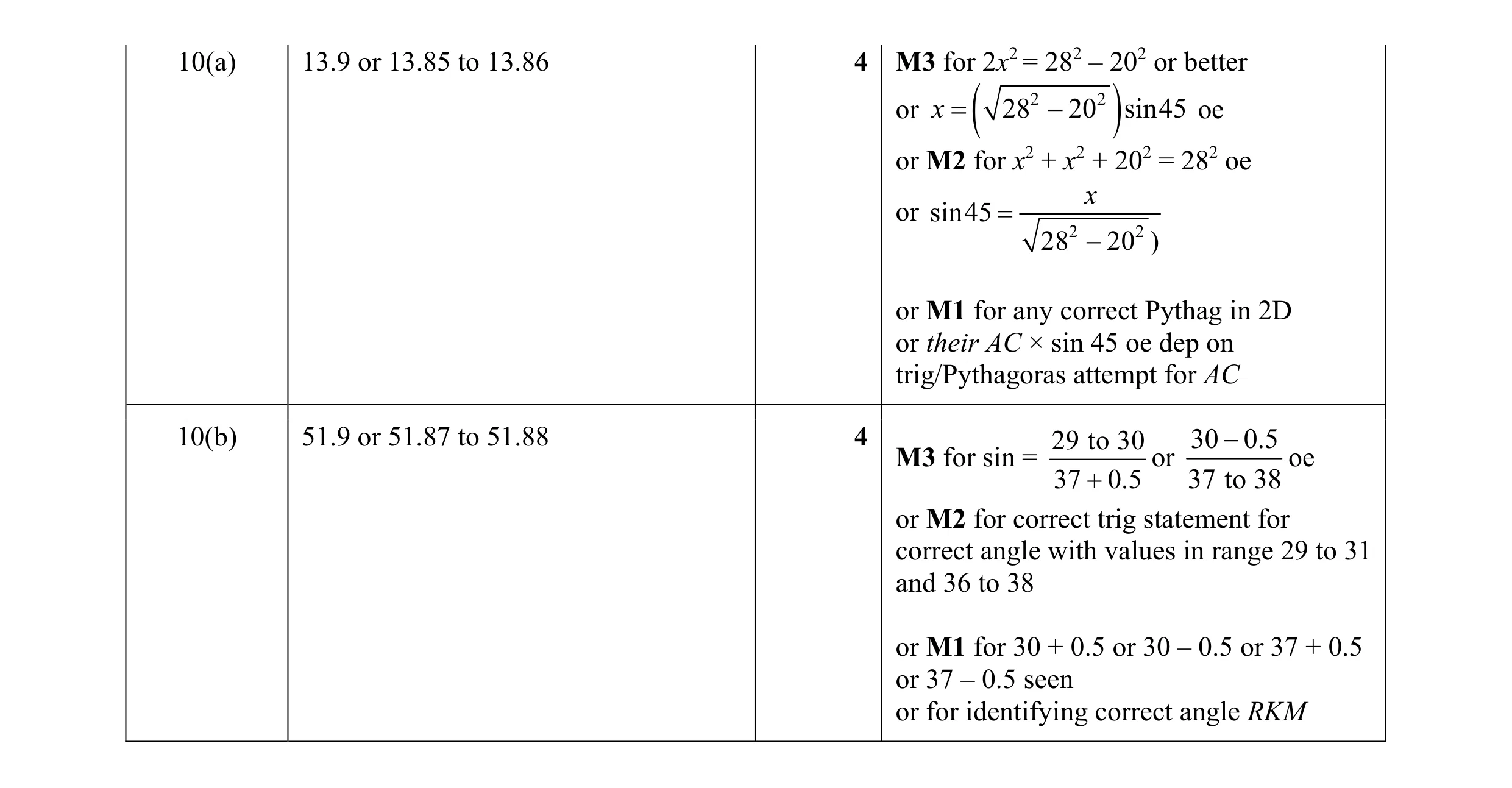
Mark scheme: 10(a) 13.9 or 13.85 to 13.86 4 M3 for 2x2 = 282 – 202 or better or x 28 2 20 2 sin45 oe or M2 for x2 + x2 + 202 = 282 oe x or sin45 28 2 20 2 ) or M1 for any correct Pythag in 2D or their AC × sin 45 oe dep on trig/Pythagoras attempt for AC 10(b) 51.9 or 51.87 to 51.88 4 29 to 30 30 0.5 M3 for sin = or oe 37 0.5 37 to 38 or M2 for correct trig statement for correct angle with values in range 29 to 31 and 36 to 38 or M1 for 30 + 0.5 or 30 – 0.5 or 37 + 0.5 or 37 – 0.5 seen or for identifying correct angle RKM
This question in 0580/42 May/June 2023
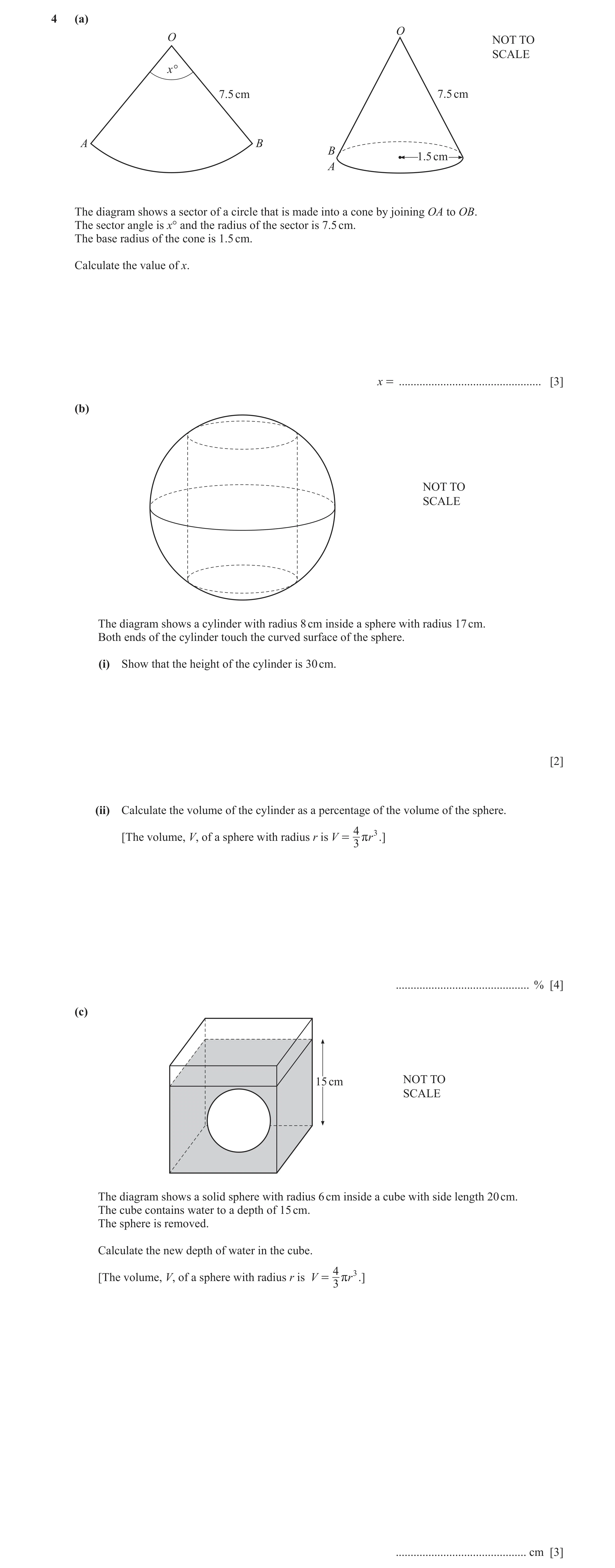
Q35 · O O NOT TO SCALE x° 7.5 cm 7.5 cm A B B 1.5 cm A The diagram shows a sector of a circle… 0580/42 Oct/Nov 2023
4 (a) O O NOT TO SCALE x° 7.5 cm 7.5 cm A B B 1.5 cm A The diagram shows a sector of a circle that is made into a cone by joining OA to OB. The sector angle is x° and the radius of the sector is 7.5 cm. The base radius of the cone is 1.5 cm. Calculate the value of x. x = … [3] (b) NOT TO SCALE The diagram shows a cylinder with radius 8 cm inside a sphere with radius 17 cm. Both ends of the cylinder touch the curved surface of the sphere. (i) Show that the height of the cylinder is 30 cm. [2] (ii) Calculate the volume of the cylinder as a percentage of the volume of the sphere. 4 3 [The volume, V, of a sphere with radius r is V = rr .] 3 … % [4] (c) 15 cm NOT TO SCALE The diagram shows a solid sphere with radius 6 cm inside a cube with side length 20 cm. The cube contains water to a depth of 15 cm. The sphere is removed. Calculate the new depth of water in the cube. 4 3 [The volume, V, of a sphere with radius r is V = rr .] 3 … cm [3]
12 marks
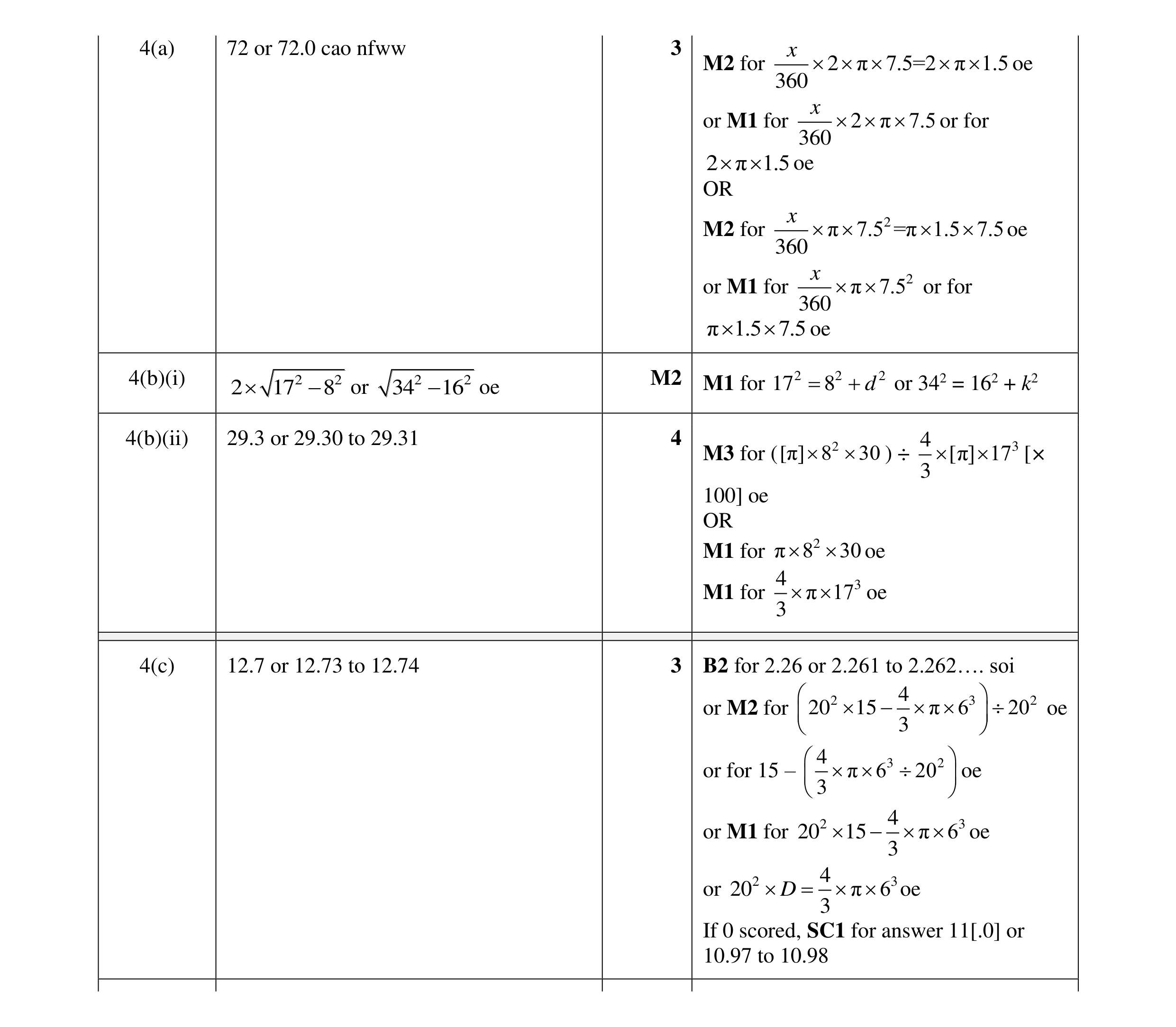
Mark scheme: 4(a) 72 or 72.0 cao nfww 3 x M2 for 2 π 7.5=2 π 1.5 oe 360 x or M1 for 2 π 7.5 or for 360 2 π 1.5 oe OR x 2 M2 for π 7.5 =π 1.5 7.5 oe 360 x 2 or M1 for π 7.5 or for 360 π 1.5 7.5 oe 4(b)(i) M2 M1 for 17 2 = 82 + d 2 or 342 = 162 + k2 2 172 − 82 or 342 − 162 oe 4(b)(ii) 29.3 or 29.30 to 29.31 4 2 4 3 M3 for ( [π] 8 30 ) ÷ [π] 17 [× 3 100] oe OR M1 for π 82 30 oe 4 3 M1 for π 17 oe 3 4(c) 12.7 or 12.73 to 12.74 3 B2 for 2.26 or 2.261 to 2.262…. soi 2 4 3 2 or M2 for 20 15 − π 6 20 oe 3 4 3 2 or for 15 – π 6 20 oe 3 2 4 3 or M1 for 20 15 − π 6 oe 3 2 4 3 or 20 D = π 6 oe 3 If 0 scored, SC1 for answer 11[.0] or 10.97 to 10.98
This question in 0580/42 Oct/Nov 2023
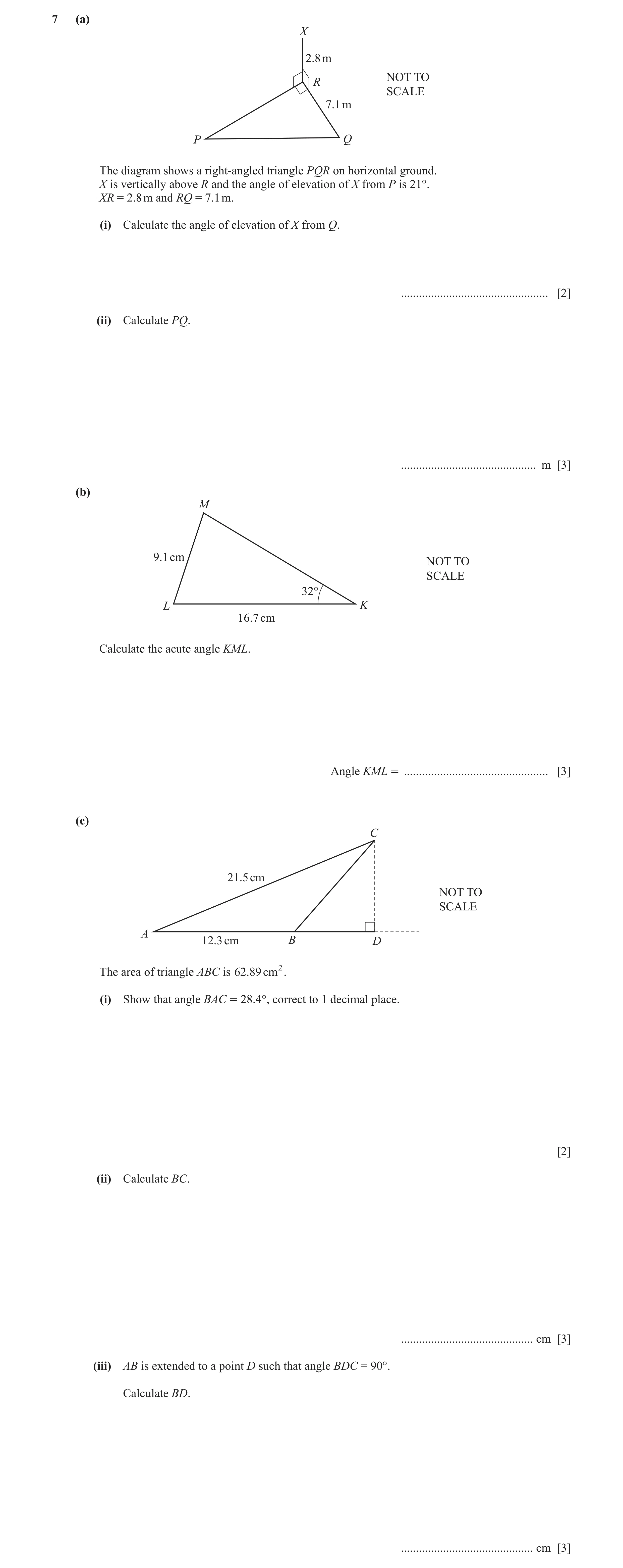
Q36 · X 2.8 m NOT TO R SCALE 7.1 m P Q The diagram shows a right-angled triangle PQR on… 0580/42 Oct/Nov 2023
7 (a) X 2.8 m NOT TO R SCALE 7.1 m P Q The diagram shows a right-angled triangle PQR on horizontal ground. X is vertically above R and the angle of elevation of X from P is 21°. XR = 2.8 m and RQ = 7.1 m. (i) Calculate the angle of elevation of X from Q. … [2] (ii) Calculate PQ. … m [3] (b) M 9.1 cm NOT TO SCALE 32° L K 16.7 cm Calculate the acute angle KML. Angle KML = … [3] (c) C 21.5 cm NOT TO SCALE A 12.3 cm B D The area of triangle ABC is 62.89 cm 2. (i) Show that angle BAC = 28.4°, correct to 1 decimal place. [2] (ii) Calculate BC. … cm [3] (iii) AB is extended to a point D such that angle BDC = 90°. Calculate BD. … cm [3]
16 marks
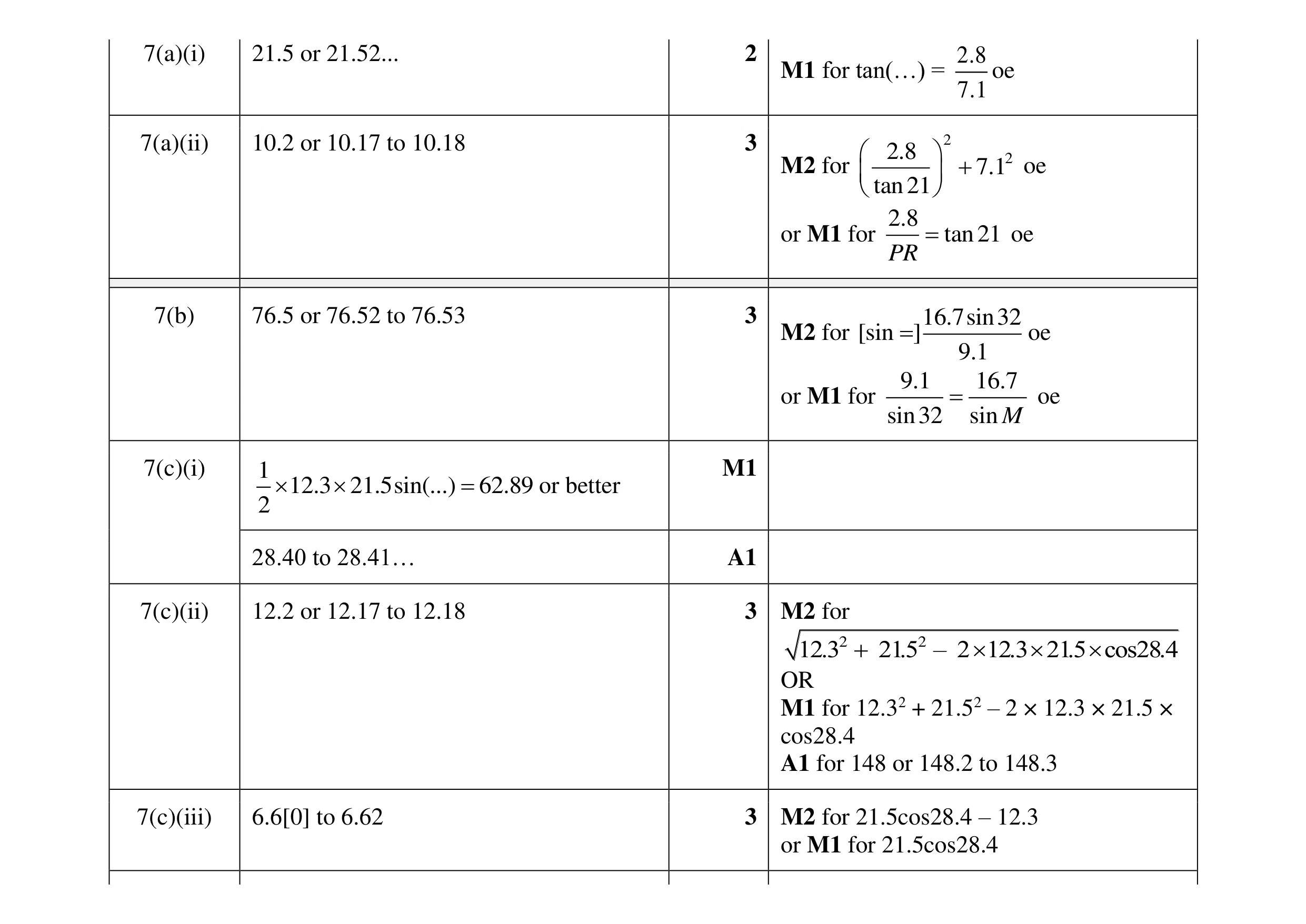
Mark scheme: 7(a)(i) 21.5 or 21.52... 2 2.8 M1 for tan(…) = oe 7.1 7(a)(ii) 10.2 or 10.17 to 10.18 3 2 2.8 2 oe M2 for + 7.1 tan21 2.8 or M1 for = tan21 oe PR 7(b) 76.5 or 76.52 to 76.53 3 16.7sin32 M2 for [sin =] oe 9.1 9.1 16.7 or M1 for = oe sin32 sin M 7(c)(i) 1 M1 12.3 21.5sin(...) = 62.89 or better 2 28.40 to 28.41… A1 7(c)(ii) 12.2 or 12.17 to 12.18 3 M2 for 12.32 + 21.52 – 2 12.3 21.5 cos28.4 OR M1 for 12.32 + 21.52 – 2 × 12.3 × 21.5 × cos28.4 A1 for 148 or 148.2 to 148.3 7(c)(iii) 6.6[0] to 6.62 3 M2 for 21.5cos28.4 – 12.3 or M1 for 21.5cos28.4
This question in 0580/42 Oct/Nov 2023
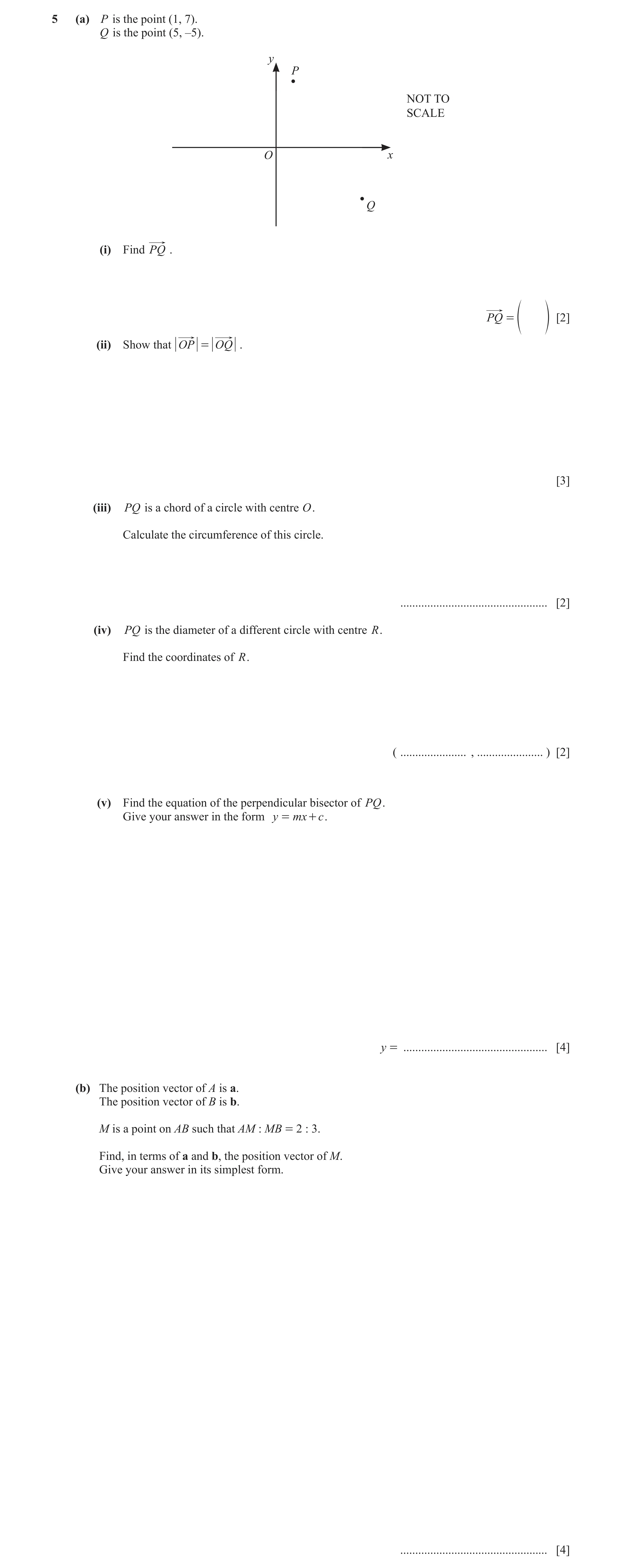
Q37 · P is the point (1, 7) 0580/41 May/June 2024
5 (a) P is the point (1, 7). Q is the point (5, –5). y P NOT TO SCALE O x Q (i) Find PQ . PQ = [2] f p (ii) Show that OP = OQ . [3] (iii) PQ is a chord of a circle with centre O. Calculate the circumference of this circle. … [2] (iv) PQ is the diameter of a different circle with centre R. Find the coordinates of R. ( … , … ) [2] (v) Find the equation of the perpendicular bisector of PQ. Give your answer in the form y = mx + c . y = … [4] (b) The position vector of A is a. The position vector of B is b. M is a point on AB such that AM : MB = 2 : 3. Find, in terms of a and b, the position vector of M. Give your answer in its simplest form. … [4]
17 marks
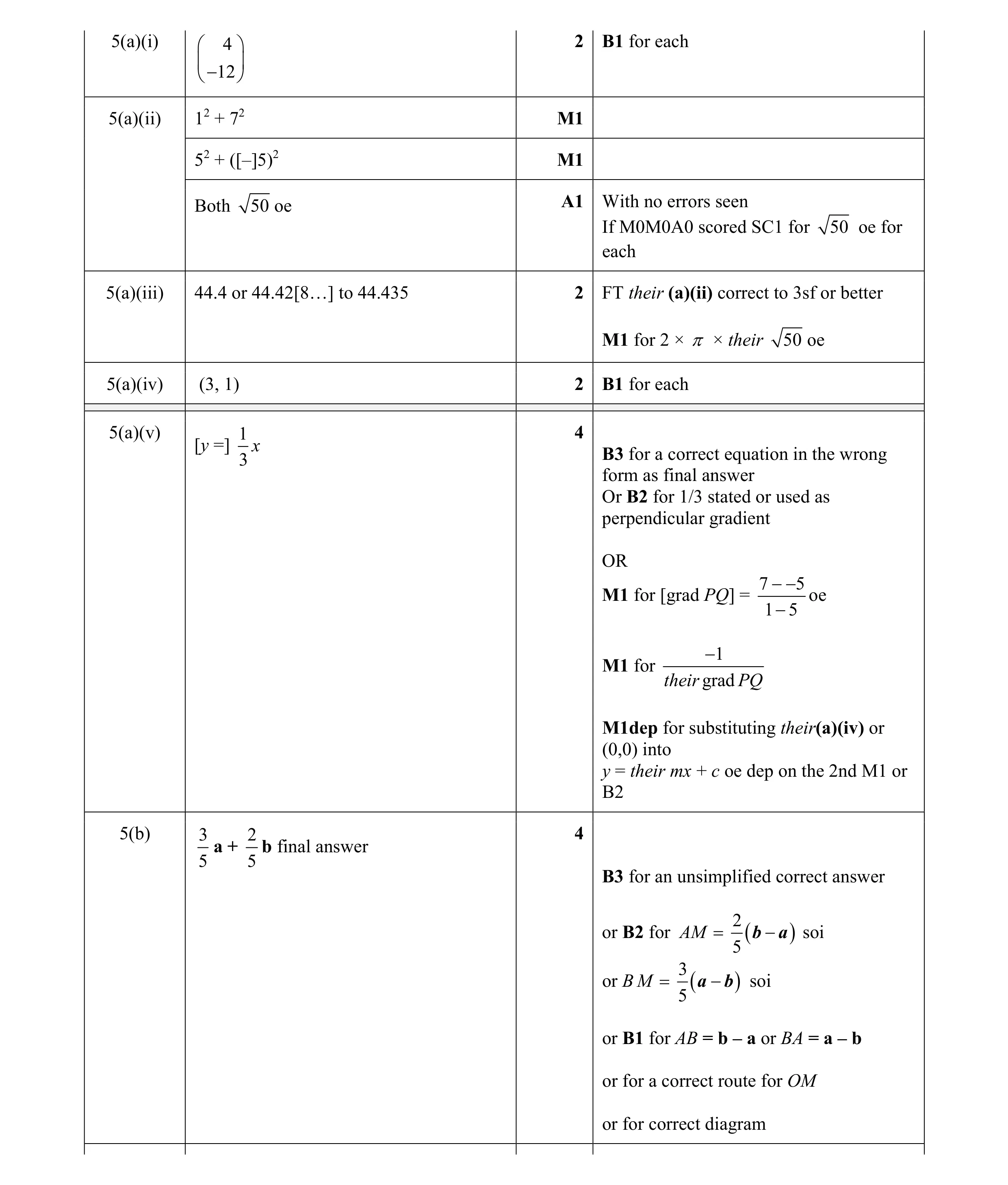
Mark scheme: 5(a)(i) 4 2 B1 for each 12 5(a)(ii) 12 + 72 M1 52 + ([–]5)2 M1 Both 50 oe A1 With no errors seen If M0M0A0 scored SC1 for 50 oe for each 5(a)(iii) 44.4 or 44.42[8…] to 44.435 2 FT their (a)(ii) correct to 3sf or better M1 for 2 × × their 50 oe 5(a)(iv) (3, 1) 2 B1 for each 5(a)(v) 1 4 [y =] x B3 for a correct equation in the wrong 3 form as final answer Or B2 for 1/3 stated or used as perpendicular gradient OR 7 5 M1 for [grad PQ] = oe 1 5 1 M1 for their grad PQ M1dep for substituting their(a)(iv) or (0,0) into y = their mx + c oe dep on the 2nd M1 or B2 5(b) 3 2 4 a + b final answer 5 5 B3 for an unsimplified correct answer 2 or B2 for AM b a soi 5 3 or B M a b soi 5 or B1 for AB = b – a or BA = a – b or for a correct route for OM or for correct diagram
This question in 0580/41 May/June 2024
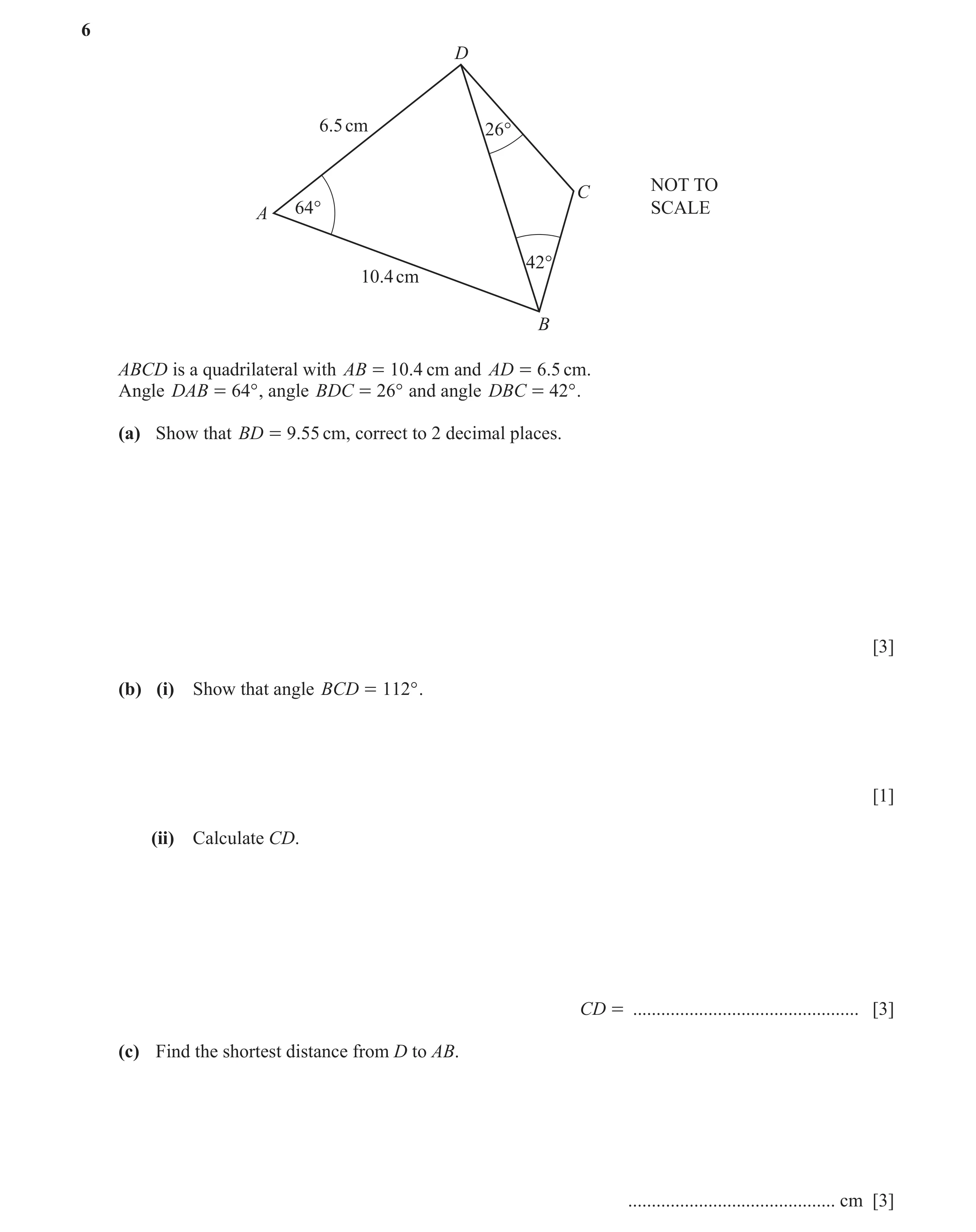
Q38 · D 6.5 cm 26° NOT TO C 64° SCALE A 42° 10.4 cm B ABCD is a quadrilateral with AB = 10.4 cm… 0580/42 May/June 2024
6 D 6.5 cm 26° NOT TO C 64° SCALE A 42° 10.4 cm B ABCD is a quadrilateral with AB = 10.4 cm and AD = 6.5 cm. Angle DAB = 64° , angle BDC = 26° and angle DBC = 42° . (a) Show that BD = 9.55 cm, correct to 2 decimal places. [3] (b) (i) Show that angle BCD = 112° . [1] (ii) Calculate CD. CD = … [3] (c) Find the shortest distance from D to AB. … cm [3]
10 marks
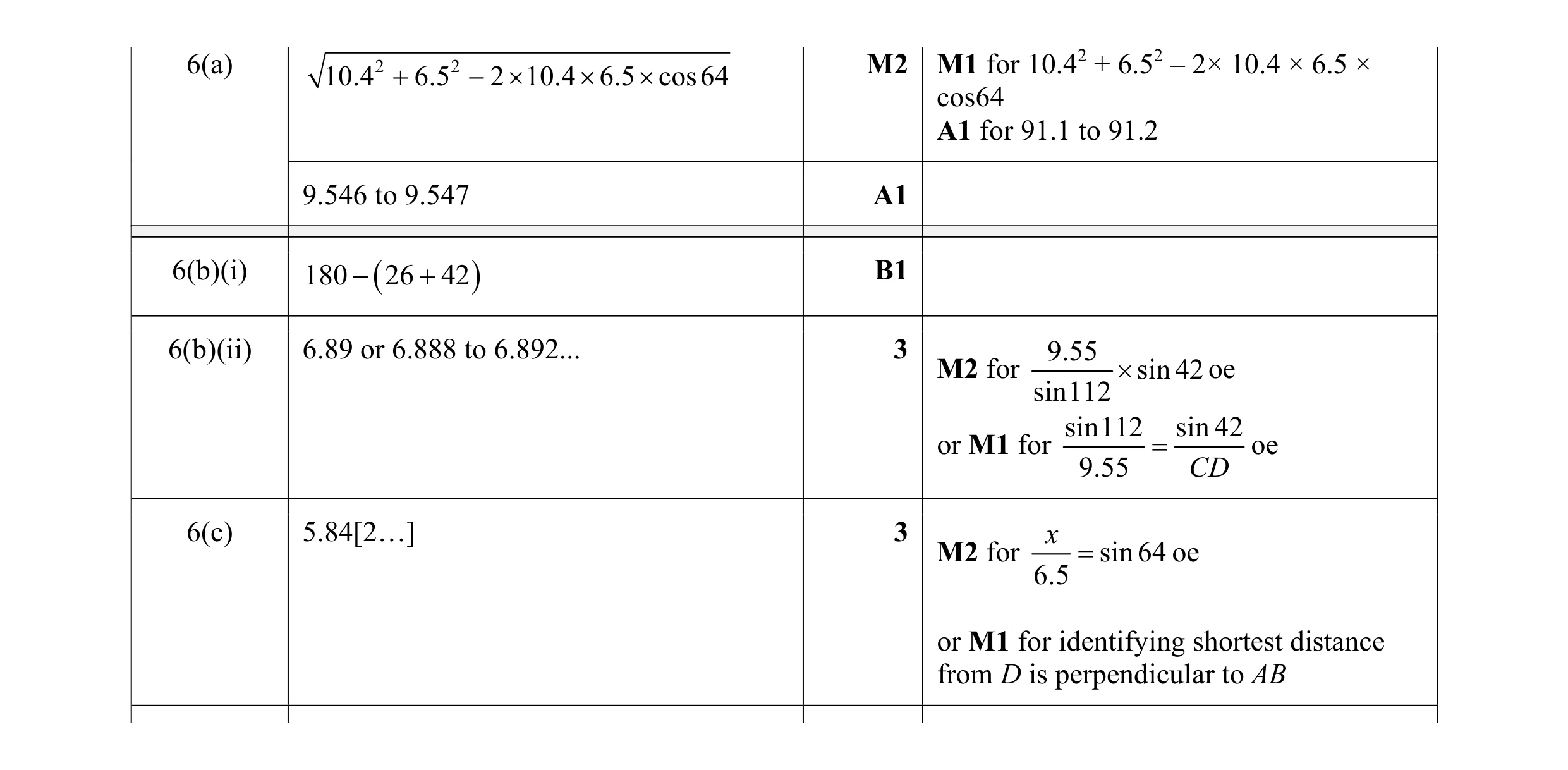
Mark scheme: 6(a) 2 2 M2 M1 for 10.42 + 6.52 – 2× 10.4 × 6.5 × 10.4 6.5 2 10.4 6.5 cos64 cos64 A1 for 91.1 to 91.2 9.546 to 9.547 A1 6(b)(i) 180 26 42 B1 6(b)(ii) 6.89 or 6.888 to 6.892... 3 9.55 M2 for sin 42 oe sin112 sin112 sin 42 or M1 for oe 9.55 CD 6(c) 5.84[2…] 3 x M2 for sin64 oe 6.5 or M1 for identifying shortest distance from D is perpendicular to AB
This question in 0580/42 May/June 2024
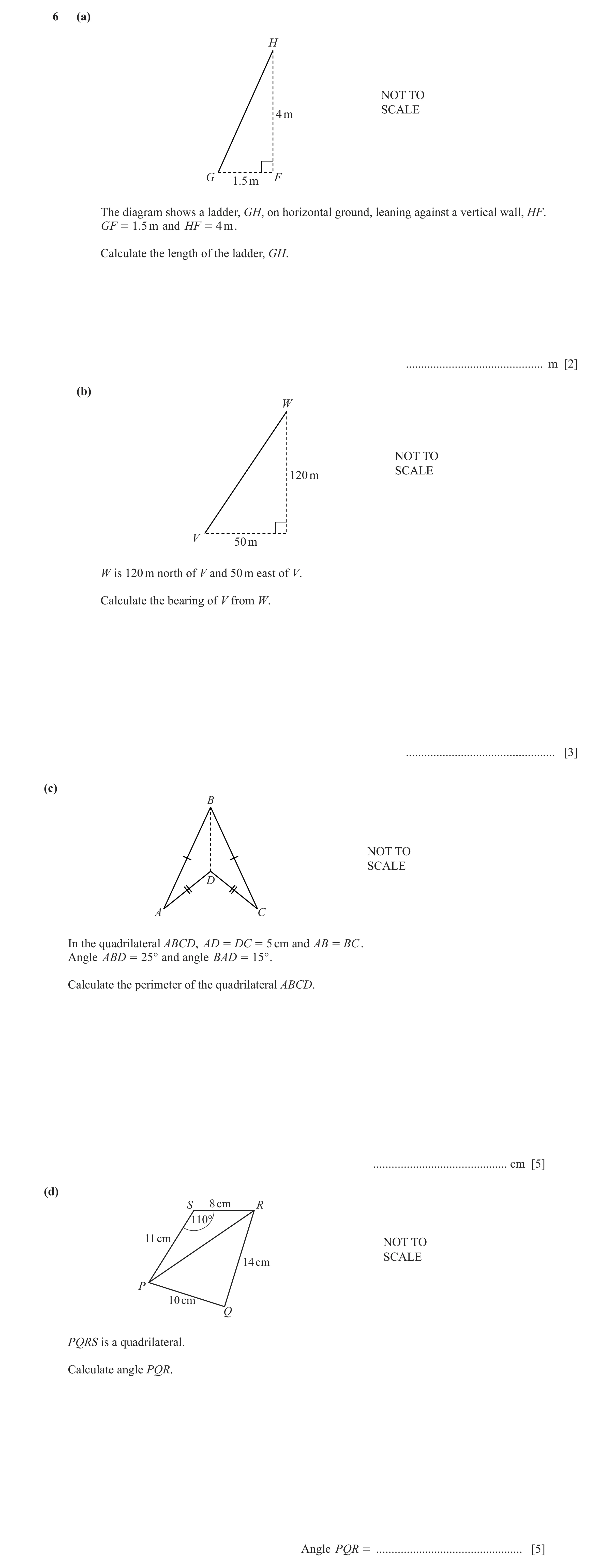
Q39 · H NOT TO SCALE 4 m G F 1.5 m The diagram shows a ladder, GH, on horizontal ground… 0580/43 May/June 2024
6 (a) H NOT TO SCALE 4 m G F 1.5 m The diagram shows a ladder, GH, on horizontal ground, leaning against a vertical wall, HF. GF = 1.5 m and HF = 4 m . Calculate the length of the ladder, GH. … m [2] (b) W NOT TO SCALE 120 m V 50 m W is 120 m north of V and 50 m east of V. Calculate the bearing of V from W. … [3] (c) B NOT TO SCALE D A C In the quadrilateral ABCD, AD = DC = 5 cm and AB = BC . Angle ABD = 25° and angle BAD = 15° . Calculate the perimeter of the quadrilateral ABCD. … cm [5] (d) S 8 cm R 110° 11 cm NOT TO SCALE 14 cm P 10 cm Q PQRS is a quadrilateral. Calculate angle PQR. Angle PQR = … [5]
15 marks
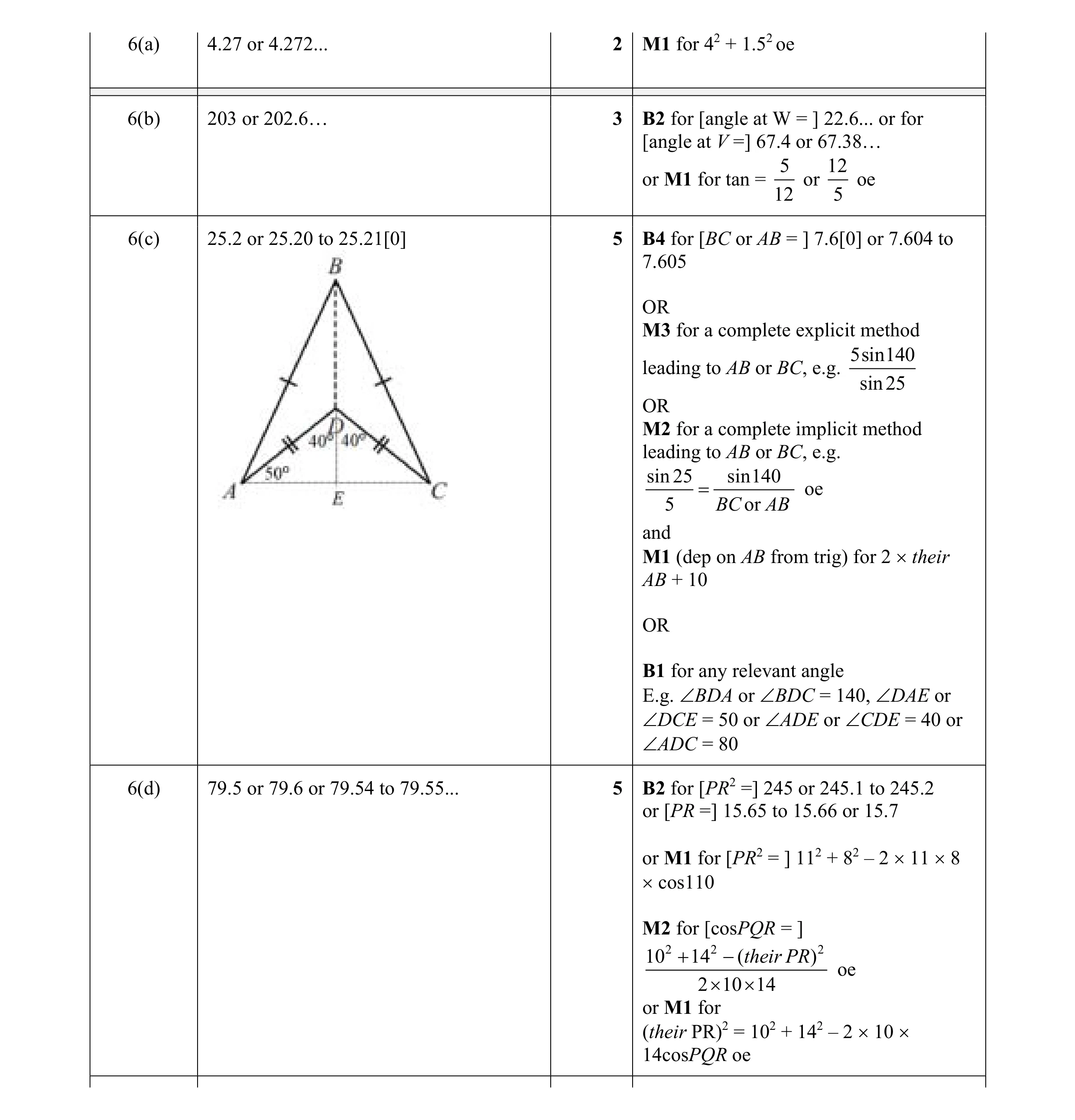
Mark scheme: 6(a) 4.27 or 4.272... 2 M1 for 42 + 1.52 oe 6(b) 203 or 202.6… 3 B2 for [angle at W = ] 22.6... or for [angle at V =] 67.4 or 67.38… 5 12 or M1 for tan = or oe 12 5 6(c) 25.2 or 25.20 to 25.21[0] 5 B4 for [BC or AB = ] 7.6[0] or 7.604 to 7.605 OR M3 for a complete explicit method 5sin140 leading to AB or BC, e.g. sin25 OR M2 for a complete implicit method leading to AB or BC, e.g. sin 25 sin140 oe 5 BC or AB and M1 (dep on AB from trig) for 2 their AB + 10 OR B1 for any relevant angle E.g. BDA or BDC = 140, DAE or DCE = 50 or ADE or CDE = 40 or ADC = 80 6(d) 79.5 or 79.6 or 79.54 to 79.55... 5 B2 for [PR2 =] 245 or 245.1 to 245.2 or [PR =] 15.65 to 15.66 or 15.7 or M1 for [PR2 = ] 112 + 82 – 2 11 8 cos110 M2 for [cosPQR = ] 10 2 14 2 (their PR ) 2 oe 2 10 14 or M1 for (their PR)2 = 102 + 142 – 2 10 14cosPQR oe
This question in 0580/43 May/June 2024
 1 / 59
 2 / 59
 4 / 59
 7 / 59
 8 / 59
 11 / 59
 16 / 59
 25 / 59
 28 / 59
 31 / 59
 32 / 59
 35 / 59
 41 / 59
 42 / 59
 57 / 59
 11
 15
 19
 16
 15
 17
 7
 15
 13
 14
 10
 12
 19
 12
 15
 13
 11
 14
 9
 16
 13
 11
 11
 8
 15
 11
 14
 11
 9
 12
 16
 12
 16
 8
 12
 16
 17
 10
 15