Cambridge IGCSE History 0470 — 2025 Oct/Nov Paper 4 · Variant 3
0470/43/O/N/25 · 40 marks · 60 min
The question paper and its mark scheme, free to read here and free to download. This is Cambridge’s own paper, exactly as it was sat.
Question paper4 pages

Mark scheme16 pages
Answers below. Sit the paper first if you are practising.
Paper as text
Question paper, page 1
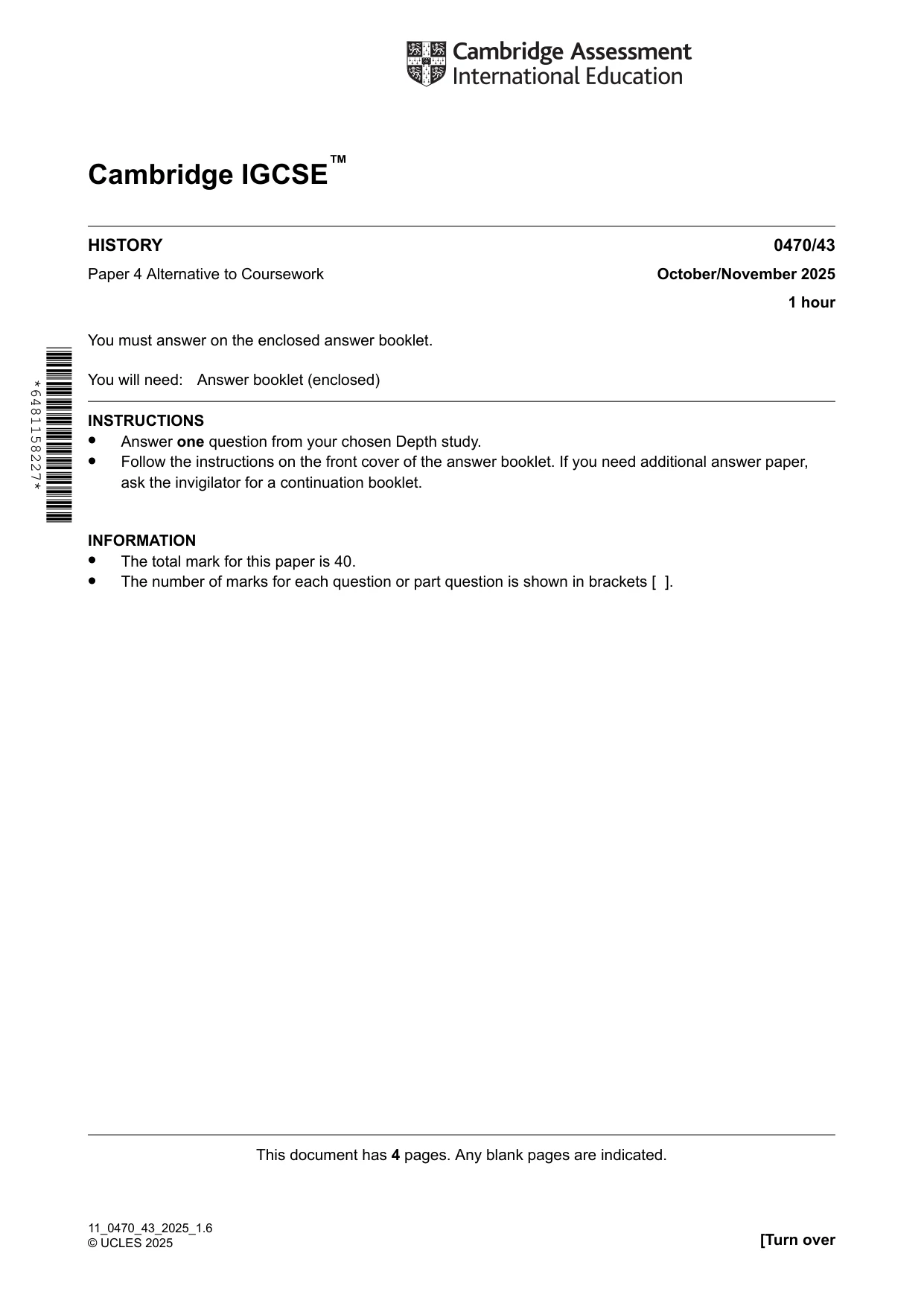
Cambridge IGCSE™ 0470/43 October/November 2025 1 hour HISTORY Paper 4 Alternative to Coursework You must answer on the enclosed answer booklet. You will need: Answer booklet (enclosed) INSTRUCTIONS • Answer one question from your chosen Depth study. • Follow the instructions on the front cover of the answer booklet. If you need additional answer paper, ask the invigilator for a continuation booklet. INFORMATION • The total mark for this paper is 40. • The number of marks for each question or part question is shown in brackets [ ]. This document has 4 pages. Any blank pages are indicated. [Turn over 11_0470_43_2025_1.6 © UCLES 2025 *6481158227*
Question paper, page 2
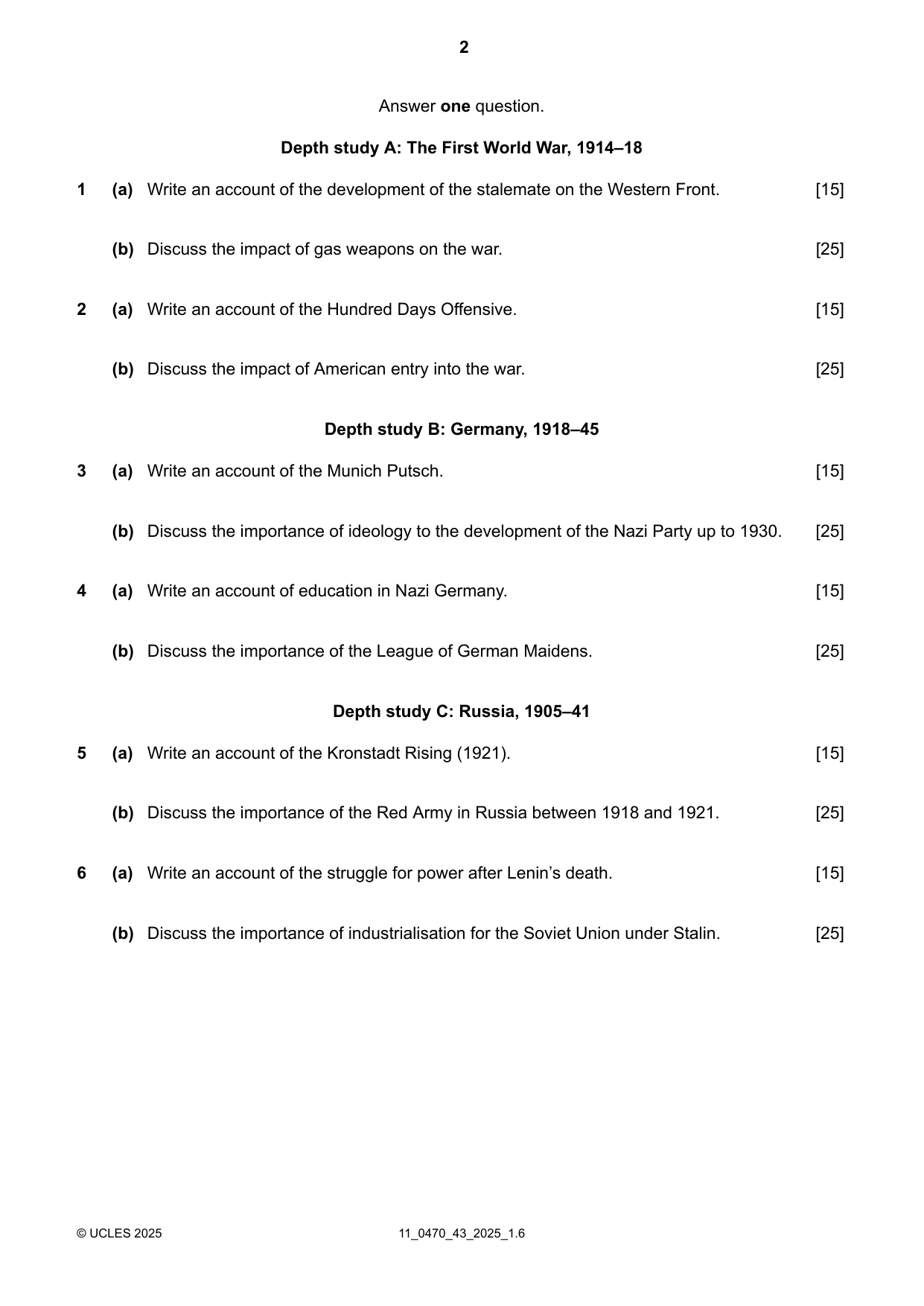
Answer one question. Depth study A: The First World War, 1914–18 Write an account of the development of the stalemate on the Western Front. [15] (a) 1 Discuss the impact of gas weapons on the war. [25] (b) Write an account of the Hundred Days Offensive. [15] (a) 2 Discuss the impact of American entry into the war. [25] (b) Depth study B: Germany, 1918–45 Write an account of the Munich Putsch. [15] (a) 3 Discuss the importance of ideology to the development of the Nazi Party up to 1930. [25] (b) Write an account of education in Nazi Germany. [15] (a) 4 Discuss the importance of the League of German Maidens. [25] (b) Depth study C: Russia, 1905–41 Write an account of the Kronstadt Rising (1921). [15] (a) 5 Discuss the importance of the Red Army in Russia between 1918 and 1921. [25] (b) Write an account of the struggle for power after Lenin’s death. [15] (a) 6 Discuss the importance of industrialisation for the Soviet Union under Stalin. [25] (b) 11_0470_43_2025_1.6 © UCLES 2025 2
Question paper, page 3
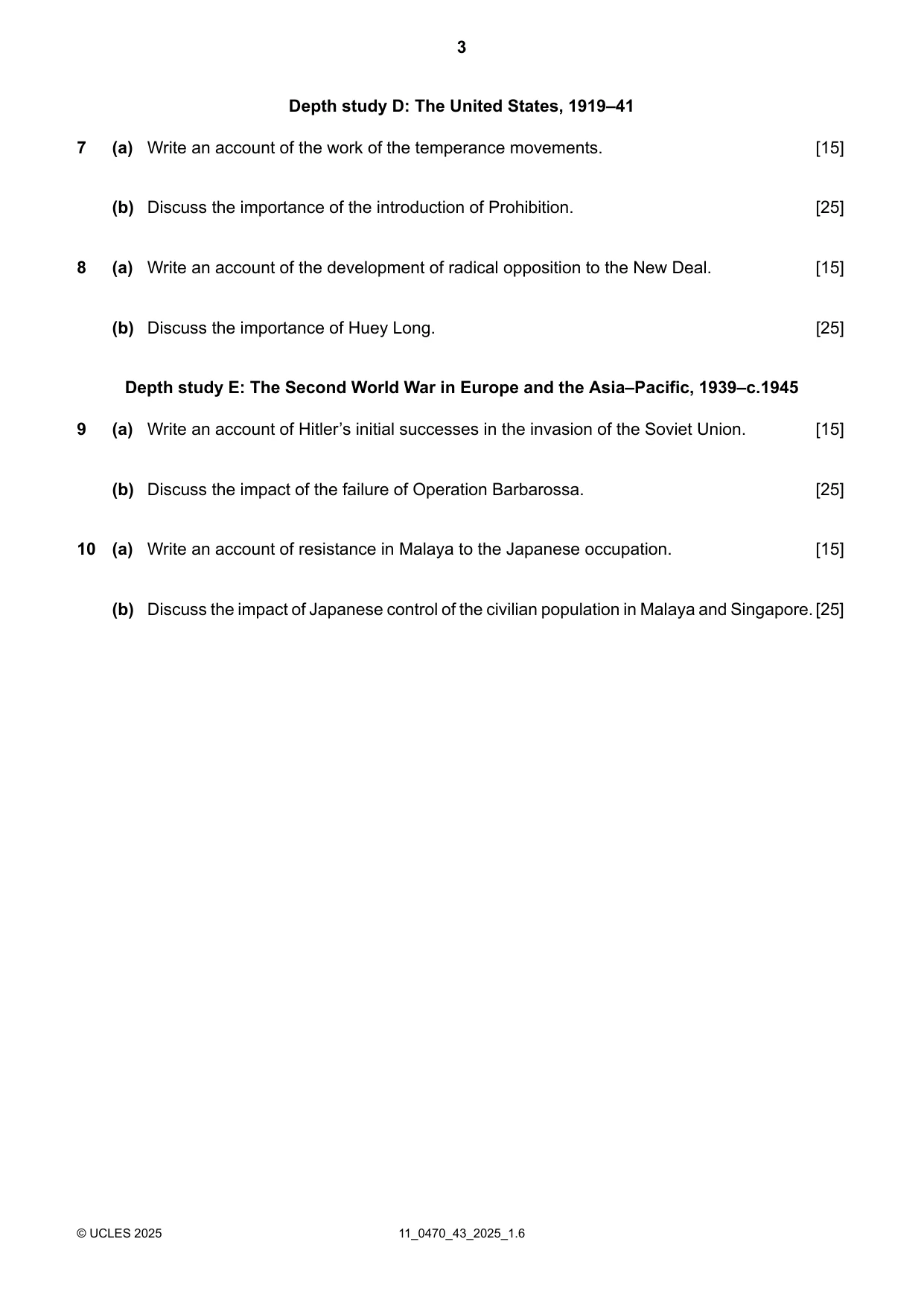
Depth study D: The United States, 1919–41 Write an account of the work of the temperance movements. [15] (a) 7 Discuss the importance of the introduction of Prohibition. [25] (b) Write an account of the development of radical opposition to the New Deal. [15] (a) 8 Discuss the importance of Huey Long. [25] (b) Depth study E: The Second World War in Europe and the Asia–Pacific, 1939–c.1945 Write an account of Hitler’s initial successes in the invasion of the Soviet Union. [15] (a) 9 Discuss the impact of the failure of Operation Barbarossa. [25] (b) Write an account of resistance in Malaya to the Japanese occupation. [15] (a) 10 Discuss the impact of Japanese control of the civilian population in Malaya and Singapore.[25] (b) 11_0470_43_2025_1.6 © UCLES 2025 3
Question paper, page 4
BLANK PAGE Permission to reproduce items where third-party owned material protected by copyright is included has been sought and cleared where possible. Every reasonable effort has been made by the publisher (UCLES) to trace copyright holders, but if any items requiring clearance have unwittingly been included, the publisher will be pleased to make amends at the earliest possible opportunity. To avoid the issue of disclosure of answer-related information to candidates, all copyright acknowledgements are reproduced online in the Cambridge Assessment International Education Copyright Acknowledgements Booklet. This is produced for each series of examinations and is freely available to download at www.cambridgeinternational.org after the live examination series. Cambridge Assessment International Education is part of Cambridge Assessment. Cambridge Assessment is the brand name of the University of Cambridge Local Examinations Syndicate (UCLES), which is a department of the University of Cambridge. 11_0470_43_2025_1.6 © UCLES 2025 4
Mark scheme, page 1
This document consists of 16 printed pages. © Cambridge University Press & Assessment 2025 [Turn over Cambridge IGCSE™ HISTORY 0470/43 Paper 4 Alternative to Coursework October/November 2025 MARK SCHEME Maximum Mark: 40 Published This mark scheme is published as an aid to teachers and candidates, to indicate the requirements of the examination. It shows the basis on which Examiners were instructed to award marks. It does not indicate the details of the discussions that took place at an Examiners’ meeting before marking began, which would have considered the acceptability of alternative answers. Mark schemes should be read in conjunction with the question paper and the Principal Examiner Report for Teachers. Cambridge International will not enter into discussions about these mark schemes. Cambridge International is publishing the mark schemes for the October/November 2025 series for most Cambridge IGCSE, Cambridge International A and AS Level components, and some Cambridge O Level components.
Mark scheme, page 2
0470/43 Cambridge IGCSE – Mark Scheme PUBLISHED October/November 2025 © Cambridge University Press & Assessment 2025 Page 2 of 16 Generic Marking Principles These general marking principles must be applied by all examiners when marking candidate answers. They should be applied alongside the specific content of the mark scheme or generic level descriptions for a question. Each question paper and mark scheme will also comply with these marking principles. GENERIC MARKING PRINCIPLE 1: Marks must be awarded in line with: • the specific content of the mark scheme or the generic level descriptors for the question • the specific skills defined in the mark scheme or in the generic level descriptors for the question • the standard of response required by a candidate as exemplified by the standardisation scripts. GENERIC MARKING PRINCIPLE 2: Marks awarded are always whole marks (not half marks, or other fractions). GENERIC MARKING PRINCIPLE 3: Marks must be awarded positively: • marks are awarded for correct/valid answers, as defined in the mark scheme. However, credit is given for valid answers which go beyond the scope of the syllabus and mark scheme, referring to your Team Leader as appropriate • marks are awarded when candidates clearly demonstrate what they know and can do • marks are not deducted for errors • marks are not deducted for omissions • answers should only be judged on the quality of spelling, punctuation and grammar when these features are specifically assessed by the question as indicated by the mark scheme. The meaning, however, should be unambiguous. GENERIC MARKING PRINCIPLE 4: Rules must be applied consistently, e.g. in situations where candidates have not followed instructions or in the application of generic level descriptors. GENERIC MARKING PRINCIPLE 5: Marks should be awarded using the full range of marks defined in the mark scheme for the question. (However, the use of the full mark range may be limited according to the quality of the candidate responses seen.) GENERIC MARKING PRINCIPLE 6: Marks awarded are based solely on the requirements as defined in the mark scheme. Marks should not be awarded with grade thresholds or grade descriptors in mind.
Mark scheme, page 3
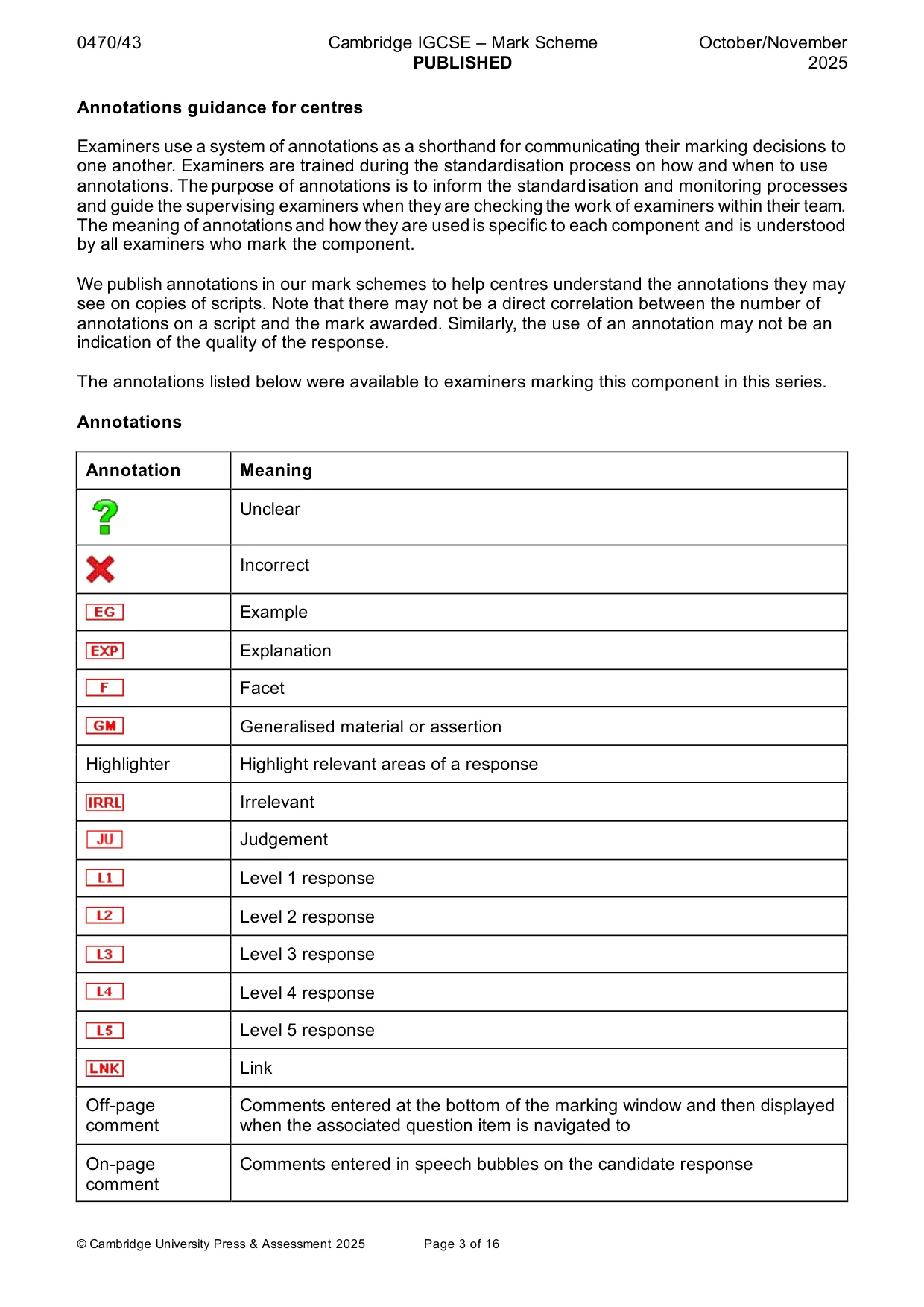
0470/43 Cambridge IGCSE – Mark Scheme PUBLISHED October/November 2025 © Cambridge University Press & Assessment 2025 Page 3 of 16 Annotations guidance for centres Examiners use a system of annotations as a shorthand for communicating their marking decisions to one another. Examiners are trained during the standardisation process on how and when to use annotations. The purpose of annotations is to inform the standardisation and monitoring processes and guide the supervising examiners when they are checking the work of examiners within their team. The meaning of annotations and how they are used is specific to each component and is understood by all examiners who mark the component. We publish annotations in our mark schemes to help centres understand the annotations they may see on copies of scripts. Note that there may not be a direct correlation between the number of annotations on a script and the mark awarded. Similarly, the use of an annotation may not be an indication of the quality of the response. The annotations listed below were available to examiners marking this component in this series. Annotations Annotation Meaning Unclear Incorrect Example Explanation Facet Generalised material or assertion Highlighter Highlight relevant areas of a response Irrelevant Judgement Level 1 response Level 2 response Level 3 response Level 4 response Level 5 response Link Off-page comment Comments entered at the bottom of the marking window and then displayed when the associated question item is navigated to On-page comment Comments entered in speech bubbles on the candidate response
Mark scheme, page 4
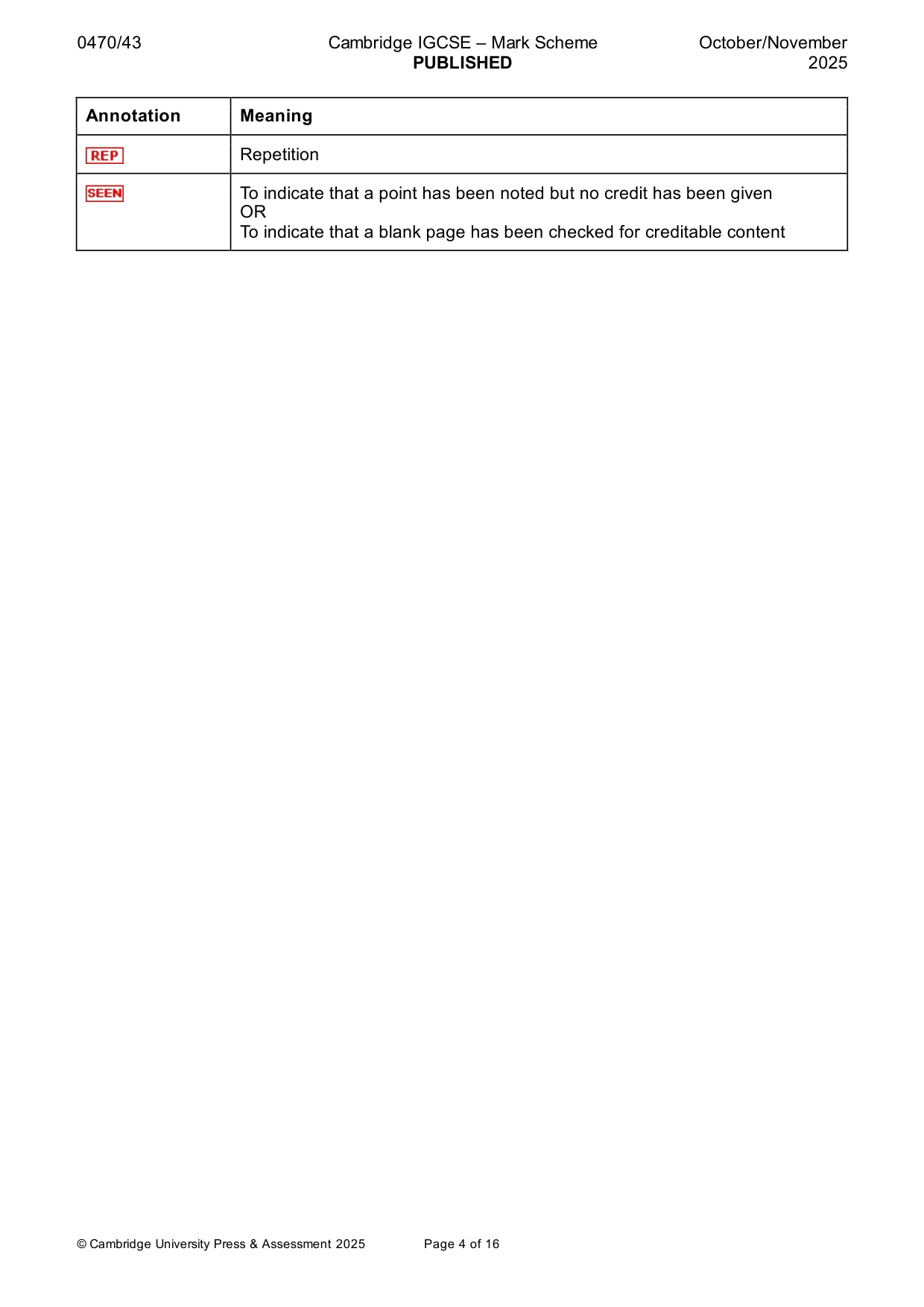
0470/43 Cambridge IGCSE – Mark Scheme PUBLISHED October/November 2025 © Cambridge University Press & Assessment 2025 Page 4 of 16 Annotation Meaning Repetition To indicate that a point has been noted but no credit has been given OR To indicate that a blank page has been checked for creditable content
Mark scheme, page 5
0470/43 Cambridge IGCSE – Mark Scheme PUBLISHED October/November 2025 © Cambridge University Press & Assessment 2025 Page 5 of 16 Guidance on using levels-based mark schemes Marking of work should be positive, rewarding achievement where possible, but clearly differentiating across the whole range of marks, where appropriate. The marker should look at the work and then make a judgement about which level statement is the ‘best fit’. In practice, work does not always match one level statement precisely so a judgement may need to be made between two or more level statements. Once a ‘best-fit’ level statement has been identified, use the following guidance to decide on a specific mark: • Where the candidate’s work convincingly meets the level statement, you should award the highest mark. • Where the candidate’s work adequately meets the level statement, you should award the most appropriate mark in the middle of the range. • Where the candidate’s work just meets the level statement, you should award the lowest mark. Assessment objectives AO1 An ability to recall, select, organise and deploy knowledge of the syllabus content. AO2 An ability to construct historical explanations using an understanding of: • cause and consequence, change and continuity, similarity and difference • the motives, emotions, intentions and beliefs of people in the past.
Mark scheme, page 6
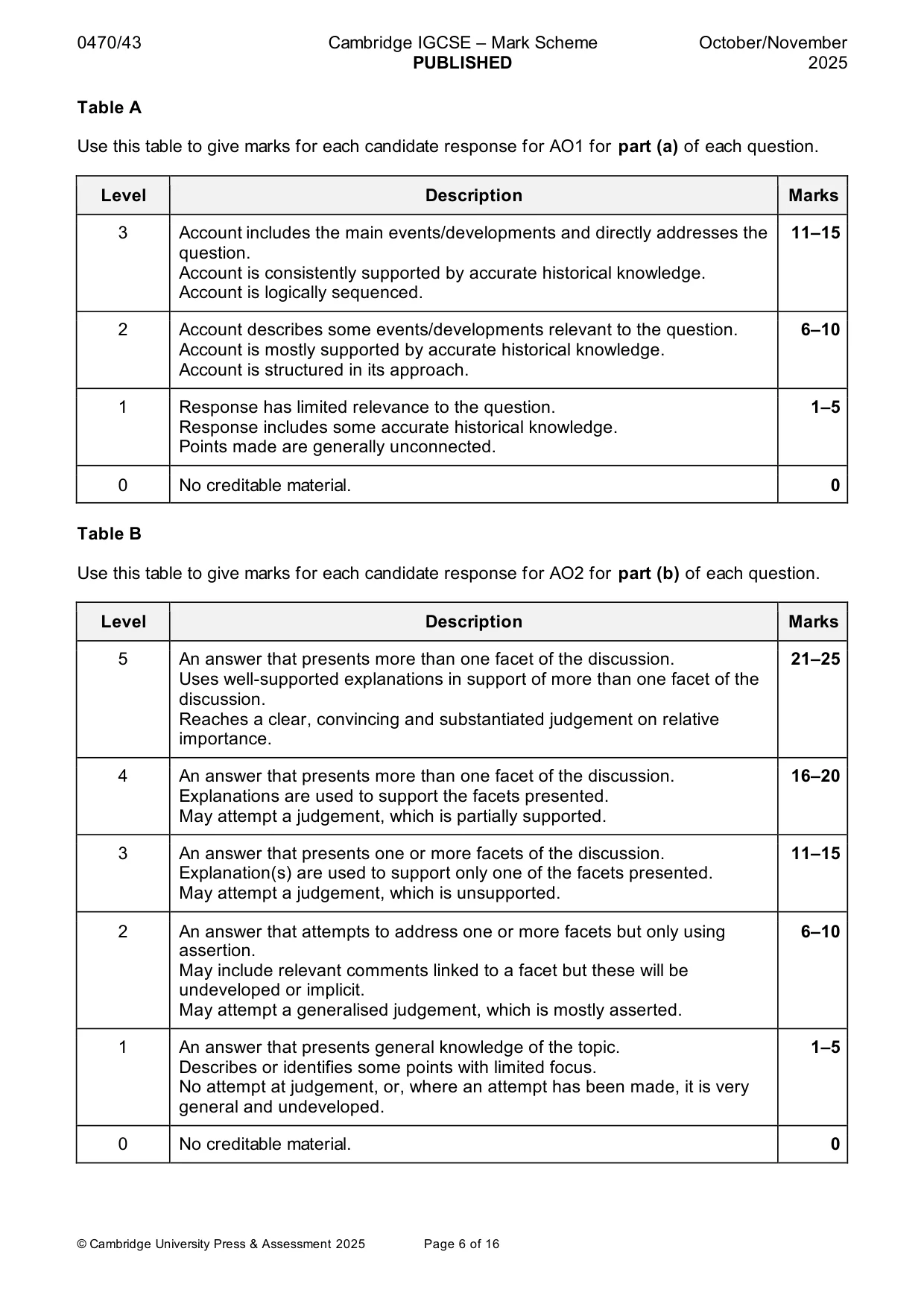
0470/43 Cambridge IGCSE – Mark Scheme PUBLISHED October/November 2025 © Cambridge University Press & Assessment 2025 Page 6 of 16 Table A Use this table to give marks for each candidate response for AO1 for part (a) of each question. Level Description Marks 3 Account includes the main events/developments and directly addresses the question. Account is consistently supported by accurate historical knowledge. Account is logically sequenced. 11–15 2 Account describes some events/developments relevant to the question. Account is mostly supported by accurate historical knowledge. Account is structured in its approach. 6–10 1 Response has limited relevance to the question. Response includes some accurate historical knowledge. Points made are generally unconnected. 1–5 0 No creditable material. 0 Table B Use this table to give marks for each candidate response for AO2 for part (b) of each question. Level Description Marks 5 An answer that presents more than one facet of the discussion. Uses well-supported explanations in support of more than one facet of the discussion. Reaches a clear, convincing and substantiated judgement on relative importance. 21–25 4 An answer that presents more than one facet of the discussion. Explanations are used to support the facets presented. May attempt a judgement, which is partially supported. 16–20 3 An answer that presents one or more facets of the discussion. Explanation(s) are used to support only one of the facets presented. May attempt a judgement, which is unsupported. 11–15 2 An answer that attempts to address one or more facets but only using assertion. May include relevant comments linked to a facet but these will be undeveloped or implicit. May attempt a generalised judgement, which is mostly asserted. 6–10 1 An answer that presents general knowledge of the topic. Describes or identifies some points with limited focus. No attempt at judgement, or, where an attempt has been made, it is very general and undeveloped. 1–5 0 No creditable material. 0
Mark scheme, page 7
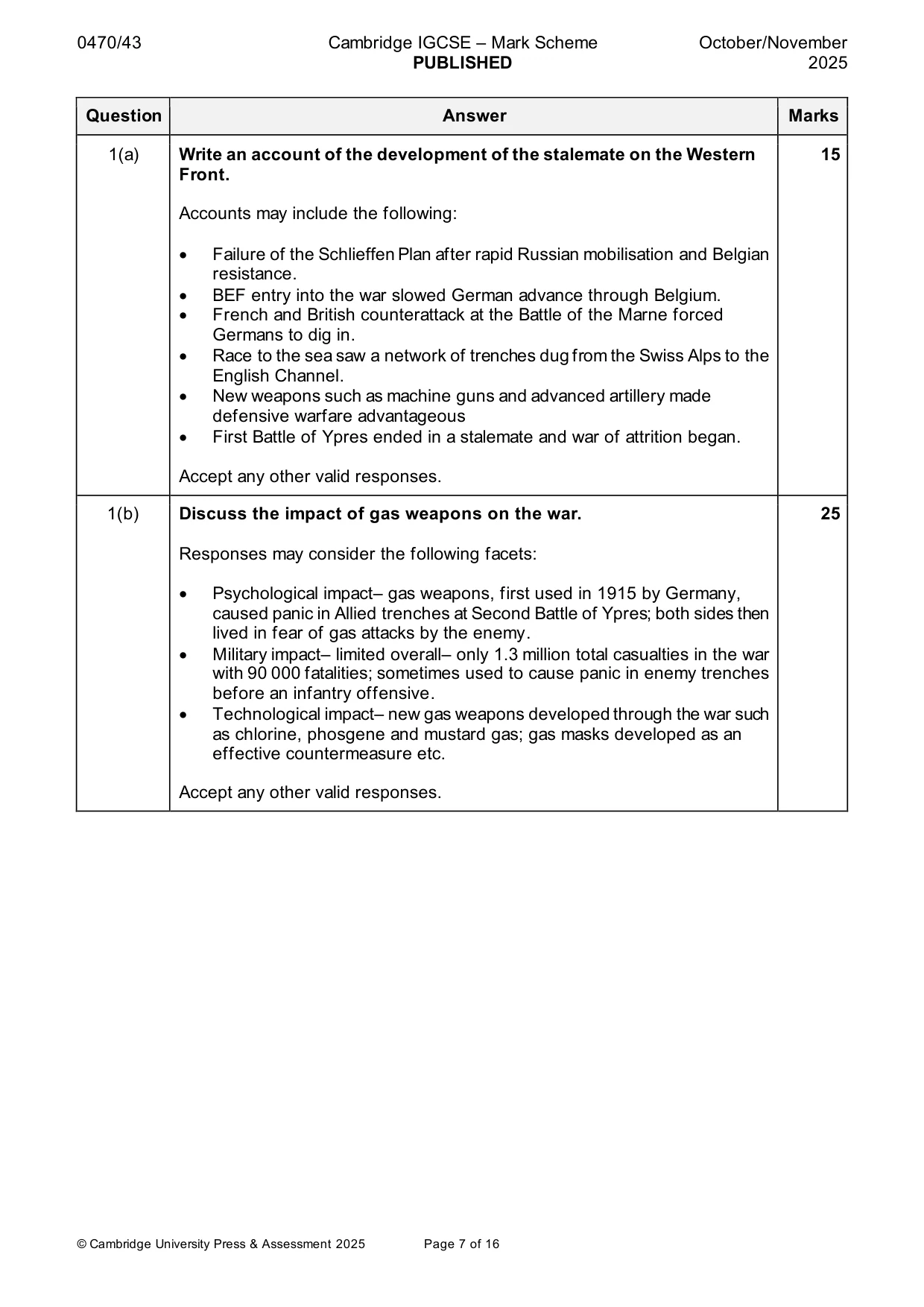
0470/43 Cambridge IGCSE – Mark Scheme PUBLISHED October/November 2025 © Cambridge University Press & Assessment 2025 Page 7 of 16 Question Answer Marks 1(a) Write an account of the development of the stalemate on the Western Front. Accounts may include the following: • Failure of the Schlieffen Plan after rapid Russian mobilisation and Belgian resistance. • BEF entry into the war slowed German advance through Belgium. • French and British counterattack at the Battle of the Marne forced Germans to dig in. • Race to the sea saw a network of trenches dug from the Swiss Alps to the English Channel. • New weapons such as machine guns and advanced artillery made defensive warfare advantageous • First Battle of Ypres ended in a stalemate and war of attrition began. Accept any other valid responses. 15 1(b) Discuss the impact of gas weapons on the war. Responses may consider the following facets: • Psychological impact– gas weapons, first used in 1915 by Germany, caused panic in Allied trenches at Second Battle of Ypres; both sides then lived in fear of gas attacks by the enemy. • Military impact– limited overall– only 1.3 million total casualties in the war with 90 000 fatalities; sometimes used to cause panic in enemy trenches before an infantry offensive. • Technological impact– new gas weapons developed through the war such as chlorine, phosgene and mustard gas; gas masks developed as an effective countermeasure etc. Accept any other valid responses. 25
Mark scheme, page 8
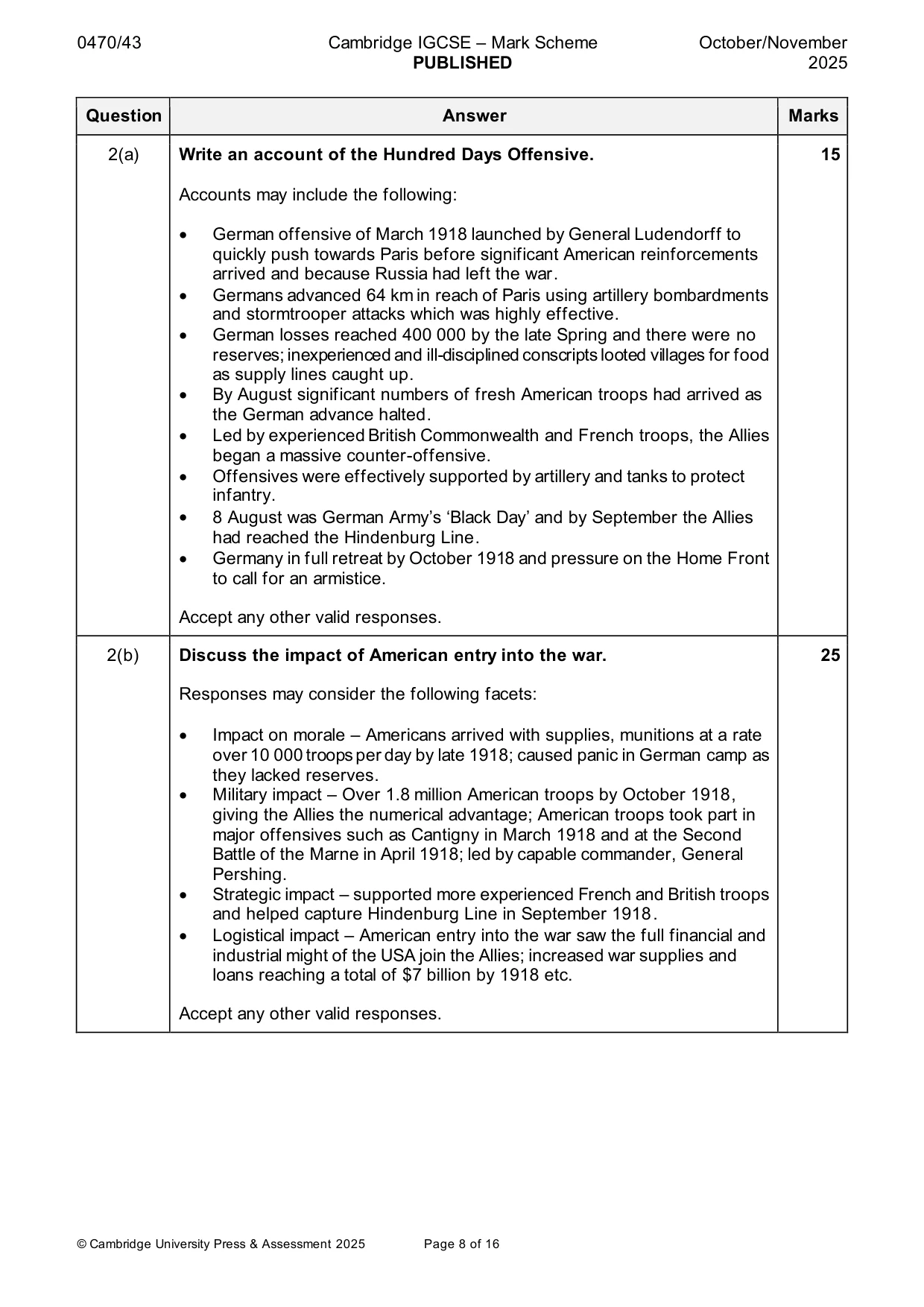
0470/43 Cambridge IGCSE – Mark Scheme PUBLISHED October/November 2025 © Cambridge University Press & Assessment 2025 Page 8 of 16 Question Answer Marks 2(a) Write an account of the Hundred Days Offensive. Accounts may include the following: • German offensive of March 1918 launched by General Ludendorff to quickly push towards Paris before significant American reinforcements arrived and because Russia had left the war. • Germans advanced 64 km in reach of Paris using artillery bombardments and stormtrooper attacks which was highly effective. • German losses reached 400 000 by the late Spring and there were no reserves; inexperienced and ill-disciplined conscripts looted villages for food as supply lines caught up. • By August significant numbers of fresh American troops had arrived as the German advance halted. • Led by experienced British Commonwealth and French troops, the Allies began a massive counter-offensive. • Offensives were effectively supported by artillery and tanks to protect infantry. • 8 August was German Army’s ‘Black Day’ and by September the Allies had reached the Hindenburg Line. • Germany in full retreat by October 1918 and pressure on the Home Front to call for an armistice. Accept any other valid responses. 15 2(b) Discuss the impact of American entry into the war. Responses may consider the following facets: • Impact on morale – Americans arrived with supplies, munitions at a rate over 10 000 troops per day by late 1918; caused panic in German camp as they lacked reserves. • Military impact – Over 1.8 million American troops by October 1918, giving the Allies the numerical advantage; American troops took part in major offensives such as Cantigny in March 1918 and at the Second Battle of the Marne in April 1918; led by capable commander, General Pershing. • Strategic impact – supported more experienced French and British troops and helped capture Hindenburg Line in September 1918. • Logistical impact – American entry into the war saw the full financial and industrial might of the USA join the Allies; increased war supplies and loans reaching a total of $7 billion by 1918 etc. Accept any other valid responses. 25
Mark scheme, page 9
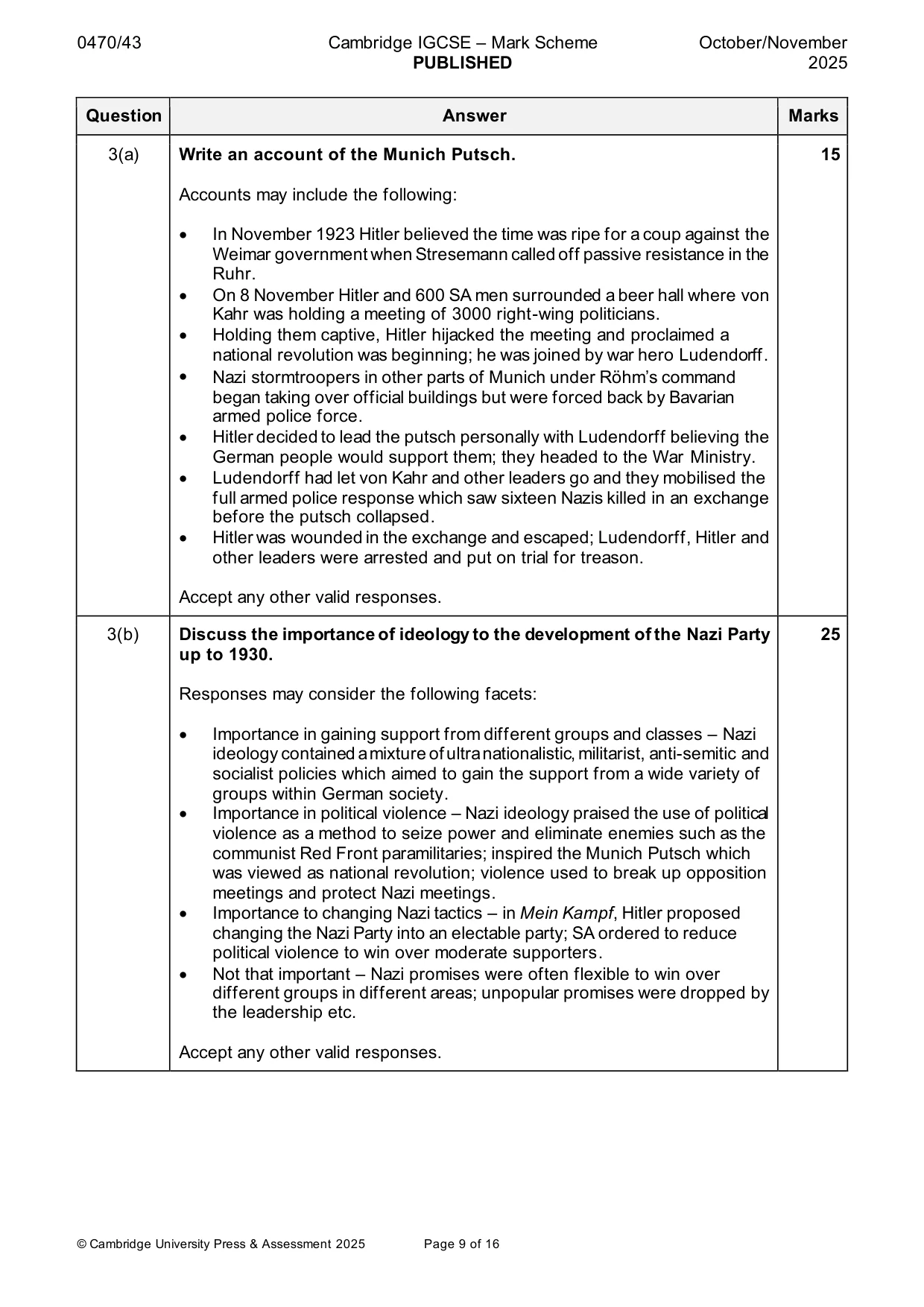
0470/43 Cambridge IGCSE – Mark Scheme PUBLISHED October/November 2025 © Cambridge University Press & Assessment 2025 Page 9 of 16 Question Answer Marks 3(a) Write an account of the Munich Putsch. Accounts may include the following: • In November 1923 Hitler believed the time was ripe for a coup against the Weimar government when Stresemann called off passive resistance in the Ruhr. • On 8 November Hitler and 600 SA men surrounded a beer hall where von Kahr was holding a meeting of 3000 right-wing politicians. • Holding them captive, Hitler hijacked the meeting and proclaimed a national revolution was beginning; he was joined by war hero Ludendorff. • Nazi stormtroopers in other parts of Munich under Röhm’s command began taking over official buildings but were forced back by Bavarian armed police force. • Hitler decided to lead the putsch personally with Ludendorff believing the German people would support them; they headed to the War Ministry. • Ludendorff had let von Kahr and other leaders go and they mobilised the full armed police response which saw sixteen Nazis killed in an exchange before the putsch collapsed. • Hitler was wounded in the exchange and escaped; Ludendorff, Hitler and other leaders were arrested and put on trial for treason. Accept any other valid responses. 15 3(b) Discuss the importance of ideology to the development of the Nazi Party up to 1930. Responses may consider the following facets: • Importance in gaining support from different groups and classes – Nazi ideology contained a mixture of ultra nationalistic, militarist, anti-semitic and socialist policies which aimed to gain the support from a wide variety of groups within German society. • Importance in political violence – Nazi ideology praised the use of political violence as a method to seize power and eliminate enemies such as the communist Red Front paramilitaries; inspired the Munich Putsch which was viewed as national revolution; violence used to break up opposition meetings and protect Nazi meetings. • Importance to changing Nazi tactics – in Mein Kampf, Hitler proposed changing the Nazi Party into an electable party; SA ordered to reduce political violence to win over moderate supporters. • Not that important – Nazi promises were often flexible to win over different groups in different areas; unpopular promises were dropped by the leadership etc. Accept any other valid responses. 25
Mark scheme, page 10
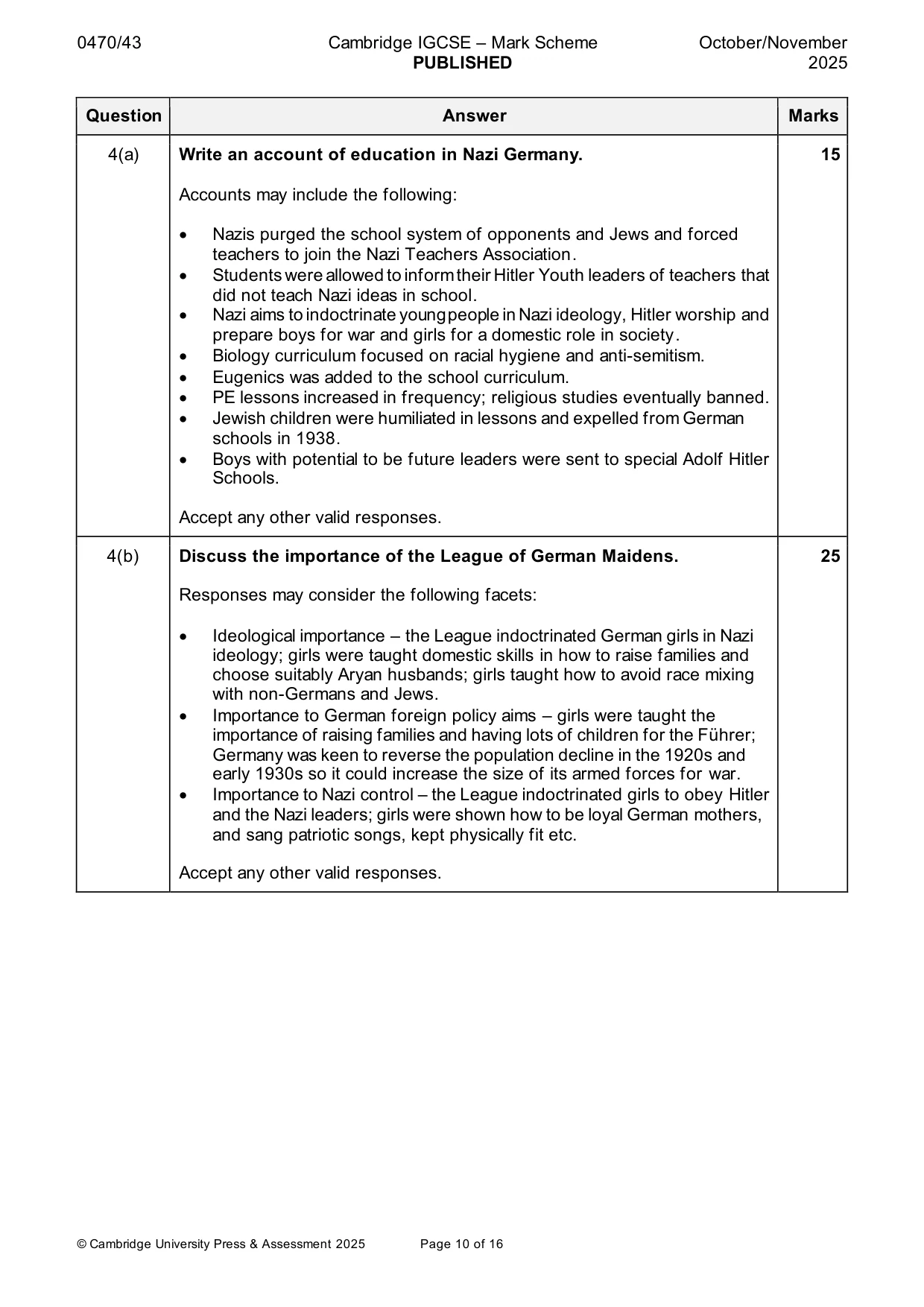
0470/43 Cambridge IGCSE – Mark Scheme PUBLISHED October/November 2025 © Cambridge University Press & Assessment 2025 Page 10 of 16 Question Answer Marks 4(a) Write an account of education in Nazi Germany. Accounts may include the following: • Nazis purged the school system of opponents and Jews and forced teachers to join the Nazi Teachers Association. • Students were allowed to inform their Hitler Youth leaders of teachers that did not teach Nazi ideas in school. • Nazi aims to indoctrinate young people in Nazi ideology, Hitler worship and prepare boys for war and girls for a domestic role in society. • Biology curriculum focused on racial hygiene and anti-semitism. • Eugenics was added to the school curriculum. • PE lessons increased in frequency; religious studies eventually banned. • Jewish children were humiliated in lessons and expelled from German schools in 1938. • Boys with potential to be future leaders were sent to special Adolf Hitler Schools. Accept any other valid responses. 15 4(b) Discuss the importance of the League of German Maidens. Responses may consider the following facets: • Ideological importance – the League indoctrinated German girls in Nazi ideology; girls were taught domestic skills in how to raise families and choose suitably Aryan husbands; girls taught how to avoid race mixing with non-Germans and Jews. • Importance to German foreign policy aims – girls were taught the importance of raising families and having lots of children for the Führer; Germany was keen to reverse the population decline in the 1920s and early 1930s so it could increase the size of its armed forces for war. • Importance to Nazi control – the League indoctrinated girls to obey Hitler and the Nazi leaders; girls were shown how to be loyal German mothers, and sang patriotic songs, kept physically fit etc. Accept any other valid responses. 25
Mark scheme, page 11
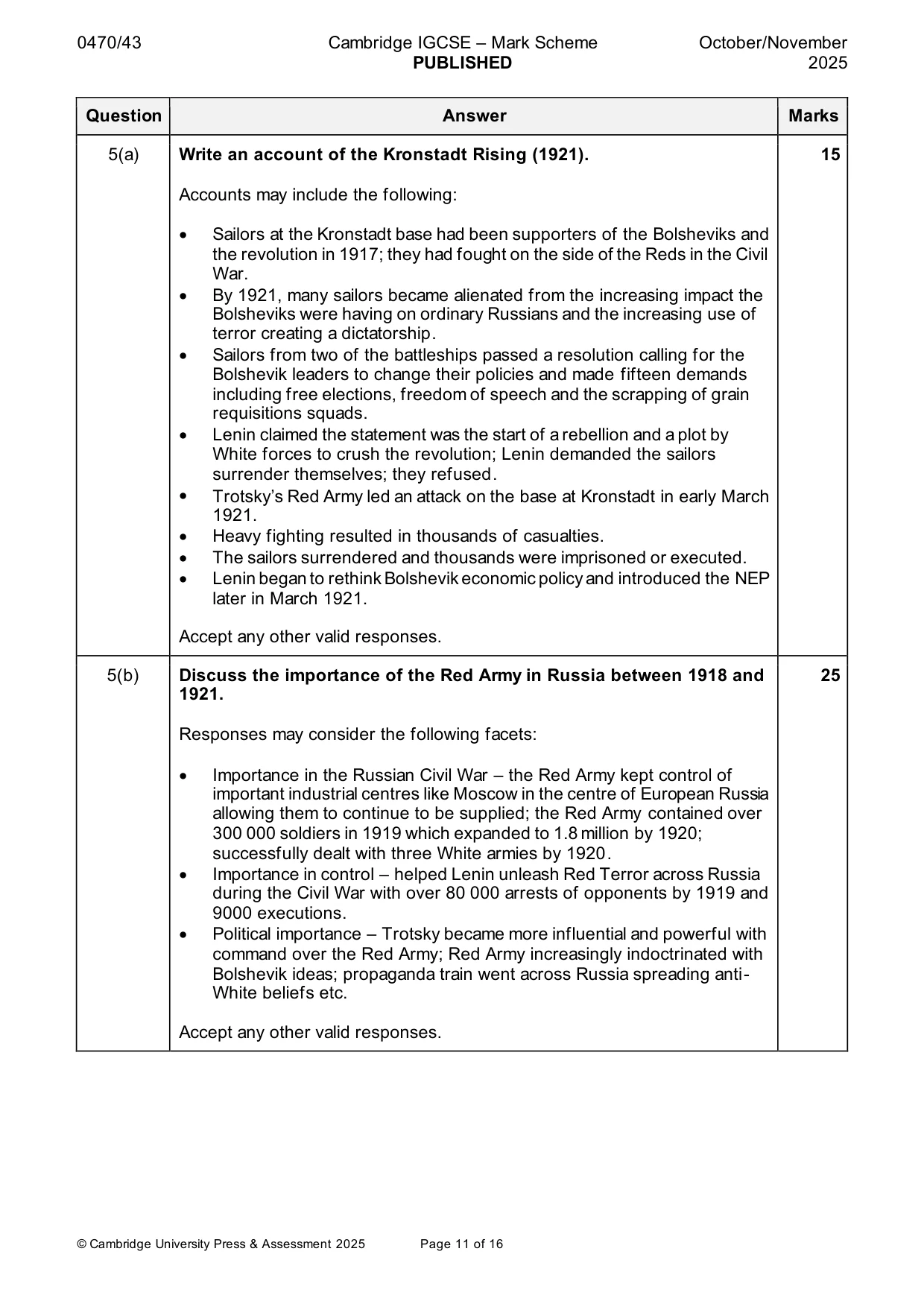
0470/43 Cambridge IGCSE – Mark Scheme PUBLISHED October/November 2025 © Cambridge University Press & Assessment 2025 Page 11 of 16 Question Answer Marks 5(a) Write an account of the Kronstadt Rising (1921). Accounts may include the following: • Sailors at the Kronstadt base had been supporters of the Bolsheviks and the revolution in 1917; they had fought on the side of the Reds in the Civil War. • By 1921, many sailors became alienated from the increasing impact the Bolsheviks were having on ordinary Russians and the increasing use of terror creating a dictatorship. • Sailors from two of the battleships passed a resolution calling for the Bolshevik leaders to change their policies and made fifteen demands including free elections, freedom of speech and the scrapping of grain requisitions squads. • Lenin claimed the statement was the start of a rebellion and a plot by White forces to crush the revolution; Lenin demanded the sailors surrender themselves; they refused. • Trotsky’s Red Army led an attack on the base at Kronstadt in early March 1921. • Heavy fighting resulted in thousands of casualties. • The sailors surrendered and thousands were imprisoned or executed. • Lenin began to rethink Bolshevik economic policy and introduced the NEP later in March 1921. Accept any other valid responses. 15 5(b) Discuss the importance of the Red Army in Russia between 1918 and 1921. Responses may consider the following facets: • Importance in the Russian Civil War – the Red Army kept control of important industrial centres like Moscow in the centre of European Russia allowing them to continue to be supplied; the Red Army contained over 300 000 soldiers in 1919 which expanded to 1.8 million by 1920; successfully dealt with three White armies by 1920. • Importance in control – helped Lenin unleash Red Terror across Russia during the Civil War with over 80 000 arrests of opponents by 1919 and 9000 executions. • Political importance – Trotsky became more influential and powerful with command over the Red Army; Red Army increasingly indoctrinated with Bolshevik ideas; propaganda train went across Russia spreading anti- White beliefs etc. Accept any other valid responses. 25
Mark scheme, page 12
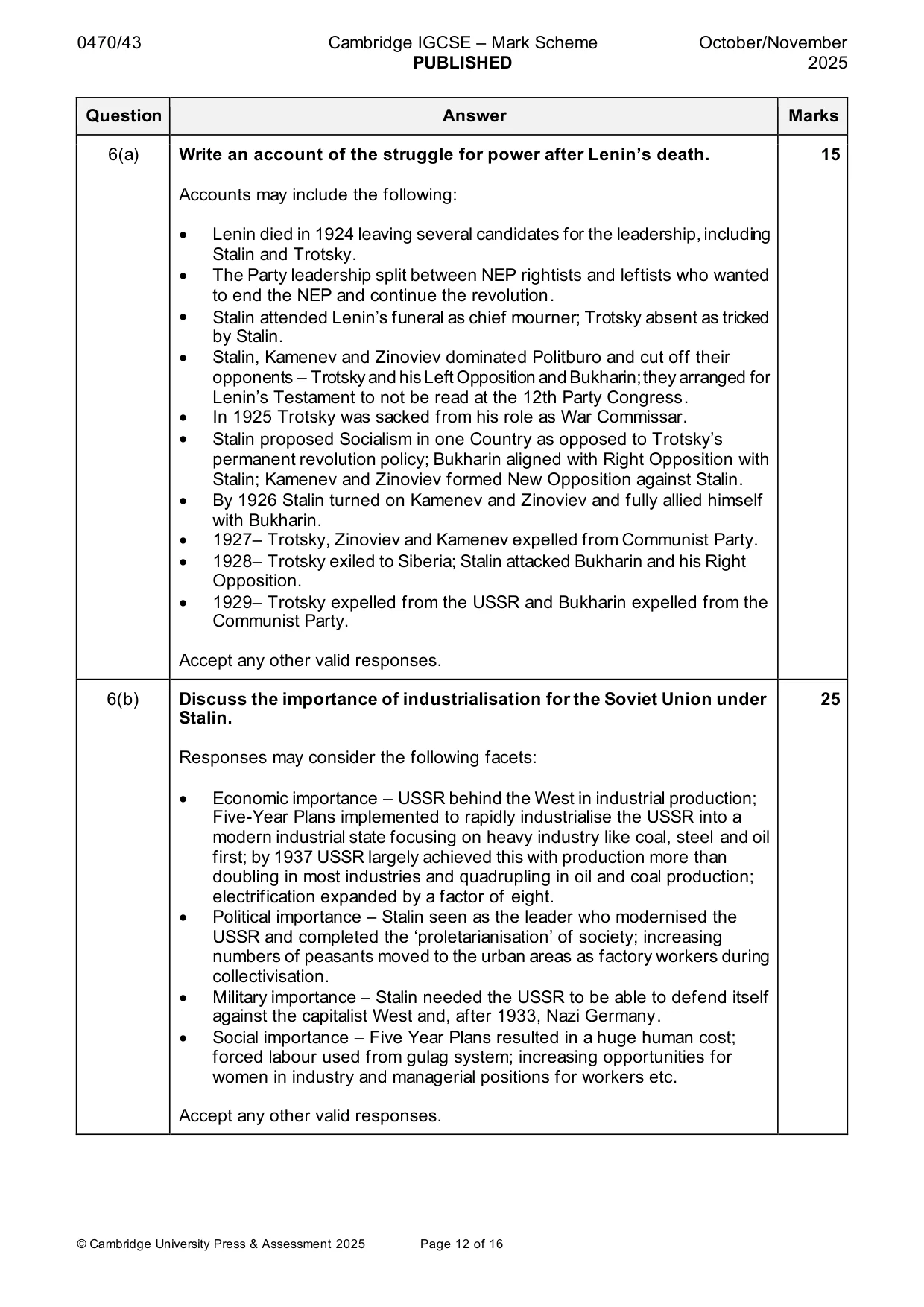
0470/43 Cambridge IGCSE – Mark Scheme PUBLISHED October/November 2025 © Cambridge University Press & Assessment 2025 Page 12 of 16 Question Answer Marks 6(a) Write an account of the struggle for power after Lenin’s death. Accounts may include the following: • Lenin died in 1924 leaving several candidates for the leadership, including Stalin and Trotsky. • The Party leadership split between NEP rightists and leftists who wanted to end the NEP and continue the revolution. • Stalin attended Lenin’s funeral as chief mourner; Trotsky absent as tricked by Stalin. • Stalin, Kamenev and Zinoviev dominated Politburo and cut off their opponents – Trotsky and his Left Opposition and Bukharin; they arranged for Lenin’s Testament to not be read at the 12th Party Congress. • In 1925 Trotsky was sacked from his role as War Commissar. • Stalin proposed Socialism in one Country as opposed to Trotsky’s permanent revolution policy; Bukharin aligned with Right Opposition with Stalin; Kamenev and Zinoviev formed New Opposition against Stalin. • By 1926 Stalin turned on Kamenev and Zinoviev and fully allied himself with Bukharin. • 1927– Trotsky, Zinoviev and Kamenev expelled from Communist Party. • 1928– Trotsky exiled to Siberia; Stalin attacked Bukharin and his Right Opposition. • 1929– Trotsky expelled from the USSR and Bukharin expelled from the Communist Party. Accept any other valid responses. 15 6(b) Discuss the importance of industrialisation for the Soviet Union under Stalin. Responses may consider the following facets: • Economic importance – USSR behind the West in industrial production; Five-Year Plans implemented to rapidly industrialise the USSR into a modern industrial state focusing on heavy industry like coal, steel and oil first; by 1937 USSR largely achieved this with production more than doubling in most industries and quadrupling in oil and coal production; electrification expanded by a factor of eight. • Political importance – Stalin seen as the leader who modernised the USSR and completed the ‘proletarianisation’ of society; increasing numbers of peasants moved to the urban areas as factory workers during collectivisation. • Military importance – Stalin needed the USSR to be able to defend itself against the capitalist West and, after 1933, Nazi Germany. • Social importance – Five Year Plans resulted in a huge human cost; forced labour used from gulag system; increasing opportunities for women in industry and managerial positions for workers etc. Accept any other valid responses. 25
Mark scheme, page 13
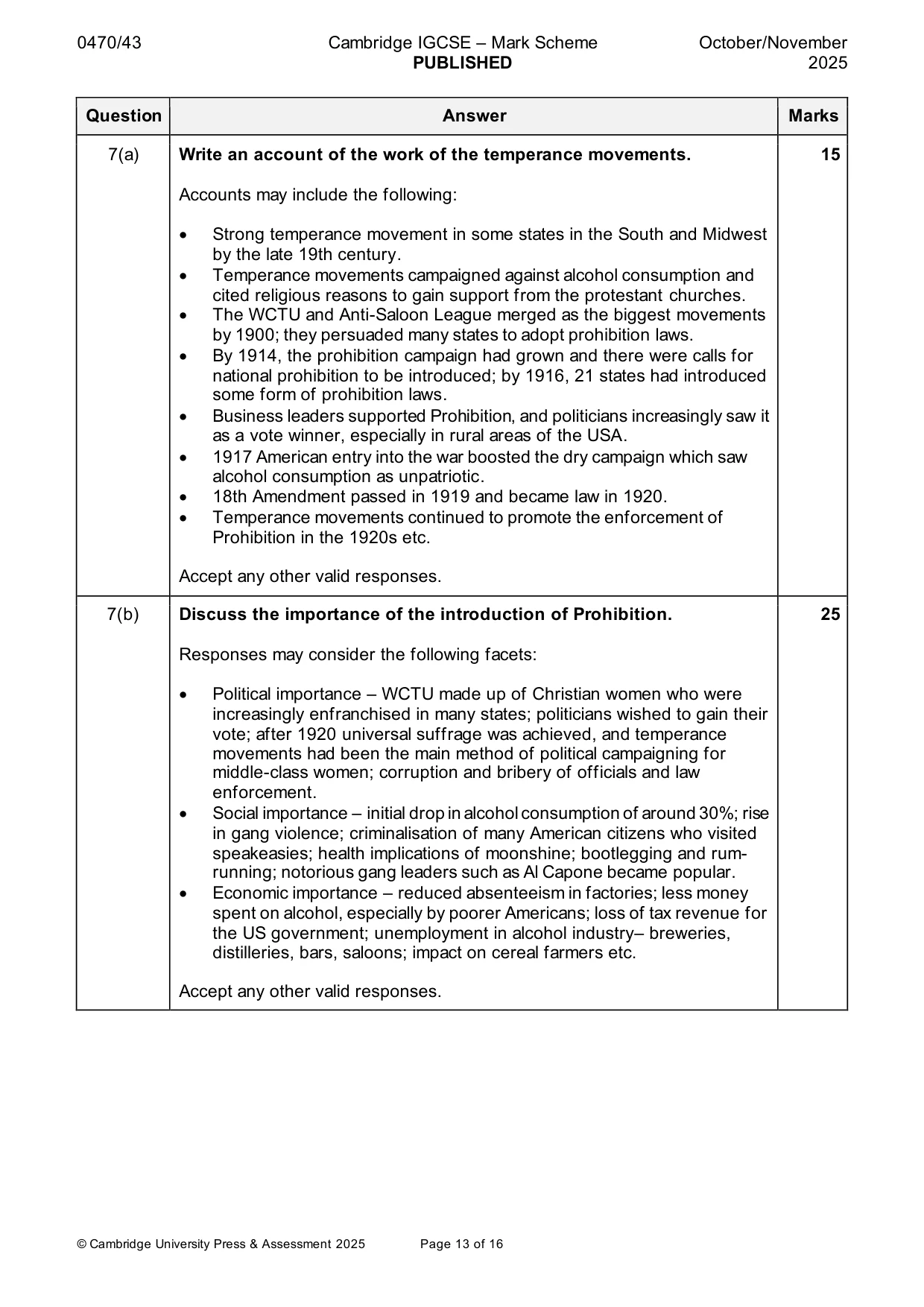
0470/43 Cambridge IGCSE – Mark Scheme PUBLISHED October/November 2025 © Cambridge University Press & Assessment 2025 Page 13 of 16 Question Answer Marks 7(a) Write an account of the work of the temperance movements. Accounts may include the following: • Strong temperance movement in some states in the South and Midwest by the late 19th century. • Temperance movements campaigned against alcohol consumption and cited religious reasons to gain support from the protestant churches. • The WCTU and Anti-Saloon League merged as the biggest movements by 1900; they persuaded many states to adopt prohibition laws. • By 1914, the prohibition campaign had grown and there were calls for national prohibition to be introduced; by 1916, 21 states had introduced some form of prohibition laws. • Business leaders supported Prohibition, and politicians increasingly saw it as a vote winner, especially in rural areas of the USA. • 1917 American entry into the war boosted the dry campaign which saw alcohol consumption as unpatriotic. • 18th Amendment passed in 1919 and became law in 1920. • Temperance movements continued to promote the enforcement of Prohibition in the 1920s etc. Accept any other valid responses. 15 7(b) Discuss the importance of the introduction of Prohibition. Responses may consider the following facets: • Political importance – WCTU made up of Christian women who were increasingly enfranchised in many states; politicians wished to gain their vote; after 1920 universal suffrage was achieved, and temperance movements had been the main method of political campaigning for middle-class women; corruption and bribery of officials and law enforcement. • Social importance – initial drop in alcohol consumption of around 30%; rise in gang violence; criminalisation of many American citizens who visited speakeasies; health implications of moonshine; bootlegging and rum- running; notorious gang leaders such as Al Capone became popular. • Economic importance – reduced absenteeism in factories; less money spent on alcohol, especially by poorer Americans; loss of tax revenue for the US government; unemployment in alcohol industry– breweries, distilleries, bars, saloons; impact on cereal farmers etc. Accept any other valid responses. 25
Mark scheme, page 14
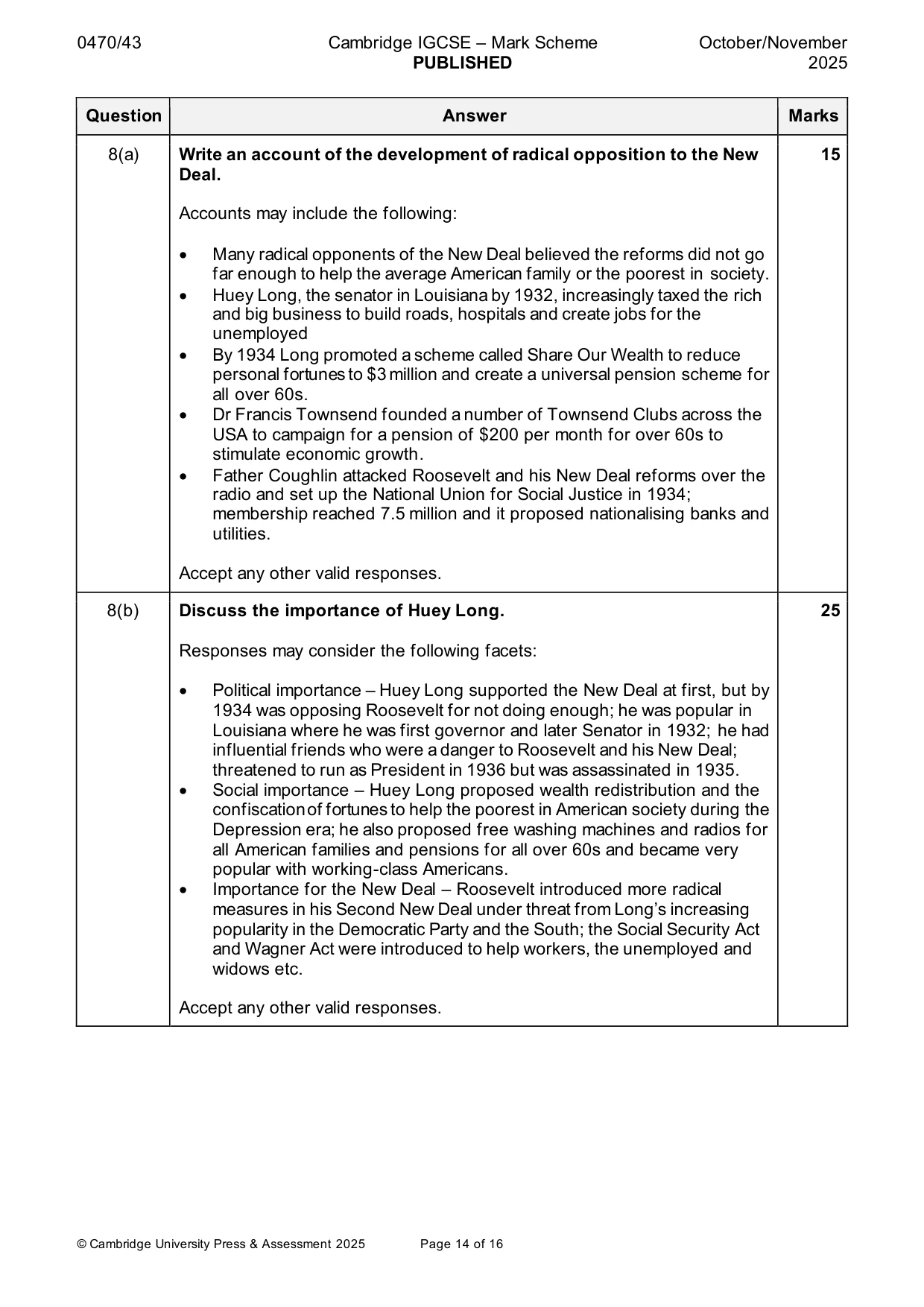
0470/43 Cambridge IGCSE – Mark Scheme PUBLISHED October/November 2025 © Cambridge University Press & Assessment 2025 Page 14 of 16 Question Answer Marks 8(a) Write an account of the development of radical opposition to the New Deal. Accounts may include the following: • Many radical opponents of the New Deal believed the reforms did not go far enough to help the average American family or the poorest in society. • Huey Long, the senator in Louisiana by 1932, increasingly taxed the rich and big business to build roads, hospitals and create jobs for the unemployed • By 1934 Long promoted a scheme called Share Our Wealth to reduce personal fortunes to $3 million and create a universal pension scheme for all over 60s. • Dr Francis Townsend founded a number of Townsend Clubs across the USA to campaign for a pension of $200 per month for over 60s to stimulate economic growth. • Father Coughlin attacked Roosevelt and his New Deal reforms over the radio and set up the National Union for Social Justice in 1934; membership reached 7.5 million and it proposed nationalising banks and utilities. Accept any other valid responses. 15 8(b) Discuss the importance of Huey Long. Responses may consider the following facets: • Political importance – Huey Long supported the New Deal at first, but by 1934 was opposing Roosevelt for not doing enough; he was popular in Louisiana where he was first governor and later Senator in 1932; he had influential friends who were a danger to Roosevelt and his New Deal; threatened to run as President in 1936 but was assassinated in 1935. • Social importance – Huey Long proposed wealth redistribution and the confiscation of fortunes to help the poorest in American society during the Depression era; he also proposed free washing machines and radios for all American families and pensions for all over 60s and became very popular with working-class Americans. • Importance for the New Deal – Roosevelt introduced more radical measures in his Second New Deal under threat from Long’s increasing popularity in the Democratic Party and the South; the Social Security Act and Wagner Act were introduced to help workers, the unemployed and widows etc. Accept any other valid responses. 25
Mark scheme, page 15
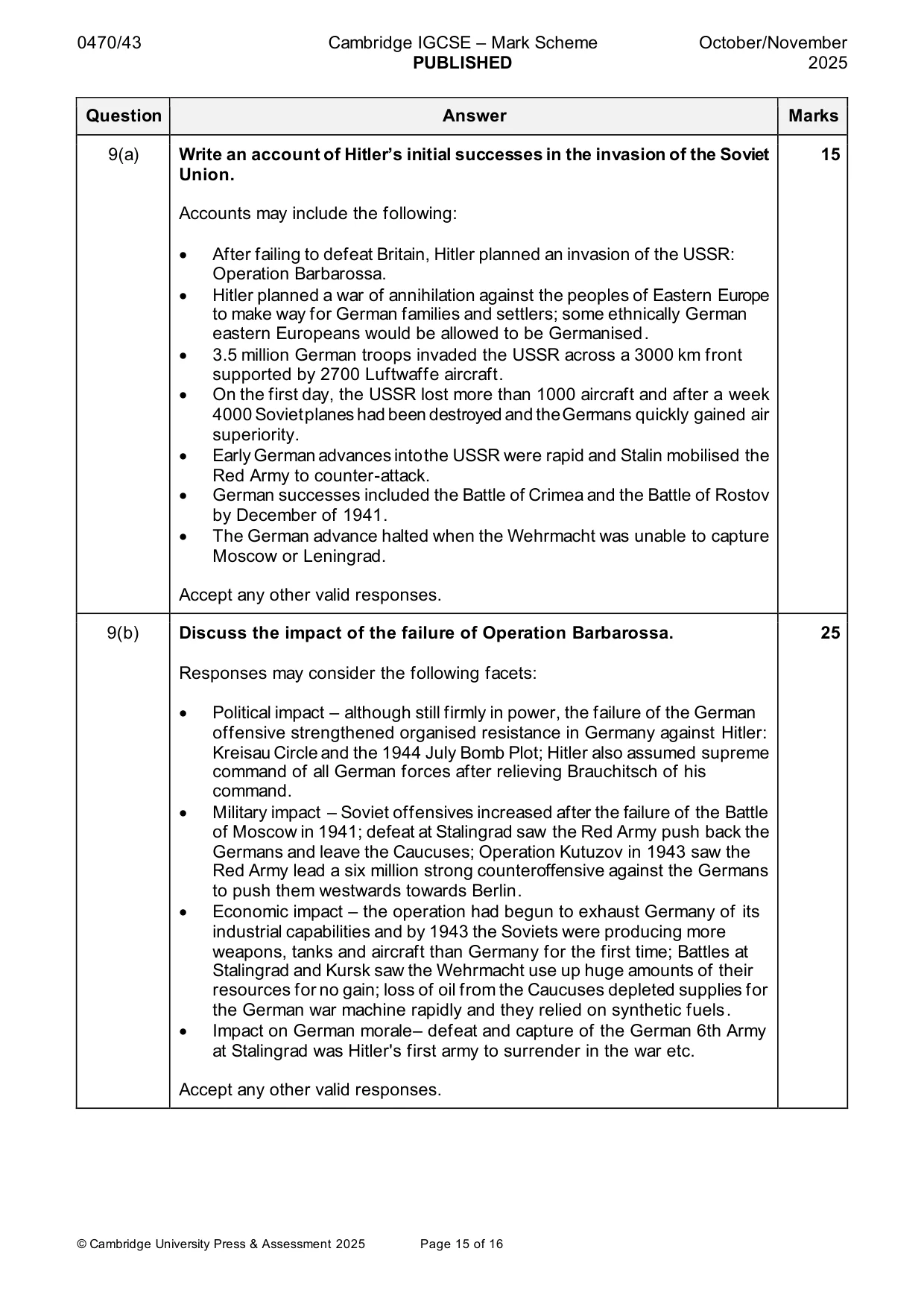
0470/43 Cambridge IGCSE – Mark Scheme PUBLISHED October/November 2025 © Cambridge University Press & Assessment 2025 Page 15 of 16 Question Answer Marks 9(a) Write an account of Hitler’s initial successes in the invasion of the Soviet Union. Accounts may include the following: • After failing to defeat Britain, Hitler planned an invasion of the USSR: Operation Barbarossa. • Hitler planned a war of annihilation against the peoples of Eastern Europe to make way for German families and settlers; some ethnically German eastern Europeans would be allowed to be Germanised. • 3.5 million German troops invaded the USSR across a 3000 km front supported by 2700 Luftwaffe aircraft. • On the first day, the USSR lost more than 1000 aircraft and after a week 4000 Soviet planes had been destroyed and the Germans quickly gained air superiority. • Early German advances into the USSR were rapid and Stalin mobilised the Red Army to counter-attack. • German successes included the Battle of Crimea and the Battle of Rostov by December of 1941. • The German advance halted when the Wehrmacht was unable to capture Moscow or Leningrad. Accept any other valid responses. 15 9(b) Discuss the impact of the failure of Operation Barbarossa. Responses may consider the following facets: • Political impact – although still firmly in power, the failure of the German offensive strengthened organised resistance in Germany against Hitler: Kreisau Circle and the 1944 July Bomb Plot; Hitler also assumed supreme command of all German forces after relieving Brauchitsch of his command. • Military impact – Soviet offensives increased after the failure of the Battle of Moscow in 1941; defeat at Stalingrad saw the Red Army push back the Germans and leave the Caucuses; Operation Kutuzov in 1943 saw the Red Army lead a six million strong counteroffensive against the Germans to push them westwards towards Berlin. • Economic impact – the operation had begun to exhaust Germany of its industrial capabilities and by 1943 the Soviets were producing more weapons, tanks and aircraft than Germany for the first time; Battles at Stalingrad and Kursk saw the Wehrmacht use up huge amounts of their resources for no gain; loss of oil from the Caucuses depleted supplies for the German war machine rapidly and they relied on synthetic fuels. • Impact on German morale– defeat and capture of the German 6th Army at Stalingrad was Hitler's first army to surrender in the war etc. Accept any other valid responses. 25
Mark scheme, page 16
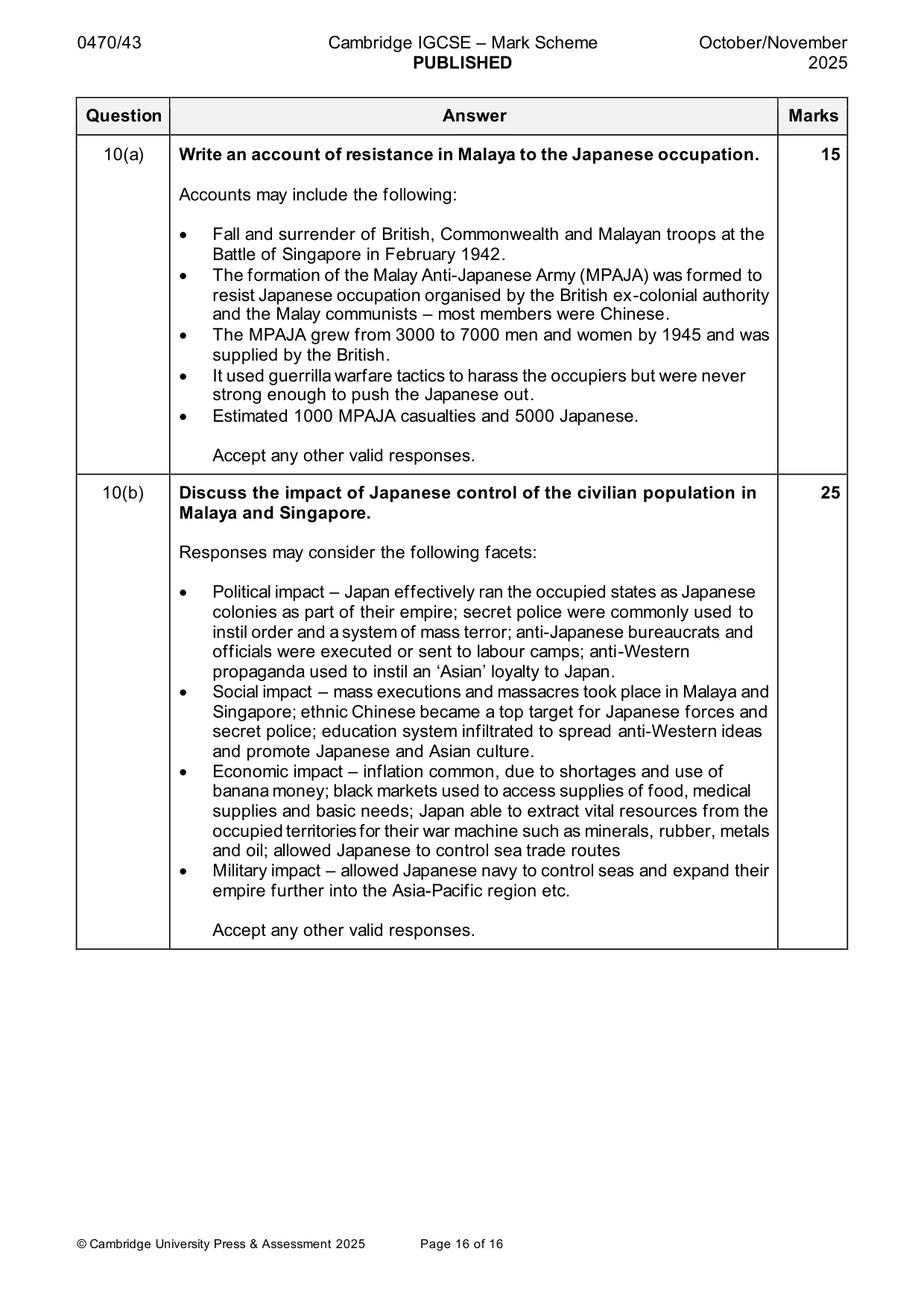
0470/43 Cambridge IGCSE – Mark Scheme PUBLISHED October/November 2025 © Cambridge University Press & Assessment 2025 Page 16 of 16 Question Answer Marks 10(a) Write an account of resistance in Malaya to the Japanese occupation. Accounts may include the following: • Fall and surrender of British, Commonwealth and Malayan troops at the Battle of Singapore in February 1942. • The formation of the Malay Anti-Japanese Army (MPAJA) was formed to resist Japanese occupation organised by the British ex-colonial authority and the Malay communists – most members were Chinese. • The MPAJA grew from 3000 to 7000 men and women by 1945 and was supplied by the British. • It used guerrilla warfare tactics to harass the occupiers but were never strong enough to push the Japanese out. • Estimated 1000 MPAJA casualties and 5000 Japanese. Accept any other valid responses. 15 10(b) Discuss the impact of Japanese control of the civilian population in Malaya and Singapore. Responses may consider the following facets: • Political impact – Japan effectively ran the occupied states as Japanese colonies as part of their empire; secret police were commonly used to instil order and a system of mass terror; anti-Japanese bureaucrats and officials were executed or sent to labour camps; anti-Western propaganda used to instil an ‘Asian’ loyalty to Japan. • Social impact – mass executions and massacres took place in Malaya and Singapore; ethnic Chinese became a top target for Japanese forces and secret police; education system infiltrated to spread anti-Western ideas and promote Japanese and Asian culture. • Economic impact – inflation common, due to shortages and use of banana money; black markets used to access supplies of food, medical supplies and basic needs; Japan able to extract vital resources from the occupied territories for their war machine such as minerals, rubber, metals and oil; allowed Japanese to control sea trade routes • Military impact – allowed Japanese navy to control seas and expand their empire further into the Asia-Pacific region etc. Accept any other valid responses. 25
What you needed in this session
Cambridge’s own grade thresholds for 2025 Oct/Nov, Paper 4 · Variant 3. A higher threshold means an easier paper — the bar moves with how the cohort did.