Cambridge IGCSE History 0470 — 2022 May/June Paper 4 · Variant 3
0470/43/M/J/22 · 40 marks · ≈45 min
The question paper and its mark scheme, free to read here and free to download. This is Cambridge’s own paper, exactly as it was sat.
Question paper4 pages

Mark scheme16 pages
Answers below. Sit the paper first if you are practising.
Paper as text
Question paper, page 1
Cambridge IGCSE™ 0470/43 May/June 2022 1 hour HISTORY Paper 4 Alternative to Coursework You must answer on the enclosed answer booklet. You will need: Answer booklet (enclosed) INSTRUCTIONS • Answer one question from your chosen Depth Study. • Follow the instructions on the front cover of the answer booklet. If you need additional answer paper, ask the invigilator for a continuation booklet. INFORMATION • The total mark for this paper is 40. • The number of marks for each question or part question is shown in brackets [ ]. This document has 4 pages. Any blank pages are indicated. [Turn over 06_0470_43_2022_1.7 © UCLES 2022 *2330040299*
Question paper, page 2
Answer one question from your chosen Depth Study. DEPTH STUDY A: THE FIRST WORLD WAR, 1914–18 How important was the Battle of the Marne to the nature of the fighting on the Western Front by the end of 1914? Explain your answer. [40] 1 How significant were the military campaigns on the Eastern Front to the outcome of the war? Explain your answer. [40] 2 DEPTH STUDY B: GERMANY, 1918–45 How important was the Munich Putsch to Nazi Party support and membership by 1930? Explain your answer. [40] 3 How significant was racial policy in bringing about the kind of society the Nazis wanted after 1933? Explain your answer. [40] 4 DEPTH STUDY C: RUSSIA, 1905–41 How important was the secret police (Okhrana) in the maintenance of Tsarist rule up to 1914? Explain your answer. [40] 5 How significant was Stalin’s control of religion and culture in creating a totalitarian state in the Soviet Union after 1928? Explain your answer. [40] 6 DEPTH STUDY D: THE UNITED STATES, 1919–41 How important was the entertainment industry as an aspect of the ‘Roaring Twenties’? Explain your answer. [40] 7 How significant a part of the New Deal were the Alphabet Agencies? Explain your answer. [40] 8 DEPTH STUDY E: CHINA, c.1930–c.1990 How important were improved relations with the USA in China’s foreign policy after 1970? Explain your answer. [40] 9 How significant were changes in education to the development of China after 1949? Explain your answer. [40] 10 06_0470_43_2022_1.7 © UCLES 2022 2
Question paper, page 3
DEPTH STUDY F: SOUTH AFRICA, c.1940–c.1994 How important was gold mining in shaping the economic development of South Africa by 1948? Explain your answer. [40] 11 How significant was international opposition in challenging apartheid? Explain your answer. [40] 12 DEPTH STUDY G: ISRAELIS AND PALESTINIANS SINCE 1945 How important was pressure from the USA as a reason for the British withdrawal from Palestine in 1948? Explain your answer. [40] 13 How significant was Jordan in Arab-Israeli relations after 1948? Explain your answer. [40] 14 06_0470_43_2022_1.7 © UCLES 2022 3
Question paper, page 4
BLANK PAGE Permission to reproduce items where third-party owned material protected by copyright is included has been sought and cleared where possible. Every reasonable effort has been made by the publisher (UCLES) to trace copyright holders, but if any items requiring clearance have unwittingly been included, the publisher will be pleased to make amends at the earliest possible opportunity. To avoid the issue of disclosure of answer-related information to candidates, all copyright acknowledgements are reproduced online in the Cambridge Assessment International Education Copyright Acknowledgements Booklet. This is produced for each series of examinations and is freely available to download at www.cambridgeinternational.org after the live examination series. Cambridge Assessment International Education is part of Cambridge Assessment. Cambridge Assessment is the brand name of the University of Cambridge Local Examinations Syndicate (UCLES), which is a department of the University of Cambridge. 06_0470_43_2022_1.7 © UCLES 2022 4
Mark scheme, page 1
This document consists of 16 printed pages. © UCLES 2022 [Turn over Cambridge IGCSE™ HISTORY 0470/43 Paper 4 Alternative to Coursework May/June 2022 MARK SCHEME Maximum Mark: 40 Published This mark scheme is published as an aid to teachers and candidates, to indicate the requirements of the examination. It shows the basis on which Examiners were instructed to award marks. It does not indicate the details of the discussions that took place at an Examiners’ meeting before marking began, which would have considered the acceptability of alternative answers. Mark schemes should be read in conjunction with the question paper and the Principal Examiner Report for Teachers. Cambridge International will not enter into discussions about these mark schemes. Cambridge International is publishing the mark schemes for the May/June 2022 series for most Cambridge IGCSE, Cambridge International A and AS Level and Cambridge Pre-U components, and some Cambridge O Level components.
Mark scheme, page 2
0470/43 Cambridge IGCSE – Mark Scheme PUBLISHED May/June 2022 © UCLES 2022 Page 2 of 16 Generic Marking Principles These general marking principles must be applied by all examiners when marking candidate answers. They should be applied alongside the specific content of the mark scheme or generic level descriptors for a question. Each question paper and mark scheme will also comply with these marking principles. GENERIC MARKING PRINCIPLE 1: Marks must be awarded in line with: the specific content of the mark scheme or the generic level descriptors for the question the specific skills defined in the mark scheme or in the generic level descriptors for the question the standard of response required by a candidate as exemplified by the standardisation scripts. GENERIC MARKING PRINCIPLE 2: Marks awarded are always whole marks (not half marks, or other fractions). GENERIC MARKING PRINCIPLE 3: Marks must be awarded positively: marks are awarded for correct/valid answers, as defined in the mark scheme. However, credit is given for valid answers which go beyond the scope of the syllabus and mark scheme, referring to your Team Leader as appropriate marks are awarded when candidates clearly demonstrate what they know and can do marks are not deducted for errors marks are not deducted for omissions answers should only be judged on the quality of spelling, punctuation and grammar when these features are specifically assessed by the question as indicated by the mark scheme. The meaning, however, should be unambiguous. GENERIC MARKING PRINCIPLE 4: Rules must be applied consistently, e.g. in situations where candidates have not followed instructions or in the application of generic level descriptors. GENERIC MARKING PRINCIPLE 5: Marks should be awarded using the full range of marks defined in the mark scheme for the question (however; the use of the full mark range may be limited according to the quality of the candidate responses seen). GENERIC MARKING PRINCIPLE 6: Marks awarded are based solely on the requirements as defined in the mark scheme. Marks should not be awarded with grade thresholds or grade descriptors in mind.
Mark scheme, page 3
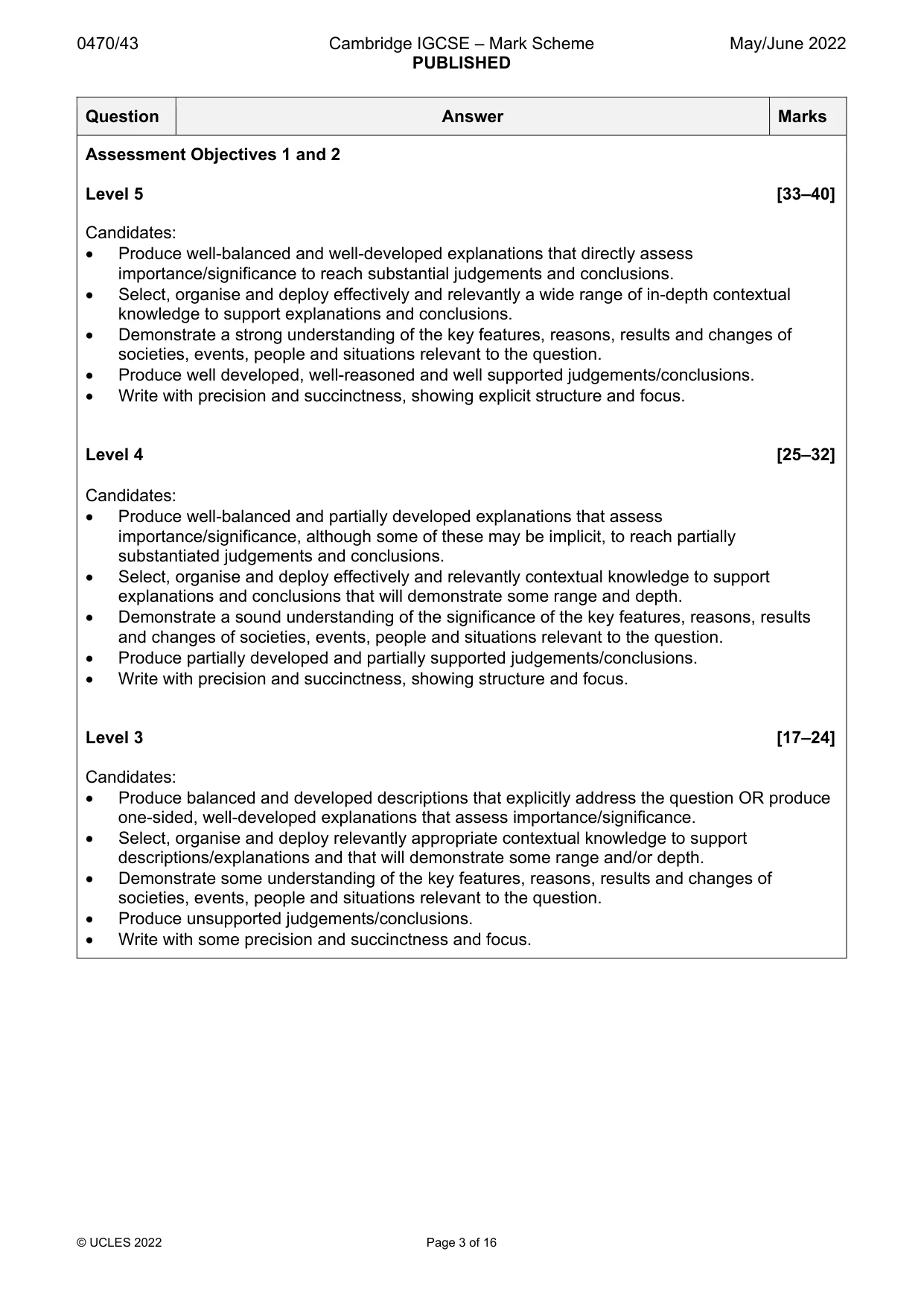
0470/43 Cambridge IGCSE – Mark Scheme PUBLISHED May/June 2022 © UCLES 2022 Page 3 of 16 Question Answer Marks Assessment Objectives 1 and 2 Level 5 [33–40] Candidates: Produce well-balanced and well-developed explanations that directly assess importance/significance to reach substantial judgements and conclusions. Select, organise and deploy effectively and relevantly a wide range of in-depth contextual knowledge to support explanations and conclusions. Demonstrate a strong understanding of the key features, reasons, results and changes of societies, events, people and situations relevant to the question. Produce well developed, well-reasoned and well supported judgements/conclusions. Write with precision and succinctness, showing explicit structure and focus. Level 4 [25–32] Candidates: Produce well-balanced and partially developed explanations that assess importance/significance, although some of these may be implicit, to reach partially substantiated judgements and conclusions. Select, organise and deploy effectively and relevantly contextual knowledge to support explanations and conclusions that will demonstrate some range and depth. Demonstrate a sound understanding of the significance of the key features, reasons, results and changes of societies, events, people and situations relevant to the question. Produce partially developed and partially supported judgements/conclusions. Write with precision and succinctness, showing structure and focus. Level 3 [17–24] Candidates: Produce balanced and developed descriptions that explicitly address the question OR produce one-sided, well-developed explanations that assess importance/significance. Select, organise and deploy relevantly appropriate contextual knowledge to support descriptions/explanations and that will demonstrate some range and/or depth. Demonstrate some understanding of the key features, reasons, results and changes of societies, events, people and situations relevant to the question. Produce unsupported judgements/conclusions. Write with some precision and succinctness and focus.
Mark scheme, page 4
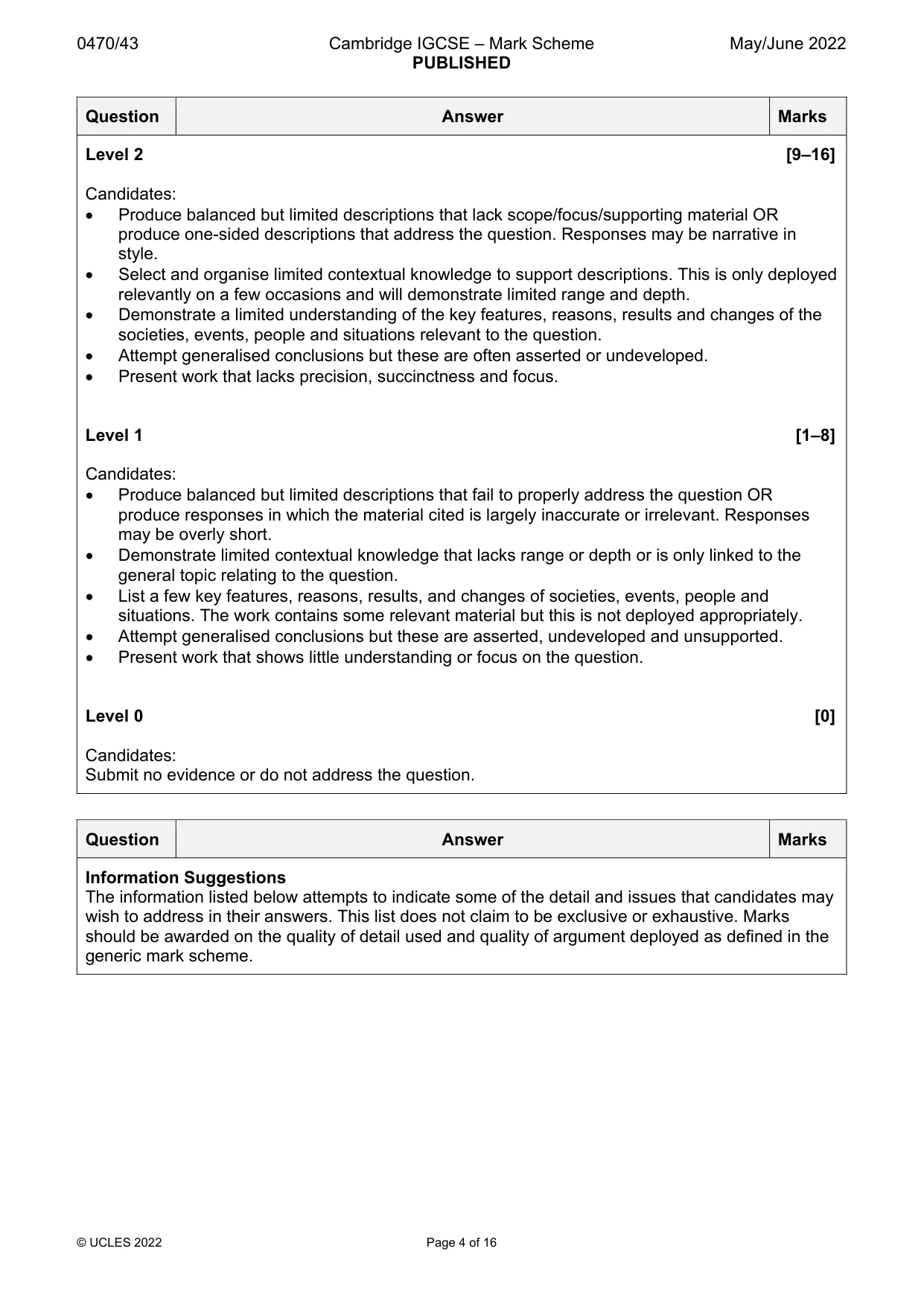
0470/43 Cambridge IGCSE – Mark Scheme PUBLISHED May/June 2022 © UCLES 2022 Page 4 of 16 Question Answer Marks Level 2 [9–16] Candidates: Produce balanced but limited descriptions that lack scope/focus/supporting material OR produce one-sided descriptions that address the question. Responses may be narrative in style. Select and organise limited contextual knowledge to support descriptions. This is only deployed relevantly on a few occasions and will demonstrate limited range and depth. Demonstrate a limited understanding of the key features, reasons, results and changes of the societies, events, people and situations relevant to the question. Attempt generalised conclusions but these are often asserted or undeveloped. Present work that lacks precision, succinctness and focus. Level 1 [1–8] Candidates: Produce balanced but limited descriptions that fail to properly address the question OR produce responses in which the material cited is largely inaccurate or irrelevant. Responses may be overly short. Demonstrate limited contextual knowledge that lacks range or depth or is only linked to the general topic relating to the question. List a few key features, reasons, results, and changes of societies, events, people and situations. The work contains some relevant material but this is not deployed appropriately. Attempt generalised conclusions but these are asserted, undeveloped and unsupported. Present work that shows little understanding or focus on the question. Level 0 [0] Candidates: Submit no evidence or do not address the question. Question Answer Marks Information Suggestions The information listed below attempts to indicate some of the detail and issues that candidates may wish to address in their answers. This list does not claim to be exclusive or exhaustive. Marks should be awarded on the quality of detail used and quality of argument deployed as defined in the generic mark scheme.
Mark scheme, page 5
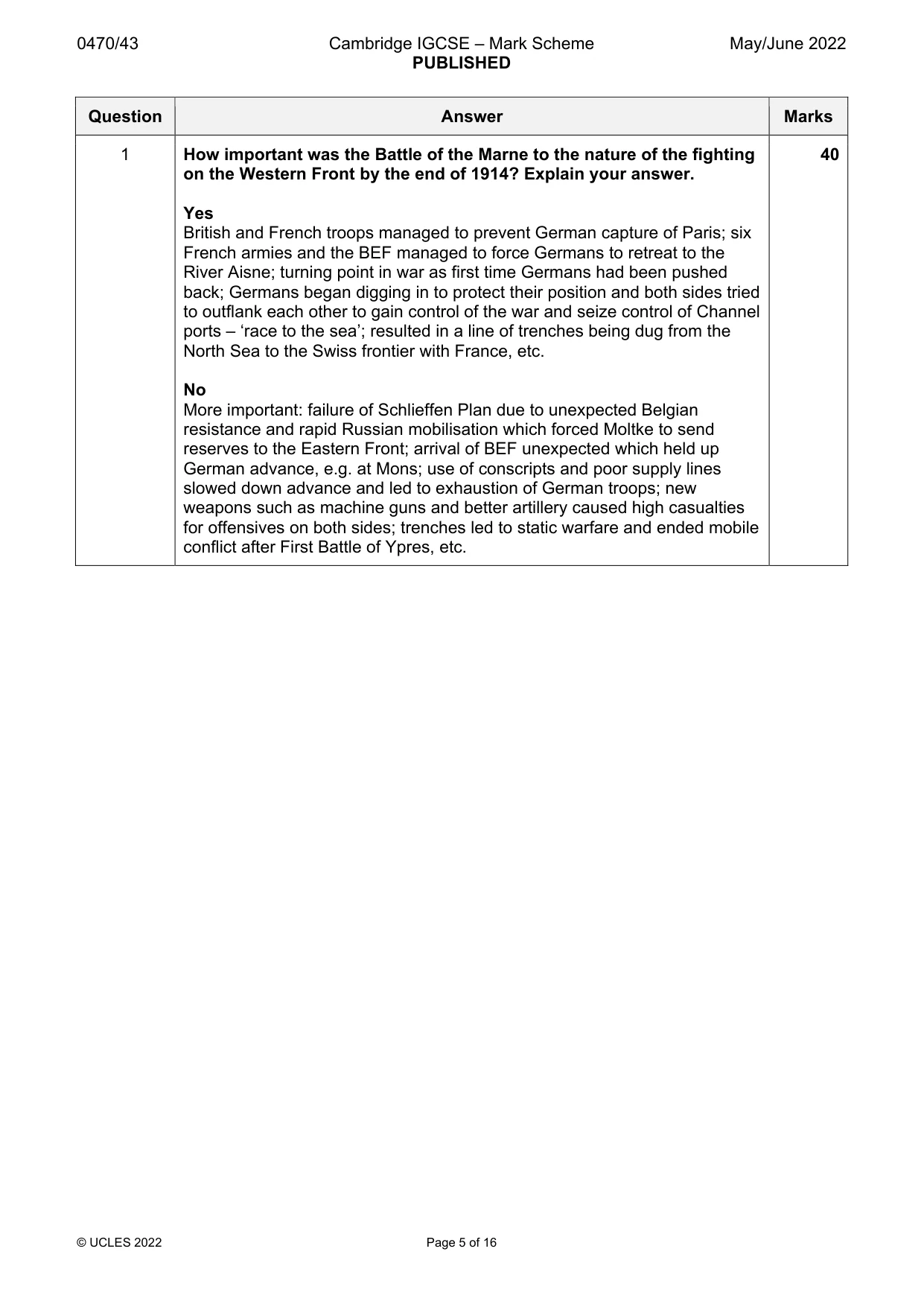
0470/43 Cambridge IGCSE – Mark Scheme PUBLISHED May/June 2022 © UCLES 2022 Page 5 of 16 Question Answer Marks 1 How important was the Battle of the Marne to the nature of the fighting on the Western Front by the end of 1914? Explain your answer. Yes British and French troops managed to prevent German capture of Paris; six French armies and the BEF managed to force Germans to retreat to the River Aisne; turning point in war as first time Germans had been pushed back; Germans began digging in to protect their position and both sides tried to outflank each other to gain control of the war and seize control of Channel ports – ‘race to the sea’; resulted in a line of trenches being dug from the North Sea to the Swiss frontier with France, etc. No More important: failure of Schlieffen Plan due to unexpected Belgian resistance and rapid Russian mobilisation which forced Moltke to send reserves to the Eastern Front; arrival of BEF unexpected which held up German advance, e.g. at Mons; use of conscripts and poor supply lines slowed down advance and led to exhaustion of German troops; new weapons such as machine guns and better artillery caused high casualties for offensives on both sides; trenches led to static warfare and ended mobile conflict after First Battle of Ypres, etc. 40
Mark scheme, page 6
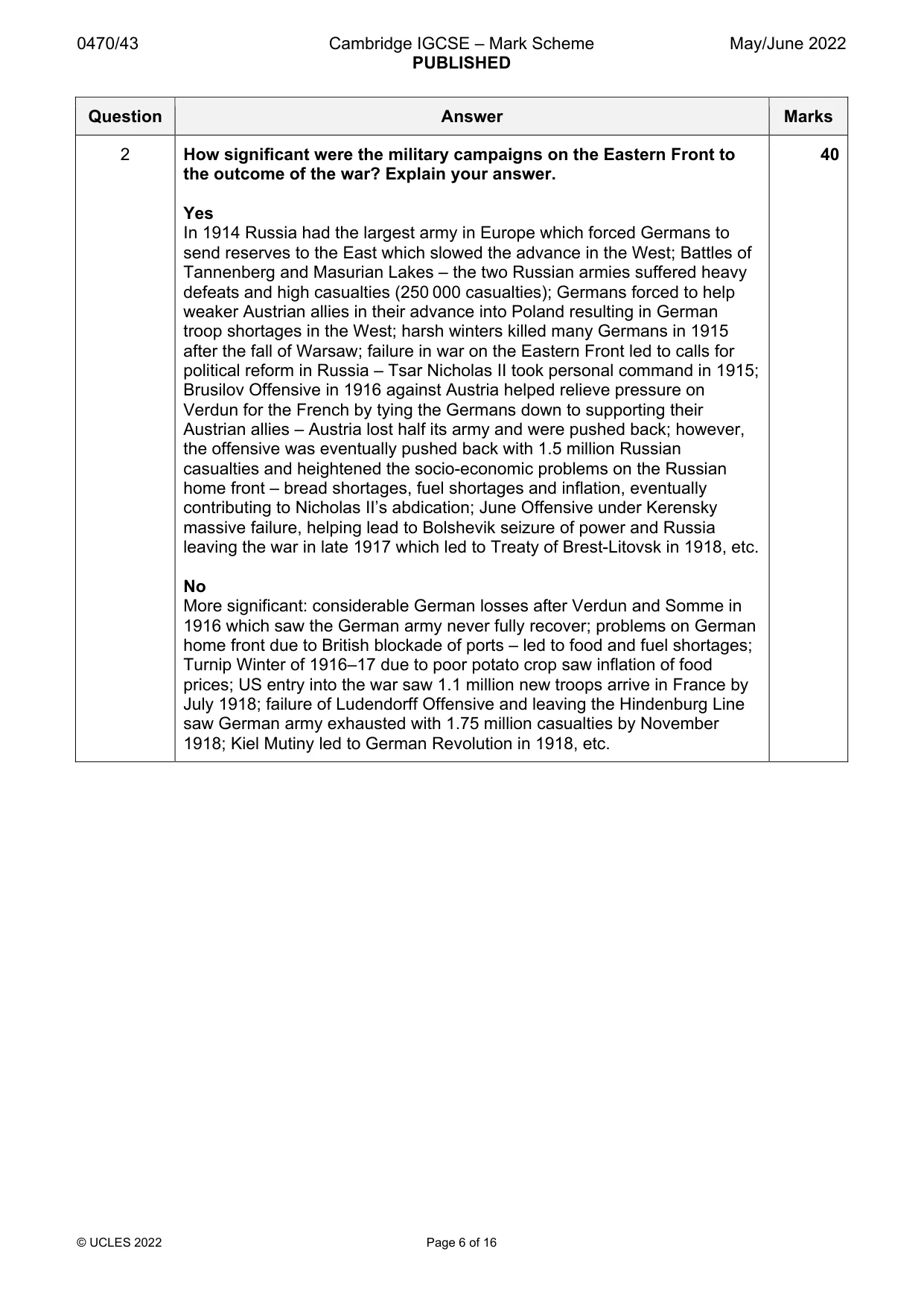
0470/43 Cambridge IGCSE – Mark Scheme PUBLISHED May/June 2022 © UCLES 2022 Page 6 of 16 Question Answer Marks 2 How significant were the military campaigns on the Eastern Front to the outcome of the war? Explain your answer. Yes In 1914 Russia had the largest army in Europe which forced Germans to send reserves to the East which slowed the advance in the West; Battles of Tannenberg and Masurian Lakes – the two Russian armies suffered heavy defeats and high casualties (250 000 casualties); Germans forced to help weaker Austrian allies in their advance into Poland resulting in German troop shortages in the West; harsh winters killed many Germans in 1915 after the fall of Warsaw; failure in war on the Eastern Front led to calls for political reform in Russia – Tsar Nicholas II took personal command in 1915; Brusilov Offensive in 1916 against Austria helped relieve pressure on Verdun for the French by tying the Germans down to supporting their Austrian allies – Austria lost half its army and were pushed back; however, the offensive was eventually pushed back with 1.5 million Russian casualties and heightened the socio-economic problems on the Russian home front – bread shortages, fuel shortages and inflation, eventually contributing to Nicholas II’s abdication; June Offensive under Kerensky massive failure, helping lead to Bolshevik seizure of power and Russia leaving the war in late 1917 which led to Treaty of Brest-Litovsk in 1918, etc. No More significant: considerable German losses after Verdun and Somme in 1916 which saw the German army never fully recover; problems on German home front due to British blockade of ports – led to food and fuel shortages; Turnip Winter of 1916–17 due to poor potato crop saw inflation of food prices; US entry into the war saw 1.1 million new troops arrive in France by July 1918; failure of Ludendorff Offensive and leaving the Hindenburg Line saw German army exhausted with 1.75 million casualties by November 1918; Kiel Mutiny led to German Revolution in 1918, etc. 40
Mark scheme, page 7
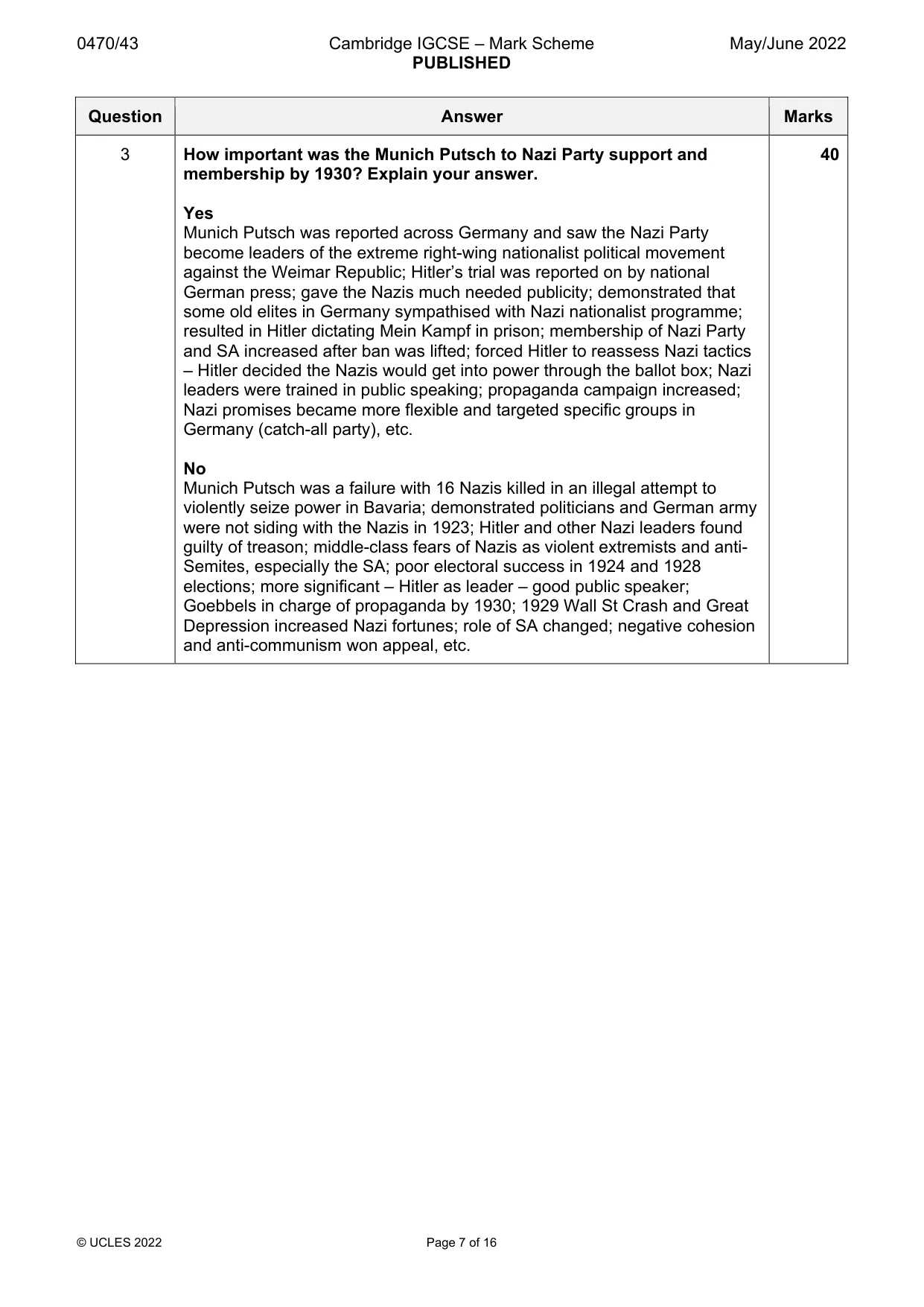
0470/43 Cambridge IGCSE – Mark Scheme PUBLISHED May/June 2022 © UCLES 2022 Page 7 of 16 Question Answer Marks 3 How important was the Munich Putsch to Nazi Party support and membership by 1930? Explain your answer. Yes Munich Putsch was reported across Germany and saw the Nazi Party become leaders of the extreme right-wing nationalist political movement against the Weimar Republic; Hitler’s trial was reported on by national German press; gave the Nazis much needed publicity; demonstrated that some old elites in Germany sympathised with Nazi nationalist programme; resulted in Hitler dictating Mein Kampf in prison; membership of Nazi Party and SA increased after ban was lifted; forced Hitler to reassess Nazi tactics – Hitler decided the Nazis would get into power through the ballot box; Nazi leaders were trained in public speaking; propaganda campaign increased; Nazi promises became more flexible and targeted specific groups in Germany (catch-all party), etc. No Munich Putsch was a failure with 16 Nazis killed in an illegal attempt to violently seize power in Bavaria; demonstrated politicians and German army were not siding with the Nazis in 1923; Hitler and other Nazi leaders found guilty of treason; middle-class fears of Nazis as violent extremists and anti- Semites, especially the SA; poor electoral success in 1924 and 1928 elections; more significant – Hitler as leader – good public speaker; Goebbels in charge of propaganda by 1930; 1929 Wall St Crash and Great Depression increased Nazi fortunes; role of SA changed; negative cohesion and anti-communism won appeal, etc. 40
Mark scheme, page 8
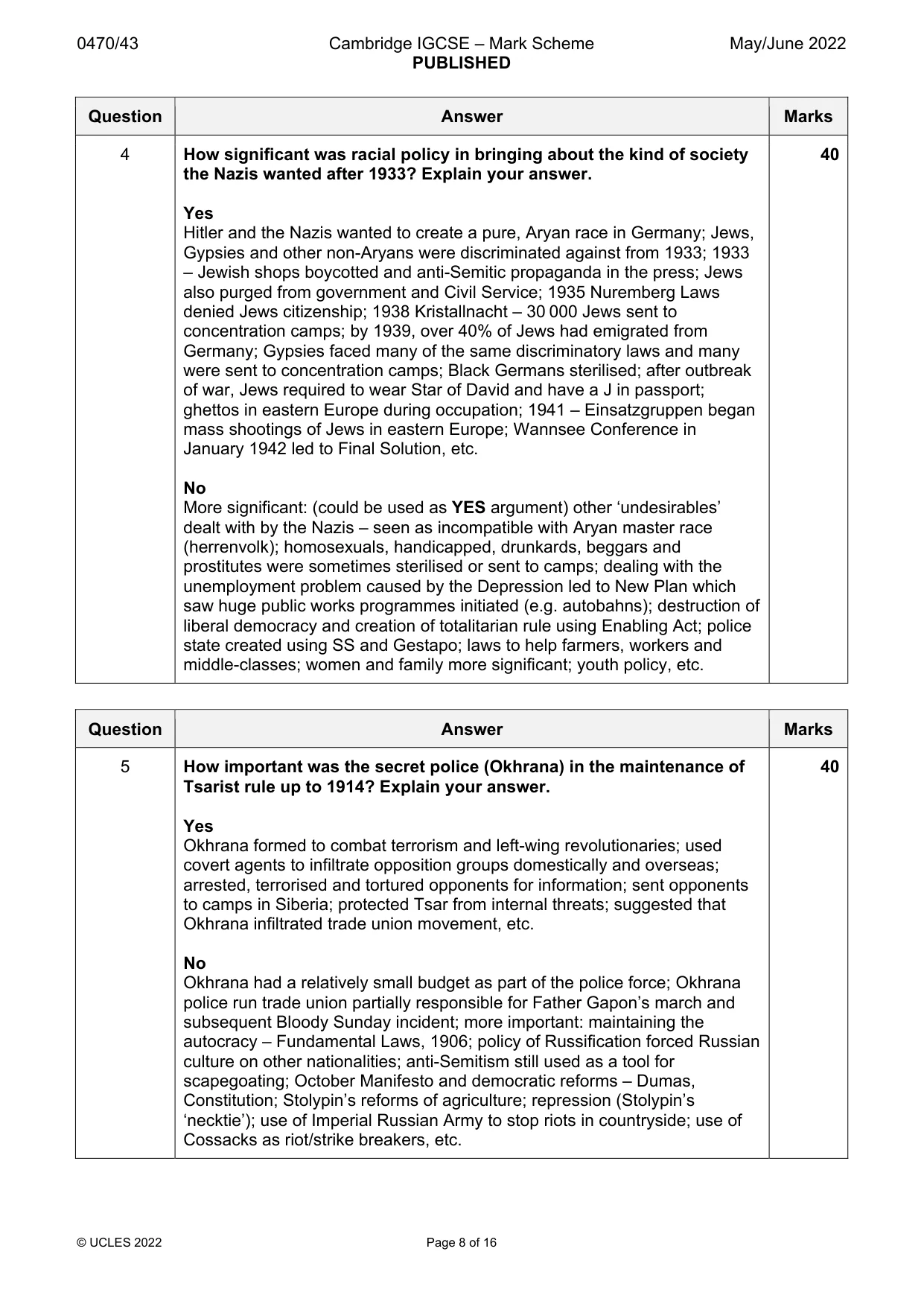
0470/43 Cambridge IGCSE – Mark Scheme PUBLISHED May/June 2022 © UCLES 2022 Page 8 of 16 Question Answer Marks 4 How significant was racial policy in bringing about the kind of society the Nazis wanted after 1933? Explain your answer. Yes Hitler and the Nazis wanted to create a pure, Aryan race in Germany; Jews, Gypsies and other non-Aryans were discriminated against from 1933; 1933 – Jewish shops boycotted and anti-Semitic propaganda in the press; Jews also purged from government and Civil Service; 1935 Nuremberg Laws denied Jews citizenship; 1938 Kristallnacht – 30 000 Jews sent to concentration camps; by 1939, over 40% of Jews had emigrated from Germany; Gypsies faced many of the same discriminatory laws and many were sent to concentration camps; Black Germans sterilised; after outbreak of war, Jews required to wear Star of David and have a J in passport; ghettos in eastern Europe during occupation; 1941 – Einsatzgruppen began mass shootings of Jews in eastern Europe; Wannsee Conference in January 1942 led to Final Solution, etc. No More significant: (could be used as YES argument) other ‘undesirables’ dealt with by the Nazis – seen as incompatible with Aryan master race (herrenvolk); homosexuals, handicapped, drunkards, beggars and prostitutes were sometimes sterilised or sent to camps; dealing with the unemployment problem caused by the Depression led to New Plan which saw huge public works programmes initiated (e.g. autobahns); destruction of liberal democracy and creation of totalitarian rule using Enabling Act; police state created using SS and Gestapo; laws to help farmers, workers and middle-classes; women and family more significant; youth policy, etc. 40 Question Answer Marks 5 How important was the secret police (Okhrana) in the maintenance of Tsarist rule up to 1914? Explain your answer. Yes Okhrana formed to combat terrorism and left-wing revolutionaries; used covert agents to infiltrate opposition groups domestically and overseas; arrested, terrorised and tortured opponents for information; sent opponents to camps in Siberia; protected Tsar from internal threats; suggested that Okhrana infiltrated trade union movement, etc. No Okhrana had a relatively small budget as part of the police force; Okhrana police run trade union partially responsible for Father Gapon’s march and subsequent Bloody Sunday incident; more important: maintaining the autocracy – Fundamental Laws, 1906; policy of Russification forced Russian culture on other nationalities; anti-Semitism still used as a tool for scapegoating; October Manifesto and democratic reforms – Dumas, Constitution; Stolypin’s reforms of agriculture; repression (Stolypin’s ‘necktie’); use of Imperial Russian Army to stop riots in countryside; use of Cossacks as riot/strike breakers, etc. 40
Mark scheme, page 9
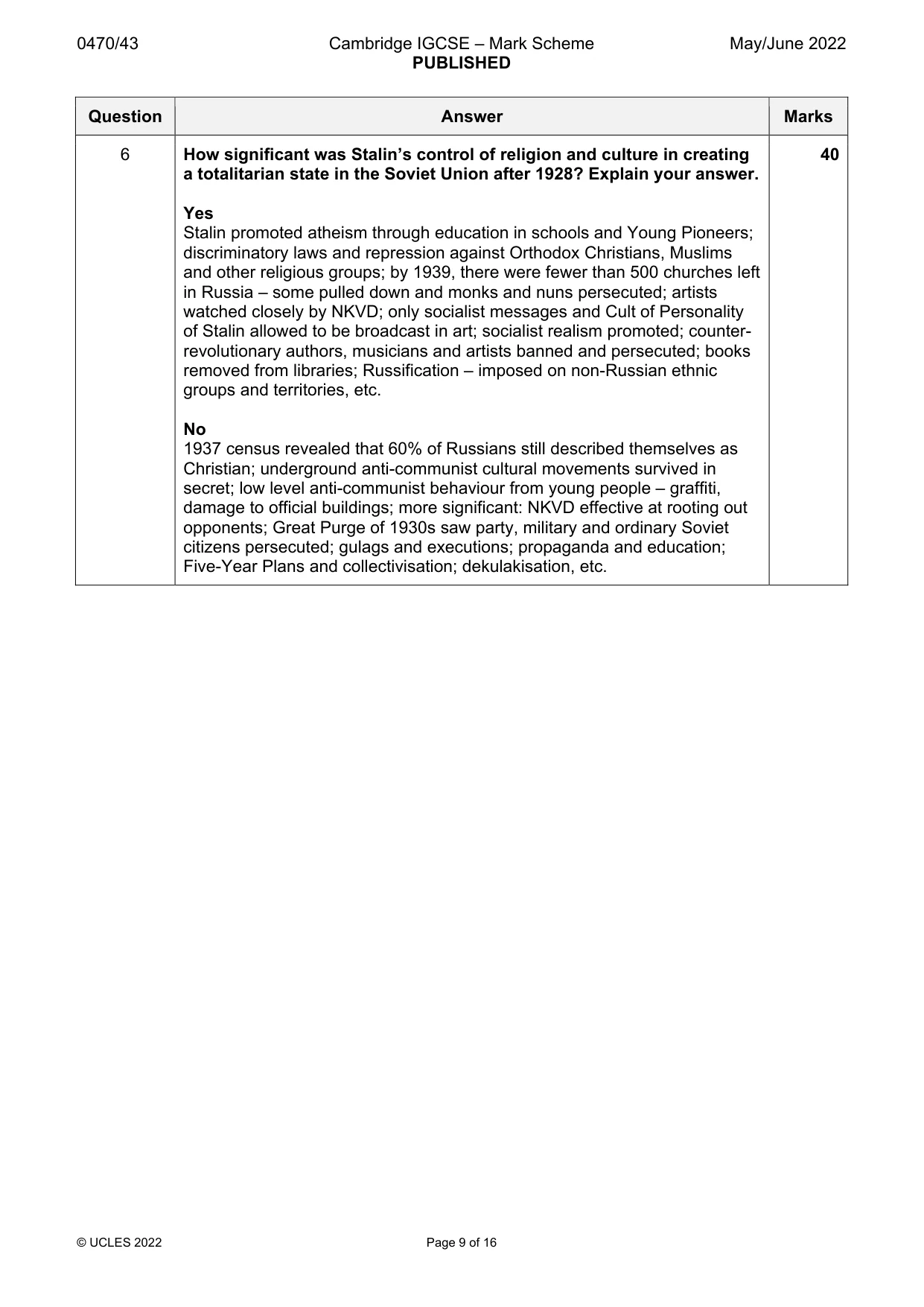
0470/43 Cambridge IGCSE – Mark Scheme PUBLISHED May/June 2022 © UCLES 2022 Page 9 of 16 Question Answer Marks 6 How significant was Stalin’s control of religion and culture in creating a totalitarian state in the Soviet Union after 1928? Explain your answer. Yes Stalin promoted atheism through education in schools and Young Pioneers; discriminatory laws and repression against Orthodox Christians, Muslims and other religious groups; by 1939, there were fewer than 500 churches left in Russia – some pulled down and monks and nuns persecuted; artists watched closely by NKVD; only socialist messages and Cult of Personality of Stalin allowed to be broadcast in art; socialist realism promoted; counter- revolutionary authors, musicians and artists banned and persecuted; books removed from libraries; Russification – imposed on non-Russian ethnic groups and territories, etc. No 1937 census revealed that 60% of Russians still described themselves as Christian; underground anti-communist cultural movements survived in secret; low level anti-communist behaviour from young people – graffiti, damage to official buildings; more significant: NKVD effective at rooting out opponents; Great Purge of 1930s saw party, military and ordinary Soviet citizens persecuted; gulags and executions; propaganda and education; Five-Year Plans and collectivisation; dekulakisation, etc. 40
Mark scheme, page 10
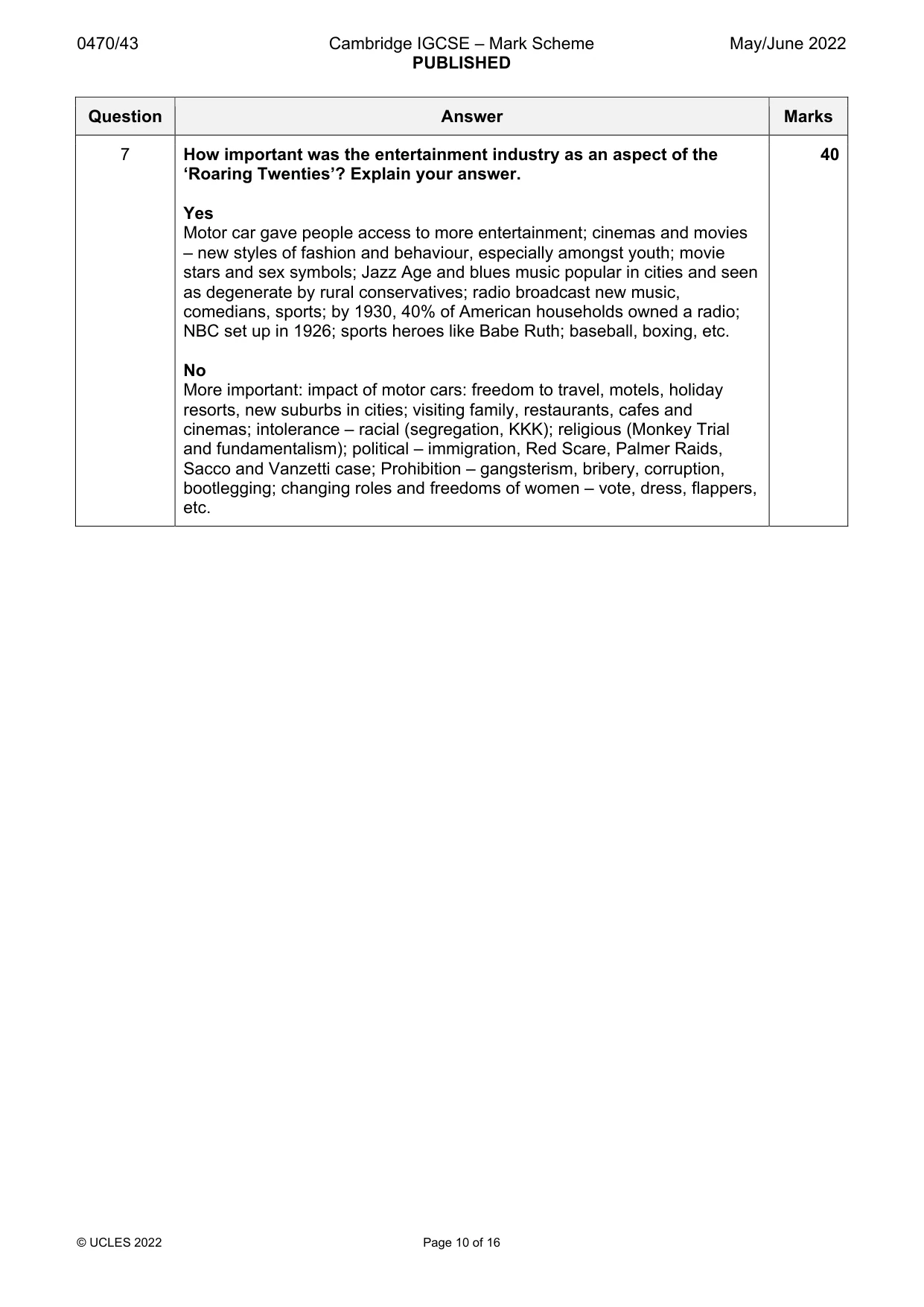
0470/43 Cambridge IGCSE – Mark Scheme PUBLISHED May/June 2022 © UCLES 2022 Page 10 of 16 Question Answer Marks 7 How important was the entertainment industry as an aspect of the ‘Roaring Twenties’? Explain your answer. Yes Motor car gave people access to more entertainment; cinemas and movies – new styles of fashion and behaviour, especially amongst youth; movie stars and sex symbols; Jazz Age and blues music popular in cities and seen as degenerate by rural conservatives; radio broadcast new music, comedians, sports; by 1930, 40% of American households owned a radio; NBC set up in 1926; sports heroes like Babe Ruth; baseball, boxing, etc. No More important: impact of motor cars: freedom to travel, motels, holiday resorts, new suburbs in cities; visiting family, restaurants, cafes and cinemas; intolerance – racial (segregation, KKK); religious (Monkey Trial and fundamentalism); political – immigration, Red Scare, Palmer Raids, Sacco and Vanzetti case; Prohibition – gangsterism, bribery, corruption, bootlegging; changing roles and freedoms of women – vote, dress, flappers, etc. 40
Mark scheme, page 11
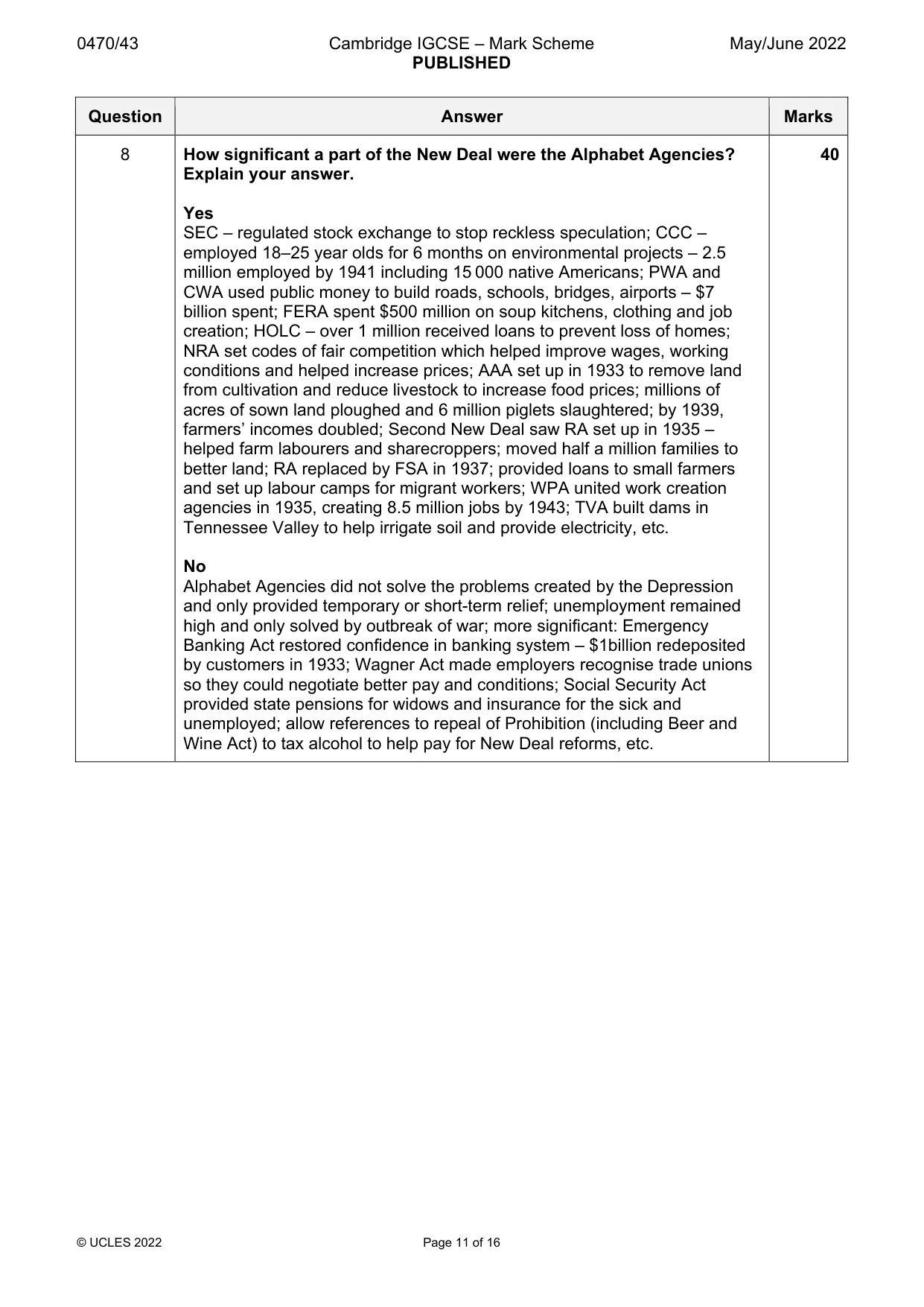
0470/43 Cambridge IGCSE – Mark Scheme PUBLISHED May/June 2022 © UCLES 2022 Page 11 of 16 Question Answer Marks 8 How significant a part of the New Deal were the Alphabet Agencies? Explain your answer. Yes SEC – regulated stock exchange to stop reckless speculation; CCC – employed 18–25 year olds for 6 months on environmental projects – 2.5 million employed by 1941 including 15 000 native Americans; PWA and CWA used public money to build roads, schools, bridges, airports – $7 billion spent; FERA spent $500 million on soup kitchens, clothing and job creation; HOLC – over 1 million received loans to prevent loss of homes; NRA set codes of fair competition which helped improve wages, working conditions and helped increase prices; AAA set up in 1933 to remove land from cultivation and reduce livestock to increase food prices; millions of acres of sown land ploughed and 6 million piglets slaughtered; by 1939, farmers’ incomes doubled; Second New Deal saw RA set up in 1935 – helped farm labourers and sharecroppers; moved half a million families to better land; RA replaced by FSA in 1937; provided loans to small farmers and set up labour camps for migrant workers; WPA united work creation agencies in 1935, creating 8.5 million jobs by 1943; TVA built dams in Tennessee Valley to help irrigate soil and provide electricity, etc. No Alphabet Agencies did not solve the problems created by the Depression and only provided temporary or short-term relief; unemployment remained high and only solved by outbreak of war; more significant: Emergency Banking Act restored confidence in banking system – $1billion redeposited by customers in 1933; Wagner Act made employers recognise trade unions so they could negotiate better pay and conditions; Social Security Act provided state pensions for widows and insurance for the sick and unemployed; allow references to repeal of Prohibition (including Beer and Wine Act) to tax alcohol to help pay for New Deal reforms, etc. 40
Mark scheme, page 12
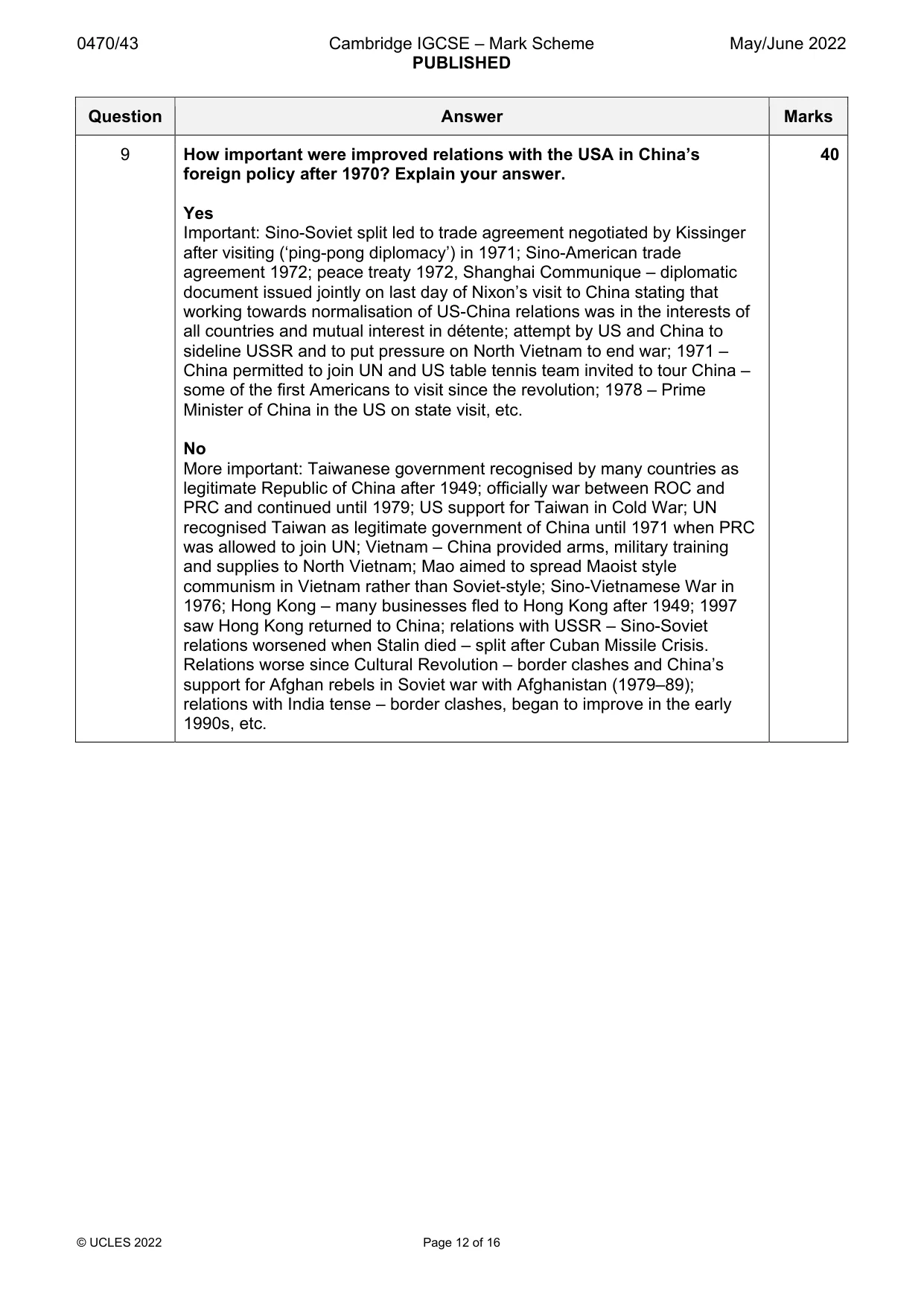
0470/43 Cambridge IGCSE – Mark Scheme PUBLISHED May/June 2022 © UCLES 2022 Page 12 of 16 Question Answer Marks 9 How important were improved relations with the USA in China’s foreign policy after 1970? Explain your answer. Yes Important: Sino-Soviet split led to trade agreement negotiated by Kissinger after visiting (‘ping-pong diplomacy’) in 1971; Sino-American trade agreement 1972; peace treaty 1972, Shanghai Communique – diplomatic document issued jointly on last day of Nixon’s visit to China stating that working towards normalisation of US-China relations was in the interests of all countries and mutual interest in détente; attempt by US and China to sideline USSR and to put pressure on North Vietnam to end war; 1971 – China permitted to join UN and US table tennis team invited to tour China – some of the first Americans to visit since the revolution; 1978 – Prime Minister of China in the US on state visit, etc. No More important: Taiwanese government recognised by many countries as legitimate Republic of China after 1949; officially war between ROC and PRC and continued until 1979; US support for Taiwan in Cold War; UN recognised Taiwan as legitimate government of China until 1971 when PRC was allowed to join UN; Vietnam – China provided arms, military training and supplies to North Vietnam; Mao aimed to spread Maoist style communism in Vietnam rather than Soviet-style; Sino-Vietnamese War in 1976; Hong Kong – many businesses fled to Hong Kong after 1949; 1997 saw Hong Kong returned to China; relations with USSR – Sino-Soviet relations worsened when Stalin died – split after Cuban Missile Crisis. Relations worse since Cultural Revolution – border clashes and China’s support for Afghan rebels in Soviet war with Afghanistan (1979–89); relations with India tense – border clashes, began to improve in the early 1990s, etc. 40
Mark scheme, page 13
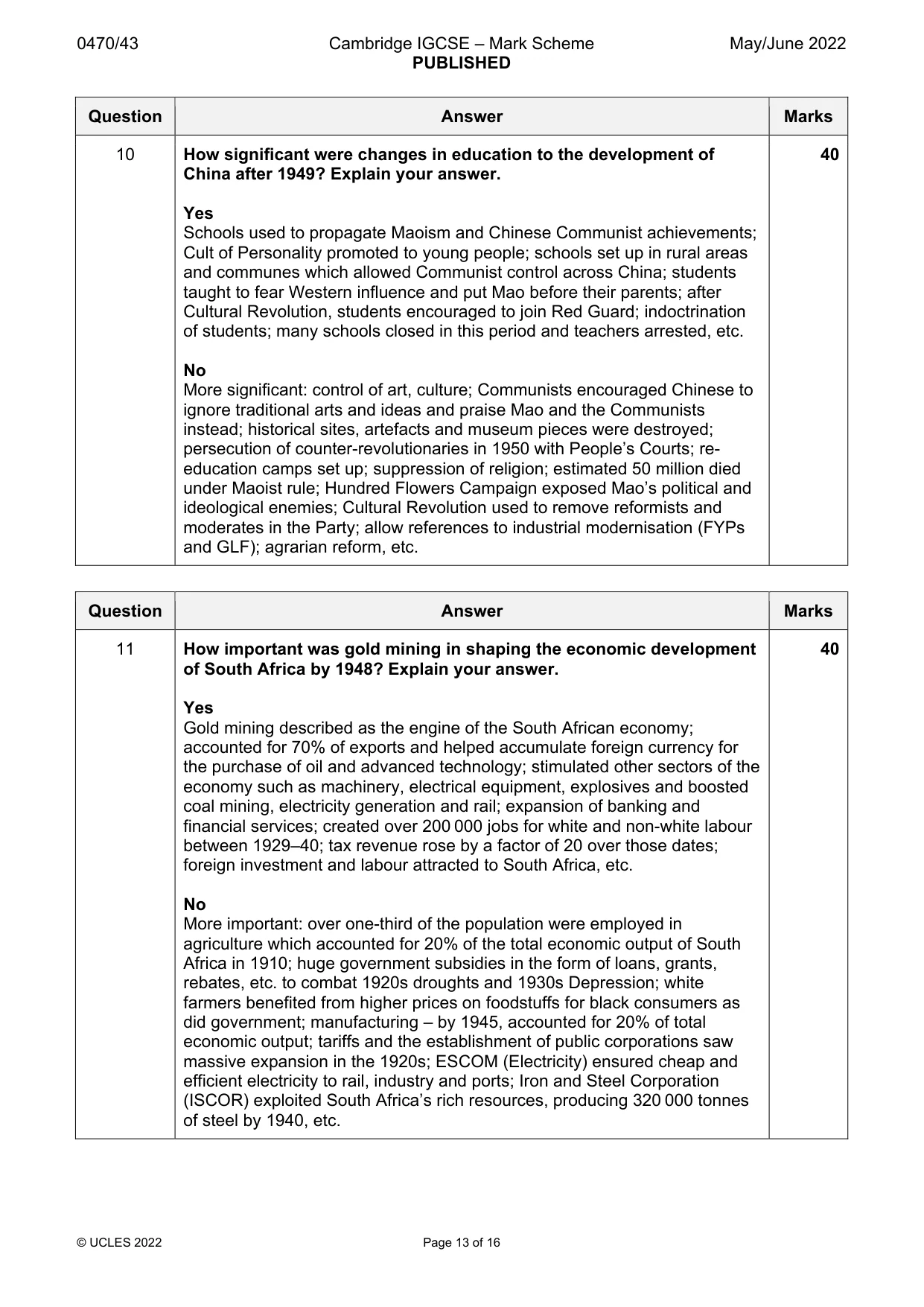
0470/43 Cambridge IGCSE – Mark Scheme PUBLISHED May/June 2022 © UCLES 2022 Page 13 of 16 Question Answer Marks 10 How significant were changes in education to the development of China after 1949? Explain your answer. Yes Schools used to propagate Maoism and Chinese Communist achievements; Cult of Personality promoted to young people; schools set up in rural areas and communes which allowed Communist control across China; students taught to fear Western influence and put Mao before their parents; after Cultural Revolution, students encouraged to join Red Guard; indoctrination of students; many schools closed in this period and teachers arrested, etc. No More significant: control of art, culture; Communists encouraged Chinese to ignore traditional arts and ideas and praise Mao and the Communists instead; historical sites, artefacts and museum pieces were destroyed; persecution of counter-revolutionaries in 1950 with People’s Courts; re- education camps set up; suppression of religion; estimated 50 million died under Maoist rule; Hundred Flowers Campaign exposed Mao’s political and ideological enemies; Cultural Revolution used to remove reformists and moderates in the Party; allow references to industrial modernisation (FYPs and GLF); agrarian reform, etc. 40 Question Answer Marks 11 How important was gold mining in shaping the economic development of South Africa by 1948? Explain your answer. Yes Gold mining described as the engine of the South African economy; accounted for 70% of exports and helped accumulate foreign currency for the purchase of oil and advanced technology; stimulated other sectors of the economy such as machinery, electrical equipment, explosives and boosted coal mining, electricity generation and rail; expansion of banking and financial services; created over 200 000 jobs for white and non-white labour between 1929–40; tax revenue rose by a factor of 20 over those dates; foreign investment and labour attracted to South Africa, etc. No More important: over one-third of the population were employed in agriculture which accounted for 20% of the total economic output of South Africa in 1910; huge government subsidies in the form of loans, grants, rebates, etc. to combat 1920s droughts and 1930s Depression; white farmers benefited from higher prices on foodstuffs for black consumers as did government; manufacturing – by 1945, accounted for 20% of total economic output; tariffs and the establishment of public corporations saw massive expansion in the 1920s; ESCOM (Electricity) ensured cheap and efficient electricity to rail, industry and ports; Iron and Steel Corporation (ISCOR) exploited South Africa’s rich resources, producing 320 000 tonnes of steel by 1940, etc. 40
Mark scheme, page 14
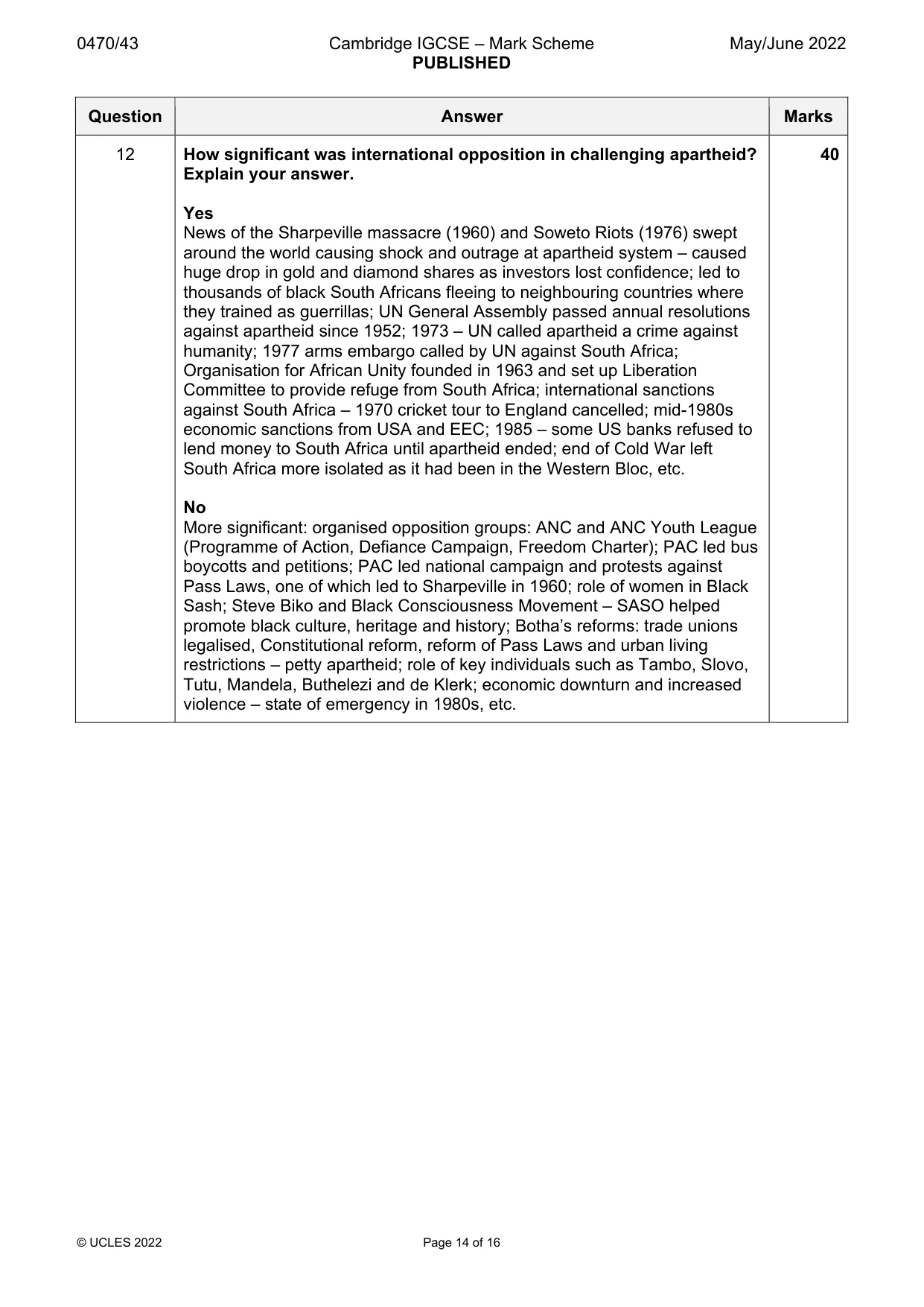
0470/43 Cambridge IGCSE – Mark Scheme PUBLISHED May/June 2022 © UCLES 2022 Page 14 of 16 Question Answer Marks 12 How significant was international opposition in challenging apartheid? Explain your answer. Yes News of the Sharpeville massacre (1960) and Soweto Riots (1976) swept around the world causing shock and outrage at apartheid system – caused huge drop in gold and diamond shares as investors lost confidence; led to thousands of black South Africans fleeing to neighbouring countries where they trained as guerrillas; UN General Assembly passed annual resolutions against apartheid since 1952; 1973 – UN called apartheid a crime against humanity; 1977 arms embargo called by UN against South Africa; Organisation for African Unity founded in 1963 and set up Liberation Committee to provide refuge from South Africa; international sanctions against South Africa – 1970 cricket tour to England cancelled; mid-1980s economic sanctions from USA and EEC; 1985 – some US banks refused to lend money to South Africa until apartheid ended; end of Cold War left South Africa more isolated as it had been in the Western Bloc, etc. No More significant: organised opposition groups: ANC and ANC Youth League (Programme of Action, Defiance Campaign, Freedom Charter); PAC led bus boycotts and petitions; PAC led national campaign and protests against Pass Laws, one of which led to Sharpeville in 1960; role of women in Black Sash; Steve Biko and Black Consciousness Movement – SASO helped promote black culture, heritage and history; Botha’s reforms: trade unions legalised, Constitutional reform, reform of Pass Laws and urban living restrictions – petty apartheid; role of key individuals such as Tambo, Slovo, Tutu, Mandela, Buthelezi and de Klerk; economic downturn and increased violence – state of emergency in 1980s, etc. 40
Mark scheme, page 15
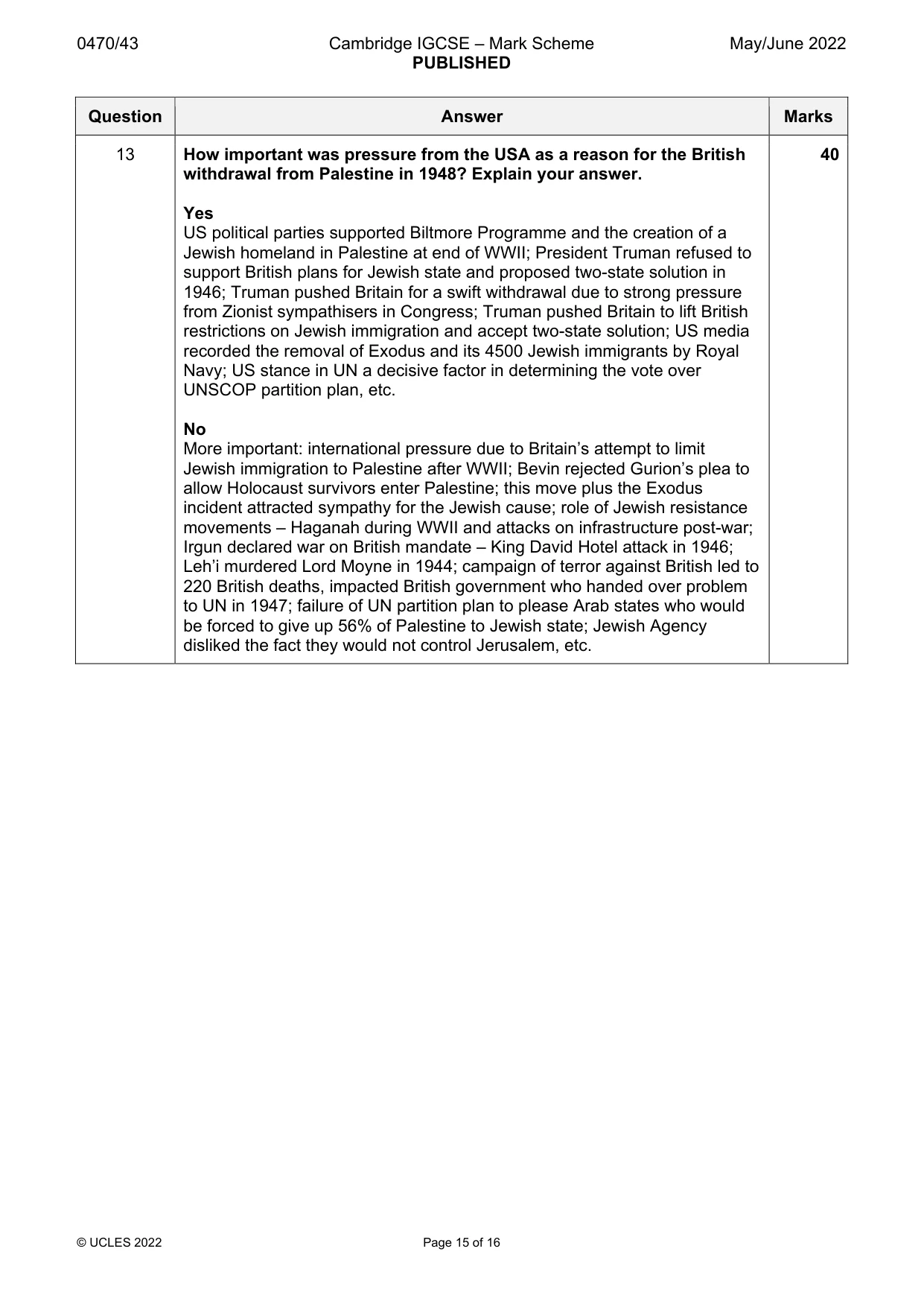
0470/43 Cambridge IGCSE – Mark Scheme PUBLISHED May/June 2022 © UCLES 2022 Page 15 of 16 Question Answer Marks 13 How important was pressure from the USA as a reason for the British withdrawal from Palestine in 1948? Explain your answer. Yes US political parties supported Biltmore Programme and the creation of a Jewish homeland in Palestine at end of WWII; President Truman refused to support British plans for Jewish state and proposed two-state solution in 1946; Truman pushed Britain for a swift withdrawal due to strong pressure from Zionist sympathisers in Congress; Truman pushed Britain to lift British restrictions on Jewish immigration and accept two-state solution; US media recorded the removal of Exodus and its 4500 Jewish immigrants by Royal Navy; US stance in UN a decisive factor in determining the vote over UNSCOP partition plan, etc. No More important: international pressure due to Britain’s attempt to limit Jewish immigration to Palestine after WWII; Bevin rejected Gurion’s plea to allow Holocaust survivors enter Palestine; this move plus the Exodus incident attracted sympathy for the Jewish cause; role of Jewish resistance movements – Haganah during WWII and attacks on infrastructure post-war; Irgun declared war on British mandate – King David Hotel attack in 1946; Leh’i murdered Lord Moyne in 1944; campaign of terror against British led to 220 British deaths, impacted British government who handed over problem to UN in 1947; failure of UN partition plan to please Arab states who would be forced to give up 56% of Palestine to Jewish state; Jewish Agency disliked the fact they would not control Jerusalem, etc. 40
Mark scheme, page 16
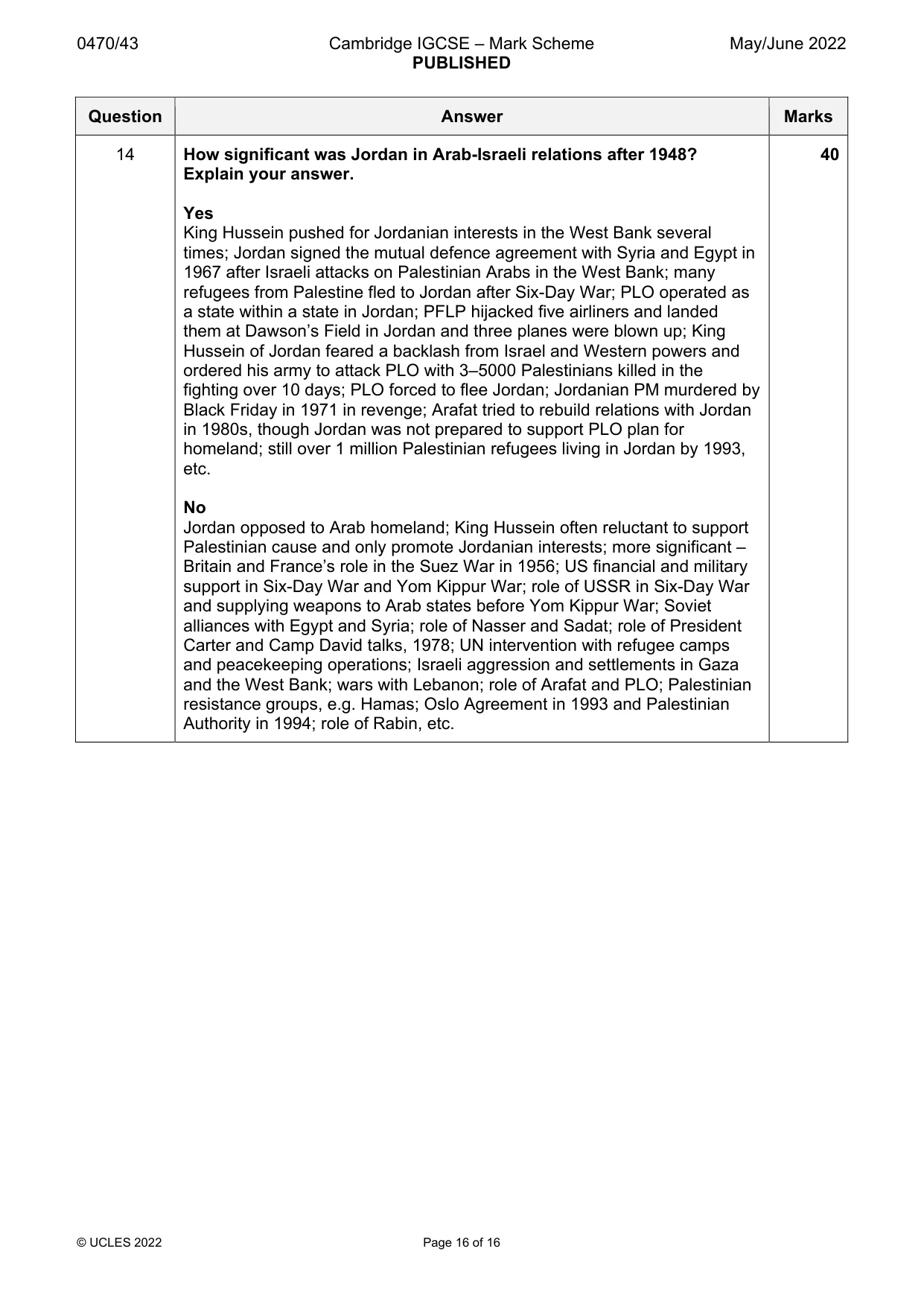
0470/43 Cambridge IGCSE – Mark Scheme PUBLISHED May/June 2022 © UCLES 2022 Page 16 of 16 Question Answer Marks 14 How significant was Jordan in Arab-Israeli relations after 1948? Explain your answer. Yes King Hussein pushed for Jordanian interests in the West Bank several times; Jordan signed the mutual defence agreement with Syria and Egypt in 1967 after Israeli attacks on Palestinian Arabs in the West Bank; many refugees from Palestine fled to Jordan after Six-Day War; PLO operated as a state within a state in Jordan; PFLP hijacked five airliners and landed them at Dawson’s Field in Jordan and three planes were blown up; King Hussein of Jordan feared a backlash from Israel and Western powers and ordered his army to attack PLO with 3–5000 Palestinians killed in the fighting over 10 days; PLO forced to flee Jordan; Jordanian PM murdered by Black Friday in 1971 in revenge; Arafat tried to rebuild relations with Jordan in 1980s, though Jordan was not prepared to support PLO plan for homeland; still over 1 million Palestinian refugees living in Jordan by 1993, etc. No Jordan opposed to Arab homeland; King Hussein often reluctant to support Palestinian cause and only promote Jordanian interests; more significant – Britain and France’s role in the Suez War in 1956; US financial and military support in Six-Day War and Yom Kippur War; role of USSR in Six-Day War and supplying weapons to Arab states before Yom Kippur War; Soviet alliances with Egypt and Syria; role of Nasser and Sadat; role of President Carter and Camp David talks, 1978; UN intervention with refugee camps and peacekeeping operations; Israeli aggression and settlements in Gaza and the West Bank; wars with Lebanon; role of Arafat and PLO; Palestinian resistance groups, e.g. Hamas; Oslo Agreement in 1993 and Palestinian Authority in 1994; role of Rabin, etc. 40
What you needed in this session
Cambridge’s own grade thresholds for 2022 May/June, Paper 4 · Variant 3. A higher threshold means an easier paper — the bar moves with how the cohort did.