Cambridge IGCSE History 0470 — 2025 May/June Paper 4 · Variant 3
0470/43/M/J/25 · 40 marks · 60 min
The question paper and its mark scheme, free to read here and free to download. This is Cambridge’s own paper, exactly as it was sat.
Question paper4 pages
Mark scheme17 pages
Answers below. Sit the paper first if you are practising.
Paper as text
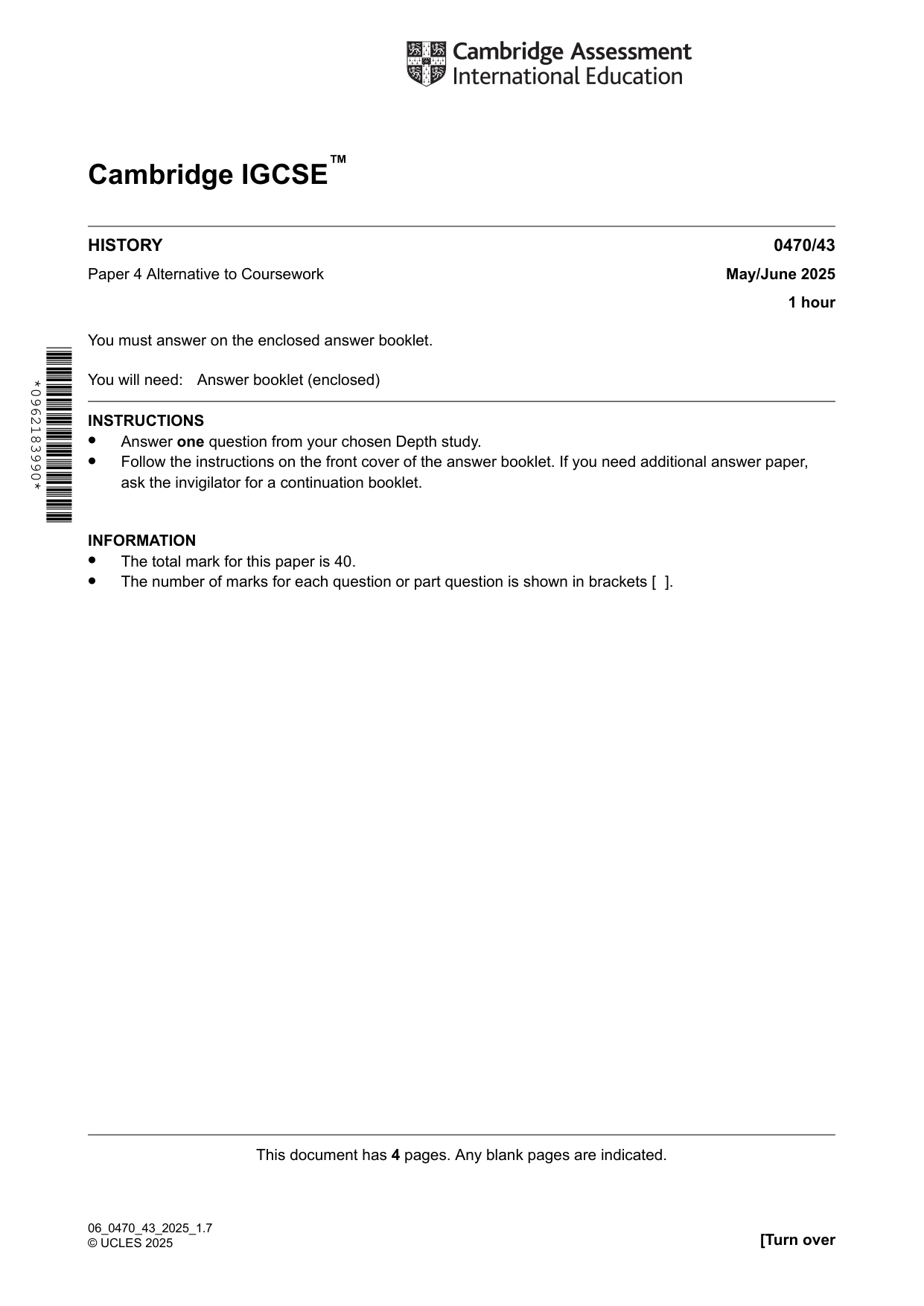
Question paper, page 1
Cambridge IGCSE™ 0470/43 May/June 2025 1 hour HISTORY Paper 4 Alternative to Coursework You must answer on the enclosed answer booklet. You will need: Answer booklet (enclosed) INSTRUCTIONS • Answer one question from your chosen Depth study. • Follow the instructions on the front cover of the answer booklet. If you need additional answer paper, ask the invigilator for a continuation booklet. INFORMATION • The total mark for this paper is 40. • The number of marks for each question or part question is shown in brackets [ ]. This document has 4 pages. Any blank pages are indicated. [Turn over 06_0470_43_2025_1.7 © UCLES 2025 *0962183990*
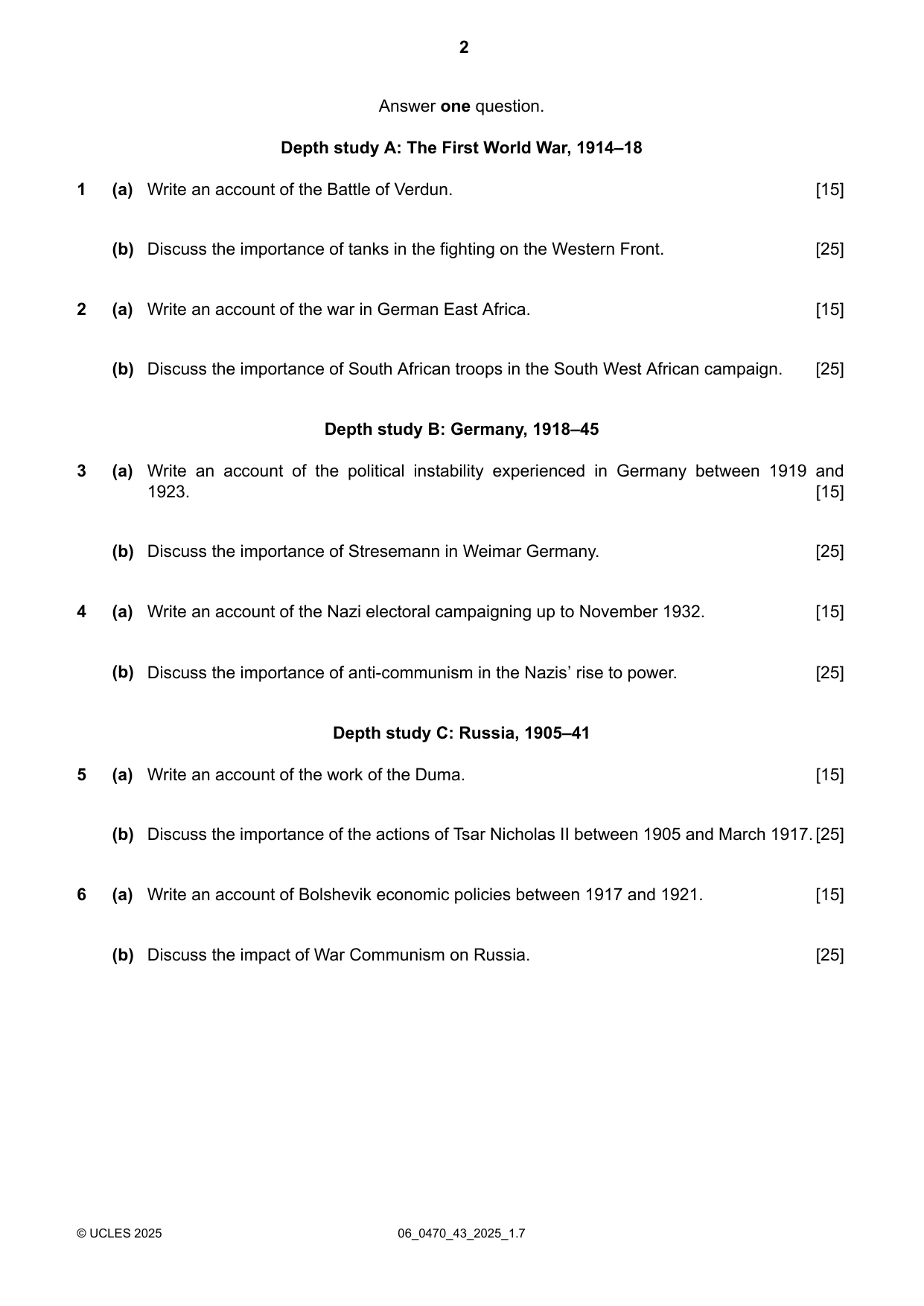
Question paper, page 2
Answer one question. Depth study A: The First World War, 1914–18 Write an account of the Battle of Verdun. [15] (a) 1 Discuss the importance of tanks in the fighting on the Western Front. [25] (b) Write an account of the war in German East Africa. [15] (a) 2 Discuss the importance of South African troops in the South West African campaign. [25] (b) Depth study B: Germany, 1918–45 Write an account of the political instability experienced in Germany between 1919 and 1923. [15] (a) 3 Discuss the importance of Stresemann in Weimar Germany. [25] (b) Write an account of the Nazi electoral campaigning up to November 1932. [15] (a) 4 Discuss the importance of anti-communism in the Nazis’ rise to power. [25] (b) Depth study C: Russia, 1905–41 Write an account of the work of the Duma. [15] (a) 5 Discuss the importance of the actions of Tsar Nicholas II between 1905 and March 1917.[25] (b) Write an account of Bolshevik economic policies between 1917 and 1921. [15] (a) 6 Discuss the impact of War Communism on Russia. [25] (b) 06_0470_43_2025_1.7 © UCLES 2025 2
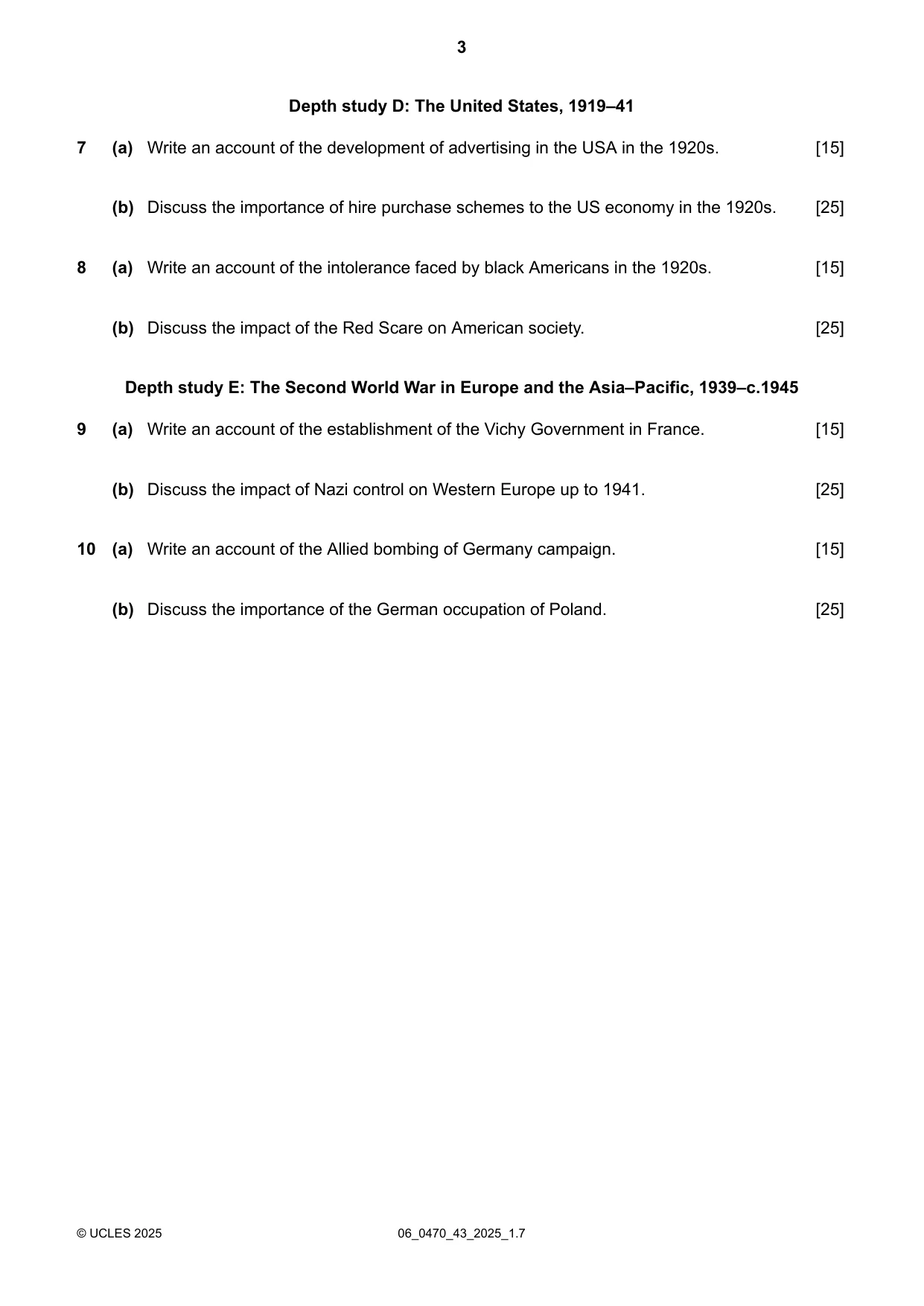
Question paper, page 3
Depth study D: The United States, 1919–41 Write an account of the development of advertising in the USA in the 1920s. [15] (a) 7 Discuss the importance of hire purchase schemes to the US economy in the 1920s. [25] (b) Write an account of the intolerance faced by black Americans in the 1920s. [15] (a) 8 Discuss the impact of the Red Scare on American society. [25] (b) Depth study E: The Second World War in Europe and the Asia–Pacific, 1939–c.1945 Write an account of the establishment of the Vichy Government in France. [15] (a) 9 Discuss the impact of Nazi control on Western Europe up to 1941. [25] (b) Write an account of the Allied bombing of Germany campaign. [15] (a) 10 Discuss the importance of the German occupation of Poland. [25] (b) 06_0470_43_2025_1.7 © UCLES 2025 3
Question paper, page 4
BLANK PAGE Permission to reproduce items where third-party owned material protected by copyright is included has been sought and cleared where possible. Every reasonable effort has been made by the publisher (UCLES) to trace copyright holders, but if any items requiring clearance have unwittingly been included, the publisher will be pleased to make amends at the earliest possible opportunity. To avoid the issue of disclosure of answer-related information to candidates, all copyright acknowledgements are reproduced online in the Cambridge Assessment International Education Copyright Acknowledgements Booklet. This is produced for each series of examinations and is freely available to download at www.cambridgeinternational.org after the live examination series. Cambridge Assessment International Education is part of Cambridge Assessment. Cambridge Assessment is the brand name of the University of Cambridge Local Examinations Syndicate (UCLES), which is a department of the University of Cambridge. 06_0470_43_2025_1.7 © UCLES 2025 4
Mark scheme, page 1
This document consists of 17 printed pages. © Cambridge University Press & Assessment 2025 [Turn over Cambridge IGCSE™ HISTORY 0470/43 Paper 4 Alternative to Coursework May/June 2025 MARK SCHEME Maximum Mark: 40 Published This mark scheme is published as an aid to teachers and candidates, to indicate the requirements of the examination. It shows the basis on which Examiners were instructed to award marks. It does not indicate the details of the discussions that took place at an Examiners’ meeting before marking began, which would have considered the acceptability of alternative answers. Mark schemes should be read in conjunction with the question paper and the Principal Examiner Report for Teachers. Cambridge International will not enter into discussions about these mark schemes. Cambridge International is publishing the mark schemes for the May/June 2025 series for most Cambridge IGCSE, Cambridge International A and AS Level components, and some Cambridge O Level components.
Mark scheme, page 2
0470/43 Cambridge IGCSE – Mark Scheme PUBLISHED May/June 2025 © Cambridge University Press & Assessment 2025 Page 2 of 17 Generic Marking Principles These general marking principles must be applied by all examiners when marking candidate answers. They should be applied alongside the specific content of the mark scheme or generic level descriptions for a question. Each question paper and mark scheme will also comply with these marking principles. GENERIC MARKING PRINCIPLE 1: Marks must be awarded in line with: • the specific content of the mark scheme or the generic level descriptors for the question • the specific skills defined in the mark scheme or in the generic level descriptors for the question • the standard of response required by a candidate as exemplified by the standardisation scripts. GENERIC MARKING PRINCIPLE 2: Marks awarded are always whole marks (not half marks, or other fractions). GENERIC MARKING PRINCIPLE 3: Marks must be awarded positively: • marks are awarded for correct/valid answers, as defined in the mark scheme. However, credit is given for valid answers which go beyond the scope of the syllabus and mark scheme, referring to your Team Leader as appropriate • marks are awarded when candidates clearly demonstrate what they know and can do • marks are not deducted for errors • marks are not deducted for omissions • answers should only be judged on the quality of spelling, punctuation and grammar when these features are specifically assessed by the question as indicated by the mark scheme. The meaning, however, should be unambiguous. GENERIC MARKING PRINCIPLE 4: Rules must be applied consistently, e.g. in situations where candidates have not followed instructions or in the application of generic level descriptors. GENERIC MARKING PRINCIPLE 5: Marks should be awarded using the full range of marks defined in the mark scheme for the question. (However, the use of the full mark range may be limited according to the quality of the candidate responses seen.) GENERIC MARKING PRINCIPLE 6: Marks awarded are based solely on the requirements as defined in the mark scheme. Marks should not be awarded with grade thresholds or grade descriptors in mind.
Mark scheme, page 3
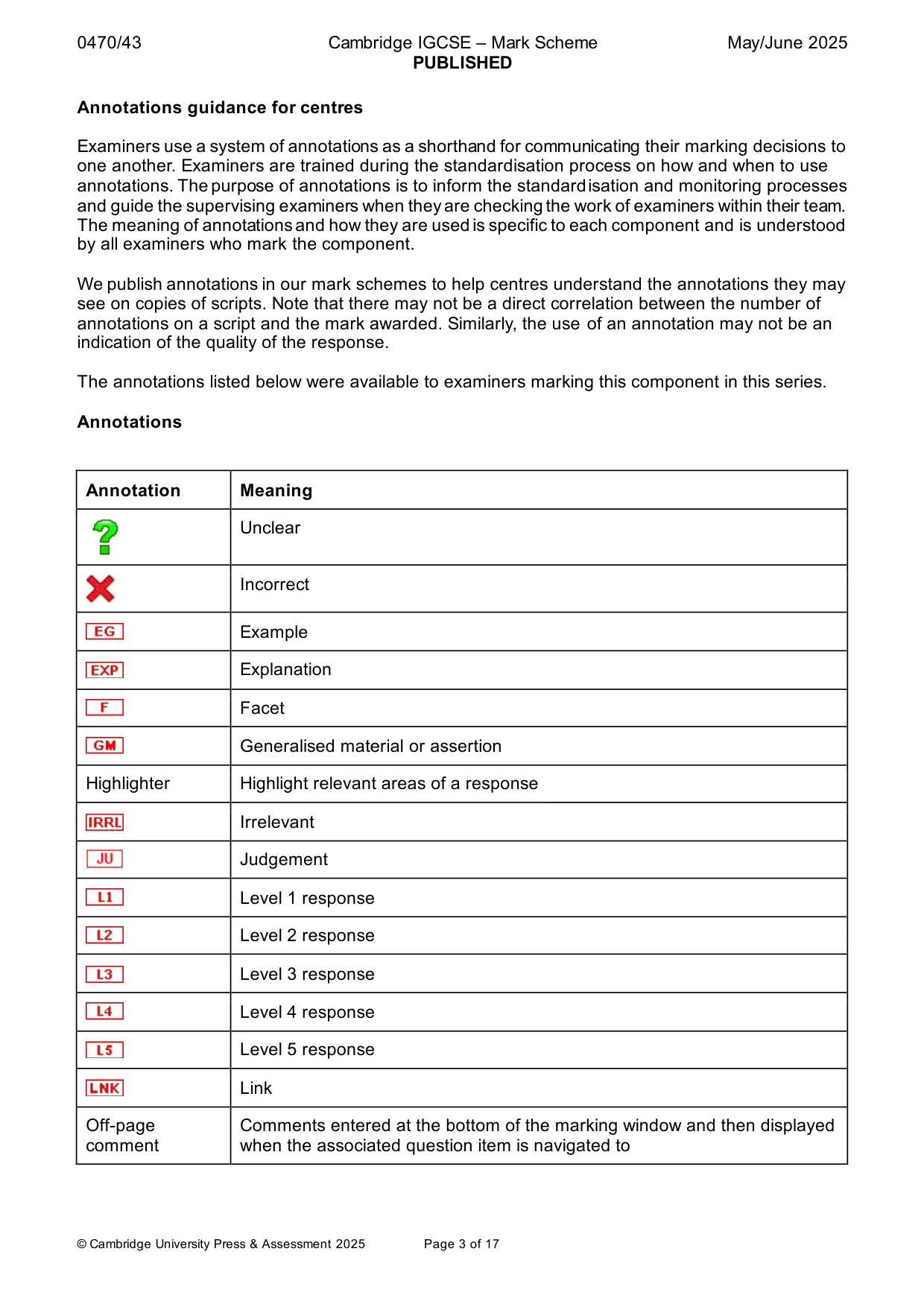
0470/43 Cambridge IGCSE – Mark Scheme PUBLISHED May/June 2025 © Cambridge University Press & Assessment 2025 Page 3 of 17 Annotations guidance for centres Examiners use a system of annotations as a shorthand for communicating their marking decisions to one another. Examiners are trained during the standardisation process on how and when to use annotations. The purpose of annotations is to inform the standardisation and monitoring processes and guide the supervising examiners when they are checking the work of examiners within their team. The meaning of annotations and how they are used is specific to each component and is understood by all examiners who mark the component. We publish annotations in our mark schemes to help centres understand the annotations they may see on copies of scripts. Note that there may not be a direct correlation between the number of annotations on a script and the mark awarded. Similarly, the use of an annotation may not be an indication of the quality of the response. The annotations listed below were available to examiners marking this component in this series. Annotations Annotation Meaning Unclear Incorrect Example Explanation Facet Generalised material or assertion Highlighter Highlight relevant areas of a response Irrelevant Judgement Level 1 response Level 2 response Level 3 response Level 4 response Level 5 response Link Off-page comment Comments entered at the bottom of the marking window and then displayed when the associated question item is navigated to
Mark scheme, page 4
0470/43 Cambridge IGCSE – Mark Scheme PUBLISHED May/June 2025 © Cambridge University Press & Assessment 2025 Page 4 of 17 Annotation Meaning On-page comment Comments entered in speech bubbles on the candidate response Repetition To indicate that a point has been noted but no credit has been given OR To indicate that a blank page has been checked for creditable content
Mark scheme, page 5
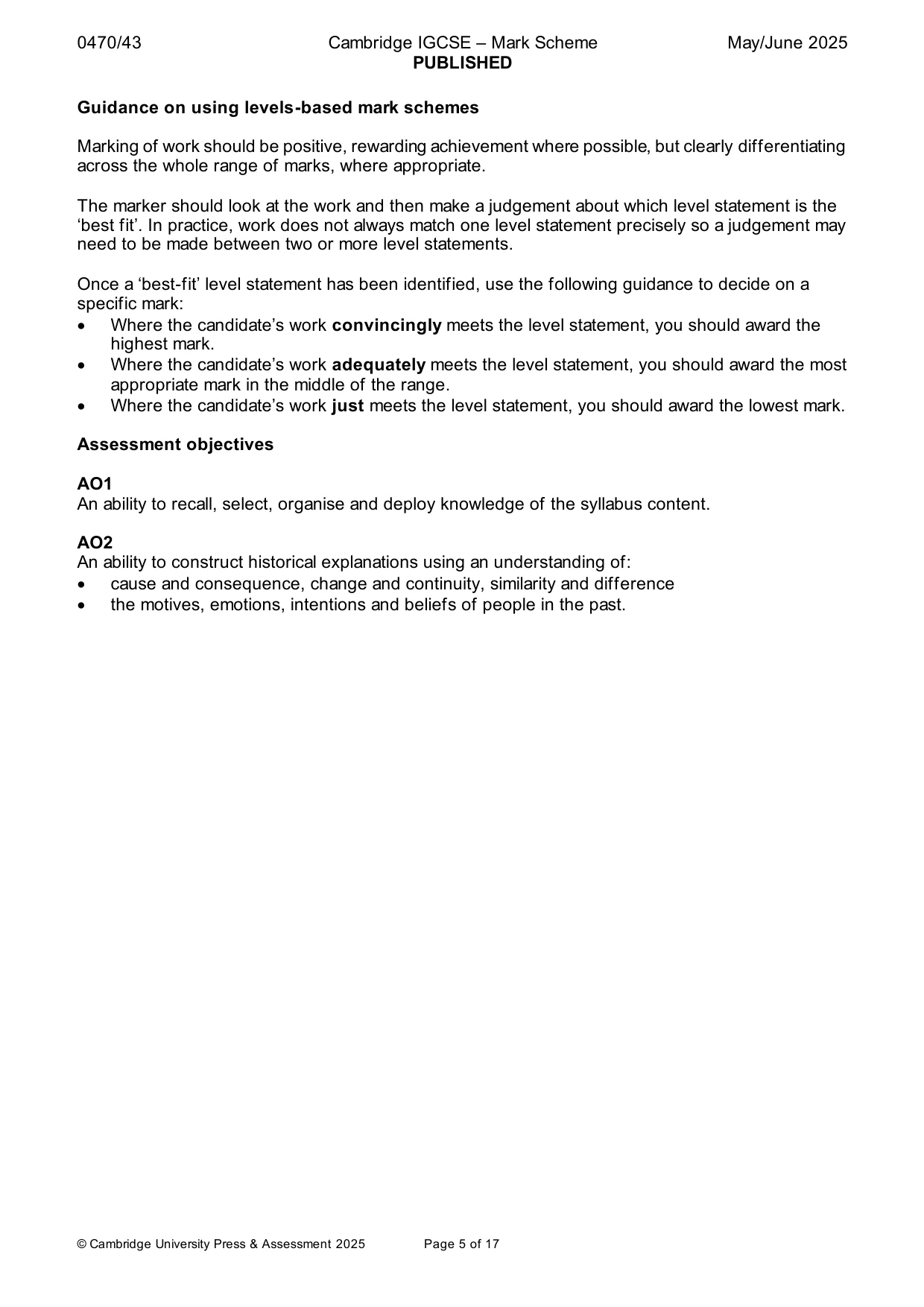
0470/43 Cambridge IGCSE – Mark Scheme PUBLISHED May/June 2025 © Cambridge University Press & Assessment 2025 Page 5 of 17 Guidance on using levels-based mark schemes Marking of work should be positive, rewarding achievement where possible, but clearly differentiating across the whole range of marks, where appropriate. The marker should look at the work and then make a judgement about which level statement is the ‘best fit’. In practice, work does not always match one level statement precisely so a judgement may need to be made between two or more level statements. Once a ‘best-fit’ level statement has been identified, use the following guidance to decide on a specific mark: • Where the candidate’s work convincingly meets the level statement, you should award the highest mark. • Where the candidate’s work adequately meets the level statement, you should award the most appropriate mark in the middle of the range. • Where the candidate’s work just meets the level statement, you should award the lowest mark. Assessment objectives AO1 An ability to recall, select, organise and deploy knowledge of the syllabus content. AO2 An ability to construct historical explanations using an understanding of: • cause and consequence, change and continuity, similarity and difference • the motives, emotions, intentions and beliefs of people in the past.
Mark scheme, page 6
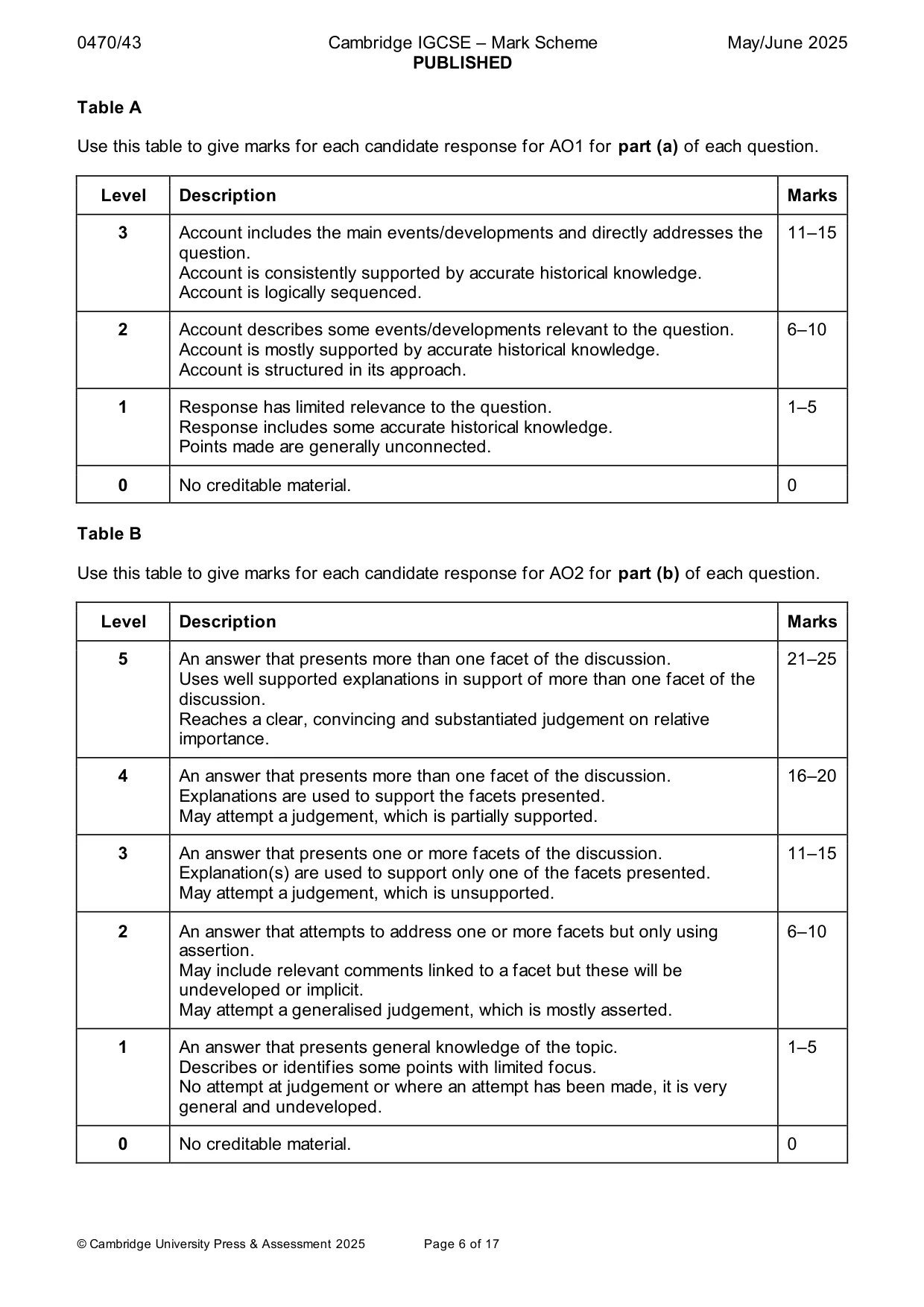
0470/43 Cambridge IGCSE – Mark Scheme PUBLISHED May/June 2025 © Cambridge University Press & Assessment 2025 Page 6 of 17 Table A Use this table to give marks for each candidate response for AO1 for part (a) of each question. Level Description Marks 3 Account includes the main events/developments and directly addresses the question. Account is consistently supported by accurate historical knowledge. Account is logically sequenced. 11–15 2 Account describes some events/developments relevant to the question. Account is mostly supported by accurate historical knowledge. Account is structured in its approach. 6–10 1 Response has limited relevance to the question. Response includes some accurate historical knowledge. Points made are generally unconnected. 1–5 0 No creditable material. 0 Table B Use this table to give marks for each candidate response for AO2 for part (b) of each question. Level Description Marks 5 An answer that presents more than one facet of the discussion. Uses well supported explanations in support of more than one facet of the discussion. Reaches a clear, convincing and substantiated judgement on relative importance. 21–25 4 An answer that presents more than one facet of the discussion. Explanations are used to support the facets presented. May attempt a judgement, which is partially supported. 16–20 3 An answer that presents one or more facets of the discussion. Explanation(s) are used to support only one of the facets presented. May attempt a judgement, which is unsupported. 11–15 2 An answer that attempts to address one or more facets but only using assertion. May include relevant comments linked to a facet but these will be undeveloped or implicit. May attempt a generalised judgement, which is mostly asserted. 6–10 1 An answer that presents general knowledge of the topic. Describes or identifies some points with limited focus. No attempt at judgement or where an attempt has been made, it is very general and undeveloped. 1–5 0 No creditable material. 0
Mark scheme, page 7
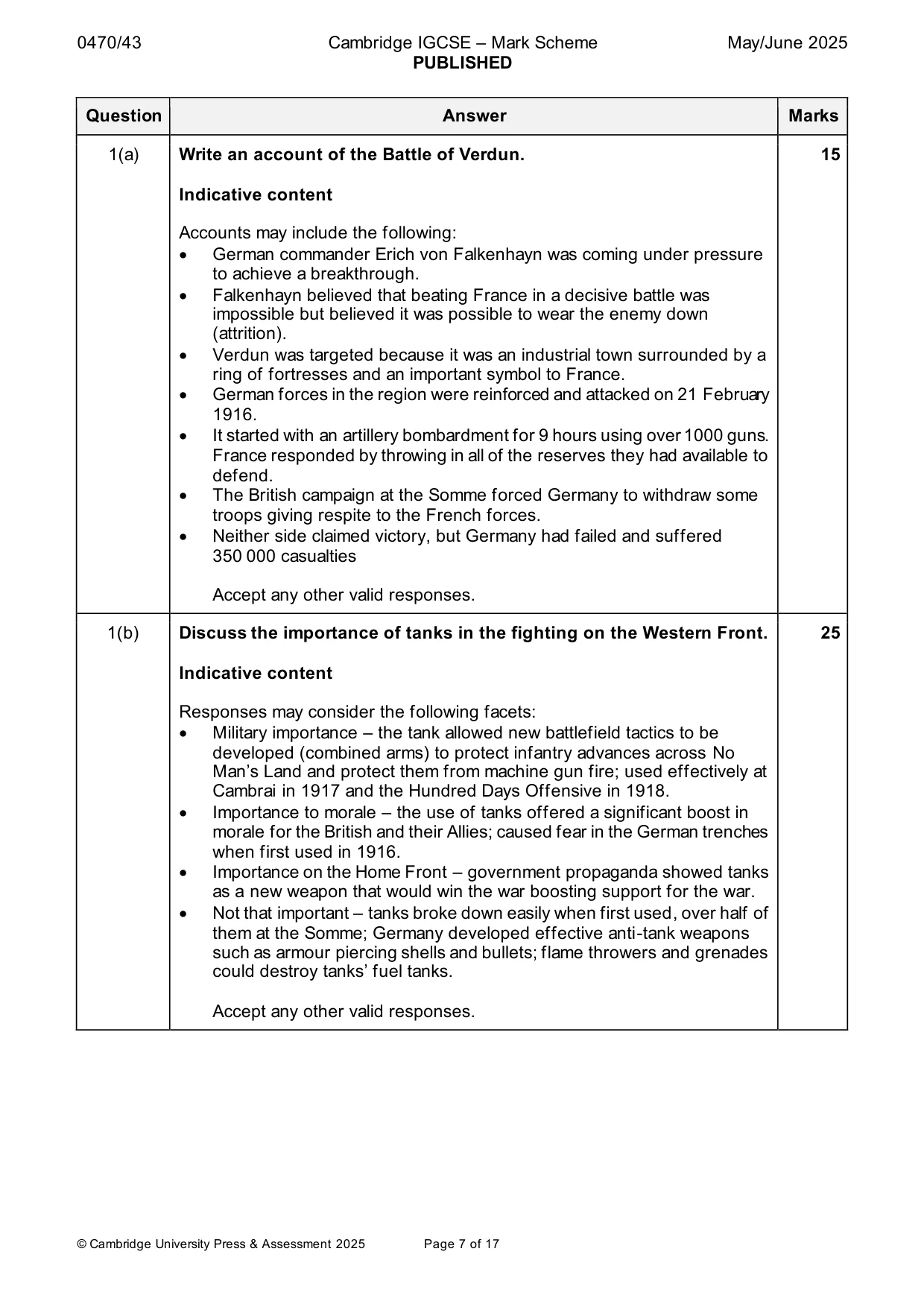
0470/43 Cambridge IGCSE – Mark Scheme PUBLISHED May/June 2025 © Cambridge University Press & Assessment 2025 Page 7 of 17 Question Answer Marks 1(a) Write an account of the Battle of Verdun. Indicative content Accounts may include the following: • German commander Erich von Falkenhayn was coming under pressure to achieve a breakthrough. • Falkenhayn believed that beating France in a decisive battle was impossible but believed it was possible to wear the enemy down (attrition). • Verdun was targeted because it was an industrial town surrounded by a ring of fortresses and an important symbol to France. • German forces in the region were reinforced and attacked on 21 February 1916. • It started with an artillery bombardment for 9 hours using over 1000 guns. France responded by throwing in all of the reserves they had available to defend. • The British campaign at the Somme forced Germany to withdraw some troops giving respite to the French forces. • Neither side claimed victory, but Germany had failed and suffered 350 000 casualties Accept any other valid responses. 15 1(b) Discuss the importance of tanks in the fighting on the Western Front. Indicative content Responses may consider the following facets: • Military importance – the tank allowed new battlefield tactics to be developed (combined arms) to protect infantry advances across No Man’s Land and protect them from machine gun fire; used effectively at Cambrai in 1917 and the Hundred Days Offensive in 1918. • Importance to morale – the use of tanks offered a significant boost in morale for the British and their Allies; caused fear in the German trenches when first used in 1916. • Importance on the Home Front – government propaganda showed tanks as a new weapon that would win the war boosting support for the war. • Not that important – tanks broke down easily when first used, over half of them at the Somme; Germany developed effective anti-tank weapons such as armour piercing shells and bullets; flame throwers and grenades could destroy tanks’ fuel tanks. Accept any other valid responses. 25
Mark scheme, page 8
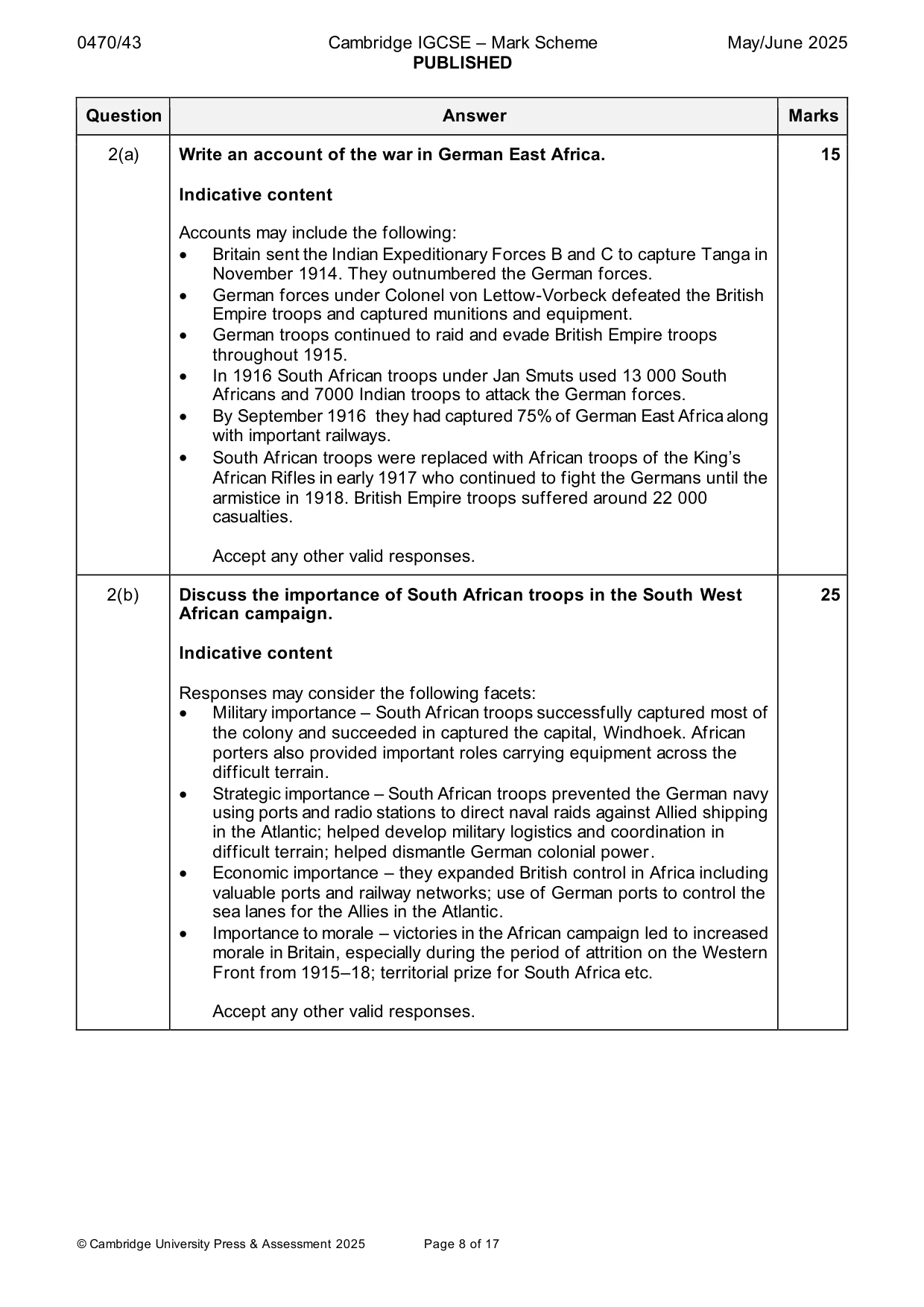
0470/43 Cambridge IGCSE – Mark Scheme PUBLISHED May/June 2025 © Cambridge University Press & Assessment 2025 Page 8 of 17 Question Answer Marks 2(a) Write an account of the war in German East Africa. Indicative content Accounts may include the following: • Britain sent the Indian Expeditionary Forces B and C to capture Tanga in November 1914. They outnumbered the German forces. • German forces under Colonel von Lettow-Vorbeck defeated the British Empire troops and captured munitions and equipment. • German troops continued to raid and evade British Empire troops throughout 1915. • In 1916 South African troops under Jan Smuts used 13 000 South Africans and 7000 Indian troops to attack the German forces. • By September 1916 they had captured 75% of German East Africa along with important railways. • South African troops were replaced with African troops of the King’s African Rifles in early 1917 who continued to fight the Germans until the armistice in 1918. British Empire troops suffered around 22 000 casualties. Accept any other valid responses. 15 2(b) Discuss the importance of South African troops in the South West African campaign. Indicative content Responses may consider the following facets: • Military importance – South African troops successfully captured most of the colony and succeeded in captured the capital, Windhoek. African porters also provided important roles carrying equipment across the difficult terrain. • Strategic importance – South African troops prevented the German navy using ports and radio stations to direct naval raids against Allied shipping in the Atlantic; helped develop military logistics and coordination in difficult terrain; helped dismantle German colonial power. • Economic importance – they expanded British control in Africa including valuable ports and railway networks; use of German ports to control the sea lanes for the Allies in the Atlantic. • Importance to morale – victories in the African campaign led to increased morale in Britain, especially during the period of attrition on the Western Front from 1915–18; territorial prize for South Africa etc. Accept any other valid responses. 25
Mark scheme, page 9
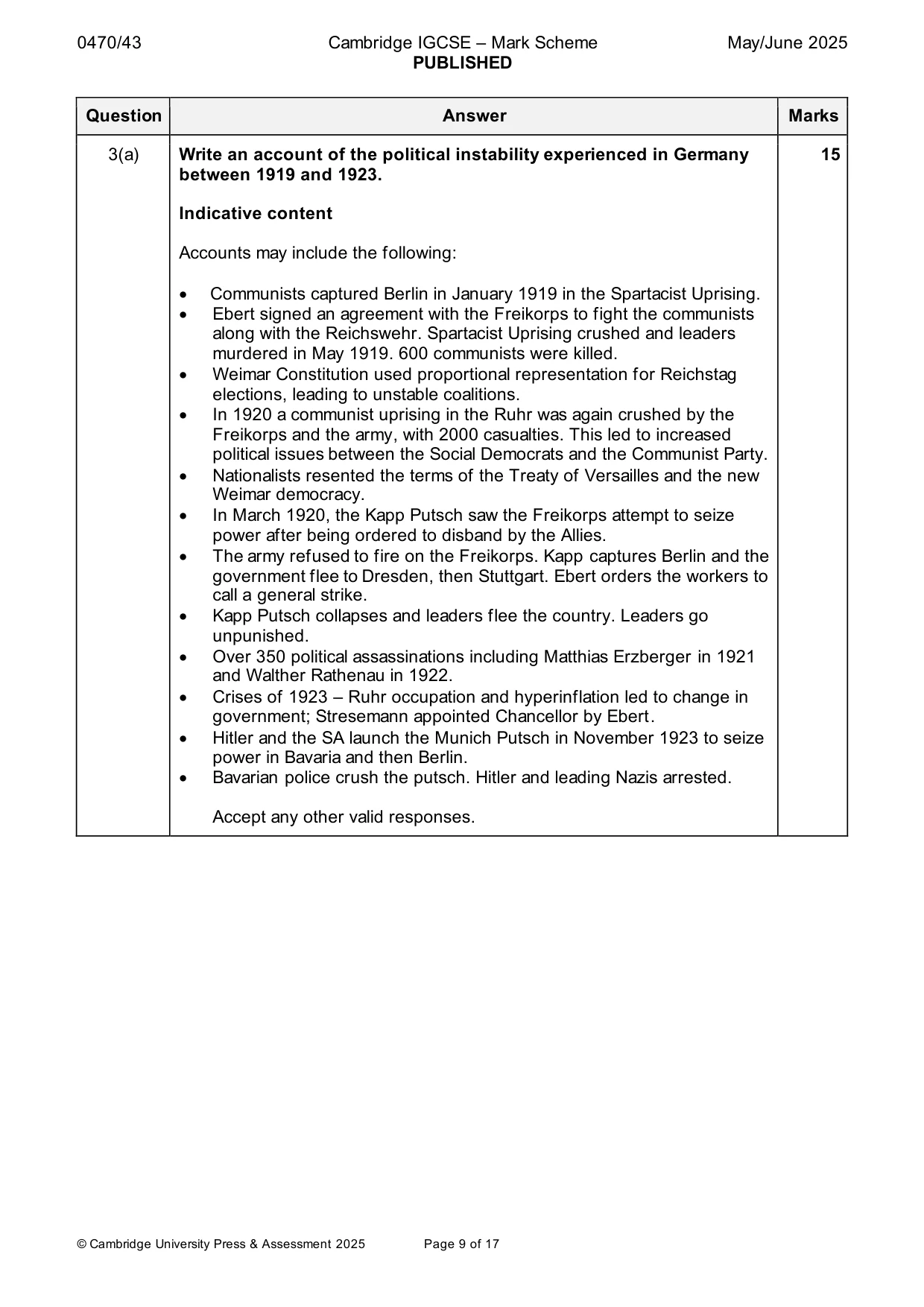
0470/43 Cambridge IGCSE – Mark Scheme PUBLISHED May/June 2025 © Cambridge University Press & Assessment 2025 Page 9 of 17 Question Answer Marks 3(a) Write an account of the political instability experienced in Germany between 1919 and 1923. Indicative content Accounts may include the following: • Communists captured Berlin in January 1919 in the Spartacist Uprising. • Ebert signed an agreement with the Freikorps to fight the communists along with the Reichswehr. Spartacist Uprising crushed and leaders murdered in May 1919. 600 communists were killed. • Weimar Constitution used proportional representation for Reichstag elections, leading to unstable coalitions. • In 1920 a communist uprising in the Ruhr was again crushed by the Freikorps and the army, with 2000 casualties. This led to increased political issues between the Social Democrats and the Communist Party. • Nationalists resented the terms of the Treaty of Versailles and the new Weimar democracy. • In March 1920, the Kapp Putsch saw the Freikorps attempt to seize power after being ordered to disband by the Allies. • The army refused to fire on the Freikorps. Kapp captures Berlin and the government flee to Dresden, then Stuttgart. Ebert orders the workers to call a general strike. • Kapp Putsch collapses and leaders flee the country. Leaders go unpunished. • Over 350 political assassinations including Matthias Erzberger in 1921 and Walther Rathenau in 1922. • Crises of 1923 – Ruhr occupation and hyperinflation led to change in government; Stresemann appointed Chancellor by Ebert. • Hitler and the SA launch the Munich Putsch in November 1923 to seize power in Bavaria and then Berlin. • Bavarian police crush the putsch. Hitler and leading Nazis arrested. Accept any other valid responses. 15
Mark scheme, page 10
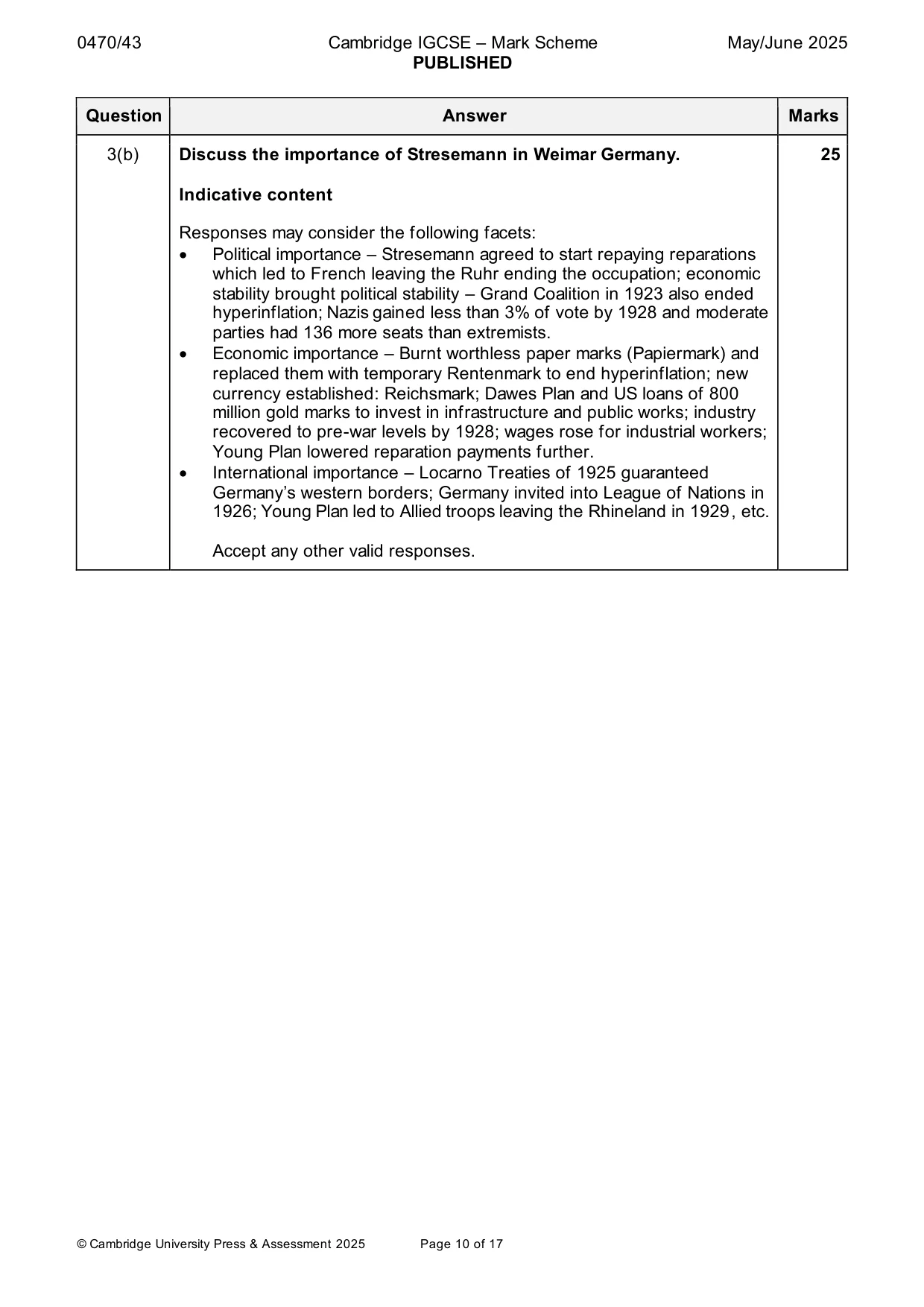
0470/43 Cambridge IGCSE – Mark Scheme PUBLISHED May/June 2025 © Cambridge University Press & Assessment 2025 Page 10 of 17 Question Answer Marks 3(b) Discuss the importance of Stresemann in Weimar Germany. Indicative content Responses may consider the following facets: • Political importance – Stresemann agreed to start repaying reparations which led to French leaving the Ruhr ending the occupation; economic stability brought political stability – Grand Coalition in 1923 also ended hyperinflation; Nazis gained less than 3% of vote by 1928 and moderate parties had 136 more seats than extremists. • Economic importance – Burnt worthless paper marks (Papiermark) and replaced them with temporary Rentenmark to end hyperinflation; new currency established: Reichsmark; Dawes Plan and US loans of 800 million gold marks to invest in infrastructure and public works; industry recovered to pre-war levels by 1928; wages rose for industrial workers; Young Plan lowered reparation payments further. • International importance – Locarno Treaties of 1925 guaranteed Germany’s western borders; Germany invited into League of Nations in 1926; Young Plan led to Allied troops leaving the Rhineland in 1929, etc. Accept any other valid responses. 25
Mark scheme, page 11
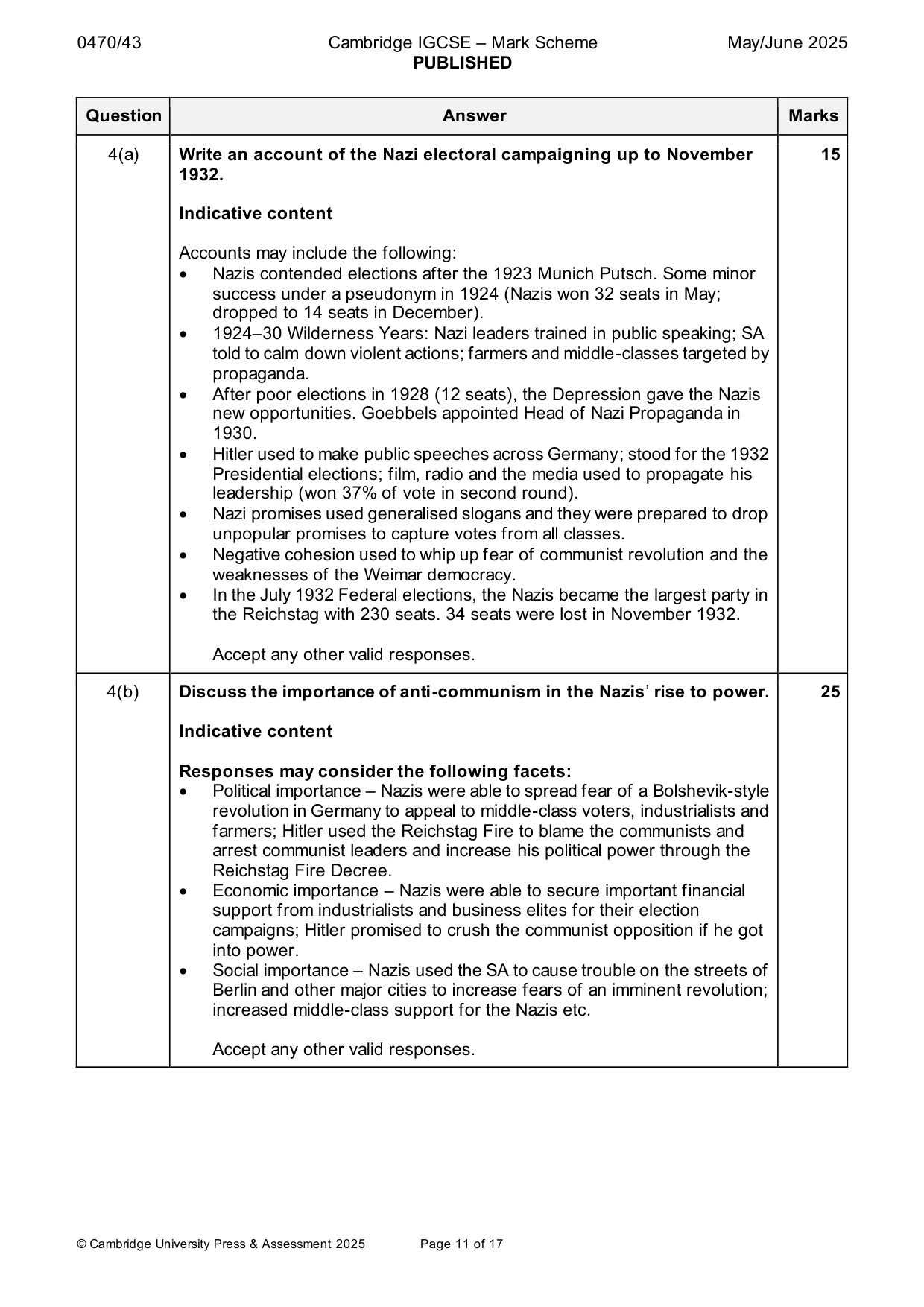
0470/43 Cambridge IGCSE – Mark Scheme PUBLISHED May/June 2025 © Cambridge University Press & Assessment 2025 Page 11 of 17 Question Answer Marks 4(a) Write an account of the Nazi electoral campaigning up to November 1932. Indicative content Accounts may include the following: • Nazis contended elections after the 1923 Munich Putsch. Some minor success under a pseudonym in 1924 (Nazis won 32 seats in May; dropped to 14 seats in December). • 1924–30 Wilderness Years: Nazi leaders trained in public speaking; SA told to calm down violent actions; farmers and middle-classes targeted by propaganda. • After poor elections in 1928 (12 seats), the Depression gave the Nazis new opportunities. Goebbels appointed Head of Nazi Propaganda in 1930. • Hitler used to make public speeches across Germany; stood for the 1932 Presidential elections; film, radio and the media used to propagate his leadership (won 37% of vote in second round). • Nazi promises used generalised slogans and they were prepared to drop unpopular promises to capture votes from all classes. • Negative cohesion used to whip up fear of communist revolution and the weaknesses of the Weimar democracy. • In the July 1932 Federal elections, the Nazis became the largest party in the Reichstag with 230 seats. 34 seats were lost in November 1932. Accept any other valid responses. 15 4(b) Discuss the importance of anti-communism in the Nazis’ rise to power. Indicative content Responses may consider the following facets: • Political importance – Nazis were able to spread fear of a Bolshevik-style revolution in Germany to appeal to middle-class voters, industrialists and farmers; Hitler used the Reichstag Fire to blame the communists and arrest communist leaders and increase his political power through the Reichstag Fire Decree. • Economic importance – Nazis were able to secure important financial support from industrialists and business elites for their election campaigns; Hitler promised to crush the communist opposition if he got into power. • Social importance – Nazis used the SA to cause trouble on the streets of Berlin and other major cities to increase fears of an imminent revolution; increased middle-class support for the Nazis etc. Accept any other valid responses. 25
Mark scheme, page 12
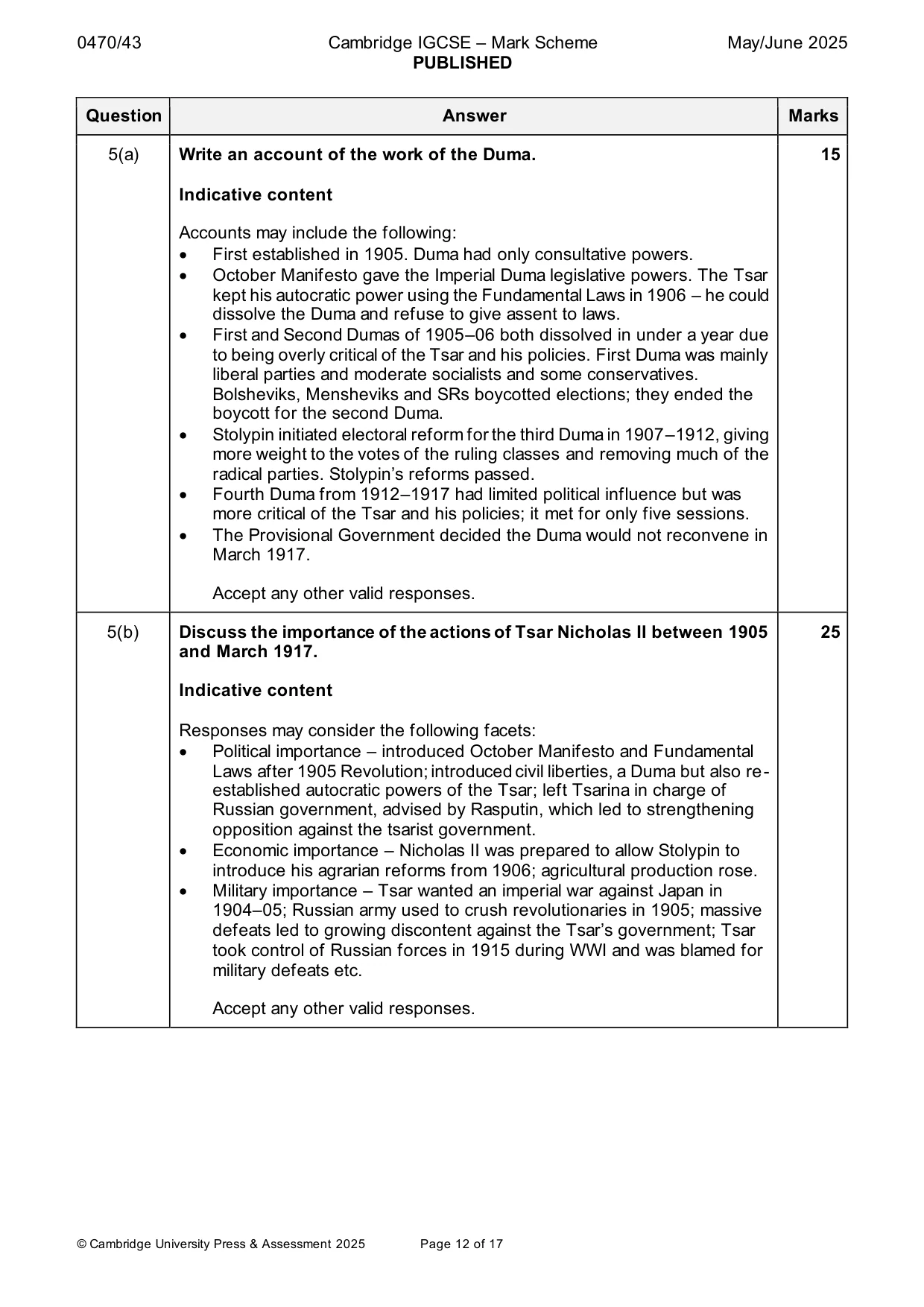
0470/43 Cambridge IGCSE – Mark Scheme PUBLISHED May/June 2025 © Cambridge University Press & Assessment 2025 Page 12 of 17 Question Answer Marks 5(a) Write an account of the work of the Duma. Indicative content Accounts may include the following: • First established in 1905. Duma had only consultative powers. • October Manifesto gave the Imperial Duma legislative powers. The Tsar kept his autocratic power using the Fundamental Laws in 1906 – he could dissolve the Duma and refuse to give assent to laws. • First and Second Dumas of 1905–06 both dissolved in under a year due to being overly critical of the Tsar and his policies. First Duma was mainly liberal parties and moderate socialists and some conservatives. Bolsheviks, Mensheviks and SRs boycotted elections; they ended the boycott for the second Duma. • Stolypin initiated electoral reform for the third Duma in 1907–1912, giving more weight to the votes of the ruling classes and removing much of the radical parties. Stolypin’s reforms passed. • Fourth Duma from 1912–1917 had limited political influence but was more critical of the Tsar and his policies; it met for only five sessions. • The Provisional Government decided the Duma would not reconvene in March 1917. Accept any other valid responses. 15 5(b) Discuss the importance of the actions of Tsar Nicholas II between 1905 and March 1917. Indicative content Responses may consider the following facets: • Political importance – introduced October Manifesto and Fundamental Laws after 1905 Revolution; introduced civil liberties, a Duma but also re- established autocratic powers of the Tsar; left Tsarina in charge of Russian government, advised by Rasputin, which led to strengthening opposition against the tsarist government. • Economic importance – Nicholas II was prepared to allow Stolypin to introduce his agrarian reforms from 1906; agricultural production rose. • Military importance – Tsar wanted an imperial war against Japan in 1904–05; Russian army used to crush revolutionaries in 1905; massive defeats led to growing discontent against the Tsar’s government; Tsar took control of Russian forces in 1915 during WWI and was blamed for military defeats etc. Accept any other valid responses. 25
Mark scheme, page 13
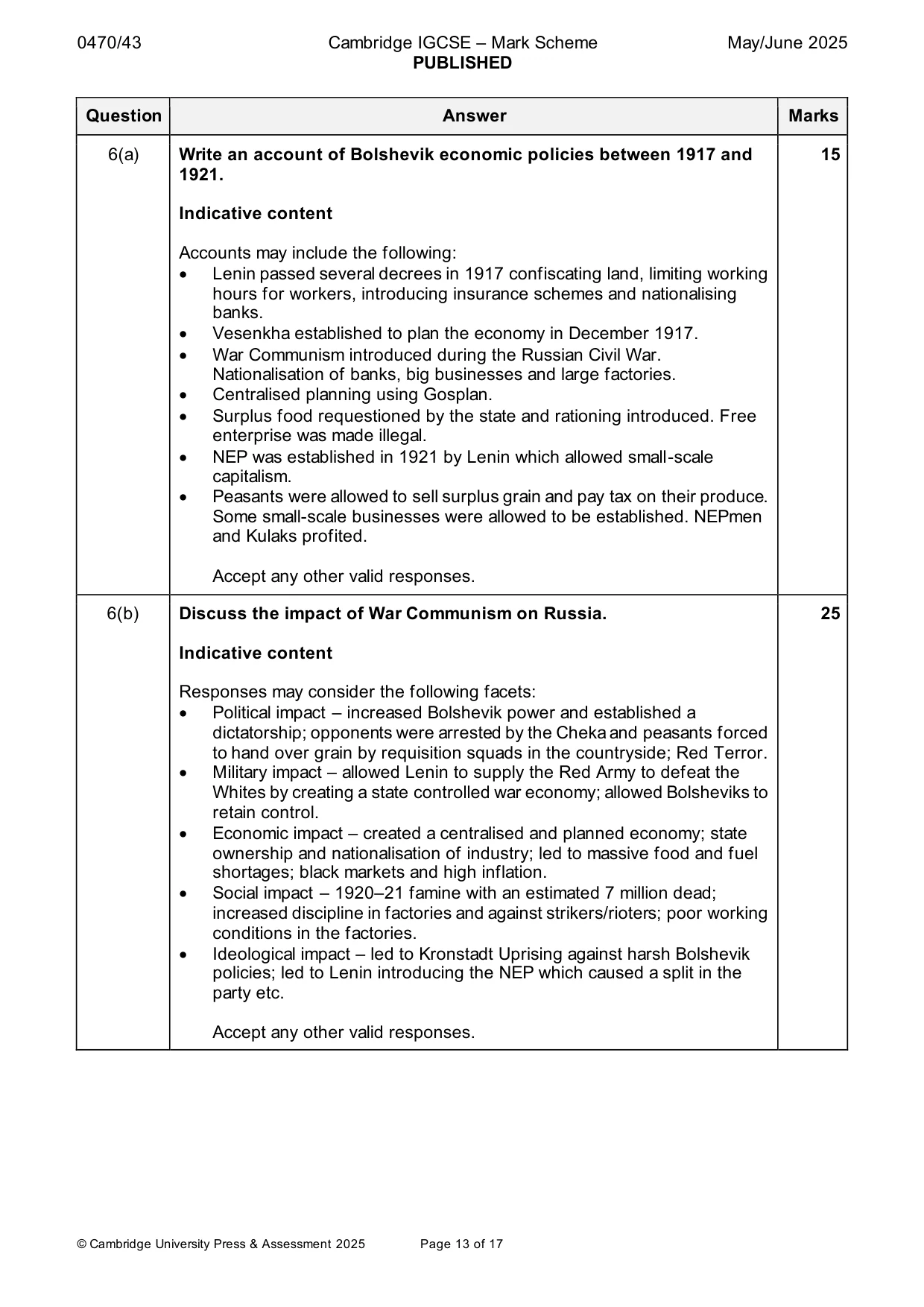
0470/43 Cambridge IGCSE – Mark Scheme PUBLISHED May/June 2025 © Cambridge University Press & Assessment 2025 Page 13 of 17 Question Answer Marks 6(a) Write an account of Bolshevik economic policies between 1917 and 1921. Indicative content Accounts may include the following: • Lenin passed several decrees in 1917 confiscating land, limiting working hours for workers, introducing insurance schemes and nationalising banks. • Vesenkha established to plan the economy in December 1917. • War Communism introduced during the Russian Civil War. Nationalisation of banks, big businesses and large factories. • Centralised planning using Gosplan. • Surplus food requestioned by the state and rationing introduced. Free enterprise was made illegal. • NEP was established in 1921 by Lenin which allowed small-scale capitalism. • Peasants were allowed to sell surplus grain and pay tax on their produce. Some small-scale businesses were allowed to be established. NEPmen and Kulaks profited. Accept any other valid responses. 15 6(b) Discuss the impact of War Communism on Russia. Indicative content Responses may consider the following facets: • Political impact – increased Bolshevik power and established a dictatorship; opponents were arrested by the Cheka and peasants forced to hand over grain by requisition squads in the countryside; Red Terror. • Military impact – allowed Lenin to supply the Red Army to defeat the Whites by creating a state controlled war economy; allowed Bolsheviks to retain control. • Economic impact – created a centralised and planned economy; state ownership and nationalisation of industry; led to massive food and fuel shortages; black markets and high inflation. • Social impact – 1920–21 famine with an estimated 7 million dead; increased discipline in factories and against strikers/rioters; poor working conditions in the factories. • Ideological impact – led to Kronstadt Uprising against harsh Bolshevik policies; led to Lenin introducing the NEP which caused a split in the party etc. Accept any other valid responses. 25
Mark scheme, page 14
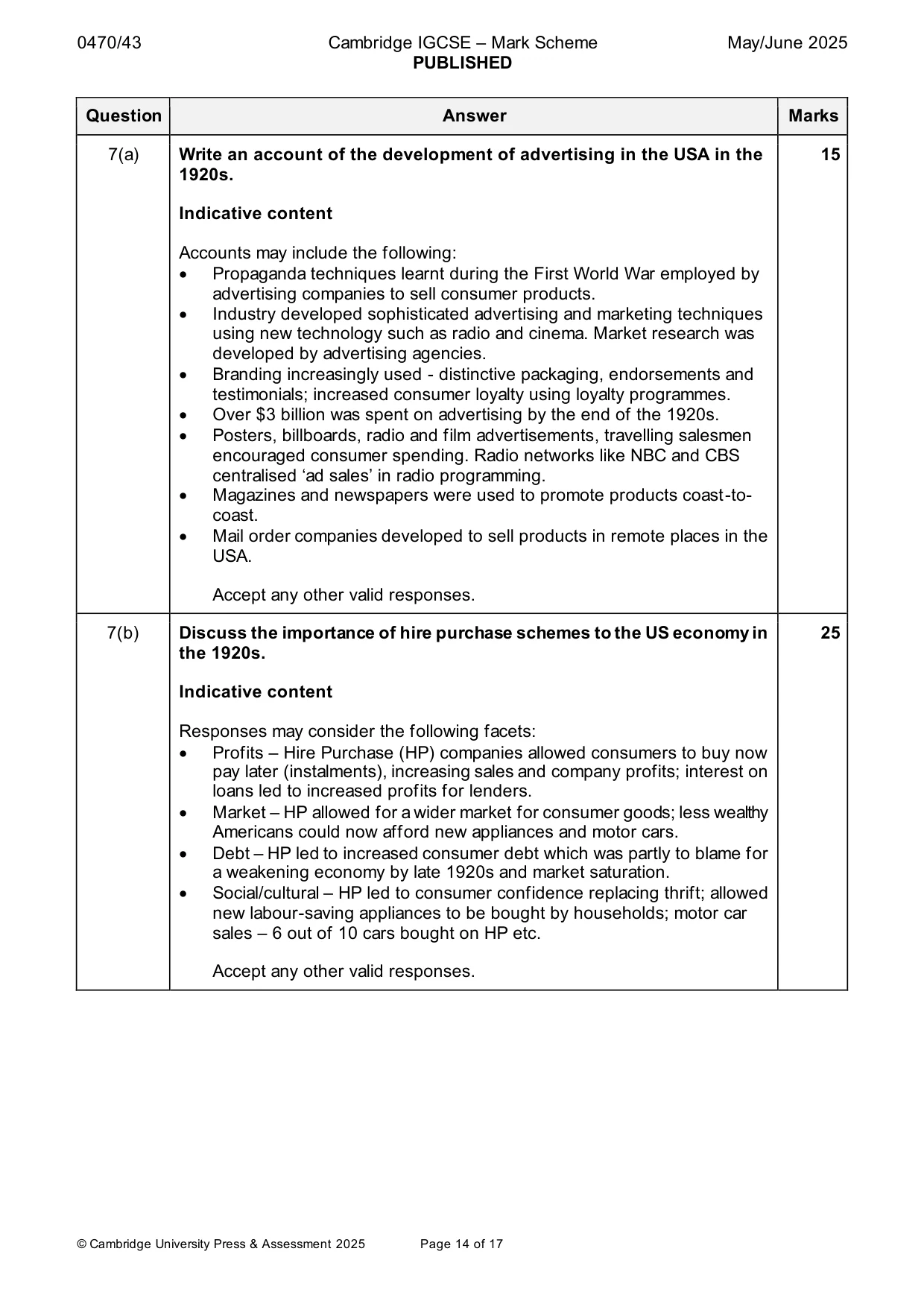
0470/43 Cambridge IGCSE – Mark Scheme PUBLISHED May/June 2025 © Cambridge University Press & Assessment 2025 Page 14 of 17 Question Answer Marks 7(a) Write an account of the development of advertising in the USA in the 1920s. Indicative content Accounts may include the following: • Propaganda techniques learnt during the First World War employed by advertising companies to sell consumer products. • Industry developed sophisticated advertising and marketing techniques using new technology such as radio and cinema. Market research was developed by advertising agencies. • Branding increasingly used - distinctive packaging, endorsements and testimonials; increased consumer loyalty using loyalty programmes. • Over $3 billion was spent on advertising by the end of the 1920s. • Posters, billboards, radio and film advertisements, travelling salesmen encouraged consumer spending. Radio networks like NBC and CBS centralised ‘ad sales’ in radio programming. • Magazines and newspapers were used to promote products coast-to- coast. • Mail order companies developed to sell products in remote places in the USA. Accept any other valid responses. 15 7(b) Discuss the importance of hire purchase schemes to the US economy in the 1920s. Indicative content Responses may consider the following facets: • Profits – Hire Purchase (HP) companies allowed consumers to buy now pay later (instalments), increasing sales and company profits; interest on loans led to increased profits for lenders. • Market – HP allowed for a wider market for consumer goods; less wealthy Americans could now afford new appliances and motor cars. • Debt – HP led to increased consumer debt which was partly to blame for a weakening economy by late 1920s and market saturation. • Social/cultural – HP led to consumer confidence replacing thrift; allowed new labour-saving appliances to be bought by households; motor car sales – 6 out of 10 cars bought on HP etc. Accept any other valid responses. 25
Mark scheme, page 15
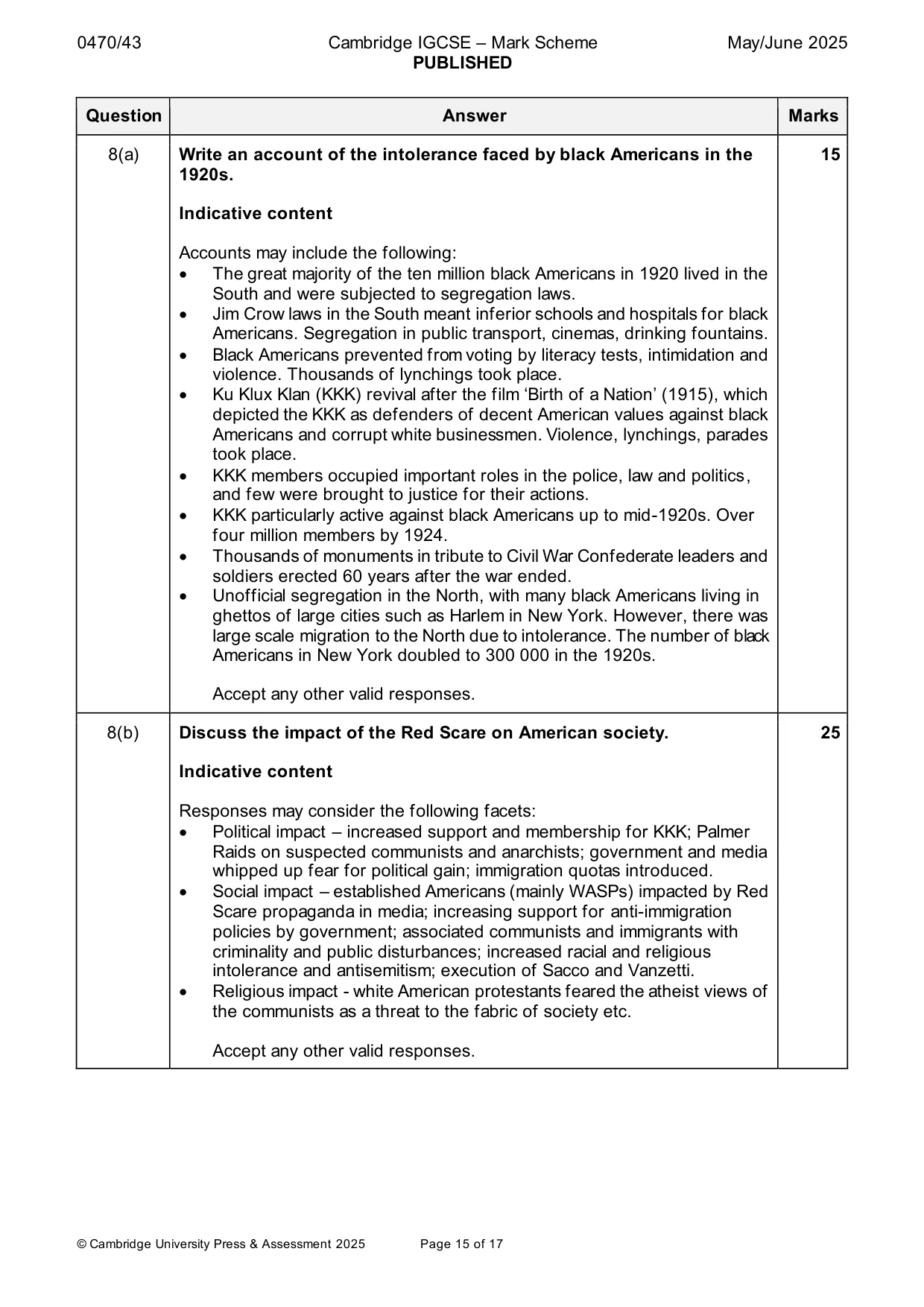
0470/43 Cambridge IGCSE – Mark Scheme PUBLISHED May/June 2025 © Cambridge University Press & Assessment 2025 Page 15 of 17 Question Answer Marks 8(a) Write an account of the intolerance faced by black Americans in the 1920s. Indicative content Accounts may include the following: • The great majority of the ten million black Americans in 1920 lived in the South and were subjected to segregation laws. • Jim Crow laws in the South meant inferior schools and hospitals for black Americans. Segregation in public transport, cinemas, drinking fountains. • Black Americans prevented from voting by literacy tests, intimidation and violence. Thousands of lynchings took place. • Ku Klux Klan (KKK) revival after the film ‘Birth of a Nation’ (1915), which depicted the KKK as defenders of decent American values against black Americans and corrupt white businessmen. Violence, lynchings, parades took place. • KKK members occupied important roles in the police, law and politics, and few were brought to justice for their actions. • KKK particularly active against black Americans up to mid-1920s. Over four million members by 1924. • Thousands of monuments in tribute to Civil War Confederate leaders and soldiers erected 60 years after the war ended. • Unofficial segregation in the North, with many black Americans living in ghettos of large cities such as Harlem in New York. However, there was large scale migration to the North due to intolerance. The number of black Americans in New York doubled to 300 000 in the 1920s. Accept any other valid responses. 15 8(b) Discuss the impact of the Red Scare on American society. Indicative content Responses may consider the following facets: • Political impact – increased support and membership for KKK; Palmer Raids on suspected communists and anarchists; government and media whipped up fear for political gain; immigration quotas introduced. • Social impact – established Americans (mainly WASPs) impacted by Red Scare propaganda in media; increasing support for anti-immigration policies by government; associated communists and immigrants with criminality and public disturbances; increased racial and religious intolerance and antisemitism; execution of Sacco and Vanzetti. • Religious impact - white American protestants feared the atheist views of the communists as a threat to the fabric of society etc. Accept any other valid responses. 25
Mark scheme, page 16
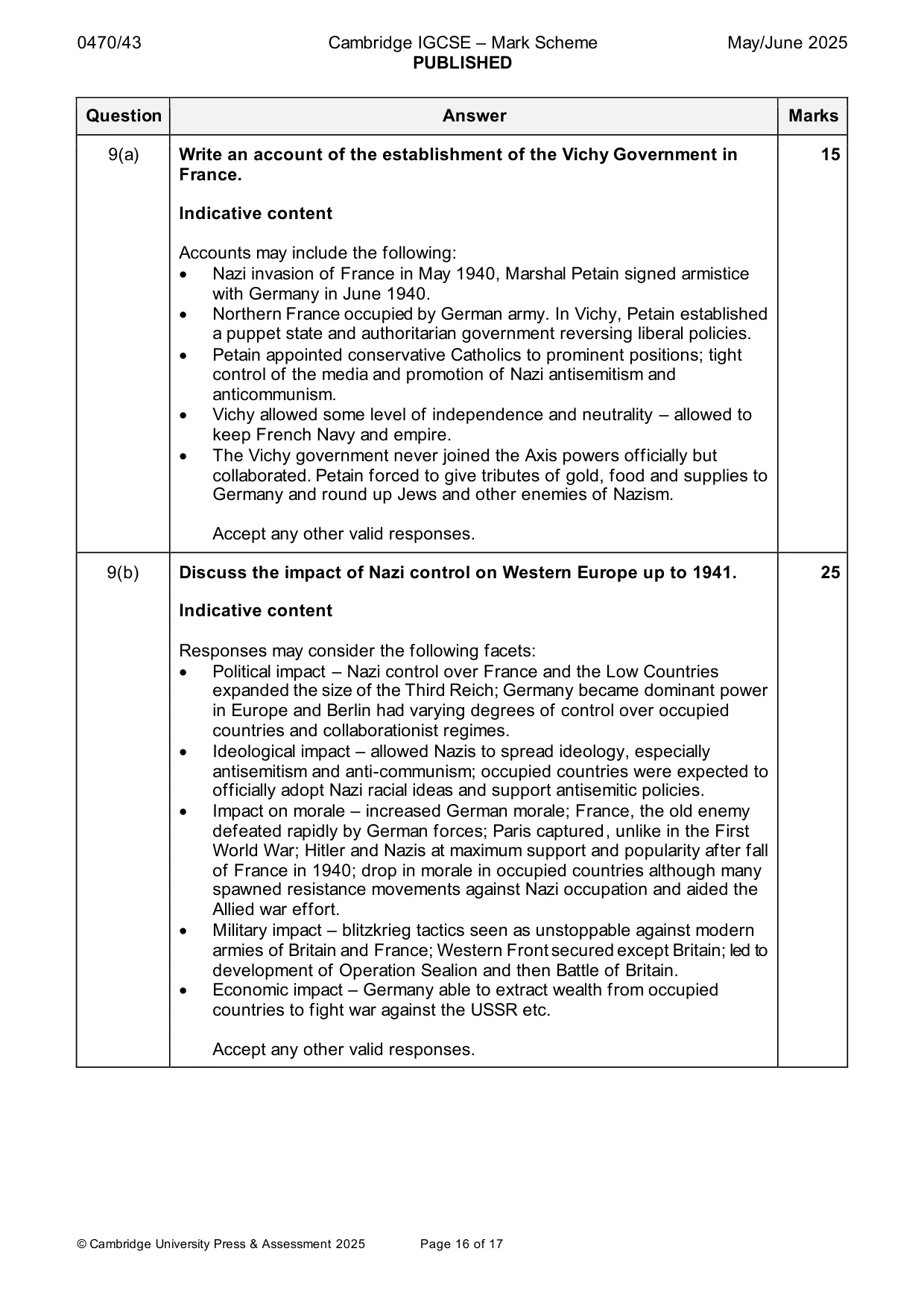
0470/43 Cambridge IGCSE – Mark Scheme PUBLISHED May/June 2025 © Cambridge University Press & Assessment 2025 Page 16 of 17 Question Answer Marks 9(a) Write an account of the establishment of the Vichy Government in France. Indicative content Accounts may include the following: • Nazi invasion of France in May 1940, Marshal Petain signed armistice with Germany in June 1940. • Northern France occupied by German army. In Vichy, Petain established a puppet state and authoritarian government reversing liberal policies. • Petain appointed conservative Catholics to prominent positions; tight control of the media and promotion of Nazi antisemitism and anticommunism. • Vichy allowed some level of independence and neutrality – allowed to keep French Navy and empire. • The Vichy government never joined the Axis powers officially but collaborated. Petain forced to give tributes of gold, food and supplies to Germany and round up Jews and other enemies of Nazism. Accept any other valid responses. 15 9(b) Discuss the impact of Nazi control on Western Europe up to 1941. Indicative content Responses may consider the following facets: • Political impact – Nazi control over France and the Low Countries expanded the size of the Third Reich; Germany became dominant power in Europe and Berlin had varying degrees of control over occupied countries and collaborationist regimes. • Ideological impact – allowed Nazis to spread ideology, especially antisemitism and anti-communism; occupied countries were expected to officially adopt Nazi racial ideas and support antisemitic policies. • Impact on morale – increased German morale; France, the old enemy defeated rapidly by German forces; Paris captured, unlike in the First World War; Hitler and Nazis at maximum support and popularity after fall of France in 1940; drop in morale in occupied countries although many spawned resistance movements against Nazi occupation and aided the Allied war effort. • Military impact – blitzkrieg tactics seen as unstoppable against modern armies of Britain and France; Western Front secured except Britain; led to development of Operation Sealion and then Battle of Britain. • Economic impact – Germany able to extract wealth from occupied countries to fight war against the USSR etc. Accept any other valid responses. 25
Mark scheme, page 17
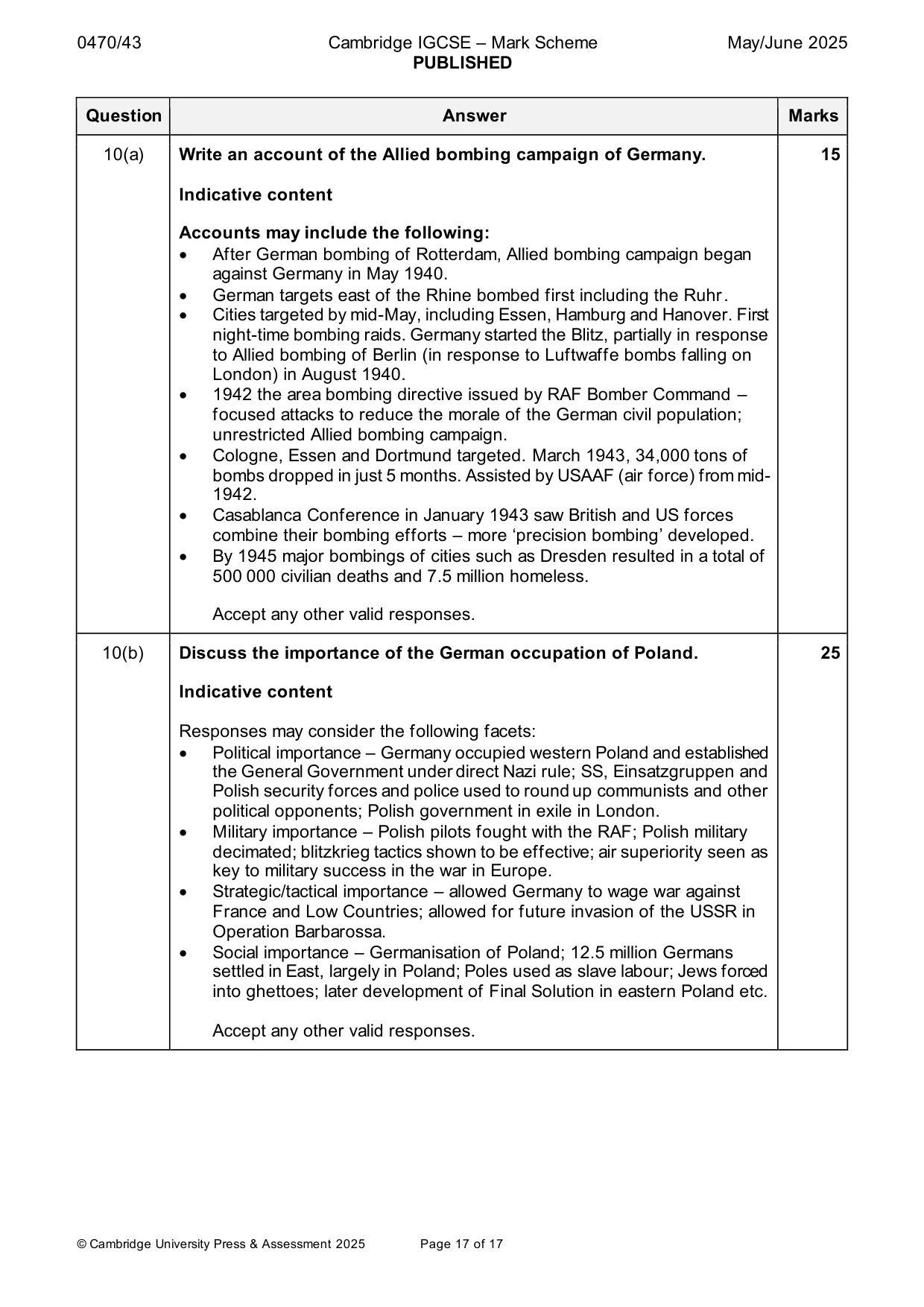
0470/43 Cambridge IGCSE – Mark Scheme PUBLISHED May/June 2025 © Cambridge University Press & Assessment 2025 Page 17 of 17 Question Answer Marks 10(a) Write an account of the Allied bombing campaign of Germany. Indicative content Accounts may include the following: • After German bombing of Rotterdam, Allied bombing campaign began against Germany in May 1940. • German targets east of the Rhine bombed first including the Ruhr. • Cities targeted by mid-May, including Essen, Hamburg and Hanover. First night-time bombing raids. Germany started the Blitz, partially in response to Allied bombing of Berlin (in response to Luftwaffe bombs falling on London) in August 1940. • 1942 the area bombing directive issued by RAF Bomber Command – focused attacks to reduce the morale of the German civil population; unrestricted Allied bombing campaign. • Cologne, Essen and Dortmund targeted. March 1943, 34,000 tons of bombs dropped in just 5 months. Assisted by USAAF (air force) from mid- 1942. • Casablanca Conference in January 1943 saw British and US forces combine their bombing efforts – more ‘precision bombing’ developed. • By 1945 major bombings of cities such as Dresden resulted in a total of 500 000 civilian deaths and 7.5 million homeless. Accept any other valid responses. 15 10(b) Discuss the importance of the German occupation of Poland. Indicative content Responses may consider the following facets: • Political importance – Germany occupied western Poland and established the General Government under direct Nazi rule; SS, Einsatzgruppen and Polish security forces and police used to round up communists and other political opponents; Polish government in exile in London. • Military importance – Polish pilots fought with the RAF; Polish military decimated; blitzkrieg tactics shown to be effective; air superiority seen as key to military success in the war in Europe. • Strategic/tactical importance – allowed Germany to wage war against France and Low Countries; allowed for future invasion of the USSR in Operation Barbarossa. • Social importance – Germanisation of Poland; 12.5 million Germans settled in East, largely in Poland; Poles used as slave labour; Jews forced into ghettoes; later development of Final Solution in eastern Poland etc. Accept any other valid responses. 25
What you needed in this session
Cambridge’s own grade thresholds for 2025 May/June, Paper 4 · Variant 3. A higher threshold means an easier paper — the bar moves with how the cohort did.