Cambridge IGCSE History 0470 — 2023 Oct/Nov Paper 4 · Variant 3
0470/43/O/N/23 · 40 marks · ≈45 min
The question paper and its mark scheme, free to read here and free to download. This is Cambridge’s own paper, exactly as it was sat.
Question paper4 pages

Mark scheme18 pages
Answers below. Sit the paper first if you are practising.
Paper as text
Question paper, page 1
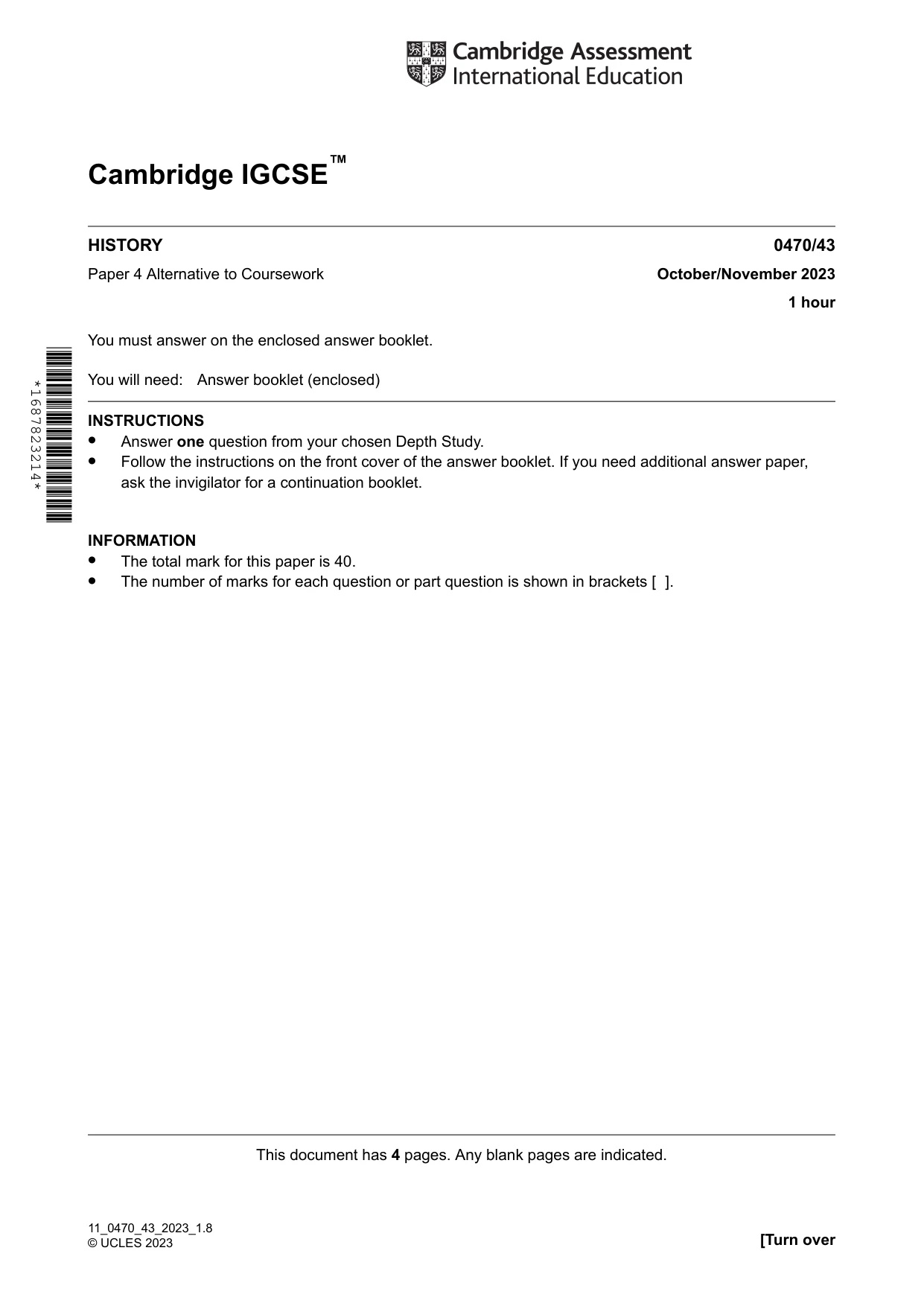
Cambridge IGCSE™ 0470/43 October/November 2023 1 hour HISTORY Paper 4 Alternative to Coursework You must answer on the enclosed answer booklet. You will need: Answer booklet (enclosed) INSTRUCTIONS • Answer one question from your chosen Depth Study. • Follow the instructions on the front cover of the answer booklet. If you need additional answer paper, ask the invigilator for a continuation booklet. INFORMATION • The total mark for this paper is 40. • The number of marks for each question or part question is shown in brackets [ ]. This document has 4 pages. Any blank pages are indicated. [Turn over 11_0470_43_2023_1.8 © UCLES 2023 *1687823214*
Question paper, page 2
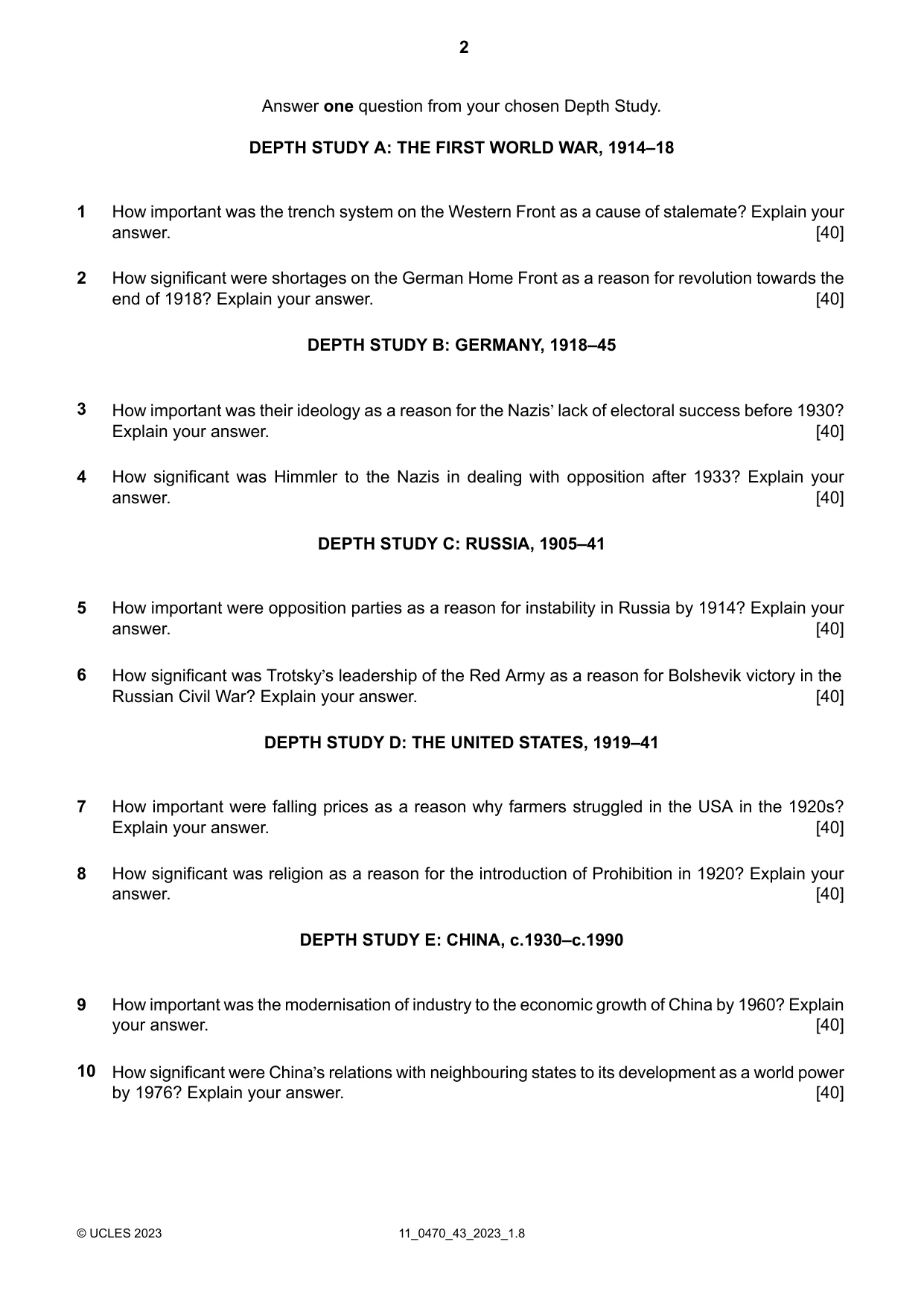
Answer one question from your chosen Depth Study. DEPTH STUDY A: THE FIRST WORLD WAR, 1914–18 How important was the trench system on the Western Front as a cause of stalemate? Explain your answer. [40] 1 How significant were shortages on the German Home Front as a reason for revolution towards the end of 1918? Explain your answer. [40] 2 DEPTH STUDY B: GERMANY, 1918–45 How important was their ideology as a reason for the Nazis’ lack of electoral success before 1930? Explain your answer. [40] 3 How significant was Himmler to the Nazis in dealing with opposition after 1933? Explain your answer. [40] 4 DEPTH STUDY C: RUSSIA, 1905–41 How important were opposition parties as a reason for instability in Russia by 1914? Explain your answer. [40] 5 How significant was Trotsky’s leadership of the Red Army as a reason for Bolshevik victory in the Russian Civil War? Explain your answer. [40] 6 DEPTH STUDY D: THE UNITED STATES, 1919–41 How important were falling prices as a reason why farmers struggled in the USA in the 1920s? Explain your answer. [40] 7 How significant was religion as a reason for the introduction of Prohibition in 1920? Explain your answer. [40] 8 DEPTH STUDY E: CHINA, c.1930–c.1990 How important was the modernisation of industry to the economic growth of China by 1960? Explain your answer. [40] 9 How significant were China’s relations with neighbouring states to its development as a world power by 1976? Explain your answer. [40] 10 11_0470_43_2023_1.8 © UCLES 2023 2
Question paper, page 3
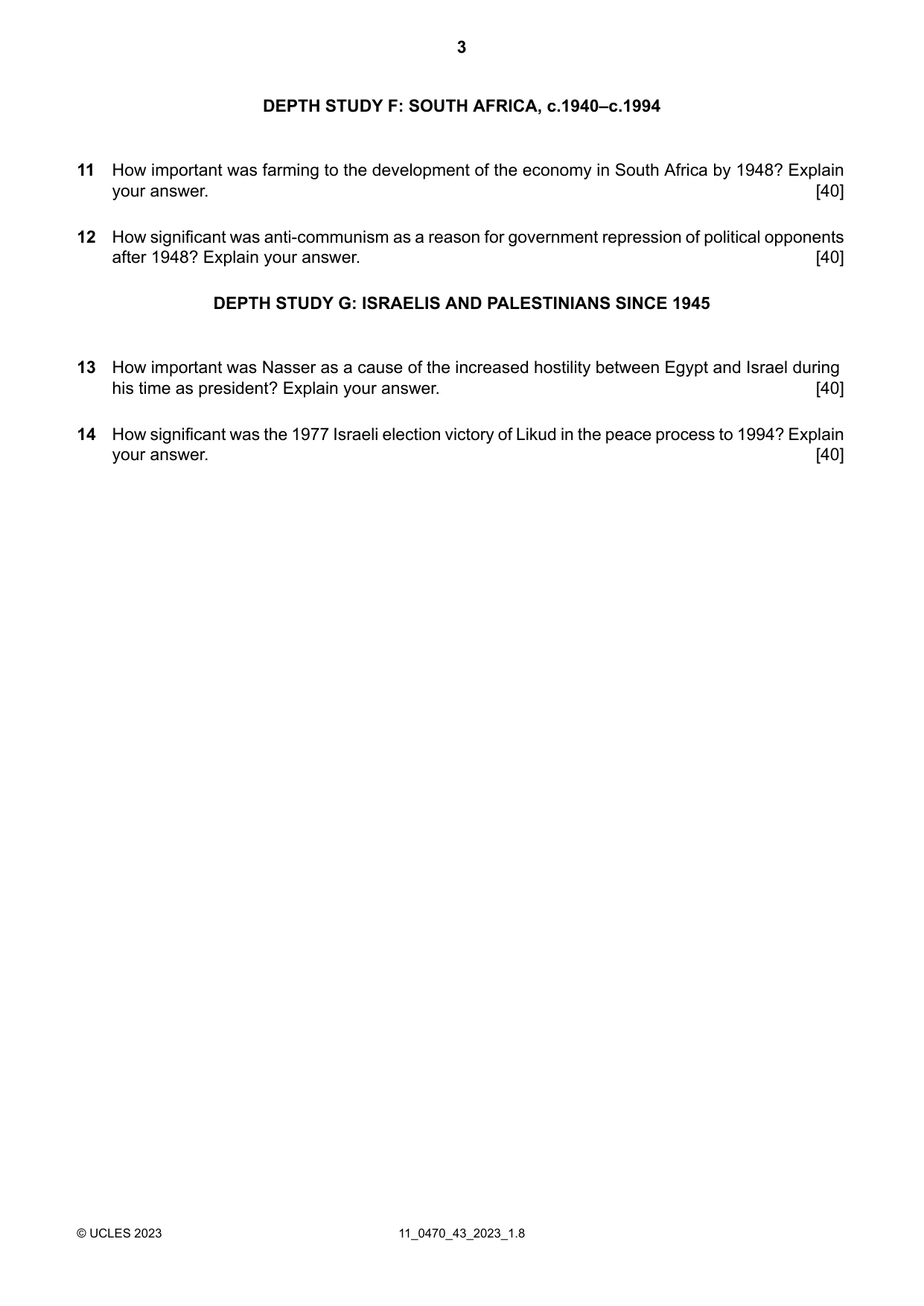
DEPTH STUDY F: SOUTH AFRICA, c.1940–c.1994 How important was farming to the development of the economy in South Africa by 1948? Explain your answer. [40] 11 How significant was anti-communism as a reason for government repression of political opponents after 1948? Explain your answer. [40] 12 DEPTH STUDY G: ISRAELIS AND PALESTINIANS SINCE 1945 How important was Nasser as a cause of the increased hostility between Egypt and Israel during his time as president? Explain your answer. [40] 13 How significant was the 1977 Israeli election victory of Likud in the peace process to 1994? Explain your answer. [40] 14 11_0470_43_2023_1.8 © UCLES 2023 3
Question paper, page 4
BLANK PAGE Permission to reproduce items where third-party owned material protected by copyright is included has been sought and cleared where possible. Every reasonable effort has been made by the publisher (UCLES) to trace copyright holders, but if any items requiring clearance have unwittingly been included, the publisher will be pleased to make amends at the earliest possible opportunity. To avoid the issue of disclosure of answer-related information to candidates, all copyright acknowledgements are reproduced online in the Cambridge Assessment International Education Copyright Acknowledgements Booklet. This is produced for each series of examinations and is freely available to download at www.cambridgeinternational.org after the live examination series. Cambridge Assessment International Education is part of Cambridge Assessment. Cambridge Assessment is the brand name of the University of Cambridge Local Examinations Syndicate (UCLES), which is a department of the University of Cambridge. 11_0470_43_2023_1.8 © UCLES 2023 4
Mark scheme, page 1
This document consists of 18 printed pages. © UCLES 2023 [Turn over Cambridge IGCSE™ HISTORY 0470/43 Paper 4 Alternative to Coursework October/November 2023 MARK SCHEME Maximum Mark: 40 Published This mark scheme is published as an aid to teachers and candidates, to indicate the requirements of the examination. It shows the basis on which Examiners were instructed to award marks. It does not indicate the details of the discussions that took place at an Examiners’ meeting before marking began, which would have considered the acceptability of alternative answers. Mark schemes should be read in conjunction with the question paper and the Principal Examiner Report for Teachers. Cambridge International will not enter into discussions about these mark schemes. Cambridge International is publishing the mark schemes for the October/November 2023 series for most Cambridge IGCSE, Cambridge International A and AS Level components, and some Cambridge O Level components.
Mark scheme, page 2
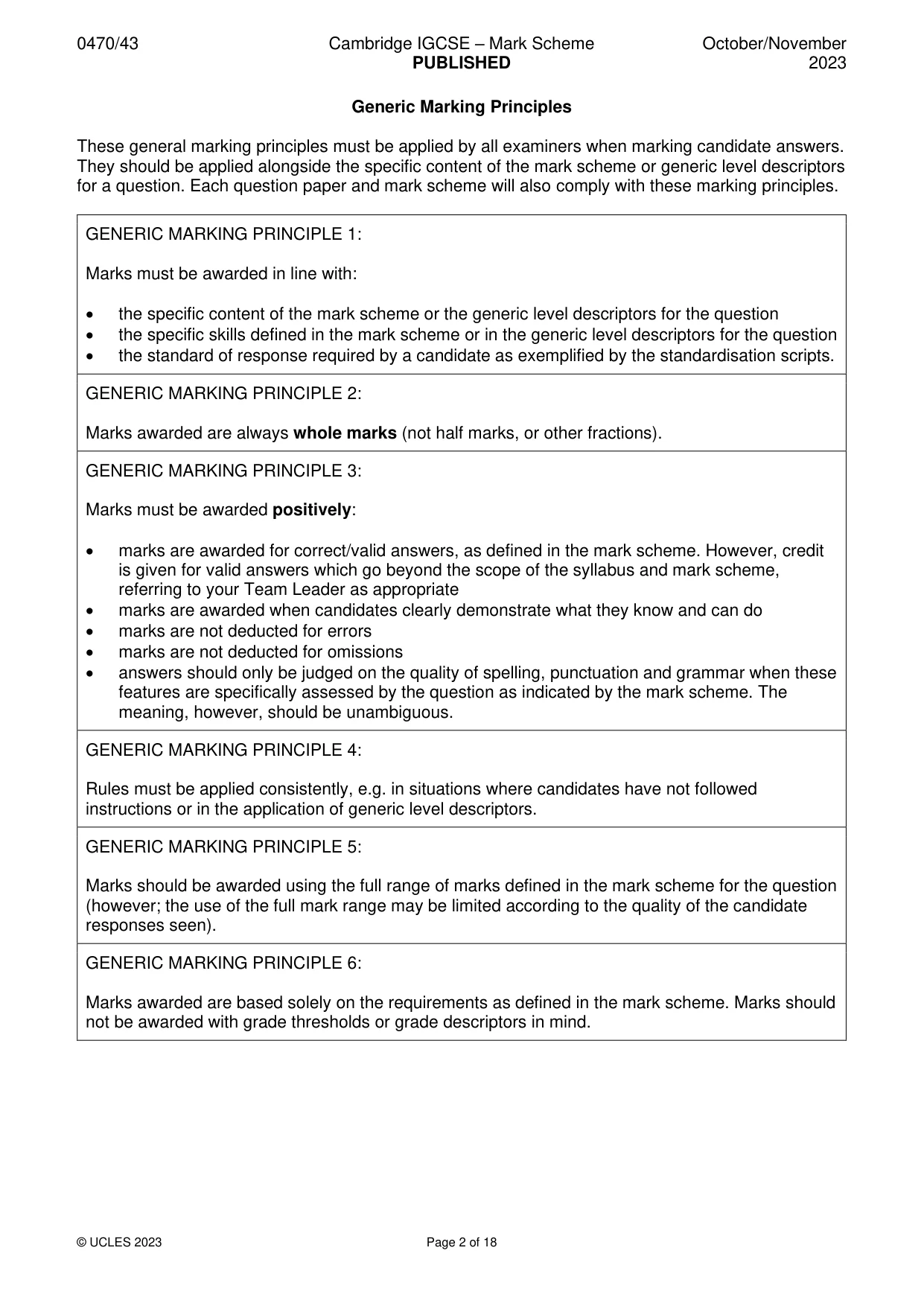
0470/43 Cambridge IGCSE – Mark Scheme PUBLISHED October/November 2023 © UCLES 2023 Page 2 of 18 Generic Marking Principles These general marking principles must be applied by all examiners when marking candidate answers. They should be applied alongside the specific content of the mark scheme or generic level descriptors for a question. Each question paper and mark scheme will also comply with these marking principles. GENERIC MARKING PRINCIPLE 1: Marks must be awarded in line with: • the specific content of the mark scheme or the generic level descriptors for the question • the specific skills defined in the mark scheme or in the generic level descriptors for the question • the standard of response required by a candidate as exemplified by the standardisation scripts. GENERIC MARKING PRINCIPLE 2: Marks awarded are always whole marks (not half marks, or other fractions). GENERIC MARKING PRINCIPLE 3: Marks must be awarded positively: • marks are awarded for correct/valid answers, as defined in the mark scheme. However, credit is given for valid answers which go beyond the scope of the syllabus and mark scheme, referring to your Team Leader as appropriate • marks are awarded when candidates clearly demonstrate what they know and can do • marks are not deducted for errors • marks are not deducted for omissions • answers should only be judged on the quality of spelling, punctuation and grammar when these features are specifically assessed by the question as indicated by the mark scheme. The meaning, however, should be unambiguous. GENERIC MARKING PRINCIPLE 4: Rules must be applied consistently, e.g. in situations where candidates have not followed instructions or in the application of generic level descriptors. GENERIC MARKING PRINCIPLE 5: Marks should be awarded using the full range of marks defined in the mark scheme for the question (however; the use of the full mark range may be limited according to the quality of the candidate responses seen). GENERIC MARKING PRINCIPLE 6: Marks awarded are based solely on the requirements as defined in the mark scheme. Marks should not be awarded with grade thresholds or grade descriptors in mind.
Mark scheme, page 3
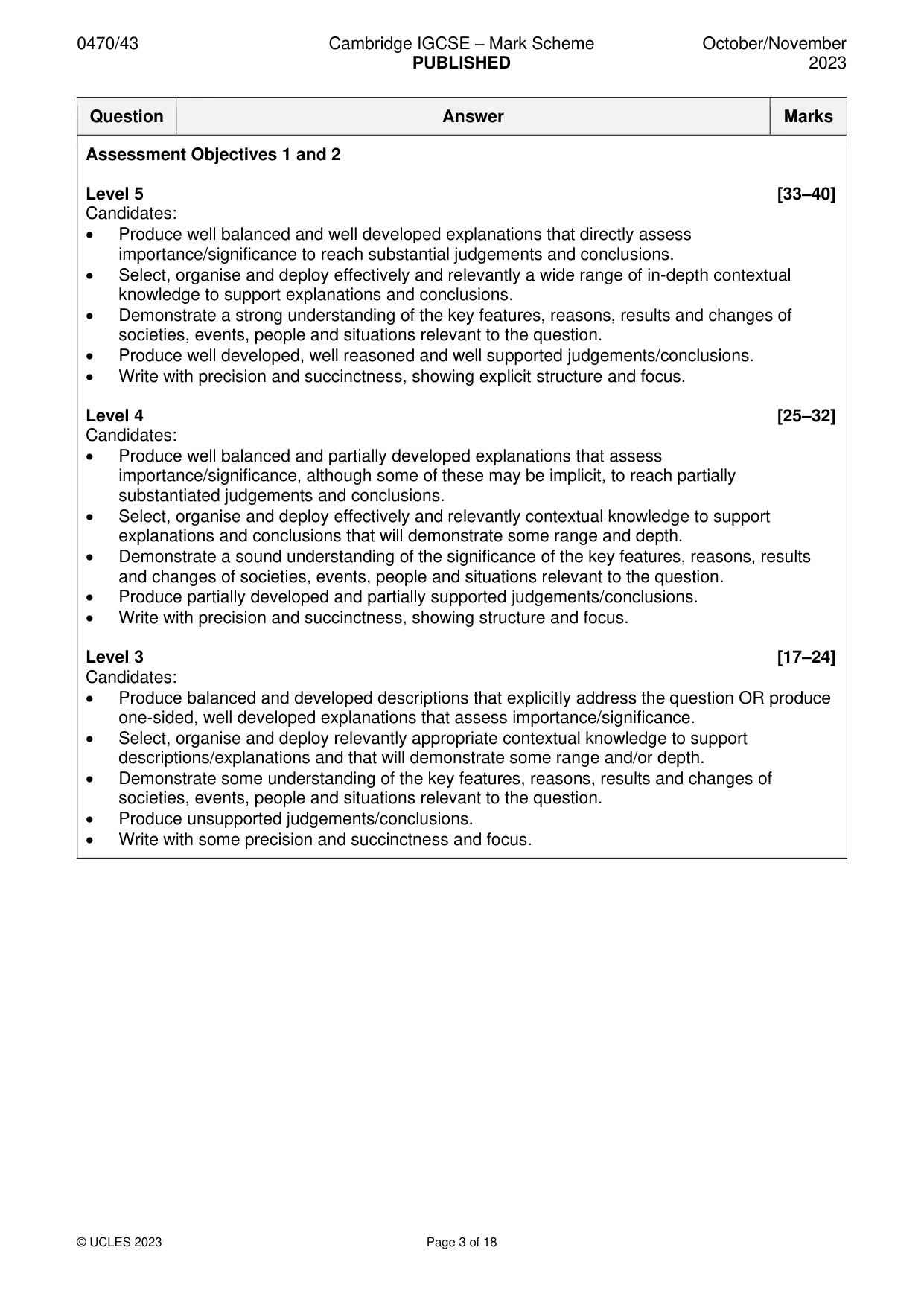
0470/43 Cambridge IGCSE – Mark Scheme PUBLISHED October/November 2023 © UCLES 2023 Page 3 of 18 Question Answer Marks Assessment Objectives 1 and 2 Level 5 [33–40] Candidates: • Produce well balanced and well developed explanations that directly assess importance/significance to reach substantial judgements and conclusions. • Select, organise and deploy effectively and relevantly a wide range of in-depth contextual knowledge to support explanations and conclusions. • Demonstrate a strong understanding of the key features, reasons, results and changes of societies, events, people and situations relevant to the question. • Produce well developed, well reasoned and well supported judgements/conclusions. • Write with precision and succinctness, showing explicit structure and focus. Level 4 [25–32] Candidates: • Produce well balanced and partially developed explanations that assess importance/significance, although some of these may be implicit, to reach partially substantiated judgements and conclusions. • Select, organise and deploy effectively and relevantly contextual knowledge to support explanations and conclusions that will demonstrate some range and depth. • Demonstrate a sound understanding of the significance of the key features, reasons, results and changes of societies, events, people and situations relevant to the question. • Produce partially developed and partially supported judgements/conclusions. • Write with precision and succinctness, showing structure and focus. Level 3 [17–24] Candidates: • Produce balanced and developed descriptions that explicitly address the question OR produce one-sided, well developed explanations that assess importance/significance. • Select, organise and deploy relevantly appropriate contextual knowledge to support descriptions/explanations and that will demonstrate some range and/or depth. • Demonstrate some understanding of the key features, reasons, results and changes of societies, events, people and situations relevant to the question. • Produce unsupported judgements/conclusions. • Write with some precision and succinctness and focus.
Mark scheme, page 4
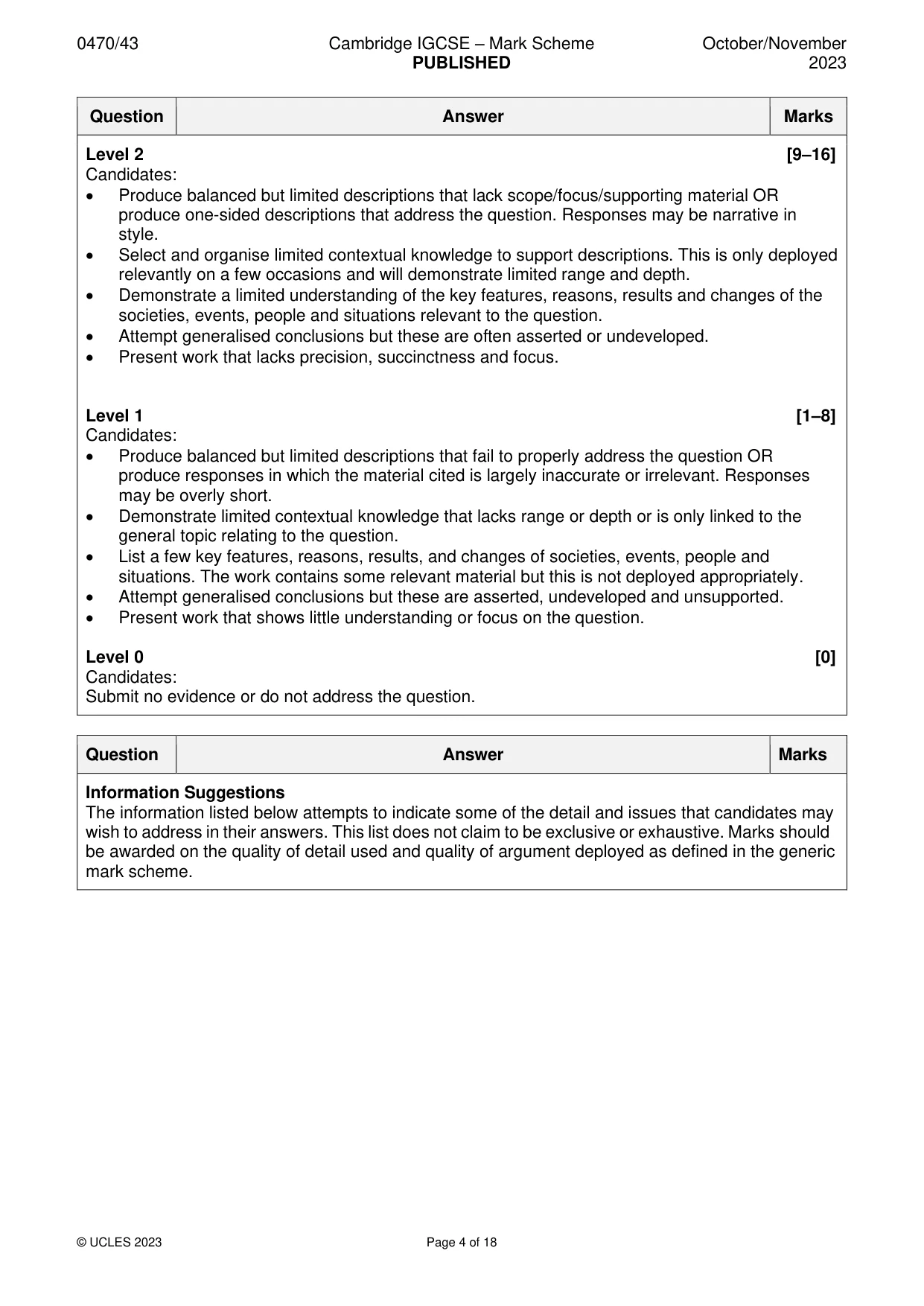
0470/43 Cambridge IGCSE – Mark Scheme PUBLISHED October/November 2023 © UCLES 2023 Page 4 of 18 Question Answer Marks Level 2 [9–16] Candidates: • Produce balanced but limited descriptions that lack scope/focus/supporting material OR produce one-sided descriptions that address the question. Responses may be narrative in style. • Select and organise limited contextual knowledge to support descriptions. This is only deployed relevantly on a few occasions and will demonstrate limited range and depth. • Demonstrate a limited understanding of the key features, reasons, results and changes of the societies, events, people and situations relevant to the question. • Attempt generalised conclusions but these are often asserted or undeveloped. • Present work that lacks precision, succinctness and focus. Level 1 [1–8] Candidates: • Produce balanced but limited descriptions that fail to properly address the question OR produce responses in which the material cited is largely inaccurate or irrelevant. Responses may be overly short. • Demonstrate limited contextual knowledge that lacks range or depth or is only linked to the general topic relating to the question. • List a few key features, reasons, results, and changes of societies, events, people and situations. The work contains some relevant material but this is not deployed appropriately. • Attempt generalised conclusions but these are asserted, undeveloped and unsupported. • Present work that shows little understanding or focus on the question. Level 0 [0] Candidates: Submit no evidence or do not address the question. Question Answer Marks Information Suggestions The information listed below attempts to indicate some of the detail and issues that candidates may wish to address in their answers. This list does not claim to be exclusive or exhaustive. Marks should be awarded on the quality of detail used and quality of argument deployed as defined in the generic mark scheme.
Mark scheme, page 5
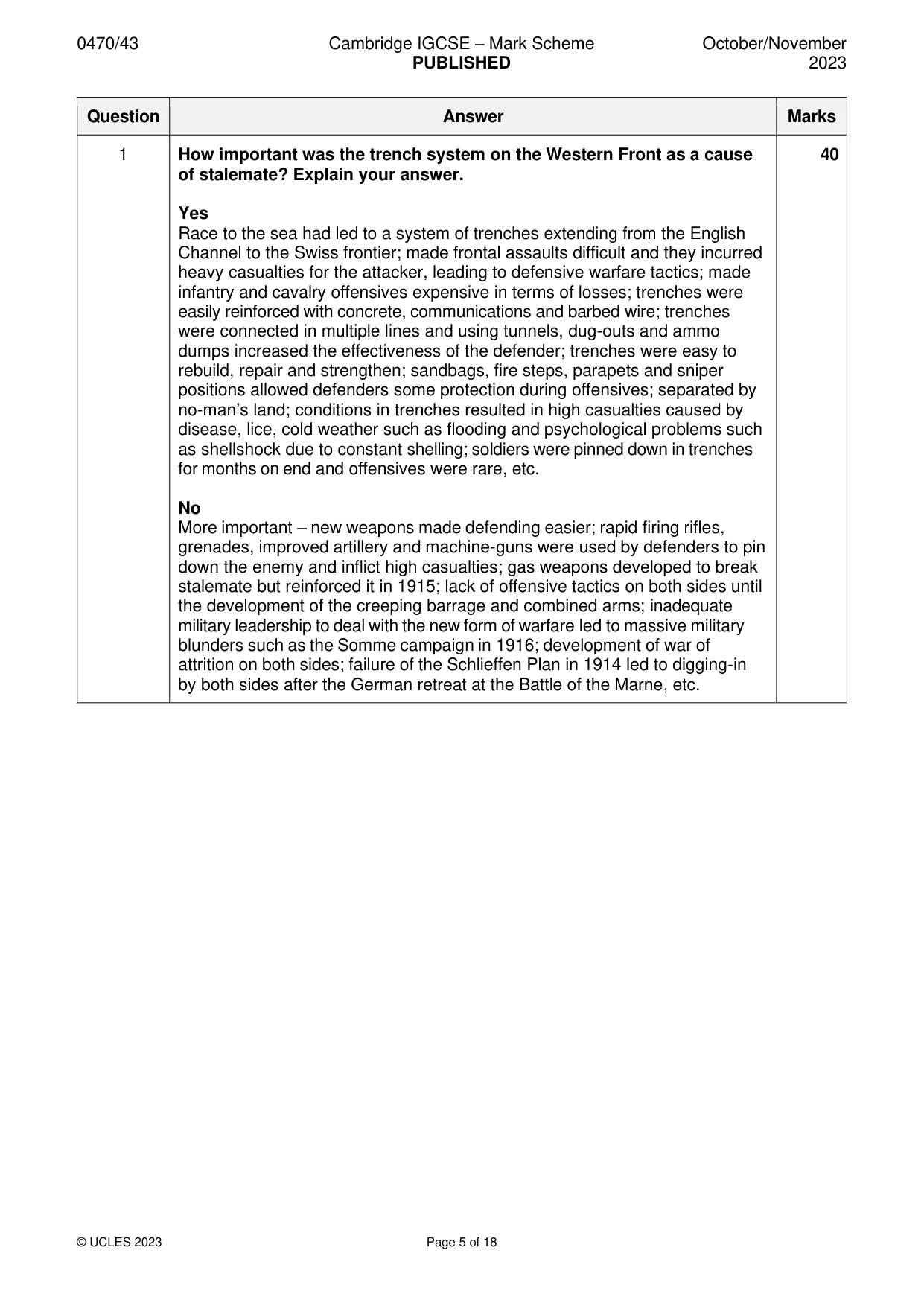
0470/43 Cambridge IGCSE – Mark Scheme PUBLISHED October/November 2023 © UCLES 2023 Page 5 of 18 Question Answer Marks 1 How important was the trench system on the Western Front as a cause of stalemate? Explain your answer. Yes Race to the sea had led to a system of trenches extending from the English Channel to the Swiss frontier; made frontal assaults difficult and they incurred heavy casualties for the attacker, leading to defensive warfare tactics; made infantry and cavalry offensives expensive in terms of losses; trenches were easily reinforced with concrete, communications and barbed wire; trenches were connected in multiple lines and using tunnels, dug-outs and ammo dumps increased the effectiveness of the defender; trenches were easy to rebuild, repair and strengthen; sandbags, fire steps, parapets and sniper positions allowed defenders some protection during offensives; separated by no-man’s land; conditions in trenches resulted in high casualties caused by disease, lice, cold weather such as flooding and psychological problems such as shellshock due to constant shelling; soldiers were pinned down in trenches for months on end and offensives were rare, etc. No More important – new weapons made defending easier; rapid firing rifles, grenades, improved artillery and machine-guns were used by defenders to pin down the enemy and inflict high casualties; gas weapons developed to break stalemate but reinforced it in 1915; lack of offensive tactics on both sides until the development of the creeping barrage and combined arms; inadequate military leadership to deal with the new form of warfare led to massive military blunders such as the Somme campaign in 1916; development of war of attrition on both sides; failure of the Schlieffen Plan in 1914 led to digging-in by both sides after the German retreat at the Battle of the Marne, etc. 40
Mark scheme, page 6
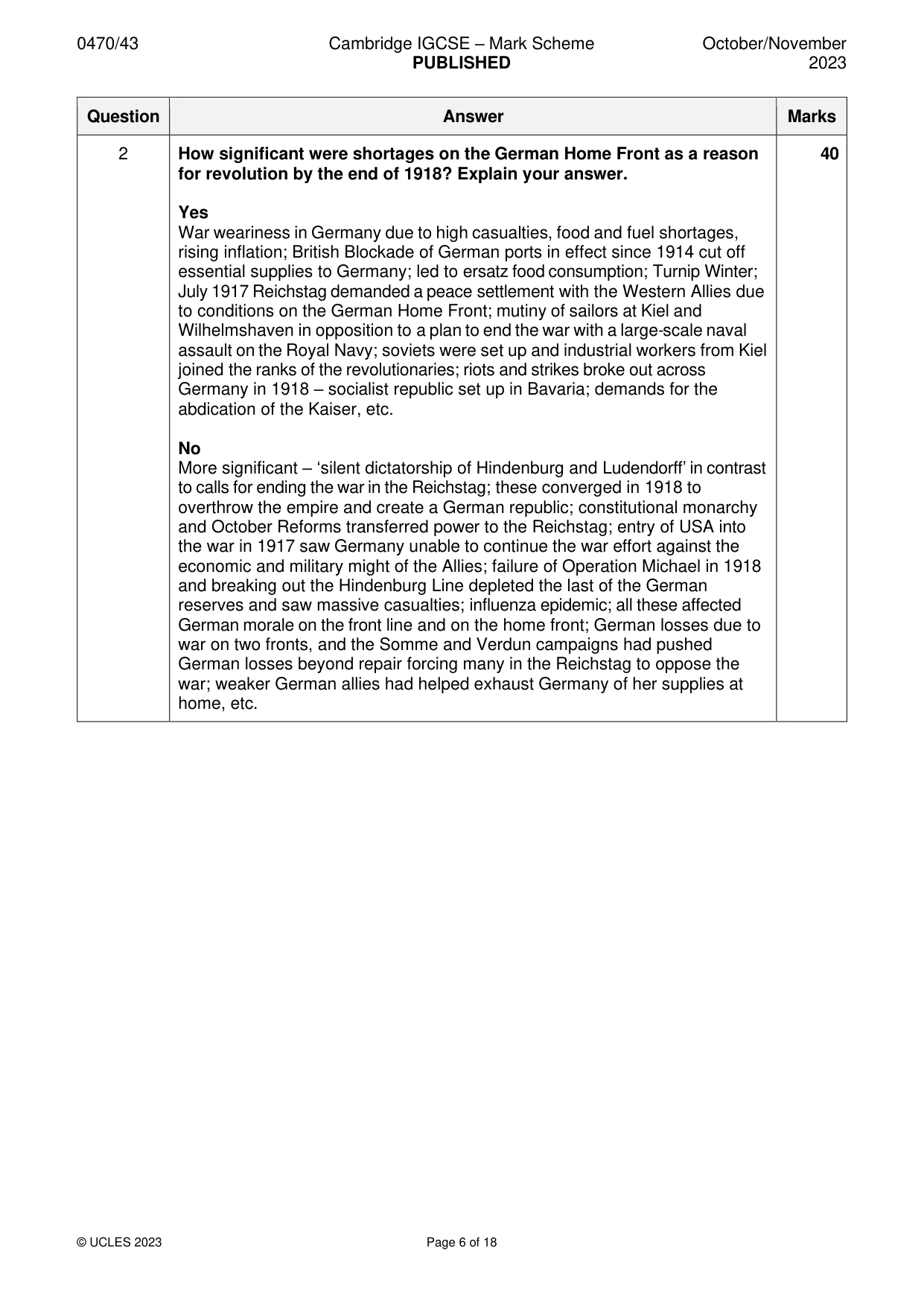
0470/43 Cambridge IGCSE – Mark Scheme PUBLISHED October/November 2023 © UCLES 2023 Page 6 of 18 Question Answer Marks 2 How significant were shortages on the German Home Front as a reason for revolution by the end of 1918? Explain your answer. Yes War weariness in Germany due to high casualties, food and fuel shortages, rising inflation; British Blockade of German ports in effect since 1914 cut off essential supplies to Germany; led to ersatz food consumption; Turnip Winter; July 1917 Reichstag demanded a peace settlement with the Western Allies due to conditions on the German Home Front; mutiny of sailors at Kiel and Wilhelmshaven in opposition to a plan to end the war with a large-scale naval assault on the Royal Navy; soviets were set up and industrial workers from Kiel joined the ranks of the revolutionaries; riots and strikes broke out across Germany in 1918 – socialist republic set up in Bavaria; demands for the abdication of the Kaiser, etc. No More significant – ‘silent dictatorship of Hindenburg and Ludendorff’ in contrast to calls for ending the war in the Reichstag; these converged in 1918 to overthrow the empire and create a German republic; constitutional monarchy and October Reforms transferred power to the Reichstag; entry of USA into the war in 1917 saw Germany unable to continue the war effort against the economic and military might of the Allies; failure of Operation Michael in 1918 and breaking out the Hindenburg Line depleted the last of the German reserves and saw massive casualties; influenza epidemic; all these affected German morale on the front line and on the home front; German losses due to war on two fronts, and the Somme and Verdun campaigns had pushed German losses beyond repair forcing many in the Reichstag to oppose the war; weaker German allies had helped exhaust Germany of her supplies at home, etc. 40
Mark scheme, page 7
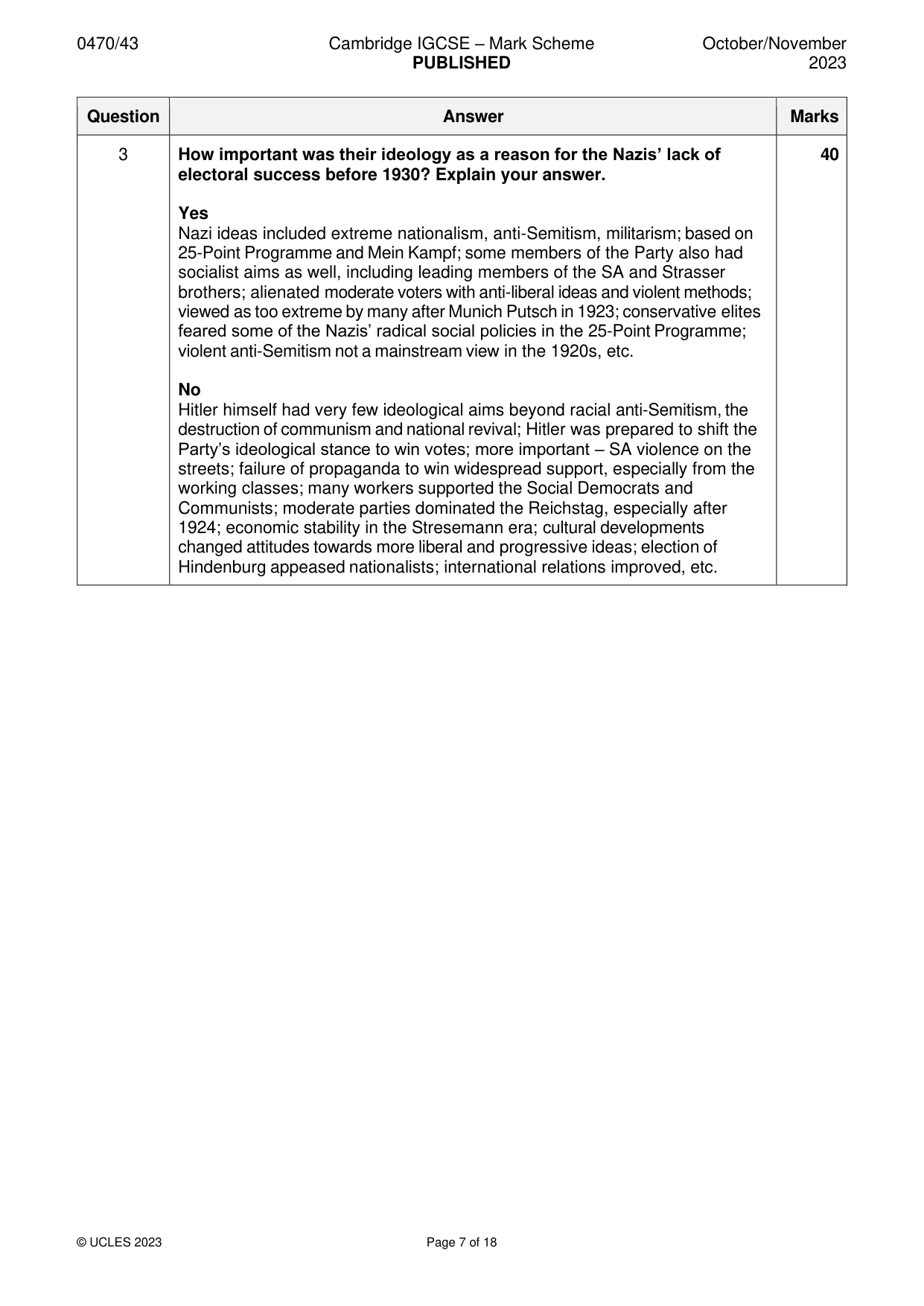
0470/43 Cambridge IGCSE – Mark Scheme PUBLISHED October/November 2023 © UCLES 2023 Page 7 of 18 Question Answer Marks 3 How important was their ideology as a reason for the Nazis’ lack of electoral success before 1930? Explain your answer. Yes Nazi ideas included extreme nationalism, anti-Semitism, militarism; based on 25-Point Programme and Mein Kampf; some members of the Party also had socialist aims as well, including leading members of the SA and Strasser brothers; alienated moderate voters with anti-liberal ideas and violent methods; viewed as too extreme by many after Munich Putsch in 1923; conservative elites feared some of the Nazis’ radical social policies in the 25-Point Programme; violent anti-Semitism not a mainstream view in the 1920s, etc. No Hitler himself had very few ideological aims beyond racial anti-Semitism, the destruction of communism and national revival; Hitler was prepared to shift the Party’s ideological stance to win votes; more important – SA violence on the streets; failure of propaganda to win widespread support, especially from the working classes; many workers supported the Social Democrats and Communists; moderate parties dominated the Reichstag, especially after 1924; economic stability in the Stresemann era; cultural developments changed attitudes towards more liberal and progressive ideas; election of Hindenburg appeased nationalists; international relations improved, etc. 40
Mark scheme, page 8
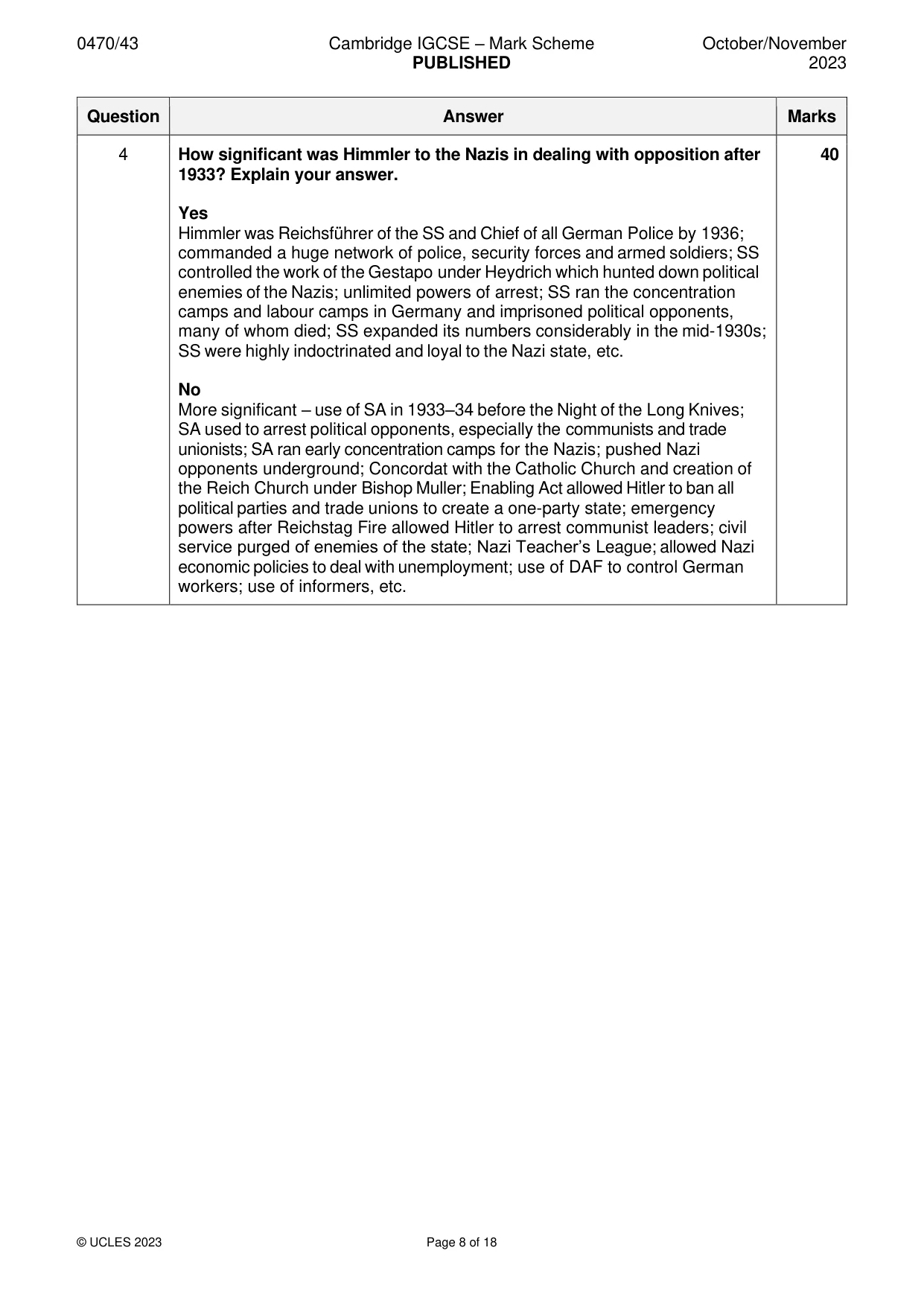
0470/43 Cambridge IGCSE – Mark Scheme PUBLISHED October/November 2023 © UCLES 2023 Page 8 of 18 Question Answer Marks 4 How significant was Himmler to the Nazis in dealing with opposition after 1933? Explain your answer. Yes Himmler was Reichsführer of the SS and Chief of all German Police by 1936; commanded a huge network of police, security forces and armed soldiers; SS controlled the work of the Gestapo under Heydrich which hunted down political enemies of the Nazis; unlimited powers of arrest; SS ran the concentration camps and labour camps in Germany and imprisoned political opponents, many of whom died; SS expanded its numbers considerably in the mid-1930s; SS were highly indoctrinated and loyal to the Nazi state, etc. No More significant – use of SA in 1933–34 before the Night of the Long Knives; SA used to arrest political opponents, especially the communists and trade unionists; SA ran early concentration camps for the Nazis; pushed Nazi opponents underground; Concordat with the Catholic Church and creation of the Reich Church under Bishop Muller; Enabling Act allowed Hitler to ban all political parties and trade unions to create a one-party state; emergency powers after Reichstag Fire allowed Hitler to arrest communist leaders; civil service purged of enemies of the state; Nazi Teacher’s League; allowed Nazi economic policies to deal with unemployment; use of DAF to control German workers; use of informers, etc. 40
Mark scheme, page 9
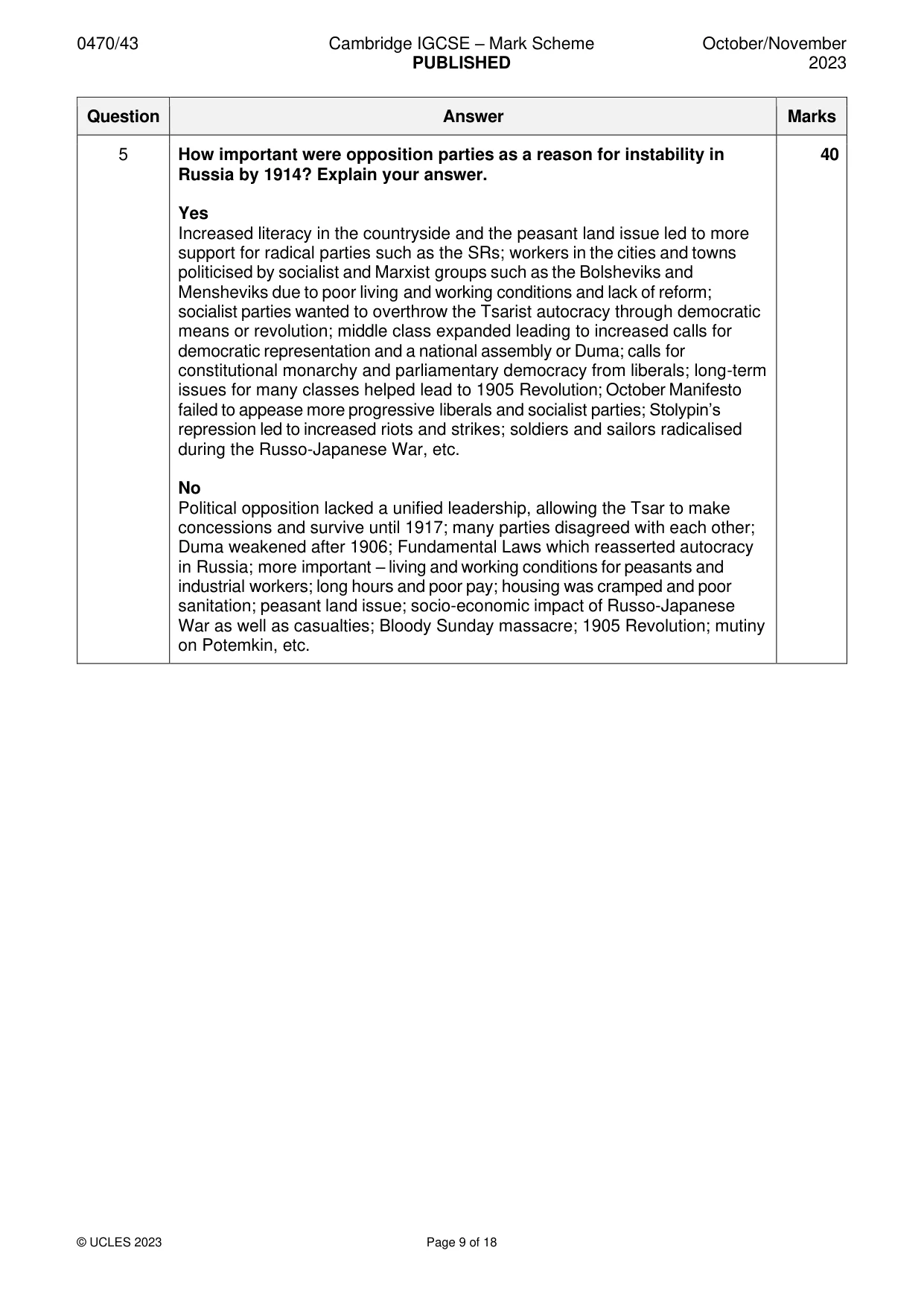
0470/43 Cambridge IGCSE – Mark Scheme PUBLISHED October/November 2023 © UCLES 2023 Page 9 of 18 Question Answer Marks 5 How important were opposition parties as a reason for instability in Russia by 1914? Explain your answer. Yes Increased literacy in the countryside and the peasant land issue led to more support for radical parties such as the SRs; workers in the cities and towns politicised by socialist and Marxist groups such as the Bolsheviks and Mensheviks due to poor living and working conditions and lack of reform; socialist parties wanted to overthrow the Tsarist autocracy through democratic means or revolution; middle class expanded leading to increased calls for democratic representation and a national assembly or Duma; calls for constitutional monarchy and parliamentary democracy from liberals; long-term issues for many classes helped lead to 1905 Revolution; October Manifesto failed to appease more progressive liberals and socialist parties; Stolypin’s repression led to increased riots and strikes; soldiers and sailors radicalised during the Russo-Japanese War, etc. No Political opposition lacked a unified leadership, allowing the Tsar to make concessions and survive until 1917; many parties disagreed with each other; Duma weakened after 1906; Fundamental Laws which reasserted autocracy in Russia; more important – living and working conditions for peasants and industrial workers; long hours and poor pay; housing was cramped and poor sanitation; peasant land issue; socio-economic impact of Russo-Japanese War as well as casualties; Bloody Sunday massacre; 1905 Revolution; mutiny on Potemkin, etc. 40
Mark scheme, page 10
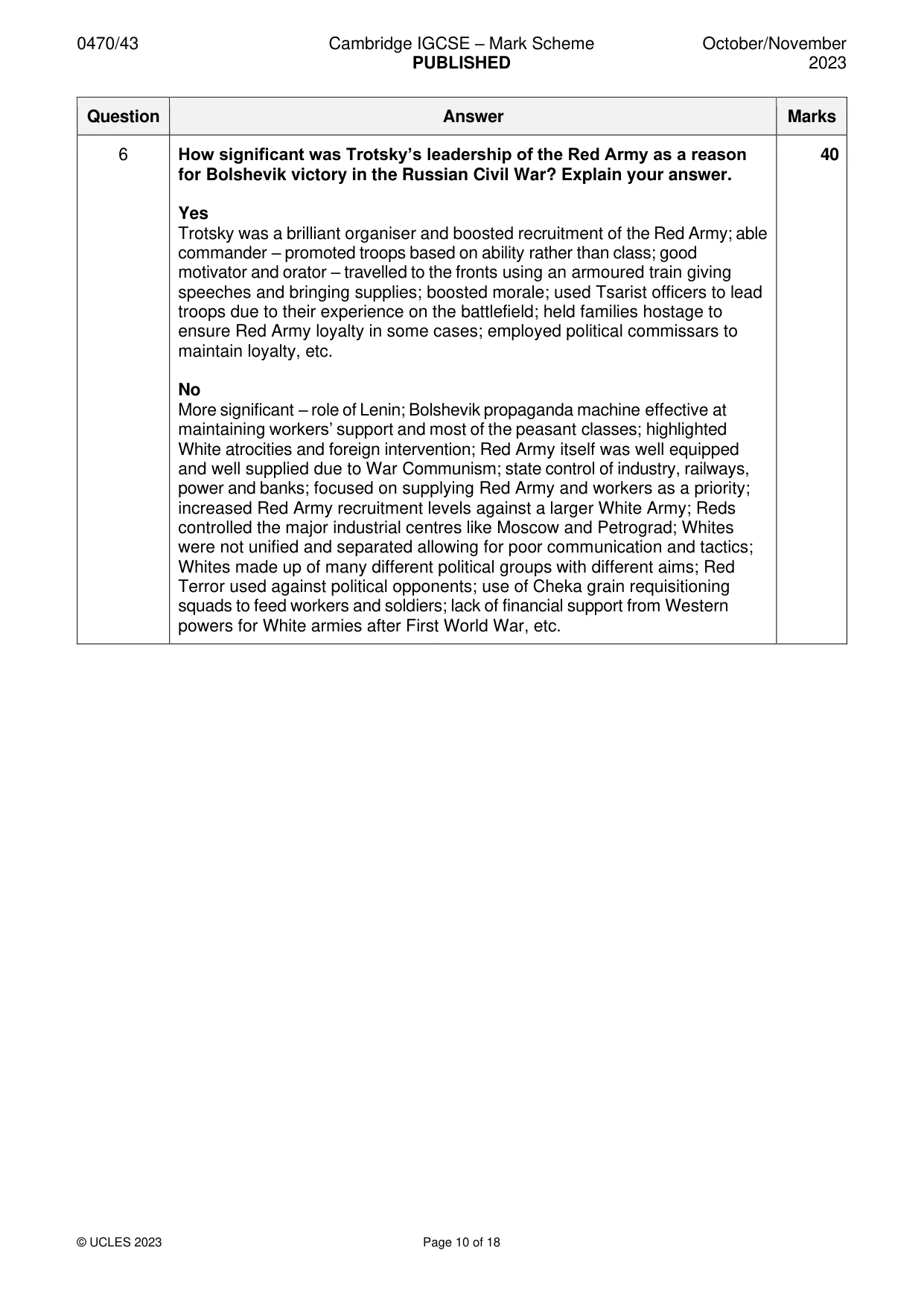
0470/43 Cambridge IGCSE – Mark Scheme PUBLISHED October/November 2023 © UCLES 2023 Page 10 of 18 Question Answer Marks 6 How significant was Trotsky’s leadership of the Red Army as a reason for Bolshevik victory in the Russian Civil War? Explain your answer. Yes Trotsky was a brilliant organiser and boosted recruitment of the Red Army; able commander – promoted troops based on ability rather than class; good motivator and orator – travelled to the fronts using an armoured train giving speeches and bringing supplies; boosted morale; used Tsarist officers to lead troops due to their experience on the battlefield; held families hostage to ensure Red Army loyalty in some cases; employed political commissars to maintain loyalty, etc. No More significant – role of Lenin; Bolshevik propaganda machine effective at maintaining workers’ support and most of the peasant classes; highlighted White atrocities and foreign intervention; Red Army itself was well equipped and well supplied due to War Communism; state control of industry, railways, power and banks; focused on supplying Red Army and workers as a priority; increased Red Army recruitment levels against a larger White Army; Reds controlled the major industrial centres like Moscow and Petrograd; Whites were not unified and separated allowing for poor communication and tactics; Whites made up of many different political groups with different aims; Red Terror used against political opponents; use of Cheka grain requisitioning squads to feed workers and soldiers; lack of financial support from Western powers for White armies after First World War, etc. 40
Mark scheme, page 11
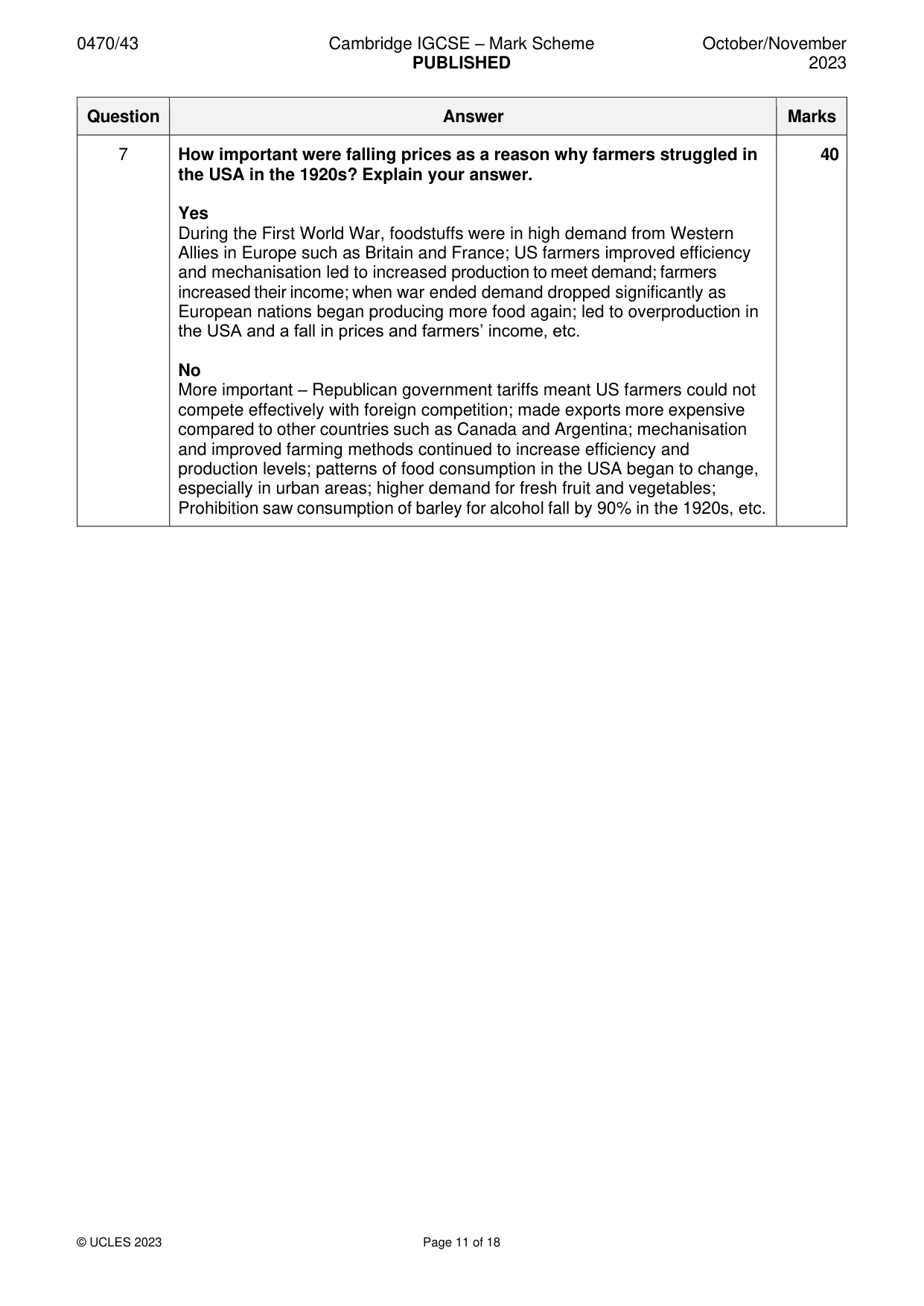
0470/43 Cambridge IGCSE – Mark Scheme PUBLISHED October/November 2023 © UCLES 2023 Page 11 of 18 Question Answer Marks 7 How important were falling prices as a reason why farmers struggled in the USA in the 1920s? Explain your answer. Yes During the First World War, foodstuffs were in high demand from Western Allies in Europe such as Britain and France; US farmers improved efficiency and mechanisation led to increased production to meet demand; farmers increased their income; when war ended demand dropped significantly as European nations began producing more food again; led to overproduction in the USA and a fall in prices and farmers’ income, etc. No More important – Republican government tariffs meant US farmers could not compete effectively with foreign competition; made exports more expensive compared to other countries such as Canada and Argentina; mechanisation and improved farming methods continued to increase efficiency and production levels; patterns of food consumption in the USA began to change, especially in urban areas; higher demand for fresh fruit and vegetables; Prohibition saw consumption of barley for alcohol fall by 90% in the 1920s, etc. 40
Mark scheme, page 12
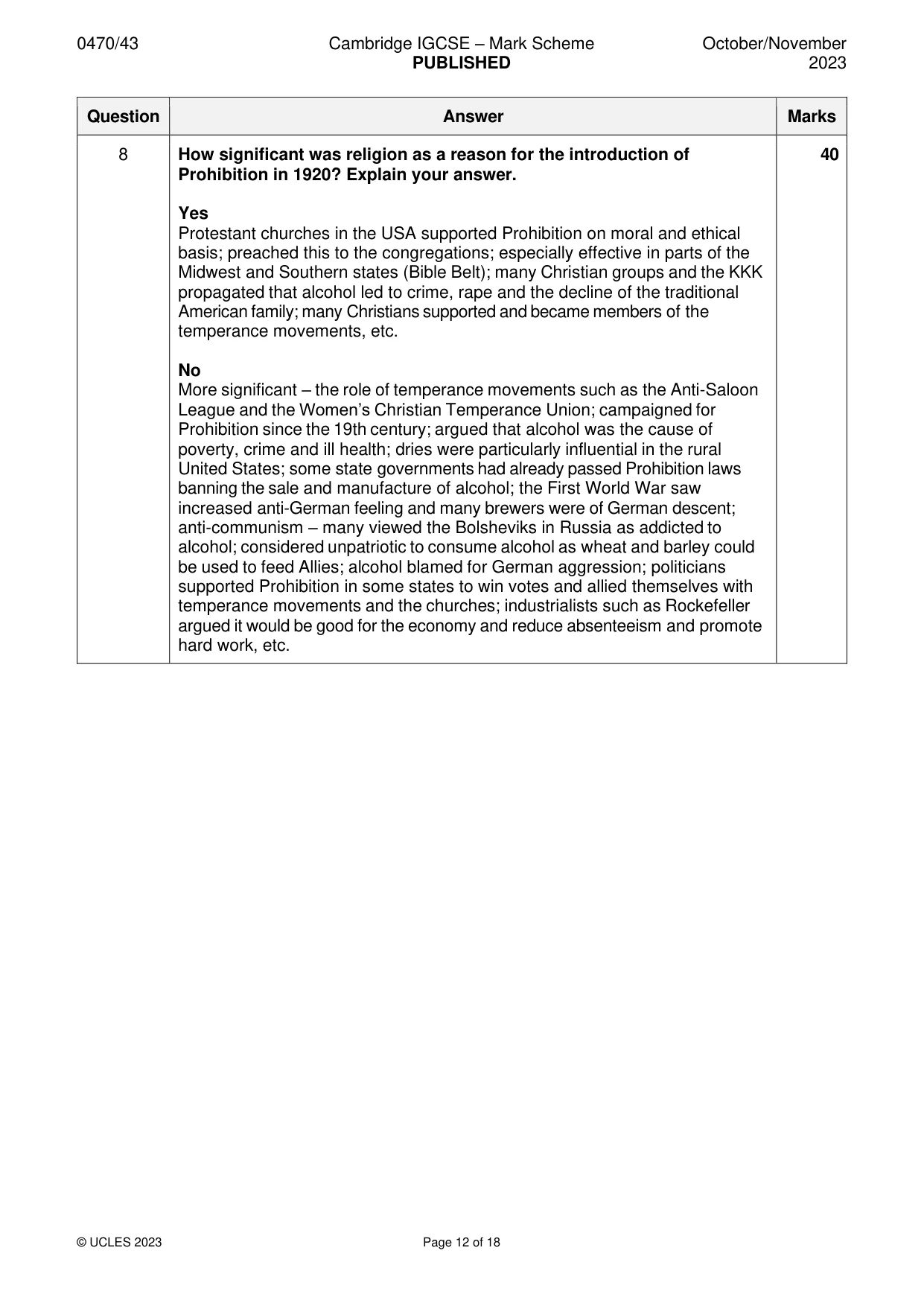
0470/43 Cambridge IGCSE – Mark Scheme PUBLISHED October/November 2023 © UCLES 2023 Page 12 of 18 Question Answer Marks 8 How significant was religion as a reason for the introduction of Prohibition in 1920? Explain your answer. Yes Protestant churches in the USA supported Prohibition on moral and ethical basis; preached this to the congregations; especially effective in parts of the Midwest and Southern states (Bible Belt); many Christian groups and the KKK propagated that alcohol led to crime, rape and the decline of the traditional American family; many Christians supported and became members of the temperance movements, etc. No More significant – the role of temperance movements such as the Anti-Saloon League and the Women’s Christian Temperance Union; campaigned for Prohibition since the 19th century; argued that alcohol was the cause of poverty, crime and ill health; dries were particularly influential in the rural United States; some state governments had already passed Prohibition laws banning the sale and manufacture of alcohol; the First World War saw increased anti-German feeling and many brewers were of German descent; anti-communism – many viewed the Bolsheviks in Russia as addicted to alcohol; considered unpatriotic to consume alcohol as wheat and barley could be used to feed Allies; alcohol blamed for German aggression; politicians supported Prohibition in some states to win votes and allied themselves with temperance movements and the churches; industrialists such as Rockefeller argued it would be good for the economy and reduce absenteeism and promote hard work, etc. 40
Mark scheme, page 13
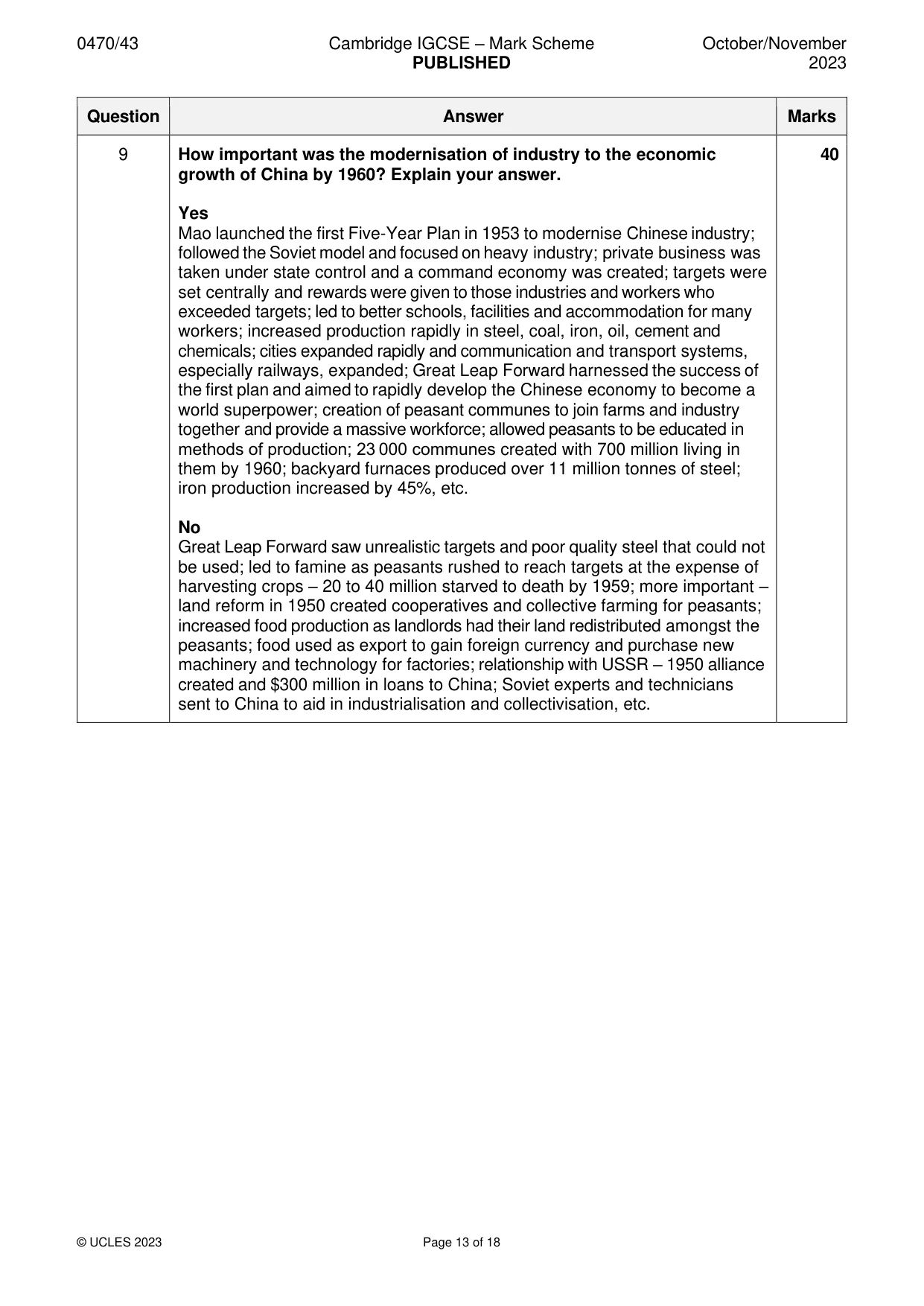
0470/43 Cambridge IGCSE – Mark Scheme PUBLISHED October/November 2023 © UCLES 2023 Page 13 of 18 Question Answer Marks 9 How important was the modernisation of industry to the economic growth of China by 1960? Explain your answer. Yes Mao launched the first Five-Year Plan in 1953 to modernise Chinese industry; followed the Soviet model and focused on heavy industry; private business was taken under state control and a command economy was created; targets were set centrally and rewards were given to those industries and workers who exceeded targets; led to better schools, facilities and accommodation for many workers; increased production rapidly in steel, coal, iron, oil, cement and chemicals; cities expanded rapidly and communication and transport systems, especially railways, expanded; Great Leap Forward harnessed the success of the first plan and aimed to rapidly develop the Chinese economy to become a world superpower; creation of peasant communes to join farms and industry together and provide a massive workforce; allowed peasants to be educated in methods of production; 23 000 communes created with 700 million living in them by 1960; backyard furnaces produced over 11 million tonnes of steel; iron production increased by 45%, etc. No Great Leap Forward saw unrealistic targets and poor quality steel that could not be used; led to famine as peasants rushed to reach targets at the expense of harvesting crops – 20 to 40 million starved to death by 1959; more important – land reform in 1950 created cooperatives and collective farming for peasants; increased food production as landlords had their land redistributed amongst the peasants; food used as export to gain foreign currency and purchase new machinery and technology for factories; relationship with USSR – 1950 alliance created and $300 million in loans to China; Soviet experts and technicians sent to China to aid in industrialisation and collectivisation, etc. 40
Mark scheme, page 14
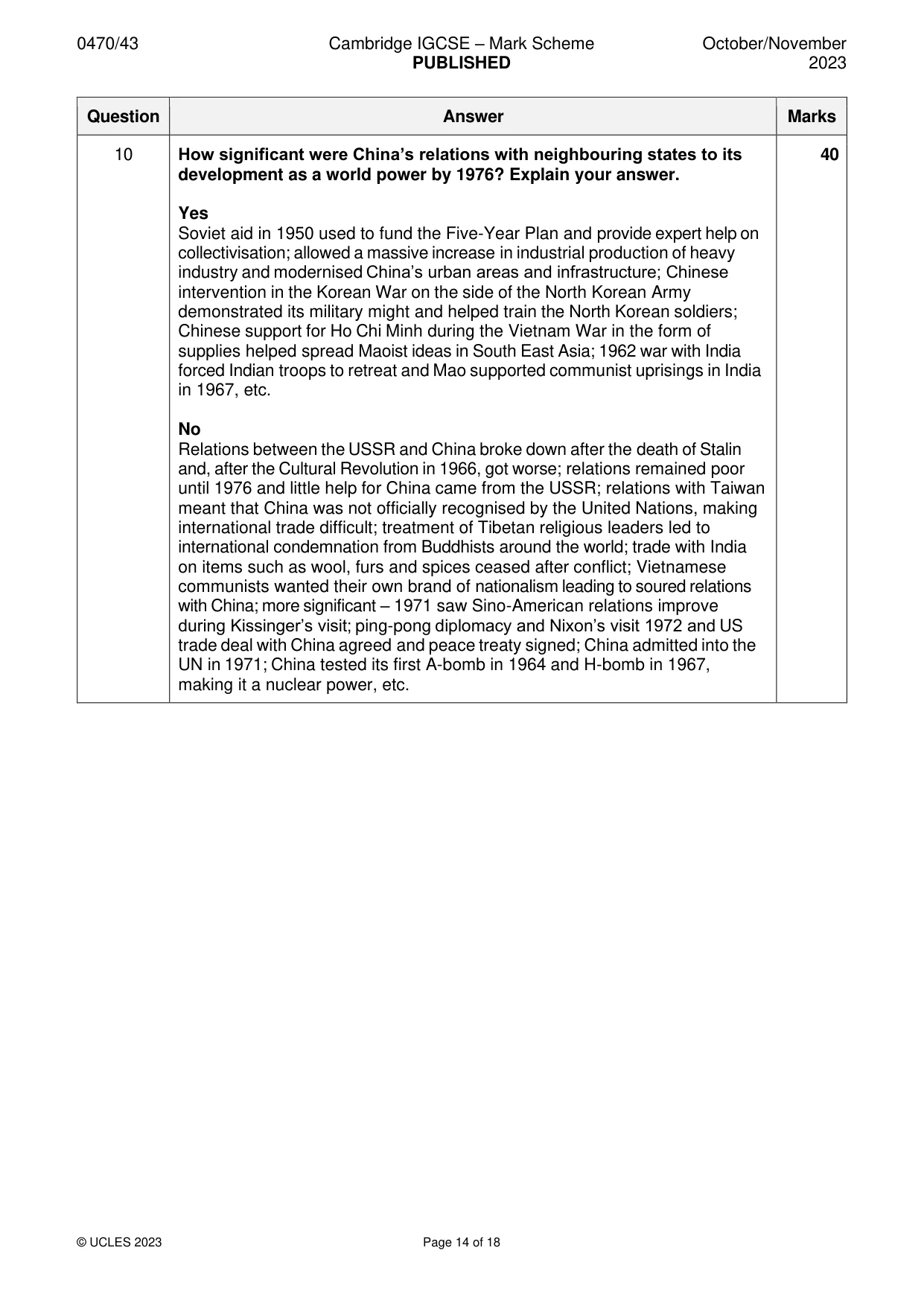
0470/43 Cambridge IGCSE – Mark Scheme PUBLISHED October/November 2023 © UCLES 2023 Page 14 of 18 Question Answer Marks 10 How significant were China’s relations with neighbouring states to its development as a world power by 1976? Explain your answer. Yes Soviet aid in 1950 used to fund the Five-Year Plan and provide expert help on collectivisation; allowed a massive increase in industrial production of heavy industry and modernised China’s urban areas and infrastructure; Chinese intervention in the Korean War on the side of the North Korean Army demonstrated its military might and helped train the North Korean soldiers; Chinese support for Ho Chi Minh during the Vietnam War in the form of supplies helped spread Maoist ideas in South East Asia; 1962 war with India forced Indian troops to retreat and Mao supported communist uprisings in India in 1967, etc. No Relations between the USSR and China broke down after the death of Stalin and, after the Cultural Revolution in 1966, got worse; relations remained poor until 1976 and little help for China came from the USSR; relations with Taiwan meant that China was not officially recognised by the United Nations, making international trade difficult; treatment of Tibetan religious leaders led to international condemnation from Buddhists around the world; trade with India on items such as wool, furs and spices ceased after conflict; Vietnamese communists wanted their own brand of nationalism leading to soured relations with China; more significant – 1971 saw Sino-American relations improve during Kissinger’s visit; ping-pong diplomacy and Nixon’s visit 1972 and US trade deal with China agreed and peace treaty signed; China admitted into the UN in 1971; China tested its first A-bomb in 1964 and H-bomb in 1967, making it a nuclear power, etc. 40
Mark scheme, page 15
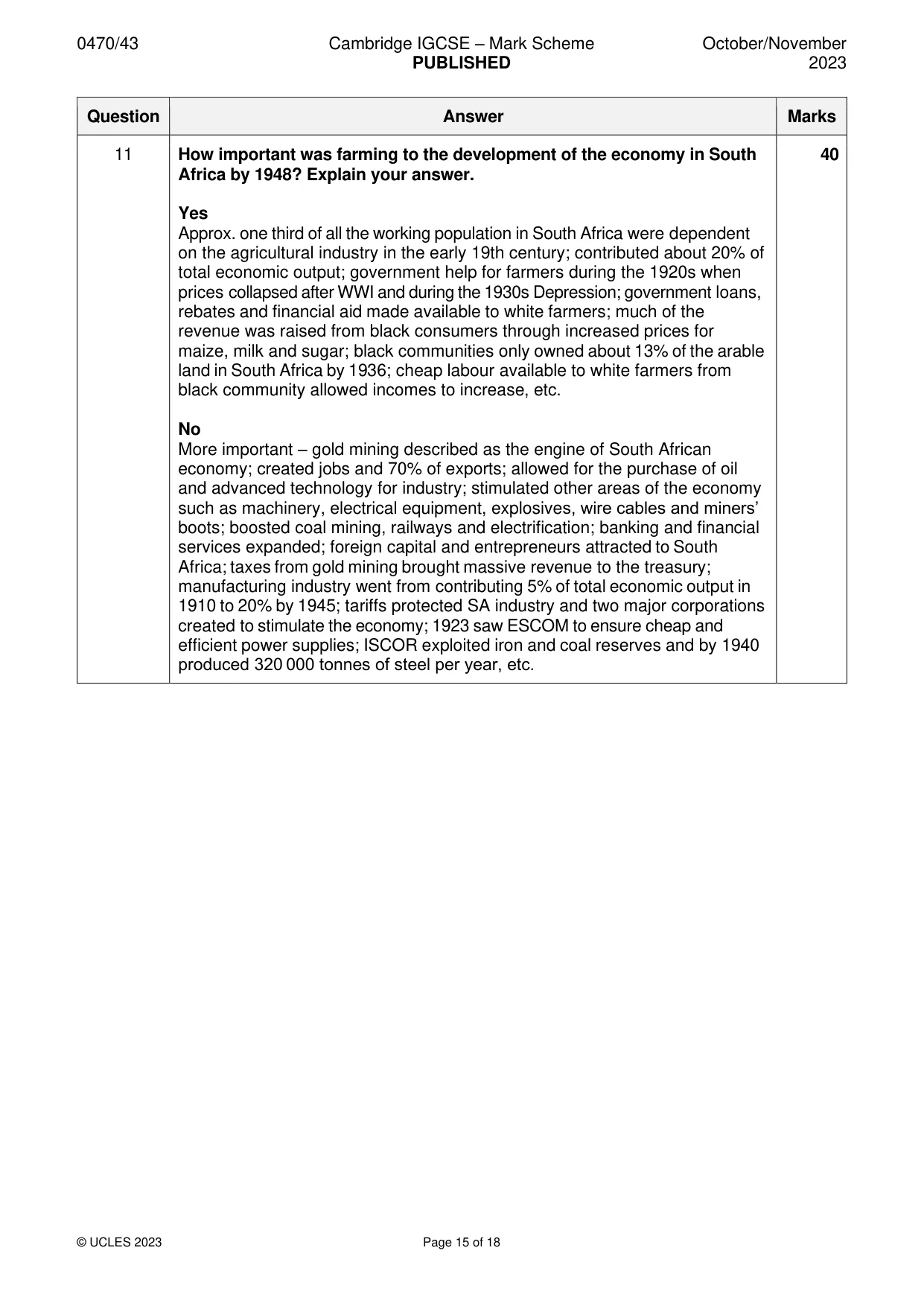
0470/43 Cambridge IGCSE – Mark Scheme PUBLISHED October/November 2023 © UCLES 2023 Page 15 of 18 Question Answer Marks 11 How important was farming to the development of the economy in South Africa by 1948? Explain your answer. Yes Approx. one third of all the working population in South Africa were dependent on the agricultural industry in the early 19th century; contributed about 20% of total economic output; government help for farmers during the 1920s when prices collapsed after WWI and during the 1930s Depression; government loans, rebates and financial aid made available to white farmers; much of the revenue was raised from black consumers through increased prices for maize, milk and sugar; black communities only owned about 13% of the arable land in South Africa by 1936; cheap labour available to white farmers from black community allowed incomes to increase, etc. No More important – gold mining described as the engine of South African economy; created jobs and 70% of exports; allowed for the purchase of oil and advanced technology for industry; stimulated other areas of the economy such as machinery, electrical equipment, explosives, wire cables and miners’ boots; boosted coal mining, railways and electrification; banking and financial services expanded; foreign capital and entrepreneurs attracted to South Africa; taxes from gold mining brought massive revenue to the treasury; manufacturing industry went from contributing 5% of total economic output in 1910 to 20% by 1945; tariffs protected SA industry and two major corporations created to stimulate the economy; 1923 saw ESCOM to ensure cheap and efficient power supplies; ISCOR exploited iron and coal reserves and by 1940 produced 320 000 tonnes of steel per year, etc. 40
Mark scheme, page 16
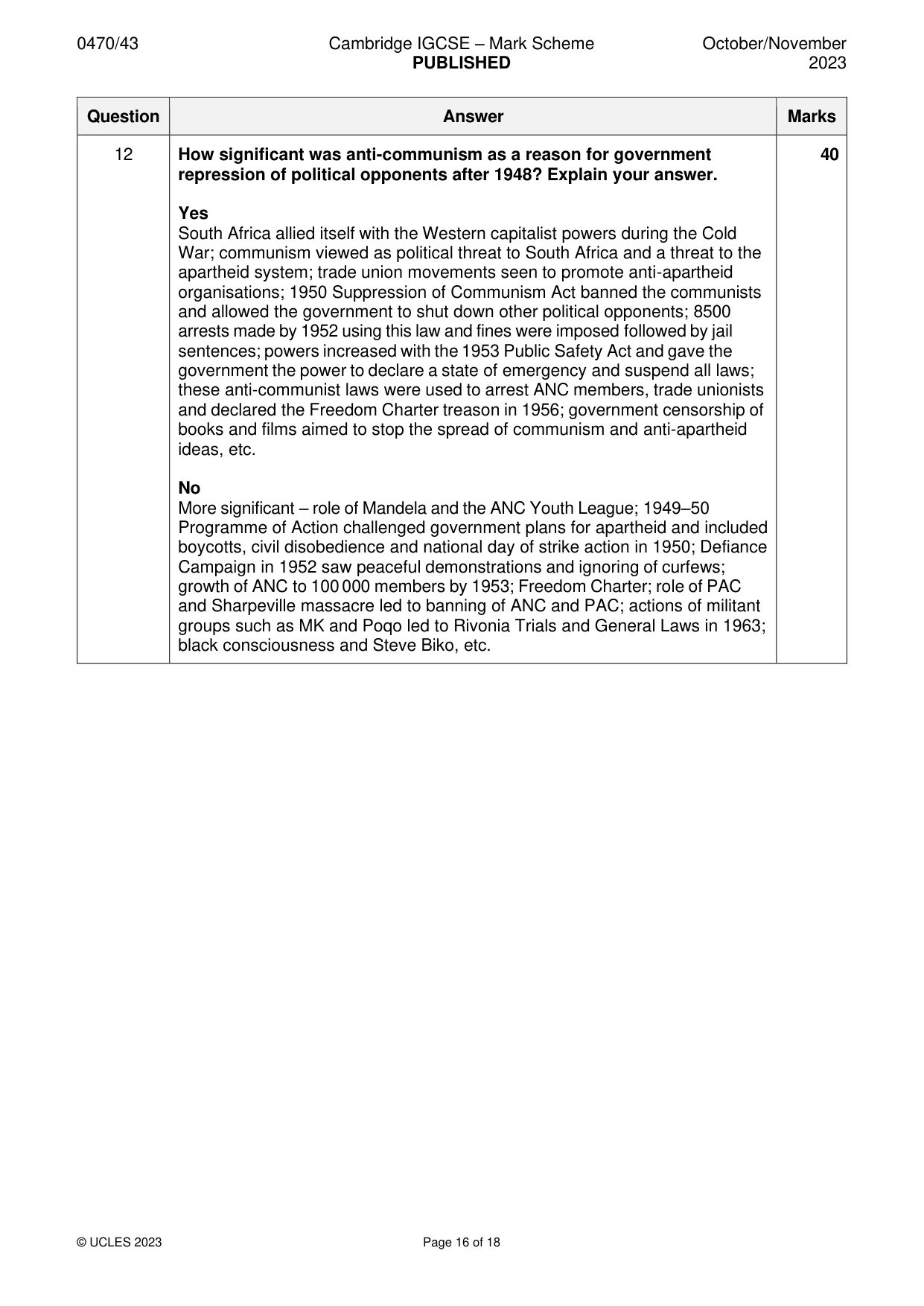
0470/43 Cambridge IGCSE – Mark Scheme PUBLISHED October/November 2023 © UCLES 2023 Page 16 of 18 Question Answer Marks 12 How significant was anti-communism as a reason for government repression of political opponents after 1948? Explain your answer. Yes South Africa allied itself with the Western capitalist powers during the Cold War; communism viewed as political threat to South Africa and a threat to the apartheid system; trade union movements seen to promote anti-apartheid organisations; 1950 Suppression of Communism Act banned the communists and allowed the government to shut down other political opponents; 8500 arrests made by 1952 using this law and fines were imposed followed by jail sentences; powers increased with the 1953 Public Safety Act and gave the government the power to declare a state of emergency and suspend all laws; these anti-communist laws were used to arrest ANC members, trade unionists and declared the Freedom Charter treason in 1956; government censorship of books and films aimed to stop the spread of communism and anti-apartheid ideas, etc. No More significant – role of Mandela and the ANC Youth League; 1949–50 Programme of Action challenged government plans for apartheid and included boycotts, civil disobedience and national day of strike action in 1950; Defiance Campaign in 1952 saw peaceful demonstrations and ignoring of curfews; growth of ANC to 100 000 members by 1953; Freedom Charter; role of PAC and Sharpeville massacre led to banning of ANC and PAC; actions of militant groups such as MK and Poqo led to Rivonia Trials and General Laws in 1963; black consciousness and Steve Biko, etc. 40
Mark scheme, page 17
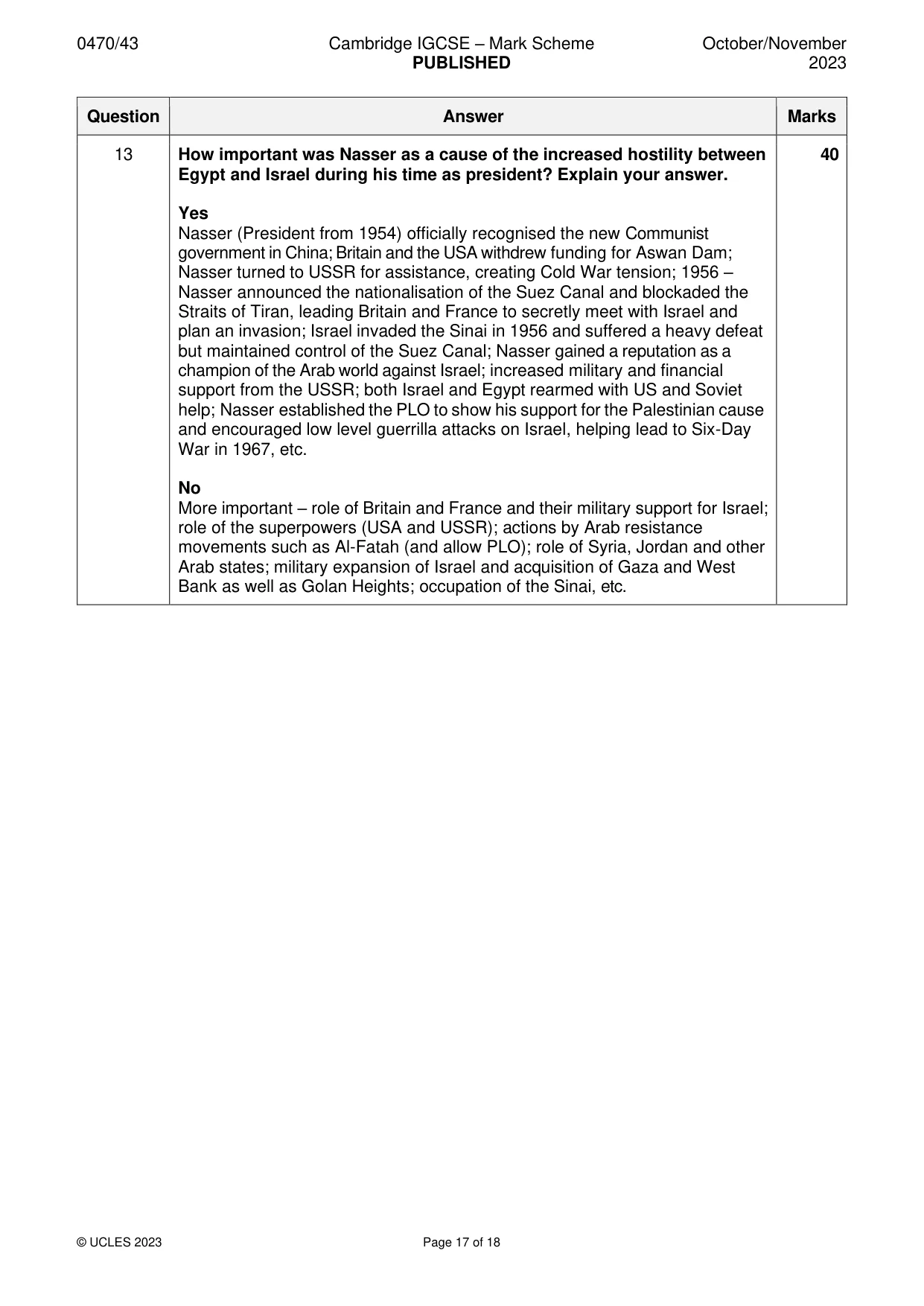
0470/43 Cambridge IGCSE – Mark Scheme PUBLISHED October/November 2023 © UCLES 2023 Page 17 of 18 Question Answer Marks 13 How important was Nasser as a cause of the increased hostility between Egypt and Israel during his time as president? Explain your answer. Yes Nasser (President from 1954) officially recognised the new Communist government in China; Britain and the USA withdrew funding for Aswan Dam; Nasser turned to USSR for assistance, creating Cold War tension; 1956 – Nasser announced the nationalisation of the Suez Canal and blockaded the Straits of Tiran, leading Britain and France to secretly meet with Israel and plan an invasion; Israel invaded the Sinai in 1956 and suffered a heavy defeat but maintained control of the Suez Canal; Nasser gained a reputation as a champion of the Arab world against Israel; increased military and financial support from the USSR; both Israel and Egypt rearmed with US and Soviet help; Nasser established the PLO to show his support for the Palestinian cause and encouraged low level guerrilla attacks on Israel, helping lead to Six-Day War in 1967, etc. No More important – role of Britain and France and their military support for Israel; role of the superpowers (USA and USSR); actions by Arab resistance movements such as Al-Fatah (and allow PLO); role of Syria, Jordan and other Arab states; military expansion of Israel and acquisition of Gaza and West Bank as well as Golan Heights; occupation of the Sinai, etc. 40
Mark scheme, page 18
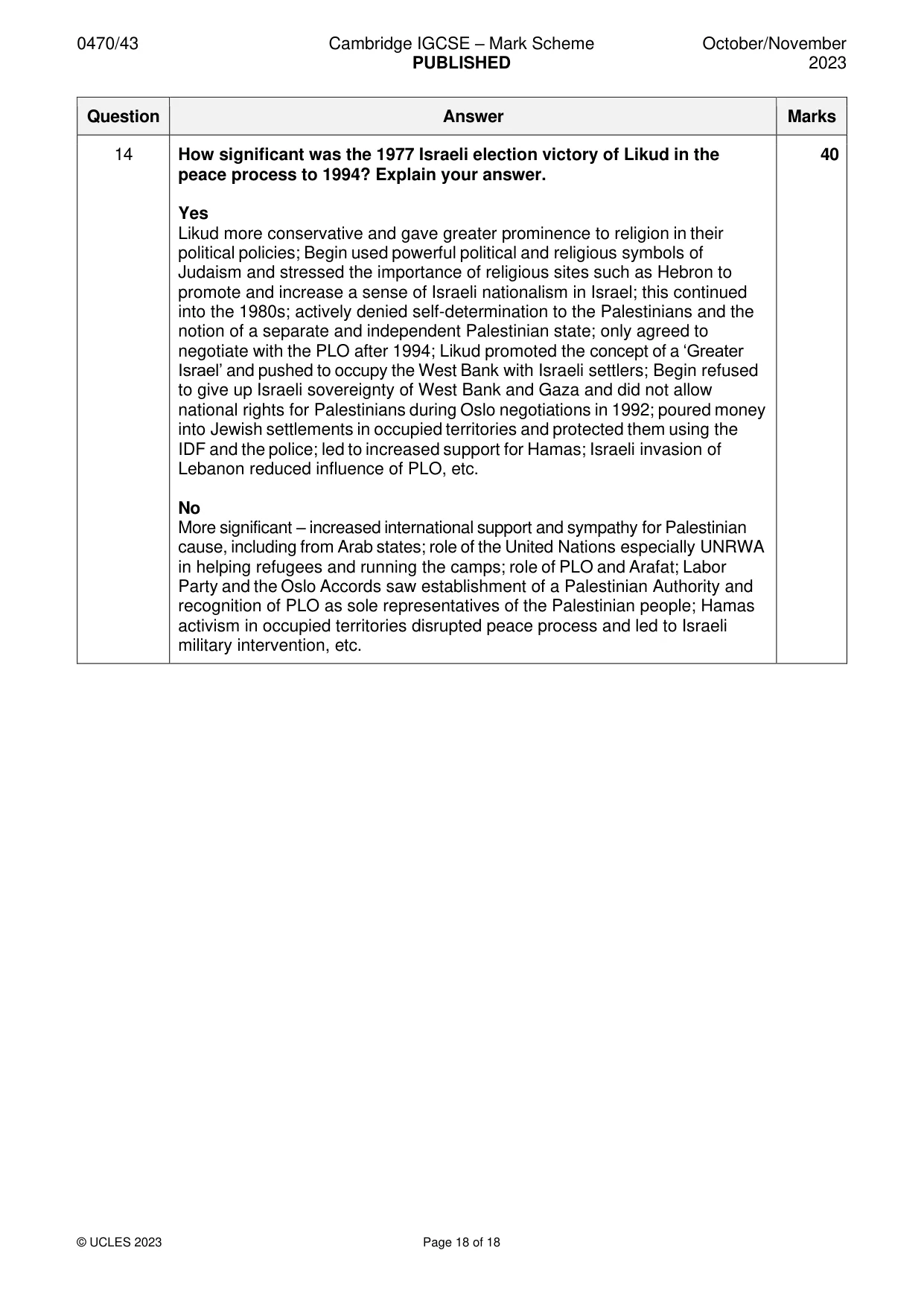
0470/43 Cambridge IGCSE – Mark Scheme PUBLISHED October/November 2023 © UCLES 2023 Page 18 of 18 Question Answer Marks 14 How significant was the 1977 Israeli election victory of Likud in the peace process to 1994? Explain your answer. Yes Likud more conservative and gave greater prominence to religion in their political policies; Begin used powerful political and religious symbols of Judaism and stressed the importance of religious sites such as Hebron to promote and increase a sense of Israeli nationalism in Israel; this continued into the 1980s; actively denied self-determination to the Palestinians and the notion of a separate and independent Palestinian state; only agreed to negotiate with the PLO after 1994; Likud promoted the concept of a ‘Greater Israel’ and pushed to occupy the West Bank with Israeli settlers; Begin refused to give up Israeli sovereignty of West Bank and Gaza and did not allow national rights for Palestinians during Oslo negotiations in 1992; poured money into Jewish settlements in occupied territories and protected them using the IDF and the police; led to increased support for Hamas; Israeli invasion of Lebanon reduced influence of PLO, etc. No More significant – increased international support and sympathy for Palestinian cause, including from Arab states; role of the United Nations especially UNRWA in helping refugees and running the camps; role of PLO and Arafat; Labor Party and the Oslo Accords saw establishment of a Palestinian Authority and recognition of PLO as sole representatives of the Palestinian people; Hamas activism in occupied territories disrupted peace process and led to Israeli military intervention, etc. 40
What you needed in this session
Cambridge’s own grade thresholds for 2023 Oct/Nov, Paper 4 · Variant 3. A higher threshold means an easier paper — the bar moves with how the cohort did.