Cambridge IGCSE History 0470 — 2025 Oct/Nov Paper 4 · Variant 2
0470/42/O/N/25 · 40 marks · 60 min
The question paper and its mark scheme, free to read here and free to download. This is Cambridge’s own paper, exactly as it was sat.
Question paper4 pages
Mark scheme17 pages
Answers below. Sit the paper first if you are practising.
Paper as text
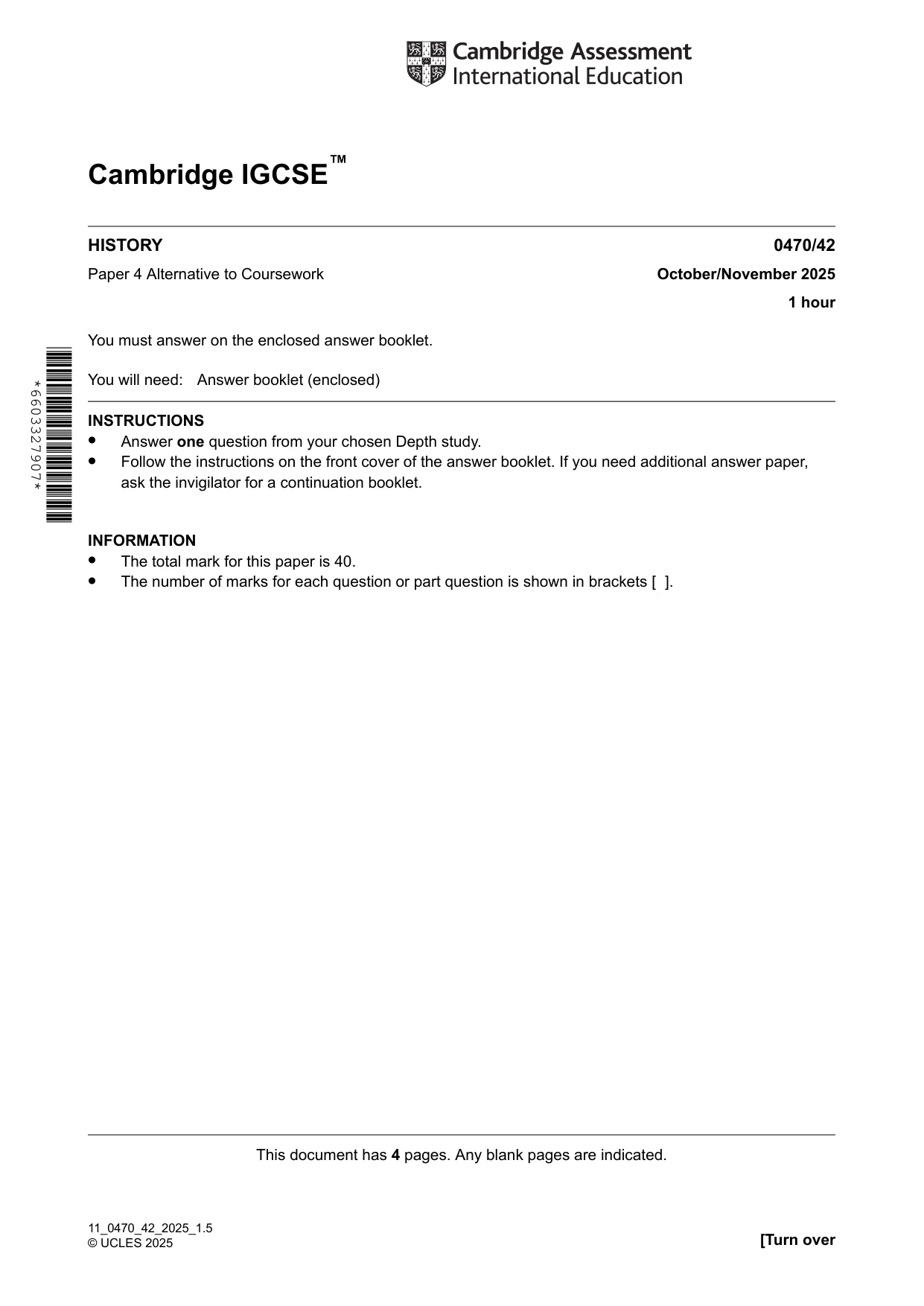
Question paper, page 1
Cambridge IGCSE™ 0470/42 October/November 2025 1 hour HISTORY Paper 4 Alternative to Coursework You must answer on the enclosed answer booklet. You will need: Answer booklet (enclosed) INSTRUCTIONS • Answer one question from your chosen Depth study. • Follow the instructions on the front cover of the answer booklet. If you need additional answer paper, ask the invigilator for a continuation booklet. INFORMATION • The total mark for this paper is 40. • The number of marks for each question or part question is shown in brackets [ ]. This document has 4 pages. Any blank pages are indicated. [Turn over 11_0470_42_2025_1.5 © UCLES 2025 *6603327907*
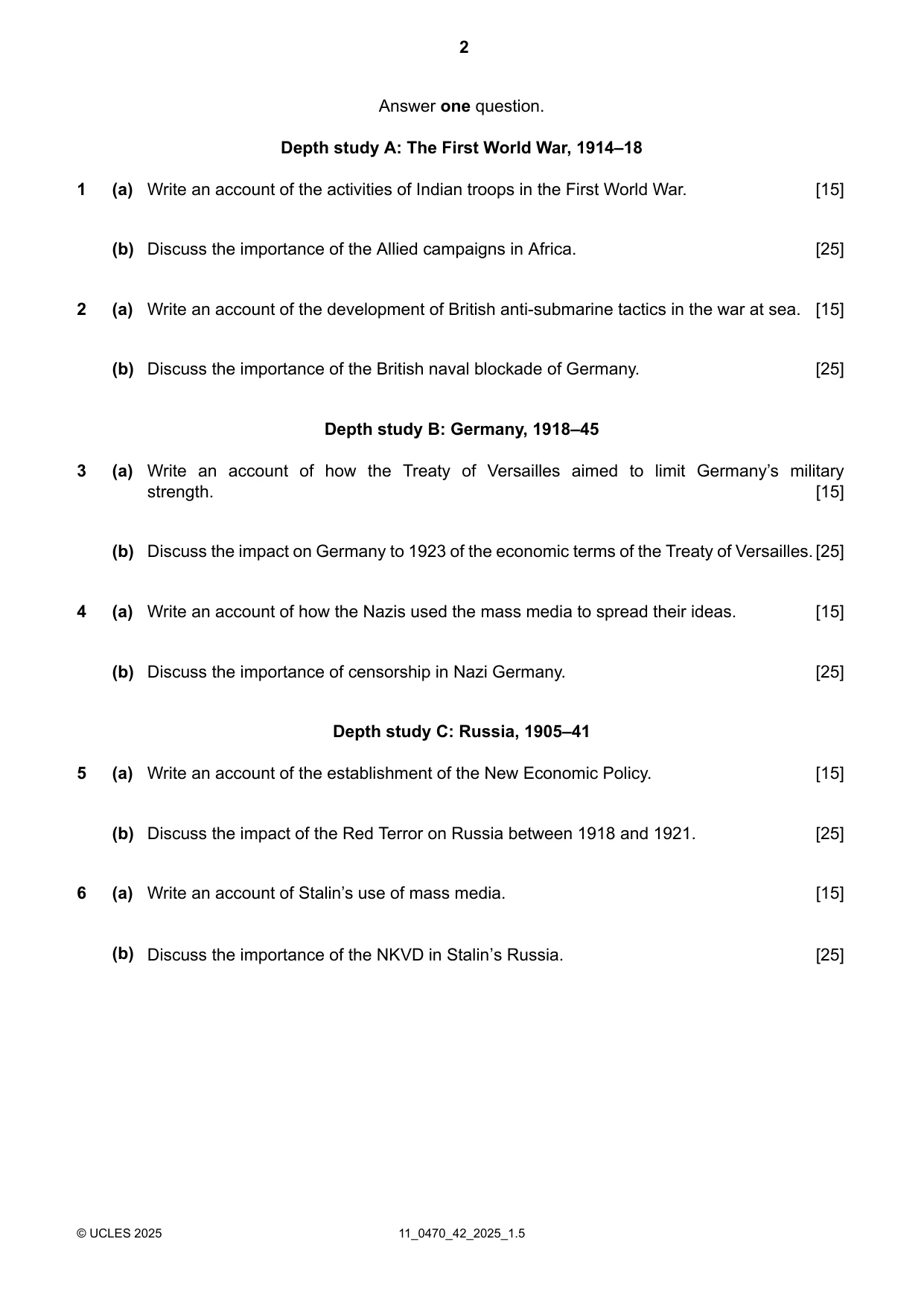
Question paper, page 2
Answer one question. Depth study A: The First World War, 1914–18 Write an account of the activities of Indian troops in the First World War. [15] (a) 1 Discuss the importance of the Allied campaigns in Africa. [25] (b) Write an account of the development of British anti-submarine tactics in the war at sea. [15] (a) 2 Discuss the importance of the British naval blockade of Germany. [25] (b) Depth study B: Germany, 1918–45 Write an account of how the Treaty of Versailles aimed to limit Germany’s military strength. [15] (a) 3 Discuss the impact on Germany to 1923 of the economic terms of the Treaty of Versailles.[25] (b) Write an account of how the Nazis used the mass media to spread their ideas. [15] (a) 4 Discuss the importance of censorship in Nazi Germany. [25] (b) Depth study C: Russia, 1905–41 Write an account of the establishment of the New Economic Policy. [15] (a) 5 Discuss the impact of the Red Terror on Russia between 1918 and 1921. [25] (b) Write an account of Stalin’s use of mass media. [15] (a) 6 Discuss the importance of the NKVD in Stalin’s Russia. [25] (b) 11_0470_42_2025_1.5 © UCLES 2025 2
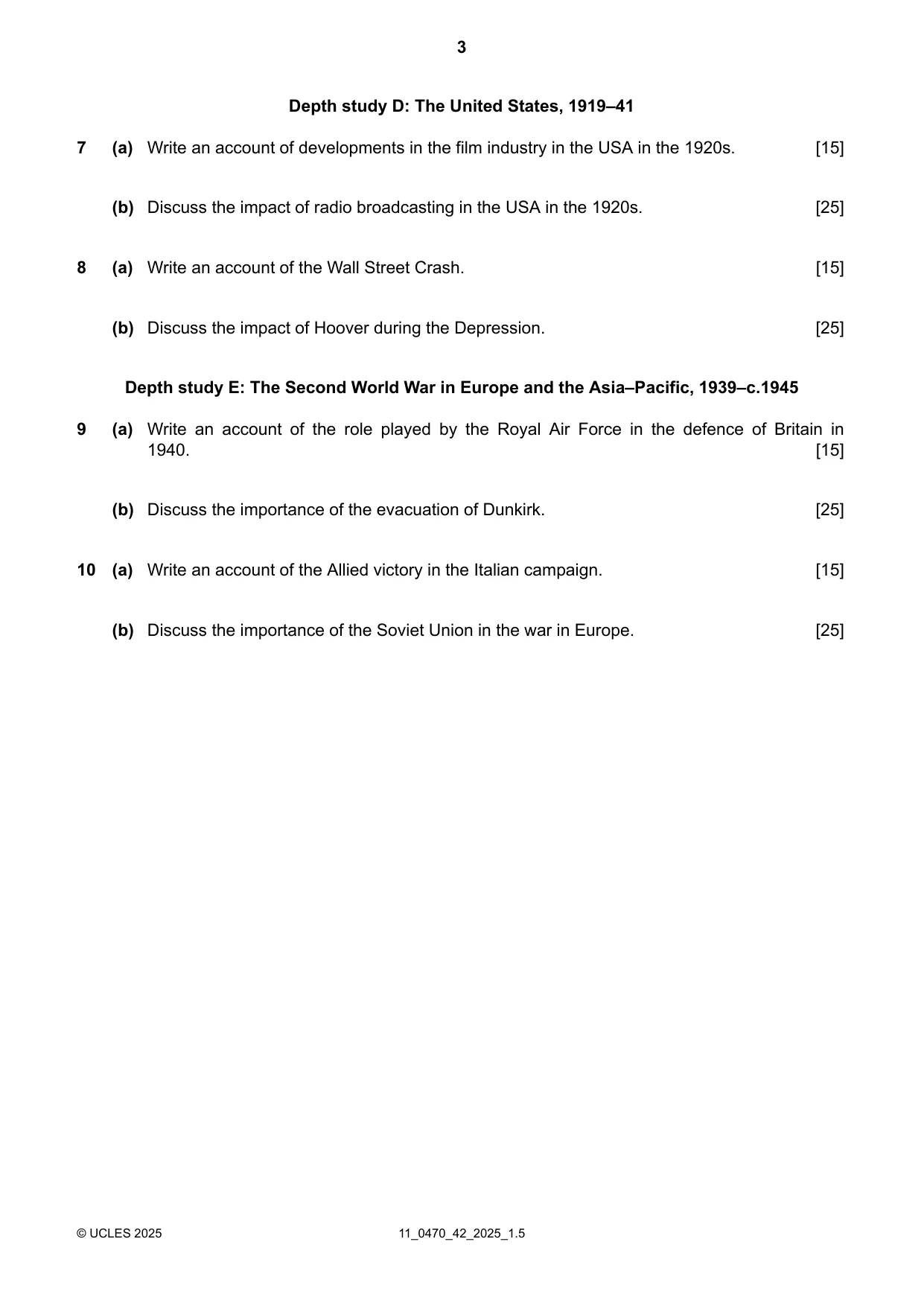
Question paper, page 3
Depth study D: The United States, 1919–41 Write an account of developments in the film industry in the USA in the 1920s. [15] (a) 7 Discuss the impact of radio broadcasting in the USA in the 1920s. [25] (b) Write an account of the Wall Street Crash. [15] (a) 8 Discuss the impact of Hoover during the Depression. [25] (b) Depth study E: The Second World War in Europe and the Asia–Pacific, 1939–c.1945 Write an account of the role played by the Royal Air Force in the defence of Britain in 1940. [15] (a) 9 Discuss the importance of the evacuation of Dunkirk. [25] (b) Write an account of the Allied victory in the Italian campaign. [15] (a) 10 Discuss the importance of the Soviet Union in the war in Europe. [25] (b) 11_0470_42_2025_1.5 © UCLES 2025 3
Question paper, page 4
BLANK PAGE Permission to reproduce items where third-party owned material protected by copyright is included has been sought and cleared where possible. Every reasonable effort has been made by the publisher (UCLES) to trace copyright holders, but if any items requiring clearance have unwittingly been included, the publisher will be pleased to make amends at the earliest possible opportunity. To avoid the issue of disclosure of answer-related information to candidates, all copyright acknowledgements are reproduced online in the Cambridge Assessment International Education Copyright Acknowledgements Booklet. This is produced for each series of examinations and is freely available to download at www.cambridgeinternational.org after the live examination series. Cambridge Assessment International Education is part of Cambridge Assessment. Cambridge Assessment is the brand name of the University of Cambridge Local Examinations Syndicate (UCLES), which is a department of the University of Cambridge. 11_0470_42_2025_1.5 © UCLES 2025 4
Mark scheme, page 1
This document consists of 17 printed pages. © Cambridge University Press & Assessment 2025 [Turn over Cambridge IGCSE™ HISTORY 0470/42 Paper 4 Alternative to Coursework October/November 2025 MARK SCHEME Maximum Mark: 40 Published This mark scheme is published as an aid to teachers and candidates, to indicate the requirements of the examination. It shows the basis on which Examiners were instructed to award marks. It does not indicate the details of the discussions that took place at an Examiners’ meeting before marking began, which would have considered the acceptability of alternative answers. Mark schemes should be read in conjunction with the question paper and the Principal Examiner Report for Teachers. Cambridge International will not enter into discussions about these mark schemes. Cambridge International is publishing the mark schemes for the October/November 2025 series for most Cambridge IGCSE, Cambridge International A and AS Level components, and some Cambridge O Level components.
Mark scheme, page 2
0470/42 Cambridge IGCSE – Mark Scheme PUBLISHED October/November 2025 © Cambridge University Press & Assessment 2025 Page 2 of 17 Generic Marking Principles These general marking principles must be applied by all examiners when marking candidate answers. They should be applied alongside the specific content of the mark scheme or generic level descriptions for a question. Each question paper and mark scheme will also comply with these marking principles. GENERIC MARKING PRINCIPLE 1: Marks must be awarded in line with: • the specific content of the mark scheme or the generic level descriptors for the question • the specific skills defined in the mark scheme or in the generic level descriptors for the question • the standard of response required by a candidate as exemplified by the standardisation scripts. GENERIC MARKING PRINCIPLE 2: Marks awarded are always whole marks (not half marks, or other fractions). GENERIC MARKING PRINCIPLE 3: Marks must be awarded positively: • marks are awarded for correct/valid answers, as defined in the mark scheme. However, credit is given for valid answers which go beyond the scope of the syllabus and mark scheme, referring to your Team Leader as appropriate • marks are awarded when candidates clearly demonstrate what they know and can do • marks are not deducted for errors • marks are not deducted for omissions • answers should only be judged on the quality of spelling, punctuation and grammar when these features are specifically assessed by the question as indicated by the mark scheme. The meaning, however, should be unambiguous. GENERIC MARKING PRINCIPLE 4: Rules must be applied consistently, e.g. in situations where candidates have not followed instructions or in the application of generic level descriptors. GENERIC MARKING PRINCIPLE 5: Marks should be awarded using the full range of marks defined in the mark scheme for the question. (However, the use of the full mark range may be limited according to the quality of the candidate responses seen.) GENERIC MARKING PRINCIPLE 6: Marks awarded are based solely on the requirements as defined in the mark scheme. Marks should not be awarded with grade thresholds or grade descriptors in mind.
Mark scheme, page 3
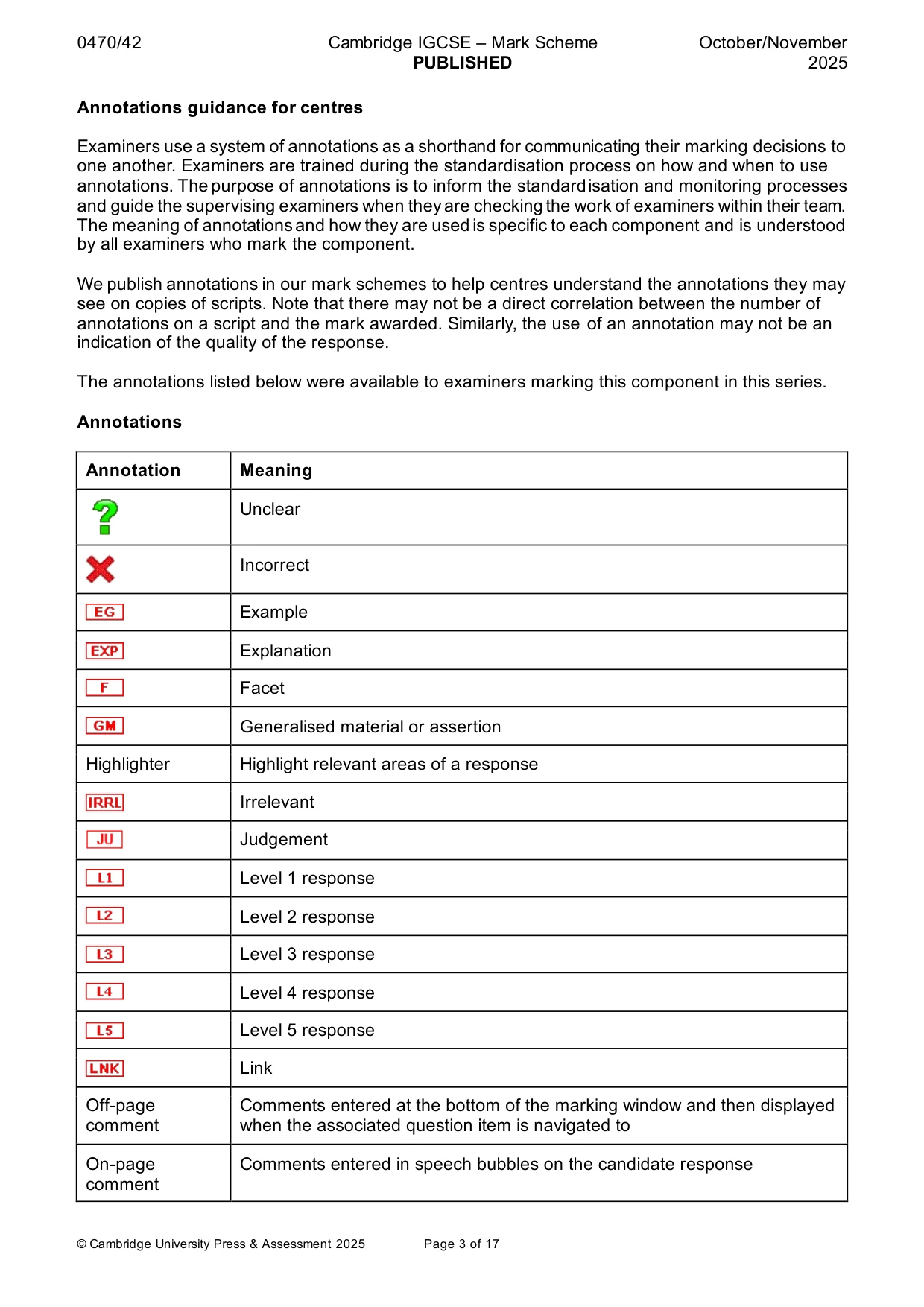
0470/42 Cambridge IGCSE – Mark Scheme PUBLISHED October/November 2025 © Cambridge University Press & Assessment 2025 Page 3 of 17 Annotations guidance for centres Examiners use a system of annotations as a shorthand for communicating their marking decisions to one another. Examiners are trained during the standardisation process on how and when to use annotations. The purpose of annotations is to inform the standardisation and monitoring processes and guide the supervising examiners when they are checking the work of examiners within their team. The meaning of annotations and how they are used is specific to each component and is understood by all examiners who mark the component. We publish annotations in our mark schemes to help centres understand the annotations they may see on copies of scripts. Note that there may not be a direct correlation between the number of annotations on a script and the mark awarded. Similarly, the use of an annotation may not be an indication of the quality of the response. The annotations listed below were available to examiners marking this component in this series. Annotations Annotation Meaning Unclear Incorrect Example Explanation Facet Generalised material or assertion Highlighter Highlight relevant areas of a response Irrelevant Judgement Level 1 response Level 2 response Level 3 response Level 4 response Level 5 response Link Off-page comment Comments entered at the bottom of the marking window and then displayed when the associated question item is navigated to On-page comment Comments entered in speech bubbles on the candidate response
Mark scheme, page 4
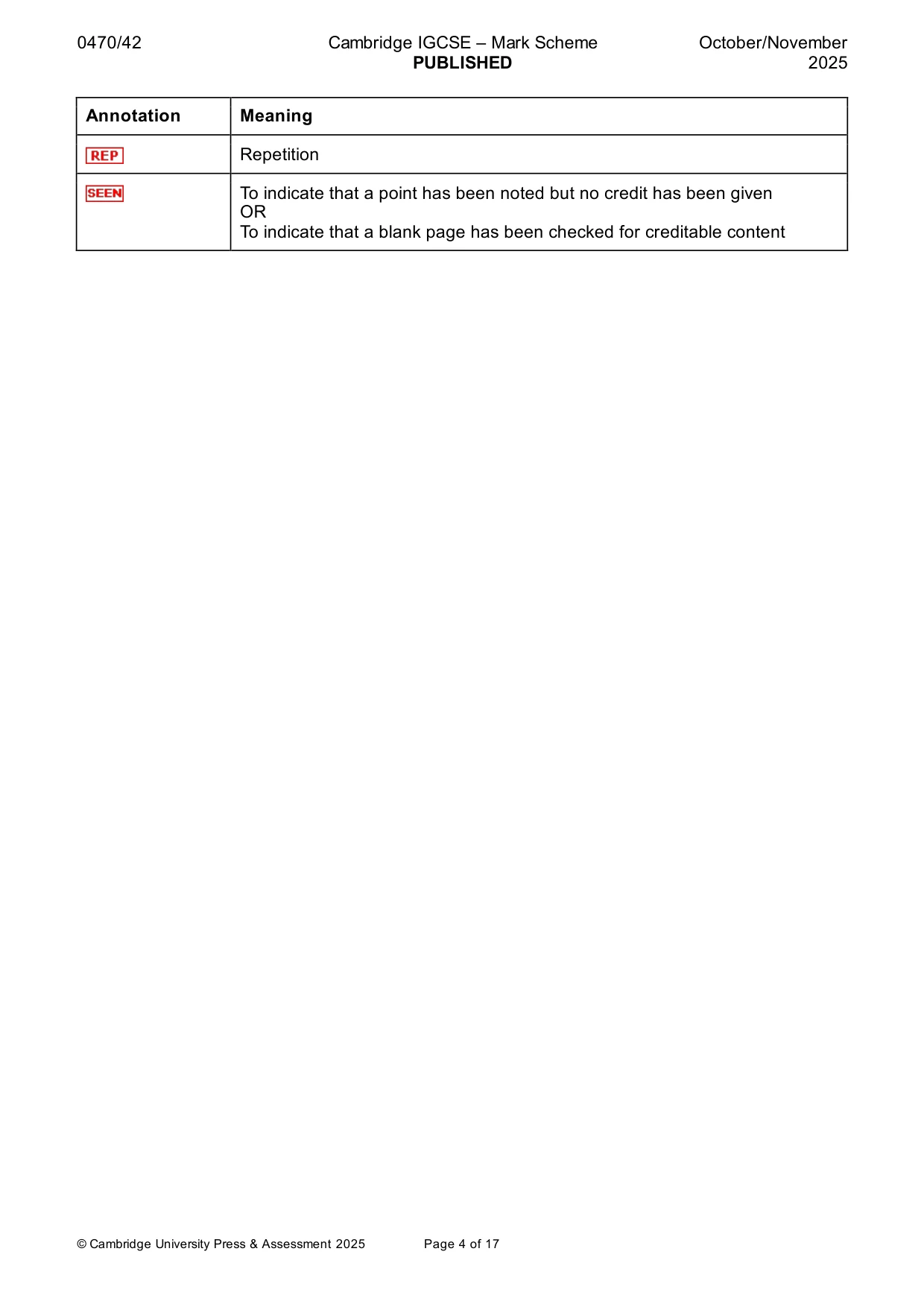
0470/42 Cambridge IGCSE – Mark Scheme PUBLISHED October/November 2025 © Cambridge University Press & Assessment 2025 Page 4 of 17 Annotation Meaning Repetition To indicate that a point has been noted but no credit has been given OR To indicate that a blank page has been checked for creditable content
Mark scheme, page 5
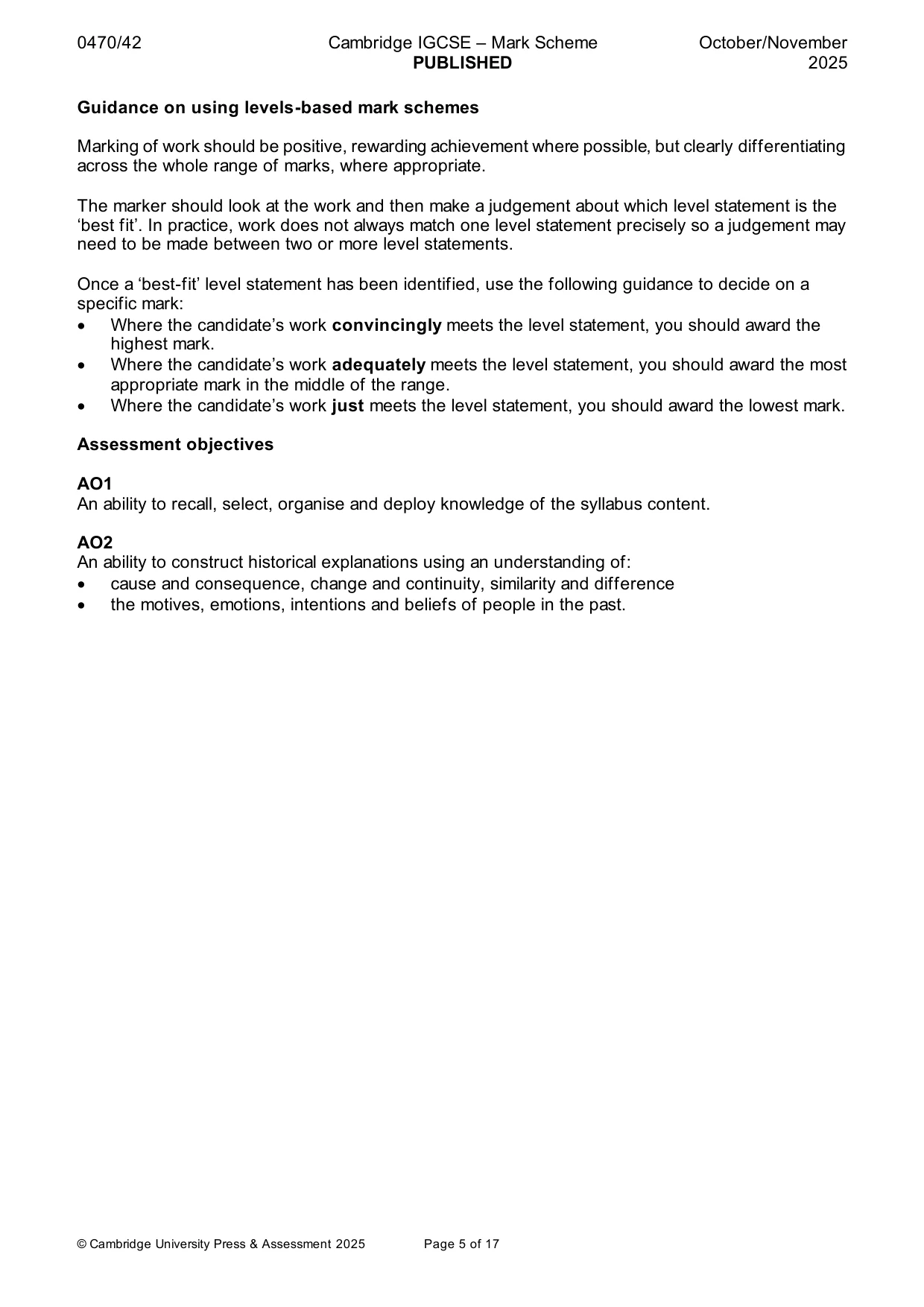
0470/42 Cambridge IGCSE – Mark Scheme PUBLISHED October/November 2025 © Cambridge University Press & Assessment 2025 Page 5 of 17 Guidance on using levels-based mark schemes Marking of work should be positive, rewarding achievement where possible, but clearly differentiating across the whole range of marks, where appropriate. The marker should look at the work and then make a judgement about which level statement is the ‘best fit’. In practice, work does not always match one level statement precisely so a judgement may need to be made between two or more level statements. Once a ‘best-fit’ level statement has been identified, use the following guidance to decide on a specific mark: • Where the candidate’s work convincingly meets the level statement, you should award the highest mark. • Where the candidate’s work adequately meets the level statement, you should award the most appropriate mark in the middle of the range. • Where the candidate’s work just meets the level statement, you should award the lowest mark. Assessment objectives AO1 An ability to recall, select, organise and deploy knowledge of the syllabus content. AO2 An ability to construct historical explanations using an understanding of: • cause and consequence, change and continuity, similarity and difference • the motives, emotions, intentions and beliefs of people in the past.
Mark scheme, page 6
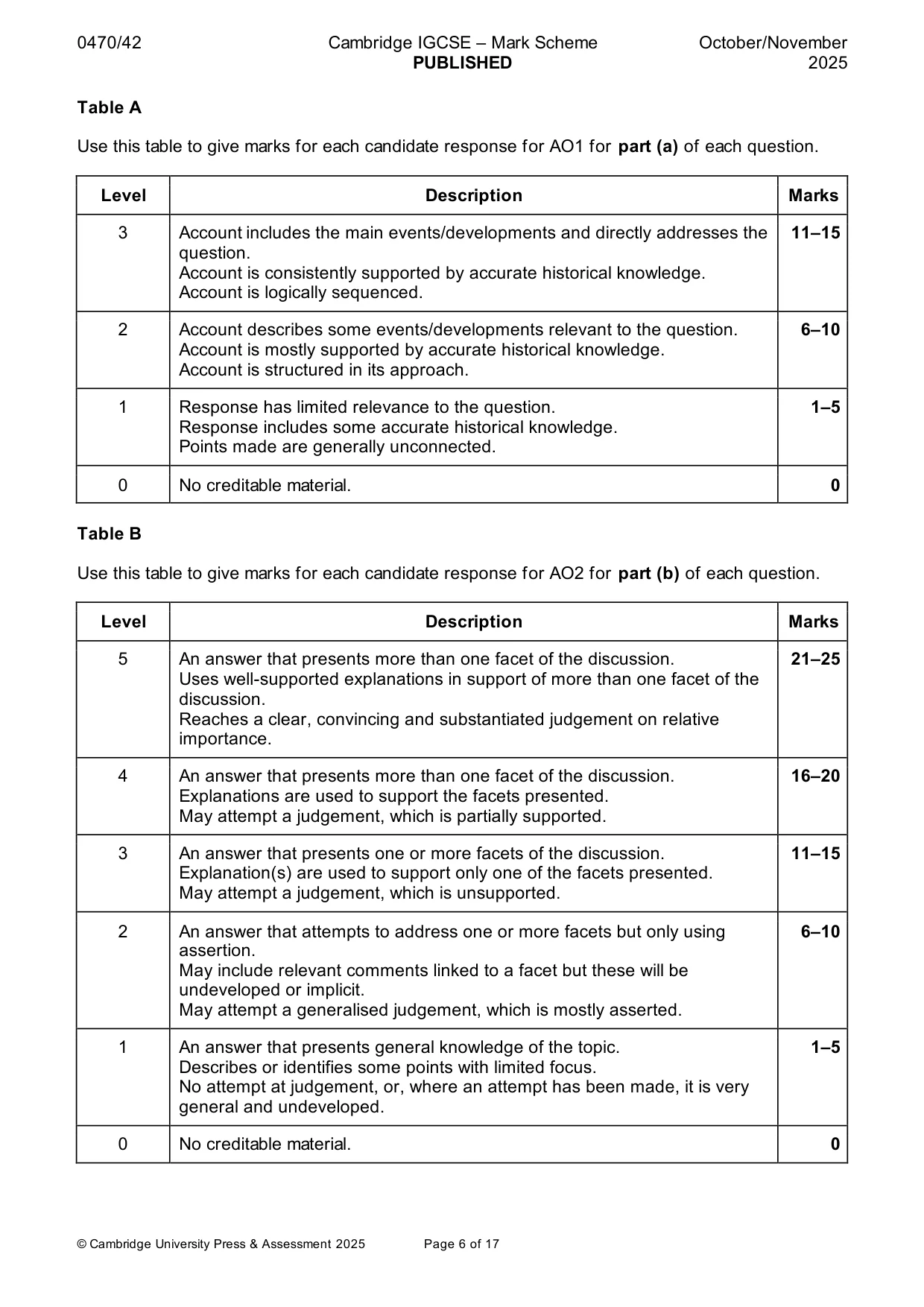
0470/42 Cambridge IGCSE – Mark Scheme PUBLISHED October/November 2025 © Cambridge University Press & Assessment 2025 Page 6 of 17 Table A Use this table to give marks for each candidate response for AO1 for part (a) of each question. Level Description Marks 3 Account includes the main events/developments and directly addresses the question. Account is consistently supported by accurate historical knowledge. Account is logically sequenced. 11–15 2 Account describes some events/developments relevant to the question. Account is mostly supported by accurate historical knowledge. Account is structured in its approach. 6–10 1 Response has limited relevance to the question. Response includes some accurate historical knowledge. Points made are generally unconnected. 1–5 0 No creditable material. 0 Table B Use this table to give marks for each candidate response for AO2 for part (b) of each question. Level Description Marks 5 An answer that presents more than one facet of the discussion. Uses well-supported explanations in support of more than one facet of the discussion. Reaches a clear, convincing and substantiated judgement on relative importance. 21–25 4 An answer that presents more than one facet of the discussion. Explanations are used to support the facets presented. May attempt a judgement, which is partially supported. 16–20 3 An answer that presents one or more facets of the discussion. Explanation(s) are used to support only one of the facets presented. May attempt a judgement, which is unsupported. 11–15 2 An answer that attempts to address one or more facets but only using assertion. May include relevant comments linked to a facet but these will be undeveloped or implicit. May attempt a generalised judgement, which is mostly asserted. 6–10 1 An answer that presents general knowledge of the topic. Describes or identifies some points with limited focus. No attempt at judgement, or, where an attempt has been made, it is very general and undeveloped. 1–5 0 No creditable material. 0
Mark scheme, page 7
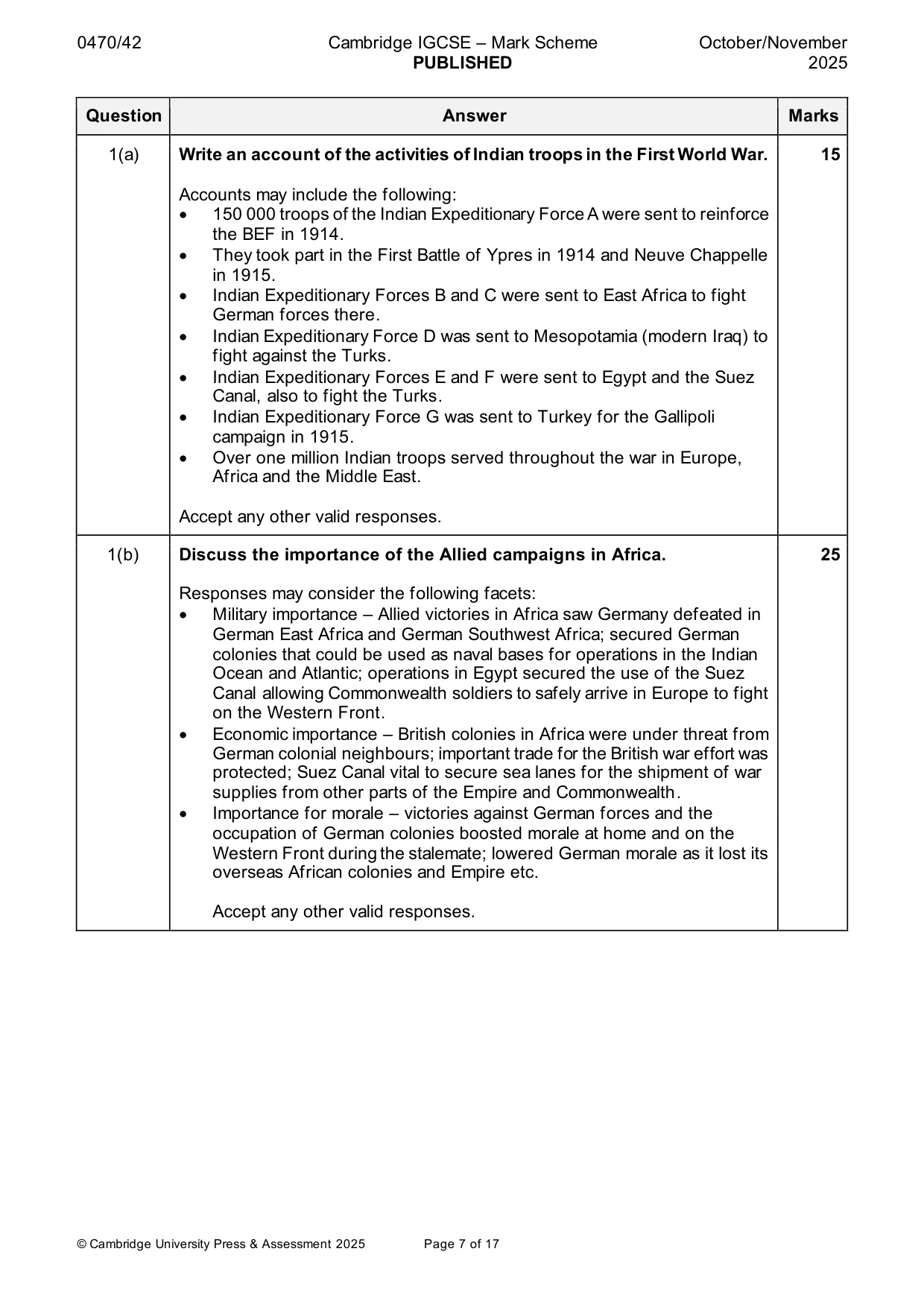
0470/42 Cambridge IGCSE – Mark Scheme PUBLISHED October/November 2025 © Cambridge University Press & Assessment 2025 Page 7 of 17 Question Answer Marks 1(a) Write an account of the activities of Indian troops in the First World War. Accounts may include the following: • 150 000 troops of the Indian Expeditionary Force A were sent to reinforce the BEF in 1914. • They took part in the First Battle of Ypres in 1914 and Neuve Chappelle in 1915. • Indian Expeditionary Forces B and C were sent to East Africa to fight German forces there. • Indian Expeditionary Force D was sent to Mesopotamia (modern Iraq) to fight against the Turks. • Indian Expeditionary Forces E and F were sent to Egypt and the Suez Canal, also to fight the Turks. • Indian Expeditionary Force G was sent to Turkey for the Gallipoli campaign in 1915. • Over one million Indian troops served throughout the war in Europe, Africa and the Middle East. Accept any other valid responses. 15 1(b) Discuss the importance of the Allied campaigns in Africa. Responses may consider the following facets: • Military importance – Allied victories in Africa saw Germany defeated in German East Africa and German Southwest Africa; secured German colonies that could be used as naval bases for operations in the Indian Ocean and Atlantic; operations in Egypt secured the use of the Suez Canal allowing Commonwealth soldiers to safely arrive in Europe to fight on the Western Front. • Economic importance – British colonies in Africa were under threat from German colonial neighbours; important trade for the British war effort was protected; Suez Canal vital to secure sea lanes for the shipment of war supplies from other parts of the Empire and Commonwealth. • Importance for morale – victories against German forces and the occupation of German colonies boosted morale at home and on the Western Front during the stalemate; lowered German morale as it lost its overseas African colonies and Empire etc. Accept any other valid responses. 25
Mark scheme, page 8
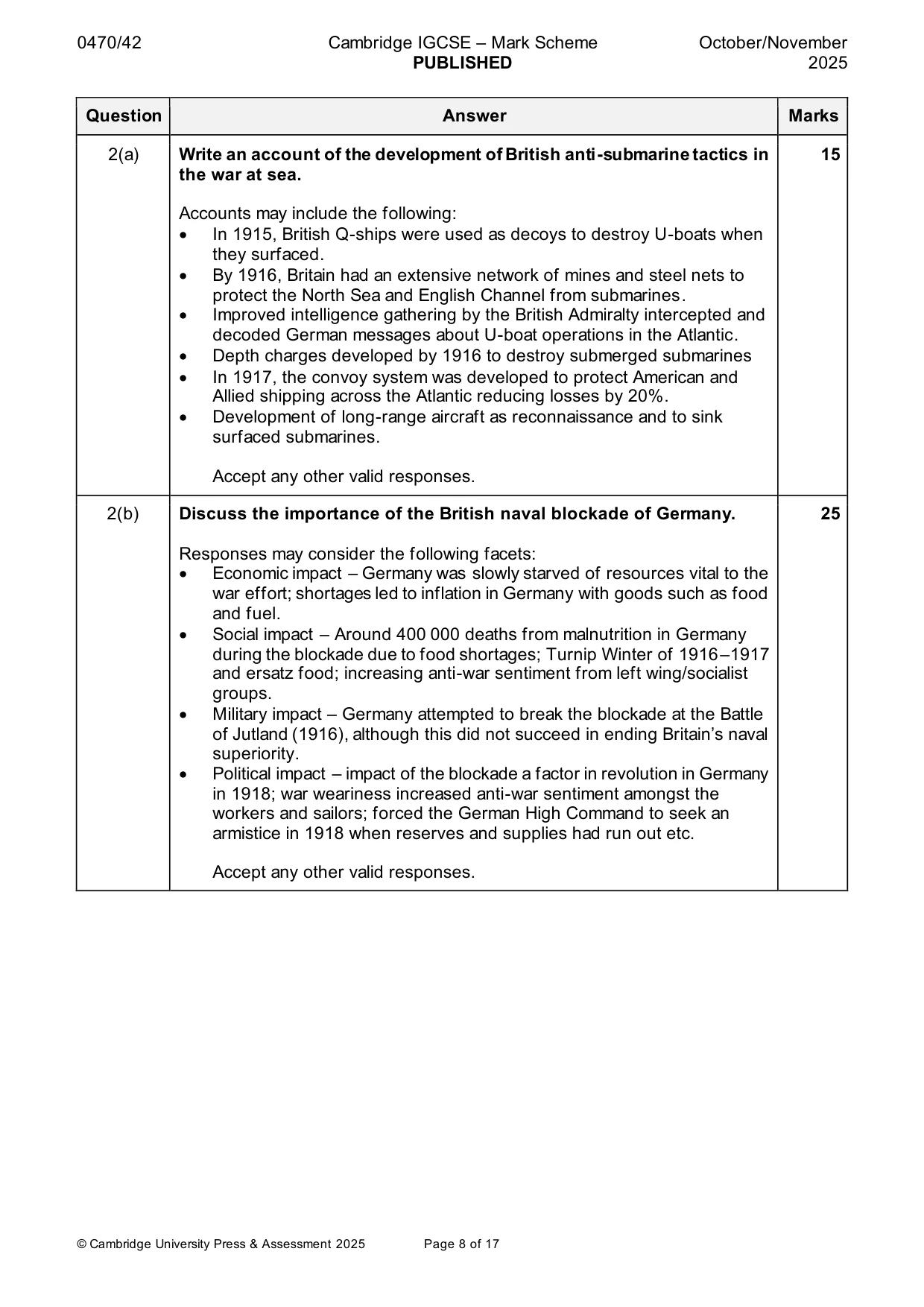
0470/42 Cambridge IGCSE – Mark Scheme PUBLISHED October/November 2025 © Cambridge University Press & Assessment 2025 Page 8 of 17 Question Answer Marks 2(a) Write an account of the development of British anti-submarine tactics in the war at sea. Accounts may include the following: • In 1915, British Q-ships were used as decoys to destroy U-boats when they surfaced. • By 1916, Britain had an extensive network of mines and steel nets to protect the North Sea and English Channel from submarines. • Improved intelligence gathering by the British Admiralty intercepted and decoded German messages about U-boat operations in the Atlantic. • Depth charges developed by 1916 to destroy submerged submarines • In 1917, the convoy system was developed to protect American and Allied shipping across the Atlantic reducing losses by 20%. • Development of long-range aircraft as reconnaissance and to sink surfaced submarines. Accept any other valid responses. 15 2(b) Discuss the importance of the British naval blockade of Germany. Responses may consider the following facets: • Economic impact – Germany was slowly starved of resources vital to the war effort; shortages led to inflation in Germany with goods such as food and fuel. • Social impact – Around 400 000 deaths from malnutrition in Germany during the blockade due to food shortages; Turnip Winter of 1916–1917 and ersatz food; increasing anti-war sentiment from left wing/socialist groups. • Military impact – Germany attempted to break the blockade at the Battle of Jutland (1916), although this did not succeed in ending Britain’s naval superiority. • Political impact – impact of the blockade a factor in revolution in Germany in 1918; war weariness increased anti-war sentiment amongst the workers and sailors; forced the German High Command to seek an armistice in 1918 when reserves and supplies had run out etc. Accept any other valid responses. 25
Mark scheme, page 9
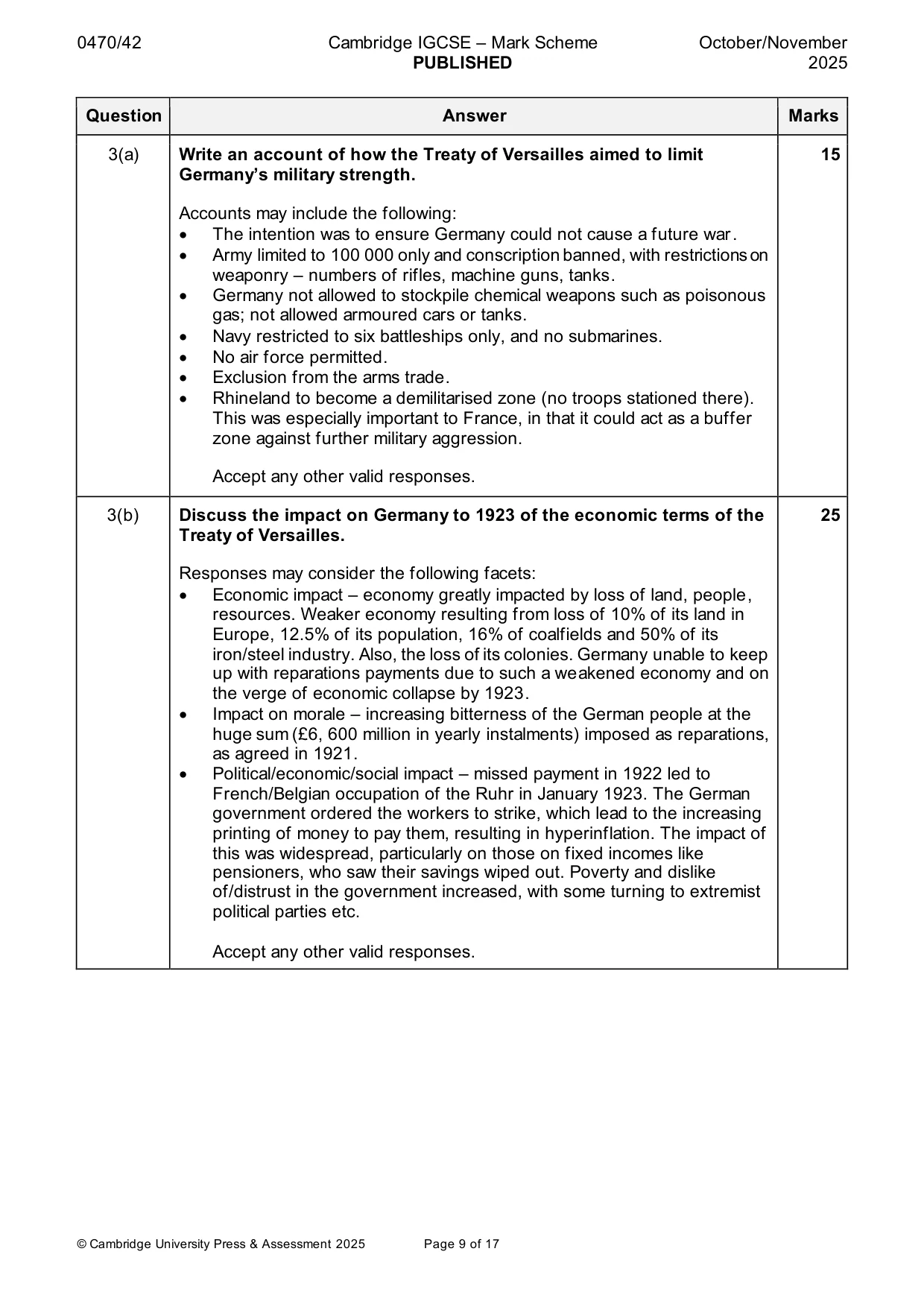
0470/42 Cambridge IGCSE – Mark Scheme PUBLISHED October/November 2025 © Cambridge University Press & Assessment 2025 Page 9 of 17 Question Answer Marks 3(a) Write an account of how the Treaty of Versailles aimed to limit Germany’s military strength. Accounts may include the following: • The intention was to ensure Germany could not cause a future war. • Army limited to 100 000 only and conscription banned, with restrictions on weaponry – numbers of rifles, machine guns, tanks. • Germany not allowed to stockpile chemical weapons such as poisonous gas; not allowed armoured cars or tanks. • Navy restricted to six battleships only, and no submarines. • No air force permitted. • Exclusion from the arms trade. • Rhineland to become a demilitarised zone (no troops stationed there). This was especially important to France, in that it could act as a buffer zone against further military aggression. Accept any other valid responses. 15 3(b) Discuss the impact on Germany to 1923 of the economic terms of the Treaty of Versailles. Responses may consider the following facets: • Economic impact – economy greatly impacted by loss of land, people, resources. Weaker economy resulting from loss of 10% of its land in Europe, 12.5% of its population, 16% of coalfields and 50% of its iron/steel industry. Also, the loss of its colonies. Germany unable to keep up with reparations payments due to such a weakened economy and on the verge of economic collapse by 1923. • Impact on morale – increasing bitterness of the German people at the huge sum (£6, 600 million in yearly instalments) imposed as reparations, as agreed in 1921. • Political/economic/social impact – missed payment in 1922 led to French/Belgian occupation of the Ruhr in January 1923. The German government ordered the workers to strike, which lead to the increasing printing of money to pay them, resulting in hyperinflation. The impact of this was widespread, particularly on those on fixed incomes like pensioners, who saw their savings wiped out. Poverty and dislike of/distrust in the government increased, with some turning to extremist political parties etc. Accept any other valid responses. 25
Mark scheme, page 10
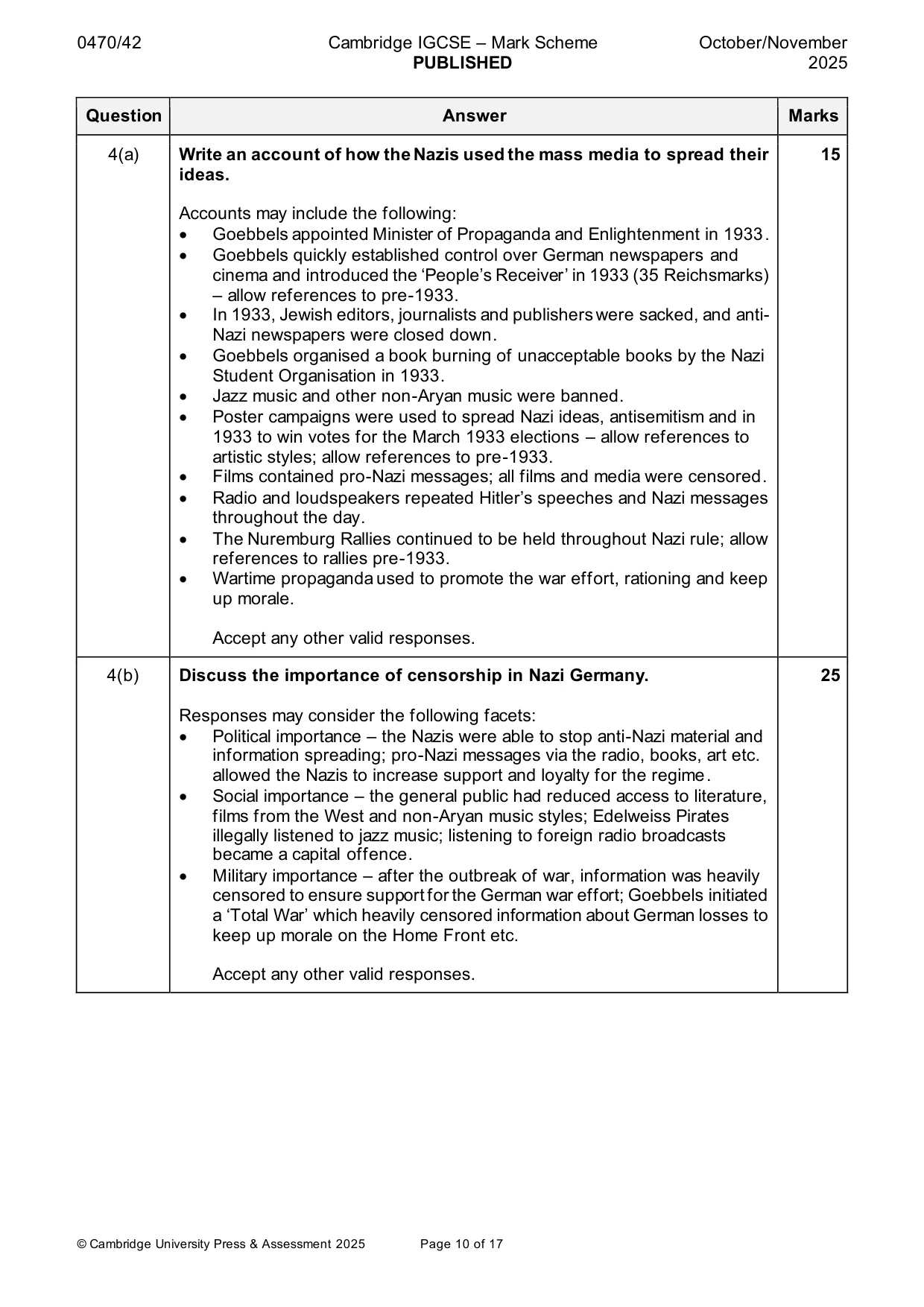
0470/42 Cambridge IGCSE – Mark Scheme PUBLISHED October/November 2025 © Cambridge University Press & Assessment 2025 Page 10 of 17 Question Answer Marks 4(a) Write an account of how the Nazis used the mass media to spread their ideas. Accounts may include the following: • Goebbels appointed Minister of Propaganda and Enlightenment in 1933. • Goebbels quickly established control over German newspapers and cinema and introduced the ‘People’s Receiver’ in 1933 (35 Reichsmarks) – allow references to pre-1933. • In 1933, Jewish editors, journalists and publishers were sacked, and anti- Nazi newspapers were closed down. • Goebbels organised a book burning of unacceptable books by the Nazi Student Organisation in 1933. • Jazz music and other non-Aryan music were banned. • Poster campaigns were used to spread Nazi ideas, antisemitism and in 1933 to win votes for the March 1933 elections – allow references to artistic styles; allow references to pre-1933. • Films contained pro-Nazi messages; all films and media were censored. • Radio and loudspeakers repeated Hitler’s speeches and Nazi messages throughout the day. • The Nuremburg Rallies continued to be held throughout Nazi rule; allow references to rallies pre-1933. • Wartime propaganda used to promote the war effort, rationing and keep up morale. Accept any other valid responses. 15 4(b) Discuss the importance of censorship in Nazi Germany. Responses may consider the following facets: • Political importance – the Nazis were able to stop anti-Nazi material and information spreading; pro-Nazi messages via the radio, books, art etc. allowed the Nazis to increase support and loyalty for the regime. • Social importance – the general public had reduced access to literature, films from the West and non-Aryan music styles; Edelweiss Pirates illegally listened to jazz music; listening to foreign radio broadcasts became a capital offence. • Military importance – after the outbreak of war, information was heavily censored to ensure support for the German war effort; Goebbels initiated a ‘Total War’ which heavily censored information about German losses to keep up morale on the Home Front etc. Accept any other valid responses. 25
Mark scheme, page 11
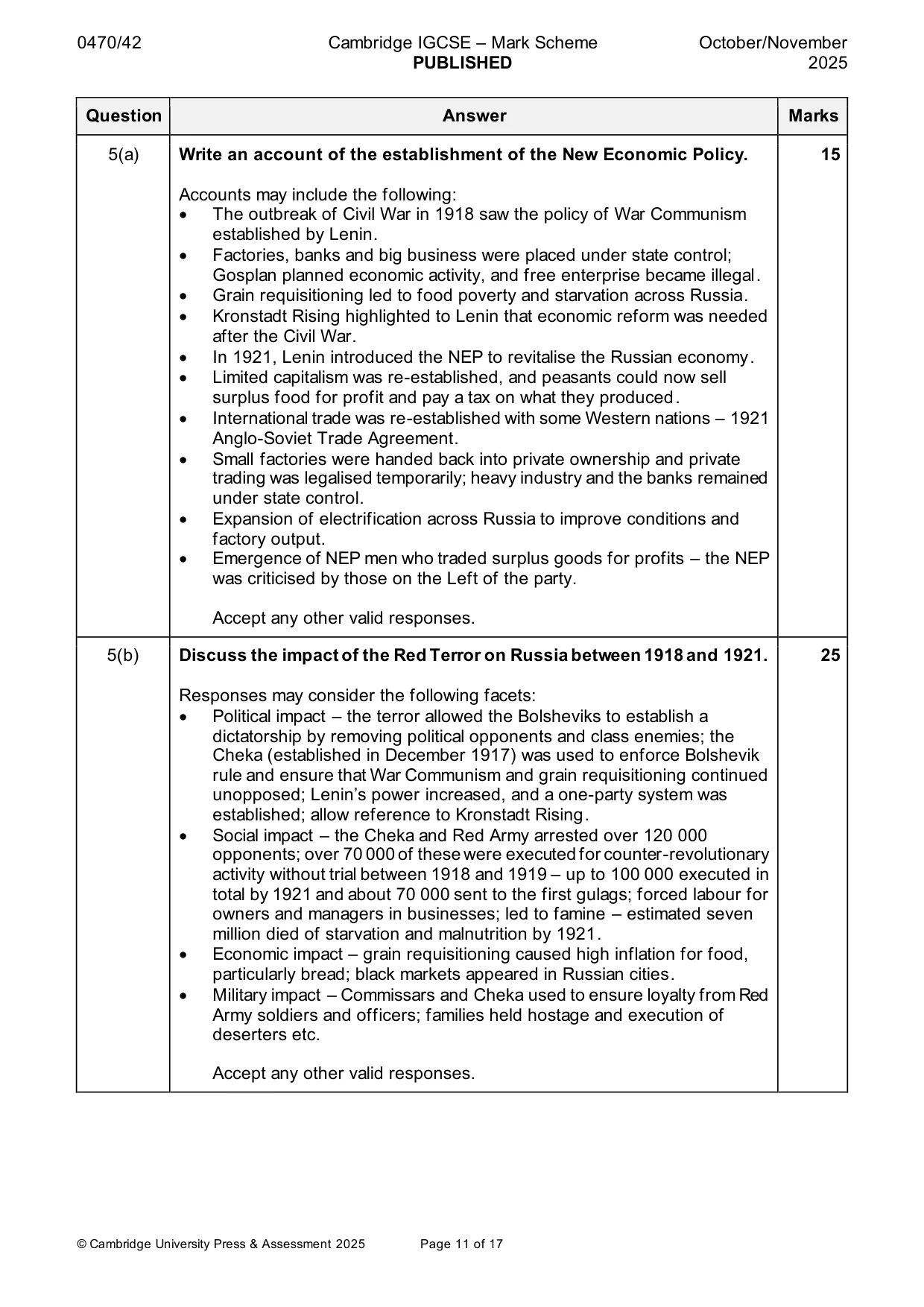
0470/42 Cambridge IGCSE – Mark Scheme PUBLISHED October/November 2025 © Cambridge University Press & Assessment 2025 Page 11 of 17 Question Answer Marks 5(a) Write an account of the establishment of the New Economic Policy. Accounts may include the following: • The outbreak of Civil War in 1918 saw the policy of War Communism established by Lenin. • Factories, banks and big business were placed under state control; Gosplan planned economic activity, and free enterprise became illegal. • Grain requisitioning led to food poverty and starvation across Russia. • Kronstadt Rising highlighted to Lenin that economic reform was needed after the Civil War. • In 1921, Lenin introduced the NEP to revitalise the Russian economy. • Limited capitalism was re-established, and peasants could now sell surplus food for profit and pay a tax on what they produced. • International trade was re-established with some Western nations – 1921 Anglo-Soviet Trade Agreement. • Small factories were handed back into private ownership and private trading was legalised temporarily; heavy industry and the banks remained under state control. • Expansion of electrification across Russia to improve conditions and factory output. • Emergence of NEP men who traded surplus goods for profits – the NEP was criticised by those on the Left of the party. Accept any other valid responses. 15 5(b) Discuss the impact of the Red Terror on Russia between 1918 and 1921. Responses may consider the following facets: • Political impact – the terror allowed the Bolsheviks to establish a dictatorship by removing political opponents and class enemies; the Cheka (established in December 1917) was used to enforce Bolshevik rule and ensure that War Communism and grain requisitioning continued unopposed; Lenin’s power increased, and a one-party system was established; allow reference to Kronstadt Rising. • Social impact – the Cheka and Red Army arrested over 120 000 opponents; over 70 000 of these were executed for counter-revolutionary activity without trial between 1918 and 1919 – up to 100 000 executed in total by 1921 and about 70 000 sent to the first gulags; forced labour for owners and managers in businesses; led to famine – estimated seven million died of starvation and malnutrition by 1921. • Economic impact – grain requisitioning caused high inflation for food, particularly bread; black markets appeared in Russian cities. • Military impact – Commissars and Cheka used to ensure loyalty from Red Army soldiers and officers; families held hostage and execution of deserters etc. Accept any other valid responses. 25
Mark scheme, page 12
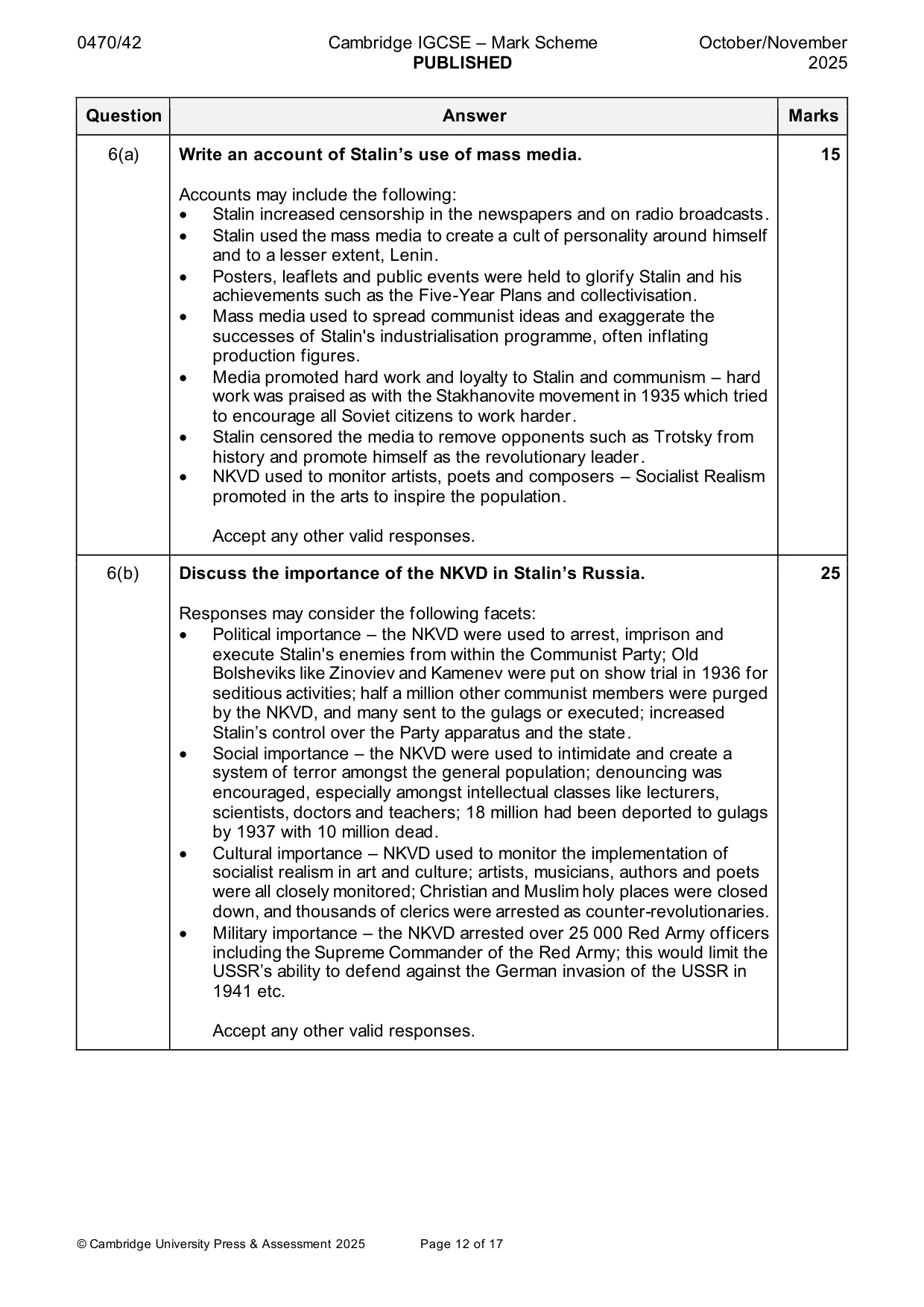
0470/42 Cambridge IGCSE – Mark Scheme PUBLISHED October/November 2025 © Cambridge University Press & Assessment 2025 Page 12 of 17 Question Answer Marks 6(a) Write an account of Stalin’s use of mass media. Accounts may include the following: • Stalin increased censorship in the newspapers and on radio broadcasts. • Stalin used the mass media to create a cult of personality around himself and to a lesser extent, Lenin. • Posters, leaflets and public events were held to glorify Stalin and his achievements such as the Five-Year Plans and collectivisation. • Mass media used to spread communist ideas and exaggerate the successes of Stalin's industrialisation programme, often inflating production figures. • Media promoted hard work and loyalty to Stalin and communism – hard work was praised as with the Stakhanovite movement in 1935 which tried to encourage all Soviet citizens to work harder. • Stalin censored the media to remove opponents such as Trotsky from history and promote himself as the revolutionary leader. • NKVD used to monitor artists, poets and composers – Socialist Realism promoted in the arts to inspire the population. Accept any other valid responses. 15 6(b) Discuss the importance of the NKVD in Stalin’s Russia. Responses may consider the following facets: • Political importance – the NKVD were used to arrest, imprison and execute Stalin's enemies from within the Communist Party; Old Bolsheviks like Zinoviev and Kamenev were put on show trial in 1936 for seditious activities; half a million other communist members were purged by the NKVD, and many sent to the gulags or executed; increased Stalin’s control over the Party apparatus and the state. • Social importance – the NKVD were used to intimidate and create a system of terror amongst the general population; denouncing was encouraged, especially amongst intellectual classes like lecturers, scientists, doctors and teachers; 18 million had been deported to gulags by 1937 with 10 million dead. • Cultural importance – NKVD used to monitor the implementation of socialist realism in art and culture; artists, musicians, authors and poets were all closely monitored; Christian and Muslim holy places were closed down, and thousands of clerics were arrested as counter-revolutionaries. • Military importance – the NKVD arrested over 25 000 Red Army officers including the Supreme Commander of the Red Army; this would limit the USSR’s ability to defend against the German invasion of the USSR in 1941 etc. Accept any other valid responses. 25
Mark scheme, page 13
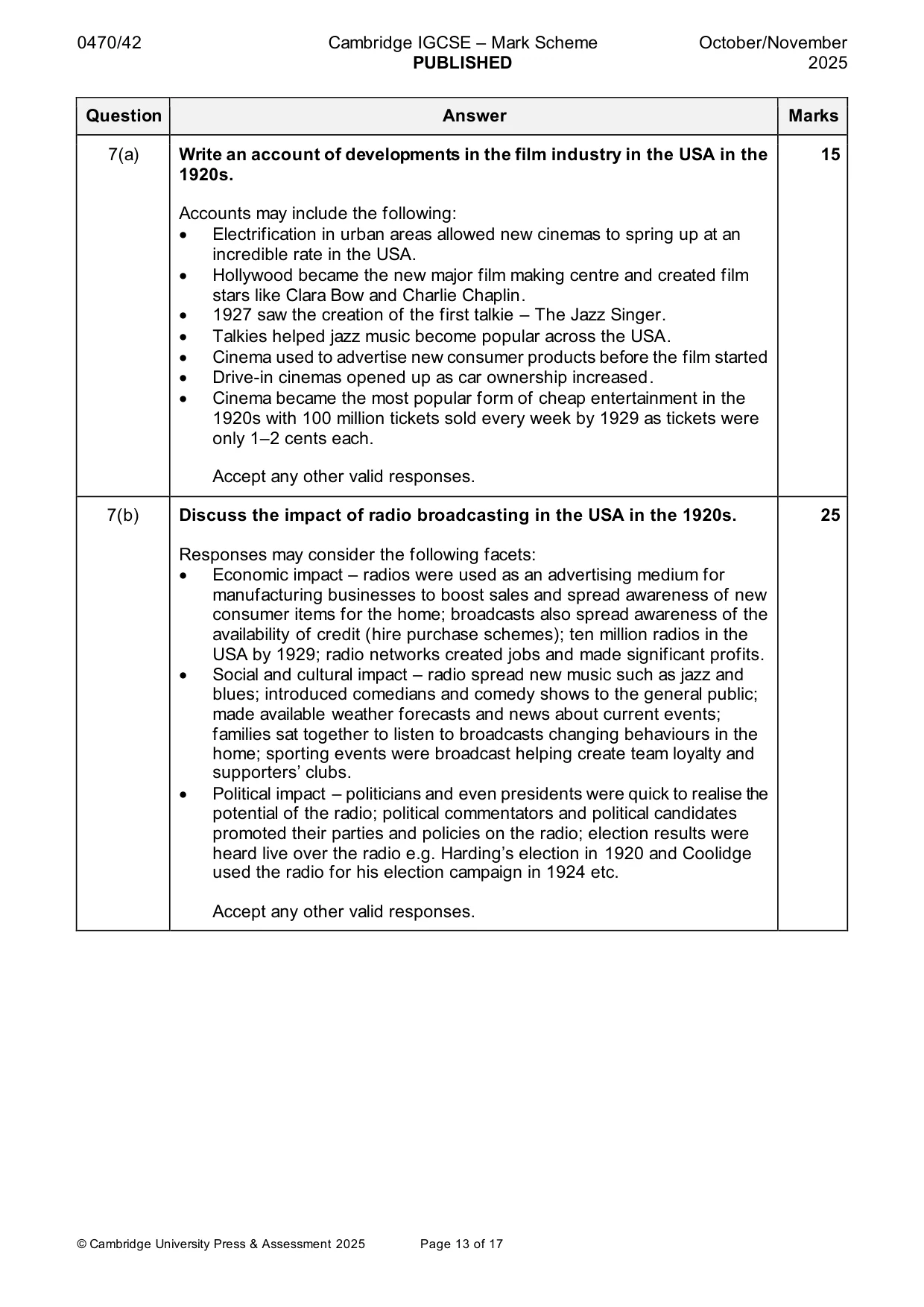
0470/42 Cambridge IGCSE – Mark Scheme PUBLISHED October/November 2025 © Cambridge University Press & Assessment 2025 Page 13 of 17 Question Answer Marks 7(a) Write an account of developments in the film industry in the USA in the 1920s. Accounts may include the following: • Electrification in urban areas allowed new cinemas to spring up at an incredible rate in the USA. • Hollywood became the new major film making centre and created film stars like Clara Bow and Charlie Chaplin. • 1927 saw the creation of the first talkie – The Jazz Singer. • Talkies helped jazz music become popular across the USA. • Cinema used to advertise new consumer products before the film started • Drive-in cinemas opened up as car ownership increased. • Cinema became the most popular form of cheap entertainment in the 1920s with 100 million tickets sold every week by 1929 as tickets were only 1–2 cents each. Accept any other valid responses. 15 7(b) Discuss the impact of radio broadcasting in the USA in the 1920s. Responses may consider the following facets: • Economic impact – radios were used as an advertising medium for manufacturing businesses to boost sales and spread awareness of new consumer items for the home; broadcasts also spread awareness of the availability of credit (hire purchase schemes); ten million radios in the USA by 1929; radio networks created jobs and made significant profits. • Social and cultural impact – radio spread new music such as jazz and blues; introduced comedians and comedy shows to the general public; made available weather forecasts and news about current events; families sat together to listen to broadcasts changing behaviours in the home; sporting events were broadcast helping create team loyalty and supporters’ clubs. • Political impact – politicians and even presidents were quick to realise the potential of the radio; political commentators and political candidates promoted their parties and policies on the radio; election results were heard live over the radio e.g. Harding’s election in 1920 and Coolidge used the radio for his election campaign in 1924 etc. Accept any other valid responses. 25
Mark scheme, page 14
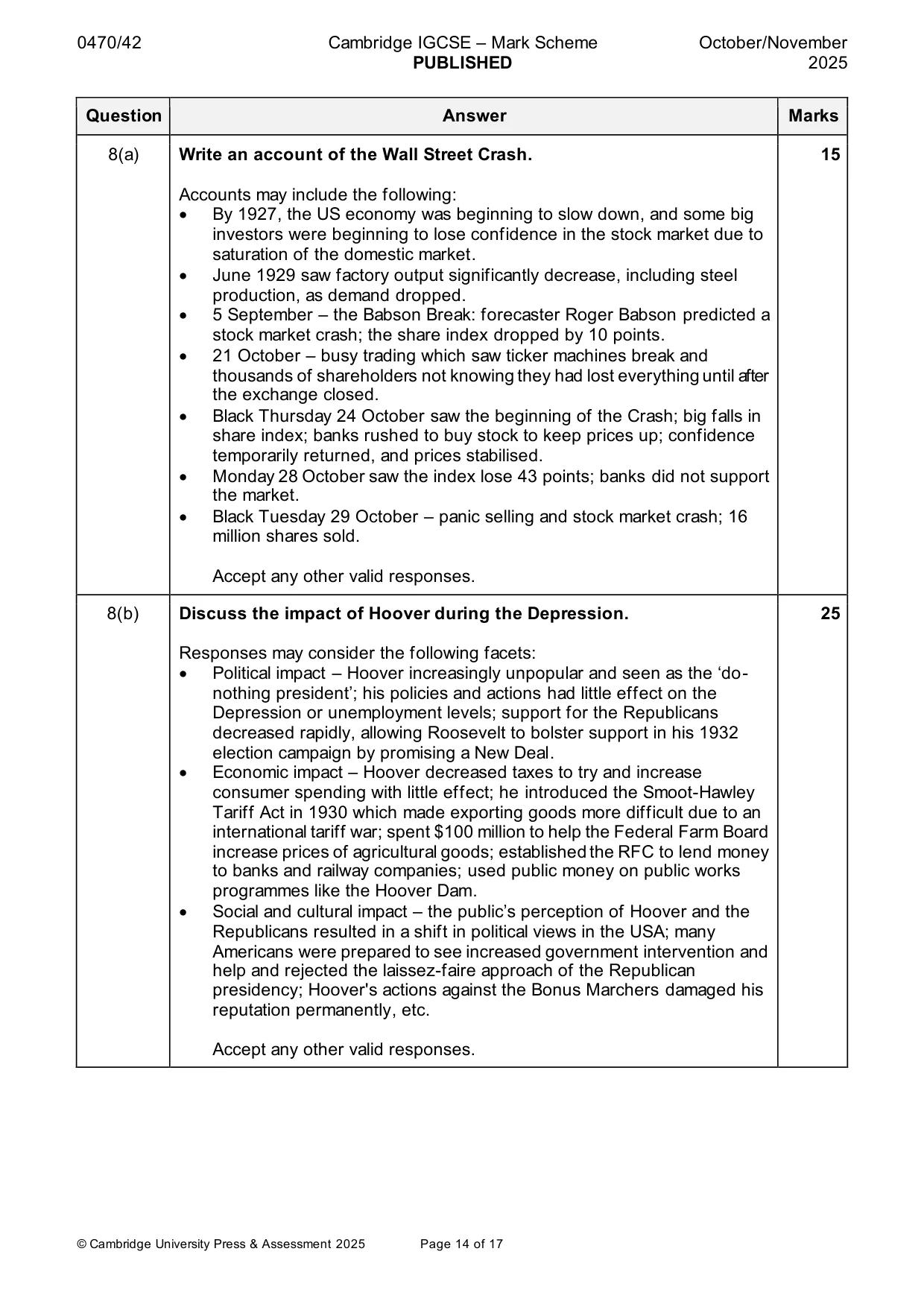
0470/42 Cambridge IGCSE – Mark Scheme PUBLISHED October/November 2025 © Cambridge University Press & Assessment 2025 Page 14 of 17 Question Answer Marks 8(a) Write an account of the Wall Street Crash. Accounts may include the following: • By 1927, the US economy was beginning to slow down, and some big investors were beginning to lose confidence in the stock market due to saturation of the domestic market. • June 1929 saw factory output significantly decrease, including steel production, as demand dropped. • 5 September – the Babson Break: forecaster Roger Babson predicted a stock market crash; the share index dropped by 10 points. • 21 October – busy trading which saw ticker machines break and thousands of shareholders not knowing they had lost everything until after the exchange closed. • Black Thursday 24 October saw the beginning of the Crash; big falls in share index; banks rushed to buy stock to keep prices up; confidence temporarily returned, and prices stabilised. • Monday 28 October saw the index lose 43 points; banks did not support the market. • Black Tuesday 29 October – panic selling and stock market crash; 16 million shares sold. Accept any other valid responses. 15 8(b) Discuss the impact of Hoover during the Depression. Responses may consider the following facets: • Political impact – Hoover increasingly unpopular and seen as the ‘do- nothing president’; his policies and actions had little effect on the Depression or unemployment levels; support for the Republicans decreased rapidly, allowing Roosevelt to bolster support in his 1932 election campaign by promising a New Deal. • Economic impact – Hoover decreased taxes to try and increase consumer spending with little effect; he introduced the Smoot-Hawley Tariff Act in 1930 which made exporting goods more difficult due to an international tariff war; spent $100 million to help the Federal Farm Board increase prices of agricultural goods; established the RFC to lend money to banks and railway companies; used public money on public works programmes like the Hoover Dam. • Social and cultural impact – the public’s perception of Hoover and the Republicans resulted in a shift in political views in the USA; many Americans were prepared to see increased government intervention and help and rejected the laissez-faire approach of the Republican presidency; Hoover's actions against the Bonus Marchers damaged his reputation permanently, etc. Accept any other valid responses. 25
Mark scheme, page 15
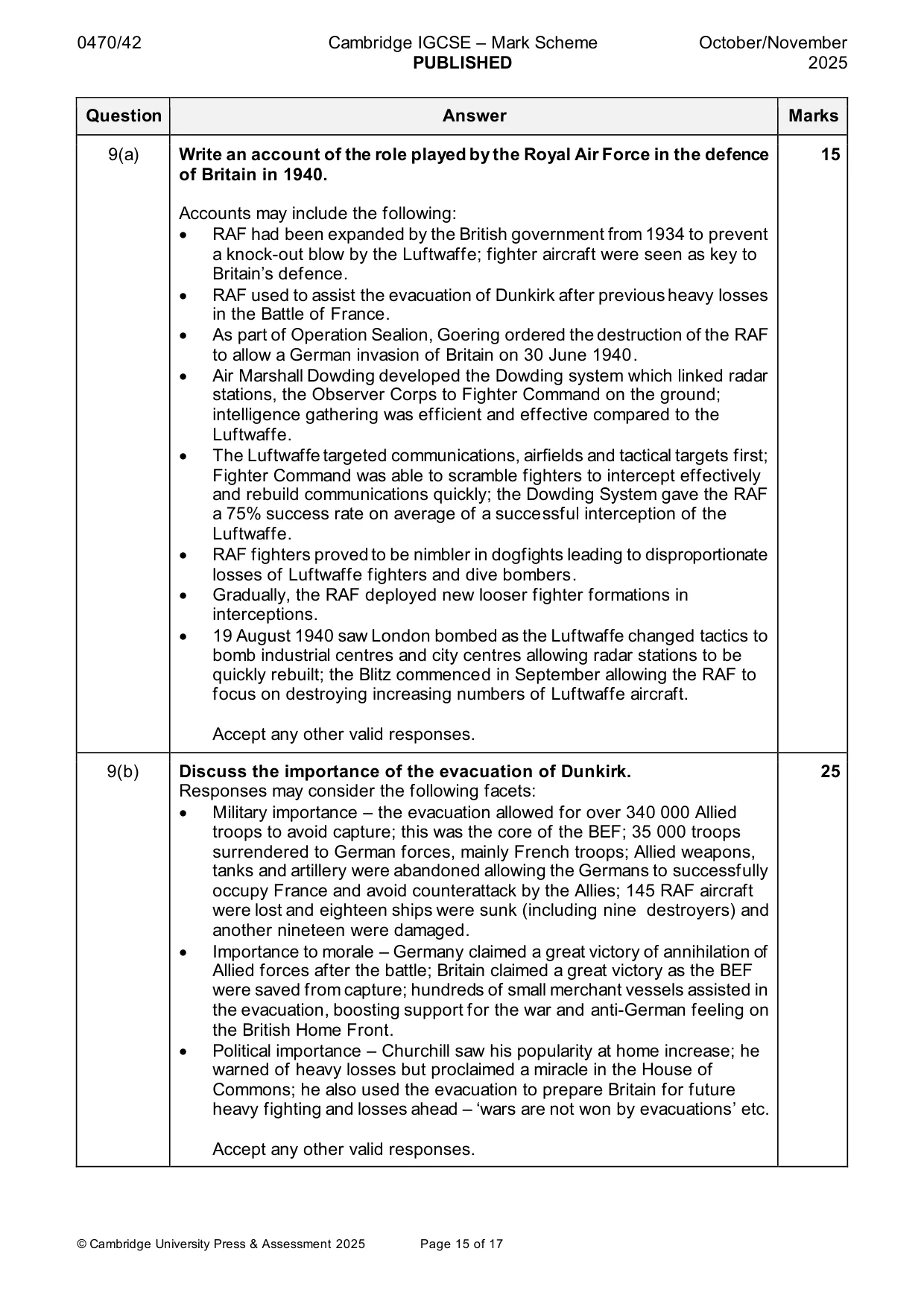
0470/42 Cambridge IGCSE – Mark Scheme PUBLISHED October/November 2025 © Cambridge University Press & Assessment 2025 Page 15 of 17 Question Answer Marks 9(a) Write an account of the role played by the Royal Air Force in the defence of Britain in 1940. Accounts may include the following: • RAF had been expanded by the British government from 1934 to prevent a knock-out blow by the Luftwaffe; fighter aircraft were seen as key to Britain’s defence. • RAF used to assist the evacuation of Dunkirk after previous heavy losses in the Battle of France. • As part of Operation Sealion, Goering ordered the destruction of the RAF to allow a German invasion of Britain on 30 June 1940. • Air Marshall Dowding developed the Dowding system which linked radar stations, the Observer Corps to Fighter Command on the ground; intelligence gathering was efficient and effective compared to the Luftwaffe. • The Luftwaffe targeted communications, airfields and tactical targets first; Fighter Command was able to scramble fighters to intercept effectively and rebuild communications quickly; the Dowding System gave the RAF a 75% success rate on average of a successful interception of the Luftwaffe. • RAF fighters proved to be nimbler in dogfights leading to disproportionate losses of Luftwaffe fighters and dive bombers. • Gradually, the RAF deployed new looser fighter formations in interceptions. • 19 August 1940 saw London bombed as the Luftwaffe changed tactics to bomb industrial centres and city centres allowing radar stations to be quickly rebuilt; the Blitz commenced in September allowing the RAF to focus on destroying increasing numbers of Luftwaffe aircraft. Accept any other valid responses. 15 9(b) Discuss the importance of the evacuation of Dunkirk. Responses may consider the following facets: • Military importance – the evacuation allowed for over 340 000 Allied troops to avoid capture; this was the core of the BEF; 35 000 troops surrendered to German forces, mainly French troops; Allied weapons, tanks and artillery were abandoned allowing the Germans to successfully occupy France and avoid counterattack by the Allies; 145 RAF aircraft were lost and eighteen ships were sunk (including nine destroyers) and another nineteen were damaged. • Importance to morale – Germany claimed a great victory of annihilation of Allied forces after the battle; Britain claimed a great victory as the BEF were saved from capture; hundreds of small merchant vessels assisted in the evacuation, boosting support for the war and anti-German feeling on the British Home Front. • Political importance – Churchill saw his popularity at home increase; he warned of heavy losses but proclaimed a miracle in the House of Commons; he also used the evacuation to prepare Britain for future heavy fighting and losses ahead – ‘wars are not won by evacuations’ etc. Accept any other valid responses. 25
Mark scheme, page 16
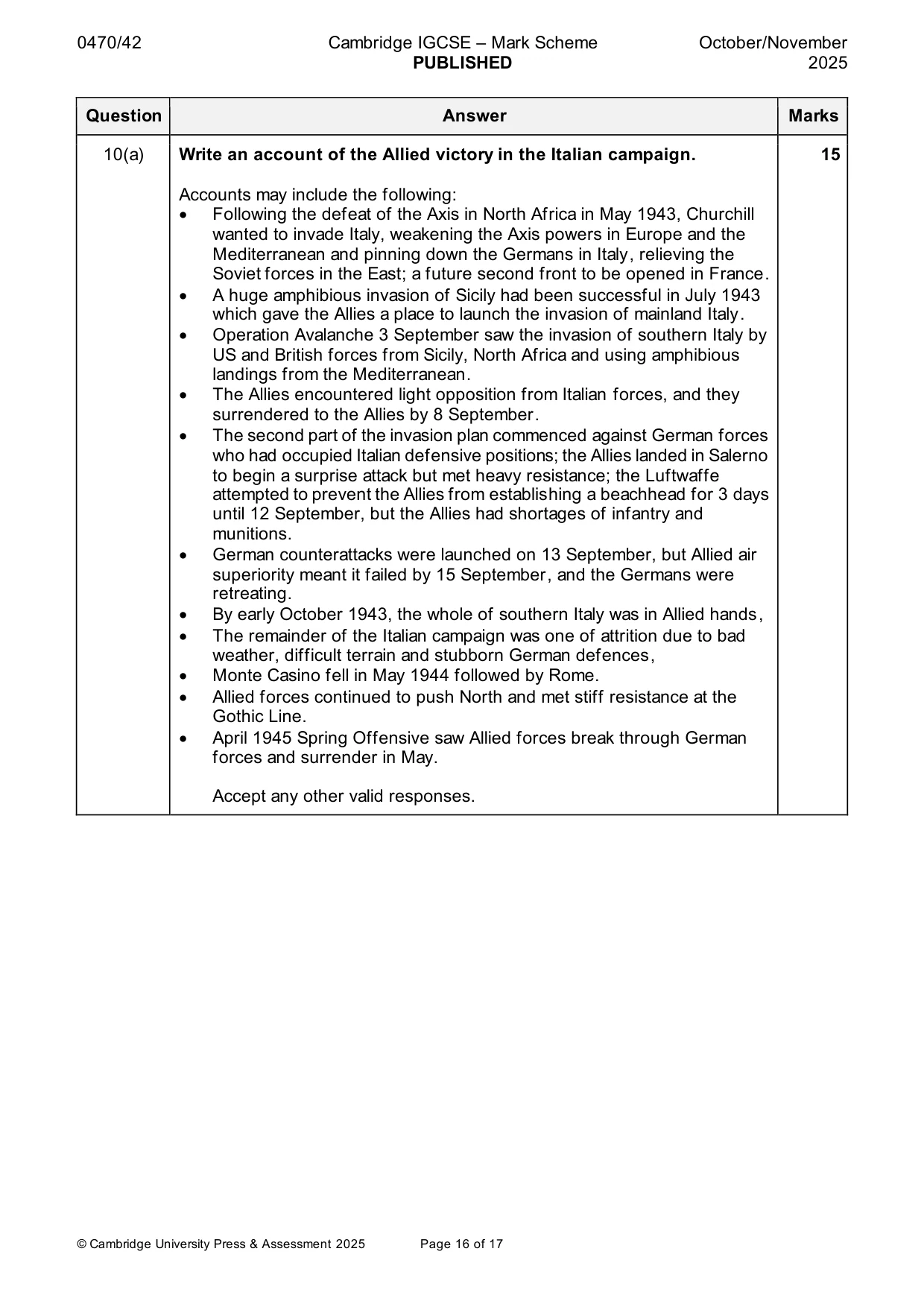
0470/42 Cambridge IGCSE – Mark Scheme PUBLISHED October/November 2025 © Cambridge University Press & Assessment 2025 Page 16 of 17 Question Answer Marks 10(a) Write an account of the Allied victory in the Italian campaign. Accounts may include the following: • Following the defeat of the Axis in North Africa in May 1943, Churchill wanted to invade Italy, weakening the Axis powers in Europe and the Mediterranean and pinning down the Germans in Italy, relieving the Soviet forces in the East; a future second front to be opened in France. • A huge amphibious invasion of Sicily had been successful in July 1943 which gave the Allies a place to launch the invasion of mainland Italy. • Operation Avalanche 3 September saw the invasion of southern Italy by US and British forces from Sicily, North Africa and using amphibious landings from the Mediterranean. • The Allies encountered light opposition from Italian forces, and they surrendered to the Allies by 8 September. • The second part of the invasion plan commenced against German forces who had occupied Italian defensive positions; the Allies landed in Salerno to begin a surprise attack but met heavy resistance; the Luftwaffe attempted to prevent the Allies from establishing a beachhead for 3 days until 12 September, but the Allies had shortages of infantry and munitions. • German counterattacks were launched on 13 September, but Allied air superiority meant it failed by 15 September, and the Germans were retreating. • By early October 1943, the whole of southern Italy was in Allied hands, • The remainder of the Italian campaign was one of attrition due to bad weather, difficult terrain and stubborn German defences, • Monte Casino fell in May 1944 followed by Rome. • Allied forces continued to push North and met stiff resistance at the Gothic Line. • April 1945 Spring Offensive saw Allied forces break through German forces and surrender in May. Accept any other valid responses. 15
Mark scheme, page 17
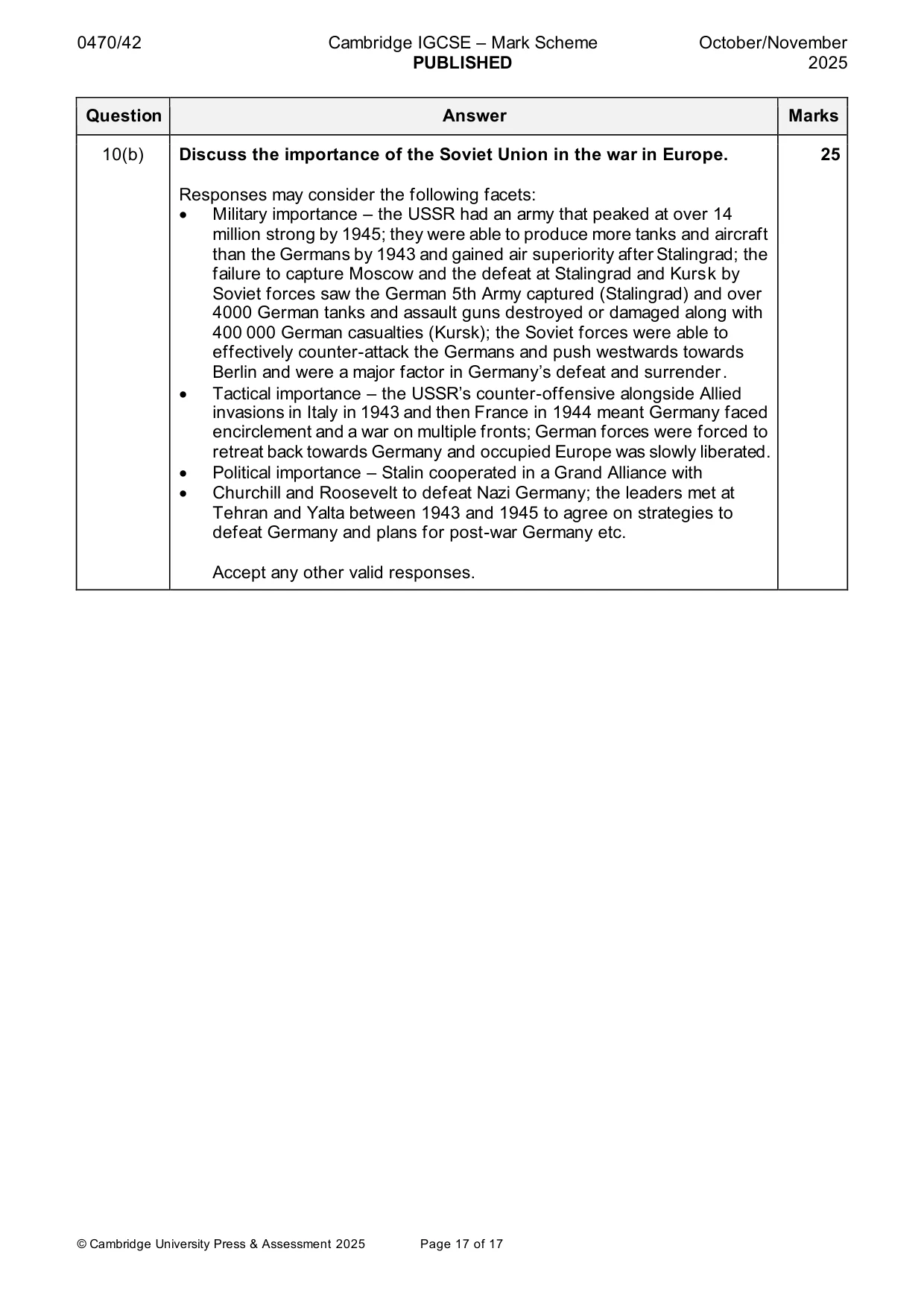
0470/42 Cambridge IGCSE – Mark Scheme PUBLISHED October/November 2025 © Cambridge University Press & Assessment 2025 Page 17 of 17 Question Answer Marks 10(b) Discuss the importance of the Soviet Union in the war in Europe. Responses may consider the following facets: • Military importance – the USSR had an army that peaked at over 14 million strong by 1945; they were able to produce more tanks and aircraft than the Germans by 1943 and gained air superiority after Stalingrad; the failure to capture Moscow and the defeat at Stalingrad and Kursk by Soviet forces saw the German 5th Army captured (Stalingrad) and over 4000 German tanks and assault guns destroyed or damaged along with 400 000 German casualties (Kursk); the Soviet forces were able to effectively counter-attack the Germans and push westwards towards Berlin and were a major factor in Germany’s defeat and surrender. • Tactical importance – the USSR’s counter-offensive alongside Allied invasions in Italy in 1943 and then France in 1944 meant Germany faced encirclement and a war on multiple fronts; German forces were forced to retreat back towards Germany and occupied Europe was slowly liberated. • Political importance – Stalin cooperated in a Grand Alliance with • Churchill and Roosevelt to defeat Nazi Germany; the leaders met at Tehran and Yalta between 1943 and 1945 to agree on strategies to defeat Germany and plans for post-war Germany etc. Accept any other valid responses. 25
What you needed in this session
Cambridge’s own grade thresholds for 2025 Oct/Nov, Paper 4 · Variant 2. A higher threshold means an easier paper — the bar moves with how the cohort did.