Cambridge IGCSE History 0470 — 2023 May/June Paper 4 · Variant 3
0470/43/M/J/23 · 40 marks · ≈45 min
The question paper and its mark scheme, free to read here and free to download. This is Cambridge’s own paper, exactly as it was sat.
Question paper4 pages
Mark scheme13 pages
Answers below. Sit the paper first if you are practising.
Paper as text
Question paper, page 1
Cambridge IGCSE™ 0470/43 May/June 2023 1 hour HISTORY Paper 4 Alternative to Coursework You must answer on the enclosed answer booklet. You will need: Answer booklet (enclosed) INSTRUCTIONS • Answer one question from your chosen Depth Study. • Follow the instructions on the front cover of the answer booklet. If you need additional answer paper, ask the invigilator for a continuation booklet. INFORMATION • The total mark for this paper is 40. • The number of marks for each question or part question is shown in brackets [ ]. This document has 4 pages. Any blank pages are indicated. [Turn over 06_0470_43_2023_1.14 © UCLES 2023 *7925813506*
Question paper, page 2
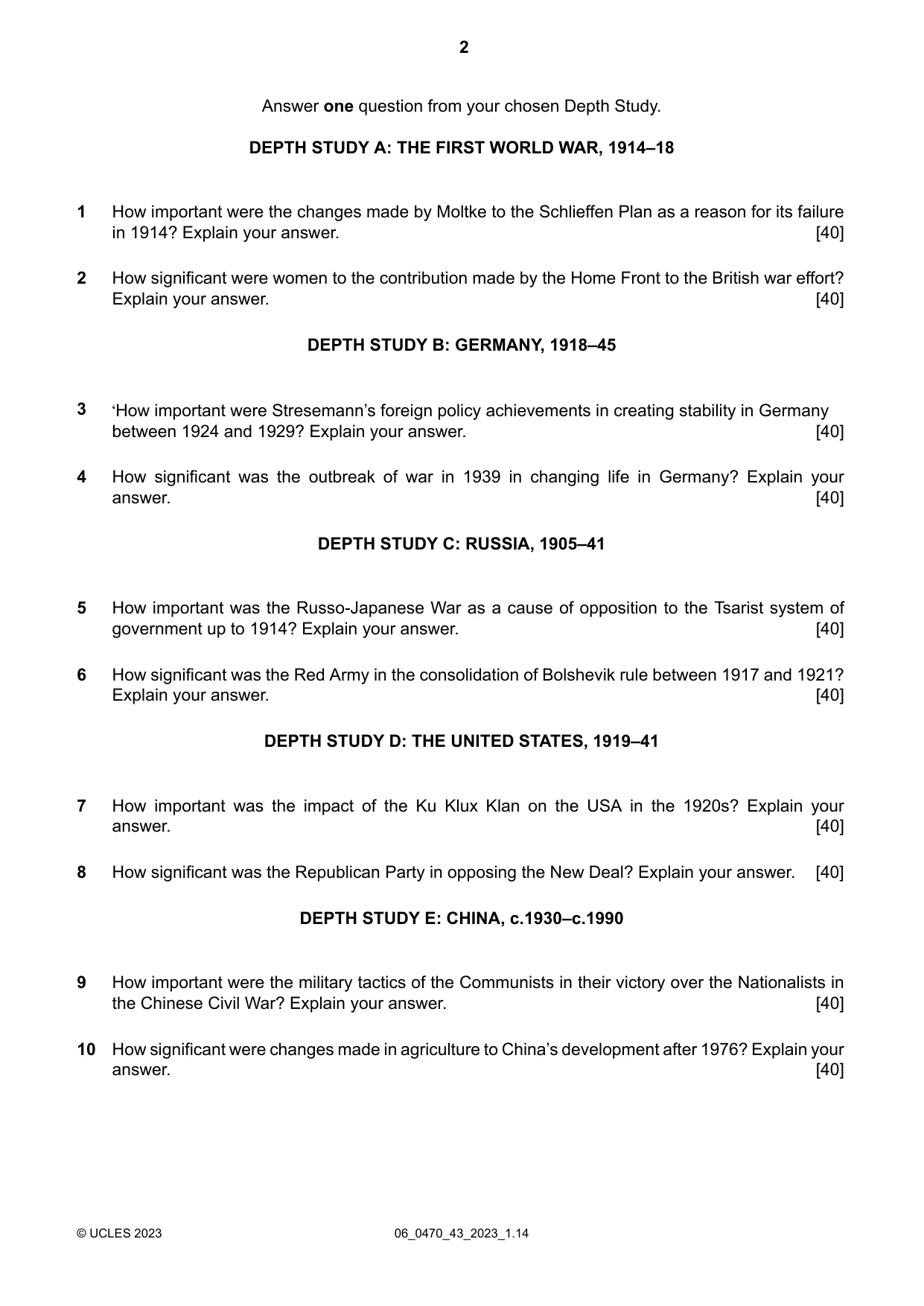
Answer one question from your chosen Depth Study. DEPTH STUDY A: THE FIRST WORLD WAR, 1914–18 How important were the changes made by Moltke to the Schlieffen Plan as a reason for its failure in 1914? Explain your answer. [40] 1 How significant were women to the contribution made by the Home Front to the British war effort? Explain your answer. [40] 2 DEPTH STUDY B: GERMANY, 1918–45 ‘How important were Stresemann’s foreign policy achievements in creating stability in Germany between 1924 and 1929? Explain your answer. [40] 3 How significant was the outbreak of war in 1939 in changing life in Germany? Explain your answer. [40] 4 DEPTH STUDY C: RUSSIA, 1905–41 How important was the Russo-Japanese War as a cause of opposition to the Tsarist system of government up to 1914? Explain your answer. [40] 5 How significant was the Red Army in the consolidation of Bolshevik rule between 1917 and 1921? Explain your answer. [40] 6 DEPTH STUDY D: THE UNITED STATES, 1919–41 How important was the impact of the Ku Klux Klan on the USA in the 1920s? Explain your answer. [40] 7 How significant was the Republican Party in opposing the New Deal? Explain your answer. [40] 8 DEPTH STUDY E: CHINA, c.1930–c.1990 How important were the military tactics of the Communists in their victory over the Nationalists in the Chinese Civil War? Explain your answer. [40] 9 How significant were changes made in agriculture to China’s development after 1976? Explain your answer. [40] 10 06_0470_43_2023_1.14 © UCLES 2023 2
Question paper, page 3
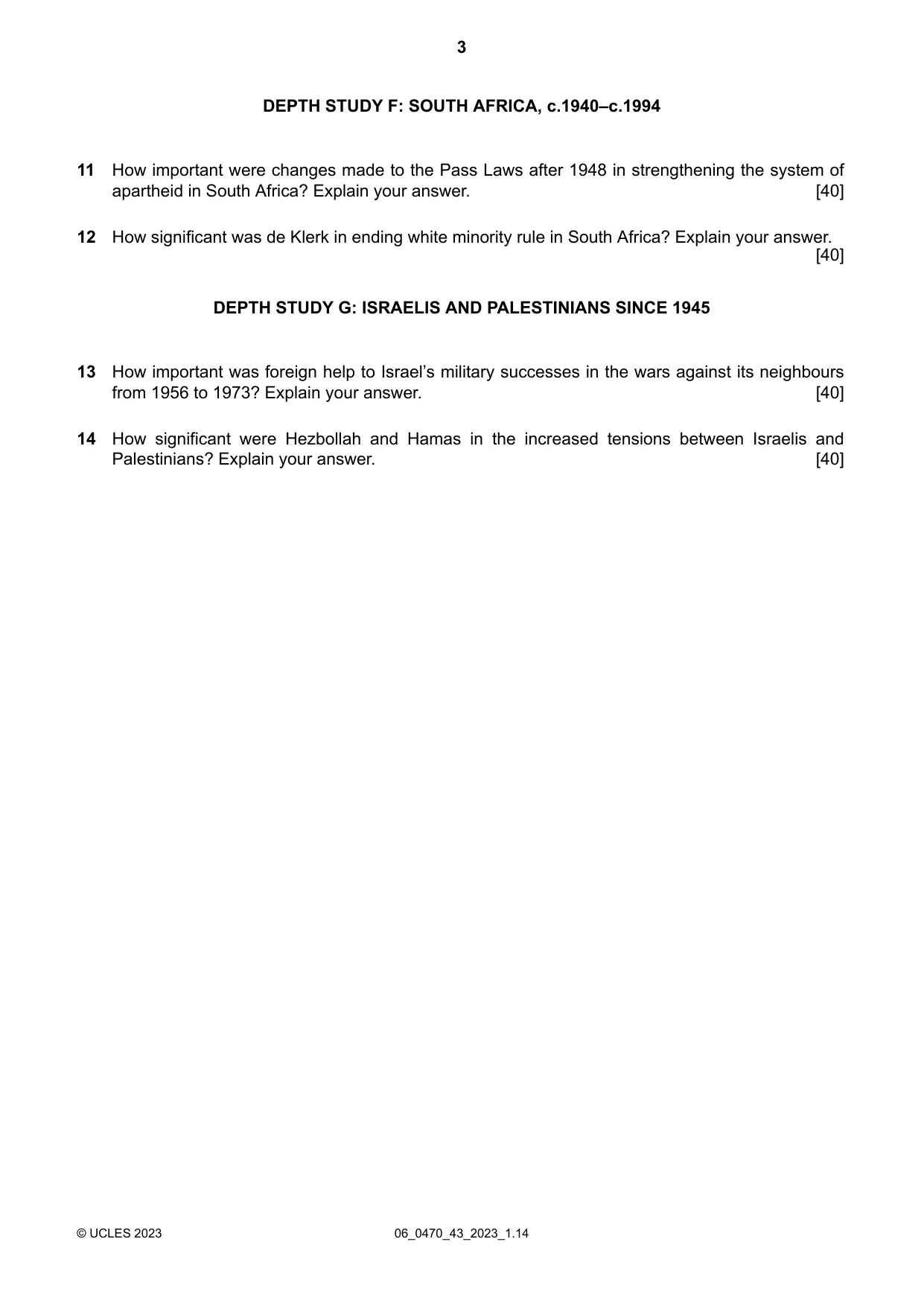
DEPTH STUDY F: SOUTH AFRICA, c.1940–c.1994 How important were changes made to the Pass Laws after 1948 in strengthening the system of apartheid in South Africa? Explain your answer. [40] 11 How significant was de Klerk in ending white minority rule in South Africa? Explain your answer. [40] 12 DEPTH STUDY G: ISRAELIS AND PALESTINIANS SINCE 1945 How important was foreign help to Israel’s military successes in the wars against its neighbours from 1956 to 1973? Explain your answer. [40] 13 How significant were Hezbollah and Hamas in the increased tensions between Israelis and Palestinians? Explain your answer. [40] 14 06_0470_43_2023_1.14 © UCLES 2023 3
Question paper, page 4
BLANK PAGE Permission to reproduce items where third-party owned material protected by copyright is included has been sought and cleared where possible. Every reasonable effort has been made by the publisher (UCLES) to trace copyright holders, but if any items requiring clearance have unwittingly been included, the publisher will be pleased to make amends at the earliest possible opportunity. To avoid the issue of disclosure of answer-related information to candidates, all copyright acknowledgements are reproduced online in the Cambridge Assessment International Education Copyright Acknowledgements Booklet. This is produced for each series of examinations and is freely available to download at www.cambridgeinternational.org after the live examination series. Cambridge Assessment International Education is part of Cambridge Assessment. Cambridge Assessment is the brand name of the University of Cambridge Local Examinations Syndicate (UCLES), which is a department of the University of Cambridge. 06_0470_43_2023_1.14 © UCLES 2023 4
Mark scheme, page 1
This document consists of 13 printed pages. © UCLES 2023 [Turn over Cambridge IGCSE™ HISTORY 0470/43 Paper 4 Alternative to Coursework May/June 2023 MARK SCHEME Maximum Mark: 40 Published This mark scheme is published as an aid to teachers and candidates, to indicate the requirements of the examination. It shows the basis on which Examiners were instructed to award marks. It does not indicate the details of the discussions that took place at an Examiners’ meeting before marking began, which would have considered the acceptability of alternative answers. Mark schemes should be read in conjunction with the question paper and the Principal Examiner Report for Teachers. Cambridge International will not enter into discussions about these mark schemes. Cambridge International is publishing the mark schemes for the May/June 2023 series for most Cambridge IGCSE, Cambridge International A and AS Level and Cambridge Pre-U components, and some Cambridge O Level components.
Mark scheme, page 2
0470/43 Cambridge IGCSE – Mark Scheme PUBLISHED May/June 2023 © UCLES 2023 Page 2 of 13 Generic Marking Principles These general marking principles must be applied by all examiners when marking candidate answers. They should be applied alongside the specific content of the mark scheme or generic level descriptors for a question. Each question paper and mark scheme will also comply with these marking principles. GENERIC MARKING PRINCIPLE 1: Marks must be awarded in line with: the specific content of the mark scheme or the generic level descriptors for the question the specific skills defined in the mark scheme or in the generic level descriptors for the question the standard of response required by a candidate as exemplified by the standardisation scripts. GENERIC MARKING PRINCIPLE 2: Marks awarded are always whole marks (not half marks, or other fractions). GENERIC MARKING PRINCIPLE 3: Marks must be awarded positively: marks are awarded for correct/valid answers, as defined in the mark scheme. However, credit is given for valid answers which go beyond the scope of the syllabus and mark scheme, referring to your Team Leader as appropriate marks are awarded when candidates clearly demonstrate what they know and can do marks are not deducted for errors marks are not deducted for omissions answers should only be judged on the quality of spelling, punctuation and grammar when these features are specifically assessed by the question as indicated by the mark scheme. The meaning, however, should be unambiguous. GENERIC MARKING PRINCIPLE 4: Rules must be applied consistently, e.g. in situations where candidates have not followed instructions or in the application of generic level descriptors. GENERIC MARKING PRINCIPLE 5: Marks should be awarded using the full range of marks defined in the mark scheme for the question (however; the use of the full mark range may be limited according to the quality of the candidate responses seen). GENERIC MARKING PRINCIPLE 6: Marks awarded are based solely on the requirements as defined in the mark scheme. Marks should not be awarded with grade thresholds or grade descriptors in mind.
Mark scheme, page 3
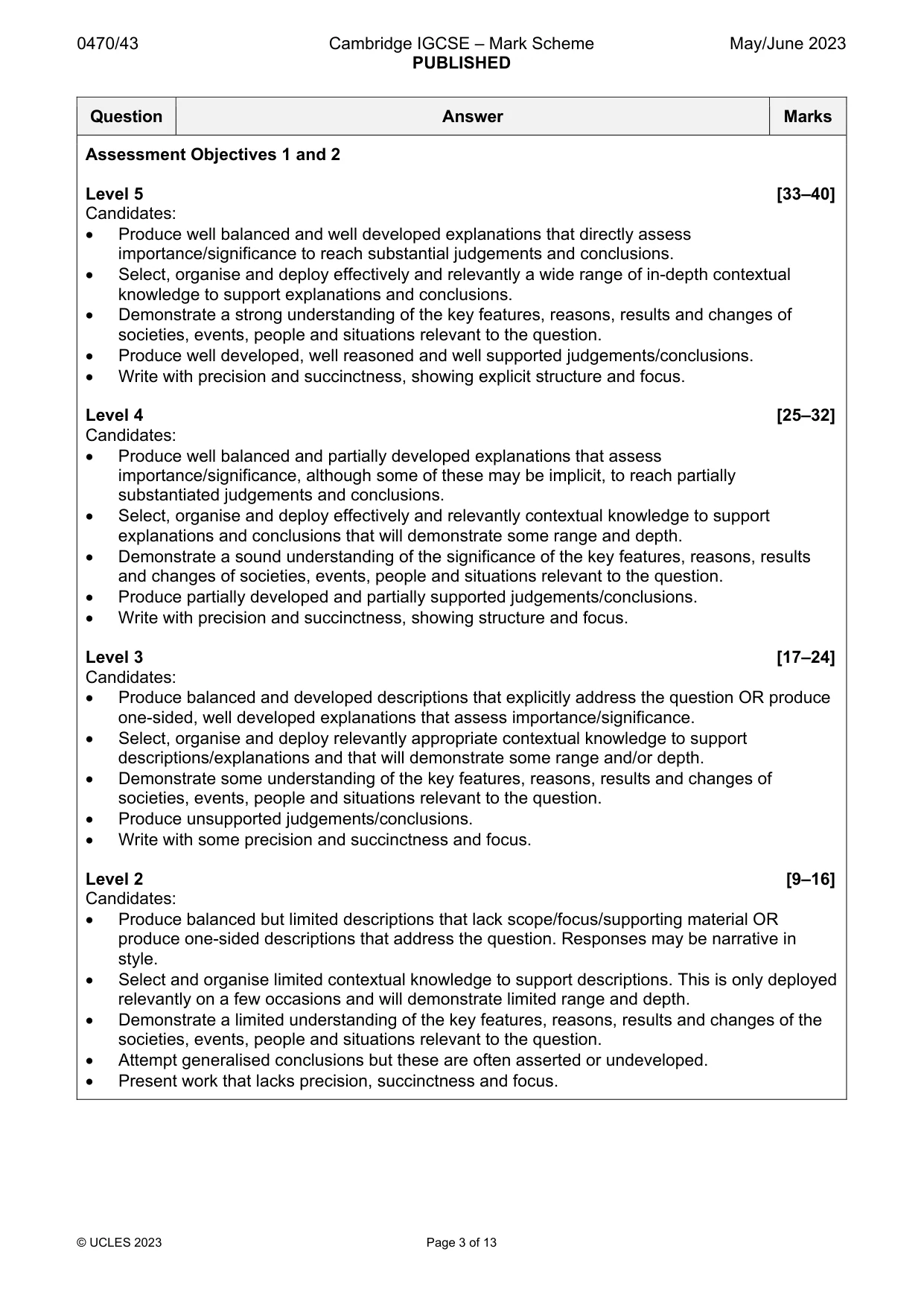
0470/43 Cambridge IGCSE – Mark Scheme PUBLISHED May/June 2023 © UCLES 2023 Page 3 of 13 Question Answer Marks Assessment Objectives 1 and 2 Level 5 [33–40] Candidates: Produce well balanced and well developed explanations that directly assess importance/significance to reach substantial judgements and conclusions. Select, organise and deploy effectively and relevantly a wide range of in-depth contextual knowledge to support explanations and conclusions. Demonstrate a strong understanding of the key features, reasons, results and changes of societies, events, people and situations relevant to the question. Produce well developed, well reasoned and well supported judgements/conclusions. Write with precision and succinctness, showing explicit structure and focus. Level 4 [25–32] Candidates: Produce well balanced and partially developed explanations that assess importance/significance, although some of these may be implicit, to reach partially substantiated judgements and conclusions. Select, organise and deploy effectively and relevantly contextual knowledge to support explanations and conclusions that will demonstrate some range and depth. Demonstrate a sound understanding of the significance of the key features, reasons, results and changes of societies, events, people and situations relevant to the question. Produce partially developed and partially supported judgements/conclusions. Write with precision and succinctness, showing structure and focus. Level 3 [17–24] Candidates: Produce balanced and developed descriptions that explicitly address the question OR produce one-sided, well developed explanations that assess importance/significance. Select, organise and deploy relevantly appropriate contextual knowledge to support descriptions/explanations and that will demonstrate some range and/or depth. Demonstrate some understanding of the key features, reasons, results and changes of societies, events, people and situations relevant to the question. Produce unsupported judgements/conclusions. Write with some precision and succinctness and focus. Level 2 [9–16] Candidates: Produce balanced but limited descriptions that lack scope/focus/supporting material OR produce one-sided descriptions that address the question. Responses may be narrative in style. Select and organise limited contextual knowledge to support descriptions. This is only deployed relevantly on a few occasions and will demonstrate limited range and depth. Demonstrate a limited understanding of the key features, reasons, results and changes of the societies, events, people and situations relevant to the question. Attempt generalised conclusions but these are often asserted or undeveloped. Present work that lacks precision, succinctness and focus.
Mark scheme, page 4
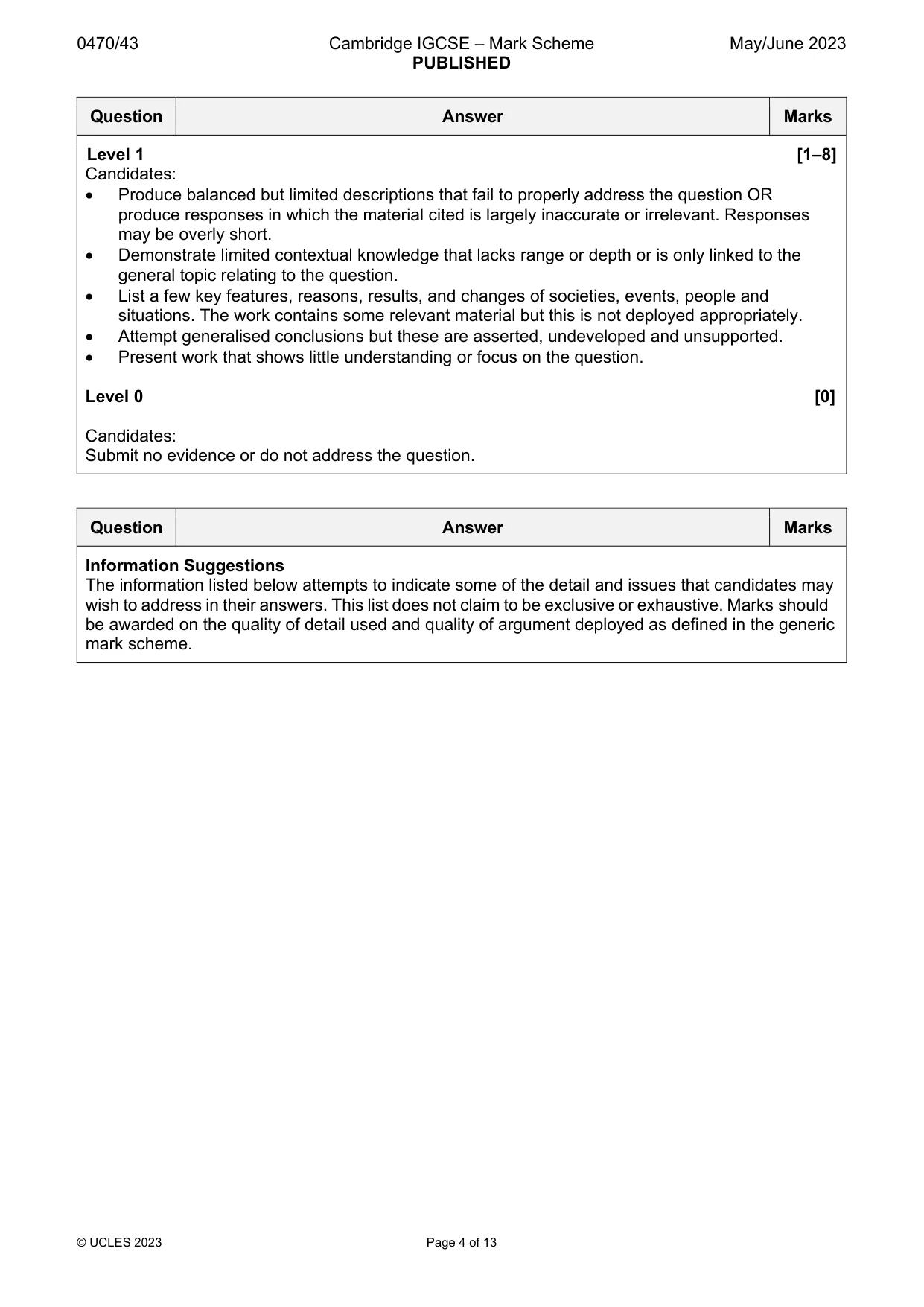
0470/43 Cambridge IGCSE – Mark Scheme PUBLISHED May/June 2023 © UCLES 2023 Page 4 of 13 Question Answer Marks Level 1 [1–8] Candidates: Produce balanced but limited descriptions that fail to properly address the question OR produce responses in which the material cited is largely inaccurate or irrelevant. Responses may be overly short. Demonstrate limited contextual knowledge that lacks range or depth or is only linked to the general topic relating to the question. List a few key features, reasons, results, and changes of societies, events, people and situations. The work contains some relevant material but this is not deployed appropriately. Attempt generalised conclusions but these are asserted, undeveloped and unsupported. Present work that shows little understanding or focus on the question. Level 0 [0] Candidates: Submit no evidence or do not address the question. Question Answer Marks Information Suggestions The information listed below attempts to indicate some of the detail and issues that candidates may wish to address in their answers. This list does not claim to be exclusive or exhaustive. Marks should be awarded on the quality of detail used and quality of argument deployed as defined in the generic mark scheme.
Mark scheme, page 5
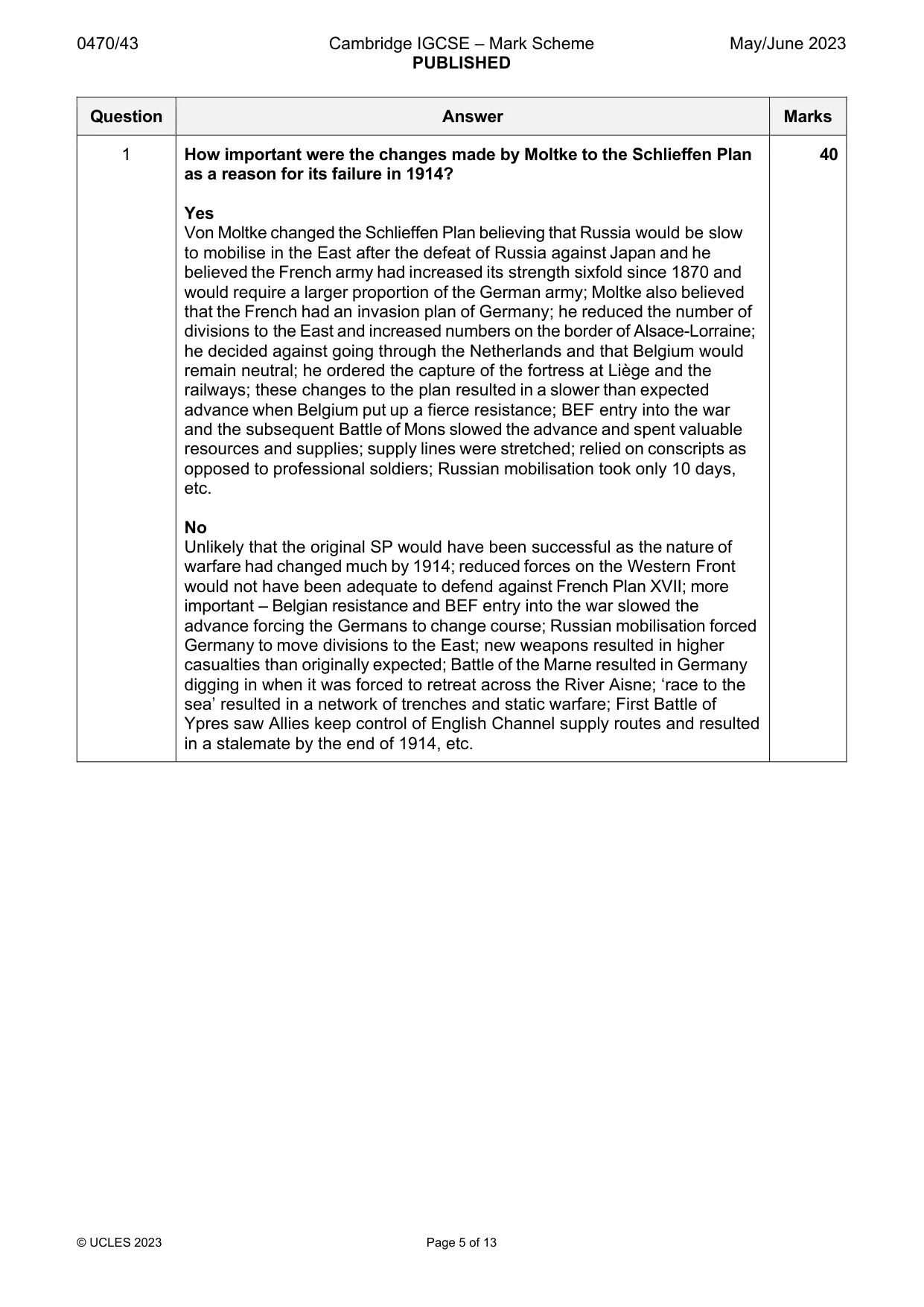
0470/43 Cambridge IGCSE – Mark Scheme PUBLISHED May/June 2023 © UCLES 2023 Page 5 of 13 Question Answer Marks 1 How important were the changes made by Moltke to the Schlieffen Plan as a reason for its failure in 1914? Yes Von Moltke changed the Schlieffen Plan believing that Russia would be slow to mobilise in the East after the defeat of Russia against Japan and he believed the French army had increased its strength sixfold since 1870 and would require a larger proportion of the German army; Moltke also believed that the French had an invasion plan of Germany; he reduced the number of divisions to the East and increased numbers on the border of Alsace-Lorraine; he decided against going through the Netherlands and that Belgium would remain neutral; he ordered the capture of the fortress at Liège and the railways; these changes to the plan resulted in a slower than expected advance when Belgium put up a fierce resistance; BEF entry into the war and the subsequent Battle of Mons slowed the advance and spent valuable resources and supplies; supply lines were stretched; relied on conscripts as opposed to professional soldiers; Russian mobilisation took only 10 days, etc. No Unlikely that the original SP would have been successful as the nature of warfare had changed much by 1914; reduced forces on the Western Front would not have been adequate to defend against French Plan XVII; more important – Belgian resistance and BEF entry into the war slowed the advance forcing the Germans to change course; Russian mobilisation forced Germany to move divisions to the East; new weapons resulted in higher casualties than originally expected; Battle of the Marne resulted in Germany digging in when it was forced to retreat across the River Aisne; ‘race to the sea’ resulted in a network of trenches and static warfare; First Battle of Ypres saw Allies keep control of English Channel supply routes and resulted in a stalemate by the end of 1914, etc. 40
Mark scheme, page 6
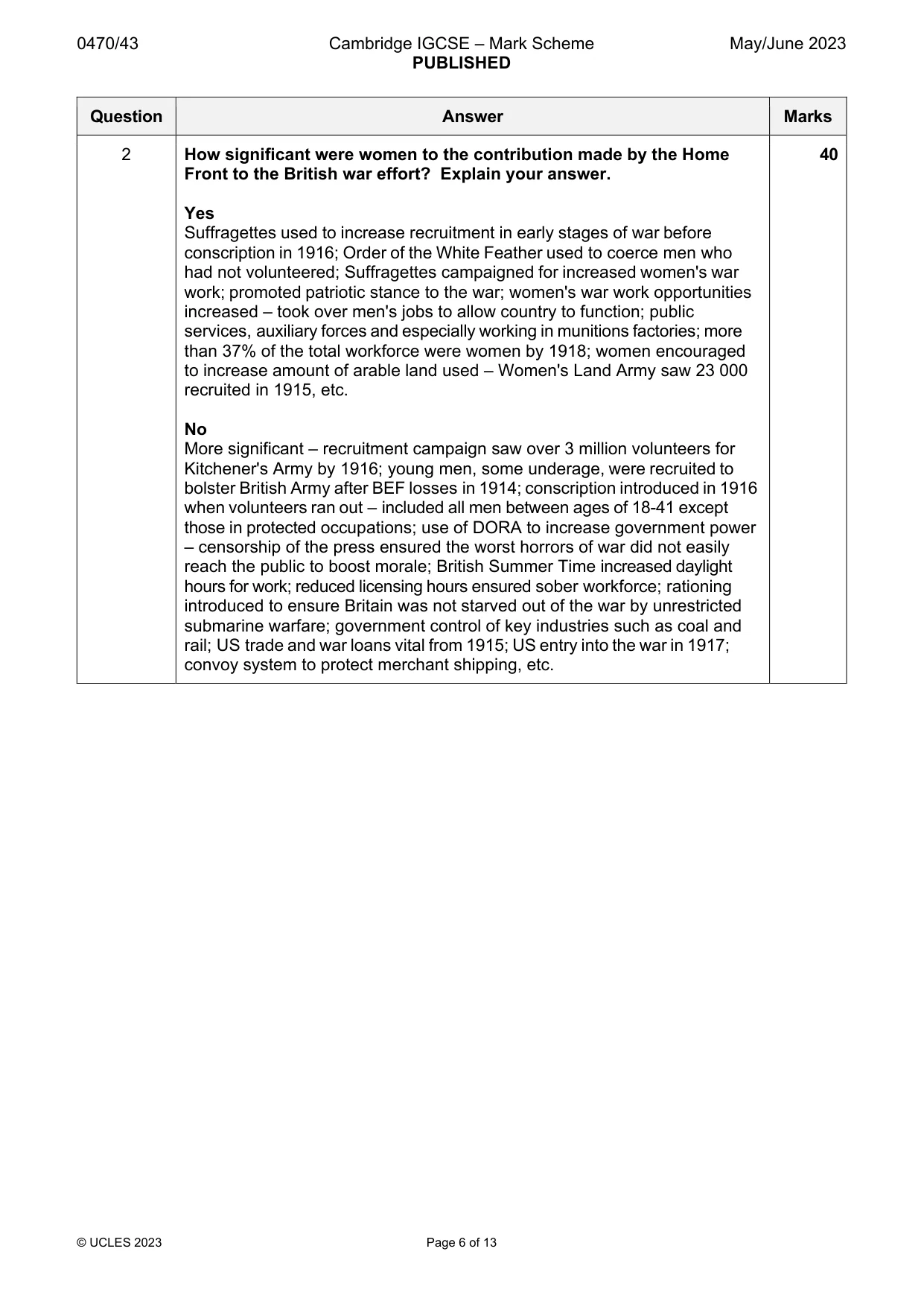
0470/43 Cambridge IGCSE – Mark Scheme PUBLISHED May/June 2023 © UCLES 2023 Page 6 of 13 Question Answer Marks 2 How significant were women to the contribution made by the Home Front to the British war effort? Explain your answer. Yes Suffragettes used to increase recruitment in early stages of war before conscription in 1916; Order of the White Feather used to coerce men who had not volunteered; Suffragettes campaigned for increased women's war work; promoted patriotic stance to the war; women's war work opportunities increased – took over men's jobs to allow country to function; public services, auxiliary forces and especially working in munitions factories; more than 37% of the total workforce were women by 1918; women encouraged to increase amount of arable land used – Women's Land Army saw 23 000 recruited in 1915, etc. No More significant – recruitment campaign saw over 3 million volunteers for Kitchener's Army by 1916; young men, some underage, were recruited to bolster British Army after BEF losses in 1914; conscription introduced in 1916 when volunteers ran out – included all men between ages of 18-41 except those in protected occupations; use of DORA to increase government power – censorship of the press ensured the worst horrors of war did not easily reach the public to boost morale; British Summer Time increased daylight hours for work; reduced licensing hours ensured sober workforce; rationing introduced to ensure Britain was not starved out of the war by unrestricted submarine warfare; government control of key industries such as coal and rail; US trade and war loans vital from 1915; US entry into the war in 1917; convoy system to protect merchant shipping, etc. 40
Mark scheme, page 7
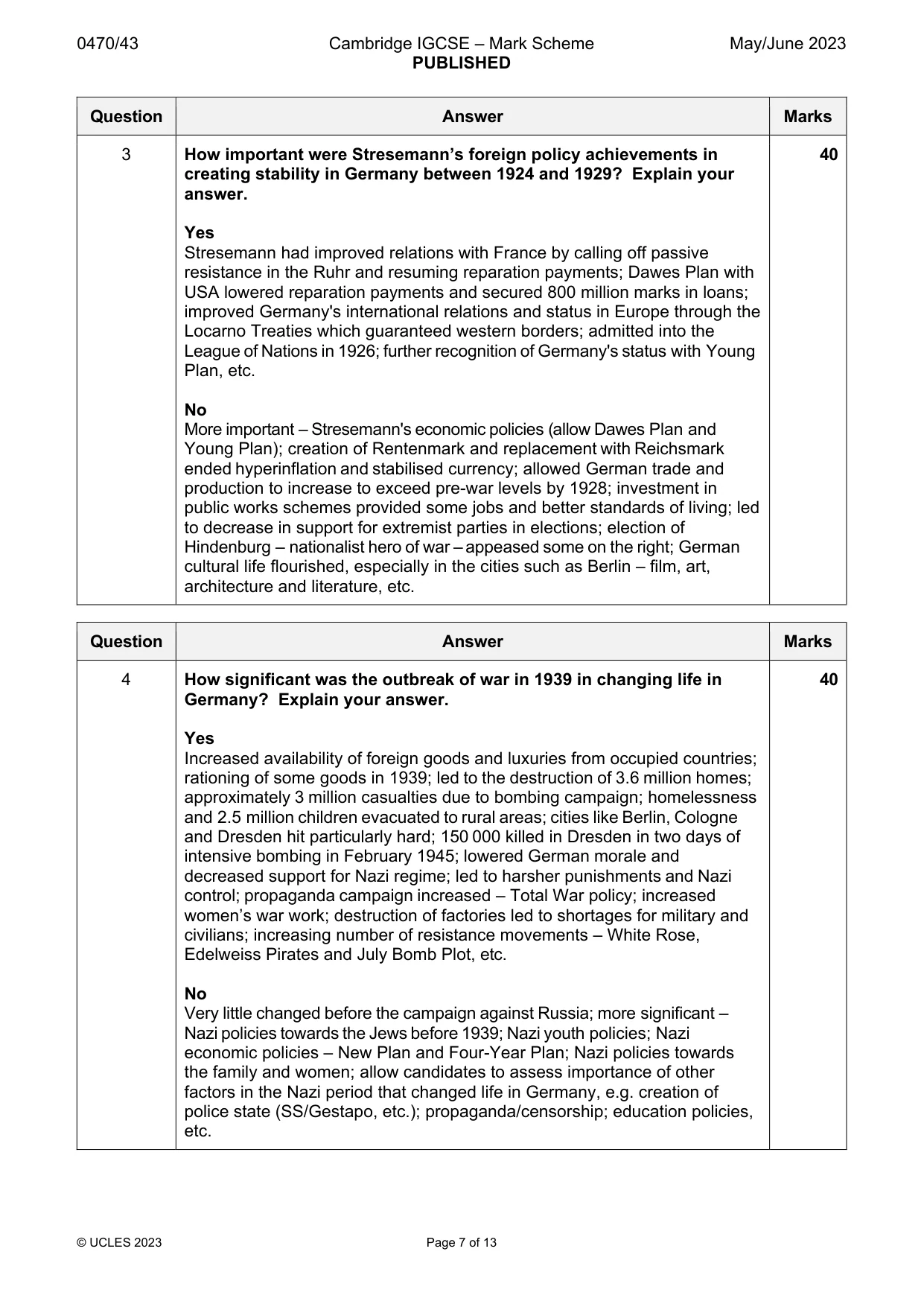
0470/43 Cambridge IGCSE – Mark Scheme PUBLISHED May/June 2023 © UCLES 2023 Page 7 of 13 Question Answer Marks 3 How important were Stresemann’s foreign policy achievements in creating stability in Germany between 1924 and 1929? Explain your answer. Yes Stresemann had improved relations with France by calling off passive resistance in the Ruhr and resuming reparation payments; Dawes Plan with USA lowered reparation payments and secured 800 million marks in loans; improved Germany's international relations and status in Europe through the Locarno Treaties which guaranteed western borders; admitted into the League of Nations in 1926; further recognition of Germany's status with Young Plan, etc. No More important – Stresemann's economic policies (allow Dawes Plan and Young Plan); creation of Rentenmark and replacement with Reichsmark ended hyperinflation and stabilised currency; allowed German trade and production to increase to exceed pre-war levels by 1928; investment in public works schemes provided some jobs and better standards of living; led to decrease in support for extremist parties in elections; election of Hindenburg – nationalist hero of war – appeased some on the right; German cultural life flourished, especially in the cities such as Berlin – film, art, architecture and literature, etc. 40 Question Answer Marks 4 How significant was the outbreak of war in 1939 in changing life in Germany? Explain your answer. Yes Increased availability of foreign goods and luxuries from occupied countries; rationing of some goods in 1939; led to the destruction of 3.6 million homes; approximately 3 million casualties due to bombing campaign; homelessness and 2.5 million children evacuated to rural areas; cities like Berlin, Cologne and Dresden hit particularly hard; 150 000 killed in Dresden in two days of intensive bombing in February 1945; lowered German morale and decreased support for Nazi regime; led to harsher punishments and Nazi control; propaganda campaign increased – Total War policy; increased women’s war work; destruction of factories led to shortages for military and civilians; increasing number of resistance movements – White Rose, Edelweiss Pirates and July Bomb Plot, etc. No Very little changed before the campaign against Russia; more significant – Nazi policies towards the Jews before 1939; Nazi youth policies; Nazi economic policies – New Plan and Four-Year Plan; Nazi policies towards the family and women; allow candidates to assess importance of other factors in the Nazi period that changed life in Germany, e.g. creation of police state (SS/Gestapo, etc.); propaganda/censorship; education policies, etc. 40
Mark scheme, page 8
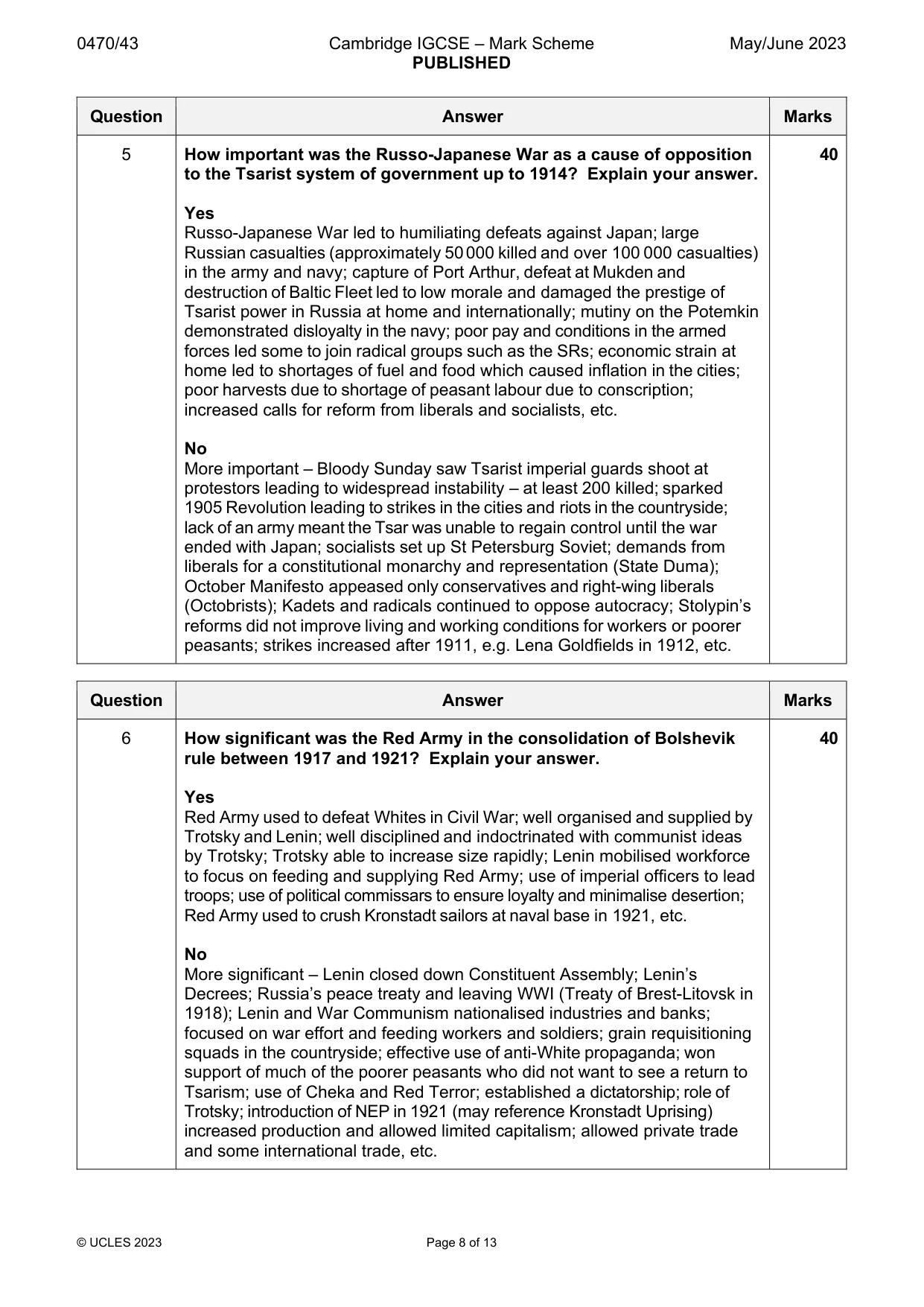
0470/43 Cambridge IGCSE – Mark Scheme PUBLISHED May/June 2023 © UCLES 2023 Page 8 of 13 Question Answer Marks 5 How important was the Russo-Japanese War as a cause of opposition to the Tsarist system of government up to 1914? Explain your answer. Yes Russo-Japanese War led to humiliating defeats against Japan; large Russian casualties (approximately 50 000 killed and over 100 000 casualties) in the army and navy; capture of Port Arthur, defeat at Mukden and destruction of Baltic Fleet led to low morale and damaged the prestige of Tsarist power in Russia at home and internationally; mutiny on the Potemkin demonstrated disloyalty in the navy; poor pay and conditions in the armed forces led some to join radical groups such as the SRs; economic strain at home led to shortages of fuel and food which caused inflation in the cities; poor harvests due to shortage of peasant labour due to conscription; increased calls for reform from liberals and socialists, etc. No More important – Bloody Sunday saw Tsarist imperial guards shoot at protestors leading to widespread instability – at least 200 killed; sparked 1905 Revolution leading to strikes in the cities and riots in the countryside; lack of an army meant the Tsar was unable to regain control until the war ended with Japan; socialists set up St Petersburg Soviet; demands from liberals for a constitutional monarchy and representation (State Duma); October Manifesto appeased only conservatives and right-wing liberals (Octobrists); Kadets and radicals continued to oppose autocracy; Stolypin’s reforms did not improve living and working conditions for workers or poorer peasants; strikes increased after 1911, e.g. Lena Goldfields in 1912, etc. 40 Question Answer Marks 6 How significant was the Red Army in the consolidation of Bolshevik rule between 1917 and 1921? Explain your answer. Yes Red Army used to defeat Whites in Civil War; well organised and supplied by Trotsky and Lenin; well disciplined and indoctrinated with communist ideas by Trotsky; Trotsky able to increase size rapidly; Lenin mobilised workforce to focus on feeding and supplying Red Army; use of imperial officers to lead troops; use of political commissars to ensure loyalty and minimalise desertion; Red Army used to crush Kronstadt sailors at naval base in 1921, etc. No More significant – Lenin closed down Constituent Assembly; Lenin’s Decrees; Russia’s peace treaty and leaving WWI (Treaty of Brest-Litovsk in 1918); Lenin and War Communism nationalised industries and banks; focused on war effort and feeding workers and soldiers; grain requisitioning squads in the countryside; effective use of anti-White propaganda; won support of much of the poorer peasants who did not want to see a return to Tsarism; use of Cheka and Red Terror; established a dictatorship; role of Trotsky; introduction of NEP in 1921 (may reference Kronstadt Uprising) increased production and allowed limited capitalism; allowed private trade and some international trade, etc. 40
Mark scheme, page 9
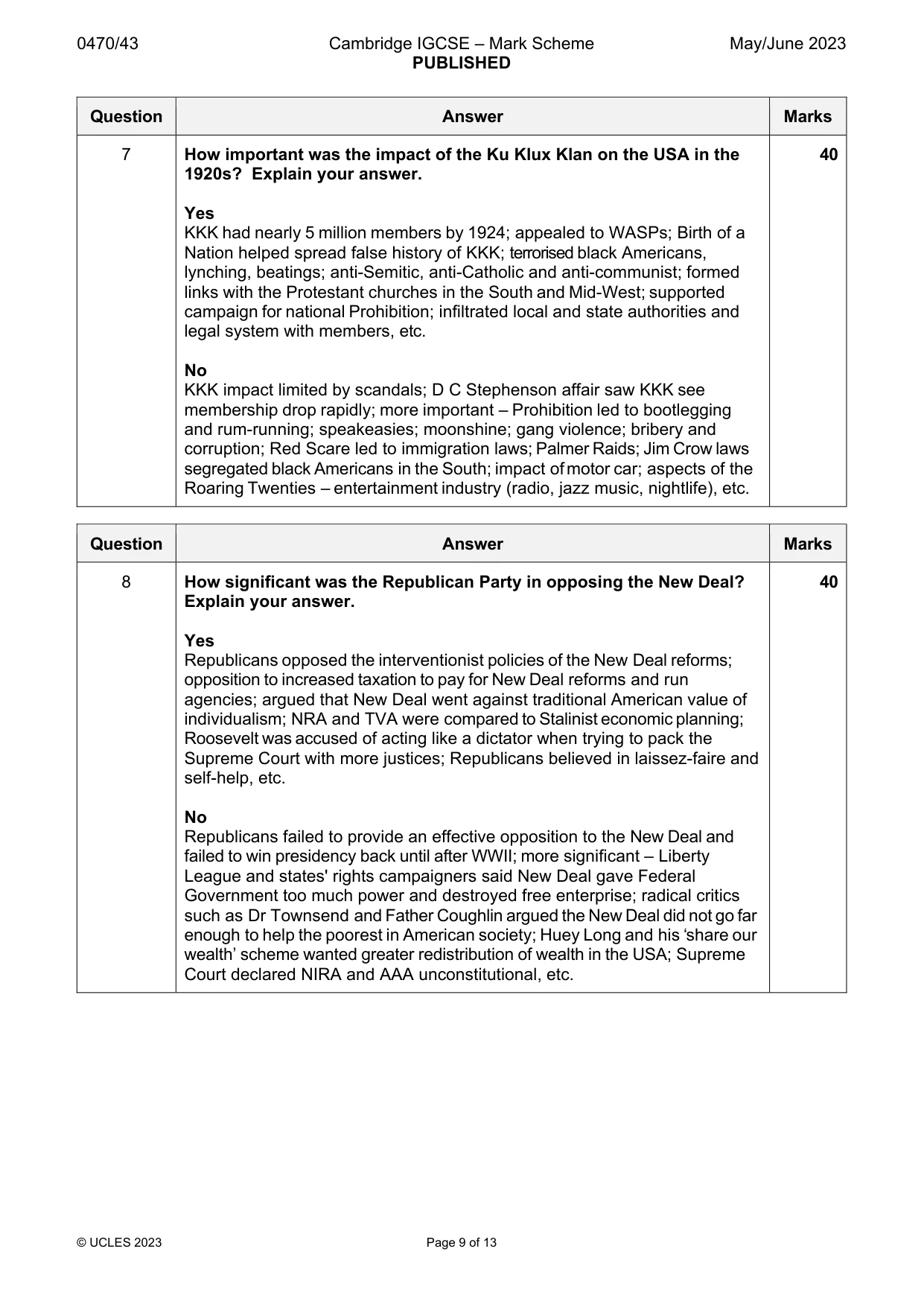
0470/43 Cambridge IGCSE – Mark Scheme PUBLISHED May/June 2023 © UCLES 2023 Page 9 of 13 Question Answer Marks 7 How important was the impact of the Ku Klux Klan on the USA in the 1920s? Explain your answer. Yes KKK had nearly 5 million members by 1924; appealed to WASPs; Birth of a Nation helped spread false history of KKK; terrorised black Americans, lynching, beatings; anti-Semitic, anti-Catholic and anti-communist; formed links with the Protestant churches in the South and Mid-West; supported campaign for national Prohibition; infiltrated local and state authorities and legal system with members, etc. No KKK impact limited by scandals; D C Stephenson affair saw KKK see membership drop rapidly; more important – Prohibition led to bootlegging and rum-running; speakeasies; moonshine; gang violence; bribery and corruption; Red Scare led to immigration laws; Palmer Raids; Jim Crow laws segregated black Americans in the South; impact of motor car; aspects of the Roaring Twenties – entertainment industry (radio, jazz music, nightlife), etc. 40 Question Answer Marks 8 How significant was the Republican Party in opposing the New Deal? Explain your answer. Yes Republicans opposed the interventionist policies of the New Deal reforms; opposition to increased taxation to pay for New Deal reforms and run agencies; argued that New Deal went against traditional American value of individualism; NRA and TVA were compared to Stalinist economic planning; Roosevelt was accused of acting like a dictator when trying to pack the Supreme Court with more justices; Republicans believed in laissez-faire and self-help, etc. No Republicans failed to provide an effective opposition to the New Deal and failed to win presidency back until after WWII; more significant – Liberty League and states' rights campaigners said New Deal gave Federal Government too much power and destroyed free enterprise; radical critics such as Dr Townsend and Father Coughlin argued the New Deal did not go far enough to help the poorest in American society; Huey Long and his ‘share our wealth’ scheme wanted greater redistribution of wealth in the USA; Supreme Court declared NIRA and AAA unconstitutional, etc. 40
Mark scheme, page 10
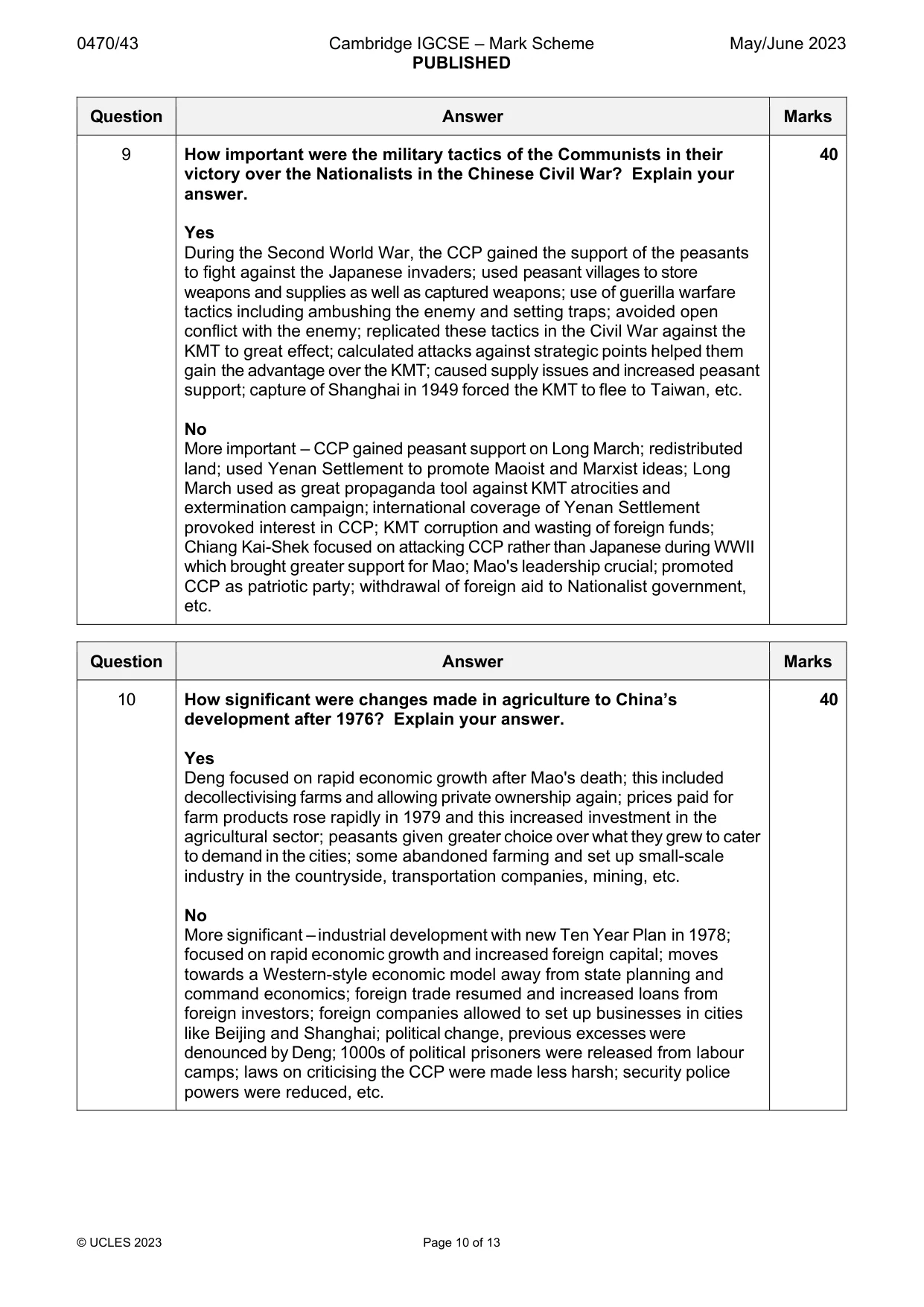
0470/43 Cambridge IGCSE – Mark Scheme PUBLISHED May/June 2023 © UCLES 2023 Page 10 of 13 Question Answer Marks 9 How important were the military tactics of the Communists in their victory over the Nationalists in the Chinese Civil War? Explain your answer. Yes During the Second World War, the CCP gained the support of the peasants to fight against the Japanese invaders; used peasant villages to store weapons and supplies as well as captured weapons; use of guerilla warfare tactics including ambushing the enemy and setting traps; avoided open conflict with the enemy; replicated these tactics in the Civil War against the KMT to great effect; calculated attacks against strategic points helped them gain the advantage over the KMT; caused supply issues and increased peasant support; capture of Shanghai in 1949 forced the KMT to flee to Taiwan, etc. No More important – CCP gained peasant support on Long March; redistributed land; used Yenan Settlement to promote Maoist and Marxist ideas; Long March used as great propaganda tool against KMT atrocities and extermination campaign; international coverage of Yenan Settlement provoked interest in CCP; KMT corruption and wasting of foreign funds; Chiang Kai-Shek focused on attacking CCP rather than Japanese during WWII which brought greater support for Mao; Mao's leadership crucial; promoted CCP as patriotic party; withdrawal of foreign aid to Nationalist government, etc. 40 Question Answer Marks 10 How significant were changes made in agriculture to China’s development after 1976? Explain your answer. Yes Deng focused on rapid economic growth after Mao's death; this included decollectivising farms and allowing private ownership again; prices paid for farm products rose rapidly in 1979 and this increased investment in the agricultural sector; peasants given greater choice over what they grew to cater to demand in the cities; some abandoned farming and set up small-scale industry in the countryside, transportation companies, mining, etc. No More significant – industrial development with new Ten Year Plan in 1978; focused on rapid economic growth and increased foreign capital; moves towards a Western-style economic model away from state planning and command economics; foreign trade resumed and increased loans from foreign investors; foreign companies allowed to set up businesses in cities like Beijing and Shanghai; political change, previous excesses were denounced by Deng; 1000s of political prisoners were released from labour camps; laws on criticising the CCP were made less harsh; security police powers were reduced, etc. 40
Mark scheme, page 11
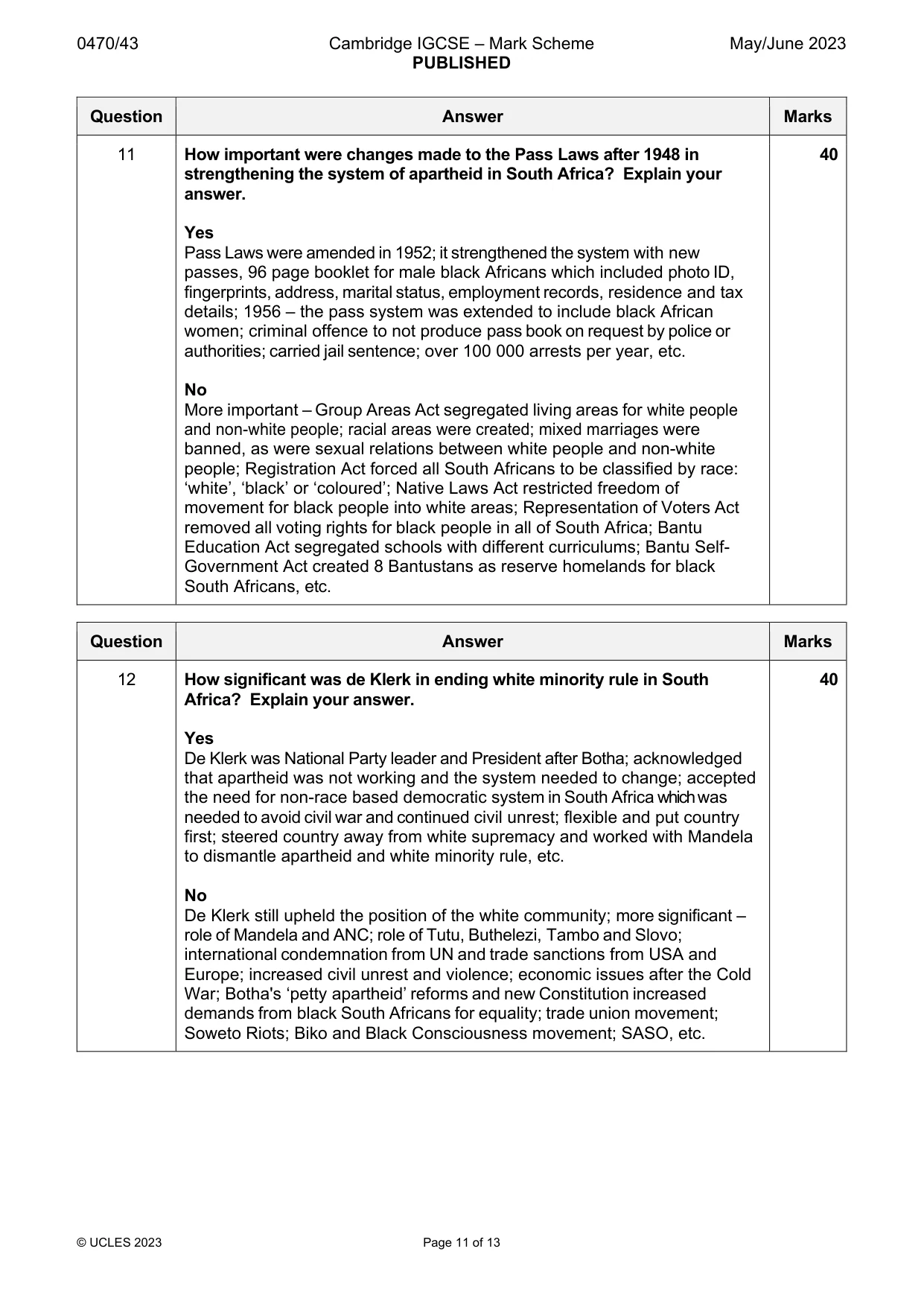
0470/43 Cambridge IGCSE – Mark Scheme PUBLISHED May/June 2023 © UCLES 2023 Page 11 of 13 Question Answer Marks 11 How important were changes made to the Pass Laws after 1948 in strengthening the system of apartheid in South Africa? Explain your answer. Yes Pass Laws were amended in 1952; it strengthened the system with new passes, 96 page booklet for male black Africans which included photo ID, fingerprints, address, marital status, employment records, residence and tax details; 1956 – the pass system was extended to include black African women; criminal offence to not produce pass book on request by police or authorities; carried jail sentence; over 100 000 arrests per year, etc. No More important – Group Areas Act segregated living areas for white people and non-white people; racial areas were created; mixed marriages were banned, as were sexual relations between white people and non-white people; Registration Act forced all South Africans to be classified by race: ‘white’, ‘black’ or ‘coloured’; Native Laws Act restricted freedom of movement for black people into white areas; Representation of Voters Act removed all voting rights for black people in all of South Africa; Bantu Education Act segregated schools with different curriculums; Bantu Self- Government Act created 8 Bantustans as reserve homelands for black South Africans, etc. 40 Question Answer Marks 12 How significant was de Klerk in ending white minority rule in South Africa? Explain your answer. Yes De Klerk was National Party leader and President after Botha; acknowledged that apartheid was not working and the system needed to change; accepted the need for non-race based democratic system in South Africa which was needed to avoid civil war and continued civil unrest; flexible and put country first; steered country away from white supremacy and worked with Mandela to dismantle apartheid and white minority rule, etc. No De Klerk still upheld the position of the white community; more significant – role of Mandela and ANC; role of Tutu, Buthelezi, Tambo and Slovo; international condemnation from UN and trade sanctions from USA and Europe; increased civil unrest and violence; economic issues after the Cold War; Botha's ‘petty apartheid’ reforms and new Constitution increased demands from black South Africans for equality; trade union movement; Soweto Riots; Biko and Black Consciousness movement; SASO, etc. 40
Mark scheme, page 12
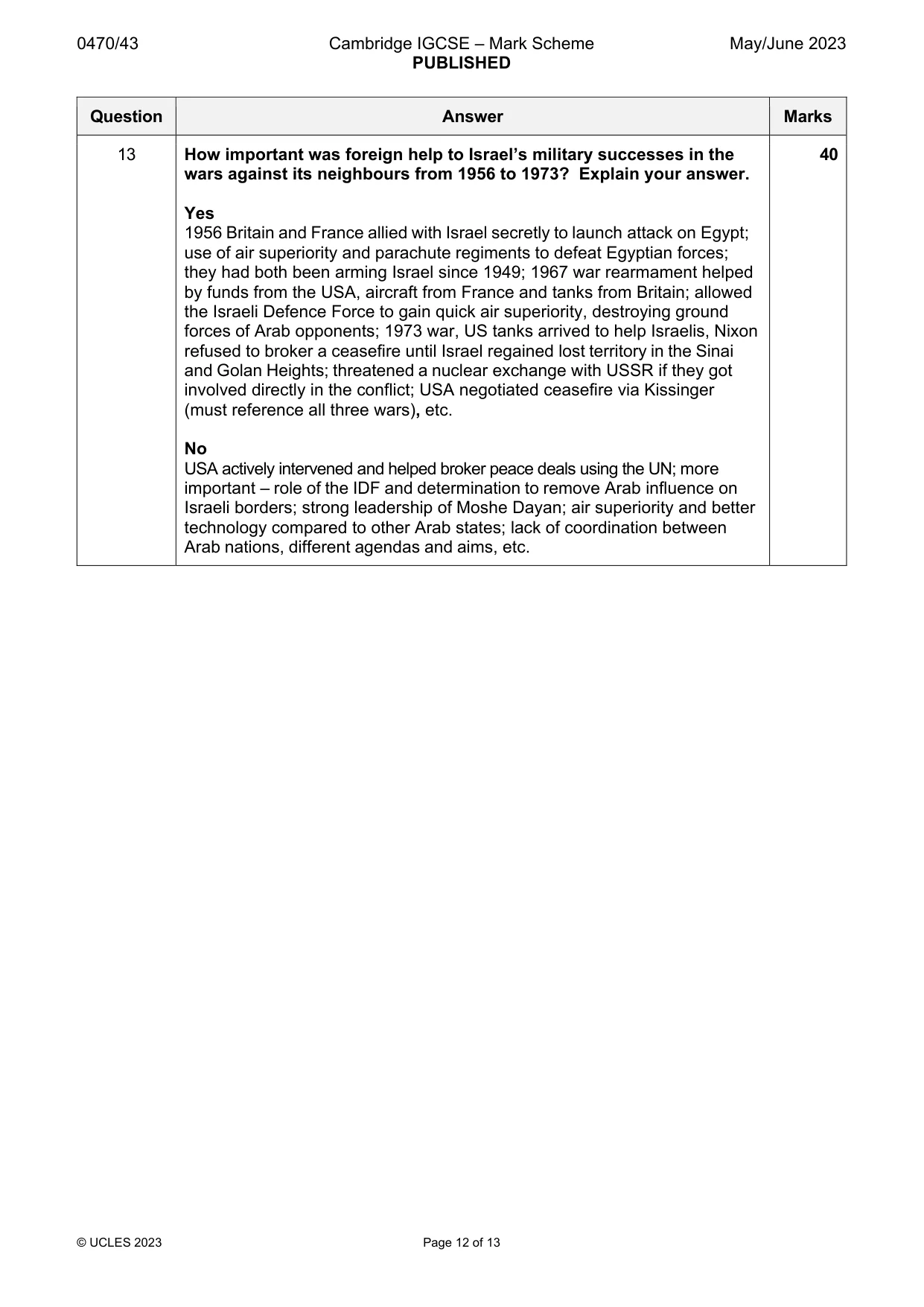
0470/43 Cambridge IGCSE – Mark Scheme PUBLISHED May/June 2023 © UCLES 2023 Page 12 of 13 Question Answer Marks 13 How important was foreign help to Israel’s military successes in the wars against its neighbours from 1956 to 1973? Explain your answer. Yes 1956 Britain and France allied with Israel secretly to launch attack on Egypt; use of air superiority and parachute regiments to defeat Egyptian forces; they had both been arming Israel since 1949; 1967 war rearmament helped by funds from the USA, aircraft from France and tanks from Britain; allowed the Israeli Defence Force to gain quick air superiority, destroying ground forces of Arab opponents; 1973 war, US tanks arrived to help Israelis, Nixon refused to broker a ceasefire until Israel regained lost territory in the Sinai and Golan Heights; threatened a nuclear exchange with USSR if they got involved directly in the conflict; USA negotiated ceasefire via Kissinger (must reference all three wars), etc. No USA actively intervened and helped broker peace deals using the UN; more important – role of the IDF and determination to remove Arab influence on Israeli borders; strong leadership of Moshe Dayan; air superiority and better technology compared to other Arab states; lack of coordination between Arab nations, different agendas and aims, etc. 40
Mark scheme, page 13
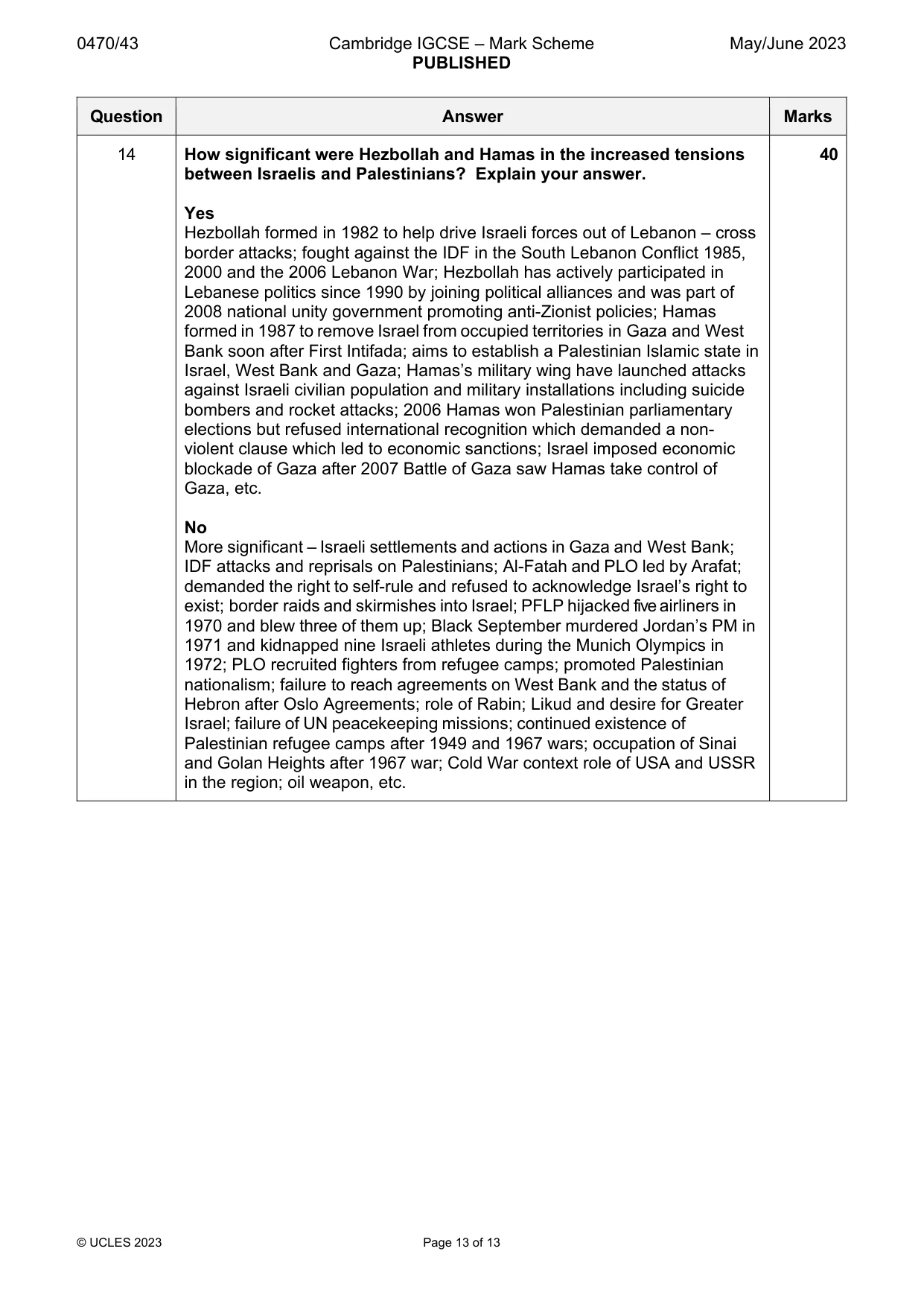
0470/43 Cambridge IGCSE – Mark Scheme PUBLISHED May/June 2023 © UCLES 2023 Page 13 of 13 Question Answer Marks 14 How significant were Hezbollah and Hamas in the increased tensions between Israelis and Palestinians? Explain your answer. Yes Hezbollah formed in 1982 to help drive Israeli forces out of Lebanon – cross border attacks; fought against the IDF in the South Lebanon Conflict 1985, 2000 and the 2006 Lebanon War; Hezbollah has actively participated in Lebanese politics since 1990 by joining political alliances and was part of 2008 national unity government promoting anti-Zionist policies; Hamas formed in 1987 to remove Israel from occupied territories in Gaza and West Bank soon after First Intifada; aims to establish a Palestinian Islamic state in Israel, West Bank and Gaza; Hamas’s military wing have launched attacks against Israeli civilian population and military installations including suicide bombers and rocket attacks; 2006 Hamas won Palestinian parliamentary elections but refused international recognition which demanded a non- violent clause which led to economic sanctions; Israel imposed economic blockade of Gaza after 2007 Battle of Gaza saw Hamas take control of Gaza, etc. No More significant – Israeli settlements and actions in Gaza and West Bank; IDF attacks and reprisals on Palestinians; Al-Fatah and PLO led by Arafat; demanded the right to self-rule and refused to acknowledge Israel’s right to exist; border raids and skirmishes into Israel; PFLP hijacked five airliners in 1970 and blew three of them up; Black September murdered Jordan’s PM in 1971 and kidnapped nine Israeli athletes during the Munich Olympics in 1972; PLO recruited fighters from refugee camps; promoted Palestinian nationalism; failure to reach agreements on West Bank and the status of Hebron after Oslo Agreements; role of Rabin; Likud and desire for Greater Israel; failure of UN peacekeeping missions; continued existence of Palestinian refugee camps after 1949 and 1967 wars; occupation of Sinai and Golan Heights after 1967 war; Cold War context role of USA and USSR in the region; oil weapon, etc. 40
What you needed in this session
Cambridge’s own grade thresholds for 2023 May/June, Paper 4 · Variant 3. A higher threshold means an easier paper — the bar moves with how the cohort did.