Cambridge IGCSE History 0470 — 2024 Oct/Nov Paper 4 · Variant 3
0470/43/O/N/24 · 40 marks · 60 min
The question paper and its mark scheme, free to read here and free to download. This is Cambridge’s own paper, exactly as it was sat.
Question paper4 pages

Mark scheme16 pages
Answers below. Sit the paper first if you are practising.
Paper as text
Question paper, page 1
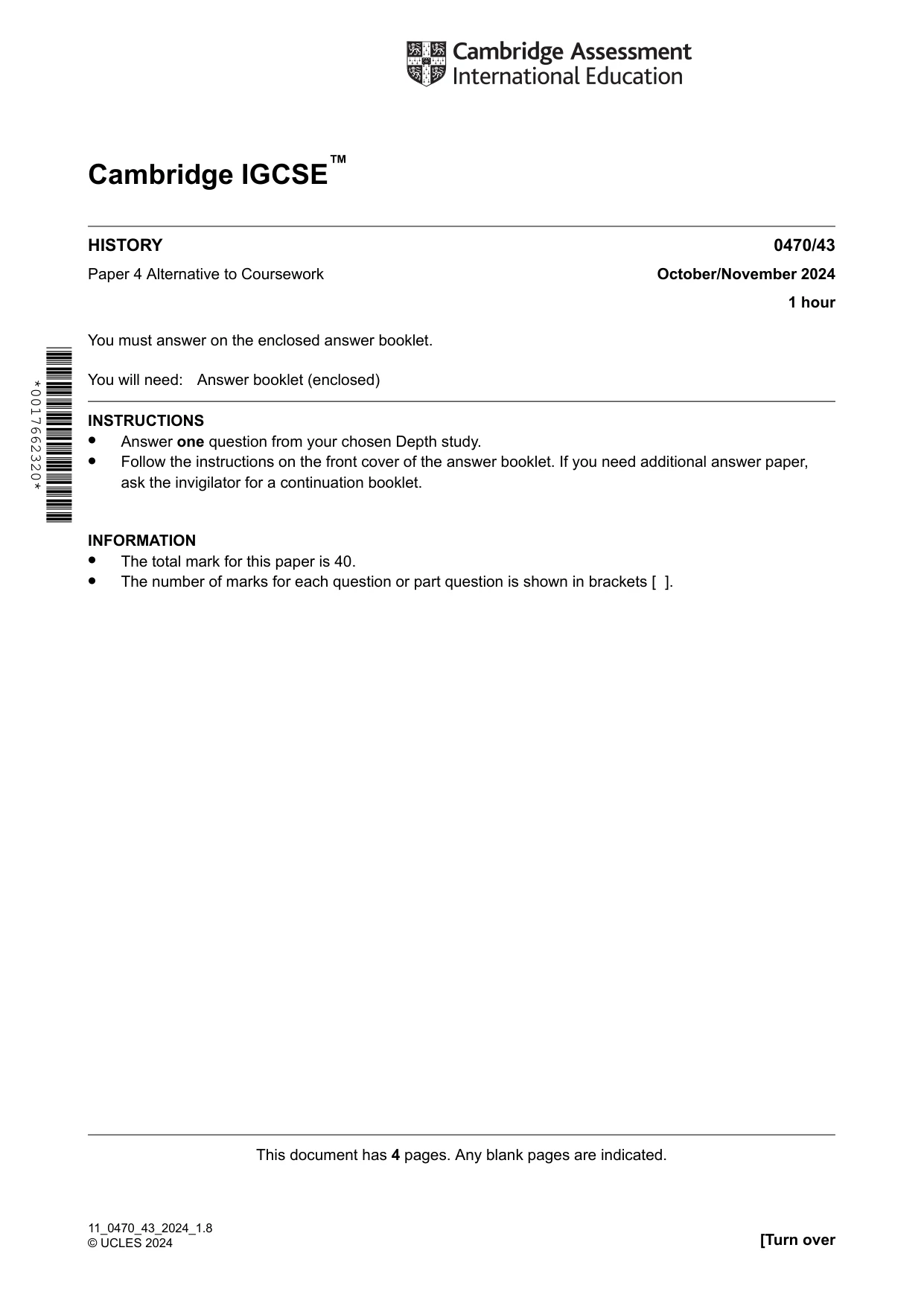
Cambridge IGCSE™ 0470/43 October/November 2024 1 hour HISTORY Paper 4 Alternative to Coursework You must answer on the enclosed answer booklet. You will need: Answer booklet (enclosed) INSTRUCTIONS • Answer one question from your chosen Depth study. • Follow the instructions on the front cover of the answer booklet. If you need additional answer paper, ask the invigilator for a continuation booklet. INFORMATION • The total mark for this paper is 40. • The number of marks for each question or part question is shown in brackets [ ]. This document has 4 pages. Any blank pages are indicated. [Turn over 11_0470_43_2024_1.8 © UCLES 2024 *0017662320*
Question paper, page 2
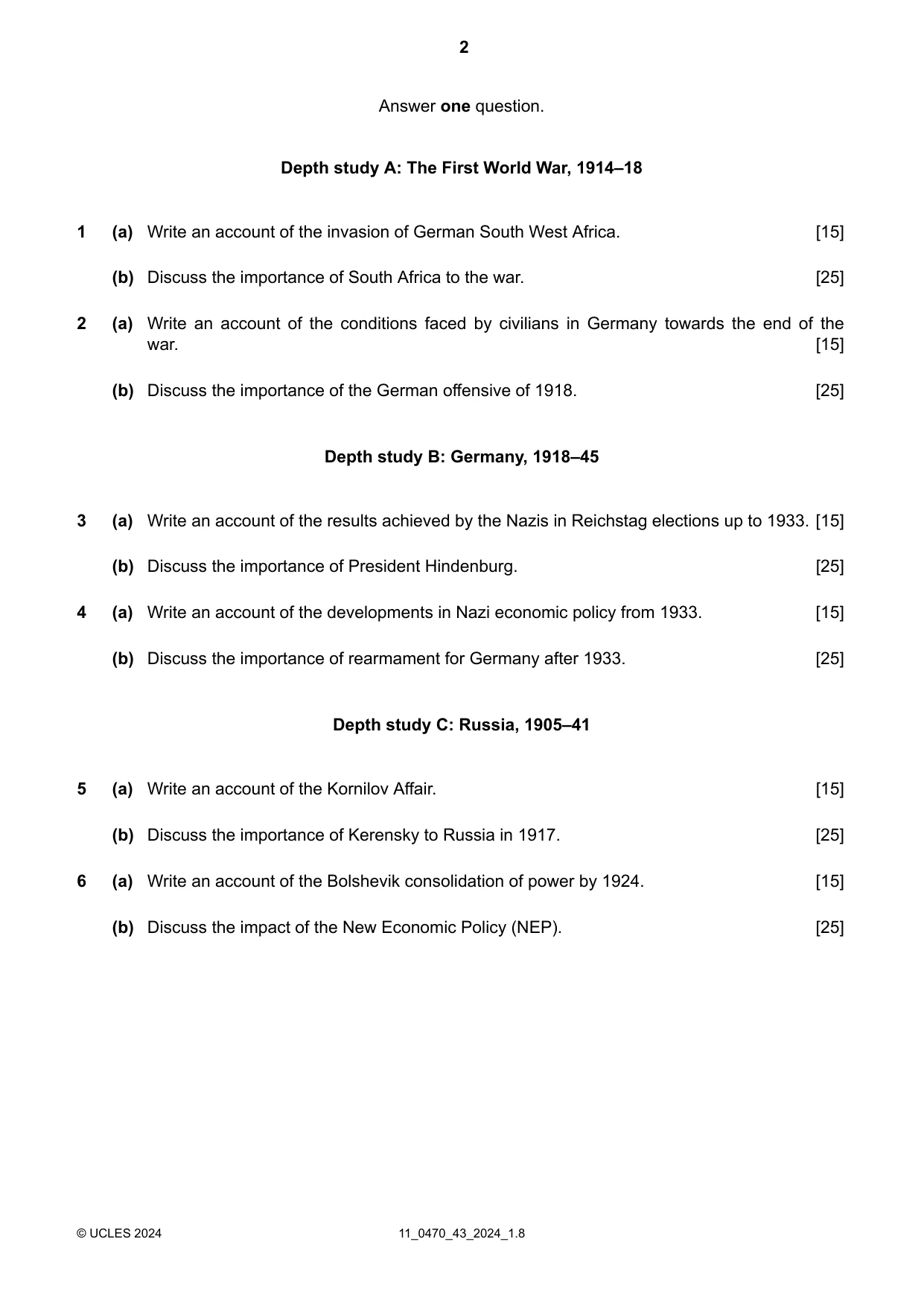
Answer one question. Depth study A: The First World War, 1914–18 Write an account of the invasion of German South West Africa. [15] (a) 1 Discuss the importance of South Africa to the war. [25] (b) Write an account of the conditions faced by civilians in Germany towards the end of the war. [15] (a) 2 Discuss the importance of the German offensive of 1918. [25] (b) Depth study B: Germany, 1918–45 Write an account of the results achieved by the Nazis in Reichstag elections up to 1933. [15] (a) 3 Discuss the importance of President Hindenburg. [25] (b) Write an account of the developments in Nazi economic policy from 1933. [15] (a) 4 Discuss the importance of rearmament for Germany after 1933. [25] (b) Depth study C: Russia, 1905–41 Write an account of the Kornilov Affair. [15] (a) 5 Discuss the importance of Kerensky to Russia in 1917. [25] (b) Write an account of the Bolshevik consolidation of power by 1924. [15] (a) 6 Discuss the impact of the New Economic Policy (NEP). [25] (b) 11_0470_43_2024_1.8 © UCLES 2024 2
Question paper, page 3
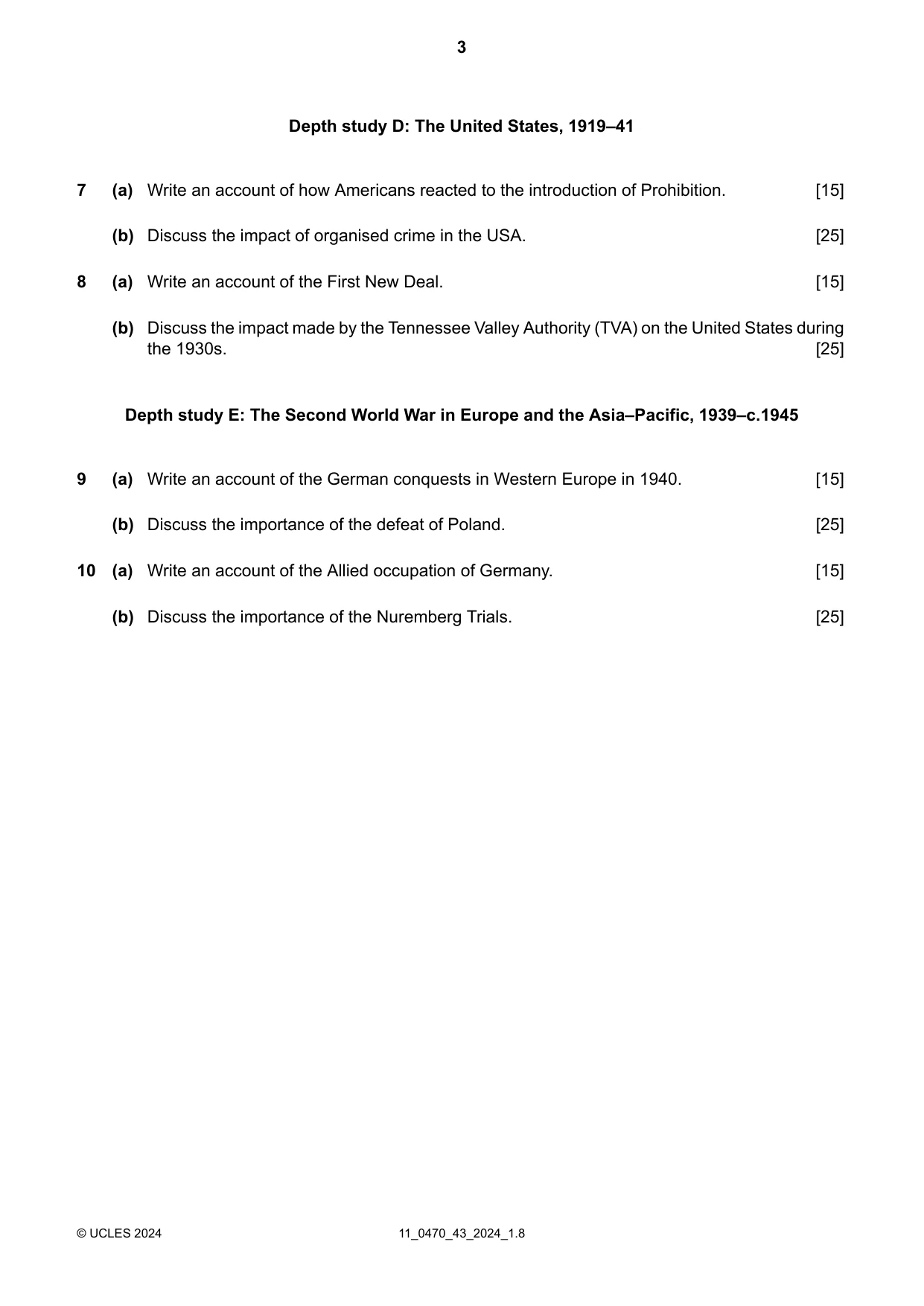
Depth study D: The United States, 1919–41 Write an account of how Americans reacted to the introduction of Prohibition. [15] (a) 7 Discuss the impact of organised crime in the USA. [25] (b) Write an account of the First New Deal. [15] (a) 8 Discuss the impact made by the Tennessee Valley Authority (TVA) on the United States during the 1930s. [25] (b) Depth study E: The Second World War in Europe and the Asia–Pacific, 1939–c.1945 Write an account of the German conquests in Western Europe in 1940. [15] (a) 9 Discuss the importance of the defeat of Poland. [25] (b) Write an account of the Allied occupation of Germany. [15] (a) 10 Discuss the importance of the Nuremberg Trials. [25] (b) 11_0470_43_2024_1.8 © UCLES 2024 3
Question paper, page 4
BLANK PAGE Permission to reproduce items where third-party owned material protected by copyright is included has been sought and cleared where possible. Every reasonable effort has been made by the publisher (UCLES) to trace copyright holders, but if any items requiring clearance have unwittingly been included, the publisher will be pleased to make amends at the earliest possible opportunity. To avoid the issue of disclosure of answer-related information to candidates, all copyright acknowledgements are reproduced online in the Cambridge Assessment International Education Copyright Acknowledgements Booklet. This is produced for each series of examinations and is freely available to download at www.cambridgeinternational.org after the live examination series. Cambridge Assessment International Education is part of Cambridge Assessment. Cambridge Assessment is the brand name of the University of Cambridge Local Examinations Syndicate (UCLES), which is a department of the University of Cambridge. 11_0470_43_2024_1.8 © UCLES 2024 4
Mark scheme, page 1
This document consists of 16 printed pages. © Cambridge University Press & Assessment 2024 [Turn over Cambridge IGCSE™ HISTORY 0470/43 Paper 4 Alternative to Coursework October/November 2024 MARK SCHEME Maximum Mark: 40 Published This mark scheme is published as an aid to teachers and candidates, to indicate the requirements of the examination. It shows the basis on which Examiners were instructed to award marks. It does not indicate the details of the discussions that took place at an Examiners’ meeting before marking began, which would have considered the acceptability of alternative answers. Mark schemes should be read in conjunction with the question paper and the Principal Examiner Report for Teachers. Cambridge International will not enter into discussions about these mark schemes. Cambridge International is publishing the mark schemes for the October/November 2024 series for most Cambridge IGCSE, Cambridge International A and AS Level components, and some Cambridge O Level components.
Mark scheme, page 2
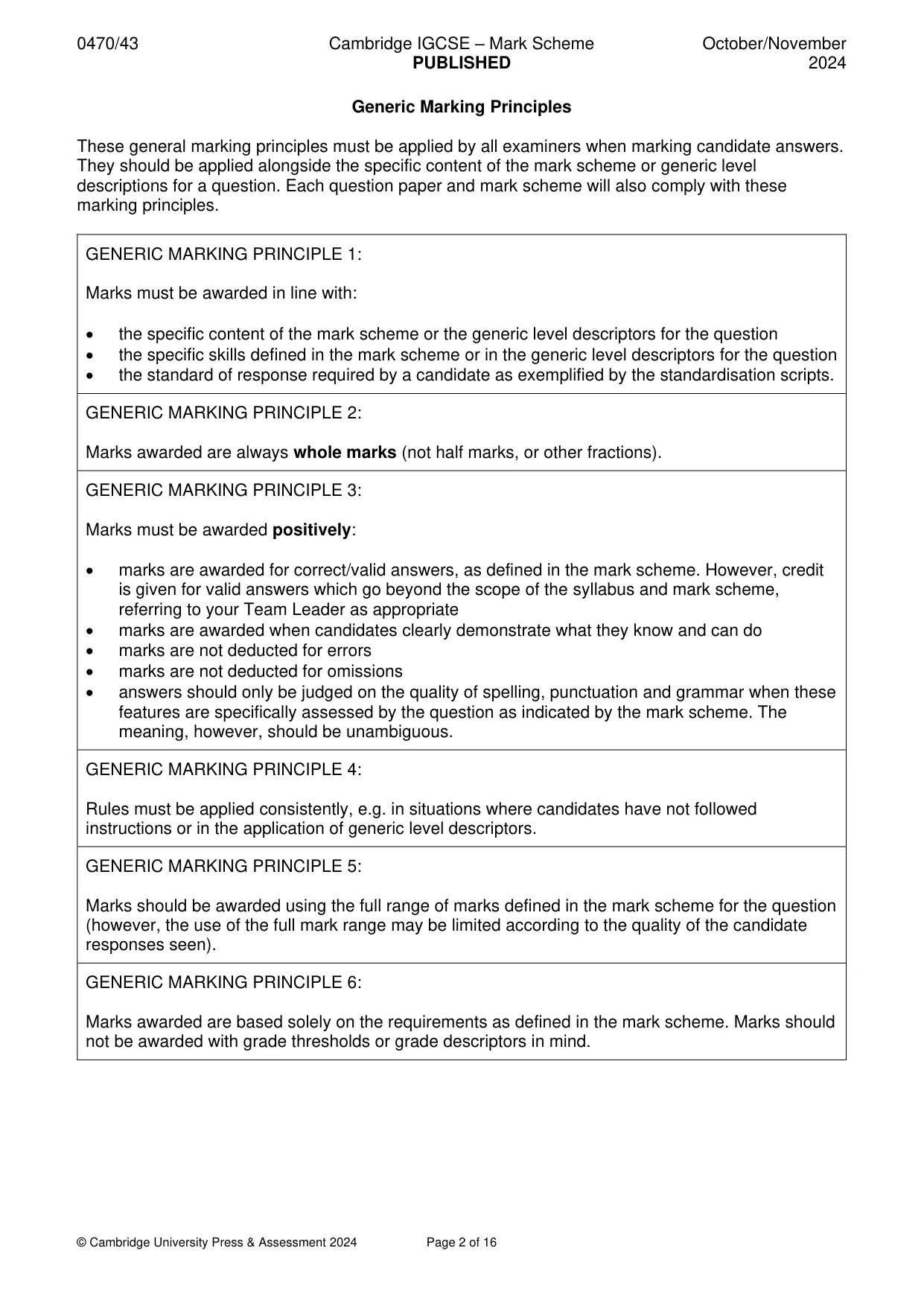
0470/43 Cambridge IGCSE – Mark Scheme PUBLISHED October/November 2024 © Cambridge University Press & Assessment 2024 Page 2 of 16 Generic Marking Principles These general marking principles must be applied by all examiners when marking candidate answers. They should be applied alongside the specific content of the mark scheme or generic level descriptions for a question. Each question paper and mark scheme will also comply with these marking principles. GENERIC MARKING PRINCIPLE 1: Marks must be awarded in line with: • the specific content of the mark scheme or the generic level descriptors for the question • the specific skills defined in the mark scheme or in the generic level descriptors for the question • the standard of response required by a candidate as exemplified by the standardisation scripts. GENERIC MARKING PRINCIPLE 2: Marks awarded are always whole marks (not half marks, or other fractions). GENERIC MARKING PRINCIPLE 3: Marks must be awarded positively: • marks are awarded for correct/valid answers, as defined in the mark scheme. However, credit is given for valid answers which go beyond the scope of the syllabus and mark scheme, referring to your Team Leader as appropriate • marks are awarded when candidates clearly demonstrate what they know and can do • marks are not deducted for errors • marks are not deducted for omissions • answers should only be judged on the quality of spelling, punctuation and grammar when these features are specifically assessed by the question as indicated by the mark scheme. The meaning, however, should be unambiguous. GENERIC MARKING PRINCIPLE 4: Rules must be applied consistently, e.g. in situations where candidates have not followed instructions or in the application of generic level descriptors. GENERIC MARKING PRINCIPLE 5: Marks should be awarded using the full range of marks defined in the mark scheme for the question (however, the use of the full mark range may be limited according to the quality of the candidate responses seen). GENERIC MARKING PRINCIPLE 6: Marks awarded are based solely on the requirements as defined in the mark scheme. Marks should not be awarded with grade thresholds or grade descriptors in mind.
Mark scheme, page 3
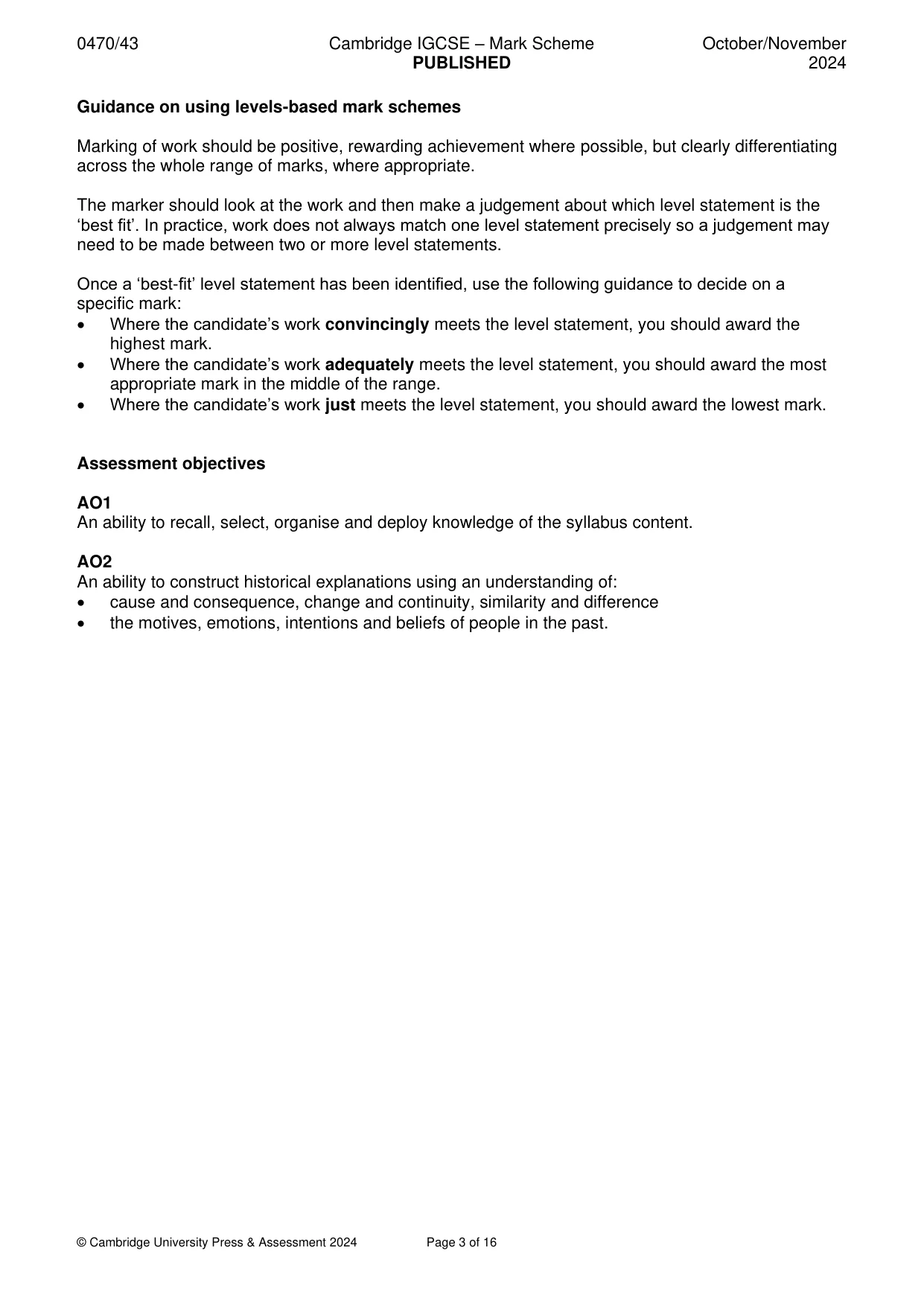
0470/43 Cambridge IGCSE – Mark Scheme PUBLISHED October/November 2024 © Cambridge University Press & Assessment 2024 Page 3 of 16 Guidance on using levels-based mark schemes Marking of work should be positive, rewarding achievement where possible, but clearly differentiating across the whole range of marks, where appropriate. The marker should look at the work and then make a judgement about which level statement is the ‘best fit’. In practice, work does not always match one level statement precisely so a judgement may need to be made between two or more level statements. Once a ‘best-fit’ level statement has been identified, use the following guidance to decide on a specific mark: • Where the candidate’s work convincingly meets the level statement, you should award the highest mark. • Where the candidate’s work adequately meets the level statement, you should award the most appropriate mark in the middle of the range. • Where the candidate’s work just meets the level statement, you should award the lowest mark. Assessment objectives AO1 An ability to recall, select, organise and deploy knowledge of the syllabus content. AO2 An ability to construct historical explanations using an understanding of: • cause and consequence, change and continuity, similarity and difference • the motives, emotions, intentions and beliefs of people in the past.
Mark scheme, page 4
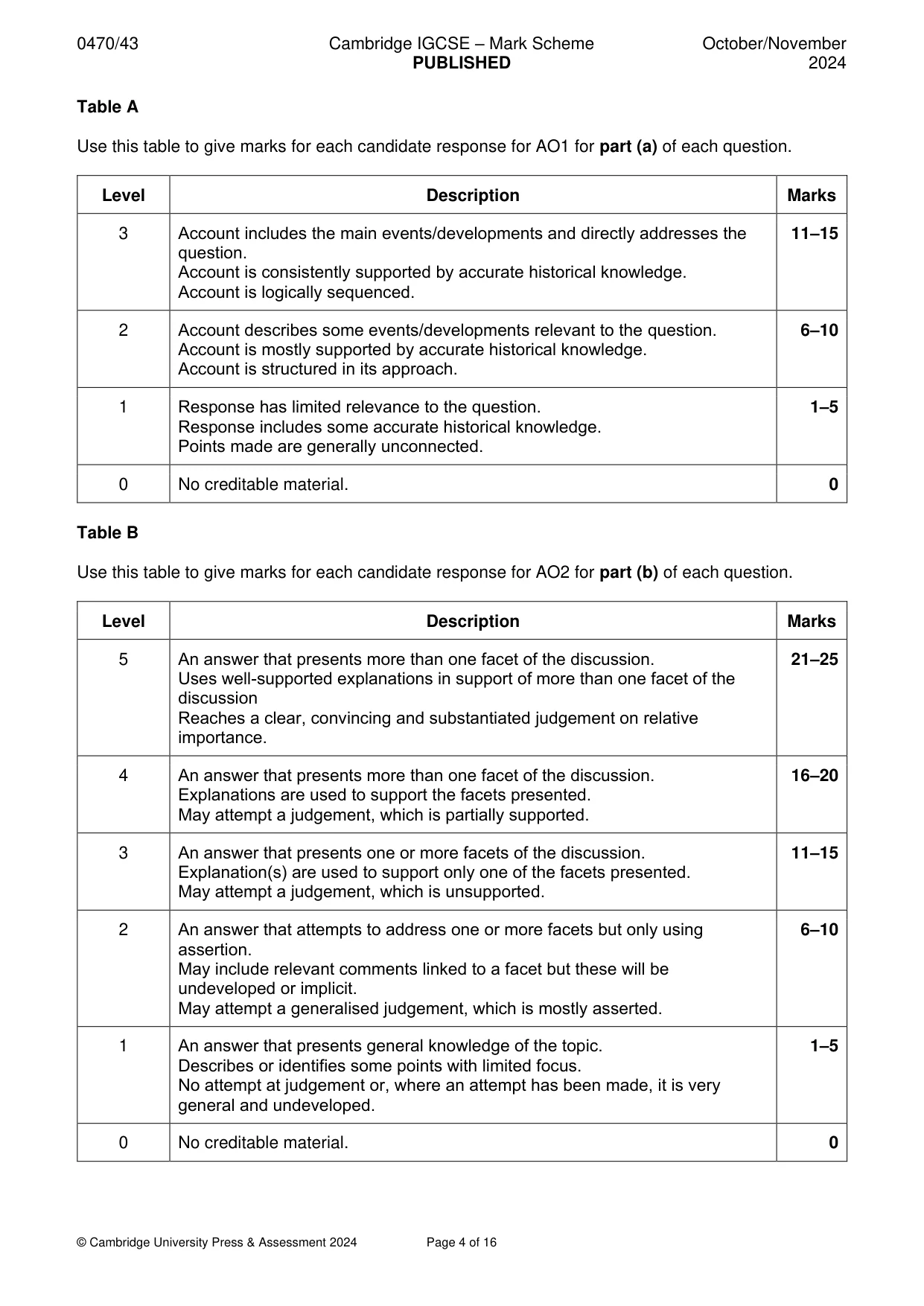
0470/43 Cambridge IGCSE – Mark Scheme PUBLISHED October/November 2024 © Cambridge University Press & Assessment 2024 Page 4 of 16 Table A Use this table to give marks for each candidate response for AO1 for part (a) of each question. Level Description Marks 3 Account includes the main events/developments and directly addresses the question. Account is consistently supported by accurate historical knowledge. Account is logically sequenced. 11–15 2 Account describes some events/developments relevant to the question. Account is mostly supported by accurate historical knowledge. Account is structured in its approach. 6–10 1 Response has limited relevance to the question. Response includes some accurate historical knowledge. Points made are generally unconnected. 1–5 0 No creditable material. 0 Table B Use this table to give marks for each candidate response for AO2 for part (b) of each question. Level Description Marks 5 An answer that presents more than one facet of the discussion. Uses well-supported explanations in support of more than one facet of the discussion Reaches a clear, convincing and substantiated judgement on relative importance. 21–25 4 An answer that presents more than one facet of the discussion. Explanations are used to support the facets presented. May attempt a judgement, which is partially supported. 16–20 3 An answer that presents one or more facets of the discussion. Explanation(s) are used to support only one of the facets presented. May attempt a judgement, which is unsupported. 11–15 2 An answer that attempts to address one or more facets but only using assertion. May include relevant comments linked to a facet but these will be undeveloped or implicit. May attempt a generalised judgement, which is mostly asserted. 6–10 1 An answer that presents general knowledge of the topic. Describes or identifies some points with limited focus. No attempt at judgement or, where an attempt has been made, it is very general and undeveloped. 1–5 0 No creditable material. 0
Mark scheme, page 5
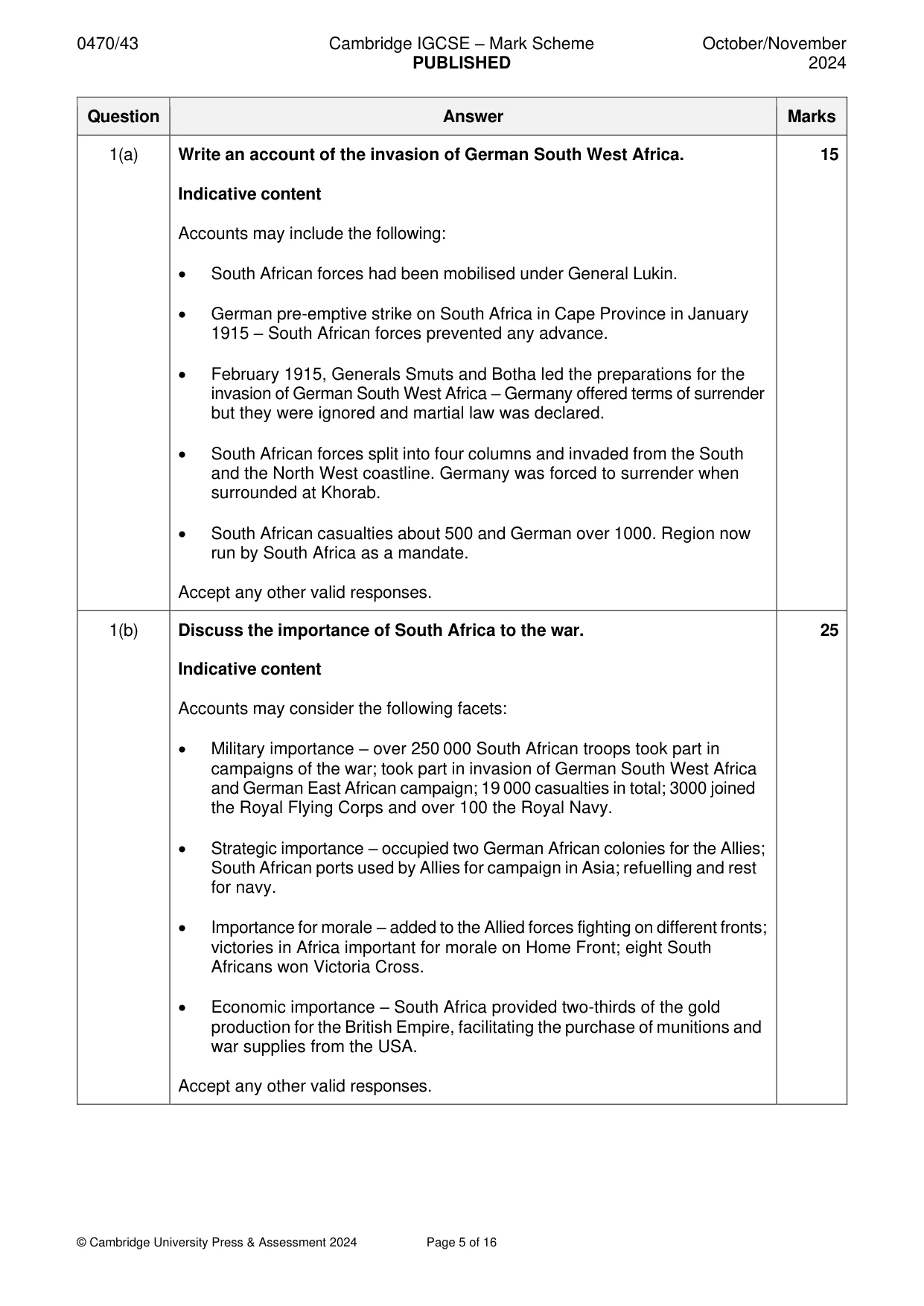
0470/43 Cambridge IGCSE – Mark Scheme PUBLISHED October/November 2024 © Cambridge University Press & Assessment 2024 Page 5 of 16 Question Answer Marks 1(a) Write an account of the invasion of German South West Africa. Indicative content Accounts may include the following: • South African forces had been mobilised under General Lukin. • German pre-emptive strike on South Africa in Cape Province in January 1915 – South African forces prevented any advance. • February 1915, Generals Smuts and Botha led the preparations for the invasion of German South West Africa – Germany offered terms of surrender but they were ignored and martial law was declared. • South African forces split into four columns and invaded from the South and the North West coastline. Germany was forced to surrender when surrounded at Khorab. • South African casualties about 500 and German over 1000. Region now run by South Africa as a mandate. Accept any other valid responses. 15 1(b) Discuss the importance of South Africa to the war. Indicative content Accounts may consider the following facets: • Military importance – over 250 000 South African troops took part in campaigns of the war; took part in invasion of German South West Africa and German East African campaign; 19 000 casualties in total; 3000 joined the Royal Flying Corps and over 100 the Royal Navy. • Strategic importance – occupied two German African colonies for the Allies; South African ports used by Allies for campaign in Asia; refuelling and rest for navy. • Importance for morale – added to the Allied forces fighting on different fronts; victories in Africa important for morale on Home Front; eight South Africans won Victoria Cross. • Economic importance – South Africa provided two-thirds of the gold production for the British Empire, facilitating the purchase of munitions and war supplies from the USA. Accept any other valid responses. 25
Mark scheme, page 6
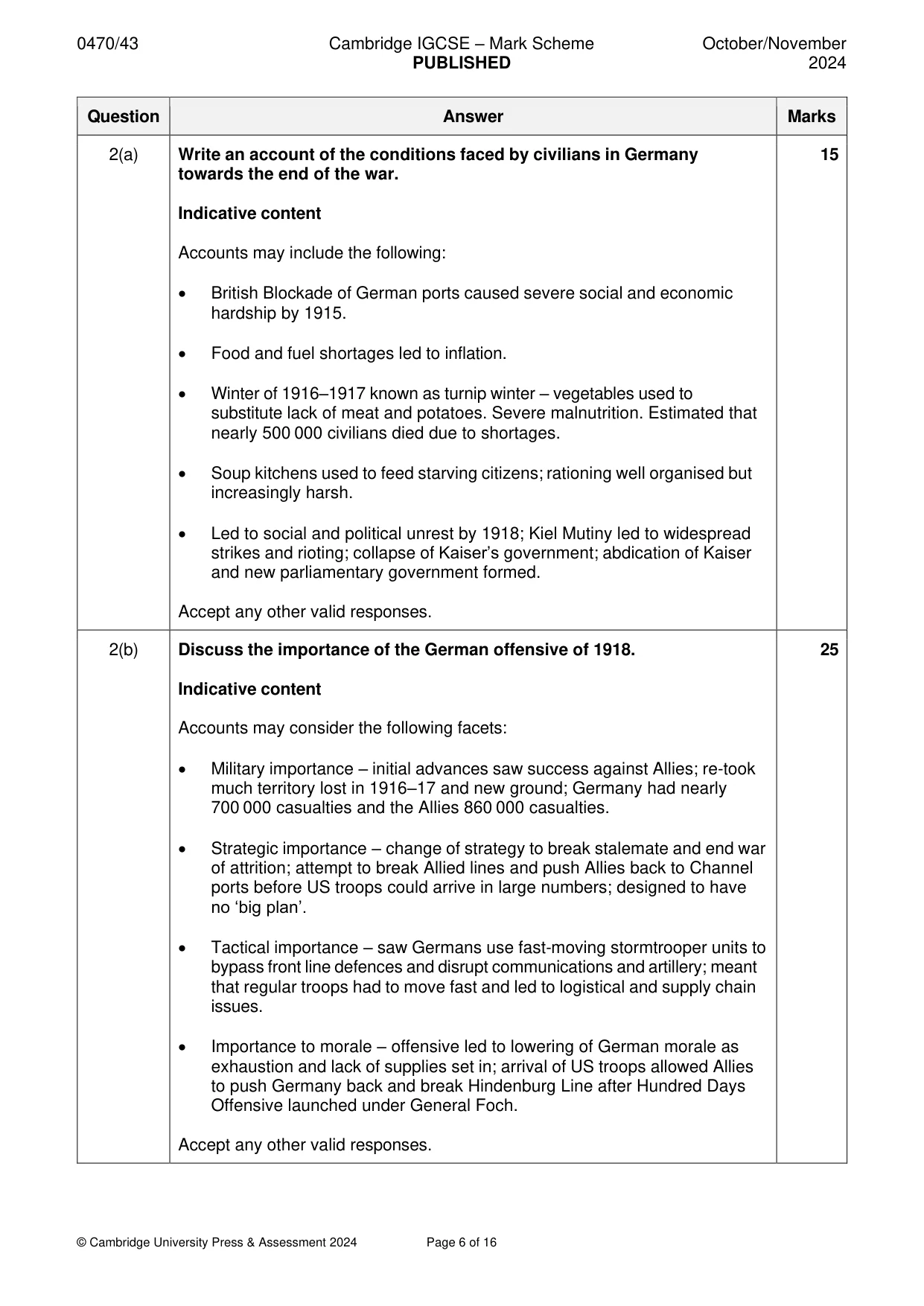
0470/43 Cambridge IGCSE – Mark Scheme PUBLISHED October/November 2024 © Cambridge University Press & Assessment 2024 Page 6 of 16 Question Answer Marks 2(a) Write an account of the conditions faced by civilians in Germany towards the end of the war. Indicative content Accounts may include the following: • British Blockade of German ports caused severe social and economic hardship by 1915. • Food and fuel shortages led to inflation. • Winter of 1916–1917 known as turnip winter – vegetables used to substitute lack of meat and potatoes. Severe malnutrition. Estimated that nearly 500 000 civilians died due to shortages. • Soup kitchens used to feed starving citizens; rationing well organised but increasingly harsh. • Led to social and political unrest by 1918; Kiel Mutiny led to widespread strikes and rioting; collapse of Kaiser’s government; abdication of Kaiser and new parliamentary government formed. Accept any other valid responses. 15 2(b) Discuss the importance of the German offensive of 1918. Indicative content Accounts may consider the following facets: • Military importance – initial advances saw success against Allies; re-took much territory lost in 1916–17 and new ground; Germany had nearly 700 000 casualties and the Allies 860 000 casualties. • Strategic importance – change of strategy to break stalemate and end war of attrition; attempt to break Allied lines and push Allies back to Channel ports before US troops could arrive in large numbers; designed to have no ‘big plan’. • Tactical importance – saw Germans use fast-moving stormtrooper units to bypass front line defences and disrupt communications and artillery; meant that regular troops had to move fast and led to logistical and supply chain issues. • Importance to morale – offensive led to lowering of German morale as exhaustion and lack of supplies set in; arrival of US troops allowed Allies to push Germany back and break Hindenburg Line after Hundred Days Offensive launched under General Foch. Accept any other valid responses. 25
Mark scheme, page 7
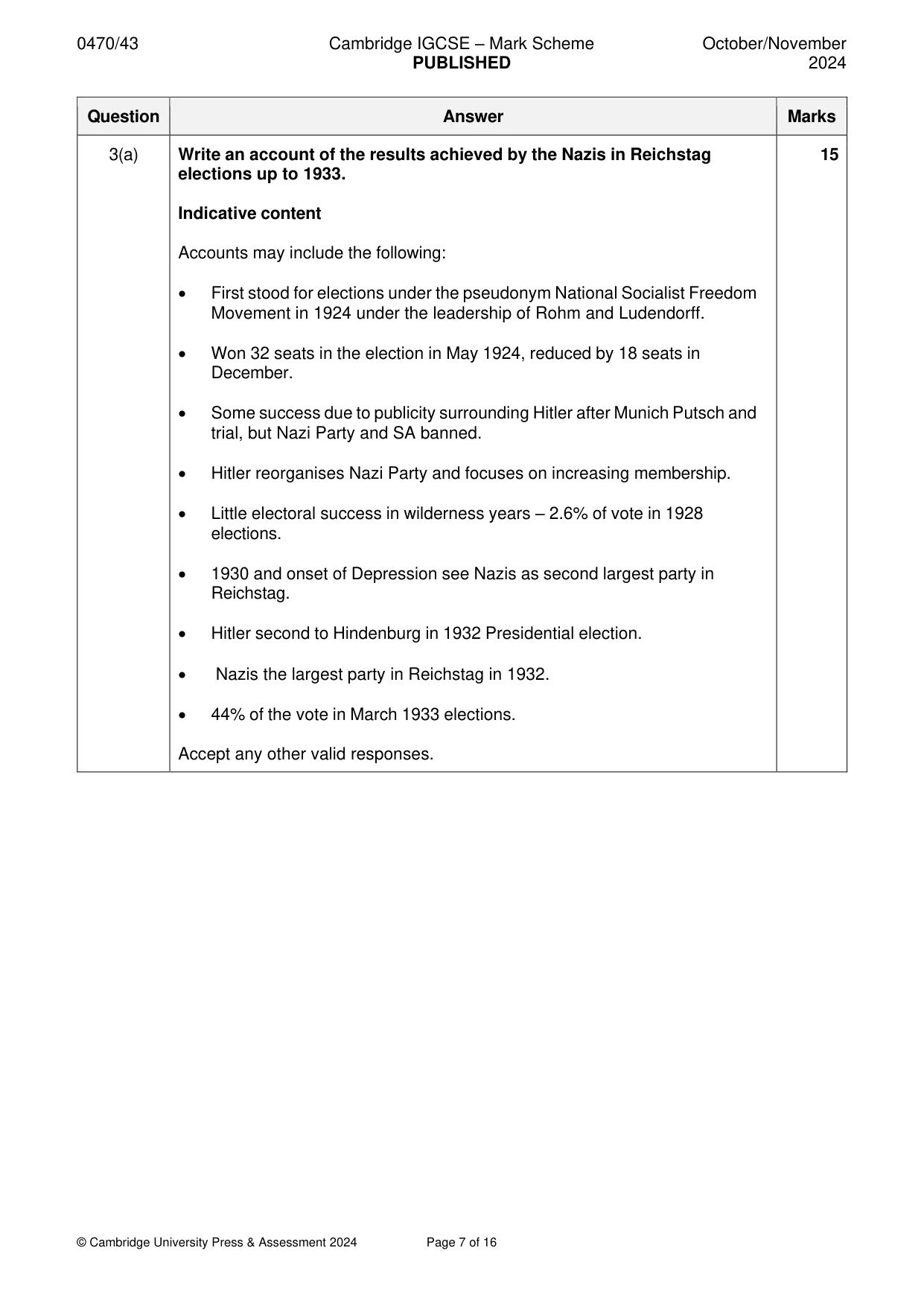
0470/43 Cambridge IGCSE – Mark Scheme PUBLISHED October/November 2024 © Cambridge University Press & Assessment 2024 Page 7 of 16 Question Answer Marks 3(a) Write an account of the results achieved by the Nazis in Reichstag elections up to 1933. Indicative content Accounts may include the following: • First stood for elections under the pseudonym National Socialist Freedom Movement in 1924 under the leadership of Rohm and Ludendorff. • Won 32 seats in the election in May 1924, reduced by 18 seats in December. • Some success due to publicity surrounding Hitler after Munich Putsch and trial, but Nazi Party and SA banned. • Hitler reorganises Nazi Party and focuses on increasing membership. • Little electoral success in wilderness years – 2.6% of vote in 1928 elections. • 1930 and onset of Depression see Nazis as second largest party in Reichstag. • Hitler second to Hindenburg in 1932 Presidential election. • Nazis the largest party in Reichstag in 1932. • 44% of the vote in March 1933 elections. Accept any other valid responses. 15
Mark scheme, page 8
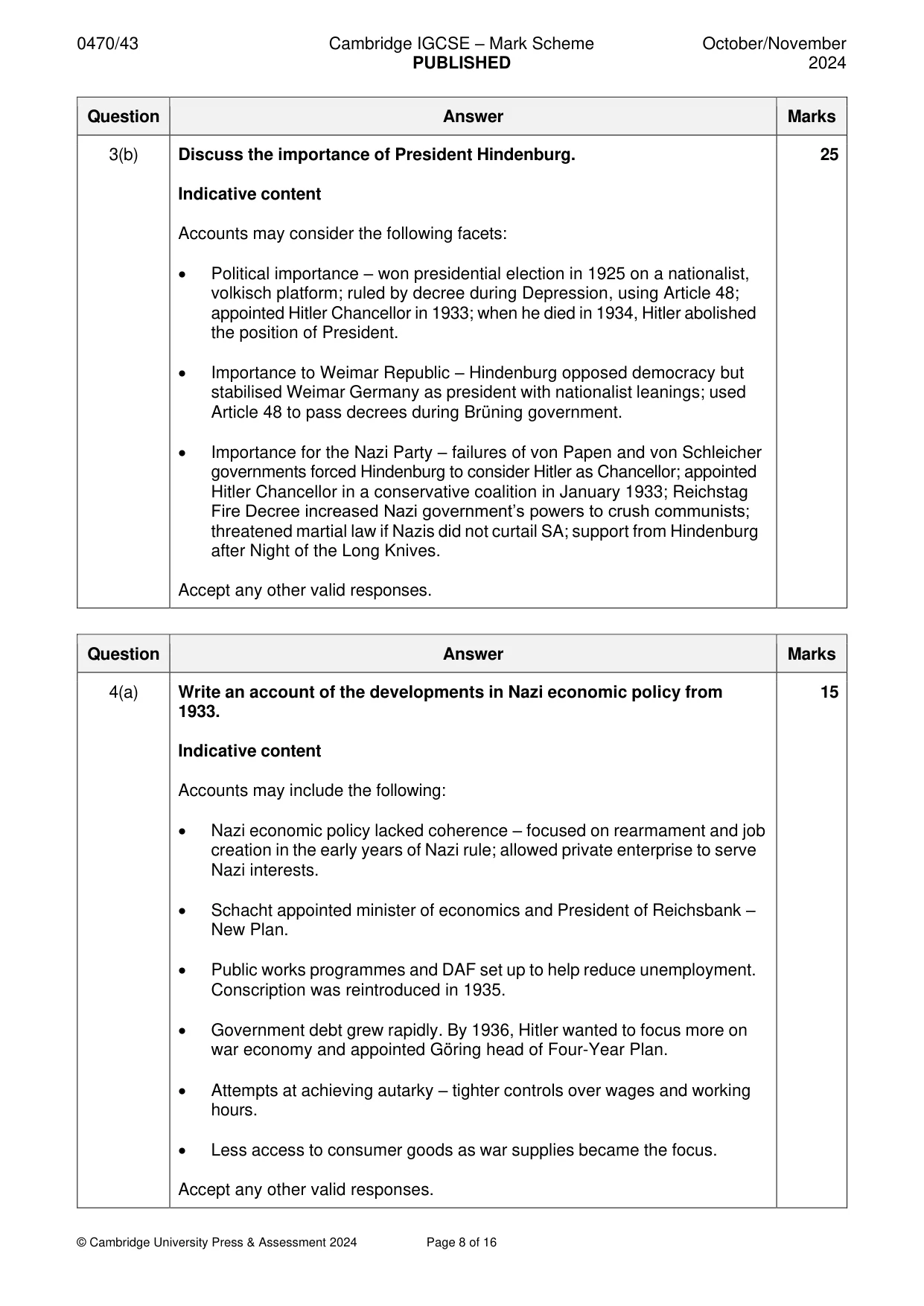
0470/43 Cambridge IGCSE – Mark Scheme PUBLISHED October/November 2024 © Cambridge University Press & Assessment 2024 Page 8 of 16 Question Answer Marks 3(b) Discuss the importance of President Hindenburg. Indicative content Accounts may consider the following facets: • Political importance – won presidential election in 1925 on a nationalist, volkisch platform; ruled by decree during Depression, using Article 48; appointed Hitler Chancellor in 1933; when he died in 1934, Hitler abolished the position of President. • Importance to Weimar Republic – Hindenburg opposed democracy but stabilised Weimar Germany as president with nationalist leanings; used Article 48 to pass decrees during Brüning government. • Importance for the Nazi Party – failures of von Papen and von Schleicher governments forced Hindenburg to consider Hitler as Chancellor; appointed Hitler Chancellor in a conservative coalition in January 1933; Reichstag Fire Decree increased Nazi government’s powers to crush communists; threatened martial law if Nazis did not curtail SA; support from Hindenburg after Night of the Long Knives. Accept any other valid responses. 25 Question Answer Marks 4(a) Write an account of the developments in Nazi economic policy from 1933. Indicative content Accounts may include the following: • Nazi economic policy lacked coherence – focused on rearmament and job creation in the early years of Nazi rule; allowed private enterprise to serve Nazi interests. • Schacht appointed minister of economics and President of Reichsbank – New Plan. • Public works programmes and DAF set up to help reduce unemployment. Conscription was reintroduced in 1935. • Government debt grew rapidly. By 1936, Hitler wanted to focus more on war economy and appointed Göring head of Four-Year Plan. • Attempts at achieving autarky – tighter controls over wages and working hours. • Less access to consumer goods as war supplies became the focus. Accept any other valid responses. 15
Mark scheme, page 9
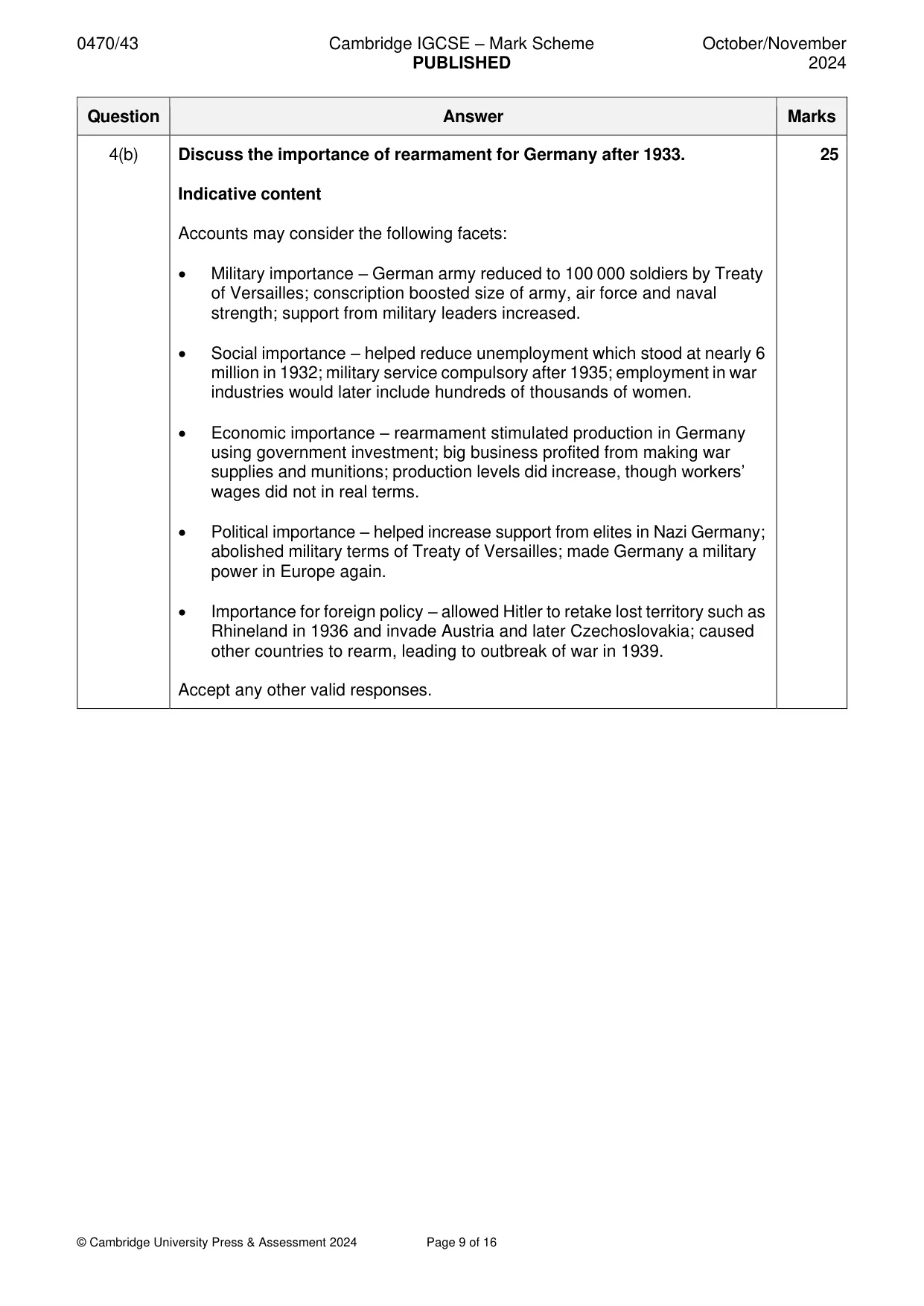
0470/43 Cambridge IGCSE – Mark Scheme PUBLISHED October/November 2024 © Cambridge University Press & Assessment 2024 Page 9 of 16 Question Answer Marks 4(b) Discuss the importance of rearmament for Germany after 1933. Indicative content Accounts may consider the following facets: • Military importance – German army reduced to 100 000 soldiers by Treaty of Versailles; conscription boosted size of army, air force and naval strength; support from military leaders increased. • Social importance – helped reduce unemployment which stood at nearly 6 million in 1932; military service compulsory after 1935; employment in war industries would later include hundreds of thousands of women. • Economic importance – rearmament stimulated production in Germany using government investment; big business profited from making war supplies and munitions; production levels did increase, though workers’ wages did not in real terms. • Political importance – helped increase support from elites in Nazi Germany; abolished military terms of Treaty of Versailles; made Germany a military power in Europe again. • Importance for foreign policy – allowed Hitler to retake lost territory such as Rhineland in 1936 and invade Austria and later Czechoslovakia; caused other countries to rearm, leading to outbreak of war in 1939. Accept any other valid responses. 25
Mark scheme, page 10
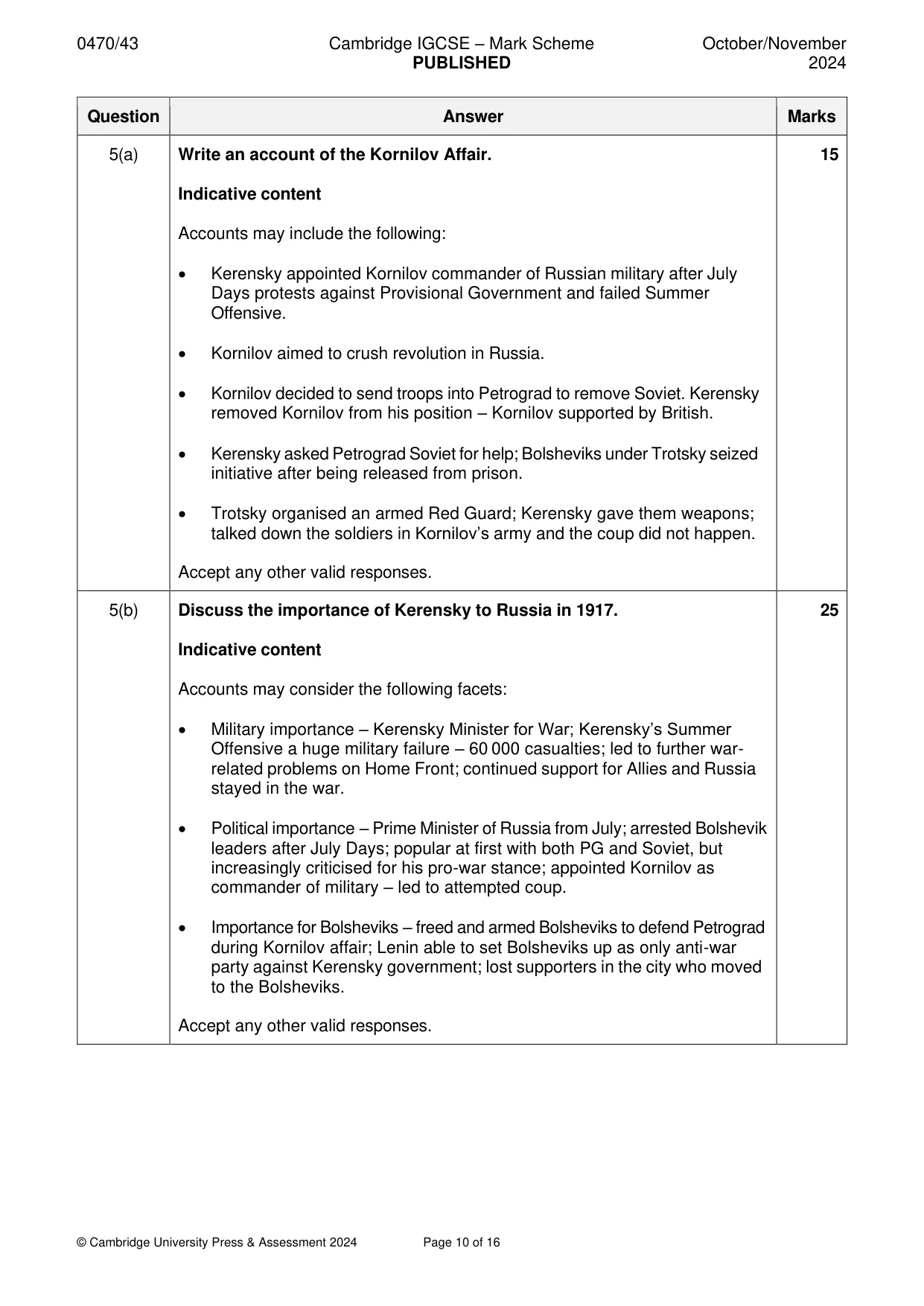
0470/43 Cambridge IGCSE – Mark Scheme PUBLISHED October/November 2024 © Cambridge University Press & Assessment 2024 Page 10 of 16 Question Answer Marks 5(a) Write an account of the Kornilov Affair. Indicative content Accounts may include the following: • Kerensky appointed Kornilov commander of Russian military after July Days protests against Provisional Government and failed Summer Offensive. • Kornilov aimed to crush revolution in Russia. • Kornilov decided to send troops into Petrograd to remove Soviet. Kerensky removed Kornilov from his position – Kornilov supported by British. • Kerensky asked Petrograd Soviet for help; Bolsheviks under Trotsky seized initiative after being released from prison. • Trotsky organised an armed Red Guard; Kerensky gave them weapons; talked down the soldiers in Kornilov’s army and the coup did not happen. Accept any other valid responses. 15 5(b) Discuss the importance of Kerensky to Russia in 1917. Indicative content Accounts may consider the following facets: • Military importance – Kerensky Minister for War; Kerensky’s Summer Offensive a huge military failure – 60 000 casualties; led to further war- related problems on Home Front; continued support for Allies and Russia stayed in the war. • Political importance – Prime Minister of Russia from July; arrested Bolshevik leaders after July Days; popular at first with both PG and Soviet, but increasingly criticised for his pro-war stance; appointed Kornilov as commander of military – led to attempted coup. • Importance for Bolsheviks – freed and armed Bolsheviks to defend Petrograd during Kornilov affair; Lenin able to set Bolsheviks up as only anti-war party against Kerensky government; lost supporters in the city who moved to the Bolsheviks. Accept any other valid responses. 25
Mark scheme, page 11
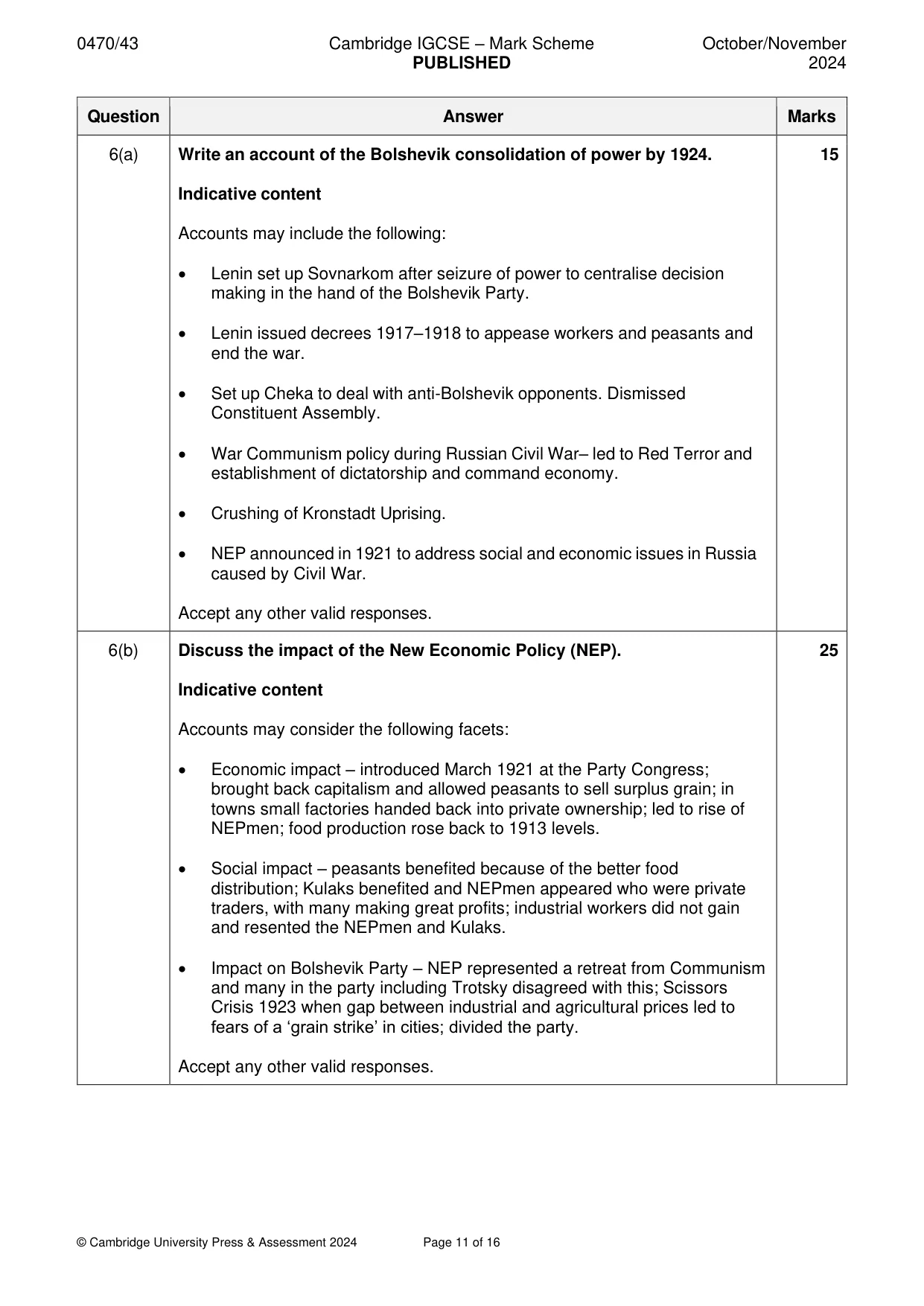
0470/43 Cambridge IGCSE – Mark Scheme PUBLISHED October/November 2024 © Cambridge University Press & Assessment 2024 Page 11 of 16 Question Answer Marks 6(a) Write an account of the Bolshevik consolidation of power by 1924. Indicative content Accounts may include the following: • Lenin set up Sovnarkom after seizure of power to centralise decision making in the hand of the Bolshevik Party. • Lenin issued decrees 1917–1918 to appease workers and peasants and end the war. • Set up Cheka to deal with anti-Bolshevik opponents. Dismissed Constituent Assembly. • War Communism policy during Russian Civil War– led to Red Terror and establishment of dictatorship and command economy. • Crushing of Kronstadt Uprising. • NEP announced in 1921 to address social and economic issues in Russia caused by Civil War. Accept any other valid responses. 15 6(b) Discuss the impact of the New Economic Policy (NEP). Indicative content Accounts may consider the following facets: • Economic impact – introduced March 1921 at the Party Congress; brought back capitalism and allowed peasants to sell surplus grain; in towns small factories handed back into private ownership; led to rise of NEPmen; food production rose back to 1913 levels. • Social impact – peasants benefited because of the better food distribution; Kulaks benefited and NEPmen appeared who were private traders, with many making great profits; industrial workers did not gain and resented the NEPmen and Kulaks. • Impact on Bolshevik Party – NEP represented a retreat from Communism and many in the party including Trotsky disagreed with this; Scissors Crisis 1923 when gap between industrial and agricultural prices led to fears of a ‘grain strike’ in cities; divided the party. Accept any other valid responses. 25
Mark scheme, page 12
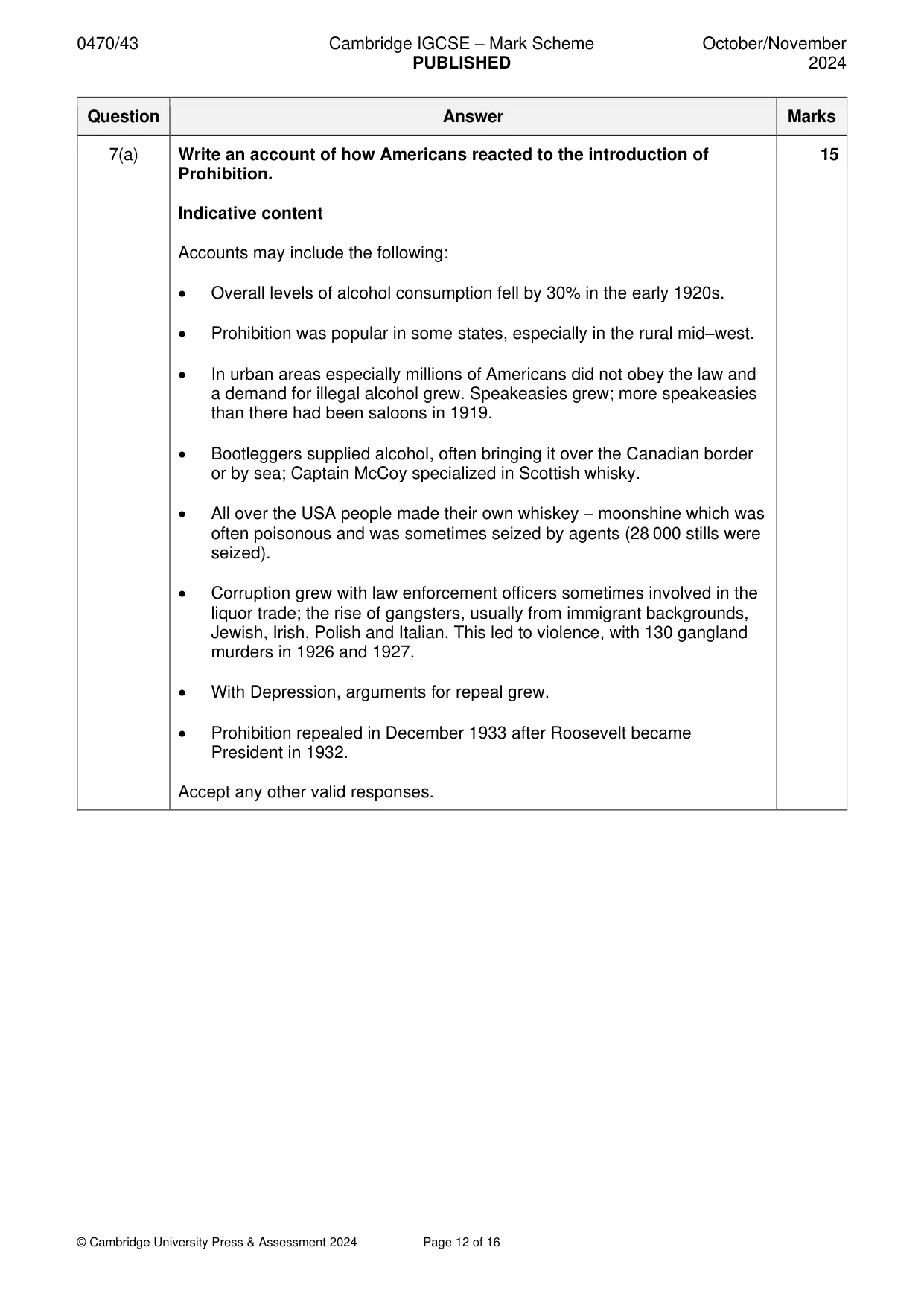
0470/43 Cambridge IGCSE – Mark Scheme PUBLISHED October/November 2024 © Cambridge University Press & Assessment 2024 Page 12 of 16 Question Answer Marks 7(a) Write an account of how Americans reacted to the introduction of Prohibition. Indicative content Accounts may include the following: • Overall levels of alcohol consumption fell by 30% in the early 1920s. • Prohibition was popular in some states, especially in the rural mid–west. • In urban areas especially millions of Americans did not obey the law and a demand for illegal alcohol grew. Speakeasies grew; more speakeasies than there had been saloons in 1919. • Bootleggers supplied alcohol, often bringing it over the Canadian border or by sea; Captain McCoy specialized in Scottish whisky. • All over the USA people made their own whiskey – moonshine which was often poisonous and was sometimes seized by agents (28 000 stills were seized). • Corruption grew with law enforcement officers sometimes involved in the liquor trade; the rise of gangsters, usually from immigrant backgrounds, Jewish, Irish, Polish and Italian. This led to violence, with 130 gangland murders in 1926 and 1927. • With Depression, arguments for repeal grew. • Prohibition repealed in December 1933 after Roosevelt became President in 1932. Accept any other valid responses. 15
Mark scheme, page 13
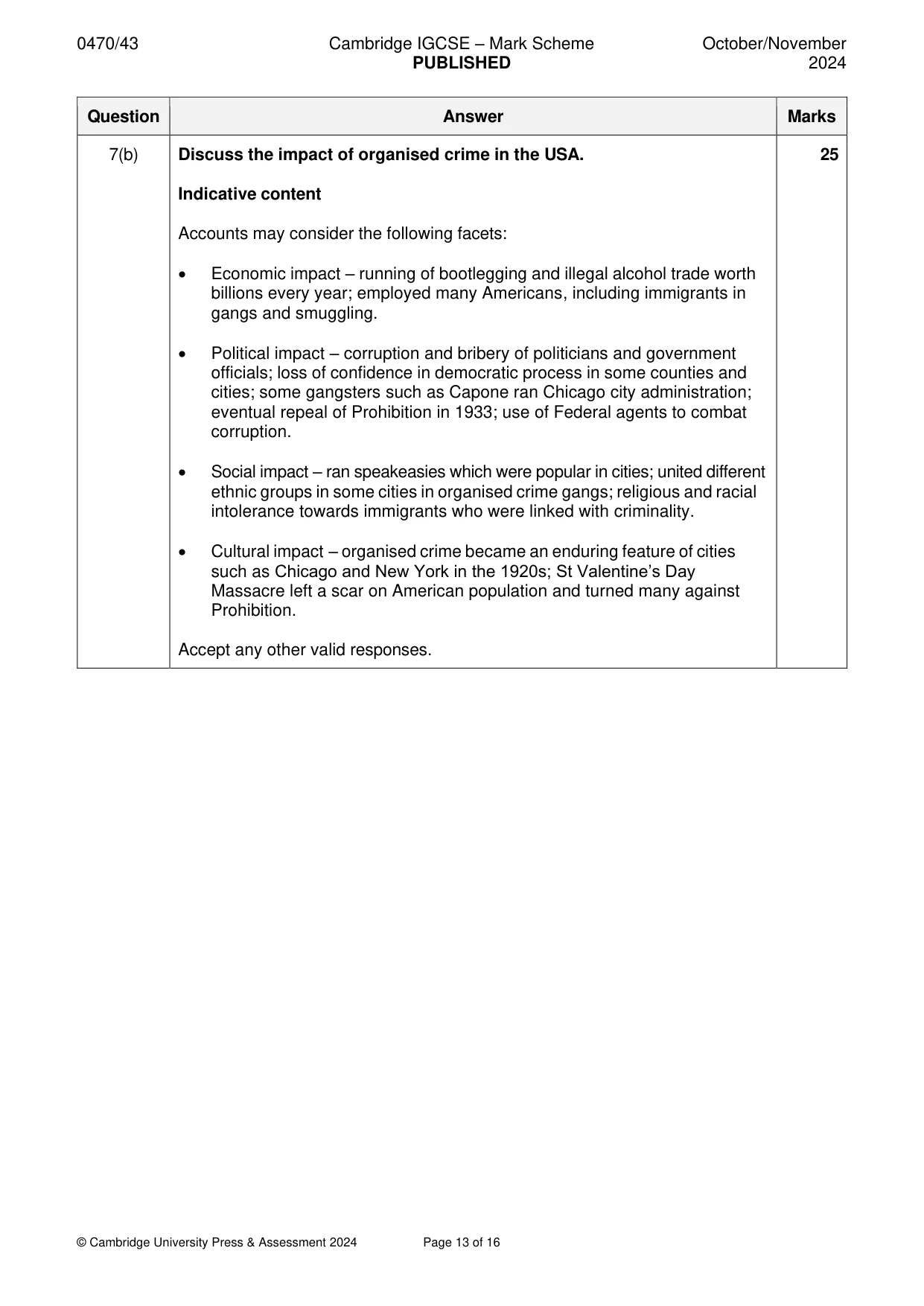
0470/43 Cambridge IGCSE – Mark Scheme PUBLISHED October/November 2024 © Cambridge University Press & Assessment 2024 Page 13 of 16 Question Answer Marks 7(b) Discuss the impact of organised crime in the USA. Indicative content Accounts may consider the following facets: • Economic impact – running of bootlegging and illegal alcohol trade worth billions every year; employed many Americans, including immigrants in gangs and smuggling. • Political impact – corruption and bribery of politicians and government officials; loss of confidence in democratic process in some counties and cities; some gangsters such as Capone ran Chicago city administration; eventual repeal of Prohibition in 1933; use of Federal agents to combat corruption. • Social impact – ran speakeasies which were popular in cities; united different ethnic groups in some cities in organised crime gangs; religious and racial intolerance towards immigrants who were linked with criminality. • Cultural impact – organised crime became an enduring feature of cities such as Chicago and New York in the 1920s; St Valentine’s Day Massacre left a scar on American population and turned many against Prohibition. Accept any other valid responses. 25
Mark scheme, page 14
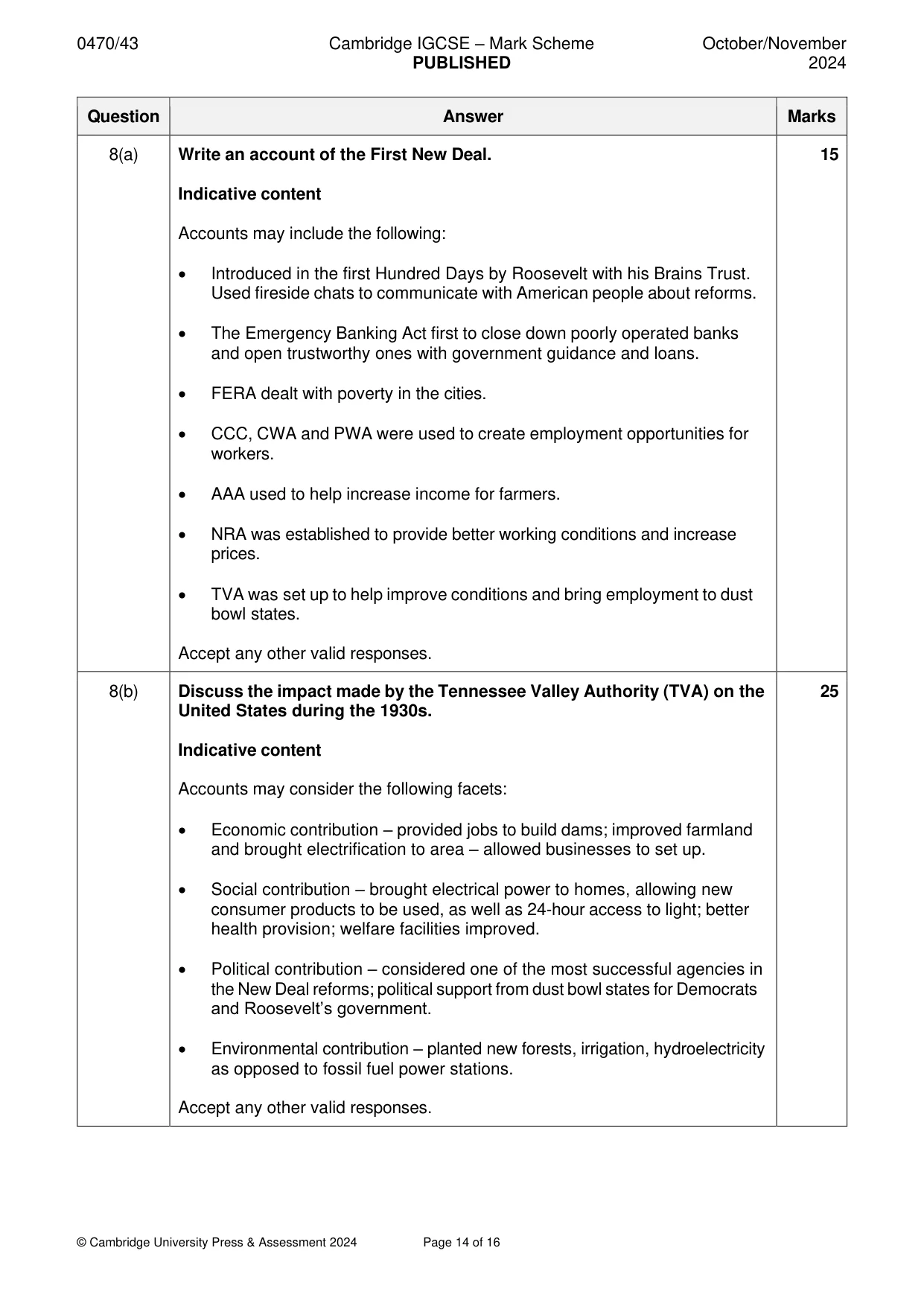
0470/43 Cambridge IGCSE – Mark Scheme PUBLISHED October/November 2024 © Cambridge University Press & Assessment 2024 Page 14 of 16 Question Answer Marks 8(a) Write an account of the First New Deal. Indicative content Accounts may include the following: • Introduced in the first Hundred Days by Roosevelt with his Brains Trust. Used fireside chats to communicate with American people about reforms. • The Emergency Banking Act first to close down poorly operated banks and open trustworthy ones with government guidance and loans. • FERA dealt with poverty in the cities. • CCC, CWA and PWA were used to create employment opportunities for workers. • AAA used to help increase income for farmers. • NRA was established to provide better working conditions and increase prices. • TVA was set up to help improve conditions and bring employment to dust bowl states. Accept any other valid responses. 15 8(b) Discuss the impact made by the Tennessee Valley Authority (TVA) on the United States during the 1930s. Indicative content Accounts may consider the following facets: • Economic contribution – provided jobs to build dams; improved farmland and brought electrification to area – allowed businesses to set up. • Social contribution – brought electrical power to homes, allowing new consumer products to be used, as well as 24-hour access to light; better health provision; welfare facilities improved. • Political contribution – considered one of the most successful agencies in the New Deal reforms; political support from dust bowl states for Democrats and Roosevelt’s government. • Environmental contribution – planted new forests, irrigation, hydroelectricity as opposed to fossil fuel power stations. Accept any other valid responses. 25
Mark scheme, page 15
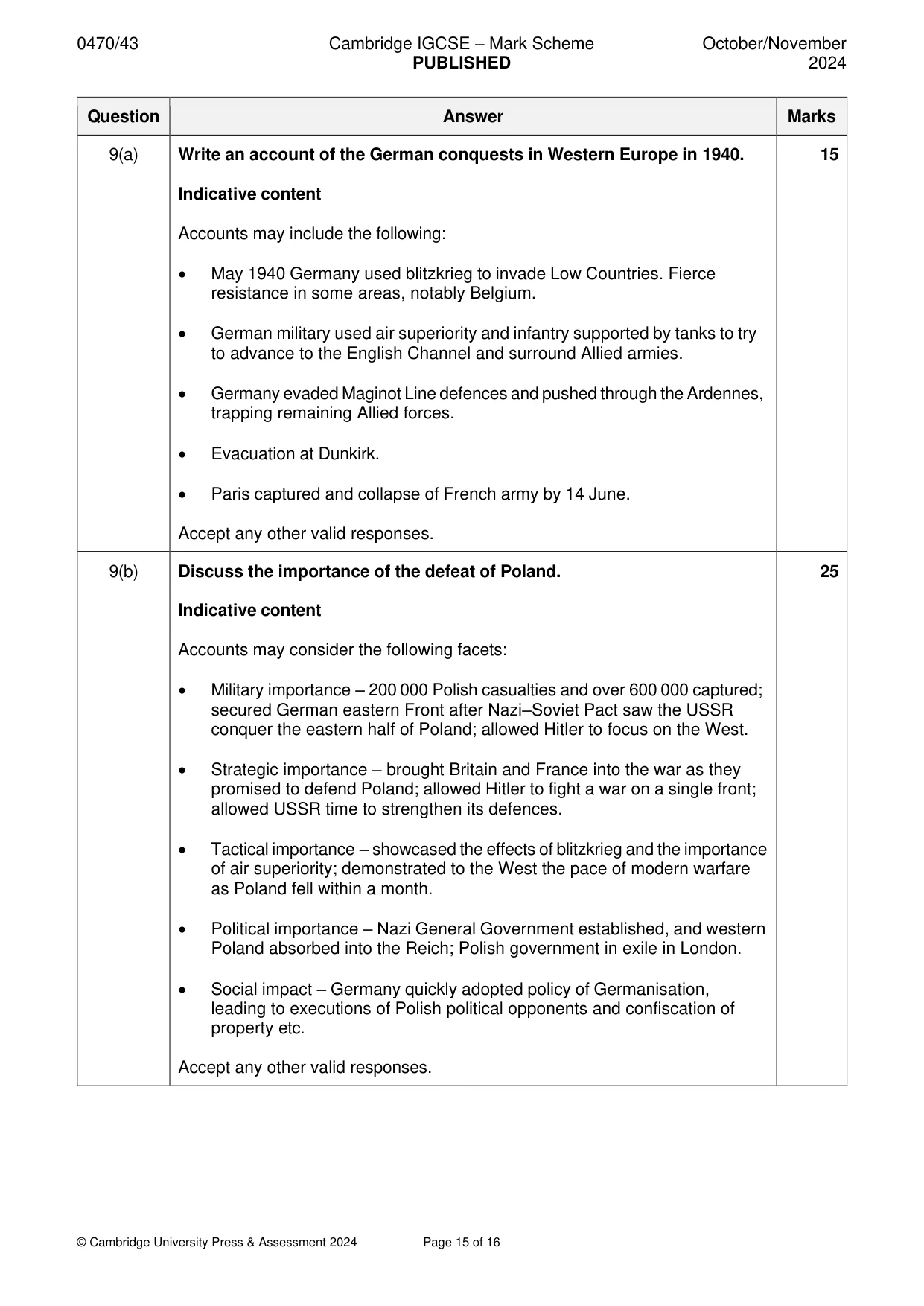
0470/43 Cambridge IGCSE – Mark Scheme PUBLISHED October/November 2024 © Cambridge University Press & Assessment 2024 Page 15 of 16 Question Answer Marks 9(a) Write an account of the German conquests in Western Europe in 1940. Indicative content Accounts may include the following: • May 1940 Germany used blitzkrieg to invade Low Countries. Fierce resistance in some areas, notably Belgium. • German military used air superiority and infantry supported by tanks to try to advance to the English Channel and surround Allied armies. • Germany evaded Maginot Line defences and pushed through the Ardennes, trapping remaining Allied forces. • Evacuation at Dunkirk. • Paris captured and collapse of French army by 14 June. Accept any other valid responses. 15 9(b) Discuss the importance of the defeat of Poland. Indicative content Accounts may consider the following facets: • Military importance – 200 000 Polish casualties and over 600 000 captured; secured German eastern Front after Nazi–Soviet Pact saw the USSR conquer the eastern half of Poland; allowed Hitler to focus on the West. • Strategic importance – brought Britain and France into the war as they promised to defend Poland; allowed Hitler to fight a war on a single front; allowed USSR time to strengthen its defences. • Tactical importance – showcased the effects of blitzkrieg and the importance of air superiority; demonstrated to the West the pace of modern warfare as Poland fell within a month. • Political importance – Nazi General Government established, and western Poland absorbed into the Reich; Polish government in exile in London. • Social impact – Germany quickly adopted policy of Germanisation, leading to executions of Polish political opponents and confiscation of property etc. Accept any other valid responses. 25
Mark scheme, page 16
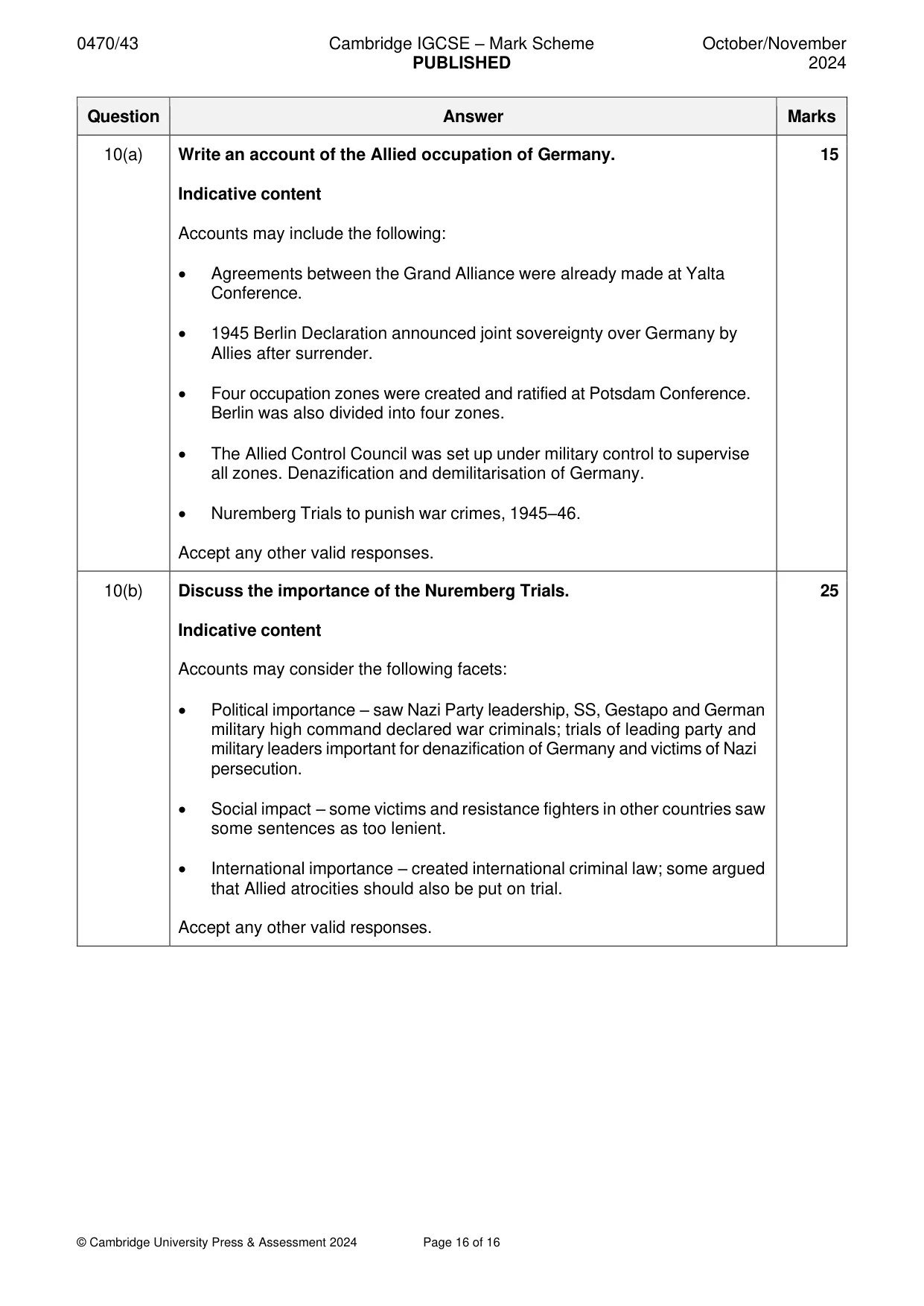
0470/43 Cambridge IGCSE – Mark Scheme PUBLISHED October/November 2024 © Cambridge University Press & Assessment 2024 Page 16 of 16 Question Answer Marks 10(a) Write an account of the Allied occupation of Germany. Indicative content Accounts may include the following: • Agreements between the Grand Alliance were already made at Yalta Conference. • 1945 Berlin Declaration announced joint sovereignty over Germany by Allies after surrender. • Four occupation zones were created and ratified at Potsdam Conference. Berlin was also divided into four zones. • The Allied Control Council was set up under military control to supervise all zones. Denazification and demilitarisation of Germany. • Nuremberg Trials to punish war crimes, 1945–46. Accept any other valid responses. 15 10(b) Discuss the importance of the Nuremberg Trials. Indicative content Accounts may consider the following facets: • Political importance – saw Nazi Party leadership, SS, Gestapo and German military high command declared war criminals; trials of leading party and military leaders important for denazification of Germany and victims of Nazi persecution. • Social impact – some victims and resistance fighters in other countries saw some sentences as too lenient. • International importance – created international criminal law; some argued that Allied atrocities should also be put on trial. Accept any other valid responses. 25
What you needed in this session
Cambridge’s own grade thresholds for 2024 Oct/Nov, Paper 4 · Variant 3. A higher threshold means an easier paper — the bar moves with how the cohort did.